<?xml version="1.0" encoding="ISO-8859-1"?><article xmlns:mml="http://www.w3.org/1998/Math/MathML" xmlns:xlink="http://www.w3.org/1999/xlink" xmlns:xsi="http://www.w3.org/2001/XMLSchema-instance">
<front>
<journal-meta>
<journal-id>0213-9111</journal-id>
<journal-title><![CDATA[Gaceta Sanitaria]]></journal-title>
<abbrev-journal-title><![CDATA[Gac Sanit]]></abbrev-journal-title>
<issn>0213-9111</issn>
<publisher>
<publisher-name><![CDATA[Sociedad Española de Salud Pública y Administración Sanitaria (SESPAS)]]></publisher-name>
</publisher>
</journal-meta>
<article-meta>
<article-id>S0213-91112013000200014</article-id>
<article-id pub-id-type="doi">10.1016/j.gaceta.2011.12.006</article-id>
<title-group>
<article-title xml:lang="en"><![CDATA[Registered prevalence of borderline personality disorder in primary care databases]]></article-title>
<article-title xml:lang="es"><![CDATA[Prevalencia registrada del trastorno límite de personalidad en las bases de datos de atención primaria]]></article-title>
</title-group>
<contrib-group>
<contrib contrib-type="author">
<name>
<surname><![CDATA[Aragonès]]></surname>
<given-names><![CDATA[Enric]]></given-names>
</name>
<xref ref-type="aff" rid="A01"/>
<xref ref-type="aff" rid="A02"/>
</contrib>
<contrib contrib-type="author">
<name>
<surname><![CDATA[Salvador-Carulla]]></surname>
<given-names><![CDATA[Luis]]></given-names>
</name>
<xref ref-type="aff" rid="A03"/>
</contrib>
<contrib contrib-type="author">
<name>
<surname><![CDATA[López-Muntaner]]></surname>
<given-names><![CDATA[Judit]]></given-names>
</name>
<xref ref-type="aff" rid="A01"/>
<xref ref-type="aff" rid="A02"/>
</contrib>
<contrib contrib-type="author">
<name>
<surname><![CDATA[Ferrer]]></surname>
<given-names><![CDATA[Marc]]></given-names>
</name>
<xref ref-type="aff" rid="A04"/>
<xref ref-type="aff" rid="A05"/>
<xref ref-type="aff" rid="A06"/>
</contrib>
<contrib contrib-type="author">
<name>
<surname><![CDATA[Piñol]]></surname>
<given-names><![CDATA[Josep Lluís]]></given-names>
</name>
<xref ref-type="aff" rid="A01"/>
<xref ref-type="aff" rid="A02"/>
</contrib>
</contrib-group>
<aff id="A01">
<institution><![CDATA[,Catalan Health Institute Tarragona-Reus Primary Care Area Research Unit]]></institution>
<addr-line><![CDATA[Tarragona ]]></addr-line>
<country>Spain</country>
</aff>
<aff id="A02">
<institution><![CDATA[,Primary Care Research Institute (IDIAP) Jordi Gol  ]]></institution>
<addr-line><![CDATA[Barcelona ]]></addr-line>
<country>Spain</country>
</aff>
<aff id="A03">
<institution><![CDATA[,University of Cádiz Psychiatry Unit ]]></institution>
<addr-line><![CDATA[Cádiz ]]></addr-line>
<country>Spain</country>
</aff>
<aff id="A04">
<institution><![CDATA[,University Hospital Vall d´Hebron Psychiatry Department ]]></institution>
<addr-line><![CDATA[ ]]></addr-line>
</aff>
<aff id="A05">
<institution><![CDATA[,Centre for Biomedical Research in Mental Health Network (CIBERSAM)  ]]></institution>
<addr-line><![CDATA[Barcelona ]]></addr-line>
<country>Spain</country>
</aff>
<aff id="A06">
<institution><![CDATA[,Universitat Autònoma de Barcelona Psychiatry and Legal Medicine Department ]]></institution>
<addr-line><![CDATA[Barcelona ]]></addr-line>
<country>Spain</country>
</aff>
<pub-date pub-type="pub">
<day>00</day>
<month>04</month>
<year>2013</year>
</pub-date>
<pub-date pub-type="epub">
<day>00</day>
<month>04</month>
<year>2013</year>
</pub-date>
<volume>27</volume>
<numero>2</numero>
<fpage>171</fpage>
<lpage>174</lpage>
<copyright-statement/>
<copyright-year/>
<self-uri xlink:href="http://scielo.isciii.es/scielo.php?script=sci_arttext&amp;pid=S0213-91112013000200014&amp;lng=en&amp;nrm=iso"></self-uri><self-uri xlink:href="http://scielo.isciii.es/scielo.php?script=sci_abstract&amp;pid=S0213-91112013000200014&amp;lng=en&amp;nrm=iso"></self-uri><self-uri xlink:href="http://scielo.isciii.es/scielo.php?script=sci_pdf&amp;pid=S0213-91112013000200014&amp;lng=en&amp;nrm=iso"></self-uri><abstract abstract-type="short" xml:lang="en"><p><![CDATA[Objective: Borderline personality disorder (BPD) is a common personality disorder, with a population prevalence of 1.4-5.9%, although the epidemiology of this disorder in primary care is insufficiently known. Our objective was to determine the registered prevalence of BPD in primary care databases and to study the demographic and clinical characteristics of these patients. Methods: We performed a cross-sectional study of the computerized databases of primary care clinical records. The target population consisted of all adults (> 16 years old) registered in the Catalan Health Institute (n = 4,764,729). Results: The prevalence of recorded BPD was 0.017%, and was higher in patients with other mental disorders, particularly substance-abuse disorders (0.161%). These patients had twice as many appointments with the general practitioner as the general population (8.1 vs. 4.4). Conclusion: The number of diagnoses of BPD recorded in primary care is extremely low, which contrasts with the available population-based data.]]></p></abstract>
<abstract abstract-type="short" xml:lang="es"><p><![CDATA[Objetivo: El trastorno límite de la personalidad (TLP) es frecuente, con una prevalencia poblacional del 1,4% al 5,9%, aunque la epidemiología de este trastorno en atención primaria es escasamente conocida. Nuestro objetivo es determinar la prevalencia registrada de TLP en atención primaria y estudiar las características de estos pacientes. Métodos: Estudio transversal de las bases de datos informatizadas de las historias clínicas de atención primaria. La población diana son los adultos (>16 años) registrados en el Instituto Catalán de la Salud (n = 4.764.729). Resultados: La prevalencia de TLP registrada es del 0,017%, y es mayor en los pacientes con otros trastornos mentales, particularmente trastornos por abuso de sustancias (0,161%). Estos pacientes duplican las visitas al médico general de la población general (8,1 frente a 4,4). Conclusión: Los diagnósticos de TLP registrados en atención primaria son escasos, lo que contrasta con los datos poblacionales disponibles.]]></p></abstract>
<kwd-group>
<kwd lng="en"><![CDATA[Borderline personality disorder]]></kwd>
<kwd lng="en"><![CDATA[Primary health care]]></kwd>
<kwd lng="en"><![CDATA[Comorbidity]]></kwd>
<kwd lng="en"><![CDATA[Prevalence]]></kwd>
<kwd lng="en"><![CDATA[Clinical records]]></kwd>
<kwd lng="es"><![CDATA[Trastorno límite de la personalidad]]></kwd>
<kwd lng="es"><![CDATA[Atención primaria de salud]]></kwd>
<kwd lng="es"><![CDATA[Comorbilidad]]></kwd>
<kwd lng="es"><![CDATA[Prevalencia]]></kwd>
<kwd lng="es"><![CDATA[Historias clínicas]]></kwd>
</kwd-group>
</article-meta>
</front><body><![CDATA[ <p><a name="top"></a><font face="Verdana" size="2"><b>BRIEF ORIGINAL ARTICLE</b></font></p>     <p>&nbsp;</p>     <p><font face="Verdana" size="4"><b>Registered prevalence of borderline personality disorder in primary care databases</b></font></p>     <p><font face="Verdana" size="4"><b>Prevalencia registrada del trastorno límite de personalidad en las bases de datos de atención primaria</b></font></p>     <p>&nbsp;</p>     <p>&nbsp;</p>     <p><font face="Verdana" size="2"><b>Enric Aragonès<sup>a,b</sup>, Luis Salvador-Carulla<sup>c</sup>, Judit López-Muntaner<sup>a,b</sup>, Marc Ferrer<sup>d,e</sup> y Josep Lluís Piñol<sup>a,b</sup></b></font></p>     <p><font face="Verdana" size="2"><sup>a</sup>Research Unit, Tarragona-Reus Primary Care Area, Catalan Health Institute, Tarragona, Spain    <br><sup>b</sup>Primary Care Research Institute (IDIAP) Jordi Gol, Barcelona, Spain    <br><sup>c</sup>Psychiatry Unit, University of Cádiz, Cádiz, Spain    ]]></body>
<body><![CDATA[<br><sup>d</sup>Psychiatry Department, University Hospital Vall d´Hebron, Centre for Biomedical Research in Mental Health Network (CIBERSAM), Barcelona, Spain    <br><sup>e</sup>Psychiatry and Legal Medicine Department, Universitat Autònoma de Barcelona, Barcelona, Spain</font></p>     <p><font face="Verdana" size="2"><a href="#bajo">Correspondence</a></font></p>     <p>&nbsp;</p>     <p>&nbsp;</p> <hr size="1">     <p><font face="Verdana" size="2"><b>ABSTRACT</b></font></p>     <p><font face="Verdana" size="2"><b>Objective:</b> Borderline personality disorder (BPD) is a common personality disorder, with a population prevalence of 1.4-5.9%, although the epidemiology of this disorder in primary care is insufficiently known. Our objective was to determine the registered prevalence of BPD in primary care databases and to study the demographic and clinical characteristics of these patients.    <br><b>Methods:</b> We performed a cross-sectional study of the computerized databases of primary care clinical records. The target population consisted of all adults (<u>&gt;</u> 16 years old) registered in the Catalan Health Institute (n = 4,764,729).    <br><b>Results:</b> The prevalence of recorded BPD was 0.017%, and was higher in patients with other mental disorders, particularly substance-abuse disorders (0.161%). These patients had twice as many appointments with the general practitioner as the general population (8.1 vs. 4.4).    <br><b>Conclusion:</b> The number of diagnoses of BPD recorded in primary care is extremely low, which contrasts with the available population-based data.</font></p>     ]]></body>
<body><![CDATA[<p><font face="Verdana" size="2"><b>Key words:</b> Borderline personality disorder. Primary health care. Comorbidity. Prevalence. Clinical records.</font></p> <hr size="1">     <p><font face="Verdana" size="2"><b>RESUMEN</b></font></p>     <p><font face="Verdana" size="2"><b>Objetivo:</b> El trastorno límite de la personalidad (TLP) es frecuente, con una prevalencia poblacional del 1,4% al 5,9%, aunque la epidemiología de este trastorno en atención primaria es escasamente conocida. Nuestro objetivo es determinar la prevalencia registrada de TLP en atención primaria y estudiar las características de estos pacientes.    <br><b>Métodos:</b> Estudio transversal de las bases de datos informatizadas de las historias clínicas de atención primaria. La población diana son los adultos (<u>&gt;</u>16 años) registrados en el Instituto Catalán de la Salud (n = 4.764.729).    <br><b>Resultados:</b> La prevalencia de TLP registrada es del 0,017%, y es mayor en los pacientes con otros trastornos mentales, particularmente trastornos por abuso de sustancias (0,161%). Estos pacientes duplican las visitas al médico general de la población general (8,1 frente a 4,4).    <br><b>Conclusión:</b> Los diagnósticos de TLP registrados en atención primaria son escasos, lo que contrasta con los datos poblacionales disponibles.</font></p>     <p><font face="Verdana" size="2"><b>Palabras clave:</b> Trastorno límite de la personalidad. Atención primaria de salud. Comorbilidad. Prevalencia. Historias clínicas.</font></p> <hr size="1">     <p>&nbsp;</p>     <p><font face="Verdana" size="2"><b>Introduction</b></font></p>     <p><font face="Verdana" size="2">Borderline personality disorder (BPD) is a chronic psychiatric disorder characterized by emotional instability and difficulties in interpersonal relationships and impulse control. Patients with BPD often show self-destructive behaviors and are at significant risk of suicide.<sup>1,2</sup> Functional deterioration can be considerable and persistent,<sup>3</sup> and there are high rates of comorbidity with other mental disorders.<sup>4, 5</sup> Epidemiological studies in the general population have reported prevalence estimations of between 1.4% and 5.9%.<sup>6, 7</sup></font></p>     ]]></body>
<body><![CDATA[<p><font face="Verdana" size="2">Although little is known about the prevalence and characteristics of patients with BPD in primary care, they are often great users of health services<sup>8</sup> and have been described as difficult, demanding, manipulative and unwilling to respect rules. In a sample of consecutive primary care patients, Gross et al.<sup>9</sup> found a prevalence of 6.4% -about four times higher than the estimated population prevalence- that were frequently not detected or treated. The aim of this study was to determine the prevalence of BPD recorded in the databases of primary care medical records in Catalonia and to study the demographic and clinical characteristics of these patients.</font></p>     <p>&nbsp;</p>     <p><font face="Verdana" size="2"><b>Methods</b></font></p>     <p><font face="Verdana" size="2">Spain has a highly developed primary care system with universal coverage organized by catchment areas and providing care for over 97% of the population. Public health centers are staffed with general practitioners, pediatricians, nurses and other personnel. Doctors have a patient list and are gatekeepers to specialist care. Since medication can be expensive, even the population with duplicate coverage (private insurance bought on top of public coverage) that does not usually consult with their public sector general practitioner have an incentive to contact the health center in order to obtain subsidized official prescriptions. This system is linked to mental health care centers.<sup>10</sup> Therefore, primary care databases register information on most of the population attended in the healthcare system. Our cross-sectional analysis focused on the database of the Information System for the Development of Research in Primary Care (<i>Sistema d´Informació per al Desenvolupament de la Investigació en Atenció Primària</i> &#091;SIDIAP&#093;, IDIAP-Jordi Gol) database. This database contains all the primary care medical records of the Catalan Health Institute (<i>Institut Català de la Salut</i> &#091;ICS&#093;). The ICS is the main public supplier of healthcare in Catalonia and covers 76.6% of the population.<sup>11</sup> The target population consists of all individuals aged 16 years old or over registered at ICS primary care centers.</font></p>     <p><font face="Verdana" size="2"><i>Measures and statistical analysis</i></font></p>     <p><font face="Verdana" size="2">We identified the proportion of patients with a diagnosis of BPD (code F60.3/ICD-10) recorded as an active health problem in their clinical record on 31/12/2010, regardless of the time when the diagnosis was registered. This overall figure was then broken down according to demographic characteristics (sex, age) and the presence of other mental disorders: substance abuse disorders, except nicotine (codes F10-19, except F17/ICD-10), psychotic disorders (codes F20-29/ICD-10), affective disorders (codes F30-39/ICD-10) and anxiety/neurotic disorders (codes F40-48/ICD-10). The odds ratios were calculated (95%CI) to evaluate how the presence of the recorded diagnosis of BPD was associated with these patient characteristics. For these calculations, we used the EPIDAT 3.1 statistical software. In individuals with BDP we investigated the use of psychiatric drugs, psychiatric comorbidity and the number of visits made to their general practitioner in a year.</font></p>     <p>&nbsp;</p>     <p><font face="Verdana" size="2"><b>Results</b></font></p>     <p><font face="Verdana" size="2">Data from 4,764,729 individuals were evaluated. A total of 829 had a recorded diagnosis of BDP (0.017%). The rates in men (0.018%) and women (0.016%) were similar. There was an inverse relationship between prevalence and age: prevalence was higher under 24 years (0.031%) and was lower above 35 years (0.014%). The prevalences of BPD were higher in patients with other mental disorders, especially substance abuse disorders (0.161%) (<a target="_blank" href="/img/revistas/gs/v27n2/original_breve5_t1.jpg">Table 1</a>).</font></p>     <p><font face="Verdana" size="2">Patients with BPD often had comorbid mental disorders, consisting of affective disorders in 26.3%, neurotic disorders in 38.1%, psychotic disorders in 5.1%, and substance abuse (most frequently alcohol) in 21.5%. These patients often consumed psychiatric drugs, particularly antidepressants (37.6%) and anxiolytics (37.4%). Of all the patients with BPD, 89.4% had visited their general practitioner during the year, with a mean of 8.1 visits per patient (<a href="#t2">Table 2</a>).</font></p>     ]]></body>
<body><![CDATA[<p align="center"><font face="Verdana" size="2"><a name="t2"><img src="/img/revistas/gs/v27n2/original_breve5_t2.jpg"></a></font></p>     <p>&nbsp;</p>     <p><font face="Verdana" size="2"><b>Discussion</b></font></p>     <p><font face="Verdana" size="2">We found that 0.017% of adult patients had a diagnosis of BDP in their clinical records, a percentage that is a long way from the prevalences reported by epidemiological studies in the general population or primary care.<sup>6, 7, 9</sup> The discrepancy between the data is clear: the recorded prevalence of BPD is 82 times lower than the population prevalence reported by Lenzenweger et al.<sup>6</sup> (0.017% versus 1.4%). This difference is even greater if compared with the 5.9% reported by Grant et al.<sup>7</sup> or the 6.4% reported by Gross et al.<sup>9</sup> in primary care patients. Comparison of these epidemiological data with data obtained from clinical records is difficult but it can be assumed that if BPD is detected and diagnosed "appropriately", the prevalence of the diagnoses on record should be closer to the population prevalence. The substantial discrepancy between the two figures suggests considerable underdiagnosis. Importantly, all relevant information about health status should be recorded in the primary care medical records, whether the health problems are handled in the primary care setting or at other levels of care.</font></p>     <p><font face="Verdana" size="2">We were also able to show that the demographic and clinical characteristics related to the recorded diagnosis of BPD are in agreement with the data reported in epidemiological studies in the general population<sup>6,7</sup> or clinical populations:<sup>1</sup> the frequency was similar between both sexes (in psychiatric patients there tends to be a higher percentage of women<sup>1, 2</sup> but in the general population the prevalence is similar in both sexes<sup>6,7</sup>), the prevalence decreases with age, and there are considerable comorbidity relations with other mental disorders, particularly substance abuse/consumption.<sup>12</sup> Patients with BPD make considerable use of health services<sup>8</sup> and this phenomenon was also the case in our primary care patients: on average, over the course of a year, these patients visited the primary care doctor twice as often as the general adult population in Catalonia<sup>13</sup> (8.1 versus 4.4 annual visits).</font></p>     <p><font face="Verdana" size="2">The data used for this study have some drawbacks, however. The diagnosis of those patients with BPD mainly treated by psychiatric services may not be included in the primary care medical records. General practitioners may not be aware that a patient has been diagnosed with BPD and, even if they are, they may not see the usefulness of this diagnostic label as it may not have a substantial effect on the primary care therapeutic plan. In some cases, the physician may prefer to save the patient from the stigma associated with a diagnosis of a personality disorder.<sup>14</sup> An added difficulty for appropriate diagnosis is that the name given in the ICD-10 -Emotionally unstable personality disorder- is quite different from the better known name used in DSM-IV -Borderline personality disorder.</font></p>     <p><font face="Verdana" size="2">Each year a large proportion of the population contacts primary care,<sup>13</sup> mainly individuals with psychological distress. Primary care plays a fundamental role in the management of the most common mental disorders. Although BPD is generally managed by specialized mental health professionals,<sup>15</sup> some authors have suggested that primary care should play a role in suspected diagnosis and in maintaining continuous care.<sup>15</sup> Likewise, it has been stressed that general practitioners should be aware of the diagnosis of BPD in their patients because this disorder can affect how other common psychiatric disorders (e.g. depression, anxiety, somatization) or even disorders of an organic nature are managed (e.g. obesity, diabetes, AIDS, pain).<sup>16</sup></font></p>     <p><font face="Verdana" size="2">To sum up, BPD is a diagnostic category that is used very little in primary care. This study confirms that there is a considerable gap between the real prevalence of BPD in the population and its prevalence in clinical records. This conclusion, however, generates new questions that need to be answered by future research to determine whether the use of this diagnostic category in primary care could improve the management of these patients and to establish the role that primary care could or should have in the detection and management of this disorder.</font></p>     <p>&nbsp;</p>     <p><font face="Verdana" size="2"><img border="0" src="/img/revistas/gs/v27n2/original_breve5_cuadro.jpg"></font></p>     ]]></body>
<body><![CDATA[<p>&nbsp;</p>     <p><font face="Verdana" size="2"><b>Authors´ contributions</b></font></p>     <p><font face="Verdana" size="2">E. Aragonès is the principal investigator and developed the original idea for the study. E. Aragonès is the study's guarantor. The study design was further developed by E. Aragonès, L. Salvador-Carulla, J.L. Piñol, J. López-Muntaner and M. Ferrer. J.L. Piñol and E. Aragonès performed the statistical analysis. E. Aragonès drafted the manuscript and all authors have read and revised versions of the draft and have approved the final version.</font></p>     <p>&nbsp;</p>     <p><font face="Verdana" size="2"><b>Funding</b></font></p>     <p><font face="Verdana" size="2">None.</font></p>     <p>&nbsp;</p>     <p><font face="Verdana" size="2"><b>Competing interests</b></font></p>     <p><font face="Verdana" size="2">None.</font></p>     <p>&nbsp;</p>     ]]></body>
<body><![CDATA[<p><b><font face="Verdana" size="2">Acknowledgments</font></b></p>     <p><font face="Verdana" size="2">We are grateful to Francesc Fina of the SIDIAP (Information System for the Development of Research in Primary Care) for his kind collaboration in extracting the data used in this article.</font></p>     <p><font face="Verdana" size="2">Marc Ferrer is grateful for the support provided by the Plan on Mental Health and Addictions (Government of Catalonia, Health Department) and grants from the Obra Social-"La Caixa" Foundation.</font></p>     <p>&nbsp;</p>     <p><font face="Verdana" size="2"><b>References</b></font></p>     <!-- ref --><p><font face="Verdana" size="2">1. Leichsenring F, Leibing E, Kruse J, et al. Borderline personality disorder. Lancet. 2011; 377:74-84.    &nbsp;&nbsp;&nbsp;&nbsp;&nbsp;&nbsp;&nbsp;&nbsp;[&#160;<a href="javascript:void(0);" onclick="javascript: window.open('/scielo.php?script=sci_nlinks&ref=2468932&pid=S0213-9111201300020001400001&lng=','','width=640,height=500,resizable=yes,scrollbars=1,menubar=yes,');">Links</a>&#160;]<!-- end-ref --></font></p>    <!-- ref --><p><font face="Verdana" size="2">2. Gunderson JG. Borderline personality disorder. N Engl J Med. 2011; 364:2037-42.    &nbsp;&nbsp;&nbsp;&nbsp;&nbsp;&nbsp;&nbsp;&nbsp;[&#160;<a href="javascript:void(0);" onclick="javascript: window.open('/scielo.php?script=sci_nlinks&ref=2468934&pid=S0213-9111201300020001400002&lng=','','width=640,height=500,resizable=yes,scrollbars=1,menubar=yes,');">Links</a>&#160;]<!-- end-ref --></font></p>    <!-- ref --><p><font face="Verdana" size="2">3. Gunderson JG, Stout RL, McGlashan TH, et al. Ten-year course of borderline personality disorder: psychopathology and function from the Collaborative Longitudinal Personality Disorders Study. Arch Gen Psychiatry. 2011; 68:827-37.    &nbsp;&nbsp;&nbsp;&nbsp;&nbsp;&nbsp;&nbsp;&nbsp;[&#160;<a href="javascript:void(0);" onclick="javascript: window.open('/scielo.php?script=sci_nlinks&ref=2468936&pid=S0213-9111201300020001400003&lng=','','width=640,height=500,resizable=yes,scrollbars=1,menubar=yes,');">Links</a>&#160;]<!-- end-ref --></font></p>    <!-- ref --><p><font face="Verdana" size="2">4. Zanarini MC, Frankenburg FR, Hennen J, et al. Axis I comorbidity in patients with borderline personality disorder: 6-year follow-up and prediction of time to remission. Am J Psychiatry. 2004; 161:2108-14.    &nbsp;&nbsp;&nbsp;&nbsp;&nbsp;&nbsp;&nbsp;&nbsp;[&#160;<a href="javascript:void(0);" onclick="javascript: window.open('/scielo.php?script=sci_nlinks&ref=2468938&pid=S0213-9111201300020001400004&lng=','','width=640,height=500,resizable=yes,scrollbars=1,menubar=yes,');">Links</a>&#160;]<!-- end-ref --></font></p>    <!-- ref --><p><font face="Verdana" size="2">5. Zanarini MC, Frankenburg FR, Vujanovic AA, et al. Axis II comorbidity of borderline personality disorder: description of 6-year course and prediction to time-to-remission. Acta Psychiatr Scand. 2004; 110:416-20.    &nbsp;&nbsp;&nbsp;&nbsp;&nbsp;&nbsp;&nbsp;&nbsp;[&#160;<a href="javascript:void(0);" onclick="javascript: window.open('/scielo.php?script=sci_nlinks&ref=2468940&pid=S0213-9111201300020001400005&lng=','','width=640,height=500,resizable=yes,scrollbars=1,menubar=yes,');">Links</a>&#160;]<!-- end-ref --></font></p>    <!-- ref --><p><font face="Verdana" size="2">6. Lenzenweger MF, Lane MC, Loranger AW, et al. DSM-IV personality disorders in the National Comorbidity Survey Replication. Biol Psychiatry. 2007; 62:553-64.    &nbsp;&nbsp;&nbsp;&nbsp;&nbsp;&nbsp;&nbsp;&nbsp;[&#160;<a href="javascript:void(0);" onclick="javascript: window.open('/scielo.php?script=sci_nlinks&ref=2468942&pid=S0213-9111201300020001400006&lng=','','width=640,height=500,resizable=yes,scrollbars=1,menubar=yes,');">Links</a>&#160;]<!-- end-ref --></font></p>    <!-- ref --><p><font face="Verdana" size="2">7. Grant BF, Chou SP, Goldstein RB, et al. Prevalence, correlates, disability, and comorbidity of DSM-IV borderline personality disorder: results from the Wave 2 National Epidemiologic Survey on Alcohol and Related Conditions. J Clin Psychiatry. 2008; 69:533-45.    &nbsp;&nbsp;&nbsp;&nbsp;&nbsp;&nbsp;&nbsp;&nbsp;[&#160;<a href="javascript:void(0);" onclick="javascript: window.open('/scielo.php?script=sci_nlinks&ref=2468944&pid=S0213-9111201300020001400007&lng=','','width=640,height=500,resizable=yes,scrollbars=1,menubar=yes,');">Links</a>&#160;]<!-- end-ref --></font></p>    <!-- ref --><p><font face="Verdana" size="2">8. Sansone RA, Farukhi S, Wiederman MW. Utilization of primary care physicians in borderline personality. Gen Hosp Psychiatry. 2011; 33:343-6.    &nbsp;&nbsp;&nbsp;&nbsp;&nbsp;&nbsp;&nbsp;&nbsp;[&#160;<a href="javascript:void(0);" onclick="javascript: window.open('/scielo.php?script=sci_nlinks&ref=2468946&pid=S0213-9111201300020001400008&lng=','','width=640,height=500,resizable=yes,scrollbars=1,menubar=yes,');">Links</a>&#160;]<!-- end-ref --></font></p>    <!-- ref --><p><font face="Verdana" size="2">9. Gross R, Olfson M, Gameroff M, et al. Borderline personality disorder in primary care. Arch Intern Med. 2002; 162:53-60.    &nbsp;&nbsp;&nbsp;&nbsp;&nbsp;&nbsp;&nbsp;&nbsp;[&#160;<a href="javascript:void(0);" onclick="javascript: window.open('/scielo.php?script=sci_nlinks&ref=2468948&pid=S0213-9111201300020001400009&lng=','','width=640,height=500,resizable=yes,scrollbars=1,menubar=yes,');">Links</a>&#160;]<!-- end-ref --></font></p>    <!-- ref --><p><font face="Verdana" size="2">10. Borkan J, Eaton CB, Novillo-Ortiz D, et al. Renewing primary care: lessons learned from the Spanish health care system. Health Aff (Millwood). 2010; 29:1432-41.    &nbsp;&nbsp;&nbsp;&nbsp;&nbsp;&nbsp;&nbsp;&nbsp;[&#160;<a href="javascript:void(0);" onclick="javascript: window.open('/scielo.php?script=sci_nlinks&ref=2468950&pid=S0213-9111201300020001400010&lng=','','width=640,height=500,resizable=yes,scrollbars=1,menubar=yes,');">Links</a>&#160;]<!-- end-ref --></font></p>    <!-- ref --><p><font face="Verdana" size="2">11. Institut Català de la Salut. Memòria 2009. Barcelona: Generalitat de Catalunya; 2010. 32p. (Accesed on November 9, 2011). Available at: <a target="_blank" href="http://www.gencat.cat/ics/infocorp/pdf/memoria_2009.pdf">http://www.gencat.cat/ics/infocorp/pdf/memoria_2009.pdf</a></font>&nbsp;&nbsp;&nbsp;&nbsp;&nbsp;&nbsp;&nbsp;&nbsp;[&#160;<a href="javascript:void(0);" onclick="javascript: window.open('/scielo.php?script=sci_nlinks&ref=2468952&pid=S0213-9111201300020001400011&lng=','','width=640,height=500,resizable=yes,scrollbars=1,menubar=yes,');">Links</a>&#160;]<!-- end-ref --><!-- ref --><p><font face="Verdana" size="2">12. Torrens M, Gilchrist G, Domingo-Salvany A, psyCoBarcelona Group. Psychiatric comorbidity in illicit drug users: substance-induced versus independent disorders. Drug Alcohol Depend. 2011; 113:147-56.    &nbsp;&nbsp;&nbsp;&nbsp;&nbsp;&nbsp;&nbsp;&nbsp;[&#160;<a href="javascript:void(0);" onclick="javascript: window.open('/scielo.php?script=sci_nlinks&ref=2468953&pid=S0213-9111201300020001400012&lng=','','width=640,height=500,resizable=yes,scrollbars=1,menubar=yes,');">Links</a>&#160;]<!-- end-ref --></font></p>    <!-- ref --><p><font face="Verdana" size="2">13. Departament de Salut. Central de Resultats. 2on Informe. Desembre 2010. Barcelona: Generalitat de Catalunya; 2011, 328 p. (Accesed on November 9, 2011). Available at: <a target="_blank" href="http://www.gencat.cat/salut/depsan/units/aatrm/pdf/central_resultats_segoninforme_2011.pdf">http://www.gencat.cat/salut/depsan/units/aatrm/pdf/central_resultats_segoninforme_2011.pdf</a>.    &nbsp;&nbsp;&nbsp;&nbsp;&nbsp;&nbsp;&nbsp;&nbsp;[&#160;<a href="javascript:void(0);" onclick="javascript: window.open('/scielo.php?script=sci_nlinks&ref=2468955&pid=S0213-9111201300020001400013&lng=','','width=640,height=500,resizable=yes,scrollbars=1,menubar=yes,');">Links</a>&#160;]<!-- end-ref --></font></p>    ]]></body>
<body><![CDATA[<!-- ref --><p><font face="Verdana" size="2">14. Newton-Howes G, Weaver T, Tyrer P. Attitudes of staff towards patients with personality disorder in community mental health teams. Aust N Z J Psychiatry. 2008; 42:572-7.    &nbsp;&nbsp;&nbsp;&nbsp;&nbsp;&nbsp;&nbsp;&nbsp;[&#160;<a href="javascript:void(0);" onclick="javascript: window.open('/scielo.php?script=sci_nlinks&ref=2468957&pid=S0213-9111201300020001400014&lng=','','width=640,height=500,resizable=yes,scrollbars=1,menubar=yes,');">Links</a>&#160;]<!-- end-ref --></font></p>    <!-- ref --><p><font face="Verdana" size="2">15. Grupo de trabajo de la guía de práctica clínica sobre trastorno límite de la personalidad. Guía de práctica clínica sobre trastorno límite de la personalidad. Barcelona: Agència d´Informació, Avaluació i Qualitat en Salut; 2011. 323p, (Accesed on November 9, 2011). Available at: <a target="_blank" href="http://www.gencat.cat/salut/depsan/units/aatrm/pdf/gpc_tlp_2011_completa.pdf">http://www.gencat.cat/salut/depsan/units/aatrm/pdf/gpc_tlp_2011_completa.pdf</a></font>&nbsp;&nbsp;&nbsp;&nbsp;&nbsp;&nbsp;&nbsp;&nbsp;[&#160;<a href="javascript:void(0);" onclick="javascript: window.open('/scielo.php?script=sci_nlinks&ref=2468959&pid=S0213-9111201300020001400015&lng=','','width=640,height=500,resizable=yes,scrollbars=1,menubar=yes,');">Links</a>&#160;]<!-- end-ref --><!-- ref --><p><font face="Verdana" size="2">16. Sansone RA, Sansone LA. Borderline personality. A primary care context. Psychiatry (Edgmont). 2004; 1:19-27.    &nbsp;&nbsp;&nbsp;&nbsp;&nbsp;&nbsp;&nbsp;&nbsp;[&#160;<a href="javascript:void(0);" onclick="javascript: window.open('/scielo.php?script=sci_nlinks&ref=2468960&pid=S0213-9111201300020001400016&lng=','','width=640,height=500,resizable=yes,scrollbars=1,menubar=yes,');">Links</a>&#160;]<!-- end-ref --></font></p>     <p>&nbsp;</p>     <p>&nbsp;</p>     <p><font face="Verdana" size="2"><a href="#top"><img border="0" src="/img/revistas/gs/v27n2/seta.gif" width="15" height="17"></a><a name="bajo"></a><b>Correspondece:</b>    <br><a href="mailto:earagones.tarte.ics@gencat.cat">earagones.tarte.ics@gencat.cat</a>    <br>(E. Aragonès)</font></p>     ]]></body>
<body><![CDATA[<p><font face="Verdana" size="2">Received 9 November 2011    <br>Accepted 26 December 2011</font></p>      ]]></body><back>
<ref-list>
<ref id="B1">
<label>1</label><nlm-citation citation-type="journal">
<person-group person-group-type="author">
<name>
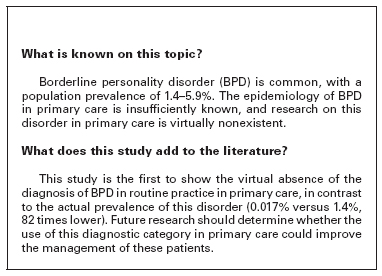
<surname><![CDATA[Leichsenring]]></surname>
<given-names><![CDATA[F]]></given-names>
</name>
<name>
<surname><![CDATA[Leibing]]></surname>
<given-names><![CDATA[E]]></given-names>
</name>
<name>
<surname><![CDATA[Kruse]]></surname>
<given-names><![CDATA[J]]></given-names>
</name>
</person-group>
<article-title xml:lang="en"><![CDATA[Borderline personality disorder]]></article-title>
<source><![CDATA[Lancet]]></source>
<year>2011</year>
<volume>377</volume>
<page-range>74-84</page-range></nlm-citation>
</ref>
<ref id="B2">
<label>2</label><nlm-citation citation-type="journal">
<person-group person-group-type="author">
<name>
<surname><![CDATA[Gunderson]]></surname>
<given-names><![CDATA[JG]]></given-names>
</name>
</person-group>
<article-title xml:lang="en"><![CDATA[Borderline personality disorder]]></article-title>
<source><![CDATA[N Engl J Med]]></source>
<year>2011</year>
<volume>364</volume>
<page-range>2037-42</page-range></nlm-citation>
</ref>
<ref id="B3">
<label>3</label><nlm-citation citation-type="journal">
<person-group person-group-type="author">
<name>
<surname><![CDATA[Gunderson]]></surname>
<given-names><![CDATA[JG]]></given-names>
</name>
<name>
<surname><![CDATA[Stout]]></surname>
<given-names><![CDATA[RL]]></given-names>
</name>
<name>
<surname><![CDATA[McGlashan]]></surname>
<given-names><![CDATA[TH]]></given-names>
</name>
</person-group>
<article-title xml:lang="en"><![CDATA[Ten-year course of borderline personality disorder: psychopathology and function from the Collaborative Longitudinal Personality Disorders Study]]></article-title>
<source><![CDATA[Arch Gen Psychiatry]]></source>
<year>2011</year>
<volume>68</volume>
<page-range>827-37</page-range></nlm-citation>
</ref>
<ref id="B4">
<label>4</label><nlm-citation citation-type="journal">
<person-group person-group-type="author">
<name>
<surname><![CDATA[Zanarini]]></surname>
<given-names><![CDATA[MC]]></given-names>
</name>
<name>
<surname><![CDATA[Frankenburg]]></surname>
<given-names><![CDATA[FR]]></given-names>
</name>
<name>
<surname><![CDATA[Hennen]]></surname>
<given-names><![CDATA[J]]></given-names>
</name>
</person-group>
<article-title xml:lang="en"><![CDATA[Axis I comorbidity in patients with borderline personality disorder: 6-year follow-up and prediction of time to remission]]></article-title>
<source><![CDATA[Am J Psychiatry]]></source>
<year>2004</year>
<volume>161</volume>
<page-range>2108-14</page-range></nlm-citation>
</ref>
<ref id="B5">
<label>5</label><nlm-citation citation-type="journal">
<person-group person-group-type="author">
<name>
<surname><![CDATA[Zanarini]]></surname>
<given-names><![CDATA[MC]]></given-names>
</name>
<name>
<surname><![CDATA[Frankenburg]]></surname>
<given-names><![CDATA[FR]]></given-names>
</name>
<name>
<surname><![CDATA[Vujanovic]]></surname>
<given-names><![CDATA[AA]]></given-names>
</name>
</person-group>
<article-title xml:lang="en"><![CDATA[Axis II comorbidity of borderline personality disorder: description of 6-year course and prediction to time-to-remission]]></article-title>
<source><![CDATA[Acta Psychiatr Scand]]></source>
<year>2004</year>
<volume>110</volume>
<page-range>416-20</page-range></nlm-citation>
</ref>
<ref id="B6">
<label>6</label><nlm-citation citation-type="journal">
<person-group person-group-type="author">
<name>
<surname><![CDATA[Lenzenweger]]></surname>
<given-names><![CDATA[MF]]></given-names>
</name>
<name>
<surname><![CDATA[Lane]]></surname>
<given-names><![CDATA[MC]]></given-names>
</name>
<name>
<surname><![CDATA[Loranger]]></surname>
<given-names><![CDATA[AW]]></given-names>
</name>
</person-group>
<article-title xml:lang="en"><![CDATA[DSM-IV personality disorders in the National Comorbidity Survey Replication]]></article-title>
<source><![CDATA[Biol Psychiatry]]></source>
<year>2007</year>
<volume>62</volume>
<page-range>553-64</page-range></nlm-citation>
</ref>
<ref id="B7">
<label>7</label><nlm-citation citation-type="journal">
<person-group person-group-type="author">
<name>
<surname><![CDATA[Grant]]></surname>
<given-names><![CDATA[BF]]></given-names>
</name>
<name>
<surname><![CDATA[Chou]]></surname>
<given-names><![CDATA[SP]]></given-names>
</name>
<name>
<surname><![CDATA[Goldstein]]></surname>
<given-names><![CDATA[RB]]></given-names>
</name>
</person-group>
<article-title xml:lang="en"><![CDATA[Prevalence, correlates, disability, and comorbidity of DSM-IV borderline personality disorder: results from the Wave 2 National Epidemiologic Survey on Alcohol and Related Conditions]]></article-title>
<source><![CDATA[J Clin Psychiatry]]></source>
<year>2008</year>
<volume>69</volume>
<page-range>533-45</page-range></nlm-citation>
</ref>
<ref id="B8">
<label>8</label><nlm-citation citation-type="journal">
<person-group person-group-type="author">
<name>
<surname><![CDATA[Sansone]]></surname>
<given-names><![CDATA[RA]]></given-names>
</name>
<name>
<surname><![CDATA[Farukhi]]></surname>
<given-names><![CDATA[S]]></given-names>
</name>
<name>
<surname><![CDATA[Wiederman]]></surname>
<given-names><![CDATA[MW]]></given-names>
</name>
</person-group>
<article-title xml:lang="en"><![CDATA[Utilization of primary care physicians in borderline personality]]></article-title>
<source><![CDATA[Gen Hosp Psychiatry]]></source>
<year>2011</year>
<volume>33</volume>
<page-range>343-6</page-range></nlm-citation>
</ref>
<ref id="B9">
<label>9</label><nlm-citation citation-type="journal">
<person-group person-group-type="author">
<name>
<surname><![CDATA[Gross]]></surname>
<given-names><![CDATA[R]]></given-names>
</name>
<name>
<surname><![CDATA[Olfson]]></surname>
<given-names><![CDATA[M]]></given-names>
</name>
<name>
<surname><![CDATA[Gameroff]]></surname>
<given-names><![CDATA[M]]></given-names>
</name>
</person-group>
<article-title xml:lang="en"><![CDATA[Borderline personality disorder in primary care]]></article-title>
<source><![CDATA[Arch Intern Med]]></source>
<year>2002</year>
<volume>162</volume>
<page-range>53-60</page-range></nlm-citation>
</ref>
<ref id="B10">
<label>10</label><nlm-citation citation-type="journal">
<person-group person-group-type="author">
<name>
<surname><![CDATA[Borkan]]></surname>
<given-names><![CDATA[J]]></given-names>
</name>
<name>
<surname><![CDATA[Eaton]]></surname>
<given-names><![CDATA[CB]]></given-names>
</name>
<name>
<surname><![CDATA[Novillo-Ortiz]]></surname>
<given-names><![CDATA[D]]></given-names>
</name>
</person-group>
<article-title xml:lang="en"><![CDATA[Renewing primary care: lessons learned from the Spanish health care system]]></article-title>
<source><![CDATA[Health Aff (Millwood)]]></source>
<year>2010</year>
<volume>29</volume>
<page-range>1432-41</page-range></nlm-citation>
</ref>
<ref id="B11">
<label>11</label><nlm-citation citation-type="book">
<collab>Institut Català de la Salut</collab>
<source><![CDATA[Memòria 2009]]></source>
<year>2010</year>
<publisher-loc><![CDATA[Barcelona ]]></publisher-loc>
<publisher-name><![CDATA[Generalitat de Catalunya]]></publisher-name>
</nlm-citation>
</ref>
<ref id="B12">
<label>12</label><nlm-citation citation-type="journal">
<person-group person-group-type="author">
<name>
<surname><![CDATA[Torrens]]></surname>
<given-names><![CDATA[M]]></given-names>
</name>
<name>
<surname><![CDATA[Gilchrist]]></surname>
<given-names><![CDATA[G]]></given-names>
</name>
<name>
<surname><![CDATA[Domingo-Salvany]]></surname>
<given-names><![CDATA[A]]></given-names>
</name>
</person-group>
<collab>psyCoBarcelona Group</collab>
<article-title xml:lang="en"><![CDATA[Psychiatric comorbidity in illicit drug users: substance-induced versus independent disorders]]></article-title>
<source><![CDATA[Drug Alcohol Depend]]></source>
<year>2011</year>
<volume>113</volume>
<page-range>147-56</page-range></nlm-citation>
</ref>
<ref id="B13">
<label>13</label><nlm-citation citation-type="book">
<collab>Departament de Salut</collab>
<source><![CDATA[Central de Resultats: 2on Informe. Desembre 2010]]></source>
<year>2011</year>
<publisher-loc><![CDATA[Barcelona ]]></publisher-loc>
<publisher-name><![CDATA[Generalitat de Catalunya]]></publisher-name>
</nlm-citation>
</ref>
<ref id="B14">
<label>14</label><nlm-citation citation-type="journal">
<person-group person-group-type="author">
<name>
<surname><![CDATA[Newton-Howes]]></surname>
<given-names><![CDATA[G]]></given-names>
</name>
<name>
<surname><![CDATA[Weaver]]></surname>
<given-names><![CDATA[T]]></given-names>
</name>
<name>
<surname><![CDATA[Tyrer]]></surname>
<given-names><![CDATA[P]]></given-names>
</name>
</person-group>
<article-title xml:lang="en"><![CDATA[Attitudes of staff towards patients with personality disorder in community mental health teams]]></article-title>
<source><![CDATA[Aust N Z J Psychiatry]]></source>
<year>2008</year>
<volume>42</volume>
<page-range>572-7</page-range></nlm-citation>
</ref>
<ref id="B15">
<label>15</label><nlm-citation citation-type="book">
<collab>Grupo de trabajo de la guía de práctica clínica sobre trastorno límite de la personalidad</collab>
<source><![CDATA[Guía de práctica clínica sobre trastorno límite de la personalidad]]></source>
<year>2011</year>
<publisher-loc><![CDATA[Barcelona ]]></publisher-loc>
<publisher-name><![CDATA[Agència d´Informació, Avaluació i Qualitat en Salut]]></publisher-name>
</nlm-citation>
</ref>
<ref id="B16">
<label>16</label><nlm-citation citation-type="journal">
<person-group person-group-type="author">
<name>
<surname><![CDATA[Sansone]]></surname>
<given-names><![CDATA[RA]]></given-names>
</name>
<name>
<surname><![CDATA[Sansone]]></surname>
<given-names><![CDATA[LA]]></given-names>
</name>
</person-group>
<article-title xml:lang="en"><![CDATA[Borderline personality: A primary care context]]></article-title>
<source><![CDATA[Psychiatry (Edgmont)]]></source>
<year>2004</year>
<volume>1</volume>
<page-range>19-27</page-range></nlm-citation>
</ref>
</ref-list>
</back>
</article>