<?xml version="1.0" encoding="ISO-8859-1"?><article xmlns:mml="http://www.w3.org/1998/Math/MathML" xmlns:xlink="http://www.w3.org/1999/xlink" xmlns:xsi="http://www.w3.org/2001/XMLSchema-instance">
<front>
<journal-meta>
<journal-id>0213-9111</journal-id>
<journal-title><![CDATA[Gaceta Sanitaria]]></journal-title>
<abbrev-journal-title><![CDATA[Gac Sanit]]></abbrev-journal-title>
<issn>0213-9111</issn>
<publisher>
<publisher-name><![CDATA[Sociedad Española de Salud Pública y Administración Sanitaria (SESPAS)]]></publisher-name>
</publisher>
</journal-meta>
<article-meta>
<article-id>S0213-91112013000500009</article-id>
<article-id pub-id-type="doi">10.1016/j.gaceta.2012.08.008</article-id>
<title-group>
<article-title xml:lang="en"><![CDATA[Work, family and daily mobility: a new approach to the problem through a mobility survey]]></article-title>
<article-title xml:lang="es"><![CDATA[Trabajo, familia y movilidad diaria: una nueva aproximación al problema a través de una encuesta de movilidad]]></article-title>
</title-group>
<contrib-group>
<contrib contrib-type="author">
<name>
<surname><![CDATA[Olabarria]]></surname>
<given-names><![CDATA[Marta]]></given-names>
</name>
<xref ref-type="aff" rid="A01"/>
<xref ref-type="aff" rid="A02"/>
</contrib>
<contrib contrib-type="author">
<name>
<surname><![CDATA[Pérez]]></surname>
<given-names><![CDATA[Katherine]]></given-names>
</name>
<xref ref-type="aff" rid="A01"/>
<xref ref-type="aff" rid="A02"/>
<xref ref-type="aff" rid="A03"/>
</contrib>
<contrib contrib-type="author">
<name>
<surname><![CDATA[Santamariña-Rubio]]></surname>
<given-names><![CDATA[Elena]]></given-names>
</name>
<xref ref-type="aff" rid="A01"/>
<xref ref-type="aff" rid="A02"/>
</contrib>
<contrib contrib-type="author">
<name>
<surname><![CDATA[Aragay]]></surname>
<given-names><![CDATA[Josep Maria]]></given-names>
</name>
<xref ref-type="aff" rid="A04"/>
</contrib>
<contrib contrib-type="author">
<name>
<surname><![CDATA[Capdet]]></surname>
<given-names><![CDATA[Mayte]]></given-names>
</name>
<xref ref-type="aff" rid="A05"/>
</contrib>
<contrib contrib-type="author">
<name>
<surname><![CDATA[Peiró]]></surname>
<given-names><![CDATA[Rosana]]></given-names>
</name>
<xref ref-type="aff" rid="A06"/>
</contrib>
<contrib contrib-type="author">
<name>
<surname><![CDATA[Rodríguez-Sanz]]></surname>
<given-names><![CDATA[Maica]]></given-names>
</name>
<xref ref-type="aff" rid="A01"/>
<xref ref-type="aff" rid="A02"/>
</contrib>
<contrib contrib-type="author">
<name>
<surname><![CDATA[Artazcoz]]></surname>
<given-names><![CDATA[Lucía]]></given-names>
</name>
<xref ref-type="aff" rid="A01"/>
<xref ref-type="aff" rid="A02"/>
<xref ref-type="aff" rid="A03"/>
</contrib>
<contrib contrib-type="author">
<name>
<surname><![CDATA[Borrell]]></surname>
<given-names><![CDATA[Carme]]></given-names>
</name>
<xref ref-type="aff" rid="A01"/>
<xref ref-type="aff" rid="A02"/>
<xref ref-type="aff" rid="A03"/>
</contrib>
</contrib-group>
<aff id="A01">
<institution><![CDATA[,Agència de Salut Pública de Barcelona  ]]></institution>
<addr-line><![CDATA[Barcelona ]]></addr-line>
<country>Spain</country>
</aff>
<aff id="A02">
<institution><![CDATA[,Institute of Biomedical Research (IIB Sant Pau)  ]]></institution>
<addr-line><![CDATA[Barcelona ]]></addr-line>
<country>Spain</country>
</aff>
<aff id="A03">
<institution><![CDATA[,Centro de Investigación Biomédica En Red de Epidemiología y Salud Pública (CIBERESP)  ]]></institution>
<addr-line><![CDATA[ ]]></addr-line>
<country>Spain</country>
</aff>
<aff id="A04">
<institution><![CDATA[,Universidad de Barcelona  ]]></institution>
<addr-line><![CDATA[Barcelona ]]></addr-line>
<country>Spain</country>
</aff>
<aff id="A05">
<institution><![CDATA[,Autoritat del Transport Metropolità  ]]></institution>
<addr-line><![CDATA[Barcelona ]]></addr-line>
<country>Spain</country>
</aff>
<aff id="A06">
<institution><![CDATA[,Centro Superior de Investigación en Salud Pública  ]]></institution>
<addr-line><![CDATA[Valencia ]]></addr-line>
<country>Spain</country>
</aff>
<pub-date pub-type="pub">
<day>00</day>
<month>10</month>
<year>2013</year>
</pub-date>
<pub-date pub-type="epub">
<day>00</day>
<month>10</month>
<year>2013</year>
</pub-date>
<volume>27</volume>
<numero>5</numero>
<fpage>433</fpage>
<lpage>439</lpage>
<copyright-statement/>
<copyright-year/>
<self-uri xlink:href="http://scielo.isciii.es/scielo.php?script=sci_arttext&amp;pid=S0213-91112013000500009&amp;lng=en&amp;nrm=iso"></self-uri><self-uri xlink:href="http://scielo.isciii.es/scielo.php?script=sci_abstract&amp;pid=S0213-91112013000500009&amp;lng=en&amp;nrm=iso"></self-uri><self-uri xlink:href="http://scielo.isciii.es/scielo.php?script=sci_pdf&amp;pid=S0213-91112013000500009&amp;lng=en&amp;nrm=iso"></self-uri><abstract abstract-type="short" xml:lang="en"><p><![CDATA[Objectives: To analyze gender inequalities in socioeconomic factors affecting the amount of time spent travelling for work-related and home-related reasons among working individuals aged between 30 and 44 years old during a weekday in Catalonia (Spain). Methods: A cross-sectional study was conducted. Data were obtained from employed individuals aged between 30 and 44 years of age who reported travelling on the day prior to the interview in the Catalan Mobility Survey 2006 (N = 23,424). Multivariate logistic regression models were adjusted to determine the factors associated with longer time spent travelling according to the reason for travelling (work- or home-related journeys). Odds ratios and 95% confidence intervals are presented. Results: A higher proportion of men travelled and spent more time travelling for work-related reasons, while a higher proportion of women travelled and spend more time travelling for home-related reasons. A higher educational level was associated with greater time spent travelling for work-related reasons in both men and women but was related to an increase in travelling time for home-related reasons only in men. In women, a larger household was associated with greater travel time for home-related reasons and with less travel time for work-related reasons. Conclusion: This study confirms the different mobility patterns in men and women, related to their distinct positions in the occupational, family and domestic spheres. Gender inequalities in mobility within the working population are largely determined by the greater responsibility of women in the domestic and family sphere. This finding should be taken into account in the design of future transport policies.]]></p></abstract>
<abstract abstract-type="short" xml:lang="es"><p><![CDATA[Objetivo: Analizar cómo los factores socioeconómicos afectan de manera desigual al tiempo invertido en desplazamiento por motivos relacionados con el trabajo y con el hogar en un día laboral, entre hombres y mujeres de 30 a 44 años de edad en Cataluña. Métodos: Estudio transversal. Los datos provienen de individuos ocupados de 30 a 44 años de edad que declararon haber realizado algún desplazamiento el día anterior a la entrevista en la Encuesta de Movilidad de Cataluña 2006 (N = 23.424). Se ajustaron modelos de regresión logística multivariados para determinar los factores asociados a desplazarse más tiempo por motivos relacionados con el trabajo y con el hogar. Se presentan las odds ratio y sus correspondientes intervalos de confianza del 95%. Resultados: Los hombres se desplazan en mayor proporción e invierten más tiempo en desplazamientos por trabajo, mientras que las mujeres lo hacen por desplazamientos relacionados con el hogar. Un nivel de estudios elevado se asocia a mayor tiempo en desplazamientos por trabajo en ambos sexos, pero sólo en los hombres se asocia con mayor tiempo en desplazamientos por hogar. Sólo en las mujeres, un mayor número de personas en el hogar está asociado a mayor tiempo en desplazamientos por hogar, y menor tiempo invertido en desplazamientos por trabajo. Conclusión: Este estudio confirma los diferentes patrones de movilidad entre hombres y mujeres, derivados de su diferente posición en el ámbito laboral y familiar. Las desigualdades en movilidad entre la población trabajadora están determinadas por la mayor responsabilidad de las mujeres en la esfera doméstica. Este hecho debería ser considerado a la hora de diseñar futuras políticas de transporte.]]></p></abstract>
<kwd-group>
<kwd lng="en"><![CDATA[Inequalities]]></kwd>
<kwd lng="en"><![CDATA[Transportation]]></kwd>
<kwd lng="en"><![CDATA[Gender roles]]></kwd>
<kwd lng="en"><![CDATA[Family relations]]></kwd>
<kwd lng="en"><![CDATA[Public policies]]></kwd>
<kwd lng="es"><![CDATA[Desigualdades]]></kwd>
<kwd lng="es"><![CDATA[Transporte]]></kwd>
<kwd lng="es"><![CDATA[Roles de género]]></kwd>
<kwd lng="es"><![CDATA[Relaciones familiares]]></kwd>
<kwd lng="es"><![CDATA[Políticas públicas]]></kwd>
</kwd-group>
</article-meta>
</front><body><![CDATA[ <p><a name="top"></a></p>     <p><font face="Verdana" size="2"><b>ORIGINAL ARTICLE</b></font></p>     <p>&nbsp;</p>     <p><font face="Verdana" size="4"><b>Work, family and daily mobility: a new approach to the problem through a mobility survey</b></font></p>     <p><font face="Verdana" size="4"><b>Trabajo, familia y movilidad diaria: una nueva aproximación al problema a través de una encuesta de movilidad</b></font></p>     <p>&nbsp;</p>     <p>&nbsp;</p>     <p><font face="Verdana" size="2"><b>Marta Olabarria<sup>a,b</sup>, Katherine Pérez<sup>a,b,c</sup>, Elena Santamariña-Rubio<sup>a,b</sup>, Josep Maria Aragay<sup>d</sup>, Mayte Capdet<sup>e</sup>, Rosana Peiró<sup>f</sup>, Maica Rodríguez-Sanz<sup>a,b</sup>, Lucía Artazcoz<sup>a,b,c</sup> and Carme Borrell<sup>a,b,c</sup></b></font></p>     <p><font face="Verdana" size="2"><sup>a</sup>Agència de Salut Pública de Barcelona, Barcelona, Spain    <br><sup>b</sup>Institute of Biomedical Research (IIB Sant Pau), Barcelona, Spain    ]]></body>
<body><![CDATA[<br><sup>c</sup>CIBER de Epidemiología y Salud Pública (CIBERESP), Spain    <br><sup>d</sup>Universidad de Barcelona, Barcelona, Spain    <br><sup>e</sup>Autoritat del Transport Metropolità, Barcelona, Spain    <br><sup>f</sup>Centro Superior de Investigación en Salud Pública, Valencia, Spain</font></p>     <p><font face="Verdana" size="2">This work was funded by the Fondo de Investigaciones Sanitarias &#091;FIS MD07/00082&#093;. The funding source has not had any involvement in the study design; in the collection, analysis, and interpretation of data; in the writting of the report; or in the decision to submit the paper for publication.</font></p>     <p><font face="Verdana" size="2"><a href="#bajo">Correspondence</a></font></p>     <p>&nbsp;</p>     <p>&nbsp;</p> <hr size="1">     <p><font face="Verdana" size="2"><b>ABSTRACT</b></font></p>     <p><font face="Verdana" size="2"><b>Objectives:</b> To analyze gender inequalities in socioeconomic factors affecting the amount of time spent travelling for work-related and home-related reasons among working individuals aged between 30 and 44 years old during a weekday in Catalonia (Spain).    ]]></body>
<body><![CDATA[<br><b>Methods:</b> A cross-sectional study was conducted. Data were obtained from employed individuals aged between 30 and 44 years of age who reported travelling on the day prior to the interview in the Catalan Mobility Survey 2006 (N = 23,424). Multivariate logistic regression models were adjusted to determine the factors associated with longer time spent travelling according to the reason for travelling (work- or home-related journeys). Odds ratios and 95% confidence intervals are presented.    <br><b>Results:</b> A higher proportion of men travelled and spent more time travelling for work-related reasons, while a higher proportion of women travelled and spend more time travelling for home-related reasons. A higher educational level was associated with greater time spent travelling for work-related reasons in both men and women but was related to an increase in travelling time for home-related reasons only in men. In women, a larger household was associated with greater travel time for home-related reasons and with less travel time for work-related reasons.    <br><b>Conclusion:</b> This study confirms the different mobility patterns in men and women, related to their distinct positions in the occupational, family and domestic spheres. Gender inequalities in mobility within the working population are largely determined by the greater responsibility of women in the domestic and family sphere. This finding should be taken into account in the design of future transport policies.</font></p>     <p><font face="Verdana" size="2"><b>Key words:</b> Inequalities. Transportation. Gender roles. Family relations. Public policies.</font></p> <hr size="1">     <p><font face="Verdana" size="2"><b>RESUMEN</b></font></p>     <p><font face="Verdana" size="2"><b>Objetivo:</b> Analizar cómo los factores socioeconómicos afectan de manera desigual al tiempo invertido en desplazamiento por motivos relacionados con el trabajo y con el hogar en un día laboral, entre hombres y mujeres de 30 a 44 años de edad en Cataluña.    <br><b>Métodos:</b> Estudio transversal. Los datos provienen de individuos ocupados de 30 a 44 años de edad que declararon haber realizado algún desplazamiento el día anterior a la entrevista en la Encuesta de Movilidad de Cataluña 2006 (N = 23.424). Se ajustaron modelos de regresión logística multivariados para determinar los factores asociados a desplazarse más tiempo por motivos relacionados con el trabajo y con el hogar. Se presentan las <i>odds ratio</i> y sus correspondientes intervalos de confianza del 95%.    <br><b>Resultados:</b> Los hombres se desplazan en mayor proporción e invierten más tiempo en desplazamientos por trabajo, mientras que las mujeres lo hacen por desplazamientos relacionados con el hogar. Un nivel de estudios elevado se asocia a mayor tiempo en desplazamientos por trabajo en ambos sexos, pero sólo en los hombres se asocia con mayor tiempo en desplazamientos por hogar. Sólo en las mujeres, un mayor número de personas en el hogar está asociado a mayor tiempo en desplazamientos por hogar, y menor tiempo invertido en desplazamientos por trabajo.    <br><b>Conclusión:</b> Este estudio confirma los diferentes patrones de movilidad entre hombres y mujeres, derivados de su diferente posición en el ámbito laboral y familiar. Las desigualdades en movilidad entre la población trabajadora están determinadas por la mayor responsabilidad de las mujeres en la esfera doméstica. Este hecho debería ser considerado a la hora de diseñar futuras políticas de transporte.</font></p>     <p><font face="Verdana" size="2"><b>Palabras clave:</b> Desigualdades. Transporte. Roles de género. Relaciones familiares. Políticas públicas.</font></p> <hr size="1">     ]]></body>
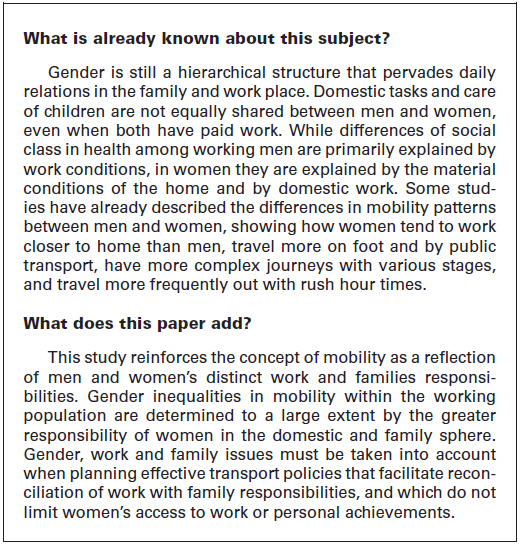
<body><![CDATA[<p>&nbsp;</p>     <p><font face="Verdana" size="2"><b>Introduction</b></font></p>     <p><font face="Verdana" size="2">Mobility is not only understood to be the collection of journeys carried out during the course of a day, but as a reflection of the reasons for making such journeys.<sup>1</sup> The way in which a person travels is directly related to their socioeconomic characteristics (gender, age, occupation, place of residence, etc.), and with the daily activities they perform (work, training, leisure, etc.), since travel is simply the means of access to any of these activities. Therefore, the study of mobility allows us to simultaneously observe the behaviour of different social groups, and is described in the literature as a reflection of social structure.<sup>2</sup></font></p>     <p><font face="Verdana" size="2">Because of the deep gender division in society, in which even now men have a protagonist role in the public and work spheres, and women in the domestic and family spheres, the patterns of mobility of men and women differ substantially. According to various urban and sociological studies carried out in recent years, factors such as accesibility, safety or space distribution are determinants in women's mobility. Therefore, women tend to work closer to home than men,<sup>3</sup> travel more on foot and by public transport, have more complex journeys<sup>4</sup> with various stages, and travel more frequently out with rush hour times.<sup>5</sup> Similarly, there are mobility differences according to socio-economic position.<sup>6</sup></font></p>     <p><font face="Verdana" size="2">To understand differences in mobility, it is necessary to take into account the conceptual framework proposed by the Commission on Social Determinants of Health in Spain,<sup>7</sup> which describes how gender or social class determine the inequalities in power observed in work sphere, and family relations. Today, gender is still a hierarchical structure that pervades daily relations in the family and work place.<sup>8</sup> This explains the fact that women have greater job uncertainty, both in terms of working conditions and contract duration.<sup>9</sup> Moreover, domestic tasks and care of children or dependents are not equally shared between men and women, even when both have paid work.<sup>9</sup> Thus, while differences of social class in health among working men are primarily explained by work conditions, in women they are explained by the material conditions of the home and by domestic work.<sup>10</sup> It has been also reported that the combination of work and family life has a greater impact on the health of manual workers than on more advantaged classes.<sup>11</sup> Because the obligatory daily mobility of individuals is composed mainly of two types of journeys, those related to work and those related to the home,<sup>12</sup> it is directly conditioned by factors related to gender and social class.</font></p>     <p><font face="Verdana" size="2">Thus, the objective of this study was to analyse gender inequalities among working individuals between 30 and 44 years in socioeconomic factors affecting the amount of time spent travelling for work-related and home-related reasons in a weekday in Catalonia (Spain).</font></p>     <p>&nbsp;</p>     <p><font face="Verdana" size="2"><b>Methods</b></font></p>     <p><font face="Verdana" size="2"><i>Design, information source and study population</i></font></p>     <p><font face="Verdana" size="2">A cross-sectional study was performed on the basis of the results of the 2006 Daily Mobility Survey (EMQ2006) carried out by the Catalan regional government and the Metropolitan Transport Authority; the CATI method (computer-assisted telephone interview) was used to survey a representative sample of the population of Catalonia, a region in the northeast of Spain with approximately 7 million inhabitants. Individuals who reported having made any journey on the workday referred to in the interview (N = 23,424) were selected from the population of working individuals between 30 and 44 years. Those who declared that they did not make any journey on this day (N = 769), were excluded. For each individual, journeys made for work- and home-related reasons were selected.</font></p>     ]]></body>
<body><![CDATA[<p><font face="Verdana" size="2"><i>Data collection methods</i></font></p>     <p><font face="Verdana" size="2">Using multistage stratified sampling, the EMQ2006 collected data from throughout the territory of Catalonia. Data were collected, firstly, selecting the municipalities from transport zones, and then the individuals using a simple random sample.<sup>13</sup> A correction system based on the population distribution was applied in each territory, in order to avoid over-representation of the least mobile individuals. In this way data regarding each of the 406,366 journeys made on the day before the interview by the 106,091 individuals surveyed, thereby obtaining representativity at the level of the 41 counties into which Catalonia is divided.</font></p>     <p><font face="Verdana" size="2"><i>Variables</i></font></p>     <p><font face="Verdana" size="2">The dependent variables analysed were time, measured in minutes, spent per person per working day travelling for work-related and home-related reasons (daily shopping, non-daily shopping, personal affairs and accompanying others). Time only included the minutes spent going to the destination. The explanatory variables were educational level (none or primary, secondary, university), and household size not-including the interviewee (none, one, and two or more). Vehicle availability was used as an adjusting variable.</font></p>     <p><font face="Verdana" size="2">Gender and residential area were used as stratification variables, with residential area defined as Barcelona, the second belt and rest of Catalonia. Barcelona included the city and the first belt, formed by the 16 municipalities closest to the city, whose mobility is conditioned by the city. The second belt included the municipalities of the six counties neighbouring Barcelona, which, despite the proximity of many municipalities to the city, showed higher levels of self-containment (journeys with origin and destination within the same county or municipality). The rest of Catalonia showed patterns of mobility that were independent of Barcelona.<sup>14</sup></font></p>     <p><font face="Verdana" size="2"><i>Statistical analysis</i></font></p>     <p><font face="Verdana" size="2">A descriptive analysis of the time spent travelling according to type of journey (work- or home-related) was performed, using the mean and the corresponding 95% confidence intervals (95%CI), and median and the interquartile range. The mean time for each type of journey was calculated with respect to the total population of the study. Where individuals travelled for only one reason, their time spent travelling for other reasons was considered to be zero.</font></p>     <p><font face="Verdana" size="2">Percentage of men and women who spent more time travelling than the median was described for each reason of travel and according to educational level and household size, and p-value of the chi-square test was used in order to compare differences by gender.</font></p>     <p><font face="Verdana" size="2">A bivariate and multivariate logistic regression analysis was performed to determine the factors associated with greater time spent travelling according to reason for travel, with calculation of the odds ratio (OR) and 95%CI, adjusted for vehicle availability and stratifying by gender and residential area. Travel time was categorised as being above or below the median. In the case of time spent travelling for home-related reasons, the median time was zero, and thus the categorization corresponded to having travelled for these reasons or not.</font></p>     <p><font face="Verdana" size="2">All analyses were carried out using the statistical package STATA 10.0.<sup>15</sup></font></p>     ]]></body>
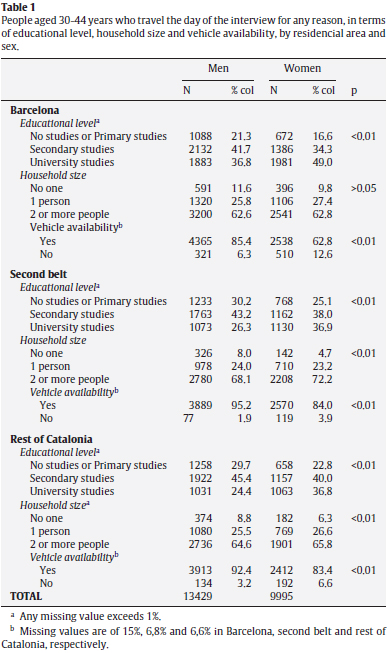
<body><![CDATA[<p>&nbsp;</p>     <p><font face="Verdana" size="2"><b>Results</b></font></p>     <p><font face="Verdana" size="2">The total number of working individuals between 30 and 44 years of age who were interviewed and who reported have made some journey on the day referred to in the interview was 13,429 men and 9,995 women. The proportion of women with university-level was higher than that of men in all residential areas. Among both males and females, the proportion of individuals with university-level was higher among residents of Barcelona than residents of other areas. More than 60% of individuals live with two or more people, in all residential areas and in both sexes. Vehicle availability is higher in men than in women in all residential areas, and in both men and women the smallest proportion of people with vehicle is found in Barcelona (<a href="#t1">Table 1</a>). The relationship with time spent travelling vary across gender and residence area. Therefore all the results are adjusted by vehicle availability.</font></p>     <p align=center><a name="t1"><img src="/img/revistas/gs/v27n5/original7_t1.jpg"></a></p>     <p>&nbsp;</p>     <p><font face="Verdana" size="2"><i>Percentage of men and women who travel and time spent travelling according to reason for travel</i></font></p>     <p><font face="Verdana" size="2">A higher proportion of men reported have travelled for work-related reasons than women, 90.2% compared to 82.6% (p &lt;0.001), and spend more time, 29.6 (95%CI: 28.9-30.2) and 23.2 (95%CI: 22.7-23.7) minutes respectively (p &lt;0.001). Conversely, a higher proportion of women reported have travelled for home-related reasons and spend more time than men (42.5% compared to 19.3%, and 7.7 compared to 3.2 minutes; p &lt;0.001) (<a target="_blank" href="/img/revistas/gs/v27n5/original7_t2.jpg">Table 2</a>).</font></p>     <p><font face="Verdana" size="2"><i>Journeys according to reason for travel as a function of educational level</i></font></p>     <p><font face="Verdana" size="2">The percentage of men who spent more time travelling for work-related reasons than the median was significantly greater than that among women in all residential areas and for all levels of education (<a target="_blank" href="/img/revistas/gs/v27n5/original7_t3.jpg">Table 3</a>). These percentages increased with educational level in both men and women and in all residential areas (<a target="_blank" href="/img/revistas/gs/v27n5/original7_t3.jpg">Table 3</a>).</font></p>     <p><font face="Verdana" size="2">Conversely, the percentage of women who spent any time travelling for home-related reasons was significantly greater than that among men in all residential areas and for all levels of education (p &lt;0.001). The percentage in women decreased with increase in educational level in all three residential areas, being university-level women who statistically present lower proportion (OR<sub>University</sub>= 0.75 &#091;0.59-0.96&#093;; OR<sub>University</sub>= 0.84 &#091;0.71-0.99&#093; in Barcelona and the rest of Catalonia, respectively). Among men the reverse relationship was observed among residents of the rest of Catalonia, being university-level men who statistically present higher proportion (OR<sub>University</sub>= 1.31 &#091;1.07-1.61&#093;).</font></p>     ]]></body>
<body><![CDATA[<p><font face="Verdana" size="2"><i>Journeys according to reason for travel as a function of the number of individuals in the home</i></font></p>     <p><font face="Verdana" size="2">For all three residential areas, only among individuals living with two or more people, the proportion of woman who spent more time on work-related journeys than the median travelling for work-related reasons was significantly minor than that among men (p &lt;0.01). The percentages decreased as the household size increased, in both men and women and in Barcelona and in the second belt, approaching statistical significance only in women living with two or more people (OR = 0.72 &#091;0.54-0.97&#093;; OR = 0.38 &#091;0.24-0.60, respectively&#093; (<a target="_blank" href="/img/revistas/gs/v27n5/original7_t3.jpg">Table 3</a>).</font></p>     <p><font face="Verdana" size="2">Among both men and women from all three residential areas, those who lived with two or more people represented the greatest proportion of individuals who travelled for home-related reasons. However, this proportion was significantly greater among women (p &lt;0.01).</font></p>     <p><font face="Verdana" size="2"><i>Factors associated with greater time spent travelling, according to reason for travel</i></font></p>     <p><font face="Verdana" size="2">In both men and women from all three residential areas, the only factor associated with greater time spent travelling for work-related reasons was higher educational level. But, only in women from the second belt, living with two or more people was associated with less time spent on work-related journeys (OR = 0.45; &#091;0.27-0.73&#093;) (<a target="_blank" href="/img/revistas/gs/v27n5/original7_t4.jpg">Table 4</a>).</font></p>     <p><font face="Verdana" size="2">In men, the only factor associated with greater time spent on home-related journeys was higher educational level and only among men living in the rest of Catalonia (OR<sub>Secondary</sub>= 1.21 &#091;1.01-1.46&#093;, OR<sub>University</sub>= 1.31 &#091;1.06-1.61&#093;). Conversely, in women, living with one more person was associated with longer time travelling for home-related reasons in the rest of Catalonia (OR = 1.68 &#091;1.18-2.39&#093;) and living with two or more individuals was associated in all residential areas (OR = 4.16 &#091;2.71-6.38&#093; in Barcelona, OR = 3.53 &#091;2.09-5.96&#093; in the second belt, OR = 3.20 &#091;2.30-4.47&#093; in the rest of Catalonia) (<a target="_blank" href="/img/revistas/gs/v27n5/original7_t4.jpg">Table 4</a>).</font></p>     <p>&nbsp;</p>     <p><font face="Verdana" size="2"><b>Discussion</b></font></p>     <p><font face="Verdana" size="2">The present study confirms the existence of distinct patterns of mobility among men and women, and the relationship with their discrete positions in the work and, domestic and family spheres. The results show that among working individuals between 30 and 44 years of age, men travel in greater proportion and spend more time travelling for work-related reasons than women, while a greater proportion of women travel and spend more time travelling for home-related reasons.</font></p>     <p><font face="Verdana" size="2">This study also demonstrates the interrelation between mobility, educational level and household size, particularly visible among women. Higher educational level was associated with greater time spent on work-related journeys in both men and women, and with increased time spent travelling for home-related reasons among men. Moreover, household size was associated with greater time spent travelling for home-related reasons, and less time spent travelling for work-related reasons among women.</font></p>     ]]></body>
<body><![CDATA[<p><font face="Verdana" size="2">In addition, this study has allowed observing the influence of educational level and household size on mobility according to residential area. Assotiation of time spent on work-related travel with educational level was stronger in the second belt, while family load reduced the time spent by women on work-related travel. Among women, the number of individuals in the home was the most powerful determinant of time spent on home-related journeys, independent of residential area and educational level.</font></p>     <p><font face="Verdana" size="2"><i>Strengths and limitations</i></font></p>     <p><font face="Verdana" size="2">It is important to highlight the usefulness of the EMQ2006 for analysing the mobility of different social groups, since it allows us to simultaneously study journeys made throughout the day and for different reasons. It offers a very large sample, representative of both the urban and non-urban areas, and allows a high level of disaggregation.</font></p>     <p><font face="Verdana" size="2">One limitation of this study was that, when analysing journey time as a function of household size, it is not possible to know the characteristics of the co-habitants, nor the interviewee's position within the family unit. Thus, it was not possible to limit this study to married co-habiting individuals or to analyse how family responsibilities are distributed among working individuals. However, limiting the study to working individuals between 30 and 44 years of age allowed us to approximate the analysis to a population of productive and reproductive age, which makes the results obtained consistent with those of studies carried out only with married or co-habiting individuals.</font></p>     <p><font face="Verdana" size="2">Another limitation is the lack of data regarding the reason for the return journey. As a result, the times described may underestimate the real time spent on each type of journey throughout the day. Nevertheless, as the objective was not to estimate times but to evaluate their association with reason for travel, we believe that this will have a minimal impact on the conclusions of this study.</font></p>     <p><font face="Verdana" size="2"><i>Time spent travelling according to reason for travel</i></font></p>     <p><font face="Verdana" size="2">The results obtained are consistent with other studies of daily mobility.<sup>16</sup> A study carried out in the metropolitan area of the city of Pamplona (Spain)<sup>17</sup> analysed the daily mobility of individuals over 15 years of age using a questionnaire that collected data on all journeys made on the day before the interview. Among individuals between 30 and 50 years of age, men made more work-related journeys per day, and women made more journeys in the accompaniment of others and for shopping.</font></p>     <p><font face="Verdana" size="2"><i>Time spent travelling according to reason for travel as a function of level of education</i></font></p>     <p><font face="Verdana" size="2">We are not aware of any study that has directly analysed time spent on work-related journeys according to educational level, although the study by Salom and Delios<sup>18</sup> performed in region of Valencia (Spain) used the rate of inter-municipal mobility (percentage of individuals who travelled to work outside of their home town) as an indirect indicator of time spent travelling to work. This study showed that, in both men and women, the tendency to work outside the town of residence increased with educational level, which is therefore associated with longer work-related journeys. Similarly, Weinberger<sup>19</sup> in a study carried out in the region of Philadelphia showed that time spent travelling to work increased with increase in salary in both genders. Both results are consistent with our analysis, in terms of greater time spent travelling to work among individuals with a higher educational level.</font></p>     <p><font face="Verdana" size="2">Some studies of time use, such as that carried out by The Women's Institute of Spain in 2006,<sup>20</sup> indicated how inequalities in time spent on household tasks between men and women decreased in university-educated individuals explained by a reduction in time spent by women. Our study, although it was concerned only with travel time, finds significant differences between men and women for all educational levels. There was no significant reduction in time spent by university-educated women in any of the residential areas studied, while, on the contrary, the percentage of university-educated men who travelled for this reason was significantly greater in the rest of Catalonia.</font></p>     ]]></body>
<body><![CDATA[<p><font face="Verdana" size="2"><i>Time spent travelling according to reason for travel as a function of the number of individuals in the home</i></font></p>     <p><font face="Verdana" size="2">To date, several studies have analysed the greater role of working women in care of the home as a function of household size and/or of dependent persons, self-perception of participation in household tasks and care of children, or through the study of time use,<sup>21, 22</sup> but to date few studies have explored the effect of this greater responsibility on mobility. Camarero et al.<sup>17</sup> showed that the presence of young children in the home had no effect on work-related mobility for men, but reduced work-related mobility among women. They also found differences as a function of residence area. Our study obtained similar results for men and women resident in the second belt of the city.</font></p>     <p><font face="Verdana" size="2"><i>Mobility and social roles</i></font></p>     <p><font face="Verdana" size="2">Working men and women of 30-44 years in productive and reproductive age present very different mobility patterns. The fact that women continue to be mainly responsible for care of the home and family<sup>23</sup> is well recognised, as well as the fact that this has consequences for their health (in terms of poorer perceived health,<sup>24</sup> greater work leave,<sup>25</sup> less physical activity,<sup>11</sup> chronic disorders or poorer mental health<sup>26</sup>). However, the fact that caring for the home implies travelling<sup>27</sup> is not always considered. In all residential areas, greater time for home-related reasons is spent by women who live with two or more individuals. On the other hand, time spent in domestic work decrease<b>s</b> with increase in educational level, supporting the hypothesis that educational level also contributes to determining the amount of domestic and family work assumed by women, fundamentally because those with a higher socio-economic level have more resources for domestic or family work.<sup>11</sup></font></p>     <p><font face="Verdana" size="2">However, as mentioned by Díaz-Muñoz et al.,<sup>2</sup> it is also important to understand how daily travel is integrated into the sequence of activities that are carried out during the course of a day, since taking charge of the care of the home could affect other areas of daily life. Our results, together with previous work<sup>18</sup> support this hypothesis since work-related travel among women is seen to diminish when they live with two or more individuals, which could be also a reflection of the fact that greater family responsibility could affect women's access to the labour market.<sup>28, 29</sup></font></p>     <p><font face="Verdana" size="2"><i>Conclusions and implications</i></font></p>     <p><font face="Verdana" size="2">Therefore, we may conclude that gender inequalities in mobility within the working population aged from 30 to 44 years are determined to a large extent by the greater responsibility of women in the domestic and family sphere, as well as by educational level. In contrast, daily mobility among men is primarily conditioned by educational level. This study reinforces the concept of mobility as a reflection of men and women's distinct work and families responsibilities. For future mobility surveys we recommend the introduction of new concepts that analyse social and economic aspects, such as the characteristics of the individuals in the household, since these could provide indispensible information to improve the study of mobility. Similarly, it is clear from this study that gender, work, family and social class must be taken into account when planning effective transport policies that facilitate reconciliation of work with family responsibilities, and which do not limit women's access to work or personal achievements, or that of more disadvantaged classes.</font></p>     <p>&nbsp;</p>     <p><font face="Verdana" size="2"><b>Authors' contributions</b></font></p>     <p><font face="Verdana" size="2">K. Pérez, E. Santamariña-Rubio and M. Olabarria conceived the study and performed the analysis. M. Olabarria wrote the draft. K. Pérez, E. Santamariña-Rubio, M. Olabarria, J.M. Aragay, M. Capdet, R. Peiró, M. Rodríguez-Sanz, L. Artazcoz and C. Borrell contributed substantially to the interpretation of the data, revised critically the draft and approved the final version of the manuscript.</font></p>     ]]></body>
<body><![CDATA[<p>&nbsp;</p>     <p><font face="Verdana" size="2"><b>Competing interests</b></font></p>     <p><font face="Verdana" size="2">All the authors declare that they have no conflicts of interest. C. Borrell forms part of the Gaceta Sanitaria editorial group and has not participated in the editorial process of this article.</font></p>     <p>&nbsp;</p>     <p><img border="0" src="/img/revistas/gs/v27n5/original7_cuadro.jpg" width="520" height="545"></p>     <p>&nbsp;</p>     <p><font face="Verdana" size="2"><b>References</b></font></p>     <!-- ref --><p><font face="Verdana" size="2">1. Miralles-Guasch C. Institut d'Estudis Regionals y Metropolitans de Barcelona. In: Movilidad y usos del tiempo. Barcelona: Ajuntament de Barcelona; 2006.    &nbsp;&nbsp;&nbsp;&nbsp;&nbsp;&nbsp;&nbsp;&nbsp;[&#160;<a href="javascript:void(0);" onclick="javascript: window.open('/scielo.php?script=sci_nlinks&ref=2479848&pid=S0213-9111201300050000900001&lng=','','width=640,height=500,resizable=yes,scrollbars=1,menubar=yes,');">Links</a>&#160;]<!-- end-ref --></font></p>    <!-- ref --><p><font face="Verdana" size="2">2. Díaz-Muñoz M, Jiménez F. Seminario Internacional sobre Género y Urbanismo. Infraestructuras para la Vida Cotidiana. ETSAM. UPM. 2002.    &nbsp;&nbsp;&nbsp;&nbsp;&nbsp;&nbsp;&nbsp;&nbsp;[&#160;<a href="javascript:void(0);" onclick="javascript: window.open('/scielo.php?script=sci_nlinks&ref=2479850&pid=S0213-9111201300050000900002&lng=','','width=640,height=500,resizable=yes,scrollbars=1,menubar=yes,');">Links</a>&#160;]<!-- end-ref --></font></p>    <!-- ref --><p><font face="Verdana" size="2">3. Howell FM, Bronson DR. The journey to work and gender inequalities in earnings: a cross-validation study for the United States. Sociological Quartely. 1996; 37:429-47.    &nbsp;&nbsp;&nbsp;&nbsp;&nbsp;&nbsp;&nbsp;&nbsp;[&#160;<a href="javascript:void(0);" onclick="javascript: window.open('/scielo.php?script=sci_nlinks&ref=2479852&pid=S0213-9111201300050000900003&lng=','','width=640,height=500,resizable=yes,scrollbars=1,menubar=yes,');">Links</a>&#160;]<!-- end-ref --></font></p>    <!-- ref --><p><font face="Verdana" size="2">4. Tobío C. Estructura urbana, movilidad y género en la ciudad moderna. Universidad Carlos III de Madrid. Conferencia Escuela de Verano Jaime Vera. Galapagar (Madrid). 1995.    &nbsp;&nbsp;&nbsp;&nbsp;&nbsp;&nbsp;&nbsp;&nbsp;[&#160;<a href="javascript:void(0);" onclick="javascript: window.open('/scielo.php?script=sci_nlinks&ref=2479854&pid=S0213-9111201300050000900004&lng=','','width=640,height=500,resizable=yes,scrollbars=1,menubar=yes,');">Links</a>&#160;]<!-- end-ref --></font></p>    <!-- ref --><p><font face="Verdana" size="2">5. Movilidad y género. Un análisis de la adecuación del transporte público a las necesidades de las mujeres en Gipuzkoa. Departamento para la Ordenación y Promoción Territorial. Diputación Foral de Gipuzkoa; 2007.    &nbsp;&nbsp;&nbsp;&nbsp;&nbsp;&nbsp;&nbsp;&nbsp;[&#160;<a href="javascript:void(0);" onclick="javascript: window.open('/scielo.php?script=sci_nlinks&ref=2479856&pid=S0213-9111201300050000900005&lng=','','width=640,height=500,resizable=yes,scrollbars=1,menubar=yes,');">Links</a>&#160;]<!-- end-ref --></font></p>    <!-- ref --><p><font face="Verdana" size="2">6. Pucher J, Renne J. Socioeconomics of urban travel, Evidences of the 2001 NHTS. Transportation Quarterly. 2003; 57:49-77.    &nbsp;&nbsp;&nbsp;&nbsp;&nbsp;&nbsp;&nbsp;&nbsp;[&#160;<a href="javascript:void(0);" onclick="javascript: window.open('/scielo.php?script=sci_nlinks&ref=2479858&pid=S0213-9111201300050000900006&lng=','','width=640,height=500,resizable=yes,scrollbars=1,menubar=yes,');">Links</a>&#160;]<!-- end-ref --></font></p>    <!-- ref --><p><font face="Verdana" size="2">7. Avanzando hacia la equidad. Propuesta de políticas e intervenciones para reducir las desigualdades sociales en salud en España. Comisión para reducir las desigualdades sociales en salud en España. 2010. Ministerio de Sanidad y Política Social. Madrid. (Accesed 28 August, 2012.) Available at: <a target="_blank" href="http://www.msc.es/profesionales/saludPublica/prevPromocion/promocion/desigualdadSalud/docs/Propuesta_Politicas_Reducir_Desigualdades.pdf">http://www.msc.es/profesionales/saludPublica/prevPromocion/promocion/desigualdadSalud/docs/Propuesta_Politicas_Reducir_Desigualdades.pdf</a>.    &nbsp;&nbsp;&nbsp;&nbsp;&nbsp;&nbsp;&nbsp;&nbsp;[&#160;<a href="javascript:void(0);" onclick="javascript: window.open('/scielo.php?script=sci_nlinks&ref=2479860&pid=S0213-9111201300050000900007&lng=','','width=640,height=500,resizable=yes,scrollbars=1,menubar=yes,');">Links</a>&#160;]<!-- end-ref --></font></p>    <!-- ref --><p><font face="Verdana" size="2">8. Artazcoz L, Borrell C. Los determinantes de la salud en una perspectiva integradora de los enfoques de género, clase social y trabajo. Guía de investigación en género y salud. 5.<sup>a</sup> Monografía Sociedad Española de Epidemiología. Barcelona; 2007.    &nbsp;&nbsp;&nbsp;&nbsp;&nbsp;&nbsp;&nbsp;&nbsp;[&#160;<a href="javascript:void(0);" onclick="javascript: window.open('/scielo.php?script=sci_nlinks&ref=2479862&pid=S0213-9111201300050000900008&lng=','','width=640,height=500,resizable=yes,scrollbars=1,menubar=yes,');">Links</a>&#160;]<!-- end-ref --></font></p>    <!-- ref --><p><font face="Verdana" size="2">9. Artazcoz L, Escribá-Ag&uuml;ir V, Cortés I. Gender, paid work, domestic chores and health in Spain. Gac Sanit. 2004; 18(Supl 2):24-35.    &nbsp;&nbsp;&nbsp;&nbsp;&nbsp;&nbsp;&nbsp;&nbsp;[&#160;<a href="javascript:void(0);" onclick="javascript: window.open('/scielo.php?script=sci_nlinks&ref=2479864&pid=S0213-9111201300050000900009&lng=','','width=640,height=500,resizable=yes,scrollbars=1,menubar=yes,');">Links</a>&#160;]<!-- end-ref --></font></p>    <!-- ref --><p><font face="Verdana" size="2">10. Borrell C, Muntaner C, Benach J, et al. Social class and self-reported health status among men and women: what is the role of work organisation, household material standards and household labour?. Social Science &amp; Medicine. 2004; 58:1869-87.    &nbsp;&nbsp;&nbsp;&nbsp;&nbsp;&nbsp;&nbsp;&nbsp;[&#160;<a href="javascript:void(0);" onclick="javascript: window.open('/scielo.php?script=sci_nlinks&ref=2479866&pid=S0213-9111201300050000900010&lng=','','width=640,height=500,resizable=yes,scrollbars=1,menubar=yes,');">Links</a>&#160;]<!-- end-ref --></font></p>    <!-- ref --><p><font face="Verdana" size="2">11. Artazcoz L, Borrell C, Benach J. Gender inequalities in health among workers: the relation with family demands. J Epidemiol Community Health. 2001; 55:639-47.    &nbsp;&nbsp;&nbsp;&nbsp;&nbsp;&nbsp;&nbsp;&nbsp;[&#160;<a href="javascript:void(0);" onclick="javascript: window.open('/scielo.php?script=sci_nlinks&ref=2479868&pid=S0213-9111201300050000900011&lng=','','width=640,height=500,resizable=yes,scrollbars=1,menubar=yes,');">Links</a>&#160;]<!-- end-ref --></font></p>    <!-- ref --><p><font face="Verdana" size="2">12. Miralles-Guasch C. Institut d'Estudis Regionals y Metropolitans de Barcelona. Movilidad y usos del tiempo. 2006. (Accesed April 28, 2008.) Available at: http://www.laboratorideltemps.org/coneixement/detail.php?id=887&amp;sec=292.    &nbsp;&nbsp;&nbsp;&nbsp;&nbsp;&nbsp;&nbsp;&nbsp;[&#160;<a href="javascript:void(0);" onclick="javascript: window.open('/scielo.php?script=sci_nlinks&ref=2479870&pid=S0213-9111201300050000900012&lng=','','width=640,height=500,resizable=yes,scrollbars=1,menubar=yes,');">Links</a>&#160;]<!-- end-ref --></font></p>    <!-- ref --><p><font face="Verdana" size="2">13. Aspectos metodológicos de la EMQ2006. Institut d'Estudis Regionals i Metropolitans de Barcelona. 2006. (Accesed April 28, 2008.) Available at: <a target="_blank" href="http://www.iermb.uab.es/mobilitat/esp/emq-06-aspectes.asp">http://www.iermb.uab.es/mobilitat/esp/emq-06-aspectes.asp</a>.    &nbsp;&nbsp;&nbsp;&nbsp;&nbsp;&nbsp;&nbsp;&nbsp;[&#160;<a href="javascript:void(0);" onclick="javascript: window.open('/scielo.php?script=sci_nlinks&ref=2479872&pid=S0213-9111201300050000900013&lng=','','width=640,height=500,resizable=yes,scrollbars=1,menubar=yes,');">Links</a>&#160;]<!-- end-ref --></font></p>    <!-- ref --><p><font face="Verdana" size="2">14. Miralles-Guasch C. Institut d'Estudis Regionals y Metropolitans de Barcelona. La mobilitat quotidiana a Catalunya. 2008. (Accesed May 12, 2010.) Available at: <a target="_blank" href="http://www.iermb.uab.es/htm/revistaPapers_numeros.asp?id=53">http://www.iermb.uab.es/htm/revistaPapers_numeros.asp?id=53</a>.    &nbsp;&nbsp;&nbsp;&nbsp;&nbsp;&nbsp;&nbsp;&nbsp;[&#160;<a href="javascript:void(0);" onclick="javascript: window.open('/scielo.php?script=sci_nlinks&ref=2479874&pid=S0213-9111201300050000900014&lng=','','width=640,height=500,resizable=yes,scrollbars=1,menubar=yes,');">Links</a>&#160;]<!-- end-ref --></font></p>    <!-- ref --><p><font face="Verdana" size="2">15. StataCorp. Stata Statistical Software: Release 9. College Station, TX: StataCorp LP; 2005.    &nbsp;&nbsp;&nbsp;&nbsp;&nbsp;&nbsp;&nbsp;&nbsp;[&#160;<a href="javascript:void(0);" onclick="javascript: window.open('/scielo.php?script=sci_nlinks&ref=2479876&pid=S0213-9111201300050000900015&lng=','','width=640,height=500,resizable=yes,scrollbars=1,menubar=yes,');">Links</a>&#160;]<!-- end-ref --></font></p>    <!-- ref --><p><font face="Verdana" size="2">16. Schaffer A, Schulz C. Women's and men's role in passenger transport. Employment and mobility patterns. Int J of Transport Economics. 2008; 32:231-50.    &nbsp;&nbsp;&nbsp;&nbsp;&nbsp;&nbsp;&nbsp;&nbsp;[&#160;<a href="javascript:void(0);" onclick="javascript: window.open('/scielo.php?script=sci_nlinks&ref=2479878&pid=S0213-9111201300050000900016&lng=','','width=640,height=500,resizable=yes,scrollbars=1,menubar=yes,');">Links</a>&#160;]<!-- end-ref --></font></p>    <!-- ref --><p><font face="Verdana" size="2">17. Camarero L, Oliva J. Exploring the social face of urban mobility: daily mobility as part of the social structure in Spain. Int J Urban and Regional Research. 2008; 32:344-62.    &nbsp;&nbsp;&nbsp;&nbsp;&nbsp;&nbsp;&nbsp;&nbsp;[&#160;<a href="javascript:void(0);" onclick="javascript: window.open('/scielo.php?script=sci_nlinks&ref=2479880&pid=S0213-9111201300050000900017&lng=','','width=640,height=500,resizable=yes,scrollbars=1,menubar=yes,');">Links</a>&#160;]<!-- end-ref --></font></p>    <!-- ref --><p><font face="Verdana" size="2">18. Salom J, Delios E. La movilidad laboral femenina en el País Valenciano: los factores sociales y laborales en las diferencias por género. Cuadernos de Geografía. 1998; 64:485-511.    &nbsp;&nbsp;&nbsp;&nbsp;&nbsp;&nbsp;&nbsp;&nbsp;[&#160;<a href="javascript:void(0);" onclick="javascript: window.open('/scielo.php?script=sci_nlinks&ref=2479882&pid=S0213-9111201300050000900018&lng=','','width=640,height=500,resizable=yes,scrollbars=1,menubar=yes,');">Links</a>&#160;]<!-- end-ref --></font></p>    <!-- ref --><p><font face="Verdana" size="2">19. Weinberger R. Men, women, job sprawl and journey to work in the Philadelphia Region. Public Works Management and Policy. 2007; 11:177-93.    &nbsp;&nbsp;&nbsp;&nbsp;&nbsp;&nbsp;&nbsp;&nbsp;[&#160;<a href="javascript:void(0);" onclick="javascript: window.open('/scielo.php?script=sci_nlinks&ref=2479884&pid=S0213-9111201300050000900019&lng=','','width=640,height=500,resizable=yes,scrollbars=1,menubar=yes,');">Links</a>&#160;]<!-- end-ref --></font></p>    <!-- ref --><p><font face="Verdana" size="2">20. Las mujeres jóvenes y el trabajo. Madrid: Instituto de la Mujer; 2006. (Accesed April 1, 2008.) Available at: <a target="_blank" href="http://www.migualdad.es/mujer/publicaciones/catalogo/estudios.htm">http://www.migualdad.es/mujer/publicaciones/catalogo/estudios.htm</a>.    &nbsp;&nbsp;&nbsp;&nbsp;&nbsp;&nbsp;&nbsp;&nbsp;[&#160;<a href="javascript:void(0);" onclick="javascript: window.open('/scielo.php?script=sci_nlinks&ref=2479886&pid=S0213-9111201300050000900020&lng=','','width=640,height=500,resizable=yes,scrollbars=1,menubar=yes,');">Links</a>&#160;]<!-- end-ref --></font></p>    <!-- ref --><p><font face="Verdana" size="2">21. Artazcoz L, Artieda L, Borrell C, et al. Combining job and family demands and being healthy. European J Public Health. 2004; 14:43-8.    &nbsp;&nbsp;&nbsp;&nbsp;&nbsp;&nbsp;&nbsp;&nbsp;[&#160;<a href="javascript:void(0);" onclick="javascript: window.open('/scielo.php?script=sci_nlinks&ref=2479888&pid=S0213-9111201300050000900021&lng=','','width=640,height=500,resizable=yes,scrollbars=1,menubar=yes,');">Links</a>&#160;]<!-- end-ref --></font></p>    <!-- ref --><p><font face="Verdana" size="2">22. Usos del tiempo, estereotipos, valores y actitudes. Madrid: Instituto de la Mujer; 2007. (Accesed April 1, 2008.) Available at: <a target="_blank" href="http://www.migualdad.es/mujer/publicaciones/catalogo/estudios.htm">http://www.migualdad.es/mujer/publicaciones/catalogo/estudios.htm</a>.    &nbsp;&nbsp;&nbsp;&nbsp;&nbsp;&nbsp;&nbsp;&nbsp;[&#160;<a href="javascript:void(0);" onclick="javascript: window.open('/scielo.php?script=sci_nlinks&ref=2479890&pid=S0213-9111201300050000900022&lng=','','width=640,height=500,resizable=yes,scrollbars=1,menubar=yes,');">Links</a>&#160;]<!-- end-ref --></font></p>    <!-- ref --><p><font face="Verdana" size="2">23. Larrañaga I, Arregui B, Arpal J. Reproductive or domestic work. Gac Sanit. 2004; 18(Supl 1):31-7.    &nbsp;&nbsp;&nbsp;&nbsp;&nbsp;&nbsp;&nbsp;&nbsp;[&#160;<a href="javascript:void(0);" onclick="javascript: window.open('/scielo.php?script=sci_nlinks&ref=2479892&pid=S0213-9111201300050000900023&lng=','','width=640,height=500,resizable=yes,scrollbars=1,menubar=yes,');">Links</a>&#160;]<!-- end-ref --></font></p>    <!-- ref --><p><font face="Verdana" size="2">24. Artazcoz L, Borrell C, Rohlfs I, et al. Housework, gender and health in the working population. Gac Sanit. 2001; 15:150-3.    &nbsp;&nbsp;&nbsp;&nbsp;&nbsp;&nbsp;&nbsp;&nbsp;[&#160;<a href="javascript:void(0);" onclick="javascript: window.open('/scielo.php?script=sci_nlinks&ref=2479894&pid=S0213-9111201300050000900024&lng=','','width=640,height=500,resizable=yes,scrollbars=1,menubar=yes,');">Links</a>&#160;]<!-- end-ref --></font></p>    <!-- ref --><p><font face="Verdana" size="2">25. Sandmark H. Work and family: associations with long-term sick-listing in Swedish women - a case-control study. BMC Public Health. 2007; 7:287.    &nbsp;&nbsp;&nbsp;&nbsp;&nbsp;&nbsp;&nbsp;&nbsp;[&#160;<a href="javascript:void(0);" onclick="javascript: window.open('/scielo.php?script=sci_nlinks&ref=2479896&pid=S0213-9111201300050000900025&lng=','','width=640,height=500,resizable=yes,scrollbars=1,menubar=yes,');">Links</a>&#160;]<!-- end-ref --></font></p>    <!-- ref --><p><font face="Verdana" size="2">26. Krantz G, Òstergren P. The combined impact of domestic responsabilities and job strain on common symptoms in employed Swedish women. Eur J Pub Health. 2001; 11:413-9.    &nbsp;&nbsp;&nbsp;&nbsp;&nbsp;&nbsp;&nbsp;&nbsp;[&#160;<a href="javascript:void(0);" onclick="javascript: window.open('/scielo.php?script=sci_nlinks&ref=2479898&pid=S0213-9111201300050000900026&lng=','','width=640,height=500,resizable=yes,scrollbars=1,menubar=yes,');">Links</a>&#160;]<!-- end-ref --></font></p>    <!-- ref --><p><font face="Verdana" size="2">27. Un análisis de la adecuación del transporte público a las necesidades de las mujeres en Gipuzkoa. Movilidad y género. Diputación Foral de Gipuzkoa, Dirección de Suelo y Transporte, Departamento para la Ordenación y Promoción Territorial. 2007. (Accesed April 1, 2008.) Available at: <a target="_blank" href="http://www.farapi.com/Erreferentziako_proiektuak/4,4,0,0,2.html">http://www.farapi.com/Erreferentziako_proiektuak/4,4,0,0,2.html</a>.    &nbsp;&nbsp;&nbsp;&nbsp;&nbsp;&nbsp;&nbsp;&nbsp;[&#160;<a href="javascript:void(0);" onclick="javascript: window.open('/scielo.php?script=sci_nlinks&ref=2479900&pid=S0213-9111201300050000900027&lng=','','width=640,height=500,resizable=yes,scrollbars=1,menubar=yes,');">Links</a>&#160;]<!-- end-ref --></font></p>    <!-- ref --><p><font face="Verdana" size="2">28. MacDonald H. Women's employment and commuting: explaining the links. J Planning Literature. 1999; 13:267-83.    &nbsp;&nbsp;&nbsp;&nbsp;&nbsp;&nbsp;&nbsp;&nbsp;[&#160;<a href="javascript:void(0);" onclick="javascript: window.open('/scielo.php?script=sci_nlinks&ref=2479902&pid=S0213-9111201300050000900028&lng=','','width=640,height=500,resizable=yes,scrollbars=1,menubar=yes,');">Links</a>&#160;]<!-- end-ref --></font></p>    <!-- ref --><p><font face="Verdana" size="2">29. Van Ham M, Mulder CH. Geographical access to childcare and mothers labour-force participation. Tijdschrift Voor Economische en Sociale Geografie. 2005; 96:63-74.    &nbsp;&nbsp;&nbsp;&nbsp;&nbsp;&nbsp;&nbsp;&nbsp;[&#160;<a href="javascript:void(0);" onclick="javascript: window.open('/scielo.php?script=sci_nlinks&ref=2479904&pid=S0213-9111201300050000900029&lng=','','width=640,height=500,resizable=yes,scrollbars=1,menubar=yes,');">Links</a>&#160;]<!-- end-ref --></font></p>     <p>&nbsp;</p>     <p>&nbsp;</p>     <p><font face="Verdana" size="2"><a href="#top"><img border="0" src="/img/revistas/gs/v27n5/seta.gif" width="15" height="17"></a><a name="bajo"></a><b>Correspondence:</b>    <br>E-mail: <a href="mailto:cperez@aspb.cat">cperez@aspb.cat</a>    <br>(K. Pérez)</font></p>     ]]></body>
<body><![CDATA[<p><font face="Verdana" size="2">Received 3 July 2012    <br>Accepted 23 August 2012</font></p>      ]]></body><back>
<ref-list>
<ref id="B1">
<label>1</label><nlm-citation citation-type="book">
<person-group person-group-type="author">
<name>
<surname><![CDATA[Miralles-Guasch]]></surname>
<given-names><![CDATA[C]]></given-names>
</name>
</person-group>
<collab>Institut d'Estudis Regionals y Metropolitans de Barcelona</collab>
<source><![CDATA[Movilidad y usos del tiempo]]></source>
<year>2006</year>
<publisher-loc><![CDATA[Barcelona ]]></publisher-loc>
<publisher-name><![CDATA[Ajuntament de Barcelona]]></publisher-name>
</nlm-citation>
</ref>
<ref id="B2">
<label>2</label><nlm-citation citation-type="confpro">
<person-group person-group-type="author">
<name>
<surname><![CDATA[Díaz-Muñoz]]></surname>
<given-names><![CDATA[M]]></given-names>
</name>
<name>
<surname><![CDATA[Jiménez]]></surname>
<given-names><![CDATA[F]]></given-names>
</name>
</person-group>
<source><![CDATA[]]></source>
<year>2002</year>
<conf-name><![CDATA[ Seminario Internacional sobre Género y Urbanismo. Infraestructuras para la Vida Cotidiana]]></conf-name>
<conf-loc> </conf-loc>
<publisher-name><![CDATA[UPM]]></publisher-name>
</nlm-citation>
</ref>
<ref id="B3">
<label>3</label><nlm-citation citation-type="journal">
<person-group person-group-type="author">
<name>
<surname><![CDATA[Howell]]></surname>
<given-names><![CDATA[FM]]></given-names>
</name>
<name>
<surname><![CDATA[Bronson]]></surname>
<given-names><![CDATA[DR]]></given-names>
</name>
</person-group>
<article-title xml:lang="en"><![CDATA[The journey to work and gender inequalities in earnings: a cross-validation study for the United States]]></article-title>
<source><![CDATA[Sociological Quartely]]></source>
<year>1996</year>
<volume>37</volume>
<page-range>429-47</page-range></nlm-citation>
</ref>
<ref id="B4">
<label>4</label><nlm-citation citation-type="book">
<person-group person-group-type="author">
<name>
<surname><![CDATA[Tobío]]></surname>
<given-names><![CDATA[C]]></given-names>
</name>
</person-group>
<source><![CDATA[Estructura urbana, movilidad y género en la ciudad moderna]]></source>
<year></year>
<publisher-name><![CDATA[Universidad Carlos III de Madrid]]></publisher-name>
</nlm-citation>
</ref>
<ref id="B5">
<label>5</label><nlm-citation citation-type="book">
<source><![CDATA[Movilidad y género: Un análisis de la adecuación del transporte público a las necesidades de las mujeres en Gipuzkoa]]></source>
<year>2007</year>
<publisher-name><![CDATA[Departamento para la Ordenación y Promoción Territorial. Diputación Foral de Gipuzkoa]]></publisher-name>
</nlm-citation>
</ref>
<ref id="B6">
<label>6</label><nlm-citation citation-type="journal">
<person-group person-group-type="author">
<name>
<surname><![CDATA[Pucher]]></surname>
<given-names><![CDATA[J]]></given-names>
</name>
<name>
<surname><![CDATA[Renne]]></surname>
<given-names><![CDATA[J]]></given-names>
</name>
</person-group>
<article-title xml:lang="en"><![CDATA[Socioeconomics of urban travel, Evidences of the 2001 NHTS]]></article-title>
<source><![CDATA[Transportation Quarterly]]></source>
<year>2003</year>
<volume>57</volume>
<page-range>49-77</page-range></nlm-citation>
</ref>
<ref id="B7">
<label>7</label><nlm-citation citation-type="book">
<source><![CDATA[Avanzando hacia la equidad: Propuesta de políticas e intervenciones para reducir las desigualdades sociales en salud en España. Comisión para reducir las desigualdades sociales en salud en España]]></source>
<year>2010</year>
<publisher-loc><![CDATA[Madrid ]]></publisher-loc>
<publisher-name><![CDATA[Ministerio de Sanidad y Política Social]]></publisher-name>
</nlm-citation>
</ref>
<ref id="B8">
<label>8</label><nlm-citation citation-type="">
<person-group person-group-type="author">
<name>
<surname><![CDATA[Artazcoz]]></surname>
<given-names><![CDATA[L]]></given-names>
</name>
<name>
<surname><![CDATA[Borrell]]></surname>
<given-names><![CDATA[C]]></given-names>
</name>
</person-group>
<source><![CDATA[Los determinantes de la salud en una perspectiva integradora de los enfoques de género, clase social y trabajo: Guía de investigación en género y salud]]></source>
<year>2007</year>
<volume>5</volume>
<publisher-loc><![CDATA[Barcelona ]]></publisher-loc>
</nlm-citation>
</ref>
<ref id="B9">
<label>9</label><nlm-citation citation-type="journal">
<person-group person-group-type="author">
<name>
<surname><![CDATA[Artazcoz]]></surname>
<given-names><![CDATA[L]]></given-names>
</name>
<name>
<surname><![CDATA[Escribá-Agüir]]></surname>
<given-names><![CDATA[V]]></given-names>
</name>
<name>
<surname><![CDATA[Cortés]]></surname>
<given-names><![CDATA[I]]></given-names>
</name>
</person-group>
<article-title xml:lang="en"><![CDATA[Gender, paid work, domestic chores and health in Spain]]></article-title>
<source><![CDATA[Gac Sanit]]></source>
<year>2004</year>
<volume>18</volume>
<numero>^s2</numero>
<issue>^s2</issue>
<supplement>2</supplement>
<page-range>24-35</page-range></nlm-citation>
</ref>
<ref id="B10">
<label>10</label><nlm-citation citation-type="journal">
<person-group person-group-type="author">
<name>
<surname><![CDATA[Borrell]]></surname>
<given-names><![CDATA[C]]></given-names>
</name>
<name>
<surname><![CDATA[Muntaner]]></surname>
<given-names><![CDATA[C]]></given-names>
</name>
<name>
<surname><![CDATA[Benach]]></surname>
<given-names><![CDATA[J]]></given-names>
</name>
</person-group>
<article-title xml:lang="en"><![CDATA[Social class and self-reported health status among men and women: what is the role of work organisation, household material standards and household labour?]]></article-title>
<source><![CDATA[Social Science & Medicine]]></source>
<year>2004</year>
<volume>58</volume>
<page-range>1869-87</page-range></nlm-citation>
</ref>
<ref id="B11">
<label>11</label><nlm-citation citation-type="journal">
<person-group person-group-type="author">
<name>
<surname><![CDATA[Artazcoz]]></surname>
<given-names><![CDATA[L]]></given-names>
</name>
<name>
<surname><![CDATA[Borrell]]></surname>
<given-names><![CDATA[C]]></given-names>
</name>
<name>
<surname><![CDATA[Benach]]></surname>
<given-names><![CDATA[J]]></given-names>
</name>
</person-group>
<article-title xml:lang="en"><![CDATA[Gender inequalities in health among workers: the relation with family demands]]></article-title>
<source><![CDATA[J Epidemiol Community Health]]></source>
<year>2001</year>
<volume>55</volume>
<page-range>639-47</page-range></nlm-citation>
</ref>
<ref id="B12">
<label>12</label><nlm-citation citation-type="">
<person-group person-group-type="author">
<name>
<surname><![CDATA[Miralles-Guasch]]></surname>
<given-names><![CDATA[C]]></given-names>
</name>
</person-group>
<collab>Institut d'Estudis Regionals y Metropolitans de Barcelona</collab>
<source><![CDATA[Movilidad y usos del tiempo]]></source>
<year>2006</year>
</nlm-citation>
</ref>
<ref id="B13">
<label>13</label><nlm-citation citation-type="book">
<source><![CDATA[Aspectos metodológicos de la EMQ2006]]></source>
<year>2006</year>
<publisher-name><![CDATA[Institut d'Estudis Regionals i Metropolitans de Barcelona]]></publisher-name>
</nlm-citation>
</ref>
<ref id="B14">
<label>14</label><nlm-citation citation-type="">
<person-group person-group-type="author">
<name>
<surname><![CDATA[Miralles-Guasch]]></surname>
<given-names><![CDATA[C]]></given-names>
</name>
</person-group>
<collab>Institut d'Estudis Regionals y Metropolitans de Barcelona</collab>
<source><![CDATA[La mobilitat quotidiana a Catalunya]]></source>
<year>2008</year>
</nlm-citation>
</ref>
<ref id="B15">
<label>15</label><nlm-citation citation-type="book">
<source><![CDATA[StataCorp. Stata Statistical Software: Release 9]]></source>
<year>2005</year>
<publisher-loc><![CDATA[College Station^eTX TX]]></publisher-loc>
<publisher-name><![CDATA[StataCorp]]></publisher-name>
</nlm-citation>
</ref>
<ref id="B16">
<label>16</label><nlm-citation citation-type="journal">
<person-group person-group-type="author">
<name>
<surname><![CDATA[Schaffer]]></surname>
<given-names><![CDATA[A]]></given-names>
</name>
<name>
<surname><![CDATA[Schulz]]></surname>
<given-names><![CDATA[C]]></given-names>
</name>
</person-group>
<article-title xml:lang="en"><![CDATA[Women's and men's role in passenger transport: Employment and mobility patterns]]></article-title>
<source><![CDATA[Int J of Transport Economics]]></source>
<year>2008</year>
<volume>32</volume>
<page-range>231-50</page-range></nlm-citation>
</ref>
<ref id="B17">
<label>17</label><nlm-citation citation-type="journal">
<person-group person-group-type="author">
<name>
<surname><![CDATA[Camarero]]></surname>
<given-names><![CDATA[L]]></given-names>
</name>
<name>
<surname><![CDATA[Oliva]]></surname>
<given-names><![CDATA[J]]></given-names>
</name>
</person-group>
<article-title xml:lang="en"><![CDATA[Exploring the social face of urban mobility: daily mobility as part of the social structure in Spain]]></article-title>
<source><![CDATA[Int J Urban and Regional Research]]></source>
<year>2008</year>
<volume>32</volume>
<page-range>344-62</page-range></nlm-citation>
</ref>
<ref id="B18">
<label>18</label><nlm-citation citation-type="journal">
<person-group person-group-type="author">
<name>
<surname><![CDATA[Salom]]></surname>
<given-names><![CDATA[J]]></given-names>
</name>
<name>
<surname><![CDATA[Delios]]></surname>
<given-names><![CDATA[E]]></given-names>
</name>
</person-group>
<article-title xml:lang="es"><![CDATA[La movilidad laboral femenina en el País Valenciano: los factores sociales y laborales en las diferencias por género]]></article-title>
<source><![CDATA[Cuadernos de Geografía]]></source>
<year>1998</year>
<volume>64</volume>
<page-range>485-511</page-range></nlm-citation>
</ref>
<ref id="B19">
<label>19</label><nlm-citation citation-type="journal">
<person-group person-group-type="author">
<name>
<surname><![CDATA[Weinberger]]></surname>
<given-names><![CDATA[R]]></given-names>
</name>
</person-group>
<article-title xml:lang="en"><![CDATA[Men, women, job sprawl and journey to work in the Philadelphia Region]]></article-title>
<source><![CDATA[Public Works Management and Policy]]></source>
<year>2007</year>
<volume>11</volume>
<page-range>177-93</page-range></nlm-citation>
</ref>
<ref id="B20">
<label>20</label><nlm-citation citation-type="book">
<source><![CDATA[Las mujeres jóvenes y el trabajo]]></source>
<year>2006</year>
<publisher-loc><![CDATA[Madrid ]]></publisher-loc>
<publisher-name><![CDATA[Instituto de la Mujer]]></publisher-name>
</nlm-citation>
</ref>
<ref id="B21">
<label>21</label><nlm-citation citation-type="journal">
<person-group person-group-type="author">
<name>
<surname><![CDATA[Artazcoz]]></surname>
<given-names><![CDATA[L]]></given-names>
</name>
<name>
<surname><![CDATA[Artieda]]></surname>
<given-names><![CDATA[L]]></given-names>
</name>
<name>
<surname><![CDATA[Borrell]]></surname>
<given-names><![CDATA[C]]></given-names>
</name>
</person-group>
<article-title xml:lang="en"><![CDATA[Combining job and family demands and being healthy]]></article-title>
<source><![CDATA[European J Public Health]]></source>
<year>2004</year>
<volume>14</volume>
<page-range>43-8</page-range></nlm-citation>
</ref>
<ref id="B22">
<label>22</label><nlm-citation citation-type="book">
<source><![CDATA[Usos del tiempo, estereotipos, valores y actitudes]]></source>
<year>2007</year>
<publisher-loc><![CDATA[Madrid ]]></publisher-loc>
<publisher-name><![CDATA[Instituto de la Mujer]]></publisher-name>
</nlm-citation>
</ref>
<ref id="B23">
<label>23</label><nlm-citation citation-type="journal">
<person-group person-group-type="author">
<name>
<surname><![CDATA[Larrañaga]]></surname>
<given-names><![CDATA[I]]></given-names>
</name>
<name>
<surname><![CDATA[Arregui]]></surname>
<given-names><![CDATA[B]]></given-names>
</name>
<name>
<surname><![CDATA[Arpal]]></surname>
<given-names><![CDATA[J]]></given-names>
</name>
</person-group>
<article-title xml:lang="en"><![CDATA[Reproductive or domestic work]]></article-title>
<source><![CDATA[Gac Sanit]]></source>
<year>2004</year>
<volume>18</volume>
<numero>^s1</numero>
<issue>^s1</issue>
<supplement>1</supplement>
<page-range>31-7</page-range></nlm-citation>
</ref>
<ref id="B24">
<label>24</label><nlm-citation citation-type="journal">
<person-group person-group-type="author">
<name>
<surname><![CDATA[Artazcoz]]></surname>
<given-names><![CDATA[L]]></given-names>
</name>
<name>
<surname><![CDATA[Borrell]]></surname>
<given-names><![CDATA[C]]></given-names>
</name>
<name>
<surname><![CDATA[Rohlfs]]></surname>
<given-names><![CDATA[I]]></given-names>
</name>
</person-group>
<article-title xml:lang="en"><![CDATA[Housework, gender and health in the working population]]></article-title>
<source><![CDATA[Gac Sanit]]></source>
<year>2001</year>
<volume>15</volume>
<page-range>150-3</page-range></nlm-citation>
</ref>
<ref id="B25">
<label>25</label><nlm-citation citation-type="journal">
<person-group person-group-type="author">
<name>
<surname><![CDATA[Sandmark]]></surname>
<given-names><![CDATA[H]]></given-names>
</name>
</person-group>
<article-title xml:lang="en"><![CDATA[Work and family: associations with long-term sick-listing in Swedish women - a case-control study]]></article-title>
<source><![CDATA[BMC Public Health]]></source>
<year>2007</year>
<volume>7</volume>
<page-range>287</page-range></nlm-citation>
</ref>
<ref id="B26">
<label>26</label><nlm-citation citation-type="journal">
<person-group person-group-type="author">
<name>
<surname><![CDATA[Krantz]]></surname>
<given-names><![CDATA[G]]></given-names>
</name>
<name>
<surname><![CDATA[Òstergren]]></surname>
<given-names><![CDATA[P]]></given-names>
</name>
</person-group>
<article-title xml:lang="en"><![CDATA[The combined impact of domestic responsabilities and job strain on common symptoms in employed Swedish women]]></article-title>
<source><![CDATA[Eur J Pub Health]]></source>
<year>2001</year>
<volume>11</volume>
<page-range>413-9</page-range></nlm-citation>
</ref>
<ref id="B27">
<label>27</label><nlm-citation citation-type="book">
<source><![CDATA[Un análisis de la adecuación del transporte público a las necesidades de las mujeres en Gipuzkoa: Movilidad y género]]></source>
<year>2007</year>
<publisher-name><![CDATA[Diputación Foral de Gipuzkoa, Dirección de Suelo y Transporte, Departamento para la Ordenación y Promoción Territorial]]></publisher-name>
</nlm-citation>
</ref>
<ref id="B28">
<label>28</label><nlm-citation citation-type="journal">
<person-group person-group-type="author">
<name>
<surname><![CDATA[MacDonald]]></surname>
<given-names><![CDATA[H]]></given-names>
</name>
</person-group>
<article-title xml:lang="en"><![CDATA[Women's employment and commuting: explaining the links]]></article-title>
<source><![CDATA[J Planning Literature]]></source>
<year>1999</year>
<volume>13</volume>
<page-range>267-83</page-range></nlm-citation>
</ref>
<ref id="B29">
<label>29</label><nlm-citation citation-type="journal">
<person-group person-group-type="author">
<name>
<surname><![CDATA[Van Ham]]></surname>
<given-names><![CDATA[M]]></given-names>
</name>
<name>
<surname><![CDATA[Mulder]]></surname>
<given-names><![CDATA[CH]]></given-names>
</name>
</person-group>
<article-title xml:lang="en"><![CDATA[Geographical access to childcare and mothers labour-force participation]]></article-title>
<source><![CDATA[Tijdschrift Voor Economische en Sociale Geografie]]></source>
<year>2005</year>
<volume>96</volume>
<page-range>63-74</page-range></nlm-citation>
</ref>
</ref-list>
</back>
</article>