<?xml version="1.0" encoding="ISO-8859-1"?><article xmlns:mml="http://www.w3.org/1998/Math/MathML" xmlns:xlink="http://www.w3.org/1999/xlink" xmlns:xsi="http://www.w3.org/2001/XMLSchema-instance">
<front>
<journal-meta>
<journal-id>0213-9111</journal-id>
<journal-title><![CDATA[Gaceta Sanitaria]]></journal-title>
<abbrev-journal-title><![CDATA[Gac Sanit]]></abbrev-journal-title>
<issn>0213-9111</issn>
<publisher>
<publisher-name><![CDATA[Sociedad Española de Salud Pública y Administración Sanitaria (SESPAS)]]></publisher-name>
</publisher>
</journal-meta>
<article-meta>
<article-id>S0213-91112016000100012</article-id>
<article-id pub-id-type="doi">10.1016/j.gaceta.2015.09.005</article-id>
<title-group>
<article-title xml:lang="en"><![CDATA[Factors associated with early childhood caries in Chile]]></article-title>
<article-title xml:lang="es"><![CDATA[Factores asociados con la caries infantil precoz en Chile]]></article-title>
</title-group>
<contrib-group>
<contrib contrib-type="author">
<name>
<surname><![CDATA[Hoffmeister]]></surname>
<given-names><![CDATA[Lorena]]></given-names>
</name>
<xref ref-type="aff" rid="A01"/>
</contrib>
<contrib contrib-type="author">
<name>
<surname><![CDATA[Moya]]></surname>
<given-names><![CDATA[Patricia]]></given-names>
</name>
<xref ref-type="aff" rid="A01"/>
</contrib>
<contrib contrib-type="author">
<name>
<surname><![CDATA[Vidal]]></surname>
<given-names><![CDATA[Carolina]]></given-names>
</name>
<xref ref-type="aff" rid="A01"/>
</contrib>
<contrib contrib-type="author">
<name>
<surname><![CDATA[Benadof]]></surname>
<given-names><![CDATA[Dafna]]></given-names>
</name>
<xref ref-type="aff" rid="A01"/>
</contrib>
</contrib-group>
<aff id="A01">
<institution><![CDATA[,Universidad Mayor Escuela de Salud Pública ]]></institution>
<addr-line><![CDATA[Santiago ]]></addr-line>
<country>Chile</country>
</aff>
<pub-date pub-type="pub">
<day>00</day>
<month>02</month>
<year>2016</year>
</pub-date>
<pub-date pub-type="epub">
<day>00</day>
<month>02</month>
<year>2016</year>
</pub-date>
<volume>30</volume>
<numero>1</numero>
<fpage>59</fpage>
<lpage>62</lpage>
<copyright-statement/>
<copyright-year/>
<self-uri xlink:href="http://scielo.isciii.es/scielo.php?script=sci_arttext&amp;pid=S0213-91112016000100012&amp;lng=en&amp;nrm=iso"></self-uri><self-uri xlink:href="http://scielo.isciii.es/scielo.php?script=sci_abstract&amp;pid=S0213-91112016000100012&amp;lng=en&amp;nrm=iso"></self-uri><self-uri xlink:href="http://scielo.isciii.es/scielo.php?script=sci_pdf&amp;pid=S0213-91112016000100012&amp;lng=en&amp;nrm=iso"></self-uri><abstract abstract-type="short" xml:lang="en"><p><![CDATA[Objective: To determine the prevalence of caries and identify the associated factors among children aged 2 and 4 years in southern Chile. Methods: A cross-sectional study was conducted in a random sample of 2,987 children. Dental examinations were performed in all participating children and a self-administered survey was administered to their primary caregivers. The statistical analysis included a zero inflated negative binomial regression model. Results: The prevalence of caries was 20.3% for 2-year-olds and 52.7% for 4-year-olds. The factors associated with caries included the following: living in the Bio-Bío region, PR2year-old: 1.65 (1.10-2.47), PR4year-old: 1.44 (1.18-1.75) and having a low socioeconomic position, PR2year-old: 5.39 (2.14-13.57), PR4year-old: 3.71 (2.68-5.13) or a medium socioeconomic position, PR2year-old: 2.79 (1.06-7.33), PR4year-old: 2.70 (1.92-3.79). In 4-year-olds, a high frequency of consuming sugary drinks at bedtime (PR: 1.30; 1.06-1.59), not brushing teeth daily (PR: 1.37; 1.18-1.60), and the presence of gingivitis (PR: 1.64; 1.28-2.09) were also associated with caries. Conclusions: The high prevalence of caries in this young group is concerning. The factors associated with caries identified in this study could help in the design of preventive interventions at early ages.]]></p></abstract>
<abstract abstract-type="short" xml:lang="es"><p><![CDATA[Objetivo: Determinar la prevalencia y los factores asociados a la caries en niños y niñas de 2 y 4 años de edad en el sur de Chile. Métodos: Estudio transversal, con muestra probabilística de 2987 niños y niñas. Se realizaron exámenes dentales a los participantes y una encuesta autoadministrada a sus cuidadores. El análisis estadístico incluyó un modelo binomial negativo cero inflado. Resultados: La prevalencia de caries fue del 20,3% (2 años de edad) y del 52,7% (4 años de edad). Los factores asociados a la caries fueron vivir en la región del Bio-Bío, RP2años: 1,65 (1,10-2,47), RP4años: 1,44 (1,18-1,75), y la posición socioeconómica baja, RP2años: 5,39 (2,14-13,57), RP4años: 3,71 (2,68-5,13), o media, RP2años: 2,79 (1,06-7,33), RP4años: 2,70 (1,92-3,79). En los niños y las niñas de 4 años de edad, la alta frecuencia de consumo de bebestibles azucarados antes de dormir (RP: 1,30; 1,06-1,59), no lavarse los dientes a diario (RP: 1,37; 1,18-1,60) y la gingivitis (RP: 1,64; 1,28-2,09) se asociaron a tener caries. Conclusiones: Esta alta prevalencia de caries es preocupante. Los factores asociados a la caries identificados pueden ayudar en el diseño de intervenciones preventivas en etapas precoces.]]></p></abstract>
<kwd-group>
<kwd lng="en"><![CDATA[Dental caries]]></kwd>
<kwd lng="en"><![CDATA[Child]]></kwd>
<kwd lng="en"><![CDATA[Preschool]]></kwd>
<kwd lng="en"><![CDATA[Socioeconomic factors]]></kwd>
<kwd lng="es"><![CDATA[Caries dental]]></kwd>
<kwd lng="es"><![CDATA[Preescolar]]></kwd>
<kwd lng="es"><![CDATA[Factores socioeconómicos]]></kwd>
</kwd-group>
</article-meta>
</front><body><![CDATA[  <a name="top"></a>     <p><font face="Verdana" size="2"><b>BRIEF ORIGINAL ARTICLE</b></font></p>     <p>&nbsp;</p>     <p><font face="Verdana" size="4"><b>Factors associated with early childhood caries in Chile</b></font></p>     <p><font face="Verdana" size="4"><b>Factores asociados con la caries infantil precoz en Chile</b></font></p>     <p>&nbsp;</p>     <p>&nbsp;</p>     <p><font face="Verdana" size="2"><b>Lorena Hoffmeister, Patricia Moya, Carolina Vidal and Dafna Benadof</b></font></p>     <p><font face="Verdana" size="2">Escuela de Salud P&uacute;blica, Universidad Mayor, Santiago, Chile</font></p>     <p><font face="Verdana" size="2">The Ministry of Health of Chile contributed to the accomplishment of this work.</font></p>     ]]></body>
<body><![CDATA[<p><font face="Verdana" size="2"><a href="#bajo">Correspondence</a></font></p>     <p>&nbsp;</p>     <p>&nbsp;</p> <hr size="1">    <p><font face="Verdana" size="2"><b>ABSTRACT</b></font></p>     <p><font face="Verdana" size="2"><b>Objective:</b> To determine the prevalence of caries and identify the associated factors among children aged 2 and 4 years in southern Chile.    <br><b>Methods:</b> A cross-sectional study was conducted in a random sample of 2,987 children. Dental examinations were performed in all participating children and a self-administered survey was administered to their primary caregivers. The statistical analysis included a zero inflated negative binomial regression model.    <br><b>Results:</b> The prevalence of caries was 20.3% for 2-year-olds and 52.7% for 4-year-olds. The factors associated with caries included the following: living in the Bio-B&iacute;o region, PR<sub>2year-old</sub>: 1.65 (1.10-2.47), PR<sub>4year-old</sub>: 1.44 (1.18-1.75) and having a low socioeconomic position, PR<sub>2year-old</sub>: 5.39 (2.14-13.57), PR<sub>4year-old</sub>: 3.71 (2.68-5.13) or a medium socioeconomic position, PR<sub>2year-old</sub>: 2.79 (1.06-7.33), PR<sub>4year-old</sub>: 2.70 (1.92-3.79). In 4-year-olds, a high frequency of consuming sugary drinks at bedtime (PR: 1.30; 1.06-1.59), not brushing teeth daily (PR: 1.37; 1.18-1.60), and the presence of gingivitis (PR: 1.64; 1.28-2.09) were also associated with caries.    <br><b>Conclusions:</b> The high prevalence of caries in this young group is concerning. The factors associated with caries identified in this study could help in the design of preventive interventions at early ages.</font></p>     <p><font face="Verdana" size="2"><b>Key words:</b> Dental caries. Child. Preschool. Socioeconomic factors.</font></p> <hr size="1">    <p><font face="Verdana" size="2"><b>RESUMEN</b></font></p>     ]]></body>
<body><![CDATA[<p><font face="Verdana" size="2"><b>Objetivo:</b> Determinar la prevalencia y los factores asociados a la caries en ni&ntilde;os y ni&ntilde;as de 2 y 4 a&ntilde;os de edad en el sur de Chile.    <br><b>M&eacute;todos:</b> Estudio transversal, con muestra probabil&iacute;stica de 2987 ni&ntilde;os y ni&ntilde;as. Se realizaron ex&aacute;menes dentales a los participantes y una encuesta autoadministrada a sus cuidadores. El an&aacute;lisis estad&iacute;stico incluy&oacute; un modelo binomial negativo cero inflado.    <br><b>Resultados:</b> La prevalencia de caries fue del 20,3% (2 a&ntilde;os de edad) y del 52,7% (4 a&ntilde;os de edad). Los factores asociados a la caries fueron vivir en la regi&oacute;n del Bio-B&iacute;o, RP<sub>2a&ntilde;os</sub>: 1,65 (1,10-2,47), RP<sub>4a&ntilde;os</sub>: 1,44 (1,18-1,75), y la posici&oacute;n socioecon&oacute;mica baja, RP<sub>2a&ntilde;os</sub>: 5,39 (2,14-13,57), RP<sub>4a&ntilde;os</sub>: 3,71 (2,68-5,13), o media, RP<sub>2a&ntilde;os</sub>: 2,79 (1,06-7,33), RP<sub>4a&ntilde;os</sub>: 2,70 (1,92-3,79). En los ni&ntilde;os y las ni&ntilde;as de 4 a&ntilde;os de edad, la alta frecuencia de consumo de bebestibles azucarados antes de dormir (RP: 1,30; 1,06-1,59), no lavarse los dientes a diario (RP: 1,37; 1,18-1,60) y la gingivitis (RP: 1,64; 1,28-2,09) se asociaron a tener caries.    <br><b>Conclusiones:</b> Esta alta prevalencia de caries es preocupante. Los factores asociados a la caries identificados pueden ayudar en el dise&ntilde;o de intervenciones preventivas en etapas precoces.</font></p>     <p><font face="Verdana" size="2"><b>Palabras clave:</b> Caries dental. Preescolar. Factores socioecon&oacute;micos.</font></p> <hr size="1">     <p>&nbsp;</p>     <p><font face="Verdana" size="2"><b>Introduction</b></font></p>     <p><font face="Verdana" size="2">Early childhood caries is a significant public health problem due to its high prevalence in economically disadvantaged groups.<sup>1</sup> Factors such as consumption of sugary foods, dental plaque accumulation, and number of people in the household have been found to be associated with caries.<sup>2,3</sup></font></p>     <p><font face="Verdana" size="2">Few studies have evaluated oral health and socioeconomic disparities in preschool children in Latin American countries.<sup>4,5</sup> In Chile, efforts have been made to diminish health disparities (e.g., water fluoridation programs). Nevertheless, the caries distribution associated with socioeconomic, dietary and oral hygiene factors has not been described for preschool children.</font></p>     <p><font face="Verdana" size="2">We aimed to identify factors associated with caries extent and estimate the prevalence of caries among preschool children in southern Chile.</font></p>     ]]></body>
<body><![CDATA[<p>&nbsp;</p>     <p><font face="Verdana" size="2"><b>Methods</b></font></p>     <p><font face="Verdana" size="2"><i>Design and sampling process</i></font></p>     <p><font face="Verdana" size="2">The following was an observational, cross-sectional study. The sampling frame was the daycare centers register (N = 2,473). A stratified multistage probability sampling method was used. Stratification was based on age (2 and 4-year-old) and geographical region (Bio-B&iacute;o, Araucan&iacute;a, Los Lagos-Los R&iacute;os, and Ays&eacute;n-Magallanes). The sampling unit was daycare centers in each stratum. We included children attending all three types of daycare centers (public without out-of-pocket charges, subsidized, and private).</font></p>     <p><font face="Verdana" size="2">This study was approved by the Bioethics Committee of Universidad Mayor, Chile.</font></p>     <p><font face="Verdana" size="2"><i>Study variables and survey</i></font></p>     <p><font face="Verdana" size="2">Clinical variables included the traditional dental caries index (dmft),<sup>6</sup> caries prevalence (dmft &ge;1), and gingivitis (only measured in 4-years-olds). A socioeconomic position index was created using educational level of the head of the household and household income variables. Sociodemographic variables included gender, age, educational level, and region of residence; family composition was assessed with the number of children and adults living in the household.<sup>2,7</sup> Nutritional factors were evaluated with bedtime sugary beverages frequency, tea consumption (because of its fluoride composition), and persistence of night-time breastfeeding. Oral hygiene habits included tooth brushing frequency and adult supervision. A self-administered questionnaire for caregivers evaluated these variables.</font></p>     <p><font face="Verdana" size="2"><i>Data collection</i></font></p>     <p><font face="Verdana" size="2">Data was collected between October 2009 and May 2010. Caregivers of children aged 2 and 4 were sent a letter describing the study and asking for consent to examine their child. The letter also included a survey for the caregivers to fill out at home. Children of parents who consented underwent a standardized dental examination<sup>6</sup> performed by two trained dentists. Calibration was conducted in 20 children. The caries index kappa coefficient for inter-rater agreement was K = 0.89 and K<sub>1</sub> = 0.98, K<sub>2</sub> = 0.91 for intra-rater agreement. The gingivitis kappa coefficient was K = 0.773 for inter-rater agreement and K<sub>1</sub> = 1.00, K<sub>2</sub> = 1.00 for intra-rater agreement.</font></p>     <p><font face="Verdana" size="2"><i>Data analysis</i></font></p>     ]]></body>
<body><![CDATA[<p><font face="Verdana" size="2">According to the sample design and to obtain representative results by region, sampling weights were calculated as the inverse probability of being included in the study. Frequency tables, point estimates and 95% confidence intervals were used. The prevalence of dental caries, dmft index, and Significant Caries Index (SiC, which identifies the third most affected by caries in the population) were calculated for each stratum.<sup>8</sup></font></p>     <p><font face="Verdana" size="2">We used a zero inflated regression model to analyze the association of sociodemographic factors, family composition, nutritional and oral habits with the dmft index for 2 and 4-year-old children. The association of gingivitis with the dmft index was evaluated only in 4-year-olds. We used the Vuong test to select between the Poisson (ZIP) and negative binomial (ZINB) distributions. Data analysis was performed using Stata 13.</font></p>     <p>&nbsp;</p>     <p><font face="Verdana" size="2"><b>Results</b></font></p>     <p><font face="Verdana" size="2">The final sample size was 1,387 two-year-old children and 1,600 four-year-old children. The response rate was 75.4% and 76.2% respectively. A total of 65.7% of the 2-year-olds and 59.1% of the 4-year-olds were from families with low socioeconomic position. The socioeconomic position distribution was similar between regions (data not showed). The highest educational level reported by 65.4% of the 2-year-olds' caretakers and 63.8% of those of 4-year-olds was secondary school or less.</font></p>     <p><font face="Verdana" size="2">Caries prevalence in 2-years-olds was 20.3% and 52.7% in 4-year-olds. In both groups, the prevalence of caries was lower as the household's socioeconomic position category was higher (<a href="#t1">Table 1</a>).</font></p>     <p>&nbsp;</p>     <p align="center"><font face="Verdana" size="2"><b><a name="t1"></a>Table 1 - Summary statistics for the caries prevalence (%), dental caries index mean (dmft),    <br>and significant caries index mean (SiC) according to socioeconomic position categories (SEP),    <br>in 2 and 4 year-olds, southern Chile.</b>    ]]></body>
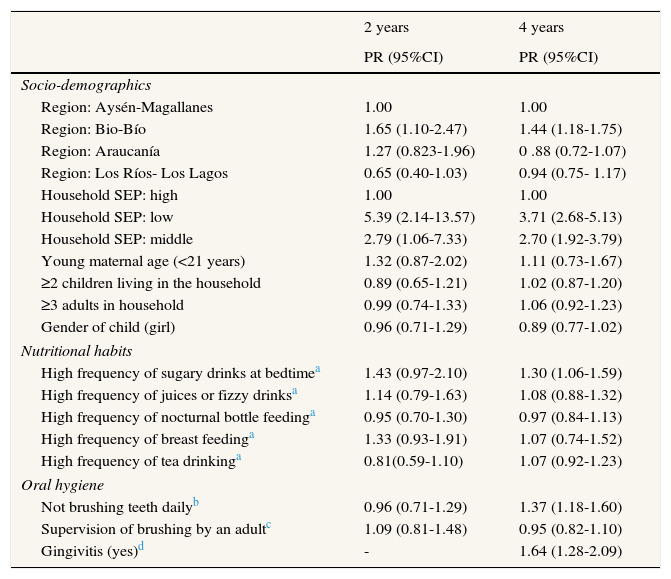
<body><![CDATA[<br><img src="/img/revistas/gs/v30n1/original_breve5_t1.jpg">    <br>95%CI: 95% confidence interval. <sup>a</sup> Weighted analyses.</font></p>     <p>&nbsp;</p>     <p><font face="Verdana" size="2">The mean dmft was 0.6 in 2-year-olds (95% confidence interval &#091;95%CI&#093;: 0.5-0.8). In this group, the mean number of decayed teeth was 0.6 (95%CI: 0.5-0.7) and mean number of filled teeth was 0.0 (95%CI: 0.0-0.1). No extractions were found. The mean dmft was higher in children from low socioeconomic position households than in those from high socioeconomic position households (<a href="#t1">Table 1</a>). No statistically significant differences between boys and girls were found for the dmft index (p-value for U Mann-Whitney test was 0.097).</font></p>     <p><font face="Verdana" size="2">In 4-year-olds, the mean dmft was 2.5. This group had a mean number of decayed teeth of 2.0 (95%CI: 1.7-2.4), mean number of filled teeth of 0.4 (95%CI: 0.3-0.6), and mean number of extracted teeth of 0.0 (95%CI: 0.0-0.1). The mean dmft was 3.2 in 4-year-olds from low socioeconomic position households, compared with 0.6 in those from high socioeconomic position households.</font></p>     <p><font face="Verdana" size="2">The SiC index was 1.8 for 2-years-old children and 6.0 for 4-years-olds. In both age groups, children from low socioeconomic position households had higher SiC indexes than children from other socioeconomic position households.</font></p>     <p><font face="Verdana" size="2"><a href="#t2">Table 2</a> shows the results obtained from the multivariable model for dmft. For 2-year-old children living in the Bio-B&iacute;o region, the dmft was 1.65 times larger than it was for those living in the region of Ays&eacute;n-Magallanes, whereas for 4-years-old it was 1.44 times as large. Children in low and middle socioeconomic position households had a significantly larger dmft index than those in higher socioeconomic position households.</font></p>     <p>&nbsp;</p>     <p align="center"><font face="Verdana" size="2"><b><a name="t2"></a>Table 2 - Zero inflated negative binomial regression models for dental caries index    <br>(number of teeth with history of caries) in children aged 2 and 4 years old.</b>    ]]></body>
<body><![CDATA[<br><img src="/img/revistas/gs/v30n1/original_breve5_t2.jpg">    <br>95%CI: 95% confidence interval; SEP: socioeconomic position.    <br>Reference categories: <sup>a</sup> - Less than three times a week.    <br><sup>b</sup> - Brushing teeth daily. <sup>c</sup> - No supervision by adult.    <br><sup>d</sup> - Absence of gingivitis.</font></p>     <p>&nbsp;</p>     <p><font face="Verdana" size="2">Four-year-old children who drank sugary beverages before bedtime with high frequency had a dmft 1.30 times as large as those who drank before bedtime less than 3 times per week. Four-year-olds who did not brush their teeth daily had a dmft 1.37 times larger than those who brushed their teeth daily. In this age group gingivitis was associated with the dmft index (PR = 1.64).</font></p>     <p>&nbsp;</p>     <p><font face="Verdana" size="2"><b>Discussion</b></font></p>     <p><font face="Verdana" size="2">Our findings reveal a high prevalence of dental caries in the preschool children in Chile. Countries such as the United States<sup>9</sup> and Brazil<sup>4</sup> have reported lower caries prevalences among comparable populations. Despite these differences, caries showed a similar distribution pattern among socioeconomic levels as described in other studies.<sup>4,9</sup> It is important to note that the dental caries index used for this study followed the guidelines of the WHO,<sup>6</sup> which does not differentiate between stages of development of dental cavities. This situation might underestimate the caries prevalence in this population.</font></p>     ]]></body>
<body><![CDATA[<p><font face="Verdana" size="2">The mean dmft in 4-year-olds was lower than that reported in similar studies in Chile,<sup>10</sup> but higher than that reported in similar populations in other Latin American countries<sup>11</sup> and indicates considerable oral damage due to caries. Health disparities can be further understood with the SiC index which showed that children in low socioeconomic position households had extensive caries experience.</font></p>     <p><font face="Verdana" size="2">The multivariable and descriptive analyses confirmed large-scale inequalities in socioeconomic position in both age groups, which is consistent with the literature describing older children.<sup>1,12</sup> These inequalities are reflected in the descriptive results, which showed that 2 year old children of low socioeconomic groups had 10 times more caries than those of higher socioeconomic groups. Also the multivariable model showed a prevalence ratio of caries in children of low socioeconomic groups of at least twice that of higher socioeconomic groups. On the other hand, nutritional factors contributed independently to caries prevalence. We hypothesize that these behaviors replaced previous behaviors also associated with nighttime feeding at earlier ages. Oral hygiene habits were found to be protective factors at age 4 which might be due in part to increased motor control,<sup>13</sup> and their increased ability to understand instructions.<sup>14</sup> Other factors such as parents educational level and dental education in daycare centers might also affect oral hygiene among individuals, but they could not explain the difference between ages. The higher risk of developing caries in the region of Bio-B&iacute;o could be explained by the extremely low levels of fluoridated water in this area (0.003 to 0.055 ppm).<sup>15</sup></font></p>     <p><font face="Verdana" size="2">Our results showed that there were no statistically significant differences between boys and girls in the number of carious lesions. The literature regarding this topic for this age group is scarce and not conclusive.<sup>16</sup></font></p>     <p><font face="Verdana" size="2">The study limitations are that all sampled children attended daycare facilities, affecting the results' external validity; also the cross-sectional study design emphasizes the need to be cautious with the interpretation of its results. It is important to consider that nutritional and oral hygiene variables might be influenced by oral health status and therefore we cannot establish these as risk factors for dental caries.</font></p>     <p><font face="Verdana" size="2">On the other hand, the strength of this study relies on the sample size and on the heterogeneity of the sample in terms of geographical distribution, family characteristics, and type of daycare centers (public without out-of-pocket charges, subsidized, and private).</font></p>     <p><font face="Verdana" size="2">In conclusion, this study found a high caries prevalence in children at very young ages in this region of Latin America. Socioeconomic position was found to be associated with caries experience. Nutritional habits were associated with caries development in all children, independent of their socioeconomic status and region of residency. We suggest that other factors such as family traditions might be related to dietary habits in this population. We encourage the implementation of oral health education and prevention programs aimed at improving nutritional habits at a familial level so that children can experience a healthy home environment.</font></p>     <p>&nbsp;</p>     <p><font face="Verdana" size="2"><b>Editor in charge</b></font></p>     <p><font face="Verdana" size="2">Gl&ograve;ria P&eacute;rez.</font></p>     <p>&nbsp;</p>     ]]></body>
<body><![CDATA[<p><font face="Verdana" size="2"><b>Transparency declaration</b></font></p>     <p><font face="Verdana" size="2">The corresponding author on behalf of the other authors guarantee the accuracy, transparency and honesty of the data and information contained in the study, that no relevant information has been omitted and that all discrepancies between authors have been adequately resolved and described.</font></p>     <p>&nbsp;</p>     <p><font face="Verdana" size="2"><b>Authorship contributions</b></font></p>     <p><font face="Verdana" size="2">L. Hoffmeister and P. Moya were involved in the conception and design of the work. C. Vidal carried out the analysis and interpretation of data. D. Benadof contributed to the writing and its critical review with important intellectual contributions. All authors have approved the final version and are jointly accountable for all aspects of the work.</font></p>     <p>&nbsp;</p>     <p><font face="Verdana" size="2"><b>Conflicts of interest</b></font></p>     <p><font face="Verdana" size="2">None.</font></p>     <p>&nbsp;</p>     <p><img src="/img/revistas/gs/v30n1/original_breve5_cuadro.jpg"></p>     ]]></body>
<body><![CDATA[<p>&nbsp;</p>     <p><font face="Verdana" size="2"><b>References</b></font></p>     <!-- ref --><p><font face="Verdana" size="2">1. Antunes J.L.F., Narvai P.C., Nugent Z.J. Measuring inequalities in the distribution of dental caries. Community Dent Oral Epidemiol. 2004;32:41-8.    &nbsp;&nbsp;&nbsp;&nbsp;&nbsp;&nbsp;&nbsp;&nbsp;[&#160;<a href="javascript:void(0);" onclick="javascript: window.open('/scielo.php?script=sci_nlinks&ref=2506826&pid=S0213-9111201600010001200001&lng=','','width=640,height=500,resizable=yes,scrollbars=1,menubar=yes,');">Links</a>&#160;]<!-- end-ref --></font></p>    <!-- ref --><p><font face="Verdana" size="2">2. Harris R., Nicoll A.D., Adair P.M., et al. Risk factors for dental caries in young children: a systematic review of the literature. Community Dent Health. 2004;21(Suppl 1):71-85.    &nbsp;&nbsp;&nbsp;&nbsp;&nbsp;&nbsp;&nbsp;&nbsp;[&#160;<a href="javascript:void(0);" onclick="javascript: window.open('/scielo.php?script=sci_nlinks&ref=2506828&pid=S0213-9111201600010001200002&lng=','','width=640,height=500,resizable=yes,scrollbars=1,menubar=yes,');">Links</a>&#160;]<!-- end-ref --></font></p>    <!-- ref --><p><font face="Verdana" size="2">3. Moimaz S.A.S., Fadel C.B., Lolli L.F., et al. Social aspects of dental caries in the context of mother-child pairs. J Appl Oral Sci. 2014;22:73-8.    &nbsp;&nbsp;&nbsp;&nbsp;&nbsp;&nbsp;&nbsp;&nbsp;[&#160;<a href="javascript:void(0);" onclick="javascript: window.open('/scielo.php?script=sci_nlinks&ref=2506830&pid=S0213-9111201600010001200003&lng=','','width=640,height=500,resizable=yes,scrollbars=1,menubar=yes,');">Links</a>&#160;]<!-- end-ref --></font></p>    <!-- ref --><p><font face="Verdana" size="2">4. Dos V.E., de R.M.B., Oliveira M.C., et al. Early childhood caries and its relationship with perinatal, socioeconomic and nutritional risks: a cross-sectional study. BMC Oral Health. 2014;14:47.    &nbsp;&nbsp;&nbsp;&nbsp;&nbsp;&nbsp;&nbsp;&nbsp;[&#160;<a href="javascript:void(0);" onclick="javascript: window.open('/scielo.php?script=sci_nlinks&ref=2506832&pid=S0213-9111201600010001200004&lng=','','width=640,height=500,resizable=yes,scrollbars=1,menubar=yes,');">Links</a>&#160;]<!-- end-ref --></font></p>    ]]></body>
<body><![CDATA[<!-- ref --><p><font face="Verdana" size="2">5. Costa L.R., Daher A., Queiroz M.G. Early childhood caries and body mass index in young children from low income families. Int J Environ Res Public Health. 2013;10:867-78.    &nbsp;&nbsp;&nbsp;&nbsp;&nbsp;&nbsp;&nbsp;&nbsp;[&#160;<a href="javascript:void(0);" onclick="javascript: window.open('/scielo.php?script=sci_nlinks&ref=2506834&pid=S0213-9111201600010001200005&lng=','','width=640,height=500,resizable=yes,scrollbars=1,menubar=yes,');">Links</a>&#160;]<!-- end-ref --></font></p>    <!-- ref --><p><font face="Verdana" size="2">6. World Health Organization. Oral Health Surveys: Basic Methods. 4th ed. Geneva: WHO; 1997. 67 p.    &nbsp;&nbsp;&nbsp;&nbsp;&nbsp;&nbsp;&nbsp;&nbsp;[&#160;<a href="javascript:void(0);" onclick="javascript: window.open('/scielo.php?script=sci_nlinks&ref=2506836&pid=S0213-9111201600010001200006&lng=','','width=640,height=500,resizable=yes,scrollbars=1,menubar=yes,');">Links</a>&#160;]<!-- end-ref --></font></p>    <!-- ref --><p><font face="Verdana" size="2">7. Antunes J.L.F., Frazao P., Narvai P.C., et al. Spatial analysis to identify differentials in dental needs by area-based measures. Community Dent Oral Epidemiol. 2002;30:133-42.    &nbsp;&nbsp;&nbsp;&nbsp;&nbsp;&nbsp;&nbsp;&nbsp;[&#160;<a href="javascript:void(0);" onclick="javascript: window.open('/scielo.php?script=sci_nlinks&ref=2506838&pid=S0213-9111201600010001200007&lng=','','width=640,height=500,resizable=yes,scrollbars=1,menubar=yes,');">Links</a>&#160;]<!-- end-ref --></font></p>    <!-- ref --><p><font face="Verdana" size="2">8. Bratthall D. Introducing the Significant Caries Index together with a proposal for a new global oral health goal for 12-year-olds. Int Dent J. 2000;50:378-84.    &nbsp;&nbsp;&nbsp;&nbsp;&nbsp;&nbsp;&nbsp;&nbsp;[&#160;<a href="javascript:void(0);" onclick="javascript: window.open('/scielo.php?script=sci_nlinks&ref=2506840&pid=S0213-9111201600010001200008&lng=','','width=640,height=500,resizable=yes,scrollbars=1,menubar=yes,');">Links</a>&#160;]<!-- end-ref --></font></p>    <!-- ref --><p><font face="Verdana" size="2">9. Dye B., Tan S., Smith V., et al. Trends in oral health status: United States, 1988-1994 and 1999-2004. Vital Health Stat. 2007;11:1-92.    &nbsp;&nbsp;&nbsp;&nbsp;&nbsp;&nbsp;&nbsp;&nbsp;[&#160;<a href="javascript:void(0);" onclick="javascript: window.open('/scielo.php?script=sci_nlinks&ref=2506842&pid=S0213-9111201600010001200009&lng=','','width=640,height=500,resizable=yes,scrollbars=1,menubar=yes,');">Links</a>&#160;]<!-- end-ref --></font></p>    ]]></body>
<body><![CDATA[<!-- ref --><p><font face="Verdana" size="2">10. Zaror S&aacute;nchez C, Pineda Toledo P, Orellana C&aacute;ceres JJ. Prevalencia de caries temprana de la infancia y sus factores asociados en ni&ntilde;os chilenos de 2 y 4 a&ntilde;os. Int J Odontostomatol. 201;5:171-7.    &nbsp;&nbsp;&nbsp;&nbsp;&nbsp;&nbsp;&nbsp;&nbsp;[&#160;<a href="javascript:void(0);" onclick="javascript: window.open('/scielo.php?script=sci_nlinks&ref=2506844&pid=S0213-9111201600010001200010&lng=','','width=640,height=500,resizable=yes,scrollbars=1,menubar=yes,');">Links</a>&#160;]<!-- end-ref --></font></p>    <!-- ref --><p><font face="Verdana" size="2">11. Carvalho F., Carvalho C.R.B., Xavier A., et al. Dental caries experience in preschool children of Bauru, SP, Brazil. Brazilian Journal of Oral Science. 2009;8.    &nbsp;&nbsp;&nbsp;&nbsp;&nbsp;&nbsp;&nbsp;&nbsp;[&#160;<a href="javascript:void(0);" onclick="javascript: window.open('/scielo.php?script=sci_nlinks&ref=2506846&pid=S0213-9111201600010001200011&lng=','','width=640,height=500,resizable=yes,scrollbars=1,menubar=yes,');">Links</a>&#160;]<!-- end-ref --></font></p>    <!-- ref --><p><font face="Verdana" size="2">12. Delgado-Angulo E.K., Hobdell M.H., Bernab&eacute; E. Poverty, social exclusion and dental caries of 12-year-old children: a cross-sectional study in Lima, Peru. BMC Oral Health. 2009;9:16.    &nbsp;&nbsp;&nbsp;&nbsp;&nbsp;&nbsp;&nbsp;&nbsp;[&#160;<a href="javascript:void(0);" onclick="javascript: window.open('/scielo.php?script=sci_nlinks&ref=2506848&pid=S0213-9111201600010001200012&lng=','','width=640,height=500,resizable=yes,scrollbars=1,menubar=yes,');">Links</a>&#160;]<!-- end-ref --></font></p>    <!-- ref --><p><font face="Verdana" size="2">13. Gerber R.J., Wilks T., Erdie-Lalena C. Developmental milestones: motor development. Pediatr Rev. 2010;31:267-76.    &nbsp;&nbsp;&nbsp;&nbsp;&nbsp;&nbsp;&nbsp;&nbsp;[&#160;<a href="javascript:void(0);" onclick="javascript: window.open('/scielo.php?script=sci_nlinks&ref=2506850&pid=S0213-9111201600010001200013&lng=','','width=640,height=500,resizable=yes,scrollbars=1,menubar=yes,');">Links</a>&#160;]<!-- end-ref --></font></p>    <!-- ref --><p><font face="Verdana" size="2">14. Wilks T., Gerber R.J., Erdie-Lalena C. Developmental milestones: cognitive development. Pediatr Rev. 2010;31:364-7.    &nbsp;&nbsp;&nbsp;&nbsp;&nbsp;&nbsp;&nbsp;&nbsp;[&#160;<a href="javascript:void(0);" onclick="javascript: window.open('/scielo.php?script=sci_nlinks&ref=2506852&pid=S0213-9111201600010001200014&lng=','','width=640,height=500,resizable=yes,scrollbars=1,menubar=yes,');">Links</a>&#160;]<!-- end-ref --></font></p>    ]]></body>
<body><![CDATA[<!-- ref --><p><font face="Verdana" size="2">15. Gomez S, Fernandez O. (Water fluoridation experience in Chile). In: Gomez S, editor. (Fluoride therapy in dentistry). 4th ed. 2010. p. 211-21.    &nbsp;&nbsp;&nbsp;&nbsp;&nbsp;&nbsp;&nbsp;&nbsp;[&#160;<a href="javascript:void(0);" onclick="javascript: window.open('/scielo.php?script=sci_nlinks&ref=2506854&pid=S0213-9111201600010001200015&lng=','','width=640,height=500,resizable=yes,scrollbars=1,menubar=yes,');">Links</a>&#160;]<!-- end-ref --></font></p>    <!-- ref --><p><font face="Verdana" size="2">16. Kramer A.A., Hakeberg M., Petzold M., et al. Demographic factors and dental health of Swedish children and adolescents. Acta Odontol Scand. 2015;1:1-8.    &nbsp;&nbsp;&nbsp;&nbsp;&nbsp;&nbsp;&nbsp;&nbsp;[&#160;<a href="javascript:void(0);" onclick="javascript: window.open('/scielo.php?script=sci_nlinks&ref=2506856&pid=S0213-9111201600010001200016&lng=','','width=640,height=500,resizable=yes,scrollbars=1,menubar=yes,');">Links</a>&#160;]<!-- end-ref --></font></p>     <p>&nbsp;</p>     <p>&nbsp;</p>     <p><font face="Verdana" size="2"><a href="#top"><img border="0" src="/img/revistas/gs/v30n1/seta.gif" width="15" height="17"></a><a name="bajo"></a><b>Correspondence:</b>    <br>Patricia Moya:    <br><a href="mailto:salud.publica@umayor.cl">salud.publica@umayor.cl</a></font></p>     <p><font face="Verdana" size="2">Received: 7 July 2015    ]]></body>
<body><![CDATA[<br>Accepted: 30 September 2015</font></p>      ]]></body><back>
<ref-list>
<ref id="B1">
<label>1</label><nlm-citation citation-type="journal">
<person-group person-group-type="author">
<name>
<surname><![CDATA[Antunes]]></surname>
<given-names><![CDATA[J.L.F.]]></given-names>
</name>
<name>
<surname><![CDATA[Narvai]]></surname>
<given-names><![CDATA[P.C.]]></given-names>
</name>
<name>
<surname><![CDATA[Nugent]]></surname>
<given-names><![CDATA[Z.J]]></given-names>
</name>
</person-group>
<article-title xml:lang="en"><![CDATA[Measuring inequalities in the distribution of dental caries]]></article-title>
<source><![CDATA[Community Dent Oral Epidemiol]]></source>
<year>2004</year>
<volume>32</volume>
<page-range>41-8</page-range></nlm-citation>
</ref>
<ref id="B2">
<label>2</label><nlm-citation citation-type="journal">
<person-group person-group-type="author">
<name>
<surname><![CDATA[Harris]]></surname>
<given-names><![CDATA[R.]]></given-names>
</name>
<name>
<surname><![CDATA[Nicoll]]></surname>
<given-names><![CDATA[A.D.]]></given-names>
</name>
<name>
<surname><![CDATA[Adair]]></surname>
<given-names><![CDATA[P.M.]]></given-names>
</name>
</person-group>
<article-title xml:lang="en"><![CDATA[Risk factors for dental caries in young children: a systematic review of the literature]]></article-title>
<source><![CDATA[Community Dent Health]]></source>
<year>2004</year>
<volume>21</volume>
<numero>^s1</numero>
<issue>^s1</issue>
<supplement>1</supplement>
<page-range>71-85</page-range></nlm-citation>
</ref>
<ref id="B3">
<label>3</label><nlm-citation citation-type="journal">
<person-group person-group-type="author">
<name>
<surname><![CDATA[Moimaz]]></surname>
<given-names><![CDATA[S.A.S.]]></given-names>
</name>
<name>
<surname><![CDATA[Fadel]]></surname>
<given-names><![CDATA[C.B.]]></given-names>
</name>
<name>
<surname><![CDATA[Lolli]]></surname>
<given-names><![CDATA[L.F.]]></given-names>
</name>
</person-group>
<article-title xml:lang="en"><![CDATA[Social aspects of dental caries in the context of mother-child pairs]]></article-title>
<source><![CDATA[J Appl Oral Sci]]></source>
<year>2014</year>
<volume>22</volume>
<page-range>73-8</page-range></nlm-citation>
</ref>
<ref id="B4">
<label>4</label><nlm-citation citation-type="journal">
<person-group person-group-type="author">
<name>
<surname><![CDATA[Dos]]></surname>
<given-names><![CDATA[V.E.]]></given-names>
</name>
<name>
<surname><![CDATA[de]]></surname>
<given-names><![CDATA[R.M.B.]]></given-names>
</name>
<name>
<surname><![CDATA[Oliveira]]></surname>
<given-names><![CDATA[M.C.]]></given-names>
</name>
</person-group>
<article-title xml:lang="en"><![CDATA[Early childhood caries and its relationship with perinatal, socioeconomic and nutritional risks: a cross-sectional study]]></article-title>
<source><![CDATA[BMC Oral Health]]></source>
<year>2014</year>
<volume>14</volume>
</nlm-citation>
</ref>
<ref id="B5">
<label>5</label><nlm-citation citation-type="journal">
<person-group person-group-type="author">
<name>
<surname><![CDATA[Costa]]></surname>
<given-names><![CDATA[L.R.]]></given-names>
</name>
<name>
<surname><![CDATA[Daher]]></surname>
<given-names><![CDATA[A.]]></given-names>
</name>
<name>
<surname><![CDATA[Queiroz]]></surname>
<given-names><![CDATA[M.G]]></given-names>
</name>
</person-group>
<article-title xml:lang="en"><![CDATA[Early childhood caries and body mass index in young children from low income families]]></article-title>
<source><![CDATA[Int J Environ Res Public Health]]></source>
<year>2013</year>
<volume>10</volume>
<page-range>867-78</page-range></nlm-citation>
</ref>
<ref id="B6">
<label>6</label><nlm-citation citation-type="book">
<collab>World Health Organization</collab>
<source><![CDATA[Oral Health Surveys: Basic Methods]]></source>
<year>1997</year>
<edition>4</edition>
<publisher-loc><![CDATA[Geneva ]]></publisher-loc>
<publisher-name><![CDATA[WHO]]></publisher-name>
</nlm-citation>
</ref>
<ref id="B7">
<label>7</label><nlm-citation citation-type="journal">
<person-group person-group-type="author">
<name>
<surname><![CDATA[Antunes]]></surname>
<given-names><![CDATA[J.L.F.]]></given-names>
</name>
<name>
<surname><![CDATA[Frazao]]></surname>
<given-names><![CDATA[P.]]></given-names>
</name>
<name>
<surname><![CDATA[Narvai]]></surname>
<given-names><![CDATA[P.C.]]></given-names>
</name>
</person-group>
<article-title xml:lang="en"><![CDATA[Spatial analysis to identify differentials in dental needs by area-based measures]]></article-title>
<source><![CDATA[Community Dent Oral Epidemiol]]></source>
<year>2002</year>
<volume>30</volume>
<page-range>133-42</page-range></nlm-citation>
</ref>
<ref id="B8">
<label>8</label><nlm-citation citation-type="journal">
<person-group person-group-type="author">
<name>
<surname><![CDATA[Bratthall]]></surname>
<given-names><![CDATA[D]]></given-names>
</name>
</person-group>
<article-title xml:lang="en"><![CDATA[Introducing the Significant Caries Index together with a proposal for a new global oral health goal for 12-year-olds]]></article-title>
<source><![CDATA[Int Dent J]]></source>
<year>2000</year>
<volume>50</volume>
<page-range>378-84</page-range></nlm-citation>
</ref>
<ref id="B9">
<label>9</label><nlm-citation citation-type="journal">
<person-group person-group-type="author">
<name>
<surname><![CDATA[Dye]]></surname>
<given-names><![CDATA[B.]]></given-names>
</name>
<name>
<surname><![CDATA[Tan]]></surname>
<given-names><![CDATA[S.]]></given-names>
</name>
<name>
<surname><![CDATA[Smith]]></surname>
<given-names><![CDATA[V.]]></given-names>
</name>
</person-group>
<article-title xml:lang="en"><![CDATA[Trends in oral health status: United States, 1988-1994 and 1999-2004]]></article-title>
<source><![CDATA[Vital Health Stat]]></source>
<year>2007</year>
<volume>11</volume>
<page-range>1-92</page-range></nlm-citation>
</ref>
<ref id="B10">
<label>10</label><nlm-citation citation-type="journal">
<person-group person-group-type="author">
<name>
<surname><![CDATA[Zaror Sánchez]]></surname>
<given-names><![CDATA[C]]></given-names>
</name>
<name>
<surname><![CDATA[Pineda Toledo]]></surname>
<given-names><![CDATA[P]]></given-names>
</name>
<name>
<surname><![CDATA[Orellana Cáceres]]></surname>
<given-names><![CDATA[JJ]]></given-names>
</name>
</person-group>
<article-title xml:lang="es"><![CDATA[Prevalencia de caries temprana de la infancia y sus factores asociados en niños chilenos de 2 y 4 años]]></article-title>
<source><![CDATA[Int J Odontostomatol]]></source>
<year>201</year>
<volume>5</volume>
<page-range>171-7</page-range></nlm-citation>
</ref>
<ref id="B11">
<label>11</label><nlm-citation citation-type="journal">
<person-group person-group-type="author">
<name>
<surname><![CDATA[Carvalho]]></surname>
<given-names><![CDATA[F.]]></given-names>
</name>
<name>
<surname><![CDATA[Carvalho]]></surname>
<given-names><![CDATA[C.R.B.]]></given-names>
</name>
<name>
<surname><![CDATA[Xavier]]></surname>
<given-names><![CDATA[A.]]></given-names>
</name>
</person-group>
<article-title xml:lang="en"><![CDATA[Dental caries experience in preschool children of Bauru, SP, Brazil]]></article-title>
<source><![CDATA[Brazilian Journal of Oral Science]]></source>
<year>2009</year>
<volume>8</volume>
</nlm-citation>
</ref>
<ref id="B12">
<label>12</label><nlm-citation citation-type="journal">
<person-group person-group-type="author">
<name>
<surname><![CDATA[Delgado-Angulo]]></surname>
<given-names><![CDATA[E.K.]]></given-names>
</name>
<name>
<surname><![CDATA[Hobdell]]></surname>
<given-names><![CDATA[M.H.]]></given-names>
</name>
<name>
<surname><![CDATA[Bernabé]]></surname>
<given-names><![CDATA[E]]></given-names>
</name>
</person-group>
<article-title xml:lang="en"><![CDATA[Poverty, social exclusion and dental caries of 12-year-old children: a cross-sectional study in Lima, Peru]]></article-title>
<source><![CDATA[BMC Oral Health]]></source>
<year>2009</year>
<volume>9</volume>
</nlm-citation>
</ref>
<ref id="B13">
<label>13</label><nlm-citation citation-type="journal">
<person-group person-group-type="author">
<name>
<surname><![CDATA[Gerber]]></surname>
<given-names><![CDATA[R.J.]]></given-names>
</name>
<name>
<surname><![CDATA[Wilks]]></surname>
<given-names><![CDATA[T.]]></given-names>
</name>
<name>
<surname><![CDATA[Erdie-Lalena]]></surname>
<given-names><![CDATA[C]]></given-names>
</name>
</person-group>
<article-title xml:lang="en"><![CDATA[Developmental milestones: motor development]]></article-title>
<source><![CDATA[Pediatr Rev]]></source>
<year>2010</year>
<volume>31</volume>
<page-range>267-76</page-range></nlm-citation>
</ref>
<ref id="B14">
<label>14</label><nlm-citation citation-type="journal">
<person-group person-group-type="author">
<name>
<surname><![CDATA[Wilks]]></surname>
<given-names><![CDATA[T.]]></given-names>
</name>
<name>
<surname><![CDATA[Gerber]]></surname>
<given-names><![CDATA[R.J.]]></given-names>
</name>
<name>
<surname><![CDATA[Erdie-Lalena]]></surname>
<given-names><![CDATA[C]]></given-names>
</name>
</person-group>
<article-title xml:lang="en"><![CDATA[Developmental milestones: cognitive development]]></article-title>
<source><![CDATA[Pediatr Rev]]></source>
<year>2010</year>
<volume>31</volume>
<page-range>364-7</page-range></nlm-citation>
</ref>
<ref id="B15">
<label>15</label><nlm-citation citation-type="">
<person-group person-group-type="author">
<name>
<surname><![CDATA[Gomez]]></surname>
<given-names><![CDATA[S]]></given-names>
</name>
<name>
<surname><![CDATA[Fernandez]]></surname>
<given-names><![CDATA[O.]]></given-names>
</name>
</person-group>
<article-title xml:lang="en"><![CDATA[Water fluoridation experience in Chile]]></article-title>
<person-group person-group-type="editor">
<name>
<surname><![CDATA[Gomez]]></surname>
<given-names><![CDATA[S]]></given-names>
</name>
</person-group>
<source><![CDATA[Fluoride therapy in dentistry]]></source>
<year>2010</year>
<edition>4</edition>
<page-range>211-21</page-range></nlm-citation>
</ref>
<ref id="B16">
<label>16</label><nlm-citation citation-type="journal">
<person-group person-group-type="author">
<name>
<surname><![CDATA[Kramer]]></surname>
<given-names><![CDATA[A.A.]]></given-names>
</name>
<name>
<surname><![CDATA[Hakeberg]]></surname>
<given-names><![CDATA[M.]]></given-names>
</name>
<name>
<surname><![CDATA[Petzold]]></surname>
<given-names><![CDATA[M.]]></given-names>
</name>
</person-group>
<article-title xml:lang="en"><![CDATA[Demographic factors and dental health of Swedish children and adolescents]]></article-title>
<source><![CDATA[Acta Odontol Scand]]></source>
<year>2015</year>
<numero>1</numero>
<issue>1</issue>
<page-range>1-8</page-range></nlm-citation>
</ref>
</ref-list>
</back>
</article>