<?xml version="1.0" encoding="ISO-8859-1"?><article xmlns:mml="http://www.w3.org/1998/Math/MathML" xmlns:xlink="http://www.w3.org/1999/xlink" xmlns:xsi="http://www.w3.org/2001/XMLSchema-instance">
<front>
<journal-meta>
<journal-id>0378-4835</journal-id>
<journal-title><![CDATA[Oncología (Barcelona)]]></journal-title>
<abbrev-journal-title><![CDATA[Oncología (Barc.)]]></abbrev-journal-title>
<issn>0378-4835</issn>
<publisher>
<publisher-name><![CDATA[Alpe Editores, S.A.]]></publisher-name>
</publisher>
</journal-meta>
<article-meta>
<article-id>S0378-48352004000400005</article-id>
<title-group>
<article-title xml:lang="en"><![CDATA[D2 or non D2-lymphadenectomy in gastric cancer]]></article-title>
</title-group>
<contrib-group>
<contrib contrib-type="author">
<name>
<surname><![CDATA[Nitti]]></surname>
<given-names><![CDATA[D.]]></given-names>
</name>
<xref ref-type="aff" rid="A01"/>
</contrib>
<contrib contrib-type="author">
<name>
<surname><![CDATA[Marchet]]></surname>
<given-names><![CDATA[A.]]></given-names>
</name>
<xref ref-type="aff" rid="A01"/>
</contrib>
<contrib contrib-type="author">
<name>
<surname><![CDATA[Olivieri]]></surname>
<given-names><![CDATA[M.]]></given-names>
</name>
<xref ref-type="aff" rid="A01"/>
</contrib>
<contrib contrib-type="author">
<name>
<surname><![CDATA[Ambrosi]]></surname>
<given-names><![CDATA[A.]]></given-names>
</name>
<xref ref-type="aff" rid="A01"/>
</contrib>
<contrib contrib-type="author">
<name>
<surname><![CDATA[Mencarelli]]></surname>
<given-names><![CDATA[R.]]></given-names>
</name>
<xref ref-type="aff" rid="A01"/>
</contrib>
<contrib contrib-type="author">
<name>
<surname><![CDATA[Farinati]]></surname>
<given-names><![CDATA[F.]]></given-names>
</name>
<xref ref-type="aff" rid="A01"/>
</contrib>
<contrib contrib-type="author">
<name>
<surname><![CDATA[Belluco]]></surname>
<given-names><![CDATA[C.]]></given-names>
</name>
<xref ref-type="aff" rid="A01"/>
</contrib>
<contrib contrib-type="author">
<name>
<surname><![CDATA[Lise]]></surname>
<given-names><![CDATA[M.]]></given-names>
</name>
<xref ref-type="aff" rid="A01"/>
</contrib>
</contrib-group>
<aff id="A01">
<institution><![CDATA[,University of Padova Institute the Clinica Chirurgica 2 Departament of Oncological and Surgical Sciences]]></institution>
<addr-line><![CDATA[ ]]></addr-line>
<country>Italy</country>
</aff>
<pub-date pub-type="pub">
<day>00</day>
<month>04</month>
<year>2004</year>
</pub-date>
<pub-date pub-type="epub">
<day>00</day>
<month>04</month>
<year>2004</year>
</pub-date>
<volume>27</volume>
<numero>4</numero>
<fpage>34</fpage>
<lpage>37</lpage>
<copyright-statement/>
<copyright-year/>
<self-uri xlink:href="http://scielo.isciii.es/scielo.php?script=sci_arttext&amp;pid=S0378-48352004000400005&amp;lng=en&amp;nrm=iso"></self-uri><self-uri xlink:href="http://scielo.isciii.es/scielo.php?script=sci_abstract&amp;pid=S0378-48352004000400005&amp;lng=en&amp;nrm=iso"></self-uri><self-uri xlink:href="http://scielo.isciii.es/scielo.php?script=sci_pdf&amp;pid=S0378-48352004000400005&amp;lng=en&amp;nrm=iso"></self-uri></article-meta>
</front><body><![CDATA[ <p align="right"><b><font face="Verdana, Arial, Helvetica-Normal, sans-serif" size="2">CARCINOMA    DE EST&Oacute;MAGO</font></b></p>     <p>&nbsp;</p>     <p><font face="Verdana, Arial, Helvetica-Normal, sans-serif" size="4"><b><a name="top10"></a>D2    or non D2-lymphadenectomy in gastric cancer</b></font></p>     <p>&nbsp;</p>     <p><font face="Verdana, Arial, Helvetica-Normal, sans-serif" size="2"><b>&nbsp;</b></font></p>     <p><font face="Verdana, Arial, Helvetica-Normal, sans-serif" size="2"><b>D. Nitti    MD; A. Marchet MD; M. Olivieri MD; A. Ambrosi PhD; R. Mencarelli MD; F. Farinati    MD; C. Belluco MD; M. Lise MD</b></font></p>     <p><font face="Verdana, Arial, Helvetica-Normal, sans-serif" size="2">Department    of Oncological and Surgical Sciences. Clinica Chirurgica 2. University of Padova.    Italy</font></p>     <p><font face="Verdana, Arial, Helvetica, sans-serif" size="2"><a href="#back10">Correspondence</a></font></p>     <p>&nbsp;</p>     <p>&nbsp;</p>     ]]></body>
<body><![CDATA[<p><font face="Verdana, Arial, Helvetica-Normal, sans-serif" size="3"><b>Introduction</b></font></p>     <p><font face="Verdana, Arial, Helvetica-Normal, sans-serif" size="2">The main    treatment modality for gastric carcinoma, which is still the second most common    cause of cancer-related deaths worldwide, is surgery. In Western countries,    a radical surgical procedure can be achieved in 70-80% of cases with a survival    at 5 years of 35-40%<sup>1-3</sup>. However, even after radical procedures,    recurrences occur in 50-60% of cases<sup>4</sup>. Patients with relapse mainly    present distant metastasis, but in 20- 40% of cases, recurrences are loco-regional    and involve the "gastric bed", the lymph nodes and/or the anastomosis or the    duodenal stump<sup>4</sup>. Loco-regional recurrences are probably related to    the biological characteristics of the tumor but, in some cases, they may be    due to an inadequate surgical procedure.</font></p>     <p><font face="Verdana, Arial, Helvetica-Normal, sans-serif" size="2">The results    reported by Japanese surgeons are better than those reported in Western countries    for all disease stages, with a 5-year survival rate approaching 50%<sup>5</sup>.    It has been suggested that the use of a different surgical procedure may explain    this difference in survival of patients with the same disease stage. In Japan,    standard guidelines have been established for lymph node dissection<sup>6</sup>:    extended lymphadenectomy is routinely used, and five-year survival rates after    extended lymphadenectomy (D2) reported in retrospective studies are significantly    higher than those reported following a lymphadenectomy limited to the perigastric    lymph nodes (D1)<sup>7</sup>.</font></p>     <p><font face="Verdana, Arial, Helvetica-Normal, sans-serif" size="2">D2 lymphadenectomy    is used less widely in the West. In an overview on gastric cancer treatment    in the USA, D2 dissections were performed in only 4 to 7% of cases<sup>2, 8-9</sup>.    The scepticism expressed by Western surgeons may be justified in view of the    doubts regarding the therapeutic value of extended lymphadenectomy, strengthened    by previous unfavourable results in Western countries<sup>9</sup>, and by the    negative impact the procedure was found to have on survival in previous randomized    clinical trials<sup>10-11</sup>, although conducted on small series. Moreover,    extended lymphadenectomy is difficult to perform, requires a longer operating    time and incurs a high incidence of mortality and morbidity. One randomized    clinical trial in England<sup>12</sup> and another in Holland<sup>13</sup>,    confirmed that there is a significant increase in the mortality and morbidity    rates after D2 lymphadenectomy with respect to D1 (in the English study, morbidity    was 28% for D1 and 46% for D2 and the mortality rate was 6.5% for D1 and 13%    for D2; in the Dutch study, mortality and morbidity were 25% and 4% respectively    in the D1 group and 43% and 10% respectively in the D2 group). These differences    were related to the high percentage of patients who underwent splenectomy and/or    distal pancreaectomy. In the English study there was no evidence that D2 resection    benefited overall survival: the five-year survival rate in the D1 and D2 arms    was 35% and 33%, respectively. Similar negative survival outcomes following    D2 lymphadenectomy were reported in the Dutch study: five-year survival rates    were 45% for the D1 group and 47% for the D2 group and cumulative risks of relapse    at five year were 43% and 37% for D1 and D2, respectively. However, after a    median follow-up of 11 years, a significant survival benefit was observed for    N2-positive patients of the D2 group: 20% are still alive<sup>14</sup>.</font></p>     <p><font face="Verdana, Arial, Helvetica-Normal, sans-serif" size="2">However,    the results of these multicentric studies may be criticized for the following    reasons:</font></p>     <p><font face="Verdana, Arial, Helvetica-Normal, sans-serif" size="2">a) the standarization    of lymph nodes dissection was doubtful<sup>15-16</sup>: in 51% of the patients    who underwent D2 dissection, no lymph nodes were obtained from two or more stations    dissected, and in 36% of the D1 dissections the number of nodes removed was    smaller than that required;</font></p>     <p><font face="Verdana, Arial, Helvetica-Normal, sans-serif" size="2">b) a large    number of distal pancreatectomies and splenectomies were performed, but these    procedures can be avoided for a adequate D2 lymphadenectomy;</font></p>     <p><font face="Verdana, Arial, Helvetica-Normal, sans-serif" size="2">c) with    a view to achieving a high rate of accrual, several hospitals participated in    the study, and therefore the median number of patients operated on by each surgeon    was very small: the morbidity and mortality of surgical procedures are related    to the number of procedures performed by each surgeon.</font></p>     <p><font face="Verdana, Arial, Helvetica-Normal, sans-serif" size="2">The prognostic    value of extended lymphadenectomy was confirmed in the 5<sup>th</sup> edition    of the TNM (UICC 1997), in which the N classification was modified: it is now    based on the number of lymph nodes involved (N0, no lymph nodes metastases;    N1, 1 to 6 positive lymph nodes; N2, 7 to 15 positive lymph nodes; and N3, more    than 15 positive lymph nodes). Moreover, the UICC has stated that the "histological    examination of a regional lymphadenectomy specimen will ordinarily include 15    or more lymph nodes". It is therefore necessary to remove at least 15 lymph    nodes in order to be able to classify a patient as "N2 or N3".</font></p>     <p><font face="Verdana, Arial, Helvetica-Normal, sans-serif" size="2">&nbsp;</font></p>     ]]></body>
<body><![CDATA[<p><font face="Verdana, Arial, Helvetica-Normal, sans-serif" size="3"><b>The EORTC    experience</b></font></p>     <p><font face="Verdana, Arial, Helvetica-Normal, sans-serif" size="2">In 1989,    the Gastrointestinal Tract Cancer Cooperative Group (GITCCG) of the European    Organization for Research and Treatment of Cancer (EORTC) closed a phase III    clinical trial on adjuvant chemotherapy with the FAM regimen. In eight European    Countries, 314 patients who had undergone curative resection for stage II or    stage III gastric carcinoma were randomized to receive the modified FAM regimen,    or no further treatment. A retrospective analysis of this study was made to    evaluate the effect of prognostic factors on survival and time to recurrence    in relation to the characteristics of patients and tumors, and treatment<sup>17</sup>.    For each patient, an evaluation of regional lymphadenectomy was made on the    basis of partial or complete D1, D2 or D3 dissection in relation to tumor site.    After comparing surgical and pathology data, lymphadenectomy was classified    as "adequate" when the extent of lymph node dissection was wider than lymph    node metastatic diffusion, "partially adequate" when these coincided and "inadequate"    when the dissection did not encompass metastatic diffusion (random lymph node    biopsies) or when there was a fault in the surgical technique (e.g., greater    omentum not removed).</font></p>     <p><font face="Verdana, Arial, Helvetica-Normal, sans-serif" size="2">Since pathology    data were incomplete in 5 out of 314 cases, the series evaluated for quality    of surgery consisted of 309 patients. Resection was considered "adequate" in    102 patients (33%), "partially adequate" in 131 (42.4%), and "inadequate" in    76 (24.6%). At univariate analysis, statistically significant differences in    survival and time to progression emerged for T, N, disease-stage or adequacy    of surgery. Survival was significantly better for patients who had "adequate"    than in those who had "partially adequate" and "inadequate" surgery (p&lt;0.001)    and the differences in survival between "adequate" and "inadequate" or "partially    adequate" surgery persisted when stage II and stage III patients were analyzed    separately.</font></p>     <p><font face="Verdana, Arial, Helvetica-Normal, sans-serif" size="2">Multivariate    analysis retained preoperative Hb level, T, N, and adequacy of surgery for duration    of survival, and T, N, adequacy of surgery and adjuvant chemotherapy for time    to recurrence. These data, show that inadequate lymphadenectomy may result not    only in stage shifting, but also in compromised radicality in patients with    "curable" disease<sup>17</sup>.</font></p>     <p><font face="Verdana, Arial, Helvetica-Normal, sans-serif" size="2">In the nineties    the EORTC evaluated the efficacy of the FAMTX regimen versus surgery alone in    a randomized clinical trial on patients with radically resected gastric cancer.    At that time, the International Collaborative Cancer Group (ICCG) was also investigating    5-FU+Epirubicin (EPI)+ MTX with Leucovorin rescue (FEMTX) versus surgery alone.    The two trials were considered similar enough by an Independent Data Monitoring    Committee to be analyzed together. From July 1990 to March 1998, 397 untreated    patients were randomised in both trials. Two hundred and six patients from 23    EORTC institutions (trial opened in February'91) and 191 from 16 ICCG institutions    were registered. At a preliminary analysis, the overall survivals in the EORTC    trial appeared better than those in the ICCG trial<sup>18</sup>.</font></p>     <p><font face="Verdana, Arial, Helvetica-Normal, sans-serif" size="2">An analysis    of the surgical procedures used in the two trials showed important differences    between extent of surgery. In the EORTC trial 89% of patients underwent D2 dissection.    The median number of lymph nodes removed was 13 in the ICCG study, whereas 74%    of patients had 13 or more nodes removed in the EORTC trial. Although a direct    comparison cannot be made, it appears likely that the more radical surgery performed    in the EORTC study resulted in a greater survival benefit than the less radical    surgery performed in the ICCG trial<sup>18</sup> .</font></p>     <p><font face="Verdana, Arial, Helvetica-Normal, sans-serif" size="2">&nbsp; <b>&nbsp;</b></font></p>     <p><font face="Verdana, Arial, Helvetica-Normal, sans-serif" size="3"><b>Personal    experience</b></font></p>     <p><font face="Verdana, Arial, Helvetica-Normal, sans-serif" size="2">To evaluate    the impact of D2 lymphadenectomy on the survival of patients who undergo radical    resection for gastric cancer and to demonstrate the role of the other prognostic    factors, recently we reviewed the data of 445 consecutive patients operated    on at Clinica Chirurgica II, Padova University<sup>19-20</sup>.</font></p>     <p><font face="Verdana, Arial, Helvetica-Normal, sans-serif" size="2">Between    February 1980 and December 1999, among 445 patients with histologically confirmed    carcinoma of the stomach, 314 patients underwent radical resection (R0). Thirty-seven    were excluded from the analysis: the study is therefore based on data from 277    patients who underwent radical resection (R0). D2 dissection was performed in    259 (93.6%), and D1 lymphadenectomy in 18 (6.4%) cases.</font></p>     ]]></body>
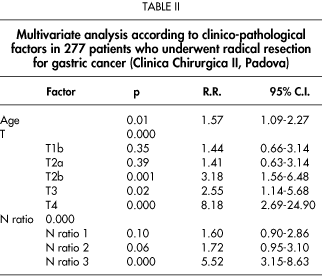
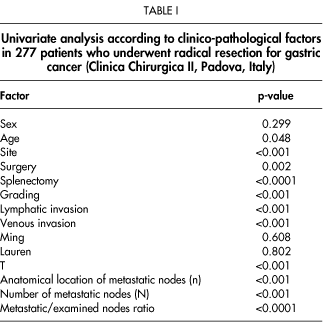
<body><![CDATA[<p><font face="Verdana, Arial, Helvetica-Normal, sans-serif" size="2">From 277    patients, a total of 7,668 lymph nodes (median 27; mean, 27.6; range 11-62)    were removed and examined. Lymphadenectomy included more than 15 lymph nodes    was performed in 245 cases (88.4%): 11 to 25 nodes in 116 patients (41.8%) and    more than 25 nodes in 161 patients (58.2%). A total of 1,280 lymph nodes were    metastatic (median, 5; mean, 8.25; range, 1-47). For the 277 patients, the 5-year    survival rate was 57%; it was 82% for the 117 patients without lymph node metastases,    and 37% for the 160 patients with lymph node metastases (<a href="/img/onco/v27n4/05f1.gif">Fig.    1</a>). <a href="#tab1">Table I</a> reports findings at univariate analysis    for prognostic factors.</font></p>     <p align="center"><a name="tab1"></a></p>     <p align="center">&nbsp;</p>     <p align="center"><img src="/img/onco/v27n4/05t1.gif"></p>     <p align="center">&nbsp;</p>     <p><font face="Verdana, Arial, Helvetica-Normal, sans-serif" size="2">When multivariate    analysis was performed, only age, T, and metastatic/examined lymphnodes ratio    (N ratio) were found to be independent prognostic factors (RR of N ratio 1=1.60,    RR of N ratio 2=1.72; RR of N ratio 3=5.52) (<a href="#tab2">Table II</a>).</font></p>     <p align="center"><a name="tab2"></a></p>     <p align="center">&nbsp;</p>     <p align="center"><img src="/img/onco/v27n4/05t2.gif"></p>     <p align="center">&nbsp;</p>     ]]></body>
<body><![CDATA[<p><font face="Verdana, Arial, Helvetica-Normal, sans-serif" size="2">In our study,    which considered almost exclusively D2 lymphadenectomy, the overall survival    rate appears better than that usually reported in western countries, and similar    to that reported in Japanese trials. These results could be related to the quality    of surgery performed in our series. We therefore believe that D2 lymphadenectomy    allows accurate disease staging of the disease and can be "curative" in patients    with gastric cancer confined to the locoregional area.</font></p>     <p><font face="Verdana, Arial, Helvetica-Normal, sans-serif" size="2">&nbsp;</font></p>     <p><font face="Verdana, Arial, Helvetica-Normal, sans-serif" size="3"><b>References</b></font></p>     <!-- ref --><p><font face="Verdana, Arial, Helvetica-Normal, sans-serif" size="2">1. Hundahl    SA, Phillips JL, Menck HR. The National Cancer Data Base Report on poor survival    of US gastric carcinoma patients treated with gastrectomy. Fifth Edition American    Joint Committee on Cancer Staging, proximal disease, and the "different disease"    hypothesis. Cancer 2000; 88:921-32.</font>&nbsp;&nbsp;&nbsp;&nbsp;&nbsp;&nbsp;&nbsp;&nbsp;[&#160;<a href="javascript:void(0);" onclick="javascript: window.open('/scielo.php?script=sci_nlinks&ref=4061174&pid=S0378-4835200400040000500001&lng=','','width=640,height=500,resizable=yes,scrollbars=1,menubar=yes,');">Links</a>&#160;]<!-- end-ref --><!-- ref --><p><font face="Verdana, Arial, Helvetica-Normal, sans-serif" size="2">2. Berrino    F, Sant M, Verdecchia A, et al. Survival of cancer patients in Europe. The Eurocare    study. IARC Sci, 1995; Publ. No.132.</font>&nbsp;&nbsp;&nbsp;&nbsp;&nbsp;&nbsp;&nbsp;&nbsp;[&#160;<a href="javascript:void(0);" onclick="javascript: window.open('/scielo.php?script=sci_nlinks&ref=4061175&pid=S0378-4835200400040000500002&lng=','','width=640,height=500,resizable=yes,scrollbars=1,menubar=yes,');">Links</a>&#160;]<!-- end-ref --><!-- ref --><p><font face="Verdana, Arial, Helvetica-Normal, sans-serif" size="2">3. Siewert    JR, Bottcher K, Roder JC, Busch R, Hermanek P, Meyer HJ. Prognostic relevance    of lymph node dissection in gastric carcinoma. German Gastric Carcinoma Study    Group. Br J Surg 1993; 80:1015-8.</font>&nbsp;&nbsp;&nbsp;&nbsp;&nbsp;&nbsp;&nbsp;&nbsp;[&#160;<a href="javascript:void(0);" onclick="javascript: window.open('/scielo.php?script=sci_nlinks&ref=4061176&pid=S0378-4835200400040000500003&lng=','','width=640,height=500,resizable=yes,scrollbars=1,menubar=yes,');">Links</a>&#160;]<!-- end-ref --><!-- ref --><p><font face="Verdana, Arial, Helvetica-Normal, sans-serif" size="2">4. Gunderson    LL. Gastric cancer. Patterns of relapse after surgical resection. Seminars in    Radiation Oncology 2002; 12:150-61.</font>&nbsp;&nbsp;&nbsp;&nbsp;&nbsp;&nbsp;&nbsp;&nbsp;[&#160;<a href="javascript:void(0);" onclick="javascript: window.open('/scielo.php?script=sci_nlinks&ref=4061177&pid=S0378-4835200400040000500004&lng=','','width=640,height=500,resizable=yes,scrollbars=1,menubar=yes,');">Links</a>&#160;]<!-- end-ref --><!-- ref --><p><font face="Verdana, Arial, Helvetica-Normal, sans-serif" size="2">5. Harrison    LE, Karpeh MS, Brennan F. Extended lymphadenectomy is associated with a survival    benefit for node-negative gastric cancer. J Gastrointest Surg 1998; 2:126-31.</font>&nbsp;&nbsp;&nbsp;&nbsp;&nbsp;&nbsp;&nbsp;&nbsp;[&#160;<a href="javascript:void(0);" onclick="javascript: window.open('/scielo.php?script=sci_nlinks&ref=4061178&pid=S0378-4835200400040000500005&lng=','','width=640,height=500,resizable=yes,scrollbars=1,menubar=yes,');">Links</a>&#160;]<!-- end-ref --><!-- ref --><p><font face="Verdana, Arial, Helvetica-Normal, sans-serif" size="2">6. Noguchi    Y, Imada T, Matsumoto A, Coit DG, Brennan MF. Radical surgery for gastric cancer:    a review of the Japanese experience. Cancer 1989; 64:2053-62.</font>&nbsp;&nbsp;&nbsp;&nbsp;&nbsp;&nbsp;&nbsp;&nbsp;[&#160;<a href="javascript:void(0);" onclick="javascript: window.open('/scielo.php?script=sci_nlinks&ref=4061179&pid=S0378-4835200400040000500006&lng=','','width=640,height=500,resizable=yes,scrollbars=1,menubar=yes,');">Links</a>&#160;]<!-- end-ref --><!-- ref --><p><font face="Verdana, Arial, Helvetica-Normal, sans-serif" size="2">7. Maruyama    K, Gunven P, Okabayashi K, Sasako M, Kinoshita T. Lymph nodes metastases in    gastric cancer. Ann Surg 1989; 210:596-602.</font>&nbsp;&nbsp;&nbsp;&nbsp;&nbsp;&nbsp;&nbsp;&nbsp;[&#160;<a href="javascript:void(0);" onclick="javascript: window.open('/scielo.php?script=sci_nlinks&ref=4061180&pid=S0378-4835200400040000500007&lng=','','width=640,height=500,resizable=yes,scrollbars=1,menubar=yes,');">Links</a>&#160;]<!-- end-ref --><!-- ref --><p><font face="Verdana, Arial, Helvetica-Normal, sans-serif" size="2">8. Hundal    SA, Macdonald JS, Benedetti J, Fitzsimmons T, for the Southwest Oncology Group    and the Gastric Intergroup. Surgical treatment variation in a prospective, randomized    trial of chemoradiotherapy in gastric cancer: the effect of undertreatment.    Ann Surg Oncol 2002; 9:278-86.</font>&nbsp;&nbsp;&nbsp;&nbsp;&nbsp;&nbsp;&nbsp;&nbsp;[&#160;<a href="javascript:void(0);" onclick="javascript: window.open('/scielo.php?script=sci_nlinks&ref=4061181&pid=S0378-4835200400040000500008&lng=','','width=640,height=500,resizable=yes,scrollbars=1,menubar=yes,');">Links</a>&#160;]<!-- end-ref --><!-- ref --><p><font face="Verdana, Arial, Helvetica-Normal, sans-serif" size="2">9. Wanebo    HJ, Kennedy BJ, Winchester DP, Fregmen A, Stewart AK. Gastric carcinoma: does    lymph node dissection alter the survival? J Am Coll Surg 1996; 183:616-24.</font>&nbsp;&nbsp;&nbsp;&nbsp;&nbsp;&nbsp;&nbsp;&nbsp;[&#160;<a href="javascript:void(0);" onclick="javascript: window.open('/scielo.php?script=sci_nlinks&ref=4061182&pid=S0378-4835200400040000500009&lng=','','width=640,height=500,resizable=yes,scrollbars=1,menubar=yes,');">Links</a>&#160;]<!-- end-ref --><!-- ref --><p><font face="Verdana, Arial, Helvetica-Normal, sans-serif" size="2">10. Dent    DM, Madden MV, Price SK. Randomized comparison of R1 and R2 gastrectomy for    gastric carcinoma. Br J Surg 1988; 75:110-2.</font>&nbsp;&nbsp;&nbsp;&nbsp;&nbsp;&nbsp;&nbsp;&nbsp;[&#160;<a href="javascript:void(0);" onclick="javascript: window.open('/scielo.php?script=sci_nlinks&ref=4061183&pid=S0378-4835200400040000500010&lng=','','width=640,height=500,resizable=yes,scrollbars=1,menubar=yes,');">Links</a>&#160;]<!-- end-ref --><!-- ref --><p><font face="Verdana, Arial, Helvetica-Normal, sans-serif" size="2">11. Diggory    RT, Cuschieri A. R2/R3 gastrectomy for carcinoma: an audited experience of a    consecutive series. Br J Surg 1985; 72:146-8.</font>&nbsp;&nbsp;&nbsp;&nbsp;&nbsp;&nbsp;&nbsp;&nbsp;[&#160;<a href="javascript:void(0);" onclick="javascript: window.open('/scielo.php?script=sci_nlinks&ref=4061184&pid=S0378-4835200400040000500011&lng=','','width=640,height=500,resizable=yes,scrollbars=1,menubar=yes,');">Links</a>&#160;]<!-- end-ref --><!-- ref --><p><font face="Verdana, Arial, Helvetica-Normal, sans-serif" size="2">12. Cuschieri    A, Weeden S, Fielding J, et al. Patient survival after D1 and D2 resections    for gastric cancer. Long term results of the MRC randomised surgical trial.    Br J Cancer 1999; 79:1522-30.</font>&nbsp;&nbsp;&nbsp;&nbsp;&nbsp;&nbsp;&nbsp;&nbsp;[&#160;<a href="javascript:void(0);" onclick="javascript: window.open('/scielo.php?script=sci_nlinks&ref=4061185&pid=S0378-4835200400040000500012&lng=','','width=640,height=500,resizable=yes,scrollbars=1,menubar=yes,');">Links</a>&#160;]<!-- end-ref --><!-- ref --><p><font face="Verdana, Arial, Helvetica-Normal, sans-serif" size="2">13. Bonekamp    JJ, Hermans J, Sasako M, van de Velde CJH. Extended lymph-node dissection for    gastric cancer. N Engl J Med 1999; 340:908-14.</font>&nbsp;&nbsp;&nbsp;&nbsp;&nbsp;&nbsp;&nbsp;&nbsp;[&#160;<a href="javascript:void(0);" onclick="javascript: window.open('/scielo.php?script=sci_nlinks&ref=4061186&pid=S0378-4835200400040000500013&lng=','','width=640,height=500,resizable=yes,scrollbars=1,menubar=yes,');">Links</a>&#160;]<!-- end-ref --><!-- ref --><p><font face="Verdana, Arial, Helvetica-Normal, sans-serif" size="2">14. Peeters    K., van de Velde CHJ. Improving treatment outcome for gastric cancer: the role    of surgery and adjuvant therapy. J Clin Oncol 2003; 21(23s):272s-3s.</font>&nbsp;&nbsp;&nbsp;&nbsp;&nbsp;&nbsp;&nbsp;&nbsp;[&#160;<a href="javascript:void(0);" onclick="javascript: window.open('/scielo.php?script=sci_nlinks&ref=4061187&pid=S0378-4835200400040000500014&lng=','','width=640,height=500,resizable=yes,scrollbars=1,menubar=yes,');">Links</a>&#160;]<!-- end-ref --><!-- ref --><p><font face="Verdana, Arial, Helvetica-Normal, sans-serif" size="2">15. Brennan    MF. Lymph node dissection for gastric cancer. New Engl J Med 1999; 340:956-8.</font>&nbsp;&nbsp;&nbsp;&nbsp;&nbsp;&nbsp;&nbsp;&nbsp;[&#160;<a href="javascript:void(0);" onclick="javascript: window.open('/scielo.php?script=sci_nlinks&ref=4061188&pid=S0378-4835200400040000500015&lng=','','width=640,height=500,resizable=yes,scrollbars=1,menubar=yes,');">Links</a>&#160;]<!-- end-ref --><!-- ref --><p><font face="Verdana, Arial, Helvetica-Normal, sans-serif" size="2">16. Sasako    M. Risk factors for surgical treatment in the Dutch Gastric Cancer Trial. Br    J Surg1997; 84:1567-71.</font>&nbsp;&nbsp;&nbsp;&nbsp;&nbsp;&nbsp;&nbsp;&nbsp;[&#160;<a href="javascript:void(0);" onclick="javascript: window.open('/scielo.php?script=sci_nlinks&ref=4061189&pid=S0378-4835200400040000500016&lng=','','width=640,height=500,resizable=yes,scrollbars=1,menubar=yes,');">Links</a>&#160;]<!-- end-ref --><!-- ref --><p><font face="Verdana, Arial, Helvetica-Normal, sans-serif" size="2">17. Lise    M, Nitti D, Marchet A, Sahmoud T, Duez N, et al. Prognostic factors in resectable    gastric cancer: results of EORTC study N&deg;40813 on FAM adjuvant chemotherapy.    Ann Surg Oncol 1995; 2:495-501.</font>&nbsp;&nbsp;&nbsp;&nbsp;&nbsp;&nbsp;&nbsp;&nbsp;[&#160;<a href="javascript:void(0);" onclick="javascript: window.open('/scielo.php?script=sci_nlinks&ref=4061190&pid=S0378-4835200400040000500017&lng=','','width=640,height=500,resizable=yes,scrollbars=1,menubar=yes,');">Links</a>&#160;]<!-- end-ref --><!-- ref --><p><font face="Verdana, Arial, Helvetica-Normal, sans-serif" size="2">18. J. Wils,    D. Nitti, J. Guimaraes-Dos-Santos, G. Fountzilas, F. Conte, C. Sava, A.    Tres, E. Sanchez, J. Homewood, M.L. Couvreur, E. Hall, B. Baron, M. Lise. Randomized    phase III studies of adjuvant chemotherapy with FAMTX or FEMTX in resected gastric    cancer. Pooled results of studies from the EORTC GI-group and the ICCG. Proceedings    of ASCO 2002. Abstract 521.</font>&nbsp;&nbsp;&nbsp;&nbsp;&nbsp;&nbsp;&nbsp;&nbsp;[&#160;<a href="javascript:void(0);" onclick="javascript: window.open('/scielo.php?script=sci_nlinks&ref=4061191&pid=S0378-4835200400040000500018&lng=','','width=640,height=500,resizable=yes,scrollbars=1,menubar=yes,');">Links</a>&#160;]<!-- end-ref --><!-- ref --><p><font face="Verdana, Arial, Helvetica-Normal, sans-serif" size="2">19. Nitti    D, Marchet A, Belluco C, Olivieri M, Ambrosi A, Mammano E, Lise M. Ratio between    metastatic and examined lymph nodes is an independent prognostic factor after    D2 resection for gastric cancer: analysis of a large European monoinstitutional    experience. Ann Surg Oncol 2003; 10:1077-85.</font>&nbsp;&nbsp;&nbsp;&nbsp;&nbsp;&nbsp;&nbsp;&nbsp;[&#160;<a href="javascript:void(0);" onclick="javascript: window.open('/scielo.php?script=sci_nlinks&ref=4061192&pid=S0378-4835200400040000500019&lng=','','width=640,height=500,resizable=yes,scrollbars=1,menubar=yes,');">Links</a>&#160;]<!-- end-ref --><!-- ref --><p><font face="Verdana, Arial, Helvetica-Normal, sans-serif" size="2">20. Nitti    D, Marchet A, Olivieri M, Ambrosi A, Mencarelli R, Farinati F, Belluco C, Lise    M. Limphadenectomy in patients with gastric cancer: a critical review. Tumori    2003; 2:S35-S38.</font>&nbsp;&nbsp;&nbsp;&nbsp;&nbsp;&nbsp;&nbsp;&nbsp;[&#160;<a href="javascript:void(0);" onclick="javascript: window.open('/scielo.php?script=sci_nlinks&ref=4061193&pid=S0378-4835200400040000500020&lng=','','width=640,height=500,resizable=yes,scrollbars=1,menubar=yes,');">Links</a>&#160;]<!-- end-ref --><p>&nbsp;</p>     <p>&nbsp;</p>     <p><font face="Verdana, Arial, Helvetica, sans-serif" size="2"><a name="back10"></a><a href="#top10"><img src="/img/onco/v27n4/seta.gif" border="0"></a>    <b>Correspondence to    <br>   </b> Prof.    Donato Nitti    <br>   Istituto di Clinica Chirurgica Generale II    <br>   Universit&agrave; di Padova    <br>   Via Giustiniani, 2    ]]></body>
<body><![CDATA[<br>   35128 - Padova, Italy    <br>   E-mail: <a href="mailto:donato.nitti@unipd.it">donato.nitti@unipd.it</a></font></p>      ]]></body><back>
<ref-list>
<ref id="B1">
<label>1</label><nlm-citation citation-type="journal">
<person-group person-group-type="author">
<name>
<surname><![CDATA[Hundahl]]></surname>
<given-names><![CDATA[SA]]></given-names>
</name>
<name>
<surname><![CDATA[Phillips]]></surname>
<given-names><![CDATA[JL]]></given-names>
</name>
<name>
<surname><![CDATA[Menck]]></surname>
<given-names><![CDATA[HR]]></given-names>
</name>
</person-group>
<article-title xml:lang="en"><![CDATA[The National Cancer Data Base Report on poor survival of US gastric carcinoma patients treated with gastrectomy: Fifth Edition American Joint Committee on Cancer Staging, proximal disease, and the "different disease" hypothesis]]></article-title>
<source><![CDATA[Cancer]]></source>
<year>2000</year>
<volume>88</volume>
<page-range>921-32</page-range></nlm-citation>
</ref>
<ref id="B2">
<label>2</label><nlm-citation citation-type="journal">
<person-group person-group-type="author">
<name>
<surname><![CDATA[Berrino]]></surname>
<given-names><![CDATA[F]]></given-names>
</name>
<name>
<surname><![CDATA[Sant]]></surname>
<given-names><![CDATA[M]]></given-names>
</name>
<name>
<surname><![CDATA[Verdecchia]]></surname>
<given-names><![CDATA[A]]></given-names>
</name>
</person-group>
<article-title xml:lang="en"><![CDATA[Survival of cancer patients in Europe: The Eurocare study]]></article-title>
<source><![CDATA[IARC Sci]]></source>
<year>1995</year>
<volume>132</volume>
</nlm-citation>
</ref>
<ref id="B3">
<label>3</label><nlm-citation citation-type="journal">
<person-group person-group-type="author">
<name>
<surname><![CDATA[Siewert]]></surname>
<given-names><![CDATA[JR]]></given-names>
</name>
<name>
<surname><![CDATA[Bottcher]]></surname>
<given-names><![CDATA[K]]></given-names>
</name>
<name>
<surname><![CDATA[Roder]]></surname>
<given-names><![CDATA[JC]]></given-names>
</name>
<name>
<surname><![CDATA[Busch]]></surname>
<given-names><![CDATA[R]]></given-names>
</name>
<name>
<surname><![CDATA[Hermanek]]></surname>
<given-names><![CDATA[P]]></given-names>
</name>
<name>
<surname><![CDATA[Meyer]]></surname>
<given-names><![CDATA[HJ]]></given-names>
</name>
</person-group>
<article-title xml:lang="en"><![CDATA[Prognostic relevance of lymph node dissection in gastric carcinoma: German Gastric Carcinoma Study Group]]></article-title>
<source><![CDATA[Br J Surg]]></source>
<year>1993</year>
<volume>80</volume>
<page-range>1015-8</page-range></nlm-citation>
</ref>
<ref id="B4">
<label>4</label><nlm-citation citation-type="journal">
<person-group person-group-type="author">
<name>
<surname><![CDATA[Gunderson]]></surname>
<given-names><![CDATA[LL]]></given-names>
</name>
</person-group>
<article-title xml:lang="en"><![CDATA[Gastric cancer: Patterns of relapse after surgical resection]]></article-title>
<source><![CDATA[Seminars in Radiation Oncology]]></source>
<year>2002</year>
<volume>12</volume>
<page-range>150-61</page-range></nlm-citation>
</ref>
<ref id="B5">
<label>5</label><nlm-citation citation-type="journal">
<person-group person-group-type="author">
<name>
<surname><![CDATA[Harrison]]></surname>
<given-names><![CDATA[LE]]></given-names>
</name>
<name>
<surname><![CDATA[Karpeh]]></surname>
<given-names><![CDATA[MS]]></given-names>
</name>
<name>
<surname><![CDATA[Brennan]]></surname>
<given-names><![CDATA[F]]></given-names>
</name>
</person-group>
<article-title xml:lang="en"><![CDATA[Extended lymphadenectomy is associated with a survival benefit for node-negative gastric cancer]]></article-title>
<source><![CDATA[J Gastrointest Surg]]></source>
<year>1998</year>
<volume>2</volume>
<page-range>126-31</page-range></nlm-citation>
</ref>
<ref id="B6">
<label>6</label><nlm-citation citation-type="journal">
<person-group person-group-type="author">
<name>
<surname><![CDATA[Noguchi]]></surname>
<given-names><![CDATA[Y]]></given-names>
</name>
<name>
<surname><![CDATA[Imada]]></surname>
<given-names><![CDATA[T]]></given-names>
</name>
<name>
<surname><![CDATA[Matsumoto]]></surname>
<given-names><![CDATA[A]]></given-names>
</name>
<name>
<surname><![CDATA[Coit]]></surname>
<given-names><![CDATA[DG]]></given-names>
</name>
<name>
<surname><![CDATA[Brennan]]></surname>
<given-names><![CDATA[MF]]></given-names>
</name>
</person-group>
<article-title xml:lang="en"><![CDATA[Radical surgery for gastric cancer: a review of the Japanese experience]]></article-title>
<source><![CDATA[Cancer]]></source>
<year>1989</year>
<volume>64</volume>
<page-range>2053-62</page-range></nlm-citation>
</ref>
<ref id="B7">
<label>7</label><nlm-citation citation-type="journal">
<person-group person-group-type="author">
<name>
<surname><![CDATA[Maruyama]]></surname>
<given-names><![CDATA[K]]></given-names>
</name>
<name>
<surname><![CDATA[Gunven]]></surname>
<given-names><![CDATA[P]]></given-names>
</name>
<name>
<surname><![CDATA[Okabayashi]]></surname>
<given-names><![CDATA[K]]></given-names>
</name>
<name>
<surname><![CDATA[Sasako]]></surname>
<given-names><![CDATA[M]]></given-names>
</name>
<name>
<surname><![CDATA[Kinoshita]]></surname>
<given-names><![CDATA[T]]></given-names>
</name>
</person-group>
<article-title xml:lang="en"><![CDATA[Lymph nodes metastases in gastric cancer]]></article-title>
<source><![CDATA[Ann Surg]]></source>
<year>1989</year>
<volume>210</volume>
<page-range>596-602</page-range></nlm-citation>
</ref>
<ref id="B8">
<label>8</label><nlm-citation citation-type="journal">
<person-group person-group-type="author">
<name>
<surname><![CDATA[Hundal]]></surname>
<given-names><![CDATA[SA]]></given-names>
</name>
<name>
<surname><![CDATA[Macdonald]]></surname>
<given-names><![CDATA[JS]]></given-names>
</name>
<name>
<surname><![CDATA[Benedetti]]></surname>
<given-names><![CDATA[J]]></given-names>
</name>
<name>
<surname><![CDATA[Fitzsimmons]]></surname>
<given-names><![CDATA[T]]></given-names>
</name>
</person-group>
<article-title xml:lang="en"><![CDATA[Surgical treatment variation in a prospective, randomized trial of chemoradiotherapy in gastric cancer: the effect of undertreatment]]></article-title>
<source><![CDATA[Ann Surg Oncol]]></source>
<year>2002</year>
<volume>9</volume>
<page-range>278-86</page-range></nlm-citation>
</ref>
<ref id="B9">
<label>9</label><nlm-citation citation-type="journal">
<person-group person-group-type="author">
<name>
<surname><![CDATA[Wanebo]]></surname>
<given-names><![CDATA[HJ]]></given-names>
</name>
<name>
<surname><![CDATA[Kennedy]]></surname>
<given-names><![CDATA[BJ]]></given-names>
</name>
<name>
<surname><![CDATA[Winchester]]></surname>
<given-names><![CDATA[DP]]></given-names>
</name>
<name>
<surname><![CDATA[Fregmen]]></surname>
<given-names><![CDATA[A]]></given-names>
</name>
<name>
<surname><![CDATA[Stewart]]></surname>
<given-names><![CDATA[AK]]></given-names>
</name>
</person-group>
<article-title xml:lang="en"><![CDATA[Gastric carcinoma: does lymph node dissection alter the survival?]]></article-title>
<source><![CDATA[J Am Coll Surg]]></source>
<year>1996</year>
<volume>183</volume>
<page-range>616-24</page-range></nlm-citation>
</ref>
<ref id="B10">
<label>10</label><nlm-citation citation-type="journal">
<person-group person-group-type="author">
<name>
<surname><![CDATA[Dent]]></surname>
<given-names><![CDATA[DM]]></given-names>
</name>
<name>
<surname><![CDATA[Madden]]></surname>
<given-names><![CDATA[MV]]></given-names>
</name>
<name>
<surname><![CDATA[Price]]></surname>
<given-names><![CDATA[SK]]></given-names>
</name>
</person-group>
<article-title xml:lang="en"><![CDATA[Randomized comparison of R1 and R2 gastrectomy for gastric carcinoma]]></article-title>
<source><![CDATA[Br J Surg]]></source>
<year>1988</year>
<volume>75</volume>
<page-range>110-2</page-range></nlm-citation>
</ref>
<ref id="B11">
<label>11</label><nlm-citation citation-type="journal">
<person-group person-group-type="author">
<name>
<surname><![CDATA[Diggory]]></surname>
<given-names><![CDATA[RT]]></given-names>
</name>
<name>
<surname><![CDATA[Cuschieri]]></surname>
<given-names><![CDATA[A]]></given-names>
</name>
</person-group>
<article-title xml:lang="en"><![CDATA[R2/R3 gastrectomy for carcinoma: an audited experience of a consecutive series]]></article-title>
<source><![CDATA[Br J Surg]]></source>
<year>1985</year>
<volume>72</volume>
<page-range>146-8</page-range></nlm-citation>
</ref>
<ref id="B12">
<label>12</label><nlm-citation citation-type="journal">
<person-group person-group-type="author">
<name>
<surname><![CDATA[Cuschieri]]></surname>
<given-names><![CDATA[A]]></given-names>
</name>
<name>
<surname><![CDATA[Weeden]]></surname>
<given-names><![CDATA[S]]></given-names>
</name>
<name>
<surname><![CDATA[Fielding]]></surname>
<given-names><![CDATA[J]]></given-names>
</name>
</person-group>
<article-title xml:lang="en"><![CDATA[Patient survival after D1 and D2 resections for gastric cancer: Long term results of the MRC randomised surgical trial]]></article-title>
<source><![CDATA[Br J Cancer]]></source>
<year>1999</year>
<volume>79</volume>
<page-range>1522-30</page-range></nlm-citation>
</ref>
<ref id="B13">
<label>13</label><nlm-citation citation-type="journal">
<person-group person-group-type="author">
<name>
<surname><![CDATA[Bonekamp]]></surname>
<given-names><![CDATA[JJ]]></given-names>
</name>
<name>
<surname><![CDATA[Hermans]]></surname>
<given-names><![CDATA[J]]></given-names>
</name>
<name>
<surname><![CDATA[Sasako]]></surname>
<given-names><![CDATA[M]]></given-names>
</name>
<name>
<surname><![CDATA[van de Velde]]></surname>
<given-names><![CDATA[CJH]]></given-names>
</name>
</person-group>
<article-title xml:lang="en"><![CDATA[Extended lymph-node dissection for gastric cancer]]></article-title>
<source><![CDATA[N Engl J Med]]></source>
<year>1999</year>
<volume>340</volume>
<page-range>908-14</page-range></nlm-citation>
</ref>
<ref id="B14">
<label>14</label><nlm-citation citation-type="journal">
<person-group person-group-type="author">
<name>
<surname><![CDATA[Peeters]]></surname>
<given-names><![CDATA[K.]]></given-names>
</name>
<name>
<surname><![CDATA[van de Velde]]></surname>
<given-names><![CDATA[CHJ]]></given-names>
</name>
</person-group>
<article-title xml:lang="en"><![CDATA[Improving treatment outcome for gastric cancer: the role of surgery and adjuvant therapy]]></article-title>
<source><![CDATA[J Clin Oncol]]></source>
<year>2003</year>
<volume>21</volume>
<numero>^s23</numero>
<issue>^s23</issue>
<supplement>23</supplement>
<page-range>272s-3s</page-range></nlm-citation>
</ref>
<ref id="B15">
<label>15</label><nlm-citation citation-type="journal">
<person-group person-group-type="author">
<name>
<surname><![CDATA[Brennan]]></surname>
<given-names><![CDATA[MF]]></given-names>
</name>
</person-group>
<article-title xml:lang="en"><![CDATA[Lymph node dissection for gastric cancer]]></article-title>
<source><![CDATA[New Engl J Med]]></source>
<year>1999</year>
<volume>340</volume>
<page-range>956-8</page-range></nlm-citation>
</ref>
<ref id="B16">
<label>16</label><nlm-citation citation-type="journal">
<person-group person-group-type="author">
<name>
<surname><![CDATA[Sasako]]></surname>
<given-names><![CDATA[M]]></given-names>
</name>
</person-group>
<article-title xml:lang="en"><![CDATA[Risk factors for surgical treatment in the Dutch Gastric Cancer Trial]]></article-title>
<source><![CDATA[Br J Surg]]></source>
<year>1997</year>
<volume>84</volume>
<page-range>1567-71</page-range></nlm-citation>
</ref>
<ref id="B17">
<label>17</label><nlm-citation citation-type="journal">
<person-group person-group-type="author">
<name>
<surname><![CDATA[Lise]]></surname>
<given-names><![CDATA[M]]></given-names>
</name>
<name>
<surname><![CDATA[Nitti]]></surname>
<given-names><![CDATA[D]]></given-names>
</name>
<name>
<surname><![CDATA[Marchet]]></surname>
<given-names><![CDATA[A]]></given-names>
</name>
<name>
<surname><![CDATA[Sahmoud]]></surname>
<given-names><![CDATA[T]]></given-names>
</name>
<name>
<surname><![CDATA[Duez]]></surname>
<given-names><![CDATA[N]]></given-names>
</name>
</person-group>
<article-title xml:lang="en"><![CDATA[Prognostic factors in resectable gastric cancer: results of EORTC study N&deg;40813 on FAM adjuvant chemotherapy]]></article-title>
<source><![CDATA[Ann Surg Oncol]]></source>
<year>1995</year>
<volume>2</volume>
<page-range>495-501</page-range></nlm-citation>
</ref>
<ref id="B18">
<label>18</label><nlm-citation citation-type="confpro">
<person-group person-group-type="author">
<name>
<surname><![CDATA[Wils]]></surname>
<given-names><![CDATA[J.]]></given-names>
</name>
<name>
<surname><![CDATA[Nitti]]></surname>
<given-names><![CDATA[D.]]></given-names>
</name>
<name>
<surname><![CDATA[Santos]]></surname>
<given-names><![CDATA[J. Guimaraes&shy;Dos]]></given-names>
</name>
<name>
<surname><![CDATA[Fountzilas]]></surname>
<given-names><![CDATA[G.]]></given-names>
</name>
<name>
<surname><![CDATA[Conte]]></surname>
<given-names><![CDATA[F.]]></given-names>
</name>
<name>
<surname><![CDATA[Sava]]></surname>
<given-names><![CDATA[C.]]></given-names>
</name>
<name>
<surname><![CDATA[Tres]]></surname>
<given-names><![CDATA[A.]]></given-names>
</name>
<name>
<surname><![CDATA[Sanchez]]></surname>
<given-names><![CDATA[E.]]></given-names>
</name>
<name>
<surname><![CDATA[Homewood]]></surname>
<given-names><![CDATA[J.]]></given-names>
</name>
<name>
<surname><![CDATA[Couvreur]]></surname>
<given-names><![CDATA[M.L.]]></given-names>
</name>
<name>
<surname><![CDATA[Hall]]></surname>
<given-names><![CDATA[E.]]></given-names>
</name>
<name>
<surname><![CDATA[Baron]]></surname>
<given-names><![CDATA[B.]]></given-names>
</name>
<name>
<surname><![CDATA[Lise]]></surname>
<given-names><![CDATA[M.]]></given-names>
</name>
</person-group>
<article-title xml:lang="en"><![CDATA[Randomized phase III studies of adjuvant chemotherapy with FAMTX or FEMTX in resected gastric cancer: Pooled results of studies from the EORTC GI-group and the ICCG]]></article-title>
<source><![CDATA[Proceedings]]></source>
<year></year>
<conf-name><![CDATA[ ASCO]]></conf-name>
<conf-date>2002</conf-date>
<conf-loc> </conf-loc>
</nlm-citation>
</ref>
<ref id="B19">
<label>19</label><nlm-citation citation-type="journal">
<person-group person-group-type="author">
<name>
<surname><![CDATA[Nitti]]></surname>
<given-names><![CDATA[D]]></given-names>
</name>
<name>
<surname><![CDATA[Marchet]]></surname>
<given-names><![CDATA[A]]></given-names>
</name>
<name>
<surname><![CDATA[Belluco]]></surname>
<given-names><![CDATA[C]]></given-names>
</name>
<name>
<surname><![CDATA[Olivieri]]></surname>
<given-names><![CDATA[M]]></given-names>
</name>
<name>
<surname><![CDATA[Ambrosi]]></surname>
<given-names><![CDATA[A]]></given-names>
</name>
<name>
<surname><![CDATA[Mammano]]></surname>
<given-names><![CDATA[E]]></given-names>
</name>
<name>
<surname><![CDATA[Lise]]></surname>
<given-names><![CDATA[M]]></given-names>
</name>
</person-group>
<article-title xml:lang="en"><![CDATA[Ratio between metastatic and examined lymph nodes is an independent prognostic factor after D2 resection for gastric cancer: analysis of a large European monoinstitutional experience]]></article-title>
<source><![CDATA[Ann Surg Oncol]]></source>
<year>2003</year>
<volume>10</volume>
<page-range>1077-85</page-range></nlm-citation>
</ref>
<ref id="B20">
<label>20</label><nlm-citation citation-type="journal">
<person-group person-group-type="author">
<name>
<surname><![CDATA[Nitti]]></surname>
<given-names><![CDATA[D]]></given-names>
</name>
<name>
<surname><![CDATA[Marchet]]></surname>
<given-names><![CDATA[A]]></given-names>
</name>
<name>
<surname><![CDATA[Olivieri]]></surname>
<given-names><![CDATA[M]]></given-names>
</name>
<name>
<surname><![CDATA[Ambrosi]]></surname>
<given-names><![CDATA[A]]></given-names>
</name>
<name>
<surname><![CDATA[Mencarelli]]></surname>
<given-names><![CDATA[R]]></given-names>
</name>
<name>
<surname><![CDATA[Farinati]]></surname>
<given-names><![CDATA[F]]></given-names>
</name>
<name>
<surname><![CDATA[Belluco]]></surname>
<given-names><![CDATA[C]]></given-names>
</name>
<name>
<surname><![CDATA[Lise]]></surname>
<given-names><![CDATA[M]]></given-names>
</name>
</person-group>
<article-title xml:lang="en"><![CDATA[Limphadenectomy in patients with gastric cancer: a critical review]]></article-title>
<source><![CDATA[Tumori]]></source>
<year>2003</year>
<volume>2</volume>
<page-range>S35-S38</page-range></nlm-citation>
</ref>
</ref-list>
</back>
</article>