<?xml version="1.0" encoding="ISO-8859-1"?><article xmlns:mml="http://www.w3.org/1998/Math/MathML" xmlns:xlink="http://www.w3.org/1999/xlink" xmlns:xsi="http://www.w3.org/2001/XMLSchema-instance">
<front>
<journal-meta>
<journal-id>0378-4835</journal-id>
<journal-title><![CDATA[Oncología (Barcelona)]]></journal-title>
<abbrev-journal-title><![CDATA[Oncología (Barc.)]]></abbrev-journal-title>
<issn>0378-4835</issn>
<publisher>
<publisher-name><![CDATA[Alpe Editores, S.A.]]></publisher-name>
</publisher>
</journal-meta>
<article-meta>
<article-id>S0378-48352004000600004</article-id>
<title-group>
<article-title xml:lang="en"><![CDATA[Methods and advanced Equipment for Simulation and Treatment in Radiation Oncology: programa MAESTRO]]></article-title>
</title-group>
<contrib-group>
<contrib contrib-type="author">
<name>
<surname><![CDATA[Biti]]></surname>
<given-names><![CDATA[G. P.]]></given-names>
</name>
<xref ref-type="aff" rid="A01"/>
</contrib>
<contrib contrib-type="author">
<name>
<surname><![CDATA[Bucciolini]]></surname>
<given-names><![CDATA[M.]]></given-names>
</name>
<xref ref-type="aff" rid="A01"/>
</contrib>
<contrib contrib-type="author">
<name>
<surname><![CDATA[Livi]]></surname>
<given-names><![CDATA[L.]]></given-names>
</name>
<xref ref-type="aff" rid="A01"/>
</contrib>
<contrib contrib-type="author">
<name>
<surname><![CDATA[Paiar]]></surname>
<given-names><![CDATA[F.]]></given-names>
</name>
<xref ref-type="aff" rid="A01"/>
</contrib>
<contrib contrib-type="author">
<name>
<surname><![CDATA[Pallotta]]></surname>
<given-names><![CDATA[S.]]></given-names>
</name>
<xref ref-type="aff" rid="A01"/>
</contrib>
<contrib contrib-type="author">
<name>
<surname><![CDATA[Talamonti]]></surname>
<given-names><![CDATA[C.]]></given-names>
</name>
<xref ref-type="aff" rid="A01"/>
</contrib>
</contrib-group>
<aff id="A01">
<institution><![CDATA[,University of Florence  ]]></institution>
<addr-line><![CDATA[ ]]></addr-line>
</aff>
<pub-date pub-type="pub">
<day>00</day>
<month>06</month>
<year>2004</year>
</pub-date>
<pub-date pub-type="epub">
<day>00</day>
<month>06</month>
<year>2004</year>
</pub-date>
<volume>27</volume>
<numero>6</numero>
<fpage>30</fpage>
<lpage>31</lpage>
<copyright-statement/>
<copyright-year/>
<self-uri xlink:href="http://scielo.isciii.es/scielo.php?script=sci_arttext&amp;pid=S0378-48352004000600004&amp;lng=en&amp;nrm=iso"></self-uri><self-uri xlink:href="http://scielo.isciii.es/scielo.php?script=sci_abstract&amp;pid=S0378-48352004000600004&amp;lng=en&amp;nrm=iso"></self-uri><self-uri xlink:href="http://scielo.isciii.es/scielo.php?script=sci_pdf&amp;pid=S0378-48352004000600004&amp;lng=en&amp;nrm=iso"></self-uri></article-meta>
</front><body><![CDATA[ <p align="right"><b><font face="Verdana, Arial, Helvetica-Normal, sans-serif" size="2">APLICACIONES    CL&Iacute;NICAS DE RTC, IMRT Y RTEx</font></b></p>     <p>&nbsp;</p>     <p><font face="Verdana, Arial, Helvetica-Normal, sans-serif" size="4"><b>Methods    and advanced Equipment for Simulation and Treatment in Radiation Oncology. Programa    MAESTRO</b></font></p>     <p>&nbsp;</p>     <p>&nbsp;</p>     <p><font face="Verdana, Arial, Helvetica-Normal, sans-serif" size="2"><b>G. P.    Biti; M. Bucciolini; L. Livi; F. Paiar; S. Pallotta; C. Talamonti</b></font></p>     <p><font face="Verdana, Arial, Helvetica-Normal, sans-serif" size="2">University    of Florence</font></p>     <p>&nbsp;</p>     <p>&nbsp;</p>     <p><font face="Verdana, Arial, Helvetica-Normal, sans-serif" size="2">During external    beam radiotherapy normal tissues are irradiated along with the tumour. Radiation    therapists try to minimize the dose to normal tissues while delivering a high    dose to the target volume. Often this is difficult and complications arise due    to irradiation of normal tissues. These complication depend not only on the    dose but also on volume of the organ irradited<sup>1</sup>. Experimental and    clinical data have indicated that the probability of tumour control and normal    tissue complications after radiation therapy are dose dependent, and that the    corresponding dose-response relationships produce sigmoid-shaped curves<sup>2</sup>.    However, for many human cancers the observed tumor control curve represents    a population average for clones of different sensitivities. This problem is    further complicated by uncertaines in tumor deliveration, organ motion, and    in patients positioning from day by to day<sup>3</sup>. To compense for these    uncertaines, large safety margins have usually been added to the planning target    volume (PTV), extending into surrounding normal tissue, to decrease the risk    of marginal tumor miss.</font></p>     ]]></body>
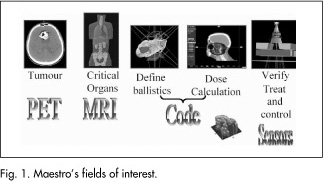
<body><![CDATA[<p><font face="Verdana, Arial, Helvetica-Normal, sans-serif" size="2">In delivering    high dose, the radiation oncologyst pay attection every day not only to the    target volume but, expecially, to critical surrounding tissues. At high dose    very small variations of percentage of volume of normal tissue included in the    target can determinate cronic and no-reversable dammage<sup>4</sup>. Up to now    standard radiotherapy treatments are delivered using three dimensional conformal    methods. 3D treatment planning uses advanced imaging thecniques for tumor and    normal organ segmentation, new algorithms for precise dose calculation and computer    aided optimization to generate treatment plans that confine the prescribed dose    to the tumor, while maximally excluding the adjacent normal organs. Patients    immobilization and computer-driven beam shaping devices as well as on line portal    imaging are used to decrease treatment uncertainties and assure the quality    of treatment delivery, but tolerance problems of normal tissue are present.</font></p>     <p><font face="Verdana, Arial, Helvetica-Normal, sans-serif" size="2">Moreover    radiotherapy plans based on physical dose do not necessarity enterely reflect    the biological effects under various fractionation schemes<sup>5</sup>.</font></p>     <p><font face="Verdana, Arial, Helvetica-Normal, sans-serif" size="2">New techniques    have been implemented to overcome this problem. Intensity-modulated radiation    therapy (I.M.R.T.) extends the capability of 3D conformal methods. Studies show<sup>6</sup>    that these methods can clinically reduce complications and can allow a larger    safety margin for dose escalation. The ultimate goal is proved survival and    improved quality of life.</font></p>     <p><font face="Verdana, Arial, Helvetica-Normal, sans-serif" size="2">In the sixth    framework programme the European commission has founded the Integrated Project    "Methods and Advanced Equipment for Simulation and Treatment in Radiation Oncology"    (MAESTRO). The duration of the project is five years starting from the first    of May.</font></p>     <p><font face="Verdana, Arial, Helvetica-Normal, sans-serif" size="2">The consortium    comprises some of the major partners involved in radiation therapy and high    energy physics in Europe: manufacturers and technology providers (IBA, SCANDITRONIX,    DOSISOFT, NRG, ELDIM), research institutes (CEA, INFN, IGR, CNRS/IN2P3), universities    (DELFT, COVENTRY, FIRENZE), and well-known Oncology centres: Institut Curie    (France), REM Radioterapia (Italy), CCO (United Kingdom), UDE (Essen in Germany),    COOK (Poland) and National Institutes (NPL, ISS-Italy).</font></p>     <p><font face="Verdana, Arial, Helvetica-Normal, sans-serif" size="2">In MAESTRO    project, novel technologies in patient alignment, organ tracking, dose calculation    and dose measurement will be developed, together with advanced software for    radiotherapy image processing and merging for therapy planning using new conformal    therapy modalities are investigated. Clinical environments will be provided    for pre-clinical validation.</font></p>     <p><font face="Verdana, Arial, Helvetica-Normal, sans-serif" size="2">New tools    will be available as prototypes before the end of this study, such as real-time    imaging devices used with high energy photon beams and protons, and software    using fast Monte Carlo codes, well-known for their high accuracy in any material    and beam situation, and novel 2D surface and 3D volume dosimeters allowing better    patient positioning and better beam and dose monitoring.</font></p>     <p><font face="Verdana, Arial, Helvetica-Normal, sans-serif" size="2">The aim    of Maestro is to develop and validate in clinical conditions the advanced equipment    need in using new techniques. The development of a clinical protocol is very    important to evaluate the emerging results and to ensure that the new technologies    will be clinically relevant and industrially viable.</font></p>     <p><font face="Verdana, Arial, Helvetica-Normal, sans-serif" size="2">The project    is organised in 3 specific work packages on research and development activities    and two blocks of training and management activities. The main field of interest    of the MAESTRO project are sketched in <a href="#Fig1">Fig. 1</a>, here below    a brief description of the R&amp;D work packages is reported.</font></p>     <p>&nbsp;</p>     ]]></body>
<body><![CDATA[<p>     <p align="center"><a name="Fig1"></a></p>     <p align="center"><img src="/img/onco/v27n6/04f1.jpg" width="324" height="182"></p>     <p>&nbsp;</p>     <p><font face="Verdana, Arial, Helvetica-Normal, sans-serif" size="2">The first    one concerns the "Adaptive Radiation delivery, tracking and control for radiotherapy    " (WP1). This package is important to evaluate the target and normal tissue    motions to permit a safety dose escalation. During irradiation must be considered    not only the normal tissue motions but also patient's comodities and different    motion in different segments due to physiological settings or for example due    to previous surgical approach (bowel motion-synechia).</font></p>     <p><font face="Verdana, Arial, Helvetica-Normal, sans-serif" size="2">The second    one is about the "Radiotherapy Software development" (WP2). An accurate dose    evaluation using a Monte Carlo based TPS is very important to understand the    effective dose distribution to the target and critical organs. High dose in    very small volume in normal tissue can determinate severe late complication.</font></p>     <p><font face="Verdana, Arial, Helvetica-Normal, sans-serif" size="2">"Sensors    for dose evaluation in radiotherapy" is treated in the third work package (WP3).    The special techniques are characterized by high dose delivered. Consequently    clinicians pay attention also to small variation of dose on very small volume    of critical organs to avoid cronic and no-reversible damage for these reasons    strong requirements in the current dosimeters and techniques arise.</font></p>     <p><font face="Verdana, Arial, Helvetica-Normal, sans-serif" size="2">The three    work programmes (WP1, WP2, WP3) have been constructed around research activities    including recent advances in high technology development done in public research    institutes and manufacturer's laboratories.</font></p>     <p><font face="Verdana, Arial, Helvetica-Normal, sans-serif" size="2">Within work    package WP4 the clinical requirements will be defined, the QA procedures and    protocol studies developed, comprising risk assessment studies, and the new    devices proposed in the consortium evaluated.</font></p>     <p><font face="Verdana, Arial, Helvetica-Normal, sans-serif" size="2">The work    package WP5 will deal with training and dissemination activities for researchers    and medical physicists applying new instruments developed in this project. Particular    attention will be devoted to obtaining guidance and critical evaluation concerning    newly developed products, by practicing clinicians and medical physicists, in    their clinical environment.</font></p>     ]]></body>
<body><![CDATA[<p><font face="Verdana, Arial, Helvetica-Normal, sans-serif" size="2">&nbsp;</font></p>     <p><font face="Verdana, Arial, Helvetica-Normal, sans-serif" size="3"><b>References</b></font></p>     <!-- ref --><p><font face="Verdana, Arial, Helvetica-Normal, sans-serif" size="2">1. Burman    C, Kutcher G J, Emami B et al: fitting of normal tissue tolerance data to an    analytic function. Int J. Radiation Oncology Biol Phys 1991; 21:123-35.</font>&nbsp;&nbsp;&nbsp;&nbsp;&nbsp;&nbsp;&nbsp;&nbsp;[&#160;<a href="javascript:void(0);" onclick="javascript: window.open('/scielo.php?script=sci_nlinks&ref=4062455&pid=S0378-4835200400060000400001&lng=','','width=640,height=500,resizable=yes,scrollbars=1,menubar=yes,');">Links</a>&#160;]<!-- end-ref --><!-- ref --><p><font face="Verdana, Arial, Helvetica-Normal, sans-serif" size="2">2. Hendry    JH, Moore JV. Is\the steepness of dose-incidence curves for tumour control or    complication due to variation before or as a result of irradiation? Br J Radiol    1984; 57: 1045-6).</font>&nbsp;&nbsp;&nbsp;&nbsp;&nbsp;&nbsp;&nbsp;&nbsp;[&#160;<a href="javascript:void(0);" onclick="javascript: window.open('/scielo.php?script=sci_nlinks&ref=4062456&pid=S0378-4835200400060000400002&lng=','','width=640,height=500,resizable=yes,scrollbars=1,menubar=yes,');">Links</a>&#160;]<!-- end-ref --><!-- ref --><p><font face="Verdana, Arial, Helvetica-Normal, sans-serif" size="2">3. Balter    JM, Sandler HM, Lam K et al. Measurement of prostate movement over the course    of routine radiotherapy using implanted markers. Int J Radiation Oncology Biol    Phys 1995; 31:113-8.</font>&nbsp;&nbsp;&nbsp;&nbsp;&nbsp;&nbsp;&nbsp;&nbsp;[&#160;<a href="javascript:void(0);" onclick="javascript: window.open('/scielo.php?script=sci_nlinks&ref=4062457&pid=S0378-4835200400060000400003&lng=','','width=640,height=500,resizable=yes,scrollbars=1,menubar=yes,');">Links</a>&#160;]<!-- end-ref --><!-- ref --><p><font face="Verdana, Arial, Helvetica-Normal, sans-serif" size="2">4. Fiorino    C, Sanguineti G, Cozzarini C et al. Rectal dose-volume constraints in high-dose    radiotherapy of localized prostate cancer. Int J. Radiation Oncology Biol Phys    2003; 57:953-62.</font>&nbsp;&nbsp;&nbsp;&nbsp;&nbsp;&nbsp;&nbsp;&nbsp;[&#160;<a href="javascript:void(0);" onclick="javascript: window.open('/scielo.php?script=sci_nlinks&ref=4062458&pid=S0378-4835200400060000400004&lng=','','width=640,height=500,resizable=yes,scrollbars=1,menubar=yes,');">Links</a>&#160;]<!-- end-ref --><!-- ref --><p><font face="Verdana, Arial, Helvetica-Normal, sans-serif" size="2">5. Lee S,    Leu M, Smathers JB et al. Biologically effective dose distribution based on    the linear quadratic model and its clinical relevance Int J Radiation Oncology    Biol Phys 1995; 23:375-89.</font>&nbsp;&nbsp;&nbsp;&nbsp;&nbsp;&nbsp;&nbsp;&nbsp;[&#160;<a href="javascript:void(0);" onclick="javascript: window.open('/scielo.php?script=sci_nlinks&ref=4062459&pid=S0378-4835200400060000400005&lng=','','width=640,height=500,resizable=yes,scrollbars=1,menubar=yes,');">Links</a>&#160;]<!-- end-ref --><!-- ref --><p><font face="Verdana, Arial, Helvetica-Normal, sans-serif" size="2">6. Zelefsky    M, Fuks L, Happersett, et al. Clinical experience with intensity modulated radiation    therapy (I.M.R.T) in prostate cancer. Radiation &amp; Oncology 2000; 55:241-9).</font>&nbsp;&nbsp;&nbsp;&nbsp;&nbsp;&nbsp;&nbsp;&nbsp;[&#160;<a href="javascript:void(0);" onclick="javascript: window.open('/scielo.php?script=sci_nlinks&ref=4062460&pid=S0378-4835200400060000400006&lng=','','width=640,height=500,resizable=yes,scrollbars=1,menubar=yes,');">Links</a>&#160;]<!-- end-ref --> ]]></body><back>
<ref-list>
<ref id="B1">
<label>1</label><nlm-citation citation-type="journal">
<person-group person-group-type="author">
<name>
<surname><![CDATA[Burman]]></surname>
<given-names><![CDATA[C]]></given-names>
</name>
<name>
<surname><![CDATA[Kutcher]]></surname>
<given-names><![CDATA[G J]]></given-names>
</name>
<name>
<surname><![CDATA[Emami]]></surname>
<given-names><![CDATA[B]]></given-names>
</name>
</person-group>
<article-title xml:lang="en"><![CDATA[fitting of normal tissue tolerance data to an analytic function]]></article-title>
<source><![CDATA[Int J. Radiation Oncology Biol Phys]]></source>
<year>1991</year>
<volume>21</volume>
<page-range>123-35</page-range></nlm-citation>
</ref>
<ref id="B2">
<label>2</label><nlm-citation citation-type="journal">
<person-group person-group-type="author">
<name>
<surname><![CDATA[Hendry]]></surname>
<given-names><![CDATA[JH]]></given-names>
</name>
<name>
<surname><![CDATA[Moore]]></surname>
<given-names><![CDATA[JV]]></given-names>
</name>
</person-group>
<article-title xml:lang="en"><![CDATA[Is\the steepness of dose-incidence curves for tumour control or complication due to variation before or as a result of irradiation?]]></article-title>
<source><![CDATA[Br J Radiol]]></source>
<year>1984</year>
<volume>57</volume>
<page-range>1045-6</page-range></nlm-citation>
</ref>
<ref id="B3">
<label>3</label><nlm-citation citation-type="journal">
<person-group person-group-type="author">
<name>
<surname><![CDATA[Balter]]></surname>
<given-names><![CDATA[JM]]></given-names>
</name>
<name>
<surname><![CDATA[Sandler]]></surname>
<given-names><![CDATA[HM]]></given-names>
</name>
<name>
<surname><![CDATA[Lam]]></surname>
<given-names><![CDATA[K]]></given-names>
</name>
</person-group>
<article-title xml:lang="en"><![CDATA[Measurement of prostate movement over the course of routine radiotherapy using implanted markers]]></article-title>
<source><![CDATA[Int J Radiation Oncology Biol Phys]]></source>
<year>1995</year>
<volume>31</volume>
<page-range>113-8</page-range></nlm-citation>
</ref>
<ref id="B4">
<label>4</label><nlm-citation citation-type="journal">
<person-group person-group-type="author">
<name>
<surname><![CDATA[Fiorino]]></surname>
<given-names><![CDATA[C]]></given-names>
</name>
<name>
<surname><![CDATA[Sanguineti]]></surname>
<given-names><![CDATA[G]]></given-names>
</name>
<name>
<surname><![CDATA[Cozzarini]]></surname>
<given-names><![CDATA[C]]></given-names>
</name>
</person-group>
<article-title xml:lang="en"><![CDATA[Rectal dose-volume constraints in high-dose radiotherapy of localized prostate cancer]]></article-title>
<source><![CDATA[Int J. Radiation Oncology Biol Phys]]></source>
<year>2003</year>
<volume>57</volume>
<page-range>953-62</page-range></nlm-citation>
</ref>
<ref id="B5">
<label>5</label><nlm-citation citation-type="journal">
<person-group person-group-type="author">
<name>
<surname><![CDATA[Lee]]></surname>
<given-names><![CDATA[S]]></given-names>
</name>
<name>
<surname><![CDATA[Leu]]></surname>
<given-names><![CDATA[M]]></given-names>
</name>
<name>
<surname><![CDATA[Smathers]]></surname>
<given-names><![CDATA[JB]]></given-names>
</name>
</person-group>
<article-title xml:lang="en"><![CDATA[Biologically effective dose distribution based on the linear quadratic model and its clinical relevance]]></article-title>
<source><![CDATA[Int J Radiation Oncology Biol Phys]]></source>
<year>1995</year>
<volume>23</volume>
<page-range>375-89</page-range></nlm-citation>
</ref>
<ref id="B6">
<label>6</label><nlm-citation citation-type="journal">
<person-group person-group-type="author">
<name>
<surname><![CDATA[Zelefsky]]></surname>
<given-names><![CDATA[M]]></given-names>
</name>
<name>
<surname><![CDATA[Fuks]]></surname>
<given-names><![CDATA[L]]></given-names>
</name>
<name>
<surname><![CDATA[Happersett]]></surname>
</name>
</person-group>
<article-title xml:lang="en"><![CDATA[Clinical experience with intensity modulated radiation therapy (I.M.R.T) in prostate cancer]]></article-title>
<source><![CDATA[Radiation & Oncology]]></source>
<year>2000</year>
<volume>55</volume>
<page-range>241-9</page-range></nlm-citation>
</ref>
</ref-list>
</back>
</article>
