<?xml version="1.0" encoding="ISO-8859-1"?><article xmlns:mml="http://www.w3.org/1998/Math/MathML" xmlns:xlink="http://www.w3.org/1999/xlink" xmlns:xsi="http://www.w3.org/2001/XMLSchema-instance">
<front>
<journal-meta>
<journal-id>0378-4835</journal-id>
<journal-title><![CDATA[Oncología (Barcelona)]]></journal-title>
<abbrev-journal-title><![CDATA[Oncología (Barc.)]]></abbrev-journal-title>
<issn>0378-4835</issn>
<publisher>
<publisher-name><![CDATA[Alpe Editores, S.A.]]></publisher-name>
</publisher>
</journal-meta>
<article-meta>
<article-id>S0378-48352004000900004</article-id>
<title-group>
<article-title xml:lang="en"><![CDATA[Pronostic value of clinicopathologic factors Ki67, cyclin D1, cyclin D3 and CDK4 in gastric carcinoma]]></article-title>
</title-group>
<contrib-group>
<contrib contrib-type="author">
<name>
<surname><![CDATA[Valerdiz Casasola]]></surname>
<given-names><![CDATA[S.]]></given-names>
</name>
<xref ref-type="aff" rid="A01"/>
</contrib>
<contrib contrib-type="author">
<name>
<surname><![CDATA[Menéndez Colunga]]></surname>
<given-names><![CDATA[M. J.]]></given-names>
</name>
<xref ref-type="aff" rid="A02"/>
</contrib>
<contrib contrib-type="author">
<name>
<surname><![CDATA[Aller Millán]]></surname>
<given-names><![CDATA[O.]]></given-names>
</name>
<xref ref-type="aff" rid="A03"/>
</contrib>
<contrib contrib-type="author">
<name>
<surname><![CDATA[Martínez Rodríguez]]></surname>
<given-names><![CDATA[J. M.]]></given-names>
</name>
<xref ref-type="aff" rid="A03"/>
</contrib>
</contrib-group>
<aff id="A01">
<institution><![CDATA[,Hospital de El Bierzo Department of Pathology ]]></institution>
<addr-line><![CDATA[ ]]></addr-line>
</aff>
<aff id="A02">
<institution><![CDATA[,Hospital de El Bierzo Service of Urgencies ]]></institution>
<addr-line><![CDATA[ ]]></addr-line>
</aff>
<aff id="A03">
<institution><![CDATA[,Universidad de León Faculty of Veterinary Department of Animal Pathology]]></institution>
<addr-line><![CDATA[ ]]></addr-line>
</aff>
<pub-date pub-type="pub">
<day>00</day>
<month>09</month>
<year>2004</year>
</pub-date>
<pub-date pub-type="epub">
<day>00</day>
<month>09</month>
<year>2004</year>
</pub-date>
<volume>27</volume>
<numero>9</numero>
<fpage>31</fpage>
<lpage>37</lpage>
<copyright-statement/>
<copyright-year/>
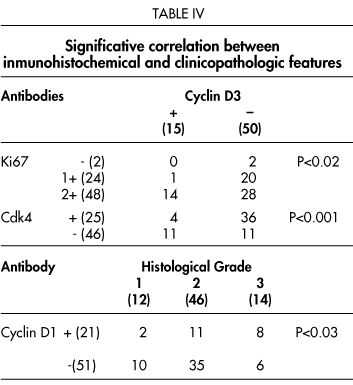
<self-uri xlink:href="http://scielo.isciii.es/scielo.php?script=sci_arttext&amp;pid=S0378-48352004000900004&amp;lng=en&amp;nrm=iso"></self-uri><self-uri xlink:href="http://scielo.isciii.es/scielo.php?script=sci_abstract&amp;pid=S0378-48352004000900004&amp;lng=en&amp;nrm=iso"></self-uri><self-uri xlink:href="http://scielo.isciii.es/scielo.php?script=sci_pdf&amp;pid=S0378-48352004000900004&amp;lng=en&amp;nrm=iso"></self-uri><abstract abstract-type="short" xml:lang="en"><p><![CDATA[PURPOSE: To estimate the prognostic value of cyclin D1, Ki67, cyclin D3, cdk4 and classical clinicopathologic features of gastric carcinoma alone and in combination. MATERIAL AND METHODS: We investigated the expression of cyclin D1, cyclin D3, cdk4 and Ki67 in gastric carcinoma. They were analyzed by immunohistochemical stain in formalin-fixed, paraffin-embedded tissue sections from 74 patients with gastric carcinoma, using automated methods. Immunostains, Ki67 proliferation index, histologic grade and histological type (Lauren classification) were compared with the length of survival. RESULTS: Positive immunostaining was shown in 97% of the cases for Ki67, in 29% for cyclin D1, in 23% for cyclin D3, and in 35% for cdk4. On multivariate analysis only Ki67 (PI) (p<0.01) and pathologic grade (p<0.03) correlated with the length of survival. Expression of cyclin D3 was related with cdk4 (p<0.001) and Ki67 (PI) (p<0.02), and expression of cyclyn D1 was related with histologic grade (p<0.03). CONCLUSIONS: Our results suggest that higher proliferation index of Ki67 and histological grade could be useful as markers of poorer prognosis. Over-expression of cyclin D1 could be an important role in cell proliferation. The relations between cyclin D3, cdk4 and Ki67 might be explained by the role of cyclin D3 and cdk4 in the cell cycle and the expression of Ki67 along the cellular cycle.]]></p></abstract>
<abstract abstract-type="short" xml:lang="es"><p><![CDATA[PROPÓSITO: Conocer el valor pronóstico de la ciclina Dl, ciclina D3, cdk4 y Ki67, estudiados por métodos inmunohistoquímicos, junto con las características clinicopatológicos de los carcinomas gástricos. MÉTODOS Y RESULTADOS: Realizamos estudio inmunohistoquimicos de material incluido en parafina para ciclina D1, ciclina D3, cdk4 y Ki67 en 74 pacientes con carcinoma gástrico. Las inmunotinciones para ciclinas D1, D3 y cdk4 así el índice de proliferación de Ki67, el grado histológico y el tipo histológico (según la clasificación de Lauren) se compararon con la supervivencia. El 97% de los casos eran Ki67 positivos, el 29% para ciclina D1, el 23% para ciclina D3 y el 35% para cdk4. El análisis multivariante sólo mostró correlación entre el Ki67 (PI) (p<0,01) y la supervivencia. En el análisis univariante el grado histológico también se correlaciona con la supervivencia (p<0,03). La expresión de ciclina D3 se relaciona con cdk4 (p<0,001) y Ki67 (PI) (p<0,02) y la expresión de ciclina D1 con el grado histológico (p<0,03). CONCLUSIONES: Nuestros resultados sugieren que un índice de proliferación elevado de Ki67 y el grado histológico son marcadores de mal pronóstico. La sobreexpresión de la ciclina D1 podría tener un importante papel en la proliferación celular. La relación entre ciclina D3, cdk4 y Ki67 podrían explicarse por su papel a lo largo del ciclo celular.]]></p></abstract>
<kwd-group>
<kwd lng="en"><![CDATA[Gastric carcinoma]]></kwd>
<kwd lng="en"><![CDATA[Ki67]]></kwd>
<kwd lng="en"><![CDATA[Cdk4]]></kwd>
<kwd lng="en"><![CDATA[Cyclin]]></kwd>
<kwd lng="es"><![CDATA[Ki67]]></kwd>
<kwd lng="es"><![CDATA[Carcinoma gástrico]]></kwd>
<kwd lng="es"><![CDATA[Ciclinas]]></kwd>
</kwd-group>
</article-meta>
</front><body><![CDATA[ <p align="right"><font face="Verdana, Arial, Helvetica-Normal, sans-serif" size="2"><b>ORIGINALES</b></font></p>     <p align="right">&nbsp;</p>      <p><font face="Verdana, Arial, Helvetica-Normal, sans-serif" size="4"><b><a name="top10"></a>Pronostic    value of clinicopathologic factors Ki67, cyclin D1, cyclin D3 and CDK4 in gastric    carcinoma</b></font></p>      <p>&nbsp;</p>     <p>&nbsp;</p>      <p><font face="Verdana, Arial, Helvetica, sans-serif" size="2"><b>S. Valerdiz    Casasola<sup>1</sup>; M. J. Men&eacute;ndez Colunga<sup>2</sup>; O. Aller Mill&aacute;n<sup>3</sup>;    J. M. Mart&iacute;nez Rodr&iacute;guez<sup>3</sup></b></font></p>      <p><font face="Verdana, Arial, Helvetica, sans-serif" size="2"><sup>1 </sup>Dept.    of Pathology. Hospital de El Bierzo    <br> <sup>2 </sup>S.    of Urgencies. Hospital de El Bierzo    <br> <sup>3 </sup>Dept.    of Animal Pathology. Faculty of Veterinary. Universidad de Le&oacute;n</font></p>      <p><font face="Verdana, Arial, Helvetica, sans-serif" size="2"><a href="#back10">Correspondence</a></font></p>      ]]></body>
<body><![CDATA[<p>&nbsp;</p>     <p>&nbsp;</p> <hr size="1" noshade>     <p><font face="Verdana, Arial, Helvetica, sans-serif" size="2"><b>SUMMARY</b></font></p>      <p><font face="Verdana, Arial, Helvetica, sans-serif" size="2"><b>PURPOSE: </b>To    estimate the prognostic value of cyclin D1, Ki67, cyclin D3, cdk4 and classical    clinicopathologic features of gastric carcinoma alone and in combination.    <br>   <b> MATERIAL AND METHODS:</b> We investigated the expression of cyclin D1, cyclin    D3, cdk4 and Ki67 in gastric carcinoma. They were analyzed by immunohistochemical    stain in formalin-fixed, paraffin-embedded tissue sections from 74 patients    with gastric carcinoma, using automated methods. Immunostains, Ki67 proliferation    index, histologic grade and histological type (Lauren classification) were compared    with the length of survival.    <br>   <b>RESULTS: </b>Positive immunostaining was shown in 97% of the cases for Ki67,    in 29% for cyclin D1, in 23% for cyclin D3, and in 35% for cdk4. On multivariate    analysis only Ki67 (PI) (p&lt;0.01) and pathologic grade (p&lt;0.03) correlated    with the length of survival. Expression of cyclin D3 was related with cdk4 (p&lt;0.001)    and Ki67 (PI) (p&lt;0.02), and expression of cyclyn D1 was related with histologic    grade (p&lt;0.03).    <br>   <b>CONCLUSIONS:</b> Our results suggest that higher proliferation index of Ki67    and histological grade could be useful as markers of poorer prognosis. Over-expression    of cyclin D1 could be an important role in cell proliferation. The relations    between cyclin D3, cdk4 and Ki67 might be explained by the role of cyclin D3    and cdk4 in the cell cycle and the expression of Ki67 along the cellular cycle.</font></p>     <p><font face="Verdana, Arial, Helvetica, sans-serif" size="2"><b>Key words:</b>    Gastric carcinoma. Ki67. Cdk4. Cyclin.</font></p> <hr size="1" noshade>     <p><font face="Verdana, Arial, Helvetica, sans-serif" size="2"><b>RESUMEN &nbsp;</b></font></p>      <p><font face="Verdana, Arial, Helvetica, sans-serif" size="2"><b>PROP&Oacute;SITO:</b>    Conocer el valor pron&oacute;stico de la ciclina Dl, ciclina D3, cdk4 y Ki67,    estudiados por m&eacute;todos inmunohistoqu&iacute;micos, junto con las caracter&iacute;sticas    clinicopatol&oacute;gicos de los carcinomas g&aacute;stricos.    ]]></body>
<body><![CDATA[<br>   <b> M&Eacute;TODOS Y RESULTADOS: </b>Realizamos estudio inmunohistoquimicos    de material incluido en parafina para ciclina D1, ciclina D3, cdk4 y Ki67 en    74 pacientes con carcinoma g&aacute;strico. Las inmunotinciones para ciclinas    D1, D3 y cdk4 as&iacute; el &iacute;ndice de proliferaci&oacute;n de Ki67, el    grado histol&oacute;gico y el tipo histol&oacute;gico (seg&uacute;n la clasificaci&oacute;n    de Lauren) se compararon con la supervivencia. El 97% de los casos eran Ki67    positivos, el 29% para ciclina D1, el 23% para ciclina D3 y el 35% para cdk4.    El an&aacute;lisis multivariante s&oacute;lo mostr&oacute; correlaci&oacute;n    entre el Ki67 (PI) (p&lt;0,01) y la supervivencia. En el an&aacute;lisis univariante    el grado histol&oacute;gico tambi&eacute;n se correlaciona con la supervivencia    (p&lt;0,03). La expresi&oacute;n de ciclina D3 se relaciona con cdk4 (p&lt;0,001)    y Ki67 (PI) (p&lt;0,02) y la expresi&oacute;n de ciclina D1 con el grado histol&oacute;gico    (p&lt;0,03).    <br>   <b>CONCLUSIONES: </b>Nuestros resultados sugieren que un &iacute;ndice de proliferaci&oacute;n    elevado de Ki67 y el grado histol&oacute;gico son marcadores de mal pron&oacute;stico.    La sobreexpresi&oacute;n de la ciclina D1 podr&iacute;a tener un importante    papel en la proliferaci&oacute;n celular. La relaci&oacute;n entre ciclina D3,    cdk4 y Ki67 podr&iacute;an explicarse por su papel a lo largo del ciclo celular.</font></p>      <p><font face="Verdana, Arial, Helvetica, sans-serif" size="2"><b>Palabras clave:</b>    Ki67. Carcinoma g&aacute;strico. Ciclinas.</font></p> <hr size="1" noshade>     <p>&nbsp;</p>     <p>&nbsp;</p>      <p><font face="Verdana, Arial, Helvetica-Normal, sans-serif" size="3"><b>Introducci&oacute;n</b></font></p>      <p><font face="Verdana, Arial, Helvetica, sans-serif" size="2">Gastric adenocarcinoma is one of the main causes of cancer mortality in the world. It is still the more prevalent worldwide despite it's incidence is decreasing in Western countries. The world distribution is variable with an average prevalence of 45/10000 in Japan, Latin America and Eastern Europe; 15/100000 in USA, Australia and New Zealand, and Spain being in an intermediate situation.</font></p>      <p><font face="Verdana, Arial, Helvetica, sans-serif" size="2">From the histological and epidemiological point of view, gastric adenocarcinoma has been classified in two main typcs. Intestinal adenocarcinoma, well differentiated and expansive, is prevalent in populations with high rates of gastric carcinoma. On the contrary, diffuse or infiltrating adenocarcinoma is more frequent in populations with low incidence of gastric cancer. The etiology of the intestinal type is mainly associated with environmental factors, usually appearing as the result of a large multifactorial process with dietetic, social and economic factors being involved (Correa, 1992). In contrast, diffuse carcinoma is more dependent on genetic factors. Despite the amount of information on environmental factors and gastric cancer, little is know about genetic factors. Some authors have suggested that genetic susceptibility would predispose to gastric cancer to a minority of the population while environmental factors would accelerate tumor progression.</font></p>      <p><font face="Verdana, Arial, Helvetica, sans-serif" size="2">Cyclins are family of proteins that have been recognized. that plays, a role in the development of neoplasia. Under normal conditions, the progress of mammalian cells through the stages of the cell cycle is precisely coordinated by a group of related cyclindependent kinases and cyclins<sup>1-3</sup>. In general, cell cycle transitions are controlled by cdks<sup>4</sup>. Those holoenzymes contain both regulatory (cyclin) and catalytic (cdk) subunits but likely exist as higher order complexes that include additional proteins. Restriction point control is mediated by two families of enzymes, the cyclin-D and Edependent kinases. Whereas cdk4 and cdk6 are relatively long-lived proteins, the D type cyclins are unstable, and their induction, synthesis, and assembly with their catalytic partners, all depend upon persistent mitogenic signaling<sup>5</sup>. The D-type cyclins act as growth factor sensors, forming active kinases in response to extra cellular cues. The D-type cyclins reach maximal levels of expression and form functional kinases complexes with cdk4 or cdk6 during the mid-G1 phase<sup>6</sup>.</font></p>      <p><font face="Verdana, Arial, Helvetica, sans-serif" size="2">The D cyclin binds to cyclin-dependent kinases and proliferating cell nuclear antigen, by which the complexes formed are strangely implicated in the control of cell proliferation<sup>7</sup>. Particularly cyclin D1, expressed in early G1, and shown to be amplified, or over expressed in a wide variety of tumors<sup>7-11</sup>. In gastric cancer has been proved over expression of cyclin E, cyclin A and cyclin B1, but not cyclin D<sup>12</sup>.</font></p>      ]]></body>
<body><![CDATA[<p><font face="Verdana, Arial, Helvetica, sans-serif" size="2">Protein Ki67 (MIB1) is an antigen of proliferating cells and may prove a more robust marker of cell proliferation than PCNA (proliferating cell nuclear antigen)<sup>13</sup>. That expression occurs during G1, increases during the cycle cell and the rapidly declines after mitosis<sup>13</sup>. Among previously published studies of proliferations markers in gastric cancer, Ki67 labelling rate correlate with large tumor size, peritoneal metastases and advanced clinical stage<sup>14</sup> or not<sup>15</sup>.</font></p>      <p><font face="Verdana, Arial, Helvetica, sans-serif" size="2">In order to increase the knowledge on the correlations between clinicopathologic and genetic factors in gastric cancer, we analysed, using clinical samples, the expression levels of nuclear markers associated with the cell cycle (cyclin D1, D3, cdk4, Ki67). Our aim is to establish the prognostic value of these markers. This work is part of a major project in which the molecular characterization of the tumour samples will be performed.</font></p>      <p>&nbsp;</p>      <p><font face="Verdana, Arial, Helvetica-Normal, sans-serif" size="3"><b>Materials    and methods</b></font></p>      <p><font face="Verdana, Arial, Helvetica, sans-serif" size="2"><b>Patients and    tumor specimens</b></font></p>      <p><font face="Verdana, Arial, Helvetica, sans-serif" size="2">Samples from primary    gastric carcinoma diagnosed between 1994 and 1999 were obtained from the files    of Dept. of Pathology at Hospital de El Bierzo. The total patient number was    74, 51 (68.9%) men and 23 (31.08%) women with an average age of 68.2 years (range    35-91 years). All the material consisted of endoscopy biopsy. We examined hematoxylin    and eosin-stained slides from each case to evaluate the tumour type according    to the Lauren classification<sup>16</sup> and the histological grade. Clinical    data was obtained on each patient from the tumour registries.</font></p>      <p><font face="Verdana, Arial, Helvetica, sans-serif" size="2"><b>Immunohistochemical    analysis</b></font></p>      <p><font face="Verdana, Arial, Helvetica, sans-serif" size="2">Paraffin sections    from each case with representative neoplastic tissue were carefully selected.    Immunohistochemical staining procedures were performed on the Dako Autostainer    (Dako, Carpinteria, CA) using antibodies listed in <a href="#tab1">Table I</a>.    Sections were deparaffinized, rehydrated, and pretreated with buffer, pH 6.0.    Primary antibody incubation time was 30 minutes. The detection system used was    the LSAB+ kit from the Dako Corporation. Staining used was visualized with diaminobenzidine-cobalt    chloride, resulting in a brown end product sections then wore counterstained    with ethyl green pH 4.0</font></p>     <p align="center"><a name="tab1"></a></p>     <p>&nbsp;</p>     ]]></body>
<body><![CDATA[<p align="center"><img src="/img/onco/v27n9/04t1.gif" width="571" height="215"></p>     <p>&nbsp;</p>      <p><font face="Verdana, Arial, Helvetica, sans-serif" size="2">Proliferation index    (PIS) were calculated by Ki67 (MIB-1) as percentage of positive nuclear cells    among more the 1000 cells counted. Scoring of immunostaining was categorized    as follows: zero, &lt;10% cells stained; 1, 10-49% cells stained and 2, &gt;50%    cells stained. For cyclin D1, cyclin D3 and cdk4 the scoring of immunostained    was categorized as follows: -, &lt;10% cells stained and +, &gt;10% cells stained.</font></p>      <p><font face="Verdana, Arial, Helvetica, sans-serif" size="2"><b>Statistical    analysis</b></font></p>      <p><font face="Verdana, Arial, Helvetica, sans-serif" size="2">The correlation    of the immunostaining of each of markers was assessed with each of the others|    markers and clinicopathological parameters, using the Fisher's exact test. Univariate    and multivariate analyses for the prediction of length of survival by marker,    histological type, histological grade, age, sex were performed using the Cox    proportional hazards model. The impact of each prognostic variable on survival    was also studied using the method of Kaplan and Meier. P&lt;0,05 was assumed    to be statistically significant.</font></p>      <p>&nbsp;</p>      <p><font face="Verdana, Arial, Helvetica-Normal, sans-serif" size="3"><b>Results</b></font></p>      <p><font face="Verdana, Arial, Helvetica, sans-serif" size="2">The majority of    tumours, 67 (81,9%) were of intestinal type, whereas only 7 tumours (18,9%)    were of the diffuse type. Twelve tumours (16%) were well-differentiated, 55    (74,6%) moderately differentiated and 7 (9,4%) poor differentiated. The follow-up    time ranged from 92 days to 351 days, with a mean time of 252 days (<a href="#fig1">Fig.    1</a>). The mean age of the patients was 68 years (range, 35-91 years). Fifty-one    (68,9%) were men, and 23 (31,08%) were women. By the time this study was performed,    twelve patients were alive (16,2%), 57 (77%) had died and 5 (6,8%) failed to    follow-up (<a href="#tab2">Table II</a>).</font></p>     <p align="center"><a name="fig1"></a></p>     <p>&nbsp;</p>     ]]></body>
<body><![CDATA[<p align="center"><img src="/img/onco/v27n9/04f1.gif" width="360" height="278"></p>     <p>&nbsp;</p>     <p align="center"><a name="tab2"></a></p>     <p>&nbsp;</p>     <p align="center"><img src="/img/onco/v27n9/04t2.gif" width="355" height="312"></p>     <p>&nbsp;</p>      <p><font face="Verdana, Arial, Helvetica, sans-serif" size="2">Of the 74 tumours    studied, 97,3% positively expressed Ki67, 29,2% cyclin Dl, 23,1% cyclin D3 and    35, 3% cdk4 (<a href="#fig2">Fig. 2</a> and <a href="#fig3">3</a>). Ki67 (PI)    was negative (score 0) for 2 tumours (2,7%), score 1 for 24 tumours (32,4%)    and score 2 for 48 tumours (64,9%) (<a href="#tab3">Table III</a>).</font></p>     <p align="center"><a name="fig2"></a></p>     <p>&nbsp;</p>     <p align="center"><img src="/img/onco/v27n9/04f2.jpg" width="356" height="281"></p>     ]]></body>
<body><![CDATA[<p>&nbsp;</p>     <p align="center"><a name="fig3"></a></p>     <p>&nbsp;</p>     <p align="center"><img src="/img/onco/v27n9/04f3.jpg" width="357" height="286"></p>     <p>&nbsp;</p>     <p align="center"><a name="tab3"></a></p>     <p>&nbsp;</p>     <p align="center"><img src="/img/onco/v27n9/04t3.gif" width="336" height="317"></p>     <p>&nbsp;</p>      <p><font face="Verdana, Arial, Helvetica, sans-serif" size="2">Expression of CD3    were related with cdk4 (p&lt;0,001) and Ki67 (p&lt;0, 02). Significantly, correlation    between other antibodies was not found. The patients with well differentiated    gastric carcinoma revealed a relatively better prognosis with moderately and    poor differentiated gastric carcinoma (p&lt;0,02). Interestingly, all the patients    who were alive at the end of this study showed well-differentiated adenocarcinomas    (p&lt;0,02). Age, histological type and sex were not related with survival.    The expression of CD1 was significantly related with the histological grade    (p&lt;0,03) (<a href="#tab4">Table 4</a>).</font></p>     ]]></body>
<body><![CDATA[<p align="center"><a name="tab4"></a></p>     <p>&nbsp;</p>     <p align="center"><img src="/img/onco/v27n9/04t4.gif" width="353" height="385"></p>     <p>&nbsp;</p>      <p><font face="Verdana, Arial, Helvetica, sans-serif" size="2">Multivariate survival    analysis was performed based on clinicopathologic factors and immunohistochemical    expression of CD1, CD3, cdk4 and Ki67. The statistical results revealed that    only Ki67 expression (PI) was independent and significant prognostic factor    (p&lt;0,01) (<a href="#fig4">Fig. 4</a>). On univariate analysis histological    grade (p&lt;0,03) (<a href="#fig5">Fig. 5</a>) was correlated with length of    the survival.</font></p>     <p align="center"><a name="fig4"></a></p>     <p>&nbsp;</p>     <p align="center"><img src="/img/onco/v27n9/04f4.gif" width="363" height="265"></p>     <p>&nbsp;</p>     <p align="center"><a name="fig5"></a></p>     ]]></body>
<body><![CDATA[<p>&nbsp;</p>     <p align="center"><img src="/img/onco/v27n9/04f5.gif" width="358" height="264"></p>      <p>&nbsp;</p>      <p><font face="Verdana, Arial, Helvetica-Normal, sans-serif" size="3"><b>Discusion</b></font></p>      <p><font face="Verdana, Arial, Helvetica, sans-serif" size="2">Gastric carcinoma occurs in patients throughout the world, although the incidence varies geographically. In Spain, gastric carcinoma accounts for approximately 3% of cancer deaths. Gastric adenocarcinomas can be divided histologically in two types, intestinal and diffuse<sup>16</sup>. The intestinal type can resemble colorectal carcinoma, being composed of tubular structures, with areas of solid growth or papillary pattern. The diffuse type is composed of individual cells or small groups of cells that infiltrate the gastric wall in a diffuse fashion. Cells of the diffuse type often have a signet ring appearance. Survival tends to be worse in the diffuse type, probably related to advanced stage at presentation. When matched stage for stage, however, there is no difference in survival between the two histological type<sup>12</sup>. The prognosis largely depends on the extent of penetration into or through the gastric wall, extension into adjacent structures, and the presence or absence of lymph node and/or distant metastases. As with histological type, neither size nor location is useful in predicting survival<sup>17</sup>.</font></p>      <p><font face="Verdana, Arial, Helvetica, sans-serif" size="2">In the present study, histological grade was correlated (in univariate analysis) with survival, when the tumour was classified into well, moderately and poor differentiation type (p&lt;0,03). In addition, the histological grade was correlated with clinical situation of the end of study (p&lt;0,02). The relationship between histological grade and survival is controversial. In two different studies using the same classification (well, moderately and poor differentiated) the correlation with survival is different. Shiu MH et al.<sup>17</sup> considered that there is significantly correlation with survival, but in study of Roder J et al.<sup>18</sup> there is not correlation. Likewise, in our study to be demonstrated that the majority of patients live at end of study are patients with diagnosed of welldifferentiated gastric carcinoma.</font></p>      <p><font face="Verdana, Arial, Helvetica, sans-serif" size="2">Multivariate analysis revealed that only Ki67 was independent prognostic factor. Prognostic significance of Ki67 has been reported in various cancers<sup>19</sup>. In gastric carcinomas, other studies<sup>15, 20</sup> do not in agreement with our results. The difference with these studies may be explained by the difference in immunohistochemical and evaluation procedures.</font></p>      <p><font face="Verdana, Arial, Helvetica, sans-serif" size="2">Growth factors and cytokine positively or negatively regulate cell proliferation, cell differentiation and cell death or apoptosis though cell cycle operated by the CDKs and CDK inhibitors. Many positive growth factors are finally linked with cyclin D, whereas negative growth factor may act as a major inhibitor of cell proliferation though a cyclinCDK inhibitor p27<sup>Kip131,32</sup> or p21<sup>Waf/1cip1</sup>. The D-type cyclins reach maximal levels of expression and form functional complexes with CDK4 during the mid-G1 phase. Therefore, the biological role of the D3-cyclin had been related that a possible dual role in cell proliferation and induction and/or maintenance of terminal differentiation<sup>21</sup>. In gastric cancers, cyclin D1 overexpression was associated with a nonsignet ring phenotype and one study<sup>22</sup>, with no pathological features in another study<sup>23</sup> and with a signet ring cell phenotype and poor differentiation in other<sup>24</sup>. Our study demonstrated significant relation between cyclin-D1 and histological grade. Probably, because the cyclin D1 is more important in the cellular proliferations that other cyclin D type. Therefore, it is probable that expression of cyclin D3 is later to the cyclin D1<sup>21</sup> and would explain to statistical relation between cyclin CD3 and Ki67 since this later is expressed throughout the cellular cycle except G phase. The same relation between cyclin CD3 and cdk4 could be explained the role of the cyclin D3 in the maintenance of terminal differentiation and because cdk4 is relative long-lived protein with cyclins-D.</font></p>      <p>&nbsp;</p>      <p><font face="Verdana, Arial, Helvetica-Normal, sans-serif" size="3"><b>References</b></font></p>      ]]></body>
<body><![CDATA[<!-- ref --><p><font face="Verdana, Arial, Helvetica, sans-serif" size="2">1.	Matsushine H, Ewen ME, Strom DK, Kato JY, Hanks SK, Rosussel MF et al. Identification and properties of an atypical catalytic subunit (p34 psk-J3/cdk4) for mammalian D type G1 cyclins. Cells 1992; 71:323-34.</font>&nbsp;&nbsp;&nbsp;&nbsp;&nbsp;&nbsp;&nbsp;&nbsp;[&#160;<a href="javascript:void(0);" onclick="javascript: window.open('/scielo.php?script=sci_nlinks&ref=4084388&pid=S0378-4835200400090000400001&lng=','','width=640,height=500,resizable=yes,scrollbars=1,menubar=yes,');">Links</a>&#160;]<!-- end-ref --><!-- ref --><p><font face="Verdana, Arial, Helvetica, sans-serif" size="2">2.	Sherr CJ. Mamalian G1 cyclins. Cell 1993; 73:1059-65.</font>&nbsp;&nbsp;&nbsp;&nbsp;&nbsp;&nbsp;&nbsp;&nbsp;[&#160;<a href="javascript:void(0);" onclick="javascript: window.open('/scielo.php?script=sci_nlinks&ref=4084389&pid=S0378-4835200400090000400002&lng=','','width=640,height=500,resizable=yes,scrollbars=1,menubar=yes,');">Links</a>&#160;]<!-- end-ref --><!-- ref --><p><font face="Verdana, Arial, Helvetica, sans-serif" size="2">3.	Dunphy WG. The decision to enter mitoses. Trends Cell Biol 1994; 4:202-7.</font>&nbsp;&nbsp;&nbsp;&nbsp;&nbsp;&nbsp;&nbsp;&nbsp;[&#160;<a href="javascript:void(0);" onclick="javascript: window.open('/scielo.php?script=sci_nlinks&ref=4084390&pid=S0378-4835200400090000400003&lng=','','width=640,height=500,resizable=yes,scrollbars=1,menubar=yes,');">Links</a>&#160;]<!-- end-ref --><!-- ref --><p><font face="Verdana, Arial, Helvetica, sans-serif" size="2">4.	Pardee HB. G1 events and regulation of cell proliferation. Science (Washington DC) 1989; 246:603-8.</font>&nbsp;&nbsp;&nbsp;&nbsp;&nbsp;&nbsp;&nbsp;&nbsp;[&#160;<a href="javascript:void(0);" onclick="javascript: window.open('/scielo.php?script=sci_nlinks&ref=4084391&pid=S0378-4835200400090000400004&lng=','','width=640,height=500,resizable=yes,scrollbars=1,menubar=yes,');">Links</a>&#160;]<!-- end-ref --><!-- ref --><p><font face="Verdana, Arial, Helvetica, sans-serif" size="2">5.	Scherr ChJ. The Pezcoller Lecturer: Cancer cells cycles revisited. Cancer Research 2000; 60:3689-95.</font>&nbsp;&nbsp;&nbsp;&nbsp;&nbsp;&nbsp;&nbsp;&nbsp;[&#160;<a href="javascript:void(0);" onclick="javascript: window.open('/scielo.php?script=sci_nlinks&ref=4084392&pid=S0378-4835200400090000400005&lng=','','width=640,height=500,resizable=yes,scrollbars=1,menubar=yes,');">Links</a>&#160;]<!-- end-ref --><!-- ref --><p><font face="Verdana, Arial, Helvetica, sans-serif" size="2">6.	Ohbu M, Kobayashi N, Okayasu I. Expression of cell cycle regulatory proteins in the multistep process of aesophageal carcinogenesis: stepwise over-expression of cyclin E and p53, reduction of p21WAF/C1P1 and dysregulation of cyclin D1 and p27KIP1. Histopathology 2001; 39:589-96.</font>&nbsp;&nbsp;&nbsp;&nbsp;&nbsp;&nbsp;&nbsp;&nbsp;[&#160;<a href="javascript:void(0);" onclick="javascript: window.open('/scielo.php?script=sci_nlinks&ref=4084393&pid=S0378-4835200400090000400006&lng=','','width=640,height=500,resizable=yes,scrollbars=1,menubar=yes,');">Links</a>&#160;]<!-- end-ref --><!-- ref --><p><font face="Verdana, Arial, Helvetica, sans-serif" size="2">7.	Tahara E. Genetic alterations in human gastrointestinal cancers. The application to moleculardiagnosis. Cancer 1995; 75:1410-7.</font>&nbsp;&nbsp;&nbsp;&nbsp;&nbsp;&nbsp;&nbsp;&nbsp;[&#160;<a href="javascript:void(0);" onclick="javascript: window.open('/scielo.php?script=sci_nlinks&ref=4084394&pid=S0378-4835200400090000400007&lng=','','width=640,height=500,resizable=yes,scrollbars=1,menubar=yes,');">Links</a>&#160;]<!-- end-ref --><!-- ref --><p><font face="Verdana, Arial, Helvetica, sans-serif" size="2">8.	Jiang W, Zhang YJ, Kahn SM, Hollstein M, Santela RM, Lu SH, et al. Altered expresion of the cyclin D1 and the retinoblastoma genes in human aesophageal cancer. Proc Nath Acad Sci USA 1993; 90:9026-30.</font>&nbsp;&nbsp;&nbsp;&nbsp;&nbsp;&nbsp;&nbsp;&nbsp;[&#160;<a href="javascript:void(0);" onclick="javascript: window.open('/scielo.php?script=sci_nlinks&ref=4084395&pid=S0378-4835200400090000400008&lng=','','width=640,height=500,resizable=yes,scrollbars=1,menubar=yes,');">Links</a>&#160;]<!-- end-ref --><!-- ref --><p><font face="Verdana, Arial, Helvetica, sans-serif" size="2">9.	Leach FS, Elledge SJ, Sherr CJ, Wilson JKV, Markowitz S, Kinzler KW, et al. Amplification of cyclin genes in colorectal carcinomas. Cancer Res 1993 ;53:1986-9.</font>&nbsp;&nbsp;&nbsp;&nbsp;&nbsp;&nbsp;&nbsp;&nbsp;[&#160;<a href="javascript:void(0);" onclick="javascript: window.open('/scielo.php?script=sci_nlinks&ref=4084396&pid=S0378-4835200400090000400009&lng=','','width=640,height=500,resizable=yes,scrollbars=1,menubar=yes,');">Links</a>&#160;]<!-- end-ref --><!-- ref --><p><font face="Verdana, Arial, Helvetica, sans-serif" size="2">10.	Gim&eacute;nez-Conti IB, Collet AM, Lanfranchi H, Itoiz ME, Luna M, Xu Hy, et al. P53, Rb and cyclin D1 expression in human oral verrucous carcinomas. Cancer 1996; 78:17-23.</font>&nbsp;&nbsp;&nbsp;&nbsp;&nbsp;&nbsp;&nbsp;&nbsp;[&#160;<a href="javascript:void(0);" onclick="javascript: window.open('/scielo.php?script=sci_nlinks&ref=4084397&pid=S0378-4835200400090000400010&lng=','','width=640,height=500,resizable=yes,scrollbars=1,menubar=yes,');">Links</a>&#160;]<!-- end-ref --><!-- ref --><p><font face="Verdana, Arial, Helvetica, sans-serif" size="2">11.	Ito K, Sasano H, Yoshida Y, Sato S, Yajima A. Immunohistochemical study of cyclins D and E and dependent kinase (cdk) 2 and 4 in human endometrial carcinoma. Anticancer Res 1998; 18:1661-4.</font>&nbsp;&nbsp;&nbsp;&nbsp;&nbsp;&nbsp;&nbsp;&nbsp;[&#160;<a href="javascript:void(0);" onclick="javascript: window.open('/scielo.php?script=sci_nlinks&ref=4084398&pid=S0378-4835200400090000400011&lng=','','width=640,height=500,resizable=yes,scrollbars=1,menubar=yes,');">Links</a>&#160;]<!-- end-ref --><!-- ref --><p><font face="Verdana, Arial, Helvetica, sans-serif" size="2">12.	Brien TP, Depowsky PL, Sheehan Ch, Ross JS, Mckenna B. Prognostic factors in gastric cancer. Mod Pathol 1998; 11:870-7.</font>&nbsp;&nbsp;&nbsp;&nbsp;&nbsp;&nbsp;&nbsp;&nbsp;[&#160;<a href="javascript:void(0);" onclick="javascript: window.open('/scielo.php?script=sci_nlinks&ref=4084399&pid=S0378-4835200400090000400012&lng=','','width=640,height=500,resizable=yes,scrollbars=1,menubar=yes,');">Links</a>&#160;]<!-- end-ref --><!-- ref --><p><font face="Verdana, Arial, Helvetica, sans-serif" size="2">13.	McKormi K, Chong H, Hobbs C, Datta C, Hall PA, et al. Detection of the Ki67 antigen in fixed and waxembedded sections with the monoclonal antibody MIB1. Histopathology 1993; 22: 355-60.</font>&nbsp;&nbsp;&nbsp;&nbsp;&nbsp;&nbsp;&nbsp;&nbsp;[&#160;<a href="javascript:void(0);" onclick="javascript: window.open('/scielo.php?script=sci_nlinks&ref=4084400&pid=S0378-4835200400090000400013&lng=','','width=640,height=500,resizable=yes,scrollbars=1,menubar=yes,');">Links</a>&#160;]<!-- end-ref --><!-- ref --><p><font face="Verdana, Arial, Helvetica, sans-serif" size="2">14.	Kimura H, Yonemura Y, Miyazaki I. Proliferative activity in gastric cancer determined with the cell cycle-related monoclonal antibodies Ki67 and plO5: analysis by flow cytometry. J Surg Oncol 1992; 51:174-8.</font>&nbsp;&nbsp;&nbsp;&nbsp;&nbsp;&nbsp;&nbsp;&nbsp;[&#160;<a href="javascript:void(0);" onclick="javascript: window.open('/scielo.php?script=sci_nlinks&ref=4084401&pid=S0378-4835200400090000400014&lng=','','width=640,height=500,resizable=yes,scrollbars=1,menubar=yes,');">Links</a>&#160;]<!-- end-ref --><!-- ref --><p><font face="Verdana, Arial, Helvetica, sans-serif" size="2">15.	Broll R, Mahke C, Best R, Schimmelpenning H, Strik MW, Schiedeck T, Bruch HP, Duchrow M. Assessment of the proliferation index in gastric carcinomas with the monoclonal antibody MIB-1. J Cancer Res Clin Oncol 1998; 124:49-54.</font>&nbsp;&nbsp;&nbsp;&nbsp;&nbsp;&nbsp;&nbsp;&nbsp;[&#160;<a href="javascript:void(0);" onclick="javascript: window.open('/scielo.php?script=sci_nlinks&ref=4084402&pid=S0378-4835200400090000400015&lng=','','width=640,height=500,resizable=yes,scrollbars=1,menubar=yes,');">Links</a>&#160;]<!-- end-ref --><!-- ref --><p><font face="Verdana, Arial, Helvetica, sans-serif" size="2">16.	Lauren P, The two histological main typcs of gastric carcinoma: diffuse and socalled intestinal type carcinoma. Acta Pathol Microbiol Scand 1965; 64:31-49.</font>&nbsp;&nbsp;&nbsp;&nbsp;&nbsp;&nbsp;&nbsp;&nbsp;[&#160;<a href="javascript:void(0);" onclick="javascript: window.open('/scielo.php?script=sci_nlinks&ref=4084403&pid=S0378-4835200400090000400016&lng=','','width=640,height=500,resizable=yes,scrollbars=1,menubar=yes,');">Links</a>&#160;]<!-- end-ref --><!-- ref --><p><font face="Verdana, Arial, Helvetica, sans-serif" size="2">17.	Shiu MH, Perrotti M, Brennan MF. Adenocarcinoma of the stomach: a multivariate analysis of clinical, pathological and treatment factors. Hepatogastroenterology 1989; 36:7-12.</font>&nbsp;&nbsp;&nbsp;&nbsp;&nbsp;&nbsp;&nbsp;&nbsp;[&#160;<a href="javascript:void(0);" onclick="javascript: window.open('/scielo.php?script=sci_nlinks&ref=4084404&pid=S0378-4835200400090000400017&lng=','','width=640,height=500,resizable=yes,scrollbars=1,menubar=yes,');">Links</a>&#160;]<!-- end-ref --><!-- ref --><p><font face="Verdana, Arial, Helvetica, sans-serif" size="2">18.	Roder J, B6ttcher K, Siewert R, et al. Prognostic factors in gastric carcinoma. Results ofthe German Gastric Carcinoma Study 1992. Cancer 1993; 72:2089-97.</font>&nbsp;&nbsp;&nbsp;&nbsp;&nbsp;&nbsp;&nbsp;&nbsp;[&#160;<a href="javascript:void(0);" onclick="javascript: window.open('/scielo.php?script=sci_nlinks&ref=4084405&pid=S0378-4835200400090000400018&lng=','','width=640,height=500,resizable=yes,scrollbars=1,menubar=yes,');">Links</a>&#160;]<!-- end-ref --><!-- ref --><p><font face="Verdana, Arial, Helvetica, sans-serif" size="2">19.	Brown DC, Gatter KG. Ki67 protein: The immaculate deception? Histopathology 2002; 40:2-11.</font>&nbsp;&nbsp;&nbsp;&nbsp;&nbsp;&nbsp;&nbsp;&nbsp;[&#160;<a href="javascript:void(0);" onclick="javascript: window.open('/scielo.php?script=sci_nlinks&ref=4084406&pid=S0378-4835200400090000400019&lng=','','width=640,height=500,resizable=yes,scrollbars=1,menubar=yes,');">Links</a>&#160;]<!-- end-ref --><!-- ref --><p><font face="Verdana, Arial, Helvetica, sans-serif" size="2">20.	Ramires M, David L, Leiato D, Seixas M, Sansonetty F, Sobrinho-Simoes M. Ki67 labelling index in gastric carcinomas. An immunohistochemical study using double staining for the evaluation of the proliferative activity of diffuse-type carcinomas. J Pathol 1997; 182;62-7.</font>&nbsp;&nbsp;&nbsp;&nbsp;&nbsp;&nbsp;&nbsp;&nbsp;[&#160;<a href="javascript:void(0);" onclick="javascript: window.open('/scielo.php?script=sci_nlinks&ref=4084407&pid=S0378-4835200400090000400020&lng=','','width=640,height=500,resizable=yes,scrollbars=1,menubar=yes,');">Links</a>&#160;]<!-- end-ref --><!-- ref --><p><font face="Verdana, Arial, Helvetica, sans-serif" size="2">21.	Bartkova J, Lukas J, Strauss M, Bartek J. Cyclin D3: requirement for G1/S transition suggest a dual role in proliferation and differentiation. Oncogene 1998; 17:1027-37.</font>&nbsp;&nbsp;&nbsp;&nbsp;&nbsp;&nbsp;&nbsp;&nbsp;[&#160;<a href="javascript:void(0);" onclick="javascript: window.open('/scielo.php?script=sci_nlinks&ref=4084408&pid=S0378-4835200400090000400021&lng=','','width=640,height=500,resizable=yes,scrollbars=1,menubar=yes,');">Links</a>&#160;]<!-- end-ref --><!-- ref --><p><font face="Verdana, Arial, Helvetica, sans-serif" size="2">22.	M&uuml;ller W, Noguchi T, Wirtz H, et al. Expression of cell-cycle regulatory proteins cyclin D 1, Cyclin E and their inhibitor p21 WAF/CIP in gastric cancer. J Pathol 1999; 89:186-93.</font>&nbsp;&nbsp;&nbsp;&nbsp;&nbsp;&nbsp;&nbsp;&nbsp;[&#160;<a href="javascript:void(0);" onclick="javascript: window.open('/scielo.php?script=sci_nlinks&ref=4084409&pid=S0378-4835200400090000400022&lng=','','width=640,height=500,resizable=yes,scrollbars=1,menubar=yes,');">Links</a>&#160;]<!-- end-ref --><!-- ref --><p><font face="Verdana, Arial, Helvetica, sans-serif" size="2">23.	Takano Y, Kato Y, Masuda M, et al. Cyclin D2, but not cyclin D1, overexpression closely correlats with gastric cancer progresi&oacute;n and prognosis. J Pathol 1999; 189:194-200.</font>&nbsp;&nbsp;&nbsp;&nbsp;&nbsp;&nbsp;&nbsp;&nbsp;[&#160;<a href="javascript:void(0);" onclick="javascript: window.open('/scielo.php?script=sci_nlinks&ref=4084410&pid=S0378-4835200400090000400023&lng=','','width=640,height=500,resizable=yes,scrollbars=1,menubar=yes,');">Links</a>&#160;]<!-- end-ref --><!-- ref --><p><font face="Verdana, Arial, Helvetica, sans-serif" size="2">24. Feakins RM,    Nickols CD, Bidd H, Walton SJ. Abnormal expression of pRb, p16, and cyclin D1    in gastric adenocarcinoma and lymph node metastases:relationship with pathological    features and survival. Hum Pathol 2003; 34:1276-82. </font>&nbsp;&nbsp;&nbsp;&nbsp;&nbsp;&nbsp;&nbsp;&nbsp;[&#160;<a href="javascript:void(0);" onclick="javascript: window.open('/scielo.php?script=sci_nlinks&ref=4084411&pid=S0378-4835200400090000400024&lng=','','width=640,height=500,resizable=yes,scrollbars=1,menubar=yes,');">Links</a>&#160;]<!-- end-ref --><p>&nbsp;</p>     <p>&nbsp;</p>     <p><font face="Verdana, Arial, Helvetica, sans-serif" size="2"><a name="back10"></a><a href="#top10"><img src="/img/onco/v27n9/seta.gif" border="0"></a>    <b>Correspondence to    <br>   </b>Dr. S. Valerdiz Casasola    <br>   Anatom&iacute;a Patol&oacute;gica    <br>   Hospital de El Bierzo    ]]></body>
<body><![CDATA[<br>   E-24400 Ponferrada (Le&oacute;n)    <br>   E-mail: <a href="mailto:svc@usuarios.retecal.es">svc@usuarios.retecal.es</a></font></p>     <p><font face="Verdana, Arial, Helvetica, sans-serif" size="2">Recibido: 20.04.04    <br>    Aceptado:    16.06.04</font></p>      ]]></body><back>
<ref-list>
<ref id="B1">
<label>1</label><nlm-citation citation-type="journal">
<person-group person-group-type="author">
<name>
<surname><![CDATA[Matsushine]]></surname>
<given-names><![CDATA[H]]></given-names>
</name>
<name>
<surname><![CDATA[Ewen]]></surname>
<given-names><![CDATA[ME]]></given-names>
</name>
<name>
<surname><![CDATA[Strom]]></surname>
<given-names><![CDATA[DK]]></given-names>
</name>
<name>
<surname><![CDATA[Kato]]></surname>
<given-names><![CDATA[JY]]></given-names>
</name>
<name>
<surname><![CDATA[Hanks]]></surname>
<given-names><![CDATA[SK]]></given-names>
</name>
<name>
<surname><![CDATA[Rosussel]]></surname>
<given-names><![CDATA[MF]]></given-names>
</name>
</person-group>
<article-title xml:lang="en"><![CDATA[Identification and properties of an atypical catalytic subunit (p34 psk-J3/cdk4) for mammalian D type G1 cyclins]]></article-title>
<source><![CDATA[Cells]]></source>
<year>1992</year>
<volume>71</volume>
<page-range>323-34</page-range></nlm-citation>
</ref>
<ref id="B2">
<label>2</label><nlm-citation citation-type="journal">
<person-group person-group-type="author">
<name>
<surname><![CDATA[Sherr]]></surname>
<given-names><![CDATA[CJ]]></given-names>
</name>
</person-group>
<article-title xml:lang="en"><![CDATA[Mamalian G1 cyclins]]></article-title>
<source><![CDATA[Cell]]></source>
<year>1993</year>
<volume>73</volume>
<page-range>1059-65</page-range></nlm-citation>
</ref>
<ref id="B3">
<label>3</label><nlm-citation citation-type="journal">
<person-group person-group-type="author">
<name>
<surname><![CDATA[Dunphy]]></surname>
<given-names><![CDATA[WG]]></given-names>
</name>
</person-group>
<article-title xml:lang="en"><![CDATA[The decision to enter mitoses]]></article-title>
<source><![CDATA[Trends Cell Biol]]></source>
<year>1994</year>
<volume>4</volume>
<page-range>202-7</page-range></nlm-citation>
</ref>
<ref id="B4">
<label>4</label><nlm-citation citation-type="journal">
<person-group person-group-type="author">
<name>
<surname><![CDATA[Pardee]]></surname>
<given-names><![CDATA[HB]]></given-names>
</name>
</person-group>
<article-title xml:lang="en"><![CDATA[G1 events and regulation of cell proliferation]]></article-title>
<source><![CDATA[Science (Washington DC)]]></source>
<year>1989</year>
<volume>246</volume>
<page-range>603-8</page-range></nlm-citation>
</ref>
<ref id="B5">
<label>5</label><nlm-citation citation-type="journal">
<person-group person-group-type="author">
<name>
<surname><![CDATA[Scherr]]></surname>
<given-names><![CDATA[ChJ]]></given-names>
</name>
</person-group>
<article-title xml:lang="en"><![CDATA[The Pezcoller Lecturer: Cancer cells cycles revisited]]></article-title>
<source><![CDATA[Cancer Research]]></source>
<year>2000</year>
<volume>60</volume>
<page-range>3689-95</page-range></nlm-citation>
</ref>
<ref id="B6">
<label>6</label><nlm-citation citation-type="journal">
<person-group person-group-type="author">
<name>
<surname><![CDATA[Ohbu]]></surname>
<given-names><![CDATA[M]]></given-names>
</name>
<name>
<surname><![CDATA[Kobayashi]]></surname>
<given-names><![CDATA[N]]></given-names>
</name>
<name>
<surname><![CDATA[Okayasu]]></surname>
<given-names><![CDATA[I]]></given-names>
</name>
</person-group>
<article-title xml:lang="en"><![CDATA[Expression of cell cycle regulatory proteins in the multistep process of aesophageal carcinogenesis: stepwise over-expression of cyclin E and p53, reduction of p21WAF/C1P1 and dysregulation of cyclin D1 and p27KIP1]]></article-title>
<source><![CDATA[Histopathology]]></source>
<year>2001</year>
<volume>39</volume>
<page-range>589-96</page-range></nlm-citation>
</ref>
<ref id="B7">
<label>7</label><nlm-citation citation-type="journal">
<person-group person-group-type="author">
<name>
<surname><![CDATA[Tahara]]></surname>
<given-names><![CDATA[E]]></given-names>
</name>
</person-group>
<article-title xml:lang="en"><![CDATA[Genetic alterations in human gastrointestinal cancers: The application to moleculardiagnosis]]></article-title>
<source><![CDATA[Cancer]]></source>
<year>1995</year>
<volume>75</volume>
<page-range>1410-7</page-range></nlm-citation>
</ref>
<ref id="B8">
<label>8</label><nlm-citation citation-type="journal">
<person-group person-group-type="author">
<name>
<surname><![CDATA[Jiang]]></surname>
<given-names><![CDATA[W]]></given-names>
</name>
<name>
<surname><![CDATA[Zhang]]></surname>
<given-names><![CDATA[YJ]]></given-names>
</name>
<name>
<surname><![CDATA[Kahn]]></surname>
<given-names><![CDATA[SM]]></given-names>
</name>
<name>
<surname><![CDATA[Hollstein]]></surname>
<given-names><![CDATA[M]]></given-names>
</name>
<name>
<surname><![CDATA[Santela]]></surname>
<given-names><![CDATA[RM]]></given-names>
</name>
<name>
<surname><![CDATA[Lu]]></surname>
<given-names><![CDATA[SH]]></given-names>
</name>
</person-group>
<article-title xml:lang="en"><![CDATA[Altered expresion of the cyclin D1 and the retinoblastoma genes in human aesophageal cancer]]></article-title>
<source><![CDATA[Proc Nath Acad Sci USA]]></source>
<year>1993</year>
<volume>90</volume>
<page-range>9026-30</page-range></nlm-citation>
</ref>
<ref id="B9">
<label>9</label><nlm-citation citation-type="journal">
<person-group person-group-type="author">
<name>
<surname><![CDATA[Leach]]></surname>
<given-names><![CDATA[FS]]></given-names>
</name>
<name>
<surname><![CDATA[Elledge]]></surname>
<given-names><![CDATA[SJ]]></given-names>
</name>
<name>
<surname><![CDATA[Sherr]]></surname>
<given-names><![CDATA[CJ]]></given-names>
</name>
<name>
<surname><![CDATA[Wilson]]></surname>
<given-names><![CDATA[JKV]]></given-names>
</name>
<name>
<surname><![CDATA[Markowitz]]></surname>
<given-names><![CDATA[S]]></given-names>
</name>
<name>
<surname><![CDATA[Kinzler]]></surname>
<given-names><![CDATA[KW]]></given-names>
</name>
</person-group>
<article-title xml:lang="en"><![CDATA[Amplification of cyclin genes in colorectal carcinomas]]></article-title>
<source><![CDATA[Cancer Res]]></source>
<year>1993</year>
<volume>53</volume>
<page-range>1986-9</page-range></nlm-citation>
</ref>
<ref id="B10">
<label>10</label><nlm-citation citation-type="journal">
<person-group person-group-type="author">
<name>
<surname><![CDATA[Giménez-Conti]]></surname>
<given-names><![CDATA[IB]]></given-names>
</name>
<name>
<surname><![CDATA[Collet]]></surname>
<given-names><![CDATA[AM]]></given-names>
</name>
<name>
<surname><![CDATA[Lanfranchi]]></surname>
<given-names><![CDATA[H]]></given-names>
</name>
<name>
<surname><![CDATA[Itoiz]]></surname>
<given-names><![CDATA[ME]]></given-names>
</name>
<name>
<surname><![CDATA[Luna]]></surname>
<given-names><![CDATA[M]]></given-names>
</name>
<name>
<surname><![CDATA[Xu]]></surname>
<given-names><![CDATA[Hy]]></given-names>
</name>
</person-group>
<article-title xml:lang="en"><![CDATA[P53, Rb and cyclin D1 expression in human oral verrucous carcinomas]]></article-title>
<source><![CDATA[Cancer]]></source>
<year>1996</year>
<volume>78</volume>
<page-range>17-23</page-range></nlm-citation>
</ref>
<ref id="B11">
<label>11</label><nlm-citation citation-type="journal">
<person-group person-group-type="author">
<name>
<surname><![CDATA[Ito]]></surname>
<given-names><![CDATA[K]]></given-names>
</name>
<name>
<surname><![CDATA[Sasano]]></surname>
<given-names><![CDATA[H]]></given-names>
</name>
<name>
<surname><![CDATA[Yoshida]]></surname>
<given-names><![CDATA[Y]]></given-names>
</name>
<name>
<surname><![CDATA[Sato]]></surname>
<given-names><![CDATA[S]]></given-names>
</name>
<name>
<surname><![CDATA[Yajima]]></surname>
<given-names><![CDATA[A]]></given-names>
</name>
</person-group>
<article-title xml:lang="en"><![CDATA[Immunohistochemical study of cyclins D and E and dependent kinase (cdk) 2 and 4 in human endometrial carcinoma]]></article-title>
<source><![CDATA[Anticancer Res]]></source>
<year>1998</year>
<volume>18</volume>
<page-range>1661-4</page-range></nlm-citation>
</ref>
<ref id="B12">
<label>12</label><nlm-citation citation-type="journal">
<person-group person-group-type="author">
<name>
<surname><![CDATA[Brien]]></surname>
<given-names><![CDATA[TP]]></given-names>
</name>
<name>
<surname><![CDATA[Depowsky]]></surname>
<given-names><![CDATA[PL]]></given-names>
</name>
<name>
<surname><![CDATA[Sheehan]]></surname>
<given-names><![CDATA[Ch]]></given-names>
</name>
<name>
<surname><![CDATA[Ross]]></surname>
<given-names><![CDATA[JS]]></given-names>
</name>
<name>
<surname><![CDATA[Mckenna]]></surname>
<given-names><![CDATA[B]]></given-names>
</name>
</person-group>
<article-title xml:lang="en"><![CDATA[Prognostic factors in gastric cancer]]></article-title>
<source><![CDATA[Mod Pathol]]></source>
<year>1998</year>
<volume>11</volume>
<page-range>870-7</page-range></nlm-citation>
</ref>
<ref id="B13">
<label>13</label><nlm-citation citation-type="journal">
<person-group person-group-type="author">
<name>
<surname><![CDATA[McKormi]]></surname>
<given-names><![CDATA[K]]></given-names>
</name>
<name>
<surname><![CDATA[Chong]]></surname>
<given-names><![CDATA[H]]></given-names>
</name>
<name>
<surname><![CDATA[Hobbs]]></surname>
<given-names><![CDATA[C]]></given-names>
</name>
<name>
<surname><![CDATA[Datta]]></surname>
<given-names><![CDATA[C]]></given-names>
</name>
<name>
<surname><![CDATA[Hall]]></surname>
<given-names><![CDATA[PA]]></given-names>
</name>
</person-group>
<article-title xml:lang="en"><![CDATA[Detection of the Ki67 antigen in fixed and waxembedded sections with the monoclonal antibody MIB1]]></article-title>
<source><![CDATA[Histopathology]]></source>
<year>1993</year>
<volume>22</volume>
<page-range>355-60</page-range></nlm-citation>
</ref>
<ref id="B14">
<label>14</label><nlm-citation citation-type="journal">
<person-group person-group-type="author">
<name>
<surname><![CDATA[Kimura]]></surname>
<given-names><![CDATA[H]]></given-names>
</name>
<name>
<surname><![CDATA[Yonemura]]></surname>
<given-names><![CDATA[Y]]></given-names>
</name>
<name>
<surname><![CDATA[Miyazaki]]></surname>
<given-names><![CDATA[I]]></given-names>
</name>
</person-group>
<article-title xml:lang="en"><![CDATA[Proliferative activity in gastric cancer determined with the cell cycle-related monoclonal antibodies Ki67 and plO5: analysis by flow cytometry]]></article-title>
<source><![CDATA[J Surg Oncol]]></source>
<year>1992</year>
<volume>51</volume>
<page-range>174-8</page-range></nlm-citation>
</ref>
<ref id="B15">
<label>15</label><nlm-citation citation-type="journal">
<person-group person-group-type="author">
<name>
<surname><![CDATA[Broll]]></surname>
<given-names><![CDATA[R]]></given-names>
</name>
<name>
<surname><![CDATA[Mahke]]></surname>
<given-names><![CDATA[C]]></given-names>
</name>
<name>
<surname><![CDATA[Best]]></surname>
<given-names><![CDATA[R]]></given-names>
</name>
<name>
<surname><![CDATA[Schimmelpenning]]></surname>
<given-names><![CDATA[H]]></given-names>
</name>
<name>
<surname><![CDATA[Strik]]></surname>
<given-names><![CDATA[MW]]></given-names>
</name>
<name>
<surname><![CDATA[Schiedeck]]></surname>
<given-names><![CDATA[T]]></given-names>
</name>
<name>
<surname><![CDATA[Bruch]]></surname>
<given-names><![CDATA[HP]]></given-names>
</name>
<name>
<surname><![CDATA[Duchrow]]></surname>
<given-names><![CDATA[M]]></given-names>
</name>
</person-group>
<article-title xml:lang="en"><![CDATA[Assessment of the proliferation index in gastric carcinomas with the monoclonal antibody MIB-1]]></article-title>
<source><![CDATA[J Cancer Res Clin Oncol]]></source>
<year>1998</year>
<volume>124</volume>
<page-range>49-54</page-range></nlm-citation>
</ref>
<ref id="B16">
<label>16</label><nlm-citation citation-type="journal">
<person-group person-group-type="author">
<name>
<surname><![CDATA[Lauren]]></surname>
<given-names><![CDATA[P]]></given-names>
</name>
</person-group>
<article-title xml:lang="en"><![CDATA[The two histological main typcs of gastric carcinoma: diffuse and socalled intestinal type carcinoma]]></article-title>
<source><![CDATA[Acta Pathol Microbiol Scand]]></source>
<year>1965</year>
<volume>64</volume>
</nlm-citation>
</ref>
<ref id="B17">
<label>17</label><nlm-citation citation-type="journal">
<person-group person-group-type="author">
<name>
<surname><![CDATA[Shiu]]></surname>
<given-names><![CDATA[MH]]></given-names>
</name>
<name>
<surname><![CDATA[Perrotti]]></surname>
<given-names><![CDATA[M]]></given-names>
</name>
<name>
<surname><![CDATA[Brennan]]></surname>
<given-names><![CDATA[MF]]></given-names>
</name>
</person-group>
<article-title xml:lang="en"><![CDATA[Adenocarcinoma of the stomach: a multivariate analysis of clinical, pathological and treatment factors]]></article-title>
<source><![CDATA[Hepatogastroenterology]]></source>
<year>1989</year>
<volume>36</volume>
<page-range>7-12</page-range></nlm-citation>
</ref>
<ref id="B18">
<label>18</label><nlm-citation citation-type="journal">
<person-group person-group-type="author">
<name>
<surname><![CDATA[Roder]]></surname>
<given-names><![CDATA[J]]></given-names>
</name>
<name>
<surname><![CDATA[B6ttcher]]></surname>
<given-names><![CDATA[K]]></given-names>
</name>
<name>
<surname><![CDATA[Siewert]]></surname>
<given-names><![CDATA[R]]></given-names>
</name>
</person-group>
<article-title xml:lang="en"><![CDATA[Prognostic factors in gastric carcinoma: Results ofthe German Gastric Carcinoma Study 1992]]></article-title>
<source><![CDATA[Cancer]]></source>
<year>1993</year>
<volume>72</volume>
<page-range>2089-97</page-range></nlm-citation>
</ref>
<ref id="B19">
<label>19</label><nlm-citation citation-type="journal">
<person-group person-group-type="author">
<name>
<surname><![CDATA[Brown]]></surname>
<given-names><![CDATA[DC]]></given-names>
</name>
<name>
<surname><![CDATA[Gatter]]></surname>
<given-names><![CDATA[KG]]></given-names>
</name>
</person-group>
<article-title xml:lang="en"><![CDATA[Ki67 protein: The immaculate deception?]]></article-title>
<source><![CDATA[Histopathology]]></source>
<year>2002</year>
<volume>40</volume>
<page-range>2-11</page-range></nlm-citation>
</ref>
<ref id="B20">
<label>20</label><nlm-citation citation-type="journal">
<person-group person-group-type="author">
<name>
<surname><![CDATA[Ramires]]></surname>
<given-names><![CDATA[M]]></given-names>
</name>
<name>
<surname><![CDATA[David]]></surname>
<given-names><![CDATA[L]]></given-names>
</name>
<name>
<surname><![CDATA[Leiato]]></surname>
<given-names><![CDATA[D]]></given-names>
</name>
<name>
<surname><![CDATA[Seixas]]></surname>
<given-names><![CDATA[M]]></given-names>
</name>
<name>
<surname><![CDATA[Sansonetty]]></surname>
<given-names><![CDATA[F]]></given-names>
</name>
<name>
<surname><![CDATA[Sobrinho-Simoes]]></surname>
<given-names><![CDATA[M]]></given-names>
</name>
</person-group>
<article-title xml:lang="en"><![CDATA[Ki67 labelling index in gastric carcinomas: An immunohistochemical study using double staining for the evaluation of the proliferative activity of diffuse-type carcinomas]]></article-title>
<source><![CDATA[J Pathol]]></source>
<year>1997</year>
<volume>182</volume>
<page-range>62-7</page-range></nlm-citation>
</ref>
<ref id="B21">
<label>21</label><nlm-citation citation-type="journal">
<person-group person-group-type="author">
<name>
<surname><![CDATA[Bartkova]]></surname>
<given-names><![CDATA[J]]></given-names>
</name>
<name>
<surname><![CDATA[Lukas]]></surname>
<given-names><![CDATA[J]]></given-names>
</name>
<name>
<surname><![CDATA[Strauss]]></surname>
<given-names><![CDATA[M]]></given-names>
</name>
<name>
<surname><![CDATA[Bartek]]></surname>
<given-names><![CDATA[J]]></given-names>
</name>
</person-group>
<article-title xml:lang="en"><![CDATA[Cyclin D3: requirement for G1/S transition suggest a dual role in proliferation and differentiation]]></article-title>
<source><![CDATA[Oncogene]]></source>
<year>1998</year>
<volume>17</volume>
<page-range>1027-37</page-range></nlm-citation>
</ref>
<ref id="B22">
<label>22</label><nlm-citation citation-type="journal">
<person-group person-group-type="author">
<name>
<surname><![CDATA[Müller]]></surname>
<given-names><![CDATA[W]]></given-names>
</name>
<name>
<surname><![CDATA[Noguchi]]></surname>
<given-names><![CDATA[T]]></given-names>
</name>
<name>
<surname><![CDATA[Wirtz]]></surname>
<given-names><![CDATA[H]]></given-names>
</name>
</person-group>
<article-title xml:lang="en"><![CDATA[Expression of cell-cycle regulatory proteins cyclin D 1, Cyclin E and their inhibitor p21 WAF/CIP in gastric cancer]]></article-title>
<source><![CDATA[J Pathol]]></source>
<year>1999</year>
<volume>89</volume>
<page-range>186-93</page-range></nlm-citation>
</ref>
<ref id="B23">
<label>23</label><nlm-citation citation-type="journal">
<person-group person-group-type="author">
<name>
<surname><![CDATA[Takano]]></surname>
<given-names><![CDATA[Y]]></given-names>
</name>
<name>
<surname><![CDATA[Kato]]></surname>
<given-names><![CDATA[Y]]></given-names>
</name>
<name>
<surname><![CDATA[Masuda]]></surname>
<given-names><![CDATA[M]]></given-names>
</name>
</person-group>
<article-title xml:lang="en"><![CDATA[Cyclin D2, but not cyclin D1, overexpression closely correlats with gastric cancer progresión and prognosis]]></article-title>
<source><![CDATA[J Pathol]]></source>
<year>1999</year>
<volume>189</volume>
<page-range>194-200</page-range></nlm-citation>
</ref>
<ref id="B24">
<label>24</label><nlm-citation citation-type="journal">
<person-group person-group-type="author">
<name>
<surname><![CDATA[Feakins]]></surname>
<given-names><![CDATA[RM]]></given-names>
</name>
<name>
<surname><![CDATA[Nickols]]></surname>
<given-names><![CDATA[CD]]></given-names>
</name>
<name>
<surname><![CDATA[Bidd]]></surname>
<given-names><![CDATA[H]]></given-names>
</name>
<name>
<surname><![CDATA[Walton]]></surname>
<given-names><![CDATA[SJ]]></given-names>
</name>
</person-group>
<article-title xml:lang="en"><![CDATA[Abnormal expression of pRb, p16, and cyclin D1 in gastric adenocarcinoma and lymph node metastases: relationship with pathological features and survival]]></article-title>
<source><![CDATA[Hum Pathol]]></source>
<year>2003</year>
<volume>34</volume>
<page-range>1276-82</page-range></nlm-citation>
</ref>
</ref-list>
</back>
</article>