<?xml version="1.0" encoding="ISO-8859-1"?><article xmlns:mml="http://www.w3.org/1998/Math/MathML" xmlns:xlink="http://www.w3.org/1999/xlink" xmlns:xsi="http://www.w3.org/2001/XMLSchema-instance">
<front>
<journal-meta>
<journal-id>0378-4835</journal-id>
<journal-title><![CDATA[Oncología (Barcelona)]]></journal-title>
<abbrev-journal-title><![CDATA[Oncología (Barc.)]]></abbrev-journal-title>
<issn>0378-4835</issn>
<publisher>
<publisher-name><![CDATA[Alpe Editores, S.A.]]></publisher-name>
</publisher>
</journal-meta>
<article-meta>
<article-id>S0378-48352006001000004</article-id>
<title-group>
<article-title xml:lang="en"><![CDATA[The usefulness of reirradiation in the treatment of pelvic recurrence of rectal and gynaecological tumours]]></article-title>
<article-title xml:lang="es"><![CDATA[La utilidad de la reirradiación en el tratamiento de recurrencia pélvica de los tumores rectales y ginecológicos]]></article-title>
</title-group>
<contrib-group>
<contrib contrib-type="author">
<name>
<surname><![CDATA[Andreu Martínez]]></surname>
<given-names><![CDATA[F. J.]]></given-names>
</name>
<xref ref-type="aff" rid="A01"/>
</contrib>
<contrib contrib-type="author">
<name>
<surname><![CDATA[Martínez Mateu]]></surname>
<given-names><![CDATA[J. M.]]></given-names>
</name>
<xref ref-type="aff" rid="A01"/>
</contrib>
<contrib contrib-type="author">
<name>
<surname><![CDATA[Cardenal Macía]]></surname>
<given-names><![CDATA[R.]]></given-names>
</name>
<xref ref-type="aff" rid="A01"/>
</contrib>
</contrib-group>
<aff id="A01">
<institution><![CDATA[,Hospital Universitari Sant Joan Servicio de Oncología Radioterapica ]]></institution>
<addr-line><![CDATA[Alicante ]]></addr-line>
<country>España</country>
</aff>
<pub-date pub-type="pub">
<day>00</day>
<month>12</month>
<year>2006</year>
</pub-date>
<pub-date pub-type="epub">
<day>00</day>
<month>12</month>
<year>2006</year>
</pub-date>
<volume>29</volume>
<numero>10</numero>
<fpage>23</fpage>
<lpage>29</lpage>
<copyright-statement/>
<copyright-year/>
<self-uri xlink:href="http://scielo.isciii.es/scielo.php?script=sci_arttext&amp;pid=S0378-48352006001000004&amp;lng=en&amp;nrm=iso"></self-uri><self-uri xlink:href="http://scielo.isciii.es/scielo.php?script=sci_abstract&amp;pid=S0378-48352006001000004&amp;lng=en&amp;nrm=iso"></self-uri><self-uri xlink:href="http://scielo.isciii.es/scielo.php?script=sci_pdf&amp;pid=S0378-48352006001000004&amp;lng=en&amp;nrm=iso"></self-uri><abstract abstract-type="short" xml:lang="en"><p><![CDATA[Pelvic tumors recurrences have diminished with the modern radiation therapy techniques. However, they are still observed, with or without distant metastases, leading to a serious and even mortal disease. The choice of an adequate therapy poses a clinical challenge. One of the procedures is the repetition of radiation therapy. In this review we manifest how complex is the treatment of gynecological and rectal tumors recidivations, and the importance of a detailed consideration of the available therapies in order to make a decision, specially when the primary tumor has been previously irradiated, be it as only treatment or combined with other therapies.]]></p></abstract>
<abstract abstract-type="short" xml:lang="es"><p><![CDATA[La recidiva local de tumores pélvicos tras irradiación, aunque ha disminuido su incidencia gracias a las modernas técnicas de radioterapia, sigue produciéndose acompañada o no de metástasis a distancia. Además dicha recidiva ocasiona una gran morbilidad e incluso puede ser la causa de la muerte de estos pacientes. La selección del método de retratamiento a emplear representa un importante desafío clínico. De todos los métodos de retratamiento posibles a utilizar, la reirradiación es uno de ellos. En esta revisión intentamos poner de manifiesto la complejidad del tratamiento en el caso de tumores ginecológicos y rectales recidivados y lo importante de considerar minuciosamente todas las alternativas terapéuticas que existen, para poder tomar una decisión final adecuada, sobre todo, si los pacientes ya han sido previamente irradiados como tratamiento único o combinado de su tumor primario.]]></p></abstract>
<kwd-group>
<kwd lng="en"><![CDATA[Local recurrence]]></kwd>
<kwd lng="en"><![CDATA[Reirradiation]]></kwd>
<kwd lng="en"><![CDATA[Retreatment]]></kwd>
<kwd lng="en"><![CDATA[Radiotherapy]]></kwd>
<kwd lng="en"><![CDATA[Rectal cancer]]></kwd>
<kwd lng="en"><![CDATA[Gynecological tumors]]></kwd>
<kwd lng="es"><![CDATA[Recidiva local]]></kwd>
<kwd lng="es"><![CDATA[Reirradiación]]></kwd>
<kwd lng="es"><![CDATA[Retratamiento]]></kwd>
<kwd lng="es"><![CDATA[Radioterapia]]></kwd>
<kwd lng="es"><![CDATA[Cáncer de recto]]></kwd>
<kwd lng="es"><![CDATA[Tumores ginecológicos]]></kwd>
</kwd-group>
</article-meta>
</front><body><![CDATA[ <p align="right"><font face="Verdana, Arial, Helvetica, sans-serif" size="2"><b>REVISI&Oacute;N</b></font></p>     <p>&nbsp;</p>      <p><font face="Verdana, Arial, Helvetica, sans-serif" size="4"><b><a name="top10"></a>The    usefulness of reirradiation in the treatment of pelvic recurrence of rectal    and gynaecological tumours</b></font></p>      <p><font face="Verdana, Arial, Helvetica, sans-serif" size="2"><b>&nbsp;</b></font></p>     <p>&nbsp;</p>      <p><font face="Verdana, Arial, Helvetica, sans-serif" size="2"><b>F. J. Andreu    Mart&iacute;nez; J. M. Mart&iacute;nez Mateu; R. Cardenal Mac&iacute;a</b></font></p>      <p><font face="Verdana, Arial, Helvetica, sans-serif" size="2">Servicio de Oncolog&iacute;a    Radioterapica. Hospital Universitari Sant Joan. Alicante (Espa&ntilde;a)</font></p>      <p><font face="Verdana, Arial, Helvetica, sans-serif" size="2"><a href="#back10">Correspondence</a></font></p>     <p>&nbsp;</p>     <p>&nbsp;</p> <hr size="1" noshade>     ]]></body>
<body><![CDATA[<p><font face="Verdana, Arial, Helvetica, sans-serif" size="2"><B>SUMMARY&nbsp;</b></font></p>      <p><font face="Verdana, Arial, Helvetica, sans-serif" size="2">Pelvic tumors recurrences    have diminished with the modern radiation therapy techniques. However, they    are still observed, with or without distant metastases, leading to a serious    and even mortal disease. The choice of an adequate therapy poses a clinical    challenge. One of the procedures is the repetition of radiation therapy.    <br>   In this review    we manifest how complex is the treatment of gynecological and rectal tumors    recidivations, and the importance of a detailed consideration of the available    therapies in order to make a decision, specially when the primary tumor has    been previously irradiated, be it as only treatment or combined with other therapies.</font></p>      <p><font face="Verdana, Arial, Helvetica, sans-serif" size="2"><b>Key words: </b>Local    recurrence. Reirradiation. Retreatment. Radiotherapy. Rectal cancer. Gynecological    tumors.</font></p>  <hr size="1" noshade>     <p><font face="Verdana, Arial, Helvetica, sans-serif" size="2"><B>RESUMEN</B>&nbsp;</font></p>      <p><font face="Verdana, Arial, Helvetica, sans-serif" size="2">La recidiva local    de tumores p&eacute;lvicos tras irradiaci&oacute;n, aunque ha disminuido su    incidencia gracias a las modernas t&eacute;cnicas de radioterapia, sigue produci&eacute;ndose    acompa&ntilde;ada o no de met&aacute;stasis a distancia. Adem&aacute;s dicha    recidiva ocasiona una gran morbilidad e incluso puede ser la causa de la muerte    de estos pacientes. La selecci&oacute;n del m&eacute;todo de retratamiento a    emplear representa un importante desaf&iacute;o cl&iacute;nico. De todos los    m&eacute;todos de retratamiento posibles a utilizar, la reirradiaci&oacute;n    es uno de ellos.    <br>   En esta revisi&oacute;n    intentamos poner de manifiesto la complejidad del tratamiento en el caso de    tumores ginecol&oacute;gicos y rectales recidivados y lo importante de considerar    minuciosamente todas las alternativas terap&eacute;uticas que existen, para    poder tomar una decisi&oacute;n final adecuada, sobre todo, si los pacientes    ya han sido previamente irradiados como tratamiento &uacute;nico o combinado    de su tumor primario.&nbsp;</font></p>      <p><font face="Verdana, Arial, Helvetica, sans-serif" size="2"><b>Palabras clave:</b>    Recidiva local. Reirradiaci&oacute;n. Retratamiento. Radioterapia. C&aacute;ncer    de recto. Tumores ginecol&oacute;gicos.</font></p> <hr size="1" noshade>     <p>&nbsp;</p>      <p><font face="Verdana, Arial, Helvetica, sans-serif" size="3"><b>Introduction</b></font></p>      ]]></body>
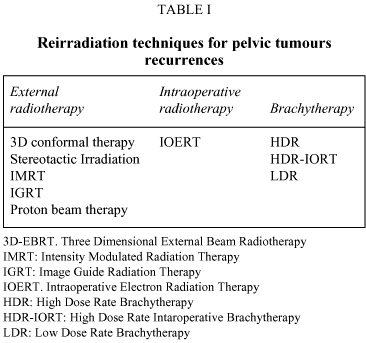
<body><![CDATA[<p><font face="Verdana, Arial, Helvetica, sans-serif" size="2">Although with improvement of radiotherapy (RT) techniques and increase in dose delivered to the pelvic tumour has improved local control, local pelvic recurrence after radiotherapy still occurs (with or without distant metastasis), and such recurrence can be distressing or even fatal<sup>1</sup>.</font></p>      <p><font face="Verdana, Arial, Helvetica, sans-serif" size="2">Selection of the retreatment method to relieve symptoms or improve the prognosis is important, but this remains a difficult management issue and represents a significant challenge<sup>2</sup>. Despite this interest and the experience of many radiation oncologists, there have been few reports dealing with reirradiation<sup>3</sup>.</font></p>      <p><font face="Verdana, Arial, Helvetica, sans-serif" size="2">Pelvic reirradiation is a local treatment with radiotherapy in patients with loco-regional recurrence of pelvic tumours previously treated with radiation therapy. The aim of the treatment is giving high dose of radiation in target volume and diminishing the radiation doses in normal tissues and critics organs.</font></p>      <p><font face="Verdana, Arial, Helvetica, sans-serif" size="2">Reirradiation is one of the possible methods, and others isolates treatments could be surgery or chemotherapy, but nowadays an adequate combination of them may get the best results.</font></p>      <p><font face="Verdana, Arial, Helvetica, sans-serif" size="2">Conventional thinking    in radiation oncology has been that a heavily irradiated tissue will not tolerate    retreatment, but recently this idea has lost strength. First of all, it is very    important to analyze the techniques used in the initial treatment (beam energy,    volume. doses delivered with external or intracavitary irradiation). Also, the    period of time between the two treatments must be taken in consideration because    is postulated that some repair of the initial damage may take place in the interval.    However, it is foolhardy to assume that previously irradiated tissues will have    the same tolerance as newly irradiated tissues. Factors that determine the extent    to which residual injury will limit retreatment tolerance include<sup>4, 5</sup>:    <i>a)</i> the amount of cell depletion caused by prior treatment, <i>b)</i>    the time elapsed since that treatment (and therefore the extent of regeneration),    <i>c)</i> the tissue at risk. High prior doses, short intervals between treatment    courses and slow regeneration of target cells will reduce retreatment tolerance.    Reirradiation of previously irradiated patient may be possible, nevertheless,    must be undertaken with caution.</font></p>     <p><font face="Verdana, Arial, Helvetica, sans-serif" size="2">The most important    reirradiation techniques for loco-regional pelvic tumours recurrence are shown    in <a href="#tab1">Table I</a> and the most frequently reirradiated pelvic tumours    are: rectal carcinoma and gynaecological tumours, as cervix and endometrial    cancer.</font></p>     <p>&nbsp;</p>     <p><a name="tab1"></a></p>     <p align="center"><font face="Verdana, Arial, Helvetica, sans-serif" size="2">&nbsp;<img src="/img/revistas/onco/v29n10/04t1.gif"></font></p>     <p>&nbsp;</p>      ]]></body>
<body><![CDATA[<p><font face="Verdana, Arial, Helvetica, sans-serif" size="3"><b>Rectal carcinoma</b>&nbsp;</font></p>      <p><font face="Verdana, Arial, Helvetica, sans-serif" size="2">Local recurrence of rectal cancer after combined radiation and adequate surgery is fortunately rare<sup>3</sup>. The survival of patients with recurrent or metastatic colorectal cancer usually is less than 12 months<sup>1</sup>. It is difficult to manage and many of these tumours adhere to or invade into vital pelvic structures rendering surgery or external beam radiotherapy as palliative treatment.</font></p>      <p><font face="Verdana, Arial, Helvetica, sans-serif" size="2">Mohiuddin et al<sup>6, 7</sup> from University of Kentucky Medical Center published in 2000 the results in 103 patients with recurrent adenocarcinoma of the rectum underwent reirradiation with concurrent 5-fluorouracil (5FU)-based chemotherapy. The median time from initial treatment to recurrence was 19 months; all the patients were previously irradiated with a median initial radiation dose to the pelvis of 50,4 Gy. Irradiation techniques consisted of two lateral fields with/without a posterior pelvic field to include recurrent tumour with a margin of 2-4 cm only. Total cumulative doses ranged from 70 to 100 Gy with a median total dose of 85 Gy. After the reirradiation, 34 patients also underwent surgical resection for residual disease. With a median follow-up of 2 years, the median survival for the whole group was 26 months and the 5-year actuarial survival rate was 19%. Nevertheless, the group of patients undergoing surgical resection after reirradiation had a median interval and 5-year survival rate of 44 months and 22% compared with 14 months and 15% for patients treated with reirradiation only (p= 0.0001). Late complications were seen in 22 patients, including persistent severe diarrhoea in 18 patients, small bowel obstruction was seen in 15 patients, fistula formation in 4 patients, and coloanal stricture in 2 patients.</font></p>      <p><font face="Verdana, Arial, Helvetica, sans-serif" size="2">Haddock et al<sup>8</sup> from Mayo Clinic and Mayo Medical School published in 2001 the results in 51 previously irradiated patients with locally advanced colorectal cancer without evidence of distant metastatic disease who were treated with surgical resection before intraoperative electron radiotherapy (IOERT) +/- additional external beam radiotherapy (EBRT). Surgery was made to achieve a gross total resection (R1 or R0) before IOERT if it could be safely accomplished. The median IOERT dose was 20 Gy (range from 10 to 30 Gy). 37 patients received additional EBRT either pre or postoperatively (median 25,2 Gy). 21 patients received chemotherapy with 5-FU &plusmn; leucovorin during radiotherapy but only 13 received additional cycles of 5-FU &plusmn; leucovorin as maintenance chemotherapy. The median, two year and five year actuarial overall survivals were 23 months, 48% and 12%, respectively. The 2-year actuarial central control (within IOERT field) is 72%. There is a trend toward improved local control in patients who received as least 30 Gy EBRT in addition to IOERT as compared to those who received no EBRT or less than 30 Gy with 2-year local control rate of 81% versus 54%. The main IORT related toxicity was peripheral neuropathy, sixteen (32%) patients developed neuropathies. Ureteral narrowing or obstruction occurred in seven patients too. But long term survival is poor due to the high rate of distant metastasis.</font></p>      <p><font face="Verdana, Arial, Helvetica, sans-serif" size="2">High dose rate intraoperative brachytherapy (HDR-IORT) is used for two authors in order to treat recurrent colorectal cancer.</font></p>      <p><font face="Verdana, Arial, Helvetica, sans-serif" size="2">One of them is    Nag et al<sup>1</sup> from Division of Radiation Oncology; Arthur G James Cancer    Hospital and Research Institute. They in an attempt to improve the fatal prognosis    of recurrent or metastatic colorectal carcinoma investigated the role of HDR-IORT    in the management of these patients. 26 patients were treated with maximal surgical    resection and HDR-IORT. They included several patients who were previously irradiated.    Intraoperative radiation dose ranged from 10 to 20 Gy. The surgical resection    was microscopic (R1) in 16 patients (62%) and gross residual (R2) in 10 patients    (38%). 6 patients received postoperative EBRT too. After a median follow-up    of 28 months, seven of 15 evaluable patients (47%) failed in the area treated    with HDR-IORT. The median survival was 23 months (R1 24 months; R2 17 months),    with a 4-year actuarial survival rate of 36%. They concluded that the use of    HDR-IORT in association with radical resection increases local control in patients    with recurrent or metastatic colorectal cancer and patients with microscopic    residual disease achieved a better result than do those with gross residual    disease.</font></p>     <p><font face="Verdana, Arial, Helvetica, sans-serif" size="2">The other is Alektiar et al<sup>9</sup> from Memorial Sloan-Kettering Cancer Center, this article is an update of their preliminary report with longer follow-up and larger patients number. Seventy four patients with locally recurrent rectal cancer were treated with surgery plus HDR-IORT. Additional EBRT was given to 29 patients, and 33 patients received 5 fluorouracil based chemotherapy. All the patients underwent complete gross resection, and 21 of 74 had positive microscopic margin. The dose of HDR-IORT ranges from 10 to 18 Gy. With a median follow-up of 22 months, the 5-year local control, and overall survival rates were 39% and 23% respectively. They conclude that for overall survival a negative microscopic margin (p= 0.04) and the use of HDR-IORT + EBRT (p= 0.04) were significant predictors of improved survival, nevertheless, the only predictor of improved local control was a negative margin of resection with a 5-year local control rate of 43%, compared to 26% in those with positive margin (p = 0.02) The incidence of peripheral neuropathy was 16%.</font></p>      <p><font face="Verdana, Arial, Helvetica, sans-serif" size="2">Glimelius<sup>3</sup> from University Hospital Uppsala reported that if possible to reirradiated patients who developed recurrence and have already had pre or postoperative radiotherapy to a dose of about 50 Gy over five weeks or 25 Gy in one week. They could be treated up to al least 30 Gy externally over three weeks. In addition, IOERT or HDR-IORT may be given. This strategy may give benefit but cure is not possible unless the recurrence is surgically resectable.</font></p>      <p><font face="Verdana, Arial, Helvetica, sans-serif" size="2">Finally Watson et al<sup>10</sup> from University of Michigan Medical Center arrived at the conclusion in 1996 that reirradition of previously irradiated rectal cancer would be considered only when there is no other alternative for effective therapy and in the face of progressive and severe symptoms. They recommended the use of three dimensional treatment planning, portals can be designed to limit dose to previously irradiated critical structures while minimizing the risk of treatment related complications.</font></p>      <p><font face="Verdana, Arial, Helvetica, sans-serif" size="2">Results of the    different treatments are summarized in <a href="/img/revistas/onco/v29n10/04t2.gif" target="_blank">Table II</a>.</font></p>     ]]></body>
<body><![CDATA[<p>&nbsp;</p>      <p><font face="Verdana, Arial, Helvetica, sans-serif" size="3"><b>Gynaecological    tumours</b></font></p>      <p><font face="Verdana, Arial, Helvetica, sans-serif" size="2">Local control rates in advanced cervical cancer has improved dramatically over the last two decades with the widespread used of standardized brachytherapy and, more recently, with the addition of concurrent cisplatin. However some 20 to 40% of patients with advanced primary tumours are still expected to recur locally<sup>11</sup>. Local control prospects are even worse for patients who present with recurrent disease, especially if they have received radiotherapy during the primary management. Whereas 25 to 50% of selected patients with gynaecologic tumours who relapse centrally in an irradiated pelvis can be salvaged by exenteration, postirradiation recurrences infiltrating the pelvic side wall are not usually considered candidates for exenterative surgery because tumour-free margins cannot be achieved and generally the prognosis of these patients have been fatal, although based on the biologic factors of the tumour, 50 per cent might be salvaged if local control is achieved<sup>12</sup>.</font></p>      <p><font face="Verdana, Arial, Helvetica, sans-serif" size="2">Mah&eacute; et    al<sup>13</sup> in 1996 reported the results of the French intraoperative radiation    therapy group; they retrospectively reviewed data from a cohort of 70 nonselected    patients with pelvic recurrence of cervical carcinoma and treated in seven French    institutions with IOERT. Fifty four patients have received previously radiotherapy    (11 radiotherapy alone and 43 radiotherapy plus surgery). The initial treatment    with radiotherapy was usually a combination of EBRT plus brachytherapy. Nevertheless    only four patients were given neoadjuvant chemotherapy (CT) with 5FU and cisplatin.    The mean time to recurrence was 70 months (range 3-288 months) and the location    of pelvic failure was the sidewall (&plusmn; central pelvis) in 59 out of 70    patients (84%) and the central pelvis alone in 11 out of 70 (16%). The modalities    of treatments for recurrences were surgery plus IOERT in 40 patients, surgery    plus IOERT plus EBRT in 30 patients. Twenty patients received additional CT    before or after IOERT, the protocol was usually a combination of 5FU and cisplatin    or a cisplatin-containing regimen. The kinds of resection were gross complete    in 30 patients, gross incomplete or biopsy in 37 patients and not related in    3 patients. The mean IOERT dose was 18 Gy (range from 10 to 25 Gy) when gross    complete resection was done and 19 Gy (range from 10 to 30 Gy) when partial    resection (gross incomplete resection or biopsy) was done. Mean follow-up after    IOERT was 15 months (range 2-69 months). Median survival was 11 months and local    control 21%. One, 2- and 3-year overall survival rates were 47, 17 and 8%, respectively.    Although median survival, local control increased after gross complete resection    (13 months, 27%) versus partial resection (10 months, 16%) and median survival,    local control and overall survival at one, 2- and 3-year increased when initial    treatment consisted of surgery (S) alone (15 months; 25%; 56%, 31% and 19%)    versus radiotherapy (RT&plusmn;S) (10 months; 16%; 30%, 11% and 4%), results    are shown too in <a href="#fig1">Figure 1</a>. However, these differences were    not statistically significant. No death-related toxicity was observed. Grade    2 or 3 toxicity was observed in 19 out 70 patients (27%), including 9 not directly    IOERT-related complications (13%; three digestive tract fistulas, one rectal    stricture, three urinary fistulas, two infections) and 10 directly IOERT-related    complications (14%; five neuropathies, four ureteral obstructions and one rectal    stricture).</font></p>     <p><a name="fig1"></a></p>     <p>&nbsp;</p>     <p align="center"><img src="/img/revistas/onco/v29n10/04f1.gif"></p>     <p>&nbsp;</p>      <p><font face="Verdana, Arial, Helvetica, sans-serif" size="2">Mart&iacute;nez-Monge et al<sup>14</sup> from Clinica Universitaria of Navarra in 2001 reported their results for locally advanced and recurrent cervical cancer. 67 patients were treated with IOERT. Thirty-six had recurrent cervical cancer and thirty-one had primary locally advanced disease. 31 out of 36 patients with recurrent disease occurring in a previously irradiated area were evaluated for radical surgery as initial option, unless their disease was considered unresectable (determined by the presence of tumour fixation to the pelvic boundaries by gynaecological examination and, in some borderline cases, with the aid of pelvic MRI). They were revaluated for surgery after they received two or three courses of chemotherapy usually a combination of cisplatin, adriamycin and ifosfamide. Surgery resections were with gross residual disease in 5 patients, microscopic residual disease in 10 patients and no residual disease in 21 patients. The median dose of EBRT that these patients received previously was 53 Gy (range from 40 to 75 Gy) and IOERT median dose was 15 Gy for recurrent disease (range from 10 to 20 Gy). After median follow-ups of 18,9 months for patients with recurrent disease, the 10 year disease free survival and overall survival for these patients were 16% and 14% respectively, nevertheless the 10 year overall survival for patients with gross residual disease was 0% (median survival time: 7,8 months), for patients with microscopic disease was 9% (median survival time: 11,1 months), and for patients with no residual disease was 45,3% (median survival time: 61,1 months). The overall incidence of toxic events which are not usually observed after radical surgery and that might attributable to IOERT was 14,9%. Chronic pain was observed in 6 patients (8,9%) in the recurrent group.</font></p>      <p><font face="Verdana, Arial, Helvetica, sans-serif" size="2">Hockel et al<sup>12</sup> from University of Mainz reported their experience with 48 patients with postirradiation recurrent or persistent gynaecologic malignancies. They have designed the combined operative and radiotherapeutic treatment (CORT) procedure for the treatment of postirradiation recurrence infiltrating the pelvic wall and developed several new techniques for its realization. After the surgery procedure (R1), the tumour bed is irradiated with brachytherapy of HDR. At a median follow-up of 33 months (range from 3 to 71 months), the 5-year survival probability was 44%. The overall control rate was 68% and 85% in the last 25 patients in the series. The severe complications rate at 5 years was 33%. They concluded that R1 resection of the tumour at the pelvic wall is mandatory in order to get long term survival.</font></p>      ]]></body>
<body><![CDATA[<p><font face="Verdana, Arial, Helvetica, sans-serif" size="2">In this way Abe and Shibamoto<sup>15</sup> in 1996 concluded that the results of IORT for previously irradiated patients are most discouraging, and the gross surgical resection is mandatory in patients with cervical cancer recurrence previously irradiated if we want to achieve a survival benefit. Peripheral neuropathy and ureteral stenosis constitute the major toxicity of pelvic IORT.</font></p>      <p><font face="Verdana, Arial, Helvetica, sans-serif" size="2">Finally Zuliani de Oliveira et al in 2005<sup>16</sup> reported their results with 11 patients diagnosed of cervical carcinoma who presented pelvic recurrence after radiation therapy and were treated with HDR. The median follow-up was 22.5 months (2 to 54 months). Ten patients (91%) presented complete clinical response, three patients (27%) were disease free, two were alive with disease, three died of cancer and three were lost in the follow-up after the second recurrence. One patient died without evaluation of the response. The major toxicity was urinary tract toxicity grade III in one patient (9%).</font></p>      <p><font face="Verdana, Arial, Helvetica, sans-serif" size="2">Results of the    different treatments are summarized in <a href="/img/revistas/onco/v29n10/04t3.gif" target="_blank">Table III</a>.</font></p>     <p>&nbsp;</p>      <p><font face="Verdana, Arial, Helvetica, sans-serif" size="3"><b>Conclusions</b>&nbsp;</font></p>      <p><font face="Verdana, Arial, Helvetica, sans-serif" size="2">The pelvic reirradiation must not be the exclusive standard treatment in patients with recurrent pelvic tumours after a previously course of irradiation. As minimal data is available on the toxicity of additional radiation therapy, this approach would be considered only when there in no other alternative for effective therapy and in the face of progressive and severe symptoms.</font></p>      <p><font face="Verdana, Arial, Helvetica, sans-serif" size="2">The irradiation techniques more frequently used are intraoperative radiotherapy or high dose brachytherapy. Although some institutions have a good experience without prohibitive long-term side effects using three dimensional conformal radiotherapy.</font></p>      <p><font face="Verdana, Arial, Helvetica, sans-serif" size="2">The best results are achieved with the combination of several treatments (surgery, chemotherapy, hyperthermia, etc), especially if the patient was treated initially with radiotherapy.</font></p>      <p><font face="Verdana, Arial, Helvetica, sans-serif" size="2">We hope that the    new diagnostic methods, as dynamic MRI or PET that allow to get anatomical,    as well biological and functional information of the tumours, in addition of    the planning systems and the new treatment techniques (IOERT, IMRT, IGRT, HDR-IORT)    will allow to delimitate more exactly the target volume, reducing the dose to    the normal tissues and critical structures of the pelvis, in order to get a    better local control and minimizing the risk of treatment related complications.</font></p>     <p>&nbsp;</p>      ]]></body>
<body><![CDATA[<p><font face="Verdana, Arial, Helvetica, sans-serif" size="3"><b>References</b>&nbsp;</font></p>      <!-- ref --><p><font face="Verdana, Arial, Helvetica, sans-serif" size="2">1. Nag S, Martinez-Monge R, Mills J, et al. Intraoperative high dose rate brachytherapy in recurrent or metastatic colorectal carcinoma. Ann Surg Oncol. 1998; 5: 16-22.</font>&nbsp;&nbsp;&nbsp;&nbsp;&nbsp;&nbsp;&nbsp;&nbsp;[&#160;<a href="javascript:void(0);" onclick="javascript: window.open('/scielo.php?script=sci_nlinks&ref=4096428&pid=S0378-4835200600100000400001&lng=','','width=640,height=500,resizable=yes,scrollbars=1,menubar=yes,');">Links</a>&#160;]<!-- end-ref --><!-- ref --><p><font face="Verdana, Arial, Helvetica, sans-serif" size="2">2. Alektiar KM, Zelefsky MJ, Paty PB, et al. High-dose-rate intraoperative brachytherapy for recurrent colorectal cancer. Int J Radiat Oncol Biol Phy. 2000; 48: 219-26.</font>&nbsp;&nbsp;&nbsp;&nbsp;&nbsp;&nbsp;&nbsp;&nbsp;[&#160;<a href="javascript:void(0);" onclick="javascript: window.open('/scielo.php?script=sci_nlinks&ref=4096429&pid=S0378-4835200600100000400002&lng=','','width=640,height=500,resizable=yes,scrollbars=1,menubar=yes,');">Links</a>&#160;]<!-- end-ref --><!-- ref --><p><font face="Verdana, Arial, Helvetica, sans-serif" size="2">3. Glimelius B. Recurrent rectal cancer. The pre-irradiated primary tumours: can more radiotherapy be given?. Colorectal Dis. 2003; 5: 501-3.</font>&nbsp;&nbsp;&nbsp;&nbsp;&nbsp;&nbsp;&nbsp;&nbsp;[&#160;<a href="javascript:void(0);" onclick="javascript: window.open('/scielo.php?script=sci_nlinks&ref=4096430&pid=S0378-4835200600100000400003&lng=','','width=640,height=500,resizable=yes,scrollbars=1,menubar=yes,');">Links</a>&#160;]<!-- end-ref --><!-- ref --><p><font face="Verdana, Arial, Helvetica, sans-serif" size="2">4. Nieder C, Milas L, Ang KK. Tissue tolerance to reirradiation. Semin Radiat Oncol. 2000; 10: 300.</font>&nbsp;&nbsp;&nbsp;&nbsp;&nbsp;&nbsp;&nbsp;&nbsp;[&#160;<a href="javascript:void(0);" onclick="javascript: window.open('/scielo.php?script=sci_nlinks&ref=4096431&pid=S0378-4835200600100000400004&lng=','','width=640,height=500,resizable=yes,scrollbars=1,menubar=yes,');">Links</a>&#160;]<!-- end-ref --><!-- ref --><p><font face="Verdana, Arial, Helvetica, sans-serif" size="2">5. Withers HR, Mc Bride WH. Radiation effects on normal tissues. Front Radiat Oncol. 1999; 22: 1.</font>&nbsp;&nbsp;&nbsp;&nbsp;&nbsp;&nbsp;&nbsp;&nbsp;[&#160;<a href="javascript:void(0);" onclick="javascript: window.open('/scielo.php?script=sci_nlinks&ref=4096432&pid=S0378-4835200600100000400005&lng=','','width=640,height=500,resizable=yes,scrollbars=1,menubar=yes,');">Links</a>&#160;]<!-- end-ref --><!-- ref --><p><font face="Verdana, Arial, Helvetica, sans-serif" size="2">6. Lingareddy V, Ahmad NR, Mohiuddin M. Palliative reirradiation for recurrent rectal cancer. Int J Radiat Oncol Biol Phy. 1997; 38: 785-90.</font>&nbsp;&nbsp;&nbsp;&nbsp;&nbsp;&nbsp;&nbsp;&nbsp;[&#160;<a href="javascript:void(0);" onclick="javascript: window.open('/scielo.php?script=sci_nlinks&ref=4096433&pid=S0378-4835200600100000400006&lng=','','width=640,height=500,resizable=yes,scrollbars=1,menubar=yes,');">Links</a>&#160;]<!-- end-ref --><!-- ref --><p><font face="Verdana, Arial, Helvetica, sans-serif" size="2">7. Mohiuddin M, Marks G, Marks J. Long-term results or reirradiation for patients with recurrent rectal carcinoma. Cancer. 2000; 95: 1144-50.</font>&nbsp;&nbsp;&nbsp;&nbsp;&nbsp;&nbsp;&nbsp;&nbsp;[&#160;<a href="javascript:void(0);" onclick="javascript: window.open('/scielo.php?script=sci_nlinks&ref=4096434&pid=S0378-4835200600100000400007&lng=','','width=640,height=500,resizable=yes,scrollbars=1,menubar=yes,');">Links</a>&#160;]<!-- end-ref --><!-- ref --><p><font face="Verdana, Arial, Helvetica, sans-serif" size="2">8. Haddock MG, Gunderson LL, Nelson H, et al. Intraoperative irradiation for locally recurrent colorectal cancer in previously irradiated patients. Int J Radiat Oncol Biol Phy. 2001; 49: 1267-74.</font>&nbsp;&nbsp;&nbsp;&nbsp;&nbsp;&nbsp;&nbsp;&nbsp;[&#160;<a href="javascript:void(0);" onclick="javascript: window.open('/scielo.php?script=sci_nlinks&ref=4096435&pid=S0378-4835200600100000400008&lng=','','width=640,height=500,resizable=yes,scrollbars=1,menubar=yes,');">Links</a>&#160;]<!-- end-ref --><!-- ref --><p><font face="Verdana, Arial, Helvetica, sans-serif" size="2">9. Alektiar KM, Zelefsky MJ, Paty PB, et al. High dose rate intraoperative brachytherapy for recurrent colorectal cancer. Int J Radiat Oncol Biol Phy. 2000; 48: 219-26.</font>&nbsp;&nbsp;&nbsp;&nbsp;&nbsp;&nbsp;&nbsp;&nbsp;[&#160;<a href="javascript:void(0);" onclick="javascript: window.open('/scielo.php?script=sci_nlinks&ref=4096436&pid=S0378-4835200600100000400009&lng=','','width=640,height=500,resizable=yes,scrollbars=1,menubar=yes,');">Links</a>&#160;]<!-- end-ref --><!-- ref --><p><font face="Verdana, Arial, Helvetica, sans-serif" size="2">10. Watson B, Robertson JM, Marsh L, et al. A three-dimensional approach for re-irradiation of recurrent colorectal adenocarcinoma. Med Dosi. 1996; 21: 79-82.</font>&nbsp;&nbsp;&nbsp;&nbsp;&nbsp;&nbsp;&nbsp;&nbsp;[&#160;<a href="javascript:void(0);" onclick="javascript: window.open('/scielo.php?script=sci_nlinks&ref=4096437&pid=S0378-4835200600100000400010&lng=','','width=640,height=500,resizable=yes,scrollbars=1,menubar=yes,');">Links</a>&#160;]<!-- end-ref --><!-- ref --><p><font face="Verdana, Arial, Helvetica, sans-serif" size="2">11. Andreu-Mart&iacute;nez FJ, Mart&iacute;nez-Mateu JM. Hypoxia and anaemia in patients with cancer of the uterine cervix. Clin Transl Oncol. 2005; 7: 323-31.</font>&nbsp;&nbsp;&nbsp;&nbsp;&nbsp;&nbsp;&nbsp;&nbsp;[&#160;<a href="javascript:void(0);" onclick="javascript: window.open('/scielo.php?script=sci_nlinks&ref=4096438&pid=S0378-4835200600100000400011&lng=','','width=640,height=500,resizable=yes,scrollbars=1,menubar=yes,');">Links</a>&#160;]<!-- end-ref --><!-- ref --><p><font face="Verdana, Arial, Helvetica, sans-serif" size="2">12. Hockel M, Sclenger K, Hamm H, et al. Five-year experience with combined operative and radiotherapeutic treatment of recurrent gynecologic tumours infiltrating the pelvic wall. Cancer. 1996; 77: 1918-33.</font>&nbsp;&nbsp;&nbsp;&nbsp;&nbsp;&nbsp;&nbsp;&nbsp;[&#160;<a href="javascript:void(0);" onclick="javascript: window.open('/scielo.php?script=sci_nlinks&ref=4096439&pid=S0378-4835200600100000400012&lng=','','width=640,height=500,resizable=yes,scrollbars=1,menubar=yes,');">Links</a>&#160;]<!-- end-ref --><!-- ref --><p><font face="Verdana, Arial, Helvetica, sans-serif" size="2">13. Mah&eacute; MC, G&eacute;rard JP, Dubois JB, et al. Intraoperative radiation therapy in recurrent carcinoma of the uterine cervix: reports of the French intraoperative group on 70 patients. Int J Radiat Oncol Biol Phy. 1996; 34: 21-6.</font>&nbsp;&nbsp;&nbsp;&nbsp;&nbsp;&nbsp;&nbsp;&nbsp;[&#160;<a href="javascript:void(0);" onclick="javascript: window.open('/scielo.php?script=sci_nlinks&ref=4096440&pid=S0378-4835200600100000400013&lng=','','width=640,height=500,resizable=yes,scrollbars=1,menubar=yes,');">Links</a>&#160;]<!-- end-ref --><!-- ref --><p><font face="Verdana, Arial, Helvetica, sans-serif" size="2">14. Mart&iacute;nez-Monge R, Jurado M, Aristu JJ, et al. Intraoperative Electron Beam Radiotherapy during Radical Surgery for Locally Advanced and Recurrent Cervical Cancer. Gynecol Oncol. 2001; 82: 538-43.</font>&nbsp;&nbsp;&nbsp;&nbsp;&nbsp;&nbsp;&nbsp;&nbsp;[&#160;<a href="javascript:void(0);" onclick="javascript: window.open('/scielo.php?script=sci_nlinks&ref=4096441&pid=S0378-4835200600100000400014&lng=','','width=640,height=500,resizable=yes,scrollbars=1,menubar=yes,');">Links</a>&#160;]<!-- end-ref --><!-- ref --><p><font face="Verdana, Arial, Helvetica, sans-serif" size="2">15. Abe M and Shibamoto Y. The usefulness of intraoperative radiation therapy in the treatment of pelvic recurrence of cervical cancer. Int J Radiat Oncol Biol Phy.1996; 34: 513-4.</font>&nbsp;&nbsp;&nbsp;&nbsp;&nbsp;&nbsp;&nbsp;&nbsp;[&#160;<a href="javascript:void(0);" onclick="javascript: window.open('/scielo.php?script=sci_nlinks&ref=4096442&pid=S0378-4835200600100000400015&lng=','','width=640,height=500,resizable=yes,scrollbars=1,menubar=yes,');">Links</a>&#160;]<!-- end-ref --><!-- ref --><p><font face="Verdana, Arial, Helvetica, sans-serif" size="2">16. Zuliani de    Oliveira AC, Barros Esteves SC, Andrade Feijo LF et al. Braquiterapia iIntersticial    para recidivas de c&acirc;ncer de colo uterino p&oacute;s-radioterapia. Radiol    Bras. 2005; 38: 117-20</font>&nbsp;&nbsp;&nbsp;&nbsp;&nbsp;&nbsp;&nbsp;&nbsp;[&#160;<a href="javascript:void(0);" onclick="javascript: window.open('/scielo.php?script=sci_nlinks&ref=4096443&pid=S0378-4835200600100000400016&lng=','','width=640,height=500,resizable=yes,scrollbars=1,menubar=yes,');">Links</a>&#160;]<!-- end-ref --><p>&nbsp;</p>     <p>&nbsp;</p>     <p><font face="Verdana, Arial, Helvetica, sans-serif" size="2"><a name="back10"></a><a href="#top10"><img src="/img/revistas/onco/v29n10/seta.gif" border="0"></a><b>Correspondence:    ]]></body>
<body><![CDATA[<br>   </b>Dr. F.    J. Andreu Mart&iacute;nez    <br>   Servicio    de Oncolog&iacute;a Radioter&aacute;pica    <br>   Hospital    Universitari Sant Joan    <br>   Crta. Ncal.    332 Alicante-Valencia, s/n.    <br>   E-03550 Sant    Joan d'Alacant (Alicante)    <br>   Espa&ntilde;a    <br>   </font><a href="mailto:andreu_fra@gva.es"><font face="Verdana, Arial, Helvetica, sans-serif" size="2">andreu_fra@gva.es</font></a><font face="Verdana, Arial, Helvetica, sans-serif" size="2">.</font></p>     <p><font face="Verdana, Arial, Helvetica, sans-serif" size="2">Recibido: 04.04.06    <br>   Revisado: 10.04.06    <br>   Aceptado: 29.05.06</font></p>     ]]></body>
<body><![CDATA[ ]]></body><back>
<ref-list>
<ref id="B1">
<label>1</label><nlm-citation citation-type="journal">
<person-group person-group-type="author">
<name>
<surname><![CDATA[Nag]]></surname>
<given-names><![CDATA[S]]></given-names>
</name>
<name>
<surname><![CDATA[Martinez-Monge]]></surname>
<given-names><![CDATA[R]]></given-names>
</name>
<name>
<surname><![CDATA[Mills]]></surname>
<given-names><![CDATA[J]]></given-names>
</name>
</person-group>
<article-title xml:lang="en"><![CDATA[Intraoperative high dose rate brachytherapy in recurrent or metastatic colorectal carcinoma]]></article-title>
<source><![CDATA[Ann Surg Oncol.]]></source>
<year>1998</year>
<volume>5</volume>
<page-range>16-22</page-range></nlm-citation>
</ref>
<ref id="B2">
<label>2</label><nlm-citation citation-type="journal">
<person-group person-group-type="author">
<name>
<surname><![CDATA[Alektiar]]></surname>
<given-names><![CDATA[KM]]></given-names>
</name>
<name>
<surname><![CDATA[Zelefsky]]></surname>
<given-names><![CDATA[MJ]]></given-names>
</name>
<name>
<surname><![CDATA[Paty]]></surname>
<given-names><![CDATA[PB]]></given-names>
</name>
</person-group>
<article-title xml:lang="en"><![CDATA[High-dose-rate intraoperative brachytherapy for recurrent colorectal cancer]]></article-title>
<source><![CDATA[Int J Radiat Oncol Biol Phy.]]></source>
<year>2000</year>
<volume>48</volume>
<page-range>219-26</page-range></nlm-citation>
</ref>
<ref id="B3">
<label>3</label><nlm-citation citation-type="journal">
<person-group person-group-type="author">
<name>
<surname><![CDATA[Glimelius]]></surname>
<given-names><![CDATA[B]]></given-names>
</name>
</person-group>
<article-title xml:lang="en"><![CDATA[Recurrent rectal cancer: The pre-irradiated primary tumours: can more radiotherapy be given?]]></article-title>
<source><![CDATA[Colorectal Dis.]]></source>
<year>2003</year>
<volume>5</volume>
<page-range>501-3</page-range></nlm-citation>
</ref>
<ref id="B4">
<label>4</label><nlm-citation citation-type="journal">
<person-group person-group-type="author">
<name>
<surname><![CDATA[Nieder]]></surname>
<given-names><![CDATA[C]]></given-names>
</name>
<name>
<surname><![CDATA[Milas]]></surname>
<given-names><![CDATA[L]]></given-names>
</name>
<name>
<surname><![CDATA[Ang]]></surname>
<given-names><![CDATA[KK]]></given-names>
</name>
</person-group>
<article-title xml:lang="en"><![CDATA[Tissue tolerance to reirradiation]]></article-title>
<source><![CDATA[Semin Radiat Oncol.]]></source>
<year>2000</year>
<volume>10</volume>
<page-range>300</page-range></nlm-citation>
</ref>
<ref id="B5">
<label>5</label><nlm-citation citation-type="journal">
<person-group person-group-type="author">
<name>
<surname><![CDATA[Withers]]></surname>
<given-names><![CDATA[HR]]></given-names>
</name>
<name>
<surname><![CDATA[Mc Bride]]></surname>
<given-names><![CDATA[WH]]></given-names>
</name>
</person-group>
<article-title xml:lang="en"><![CDATA[Radiation effects on normal tissues]]></article-title>
<source><![CDATA[Front Radiat Oncol.]]></source>
<year>1999</year>
<volume>22</volume>
<page-range>1</page-range></nlm-citation>
</ref>
<ref id="B6">
<label>6</label><nlm-citation citation-type="journal">
<person-group person-group-type="author">
<name>
<surname><![CDATA[Lingareddy]]></surname>
<given-names><![CDATA[V]]></given-names>
</name>
<name>
<surname><![CDATA[Ahmad]]></surname>
<given-names><![CDATA[NR]]></given-names>
</name>
<name>
<surname><![CDATA[Mohiuddin]]></surname>
<given-names><![CDATA[M]]></given-names>
</name>
</person-group>
<article-title xml:lang="en"><![CDATA[Palliative reirradiation for recurrent rectal cancer]]></article-title>
<source><![CDATA[Int J Radiat Oncol Biol Phy.]]></source>
<year>1997</year>
<volume>38</volume>
<page-range>785-90</page-range></nlm-citation>
</ref>
<ref id="B7">
<label>7</label><nlm-citation citation-type="journal">
<person-group person-group-type="author">
<name>
<surname><![CDATA[Mohiuddin]]></surname>
<given-names><![CDATA[M]]></given-names>
</name>
<name>
<surname><![CDATA[Marks]]></surname>
<given-names><![CDATA[G]]></given-names>
</name>
<name>
<surname><![CDATA[Marks]]></surname>
<given-names><![CDATA[J]]></given-names>
</name>
</person-group>
<article-title xml:lang="en"><![CDATA[Long-term results or reirradiation for patients with recurrent rectal carcinoma]]></article-title>
<source><![CDATA[Cancer]]></source>
<year>2000</year>
<volume>95</volume>
<page-range>1144-50</page-range></nlm-citation>
</ref>
<ref id="B8">
<label>8</label><nlm-citation citation-type="journal">
<person-group person-group-type="author">
<name>
<surname><![CDATA[Haddock]]></surname>
<given-names><![CDATA[MG]]></given-names>
</name>
<name>
<surname><![CDATA[Gunderson]]></surname>
<given-names><![CDATA[LL]]></given-names>
</name>
<name>
<surname><![CDATA[Nelson]]></surname>
<given-names><![CDATA[H]]></given-names>
</name>
</person-group>
<article-title xml:lang="en"><![CDATA[Intraoperative irradiation for locally recurrent colorectal cancer in previously irradiated patients]]></article-title>
<source><![CDATA[Int J Radiat Oncol Biol Phy.]]></source>
<year>2001</year>
<volume>49</volume>
<page-range>1267-74</page-range></nlm-citation>
</ref>
<ref id="B9">
<label>9</label><nlm-citation citation-type="journal">
<person-group person-group-type="author">
<name>
<surname><![CDATA[Alektiar]]></surname>
<given-names><![CDATA[KM]]></given-names>
</name>
<name>
<surname><![CDATA[Zelefsky]]></surname>
<given-names><![CDATA[MJ]]></given-names>
</name>
<name>
<surname><![CDATA[Paty]]></surname>
<given-names><![CDATA[PB]]></given-names>
</name>
</person-group>
<article-title xml:lang="en"><![CDATA[High dose rate intraoperative brachytherapy for recurrent colorectal cancer]]></article-title>
<source><![CDATA[Int J Radiat Oncol Biol Phy.]]></source>
<year>2000</year>
<volume>48</volume>
<page-range>219-26</page-range></nlm-citation>
</ref>
<ref id="B10">
<label>10</label><nlm-citation citation-type="journal">
<person-group person-group-type="author">
<name>
<surname><![CDATA[Watson]]></surname>
<given-names><![CDATA[B]]></given-names>
</name>
<name>
<surname><![CDATA[Robertson]]></surname>
<given-names><![CDATA[JM]]></given-names>
</name>
<name>
<surname><![CDATA[Marsh]]></surname>
<given-names><![CDATA[L]]></given-names>
</name>
</person-group>
<article-title xml:lang="en"><![CDATA[A three-dimensional approach for re-irradiation of recurrent colorectal adenocarcinoma]]></article-title>
<source><![CDATA[Med Dosi.]]></source>
<year>1996</year>
<volume>21</volume>
<page-range>79-82</page-range></nlm-citation>
</ref>
<ref id="B11">
<label>11</label><nlm-citation citation-type="journal">
<person-group person-group-type="author">
<name>
<surname><![CDATA[Andreu-Martínez]]></surname>
<given-names><![CDATA[FJ]]></given-names>
</name>
<name>
<surname><![CDATA[Martínez-Mateu]]></surname>
<given-names><![CDATA[JM]]></given-names>
</name>
</person-group>
<article-title xml:lang="en"><![CDATA[Hypoxia and anaemia in patients with cancer of the uterine cervix]]></article-title>
<source><![CDATA[Clin Transl Oncol.]]></source>
<year>2005</year>
<volume>7</volume>
<page-range>323-31</page-range></nlm-citation>
</ref>
<ref id="B12">
<label>12</label><nlm-citation citation-type="journal">
<person-group person-group-type="author">
<name>
<surname><![CDATA[Hockel]]></surname>
<given-names><![CDATA[M]]></given-names>
</name>
<name>
<surname><![CDATA[Sclenger]]></surname>
<given-names><![CDATA[K]]></given-names>
</name>
<name>
<surname><![CDATA[Hamm]]></surname>
<given-names><![CDATA[H]]></given-names>
</name>
</person-group>
<article-title xml:lang="en"><![CDATA[Five-year experience with combined operative and radiotherapeutic treatment of recurrent gynecologic tumours infiltrating the pelvic wall]]></article-title>
<source><![CDATA[Cancer]]></source>
<year>1996</year>
<volume>77</volume>
<page-range>1918-33</page-range></nlm-citation>
</ref>
<ref id="B13">
<label>13</label><nlm-citation citation-type="journal">
<person-group person-group-type="author">
<name>
<surname><![CDATA[Mahé]]></surname>
<given-names><![CDATA[MC]]></given-names>
</name>
<name>
<surname><![CDATA[Gérard]]></surname>
<given-names><![CDATA[JP]]></given-names>
</name>
<name>
<surname><![CDATA[Dubois]]></surname>
<given-names><![CDATA[JB]]></given-names>
</name>
</person-group>
<article-title xml:lang="en"><![CDATA[Intraoperative radiation therapy in recurrent carcinoma of the uterine cervix: reports of the French intraoperative group on 70 patients]]></article-title>
<source><![CDATA[Int J Radiat Oncol Biol Phy.]]></source>
<year>1996</year>
<volume>34</volume>
<page-range>21-6</page-range></nlm-citation>
</ref>
<ref id="B14">
<label>14</label><nlm-citation citation-type="journal">
<person-group person-group-type="author">
<name>
<surname><![CDATA[Martínez-Monge]]></surname>
<given-names><![CDATA[R]]></given-names>
</name>
<name>
<surname><![CDATA[Jurado]]></surname>
<given-names><![CDATA[M]]></given-names>
</name>
<name>
<surname><![CDATA[Aristu]]></surname>
<given-names><![CDATA[JJ]]></given-names>
</name>
</person-group>
<article-title xml:lang="en"><![CDATA[Intraoperative Electron Beam Radiotherapy during Radical Surgery for Locally Advanced and Recurrent Cervical Cancer]]></article-title>
<source><![CDATA[Gynecol Oncol.]]></source>
<year>2001</year>
<volume>82</volume>
<page-range>538-43</page-range></nlm-citation>
</ref>
<ref id="B15">
<label>15</label><nlm-citation citation-type="journal">
<person-group person-group-type="author">
<name>
<surname><![CDATA[Abe]]></surname>
<given-names><![CDATA[M]]></given-names>
</name>
<name>
<surname><![CDATA[Shibamoto]]></surname>
<given-names><![CDATA[Y]]></given-names>
</name>
</person-group>
<article-title xml:lang="en"><![CDATA[The usefulness of intraoperative radiation therapy in the treatment of pelvic recurrence of cervical cancer]]></article-title>
<source><![CDATA[Int J Radiat Oncol Biol Phy.]]></source>
<year>1996</year>
<volume>34</volume>
<page-range>513-4</page-range></nlm-citation>
</ref>
<ref id="B16">
<label>16</label><nlm-citation citation-type="journal">
<person-group person-group-type="author">
<name>
<surname><![CDATA[Zuliani de Oliveira]]></surname>
<given-names><![CDATA[AC]]></given-names>
</name>
<name>
<surname><![CDATA[Barros Esteves]]></surname>
<given-names><![CDATA[SC]]></given-names>
</name>
<name>
<surname><![CDATA[Andrade Feijo]]></surname>
<given-names><![CDATA[LF]]></given-names>
</name>
</person-group>
<article-title xml:lang="pt"><![CDATA[Braquiterapia iIntersticial para recidivas de câncer de colo uterino pós-radioterapia]]></article-title>
<source><![CDATA[Radiol Bras.]]></source>
<year>2005</year>
<volume>38</volume>
<page-range>117-20</page-range></nlm-citation>
</ref>
</ref-list>
</back>
</article>
