<?xml version="1.0" encoding="ISO-8859-1"?><article xmlns:mml="http://www.w3.org/1998/Math/MathML" xmlns:xlink="http://www.w3.org/1999/xlink" xmlns:xsi="http://www.w3.org/2001/XMLSchema-instance">
<front>
<journal-meta>
<journal-id>1130-0108</journal-id>
<journal-title><![CDATA[Revista Española de Enfermedades Digestivas]]></journal-title>
<abbrev-journal-title><![CDATA[Rev. esp. enferm. dig.]]></abbrev-journal-title>
<issn>1130-0108</issn>
<publisher>
<publisher-name><![CDATA[Sociedad Española de Patología Digestiva]]></publisher-name>
</publisher>
</journal-meta>
<article-meta>
<article-id>S1130-01082004000100010</article-id>
<title-group>
<article-title xml:lang="en"><![CDATA[Gastrointestinal hemorrhage due to metastatic choriocarcinoma with gastric and colonic involvement]]></article-title>
<article-title xml:lang="es"><![CDATA[Hemorragia digestiva secundaria a coriocarcinoma con metástasis gástricas y colónicas]]></article-title>
</title-group>
<contrib-group>
<contrib contrib-type="author">
<name>
<surname><![CDATA[Molina Infante]]></surname>
<given-names><![CDATA[J.]]></given-names>
</name>
<xref ref-type="aff" rid="A01"/>
</contrib>
<contrib contrib-type="author">
<name>
<surname><![CDATA[Beceiro Pedreño]]></surname>
<given-names><![CDATA[I.]]></given-names>
</name>
<xref ref-type="aff" rid="A01"/>
</contrib>
<contrib contrib-type="author">
<name>
<surname><![CDATA[Ripoll Noiseux]]></surname>
<given-names><![CDATA[C.]]></given-names>
</name>
<xref ref-type="aff" rid="A01"/>
</contrib>
<contrib contrib-type="author">
<name>
<surname><![CDATA[Marín Jiménez]]></surname>
<given-names><![CDATA[I.]]></given-names>
</name>
<xref ref-type="aff" rid="A01"/>
</contrib>
<contrib contrib-type="author">
<name>
<surname><![CDATA[González Asanza]]></surname>
<given-names><![CDATA[C.]]></given-names>
</name>
<xref ref-type="aff" rid="A01"/>
</contrib>
<contrib contrib-type="author">
<name>
<surname><![CDATA[Menchén Fernández-Pacheco]]></surname>
<given-names><![CDATA[P.]]></given-names>
</name>
<xref ref-type="aff" rid="A01"/>
</contrib>
</contrib-group>
<aff id="A01">
<institution><![CDATA[,Hospital General Universitario Gregorio Marañón Department of Gastroenterology Endoscopy Unit]]></institution>
<addr-line><![CDATA[Madrid ]]></addr-line>
<country>Spain</country>
</aff>
<pub-date pub-type="pub">
<day>00</day>
<month>01</month>
<year>2004</year>
</pub-date>
<pub-date pub-type="epub">
<day>00</day>
<month>01</month>
<year>2004</year>
</pub-date>
<volume>96</volume>
<numero>1</numero>
<fpage>77</fpage>
<lpage>80</lpage>
<copyright-statement/>
<copyright-year/>
<self-uri xlink:href="http://scielo.isciii.es/scielo.php?script=sci_arttext&amp;pid=S1130-01082004000100010&amp;lng=en&amp;nrm=iso"></self-uri><self-uri xlink:href="http://scielo.isciii.es/scielo.php?script=sci_abstract&amp;pid=S1130-01082004000100010&amp;lng=en&amp;nrm=iso"></self-uri><self-uri xlink:href="http://scielo.isciii.es/scielo.php?script=sci_pdf&amp;pid=S1130-01082004000100010&amp;lng=en&amp;nrm=iso"></self-uri><abstract abstract-type="short" xml:lang="en"><p><![CDATA[Metastatic choriocarcinoma is a rare nonseminomatous germ-cell tumor with a characteristic hemorrhagic tendency due to its trophoblastic origin. Gastrointestinal tube involvement is present in less than 5% of cases, and location or therapy of these lesions can be achieved by endoscopy, angiography or surgery. Despite its being a highly curable malignant disease, the ocurrence of gastrointestinal bleeding worsens prognosis. We report a case of metastatic choriocarcinoma which manifested as melaena and was diagnosed by the presence of metastatic lesions in the stomach and right bowel on endoscopy.]]></p></abstract>
<abstract abstract-type="short" xml:lang="es"><p><![CDATA[El coriocarcinoma metastático es una infrecuente tumoración de células germinales con una marcada tendencia hemorrágica debido a su origen trofloblástico. La invasión del tubo digestivo ocurre en menos del 5% de los casos. A pesar de ser una enfermedad maligna con buena respuesta a la quimioterapia, la hemorragia gastrointestinal ensombrece el pronóstico. Presentamos un caso de un paciente de 37 años con un coriocarcinoma diseminado en el que la presentación clínica fue hemorragia digestiva en forma de melenas, encontrándose por endoscopia lesiones metastáticas en estómago y colon derecho.]]></p></abstract>
<kwd-group>
<kwd lng="en"><![CDATA[Choriocarcinoma]]></kwd>
<kwd lng="en"><![CDATA[Gastrointestinal hemorrhage]]></kwd>
<kwd lng="es"><![CDATA[Coriocarcinoma]]></kwd>
<kwd lng="es"><![CDATA[Hemorragia digestiva]]></kwd>
</kwd-group>
</article-meta>
</front><body><![CDATA[ <div align="center">         <center>     <table border="1" width="30%">       <tr>         <td width="100%">               <p align="center"><b><font face="Arial">CLINICAL NOTE</font></b></td>       </tr>     </table>     </center>    </div>       <p>    <br>   <b><font size=5>Gastrointestinal hemorrhage due to metastatic       choriocarcinoma    <br>   with gastric and colonic involvement</font></b> </p>        <p><b>J. Molina Infante, I. Beceiro Pedreño, C. Ripoll Noiseux, I. Marín       Jiménez, C. González Asanza and    <br>   P. Menchén Fernández-Pacheco</b> </p>        <p><i>Department of Gastroenterology. Endoscopy       Unit. Hospital General Universitario Gregorio Marañón. Madrid, Spain</i> </p>        <p>&nbsp; </p>        ]]></body>
<body><![CDATA[<p><b>ABSTRACT</b> </p>        <p><font face="Arial" size="2">Metastatic choriocarcinoma       is a rare nonseminomatous germ-cell tumor with a characteristic hemorrhagic       tendency due to its trophoblastic origin. Gastrointestinal tube involvement       is present in less than 5% of cases, and location or therapy of these lesions       can be achieved by endoscopy, angiography or surgery. Despite its being       a highly curable malignant disease, the ocurrence of gastrointestinal bleeding       worsens prognosis. We report a case of metastatic choriocarcinoma which       manifested as melaena and was diagnosed by the presence of metastatic lesions       in the stomach and right bowel on endoscopy.</font> </p>        <p><font face="Arial" size="2"><b>Key words:</b> Choriocarcinoma.       Gastrointestinal hemorrhage.</font> </p>     <hr>       <p><i><font size="2">Molina Infante J,       Beceiro Pedreño I, Ripoll Noiseux C, Marín Jiménez I, González Asanza C,       Menchén Fernández-Pacheco P. Gastrointestinal hemorrhage due to metastatic       choriocarcinoma with gastric and colonic involvement. Rev Esp Enferm Dig       2004; 96: 77-80.</font></i></p>     <hr>       <p><font size="2"><i>Recibido</i>: 08-04-03.    <br>   Aceptado: 23-05-03.</font></p>         <p><font size="2"><i>Correspondencia</i>: J. Molina Infante. Servicio de    Aparato Digestivo. Hospital General Universitario Gregorio Marañón. Dr.    Esquerdo, 46. 28007 Madrid. Telfs.: 915868300 / 627430248. e-mail: <a href="mailto:xavi_molina@hotmail.com">xavi_molina@hotmail.com</a>.</font></p>         <p>&nbsp;</p>         <p><b>INTRODUCTION</b></p>         <p>Tumoral metastatic disease       involving the gut is an infrequent event that may result in gastrointestinal       hemorrhage. In most cases, a diagnosis is casually reached during autopsy,       radiological techniques or surgical procedures. Tumors most frequently       associated with gut metastases include melanoma, lung and breast cancer,  renal       cell carcinoma, germ-cell tumours, and head and neck tumors (1).</p>         ]]></body>
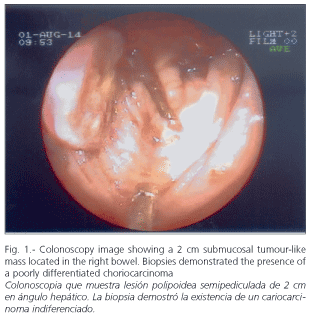
<body><![CDATA[<p>In patients with wide-spread       tumoral disease and gastrointestinal hemorrhage, endoscopic management       should be individualized according to personal and clinical characteristics,       in order to obtain etiological information on the hemorrhage, a histological       examination of potential bleeding lesions, and endoscopic therapy when       necessary.</p>         <p><b>CASE REPORT</b></p>         <p>A 37-year-old man with no significant medical or surgical history was admitted         because of fatigue, weight loss, fever up to 38 ºC, and moderate hematuria         during the last month. Physical examination was normal. Laboratory testing         showed anaemia (haemoglobin 7.7 g/L), fibrinogen 838 mg/dL, and LDH 2811         mg/dL. On a chest x-ray several  bilaterally spread nodules were seen,         with sizes ranging from 2 to 8 centimeters, and an abdominal CT scan         demonstrated similar lesions in the liver, spleen, kidneys and bladder.         No mediastinal or retroperitoneal masses were observed, and a testicular         ecography was normal.</p>         <p>Seven         days after admission the patient presented melaena and hypotension, which         required blood transfusion. Endoscopy showed a 3 cm submucosal mass with         a central deep ulceration in the upper body of the stomach, but no blood         was found. The procedure was not completed because of patient intolerance.         Beta- human chorionic gonadotropin was 9.281 mIU/mL (normal less than         5.0), with no positivity for other tumour markers. Due to the absence         of blood in upper endoscopy, a colonoscopy was performed. Two polypoid         masses in the right bowel were shown (<a href="#F1">Fig. 1</a>). On histologic examination         a poorly differentiated glandular carcinoma suggestive of choriocarcinoma         was detected.</p>         		    <p align="center"><a name="F1"><img src="/img/diges/v96n1/capitulo10/fig_1ing.gif" width="311" height="323"></a></p>         <p>Despite         the fact that a primary tumour location was not found, cisplatin-based         combination chemotherapy was started; however, the patient unfortunately         died three weeks later. </p>        <p><b>DISCUSSION</b></p>        <p>Non-gestational         choriocarcinoma is a rare trophoblastic germ-cell tumour with a characteristically         agressive spread through the lymph and blood from the retroperitoneal         space, mediastinum and gonads. Because of its origin, metastatic lesions         produce beta-human chorionic gonadotropin; they also have a hemorrhagic         tendency that results in the disease often presenting with bleeding from         metastatic lesions. Metastatic disease is usually located in the lung,         brain, bones, and lymph nodes, and it involves the gut in less than 5%         of cases (2). In such cases the stomach, usually the upper body, is the         most common location, with a few case reports on the small intestine         and colon (3-7). No prior report of simultaneous gastric and colonic         hemorrhagic lesions has been described at the onset of this disease. </p>        <p>In         any metastatic neoplasm implantation takes place in the submucosa once         tumour cells reach the gastrointestinal tract, as they fail to pass through         the capillary barrier. As this submucosal tumour grows, blood supply         to its central area decreases, which gives rise to erosions and ulcerations.         For this reason, the main morphologic endoscopic features of metastatic         gastrointestinal lesions are ulcerated submucosal and polypoid masses         (1), which may require a more aggressive biopsy technique in order to         obtain proper histological material.</p>        <p>Tumoral         specific markers are an important diagnostic tool. Beta-human chorionic         gonadotropin serum concentrations are increased in all patients with         pure choriocarcinoma and alpha-fetoprotein concentrations may be elevated         in 30-60% of choriocarcinomas, usually in mixed histological forms with         other germ-cell tumours.</p>        ]]></body>
<body><![CDATA[<p>Metastatic         choriocarcinoma is a malignant disease with a high remission rate and         a 5-year overall survival rate of 70-80%. Main prognostic factors include         chemorefractory status, beta human gonadotropin serum concentrations         higher than 1000 mIU/mL, and a primary mediastinal tumour. However, the         occurrence of gastrointestinal hemorrhage due to metastatic lesions –and         also promoted by chemotherapy adverse effects– worsens the prognosis.         The treatment of choice is a high-dose cisplatin-based chemotherapy,         and  the role of coadjuvant peripheral blood stem-cell transplantation         is being evaluated in clinical trials (8).</p>        <p>The         specific treatment of gastrointestinal bleeding metastatic disease is         controversial because accurate  topographic mapping of the lesions by         endoscopy, laparoscopy or angiography would be needed. In recent years,         there have been some reports on laparoscopic surgery for isolated gastric         and jejunal lesions (3,7,9), and angiographic embolization (5), but no         survival benefit has been proven with these approaches. </p>        <p>In         every young man with widespread, unidentified tumoral disease and various         hemorrhagic symptoms, a germ-cell tumour should be ruled out by testicular         ecography, thoracic and abdominal scans, and beta-human chorionic gonadotropin         and alpha-fetoprotein serum concentrations. In the case of gastrointestinal         hemorrhage, a panendoscopic examination and histologic evaluation should         be carried out to identify metastatic lesions and provide potential endoscopic         therapy; should this be not practical, angiography and surgery might         prove useful for the control of active tumour bleeding.</p>        <p><b>REFERENCES</b></p>        <!-- ref --><p>1. Hsu C, Chen J, Changchien S. Endoscopic       features of metastatic tumors in the upper gastrointestinal tract. Endoscopy       1996; 28: 249-53.&nbsp;&nbsp;&nbsp;&nbsp;&nbsp;&nbsp;&nbsp;&nbsp;[&#160;<a href="javascript:void(0);" onclick="javascript: window.open('/scielo.php?script=sci_nlinks&ref=5207500&pid=S1130-0108200400010001000001&lng=','','width=640,height=500,resizable=yes,scrollbars=1,menubar=yes,');">Links</a>&#160;]<!-- end-ref --><!-- ref --><p>2. Sheinfeld J. Nonseminomatous germ       cell tumors of the testis: current concepts and controversias. Urology       1994; 44: 2-14.&nbsp;&nbsp;&nbsp;&nbsp;&nbsp;&nbsp;&nbsp;&nbsp;[&#160;<a href="javascript:void(0);" onclick="javascript: window.open('/scielo.php?script=sci_nlinks&ref=5207501&pid=S1130-0108200400010001000002&lng=','','width=640,height=500,resizable=yes,scrollbars=1,menubar=yes,');">Links</a>&#160;]<!-- end-ref --><!-- ref --><p>3. Zerbib P, Prieur E, Khory-Helou       A, Catala P, Pruvot FR, Chambor JP. Hemorrhagic digestive metastases from       testicular choriocarcionoma. Ann Chir 2002; 127: 300-1&nbsp;&nbsp;&nbsp;&nbsp;&nbsp;&nbsp;&nbsp;&nbsp;[&#160;<a href="javascript:void(0);" onclick="javascript: window.open('/scielo.php?script=sci_nlinks&ref=5207502&pid=S1130-0108200400010001000003&lng=','','width=640,height=500,resizable=yes,scrollbars=1,menubar=yes,');">Links</a>&#160;]<!-- end-ref --><!-- ref --><p>4. Odelowo OO, Naab T, Dewitty RL.       Metastatic choriocarcinoma presenting as a bleeding duodenal ulcer. J Assoc       Minor Phys 2001; 12: 144-8.&nbsp;&nbsp;&nbsp;&nbsp;&nbsp;&nbsp;&nbsp;&nbsp;[&#160;<a href="javascript:void(0);" onclick="javascript: window.open('/scielo.php?script=sci_nlinks&ref=5207503&pid=S1130-0108200400010001000004&lng=','','width=640,height=500,resizable=yes,scrollbars=1,menubar=yes,');">Links</a>&#160;]<!-- end-ref --><!-- ref --><p>5. Rosenblatt GS, Walsh CJ, Chung       S. Metastatic testis tumor presenting as gastrointestinal hemorrhage. J       Urol 2000; 164: 1655.&nbsp;&nbsp;&nbsp;&nbsp;&nbsp;&nbsp;&nbsp;&nbsp;[&#160;<a href="javascript:void(0);" onclick="javascript: window.open('/scielo.php?script=sci_nlinks&ref=5207504&pid=S1130-0108200400010001000005&lng=','','width=640,height=500,resizable=yes,scrollbars=1,menubar=yes,');">Links</a>&#160;]<!-- end-ref --><!-- ref --><p>6. Garcia AO, Mahfoud C, Tallarico       O, Cohen R, Milano C, Bonfanti L. Acute low digestive hemorrhage in testicular       choriocarcinoma. Acta Gastroenterol Latinoam 1997; 27: 81-2.&nbsp;&nbsp;&nbsp;&nbsp;&nbsp;&nbsp;&nbsp;&nbsp;[&#160;<a href="javascript:void(0);" onclick="javascript: window.open('/scielo.php?script=sci_nlinks&ref=5207505&pid=S1130-0108200400010001000006&lng=','','width=640,height=500,resizable=yes,scrollbars=1,menubar=yes,');">Links</a>&#160;]<!-- end-ref --><!-- ref --><p>7. Ho H, Zuckerman MJ, Boman D. Gastrointestinal       hemorrhage due to choriocarcinoma involving the duodenum. J Clin Gastroenterol       1988; 10: 146-50.&nbsp;&nbsp;&nbsp;&nbsp;&nbsp;&nbsp;&nbsp;&nbsp;[&#160;<a href="javascript:void(0);" onclick="javascript: window.open('/scielo.php?script=sci_nlinks&ref=5207506&pid=S1130-0108200400010001000007&lng=','','width=640,height=500,resizable=yes,scrollbars=1,menubar=yes,');">Links</a>&#160;]<!-- end-ref --><!-- ref --><p>8. Bokemeyer C, Harstrick A, Beyer       J, Metzner B, Ruther U, Hartman JT et al. The use of dose- intensified       chemotherapy in the treatment of metastatic nonseminomatous testicular       germ cell tumors. German Testicular Cancer Group. Semin Oncol 1998; 25:       24-32.&nbsp;&nbsp;&nbsp;&nbsp;&nbsp;&nbsp;&nbsp;&nbsp;[&#160;<a href="javascript:void(0);" onclick="javascript: window.open('/scielo.php?script=sci_nlinks&ref=5207507&pid=S1130-0108200400010001000008&lng=','','width=640,height=500,resizable=yes,scrollbars=1,menubar=yes,');">Links</a>&#160;]<!-- end-ref --><!-- ref --><p>9. Galloway SW, Yeung EC, Lau JY,       Cheng CS. Laparoscopic gastric resection for bleeding metastatic choriocarcinoma.       Surg Endosc 2001; 15: 100.&nbsp;&nbsp;&nbsp;&nbsp;&nbsp;&nbsp;&nbsp;&nbsp;[&#160;<a href="javascript:void(0);" onclick="javascript: window.open('/scielo.php?script=sci_nlinks&ref=5207508&pid=S1130-0108200400010001000009&lng=','','width=640,height=500,resizable=yes,scrollbars=1,menubar=yes,');">Links</a>&#160;]<!-- end-ref --> ]]></body><back>
<ref-list>
<ref id="B1">
<label>1</label><nlm-citation citation-type="journal">
<person-group person-group-type="author">
<name>
<surname><![CDATA[Hsu]]></surname>
<given-names><![CDATA[C]]></given-names>
</name>
<name>
<surname><![CDATA[Chen]]></surname>
<given-names><![CDATA[J]]></given-names>
</name>
<name>
<surname><![CDATA[Changchien]]></surname>
<given-names><![CDATA[S]]></given-names>
</name>
</person-group>
<article-title xml:lang="en"><![CDATA[Endoscopic features of metastatic tumors in the upper gastrointestinal tract]]></article-title>
<source><![CDATA[Endoscopy]]></source>
<year>1996</year>
<volume>28</volume>
<page-range>249-53</page-range></nlm-citation>
</ref>
<ref id="B2">
<label>2</label><nlm-citation citation-type="journal">
<person-group person-group-type="author">
<name>
<surname><![CDATA[Sheinfeld]]></surname>
<given-names><![CDATA[J]]></given-names>
</name>
</person-group>
<article-title xml:lang="en"><![CDATA[Nonseminomatous germ cell tumors of the testis: current concepts and controversias]]></article-title>
<source><![CDATA[Urology]]></source>
<year>1994</year>
<volume>44</volume>
<page-range>2-14</page-range></nlm-citation>
</ref>
<ref id="B3">
<label>3</label><nlm-citation citation-type="journal">
<person-group person-group-type="author">
<name>
<surname><![CDATA[Zerbib]]></surname>
<given-names><![CDATA[P]]></given-names>
</name>
<name>
<surname><![CDATA[Prieur]]></surname>
<given-names><![CDATA[E]]></given-names>
</name>
<name>
<surname><![CDATA[Khory-Helou]]></surname>
<given-names><![CDATA[A]]></given-names>
</name>
<name>
<surname><![CDATA[Catala]]></surname>
<given-names><![CDATA[P]]></given-names>
</name>
<name>
<surname><![CDATA[Pruvot]]></surname>
<given-names><![CDATA[FR]]></given-names>
</name>
<name>
<surname><![CDATA[Chambor]]></surname>
<given-names><![CDATA[JP]]></given-names>
</name>
</person-group>
<article-title xml:lang="en"><![CDATA[Hemorrhagic digestive metastases from testicular choriocarcionoma]]></article-title>
<source><![CDATA[Ann Chir]]></source>
<year>2002</year>
<volume>127</volume>
<page-range>300-1</page-range></nlm-citation>
</ref>
<ref id="B4">
<label>4</label><nlm-citation citation-type="journal">
<person-group person-group-type="author">
<name>
<surname><![CDATA[Odelowo]]></surname>
<given-names><![CDATA[OO]]></given-names>
</name>
<name>
<surname><![CDATA[Naab]]></surname>
<given-names><![CDATA[T]]></given-names>
</name>
<name>
<surname><![CDATA[Dewitty]]></surname>
<given-names><![CDATA[RL]]></given-names>
</name>
</person-group>
<article-title xml:lang="en"><![CDATA[Metastatic choriocarcinoma presenting as a bleeding duodenal ulcer]]></article-title>
<source><![CDATA[J Assoc Minor Phys]]></source>
<year>2001</year>
<volume>12</volume>
<page-range>144-8</page-range></nlm-citation>
</ref>
<ref id="B5">
<label>5</label><nlm-citation citation-type="journal">
<person-group person-group-type="author">
<name>
<surname><![CDATA[Rosenblatt]]></surname>
<given-names><![CDATA[GS]]></given-names>
</name>
<name>
<surname><![CDATA[Walsh]]></surname>
<given-names><![CDATA[CJ]]></given-names>
</name>
<name>
<surname><![CDATA[Chung]]></surname>
<given-names><![CDATA[S]]></given-names>
</name>
</person-group>
<article-title xml:lang="en"><![CDATA[Metastatic testis tumor presenting as gastrointestinal hemorrhage]]></article-title>
<source><![CDATA[J Urol]]></source>
<year>2000</year>
<volume>164</volume>
<page-range>1655</page-range></nlm-citation>
</ref>
<ref id="B6">
<label>6</label><nlm-citation citation-type="journal">
<person-group person-group-type="author">
<name>
<surname><![CDATA[Garcia]]></surname>
<given-names><![CDATA[AO]]></given-names>
</name>
<name>
<surname><![CDATA[Mahfoud]]></surname>
<given-names><![CDATA[C]]></given-names>
</name>
<name>
<surname><![CDATA[Tallarico]]></surname>
<given-names><![CDATA[O]]></given-names>
</name>
<name>
<surname><![CDATA[Cohen]]></surname>
<given-names><![CDATA[R]]></given-names>
</name>
<name>
<surname><![CDATA[Milano]]></surname>
<given-names><![CDATA[C]]></given-names>
</name>
<name>
<surname><![CDATA[Bonfanti]]></surname>
<given-names><![CDATA[L]]></given-names>
</name>
</person-group>
<article-title xml:lang="en"><![CDATA[Acute low digestive hemorrhage in testicular choriocarcinoma]]></article-title>
<source><![CDATA[Acta Gastroenterol Latinoam]]></source>
<year>1997</year>
<volume>27</volume>
<page-range>81-2</page-range></nlm-citation>
</ref>
<ref id="B7">
<label>7</label><nlm-citation citation-type="journal">
<person-group person-group-type="author">
<name>
<surname><![CDATA[Ho]]></surname>
<given-names><![CDATA[H]]></given-names>
</name>
<name>
<surname><![CDATA[Zuckerman]]></surname>
<given-names><![CDATA[MJ]]></given-names>
</name>
<name>
<surname><![CDATA[Boman]]></surname>
<given-names><![CDATA[D]]></given-names>
</name>
</person-group>
<article-title xml:lang="en"><![CDATA[Gastrointestinal hemorrhage due to choriocarcinoma involving the duodenum]]></article-title>
<source><![CDATA[J Clin Gastroenterol]]></source>
<year>1988</year>
<volume>10</volume>
<page-range>146-50</page-range></nlm-citation>
</ref>
<ref id="B8">
<label>8</label><nlm-citation citation-type="journal">
<person-group person-group-type="author">
<name>
<surname><![CDATA[Bokemeyer]]></surname>
<given-names><![CDATA[C]]></given-names>
</name>
<name>
<surname><![CDATA[Harstrick]]></surname>
<given-names><![CDATA[A]]></given-names>
</name>
<name>
<surname><![CDATA[Beyer]]></surname>
<given-names><![CDATA[J]]></given-names>
</name>
<name>
<surname><![CDATA[Metzner]]></surname>
<given-names><![CDATA[B]]></given-names>
</name>
<name>
<surname><![CDATA[Ruther]]></surname>
<given-names><![CDATA[U]]></given-names>
</name>
<name>
<surname><![CDATA[Hartman]]></surname>
<given-names><![CDATA[JT]]></given-names>
</name>
</person-group>
<article-title xml:lang="en"><![CDATA[The use of dose- intensified chemotherapy in the treatment of metastatic nonseminomatous testicular germ cell tumors]]></article-title>
<source><![CDATA[Semin Oncol]]></source>
<year>1998</year>
<volume>25</volume>
<page-range>24-32</page-range></nlm-citation>
</ref>
<ref id="B9">
<label>9</label><nlm-citation citation-type="journal">
<person-group person-group-type="author">
<name>
<surname><![CDATA[Galloway]]></surname>
<given-names><![CDATA[SW]]></given-names>
</name>
<name>
<surname><![CDATA[Yeung]]></surname>
<given-names><![CDATA[EC]]></given-names>
</name>
<name>
<surname><![CDATA[Lau]]></surname>
<given-names><![CDATA[JY]]></given-names>
</name>
<name>
<surname><![CDATA[Cheng]]></surname>
<given-names><![CDATA[CS]]></given-names>
</name>
</person-group>
<article-title xml:lang="en"><![CDATA[Laparoscopic gastric resection for bleeding metastatic choriocarcinoma]]></article-title>
<source><![CDATA[Surg Endosc]]></source>
<year>2001</year>
<volume>15</volume>
<page-range>100</page-range></nlm-citation>
</ref>
</ref-list>
</back>
</article>
