<?xml version="1.0" encoding="ISO-8859-1"?><article xmlns:mml="http://www.w3.org/1998/Math/MathML" xmlns:xlink="http://www.w3.org/1999/xlink" xmlns:xsi="http://www.w3.org/2001/XMLSchema-instance">
<front>
<journal-meta>
<journal-id>1130-0108</journal-id>
<journal-title><![CDATA[Revista Española de Enfermedades Digestivas]]></journal-title>
<abbrev-journal-title><![CDATA[Rev. esp. enferm. dig.]]></abbrev-journal-title>
<issn>1130-0108</issn>
<publisher>
<publisher-name><![CDATA[Sociedad Española de Patología Digestiva]]></publisher-name>
</publisher>
</journal-meta>
<article-meta>
<article-id>S1130-01082004000500008</article-id>
<title-group>
<article-title xml:lang="en"><![CDATA[Diffuse cavernous hemangioma of the rectum: an atypical cause of rectal bleeding]]></article-title>
<article-title xml:lang="es"><![CDATA[Hemangioma cavernoso difuso del recto: una causa atípica de hemorragia digestiva baja]]></article-title>
</title-group>
<contrib-group>
<contrib contrib-type="author">
<name>
<surname><![CDATA[Hervías]]></surname>
<given-names><![CDATA[D.]]></given-names>
</name>
<xref ref-type="aff" rid="A01"/>
</contrib>
<contrib contrib-type="author">
<name>
<surname><![CDATA[Turrión]]></surname>
<given-names><![CDATA[J. P.]]></given-names>
</name>
<xref ref-type="aff" rid="A01"/>
</contrib>
<contrib contrib-type="author">
<name>
<surname><![CDATA[Herrera]]></surname>
<given-names><![CDATA[M.]]></given-names>
</name>
<xref ref-type="aff" rid="A01"/>
</contrib>
<contrib contrib-type="author">
<name>
<surname><![CDATA[Navajas León]]></surname>
<given-names><![CDATA[J.]]></given-names>
</name>
<xref ref-type="aff" rid="A01"/>
</contrib>
<contrib contrib-type="author">
<name>
<surname><![CDATA[Pajares Villarroya]]></surname>
<given-names><![CDATA[R.]]></given-names>
</name>
<xref ref-type="aff" rid="A01"/>
</contrib>
<contrib contrib-type="author">
<name>
<surname><![CDATA[Manceñido]]></surname>
<given-names><![CDATA[N.]]></given-names>
</name>
<xref ref-type="aff" rid="A01"/>
</contrib>
<contrib contrib-type="author">
<name>
<surname><![CDATA[Castillo]]></surname>
<given-names><![CDATA[P.]]></given-names>
</name>
<xref ref-type="aff" rid="A01"/>
</contrib>
<contrib contrib-type="author">
<name>
<surname><![CDATA[Segura]]></surname>
<given-names><![CDATA[J.M.]]></given-names>
</name>
<xref ref-type="aff" rid="A01"/>
</contrib>
</contrib-group>
<aff id="A01">
<institution><![CDATA[,Hospital Universitario La Paz Service of Digestive Diseases ]]></institution>
<addr-line><![CDATA[Madrid ]]></addr-line>
<country>Spain</country>
</aff>
<pub-date pub-type="pub">
<day>00</day>
<month>05</month>
<year>2004</year>
</pub-date>
<pub-date pub-type="epub">
<day>00</day>
<month>05</month>
<year>2004</year>
</pub-date>
<volume>96</volume>
<numero>5</numero>
<fpage>346</fpage>
<lpage>352</lpage>
<copyright-statement/>
<copyright-year/>
<self-uri xlink:href="http://scielo.isciii.es/scielo.php?script=sci_arttext&amp;pid=S1130-01082004000500008&amp;lng=en&amp;nrm=iso"></self-uri><self-uri xlink:href="http://scielo.isciii.es/scielo.php?script=sci_abstract&amp;pid=S1130-01082004000500008&amp;lng=en&amp;nrm=iso"></self-uri><self-uri xlink:href="http://scielo.isciii.es/scielo.php?script=sci_pdf&amp;pid=S1130-01082004000500008&amp;lng=en&amp;nrm=iso"></self-uri><abstract abstract-type="short" xml:lang="en"><p><![CDATA[Objective: cavernous hemangioma of the rectosigmoid colon is a rare disease, with no more than 200 cases reported in the literature. The rectosigmoid is the most common site of this disease in the gastrointestinal tract. Case report: we report the case of a 31-year-old male with recurrent episodes of rectal bleeding, who was finally diagnosed of diffuse cavernous hemangioma of the rectum. The tumor, of 12 x 10 x 9 cm in size, occupied the rectum to the margin of the anal sphincter. A surgical procedure was ruled out because of the inability to carry out a safe anastomosis while preserving anal sphincters. Discussion: rectal hemangiomas are less frequent vascular malformations. The clinical presentation of a cavernous hemangioma of the rectum is usually acute, recurrent or chronic rectal bleeding. Other symptoms stem from the possible compression or invasion of adjacent structures, such as lumbar or perianal pain, metrorrhage, hematuria, etc. This diagnosis is commonly made in younger patients. Colonoscopy is without doubt the diagnostic technique of choice, and it allows to establish the localization, morphology, and total extension of the lesion; its characteristic image is a red-purplish nodule with great vascular congestion. According to the opinion of most authors, biopsy is not advisable during colonoscopy, since imaging techniques are sufficient for an accurate diagnosis, and the risk of bleeding while manipulating this lesion is not negligible. Computed tomography and particularly magnetic resonance imaging, given their high precision to delimit the lesion and its relations to adjacent structures, are imaging studies that are mandatory before surgical treatment. Other techniques such as selective angiography, barium enema, gastrointestinal transit, and upper-tract endoscopy may be supplementary and help locate more lesions along the gastrointestinal tract. Failure to recognize the exact diagnosis and extent of diffuse cavernous hemangioma may lead to failed surgical treatment and severe complications. Complete surgical excision of the lesion with a sphincter-saving procedure is the primary mode of treatment: conservative proctectomy with coloanal anastomosis.]]></p></abstract>
<abstract abstract-type="short" xml:lang="es"><p><![CDATA[Objetivo: el hemangioma cavernoso rectal constituye una rara patología, de la cual no se han descrito más de 200 casos en la literatura. El recto y colon sigmoide son la localización más frecuente de esta enfermedad en el tracto gastrointestinal. Caso clínico: a continuación presentamos el caso de un varón de 31 años de edad con episodios recurrentes de sangrado digestivo en forma de rectorragias, el cual finalmente fue dignosticado de hemangioma cavernoso difuso rectal. El tumor, de 12 x 10 x 9 cm de tamaño, ocupaba el recto y se extendía hasta el margen del esfínter anal. El tratamiento quirúrgico fue rechazado ante la imposibilidad de llevar a cabo una resección y una anastomosis segura preservando los esfínteres anales. Discusión: los hemangiomas rectales son malformaciones vasculares infrecuentes que se manifiestan en forma de sangrado rectal agudo, crónico o recurrente como primera sintomatología. Otros síntomas vienen derivados de la compresión de estructuras adyacentes como dolor lumbar o perianal, metrorragias, hematuria, etc. El diagnóstico se realiza casi siempre en adultos jóvenes. La colonoscopia es sin duda la prueba diagnóstica de elección, mostrando la extensión, morfología, características del tumor y la típica imagen es la de una formación nodular, rojo-violácea, con gran congestión vascular. De acuerdo con la opinión de la mayoría de los autores, la toma de biopsias durante la endoscopia no está indicada, dado que las técnicas de imagen son suficientes para el diagnóstico y que el riesgo de sangrado durante la manipulación del tumor no es en absoluto despreciable. La TAC y especiamente la RMN permiten definir mejor la lesión y su relación con estructuras adyacentes, siendo primordiales de cara a un tratamiento quirúrgico. El estudio baritado, la arteriografía selectiva mesentérica o la gastroscopia pueden complementar y descartar además patología similar en otras localizaciones del tracto gastrointestinal. El diagnóstico erróneo de hemangioma cavernoso rectal o de su extensión completa puede derivar en un fallo en el tratamiento quirúrgico y graves complicaciones. La completa resección del tumor preservando los esfínteres anales constituye la técnica quirúrgica de elección: proctectomía conservadora con anastomosis coloanal.]]></p></abstract>
<kwd-group>
<kwd lng="en"><![CDATA[Rectum]]></kwd>
<kwd lng="en"><![CDATA[Cavernous hemangioma]]></kwd>
<kwd lng="en"><![CDATA[Rectal bleeding]]></kwd>
<kwd lng="en"><![CDATA[MRI]]></kwd>
<kwd lng="en"><![CDATA[Colonoscopy]]></kwd>
<kwd lng="es"><![CDATA[Recto]]></kwd>
<kwd lng="es"><![CDATA[Hemangioma cavernoso]]></kwd>
<kwd lng="es"><![CDATA[Rectorragias]]></kwd>
<kwd lng="es"><![CDATA[Resonancia magnética nuclear]]></kwd>
<kwd lng="es"><![CDATA[Colonoscopia]]></kwd>
</kwd-group>
</article-meta>
</front><body><![CDATA[ <div align="center">       <center>   <table border="1" width="30%">     <tr>       <td width="100%" align="center"><b><font face="Arial">CLINICAL NOTE</font></b></td>     </tr>   </table>   </center> </div>     <p>    <br> <b><font size=5>Diffuse cavernous hemangioma of the rectum: an atypical cause of rectal bleeding</font></b></p>     <p><b>D. Herv&iacute;as, J. P. Turri&oacute;n, M. Herrera, J. Navajas Le&oacute;n, R. Pajares Villarroya, N. Mance&ntilde;ido, P. Castillo and J.M. Segura</b></p>     <p><i>Service of Digestive Diseases. Hospital Universitario La Paz. Madrid, Spain</i></p>     <p>&nbsp;</p>     <p><b>ABSTRACT</b></p>     <p><font face="Arial" size="2"><b>Objective</b>: cavernous hemangioma of the rectosigmoid colon is a rare disease, with no more than 200 cases reported in the literature. The rectosigmoid is the most common site of this disease in the gastrointestinal tract.<b>    <br> Case report</b>: we report the case of a 31-year-old male with recurrent episodes of rectal bleeding, who was finally diagnosed of diffuse cavernous hemangioma of the rectum. The tumor, of 12 x 10 x 9 cm in size, occupied the rectum to the margin of the anal sphincter. A surgical procedure was ruled out because of the inability to carry out a safe anastomosis while preserving anal sphincters.<b>    ]]></body>
<body><![CDATA[<br> Discussion</b>: rectal hemangiomas are less frequent vascular malformations. The clinical presentation of a cavernous hemangioma of the rectum is usually acute, recurrent or chronic rectal bleeding. Other symptoms stem from the possible compression or invasion of adjacent structures, such as lumbar or perianal pain, metrorrhage, hematuria, etc. This diagnosis is commonly made in younger patients.    <br> Colonoscopy is without doubt the diagnostic technique of choice, and it allows to establish the localization, morphology, and total extension of the lesion; its characteristic image is a red-purplish nodule with great vascular congestion. According to the opinion of most authors, biopsy is not advisable during colonoscopy, since imaging techniques are sufficient for an accurate diagnosis, and the risk of bleeding while manipulating this lesion is not negligible. Computed tomography and particularly magnetic resonance imaging, given their high precision to delimit the lesion and its relations to adjacent structures, are imaging studies that are mandatory before surgical treatment. Other techniques such as selective angiography, barium enema, gastrointestinal transit, and upper-tract endoscopy may be supplementary and help locate more lesions along the gastrointestinal tract.    <br> Failure to recognize the exact diagnosis and extent of diffuse cavernous hemangioma may lead to failed surgical treatment and severe complications.    <br> Complete surgical excision of the lesion with a sphincter-saving procedure is the primary mode of treatment: conservative proctectomy with coloanal anastomosis.</font></p>     <p><font face="Arial" size="2"><b>Key words</b>: Rectum. Cavernous hemangioma. Rectal bleeding. MRI. Colonoscopy.</font></p> <hr>     <p><i><font size="2">Herv&iacute;as D, Turri&oacute;n JP, Herrera M, Navajas Le&oacute;n J, Pajares Villarroya R, Mance&ntilde;ido N, Castillo P, Segura JM. Diffuse cavernous hemangioma of the rectum: an atypical cause of rectal bleeding. Rev Esp Enferm Dig 2004; 96: 346-352.</font></i></p> <hr>     <p><font size="2"><i>Recibido</i>: 09-06-03.    <br> <i>Aceptado</i>: 22-07-03.</font></p>     <p><font size="2"><i>Correspondencia</i>: Daniel Hervías Cruz. Avda. Monforte de Lemos, 169, 4º-4. 28029 Madrid, Spain. Telfs.: 91 373 48 15 - 699 85 21 74. e-mail: </font><a href="mailto:dhervias@jazzfree.com"><font size="2">dhervias@jazzfree.com</font></a></p>     <p>&nbsp;</p>     ]]></body>
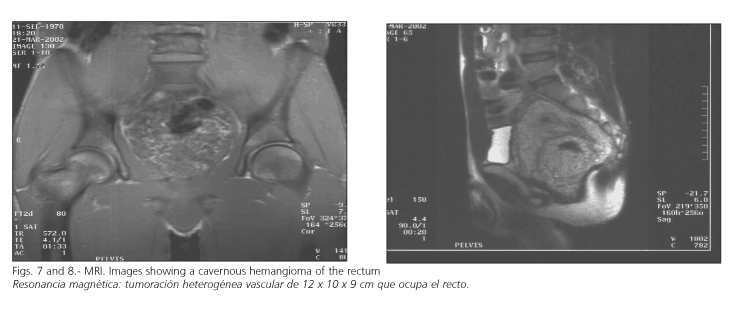
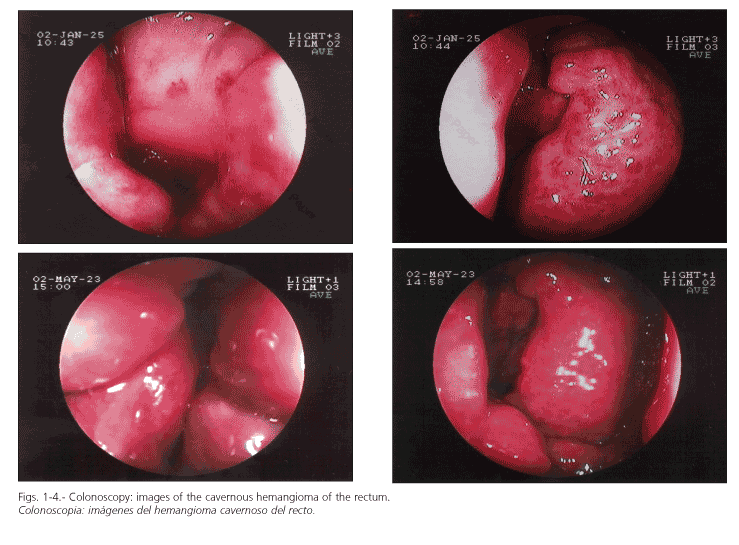
<body><![CDATA[<p><b>INTRODUCTION</b></p>     <p>Diffuse cavernous hemangioma of the rectum is an uncommon disease with less than 200 reported cases that affects mainly young adults. The rectosigmoid is the most common site of location of this disease in the gastrointestinal tract. The clinical presentation is usually acute, recurrent or chronic rectal bleeding. Symptoms usually manifest early in the disease, but the diagnosis of cavernous hemangioma is seldom established until adulthood.</p>    <p>   Diagnosis is usually reached by barium enema examination, colonoscopy, findings on selective inferior mesenteric artery angiography, and other imaging studies such as computed tomography (CT) and magnetic resonance imaging (MRI). The latter imaging study is mandatory to confirm the diagnosis and to evaluate the full extent of the disease. CT and MRI provide information about the dimensions of the tumor and the involvement of adjacent structures.</p>    <p>   Failure to recognize the exact extent of a diffuse cavernous hemangioma in the rectosigmoid colon may lead to failed surgical treatment and severe complications. Complete surgical excision of the lesion with a sphincter-saving procedure is the primary mode of treatment (conservative proctectomy with coloanal anastomosis). We present the case of a 31-year-old male with a diffuse cavernous hemangioma of the   rectum.</p>    <p>   <b>CASE REPORT</b></p>    <p>   A 31-year-old man was attended in our center because of recurrent rectal bleeding during the last 4 years.</p>    <p>   In his medical history, besides an active smoking habit, a previous vascular hamartoma in the rectum-sigma stands out. This was operated 15 years before by means of sigmoid resection and end-terminal anastomosis. </p>    <p>   In successive colonoscopies after each episode of rectal bleeding, the patient was diagnosed of grade III/IV internal hemorrhoids and subsequently of ulcerative proctitis, without any histological confirmation or improvement following treatment with 5-aminosalicylic acid. No other hemorrhage-associated symptoms, such as abdominal pain, fever, consumptive syndrome, or anemia developed.</p>    <p>   Following another episode of open rectal bleeding, a colonoscopy was carried out. Endoscopy displayed a pseudotumoral, smooth, embossed, vessel-like mass, which occupied the rectum and extended to the margin of the anal sphincter (<a href="#f1-4">Figs. 1-4</a>). No biopsy samples were taken because a high risk of hemorrhage has been described during manipulation of these vascular lesions.</p>       <p align="center"><a name="f1-4"><img src="/img/diges/v96n5/images/notaclinica_fig1-4.gif" width="739" height="545"></a></p>       ]]></body>
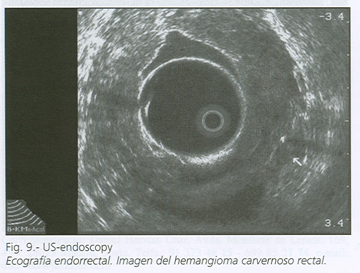
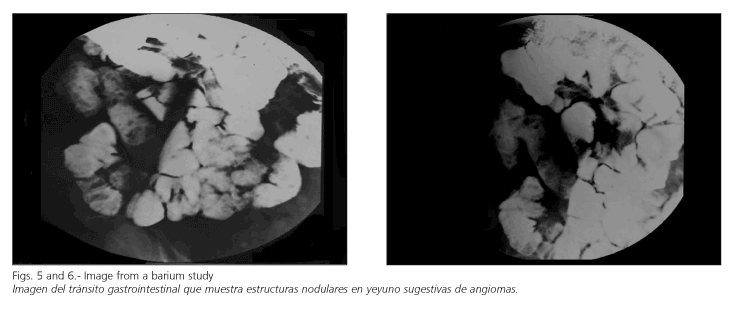
<body><![CDATA[<p>    <br>   A contrast-enhanced MRI showed an intense enlargement of the rectal wall extending to the rectum-sigma junction, which was identified as a mass of 12 x 10 x 9 cm in size that had previously moved towards the bladder, without ever infiltrating this organ (<a href="#f7-8">Figs. 7 y 8</a>). The study was completed with an endorectal ultrasonography that confirmed the presence of a heterogeneous, circumferential lesion that occupy the rectum and seemed to depend on the submucosal layer. This mass contained hyper-echogenic images resulting from calcifications and it was suggestive of a vascular lesion (<a href="#f9">Fig. 9</a>).</p>       <p>An oral endoscopy was carried out to exclude the presence of vascular lesions at this level. A bowel follow-through suggested the presence of nodular lesions compatible with angiomas in the jejunum (<a href="#f5-6">Figs. 5 y 6</a>). Selective arteriography did not describe any alterations at the level of the inferior mesenteric artery, and an embolization of the lesion was not possible during this test.</p>     <p align="center"><a name="f7-8"><img src="/img/diges/v96n5/images/notaclinica_fig7-8.gif" width="733" height="314"></a></p>     <p align="center"><a name="f9"><img src="/img/diges/v96n5/images/notaclinica_fig9.gif" width="360" height="273"></a></p>     <p align="center"><a name="f5-6"><img src="/img/diges/v96n5/images/notaclinica_fig5-6.gif" width="733" height="313"></a></p>     <p>    <br> Given the recurrence of bleeding, the possibility of more severe hemorrhage (even occult) and the size of the lesion, a surgical procedure was suggested, but was then ruled out since a safe anastomosis with sphincter preservation was deemed impossible.</p>     <p><b>DISCUSSION</b></p>     <p>Rectal hemangiomas are uncommon vascular malformations generally associated with self-limited rectal bleed-ing as their primary symptom (1-3). Other symptoms stem from a possible compression or invasion of adjacent structures, such as lumbar or perianal pain, metrorrhage, hematuria, etc. (4).</p>     ]]></body>
<body><![CDATA[<p>   Large lesions may be associated with coagulation disturbances as a result of coagulation factor consumption, or as a consequence of platelet destruction secondary to intravascular coagulation within the lesion. As was the case in our patient, a large number of these malformations are near missed or falsely diagnosed, since symptoms are attributed to internal hemorrhoids, polyps, ulcerative colitis, etc. (1-3). Furthermore, many patients show a previous surgical history, especially hemorrhoidectomy, which of course did not prevent further rectal bleeding. </p>    <p>   Colonoscopy is undoubtedly the diagnostic technique of choice, and it allows to establish the localization, morphology, and total extension of the lesion; its characteristic image is a red-purplish nodule with severe vascular congestion (1-3). Occasionally, ulcerations or an endoscopic image indistinguishable from that of a proctitis may be observed.</p>    <p>   It is essential to determine the relation of the lesion with the sphincters, a must in view of a future surgical resection, where sphincter preservation is always pointed out.</p>    <p>   According to the opinion of most authors, biopsy collection is not advisable during colonoscopy, as imaging techniques are sufficient for an accurate diagnosis, and the risk of bleeding during manipulation of this lesion is not negligible (1-3).</p>    <p>   CT (5) and particularly MRI are highly accurate in delimiting the lesion and its relation to adjacent structures. Therefore, these techniques are of choice for this condition (6,7). In this sense, MRI is, at present, almost a mandatory option before surgical procedures are taken (8).</p>    <p>   Other radiologic techniques such as barium enema and gastrointestinal follow-through may be supplementary, but do not generally provide more information, except for the diagnosis of "diffuse intestinal hemangiomatosis". This condition consists of numerous cavernous hemangiomas in the stomach, small intestine and colon (frequently associated with the same lesions in the skin and the soft tissues of the head and neck) (9).</p>    <p>   Selective arteriography may detect these lesions, but it is of little importance for the diagnosis. In addition, it shows normal results in most patients, because of the presence of thrombosis in dilated vascular spaces within the hemangioma.</p>    <p>   It has been recently suggested that radionuclide studies, particularly Tc-99 scans, may play a role in the assessment of the extension of these lesions.</p>    <p>   Once a diagnosis has been established, eradication of the lesion should be recommended.</p>    <p>   Although alternative therapies such as sclerotherapy, criotherapy or argon fulguration have been used, these procedures are only of limited value in the case of well-defined, small lesions; because of this, most authors have been abandoned these treatment nowadays. </p>    ]]></body>
<body><![CDATA[<p>   Commonly used surgical techniques include abdominal-perineal amputation and "sleeve" coloanal anastomosis (14,15).</p>    <p>   The former has the disadvantage of leaving the patient with a permanent stoma, and it may also cause sexual and/or urinary dysfunction.</p>    <p>   Coloanal anastomosis requires a wide mucosectomy of the rectum, keeping a muscular "sleeve" of rectal wall (12).</p>    <p>   Although total eradication of the hemangioma is not possible with this technique, there seems to be no risk for new hemorrhage.</p>    <p>   The main disadvantage of this anastomosis lies in the difficulty implied by such wide mucosectomy, and severe hemorrhage may develop from vascular dilations at a submucosal   level.</p>     <p>   <b>REFERENCES</b></p>     <!-- ref --><p>   1. Lyon DT, Mantia AG. Large bowel hemangiomas. Dis Colon Rectum 1984; 27: 404-14.&nbsp;&nbsp;&nbsp;&nbsp;&nbsp;&nbsp;&nbsp;&nbsp;[&#160;<a href="javascript:void(0);" onclick="javascript: window.open('/scielo.php?script=sci_nlinks&ref=5193724&pid=S1130-0108200400050000800001&lng=','','width=640,height=500,resizable=yes,scrollbars=1,menubar=yes,');">Links</a>&#160;]<!-- end-ref --><!-- ref --><p> 2. Terence CF, Tan MD, Wang JY. Diffuse cavernous hemangioma of the rectum complicated by invasion of pelvic structures: report of two cases. Dis Colon Rectum 1998; 41: 1062-6.&nbsp;&nbsp;&nbsp;&nbsp;&nbsp;&nbsp;&nbsp;&nbsp;[&#160;<a href="javascript:void(0);" onclick="javascript: window.open('/scielo.php?script=sci_nlinks&ref=5193725&pid=S1130-0108200400050000800002&lng=','','width=640,height=500,resizable=yes,scrollbars=1,menubar=yes,');">Links</a>&#160;]<!-- end-ref --><!-- ref --><p> 3. Tanaka N, Onda M, Furukawa K, Kumazaki T. Diffuse Cavernous Haemangioma of the Rectum. Eur J Surgery 1999; 165: 280-3.&nbsp;&nbsp;&nbsp;&nbsp;&nbsp;&nbsp;&nbsp;&nbsp;[&#160;<a href="javascript:void(0);" onclick="javascript: window.open('/scielo.php?script=sci_nlinks&ref=5193726&pid=S1130-0108200400050000800003&lng=','','width=640,height=500,resizable=yes,scrollbars=1,menubar=yes,');">Links</a>&#160;]<!-- end-ref --><!-- ref --><p> 4. Dachman AH, Ros PR, Shekitka KM, Buck JL, Olmsted WW, Hinton CB. Colorrectal hemangioma: radiologic findings. Radiology 1988; 167: 31-4.&nbsp;&nbsp;&nbsp;&nbsp;&nbsp;&nbsp;&nbsp;&nbsp;[&#160;<a href="javascript:void(0);" onclick="javascript: window.open('/scielo.php?script=sci_nlinks&ref=5193727&pid=S1130-0108200400050000800004&lng=','','width=640,height=500,resizable=yes,scrollbars=1,menubar=yes,');">Links</a>&#160;]<!-- end-ref --><!-- ref --><p> 5. Poggioli G, Marchetti F, Selleri S, Fortunato C, Laureti S, Gozzetti. Coloanal anastomosis with colonic reservoir for cavernous hemangioma of the rectum. Hepato-Gastroenterol 1993; 40: 279-81.&nbsp;&nbsp;&nbsp;&nbsp;&nbsp;&nbsp;&nbsp;&nbsp;[&#160;<a href="javascript:void(0);" onclick="javascript: window.open('/scielo.php?script=sci_nlinks&ref=5193728&pid=S1130-0108200400050000800005&lng=','','width=640,height=500,resizable=yes,scrollbars=1,menubar=yes,');">Links</a>&#160;]<!-- end-ref --><!-- ref --><p> 6. Bell GA, McKenzie AD, Emmons H. Diffuse cavernous hemangioma of the rectum: report of a case and review of the literature. Dis Colon Rectum 1972; 15: 377-82.&nbsp;&nbsp;&nbsp;&nbsp;&nbsp;&nbsp;&nbsp;&nbsp;[&#160;<a href="javascript:void(0);" onclick="javascript: window.open('/scielo.php?script=sci_nlinks&ref=5193729&pid=S1130-0108200400050000800006&lng=','','width=640,height=500,resizable=yes,scrollbars=1,menubar=yes,');">Links</a>&#160;]<!-- end-ref --><!-- ref --><p> 7. Londono-Schimmer EE, Ritchie JK, Hawley PR. Coloanal sleeve anastomosis in the treatment of diffuse cavernous haemangioma of the rectum: long term results. Br J Surgery 1994; 81: 1235-7.&nbsp;&nbsp;&nbsp;&nbsp;&nbsp;&nbsp;&nbsp;&nbsp;[&#160;<a href="javascript:void(0);" onclick="javascript: window.open('/scielo.php?script=sci_nlinks&ref=5193730&pid=S1130-0108200400050000800007&lng=','','width=640,height=500,resizable=yes,scrollbars=1,menubar=yes,');">Links</a>&#160;]<!-- end-ref --><!-- ref --><p> 8. Castellv&iacute; J, Pares D, Ramos E, Serrano T, Oca J, Mart&iacute; Ragu&eacute; J. Opciones en el tratamiento quir&uacute;rgico del hemangioma cavernoso difuso del recto. Rev Esp Enferm Dig 1996; 88, 8: 566-8.&nbsp;&nbsp;&nbsp;&nbsp;&nbsp;&nbsp;&nbsp;&nbsp;[&#160;<a href="javascript:void(0);" onclick="javascript: window.open('/scielo.php?script=sci_nlinks&ref=5193731&pid=S1130-0108200400050000800008&lng=','','width=640,height=500,resizable=yes,scrollbars=1,menubar=yes,');">Links</a>&#160;]<!-- end-ref --><!-- ref --><p> 9. Chaimoff Ch, Lurie H. Hemangioma of the rectum: clinical appearance and treatment. Dis Colon Rectum 1978; 21: 295-6.&nbsp;&nbsp;&nbsp;&nbsp;&nbsp;&nbsp;&nbsp;&nbsp;[&#160;<a href="javascript:void(0);" onclick="javascript: window.open('/scielo.php?script=sci_nlinks&ref=5193732&pid=S1130-0108200400050000800009&lng=','','width=640,height=500,resizable=yes,scrollbars=1,menubar=yes,');">Links</a>&#160;]<!-- end-ref --><!-- ref --><p>   10. Malone PS, Kiely EM, Spitz L. Diffuse cavernous haemangioma of the rectum in childhood. Br J Surgery 1990; 77: 338-9.&nbsp;&nbsp;&nbsp;&nbsp;&nbsp;&nbsp;&nbsp;&nbsp;[&#160;<a href="javascript:void(0);" onclick="javascript: window.open('/scielo.php?script=sci_nlinks&ref=5193733&pid=S1130-0108200400050000800010&lng=','','width=640,height=500,resizable=yes,scrollbars=1,menubar=yes,');">Links</a>&#160;]<!-- end-ref --><!-- ref --><p>   11. Amarapurkar D, Jadliwala M, Sandeep Punamiya. Cavernous hemangiomas of the rectum: report of three cases. Am J Gastroenterol 1998; 93: 1357-9.&nbsp;&nbsp;&nbsp;&nbsp;&nbsp;&nbsp;&nbsp;&nbsp;[&#160;<a href="javascript:void(0);" onclick="javascript: window.open('/scielo.php?script=sci_nlinks&ref=5193734&pid=S1130-0108200400050000800011&lng=','','width=640,height=500,resizable=yes,scrollbars=1,menubar=yes,');">Links</a>&#160;]<!-- end-ref --><!-- ref --><p>   12. Takamatsu H, Akiyama H, Noguchi H, Tahara H, Kahiya H. Endorrectal pull-through operation for diffuse cavernous hemangiomatosis of the sigmoid colon, rectum and anus. Eur J Pediatric Surgery 1992: 245-7.&nbsp;&nbsp;&nbsp;&nbsp;&nbsp;&nbsp;&nbsp;&nbsp;[&#160;<a href="javascript:void(0);" onclick="javascript: window.open('/scielo.php?script=sci_nlinks&ref=5193735&pid=S1130-0108200400050000800012&lng=','','width=640,height=500,resizable=yes,scrollbars=1,menubar=yes,');">Links</a>&#160;]<!-- end-ref --><!-- ref --><p>   13. Bortz, JH. Diffuse cavernous hemangioma of the rectum and sigmoid. Abdominal Imaging 1994; 19: 18-20.&nbsp;&nbsp;&nbsp;&nbsp;&nbsp;&nbsp;&nbsp;&nbsp;[&#160;<a href="javascript:void(0);" onclick="javascript: window.open('/scielo.php?script=sci_nlinks&ref=5193736&pid=S1130-0108200400050000800013&lng=','','width=640,height=500,resizable=yes,scrollbars=1,menubar=yes,');">Links</a>&#160;]<!-- end-ref --><!-- ref --><p>   14. Lupetin AR. Diffuse cavernous hemangioma of the rectum. Evaluation and MRI. Gastrointestinal Radiology 1990; 15: 343-5.&nbsp;&nbsp;&nbsp;&nbsp;&nbsp;&nbsp;&nbsp;&nbsp;[&#160;<a href="javascript:void(0);" onclick="javascript: window.open('/scielo.php?script=sci_nlinks&ref=5193737&pid=S1130-0108200400050000800014&lng=','','width=640,height=500,resizable=yes,scrollbars=1,menubar=yes,');">Links</a>&#160;]<!-- end-ref --> ]]></body><back>
<ref-list>
<ref id="B1">
<label>1</label><nlm-citation citation-type="journal">
<person-group person-group-type="author">
<name>
<surname><![CDATA[Lyon]]></surname>
<given-names><![CDATA[DT]]></given-names>
</name>
<name>
<surname><![CDATA[Mantia]]></surname>
<given-names><![CDATA[AG]]></given-names>
</name>
</person-group>
<article-title xml:lang="en"><![CDATA[Large bowel hemangiomas]]></article-title>
<source><![CDATA[Dis Colon Rectum]]></source>
<year>1984</year>
<volume>27</volume>
<page-range>404-14</page-range></nlm-citation>
</ref>
<ref id="B2">
<label>2</label><nlm-citation citation-type="journal">
<person-group person-group-type="author">
<name>
<surname><![CDATA[Terence]]></surname>
<given-names><![CDATA[CF]]></given-names>
</name>
<name>
<surname><![CDATA[Tan]]></surname>
<given-names><![CDATA[MD]]></given-names>
</name>
<name>
<surname><![CDATA[Wang]]></surname>
<given-names><![CDATA[JY]]></given-names>
</name>
</person-group>
<article-title xml:lang="en"><![CDATA[Diffuse cavernous hemangioma of the rectum complicated by invasion of pelvic structures: report of two cases]]></article-title>
<source><![CDATA[Dis Colon Rectum]]></source>
<year>1998</year>
<volume>41</volume>
<page-range>1062-6</page-range></nlm-citation>
</ref>
<ref id="B3">
<label>3</label><nlm-citation citation-type="journal">
<person-group person-group-type="author">
<name>
<surname><![CDATA[Tanaka]]></surname>
<given-names><![CDATA[N]]></given-names>
</name>
<name>
<surname><![CDATA[Onda]]></surname>
<given-names><![CDATA[M]]></given-names>
</name>
<name>
<surname><![CDATA[Furukawa]]></surname>
<given-names><![CDATA[K]]></given-names>
</name>
<name>
<surname><![CDATA[Kumazaki]]></surname>
<given-names><![CDATA[T]]></given-names>
</name>
</person-group>
<article-title xml:lang="en"><![CDATA[Diffuse Cavernous Haemangioma of the Rectum]]></article-title>
<source><![CDATA[Eur J Surgery]]></source>
<year>1999</year>
<volume>165</volume>
<page-range>280-3</page-range></nlm-citation>
</ref>
<ref id="B4">
<label>4</label><nlm-citation citation-type="journal">
<person-group person-group-type="author">
<name>
<surname><![CDATA[Dachman]]></surname>
<given-names><![CDATA[AH]]></given-names>
</name>
<name>
<surname><![CDATA[Ros]]></surname>
<given-names><![CDATA[PR]]></given-names>
</name>
<name>
<surname><![CDATA[Shekitka]]></surname>
<given-names><![CDATA[KM]]></given-names>
</name>
<name>
<surname><![CDATA[Buck]]></surname>
<given-names><![CDATA[JL]]></given-names>
</name>
<name>
<surname><![CDATA[Olmsted]]></surname>
<given-names><![CDATA[WW]]></given-names>
</name>
<name>
<surname><![CDATA[Hinton]]></surname>
<given-names><![CDATA[CB]]></given-names>
</name>
</person-group>
<article-title xml:lang="en"><![CDATA[Colorrectal hemangioma: radiologic findings]]></article-title>
<source><![CDATA[Radiology]]></source>
<year>1988</year>
<volume>167</volume>
<page-range>31-4</page-range></nlm-citation>
</ref>
<ref id="B5">
<label>5</label><nlm-citation citation-type="journal">
<person-group person-group-type="author">
<name>
<surname><![CDATA[Poggioli]]></surname>
<given-names><![CDATA[G]]></given-names>
</name>
<name>
<surname><![CDATA[Marchetti]]></surname>
<given-names><![CDATA[F]]></given-names>
</name>
<name>
<surname><![CDATA[Selleri]]></surname>
<given-names><![CDATA[S]]></given-names>
</name>
<name>
<surname><![CDATA[Fortunato]]></surname>
<given-names><![CDATA[C]]></given-names>
</name>
<name>
<surname><![CDATA[Laureti]]></surname>
<given-names><![CDATA[S]]></given-names>
</name>
<name>
<surname><![CDATA[Gozzetti]]></surname>
</name>
</person-group>
<article-title xml:lang="en"><![CDATA[Coloanal anastomosis with colonic reservoir for cavernous hemangioma of the rectum]]></article-title>
<source><![CDATA[Hepato-Gastroenterol]]></source>
<year>1993</year>
<volume>40</volume>
<page-range>279-81</page-range></nlm-citation>
</ref>
<ref id="B6">
<label>6</label><nlm-citation citation-type="journal">
<person-group person-group-type="author">
<name>
<surname><![CDATA[Bell]]></surname>
<given-names><![CDATA[GA]]></given-names>
</name>
<name>
<surname><![CDATA[McKenzie]]></surname>
<given-names><![CDATA[AD]]></given-names>
</name>
<name>
<surname><![CDATA[Emmons]]></surname>
<given-names><![CDATA[H]]></given-names>
</name>
</person-group>
<article-title xml:lang="en"><![CDATA[Diffuse cavernous hemangioma of the rectum: report of a case and review of the literature]]></article-title>
<source><![CDATA[Dis Colon Rectum]]></source>
<year>1972</year>
<volume>15</volume>
<page-range>377-82</page-range></nlm-citation>
</ref>
<ref id="B7">
<label>7</label><nlm-citation citation-type="journal">
<person-group person-group-type="author">
<name>
<surname><![CDATA[Londono-Schimmer]]></surname>
<given-names><![CDATA[EE]]></given-names>
</name>
<name>
<surname><![CDATA[Ritchie]]></surname>
<given-names><![CDATA[JK]]></given-names>
</name>
<name>
<surname><![CDATA[Hawley]]></surname>
<given-names><![CDATA[PR]]></given-names>
</name>
</person-group>
<article-title xml:lang="en"><![CDATA[Coloanal sleeve anastomosis in the treatment of diffuse cavernous haemangioma of the rectum: long term results]]></article-title>
<source><![CDATA[Br J Surgery]]></source>
<year>1994</year>
<volume>81</volume>
<page-range>1235-7</page-range></nlm-citation>
</ref>
<ref id="B8">
<label>8</label><nlm-citation citation-type="journal">
<person-group person-group-type="author">
<name>
<surname><![CDATA[Castellví]]></surname>
<given-names><![CDATA[J]]></given-names>
</name>
<name>
<surname><![CDATA[Pares]]></surname>
<given-names><![CDATA[D]]></given-names>
</name>
<name>
<surname><![CDATA[Ramos]]></surname>
<given-names><![CDATA[E]]></given-names>
</name>
<name>
<surname><![CDATA[Serrano]]></surname>
<given-names><![CDATA[T]]></given-names>
</name>
<name>
<surname><![CDATA[Oca]]></surname>
<given-names><![CDATA[J]]></given-names>
</name>
<name>
<surname><![CDATA[Martí Ragué]]></surname>
<given-names><![CDATA[J]]></given-names>
</name>
</person-group>
<article-title xml:lang="es"><![CDATA[Opciones en el tratamiento quirúrgico del hemangioma cavernoso difuso del recto]]></article-title>
<source><![CDATA[Rev Esp Enferm Dig]]></source>
<year>1996</year>
<volume>88, 8</volume>
<page-range>566-8</page-range></nlm-citation>
</ref>
<ref id="B9">
<label>9</label><nlm-citation citation-type="journal">
<person-group person-group-type="author">
<name>
<surname><![CDATA[Chaimoff]]></surname>
<given-names><![CDATA[Ch]]></given-names>
</name>
<name>
<surname><![CDATA[Lurie]]></surname>
<given-names><![CDATA[H]]></given-names>
</name>
</person-group>
<article-title xml:lang="en"><![CDATA[Hemangioma of the rectum: clinical appearance and treatment]]></article-title>
<source><![CDATA[Dis Colon Rectum]]></source>
<year>1978</year>
<volume>21</volume>
<page-range>295-6</page-range></nlm-citation>
</ref>
<ref id="B10">
<label>10</label><nlm-citation citation-type="journal">
<person-group person-group-type="author">
<name>
<surname><![CDATA[Malone]]></surname>
<given-names><![CDATA[PS]]></given-names>
</name>
<name>
<surname><![CDATA[Kiely]]></surname>
<given-names><![CDATA[EM]]></given-names>
</name>
<name>
<surname><![CDATA[Spitz]]></surname>
<given-names><![CDATA[L]]></given-names>
</name>
</person-group>
<article-title xml:lang="en"><![CDATA[Diffuse cavernous haemangioma of the rectum in childhood]]></article-title>
<source><![CDATA[Br J Surgery]]></source>
<year>1990</year>
<volume>77</volume>
<page-range>338-9</page-range></nlm-citation>
</ref>
<ref id="B11">
<label>11</label><nlm-citation citation-type="journal">
<person-group person-group-type="author">
<name>
<surname><![CDATA[Amarapurkar]]></surname>
<given-names><![CDATA[D]]></given-names>
</name>
<name>
<surname><![CDATA[Jadliwala]]></surname>
<given-names><![CDATA[M]]></given-names>
</name>
<name>
<surname><![CDATA[Sandeep]]></surname>
<given-names><![CDATA[Punamiya]]></given-names>
</name>
</person-group>
<article-title xml:lang="en"><![CDATA[Cavernous hemangiomas of the rectum: report of three cases]]></article-title>
<source><![CDATA[Am J Gastroenterol]]></source>
<year>1998</year>
<volume>93</volume>
<page-range>1357-9</page-range></nlm-citation>
</ref>
<ref id="B12">
<label>12</label><nlm-citation citation-type="journal">
<person-group person-group-type="author">
<name>
<surname><![CDATA[Takamatsu]]></surname>
<given-names><![CDATA[H]]></given-names>
</name>
<name>
<surname><![CDATA[Akiyama]]></surname>
<given-names><![CDATA[H]]></given-names>
</name>
<name>
<surname><![CDATA[Noguchi]]></surname>
<given-names><![CDATA[H]]></given-names>
</name>
<name>
<surname><![CDATA[Tahara]]></surname>
<given-names><![CDATA[H]]></given-names>
</name>
<name>
<surname><![CDATA[Kahiya]]></surname>
<given-names><![CDATA[H]]></given-names>
</name>
</person-group>
<article-title xml:lang="en"><![CDATA[Endorrectal pull-through operation for diffuse cavernous hemangiomatosis of the sigmoid colon, rectum and anus]]></article-title>
<source><![CDATA[Eur J Pediatric Surgery]]></source>
<year>1992</year>
<page-range>245-7</page-range></nlm-citation>
</ref>
<ref id="B13">
<label>13</label><nlm-citation citation-type="journal">
<person-group person-group-type="author">
<name>
<surname><![CDATA[Bortz,]]></surname>
<given-names><![CDATA[JH]]></given-names>
</name>
</person-group>
<article-title xml:lang="en"><![CDATA[Diffuse cavernous hemangioma of the rectum and sigmoid]]></article-title>
<source><![CDATA[Abdominal Imaging]]></source>
<year>1994</year>
<volume>19</volume>
<page-range>18-20</page-range></nlm-citation>
</ref>
<ref id="B14">
<label>14</label><nlm-citation citation-type="journal">
<person-group person-group-type="author">
<name>
<surname><![CDATA[Lupetin]]></surname>
<given-names><![CDATA[AR]]></given-names>
</name>
</person-group>
<article-title xml:lang="en"><![CDATA[Diffuse cavernous hemangioma of the rectum: Evaluation and MRI]]></article-title>
<source><![CDATA[Gastrointestinal Radiology]]></source>
<year>1990</year>
<volume>15</volume>
<page-range>343-5</page-range></nlm-citation>
</ref>
</ref-list>
</back>
</article>