<?xml version="1.0" encoding="ISO-8859-1"?><article xmlns:mml="http://www.w3.org/1998/Math/MathML" xmlns:xlink="http://www.w3.org/1999/xlink" xmlns:xsi="http://www.w3.org/2001/XMLSchema-instance">
<front>
<journal-meta>
<journal-id>1130-0108</journal-id>
<journal-title><![CDATA[Revista Española de Enfermedades Digestivas]]></journal-title>
<abbrev-journal-title><![CDATA[Rev. esp. enferm. dig.]]></abbrev-journal-title>
<issn>1130-0108</issn>
<publisher>
<publisher-name><![CDATA[Sociedad Española de Patología Digestiva]]></publisher-name>
</publisher>
</journal-meta>
<article-meta>
<article-id>S1130-01082004001100005</article-id>
<title-group>
<article-title xml:lang="en"><![CDATA[Unstimulated salivary flow rate, pH and buffer capacity of saliva in healthy volunteers]]></article-title>
<article-title xml:lang="es"><![CDATA[Débito basal, pH y capacidad tampón de la secreción salivar en sujetos sanos]]></article-title>
</title-group>
<contrib-group>
<contrib contrib-type="author">
<name>
<surname><![CDATA[Fenoll-Palomares]]></surname>
<given-names><![CDATA[C.]]></given-names>
</name>
<xref ref-type="aff" rid="A01"/>
</contrib>
<contrib contrib-type="author">
<name>
<surname><![CDATA[Muñoz-Montagud]]></surname>
<given-names><![CDATA[J. V.]]></given-names>
</name>
<xref ref-type="aff" rid="A02"/>
</contrib>
<contrib contrib-type="author">
<name>
<surname><![CDATA[Sanchiz]]></surname>
<given-names><![CDATA[V.]]></given-names>
</name>
<xref ref-type="aff" rid="A03"/>
</contrib>
<contrib contrib-type="author">
<name>
<surname><![CDATA[Herreros]]></surname>
<given-names><![CDATA[B.]]></given-names>
</name>
<xref ref-type="aff" rid="A03"/>
</contrib>
<contrib contrib-type="author">
<name>
<surname><![CDATA[Hernández]]></surname>
<given-names><![CDATA[V.]]></given-names>
</name>
<xref ref-type="aff" rid="A03"/>
</contrib>
<contrib contrib-type="author">
<name>
<surname><![CDATA[Mínguez]]></surname>
<given-names><![CDATA[M.]]></given-names>
</name>
<xref ref-type="aff" rid="A03"/>
</contrib>
<contrib contrib-type="author">
<name>
<surname><![CDATA[Benages]]></surname>
<given-names><![CDATA[A.]]></given-names>
</name>
<xref ref-type="aff" rid="A03"/>
</contrib>
</contrib-group>
<aff id="A01">
<institution><![CDATA[,Centro de Atención Primaria Servicio de Medicina Familiar y Comunitaria ]]></institution>
<addr-line><![CDATA[Rafelbunyol Valencia]]></addr-line>
</aff>
<aff id="A02">
<institution><![CDATA[,Centro de Especialidades  ]]></institution>
<addr-line><![CDATA[Burjassot Valencia]]></addr-line>
</aff>
<aff id="A03">
<institution><![CDATA[,Universitat de Valencia Hospital Clínico Universitario Service of Gastroenterology]]></institution>
<addr-line><![CDATA[ ]]></addr-line>
<country>Spain</country>
</aff>
<pub-date pub-type="pub">
<day>00</day>
<month>11</month>
<year>2004</year>
</pub-date>
<pub-date pub-type="epub">
<day>00</day>
<month>11</month>
<year>2004</year>
</pub-date>
<volume>96</volume>
<numero>11</numero>
<fpage>773</fpage>
<lpage>783</lpage>
<copyright-statement/>
<copyright-year/>
<self-uri xlink:href="http://scielo.isciii.es/scielo.php?script=sci_arttext&amp;pid=S1130-01082004001100005&amp;lng=en&amp;nrm=iso"></self-uri><self-uri xlink:href="http://scielo.isciii.es/scielo.php?script=sci_abstract&amp;pid=S1130-01082004001100005&amp;lng=en&amp;nrm=iso"></self-uri><self-uri xlink:href="http://scielo.isciii.es/scielo.php?script=sci_pdf&amp;pid=S1130-01082004001100005&amp;lng=en&amp;nrm=iso"></self-uri><abstract abstract-type="short" xml:lang="en"><p><![CDATA[Objectives: to assess the salivary flow rate, pH, and buffer capacity of healthy volunteers, and their relationships with age, gender, obesity, smoking, and alcohol consumption, and to establish the lower-end value of normal salivary flow (oligosialia). Methods: a prospective study was conducted in 159 healthy volunteers (age > 18 years, absence of medical conditions that could decrease salivary flow). Unstimulated whole saliva was collected during ten minutes, and salivary flow rate (ml/min), pH, and bicarbonate concentration (mmol/l) were measured using a Radiometer ABL 520. The 5 percentile of salivary flow rate and bicarbonate concentration was considered the lower limit of normality. Results: median salivary flow rate was 0.48 ml/min (range: 0.1-2 ml/min). Age younger than 44 years was associated with higher flow rates (OR 2.10). Compared with women, men presented a higher flow rate (OR 3.19) and buffer capacity (OR 2.81). Bicarbonate concentration correlated with salivary flow rate. The lower-end values of normal flow rate and bicarbonate concentration were 0.15 ml/min and 1.800 mmol/l, respectively. The presence of obesity, smoking, and alcohol consumption did not influence salivary parameters. Conclusions: in healthy volunteers, salivary flow rate depends on age and gender, and correlates with buffer capacity. Obesity, smoking, and alcohol use do not influence salivary secretion.]]></p></abstract>
<abstract abstract-type="short" xml:lang="es"><p><![CDATA[Objetivos: conocer el débito, pH y capacidad tampón de la saliva en sujetos sanos y sus relaciones con edad, sexo, obesidad y hábitos tabáquico y alcohólico, así como establecer la definición de hiposialia. Métodos: estudio observacional prospectivo en 159 voluntarios sanos (> 18 años, sin factores conocidos que disminuyan la secreción salivar). Se ha recogido la saliva total, sin estímulo, durante 10 minutos, determinando su débito (ml/min), pH y capacidad tampón (concentración de bicarbonato en mmol/l) mediante autoanalizador Radiometer ABL 520. Se han calculado los límites inferiores del débito salivar y concentración de bicarbonato por el percentil 5. Resultados: la mediana del débito salivar es 0,48 ml/min (rango 0,1-2). La mayor edad condiciona una disminución del débito salivar; los sujetos con edad < 44 años presentan mayor flujo salivar respecto a edad superior (OR 2,10). Los hombres presentan mayor secreción salivar respecto a las mujeres (OR 3,19). La concentración de bicarbonato se correlaciona positivamente con el débito salivar; los hombres presentan una mayor capacidad tampón respecto a las mujeres (OR 2,81). Los límites inferiores de la normalidad del débito y concentración de bicarbonato son 0,15 ml/min y 1,800 mmol/l, respectivamente. La obesidad y los hábitos tabáquico y alcohólico no modifican las características de la secreción salivar. Conclusiones: la edad y sexo influyen sobre el débito salivar; la capacidad tampón se relaciona positivamente con el débito salivar. Los hábitos tabáquico y alcohólico, así como la obesidad no modifican la secreción salivar.]]></p></abstract>
<kwd-group>
<kwd lng="en"><![CDATA[Saliva]]></kwd>
<kwd lng="en"><![CDATA[Salivary flow rate]]></kwd>
<kwd lng="en"><![CDATA[Salivary buffer capacity]]></kwd>
<kwd lng="en"><![CDATA[Oligosialia]]></kwd>
<kwd lng="es"><![CDATA[Saliva]]></kwd>
<kwd lng="es"><![CDATA[Débito salivar]]></kwd>
<kwd lng="es"><![CDATA[Capacidad tampón salivar]]></kwd>
<kwd lng="es"><![CDATA[Hiposialia]]></kwd>
</kwd-group>
</article-meta>
</front><body><![CDATA[ <div align="center">       <center>   <table border="1" width="30%">     <tr>       <td width="100%" align="center"><font face="Arial"><b>ORIGINAL PAPERS</b></font></td>     </tr>   </table>   </center> </div>     <p>    <br> <font size=5><b>Unstimulated salivary flow rate, pH and buffer capacity of saliva in healthy volunteers</b></font></p>     <p><b>C. Fenoll-Palomares, J. V. Muñoz-Montagud<sup>1</sup>, V. Sanchiz<sup>2</sup>, B. Herreros<sup>2</sup>, V. Hernández<sup>2</sup>, M. Mínguez<sup>2</sup> and A. Benages<sup>2</sup></b> </p>     <p><i>Medicina Familiar y Comunitaria. Centro de Atención Primaria. Rafelbunyol, Valencia. <sup>1</sup>Centro de Especialidades. Burjassot. Valencia.<sup> 2</sup>Service of Gastroenterology. Hospital Clínico Universitario. Universitat de Valencia, Spain</i></p>     <p>&nbsp;</p>     <p><b>ABSTRACT</b></p>     <p><font size="2" face="Arial"><b>Objectives</b>: to assess the salivary flow rate, pH, and buffer capacity of healthy volunteers, and their relationships with age, gender, obesity, smoking, and alcohol consumption, and to establish the lower-end value of normal salivary flow (oligosialia).<b>    <br> Methods</b>: a prospective study was conducted in 159 healthy volunteers (age &gt; 18 years, absence of medical conditions that could decrease salivary flow). Unstimulated whole saliva was collected during ten minutes, and salivary flow rate (ml/min), pH, and bicarbonate concentration (mmol/l) were measured using a Radiometer ABL 520. The 5 percentile of salivary flow rate and bicarbonate concentration was considered the lower limit of normality.    ]]></body>
<body><![CDATA[<br> <b>Results</b>: median salivary flow rate was 0.48 ml/min (range: 0.1-2 ml/min). Age younger than 44 years was associated with higher flow rates (OR 2.10). Compared with women, men presented a higher flow rate (OR 3.19) and buffer capacity (OR 2.81). Bicarbonate concentration correlated with salivary flow rate. The lower-end values of normal flow rate and bicarbonate concentration were 0.15 ml/min and 1.800 mmol/l, respectively. The presence of obesity, smoking, and alcohol consumption did not influence salivary parameters.    <br> <b>Conclusions</b>: in healthy volunteers, salivary flow rate depends on age and gender, and correlates with buffer capacity. Obesity, smoking, and alcohol use do not influence salivary secretion.</font></p>     <p><font size="2" face="Arial"><b>Key words</b>: Saliva. Salivary flow rate. Salivary buffer capacity. Oligosialia.</font></p> <hr>     <p><i><font size="2">Fenoll-Palomares C, Muñoz-Montagud JV, Sanchiz V, Herreros B, Hernández V, Mínguez M, Benages A. Unstimulated salivary flow rate, pH, and buffer capacity of saliva in healthy volunteers. Rev Esp Enferm Dig 2004; 96: 773-783.</font></i></p> <hr>     <p><font size="2">Recibido: 24-06-04.    <br> <i>Aceptado</i>: 30-06-04.</font></p>     <p><font size="2"><i>Correspondencia</i>: Adolfo Benages. Servicio de Gastroenterología. Hospital Clínico Universitario. Avda. Blasco Ibáñez, 17. 46010 Valencia. e-mail: <a href="mailto:benages@uv.es">benages@uv.es</a></font></p>     <p>&nbsp;</p>     <p><b>INTRODUCTION</b></p>     <p>Saliva plays a critical role in oral homeostasis, as it modulates the ecosystem within the oral cavity (1). Lubrication of the alimentary bolus, protection against virus, bacteria and fungi, buffer capacity, protection and repair of the oral mucosa, and dental remineralization are some of the functions of saliva (2-4). Taking this into account, quantitative and/or qualitative alterations in salivary secretion may lead to local (caries, oral mucositis, candidiasis, oral infections, chewing disorders) or extra-oral (dysphagia, halitosis, weight loss) adverse effects (5-7).</p>    ]]></body>
<body><![CDATA[<p>   Xerostomia or "dry mouth" is usually the clinical expression of decreased salivary secretion; however, it may occur without a low salivary flow rate (8). </p>    <p>   Xerostomia is a common condition (9) that leads patients to visit many specialist clinics (gastroentrologists, dentists, internal medicine doctors), as it may develop in many local and systemic diseases   (Sjögren's syndrome, diabetes mellitus, drug exposures, radiation to the head or neck) (10-13); nevertheless, in older patients xerostomia may develop in the absence of any disease (14-15), which may be explained by an ageing-related decrease in salivary secretion.</p>    <p>   It has been suggested that ageing leads to a decrease in salivary flow rate as a consequence of parenchymal atrophy (16-21). Alternatively, some authors showed that healthy old people had a normal salivary flow rate with a great functional reserve, mainly in the parotid glands (22-26).</p>    <p>   The buffer capacity of saliva is an important factor, which plays a role in the maintenance of salivary pH, and in dental remineralization. The buffer capacity of saliva basically depends on bicarbonate concentration (27); it correlates with salivary flow rate (28), as any factor decreasing salivary flow rate tends to decrease its buffer capacity and to increase the risk of caries development (29).</p>    <p>   Other factors that may influence salivary flow rate and the buffer capacity of saliva are gender, smoking status, and alcohol consumption. Women show a lower salivary flow rate (30-32) and decreased buffer capacity (29). The relationship between salivary secretion and smoking or alcohol consumption is controversial, as normal secretion and the presence of hyposialia have both been reported (33-37).</p>    <p>   The aim of this study was to analyze unstimulated salivary flow rate, salivary pH, and salivary buffer capacity in a group of healthy subjects, as well as their relationship with age and gender, together with other individual factors (obesity, smoking status, alcohol consumption), in order to establish normal ranges in the healthy population in our area.</p>     <p><b>MATERIAL AND METHODS</b></p>     <p>An observational prospective study on healthy volunteers who signed an informed consent, from April 1998 to May 2000. Volunteers were included if they were older than 18, did not suffer from acute or chronic diseases of the oral mucosa or salivary glands, did not complain of "oral dryness" or "oral burning", did not suffer from acute infectious diseases, systemic illness or cardiac, renal, respiratory or hepatic failure, and had not received therapeutic radiation to the head or neck region; women were not to be pregnant or were using safe contraceptive methods (except anovulatories). Volunteers were excluded from the study if they did not meet inclusion criteria or did not sign an informed consent.</p>    <p>   Every patient was explored by the same stomatologist to rule out acute or chronic diseases of the oral mucosa or salivary glands. Demographic features were collected (age, gender, height, and weight), as well as smoking status and alcohol consumption. In each patient the body mass index was determined, and if greater than 30 the subject was considered obese (38). The subject was considered a smoker if he smoked, regardless of the number of cigarettes, and an alcohol consumer if alcohol intake was greater than 60 g/day in men or 40 g/day in women.</p>     <p><b>Study of salivary secretion</b></p>     ]]></body>
<body><![CDATA[<p>The study of salivary secretion was performed without any stimulus in the morning (9 to 11 a.m.), under standard temperature and humidity conditions. All subjects refrained from eating, drinking or smoking for a minimum of 2 h before saliva collection.</p>    <p>   Subjects were comfortably seated and, after a few minutes of relaxation, they were trained to avoid swallowing saliva and asked to lean forward and spit all the saliva they produced for 10 minutes into a graduated test tube, through a glass funnel. The whole volume collected for 10 minutes was then measured.</p>    <p>   To determine salivary pH and bicarbonate concentration, an analyzer Radiometer ABL 250 was used. To diminish the error probability, each sample was analyzed three times, and the mean value was assumed to be the real one.</p>    <p>   We analyzed the following variables of salivary secretion: salivary flow rate (ml/min), macroscopic appearance (transparent, turbid or bloody), pH, and buffer capacity expressed as bicarbonate concentration (mmol/l).</p>     <p><b>Statistical study</b></p>     <p>A descriptive analysis of variables was performed. To assess the normal distribution of quantitative variables, a Kolmogorov-Smirnov test was used. Variables with a normal distribution were compared using Student's t test or an ANOVA test (when comparing more than two groups). Non-parametric tests (Mann-Whitney U, Kruskal-Wallis) were used to compare variables without a normal distribution. To assess the correlation between quantitative variables, Pearson's coefficient was used. A Chi-square test was used to compare qualitative variables. Variables which obtained a p value less than 0.1 were included in a multivariate analysis (logistic regression, step forward method). Statistical significance was assumed if p lt; 0.05. The statistical analysis was performed with an SPSS 11.5 pack for Windows (SPSS Inc., Chicago, Illinois).</p>     <p><b>RESULTS</b></p>     <p><b>Subjects</b></p>     <p>One hundred and fifty-nine patients made up the study group (52 males, 107 females) (<a href="#t1">Table I</a>). Age was similar for both men and women (p = 0.796); obese people were younger than non-obese individuals (31.94 &plusmn; 9.64 <i> vs</i> 45.52 &plusmn; 14.03 years, p &lt; 0.001); smokers were younger than non-smokers (36.85 &plusmn; 11.75 <i> vs</i> 46.69 &plusmn; 14.18 years, p &lt; 0.001); subjects who did not drink alcohol were older than those with alcohol consumption (45.46 &plusmn; 14.56 <i> vs</i> 36.83 &plusmn; 9.54 years, p = 0.001).</p>     <p align="center"><a name="t1"><img src="/img/diges/v96n11/imagenes/original4_tabla1.gif" width="319" height="292"></a></p>     ]]></body>
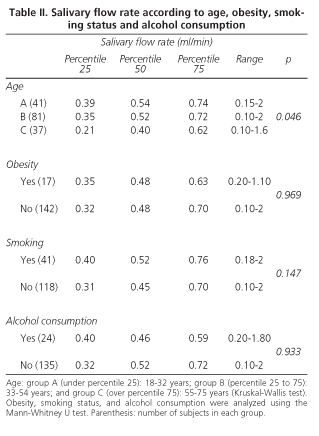
<body><![CDATA[<p>    <br> <b> Salivary flow rate, pH and buffer capacity of saliva</b></p>     <p>Features of saliva are shown in <a href="#t1"> table I</a>. Unstimulated salivary flow rate does not present a normal distribution. According to Navazesh (39), who defined hyposialia (basal flow rate equal or less than 0.16 ml/min), only eight subjects (5.03%) were under this level; these subjects, compared with those with a normal flow rate, have a lower pH (6.5390 &plusmn; 0.3605 <i> vs</i> 6.8036 &plusmn; 0.2782, p = 0.011) and a lower bicarbonate concentration (3.5625 &plusmn; 3.0654 mmol/l <i> vs</i> 5.8611 &plusmn; 2.7248 mmol/l, p = 0.022). In the subjects with hyposialia, the aspect of saliva was more frequently turbid (6/8 subjects).</p>    <p>   A significant positive correlation was found between salivary flow rate, pH, and bicarbonate concentration (r = 0.322, p   &lt; 0.001, and r = 0.425, p lt; 0.001, respectively), and between pH and bicarbonate concentration (r = 0.736, p = 0.001).</p>    <p>   <b>   Relationship between salivary parameters and demographic variables</b></p>     <p>Men showed a greater flow rate than women (median 0.57 ml/min, range 0.15-2 <i> vs</i> 0.42 ml/min, range 0.10-2, p &lt; 0.001). Between men and women no differences were found in salivary pH (6.8400 &plusmn; 0.3199 in men <i> vs</i> 6.7661 &plusmn; 0.2686 in women, p = 0.128), but men's buffer capacity was higher (6.626 &plusmn; 3.1239 mmol/l <i> vs</i> 5.3171 &plusmn; 2.4989 mmol/l, p = 0.010).</p>    <p>   To analyze the role of age, percentiles 25 and 75 were determined (32 and 54 years, respectively). We found that older patients presented a significant lower salivary flow rate   (<a href="#t2">Table II</a>), but no differences were found in pH or buffer capacity between these three age groups   (<a href="#t3">Table III</a>). Age correlated significantly with flow rate (r = -0.222, p = 0.005), but not with pH (r = -0.106, p = 0.185) or bicarbonate concentration (r = -0.030, p = 0.710).</p>     <p align="center"><a name="t2"><img src="/img/diges/v96n11/imagenes/original4_tabla2.gif" width="319" height="436"></a></p>     <p align="center"><a name="t3"><img src="/img/diges/v96n11/imagenes/original4_tabla3.gif" width="321" height="249"></a></p>     <p>    ]]></body>
<body><![CDATA[<br> Salivary variables in obese subjects, smokers or alcohol consumers did not differ from those in non-obese, non-smoking or non-alcohol consuming volunteers (<a href="#t2">Tables II</a> and <a href="#t4">IV</a>).</p>     <p align="center"><a name="t4"><img src="/img/diges/v96n11/imagenes/original4_tabla4.gif" width="321" height="236"></a></p>     <p>    <br> <b> Univariate analysis</b></p>     <p>To study salivary variables with respect to qualitative variables and age (younger or older than the median age), they were classified into two categories (lower or greater than the median value). <a href="#t5"> Table V</a> shows the results of this analysis.</p>     <p align="center"><a name="t5"><img src="/img/diges/v96n11/imagenes/original4_tabla5.gif" width="647" height="351"></a></p>     <p>    <br> The variable <i> "hyposialia"</i> (defined according to Navazesh) (39), has not been analyzed, as it was present in only 8/159 volunteers (5.03%); but it is worth noting that 6 of them were women, 7 of them were older than 44, and none of them was obese, a smoker or an alcohol consumer.</p>     <p><b>Multivariate analysis</b></p>     <p>Salivary flow rate above the median value was associated with younger age (&lt; 44 years) (OR 2.10, CI95% 1.08-4.05, p = 0.027) and male gender (OR 3.19, CI95% 1.56-6.50, p = 0.001). Women showed a pH under the median value (OR 2.13, CI95% 1.081-4.207, p = 0.029), whereas in men bicarbonate concentration tended to be above median values (OR 2.81, CI95% 1.39-5.67, p = 0.004).</p>     ]]></body>
<body><![CDATA[<p><b>DISCUSSION</b></p>     <p>Nowadays, to offer better health care to people a trend is seen towards integrating medical and odontological knowledge (40); hence, gastroenterologists should learn about salivary disorders, as saliva is the initial responsible of the digestive process. On the other hand, the longevity of population, novel therapeutic techniques and increased drug usage may affect oral structures, including salivary glands, which could favor the development of local diseases or extra-oral disorders.</p>    <p>   Measurement of salivary secretion can be accomplished by different methods: a) resting or unstimulated whole saliva secretion; b) stimulated whole saliva secretion; and c) glandular saliva collection (mainly from parotid glands) with or without stimulation. Unstimulated whole saliva reflects basal salivary flow rate, is present in our mouths for about 14 hours a day, and is the secretion that provides protection to oral tissues. Stimulated saliva represents the secretion during food intake (physiologic stimulation), and is present in our mouths for up to 2 hours (3). So, the study of unstimulated salivary secretion is an accurate method to analyze salivary gland status, while stimulated saliva is useful for the study of the functional reserve. In our study we have chosen to measure unstimulated saliva, as it is an easy, non-invasive and comfortable procedure, which favors its use in population studies.</p>    <p>   Age influences salivary secretion, probably due to the physiologic process of ageing (16-21). Our results confirm this aspect, as we observed than older age is associated with decreased non-stimulated salivary flow rate (r = -0.222, p = 0.005), while in younger people (&lt; 44 years) flow rate is greater than in people older than 44 years (OR 2.10).</p>    <p>   According to our data, salivary flow is greater in men than in women (OR 3.19); this finding is not related to age, as both groups (men and women) did not show differences in this variable. Similar results are shown in other studies (30-32), and it is suggested that these differences may be explained by salivary gland size, which is smaller in women (41). Decreased salivary secretion in women may be related to the greater frequency or "oral dryness" seen in females (3).</p>    <p>   Data about the influence of age in the literature are controversial, and this could be a consequence of some methodological biases: variability in age groups, collection of unstimulated and/or stimulated saliva, inclusion of medicated subjects, etc. (30).</p>    <p>   Our data on the buffer capacity of saliva agree with those published in other studies (27-29), as we found a positive correlation with flow rate and a lower bicarbonate concentration in women. From our series, we may consider that there is a decreased buffer capacity when bicarbonate concentration is lower than 1,800 mmol/l (percentile 5).</p>    <p>   It has been postulated that juvenile obesity is a risk factor of oral disorders (42), caries among them (43); the work of Power et al. (44) did not show any differences in salivation patterns between obese and non-obese subjects, while other authors found that in young obese people salivary secretion was higher than in the control group (45). Smoking increases salivary flow in the short term (46), but in long-term smokers no differences have been shown   <i> versus</i> non-smokers in flow rate (47,48); it has been reported a decrease of pH (47) and buffer capacity (49) in smokers, but normal values of both parameters have also been described (48,50). Acute intake of alcoholic drinks decreases salivary secretion (37); however, in chronic alcoholism, with or without hepatic disorder, data are controversial, as a decrease in salivary flow has been reported (34,51), as well as a normal (35) or increased flow (52).</p>    <p>   In our study, obesity, smoking, and alcohol consumption do not imply alterations on salivary features (flow and buffer capacity); however, we cannot draw firm conclusions due to the low number of subjects with these conditions.</p>    <p>   Reduction of salivary flow has been related to a sensation of <i> "dry mouth&quot;</i>; despite frequent complaints about this symptom and the impairment in quality of life that it involves, it has only been trivially studied in clinical practice (11,53). Xerostomia is mainly related to drug ingestion (anticholinergics, sympatheticomimetics, drugs acting on serotonin or noradrenalin receptors, etc.) (54), therapeutic radiation of the head and neck, and autoimmune diseases such as   Sjögren's syndrome. In a study of 100 patients older than 60 years who complained of xerostomia, the most prevalent etiology was   Sjögren's syndrome, followed by iatrogenic xerostomia and idiopathic xerostomia; the authors found hyposialia (unstimulated flow rate lt; 0.2 ml/min) in 65% of patients (55).</p>    ]]></body>
<body><![CDATA[<p>   The diagnostic of hyposialia can be established according to flow rate, but no consensus has been reached regarding cut-off values, which makes it difficult to compare studies of salivary secretion and "dry mouth". In our series, we considered hyposialia if salivary flow was lower than percentile 5 (0.15 ml/min), which is similar to the value found by Navazesh (0,16 ml/min) (8); in the literature, values to define hyposialia vary from 0.10 (56) to 0.20 ml/min (55). In our series, four healthy volunteers had hyposialia without a sensation of   <i> "dry mouth"</i> (2.5%); all of them were women older than the median age, non-obese, non-smokers, and who did not consume alcohol.</p>    <p>   To evaluate our results about the flow rate and buffer capacity of saliva in healthy subjects, and to demonstrate its diagnostic usefulness (especially the cut-off value to define hyposialia), it would be necessary that patients diagnosed with xerostomia be   studied.</p>    <p>   <b>REFERENCES</b></p>     <!-- ref --><p>   1. Atkinson JC, Baum BJ. Salivary enhancement: current status and future therapies. J Dent Edu 2001; 105: 1096-101.&nbsp;&nbsp;&nbsp;&nbsp;&nbsp;&nbsp;&nbsp;&nbsp;[&#160;<a href="javascript:void(0);" onclick="javascript: window.open('/scielo.php?script=sci_nlinks&ref=5210883&pid=S1130-0108200400110000500001&lng=','','width=640,height=500,resizable=yes,scrollbars=1,menubar=yes,');">Links</a>&#160;]<!-- end-ref --><!-- ref --><p> 2. Mandel ID. The role of saliva in maintaining oral homeostasis. J Am Dent Assoc 1989; 119: 298-304.&nbsp;&nbsp;&nbsp;&nbsp;&nbsp;&nbsp;&nbsp;&nbsp;[&#160;<a href="javascript:void(0);" onclick="javascript: window.open('/scielo.php?script=sci_nlinks&ref=5210884&pid=S1130-0108200400110000500002&lng=','','width=640,height=500,resizable=yes,scrollbars=1,menubar=yes,');">Links</a>&#160;]<!-- end-ref --><!-- ref --><p> 3. Sreebny CM. Saliva in health and disease: an appraisal and update. Int Dent J 2000; 50: 140-61.&nbsp;&nbsp;&nbsp;&nbsp;&nbsp;&nbsp;&nbsp;&nbsp;[&#160;<a href="javascript:void(0);" onclick="javascript: window.open('/scielo.php?script=sci_nlinks&ref=5210885&pid=S1130-0108200400110000500003&lng=','','width=640,height=500,resizable=yes,scrollbars=1,menubar=yes,');">Links</a>&#160;]<!-- end-ref --><!-- ref --><p> 4. Sonies BC, Ship JA, Baum BJ. Relationship between saliva production and oropharyngeal swallow in healthy, different-aged adults. Dysphagia 1989; 4: 85-9.&nbsp;&nbsp;&nbsp;&nbsp;&nbsp;&nbsp;&nbsp;&nbsp;[&#160;<a href="javascript:void(0);" onclick="javascript: window.open('/scielo.php?script=sci_nlinks&ref=5210886&pid=S1130-0108200400110000500004&lng=','','width=640,height=500,resizable=yes,scrollbars=1,menubar=yes,');">Links</a>&#160;]<!-- end-ref --><!-- ref --><p> 5. Atkinson JC, Wu A. Salivary gland dysfunction: causes, symptoms, treatment. J Am Dent Assoc 1994; 125: 409-16.&nbsp;&nbsp;&nbsp;&nbsp;&nbsp;&nbsp;&nbsp;&nbsp;[&#160;<a href="javascript:void(0);" onclick="javascript: window.open('/scielo.php?script=sci_nlinks&ref=5210887&pid=S1130-0108200400110000500005&lng=','','width=640,height=500,resizable=yes,scrollbars=1,menubar=yes,');">Links</a>&#160;]<!-- end-ref --><!-- ref --><p> 6. Ship JA, Pillemer SR, Baum BJ. Xerostomia and the geriatric patient. J Am Geriatr Soc 2002; 50: 535-43.&nbsp;&nbsp;&nbsp;&nbsp;&nbsp;&nbsp;&nbsp;&nbsp;[&#160;<a href="javascript:void(0);" onclick="javascript: window.open('/scielo.php?script=sci_nlinks&ref=5210888&pid=S1130-0108200400110000500006&lng=','','width=640,height=500,resizable=yes,scrollbars=1,menubar=yes,');">Links</a>&#160;]<!-- end-ref --><!-- ref --><p> 7. Valdez IH, Fox PC. Interactions of the salivary and gastrointestinal systems. II. Effects of salivary dysfunction on the gastrointestinal tract. Dig Dis 1991; 9: 210-8.&nbsp;&nbsp;&nbsp;&nbsp;&nbsp;&nbsp;&nbsp;&nbsp;[&#160;<a href="javascript:void(0);" onclick="javascript: window.open('/scielo.php?script=sci_nlinks&ref=5210889&pid=S1130-0108200400110000500007&lng=','','width=640,height=500,resizable=yes,scrollbars=1,menubar=yes,');">Links</a>&#160;]<!-- end-ref --><!-- ref --><p> 8. Navazesh M. Dry mouth: aging and oral health. Compend Contn Educ Dent 2002; 23 (Supl. 10): 41-8.&nbsp;&nbsp;&nbsp;&nbsp;&nbsp;&nbsp;&nbsp;&nbsp;[&#160;<a href="javascript:void(0);" onclick="javascript: window.open('/scielo.php?script=sci_nlinks&ref=5210890&pid=S1130-0108200400110000500008&lng=','','width=640,height=500,resizable=yes,scrollbars=1,menubar=yes,');">Links</a>&#160;]<!-- end-ref --><!-- ref --><p> 9. Sreebny LM, Valdini A. Xerostomia. Part I. Relationship to other oral symptoms and salivary gland hypofunction. Oral Surg Oral Med Oral Pathol 1998; 68: 451-8.&nbsp;&nbsp;&nbsp;&nbsp;&nbsp;&nbsp;&nbsp;&nbsp;[&#160;<a href="javascript:void(0);" onclick="javascript: window.open('/scielo.php?script=sci_nlinks&ref=5210891&pid=S1130-0108200400110000500009&lng=','','width=640,height=500,resizable=yes,scrollbars=1,menubar=yes,');">Links</a>&#160;]<!-- end-ref --><!-- ref --><p>   10. Daniels TE. Evaluation, differential diagnosis, and treatment of xerostomia. J Rheumatol Suppl 2000; 61: 6-10.&nbsp;&nbsp;&nbsp;&nbsp;&nbsp;&nbsp;&nbsp;&nbsp;[&#160;<a href="javascript:void(0);" onclick="javascript: window.open('/scielo.php?script=sci_nlinks&ref=5210892&pid=S1130-0108200400110000500010&lng=','','width=640,height=500,resizable=yes,scrollbars=1,menubar=yes,');">Links</a>&#160;]<!-- end-ref --><!-- ref --><p>   11. Sreebny LM, Valdini A. Xerostomia. A neglected symptom. Arch Intern Med 1987; 147: 1333-7.&nbsp;&nbsp;&nbsp;&nbsp;&nbsp;&nbsp;&nbsp;&nbsp;[&#160;<a href="javascript:void(0);" onclick="javascript: window.open('/scielo.php?script=sci_nlinks&ref=5210893&pid=S1130-0108200400110000500011&lng=','','width=640,height=500,resizable=yes,scrollbars=1,menubar=yes,');">Links</a>&#160;]<!-- end-ref --><!-- ref --><p>   12. Guggenheimer J, Moore PA. Xerostomia: etiology, recognition and treatment. J Am Dent Assoc 2003; 134: 61-9.&nbsp;&nbsp;&nbsp;&nbsp;&nbsp;&nbsp;&nbsp;&nbsp;[&#160;<a href="javascript:void(0);" onclick="javascript: window.open('/scielo.php?script=sci_nlinks&ref=5210894&pid=S1130-0108200400110000500012&lng=','','width=640,height=500,resizable=yes,scrollbars=1,menubar=yes,');">Links</a>&#160;]<!-- end-ref --><!-- ref --><p>   13. Porter SR, Scully C, Hegarty AM. An update of the etiology and management of xerostomia. Oral Surg Oral Med Oral Pathol Oral Radiol Endod 2004; 97: 28-46.&nbsp;&nbsp;&nbsp;&nbsp;&nbsp;&nbsp;&nbsp;&nbsp;[&#160;<a href="javascript:void(0);" onclick="javascript: window.open('/scielo.php?script=sci_nlinks&ref=5210895&pid=S1130-0108200400110000500013&lng=','','width=640,height=500,resizable=yes,scrollbars=1,menubar=yes,');">Links</a>&#160;]<!-- end-ref --><!-- ref --><p>   14. Bivona PL. Xerostomia. A common problem among the elderly. NY State Dent J 1998; 64: 46-52.&nbsp;&nbsp;&nbsp;&nbsp;&nbsp;&nbsp;&nbsp;&nbsp;[&#160;<a href="javascript:void(0);" onclick="javascript: window.open('/scielo.php?script=sci_nlinks&ref=5210896&pid=S1130-0108200400110000500014&lng=','','width=640,height=500,resizable=yes,scrollbars=1,menubar=yes,');">Links</a>&#160;]<!-- end-ref --><!-- ref --><p>   15. Astor FC, Hanft KL, Ciocon JO. Xerostomia: a prevalent condition in the elderly. Ear Nose Throat J 1999; 78: 476-9.&nbsp;&nbsp;&nbsp;&nbsp;&nbsp;&nbsp;&nbsp;&nbsp;[&#160;<a href="javascript:void(0);" onclick="javascript: window.open('/scielo.php?script=sci_nlinks&ref=5210897&pid=S1130-0108200400110000500015&lng=','','width=640,height=500,resizable=yes,scrollbars=1,menubar=yes,');">Links</a>&#160;]<!-- end-ref --><!-- ref --><p>   16. Tanida T, Ueta E, Tobiume A, Hamada T, Rao F, Osaki T. Influence of aging on candidal growth and adhesion regulatory agents in saliva. J Oral Pathol Med 2001; 30: 328-35.&nbsp;&nbsp;&nbsp;&nbsp;&nbsp;&nbsp;&nbsp;&nbsp;[&#160;<a href="javascript:void(0);" onclick="javascript: window.open('/scielo.php?script=sci_nlinks&ref=5210898&pid=S1130-0108200400110000500016&lng=','','width=640,height=500,resizable=yes,scrollbars=1,menubar=yes,');">Links</a>&#160;]<!-- end-ref --><!-- ref --><p>   17. Yeh CK, Johnson DA, Dodds MW, Sakai S, Rugh JD, Hatch JP. Association of salivary flow rates with maximal bite force. J Dent Res 2000; 79: 1560-5.&nbsp;&nbsp;&nbsp;&nbsp;&nbsp;&nbsp;&nbsp;&nbsp;[&#160;<a href="javascript:void(0);" onclick="javascript: window.open('/scielo.php?script=sci_nlinks&ref=5210899&pid=S1130-0108200400110000500017&lng=','','width=640,height=500,resizable=yes,scrollbars=1,menubar=yes,');">Links</a>&#160;]<!-- end-ref --><!-- ref --><p>   18. Yeh CK, Johnson DA, Dodds MW. Impact of aging on human salivary gland function: a community-based study. Aging (Milano) 1998; 10: 421-8.&nbsp;&nbsp;&nbsp;&nbsp;&nbsp;&nbsp;&nbsp;&nbsp;[&#160;<a href="javascript:void(0);" onclick="javascript: window.open('/scielo.php?script=sci_nlinks&ref=5210900&pid=S1130-0108200400110000500018&lng=','','width=640,height=500,resizable=yes,scrollbars=1,menubar=yes,');">Links</a>&#160;]<!-- end-ref --><!-- ref --><p>   19. Lopez Jornet MP, Bermejo Fenoll A. Is there an age-dependent decrease in resting secretion of saliva of healthy persons?. A study of 1493 subjects. Braz Dent J 1994; 5: 93-8.&nbsp;&nbsp;&nbsp;&nbsp;&nbsp;&nbsp;&nbsp;&nbsp;[&#160;<a href="javascript:void(0);" onclick="javascript: window.open('/scielo.php?script=sci_nlinks&ref=5210901&pid=S1130-0108200400110000500019&lng=','','width=640,height=500,resizable=yes,scrollbars=1,menubar=yes,');">Links</a>&#160;]<!-- end-ref --><!-- ref --><p>   20. Narhi TO, Kurki N, Ainamo A. Saliva, salivary micro-organisms, and oral health in the home-dwelling old elderly-a five-year longitudinal study. J Dent Res 1999; 78: 1640-6.&nbsp;&nbsp;&nbsp;&nbsp;&nbsp;&nbsp;&nbsp;&nbsp;[&#160;<a href="javascript:void(0);" onclick="javascript: window.open('/scielo.php?script=sci_nlinks&ref=5210902&pid=S1130-0108200400110000500020&lng=','','width=640,height=500,resizable=yes,scrollbars=1,menubar=yes,');">Links</a>&#160;]<!-- end-ref --><!-- ref --><p>   21. Bergdahl M, Bergdahl J. Low unstimulated salivary flow and subjetive oral dryness: association with medication, anxiety, depression, and stress. J Dent Res 2000; 79: 1652-8.&nbsp;&nbsp;&nbsp;&nbsp;&nbsp;&nbsp;&nbsp;&nbsp;[&#160;<a href="javascript:void(0);" onclick="javascript: window.open('/scielo.php?script=sci_nlinks&ref=5210903&pid=S1130-0108200400110000500021&lng=','','width=640,height=500,resizable=yes,scrollbars=1,menubar=yes,');">Links</a>&#160;]<!-- end-ref --><!-- ref --><p>   22. Tylenda CA, Ship JA, Fox PC, Baum BJ. Evaluation of submandibular salivary flow rate in different age groups. J Dent Res 1988; 67: 1225-8.&nbsp;&nbsp;&nbsp;&nbsp;&nbsp;&nbsp;&nbsp;&nbsp;[&#160;<a href="javascript:void(0);" onclick="javascript: window.open('/scielo.php?script=sci_nlinks&ref=5210904&pid=S1130-0108200400110000500022&lng=','','width=640,height=500,resizable=yes,scrollbars=1,menubar=yes,');">Links</a>&#160;]<!-- end-ref --><!-- ref --><p>   23. Baum BJ. Salivary gland fluid secretion during aging. J Am Geriatr Soc 1989; 37: 453-8.&nbsp;&nbsp;&nbsp;&nbsp;&nbsp;&nbsp;&nbsp;&nbsp;[&#160;<a href="javascript:void(0);" onclick="javascript: window.open('/scielo.php?script=sci_nlinks&ref=5210905&pid=S1130-0108200400110000500023&lng=','','width=640,height=500,resizable=yes,scrollbars=1,menubar=yes,');">Links</a>&#160;]<!-- end-ref --><!-- ref --><p>   24. Navazesh M. Salivary gland hypofunction in elderly patients. J Calif Dent Assoc 1994; 22: 62-8.&nbsp;&nbsp;&nbsp;&nbsp;&nbsp;&nbsp;&nbsp;&nbsp;[&#160;<a href="javascript:void(0);" onclick="javascript: window.open('/scielo.php?script=sci_nlinks&ref=5210906&pid=S1130-0108200400110000500024&lng=','','width=640,height=500,resizable=yes,scrollbars=1,menubar=yes,');">Links</a>&#160;]<!-- end-ref --><!-- ref --><p>   25. Fischer D, Ship JA. Effect of age on variability of parotid salivary gland flow rates over time. Age Ageing 1999; 28: 557-61.&nbsp;&nbsp;&nbsp;&nbsp;&nbsp;&nbsp;&nbsp;&nbsp;[&#160;<a href="javascript:void(0);" onclick="javascript: window.open('/scielo.php?script=sci_nlinks&ref=5210907&pid=S1130-0108200400110000500025&lng=','','width=640,height=500,resizable=yes,scrollbars=1,menubar=yes,');">Links</a>&#160;]<!-- end-ref --><!-- ref --><p>   26. Ship JA, Nolan NE, Puckett SA. Longitudinal analysis of parotid and submandibular salivary flow rates in healthy, different-aged adults. J Gerontol A Biol Sci Med Sci 1995; 50: 285-9.&nbsp;&nbsp;&nbsp;&nbsp;&nbsp;&nbsp;&nbsp;&nbsp;[&#160;<a href="javascript:void(0);" onclick="javascript: window.open('/scielo.php?script=sci_nlinks&ref=5210908&pid=S1130-0108200400110000500026&lng=','','width=640,height=500,resizable=yes,scrollbars=1,menubar=yes,');">Links</a>&#160;]<!-- end-ref --><!-- ref --><p>   27. Bardow A, Moe D, Nyvad B, Nauntofte B. The buffer capacity and buffer systems of human whole saliva measured without loss of CO2. Arch Oral Biol 2000; 45: 1-12.&nbsp;&nbsp;&nbsp;&nbsp;&nbsp;&nbsp;&nbsp;&nbsp;[&#160;<a href="javascript:void(0);" onclick="javascript: window.open('/scielo.php?script=sci_nlinks&ref=5210909&pid=S1130-0108200400110000500027&lng=','','width=640,height=500,resizable=yes,scrollbars=1,menubar=yes,');">Links</a>&#160;]<!-- end-ref --><!-- ref --><p>   28. Wikner S, Söder P-ö. Factors associated with salivary buffering capacity in young adults in Stockholm, Sweden. Scand J Dent Res 1994; 102: 50-3.&nbsp;&nbsp;&nbsp;&nbsp;&nbsp;&nbsp;&nbsp;&nbsp;[&#160;<a href="javascript:void(0);" onclick="javascript: window.open('/scielo.php?script=sci_nlinks&ref=5210910&pid=S1130-0108200400110000500028&lng=','','width=640,height=500,resizable=yes,scrollbars=1,menubar=yes,');">Links</a>&#160;]<!-- end-ref --><!-- ref --><p>   29. Heintze U, Birkhed D, Björn H. Secretion rate and buffer of resting and stimuled whole saliva as a function of age an sex. Swed Dentr 1983; 7: 227-38.&nbsp;&nbsp;&nbsp;&nbsp;&nbsp;&nbsp;&nbsp;&nbsp;[&#160;<a href="javascript:void(0);" onclick="javascript: window.open('/scielo.php?script=sci_nlinks&ref=5210911&pid=S1130-0108200400110000500029&lng=','','width=640,height=500,resizable=yes,scrollbars=1,menubar=yes,');">Links</a>&#160;]<!-- end-ref --><!-- ref --><p>   30. Percival RS, Challcombe SJ, Marsh PD. Flow rates of resting whole and stimulated parotid saliva in relation to age and gender. J Dent Res 1994; 73: 1416-20.&nbsp;&nbsp;&nbsp;&nbsp;&nbsp;&nbsp;&nbsp;&nbsp;[&#160;<a href="javascript:void(0);" onclick="javascript: window.open('/scielo.php?script=sci_nlinks&ref=5210912&pid=S1130-0108200400110000500030&lng=','','width=640,height=500,resizable=yes,scrollbars=1,menubar=yes,');">Links</a>&#160;]<!-- end-ref --><!-- ref --><p>   31. Mazengo MC, Söderling, Alakuijala P, Tiekso J, Tenovuo J, Simell O, et al. Flow rate and composition of whole saliva in rural and urban Tanzania with special reference to diet, age, and gender. Caries Res 1994; 28: 468-76.&nbsp;&nbsp;&nbsp;&nbsp;&nbsp;&nbsp;&nbsp;&nbsp;[&#160;<a href="javascript:void(0);" onclick="javascript: window.open('/scielo.php?script=sci_nlinks&ref=5210913&pid=S1130-0108200400110000500031&lng=','','width=640,height=500,resizable=yes,scrollbars=1,menubar=yes,');">Links</a>&#160;]<!-- end-ref --><!-- ref --><p>   32. Ikebe K, Sajima H, Kobayashi S, Hata K, Morii K, Nokubi T, et al. Association of salivary flow rate with oral function in a sample of community-dwelling older adults in Japan. Oral Surg Oral Med Oral Pathol Oral Radiol Endod 2002; 94: 184-90.&nbsp;&nbsp;&nbsp;&nbsp;&nbsp;&nbsp;&nbsp;&nbsp;[&#160;<a href="javascript:void(0);" onclick="javascript: window.open('/scielo.php?script=sci_nlinks&ref=5210914&pid=S1130-0108200400110000500032&lng=','','width=640,height=500,resizable=yes,scrollbars=1,menubar=yes,');">Links</a>&#160;]<!-- end-ref --><!-- ref --><p>   33. Scott J, Woods K, Baxter P. Salivary flow rate, protein and electrolyte concentrations in chronic alcoholic patients. J Biol Buccale 1988; 16: 215-8.&nbsp;&nbsp;&nbsp;&nbsp;&nbsp;&nbsp;&nbsp;&nbsp;[&#160;<a href="javascript:void(0);" onclick="javascript: window.open('/scielo.php?script=sci_nlinks&ref=5210915&pid=S1130-0108200400110000500033&lng=','','width=640,height=500,resizable=yes,scrollbars=1,menubar=yes,');">Links</a>&#160;]<!-- end-ref --><!-- ref --><p>   34. Dutta SK, Dukehart M, Narang A, Latham PS. Functional and structural changes in parotid glands of alcoholic cirrhotic patients. Gastroenterology 1989; 96: 510-8.&nbsp;&nbsp;&nbsp;&nbsp;&nbsp;&nbsp;&nbsp;&nbsp;[&#160;<a href="javascript:void(0);" onclick="javascript: window.open('/scielo.php?script=sci_nlinks&ref=5210916&pid=S1130-0108200400110000500034&lng=','','width=640,height=500,resizable=yes,scrollbars=1,menubar=yes,');">Links</a>&#160;]<!-- end-ref --><!-- ref --><p>   35. Bagan JV, Alapont L, Sanz C, del Olmo JA, Morcillo E, Cortijo J, et al. Alteraciones dentales y salivales en los pacientes con cirrosis hepática: estudio de 100 casos. Med Clin (Barc) 1998; 111: 125-8.&nbsp;&nbsp;&nbsp;&nbsp;&nbsp;&nbsp;&nbsp;&nbsp;[&#160;<a href="javascript:void(0);" onclick="javascript: window.open('/scielo.php?script=sci_nlinks&ref=5210917&pid=S1130-0108200400110000500035&lng=','','width=640,height=500,resizable=yes,scrollbars=1,menubar=yes,');">Links</a>&#160;]<!-- end-ref --><!-- ref --><p>   36. Jhonson NW, Bain CA, and EU-Working Group on Tobacco and Oral Health. Tobacco and oral disease. Br Dent J 2000; 189: 200-6.&nbsp;&nbsp;&nbsp;&nbsp;&nbsp;&nbsp;&nbsp;&nbsp;[&#160;<a href="javascript:void(0);" onclick="javascript: window.open('/scielo.php?script=sci_nlinks&ref=5210918&pid=S1130-0108200400110000500036&lng=','','width=640,height=500,resizable=yes,scrollbars=1,menubar=yes,');">Links</a>&#160;]<!-- end-ref --><!-- ref --><p>   37. Enberg N, Alho H, Loimaranta V, Lenander-Lumikari M. Saliva flow rate, amylase activity, and protein and electrolyte concentrations in saliva after acute alcohol consumption. Oral Surg Oral Med Oral Pathol Oral Radiol Endod 2001; 92: 292-8.&nbsp;&nbsp;&nbsp;&nbsp;&nbsp;&nbsp;&nbsp;&nbsp;[&#160;<a href="javascript:void(0);" onclick="javascript: window.open('/scielo.php?script=sci_nlinks&ref=5210919&pid=S1130-0108200400110000500037&lng=','','width=640,height=500,resizable=yes,scrollbars=1,menubar=yes,');">Links</a>&#160;]<!-- end-ref --><!-- ref --><p>   38. Quiles Izquierdo J, Vioque J. Prevalencia de obesidad en la Comunidad Valenciana. Med Clin (Barc) 1996; 106: 529-33.&nbsp;&nbsp;&nbsp;&nbsp;&nbsp;&nbsp;&nbsp;&nbsp;[&#160;<a href="javascript:void(0);" onclick="javascript: window.open('/scielo.php?script=sci_nlinks&ref=5210920&pid=S1130-0108200400110000500038&lng=','','width=640,height=500,resizable=yes,scrollbars=1,menubar=yes,');">Links</a>&#160;]<!-- end-ref --><!-- ref --><p>   39. Navazesh M, Christensen C, Brightman V. Clinical criteria for the diagnosis of salivary gland hypofunction. J Dent Res 1992; 71: 1363-9.&nbsp;&nbsp;&nbsp;&nbsp;&nbsp;&nbsp;&nbsp;&nbsp;[&#160;<a href="javascript:void(0);" onclick="javascript: window.open('/scielo.php?script=sci_nlinks&ref=5210921&pid=S1130-0108200400110000500039&lng=','','width=640,height=500,resizable=yes,scrollbars=1,menubar=yes,');">Links</a>&#160;]<!-- end-ref --><!-- ref --><p>   40. Perrier M. Dental medicine and medicine. Rev Med Suisse Romande 2002; 122: 495-8.&nbsp;&nbsp;&nbsp;&nbsp;&nbsp;&nbsp;&nbsp;&nbsp;[&#160;<a href="javascript:void(0);" onclick="javascript: window.open('/scielo.php?script=sci_nlinks&ref=5210922&pid=S1130-0108200400110000500040&lng=','','width=640,height=500,resizable=yes,scrollbars=1,menubar=yes,');">Links</a>&#160;]<!-- end-ref --><!-- ref --><p>   41. Scott J. Age, sex and contralateral differences in the volumes of human submandibular salivary glands. Arch Oral Biol 1975: 20: 885-7.&nbsp;&nbsp;&nbsp;&nbsp;&nbsp;&nbsp;&nbsp;&nbsp;[&#160;<a href="javascript:void(0);" onclick="javascript: window.open('/scielo.php?script=sci_nlinks&ref=5210923&pid=S1130-0108200400110000500041&lng=','','width=640,height=500,resizable=yes,scrollbars=1,menubar=yes,');">Links</a>&#160;]<!-- end-ref --><!-- ref --><p>   42. Al-Khalili B, Norgren S, Marcus C, Dahllöf G. Correlation between oral health and percentage overweight in children with severe obesity. J Dent Res 2000; 79: Special Issue: 315.&nbsp;&nbsp;&nbsp;&nbsp;&nbsp;&nbsp;&nbsp;&nbsp;[&#160;<a href="javascript:void(0);" onclick="javascript: window.open('/scielo.php?script=sci_nlinks&ref=5210924&pid=S1130-0108200400110000500042&lng=','','width=640,height=500,resizable=yes,scrollbars=1,menubar=yes,');">Links</a>&#160;]<!-- end-ref --><!-- ref --><p>   43. Tuomi T. Pilot study on obesity in caries prediction. Community Dent Oral Epidemiol 1989; 17: 289-91.&nbsp;&nbsp;&nbsp;&nbsp;&nbsp;&nbsp;&nbsp;&nbsp;[&#160;<a href="javascript:void(0);" onclick="javascript: window.open('/scielo.php?script=sci_nlinks&ref=5210925&pid=S1130-0108200400110000500043&lng=','','width=640,height=500,resizable=yes,scrollbars=1,menubar=yes,');">Links</a>&#160;]<!-- end-ref --><!-- ref --><p>   44. Powers PS, Holland P, Miller C, Powers HP. Salivation patterns of obese and normal subjects. Int J Obes 1982; 6: 267-70.&nbsp;&nbsp;&nbsp;&nbsp;&nbsp;&nbsp;&nbsp;&nbsp;[&#160;<a href="javascript:void(0);" onclick="javascript: window.open('/scielo.php?script=sci_nlinks&ref=5210926&pid=S1130-0108200400110000500044&lng=','','width=640,height=500,resizable=yes,scrollbars=1,menubar=yes,');">Links</a>&#160;]<!-- end-ref --><!-- ref --><p>   45. de Oliveira CG, Collares EF, Barbieri MA, Fernandes MI. Production and concentration of saliva and salivary amylase in obese children. Arq Gastroenterol 1997; 34: 105-11.&nbsp;&nbsp;&nbsp;&nbsp;&nbsp;&nbsp;&nbsp;&nbsp;[&#160;<a href="javascript:void(0);" onclick="javascript: window.open('/scielo.php?script=sci_nlinks&ref=5210927&pid=S1130-0108200400110000500045&lng=','','width=640,height=500,resizable=yes,scrollbars=1,menubar=yes,');">Links</a>&#160;]<!-- end-ref --><!-- ref --><p>   46. Pangborn RM, Shanon IM. Visual deprivation and parotid response to cigarette smoking. Physiol Behavior 1971; 6: 559-61.&nbsp;&nbsp;&nbsp;&nbsp;&nbsp;&nbsp;&nbsp;&nbsp;[&#160;<a href="javascript:void(0);" onclick="javascript: window.open('/scielo.php?script=sci_nlinks&ref=5210928&pid=S1130-0108200400110000500046&lng=','','width=640,height=500,resizable=yes,scrollbars=1,menubar=yes,');">Links</a>&#160;]<!-- end-ref --><!-- ref --><p>   47. Parvinen T. Stimulated salivary flow rate, pH and lactobacillus and yeast concentration in non-smokers. Scand J Dent Res 1984; 92: 315-8.&nbsp;&nbsp;&nbsp;&nbsp;&nbsp;&nbsp;&nbsp;&nbsp;[&#160;<a href="javascript:void(0);" onclick="javascript: window.open('/scielo.php?script=sci_nlinks&ref=5210929&pid=S1130-0108200400110000500047&lng=','','width=640,height=500,resizable=yes,scrollbars=1,menubar=yes,');">Links</a>&#160;]<!-- end-ref --><!-- ref --><p>   48. Olsen BL, McDonald JL, Gleason MJ, et al. Comparison of various salivary parameters in smokers before and after the use a nicotine-containing chewing gum. J Dent Res 1985; 64: 826-30.&nbsp;&nbsp;&nbsp;&nbsp;&nbsp;&nbsp;&nbsp;&nbsp;[&#160;<a href="javascript:void(0);" onclick="javascript: window.open('/scielo.php?script=sci_nlinks&ref=5210930&pid=S1130-0108200400110000500048&lng=','','width=640,height=500,resizable=yes,scrollbars=1,menubar=yes,');">Links</a>&#160;]<!-- end-ref --><!-- ref --><p>   49. Wikner S, Söder PO. Factors associated with salivary buffering capacity in young adults in Stockholm. Scand J Dent Res 1994; 102: 50-3.&nbsp;&nbsp;&nbsp;&nbsp;&nbsp;&nbsp;&nbsp;&nbsp;[&#160;<a href="javascript:void(0);" onclick="javascript: window.open('/scielo.php?script=sci_nlinks&ref=5210931&pid=S1130-0108200400110000500049&lng=','','width=640,height=500,resizable=yes,scrollbars=1,menubar=yes,');">Links</a>&#160;]<!-- end-ref --><!-- ref --><p>   50. Corant P. Effect of smoking on the antilactobacillus system in saliva. Odontol Revy 1967; 18: 251-61.&nbsp;&nbsp;&nbsp;&nbsp;&nbsp;&nbsp;&nbsp;&nbsp;[&#160;<a href="javascript:void(0);" onclick="javascript: window.open('/scielo.php?script=sci_nlinks&ref=5210932&pid=S1130-0108200400110000500050&lng=','','width=640,height=500,resizable=yes,scrollbars=1,menubar=yes,');">Links</a>&#160;]<!-- end-ref --><!-- ref --><p>   51. Dutta SK, Orestes M, Vengulekur, Kwo P. Ethanol and human saliva: Effect of chronic alcoholism on flow rate, composition, and epidermal growth factor. Am J Gastroenterol 1992; 87: 350-4.&nbsp;&nbsp;&nbsp;&nbsp;&nbsp;&nbsp;&nbsp;&nbsp;[&#160;<a href="javascript:void(0);" onclick="javascript: window.open('/scielo.php?script=sci_nlinks&ref=5210933&pid=S1130-0108200400110000500051&lng=','','width=640,height=500,resizable=yes,scrollbars=1,menubar=yes,');">Links</a>&#160;]<!-- end-ref --><!-- ref --><p>   52. Abelson D, Mandel ID, Karmiol M. Salivary studies in alcoholic cirrhosis. Oral Surg Oral Med Oral Pathol 1976; 41: 188-91.&nbsp;&nbsp;&nbsp;&nbsp;&nbsp;&nbsp;&nbsp;&nbsp;[&#160;<a href="javascript:void(0);" onclick="javascript: window.open('/scielo.php?script=sci_nlinks&ref=5210934&pid=S1130-0108200400110000500052&lng=','','width=640,height=500,resizable=yes,scrollbars=1,menubar=yes,');">Links</a>&#160;]<!-- end-ref --><!-- ref --><p>   53. Nederfors T. Xerostomia and hyposalivation. Adv Dent Res 2000; 14: 48-56.&nbsp;&nbsp;&nbsp;&nbsp;&nbsp;&nbsp;&nbsp;&nbsp;[&#160;<a href="javascript:void(0);" onclick="javascript: window.open('/scielo.php?script=sci_nlinks&ref=5210935&pid=S1130-0108200400110000500053&lng=','','width=640,height=500,resizable=yes,scrollbars=1,menubar=yes,');">Links</a>&#160;]<!-- end-ref --><!-- ref --><p>   54. Scully C. Drug effects on salivary glands: dry mouth. Oral Dis 2003; 9: 165-76.&nbsp;&nbsp;&nbsp;&nbsp;&nbsp;&nbsp;&nbsp;&nbsp;[&#160;<a href="javascript:void(0);" onclick="javascript: window.open('/scielo.php?script=sci_nlinks&ref=5210936&pid=S1130-0108200400110000500054&lng=','','width=640,height=500,resizable=yes,scrollbars=1,menubar=yes,');">Links</a>&#160;]<!-- end-ref --><!-- ref --><p>   55. Longman LP, Higham SM, Rai K, Edgar WM, Field EA. Salivary gland hypofunction in elderly patients attending a xerostomia clinic. Gerodontology 1995; 12: 67-72.&nbsp;&nbsp;&nbsp;&nbsp;&nbsp;&nbsp;&nbsp;&nbsp;[&#160;<a href="javascript:void(0);" onclick="javascript: window.open('/scielo.php?script=sci_nlinks&ref=5210937&pid=S1130-0108200400110000500055&lng=','','width=640,height=500,resizable=yes,scrollbars=1,menubar=yes,');">Links</a>&#160;]<!-- end-ref --><!-- ref --><p>   56. Sreebny LM. Saliva: Its role in health and disease. Int Dent J 1992; 42: 287-304.&nbsp;&nbsp;&nbsp;&nbsp;&nbsp;&nbsp;&nbsp;&nbsp;[&#160;<a href="javascript:void(0);" onclick="javascript: window.open('/scielo.php?script=sci_nlinks&ref=5210938&pid=S1130-0108200400110000500056&lng=','','width=640,height=500,resizable=yes,scrollbars=1,menubar=yes,');">Links</a>&#160;]<!-- end-ref --> ]]></body><back>
<ref-list>
<ref id="B1">
<label>1</label><nlm-citation citation-type="journal">
<person-group person-group-type="author">
<name>
<surname><![CDATA[Atkinson]]></surname>
<given-names><![CDATA[JC]]></given-names>
</name>
<name>
<surname><![CDATA[Baum]]></surname>
<given-names><![CDATA[BJ]]></given-names>
</name>
</person-group>
<article-title xml:lang="en"><![CDATA[Salivary enhancement: current status and future therapies]]></article-title>
<source><![CDATA[J Dent Edu]]></source>
<year>2001</year>
<volume>105</volume>
<page-range>1096-101</page-range></nlm-citation>
</ref>
<ref id="B2">
<label>2</label><nlm-citation citation-type="journal">
<person-group person-group-type="author">
<name>
<surname><![CDATA[Mandel]]></surname>
<given-names><![CDATA[ID]]></given-names>
</name>
</person-group>
<article-title xml:lang="en"><![CDATA[The role of saliva in maintaining oral homeostasis]]></article-title>
<source><![CDATA[J Am Dent Assoc]]></source>
<year>1989</year>
<volume>119</volume>
<page-range>298-304</page-range></nlm-citation>
</ref>
<ref id="B3">
<label>3</label><nlm-citation citation-type="journal">
<person-group person-group-type="author">
<name>
<surname><![CDATA[Sreebny]]></surname>
<given-names><![CDATA[CM]]></given-names>
</name>
</person-group>
<article-title xml:lang="en"><![CDATA[Saliva in health and disease: an appraisal and update]]></article-title>
<source><![CDATA[Int Dent J]]></source>
<year>2000</year>
<volume>50</volume>
<page-range>140-61</page-range></nlm-citation>
</ref>
<ref id="B4">
<label>4</label><nlm-citation citation-type="journal">
<person-group person-group-type="author">
<name>
<surname><![CDATA[Sonies]]></surname>
<given-names><![CDATA[BC]]></given-names>
</name>
<name>
<surname><![CDATA[Ship]]></surname>
<given-names><![CDATA[JA]]></given-names>
</name>
<name>
<surname><![CDATA[Baum]]></surname>
<given-names><![CDATA[BJ]]></given-names>
</name>
</person-group>
<article-title xml:lang="en"><![CDATA[Relationship between saliva production and oropharyngeal swallow in healthy, different-aged adults]]></article-title>
<source><![CDATA[Dysphagia]]></source>
<year>1989</year>
<volume>4</volume>
<page-range>85-9</page-range></nlm-citation>
</ref>
<ref id="B5">
<label>5</label><nlm-citation citation-type="journal">
<person-group person-group-type="author">
<name>
<surname><![CDATA[Atkinson]]></surname>
<given-names><![CDATA[JC]]></given-names>
</name>
<name>
<surname><![CDATA[Wu]]></surname>
<given-names><![CDATA[A]]></given-names>
</name>
</person-group>
<article-title xml:lang="en"><![CDATA[Salivary gland dysfunction: causes, symptoms, treatment]]></article-title>
<source><![CDATA[J Am Dent Assoc]]></source>
<year>1994</year>
<volume>125</volume>
<page-range>409-16</page-range></nlm-citation>
</ref>
<ref id="B6">
<label>6</label><nlm-citation citation-type="journal">
<person-group person-group-type="author">
<name>
<surname><![CDATA[Ship]]></surname>
<given-names><![CDATA[JA]]></given-names>
</name>
<name>
<surname><![CDATA[Pillemer]]></surname>
<given-names><![CDATA[SR]]></given-names>
</name>
<name>
<surname><![CDATA[Baum]]></surname>
<given-names><![CDATA[BJ]]></given-names>
</name>
</person-group>
<article-title xml:lang="en"><![CDATA[Xerostomia and the geriatric patient]]></article-title>
<source><![CDATA[J Am Geriatr Soc]]></source>
<year>2002</year>
<volume>50</volume>
<page-range>535-43</page-range></nlm-citation>
</ref>
<ref id="B7">
<label>7</label><nlm-citation citation-type="journal">
<person-group person-group-type="author">
<name>
<surname><![CDATA[Valdez]]></surname>
<given-names><![CDATA[IH]]></given-names>
</name>
<name>
<surname><![CDATA[Fox]]></surname>
<given-names><![CDATA[PC]]></given-names>
</name>
</person-group>
<article-title xml:lang="en"><![CDATA[Interactions of the salivary and gastrointestinal systems: II. Effects of salivary dysfunction on the gastrointestinal tract]]></article-title>
<source><![CDATA[Dig Dis]]></source>
<year>1991</year>
<volume>9</volume>
<page-range>210-8</page-range></nlm-citation>
</ref>
<ref id="B8">
<label>8</label><nlm-citation citation-type="journal">
<person-group person-group-type="author">
<name>
<surname><![CDATA[Navazesh]]></surname>
<given-names><![CDATA[M]]></given-names>
</name>
</person-group>
<article-title xml:lang="en"><![CDATA[Dry mouth: aging and oral health]]></article-title>
<source><![CDATA[Compend Contn Educ Dent]]></source>
<year>2002</year>
<volume>23</volume>
<numero>^s10</numero>
<issue>^s10</issue>
<supplement>10</supplement>
<page-range>41-8</page-range></nlm-citation>
</ref>
<ref id="B9">
<label>9</label><nlm-citation citation-type="journal">
<person-group person-group-type="author">
<name>
<surname><![CDATA[Sreebny]]></surname>
<given-names><![CDATA[LM]]></given-names>
</name>
<name>
<surname><![CDATA[Valdini]]></surname>
<given-names><![CDATA[A]]></given-names>
</name>
</person-group>
<article-title xml:lang="en"><![CDATA[Xerostomia: Part I. Relationship to other oral symptoms and salivary gland hypofunction]]></article-title>
<source><![CDATA[Oral Surg Oral Med Oral Pathol]]></source>
<year>1998</year>
<volume>68</volume>
<page-range>451-8</page-range></nlm-citation>
</ref>
<ref id="B10">
<label>10</label><nlm-citation citation-type="journal">
<person-group person-group-type="author">
<name>
<surname><![CDATA[Daniels]]></surname>
<given-names><![CDATA[TE]]></given-names>
</name>
</person-group>
<article-title xml:lang="en"><![CDATA[Evaluation, differential diagnosis, and treatment of xerostomia]]></article-title>
<source><![CDATA[J Rheumatol Suppl]]></source>
<year>2000</year>
<volume>61</volume>
<page-range>6-10</page-range></nlm-citation>
</ref>
<ref id="B11">
<label>11</label><nlm-citation citation-type="journal">
<person-group person-group-type="author">
<name>
<surname><![CDATA[Sreebny]]></surname>
<given-names><![CDATA[LM]]></given-names>
</name>
<name>
<surname><![CDATA[Valdini]]></surname>
<given-names><![CDATA[A]]></given-names>
</name>
</person-group>
<article-title xml:lang="en"><![CDATA[Xerostomia: A neglected symptom]]></article-title>
<source><![CDATA[Arch Intern Med]]></source>
<year>1987</year>
<volume>147</volume>
<page-range>1333-7</page-range></nlm-citation>
</ref>
<ref id="B12">
<label>12</label><nlm-citation citation-type="journal">
<person-group person-group-type="author">
<name>
<surname><![CDATA[Guggenheimer]]></surname>
<given-names><![CDATA[J]]></given-names>
</name>
<name>
<surname><![CDATA[Moore]]></surname>
<given-names><![CDATA[PA]]></given-names>
</name>
</person-group>
<article-title xml:lang="en"><![CDATA[Xerostomia: etiology, recognition and treatment]]></article-title>
<source><![CDATA[J Am Dent Assoc]]></source>
<year>2003</year>
<volume>134</volume>
<page-range>61-9</page-range></nlm-citation>
</ref>
<ref id="B13">
<label>13</label><nlm-citation citation-type="journal">
<person-group person-group-type="author">
<name>
<surname><![CDATA[Porter]]></surname>
<given-names><![CDATA[SR]]></given-names>
</name>
<name>
<surname><![CDATA[Scully]]></surname>
<given-names><![CDATA[C]]></given-names>
</name>
<name>
<surname><![CDATA[Hegarty]]></surname>
<given-names><![CDATA[AM]]></given-names>
</name>
</person-group>
<article-title xml:lang="en"><![CDATA[An update of the etiology and management of xerostomia]]></article-title>
<source><![CDATA[Oral Surg Oral Med Oral Pathol Oral Radiol Endod]]></source>
<year>2004</year>
<volume>97</volume>
<page-range>28-46</page-range></nlm-citation>
</ref>
<ref id="B14">
<label>14</label><nlm-citation citation-type="journal">
<person-group person-group-type="author">
<name>
<surname><![CDATA[Bivona]]></surname>
<given-names><![CDATA[PL]]></given-names>
</name>
</person-group>
<article-title xml:lang="en"><![CDATA[Xerostomia: A common problem among the elderly]]></article-title>
<source><![CDATA[NY State Dent J]]></source>
<year>1998</year>
<volume>64</volume>
<page-range>46-52</page-range></nlm-citation>
</ref>
<ref id="B15">
<label>15</label><nlm-citation citation-type="journal">
<person-group person-group-type="author">
<name>
<surname><![CDATA[Astor]]></surname>
<given-names><![CDATA[FC]]></given-names>
</name>
<name>
<surname><![CDATA[Hanft]]></surname>
<given-names><![CDATA[KL]]></given-names>
</name>
<name>
<surname><![CDATA[Ciocon]]></surname>
<given-names><![CDATA[JO]]></given-names>
</name>
</person-group>
<article-title xml:lang="en"><![CDATA[Xerostomia: a prevalent condition in the elderly]]></article-title>
<source><![CDATA[Ear Nose Throat J]]></source>
<year>1999</year>
<volume>78</volume>
<page-range>476-9</page-range></nlm-citation>
</ref>
<ref id="B16">
<label>16</label><nlm-citation citation-type="journal">
<person-group person-group-type="author">
<name>
<surname><![CDATA[Tanida]]></surname>
<given-names><![CDATA[T]]></given-names>
</name>
<name>
<surname><![CDATA[Ueta]]></surname>
<given-names><![CDATA[E]]></given-names>
</name>
<name>
<surname><![CDATA[Tobiume]]></surname>
<given-names><![CDATA[A]]></given-names>
</name>
<name>
<surname><![CDATA[Hamada]]></surname>
<given-names><![CDATA[T]]></given-names>
</name>
<name>
<surname><![CDATA[Rao]]></surname>
<given-names><![CDATA[F]]></given-names>
</name>
<name>
<surname><![CDATA[Osaki]]></surname>
<given-names><![CDATA[T]]></given-names>
</name>
</person-group>
<article-title xml:lang="en"><![CDATA[Influence of aging on candidal growth and adhesion regulatory agents in saliva]]></article-title>
<source><![CDATA[J Oral Pathol Med]]></source>
<year>2001</year>
<volume>30</volume>
<page-range>328-35</page-range></nlm-citation>
</ref>
<ref id="B17">
<label>17</label><nlm-citation citation-type="journal">
<person-group person-group-type="author">
<name>
<surname><![CDATA[Yeh]]></surname>
<given-names><![CDATA[CK]]></given-names>
</name>
<name>
<surname><![CDATA[Johnson]]></surname>
<given-names><![CDATA[DA]]></given-names>
</name>
<name>
<surname><![CDATA[Dodds]]></surname>
<given-names><![CDATA[MW]]></given-names>
</name>
<name>
<surname><![CDATA[Sakai]]></surname>
<given-names><![CDATA[S]]></given-names>
</name>
<name>
<surname><![CDATA[Rugh]]></surname>
<given-names><![CDATA[JD]]></given-names>
</name>
<name>
<surname><![CDATA[Hatch]]></surname>
<given-names><![CDATA[JP]]></given-names>
</name>
</person-group>
<article-title xml:lang="en"><![CDATA[Association of salivary flow rates with maximal bite force]]></article-title>
<source><![CDATA[J Dent Res]]></source>
<year>2000</year>
<volume>79</volume>
<page-range>1560-5</page-range></nlm-citation>
</ref>
<ref id="B18">
<label>18</label><nlm-citation citation-type="journal">
<person-group person-group-type="author">
<name>
<surname><![CDATA[Yeh]]></surname>
<given-names><![CDATA[CK]]></given-names>
</name>
<name>
<surname><![CDATA[Johnson]]></surname>
<given-names><![CDATA[DA]]></given-names>
</name>
<name>
<surname><![CDATA[Dodds]]></surname>
<given-names><![CDATA[MW]]></given-names>
</name>
</person-group>
<article-title xml:lang="en"><![CDATA[Impact of aging on human salivary gland function: a community-based study]]></article-title>
<source><![CDATA[Aging]]></source>
<year>1998</year>
<volume>10</volume>
<page-range>421-8</page-range><publisher-loc><![CDATA[Milano ]]></publisher-loc>
</nlm-citation>
</ref>
<ref id="B19">
<label>19</label><nlm-citation citation-type="journal">
<person-group person-group-type="author">
<name>
<surname><![CDATA[Lopez Jornet]]></surname>
<given-names><![CDATA[MP]]></given-names>
</name>
<name>
<surname><![CDATA[Bermejo Fenoll]]></surname>
<given-names><![CDATA[A]]></given-names>
</name>
</person-group>
<article-title xml:lang="en"><![CDATA[Is there an age-dependent decrease in resting secretion of saliva of healthy persons?: A study of 1493 subjects]]></article-title>
<source><![CDATA[Braz Dent J]]></source>
<year>1994</year>
<volume>5</volume>
<page-range>93-8</page-range></nlm-citation>
</ref>
<ref id="B20">
<label>20</label><nlm-citation citation-type="journal">
<person-group person-group-type="author">
<name>
<surname><![CDATA[Narhi]]></surname>
<given-names><![CDATA[TO]]></given-names>
</name>
<name>
<surname><![CDATA[Kurki]]></surname>
<given-names><![CDATA[N]]></given-names>
</name>
<name>
<surname><![CDATA[Ainamo]]></surname>
<given-names><![CDATA[A]]></given-names>
</name>
</person-group>
<article-title xml:lang="en"><![CDATA[Saliva, salivary micro-organisms, and oral health in the home-dwelling old elderly-a five-year longitudinal study]]></article-title>
<source><![CDATA[J Dent Res]]></source>
<year>1999</year>
<volume>78</volume>
<page-range>1640-6</page-range></nlm-citation>
</ref>
<ref id="B21">
<label>21</label><nlm-citation citation-type="journal">
<person-group person-group-type="author">
<name>
<surname><![CDATA[Bergdahl]]></surname>
<given-names><![CDATA[M]]></given-names>
</name>
<name>
<surname><![CDATA[Bergdahl]]></surname>
<given-names><![CDATA[J]]></given-names>
</name>
</person-group>
<article-title xml:lang="en"><![CDATA[Low unstimulated salivary flow and subjetive oral dryness: association with medication, anxiety, depression, and stress]]></article-title>
<source><![CDATA[J Dent Res]]></source>
<year>2000</year>
<volume>79</volume>
<page-range>1652-8</page-range></nlm-citation>
</ref>
<ref id="B22">
<label>22</label><nlm-citation citation-type="journal">
<person-group person-group-type="author">
<name>
<surname><![CDATA[Tylenda]]></surname>
<given-names><![CDATA[CA]]></given-names>
</name>
<name>
<surname><![CDATA[Ship]]></surname>
<given-names><![CDATA[JA]]></given-names>
</name>
<name>
<surname><![CDATA[Fox]]></surname>
<given-names><![CDATA[PC]]></given-names>
</name>
<name>
<surname><![CDATA[Baum]]></surname>
<given-names><![CDATA[BJ]]></given-names>
</name>
</person-group>
<article-title xml:lang="en"><![CDATA[Evaluation of submandibular salivary flow rate in different age groups]]></article-title>
<source><![CDATA[J Dent Res]]></source>
<year>1988</year>
<volume>67</volume>
<page-range>1225-8</page-range></nlm-citation>
</ref>
<ref id="B23">
<label>23</label><nlm-citation citation-type="journal">
<person-group person-group-type="author">
<name>
<surname><![CDATA[Baum]]></surname>
<given-names><![CDATA[BJ]]></given-names>
</name>
</person-group>
<article-title xml:lang="en"><![CDATA[Salivary gland fluid secretion during aging]]></article-title>
<source><![CDATA[J Am Geriatr Soc]]></source>
<year>1989</year>
<volume>37</volume>
<page-range>453-8</page-range></nlm-citation>
</ref>
<ref id="B24">
<label>24</label><nlm-citation citation-type="journal">
<person-group person-group-type="author">
<name>
<surname><![CDATA[Navazesh]]></surname>
<given-names><![CDATA[M]]></given-names>
</name>
</person-group>
<article-title xml:lang="en"><![CDATA[Salivary gland hypofunction in elderly patients]]></article-title>
<source><![CDATA[J Calif Dent Assoc]]></source>
<year>1994</year>
<volume>22</volume>
<page-range>62-8</page-range></nlm-citation>
</ref>
<ref id="B25">
<label>25</label><nlm-citation citation-type="journal">
<person-group person-group-type="author">
<name>
<surname><![CDATA[Fischer]]></surname>
<given-names><![CDATA[D]]></given-names>
</name>
<name>
<surname><![CDATA[Ship]]></surname>
<given-names><![CDATA[JA]]></given-names>
</name>
</person-group>
<article-title xml:lang="en"><![CDATA[Effect of age on variability of parotid salivary gland flow rates over time]]></article-title>
<source><![CDATA[Age Ageing]]></source>
<year>1999</year>
<volume>28</volume>
<page-range>557-61</page-range></nlm-citation>
</ref>
<ref id="B26">
<label>26</label><nlm-citation citation-type="journal">
<person-group person-group-type="author">
<name>
<surname><![CDATA[Ship]]></surname>
<given-names><![CDATA[JA]]></given-names>
</name>
<name>
<surname><![CDATA[Nolan]]></surname>
<given-names><![CDATA[NE]]></given-names>
</name>
<name>
<surname><![CDATA[Puckett]]></surname>
<given-names><![CDATA[SA]]></given-names>
</name>
</person-group>
<article-title xml:lang="en"><![CDATA[Longitudinal analysis of parotid and submandibular salivary flow rates in healthy, different-aged adults]]></article-title>
<source><![CDATA[J Gerontol A Biol Sci Med Sci]]></source>
<year>1995</year>
<volume>50</volume>
<page-range>285-9</page-range></nlm-citation>
</ref>
<ref id="B27">
<label>27</label><nlm-citation citation-type="journal">
<person-group person-group-type="author">
<name>
<surname><![CDATA[Bardow]]></surname>
<given-names><![CDATA[A]]></given-names>
</name>
<name>
<surname><![CDATA[Moe]]></surname>
<given-names><![CDATA[D]]></given-names>
</name>
<name>
<surname><![CDATA[Nyvad]]></surname>
<given-names><![CDATA[B]]></given-names>
</name>
<name>
<surname><![CDATA[Nauntofte]]></surname>
<given-names><![CDATA[B]]></given-names>
</name>
</person-group>
<article-title xml:lang="en"><![CDATA[The buffer capacity and buffer systems of human whole saliva measured without loss of CO2]]></article-title>
<source><![CDATA[Arch Oral Biol]]></source>
<year>2000</year>
<volume>45</volume>
<page-range>1-12</page-range></nlm-citation>
</ref>
<ref id="B28">
<label>28</label><nlm-citation citation-type="journal">
<person-group person-group-type="author">
<name>
<surname><![CDATA[Wikner]]></surname>
<given-names><![CDATA[S]]></given-names>
</name>
<name>
<surname><![CDATA[Söder]]></surname>
<given-names><![CDATA[P-ö]]></given-names>
</name>
</person-group>
<article-title xml:lang="en"><![CDATA[Factors associated with salivary buffering capacity in young adults in Stockholm, Sweden]]></article-title>
<source><![CDATA[Scand J Dent Res]]></source>
<year>1994</year>
<volume>102</volume>
<page-range>50-3</page-range></nlm-citation>
</ref>
<ref id="B29">
<label>29</label><nlm-citation citation-type="journal">
<person-group person-group-type="author">
<name>
<surname><![CDATA[Heintze]]></surname>
<given-names><![CDATA[U]]></given-names>
</name>
<name>
<surname><![CDATA[Birkhed]]></surname>
<given-names><![CDATA[D]]></given-names>
</name>
<name>
<surname><![CDATA[Björn]]></surname>
<given-names><![CDATA[H]]></given-names>
</name>
</person-group>
<article-title xml:lang="en"><![CDATA[Secretion rate and buffer of resting and stimuled whole saliva as a function of age an sex]]></article-title>
<source><![CDATA[Swed Dentr]]></source>
<year>1983</year>
<volume>7</volume>
<page-range>227-38</page-range></nlm-citation>
</ref>
<ref id="B30">
<label>30</label><nlm-citation citation-type="journal">
<person-group person-group-type="author">
<name>
<surname><![CDATA[Percival]]></surname>
<given-names><![CDATA[RS]]></given-names>
</name>
<name>
<surname><![CDATA[Challcombe]]></surname>
<given-names><![CDATA[SJ]]></given-names>
</name>
<name>
<surname><![CDATA[Marsh]]></surname>
<given-names><![CDATA[PD]]></given-names>
</name>
</person-group>
<article-title xml:lang="en"><![CDATA[Flow rates of resting whole and stimulated parotid saliva in relation to age and gender]]></article-title>
<source><![CDATA[J Dent Res]]></source>
<year>1994</year>
<volume>73</volume>
<page-range>1416-20</page-range></nlm-citation>
</ref>
<ref id="B31">
<label>31</label><nlm-citation citation-type="journal">
<person-group person-group-type="author">
<name>
<surname><![CDATA[Mazengo]]></surname>
<given-names><![CDATA[MC]]></given-names>
</name>
<name>
<surname><![CDATA[Söderling]]></surname>
</name>
<name>
<surname><![CDATA[Alakuijala]]></surname>
<given-names><![CDATA[P]]></given-names>
</name>
<name>
<surname><![CDATA[Tiekso]]></surname>
<given-names><![CDATA[J]]></given-names>
</name>
<name>
<surname><![CDATA[Tenovuo]]></surname>
<given-names><![CDATA[J]]></given-names>
</name>
<name>
<surname><![CDATA[Simell]]></surname>
<given-names><![CDATA[O]]></given-names>
</name>
</person-group>
<article-title xml:lang="en"><![CDATA[Flow rate and composition of whole saliva in rural and urban Tanzania with special reference to diet, age, and gender]]></article-title>
<source><![CDATA[Caries Res]]></source>
<year>1994</year>
<volume>28</volume>
<page-range>468-76</page-range></nlm-citation>
</ref>
<ref id="B32">
<label>32</label><nlm-citation citation-type="journal">
<person-group person-group-type="author">
<name>
<surname><![CDATA[Ikebe]]></surname>
<given-names><![CDATA[K]]></given-names>
</name>
<name>
<surname><![CDATA[Sajima]]></surname>
<given-names><![CDATA[H]]></given-names>
</name>
<name>
<surname><![CDATA[Kobayashi]]></surname>
<given-names><![CDATA[S]]></given-names>
</name>
<name>
<surname><![CDATA[Hata]]></surname>
<given-names><![CDATA[K]]></given-names>
</name>
<name>
<surname><![CDATA[Morii]]></surname>
<given-names><![CDATA[K]]></given-names>
</name>
<name>
<surname><![CDATA[Nokubi]]></surname>
<given-names><![CDATA[T]]></given-names>
</name>
</person-group>
<article-title xml:lang="en"><![CDATA[Association of salivary flow rate with oral function in a sample of community-dwelling older adults in Japan]]></article-title>
<source><![CDATA[Oral Surg Oral Med Oral Pathol Oral Radiol Endod]]></source>
<year>2002</year>
<volume>94</volume>
<page-range>184-90</page-range></nlm-citation>
</ref>
<ref id="B33">
<label>33</label><nlm-citation citation-type="journal">
<person-group person-group-type="author">
<name>
<surname><![CDATA[Scott]]></surname>
<given-names><![CDATA[J]]></given-names>
</name>
<name>
<surname><![CDATA[Woods]]></surname>
<given-names><![CDATA[K]]></given-names>
</name>
<name>
<surname><![CDATA[Baxter]]></surname>
<given-names><![CDATA[P]]></given-names>
</name>
</person-group>
<article-title xml:lang="en"><![CDATA[Salivary flow rate, protein and electrolyte concentrations in chronic alcoholic patients]]></article-title>
<source><![CDATA[J Biol Buccale]]></source>
<year>1988</year>
<volume>16</volume>
<page-range>215-8</page-range></nlm-citation>
</ref>
<ref id="B34">
<label>34</label><nlm-citation citation-type="journal">
<person-group person-group-type="author">
<name>
<surname><![CDATA[Dutta]]></surname>
<given-names><![CDATA[SK]]></given-names>
</name>
<name>
<surname><![CDATA[Dukehart]]></surname>
<given-names><![CDATA[M]]></given-names>
</name>
<name>
<surname><![CDATA[Narang]]></surname>
<given-names><![CDATA[A]]></given-names>
</name>
<name>
<surname><![CDATA[Latham]]></surname>
<given-names><![CDATA[PS]]></given-names>
</name>
</person-group>
<article-title xml:lang="en"><![CDATA[Functional and structural changes in parotid glands of alcoholic cirrhotic patients]]></article-title>
<source><![CDATA[Gastroenterology]]></source>
<year>1989</year>
<volume>96</volume>
<page-range>510-8</page-range></nlm-citation>
</ref>
<ref id="B35">
<label>35</label><nlm-citation citation-type="journal">
<person-group person-group-type="author">
<name>
<surname><![CDATA[Bagan]]></surname>
<given-names><![CDATA[JV]]></given-names>
</name>
<name>
<surname><![CDATA[Alapont]]></surname>
<given-names><![CDATA[L]]></given-names>
</name>
<name>
<surname><![CDATA[Sanz]]></surname>
<given-names><![CDATA[C]]></given-names>
</name>
<name>
<surname><![CDATA[del Olmo]]></surname>
<given-names><![CDATA[JA]]></given-names>
</name>
<name>
<surname><![CDATA[Morcillo]]></surname>
<given-names><![CDATA[E]]></given-names>
</name>
<name>
<surname><![CDATA[Cortijo]]></surname>
<given-names><![CDATA[J]]></given-names>
</name>
</person-group>
<article-title xml:lang="es"><![CDATA[Alteraciones dentales y salivales en los pacientes con cirrosis hepática: estudio de 100 casos]]></article-title>
<source><![CDATA[Med Clin]]></source>
<year>1998</year>
<volume>111</volume>
<page-range>125-8</page-range><publisher-loc><![CDATA[Barc ]]></publisher-loc>
</nlm-citation>
</ref>
<ref id="B36">
<label>36</label><nlm-citation citation-type="journal">
<person-group person-group-type="author">
<name>
<surname><![CDATA[Jhonson]]></surname>
<given-names><![CDATA[NW]]></given-names>
</name>
<name>
<surname><![CDATA[Bain]]></surname>
<given-names><![CDATA[CA]]></given-names>
</name>
</person-group>
<collab>EU-Working Group on Tobacco and Oral Health</collab>
<article-title xml:lang="en"><![CDATA[Tobacco and oral disease]]></article-title>
<source><![CDATA[Br Dent J]]></source>
<year>2000</year>
<volume>189</volume>
<page-range>200-6</page-range></nlm-citation>
</ref>
<ref id="B37">
<label>37</label><nlm-citation citation-type="journal">
<person-group person-group-type="author">
<name>
<surname><![CDATA[Enberg]]></surname>
<given-names><![CDATA[N]]></given-names>
</name>
<name>
<surname><![CDATA[Alho]]></surname>
<given-names><![CDATA[H]]></given-names>
</name>
<name>
<surname><![CDATA[Loimaranta]]></surname>
<given-names><![CDATA[V]]></given-names>
</name>
<name>
<surname><![CDATA[Lenander-Lumikari]]></surname>
<given-names><![CDATA[M]]></given-names>
</name>
</person-group>
<article-title xml:lang="en"><![CDATA[Saliva flow rate, amylase activity, and protein and electrolyte concentrations in saliva after acute alcohol consumption]]></article-title>
<source><![CDATA[Oral Surg Oral Med Oral Pathol Oral Radiol Endod]]></source>
<year>2001</year>
<volume>92</volume>
<page-range>292-8</page-range></nlm-citation>
</ref>
<ref id="B38">
<label>38</label><nlm-citation citation-type="journal">
<person-group person-group-type="author">
<name>
<surname><![CDATA[Quiles Izquierdo]]></surname>
<given-names><![CDATA[J]]></given-names>
</name>
<name>
<surname><![CDATA[Vioque]]></surname>
<given-names><![CDATA[J]]></given-names>
</name>
</person-group>
<article-title xml:lang="es"><![CDATA[Prevalencia de obesidad en la Comunidad Valenciana]]></article-title>
<source><![CDATA[Med Clin]]></source>
<year>1996</year>
<volume>106</volume>
<page-range>529-33</page-range><publisher-loc><![CDATA[Barc ]]></publisher-loc>
</nlm-citation>
</ref>
<ref id="B39">
<label>39</label><nlm-citation citation-type="journal">
<person-group person-group-type="author">
<name>
<surname><![CDATA[Navazesh]]></surname>
<given-names><![CDATA[M]]></given-names>
</name>
<name>
<surname><![CDATA[Christensen]]></surname>
<given-names><![CDATA[C]]></given-names>
</name>
<name>
<surname><![CDATA[Brightman]]></surname>
<given-names><![CDATA[V]]></given-names>
</name>
</person-group>
<article-title xml:lang="en"><![CDATA[Clinical criteria for the diagnosis of salivary gland hypofunction]]></article-title>
<source><![CDATA[J Dent Res]]></source>
<year>1992</year>
<volume>71</volume>
<page-range>1363-9</page-range></nlm-citation>
</ref>
<ref id="B40">
<label>40</label><nlm-citation citation-type="journal">
<person-group person-group-type="author">
<name>
<surname><![CDATA[Perrier]]></surname>
<given-names><![CDATA[M]]></given-names>
</name>
</person-group>
<article-title xml:lang="en"><![CDATA[Dental medicine and medicine]]></article-title>
<source><![CDATA[Rev Med Suisse Romande]]></source>
<year>2002</year>
<volume>122</volume>
<page-range>495-8</page-range></nlm-citation>
</ref>
<ref id="B41">
<label>41</label><nlm-citation citation-type="journal">
<person-group person-group-type="author">
<name>
<surname><![CDATA[Scott]]></surname>
<given-names><![CDATA[J]]></given-names>
</name>
</person-group>
<article-title xml:lang="en"><![CDATA[Age, sex and contralateral differences in the volumes of human submandibular salivary glands]]></article-title>
<source><![CDATA[Arch Oral Biol]]></source>
<year>1975</year>
<volume>20</volume>
<page-range>885-7</page-range></nlm-citation>
</ref>
<ref id="B42">
<label>42</label><nlm-citation citation-type="journal">
<person-group person-group-type="author">
<name>
<surname><![CDATA[Al-Khalili]]></surname>
<given-names><![CDATA[B]]></given-names>
</name>
<name>
<surname><![CDATA[Norgren]]></surname>
<given-names><![CDATA[S]]></given-names>
</name>
<name>
<surname><![CDATA[Marcus]]></surname>
<given-names><![CDATA[C]]></given-names>
</name>
<name>
<surname><![CDATA[Dahllöf]]></surname>
<given-names><![CDATA[G]]></given-names>
</name>
</person-group>
<article-title xml:lang="en"><![CDATA[Correlation between oral health and percentage overweight in children with severe obesity]]></article-title>
<source><![CDATA[J Dent Res]]></source>
<year>2000</year>
<volume>79</volume>
<numero>Special</numero>
<issue>Special</issue>
<page-range>315</page-range></nlm-citation>
</ref>
<ref id="B43">
<label>43</label><nlm-citation citation-type="journal">
<person-group person-group-type="author">
<name>
<surname><![CDATA[Tuomi]]></surname>
<given-names><![CDATA[T]]></given-names>
</name>
</person-group>
<article-title xml:lang="en"><![CDATA[Pilot study on obesity in caries prediction]]></article-title>
<source><![CDATA[Community Dent Oral Epidemiol]]></source>
<year>1989</year>
<volume>17</volume>
<page-range>289-91</page-range></nlm-citation>
</ref>
<ref id="B44">
<label>44</label><nlm-citation citation-type="journal">
<person-group person-group-type="author">
<name>
<surname><![CDATA[Powers]]></surname>
<given-names><![CDATA[PS]]></given-names>
</name>
<name>
<surname><![CDATA[Holland]]></surname>
<given-names><![CDATA[P]]></given-names>
</name>
<name>
<surname><![CDATA[Miller]]></surname>
<given-names><![CDATA[C]]></given-names>
</name>
<name>
<surname><![CDATA[Powers]]></surname>
<given-names><![CDATA[HP]]></given-names>
</name>
</person-group>
<article-title xml:lang="en"><![CDATA[Salivation patterns of obese and normal subjects]]></article-title>
<source><![CDATA[Int J Obes]]></source>
<year>1982</year>
<volume>6</volume>
<page-range>267-70</page-range></nlm-citation>
</ref>
<ref id="B45">
<label>45</label><nlm-citation citation-type="journal">
<person-group person-group-type="author">
<name>
<surname><![CDATA[de Oliveira]]></surname>
<given-names><![CDATA[CG]]></given-names>
</name>
<name>
<surname><![CDATA[Collares]]></surname>
<given-names><![CDATA[EF]]></given-names>
</name>
<name>
<surname><![CDATA[Barbieri]]></surname>
<given-names><![CDATA[MA]]></given-names>
</name>
<name>
<surname><![CDATA[Fernandes]]></surname>
<given-names><![CDATA[MI]]></given-names>
</name>
</person-group>
<article-title xml:lang="en"><![CDATA[Production and concentration of saliva and salivary amylase in obese children]]></article-title>
<source><![CDATA[Arq Gastroenterol]]></source>
<year>1997</year>
<volume>34</volume>
<page-range>105-11</page-range></nlm-citation>
</ref>
<ref id="B46">
<label>46</label><nlm-citation citation-type="journal">
<person-group person-group-type="author">
<name>
<surname><![CDATA[Pangborn]]></surname>
<given-names><![CDATA[RM]]></given-names>
</name>
<name>
<surname><![CDATA[Shanon]]></surname>
<given-names><![CDATA[IM]]></given-names>
</name>
</person-group>
<article-title xml:lang="en"><![CDATA[Visual deprivation and parotid response to cigarette smoking]]></article-title>
<source><![CDATA[Physiol Behavior]]></source>
<year>1971</year>
<volume>6</volume>
<page-range>559-61</page-range></nlm-citation>
</ref>
<ref id="B47">
<label>47</label><nlm-citation citation-type="journal">
<person-group person-group-type="author">
<name>
<surname><![CDATA[Parvinen]]></surname>
<given-names><![CDATA[T]]></given-names>
</name>
</person-group>
<article-title xml:lang="en"><![CDATA[Stimulated salivary flow rate, pH and lactobacillus and yeast concentration in non-smokers]]></article-title>
<source><![CDATA[Scand J Dent Res]]></source>
<year>1984</year>
<volume>92</volume>
<page-range>315-8</page-range></nlm-citation>
</ref>
<ref id="B48">
<label>48</label><nlm-citation citation-type="journal">
<person-group person-group-type="author">
<name>
<surname><![CDATA[Olsen]]></surname>
<given-names><![CDATA[BL]]></given-names>
</name>
<name>
<surname><![CDATA[McDonald]]></surname>
<given-names><![CDATA[JL]]></given-names>
</name>
<name>
<surname><![CDATA[Gleason]]></surname>
<given-names><![CDATA[MJ]]></given-names>
</name>
</person-group>
<article-title xml:lang="en"><![CDATA[Comparison of various salivary parameters in smokers before and after the use a nicotine-containing chewing gum]]></article-title>
<source><![CDATA[J Dent Res]]></source>
<year>1985</year>
<volume>64</volume>
<page-range>826-30</page-range></nlm-citation>
</ref>
<ref id="B49">
<label>49</label><nlm-citation citation-type="journal">
<person-group person-group-type="author">
<name>
<surname><![CDATA[Wikner]]></surname>
<given-names><![CDATA[S]]></given-names>
</name>
<name>
<surname><![CDATA[Söder]]></surname>
<given-names><![CDATA[PO]]></given-names>
</name>
</person-group>
<article-title xml:lang="en"><![CDATA[Factors associated with salivary buffering capacity in young adults in Stockholm]]></article-title>
<source><![CDATA[Scand J Dent Res]]></source>
<year>1994</year>
<volume>102</volume>
<page-range>50-3</page-range></nlm-citation>
</ref>
<ref id="B50">
<label>50</label><nlm-citation citation-type="journal">
<person-group person-group-type="author">
<name>
<surname><![CDATA[Corant]]></surname>
<given-names><![CDATA[P]]></given-names>
</name>
</person-group>
<article-title xml:lang="en"><![CDATA[Effect of smoking on the antilactobacillus system in saliva]]></article-title>
<source><![CDATA[Odontol Revy]]></source>
<year>1967</year>
<volume>18</volume>
<page-range>251-61</page-range></nlm-citation>
</ref>
<ref id="B51">
<label>51</label><nlm-citation citation-type="journal">
<person-group person-group-type="author">
<name>
<surname><![CDATA[Dutta]]></surname>
<given-names><![CDATA[SK]]></given-names>
</name>
<name>
<surname><![CDATA[Orestes]]></surname>
<given-names><![CDATA[M]]></given-names>
</name>
<name>
<surname><![CDATA[Vengulekur]]></surname>
</name>
<name>
<surname><![CDATA[Kwo]]></surname>
<given-names><![CDATA[P]]></given-names>
</name>
</person-group>
<article-title xml:lang="en"><![CDATA[Ethanol and human saliva: Effect of chronic alcoholism on flow rate, composition, and epidermal growth factor]]></article-title>
<source><![CDATA[Am J Gastroenterol]]></source>
<year>1992</year>
<volume>87</volume>
<page-range>350-4</page-range></nlm-citation>
</ref>
<ref id="B52">
<label>52</label><nlm-citation citation-type="journal">
<person-group person-group-type="author">
<name>
<surname><![CDATA[Abelson]]></surname>
<given-names><![CDATA[D]]></given-names>
</name>
<name>
<surname><![CDATA[Mandel]]></surname>
<given-names><![CDATA[ID]]></given-names>
</name>
<name>
<surname><![CDATA[Karmiol]]></surname>
<given-names><![CDATA[M]]></given-names>
</name>
</person-group>
<article-title xml:lang="en"><![CDATA[Salivary studies in alcoholic cirrhosis]]></article-title>
<source><![CDATA[Oral Surg Oral Med Oral Pathol]]></source>
<year>1976</year>
<volume>41</volume>
<page-range>188-91</page-range></nlm-citation>
</ref>
<ref id="B53">
<label>53</label><nlm-citation citation-type="journal">
<person-group person-group-type="author">
<name>
<surname><![CDATA[Nederfors]]></surname>
<given-names><![CDATA[T]]></given-names>
</name>
</person-group>
<article-title xml:lang="en"><![CDATA[Xerostomia and hyposalivation]]></article-title>
<source><![CDATA[Adv Dent Res]]></source>
<year>2000</year>
<volume>14</volume>
<page-range>48-56</page-range></nlm-citation>
</ref>
<ref id="B54">
<label>54</label><nlm-citation citation-type="journal">
<person-group person-group-type="author">
<name>
<surname><![CDATA[Scully]]></surname>
<given-names><![CDATA[C]]></given-names>
</name>
</person-group>
<article-title xml:lang="en"><![CDATA[Drug effects on salivary glands: dry mouth]]></article-title>
<source><![CDATA[Oral Dis]]></source>
<year>2003</year>
<volume>9</volume>
<page-range>165-76</page-range></nlm-citation>
</ref>
<ref id="B55">
<label>55</label><nlm-citation citation-type="journal">
<person-group person-group-type="author">
<name>
<surname><![CDATA[Longman]]></surname>
<given-names><![CDATA[LP]]></given-names>
</name>
<name>
<surname><![CDATA[Higham]]></surname>
<given-names><![CDATA[SM]]></given-names>
</name>
<name>
<surname><![CDATA[Rai]]></surname>
<given-names><![CDATA[K]]></given-names>
</name>
<name>
<surname><![CDATA[Edgar]]></surname>
<given-names><![CDATA[WM]]></given-names>
</name>
<name>
<surname><![CDATA[Field]]></surname>
<given-names><![CDATA[EA]]></given-names>
</name>
</person-group>
<article-title xml:lang="en"><![CDATA[Salivary gland hypofunction in elderly patients attending a xerostomia clinic]]></article-title>
<source><![CDATA[Gerodontology]]></source>
<year>1995</year>
<volume>12</volume>
<page-range>67-72</page-range></nlm-citation>
</ref>
<ref id="B56">
<label>56</label><nlm-citation citation-type="journal">
<person-group person-group-type="author">
<name>
<surname><![CDATA[Sreebny]]></surname>
<given-names><![CDATA[LM]]></given-names>
</name>
</person-group>
<article-title xml:lang="en"><![CDATA[Saliva: Its role in health and disease]]></article-title>
<source><![CDATA[Int Dent J]]></source>
<year>1992</year>
<volume>42</volume>
<page-range>287-304</page-range></nlm-citation>
</ref>
</ref-list>
</back>
</article>