<?xml version="1.0" encoding="ISO-8859-1"?><article xmlns:mml="http://www.w3.org/1998/Math/MathML" xmlns:xlink="http://www.w3.org/1999/xlink" xmlns:xsi="http://www.w3.org/2001/XMLSchema-instance">
<front>
<journal-meta>
<journal-id>1130-0108</journal-id>
<journal-title><![CDATA[Revista Española de Enfermedades Digestivas]]></journal-title>
<abbrev-journal-title><![CDATA[Rev. esp. enferm. dig.]]></abbrev-journal-title>
<issn>1130-0108</issn>
<publisher>
<publisher-name><![CDATA[Sociedad Española de Patología Digestiva]]></publisher-name>
</publisher>
</journal-meta>
<article-meta>
<article-id>S1130-01082005000700004</article-id>
<title-group>
<article-title xml:lang="en"><![CDATA[Sequential treatment for proctalgia fugax: Mid-term follow-up]]></article-title>
<article-title xml:lang="es"><![CDATA[Tratamiento secuencial para la proctalgia fugaz: Resultados a medio plazo]]></article-title>
</title-group>
<contrib-group>
<contrib contrib-type="author">
<name>
<surname><![CDATA[Gracia Solanas]]></surname>
<given-names><![CDATA[J. A.]]></given-names>
</name>
<xref ref-type="aff" rid="A01"/>
</contrib>
<contrib contrib-type="author">
<name>
<surname><![CDATA[Ramírez Rodríguez]]></surname>
<given-names><![CDATA[J. M.]]></given-names>
</name>
<xref ref-type="aff" rid="A01"/>
</contrib>
<contrib contrib-type="author">
<name>
<surname><![CDATA[Elía Guedea]]></surname>
<given-names><![CDATA[M.]]></given-names>
</name>
<xref ref-type="aff" rid="A01"/>
</contrib>
<contrib contrib-type="author">
<name>
<surname><![CDATA[Aguilella Diago]]></surname>
<given-names><![CDATA[V.]]></given-names>
</name>
<xref ref-type="aff" rid="A01"/>
</contrib>
<contrib contrib-type="author">
<name>
<surname><![CDATA[Martínez Díez]]></surname>
<given-names><![CDATA[M.]]></given-names>
</name>
<xref ref-type="aff" rid="A01"/>
</contrib>
</contrib-group>
<aff id="A01">
<institution><![CDATA[,Hospital Clínico Universitario Department of Surgery B Unit of Coloproctology]]></institution>
<addr-line><![CDATA[Zaragoza ]]></addr-line>
<country>Spain</country>
</aff>
<pub-date pub-type="pub">
<day>00</day>
<month>07</month>
<year>2005</year>
</pub-date>
<pub-date pub-type="epub">
<day>00</day>
<month>07</month>
<year>2005</year>
</pub-date>
<volume>97</volume>
<numero>7</numero>
<fpage>491</fpage>
<lpage>496</lpage>
<copyright-statement/>
<copyright-year/>
<self-uri xlink:href="http://scielo.isciii.es/scielo.php?script=sci_arttext&amp;pid=S1130-01082005000700004&amp;lng=en&amp;nrm=iso"></self-uri><self-uri xlink:href="http://scielo.isciii.es/scielo.php?script=sci_abstract&amp;pid=S1130-01082005000700004&amp;lng=en&amp;nrm=iso"></self-uri><self-uri xlink:href="http://scielo.isciii.es/scielo.php?script=sci_pdf&amp;pid=S1130-01082005000700004&amp;lng=en&amp;nrm=iso"></self-uri><abstract abstract-type="short" xml:lang="en"><p><![CDATA[Introduction: proctalgia fugax (PF) is a benign, self-limiting disease characterized by episodes of intense anorectal pain at frequent intervals in the absence of organic proctological disease. Even though PF was described more than a century ago, its etiology remains unclear. Currently there is no information available. Few papers quoting many ways of management have been published. The aim of this study was to investigate patients complaining of this condition and to treat them with sequential therapy. Patients and methods: we devised a descriptive, prospective study of patients complaining of acute perianal pain -duration less than 30 minutes- without organic disease or previous perianal surgery since 1996 to 2002 in our Department. We treated these patients using a three-step treatment (1: information, hip bath, benzodiazepines; 2: sublingual nifedipine 10 mg, or topic 0.1% nitroglycerin on demand; 3: internal anal sphincterotomy if hypertrophy of the internal anal sphincter was demonstrated by anal ultrasonography and no improvement was confirmed with the previous steps of treatment). We defined remarkable improvement as a decrease in the number of episodes by half or in pain intensity by 50%. Results: Fifteen patients with an average follow-up of 4 years. Anal endosonography confirmed a grossly thickened internal anal sphincter (IAS) in 5 cases. After the first step of treatment 7 patients improved and 1 patient was cured; after the second step of treatment 3 patients improved and 1 was cured; the third step was applied to 3 patients with a thickened IAS; 1 patient improved and 1 patient was cured. Conclusion: a total resolution of PF is not always possible, but we may improve symptoms and their frequency. Almost 50% of patients in our series improved with the first step of treatment; 30% of our patients had IAS hypertrophy. Anal endosonography can help in the diagnosis of organic diseases or IAS hypertrophy, for which we can perform an internal anal sphyncter myectomy.]]></p></abstract>
<abstract abstract-type="short" xml:lang="es"><p><![CDATA[Introducción: la proctalgia fugaz (PF) es una patología benigna, autolimitada, caracterizada por dolor anorrectal intenso, a intervalos frecuentes, sin causa orgánica aparente. Su etiología no está clara, a pesar de ser conocida desde hace un siglo y existen pocos artículos publicados sobre esta patología, con escaso número de pacientes, aplicando tratamientos variados con mayor o menor fortuna. El propósito de este trabajo ha sido estudiar a una serie de pacientes aquejados de esta patología y aplicar a todos ellos un tratamiento de manera secuencial en dependencia de su respuesta al mismo. Material y métodos: realizamos un estudio descriptivo prospectivo de pacientes aquejados de dolor perianal brusco, < 30 min de duración, sin lesión orgánica concomitante ni intervención previa perianal desde 1996-2002 en nuestro Servicio, sometiéndoles a un tratamiento de manera secuencial, basado en 3 escalones terapéuticos (1. información, baños de asiento, tranquilizantes; 2. nifedipino 10 mg sublingual, o nitroglicerina tópica 0,1% en el momento de la crisis; y 3. esfinterotomía lateral interna si hipertrofia del esfínter anal interno y no mejoría con los otros escalones). Definimos mejoría significativa cuando se producía un importante distanciamiento de los episodios (disminución nº crisis a la mitad) y/o disminución del dolor en un 50%. Resultados: quince pacientes con un seguimiento medio de 4 años. Mediante ecografía endoanal se pudo demostrar la existencia de hipertrofia del esfínter anal interno (EAI) en 5 casos. Tras la aplicación del escalón 1 mejoraron 7 pacientes y curó 1 paciente; con el escalón 2 mejoraron 3 pacientes y 1 curó, y se aplicó el escalón 3 a 3 pacientes que presentaban hipertrofia del EAI mejorando 1 y curando otro paciente. Conclusión: la curación de la PF no siempre es factible, pero sí es posible aliviar los síntomas, así como su frecuencia. Casi el 50% de los pacientes de nuestra serie mejoró con el escalón 1 del tratamiento. Un tercio de nuestros pacientes presentaban hipertrofia del EAI. La ecografía endoanal ayudará tanto a descartar lesiones orgánicas concomitantes como a diagnosticar una hipertrofia del EAI, que se beneficiaría de una esfinterotomía lateral interna.]]></p></abstract>
<kwd-group>
<kwd lng="en"><![CDATA[Anal pain]]></kwd>
<kwd lng="en"><![CDATA[Proctalgia fugax]]></kwd>
<kwd lng="en"><![CDATA[Sphincter hypertrophy]]></kwd>
<kwd lng="en"><![CDATA[Sphincterotomy]]></kwd>
<kwd lng="es"><![CDATA[Dolor anal]]></kwd>
<kwd lng="es"><![CDATA[Proctalgia fugaz]]></kwd>
<kwd lng="es"><![CDATA[Hipertrofia esfinteriana]]></kwd>
<kwd lng="es"><![CDATA[Esfinterotomía]]></kwd>
</kwd-group>
</article-meta>
</front><body><![CDATA[ <div align="center">       <center>   <table border="1" width="30%">     <tr>       <td width="100%" align="center"><font face="Arial"><b>ORIGINAL PAPERS</b></font></td>     </tr>   </table>   </center> </div>     <p><b>    <br> <font size=5>Sequential treatment for proctalgia fugax. Mid-term follow-up</font></b></p>     <p><b>J. A. Gracia Solanas, J. M. Ram&iacute;rez Rodr&iacute;guez, M. El&iacute;a Guedea, V. Aguilella Diago and M. Mart&iacute;nez D&iacute;ez</b></p>     <p><i>Unit of Coloproctology. Department of Surgery "B". Hospital Cl&iacute;nico Universitario. Zaragoza, Spain</i></p>     <p>&nbsp;</p>     <p><b>ABSTRACT</b></p>     <p><font face="Arial" size="2"><b>Introduction</b>: proctalgia fugax (PF) is a benign, self-limiting disease characterized by episodes of intense anorectal pain at frequent intervals in the absence of organic proctological disease. Even though PF was described more than a century ago, its etiology remains unclear. Currently there is no information available. Few papers quoting many ways of management have been published. The aim of this study was to investigate patients complaining of this condition and to treat them with sequential therapy.<b>    <br> Patients and methods</b>: we devised a descriptive, prospective study of patients complaining of acute perianal pain -duration less than 30 minutes- without organic disease or previous perianal surgery since 1996 to 2002 in our Department. We treated these patients using a three-step treatment (1: information, hip bath, benzodiazepines; 2: sublingual nifedipine 10 mg, or topic 0.1% nitroglycerin on demand; 3: internal anal sphincterotomy if hypertrophy of the internal anal sphincter was demonstrated by anal ultrasonography and no improvement was confirmed with the previous steps of treatment). We defined remarkable improvement as a decrease in the number of episodes by half or in pain intensity by 50%.<b>    ]]></body>
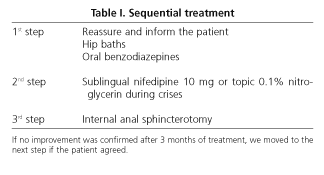
<body><![CDATA[<br> Results</b>: Fifteen patients with an average follow-up of 4 years. Anal endosonography confirmed a grossly thickened internal anal sphincter (IAS) in 5 cases. After the first step of treatment 7 patients improved and 1 patient was cured; after the second step of treatment 3 patients improved and 1 was cured; the third step was applied to 3 patients with a thickened IAS; 1 patient improved and 1 patient was cured.<b>    <br> Conclusion</b>: a total resolution of PF is not always possible, but we may improve symptoms and their frequency. Almost 50% of patients in our series improved with the first step of treatment; 30% of our patients had IAS hypertrophy. Anal endosonography can help in the diagnosis of organic diseases or IAS hypertrophy, for which we can perform an internal anal sphyncter myectomy.</font></p>     <p><font face="Arial" size="2"><b>Key words</b>: Anal pain. Proctalgia fugax. Sphincter hypertrophy. Sphincterotomy.</font></p> <hr>     <p><i><font size="2">Gracia Solanas JA, Ram&iacute;rez Rodr&iacute;guez JM, El&iacute;a Guedea M, Aguilella Diago V, Mart&iacute;nez D&iacute;ez M. Sequential treatment for proctalgia fugax. Mid-term follow-up. Rev Esp Enferm Dig 2005; 97: 491-496.</font></i></p> <hr>     <p><font size="2"><i>Recibido</i>: 29-11-04.    <br> <i>Aceptado</i>: 15-02-05.</font></p>     <p><font size="2"><i>Correspondencia</i>: José Antonio Gracia Solanas. C/ Miguel Servet, 43, 6º 1ª, esc. izda. 50013 Zaragoza. e-mail: <a href="mailto:josegraciasolanas@hotmail.com">josegraciasolanas@hotmail.com</a></font></p>     <p>&nbsp;</p>     <p><b>INTRODUCTION</b></p>     <p>Anorectal and perineal pain has been described in association with different pathologies that are usually easy to recognize, including hemorrhoids, fistula, fissures, perianal sepsis and carcinomas. But perianal pain can also be present in some cases where an organic cause cannot be found, and its pathophysiology remains uncertain. Proctalgia fugax had been traditionally included amongst other functional disorders that produce anorectal and perineal pain without recognizable organic disease, including coccygodynia, levator ani syndrome, vulvodynia, and perineal neuralgia. Although proctalgia fugax was described more than a century ago, its etiology is still unclear. Proctalgia fugax is a benign, self-limited disease characterized by episodes of deep recurrent anorectal pain. Even though nearly 14% of the population may suffer from proctalgia fugax, most patients do not seek medical advice (1). The diagnosis is based upon its particular clinical pattern and the lack of organic disorders explaining anorectal pain. Many therapies have been used in the management of such cases, often in an empirical way.</p>    ]]></body>
<body><![CDATA[<p>   There are in fact few papers on proctalgia fugax in the literature, most of them focusing on the study of a particular treatment usually in a short series of patients.</p>    <p>   The aim of this study was to prospectively study a group of patients complaining from this pathology, and to treat them according to a pre-established sequential therapy.</p>     <p><b>MATERIAL AND METHOD</b></p>     <p>From January 1996 to January 2002 all patients visiting our outpatient clinic because of proctalgia fugax were prospectively included in a specially designed data file. A detailed medical history as well as a perianal and rectal examination were performed for all cases. Anuscopy, rectoscopy and anal endosonography (AUS) were mandatory complementary diagnostic tests.</p>    <p>   Criteria for inclusion in our study were: abrupt deep pain limited to the anal canal, with a maximum duration of 30 minutes and at least one episode per month.</p>    <p>   Patients with synchronic organic lesions or with a history of surgery in the perianal region were excluded.</p>    <p>   After an exhaustive MedLine research a therapeutic protocol was established based on three steps according to the most relevant bibliography   (<a href="#t1">Table I</a>). Following our protocol patients were offered the next step of treatment when no improvement was obtained with the previous.</p>     <p align="center"><a name="t1"><img src="/img/diges/v97n7/imagenes/original3_tabla1_ing.gif" width="324" height="175"></a></p>     <p>    <br> First step: reassurance about the disease, hip bath, benzodiazepines; second step: sublingual nifedipine 10 mg (or topic 0.1% nitroglycerin ointment if previous hypotension) at the time of episodes. Third step: internal anal sphincterotomy when AUS showed hypertrophy (IAS thicker than 3.5 mm) (2). The adequacy of the sphincterotomy was assessed by AUS at the first postoperative control.</p>     ]]></body>
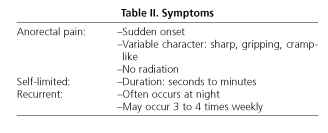
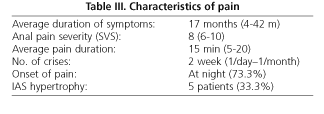
<body><![CDATA[<p>All patients were asked to complete an analogical visual pain scale (VPS: 0=no pain, 10=worst pain) at the time of the crisis, and to point out the result on a diary.</p>     <p>We defined a remarkable improvement if the number of episodes decreased to a half or the level of pain (according to the VPS) dropped by more than 50%.</p>     <p>The follow-up was planned at 1, 3 and 6 months and yearly thereafter. Patients were contacted by phone in order to learn their current situation.</p>     <p><b>RESULTS</b></p>     <p>Fifteen (11 women) patients with a mean age of 46 years (range 36-60) could be included in our study. Average follow-up has been of 4 (range 2-6) years.</p>     <p>Symptoms are shown in <a href="#t2"> table II</a>. </p>     <p align="center"><a name="t2"><img src="/img/diges/v97n7/imagenes/original3_tabla2_ing.gif" width="328" height="133"></a></p>     <p>    <br> The characteristics of pain (<a href="#t3">Table III</a>) were: nocturnal pain in 73.3% (11 cases) of cases, with VSP reaching an average pain level of 8 (range 6-9). The duration of symptoms was 17 months (range 4-42) on average. The number of crisis was 2 per week (range 1/day -1/month).</p>     <p align="center"><a name="t3"><img src="/img/diges/v97n7/imagenes/original3_tabla3_ing.gif" width="324" height="114"></a></p>     ]]></body>
<body><![CDATA[<p>    <br> AUS showed IAS hypertrophy in 5 patients.</p>     <p>After the first step in our sequential treatment, all patients improved (anal pain decreased to a level of 5.4; range 3-8) but just 7 of them fulfilled our criteria of remarkable improvement (anal pain average: 3.4; range 3-4; average number of crisis 1 per week), and 1 patient was cured. According to our protocol, the second step of treatment was offered to 7 patients (5 of them received sublingual nifedipine and the other 2 nitroglycerin ointment). Again, all patients improved (anal pain intensity level dropped to 4; range 2-7; average number of episodes 3 per month), but only three of them satisfying our criteria of remarkable improvement (anal pain average: 3). One patient was free of disease after this second step. As undesirable effects, 1 patient (20%) complained of mild headache and 2 patients (40%) presented facial flushing shortly after the nifedipine pill; such cases did not required to suspend the therapy. None patient under nitroglycerin ointment reported side-effect. In 3 cases with a demonstrated IAS hypertrophy and no improvement in previous steps, an anal internal sphincterotomy was performed. After this third therapy step, one patient improved, with an intensity level of anal pain of 4. The other two cases, healed (<a href="#t4">Table IV</a>).</p>     <p align="center"><a name="t4"><img src="/img/diges/v97n7/imagenes/original3_tabla4_ing.gif" width="328" height="122"></a></p>     <p>    <br> Currently, 4 out of 15 patients are free of symptoms, 8 patients have some mild and sporadic crises (1 in 6 months), and only 3 patients remain complaining of recurrent acute anal pain (1/month).</p>     <p><b>DISCUSSION</b></p>     <p>Proctalgia fugax is a symptomatic, unstable disease with differences in the duration and recurrence of episodes, which makes it hard to include these patients within an homogeneous group. It is a very prevalent disease, but fortunately most patients have sporadic crises (1-2/year or even less) and do not demand medical advice (1). Patients seen in our outpatient clinic had a mean of 2 episodes per week. In fact, we could not use the number of crisis as an exclusion criterion.</p>    <p>   Although the clinical appearance of proctalgia fugax was established almost a century ago, its etiology remains unclear. Moreover, due to a lack of proper studies, the management of these patients is controversial.</p>    <p>   Some theories have appeared trying to explain the pathophysiology of proctalgia fugax: alterations in the internal anal sphincter function and its morphology (3). In fact, a hereditary form with sphincter hypertrophy has been identified of late (4,5). Some other cases have been reported in association with irritable bowel syndrome (6). Uncontrolled serotonine release would result in excessive hypermotility as well as in visceral hypersensitivity (7). Finally, other theories suggest that proctalgia fugax is caused by pshycological factors (8).</p>    ]]></body>
<body><![CDATA[<p>   The diagnosis is based upon clinical manifestations and the absence of an organic origin for pain. Physical examination, rectoscopy, and anuscopy are normal in these patients. Endoanal ultrasonograhy or magnetic resonance imaging scans are usually normal, but sometimes may find an unexpected hypertrophy of the IAS; in such cases an internal anal sphincterotomy (as is the case in the hereditary form) may be of help. Anorectal manometry can demonstrate an increased IAS pressure with paroxysmal inability to relax in some cases (3).</p>    <p>   The differential diagnosis of anorectal pain must include common organic diseases such as hemorrhoids, anal fissure, perineal fistula and sepsis, carcinoma, compression of sacral nerves (8), and gynecological disease (9).</p>    <p>   Many treatments have been attempted with different success rates: cholinergic drugs (10), calcium antagonists (11), botulinum A toxin (12), adrenergic drugs (13) such as salbutamol inhalations during episodes, intravenous lidocaine (14), hip baths (15), topical nitroglycerin oinment (16), biofeedback techniques, anal dilatation, internal lateral sphyncterotomy when IAS hypertrophy is demonstrated (4,5), and psychotherapy (17).</p>    <p>   At first glance ours may seem a short series, but in talking about proctalgia fugax it is by no means worthless. Moreover, all of our patients followed the same sequential treatment for at least 2 years. Having in mind the limited number of patients we only could devise a descriptive study, even if we knew that a better study would have been a case-control trial. For this reason we could not calculate statistical significances, and our results cannot be generalized. Healing is not always possible, but symptoms can be partly relieved and the rate of episodes reduced. Almost 50% of patients in our study were satisfied after the first step of treatment; in such cases no further treatment was necessary. We can conclude that one of the most important facts in the management of proctalgia fugax is to reassure patients about the disease, and many of them will learn to cope with their pain and to tolerate it better. In our series, 5 out of 15 (33.3%) patients had IAS hypertrophy on AUS. In 3 of them we carried out a sphincterotomy, which improved symptoms. Thus we advocate (with the limitations entailed by the number of patients) for anal endosonography as a useful tool in proctalgia fugax, first to rule out organic disease and secondly to identify patients with IAS hypertrophy who may benefit from sphincterotomy when conservative therapy fails.</p>     <p><b>REFERENCES</b></p>     <!-- ref --><p>1. Potter MA, Bartolo DC. Proctalgia fugaz. Eur J Gastroenterol Hepatol 2001; 13(11): 1289-90.&nbsp;&nbsp;&nbsp;&nbsp;&nbsp;&nbsp;&nbsp;&nbsp;[&#160;<a href="javascript:void(0);" onclick="javascript: window.open('/scielo.php?script=sci_nlinks&ref=5213381&pid=S1130-0108200500070000400001&lng=','','width=640,height=500,resizable=yes,scrollbars=1,menubar=yes,');">Links</a>&#160;]<!-- end-ref --><!-- ref --><p> 2. Ignacio Fuertes. Ecograf&iacute;a normal del canal anal. En: Ram&iacute;rez JM, Mortensen NJ, Aguilella V. Manual Pr&aacute;ctico de ecograf&iacute;a endoanal y endorectal. Zaragoza: Universidad de Zaragoza, 2000. p. 67-78.&nbsp;&nbsp;&nbsp;&nbsp;&nbsp;&nbsp;&nbsp;&nbsp;[&#160;<a href="javascript:void(0);" onclick="javascript: window.open('/scielo.php?script=sci_nlinks&ref=5213382&pid=S1130-0108200500070000400002&lng=','','width=640,height=500,resizable=yes,scrollbars=1,menubar=yes,');">Links</a>&#160;]<!-- end-ref --><!-- ref --><p> 3. Rao SS, Hatfield RA. Paroxysmal anal hyperkinesis: a characteristic feature of proctalgia fugax. Gut 1996; 39 (4): 609-12.&nbsp;&nbsp;&nbsp;&nbsp;&nbsp;&nbsp;&nbsp;&nbsp;[&#160;<a href="javascript:void(0);" onclick="javascript: window.open('/scielo.php?script=sci_nlinks&ref=5213383&pid=S1130-0108200500070000400003&lng=','','width=640,height=500,resizable=yes,scrollbars=1,menubar=yes,');">Links</a>&#160;]<!-- end-ref --><!-- ref --><p> 4. Kamm MA, Hoyle CH, Burleigh DE, Law PJ, Swash M, Martin JE, et al. Hereditary internal anal sphincter myopathy causing proctalgia fugax and constipation. A newly identified condition. Gastroenterology. 1991; 100 (3): 805-10.&nbsp;&nbsp;&nbsp;&nbsp;&nbsp;&nbsp;&nbsp;&nbsp;[&#160;<a href="javascript:void(0);" onclick="javascript: window.open('/scielo.php?script=sci_nlinks&ref=5213384&pid=S1130-0108200500070000400004&lng=','','width=640,height=500,resizable=yes,scrollbars=1,menubar=yes,');">Links</a>&#160;]<!-- end-ref --><!-- ref --><p> 5. Guy RJ, Kamm MA, Martin JE. Internal anal sphincter myopathy causing proctalgia fugax and constipation: further clinical and radiological characterization in a patient. Eur J Gastroenterol Hepatol 1997; 9 (2): 221-4.&nbsp;&nbsp;&nbsp;&nbsp;&nbsp;&nbsp;&nbsp;&nbsp;[&#160;<a href="javascript:void(0);" onclick="javascript: window.open('/scielo.php?script=sci_nlinks&ref=5213385&pid=S1130-0108200500070000400005&lng=','','width=640,height=500,resizable=yes,scrollbars=1,menubar=yes,');">Links</a>&#160;]<!-- end-ref --><!-- ref --><p> 6. Thompson WG. Proctalgia fugax in patients with the irritative bowel, peptic ulcer, or inflammatory bowel disease. Am J Gastroenterol 1984; 79 (6): 450-2.&nbsp;&nbsp;&nbsp;&nbsp;&nbsp;&nbsp;&nbsp;&nbsp;[&#160;<a href="javascript:void(0);" onclick="javascript: window.open('/scielo.php?script=sci_nlinks&ref=5213386&pid=S1130-0108200500070000400006&lng=','','width=640,height=500,resizable=yes,scrollbars=1,menubar=yes,');">Links</a>&#160;]<!-- end-ref --><!-- ref --><p> 7. Kin DY, Camilleri M. Serotonin: A mediator of the brain-gut connection. Am J Gastroenterol 2000; 95 (10): 2698-709.&nbsp;&nbsp;&nbsp;&nbsp;&nbsp;&nbsp;&nbsp;&nbsp;[&#160;<a href="javascript:void(0);" onclick="javascript: window.open('/scielo.php?script=sci_nlinks&ref=5213387&pid=S1130-0108200500070000400007&lng=','','width=640,height=500,resizable=yes,scrollbars=1,menubar=yes,');">Links</a>&#160;]<!-- end-ref --><!-- ref --><p> 8. Mazza L, Formento E, Fonda G. Anorectal and perineal pain: new pathophysiological hipotesis. Tech Coloproctol 2004; 8 (2): 77-83.&nbsp;&nbsp;&nbsp;&nbsp;&nbsp;&nbsp;&nbsp;&nbsp;[&#160;<a href="javascript:void(0);" onclick="javascript: window.open('/scielo.php?script=sci_nlinks&ref=5213388&pid=S1130-0108200500070000400008&lng=','','width=640,height=500,resizable=yes,scrollbars=1,menubar=yes,');">Links</a>&#160;]<!-- end-ref --><!-- ref --><p> 9. Wald A. Functional anorectal and pelvic pain. Gastroenterol Clin Am 2001; 30 (1): 243-51, viii-ix.&nbsp;&nbsp;&nbsp;&nbsp;&nbsp;&nbsp;&nbsp;&nbsp;[&#160;<a href="javascript:void(0);" onclick="javascript: window.open('/scielo.php?script=sci_nlinks&ref=5213389&pid=S1130-0108200500070000400009&lng=','','width=640,height=500,resizable=yes,scrollbars=1,menubar=yes,');">Links</a>&#160;]<!-- end-ref --><!-- ref --><p>   10. Eckardt VF, Dodt O, Kanzler G, Bernhard G. Anorectal function and morphology in patientes with sporadic proctalgia fugax. Dis Colon Rectum 1996; 39 (7): 755-62.&nbsp;&nbsp;&nbsp;&nbsp;&nbsp;&nbsp;&nbsp;&nbsp;[&#160;<a href="javascript:void(0);" onclick="javascript: window.open('/scielo.php?script=sci_nlinks&ref=5213390&pid=S1130-0108200500070000400010&lng=','','width=640,height=500,resizable=yes,scrollbars=1,menubar=yes,');">Links</a>&#160;]<!-- end-ref --><!-- ref --><p>   11. Babb RR. Proctalgia fugax: would you recognize it? Postgrad Med 1996; 99 (4): 236-4.&nbsp;&nbsp;&nbsp;&nbsp;&nbsp;&nbsp;&nbsp;&nbsp;[&#160;<a href="javascript:void(0);" onclick="javascript: window.open('/scielo.php?script=sci_nlinks&ref=5213391&pid=S1130-0108200500070000400011&lng=','','width=640,height=500,resizable=yes,scrollbars=1,menubar=yes,');">Links</a>&#160;]<!-- end-ref --><!-- ref --><p>   12. Zajacz M. Applications of the botulinum A toxin. Orv Chetil 2003; 144 (18): 837-42.&nbsp;&nbsp;&nbsp;&nbsp;&nbsp;&nbsp;&nbsp;&nbsp;[&#160;<a href="javascript:void(0);" onclick="javascript: window.open('/scielo.php?script=sci_nlinks&ref=5213392&pid=S1130-0108200500070000400012&lng=','','width=640,height=500,resizable=yes,scrollbars=1,menubar=yes,');">Links</a>&#160;]<!-- end-ref --><!-- ref --><p>   13. Eckardt VF, Dodt O, Kanzler G, Bernhard G. Treatment of proctalgia fugax with salbutamol inhalation. Am J Gastroenterol 1996; 91 (4): 686-9.&nbsp;&nbsp;&nbsp;&nbsp;&nbsp;&nbsp;&nbsp;&nbsp;[&#160;<a href="javascript:void(0);" onclick="javascript: window.open('/scielo.php?script=sci_nlinks&ref=5213393&pid=S1130-0108200500070000400013&lng=','','width=640,height=500,resizable=yes,scrollbars=1,menubar=yes,');">Links</a>&#160;]<!-- end-ref --><!-- ref --><p>   14. Peleg R, Shvartzman P. Low-dose intravenous lidocaine as treatment for proctalgia fugax. Reg Anesth Pain Med 2002; 27 (1): 97-9.&nbsp;&nbsp;&nbsp;&nbsp;&nbsp;&nbsp;&nbsp;&nbsp;[&#160;<a href="javascript:void(0);" onclick="javascript: window.open('/scielo.php?script=sci_nlinks&ref=5213394&pid=S1130-0108200500070000400014&lng=','','width=640,height=500,resizable=yes,scrollbars=1,menubar=yes,');">Links</a>&#160;]<!-- end-ref --><!-- ref --><p>   15. Dodi G, Bogoni F, Infantino A, Pianon P, Mortellaro LM, Lise M. Hot or cold in anal pain? A study of the changes in internal anal sphincter pressure profiles. Dis Colon Rectum 1986; 29 (4): 248-51.&nbsp;&nbsp;&nbsp;&nbsp;&nbsp;&nbsp;&nbsp;&nbsp;[&#160;<a href="javascript:void(0);" onclick="javascript: window.open('/scielo.php?script=sci_nlinks&ref=5213395&pid=S1130-0108200500070000400015&lng=','','width=640,height=500,resizable=yes,scrollbars=1,menubar=yes,');">Links</a>&#160;]<!-- end-ref --><!-- ref --><p>   16. Lowenstein B, Cataldo PA. Treatment of proctalgia fugax with topical nitroglycerin: report of a case. Dis Colon Rectum 1998; 41 (5): 667-8.&nbsp;&nbsp;&nbsp;&nbsp;&nbsp;&nbsp;&nbsp;&nbsp;[&#160;<a href="javascript:void(0);" onclick="javascript: window.open('/scielo.php?script=sci_nlinks&ref=5213396&pid=S1130-0108200500070000400016&lng=','','width=640,height=500,resizable=yes,scrollbars=1,menubar=yes,');">Links</a>&#160;]<!-- end-ref --><!-- ref --><p>   17. Wesselmann U, Burnett AL, Heinberg LJ. The urogenital and rectal pain syndromes. Pain 1997; 73 (3): 269-94.&nbsp;&nbsp;&nbsp;&nbsp;&nbsp;&nbsp;&nbsp;&nbsp;[&#160;<a href="javascript:void(0);" onclick="javascript: window.open('/scielo.php?script=sci_nlinks&ref=5213397&pid=S1130-0108200500070000400017&lng=','','width=640,height=500,resizable=yes,scrollbars=1,menubar=yes,');">Links</a>&#160;]<!-- end-ref --> ]]></body><back>
<ref-list>
<ref id="B1">
<label>1</label><nlm-citation citation-type="journal">
<person-group person-group-type="author">
<name>
<surname><![CDATA[Potter]]></surname>
<given-names><![CDATA[MA]]></given-names>
</name>
<name>
<surname><![CDATA[Bartolo]]></surname>
<given-names><![CDATA[DC]]></given-names>
</name>
</person-group>
<article-title xml:lang="es"><![CDATA[Proctalgia fugaz]]></article-title>
<source><![CDATA[Eur J Gastroenterol Hepatol]]></source>
<year>2001</year>
<volume>13</volume>
<numero>11</numero>
<issue>11</issue>
<page-range>1289-90</page-range></nlm-citation>
</ref>
<ref id="B2">
<label>2</label><nlm-citation citation-type="book">
<person-group person-group-type="author">
<name>
<surname><![CDATA[Fuertes]]></surname>
<given-names><![CDATA[Ignacio]]></given-names>
</name>
</person-group>
<article-title xml:lang="es"><![CDATA[Ecografía normal del canal anal]]></article-title>
<person-group person-group-type="editor">
<name>
<surname><![CDATA[Ramírez]]></surname>
<given-names><![CDATA[JM]]></given-names>
</name>
<name>
<surname><![CDATA[Mortensen]]></surname>
<given-names><![CDATA[NJ]]></given-names>
</name>
<name>
<surname><![CDATA[Aguilella]]></surname>
<given-names><![CDATA[V]]></given-names>
</name>
</person-group>
<source><![CDATA[Manual Práctico de ecografía endoanal y endorectal]]></source>
<year>2000</year>
<page-range>67-78</page-range><publisher-loc><![CDATA[Zaragoza ]]></publisher-loc>
<publisher-name><![CDATA[Universidad de Zaragoza]]></publisher-name>
</nlm-citation>
</ref>
<ref id="B3">
<label>3</label><nlm-citation citation-type="journal">
<person-group person-group-type="author">
<name>
<surname><![CDATA[Rao]]></surname>
<given-names><![CDATA[SS]]></given-names>
</name>
<name>
<surname><![CDATA[Hatfield]]></surname>
<given-names><![CDATA[RA]]></given-names>
</name>
</person-group>
<article-title xml:lang="en"><![CDATA[Paroxysmal anal hyperkinesis: a characteristic feature of proctalgia fugax]]></article-title>
<source><![CDATA[Gut]]></source>
<year>1996</year>
<volume>39</volume>
<numero>4</numero>
<issue>4</issue>
<page-range>609-12</page-range></nlm-citation>
</ref>
<ref id="B4">
<label>4</label><nlm-citation citation-type="journal">
<person-group person-group-type="author">
<name>
<surname><![CDATA[Kamm]]></surname>
<given-names><![CDATA[MA]]></given-names>
</name>
<name>
<surname><![CDATA[Hoyle]]></surname>
<given-names><![CDATA[CH]]></given-names>
</name>
<name>
<surname><![CDATA[Burleigh]]></surname>
<given-names><![CDATA[DE]]></given-names>
</name>
<name>
<surname><![CDATA[Law]]></surname>
<given-names><![CDATA[PJ]]></given-names>
</name>
<name>
<surname><![CDATA[Swash]]></surname>
<given-names><![CDATA[M]]></given-names>
</name>
<name>
<surname><![CDATA[Martin]]></surname>
<given-names><![CDATA[JE]]></given-names>
</name>
</person-group>
<article-title xml:lang="en"><![CDATA[Hereditary internal anal sphincter myopathy causing proctalgia fugax and constipation: A newly identified condition]]></article-title>
<source><![CDATA[Gastroenterology]]></source>
<year>1991</year>
<volume>100</volume>
<numero>3</numero>
<issue>3</issue>
<page-range>805-10</page-range></nlm-citation>
</ref>
<ref id="B5">
<label>5</label><nlm-citation citation-type="journal">
<person-group person-group-type="author">
<name>
<surname><![CDATA[Guy]]></surname>
<given-names><![CDATA[RJ]]></given-names>
</name>
<name>
<surname><![CDATA[Kamm]]></surname>
<given-names><![CDATA[MA]]></given-names>
</name>
<name>
<surname><![CDATA[Martin]]></surname>
<given-names><![CDATA[JE]]></given-names>
</name>
</person-group>
<article-title xml:lang="en"><![CDATA[Internal anal sphincter myopathy causing proctalgia fugax and constipation: further clinical and radiological characterization in a patient]]></article-title>
<source><![CDATA[Eur J Gastroenterol Hepatol]]></source>
<year>1997</year>
<volume>9</volume>
<numero>2</numero>
<issue>2</issue>
<page-range>221-4</page-range></nlm-citation>
</ref>
<ref id="B6">
<label>6</label><nlm-citation citation-type="journal">
<person-group person-group-type="author">
<name>
<surname><![CDATA[Thompson]]></surname>
<given-names><![CDATA[WG]]></given-names>
</name>
</person-group>
<article-title xml:lang="en"><![CDATA[Proctalgia fugax in patients with the irritative bowel, peptic ulcer, or inflammatory bowel disease]]></article-title>
<source><![CDATA[Am J Gastroenterol]]></source>
<year>1984</year>
<volume>79</volume>
<numero>6</numero>
<issue>6</issue>
<page-range>450-2</page-range></nlm-citation>
</ref>
<ref id="B7">
<label>7</label><nlm-citation citation-type="journal">
<person-group person-group-type="author">
<name>
<surname><![CDATA[Kin]]></surname>
<given-names><![CDATA[DY]]></given-names>
</name>
<name>
<surname><![CDATA[Camilleri]]></surname>
<given-names><![CDATA[M]]></given-names>
</name>
</person-group>
<article-title xml:lang="en"><![CDATA[Serotonin: A mediator of the brain-gut connection]]></article-title>
<source><![CDATA[Am J Gastroenterol]]></source>
<year>2000</year>
<volume>95</volume>
<numero>10</numero>
<issue>10</issue>
<page-range>2698-709</page-range></nlm-citation>
</ref>
<ref id="B8">
<label>8</label><nlm-citation citation-type="journal">
<person-group person-group-type="author">
<name>
<surname><![CDATA[Mazza]]></surname>
<given-names><![CDATA[L]]></given-names>
</name>
<name>
<surname><![CDATA[Formento]]></surname>
<given-names><![CDATA[E]]></given-names>
</name>
<name>
<surname><![CDATA[Fonda]]></surname>
<given-names><![CDATA[G]]></given-names>
</name>
</person-group>
<article-title xml:lang="en"><![CDATA[Anorectal and perineal pain: new pathophysiological hipotesis]]></article-title>
<source><![CDATA[Tech Coloproctol]]></source>
<year>2004</year>
<volume>8</volume>
<numero>2</numero>
<issue>2</issue>
<page-range>77-83</page-range></nlm-citation>
</ref>
<ref id="B9">
<label>9</label><nlm-citation citation-type="journal">
<person-group person-group-type="author">
<name>
<surname><![CDATA[Wald]]></surname>
<given-names><![CDATA[A]]></given-names>
</name>
</person-group>
<article-title xml:lang="en"><![CDATA[Functional anorectal and pelvic pain]]></article-title>
<source><![CDATA[Gastroenterol Clin Am]]></source>
<year>2001</year>
<volume>30</volume>
<numero>1</numero>
<issue>1</issue>
<page-range>243-51</page-range></nlm-citation>
</ref>
<ref id="B10">
<label>10</label><nlm-citation citation-type="journal">
<person-group person-group-type="author">
<name>
<surname><![CDATA[Eckardt]]></surname>
<given-names><![CDATA[VF]]></given-names>
</name>
<name>
<surname><![CDATA[Dodt]]></surname>
<given-names><![CDATA[O]]></given-names>
</name>
<name>
<surname><![CDATA[Kanzler]]></surname>
<given-names><![CDATA[G]]></given-names>
</name>
<name>
<surname><![CDATA[Bernhard]]></surname>
<given-names><![CDATA[G]]></given-names>
</name>
</person-group>
<article-title xml:lang="en"><![CDATA[Anorectal function and morphology in patientes with sporadic proctalgia fugax]]></article-title>
<source><![CDATA[Dis Colon Rectum]]></source>
<year>1996</year>
<volume>39</volume>
<numero>7</numero>
<issue>7</issue>
<page-range>755-62</page-range></nlm-citation>
</ref>
<ref id="B11">
<label>11</label><nlm-citation citation-type="journal">
<person-group person-group-type="author">
<name>
<surname><![CDATA[Babb]]></surname>
<given-names><![CDATA[RR]]></given-names>
</name>
</person-group>
<article-title xml:lang="en"><![CDATA[Proctalgia fugax: would you recognize it?]]></article-title>
<source><![CDATA[Postgrad Med]]></source>
<year>1996</year>
<volume>99</volume>
<numero>4</numero>
<issue>4</issue>
<page-range>236-4</page-range></nlm-citation>
</ref>
<ref id="B12">
<label>12</label><nlm-citation citation-type="journal">
<person-group person-group-type="author">
<name>
<surname><![CDATA[Zajacz]]></surname>
<given-names><![CDATA[M]]></given-names>
</name>
</person-group>
<article-title xml:lang="en"><![CDATA[Applications of the botulinum A toxin]]></article-title>
<source><![CDATA[Orv Chetil]]></source>
<year>2003</year>
<volume>144</volume>
<numero>18</numero>
<issue>18</issue>
<page-range>837-42</page-range></nlm-citation>
</ref>
<ref id="B13">
<label>13</label><nlm-citation citation-type="journal">
<person-group person-group-type="author">
<name>
<surname><![CDATA[Eckardt]]></surname>
<given-names><![CDATA[VF]]></given-names>
</name>
<name>
<surname><![CDATA[Dodt]]></surname>
<given-names><![CDATA[O]]></given-names>
</name>
<name>
<surname><![CDATA[Kanzler]]></surname>
<given-names><![CDATA[G]]></given-names>
</name>
<name>
<surname><![CDATA[Bernhard]]></surname>
<given-names><![CDATA[G]]></given-names>
</name>
</person-group>
<article-title xml:lang="en"><![CDATA[Treatment of proctalgia fugax with salbutamol inhalation]]></article-title>
<source><![CDATA[Am J Gastroenterol]]></source>
<year>1996</year>
<volume>91</volume>
<numero>4</numero>
<issue>4</issue>
<page-range>686-9</page-range></nlm-citation>
</ref>
<ref id="B14">
<label>14</label><nlm-citation citation-type="journal">
<person-group person-group-type="author">
<name>
<surname><![CDATA[Peleg]]></surname>
<given-names><![CDATA[R]]></given-names>
</name>
<name>
<surname><![CDATA[Shvartzman]]></surname>
<given-names><![CDATA[P]]></given-names>
</name>
</person-group>
<article-title xml:lang="en"><![CDATA[Low-dose intravenous lidocaine as treatment for proctalgia fugax]]></article-title>
<source><![CDATA[Reg Anesth Pain Med]]></source>
<year>2002</year>
<volume>27</volume>
<numero>1</numero>
<issue>1</issue>
<page-range>97-9</page-range></nlm-citation>
</ref>
<ref id="B15">
<label>15</label><nlm-citation citation-type="journal">
<person-group person-group-type="author">
<name>
<surname><![CDATA[Dodi]]></surname>
<given-names><![CDATA[G]]></given-names>
</name>
<name>
<surname><![CDATA[Bogoni]]></surname>
<given-names><![CDATA[F]]></given-names>
</name>
<name>
<surname><![CDATA[Infantino]]></surname>
<given-names><![CDATA[A]]></given-names>
</name>
<name>
<surname><![CDATA[Pianon]]></surname>
<given-names><![CDATA[P]]></given-names>
</name>
<name>
<surname><![CDATA[Mortellaro]]></surname>
<given-names><![CDATA[LM]]></given-names>
</name>
<name>
<surname><![CDATA[Lise]]></surname>
<given-names><![CDATA[M]]></given-names>
</name>
</person-group>
<article-title xml:lang="en"><![CDATA[Hot or cold in anal pain?: A study of the changes in internal anal sphincter pressure profiles]]></article-title>
<source><![CDATA[Dis Colon Rectum]]></source>
<year>1986</year>
<volume>29</volume>
<numero>4</numero>
<issue>4</issue>
<page-range>248-51</page-range></nlm-citation>
</ref>
<ref id="B16">
<label>16</label><nlm-citation citation-type="journal">
<person-group person-group-type="author">
<name>
<surname><![CDATA[Lowenstein]]></surname>
<given-names><![CDATA[B]]></given-names>
</name>
<name>
<surname><![CDATA[Cataldo]]></surname>
<given-names><![CDATA[PA]]></given-names>
</name>
</person-group>
<article-title xml:lang="en"><![CDATA[Treatment of proctalgia fugax with topical nitroglycerin: report of a case]]></article-title>
<source><![CDATA[Dis Colon Rectum]]></source>
<year>1998</year>
<volume>41</volume>
<numero>5</numero>
<issue>5</issue>
<page-range>667-8</page-range></nlm-citation>
</ref>
<ref id="B17">
<label>17</label><nlm-citation citation-type="journal">
<person-group person-group-type="author">
<name>
<surname><![CDATA[Wesselmann]]></surname>
<given-names><![CDATA[U]]></given-names>
</name>
<name>
<surname><![CDATA[Burnett]]></surname>
<given-names><![CDATA[AL]]></given-names>
</name>
<name>
<surname><![CDATA[Heinberg]]></surname>
<given-names><![CDATA[LJ]]></given-names>
</name>
</person-group>
<article-title xml:lang="en"><![CDATA[The urogenital and rectal pain syndromes]]></article-title>
<source><![CDATA[Pain]]></source>
<year>1997</year>
<volume>73</volume>
<numero>3</numero>
<issue>3</issue>
<page-range>269-94</page-range></nlm-citation>
</ref>
</ref-list>
</back>
</article>