<?xml version="1.0" encoding="ISO-8859-1"?><article xmlns:mml="http://www.w3.org/1998/Math/MathML" xmlns:xlink="http://www.w3.org/1999/xlink" xmlns:xsi="http://www.w3.org/2001/XMLSchema-instance">
<front>
<journal-meta>
<journal-id>1130-0108</journal-id>
<journal-title><![CDATA[Revista Española de Enfermedades Digestivas]]></journal-title>
<abbrev-journal-title><![CDATA[Rev. esp. enferm. dig.]]></abbrev-journal-title>
<issn>1130-0108</issn>
<publisher>
<publisher-name><![CDATA[Sociedad Española de Patología Digestiva]]></publisher-name>
</publisher>
</journal-meta>
<article-meta>
<article-id>S1130-01082006000600006</article-id>
<title-group>
<article-title xml:lang="en"><![CDATA[Constipation in the population over 50 years of age in Albacete province]]></article-title>
<article-title xml:lang="es"><![CDATA[Estreñimiento en la población mayor de 50 años de la provincia de Albacete]]></article-title>
</title-group>
<contrib-group>
<contrib contrib-type="author">
<name>
<surname><![CDATA[López Cara]]></surname>
<given-names><![CDATA[M. A.]]></given-names>
</name>
<xref ref-type="aff" rid="A01"/>
</contrib>
<contrib contrib-type="author">
<name>
<surname><![CDATA[Tárraga López]]></surname>
<given-names><![CDATA[P. J.]]></given-names>
</name>
<xref ref-type="aff" rid="A02"/>
</contrib>
<contrib contrib-type="author">
<name>
<surname><![CDATA[Cerdán Oliver]]></surname>
<given-names><![CDATA[M.]]></given-names>
</name>
<xref ref-type="aff" rid="A03"/>
</contrib>
<contrib contrib-type="author">
<name>
<surname><![CDATA[Ocaña López]]></surname>
<given-names><![CDATA[J. M.]]></given-names>
</name>
<xref ref-type="aff" rid="A04"/>
</contrib>
<contrib contrib-type="author">
<name>
<surname><![CDATA[Celada Rodríguez]]></surname>
<given-names><![CDATA[A.]]></given-names>
</name>
<xref ref-type="aff" rid="A02"/>
</contrib>
<contrib contrib-type="author">
<name>
<surname><![CDATA[Solera Albero]]></surname>
<given-names><![CDATA[J.]]></given-names>
</name>
<xref ref-type="aff" rid="A04"/>
</contrib>
<contrib contrib-type="author">
<name>
<surname><![CDATA[Palomino Medina]]></surname>
<given-names><![CDATA[M. A.]]></given-names>
</name>
<xref ref-type="aff" rid="A05"/>
</contrib>
</contrib-group>
<aff id="A01">
<institution><![CDATA[,Primary Health Center Casas de Juan Núñez  ]]></institution>
<addr-line><![CDATA[Albacete ]]></addr-line>
</aff>
<aff id="A02">
<institution><![CDATA[,Health Center nº 6  ]]></institution>
<addr-line><![CDATA[Albacete ]]></addr-line>
</aff>
<aff id="A03">
<institution><![CDATA[,Health Center Hellín  ]]></institution>
<addr-line><![CDATA[Albacete ]]></addr-line>
</aff>
<aff id="A04">
<institution><![CDATA[,Health Center Alcaraz  ]]></institution>
<addr-line><![CDATA[Albacete ]]></addr-line>
</aff>
<aff id="A05">
<institution><![CDATA[,Health Center Cardenete  ]]></institution>
<addr-line><![CDATA[Cuenca ]]></addr-line>
<country>Spain</country>
</aff>
<pub-date pub-type="pub">
<day>00</day>
<month>06</month>
<year>2006</year>
</pub-date>
<pub-date pub-type="epub">
<day>00</day>
<month>06</month>
<year>2006</year>
</pub-date>
<volume>98</volume>
<numero>6</numero>
<fpage>449</fpage>
<lpage>459</lpage>
<copyright-statement/>
<copyright-year/>
<self-uri xlink:href="http://scielo.isciii.es/scielo.php?script=sci_arttext&amp;pid=S1130-01082006000600006&amp;lng=en&amp;nrm=iso"></self-uri><self-uri xlink:href="http://scielo.isciii.es/scielo.php?script=sci_abstract&amp;pid=S1130-01082006000600006&amp;lng=en&amp;nrm=iso"></self-uri><self-uri xlink:href="http://scielo.isciii.es/scielo.php?script=sci_pdf&amp;pid=S1130-01082006000600006&amp;lng=en&amp;nrm=iso"></self-uri><abstract abstract-type="short" xml:lang="en"><p><![CDATA[Objective: to determine the incidence of constipation in Albacete province and its relation with diet and lifestyle. Patients and methods: cross-sectional population survey. We studied 414 participants over 50 years of age in Albacete province. 445 persons over 50 years of age were included in the study. All participants were selected by systematic random sampling; 414 participants filled in the questionnaire correctly. Main measures: age, weight and height, marital status, level of education and occupation; presence of a disease, number of sleep hours a day, physical exercise, smoking, alcohol intake, drug intake (anti-inflammatories and laxatives); bowel habit, diet, meal frequency and place; food intake frequency per week, daily intake of water, coffee, tea and herbal beverages; vitamin and fiber supplements; presence of cancer in the family. Results: 56.9% of participants were women. Mean age 67.07 years. In Albacete province, 4.4% of the population over 50 years have a bowel habit consistent with constipation. Most participants had three meals a day (breakfast, lunch, and supper), while 50% had another meal in the morning or afternoon. These meals took place, habitually, in the domicile. There was a preponderance in daily intake of the following foods: milk (83.7%), bread (95.1%), vegetables (68.8%), fruit (91.8%), and virgin olive oil (96.6%). Fish was eaten every one to two days, and pulses and meat every three to six days. 44.4% of participants drank one to two liters of water a day. Only 3.9% of participants took some supplement; 35% of participants were on a diet. It was observed that 97.7% of participants with more than three defecations a week had a high intake of virgin olive oil; 65.7% of participants did some physical exercise customarily; 70.2% of participants were non-smokers, 10.2% were smokers, and 18.4% were ex-smokers. With regard to alcohol, the percentage of drinkers was 35.1%. The main class of medications taken by participants was NSAIDs -14.5%; 79.7% took neither NSAIDs nor laxatives. Only 2.7% of participants took laxatives regularly. Conclusions: Most participants had relatively healthy eating habits.]]></p></abstract>
<kwd-group>
<kwd lng="en"><![CDATA[Diet]]></kwd>
<kwd lng="en"><![CDATA[Lifestyle]]></kwd>
<kwd lng="en"><![CDATA[Bowel habit]]></kwd>
<kwd lng="en"><![CDATA[Persons]]></kwd>
</kwd-group>
</article-meta>
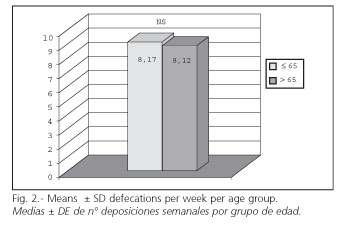
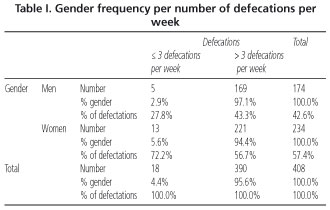
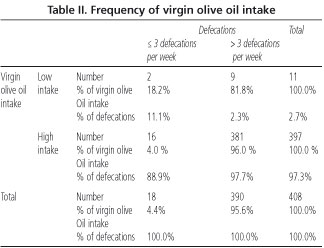
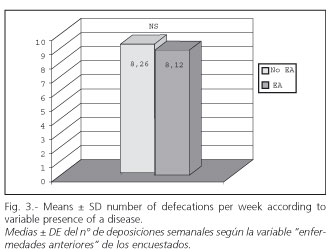
</front><body><![CDATA[ <p align="right"><b><font face="Verdana" size="2">ORIGINAL PAPERS</font></b></p>     <p>&nbsp;</p>     <p><font face="Verdana" size="4"><b><a name="top"></a>Constipation in the population over 50 years of age in Albacete province</b></font></p>     <p><font face="Verdana" size="4"><b>Estreñimiento en la población mayor de 50 años de la provincia de Albacete</b></font></p>     <p>&nbsp;</p>     <p>&nbsp;</p>     <p><font face="Verdana" size="2"><b>M. A. L&oacute;pez Cara, P. J. T&aacute;rraga L&oacute;pez<sup>1</sup>, M. Cerd&aacute;n Oliver<sup>2</sup>, J. M. Oca&ntilde;a L&oacute;pez<sup>3</sup>,&nbsp;    <br>  A. Celada Rodr&iacute;guez<sup>1</sup>, J. Solera Albero<sup>3</sup> and M. A. Palomino Medina<sup>4</sup></b></font></p>     <p><font face="Verdana" size="2">Primary Health. Center "Casas de Juan N&uacute;&ntilde;ez". Albacete.&nbsp;    <br> <sup>1</sup>Health Center nº 6. Albacete.&nbsp;    ]]></body>
<body><![CDATA[<br> <sup>2</sup>Health Center Hell&iacute;n. Albacete.&nbsp;    <br>  Health Center Alcaraz. Albacete.&nbsp;    <br> <sup>4</sup>Health Center Cardenete. Cuenca, Spain</font></p>     <p><font face="Verdana" size="2"><u><a href="#back">Correspondence</a></u></font></p>     <p>&nbsp;</p>     <p>&nbsp;</p> <hr size="1">     <p><b><font face="Verdana" size="2">ABSTRACT</font></b></p>     <p><font face="Verdana" size="2"><b>Objective:</b> to determine the incidence of constipation in Albacete province and its relation with diet and lifestyle.<b>    <br> Patients and methods:</b> cross-sectional population survey. We studied 414 participants over 50 years of age in Albacete province. 445 persons over 50 years of age were included in the study. All participants were selected by systematic random sampling; 414 participants filled in the questionnaire correctly. Main measures: age, weight and height, marital status, level of education and occupation; presence of a disease, number of sleep hours a day, physical exercise, smoking, alcohol intake, drug intake (anti-inflammatories and laxatives); bowel habit, diet, meal frequency and place; food intake frequency per week, daily intake of water, coffee, tea and herbal beverages; vitamin and fiber supplements; presence of cancer in the family.<b>    <br> Results:</b> 56.9% of participants were women. Mean age 67.07 years. In Albacete province, 4.4% of the population over 50 years have a bowel habit consistent with constipation. Most participants had three meals a day (breakfast, lunch, and supper), while 50% had another meal in the morning or afternoon. These meals took place, habitually, in the domicile. There was a preponderance in daily intake of the following foods: milk (83.7%), bread (95.1%), vegetables (68.8%), fruit (91.8%), and virgin olive oil (96.6%). Fish was eaten every one to two days, and pulses and meat every three to six days. 44.4% of participants drank one to two liters of water a day. Only 3.9% of participants took some supplement; 35% of participants were on a diet. It was observed that 97.7% of participants with more than three defecations a week had a high intake of virgin olive oil; 65.7% of participants did some physical exercise customarily; 70.2% of participants were non-smokers, 10.2% were smokers, and 18.4% were ex-smokers. With regard to alcohol, the percentage of drinkers was 35.1%. The main class of medications taken by participants was NSAIDs -14.5%; 79.7% took neither NSAIDs nor laxatives. Only 2.7% of participants took laxatives regularly.<b>    ]]></body>
<body><![CDATA[<br> Conclusions:</b> Most participants had relatively healthy eating habits.</font></p>     <p><font face="Verdana" size="2"><b>Key words: </b>Diet. Lifestyle. Bowel habit. Persons.</font></p>  <hr size="1">      <p>&nbsp;</p>     <p><b><font face="Verdana" size="3">Introduction</font></b></p>     <p><font face="Verdana" size="2">Constipation is a term that defines a symptom, not a disease or a diagnose, and, as such, indicates a subjective assessment of persons experiencing a defecation disorder. Constipation is characterized not only by its subjective nature but also by its marked complexity, since it can be motivated by many causes and pathogenic/pathophysiological mechanisms, and adopt diverse clinical manifestations (1).</font> </p>    <p>   <font face="Verdana" size="2">   Constipation can be defined by two basic inconveniences (2-4): infrequent defecation and excessive strain. Infrequent defecation is considered when frequency is fewer than three times a week. Strain is deemed excessive when it happens in more than 25% of defecations. Other inconveniences are: increase in the consistency of feces, reduced fecal mass, feeling of incomplete evacuation, and painful defecation (5-7).</font></p>     <p><b><font face="Verdana" size="2">Roma II criteria for the diagnosis of constipation</font></b></p>     <p><font face="Verdana" size="2">At least 12 weeks, which need not be consecutive, in the preceding 12 months of two or more of:</font></p>    <p> <font face="Verdana" size="2"> -Strain in &gt; 1/4 defecations.</font></p>    <p> <font face="Verdana" size="2"> -Lumpy or hard stools &gt; 1/4 defecations.</font></p>    ]]></body>
<body><![CDATA[<p> <font face="Verdana" size="2"> -Sensation of incomplete evacuation &gt; 1/4 defecations.</font></p>    <p> <font face="Verdana" size="2"> -Sensation of anorectal obstruction/blockage &gt; 1/4 defecations.</font></p>    <p> <font face="Verdana" size="2"> -Manual maneuvers to facilitate &gt; 1/4 defecations (e.g. digital evacuation, support of the pelvic floor); and/or,</font></p>    <p> <font face="Verdana" size="2"> -&lt; 3 defecations per week.</font></p>    <p>   <font face="Verdana" size="2">   More than seven million persons in Spain are affected by digestive motility disorders. Constipation is among the most frequent problems since it affects 20-25% of the population, especially women and elderly persons (5).</font></p>    <p>   <font face="Verdana" size="2">   Approximately two per cent of the population suffers from constipation. The incidence of constipation increases with age, especially in persons over 65 years, when it augments in an exponential way. This disorder is three times more frequent in women than men, although in the elderly its prevalence is very similar in the Caucasian race, developed countries, and lower socio-economic level (6,7).</font></p>    <p>   <font face="Verdana" size="2">   Constipation is very frequent among the general population -in our environment the estimate is that self-perceived constipation is close to 25% in urban areas (8). The annual prevalence of consultation for this reason is approximately 1.2% of all consultations (men 0.8%; women 1.16%) (9). Most patients seek medical advice in family practices (31%), while 20% go to an internist, and a scarce 4% go to a gastroenterologist (10).</font></p>    <p>   <font face="Verdana" size="2">   Studies that have used questionnaires have detected that self-perceived constipation is reported by 18-21% of participants (men 8-12%; women 21-36%).</font></p>    <p>   <font face="Verdana" size="2">   On the other hand, questionnaires carried out in the USA have obtained prevalences around 2-3%, with a women/men ratio of 2.5-3/1.</font></p>    <p>   <font face="Verdana" size="2">   An extensive survey led by the Centre for Constipation Information Duphar (11) and carried out with 15,000 persons in the five more populated countries of Western Europe (Germany, United Kingdom, Italy, France and Spain) revealed that subjective constipation affects 18.40% of the population (almost 7.5 million persons) in Spain, which places our country in a second position after Italy, with 21.5% of its population.</font></p>    ]]></body>
<body><![CDATA[<p>   <font face="Verdana" size="2">   Of all the participants who suffered subjective constipation 72% were women, and 35% considered that their constipation was chronic, which places Spain at the top of the countries where this survey was carried out. Likewise, Spain is the Western European country where more persons seek medical advice to solve this problem -25%. These data are consistent with a survey carried out in the Valencian Community, where 22% of the participants considered themselves constipated. This proportion, though, decreased to 18% when the definition of constipation was formulated in objective terms (12). Chronic subjective constipation was two times more frequent in women than men, but when using objective criteria the proportion increased threefold. Moreover, when specifying obstructive chronic constipation the rate was three and a half times higher in   females.</font></p>     <p>&nbsp;</p>     <p><b><font face="Verdana" size="3">Material and methods</font></b></p>     <p><font face="Verdana" size="2">Albacete province is one of the five that make up Autonomous Community "Castilla-La Mancha". This regional body is located in the Central Plateau, towards the Southeast of the Iberian Peninsula.</font></p>    <p>   <font face="Verdana" size="2">   According to the 1996 Census Albacete province had a population of 359,010 (178,130 men and 180,880 women). A relevant demographic characteristic is its low density of population (24.1 persons/km2), significantly lower than Spain's national mean value (78.4 persons/km2). This fact is consistent throughout Castilla-La Mancha, the third more underpopulated region within the European Union.</font></p>    <p>   <font face="Verdana" size="2">   The local census of 25 towns and villages randomly selected were used for the study.</font></p>    <p>   <font face="Verdana" size="2">   All 445 participants, selected by systematic random sampling (statistical power 94.93, alpha 0.05 error), were summoned by means of a personalized letter to fill in a habits and lifestyle questionnaire previously designed and validated. Participants that had passed away or moved were substituted for by the immediately anterior or posterior person in the census. Thus, a total of 445 questionnaires were administered in Albacete province to determine the number of defecations per week in persons over 50 years of age. Once the survey was completed, the statistical analysis related the different variables about diet and lifestyle.</font></p>    <p>   <font face="Verdana" size="2">   We considered constipated participants those with less than three defecations a week.</font></p>    <p>   <font face="Verdana" size="2">   Variables included in the questionnaire were:</font></p>    <p> <font face="Verdana" size="2"> -Identification of every participant, plus gender, date of birth, age, weight, and height.</font></p>    ]]></body>
<body><![CDATA[<p> <font face="Verdana" size="2"> -Marital status, education level and occupation.</font></p>    <p> <font face="Verdana" size="2"> -Presence of any disease.</font></p>    <p> <font face="Verdana" size="2"> -Sleeping hours a day.</font></p>    <p> <font face="Verdana" size="2"> -Physical exercise.</font></p>    <p> <font face="Verdana" size="2"> -Smoking.</font></p>    <p> <font face="Verdana" size="2"> -Alcohol intake.</font></p>    <p> <font face="Verdana" size="2"> -Medication use (anti-inflammatories and laxatives).</font></p>    <p> <font face="Verdana" size="2"> -Bowel habit.</font></p>    <p> <font face="Verdana" size="2"> -Diet.</font></p>    <p> <font face="Verdana" size="2"> -Habitual frequency and place of meals.</font></p>    ]]></body>
<body><![CDATA[<p> <font face="Verdana" size="2"> -Frequency of foods a week.</font></p>    <p> <font face="Verdana" size="2"> -Daily intake of water, coffee, tea and other herbal beverages.</font></p>    <p> <font face="Verdana" size="2"> -Intake of vitamins and fiber supplements.</font></p>    <p> <font face="Verdana" size="2"> -Presence of cancer in the family.</font></p>    <p>   <font face="Verdana" size="2">   All data were entered in a database (Dbase IV) and analyzed with the statistical package SPSS 10.</font></p>    <p>   <font face="Verdana" size="2">   After a descriptive analysis of each variable we looked for significant associations between the main variable "bowel habit", expressed as number of defecations per week, and the rest of variables. Being "bowel habit" a continuous variable we used mean comparisons when relating with categorical variables, and correlation/regression tools when relating with other continuous variables. Notwithstanding, we did an initial selection of the most important variables in the study.</font></p>    <p>   <font face="Verdana" size="2">   The categorical variables selected were:</font></p>    <p> <font face="Verdana" size="2"> -Presence of a disease.</font></p>    <p> <font face="Verdana" size="2"> -Physical exercise.</font></p>    <p> <font face="Verdana" size="2"> -Smoking.</font></p>    ]]></body>
<body><![CDATA[<p> <font face="Verdana" size="2"> -Alcohol intake.</font></p>    <p> <font face="Verdana" size="2"> -Medication use.</font></p>    <p> <font face="Verdana" size="2"> -Diet.</font></p>    <p> <font face="Verdana" size="2"> -Water intake.</font></p>    <p> <font face="Verdana" size="2"> -Presence of cancer in the family.</font></p>    <p>   <font face="Verdana" size="2">   While the continuous variables selected were:</font></p>    <p> <font face="Verdana" size="2"> -Age.</font></p>    <p> <font face="Verdana" size="2"> -Body mass index (BMI).</font></p>     <p>&nbsp;</p>     <p><b><font face="Verdana" size="3">Results</font></b></p>     ]]></body>
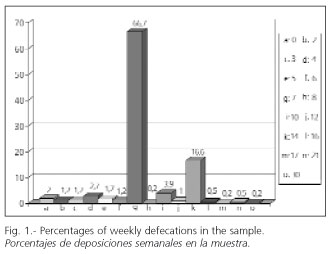
<body><![CDATA[<p><b><font face="Verdana" size="2">Incidence of constipation in Albacete province</font></b></p>     <p><font face="Verdana" size="2">The mean of defecations per week in people over 50 years of age was 8.15 (SD &plusmn; 3.48); 66.7% of participants defecated seven times a week and 16.6% 14 times a week (<a href="#f1">Fig. 1</a>). The proportion of participants who were on a diet was 35%, 84.7% of these because of a disease. There was a remarkable age homogeneity among constipated and non-constipated participants (66.98 &plusmn; 5.84 years and 66.99 &plusmn; 7.17 years, respectively).</font></p>     <p align="center"><font face="Verdana" size="2"><a name="f1"><img src="/img/revistas/diges/v98n6/original5_06.jpg" width="330" height="254"></a></font></p>     <p><font face="Verdana" size="2">Although not statistically significant, there is a slight difference in the mean of defecations between the group over 65 years (8.12) and the group at or below 65 years (8.17%) (<a href="#f2">Fig. 2</a>).</font></p>     <p align="center"><font face="Verdana" size="2"><a name="f2"><img src="/img/revistas/diges/v98n6/original5_05.jpg" width="350" height="227"></a></font></p>    <p>   <font face="Verdana" size="2">   In Albacete province 4.4% of the population over 50 have a bowel habit consistent with constipation, which translates as an incidence of 43.47 patients per 100.000 persons per year.</font></p>    <p>   <font face="Verdana" size="2">   The women:men ratio was 2:1 (<a href="#t1">Table I</a>).</font></p>     <p align="center">&nbsp;</p>     <p align="center"><font face="Verdana" size="2"><a name="t1"><img src="/img/revistas/diges/v98n6/original5_15.jpg" width="330" height="210"></a></font></p>     <p><font face="Verdana" size="2">Of all the participants who reported more than three defecations per week 97.7% had a high intake of virgin olive oil, <i> versus</i> 88.9% of participants with three or less defecations per week who also reported a high intake of virgin olive oil. This difference established a statistically significant relation between both variables (Chi-square = 5.083, 1 d.o.f, p = 0.004) (<a href="#t2">Table II</a>).</font></p>     ]]></body>
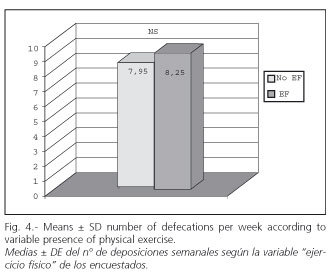
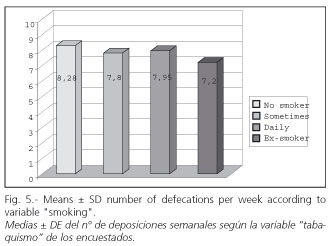
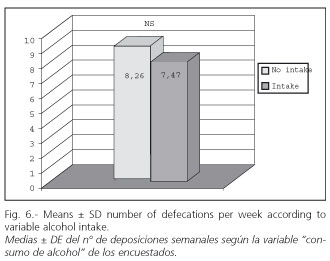
<body><![CDATA[<p align="center"><font face="Verdana" size="2"><a name="t2"><img src="/img/revistas/diges/v98n6/original5_13.jpg" width="324" height="248"></a></font></p>     <p><b><font face="Verdana" size="2">Bivariate relations with the main variable: bowel habits</font></b></p>     <p><font face="Verdana" size="2">The mean of defecations in the subgroup with no disease was 8.26 &plusmn; 2.82 times/week, while the subgroup with a disease had a mean of 8.12 &plusmn; 3.65 time/week. We performed Student's t-test for independent groups but the result was not significant (t = 0.348, 407 d.o.f., p = 0.728) (<a href="#f3">Fig. 3</a>).</font></p>     <p align="center"><font face="Verdana" size="2"><a name="f3"><img src="/img/revistas/diges/v98n6/original5_20.jpg" width="330" height="252"></a></font></p>     <p><font face="Verdana" size="2">Although Student's t-test did not find statistically significant differences (t = -0.831, 405 d.o.f., p = 0.407) the subgroup that habitually took physical exercise had a number of defecations per week (8.25) higher than those who did not (7.95%) (<a href="#f4">Fig. 4</a>).</font></p>     <p align="center"><font face="Verdana" size="2"><a name="f4"><img src="/img/revistas/diges/v98n6/original5_24.jpg" width="330" height="272"></a></font></p>     <p><font face="Verdana" size="2">With regard to smoking, the categorical variable "breaks" the continuous variable in four subgroups, from "non-smoker" to "ex-smoker". This fact leads to high data dispersal, producing subgroups like "occasional smoker" with only five participants. Therefore we had to use non-parametric statistics for mean comparisons in these four subgroups. The subgroup with a higher mean in number of defecations per week was "non-smokers" (8.28), but the difference was non-significant according to the non-parametric Kruskal-Wallis test (Chi-square = 1.992, 3 d.o.f., p = 0.574) (<a href="#f5">Fig. 5</a>).</font></p>     <p align="center"><font face="Verdana" size="2"><a name="f5"><img src="/img/revistas/diges/v98n6/original5_30.jpg" width="330" height="246"></a></font></p>     <p><font face="Verdana" size="2">The ingestion of a toxic substance causes again a fewer number of defecations per week. The mean in the alcohol consumption subgroup is 7.47 while in the subgroup with no consumption is 8.26. However, Student-t test for independent groups did not show significant differences (t = 0.896, 352.790 d.o.f., p = 0.406) (<a href="#f6">Fig. 6</a>).</font></p>     <p align="center"><font face="Verdana" size="2"><a name="f6"><img src="/img/revistas/diges/v98n6/original5_37.jpg" width="330" height="261"></a></font></p>     ]]></body>
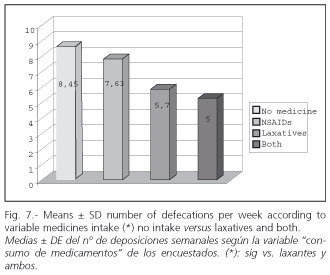
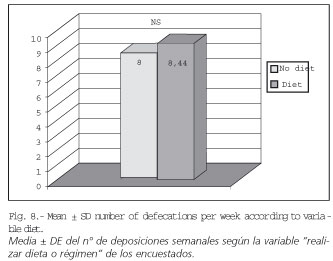
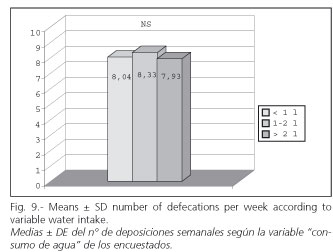
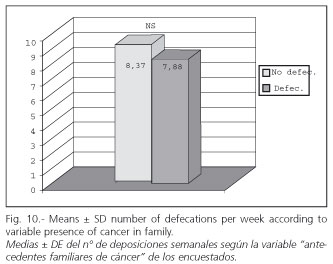
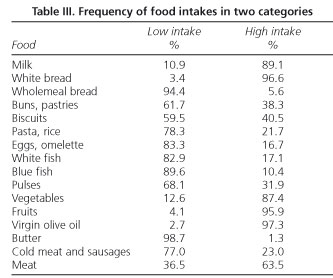
<body><![CDATA[<p><font face="Verdana" size="2">Participants who did not take any medicines had a mean (8.45) higher than the rest. The group who took laxatives as well as NSAIDs had the lowest mean (5). Comparisons between the subgroup who did not take any medications and the subgroups who took only laxatives or laxatives plus NSAIDs resulted in significant differences (<a href="#f7">Fig. 7</a>).</font></p>     <p align="center"><font face="Verdana" size="2"><a name="f7"><img src="/img/revistas/diges/v98n6/original5_41.jpg" width="330" height="275"></a></font></p>     <p><font face="Verdana" size="2">The subgroup that followed some kind of diet had a higher mean (8.44) <i> versus</i> those who did not (8). Notwithstanding, Student's t-test for independent groups yielded no significant difference (t = -1.231, 407 d.o.f., p = 0.219) (<a href="#f8">Fig. 8</a>).</font></p>     <p align="center"><font face="Verdana" size="2"><a name="f8"><img src="/img/revistas/diges/v98n6/original5_21.jpg" width="333" height="261"></a></font></p>     <p><font face="Verdana" size="2">We could see an increase in the mean of defecations per week in the group with moderate water intake (1-2 litres) when compared to the other two groups. According to the one-way ANOVA test, differences between means were not significant (F = 0.450, p = 0.638) (<a href="#f9">Fig. 9</a>).</font></p>     <p align="center"><font face="Verdana" size="2"><a name="f9"><img src="/img/revistas/diges/v98n6/original5_28.jpg" width="333" height="252"></a></font></p>     <p><font face="Verdana" size="2">The subgroup without cancer in the family had a higher mean (8.37), but Student's t-test showed no significant difference (t = 1.426, 407 d.o.f., p = 0.155) (<a href="#f10">Fig. 10</a>).</font></p>     <p align="center"><font face="Verdana" size="2"><a name="f10"><img src="/img/revistas/diges/v98n6/original5_34.jpg" width="333" height="264"></a></font></p>     <p><font face="Verdana" size="2">Persons over 50 years of age in Albacete province have a high intake of milk, white bread, vegetables, fruits, and virgin olive oil (<a href="#t3">Table III</a>).</font></p>     <p align="center"><font face="Verdana" size="2"><a name="t3"><img src="/img/revistas/diges/v98n6/original5_39.jpg" width="333" height="278"></a></font></p>     ]]></body>
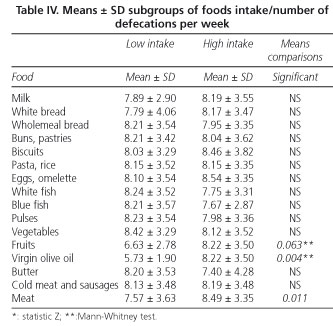
<body><![CDATA[<p><font face="Verdana" size="2">The only significant comparisons were for virgin olive oil (p = 0.004) and meat (p = 0.011). In the case of fruits, results were very close to the confidence level (p = 0.063) (<a href="#t4">Table IV</a>).</font></p>    <p>   <font face="Verdana" size="2">   To sum it up, with a confidence level of at least 95%, participants who more frequently ate fruits, virgin olive oil or meat had a higher mean of defecations per week when compared to the rest of participants, with a significant difference.</font></p>     <p align="center"><font face="Verdana" size="2"><a name="t4"><img src="/img/revistas/diges/v98n6/original5_43.jpg" width="333" height="326"></a></font></p>     <p>&nbsp;</p>     <p><b><font face="Verdana" size="3">Discussion</font></b></p>     <p><font face="Verdana" size="2">Elderly persons have a five times higher probability of suffering constipation when compared to younger persons. In most cases, reasons include diets, lack of physical exercise, use of medicines, and poor bowel habits.</font></p>    <p>   <font face="Verdana" size="2">   In our study the percentage of constipation in Albacete province for persons over 50 years of age was 4.4%, lower than the Spanish mean value (18.4% according to Duphar's Center for Constipation Information) (13).</font></p>    <p>   <font face="Verdana" size="2">   Regarding gender, the proportion is 2.5 constipated women per each man, which is consistent with other studies, while on the subject of age results were very homogeneous (66.98 &plusmn; 5.84 years and 66.99 &plusmn; 7.17 years, respectively). Mean defecations were slightly lower (8.12) in the group aged over 65.</font></p>    <p>   <font face="Verdana" size="2">   Persons over 50 years of age in Albacete province have a healthy lifestyle.</font></p>    <p>   <font face="Verdana" size="2">   The percentage of persons who eat bread or cereals (96.6%), vegetables (87.4%) and fruits (95.9%) is higher than the percentage of persons meeting the recommended allowances for these foods in Spain (bread: 82%, vegetables: 69%, fruits: 64%, according to the Health National Survey 2001) (14).</font></p>    ]]></body>
<body><![CDATA[<p>   <font face="Verdana" size="2">   Participants who ate fruits, virgin olive oil, or meat more frequently significantly increased their mean of defecations per week.</font></p>    <p>   <font face="Verdana" size="2">   These findings confirm existing studies that recommend a varied and balanced diet with a high intake of fruits for their high fiber contents, and virgin olive oil for its lubricant effect, which improves bowel movement and decreases constipation.</font></p>    <p>   <font face="Verdana" size="2">   Number of defecations is higher in persons who do physical exercise than in persons who do not. This is also in agreement with most studies (15-18) in which physical exercise is recommended because it shortens gastrointestinal transit. According to Meshkimpour (19-21) physical exercise does not have an important role in the treatment of constipation but increases colon motility in active persons. The effects of physical exercise are controversial, since most authors have not been able to demonstrate that it increases the frequency or volume of defecations (21).</font></p>    <p>   <font face="Verdana" size="2">   With regard to smoking in our study, the subgroup of non-smokers had a higher number of defecations per week. This is in disagreement with many studies on smoking effects -it seems that smoking, in increasing intestinal motility, should increase the number of defecations (Medline Plus: use of smoking and spit tobacco 2002). However, in our study, participants who did smoke daily had a higher number of defecations per week than ex-smokers.</font></p>    <p>   <font face="Verdana" size="2">   We have observed that, due to its effect on intestinal motility, persons who habitually have alcohol have a fewer number of defecations per week than persons who do not.</font></p>    <p>   <font face="Verdana" size="2">   With regard to use of medications we could observe that participants who did not take any kind of medication had a higher mean of defecations per week versus the rest. On the contrary, those who took laxatives or NSAIDs had a lower mean when compared to the rest of participants (20-23).</font></p>    <p>   <font face="Verdana" size="2">   Comparisons between the group taking no medications and the group using laxatives or laxatives plus NSAIDs were significant. However, the group without medication did not significantly differ from the group with NSAIDs.</font></p>    <p>   <font face="Verdana" size="2">   All this is in agreement with the fact that, on occasion, constipation is secondary to medications and laxative abuse.</font></p>     <p>&nbsp;</p>     <p><b><font face="Verdana" size="3">References</font></b></p>     ]]></body>
<body><![CDATA[<!-- ref --><p><font face="Verdana" size="2">1. Herrer&iacute;as Guti&eacute;rrez JM, Amador Romero FJ. Gastroenterolog&iacute;a y Hepatolog&iacute;a en Atenci&oacute;n Primaria. Madrid: Ediciones Aula M&eacute;dica, S.L.; 2002. p. 187-95.</font>&nbsp;&nbsp;&nbsp;&nbsp;&nbsp;&nbsp;&nbsp;&nbsp;[&#160;<a href="javascript:void(0);" onclick="javascript: window.open('/scielo.php?script=sci_nlinks&ref=5229812&pid=S1130-0108200600060000600001&lng=','','width=640,height=500,resizable=yes,scrollbars=1,menubar=yes,');">Links</a>&#160;]<!-- end-ref --><!-- ref --><p> <font face="Verdana" size="2"> 2. Leonnard-Jones JE. Constipation. In: Feldman M, Scharschmidt BF, Sleisenger MH, editors. Sleisenger and Fordtran's gastrointestinal and liver disease. Pathophysiology, diagnosis, management. 6<sup>th</sup> ed. Philadelphia: W.B. Saunders Company; 1998. p. 174-9.</font>&nbsp;&nbsp;&nbsp;&nbsp;&nbsp;&nbsp;&nbsp;&nbsp;[&#160;<a href="javascript:void(0);" onclick="javascript: window.open('/scielo.php?script=sci_nlinks&ref=5229813&pid=S1130-0108200600060000600002&lng=','','width=640,height=500,resizable=yes,scrollbars=1,menubar=yes,');">Links</a>&#160;]<!-- end-ref --><!-- ref --><p> <font face="Verdana" size="2"> 3. Husui-Ali R, G&oacute;mez Rodr&iacute;guez BJ, Mendoza Olivares FJ, Garc&iacute;a Montes JM, S&aacute;nchez-Gey Venegas S, Herrer&iacute;as Guti&eacute;rrez JM. Medida del tiempo de tr&aacute;nsito col&oacute;nico en el estre&ntilde;imiento cr&oacute;nico idiop&aacute;tico. Rev Esp Enferm Dig 2003; 95: 181-5.</font>&nbsp;&nbsp;&nbsp;&nbsp;&nbsp;&nbsp;&nbsp;&nbsp;[&#160;<a href="javascript:void(0);" onclick="javascript: window.open('/scielo.php?script=sci_nlinks&ref=5229814&pid=S1130-0108200600060000600003&lng=','','width=640,height=500,resizable=yes,scrollbars=1,menubar=yes,');">Links</a>&#160;]<!-- end-ref --><!-- ref --><p> <font face="Verdana" size="2"> 4. Benages A. Valoraci&oacute;n del tiempo de transito col&oacute;nico en los pacientes con estre&ntilde;imiento cr&oacute;nico idiop&aacute;tico. Rev Esp Enferm Dig 2003; 95: 171-5.</font>&nbsp;&nbsp;&nbsp;&nbsp;&nbsp;&nbsp;&nbsp;&nbsp;[&#160;<a href="javascript:void(0);" onclick="javascript: window.open('/scielo.php?script=sci_nlinks&ref=5229815&pid=S1130-0108200600060000600004&lng=','','width=640,height=500,resizable=yes,scrollbars=1,menubar=yes,');">Links</a>&#160;]<!-- end-ref --><!-- ref --><p> <font face="Verdana" size="2"> 5. Moreno-Osset E, Ballester Fayos J, A&ntilde;&oacute;n Rodr&iacute;guez R. Estre&ntilde;imiento. In: Vilardell F, Rod&eacute;s J, Malagelada JR, Pajares JM, P&eacute;rez Mota A, Moreno Gonz&aacute;lez E, Puig la Calle J, editores. Enfermedades Digestivas. Madrid: Grupo Aula M&eacute;dica S.A.; 1998. p. 883-96.</font> &nbsp;&nbsp;&nbsp;&nbsp;&nbsp;&nbsp;&nbsp;&nbsp;[&#160;<a href="javascript:void(0);" onclick="javascript: window.open('/scielo.php?script=sci_nlinks&ref=5229816&pid=S1130-0108200600060000600005&lng=','','width=640,height=500,resizable=yes,scrollbars=1,menubar=yes,');">Links</a>&#160;]<!-- end-ref --><!-- ref --><p> <font face="Verdana" size="2"> 6. Wald A. Approach to the patient with constipation. In: Yamada T, Alpers DH, Laine L, Owyang C, Powell DW, editors. Textbook of gastroenterology. 3<sup>rd</sup> ed. Filadelfia: Lippincott Williams and Wilkins; 1999. p. 910-26.</font> &nbsp;&nbsp;&nbsp;&nbsp;&nbsp;&nbsp;&nbsp;&nbsp;[&#160;<a href="javascript:void(0);" onclick="javascript: window.open('/scielo.php?script=sci_nlinks&ref=5229817&pid=S1130-0108200600060000600006&lng=','','width=640,height=500,resizable=yes,scrollbars=1,menubar=yes,');">Links</a>&#160;]<!-- end-ref --><!-- ref --><p> <font face="Verdana" size="2"> 7. Moreno-Osset E, Ballester Fayos J, Ant&oacute;n Conejero MD. Manometr&iacute;a col&oacute;nica. In: Vilardell F, Rod&eacute;s J, Malagelada JR, Pajares JM, P&eacute;rez Mota A, Moreno Gonz&aacute;lez E, Puig la Calle J, editores. Enfermedades Digestivas. Madrid: Grupo Aula M&eacute;dica S.A.; 1998. p. 871-82.</font>&nbsp;&nbsp;&nbsp;&nbsp;&nbsp;&nbsp;&nbsp;&nbsp;[&#160;<a href="javascript:void(0);" onclick="javascript: window.open('/scielo.php?script=sci_nlinks&ref=5229818&pid=S1130-0108200600060000600007&lng=','','width=640,height=500,resizable=yes,scrollbars=1,menubar=yes,');">Links</a>&#160;]<!-- end-ref --><!-- ref --><p> <font face="Verdana" size="2"> 8. Read NW, Timms JM. Defecation and the pathophysiology of constipation. Clin Gastroenterol 1986; 15: 937-65.</font>&nbsp;&nbsp;&nbsp;&nbsp;&nbsp;&nbsp;&nbsp;&nbsp;[&#160;<a href="javascript:void(0);" onclick="javascript: window.open('/scielo.php?script=sci_nlinks&ref=5229819&pid=S1130-0108200600060000600008&lng=','','width=640,height=500,resizable=yes,scrollbars=1,menubar=yes,');">Links</a>&#160;]<!-- end-ref --><!-- ref --><p> <font face="Verdana" size="2"> 9. Cummings JH. Constipation, dietary fibre and the control of large bowel function. Postgrad Med J 1984; 60: 811-9.</font>&nbsp;&nbsp;&nbsp;&nbsp;&nbsp;&nbsp;&nbsp;&nbsp;[&#160;<a href="javascript:void(0);" onclick="javascript: window.open('/scielo.php?script=sci_nlinks&ref=5229820&pid=S1130-0108200600060000600009&lng=','','width=640,height=500,resizable=yes,scrollbars=1,menubar=yes,');">Links</a>&#160;]<!-- end-ref --><!-- ref --><p>   <font face="Verdana" size="2">   10. Calvo Boigues B. H&aacute;bito intestinal y epidemiolog&iacute;a de los trastornos funcionales intestinales. Estudio poblacional &#091;dissertation&#093;. Valencia: Universitat de Valencia; 1994.</font>&nbsp;&nbsp;&nbsp;&nbsp;&nbsp;&nbsp;&nbsp;&nbsp;[&#160;<a href="javascript:void(0);" onclick="javascript: window.open('/scielo.php?script=sci_nlinks&ref=5229821&pid=S1130-0108200600060000600010&lng=','','width=640,height=500,resizable=yes,scrollbars=1,menubar=yes,');">Links</a>&#160;]<!-- end-ref --><!-- ref --><p>   <font face="Verdana" size="2">   11. Sonnenberg A, Koch TR. Physicians visits in the United Status for constipation: 1958-1986. Dig Dis Sci 1989; 34: 606-11.</font>&nbsp;&nbsp;&nbsp;&nbsp;&nbsp;&nbsp;&nbsp;&nbsp;[&#160;<a href="javascript:void(0);" onclick="javascript: window.open('/scielo.php?script=sci_nlinks&ref=5229822&pid=S1130-0108200600060000600011&lng=','','width=640,height=500,resizable=yes,scrollbars=1,menubar=yes,');">Links</a>&#160;]<!-- end-ref --><!-- ref --><p>   <font face="Verdana" size="2">   12. Moreno-Osset E, Ballester Fayos J, A&ntilde;&oacute;n Rodr&iacute;guez R. Estre&ntilde;imiento cr&oacute;nico idiop&aacute;tico. Rev And Pat Digest 1996; 19: 249-57.</font>&nbsp;&nbsp;&nbsp;&nbsp;&nbsp;&nbsp;&nbsp;&nbsp;[&#160;<a href="javascript:void(0);" onclick="javascript: window.open('/scielo.php?script=sci_nlinks&ref=5229823&pid=S1130-0108200600060000600012&lng=','','width=640,height=500,resizable=yes,scrollbars=1,menubar=yes,');">Links</a>&#160;]<!-- end-ref --><!-- ref --><p>   <font face="Verdana" size="2">   13. Bixquert M. Estre&ntilde;imiento del adulto. In: Bixquert M, L&oacute;pez C, Sastre A y Serrano P, editores. La consulta diaria en el estre&ntilde;imiento cr&oacute;nico. Madrid: Masson; 2000. p. 23-49.</font>&nbsp;&nbsp;&nbsp;&nbsp;&nbsp;&nbsp;&nbsp;&nbsp;[&#160;<a href="javascript:void(0);" onclick="javascript: window.open('/scielo.php?script=sci_nlinks&ref=5229824&pid=S1130-0108200600060000600013&lng=','','width=640,height=500,resizable=yes,scrollbars=1,menubar=yes,');">Links</a>&#160;]<!-- end-ref --><!-- ref --><p>   <font face="Verdana" size="2">   14. G&aacute;lvez C, Garrigues V, Ortiz V, Ponce J. Estre&ntilde;imiento cr&oacute;nico (EC). Un estudio de prevalencia en la poblaci&oacute;n general. Rev Sdad Valenciana Patol Dig 1999; 18: 125-6.</font>&nbsp;&nbsp;&nbsp;&nbsp;&nbsp;&nbsp;&nbsp;&nbsp;[&#160;<a href="javascript:void(0);" onclick="javascript: window.open('/scielo.php?script=sci_nlinks&ref=5229825&pid=S1130-0108200600060000600014&lng=','','width=640,height=500,resizable=yes,scrollbars=1,menubar=yes,');">Links</a>&#160;]<!-- end-ref --><!-- ref --><p>   <font face="Verdana" size="2">   15. Devroede G. Constipation. In: Kumar D, Wingate D, editors. An illustrated guide to Gastrointestinal motility.   2<sup>nd</sup> ed. Edimburgo: Churchill Livingstone; 1993. p. 595-654.</font>&nbsp;&nbsp;&nbsp;&nbsp;&nbsp;&nbsp;&nbsp;&nbsp;[&#160;<a href="javascript:void(0);" onclick="javascript: window.open('/scielo.php?script=sci_nlinks&ref=5229826&pid=S1130-0108200600060000600015&lng=','','width=640,height=500,resizable=yes,scrollbars=1,menubar=yes,');">Links</a>&#160;]<!-- end-ref --><!-- ref --><p>   <font face="Verdana" size="2">   16. Ministerio de Sanidad y Consumo. Encuesta Nacional de Salud de 1987, 1993, 1997 y 2001. Madrid.</font>&nbsp;&nbsp;&nbsp;&nbsp;&nbsp;&nbsp;&nbsp;&nbsp;[&#160;<a href="javascript:void(0);" onclick="javascript: window.open('/scielo.php?script=sci_nlinks&ref=5229827&pid=S1130-0108200600060000600016&lng=','','width=640,height=500,resizable=yes,scrollbars=1,menubar=yes,');">Links</a>&#160;]<!-- end-ref --><!-- ref --><p>   <font face="Verdana" size="2">   17. Mart&iacute;n Zurro A, Gil Canalda I. Claves Cl&iacute;nicas en Medicina de Familia. Aparato digestivo. Barcelona: Editorial Masson, S.A.; 2000. p. 56-7.</font>&nbsp;&nbsp;&nbsp;&nbsp;&nbsp;&nbsp;&nbsp;&nbsp;[&#160;<a href="javascript:void(0);" onclick="javascript: window.open('/scielo.php?script=sci_nlinks&ref=5229828&pid=S1130-0108200600060000600017&lng=','','width=640,height=500,resizable=yes,scrollbars=1,menubar=yes,');">Links</a>&#160;]<!-- end-ref --><!-- ref --><p>   <font face="Verdana" size="2">   18. Harrinson RL, Leeds AR, Bolster NR, Judd PA. Exercise and wheat bran; effect on whole gut transit. Proc Nutr Soc 1980; 39: 22-3.</font>&nbsp;&nbsp;&nbsp;&nbsp;&nbsp;&nbsp;&nbsp;&nbsp;[&#160;<a href="javascript:void(0);" onclick="javascript: window.open('/scielo.php?script=sci_nlinks&ref=5229829&pid=S1130-0108200600060000600018&lng=','','width=640,height=500,resizable=yes,scrollbars=1,menubar=yes,');">Links</a>&#160;]<!-- end-ref --><!-- ref --><p>   <font face="Verdana" size="2">   19. Cordain L, Latin RW, Behnke JJ. The effects of an aerobic running program on bowel transit time. J Sports Med 1986; 26: 101-4.</font>&nbsp;&nbsp;&nbsp;&nbsp;&nbsp;&nbsp;&nbsp;&nbsp;[&#160;<a href="javascript:void(0);" onclick="javascript: window.open('/scielo.php?script=sci_nlinks&ref=5229830&pid=S1130-0108200600060000600019&lng=','','width=640,height=500,resizable=yes,scrollbars=1,menubar=yes,');">Links</a>&#160;]<!-- end-ref --><!-- ref --><p>   <font face="Verdana" size="2">   20. Holdstock DJ, Misiewicz JJ, Smith T, Rowlands E. Propulsion (mass movement) in the human colon and its relationship to meals and somatic activity. Gut 1970; 11: 91-9.</font>&nbsp;&nbsp;&nbsp;&nbsp;&nbsp;&nbsp;&nbsp;&nbsp;[&#160;<a href="javascript:void(0);" onclick="javascript: window.open('/scielo.php?script=sci_nlinks&ref=5229831&pid=S1130-0108200600060000600020&lng=','','width=640,height=500,resizable=yes,scrollbars=1,menubar=yes,');">Links</a>&#160;]<!-- end-ref --><!-- ref --><p>   <font face="Verdana" size="2">   21. Meshkinpour H, Kemp C, Fairshter R. Effects of aerobics exercise on mouth-to-cecum transit time. Gastroenterology 1989; 96: 938-41.</font>&nbsp;&nbsp;&nbsp;&nbsp;&nbsp;&nbsp;&nbsp;&nbsp;[&#160;<a href="javascript:void(0);" onclick="javascript: window.open('/scielo.php?script=sci_nlinks&ref=5229832&pid=S1130-0108200600060000600021&lng=','','width=640,height=500,resizable=yes,scrollbars=1,menubar=yes,');">Links</a>&#160;]<!-- end-ref --><!-- ref --><p>   <font face="Verdana" size="2">   22. Robertson G, Meshkinpour H, Vandenberg K, Cohen A, Wilson A. Effects of exercise on total and segmental colon transit. J Clin Gastroenterol 1993; 16: 300-3.</font>&nbsp;&nbsp;&nbsp;&nbsp;&nbsp;&nbsp;&nbsp;&nbsp;[&#160;<a href="javascript:void(0);" onclick="javascript: window.open('/scielo.php?script=sci_nlinks&ref=5229833&pid=S1130-0108200600060000600022&lng=','','width=640,height=500,resizable=yes,scrollbars=1,menubar=yes,');">Links</a>&#160;]<!-- end-ref --><!-- ref --><p>   <font face="Verdana" size="2">   23. Meshkinpour H, Selod S, Movahedi H, Nami N, James N, Wilson A. Effects of regular exercise in management of chronic idiopathic constipation. Dig Dis Scie 1998; 43: 2379-83.</font>&nbsp;&nbsp;&nbsp;&nbsp;&nbsp;&nbsp;&nbsp;&nbsp;[&#160;<a href="javascript:void(0);" onclick="javascript: window.open('/scielo.php?script=sci_nlinks&ref=5229834&pid=S1130-0108200600060000600023&lng=','','width=640,height=500,resizable=yes,scrollbars=1,menubar=yes,');">Links</a>&#160;]<!-- end-ref --><p>&nbsp;</p>     <p>&nbsp;</p>     <p><font face="Verdana" size="2"><b><a href="#top"><img border="0" src="/img/revistas/diges/v98n6/seta.gif" width="15" height="17"></a><a name="back"></a>Correspondence:    <br> </b>Pedro J. Tárraga López.    <br> C/ Ángel, 53, 1ºE,&nbsp;    <br>  02002 Albacete.    <br> Fax: 967 520 526     ]]></body>
<body><![CDATA[<br> e-mail: <a href="mailto:pjtarraga@sescam.jccm.es">pjtarraga@sescam.jccm.es</a></font></p>     <p><font face="Verdana" size="2">Recibido: 04-11-05    <br> Aceptado: 23-01-06</font></p>      ]]></body><back>
<ref-list>
<ref id="B1">
<label>1</label><nlm-citation citation-type="book">
<person-group person-group-type="author">
<name>
<surname><![CDATA[Herrerías Gutiérrez]]></surname>
<given-names><![CDATA[JM]]></given-names>
</name>
<name>
<surname><![CDATA[Amador Romero]]></surname>
<given-names><![CDATA[FJ]]></given-names>
</name>
</person-group>
<source><![CDATA[Gastroenterología y Hepatología en Atención Primaria]]></source>
<year>2002</year>
<page-range>187-95</page-range><publisher-loc><![CDATA[Madrid ]]></publisher-loc>
<publisher-name><![CDATA[Ediciones Aula Médica, S.L.]]></publisher-name>
</nlm-citation>
</ref>
<ref id="B2">
<label>2</label><nlm-citation citation-type="book">
<person-group person-group-type="author">
<name>
<surname><![CDATA[Leonnard-Jones]]></surname>
<given-names><![CDATA[JE.]]></given-names>
</name>
</person-group>
<article-title xml:lang="en"><![CDATA[Constipation]]></article-title>
<person-group person-group-type="editor">
<name>
<surname><![CDATA[Feldman]]></surname>
<given-names><![CDATA[M]]></given-names>
</name>
<name>
<surname><![CDATA[Scharschmidt]]></surname>
<given-names><![CDATA[BF]]></given-names>
</name>
<name>
<surname><![CDATA[Sleisenger]]></surname>
<given-names><![CDATA[MH]]></given-names>
</name>
</person-group>
<source><![CDATA[Sleisenger and Fordtran's gastrointestinal and liver disease: Pathophysiology, diagnosis, management]]></source>
<year>1998</year>
<edition>6</edition>
<page-range>174-9</page-range><publisher-loc><![CDATA[Philadelphia ]]></publisher-loc>
<publisher-name><![CDATA[W.B. Saunders Company]]></publisher-name>
</nlm-citation>
</ref>
<ref id="B3">
<label>3</label><nlm-citation citation-type="journal">
<person-group person-group-type="author">
<name>
<surname><![CDATA[Husui-Ali]]></surname>
<given-names><![CDATA[R]]></given-names>
</name>
<name>
<surname><![CDATA[Gómez Rodríguez]]></surname>
<given-names><![CDATA[BJ]]></given-names>
</name>
<name>
<surname><![CDATA[Mendoza Olivares]]></surname>
<given-names><![CDATA[FJ]]></given-names>
</name>
<name>
<surname><![CDATA[García Montes]]></surname>
<given-names><![CDATA[JM]]></given-names>
</name>
<name>
<surname><![CDATA[Sánchez-Gey Venegas]]></surname>
<given-names><![CDATA[S]]></given-names>
</name>
<name>
<surname><![CDATA[Herrerías Gutiérrez]]></surname>
<given-names><![CDATA[JM]]></given-names>
</name>
</person-group>
<article-title xml:lang="es"><![CDATA[Medida del tiempo de tránsito colónico en el estreñimiento crónico idiopático]]></article-title>
<source><![CDATA[Rev Esp Enferm Dig]]></source>
<year>2003</year>
<volume>95</volume>
<page-range>181-5</page-range></nlm-citation>
</ref>
<ref id="B4">
<label>4</label><nlm-citation citation-type="journal">
<person-group person-group-type="author">
<name>
<surname><![CDATA[Benages]]></surname>
<given-names><![CDATA[A]]></given-names>
</name>
</person-group>
<article-title xml:lang="es"><![CDATA[Valoración del tiempo de transito colónico en los pacientes con estreñimiento crónico idiopático]]></article-title>
<source><![CDATA[Rev Esp Enferm Dig]]></source>
<year>2003</year>
<volume>95</volume>
<page-range>171-5</page-range></nlm-citation>
</ref>
<ref id="B5">
<label>5</label><nlm-citation citation-type="book">
<person-group person-group-type="author">
<name>
<surname><![CDATA[Moreno-Osset]]></surname>
<given-names><![CDATA[E]]></given-names>
</name>
<name>
<surname><![CDATA[Ballester Fayos]]></surname>
<given-names><![CDATA[J]]></given-names>
</name>
<name>
<surname><![CDATA[Añón Rodríguez]]></surname>
<given-names><![CDATA[R]]></given-names>
</name>
</person-group>
<article-title xml:lang="es"><![CDATA[Estreñimiento]]></article-title>
<person-group person-group-type="editor">
<name>
<surname><![CDATA[Vilardell]]></surname>
<given-names><![CDATA[F]]></given-names>
</name>
<name>
<surname><![CDATA[Rodés]]></surname>
<given-names><![CDATA[J]]></given-names>
</name>
<name>
<surname><![CDATA[Malagelada]]></surname>
<given-names><![CDATA[JR]]></given-names>
</name>
<name>
<surname><![CDATA[Pajares]]></surname>
<given-names><![CDATA[JM]]></given-names>
</name>
<name>
<surname><![CDATA[Pérez Mota]]></surname>
<given-names><![CDATA[A]]></given-names>
</name>
<name>
<surname><![CDATA[Moreno González]]></surname>
<given-names><![CDATA[E]]></given-names>
</name>
<name>
<surname><![CDATA[Puig la Calle]]></surname>
<given-names><![CDATA[J]]></given-names>
</name>
</person-group>
<source><![CDATA[Enfermedades Digestivas]]></source>
<year>1998</year>
<page-range>883-96</page-range><publisher-loc><![CDATA[Madrid ]]></publisher-loc>
<publisher-name><![CDATA[Grupo Aula Médica]]></publisher-name>
</nlm-citation>
</ref>
<ref id="B6">
<label>6</label><nlm-citation citation-type="book">
<person-group person-group-type="author">
<name>
<surname><![CDATA[Wald]]></surname>
<given-names><![CDATA[A.]]></given-names>
</name>
</person-group>
<article-title xml:lang="en"><![CDATA[Approach to the patient with constipation]]></article-title>
<person-group person-group-type="editor">
<name>
<surname><![CDATA[Yamada]]></surname>
<given-names><![CDATA[T]]></given-names>
</name>
<name>
<surname><![CDATA[Alpers]]></surname>
<given-names><![CDATA[DH]]></given-names>
</name>
<name>
<surname><![CDATA[Laine]]></surname>
<given-names><![CDATA[L]]></given-names>
</name>
<name>
<surname><![CDATA[Owyang]]></surname>
<given-names><![CDATA[C]]></given-names>
</name>
<name>
<surname><![CDATA[Powell]]></surname>
<given-names><![CDATA[DW]]></given-names>
</name>
</person-group>
<source><![CDATA[Textbook of gastroenterology]]></source>
<year>1999</year>
<edition>3</edition>
<page-range>910-26</page-range><publisher-loc><![CDATA[Filadelfia ]]></publisher-loc>
<publisher-name><![CDATA[Lippincott Williams and Wilkins]]></publisher-name>
</nlm-citation>
</ref>
<ref id="B7">
<label>7</label><nlm-citation citation-type="book">
<person-group person-group-type="author">
<name>
<surname><![CDATA[Moreno-Osset]]></surname>
<given-names><![CDATA[E]]></given-names>
</name>
<name>
<surname><![CDATA[Ballester Fayos]]></surname>
<given-names><![CDATA[J]]></given-names>
</name>
<name>
<surname><![CDATA[Antón Conejero]]></surname>
<given-names><![CDATA[MD]]></given-names>
</name>
</person-group>
<article-title xml:lang="es"><![CDATA[Manometría colónica]]></article-title>
<person-group person-group-type="editor">
<name>
<surname><![CDATA[Vilardell]]></surname>
<given-names><![CDATA[F]]></given-names>
</name>
<name>
<surname><![CDATA[Rodés]]></surname>
<given-names><![CDATA[J]]></given-names>
</name>
<name>
<surname><![CDATA[Malagelada]]></surname>
<given-names><![CDATA[JR]]></given-names>
</name>
<name>
<surname><![CDATA[Pajares]]></surname>
<given-names><![CDATA[JM]]></given-names>
</name>
<name>
<surname><![CDATA[Pérez Mota]]></surname>
<given-names><![CDATA[A]]></given-names>
</name>
<name>
<surname><![CDATA[Moreno González]]></surname>
<given-names><![CDATA[E]]></given-names>
</name>
<name>
<surname><![CDATA[Puig la Calle]]></surname>
<given-names><![CDATA[J]]></given-names>
</name>
</person-group>
<source><![CDATA[Enfermedades Digestivas]]></source>
<year>1998</year>
<page-range>871-82</page-range><publisher-loc><![CDATA[Madrid ]]></publisher-loc>
<publisher-name><![CDATA[Grupo Aula Médica]]></publisher-name>
</nlm-citation>
</ref>
<ref id="B8">
<label>8</label><nlm-citation citation-type="journal">
<person-group person-group-type="author">
<name>
<surname><![CDATA[Read]]></surname>
<given-names><![CDATA[NW]]></given-names>
</name>
<name>
<surname><![CDATA[Timms]]></surname>
<given-names><![CDATA[JM]]></given-names>
</name>
</person-group>
<article-title xml:lang="en"><![CDATA[Defecation and the pathophysiology of constipation]]></article-title>
<source><![CDATA[Clin Gastroenterol]]></source>
<year>1986</year>
<volume>15</volume>
<page-range>937-65</page-range></nlm-citation>
</ref>
<ref id="B9">
<label>9</label><nlm-citation citation-type="journal">
<person-group person-group-type="author">
<name>
<surname><![CDATA[Cummings]]></surname>
<given-names><![CDATA[JH]]></given-names>
</name>
</person-group>
<article-title xml:lang="en"><![CDATA[Constipation, dietary fibre and the control of large bowel function]]></article-title>
<source><![CDATA[Postgrad Med J]]></source>
<year>1984</year>
<volume>60</volume>
<page-range>811-9</page-range></nlm-citation>
</ref>
<ref id="B10">
<label>10</label><nlm-citation citation-type="book">
<person-group person-group-type="author">
<name>
<surname><![CDATA[Calvo Boigues]]></surname>
<given-names><![CDATA[B]]></given-names>
</name>
</person-group>
<source><![CDATA[Hábito intestinal y epidemiología de los trastornos funcionales intestinales: Estudio poblacional]]></source>
<year>1994</year>
<publisher-loc><![CDATA[Valencia ]]></publisher-loc>
<publisher-name><![CDATA[Universitat de Valencia]]></publisher-name>
</nlm-citation>
</ref>
<ref id="B11">
<label>11</label><nlm-citation citation-type="journal">
<person-group person-group-type="author">
<name>
<surname><![CDATA[Sonnenberg]]></surname>
<given-names><![CDATA[A]]></given-names>
</name>
<name>
<surname><![CDATA[Koch]]></surname>
<given-names><![CDATA[TR]]></given-names>
</name>
</person-group>
<article-title xml:lang="en"><![CDATA[Physicians visits in the United Status for constipation: 1958-1986]]></article-title>
<source><![CDATA[Dig Dis Sci]]></source>
<year>1989</year>
<volume>34</volume>
<page-range>606-11</page-range></nlm-citation>
</ref>
<ref id="B12">
<label>12</label><nlm-citation citation-type="journal">
<person-group person-group-type="author">
<name>
<surname><![CDATA[Moreno-Osset]]></surname>
<given-names><![CDATA[E]]></given-names>
</name>
<name>
<surname><![CDATA[Ballester Fayos]]></surname>
<given-names><![CDATA[J]]></given-names>
</name>
<name>
<surname><![CDATA[Añón Rodríguez]]></surname>
<given-names><![CDATA[R]]></given-names>
</name>
</person-group>
<article-title xml:lang="es"><![CDATA[Estreñimiento crónico idiopático]]></article-title>
<source><![CDATA[Rev And Pat Digest]]></source>
<year>1996</year>
<volume>19</volume>
<page-range>249-57</page-range></nlm-citation>
</ref>
<ref id="B13">
<label>13</label><nlm-citation citation-type="book">
<person-group person-group-type="author">
<name>
<surname><![CDATA[Bixquert]]></surname>
<given-names><![CDATA[M]]></given-names>
</name>
</person-group>
<article-title xml:lang="es"><![CDATA[Estreñimiento del adulto]]></article-title>
<person-group person-group-type="editor">
<name>
<surname><![CDATA[Bixquert]]></surname>
<given-names><![CDATA[M]]></given-names>
</name>
<name>
<surname><![CDATA[López]]></surname>
<given-names><![CDATA[C]]></given-names>
</name>
<name>
<surname><![CDATA[Sastre]]></surname>
<given-names><![CDATA[A]]></given-names>
</name>
<name>
<surname><![CDATA[Serrano]]></surname>
<given-names><![CDATA[P]]></given-names>
</name>
</person-group>
<source><![CDATA[La consulta diaria en el estreñimiento crónico]]></source>
<year>2000</year>
<page-range>23-49</page-range><publisher-loc><![CDATA[Madrid ]]></publisher-loc>
<publisher-name><![CDATA[Masson]]></publisher-name>
</nlm-citation>
</ref>
<ref id="B14">
<label>14</label><nlm-citation citation-type="journal">
<person-group person-group-type="author">
<name>
<surname><![CDATA[Gálvez]]></surname>
<given-names><![CDATA[C]]></given-names>
</name>
<name>
<surname><![CDATA[Garrigues]]></surname>
<given-names><![CDATA[V]]></given-names>
</name>
<name>
<surname><![CDATA[Ortiz]]></surname>
<given-names><![CDATA[V]]></given-names>
</name>
<name>
<surname><![CDATA[Ponce]]></surname>
<given-names><![CDATA[J]]></given-names>
</name>
</person-group>
<article-title xml:lang="es"><![CDATA[Estreñimiento crónico (EC): Un estudio de prevalencia en la población general]]></article-title>
<source><![CDATA[Rev Sdad Valenciana Patol Dig]]></source>
<year>1999</year>
<volume>18</volume>
<page-range>125-6</page-range></nlm-citation>
</ref>
<ref id="B15">
<label>15</label><nlm-citation citation-type="book">
<person-group person-group-type="author">
<name>
<surname><![CDATA[Devroede]]></surname>
<given-names><![CDATA[G.]]></given-names>
</name>
</person-group>
<article-title xml:lang="en"><![CDATA[Constipation]]></article-title>
<person-group person-group-type="editor">
<name>
<surname><![CDATA[Kumar]]></surname>
<given-names><![CDATA[D]]></given-names>
</name>
<name>
<surname><![CDATA[Wingate]]></surname>
<given-names><![CDATA[D]]></given-names>
</name>
</person-group>
<source><![CDATA[An illustrated guide to Gastrointestinal motility]]></source>
<year>1993</year>
<edition>2</edition>
<page-range>595-654</page-range><publisher-loc><![CDATA[Edimburgo ]]></publisher-loc>
<publisher-name><![CDATA[Churchill Livingstone]]></publisher-name>
</nlm-citation>
</ref>
<ref id="B16">
<label>16</label><nlm-citation citation-type="">
<collab>Ministerio de Sanidad y Consumo</collab>
<source><![CDATA[Encuesta Nacional de Salud de 1987, 1993, 1997 y 2001]]></source>
<year></year>
<publisher-loc><![CDATA[Madrid ]]></publisher-loc>
</nlm-citation>
</ref>
<ref id="B17">
<label>17</label><nlm-citation citation-type="book">
<person-group person-group-type="author">
<name>
<surname><![CDATA[Martín Zurro]]></surname>
<given-names><![CDATA[A]]></given-names>
</name>
<name>
<surname><![CDATA[Gil Canalda]]></surname>
<given-names><![CDATA[I]]></given-names>
</name>
</person-group>
<source><![CDATA[Claves Clínicas en Medicina de Familia: Aparato digestivo]]></source>
<year>2000</year>
<page-range>56-7</page-range><publisher-loc><![CDATA[Barcelona ]]></publisher-loc>
<publisher-name><![CDATA[Editorial Masson]]></publisher-name>
</nlm-citation>
</ref>
<ref id="B18">
<label>18</label><nlm-citation citation-type="journal">
<person-group person-group-type="author">
<name>
<surname><![CDATA[Harrinson]]></surname>
<given-names><![CDATA[RL]]></given-names>
</name>
<name>
<surname><![CDATA[Leeds]]></surname>
<given-names><![CDATA[AR]]></given-names>
</name>
<name>
<surname><![CDATA[Bolster]]></surname>
<given-names><![CDATA[NR]]></given-names>
</name>
<name>
<surname><![CDATA[Judd]]></surname>
<given-names><![CDATA[PA]]></given-names>
</name>
</person-group>
<article-title xml:lang="en"><![CDATA[Exercise and wheat bran; effect on whole gut transit]]></article-title>
<source><![CDATA[Proc Nutr Soc]]></source>
<year>1980</year>
<volume>39</volume>
<page-range>22-3</page-range></nlm-citation>
</ref>
<ref id="B19">
<label>19</label><nlm-citation citation-type="journal">
<person-group person-group-type="author">
<name>
<surname><![CDATA[Cordain]]></surname>
<given-names><![CDATA[L]]></given-names>
</name>
<name>
<surname><![CDATA[Latin]]></surname>
<given-names><![CDATA[RW]]></given-names>
</name>
<name>
<surname><![CDATA[Behnke]]></surname>
<given-names><![CDATA[JJ]]></given-names>
</name>
</person-group>
<article-title xml:lang="en"><![CDATA[The effects of an aerobic running program on bowel transit time]]></article-title>
<source><![CDATA[J Sports Med]]></source>
<year>1986</year>
<volume>26</volume>
<page-range>101-4</page-range></nlm-citation>
</ref>
<ref id="B20">
<label>20</label><nlm-citation citation-type="journal">
<person-group person-group-type="author">
<name>
<surname><![CDATA[Holdstock]]></surname>
<given-names><![CDATA[DJ]]></given-names>
</name>
<name>
<surname><![CDATA[Misiewicz]]></surname>
<given-names><![CDATA[JJ]]></given-names>
</name>
<name>
<surname><![CDATA[Smith]]></surname>
<given-names><![CDATA[T]]></given-names>
</name>
<name>
<surname><![CDATA[Rowlands]]></surname>
<given-names><![CDATA[E]]></given-names>
</name>
</person-group>
<article-title xml:lang="en"><![CDATA[Propulsion (mass movement) in the human colon and its relationship to meals and somatic activity]]></article-title>
<source><![CDATA[Gut]]></source>
<year>1970</year>
<volume>11</volume>
<page-range>91-9</page-range></nlm-citation>
</ref>
<ref id="B21">
<label>21</label><nlm-citation citation-type="journal">
<person-group person-group-type="author">
<name>
<surname><![CDATA[Meshkinpour]]></surname>
<given-names><![CDATA[H]]></given-names>
</name>
<name>
<surname><![CDATA[Kemp]]></surname>
<given-names><![CDATA[C]]></given-names>
</name>
<name>
<surname><![CDATA[Fairshter]]></surname>
<given-names><![CDATA[R]]></given-names>
</name>
</person-group>
<article-title xml:lang="en"><![CDATA[Effects of aerobics exercise on mouth-to-cecum transit time]]></article-title>
<source><![CDATA[Gastroenterology]]></source>
<year>1989</year>
<volume>96</volume>
<page-range>938-41</page-range></nlm-citation>
</ref>
<ref id="B22">
<label>22</label><nlm-citation citation-type="journal">
<person-group person-group-type="author">
<name>
<surname><![CDATA[Robertson]]></surname>
<given-names><![CDATA[G]]></given-names>
</name>
<name>
<surname><![CDATA[Meshkinpour]]></surname>
<given-names><![CDATA[H]]></given-names>
</name>
<name>
<surname><![CDATA[Vandenberg]]></surname>
<given-names><![CDATA[K]]></given-names>
</name>
<name>
<surname><![CDATA[Cohen]]></surname>
<given-names><![CDATA[A]]></given-names>
</name>
<name>
<surname><![CDATA[Wilson]]></surname>
<given-names><![CDATA[A]]></given-names>
</name>
</person-group>
<article-title xml:lang="en"><![CDATA[Effects of exercise on total and segmental colon transit]]></article-title>
<source><![CDATA[J Clin Gastroenterol]]></source>
<year>1993</year>
<volume>16</volume>
<page-range>300-3</page-range></nlm-citation>
</ref>
<ref id="B23">
<label>23</label><nlm-citation citation-type="journal">
<person-group person-group-type="author">
<name>
<surname><![CDATA[Meshkinpour]]></surname>
<given-names><![CDATA[H]]></given-names>
</name>
<name>
<surname><![CDATA[Selod]]></surname>
<given-names><![CDATA[S]]></given-names>
</name>
<name>
<surname><![CDATA[Movahedi]]></surname>
<given-names><![CDATA[H]]></given-names>
</name>
<name>
<surname><![CDATA[Nami]]></surname>
<given-names><![CDATA[N]]></given-names>
</name>
<name>
<surname><![CDATA[James]]></surname>
<given-names><![CDATA[N]]></given-names>
</name>
<name>
<surname><![CDATA[Wilson]]></surname>
<given-names><![CDATA[A]]></given-names>
</name>
</person-group>
<article-title xml:lang="en"><![CDATA[Effects of regular exercise in management of chronic idiopathic constipation]]></article-title>
<source><![CDATA[Dig Dis Scie]]></source>
<year>1998</year>
<volume>43</volume>
<page-range>2379-83</page-range></nlm-citation>
</ref>
</ref-list>
</back>
</article>