<?xml version="1.0" encoding="ISO-8859-1"?><article xmlns:mml="http://www.w3.org/1998/Math/MathML" xmlns:xlink="http://www.w3.org/1999/xlink" xmlns:xsi="http://www.w3.org/2001/XMLSchema-instance">
<front>
<journal-meta>
<journal-id>1130-0108</journal-id>
<journal-title><![CDATA[Revista Española de Enfermedades Digestivas]]></journal-title>
<abbrev-journal-title><![CDATA[Rev. esp. enferm. dig.]]></abbrev-journal-title>
<issn>1130-0108</issn>
<publisher>
<publisher-name><![CDATA[Sociedad Española de Patología Digestiva]]></publisher-name>
</publisher>
</journal-meta>
<article-meta>
<article-id>S1130-01082009000200002</article-id>
<title-group>
<article-title xml:lang="en"><![CDATA[Effectiveness of argon plasma coagulation in the treatment of chronic actinic proctitis]]></article-title>
<article-title xml:lang="es"><![CDATA[Efectividad de la fulguración con argón plasma en el tratamiento de la proctitis actínica crónica]]></article-title>
</title-group>
<contrib-group>
<contrib contrib-type="author">
<name>
<surname><![CDATA[Tormo]]></surname>
<given-names><![CDATA[V.]]></given-names>
</name>
<xref ref-type="aff" rid="A01"/>
</contrib>
<contrib contrib-type="author">
<name>
<surname><![CDATA[Wikman Jorgensen]]></surname>
<given-names><![CDATA[P.]]></given-names>
</name>
<xref ref-type="aff" rid="A02"/>
</contrib>
<contrib contrib-type="author">
<name>
<surname><![CDATA[García del Castillo]]></surname>
<given-names><![CDATA[G.]]></given-names>
</name>
<xref ref-type="aff" rid="A03"/>
</contrib>
<contrib contrib-type="author">
<name>
<surname><![CDATA[Ruiz]]></surname>
<given-names><![CDATA[F.]]></given-names>
</name>
<xref ref-type="aff" rid="A03"/>
</contrib>
<contrib contrib-type="author">
<name>
<surname><![CDATA[Martínez Egea]]></surname>
<given-names><![CDATA[A.]]></given-names>
</name>
<xref ref-type="aff" rid="A03"/>
</contrib>
</contrib-group>
<aff id="A01">
<institution><![CDATA[,San Juan Hospital Service of Radiotherapic Oncology ]]></institution>
<addr-line><![CDATA[ ]]></addr-line>
</aff>
<aff id="A02">
<institution><![CDATA[,San Juan Hospital Service of Internal Medicine ]]></institution>
<addr-line><![CDATA[ ]]></addr-line>
</aff>
<aff id="A03">
<institution><![CDATA[,San Juan Hospital Service of Digestive Diseases ]]></institution>
<addr-line><![CDATA[San Juan de Alicante ]]></addr-line>
<country>Spain</country>
</aff>
<pub-date pub-type="pub">
<day>00</day>
<month>02</month>
<year>2009</year>
</pub-date>
<pub-date pub-type="epub">
<day>00</day>
<month>02</month>
<year>2009</year>
</pub-date>
<volume>101</volume>
<numero>2</numero>
<fpage>91</fpage>
<lpage>96</lpage>
<copyright-statement/>
<copyright-year/>
<self-uri xlink:href="http://scielo.isciii.es/scielo.php?script=sci_arttext&amp;pid=S1130-01082009000200002&amp;lng=en&amp;nrm=iso"></self-uri><self-uri xlink:href="http://scielo.isciii.es/scielo.php?script=sci_abstract&amp;pid=S1130-01082009000200002&amp;lng=en&amp;nrm=iso"></self-uri><self-uri xlink:href="http://scielo.isciii.es/scielo.php?script=sci_pdf&amp;pid=S1130-01082009000200002&amp;lng=en&amp;nrm=iso"></self-uri><abstract abstract-type="short" xml:lang="en"><p><![CDATA[Introduction: there are two kinds of actinic proctitis - one is acute and self-limited, and lasts about 3 months; the other is chronic and develops months to years after radiation therapy. The incidence of chronic actinic proctitis is about 5-20% of radiated prostate tumors. Objective: to evaluate the effectiveness of argon plasma coagulation in the treatment of chronic actinic proctitis. Material and method: a retrospective search of patients with the diagnosis of actinic proctitis. The number of argon plasma coagulation therapies needed to achieve the symptom resolution was analyzed. Results: we found 22 patients with a diagnosis of actinic proctitis. Nineteen were males (86.7%) and three (13.6%) were females. Nineteen patients (86.4%) had a diagnosis of prostate adenocarcinoma, one had a diagnosis of squamous-cell cervix carcinoma (4.5%), and two had a diagnosis of endometrial carcinoma (9.1%). The mean number of coagulation sessions needed for symptom resolution was 2.58 (absolute range 1-7) with a median of 2 sessions. Conclusion: multiple treatments are described in the literature. None of them have shown promising results. Our results suggest that argon plasma coagulation is effective in the treatment of this condition, and achieves a rapid and sustained response with few sessions and a good safety profile.]]></p></abstract>
<abstract abstract-type="short" xml:lang="es"><p><![CDATA[Introducción: existen 2 tipos de proctitis actínica, una aguda autolimitada, que dura aproximadamente 3 meses y otra crónica que aparece a los meses o años de la radioterapia. La incidencia de proctitis actínica crónica es del 5-20% de los tumores prostáticos irradiados. Objetivo: evaluar la efectividad de la fulguración con argón plasma en el tratamiento de este tipo de proctitis. Material y método: estudio retrospectivo. Realizamos una búsqueda retrospectiva de aquellos pacientes diagnosticados de proctitis actínica entre 2004 y 2007. Analizamos el número de sesiones de fulguración con plasma de argón que fueron necesarias para la resolución de la sintomatología. Resultados: hemos hallado 22 pacientes con el diagnóstico de proctitis actínica. Diecinueve de los pacientes eran varones (86,4%) y tres mujeres (13,6%). De todos los pacientes 19 fueron diagnosticados de adenocarcinoma prostático (86,4%), una fue diagnosticada de carcinoma epidermoide de cérvix uterino (4,5%) y dos fueron diagnosticadas de adenocarcinoma de endometrio (9,1%). La media de sesiones de fulguración con plasma de argón necesarias para resolución de la clínica presentada fue de 2,58 (rango entre 1 y 7 sesiones) y con un mediana de 2 sesiones. Conclusión: en la literatura hay descritos múltiples tratamientos para la proctitis actínica. No obstante, ninguno de ellos ha presentado resultados demasiado prometedores. Nuestros resultados sugieren que la fulguración con plasma de argón es efectiva en el tratamiento de esta patología, consiguiendo una resolución rápida y mantenida de la sintomatología con pocas sesiones, además de presentar un buen perfil de seguridad.]]></p></abstract>
<kwd-group>
<kwd lng="en"><![CDATA[Proctitis]]></kwd>
<kwd lng="en"><![CDATA[Radiotherapy]]></kwd>
<kwd lng="en"><![CDATA[Endoscopy]]></kwd>
<kwd lng="en"><![CDATA[Actinic]]></kwd>
<kwd lng="es"><![CDATA[Proctitis]]></kwd>
<kwd lng="es"><![CDATA[Radioterapia]]></kwd>
<kwd lng="es"><![CDATA[Endoscopia]]></kwd>
<kwd lng="es"><![CDATA[Actínica]]></kwd>
</kwd-group>
</article-meta>
</front><body><![CDATA[ <p align="right"><font face="Verdana" size="2"><b><a name="top"></a>ORIGINAL PAPERS</b></font></p>     <p>&nbsp;</p>     <p><font face="Verdana" size="4"><b>Effectiveness of argon plasma coagulation in the treatment of chronic actinic proctitis</b></font></p>     <p><font face="Verdana" size="4"><b>Efectividad de la fulguraci&oacute;n con arg&oacute;n plasma en el tratamiento de la proctitis act&iacute;nica cr&oacute;nica</b></font></p>     <p>&nbsp;</p>     <p>&nbsp;</p>     <p><font face="Verdana" size="2"><b>V. Tormo, P. Wikman Jorgensen<sup>1</sup>, G. Garc&iacute;a del Castillo<sup>2</sup>, F. Ruiz<sup>2</sup> and A. Mart&iacute;nez Egea<sup>2</sup></b></font></p>     <p><font face="Verdana" size="2">Services of Radiotherapic Oncology, <sup>1</sup>Internal Medicine, and <sup>2</sup>Digestive Diseases. San Juan Hospital. San Juan de Alicante. Alicante, Spain</font></p>     <p><font face="Verdana" size="2"><a href="#bajo">Correspondence</a></font></p>     <p>&nbsp;</p>     ]]></body>
<body><![CDATA[<p>&nbsp;</p> <hr size="1">     <p><font face="Verdana" size="2"><b>ABSTRACT</b></font></p>     <p><font face="Verdana" size="2"><b>Introduction:</b> there are two kinds of actinic proctitis - one is acute and self-limited, and lasts about 3 months; the other is chronic and develops months to years after radiation therapy. The incidence of chronic actinic proctitis is about 5-20% of radiated prostate tumors.    <br><b>Objective:</b> to evaluate the effectiveness of argon plasma coagulation in the treatment of chronic actinic proctitis.    <br><b>Material and method:</b> a retrospective search of patients with the diagnosis of actinic proctitis. The number of argon plasma coagulation therapies needed to achieve the symptom resolution was analyzed.    <br><b>Results:</b> we found 22 patients with a diagnosis of actinic proctitis. Nineteen were males (86.7%) and three (13.6%) were females. Nineteen patients (86.4%) had a diagnosis of prostate adenocarcinoma, one had a diagnosis of squamous-cell cervix carcinoma (4.5%), and two had a diagnosis of endometrial carcinoma (9.1%). The mean number of coagulation sessions needed for symptom resolution was 2.58 (absolute range 1-7) with a median of 2 sessions.    <br><b>Conclusion:</b> multiple treatments are described in the literature. None of them have shown promising results. Our results suggest that argon plasma coagulation is effective in the treatment of this condition, and achieves a rapid and sustained response with few sessions and a good safety profile.</font></p>     <p><font face="Verdana" size="2"><b>Key words:</b> Proctitis. Radiotherapy. Endoscopy. Actinic.</font></p> <hr size="1">     <p><font face="Verdana" size="2"><b>RESUMEN</b></font></p>     <p><font face="Verdana" size="2"><b>Introducci&oacute;n:</b> existen 2 tipos de proctitis act&iacute;nica, una aguda autolimitada, que dura aproximadamente 3 meses y otra cr&oacute;nica que aparece a los meses o a&ntilde;os de la radioterapia. La incidencia de proctitis act&iacute;nica cr&oacute;nica es del 5-20% de los tumores prost&aacute;ticos irradiados.    ]]></body>
<body><![CDATA[<br><b>Objetivo:</b> evaluar la efectividad de la fulguraci&oacute;n con arg&oacute;n plasma en el tratamiento de este tipo de proctitis.    <br><b>Material y m&eacute;todo:</b> estudio retrospectivo. Realizamos una b&uacute;squeda retrospectiva de aquellos pacientes diagnosticados de proctitis act&iacute;nica entre 2004 y 2007. Analizamos el n&uacute;mero de sesiones de fulguraci&oacute;n con plasma de arg&oacute;n que fueron necesarias para la resoluci&oacute;n de la sintomatolog&iacute;a.    <br><b>Resultados:</b> hemos hallado 22 pacientes con el diagn&oacute;stico de proctitis act&iacute;nica. Diecinueve de los pacientes eran varones (86,4%) y tres mujeres (13,6%). De todos los pacientes 19 fueron diagnosticados de adenocarcinoma prost&aacute;tico (86,4%), una fue diagnosticada de carcinoma epidermoide de c&eacute;rvix uterino (4,5%) y dos fueron diagnosticadas de adenocarcinoma de endometrio (9,1%). La media de sesiones de fulguraci&oacute;n con plasma de arg&oacute;n necesarias para resoluci&oacute;n de la cl&iacute;nica presentada fue de 2,58 (rango entre 1 y 7 sesiones) y con un mediana de 2 sesiones.    <br><b>Conclusi&oacute;n:</b> en la literatura hay descritos m&uacute;ltiples tratamientos para la proctitis act&iacute;nica. No obstante, ninguno de ellos ha presentado resultados demasiado prometedores. Nuestros resultados sugieren que la fulguraci&oacute;n con plasma de arg&oacute;n es efectiva en el tratamiento de esta patolog&iacute;a, consiguiendo una resoluci&oacute;n r&aacute;pida y mantenida de la sintomatolog&iacute;a con pocas sesiones, adem&aacute;s de presentar un buen perfil de seguridad.</font></p>     <p><font face="Verdana" size="2"><b>Palabras clave:</b> Proctitis. Radioterapia. Endoscopia. Act&iacute;nica.</font></p> <hr size="1">     <p>&nbsp;</p>     <p><font face="Verdana"><b>Introduction</b></font></p>     <p><font face="Verdana" size="2">Actinic proctitis affects 5 to 20% of patients with a diagnosis of a pelvic malignant tumor receiving external beam radiotherapy (1-3). Its frequency is increasing. This increase is due to the increasing prevalence of cancers amenable to external radiotherapy, mainly prostatic adenocarcinoma. There are 2 types of actinic proctitis -acute and chronic. The former is normally self-limited in time and appears early during treatment or within 3 months after therapy completion. The latter usually develops months to years after treatment end, in most cases within 2 years (mean, 8-12 months).</font></p>     <p><font face="Verdana" size="2">Chronic actinic proctitis is due to obliterating endarteritis, submucosal fibrosis and new vessel formation (telangiectasia) (4). The most frequent form of presentation of chronic radiation proctitis is rectal bleeding (5). Many treatments are available for chronic actinic proctitis - 5-amino-salicylates, steroids, sucralfate, metronidazole, and short-chain fatty acids have been tried. None of them has shown promising results, though. Regarding endoscopic therapy formalin, heater probe, nd:YAG laser, KTP laser, and bipolar electrocoagulation have been assayed. These therapies have shown some efficacy but also important adverse effects (6). In the last few years argon plasma coagulation therapy has been developed. Its advantages are based on coagulation depth control, easy use, and low cost (4). Our goal was to evaluate the effectiveness of argon plasma coagulation in the treatment of chronic actinic proctitis.</font></p>     <p>&nbsp;</p>     ]]></body>
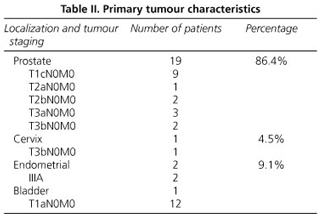
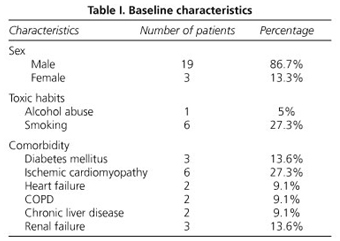
<body><![CDATA[<p><font face="Verdana"><b>Material and methods</b></font></p>     <p><font face="Verdana" size="2">This is a descriptive study. We performed a retrospective search in our hospital's archive for patients treated with argon plasma fulguration for actinic proctitis between years 2004 and 2007. Inclusion criteria were: a) endoscopic diagnosis of actinic proctitis; b) having received pelvic external radiotherapy at doses higher than or equal to 66 Gy; c) a histological diagnosis of pelvic malignancy (prostate or endometrial carcinoma, cervix carcinoma, bladder papillary carcinoma); and d) treatment with argon plasma coagulation.</font></p>     <p><font face="Verdana" size="2">Conventional endoscopes were used (Olympus exera cv 145, argon plasma Font ERBE APC 300). The probes used had a frontal exit. Treatment was applied in pulses with a duration lower than one second, avoiding the brushing of injuries, with an argon plasma flux of 2 L/min and power at 50 W. Sessions were repeated every 6-8 weeks until bleeding remission. Preparation was done with phosphosoda the previous day (<a target="_blank" href="/img/revistas/diges/v101n2/original1_f1.jpg">Fig. 1</a>).</font></p>     <p><font face="Verdana" size="2">Data regarding the number of sessions necessary to stop bleeding, number of blood transfusions, therapy-related side effects, comorbidity, cancer type, and doses administered were all recorded.</font></p>     <p><font face="Verdana" size="2">The distribution of the variables was analyzed graphically. Variables were expressed as mean &plusmn; standard deviation if they followed normal distributions and as median &plusmn; interquartilic range if they did not.</font></p>     <p>&nbsp;</p>     <p><font face="Verdana"><b>Results</b></font></p>     <p><font face="Verdana" size="2">Twenty-two cases of actinic proctitis requiring treatment with argon plasma coagulation were found. Baseline patient characteristics are summarized in <a href="#t1">table I</a>. Mean age was 74.3 years (&plusmn; 7.5). Nineteen patients were men and three were women. Tumours radiated included: 1 cervix squamous-cell carcinoma, 2 endometrial adenocarcinomas, and 19 prostate adenocarcinomas (<a href="#t2">Table II</a>). One of the patients had two cancers, one prostate adenocarcinoma and one bladder papillary carcinoma. Radiation doses administered were 70 Gy for 70% of cases. Median haemoglobin nadir was 11 g/dl (10.9-13.0), median number of sessions needed to stop rectal bleeding was 2 (1-4). Only two patients required blood transfusions because of a big drop in hemoglobin concentration. Few patients were on antiplatelet or anticoagulant treatment. In fact, we found only two -one was on 100 mg/day AAS and one was on 75 mg/day clopidogrel.</font></p>     <p align="center"><font face="Verdana" size="2"><a name="t1"><img src="/img/revistas/diges/v101n2/original1_table1.jpg" width="340" height="241"></a></font></p>     <p align="center"><font face="Verdana" size="2"><a name="t2"><img src="/img/revistas/diges/v101n2/original1_table2.jpg" width="323" height="219"></a></font></p>     ]]></body>
<body><![CDATA[<p align="center">&nbsp;</p>     <p><font face="Verdana" size="2">We identified no treatment-related adverse events with argon plasma.</font></p>     <p>&nbsp;</p>     <p><font face="Verdana"><b>Discussion</b></font></p>     <p><font face="Verdana" size="2">Therapeutic options described in the literature for rectal bleeding due to chronic actinic proctitis are diverse and have to be selected based on symptoms (RTOG/EORTC of acute and chronic toxicity scales) (6-8). In patients with grade-1 proctitis enemas with steroids and 5-ASA derivatives can be used. Although there is no evidence of endoscopic efficacy, patients feel a subjective improvement of symptoms (9,10). Short-chain fatty acids can also be used because of their trophic effect on the rectal mucosa, but only some studies have demonstrated a decreased number of bleeding episodes and improved endoscopic changes (9). Another option is oral metronidazole and enemas with betamethasone and mesalazine, as this combination has demonstrated a significant reduction in the incidence of rectal bleeding, ulcers, diarrhoea, and erythema (10). Patients refractory to the aforementioned treatments and with grade 2-3 chronic proctitis could benefit from endoscopic treatment including chemical cauterization of bleeding vessels and ulcers using 4% formalin. This method has demonstrated in prospective studies responses in 67 to 89% of cases, with 5% of important adverse events such as anal ulceration, rectal stenosis, incontinence, and anal pain (11). Other possible endoscopic treatments are argon plasma coagulation and Nd:YAG laser. This latter option has results similar to argon plasma coagulation but is a more expensive option with a higher proportion of adverse events (9). Other treatments are described, like hyperbaric chamber oxygenation, that may affect angiogenesis by stimulating microvascularization. Anyway, all published series are retrospective and highly heterogeneous regarding cases included, although they report improvement rates without adverse effects of up to 65% (12-14). Another inconvenience is the high number of daily sessions necessary for improvement (20-40), and the scarce availability of specialized centres. Patients refractory to endoscopic treatment or with grade-4 rectal toxicity (fewer than 10%) may be surgically treated. Regarding treatment with argon plasma, reported responses vary between 83 to 100% of patients treated after 2-3 sessions, with very few complications (15-17). In our study we found no treatment-derived complication, and the percentage of patients that needed 3 or fewer sessions for symptom relief and endoscopic improvement was 68%. Therefore we conclude that our data are consistent with those published in the literature, and we confirm that endoscopic treatment with argon plasma is a cheap, easy-to-perform, safe, and highly efficacious technique for the treatment of rectal bleeding in patients with chronic actinic proctitis as a result of pelvic radiation therapy.</font></p>     <p>&nbsp;</p>     <p><font face="Verdana"><b>References</b></font></p>     <!-- ref --><p><font face="Verdana" size="2">1. Postgate A, Saunders B, Tjandra J, Vargo J. Argon plasma coagulation in chronic radiation proctitis. Endoscopy 2007; 39: 361-5.</font>&nbsp;&nbsp;&nbsp;&nbsp;&nbsp;&nbsp;&nbsp;&nbsp;[&#160;<a href="javascript:void(0);" onclick="javascript: window.open('/scielo.php?script=sci_nlinks&ref=5277775&pid=S1130-0108200900020000200001&lng=','','width=640,height=500,resizable=yes,scrollbars=1,menubar=yes,');">Links</a>&#160;]<!-- end-ref --><!-- ref --><p><font face="Verdana" size="2">2. Donaldson SS. Radiation proctitis after prostate carcinoma therapy. JAMA 1994; 270: 819-20.</font>&nbsp;&nbsp;&nbsp;&nbsp;&nbsp;&nbsp;&nbsp;&nbsp;[&#160;<a href="javascript:void(0);" onclick="javascript: window.open('/scielo.php?script=sci_nlinks&ref=5277776&pid=S1130-0108200900020000200002&lng=','','width=640,height=500,resizable=yes,scrollbars=1,menubar=yes,');">Links</a>&#160;]<!-- end-ref --><!-- ref --><p><font face="Verdana" size="2">3. Serna de la Higuera C, Mart&iacute;n Arribas MI, P&eacute;rez Villoria A, et al. Eficacia y seguridad de la electrocoagulaci&oacute;n con plasma de arg&oacute;n en el tratamiento del sangrado rectal secundario a proctitis por radioterapia. Rev Esp Enferm Dig 2004; 96(11): 758-64.</font>&nbsp;&nbsp;&nbsp;&nbsp;&nbsp;&nbsp;&nbsp;&nbsp;[&#160;<a href="javascript:void(0);" onclick="javascript: window.open('/scielo.php?script=sci_nlinks&ref=5277777&pid=S1130-0108200900020000200003&lng=','','width=640,height=500,resizable=yes,scrollbars=1,menubar=yes,');">Links</a>&#160;]<!-- end-ref --><!-- ref --><p><font face="Verdana" size="2">4. Sebastián S, O'Connor H, O'Morain, et al. Argon plasma coagulation as first-line therapy for chronic radiation proctopathy. J Gastroenterol Hepathol 2004; 19: 1169-73.</font>&nbsp;&nbsp;&nbsp;&nbsp;&nbsp;&nbsp;&nbsp;&nbsp;[&#160;<a href="javascript:void(0);" onclick="javascript: window.open('/scielo.php?script=sci_nlinks&ref=5277778&pid=S1130-0108200900020000200004&lng=','','width=640,height=500,resizable=yes,scrollbars=1,menubar=yes,');">Links</a>&#160;]<!-- end-ref --><!-- ref --><p><font face="Verdana" size="2">5. Johnstone JH. Complications following endoscopic laser therapy. Gastrointest Endosc 1982; 28: 135-6.</font>&nbsp;&nbsp;&nbsp;&nbsp;&nbsp;&nbsp;&nbsp;&nbsp;[&#160;<a href="javascript:void(0);" onclick="javascript: window.open('/scielo.php?script=sci_nlinks&ref=5277779&pid=S1130-0108200900020000200005&lng=','','width=640,height=500,resizable=yes,scrollbars=1,menubar=yes,');">Links</a>&#160;]<!-- end-ref --><!-- ref --><p><font face="Verdana" size="2">6. Cox JD, Stetz J, Pajak TF. Toxicity criteria of the Radiotherapy Oncology Group (RTOG) and the European Organizations for Research and Treatment of Cancer (EORTC). Int J Radiat Oncol Biol Phys 1995; 31: 1341-6.</font>&nbsp;&nbsp;&nbsp;&nbsp;&nbsp;&nbsp;&nbsp;&nbsp;[&#160;<a href="javascript:void(0);" onclick="javascript: window.open('/scielo.php?script=sci_nlinks&ref=5277780&pid=S1130-0108200900020000200006&lng=','','width=640,height=500,resizable=yes,scrollbars=1,menubar=yes,');">Links</a>&#160;]<!-- end-ref --><!-- ref --><p><font face="Verdana" size="2">7. Coia LR, Myerson RJ, Tepper JE. Late effects of radiation therapy and gastrointestinal tract. Int J Radiat Oncol Biol Phys 1995; 31: 1213-36.</font>&nbsp;&nbsp;&nbsp;&nbsp;&nbsp;&nbsp;&nbsp;&nbsp;[&#160;<a href="javascript:void(0);" onclick="javascript: window.open('/scielo.php?script=sci_nlinks&ref=5277781&pid=S1130-0108200900020000200007&lng=','','width=640,height=500,resizable=yes,scrollbars=1,menubar=yes,');">Links</a>&#160;]<!-- end-ref --><!-- ref --><p><font face="Verdana" size="2">8. Garg AK, Mai W-Y, McGary JE, et al. Radiation proctopathy in the treatment of prostate cancer. Int J Radiat Oncol Biol Phys 2066; 66: 1294-305.</font>&nbsp;&nbsp;&nbsp;&nbsp;&nbsp;&nbsp;&nbsp;&nbsp;[&#160;<a href="javascript:void(0);" onclick="javascript: window.open('/scielo.php?script=sci_nlinks&ref=5277782&pid=S1130-0108200900020000200008&lng=','','width=640,height=500,resizable=yes,scrollbars=1,menubar=yes,');">Links</a>&#160;]<!-- end-ref --><!-- ref --><p><font face="Verdana" size="2">9. Denton A, Forbes A, Andreyev JM, et al. Non surgical interventions for late radiation proctitis in patients who have received radical radiotherapy to the pelvis. Cochrane Database of Systematic Reviews 2002 Issue 1. Art. No: CD003455.</font>&nbsp;&nbsp;&nbsp;&nbsp;&nbsp;&nbsp;&nbsp;&nbsp;[&#160;<a href="javascript:void(0);" onclick="javascript: window.open('/scielo.php?script=sci_nlinks&ref=5277783&pid=S1130-0108200900020000200009&lng=','','width=640,height=500,resizable=yes,scrollbars=1,menubar=yes,');">Links</a>&#160;]<!-- end-ref --><!-- ref --><p><font face="Verdana" size="2">10. Jahraus CD, Bettenhausen D, Malik U, et al. Prevention of acute radiation-induced proctosigmoiditis by balsalazide: a randomized, double-blind, placebo controlled trial in prostate cancer. Int J Radiat Oncol Biol Phys 2005; 63: 1483-7.</font>&nbsp;&nbsp;&nbsp;&nbsp;&nbsp;&nbsp;&nbsp;&nbsp;[&#160;<a href="javascript:void(0);" onclick="javascript: window.open('/scielo.php?script=sci_nlinks&ref=5277784&pid=S1130-0108200900020000200010&lng=','','width=640,height=500,resizable=yes,scrollbars=1,menubar=yes,');">Links</a>&#160;]<!-- end-ref --><!-- ref --><p><font face="Verdana" size="2">11. Denton AS, Bentzen SM, Maher EJ. How useful are observational reports in the evaluation of interventions for radiation morbidity?: an analysis of formalin therapy for late radiation proctitis. Radiother Oncol 2002; 64(3): 291-5.</font>&nbsp;&nbsp;&nbsp;&nbsp;&nbsp;&nbsp;&nbsp;&nbsp;[&#160;<a href="javascript:void(0);" onclick="javascript: window.open('/scielo.php?script=sci_nlinks&ref=5277785&pid=S1130-0108200900020000200011&lng=','','width=640,height=500,resizable=yes,scrollbars=1,menubar=yes,');">Links</a>&#160;]<!-- end-ref --><!-- ref --><p><font face="Verdana" size="2">12. Mayer R, Klemen H, Quehenberger F, et al. Hyperbaric oxygen an effective tool to treat radiation morbidity in prostate cancer. Radiother Oncol 2001; 61(2): 151-6.</font>&nbsp;&nbsp;&nbsp;&nbsp;&nbsp;&nbsp;&nbsp;&nbsp;[&#160;<a href="javascript:void(0);" onclick="javascript: window.open('/scielo.php?script=sci_nlinks&ref=5277786&pid=S1130-0108200900020000200012&lng=','','width=640,height=500,resizable=yes,scrollbars=1,menubar=yes,');">Links</a>&#160;]<!-- end-ref --><!-- ref --><p><font face="Verdana" size="2">13. Bemmet MH, Feldmeier J, Hampson N, et al. Hyperbaric oxygen therapy for late radiation tissue injury. Cochrane Database of Sistematyc Reviews 2005, Issue 3. Art. No: CD005005.</font>&nbsp;&nbsp;&nbsp;&nbsp;&nbsp;&nbsp;&nbsp;&nbsp;[&#160;<a href="javascript:void(0);" onclick="javascript: window.open('/scielo.php?script=sci_nlinks&ref=5277787&pid=S1130-0108200900020000200013&lng=','','width=640,height=500,resizable=yes,scrollbars=1,menubar=yes,');">Links</a>&#160;]<!-- end-ref --><!-- ref --><p><font face="Verdana" size="2">14. Caeiro M, Calder&oacute;n A, Moj&oacute;n A, et al. Papel de la oxigenoterapia hiperb&aacute;rica en el tratamiento de las complicaciones cr&oacute;nicas derivadas del tratamiento con radioterapia en pacientes con c&aacute;ncer. Bases f&iacute;sicas, t&eacute;cnicas y cl&iacute;nicas. Oncologia (Barc) 2005; 28.</font>&nbsp;&nbsp;&nbsp;&nbsp;&nbsp;&nbsp;&nbsp;&nbsp;[&#160;<a href="javascript:void(0);" onclick="javascript: window.open('/scielo.php?script=sci_nlinks&ref=5277788&pid=S1130-0108200900020000200014&lng=','','width=640,height=500,resizable=yes,scrollbars=1,menubar=yes,');">Links</a>&#160;]<!-- end-ref --><!-- ref --><p><font face="Verdana" size="2">15. Tam W, Moore J, Schoeman M. Treatment of radiation proctitis with argon plasma coagulation. Endoscopy 2000; 32(9): 667-72.</font>&nbsp;&nbsp;&nbsp;&nbsp;&nbsp;&nbsp;&nbsp;&nbsp;[&#160;<a href="javascript:void(0);" onclick="javascript: window.open('/scielo.php?script=sci_nlinks&ref=5277789&pid=S1130-0108200900020000200015&lng=','','width=640,height=500,resizable=yes,scrollbars=1,menubar=yes,');">Links</a>&#160;]<!-- end-ref --><!-- ref --><p><font face="Verdana" size="2">16. Ta&iuml;eb S, Rolachon A, Cenni JC, et al. Effective use of argon plasma coagulation in the treatment of severe radiation proctitis. Dis Colon Rectum 2001; 44(12): 1766-71.</font>&nbsp;&nbsp;&nbsp;&nbsp;&nbsp;&nbsp;&nbsp;&nbsp;[&#160;<a href="javascript:void(0);" onclick="javascript: window.open('/scielo.php?script=sci_nlinks&ref=5277790&pid=S1130-0108200900020000200016&lng=','','width=640,height=500,resizable=yes,scrollbars=1,menubar=yes,');">Links</a>&#160;]<!-- end-ref --><!-- ref --><p><font face="Verdana" size="2">17. Tjandra JJ, Sengupta S. Argon plasma coagulation is an effective treatment for refractory hemorrhagic radiation proctitis. Dis Colon Rectum 2001; 44(12): 1759-65.</font>&nbsp;&nbsp;&nbsp;&nbsp;&nbsp;&nbsp;&nbsp;&nbsp;[&#160;<a href="javascript:void(0);" onclick="javascript: window.open('/scielo.php?script=sci_nlinks&ref=5277791&pid=S1130-0108200900020000200017&lng=','','width=640,height=500,resizable=yes,scrollbars=1,menubar=yes,');">Links</a>&#160;]<!-- end-ref --><p>&nbsp;</p>     <p>&nbsp;</p>     <p><font face="Verdana" size="2"><b><a href="#top"><img border="0" src="/img/revistas/diges/v101n2/seta.gif" width="15" height="17"></a> <a name="bajo"></a>Correspondence:</b>    <br>Philip Wikman Jorgensen.    <br>Servicio de Medicina Interna.    <br>Hospital de San Juan de Alicante.    ]]></body>
<body><![CDATA[<br>Ctra. Alicante-Valencia, s/n.    <br>03550 San Juan de Alicante. Alicante, Spain.    <br>e-mail: <a href="mailto:pwjpwj@hotmail.com">pwjpwj@hotmail.com</a></font></p>     <p><font face="Verdana" size="2">Received: 23-06-08.    <br>Accepted: 18-12-08.</font></p>      ]]></body><back>
<ref-list>
<ref id="B1">
<label>1</label><nlm-citation citation-type="journal">
<person-group person-group-type="author">
<name>
<surname><![CDATA[Postgate]]></surname>
<given-names><![CDATA[A]]></given-names>
</name>
<name>
<surname><![CDATA[Saunders]]></surname>
<given-names><![CDATA[B]]></given-names>
</name>
<name>
<surname><![CDATA[Tjandra]]></surname>
<given-names><![CDATA[J]]></given-names>
</name>
<name>
<surname><![CDATA[Vargo]]></surname>
<given-names><![CDATA[J]]></given-names>
</name>
</person-group>
<article-title xml:lang="en"><![CDATA[Argon plasma coagulation in chronic radiation proctitis]]></article-title>
<source><![CDATA[Endoscopy]]></source>
<year>2007</year>
<volume>39</volume>
<page-range>361-5</page-range></nlm-citation>
</ref>
<ref id="B2">
<label>2</label><nlm-citation citation-type="journal">
<person-group person-group-type="author">
<name>
<surname><![CDATA[Donaldson]]></surname>
<given-names><![CDATA[SS]]></given-names>
</name>
</person-group>
<article-title xml:lang="en"><![CDATA[Radiation proctitis after prostate carcinoma therapy]]></article-title>
<source><![CDATA[JAMA]]></source>
<year>1994</year>
<volume>270</volume>
<page-range>819-20</page-range></nlm-citation>
</ref>
<ref id="B3">
<label>3</label><nlm-citation citation-type="journal">
<person-group person-group-type="author">
<name>
<surname><![CDATA[Serna de la Higuera]]></surname>
<given-names><![CDATA[C]]></given-names>
</name>
<name>
<surname><![CDATA[Martín Arribas]]></surname>
<given-names><![CDATA[MI]]></given-names>
</name>
<name>
<surname><![CDATA[Pérez Villoria]]></surname>
<given-names><![CDATA[A]]></given-names>
</name>
</person-group>
<article-title xml:lang="es"><![CDATA[Eficacia y seguridad de la electrocoagulación con plasma de argón en el tratamiento del sangrado rectal secundario a proctitis por radioterapia]]></article-title>
<source><![CDATA[Rev Esp Enferm Dig]]></source>
<year>2004</year>
<volume>96</volume>
<numero>11</numero>
<issue>11</issue>
<page-range>758-64</page-range></nlm-citation>
</ref>
<ref id="B4">
<label>4</label><nlm-citation citation-type="journal">
<person-group person-group-type="author">
<name>
<surname><![CDATA[Sebastián]]></surname>
<given-names><![CDATA[S]]></given-names>
</name>
<name>
<surname><![CDATA[O'Connor]]></surname>
<given-names><![CDATA[H]]></given-names>
</name>
<name>
<surname><![CDATA[O'Morain]]></surname>
</name>
</person-group>
<article-title xml:lang="en"><![CDATA[Argon plasma coagulation as first-line therapy for chronic radiation proctopathy]]></article-title>
<source><![CDATA[J Gastroenterol Hepathol]]></source>
<year>2004</year>
<volume>19</volume>
<page-range>1169-73</page-range></nlm-citation>
</ref>
<ref id="B5">
<label>5</label><nlm-citation citation-type="journal">
<person-group person-group-type="author">
<name>
<surname><![CDATA[Johnstone]]></surname>
<given-names><![CDATA[JH]]></given-names>
</name>
</person-group>
<article-title xml:lang="en"><![CDATA[Complications following endoscopic laser therapy]]></article-title>
<source><![CDATA[Gastrointest Endosc]]></source>
<year>1982</year>
<volume>28</volume>
<page-range>135-6</page-range></nlm-citation>
</ref>
<ref id="B6">
<label>6</label><nlm-citation citation-type="journal">
<person-group person-group-type="author">
<name>
<surname><![CDATA[Cox]]></surname>
<given-names><![CDATA[JD]]></given-names>
</name>
<name>
<surname><![CDATA[Stetz]]></surname>
<given-names><![CDATA[J]]></given-names>
</name>
<name>
<surname><![CDATA[Pajak]]></surname>
<given-names><![CDATA[TF]]></given-names>
</name>
</person-group>
<article-title xml:lang="en"><![CDATA[Toxicity criteria of the Radiotherapy Oncology Group (RTOG) and the European Organizations for Research and Treatment of Cancer (EORTC)]]></article-title>
<source><![CDATA[Int J Radiat Oncol Biol Phys]]></source>
<year>1995</year>
<volume>31</volume>
<page-range>1341-6</page-range></nlm-citation>
</ref>
<ref id="B7">
<label>7</label><nlm-citation citation-type="journal">
<person-group person-group-type="author">
<name>
<surname><![CDATA[Coia]]></surname>
<given-names><![CDATA[LR]]></given-names>
</name>
<name>
<surname><![CDATA[Myerson]]></surname>
<given-names><![CDATA[RJ]]></given-names>
</name>
<name>
<surname><![CDATA[Tepper]]></surname>
<given-names><![CDATA[JE]]></given-names>
</name>
</person-group>
<article-title xml:lang="en"><![CDATA[Late effects of radiation therapy and gastrointestinal tract]]></article-title>
<source><![CDATA[Int J Radiat Oncol Biol Phys]]></source>
<year>1995</year>
<volume>31</volume>
<page-range>1213-36</page-range></nlm-citation>
</ref>
<ref id="B8">
<label>8</label><nlm-citation citation-type="journal">
<person-group person-group-type="author">
<name>
<surname><![CDATA[Garg]]></surname>
<given-names><![CDATA[AK]]></given-names>
</name>
<name>
<surname><![CDATA[Mai]]></surname>
<given-names><![CDATA[W-Y]]></given-names>
</name>
<name>
<surname><![CDATA[McGary]]></surname>
<given-names><![CDATA[JE]]></given-names>
</name>
</person-group>
<article-title xml:lang="en"><![CDATA[Radiation proctopathy in the treatment of prostate cancer]]></article-title>
<source><![CDATA[Int J Radiat Oncol Biol Phys]]></source>
<year></year>
<volume>66</volume>
<page-range>1294-305</page-range></nlm-citation>
</ref>
<ref id="B9">
<label>9</label><nlm-citation citation-type="journal">
<person-group person-group-type="author">
<name>
<surname><![CDATA[Denton]]></surname>
<given-names><![CDATA[A]]></given-names>
</name>
<name>
<surname><![CDATA[Forbes]]></surname>
<given-names><![CDATA[A]]></given-names>
</name>
<name>
<surname><![CDATA[Andreyev]]></surname>
<given-names><![CDATA[JM]]></given-names>
</name>
</person-group>
<article-title xml:lang="en"><![CDATA[Non surgical interventions for late radiation proctitis in patients who have received radical radiotherapy to the pelvis]]></article-title>
<source><![CDATA[Cochrane Database of Systematic Reviews]]></source>
<year>2002</year>
<numero>1</numero>
<issue>1</issue>
</nlm-citation>
</ref>
<ref id="B10">
<label>10</label><nlm-citation citation-type="journal">
<person-group person-group-type="author">
<name>
<surname><![CDATA[Jahraus]]></surname>
<given-names><![CDATA[CD]]></given-names>
</name>
<name>
<surname><![CDATA[Bettenhausen]]></surname>
<given-names><![CDATA[D]]></given-names>
</name>
<name>
<surname><![CDATA[Malik]]></surname>
<given-names><![CDATA[U]]></given-names>
</name>
</person-group>
<article-title xml:lang="en"><![CDATA[Prevention of acute radiation-induced proctosigmoiditis by balsalazide: a randomized, double-blind, placebo controlled trial in prostate cancer]]></article-title>
<source><![CDATA[Int J Radiat Oncol Biol Phys]]></source>
<year>2005</year>
<volume>63</volume>
<page-range>1483-7</page-range></nlm-citation>
</ref>
<ref id="B11">
<label>11</label><nlm-citation citation-type="journal">
<person-group person-group-type="author">
<name>
<surname><![CDATA[Denton]]></surname>
<given-names><![CDATA[AS]]></given-names>
</name>
<name>
<surname><![CDATA[Bentzen]]></surname>
<given-names><![CDATA[SM]]></given-names>
</name>
<name>
<surname><![CDATA[Maher]]></surname>
<given-names><![CDATA[EJ]]></given-names>
</name>
</person-group>
<article-title xml:lang="en"><![CDATA[How useful are observational reports in the evaluation of interventions for radiation morbidity?: an analysis of formalin therapy for late radiation proctitis]]></article-title>
<source><![CDATA[Radiother Oncol]]></source>
<year>2002</year>
<volume>64</volume>
<numero>3</numero>
<issue>3</issue>
<page-range>291-5</page-range></nlm-citation>
</ref>
<ref id="B12">
<label>12</label><nlm-citation citation-type="journal">
<person-group person-group-type="author">
<name>
<surname><![CDATA[Mayer]]></surname>
<given-names><![CDATA[R]]></given-names>
</name>
<name>
<surname><![CDATA[Klemen]]></surname>
<given-names><![CDATA[H]]></given-names>
</name>
<name>
<surname><![CDATA[Quehenberger]]></surname>
<given-names><![CDATA[F]]></given-names>
</name>
</person-group>
<article-title xml:lang="en"><![CDATA[Hyperbaric oxygen an effective tool to treat radiation morbidity in prostate cancer]]></article-title>
<source><![CDATA[Radiother Oncol]]></source>
<year>2001</year>
<volume>61</volume>
<numero>2</numero>
<issue>2</issue>
<page-range>151-6</page-range></nlm-citation>
</ref>
<ref id="B13">
<label>13</label><nlm-citation citation-type="journal">
<person-group person-group-type="author">
<name>
<surname><![CDATA[Bemmet]]></surname>
<given-names><![CDATA[MH]]></given-names>
</name>
<name>
<surname><![CDATA[Feldmeier]]></surname>
<given-names><![CDATA[J]]></given-names>
</name>
<name>
<surname><![CDATA[Hampson]]></surname>
<given-names><![CDATA[N]]></given-names>
</name>
</person-group>
<article-title xml:lang="en"><![CDATA[Hyperbaric oxygen therapy for late radiation tissue injury]]></article-title>
<source><![CDATA[Cochrane Database of Sistematyc Reviews]]></source>
<year>2005</year>
<numero>3</numero>
<issue>3</issue>
</nlm-citation>
</ref>
<ref id="B14">
<label>14</label><nlm-citation citation-type="journal">
<person-group person-group-type="author">
<name>
<surname><![CDATA[Caeiro]]></surname>
<given-names><![CDATA[M]]></given-names>
</name>
<name>
<surname><![CDATA[Calderón]]></surname>
<given-names><![CDATA[A]]></given-names>
</name>
<name>
<surname><![CDATA[Mojón]]></surname>
<given-names><![CDATA[A]]></given-names>
</name>
</person-group>
<article-title xml:lang="es"><![CDATA[Papel de la oxigenoterapia hiperbárica en el tratamiento de las complicaciones crónicas derivadas del tratamiento con radioterapia en pacientes con cáncer: Bases físicas, técnicas y clínicas]]></article-title>
<source><![CDATA[Oncologia (Barc)]]></source>
<year>2005</year>
<volume>28</volume>
</nlm-citation>
</ref>
<ref id="B15">
<label>15</label><nlm-citation citation-type="journal">
<person-group person-group-type="author">
<name>
<surname><![CDATA[Tam]]></surname>
<given-names><![CDATA[W]]></given-names>
</name>
<name>
<surname><![CDATA[Moore]]></surname>
<given-names><![CDATA[J]]></given-names>
</name>
<name>
<surname><![CDATA[Schoeman]]></surname>
<given-names><![CDATA[M]]></given-names>
</name>
</person-group>
<article-title xml:lang="en"><![CDATA[Treatment of radiation proctitis with argon plasma coagulation]]></article-title>
<source><![CDATA[Endoscopy]]></source>
<year>2000</year>
<volume>32</volume>
<numero>9</numero>
<issue>9</issue>
<page-range>667-72</page-range></nlm-citation>
</ref>
<ref id="B16">
<label>16</label><nlm-citation citation-type="journal">
<person-group person-group-type="author">
<name>
<surname><![CDATA[Taïeb]]></surname>
<given-names><![CDATA[S]]></given-names>
</name>
<name>
<surname><![CDATA[Rolachon]]></surname>
<given-names><![CDATA[A]]></given-names>
</name>
<name>
<surname><![CDATA[Cenni]]></surname>
<given-names><![CDATA[JC]]></given-names>
</name>
</person-group>
<article-title xml:lang="en"><![CDATA[Effective use of argon plasma coagulation in the treatment of severe radiation proctitis]]></article-title>
<source><![CDATA[Dis Colon Rectum]]></source>
<year>2001</year>
<volume>44</volume>
<numero>12</numero>
<issue>12</issue>
<page-range>1766-71</page-range></nlm-citation>
</ref>
<ref id="B17">
<label>17</label><nlm-citation citation-type="journal">
<person-group person-group-type="author">
<name>
<surname><![CDATA[Tjandra]]></surname>
<given-names><![CDATA[JJ]]></given-names>
</name>
<name>
<surname><![CDATA[Sengupta]]></surname>
<given-names><![CDATA[S]]></given-names>
</name>
</person-group>
<article-title xml:lang="en"><![CDATA[Argon plasma coagulation is an effective treatment for refractory hemorrhagic radiation proctitis]]></article-title>
<source><![CDATA[Dis Colon Rectum]]></source>
<year>2001</year>
<volume>44</volume>
<numero>12</numero>
<issue>12</issue>
<page-range>1759-65</page-range></nlm-citation>
</ref>
</ref-list>
</back>
</article>