<?xml version="1.0" encoding="ISO-8859-1"?><article xmlns:mml="http://www.w3.org/1998/Math/MathML" xmlns:xlink="http://www.w3.org/1999/xlink" xmlns:xsi="http://www.w3.org/2001/XMLSchema-instance">
<front>
<journal-meta>
<journal-id>1130-0108</journal-id>
<journal-title><![CDATA[Revista Española de Enfermedades Digestivas]]></journal-title>
<abbrev-journal-title><![CDATA[Rev. esp. enferm. dig.]]></abbrev-journal-title>
<issn>1130-0108</issn>
<publisher>
<publisher-name><![CDATA[Sociedad Española de Patología Digestiva]]></publisher-name>
</publisher>
</journal-meta>
<article-meta>
<article-id>S1130-01082009000200005</article-id>
<title-group>
<article-title xml:lang="en"><![CDATA[Gallstone ileus: management options and results on a series of 40 patients]]></article-title>
<article-title xml:lang="es"><![CDATA[Íleo biliar: opciones terapéuticas y resultados en una serie de 40 casos]]></article-title>
</title-group>
<contrib-group>
<contrib contrib-type="author">
<name>
<surname><![CDATA[Martínez Ramos]]></surname>
<given-names><![CDATA[D.]]></given-names>
</name>
<xref ref-type="aff" rid="A01"/>
</contrib>
<contrib contrib-type="author">
<name>
<surname><![CDATA[Daroca José]]></surname>
<given-names><![CDATA[J. M.]]></given-names>
</name>
<xref ref-type="aff" rid="A01"/>
</contrib>
<contrib contrib-type="author">
<name>
<surname><![CDATA[Escrig Sos]]></surname>
<given-names><![CDATA[J.]]></given-names>
</name>
<xref ref-type="aff" rid="A01"/>
</contrib>
<contrib contrib-type="author">
<name>
<surname><![CDATA[Paiva Coronel]]></surname>
<given-names><![CDATA[G.]]></given-names>
</name>
<xref ref-type="aff" rid="A01"/>
</contrib>
<contrib contrib-type="author">
<name>
<surname><![CDATA[Alcalde Sánchez]]></surname>
<given-names><![CDATA[M.]]></given-names>
</name>
<xref ref-type="aff" rid="A01"/>
</contrib>
<contrib contrib-type="author">
<name>
<surname><![CDATA[Salvador Sanchis]]></surname>
<given-names><![CDATA[J. L.]]></given-names>
</name>
<xref ref-type="aff" rid="A01"/>
</contrib>
</contrib-group>
<aff id="A01">
<institution><![CDATA[,Hospital General de Castellón Service of Digestive and General Surgery ]]></institution>
<addr-line><![CDATA[Castellón ]]></addr-line>
<country>Spain</country>
</aff>
<pub-date pub-type="pub">
<day>00</day>
<month>02</month>
<year>2009</year>
</pub-date>
<pub-date pub-type="epub">
<day>00</day>
<month>02</month>
<year>2009</year>
</pub-date>
<volume>101</volume>
<numero>2</numero>
<fpage>117</fpage>
<lpage>124</lpage>
<copyright-statement/>
<copyright-year/>
<self-uri xlink:href="http://scielo.isciii.es/scielo.php?script=sci_arttext&amp;pid=S1130-01082009000200005&amp;lng=en&amp;nrm=iso"></self-uri><self-uri xlink:href="http://scielo.isciii.es/scielo.php?script=sci_abstract&amp;pid=S1130-01082009000200005&amp;lng=en&amp;nrm=iso"></self-uri><self-uri xlink:href="http://scielo.isciii.es/scielo.php?script=sci_pdf&amp;pid=S1130-01082009000200005&amp;lng=en&amp;nrm=iso"></self-uri><abstract abstract-type="short" xml:lang="en"><p><![CDATA[Introduction: controversy remains about the management of gallstone ileus. While some authors propose enterotomy, others defend the one-stage procedure (simultaneously fistula repair). The objective of the present study was to analyze management options and comparative study their results. Material and methods: retrospective and descriptive study with revision of clinical stories of patients with the diagnosis of gallstone ileus between 1987 and 2008. All the following variables were recorded: dates of hospital admission, surgery and discharge, age, sex, pathological antecedents, preoperative or intraoperative diagnosis, treatment, location of the fistula and location of the obstruction. End-result variables were: postoperative complications, mortality, complications during the follow-up and biliary complications. Results: a total of 40 patients were included of 46,648 admissions. Age, comorbidity, and intraoperative diagnosis were related with poorer short- and long-outcomes. The percentage of postoperative complications was similar for groups with and without fistula repair. Mortality was higher in the group with fistula repair (15vs. 25%). Biliary complications were more frequent in the group without fistula repair (11 vs. 0%). Sex, location of the fistula and location of the obstruction did not be related with the prognosis. Conclusion: one-stage procedure is related with higher mortality rate than enterotomy alone. Nevertheless, fistula repair reduces the number of biliary complications during the follow-up.]]></p></abstract>
<abstract abstract-type="short" xml:lang="es"><p><![CDATA[Introducción: todavía existe gran controversia sobre el mejor tratamiento del íleo biliar. Algunos autores proponen la enterotomía aislada, mientras otros defienden la reparación de la fístula bilioentérica en el mismo acto quirúrgico. El objetivo del presente estudio fue analizar las opciones terapéuticas en estos pacientes y estudiar sus resultados. Material y métodos: estudio retrospectivo y descriptivo, con revisión de las historias clínicas de los pacientes diagnosticados de íleo biliar desde 1987 hasta 2008. Se recogieron las fechas de ingreso, de intervención y del alta, edad, sexo, antecedentes patológicos, diagnóstico preoperatorio o intraoperatorio, tratamiento, lugar de la fístula y lugar de la obstrucción. Como variables de resultado se utilizaron las complicaciones postoperatorias, mortalidad, complicaciones en el seguimiento y complicaciones biliares. Resultados: se incluyeron 40 pacientes sobre 46.648 ingresos. La edad, la comorbilidad y el diagnóstico intraoperatorio se relacionaron con peores resultados a corto y largo plazo. El porcentaje de complicaciones postoperatorias fue similar para el grupo con abordaje de la fístula y para el grupo con enterotomía aislada. La mortalidad fue superior en el grupo con abordaje de la fístula (15 frente a 25%). Las complicaciones biliares fueron más frecuentes en el grupo sin abordaje de la fístula biliar (11 frente a 0%). El sexo, lugar de la fístula o el lugar de la obstrucción no demostraron diferencias. Conclusión: la cirugía en un solo tiempo se relaciona con mayor mortalidad que la enterotomía aislada. No obstante, añadir la reparación de la fístula reduce el número de complicaciones biliares en el seguimiento.]]></p></abstract>
<kwd-group>
<kwd lng="en"><![CDATA[Gallstone ileus]]></kwd>
<kwd lng="en"><![CDATA[Enterotomy]]></kwd>
<kwd lng="en"><![CDATA[Biliary fistula]]></kwd>
<kwd lng="es"><![CDATA[Íleo biliar]]></kwd>
<kwd lng="es"><![CDATA[Enterotomía]]></kwd>
<kwd lng="es"><![CDATA[Fístula biliar]]></kwd>
</kwd-group>
</article-meta>
</front><body><![CDATA[ <p align="right"><font face="Verdana" size="2"><b><a name="top"></a>ORIGINAL PAPERS</b></font></p>     <p>&nbsp;</p>     <p><font face="Verdana" size="4"><b>Gallstone ileus: management options and results on a series of 40 patients</b></font></p>     <p><font face="Verdana" size="4"><b>&Iacute;leo biliar: opciones terap&eacute;uticas y resultados en una serie de 40 casos</b></font></p>     <p>&nbsp;</p>     <p>&nbsp;</p>     <p><font face="Verdana" size="2"><b>D. Mart&iacute;nez Ramos, J. M. Daroca Jos&eacute;, J. Escrig Sos, G. Paiva Coronel, M. Alcalde S&aacute;nchez and J. L. Salvador Sanchis</b></font></p>     <p><font face="Verdana" size="2">Service of Digestive and General Surgery. Hospital General de Castell&oacute;n. Spain</font></p>     <p><font face="Verdana" size="2"><a href="#bajo">Correspondence</a></font></p>     <p>&nbsp;</p>     ]]></body>
<body><![CDATA[<p>&nbsp;</p> <hr size="1">     <p><font face="Verdana" size="2"><b>ABSTRACT</b></font></p>     <p><font face="Verdana" size="2"><b>Introduction:</b> controversy remains about the management of gallstone ileus. While some authors propose enterotomy, others defend the one-stage procedure (simultaneously fistula repair). The objective of the present study was to analyze management options and comparative study their results.    <br><b>Material and methods:</b> retrospective and descriptive study with revision of clinical stories of patients with the diagnosis of gallstone ileus between 1987 and 2008. All the following variables were recorded: dates of hospital admission, surgery and discharge, age, sex, pathological antecedents, preoperative or intraoperative diagnosis, treatment, location of the fistula and location of the obstruction. End-result variables were: postoperative complications, mortality, complications during the follow-up and biliary complications.    <br><b>Results:</b> a total of 40 patients were included of 46,648 admissions. Age, comorbidity, and intraoperative diagnosis were related with poorer short- and long-outcomes. The percentage of postoperative complications was similar for groups with and without fistula repair. Mortality was higher in the group with fistula repair (15<i>vs.</i> 25%). Biliary complications were more frequent in the group without fistula repair (11 <i>vs.</i> 0%). Sex, location of the fistula and location of the obstruction did not be related with the prognosis.    <br><b>Conclusion:</b> one-stage procedure is related with higher mortality rate than enterotomy alone. Nevertheless, fistula repair reduces the number of biliary complications during the follow-up.</font></p>     <p><font face="Verdana" size="2"><b>Key words:</b> Gallstone ileus. Enterotomy. Biliary fistula.</font></p> <hr size="1">     <p><font face="Verdana" size="2"><b>RESUMEN</b></font></p>     <p><font face="Verdana" size="2"><b>Introducci&oacute;n:</b> todav&iacute;a existe gran controversia sobre el mejor tratamiento del &iacute;leo biliar. Algunos autores proponen la enterotom&iacute;a aislada, mientras otros defienden la reparaci&oacute;n de la f&iacute;stula bilioent&eacute;rica en el mismo acto quir&uacute;rgico. El objetivo del presente estudio fue analizar las opciones terap&eacute;uticas en estos pacientes y estudiar sus resultados.    <br><b>Material y m&eacute;todos:</b> estudio retrospectivo y descriptivo, con revisi&oacute;n de las historias cl&iacute;nicas de los pacientes diagnosticados de &iacute;leo biliar desde 1987 hasta 2008. Se recogieron las fechas de ingreso, de intervenci&oacute;n y del alta, edad, sexo, antecedentes patol&oacute;gicos, diagn&oacute;stico preoperatorio o intraoperatorio, tratamiento, lugar de la f&iacute;stula y lugar de la obstrucci&oacute;n. Como variables de resultado se utilizaron las complicaciones postoperatorias, mortalidad, complicaciones en el seguimiento y complicaciones biliares.    ]]></body>
<body><![CDATA[<br><b>Resultados:</b> se incluyeron 40 pacientes sobre 46.648 ingresos. La edad, la comorbilidad y el diagn&oacute;stico intraoperatorio se relacionaron con peores resultados a corto y largo plazo. El porcentaje de complicaciones postoperatorias fue similar para el grupo con abordaje de la f&iacute;stula y para el grupo con enterotom&iacute;a aislada. La mortalidad fue superior en el grupo con abordaje de la f&iacute;stula (15 frente a 25%). Las complicaciones biliares fueron m&aacute;s frecuentes en el grupo sin abordaje de la f&iacute;stula biliar (11 frente a 0%). El sexo, lugar de la f&iacute;stula o el lugar de la obstrucci&oacute;n no demostraron diferencias.    <br><b>Conclusi&oacute;n:</b> la cirug&iacute;a en un solo tiempo se relaciona con mayor mortalidad que la enterotom&iacute;a aislada. No obstante, a&ntilde;adir la reparaci&oacute;n de la f&iacute;stula reduce el n&uacute;mero de complicaciones biliares en el seguimiento.</font></p>     <p><font face="Verdana" size="2"><b>Palabras clave:</b> &Iacute;leo biliar. Enterotom&iacute;a. F&iacute;stula biliar.</font></p> <hr size="1">     <p>&nbsp;</p>     <p><font face="Verdana"><b>Introduction</b></font></p>     <p><font face="Verdana" size="2">Described first by Bartholin in 1654, gallstone ileus is defined as a mechanical obstruction of the gastrointestinal tract caused by the presence of a gallstone in its lumen. Up until now, the preferred treatment for these patients was enterotomy plus gallstone extraction (1-3). Since gallstone ileus is usually caused by a bilioenteric fistula, some authors have proposed that the fistula should be repaired in the same surgical act, accompanying enterotomy and cholecystectomy (one-stage procedure) (4). Nonetheless, this procedure is not exempt of complications and there is no definite agreement regarding the best therapeutical approach in such cases.</font></p>     <p><font face="Verdana" size="2">The objective of this study was to analyze the therapeutical options available for patients with a diagnosis of gallstone ileus, and to study the short- and long-term results of the most commonly performed procedures.</font></p>     <p>&nbsp;</p>     <p><font face="Verdana"><b>Material and methods</b></font></p>     <p><font face="Verdana" size="2">This study consists of a retrospective review of hospital records for patients diagnosed with gallstone ileus and hospitalized in the Gastrointestinal and General Surgery Department in our hospital between November 1987 and October 2008. The total number of patients was 40. From these records we obtained hospitalization dates, surgical procedure type and date, hospital discharge date, and last visit date. Variables initially studied were: age, gender, medical history, presurgical and surgical diagnosis with gallstone ileus, type of treatment applied, and anatomical localization of fistula and obstruction. To analyze the results, variables used included: immediate post-op complications, complications observed during follow-up - particularly biliary tract complications - and mortality rates.</font></p>     ]]></body>
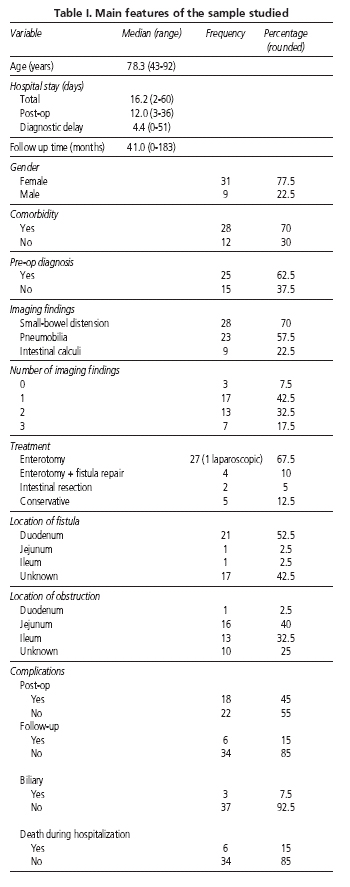
<body><![CDATA[<p><font face="Verdana" size="2">The low incidence of this disease is the reason for the small number of patients seen in such a long period of time. Under these conditions the inferential analysis is not appropriate, hence only a descriptive analysis was made. Statistical calculations were performed with the program SPSS<sup>®</sup> Windows 15.0.</font></p>     <p>&nbsp;</p>     <p><font face="Verdana"><b>Results</b></font></p>     <p><font face="Verdana" size="2">During the time period selected 46,648 patients were hospitalized in our department. Of these, 40 were diagnosed with gallstone ileus, which indicates an incidence of approximately 0.9&permil; (1 in 1,166). The number of cases per year was relatively constant with an average of 2 hospitalizations per year. <a href="#t1">Table I</a> shows the main features of the sample studied.</font></p>     <p align="center"><font face="Verdana" size="2"><a name="t1"><img src="/img/revistas/diges/v101n2/original4_table1.jpg" width="350" height="887"></a></font></p>     <p><font face="Verdana" size="2">Median hospitalization for each patient was 14 days (range: 4-60). Post-surgical stay in hospital was approximately 9.5 days (range: 3-36). The interquartilic range reveals the most representative hospitalization periods. For total hospital stay it was approximately 10-20 days, and for post-surgical stay it was approximately 7 to 16 days. There were atypical and extreme hospitalizarion periods, but as usual none of them are representative.</font></p>     <p><font face="Verdana" size="2">Prior to the surgery the following tests were performed: abdominal X-rays were for 40 patients, abdominal ultrasounds for 26 patients, and CT scans for 8 patients. These tests yielded no positive results in 3 patients, who underwent surgery with no established pre-op diagnosis. Rigler's triad (small-bowel dilation, ectopic gallstones, and aerobilia) was observed in 7 patients.</font></p>     <p><font face="Verdana" size="2"><a target="_blank" href="/img/revistas/diges/v101n2/original4_table2.jpg">Table II</a> shows the complications found in our series. The percentages shown in this table, and in the following one, were calculated with the total number of available cases, which did not always match the real totals of the series, mainly because of faulty data collection from hospital records. As shown in this table, patient older age (more than 80 years) was related to a poorer short-term prognosis, more post-op complications, and a greater mortality rate at hospitalization. Nonetheless, biliary-tract and general complications seen during follow-up were less in number. These complications were observed more frequently in younger patients, probably because older patients, due to their age, died before such complications could develop. Comorbidity was associated with a worse short-term and long-term prognosis. However, the percentage of deaths during the post-op period was greater when there was no comorbidity present (11 against 25%), but he number of cases, 3 patients in each group, was very low, making chance a possible reason for these apparently contradictory results. Finally, the percentage of immediate complications was greater when the diagnosis of gallstone ileus was made during the surgical procedure than when it was made prior to surgery. This difference, however, was not clinically relevant for long-term prognosis.</font></p>     <p><font face="Verdana" size="2"><a target="_blank" href="/img/revistas/diges/v101n2/original4_table3.jpg">Table III</a> shows the results of analyzing complications according to type of treatment performed. When enterotomy was performed alone, the percentage of post-op complications was similar to that in the group that underwent enterotomy plus fistula repair. However, the mortality rate was greater in the latter (25 against 15%), while biliary tract complications were more frequent in the former. This table also shows that with conservative treatment only one patient in five (20%) had immediate complications, and no complications were observed during their follow-up period. Finally, when intestinal resection was needed, the percentage of complications was 100%, leading to death in 1 every 2 patients.</font></p>     <p><font face="Verdana" size="2">Other variables such as gender, or fistula or obstruction anatomical localization showed no clinical relevance whatsoever in the incidence of complications, both in the immediate post-op period and during follow-up.</font></p>     ]]></body>
<body><![CDATA[<p>&nbsp;</p>     <p><font face="Verdana"><b>Discussion</b></font></p>     <p><font face="Verdana" size="2">Gallstone ileus is an infrequent complication of gallstone disease; it is the cause of 1 to 3% of mechanical obstructions in the small bowel (5-7). This low incidence, which is also observed in our analysis, results in very few prospective studies, and in reduced sample sizes in those available. Because of this, a retrospective and descriptive study like the one reported, despite obvious limitations, is of great interest, as few publications have achieved the number of patients included herein. Of course, the ongoing controversy about the best therapeutical options concerning gallstone ileus completely justifies these studies.</font></p>     <p><font face="Verdana" size="2">Even though there is universal agreement on surgery as first-option treatment for these patients, there is still reasonable disagreement about the need of fistula repair. While some authors (7-9) recommend one-stage procedures as the treatment of choice, with enterotomy alone being limited to unstable patients, most authors (5,6,10-13) advocate for enterotomy alone as first choice of treatment, followed by a second surgery only for symptomatic patients or patients developing complications during follow-up. This way the first surgery is technically simpler and faster. In the greatest literature review, made by Reissner and Cohen (14), with more than 1,000 cases collected, results showed that the mortality rate for the one-stage procedure was 16.9%, compared to 11.7% for enterotomy alone. However, 10% of patients subjected to enterotomy alone needed reintervention because of biliary-tract symptoms detected during follow-up. Our data match Reissner and Cohen's work, showing that the group of patients with fistula repair presented a greater mortality than the group with enterotomy alone (25 against 15%). Accordingly, the percentage of biliary tract complications for the enterotomy only group was 11%, compared to 0% in the group that also had fistula repair.</font></p>     <p><font face="Verdana" size="2">Therefore, taking into account both the bibliographical review and our own experience, fistula repair cannot be recommended during the same surgical act as the treatment of choice for gallstone ileus in all patients. This technique is clearly associated with greater mortality. The therapeutical decision should balance the risks and benefits of each type of procedure, considering that most patients were older than 78 years, 70% had comorbidities, most had a delayed diagnosis (approximately 4 days in our series), and surgery was done under emergency conditions. In our opinion, the one-stage procedure should be performed in patients with greater life expectancy, less comorbidity, and no technical impairments.</font></p>     <p><font face="Verdana" size="2">On the other hand, 5 patients in our series did not undergo surgery, but were treated conservatively with nasogastric decompression, intravenous fluids, pain killers, etc. Eventually, all these patients spontaneously eliminated their gallstones via the rectum with a fairly satisfactory follow-up. Some authors have reported spontaneous elimination of gallstones in up to 5-7% of patients (10,15,16), a little lower than the percentage found in our series. There are 2 possible explanations for the positive results observed with conservative treatment in selected patients. The first one suggests that the occlusion was not complete, making spontaneous resolution more plausible. The second one, related to the first one, refers to a characteristic phenomenom called <i>tumbling</i>, where a gallstone continually migrates along the gastrointestinal tract producing symptoms whenever it obstructs a part of the lumen, which recede when the obstacle is overcome and recur when another tract segment is blocked, over and over again (17,18). Nevertheless we do not recommend conservative treatment in these patients, despite the positive results observed in the literature, because in our series the non-surgical treatment was performed exceptionally.</font></p>     <p><font face="Verdana" size="2">Finally, it has been demonstrated that a laparoscopic approach, recently used in one of our patients, results in fewer complications in high-risk patients (19). This technique requires a mini-laparotomy in order to extract the intestinal segment with the impacted gallstone. However, the personal experience of a surgeon with this type of technique may produce biased results. We agree with other authors (19,20) that this surgical procedure may be considered a first-choice option, despite obvious limitations. Since the general experience with this approach is still limited, new studies should be performed in order to define the specific indications for laparoscopic access in patients with gallstone ileus. It should be stated that there still are no publications comparing the results of the laparoscopic approach versus the one-stage procedure and two-stage surgery. Other therapeutical options such as lithotripsy or Kopel's maneuvers (forcing the gallstone through Bauhin's valve) were not performed in any of our patients, therefore we cannot discuss them in this text.</font></p>     <p><font face="Verdana" size="2">To summarize, according to a literature review and our own experience, the one-stage procedure (enterotomy, fistula repair, and cholecystectomy) is strongly associated with greater mortality. On the other hand, fistula repair and cholecystectomy in the same surgical act reduce the need for reintervention and the incidence of complications related to fistular persistence, including recurrent ileus, cholecystitis, or cholangitis. Some individual factors such as age and clinical stability should be taken into consideration when choosing the most appropriate treatment for each patient.</font></p>     <p>&nbsp;</p>     <p><font face="Verdana"><b>References</b></font></p>     ]]></body>
<body><![CDATA[<!-- ref --><p><font face="Verdana" size="2">1. Masannat Y, Masannat Y, Shatnawei A. Gallstone ileus: a review. Mount Sinai J Med 2006; 73: 1132-4.</font>&nbsp;&nbsp;&nbsp;&nbsp;&nbsp;&nbsp;&nbsp;&nbsp;[&#160;<a href="javascript:void(0);" onclick="javascript: window.open('/scielo.php?script=sci_nlinks&ref=5275787&pid=S1130-0108200900020000500001&lng=','','width=640,height=500,resizable=yes,scrollbars=1,menubar=yes,');">Links</a>&#160;]<!-- end-ref --><!-- ref --><p><font face="Verdana" size="2">2. Echenique Elizondo M, Amondara&iacute;n Arrat&iacute;bel JA, Lir&oacute;n de Robles Sanz C. &Iacute;leo biliar. Rev Esp Enferm Dig 2007; 99: 672-80.</font>&nbsp;&nbsp;&nbsp;&nbsp;&nbsp;&nbsp;&nbsp;&nbsp;[&#160;<a href="javascript:void(0);" onclick="javascript: window.open('/scielo.php?script=sci_nlinks&ref=5275788&pid=S1130-0108200900020000500002&lng=','','width=640,height=500,resizable=yes,scrollbars=1,menubar=yes,');">Links</a>&#160;]<!-- end-ref --><!-- ref --><p><font face="Verdana" size="2">3. Pozo Moreno R, Rojas Feria M, Pallares Manrique H, Ramos Lora M, Dom&iacute;nguez Mac&iacute;as A. &Iacute;leo biliar en paciente de edad avanzada. Rev Esp Enferm Dig 2008; 100: 432-3.</font>&nbsp;&nbsp;&nbsp;&nbsp;&nbsp;&nbsp;&nbsp;&nbsp;[&#160;<a href="javascript:void(0);" onclick="javascript: window.open('/scielo.php?script=sci_nlinks&ref=5275789&pid=S1130-0108200900020000500003&lng=','','width=640,height=500,resizable=yes,scrollbars=1,menubar=yes,');">Links</a>&#160;]<!-- end-ref --><!-- ref --><p><font face="Verdana" size="2">4. Sevilla Molina MP, S&aacute;nchez Blanco JM, Escribano Negueruela L, G&oacute;mez Rubio D, Recio Moyano G, Campoy Mart&iacute;nez P. Biliary ileus: enterolithotomy only or radical surgery? Rev Esp Enferm Dig 1992; 81: 407-10.</font>&nbsp;&nbsp;&nbsp;&nbsp;&nbsp;&nbsp;&nbsp;&nbsp;[&#160;<a href="javascript:void(0);" onclick="javascript: window.open('/scielo.php?script=sci_nlinks&ref=5275790&pid=S1130-0108200900020000500004&lng=','','width=640,height=500,resizable=yes,scrollbars=1,menubar=yes,');">Links</a>&#160;]<!-- end-ref --><!-- ref --><p><font face="Verdana" size="2">5. Ayantunde AA, Agrawal A. Gallstone ileus: diagnosis and management. World J Surg 2007; 31: 1292-7.</font>&nbsp;&nbsp;&nbsp;&nbsp;&nbsp;&nbsp;&nbsp;&nbsp;[&#160;<a href="javascript:void(0);" onclick="javascript: window.open('/scielo.php?script=sci_nlinks&ref=5275791&pid=S1130-0108200900020000500005&lng=','','width=640,height=500,resizable=yes,scrollbars=1,menubar=yes,');">Links</a>&#160;]<!-- end-ref --><!-- ref --><p><font face="Verdana" size="2">6. Casals Garrigo R, Mias Carcaball MC, de la Fuente Ju&aacute;rez MC, et al. Valoraci&oacute;n del paciente con &iacute;leo biliar. Tratamiento y seguimiento. Cir Esp 2000; 67: 264-7.</font>&nbsp;&nbsp;&nbsp;&nbsp;&nbsp;&nbsp;&nbsp;&nbsp;[&#160;<a href="javascript:void(0);" onclick="javascript: window.open('/scielo.php?script=sci_nlinks&ref=5275792&pid=S1130-0108200900020000500006&lng=','','width=640,height=500,resizable=yes,scrollbars=1,menubar=yes,');">Links</a>&#160;]<!-- end-ref --><!-- ref --><p><font face="Verdana" size="2">7. Khan RN, Tayeb M. Gallstone ileus: retrospective review of a single centre's experience using two surgical procedures. Singapore Med J 2008; 49: 624-6.</font>&nbsp;&nbsp;&nbsp;&nbsp;&nbsp;&nbsp;&nbsp;&nbsp;[&#160;<a href="javascript:void(0);" onclick="javascript: window.open('/scielo.php?script=sci_nlinks&ref=5275793&pid=S1130-0108200900020000500007&lng=','','width=640,height=500,resizable=yes,scrollbars=1,menubar=yes,');">Links</a>&#160;]<!-- end-ref --><!-- ref --><p><font face="Verdana" size="2">8. Clavien PA, Richon J, Burgan S, Rohner A. Gallstone ileus. Br J Surg 1990; 77: 737-42.</font>&nbsp;&nbsp;&nbsp;&nbsp;&nbsp;&nbsp;&nbsp;&nbsp;[&#160;<a href="javascript:void(0);" onclick="javascript: window.open('/scielo.php?script=sci_nlinks&ref=5275794&pid=S1130-0108200900020000500008&lng=','','width=640,height=500,resizable=yes,scrollbars=1,menubar=yes,');">Links</a>&#160;]<!-- end-ref --><!-- ref --><p><font face="Verdana" size="2">9. Pavlidis TE, Atmatzidis KS, Papaziogas BT, Papaziogas TB. Management of gallstone ileus. J Hepatobiliary Pancreat Surg 2003; 10: 299-302.</font>&nbsp;&nbsp;&nbsp;&nbsp;&nbsp;&nbsp;&nbsp;&nbsp;[&#160;<a href="javascript:void(0);" onclick="javascript: window.open('/scielo.php?script=sci_nlinks&ref=5275795&pid=S1130-0108200900020000500009&lng=','','width=640,height=500,resizable=yes,scrollbars=1,menubar=yes,');">Links</a>&#160;]<!-- end-ref --><!-- ref --><p><font face="Verdana" size="2">10. Rodríguez Hermosa JI, Codina Cazador A, Giron&egrave;s Vil&agrave; J, Roig M, Figa F, Acero D. &Iacute;leo biliar: resultados del an&aacute;lisis de una serie de 40 casos. Gastroenterol Hepatol 2001; 24: 489-94.</font>&nbsp;&nbsp;&nbsp;&nbsp;&nbsp;&nbsp;&nbsp;&nbsp;[&#160;<a href="javascript:void(0);" onclick="javascript: window.open('/scielo.php?script=sci_nlinks&ref=5275796&pid=S1130-0108200900020000500010&lng=','','width=640,height=500,resizable=yes,scrollbars=1,menubar=yes,');">Links</a>&#160;]<!-- end-ref --><!-- ref --><p><font face="Verdana" size="2">11. Doko M, Zovak M, Kopljar M, Glavan E, Ljubicic N, Hochst&auml;dter H. Comparison of surgical treatments of gallstone ileus: preliminary report. World J Surg 2003; 27: 400-4.</font>&nbsp;&nbsp;&nbsp;&nbsp;&nbsp;&nbsp;&nbsp;&nbsp;[&#160;<a href="javascript:void(0);" onclick="javascript: window.open('/scielo.php?script=sci_nlinks&ref=5275797&pid=S1130-0108200900020000500011&lng=','','width=640,height=500,resizable=yes,scrollbars=1,menubar=yes,');">Links</a>&#160;]<!-- end-ref --><!-- ref --><p><font face="Verdana" size="2">12. Rodr&iacute;guez-Sanju&aacute;n JC, Casado F, Fern&aacute;ndez MJ, Morales DJ, Naranjo A. Cholecystectomy and fistula closure versus enterolithotomy alone in gallstone ileus. Br J Surg 1997; 84: 634-7.</font>&nbsp;&nbsp;&nbsp;&nbsp;&nbsp;&nbsp;&nbsp;&nbsp;[&#160;<a href="javascript:void(0);" onclick="javascript: window.open('/scielo.php?script=sci_nlinks&ref=5275798&pid=S1130-0108200900020000500012&lng=','','width=640,height=500,resizable=yes,scrollbars=1,menubar=yes,');">Links</a>&#160;]<!-- end-ref --><!-- ref --><p><font face="Verdana" size="2">13. Tan YM, Wong WK, Ooi LLPJ. A comparison of two surgical strategies for the emergency treatment of gallstone ileus. Singapore Med J 2004; 45: 69-72.</font>&nbsp;&nbsp;&nbsp;&nbsp;&nbsp;&nbsp;&nbsp;&nbsp;[&#160;<a href="javascript:void(0);" onclick="javascript: window.open('/scielo.php?script=sci_nlinks&ref=5275799&pid=S1130-0108200900020000500013&lng=','','width=640,height=500,resizable=yes,scrollbars=1,menubar=yes,');">Links</a>&#160;]<!-- end-ref --><!-- ref --><p><font face="Verdana" size="2">14. Reisner RM, Cohen JR. Gallstone ileus: a review of 1001 reported cases. Am Surg 1994; 60: 441-6.</font>&nbsp;&nbsp;&nbsp;&nbsp;&nbsp;&nbsp;&nbsp;&nbsp;[&#160;<a href="javascript:void(0);" onclick="javascript: window.open('/scielo.php?script=sci_nlinks&ref=5275800&pid=S1130-0108200900020000500014&lng=','','width=640,height=500,resizable=yes,scrollbars=1,menubar=yes,');">Links</a>&#160;]<!-- end-ref --><!-- ref --><p><font face="Verdana" size="2">15. Ihara E, Ochiai T, Yamamoto K, Kabemura T, Harada N. A case of gallstone ileus with spontaneous evacuation. Am J Gastroenterol 2002; 97: 1259-60.</font>&nbsp;&nbsp;&nbsp;&nbsp;&nbsp;&nbsp;&nbsp;&nbsp;[&#160;<a href="javascript:void(0);" onclick="javascript: window.open('/scielo.php?script=sci_nlinks&ref=5275801&pid=S1130-0108200900020000500015&lng=','','width=640,height=500,resizable=yes,scrollbars=1,menubar=yes,');">Links</a>&#160;]<!-- end-ref --><!-- ref --><p><font face="Verdana" size="2">16. Noriega Maldonado O, Bernal Mendoza LM, Rivera Nava JC, Guevara-Torres L. &Iacute;leo biliar. Cir Ciruj 2005; 73: 443-8.</font>&nbsp;&nbsp;&nbsp;&nbsp;&nbsp;&nbsp;&nbsp;&nbsp;[&#160;<a href="javascript:void(0);" onclick="javascript: window.open('/scielo.php?script=sci_nlinks&ref=5275802&pid=S1130-0108200900020000500016&lng=','','width=640,height=500,resizable=yes,scrollbars=1,menubar=yes,');">Links</a>&#160;]<!-- end-ref --><!-- ref --><p><font face="Verdana" size="2">17. Salazar Lozano C, Rocha Guevara E, Vargas Gismondi A, de la Fuente Lira M, Ernesto de Obald&iacute;a-Zeled&oacute;n R, Cordero Vargas C. &Iacute;leo biliar y f&iacute;stula colecistoduodenal. Cir Ciruj 2006; 74: 199-203.</font>&nbsp;&nbsp;&nbsp;&nbsp;&nbsp;&nbsp;&nbsp;&nbsp;[&#160;<a href="javascript:void(0);" onclick="javascript: window.open('/scielo.php?script=sci_nlinks&ref=5275803&pid=S1130-0108200900020000500017&lng=','','width=640,height=500,resizable=yes,scrollbars=1,menubar=yes,');">Links</a>&#160;]<!-- end-ref --><!-- ref --><p><font face="Verdana" size="2">18. Keogh C, Brown JA, Torreggiani WC, MacFarlane J, Halperin L. Recurrent gallstone ileus: case report. Can Assoc Radiol J 2003; 54: 90-2.</font>&nbsp;&nbsp;&nbsp;&nbsp;&nbsp;&nbsp;&nbsp;&nbsp;[&#160;<a href="javascript:void(0);" onclick="javascript: window.open('/scielo.php?script=sci_nlinks&ref=5275804&pid=S1130-0108200900020000500018&lng=','','width=640,height=500,resizable=yes,scrollbars=1,menubar=yes,');">Links</a>&#160;]<!-- end-ref --><!-- ref --><p><font face="Verdana" size="2">19. Moberg AC, Montgomery A. Laparoscopically assisted or open enterolithotomy for gallstone ileus. Br J Surg 2007; 94: 53-7.</font>&nbsp;&nbsp;&nbsp;&nbsp;&nbsp;&nbsp;&nbsp;&nbsp;[&#160;<a href="javascript:void(0);" onclick="javascript: window.open('/scielo.php?script=sci_nlinks&ref=5275805&pid=S1130-0108200900020000500019&lng=','','width=640,height=500,resizable=yes,scrollbars=1,menubar=yes,');">Links</a>&#160;]<!-- end-ref --><!-- ref --><p><font face="Verdana" size="2">20. Ferraina P, Gancedo MC, Elli F, Nallar M, Ferraro A, Sarotto L, et al. Video-Assisted Laparoscopic enterolithotomy: new technique in the surgical management of gallstone ileus. Surg Laparosc Endosc Percutan Tech 2003; 13: 83-7.</font>&nbsp;&nbsp;&nbsp;&nbsp;&nbsp;&nbsp;&nbsp;&nbsp;[&#160;<a href="javascript:void(0);" onclick="javascript: window.open('/scielo.php?script=sci_nlinks&ref=5275806&pid=S1130-0108200900020000500020&lng=','','width=640,height=500,resizable=yes,scrollbars=1,menubar=yes,');">Links</a>&#160;]<!-- end-ref --><p>&nbsp;</p>     <p>&nbsp;</p>     <p><font face="Verdana" size="2"><b><a href="#top"><img border="0" src="/img/revistas/diges/v101n2/seta.gif" width="15" height="17"></a> <a name="bajo"></a>Correspondence:</b>    <br>David Martínez-Ramos.    <br>Servicio de Cirugía General y Digestiva.    <br>Hospital General de Castellón.    <br>Avda Benicàssim, s/n.    <br>12004 Castellón, Spain.    <br>e-mail: <a href="mailto:davidmartinez@comcas.es">davidmartinez@comcas.es</a></font></p>     <p><font face="Verdana" size="2">Received: 27-11-08.    ]]></body>
<body><![CDATA[<br>Accepted: 15-01-09.</font></p>      ]]></body><back>
<ref-list>
<ref id="B1">
<label>1</label><nlm-citation citation-type="journal">
<person-group person-group-type="author">
<name>
<surname><![CDATA[Masannat]]></surname>
<given-names><![CDATA[Y]]></given-names>
</name>
<name>
<surname><![CDATA[Masannat]]></surname>
<given-names><![CDATA[Y]]></given-names>
</name>
<name>
<surname><![CDATA[Shatnawei]]></surname>
<given-names><![CDATA[A]]></given-names>
</name>
</person-group>
<article-title xml:lang="en"><![CDATA[Gallstone ileus: a review]]></article-title>
<source><![CDATA[Mount Sinai J Med]]></source>
<year>2006</year>
<volume>73</volume>
<page-range>1132-4</page-range></nlm-citation>
</ref>
<ref id="B2">
<label>2</label><nlm-citation citation-type="journal">
<person-group person-group-type="author">
<name>
<surname><![CDATA[Echenique Elizondo]]></surname>
<given-names><![CDATA[M]]></given-names>
</name>
<name>
<surname><![CDATA[Amondaraín Arratíbel]]></surname>
<given-names><![CDATA[JA]]></given-names>
</name>
<name>
<surname><![CDATA[Lirón de Robles Sanz]]></surname>
<given-names><![CDATA[C]]></given-names>
</name>
</person-group>
<article-title xml:lang="es"><![CDATA[Íleo biliar]]></article-title>
<source><![CDATA[Rev Esp Enferm Dig]]></source>
<year>2007</year>
<volume>99</volume>
<page-range>672-80</page-range></nlm-citation>
</ref>
<ref id="B3">
<label>3</label><nlm-citation citation-type="journal">
<person-group person-group-type="author">
<name>
<surname><![CDATA[Pozo Moreno]]></surname>
<given-names><![CDATA[R]]></given-names>
</name>
<name>
<surname><![CDATA[Rojas Feria]]></surname>
<given-names><![CDATA[M]]></given-names>
</name>
<name>
<surname><![CDATA[Pallares Manrique]]></surname>
<given-names><![CDATA[H]]></given-names>
</name>
<name>
<surname><![CDATA[Ramos Lora]]></surname>
<given-names><![CDATA[M]]></given-names>
</name>
<name>
<surname><![CDATA[Domínguez Macías]]></surname>
<given-names><![CDATA[A]]></given-names>
</name>
</person-group>
<article-title xml:lang="es"><![CDATA[Íleo biliar en paciente de edad avanzada]]></article-title>
<source><![CDATA[Rev Esp Enferm Dig]]></source>
<year>2008</year>
<volume>100</volume>
<page-range>432-3</page-range></nlm-citation>
</ref>
<ref id="B4">
<label>4</label><nlm-citation citation-type="journal">
<person-group person-group-type="author">
<name>
<surname><![CDATA[Sevilla Molina]]></surname>
<given-names><![CDATA[MP]]></given-names>
</name>
<name>
<surname><![CDATA[Sánchez Blanco]]></surname>
<given-names><![CDATA[JM]]></given-names>
</name>
<name>
<surname><![CDATA[Escribano Negueruela]]></surname>
<given-names><![CDATA[L]]></given-names>
</name>
<name>
<surname><![CDATA[Gómez Rubio]]></surname>
<given-names><![CDATA[D]]></given-names>
</name>
<name>
<surname><![CDATA[Recio Moyano]]></surname>
<given-names><![CDATA[G]]></given-names>
</name>
<name>
<surname><![CDATA[Campoy Martínez]]></surname>
<given-names><![CDATA[P]]></given-names>
</name>
</person-group>
<article-title xml:lang="en"><![CDATA[Biliary ileus: enterolithotomy only or radical surgery?]]></article-title>
<source><![CDATA[Rev Esp Enferm Dig]]></source>
<year>1992</year>
<volume>81</volume>
<page-range>407-10</page-range></nlm-citation>
</ref>
<ref id="B5">
<label>5</label><nlm-citation citation-type="journal">
<person-group person-group-type="author">
<name>
<surname><![CDATA[Ayantunde]]></surname>
<given-names><![CDATA[AA]]></given-names>
</name>
<name>
<surname><![CDATA[Agrawal]]></surname>
<given-names><![CDATA[A]]></given-names>
</name>
</person-group>
<article-title xml:lang="en"><![CDATA[Gallstone ileus: diagnosis and management]]></article-title>
<source><![CDATA[World J Surg]]></source>
<year>2007</year>
<volume>31</volume>
<page-range>1292-7</page-range></nlm-citation>
</ref>
<ref id="B6">
<label>6</label><nlm-citation citation-type="journal">
<person-group person-group-type="author">
<name>
<surname><![CDATA[Casals Garrigo]]></surname>
<given-names><![CDATA[R]]></given-names>
</name>
<name>
<surname><![CDATA[Mias Carcaball]]></surname>
<given-names><![CDATA[MC]]></given-names>
</name>
<name>
<surname><![CDATA[de la Fuente Juárez]]></surname>
<given-names><![CDATA[MC]]></given-names>
</name>
</person-group>
<article-title xml:lang="es"><![CDATA[Valoración del paciente con íleo biliar: Tratamiento y seguimiento]]></article-title>
<source><![CDATA[Cir Esp]]></source>
<year>2000</year>
<volume>67</volume>
<page-range>264-7</page-range></nlm-citation>
</ref>
<ref id="B7">
<label>7</label><nlm-citation citation-type="journal">
<person-group person-group-type="author">
<name>
<surname><![CDATA[Khan]]></surname>
<given-names><![CDATA[RN]]></given-names>
</name>
<name>
<surname><![CDATA[Tayeb]]></surname>
<given-names><![CDATA[M]]></given-names>
</name>
</person-group>
<article-title xml:lang="en"><![CDATA[Gallstone ileus: retrospective review of a single centre's experience using two surgical procedures]]></article-title>
<source><![CDATA[Singapore Med J]]></source>
<year>2008</year>
<volume>49</volume>
<page-range>624-6</page-range></nlm-citation>
</ref>
<ref id="B8">
<label>8</label><nlm-citation citation-type="journal">
<person-group person-group-type="author">
<name>
<surname><![CDATA[Clavien]]></surname>
<given-names><![CDATA[PA]]></given-names>
</name>
<name>
<surname><![CDATA[Richon]]></surname>
<given-names><![CDATA[J]]></given-names>
</name>
<name>
<surname><![CDATA[Burgan]]></surname>
<given-names><![CDATA[S]]></given-names>
</name>
<name>
<surname><![CDATA[Rohner]]></surname>
<given-names><![CDATA[A]]></given-names>
</name>
</person-group>
<article-title xml:lang="en"><![CDATA[Gallstone ileus]]></article-title>
<source><![CDATA[Br J Surg]]></source>
<year>1990</year>
<volume>77</volume>
<page-range>737-42</page-range></nlm-citation>
</ref>
<ref id="B9">
<label>9</label><nlm-citation citation-type="journal">
<person-group person-group-type="author">
<name>
<surname><![CDATA[Pavlidis]]></surname>
<given-names><![CDATA[TE]]></given-names>
</name>
<name>
<surname><![CDATA[Atmatzidis]]></surname>
<given-names><![CDATA[KS]]></given-names>
</name>
<name>
<surname><![CDATA[Papaziogas]]></surname>
<given-names><![CDATA[BT]]></given-names>
</name>
<name>
<surname><![CDATA[Papaziogas]]></surname>
<given-names><![CDATA[TB]]></given-names>
</name>
</person-group>
<article-title xml:lang="en"><![CDATA[Management of gallstone ileus]]></article-title>
<source><![CDATA[J Hepatobiliary Pancreat Surg]]></source>
<year>2003</year>
<volume>10</volume>
<page-range>299-302</page-range></nlm-citation>
</ref>
<ref id="B10">
<label>10</label><nlm-citation citation-type="journal">
<person-group person-group-type="author">
<name>
<surname><![CDATA[Rodríguez Hermosa]]></surname>
<given-names><![CDATA[JI]]></given-names>
</name>
<name>
<surname><![CDATA[Codina Cazador]]></surname>
<given-names><![CDATA[A]]></given-names>
</name>
<name>
<surname><![CDATA[Gironès Vilà]]></surname>
<given-names><![CDATA[J]]></given-names>
</name>
<name>
<surname><![CDATA[Roig]]></surname>
<given-names><![CDATA[M]]></given-names>
</name>
<name>
<surname><![CDATA[Figa]]></surname>
<given-names><![CDATA[F]]></given-names>
</name>
<name>
<surname><![CDATA[Acero]]></surname>
<given-names><![CDATA[D]]></given-names>
</name>
</person-group>
<article-title xml:lang="es"><![CDATA[Íleo biliar: resultados del análisis de una serie de 40 casos]]></article-title>
<source><![CDATA[Gastroenterol Hepatol]]></source>
<year>2001</year>
<volume>24</volume>
<page-range>489-94</page-range></nlm-citation>
</ref>
<ref id="B11">
<label>11</label><nlm-citation citation-type="journal">
<person-group person-group-type="author">
<name>
<surname><![CDATA[Doko]]></surname>
<given-names><![CDATA[M]]></given-names>
</name>
<name>
<surname><![CDATA[Zovak]]></surname>
<given-names><![CDATA[M]]></given-names>
</name>
<name>
<surname><![CDATA[Kopljar]]></surname>
<given-names><![CDATA[M]]></given-names>
</name>
<name>
<surname><![CDATA[Glavan]]></surname>
<given-names><![CDATA[E]]></given-names>
</name>
<name>
<surname><![CDATA[Ljubicic]]></surname>
<given-names><![CDATA[N]]></given-names>
</name>
<name>
<surname><![CDATA[Hochstädter]]></surname>
<given-names><![CDATA[H]]></given-names>
</name>
</person-group>
<article-title xml:lang="en"><![CDATA[Comparison of surgical treatments of gallstone ileus: preliminary report]]></article-title>
<source><![CDATA[World J Surg]]></source>
<year>2003</year>
<volume>27</volume>
<page-range>400-4</page-range></nlm-citation>
</ref>
<ref id="B12">
<label>12</label><nlm-citation citation-type="journal">
<person-group person-group-type="author">
<name>
<surname><![CDATA[Rodríguez-Sanjuán]]></surname>
<given-names><![CDATA[JC]]></given-names>
</name>
<name>
<surname><![CDATA[Casado]]></surname>
<given-names><![CDATA[F]]></given-names>
</name>
<name>
<surname><![CDATA[Fernández]]></surname>
<given-names><![CDATA[MJ]]></given-names>
</name>
<name>
<surname><![CDATA[Morales]]></surname>
<given-names><![CDATA[DJ]]></given-names>
</name>
<name>
<surname><![CDATA[Naranjo]]></surname>
<given-names><![CDATA[A]]></given-names>
</name>
</person-group>
<article-title xml:lang="en"><![CDATA[Cholecystectomy and fistula closure versus enterolithotomy alone in gallstone ileus]]></article-title>
<source><![CDATA[Br J Surg]]></source>
<year>1997</year>
<volume>84</volume>
<page-range>634-7</page-range></nlm-citation>
</ref>
<ref id="B13">
<label>13</label><nlm-citation citation-type="journal">
<person-group person-group-type="author">
<name>
<surname><![CDATA[Tan]]></surname>
<given-names><![CDATA[YM]]></given-names>
</name>
<name>
<surname><![CDATA[Wong]]></surname>
<given-names><![CDATA[WK]]></given-names>
</name>
<name>
<surname><![CDATA[Ooi]]></surname>
<given-names><![CDATA[LLPJ]]></given-names>
</name>
</person-group>
<article-title xml:lang="en"><![CDATA[A comparison of two surgical strategies for the emergency treatment of gallstone ileus]]></article-title>
<source><![CDATA[Singapore Med J]]></source>
<year>2004</year>
<volume>45</volume>
<page-range>69-72</page-range></nlm-citation>
</ref>
<ref id="B14">
<label>14</label><nlm-citation citation-type="journal">
<person-group person-group-type="author">
<name>
<surname><![CDATA[Reisner]]></surname>
<given-names><![CDATA[RM]]></given-names>
</name>
<name>
<surname><![CDATA[Cohen]]></surname>
<given-names><![CDATA[JR]]></given-names>
</name>
</person-group>
<article-title xml:lang="en"><![CDATA[Gallstone ileus: a review of 1001 reported cases]]></article-title>
<source><![CDATA[Am Surg]]></source>
<year>1994</year>
<volume>60</volume>
<page-range>441-6</page-range></nlm-citation>
</ref>
<ref id="B15">
<label>15</label><nlm-citation citation-type="journal">
<person-group person-group-type="author">
<name>
<surname><![CDATA[Ihara]]></surname>
<given-names><![CDATA[E]]></given-names>
</name>
<name>
<surname><![CDATA[Ochiai]]></surname>
<given-names><![CDATA[T]]></given-names>
</name>
<name>
<surname><![CDATA[Yamamoto]]></surname>
<given-names><![CDATA[K]]></given-names>
</name>
<name>
<surname><![CDATA[Kabemura]]></surname>
<given-names><![CDATA[T]]></given-names>
</name>
<name>
<surname><![CDATA[Harada]]></surname>
<given-names><![CDATA[N]]></given-names>
</name>
</person-group>
<article-title xml:lang="en"><![CDATA[A case of gallstone ileus with spontaneous evacuation]]></article-title>
<source><![CDATA[Am J Gastroenterol]]></source>
<year>2002</year>
<volume>97</volume>
<page-range>1259-60</page-range></nlm-citation>
</ref>
<ref id="B16">
<label>16</label><nlm-citation citation-type="journal">
<person-group person-group-type="author">
<name>
<surname><![CDATA[Noriega Maldonado]]></surname>
<given-names><![CDATA[O]]></given-names>
</name>
<name>
<surname><![CDATA[Bernal Mendoza]]></surname>
<given-names><![CDATA[LM]]></given-names>
</name>
<name>
<surname><![CDATA[Rivera Nava]]></surname>
<given-names><![CDATA[JC]]></given-names>
</name>
<name>
<surname><![CDATA[Guevara-Torres]]></surname>
<given-names><![CDATA[L]]></given-names>
</name>
</person-group>
<article-title xml:lang="es"><![CDATA[Íleo biliar]]></article-title>
<source><![CDATA[Cir Ciruj]]></source>
<year>2005</year>
<volume>73</volume>
<page-range>443-8</page-range></nlm-citation>
</ref>
<ref id="B17">
<label>17</label><nlm-citation citation-type="journal">
<person-group person-group-type="author">
<name>
<surname><![CDATA[Salazar Lozano]]></surname>
<given-names><![CDATA[C]]></given-names>
</name>
<name>
<surname><![CDATA[Rocha Guevara]]></surname>
<given-names><![CDATA[E]]></given-names>
</name>
<name>
<surname><![CDATA[Vargas Gismondi]]></surname>
<given-names><![CDATA[A]]></given-names>
</name>
<name>
<surname><![CDATA[de la Fuente Lira]]></surname>
<given-names><![CDATA[M]]></given-names>
</name>
<name>
<surname><![CDATA[Ernesto de Obaldía-Zeledón]]></surname>
<given-names><![CDATA[R]]></given-names>
</name>
<name>
<surname><![CDATA[Cordero Vargas]]></surname>
<given-names><![CDATA[C]]></given-names>
</name>
</person-group>
<article-title xml:lang="es"><![CDATA[Íleo biliar y fístula colecistoduodenal]]></article-title>
<source><![CDATA[Cir Ciruj]]></source>
<year>2006</year>
<volume>74</volume>
<page-range>199-203</page-range></nlm-citation>
</ref>
<ref id="B18">
<label>18</label><nlm-citation citation-type="journal">
<person-group person-group-type="author">
<name>
<surname><![CDATA[Keogh]]></surname>
<given-names><![CDATA[C]]></given-names>
</name>
<name>
<surname><![CDATA[Brown]]></surname>
<given-names><![CDATA[JA]]></given-names>
</name>
<name>
<surname><![CDATA[Torreggiani]]></surname>
<given-names><![CDATA[WC]]></given-names>
</name>
<name>
<surname><![CDATA[MacFarlane]]></surname>
<given-names><![CDATA[J]]></given-names>
</name>
<name>
<surname><![CDATA[Halperin]]></surname>
<given-names><![CDATA[L]]></given-names>
</name>
</person-group>
<article-title xml:lang="en"><![CDATA[Recurrent gallstone ileus: case report]]></article-title>
<source><![CDATA[Can Assoc Radiol J]]></source>
<year>2003</year>
<volume>54</volume>
<page-range>90-2</page-range></nlm-citation>
</ref>
<ref id="B19">
<label>19</label><nlm-citation citation-type="journal">
<person-group person-group-type="author">
<name>
<surname><![CDATA[Moberg]]></surname>
<given-names><![CDATA[AC]]></given-names>
</name>
<name>
<surname><![CDATA[Montgomery]]></surname>
<given-names><![CDATA[A]]></given-names>
</name>
</person-group>
<article-title xml:lang="en"><![CDATA[Laparoscopically assisted or open enterolithotomy for gallstone ileus]]></article-title>
<source><![CDATA[Br J Surg]]></source>
<year>2007</year>
<volume>94</volume>
<page-range>53-7</page-range></nlm-citation>
</ref>
<ref id="B20">
<label>20</label><nlm-citation citation-type="journal">
<person-group person-group-type="author">
<name>
<surname><![CDATA[Ferraina]]></surname>
<given-names><![CDATA[P]]></given-names>
</name>
<name>
<surname><![CDATA[Gancedo]]></surname>
<given-names><![CDATA[MC]]></given-names>
</name>
<name>
<surname><![CDATA[Elli]]></surname>
<given-names><![CDATA[F]]></given-names>
</name>
<name>
<surname><![CDATA[Nallar]]></surname>
<given-names><![CDATA[M]]></given-names>
</name>
<name>
<surname><![CDATA[Ferraro]]></surname>
<given-names><![CDATA[A]]></given-names>
</name>
<name>
<surname><![CDATA[Sarotto]]></surname>
<given-names><![CDATA[L]]></given-names>
</name>
</person-group>
<article-title xml:lang="en"><![CDATA[Video-Assisted Laparoscopic enterolithotomy: new technique in the surgical management of gallstone ileus]]></article-title>
<source><![CDATA[Surg Laparosc Endosc Percutan Tech]]></source>
<year>2003</year>
<volume>13</volume>
<page-range>83-7</page-range></nlm-citation>
</ref>
</ref-list>
</back>
</article>
