<?xml version="1.0" encoding="ISO-8859-1"?><article xmlns:mml="http://www.w3.org/1998/Math/MathML" xmlns:xlink="http://www.w3.org/1999/xlink" xmlns:xsi="http://www.w3.org/2001/XMLSchema-instance">
<front>
<journal-meta>
<journal-id>1130-0108</journal-id>
<journal-title><![CDATA[Revista Española de Enfermedades Digestivas]]></journal-title>
<abbrev-journal-title><![CDATA[Rev. esp. enferm. dig.]]></abbrev-journal-title>
<issn>1130-0108</issn>
<publisher>
<publisher-name><![CDATA[Sociedad Española de Patología Digestiva]]></publisher-name>
</publisher>
</journal-meta>
<article-meta>
<article-id>S1130-01082009000900003</article-id>
<title-group>
<article-title xml:lang="en"><![CDATA[Validity of tests performed to diagnose acute abdominal pain in patients admitted at an emergency department]]></article-title>
<article-title xml:lang="es"><![CDATA[Validez de las pruebas diagnósticas realizadas a pacientes con dolor abdominal agudo en un servicio de urgencias hospitalario]]></article-title>
</title-group>
<contrib-group>
<contrib contrib-type="author">
<name>
<surname><![CDATA[Navarro Fernández]]></surname>
<given-names><![CDATA[J. A.]]></given-names>
</name>
<xref ref-type="aff" rid="A01"/>
</contrib>
<contrib contrib-type="author">
<name>
<surname><![CDATA[Tárraga López]]></surname>
<given-names><![CDATA[P. J.]]></given-names>
</name>
<xref ref-type="aff" rid="A02"/>
</contrib>
<contrib contrib-type="author">
<name>
<surname><![CDATA[Rodríguez Montes]]></surname>
<given-names><![CDATA[J. A.]]></given-names>
</name>
<xref ref-type="aff" rid="A03"/>
</contrib>
<contrib contrib-type="author">
<name>
<surname><![CDATA[López Cara]]></surname>
<given-names><![CDATA[M. A.]]></given-names>
</name>
<xref ref-type="aff" rid="A04"/>
<xref ref-type="aff" rid="A05"/>
</contrib>
</contrib-group>
<aff id="A01">
<institution><![CDATA[,Department of Emergency of Yecla  ]]></institution>
<addr-line><![CDATA[Yecla ]]></addr-line>
<country>Spain</country>
</aff>
<aff id="A02">
<institution><![CDATA[,School of Medicine of Albacete Medical Center in Albacete ]]></institution>
<addr-line><![CDATA[Albacete ]]></addr-line>
<country>Spain</country>
</aff>
<aff id="A03">
<institution><![CDATA[,Autonomous University of Madrid Department of Surgery ]]></institution>
<addr-line><![CDATA[Madrid ]]></addr-line>
<country>Spain</country>
</aff>
<aff id="A04">
<institution><![CDATA[,Medical Center in Alcaraz  ]]></institution>
<addr-line><![CDATA[Alcaraz ]]></addr-line>
<country>Spain</country>
</aff>
<aff id="A05">
<institution><![CDATA[,Autonomous University of Madrid  ]]></institution>
<addr-line><![CDATA[Madrid ]]></addr-line>
<country>Spain</country>
</aff>
<pub-date pub-type="pub">
<day>00</day>
<month>09</month>
<year>2009</year>
</pub-date>
<pub-date pub-type="epub">
<day>00</day>
<month>09</month>
<year>2009</year>
</pub-date>
<volume>101</volume>
<numero>9</numero>
<fpage>610</fpage>
<lpage>614</lpage>
<copyright-statement/>
<copyright-year/>
<self-uri xlink:href="http://scielo.isciii.es/scielo.php?script=sci_arttext&amp;pid=S1130-01082009000900003&amp;lng=en&amp;nrm=iso"></self-uri><self-uri xlink:href="http://scielo.isciii.es/scielo.php?script=sci_abstract&amp;pid=S1130-01082009000900003&amp;lng=en&amp;nrm=iso"></self-uri><self-uri xlink:href="http://scielo.isciii.es/scielo.php?script=sci_pdf&amp;pid=S1130-01082009000900003&amp;lng=en&amp;nrm=iso"></self-uri><abstract abstract-type="short" xml:lang="en"><p><![CDATA[Objective: to determine the real importance of anamnesis, physical examination, and various tests in the assessment of acute abdominal pain. Methods: a retrospective observational study with patients complaining of abdominal pain at the Emergency Department, Altiplano Health Area (Murcia) was performed. In our study we considered the following variables: socio-demographic data, history of previous surgery, symptoms, place and type of pain. Imaging tests were labeled as positive, negative, or inconclusive for assumed diagnoses, which were retrospectively assessed by an external radiologist who was unaware of the patient's final diagnosis. Results: our study includes 292 patients with a mean age of 45.49 years; 56.8% of these patients were women. Regarding the frequency of the different acute abdomen diagnoses, appendicitis was the main cause (approx. 25%), followed by cholecystitis (10%). We found a significant diagnostic correlation between pain location in the right hypochondrium (RHC) and a diagnosis with cholecystitis. This location was also significant for acute appendicitis (up to 74%). Regarding clinical signs, we only observed a significant correlation between fever and viscera perforation, and between Murphy's sign and cholecystitis. Sensitivity and specificity found in relation to the psoas sign were similar to those seen in other series, 16 and 95% respectively, and slightly lower than the Blumberg or rebound sign, which we found to be around 50 and 23%, respectively. Conclusions: a) anamnesis and physical examination offer limited accuracy when assessing acute abdomen; b) ultrasound scans offer a low diagnostic agreement index for appendicitis; and c) laparoscopy may prove useful for diagnosis, and is also a possible treatment for acute abdominal pain despite its low diagnostic efficiency.]]></p></abstract>
<abstract abstract-type="short" xml:lang="es"><p><![CDATA[Objetivo: determinar la importancia real que en sí tienen la anamnesis, la exploración física y las diferentes pruebas complementarias en la valoración del dolor abdominal agudo. Métodos: estudio observacional y retrospectivo en una población a estudio: Área V de Salud - Altiplano (Murcia). Enfermos que consultan por dolor abdominal en el Servicio de Urgencias. Se realiza una revisión de las historias clínicas. Variables a estudio: datos socio-demográficos, antecedentes personales de cirugía previa, síntomas asociados, localización del dolor y tipo del mismo. Las pruebas complementarias de imagen se etiquetaron como positivas, negativas y no concluyentes para el diagnóstico de presunción y fueron a posteriori reevaluadas por un radiólogo externo que desconocía el diagnóstico final del enfermo. Resultados: el número de pacientes estudiados fue de 292, cuya edad media estuvo en los 45,49 años. El 56,8% fueron mujeres. En cuanto a la frecuencia de los diferentes diagnósticos de abdomen agudo podemos hablar de la apendicitis como principal causa con un porcentaje cercano al 25%, seguido de la colecistitis con un 10%. Encontramos una concordancia diagnóstica significativa entre la localización del dolor en HCD y el diagnóstico de colecistitis. Esta localización también resulta significativa en el caso de la apendicitis aguda, en esta, hasta un 74%. En cuanto a los signos clínicos sólo hemos encontrado una correlación significativa entre la fiebre y la perforación de víscera hueca y entre el signo de Murphy y la colecistitis. La sensibilidad y especificidad encontradas con respecto al signo del psoas son muy similares a las encontradas en otras series entorno al 16 y 95% respectivamente; siendo algo menores con respecto al Blumberg o signo de rebote que se sitúa en nuestro estudio entorno al 50 y 23%. Conclusiones: a) la anamnesis y la exploración física tienen una exactitud limitada a la hora de valorar abdomen agudo; b) la ecografía presenta con respecto a la apendicitis un índice de concordancia diagnóstica bajo; y c) la laparoscopia puede resultar un instrumento útil para el diagnóstico y posible tratamiento del dolor abdominal agudo, aunque la eficiencia diagnóstica que determinaría su utilización sea baja.]]></p></abstract>
<kwd-group>
<kwd lng="en"><![CDATA[Emergency]]></kwd>
<kwd lng="en"><![CDATA[Abdominal pain]]></kwd>
<kwd lng="en"><![CDATA[Diagnosis]]></kwd>
<kwd lng="es"><![CDATA[Urgencias]]></kwd>
<kwd lng="es"><![CDATA[Dolor abdominal]]></kwd>
<kwd lng="es"><![CDATA[Diagnóstico]]></kwd>
</kwd-group>
</article-meta>
</front><body><![CDATA[ <p><font face="Verdana" size="2"><b><a name="top"></a>ORIGINAL PAPERS</b></font></p>     <p>&nbsp;</p>     <p><b><font face="Verdana" size="4">Validity of tests performed to diagnose acute abdominal pain in patients admitted at an emergency department</font></b></p>     <p><font face="Verdana" size="4"><b>Validez de las pruebas diagn&oacute;sticas realizadas a pacientes con dolor abdominal agudo en un servicio de urgencias hospitalario</b></font></p>     <p>&nbsp;</p>     <p>&nbsp;</p>     <p><font face="Verdana" size="2"><b>J. A. Navarro Fern&aacute;ndez, P. J. T&aacute;rraga L&oacute;pez<sup>1</sup>, J. A. Rodr&iacute;guez Montes<sup>2</sup> and M. A. L&oacute;pez Cara<sup>3</sup></b></font></p>     <p><font face="Verdana" size="2">Department of Emergency of Yecla, Murcia. Spain.<sup>    <br>1</sup>Medical Center in Albacete. School of Medicine. Albacete, Spain.<sup>    <br>2</sup>Department of Surgery. Autonomous University of Madrid. Spain.<sup>    ]]></body>
<body><![CDATA[<br>3</sup>Medical Center in Alcaraz. Albacete, Spain. Autonomous University of Madrid. Spain</font></p>     <p><font face="Verdana" size="2"><a href="#bajo">Correspondence</a></font></p>     <p>&nbsp;</p>     <p>&nbsp;</p><hr size="1">     <p><font face="Verdana" size="2"><b>ABSTRACT</b></font></p>     <p><font face="Verdana" size="2"><b>Objective:</b> to determine the real importance of anamnesis, physical examination, and various tests in the assessment of acute abdominal pain.    <br><b>Methods:</b> a retrospective observational study with patients complaining of abdominal pain at the Emergency Department, Altiplano Health Area (Murcia) was performed. In our study we considered the following variables: socio-demographic data, history of previous surgery, symptoms, place and type of pain. Imaging tests were labeled as positive, negative, or inconclusive for assumed diagnoses, which were retrospectively assessed by an external radiologist who was unaware of the patient's final diagnosis.    <br><b>Results: </b>our study includes 292 patients with a mean age of 45.49 years; 56.8% of these patients were women. Regarding the frequency of the different acute abdomen diagnoses, appendicitis was the main cause (approx. 25%), followed by cholecystitis (10%). We found a significant diagnostic correlation between pain location in the right hypochondrium (RHC) and a diagnosis with cholecystitis. This location was also significant for acute appendicitis (up to 74%). Regarding clinical signs, we only observed a significant correlation between fever and viscera perforation, and between Murphy's sign and cholecystitis. Sensitivity and specificity found in relation to the psoas sign were similar to those seen in other series, 16 and 95% respectively, and slightly lower than the Blumberg or rebound sign, which we found to be around 50 and 23%, respectively.    <br><b>Conclusions:</b> a) anamnesis and physical examination offer limited accuracy when assessing acute abdomen; b) ultrasound scans offer a low diagnostic agreement index for appendicitis; and c) laparoscopy may prove useful for diagnosis, and is also a possible treatment for acute abdominal pain despite its low diagnostic efficiency.</font></p>     <p><font face="Verdana" size="2"><b>Key words:</b> Emergency. Abdominal pain. Diagnosis.</font></p> <hr size="1">     ]]></body>
<body><![CDATA[<p><font face="Verdana" size="2"><b>RESUMEN</b></font></p>     <p><font face="Verdana" size="2"><b>Objetivo:</b> determinar la importancia real que en s&iacute; tienen la anamnesis, la exploraci&oacute;n f&iacute;sica y las diferentes pruebas complementarias en la valoraci&oacute;n del dolor abdominal agudo.    <br><b>M&eacute;todos:</b> estudio observacional y retrospectivo en una poblaci&oacute;n a estudio: &Aacute;rea V de Salud - Altiplano (Murcia). Enfermos que consultan por dolor abdominal en el Servicio de Urgencias. Se realiza una revisi&oacute;n de las historias cl&iacute;nicas. Variables a estudio: datos socio-demogr&aacute;ficos, antecedentes personales de cirug&iacute;a previa, s&iacute;ntomas asociados, localizaci&oacute;n del dolor y tipo del mismo. Las pruebas complementarias de imagen se etiquetaron como positivas, negativas y no concluyentes para el diagn&oacute;stico de presunci&oacute;n y fueron a posteriori reevaluadas por un radi&oacute;logo externo que desconoc&iacute;a el diagn&oacute;stico final del enfermo.    <br><b>Resultados:</b> el n&uacute;mero de pacientes estudiados fue de 292, cuya edad media estuvo en los 45,49 a&ntilde;os. El 56,8% fueron mujeres. En cuanto a la frecuencia de los diferentes diagn&oacute;sticos de abdomen agudo podemos hablar de la apendicitis como principal causa con un porcentaje cercano al 25%, seguido de la colecistitis con un 10%. Encontramos una concordancia diagn&oacute;stica significativa entre la localizaci&oacute;n del dolor en HCD y el diagn&oacute;stico de colecistitis. Esta localizaci&oacute;n tambi&eacute;n resulta significativa en el caso de la apendicitis aguda, en esta, hasta un 74%. En cuanto a los signos cl&iacute;nicos s&oacute;lo hemos encontrado una correlaci&oacute;n significativa entre la fiebre y la perforaci&oacute;n de v&iacute;scera hueca y entre el signo de Murphy y la colecistitis. La sensibilidad y especificidad encontradas con respecto al signo del psoas son muy similares a las encontradas en otras series entorno al 16 y 95% respectivamente; siendo algo menores con respecto al Blumberg o signo de rebote que se sit&uacute;a en nuestro estudio entorno al 50 y 23%.    <br><b>Conclusiones:</b> a) la anamnesis y la exploraci&oacute;n f&iacute;sica tienen una exactitud limitada a la hora de valorar abdomen agudo; b) la ecograf&iacute;a presenta con respecto a la apendicitis un &iacute;ndice de concordancia diagn&oacute;stica bajo; y c) la laparoscopia puede resultar un instrumento &uacute;til para el diagn&oacute;stico y posible tratamiento del dolor abdominal agudo, aunque la eficiencia diagn&oacute;stica que determinar&iacute;a su utilizaci&oacute;n sea baja.</font></p>     <p><font face="Verdana" size="2"><b>Palabras clave:</b> Urgencias. Dolor abdominal. Diagn&oacute;stico.</font></p> <hr size="1">     <p>&nbsp;</p>     <p><font face="Verdana" size="2"><b>Introduction</b></font></p>     <p><font face="Verdana" size="2">Abdominal pain is one of the most frequent symptoms in patients attended at the Emergency Department, and constitutes almost 50% of the reasons for going to a hospital's A+E. Half of patients with abdominal pain attended to in an emergency room remain undiagnosed (1).</font></p>     <p><font face="Verdana" size="2">The term 'acute abdomen' was introduced into the medical literature by John B Deaver, who described it as: "any acute intra-abdominal trouble that requires urgent surgical treatment". In 1921, Sir Zachary Cope pointed out the importance of preparing an anamnesis and doing a thorough physical examination. Those attitudes that do not consider immediate action when faced with possible acute abdominal trouble are only justified under exceptional circumstances. Cope went on to stress that not making a decision within 8 or 10 hours may imply endangering the patient's life, and that a delay of 2 hours is equivalent to between 2 weeks and 2 months for the patient to recover. Moreover, a few standard techniques are sufficient to confirm a clinical diagnosis in the case of acute abdomen (2).</font></p>     ]]></body>
<body><![CDATA[<p><font face="Verdana" size="2">We may define acute abdomen as the presence of abdominal pain that has evolved in less than a week and remains undiagnosed. This pain is characterized by: a) its originating from and referring to the abdomen; b) its being acute given its chronology and intensity; c) its being accompanied by intestinal passage disturbances; and d) severe deterioration of the patient's overall health status.</font></p>     <p><font face="Verdana" size="2">Acute abdominal pain represents 10% of consultations in a hospital's emergency service (3). Although there are numerous causes for acute abdominal pain, there is a group of such causes that appears most frequently. Therefore, we consider them first when we examine a patient. In an analysis of 10,682 cases of acute abdominal pain followed by the World Gastroenterology Organization, 34% were diagnosed as nonspecific abdominal pain, 28% as acute appendicitis, and 10% as cholecystitis (4).</font></p>     <p><font face="Verdana" size="2">The main causes of acute abdominal pain requiring urgent treatment may be summarized as follows: acute appendicitis, abdominal aorta aneurysm, hollow viscera perforation, obstructed intestine with or without strangulation, intestinal ischemia, cholecystitis and acute cholangitis, rupture of ectopic pregnancy, intra-abdominal abscess, hepatic rupture, ruptured spleen and extra-abdominal pathology. These causes also depend on the patient's sex and age (5) (<a target="_blank" href="/img/revistas/diges/v101n9/original2_13.jpg">Table I</a> ).</font></p>     <p><font face="Verdana" size="2">The main objective of this study was to determine the real importance of the anamnesis, physical examination, and the various laboratory tests to assess acute abdominal pain. The second objective was to know the percentage of patients who take painkillers during the acute process (6), and of patients who return for the same cause within 10 days after being discharged from a hospital emergency room.</font></p>     <p>&nbsp;</p>     <p><font face="Verdana" size="2"><b>Material and methods</b></font></p>     <p><font face="Verdana" size="2">This is an observational, retrospective study which we carried out in a population from the "Altiplano Health Area V", Yecla (Murcia). Inclusion criteria were based on patients who came to our hospital emergency room complaining of abdominal pain during the period between January first 2004 and December 31<sup>st</sup> 2004. We randomly selected a sample of 300 patients which we homogeneously divided into two groups: a) patients who had not been hospitalized; and b) patients who had been admitted to our General Surgery Service and had been diagnosed with non-traumatic acute abdomen. We excluded eight patients in whom the necessary studies to reach a definite diagnosis had not been completed. Therefore, our study sample consisted of 292 patients.</font></p>     <p><font face="Verdana" size="2">Samples were selected from the hospital's admission registry database, and that of the Emergency Department, which includes data such as reason for consultation and diagnosis at discharge. We reviewed case histories, and collected socio-demographic data, histories of previous surgery, associated symptoms, and location and type of pain. The doctor doing the physical examination considered whether there were any general clinical signs (hypotension/hypoperfusion, tachycardia, and temperature), as well as any clinical signs when examining the patient's abdomen: presence or absence of abdominal distension, palpable masses, pulsatile masses, as well as various signs of irritated peritoneum (7).</font></p>     <p><font face="Verdana" size="2">Complementary imaging tests were labeled positive, negative, and inconclusive for the assumed diagnosis, and were reassessed later by an external radiologist who was unaware of the patient's final diagnosis (8). The analysis for agreement and efficacy between clinical diagnosis (patient's history/laboratory tests) and laparascopic/laparotomic diagnosis was performed after considering the laparoscopic/laparotomic finding as a true criterion, which in turn refuted the pathological diagnosis (9).</font></p>     <p>&nbsp;</p>     ]]></body>
<body><![CDATA[<p><font face="Verdana" size="2"><b>Operational definitions</b></font></p>     <p><font face="Verdana" size="2">Anamnesis, physical examination, and tests form part of the diagnosis procedure. Evidently, a good diagnostic test offers positive results in patients and negative results in the healthy population. Therefore, the following parameters must be expected of such a test (10):</font></p>     <p><font face="Verdana" size="2"><i>-Validity:</i>  the extent to which a test measures what it ought to measure. Sensitivity and specificity are measurements of this validity.</font></p>     <p><font face="Verdana" size="2"><i>-Reproducibility:</i> the capacity of the test to offer the same results when applying the test again under similar circumstances.</font></p>     <p><font face="Verdana" size="2"><i>-Safety:</i>  determined by a predictive value of a positive or a negative result.</font></p>     <p><font face="Verdana" size="2">It is advisable that the test be easy to perform, accepted by patients, with a minimum of potential adverse effects, and economically feasible.</font></p>     <p><font face="Verdana" size="2">In this study, we will fundamentally review the concepts that determine the validity of a test (sensitivity and specificity), and its safety (positive and negative predictive values) using the <i>Kappa index</i> (</font><font face="Symbol" size="2">k</font><font face="Verdana" size="2">) for agreement.</font></p>     <p><font face="Verdana" size="2">We used SPSS, version 11.0, for data analyses and to determine the frequency of study variables. We carried out and calculated data analyses with CASPe (11). This was also used to calculate agreement, Kappa value, and the rest of diagnostic efficacy indices by applying a 95% level of confidence (&alpha; &lt; 0.05) (12-18).</font></p>     <p>&nbsp;</p>     <p><font face="Verdana" size="2"><b>Results</b></font></p>     ]]></body>
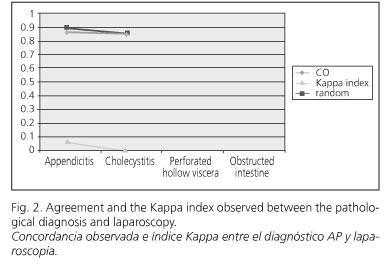
<body><![CDATA[<p><font face="Verdana" size="2">The number of patients studied was 292, with a mean age of 45.49 years, of whom 56.8% were women. In terms of frequency of the various causes of acute abdomen, appendicitis was found to be the main cause with a percentage of around 25%, followed by cholecystitis with a frequency of 10%. A laparoscopy was done in approximately 45% of patients, and was the main procedure in almost 75% of them. Up to 9% of these patients were diagnosed after performing various diagnostic tests, including laparoscopy for nonspecific abdominal pain (<a href="#f1">Fig. 1</a>).</font></p>     <p align="center"><font face="Verdana" size="2"><a name="f1"><img src="/img/revistas/diges/v101n9/original2_03.jpg" width="402" height="296"></a></font></p>     <p>&nbsp;</p>     <p><font face="Verdana" size="2">Pain location in the right lower quadrant of the abdomen may relate to acute appendicitis with an accuracy of 76.5%, a Jouden index of 0.6, a likelihood ratio (CPP or LR+) of 5.98, and a 95% CI (2.03-17.68). The relationship between pain in the right upper quadrant and cholecystitis increased considerably with an LR+ of 26.14 and a 95% CI (6.47-105).</font></p>     <p><font face="Verdana" size="2">Although there was no diagnostic agreement between fever and acute appendicitis, it did exist in relation to perforated hollow viscera with an LR+ of 5.7 and a 95% CI (1.8-48.9).</font></p>     <p><font face="Verdana" size="2">The presence of signs of irritated peritoneum did not correlate with the presence of appendicitis. All the results analyzed had an LR+ close to one, or included a 95% CI. On the other hand, a significant relationship was observed between the presence of Murphy's sign and acute cholecystitis with an LR+ of 21.50 and a 95% CI (1.99- 273.73).</font></p>     <p><font face="Verdana" size="2">Regarding laboratory tests, the relationship between leukocytosis and appendicitis was minor, with an LR+ of 2.10 and a 95% CI (1.27-3.50).</font></p>     <p><font face="Verdana" size="2">When we analyzed imaging tests, plain X-rays show a moderate relationship with perforated hollow viscera with an LR+ of 5.17 and a 95% CI (1.71-15.58), and with intestinal ischemia with an LR+ of 10.83, 95% CI (5.05-23.33). However, abdominal X-rays while standing reveals a moderate relationship with perforated hollow viscera, with an LR+ of 6.20, 95% CI (1.48-25.96). Abdominal ultrasounds show a significant relationship with cholecystitis &#091;LR+ 4.69, 95% CI (2.90-7.60)&#093;. Neither ultrasounds nor CAT show diagnostic agreement with the remaining conditions (<a target="_blank" href="/img/revistas/diges/v101n9/original2_13.jpg">Table I</a>).</font></p>     <p><font face="Verdana" size="2">In order to determining diagnostic agreement among the various tests, we have to point out that the agreement and Kappa index observed among the various diagnostic tests revealed a moderate degree of correlation that differed considerably from the unit (Figs. <a href="#f2">2</a>, <a href="#f3">3</a> and <a href="#f4">4</a>).</font></p>     <p align="center"><font face="Verdana" size="2"><a name="f2"><img src="/img/revistas/diges/v101n9/original2_05.jpg" width="390" height="272"></a></font></p>     ]]></body>
<body><![CDATA[<p align="center"><font face="Verdana" size="2"><a name="f3"><img src="/img/revistas/diges/v101n9/original2_07.jpg" width="424" height="272"></a></font></p>     <p align="center"><font face="Verdana" size="2"><a name="f4"><img src="/img/revistas/diges/v101n9/original2_14.jpg" width="424" height="306"></a></font></p>     <p><font face="Verdana" size="2">The correlation obtained among the various diagnostic tests and laparoscopy was poor, as it was in relation to the gold standard (pathology confirmation), which rendered it sensitive, but inefficient in terms of specificity to rule out the pathology in question, thus facilitating the appearance of a considerable amount of false negatives.</font></p>     <p><font face="Verdana" size="2">The Kappa index for interobserver variability in the diagnostic assessment of imaging tests was 0.7, which is considered a good diagnostic correlation.</font></p>     <p><font face="Verdana" size="2">A rectal examination was done in only 6.3% of patients attended in our Emergency Department and a good diagnostic correlation was found in more than 50% of patients undergoing this examination.</font></p>     <p><font face="Verdana" size="2">The percentage of patients who returned for the same cause within 10 days after being discharged from the hospital emergency department was around 2.4%, and in no patient, the history or diagnosis at discharge was modified.</font></p>     <p>&nbsp;</p>     <p><font face="Verdana" size="2"><b>Discussion</b></font></p>     <p><font face="Verdana" size="2">The main causes of acute abdominal pain found in our study are acute appendicitis, nonspecific abdominal pain, and biliary tract diseases. The literature we reviewed not only includes biliary tract diseases as the main cause of such pain (13), but also nonspecific abdominal pain or abdominal pain of unknown origin as one of the most common final diagnoses (14), which also comes across in our study. In terms of etiologic distribution, however, we note differences in relation to diverticular disease, nonspecific abdominal pain, appendicitis, neoplasms and intestinal obstruction, which are noted much more frequently in the literature than in this study (19).</font></p>     <p><font face="Verdana" size="2">We also observe a significant diagnostic agreement between the location of pain in the right upper quadrant and the diagnosis of cholecystitis. However, in the literature, only 38% of cases of cholecystitis, the pain was confined to the right upper quadrant. This location of pain is also significant in the case of acute appendicitis since up to 74% of patients had pain confined to the right lower quadrant at the time of emergency room admissions (20,21).</font></p>     ]]></body>
<body><![CDATA[<p><font face="Verdana" size="2">With regard to the correlation with other symptoms, we noted no significant differences. In a large series, 100% of patients with appendicitis, cholecystitis and intestinal obstruction complained of pain followed by vomiting, in contrast with 20 and 24% of patients with nonspecific abdominal pain and gastroenteritis, respectively. Other studies also support this fact and fever and vomiting are more common in patients with acute appendicitis than in those with other causes of acute abdomen (22,23).</font></p>     <p><font face="Verdana" size="2">With respect to clinical signs, we have only found a significant correlation between fever and perforated hollow viscera, and between Murphy's sign and acute cholecystitis. The sensitivity and specificity found with respect to the psoas sign are very similar to those observed in other series, around the 16 and 95%, respectively. These percentages are somewhat lower in terms of Blumberg's or rebound sign that in our study are around 50 and 23%, respectively (24).</font></p>     <p><font face="Verdana" size="2">The main indication for white blood count and differential is the discrimination between acute appendicitis and nonspecific abdominal pain. Indeed, leukocytosis accompanies acute appendicitis in most cases, less in cholecystitis and about half of cases of obstruction, compared with gastroenteritis by 43% and nonspecific abdominal pain in 31% (25).</font></p>     <p><font face="Verdana" size="2">With regard to imaging tests, ultrasound scans provide an accurate diagnosis for acute cholecystitis in 95 to 99% of cases, and for appendicitis being lower, around 76% (25).</font></p>     <p><font face="Verdana" size="2">The correlation among the various diagnostic tests and laparoscopy is poor, as well as between latter and the gold standard (pathological confirmation). Therefore, despite being sensitive, it is not efficient in terms of specificity to rule out the pathology in question, thus facilitating the appearance of a considerable number of false negatives. Laparoscopy may be a useful tool for diagnosis, and possibly treatment of acute abdominal pain; although its efficiency was somewhat low in our study, but not in other series (26).</font></p>     <p><font face="Verdana" size="2">The standard reference used (pathology findings on the surgical specimen) may only be verified in patients undergoing surgery, which may possibly imply a sequence bias (or verification bias). A sequence bias is usual when the reference pattern is an invasive technique, and it is more likely to take place when the diagnostic test is positive (an abdominal ultrasonogram suggesting appendicitis). The reliability of diagnostic tests is only assessed for imaging techniques, and the same process is not taken into account for physical examination (27).</font></p>     <p>&nbsp;</p>     <p><font face="Verdana" size="2"><b>Conclusions</b></font></p>     <p><font face="Verdana" size="2">1. Patient's history and physical examination are of limited accuracy when assessing acute abdominal pain.</font></p>     <p><font face="Verdana" size="2">2. An ultrasound scan presents a low diagnostic agreement index in relation to appendicitis.</font></p>     ]]></body>
<body><![CDATA[<p><font face="Verdana" size="2">3. Laparoscopy may prove useful to diagnose, and possibly treatment, acute abdominal pain despite a low diagnostic efficiency.</font></p>     <p>&nbsp;</p>     <p><font face="Verdana" size="2"><b>References</b></font></p>     <!-- ref --><p><font face="Verdana" size="2">1. Moya Mir MS, Laguna P. Analgesia en el dolor abdominal agudo. Estal Emergencias 2001; 13: 229-31.</font>&nbsp;&nbsp;&nbsp;&nbsp;&nbsp;&nbsp;&nbsp;&nbsp;[&#160;<a href="javascript:void(0);" onclick="javascript: window.open('/scielo.php?script=sci_nlinks&ref=5285013&pid=S1130-0108200900090000300001&lng=','','width=640,height=500,resizable=yes,scrollbars=1,menubar=yes,');">Links</a>&#160;]<!-- end-ref --><!-- ref --><p><font face="Verdana" size="2">2. Schwartz SI. Ap&eacute;ndice. In: Schwartz SI, Shires GT, Spencer FC, editors. Principios de Cirug&iacute;a. 6<sup>th</sup> ed. M&eacute;xico: McGraw-Hill; 2000.</font>&nbsp;&nbsp;&nbsp;&nbsp;&nbsp;&nbsp;&nbsp;&nbsp;[&#160;<a href="javascript:void(0);" onclick="javascript: window.open('/scielo.php?script=sci_nlinks&ref=5285014&pid=S1130-0108200900090000300002&lng=','','width=640,height=500,resizable=yes,scrollbars=1,menubar=yes,');">Links</a>&#160;]<!-- end-ref --><!-- ref --><p><font face="Verdana" size="2">3. Wolfe JM, Lein DY, Lenkoski K, Smithline HA. Analgesic administration to patients with an acute abdomen: a survey of emergency medicine physicians. Am J Emerg Med 2000; 18(3): 250-3.</font>&nbsp;&nbsp;&nbsp;&nbsp;&nbsp;&nbsp;&nbsp;&nbsp;[&#160;<a href="javascript:void(0);" onclick="javascript: window.open('/scielo.php?script=sci_nlinks&ref=5285015&pid=S1130-0108200900090000300003&lng=','','width=640,height=500,resizable=yes,scrollbars=1,menubar=yes,');">Links</a>&#160;]<!-- end-ref --><!-- ref --><p><font face="Verdana" size="2">4. Abboud PA, Colwell CB. Critically reappraising the literature-driven practice of analgesia administration for acute abdominal pain in the emergency room prior to surgical evaluation. Am J Surg 2004; 188(1): 102-3.</font>&nbsp;&nbsp;&nbsp;&nbsp;&nbsp;&nbsp;&nbsp;&nbsp;[&#160;<a href="javascript:void(0);" onclick="javascript: window.open('/scielo.php?script=sci_nlinks&ref=5285016&pid=S1130-0108200900090000300004&lng=','','width=640,height=500,resizable=yes,scrollbars=1,menubar=yes,');">Links</a>&#160;]<!-- end-ref --><!-- ref --><p><font face="Verdana" size="2">5. Dombal FT. Acute abdominal pain in the elderly. J Clin Gastroenterol 1994; 19: 331-5.</font>&nbsp;&nbsp;&nbsp;&nbsp;&nbsp;&nbsp;&nbsp;&nbsp;[&#160;<a href="javascript:void(0);" onclick="javascript: window.open('/scielo.php?script=sci_nlinks&ref=5285017&pid=S1130-0108200900090000300005&lng=','','width=640,height=500,resizable=yes,scrollbars=1,menubar=yes,');">Links</a>&#160;]<!-- end-ref --><!-- ref --><p><font face="Verdana" size="2">6. Nissman SA, Kaplan LJ, Mann BD. Critically reappraising the literature-driven practice of analgesia administration for acute abdominal pain in the emergency room prior to surgical evaluation. Am J Surg 2003; 185(4): 291-6.</font>&nbsp;&nbsp;&nbsp;&nbsp;&nbsp;&nbsp;&nbsp;&nbsp;[&#160;<a href="javascript:void(0);" onclick="javascript: window.open('/scielo.php?script=sci_nlinks&ref=5285018&pid=S1130-0108200900090000300006&lng=','','width=640,height=500,resizable=yes,scrollbars=1,menubar=yes,');">Links</a>&#160;]<!-- end-ref --><!-- ref --><p><font face="Verdana" size="2">7. Yen K, Karpas A, Pinkerton HJ, Gorelick MH. Interexaminer reliability in physical examination of pediatric patients with abdominal pain. Arch Pediatr Adolesc Med 2005; 159(4): 373-6.</font>&nbsp;&nbsp;&nbsp;&nbsp;&nbsp;&nbsp;&nbsp;&nbsp;[&#160;<a href="javascript:void(0);" onclick="javascript: window.open('/scielo.php?script=sci_nlinks&ref=5285019&pid=S1130-0108200900090000300007&lng=','','width=640,height=500,resizable=yes,scrollbars=1,menubar=yes,');">Links</a>&#160;]<!-- end-ref --><!-- ref --><p><font face="Verdana" size="2">8. L&oacute;pez de Ullibarri GI, Pita FS. Metodolog&iacute;a de la investigaci&oacute;n. Medidas de concordancia: el &iacute;ndice Kappa. HTML Febrero 2002: 169-71.</font>&nbsp;&nbsp;&nbsp;&nbsp;&nbsp;&nbsp;&nbsp;&nbsp;[&#160;<a href="javascript:void(0);" onclick="javascript: window.open('/scielo.php?script=sci_nlinks&ref=5285020&pid=S1130-0108200900090000300008&lng=','','width=640,height=500,resizable=yes,scrollbars=1,menubar=yes,');">Links</a>&#160;]<!-- end-ref --><!-- ref --><p><font face="Verdana" size="2">9. Gil VF, Peinado E, Obrador E, Pascual R, P&eacute;rez C, Merino J. Validez de las pruebas diagn&oacute;sticas para confirmar o descartar una apendicitis aguda. Med Clin (Barc) 2000; 114(Supl. 2): 48-51.</font>&nbsp;&nbsp;&nbsp;&nbsp;&nbsp;&nbsp;&nbsp;&nbsp;[&#160;<a href="javascript:void(0);" onclick="javascript: window.open('/scielo.php?script=sci_nlinks&ref=5285021&pid=S1130-0108200900090000300009&lng=','','width=640,height=500,resizable=yes,scrollbars=1,menubar=yes,');">Links</a>&#160;]<!-- end-ref --><!-- ref --><p><font face="Verdana" size="2">10. Sackett DL, Haynes RB, Guyatt GH, Tugwell P. Epidemiolog&iacute;a cl&iacute;nica. Ciencia b&aacute;sica para la medicina cl&iacute;nica. 2ª ed. Madrid: Editorial M&eacute;dica Panamericana; 1994. P. 131-56.</font>&nbsp;&nbsp;&nbsp;&nbsp;&nbsp;&nbsp;&nbsp;&nbsp;[&#160;<a href="javascript:void(0);" onclick="javascript: window.open('/scielo.php?script=sci_nlinks&ref=5285022&pid=S1130-0108200900090000300010&lng=','','width=640,height=500,resizable=yes,scrollbars=1,menubar=yes,');">Links</a>&#160;]<!-- end-ref --><!-- ref --><p><font face="Verdana" size="2">11. Jim&eacute;nez Rodr&iacute;guez RM, D&iacute;az Pav&oacute;n JM, V&aacute;zquez Monchul JM, Socas Mac&iacute;as M, S&aacute;nchez Gil JM. Causa infrecuente de dolor abdominal: Ewing's sarcomasarcoma de Ewing. Rev Esp Enferm Dig 2007; 99(12): 734-6.</font>&nbsp;&nbsp;&nbsp;&nbsp;&nbsp;&nbsp;&nbsp;&nbsp;[&#160;<a href="javascript:void(0);" onclick="javascript: window.open('/scielo.php?script=sci_nlinks&ref=5285023&pid=S1130-0108200900090000300011&lng=','','width=640,height=500,resizable=yes,scrollbars=1,menubar=yes,');">Links</a>&#160;]<!-- end-ref --><!-- ref --><p><font face="Verdana" size="2">12. Mendui&ntilde;a Guill&eacute;n MJ, Alaminos Garc&iacute;a P, Valenzuela Barranco M. Paciente de 70 a&ntilde;os con dolor en fosa il&iacute;aca izquierda y crepitaci&oacute;n a la palpaci&oacute;n profunda abdominal. Rev Esp Enferm Dig 2007; 99(10): 606-7.</font>&nbsp;&nbsp;&nbsp;&nbsp;&nbsp;&nbsp;&nbsp;&nbsp;[&#160;<a href="javascript:void(0);" onclick="javascript: window.open('/scielo.php?script=sci_nlinks&ref=5285024&pid=S1130-0108200900090000300012&lng=','','width=640,height=500,resizable=yes,scrollbars=1,menubar=yes,');">Links</a>&#160;]<!-- end-ref --><!-- ref --><p><font face="Verdana" size="2">13. Caspe. Programa de habilidades en lectura cr&iacute;tica Espa&ntilde;a. Disponible en: <a target="_blank" href="http://www.redcaspe.org/herramientas/descargas/pruebasdiagnosticas.xls">http://www.redcaspe.org/herramientas/descargas/pruebasdiagnosticas.xls</a></font>&nbsp;&nbsp;&nbsp;&nbsp;&nbsp;&nbsp;&nbsp;&nbsp;[&#160;<a href="javascript:void(0);" onclick="javascript: window.open('/scielo.php?script=sci_nlinks&ref=5285025&pid=S1130-0108200900090000300013&lng=','','width=640,height=500,resizable=yes,scrollbars=1,menubar=yes,');">Links</a>&#160;]<!-- end-ref --><!-- ref --><p><font face="Verdana" size="2">14. L&oacute;pez de Ullibarri GI, Pita FS. Metodolog&iacute;a de la investigaci&oacute;n. Medidas de concordancia: el &iacute;ndice Kappa. HTML Febrero 2002: 169-71.</font>&nbsp;&nbsp;&nbsp;&nbsp;&nbsp;&nbsp;&nbsp;&nbsp;[&#160;<a href="javascript:void(0);" onclick="javascript: window.open('/scielo.php?script=sci_nlinks&ref=5285026&pid=S1130-0108200900090000300014&lng=','','width=640,height=500,resizable=yes,scrollbars=1,menubar=yes,');">Links</a>&#160;]<!-- end-ref --><!-- ref --><p><font face="Verdana" size="2">15. Soto-L&oacute;pez A, &Aacute;guila-Melero O, Reyes-Corcho A, Consuegra-D&iacute;az JE, G&oacute;mez-Baute R. Eficiencia diagn&oacute;stica en la apendicitis aguda. Cir Ciruj 2003; 71(3): 204-9.</font>&nbsp;&nbsp;&nbsp;&nbsp;&nbsp;&nbsp;&nbsp;&nbsp;[&#160;<a href="javascript:void(0);" onclick="javascript: window.open('/scielo.php?script=sci_nlinks&ref=5285027&pid=S1130-0108200900090000300015&lng=','','width=640,height=500,resizable=yes,scrollbars=1,menubar=yes,');">Links</a>&#160;]<!-- end-ref --><!-- ref --><p><font face="Verdana" size="2">16. Aydelotte JD, Collen JF, Martin RR. Analgesic administration prior to surgical evaluation for acute appendicitis. Curr Surg 2004; 61(4): 373-5.</font>&nbsp;&nbsp;&nbsp;&nbsp;&nbsp;&nbsp;&nbsp;&nbsp;[&#160;<a href="javascript:void(0);" onclick="javascript: window.open('/scielo.php?script=sci_nlinks&ref=5285028&pid=S1130-0108200900090000300016&lng=','','width=640,height=500,resizable=yes,scrollbars=1,menubar=yes,');">Links</a>&#160;]<!-- end-ref --><!-- ref --><p><font face="Verdana" size="2">17. Kettunen J, Paajanen H, Kostiainen S. Emergency abdominal surgery in the elderly.  (Abstract). Hepatogastroenterology 1995; 42: 106-8.</font>&nbsp;&nbsp;&nbsp;&nbsp;&nbsp;&nbsp;&nbsp;&nbsp;[&#160;<a href="javascript:void(0);" onclick="javascript: window.open('/scielo.php?script=sci_nlinks&ref=5285029&pid=S1130-0108200900090000300017&lng=','','width=640,height=500,resizable=yes,scrollbars=1,menubar=yes,');">Links</a>&#160;]<!-- end-ref --><!-- ref --><p><font face="Verdana" size="2">18. Larraona JL, Castro M. Dolor tor&aacute;cico de origen esof&aacute;gico. Rev Esp Enferm Dig 2007; 99(4): 239.</font>&nbsp;&nbsp;&nbsp;&nbsp;&nbsp;&nbsp;&nbsp;&nbsp;[&#160;<a href="javascript:void(0);" onclick="javascript: window.open('/scielo.php?script=sci_nlinks&ref=5285030&pid=S1130-0108200900090000300018&lng=','','width=640,height=500,resizable=yes,scrollbars=1,menubar=yes,');">Links</a>&#160;]<!-- end-ref --><!-- ref --><p><font face="Verdana" size="2">19. D&iacute;az-Rubio, M. Chest pain of esophageal origin. Rev Esp Enferm Dig 2004; 96(9): 593-8.</font>&nbsp;&nbsp;&nbsp;&nbsp;&nbsp;&nbsp;&nbsp;&nbsp;[&#160;<a href="javascript:void(0);" onclick="javascript: window.open('/scielo.php?script=sci_nlinks&ref=5285031&pid=S1130-0108200900090000300019&lng=','','width=640,height=500,resizable=yes,scrollbars=1,menubar=yes,');">Links</a>&#160;]<!-- end-ref --><!-- ref --><p><font face="Verdana" size="2">20. Planells Roig M, Bueno Lled&oacute; J, Sanahuja Santaf&eacute; A, Garc&iacute;a Espinosa R. Quality of life (GIQLI) and laparoscopic cholecystectomy usefulness in patients with gallbladder dysfunction or chronic non-lithiasic biliary pain (chronic acalculous cholecystitis). Rev Esp Enferm Dig 2004; 96(7): 442-51.</font>&nbsp;&nbsp;&nbsp;&nbsp;&nbsp;&nbsp;&nbsp;&nbsp;[&#160;<a href="javascript:void(0);" onclick="javascript: window.open('/scielo.php?script=sci_nlinks&ref=5285032&pid=S1130-0108200900090000300020&lng=','','width=640,height=500,resizable=yes,scrollbars=1,menubar=yes,');">Links</a>&#160;]<!-- end-ref --><!-- ref --><p><font face="Verdana" size="2">21. Wagner JM, McKinney WP, Carpenter JL. Does this patient have appendicitis? JAMA 1996; 276(19): 21-5.</font>&nbsp;&nbsp;&nbsp;&nbsp;&nbsp;&nbsp;&nbsp;&nbsp;[&#160;<a href="javascript:void(0);" onclick="javascript: window.open('/scielo.php?script=sci_nlinks&ref=5285033&pid=S1130-0108200900090000300021&lng=','','width=640,height=500,resizable=yes,scrollbars=1,menubar=yes,');">Links</a>&#160;]<!-- end-ref --><!-- ref --><p><font face="Verdana" size="2">22. Eskelinen M, Ikonen J, Lipponen P. The value of history-taking, phisical examination, and computer assistance in the diagnosis of acute appendicitis in patients more than 50 years old. Scand J Gastroenterol 1995; 30: 349-55.</font>&nbsp;&nbsp;&nbsp;&nbsp;&nbsp;&nbsp;&nbsp;&nbsp;[&#160;<a href="javascript:void(0);" onclick="javascript: window.open('/scielo.php?script=sci_nlinks&ref=5285034&pid=S1130-0108200900090000300022&lng=','','width=640,height=500,resizable=yes,scrollbars=1,menubar=yes,');">Links</a>&#160;]<!-- end-ref --><!-- ref --><p><font face="Verdana" size="2">23. Stalinad JR, Ditchbrun J, De Dombal FT. Clinical presentation of acute abdomen: Study of 600 patients. Br Med J 1972; 3: 393-8.</font>&nbsp;&nbsp;&nbsp;&nbsp;&nbsp;&nbsp;&nbsp;&nbsp;[&#160;<a href="javascript:void(0);" onclick="javascript: window.open('/scielo.php?script=sci_nlinks&ref=5285035&pid=S1130-0108200900090000300023&lng=','','width=640,height=500,resizable=yes,scrollbars=1,menubar=yes,');">Links</a>&#160;]<!-- end-ref --><!-- ref --><p><font face="Verdana" size="2">24. Kim J-P, Kim S-J, Lee J-H, Kim S-W, Choi M-G, Yu H-J. Surgery in the aged in Korea. Arch Surg 1998; 133: 18-23.</font>&nbsp;&nbsp;&nbsp;&nbsp;&nbsp;&nbsp;&nbsp;&nbsp;[&#160;<a href="javascript:void(0);" onclick="javascript: window.open('/scielo.php?script=sci_nlinks&ref=5285036&pid=S1130-0108200900090000300024&lng=','','width=640,height=500,resizable=yes,scrollbars=1,menubar=yes,');">Links</a>&#160;]<!-- end-ref --><!-- ref --><p><font face="Verdana" size="2">25. Gil VF, Peinado E, Obrador E, Pascual R, P&eacute;rez C, Merino J. Validez de las pruebas diagn&oacute;sticas para confirmar o descartar una apendicitis aguda. Med Clin (Barc) 2000; 114(Supl. 2): 48-51.</font>&nbsp;&nbsp;&nbsp;&nbsp;&nbsp;&nbsp;&nbsp;&nbsp;[&#160;<a href="javascript:void(0);" onclick="javascript: window.open('/scielo.php?script=sci_nlinks&ref=5285037&pid=S1130-0108200900090000300025&lng=','','width=640,height=500,resizable=yes,scrollbars=1,menubar=yes,');">Links</a>&#160;]<!-- end-ref --><!-- ref --><p><font face="Verdana" size="2">26. Zimmerman O, Halpern P. Opinion survey of analgesia for abdominal pain in Israeli emergency departments. Isr Med Assoc J 2004; 6(11): 681-5.</font>&nbsp;&nbsp;&nbsp;&nbsp;&nbsp;&nbsp;&nbsp;&nbsp;[&#160;<a href="javascript:void(0);" onclick="javascript: window.open('/scielo.php?script=sci_nlinks&ref=5285038&pid=S1130-0108200900090000300026&lng=','','width=640,height=500,resizable=yes,scrollbars=1,menubar=yes,');">Links</a>&#160;]<!-- end-ref --><!-- ref --><p><font face="Verdana" size="2">27. Gonz&aacute;lez de Diosa J, Ochoa Sangradorb C. Rendimiento de la ecograf&iacute;a abdominal en el diagn&oacute;stico de apendicitis aguda. La importancia del cociente de probabilidades. An Pediatr (Barc) 2003; 59(6): 601-5.</font>&nbsp;&nbsp;&nbsp;&nbsp;&nbsp;&nbsp;&nbsp;&nbsp;[&#160;<a href="javascript:void(0);" onclick="javascript: window.open('/scielo.php?script=sci_nlinks&ref=5285039&pid=S1130-0108200900090000300027&lng=','','width=640,height=500,resizable=yes,scrollbars=1,menubar=yes,');">Links</a>&#160;]<!-- end-ref --><p>&nbsp;</p>     <p>&nbsp;</p>     <p><font face="Verdana" size="2"><b><a href="#top"><img border="0" src="/img/revistas/diges/v101n9/seta.gif" width="15" height="17"></a><a name="bajo"></a>Correspondence:</b>    <br>Pedro J. Tárraga López.    <br>C/ Ángel, 53, 1 E. 02002 Albacete, Spain.    <br>e-mail: <a href="mailto:pedrojuan.tarraga@uclm.es">pedrojuan.tarraga@uclm.es</a></font></p>     <p><font face="Verdana" size="2">Received: 11-12-08.    <br>Accepted: 12-05-09.</font></p>      ]]></body><back>
<ref-list>
<ref id="B1">
<label>1</label><nlm-citation citation-type="journal">
<person-group person-group-type="author">
<name>
<surname><![CDATA[Moya Mir]]></surname>
<given-names><![CDATA[MS]]></given-names>
</name>
<name>
<surname><![CDATA[Laguna]]></surname>
<given-names><![CDATA[P]]></given-names>
</name>
</person-group>
<article-title xml:lang="es"><![CDATA[Analgesia en el dolor abdominal agudo]]></article-title>
<source><![CDATA[Estal Emergencias]]></source>
<year>2001</year>
<volume>13</volume>
<page-range>229-31</page-range></nlm-citation>
</ref>
<ref id="B2">
<label>2</label><nlm-citation citation-type="book">
<person-group person-group-type="author">
<name>
<surname><![CDATA[Schwartz]]></surname>
<given-names><![CDATA[SI]]></given-names>
</name>
</person-group>
<article-title xml:lang="es"><![CDATA[Apéndice]]></article-title>
<person-group person-group-type="editor">
<name>
<surname><![CDATA[Schwartz]]></surname>
<given-names><![CDATA[SI]]></given-names>
</name>
<name>
<surname><![CDATA[Shires]]></surname>
<given-names><![CDATA[GT]]></given-names>
</name>
<name>
<surname><![CDATA[Spencer]]></surname>
<given-names><![CDATA[FC]]></given-names>
</name>
</person-group>
<source><![CDATA[Principios de Cirugía]]></source>
<year>2000</year>
<edition>6</edition>
<publisher-name><![CDATA[McGraw-Hill]]></publisher-name>
</nlm-citation>
</ref>
<ref id="B3">
<label>3</label><nlm-citation citation-type="journal">
<person-group person-group-type="author">
<name>
<surname><![CDATA[Wolfe]]></surname>
<given-names><![CDATA[JM]]></given-names>
</name>
<name>
<surname><![CDATA[Lein]]></surname>
<given-names><![CDATA[DY]]></given-names>
</name>
<name>
<surname><![CDATA[Lenkoski]]></surname>
<given-names><![CDATA[K]]></given-names>
</name>
<name>
<surname><![CDATA[Smithline]]></surname>
<given-names><![CDATA[HA]]></given-names>
</name>
</person-group>
<article-title xml:lang="en"><![CDATA[Analgesic administration to patients with an acute abdomen: a survey of emergency medicine physicians]]></article-title>
<source><![CDATA[Am J Emerg Med]]></source>
<year>2000</year>
<volume>18</volume>
<numero>3</numero>
<issue>3</issue>
<page-range>250-3</page-range></nlm-citation>
</ref>
<ref id="B4">
<label>4</label><nlm-citation citation-type="journal">
<person-group person-group-type="author">
<name>
<surname><![CDATA[Abboud]]></surname>
<given-names><![CDATA[PA]]></given-names>
</name>
<name>
<surname><![CDATA[Colwell]]></surname>
<given-names><![CDATA[CB]]></given-names>
</name>
</person-group>
<article-title xml:lang="en"><![CDATA[Critically reappraising the literature-driven practice of analgesia administration for acute abdominal pain in the emergency room prior to surgical evaluation]]></article-title>
<source><![CDATA[Am J Surg]]></source>
<year>2004</year>
<volume>188</volume>
<numero>1</numero>
<issue>1</issue>
<page-range>102-3</page-range></nlm-citation>
</ref>
<ref id="B5">
<label>5</label><nlm-citation citation-type="journal">
<person-group person-group-type="author">
<name>
<surname><![CDATA[Dombal]]></surname>
<given-names><![CDATA[FT]]></given-names>
</name>
</person-group>
<article-title xml:lang="en"><![CDATA[Acute abdominal pain in the elderly]]></article-title>
<source><![CDATA[J Clin Gastroenterol]]></source>
<year>1994</year>
<volume>19</volume>
<page-range>331-5</page-range></nlm-citation>
</ref>
<ref id="B6">
<label>6</label><nlm-citation citation-type="journal">
<person-group person-group-type="author">
<name>
<surname><![CDATA[Nissman]]></surname>
<given-names><![CDATA[SA]]></given-names>
</name>
<name>
<surname><![CDATA[Kaplan]]></surname>
<given-names><![CDATA[LJ]]></given-names>
</name>
<name>
<surname><![CDATA[Mann]]></surname>
<given-names><![CDATA[BD]]></given-names>
</name>
</person-group>
<article-title xml:lang="en"><![CDATA[Critically reappraising the literature-driven practice of analgesia administration for acute abdominal pain in the emergency room prior to surgical evaluation]]></article-title>
<source><![CDATA[Am J Surg]]></source>
<year>2003</year>
<volume>185</volume>
<numero>4</numero>
<issue>4</issue>
<page-range>291-6</page-range></nlm-citation>
</ref>
<ref id="B7">
<label>7</label><nlm-citation citation-type="journal">
<person-group person-group-type="author">
<name>
<surname><![CDATA[Yen]]></surname>
<given-names><![CDATA[K]]></given-names>
</name>
<name>
<surname><![CDATA[Karpas]]></surname>
<given-names><![CDATA[A]]></given-names>
</name>
<name>
<surname><![CDATA[Pinkerton]]></surname>
<given-names><![CDATA[HJ]]></given-names>
</name>
<name>
<surname><![CDATA[Gorelick]]></surname>
<given-names><![CDATA[MH]]></given-names>
</name>
</person-group>
<article-title xml:lang="en"><![CDATA[Interexaminer reliability in physical examination of pediatric patients with abdominal pain]]></article-title>
<source><![CDATA[Arch Pediatr Adolesc Med]]></source>
<year>2005</year>
<volume>159</volume>
<numero>4</numero>
<issue>4</issue>
<page-range>373-6</page-range></nlm-citation>
</ref>
<ref id="B8">
<label>8</label><nlm-citation citation-type="journal">
<person-group person-group-type="author">
<name>
<surname><![CDATA[López de Ullibarri]]></surname>
<given-names><![CDATA[GI]]></given-names>
</name>
<name>
<surname><![CDATA[Pita]]></surname>
<given-names><![CDATA[FS]]></given-names>
</name>
</person-group>
<article-title xml:lang="es"><![CDATA[Metodología de la investigación: Medidas de concordancia: el índice Kappa]]></article-title>
<source><![CDATA[HTML]]></source>
<year>Febr</year>
<month>er</month>
<day>o </day>
<page-range>169-71</page-range></nlm-citation>
</ref>
<ref id="B9">
<label>9</label><nlm-citation citation-type="journal">
<person-group person-group-type="author">
<name>
<surname><![CDATA[Gil]]></surname>
<given-names><![CDATA[VF]]></given-names>
</name>
<name>
<surname><![CDATA[Peinado]]></surname>
<given-names><![CDATA[E]]></given-names>
</name>
<name>
<surname><![CDATA[Obrador]]></surname>
<given-names><![CDATA[E]]></given-names>
</name>
<name>
<surname><![CDATA[Pascual]]></surname>
<given-names><![CDATA[R]]></given-names>
</name>
<name>
<surname><![CDATA[Pérez]]></surname>
<given-names><![CDATA[C]]></given-names>
</name>
<name>
<surname><![CDATA[Merino]]></surname>
<given-names><![CDATA[J]]></given-names>
</name>
</person-group>
<article-title xml:lang="es"><![CDATA[Validez de las pruebas diagnósticas para confirmar o descartar una apendicitis aguda]]></article-title>
<source><![CDATA[Med Clin (Barc)]]></source>
<year>2000</year>
<volume>114</volume>
<numero>^s2</numero>
<issue>^s2</issue>
<supplement>2</supplement>
<page-range>48-51</page-range></nlm-citation>
</ref>
<ref id="B10">
<label>10</label><nlm-citation citation-type="book">
<person-group person-group-type="author">
<name>
<surname><![CDATA[Sackett]]></surname>
<given-names><![CDATA[DL]]></given-names>
</name>
<name>
<surname><![CDATA[Haynes]]></surname>
<given-names><![CDATA[RB]]></given-names>
</name>
<name>
<surname><![CDATA[Guyatt]]></surname>
<given-names><![CDATA[GH]]></given-names>
</name>
<name>
<surname><![CDATA[Tugwell]]></surname>
<given-names><![CDATA[P]]></given-names>
</name>
</person-group>
<source><![CDATA[Epidemiología clínica: Ciencia básica para la medicina clínica]]></source>
<year>1994</year>
<edition>2</edition>
<page-range>131-56</page-range><publisher-loc><![CDATA[Madrid ]]></publisher-loc>
<publisher-name><![CDATA[Médica Panamericana]]></publisher-name>
</nlm-citation>
</ref>
<ref id="B11">
<label>11</label><nlm-citation citation-type="journal">
<person-group person-group-type="author">
<name>
<surname><![CDATA[Jiménez Rodríguez]]></surname>
<given-names><![CDATA[RM]]></given-names>
</name>
<name>
<surname><![CDATA[Díaz Pavón]]></surname>
<given-names><![CDATA[JM]]></given-names>
</name>
<name>
<surname><![CDATA[Vázquez Monchul]]></surname>
<given-names><![CDATA[JM]]></given-names>
</name>
<name>
<surname><![CDATA[Socas Macías]]></surname>
<given-names><![CDATA[M]]></given-names>
</name>
<name>
<surname><![CDATA[Sánchez Gil]]></surname>
<given-names><![CDATA[JM]]></given-names>
</name>
</person-group>
<article-title xml:lang="es"><![CDATA[Causa infrecuente de dolor abdominal: Ewing's sarcomasarcoma de Ewing]]></article-title>
<source><![CDATA[Rev Esp Enferm Dig]]></source>
<year>2007</year>
<volume>99</volume>
<numero>12</numero>
<issue>12</issue>
<page-range>734-6</page-range></nlm-citation>
</ref>
<ref id="B12">
<label>12</label><nlm-citation citation-type="journal">
<person-group person-group-type="author">
<name>
<surname><![CDATA[Menduiña Guillén]]></surname>
<given-names><![CDATA[MJ]]></given-names>
</name>
<name>
<surname><![CDATA[Alaminos García]]></surname>
<given-names><![CDATA[P]]></given-names>
</name>
<name>
<surname><![CDATA[Valenzuela Barranco]]></surname>
<given-names><![CDATA[M]]></given-names>
</name>
</person-group>
<article-title xml:lang="es"><![CDATA[Paciente de 70 años con dolor en fosa ilíaca izquierda y crepitación a la palpación profunda abdominal]]></article-title>
<source><![CDATA[Rev Esp Enferm Dig]]></source>
<year>2007</year>
<volume>99</volume>
<numero>10</numero>
<issue>10</issue>
<page-range>606-7</page-range></nlm-citation>
</ref>
<ref id="B13">
<label>13</label><nlm-citation citation-type="">
<source><![CDATA[Caspe: Programa de habilidades en lectura crítica España]]></source>
<year></year>
</nlm-citation>
</ref>
<ref id="B14">
<label>14</label><nlm-citation citation-type="journal">
<person-group person-group-type="author">
<name>
<surname><![CDATA[López de Ullibarri]]></surname>
<given-names><![CDATA[GI]]></given-names>
</name>
<name>
<surname><![CDATA[Pita]]></surname>
<given-names><![CDATA[FS]]></given-names>
</name>
</person-group>
<article-title xml:lang="es"><![CDATA[Metodología de la investigación: Medidas de concordancia: el índice Kappa]]></article-title>
<source><![CDATA[HTML]]></source>
<year>Febr</year>
<month>er</month>
<day>o </day>
<page-range>169-71</page-range></nlm-citation>
</ref>
<ref id="B15">
<label>15</label><nlm-citation citation-type="journal">
<person-group person-group-type="author">
<name>
<surname><![CDATA[Soto-López]]></surname>
<given-names><![CDATA[A]]></given-names>
</name>
<name>
<surname><![CDATA[Águila-Melero]]></surname>
<given-names><![CDATA[O]]></given-names>
</name>
<name>
<surname><![CDATA[Reyes-Corcho]]></surname>
<given-names><![CDATA[A]]></given-names>
</name>
<name>
<surname><![CDATA[Consuegra-Díaz]]></surname>
<given-names><![CDATA[JE]]></given-names>
</name>
<name>
<surname><![CDATA[Gómez-Baute]]></surname>
<given-names><![CDATA[R]]></given-names>
</name>
</person-group>
<article-title xml:lang="es"><![CDATA[Eficiencia diagnóstica en la apendicitis aguda]]></article-title>
<source><![CDATA[Cir Ciruj]]></source>
<year>2003</year>
<volume>71</volume>
<numero>3</numero>
<issue>3</issue>
<page-range>204-9</page-range></nlm-citation>
</ref>
<ref id="B16">
<label>16</label><nlm-citation citation-type="journal">
<person-group person-group-type="author">
<name>
<surname><![CDATA[Aydelotte]]></surname>
<given-names><![CDATA[JD]]></given-names>
</name>
<name>
<surname><![CDATA[Collen]]></surname>
<given-names><![CDATA[JF]]></given-names>
</name>
<name>
<surname><![CDATA[Martin]]></surname>
<given-names><![CDATA[RR]]></given-names>
</name>
</person-group>
<article-title xml:lang="en"><![CDATA[Analgesic administration prior to surgical evaluation for acute appendicitis]]></article-title>
<source><![CDATA[Curr Surg]]></source>
<year>2004</year>
<volume>61</volume>
<numero>4</numero>
<issue>4</issue>
<page-range>373-5</page-range></nlm-citation>
</ref>
<ref id="B17">
<label>17</label><nlm-citation citation-type="journal">
<person-group person-group-type="author">
<name>
<surname><![CDATA[Kettunen]]></surname>
<given-names><![CDATA[J]]></given-names>
</name>
<name>
<surname><![CDATA[Paajanen]]></surname>
<given-names><![CDATA[H]]></given-names>
</name>
<name>
<surname><![CDATA[Kostiainen]]></surname>
<given-names><![CDATA[S]]></given-names>
</name>
</person-group>
<article-title xml:lang="en"><![CDATA[Emergency abdominal surgery in the elderly]]></article-title>
<source><![CDATA[Hepatogastroenterology]]></source>
<year>1995</year>
<volume>42</volume>
<page-range>106-8</page-range></nlm-citation>
</ref>
<ref id="B18">
<label>18</label><nlm-citation citation-type="journal">
<person-group person-group-type="author">
<name>
<surname><![CDATA[Larraona]]></surname>
<given-names><![CDATA[JL]]></given-names>
</name>
<name>
<surname><![CDATA[Castro]]></surname>
<given-names><![CDATA[M]]></given-names>
</name>
</person-group>
<article-title xml:lang="es"><![CDATA[Dolor torácico de origen esofágico]]></article-title>
<source><![CDATA[Rev Esp Enferm Dig]]></source>
<year>2007</year>
<volume>99</volume>
<numero>4</numero>
<issue>4</issue>
<page-range>239</page-range></nlm-citation>
</ref>
<ref id="B19">
<label>19</label><nlm-citation citation-type="journal">
<person-group person-group-type="author">
<name>
<surname><![CDATA[Díaz-Rubio]]></surname>
<given-names><![CDATA[M]]></given-names>
</name>
</person-group>
<article-title xml:lang="en"><![CDATA[Chest pain of esophageal origin]]></article-title>
<source><![CDATA[Rev Esp Enferm Dig]]></source>
<year>2004</year>
<volume>96</volume>
<numero>9</numero>
<issue>9</issue>
<page-range>593-8</page-range></nlm-citation>
</ref>
<ref id="B20">
<label>20</label><nlm-citation citation-type="journal">
<person-group person-group-type="author">
<name>
<surname><![CDATA[Planells Roig]]></surname>
<given-names><![CDATA[M]]></given-names>
</name>
<name>
<surname><![CDATA[Bueno Lledó]]></surname>
<given-names><![CDATA[J]]></given-names>
</name>
<name>
<surname><![CDATA[Sanahuja Santafé]]></surname>
<given-names><![CDATA[A]]></given-names>
</name>
<name>
<surname><![CDATA[García Espinosa]]></surname>
<given-names><![CDATA[R]]></given-names>
</name>
</person-group>
<article-title xml:lang="en"><![CDATA[Quality of life (GIQLI) and laparoscopic cholecystectomy usefulness in patients with gallbladder dysfunction or chronic non-lithiasic biliary pain (chronic acalculous cholecystitis)]]></article-title>
<source><![CDATA[Rev Esp Enferm Dig]]></source>
<year>2004</year>
<volume>96</volume>
<numero>7</numero>
<issue>7</issue>
<page-range>442-51</page-range></nlm-citation>
</ref>
<ref id="B21">
<label>21</label><nlm-citation citation-type="journal">
<person-group person-group-type="author">
<name>
<surname><![CDATA[Wagner]]></surname>
<given-names><![CDATA[JM]]></given-names>
</name>
<name>
<surname><![CDATA[McKinney]]></surname>
<given-names><![CDATA[WP]]></given-names>
</name>
<name>
<surname><![CDATA[Carpenter]]></surname>
<given-names><![CDATA[JL]]></given-names>
</name>
</person-group>
<article-title xml:lang="en"><![CDATA[Does this patient have appendicitis?]]></article-title>
<source><![CDATA[JAMA]]></source>
<year>1996</year>
<volume>276</volume>
<numero>19</numero>
<issue>19</issue>
<page-range>21-5</page-range></nlm-citation>
</ref>
<ref id="B22">
<label>22</label><nlm-citation citation-type="journal">
<person-group person-group-type="author">
<name>
<surname><![CDATA[Eskelinen]]></surname>
<given-names><![CDATA[M]]></given-names>
</name>
<name>
<surname><![CDATA[Ikonen]]></surname>
<given-names><![CDATA[J]]></given-names>
</name>
<name>
<surname><![CDATA[Lipponen]]></surname>
<given-names><![CDATA[P]]></given-names>
</name>
</person-group>
<article-title xml:lang="en"><![CDATA[The value of history-taking, phisical examination, and computer assistance in the diagnosis of acute appendicitis in patients more than 50 years old]]></article-title>
<source><![CDATA[Scand J Gastroenterol]]></source>
<year>1995</year>
<volume>30</volume>
<page-range>349-55</page-range></nlm-citation>
</ref>
<ref id="B23">
<label>23</label><nlm-citation citation-type="journal">
<person-group person-group-type="author">
<name>
<surname><![CDATA[Stalinad]]></surname>
<given-names><![CDATA[JR]]></given-names>
</name>
<name>
<surname><![CDATA[Ditchbrun]]></surname>
<given-names><![CDATA[J]]></given-names>
</name>
<name>
<surname><![CDATA[De Dombal]]></surname>
<given-names><![CDATA[FT]]></given-names>
</name>
</person-group>
<article-title xml:lang="en"><![CDATA[Clinical presentation of acute abdomen: Study of 600 patients]]></article-title>
<source><![CDATA[Br Med J]]></source>
<year>1972</year>
<volume>3</volume>
<page-range>393-8</page-range></nlm-citation>
</ref>
<ref id="B24">
<label>24</label><nlm-citation citation-type="journal">
<person-group person-group-type="author">
<name>
<surname><![CDATA[Kim]]></surname>
<given-names><![CDATA[J-P]]></given-names>
</name>
<name>
<surname><![CDATA[Kim]]></surname>
<given-names><![CDATA[S-J]]></given-names>
</name>
<name>
<surname><![CDATA[Lee]]></surname>
<given-names><![CDATA[J-H]]></given-names>
</name>
<name>
<surname><![CDATA[Kim]]></surname>
<given-names><![CDATA[S-W]]></given-names>
</name>
<name>
<surname><![CDATA[Choi]]></surname>
<given-names><![CDATA[M-G]]></given-names>
</name>
<name>
<surname><![CDATA[Yu]]></surname>
<given-names><![CDATA[H-J]]></given-names>
</name>
</person-group>
<article-title xml:lang="en"><![CDATA[Surgery in the aged in Korea]]></article-title>
<source><![CDATA[Arch Surg]]></source>
<year>1998</year>
<volume>133</volume>
<page-range>18-23</page-range></nlm-citation>
</ref>
<ref id="B25">
<label>25</label><nlm-citation citation-type="journal">
<person-group person-group-type="author">
<name>
<surname><![CDATA[Gil]]></surname>
<given-names><![CDATA[VF]]></given-names>
</name>
<name>
<surname><![CDATA[Peinado]]></surname>
<given-names><![CDATA[E]]></given-names>
</name>
<name>
<surname><![CDATA[Obrador]]></surname>
<given-names><![CDATA[E]]></given-names>
</name>
<name>
<surname><![CDATA[Pascual]]></surname>
<given-names><![CDATA[R]]></given-names>
</name>
<name>
<surname><![CDATA[Pérez]]></surname>
<given-names><![CDATA[C]]></given-names>
</name>
<name>
<surname><![CDATA[Merino]]></surname>
<given-names><![CDATA[J]]></given-names>
</name>
</person-group>
<article-title xml:lang="es"><![CDATA[Validez de las pruebas diagnósticas para confirmar o descartar una apendicitis aguda]]></article-title>
<source><![CDATA[Med Clin (Barc)]]></source>
<year>2000</year>
<volume>114</volume>
<numero>^s2</numero>
<issue>^s2</issue>
<supplement>2</supplement>
<page-range>48-51</page-range></nlm-citation>
</ref>
<ref id="B26">
<label>26</label><nlm-citation citation-type="journal">
<person-group person-group-type="author">
<name>
<surname><![CDATA[Zimmerman]]></surname>
<given-names><![CDATA[O]]></given-names>
</name>
<name>
<surname><![CDATA[Halpern]]></surname>
<given-names><![CDATA[P]]></given-names>
</name>
</person-group>
<article-title xml:lang="en"><![CDATA[Opinion survey of analgesia for abdominal pain in Israeli emergency departments]]></article-title>
<source><![CDATA[Isr Med Assoc J]]></source>
<year>2004</year>
<volume>6</volume>
<numero>11</numero>
<issue>11</issue>
<page-range>681-5</page-range></nlm-citation>
</ref>
<ref id="B27">
<label>27</label><nlm-citation citation-type="journal">
<person-group person-group-type="author">
<name>
<surname><![CDATA[González de Diosa]]></surname>
<given-names><![CDATA[J]]></given-names>
</name>
<name>
<surname><![CDATA[Ochoa Sangradorb]]></surname>
<given-names><![CDATA[C]]></given-names>
</name>
</person-group>
<article-title xml:lang="es"><![CDATA[Rendimiento de la ecografía abdominal en el diagnóstico de apendicitis aguda: La importancia del cociente de probabilidades]]></article-title>
<source><![CDATA[An Pediatr (Barc)]]></source>
<year>2003</year>
<volume>59</volume>
<numero>6</numero>
<issue>6</issue>
<page-range>601-5</page-range></nlm-citation>
</ref>
</ref-list>
</back>
</article>