<?xml version="1.0" encoding="ISO-8859-1"?><article xmlns:mml="http://www.w3.org/1998/Math/MathML" xmlns:xlink="http://www.w3.org/1999/xlink" xmlns:xsi="http://www.w3.org/2001/XMLSchema-instance">
<front>
<journal-meta>
<journal-id>1130-0108</journal-id>
<journal-title><![CDATA[Revista Española de Enfermedades Digestivas]]></journal-title>
<abbrev-journal-title><![CDATA[Rev. esp. enferm. dig.]]></abbrev-journal-title>
<issn>1130-0108</issn>
<publisher>
<publisher-name><![CDATA[Sociedad Española de Patología Digestiva]]></publisher-name>
</publisher>
</journal-meta>
<article-meta>
<article-id>S1130-01082010000200004</article-id>
<title-group>
<article-title xml:lang="en"><![CDATA[Pyogenic versus amoebic liver abscesses: A comparative clinical study in a series of 58 patients]]></article-title>
<article-title xml:lang="es"><![CDATA[Absceso hepático piógeno versus amebiano: Estudio clínico comparativo de una serie de 58 casos]]></article-title>
</title-group>
<contrib-group>
<contrib contrib-type="author">
<name>
<surname><![CDATA[Cosme]]></surname>
<given-names><![CDATA[A.]]></given-names>
</name>
<xref ref-type="aff" rid="A01"/>
<xref ref-type="aff" rid="A05"/>
</contrib>
<contrib contrib-type="author">
<name>
<surname><![CDATA[Ojeda]]></surname>
<given-names><![CDATA[E.]]></given-names>
</name>
<xref ref-type="aff" rid="A02"/>
</contrib>
<contrib contrib-type="author">
<name>
<surname><![CDATA[Zamarreño]]></surname>
<given-names><![CDATA[I.]]></given-names>
</name>
<xref ref-type="aff" rid="A02"/>
</contrib>
<contrib contrib-type="author">
<name>
<surname><![CDATA[Bujanda]]></surname>
<given-names><![CDATA[L.]]></given-names>
</name>
<xref ref-type="aff" rid="A01"/>
<xref ref-type="aff" rid="A05"/>
</contrib>
<contrib contrib-type="author">
<name>
<surname><![CDATA[Garmendia]]></surname>
<given-names><![CDATA[G.]]></given-names>
</name>
<xref ref-type="aff" rid="A03"/>
</contrib>
<contrib contrib-type="author">
<name>
<surname><![CDATA[Echeverría]]></surname>
<given-names><![CDATA[M. J.]]></given-names>
</name>
<xref ref-type="aff" rid="A04"/>
</contrib>
<contrib contrib-type="author">
<name>
<surname><![CDATA[Benavente]]></surname>
<given-names><![CDATA[J.]]></given-names>
</name>
<xref ref-type="aff" rid="A02"/>
</contrib>
</contrib-group>
<aff id="A01">
<institution><![CDATA[,Donostia Hospital Gastroenterology Department ]]></institution>
<addr-line><![CDATA[ ]]></addr-line>
</aff>
<aff id="A05">
<institution><![CDATA[,Centro de investigación biomédica en red: enfermedades hepáticas y digestivas (CIBEREHD)  ]]></institution>
<addr-line><![CDATA[ ]]></addr-line>
</aff>
<aff id="A02">
<institution><![CDATA[,Donostia Hospital Department of Internal Medicine ]]></institution>
<addr-line><![CDATA[ ]]></addr-line>
</aff>
<aff id="A03">
<institution><![CDATA[,Donostia Hospital Department of Radiology ]]></institution>
<addr-line><![CDATA[ ]]></addr-line>
</aff>
<aff id="A04">
<institution><![CDATA[,Donostia Hospital Department of Microbiology ]]></institution>
<addr-line><![CDATA[San Sebastián ]]></addr-line>
<country>Spain</country>
</aff>
<pub-date pub-type="pub">
<day>00</day>
<month>02</month>
<year>2010</year>
</pub-date>
<pub-date pub-type="epub">
<day>00</day>
<month>02</month>
<year>2010</year>
</pub-date>
<volume>102</volume>
<numero>2</numero>
<fpage>90</fpage>
<lpage>95</lpage>
<copyright-statement/>
<copyright-year/>
<self-uri xlink:href="http://scielo.isciii.es/scielo.php?script=sci_arttext&amp;pid=S1130-01082010000200004&amp;lng=en&amp;nrm=iso"></self-uri><self-uri xlink:href="http://scielo.isciii.es/scielo.php?script=sci_abstract&amp;pid=S1130-01082010000200004&amp;lng=en&amp;nrm=iso"></self-uri><self-uri xlink:href="http://scielo.isciii.es/scielo.php?script=sci_pdf&amp;pid=S1130-01082010000200004&amp;lng=en&amp;nrm=iso"></self-uri><abstract abstract-type="short" xml:lang="en"><p><![CDATA[Objective: to compare the clinical and epidemiological characteristics of patients with pyogenic liver abscess (PLA) and with amebic liver abscess (AHA) in order to determine the potential factors that may help improve diagnosis and treatment for this disease. Material and method: a retrospective study of clinical histories of 45 patients with PLA and 13 with ALA, diagnosed between 1985 and 2005 in Donostia Hospital in San Sebastián. Results: among the 45 patients with PLA (30 men and 15 women, with a mean age of 61 years and 11 months), more than a half were cholangitic (13 cases) or were of unknown origin (15 cases). In 10 patients, diabetes was considered to be a predisposing condition. Increased ESR (> 30), leukocytosis (> 12,000), fever and abdominal pain were observed in 95.5%, 86.7%, 82.8% and 68.9%, respectively. Twenty-five patients had single abscesses. Abscess and blood cultures were positive in 77.1% and 50% of cases, respectively (44.4% with polymicrobial infection). E. coli and S. milleri were the most commonly found germs. A percutaneous drainage was performed on 22 patients. Mean hospital stay was 27 days, and overall mortality, including that related to concomitant conditions, was 7 of 45 cases. Of the 13 cases of ALA (7 men and 6 women, with mean age of 42,9 years), 2 were locally acquired. Increased AF and GGTP (> 2N), fever, leukocytosis and ESR (> 30) were observed in 92.3, 77, 70 and 61.5% of cases, respectively. There were single abscesses in 10 patients and all except one were located in the right lobe. The serological test for E. histolytica (IFF &ge; 1/256) was positive in 100% of cases. A percutaneous drainage was carried out on 6 patients. Mean hospital stay was 18 days and two patients died. Conclusions: In our series, the clinical parameters suggesting pyogenic origin were: age 50 or older, male gender, diabetes, moderately elevated bilirubin and transaminases. In amoebic cases the associated features were being aged 45 or younger, diarrhoea, and presence of a single abscess in the right lobe. Parasitism by E. histolytica must be considered in the differential diagnosis of liver abscesses, even with no epidemiological clinical history of travel and/or immigration.]]></p></abstract>
<abstract abstract-type="short" xml:lang="es"><p><![CDATA[Objetivo: comparar las características clínicas y epidemiológicas de los pacientes con absceso hepático piógeno (AHP) y con absceso hepático amebiano (AHA) para establecer posibles factores que ayuden a mejorar el diagnóstico y tratamiento de la enfermedad. Material y método: se realiza un estudio retrospectivo de las historias clínicas de 45 pacientes con AHP y de 13 con AHA, diagnosticados entre 1985 y 2005 en el Hospital Donostia de San Sebastián. Resultados: de los 45 casos de AHP (30 hombres y 15 mujeres con una edad media de 61 años y 11 meses), más de la mitad fueron de origen colangítico (13 casos) o criptogenético (15 casos). La diabetes como enfermedad predisponente se objetivó en 10. La elevación de la VSG (> 30), leucocitosis (> 12.000), fiebre y dolor abdominal se observaron en el 95,5, 86,7, 82,8 y 68,9% de los casos respectivamente. Los abscesos fueron solitarios en 25 casos. Los cultivos del absceso y los hemocultivos fueron positivos en el 77,1 y 50%, respectivamente (44,4% de los casos eran polimicrobianos). E. coli y S. milleri fueron los gérmenes más habituales. Se hizo drenaje percutáneo en 22 pacientes. La mortalidad global, incluida la relacionada con la patología subyacente, fue de 7 casos y la estancia media hospitalaria de 27 días. De los 13 casos de AHA (7 hombres y 6 mujeres con una edad media de 42 años y 9 meses), 2 fueron autóctonos. La elevación de la FA y GGTP (> 2N), fiebre, leucocitosis y VSG (> 30) se observaron en el 92,3, 77, 70 y 61,5% de los casos respectivamente. Los abscesos fueron únicos en 10 casos y excepto uno, 12 se localizaron en el lóbulo derecho. La serología a E. histolytica (IFI &ge; 1/256) fue positiva en el 100% de los casos. Se hizo drenaje percutáneo en 6 pacientes. La mortalidad fue de 2 casos y la estancia media hospitalaria de 18 días. Conclusiones: en nuestra serie, las características clínicas que sugieren un origen piógeno son: la edad superior a 50 años, el sexo masculino, la diabetes y la bilirrubina y transaminasas moderadamente elevadas. En el amebiano, la edad menor de 45 años, la diarrea y la localización solitaria del absceso en el lóbulo derecho. La parasitación por E. histolytica se debe considerar en el diagnóstico diferencial de los abscesos hepáticos, incluso sin el antecedente epidemiológico de viajes o de inmigración.]]></p></abstract>
<kwd-group>
<kwd lng="en"><![CDATA[Liver abscess]]></kwd>
<kwd lng="en"><![CDATA[Pyogenic]]></kwd>
<kwd lng="en"><![CDATA[Amoebic]]></kwd>
<kwd lng="en"><![CDATA[Comparison]]></kwd>
<kwd lng="es"><![CDATA[Absceso hepático]]></kwd>
<kwd lng="es"><![CDATA[Piógeno]]></kwd>
<kwd lng="es"><![CDATA[Amebiano]]></kwd>
<kwd lng="es"><![CDATA[Comparación]]></kwd>
</kwd-group>
</article-meta>
</front><body><![CDATA[ <p><a name="top"></a><font face="Verdana" size="2"><b>ORIGINAL PAPERS</b></font></p>     <p>&nbsp;</p>     <p><font face="Verdana" size="4"><b>Pyogenic <i>versus</i> amoebic liver abscesses. A comparative clinical study in a series of 58 patients</b></font></p>     <p><font face="Verdana" size="4"><b>Absceso hep&aacute;tico pi&oacute;geno <i>versus</i> amebiano. Estudio cl&iacute;nico comparativo de una serie de 58 casos</b></font></p>     <p>&nbsp;</p>     <p>&nbsp;</p>     <p><font face="Verdana" size="2"><b>A. Cosme<sup>1</sup>, E. Ojeda<sup>2</sup>, I. Zamarre&ntilde;o<sup>2</sup>, L. Bujanda<sup>1</sup>, G. Garmendia<sup>3</sup>, M. J. Echeverr&iacute;a<sup>4</sup> and J. Benavente<sup>2</sup></b></font></p>     <p><font face="Verdana" size="2"><sup>1</sup>Gastroenterology Department. Donostia Hospital. CIBEREHD. University of the Basque Country. San Sebasti&aacute;n, Guip&uacute;zcoa. Spain. Departments of <sup>2</sup>Internal Medicine, <sup>3</sup>Radiology, and <sup>4</sup>Microbiology. Donostia Hospital. San Sebasti&aacute;n, Guip&uacute;zcoa. Spain</font></p>     <p><font face="Verdana" size="2"><a href="#bajo">Correspondence</a></font></p>     <p>&nbsp;</p>     ]]></body>
<body><![CDATA[<p>&nbsp;</p> <hr size="1">     <p><font face="Verdana" size="2"><b>ABSTRACT</b></font></p>     <p><font face="Verdana" size="2"><b>Objective:</b> to compare the clinical and epidemiological characteristics of patients with pyogenic liver abscess (PLA) and with amebic liver abscess (AHA) in order to determine the potential factors that may help improve diagnosis and treatment for this disease.    <br><b>Material and method:</b> a retrospective study of clinical histories of 45 patients with PLA and 13 with ALA, diagnosed between 1985 and 2005 in Donostia Hospital in San Sebasti&aacute;n.    <br><b>Results:</b> among the 45 patients with PLA (30 men and 15 women, with a mean age of 61 years and 11 months), more than a half were cholangitic (13 cases) or were of unknown origin (15 cases). In 10 patients, diabetes was considered to be a predisposing condition. Increased ESR (&gt; 30), leukocytosis (&gt; 12,000), fever and abdominal pain were observed in 95.5%, 86.7%, 82.8% and 68.9%, respectively. Twenty-five patients had single abscesses. Abscess and blood cultures were positive in 77.1% and 50% of cases, respectively (44.4% with polymicrobial infection). <i>E. coli</i> and <i>S. milleri</i> were the most commonly found germs. A percutaneous drainage was performed on 22 patients. Mean hospital stay was 27 days, and overall mortality, including that related to concomitant conditions, was 7 of 45 cases.    <br>Of the 13 cases of ALA (7 men and 6 women, with mean age of 42,9 years), 2 were locally acquired. Increased AF and GGTP (&gt; 2N), fever, leukocytosis and ESR (&gt; 30) were observed in 92.3, 77, 70 and 61.5% of cases, respectively. There were single abscesses in 10 patients and all except one were located in the right lobe. The serological test for E. histolytica (IFF &ge; 1/256) was positive in 100% of cases. A percutaneous drainage was carried out on 6 patients. Mean hospital stay was 18 days and two patients died.     <br><b>Conclusions:</b> In our series, the clinical parameters suggesting pyogenic origin were: age 50 or older, male gender, diabetes, moderately elevated bilirubin and transaminases. In amoebic cases the associated features were being aged 45 or younger, diarrhoea, and presence of a single abscess in the right lobe. Parasitism by <i>E. histolytica</i> must be considered in the differential diagnosis of liver abscesses, even with no epidemiological clinical history of travel and/or immigration.</font></p>     <p><font face="Verdana" size="2"><b>Key words:</b> Liver abscess. Pyogenic. Amoebic. Comparison.</font></p> <hr size="1">     <p><font face="Verdana" size="2"><b>RESUMEN</b></font></p>     <p><font face="Verdana" size="2"><b>Objetivo:</b> comparar las caracter&iacute;sticas cl&iacute;nicas y epidemiol&oacute;gicas de los pacientes con absceso hep&aacute;tico pi&oacute;geno (AHP) y con absceso hep&aacute;tico amebiano (AHA) para establecer posibles factores que ayuden a mejorar el diagn&oacute;stico y tratamiento de la enfermedad.    ]]></body>
<body><![CDATA[<br><b>Material y m&eacute;todo:</b> se realiza un estudio retrospectivo de las historias cl&iacute;nicas de 45 pacientes con AHP y de 13 con AHA, diagnosticados entre 1985 y 2005 en el Hospital Donostia de San Sebasti&aacute;n.    <br><b>Resultados:</b> de los 45 casos de AHP (30 hombres y 15 mujeres con una edad media de 61 a&ntilde;os y 11 meses), m&aacute;s de la mitad fueron de origen colang&iacute;tico (13 casos) o criptogen&eacute;tico (15 casos). La diabetes como enfermedad predisponente se objetiv&oacute; en 10. La elevaci&oacute;n de la VSG (&gt; 30), leucocitosis (&gt; 12.000), fiebre y dolor abdominal se observaron en el 95,5, 86,7, 82,8 y 68,9% de los casos respectivamente. Los abscesos fueron solitarios en 25 casos. Los cultivos del absceso y los hemocultivos fueron positivos en el 77,1 y 50%, respectivamente (44,4% de los casos eran polimicrobianos). <i>E. coli</i> y <i>S. milleri</i> fueron los g&eacute;rmenes m&aacute;s habituales. Se hizo drenaje percut&aacute;neo en 22 pacientes. La mortalidad global, incluida la relacionada con la patolog&iacute;a subyacente, fue de 7 casos y la estancia media hospitalaria de 27 d&iacute;as.    <br>De los 13 casos de AHA (7 hombres y 6 mujeres con una edad media de 42 a&ntilde;os y 9 meses), 2 fueron aut&oacute;ctonos. La elevaci&oacute;n de la FA y GGTP (&gt; 2N), fiebre, leucocitosis y VSG (&gt; 30) se observaron en el 92,3, 77, 70 y 61,5% de los casos respectivamente. Los abscesos fueron &uacute;nicos en 10 casos y excepto uno, 12 se localizaron en el l&oacute;bulo derecho. La serolog&iacute;a a <i>E. histolytica</i> (IFI &ge; 1/256) fue positiva en el 100% de los casos. Se hizo drenaje percut&aacute;neo en 6 pacientes. La mortalidad fue de 2 casos y la estancia media hospitalaria de 18 d&iacute;as.    <br><b>Conclusiones:</b> en nuestra serie, las caracter&iacute;sticas cl&iacute;nicas que sugieren un origen pi&oacute;geno son: la edad superior a 50 a&ntilde;os, el sexo masculino, la diabetes y la bilirrubina y transaminasas moderadamente elevadas. En el amebiano, la edad menor de 45 a&ntilde;os, la diarrea y la localizaci&oacute;n solitaria del absceso en el l&oacute;bulo derecho. La parasitaci&oacute;n por <i>E. histolytica</i> se debe considerar en el diagn&oacute;stico diferencial de los abscesos hep&aacute;ticos, incluso sin el antecedente epidemiol&oacute;gico de viajes o de inmigraci&oacute;n.</font></p>     <p><font face="Verdana" size="2"><b>Palabras clave:</b> Absceso hep&aacute;tico. Pi&oacute;geno. Amebiano. Comparaci&oacute;n.</font></p> <hr size="1">     <p>&nbsp;</p>     <p><font face="Verdana" size="2"><b>Introduction</b></font></p>     <p><font face="Verdana" size="2">The incidence of pyogenic liver abscess (PLA) ranges from 1.1 to 2.3 cases per 100,000 population every year (1,2). PLA occurs mainly in immunosuppressed and diabetic patients, and in individuals suffering from malignant neoplasia. Its prevalence has increased in recent years due to liver transplantation. Clinical characteristics depend on the pathogenic mechanism involved. Mortality rates have been reported as 6-32% in various hospital series (2,3).</font></p>     <p><font face="Verdana" size="2">Parasitism by <i>Entamoeba histolytica</i> in developed countries occurs in specific population subgroups: immigrants and travellers coming from endemic regions, psychiatric hospital patients, individuals with occasional contact with people coming from areas with amoebiasis, and those who have ingested contaminated food. The prevalence of infection by <i>E. histolytica</i> in Spain is low: 0.7% in the Barcelona hospital population (1978) (4), a percentage of 1.79% in a population in the northern area of Huelva province (1998) (5), and between 2.2 to 21% in adult immigrants (2002) (6). Mortality rates range from less than 1% in patients with abscesses without complications to 34% in complicated cases (7). The approximate incidence of amoebic liver abscess (ALA) in Guipuzcoa is of 0.1 cases for every 100,000 people every year.</font></p>     <p><font face="Verdana" size="2">In this study, liver abscess cases are reviewed retrospectively to establish the clinical differences between the pyogenic and amoebic aetiologies, thereby facilitating early treatment in these patients. Some of these cases have been the subject of prior reviews and communications (8,9).</font></p>     ]]></body>
<body><![CDATA[<p>&nbsp;</p>     <p><font face="Verdana" size="2"><b>Patients and method</b></font></p>     <p><font face="Verdana" size="2">The clinical histories of patients diagnosed with PLA and ALA between 1985 and 2005 in Donostia Hospital, San Sebasti&aacute;n, were reviewed retrospectively.</font></p>     <p><font face="Verdana" size="2">Pyogenic liver abscess was defined as the observation of one or more ultrasound and CT images with positive cultures, or by positivity in two or more blood cultures of germs consistent with the diagnosis. Hepatic lesions diagnosed by imaging techniques, but without positive cultures of the pus, were included after ruling out other diseases according to the clinical history. An amoebic aetiology was demonstrated by serology (antibody titre against <i>E. histolytica</i> by IIF &ge; 1/256), faeces and/or abscess culture, and by location in the liver by imaging techniques.</font></p>     <p><font face="Verdana" size="2">The following variables were taken into account: age, sex, clinical features, blood and other diagnostic tests, type of abscess and location within the liver, treatment, evolution, and average hospital stay in both series. In addition, predisposing diseases and the origin of abscesses for pyogenic abscesses (45 cases), and associated diseases, epidemiological history of travelling to areas with a high prevalence of amoebiasis, the origin of patients, and the time between having been to endemic areas and the occurrence of symptoms in amoebic cases (13 cases) were analysed.</font></p>     <p><font face="Verdana" size="2"><b>Statistical analysis</b></font></p>     <p><font face="Verdana" size="2">In order to evaluate the differences between demographic data for PLA and ALA, the chi square test and/or Fisher's test were used for categorical variables, and Student's t-test and the non-parametric Mann-Whitney U test for quantitative variables. Differences between groups were considered to be significant when p value was less than 0.05.</font></p>     <p>&nbsp;</p>     <p><font face="Verdana" size="2"><b>Results</b></font></p>     <p><font face="Verdana" size="2">During the two decades studied, 45 patients were diagnosed with PLA caused by bacteria, and there were 13 cases of ALA. The clinical features and laboratory data of the two series are shown in <a target="_blank" href="/img/revistas/diges/v102n2/original3_t1.jpg">table I</a>. Predisposing conditions for pyogenic abscesses were: diabetes mellitus (10 cases); tumours (4, out of which 2 had liver metastasis); chronic pancreatitis (4); hydatid cysts; (3) infection by HIV (1); and liver cirrhosis (1). The origin of the abscess was biliary in 13 cases, phlebitis of the portal vein in 5, spread of infection from previous liver lesions in 5, haematogenic in 4, by contiguity in 3, and 15 of unknown origin.</font></p>     ]]></body>
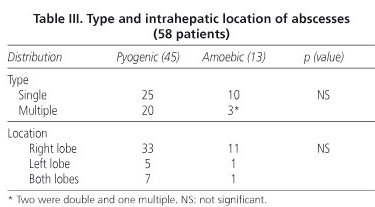
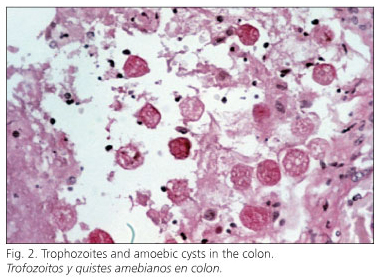
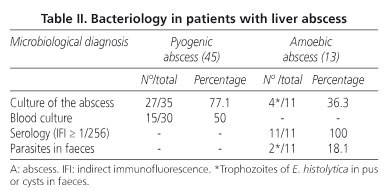
<body><![CDATA[<p><font face="Verdana" size="2">The clinical history of patients with amoebic abscesses included: malaria, chronic liver disease due to hepatitis B and C viruses (1 case), and chronic obstructive pulmonary disease COPD (1 case). Eleven out of thirteen lived in Guipuzcoa, one lived in Uruguay (was on holiday in Guipuzcoa), and another came from Japan (but had been living in Guipuzcoa for the previous 6 months). Eleven had travelled to areas where the disease is endemic -India (4), Mexico (3), Costa Rica, Uganda, Guinea and Morocco (1)-. In 82% of cases symptoms appeared within the first 5 months after the visit. Two individuals did not have any history of exposure to endemic areas. One of them may have been infected by their partner who suffered from amoebic colitis, and the other one had a risk factor due to his/her profession (drain cleaner). Concomitant amoebic colitis was present in 5 patients.</font></p>     <p><font face="Verdana" size="2">Microbiological diagnoses and findings from imaging techniques for the 58 patients studied are shown in tables <a href="#t2">II</a> and <a href="#t3">III</a>. Abdominal echography was performed on 50 patients, leading to a diagnosis in 38 (76%), while a CT scan was carried out on 55, and a diagnosis was reached in 96% of these cases (<a href="#f1">Fig. 1</a>). The micro-organisms isolated from the pyogenic abscesses were: aerobic gram negative rods (23 cases), anaerobic bacteria (15), aerobic gram positive cocci (14), aerobic gram positive rods (1) and <i>Brucella</i> (1). A total of 44.4% (12 out of 27) of abscesses with a bacteriological diagnosis were polymicrobial. <i>E. coli</i> and <i>S. milleri</i> (21 cases) were the most commonly found germs. Amoebic abscesses were larger than 10 cm in diameter in 5 cases (4 single and 1 multiple), and larger than 5 cm in a further 7 cases (5 single and 2 multiple).</font></p>     <p align="center"><font size="2" face="Verdana"><a name="t2"><img border="0" src="/img/revistas/diges/v102n2/original3_t2.jpg" width="388" height="191"></a></font></p>     <p align="center"><font size="2" face="Verdana"><a name="t3"><img border="0" src="/img/revistas/diges/v102n2/original3_t3.jpg" width="375" height="207"></a></font></p>     <p align="center"><font size="2" face="Verdana"><a name="f1"><img border="0" src="/img/revistas/diges/v102n2/original3_f1.jpg" width="379" height="280"></a></font></p>     <p>&nbsp;</p>     <p><font face="Verdana" size="2">The treatment of patients with PHA consisted of antibiotherapy, drainage and surgery. The most commonly used antibiotic combination were third generation cephalosporins with metronidazole, alone or with aminoglycosides (17 cases), imipenem or piperacillin-tazobactam (16), and aminoglycosides with metronidazole (5). Antibiotic therapy without drainage was carried out in 10 patients (one recurred and needed surgery due to biliary stenosis). CT-guided percutaneous drainage in association with adequate antibiotic coverage was used in 22 patients (<a href="#t4">Table IV</a>). This procedure was successful in 18 (full recovery 81.8%). In 13 patients, where the drainage was not successful, surgery was undertaken. Overall mortality was related to the diseases that needed surgical treatment (acute cholecystitis, obstructive icterus, infected hydatid cyst in the liver, peritonitis, postoperative biliary stenosis, and carcinoma of the gallbladder). The average hospital stay of those patients who were treated with percutaneous drainage was shorter than that of those treated with surgery (21 <i>versus</i> 40 days).</font></p>     <p align="center"><font size="2" face="Verdana"><a name="t4"><img border="0" src="/img/revistas/diges/v102n2/original3_t4.jpg" width="374" height="227"></a></font></p>     <p><font face="Verdana" size="2">Patients suffering with ALA were treated with metronidazole and paramomycin as a first choice. CT-guided percutaneous drainage was carried out in 6 cases (5 of them with abscess sizes exceeding 10 cm), and surgery in 4 cases. Mortality rates and mean hospital stay are shown in <a href="#t4">table IV</a>. Two people died; one due to peritonitis secondary to multiple perforations in the colon due to amoebic ulcerative colitis (<a href="#f2">Fig. 2</a>) in association with septic shock, and the other one due to large multiple abscesses with sepsis and respiratory distress.</font></p>     <p align="center"><font size="2" face="Verdana"><a name="f2"><img border="0" src="/img/revistas/diges/v102n2/original3_f2.jpg" width="377" height="279"></a></font></p>     ]]></body>
<body><![CDATA[<p>&nbsp;</p>     <p><font face="Verdana" size="2"><b>Discussion</b></font></p>     <p><font face="Verdana" size="2">Amoebiasis is a protozoan disease that affects 10% of the world population with a high prevalence in Mexico and South Africa (among the black population), some areas in the Middle East, South and Southeast Asia, and parts of Western Africa and South America. ALA occurs in between 3 and 9% of the people infected with the parasite. In Spain, during the last decade, there has been an increase in the number of autochthonous cases. Some series of patients suffering from ALA have indicated a predilection for middle-aged men, and that it is less common at extreme ages (10-13).</font></p>     <p><font face="Verdana" size="2">PHA has a variable occurrence in the population according to concomitant diseases. The risk of developing a pyogenic abscess in diabetic people and in those suffering from malignant tumours is tenfold higher than that of the general population; in patients who have undergone liver transplantation it is 445 times higher (2). PHA often occurs in individuals over 50 years old with a slight predominance in men (14,15). Abscesses secondary to ascending cholangitis and of unknown origin are the most common.</font></p>     <p><font face="Verdana" size="2">ALA is caused by the colonization of the liver by trophozoites of pathogenic strains of <i>E. histolytica</i> through portal circulation. It causes foci of necrosis in the liver parenchyma, most of the time leading into a single cavity. The most common clinical signs and symptoms are abdominal pain (70-100 of the cases) in association with fever (70-100%) and diarrhoea, with or without blood (30-50% of the cases). Sometimes, the abscess only causes fever.</font></p>     <p><font face="Verdana" size="2">The classical symptomatology of PLA (fever, shivering, and pain in the lower right abdomen with or without hepatomegaly, of subacute presentation), occurs in a small percentage of patients. In recent Spanish series (9,16-20), up to 60% of patients lack symptoms suggestive of processes in the lower right abdomen. Icterus is often associated with biliary pathology. <a target="_blank" href="/img/revistas/diges/v102n2/original3_t5.jpg">Table V</a> shows the differential characteristics of PLA and ALA from other studies in Central and South American and Asian countries (14,15,21-24).</font></p>     <p><font face="Verdana" size="2">Blood tests for both types of abscesses are similar: increased ESR, leukocytosis with left shift, and slight changes in liver function tests. In cases secondary to biliary tract infection, bilirubin levels are often increased. In blood tests in amoebic infections there is often a moderate increase of alkaline phosphatase; icterus is rare and, when present, moderate.</font></p>     <p><font face="Verdana" size="2">Abdominal contrast CT is the technique of choice for the diagnosis of liver abscesses. In our series, it helped in the diagnosis of lesions in 96% of patients, similar to what is reported in the literature (3,9,12,23,25,26). Its sensitivity is almost 100% higher than echography, which remains the first examination to be carried out because of its low cost and ready availability. However, both CT scans and echography may lead to false negatives in abscesses smaller than 1 cm in diameter, in those located near the diaphragmatic dome, and in those in early stages of development.</font></p>     <p><font face="Verdana" size="2">The microbiological diagnosis of pyogenic abscesses is based on the identification of the germ by culture, with samples obtained from the liver by FNA -70-95% of cases (9,15-20,23)-, or by blood culture -40-60% of cases (9,15-20,23)-. In amoebic abscesses several methods were used: detection of specific antigens (adhesine <i>Gal-GalNac</i>) and serum antibodies against <i>E. histolytica</i>, fecal smear test, FNA of abscesses, and molecular biology techniques. Of these, the serological test (indirect hemaglutination) is the most sensitive (positive in 90-100% of the cases), while faecal smear test and microbiological culture are least affordable. PCR is considered the gold standard for immigrants coming from endemic areas and frequent travellers who carry antibodies against <i>E. histolytica</i> for several years after being infected. Currently, a very specific technique which can be used for the diagnosis of ALA as long as the subject has not been treated with amoebacides is the presence of adhesin <i>Gal-GalNac</i> in the serum (27).</font></p>     <p><font face="Verdana" size="2">The treatment of choice for PLA (echo or CT-guided percutaneous drainage in association with antibiotics) cures between 72 and 90% of patients, with complications ranging from 4 to 18% (28-30). The absolute contraindications for guided drainage are when there is an indication for surgery because of an associated disease or significant coagulopathy. Relative contraindications are ascites, very viscous purulent material, multiple small abscesses, and the risk of damaging vital structures, especially those in the left lobe. Surgery is performed when percutaneous treatment fails, or there are absolute or relative contraindications for guided drainage, associated diseases secondary to surgical treatment, or abscesses with rupture or haemorrhage. Antibiotic treatment without drainage is controversial. It should be applied only in patients with small abscesses and always considering each individual case (9,28). In our series, such diverse treatments are explained by the fact that patients were seen at different points over a long period (20 years).</font></p>     ]]></body>
<body><![CDATA[<p><font face="Verdana" size="2">The treatment for ALA consists of the intraluminal and systemic administration of amoebacides as soon as possible. Guided percutaneous drainage is performed in case of large abscesses (&gt; 8 cm) (31), those located in the left lobe, and when there is no response to medical treatment or liver failure is present. There is no current evidence whether guided percutaneous drainage provides extra benefits compared to treatment with metronidazole alone in uncomplicated ALA cases (32). Surgical treatment is performed if percutaneous drainage fails or complications arise. Mortality rates are lower than 1% in uncomplicated cases (without superinfection or rupture to the peritoneum, pleura or pericardium).</font></p>     <p><font face="Verdana" size="2">The limitations of this study are its retrospective, observational nature, and that it includes a relatively small number of cases compared to other Central and South American Asian studies. However, it represents one of the few series in our country (12) in which the clinical pictures of these two types of liver abscesses are compared.</font></p>     <p><font face="Verdana" size="2">As a conclusion, in our series PLA occurred in people aged 50 or over, often with diabetes, and generally associated with bilirubin levels over 2 mg/dL. On the other hand, subjects with ALA had an epidemiological history of travel or immigration. Diarrhoea was one of the initial symptoms of the disease, and they had a single abscess predominantly in the right lobe.</font></p>     <p>&nbsp;</p>     <p><font face="Verdana" size="2"><b>References</b></font></p>     <!-- ref --><p><font face="Verdana" size="2">1. Hansen PS, Schonheyder HC. Pyogenic hepatic abscess: a ten year population-based retrospective study. APMIS 1998; 106: 396-402.</font>&nbsp;&nbsp;&nbsp;&nbsp;&nbsp;&nbsp;&nbsp;&nbsp;[&#160;<a href="javascript:void(0);" onclick="javascript: window.open('/scielo.php?script=sci_nlinks&ref=5291840&pid=S1130-0108201000020000400001&lng=','','width=640,height=500,resizable=yes,scrollbars=1,menubar=yes,');">Links</a>&#160;]<!-- end-ref --><!-- ref --><p><font face="Verdana" size="2">2. Kaplan GG, Gregson DB, Laupland KB. Population-based study of the epidemiology of and the risk factors for pyogenic liver abscess. Clin Gastroenterol Hepatol 2004; 2: 1032-8.</font>&nbsp;&nbsp;&nbsp;&nbsp;&nbsp;&nbsp;&nbsp;&nbsp;[&#160;<a href="javascript:void(0);" onclick="javascript: window.open('/scielo.php?script=sci_nlinks&ref=5291841&pid=S1130-0108201000020000400002&lng=','','width=640,height=500,resizable=yes,scrollbars=1,menubar=yes,');">Links</a>&#160;]<!-- end-ref --><!-- ref --><p><font face="Verdana" size="2">3. Cosme Jim&eacute;nez A, Bujanda Fern&aacute;ndez de Pi&eacute;rola L, Ojeda P&eacute;rez E. Abscesos hep&aacute;ticos pi&oacute;genos. El especialista opina. Disponible en: <a target="_blank" href="http://www.nacom.es/Med1/3/doc/expertodocumentos/2001">http://www.nacom.es/Med1/3/doc/expertodocumentos/2001</a>.</font>&nbsp;&nbsp;&nbsp;&nbsp;&nbsp;&nbsp;&nbsp;&nbsp;[&#160;<a href="javascript:void(0);" onclick="javascript: window.open('/scielo.php?script=sci_nlinks&ref=5291842&pid=S1130-0108201000020000400003&lng=','','width=640,height=500,resizable=yes,scrollbars=1,menubar=yes,');">Links</a>&#160;]<!-- end-ref --><!-- ref --><p><font face="Verdana" size="2">4. Port&uacute;s M, Prats G. Contribuci&oacute;n al conocimiento de las protozoosis intestinales en la poblaci&oacute;n hospitalaria barcelonesa. Med Clin (Bar) 1981; 76: 203-5.</font>&nbsp;&nbsp;&nbsp;&nbsp;&nbsp;&nbsp;&nbsp;&nbsp;[&#160;<a href="javascript:void(0);" onclick="javascript: window.open('/scielo.php?script=sci_nlinks&ref=5291843&pid=S1130-0108201000020000400004&lng=','','width=640,height=500,resizable=yes,scrollbars=1,menubar=yes,');">Links</a>&#160;]<!-- end-ref --><!-- ref --><p><font face="Verdana" size="2">5. Perea R, Bassas E, Lepe JA, Lombardo M, Garc&eacute;s M. Prevalencia de anticuerpos frente a Entamoeba histolytica en la zona norte de la provincia de Huelva. Med Clin (Bar) 1998; 110: 275.</font>&nbsp;&nbsp;&nbsp;&nbsp;&nbsp;&nbsp;&nbsp;&nbsp;[&#160;<a href="javascript:void(0);" onclick="javascript: window.open('/scielo.php?script=sci_nlinks&ref=5291844&pid=S1130-0108201000020000400005&lng=','','width=640,height=500,resizable=yes,scrollbars=1,menubar=yes,');">Links</a>&#160;]<!-- end-ref --><!-- ref --><p><font face="Verdana" size="2">6. P&eacute;rez Arellano JL, Muro &Aacute;lvarez A, Hern&aacute;ndez Cabrera M, Mart&iacute;n S&aacute;nchez AM. Amebosis. Medicine (Madrid) 2002; 8: 3731-41.</font>&nbsp;&nbsp;&nbsp;&nbsp;&nbsp;&nbsp;&nbsp;&nbsp;[&#160;<a href="javascript:void(0);" onclick="javascript: window.open('/scielo.php?script=sci_nlinks&ref=5291845&pid=S1130-0108201000020000400006&lng=','','width=640,height=500,resizable=yes,scrollbars=1,menubar=yes,');">Links</a>&#160;]<!-- end-ref --><!-- ref --><p><font face="Verdana" size="2">7. Ortiz FM, Devesa F, Ferrando J, Ferrando I, Borghol A, Guti&eacute;rrez J. Absceso hep&aacute;tico amebiano: ¿tratamiento farmacol&oacute;gico o punci&oacute;n-aspiraci&oacute;n? Gastroenterol Hepatol 2007; 30: 399-401.</font>&nbsp;&nbsp;&nbsp;&nbsp;&nbsp;&nbsp;&nbsp;&nbsp;[&#160;<a href="javascript:void(0);" onclick="javascript: window.open('/scielo.php?script=sci_nlinks&ref=5291846&pid=S1130-0108201000020000400007&lng=','','width=640,height=500,resizable=yes,scrollbars=1,menubar=yes,');">Links</a>&#160;]<!-- end-ref --><!-- ref --><p><font face="Verdana" size="2">8. P&eacute;rez Trallero E, Cilla Eguiluz G, Urbieta Ega&ntilde;a M, Mu&ntilde;oz Baroja I. Infecciones aut&oacute;ctonas por Entamoeba histolytica. Med Clin (Bar) 1985; 85: 254.</font>&nbsp;&nbsp;&nbsp;&nbsp;&nbsp;&nbsp;&nbsp;&nbsp;[&#160;<a href="javascript:void(0);" onclick="javascript: window.open('/scielo.php?script=sci_nlinks&ref=5291847&pid=S1130-0108201000020000400008&lng=','','width=640,height=500,resizable=yes,scrollbars=1,menubar=yes,');">Links</a>&#160;]<!-- end-ref --><!-- ref --><p><font face="Verdana" size="2">9. Barrio J, Cosme A, Ojeda E, Garmendia G, Castiella A, Bujanda L, et al. Abscesos hep&aacute;ticos pi&oacute;genos de origen bacteriano. Estudio de una serie de 45 casos. Rev Esp Enferm Dig 2000; 92: 232-5.</font>&nbsp;&nbsp;&nbsp;&nbsp;&nbsp;&nbsp;&nbsp;&nbsp;[&#160;<a href="javascript:void(0);" onclick="javascript: window.open('/scielo.php?script=sci_nlinks&ref=5291848&pid=S1130-0108201000020000400009&lng=','','width=640,height=500,resizable=yes,scrollbars=1,menubar=yes,');">Links</a>&#160;]<!-- end-ref --><!-- ref --><p><font face="Verdana" size="2">10. Djossou F, Malvy D, Tamboura M, Beylot J, Lamouliatte H, Longy-Boursier M, et al. Amoebic liver abscess. Study of 20 cases with literature review. Rev Med Inter 2003; 24: 97-106.</font>&nbsp;&nbsp;&nbsp;&nbsp;&nbsp;&nbsp;&nbsp;&nbsp;[&#160;<a href="javascript:void(0);" onclick="javascript: window.open('/scielo.php?script=sci_nlinks&ref=5291849&pid=S1130-0108201000020000400010&lng=','','width=640,height=500,resizable=yes,scrollbars=1,menubar=yes,');">Links</a>&#160;]<!-- end-ref --><!-- ref --><p><font face="Verdana" size="2">11. Garc&iacute;a-Forcada A, Sans M, Gascon J, Valls ME, Bru C, Corachan M. Absceso hep&aacute;tico amebiano: revisi&oacute;n de 13 casos. Med Clin (Bar) 1995; 105: 537-40.</font>&nbsp;&nbsp;&nbsp;&nbsp;&nbsp;&nbsp;&nbsp;&nbsp;[&#160;<a href="javascript:void(0);" onclick="javascript: window.open('/scielo.php?script=sci_nlinks&ref=5291850&pid=S1130-0108201000020000400011&lng=','','width=640,height=500,resizable=yes,scrollbars=1,menubar=yes,');">Links</a>&#160;]<!-- end-ref --><!-- ref --><p><font face="Verdana" size="2">12. Blanco Quintana F, Novellas Arribas B, S&aacute;nchez Molini P, Sanz Sanz J. Descriptive study of 39 cases of hepatic abscess of pyogenic and amebic origin. An Med Interna (Madrid) 1995; 12: 477-84.</font>&nbsp;&nbsp;&nbsp;&nbsp;&nbsp;&nbsp;&nbsp;&nbsp;[&#160;<a href="javascript:void(0);" onclick="javascript: window.open('/scielo.php?script=sci_nlinks&ref=5291851&pid=S1130-0108201000020000400012&lng=','','width=640,height=500,resizable=yes,scrollbars=1,menubar=yes,');">Links</a>&#160;]<!-- end-ref --><!-- ref --><p><font face="Verdana" size="2">13. Nari GA, Ceballos Espinosa R, Carrera Ladr&oacute;n de Guevara S, Preciado Vargas J, Cruz Valenciano JL, Briones Rivas JL et al. Abscesos amebianos de h&iacute;gado. Tres a&ntilde;os de experiencia. Rev Esp Enferm Dig 2008; 100: 268-72.</font>&nbsp;&nbsp;&nbsp;&nbsp;&nbsp;&nbsp;&nbsp;&nbsp;[&#160;<a href="javascript:void(0);" onclick="javascript: window.open('/scielo.php?script=sci_nlinks&ref=5291852&pid=S1130-0108201000020000400013&lng=','','width=640,height=500,resizable=yes,scrollbars=1,menubar=yes,');">Links</a>&#160;]<!-- end-ref --><!-- ref --><p><font face="Verdana" size="2">14. Barbour GL, Juniper K. A clinical comparison of amebic and pyogenic abscess of the liver in sixty-six patients. Am J Med 1972; 53: 323-34.</font>&nbsp;&nbsp;&nbsp;&nbsp;&nbsp;&nbsp;&nbsp;&nbsp;[&#160;<a href="javascript:void(0);" onclick="javascript: window.open('/scielo.php?script=sci_nlinks&ref=5291853&pid=S1130-0108201000020000400014&lng=','','width=640,height=500,resizable=yes,scrollbars=1,menubar=yes,');">Links</a>&#160;]<!-- end-ref --><!-- ref --><p><font face="Verdana" size="2">15. Conter RL, Pitt HA, Tompkins RK, Longmire WP. Differentiation of pyogenic from amebic hepatic abscess. Surg Gynecol Obstr 1986; 162: 114-20.</font>&nbsp;&nbsp;&nbsp;&nbsp;&nbsp;&nbsp;&nbsp;&nbsp;[&#160;<a href="javascript:void(0);" onclick="javascript: window.open('/scielo.php?script=sci_nlinks&ref=5291854&pid=S1130-0108201000020000400015&lng=','','width=640,height=500,resizable=yes,scrollbars=1,menubar=yes,');">Links</a>&#160;]<!-- end-ref --><!-- ref --><p><font face="Verdana" size="2">16. Comas P, Vargas V, Almirante B, Gonz&aacute;lez A, Garc&iacute;a D, Esteban R, et al. Absceso pi&oacute;geno hep&aacute;tico. Revisi&oacute;n de 33 casos. Rev Clin Esp 1989; 185: 225-30.</font>&nbsp;&nbsp;&nbsp;&nbsp;&nbsp;&nbsp;&nbsp;&nbsp;[&#160;<a href="javascript:void(0);" onclick="javascript: window.open('/scielo.php?script=sci_nlinks&ref=5291855&pid=S1130-0108201000020000400016&lng=','','width=640,height=500,resizable=yes,scrollbars=1,menubar=yes,');">Links</a>&#160;]<!-- end-ref --><!-- ref --><p><font face="Verdana" size="2">17. Corbella X, Vadillo M, Torras J, Pujol M, Rafecas A, Gudiol F. Presentaci&oacute;n, diagn&oacute;stico y tratamiento del absceso hep&aacute;tico pi&oacute;geno: an&aacute;lisis de una serie de 63 casos. Enferm Infecc Microbiol Clin 1995; 13: 80-4.</font>&nbsp;&nbsp;&nbsp;&nbsp;&nbsp;&nbsp;&nbsp;&nbsp;[&#160;<a href="javascript:void(0);" onclick="javascript: window.open('/scielo.php?script=sci_nlinks&ref=5291856&pid=S1130-0108201000020000400017&lng=','','width=640,height=500,resizable=yes,scrollbars=1,menubar=yes,');">Links</a>&#160;]<!-- end-ref --><!-- ref --><p><font face="Verdana" size="2">18. Ramos A, Gazapo T, Murillas J, Mart&iacute;n H, Mandaza P, Cuervas V. Absceso hep&aacute;tico pi&oacute;geno. Estudio descriptivo de 35 casos. Gastroenterol Hepatol 1996; 19: 292-6.</font>&nbsp;&nbsp;&nbsp;&nbsp;&nbsp;&nbsp;&nbsp;&nbsp;[&#160;<a href="javascript:void(0);" onclick="javascript: window.open('/scielo.php?script=sci_nlinks&ref=5291857&pid=S1130-0108201000020000400018&lng=','','width=640,height=500,resizable=yes,scrollbars=1,menubar=yes,');">Links</a>&#160;]<!-- end-ref --><!-- ref --><p><font face="Verdana" size="2">19. Asensi V, Rodr&iacute;guez A, Carton JA, Maradona JA, &Aacute;lvarez E, Llera JM, et al. Abscesos hep&aacute;ticos pi&oacute;genos. Revisi&oacute;n de 59 casos y experiencia con imipenem. Rev Clin Esp 1997; 197: 494-9.</font>&nbsp;&nbsp;&nbsp;&nbsp;&nbsp;&nbsp;&nbsp;&nbsp;[&#160;<a href="javascript:void(0);" onclick="javascript: window.open('/scielo.php?script=sci_nlinks&ref=5291858&pid=S1130-0108201000020000400019&lng=','','width=640,height=500,resizable=yes,scrollbars=1,menubar=yes,');">Links</a>&#160;]<!-- end-ref --><!-- ref --><p><font face="Verdana" size="2">20. Jim&eacute;nez E, Tiberio G, S&aacute;nchez J, Jim&eacute;nez FJ, Jim&eacute;nez G. Abscesos hep&aacute;ticos pi&oacute;genos: experiencia de 16 a&ntilde;os en su diagn&oacute;stico y tratamiento. Enferm Infecc Microbiol Clin 1998; 16: 307-11.</font>&nbsp;&nbsp;&nbsp;&nbsp;&nbsp;&nbsp;&nbsp;&nbsp;[&#160;<a href="javascript:void(0);" onclick="javascript: window.open('/scielo.php?script=sci_nlinks&ref=5291859&pid=S1130-0108201000020000400020&lng=','','width=640,height=500,resizable=yes,scrollbars=1,menubar=yes,');">Links</a>&#160;]<!-- end-ref --><!-- ref --><p><font face="Verdana" size="2">21. Ogden WW, Hunter PR, Rives JD. Liver abscess. Postgrad Med 1961; 30: 11-9.</font>&nbsp;&nbsp;&nbsp;&nbsp;&nbsp;&nbsp;&nbsp;&nbsp;[&#160;<a href="javascript:void(0);" onclick="javascript: window.open('/scielo.php?script=sci_nlinks&ref=5291860&pid=S1130-0108201000020000400021&lng=','','width=640,height=500,resizable=yes,scrollbars=1,menubar=yes,');">Links</a>&#160;]<!-- end-ref --><!-- ref --><p><font face="Verdana" size="2">22. May RP, Lehmann JD, Sanford JP. Difficulties in differentiating amebic from pyogenic liver abscess. Arch Intern Med 1967; 119: 69-74.</font>&nbsp;&nbsp;&nbsp;&nbsp;&nbsp;&nbsp;&nbsp;&nbsp;[&#160;<a href="javascript:void(0);" onclick="javascript: window.open('/scielo.php?script=sci_nlinks&ref=5291861&pid=S1130-0108201000020000400022&lng=','','width=640,height=500,resizable=yes,scrollbars=1,menubar=yes,');">Links</a>&#160;]<!-- end-ref --><!-- ref --><p><font face="Verdana" size="2">23. Barnes PF, De Cock KM, Reynolds TN, Ralls PW. A comparison of amebic and pyogenic abscess of the liver. Medicine (Baltimore) 1987; 66: 472-83.</font>&nbsp;&nbsp;&nbsp;&nbsp;&nbsp;&nbsp;&nbsp;&nbsp;[&#160;<a href="javascript:void(0);" onclick="javascript: window.open('/scielo.php?script=sci_nlinks&ref=5291862&pid=S1130-0108201000020000400023&lng=','','width=640,height=500,resizable=yes,scrollbars=1,menubar=yes,');">Links</a>&#160;]<!-- end-ref --><!-- ref --><p><font face="Verdana" size="2">24. Lodhi S, Sarwari AR, Muzammil M, Salam A, Smego RA. Features distinguishing amoebic from pyogenic liver abscess: a review of 577 adult cases. Trop Med Int Health 2004; 9: 718-23.</font>&nbsp;&nbsp;&nbsp;&nbsp;&nbsp;&nbsp;&nbsp;&nbsp;[&#160;<a href="javascript:void(0);" onclick="javascript: window.open('/scielo.php?script=sci_nlinks&ref=5291863&pid=S1130-0108201000020000400024&lng=','','width=640,height=500,resizable=yes,scrollbars=1,menubar=yes,');">Links</a>&#160;]<!-- end-ref --><!-- ref --><p><font face="Verdana" size="2">25. Greenstein AJ, Barth J, Dicker A, Bottone EJ, Aufses AH. Amebic liver abscess: a study of 11 cases compared with a series of 38 patients with pyogenic liver abscess. Am J Gastroenterol 1985; 80: 472-8.</font>&nbsp;&nbsp;&nbsp;&nbsp;&nbsp;&nbsp;&nbsp;&nbsp;[&#160;<a href="javascript:void(0);" onclick="javascript: window.open('/scielo.php?script=sci_nlinks&ref=5291864&pid=S1130-0108201000020000400025&lng=','','width=640,height=500,resizable=yes,scrollbars=1,menubar=yes,');">Links</a>&#160;]<!-- end-ref --><!-- ref --><p><font face="Verdana" size="2">26. Ahsan T, Jehangir MU, Mahmood T, Ahmed N, Saleem M, Shahid M, et al. Amoebic versus pyogenic liver abscess. J Pak Med Assoc 2002; 52: 497-501.</font>&nbsp;&nbsp;&nbsp;&nbsp;&nbsp;&nbsp;&nbsp;&nbsp;[&#160;<a href="javascript:void(0);" onclick="javascript: window.open('/scielo.php?script=sci_nlinks&ref=5291865&pid=S1130-0108201000020000400026&lng=','','width=640,height=500,resizable=yes,scrollbars=1,menubar=yes,');">Links</a>&#160;]<!-- end-ref --><!-- ref --><p><font face="Verdana" size="2">27. Haque R, Mollah NU, Ali IK, Alam K, Eubanks A, Lyerly D, et al. Diagnosis of amebic liver abscess and intestinal infection with the TechLab Entamoeba histolytica II antigen detection and antibody tests. J Clin Microbiol 2000; 38: 3235-9.</font>&nbsp;&nbsp;&nbsp;&nbsp;&nbsp;&nbsp;&nbsp;&nbsp;[&#160;<a href="javascript:void(0);" onclick="javascript: window.open('/scielo.php?script=sci_nlinks&ref=5291866&pid=S1130-0108201000020000400027&lng=','','width=640,height=500,resizable=yes,scrollbars=1,menubar=yes,');">Links</a>&#160;]<!-- end-ref --><!-- ref --><p><font face="Verdana" size="2">28. Seeto RK, Rockey DC. Pyogenic liver abscess. Changes in etiology, management and outcome. Medicine (Baltimore) 1996; 75: 99-113.</font>&nbsp;&nbsp;&nbsp;&nbsp;&nbsp;&nbsp;&nbsp;&nbsp;[&#160;<a href="javascript:void(0);" onclick="javascript: window.open('/scielo.php?script=sci_nlinks&ref=5291867&pid=S1130-0108201000020000400028&lng=','','width=640,height=500,resizable=yes,scrollbars=1,menubar=yes,');">Links</a>&#160;]<!-- end-ref --><!-- ref --><p><font face="Verdana" size="2">29. Bru C, Ayuso MC, Bianchi L, De la Torre P, Texeidor N. Abscesos hep&aacute;ticos: drenaje percut&aacute;neo bajo control ecogr&aacute;fico. Gastroenterol Hepatol 1986; 9: 15-20. </font>&nbsp;&nbsp;&nbsp;&nbsp;&nbsp;&nbsp;&nbsp;&nbsp;[&#160;<a href="javascript:void(0);" onclick="javascript: window.open('/scielo.php?script=sci_nlinks&ref=5291868&pid=S1130-0108201000020000400029&lng=','','width=640,height=500,resizable=yes,scrollbars=1,menubar=yes,');">Links</a>&#160;]<!-- end-ref --><!-- ref --><p><font face="Verdana" size="2">30. Eroles G, Mecina AB, Fern&aacute;ndez C, Mancebo AB, Riva L. Abscesos hep&aacute;ticos: revisi&oacute;n retrospectiva de 68 casos. An Med Interna (Madrid) 2008; 5: 335-41.</font>&nbsp;&nbsp;&nbsp;&nbsp;&nbsp;&nbsp;&nbsp;&nbsp;[&#160;<a href="javascript:void(0);" onclick="javascript: window.open('/scielo.php?script=sci_nlinks&ref=5291869&pid=S1130-0108201000020000400030&lng=','','width=640,height=500,resizable=yes,scrollbars=1,menubar=yes,');">Links</a>&#160;]<!-- end-ref --><!-- ref --><p><font face="Verdana" size="2">31. Graillet R, S&aacute;nchez-Aguilar M, Mor&aacute;n-Mendoza AO, Hern&aacute;ndez-Sierra JF, Gordillo-Moscoso A, Tapia-P&eacute;rez JH. An&aacute;lisis de factores asociados al fracaso del tratamiento m&eacute;dico del absceso hep&aacute;tico amebiano. Cir Esp 2008; 84: 83-6.</font>&nbsp;&nbsp;&nbsp;&nbsp;&nbsp;&nbsp;&nbsp;&nbsp;[&#160;<a href="javascript:void(0);" onclick="javascript: window.open('/scielo.php?script=sci_nlinks&ref=5291870&pid=S1130-0108201000020000400031&lng=','','width=640,height=500,resizable=yes,scrollbars=1,menubar=yes,');">Links</a>&#160;]<!-- end-ref --><!-- ref --><p><font face="Verdana" size="2">32. Chavez-Tapia NC, Hern&aacute;ndez-Calleros J, Tellez-Avila FI, Torre A, Uribe M. Image-guided percutaneous procedure plus metronidazole versus metronidazole alone for uncomplicated amoebic liver abscess (Review). Cochrane Database Syst Rev 2009; 21(1): CD004886.</font>&nbsp;&nbsp;&nbsp;&nbsp;&nbsp;&nbsp;&nbsp;&nbsp;[&#160;<a href="javascript:void(0);" onclick="javascript: window.open('/scielo.php?script=sci_nlinks&ref=5291871&pid=S1130-0108201000020000400032&lng=','','width=640,height=500,resizable=yes,scrollbars=1,menubar=yes,');">Links</a>&#160;]<!-- end-ref --><p>&nbsp;</p>     <p>&nbsp;</p>     <p><a href="#top"><img border="0" src="/img/revistas/diges/v102n2/seta.gif" width="15" height="17"></a><a name="bajo"></a><font face="Verdana" size="2"><b>Correspondence:</b>    ]]></body>
<body><![CDATA[<br>Ángel Cosme Jiménez.    <br>Servicio de Aparato Digestivo.    <br>Hospital Donostia.    <br>Paseo Dr. Beguiristain, s/n. 20014 San Sebastián.    <br>email: <a href="mailto:acosme@chdo.osakidetza.net">acosme@chdo.osakidetza.net</a></font></p>     <p><font face="Verdana" size="2">Received: 01-04-09.    <br>Accepted: 28-10-09.</font></p>      ]]></body><back>
<ref-list>
<ref id="B1">
<label>1</label><nlm-citation citation-type="journal">
<person-group person-group-type="author">
<name>
<surname><![CDATA[Hansen]]></surname>
<given-names><![CDATA[PS]]></given-names>
</name>
<name>
<surname><![CDATA[Schonheyder]]></surname>
<given-names><![CDATA[HC]]></given-names>
</name>
</person-group>
<article-title xml:lang="en"><![CDATA[Pyogenic hepatic abscess: a ten year population-based retrospective study]]></article-title>
<source><![CDATA[APMIS]]></source>
<year>1998</year>
<volume>106</volume>
<page-range>396-402</page-range></nlm-citation>
</ref>
<ref id="B2">
<label>2</label><nlm-citation citation-type="journal">
<person-group person-group-type="author">
<name>
<surname><![CDATA[Kaplan]]></surname>
<given-names><![CDATA[GG]]></given-names>
</name>
<name>
<surname><![CDATA[Gregson]]></surname>
<given-names><![CDATA[DB]]></given-names>
</name>
<name>
<surname><![CDATA[Laupland]]></surname>
<given-names><![CDATA[KB]]></given-names>
</name>
</person-group>
<article-title xml:lang="en"><![CDATA[Population-based study of the epidemiology of and the risk factors for pyogenic liver abscess]]></article-title>
<source><![CDATA[Clin Gastroenterol Hepatol]]></source>
<year>2004</year>
<volume>2</volume>
<page-range>1032-8</page-range></nlm-citation>
</ref>
<ref id="B3">
<label>3</label><nlm-citation citation-type="journal">
<person-group person-group-type="author">
<name>
<surname><![CDATA[Cosme Jiménez]]></surname>
<given-names><![CDATA[A]]></given-names>
</name>
<name>
<surname><![CDATA[Bujanda Fernández de Piérola]]></surname>
<given-names><![CDATA[L]]></given-names>
</name>
<name>
<surname><![CDATA[Ojeda Pérez]]></surname>
<given-names><![CDATA[E]]></given-names>
</name>
</person-group>
<article-title xml:lang="es"><![CDATA[Abscesos hepáticos piógenos]]></article-title>
<source><![CDATA[El especialista]]></source>
<year></year>
</nlm-citation>
</ref>
<ref id="B4">
<label>4</label><nlm-citation citation-type="journal">
<person-group person-group-type="author">
<name>
<surname><![CDATA[Portús]]></surname>
<given-names><![CDATA[M]]></given-names>
</name>
<name>
<surname><![CDATA[Prats]]></surname>
<given-names><![CDATA[G]]></given-names>
</name>
</person-group>
<article-title xml:lang="es"><![CDATA[Contribución al conocimiento de las protozoosis intestinales en la población hospitalaria barcelonesa]]></article-title>
<source><![CDATA[Med Clin (Bar)]]></source>
<year>1981</year>
<volume>76</volume>
<page-range>203-5</page-range></nlm-citation>
</ref>
<ref id="B5">
<label>5</label><nlm-citation citation-type="journal">
<person-group person-group-type="author">
<name>
<surname><![CDATA[Perea]]></surname>
<given-names><![CDATA[R]]></given-names>
</name>
<name>
<surname><![CDATA[Bassas]]></surname>
<given-names><![CDATA[E]]></given-names>
</name>
<name>
<surname><![CDATA[Lepe]]></surname>
<given-names><![CDATA[JA]]></given-names>
</name>
<name>
<surname><![CDATA[Lombardo]]></surname>
<given-names><![CDATA[M]]></given-names>
</name>
<name>
<surname><![CDATA[Garcés]]></surname>
<given-names><![CDATA[M]]></given-names>
</name>
</person-group>
<article-title xml:lang="es"><![CDATA[Prevalencia de anticuerpos frente a Entamoeba histolytica en la zona norte de la provincia de Huelva]]></article-title>
<source><![CDATA[Med Clin (Bar)]]></source>
<year>1998</year>
<volume>110</volume>
<page-range>275</page-range></nlm-citation>
</ref>
<ref id="B6">
<label>6</label><nlm-citation citation-type="journal">
<person-group person-group-type="author">
<name>
<surname><![CDATA[Pérez Arellano]]></surname>
<given-names><![CDATA[JL]]></given-names>
</name>
<name>
<surname><![CDATA[Muro Álvarez]]></surname>
<given-names><![CDATA[A]]></given-names>
</name>
<name>
<surname><![CDATA[Hernández Cabrera]]></surname>
<given-names><![CDATA[M]]></given-names>
</name>
<name>
<surname><![CDATA[Martín Sánchez]]></surname>
<given-names><![CDATA[AM]]></given-names>
</name>
</person-group>
<article-title xml:lang="es"><![CDATA[Amebosis]]></article-title>
<source><![CDATA[Medicine (Madrid)]]></source>
<year>2002</year>
<volume>8</volume>
<page-range>3731-41</page-range></nlm-citation>
</ref>
<ref id="B7">
<label>7</label><nlm-citation citation-type="journal">
<person-group person-group-type="author">
<name>
<surname><![CDATA[Ortiz]]></surname>
<given-names><![CDATA[FM]]></given-names>
</name>
<name>
<surname><![CDATA[Devesa]]></surname>
<given-names><![CDATA[F]]></given-names>
</name>
<name>
<surname><![CDATA[Ferrando]]></surname>
<given-names><![CDATA[J]]></given-names>
</name>
<name>
<surname><![CDATA[Ferrando]]></surname>
<given-names><![CDATA[I]]></given-names>
</name>
<name>
<surname><![CDATA[Borghol]]></surname>
<given-names><![CDATA[A]]></given-names>
</name>
<name>
<surname><![CDATA[Gutiérrez]]></surname>
<given-names><![CDATA[J]]></given-names>
</name>
</person-group>
<article-title xml:lang="es"><![CDATA[Absceso hepático amebiano: ¿tratamiento farmacológico o punción-aspiración?]]></article-title>
<source><![CDATA[Gastroenterol Hepatol]]></source>
<year>2007</year>
<volume>30</volume>
<page-range>399-401</page-range></nlm-citation>
</ref>
<ref id="B8">
<label>8</label><nlm-citation citation-type="journal">
<person-group person-group-type="author">
<name>
<surname><![CDATA[Pérez Trallero]]></surname>
<given-names><![CDATA[E]]></given-names>
</name>
<name>
<surname><![CDATA[Cilla Eguiluz]]></surname>
<given-names><![CDATA[G]]></given-names>
</name>
<name>
<surname><![CDATA[Urbieta Egaña]]></surname>
<given-names><![CDATA[M]]></given-names>
</name>
<name>
<surname><![CDATA[Muñoz Baroja]]></surname>
<given-names><![CDATA[I]]></given-names>
</name>
</person-group>
<article-title xml:lang="es"><![CDATA[Infecciones autóctonas por Entamoeba histolytica]]></article-title>
<source><![CDATA[Med Clin (Bar)]]></source>
<year>1985</year>
<volume>85</volume>
<page-range>254</page-range></nlm-citation>
</ref>
<ref id="B9">
<label>9</label><nlm-citation citation-type="journal">
<person-group person-group-type="author">
<name>
<surname><![CDATA[Barrio]]></surname>
<given-names><![CDATA[J]]></given-names>
</name>
<name>
<surname><![CDATA[Cosme]]></surname>
<given-names><![CDATA[A]]></given-names>
</name>
<name>
<surname><![CDATA[Ojeda]]></surname>
<given-names><![CDATA[E]]></given-names>
</name>
<name>
<surname><![CDATA[Garmendia]]></surname>
<given-names><![CDATA[G]]></given-names>
</name>
<name>
<surname><![CDATA[Castiella]]></surname>
<given-names><![CDATA[A]]></given-names>
</name>
<name>
<surname><![CDATA[Bujanda]]></surname>
<given-names><![CDATA[L]]></given-names>
</name>
</person-group>
<article-title xml:lang="es"><![CDATA[Abscesos hepáticos piógenos de origen bacteriano: Estudio de una serie de 45 casos]]></article-title>
<source><![CDATA[Rev Esp Enferm Dig]]></source>
<year>2000</year>
<volume>92</volume>
<page-range>232-5</page-range></nlm-citation>
</ref>
<ref id="B10">
<label>10</label><nlm-citation citation-type="journal">
<person-group person-group-type="author">
<name>
<surname><![CDATA[Djossou]]></surname>
<given-names><![CDATA[F]]></given-names>
</name>
<name>
<surname><![CDATA[Malvy]]></surname>
<given-names><![CDATA[D]]></given-names>
</name>
<name>
<surname><![CDATA[Tamboura]]></surname>
<given-names><![CDATA[M]]></given-names>
</name>
<name>
<surname><![CDATA[Beylot]]></surname>
<given-names><![CDATA[J]]></given-names>
</name>
<name>
<surname><![CDATA[Lamouliatte]]></surname>
<given-names><![CDATA[H]]></given-names>
</name>
<name>
<surname><![CDATA[Longy-Boursier]]></surname>
<given-names><![CDATA[M]]></given-names>
</name>
</person-group>
<article-title xml:lang="en"><![CDATA[Amoebic liver abscess: Study of 20 cases with literature review]]></article-title>
<source><![CDATA[Rev Med Inter]]></source>
<year>2003</year>
<volume>24</volume>
<page-range>97-106</page-range></nlm-citation>
</ref>
<ref id="B11">
<label>11</label><nlm-citation citation-type="journal">
<person-group person-group-type="author">
<name>
<surname><![CDATA[García-Forcada]]></surname>
<given-names><![CDATA[A]]></given-names>
</name>
<name>
<surname><![CDATA[Sans]]></surname>
<given-names><![CDATA[M]]></given-names>
</name>
<name>
<surname><![CDATA[Gascon]]></surname>
<given-names><![CDATA[J]]></given-names>
</name>
<name>
<surname><![CDATA[Valls]]></surname>
<given-names><![CDATA[ME]]></given-names>
</name>
<name>
<surname><![CDATA[Bru]]></surname>
<given-names><![CDATA[C]]></given-names>
</name>
<name>
<surname><![CDATA[Corachan]]></surname>
<given-names><![CDATA[M]]></given-names>
</name>
</person-group>
<article-title xml:lang="es"><![CDATA[Absceso hepático amebiano: revisión de 13 casos]]></article-title>
<source><![CDATA[Med Clin (Bar)]]></source>
<year>1995</year>
<volume>105</volume>
<page-range>537-40</page-range></nlm-citation>
</ref>
<ref id="B12">
<label>12</label><nlm-citation citation-type="journal">
<person-group person-group-type="author">
<name>
<surname><![CDATA[Blanco Quintana]]></surname>
<given-names><![CDATA[F]]></given-names>
</name>
<name>
<surname><![CDATA[Novellas Arribas]]></surname>
<given-names><![CDATA[B]]></given-names>
</name>
<name>
<surname><![CDATA[Sánchez Molini]]></surname>
<given-names><![CDATA[P]]></given-names>
</name>
<name>
<surname><![CDATA[Sanz Sanz]]></surname>
<given-names><![CDATA[J]]></given-names>
</name>
</person-group>
<article-title xml:lang="en"><![CDATA[Descriptive study of 39 cases of hepatic abscess of pyogenic and amebic origin]]></article-title>
<source><![CDATA[An Med Interna (Madrid)]]></source>
<year>1995</year>
<volume>12</volume>
<page-range>477-84</page-range></nlm-citation>
</ref>
<ref id="B13">
<label>13</label><nlm-citation citation-type="journal">
<person-group person-group-type="author">
<name>
<surname><![CDATA[Nari]]></surname>
<given-names><![CDATA[GA]]></given-names>
</name>
<name>
<surname><![CDATA[Ceballos Espinosa]]></surname>
<given-names><![CDATA[R]]></given-names>
</name>
<name>
<surname><![CDATA[Carrera Ladrón de Guevara]]></surname>
<given-names><![CDATA[S]]></given-names>
</name>
<name>
<surname><![CDATA[Preciado Vargas]]></surname>
<given-names><![CDATA[J]]></given-names>
</name>
<name>
<surname><![CDATA[Cruz Valenciano]]></surname>
<given-names><![CDATA[JL]]></given-names>
</name>
<name>
<surname><![CDATA[Briones Rivas]]></surname>
<given-names><![CDATA[JL]]></given-names>
</name>
</person-group>
<article-title xml:lang="es"><![CDATA[Abscesos amebianos de hígado: Tres años de experiencia]]></article-title>
<source><![CDATA[Rev Esp Enferm Dig]]></source>
<year>2008</year>
<volume>100</volume>
<page-range>268-72</page-range></nlm-citation>
</ref>
<ref id="B14">
<label>14</label><nlm-citation citation-type="journal">
<person-group person-group-type="author">
<name>
<surname><![CDATA[Barbour]]></surname>
<given-names><![CDATA[GL]]></given-names>
</name>
<name>
<surname><![CDATA[Juniper]]></surname>
<given-names><![CDATA[K]]></given-names>
</name>
</person-group>
<article-title xml:lang="en"><![CDATA[A clinical comparison of amebic and pyogenic abscess of the liver in sixty-six patients]]></article-title>
<source><![CDATA[Am J Med]]></source>
<year>1972</year>
<volume>53</volume>
<page-range>323-34</page-range></nlm-citation>
</ref>
<ref id="B15">
<label>15</label><nlm-citation citation-type="journal">
<person-group person-group-type="author">
<name>
<surname><![CDATA[Conter]]></surname>
<given-names><![CDATA[RL]]></given-names>
</name>
<name>
<surname><![CDATA[Pitt]]></surname>
<given-names><![CDATA[HA]]></given-names>
</name>
<name>
<surname><![CDATA[Tompkins]]></surname>
<given-names><![CDATA[RK]]></given-names>
</name>
<name>
<surname><![CDATA[Longmire]]></surname>
<given-names><![CDATA[WP]]></given-names>
</name>
</person-group>
<article-title xml:lang="en"><![CDATA[Differentiation of pyogenic from amebic hepatic abscess]]></article-title>
<source><![CDATA[Surg Gynecol Obstr]]></source>
<year>1986</year>
<volume>162</volume>
<page-range>114-20</page-range></nlm-citation>
</ref>
<ref id="B16">
<label>16</label><nlm-citation citation-type="journal">
<person-group person-group-type="author">
<name>
<surname><![CDATA[Comas]]></surname>
<given-names><![CDATA[P]]></given-names>
</name>
<name>
<surname><![CDATA[Vargas]]></surname>
<given-names><![CDATA[V]]></given-names>
</name>
<name>
<surname><![CDATA[Almirante]]></surname>
<given-names><![CDATA[B]]></given-names>
</name>
<name>
<surname><![CDATA[González]]></surname>
<given-names><![CDATA[A]]></given-names>
</name>
<name>
<surname><![CDATA[García]]></surname>
<given-names><![CDATA[D]]></given-names>
</name>
<name>
<surname><![CDATA[Esteban]]></surname>
<given-names><![CDATA[R]]></given-names>
</name>
</person-group>
<article-title xml:lang="es"><![CDATA[Absceso piógeno hepático: Revisión de 33 casos]]></article-title>
<source><![CDATA[Rev Clin Esp]]></source>
<year>1989</year>
<volume>185</volume>
<page-range>225-30</page-range></nlm-citation>
</ref>
<ref id="B17">
<label>17</label><nlm-citation citation-type="journal">
<person-group person-group-type="author">
<name>
<surname><![CDATA[Corbella]]></surname>
<given-names><![CDATA[X]]></given-names>
</name>
<name>
<surname><![CDATA[Vadillo]]></surname>
<given-names><![CDATA[M]]></given-names>
</name>
<name>
<surname><![CDATA[Torras]]></surname>
<given-names><![CDATA[J]]></given-names>
</name>
<name>
<surname><![CDATA[Pujol]]></surname>
<given-names><![CDATA[M]]></given-names>
</name>
<name>
<surname><![CDATA[Rafecas]]></surname>
<given-names><![CDATA[A]]></given-names>
</name>
<name>
<surname><![CDATA[Gudiol]]></surname>
<given-names><![CDATA[F]]></given-names>
</name>
</person-group>
<article-title xml:lang="es"><![CDATA[Presentación, diagnóstico y tratamiento del absceso hepático piógeno: análisis de una serie de 63 casos]]></article-title>
<source><![CDATA[Enferm Infecc Microbiol Clin]]></source>
<year>1995</year>
<volume>13</volume>
<page-range>80-4</page-range></nlm-citation>
</ref>
<ref id="B18">
<label>18</label><nlm-citation citation-type="journal">
<person-group person-group-type="author">
<name>
<surname><![CDATA[Ramos]]></surname>
<given-names><![CDATA[A]]></given-names>
</name>
<name>
<surname><![CDATA[Gazapo]]></surname>
<given-names><![CDATA[T]]></given-names>
</name>
<name>
<surname><![CDATA[Murillas]]></surname>
<given-names><![CDATA[J]]></given-names>
</name>
<name>
<surname><![CDATA[Martín]]></surname>
<given-names><![CDATA[H]]></given-names>
</name>
<name>
<surname><![CDATA[Mandaza]]></surname>
<given-names><![CDATA[P]]></given-names>
</name>
<name>
<surname><![CDATA[Cuervas]]></surname>
<given-names><![CDATA[V]]></given-names>
</name>
</person-group>
<article-title xml:lang="es"><![CDATA[Absceso hepático piógeno: Estudio descriptivo de 35 casos]]></article-title>
<source><![CDATA[Gastroenterol Hepatol]]></source>
<year>1996</year>
<volume>19</volume>
<page-range>292-6</page-range></nlm-citation>
</ref>
<ref id="B19">
<label>19</label><nlm-citation citation-type="journal">
<person-group person-group-type="author">
<name>
<surname><![CDATA[Asensi]]></surname>
<given-names><![CDATA[V]]></given-names>
</name>
<name>
<surname><![CDATA[Rodríguez]]></surname>
<given-names><![CDATA[A]]></given-names>
</name>
<name>
<surname><![CDATA[Carton]]></surname>
<given-names><![CDATA[JA]]></given-names>
</name>
<name>
<surname><![CDATA[Maradona]]></surname>
<given-names><![CDATA[JA]]></given-names>
</name>
<name>
<surname><![CDATA[Álvarez]]></surname>
<given-names><![CDATA[E]]></given-names>
</name>
<name>
<surname><![CDATA[Llera]]></surname>
<given-names><![CDATA[JM]]></given-names>
</name>
</person-group>
<article-title xml:lang="es"><![CDATA[Abscesos hepáticos piógenos: Revisión de 59 casos y experiencia con imipenem]]></article-title>
<source><![CDATA[Rev Clin Esp]]></source>
<year>1997</year>
<volume>197</volume>
<page-range>494-9</page-range></nlm-citation>
</ref>
<ref id="B20">
<label>20</label><nlm-citation citation-type="journal">
<person-group person-group-type="author">
<name>
<surname><![CDATA[Jiménez]]></surname>
<given-names><![CDATA[E]]></given-names>
</name>
<name>
<surname><![CDATA[Tiberio]]></surname>
<given-names><![CDATA[G]]></given-names>
</name>
<name>
<surname><![CDATA[Sánchez]]></surname>
<given-names><![CDATA[J]]></given-names>
</name>
<name>
<surname><![CDATA[Jiménez]]></surname>
<given-names><![CDATA[FJ]]></given-names>
</name>
<name>
<surname><![CDATA[Jiménez]]></surname>
<given-names><![CDATA[G]]></given-names>
</name>
</person-group>
<article-title xml:lang="es"><![CDATA[Abscesos hepáticos piógenos: experiencia de 16 años en su diagnóstico y tratamiento]]></article-title>
<source><![CDATA[Enferm Infecc Microbiol Clin]]></source>
<year>1998</year>
<volume>16</volume>
<page-range>307-11</page-range></nlm-citation>
</ref>
<ref id="B21">
<label>21</label><nlm-citation citation-type="journal">
<person-group person-group-type="author">
<name>
<surname><![CDATA[Ogden]]></surname>
<given-names><![CDATA[WW]]></given-names>
</name>
<name>
<surname><![CDATA[Hunter]]></surname>
<given-names><![CDATA[PR]]></given-names>
</name>
<name>
<surname><![CDATA[Rives]]></surname>
<given-names><![CDATA[JD]]></given-names>
</name>
</person-group>
<article-title xml:lang="en"><![CDATA[Liver abscess]]></article-title>
<source><![CDATA[Postgrad Med]]></source>
<year>1961</year>
<volume>30</volume>
<page-range>11-9</page-range></nlm-citation>
</ref>
<ref id="B22">
<label>22</label><nlm-citation citation-type="journal">
<person-group person-group-type="author">
<name>
<surname><![CDATA[May]]></surname>
<given-names><![CDATA[RP]]></given-names>
</name>
<name>
<surname><![CDATA[Lehmann]]></surname>
<given-names><![CDATA[JD]]></given-names>
</name>
<name>
<surname><![CDATA[Sanford]]></surname>
<given-names><![CDATA[JP]]></given-names>
</name>
</person-group>
<article-title xml:lang="en"><![CDATA[Difficulties in differentiating amebic from pyogenic liver abscess]]></article-title>
<source><![CDATA[Arch Intern Med]]></source>
<year>1967</year>
<volume>119</volume>
<page-range>69-74</page-range></nlm-citation>
</ref>
<ref id="B23">
<label>23</label><nlm-citation citation-type="journal">
<person-group person-group-type="author">
<name>
<surname><![CDATA[Barnes]]></surname>
<given-names><![CDATA[PF]]></given-names>
</name>
<name>
<surname><![CDATA[De Cock]]></surname>
<given-names><![CDATA[KM]]></given-names>
</name>
<name>
<surname><![CDATA[Reynolds]]></surname>
<given-names><![CDATA[TN]]></given-names>
</name>
<name>
<surname><![CDATA[Ralls]]></surname>
<given-names><![CDATA[PW]]></given-names>
</name>
</person-group>
<article-title xml:lang="en"><![CDATA[A comparison of amebic and pyogenic abscess of the liver]]></article-title>
<source><![CDATA[Medicine (Baltimore)]]></source>
<year>1987</year>
<volume>66</volume>
<page-range>472-83</page-range></nlm-citation>
</ref>
<ref id="B24">
<label>24</label><nlm-citation citation-type="journal">
<person-group person-group-type="author">
<name>
<surname><![CDATA[Lodhi]]></surname>
<given-names><![CDATA[S]]></given-names>
</name>
<name>
<surname><![CDATA[Sarwari]]></surname>
<given-names><![CDATA[AR]]></given-names>
</name>
<name>
<surname><![CDATA[Muzammil]]></surname>
<given-names><![CDATA[M]]></given-names>
</name>
<name>
<surname><![CDATA[Salam]]></surname>
<given-names><![CDATA[A]]></given-names>
</name>
<name>
<surname><![CDATA[Smego]]></surname>
<given-names><![CDATA[RA]]></given-names>
</name>
</person-group>
<article-title xml:lang="en"><![CDATA[Features distinguishing amoebic from pyogenic liver abscess: a review of 577 adult cases]]></article-title>
<source><![CDATA[Trop Med Int Health]]></source>
<year>2004</year>
<volume>9</volume>
<page-range>718-23</page-range></nlm-citation>
</ref>
<ref id="B25">
<label>25</label><nlm-citation citation-type="journal">
<person-group person-group-type="author">
<name>
<surname><![CDATA[Greenstein]]></surname>
<given-names><![CDATA[AJ]]></given-names>
</name>
<name>
<surname><![CDATA[Barth]]></surname>
<given-names><![CDATA[J]]></given-names>
</name>
<name>
<surname><![CDATA[Dicker]]></surname>
<given-names><![CDATA[A]]></given-names>
</name>
<name>
<surname><![CDATA[Bottone]]></surname>
<given-names><![CDATA[EJ]]></given-names>
</name>
<name>
<surname><![CDATA[Aufses]]></surname>
<given-names><![CDATA[AH]]></given-names>
</name>
</person-group>
<article-title xml:lang="en"><![CDATA[Amebic liver abscess: a study of 11 cases compared with a series of 38 patients with pyogenic liver abscess]]></article-title>
<source><![CDATA[Am J Gastroenterol]]></source>
<year>1985</year>
<volume>80</volume>
<page-range>472-8</page-range></nlm-citation>
</ref>
<ref id="B26">
<label>26</label><nlm-citation citation-type="journal">
<person-group person-group-type="author">
<name>
<surname><![CDATA[Ahsan]]></surname>
<given-names><![CDATA[T]]></given-names>
</name>
<name>
<surname><![CDATA[Jehangir]]></surname>
<given-names><![CDATA[MU]]></given-names>
</name>
<name>
<surname><![CDATA[Mahmood]]></surname>
<given-names><![CDATA[T]]></given-names>
</name>
<name>
<surname><![CDATA[Ahmed]]></surname>
<given-names><![CDATA[N]]></given-names>
</name>
<name>
<surname><![CDATA[Saleem]]></surname>
<given-names><![CDATA[M]]></given-names>
</name>
<name>
<surname><![CDATA[Shahid]]></surname>
<given-names><![CDATA[M]]></given-names>
</name>
</person-group>
<article-title xml:lang="en"><![CDATA[Amoebic versus pyogenic liver abscess]]></article-title>
<source><![CDATA[J Pak Med Assoc]]></source>
<year>2002</year>
<volume>52</volume>
<page-range>497-501</page-range></nlm-citation>
</ref>
<ref id="B27">
<label>27</label><nlm-citation citation-type="journal">
<person-group person-group-type="author">
<name>
<surname><![CDATA[Haque]]></surname>
<given-names><![CDATA[R]]></given-names>
</name>
<name>
<surname><![CDATA[Mollah]]></surname>
<given-names><![CDATA[NU]]></given-names>
</name>
<name>
<surname><![CDATA[Ali]]></surname>
<given-names><![CDATA[IK]]></given-names>
</name>
<name>
<surname><![CDATA[Alam]]></surname>
<given-names><![CDATA[K]]></given-names>
</name>
<name>
<surname><![CDATA[Eubanks]]></surname>
<given-names><![CDATA[A]]></given-names>
</name>
<name>
<surname><![CDATA[Lyerly]]></surname>
<given-names><![CDATA[D]]></given-names>
</name>
</person-group>
<article-title xml:lang="en"><![CDATA[Diagnosis of amebic liver abscess and intestinal infection with the TechLab Entamoeba histolytica II antigen detection and antibody tests]]></article-title>
<source><![CDATA[J Clin Microbiol]]></source>
<year>2000</year>
<volume>38</volume>
<page-range>3235-9</page-range></nlm-citation>
</ref>
<ref id="B28">
<label>28</label><nlm-citation citation-type="journal">
<person-group person-group-type="author">
<name>
<surname><![CDATA[Seeto]]></surname>
<given-names><![CDATA[RK]]></given-names>
</name>
<name>
<surname><![CDATA[Rockey]]></surname>
<given-names><![CDATA[DC]]></given-names>
</name>
</person-group>
<article-title xml:lang="en"><![CDATA[Pyogenic liver abscess: Changes in etiology, management and outcome]]></article-title>
<source><![CDATA[Medicine (Baltimore)]]></source>
<year>1996</year>
<volume>75</volume>
<page-range>99-113</page-range></nlm-citation>
</ref>
<ref id="B29">
<label>29</label><nlm-citation citation-type="journal">
<person-group person-group-type="author">
<name>
<surname><![CDATA[Bru]]></surname>
<given-names><![CDATA[C]]></given-names>
</name>
<name>
<surname><![CDATA[Ayuso]]></surname>
<given-names><![CDATA[MC]]></given-names>
</name>
<name>
<surname><![CDATA[Bianchi]]></surname>
<given-names><![CDATA[L]]></given-names>
</name>
<name>
<surname><![CDATA[De la Torre]]></surname>
<given-names><![CDATA[P]]></given-names>
</name>
<name>
<surname><![CDATA[Texeidor]]></surname>
<given-names><![CDATA[N]]></given-names>
</name>
</person-group>
<article-title xml:lang="es"><![CDATA[Abscesos hepáticos: drenaje percutáneo bajo control ecográfico]]></article-title>
<source><![CDATA[Gastroenterol Hepatol]]></source>
<year>1986</year>
<volume>9</volume>
<page-range>15-20</page-range></nlm-citation>
</ref>
<ref id="B30">
<label>30</label><nlm-citation citation-type="journal">
<person-group person-group-type="author">
<name>
<surname><![CDATA[Eroles]]></surname>
<given-names><![CDATA[G]]></given-names>
</name>
<name>
<surname><![CDATA[Mecina]]></surname>
<given-names><![CDATA[AB]]></given-names>
</name>
<name>
<surname><![CDATA[Fernández]]></surname>
<given-names><![CDATA[C]]></given-names>
</name>
<name>
<surname><![CDATA[Mancebo]]></surname>
<given-names><![CDATA[AB]]></given-names>
</name>
<name>
<surname><![CDATA[Riva]]></surname>
<given-names><![CDATA[L]]></given-names>
</name>
</person-group>
<article-title xml:lang="es"><![CDATA[Abscesos hepáticos: revisión retrospectiva de 68 casos]]></article-title>
<source><![CDATA[An Med Interna (Madrid)]]></source>
<year>2008</year>
<volume>5</volume>
<page-range>335-41</page-range></nlm-citation>
</ref>
<ref id="B31">
<label>31</label><nlm-citation citation-type="journal">
<person-group person-group-type="author">
<name>
<surname><![CDATA[Graillet]]></surname>
<given-names><![CDATA[R]]></given-names>
</name>
<name>
<surname><![CDATA[Sánchez-Aguilar]]></surname>
<given-names><![CDATA[M]]></given-names>
</name>
<name>
<surname><![CDATA[Morán-Mendoza]]></surname>
<given-names><![CDATA[AO]]></given-names>
</name>
<name>
<surname><![CDATA[Hernández-Sierra]]></surname>
<given-names><![CDATA[JF]]></given-names>
</name>
<name>
<surname><![CDATA[Gordillo-Moscoso]]></surname>
<given-names><![CDATA[A]]></given-names>
</name>
<name>
<surname><![CDATA[Tapia-Pérez]]></surname>
<given-names><![CDATA[JH]]></given-names>
</name>
</person-group>
<article-title xml:lang="es"><![CDATA[Análisis de factores asociados al fracaso del tratamiento médico del absceso hepático amebiano]]></article-title>
<source><![CDATA[Cir Esp]]></source>
<year>2008</year>
<volume>84</volume>
<page-range>83-6</page-range></nlm-citation>
</ref>
<ref id="B32">
<label>32</label><nlm-citation citation-type="journal">
<person-group person-group-type="author">
<name>
<surname><![CDATA[Chavez-Tapia]]></surname>
<given-names><![CDATA[NC]]></given-names>
</name>
<name>
<surname><![CDATA[Hernández-Calleros]]></surname>
<given-names><![CDATA[J]]></given-names>
</name>
<name>
<surname><![CDATA[Tellez-Avila]]></surname>
<given-names><![CDATA[FI]]></given-names>
</name>
<name>
<surname><![CDATA[Torre]]></surname>
<given-names><![CDATA[A]]></given-names>
</name>
<name>
<surname><![CDATA[Uribe]]></surname>
<given-names><![CDATA[M]]></given-names>
</name>
</person-group>
<article-title xml:lang="en"><![CDATA[Image-guided percutaneous procedure plus metronidazole versus metronidazole alone for uncomplicated amoebic liver abscess (Review)]]></article-title>
<source><![CDATA[Cochrane Database Syst Rev]]></source>
<year>2009</year>
<volume>21</volume>
<numero>1</numero>
<issue>1</issue>
</nlm-citation>
</ref>
</ref-list>
</back>
</article>