<?xml version="1.0" encoding="ISO-8859-1"?><article xmlns:mml="http://www.w3.org/1998/Math/MathML" xmlns:xlink="http://www.w3.org/1999/xlink" xmlns:xsi="http://www.w3.org/2001/XMLSchema-instance">
<front>
<journal-meta>
<journal-id>1130-0108</journal-id>
<journal-title><![CDATA[Revista Española de Enfermedades Digestivas]]></journal-title>
<abbrev-journal-title><![CDATA[Rev. esp. enferm. dig.]]></abbrev-journal-title>
<issn>1130-0108</issn>
<publisher>
<publisher-name><![CDATA[Sociedad Española de Patología Digestiva]]></publisher-name>
</publisher>
</journal-meta>
<article-meta>
<article-id>S1130-01082010000700011</article-id>
<title-group>
<article-title xml:lang="en"><![CDATA[Angelman syndrome and celiac disease]]></article-title>
<article-title xml:lang="es"><![CDATA[Síndrome de Angelman y enfermedades celiacas]]></article-title>
</title-group>
<contrib-group>
<contrib contrib-type="author">
<name>
<surname><![CDATA[Rodrigo]]></surname>
<given-names><![CDATA[L.]]></given-names>
</name>
<xref ref-type="aff" rid="A01"/>
</contrib>
<contrib contrib-type="author">
<name>
<surname><![CDATA[Álvarez]]></surname>
<given-names><![CDATA[N.]]></given-names>
</name>
<xref ref-type="aff" rid="A01"/>
</contrib>
<contrib contrib-type="author">
<name>
<surname><![CDATA[Salas-Puig]]></surname>
<given-names><![CDATA[J.]]></given-names>
</name>
<xref ref-type="aff" rid="A02"/>
</contrib>
<contrib contrib-type="author">
<name>
<surname><![CDATA[Hernández-Lahoz]]></surname>
<given-names><![CDATA[C.]]></given-names>
</name>
<xref ref-type="aff" rid="A02"/>
</contrib>
</contrib-group>
<aff id="A01">
<institution><![CDATA[,Hospital Universitario Central de Asturias (HUCA) Department of Gastroenterology ]]></institution>
<addr-line><![CDATA[ ]]></addr-line>
</aff>
<aff id="A02">
<institution><![CDATA[,Hospital Universitario Central de Asturias (HUCA) Department of Neurology ]]></institution>
<addr-line><![CDATA[Oviedo ]]></addr-line>
<country>Spain</country>
</aff>
<pub-date pub-type="pub">
<day>00</day>
<month>07</month>
<year>2010</year>
</pub-date>
<pub-date pub-type="epub">
<day>00</day>
<month>07</month>
<year>2010</year>
</pub-date>
<volume>102</volume>
<numero>7</numero>
<fpage>450</fpage>
<lpage>451</lpage>
<copyright-statement/>
<copyright-year/>
<self-uri xlink:href="http://scielo.isciii.es/scielo.php?script=sci_arttext&amp;pid=S1130-01082010000700011&amp;lng=en&amp;nrm=iso"></self-uri><self-uri xlink:href="http://scielo.isciii.es/scielo.php?script=sci_abstract&amp;pid=S1130-01082010000700011&amp;lng=en&amp;nrm=iso"></self-uri><self-uri xlink:href="http://scielo.isciii.es/scielo.php?script=sci_pdf&amp;pid=S1130-01082010000700011&amp;lng=en&amp;nrm=iso"></self-uri></article-meta>
</front><body><![CDATA[ <p><font face="Verdana" size="2"><b>LETTERS TO THE EDITOR</b></font></p>     <p>&nbsp;</p>     <p><font face="Verdana" size="4"><b>Angelman syndrome and celiac disease</b></font></p>     <p><font face="Verdana" size="4"><b>Síndrome de Angelman y enfermedades celiacas</b></font></p>     <p>&nbsp;</p>     <p>&nbsp;</p> <hr size="1">     <p><font face="Verdana" size="2"><i>Key words: Angelman syndrome. Celiac disease.</i></font></p> <hr size="1">     <p>&nbsp;</p>     <p>&nbsp;</p>     <p><font face="Verdana" size="2"><i>Dear Editor,</i></font></p>     ]]></body>
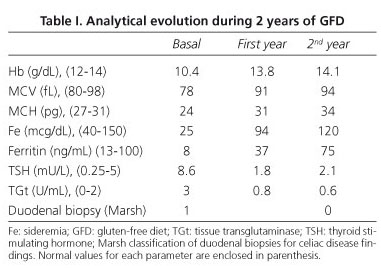
<body><![CDATA[<p><font face="Verdana" size="2">A 42-years old woman has been suffering from psychomotor retardation since early childhood. She needed permanent assistance from her family for all basic activities of daily life and never developed neither language skills, nor sphincter control. She has a peculiar face and walks with small steps, without motor deficit. She also presents traits of altered behavior, smiles continuously without apparent cause, and scratches when she is upset. She has severe constipation since childhood (1 deposition/week), and requires frequent intake of laxatives. The body mass index was normal (21 kg/m<sup>2</sup>).</font></p>     <p><font face="Verdana" size="2">At age of 11 she presented a picture of herpetiform dermatitis. She has suffered from epilepsy since adolescence. At first, she had frequent convulsive seizures, mixed with episodes of absence with a myoclonic component. She was also diagnosed of hypothyroidism at age 37, and has been treated since then with substitution therapy. The diagnosis of Angelman syndrome (AS) was established based on clinical features, and confirmed by fluorescence <i>in situ</i> hybridization (FISH) on the affected region, which showed the presence of a microdeletion in the q11-q13 region of one of the chromosomes 15.</font></p>     <p><font face="Verdana" size="2">The patient came to our clinic 2.5 years ago with the chief complaint of marked food intolerance with frequent nausea and repeated episodes of vomiting and acid reflux. She was unresponsive to antiemetics or PPIs. She had a significant ferropenic anemia (Hb = 10.4 g/dL), which was refractory to oral iron preparations.</font></p>     <p><font face="Verdana" size="2">A colonoscopy and an upper gastrointestinal (GI) endoscopy were normal. Duodenal biopsies showed an increase of intraepithelial lymphocytes (LIEs) (&gt; 40%), without villous atrophy (Marsh I). A slightly increased tissue transglutaminase (3 U/ml) was detected, being DQ2-positive in one allele and DQ8-positive in both.</font></p>     <p><font face="Verdana" size="2">Based on the histological, serological, and genetic findings a celiac disease (CD) was diagnosed, and the family was advised to feed the patient with a gluten-free diet (GFD). We also administered parenteral iron, once/week during 3 months, with total resolution of anemia.</font></p>     <p><font face="Verdana" size="2">The follow-up examinations to date (five in two years and a half overall) show that the patient remains asymptomatic, without anemia and improved control of the hypothyroidism and epilepsy, after the first year of the GFD. Constipation has notably improved (1 deposition/2 days). Upper GI endoscopy was repeated after 2 years of the GFD, showing that the lymphocy-tic enteritis had resolved with normal appearance of the intestinal mucosa (Marsh 0). The follow-up laboratory tests performed during these 2 years are shown in <a href="#t1">table I</a>.</font></p>     <p align="center"><a name="t1"><img border="0" src="/img/revistas/diges/v102n7/carta1_t1.jpg" width="381" height="268"></a></p>     <p>&nbsp;</p>     <p><font face="Verdana" size="2">The AS is different from the one caused by abnormal paternal contribution to the same locus, known as Prader-Willi syndrome. The genetic basis for AS was described for the first time in 1997, and consists of a disruption of the UBE3A/E6-AP gene. The corresponding protein plays a role in the ubiquitin-dependent degradation pathway, which is important for the regulation of protein homeostasis associated with the neuronal synaptic function (1-3).</font></p>     <p><font face="Verdana" size="2">We conclude that this patient presents CD associated with AS and epilepsy with an autoimmune disorder hypothyroidism, which is often associated with CD. She had also a herpetiform dermatitis, together with refractory chronic iron deficiency anemia, which was corrected permanently with parenteral iron and GFD. The seizures have also decreased and an improvement in behavior is apparent.</font></p>     ]]></body>
<body><![CDATA[<p><font face="Verdana" size="2">The patient presented duodenal lymphocytic enteritis (Oberhuber-Marsh modified classification) (4,5), with increased serological markers and compatible genetic susceptibility, as well as upper digestive intolerance and striking constipation as the predominant digestive symptoms.</font></p>     <p><font face="Verdana" size="2">We believe that to the same extent as in other chromosomopathies such as Turner's syndrome, Down's syndrome or Williams syndrome, in patients with AS and a compatible clinical picture, the presence of an associated CD should be considered and further investigated (6-10).</font></p>     <p>&nbsp;</p>     <p align="right"><font face="Verdana" size="2"><b>L. Rodrigo<sup>1</sup>, N. &Aacute;lvarez<sup>1</sup>, J. Salas-Puig<sup>2</sup> and C. Hern&aacute;ndez-Lahoz<sup>2</sup></b>    <br>Departments of <sup>1</sup>Gastroenterology and <sup>2</sup>Neurology. Hospital Universitario Central de Asturias (HUCA). Oviedo, Asturias. Spain.</font></p>     <p>&nbsp;</p>     <p><font face="Verdana" size="2"><b>References</b></font></p>     <!-- ref --><p><font face="Verdana" size="2">1. Gurrieri F, Accadia M. Genetic imprinting: the paradigm of Prader-Willi and Angelman syndromes. Endocr Dev 2009; 14: 20-8.</font>&nbsp;&nbsp;&nbsp;&nbsp;&nbsp;&nbsp;&nbsp;&nbsp;[&#160;<a href="javascript:void(0);" onclick="javascript: window.open('/scielo.php?script=sci_nlinks&ref=5307564&pid=S1130-0108201000070001100001&lng=','','width=640,height=500,resizable=yes,scrollbars=1,menubar=yes,');">Links</a>&#160;]<!-- end-ref --><!-- ref --><p><font face="Verdana" size="2">2. Williams C. Angelman syndrome scientific symposium on the structure and function of UBE3A/E6AP. J Child Neurol 2009; 24: 904-8.</font>&nbsp;&nbsp;&nbsp;&nbsp;&nbsp;&nbsp;&nbsp;&nbsp;[&#160;<a href="javascript:void(0);" onclick="javascript: window.open('/scielo.php?script=sci_nlinks&ref=5307565&pid=S1130-0108201000070001100002&lng=','','width=640,height=500,resizable=yes,scrollbars=1,menubar=yes,');">Links</a>&#160;]<!-- end-ref --><!-- ref --><p><font face="Verdana" size="2">3. Tzagkaraki E, Christalena S, Helen F, Argyris D, Ariadni M, Emmanuel K. Novel human pathological mutations. Gene symbol: UBE3A. Disease: Angelman syndrome. Hum Genet 2009; 126: 331.</font>&nbsp;&nbsp;&nbsp;&nbsp;&nbsp;&nbsp;&nbsp;&nbsp;[&#160;<a href="javascript:void(0);" onclick="javascript: window.open('/scielo.php?script=sci_nlinks&ref=5307566&pid=S1130-0108201000070001100003&lng=','','width=640,height=500,resizable=yes,scrollbars=1,menubar=yes,');">Links</a>&#160;]<!-- end-ref --><!-- ref --><p><font face="Verdana" size="2">4. Oberhuber G, Caspary WF, Kirchner T, Borchard F, Stolte M. Diagnosis of celiac disease and sprue. Recommendations of the German Society for the Pathology Task Force on Gastroenterology. Pathology 2001; 22: 72-81.</font>&nbsp;&nbsp;&nbsp;&nbsp;&nbsp;&nbsp;&nbsp;&nbsp;[&#160;<a href="javascript:void(0);" onclick="javascript: window.open('/scielo.php?script=sci_nlinks&ref=5307567&pid=S1130-0108201000070001100004&lng=','','width=640,height=500,resizable=yes,scrollbars=1,menubar=yes,');">Links</a>&#160;]<!-- end-ref --><!-- ref --><p><font face="Verdana" size="2">5. Marsh MN. Gluten major histocompatibility complex and the small intestine. A molecular and immunobiologic approach to the spectrum of gluten sensitivity (celiac sprue). Gastroenterology 1992; 102: 330-54.</font>&nbsp;&nbsp;&nbsp;&nbsp;&nbsp;&nbsp;&nbsp;&nbsp;[&#160;<a href="javascript:void(0);" onclick="javascript: window.open('/scielo.php?script=sci_nlinks&ref=5307568&pid=S1130-0108201000070001100005&lng=','','width=640,height=500,resizable=yes,scrollbars=1,menubar=yes,');">Links</a>&#160;]<!-- end-ref --><!-- ref --><p><font face="Verdana" size="2">6. Rodrigo L. Celiac disease. World J Gastroenterol 2006; 12: 6585-93.</font>&nbsp;&nbsp;&nbsp;&nbsp;&nbsp;&nbsp;&nbsp;&nbsp;[&#160;<a href="javascript:void(0);" onclick="javascript: window.open('/scielo.php?script=sci_nlinks&ref=5307569&pid=S1130-0108201000070001100006&lng=','','width=640,height=500,resizable=yes,scrollbars=1,menubar=yes,');">Links</a>&#160;]<!-- end-ref --><!-- ref --><p><font face="Verdana" size="2">7. Frost AR, Band MM, Conway GS. Serological screening for coeliac disease in adults with Turner's syndrome: prevalence and clinical significance of endomysium antibody positivity. Eur J Endocrinol 2009; 160: 675-9.</font>&nbsp;&nbsp;&nbsp;&nbsp;&nbsp;&nbsp;&nbsp;&nbsp;[&#160;<a href="javascript:void(0);" onclick="javascript: window.open('/scielo.php?script=sci_nlinks&ref=5307570&pid=S1130-0108201000070001100007&lng=','','width=640,height=500,resizable=yes,scrollbars=1,menubar=yes,');">Links</a>&#160;]<!-- end-ref --><!-- ref --><p><font face="Verdana" size="2">8. Henderson A, Lynch SA, Wilkinson S, Hunter M. Adults with Down's syndrome: the prevalence of complications and health care in the community. Br J Gen Pract 2007; 57: 50-5.</font>&nbsp;&nbsp;&nbsp;&nbsp;&nbsp;&nbsp;&nbsp;&nbsp;[&#160;<a href="javascript:void(0);" onclick="javascript: window.open('/scielo.php?script=sci_nlinks&ref=5307571&pid=S1130-0108201000070001100008&lng=','','width=640,height=500,resizable=yes,scrollbars=1,menubar=yes,');">Links</a>&#160;]<!-- end-ref --><!-- ref --><p><font face="Verdana" size="2">9. Giannotti A, Tiberio G, Castro M, Virgilii F, Colistro F, Ferretti F, et al. Celiac disease in Williams syndrome. J Med Genet 2001; 38: 767-8.</font>&nbsp;&nbsp;&nbsp;&nbsp;&nbsp;&nbsp;&nbsp;&nbsp;[&#160;<a href="javascript:void(0);" onclick="javascript: window.open('/scielo.php?script=sci_nlinks&ref=5307572&pid=S1130-0108201000070001100009&lng=','','width=640,height=500,resizable=yes,scrollbars=1,menubar=yes,');">Links</a>&#160;]<!-- end-ref --><!-- ref --><p><font face="Verdana" size="2">10. Romanos J, van Diemen CC, Noite IM, Trynke G, Zhermakova A, Fu J, et al. Analysis of HLA and non-HLA alleles can identify individuals at high risk for celiac disease. Gastroenterology 2009; 137: 834-40.</font>&nbsp;&nbsp;&nbsp;&nbsp;&nbsp;&nbsp;&nbsp;&nbsp;[&#160;<a href="javascript:void(0);" onclick="javascript: window.open('/scielo.php?script=sci_nlinks&ref=5307573&pid=S1130-0108201000070001100010&lng=','','width=640,height=500,resizable=yes,scrollbars=1,menubar=yes,');">Links</a>&#160;]<!-- end-ref --> ]]></body><back>
<ref-list>
<ref id="B1">
<label>1</label><nlm-citation citation-type="journal">
<person-group person-group-type="author">
<name>
<surname><![CDATA[Gurrieri]]></surname>
<given-names><![CDATA[F]]></given-names>
</name>
<name>
<surname><![CDATA[Accadia]]></surname>
<given-names><![CDATA[M]]></given-names>
</name>
</person-group>
<article-title xml:lang="en"><![CDATA[Genetic imprinting: the paradigm of Prader-Willi and Angelman syndromes]]></article-title>
<source><![CDATA[Endocr Dev]]></source>
<year>2009</year>
<volume>14</volume>
<page-range>20-8</page-range></nlm-citation>
</ref>
<ref id="B2">
<label>2</label><nlm-citation citation-type="journal">
<person-group person-group-type="author">
<name>
<surname><![CDATA[Williams]]></surname>
<given-names><![CDATA[C]]></given-names>
</name>
</person-group>
<article-title xml:lang="en"><![CDATA[Angelman syndrome scientific symposium on the structure and function of UBE3A/E6AP]]></article-title>
<source><![CDATA[J Child Neurol]]></source>
<year>2009</year>
<volume>24</volume>
<page-range>904-8</page-range></nlm-citation>
</ref>
<ref id="B3">
<label>3</label><nlm-citation citation-type="journal">
<person-group person-group-type="author">
<name>
<surname><![CDATA[Tzagkaraki]]></surname>
<given-names><![CDATA[E]]></given-names>
</name>
<name>
<surname><![CDATA[Christalena]]></surname>
<given-names><![CDATA[S]]></given-names>
</name>
<name>
<surname><![CDATA[Helen]]></surname>
<given-names><![CDATA[F]]></given-names>
</name>
<name>
<surname><![CDATA[Argyris]]></surname>
<given-names><![CDATA[D]]></given-names>
</name>
<name>
<surname><![CDATA[Ariadni]]></surname>
<given-names><![CDATA[M]]></given-names>
</name>
<name>
<surname><![CDATA[Emmanuel]]></surname>
<given-names><![CDATA[K]]></given-names>
</name>
</person-group>
<article-title xml:lang="en"><![CDATA[Novel human pathological mutations. Gene symbol: UBE3A. Disease: Angelman syndrome]]></article-title>
<source><![CDATA[Hum Genet]]></source>
<year>2009</year>
<volume>126</volume>
<page-range>331</page-range></nlm-citation>
</ref>
<ref id="B4">
<label>4</label><nlm-citation citation-type="journal">
<person-group person-group-type="author">
<name>
<surname><![CDATA[Oberhuber]]></surname>
<given-names><![CDATA[G]]></given-names>
</name>
<name>
<surname><![CDATA[Caspary]]></surname>
<given-names><![CDATA[WF]]></given-names>
</name>
<name>
<surname><![CDATA[Kirchner]]></surname>
<given-names><![CDATA[T]]></given-names>
</name>
<name>
<surname><![CDATA[Borchard]]></surname>
<given-names><![CDATA[F]]></given-names>
</name>
<name>
<surname><![CDATA[Stolte]]></surname>
<given-names><![CDATA[M]]></given-names>
</name>
</person-group>
<article-title xml:lang="en"><![CDATA[Diagnosis of celiac disease and sprue: Recommendations of the German Society for the Pathology Task Force on Gastroenterology]]></article-title>
<source><![CDATA[Pathology]]></source>
<year>2001</year>
<volume>22</volume>
<page-range>72-81</page-range></nlm-citation>
</ref>
<ref id="B5">
<label>5</label><nlm-citation citation-type="journal">
<person-group person-group-type="author">
<name>
<surname><![CDATA[Marsh]]></surname>
<given-names><![CDATA[MN]]></given-names>
</name>
</person-group>
<article-title xml:lang="en"><![CDATA[Gluten major histocompatibility complex and the small intestine: A molecular and immunobiologic approach to the spectrum of gluten sensitivity (celiac sprue)]]></article-title>
<source><![CDATA[Gastroenterology]]></source>
<year>1992</year>
<volume>102</volume>
<page-range>330-54</page-range></nlm-citation>
</ref>
<ref id="B6">
<label>6</label><nlm-citation citation-type="journal">
<person-group person-group-type="author">
<name>
<surname><![CDATA[Rodrigo]]></surname>
<given-names><![CDATA[L]]></given-names>
</name>
</person-group>
<article-title xml:lang="en"><![CDATA[Celiac disease]]></article-title>
<source><![CDATA[World J Gastroenterol]]></source>
<year>2006</year>
<volume>12</volume>
<page-range>6585-93</page-range></nlm-citation>
</ref>
<ref id="B7">
<label>7</label><nlm-citation citation-type="journal">
<person-group person-group-type="author">
<name>
<surname><![CDATA[Frost]]></surname>
<given-names><![CDATA[AR]]></given-names>
</name>
<name>
<surname><![CDATA[Band]]></surname>
<given-names><![CDATA[MM]]></given-names>
</name>
<name>
<surname><![CDATA[Conway]]></surname>
<given-names><![CDATA[GS]]></given-names>
</name>
</person-group>
<article-title xml:lang="en"><![CDATA[Serological screening for coeliac disease in adults with Turner's syndrome: prevalence and clinical significance of endomysium antibody positivity]]></article-title>
<source><![CDATA[Eur J Endocrinol]]></source>
<year>2009</year>
<volume>160</volume>
<page-range>675-9</page-range></nlm-citation>
</ref>
<ref id="B8">
<label>8</label><nlm-citation citation-type="journal">
<person-group person-group-type="author">
<name>
<surname><![CDATA[Henderson]]></surname>
<given-names><![CDATA[A]]></given-names>
</name>
<name>
<surname><![CDATA[Lynch]]></surname>
<given-names><![CDATA[SA]]></given-names>
</name>
<name>
<surname><![CDATA[Wilkinson]]></surname>
<given-names><![CDATA[S]]></given-names>
</name>
<name>
<surname><![CDATA[Hunter]]></surname>
<given-names><![CDATA[M]]></given-names>
</name>
</person-group>
<article-title xml:lang="en"><![CDATA[Adults with Down's syndrome: the prevalence of complications and health care in the community]]></article-title>
<source><![CDATA[Br J Gen Pract]]></source>
<year>2007</year>
<volume>57</volume>
<page-range>50-5</page-range></nlm-citation>
</ref>
<ref id="B9">
<label>9</label><nlm-citation citation-type="journal">
<person-group person-group-type="author">
<name>
<surname><![CDATA[Giannotti]]></surname>
<given-names><![CDATA[A]]></given-names>
</name>
<name>
<surname><![CDATA[Tiberio]]></surname>
<given-names><![CDATA[G]]></given-names>
</name>
<name>
<surname><![CDATA[Castro]]></surname>
<given-names><![CDATA[M]]></given-names>
</name>
<name>
<surname><![CDATA[Virgilii]]></surname>
<given-names><![CDATA[F]]></given-names>
</name>
<name>
<surname><![CDATA[Colistro]]></surname>
<given-names><![CDATA[F]]></given-names>
</name>
<name>
<surname><![CDATA[Ferretti]]></surname>
<given-names><![CDATA[F]]></given-names>
</name>
</person-group>
<article-title xml:lang="en"><![CDATA[Celiac disease in Williams syndrome]]></article-title>
<source><![CDATA[J Med Genet]]></source>
<year>2001</year>
<volume>38</volume>
<page-range>767-8</page-range></nlm-citation>
</ref>
<ref id="B10">
<label>10</label><nlm-citation citation-type="journal">
<person-group person-group-type="author">
<name>
<surname><![CDATA[Romanos]]></surname>
<given-names><![CDATA[J]]></given-names>
</name>
<name>
<surname><![CDATA[van Diemen]]></surname>
<given-names><![CDATA[CC]]></given-names>
</name>
<name>
<surname><![CDATA[Noite]]></surname>
<given-names><![CDATA[IM]]></given-names>
</name>
<name>
<surname><![CDATA[Trynke]]></surname>
<given-names><![CDATA[G]]></given-names>
</name>
<name>
<surname><![CDATA[Zhermakova]]></surname>
<given-names><![CDATA[A]]></given-names>
</name>
<name>
<surname><![CDATA[Fu]]></surname>
<given-names><![CDATA[J]]></given-names>
</name>
</person-group>
<article-title xml:lang="en"><![CDATA[Analysis of HLA and non-HLA alleles can identify individuals at high risk for celiac disease]]></article-title>
<source><![CDATA[Gastroenterology]]></source>
<year>2009</year>
<volume>137</volume>
<page-range>834-40</page-range></nlm-citation>
</ref>
</ref-list>
</back>
</article>
