<?xml version="1.0" encoding="ISO-8859-1"?><article xmlns:mml="http://www.w3.org/1998/Math/MathML" xmlns:xlink="http://www.w3.org/1999/xlink" xmlns:xsi="http://www.w3.org/2001/XMLSchema-instance">
<front>
<journal-meta>
<journal-id>1130-0108</journal-id>
<journal-title><![CDATA[Revista Española de Enfermedades Digestivas]]></journal-title>
<abbrev-journal-title><![CDATA[Rev. esp. enferm. dig.]]></abbrev-journal-title>
<issn>1130-0108</issn>
<publisher>
<publisher-name><![CDATA[Sociedad Española de Patología Digestiva]]></publisher-name>
</publisher>
</journal-meta>
<article-meta>
<article-id>S1130-01082011000200013</article-id>
<title-group>
<article-title xml:lang="en"><![CDATA[Hemoperitoneum after gallbladder perforation associated with hemodialysis]]></article-title>
<article-title xml:lang="es"><![CDATA[Hemoperitoneo secundario a perforación de la vesícula biliar asociado a hemodiálisis]]></article-title>
</title-group>
<contrib-group>
<contrib contrib-type="author">
<name>
<surname><![CDATA[Pérez-Grobas]]></surname>
<given-names><![CDATA[J.]]></given-names>
</name>
<xref ref-type="aff" rid="A01"/>
</contrib>
<contrib contrib-type="author">
<name>
<surname><![CDATA[López-García]]></surname>
<given-names><![CDATA[S.]]></given-names>
</name>
<xref ref-type="aff" rid="A01"/>
</contrib>
<contrib contrib-type="author">
<name>
<surname><![CDATA[Seoane]]></surname>
<given-names><![CDATA[M.]]></given-names>
</name>
<xref ref-type="aff" rid="A01"/>
</contrib>
<contrib contrib-type="author">
<name>
<surname><![CDATA[Berdeal-Díaz]]></surname>
<given-names><![CDATA[M.]]></given-names>
</name>
<xref ref-type="aff" rid="A01"/>
</contrib>
<contrib contrib-type="author">
<name>
<surname><![CDATA[Alvite-Canosa]]></surname>
<given-names><![CDATA[M.]]></given-names>
</name>
<xref ref-type="aff" rid="A01"/>
</contrib>
<contrib contrib-type="author">
<name>
<surname><![CDATA[Alonso-Fernández]]></surname>
<given-names><![CDATA[L.]]></given-names>
</name>
<xref ref-type="aff" rid="A01"/>
</contrib>
<contrib contrib-type="author">
<name>
<surname><![CDATA[Carral-Freire]]></surname>
<given-names><![CDATA[M.]]></given-names>
</name>
<xref ref-type="aff" rid="A01"/>
</contrib>
<contrib contrib-type="author">
<name>
<surname><![CDATA[Bouzón]]></surname>
<given-names><![CDATA[A.]]></given-names>
</name>
<xref ref-type="aff" rid="A01"/>
</contrib>
</contrib-group>
<aff id="A01">
<institution><![CDATA[,Complexo Hospitalario Universitario de A Coruña (CHUAC) Department of General Surgery A ]]></institution>
<addr-line><![CDATA[ ]]></addr-line>
<country>Spain</country>
</aff>
<pub-date pub-type="pub">
<day>00</day>
<month>02</month>
<year>2011</year>
</pub-date>
<pub-date pub-type="epub">
<day>00</day>
<month>02</month>
<year>2011</year>
</pub-date>
<volume>103</volume>
<numero>2</numero>
<fpage>100</fpage>
<lpage>101</lpage>
<copyright-statement/>
<copyright-year/>
<self-uri xlink:href="http://scielo.isciii.es/scielo.php?script=sci_arttext&amp;pid=S1130-01082011000200013&amp;lng=en&amp;nrm=iso"></self-uri><self-uri xlink:href="http://scielo.isciii.es/scielo.php?script=sci_abstract&amp;pid=S1130-01082011000200013&amp;lng=en&amp;nrm=iso"></self-uri><self-uri xlink:href="http://scielo.isciii.es/scielo.php?script=sci_pdf&amp;pid=S1130-01082011000200013&amp;lng=en&amp;nrm=iso"></self-uri></article-meta>
</front><body><![CDATA[ <p><font face="Verdana" size="2"><b>LETTERS TO THE EDITOR</b></font></p>     <p>&nbsp;</p>     <p><font face="Verdana" size="4"><b>Hemoperitoneum after gallbladder perforation associated with hemodialysis</b></font></p>     <p><font face="Verdana" size="4"><b>Hemoperitoneo secundario a perforaci&oacute;n de la ves&iacute;cula biliar asociado a hemodi&aacute;lisis</b></font></p>     <p>&nbsp;</p>     <p>&nbsp;</p><hr size="1">     <p><font face="Verdana" size="2"><i>Key words: Haemoperitoneum. Hemodyalisis. Gallbladder perforation.</i></font></p>     <p><font face="Verdana" size="2"><i>Palabras clave: Hemoperitoneo. Hemodi&aacute;lisis. Perforaci&oacute;n biliar.</i></font></p> <hr size="1">     <p>&nbsp;</p>     <p>&nbsp;</p>     ]]></body>
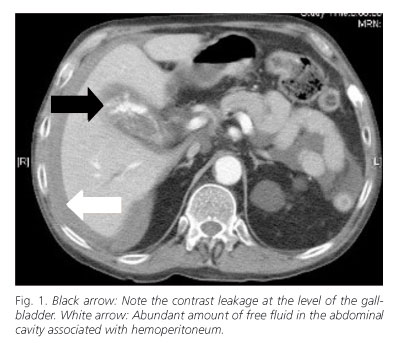
<body><![CDATA[<p><font face="Verdana" size="2"><i>Dear Editor,</i></font></p>     <p><font face="Verdana" size="2">Hemoperitoneum after spontaneous perforation of the gallbladder is an extremely rare finding. Garamendi et al. find less than 50 cases published since 1858 (2). It is believed that the pathogenesis of gallbladder perforation is related with the impaction of a stone in the cystic duct causing inflammation of the gallbladder, infection and necrosis with subsequent perforation. This event can be accompanied with or without hemoperitoneum. On the other hand, hemodialysis patients usually have abdominal complications, particularly complications at the hepatobiliary tree: cholelithiasis, acalculous cholecystitis and lithiasis, and in some cases hemoperitoneum secondary to perforation of the gallbladder. Gold standard imaging test is CT, but in hemodynamically unstable patients, performing an abdominal ultrasound may reveal the presence of hemoperitoneum and therefore the need for urgent surgical treatment although not always it is possible to locate the leak of contrast (1).</font></p>     <p><font face="Verdana" size="2">We report a case of a 57 year-old man with personal history of hypertension, dyslipidemia, chronic renal failure secondary to IgA mesangial glomerulonephritis. Because of this he was submitted to renal transplantation 30 years before. Nevertheless, he suffered chronic graft dysfunction that recently led to graft removing and hemodialysis. After this procedure, he suffered a perforation of a duodenal ulcer which needs a vagotomy and pyloroplasty. He came to the emergency room because of diffuse abdominal pain and tendency to hypotension. On palpation, he presented right upper quadrant peritonitis and blood tests showed severe anemia (hematocrit, 23%; haemoglobin, 7.7 g/ dl) with mild leukocytosis and shift to the left. A computer tomography scan showed an intravenous contrast leakage from the gallbladder into the peritoneal cavity and abundant amount of free fluid consistent with hemoperitoneum (<a href="#f1">Fig 1</a>). During the surgery, we found a very large hemoperitoneum secondary to gallbladder perforation with clear signs of cholecystitis. A cholecystectomy was performed.</font></p>     <p align="center"><font face="Verdana" size="2"><a name="f1"><img src="/img/revistas/diges/v103n2/carta2_f1.jpg" width="400" height="344"></a></font></p>     <p><font face="Verdana" size="2">The perforation of the gallbladder is a relatively common complication in acute cholecystitis. Although it is rarely accompanied by hemoperitoneum, it is known that in hemodialysis patients the risk of bleeding is increased, probably due to the use of anticoagulants as well as to the clotting disorders inherent to renal failure. Abdominal complications, primarily associated with women and gynecological pathology, require surgical treatment only in 20% of cases (3,4). However, currently, the only treatment of gallbladder perforation with or without hemoperitoneum is cholecystectomy.</font></p>     <p>&nbsp;</p>     <p align="right"><font face="Verdana" size="2"><b>J. P&eacute;rez-Grobas, S. L&oacute;pez-Garc&iacute;a, M. Seoane, M. Berdeal-D&iacute;az, M. Alvite-Canosa. L. Alonso-Fern&aacute;ndez, M. Carral-Freire and A. Bouz&oacute;n</b>    <br>Department of General Surgery A. Complexo Hospitalario Universitario de A Coru&ntilde;a (CHUAC). Spain</font></p>     <p>&nbsp;</p>     <p><font face="Verdana" size="2"><b>References</b></font></p>     ]]></body>
<body><![CDATA[<!-- ref --><p><font face="Verdana" size="2">1. Lucey BC, Varghese JC, Soto JA. Spontaneous hemoperitoneum: causes and significance. Curr Probl Diagn Radiol. 2005;34:182-95.    &nbsp;&nbsp;&nbsp;&nbsp;&nbsp;&nbsp;&nbsp;&nbsp;[&#160;<a href="javascript:void(0);" onclick="javascript: window.open('/scielo.php?script=sci_nlinks&ref=5319656&pid=S1130-0108201100020001300001&lng=','','width=640,height=500,resizable=yes,scrollbars=1,menubar=yes,');">Links</a>&#160;]<!-- end-ref --></font></p>    <!-- ref --><p><font face="Verdana" size="2">2. Garamendi, M.  Arbella y B. Aguiler. Hemoperitoneo masivo consecutivo a perforaci&oacute;n espont&aacute;nea de la ves&iacute;cula biliar. A prop&oacute;sito de un caso de muerte s&uacute;bita. Cuadernos de Medicina Forense N<sup>o</sup> 28 - Abril 2002</font>&nbsp;&nbsp;&nbsp;&nbsp;&nbsp;&nbsp;&nbsp;&nbsp;[&#160;<a href="javascript:void(0);" onclick="javascript: window.open('/scielo.php?script=sci_nlinks&ref=5319658&pid=S1130-0108201100020001300002&lng=','','width=640,height=500,resizable=yes,scrollbars=1,menubar=yes,');">Links</a>&#160;]<!-- end-ref --><!-- ref --><p><font face="Verdana" size="2">3. Katsumichi Iki, Hiroshi Inada, Masataka Satoh, Tsukasa Tsunoda Hemorrhagic acalculous cholecystitis associted with hemodialysis Surgery, 2002;132:903.    &nbsp;&nbsp;&nbsp;&nbsp;&nbsp;&nbsp;&nbsp;&nbsp;[&#160;<a href="javascript:void(0);" onclick="javascript: window.open('/scielo.php?script=sci_nlinks&ref=5319659&pid=S1130-0108201100020001300003&lng=','','width=640,height=500,resizable=yes,scrollbars=1,menubar=yes,');">Links</a>&#160;]<!-- end-ref --></font></p>    <!-- ref --><p><font face="Verdana" size="2">4. Stolz A, Fourcade J, Klisnick A, Souweine B, Abergel A, Baguet JC, Deteix P. Hemoperitoneum in patients receiving hemodialysis. Am J Kidney Dis. 2000;36:E11.    &nbsp;&nbsp;&nbsp;&nbsp;&nbsp;&nbsp;&nbsp;&nbsp;[&#160;<a href="javascript:void(0);" onclick="javascript: window.open('/scielo.php?script=sci_nlinks&ref=5319661&pid=S1130-0108201100020001300004&lng=','','width=640,height=500,resizable=yes,scrollbars=1,menubar=yes,');">Links</a>&#160;]<!-- end-ref --></font></p>      ]]></body><back>
<ref-list>
<ref id="B1">
<label>1</label><nlm-citation citation-type="journal">
<person-group person-group-type="author">
<name>
<surname><![CDATA[Lucey]]></surname>
<given-names><![CDATA[BC]]></given-names>
</name>
<name>
<surname><![CDATA[Varghese]]></surname>
<given-names><![CDATA[JC]]></given-names>
</name>
<name>
<surname><![CDATA[Soto]]></surname>
<given-names><![CDATA[JA]]></given-names>
</name>
</person-group>
<article-title xml:lang="en"><![CDATA[Spontaneous hemoperitoneum: causes and significance]]></article-title>
<source><![CDATA[Curr Probl Diagn Radiol.]]></source>
<year>2005</year>
<volume>34</volume>
<page-range>182-95</page-range></nlm-citation>
</ref>
<ref id="B2">
<label>2</label><nlm-citation citation-type="journal">
<person-group person-group-type="author">
<name>
<surname><![CDATA[Garamendi]]></surname>
<given-names><![CDATA[M.]]></given-names>
</name>
<name>
<surname><![CDATA[Arbella]]></surname>
</name>
<name>
<surname><![CDATA[Aguiler]]></surname>
<given-names><![CDATA[B.]]></given-names>
</name>
</person-group>
<article-title xml:lang="es"><![CDATA[Hemoperitoneo masivo consecutivo a perforación espontánea de la vesícula biliar: A propósito de un caso de muerte súbita]]></article-title>
<source><![CDATA[Cuadernos de Medicina Forense]]></source>
<year>Abri</year>
<month>l </month>
<day>20</day>
<numero>28</numero>
<issue>28</issue>
</nlm-citation>
</ref>
<ref id="B3">
<label>3</label><nlm-citation citation-type="journal">
<person-group person-group-type="author">
<name>
<surname><![CDATA[Katsumichi]]></surname>
<given-names><![CDATA[Iki]]></given-names>
</name>
<name>
<surname><![CDATA[Hiroshi]]></surname>
<given-names><![CDATA[Inada]]></given-names>
</name>
<name>
<surname><![CDATA[Masataka]]></surname>
<given-names><![CDATA[Satoh]]></given-names>
</name>
<name>
<surname><![CDATA[Tsukasa]]></surname>
<given-names><![CDATA[Tsunoda]]></given-names>
</name>
</person-group>
<article-title xml:lang="en"><![CDATA[Hemorrhagic acalculous cholecystitis associted with hemodialysis]]></article-title>
<source><![CDATA[Surgery]]></source>
<year>2002</year>
<volume>132</volume>
<page-range>903</page-range></nlm-citation>
</ref>
<ref id="B4">
<label>4</label><nlm-citation citation-type="journal">
<person-group person-group-type="author">
<name>
<surname><![CDATA[Stolz]]></surname>
<given-names><![CDATA[A]]></given-names>
</name>
<name>
<surname><![CDATA[Fourcade]]></surname>
<given-names><![CDATA[J]]></given-names>
</name>
<name>
<surname><![CDATA[Klisnick]]></surname>
<given-names><![CDATA[A]]></given-names>
</name>
<name>
<surname><![CDATA[Souweine]]></surname>
<given-names><![CDATA[B]]></given-names>
</name>
<name>
<surname><![CDATA[Abergel]]></surname>
<given-names><![CDATA[A]]></given-names>
</name>
<name>
<surname><![CDATA[Baguet]]></surname>
<given-names><![CDATA[JC]]></given-names>
</name>
<name>
<surname><![CDATA[Deteix]]></surname>
<given-names><![CDATA[P]]></given-names>
</name>
</person-group>
<article-title xml:lang="en"><![CDATA[Hemoperitoneum in patients receiving hemodialysis]]></article-title>
<source><![CDATA[Am J Kidney Dis.]]></source>
<year>2000</year>
<volume>36</volume>
<page-range>E11</page-range></nlm-citation>
</ref>
</ref-list>
</back>
</article>
