<?xml version="1.0" encoding="ISO-8859-1"?><article xmlns:mml="http://www.w3.org/1998/Math/MathML" xmlns:xlink="http://www.w3.org/1999/xlink" xmlns:xsi="http://www.w3.org/2001/XMLSchema-instance">
<front>
<journal-meta>
<journal-id>1130-0108</journal-id>
<journal-title><![CDATA[Revista Española de Enfermedades Digestivas]]></journal-title>
<abbrev-journal-title><![CDATA[Rev. esp. enferm. dig.]]></abbrev-journal-title>
<issn>1130-0108</issn>
<publisher>
<publisher-name><![CDATA[Sociedad Española de Patología Digestiva]]></publisher-name>
</publisher>
</journal-meta>
<article-meta>
<article-id>S1130-01082011000400009</article-id>
<article-id pub-id-type="doi">10.4321/S1130-01082011000400009</article-id>
<title-group>
<article-title xml:lang="en"><![CDATA[Diagnosis of Whipple's disease using molecular biology techniques]]></article-title>
<article-title xml:lang="es"><![CDATA[Diagnóstico de la enfermedad de Whipple por técnicas de biología molecular. Aportación de dos casos]]></article-title>
</title-group>
<contrib-group>
<contrib contrib-type="author">
<name>
<surname><![CDATA[Cosme]]></surname>
<given-names><![CDATA[Ángel]]></given-names>
</name>
<xref ref-type="aff" rid="A01"/>
<xref ref-type="aff" rid="A02"/>
<xref ref-type="aff" rid="A03"/>
</contrib>
<contrib contrib-type="author">
<name>
<surname><![CDATA[Ojeda]]></surname>
<given-names><![CDATA[Evelia]]></given-names>
</name>
<xref ref-type="aff" rid="A04"/>
</contrib>
<contrib contrib-type="author">
<name>
<surname><![CDATA[Muñagorri]]></surname>
<given-names><![CDATA[Ana I.]]></given-names>
</name>
<xref ref-type="aff" rid="A01"/>
</contrib>
<contrib contrib-type="author">
<name>
<surname><![CDATA[Gaminde]]></surname>
<given-names><![CDATA[Eduardo]]></given-names>
</name>
<xref ref-type="aff" rid="A04"/>
</contrib>
<contrib contrib-type="author">
<name>
<surname><![CDATA[Bujanda]]></surname>
<given-names><![CDATA[Luis]]></given-names>
</name>
<xref ref-type="aff" rid="A01"/>
<xref ref-type="aff" rid="A02"/>
<xref ref-type="aff" rid="A03"/>
</contrib>
<contrib contrib-type="author">
<name>
<surname><![CDATA[Larzabal]]></surname>
<given-names><![CDATA[Mikel]]></given-names>
</name>
<xref ref-type="aff" rid="A05"/>
</contrib>
<contrib contrib-type="author">
<name>
<surname><![CDATA[Gil]]></surname>
<given-names><![CDATA[Inés]]></given-names>
</name>
<xref ref-type="aff" rid="A01"/>
</contrib>
</contrib-group>
<aff id="A01">
<institution><![CDATA[,Hospital Donostia Department of Digestive Diseases ]]></institution>
<addr-line><![CDATA[ ]]></addr-line>
</aff>
<aff id="A02">
<institution><![CDATA[,Centro de Investigación Biomédica en Red en el Área temática de Enfermedades Hepáticas y Digestivas (CIBERHD)  ]]></institution>
<addr-line><![CDATA[ ]]></addr-line>
</aff>
<aff id="A03">
<institution><![CDATA[,University of the Basque Country  ]]></institution>
<addr-line><![CDATA[San Sebastián ]]></addr-line>
<country>Spain</country>
</aff>
<aff id="A04">
<institution><![CDATA[,Hospital Donostia Department of Internal Medicine ]]></institution>
<addr-line><![CDATA[ ]]></addr-line>
</aff>
<aff id="A05">
<institution><![CDATA[,Hospital Donostia Department of Pathology ]]></institution>
<addr-line><![CDATA[San Sebastián ]]></addr-line>
<country>Spain</country>
</aff>
<pub-date pub-type="pub">
<day>00</day>
<month>04</month>
<year>2011</year>
</pub-date>
<pub-date pub-type="epub">
<day>00</day>
<month>04</month>
<year>2011</year>
</pub-date>
<volume>103</volume>
<numero>4</numero>
<fpage>213</fpage>
<lpage>217</lpage>
<copyright-statement/>
<copyright-year/>
<self-uri xlink:href="http://scielo.isciii.es/scielo.php?script=sci_arttext&amp;pid=S1130-01082011000400009&amp;lng=en&amp;nrm=iso"></self-uri><self-uri xlink:href="http://scielo.isciii.es/scielo.php?script=sci_abstract&amp;pid=S1130-01082011000400009&amp;lng=en&amp;nrm=iso"></self-uri><self-uri xlink:href="http://scielo.isciii.es/scielo.php?script=sci_pdf&amp;pid=S1130-01082011000400009&amp;lng=en&amp;nrm=iso"></self-uri><abstract abstract-type="short" xml:lang="en"><p><![CDATA[extraintestinal manifestations, species-specific PCR using different sequences of the T. whippleii genome from different tissue types and biological fluids is recommended. The diagnosis of Whipple's disease (WD) is based on the existence of clinical signs and symptoms compatible with the disease and in the presence of PAS-positive diastase-resistant granules in the macrophages of the small intestine. If there is suspicion of the disease but no histological findings or only isolated This study reports two cases: the first patient had diarrhea and the disease was suspected after an endoscopic examination of the ileum, while the second patient had multi-systemic manifestations, particularly abdominal, thoracic, and peripheral lymphadenopathies. In both cases, the diagnosis was confirmed using molecular biology techniques to samples from the small intestine or from a retroperineal lymph node, respectively.]]></p></abstract>
<abstract abstract-type="short" xml:lang="es"><p><![CDATA[El diagnóstico de la enfermedad de Whipple (EW) se basa en la existencia de una clínica compatible y en el hallazgo de gránulos PAS +, diastasa resistente, en los macrófagos del intestino delgado. Si hay sospecha de enfermedad pero no evidencia histológica o manifestaciones extraintestinales aisladas se precisa el estudio mediante PCR específicas de distintas secuencias del genoma de T. whippleii en tejidos y fluidos biológicos. Se presentan dos casos, uno con diarrea en el que se sospechó la enfermedad tras ileoscopia y otro con manifestaciones multisistémicas, sobre todo adenopatías abdominales, torácicas y periféricas. En ambos, el estudio molecular del intestino delgado y de una linfadenopatía retroperitoneal respectivamente confirmó el diagnóstico.]]></p></abstract>
<kwd-group>
<kwd lng="en"><![CDATA[Whipple's disease]]></kwd>
<kwd lng="en"><![CDATA[Molecular diagnosis]]></kwd>
<kwd lng="en"><![CDATA[Polymerase chain reaction]]></kwd>
<kwd lng="en"><![CDATA[Tropheryma whippleii]]></kwd>
<kwd lng="en"><![CDATA[Enfermedad de Whipple]]></kwd>
<kwd lng="en"><![CDATA[Diagnóstico molecular]]></kwd>
<kwd lng="en"><![CDATA[Reacción en cadena de polimerasa]]></kwd>
<kwd lng="en"><![CDATA[Tropheryma Whippleii]]></kwd>
</kwd-group>
</article-meta>
</front><body><![CDATA[ <p><a name="top"></a><font face="Verdana" size="2"><b>CLINICAL NOTE</b></font></p>     <p>&nbsp;</p>     <p><font face="Verdana" size="4"><b>Diagnosis of Whipple's disease using molecular biology techniques</b></font></p>     <p><font face="Verdana" size="4"><b>Diagn&oacute;stico de la enfermedad de Whipple por t&eacute;cnicas de biolog&iacute;a molecular. Aportaci&oacute;n de dos casos</b></font></p>     <p>&nbsp;</p>     <p>&nbsp;</p>     <p><font face="Verdana" size="2"><b>&Aacute;ngel Cosme<sup>1</sup>*, Evelia Ojeda<sup>2</sup>, Ana I. Mu&ntilde;agorri<sup>1</sup>, Eduardo Gaminde<sup>2</sup>, Luis Bujanda<sup>1</sup>*, Mikel Larzabal<sup>3</sup> and In&eacute;s Gil<sup>1</sup></b></font></p>     <p><font face="Verdana" size="2"><sup>1</sup>Department of Digestive Diseases. Hospital Donostia. *CIBERHD. University of the Basque Country. San Sebasti&aacute;n, Guip&uacute;zcoa. Spain. Departments of <sup>2</sup>Internal Medicine, and <sup>3</sup>Pathology. Hospital Donostia. San Sebasti&aacute;n, Guip&uacute;zcoa. Spain</font></p>     <p><font face="Verdana" size="2"><a href="#back">Correspondence</a></font></p>     <p>&nbsp;</p>     ]]></body>
<body><![CDATA[<p>&nbsp;</p> <hr size="1">     <p><font face="Verdana" size="2"><b>ABSTRACT</b></font></p>     <p><font face="Verdana" size="2">The diagnosis of Whipple's disease (WD) is based on the existence of clinical signs and symptoms compatible with the disease and in the presence of PAS-positive diastase-resistant granules in the macrophages of the small intestine. If there is suspicion of the disease but no histological findings or only isolated extraintestinal manifestations, species-specific PCR using different sequences of the <i>T. whippleii</i> genome from different tissue types and biological fluids is recommended.    <br>This study reports two cases: the first patient had diarrhea and the disease was suspected after an endoscopic examination of the ileum, while the second patient had multi-systemic manifestations, particularly abdominal, thoracic, and peripheral lymphadenopathies. In both cases, the diagnosis was confirmed using molecular biology techniques to samples from the small intestine or from a retroperineal lymph node, respectively.</font></p>     <p><font face="Verdana" size="2"><b>Key words:</b> Whipple's disease. Molecular diagnosis. Polymerase chain reaction. Tropheryma whippleii.</font></p> <hr size="1">     <p><font face="Verdana" size="2"><b>RESUMEN</b></font></p>     <p><font face="Verdana" size="2">El diagn&oacute;stico de la enfermedad de Whipple (EW) se basa en la existencia de una cl&iacute;nica compatible y en el hallazgo de gr&aacute;nulos PAS +, diastasa resistente, en los macr&oacute;fagos del intestino delgado. Si hay sospecha de enfermedad pero no evidencia histol&oacute;gica o manifestaciones extraintestinales aisladas se precisa el estudio mediante PCR espec&iacute;ficas de distintas secuencias del genoma de <i>T. whippleii</i> en tejidos y fluidos biol&oacute;gicos.    <br>Se presentan dos casos, uno con diarrea en el que se sospech&oacute; la enfermedad tras ileoscopia y otro con manifestaciones multisist&eacute;micas, sobre todo adenopat&iacute;as abdominales, tor&aacute;cicas y perif&eacute;ricas. En ambos, el estudio molecular del intestino delgado y de una linfadenopat&iacute;a retroperitoneal respectivamente confirm&oacute; el diagn&oacute;stico.</font></p>     <p><font face="Verdana" size="2"><b>Palabras clave:</b> Enfermedad de Whipple. Diagn&oacute;stico molecular. Reacci&oacute;n en cadena de polimerasa. Tropheryma Whippleii.</font></p> <hr size="1">     <p>&nbsp;</p>     ]]></body>
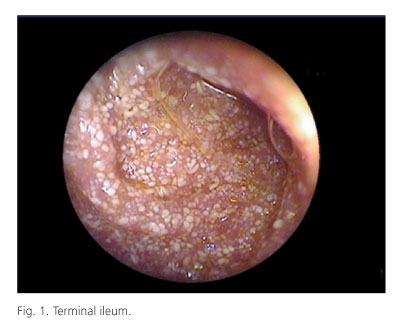
<body><![CDATA[<p><font face="Verdana" size="2"><b>Introduction</b></font></p>     <p><font face="Verdana" size="2">To date, the diagnosis of Whipple's disease (WD) continues to be based on the histological examination of the small intestine. When there is a consistent clinical picture, diagnosis can be made on the basis of histological findings from examination of the intestinal mucosa under an optical microscope, without being necessary to confirm the presence of bacilli under the electron microscopy or by using molecular biology techniques.</font></p>     <p><font face="Verdana" size="2">When the disease is suspected but there are no histological findings or only isolated extraintestinal manifestations, such as in the central nervous system (CNS), it is essential to confirm the diagnosis using electron microscopy to study biopsies of the duodenum, or polymerase chain reaction (PCR) analysis of biopsies, blood or body fluids. Over the last decade, new PCR molecular techniques have started to be used for atypical presentations and for monitoring treatment of the disease.</font></p>     <p><font face="Verdana" size="2">In this paper, we present two cases of WD. The first was a male with diarrhea, in whom the disease was suspected after endoscopic findings in the ileum. Pathological findings in the ileum mucosa and later in the duodenum, together with PCR analysis of a duodenal biopsy sample confirmed the diagnosis (Presented at the XXIV National Meeting of the Spanish Association of Digestive Endoscopy. Seville, 2002). The second case showed systemic manifestations and the findings (histopathological and molecular) concerning retroperitoneal lymph nodes led to the diagnosis.</font></p>     <p>&nbsp;</p>     <p><font face="Verdana" size="2"><b>Case report 1</b></font></p>     <p><font face="Verdana" size="2">A 29-year-old male, previously healthy, visited his doctor in 2001 complaining of liquid diarrhea (7-10 loose stools per day), diffuse colicky abdominal pain and weight loss (18 kg since the symptoms had started), over 5 months. The patient reported recurrent self-limiting episodes of arthralgia affecting large joints in the previous weeks. The standard blood test, stool culture test, stool ova, parasite assays and an opaque enema, requested as an outpatient, were all normal.</font></p>     <p><font face="Verdana" size="2">Subsequently, colonoscopy confirmed that the colon was normal. However, ileum endoscopy revealed erythematous, edematous and friable ileum mucosa, with isolated whitish granules, which on advancing further with the endoscope merged to resemble "grains of rice" (<a href="#f1">Fig. 1</a>).</font></p>     <p align="center"><font face="Verdana" size="2"><a name="f1"><img src="/img/revistas/diges/v103n4/notaclinica_fig1.jpg" width="406" height="330"></a></font></p>     <p><font face="Verdana" size="2">While waiting for the results of the biopsy, his clinical condition worsened, with more frequent passing of stools, his temperature raised to 39 <sup>o</sup>C and he was admitted to hospital. Signs and symptoms included deterioration of his general condition, temperature of 38.5 <sup>o</sup>C and diffuse abdominal pain. No skin lesions were observed, nor were lymphadenopathies detected by palpation. The blood test yielded the following results: hematocrit 29.8% (40-50), platelets 409,000/mm<sup>3</sup> (139-400,000), total proteins 4.9 g/dl, albumin 2 g/dl, iron 10 ng/dl (60-160), transferrin saturation 3% (15-50%) and D-xylose absorption consistent with malabsorption. The levels of the following parameters were normal: bilirubin, glucose, urea, creatinine, vitamin B12, folic acid, thyroid hormones, triglycerides, phosphorus, magnesium, liver function tests, immunoglobulins, transferrin, and anti-endomysium and anti-gliadin antibodies. Both microbiological analysis of the feces, blood and urine and serological tests for viruses and bacteria (human immunodeficiency virus -HIV, hepatitis B and C viruses,  <i>Salmonella, Clostridium difficile</i> and mycobacteria) were negative.</font></p>     ]]></body>
<body><![CDATA[<p><font face="Verdana" size="2">Ultrasound and CT scans of abdomen and pelvis, as well as X-ray intestinal transit, were also normal. However, endoscopic examination of the stomach revealed a marked thickening of the gastric folds with edema, and granular appearance with whitish infiltrates. Pathological analysis of the duodenal mucosa demonstrated the presence of diastase resistant PAS-positive granules, which had also been found in the ileal biopsy taken previously. The presence of the 16S ribosomal DNA (rRNA gene) sequence of <i>Tropheryma whippleii</i> was confirmed in the duodenum.</font></p>     <p><font face="Verdana" size="2">The patient was prescribed penicillin (1.2 x 10<sup>6</sup> units per day) and streptomycin (1 g/day) for 14 days, followed by cotrimoxazol (800/160 mg every 12 hours) for one year. In the first two weeks, he gained weight and his temperature returned to normal. After 10 months, endoscopic examination of the duodenum was normal but there still were isolated foci of PAS-positive macrophages in the lamina propria. Results of PCR on the duodenal mucosa were negative. Eight years later, there were no histological findings associated with the disease from examination of duodenal and ileal biopsies under an optical microscope.</font></p>     <p>&nbsp;</p>     <p><font face="Verdana" size="2"><b>Case report 2</b></font></p>     <p><font face="Verdana" size="2">The patient, a 70-year-old male, reported episodes of pain and swelling of his hands and right ankle since the age of 12, three or four times a month, lasting for 2 to 3 days. Later, he developed pain in cervical and dorsal regions of the spine, associated with increased ESR. A diagnosis of palindromic rheumatism was made and treated with gold salts, NSAIDS and methotrexate. Since then, he had had moderate anemia with no clear improvement with oral iron treatment. For 20 years, he had suffered from neurotic depression and chronic celoptic delirans disorder that required treatment on several occasions (risperidone, venlafaxine). In June 2003, he was admitted to hospital due to melena and dizziness; hemoglobin level was 9.3 g/dl. The patient refused gastric endoscopy. Results of opaque enema and upper gastrointestinal series examinations were both normal. Three months later, he was readmitted due to intermittent diffuse abdominal pain associated with episodes of frequent liquid stools, asthenia, anorexia and weight loss, lasting for 15 days.</font></p>     <p><font face="Verdana" size="2">Physical examination revealed high temperature, slight dehydration and cachexia, with hyperpigmentation of the skin. Left submandibular lymphadenopathy was palpable, 2 cm large, mobile, painless and elastic. There were two left axillary lymph nodes of 1.5-2 cm. In auscultation of lungs, generalized decreased breath sounds were noted. The abdomen was soft and five mobile and painless inguinal lymphadenopathies were detected, three on the right side of 1 cm and two on the left side of 1.5 cm.</font></p>     <p><font face="Verdana" size="2">Relevant results from the blood test were: hemoglobin 8.9 g/dl (13-17), hematocrit 26.4%, MCV 77.2 fL (80-97), MCH 25 pg (27-33), iron 13 ng/dl, reticulocyte count 64, C-reactive protein 75, ESR 78, total protein 5.6 g/dl, and albumin 2.3 g/dl. Results for the following parameters were normal: bilirubin, creatinine, glucose, urea, ions, liver function, amylase, lipase, vitamin B12, folic acid, ferritin, transferrin, haptoglobin, leucocytes, platelets, Coombs test and blood coagulation. In addition, anti-native DNA, anti-transglutaminase and ANA tests were negative, as were serological tests and fecal microbial analysis for hepatitis A, B and C viruses, cytomegalovirus, HIV,  <i>Toxoplasma, Brucella, Salmonella</i> and <i>Treponema pallidum</i>. No parasites were found in the faeces, and microscopic examination of sputum bacteria was normal. Mantoux test was 28 mm.</font></p>     <p><font face="Verdana" size="2">X-ray examination of the thorax revealed left-sided pleural effusion. Analysis of the pleural fluid showed: red blood cells 372,000/&micro;L, leucocytes 1970/&micro;L (of which 41% were polymorphonuclear leucocytes and 59% were lymphocytes), protein 3.2 g/dl, ADA 21 U/L (0-43), pH 7.44, and LDH 413 U/L. No malignant cells were detected. Neither the upper gastrointestinal series and opaque enema examinations nor an ultrasound scan of abdomen and colonoscopy that reached cecum, identified the presence of any lesions. However, the CT scan of the abdomen showed bilateral pleural effusion, pathologically enlarged retroperitoneal, left paraaortic, aortic caval, retrocaval, paracardiac and diaphragmatic lymph nodes. There also was a small amount of fluid in the rectovesical pouch. A biopsy sample was taken from a left inguinal lymph node and histological examination revealed microgranulomas with no associated necrosis. Subsequently, a laparoscopic biopsy was taken of a retroperitoneal lymph node. The pathological analysis revealed partially disrupted lymph node architecture, lipophagic granulomas, with abundant PAS-positive diastase-resistant material in the cytoplasm, mostly rounded or elongated in shape, compatible with WD. The 16S ribosomal DNA (rRNA gene) sequence of <i>T. whippleii</i> was detected in the lymph node.</font></p>     <p><font face="Verdana" size="2">Therapy was started with intravenous ceftriaxone (2 g /day) for 2 weeks and after that oral cotrimazol (800/160 mg) every 12 hours, for 3 years. After a few weeks the digestive and systemic symptoms disappeared. After 3 years of follow up, the patient made a suicide attempt, so was admitted to the Psychiatry Unit. He was in a state of confusion, with tremors and difficulty for walking. A brain CT scan revealed a mass in the right temporal parietal area, suggesting a high grade glial tumour. The MRI scan was consistent with this type of tumour in the right posterior temporal region (<a target="_blank" href="/img/revistas/diges/v103n4/notaclinica_fig2.jpg">Fig. 2</a>) and bilateral lesions in the white matter of the parietofrontal region, ARWMC grade I-II. Surgical treatment was proposed to the family, but was not accepted, and the patient was transferred to a long-stay facility.</font></p>     <p>&nbsp;</p>     ]]></body>
<body><![CDATA[<p><font face="Verdana" size="2"><b>Discussion</b></font></p>     <p><font face="Verdana" size="2">The pathogen causing Whipple's disease, <i>Tropheryma whippleii</i>, was identified in1992 by PCR amplification of the 16S rRNA sequence (1). In 1997, the first attempts to culture the bacteria were made and in 2000 it was successfully cultured <i>in vitro</i> using human fibroblast cell lines (2). To date, it is known that there are several variants of its genetic sequence, and these have been associated with different subtypes of <i>T. whippleii</i> as well as with the existence of healthy carriers, virulence of the bacteria and clinical manifestations.</font></p>     <p><font face="Verdana" size="2">The most common signs and symptoms of the disease in our environment (3) are: weight loss (80%), diarrhea with or without malabsorption (63%), arthralgia prior to diagnosis (58%), lymphadenopathies (35%), abdominal pain (27%), skin hyperpigmentation (24%), fever (23%) and neurological manifestations (16%). The typical clinical signs and symptoms of weight loss, abdominal pain, fever, arthralgia and, in particular, diarrhea facilitate the diagnosis. However, given the multi-systemic nature of the disease, it can be more difficult to identify when there are no specific clinical manifestations. In these circumstances, the diagnosis is usually confirmed using molecular biology techniques, since culture of the bacteria and identification of specific monoclonal antibodies can only be carried out in a limited number of referral centres.</font></p>     <p><font face="Verdana" size="2">The identification of <i>T. whippleii</i> in tissue, blood and body fluids by PCR is based on the amplification of certain regions of its genome. If the 16 S rRNA gene is found using universal PCR, it demonstrates that there is a bacterial infection, but not specifically with <i>T. whippleii</i>. That is why it is recommended that two specific sequences of <i>T. whippleii</i> should be identified in at least two different regions. The most commonly used are the species-specific PCR of the 16S rRNA gene,  <i>hsp 65, rpob</i>, the 16S-23S rRNA intergenic spacer region, the domain III of the 23 S rRNA gene and repeated sequences in the genome (4).</font></p>     <p><font face="Verdana" size="2">In a retrospective study of 91 patients with WD, taken from the Spanish literature up to 2001, the diagnosis of the disease had been made using histological samples of various different tissues in 89 patients, in particular of the small intestine (51 from the duodenum and 32 from the jejunum), and using PCR methods in just 2 cases (3). Forty-eight further cases were published up to December 2008. Out of the 139 analyzed (including the cases of this study), PCR analysis of the histological samples was positive in 18 cases (5-17). Of these, in 12 patients (6-12,14,15) PCR can be considered as complementary to the positive results found with optical microscopy (10 of the intestine, and 2 of abdominal lymph nodes). The signs and symptoms of these patients corresponded to those of the disease, except in the case of one man, which suggested adult Still's disease (9). In most of these cases, the macroscopic aspect of the endoscopic examination of the small intestine agreed with the histological findings using an optical microscope. In two patients there was involvement of the distal ileum -in one case also of the colon (15)- and in another case, of the lingual tonsils (14). In the other six cases, the diagnosis of WD was made exclusively using PCR analysis of several tissues (duodenum, blood and spleen) (5,7,13,16,17). The clinical manifestations included: neurological abnormalities restricted to the CNS in one individual (5), and in five cases gastrointestinal and systemic signs, which were accompanied by clear neurological involvement in three patients (7,13,17). In five of these cases, the endoscopic examination of the intestine was normal and no PAS-positive macrophages were found in the duodenal mucosa. One individual had duodenum and colon involved (17).</font></p>     <p><font face="Verdana" size="2">The diagnosis of WD is considered to be conclusive if both the histology and PCR are positive. If just one of the tests is positive, the suspected diagnosis should be confirmed by analyzing a different tissue. Moreover, if only the PCR is positive, it is necessary to analyze two specific sequences of <i>T. whippleii</i> in the same sample or take biopsies from other locations (lymph node, CSF, aortic valve, synovial tissue, and vitreous humor) (18,19). Sensitivity of histology of duodenal and jejunal biopsies is 94%, while specificity reaches nearly 100% if the findings using electron microscopy and PCR are both positive (3). So far, no data has been reported concerning sensitivity and specificity of PCR techniques using specific sequences of the genome of <i>T. whippleii</i> in large series of patients.</font></p>     <p><font face="Verdana" size="2">PCR techniques are useful for monitoring the effectiveness of treatment. However, a negative result from PCR analysis of the intestinal mucosa is no guarantee that the patient does not suffer from the disease. <i>T. whippleii</i> may hide in the CSF and cause relapses -in up to 35% of patients when cotrimazol was not used in a systematic way (3,18)-. For this reason, it is recommended that the CSF should be analyzed using PCR at the end of the antibiotics course, even in the absence of symptoms. It should be taken into account that in the presence of neurological manifestations, the PCR test is positive in 50% of cases.</font></p>     <p><font face="Verdana" size="2">The appearance of a brain tumor in our second case suggests a potential relationship between WD and neoplasia. Changes in the immune system and immunodeficiency in this type of patients may trigger the development of tumors. Indeed, various other studies have described cases of WD associated with laryngeal carcinoma, colon cancer (20), extraintestinal lymphoma (21) and gastric adenocarcinoma (22).</font></p>     <p>&nbsp;</p>     <p><font face="Verdana" size="2"><b>References</b></font></p>     ]]></body>
<body><![CDATA[<!-- ref --><p><font face="Verdana" size="2">1. Relman DA, Schmidt TM, MacDermott RP, Falkow S. Identification of the uncultured bacillus of Whipple's disease. N Engl J Med 1992;327:293-301.    &nbsp;&nbsp;&nbsp;&nbsp;&nbsp;&nbsp;&nbsp;&nbsp;[&#160;<a href="javascript:void(0);" onclick="javascript: window.open('/scielo.php?script=sci_nlinks&ref=5311671&pid=S1130-0108201100040000900001&lng=','','width=640,height=500,resizable=yes,scrollbars=1,menubar=yes,');">Links</a>&#160;]<!-- end-ref --></font></p>    <!-- ref --><p><font face="Verdana" size="2">2. Raoult D, Birg ML, La Scola B, Fournier PE, Enea M, Lepidi H, et al. Cultivation of the bacillus of Whipple's disease. N Engl J Med 2000;342:620-5.    &nbsp;&nbsp;&nbsp;&nbsp;&nbsp;&nbsp;&nbsp;&nbsp;[&#160;<a href="javascript:void(0);" onclick="javascript: window.open('/scielo.php?script=sci_nlinks&ref=5311673&pid=S1130-0108201100040000900002&lng=','','width=640,height=500,resizable=yes,scrollbars=1,menubar=yes,');">Links</a>&#160;]<!-- end-ref --></font></p>    <!-- ref --><p><font face="Verdana" size="2">3. Ojeda E, Cosme A, Lapaza J, Torrado J, Arruabarrena I, Alzate L. Whipple's disease in Spain: a clinical review of 91 patients diagnosed between 1947 and 2001. Rev Esp Enferm Dig 2010;102(2):108-123.    &nbsp;&nbsp;&nbsp;&nbsp;&nbsp;&nbsp;&nbsp;&nbsp;[&#160;<a href="javascript:void(0);" onclick="javascript: window.open('/scielo.php?script=sci_nlinks&ref=5311675&pid=S1130-0108201100040000900003&lng=','','width=640,height=500,resizable=yes,scrollbars=1,menubar=yes,');">Links</a>&#160;]<!-- end-ref --></font></p>    <!-- ref --><p><font face="Verdana" size="2">4. Fenollar F, Raoult D. Molecular techniques in Whipple's disease. Exper Rev Mol Diagn 2001;1:299-309.    &nbsp;&nbsp;&nbsp;&nbsp;&nbsp;&nbsp;&nbsp;&nbsp;[&#160;<a href="javascript:void(0);" onclick="javascript: window.open('/scielo.php?script=sci_nlinks&ref=5311677&pid=S1130-0108201100040000900004&lng=','','width=640,height=500,resizable=yes,scrollbars=1,menubar=yes,');">Links</a>&#160;]<!-- end-ref --></font></p>    <!-- ref --><p><font face="Verdana" size="2">5. Coria F, Cuadrado N, Velasco C, Jim&eacute;nez Carmona JJ, Jim&eacute;nez MI, Mena FJ, et al. Whipple's disease with isolated central nervous system symptomatology diagnosed by molecular identification of Tropheryma whippleii in peripheral blood. Neurologia 2000;15:173-6.    &nbsp;&nbsp;&nbsp;&nbsp;&nbsp;&nbsp;&nbsp;&nbsp;[&#160;<a href="javascript:void(0);" onclick="javascript: window.open('/scielo.php?script=sci_nlinks&ref=5311679&pid=S1130-0108201100040000900005&lng=','','width=640,height=500,resizable=yes,scrollbars=1,menubar=yes,');">Links</a>&#160;]<!-- end-ref --></font></p>    ]]></body>
<body><![CDATA[<!-- ref --><p><font face="Verdana" size="2">6. Del Olmo ML, Pascual T, Monteagudo B, Mart&iacute;n M, Crespo J, Ojeda J, et al. Descripci&oacute;n de dos casos de enfermedad de Whipple. Rev Esp Enferm Dig 2002;94(Supl.I):149-50.    &nbsp;&nbsp;&nbsp;&nbsp;&nbsp;&nbsp;&nbsp;&nbsp;[&#160;<a href="javascript:void(0);" onclick="javascript: window.open('/scielo.php?script=sci_nlinks&ref=5311681&pid=S1130-0108201100040000900006&lng=','','width=640,height=500,resizable=yes,scrollbars=1,menubar=yes,');">Links</a>&#160;]<!-- end-ref --></font></p>    <!-- ref --><p><font face="Verdana" size="2">7. Reyes Mart&iacute;nez C, Cordero Fern&aacute;ndez R, Torronteras Santiago R, Reina Campos FR, M&aacute;rquez Gal&aacute;n JL, S&aacute;nchez Ag&uuml;era M. Enfermedad de Whipple: presentaci&oacute;n de los casos diagnosticados en nuestro hospital. Rev Esp Enferm Dig 2003; 95:143-8.    &nbsp;&nbsp;&nbsp;&nbsp;&nbsp;&nbsp;&nbsp;&nbsp;[&#160;<a href="javascript:void(0);" onclick="javascript: window.open('/scielo.php?script=sci_nlinks&ref=5311683&pid=S1130-0108201100040000900007&lng=','','width=640,height=500,resizable=yes,scrollbars=1,menubar=yes,');">Links</a>&#160;]<!-- end-ref --></font></p>    <!-- ref --><p><font face="Verdana" size="2">8. Z&uacute;&ntilde;iga A, Bernet L, Bustamante M, Cano R. Enfermedad de Whipple diagnosticada por t&eacute;cnica de reacci&oacute;n en cadena polimerasa. Med Clin (Barc) 2004;122:118-9.    &nbsp;&nbsp;&nbsp;&nbsp;&nbsp;&nbsp;&nbsp;&nbsp;[&#160;<a href="javascript:void(0);" onclick="javascript: window.open('/scielo.php?script=sci_nlinks&ref=5311685&pid=S1130-0108201100040000900008&lng=','','width=640,height=500,resizable=yes,scrollbars=1,menubar=yes,');">Links</a>&#160;]<!-- end-ref --></font></p>    <!-- ref --><p><font face="Verdana" size="2">9. Garc&iacute;a A, Batlle C, Losada E, Selva A. Enfermedad de Whipple y fiebre de origen desconocido. Med Clin (Barc) 2005;125:635.    &nbsp;&nbsp;&nbsp;&nbsp;&nbsp;&nbsp;&nbsp;&nbsp;[&#160;<a href="javascript:void(0);" onclick="javascript: window.open('/scielo.php?script=sci_nlinks&ref=5311687&pid=S1130-0108201100040000900009&lng=','','width=640,height=500,resizable=yes,scrollbars=1,menubar=yes,');">Links</a>&#160;]<!-- end-ref --></font></p>    <!-- ref --><p><font face="Verdana" size="2">10. Garc&iacute;a Bern&aacute;rdez AM, Garc&iacute;a D&iacute;ez AI, &Aacute;lvarez Cuesta CC, Gallegos Villalobos M, Vallina &Aacute;lvarez E, Arribas Castillo JM. Enfermedad de Whipple. Dos nuevos casos de una enfermedad infradiagnosticada. An Med Inter (Madrid) 2005;22:231-4.    &nbsp;&nbsp;&nbsp;&nbsp;&nbsp;&nbsp;&nbsp;&nbsp;[&#160;<a href="javascript:void(0);" onclick="javascript: window.open('/scielo.php?script=sci_nlinks&ref=5311689&pid=S1130-0108201100040000900010&lng=','','width=640,height=500,resizable=yes,scrollbars=1,menubar=yes,');">Links</a>&#160;]<!-- end-ref --></font></p>    ]]></body>
<body><![CDATA[<!-- ref --><p><font face="Verdana" size="2">11. Navajas FJ, Mu&ntilde;oz Rosas C, Valle J, Garc&iacute;a Aparicio A, Rodr&iacute;guez Merlo R, De la Cruz G, et al. Enfermedad de Whipple: sospecha diagn&oacute;stica por c&aacute;psula endosc&oacute;pica. Asociaci&oacute;n Espa&ntilde;ola de Endoscopia Digestiva. XXVII Jornada Nacional de la Sociedad Espa&ntilde;ola de Endoscopia Digestiva. Libro de Comunicaciones. Madrid; 2005;121.    &nbsp;&nbsp;&nbsp;&nbsp;&nbsp;&nbsp;&nbsp;&nbsp;[&#160;<a href="javascript:void(0);" onclick="javascript: window.open('/scielo.php?script=sci_nlinks&ref=5311691&pid=S1130-0108201100040000900011&lng=','','width=640,height=500,resizable=yes,scrollbars=1,menubar=yes,');">Links</a>&#160;]<!-- end-ref --></font></p>    <!-- ref --><p><font face="Verdana" size="2">12. L&oacute;pez Mart&iacute;n A, Arribas J, M&aacute;s P, L&oacute;pez MM, Hallal H, P&eacute;rez Cuadrado E, et al. Enfermedad de Whipple con afectaci&oacute;n masiva yeyuno-ileal. Papel de la enteroscopia de doble bal&oacute;n (EDB). Asociaci&oacute;n Espa&ntilde;ola de Endoscopia Digestiva. XXVII Jornada Nacional de la Sociedad Espa&ntilde;ola de Endoscopia Digestiva. Libro de Comunicaciones. Madrid; 2005; 122.    &nbsp;&nbsp;&nbsp;&nbsp;&nbsp;&nbsp;&nbsp;&nbsp;[&#160;<a href="javascript:void(0);" onclick="javascript: window.open('/scielo.php?script=sci_nlinks&ref=5311693&pid=S1130-0108201100040000900012&lng=','','width=640,height=500,resizable=yes,scrollbars=1,menubar=yes,');">Links</a>&#160;]<!-- end-ref --></font></p>    <!-- ref --><p><font face="Verdana" size="2">13. Ju&aacute;rez Y, Espa&ntilde;a S, Fern&aacute;ndez-D&iacute;az ML, Lueiro M. Escorbuto e ictiosis adquirida asociadas a enfermedad de Whipple. Actas Dermosifilogr 2006;97:587-590.    &nbsp;&nbsp;&nbsp;&nbsp;&nbsp;&nbsp;&nbsp;&nbsp;[&#160;<a href="javascript:void(0);" onclick="javascript: window.open('/scielo.php?script=sci_nlinks&ref=5311695&pid=S1130-0108201100040000900013&lng=','','width=640,height=500,resizable=yes,scrollbars=1,menubar=yes,');">Links</a>&#160;]<!-- end-ref --></font></p>    <!-- ref --><p><font face="Verdana" size="2">14. Cosme Jim&eacute;nez A, Ojeda P&eacute;rez E, Neira F, Vaquero P&eacute;rez M, Bujanda L, Montalvo I, et al. Hipertrofia amigdalar y adenopat&iacute;as mesent&eacute;ricas como manifestaciones predominantes en un paciente con enfermedad de Whipple. Gastroenterol Hepatol 2007;30:395-8.    &nbsp;&nbsp;&nbsp;&nbsp;&nbsp;&nbsp;&nbsp;&nbsp;[&#160;<a href="javascript:void(0);" onclick="javascript: window.open('/scielo.php?script=sci_nlinks&ref=5311697&pid=S1130-0108201100040000900014&lng=','','width=640,height=500,resizable=yes,scrollbars=1,menubar=yes,');">Links</a>&#160;]<!-- end-ref --></font></p>    <!-- ref --><p><font face="Verdana" size="2">15. Sierra Mor&oacute;s E, Gin&eacute; Gala J, Lago Maci&aacute; A, Villar Fern&aacute;ndez M, Cardona Castell&aacute; C. Lesiones de la mucosa col&oacute;nica por enfermedad de Whipple. Rev Esp Enferm Dig 2008;100(Supl.I):143.    &nbsp;&nbsp;&nbsp;&nbsp;&nbsp;&nbsp;&nbsp;&nbsp;[&#160;<a href="javascript:void(0);" onclick="javascript: window.open('/scielo.php?script=sci_nlinks&ref=5311699&pid=S1130-0108201100040000900015&lng=','','width=640,height=500,resizable=yes,scrollbars=1,menubar=yes,');">Links</a>&#160;]<!-- end-ref --></font></p>    ]]></body>
<body><![CDATA[<!-- ref --><p><font face="Verdana" size="2">16. Reyes R, Peris P, Feu F, Mart&iacute;nez-Ferrer A, Quera A, Gua&ntilde;abens N. Enfermedad de Whipple. Estudio de 6 casos. Med Clin (Barc) 2008; 130:219-22.    &nbsp;&nbsp;&nbsp;&nbsp;&nbsp;&nbsp;&nbsp;&nbsp;[&#160;<a href="javascript:void(0);" onclick="javascript: window.open('/scielo.php?script=sci_nlinks&ref=5311701&pid=S1130-0108201100040000900016&lng=','','width=640,height=500,resizable=yes,scrollbars=1,menubar=yes,');">Links</a>&#160;]<!-- end-ref --></font></p>    <!-- ref --><p><font face="Verdana" size="2">17. Barra Valencia V, Fundora Su&aacute;rez Y, P&eacute;rez Saborido B, Jim&eacute;nez de los Galanes March&aacute;n S, Gimeno Calvo A, Olivares Pizarro SP, et al. Enfermedad de Whipple en transplante hep&aacute;tico: caso cl&iacute;nico. Rev Esp Enferm Dig 2008;Supl.I:153-4.    &nbsp;&nbsp;&nbsp;&nbsp;&nbsp;&nbsp;&nbsp;&nbsp;[&#160;<a href="javascript:void(0);" onclick="javascript: window.open('/scielo.php?script=sci_nlinks&ref=5311703&pid=S1130-0108201100040000900017&lng=','','width=640,height=500,resizable=yes,scrollbars=1,menubar=yes,');">Links</a>&#160;]<!-- end-ref --></font></p>    <!-- ref --><p><font face="Verdana" size="2">18. Fenollar F, Puechal X, Raoult D. Whipple's disease. N Engl J Med 2007; 356:55-66.    &nbsp;&nbsp;&nbsp;&nbsp;&nbsp;&nbsp;&nbsp;&nbsp;[&#160;<a href="javascript:void(0);" onclick="javascript: window.open('/scielo.php?script=sci_nlinks&ref=5311705&pid=S1130-0108201100040000900018&lng=','','width=640,height=500,resizable=yes,scrollbars=1,menubar=yes,');">Links</a>&#160;]<!-- end-ref --></font></p>    <!-- ref --><p><font face="Verdana" size="2">19. Blanco JR, Jado I, Mar&iacute;n M, Sanfeli&uacute; I, Portillo A, Anda P, et al. Diagn&oacute;stico microbiol&oacute;gico de las infecciones por pat&oacute;genos bacterianos emergentes: Anaplasma, Bartonella, Rickettsia, Tropheryma whippleii. Enferm Infecc Microbiol Clin 2008;26:573-80.    &nbsp;&nbsp;&nbsp;&nbsp;&nbsp;&nbsp;&nbsp;&nbsp;[&#160;<a href="javascript:void(0);" onclick="javascript: window.open('/scielo.php?script=sci_nlinks&ref=5311707&pid=S1130-0108201100040000900019&lng=','','width=640,height=500,resizable=yes,scrollbars=1,menubar=yes,');">Links</a>&#160;]<!-- end-ref --></font></p>    <!-- ref --><p><font face="Verdana" size="2">20. Bai JC, Crosetti EE, Mauri&ntilde;o EC, Mart&iacute;nez CA, Sambuelli A, Boerr LA. Short-term antibiotic treatment in Whipple's disease. J Clin Gastroenterol 1991;13:303-7.    &nbsp;&nbsp;&nbsp;&nbsp;&nbsp;&nbsp;&nbsp;&nbsp;[&#160;<a href="javascript:void(0);" onclick="javascript: window.open('/scielo.php?script=sci_nlinks&ref=5311709&pid=S1130-0108201100040000900020&lng=','','width=640,height=500,resizable=yes,scrollbars=1,menubar=yes,');">Links</a>&#160;]<!-- end-ref --></font></p>    ]]></body>
<body><![CDATA[<!-- ref --><p><font face="Verdana" size="2">21. Gillen CD, Coddington R, Monteith PG, Taylor RH. Extraintestinal lymphoma in association with Whipple's disease Gut 1993;34:1627-9.    &nbsp;&nbsp;&nbsp;&nbsp;&nbsp;&nbsp;&nbsp;&nbsp;[&#160;<a href="javascript:void(0);" onclick="javascript: window.open('/scielo.php?script=sci_nlinks&ref=5311711&pid=S1130-0108201100040000900021&lng=','','width=640,height=500,resizable=yes,scrollbars=1,menubar=yes,');">Links</a>&#160;]<!-- end-ref --></font></p>    <!-- ref --><p><font face="Verdana" size="2">22. Cadenas F, S&aacute;nchez-Lombra&ntilde;a JL, P&eacute;rez R, Lomo FJ, Madrigal Rubiales B, et al. Leucocitosis persistente como debut de la enfermedad de Whipple con desarrollo de c&aacute;ncer g&aacute;strico en el seguimiento. Rev Esp Enferm Dig 1999;91:785-8.    &nbsp;&nbsp;&nbsp;&nbsp;&nbsp;&nbsp;&nbsp;&nbsp;[&#160;<a href="javascript:void(0);" onclick="javascript: window.open('/scielo.php?script=sci_nlinks&ref=5311713&pid=S1130-0108201100040000900022&lng=','','width=640,height=500,resizable=yes,scrollbars=1,menubar=yes,');">Links</a>&#160;]<!-- end-ref --></font></p>     <p>&nbsp;</p>     <p>&nbsp;</p>     <p><font face="Verdana" size="2"><a name="back"></a><a href="#top"><img src="/img/revistas/diges/v103n4/seta.jpg" border="0"></a><b>Correspondence:</b>    <br>Ángel Cosme.    <br>Departmet of Digestive Diseases.    <br>Hospital Donostia.    ]]></body>
<body><![CDATA[<br>Paseo Dr. Beguiristain s/n.    <br>20014 San Sebastián, Guipuzcoa. Spain    <br>e-mail:  <a href="mailto:acosme@chdo.osakidetza.net">acosme@chdo.osakidetza.net</a></font></p>     <p><font face="Verdana" size="2">Received: 15-07-10.    <br>Accepted: 21-07-10.</font></p>      ]]></body><back>
<ref-list>
<ref id="B1">
<label>1</label><nlm-citation citation-type="journal">
<person-group person-group-type="author">
<name>
<surname><![CDATA[Relman]]></surname>
<given-names><![CDATA[DA]]></given-names>
</name>
<name>
<surname><![CDATA[Schmidt]]></surname>
<given-names><![CDATA[TM]]></given-names>
</name>
<name>
<surname><![CDATA[MacDermott]]></surname>
<given-names><![CDATA[RP]]></given-names>
</name>
<name>
<surname><![CDATA[Falkow]]></surname>
<given-names><![CDATA[S]]></given-names>
</name>
</person-group>
<article-title xml:lang="en"><![CDATA[Identification of the uncultured bacillus of Whipple's disease]]></article-title>
<source><![CDATA[N Engl J Med]]></source>
<year>1992</year>
<volume>327</volume>
<page-range>293-301</page-range></nlm-citation>
</ref>
<ref id="B2">
<label>2</label><nlm-citation citation-type="journal">
<person-group person-group-type="author">
<name>
<surname><![CDATA[Raoult]]></surname>
<given-names><![CDATA[D]]></given-names>
</name>
<name>
<surname><![CDATA[Birg]]></surname>
<given-names><![CDATA[ML]]></given-names>
</name>
<name>
<surname><![CDATA[La Scola]]></surname>
<given-names><![CDATA[B]]></given-names>
</name>
<name>
<surname><![CDATA[Fournier]]></surname>
<given-names><![CDATA[PE]]></given-names>
</name>
<name>
<surname><![CDATA[Enea]]></surname>
<given-names><![CDATA[M]]></given-names>
</name>
<name>
<surname><![CDATA[Lepidi]]></surname>
<given-names><![CDATA[H]]></given-names>
</name>
</person-group>
<article-title xml:lang="en"><![CDATA[Cultivation of the bacillus of Whipple's disease]]></article-title>
<source><![CDATA[N Engl J Med]]></source>
<year>2000</year>
<volume>342</volume>
<page-range>620-5</page-range></nlm-citation>
</ref>
<ref id="B3">
<label>3</label><nlm-citation citation-type="journal">
<person-group person-group-type="author">
<name>
<surname><![CDATA[Ojeda]]></surname>
<given-names><![CDATA[E]]></given-names>
</name>
<name>
<surname><![CDATA[Cosme]]></surname>
<given-names><![CDATA[A]]></given-names>
</name>
<name>
<surname><![CDATA[Lapaza]]></surname>
<given-names><![CDATA[J]]></given-names>
</name>
<name>
<surname><![CDATA[Torrado]]></surname>
<given-names><![CDATA[J]]></given-names>
</name>
<name>
<surname><![CDATA[Arruabarrena]]></surname>
<given-names><![CDATA[I]]></given-names>
</name>
<name>
<surname><![CDATA[Alzate]]></surname>
<given-names><![CDATA[L]]></given-names>
</name>
</person-group>
<article-title xml:lang="en"><![CDATA[Whipple's disease in Spain: a clinical review of 91 patients diagnosed between 1947 and 2001]]></article-title>
<source><![CDATA[Rev Esp Enferm Dig]]></source>
<year>2010</year>
<volume>102</volume>
<numero>2</numero>
<issue>2</issue>
<page-range>108-123</page-range></nlm-citation>
</ref>
<ref id="B4">
<label>4</label><nlm-citation citation-type="journal">
<person-group person-group-type="author">
<name>
<surname><![CDATA[Fenollar]]></surname>
<given-names><![CDATA[F]]></given-names>
</name>
<name>
<surname><![CDATA[Raoult]]></surname>
<given-names><![CDATA[D]]></given-names>
</name>
</person-group>
<article-title xml:lang="en"><![CDATA[Molecular techniques in Whipple's disease]]></article-title>
<source><![CDATA[Exper Rev Mol Diagn]]></source>
<year>2001</year>
<volume>1</volume>
<page-range>299-309</page-range></nlm-citation>
</ref>
<ref id="B5">
<label>5</label><nlm-citation citation-type="journal">
<person-group person-group-type="author">
<name>
<surname><![CDATA[Coria]]></surname>
<given-names><![CDATA[F]]></given-names>
</name>
<name>
<surname><![CDATA[Cuadrado]]></surname>
<given-names><![CDATA[N]]></given-names>
</name>
<name>
<surname><![CDATA[Velasco]]></surname>
<given-names><![CDATA[C]]></given-names>
</name>
<name>
<surname><![CDATA[Jiménez Carmona]]></surname>
<given-names><![CDATA[JJ]]></given-names>
</name>
<name>
<surname><![CDATA[Jiménez]]></surname>
<given-names><![CDATA[MI]]></given-names>
</name>
<name>
<surname><![CDATA[Mena]]></surname>
<given-names><![CDATA[FJ]]></given-names>
</name>
</person-group>
<article-title xml:lang="en"><![CDATA[Whipple's disease with isolated central nervous system symptomatology diagnosed by molecular identification of Tropheryma whippleii in peripheral blood]]></article-title>
<source><![CDATA[Neurologia]]></source>
<year>2000</year>
<volume>15</volume>
<page-range>173-6</page-range></nlm-citation>
</ref>
<ref id="B6">
<label>6</label><nlm-citation citation-type="journal">
<person-group person-group-type="author">
<name>
<surname><![CDATA[Del Olmo]]></surname>
<given-names><![CDATA[ML]]></given-names>
</name>
<name>
<surname><![CDATA[Pascual]]></surname>
<given-names><![CDATA[T]]></given-names>
</name>
<name>
<surname><![CDATA[Monteagudo]]></surname>
<given-names><![CDATA[B]]></given-names>
</name>
<name>
<surname><![CDATA[Martín]]></surname>
<given-names><![CDATA[M]]></given-names>
</name>
<name>
<surname><![CDATA[Crespo]]></surname>
<given-names><![CDATA[J]]></given-names>
</name>
<name>
<surname><![CDATA[Ojeda]]></surname>
<given-names><![CDATA[J]]></given-names>
</name>
</person-group>
<article-title xml:lang="es"><![CDATA[Descripción de dos casos de enfermedad de Whipple]]></article-title>
<source><![CDATA[Rev Esp Enferm Dig]]></source>
<year>2002</year>
<volume>94</volume>
<numero>^sI</numero>
<issue>^sI</issue>
<supplement>I</supplement>
<page-range>149-50</page-range></nlm-citation>
</ref>
<ref id="B7">
<label>7</label><nlm-citation citation-type="journal">
<person-group person-group-type="author">
<name>
<surname><![CDATA[Reyes Martínez]]></surname>
<given-names><![CDATA[C]]></given-names>
</name>
<name>
<surname><![CDATA[Cordero Fernández]]></surname>
<given-names><![CDATA[R]]></given-names>
</name>
<name>
<surname><![CDATA[Torronteras Santiago]]></surname>
<given-names><![CDATA[R]]></given-names>
</name>
<name>
<surname><![CDATA[Reina Campos]]></surname>
<given-names><![CDATA[FR]]></given-names>
</name>
<name>
<surname><![CDATA[Márquez Galán]]></surname>
<given-names><![CDATA[JL]]></given-names>
</name>
<name>
<surname><![CDATA[Sánchez Agüera]]></surname>
<given-names><![CDATA[M]]></given-names>
</name>
</person-group>
<article-title xml:lang="es"><![CDATA[Enfermedad de Whipple: presentación de los casos diagnosticados en nuestro hospital]]></article-title>
<source><![CDATA[Rev Esp Enferm Dig]]></source>
<year>2003</year>
<volume>95</volume>
<page-range>143-8</page-range></nlm-citation>
</ref>
<ref id="B8">
<label>8</label><nlm-citation citation-type="journal">
<person-group person-group-type="author">
<name>
<surname><![CDATA[Zúñiga]]></surname>
<given-names><![CDATA[A]]></given-names>
</name>
<name>
<surname><![CDATA[Bernet]]></surname>
<given-names><![CDATA[L]]></given-names>
</name>
<name>
<surname><![CDATA[Bustamante]]></surname>
<given-names><![CDATA[M]]></given-names>
</name>
<name>
<surname><![CDATA[Cano]]></surname>
<given-names><![CDATA[R]]></given-names>
</name>
</person-group>
<article-title xml:lang="es"><![CDATA[Enfermedad de Whipple diagnosticada por técnica de reacción en cadena polimerasa]]></article-title>
<source><![CDATA[Med Clin (Barc)]]></source>
<year>2004</year>
<volume>122</volume>
<page-range>118-9</page-range></nlm-citation>
</ref>
<ref id="B9">
<label>9</label><nlm-citation citation-type="journal">
<person-group person-group-type="author">
<name>
<surname><![CDATA[García]]></surname>
<given-names><![CDATA[A]]></given-names>
</name>
<name>
<surname><![CDATA[Batlle]]></surname>
<given-names><![CDATA[C]]></given-names>
</name>
<name>
<surname><![CDATA[Losada]]></surname>
<given-names><![CDATA[E]]></given-names>
</name>
<name>
<surname><![CDATA[Selva]]></surname>
<given-names><![CDATA[A]]></given-names>
</name>
</person-group>
<article-title xml:lang="es"><![CDATA[Enfermedad de Whipple y fiebre de origen desconocido]]></article-title>
<source><![CDATA[Med Clin (Barc)]]></source>
<year>2005</year>
<volume>125</volume>
<page-range>635</page-range></nlm-citation>
</ref>
<ref id="B10">
<label>10</label><nlm-citation citation-type="journal">
<person-group person-group-type="author">
<name>
<surname><![CDATA[García Bernárdez]]></surname>
<given-names><![CDATA[AM]]></given-names>
</name>
<name>
<surname><![CDATA[García Díez]]></surname>
<given-names><![CDATA[AI]]></given-names>
</name>
<name>
<surname><![CDATA[Álvarez Cuesta]]></surname>
<given-names><![CDATA[CC]]></given-names>
</name>
<name>
<surname><![CDATA[Gallegos Villalobos]]></surname>
<given-names><![CDATA[M]]></given-names>
</name>
<name>
<surname><![CDATA[Vallina Álvarez]]></surname>
<given-names><![CDATA[E]]></given-names>
</name>
<name>
<surname><![CDATA[Arribas Castillo]]></surname>
<given-names><![CDATA[JM]]></given-names>
</name>
</person-group>
<article-title xml:lang="es"><![CDATA[Enfermedad de Whipple: Dos nuevos casos de una enfermedad infradiagnosticada]]></article-title>
<source><![CDATA[An Med Inter (Madrid)]]></source>
<year>2005</year>
<volume>22</volume>
<page-range>231-4</page-range></nlm-citation>
</ref>
<ref id="B11">
<label>11</label><nlm-citation citation-type="confpro">
<person-group person-group-type="author">
<name>
<surname><![CDATA[Navajas]]></surname>
<given-names><![CDATA[FJ]]></given-names>
</name>
<name>
<surname><![CDATA[Muñoz Rosas]]></surname>
<given-names><![CDATA[C]]></given-names>
</name>
<name>
<surname><![CDATA[Valle]]></surname>
<given-names><![CDATA[J]]></given-names>
</name>
<name>
<surname><![CDATA[García Aparicio]]></surname>
<given-names><![CDATA[A]]></given-names>
</name>
<name>
<surname><![CDATA[Rodríguez Merlo]]></surname>
<given-names><![CDATA[R]]></given-names>
</name>
<name>
<surname><![CDATA[De la Cruz]]></surname>
<given-names><![CDATA[G]]></given-names>
</name>
</person-group>
<article-title xml:lang="es"><![CDATA[Enfermedad de Whipple: sospecha diagnóstica por cápsula endoscópica]]></article-title>
<source><![CDATA[Libro de Comunicaciones]]></source>
<year>2005</year>
<conf-name><![CDATA[XXVII Jornada Nacional de la Sociedad Española de Endoscopia Digestiva]]></conf-name>
<conf-loc> </conf-loc>
<page-range>121</page-range><publisher-loc><![CDATA[Madrid ]]></publisher-loc>
</nlm-citation>
</ref>
<ref id="B12">
<label>12</label><nlm-citation citation-type="confpro">
<person-group person-group-type="author">
<name>
<surname><![CDATA[López Martín]]></surname>
<given-names><![CDATA[A]]></given-names>
</name>
<name>
<surname><![CDATA[Arribas]]></surname>
<given-names><![CDATA[J]]></given-names>
</name>
<name>
<surname><![CDATA[Más]]></surname>
<given-names><![CDATA[P]]></given-names>
</name>
<name>
<surname><![CDATA[López]]></surname>
<given-names><![CDATA[MM]]></given-names>
</name>
<name>
<surname><![CDATA[Hallal]]></surname>
<given-names><![CDATA[H]]></given-names>
</name>
<name>
<surname><![CDATA[Pérez Cuadrado]]></surname>
<given-names><![CDATA[E]]></given-names>
</name>
</person-group>
<article-title xml:lang="es"><![CDATA[Enfermedad de Whipple con afectación masiva yeyuno-ileal: Papel de la enteroscopia de doble balón (EDB)]]></article-title>
<source><![CDATA[Libro de Comunicaciones]]></source>
<year>2005</year>
<conf-name><![CDATA[XXVII Jornada Nacional de la Sociedad Española de Endoscopia Digestiva]]></conf-name>
<conf-loc> </conf-loc>
<page-range>122</page-range><publisher-loc><![CDATA[Madrid ]]></publisher-loc>
</nlm-citation>
</ref>
<ref id="B13">
<label>13</label><nlm-citation citation-type="journal">
<person-group person-group-type="author">
<name>
<surname><![CDATA[Juárez]]></surname>
<given-names><![CDATA[Y]]></given-names>
</name>
<name>
<surname><![CDATA[España]]></surname>
<given-names><![CDATA[S]]></given-names>
</name>
<name>
<surname><![CDATA[Fernández-Díaz]]></surname>
<given-names><![CDATA[ML]]></given-names>
</name>
<name>
<surname><![CDATA[Lueiro]]></surname>
<given-names><![CDATA[M]]></given-names>
</name>
</person-group>
<article-title xml:lang="es"><![CDATA[Escorbuto e ictiosis adquirida asociadas a enfermedad de Whipple]]></article-title>
<source><![CDATA[Actas Dermosifilogr]]></source>
<year>2006</year>
<volume>97</volume>
<page-range>587-590</page-range></nlm-citation>
</ref>
<ref id="B14">
<label>14</label><nlm-citation citation-type="journal">
<person-group person-group-type="author">
<name>
<surname><![CDATA[Cosme Jiménez]]></surname>
<given-names><![CDATA[A]]></given-names>
</name>
<name>
<surname><![CDATA[Ojeda Pérez]]></surname>
<given-names><![CDATA[E]]></given-names>
</name>
<name>
<surname><![CDATA[Neira]]></surname>
<given-names><![CDATA[F]]></given-names>
</name>
<name>
<surname><![CDATA[Vaquero Pérez]]></surname>
<given-names><![CDATA[M]]></given-names>
</name>
<name>
<surname><![CDATA[Bujanda]]></surname>
<given-names><![CDATA[L]]></given-names>
</name>
<name>
<surname><![CDATA[Montalvo]]></surname>
<given-names><![CDATA[I]]></given-names>
</name>
</person-group>
<article-title xml:lang="es"><![CDATA[Hipertrofia amigdalar y adenopatías mesentéricas como manifestaciones predominantes en un paciente con enfermedad de Whipple]]></article-title>
<source><![CDATA[Gastroenterol Hepatol]]></source>
<year>2007</year>
<volume>30</volume>
<page-range>395-8</page-range></nlm-citation>
</ref>
<ref id="B15">
<label>15</label><nlm-citation citation-type="journal">
<person-group person-group-type="author">
<name>
<surname><![CDATA[Sierra Morós]]></surname>
<given-names><![CDATA[E]]></given-names>
</name>
<name>
<surname><![CDATA[Giné Gala]]></surname>
<given-names><![CDATA[J]]></given-names>
</name>
<name>
<surname><![CDATA[Lago Maciá]]></surname>
<given-names><![CDATA[A]]></given-names>
</name>
<name>
<surname><![CDATA[Villar Fernández]]></surname>
<given-names><![CDATA[M]]></given-names>
</name>
<name>
<surname><![CDATA[Cardona Castellá]]></surname>
<given-names><![CDATA[C]]></given-names>
</name>
</person-group>
<article-title xml:lang="es"><![CDATA[Lesiones de la mucosa colónica por enfermedad de Whipple]]></article-title>
<source><![CDATA[Rev Esp Enferm Dig]]></source>
<year>2008</year>
<volume>100</volume>
<numero>^sI</numero>
<issue>^sI</issue>
<supplement>I</supplement>
<page-range>143</page-range></nlm-citation>
</ref>
<ref id="B16">
<label>16</label><nlm-citation citation-type="journal">
<person-group person-group-type="author">
<name>
<surname><![CDATA[Reyes]]></surname>
<given-names><![CDATA[R]]></given-names>
</name>
<name>
<surname><![CDATA[Peris]]></surname>
<given-names><![CDATA[P]]></given-names>
</name>
<name>
<surname><![CDATA[Feu]]></surname>
<given-names><![CDATA[F]]></given-names>
</name>
<name>
<surname><![CDATA[Martínez-Ferrer]]></surname>
<given-names><![CDATA[A]]></given-names>
</name>
<name>
<surname><![CDATA[Quera]]></surname>
<given-names><![CDATA[A]]></given-names>
</name>
<name>
<surname><![CDATA[Guañabens]]></surname>
<given-names><![CDATA[N]]></given-names>
</name>
</person-group>
<article-title xml:lang="es"><![CDATA[Enfermedad de Whipple: Estudio de 6 casos]]></article-title>
<source><![CDATA[Med Clin (Barc)]]></source>
<year>2008</year>
<volume>130</volume>
<page-range>219-22</page-range></nlm-citation>
</ref>
<ref id="B17">
<label>17</label><nlm-citation citation-type="journal">
<person-group person-group-type="author">
<name>
<surname><![CDATA[Barra Valencia]]></surname>
<given-names><![CDATA[V]]></given-names>
</name>
<name>
<surname><![CDATA[Fundora Suárez]]></surname>
<given-names><![CDATA[Y]]></given-names>
</name>
<name>
<surname><![CDATA[Pérez Saborido]]></surname>
<given-names><![CDATA[B]]></given-names>
</name>
<name>
<surname><![CDATA[Jiménez de los Galanes Marchán]]></surname>
<given-names><![CDATA[S]]></given-names>
</name>
<name>
<surname><![CDATA[Gimeno Calvo]]></surname>
<given-names><![CDATA[A]]></given-names>
</name>
<name>
<surname><![CDATA[Olivares Pizarro]]></surname>
<given-names><![CDATA[SP]]></given-names>
</name>
</person-group>
<article-title xml:lang="es"><![CDATA[Enfermedad de Whipple en transplante hepático: caso clínico]]></article-title>
<source><![CDATA[Rev Esp Enferm Dig]]></source>
<year>2008</year>
<numero>^sI</numero>
<issue>^sI</issue>
<supplement>I</supplement>
<page-range>153-4</page-range></nlm-citation>
</ref>
<ref id="B18">
<label>18</label><nlm-citation citation-type="journal">
<person-group person-group-type="author">
<name>
<surname><![CDATA[Fenollar]]></surname>
<given-names><![CDATA[F]]></given-names>
</name>
<name>
<surname><![CDATA[Puechal]]></surname>
<given-names><![CDATA[X]]></given-names>
</name>
<name>
<surname><![CDATA[Raoult]]></surname>
<given-names><![CDATA[D]]></given-names>
</name>
</person-group>
<article-title xml:lang="en"><![CDATA[Whipple's disease]]></article-title>
<source><![CDATA[N Engl J Med]]></source>
<year>2007</year>
<volume>356</volume>
<page-range>55-66</page-range></nlm-citation>
</ref>
<ref id="B19">
<label>19</label><nlm-citation citation-type="journal">
<person-group person-group-type="author">
<name>
<surname><![CDATA[Blanco]]></surname>
<given-names><![CDATA[JR]]></given-names>
</name>
<name>
<surname><![CDATA[Jado]]></surname>
<given-names><![CDATA[I]]></given-names>
</name>
<name>
<surname><![CDATA[Marín]]></surname>
<given-names><![CDATA[M]]></given-names>
</name>
<name>
<surname><![CDATA[Sanfeliú]]></surname>
<given-names><![CDATA[I]]></given-names>
</name>
<name>
<surname><![CDATA[Portillo]]></surname>
<given-names><![CDATA[A]]></given-names>
</name>
<name>
<surname><![CDATA[Anda]]></surname>
<given-names><![CDATA[P]]></given-names>
</name>
</person-group>
<article-title xml:lang="en"><![CDATA[Diagnóstico microbiológico de las infecciones por patógenos bacterianos emergentes: Anaplasma, Bartonella, Rickettsia, Tropheryma whippleii]]></article-title>
<source><![CDATA[Enferm Infecc Microbiol Clin]]></source>
<year>2008</year>
<volume>26</volume>
<page-range>573-80</page-range></nlm-citation>
</ref>
<ref id="B20">
<label>20</label><nlm-citation citation-type="journal">
<person-group person-group-type="author">
<name>
<surname><![CDATA[Bai]]></surname>
<given-names><![CDATA[JC]]></given-names>
</name>
<name>
<surname><![CDATA[Crosetti]]></surname>
<given-names><![CDATA[EE]]></given-names>
</name>
<name>
<surname><![CDATA[Mauriño]]></surname>
<given-names><![CDATA[EC]]></given-names>
</name>
<name>
<surname><![CDATA[Martínez]]></surname>
<given-names><![CDATA[CA]]></given-names>
</name>
<name>
<surname><![CDATA[Sambuelli]]></surname>
<given-names><![CDATA[A]]></given-names>
</name>
<name>
<surname><![CDATA[Boerr]]></surname>
<given-names><![CDATA[LA]]></given-names>
</name>
</person-group>
<article-title xml:lang="en"><![CDATA[Short-term antibiotic treatment in Whipple's disease]]></article-title>
<source><![CDATA[J Clin Gastroenterol]]></source>
<year>1991</year>
<volume>13</volume>
<page-range>303-7</page-range></nlm-citation>
</ref>
<ref id="B21">
<label>21</label><nlm-citation citation-type="journal">
<person-group person-group-type="author">
<name>
<surname><![CDATA[Gillen]]></surname>
<given-names><![CDATA[CD]]></given-names>
</name>
<name>
<surname><![CDATA[Coddington]]></surname>
<given-names><![CDATA[R]]></given-names>
</name>
<name>
<surname><![CDATA[Monteith]]></surname>
<given-names><![CDATA[PG]]></given-names>
</name>
<name>
<surname><![CDATA[Taylor]]></surname>
<given-names><![CDATA[RH]]></given-names>
</name>
</person-group>
<article-title xml:lang="en"><![CDATA[Extraintestinal lymphoma in association with Whipple's disease]]></article-title>
<source><![CDATA[Gut]]></source>
<year>1993</year>
<volume>34</volume>
<page-range>1627-9</page-range></nlm-citation>
</ref>
<ref id="B22">
<label>22</label><nlm-citation citation-type="journal">
<person-group person-group-type="author">
<name>
<surname><![CDATA[Cadenas]]></surname>
<given-names><![CDATA[F]]></given-names>
</name>
<name>
<surname><![CDATA[Sánchez-Lombraña]]></surname>
<given-names><![CDATA[JL]]></given-names>
</name>
<name>
<surname><![CDATA[Pérez]]></surname>
<given-names><![CDATA[R]]></given-names>
</name>
<name>
<surname><![CDATA[Lomo]]></surname>
<given-names><![CDATA[FJ]]></given-names>
</name>
<name>
<surname><![CDATA[Madrigal Rubiales]]></surname>
<given-names><![CDATA[B]]></given-names>
</name>
</person-group>
<article-title xml:lang="es"><![CDATA[Leucocitosis persistente como debut de la enfermedad de Whipple con desarrollo de cáncer gástrico en el seguimiento]]></article-title>
<source><![CDATA[Rev Esp Enferm Dig]]></source>
<year>1999</year>
<volume>91</volume>
<page-range>785-8</page-range></nlm-citation>
</ref>
</ref-list>
</back>
</article>
