<?xml version="1.0" encoding="ISO-8859-1"?><article xmlns:mml="http://www.w3.org/1998/Math/MathML" xmlns:xlink="http://www.w3.org/1999/xlink" xmlns:xsi="http://www.w3.org/2001/XMLSchema-instance">
<front>
<journal-meta>
<journal-id>1130-0108</journal-id>
<journal-title><![CDATA[Revista Española de Enfermedades Digestivas]]></journal-title>
<abbrev-journal-title><![CDATA[Rev. esp. enferm. dig.]]></abbrev-journal-title>
<issn>1130-0108</issn>
<publisher>
<publisher-name><![CDATA[Sociedad Española de Patología Digestiva]]></publisher-name>
</publisher>
</journal-meta>
<article-meta>
<article-id>S1130-01082011000500008</article-id>
<article-id pub-id-type="doi">10.4321/S1130-01082011000500008</article-id>
<title-group>
<article-title xml:lang="en"><![CDATA[Large asymptomatic type III paraesophageal hernia]]></article-title>
<article-title xml:lang="es"><![CDATA[Gran hernia hiatal paraesofágica tipo III asintomática]]></article-title>
</title-group>
<contrib-group>
<contrib contrib-type="author">
<name>
<surname><![CDATA[Castaño-Milla]]></surname>
<given-names><![CDATA[Carlos]]></given-names>
</name>
<xref ref-type="aff" rid="A01"/>
</contrib>
<contrib contrib-type="author">
<name>
<surname><![CDATA[Fuente-Fernández]]></surname>
<given-names><![CDATA[Enrique de la]]></given-names>
</name>
<xref ref-type="aff" rid="A01"/>
</contrib>
<contrib contrib-type="author">
<name>
<surname><![CDATA[García-Buey]]></surname>
<given-names><![CDATA[Luisa]]></given-names>
</name>
<xref ref-type="aff" rid="A01"/>
</contrib>
</contrib-group>
<aff id="A01">
<institution><![CDATA[,Hospital Universitario de La Princesa Departments of Gastroenterology and Hepatology ]]></institution>
<addr-line><![CDATA[Madrid ]]></addr-line>
<country>Spain</country>
</aff>
<pub-date pub-type="pub">
<day>00</day>
<month>05</month>
<year>2011</year>
</pub-date>
<pub-date pub-type="epub">
<day>00</day>
<month>05</month>
<year>2011</year>
</pub-date>
<volume>103</volume>
<numero>5</numero>
<fpage>267</fpage>
<lpage>268</lpage>
<copyright-statement/>
<copyright-year/>
<self-uri xlink:href="http://scielo.isciii.es/scielo.php?script=sci_arttext&amp;pid=S1130-01082011000500008&amp;lng=en&amp;nrm=iso"></self-uri><self-uri xlink:href="http://scielo.isciii.es/scielo.php?script=sci_abstract&amp;pid=S1130-01082011000500008&amp;lng=en&amp;nrm=iso"></self-uri><self-uri xlink:href="http://scielo.isciii.es/scielo.php?script=sci_pdf&amp;pid=S1130-01082011000500008&amp;lng=en&amp;nrm=iso"></self-uri></article-meta>
</front><body><![CDATA[ <p><font face="Verdana" size="2"><b>PICTURES IN DIGESTIVE PATHOLOGY</b></font></p>     <p>&nbsp;</p>     <p><font face="Verdana" size="4"><b>Large asymptomatic type III paraesophageal hernia</b></font></p>     <p><font face="Verdana" size="4"><b>Gran hernia hiatal paraesof&aacute;gica tipo III asintom&aacute;tica</b></font></p>     <p>&nbsp;</p>     <p>&nbsp;</p>     <p><font face="Verdana" size="2"><b>Carlos Casta&ntilde;o-Milla, Enrique de la Fuente-Fern&aacute;ndez and Luisa Garc&iacute;a-Buey</b></font></p>     <p><font face="Verdana" size="2">Departments of Gastroenterology and Hepatology. Hospital Universitario de La Princesa. Madrid, Spain</font></p>     <p>&nbsp;</p>     <p>&nbsp;</p>     ]]></body>
<body><![CDATA[<p><font face="Verdana" size="2"><b>Introduction</b></font></p>     <p><font face="Verdana" size="2">Hiatal hernias involve the herniation of part of abdominal contents through the esophageal hiatus of the diaphragm. There are four types: type I or sliding hiatal hernia, type II or paraesophageal hiatal hernia, or mixed type III and type IV, in which ascend to the chest organs like the colon and spleen (1).</font></p>     <p>&nbsp;</p>     <p align="center"><font face="Verdana" size="2"><img src="/img/revistas/diges/v103n5/imagenes2_fig1.jpg" width="408" height="548"></font></p>     <p align="center">&nbsp;</p>     <p align="center"><font face="Verdana" size="2"><img src="/img/revistas/diges/v103n5/imagenes2_fig2.jpg" width="390" height="384"></font></p>     <p align="center">&nbsp;</p>     <p align="center"><font face="Verdana" size="2"><img src="/img/revistas/diges/v103n5/imagenes2_fig3.jpg" width="406" height="384"></font></p>     <p>&nbsp;</p>     <p><font face="Verdana" size="2"><b>Clinical observation</b></font></p>     ]]></body>
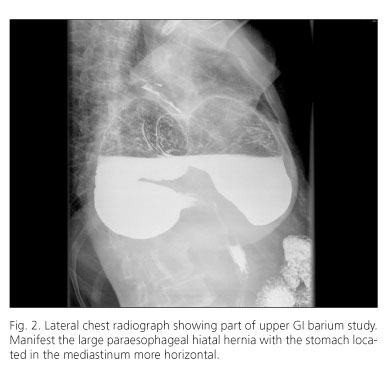
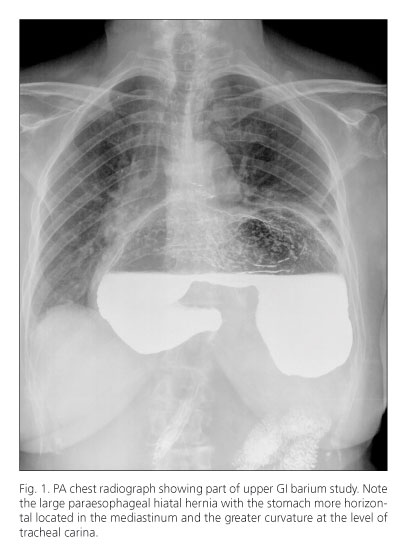
<body><![CDATA[<p><font face="Verdana" size="2">A 67 year-old-woman was admitted to the Gastroenterology Department to study microcytic anemia, and heartburn. She had a hemoglobin of 6.4 g/dL, MCV 61 m<sup>3</sup> and profile of iron deficiency. We performed a gastroscopy, which revealed a large hiatal hernia with a mixed component and a tarnished mucosa in the fundus, antrum and body. The barium radiological study demonstrated a horizontalization of the stomach in the mediastinum, with the gastric body and greater curvature at the level of tracheal carina and the gastroesophageal junction at the level of gastric fundus (lower gastric body). In addition, it presented a marked delay in the elimination of contrast through the pylorus. We did not identify the left hemidiaphragm. Then it was decided to request a chest computed tomography, which confirmed the findings. It was proposed surgical repair of large mixed hernia with possible risk of volvulus, but the patient refused surgery. He is currently asymptomatic.</font></p>     <p>&nbsp;</p>     <p><font face="Verdana" size="2"><b>Discussion</b></font></p>     <p><font face="Verdana" size="2">The repair of sliding hiatal hernias is indicated only in case of large hernias that cause symptoms of GERD refractory to medical treatment. By contrast, hiatal hernia types II, III and IV should be repaired early, even in the absence of symptoms, because of the risk of potentially serious complications such as volvulus of the stomach (1-3). In our case, the patient repeatedly refused surgical treatment and remains asymptomatic.</font></p>     <p>&nbsp;</p>     <p><font face="Verdana" size="2"><b>References</b></font></p>     <!-- ref --><p><font face="Verdana" size="2">1. Pag&aacute;n Pomar A, Palma Zamora E, Ochogavia Segui A, Llabres Rosello M. Laparoscopic surgery into mixed hiatal hernia. Results pre-operative and post-operative. Rev Esp Enferm Dig 2009;101:623-30.    &nbsp;&nbsp;&nbsp;&nbsp;&nbsp;&nbsp;&nbsp;&nbsp;[&#160;<a href="javascript:void(0);" onclick="javascript: window.open('/scielo.php?script=sci_nlinks&ref=5314663&pid=S1130-0108201100050000800001&lng=','','width=640,height=500,resizable=yes,scrollbars=1,menubar=yes,');">Links</a>&#160;]<!-- end-ref --></font></p>    <!-- ref --><p><font face="Verdana" size="2">2. Al-Balas H, Bani Hani M, Omari HZ. Radiological features of acute gastric volvulus in adult patients. Clinical Imaging 2010;34:344-7.    &nbsp;&nbsp;&nbsp;&nbsp;&nbsp;&nbsp;&nbsp;&nbsp;[&#160;<a href="javascript:void(0);" onclick="javascript: window.open('/scielo.php?script=sci_nlinks&ref=5314665&pid=S1130-0108201100050000800002&lng=','','width=640,height=500,resizable=yes,scrollbars=1,menubar=yes,');">Links</a>&#160;]<!-- end-ref --></font></p>    ]]></body>
<body><![CDATA[<!-- ref --><p><font face="Verdana" size="2">3. Shivanand G, Seema S, Srivastava DN, Pande GK, Sahni P, Prasad R, et al. Gastric volvulus: Acute and chronic presentation. Clinical Imaging 2003;27:265-8.    &nbsp;&nbsp;&nbsp;&nbsp;&nbsp;&nbsp;&nbsp;&nbsp;[&#160;<a href="javascript:void(0);" onclick="javascript: window.open('/scielo.php?script=sci_nlinks&ref=5314667&pid=S1130-0108201100050000800003&lng=','','width=640,height=500,resizable=yes,scrollbars=1,menubar=yes,');">Links</a>&#160;]<!-- end-ref --></font></p>      ]]></body><back>
<ref-list>
<ref id="B1">
<label>1</label><nlm-citation citation-type="journal">
<person-group person-group-type="author">
<name>
<surname><![CDATA[Pagán Pomar]]></surname>
<given-names><![CDATA[A]]></given-names>
</name>
<name>
<surname><![CDATA[Palma Zamora]]></surname>
<given-names><![CDATA[E]]></given-names>
</name>
<name>
<surname><![CDATA[Ochogavia Segui]]></surname>
<given-names><![CDATA[A]]></given-names>
</name>
<name>
<surname><![CDATA[Llabres Rosello]]></surname>
<given-names><![CDATA[M]]></given-names>
</name>
</person-group>
<article-title xml:lang="en"><![CDATA[Laparoscopic surgery into mixed hiatal hernia: Results pre-operative and post-operative]]></article-title>
<source><![CDATA[Rev Esp Enferm Dig]]></source>
<year>2009</year>
<volume>101</volume>
<page-range>623-30</page-range></nlm-citation>
</ref>
<ref id="B2">
<label>2</label><nlm-citation citation-type="journal">
<person-group person-group-type="author">
<name>
<surname><![CDATA[Al-Balas]]></surname>
<given-names><![CDATA[H]]></given-names>
</name>
<name>
<surname><![CDATA[Bani Hani]]></surname>
<given-names><![CDATA[M]]></given-names>
</name>
<name>
<surname><![CDATA[Omari]]></surname>
<given-names><![CDATA[HZ]]></given-names>
</name>
</person-group>
<article-title xml:lang="en"><![CDATA[Radiological features of acute gastric volvulus in adult patients]]></article-title>
<source><![CDATA[Clinical Imaging]]></source>
<year>2010</year>
<volume>34</volume>
<page-range>344-7</page-range></nlm-citation>
</ref>
<ref id="B3">
<label>3</label><nlm-citation citation-type="journal">
<person-group person-group-type="author">
<name>
<surname><![CDATA[Shivanand]]></surname>
<given-names><![CDATA[G]]></given-names>
</name>
<name>
<surname><![CDATA[Seema]]></surname>
<given-names><![CDATA[S]]></given-names>
</name>
<name>
<surname><![CDATA[Srivastava]]></surname>
<given-names><![CDATA[DN]]></given-names>
</name>
<name>
<surname><![CDATA[Pande]]></surname>
<given-names><![CDATA[GK]]></given-names>
</name>
<name>
<surname><![CDATA[Sahni]]></surname>
<given-names><![CDATA[P]]></given-names>
</name>
<name>
<surname><![CDATA[Prasad]]></surname>
<given-names><![CDATA[R]]></given-names>
</name>
</person-group>
<article-title xml:lang="en"><![CDATA[Gastric volvulus: Acute and chronic presentation]]></article-title>
<source><![CDATA[Clinical Imaging]]></source>
<year>2003</year>
<volume>27</volume>
<page-range>265-8</page-range></nlm-citation>
</ref>
</ref-list>
</back>
</article>