<?xml version="1.0" encoding="ISO-8859-1"?><article xmlns:mml="http://www.w3.org/1998/Math/MathML" xmlns:xlink="http://www.w3.org/1999/xlink" xmlns:xsi="http://www.w3.org/2001/XMLSchema-instance">
<front>
<journal-meta>
<journal-id>1130-0108</journal-id>
<journal-title><![CDATA[Revista Española de Enfermedades Digestivas]]></journal-title>
<abbrev-journal-title><![CDATA[Rev. esp. enferm. dig.]]></abbrev-journal-title>
<issn>1130-0108</issn>
<publisher>
<publisher-name><![CDATA[Sociedad Española de Patología Digestiva]]></publisher-name>
</publisher>
</journal-meta>
<article-meta>
<article-id>S1130-01082012000100004</article-id>
<article-id pub-id-type="doi">10.4321/S1130-01082012000100004</article-id>
<title-group>
<article-title xml:lang="en"><![CDATA[Effect upon hospital activity of the application of a continued care model centered on patients with inflammatory bowel disease]]></article-title>
<article-title xml:lang="es"><![CDATA[Efecto de la aplicación de un modelo de asistencia continuada centrada en el paciente con enfermedad inflamatoria intestinal en la actividad hospitalaria]]></article-title>
</title-group>
<contrib-group>
<contrib contrib-type="author">
<name>
<surname><![CDATA[Casellas-Jordá]]></surname>
<given-names><![CDATA[Francesc]]></given-names>
</name>
<xref ref-type="aff" rid="A01"/>
<xref ref-type="aff" rid="A02"/>
</contrib>
<contrib contrib-type="author">
<name>
<surname><![CDATA[Borruel-Sainz]]></surname>
<given-names><![CDATA[Natalia]]></given-names>
</name>
<xref ref-type="aff" rid="A01"/>
<xref ref-type="aff" rid="A02"/>
</contrib>
<contrib contrib-type="author">
<name>
<surname><![CDATA[Torrejón-Herrera]]></surname>
<given-names><![CDATA[Antonio]]></given-names>
</name>
<xref ref-type="aff" rid="A01"/>
<xref ref-type="aff" rid="A02"/>
</contrib>
<contrib contrib-type="author">
<name>
<surname><![CDATA[Castells]]></surname>
<given-names><![CDATA[Isabel]]></given-names>
</name>
<xref ref-type="aff" rid="A01"/>
<xref ref-type="aff" rid="A02"/>
</contrib>
</contrib-group>
<aff id="A01">
<institution><![CDATA[,Hospital Universitari Vall d'Hebron Unitat d'Atenció Crohn-Colitis ]]></institution>
<addr-line><![CDATA[ ]]></addr-line>
</aff>
<aff id="A02">
<institution><![CDATA[,Centro de Investigación Biomédica en Red de Enfermedades Hepáticas y Digestivas (CIBERehd)  ]]></institution>
<addr-line><![CDATA[Barcelona ]]></addr-line>
<country>Spain</country>
</aff>
<pub-date pub-type="pub">
<day>00</day>
<month>01</month>
<year>2012</year>
</pub-date>
<pub-date pub-type="epub">
<day>00</day>
<month>01</month>
<year>2012</year>
</pub-date>
<volume>104</volume>
<numero>1</numero>
<fpage>16</fpage>
<lpage>20</lpage>
<copyright-statement/>
<copyright-year/>
<self-uri xlink:href="http://scielo.isciii.es/scielo.php?script=sci_arttext&amp;pid=S1130-01082012000100004&amp;lng=en&amp;nrm=iso"></self-uri><self-uri xlink:href="http://scielo.isciii.es/scielo.php?script=sci_abstract&amp;pid=S1130-01082012000100004&amp;lng=en&amp;nrm=iso"></self-uri><self-uri xlink:href="http://scielo.isciii.es/scielo.php?script=sci_pdf&amp;pid=S1130-01082012000100004&amp;lng=en&amp;nrm=iso"></self-uri><abstract abstract-type="short" xml:lang="en"><p><![CDATA[Background: since 1999, the Crohn-Colitis Care Unit (UACC) has been dedicated to the integral management of patients with Crohn's disease (CD) and ulcerative colitis (UC). The working methodology of the UACC is based on personalized, continued, non-physical presence, open access and patient-centered care. From its creation, the UACC has experienced an increase in the number of its users and outpatient services. However, the impact of the activity of the UACC upon patient hospitalization is not known. Objectives: to determine the hospital activity related to CD and UC, and correlate it to the activity of the UACC. Methods: a retrospective evaluation was made of the physical presence and non-presence activities of the UACC from January 1999 to December 2008, and of the hospital admissions and mean durations of stay due to CD and UC during that same time period. Results: the number of attended patients and of presence and non-presence activities of the UACC has gradually increased. This increase contrasts with the number of annual hospital admissions, which has remained stable during the study period, with 200-300 admissions/year. Consequently, the hospitalized patients / UACC registered patients ratio has decreased from 0.36 at the start of the study period to 0.14 at the end. The median hospital stay has also decreased, from 11 days at the start of the study period to 8 days at the end. Conclusions: the UACC allows effective management of IBD patient care, since it is able to attend the needs of more patients without increasing the number of admissions, and shortening the duration of hospital stay.]]></p></abstract>
<abstract abstract-type="short" xml:lang="es"><p><![CDATA[Introducción: desde 1999 está en funcionamiento la Unidad de Atención Crohn-Colitis (UACC) para la atención integral a los pacientes con enfermedad de Crohn (EC) y colitis ulcerosa (CU). La UACC sigue un método de trabajo basado en la atención personalizada, continuada, no presencial, de acceso abierto y centrada en el paciente. Desde su implantación, la UACC se ha relacionado con un aumento en el número de usuarios y de actividades. Se desconoce, sin embargo, la repercusión que tiene el funcionamiento UACC sobre la hospitalización de los pacientes. Objetivos: determinar la actividad hospitalaria relacionada con la EC y la CU y su relación con la actividad desarrollada en la UACC. Métodos: revisión de la actividad desarrollada en la UACC desde enero de 1999 a diciembre de 2008, y de los ingresos hospitalarios y estancias medias hospitalarias por EC y CU en el mismo período. Resultados: el número de usuarios y de actividades prestadas en la UACC, ha aumentado de forma progresiva. Dicho incremento contrasta con el número anual de ingresos hospitalarios, que ha permanecido estacionario en 200-300 ingresos/año. En consecuencia, la ratio pacientes hospitalizados/pacientes registrados en la UACC ha disminuido de 0,36 a 0,14. La estancia media hospitalaria también se ha reducido, de 11 días a 8 días al final del periodo de observación. Conclusiones: el modelo UACC permite una gestión más eficaz de atención a los pacientes con EII ya que consigue atender las necesidades de más pacientes, sin aumentar el número de ingresos y acortando las estancias hospitalarias.]]></p></abstract>
<kwd-group>
<kwd lng="en"><![CDATA[Inflammatory bowel disease]]></kwd>
<kwd lng="en"><![CDATA[Continued care]]></kwd>
<kwd lng="en"><![CDATA[IBD unit]]></kwd>
<kwd lng="en"><![CDATA[Ulcerative colitis]]></kwd>
<kwd lng="en"><![CDATA[Crohn's disease]]></kwd>
<kwd lng="en"><![CDATA[Hospital admissions]]></kwd>
<kwd lng="es"><![CDATA[Enfermedad inflamatoria intestinal]]></kwd>
<kwd lng="es"><![CDATA[Atención continuada]]></kwd>
<kwd lng="es"><![CDATA[Unidad de atención integral]]></kwd>
<kwd lng="es"><![CDATA[Colitis ulcerosa]]></kwd>
<kwd lng="es"><![CDATA[Enfermedad de Crohn]]></kwd>
<kwd lng="es"><![CDATA[Ingreso hospitalario]]></kwd>
<kwd lng="es"><![CDATA[Estancias hospitalarias]]></kwd>
</kwd-group>
</article-meta>
</front><body><![CDATA[ <p><a name="top"></a><font face="Verdana" size="2"><b>ORIGINAL PAPERS</b></font></p>     <p>&nbsp;</p>     <p><font face="Verdana" size="4"><b>Effect upon hospital activity of the application of a continued care model centered on patients with inflammatory bowel disease</b></font></p>     <p><font face="Verdana" size="4"><b>Efecto de la aplicaci&oacute;n de un modelo de asistencia continuada centrada en el paciente con enfermedad inflamatoria intestinal en la actividad hospitalaria</b></font></p>     <p>&nbsp;</p>     <p>&nbsp;</p>     <p><font face="Verdana" size="2"><b>Francesc Casellas-Jord&aacute;, Natalia Borruel-Sainz, Antonio Torrej&oacute;n-Herrera and Isabel Castells</b></font></p>     <p><font face="Verdana" size="2">Unitat d'Atenci&oacute; Crohn-Colitis (UACC). Hospital Universitari Vall d'Hebron. CIBERehd. Barcelona, Spain</font></p>     <p><font face="Verdana" size="2">This work was supported in part by grants from the Generalitat de Catalunya (RE: 2001SGR00389) and the Centro de Investigaci&oacute;n Biom&eacute;dica en Red de Enfermedades Hep&aacute;ticas y Digestivas (CIBERehd, Spain). Ciberehd is funded by the Instituto de Salud Carlos III, Spain.</font></p>     <p><font face="Verdana" size="2"><a href="#bajo">Correspondence</a></font></p>     ]]></body>
<body><![CDATA[<p>&nbsp;</p>     <p>&nbsp;</p> <hr size="1">     <p><font face="Verdana" size="2"><b>ABSTRACT</b></font></p>     <p><font face="Verdana" size="2"><b>Background:</b> since 1999, the Crohn-Colitis Care Unit (UACC) has been dedicated to the integral management of patients with Crohn's disease (CD) and ulcerative colitis (UC). The working methodology of the UACC is based on personalized, continued, non-physical presence, open access and patient-centered care. From its creation, the UACC has experienced an increase in the number of its users and outpatient services. However, the impact of the activity of the UACC upon patient hospitalization is not known.    <br><b>Objectives:</b> to determine the hospital activity related to CD and UC, and correlate it to the activity of the UACC.    <br><b>Methods:</b> a retrospective evaluation was made of the physical presence and non-presence activities of the UACC from January 1999 to December 2008, and of the hospital admissions and mean durations of stay due to CD and UC during that same time period.    <br><b>Results:</b> the number of attended patients and of presence and non-presence activities of the UACC has gradually increased. This increase contrasts with the number of annual hospital admissions, which has remained stable during the study period, with 200-300 admissions/year. Consequently, the hospitalized patients / UACC registered patients ratio has decreased from 0.36 at the start of the study period to 0.14 at the end. The median hospital stay has also decreased, from 11 days at the start of the study period to 8 days at the end.    <br><b>Conclusions:</b> the UACC allows effective management of IBD patient care, since it is able to attend the needs of more patients without increasing the number of admissions, and shortening the duration of hospital stay.</font></p>     <p><font face="Verdana" size="2"><b>Key words:</b> Inflammatory bowel disease. Continued care. IBD unit. Ulcerative colitis. Crohn's disease. Hospital admissions.</font></p> <hr size="1">     <p><font face="Verdana" size="2"><b>RESUMEN</b></font></p>     ]]></body>
<body><![CDATA[<p><font face="Verdana" size="2"><b>Introducci&oacute;n:</b> desde 1999 est&aacute; en funcionamiento la Unidad de Atenci&oacute;n Crohn-Colitis (UACC) para la atenci&oacute;n integral a los pacientes con enfermedad de Crohn (EC) y colitis ulcerosa (CU). La UACC sigue un m&eacute;todo de trabajo basado en la atenci&oacute;n personalizada, continuada, no presencial, de acceso abierto y centrada en el paciente. Desde su implantaci&oacute;n, la UACC se ha relacionado con un aumento en el n&uacute;mero de usuarios y de actividades. Se desconoce, sin embargo, la repercusi&oacute;n que tiene el funcionamiento UACC sobre la hospitalizaci&oacute;n de los pacientes.    <br><b>Objetivos:</b> determinar la actividad hospitalaria relacionada con la EC y la CU y su relaci&oacute;n con la actividad desarrollada en la UACC.    <br><b>M&eacute;todos:</b> revisi&oacute;n de la actividad desarrollada en la UACC desde enero de 1999 a diciembre de 2008, y de los ingresos hospitalarios y estancias medias hospitalarias por EC y CU en el mismo per&iacute;odo.    <br><b>Resultados:</b> el n&uacute;mero de usuarios y de actividades prestadas en la UACC, ha aumentado de forma progresiva. Dicho incremento contrasta con el n&uacute;mero anual de ingresos hospitalarios, que ha permanecido estacionario en 200-300 ingresos/a&ntilde;o. En consecuencia, la ratio pacientes hospitalizados/pacientes registrados en la UACC ha disminuido de 0,36 a 0,14. La estancia media hospitalaria tambi&eacute;n se ha reducido, de 11 d&iacute;as a 8 d&iacute;as al final del periodo de observaci&oacute;n.    <br><b>Conclusiones:</b> el modelo UACC permite una gesti&oacute;n m&aacute;s eficaz de atenci&oacute;n a los pacientes con EII ya que consigue atender las necesidades de m&aacute;s pacientes, sin aumentar el n&uacute;mero de ingresos y acortando las estancias hospitalarias.</font></p>     <p><font face="Verdana" size="2"><b>Palabras clave:</b> Enfermedad inflamatoria intestinal. Atenci&oacute;n continuada. Unidad de atenci&oacute;n integral. Colitis ulcerosa. Enfermedad de Crohn. Ingreso hospitalario. Estancias hospitalarias.</font></p> <hr size="1">     <p>&nbsp;</p>     <p><font face="Verdana" size="2"><b>Introduction</b></font></p>     <p><font face="Verdana" size="2">Inflammatory bowel disease (IBD) comprises two chronic inflammatory illnesses: Crohn's disease (CD) and ulcerative colitis (UC). IBD has important medical and social repercussions for several reasons. On one hand, these disorders are increasingly common, and in our setting their annual incidence per 100,000 inhabitants has increased from 1.9 to 8.0 in the case of CD, and from 3.8 to 9.5 in the case of UC (1-3). On the other hand, IBD particularly affects fully productive and reproductive young adults. Such individuals suffer a chronic disease with both digestive and non-digestive symptoms, and recurrent flare-ups which in turn can be accompanied by a range of complications. In addition, patients with IBD must receive continued and complex treatment, with potential serious adverse effects. On the other hand, despite such treatment, resective surgery may prove necessary, with long-term consequences such as those associated with the need for ostomies. All these factors explain why the management of IBD patients is complex, requiring a multidisciplinary approach to management on a continued basis and centered on the needs of each individual patient.</font></p>     <p><font face="Verdana" size="2">The introduction of specialized Units is able to improve the healthcare of patients with IBD, as reflected by improved quality of life, adherence to therapy, patient satisfaction, fewer hospital admissions and a lesser use of corticosteroids (4).</font></p>     ]]></body>
<body><![CDATA[<p><font face="Verdana" size="2">In 1999 the Crohn-Colitis Care Unit (UACC) (Hospital Universitari Vall d'Hebron, Barcelona, Spain) was created as a service for promoting the health of patients with IBD. The UACC is composed of a team of healthcare professionals -physicians and others- with expertise in the field of IBD, who offer integral attention to patient demands. The working methodology of the UACC is based on personalized, continued, multidisciplinary, non-physical presence, open access and patient-centered care. To this effect, the UACC has its own specific facilities, an open telephone line attended by professionals with training in IBD, a specific computer-based registry of activities, and a website (<a target="_blank" href="http://www.ua-cc.org">http://www.ua-cc.org</a>) with a range of interactive services offering users a guided and tutored way to satisfy their information needs. Thus, the UACC model is not a monographic consulting center but rather a resources coordinating unit that attends demands (such as by telephone), programs visits for participation in health education projects, or arranges appointments for medical visits upon demand (5). The introduction of this service aimed to address the deficiencies detected by the patients themselves, such as insufficient information, a lack of attention to the patient environment, and deficient accessibility and fluidness in the use of healthcare resources (6).</font></p>     <p><font face="Verdana" size="2">An analysis of the activity of the UACC in its first years of functioning has revealed a progressive increase in both the physical presence and non-presence activity of the Unit, and in website activity -this running parallel to an increase in the number of patients documented in the computer registry (7). In response to the application of visual analog scales specifically designed to assess user satisfaction with the UACC, the patients expressed a high degree of satisfaction (score 9/10) in reference to areas such as healthcare continuity, convenience, accessibility, courtesy and professional competence (8). The availability of a specialized continued and IBD patient-centered healthcare tool such as the UACC model improves patient care and satisfaction, though it remains to be established whether it is also accompanied by an excessive burden in terms of hospital resource utilization. The present study was therefore designed to examine the evolution of hospital resource utilization, the number of hospital admissions and the duration of hospital stay since the UACC came into operation.</font></p>     <p>&nbsp;</p>     <p><font face="Verdana" size="2"><b>Methods</b></font></p>     <p><font face="Verdana" size="2">A retrospective, comparative observational study was made of the activity of the UACC and of the number of hospital admissions and the duration of hospital stay generated by patients with CD and UC.</font></p>     <p><font face="Verdana" size="2">According to data from 2008, the General Area of the Hospital Universitari Vall d'Hebron has 743 hospitalization beds corresponding to the clinical and surgical specialties, excluding the areas of Traumatology-Rehabilitation and Maternal-Pediatric Care. This number of beds remained stable during the period of the study. The Hospital attends a population of 453,196 inhabitants in Barcelona (51% of all hospital discharges correspond to the reference area), the rest of Catalonia (45% of all hospital discharges), and the rest of Spain (2%).</font></p>     <p><font face="Verdana" size="2"><b>Procedure</b></font></p>     <p><font face="Verdana" size="2">A review was made of the UACC activity registry data and clinical and surgical admissions records of the Hospital Universitari Vall d'Hebron for the period between 1 January 1999 and 31 December 2008, involving admitted patients with diagnosis-related group classification codes corresponding to CD or UC (both principal and secondary diagnoses, and independently of disease location) independently of the Department. In calculating the number of activities in the UACC, we did not include outpatient clinic visits or hospital interconsultations.</font></p>     <p><font face="Verdana" size="2"><b>Statistical analysis</b></font></p>     <p><font face="Verdana" size="2">According to the Kolmogorov-Smirnov test, some values did not conform to normality. Thus, variables were described as absolute numbers or medians. Dunn's test was used for all pair wise comparisons following rank-based ANOVA where necessary.</font></p>     ]]></body>
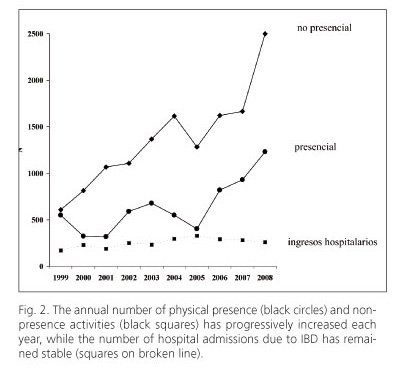
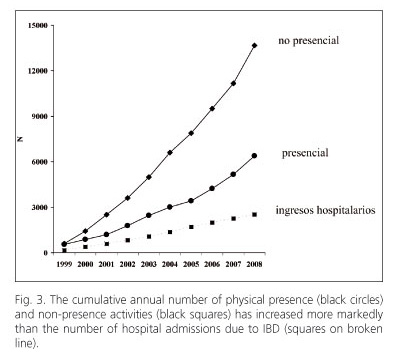
<body><![CDATA[<p>&nbsp;</p>     <p><font face="Verdana" size="2"><b>Results</b></font></p>     <p><font face="Verdana" size="2"><b>Users registered in the UACC</b></font></p>     <p><font face="Verdana" size="2">The number of users registered in the UACC has progressively increased each year, reaching 1,784 at the end of the study period (<a href="#f1">Fig. 1</a>). The Unit has registered 849 patients with CD and 893 with UC (the rest corresponding to indeterminate disease), of which 880 were males and 904 females. Most of the subjects were young and only 380 (21%) were over 50 years of age.</font></p>     <p align="center"><font face="Verdana" size="2"><a name="f1"><img src="/img/revistas/diges/v104n1/original3_fig1.jpg"></a></font></p>     <p>&nbsp;</p>     <p><font face="Verdana" size="2"><b>Healthcare activity in the UACC and hospital admissions</b></font></p>     <p><font face="Verdana" size="2">The physical presence and non-presence activities of the UACC have increased each year during the first 10 years of the UACC. The increase in activity has been particularly notorious in the last four years, as can be seen in  <a href="#f2">figure 2</a>. In contrast, the annual number of hospital admissions has remained stable, with between 170 and 329 admissions a year. As a consequence of the increase in activity of the UACC, the slope of the cumulative interventions curve is greater for UACC activity than for the number of patients admitted to hospital. In addition, the slope of the curve is greater for non-physical presence activity than for physical presence activity of the UACC (<a href="#f3">Fig. 3</a>).</font></p>     <p>&nbsp;</p>     <p align="center"><font face="Verdana" size="2"><a name="f2"><img src="/img/revistas/diges/v104n1/original3_fig2.jpg"></a></font></p>     ]]></body>
<body><![CDATA[<p align="center"><font face="Verdana" size="2"><a name="f3"><img src="/img/revistas/diges/v104n1/original3_fig3.jpg"></a></font></p>     <p align="center">&nbsp;</p>     <p><font face="Verdana" size="2">The progressive increase in the activity of the UACC has not been accompanied by an increase in hospital activity. This is confirmed by the progressive and marked decrease in the ratio between the annual hospital admissions and the patients registered in the UACC (<a href="#f4">Fig. 4</a>).</font></p>     <p align="center"><font face="Verdana" size="2"><a name="f4"><img src="/img/revistas/diges/v104n1/original3_fig4.jpg"></a></font></p>     <p>&nbsp;</p>     <p><font face="Verdana" size="2">Another aspect that has been examined in relation to the effect of the UACC upon hospital activity is the duration of hospital stay.  <a href="#f5">Figure 5</a> shows that the duration of hospital stay (in days) decreased from a median of 11 days at the start of the study period to 8 days at the end of follow-up. The change between the first year of operation of the UACC and the end of the study period proved statistically significant (Dunn's test, p &lt; 0.05).</font></p>     <p align="center"><font face="Verdana" size="2"><a name="f5"><img src="/img/revistas/diges/v104n1/original3_fig5.jpg"></a></font></p>     <p>&nbsp;</p>     <p><font face="Verdana" size="2"><b>Discussion</b></font></p>     <p><font face="Verdana" size="2">Inflammatory bowel disease (IBD) is increasingly common in industrialized western countries (9). This fact, and the clinical repercussions and therapeutic complexity of the disease, generate important personal and social costs. One of the main factors contributing to the cost and healthcare resources consumption associated with IBD refers to hospital admissions (10). An added consideration is the fact that despite the improvements in the medical treatment of IBD, the hospital admission rate per inhabitant attributable to the disease continues to increase (11-14). For this reason we considered it to be very interesting to evaluate the influence upon hospital admission of the UACC model based on patient-centered, continued, multidisciplinary, non-physical presence, open access care involving specialized telephone-based attention.</font></p>     ]]></body>
<body><![CDATA[<p><font face="Verdana" size="2">In order to improve the care of patients with IBD, and in concordance with the current biopsychosocial approach to the management of chronic diseases, Units or Departments have been designed to offer care specifically centered on the patient. The incorporation of training programs with personalized patient self-management plans and telephone follow-up and appointments upon demand does not significantly modify the course of the disease or patient quality of life, but the affected patients nevertheless find this approach more convenient and prefer it to the conventional system involving programmed follow-up (15). Over a period of one year, follow-up centered on the patient with open telephone access has shown that the patients feel more sure of themselves in being able to cope with the disease, and visit the hospital less often (16). Studies have been made to determine whether such patient-centered care increases the associated costs, based on cost-effectiveness analyses and estimations of the quality-adjusted life years gained (QALYs). One such study (17) has shown that during the first year of operation of the self-management program, a saving of 148 &pound; is obtained per patient, with a probability of around 63% that the whole system approach to self-management is cost-effective, assuming a willingness to pay up to 30,000 &pound; for an additional QALY. However, little information is available on the results of this type of healthcare model over a longer term.</font></p>     <p><font face="Verdana" size="2">A retrospective analysis has been made of the progression of the number of admissions from the start of activity of the UACC, contemplating all admissions -both clinical and surgical. The results of the present study show that from the creation of the UACC the number of patients attended has increased, but hospital admissions has remained stable, with no progressive increments such as those reported by studies conducted in the United States and Canada. This finding contrasts with the observed increase in the number of patients registered and the healthcare activity -both physical presence care in the UACC and patient attention by telephone. As a result, the ratio between the number of hospital admissions and the patients registered in the UACC has decreased markedly and progressively. The present study does not allow us to conclude that the absence of an increase in the number of admissions is a direct consequence of the activity of the UACC, since it has not been possible to establish the influence of other factors such as changes in the criteria for hospital admission or the effect of recently introduced drugs (18). However, we consider that more effective patient management in the Emergency Department from the UACC, and the fact that the latter guarantees close and specialized follow-up, allowing even the use of second-line drug treatments, make it unnecessary to decide hospital admissions which otherwise would have been unavoidable.</font></p>     <p><font face="Verdana" size="2">Similar results have been obtained in relation to the duration of hospital admission. In the first 7 years we observed a gradual shortening of hospital stay, followed by stabilization in the last three years. In this context, the shortening of hospital stay has been statistically significant. The influence of the UACC in relation to the shortening of hospital stay may be related to the fact that patient discharge can be decided earlier, since follow-up on an outpatient basis is more fluid. Due to the retrospective nature of the study, we here again cannot exclude the influence of other factors such as for example improved management of hospital resources, treatment innovations, etc. Thus, the effect of factors such as the update of diagnostic and therapeutic protocols, new biologic treatments, the reduction in the delay of explorations has not been evaluated. The functioning of the UACC coincides with the introduction of the biologic antiTNF agents being difficult to individualize the effect of the UACC from the effect of antiTNF treatment because this treatment is given and controlled in the UACC.</font></p>     <p><font face="Verdana" size="2">In conclusion, implantation in the Hospital of the UACC model allows effective management of IBD patient care, since it has been possible to attend the needs of more patients without increasing the number of admissions, and shortening the duration of hospital stay.</font></p>     <p>&nbsp;</p>     <p><font face="Verdana" size="2"><b>References</b></font></p>     <!-- ref --><p><font face="Verdana" size="2">1. Pajares JM, Gisbert JP. Epidemiology of inflammatory bowel disease in Spain. A systematic review. Rev Esp Enferm Dig 2001;93:9-20.    &nbsp;&nbsp;&nbsp;&nbsp;&nbsp;&nbsp;&nbsp;&nbsp;[&#160;<a href="javascript:void(0);" onclick="javascript: window.open('/scielo.php?script=sci_nlinks&ref=5329456&pid=S1130-0108201200010000400001&lng=','','width=640,height=500,resizable=yes,scrollbars=1,menubar=yes,');">Links</a>&#160;]<!-- end-ref --></font></p>    <!-- ref --><p><font face="Verdana" size="2">2. L&oacute;pez-Serrano P, P&eacute;rez-Calle JL, Carrera-Alonso E, P&eacute;rez-Fern&aacute;ndez T, Rodr&iacute;guez-Caravaca G, Boixeda-de-Miguel D, et al. Epidemiologic study on the current incidence of inflammatory bowel disease in Madrid. Rev Esp Enferm Dig 2009;101:768-72.    &nbsp;&nbsp;&nbsp;&nbsp;&nbsp;&nbsp;&nbsp;&nbsp;[&#160;<a href="javascript:void(0);" onclick="javascript: window.open('/scielo.php?script=sci_nlinks&ref=5329458&pid=S1130-0108201200010000400002&lng=','','width=640,height=500,resizable=yes,scrollbars=1,menubar=yes,');">Links</a>&#160;]<!-- end-ref --></font></p>    ]]></body>
<body><![CDATA[<!-- ref --><p><font face="Verdana" size="2">3. Arin Letamendia A, Borda Celaya F, Burusco Paternain MJ, Prieto Mart&iacute;nez C, Mart&iacute;nez Echeverr&iacute;a A, Elizalde Apestegui I, et al. High incidence rates of inflammatory bowel disease in Navarra (Spain). Results of a prospective, population-based study. Gastroenterol Hepatol 2008;31:111-6.    &nbsp;&nbsp;&nbsp;&nbsp;&nbsp;&nbsp;&nbsp;&nbsp;[&#160;<a href="javascript:void(0);" onclick="javascript: window.open('/scielo.php?script=sci_nlinks&ref=5329460&pid=S1130-0108201200010000400003&lng=','','width=640,height=500,resizable=yes,scrollbars=1,menubar=yes,');">Links</a>&#160;]<!-- end-ref --></font></p>    <!-- ref --><p><font face="Verdana" size="2">4. Phan VA, van Langenberg DR, Grafton R, et al. Introduction of a dedicated IBD service quantitatively and qualitatively improves outcomes in less than 18 months: a prospective cohort study in a large metropolitan centre. Gastroenterology 2010;138(Supl. 1): S318.    &nbsp;&nbsp;&nbsp;&nbsp;&nbsp;&nbsp;&nbsp;&nbsp;[&#160;<a href="javascript:void(0);" onclick="javascript: window.open('/scielo.php?script=sci_nlinks&ref=5329462&pid=S1130-0108201200010000400004&lng=','','width=640,height=500,resizable=yes,scrollbars=1,menubar=yes,');">Links</a>&#160;]<!-- end-ref --></font></p>    <!-- ref --><p><font face="Verdana" size="2">5. Fontanet G, Casellas F, Malagelada JR. The Crohn-Colitis care unit: analysis of the first 3 years of activity. Gac Sanit 2004;18:483-5.    &nbsp;&nbsp;&nbsp;&nbsp;&nbsp;&nbsp;&nbsp;&nbsp;[&#160;<a href="javascript:void(0);" onclick="javascript: window.open('/scielo.php?script=sci_nlinks&ref=5329464&pid=S1130-0108201200010000400005&lng=','','width=640,height=500,resizable=yes,scrollbars=1,menubar=yes,');">Links</a>&#160;]<!-- end-ref --></font></p>    <!-- ref --><p><font face="Verdana" size="2">6. Casellas F, Fontanet G, Borruel N, Malagelada JR. The opinion of patients with inflammatory bowel disease on healthcare received. Rev Esp Enferm Dig 2004;96:174-84.    &nbsp;&nbsp;&nbsp;&nbsp;&nbsp;&nbsp;&nbsp;&nbsp;[&#160;<a href="javascript:void(0);" onclick="javascript: window.open('/scielo.php?script=sci_nlinks&ref=5329466&pid=S1130-0108201200010000400006&lng=','','width=640,height=500,resizable=yes,scrollbars=1,menubar=yes,');">Links</a>&#160;]<!-- end-ref --></font></p>    <!-- ref --><p><font face="Verdana" size="2">7. Torrej&oacute;n A, Masachs M, Borruel N, Castells I, Castillejo N, Malagelada JR, et al. Aplicaci&oacute;n de un modelo de asistencia continuada en la enfermedad inflamatoria intestinal: la Unidad de Atenci&oacute;n Crohn-Colitis. Gastroenterol Hepatol 2009;32:77-82.    &nbsp;&nbsp;&nbsp;&nbsp;&nbsp;&nbsp;&nbsp;&nbsp;[&#160;<a href="javascript:void(0);" onclick="javascript: window.open('/scielo.php?script=sci_nlinks&ref=5329468&pid=S1130-0108201200010000400007&lng=','','width=640,height=500,resizable=yes,scrollbars=1,menubar=yes,');">Links</a>&#160;]<!-- end-ref --></font></p>    ]]></body>
<body><![CDATA[<!-- ref --><p><font face="Verdana" size="2">8. Masachs M, Casellas F, Borruel N, Torrej&oacute;n A. Castells I, Malagelada JR. Validation of the Spanish version of a questionnaire to measure quality of care through the eyes of patients with inflammatory bowel disease (QUOTE-IBD). Inflamm Bowel Dis 2010;16:982-92.    &nbsp;&nbsp;&nbsp;&nbsp;&nbsp;&nbsp;&nbsp;&nbsp;[&#160;<a href="javascript:void(0);" onclick="javascript: window.open('/scielo.php?script=sci_nlinks&ref=5329470&pid=S1130-0108201200010000400008&lng=','','width=640,height=500,resizable=yes,scrollbars=1,menubar=yes,');">Links</a>&#160;]<!-- end-ref --></font></p>    <!-- ref --><p><font face="Verdana" size="2">9. Weiss ST. The hygiene hypothesis and allergic diseases. New Engl J Med 2002;347:930-1.    &nbsp;&nbsp;&nbsp;&nbsp;&nbsp;&nbsp;&nbsp;&nbsp;[&#160;<a href="javascript:void(0);" onclick="javascript: window.open('/scielo.php?script=sci_nlinks&ref=5329472&pid=S1130-0108201200010000400009&lng=','','width=640,height=500,resizable=yes,scrollbars=1,menubar=yes,');">Links</a>&#160;]<!-- end-ref --></font></p>    <!-- ref --><p><font face="Verdana" size="2">10. Casellas F, Pan&eacute;s J, Garc&iacute;a-S&aacute;nchez V, Ginard D, Gomoll&oacute;n F, Hinojosa J, et al. A. Costes m&eacute;dicos directos de la enfermedad de Crohn en Espa&ntilde;a. Pharmacoeconomics-Spanish Research Articles 2010;7:38-46.    &nbsp;&nbsp;&nbsp;&nbsp;&nbsp;&nbsp;&nbsp;&nbsp;[&#160;<a href="javascript:void(0);" onclick="javascript: window.open('/scielo.php?script=sci_nlinks&ref=5329474&pid=S1130-0108201200010000400010&lng=','','width=640,height=500,resizable=yes,scrollbars=1,menubar=yes,');">Links</a>&#160;]<!-- end-ref --></font></p>    <!-- ref --><p><font face="Verdana" size="2">11. Bewtra M, Su C, Lewis JD. Trends in hospitalization rates for inflammatory bowel disease in the United States. Clin Gastroenterol Hepatol 2007;5:597-601.    &nbsp;&nbsp;&nbsp;&nbsp;&nbsp;&nbsp;&nbsp;&nbsp;[&#160;<a href="javascript:void(0);" onclick="javascript: window.open('/scielo.php?script=sci_nlinks&ref=5329476&pid=S1130-0108201200010000400011&lng=','','width=640,height=500,resizable=yes,scrollbars=1,menubar=yes,');">Links</a>&#160;]<!-- end-ref --></font></p>    <!-- ref --><p><font face="Verdana" size="2">12. Nguyen GC, Sam J, Murthy SK, Kaplan GG, Tinmouth JM, LaVeist TA Hospitalizations for inflammatory bowel disease: profile of the uninsured in the United States. Inflamm Bowel Dis 2009;15:726-33.    &nbsp;&nbsp;&nbsp;&nbsp;&nbsp;&nbsp;&nbsp;&nbsp;[&#160;<a href="javascript:void(0);" onclick="javascript: window.open('/scielo.php?script=sci_nlinks&ref=5329478&pid=S1130-0108201200010000400012&lng=','','width=640,height=500,resizable=yes,scrollbars=1,menubar=yes,');">Links</a>&#160;]<!-- end-ref --></font></p>    ]]></body>
<body><![CDATA[<!-- ref --><p><font face="Verdana" size="2">13. Nguyen GC, Steinhart AH. Nationwide patterns of hospitalizations to centers with high volume of admissions for inflammatory bowel disease and their impact on mortality. Inflamm Bowel Dis 2008;14:1688-94.    &nbsp;&nbsp;&nbsp;&nbsp;&nbsp;&nbsp;&nbsp;&nbsp;[&#160;<a href="javascript:void(0);" onclick="javascript: window.open('/scielo.php?script=sci_nlinks&ref=5329480&pid=S1130-0108201200010000400013&lng=','','width=640,height=500,resizable=yes,scrollbars=1,menubar=yes,');">Links</a>&#160;]<!-- end-ref --></font></p>    <!-- ref --><p><font face="Verdana" size="2">14. Wang YR, Cangemi JR, Picco MF. Changing Trends of Hospitalizations for Inflammatory Bowel Disease in the United States, 1993-2007. Gastroenterology 2010;138(Supl. 1):S531-S532.    &nbsp;&nbsp;&nbsp;&nbsp;&nbsp;&nbsp;&nbsp;&nbsp;[&#160;<a href="javascript:void(0);" onclick="javascript: window.open('/scielo.php?script=sci_nlinks&ref=5329482&pid=S1130-0108201200010000400014&lng=','','width=640,height=500,resizable=yes,scrollbars=1,menubar=yes,');">Links</a>&#160;]<!-- end-ref --></font></p>    <!-- ref --><p><font face="Verdana" size="2">15. Robinson A, Thompson DG, Wilkin D, Roberts C, for the Northwest Gastrointestinal Research Group. Guided self-management and patient-directed follow-up of ulcerative colitis: a randomised trial. Lancet 2001;358:976-81.    &nbsp;&nbsp;&nbsp;&nbsp;&nbsp;&nbsp;&nbsp;&nbsp;[&#160;<a href="javascript:void(0);" onclick="javascript: window.open('/scielo.php?script=sci_nlinks&ref=5329484&pid=S1130-0108201200010000400015&lng=','','width=640,height=500,resizable=yes,scrollbars=1,menubar=yes,');">Links</a>&#160;]<!-- end-ref --></font></p>    <!-- ref --><p><font face="Verdana" size="2">16. Kennedy AP, Nelson E, Reeves D, Richardson G, Roberts C, Robinson A, et al. A randomised controlled trial to assess the effectiveness and cost of a patient orientated self management approach to chronic inflammatory bowel disease. Gut 2004;53:1639-45.    &nbsp;&nbsp;&nbsp;&nbsp;&nbsp;&nbsp;&nbsp;&nbsp;[&#160;<a href="javascript:void(0);" onclick="javascript: window.open('/scielo.php?script=sci_nlinks&ref=5329486&pid=S1130-0108201200010000400016&lng=','','width=640,height=500,resizable=yes,scrollbars=1,menubar=yes,');">Links</a>&#160;]<!-- end-ref --></font></p>    <!-- ref --><p><font face="Verdana" size="2">17. Richardson G, Sculpher M, Kennedy A, Nelson E, Reevers D, Roberts C, et al. Is self-care a cost-effective use of resources? Evidence from a randomized trial in inflammatory bowel disease. J Health Serv Res Policy 2006;11:225-30.    &nbsp;&nbsp;&nbsp;&nbsp;&nbsp;&nbsp;&nbsp;&nbsp;[&#160;<a href="javascript:void(0);" onclick="javascript: window.open('/scielo.php?script=sci_nlinks&ref=5329488&pid=S1130-0108201200010000400017&lng=','','width=640,height=500,resizable=yes,scrollbars=1,menubar=yes,');">Links</a>&#160;]<!-- end-ref --></font></p>    ]]></body>
<body><![CDATA[<!-- ref --><p><font face="Verdana" size="2">18. Taxonera C, Rodrigo L, Casellas F, Calvet X, G&oacute;mez-Camacho F, Ginard D, et al. Infliximab maintenance therapy is associated with decreases in direct resource use in patients with luminal or fistulizing Crohn's disease. J Clin Gastroenterol 2009;43:950-6.    &nbsp;&nbsp;&nbsp;&nbsp;&nbsp;&nbsp;&nbsp;&nbsp;[&#160;<a href="javascript:void(0);" onclick="javascript: window.open('/scielo.php?script=sci_nlinks&ref=5329490&pid=S1130-0108201200010000400018&lng=','','width=640,height=500,resizable=yes,scrollbars=1,menubar=yes,');">Links</a>&#160;]<!-- end-ref --></font></p>     <p>&nbsp;</p>     <p>&nbsp;</p>     <p><font face="Verdana" size="2"><a href="#top"><img border="0" src="/img/revistas/diges/v104n1/seta.gif" width="15" height="17"></a><a name="bajo"></a><b>Correspondence:</b>    <br>Francesc Casellas. UACC.    <br>Hospital Universitari Vall d'Hebron.    <br>Pso. Vall d'Hebron, 119.    <br>08035 Barcelona, Spain.    <br>e-mail:  <a href="mailto:fcasellas@vhebron.net">fcasellas@vhebron.net</a></font></p>     ]]></body>
<body><![CDATA[<p><font face="Verdana" size="2">Received: 08-06-11.    <br>Accepted:</b> 01-09-11.</font></p>      ]]></body><back>
<ref-list>
<ref id="B1">
<label>1</label><nlm-citation citation-type="journal">
<person-group person-group-type="author">
<name>
<surname><![CDATA[Pajares]]></surname>
<given-names><![CDATA[JM]]></given-names>
</name>
<name>
<surname><![CDATA[Gisbert]]></surname>
<given-names><![CDATA[JP]]></given-names>
</name>
</person-group>
<article-title xml:lang="en"><![CDATA[Epidemiology of inflammatory bowel disease in Spain: A systematic review]]></article-title>
<source><![CDATA[Rev Esp Enferm Dig]]></source>
<year>2001</year>
<volume>93</volume>
<page-range>9-20</page-range></nlm-citation>
</ref>
<ref id="B2">
<label>2</label><nlm-citation citation-type="journal">
<person-group person-group-type="author">
<name>
<surname><![CDATA[López-Serrano]]></surname>
<given-names><![CDATA[P]]></given-names>
</name>
<name>
<surname><![CDATA[Pérez-Calle]]></surname>
<given-names><![CDATA[JL]]></given-names>
</name>
<name>
<surname><![CDATA[Carrera-Alonso]]></surname>
<given-names><![CDATA[E]]></given-names>
</name>
<name>
<surname><![CDATA[Pérez-Fernández]]></surname>
<given-names><![CDATA[T]]></given-names>
</name>
<name>
<surname><![CDATA[Rodríguez-Caravaca]]></surname>
<given-names><![CDATA[G]]></given-names>
</name>
<name>
<surname><![CDATA[Boixeda-de-Miguel]]></surname>
<given-names><![CDATA[D]]></given-names>
</name>
</person-group>
<article-title xml:lang="en"><![CDATA[Epidemiologic study on the current incidence of inflammatory bowel disease in Madrid]]></article-title>
<source><![CDATA[Rev Esp Enferm Dig]]></source>
<year>2009</year>
<volume>101</volume>
<page-range>768-72</page-range></nlm-citation>
</ref>
<ref id="B3">
<label>3</label><nlm-citation citation-type="journal">
<person-group person-group-type="author">
<name>
<surname><![CDATA[Arin Letamendia]]></surname>
<given-names><![CDATA[A]]></given-names>
</name>
<name>
<surname><![CDATA[Borda Celaya]]></surname>
<given-names><![CDATA[F]]></given-names>
</name>
<name>
<surname><![CDATA[Burusco Paternain]]></surname>
<given-names><![CDATA[MJ]]></given-names>
</name>
<name>
<surname><![CDATA[Prieto Martínez]]></surname>
<given-names><![CDATA[C]]></given-names>
</name>
<name>
<surname><![CDATA[Martínez Echeverría]]></surname>
<given-names><![CDATA[A]]></given-names>
</name>
<name>
<surname><![CDATA[Elizalde Apestegui]]></surname>
<given-names><![CDATA[I]]></given-names>
</name>
</person-group>
<article-title xml:lang="en"><![CDATA[High incidence rates of inflammatory bowel disease in Navarra (Spain): Results of a prospective, population-based study]]></article-title>
<source><![CDATA[Gastroenterol Hepatol]]></source>
<year>2008</year>
<volume>31</volume>
<page-range>111-6</page-range></nlm-citation>
</ref>
<ref id="B4">
<label>4</label><nlm-citation citation-type="journal">
<person-group person-group-type="author">
<name>
<surname><![CDATA[Phan]]></surname>
<given-names><![CDATA[VA]]></given-names>
</name>
<name>
<surname><![CDATA[van Langenberg]]></surname>
<given-names><![CDATA[DR]]></given-names>
</name>
<name>
<surname><![CDATA[Grafton]]></surname>
<given-names><![CDATA[R]]></given-names>
</name>
</person-group>
<article-title xml:lang="en"><![CDATA[Introduction of a dedicated IBD service quantitatively and qualitatively improves outcomes in less than 18 months: a prospective cohort study in a large metropolitan centre]]></article-title>
<source><![CDATA[Gastroenterology]]></source>
<year>2010</year>
<volume>138</volume>
<numero>^s1</numero>
<issue>^s1</issue>
<supplement>1</supplement>
<page-range>S318</page-range></nlm-citation>
</ref>
<ref id="B5">
<label>5</label><nlm-citation citation-type="journal">
<person-group person-group-type="author">
<name>
<surname><![CDATA[Fontanet]]></surname>
<given-names><![CDATA[G]]></given-names>
</name>
<name>
<surname><![CDATA[Casellas]]></surname>
<given-names><![CDATA[F]]></given-names>
</name>
<name>
<surname><![CDATA[Malagelada]]></surname>
<given-names><![CDATA[JR]]></given-names>
</name>
</person-group>
<article-title xml:lang="en"><![CDATA[The Crohn-Colitis care unit: analysis of the first 3 years of activity]]></article-title>
<source><![CDATA[Gac Sanit]]></source>
<year>2004</year>
<volume>18</volume>
<page-range>483-5</page-range></nlm-citation>
</ref>
<ref id="B6">
<label>6</label><nlm-citation citation-type="journal">
<person-group person-group-type="author">
<name>
<surname><![CDATA[Casellas]]></surname>
<given-names><![CDATA[F]]></given-names>
</name>
<name>
<surname><![CDATA[Fontanet]]></surname>
<given-names><![CDATA[G]]></given-names>
</name>
<name>
<surname><![CDATA[Borruel]]></surname>
<given-names><![CDATA[N]]></given-names>
</name>
<name>
<surname><![CDATA[Malagelada]]></surname>
<given-names><![CDATA[JR]]></given-names>
</name>
</person-group>
<article-title xml:lang="en"><![CDATA[The opinion of patients with inflammatory bowel disease on healthcare received]]></article-title>
<source><![CDATA[Rev Esp Enferm Dig]]></source>
<year>2004</year>
<volume>96</volume>
<page-range>174-84</page-range></nlm-citation>
</ref>
<ref id="B7">
<label>7</label><nlm-citation citation-type="journal">
<person-group person-group-type="author">
<name>
<surname><![CDATA[Torrejón]]></surname>
<given-names><![CDATA[A]]></given-names>
</name>
<name>
<surname><![CDATA[Masachs]]></surname>
<given-names><![CDATA[M]]></given-names>
</name>
<name>
<surname><![CDATA[Borruel]]></surname>
<given-names><![CDATA[N]]></given-names>
</name>
<name>
<surname><![CDATA[Castells]]></surname>
<given-names><![CDATA[I]]></given-names>
</name>
<name>
<surname><![CDATA[Castillejo]]></surname>
<given-names><![CDATA[N]]></given-names>
</name>
<name>
<surname><![CDATA[Malagelada]]></surname>
<given-names><![CDATA[JR]]></given-names>
</name>
</person-group>
<article-title xml:lang="es"><![CDATA[Aplicación de un modelo de asistencia continuada en la enfermedad inflamatoria intestinal: la Unidad de Atención Crohn-Colitis]]></article-title>
<source><![CDATA[Gastroenterol Hepatol]]></source>
<year>2009</year>
<volume>32</volume>
<page-range>77-82</page-range></nlm-citation>
</ref>
<ref id="B8">
<label>8</label><nlm-citation citation-type="journal">
<person-group person-group-type="author">
<name>
<surname><![CDATA[Masachs]]></surname>
<given-names><![CDATA[M]]></given-names>
</name>
<name>
<surname><![CDATA[Casellas]]></surname>
<given-names><![CDATA[F]]></given-names>
</name>
<name>
<surname><![CDATA[Borruel]]></surname>
<given-names><![CDATA[N]]></given-names>
</name>
<name>
<surname><![CDATA[Torrejón]]></surname>
<given-names><![CDATA[A]]></given-names>
</name>
<name>
<surname><![CDATA[Castells]]></surname>
<given-names><![CDATA[I]]></given-names>
</name>
<name>
<surname><![CDATA[Malagelada]]></surname>
<given-names><![CDATA[JR]]></given-names>
</name>
</person-group>
<article-title xml:lang="en"><![CDATA[Validation of the Spanish version of a questionnaire to measure quality of care through the eyes of patients with inflammatory bowel disease (QUOTE-IBD)]]></article-title>
<source><![CDATA[Inflamm Bowel Dis]]></source>
<year>2010</year>
<volume>16</volume>
<page-range>982-92</page-range></nlm-citation>
</ref>
<ref id="B9">
<label>9</label><nlm-citation citation-type="journal">
<person-group person-group-type="author">
<name>
<surname><![CDATA[Weiss]]></surname>
<given-names><![CDATA[ST]]></given-names>
</name>
</person-group>
<article-title xml:lang="en"><![CDATA[The hygiene hypothesis and allergic diseases]]></article-title>
<source><![CDATA[New Engl J Med]]></source>
<year>2002</year>
<volume>347</volume>
<page-range>930-1</page-range></nlm-citation>
</ref>
<ref id="B10">
<label>10</label><nlm-citation citation-type="journal">
<person-group person-group-type="author">
<name>
<surname><![CDATA[Casellas]]></surname>
<given-names><![CDATA[F]]></given-names>
</name>
<name>
<surname><![CDATA[Panés]]></surname>
<given-names><![CDATA[J]]></given-names>
</name>
<name>
<surname><![CDATA[García-Sánchez]]></surname>
<given-names><![CDATA[V]]></given-names>
</name>
<name>
<surname><![CDATA[Ginard]]></surname>
<given-names><![CDATA[D]]></given-names>
</name>
<name>
<surname><![CDATA[Gomollón]]></surname>
<given-names><![CDATA[F]]></given-names>
</name>
<name>
<surname><![CDATA[Hinojosa]]></surname>
<given-names><![CDATA[J]]></given-names>
</name>
</person-group>
<article-title xml:lang="es"><![CDATA[Costes médicos directos de la enfermedad de Crohn en España]]></article-title>
<source><![CDATA[Pharmacoeconomics-Spanish Research Articles]]></source>
<year>2010</year>
<volume>7</volume>
<page-range>38-46</page-range></nlm-citation>
</ref>
<ref id="B11">
<label>11</label><nlm-citation citation-type="journal">
<person-group person-group-type="author">
<name>
<surname><![CDATA[Bewtra]]></surname>
<given-names><![CDATA[M]]></given-names>
</name>
<name>
<surname><![CDATA[Su]]></surname>
<given-names><![CDATA[C]]></given-names>
</name>
<name>
<surname><![CDATA[Lewis]]></surname>
<given-names><![CDATA[JD]]></given-names>
</name>
</person-group>
<article-title xml:lang="en"><![CDATA[Trends in hospitalization rates for inflammatory bowel disease in the United States]]></article-title>
<source><![CDATA[Clin Gastroenterol Hepatol]]></source>
<year>2007</year>
<volume>5</volume>
<page-range>597-601</page-range></nlm-citation>
</ref>
<ref id="B12">
<label>12</label><nlm-citation citation-type="journal">
<person-group person-group-type="author">
<name>
<surname><![CDATA[Nguyen]]></surname>
<given-names><![CDATA[GC]]></given-names>
</name>
<name>
<surname><![CDATA[Sam]]></surname>
<given-names><![CDATA[J]]></given-names>
</name>
<name>
<surname><![CDATA[Murthy]]></surname>
<given-names><![CDATA[SK]]></given-names>
</name>
<name>
<surname><![CDATA[Kaplan]]></surname>
<given-names><![CDATA[GG]]></given-names>
</name>
<name>
<surname><![CDATA[Tinmouth]]></surname>
<given-names><![CDATA[JM]]></given-names>
</name>
<name>
<surname><![CDATA[LaVeist]]></surname>
<given-names><![CDATA[TA]]></given-names>
</name>
</person-group>
<article-title xml:lang="en"><![CDATA[Hospitalizations for inflammatory bowel disease: profile of the uninsured in the United States]]></article-title>
<source><![CDATA[Inflamm Bowel Dis]]></source>
<year>2009</year>
<volume>15</volume>
<page-range>726-33</page-range></nlm-citation>
</ref>
<ref id="B13">
<label>13</label><nlm-citation citation-type="journal">
<person-group person-group-type="author">
<name>
<surname><![CDATA[Nguyen]]></surname>
<given-names><![CDATA[GC]]></given-names>
</name>
<name>
<surname><![CDATA[Steinhart]]></surname>
<given-names><![CDATA[AH]]></given-names>
</name>
</person-group>
<article-title xml:lang="en"><![CDATA[Nationwide patterns of hospitalizations to centers with high volume of admissions for inflammatory bowel disease and their impact on mortality]]></article-title>
<source><![CDATA[Inflamm Bowel Dis]]></source>
<year>2008</year>
<volume>14</volume>
<page-range>1688-94</page-range></nlm-citation>
</ref>
<ref id="B14">
<label>14</label><nlm-citation citation-type="journal">
<person-group person-group-type="author">
<name>
<surname><![CDATA[Wang]]></surname>
<given-names><![CDATA[YR]]></given-names>
</name>
<name>
<surname><![CDATA[Cangemi]]></surname>
<given-names><![CDATA[JR]]></given-names>
</name>
<name>
<surname><![CDATA[Picco]]></surname>
<given-names><![CDATA[MF]]></given-names>
</name>
</person-group>
<article-title xml:lang="en"><![CDATA[Changing Trends of Hospitalizations for Inflammatory Bowel Disease in the United States, 1993-2007]]></article-title>
<source><![CDATA[Gastroenterology]]></source>
<year>2010</year>
<volume>138</volume>
<numero>^s1</numero>
<issue>^s1</issue>
<supplement>1</supplement>
<page-range>S531-S532</page-range></nlm-citation>
</ref>
<ref id="B15">
<label>15</label><nlm-citation citation-type="journal">
<person-group person-group-type="author">
<name>
<surname><![CDATA[Robinson]]></surname>
<given-names><![CDATA[A]]></given-names>
</name>
<name>
<surname><![CDATA[Thompson]]></surname>
<given-names><![CDATA[DG]]></given-names>
</name>
<name>
<surname><![CDATA[Wilkin]]></surname>
<given-names><![CDATA[D]]></given-names>
</name>
<name>
<surname><![CDATA[Roberts]]></surname>
<given-names><![CDATA[C]]></given-names>
</name>
</person-group>
<collab>the Northwest Gastrointestinal Research Group</collab>
<article-title xml:lang="en"><![CDATA[Guided self-management and patient-directed follow-up of ulcerative colitis: a randomised trial]]></article-title>
<source><![CDATA[Lancet]]></source>
<year>2001</year>
<volume>358</volume>
<page-range>976-81</page-range></nlm-citation>
</ref>
<ref id="B16">
<label>16</label><nlm-citation citation-type="journal">
<person-group person-group-type="author">
<name>
<surname><![CDATA[Kennedy]]></surname>
<given-names><![CDATA[AP]]></given-names>
</name>
<name>
<surname><![CDATA[Nelson]]></surname>
<given-names><![CDATA[E]]></given-names>
</name>
<name>
<surname><![CDATA[Reeves]]></surname>
<given-names><![CDATA[D]]></given-names>
</name>
<name>
<surname><![CDATA[Richardson]]></surname>
<given-names><![CDATA[G]]></given-names>
</name>
<name>
<surname><![CDATA[Roberts]]></surname>
<given-names><![CDATA[C]]></given-names>
</name>
<name>
<surname><![CDATA[Robinson]]></surname>
<given-names><![CDATA[A]]></given-names>
</name>
</person-group>
<article-title xml:lang="en"><![CDATA[A randomised controlled trial to assess the effectiveness and cost of a patient orientated self management approach to chronic inflammatory bowel disease]]></article-title>
<source><![CDATA[Gut]]></source>
<year>2004</year>
<volume>53</volume>
<page-range>1639-45</page-range></nlm-citation>
</ref>
<ref id="B17">
<label>17</label><nlm-citation citation-type="journal">
<person-group person-group-type="author">
<name>
<surname><![CDATA[Richardson]]></surname>
<given-names><![CDATA[G]]></given-names>
</name>
<name>
<surname><![CDATA[Sculpher]]></surname>
<given-names><![CDATA[M]]></given-names>
</name>
<name>
<surname><![CDATA[Kennedy]]></surname>
<given-names><![CDATA[A]]></given-names>
</name>
<name>
<surname><![CDATA[Nelson]]></surname>
<given-names><![CDATA[E]]></given-names>
</name>
<name>
<surname><![CDATA[Reevers]]></surname>
<given-names><![CDATA[D]]></given-names>
</name>
<name>
<surname><![CDATA[Roberts]]></surname>
<given-names><![CDATA[C]]></given-names>
</name>
</person-group>
<article-title xml:lang="en"><![CDATA[Is self-care a cost-effective use of resources?: Evidence from a randomized trial in inflammatory bowel disease]]></article-title>
<source><![CDATA[J Health Serv Res Policy]]></source>
<year>2006</year>
<volume>11</volume>
<page-range>225-30</page-range></nlm-citation>
</ref>
<ref id="B18">
<label>18</label><nlm-citation citation-type="journal">
<person-group person-group-type="author">
<name>
<surname><![CDATA[Taxonera]]></surname>
<given-names><![CDATA[C]]></given-names>
</name>
<name>
<surname><![CDATA[Rodrigo]]></surname>
<given-names><![CDATA[L]]></given-names>
</name>
<name>
<surname><![CDATA[Casellas]]></surname>
<given-names><![CDATA[F]]></given-names>
</name>
<name>
<surname><![CDATA[Calvet]]></surname>
<given-names><![CDATA[X]]></given-names>
</name>
<name>
<surname><![CDATA[Gómez-Camacho]]></surname>
<given-names><![CDATA[F]]></given-names>
</name>
<name>
<surname><![CDATA[Ginard]]></surname>
<given-names><![CDATA[D]]></given-names>
</name>
</person-group>
<article-title xml:lang="en"><![CDATA[Infliximab maintenance therapy is associated with decreases in direct resource use in patients with luminal or fistulizing Crohn's disease]]></article-title>
<source><![CDATA[J Clin Gastroenterol]]></source>
<year>2009</year>
<volume>43</volume>
<page-range>950-6</page-range></nlm-citation>
</ref>
</ref-list>
</back>
</article>