<?xml version="1.0" encoding="ISO-8859-1"?><article xmlns:mml="http://www.w3.org/1998/Math/MathML" xmlns:xlink="http://www.w3.org/1999/xlink" xmlns:xsi="http://www.w3.org/2001/XMLSchema-instance">
<front>
<journal-meta>
<journal-id>1130-0108</journal-id>
<journal-title><![CDATA[Revista Española de Enfermedades Digestivas]]></journal-title>
<abbrev-journal-title><![CDATA[Rev. esp. enferm. dig.]]></abbrev-journal-title>
<issn>1130-0108</issn>
<publisher>
<publisher-name><![CDATA[Sociedad Española de Patología Digestiva]]></publisher-name>
</publisher>
</journal-meta>
<article-meta>
<article-id>S1130-01082012000700016</article-id>
<article-id pub-id-type="doi">10.4321/S1130-01082012000700016</article-id>
<title-group>
<article-title xml:lang="en"><![CDATA[Acute appendicitis by Enterobius vermicularis, an unusual etiology in children]]></article-title>
<article-title xml:lang="es"><![CDATA[Apendicitis aguda por Enterobius vermicularis, una etiología inusual en niños]]></article-title>
</title-group>
<contrib-group>
<contrib contrib-type="author">
<name>
<surname><![CDATA[Martínez-Criado]]></surname>
<given-names><![CDATA[Yolanda]]></given-names>
</name>
<xref ref-type="aff" rid="A01"/>
</contrib>
<contrib contrib-type="author">
<name>
<surname><![CDATA[Millán-López]]></surname>
<given-names><![CDATA[Ana]]></given-names>
</name>
<xref ref-type="aff" rid="A01"/>
</contrib>
<contrib contrib-type="author">
<name>
<surname><![CDATA[Galán]]></surname>
<given-names><![CDATA[Nicoleta]]></given-names>
</name>
<xref ref-type="aff" rid="A01"/>
</contrib>
<contrib contrib-type="author">
<name>
<surname><![CDATA[de-Agustín-Asensio]]></surname>
<given-names><![CDATA[Juan Carlos]]></given-names>
</name>
<xref ref-type="aff" rid="A01"/>
</contrib>
</contrib-group>
<aff id="A01">
<institution><![CDATA[,Hospital Infantil Virgen del Rocio Department of Pediatric Surgery ]]></institution>
<addr-line><![CDATA[Seville ]]></addr-line>
<country>Spain</country>
</aff>
<pub-date pub-type="pub">
<day>00</day>
<month>07</month>
<year>2012</year>
</pub-date>
<pub-date pub-type="epub">
<day>00</day>
<month>07</month>
<year>2012</year>
</pub-date>
<volume>104</volume>
<numero>7</numero>
<fpage>393</fpage>
<lpage>394</lpage>
<copyright-statement/>
<copyright-year/>
<self-uri xlink:href="http://scielo.isciii.es/scielo.php?script=sci_arttext&amp;pid=S1130-01082012000700016&amp;lng=en&amp;nrm=iso"></self-uri><self-uri xlink:href="http://scielo.isciii.es/scielo.php?script=sci_abstract&amp;pid=S1130-01082012000700016&amp;lng=en&amp;nrm=iso"></self-uri><self-uri xlink:href="http://scielo.isciii.es/scielo.php?script=sci_pdf&amp;pid=S1130-01082012000700016&amp;lng=en&amp;nrm=iso"></self-uri></article-meta>
</front><body><![CDATA[ <p><font face="Verdana" size="2"><b>LETTERS TO THE EDITOR</b></font></p>     <p>&nbsp;</p>     <p><font face="Verdana" size="4"><b>Acute appendicitis by <i>Enterobius vermicularis</i>, an unusual etiology in children</b></font></p>     <p><font face="Verdana" size="4"><b>Apendicitis aguda por <i>Enterobius vermicularis</i>, una etiolog&iacute;a inusual en ni&ntilde;os</b></font></p>     <p>&nbsp;</p>     <p>&nbsp;</p> <hr size="1">     <p><font face="Verdana" size="2"><i>Key words: Enterobius vermicularis. Acute appendicitis. Children.</i></font></p>     <p><font face="Verdana" size="2"><i>Palabras clave: Enterobius vermicularis. Apendicitis aguda. Ni&ntilde;os.</i></font></p> <hr size="1">     <p>&nbsp;</p>     <p><font face="Verdana" size="2"><i>Dear Editor,</i></font></p>     ]]></body>
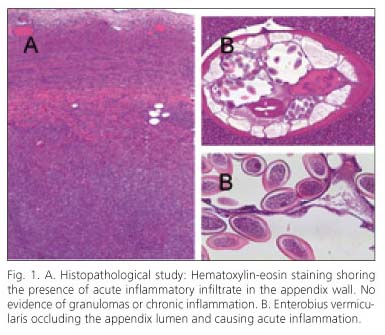
<body><![CDATA[<p><font face="Verdana" size="2">The <i>Enterobius vermicularis</i> (EV) is one of the most common gastrointestinal helminth infections in children. Acute appendicitis (AA) is the most prevalent surgical emergency in pediatrics. The role of worms in the development of histologically confirmed AA is controversial, although the obstruction of the appendicular lumen could act as an exceptional trigger.</font></p>     <p>&nbsp;</p>     <p><font face="Verdana" size="2"><b>Case report</b></font></p>     <p><font face="Verdana" size="2">A 7-year-old boy went to emergency department with severe abdominal pain of 20 hours, located in the right iliac fossa. Fever. Alimentary vomit. Normal bowel movements.</font></p>     <p><font face="Verdana" size="2">On examination, the child had general status affectation. Abdominal palpation aimed to voluntary defense in FID. Blumberg and psoas signs were positive.</font></p>     <p><font face="Verdana" size="2">Laboratory tests showed leukocytosis with neutrophilia and eosinophilia. Ultrasound visualized retrocaecal appendix of 6 mm.</font></p>     <p><font face="Verdana" size="2">Urgent laparotomy appendectomy was performed, appreciating macroscopic inflammation of the appendix, without free liquid. Normal ileum.</font></p>     <p><font face="Verdana" size="2">Histopathological examination confirmed the diagnosis of appendicitis; cells of acute inflammation were invading the wall (<a href="#f1">Fig. 1A</a>) and pinworms occluding the lumen (<a href="#f1">Fig. 1B</a>).</font></p>     <p>&nbsp;</p>     <p align=center><a name="f1"><img src="/img/revistas/diges/v104n7/carta6_fig1.jpg"></a></font></p>     ]]></body>
<body><![CDATA[<p>&nbsp;</p>     <p><font face="Verdana" size="2">Given these findings, we contacted the family to start treatment with mebendazole.</font></p>     <p>&nbsp;</p>     <p><font face="Verdana" size="2"><b>Discussion</b></font></p>     <p><font face="Verdana" size="2">The AA is the most common surgical cause of abdominal pain in children. It may be triggered by obstruction, decreased blood flow, mucosal ischemic injury or bacterial infection. Parasitic infections represent a minimum percentage of causes (2,3). The fecaliths are the most common trigger, but some parasites may be involved in its formation (4).</font></p>     <p><font face="Verdana" size="2">The presence of EV in the context of an AA ranges from 0.2 to 3.8% (5). Helminthic invasion originates appendicular cramps caused by intermittent luminal obstruction, simulating a picture of AA (6). Courses of perianal itching, bruxism and insomnia may also be present. The histopathological study shows infiltration of the appendicular wall by neutrophils and eosinophils, with granulomas and necrosis. In exceptional cases, obstruction of the appendicular lumen by EV causes appendicitis confirmed histologically with acute inflammation (7).</font></p>     <p><font face="Verdana" size="2">The diagnosis of appendicitis is clinical. Laboratory tests, radiography and abdominal ultrasound are additional tests, but not diagnostic. In the context of a clinical appendicitis, the presence of previous appendicular colic and eosinophilia should make us to consider the existence of concomitant parasitic infection. Moreover, In the presence of perianal pruritus, bruxism and insomnia we must suspect the appendicular colonization by EV (8,9).</font></p>     <p><font face="Verdana" size="2">Face with a clinical diagnosis of AA, emergency appendectomy is indicated. Laparoscopic appendectomy is associated with an increased risk of intraperitoneal settlement in the case of gastrointestinal helminthic infection (9). Laparotomy appendectomy is considered a safer technique.</font></p>     <p><font face="Verdana" size="2">The systematic review of the histopathological examination of the appendices has demonstrated the incidental presence of parasites, being EV the most prevalent in children (10). Their discovery allows starting the treatment of the patient and family with mebendazole to eradicate the parasitic infection.</font></p>     <p><font face="Verdana" size="2">In conclusion, the systematic review and histological study of the appendages is essential. The incidental finding of intestinal parasitism by EV permits to start anthelminthic treatment. Performing an exhaustive medical history will help to identify clinical and laboratory data indicative of parasitic infection.</font></p>     ]]></body>
<body><![CDATA[<p>&nbsp;</p>     <p align=right><font face="Verdana" size="2"><b>Yolanda Mart&iacute;nez-Criado, Ana Mill&aacute;n-L&oacute;pez, Nicoleta Gal&aacute;n and Juan Carlos de-Agust&iacute;n-Asensio</b>    <br>Department of Pediatric Surgery. Hospital infantil Virgen del Roc&iacute;o. Seville, Spain</font></p>     <p>&nbsp;</p>     <p><font face="Verdana" size="2"><b>References</b></font></p>     <!-- ref --><p><font face="Verdana" size="2">1. Mowlavi GH, Massoud J, Mobedi I, Rezaian M, Solaymani Mohammadi S. Enterobius vermicularis: a controversial cause of appendicitis. Iran J Publ Health 2004;33:27e-31.    &nbsp;&nbsp;&nbsp;&nbsp;&nbsp;&nbsp;&nbsp;&nbsp;[&#160;<a href="javascript:void(0);" onclick="javascript: window.open('/scielo.php?script=sci_nlinks&ref=5376181&pid=S1130-0108201200070001600001&lng=','','width=640,height=500,resizable=yes,scrollbars=1,menubar=yes,');">Links</a>&#160;]<!-- end-ref --></font></p>    <!-- ref --><p><font face="Verdana" size="2">2. Sidky HA, Maksoud MA, Aziz HA, Saleh A. Acute appendicitis as a complication of helminthic infection among some Egyptian patients. J Egypt Soc Parasitol 1981;11:469-73.    &nbsp;&nbsp;&nbsp;&nbsp;&nbsp;&nbsp;&nbsp;&nbsp;[&#160;<a href="javascript:void(0);" onclick="javascript: window.open('/scielo.php?script=sci_nlinks&ref=5376183&pid=S1130-0108201200070001600002&lng=','','width=640,height=500,resizable=yes,scrollbars=1,menubar=yes,');">Links</a>&#160;]<!-- end-ref --></font></p>    <!-- ref --><p><font face="Verdana" size="2">3. Feng CS. Parasites in faecaliths. J Clin Pathol 1988;41:232-3.    &nbsp;&nbsp;&nbsp;&nbsp;&nbsp;&nbsp;&nbsp;&nbsp;[&#160;<a href="javascript:void(0);" onclick="javascript: window.open('/scielo.php?script=sci_nlinks&ref=5376185&pid=S1130-0108201200070001600003&lng=','','width=640,height=500,resizable=yes,scrollbars=1,menubar=yes,');">Links</a>&#160;]<!-- end-ref --></font></p>    <!-- ref --><p><font face="Verdana" size="2">4. Grimes C, Chin D, Bailey C, Gergely S, Harris AM. Appendiceal faecaliths are associated with right iliac fossa pain. Ann R Coll Surg Engl 2010;92:61e4.    &nbsp;&nbsp;&nbsp;&nbsp;&nbsp;&nbsp;&nbsp;&nbsp;[&#160;<a href="javascript:void(0);" onclick="javascript: window.open('/scielo.php?script=sci_nlinks&ref=5376187&pid=S1130-0108201200070001600004&lng=','','width=640,height=500,resizable=yes,scrollbars=1,menubar=yes,');">Links</a>&#160;]<!-- end-ref --></font></p>    <!-- ref --><p><font face="Verdana" size="2">5. Sah SP, Bhadani PP. Enterobius vermicularis causing symptoms of appendicitis in Nepal. Trop Doct 2006;36:160-2.    &nbsp;&nbsp;&nbsp;&nbsp;&nbsp;&nbsp;&nbsp;&nbsp;[&#160;<a href="javascript:void(0);" onclick="javascript: window.open('/scielo.php?script=sci_nlinks&ref=5376189&pid=S1130-0108201200070001600005&lng=','','width=640,height=500,resizable=yes,scrollbars=1,menubar=yes,');">Links</a>&#160;]<!-- end-ref --></font></p>    <!-- ref --><p><font face="Verdana" size="2">6. Wiebe BM. Appendicitis and Enterobius vermicularis. Scand J Gastroenterol 1991;26:336-8.    &nbsp;&nbsp;&nbsp;&nbsp;&nbsp;&nbsp;&nbsp;&nbsp;[&#160;<a href="javascript:void(0);" onclick="javascript: window.open('/scielo.php?script=sci_nlinks&ref=5376191&pid=S1130-0108201200070001600006&lng=','','width=640,height=500,resizable=yes,scrollbars=1,menubar=yes,');">Links</a>&#160;]<!-- end-ref --></font></p>    <!-- ref --><p><font face="Verdana" size="2">7. Aydin O. Incidental parasitic infestations in surgically removed appendices: a retrospective analysis. Diagnostic Pathology 2007;2:16.    &nbsp;&nbsp;&nbsp;&nbsp;&nbsp;&nbsp;&nbsp;&nbsp;[&#160;<a href="javascript:void(0);" onclick="javascript: window.open('/scielo.php?script=sci_nlinks&ref=5376193&pid=S1130-0108201200070001600007&lng=','','width=640,height=500,resizable=yes,scrollbars=1,menubar=yes,');">Links</a>&#160;]<!-- end-ref --></font></p>    <!-- ref --><p><font face="Verdana" size="2">8. Arca MJ, Gates RL, Groner JI, Hammond S, Caniano DA. Clinical manifestations of appendiceal pinworms in children: an institutional experience and a review of the literature. Pediatr Surg Int 2004;20:372-5.    &nbsp;&nbsp;&nbsp;&nbsp;&nbsp;&nbsp;&nbsp;&nbsp;[&#160;<a href="javascript:void(0);" onclick="javascript: window.open('/scielo.php?script=sci_nlinks&ref=5376195&pid=S1130-0108201200070001600008&lng=','','width=640,height=500,resizable=yes,scrollbars=1,menubar=yes,');">Links</a>&#160;]<!-- end-ref --></font></p>    <!-- ref --><p><font face="Verdana" size="2">9. Saxena AK, Springer A, Tsokas J, Willital GH. Laparoscopic appendectomy in children with Enterobius vermicularis. Surg Laparosc Endosc Percutan Tech 2001;11:284e6.    &nbsp;&nbsp;&nbsp;&nbsp;&nbsp;&nbsp;&nbsp;&nbsp;[&#160;<a href="javascript:void(0);" onclick="javascript: window.open('/scielo.php?script=sci_nlinks&ref=5376197&pid=S1130-0108201200070001600009&lng=','','width=640,height=500,resizable=yes,scrollbars=1,menubar=yes,');">Links</a>&#160;]<!-- end-ref --></font></p>    <!-- ref --><p><font face="Verdana" size="2">10. Nemeth L, Reen DJ, O'Briain DS, McDermott M, Puri P. Evidence of an inflammatory pathologic condition in "normal" appendices following emergency appendectomy. Arch Pathol Lab Med 2001;125:759e64.    &nbsp;&nbsp;&nbsp;&nbsp;&nbsp;&nbsp;&nbsp;&nbsp;[&#160;<a href="javascript:void(0);" onclick="javascript: window.open('/scielo.php?script=sci_nlinks&ref=5376199&pid=S1130-0108201200070001600010&lng=','','width=640,height=500,resizable=yes,scrollbars=1,menubar=yes,');">Links</a>&#160;]<!-- end-ref --></font></p>      ]]></body><back>
<ref-list>
<ref id="B1">
<label>1</label><nlm-citation citation-type="journal">
<person-group person-group-type="author">
<name>
<surname><![CDATA[Mowlavi]]></surname>
<given-names><![CDATA[GH]]></given-names>
</name>
<name>
<surname><![CDATA[Massoud]]></surname>
<given-names><![CDATA[J]]></given-names>
</name>
<name>
<surname><![CDATA[Mobedi]]></surname>
<given-names><![CDATA[I]]></given-names>
</name>
<name>
<surname><![CDATA[Rezaian]]></surname>
<given-names><![CDATA[M]]></given-names>
</name>
<name>
<surname><![CDATA[Solaymani Mohammadi]]></surname>
<given-names><![CDATA[S]]></given-names>
</name>
</person-group>
<article-title xml:lang="en"><![CDATA[Enterobius vermicularis: a controversial cause of appendicitis]]></article-title>
<source><![CDATA[Iran J Publ Health]]></source>
<year>2004</year>
<volume>33</volume>
<page-range>27e-31</page-range></nlm-citation>
</ref>
<ref id="B2">
<label>2</label><nlm-citation citation-type="journal">
<person-group person-group-type="author">
<name>
<surname><![CDATA[Sidky]]></surname>
<given-names><![CDATA[HA]]></given-names>
</name>
<name>
<surname><![CDATA[Maksoud]]></surname>
<given-names><![CDATA[MA]]></given-names>
</name>
<name>
<surname><![CDATA[Aziz]]></surname>
<given-names><![CDATA[HA]]></given-names>
</name>
<name>
<surname><![CDATA[Saleh]]></surname>
<given-names><![CDATA[A]]></given-names>
</name>
</person-group>
<article-title xml:lang="en"><![CDATA[Acute appendicitis as a complication of helminthic infection among some Egyptian patients]]></article-title>
<source><![CDATA[J Egypt Soc Parasitol]]></source>
<year>1981</year>
<volume>11</volume>
<page-range>469-73</page-range></nlm-citation>
</ref>
<ref id="B3">
<label>3</label><nlm-citation citation-type="journal">
<person-group person-group-type="author">
<name>
<surname><![CDATA[Feng]]></surname>
<given-names><![CDATA[CS]]></given-names>
</name>
</person-group>
<article-title xml:lang="en"><![CDATA[Parasites in faecaliths]]></article-title>
<source><![CDATA[J Clin Pathol]]></source>
<year>1988</year>
<volume>41</volume>
<page-range>232-3</page-range></nlm-citation>
</ref>
<ref id="B4">
<label>4</label><nlm-citation citation-type="journal">
<person-group person-group-type="author">
<name>
<surname><![CDATA[Grimes]]></surname>
<given-names><![CDATA[C]]></given-names>
</name>
<name>
<surname><![CDATA[Chin]]></surname>
<given-names><![CDATA[D]]></given-names>
</name>
<name>
<surname><![CDATA[Bailey]]></surname>
<given-names><![CDATA[C]]></given-names>
</name>
<name>
<surname><![CDATA[Gergely]]></surname>
<given-names><![CDATA[S]]></given-names>
</name>
<name>
<surname><![CDATA[Harris]]></surname>
<given-names><![CDATA[AM]]></given-names>
</name>
</person-group>
<article-title xml:lang="en"><![CDATA[Appendiceal faecaliths are associated with right iliac fossa pain]]></article-title>
<source><![CDATA[Ann R Coll Surg Engl]]></source>
<year>2010</year>
<volume>92</volume>
<page-range>61e4</page-range></nlm-citation>
</ref>
<ref id="B5">
<label>5</label><nlm-citation citation-type="journal">
<person-group person-group-type="author">
<name>
<surname><![CDATA[Sah]]></surname>
<given-names><![CDATA[SP]]></given-names>
</name>
<name>
<surname><![CDATA[Bhadani]]></surname>
<given-names><![CDATA[PP]]></given-names>
</name>
</person-group>
<article-title xml:lang="en"><![CDATA[Enterobius vermicularis causing symptoms of appendicitis in Nepal]]></article-title>
<source><![CDATA[Trop Doct]]></source>
<year>2006</year>
<volume>36</volume>
<page-range>160-2</page-range></nlm-citation>
</ref>
<ref id="B6">
<label>6</label><nlm-citation citation-type="journal">
<person-group person-group-type="author">
<name>
<surname><![CDATA[Wiebe]]></surname>
<given-names><![CDATA[BM]]></given-names>
</name>
</person-group>
<article-title xml:lang="en"><![CDATA[Appendicitis and Enterobius vermicularis]]></article-title>
<source><![CDATA[Scand J Gastroenterol]]></source>
<year>1991</year>
<volume>26</volume>
<page-range>336-8</page-range></nlm-citation>
</ref>
<ref id="B7">
<label>7</label><nlm-citation citation-type="journal">
<person-group person-group-type="author">
<name>
<surname><![CDATA[Aydin]]></surname>
<given-names><![CDATA[O]]></given-names>
</name>
</person-group>
<article-title xml:lang="en"><![CDATA[Incidental parasitic infestations in surgically removed appendices: a retrospective analysis]]></article-title>
<source><![CDATA[Diagnostic Pathology]]></source>
<year>2007</year>
<volume>2</volume>
<page-range>16</page-range></nlm-citation>
</ref>
<ref id="B8">
<label>8</label><nlm-citation citation-type="journal">
<person-group person-group-type="author">
<name>
<surname><![CDATA[Arca]]></surname>
<given-names><![CDATA[MJ]]></given-names>
</name>
<name>
<surname><![CDATA[Gates]]></surname>
<given-names><![CDATA[RL]]></given-names>
</name>
<name>
<surname><![CDATA[Groner]]></surname>
<given-names><![CDATA[JI]]></given-names>
</name>
<name>
<surname><![CDATA[Hammond]]></surname>
<given-names><![CDATA[S]]></given-names>
</name>
<name>
<surname><![CDATA[Caniano]]></surname>
<given-names><![CDATA[DA]]></given-names>
</name>
</person-group>
<article-title xml:lang="en"><![CDATA[Clinical manifestations of appendiceal pinworms in children: an institutional experience and a review of the literature]]></article-title>
<source><![CDATA[Pediatr Surg Int]]></source>
<year>2004</year>
<volume>20</volume>
<page-range>372-5</page-range></nlm-citation>
</ref>
<ref id="B9">
<label>9</label><nlm-citation citation-type="journal">
<person-group person-group-type="author">
<name>
<surname><![CDATA[Saxena]]></surname>
<given-names><![CDATA[AK]]></given-names>
</name>
<name>
<surname><![CDATA[Springer]]></surname>
<given-names><![CDATA[A]]></given-names>
</name>
<name>
<surname><![CDATA[Tsokas]]></surname>
<given-names><![CDATA[J]]></given-names>
</name>
<name>
<surname><![CDATA[Willital]]></surname>
<given-names><![CDATA[GH]]></given-names>
</name>
</person-group>
<article-title xml:lang="en"><![CDATA[Laparoscopic appendectomy in children with Enterobius vermicularis]]></article-title>
<source><![CDATA[Surg Laparosc Endosc Percutan Tech]]></source>
<year>2001</year>
<volume>11</volume>
<page-range>284e6</page-range></nlm-citation>
</ref>
<ref id="B10">
<label>10</label><nlm-citation citation-type="journal">
<person-group person-group-type="author">
<name>
<surname><![CDATA[Nemeth]]></surname>
<given-names><![CDATA[L]]></given-names>
</name>
<name>
<surname><![CDATA[Reen]]></surname>
<given-names><![CDATA[DJ]]></given-names>
</name>
<name>
<surname><![CDATA[O'Briain]]></surname>
<given-names><![CDATA[DS]]></given-names>
</name>
<name>
<surname><![CDATA[McDermott]]></surname>
<given-names><![CDATA[M]]></given-names>
</name>
<name>
<surname><![CDATA[Puri]]></surname>
<given-names><![CDATA[P]]></given-names>
</name>
</person-group>
<article-title xml:lang="en"><![CDATA[Evidence of an inflammatory pathologic condition in "normal" appendices following emergency appendectomy]]></article-title>
<source><![CDATA[Arch Pathol Lab Med]]></source>
<year>2001</year>
<volume>125</volume>
<page-range>759e64</page-range></nlm-citation>
</ref>
</ref-list>
</back>
</article>
