<?xml version="1.0" encoding="ISO-8859-1"?><article xmlns:mml="http://www.w3.org/1998/Math/MathML" xmlns:xlink="http://www.w3.org/1999/xlink" xmlns:xsi="http://www.w3.org/2001/XMLSchema-instance">
<front>
<journal-meta>
<journal-id>1130-0108</journal-id>
<journal-title><![CDATA[Revista Española de Enfermedades Digestivas]]></journal-title>
<abbrev-journal-title><![CDATA[Rev. esp. enferm. dig.]]></abbrev-journal-title>
<issn>1130-0108</issn>
<publisher>
<publisher-name><![CDATA[Sociedad Española de Patología Digestiva]]></publisher-name>
</publisher>
</journal-meta>
<article-meta>
<article-id>S1130-01082012000800009</article-id>
<article-id pub-id-type="doi">10.4321/S1130-01082012000800009</article-id>
<title-group>
<article-title xml:lang="en"><![CDATA[Giant duodenal ulcer perforation: a case of innovative repair with an antrum gastric patch]]></article-title>
<article-title xml:lang="es"><![CDATA[Perforación de ulcus gigante duodenal: reparación innovadora mediante una plastia del antro gástrico]]></article-title>
</title-group>
<contrib-group>
<contrib contrib-type="author">
<name>
<surname><![CDATA[Cienfuegos]]></surname>
<given-names><![CDATA[Javier A.]]></given-names>
</name>
<xref ref-type="aff" rid="A01"/>
</contrib>
<contrib contrib-type="author">
<name>
<surname><![CDATA[Rotellar]]></surname>
<given-names><![CDATA[Fernando]]></given-names>
</name>
<xref ref-type="aff" rid="A01"/>
</contrib>
<contrib contrib-type="author">
<name>
<surname><![CDATA[Valentí]]></surname>
<given-names><![CDATA[Víctor]]></given-names>
</name>
<xref ref-type="aff" rid="A01"/>
</contrib>
<contrib contrib-type="author">
<name>
<surname><![CDATA[Arredondo]]></surname>
<given-names><![CDATA[Jorge]]></given-names>
</name>
<xref ref-type="aff" rid="A01"/>
</contrib>
<contrib contrib-type="author">
<name>
<surname><![CDATA[Baixauli]]></surname>
<given-names><![CDATA[Jorge]]></given-names>
</name>
<xref ref-type="aff" rid="A01"/>
</contrib>
<contrib contrib-type="author">
<name>
<surname><![CDATA[Pedano]]></surname>
<given-names><![CDATA[Nicolás]]></given-names>
</name>
<xref ref-type="aff" rid="A01"/>
</contrib>
<contrib contrib-type="author">
<name>
<surname><![CDATA[Bellver]]></surname>
<given-names><![CDATA[Manuel]]></given-names>
</name>
<xref ref-type="aff" rid="A01"/>
</contrib>
<contrib contrib-type="author">
<name>
<surname><![CDATA[Hernández-Lizoain]]></surname>
<given-names><![CDATA[José Luis]]></given-names>
</name>
<xref ref-type="aff" rid="A01"/>
</contrib>
</contrib-group>
<aff id="A01">
<institution><![CDATA[,Clínica Universidad de Navarra Department of General and Digestive Surgery ]]></institution>
<addr-line><![CDATA[Pamplona ]]></addr-line>
<country>Spain</country>
</aff>
<pub-date pub-type="pub">
<day>00</day>
<month>08</month>
<year>2012</year>
</pub-date>
<pub-date pub-type="epub">
<day>00</day>
<month>08</month>
<year>2012</year>
</pub-date>
<volume>104</volume>
<numero>8</numero>
<fpage>436</fpage>
<lpage>439</lpage>
<copyright-statement/>
<copyright-year/>
<self-uri xlink:href="http://scielo.isciii.es/scielo.php?script=sci_arttext&amp;pid=S1130-01082012000800009&amp;lng=en&amp;nrm=iso"></self-uri><self-uri xlink:href="http://scielo.isciii.es/scielo.php?script=sci_abstract&amp;pid=S1130-01082012000800009&amp;lng=en&amp;nrm=iso"></self-uri><self-uri xlink:href="http://scielo.isciii.es/scielo.php?script=sci_pdf&amp;pid=S1130-01082012000800009&amp;lng=en&amp;nrm=iso"></self-uri><abstract abstract-type="short" xml:lang="en"><p><![CDATA[Backgrounds: the treatment of a perforated giant duodenal ulcer (GUDs) represents a formidable surgical challenge regarding the duodenal wall defect repair in severe peritonitis setting. A high incidence of dehiscence and hospital mortality (15-40%- has been reported with the majority of the techniques). We report a case of GUDs perforation successfully treated with a subtotal gastrectomy and a gastric patch with the remnant antrum, for repairing the duodenal defect. Case report: a 63-years-old man with antecedents of peptic ulcer disease presents a large duodenal ulcer perforation with 48 hrs delay and associated with severe peritonitis and a retroperitoneal collection. A subtotal gastrectomy with Billroth II reconstruction and reconstruction of the duodenal defect with a patch of the remnant antrum was carried out. The patient was discharged at 17th postoperative day with good tolerance. Discussion: the duodenal defect repair with a patch of the remant antrum, represents a valid alternative in similar circumstances. To our knowledge, it appears to be the first clinical description of this technique.]]></p></abstract>
<abstract abstract-type="short" xml:lang="es"><p><![CDATA[Antecedentes: el tratamiento de un ulcus duodenal gigante (UDG; > 2 cm) perforado entraña una gran dificultad técnica, por la reparación del gran defecto duodenal; y por la peritonitis sobreañadida. Todas las técnicas descritas se asocian con un índice elevado de dehiscencias y una mortalidad del 15-40%. Describimos por primera vez el caso de un UDG perforado, tratado mediante una gastrectomía subtotal y con una plastia del antro gástrico remanente. Caso clínico: varón de 63 años que se interviene de un UDG perforado en la 2ª porción duodenal asociado con peritonitis severa y disección de la gotiera parieto-cólica derecha retroperitoneo. Se realiza gastrectomía tipo Bilroth II y reparación del defecto duodenal mediante una plastia con la pared del antro gástrico remanente. El paciente fue dado de alta a los 17 días. Discusión: la reparación del defecto duodenal con una plastia del antro gástrico, puede ser una opción muy valiosa en situaciones similares a la descrita. En nuestro conocimiento, se trata de la primera descripción clínica de esta técnica.]]></p></abstract>
<kwd-group>
<kwd lng="en"><![CDATA[Giant ulcer]]></kwd>
<kwd lng="en"><![CDATA[Perforation]]></kwd>
<kwd lng="en"><![CDATA[Gastric patch]]></kwd>
<kwd lng="en"><![CDATA[Duodenal repair]]></kwd>
<kwd lng="es"><![CDATA[Ulcus gigante]]></kwd>
<kwd lng="es"><![CDATA[Perforación]]></kwd>
<kwd lng="es"><![CDATA[Plastia gástrica]]></kwd>
<kwd lng="es"><![CDATA[Reparación duodenal]]></kwd>
</kwd-group>
</article-meta>
</front><body><![CDATA[ <p><a name="top"></a><font face="Verdana" size="2"><b>CLINICAL NOTE</b></font></p>     <p>&nbsp;</p>     <p><font face="Verdana" size="4"><b>Giant duodenal ulcer perforation: a case of innovative repair with an antrum gastric patch</b></font></p>     <p><font face="Verdana" size="4"><b>Perforaci&oacute;n de ulcus gigante duodenal: reparaci&oacute;n innovadora mediante una plastia del antro g&aacute;strico</b></font></p>     <p>&nbsp;</p>     <p>&nbsp;</p>     <p><font face="Verdana" size="2"><b>Javier A.-Cienfuegos, Fernando Rotellar, V&iacute;ctor Valent&iacute;, Jorge Arredondo, Jorge Baixauli, Nicol&aacute;s Pedano, Manuel Bellver and José Luis Hern&aacute;ndez-Lizoain</b></font></p>     <p><font face="Verdana" size="2">Department of General and Digestive Surgery. Cl&iacute;nica Universidad de Navarra. Pamplona, Navarra. Spain</font></p>     <p><font face="Verdana" size="2"><a href="#bajo">Correspondence</a></font></p>     <p>&nbsp;</p>     ]]></body>
<body><![CDATA[<p>&nbsp;</p> <hr size="1">     <p><font face="Verdana" size="2"><b>ABSTRACT</b></font></p>     <p><font face="Verdana" size="2"><b>Backgrounds:</b> the treatment of a perforated giant duodenal ulcer (GUDs) represents a formidable surgical challenge regarding the duodenal wall defect repair in severe peritonitis setting. A high incidence of dehiscence and hospital mortality (15-40%- has been reported with the majority of the techniques).    <br>We report a case of GUDs perforation successfully treated with a subtotal gastrectomy and a gastric patch with the remnant antrum, for repairing the duodenal defect.    <br><b>Case report:</b> a 63-years-old man with antecedents of peptic ulcer disease presents a large duodenal ulcer perforation with 48 hrs delay and associated with severe peritonitis and a retroperitoneal collection. A subtotal gastrectomy with Billroth II reconstruction and reconstruction of the duodenal defect with a patch of the remnant antrum was carried out. The patient was discharged at 17<sup>th</sup> postoperative day with good tolerance.    <br><b>Discussion:</b> the duodenal defect repair with a patch of the remant antrum, represents a valid alternative in similar circumstances. To our knowledge, it appears to be the first clinical description of this technique.</font></p>     <p><font face="Verdana" size="2"><b>Key words:</b> Giant ulcer. Perforation. Gastric patch. Duodenal repair.</font></p> <hr size="1">     <p><font face="Verdana" size="2"><b>RESUMEN</b></font></p>     <p><font face="Verdana" size="2"><b>Antecedentes:</b> el tratamiento de un ulcus duodenal gigante (UDG; &gt; 2 cm) perforado entra&ntilde;a una gran dificultad t&eacute;cnica, por la reparaci&oacute;n del gran defecto duodenal; y por la peritonitis sobrea&ntilde;adida. Todas las t&eacute;cnicas descritas se asocian con un &iacute;ndice elevado de dehiscencias y una mortalidad del 15-40%. Describimos por primera vez el caso de un UDG perforado, tratado mediante una gastrectom&iacute;a subtotal y con una plastia del antro g&aacute;strico remanente.    <br><b>Caso cl&iacute;nico:</b> var&oacute;n de 63 a&ntilde;os que se interviene de un UDG perforado en la 2<sup>a</sup> porci&oacute;n duodenal asociado con peritonitis severa y disecci&oacute;n de la gotiera parieto-c&oacute;lica derecha retroperitoneo. Se realiza gastrectom&iacute;a tipo Bilroth II y reparaci&oacute;n del defecto duodenal mediante una plastia con la pared del antro g&aacute;strico remanente. El paciente fue dado de alta a los 17 d&iacute;as.    ]]></body>
<body><![CDATA[<br><b>Discusi&oacute;n:</b> la reparaci&oacute;n del defecto duodenal con una plastia del antro g&aacute;strico, puede ser una opci&oacute;n muy valiosa en situaciones similares a la descrita. En nuestro conocimiento, se trata de la primera descripci&oacute;n cl&iacute;nica de esta t&eacute;cnica.</font></p>     <p><font face="Verdana" size="2"><b>Palabras clave:</b> Ulcus gigante. Perforaci&oacute;n. Plastia g&aacute;strica. Reparaci&oacute;n duodenal.</font></p> <hr size="1">     <p>&nbsp;</p>     <p><font face="Verdana" size="2"><b>Introduction</b></font></p>     <p><font face="Verdana" size="2">Despite the efficacy of medical treatment of peptic ulcer disease (PU), an already increase incidence of severe PU complications -bleeding, perforation- have been reported, attributed to the indiscriminate use of non-steroidal anti-inflammatory and low-dose aspirin (1-3).</font></p>     <p><font face="Verdana" size="2">These complications usually occur in patients suffering of concurrent medical illness and are associated with an increased operative mortality (15-40%). Patient age older than 70 years, a delay in the surgical treatment, preoperative shock (Blood pressure &lt; 100 mmHg), hypoalbuminemia, metabolic acidosis and renal dysfunction have identified as poor prognostic factors (2-4).</font></p>     <p><font face="Verdana" size="2">The giant duodenal ulcer (GUDs) perforation (a full-thickness peptic ulcer 2 cm or larger in diameter and usually involving a large portion of the duodenum) is a rare entity that represents a formidable surgical challenge regarding the duodenal defect repair specially when is associated with life-threatening peritonitis.</font></p>     <p><font face="Verdana" size="2">We describe the case of perforated GDUs, associated with systemic inflammatory response, successfully treated with a partial gastrectomy and a patch with the remnant antrum for closing the large duodenal defect. To our knowledge, it represents the first clinical report with this technique.</font></p>     <p>&nbsp;</p>     <p><font face="Verdana" size="2"><b>Case report</b></font></p>     ]]></body>
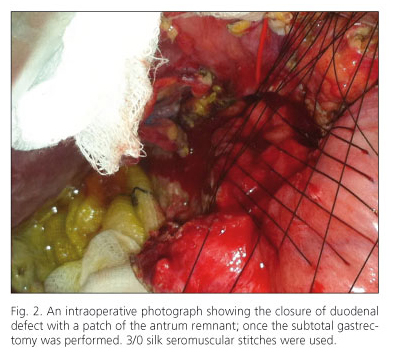
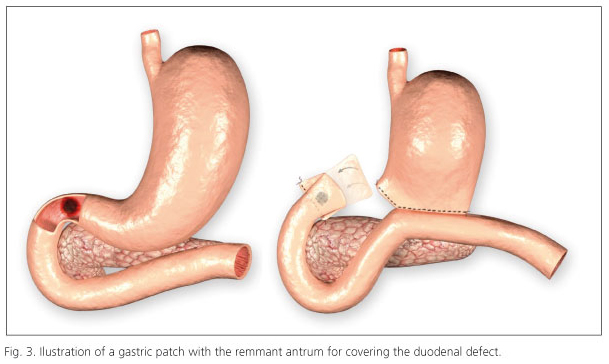
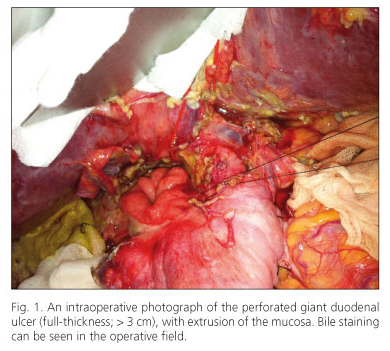
<body><![CDATA[<p><font face="Verdana" size="2">A 63-years-old man was referred from a local hospital because persisting abdominal pain, with nausea, vomiting and weakness. Five days earlier, the patient consulted in the referring hospital because of sudden abdominal epigastric pain irradiated to right hypocondrium, associated with nausea and vomiting undigested food particles. An upper endoscopy revealed a double pylorus sign, with one of the lumen occluded. The exploration was interrupted because acute bleeding. On the following day, a conventional barium meal study showed a gastric outlet obstruction.</font></p>     <p><font face="Verdana" size="2">In his recent medical history, the patient had been operated 12 months before of a duodenal ulcer perforation. A Graham patch (omental patch) with primary closure of the ulcer was performed. There was no relation with <i>Helicobacter pylori</i> and afterwards the patient was treated with proton-pump inhibitors (PPI), 20 mg daily.</font></p>     <p><font face="Verdana" size="2">In his past medical history, the patient had been diagnosed at the age of 23 years with duodenal peptic ulcer. He currently smokes 20 cigarettes daily and consumes 80-100 mg of alcohol daily.</font></p>     <p><font face="Verdana" size="2">On examination, the patient appeared ill and complaining of abdominal pain. Pulse, 140 beats per minute; blood pressure, 103/72 mmHg. Oxygen saturation 96% while he was breathing ambient air. There was epigastric tenderness and throughout right hypocondrium guarding. Laboratory testing showed leukocytosis of 11.8 x 10<sup>3</sup>&micro;L neutrophils, 67.1%; monocytes 23.6%; platelets 255 x 10<sup>3</sup> per mm<sup>3</sup>, fibrinogen, 877 mg/dL. Rest of laboratory tests were normal. During his admission, the temperature rouse to 38.5 <sup>o</sup>C, persisted the leukocytosis and C reactive protein (CRP), 29 mg/dL (normal value, 0.8 mg/dl).</font></p>     <p><font face="Verdana" size="2">A plain radiography and an ultrasonography revealed a large retroperitoneal collection (&gt; 10 cm diameter) with presence of gas bubbles, free air and barium contrast agent extravasation into the Morrison's pouch and right paracolic gutter.</font></p>     <p><font face="Verdana" size="2">An urgent laparotomy was carried out, disclosing a large purulent collection, which occupied the entire right paracolic space and Morrison's pouch. A wide Kocher maneuver and mobilization of the duodenum revealed a perforated GUD with mucosal extrusion in the posterior wall of the second part of the duodenum (<a href="#f1">Fig. 1</a>).</font></p>     <p>&nbsp;</p>     <p align="center"><font face="Verdana" size="2"><a name="f1"><img src="/img/revistas/diges/v104n8/notaclinica_fig1.jpg"></a></font></p>     <p>&nbsp;</p>     <p><font face="Verdana" size="2">A subtotal gastrectomy combined with truncal vagectomy and Billroth II reconstruction was carried out. A gastric patch with the remnant antrum was used to cover the duodenal defect, shaping as "notched lapel" with interrupted 3/0 silk seromuscular sutures (Figs.  <a href="#f2">2</a> and <a href="#f3">3</a>). The retroperitoneal space was covered with a large vascularized segment of the greater omentum. After copious washing of the abdominal cavity a closed drain (Jakson-Pratt<sup>&reg;</sup>) was placed on the right parietocolic space.</font></p>     ]]></body>
<body><![CDATA[<p>&nbsp;</p>     <p align="center"><font face="Verdana" size="2"><a name="f2"><img src="/img/revistas/diges/v104n8/notaclinica_fig2.jpg"></a></font></p>     <p>&nbsp;</p>     <p align="center"><font face="Verdana" size="2"><a name="f3"><img src="/img/revistas/diges/v104n8/notaclinica_fig3.jpg"></a></font></p>     <p>&nbsp;</p>     <p><font face="Verdana" size="2">In the 6<sup>th</sup> postoperative day, an intraabdominal collection was drained under ultrasonography control, yielding polymicrobial flora. The patient developed an uneventful postoperative course being discharged at 16<sup>th</sup> postoperative day with a regular diet. The pathology report was negative for <i>Helicobacter pylori.</i></font></p>     <p>&nbsp;</p>     <p><font face="Verdana" size="2"><b>Discussion</b></font></p>     <p><font face="Verdana" size="2">Despite the efficacy of the medical treatment of peptic ulcer disease, in the last decades a steady increase in the PU complications has been reported regarding with NSAIDs consumption (1-4).</font></p>     <p><font face="Verdana" size="2">The PU perforation still represents 10-20% of the surgical complications, having recently raised the attention of several authors (2,3). In a prospective study of 113 consecutive cases: age older than 70 years, the presence of shock at the time of admission, a delay beyond 24 h in the diagnosis and concurrent medical illness, were related with hospital mortality (4). Besides these risk factors, ASA physical status (American Society of Anesthesiologists), hypoalbuminemia, increased serum creatinine, and metabolic acidosis have been confirmed as well (2-5).</font></p>     ]]></body>
<body><![CDATA[<p><font face="Verdana" size="2">The perforated giant ulcers comprise about 1-2% of the perforated duodenal ulcers, and are associated with a high morbidity (20-70%) and mortality (15-40%). Perforation of GDUs is particularly hazardous and represent a surgical challenge regarding the closure of the severe duodenal wall defect and surrounding inflammation (6-9).</font></p>     <p><font face="Verdana" size="2">Though the majority of PU perforations (0-2 cm wide) are successfully treated with one-layer closure plus a greater omentum patch (Graham technique); perforations of GDUs demand more complex procedures as subtotal gastrectomy associated with jejunal serosal patch, pedicle graft of jejunum or pyloric exclusion. Nevertheless each of these procedures have shown a high incidence of duodenal dehiscence (&gt; 10%) and a high mortality (10-65%) (3,4,7-10).</font></p>     <p><font face="Verdana" size="2">In our case a partial gastrectomy with Billroth II reconstruction, a gastric patch with the antrum remnant for covering the duodenal defect was carried out, as consequence of the peritoneal contamination and the patient's previous history of PU disease.</font></p>     <p><font face="Verdana" size="2">The repair of severe duodenal wall defects have been an issue of several experimental and clinical studies, under the circumstances of oncologic procedures, blunt abdominal trauma as well as GDUs or diverticulum perforation (6,9,11-14). In 1978, Papachristou and Fortner described in dogs the "island" gastric patch with the greater curvature of the stomach meanwhile keeping intact its gastric wall vasculature, for closing duodenal defects, although has not been described in humans (15).</font></p>     <p><font face="Verdana" size="2">The use of an isolated jejunal loop as serosal patch is the preferred technique, concurrently others have adduced duodenal diversion claiming the technical complexity in the severe peritonitis scenario as well (7,8,10).</font></p>     <p><font face="Verdana" size="2">A high incidence of dehiscence (&gt; 10-50%) and gastric outlet obstruction has been reported in most of the papers. The shown technique could be very useful in the hazardous setting of large GUDs perforation associated with peritoneal contamination.</font></p>     <p>&nbsp;</p>     <p><font face="Verdana" size="2"><b>Acknowlegments</b></font></p>     <p><font face="Verdana" size="2">The authors thank &Iacute;&ntilde;igo Chalezquez for the art-work and Beatriz Urbelz for the technical assistance.</font></p>     <p>&nbsp;</p>     ]]></body>
<body><![CDATA[<p><font face="Verdana" size="2"><b>References</b></font></p>     <!-- ref --><p><font face="Verdana" size="2">1. Thorsen K, Glomsaker TB, Von Meer A, Soreide K, Soreide JA. Trends in diagnosis and surgical management of patients with perforated peptic ulcer. J Gastrointest Surg 2011;15:1329-35.    &nbsp;&nbsp;&nbsp;&nbsp;&nbsp;&nbsp;&nbsp;&nbsp;[&#160;<a href="javascript:void(0);" onclick="javascript: window.open('/scielo.php?script=sci_nlinks&ref=5339483&pid=S1130-0108201200080000900001&lng=','','width=640,height=500,resizable=yes,scrollbars=1,menubar=yes,');">Links</a>&#160;]<!-- end-ref --></font></p>    <!-- ref --><p><font face="Verdana" size="2">2. Moller MH, Shah K, Bendix J, Jensen A G, Zimmermann-Nielsen E, Adamsen S, et al. Risk factors in patients surgically treated for peptic ulcer perforation. Scand J Gastroenterol 2009;44:145-52.    &nbsp;&nbsp;&nbsp;&nbsp;&nbsp;&nbsp;&nbsp;&nbsp;[&#160;<a href="javascript:void(0);" onclick="javascript: window.open('/scielo.php?script=sci_nlinks&ref=5339485&pid=S1130-0108201200080000900002&lng=','','width=640,height=500,resizable=yes,scrollbars=1,menubar=yes,');">Links</a>&#160;]<!-- end-ref --></font></p>    <!-- ref --><p><font face="Verdana" size="2">3. Gupta S, Kaushi KR, Sharma R, Attri A. The management of large perforations of duodenal ulcers. BMC Surgery 2005;5:1-5.    &nbsp;&nbsp;&nbsp;&nbsp;&nbsp;&nbsp;&nbsp;&nbsp;[&#160;<a href="javascript:void(0);" onclick="javascript: window.open('/scielo.php?script=sci_nlinks&ref=5339487&pid=S1130-0108201200080000900003&lng=','','width=640,height=500,resizable=yes,scrollbars=1,menubar=yes,');">Links</a>&#160;]<!-- end-ref --></font></p>    <!-- ref --><p><font face="Verdana" size="2">4. Boey J, Wong J. Perforated duodenal ulcers. World J Surg 1987;11: 319-24.    &nbsp;&nbsp;&nbsp;&nbsp;&nbsp;&nbsp;&nbsp;&nbsp;[&#160;<a href="javascript:void(0);" onclick="javascript: window.open('/scielo.php?script=sci_nlinks&ref=5339489&pid=S1130-0108201200080000900004&lng=','','width=640,height=500,resizable=yes,scrollbars=1,menubar=yes,');">Links</a>&#160;]<!-- end-ref --></font></p>    <!-- ref --><p><font face="Verdana" size="2">5. Fombellida D, Gil Romea I, Moreno Mirallas MJ, Urieta Carpi A. Factores de riesgo en el tratamiento quir&uacute;rgico de la &uacute;lcera piloroduodenal perforada. Rev Esp Enferm Dig 1988;90:503-8.    &nbsp;&nbsp;&nbsp;&nbsp;&nbsp;&nbsp;&nbsp;&nbsp;[&#160;<a href="javascript:void(0);" onclick="javascript: window.open('/scielo.php?script=sci_nlinks&ref=5339491&pid=S1130-0108201200080000900005&lng=','','width=640,height=500,resizable=yes,scrollbars=1,menubar=yes,');">Links</a>&#160;]<!-- end-ref --></font></p>    <!-- ref --><p><font face="Verdana" size="2">6. Castellano G, Galvao O, Vargas J, Canga F, Moreno D, S&aacute;nchez T, et al. The diagnosis of peptic ulcer penetration into the liver by endoscopy biopsy. A report of 2 cases and review of the literature. Rev Esp Enferm Dig 1992;82:235-8.    &nbsp;&nbsp;&nbsp;&nbsp;&nbsp;&nbsp;&nbsp;&nbsp;[&#160;<a href="javascript:void(0);" onclick="javascript: window.open('/scielo.php?script=sci_nlinks&ref=5339493&pid=S1130-0108201200080000900006&lng=','','width=640,height=500,resizable=yes,scrollbars=1,menubar=yes,');">Links</a>&#160;]<!-- end-ref --></font></p>    <!-- ref --><p><font face="Verdana" size="2">7. Nussbaum MS, Schusterman MA. Management of giant duodenal ulcer. Am J Surg 1985;149:367-1.    &nbsp;&nbsp;&nbsp;&nbsp;&nbsp;&nbsp;&nbsp;&nbsp;[&#160;<a href="javascript:void(0);" onclick="javascript: window.open('/scielo.php?script=sci_nlinks&ref=5339495&pid=S1130-0108201200080000900007&lng=','','width=640,height=500,resizable=yes,scrollbars=1,menubar=yes,');">Links</a>&#160;]<!-- end-ref --></font></p>    <!-- ref --><p><font face="Verdana" size="2">8. Lal P, Vindal A, Hadke NS. Controlled tube duodenostomy in the management of giant duodenal ulcer perforation -a new technique for a surgically challenging condition. Am J Surg 2009;198:319-23.    &nbsp;&nbsp;&nbsp;&nbsp;&nbsp;&nbsp;&nbsp;&nbsp;[&#160;<a href="javascript:void(0);" onclick="javascript: window.open('/scielo.php?script=sci_nlinks&ref=5339497&pid=S1130-0108201200080000900008&lng=','','width=640,height=500,resizable=yes,scrollbars=1,menubar=yes,');">Links</a>&#160;]<!-- end-ref --></font></p>    <!-- ref --><p><font face="Verdana" size="2">9. Walley BD, Goco I. Duodenal patch grafting. Am J Surg 1980;140: 706-7.    &nbsp;&nbsp;&nbsp;&nbsp;&nbsp;&nbsp;&nbsp;&nbsp;[&#160;<a href="javascript:void(0);" onclick="javascript: window.open('/scielo.php?script=sci_nlinks&ref=5339499&pid=S1130-0108201200080000900009&lng=','','width=640,height=500,resizable=yes,scrollbars=1,menubar=yes,');">Links</a>&#160;]<!-- end-ref --></font></p>    <!-- ref --><p><font face="Verdana" size="2">10. Jani K, Saxena AK, Vaghasia R. Omental plugging for large-sized duodenal peptic perforations: A prospective randomized study of 100 patients. South Med J 2006;99:467-71.    &nbsp;&nbsp;&nbsp;&nbsp;&nbsp;&nbsp;&nbsp;&nbsp;[&#160;<a href="javascript:void(0);" onclick="javascript: window.open('/scielo.php?script=sci_nlinks&ref=5339501&pid=S1130-0108201200080000900010&lng=','','width=640,height=500,resizable=yes,scrollbars=1,menubar=yes,');">Links</a>&#160;]<!-- end-ref --></font></p>    <!-- ref --><p><font face="Verdana" size="2">11. Degiannis E, Boffard K. Duodenal injuries. Br J Surg 2000;87:1473-9.    &nbsp;&nbsp;&nbsp;&nbsp;&nbsp;&nbsp;&nbsp;&nbsp;[&#160;<a href="javascript:void(0);" onclick="javascript: window.open('/scielo.php?script=sci_nlinks&ref=5339503&pid=S1130-0108201200080000900011&lng=','','width=640,height=500,resizable=yes,scrollbars=1,menubar=yes,');">Links</a>&#160;]<!-- end-ref --></font></p>    <!-- ref --><p><font face="Verdana" size="2">12. Bhattachacharjee HK, Misra MC, Kumar S, Bansal VK. Duodenal perforation following blunt abdominal trauma. J Emerg Trauma Shock 2011;4:514-7.    &nbsp;&nbsp;&nbsp;&nbsp;&nbsp;&nbsp;&nbsp;&nbsp;[&#160;<a href="javascript:void(0);" onclick="javascript: window.open('/scielo.php?script=sci_nlinks&ref=5339505&pid=S1130-0108201200080000900012&lng=','','width=640,height=500,resizable=yes,scrollbars=1,menubar=yes,');">Links</a>&#160;]<!-- end-ref --></font></p>    <!-- ref --><p><font face="Verdana" size="2">13. Ishiguro S, Moriura S, Kobayashi I, Tabata T, Yoshioka Y, Matsumoto T. Pedicled ileal flap to repair large duodenal defect after rigth hemicolectomy for right colon cancer invading the duodenum. Surg Todat 2004;34:386-8.    &nbsp;&nbsp;&nbsp;&nbsp;&nbsp;&nbsp;&nbsp;&nbsp;[&#160;<a href="javascript:void(0);" onclick="javascript: window.open('/scielo.php?script=sci_nlinks&ref=5339507&pid=S1130-0108201200080000900013&lng=','','width=640,height=500,resizable=yes,scrollbars=1,menubar=yes,');">Links</a>&#160;]<!-- end-ref --></font></p>    <!-- ref --><p><font face="Verdana" size="2">14. Hosseini SV., Abbasi HR, Rezvani H, Vasei M, Ashraf MJ. Comparison between gallbladder serosal and mucosal patch in duodenal injuries repair in dogs. J Invest Surg 2009;22:148-53.    &nbsp;&nbsp;&nbsp;&nbsp;&nbsp;&nbsp;&nbsp;&nbsp;[&#160;<a href="javascript:void(0);" onclick="javascript: window.open('/scielo.php?script=sci_nlinks&ref=5339509&pid=S1130-0108201200080000900014&lng=','','width=640,height=500,resizable=yes,scrollbars=1,menubar=yes,');">Links</a>&#160;]<!-- end-ref --></font></p>    <!-- ref --><p><font face="Verdana" size="2">15. Papachristou DN, Fortner JG. Reconstruction of duodenal wall defects with the use of a gastric "island" flap. Arch Surg 1977;112:199-200.    &nbsp;&nbsp;&nbsp;&nbsp;&nbsp;&nbsp;&nbsp;&nbsp;[&#160;<a href="javascript:void(0);" onclick="javascript: window.open('/scielo.php?script=sci_nlinks&ref=5339511&pid=S1130-0108201200080000900015&lng=','','width=640,height=500,resizable=yes,scrollbars=1,menubar=yes,');">Links</a>&#160;]<!-- end-ref --></font></p>     <p>&nbsp;</p>     <p>&nbsp;</p>     <p><font face="Verdana" size="2"><a href="#top"><img border="0" src="/img/revistas/diges/v104n8/seta.gif" width="15" height="17"></a><a name="bajo"></a><b>Correspondence:</b>    <br>Javier A.-Cienfuegos.    <br>Department of General and Digestive Surgery.    <br>Cl&iacute;nica Universidad de Navarra.    <br>Avda. P&iacute;o XII, 36.    <br> 31008 Pamplona, Navarra. Spain    <br>email: <a href="mailto:fjacien@unav.es">fjacien@unav.es</a></font></p>     ]]></body>
<body><![CDATA[<p><font face="Verdana" size="2">Received: 10-02-2012    <br>Accepted: 02-03-2012</font></p>      ]]></body><back>
<ref-list>
<ref id="B1">
<label>1</label><nlm-citation citation-type="journal">
<person-group person-group-type="author">
<name>
<surname><![CDATA[Thorsen]]></surname>
<given-names><![CDATA[K]]></given-names>
</name>
<name>
<surname><![CDATA[Glomsaker]]></surname>
<given-names><![CDATA[TB]]></given-names>
</name>
<name>
<surname><![CDATA[Von Meer]]></surname>
<given-names><![CDATA[A]]></given-names>
</name>
<name>
<surname><![CDATA[Soreide]]></surname>
<given-names><![CDATA[K]]></given-names>
</name>
<name>
<surname><![CDATA[Soreide]]></surname>
<given-names><![CDATA[JA]]></given-names>
</name>
</person-group>
<article-title xml:lang="en"><![CDATA[Trends in diagnosis and surgical management of patients with perforated peptic ulcer]]></article-title>
<source><![CDATA[J Gastrointest Surg]]></source>
<year>2011</year>
<volume>15</volume>
<page-range>1329-35</page-range></nlm-citation>
</ref>
<ref id="B2">
<label>2</label><nlm-citation citation-type="journal">
<person-group person-group-type="author">
<name>
<surname><![CDATA[Moller]]></surname>
<given-names><![CDATA[MH]]></given-names>
</name>
<name>
<surname><![CDATA[Shah]]></surname>
<given-names><![CDATA[K]]></given-names>
</name>
<name>
<surname><![CDATA[Bendix]]></surname>
<given-names><![CDATA[J]]></given-names>
</name>
<name>
<surname><![CDATA[Jensen]]></surname>
<given-names><![CDATA[A G]]></given-names>
</name>
<name>
<surname><![CDATA[Zimmermann-Nielsen]]></surname>
<given-names><![CDATA[E]]></given-names>
</name>
<name>
<surname><![CDATA[Adamsen]]></surname>
<given-names><![CDATA[S]]></given-names>
</name>
</person-group>
<article-title xml:lang="en"><![CDATA[Risk factors in patients surgically treated for peptic ulcer perforation]]></article-title>
<source><![CDATA[Scand J Gastroenterol]]></source>
<year>2009</year>
<volume>44</volume>
<page-range>145-52</page-range></nlm-citation>
</ref>
<ref id="B3">
<label>3</label><nlm-citation citation-type="journal">
<person-group person-group-type="author">
<name>
<surname><![CDATA[Gupta]]></surname>
<given-names><![CDATA[S]]></given-names>
</name>
<name>
<surname><![CDATA[Kaushi]]></surname>
<given-names><![CDATA[KR]]></given-names>
</name>
<name>
<surname><![CDATA[Sharma]]></surname>
<given-names><![CDATA[R]]></given-names>
</name>
<name>
<surname><![CDATA[Attri]]></surname>
<given-names><![CDATA[A]]></given-names>
</name>
</person-group>
<article-title xml:lang="en"><![CDATA[The management of large perforations of duodenal ulcers]]></article-title>
<source><![CDATA[BMC Surgery]]></source>
<year>2005</year>
<volume>5</volume>
<page-range>1-5</page-range></nlm-citation>
</ref>
<ref id="B4">
<label>4</label><nlm-citation citation-type="journal">
<person-group person-group-type="author">
<name>
<surname><![CDATA[Boey]]></surname>
<given-names><![CDATA[J]]></given-names>
</name>
<name>
<surname><![CDATA[Wong]]></surname>
<given-names><![CDATA[J]]></given-names>
</name>
</person-group>
<article-title xml:lang="en"><![CDATA[Perforated duodenal ulcers]]></article-title>
<source><![CDATA[World J Surg]]></source>
<year>1987</year>
<volume>11</volume>
<page-range>319-24</page-range></nlm-citation>
</ref>
<ref id="B5">
<label>5</label><nlm-citation citation-type="journal">
<person-group person-group-type="author">
<name>
<surname><![CDATA[Fombellida]]></surname>
<given-names><![CDATA[D]]></given-names>
</name>
<name>
<surname><![CDATA[Gil Romea]]></surname>
<given-names><![CDATA[I]]></given-names>
</name>
<name>
<surname><![CDATA[Moreno Mirallas]]></surname>
<given-names><![CDATA[MJ]]></given-names>
</name>
<name>
<surname><![CDATA[Urieta Carpi]]></surname>
<given-names><![CDATA[A]]></given-names>
</name>
</person-group>
<article-title xml:lang="es"><![CDATA[Factores de riesgo en el tratamiento quirúrgico de la úlcera piloroduodenal perforada]]></article-title>
<source><![CDATA[Rev Esp Enferm Dig]]></source>
<year>1988</year>
<volume>90</volume>
<page-range>503-8</page-range></nlm-citation>
</ref>
<ref id="B6">
<label>6</label><nlm-citation citation-type="journal">
<person-group person-group-type="author">
<name>
<surname><![CDATA[Castellano]]></surname>
<given-names><![CDATA[G]]></given-names>
</name>
<name>
<surname><![CDATA[Galvao]]></surname>
<given-names><![CDATA[O]]></given-names>
</name>
<name>
<surname><![CDATA[Vargas]]></surname>
<given-names><![CDATA[J]]></given-names>
</name>
<name>
<surname><![CDATA[Canga]]></surname>
<given-names><![CDATA[F]]></given-names>
</name>
<name>
<surname><![CDATA[Moreno]]></surname>
<given-names><![CDATA[D]]></given-names>
</name>
<name>
<surname><![CDATA[Sánchez]]></surname>
<given-names><![CDATA[T]]></given-names>
</name>
</person-group>
<article-title xml:lang="en"><![CDATA[The diagnosis of peptic ulcer penetration into the liver by endoscopy biopsy: A report of 2 cases and review of the literature]]></article-title>
<source><![CDATA[Rev Esp Enferm Dig]]></source>
<year>1992</year>
<volume>82</volume>
<page-range>235-8</page-range></nlm-citation>
</ref>
<ref id="B7">
<label>7</label><nlm-citation citation-type="journal">
<person-group person-group-type="author">
<name>
<surname><![CDATA[Nussbaum]]></surname>
<given-names><![CDATA[MS]]></given-names>
</name>
<name>
<surname><![CDATA[Schusterman]]></surname>
<given-names><![CDATA[MA]]></given-names>
</name>
</person-group>
<article-title xml:lang="en"><![CDATA[Management of giant duodenal ulcer]]></article-title>
<source><![CDATA[Am J Surg]]></source>
<year>1985</year>
<volume>149</volume>
<page-range>367-1</page-range></nlm-citation>
</ref>
<ref id="B8">
<label>8</label><nlm-citation citation-type="journal">
<person-group person-group-type="author">
<name>
<surname><![CDATA[Lal]]></surname>
<given-names><![CDATA[P]]></given-names>
</name>
<name>
<surname><![CDATA[Vindal]]></surname>
<given-names><![CDATA[A]]></given-names>
</name>
<name>
<surname><![CDATA[Hadke]]></surname>
<given-names><![CDATA[NS]]></given-names>
</name>
</person-group>
<article-title xml:lang="en"><![CDATA[Controlled tube duodenostomy in the management of giant duodenal ulcer perforation: a new technique for a surgically challenging condition]]></article-title>
<source><![CDATA[Am J Surg]]></source>
<year>2009</year>
<volume>198</volume>
<page-range>319-23</page-range></nlm-citation>
</ref>
<ref id="B9">
<label>9</label><nlm-citation citation-type="journal">
<person-group person-group-type="author">
<name>
<surname><![CDATA[Walley]]></surname>
<given-names><![CDATA[BD]]></given-names>
</name>
<name>
<surname><![CDATA[Goco]]></surname>
<given-names><![CDATA[I]]></given-names>
</name>
</person-group>
<article-title xml:lang="en"><![CDATA[Duodenal patch grafting]]></article-title>
<source><![CDATA[Am J Surg]]></source>
<year>1980</year>
<volume>140</volume>
<page-range>706-7</page-range></nlm-citation>
</ref>
<ref id="B10">
<label>10</label><nlm-citation citation-type="journal">
<person-group person-group-type="author">
<name>
<surname><![CDATA[Jani]]></surname>
<given-names><![CDATA[K]]></given-names>
</name>
<name>
<surname><![CDATA[Saxena]]></surname>
<given-names><![CDATA[AK]]></given-names>
</name>
<name>
<surname><![CDATA[Vaghasia]]></surname>
<given-names><![CDATA[R]]></given-names>
</name>
</person-group>
<article-title xml:lang="en"><![CDATA[Omental plugging for large-sized duodenal peptic perforations: A prospective randomized study of 100 patients]]></article-title>
<source><![CDATA[South Med J]]></source>
<year>2006</year>
<volume>99</volume>
<page-range>467-71</page-range></nlm-citation>
</ref>
<ref id="B11">
<label>11</label><nlm-citation citation-type="journal">
<person-group person-group-type="author">
<name>
<surname><![CDATA[Degiannis]]></surname>
<given-names><![CDATA[E]]></given-names>
</name>
<name>
<surname><![CDATA[Boffard]]></surname>
<given-names><![CDATA[K]]></given-names>
</name>
</person-group>
<article-title xml:lang="en"><![CDATA[Duodenal injuries]]></article-title>
<source><![CDATA[Br J Surg]]></source>
<year>2000</year>
<volume>87</volume>
<page-range>1473-9</page-range></nlm-citation>
</ref>
<ref id="B12">
<label>12</label><nlm-citation citation-type="journal">
<person-group person-group-type="author">
<name>
<surname><![CDATA[Bhattachacharjee]]></surname>
<given-names><![CDATA[HK]]></given-names>
</name>
<name>
<surname><![CDATA[Misra]]></surname>
<given-names><![CDATA[MC]]></given-names>
</name>
<name>
<surname><![CDATA[Kumar]]></surname>
<given-names><![CDATA[S]]></given-names>
</name>
<name>
<surname><![CDATA[Bansal]]></surname>
<given-names><![CDATA[VK]]></given-names>
</name>
</person-group>
<article-title xml:lang="en"><![CDATA[Duodenal perforation following blunt abdominal trauma]]></article-title>
<source><![CDATA[J Emerg Trauma Shock]]></source>
<year>2011</year>
<volume>4</volume>
<page-range>514-7</page-range></nlm-citation>
</ref>
<ref id="B13">
<label>13</label><nlm-citation citation-type="journal">
<person-group person-group-type="author">
<name>
<surname><![CDATA[Ishiguro]]></surname>
<given-names><![CDATA[S]]></given-names>
</name>
<name>
<surname><![CDATA[Moriura]]></surname>
<given-names><![CDATA[S]]></given-names>
</name>
<name>
<surname><![CDATA[Kobayashi]]></surname>
<given-names><![CDATA[I]]></given-names>
</name>
<name>
<surname><![CDATA[Tabata]]></surname>
<given-names><![CDATA[T]]></given-names>
</name>
<name>
<surname><![CDATA[Yoshioka]]></surname>
<given-names><![CDATA[Y]]></given-names>
</name>
<name>
<surname><![CDATA[Matsumoto]]></surname>
<given-names><![CDATA[T]]></given-names>
</name>
</person-group>
<article-title xml:lang="en"><![CDATA[Pedicled ileal flap to repair large duodenal defect after rigth hemicolectomy for right colon cancer invading the duodenum]]></article-title>
<source><![CDATA[Surg Todat]]></source>
<year>2004</year>
<volume>34</volume>
<page-range>386-8</page-range></nlm-citation>
</ref>
<ref id="B14">
<label>14</label><nlm-citation citation-type="journal">
<person-group person-group-type="author">
<name>
<surname><![CDATA[Hosseini]]></surname>
<given-names><![CDATA[SV.]]></given-names>
</name>
<name>
<surname><![CDATA[Abbasi]]></surname>
<given-names><![CDATA[HR]]></given-names>
</name>
<name>
<surname><![CDATA[Rezvani]]></surname>
<given-names><![CDATA[H]]></given-names>
</name>
<name>
<surname><![CDATA[Vasei]]></surname>
<given-names><![CDATA[M]]></given-names>
</name>
<name>
<surname><![CDATA[Ashraf]]></surname>
<given-names><![CDATA[MJ]]></given-names>
</name>
</person-group>
<article-title xml:lang="en"><![CDATA[Comparison between gallbladder serosal and mucosal patch in duodenal injuries repair in dogs]]></article-title>
<source><![CDATA[J Invest Surg]]></source>
<year>2009</year>
<volume>22</volume>
<page-range>148-53</page-range></nlm-citation>
</ref>
<ref id="B15">
<label>15</label><nlm-citation citation-type="journal">
<person-group person-group-type="author">
<name>
<surname><![CDATA[Papachristou]]></surname>
<given-names><![CDATA[DN]]></given-names>
</name>
<name>
<surname><![CDATA[Fortner]]></surname>
<given-names><![CDATA[JG]]></given-names>
</name>
</person-group>
<article-title xml:lang="en"><![CDATA[Reconstruction of duodenal wall defects with the use of a gastric "island" flap]]></article-title>
<source><![CDATA[Arch Surg]]></source>
<year>1977</year>
<volume>112</volume>
<page-range>199-200</page-range></nlm-citation>
</ref>
</ref-list>
</back>
</article>