<?xml version="1.0" encoding="ISO-8859-1"?><article xmlns:mml="http://www.w3.org/1998/Math/MathML" xmlns:xlink="http://www.w3.org/1999/xlink" xmlns:xsi="http://www.w3.org/2001/XMLSchema-instance">
<front>
<journal-meta>
<journal-id>1130-0108</journal-id>
<journal-title><![CDATA[Revista Española de Enfermedades Digestivas]]></journal-title>
<abbrev-journal-title><![CDATA[Rev. esp. enferm. dig.]]></abbrev-journal-title>
<issn>1130-0108</issn>
<publisher>
<publisher-name><![CDATA[Sociedad Española de Patología Digestiva]]></publisher-name>
</publisher>
</journal-meta>
<article-meta>
<article-id>S1130-01082014000600004</article-id>
<title-group>
<article-title xml:lang="en"><![CDATA[Transcultural adaptation and validation of the "Adult Eosinophilic Esophagitis Quality of Life Questionnaire" into Spanish]]></article-title>
<article-title xml:lang="es"><![CDATA[Adaptación transcultural y validación al español del "Adult Eosinophilic Esophagitis Quality of Life Questionnaire"]]></article-title>
</title-group>
<contrib-group>
<contrib contrib-type="author">
<name>
<surname><![CDATA[Lucendo]]></surname>
<given-names><![CDATA[Alfredo J.]]></given-names>
</name>
<xref ref-type="aff" rid="A01"/>
</contrib>
<contrib contrib-type="author">
<name>
<surname><![CDATA[Sánchez-Cazalilla]]></surname>
<given-names><![CDATA[Marta]]></given-names>
</name>
<xref ref-type="aff" rid="A01"/>
<xref ref-type="aff" rid="A02"/>
</contrib>
<contrib contrib-type="author">
<name>
<surname><![CDATA[Molina-Infante]]></surname>
<given-names><![CDATA[Javier]]></given-names>
</name>
<xref ref-type="aff" rid="A03"/>
</contrib>
<contrib contrib-type="author">
<name>
<surname><![CDATA[Pérez-Martínez]]></surname>
<given-names><![CDATA[Isabel]]></given-names>
</name>
<xref ref-type="aff" rid="A04"/>
</contrib>
<contrib contrib-type="author">
<name>
<surname><![CDATA[Tenias]]></surname>
<given-names><![CDATA[José M.]]></given-names>
</name>
<xref ref-type="aff" rid="A05"/>
</contrib>
<contrib contrib-type="author">
<name>
<surname><![CDATA[Barrio]]></surname>
<given-names><![CDATA[Jesús]]></given-names>
</name>
<xref ref-type="aff" rid="A06"/>
</contrib>
<contrib contrib-type="author">
<name>
<surname><![CDATA[Nantes]]></surname>
<given-names><![CDATA[Óscar]]></given-names>
</name>
<xref ref-type="aff" rid="A07"/>
</contrib>
<contrib contrib-type="author">
<name>
<surname><![CDATA[Ríos]]></surname>
<given-names><![CDATA[Constanza Ciriza de los]]></given-names>
</name>
<xref ref-type="aff" rid="A08"/>
</contrib>
<contrib contrib-type="author">
<name>
<surname><![CDATA[Perelló]]></surname>
<given-names><![CDATA[Antonia]]></given-names>
</name>
<xref ref-type="aff" rid="A09"/>
</contrib>
<contrib contrib-type="author">
<name>
<surname><![CDATA[Arias]]></surname>
<given-names><![CDATA[Ángel]]></given-names>
</name>
<xref ref-type="aff" rid="A05"/>
</contrib>
</contrib-group>
<aff id="A01">
<institution><![CDATA[,Hospital General de Tomelloso Department of Gastroenterology ]]></institution>
<addr-line><![CDATA[Tomelloso ]]></addr-line>
<country>Spain</country>
</aff>
<aff id="A02">
<institution><![CDATA[,Clínica Ruber Department of Gastroenterology ]]></institution>
<addr-line><![CDATA[Madrid ]]></addr-line>
<country>Spain</country>
</aff>
<aff id="A03">
<institution><![CDATA[,Hospital San Pedro de Alcántara Department of Gastroenterology ]]></institution>
<addr-line><![CDATA[San Pedro de Alcántara ]]></addr-line>
<country>Spain</country>
</aff>
<aff id="A04">
<institution><![CDATA[,Hospital Universitario Central de Asturias Department of Gastroenterology ]]></institution>
<addr-line><![CDATA[Oviedo ]]></addr-line>
<country>Spain</country>
</aff>
<aff id="A05">
<institution><![CDATA[,Complejo Hospitalario La Mancha-Centro Research Support Unit ]]></institution>
<addr-line><![CDATA[Alcázar de San Juan ]]></addr-line>
<country>Spain</country>
</aff>
<aff id="A06">
<institution><![CDATA[,Hospital Universitario Río Hortega Department of Gastroenterology ]]></institution>
<addr-line><![CDATA[Valladolid ]]></addr-line>
<country>Spain</country>
</aff>
<aff id="A07">
<institution><![CDATA[,Complejo Hospitalario de Navarra Department of Gastroenterology ]]></institution>
<addr-line><![CDATA[Pamplona ]]></addr-line>
<country>Spain</country>
</aff>
<aff id="A08">
<institution><![CDATA[,Hospital Universitario 12 de Octubre Department of Gastroenterology ]]></institution>
<addr-line><![CDATA[Madrid ]]></addr-line>
<country>Spain</country>
</aff>
<aff id="A09">
<institution><![CDATA[,Hospital de Viladecans Department of Gastroenterology ]]></institution>
<addr-line><![CDATA[Viladecans ]]></addr-line>
<country>Spain</country>
</aff>
<pub-date pub-type="pub">
<day>00</day>
<month>06</month>
<year>2014</year>
</pub-date>
<pub-date pub-type="epub">
<day>00</day>
<month>06</month>
<year>2014</year>
</pub-date>
<volume>106</volume>
<numero>6</numero>
<fpage>386</fpage>
<lpage>394</lpage>
<copyright-statement/>
<copyright-year/>
<self-uri xlink:href="http://scielo.isciii.es/scielo.php?script=sci_arttext&amp;pid=S1130-01082014000600004&amp;lng=en&amp;nrm=iso"></self-uri><self-uri xlink:href="http://scielo.isciii.es/scielo.php?script=sci_abstract&amp;pid=S1130-01082014000600004&amp;lng=en&amp;nrm=iso"></self-uri><self-uri xlink:href="http://scielo.isciii.es/scielo.php?script=sci_pdf&amp;pid=S1130-01082014000600004&amp;lng=en&amp;nrm=iso"></self-uri><abstract abstract-type="short" xml:lang="en"><p><![CDATA[Background: The "Adult Eosinophilic Esophagitis Quality of Life (EoE-QoL-A) Questionnaire" was developed in English as a valid, reliable, and disease-specific health-related QoL measure. This research aims to adapt and validate this questionnaire for Spanish-speaking patients. Patients and methods: A multicenter, observational, prospective study was conducted at 8 Spanish hospitals. The cultural adaptation of the original EoE-QoL-A questionnaire was undertaken through a standardized 3-phase procedure: 1. Translation; 2. Retrotranslation; and 3. Pilot study. Patients completed the Hospital Anxiety and Depression Scale (HADS), the Short Form (SF)-12, the Brief Illness Perception Questionnaire (BIPQ), and the adapted EoE-QoL-A, with a retest 3 months later. Statistical analysis included construct validity, internal consistency, criterion validity, and reproducibility. Results: One hundred and seventy adult EoE patients (73.5 % male; aged 33.5 ± 11.4-y) were included in the study. With regard to internal validity, all Cronbach alpha values were &gt; 0.75. A significant correlation between items assessed in the SF-12, BIPQ and EoE-QoL-A questionnaires (p < 0.001) was observed. Correlations with the HADS were stronger for anxiety than for depression levels. Anxiety related to disease diagnosis and choking were the most affected dimensions; less affected were the dimensions related to eating, social, and emotional development. Intraclass correlation coefficients between the test and retest assessments were acceptable for all questionnaires, with the highest values (0.73-0.84) calculated for the EoE-QoL-A Spanish version. Conclusion: The Spanish version of the EoE-QoL-A is a reliable, valid, and responsive questionnaire. Diagnosis and choking anxiety were the most affected dimensions in the health-related QoL in adult EoE patients.]]></p></abstract>
<kwd-group>
<kwd lng="en"><![CDATA[Eosinophilic esophagitis]]></kwd>
<kwd lng="en"><![CDATA[Quality of life]]></kwd>
<kwd lng="en"><![CDATA[Questionnaire]]></kwd>
</kwd-group>
</article-meta>
</front><body><![CDATA[ 
<a name="top"></a>    <p><font face="Verdana" size="2"><b>ORIGINAL PAPERS</b></font></p>
    <p>&nbsp;</p>
    <p><font face="Verdana" size="4"><b>Transcultural adaptation and validation of the "Adult Eosinophilic Esophagitis Quality of Life Questionnaire" into Spanish</b></font></p>
    <p><font face="Verdana" size="4"><b>Adaptación transcultural y validación al español del "Adult Eosinophilic Esophagitis Quality of Life Questionnaire"</b></font></p>
    <p>&nbsp;</p>
    <p>&nbsp;</p>
    <p><font face="Verdana" size="2"><b>Alfredo J. Lucendo<sup>1</sup>, Marta S&aacute;nchez-Cazalilla<sup>1,2</sup>, Javier Molina-Infante<sup>3</sup>, Isabel P&eacute;rez-Mart&iacute;nez<sup>4</sup>, Jos&eacute; M. Tenias<sup>5</sup>, Jes&uacute;s Barrio<sup>6</sup>, &Oacute;scar Nantes<sup>7</sup>, Constanza Ciriza de los R&iacute;os<sup>8</sup>, Antonia Perell&oacute;<sup>9</sup> and &Aacute;ngel Arias<sup>5</sup></b></font></p>
    <p><font face="Verdana" size="2"><sup>1</sup>Department of Gastroenterology. Hospital General de Tomelloso. Tomelloso, Ciudad Real. Spain.    <br><sup>2</sup>Department of Gastroenterology. Cl&iacute;nica Ruber. Madrid, Spain.    ]]></body>
<body><![CDATA[<br><sup>3</sup>Department of Gastroenterology. Hospital San Pedro de Alc&aacute;ntara. C&aacute;ceres, Spain.    <br><sup>4</sup>Department of Gastroenterology. Hospital Universitario Central de Asturias. Oviedo, Spain.    <br><sup>5</sup>Research Support Unit. Complejo Hospitalario La Mancha-Centro. Alc&aacute;zar de San Juan, Ciudad Real. Spain.    <br><sup>6</sup>Department of Gastroenterology. Hospital Universitario R&iacute;o Hortega. Valladolid, Spain.    <br><sup>7</sup>Department of Gastroenterology. Complejo Hospitalario de Navarra. Pamplona, Spain.    <br><sup>8</sup>Department of Gastroenterology. Hospital Universitario 12 de Octubre. Madrid, Spain.    <br><sup>9</sup>Department of Gastroenterology. Hospital de Viladecans. Barcelona, Spain</font></p>
    <p><font face="Verdana" size="2">This work has been supported by grants from the Spanish Society for Digestive Diseases <i>(Sociedad Espa&ntilde;ola de Patolog&iacute;a Digestiva - SEPD)</i> and from the Spanish Digestive System Foundation <i>(Fundaci&oacute;n Espa&ntilde;ola del Aparato Digestivo - FEAD).</i></font></p>
    <p><font face="Verdana" size="2"><a href="#bajo">Correspondence</a></font></p>
    <p>&nbsp;</p>
    ]]></body>
<body><![CDATA[<p>&nbsp;</p>
<hr size="1">    <p><font face="Verdana" size="2"><b>ABSTRACT</b></font></p>
    <p><font face="Verdana" size="2"><b>Background:</b> The "Adult Eosinophilic Esophagitis Quality of Life (EoE-QoL-A) Questionnaire" was developed in English as a valid, reliable, and disease-specific health-related QoL measure. This research aims to adapt and validate this questionnaire for Spanish-speaking patients.    <br><b>Patients and methods:</b> A multicenter, observational, prospective study was conducted at 8 Spanish hospitals. The cultural adaptation of the original EoE-QoL-A questionnaire was undertaken through a standardized 3-phase procedure: 1. Translation; 2. Retrotranslation; and 3. Pilot study. Patients completed the Hospital Anxiety and Depression Scale (HADS), the Short Form (SF)-12, the Brief Illness Perception Questionnaire (BIPQ), and the adapted EoE-QoL-A, with a retest 3 months later. Statistical analysis included construct validity, internal consistency, criterion validity, and reproducibility.    <br><b>Results:</b> One hundred and seventy adult EoE patients (73.5&nbsp;% male; aged 33.5 &plusmn; 11.4-y) were included in the study. With regard to internal validity, all Cronbach alpha values were &gt; 0.75. A significant correlation between items assessed in the SF-12, BIPQ and EoE-QoL-A questionnaires (p &lt; 0.001) was observed. Correlations with the HADS were stronger for anxiety than for depression levels. Anxiety related to disease diagnosis and choking were the most affected dimensions; less affected were the dimensions related to eating, social, and emotional development. Intraclass correlation coefficients between the test and retest assessments were acceptable for all questionnaires, with the highest values (0.73-0.84) calculated for the EoE-QoL-A Spanish version.    <br><b>Conclusion:</b> The Spanish version of the EoE-QoL-A is a reliable, valid, and responsive questionnaire. Diagnosis and choking anxiety were the most affected dimensions in the health-related QoL in adult EoE patients.</font></p>
    <p><font face="Verdana" size="2"><b>Key words:</b> Eosinophilic esophagitis. Quality of life. Questionnaire.</font></p>
<hr size="1">
    <p>&nbsp;</p>
    <p><font face="Verdana" size="2"><b>Introduction</b></font></p>
    <p><font face="Verdana" size="2">Eosinophilic esophagitis (EoE) is a chronic, food allergy-associated, inflammatory disease characterized clinically by symptoms related to esophageal dysfunction and histologically by an eosinophil-predominant inflammation that persists after treatment with acid secretion inhibitors (1). EoE, which lasts from childhood into adulthood (2), has exhibited a rapidly increasing epidemiology, with a prevalence in Europe and the USA ranging from 43 to 56 affected patients per 100,000 inhabitants (3-5). As a consequence, EoE now represents the second leading cause of chronic esophagitis after gastroesophageal reflux disease (GERD) (6) and is the most frequent cause of dysphagia in young patients (7).</font></p>
    ]]></body>
<body><![CDATA[<p><font face="Verdana" size="2">In addition to the persistent or relapsing esophageal symptoms that characterize EoE, other factors have a significant impact on the health-related quality of life (QoL) of EoE patients. These factors include restrictions of common foods and other dietary modifications as well as the chronic nature of the disease (8-10), which requires continuous or repeated therapeutic interventions (11).</font></p>
    <p><font face="Verdana" size="2">The evaluation of health-related QoL assesses the impact a given disease has on the patient's perception of his or her own welfare in physical, psychological, and social terms due to the decrease in opportunities caused either by the disease, its consequences and treatment, and/or pertinent health policies. Health-related QoL is a consistently evaluated, patient-reported outcome for chronic illnesses, including most gastrointestinal disorders (12-16). Questionnaires that are specifically designed for patients with a particular disease manage to combine patient perception of the qualitative indicators that influence QoL with objective biological data, thus providing valuable information for developing interventions to promote the greatest possible well-being as well as a better optimization of healthcare resources (17-19).</font></p>
    <p><font face="Verdana" size="2">The adverse impact of EoE on patient QoL has been increasingly recognized over the past few years, especially after researchers documented that regular assessment of EoE, based mainly on the frequency and severity of dysphagia, did not adequately reflect the impact of the disease in psychological or social terms (20). Moreover, generic instruments assessing QoL generally failed to reflect many of the concerns and worries of EoE patients regarding their disease (21). Given the lack of specific tools for EoE, Taft et al. developed the Adult Eosinophilic Oesophagitis Quality of Life (EoE-QoL-A) Questionnaire for adult patients (22), which originally consisted of 37&nbsp;items grouped into 5 categories (eating/diet impact, social impact, emotional impact, anxiety resulting from the disease, and anxiety generated by esophageal impaction). The questionnaire was validated in a sample of 201 adult patients and has repeatedly demonstrated its reliability and validity for correlation with other general scales of QoL.</font></p>
    <p><font face="Verdana" size="2">The EoE-QoL-A questionnaire has yet to be validated in a language other than English or in a cultural context apart from that of American, so it has not been directly applicable in the Spanish language or cultural environment. The objective of this study was to adapt and validate the EoE-QoL-A questionnaire in Spanish in order to provide a useful instrument for assessing adult patients suffering from EoE.</font></p>
    <p>&nbsp;</p>
    <p><font face="Verdana" size="2"><b>Patients and methods</b></font></p>
    <p><font face="Verdana" size="2">This observational and prospective study was conducted at 8 different tertiary gastroenterology facilities located in several regions of Spain. The study protocol comprised two different phases: Cultural adaptation and validation. Recruitment of participant patients was developed between January and December 2013. The study was approved by the institutional research ethics board of La Mancha-Centro General Hospital.</font></p>
    <p><font face="Verdana" size="2"><b>Questionnaires</b></font></p>
    <p><font face="Verdana" size="2">Initially, the EoE-QoL-A was a 37-item symptom inventory specifically for adult patients with EoE. Developed by Taft et al. at Northwestern's Feinberg School of Medicine in Chicago, IL (USA), it included symptoms of esophageal dysfunction, disease impact, and anxiety. A refined 30-item scale was later published by the same researchers (23).</font></p>
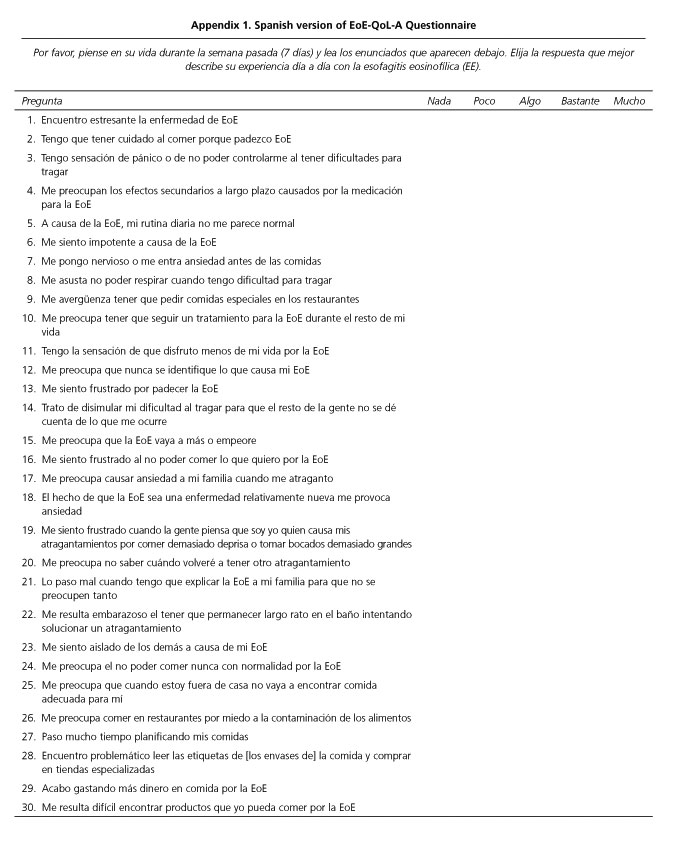
    <p><font face="Verdana" size="2">The current questionnaire consists of 30 items categorized according to the original five dimensions. The impact of the disease on eating patterns and diet comprises 10 items (2, 9, 16, 24, 25, 26, 27, 28, 29, and 30), the social impact dimension consists of 4 items (14, 17, 19, and 22), and the emotional impact is measured with 8 items (1, 5, 6, 7, 11, 13, 21, and 23). In addition, disease anxiety is explored with 5 items (4, 10, 12, 15, and 18) while choking anxiety consists of 3 items (3, 8, and 20).</font></p>
    ]]></body>
<body><![CDATA[<p><font face="Verdana" size="2">The Short Form (SF)-12 is a self-administered health-related QoL assessment instrument specifically designed for general population use. Validated for use in Spanish (24), it consists of twelve items, with physical and mental health separated into two distinct domains.</font></p>
    <p><font face="Verdana" size="2">The BIPQ (Brief Illness Perception Questionnaire) was designed to facilitate rapid assessment of a patient's personal perception of his or her illness (25). The BIPQ consists of eight items related to illness perception, all rated on a 0-10 scale. It has recently been validated for use in Spanish by Pacheco-Huergo et al. (BIPQ<sub>v2</sub>) (26).</font></p>
    <p><font face="Verdana" size="2">The Hospital Anxiety and Depression Scale (HADS) is a self-administered 14-item questionnaire composed of two intermingled 7-item subscales for anxiety and depression, excluding physical symptoms. A validated Spanish version of the HADS is also available (27).</font></p>
    <p><font face="Verdana" size="2"><b>Linguistic validation</b></font></p>
    <p><font face="Verdana" size="2">Translation of the original EoE-QoL-A into Spanish was carried out following a standardized forward-backward procedure: Two independent bilingual translators (with American English as their mother tongue) made forward translations while backward translations were made by two native-speakers of Spanish. The Spanish versions of the questionnaire were then tested in 10 adult patients with EoE, as defined according to the diagnostic criteria listed in the Updated International Consensus Guidelines for EoE (1). Potential problems were explored and discussed with the aid of a checklist. As a result, the lay-out was adapted to clarify the instructions on how to indicate the chosen answer. The Spanish version of EoE-QoL-A questionnaire was then finalized (<a href="#a1">Appendix 1</a>).</font></p>
    <p>&nbsp;</p>
    <p align="center"><font face="Verdana" size="2"><a name="a1"><img src="/img/revistas/diges/v106n6/original3_app1.jpg"></a></font></p>
    <p>&nbsp;</p>
    <p><font face="Verdana" size="2"><b>Study population and study design</b></font></p>
    <p><font face="Verdana" size="2">Male and female patients aged 18 years or older and with an established diagnosis of EoE according to the aforementioned criteria were recruited. All the study subjects were fluent and literate native speakers of Spanish. Exclusion criteria included significant changes in patient management during the research period or the presence of additional symptomatic upper gastrointestinal disorders, neurological diseases, active malignant tumors, dementia, or mental retardation.</font></p>
    ]]></body>
<body><![CDATA[<p><font face="Verdana" size="2">At the initial office visit, the treating physician explained the study to all consecutive patients potentially eligible for inclusion. After hearing the explanation of the study and giving informed consent, participating patients were given a package including further written information regarding the study aims along with instructions on how to complete the set of questionnaires and a booklet including all four questionnaires. A telephone number and email address were also provided in case of further doubts.</font></p>
    <p><font face="Verdana" size="2">Alternatively, a baseline set of questionnaires was completed at the hospital or at home and returned by post directly after completion.</font></p>
    <p><font face="Verdana" size="2">Twelve weeks later, all subjects completed a second set of questionnaires which were returned to the testing center by post. The 12-week test-retest period between repeated administration of the questionnaires was chosen as being long enough to prevent recall bias, but short enough to ensure that meaningful clinical changes had not occurred. During this period, no treatment was initiated or modified. Given the observational nature of the study, the treating physician was free to perform any intervention (e.g., endoscopic evaluation, allergy tests, or analytical study) and prescribe any treatment only after completion of the second round of questionnaires, according to the needs of each patient.</font></p>
    <p><font face="Verdana" size="2"><b>Statistical methods</b></font></p>
    <p><font face="Verdana" size="2">Statistical analysis was performed with IBM SPSS-software 20.0 (SPSS Inc, Chicago, IL, USA). Statistical significance was defined as p-values &lt; 0.05. Mean and standard deviations (SD) were reported for continuous data. For discrete data, counts and percentages were reported.</font></p>
    <p><font face="Verdana" size="2">Measure properties of the Spanish version of the EoE-QoL-A questionnaire were tested as follows (28):</font></p>
    <blockquote>
    <p><font face="Verdana" size="2">1.<i> Internal consistency</i>, that is, the extent to which items measure the same underlying construct, was tested by calculating Cronbach alpha values using baseline scores. A Cronbach alpha value between 0.70 and 0.95 was considered to reflect good internal consistency.</font></p>
    <p><font face="Verdana" size="2">2.<i> Reproducibility</i>, that is, the degree to which repeated measurements in the test-retest period provide similar answers, concerns reliability and agreement. Agreement, that is, the extent to which scores on repeated measures have similar values, was quantified with interclass correlation coefficients.</font></p>
    <p><font face="Verdana" size="2">3.<i> Construct validity</i>, that is, the extent to which the scores relate to other measures, was verified by means of a factorial analysis to identify the constructs or dimensions of the EoE-QoL-A questionnaire. A confirmatory approach using a forcing decomposition of five factors through orthogonal rotations (uncorrelated factors) or oblique rotations, if necessary, was used to improve the interpretation of the dimensions.</font></p>
    ]]></body>
<body><![CDATA[<p><font face="Verdana" size="2">4. <i>Criterion validity</i> was examined by calculating Spearman's correlation coefficient (Rho) between the Spanish versions of the EoE-QoL-A, HAD, SF-12 and BIPQ<sub>v2</sub> questionnaires.</font></p>
</blockquote>
    <p>&nbsp;</p>
    <p><font face="Verdana" size="2"><b>Results</b></font></p>
    <p><font face="Verdana" size="2"><b>Study subjects</b></font></p>
    <p><font face="Verdana" size="2">One hundred and seventy adult patients diagnosed with EoE were consecutively recruited at 8 hospitals in Spain (<a href="#a2">Appendix 2</a>), including 125 men (73.5 %) and 45 women (26.5 %) with a mean age of 33.5 years (SD: 11.4; rank 18 to 77.5). With regard to EoE treatment, 102 patients (60&nbsp;%) had been prescribed some kind of dietary restriction. No differences were observed in the demographic data or EoE symptoms of patients with or without dietary-based therapeutic interventions (<a href="#t1">Table I</a>).</font></p>
    <p>&nbsp;</p>
    <p align="center"><font face="Verdana" size="2"><a name="a2"><img src="/img/revistas/diges/v106n6/original3_app2.jpg"></a></font></p>
    <p align="center"><font face="Verdana" size="2"><a name="t1"><img src="/img/revistas/diges/v106n6/original3_table1.jpg"></a></font></p>
    <p>&nbsp;</p>
    <p><font face="Verdana" size="2">A set of questionnaires was administered to and completed by each patient, who was then given an appointment to return to the hospital 3 months later. Of the initial 170 patients, 158 (92.94 %) completed the second set of questionnaires, including 115 men (72.8 %) and 43 women (27.2 %).</font></p>
    ]]></body>
<body><![CDATA[<p><font face="Verdana" size="2"><b>Internal consistency of the Spanish version of EoE-QoL-A</b></font></p>
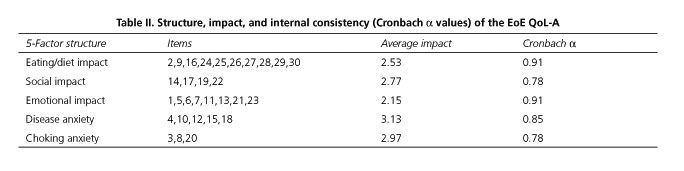
    <p><font face="Verdana" size="2">Each dimension showed good internal consistency as determined by Cronbach's alpha values over 0.75; similar and consistent values were also observed at the retest visit 3 months later. The dimensions with the highest internal consistency were impact on eating/diet, followed by disease anxiety, choking anxiety, and social impact (<a href="#t2">Table II</a>).</font></p>
    <p>&nbsp;</p>
    <p align="center"><font face="Verdana" size="2"><a name="t2"><img src="/img/revistas/diges/v106n6/original3_table2.jpg"></a></font></p>
    <p>&nbsp;</p>
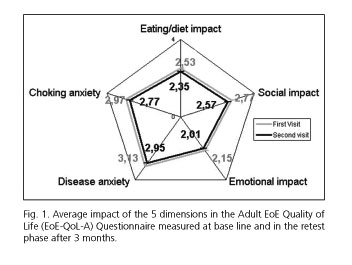
    <p><font face="Verdana" size="2">With respect to the average impact for each dimension, disease anxiety was the highest, followed by choking anxiety, social impact, eating/diet impact and finally emotional impact (<a href="#t2">Table II</a>). These results remained unchanged 3&nbsp;months later (<a href="#f1">Fig. 1</a>).</font></p>
    <p>&nbsp;</p>
    <p align="center"><font face="Verdana" size="2"><a name="f1"><img src="/img/revistas/diges/v106n6/original3_fig1.jpg"></a></font></p>
    <p>&nbsp;</p>
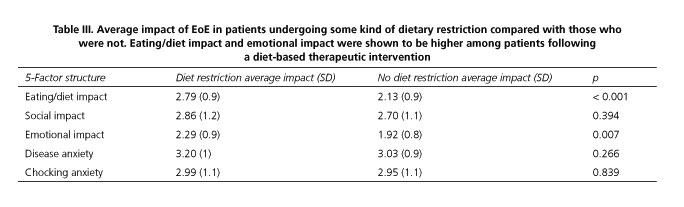
    <p><font face="Verdana" size="2">A significantly higher impact for two of the dimensions analyzed -eating/diet impact and emotional impact- was documented for adult patients following some type of dietary restriction compared to those who were not, with results of 2.79 <i>vs.</i> 2.13 (p &lt; 0.001) for the former dimension and 2.29 <i>vs.</i> 1.92 (p = 0.007) for the latter (<a href="#t3">Table III</a>).</font></p>
    ]]></body>
<body><![CDATA[<p>&nbsp;</p>
    <p align="center"><font face="Verdana" size="2"><a name="t3"><img src="/img/revistas/diges/v106n6/original3_table3.jpg"></a></font></p>
    <p>&nbsp;</p>
    <p><font face="Verdana" size="2"><b>Criterion validity</b></font></p>
    <p><font face="Verdana" size="2"><b><i>HAD scale (anxiety and depression)</i></b></font></p>
    <p><font face="Verdana" size="2">A probable or certain anxiety was observed in 31.1 % of patients, while 9.8 % of patients showed a probable or certain depression. These figures were similar for the second assessment (the retest phase), with results of 27.2&nbsp;% and 8.4 %, respectively.</font></p>
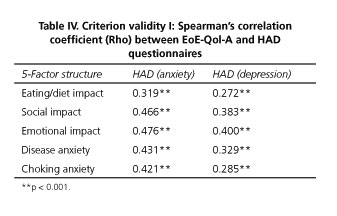
    <p><font face="Verdana" size="2">Statistically significant correlations (Spearman Rho) between the EoE-QoL-A and HAD questionnaires were documented for both anxiety and depression levels; however, anxiety levels demonstrated a stronger correlation than depression (<a href="#t4">Table IV</a>). These results remained unchanged in the retest phase 3 months later.</font></p>
    <p>&nbsp;</p>
    <p align="center"><font face="Verdana" size="2"><a name="t4"><img src="/img/revistas/diges/v106n6/original3_table4.jpg"></a></font></p>
    <p>&nbsp;</p>
    ]]></body>
<body><![CDATA[<p><font face="Verdana" size="2"><b><i>BIPQ<sub>v2</sub> (disease perception)</i></b></font></p>
    <p><font face="Verdana" size="2">A pattern of relevant, meaningful, and consistent correlations between the EoE-QoL-A and BIPQ<sub>v2</sub> scales was demonstrated, relating disease perception and the impact of EoE (<a href="#t5">Table V</a>). Disease impact (item 1), symptoms or discomfort from the disease (item 5), concern about the disease (item 6) and how the disease affects the patient's own life (item 8) were the dimensions that best correlated with the five dimensions of the EoE-related QoL. In contrast, patient attitudes towards controlling the disease (item 3) and the usefulness of treatment (item 4) did not significantly correlate with any of the items on the EoE-QoL-A. Retest results after 3 months were similar.</font></p>
    <p>&nbsp;</p>
    <p align="center"><font face="Verdana" size="2"><a name="t5"><img src="/img/revistas/diges/v106n6/original3_table5.jpg"></a></font></p>
    <p>&nbsp;</p>
    <p><font face="Verdana" size="2"><b><i>SF-12</i></b></font></p>
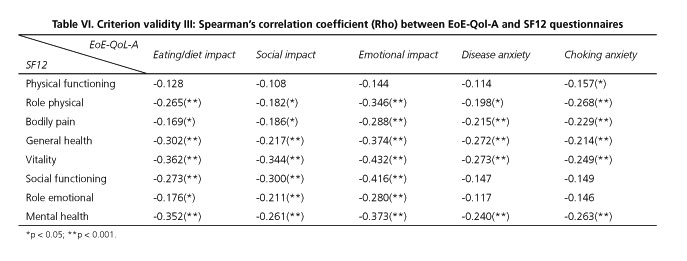
    <p><font face="Verdana" size="2">The five dimensions of the EoE-QoL-A inversely and significantly correlated with mental health, vitality, overall health status, bodily pain, and physical functioning. In contrast, the emotional and social functioning scales did not correlate with the anxiety dimensions of the EoE-QoL-A and physical functioning only correlated weakly with choking anxiety (<a href="#t6">Table VI</a>). These correlations were unchanged after 3 months.</font></p>
    <p>&nbsp;</p>
    <p align="center"><font face="Verdana" size="2"><a name="t6"><img src="/img/revistas/diges/v106n6/original3_table6.jpg"></a></font></p>
    <p>&nbsp;</p>
    ]]></body>
<body><![CDATA[<p><font face="Verdana" size="2"><b>Test/retest reliability (intraclass correlation coefficients)</b></font></p>
    <p><font face="Verdana" size="2">The retest results between administration of the first and second questionnaire in the series of 158 patients who completed two set of questionnaires were consistent. The intraclass correlation coefficients between the different questionnaires used during the first and second visits were acceptable, with the EoE-QoL-A questionnaire exhibiting the highest intraclass correlation coefficients (<a href="#t7">Table VII</a>).</font></p>
    <p>&nbsp;</p>
    <p align="center"><font face="Verdana" size="2"><a name="t7"><img src="/img/revistas/diges/v106n6/original3_table7.jpg"></a></font></p>
    <p>&nbsp;</p>
    <p><font face="Verdana" size="2"><b>Discussion</b></font></p>
    <p><font face="Verdana" size="2">This qualitative research has produced a Spanish version of the EoE-QoL-A questionnaire, which, after transcultural validation and adaptation, has proven to be a reliable, valid, and responsive instrument for assessing heath related QoL in adult men and women with EoE.</font></p>
    <p><font face="Verdana" size="2">Chronic diseases such as EoE significantly impact the QoL of affected patients over and above the proper medical control that can be provided (which, in the case of EoE, aims for histological and symptomatic remission). Specific instruments for measuring QoL have demonstrated their usefulness as tools to provide insight into new dimensions of disease. In turn, the advantages gained from measuring health-related QoL have inspired the creation of new questionnaires adapted to different diseases. However, most questionnaires measuring QoL, including the EoO-A-QoL, were originally developed in English. Given the complexity of developing these questionnaires, their translation and validation into other languages and cultural environments has become a common strategy that further allows comparisons between patients of various cultural and linguistic backgrounds. For this reason, we have embarked upon this project to translate and validate the EoE-QoL-A questionnaire, which was originally developed in English for adult American EoE patients (22,23). Our research involved the translation, retro-translation, and understandability rating of the questionnaire; subsequently, the main psychometric properties of the Spanish version of the EoE-QoL-A questionnaire were analyzed for internal convergent and discriminate validity. By readministering the questionnaire to the same patients after a 3-month period during which no therapeutic changes were undertaken, we were able to analyze the questionnaire's stability and sensitivity to change.</font></p>
    <p><font face="Verdana" size="2">The internal validity of the Spanish version of the EoE-QoL-A has been shown to adequately fulfill the properties of floor and ceiling effects -as well as those of feasibility and reliability- with very high Cronbach alpha values, obtained in both the first and second administration of the questionnaire to patients.</font></p>
    <p><font face="Verdana" size="2">Since no previous questionnaire capable of assessing the health-related QoL of EoE patients was available, the convergent validity of the Spanish version of the EoE-QoL-A questionnaire was analyzed through comparison with the SF-12 questionnaire, a generic tool already validated for use in Spanish and widely recognized and used in clinical practice. Another validated instrument was used to measure self-reported anxiety and depression (HAD scale) while perception of the disease was assessed with the aid of the validated BIPQ<sub>v2</sub> questionnaire. Correlation between the overall scores of the Spanish version of EoE-QoL-A and the remaining questionnaires was high and statistically significant, demonstrating the validity of our translated and adapted version.</font></p>
    ]]></body>
<body><![CDATA[<p><font face="Verdana" size="2">Anxiety about the disease was the most affected dimension of the EoE-QoL-A questionnaire. This may reflect a lack of knowledge about the effectiveness of available EoE treatments, or it may be associated with the uncertainties associated with the onset of a relatively new and partially unknown disease, not only for patients, but also for many physicians. Caregivers can help alleviate some of these concerns by providing patients with accurate information about the disease, its prognosis, and the currently available treatment alternatives. The greatest concern expressed by patients was choking anxiety; indeed the fear of suffering a food impaction requiring endoscopic removal overwhelmingly led patients to adopt adaptive behaviors with regard to their social and eating habits. In order to alleviate this fear, providing patients with effective therapies capable of achieving sustained disease remission is of the utmost importance.</font></p>
    <p><font face="Verdana" size="2">Interestingly, one of the least affected dimensions was the impact on eating/diet, although it was significantly more affected among patients following some type of dietary restriction, as was also the case with emotional impact of the disease. However, because the eating/diet impact dimension was also affected, albeit to a lesser extent, in patients on a regular diet, it is possible that this finding does not reflect the real quality of eating, but rather long-standing, normalized behavioral modifications, including food avoidance, food and/or consistency modification, and changes in eating pace. Emotional impact was the least affected dimension, which may reflect a reality in which dysphagia is not perceived as a troublesome symptom and does not impair the psychosocial development of the individual.</font></p>
    <p><font face="Verdana" size="2">Transcultural validation studies for instruments that attempt to measure health-related QoL generally have several biases and limitations. On the one hand, the linguistic difficulties in finding semantic equivalents between the original and target language must be taken into account. To deal with this problem, we opted for a "free translation" of the original EoE-A-QoL questionnaire, more related to the sense and meaning of the expression than to strict linguistic correctness or syntax. Participating translators were able to contribute with their opinions and choose among several versions considered to be correct. The initial version of the questionnaire was also refined after a pilot test was conducted on a small number of EoE patients. Proof of correctness and equivalence between the two instruments was provided by the high internal consistency within the proposed/explored/found dimensions by the questionnaire designer and the almost identical factorial structure observed after applying an exploratory factorial analysis to our data.</font></p>
    <p><font face="Verdana" size="2">Another common problem with questionnaires has to do with inconsistencies in the measurement of the constructs they are supposed to measure. To avoid this, new questionnaires are usually compared to other questionnaires that have already been validated in representative populations. In our work, we found a high degree of consistency between the responses to the EoE-A-QoL questionnaire and the dimensions and constructs of the SF12, HAD, and BIPQ<sub>v2</sub>.</font></p>
    <p><font face="Verdana" size="2">Finally, another common problem with adapting this type of instrument has to do with the lack or excess of interpersonal and intrapersonal variability, which renders a questionnaire unsuitable and unstable. Fortunately, this was not the case for our Spanish version of the EoE-A-QoL questionnaire, which showed an acceptable variability among patients from several centers around the country, all at different stages of the disease. To date, the Spanish EoE-A-QoL questionnaire has also exhibited a good intra-patient variability, with equivalent and stable results after being administered a second time.</font></p>
    <p><font face="Verdana" size="2">Still, it is possible that the Spanish version of the EoE-A-QoL questionnaire may need future adjustments and, if possible, simplifications, in order to make it even more suitable for routine use in measuring health-related QoL in adult EoE patients.</font></p>
    <p><font face="Verdana" size="2">In conclusion, a valid EoE-A-QoL Spanish questionnaire is now available as a useful tool in clinical practice to specifically measure health-related QoL in adult patients with EoE. Anxiety related to disease diagnosis and choking were the most affected dimensions in the QoL of adult EoE patients. Continuous medical education, advances in research, and implementation of effective therapies may thus be the most effective ways to improve QoL in these patients.</font></p>
    <p>&nbsp;</p>
    <p><font face="Verdana" size="2"><b>Acknowledgements</b></font></p>
    <p><font face="Verdana" size="2">We would like to thank Dr. Tiffany T. Taft, PsyD, from the Center for Psychosocial Research in GI, Northwestern University Feinberg School of Medicine, for her helpful comments on the manuscript and insight in this study.</font></p>
    ]]></body>
<body><![CDATA[<p>&nbsp;</p>
    <p><font face="Verdana" size="2"><b>References</b></font></p>
    <!-- ref --><p><font face="Verdana" size="2">1. Liacouras CA, Furuta GT, Hirano I, Atkins D, Attwood SE, Bonis PA, et al. J Allergy Clin Immunol 2011;128:3-20.    &nbsp;&nbsp;&nbsp;&nbsp;&nbsp;&nbsp;&nbsp;&nbsp;[&#160;<a href="javascript:void(0);" onclick="javascript: window.open('/scielo.php?script=sci_nlinks&ref=5407550&pid=S1130-0108201400060000400001&lng=','','width=640,height=500,resizable=yes,scrollbars=1,menubar=yes,');">Links</a>&#160;]<!-- end-ref --></font></p>    <!-- ref --><p><font face="Verdana" size="2">2. DeBrosse CW, Franciosi JP, King EC, Butz BK, Greenberg AB, Collins MH, et. Long-term outcomes in pediatric-onset esophageal eosinophilia. J Allergy Clin Immunol 2011;128:132-8.    &nbsp;&nbsp;&nbsp;&nbsp;&nbsp;&nbsp;&nbsp;&nbsp;[&#160;<a href="javascript:void(0);" onclick="javascript: window.open('/scielo.php?script=sci_nlinks&ref=5407552&pid=S1130-0108201400060000400002&lng=','','width=640,height=500,resizable=yes,scrollbars=1,menubar=yes,');">Links</a>&#160;]<!-- end-ref --></font></p>    <!-- ref --><p><font face="Verdana" size="2">3. Hruz P, Straumann A, Bussmann C, Heer P, Simon HU, Zwahlen M, et al. Escalating incidence of eosinophilic esophagitis: A 20-year prospective, population-based study in Olten County, Switzerland. J Allergy Clin Immunol 2011;128:1349-50.    &nbsp;&nbsp;&nbsp;&nbsp;&nbsp;&nbsp;&nbsp;&nbsp;[&#160;<a href="javascript:void(0);" onclick="javascript: window.open('/scielo.php?script=sci_nlinks&ref=5407554&pid=S1130-0108201400060000400003&lng=','','width=640,height=500,resizable=yes,scrollbars=1,menubar=yes,');">Links</a>&#160;]<!-- end-ref --></font></p>    <!-- ref --><p><font face="Verdana" size="2">4. Arias A, Lucendo AJ. Prevalence of eosinophilic oesophagitis in adult patients in a central region of Spain. Eur J Gastroenterol Hepatol 2013;25:208-12.    &nbsp;&nbsp;&nbsp;&nbsp;&nbsp;&nbsp;&nbsp;&nbsp;[&#160;<a href="javascript:void(0);" onclick="javascript: window.open('/scielo.php?script=sci_nlinks&ref=5407556&pid=S1130-0108201400060000400004&lng=','','width=640,height=500,resizable=yes,scrollbars=1,menubar=yes,');">Links</a>&#160;]<!-- end-ref --></font></p>    ]]></body>
<body><![CDATA[<!-- ref --><p><font face="Verdana" size="2">5. Dellon ES, Jensen ET, Martin CF, Shaheen NJ, Kappelman MD. The Prevalence of eosinophilic esophagitis in the United States. Clin Gastroenterol Hepatol&nbsp;2014;12:589-96.e1.    &nbsp;&nbsp;&nbsp;&nbsp;&nbsp;&nbsp;&nbsp;&nbsp;[&#160;<a href="javascript:void(0);" onclick="javascript: window.open('/scielo.php?script=sci_nlinks&ref=5407558&pid=S1130-0108201400060000400005&lng=','','width=640,height=500,resizable=yes,scrollbars=1,menubar=yes,');">Links</a>&#160;]<!-- end-ref --></font></p>    <!-- ref --><p><font face="Verdana" size="2">6. Ronkainen J, Talley NJ, Aro P, Storskrubb T, Johansson SE, Lind T, et al. Prevalence of oesophageal eosinophils and eosinophilic oesophagitis in adults: The population-based Kalixanda study. Gut 2007;56:615-20.    &nbsp;&nbsp;&nbsp;&nbsp;&nbsp;&nbsp;&nbsp;&nbsp;[&#160;<a href="javascript:void(0);" onclick="javascript: window.open('/scielo.php?script=sci_nlinks&ref=5407560&pid=S1130-0108201400060000400006&lng=','','width=640,height=500,resizable=yes,scrollbars=1,menubar=yes,');">Links</a>&#160;]<!-- end-ref --></font></p>    <!-- ref --><p><font face="Verdana" size="2">7. Lucendo AJ, Sanchez-Cazalilla M. Adult versus pediatric eosinophilic esophagitis: important differences and similarities for the clinician to understand. Expert Rev Clin Immunol 2012;8:733-45.    &nbsp;&nbsp;&nbsp;&nbsp;&nbsp;&nbsp;&nbsp;&nbsp;[&#160;<a href="javascript:void(0);" onclick="javascript: window.open('/scielo.php?script=sci_nlinks&ref=5407562&pid=S1130-0108201400060000400007&lng=','','width=640,height=500,resizable=yes,scrollbars=1,menubar=yes,');">Links</a>&#160;]<!-- end-ref --></font></p>    <!-- ref --><p><font face="Verdana" size="2">8. Straumann A. The natural history and complications of eosinophilic esophagitis. Gastrointest Endosc Clin N Am 2008;18:99-118.    &nbsp;&nbsp;&nbsp;&nbsp;&nbsp;&nbsp;&nbsp;&nbsp;[&#160;<a href="javascript:void(0);" onclick="javascript: window.open('/scielo.php?script=sci_nlinks&ref=5407564&pid=S1130-0108201400060000400008&lng=','','width=640,height=500,resizable=yes,scrollbars=1,menubar=yes,');">Links</a>&#160;]<!-- end-ref --></font></p>    <!-- ref --><p><font face="Verdana" size="2">9. Klinnert MD. Psychological impact of eosinophilic esophagitis on children and families. Immunol Allergy Clin North Am 2009;29:99-107.    &nbsp;&nbsp;&nbsp;&nbsp;&nbsp;&nbsp;&nbsp;&nbsp;[&#160;<a href="javascript:void(0);" onclick="javascript: window.open('/scielo.php?script=sci_nlinks&ref=5407566&pid=S1130-0108201400060000400009&lng=','','width=640,height=500,resizable=yes,scrollbars=1,menubar=yes,');">Links</a>&#160;]<!-- end-ref --></font></p>    ]]></body>
<body><![CDATA[<!-- ref --><p><font face="Verdana" size="2">10. Harris RF, Menard-Katcher C, Atkins D, Furuta GT, Klinnert MD. Psychosocial dysfunction in children and adolescents with eosinophilic esophagitis. J Pediatr Gastroenterol Nutr 2013;57:500-5.    &nbsp;&nbsp;&nbsp;&nbsp;&nbsp;&nbsp;&nbsp;&nbsp;[&#160;<a href="javascript:void(0);" onclick="javascript: window.open('/scielo.php?script=sci_nlinks&ref=5407568&pid=S1130-0108201400060000400010&lng=','','width=640,height=500,resizable=yes,scrollbars=1,menubar=yes,');">Links</a>&#160;]<!-- end-ref --></font></p>    <!-- ref --><p><font face="Verdana" size="2">11. Gonzalez-Castillo S, Arias A, Lucendo AJ. Treatment of eosinophilic esophagitis: How should we manage the disease? J Clin Gastroenterol 2010;44:663-71.    &nbsp;&nbsp;&nbsp;&nbsp;&nbsp;&nbsp;&nbsp;&nbsp;[&#160;<a href="javascript:void(0);" onclick="javascript: window.open('/scielo.php?script=sci_nlinks&ref=5407570&pid=S1130-0108201400060000400011&lng=','','width=640,height=500,resizable=yes,scrollbars=1,menubar=yes,');">Links</a>&#160;]<!-- end-ref --></font></p>    <!-- ref --><p><font face="Verdana" size="2">12. Casellas F, Lopez-Vivancos J, Casado A, Malagelada JR. Factors affecting health related quality of life of patients with inflammatory bowel disease. Qual Life Res 2002;11:775-81.    &nbsp;&nbsp;&nbsp;&nbsp;&nbsp;&nbsp;&nbsp;&nbsp;[&#160;<a href="javascript:void(0);" onclick="javascript: window.open('/scielo.php?script=sci_nlinks&ref=5407572&pid=S1130-0108201400060000400012&lng=','','width=640,height=500,resizable=yes,scrollbars=1,menubar=yes,');">Links</a>&#160;]<!-- end-ref --></font></p>    <!-- ref --><p><font face="Verdana" size="2">13. Garrigues V, Ortiz V, Casanova C, Bujanda L, Moreno-Osset E, Rodr&iacute;guez-T&eacute;llez M, et al. Disease-specific health-related quality of life in patients with esophageal achalasia before and after therapy. Neurogastroenterol Motil 2010;22:739-45.    &nbsp;&nbsp;&nbsp;&nbsp;&nbsp;&nbsp;&nbsp;&nbsp;[&#160;<a href="javascript:void(0);" onclick="javascript: window.open('/scielo.php?script=sci_nlinks&ref=5407574&pid=S1130-0108201400060000400013&lng=','','width=640,height=500,resizable=yes,scrollbars=1,menubar=yes,');">Links</a>&#160;]<!-- end-ref --></font></p>    <!-- ref --><p><font face="Verdana" size="2">14. Hoivik ML, Bernklev T, Moum B. Need for standardization in population-based quality of life studies: A review of the current literature. Inflamm Bowel Dis 2010;16:525-35.    &nbsp;&nbsp;&nbsp;&nbsp;&nbsp;&nbsp;&nbsp;&nbsp;[&#160;<a href="javascript:void(0);" onclick="javascript: window.open('/scielo.php?script=sci_nlinks&ref=5407576&pid=S1130-0108201400060000400014&lng=','','width=640,height=500,resizable=yes,scrollbars=1,menubar=yes,');">Links</a>&#160;]<!-- end-ref --></font></p>    ]]></body>
<body><![CDATA[<!-- ref --><p><font face="Verdana" size="2">15. Amouretti M, Le Pen C, Gaudin AF, et al. Impact of irritable bowel syndrome (IBS) on health-related quality of life (HRQOL). Gastroenterol Clin Biol 2006;30:241-6.    &nbsp;&nbsp;&nbsp;&nbsp;&nbsp;&nbsp;&nbsp;&nbsp;[&#160;<a href="javascript:void(0);" onclick="javascript: window.open('/scielo.php?script=sci_nlinks&ref=5407578&pid=S1130-0108201400060000400015&lng=','','width=640,height=500,resizable=yes,scrollbars=1,menubar=yes,');">Links</a>&#160;]<!-- end-ref --></font></p>    <!-- ref --><p><font face="Verdana" size="2">16. Casellas F, Rodrigo L, Molina-Infante J, Vivas S, Lucendo AJ, Rosinach M, et al. Transcultural adaptation and validation of the Celiac Disease Quality of Life (CD-QOL) survey, a specific questionnaire to measure quality of life in patients with celiac disease. Rev Esp Enferm Dig 2013;105:585-93.    &nbsp;&nbsp;&nbsp;&nbsp;&nbsp;&nbsp;&nbsp;&nbsp;[&#160;<a href="javascript:void(0);" onclick="javascript: window.open('/scielo.php?script=sci_nlinks&ref=5407580&pid=S1130-0108201400060000400016&lng=','','width=640,height=500,resizable=yes,scrollbars=1,menubar=yes,');">Links</a>&#160;]<!-- end-ref --></font></p>    <!-- ref --><p><font face="Verdana" size="2">17. Guyatt GH, Feeny DH, Patrick DL. Measuring health-related quality of life. Ann Intern Med 1993;118:622-9.    &nbsp;&nbsp;&nbsp;&nbsp;&nbsp;&nbsp;&nbsp;&nbsp;[&#160;<a href="javascript:void(0);" onclick="javascript: window.open('/scielo.php?script=sci_nlinks&ref=5407582&pid=S1130-0108201400060000400017&lng=','','width=640,height=500,resizable=yes,scrollbars=1,menubar=yes,');">Links</a>&#160;]<!-- end-ref --></font></p>    <!-- ref --><p><font face="Verdana" size="2">18. Testa M. Current concepts: Assessment of quality-of-life outcomes. N Eng J Med 1996;334:835-40.    &nbsp;&nbsp;&nbsp;&nbsp;&nbsp;&nbsp;&nbsp;&nbsp;[&#160;<a href="javascript:void(0);" onclick="javascript: window.open('/scielo.php?script=sci_nlinks&ref=5407584&pid=S1130-0108201400060000400018&lng=','','width=640,height=500,resizable=yes,scrollbars=1,menubar=yes,');">Links</a>&#160;]<!-- end-ref --></font></p>    <!-- ref --><p><font face="Verdana" size="2">19. Testa M. Measurement of health outcomes in treatment effectiveness evaluations: conceptual and methodological challenges. Med Care 2000;38(9 Supl.):II14-25.    &nbsp;&nbsp;&nbsp;&nbsp;&nbsp;&nbsp;&nbsp;&nbsp;[&#160;<a href="javascript:void(0);" onclick="javascript: window.open('/scielo.php?script=sci_nlinks&ref=5407586&pid=S1130-0108201400060000400019&lng=','','width=640,height=500,resizable=yes,scrollbars=1,menubar=yes,');">Links</a>&#160;]<!-- end-ref --></font></p>    ]]></body>
<body><![CDATA[<!-- ref --><p><font face="Verdana" size="2">20. Taft TH, Kern E, Keefer L, Burstein D, Hirano I. Qualitative assessment of patient-reported outcomes in adults with eosinophilic esophagitis. J Clin Gastroenterol 2011;45:769-74.    &nbsp;&nbsp;&nbsp;&nbsp;&nbsp;&nbsp;&nbsp;&nbsp;[&#160;<a href="javascript:void(0);" onclick="javascript: window.open('/scielo.php?script=sci_nlinks&ref=5407588&pid=S1130-0108201400060000400020&lng=','','width=640,height=500,resizable=yes,scrollbars=1,menubar=yes,');">Links</a>&#160;]<!-- end-ref --></font></p>    <!-- ref --><p><font face="Verdana" size="2">21. Franciosi JP, Hommel KA, DeBrosse CW, Greenberg AB, Greenler AJ, Abonia JP, et al. Quality of life in paediatric eosinophilic oesophagitis: What is important to patients? Child Care Health Dev 2012;38:477-83.    &nbsp;&nbsp;&nbsp;&nbsp;&nbsp;&nbsp;&nbsp;&nbsp;[&#160;<a href="javascript:void(0);" onclick="javascript: window.open('/scielo.php?script=sci_nlinks&ref=5407590&pid=S1130-0108201400060000400021&lng=','','width=640,height=500,resizable=yes,scrollbars=1,menubar=yes,');">Links</a>&#160;]<!-- end-ref --></font></p>    <!-- ref --><p><font face="Verdana" size="2">22. Taft TH, Kern E, Kwiatek MA, Hirano I, Gonsalves N, Keefer L. The adult eosinophilic oesophagitis quality of life questionnaire: A new measure of health-related quality of life. Aliment Pharmacol Ther 2011;34:790-8.    &nbsp;&nbsp;&nbsp;&nbsp;&nbsp;&nbsp;&nbsp;&nbsp;[&#160;<a href="javascript:void(0);" onclick="javascript: window.open('/scielo.php?script=sci_nlinks&ref=5407592&pid=S1130-0108201400060000400022&lng=','','width=640,height=500,resizable=yes,scrollbars=1,menubar=yes,');">Links</a>&#160;]<!-- end-ref --></font></p>    <!-- ref --><p><font face="Verdana" size="2">23. Bajaj S, Taft T, Keefer L, Gonsalves N, Hirano I. Validity, usability, and acceptability of the Eosinophilic Esophagitis Quality of Life scale for adults (EoE-QOL-A). Gastroenterology 2012;142 (Suppl 1):S-434.    &nbsp;&nbsp;&nbsp;&nbsp;&nbsp;&nbsp;&nbsp;&nbsp;[&#160;<a href="javascript:void(0);" onclick="javascript: window.open('/scielo.php?script=sci_nlinks&ref=5407594&pid=S1130-0108201400060000400023&lng=','','width=640,height=500,resizable=yes,scrollbars=1,menubar=yes,');">Links</a>&#160;]<!-- end-ref --></font></p>    <!-- ref --><p><font face="Verdana" size="2">24. Vilagut G, Valderas JM, Ferrer M, Garin O, L&oacute;pez-Garc&iacute;a E, Alonso J. Interpretation of SF-36 and SF-12 questionnaires in Spain: Physical and mental components. Med Clin (Barc) 1986;130:726-35.    &nbsp;&nbsp;&nbsp;&nbsp;&nbsp;&nbsp;&nbsp;&nbsp;[&#160;<a href="javascript:void(0);" onclick="javascript: window.open('/scielo.php?script=sci_nlinks&ref=5407596&pid=S1130-0108201400060000400024&lng=','','width=640,height=500,resizable=yes,scrollbars=1,menubar=yes,');">Links</a>&#160;]<!-- end-ref --></font></p>    ]]></body>
<body><![CDATA[<!-- ref --><p><font face="Verdana" size="2">25. Broadbent E, Petrie KJ, Main J, Weinman JA. The Brief Illness Perception Questionnaire. J Psichosom E 2006:60;631-7.    &nbsp;&nbsp;&nbsp;&nbsp;&nbsp;&nbsp;&nbsp;&nbsp;[&#160;<a href="javascript:void(0);" onclick="javascript: window.open('/scielo.php?script=sci_nlinks&ref=5407598&pid=S1130-0108201400060000400025&lng=','','width=640,height=500,resizable=yes,scrollbars=1,menubar=yes,');">Links</a>&#160;]<!-- end-ref --></font></p>    <!-- ref --><p><font face="Verdana" size="2">26. Pacheco-Huergo V, Viladrich C, Pujol-Ribera E, Cabezas-Pe&ntilde;a C, N&uacute;&ntilde;ez M, Roura-Olmeda P, et al. Perception in chronic illnesses: Linguistic validation of the revised Illness Perception Questionnaire and the Brief Illness Perception Questionnaire for a Spanish population. Aten Primaria 2012;44:280-7.    &nbsp;&nbsp;&nbsp;&nbsp;&nbsp;&nbsp;&nbsp;&nbsp;[&#160;<a href="javascript:void(0);" onclick="javascript: window.open('/scielo.php?script=sci_nlinks&ref=5407600&pid=S1130-0108201400060000400026&lng=','','width=640,height=500,resizable=yes,scrollbars=1,menubar=yes,');">Links</a>&#160;]<!-- end-ref --></font></p>    <!-- ref --><p><font face="Verdana" size="2">27. Tejero A, Guimer&aacute; EM, Farr&eacute; JM, Peri JM. Uso cl&iacute;nico del HAD (Hospital Anxiety and Depression Scale) en poblaci&oacute;n psiqui&aacute;trica: un estudio de su sensibilidad, fiabilidad y validez. Rev Depto Psiquiatr&iacute;a Facultad de Med Barna 1986;13:233-8.    &nbsp;&nbsp;&nbsp;&nbsp;&nbsp;&nbsp;&nbsp;&nbsp;[&#160;<a href="javascript:void(0);" onclick="javascript: window.open('/scielo.php?script=sci_nlinks&ref=5407602&pid=S1130-0108201400060000400027&lng=','','width=640,height=500,resizable=yes,scrollbars=1,menubar=yes,');">Links</a>&#160;]<!-- end-ref --></font></p>    <!-- ref --><p><font face="Verdana" size="2">28. Terwee CB, Bot SD, de Boer MR, van der Windt DA, Knol DL, Dekker J, et al. Quality criteria were proposed for measurement properties of health status questionnaires. J Clin Epidemiol 2007;60:34-42.    &nbsp;&nbsp;&nbsp;&nbsp;&nbsp;&nbsp;&nbsp;&nbsp;[&#160;<a href="javascript:void(0);" onclick="javascript: window.open('/scielo.php?script=sci_nlinks&ref=5407604&pid=S1130-0108201400060000400028&lng=','','width=640,height=500,resizable=yes,scrollbars=1,menubar=yes,');">Links</a>&#160;]<!-- end-ref --></font></p>
    <p>&nbsp;</p>
    <p>&nbsp;</p>
    ]]></body>
<body><![CDATA[<p><font face="Verdana" size="2"><a href="#top"><img border="0" src="/img/revistas/diges/v106n6/seta.gif" width="15" height="17"></a><a name="bajo"></a><b>Correspondence:</b>    <br>Alfredo J. Lucendo.    <br>Department of Gastroenterology.    <br>Hospital General de Tomelloso.    <br>Vereda de Socu&eacute;llamos, s/n.    <br>13700 Tomelloso, Ciudad Real. Spain    <br>e-mail: <a href="mailto:alucendo@vodafone.es">alucendo@vodafone.es</a></font></p>
    <p><font face="Verdana" size="2">Received: 31-03-2014    <br>Accepted: 07-07-2014</font></p>
     ]]></body><back>
<ref-list>
<ref id="B1">
<label>1</label><nlm-citation citation-type="journal">
<person-group person-group-type="author">
<name>
<surname><![CDATA[Liacouras]]></surname>
<given-names><![CDATA[CA]]></given-names>
</name>
<name>
<surname><![CDATA[Furuta]]></surname>
<given-names><![CDATA[GT]]></given-names>
</name>
<name>
<surname><![CDATA[Hirano]]></surname>
<given-names><![CDATA[I]]></given-names>
</name>
<name>
<surname><![CDATA[Atkins]]></surname>
<given-names><![CDATA[D]]></given-names>
</name>
<name>
<surname><![CDATA[Attwood]]></surname>
<given-names><![CDATA[SE]]></given-names>
</name>
<name>
<surname><![CDATA[Bonis]]></surname>
<given-names><![CDATA[PA]]></given-names>
</name>
</person-group>
<source><![CDATA[J Allergy Clin Immunol]]></source>
<year>2011</year>
<volume>128</volume>
<page-range>3-20</page-range></nlm-citation>
</ref>
<ref id="B2">
<label>2</label><nlm-citation citation-type="journal">
<person-group person-group-type="author">
<name>
<surname><![CDATA[DeBrosse]]></surname>
<given-names><![CDATA[CW]]></given-names>
</name>
<name>
<surname><![CDATA[Franciosi]]></surname>
<given-names><![CDATA[JP]]></given-names>
</name>
<name>
<surname><![CDATA[King]]></surname>
<given-names><![CDATA[EC]]></given-names>
</name>
<name>
<surname><![CDATA[Butz]]></surname>
<given-names><![CDATA[BK]]></given-names>
</name>
<name>
<surname><![CDATA[Greenberg]]></surname>
<given-names><![CDATA[AB]]></given-names>
</name>
<name>
<surname><![CDATA[Collins]]></surname>
<given-names><![CDATA[MH]]></given-names>
</name>
</person-group>
<article-title xml:lang="en"><![CDATA[Long-term outcomes in pediatric-onset esophageal eosinophilia]]></article-title>
<source><![CDATA[J Allergy Clin Immunol]]></source>
<year>2011</year>
<volume>128</volume>
<page-range>132-8</page-range></nlm-citation>
</ref>
<ref id="B3">
<label>3</label><nlm-citation citation-type="journal">
<person-group person-group-type="author">
<name>
<surname><![CDATA[Hruz]]></surname>
<given-names><![CDATA[P]]></given-names>
</name>
<name>
<surname><![CDATA[Straumann]]></surname>
<given-names><![CDATA[A]]></given-names>
</name>
<name>
<surname><![CDATA[Bussmann]]></surname>
<given-names><![CDATA[C]]></given-names>
</name>
<name>
<surname><![CDATA[Heer]]></surname>
<given-names><![CDATA[P]]></given-names>
</name>
<name>
<surname><![CDATA[Simon]]></surname>
<given-names><![CDATA[HU]]></given-names>
</name>
<name>
<surname><![CDATA[Zwahlen]]></surname>
<given-names><![CDATA[M]]></given-names>
</name>
</person-group>
<article-title xml:lang="en"><![CDATA[Escalating incidence of eosinophilic esophagitis: A 20-year prospective, population-based study in Olten County, Switzerland]]></article-title>
<source><![CDATA[J Allergy Clin Immunol]]></source>
<year>2011</year>
<volume>128</volume>
<page-range>1349-50</page-range></nlm-citation>
</ref>
<ref id="B4">
<label>4</label><nlm-citation citation-type="journal">
<person-group person-group-type="author">
<name>
<surname><![CDATA[Arias]]></surname>
<given-names><![CDATA[A]]></given-names>
</name>
<name>
<surname><![CDATA[Lucendo]]></surname>
<given-names><![CDATA[AJ]]></given-names>
</name>
</person-group>
<article-title xml:lang="en"><![CDATA[Prevalence of eosinophilic oesophagitis in adult patients in a central region of Spain]]></article-title>
<source><![CDATA[Eur J Gastroenterol Hepatol]]></source>
<year>2013</year>
<volume>25</volume>
<page-range>208-12</page-range></nlm-citation>
</ref>
<ref id="B5">
<label>5</label><nlm-citation citation-type="journal">
<person-group person-group-type="author">
<name>
<surname><![CDATA[Dellon]]></surname>
<given-names><![CDATA[ES]]></given-names>
</name>
<name>
<surname><![CDATA[Jensen]]></surname>
<given-names><![CDATA[ET]]></given-names>
</name>
<name>
<surname><![CDATA[Martin]]></surname>
<given-names><![CDATA[CF]]></given-names>
</name>
<name>
<surname><![CDATA[Shaheen]]></surname>
<given-names><![CDATA[NJ]]></given-names>
</name>
<name>
<surname><![CDATA[Kappelman]]></surname>
<given-names><![CDATA[MD]]></given-names>
</name>
</person-group>
<article-title xml:lang="en"><![CDATA[The Prevalence of eosinophilic esophagitis in the United States]]></article-title>
<source><![CDATA[Clin Gastroenterol Hepatol]]></source>
<year>2014</year>
<volume>12</volume>
<page-range>589-96</page-range></nlm-citation>
</ref>
<ref id="B6">
<label>6</label><nlm-citation citation-type="journal">
<person-group person-group-type="author">
<name>
<surname><![CDATA[Ronkainen]]></surname>
<given-names><![CDATA[J]]></given-names>
</name>
<name>
<surname><![CDATA[Talley]]></surname>
<given-names><![CDATA[NJ]]></given-names>
</name>
<name>
<surname><![CDATA[Aro]]></surname>
<given-names><![CDATA[P]]></given-names>
</name>
<name>
<surname><![CDATA[Storskrubb]]></surname>
<given-names><![CDATA[T]]></given-names>
</name>
<name>
<surname><![CDATA[Johansson]]></surname>
<given-names><![CDATA[SE]]></given-names>
</name>
<name>
<surname><![CDATA[Lind]]></surname>
<given-names><![CDATA[T]]></given-names>
</name>
</person-group>
<article-title xml:lang="en"><![CDATA[Prevalence of oesophageal eosinophils and eosinophilic oesophagitis in adults: The population-based Kalixanda study]]></article-title>
<source><![CDATA[Gut]]></source>
<year>2007</year>
<volume>56</volume>
<page-range>615-20</page-range></nlm-citation>
</ref>
<ref id="B7">
<label>7</label><nlm-citation citation-type="journal">
<person-group person-group-type="author">
<name>
<surname><![CDATA[Lucendo]]></surname>
<given-names><![CDATA[AJ]]></given-names>
</name>
<name>
<surname><![CDATA[Sanchez-Cazalilla]]></surname>
<given-names><![CDATA[M]]></given-names>
</name>
</person-group>
<article-title xml:lang="en"><![CDATA[Adult versus pediatric eosinophilic esophagitis: important differences and similarities for the clinician to understand]]></article-title>
<source><![CDATA[Expert Rev Clin Immunol]]></source>
<year>2012</year>
<volume>8</volume>
<page-range>733-45</page-range></nlm-citation>
</ref>
<ref id="B8">
<label>8</label><nlm-citation citation-type="journal">
<person-group person-group-type="author">
<name>
<surname><![CDATA[Straumann]]></surname>
<given-names><![CDATA[A]]></given-names>
</name>
</person-group>
<article-title xml:lang="en"><![CDATA[The natural history and complications of eosinophilic esophagitis]]></article-title>
<source><![CDATA[Gastrointest Endosc Clin N Am]]></source>
<year>2008</year>
<volume>18</volume>
<page-range>99-118</page-range></nlm-citation>
</ref>
<ref id="B9">
<label>9</label><nlm-citation citation-type="journal">
<person-group person-group-type="author">
<name>
<surname><![CDATA[Klinnert]]></surname>
<given-names><![CDATA[MD]]></given-names>
</name>
</person-group>
<article-title xml:lang="en"><![CDATA[Psychological impact of eosinophilic esophagitis on children and families]]></article-title>
<source><![CDATA[Immunol Allergy Clin North Am]]></source>
<year>2009</year>
<volume>29</volume>
<page-range>99-107</page-range></nlm-citation>
</ref>
<ref id="B10">
<label>10</label><nlm-citation citation-type="journal">
<person-group person-group-type="author">
<name>
<surname><![CDATA[Harris]]></surname>
<given-names><![CDATA[RF]]></given-names>
</name>
<name>
<surname><![CDATA[Menard-Katcher]]></surname>
<given-names><![CDATA[C]]></given-names>
</name>
<name>
<surname><![CDATA[Atkins]]></surname>
<given-names><![CDATA[D]]></given-names>
</name>
<name>
<surname><![CDATA[Furuta]]></surname>
<given-names><![CDATA[GT]]></given-names>
</name>
<name>
<surname><![CDATA[Klinnert]]></surname>
<given-names><![CDATA[MD]]></given-names>
</name>
</person-group>
<article-title xml:lang="en"><![CDATA[Psychosocial dysfunction in children and adolescents with eosinophilic esophagitis]]></article-title>
<source><![CDATA[J Pediatr Gastroenterol Nutr]]></source>
<year>2013</year>
<volume>57</volume>
<page-range>500-5</page-range></nlm-citation>
</ref>
<ref id="B11">
<label>11</label><nlm-citation citation-type="journal">
<person-group person-group-type="author">
<name>
<surname><![CDATA[Gonzalez-Castillo]]></surname>
<given-names><![CDATA[S]]></given-names>
</name>
<name>
<surname><![CDATA[Arias]]></surname>
<given-names><![CDATA[A]]></given-names>
</name>
<name>
<surname><![CDATA[Lucendo]]></surname>
<given-names><![CDATA[AJ]]></given-names>
</name>
</person-group>
<article-title xml:lang="en"><![CDATA[Treatment of eosinophilic esophagitis: How should we manage the disease?]]></article-title>
<source><![CDATA[J Clin Gastroenterol]]></source>
<year>2010</year>
<volume>44</volume>
<page-range>663-71</page-range></nlm-citation>
</ref>
<ref id="B12">
<label>12</label><nlm-citation citation-type="journal">
<person-group person-group-type="author">
<name>
<surname><![CDATA[Casellas]]></surname>
<given-names><![CDATA[F]]></given-names>
</name>
<name>
<surname><![CDATA[Lopez-Vivancos]]></surname>
<given-names><![CDATA[J]]></given-names>
</name>
<name>
<surname><![CDATA[Casado]]></surname>
<given-names><![CDATA[A]]></given-names>
</name>
<name>
<surname><![CDATA[Malagelada]]></surname>
<given-names><![CDATA[JR]]></given-names>
</name>
</person-group>
<article-title xml:lang="en"><![CDATA[Factors affecting health related quality of life of patients with inflammatory bowel disease]]></article-title>
<source><![CDATA[Qual Life Res]]></source>
<year>2002</year>
<volume>11</volume>
<page-range>775-81</page-range></nlm-citation>
</ref>
<ref id="B13">
<label>13</label><nlm-citation citation-type="journal">
<person-group person-group-type="author">
<name>
<surname><![CDATA[Garrigues]]></surname>
<given-names><![CDATA[V]]></given-names>
</name>
<name>
<surname><![CDATA[Ortiz]]></surname>
<given-names><![CDATA[V]]></given-names>
</name>
<name>
<surname><![CDATA[Casanova]]></surname>
<given-names><![CDATA[C]]></given-names>
</name>
<name>
<surname><![CDATA[Bujanda]]></surname>
<given-names><![CDATA[L]]></given-names>
</name>
<name>
<surname><![CDATA[Moreno-Osset]]></surname>
<given-names><![CDATA[E]]></given-names>
</name>
<name>
<surname><![CDATA[Rodríguez-Téllez]]></surname>
<given-names><![CDATA[M]]></given-names>
</name>
</person-group>
<article-title xml:lang="en"><![CDATA[Disease-specific health-related quality of life in patients with esophageal achalasia before and after therapy]]></article-title>
<source><![CDATA[Neurogastroenterol Motil]]></source>
<year>2010</year>
<volume>22</volume>
<page-range>739-45</page-range></nlm-citation>
</ref>
<ref id="B14">
<label>14</label><nlm-citation citation-type="journal">
<person-group person-group-type="author">
<name>
<surname><![CDATA[Hoivik]]></surname>
<given-names><![CDATA[ML]]></given-names>
</name>
<name>
<surname><![CDATA[Bernklev]]></surname>
<given-names><![CDATA[T]]></given-names>
</name>
<name>
<surname><![CDATA[Moum]]></surname>
<given-names><![CDATA[B]]></given-names>
</name>
</person-group>
<article-title xml:lang="en"><![CDATA[Need for standardization in population-based quality of life studies: A review of the current literature]]></article-title>
<source><![CDATA[Inflamm Bowel Dis]]></source>
<year>2010</year>
<volume>16</volume>
<page-range>525-35</page-range></nlm-citation>
</ref>
<ref id="B15">
<label>15</label><nlm-citation citation-type="journal">
<person-group person-group-type="author">
<name>
<surname><![CDATA[Amouretti]]></surname>
<given-names><![CDATA[M]]></given-names>
</name>
<name>
<surname><![CDATA[Le Pen]]></surname>
<given-names><![CDATA[C]]></given-names>
</name>
<name>
<surname><![CDATA[Gaudin]]></surname>
<given-names><![CDATA[AF]]></given-names>
</name>
</person-group>
<article-title xml:lang="en"><![CDATA[Impact of irritable bowel syndrome (IBS) on health-related quality of life (HRQOL)]]></article-title>
<source><![CDATA[Gastroenterol Clin Biol]]></source>
<year>2006</year>
<volume>30</volume>
<page-range>241-6</page-range></nlm-citation>
</ref>
<ref id="B16">
<label>16</label><nlm-citation citation-type="journal">
<person-group person-group-type="author">
<name>
<surname><![CDATA[Casellas]]></surname>
<given-names><![CDATA[F]]></given-names>
</name>
<name>
<surname><![CDATA[Rodrigo]]></surname>
<given-names><![CDATA[L]]></given-names>
</name>
<name>
<surname><![CDATA[Molina-Infante]]></surname>
<given-names><![CDATA[J]]></given-names>
</name>
<name>
<surname><![CDATA[Vivas]]></surname>
<given-names><![CDATA[S]]></given-names>
</name>
<name>
<surname><![CDATA[Lucendo]]></surname>
<given-names><![CDATA[AJ]]></given-names>
</name>
<name>
<surname><![CDATA[Rosinach]]></surname>
<given-names><![CDATA[M]]></given-names>
</name>
</person-group>
<article-title xml:lang="en"><![CDATA[Transcultural adaptation and validation of the Celiac Disease Quality of Life (CD-QOL) survey, a specific questionnaire to measure quality of life in patients with celiac disease]]></article-title>
<source><![CDATA[Rev Esp Enferm Dig]]></source>
<year>2013</year>
<volume>105</volume>
<page-range>585-93</page-range></nlm-citation>
</ref>
<ref id="B17">
<label>17</label><nlm-citation citation-type="journal">
<person-group person-group-type="author">
<name>
<surname><![CDATA[Guyatt]]></surname>
<given-names><![CDATA[GH]]></given-names>
</name>
<name>
<surname><![CDATA[Feeny]]></surname>
<given-names><![CDATA[DH]]></given-names>
</name>
<name>
<surname><![CDATA[Patrick]]></surname>
<given-names><![CDATA[DL]]></given-names>
</name>
</person-group>
<article-title xml:lang="en"><![CDATA[Measuring health-related quality of life]]></article-title>
<source><![CDATA[Ann Intern Med]]></source>
<year>1993</year>
<volume>118</volume>
<page-range>622-9</page-range></nlm-citation>
</ref>
<ref id="B18">
<label>18</label><nlm-citation citation-type="journal">
<person-group person-group-type="author">
<name>
<surname><![CDATA[Testa]]></surname>
<given-names><![CDATA[M]]></given-names>
</name>
</person-group>
<article-title xml:lang="en"><![CDATA[Current concepts: Assessment of quality-of-life outcomes]]></article-title>
<source><![CDATA[N Eng J Med]]></source>
<year>1996</year>
<volume>334</volume>
<page-range>835-40</page-range></nlm-citation>
</ref>
<ref id="B19">
<label>19</label><nlm-citation citation-type="journal">
<person-group person-group-type="author">
<name>
<surname><![CDATA[Testa]]></surname>
<given-names><![CDATA[M]]></given-names>
</name>
</person-group>
<article-title xml:lang="en"><![CDATA[Measurement of health outcomes in treatment effectiveness evaluations: conceptual and methodological challenges]]></article-title>
<source><![CDATA[Med Care]]></source>
<year>2000</year>
<volume>38</volume>
<numero>9</numero>
<issue>9</issue>
<page-range>II14-25</page-range></nlm-citation>
</ref>
<ref id="B20">
<label>20</label><nlm-citation citation-type="journal">
<person-group person-group-type="author">
<name>
<surname><![CDATA[Taft]]></surname>
<given-names><![CDATA[TH]]></given-names>
</name>
<name>
<surname><![CDATA[Kern]]></surname>
<given-names><![CDATA[E]]></given-names>
</name>
<name>
<surname><![CDATA[Keefer]]></surname>
<given-names><![CDATA[L]]></given-names>
</name>
<name>
<surname><![CDATA[Burstein]]></surname>
<given-names><![CDATA[D]]></given-names>
</name>
<name>
<surname><![CDATA[Hirano]]></surname>
<given-names><![CDATA[I]]></given-names>
</name>
</person-group>
<article-title xml:lang="en"><![CDATA[Qualitative assessment of patient-reported outcomes in adults with eosinophilic esophagitis]]></article-title>
<source><![CDATA[J Clin Gastroenterol]]></source>
<year>2011</year>
<volume>45</volume>
<page-range>769-74</page-range></nlm-citation>
</ref>
<ref id="B21">
<label>21</label><nlm-citation citation-type="journal">
<person-group person-group-type="author">
<name>
<surname><![CDATA[Franciosi]]></surname>
<given-names><![CDATA[JP]]></given-names>
</name>
<name>
<surname><![CDATA[Hommel]]></surname>
<given-names><![CDATA[KA]]></given-names>
</name>
<name>
<surname><![CDATA[DeBrosse]]></surname>
<given-names><![CDATA[CW]]></given-names>
</name>
<name>
<surname><![CDATA[Greenberg]]></surname>
<given-names><![CDATA[AB]]></given-names>
</name>
<name>
<surname><![CDATA[Greenler]]></surname>
<given-names><![CDATA[AJ]]></given-names>
</name>
<name>
<surname><![CDATA[Abonia]]></surname>
<given-names><![CDATA[JP]]></given-names>
</name>
</person-group>
<article-title xml:lang="en"><![CDATA[Quality of life in paediatric eosinophilic oesophagitis: What is important to patients?]]></article-title>
<source><![CDATA[Child Care Health Dev]]></source>
<year>2012</year>
<volume>38</volume>
<page-range>477-83</page-range></nlm-citation>
</ref>
<ref id="B22">
<label>22</label><nlm-citation citation-type="journal">
<person-group person-group-type="author">
<name>
<surname><![CDATA[Taft]]></surname>
<given-names><![CDATA[TH]]></given-names>
</name>
<name>
<surname><![CDATA[Kern]]></surname>
<given-names><![CDATA[E]]></given-names>
</name>
<name>
<surname><![CDATA[Kwiatek]]></surname>
<given-names><![CDATA[MA]]></given-names>
</name>
<name>
<surname><![CDATA[Hirano]]></surname>
<given-names><![CDATA[I]]></given-names>
</name>
<name>
<surname><![CDATA[Gonsalves]]></surname>
<given-names><![CDATA[N]]></given-names>
</name>
<name>
<surname><![CDATA[Keefer]]></surname>
<given-names><![CDATA[L]]></given-names>
</name>
</person-group>
<article-title xml:lang="en"><![CDATA[The adult eosinophilic oesophagitis quality of life questionnaire: A new measure of health-related quality of life]]></article-title>
<source><![CDATA[Aliment Pharmacol Ther]]></source>
<year>2011</year>
<volume>34</volume>
<page-range>790-8</page-range></nlm-citation>
</ref>
<ref id="B23">
<label>23</label><nlm-citation citation-type="journal">
<person-group person-group-type="author">
<name>
<surname><![CDATA[Bajaj]]></surname>
<given-names><![CDATA[S]]></given-names>
</name>
<name>
<surname><![CDATA[Taft]]></surname>
<given-names><![CDATA[T]]></given-names>
</name>
<name>
<surname><![CDATA[Keefer]]></surname>
<given-names><![CDATA[L]]></given-names>
</name>
<name>
<surname><![CDATA[Gonsalves]]></surname>
<given-names><![CDATA[N]]></given-names>
</name>
<name>
<surname><![CDATA[Hirano]]></surname>
<given-names><![CDATA[I]]></given-names>
</name>
</person-group>
<article-title xml:lang="en"><![CDATA[Validity, usability, and acceptability of the Eosinophilic Esophagitis Quality of Life scale for adults (EoE-QOL-A)]]></article-title>
<source><![CDATA[Gastroenterology]]></source>
<year>2012</year>
<volume>142</volume>
<numero>^s1</numero>
<issue>^s1</issue>
<supplement>1</supplement>
<page-range>S-434</page-range></nlm-citation>
</ref>
<ref id="B24">
<label>24</label><nlm-citation citation-type="journal">
<person-group person-group-type="author">
<name>
<surname><![CDATA[Vilagut]]></surname>
<given-names><![CDATA[G]]></given-names>
</name>
<name>
<surname><![CDATA[Valderas]]></surname>
<given-names><![CDATA[JM]]></given-names>
</name>
<name>
<surname><![CDATA[Ferrer]]></surname>
<given-names><![CDATA[M]]></given-names>
</name>
<name>
<surname><![CDATA[Garin]]></surname>
<given-names><![CDATA[O]]></given-names>
</name>
<name>
<surname><![CDATA[López-García]]></surname>
<given-names><![CDATA[E]]></given-names>
</name>
<name>
<surname><![CDATA[Alonso]]></surname>
<given-names><![CDATA[J]]></given-names>
</name>
</person-group>
<article-title xml:lang="en"><![CDATA[Interpretation of SF-36 and SF-12 questionnaires in Spain: Physical and mental components]]></article-title>
<source><![CDATA[Med Clin (Barc)]]></source>
<year>1986</year>
<volume>130</volume>
<page-range>726-35</page-range></nlm-citation>
</ref>
<ref id="B25">
<label>25</label><nlm-citation citation-type="journal">
<person-group person-group-type="author">
<name>
<surname><![CDATA[Broadbent]]></surname>
<given-names><![CDATA[E]]></given-names>
</name>
<name>
<surname><![CDATA[Petrie]]></surname>
<given-names><![CDATA[KJ]]></given-names>
</name>
<name>
<surname><![CDATA[Main]]></surname>
<given-names><![CDATA[J]]></given-names>
</name>
<name>
<surname><![CDATA[Weinman]]></surname>
<given-names><![CDATA[JA]]></given-names>
</name>
</person-group>
<article-title xml:lang="en"><![CDATA[The Brief Illness Perception Questionnaire]]></article-title>
<source><![CDATA[J Psichosom E]]></source>
<year>2006</year>
<volume>60</volume>
<page-range>631-7</page-range></nlm-citation>
</ref>
<ref id="B26">
<label>26</label><nlm-citation citation-type="journal">
<person-group person-group-type="author">
<name>
<surname><![CDATA[Pacheco-Huergo]]></surname>
<given-names><![CDATA[V]]></given-names>
</name>
<name>
<surname><![CDATA[Viladrich]]></surname>
<given-names><![CDATA[C]]></given-names>
</name>
<name>
<surname><![CDATA[Pujol-Ribera]]></surname>
<given-names><![CDATA[E]]></given-names>
</name>
<name>
<surname><![CDATA[Cabezas-Peña]]></surname>
<given-names><![CDATA[C]]></given-names>
</name>
<name>
<surname><![CDATA[Núñez]]></surname>
<given-names><![CDATA[M]]></given-names>
</name>
<name>
<surname><![CDATA[Roura-Olmeda]]></surname>
<given-names><![CDATA[P]]></given-names>
</name>
</person-group>
<article-title xml:lang="en"><![CDATA[Perception in chronic illnesses: Linguistic validation of the revised Illness Perception Questionnaire and the Brief Illness Perception Questionnaire for a Spanish population]]></article-title>
<source><![CDATA[Aten Primaria]]></source>
<year>2012</year>
<volume>44</volume>
<page-range>280-7</page-range></nlm-citation>
</ref>
<ref id="B27">
<label>27</label><nlm-citation citation-type="journal">
<person-group person-group-type="author">
<name>
<surname><![CDATA[Tejero]]></surname>
<given-names><![CDATA[A]]></given-names>
</name>
<name>
<surname><![CDATA[Guimerá]]></surname>
<given-names><![CDATA[EM]]></given-names>
</name>
<name>
<surname><![CDATA[Farré]]></surname>
<given-names><![CDATA[JM]]></given-names>
</name>
<name>
<surname><![CDATA[Peri]]></surname>
<given-names><![CDATA[JM]]></given-names>
</name>
</person-group>
<article-title xml:lang="es"><![CDATA[Uso clínico del HAD (Hospital Anxiety and Depression Scale) en población psiquiátrica: un estudio de su sensibilidad, fiabilidad y validez]]></article-title>
<source><![CDATA[Rev Depto Psiquiatría Facultad de Med Barna]]></source>
<year>1986</year>
<volume>13</volume>
<page-range>233-8</page-range></nlm-citation>
</ref>
<ref id="B28">
<label>28</label><nlm-citation citation-type="journal">
<person-group person-group-type="author">
<name>
<surname><![CDATA[Terwee]]></surname>
<given-names><![CDATA[CB]]></given-names>
</name>
<name>
<surname><![CDATA[Bot]]></surname>
<given-names><![CDATA[SD]]></given-names>
</name>
<name>
<surname><![CDATA[de Boer]]></surname>
<given-names><![CDATA[MR]]></given-names>
</name>
<name>
<surname><![CDATA[van der Windt]]></surname>
<given-names><![CDATA[DA]]></given-names>
</name>
<name>
<surname><![CDATA[Knol]]></surname>
<given-names><![CDATA[DL]]></given-names>
</name>
<name>
<surname><![CDATA[Dekker]]></surname>
<given-names><![CDATA[J]]></given-names>
</name>
</person-group>
<article-title xml:lang="en"><![CDATA[Quality criteria were proposed for measurement properties of health status questionnaires]]></article-title>
<source><![CDATA[J Clin Epidemiol]]></source>
<year>2007</year>
<volume>60</volume>
<page-range>34-42</page-range></nlm-citation>
</ref>
</ref-list>
</back>
</article>