<?xml version="1.0" encoding="ISO-8859-1"?><article xmlns:mml="http://www.w3.org/1998/Math/MathML" xmlns:xlink="http://www.w3.org/1999/xlink" xmlns:xsi="http://www.w3.org/2001/XMLSchema-instance">
<front>
<journal-meta>
<journal-id>1130-0108</journal-id>
<journal-title><![CDATA[Revista Española de Enfermedades Digestivas]]></journal-title>
<abbrev-journal-title><![CDATA[Rev. esp. enferm. dig.]]></abbrev-journal-title>
<issn>1130-0108</issn>
<publisher>
<publisher-name><![CDATA[Sociedad Española de Patología Digestiva]]></publisher-name>
</publisher>
</journal-meta>
<article-meta>
<article-id>S1130-01082015001100009</article-id>
<title-group>
<article-title xml:lang="en"><![CDATA[Direct parasitologial diagnosis of infection with Hysterothylacium aduncum in a patient with epigastralgia]]></article-title>
<article-title xml:lang="es"><![CDATA[Diagnóstico parasitológico directo de infección por Hysterothylacium aduncum en un caso de epigastralgia]]></article-title>
</title-group>
<contrib-group>
<contrib contrib-type="author">
<name>
<surname><![CDATA[González-Amores]]></surname>
<given-names><![CDATA[Yolanda]]></given-names>
</name>
<xref ref-type="aff" rid="A01"/>
</contrib>
<contrib contrib-type="author">
<name>
<surname><![CDATA[Clavijo-Frutos]]></surname>
<given-names><![CDATA[Encarnación]]></given-names>
</name>
<xref ref-type="aff" rid="A02"/>
</contrib>
<contrib contrib-type="author">
<name>
<surname><![CDATA[Salas-Casanova]]></surname>
<given-names><![CDATA[Carmen]]></given-names>
</name>
<xref ref-type="aff" rid="A03"/>
</contrib>
<contrib contrib-type="author">
<name>
<surname><![CDATA[Alcain-Martínez]]></surname>
<given-names><![CDATA[Guillermo]]></given-names>
</name>
<xref ref-type="aff" rid="A01"/>
</contrib>
</contrib-group>
<aff id="A01">
<institution><![CDATA[,Hospital Universitario Virgen de la Victoria Department of Digestive Diseases ]]></institution>
<addr-line><![CDATA[ ]]></addr-line>
</aff>
<aff id="A02">
<institution><![CDATA[,Hospital Universitario Virgen de la Victoria Department of Microbiology and Parasitology ]]></institution>
<addr-line><![CDATA[Málaga ]]></addr-line>
<country>Spain</country>
</aff>
<aff id="A03">
<institution><![CDATA[,Universidad de Málaga School of Biology Department of Parasitology]]></institution>
<addr-line><![CDATA[Málaga ]]></addr-line>
<country>Spain</country>
</aff>
<pub-date pub-type="pub">
<day>00</day>
<month>11</month>
<year>2015</year>
</pub-date>
<pub-date pub-type="epub">
<day>00</day>
<month>11</month>
<year>2015</year>
</pub-date>
<volume>107</volume>
<numero>11</numero>
<fpage>699</fpage>
<lpage>700</lpage>
<copyright-statement/>
<copyright-year/>
<self-uri xlink:href="http://scielo.isciii.es/scielo.php?script=sci_arttext&amp;pid=S1130-01082015001100009&amp;lng=en&amp;nrm=iso"></self-uri><self-uri xlink:href="http://scielo.isciii.es/scielo.php?script=sci_abstract&amp;pid=S1130-01082015001100009&amp;lng=en&amp;nrm=iso"></self-uri><self-uri xlink:href="http://scielo.isciii.es/scielo.php?script=sci_pdf&amp;pid=S1130-01082015001100009&amp;lng=en&amp;nrm=iso"></self-uri></article-meta>
</front><body><![CDATA[ <p><font face="Verdana" size="2"><b>PICTURES IN DIGESTIVE PATHOLOGY</b></font></p>     <p>&nbsp;</p>     <p><font face="Verdana" size="4"><b>Direct parasitologial diagnosis of infection with <i>Hysterothylacium aduncum</i> in a patient with epigastralgia</b></font></p>     <p><font face="Verdana" size="4"><b>Diagn&oacute;stico parasitol&oacute;gico directo de infecci&oacute;n por <i>Hysterothylacium aduncum</i> en un caso de epigastralgia</b></font></p>     <p>&nbsp;</p>     <p>&nbsp;</p>     <p><font face="Verdana" size="2"><b>Yolanda Gonz&aacute;lez-Amores<sup>1</sup>, Encarnaci&oacute;n Clavijo-Frutos<sup>2</sup>, Carmen Salas-Casanova<sup>3</sup> and Guillermo Alcain-Mart&iacute;nez<sup>1</sup></b></font></p>     <p><font face="Verdana" size="2"><sup>1</sup> Department of Digestive Diseases and <sup>2</sup> Department of Microbiology and Parasitology. Hospital Universitario Virgen de la Victoria. M&aacute;laga, Spain.    <br><sup>3</sup> Department of Parasitology. School of Biology. Universidad de M&aacute;laga. M&aacute;laga, Spain</font></p>     <p>&nbsp;</p>     ]]></body>
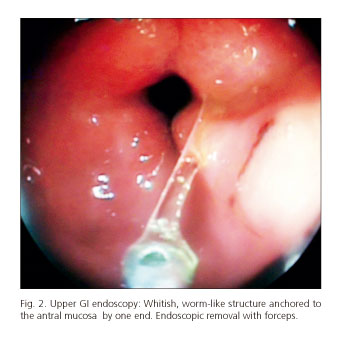
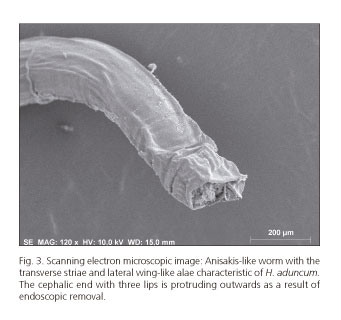
<body><![CDATA[<p>&nbsp;</p>     <p><font face="Verdana" size="2"><b>Case report</b></font></p>     <p><font face="Verdana" size="2">A patient with no relevant history presented with epigastralgia for the last 4 hours. A lab workup showed no significant findings. Abdominal CT revealed gastric wall thickening with increased contrast uptake and adipose tissue rarefaction (<a href="#f1">Fig. 1</a>). A gastroscopy was performed 12 hours after admission, which revealed an edematous, erythematous antral mucosa with 4 whitish, worm-like structures about 15 mm in length attached to it by one end. The diagnosis was reached by direct endoscopic observation, light microscopy, and scanning electron microscopy - no serology testing was needed (<a href="#f2">Fig. 2</a>). The patient initially denied having eaten raw fish, only to later confirm its ingestion after endoscopy. Following parasite removal the patient remained asymptomatic and treatment with albendazole was initiated.</font></p>     <p>&nbsp;</p>     <p align="center"><font face="Verdana" size="2"><a name="f1"><img src="/img/revistas/diges/v107n11/imagenes2_fig1.jpg"></a></font></p>     <p>&nbsp;</p>     <p align="center"><font face="Verdana" size="2"><a name="f2"><img src="/img/revistas/diges/v107n11/imagenes2_fig2.jpg"></a></font></p>     <p>&nbsp;</p>     <p><font face="Verdana" size="2"><b>Discussion</b></font></p>     <p><font face="Verdana" size="2">Direct observation allowed parasite identification as third-stage (L3) larvae of <i>Hysterothylacium aduncum</i>, an ascaroid nematode belonging to the <i>Anisakidae</i> family (1). <i>Hysterothylacium aduncum</i> is an unusual parasite - it has only been described as the causal agent of at least one case of non-invasive anisakiasis (2). Body size is consistent for this species' L3 stage (Figs. <a href="#f3">3</a> and <a href="#f4">4</a>). Manifestations result from local damage (epigastralgia, vomiting, obstruction, diarrhea, ulceration, bleeding) and hypersensitivity reactions (urticaria, angioedema, shock) (3). A definitive diagnosis may only be reached by direct parasite visualization (4). Diagnosis is challenging and relies on clinical suspicion, findings such as eosinophilia, recent raw fish ingestion, and both direct (endoscopy) and indirect (serology) testing.</font></p>     ]]></body>
<body><![CDATA[<p>&nbsp;</p>     <p align="center"><font face="Verdana" size="2"><a name="f3"><img src="/img/revistas/diges/v107n11/imagenes2_fig3.jpg"></a></font></p>     <p>&nbsp;</p>     <p align="center"><font face="Verdana" size="2"><a name="f4"><img src="/img/revistas/diges/v107n11/imagenes2_fig4.jpg"></a></font></p>     <p>&nbsp;</p>     <p><font face="Verdana" size="2">The prevalence of anisakiasis has been on the rise worldwide for the last few years (5), which may result from improved diagnostic technique resolution, increased interest in dishes consisting of raw fish, and coexistence of sea mammals acting as reservoirs in fishing areas.</font></p>     <p>&nbsp;</p>     <p><font face="Verdana" size="2"><b>References</b></font></p>     <!-- ref --><p><font face="Verdana" size="2">1. Sanmartin ML, Quintero P, Iglesias R, et al. Nematodos par&aacute;sitos en peces de las costas gallegas. Ed. D&iacute;az de Santos; 1994. p. 40-53.    &nbsp;&nbsp;&nbsp;&nbsp;&nbsp;&nbsp;&nbsp;&nbsp;[&#160;<a href="javascript:void(0);" onclick="javascript: window.open('/scielo.php?script=sci_nlinks&ref=5403406&pid=S1130-0108201500110000900001&lng=','','width=640,height=500,resizable=yes,scrollbars=1,menubar=yes,');">Links</a>&#160;]<!-- end-ref --></font></p>    ]]></body>
<body><![CDATA[<!-- ref --><p><font face="Verdana" size="2">2. Yagi K, Nagasawa K, Ishikura H, et al. Female worm Hysterothylacium aduncum excreted from human: A case report. Jap J Parasitol 1996;45:12-23.    &nbsp;&nbsp;&nbsp;&nbsp;&nbsp;&nbsp;&nbsp;&nbsp;[&#160;<a href="javascript:void(0);" onclick="javascript: window.open('/scielo.php?script=sci_nlinks&ref=5403408&pid=S1130-0108201500110000900002&lng=','','width=640,height=500,resizable=yes,scrollbars=1,menubar=yes,');">Links</a>&#160;]<!-- end-ref --></font></p>    <!-- ref --><p><font face="Verdana" size="2">3. Pontone S, Leonetti G, Guaitoli E, et al. Should the host reaction to anisakiasis influence the treatment? Different clinical presentations in two cases. Rev Esp Enferm Dig 2012;104:607-10.    &nbsp;&nbsp;&nbsp;&nbsp;&nbsp;&nbsp;&nbsp;&nbsp;[&#160;<a href="javascript:void(0);" onclick="javascript: window.open('/scielo.php?script=sci_nlinks&ref=5403410&pid=S1130-0108201500110000900003&lng=','','width=640,height=500,resizable=yes,scrollbars=1,menubar=yes,');">Links</a>&#160;]<!-- end-ref --></font></p>    <!-- ref --><p><font face="Verdana" size="2">4. Henriquez-Santana A, Villafruela-Cives M. Anisakis: pasado, presente y futuro. Medicina Cl&iacute;nica 2009;112:400-3.    &nbsp;&nbsp;&nbsp;&nbsp;&nbsp;&nbsp;&nbsp;&nbsp;[&#160;<a href="javascript:void(0);" onclick="javascript: window.open('/scielo.php?script=sci_nlinks&ref=5403412&pid=S1130-0108201500110000900004&lng=','','width=640,height=500,resizable=yes,scrollbars=1,menubar=yes,');">Links</a>&#160;]<!-- end-ref --></font></p>    <!-- ref --><p><font face="Verdana" size="2">5. Chai JY, Murrell KD, Lymbery AJ. Fish-borne parasitic zoonoses: Status and issues. International J Parasitol 2005;35:1233-54.    &nbsp;&nbsp;&nbsp;&nbsp;&nbsp;&nbsp;&nbsp;&nbsp;[&#160;<a href="javascript:void(0);" onclick="javascript: window.open('/scielo.php?script=sci_nlinks&ref=5403414&pid=S1130-0108201500110000900005&lng=','','width=640,height=500,resizable=yes,scrollbars=1,menubar=yes,');">Links</a>&#160;]<!-- end-ref --></font></p>      ]]></body><back>
<ref-list>
<ref id="B1">
<label>1</label><nlm-citation citation-type="book">
<person-group person-group-type="author">
<name>
<surname><![CDATA[Sanmartin]]></surname>
<given-names><![CDATA[ML]]></given-names>
</name>
<name>
<surname><![CDATA[Quintero]]></surname>
<given-names><![CDATA[P]]></given-names>
</name>
<name>
<surname><![CDATA[Iglesias]]></surname>
<given-names><![CDATA[R]]></given-names>
</name>
</person-group>
<source><![CDATA[Nematodos parásitos en peces de las costas gallegas]]></source>
<year>1994</year>
<page-range>40-53</page-range><publisher-name><![CDATA[Díaz de Santos]]></publisher-name>
</nlm-citation>
</ref>
<ref id="B2">
<label>2</label><nlm-citation citation-type="journal">
<person-group person-group-type="author">
<name>
<surname><![CDATA[Yagi]]></surname>
<given-names><![CDATA[K]]></given-names>
</name>
<name>
<surname><![CDATA[Nagasawa]]></surname>
<given-names><![CDATA[K]]></given-names>
</name>
<name>
<surname><![CDATA[Ishikura]]></surname>
<given-names><![CDATA[H]]></given-names>
</name>
</person-group>
<article-title xml:lang="en"><![CDATA[Female worm Hysterothylacium aduncum excreted from human: A case report]]></article-title>
<source><![CDATA[Jap J Parasitol]]></source>
<year>1996</year>
<volume>45</volume>
<page-range>12-23</page-range></nlm-citation>
</ref>
<ref id="B3">
<label>3</label><nlm-citation citation-type="journal">
<person-group person-group-type="author">
<name>
<surname><![CDATA[Pontone]]></surname>
<given-names><![CDATA[S]]></given-names>
</name>
<name>
<surname><![CDATA[Leonetti]]></surname>
<given-names><![CDATA[G]]></given-names>
</name>
<name>
<surname><![CDATA[Guaitoli]]></surname>
<given-names><![CDATA[E]]></given-names>
</name>
</person-group>
<article-title xml:lang="en"><![CDATA[Should the host reaction to anisakiasis influence the treatment?: Different clinical presentations in two cases]]></article-title>
<source><![CDATA[Rev Esp Enferm Dig]]></source>
<year>2012</year>
<volume>104</volume>
<page-range>607-10</page-range></nlm-citation>
</ref>
<ref id="B4">
<label>4</label><nlm-citation citation-type="journal">
<person-group person-group-type="author">
<name>
<surname><![CDATA[Henriquez-Santana]]></surname>
<given-names><![CDATA[A]]></given-names>
</name>
<name>
<surname><![CDATA[Villafruela-Cives]]></surname>
<given-names><![CDATA[M]]></given-names>
</name>
</person-group>
<article-title xml:lang="en"><![CDATA[Anisakis: pasado, presente y futuro]]></article-title>
<source><![CDATA[Medicina Clínica]]></source>
<year>2009</year>
<volume>112</volume>
<page-range>400-3</page-range></nlm-citation>
</ref>
<ref id="B5">
<label>5</label><nlm-citation citation-type="journal">
<person-group person-group-type="author">
<name>
<surname><![CDATA[Chai]]></surname>
<given-names><![CDATA[JY]]></given-names>
</name>
<name>
<surname><![CDATA[Murrell]]></surname>
<given-names><![CDATA[KD]]></given-names>
</name>
<name>
<surname><![CDATA[Lymbery]]></surname>
<given-names><![CDATA[AJ]]></given-names>
</name>
</person-group>
<article-title xml:lang="en"><![CDATA[Fish-borne parasitic zoonoses: Status and issues]]></article-title>
<source><![CDATA[International J Parasitol]]></source>
<year>2005</year>
<volume>35</volume>
<page-range>1233-54</page-range></nlm-citation>
</ref>
</ref-list>
</back>
</article>