<?xml version="1.0" encoding="ISO-8859-1"?><article xmlns:mml="http://www.w3.org/1998/Math/MathML" xmlns:xlink="http://www.w3.org/1999/xlink" xmlns:xsi="http://www.w3.org/2001/XMLSchema-instance">
<front>
<journal-meta>
<journal-id>1130-0108</journal-id>
<journal-title><![CDATA[Revista Española de Enfermedades Digestivas]]></journal-title>
<abbrev-journal-title><![CDATA[Rev. esp. enferm. dig.]]></abbrev-journal-title>
<issn>1130-0108</issn>
<publisher>
<publisher-name><![CDATA[Sociedad Española de Patología Digestiva]]></publisher-name>
</publisher>
</journal-meta>
<article-meta>
<article-id>S1130-01082016000400007</article-id>
<title-group>
<article-title xml:lang="en"><![CDATA[Proton-pump inhibitors adverse effects: a review of the evidence and position statement by the Sociedad Española de Patología Digestiva]]></article-title>
<article-title xml:lang="es"><![CDATA[Efectos adversos de los inhibidores de la bomba de protones: revisión de evidencias y posicionamiento de la Sociedad Española de Patología Digestiva]]></article-title>
</title-group>
<contrib-group>
<contrib contrib-type="author">
<name>
<surname><![CDATA[de-la-Coba]]></surname>
<given-names><![CDATA[Cristóbal]]></given-names>
</name>
<xref ref-type="aff" rid="A01"/>
<xref ref-type="aff" rid="A02"/>
</contrib>
<contrib contrib-type="author">
<name>
<surname><![CDATA[Argüelles-Arias]]></surname>
<given-names><![CDATA[Federico]]></given-names>
</name>
<xref ref-type="aff" rid="A03"/>
</contrib>
<contrib contrib-type="author">
<name>
<surname><![CDATA[Martín-de-Argila]]></surname>
<given-names><![CDATA[Carlos]]></given-names>
</name>
<xref ref-type="aff" rid="A04"/>
</contrib>
<contrib contrib-type="author">
<name>
<surname><![CDATA[Júdez]]></surname>
<given-names><![CDATA[Javier]]></given-names>
</name>
<xref ref-type="aff" rid="A05"/>
</contrib>
<contrib contrib-type="author">
<name>
<surname><![CDATA[Linares]]></surname>
<given-names><![CDATA[Antonio]]></given-names>
</name>
<xref ref-type="aff" rid="A06"/>
</contrib>
<contrib contrib-type="author">
<name>
<surname><![CDATA[Ortega-Alonso]]></surname>
<given-names><![CDATA[Aida]]></given-names>
</name>
<xref ref-type="aff" rid="A07"/>
<xref ref-type="aff" rid="A08"/>
<xref ref-type="aff" rid="A09"/>
<xref ref-type="aff" rid="A10"/>
</contrib>
<contrib contrib-type="author">
<name>
<surname><![CDATA[Rodríguez]]></surname>
<given-names><![CDATA[Enrique]]></given-names>
</name>
<xref ref-type="aff" rid="A04"/>
</contrib>
<contrib contrib-type="author">
<name>
<surname><![CDATA[Rodríguez-Téllez]]></surname>
<given-names><![CDATA[Manuel]]></given-names>
</name>
<xref ref-type="aff" rid="A03"/>
<xref ref-type="aff" rid="A11"/>
</contrib>
<contrib contrib-type="author">
<name>
<surname><![CDATA[Vera]]></surname>
<given-names><![CDATA[Isabel]]></given-names>
</name>
<xref ref-type="aff" rid="A12"/>
</contrib>
<contrib contrib-type="author">
<name>
<surname><![CDATA[Aguilera]]></surname>
<given-names><![CDATA[Lara]]></given-names>
</name>
<xref ref-type="aff" rid="A04"/>
</contrib>
<contrib contrib-type="author">
<name>
<surname><![CDATA[Álvarez]]></surname>
<given-names><![CDATA[Ángel]]></given-names>
</name>
<xref ref-type="aff" rid="A13"/>
<xref ref-type="aff" rid="A14"/>
</contrib>
<contrib contrib-type="author">
<name>
<surname><![CDATA[Andrade]]></surname>
<given-names><![CDATA[Raúl J.]]></given-names>
</name>
<xref ref-type="aff" rid="A07"/>
<xref ref-type="aff" rid="A08"/>
<xref ref-type="aff" rid="A09"/>
<xref ref-type="aff" rid="A10"/>
</contrib>
<contrib contrib-type="author">
<name>
<surname><![CDATA[Bao]]></surname>
<given-names><![CDATA[Fidencio]]></given-names>
</name>
<xref ref-type="aff" rid="A15"/>
</contrib>
<contrib contrib-type="author">
<name>
<surname><![CDATA[Castro]]></surname>
<given-names><![CDATA[Manuel]]></given-names>
</name>
<xref ref-type="aff" rid="A16"/>
</contrib>
<contrib contrib-type="author">
<name>
<surname><![CDATA[Giganto]]></surname>
<given-names><![CDATA[Froilán]]></given-names>
</name>
<xref ref-type="aff" rid="A17"/>
</contrib>
</contrib-group>
<aff id="A01">
<institution><![CDATA[,Sociedad Española de Patología Digestiva (SEPD) Comité de Excelencia Clínica ]]></institution>
<addr-line><![CDATA[ ]]></addr-line>
<country>Spain</country>
</aff>
<aff id="A02">
<institution><![CDATA[,Hospital de Cabueñes Digestive Diseases Unit ]]></institution>
<addr-line><![CDATA[Gijón ]]></addr-line>
<country>Spain</country>
</aff>
<aff id="A03">
<institution><![CDATA[,Hospital Universitario Virgen Macarena Unidad de Gestión Clínica (UGC) Digestive Diseases ]]></institution>
<addr-line><![CDATA[Sevilla ]]></addr-line>
<country>Spain</country>
</aff>
<aff id="A04">
<institution><![CDATA[,Hospital Universitario Ramón y Cajal Department of Gastroenterlology and Hepatology ]]></institution>
<addr-line><![CDATA[Madrid ]]></addr-line>
<country>Spain</country>
</aff>
<aff id="A05">
<institution><![CDATA[,Sociedad Española de Patología Digestiva (SEPD) Department of Knowledgement Management ]]></institution>
<addr-line><![CDATA[ ]]></addr-line>
<country>Spain</country>
</aff>
<aff id="A06">
<institution><![CDATA[,Sanatorio Nuestra Señora de Covadonga Department of Digestive Diseases ]]></institution>
<addr-line><![CDATA[Gijón ]]></addr-line>
<country>Spain</country>
</aff>
<aff id="A07">
<institution><![CDATA[,Instituto de Investigación Biomédica de Málaga (IBIMA) Unidad de Gestión Clínica (UGC) Digestive Diseases ]]></institution>
<addr-line><![CDATA[Málaga ]]></addr-line>
</aff>
<aff id="A08">
<institution><![CDATA[,Hospital Universitario Virgen de la Victoria  ]]></institution>
<addr-line><![CDATA[ ]]></addr-line>
</aff>
<aff id="A09">
<institution><![CDATA[,Universidad de Málaga  ]]></institution>
<addr-line><![CDATA[Málaga ]]></addr-line>
<country>Spain</country>
</aff>
<aff id="A10">
<institution><![CDATA[,Centro de Investigación Biomédica en Red de Enfermedades Hepáticas y Digestivas (CIBERehd)  ]]></institution>
<addr-line><![CDATA[Madrid ]]></addr-line>
<country>Spain</country>
</aff>
<aff id="A11">
<institution><![CDATA[,Universidad de Sevilla  ]]></institution>
<addr-line><![CDATA[Sevilla ]]></addr-line>
<country>Spain</country>
</aff>
<aff id="A12">
<institution><![CDATA[,Hospital Universitario Puerta de Hierro Department of Digestive Diseases ]]></institution>
<addr-line><![CDATA[Madrid ]]></addr-line>
<country>Spain</country>
</aff>
<aff id="A13">
<institution><![CDATA[,Hospital Clínico San Carlos Department of Digestive Diseases ]]></institution>
<addr-line><![CDATA[ ]]></addr-line>
</aff>
<aff id="A14">
<institution><![CDATA[,Universidad Complutense de Madrid  ]]></institution>
<addr-line><![CDATA[Madrid ]]></addr-line>
<country>Spain</country>
</aff>
<aff id="A15">
<institution><![CDATA[,Hospital San Eloy Digestive Unit ]]></institution>
<addr-line><![CDATA[Barakaldo ]]></addr-line>
<country>Spain</country>
</aff>
<aff id="A16">
<institution><![CDATA[,Hospital Universitario de Valme Department of Digestive Diseases ]]></institution>
<addr-line><![CDATA[Sevilla ]]></addr-line>
<country>Spain</country>
</aff>
<aff id="A17">
<institution><![CDATA[,Hospital Central de Asturias Department of Digestive Diseases ]]></institution>
<addr-line><![CDATA[Oviedo ]]></addr-line>
<country>Spain</country>
</aff>
<pub-date pub-type="pub">
<day>00</day>
<month>04</month>
<year>2016</year>
</pub-date>
<pub-date pub-type="epub">
<day>00</day>
<month>04</month>
<year>2016</year>
</pub-date>
<volume>108</volume>
<numero>4</numero>
<fpage>207</fpage>
<lpage>224</lpage>
<copyright-statement/>
<copyright-year/>
<self-uri xlink:href="http://scielo.isciii.es/scielo.php?script=sci_arttext&amp;pid=S1130-01082016000400007&amp;lng=en&amp;nrm=iso"></self-uri><self-uri xlink:href="http://scielo.isciii.es/scielo.php?script=sci_abstract&amp;pid=S1130-01082016000400007&amp;lng=en&amp;nrm=iso"></self-uri><self-uri xlink:href="http://scielo.isciii.es/scielo.php?script=sci_pdf&amp;pid=S1130-01082016000400007&amp;lng=en&amp;nrm=iso"></self-uri><abstract abstract-type="short" xml:lang="en"><p><![CDATA[Introduction: In the last few years a significant number of papers have related the use of proton-pump inhibitors (PPIs) to potential serious adverse effects that have resulted in social unrest. Objective: The goal of this paper was to provide a literature review for the development of an institutional position statement by Sociedad Española de Patología Digestiva (SEPD) regarding the safety of long-term PPI use. Material and methods: A comprehensive review of the literature was performed to draw conclusions based on a critical assessment of the following: a) current PPI indications; b) vitamin B12 deficiency and neurological disorders; c) magnesium deficiency; d) bone fractures; e) enteric infection and pneumonia; f) interactions with thienopyridine derivatives; e) complications in cirrhotic patients. Results: Current PPI indications have remained unchanged for years now, and are well established. A general screening of vitamin B12 levels is not recommended for all patients on a PPI; however, it does seem necessary that magnesium levels be measured at therapy onset, and then monitored in subjects on other drugs that may induce hypomagnesemia. A higher risk for bone fractures is present, even though causality cannot be concluded for this association. The association between PPIs and infection with Clostridium difficile is mild to moderate, and the risk for pneumonia is low. In patients with cardiovascular risk receiving thienopyridines derivatives it is prudent to adequately consider gastrointestinal and cardiovascular risks, given the absence of definitive evidence regardin potential drug-drug interactions; if gastrointestinal risk is found to be moderate or high, effective prevention should be in place with a PPI. PPIs should be cautiously indicated in patients with decompensated cirrhosis. Conclusions: PPIs are safe drugs whose benefits outweigh their potential side effects both short-term and long-term, provided their indication, dosage, and duration are appropriate.]]></p></abstract>
<abstract abstract-type="short" xml:lang="es"><p><![CDATA[Introducción: en los últimos años, numerosos artículos relacionan el uso de los inhibidores de la bomba de protones (IBP) con posibles efectos adversos serios que han creado cierta alarma social. Objetivo: el objetivo de este trabajo es revisar la literatura de cara a elaborar un documento institucional de posicionamiento de la Sociedad Española de Patología Digestiva (SEPD) sobre la seguridad de los IBP a largo plazo. Material y métodos: se ha realizado una revisión exhaustiva de la literatura orientada a la presentación de conclusiones tras una valoración crítica sobre los siguientes temas: a) indicaciones actuales de los IBP; b) déficit de vitamina B12 y alteraciones neurológicas; c) déficit de magnesio; d) fracturas óseas; e) infecciones entéricas y neumonías; f) interacción con los derivados de las tienopiridinas; y e) complicaciones en pacientes cirróticos. Resultados: las indicaciones actuales de los IBP no han variado en los últimos años y están bien establecidas. No se recomienda la realización de un cribado generalizado de los niveles de vitamina B12 en todos los pacientes tratados de forma crónica con estos medicamentos; sin embargo, sí parece necesario controlar los niveles de magnesio al inicio del tratamiento y monitorizarlos en pacientes con toma de otros fármacos que puedan inducir hipomagnesemia. Existe mayor riesgo de fracturas óseas, aunque no se puede concluir que esta asociación sea causal. La asociación IBP e infección por Clostridium difficile es débil o moderada y el riesgo de neumonía es bajo. En pacientes con riesgo cardiovascular y tratados con derivados de las tienopiridinas -dada la ausencia de evidencias definitivas en relación a posibles interacciones medicamentosas- parece que lo prudente sea sopesar adecuadamente los riesgos gastrointestinales y los riesgos cardiovasculares de cada paciente; cuando el riesgo gastrointestinal sea moderado/alto, debemos ejercer una acción terapéutica de prevención efectiva utilizando un IBP. En cirróticos descompensados deben ser indicados con cautela. Conclusiones: los IBP son fármacos seguros y los beneficios de su empleo, tanto a corto como a largo plazo superan los posibles efectos secundarios, siempre que la indicación, dosis y duración sean las adecuadas.]]></p></abstract>
<kwd-group>
<kwd lng="en"><![CDATA[Proton-pump inhibitors]]></kwd>
<kwd lng="en"><![CDATA[Adverse effects]]></kwd>
<kwd lng="en"><![CDATA[Guidelines as topic]]></kwd>
<kwd lng="en"><![CDATA[Position statement]]></kwd>
<kwd lng="en"><![CDATA[SEPD]]></kwd>
<kwd lng="es"><![CDATA[Inhibidores de la bomba de protones]]></kwd>
<kwd lng="es"><![CDATA[Efectos adversos]]></kwd>
<kwd lng="es"><![CDATA[Guía clínica]]></kwd>
<kwd lng="es"><![CDATA[Documento de posicionamiento]]></kwd>
<kwd lng="es"><![CDATA[SEPD]]></kwd>
</kwd-group>
</article-meta>
</front><body><![CDATA[ <p><a name="top"></a><font face="Verdana" size="2"><b>SPECIAL ARTICLE</b></font></p>     <p>&nbsp;</p>     <p><font face="Verdana" size="4"><b>Proton-pump inhibitors adverse effects: a review of the evidence and position statement by the Sociedad Espa&ntilde;ola de Patolog&iacute;a Digestiva</b></font></p>     <p><font face="Verdana" size="4"><b>Efectos adversos de los inhibidores de la bomba de protones: revisi&oacute;n de evidencias y posicionamiento de la Sociedad Espa&ntilde;ola de Patolog&iacute;a Digestiva</b></font></p>     <p>&nbsp;</p>     <p>&nbsp;</p>     <p><font face="Verdana" size="2"><b>Crist&oacute;bal de-la-Coba<sup>1,2</sup>, Federico Arg&uuml;elles-Arias<sup>3</sup>, Carlos Mart&iacute;n-de-Argila<sup>4</sup>, Javier J&uacute;dez<sup>5</sup>, Antonio Linares<sup>6</sup>, Aida Ortega-Alonso<sup>7</sup>, Enrique Rodr&iacute;guez<sup>4</sup>, Manuel Rodr&iacute;guez-T&eacute;llez<sup>8</sup>, Isabel Vera<sup>9</sup>, Lara Aguilera<sup>4</sup>, &Aacute;ngel &Aacute;lvarez<sup>10</sup>, Ra&uacute;l J. Andrade<sup>7</sup>, Fidencio Bao<sup>11</sup>, Manuel Castro<sup>12</sup> and Froil&aacute;n Giganto<sup>13</sup>, on behalf of SEPD</b></font></p>     <p><font face="Verdana" size="2"><sup>1</sup> Coordinador Comit&eacute; de Excelencia Cl&iacute;nica. SEPD. Spain.    <br><sup>2</sup> Digestive Diseases Unit. Hospital de Cabue&ntilde;es. Gij&oacute;n. Spain.    <br><sup>3</sup> UGC Digestive Diseases. Hospital Universitario Virgen Macarena. Sevilla, Spain.    ]]></body>
<body><![CDATA[<br><sup>4</sup> Department of Gastroenterology and Hepatology. Hospital Universitario Ram&oacute;n y Cajal. Madrid, Spain.    <br><sup>5</sup> Department of Knowledgement Management. SEPD. Spain.    <br><sup>6</sup> Department of Digestive Diseases. Sanatorio Nuestra Se&ntilde;ora de Covadonga. Gij&oacute;n, Asturias. Spain.    <br><sup>7</sup> UGC Digestive Diseases. Instituto de Investigaci&oacute;n Biom&eacute;dica de M&aacute;laga (IBIMA). Hospital Universitario Virgen de la Victoria. Universidad de M&aacute;laga. M&aacute;laga, Spain. Centro de Investigaci&oacute;n Biom&eacute;dica en Red de Enfermedades Hep&aacute;ticas y Digestivas (CIBERehd). Madrid, Spain.    <br><sup>8</sup> UGC Digestive Diseases. Hospital Universitario Virgen Macarena. Universidad de Sevilla. Sevilla, Spain.    <br><sup>9</sup> Department of Digestive Diseases. Hospital Universitario Puerta de Hierro. Madrid, Spain.    <br><sup>10</sup> Department of Digestive Diseases. Hospital Cl&iacute;nico San Carlos. Universidad Complutense de Madrid. Madrid, Spain.    <br><sup>11</sup> Digestive Unit. Hospital San Eloy. Barakaldo, Vizcaya, Spain.    <br><sup>12</sup> Department of Digestive Diseases. Hospital Universitario de Valme. Sevilla, Spain.    <br><sup>13</sup> Department of Digestive Diseases. Hospital Central de Asturias. Oviedo, Asturias, Spain</font></p>     ]]></body>
<body><![CDATA[<p><font face="Verdana" size="2"><a href="#bajo">Correspondence</a></font></p>     <p>&nbsp;</p>     <p>&nbsp;</p> <hr size="1">    <p><font face="Verdana" size="2"><b>ABSTRACT</b></font></p>     <p><font face="Verdana" size="2"><b>Introduction:</b> In the last few years a significant number of papers have related the use of proton-pump inhibitors (PPIs) to potential serious adverse effects that have resulted in social unrest.    <br><b>Objective:</b> The goal of this paper was to provide a literature review for the development of an institutional position statement by <i>Sociedad Espa&ntilde;ola de Patolog&iacute;a Digestiva</i> (SEPD) regarding the safety of long-term PPI use.    <br><b>Material and methods:</b> A comprehensive review of the literature was performed to draw conclusions based on a critical assessment of the following: a) current PPI indications; b) vitamin B<sub>12</sub> deficiency and neurological disorders; c) magnesium deficiency; d) bone fractures; e) enteric infection and pneumonia; f) interactions with thienopyridine derivatives; e) complications in cirrhotic patients.    <br><b>Results:</b> Current PPI indications have remained unchanged for years now, and are well established. A general screening of vitamin B12 levels is not recommended for all patients on a PPI; however, it does seem necessary that magnesium levels be measured at therapy onset, and then monitored in subjects on other drugs that may induce hypomagnesemia. A higher risk for bone fractures is present, even though causality cannot be concluded for this association. The association between PPIs and infection with Clostridium difficile is mild to moderate, and the risk for pneumonia is low. In patients with cardiovascular risk receiving thienopyridines derivatives it is prudent to adequately consider gastrointestinal and cardiovascular risks, given the absence of definitive evidence regardin potential drug-drug interactions; if gastrointestinal risk is found to be moderate or high, effective prevention should be in place with a PPI. PPIs should be cautiously indicated in patients with decompensated cirrhosis.    <br><b>Conclusions:</b> PPIs are safe drugs whose benefits outweigh their potential side effects both short-term and long-term, provided their indication, dosage, and duration are appropriate.</font></p>     <p><font face="Verdana" size="2"><b>Key words:</b> Proton-pump inhibitors. Adverse effects. Guidelines as topic. Position statement. SEPD.</font></p> <hr size="1">    ]]></body>
<body><![CDATA[<p><font face="Verdana" size="2"><b>RESUMEN</b></font></p>     <p><font face="Verdana" size="2"><b>Introducci&oacute;n:</b> en los &uacute;ltimos a&ntilde;os, numerosos art&iacute;culos relacionan el uso de los inhibidores de la bomba de protones (IBP) con posibles efectos adversos serios que han creado cierta alarma social.    <br><b>Objetivo:</b> el objetivo de este trabajo es revisar la literatura de cara a elaborar un documento institucional de posicionamiento de la Sociedad Espa&ntilde;ola de Patolog&iacute;a Digestiva (SEPD) sobre la seguridad de los IBP a largo plazo.    <br><b>Material y m&eacute;todos:</b> se ha realizado una revisi&oacute;n exhaustiva de la literatura orientada a la presentaci&oacute;n de conclusiones tras una valoraci&oacute;n cr&iacute;tica sobre los siguientes temas: a) indicaciones actuales de los IBP; b) d&eacute;ficit de vitamina B12 y alteraciones neurol&oacute;gicas; c) d&eacute;ficit de magnesio; d) fracturas &oacute;seas; e) infecciones ent&eacute;ricas y neumon&iacute;as; f) interacci&oacute;n con los derivados de las tienopiridinas; y e) complicaciones en pacientes cirr&oacute;ticos.    <br><b>Resultados:</b> las indicaciones actuales de los IBP no han variado en los &uacute;ltimos a&ntilde;os y est&aacute;n bien establecidas. No se recomienda la realizaci&oacute;n de un cribado generalizado de los niveles de vitamina B<sub>12</sub> en todos los pacientes tratados de forma cr&oacute;nica con estos medicamentos; sin embargo, s&iacute; parece necesario controlar los niveles de magnesio al inicio del tratamiento y monitorizarlos en pacientes con toma de otros f&aacute;rmacos que puedan inducir hipomagnesemia. Existe mayor riesgo de fracturas &oacute;seas, aunque no se puede concluir que esta asociaci&oacute;n sea causal. La asociaci&oacute;n IBP e infecci&oacute;n por Clostridium difficile es d&eacute;bil o moderada y el riesgo de neumon&iacute;a es bajo. En pacientes con riesgo cardiovascular y tratados con derivados de las tienopiridinas -dada la ausencia de evidencias definitivas en relaci&oacute;n a posibles interacciones medicamentosas- parece que lo prudente sea sopesar adecuadamente los riesgos gastrointestinales y los riesgos cardiovasculares de cada paciente; cuando el riesgo gastrointestinal sea moderado/alto, debemos ejercer una acci&oacute;n terap&eacute;utica de prevenci&oacute;n efectiva utilizando un IBP. En cirr&oacute;ticos descompensados deben ser indicados con cautela.    <br><b>Conclusiones:</b> los IBP son f&aacute;rmacos seguros y los beneficios de su empleo, tanto a corto como a largo plazo superan los posibles efectos secundarios, siempre que la indicaci&oacute;n, dosis y duraci&oacute;n sean las adecuadas.</font></p>     <p><font face="Verdana" size="2"><b>Palabras clave:</b> Inhibidores de la bomba de protones. Efectos adversos. Gu&iacute;a cl&iacute;nica. Documento de posicionamiento. SEPD.</font></p> <hr size="1">     <p>&nbsp;</p>     <p><font face="Verdana" size="2"><b>Introduction</b></font></p>     <p><font face="Verdana" size="2">Proton-pump inhibitors (PPI) are drugs widely used in Spain. They irreversibly inhibit the enzyme H/K-ATPase in the parietal cells of the gastric mucosa, thus reducing acid secretion. While PPIs have a short half-life (1-2 hours), this irreversible inhibition provides a longer effect, as new proton pumps need be synthesized before acid secretion is resumed (1).</font></p>     ]]></body>
<body><![CDATA[<p><font face="Verdana" size="2">PPIs are among the most commonly prescribed drugs and their turnover ranks high in the National Health System. PPI use in Spain has increased significantly in the past few years, going from 21.8 daily doses per 1,000 population in 2,000 to 96.57 daily doses per 1000 population in 2008 (2), with omeprazole becoming the most widely used drug in Spain in 2010 in terms of package count (3). Between 2000 and 2008 PPI prescriptions increased by 200% (3), and from 2004 to 2010 PPI use increased by 227%; however, the cost for public funds only increased by 21.3%, which represents a total of approximately &#x20ac;626 million (4). This implies a reduction in cost per package, likely because of generics, but public spending remains unchanged or even increases given a remarkable increase in prescriptions (4). Furthermore, when compared to other European countries, 85 in every 1000 people use a PPI daily in Spain, <i>versus</i> only 30 per 1000 in Norway and 27 per 1000 in Italy (2).</font></p>     <p><font face="Verdana" size="2">On the other hand, a number of studies reported during the last few years have associated PPI use with various adverse events, which has risen concern among both prescribers and patients. A significant need for a review on the use and side effects of PPIs in our setting was identified by Sociedad Espa&ntilde;ola de Patolog&iacute;a Digestiva (SEPD). It is not uncommon for patients receiving a PPI prescription to seek medical advice on the potential adverse effects of their prescribed drug and its long-term use.</font></p>     <p><font face="Verdana" size="2">Therefore, the goal of this paper is to identify, assess, and review the major evidence regarding the adverse effects associated with long-term PPI use, and to write a position document of SEPD including clear conclusions on the safety of this class of drugs.</font></p>     <p>&nbsp;</p>     <p><font face="Verdana" size="2"><b>Material and Methods</b></font></p>     <p><font face="Verdana" size="2">In order to perform the present review a task force made up of gastroenterologists selected, based on a literature search, the most relevant topics related to PPIs and their adverse effects. These include: a) Indications and rationale for PPI use; b) vitamin B<sub>12</sub> deficiency and neurological changes; c) magnesium deficiency; d) bone fractures; e) enteric infection and pneumonia; f) use of PPIs together with thienopyridine derivatives and cardiovascular risk; and e) complications in cirrhotic patients. Each question was answered according to the best evidence currently available following a comprehensive search of the PubMed, EMBASE, and Cochrane Library databases. After an initial draft and an in-person meeting at the 2015 SEPD Conference in Seville, a revised text was submitted to reach the highest agreement possible. In this process also a knowledge management expert played a role. Finally, the document was externally reviewed by the SEPD Executive Board.</font></p>     <p>&nbsp;</p>     <p><font face="Verdana" size="2"><b>Indications and rationale for PPI use</b></font></p>     <p><font face="Verdana" size="2">Five PPI types are currently marketed with the following names, standard doses (milligrams), and administration routes (PO: oral, IV: intravenous) (Tables <a href="#t1">I</a> and <a href="#t2">II</a>): omeprazole 10 and 20 mg (PO), 40 mg (PO and IV); lansoprazole 15 and 30 mg (PO); pantoprazole 20 and 40 mg (PO), 40 mg (IV); rabeprazole 10 and 20 mg PO); esomeprazole 10, 20 and 40 mg (PO), 40 mg (IV), with omeprazole being first on the market, cheaper, and most widely used (3).</font></p>     <p>&nbsp;</p>     ]]></body>
<body><![CDATA[<p align="center"><font face="Verdana" size="2"><a name="t1"><img src="/img/revistas/diges/v108n4/especial_table1.jpg"></a></font></p>     <p>&nbsp;</p>     <p align="center"><font face="Verdana" size="2"><a name="t2"><img src="/img/revistas/diges/v108n4/especial_table2.jpg"></a></font></p>     <p>&nbsp;</p>     <p><font face="Verdana" size="2">The reason why PPIs are prescribed in Spain at 70% above the european average is most likely related to inappropriate prescription, and the most widely mistaken indication possibly is the prophylaxis of gastroduodenal injury in patients with low (even nil) gastrolesive risk, as has been shown in other countries (5-7). Furthemore omeprazole represents 75% of PPI prescriptions, with the remaining 25% amounting to 75% of expense, which reflects the significance of using a specific PPI in addition to appropriate indication, route, dosage, and duration (2).</font></p>     <p><font face="Verdana" size="2">It is thought that 54% to 69% of PPI prescriptions are incorrect (8-16), with hospital admision being, for example, a risk factor. A study in a Spanish tertiary referral hospital (15) found that 28.7% of patients were already using a PPI before admission, 82.6% received a PPI during their hospital stay, and 54.8% had a PPI recommended on discharge. Prescription was deemed inappropriate in 74.5%, 61.3%, and 80.2% of patients, respectively. In a study recently reported by the <i>Revista Espa&ntilde;ola de Enfermedades Digestivas</i> (14), PPI indication was considered inappropriate for 63.6% of inpatients, mostly because of an unnecessary inclusion of these drugs in surgical protocols, in diagnostic or therapeutic procedures, or for the management of disease. A review of discharge reports usually reveals no information warranting a recommendation for ongoing therapy with a PPI in 54.5% of individuals; indication is uncertain for 12.7%, and evidence-based for only 32.7% of patients (12). In a later study to assess prescription 6 months before and after hospital discharge data were replicated, and on-discharge PPI indication was found to be inappropriate in 52% of cases, appropriate in only 35% of patients, and uncertain for 13%; of these, 58%, 67%, and 73%, respectively, maintained their PPI prescription after discharge. The fact that two thirds of inappropriate prescriptions originated within a hospital is to be highlighted (16). Inappropriate PPI prescription is a common issue involving all levels of care.</font></p>     <p><font face="Verdana" size="2">Accordingly, clear indications to be followed as much as possible are a key factor. Current recommendations are listed in <a href="#t3">Table 3</a> (17-19).</font></p>     <p>&nbsp;</p>     <p align="center"><font face="Verdana" size="2"><a name="t3"><img src="/img/revistas/diges/v108n4/especial_table3.jpg"></a></font></p>     <p>&nbsp;</p>     ]]></body>
<body><![CDATA[<p><font face="Verdana" size="2">A PPI prescription in association with a nonsteroidal anti-inflammatory drug (NSAID) is recommended for patients with a history of peptic ulcer disease or gastrointestinal (GI) bleeding, 60 years of age or older, with severe comorbidities, on a high-dose NSAID, and using a concomitant second NSAID (including low-dose acetylsalicylic acid or ASA) or anticoagulant, antiaggregant or glucocorticoid (20). A potentially controversial indication is the prophylaxis of stress ulcers. It is currently recommended for patients in an intensive care unit (ICU) who also exhibit an additional risk factor such as history of peptic ulcer, renal failure, coagulopathy, shock or serious sepsis, need for mechanical ventilation, brain trauma, burns, or neurosurgical procedures (21). For peptic ulcer-related GI bleeding PPIs have been shown to reduce bleeding when compared to placebo (22). As regards their schedule, major clinical guidelines recommend continuous infusion at 8 mg/hour; however, two recently reported studies have shown that the effectiveness of PO and IV bolus administration is comparable to that of continuous infusion (23,24). For uninvestigated and functional dyspepsia PPIs represent a treatment alternative to <i>Helicobacter pylori</i> eradication and upper digestive endoscopy (25). Finally, PPIs are used to differentiate eosinophilic esophagitis from gastro-esophageal reflux disease (GERD) and PPI-responsive esophageal eosinophilia (26,27), a condition for which they are now being considered a first-line therapy (27,28). In exocrine pancreatic insufficiency not responsive to isolated pancreatic enzymes, a PPI provides improved fat digestion (29). According to the above, currently a PPI may only be recommended for the aforementioned conditions.</font></p>     <p>&nbsp;</p>     <p><font face="Verdana" size="2"><b>May PPIs induce vitamin B<sub>12</sub> deficiency and neurologic disturbances?</b></font></p>     <p><font face="Verdana" size="2">Vitamin B<sub>12</sub> or cobalamin plays a key role in the synthesis of myelin and several myelopoiesis stages. It is found mainly in animal source food bound to various protein compounds. Vitamin B<sub>12</sub> separation from food in the stomach is a key step allowing its binding to intrinsic factor and subsequent absorption in the terminal ileum (30). Pepsin acts as a catalyzing enzyme for this process, and only becomes active when gastric p<sub>H</sub> is lower than 4. PPIs have been said to potentially induce a deficient absorption of this vitamin by reducing gastric juice acidity.</font></p>     <p><font face="Verdana" size="2">Available evidence supporting this association mainly derives from <i>in vitro</i> data, experimental research on small samples, observational studies, and a 2015 systematic review and metaanalysis including 5 observational studies (31-40).</font></p>     <p><font face="Verdana" size="2">The paper by Lam, et al. stands out in terms of sample size and impact on the scientific community (32). This case-control study included 25,956 patients over 18 years of age who were diagnosed with vitamin B<sub>12</sub> deficiency, and 184,199 paired healthy controls. Potential confounders taken into account included diagnosis with diabetes mellitus, thyroid disease, <i>Helicobacter pylori</i> infection, atrophic gastritis, use of drugs potentially associated with vitamin B<sub>12</sub> deficiency such as metformin, etc. In both groups, the use of PPIs (OR: 1.65; 95% CI: 1.58-1.73) or H2 antagonist (anti-H2) drugs (OR: 1.25; 95% CI: 1.17-1.34) for 2 or more years was associated with a higher risk for vitamin B<sub>12</sub> deficiency. Other findings included a dose-dependent effect and a decrease in association magnitude after drug discontinuation (p = 0.007). However, this paper did not assess diet as potential confounder, case definition was inconsistent, limitations entailes by serum cobalamin levels as a marker of B<sub>12</sub> deficiency were not counted in, over-the-counter use of PPIs (common in the USA) in both groups was not discussed, and PPI dosage was measured in tablets rather than milligrams even though different PPI tablets not always contain equivalent doses.</font></p>     <p><font face="Verdana" size="2">Furthermore, a relevant number of studies has found no association between PPI use and vitamin B<sub>12</sub> deficiency (41-48). Recently, the results of a detailed analysis of adverse effects in the LOTUS (<i>Long-Term Usage of Esomeprazole vs. Surgery for Treatment of Chronic GERD</i>) (n = 514) and SOPRAN (<i>Safety of Omeprazole in Peptic Reflux Esophagitis: A Nordic Open Study</i>) (n = 298) clinical trials were reported. With 5 and 12 years, respectively, of PPI use, no significant differences in serum vitamin B<sub>12</sub> levels were found between treatment and control groups (48). The first case reported of a clinical abnormality directly related to vitamin B<sub>12</sub> deficiency secondary to PPI use (omeprazole 40-60 mg for 4 years for the management of complicated GERD in association with peptic esophagitis and megaloblastic anemia) (49) has not been consistently replicated. Hence, despite potential risk for anemia and neurologic damage as a result of vitamin B<sub>12</sub>deficiency from chronic PPI use, such potential association has not been shown to be clinically relevant. PPIs might also induce neurologic damage through a mechanism unrelated to vitamin B<sub>12</sub> deficiency. In this respect, a case-control study associating chronic PPI use with risk for any dementia (hazard ratio: 1.38, 95% CI: 1.04-1.83) and risk for Alzheimer's disease (HR: 1.44, 95% CI: 1.01-2.06) was reported at the end of 2014 (50). Isolated cases of peripheral neuropathy reversible on therapy discontinuation may also be found in the literature (51,52).</font></p>     <p><font face="Verdana" size="2">From all the above, the limited amount and quality of the available evidence does not allow to conclude that chronic PPI use be a risk factor for neurological damage as derived from vitamin B<sub>12</sub> deficiency.</font></p>     <p><font face="Verdana" size="2">Finally, the measurement of serum vitamin B<sub>12</sub> levels to assess body storage has multiple limitations. Sensitivity for values &lt; 200 pg/mL is 65-95%, with an estimated specificity of 50%. Overall, false negative and false positive rates are deemed to be around 50% (30). Homocysteine and methylmalonic acid levels increase during vitamin B<sub>12</sub> deficiency, and have a higher diagnostic value. Anytime vitamin B<sub>12</sub> deficiency (&lt; 300-350 pg/mL) is suspected on clinical or laboratory grounds, testing should be expanded to include both measurements (30).</font></p>     <p><font face="Verdana" size="2">In conclusion, in the light of current evidence a generalized screening of vitamin B<sub>12</sub> levels cannot be advised for all patients on chronic PPI therapy. For advanced age individuals, particularly those with risk factors for this vitamin deficiency, including Crohn's disease, history of gastric/intestinal surgery, pernicious anemia, stringent vegetarianism, and malnutrition, an assessment of cobalamin stores seems appropriate within 2-3 years after therapy onset, with follow-up yearly or every two years, and vitamin replacement therapy as needed. In any case, prospective studies specifically designed to assess the real extent of a potential association between chronic PPI use and vitamin B<sub>12</sub> deficiency are needed.</font></p>     ]]></body>
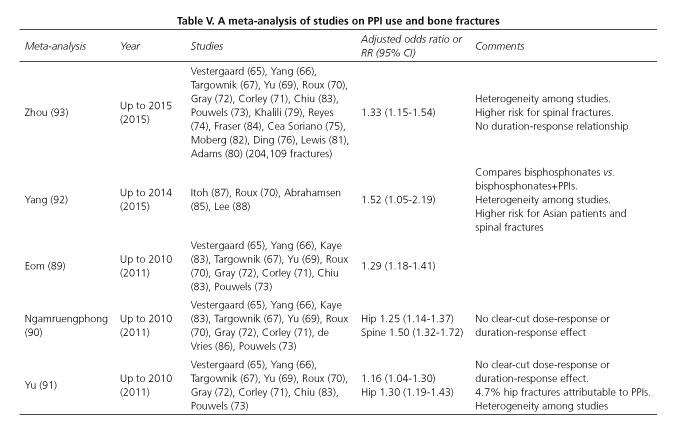
<body><![CDATA[<p>&nbsp;</p>     <p><font face="Verdana" size="2"><b>And magnesium deficiency?</b></font></p>     <p><font face="Verdana" size="2">Blood magnesium levels are dependent upon balance between intestinal absorption and renal excretion. Hypomagnesemia usually develops from decreased ingestion or absorption, increased loss (whether urinary or gastrointestinal), or impaired transportation. Hypomagnesemia has been recently associated with long-term PPI use (53-56). This is an adverse effect of unknown prevalence that raised significant controversy among prescribers. While the biological mechanism of PPI-related hypomagnesemia remains partly unknown, the increased pH induced by these drugs would seemingly affect transient receptor potential melastatin type 6 and 7 channels, thus reducing magnesium active transport and absorption (57).</font></p>     <p><font face="Verdana" size="2">Although PPIs were initially marketed in 1989, the first case report on PPI use and hypomagnesemia dates back to 2006 (58). Several observational studies followed, which assessed the potential association between PPI use and hypomagnesemia with conflicting results (54,55) or very low prevalence findings (56). Some were criticized for lack of consideration of patient diet; furthermore, since magnesium is an intracellular ion, serum concentrations do not reflect total magnesium, which renders measurement a challenging procedure. Despite low study consistency, in 2011 the "<i>Agencia Espa&ntilde;ola de Medicamentos y Productos Sanitarios</i>" (AEMPS), the U.S. Food and Drug Administration (FDA), and the Australian Medicines Safety Update of Therapeutic Goods Administration published an informative note advising that such diagnostic possibility be assessed should suggestive symptoms develop during prolonged PPI use. The note also recommended magnesium testing at baseline and then regularly under certain conditions (59-61). Later, a systematic review and meta-analysis in 2014 (62) revealed an association between PPI use and hypomagnesemia; however, high heterogeneity between studies prevented a definitive conclusion. In the cross-sectional study by Luk (63), which included 693 patients on PPIs with hypomagnesemia, the risk for hypomagnesemia was seen to vary among PPIs, being highest for pantoprazole and lowest for esomeprazole. Also the recent systematic review and meta-analysis of observational studies by Cheungpasitporn (64) found a statistically significant risk for the association of PPIs and hypomagnesemia. Current theories regarding the mechanism of PPI-related hypomagnesemia do not explain risk differences between PPIs. To date, no study has been carried out to compare hypomagnesemia risk differences between different PPIs.</font></p>     <p><font face="Verdana" size="2">In the studies reporting on impaired magnesium absorption with PPI use, patients had received a PPI for at least one year, which suggests that short-term PPI use does not reduce magnesium levels. Hypomagnesemia may be asymptomatic or result in vomiting, diarrhea, and even tetany, confusion and seizures. It is furthermore associated with prolonged QT in the ECG and electrolyte imbalance, including hypocalcemia and hypokalemia. While the frequency of this adverse event, which may be overlooked, remains unknown, both the AEMPS and FDA recommend magnesemia monitoring at treatment onset, and that follow-up be considered, particularly for prolonged PPI use in patients on concomitant PPIs and other hypomagnesemia-inducing drugs, including loop or thiazide diuretics, and drugs potentially affected by serum magnesium levels, such as digoxin (57,59,60). Other patients, including individuals with advanced age, diabetes mellitus, renal failure, and cardiovascular conditions, may also benefit from regular magnesium testing. The management of patients on a PPI with hypomagnesemia must be individualized, and the drug should be discontinued when the indication is inappropriate. Should its administration be advisable, it is recommended that minimum doses and magnesium supplementation be administered, even though this regimen has never been prospectively assessed.</font></p>     <p>&nbsp;</p>     <p><font face="Verdana" size="2"><b>Do PPIs increase bone fracture risk?</b></font></p>     <p><font face="Verdana" size="2">Multiple observational studies (65-88) and meta-analyses (89-93) have assessed PPI use, either alone or in combination with bisphosphonates, in relation to bone fracture risk. In these studies PPI use is associated with a higher risk for fragility bone fractures as a result of osteoporosis, particularly involving the spine and hip (<a target="_blank" href="/img/revistas/diges/v108n4/especial_table4.html">Table IV</a> -studies on PPIs and bone fractures-, and <a href="#t5">Table V</a> -meta-analyses of studies on PPIs and bone fractures-). The strength of this association is low, somewhat greater when adherence is high (76) or for higher daily doses of PPI (71,73,75,85). However, although likely, no dose-response or duration-response association has been well established (72,75,80,86).</font></p>     <p>&nbsp;</p>     <p align="center"><font face="Verdana" size="2"><a name="t5"><img src="/img/revistas/diges/v108n4/especial_table5.jpg"></a></font></p>     ]]></body>
<body><![CDATA[<p>&nbsp;</p>     <p><font face="Verdana" size="2">This weakness suggests a potential role of confounding factors. Kaye (68) performed a study where all patients with medical conditions associated with hip fracture risk were excluded, and found no increased risk for PPI use: RR 0.99 (95% CI: 0.7-1.1). Age, female sex, body mass index, alcohol and tobacco use, history of prior falls or fractures, neurological and hematological disease, comorbidities, and use of drugs such as antidepressants, anxiolytics, antipsychotics, antiepileptics, diuretics, and antidiabetics represent confounding factors that modulate PPI-related bone fracture risk (68,74-76,81,82,89,94,95).</font></p>     <p><font face="Verdana" size="2">Most studies have been performed in Nordic or Anglosaxon countries, where a high prevalence of fragility fractures is present -as is well known, prevalence in Spain is lower. In a retrospective case-control study in Catalonia (74) PPI use was associated with fracture risk with an OR of 1.44 (95% CI: 1.09-1.89; p = 0.009), which disappears after adjusting for confounding factors. In an also Catalan population cohort (96) including patients who received bisphosphonates, with 21,385 subjects of whom 2,026 had at least one fracture, PPIs were associated with fracture risk -OR 1.41 (95% CI: 1.22-1.65; p &lt; 0,001).</font></p>     <p><font face="Verdana" size="2">Virtually no clinical trials are available to complete the information provided by observational studies. Itoh (87) compared risedronate <i>versus</i> risedronate pluas rabeprazole (10 mg), and found no differences in fracture numbers between groups, but the study was not designed for that purpose. The aforementioned SOPRAN and LOTUS studies also found no differences in fracture numbers (48).</font></p>     <p><font face="Verdana" size="2">At any rate, no mechanism has been found through which PPIs would presumably induce fractures. Its use has not been shown to reduce calcium absorption (48,97,98) or induce significant changes in bone mineral density (69,70,72,87,99-101), and some study suggests that proton pump inhibition in osteoclasts by PPIs may impair bone remodeling (102).</font></p>     <p><font face="Verdana" size="2">Although osteoporosis-related bone fragility fractures entail a significant socio-economic impact and high morbidity and mortality rates, only 1% to 5% may be attributed to PPI use (91,103). Therefore, clinical relevance seems low. In this respect, the FDA points out that evidence is inadequate to recommend calcium supplementation or regular bone density scans (60).</font></p>     <p><font face="Verdana" size="2">In conclusion, PPI use is associated with higher risk for bone fractures, but such association cannot be said to be causal. Available evidence does not allow to recommend PPI discontinuation in order to prevent bone fractures, but inappropriate prescription must be precluded, and minimum effective doses are to be sought (60,104).</font></p>     <p>&nbsp;</p>     <p><font face="Verdana" size="2"><b>Do PPIs favor enteric infection and pneumonia?</b></font></p>     <p><font face="Verdana" size="2">The available scientific evidence, based on case-control and cohort studies, suggests that PPI is associated with a mildly increased risk of enteric infection, particularly with <i>Clostridium difficile</i> (CD), and community-acquired pneumonia (CAP). Gastric acid represents a physiological antimicrobial barrier. Infection risk during PPI use results from gastric secretion inhibition, that is, the beneficial effect of these drugs.</font></p>     ]]></body>
<body><![CDATA[<p><font face="Verdana" size="2">Leonard (105) used a meta-analysis to assess the association between enteric infection and gastric antisecretory drugs. The use of these drugs was associated with increased risk for infection with <i>Salmonella, Campylobacter</i>, and additional organisms other than CD (OR 2.55; 95% CI: 1.53-4.26), the association being higher for PPIs (OR 3.33; 95% CI: 1.84-6.02) than for anti-H<sub>2</sub> agents (OR 2.03; 95% CI: 1.05-3.92). Two recently reported studies associated PPI use with <i>Salmonella</i> (106, 107). Garc&iacute;a-Rodr&iacute;guez (108) carried out a case-control study in Spain, which also identified a greater risk for infection with these organisms during PPI use (RR 2.9; 95% CI: 2.5-3.5) but not during therapy with anti-H2 agents (RR 1.1; 95% CI: 0.9-1.4). The association between PPI use and CD infection has been most studied. Three meta-analyses reported in 2012 (109-111) identified a greater risk for CD infection (OR 1.74; 95% CI: 1.47-2.85; OR 2.31; 95% CI: 1.72-3.10 for cohort studies, and OR 1.48; 95% CI: 1.25-1.75 for case-control studies; and OR 2.15; 95% CI: 1.81-2.55, respectively).</font></p>     <p><font face="Verdana" size="2">In the meta-analysis by Kwok (109) the risk associated with PPI use (OR 1.74; 95% CI: 1.47-2.85) increased with concurrent antibiotic use (OR 1.96; 95% CI: 1.03-3.70). The causal association between PPI use and CD infection may be considered mild to moderate. Most studies provide no information on the influence of variables such as treatment duration, comorbidity, hospitalization, advanced age, etc., hence recommendations are challenging regarding preventive measures in clinical practice. However, we should be particularly cautious in prescribing PPIs for patients with risk factors for CD infection -a recently reported retrospective study (112) concluded that PPIs should be avoided in patients with recurrent CD infection. In this regard, the FDA recommends that the diagnosis with CD-related diarrhea be considered for patients on PPIs with persistent diarrhea. Furthermore, given the risk for infection with CD, they recommend that PPIs be prescribed at the lowest effective dose for the shortest duration possible (113).</font></p>     <p><font face="Verdana" size="2">As regards the association of pneumonia and PPI use, case-control studies reported in 2004-08 (114-116) and subsequent meta-analyses (117-120) suggest that PPI use may be associated with a mildly increased risk of CAP. In the review by Lambert (119) an OR of 1.49 (95% CI: 1.16-1.92) was found. A pathogenic relationship has not been well established but might involve gastric bacterial colonization, changes in oropharyngeal bacterial flora, and pulmonary microaspiration. The fact should be highlighted that increased risk is related to treatment duration, being higher within 1 month after therapy onset (OR 2.10; 95% CI: 1.39-3.16) regardless of dosage and patient age. It is also associated with an increased risk of hospitalization for CAP (OR 1.61; 95% CI: 1.12-2.31).</font></p>     <p><font face="Verdana" size="2">In summary, the increased CAP risk reported during therapy with PPIs is low, and only relevant for short-term regimens, with no convincing explanation. The absence of higher quality studies, as occurs with enteric infection, hinders the assessment of causal associations and a most likely influence of confounding factors (121,122). The information available does not allow recommendations on CAP prevention in clinical practice, except using PPIs for stringent indications alone.</font></p>     <p>&nbsp;</p>     <p><font face="Verdana" size="2"><b>Is PPI use concurrently with thienopyridine derivatives safe, or do they increasecardiovascular risk?</b></font></p>     <p><font face="Verdana" size="2">Clopidogrel and ticlopidine are thienopyridine derivatives with platelet antiaggregation activity entailing a higher risk for gastrointestinal bleeding, particularly in patients with a history of digestive bleeding and peptic ulcer. Clopidogrel is now more commonly used, and undergoes conversion to its active metabolite in the liver primarily by cytochrome P450 isoenzymes CYP2C19 and CYP3A4. These isoenzymes also play a role in PPI metabolism, this being why PPIs inhibit clopidogrel activation (123,124). Prasugrel is a novel thienopyridine that only requires a metabolic step via the hepatic CYP isoenzymes to become an active compound. Therefore, platelet inhibition is faster, more pronounced with lower doses, and response is less variable. Also, prasugrel response is less affected by concomitant CYP inhibitors (125).</font></p>     <p><font face="Verdana" size="2">The first study who drew attention on the interaction of omeprazole (20 mg daily) and clopidogrel (75 mg daily) was reported by Gilard (126). The percentage of platelet function inhibition after 7 days on both drugs was much lower in the omeprazole group (39.8 &plusmn; 15.4%) <i>versus</i> the placebo group (51.4 &plusmn; 16.4%, p &lt; 0.0001). This study did not analyze the potential clinical consequences of this effect. While many observational studies are available, few randomized controlled studies (127-129) and meta-analyses (130-133) allow to assess the clinical effect of concomitant PPI use on clopidogrel efficacy.</font></p>     <p><font face="Verdana" size="2">The COGENT study (127) compared clopidogrel <i>versus</i> clopidogrel + omeprazole (20 mg). It included 3,873 patients either with acute coronary syndrome or undergoing percutaneous revascularization. No differences in cardiovascular events were reported between both groups, but upper GI bleeding rates were lower among those treated with omeprazole. The TRITON-TIMI study (128) included 13,608 patients, and showed no association between PPI use and cardiovascular risk. Another study, PLATO (129), included 18,624 patients receiving clopidogrel or ticagrelor. Although a mildly increased cardiovascular risk was reported for those on PPIs, such risk was also seen among those on other drugs, including anti-H<sub>2</sub> agents; hence the authors concluded that PPI use may be considered a cardiovascular risk marker rather than its cause.</font></p>     <p><font face="Verdana" size="2">As regards the meta-analyses reported thus far (130-133), most studies included are observational in nature, whether retrospective or prospective. Their findings are conflicting in that some of them show a marked increase in serious cardiovascular adverse events, whereas others only find a mild or even absent increase or risk of readmission.</font></p>     ]]></body>
<body><![CDATA[<p><font face="Verdana" size="2">The most recent one, by Kwok (133), included 23 studies in 222,311 patients. While the pooled cardiovascular risk was significantly increased among subjects on PPIs, no differences were shown between PPIs, including pantoprazole, reflecting their different pharmacokinetics and their related platelet function assessments; the authors concluded that confounders and biases likely play a role in many of the pooled studies.</font></p>     <p><font face="Verdana" size="2">Several international agencies and expert committees have taken a stance on this subject. The EMA (<i>European Medicines Agency</i>) published an alert in May 2009 (amended in March 2010) suggesting that clopidogrel may be less effective in patients on PPIs, which would increase the risk of cardiovascular adverse effects (134,135). The FDA pronounced themselves similarly in 2010 (136), and the AEMPS published a warning advising against the use of omeprazole and esomeprazole -but not other PPIs- combined with clopidogrel (137). The Canadian Cardiology Society (2011) and the European Cardiology Society (2013) recommend that PPIs with less inhibition of CYP2C19 be used in patients on clopidogrel with high risk for upper GI bleeding (138,139).</font></p>     <p><font face="Verdana" size="2">Complexity has grown following a recently reported observational study (140) where a novel data mining technique was use to recover information from electronic clinical records. The primary analysis included 70,477 patients with gastroesophageal reflux disease, and the authors concluded that PPI use is associated with myocardial infarction -OR 1.16 (95% CI: 1.09-1.24). The increase seen in absolute risk is moderate- only one in 4,000 patients on a PPI may experience myocardial infarction. This effect is independent of clopidogrel use, hence the increase in cardiovascular events seen in patients receiving clopidogrel plus a PPI may also be accounted for by a PPI class effect. The weakness of this association, the differences between PPIs, the lack of control for confounders and independent cardiovascular risk factors, and the information collection approach advise caution in interpreting the study's findings.</font></p>     <p><font face="Verdana" size="2">The SOPRAN study (141), a randomized, multicenter, prospective trial in patients followed up for 12 years, reported 8 myocardial infarction events in the omeprazole group <i>versus</i> 2 in the surgical procedure group. However, this is attributed to older mean age and more prior MIs in the omeprazole group, as well as more losses to follow-up in the surgical procedure group.</font></p>     <p><font face="Verdana" size="2">During 2015, at least 5 additional sudies have been reported (142-146) that attempt to correlate PPI plus clopidogrel use with higher CV risk, with no conclusive findings. While observational studies suggest a PPI-clopidogrel interaction, such interaction remains clinically unidentified in randomized clinical trials (147-149).</font></p>     <p><font face="Verdana" size="2">Therefore, based on the currently available data, patients with acute coronary syndrome or undergoing coronary artery revascularization on thienopyridines should only be prescribed a PPI when the indication is clear, particularly if a history of peptic ulcer or upper GI bleeding is present. Anyway, caution must be exerted, and further prospective, randomized studies are needed to shed light on this potential interaction.</font></p>     <p>&nbsp;</p>     <p><font face="Verdana" size="2"><b>May PPIs increase complication risk in patients with liver cirrhosis?</b></font></p>     <p><font face="Verdana" size="2">PPIs entered clinical practice in the 1980s, and have been widely used in patients with liver cirrhosis ever since for multiple indications (peptic ulcer, gastroesophageal reflux, portal hypertensive gastropathy, post-sclerotherapy ulcer prevention, digestive bleeding, and Barrett's esophagus, among others). Considered from the outset as virtually harmless drugs, various studies reported in recent years warn against infections related to PPI use, primarily nosocomial pneumonia (150), infection with <i>Clostridium difficile</i> (151), and spontaneous bacterial peritonitis (SBP) (152,153).</font></p>     <p><font face="Verdana" size="2">Numerous studies have suggested that PPI use in patients with cirrhosis increases SBP risk, whereas others have found the opposite (152-166) (<a target="_blank" href="/img/revistas/diges/v108n4/especial_table6.jpg">Table VI</a>). Two pioneering meta-analyses (155,158) supporting the former hypothesis have been criticized for low methodological quality, namely the inclusion of a reduced number of studies and lack of any bias identification approach. A recent meta-analysis by Xu (153) concluded that these drugs, when used in patients with cirrhosis and ascites, significantly increase SBP risk, with OR 2.17 (95% CI: 1.46-3.23), albeit with high heterogeneity (I2 = 85.6%). In contrast, a simultaneously reported multicenter study (165) carried out in Argentina on 521 patients refutes this hypothesis, since no differences in PPI use were found for patients developing a SBP event or otherwise. However, the latter study, which was reported as prospective, was based on a survey on PPI use in the prior 3 months that was administered to patients on hospital admission.</font></p>     ]]></body>
<body><![CDATA[<p><font face="Verdana" size="2">Regarding dosage, an increased risk has been described for standard <i>versus</i> halved doses (162) (OR: 2.184; 95% CI: 0.935-5.103; p = 0.07). Comparisons are challenging for treatment duration since no consistent definitions are found among studies. With this limitation, both increased risk for SBP with longer treatment (167) and no influence of this variable have been reported (157).</font></p>     <p><font face="Verdana" size="2">Regarding bacterial infection risk, the meta-analysis found it increased, with OR 1.98 (95% CI: 1.36-2.87; p &lt; 0.05) (153). The study by Merli (168) suggests that chronic therapy with PPIs increases the prevalence of infection, particularly in patients with severe liver disease, hospitalized within the past 6 months, or having experienced infection during the previous year. Experimental studies in animal models (rats) showed that PPIs induce bacterial overgrowth in the gut. However, the factor predominantly determining infection risk in cirrhotic patients is function stage, with a 3-fold higher probability for Child-Pugh grades B and C, as compared to grade A; increased intestinal permeability by these drugs may be a contributing factor (169), a hypothesis supported by other studies (163).</font></p>     <p><font face="Verdana" size="2">A recent single-center, prospective study (170) related PPI use with increased mortality risk in a cohort of 272 cirrhotic patients (OR 2.363; 95% CI: 1.264-4.296; p = 0.007 for the multivariate analysis), although patients on PPIs had greater impairment of liver function (Child-Pugh, MELD) when compared to the other group (84% <i>vs</i>. 59.3% were Child B-C). In the univariate study, PPIs were related to colonization with multiresistant bacteria, a trend that persisted in the multivariate analysis albeit without reaching statistical significance.</font></p>     <p><font face="Verdana" size="2">Future prospective, well designed studies are needed to clarify the association of different PPIs with infection risk in cirrhotic patients, as well as the potential effect of dose and duration on said risk.</font></p>     <p><font face="Verdana" size="2">In summary, PPI use in patients with liver cirrhosis, particularly those with cirrhotic decompensation, may have a deleterious effect, and therefore should be cautiously indicated on an individual basis in this subgroup. Acid secretion is reduced in these patients, hence evidence is inadequate to indicate PPIs as prophylaxis for peptic complications in patients portal hypertensive gastropathy or esophageal varices.</font></p>     <p>&nbsp;</p>     <p><font face="Verdana" size="2"><b>Discussion</b></font></p>     <p><font face="Verdana" size="2">Overall, we may assert that PPIs represent a safe drug class with mostly mild adverse effects including headache, constipation, diarrhea, dyspepsia, skin rash, and rarely symptomatic hypomagnesemia. No cases of cancer or carcinoid tumors have been reported in association with long-term PPI use. Drug-drug interactions may occur through various mechanisms, including impaired absorption from gastric pH changes, or through competition for cytochrome P450. Significant interactions include atazanavir, clopidogrel, cyclosporin, warfarin, acenocoumarol, carbamazepine, and antifungal agents, among others (171). A careful assessment of potential drug-drug interactions is also key to avert adverse events or unnecessary risks for therapy failure when using novel direct-acting antiviral agents such as sofosbuvir, ledipasvir, etc., where concomitant PPI use is advised against (172).</font></p>     <p><font face="Verdana" size="2">Furthermore, consideration of PPIs as simply gastric "protectors" with virtually no adverse effects has shot up their use for uncertain indications or symptoms not associated with acid hypersecretion. Also, their current low cost and the fact that may be easily obtained over-the-counter has favored their use and self-medication. Potentially serious side effects have been reported of late, which have been related to ongoing, long-term PPI use. These include symptomatic hypomagnesemia, higher risk for bone fracture, higher risk for infection (enteric infection or pneumonia), vitamin malabsorption, risk for potentially serious interactions (clopidogrel), primarily infectious complications in cirrhotic patients, and development of chronic renal disease, as was highlighted in a recent observational study (173). However, when the scientific evidence supporting potential PPI risks is analyzed, it is often based on observational studies or case reports endowed with obvious biases, including other likely causes for the reported side effects and inconsistent findings. Similarly, most reported studies exhibit blatant heterogeneity and inadequate control for potential confounders. The GRADE classification system for assessing the quality of evidence ascribes a low-quality score to evidence obtained from observational studies, which may be upgraded to moderate-quality for strong, highly consistent effects, with a dose-response relationship, and one plausible confounder. It is further considered that the observed effect of an intervention exhibits a weak association when its relative risk or odds ratio is smaller than 2, as is the case with most studies reviewed in the present paper. Furthermore, these effects usually concern polymedicated, frail elderly individuals with severe comorbidities, and immunosuppressed, malnourished patients, where PPI use may represent an additional risk marker rather than a causal association.</font></p>     <p><font face="Verdana" size="2">The association of PPI use with pneumonia, bone fracture, or a cardiovascular event should not be underestimated, as it may entail non-negligible morbidity and mortality rates. This fact must be borne in mind, and PPI use must be envisaged as a factor that, added to other factors, may trigger undesired effects.</font></p>     ]]></body>
<body><![CDATA[<p><font face="Verdana" size="2">To sum it all up, the evidence supporting an association between these adverse effects and long-term PPI use is difficult to interpret, lacks sufficient weight, and may be biased. Even so, we must remain cautious and alert in order to prevent such complications from arising in high-risk patients. Further studies and randomized trials are obviously needed, but higher-quality evidence is unlikely to result.</font></p>     <p><font face="Verdana" size="2">Presently, both the short-term and long-term benefits of PPI therapy exceed potential risks or side effects, provided clinical indication, dosage, and treatment duration are appropriate. Efforts should be made to avoid improper prescription, particularly in the polymedicated frail elderly and following hospitalization, and to inform patients regarding their treatment duration and how to keep clear from adverse effect-associated risk factors.</font></p>     <p>&nbsp;</p>     <p><font face="Verdana" size="2"><b>Conclusions and position statement</b></font></p>     <p><font face="Verdana" size="2">In summary, based on all the above, the statements considered by the SEPD as their positioning on PPIs and their potentially serious adverse effects include the following:</font></p>     <blockquote>     <p><font face="Verdana" size="2">1. Overall, PPIs may be considered a safe drug class with few, mostly mild adverse effects.</font></p>     <p><font face="Verdana" size="2">2. Consideration of PPIs as simply gastric "protectors" with virtually no side effects has shot up their use often with no clear indication or for symptoms not associated with acid hypersecretion.</font></p>     <p><font face="Verdana" size="2">3. The need to use PPIs only when indicated, for the necessary duration, at the minimum effective dose, always under medical prescription is underscored by the SEPD.</font></p>     <p><font face="Verdana" size="2">4. Several potentially serious adverse effects have been associated with continued, long-term PPI use, but the evidence supporting such association is difficult to interpret and of insufficient weight, and may also be biased in multiple cases.</font></p>     ]]></body>
<body><![CDATA[<p><font face="Verdana" size="2">5. However, adverse effects with non-negligible morbidity and mortality rates do exist, which makes it advisable to regularly monitor appropriate PPI prescription, particularly in at-risk situations.</font></p> </blockquote>     <p>&nbsp;</p>     <p><font face="Verdana" size="2"><b>Acknowledgments</b></font></p>     <p><font face="Verdana" size="2">We are grateful to the SEPD Executive Committee members who, not having been authors themselves, have contributed to this paper's institutional review and support: Fernando Carballo, Enrique Dom&iacute;nguez, Cecilio Santander, Javier Crespo, Alfredo Lucendo, Enrique P&eacute;rez-Cuadrado, Jos&eacute; Luis Calleja, Fernando Azpiroz, Joaqu&iacute;n Hinojosa, Jos&eacute; Miguel Esteban, Julio Iglesias, and Miguel Mu&ntilde;oz-Navas. We also thank Joaqu&iacute;n Le&oacute;n for his help with the documentation and literature.</font></p>     <p>&nbsp;</p>     <p><font face="Verdana" size="2"><b>Conflicts of interest</b></font></p>     <p><font face="Verdana" size="2">The authors who sign this position statement do so on behalf of the Sociedad Espa&ntilde;ola de Patolog&iacute;a Digestiva (SEPD). Neither this Scientific Society, nor any of the members of its task force are related whatsoever to the companies that develop the PPI drugs mentioned in this document. Neither the SEPD nor the members of its task force have any financial interests in the companies that researched and distribute these PPIs; however, both the above-mentioned Society and its task force members maintain an ongoing relationship with said companies for the promotion of education, research, and improved clinical practice regarding the conditions associated with PPI use. Finally, both the SEPD and the signing authors declare that the initiative to set up a task force and develop a position statement emerged and was carried out in the absence of any formal or informal connection with the industry, which had no influence and no knowledge whatsoever regarding the task force composition and the preliminary, intermediate, and final contents of the statement before its effective publication in <i>The Spanish Journal of Gastroenterology</i> (<i>Revista Espa&ntilde;ola de Enfermedades Digestivas</i>).</font></p>     <p>&nbsp;</p>     <p><font face="Verdana" size="2"><b>References</b></font></p>     <!-- ref --><p><font face="Verdana" size="2">1. Robinson M, Horn J. Clinical pharmacology of proton pump inhibitors - What the practising physician needs to know. Drugs 2003;63:2739-54.    &nbsp;&nbsp;&nbsp;&nbsp;&nbsp;&nbsp;&nbsp;&nbsp;[&#160;<a href="javascript:void(0);" onclick="javascript: window.open('/scielo.php?script=sci_nlinks&ref=5410395&pid=S1130-0108201600040000700001&lng=','','width=640,height=500,resizable=yes,scrollbars=1,menubar=yes,');">Links</a>&#160;]<!-- end-ref --></font></p>    <!-- ref --><p><font face="Verdana" size="2">2. Garc&iacute;a del Pozo J. Estudio de utilizaci&oacute;n de antiulcerosos en Espa&ntilde;a (2000-2008). Inf Ter Sist Nac Salud 2009;33:49-54.    &nbsp;&nbsp;&nbsp;&nbsp;&nbsp;&nbsp;&nbsp;&nbsp;[&#160;<a href="javascript:void(0);" onclick="javascript: window.open('/scielo.php?script=sci_nlinks&ref=5410397&pid=S1130-0108201600040000700002&lng=','','width=640,height=500,resizable=yes,scrollbars=1,menubar=yes,');">Links</a>&#160;]<!-- end-ref --></font></p>    <!-- ref --><p><font face="Verdana" size="2">3. Ministerio de Sanidad. Subgrupos ATC y Principios activos de mayor consumo en el Sistema Nacional de Salud en 2010. Inf Ter Sist Nac Salud 2010;35:124-8.    &nbsp;&nbsp;&nbsp;&nbsp;&nbsp;&nbsp;&nbsp;&nbsp;[&#160;<a href="javascript:void(0);" onclick="javascript: window.open('/scielo.php?script=sci_nlinks&ref=5410399&pid=S1130-0108201600040000700003&lng=','','width=640,height=500,resizable=yes,scrollbars=1,menubar=yes,');">Links</a>&#160;]<!-- end-ref --></font></p>    <!-- ref --><p><font face="Verdana" size="2">4. Ponce J, Esplugues JV. Rationalizing the use of PPIs: An unresolved matter. Rev Esp Enferm Dig 2013;105:121-4. DOI: 10.4321/S1130-01082013000300001.    &nbsp;&nbsp;&nbsp;&nbsp;&nbsp;&nbsp;&nbsp;&nbsp;[&#160;<a href="javascript:void(0);" onclick="javascript: window.open('/scielo.php?script=sci_nlinks&ref=5410401&pid=S1130-0108201600040000700004&lng=','','width=640,height=500,resizable=yes,scrollbars=1,menubar=yes,');">Links</a>&#160;]<!-- end-ref --></font></p>    <!-- ref --><p><font face="Verdana" size="2">5. Simo Minana J. Use of prescription drugs in Spain and Europe. Aten Primaria. 2012;44:335-47.    &nbsp;&nbsp;&nbsp;&nbsp;&nbsp;&nbsp;&nbsp;&nbsp;[&#160;<a href="javascript:void(0);" onclick="javascript: window.open('/scielo.php?script=sci_nlinks&ref=5410403&pid=S1130-0108201600040000700005&lng=','','width=640,height=500,resizable=yes,scrollbars=1,menubar=yes,');">Links</a>&#160;]<!-- end-ref --></font></p>    <!-- ref --><p><font face="Verdana" size="2">6. Zink DA, Pohlman M, Barnes M, et al. Long-term use of acid suppression started inappropriately during hospitalization. Aliment Pharmacol Ther 2005;21:1203-9. DOI: 10.1111/j.1365-2036.2005.02454.x.    &nbsp;&nbsp;&nbsp;&nbsp;&nbsp;&nbsp;&nbsp;&nbsp;[&#160;<a href="javascript:void(0);" onclick="javascript: window.open('/scielo.php?script=sci_nlinks&ref=5410405&pid=S1130-0108201600040000700006&lng=','','width=640,height=500,resizable=yes,scrollbars=1,menubar=yes,');">Links</a>&#160;]<!-- end-ref --></font></p>    <!-- ref --><p><font face="Verdana" size="2">7. Eid SM, Boueiz A, Paranji S, et al. Patterns and predictors of proton pump inhibitor overuse among academic and non-academic hospitalists. Intern Med 2010;49:2561-8. DOI: 10.2169/internalmedicine.49.4064.    &nbsp;&nbsp;&nbsp;&nbsp;&nbsp;&nbsp;&nbsp;&nbsp;[&#160;<a href="javascript:void(0);" onclick="javascript: window.open('/scielo.php?script=sci_nlinks&ref=5410407&pid=S1130-0108201600040000700007&lng=','','width=640,height=500,resizable=yes,scrollbars=1,menubar=yes,');">Links</a>&#160;]<!-- end-ref --></font></p>    <!-- ref --><p><font face="Verdana" size="2">8. Walker NM, McDonald J. An evaluation of the use of proton pump inhibitors. Pharm World 9. Sci 2001;23:116-7.    &nbsp;&nbsp;&nbsp;&nbsp;&nbsp;&nbsp;&nbsp;&nbsp;[&#160;<a href="javascript:void(0);" onclick="javascript: window.open('/scielo.php?script=sci_nlinks&ref=5410409&pid=S1130-0108201600040000700008&lng=','','width=640,height=500,resizable=yes,scrollbars=1,menubar=yes,');">Links</a>&#160;]<!-- end-ref --></font></p>    <!-- ref --><p><font face="Verdana" size="2">9. de Burgos Lunar C, Novo del Castillo S, Llorente Diaz E, et al. Study of prescription-indication of proton pump inhibitors. Rev Clin Esp 2006;206:266-70.    &nbsp;&nbsp;&nbsp;&nbsp;&nbsp;&nbsp;&nbsp;&nbsp;[&#160;<a href="javascript:void(0);" onclick="javascript: window.open('/scielo.php?script=sci_nlinks&ref=5410411&pid=S1130-0108201600040000700009&lng=','','width=640,height=500,resizable=yes,scrollbars=1,menubar=yes,');">Links</a>&#160;]<!-- end-ref --></font></p>    <!-- ref --><p><font face="Verdana" size="2">10. Martin-Echevarria E, Pereira Julia A, Torralba M, et al. Assessing the use of proton pump inhibitors in an internal medicine department. Rev Esp Enferm Dig 2008;100:76-81.    &nbsp;&nbsp;&nbsp;&nbsp;&nbsp;&nbsp;&nbsp;&nbsp;[&#160;<a href="javascript:void(0);" onclick="javascript: window.open('/scielo.php?script=sci_nlinks&ref=5410413&pid=S1130-0108201600040000700010&lng=','','width=640,height=500,resizable=yes,scrollbars=1,menubar=yes,');">Links</a>&#160;]<!-- end-ref --></font></p>    <!-- ref --><p><font face="Verdana" size="2">11. Batuwitage BT, Kingham JGC, Morgan NE, et al. Inappropriate prescribing of proton pump inhibitors in primary care. Postgrad Med J 2007;83:66-8. DOI: 10.1136/pgmj.2006.051151.    &nbsp;&nbsp;&nbsp;&nbsp;&nbsp;&nbsp;&nbsp;&nbsp;[&#160;<a href="javascript:void(0);" onclick="javascript: window.open('/scielo.php?script=sci_nlinks&ref=5410415&pid=S1130-0108201600040000700011&lng=','','width=640,height=500,resizable=yes,scrollbars=1,menubar=yes,');">Links</a>&#160;]<!-- end-ref --></font></p>    <!-- ref --><p><font face="Verdana" size="2">12. Ahrens D, Chenot J-F, Behrens G, et al. Appropriateness of treatment recommendations for PPI in hospital discharge letters. Eur J Clin Pharmacol 2010;66:1265-71. DOI: 10.1007/s00228-010-0871-9.    &nbsp;&nbsp;&nbsp;&nbsp;&nbsp;&nbsp;&nbsp;&nbsp;[&#160;<a href="javascript:void(0);" onclick="javascript: window.open('/scielo.php?script=sci_nlinks&ref=5410417&pid=S1130-0108201600040000700012&lng=','','width=640,height=500,resizable=yes,scrollbars=1,menubar=yes,');">Links</a>&#160;]<!-- end-ref --></font></p>    <!-- ref --><p><font face="Verdana" size="2">13. Cahir C, Fahey T, Teeling M, et al. Potentially inappropriate prescribing and cost outcomes for older people: a national population study. Brit J Clin Pharmacol 2010;69:543-52. DOI: 10.1111/j.1365-2125.2010.03628.x.    &nbsp;&nbsp;&nbsp;&nbsp;&nbsp;&nbsp;&nbsp;&nbsp;[&#160;<a href="javascript:void(0);" onclick="javascript: window.open('/scielo.php?script=sci_nlinks&ref=5410419&pid=S1130-0108201600040000700013&lng=','','width=640,height=500,resizable=yes,scrollbars=1,menubar=yes,');">Links</a>&#160;]<!-- end-ref --></font></p>    <!-- ref --><p><font face="Verdana" size="2">14. Villamanan E, Ruano M, Lara C, et al. Reasons for initiation of proton pump inhibitor therapy for hospitalised patients and its impact on outpatient prescription in primary care. Rev Esp Enferm Dig 2015;107:652-8.    &nbsp;&nbsp;&nbsp;&nbsp;&nbsp;&nbsp;&nbsp;&nbsp;[&#160;<a href="javascript:void(0);" onclick="javascript: window.open('/scielo.php?script=sci_nlinks&ref=5410421&pid=S1130-0108201600040000700014&lng=','','width=640,height=500,resizable=yes,scrollbars=1,menubar=yes,');">Links</a>&#160;]<!-- end-ref --></font></p>    <!-- ref --><p><font face="Verdana" size="2">15. Ramirez E, Lei SH, Borobia AM, et al. Overuse of PPIs in patients at admission, during treatment, and at discharge in a tertiary Spanish hospital. Curr Clin Pharmacol 2010;5:288-97.    &nbsp;&nbsp;&nbsp;&nbsp;&nbsp;&nbsp;&nbsp;&nbsp;[&#160;<a href="javascript:void(0);" onclick="javascript: window.open('/scielo.php?script=sci_nlinks&ref=5410423&pid=S1130-0108201600040000700015&lng=','','width=640,height=500,resizable=yes,scrollbars=1,menubar=yes,');">Links</a>&#160;]<!-- end-ref --></font></p>    <!-- ref --><p><font face="Verdana" size="2">16. Ahrens D, Behrens G, Himmel W, et al. Appropriateness of proton pump inhibitor recommendations at hospital discharge and continuation in primary care. Int J Clin Pract 2012; 66:767-73. DOI: 10.1111/j.1742-1241.2012.02973.x.    &nbsp;&nbsp;&nbsp;&nbsp;&nbsp;&nbsp;&nbsp;&nbsp;[&#160;<a href="javascript:void(0);" onclick="javascript: window.open('/scielo.php?script=sci_nlinks&ref=5410425&pid=S1130-0108201600040000700016&lng=','','width=640,height=500,resizable=yes,scrollbars=1,menubar=yes,');">Links</a>&#160;]<!-- end-ref --></font></p>    <!-- ref --><p><font face="Verdana" size="2">17. Ponce Romero M, Berenguer Lapuerta J. Current indications for proton pump inhibitors. Rev Clin Esp 2003;203:136-8.    &nbsp;&nbsp;&nbsp;&nbsp;&nbsp;&nbsp;&nbsp;&nbsp;[&#160;<a href="javascript:void(0);" onclick="javascript: window.open('/scielo.php?script=sci_nlinks&ref=5410427&pid=S1130-0108201600040000700017&lng=','','width=640,height=500,resizable=yes,scrollbars=1,menubar=yes,');">Links</a>&#160;]<!-- end-ref --></font></p>    <!-- ref --><p><font face="Verdana" size="2">18. Grupo de trabajo Sector Zaragoza I Salud. Empleo de los inhibidores de la bomba de protones en la prevenci&oacute;n de gastropat&iacute;as secundarias a f&aacute;rmacos. Gu&iacute;a de Pr&aacute;ctica Cl&iacute;nica. Zaragoza: Gu&iacute;a Salud; 2012.    &nbsp;&nbsp;&nbsp;&nbsp;&nbsp;&nbsp;&nbsp;&nbsp;[&#160;<a href="javascript:void(0);" onclick="javascript: window.open('/scielo.php?script=sci_nlinks&ref=5410429&pid=S1130-0108201600040000700018&lng=','','width=640,height=500,resizable=yes,scrollbars=1,menubar=yes,');">Links</a>&#160;]<!-- end-ref --></font></p>    <!-- ref --><p><font face="Verdana" size="2">19. Product Characteristics. Spanish Agency of Medicines and Medical Devices.    &nbsp;&nbsp;&nbsp;&nbsp;&nbsp;&nbsp;&nbsp;&nbsp;[&#160;<a href="javascript:void(0);" onclick="javascript: window.open('/scielo.php?script=sci_nlinks&ref=5410431&pid=S1130-0108201600040000700019&lng=','','width=640,height=500,resizable=yes,scrollbars=1,menubar=yes,');">Links</a>&#160;]<!-- end-ref --></font></p>    <!-- ref --><p><font face="Verdana" size="2">20. Arroyo Villarino M, Lanas Arbeloa A. Gastroenteropat&iacute;a por AINE. En: Ponce Garc&iacute;a J, editor. Asociaci&oacute;n Espa&ntilde;ola de Gastroenterolog&iacute;a. Tratamiento de las enfermedades gastroenterol&oacute;gicas. Barcelona: Elsevier; 2011. p. 123-31.    &nbsp;&nbsp;&nbsp;&nbsp;&nbsp;&nbsp;&nbsp;&nbsp;[&#160;<a href="javascript:void(0);" onclick="javascript: window.open('/scielo.php?script=sci_nlinks&ref=5410433&pid=S1130-0108201600040000700020&lng=','','width=640,height=500,resizable=yes,scrollbars=1,menubar=yes,');">Links</a>&#160;]<!-- end-ref --></font></p>    <!-- ref --><p><font face="Verdana" size="2">21. P&eacute;rez Gisbert J, Mart&iacute;n Argila C. &Uacute;lcera p&eacute;ptica e infecci&oacute;n por Helicobacter pylori. En: Ponce Garc&iacute;a J, editor. Asociaci&oacute;n Espa&ntilde;ola de Gastroenterolog&iacute;a. Tratamiento de las enfermedades gastroenterol&oacute;gicas. Barcelona: Elsevier; 2011. p. 109-21.    &nbsp;&nbsp;&nbsp;&nbsp;&nbsp;&nbsp;&nbsp;&nbsp;[&#160;<a href="javascript:void(0);" onclick="javascript: window.open('/scielo.php?script=sci_nlinks&ref=5410435&pid=S1130-0108201600040000700021&lng=','','width=640,height=500,resizable=yes,scrollbars=1,menubar=yes,');">Links</a>&#160;]<!-- end-ref --></font></p>    <!-- ref --><p><font face="Verdana" size="2">22. Sung JJY, Barkun A, Kuipers EJ, et al. Intravenous esomeprazole for prevention of recurrent peptic ulcer bleeding - a randomized trial. Ann Intern Med 2009;150:455-64. DOI: 10.7326/0003-4819-150-7-200904070-00105.    &nbsp;&nbsp;&nbsp;&nbsp;&nbsp;&nbsp;&nbsp;&nbsp;[&#160;<a href="javascript:void(0);" onclick="javascript: window.open('/scielo.php?script=sci_nlinks&ref=5410437&pid=S1130-0108201600040000700022&lng=','','width=640,height=500,resizable=yes,scrollbars=1,menubar=yes,');">Links</a>&#160;]<!-- end-ref --></font></p>    <!-- ref --><p><font face="Verdana" size="2">23. Sachar H, Vaidya K, Laine L. Intermittent vs continuous proton pump inhibitor therapy for high-risk bleeding ulcers - a systematic review and meta-analysis. JAMA Intern Med 2014;174:1755-62. DOI: 10.1001/jamainternmed.2014.4056.    &nbsp;&nbsp;&nbsp;&nbsp;&nbsp;&nbsp;&nbsp;&nbsp;[&#160;<a href="javascript:void(0);" onclick="javascript: window.open('/scielo.php?script=sci_nlinks&ref=5410439&pid=S1130-0108201600040000700023&lng=','','width=640,height=500,resizable=yes,scrollbars=1,menubar=yes,');">Links</a>&#160;]<!-- end-ref --></font></p>    <!-- ref --><p><font face="Verdana" size="2">24. Yen H-H, Yang C-W, Su W-W, et al. Oral versus intravenous proton pump inhibitors in preventing re-bleeding for patients with peptic ulcer bleeding after successful endoscopic therapy. BMC Gastroenterol 2012;12:66. DOI: 10.1186/1471-230X-12-66.    &nbsp;&nbsp;&nbsp;&nbsp;&nbsp;&nbsp;&nbsp;&nbsp;[&#160;<a href="javascript:void(0);" onclick="javascript: window.open('/scielo.php?script=sci_nlinks&ref=5410441&pid=S1130-0108201600040000700024&lng=','','width=640,height=500,resizable=yes,scrollbars=1,menubar=yes,');">Links</a>&#160;]<!-- end-ref --></font></p>    <!-- ref --><p><font face="Verdana" size="2">25. P&eacute;rez-Gisbert J, Calvet X, Ferrandiz J, et al. Clinical practice guideline on the management of patients with dyspepsia. Update 2012. Gastroenterol Hepatol 2012;35:725.e1-38.    &nbsp;&nbsp;&nbsp;&nbsp;&nbsp;&nbsp;&nbsp;&nbsp;[&#160;<a href="javascript:void(0);" onclick="javascript: window.open('/scielo.php?script=sci_nlinks&ref=5410443&pid=S1130-0108201600040000700025&lng=','','width=640,height=500,resizable=yes,scrollbars=1,menubar=yes,');">Links</a>&#160;]<!-- end-ref --></font></p>    <!-- ref --><p><font face="Verdana" size="2">26. Dellon ES. Diagnosis and management of eosinophilic esophagitis. Clin Gastroenterol Hepatol 2012;10:1066-78.    &nbsp;&nbsp;&nbsp;&nbsp;&nbsp;&nbsp;&nbsp;&nbsp;[&#160;<a href="javascript:void(0);" onclick="javascript: window.open('/scielo.php?script=sci_nlinks&ref=5410445&pid=S1130-0108201600040000700026&lng=','','width=640,height=500,resizable=yes,scrollbars=1,menubar=yes,');">Links</a>&#160;]<!-- end-ref --></font></p>    <!-- ref --><p><font face="Verdana" size="2">27. Lucendo AJ, Arias &Aacute;, Molina-Infante J. Efficacy of proton pump inhibitor drugs for inducing clinical and histologic remission in patients with symptomatic esophageal eosinophilia: A systematic review and meta-analysis. Clin Gastroenterol Hepatol 2016;14:13-22.e1. DOI: 10.1016/j.cgh.2015.07.041.    &nbsp;&nbsp;&nbsp;&nbsp;&nbsp;&nbsp;&nbsp;&nbsp;[&#160;<a href="javascript:void(0);" onclick="javascript: window.open('/scielo.php?script=sci_nlinks&ref=5410447&pid=S1130-0108201600040000700027&lng=','','width=640,height=500,resizable=yes,scrollbars=1,menubar=yes,');">Links</a>&#160;]<!-- end-ref --></font></p>    <!-- ref --><p><font face="Verdana" size="2">28. Molina-Infante J, Bredenoord AJ, Cheng E, et al. Proton pump inhibitor-responsive oesophageal eosinophilia: an entity challenging current diagnostic criteria for eosinophilic oesophagitis. Gut 2015; (online first): pii: gutjnl-2015-310991. Accesible en: <a target="_blank" href="http://www.ncbi.nlm.nih.gov/pubmed/26685124">http://www.ncbi.nlm.nih.gov/pubmed/26685124</a> DOI: 10.1136/gutjnl-2015-310991.    &nbsp;&nbsp;&nbsp;&nbsp;&nbsp;&nbsp;&nbsp;&nbsp;[&#160;<a href="javascript:void(0);" onclick="javascript: window.open('/scielo.php?script=sci_nlinks&ref=5410449&pid=S1130-0108201600040000700028&lng=','','width=640,height=500,resizable=yes,scrollbars=1,menubar=yes,');">Links</a>&#160;]<!-- end-ref --></font></p>    <!-- ref --><p><font face="Verdana" size="2">29. Dominguez-Munoz JE, Iglesias-Garcia J, Iglesias-Rey M. Optimising the therapy of exocrine pancreatic insufficiency by the association of a proton pump inhibitor to enteric coated pancreatic extracts. Gut 2006;55:1056-7. DOI: 10.1136/gut.2006.094912.    &nbsp;&nbsp;&nbsp;&nbsp;&nbsp;&nbsp;&nbsp;&nbsp;[&#160;<a href="javascript:void(0);" onclick="javascript: window.open('/scielo.php?script=sci_nlinks&ref=5410451&pid=S1130-0108201600040000700029&lng=','','width=640,height=500,resizable=yes,scrollbars=1,menubar=yes,');">Links</a>&#160;]<!-- end-ref --></font></p>    <!-- ref --><p><font face="Verdana" size="2">30. Stabler SP. Vitamin B-12 Deficiency. N Engl J Med 2013;368:149-60.    &nbsp;&nbsp;&nbsp;&nbsp;&nbsp;&nbsp;&nbsp;&nbsp;[&#160;<a href="javascript:void(0);" onclick="javascript: window.open('/scielo.php?script=sci_nlinks&ref=5410453&pid=S1130-0108201600040000700030&lng=','','width=640,height=500,resizable=yes,scrollbars=1,menubar=yes,');">Links</a>&#160;]<!-- end-ref --></font></p>    <!-- ref --><p><font face="Verdana" size="2">31. Jung SB, Nagaraja V, Kapur A, et al. Association between vitamin B12 deficiency and long-term use of acid-lowering agents: a systematic review and meta-analysis. Intern Med J 2015;45:409-16.    &nbsp;&nbsp;&nbsp;&nbsp;&nbsp;&nbsp;&nbsp;&nbsp;[&#160;<a href="javascript:void(0);" onclick="javascript: window.open('/scielo.php?script=sci_nlinks&ref=5410455&pid=S1130-0108201600040000700031&lng=','','width=640,height=500,resizable=yes,scrollbars=1,menubar=yes,');">Links</a>&#160;]<!-- end-ref --></font></p>    <!-- ref --><p><font face="Verdana" size="2">32. Lam JR, Schneider JL, Zhao W, et al. Proton pump inhibitor and histamine 2 receptor antagonist use and vitamin B-12 deficiency. JAMA 2013;310:2435-42. DOI: 10.1001/jama.2013.280490.    &nbsp;&nbsp;&nbsp;&nbsp;&nbsp;&nbsp;&nbsp;&nbsp;[&#160;<a href="javascript:void(0);" onclick="javascript: window.open('/scielo.php?script=sci_nlinks&ref=5410457&pid=S1130-0108201600040000700032&lng=','','width=640,height=500,resizable=yes,scrollbars=1,menubar=yes,');">Links</a>&#160;]<!-- end-ref --></font></p>    <!-- ref --><p><font face="Verdana" size="2">33. Dharmarajan TS, Kanagala MR, Murakonda P, et al. Do acid-lowering agents affect vitamin B12 status in older adults? J Am Med Dir Assoc 2008;9:162-7. DOI: 10.1016/j.jamda.2007.10.004.    &nbsp;&nbsp;&nbsp;&nbsp;&nbsp;&nbsp;&nbsp;&nbsp;[&#160;<a href="javascript:void(0);" onclick="javascript: window.open('/scielo.php?script=sci_nlinks&ref=5410459&pid=S1130-0108201600040000700033&lng=','','width=640,height=500,resizable=yes,scrollbars=1,menubar=yes,');">Links</a>&#160;]<!-- end-ref --></font></p>    <!-- ref --><p><font face="Verdana" size="2">34. Valuck RJ, Ruscin JM. A case-control study on adverse effects: H2 blocker or proton pump inhibitor use and risk of vitamin B-12 deficiency in older adults. J Clin Epidemiol 2004;57:422-8. DOI: 10.1016/j.jclinepi.2003.08.015.    &nbsp;&nbsp;&nbsp;&nbsp;&nbsp;&nbsp;&nbsp;&nbsp;[&#160;<a href="javascript:void(0);" onclick="javascript: window.open('/scielo.php?script=sci_nlinks&ref=5410461&pid=S1130-0108201600040000700034&lng=','','width=640,height=500,resizable=yes,scrollbars=1,menubar=yes,');">Links</a>&#160;]<!-- end-ref --></font></p>    <!-- ref --><p><font face="Verdana" size="2">35. Force RW, Meeker AD, Cady PS, et al. Increased vitamin B-12 requirement associated with chronic acid suppression therapy. Ann Pharmacother 2003;37:490-3.    &nbsp;&nbsp;&nbsp;&nbsp;&nbsp;&nbsp;&nbsp;&nbsp;[&#160;<a href="javascript:void(0);" onclick="javascript: window.open('/scielo.php?script=sci_nlinks&ref=5410463&pid=S1130-0108201600040000700035&lng=','','width=640,height=500,resizable=yes,scrollbars=1,menubar=yes,');">Links</a>&#160;]<!-- end-ref --></font></p>    <!-- ref --><p><font face="Verdana" size="2">36. Marcuard SP, Albernaz L, Khazanie PG. Omeprazole therapy causes malabsorption of cyanocobalamin (vitamin B12). Ann Intern Med 1994;120:211-5. DOI: 10.7326/0003-4819-120-3-199402010-00006.    &nbsp;&nbsp;&nbsp;&nbsp;&nbsp;&nbsp;&nbsp;&nbsp;[&#160;<a href="javascript:void(0);" onclick="javascript: window.open('/scielo.php?script=sci_nlinks&ref=5410465&pid=S1130-0108201600040000700036&lng=','','width=640,height=500,resizable=yes,scrollbars=1,menubar=yes,');">Links</a>&#160;]<!-- end-ref --></font></p>    <!-- ref --><p><font face="Verdana" size="2">37. Mitchell SL, Rockwood K. The association between antiulcer medication and initiation of cobalamin replacement in older persons. J Clin Epidemiol 2001;54:531-4. DOI: 10.1016/S0895-4356(00)00340-1.    &nbsp;&nbsp;&nbsp;&nbsp;&nbsp;&nbsp;&nbsp;&nbsp;[&#160;<a href="javascript:void(0);" onclick="javascript: window.open('/scielo.php?script=sci_nlinks&ref=5410467&pid=S1130-0108201600040000700037&lng=','','width=640,height=500,resizable=yes,scrollbars=1,menubar=yes,');">Links</a>&#160;]<!-- end-ref --></font></p>    <!-- ref --><p><font face="Verdana" size="2">38. Koop H. Review article: Metabolic consequences of long-term inhibition of acid secretion by omeprazole. Aliment Pharmacol Ther 1992;6:399-406. DOI: 10.1111/j.1365-2036.1992.tb00553.x.    &nbsp;&nbsp;&nbsp;&nbsp;&nbsp;&nbsp;&nbsp;&nbsp;[&#160;<a href="javascript:void(0);" onclick="javascript: window.open('/scielo.php?script=sci_nlinks&ref=5410469&pid=S1130-0108201600040000700038&lng=','','width=640,height=500,resizable=yes,scrollbars=1,menubar=yes,');">Links</a>&#160;]<!-- end-ref --></font></p>    <!-- ref --><p><font face="Verdana" size="2">39. Termanini B, Gibril F, Sutliff VE, et al. Effect of long-term gastric acid suppressive therapy on serum vitamin B-12 levels in patients with Zollinger-Ellison syndrome. Am J Med 1998;104:422-30. DOI: 10.1016/S0002-9343(98)00087-4.    &nbsp;&nbsp;&nbsp;&nbsp;&nbsp;&nbsp;&nbsp;&nbsp;[&#160;<a href="javascript:void(0);" onclick="javascript: window.open('/scielo.php?script=sci_nlinks&ref=5410471&pid=S1130-0108201600040000700039&lng=','','width=640,height=500,resizable=yes,scrollbars=1,menubar=yes,');">Links</a>&#160;]<!-- end-ref --></font></p>    <!-- ref --><p><font face="Verdana" size="2">40. Rozgony NR, Fang C, Kuczmarski MF, et al. Vitamin B(12) deficiency is linked with long-term use of proton pump inhibitors in institutionalized older adults: could a cyanocobalamin nasal spray be beneficial? J Nutr Elder 2010;29:87-99. DOI: 10.1080/01639360903574734.    &nbsp;&nbsp;&nbsp;&nbsp;&nbsp;&nbsp;&nbsp;&nbsp;[&#160;<a href="javascript:void(0);" onclick="javascript: window.open('/scielo.php?script=sci_nlinks&ref=5410473&pid=S1130-0108201600040000700040&lng=','','width=640,height=500,resizable=yes,scrollbars=1,menubar=yes,');">Links</a>&#160;]<!-- end-ref --></font></p>    <!-- ref --><p><font face="Verdana" size="2">41. Koop H, Bachem MG. Serum iron, ferritin, and vitamin B12 during prolonged omeprazole therapy. J Clin Gastroenterol 1992;14:288-92. DOI: 10.1097/00004836-199206000-00005.    &nbsp;&nbsp;&nbsp;&nbsp;&nbsp;&nbsp;&nbsp;&nbsp;[&#160;<a href="javascript:void(0);" onclick="javascript: window.open('/scielo.php?script=sci_nlinks&ref=5410475&pid=S1130-0108201600040000700041&lng=','','width=640,height=500,resizable=yes,scrollbars=1,menubar=yes,');">Links</a>&#160;]<!-- end-ref --></font></p>    <!-- ref --><p><font face="Verdana" size="2">42. Schenk BE, Festen HPM, Kuipers EJ, et al. Effect of short- and long-term treatment with omeprazole on the absorption and serum levels of cobalamin. Aliment Pharmacol Ther 1996;10:541-5. DOI: 10.1046/j.1365-2036.1996.27169000.x.    &nbsp;&nbsp;&nbsp;&nbsp;&nbsp;&nbsp;&nbsp;&nbsp;[&#160;<a href="javascript:void(0);" onclick="javascript: window.open('/scielo.php?script=sci_nlinks&ref=5410477&pid=S1130-0108201600040000700042&lng=','','width=640,height=500,resizable=yes,scrollbars=1,menubar=yes,');">Links</a>&#160;]<!-- end-ref --></font></p>    <!-- ref --><p><font face="Verdana" size="2">43. Den Elzen WPJ, Groeneveld Y, De Ruijter W, et al. Long-term use of proton pump inhibitors and vitamin B12 status in elderly individuals. Aliment Pharmacol Ther 2008;27:491-7. DOI: 10.1111/j.1365-2036.2008.03601.x.    &nbsp;&nbsp;&nbsp;&nbsp;&nbsp;&nbsp;&nbsp;&nbsp;[&#160;<a href="javascript:void(0);" onclick="javascript: window.open('/scielo.php?script=sci_nlinks&ref=5410479&pid=S1130-0108201600040000700043&lng=','','width=640,height=500,resizable=yes,scrollbars=1,menubar=yes,');">Links</a>&#160;]<!-- end-ref --></font></p>    <!-- ref --><p><font face="Verdana" size="2">44. ter Heide H, Hendriks HJE, Heijmans H, et al. Are children with cystic fibrosis who are treated with a proton-pump inhibitor at risk for vitamin B-12 deficiency? J Pediatr Gastroenterol Nutr 2001;33:342-5. DOI: 10.1097/00005176-200109000-00023.    &nbsp;&nbsp;&nbsp;&nbsp;&nbsp;&nbsp;&nbsp;&nbsp;[&#160;<a href="javascript:void(0);" onclick="javascript: window.open('/scielo.php?script=sci_nlinks&ref=5410481&pid=S1130-0108201600040000700044&lng=','','width=640,height=500,resizable=yes,scrollbars=1,menubar=yes,');">Links</a>&#160;]<!-- end-ref --></font></p>    <!-- ref --><p><font face="Verdana" size="2">45. Tolia V, Boyer K. Long-term proton pump inhibitor use in children: A retrospective review of safety. Dig Dis Sci 2008;53:385-93. DOI: 10.1007/s10620-007-9880-7.    &nbsp;&nbsp;&nbsp;&nbsp;&nbsp;&nbsp;&nbsp;&nbsp;[&#160;<a href="javascript:void(0);" onclick="javascript: window.open('/scielo.php?script=sci_nlinks&ref=5410483&pid=S1130-0108201600040000700045&lng=','','width=640,height=500,resizable=yes,scrollbars=1,menubar=yes,');">Links</a>&#160;]<!-- end-ref --></font></p>    <!-- ref --><p><font face="Verdana" size="2">46. Hirschowitz BI, Worthington J, Mohnen J. Vitamin B12 deficiency in hypersecretors during long-term acid suppression with proton pump inhibitors. Aliment Pharmacol Ther 2008;27:1110-21. DOI: 10.1111/j.1365-2036.2008.03658.x.    &nbsp;&nbsp;&nbsp;&nbsp;&nbsp;&nbsp;&nbsp;&nbsp;[&#160;<a href="javascript:void(0);" onclick="javascript: window.open('/scielo.php?script=sci_nlinks&ref=5410485&pid=S1130-0108201600040000700046&lng=','','width=640,height=500,resizable=yes,scrollbars=1,menubar=yes,');">Links</a>&#160;]<!-- end-ref --></font></p>    <!-- ref --><p><font face="Verdana" size="2">47. Long AN, Atwell CL, Yoo W, et al. Vitamin B-12 deficiency associated with concomitant metformin and proton pump inhibitor use. Diabetes Care 2012;35:E84-E. DOI: 10.2337/dc12-0980.    &nbsp;&nbsp;&nbsp;&nbsp;&nbsp;&nbsp;&nbsp;&nbsp;[&#160;<a href="javascript:void(0);" onclick="javascript: window.open('/scielo.php?script=sci_nlinks&ref=5410487&pid=S1130-0108201600040000700047&lng=','','width=640,height=500,resizable=yes,scrollbars=1,menubar=yes,');">Links</a>&#160;]<!-- end-ref --></font></p>    <!-- ref --><p><font face="Verdana" size="2">48. Attwood SE, Ell C, Galmiche JP, et al. Long-term safety of proton pump inhibitor therapy assessed under controlled, randomised clinical trial conditions: data from the SOPRAN and LOTUS studies. Aliment Pharmacol Ther 2015;41:1162-74. DOI: 10.1111/apt.13194.    &nbsp;&nbsp;&nbsp;&nbsp;&nbsp;&nbsp;&nbsp;&nbsp;[&#160;<a href="javascript:void(0);" onclick="javascript: window.open('/scielo.php?script=sci_nlinks&ref=5410489&pid=S1130-0108201600040000700048&lng=','','width=640,height=500,resizable=yes,scrollbars=1,menubar=yes,');">Links</a>&#160;]<!-- end-ref --></font></p>    <!-- ref --><p><font face="Verdana" size="2">49. Bellou A, AimoneGastin I, DeKorwin JD, et al. Cobalamin deficiency with megaloblastic anaemia in one patient under long-term omeprazole therapy. J Intern Med 1996;240:161-4. DOI: 10.1046/j.1365-2796.1996.20846000.x.    &nbsp;&nbsp;&nbsp;&nbsp;&nbsp;&nbsp;&nbsp;&nbsp;[&#160;<a href="javascript:void(0);" onclick="javascript: window.open('/scielo.php?script=sci_nlinks&ref=5410491&pid=S1130-0108201600040000700049&lng=','','width=640,height=500,resizable=yes,scrollbars=1,menubar=yes,');">Links</a>&#160;]<!-- end-ref --></font></p>    <!-- ref --><p><font face="Verdana" size="2">50. Haenisch B, von Holt K, Wiese B, et al. Risk of dementia in elderly patients with the use of proton pump inhibitors. Eur Arch Psychiatry Clin Neurosci 2015;265:419-28. DOI: 10.1007/s00406-014-0554-0.    &nbsp;&nbsp;&nbsp;&nbsp;&nbsp;&nbsp;&nbsp;&nbsp;[&#160;<a href="javascript:void(0);" onclick="javascript: window.open('/scielo.php?script=sci_nlinks&ref=5410493&pid=S1130-0108201600040000700050&lng=','','width=640,height=500,resizable=yes,scrollbars=1,menubar=yes,');">Links</a>&#160;]<!-- end-ref --></font></p>    <!-- ref --><p><font face="Verdana" size="2">51. Rajabally YA, Jacob S. Neuropathy associated with lansoprazole treatment. Muscle Nerve 2005;31:124-5. DOI: 10.1002/mus.20155.    &nbsp;&nbsp;&nbsp;&nbsp;&nbsp;&nbsp;&nbsp;&nbsp;[&#160;<a href="javascript:void(0);" onclick="javascript: window.open('/scielo.php?script=sci_nlinks&ref=5410495&pid=S1130-0108201600040000700051&lng=','','width=640,height=500,resizable=yes,scrollbars=1,menubar=yes,');">Links</a>&#160;]<!-- end-ref --></font></p>    <!-- ref --><p><font face="Verdana" size="2">52. Sellapah S. An unusual side effect of omeprazole: case report. Br J Gen Pract 1990;40:389.    &nbsp;&nbsp;&nbsp;&nbsp;&nbsp;&nbsp;&nbsp;&nbsp;[&#160;<a href="javascript:void(0);" onclick="javascript: window.open('/scielo.php?script=sci_nlinks&ref=5410497&pid=S1130-0108201600040000700052&lng=','','width=640,height=500,resizable=yes,scrollbars=1,menubar=yes,');">Links</a>&#160;]<!-- end-ref --></font></p>    <!-- ref --><p><font face="Verdana" size="2">53. Danziger J, William JH, Scott DJ, et al. Proton-pump inhibitor use is associated with low serum magnesium concentrations. Kidney Int 2013;83:692-9. DOI: 10.1038/ki.2012.452.    &nbsp;&nbsp;&nbsp;&nbsp;&nbsp;&nbsp;&nbsp;&nbsp;[&#160;<a href="javascript:void(0);" onclick="javascript: window.open('/scielo.php?script=sci_nlinks&ref=5410499&pid=S1130-0108201600040000700053&lng=','','width=640,height=500,resizable=yes,scrollbars=1,menubar=yes,');">Links</a>&#160;]<!-- end-ref --></font></p>    <!-- ref --><p><font face="Verdana" size="2">54. Sumukadas D, McMurdo MET, Habicht D. Proton pump inhibitors are associated with lower magnesium levels in older people with chronic kidney disease. J Am Geriatr Soc 2012;60:392-3. DOI: 10.1111/j.1532-5415.2011.03808.x.    &nbsp;&nbsp;&nbsp;&nbsp;&nbsp;&nbsp;&nbsp;&nbsp;[&#160;<a href="javascript:void(0);" onclick="javascript: window.open('/scielo.php?script=sci_nlinks&ref=5410501&pid=S1130-0108201600040000700054&lng=','','width=640,height=500,resizable=yes,scrollbars=1,menubar=yes,');">Links</a>&#160;]<!-- end-ref --></font></p>    <!-- ref --><p><font face="Verdana" size="2">55. Gau J-T, Yang Y-X, Chen R, et al. Uses of proton pump inhibitors and hypomagnesemia. Pharmacoepidemiol Drug Saf 2012;21:553-9. DOI: 10.1002/pds.3224.    &nbsp;&nbsp;&nbsp;&nbsp;&nbsp;&nbsp;&nbsp;&nbsp;[&#160;<a href="javascript:void(0);" onclick="javascript: window.open('/scielo.php?script=sci_nlinks&ref=5410503&pid=S1130-0108201600040000700055&lng=','','width=640,height=500,resizable=yes,scrollbars=1,menubar=yes,');">Links</a>&#160;]<!-- end-ref --></font></p>    <!-- ref --><p><font face="Verdana" size="2">56. Sharara AI, Chalhoub JM, Hammoud N, et al. Low prevalence of hypomagnesemia in long-term recipients of proton pump inhibitors in a managed care cohort. Clin Gastroenterol Hepatol 2016;14:317-21. DOI: 10.1016/j.cgh.2015.10.012.    &nbsp;&nbsp;&nbsp;&nbsp;&nbsp;&nbsp;&nbsp;&nbsp;[&#160;<a href="javascript:void(0);" onclick="javascript: window.open('/scielo.php?script=sci_nlinks&ref=5410505&pid=S1130-0108201600040000700056&lng=','','width=640,height=500,resizable=yes,scrollbars=1,menubar=yes,');">Links</a>&#160;]<!-- end-ref --></font></p>    <!-- ref --><p><font face="Verdana" size="2">57. Chen J, Yuan YC, Leontiadis GI, et al. Recent safety concerns with proton pump inhibitors. J Clin Gastroenterol 2012;46:93-114. DOI: 10.1097/MCG.0b013e3182333820.    &nbsp;&nbsp;&nbsp;&nbsp;&nbsp;&nbsp;&nbsp;&nbsp;[&#160;<a href="javascript:void(0);" onclick="javascript: window.open('/scielo.php?script=sci_nlinks&ref=5410507&pid=S1130-0108201600040000700057&lng=','','width=640,height=500,resizable=yes,scrollbars=1,menubar=yes,');">Links</a>&#160;]<!-- end-ref --></font></p>    <!-- ref --><p><font face="Verdana" size="2">58. Epstein M, McGrath S, Law F. Proton-pump inhibitors and hypomagnesemic hypoparathyroidism. N Engl J Med 2006;355:1834-6. DOI: 10.1056/NEJMc066308.    &nbsp;&nbsp;&nbsp;&nbsp;&nbsp;&nbsp;&nbsp;&nbsp;[&#160;<a href="javascript:void(0);" onclick="javascript: window.open('/scielo.php?script=sci_nlinks&ref=5410509&pid=S1130-0108201600040000700058&lng=','','width=640,height=500,resizable=yes,scrollbars=1,menubar=yes,');">Links</a>&#160;]<!-- end-ref --></font></p>    <!-- ref --><p><font face="Verdana" size="2">59. Agencia Espa&ntilde;ola de Medicamentos y Productos Sanitarios (AEMPS). Riesgo de hipomagnesemia asociado a los medicamentos inhibidores de la bomba de protones (IBP). Ref. MUH (FV), 27/2011. Accesible en: <a target="_blank" href="http://www.aemps.gob.es/informa/notasInformativas/medicamentosUsoHumano/seguridad/2011/docs/NI-MUH_27-2011.pdf">http://www.aemps.gob.es/informa/notasInformativas/medicamentosUsoHumano/seguridad/2011/docs/NI-MUH_27-2011.pdf</a>. (visitado 23/12/15).    &nbsp;&nbsp;&nbsp;&nbsp;&nbsp;&nbsp;&nbsp;&nbsp;[&#160;<a href="javascript:void(0);" onclick="javascript: window.open('/scielo.php?script=sci_nlinks&ref=5410511&pid=S1130-0108201600040000700059&lng=','','width=640,height=500,resizable=yes,scrollbars=1,menubar=yes,');">Links</a>&#160;]<!-- end-ref --></font></p>    <!-- ref --><p><font face="Verdana" size="2">60. FDA Drug Safety Communication. Possible increased risk of fractures of the hip, wrist, and spine with the use of proton pump inhibitors. Washington, DC: US. Food and Drug Administration; 2011. Accesible en: <a target="_blank" href="http://www.fda.gov/Drugs/DrugSafety/ucm213206.htm">http://www.fda.gov/Drugs/DrugSafety/ucm213206.htm</a>.    &nbsp;&nbsp;&nbsp;&nbsp;&nbsp;&nbsp;&nbsp;&nbsp;[&#160;<a href="javascript:void(0);" onclick="javascript: window.open('/scielo.php?script=sci_nlinks&ref=5410513&pid=S1130-0108201600040000700060&lng=','','width=640,height=500,resizable=yes,scrollbars=1,menubar=yes,');">Links</a>&#160;]<!-- end-ref --></font></p>    <!-- ref --><p><font face="Verdana" size="2">61. Administration TG. Risk of hypomagnesaemia with proton pump inhibitors. Medicines Safety Update Vol 2, Number 3. Australian Prescriber 2011;34:81. Accesible en: <a target="_blank" href="https://www.tga.gov.au/publication-issue/medicines-safety-update-vol-2-no-3-june-2011">https://www.tga.gov.au/publication-issue/medicines-safety-update-vol-2-no-3-june-2011</a>.    &nbsp;&nbsp;&nbsp;&nbsp;&nbsp;&nbsp;&nbsp;&nbsp;[&#160;<a href="javascript:void(0);" onclick="javascript: window.open('/scielo.php?script=sci_nlinks&ref=5410515&pid=S1130-0108201600040000700061&lng=','','width=640,height=500,resizable=yes,scrollbars=1,menubar=yes,');">Links</a>&#160;]<!-- end-ref --></font></p>    <!-- ref --><p><font face="Verdana" size="2">62. Park CH, Kim EH, Roh YH, et al. The association between the use of proton pump inhibitors and the risk of hypomagnesemia: A systematic review and meta-analysis. PLoS One 2014;9:e112558. DOI: 10.1371/journal.pone.0112558.    &nbsp;&nbsp;&nbsp;&nbsp;&nbsp;&nbsp;&nbsp;&nbsp;[&#160;<a href="javascript:void(0);" onclick="javascript: window.open('/scielo.php?script=sci_nlinks&ref=5410517&pid=S1130-0108201600040000700062&lng=','','width=640,height=500,resizable=yes,scrollbars=1,menubar=yes,');">Links</a>&#160;]<!-- end-ref --></font></p>    <!-- ref --><p><font face="Verdana" size="2">63. Luk CP, Parsons R, Lee YP, et al. Proton pump inhibitor-associated hypomagnesemia: what do FDA data tell us? Ann Pharmacother 2013;47:773-80. DOI: 10.1345/aph.1R556.    &nbsp;&nbsp;&nbsp;&nbsp;&nbsp;&nbsp;&nbsp;&nbsp;[&#160;<a href="javascript:void(0);" onclick="javascript: window.open('/scielo.php?script=sci_nlinks&ref=5410519&pid=S1130-0108201600040000700063&lng=','','width=640,height=500,resizable=yes,scrollbars=1,menubar=yes,');">Links</a>&#160;]<!-- end-ref --></font></p>    <!-- ref --><p><font face="Verdana" size="2">64. Cheungpasitporn W, Thongprayoon C, Kittanamongkolchai W, et al. Proton pump inhibitors linked to hypomagnesemia: a systematic review and meta-analysis of observational studies. Ren Fail 2015;37:1237-41. DOI: 10.3109/0886022X.2015.1057800.    &nbsp;&nbsp;&nbsp;&nbsp;&nbsp;&nbsp;&nbsp;&nbsp;[&#160;<a href="javascript:void(0);" onclick="javascript: window.open('/scielo.php?script=sci_nlinks&ref=5410521&pid=S1130-0108201600040000700064&lng=','','width=640,height=500,resizable=yes,scrollbars=1,menubar=yes,');">Links</a>&#160;]<!-- end-ref --></font></p>    <!-- ref --><p><font face="Verdana" size="2">65. Vestergaard P, Rejnmark L, Mosekilde L. Proton pump inhibitors, histamine H-2 receptor antagonists, and other antacid medications and the risk of fracture. Calcif Tissue Int 2006;79:76-83. DOI: 10.1007/s00223-006-0021-7.    &nbsp;&nbsp;&nbsp;&nbsp;&nbsp;&nbsp;&nbsp;&nbsp;[&#160;<a href="javascript:void(0);" onclick="javascript: window.open('/scielo.php?script=sci_nlinks&ref=5410523&pid=S1130-0108201600040000700065&lng=','','width=640,height=500,resizable=yes,scrollbars=1,menubar=yes,');">Links</a>&#160;]<!-- end-ref --></font></p>    <!-- ref --><p><font face="Verdana" size="2">66. Yang Y-X, Lewis JD, Epstein S, et al. Long-term proton pump inhibitor therapy and risk of hip fracture. JAMA. 2006;296:2947-53. DOI: 10.1001/jama.296.24.2947.    &nbsp;&nbsp;&nbsp;&nbsp;&nbsp;&nbsp;&nbsp;&nbsp;[&#160;<a href="javascript:void(0);" onclick="javascript: window.open('/scielo.php?script=sci_nlinks&ref=5410525&pid=S1130-0108201600040000700066&lng=','','width=640,height=500,resizable=yes,scrollbars=1,menubar=yes,');">Links</a>&#160;]<!-- end-ref --></font></p>    <!-- ref --><p><font face="Verdana" size="2">67. Targownik LE, Lix LM, Metge CJ, et al. Use of proton pump inhibitors and risk of osteoporosis-related fractures. Can Med Assoc J 2008;179:319-26. DOI: 10.1503/cmaj.071330.    &nbsp;&nbsp;&nbsp;&nbsp;&nbsp;&nbsp;&nbsp;&nbsp;[&#160;<a href="javascript:void(0);" onclick="javascript: window.open('/scielo.php?script=sci_nlinks&ref=5410527&pid=S1130-0108201600040000700067&lng=','','width=640,height=500,resizable=yes,scrollbars=1,menubar=yes,');">Links</a>&#160;]<!-- end-ref --></font></p>    <!-- ref --><p><font face="Verdana" size="2">68. Kaye JA, Jick H. Proton pump inhibitor use and risk of hip fractures in patients without major risk factors. Pharmacotherapy 2008;28:951-9. DOI: 10.1592/phco.28.8.951.    &nbsp;&nbsp;&nbsp;&nbsp;&nbsp;&nbsp;&nbsp;&nbsp;[&#160;<a href="javascript:void(0);" onclick="javascript: window.open('/scielo.php?script=sci_nlinks&ref=5410529&pid=S1130-0108201600040000700068&lng=','','width=640,height=500,resizable=yes,scrollbars=1,menubar=yes,');">Links</a>&#160;]<!-- end-ref --></font></p>    <!-- ref --><p><font face="Verdana" size="2">69. Yu EW, Blackwell T, Ensrud KE, et al. Acid-suppressive medications and risk of bone loss and fracture in older adults. Calcif Tissue Int 2008;83:251-9. DOI: 10.1007/s00223-008-9170-1.    &nbsp;&nbsp;&nbsp;&nbsp;&nbsp;&nbsp;&nbsp;&nbsp;[&#160;<a href="javascript:void(0);" onclick="javascript: window.open('/scielo.php?script=sci_nlinks&ref=5410531&pid=S1130-0108201600040000700069&lng=','','width=640,height=500,resizable=yes,scrollbars=1,menubar=yes,');">Links</a>&#160;]<!-- end-ref --></font></p>    <!-- ref --><p><font face="Verdana" size="2">70. Roux C, Briot K, Gossec L, et al. Increase in vertebral fracture risk in postmenopausal women using omeprazole. Calcif Tissue Int 2009;84:13-9. DOI: 10.1007/s00223-008-9188-4.    &nbsp;&nbsp;&nbsp;&nbsp;&nbsp;&nbsp;&nbsp;&nbsp;[&#160;<a href="javascript:void(0);" onclick="javascript: window.open('/scielo.php?script=sci_nlinks&ref=5410533&pid=S1130-0108201600040000700070&lng=','','width=640,height=500,resizable=yes,scrollbars=1,menubar=yes,');">Links</a>&#160;]<!-- end-ref --></font></p>    <!-- ref --><p><font face="Verdana" size="2">71. Corley DA, Kubo A, Zhao W, et al. Proton pump inhibitors and histamine-2 receptor antagonists are associated with hip fractures among at-risk patients. Gastroenterology 2010;139:93-101. DOI: 10.1053/j.gastro.2010.03.055.    &nbsp;&nbsp;&nbsp;&nbsp;&nbsp;&nbsp;&nbsp;&nbsp;[&#160;<a href="javascript:void(0);" onclick="javascript: window.open('/scielo.php?script=sci_nlinks&ref=5410535&pid=S1130-0108201600040000700071&lng=','','width=640,height=500,resizable=yes,scrollbars=1,menubar=yes,');">Links</a>&#160;]<!-- end-ref --></font></p>    <!-- ref --><p><font face="Verdana" size="2">72. Gray SL, LaCroix AZ, Larson J, et al. Proton pump inhibitor use, hip fracture, and change in bone mineral density in postmenopausal women results from the women's health initiative. Arch Intern Med 2010;170:765-71. DOI: 10.1001/archinternmed.2010.94.    &nbsp;&nbsp;&nbsp;&nbsp;&nbsp;&nbsp;&nbsp;&nbsp;[&#160;<a href="javascript:void(0);" onclick="javascript: window.open('/scielo.php?script=sci_nlinks&ref=5410537&pid=S1130-0108201600040000700072&lng=','','width=640,height=500,resizable=yes,scrollbars=1,menubar=yes,');">Links</a>&#160;]<!-- end-ref --></font></p>    <!-- ref --><p><font face="Verdana" size="2">73. Pouwels S, Lalmohamed A, Souverein P, et al. Use of proton pump inhibitors and risk of hip/femur fracture: a population-based case-control study. Osteoporos Int 2011;22:903-10. DOI: 10.1007/s00198-010-1337-8.    &nbsp;&nbsp;&nbsp;&nbsp;&nbsp;&nbsp;&nbsp;&nbsp;[&#160;<a href="javascript:void(0);" onclick="javascript: window.open('/scielo.php?script=sci_nlinks&ref=5410539&pid=S1130-0108201600040000700073&lng=','','width=640,height=500,resizable=yes,scrollbars=1,menubar=yes,');">Links</a>&#160;]<!-- end-ref --></font></p>    <!-- ref --><p><font face="Verdana" size="2">74. Reyes C, Formiga F, Coderch M, et al. Use of proton pump inhibitors and risk of fragility hip fracture in a Mediterranean region. Bone 2013;52:557-61. DOI: 10.1016/j.bone.2012.09.028.    &nbsp;&nbsp;&nbsp;&nbsp;&nbsp;&nbsp;&nbsp;&nbsp;[&#160;<a href="javascript:void(0);" onclick="javascript: window.open('/scielo.php?script=sci_nlinks&ref=5410541&pid=S1130-0108201600040000700074&lng=','','width=640,height=500,resizable=yes,scrollbars=1,menubar=yes,');">Links</a>&#160;]<!-- end-ref --></font></p>    <!-- ref --><p><font face="Verdana" size="2">75. Cea Soriano L, Ruigomez A, Johansson S, et al. Study of the association between hip fracture and acid-suppressive drug use in a UK primary care setting. Pharmacotherapy 2014;34:570-81. DOI: 10.1002/phar.1410.    &nbsp;&nbsp;&nbsp;&nbsp;&nbsp;&nbsp;&nbsp;&nbsp;[&#160;<a href="javascript:void(0);" onclick="javascript: window.open('/scielo.php?script=sci_nlinks&ref=5410543&pid=S1130-0108201600040000700075&lng=','','width=640,height=500,resizable=yes,scrollbars=1,menubar=yes,');">Links</a>&#160;]<!-- end-ref --></font></p>    <!-- ref --><p><font face="Verdana" size="2">76. Ding J, Heller DA, Ahern FM, et al. The relationship between proton pump inhibitor adherence and fracture risk in the elderly. Calcif Tissue Int 2014;94:597-607. DOI: 10.1007/s00223-014-9855-6.    &nbsp;&nbsp;&nbsp;&nbsp;&nbsp;&nbsp;&nbsp;&nbsp;[&#160;<a href="javascript:void(0);" onclick="javascript: window.open('/scielo.php?script=sci_nlinks&ref=5410545&pid=S1130-0108201600040000700076&lng=','','width=640,height=500,resizable=yes,scrollbars=1,menubar=yes,');">Links</a>&#160;]<!-- end-ref --></font></p>    <!-- ref --><p><font face="Verdana" size="2">77. van der Hoorn MMC, Tett SE, de Vries OJ, et al. The effect of dose and type of proton pump inhibitor use on risk of fractures and osteoporosis treatment in older Australian women: A prospective cohort study. Bone 2015;81:675-82. DOI: 10.1016/j.bone.2015.08.024.    &nbsp;&nbsp;&nbsp;&nbsp;&nbsp;&nbsp;&nbsp;&nbsp;[&#160;<a href="javascript:void(0);" onclick="javascript: window.open('/scielo.php?script=sci_nlinks&ref=5410547&pid=S1130-0108201600040000700077&lng=','','width=640,height=500,resizable=yes,scrollbars=1,menubar=yes,');">Links</a>&#160;]<!-- end-ref --></font></p>    <!-- ref --><p><font face="Verdana" size="2">78. Freedberg DE, Haynes K, Denburg MR, et al. Use of proton pump inhibitors is associated with fractures in young adults: a population-based study. Osteoporos Int 2015; 26: 2501-7. DOI: 10.1007/s00198-015-3168-0.    &nbsp;&nbsp;&nbsp;&nbsp;&nbsp;&nbsp;&nbsp;&nbsp;[&#160;<a href="javascript:void(0);" onclick="javascript: window.open('/scielo.php?script=sci_nlinks&ref=5410549&pid=S1130-0108201600040000700078&lng=','','width=640,height=500,resizable=yes,scrollbars=1,menubar=yes,');">Links</a>&#160;]<!-- end-ref --></font></p>    <!-- ref --><p><font face="Verdana" size="2">79. Khalili H, Huang ES, Jacobson BC, et al. Use of proton pump inhibitors and risk of hip fracture in relation to dietary and lifestyle factors: a prospective cohort study. Br Med J 2012;344. DOI: 10.1136/bmj.e372.    &nbsp;&nbsp;&nbsp;&nbsp;&nbsp;&nbsp;&nbsp;&nbsp;[&#160;<a href="javascript:void(0);" onclick="javascript: window.open('/scielo.php?script=sci_nlinks&ref=5410551&pid=S1130-0108201600040000700079&lng=','','width=640,height=500,resizable=yes,scrollbars=1,menubar=yes,');">Links</a>&#160;]<!-- end-ref --></font></p>    <!-- ref --><p><font face="Verdana" size="2">80. Adams AL, Black MH, Zhang JL, et al. Proton-pump inhibitor use and hip fractures in men: a population-based case-control study. Ann Epidemiol 2014;24:286-90.    &nbsp;&nbsp;&nbsp;&nbsp;&nbsp;&nbsp;&nbsp;&nbsp;[&#160;<a href="javascript:void(0);" onclick="javascript: window.open('/scielo.php?script=sci_nlinks&ref=5410553&pid=S1130-0108201600040000700080&lng=','','width=640,height=500,resizable=yes,scrollbars=1,menubar=yes,');">Links</a>&#160;]<!-- end-ref --></font></p>    <!-- ref --><p><font face="Verdana" size="2">81. Lewis JR, Barre D, Zhu K, et al. Long-Term proton pump inhibitor therapy and falls and fractures in elderly women: A prospective cohort study. J Bone Miner Res 2014;29:2489-97. DOI: 10.1002/jbmr.2279.    &nbsp;&nbsp;&nbsp;&nbsp;&nbsp;&nbsp;&nbsp;&nbsp;[&#160;<a href="javascript:void(0);" onclick="javascript: window.open('/scielo.php?script=sci_nlinks&ref=5410555&pid=S1130-0108201600040000700081&lng=','','width=640,height=500,resizable=yes,scrollbars=1,menubar=yes,');">Links</a>&#160;]<!-- end-ref --></font></p>    <!-- ref --><p><font face="Verdana" size="2">82. Moberg LME, Nilsson PM, Samsioe G, et al. Use of proton pump inhibitors (PPI) and history of earlier fracture are independent risk factors for fracture in postmenopausal women. The 83. WHILA study. Maturitas 2014;78:310-5. DOI: 10.1016/j.maturitas.2014.05.019.    &nbsp;&nbsp;&nbsp;&nbsp;&nbsp;&nbsp;&nbsp;&nbsp;[&#160;<a href="javascript:void(0);" onclick="javascript: window.open('/scielo.php?script=sci_nlinks&ref=5410557&pid=S1130-0108201600040000700082&lng=','','width=640,height=500,resizable=yes,scrollbars=1,menubar=yes,');">Links</a>&#160;]<!-- end-ref --></font></p>    <!-- ref --><p><font face="Verdana" size="2">83. Chiu HF, Huang YW, Chang CC, et al. Use of proton pump inhibitors increased the risk of hip fracture: a population-based case-control study. Pharmacoepidemiol Drug Saf 2010;19:1131-6. DOI: 10.1002/pds.2026.    &nbsp;&nbsp;&nbsp;&nbsp;&nbsp;&nbsp;&nbsp;&nbsp;[&#160;<a href="javascript:void(0);" onclick="javascript: window.open('/scielo.php?script=sci_nlinks&ref=5410559&pid=S1130-0108201600040000700083&lng=','','width=640,height=500,resizable=yes,scrollbars=1,menubar=yes,');">Links</a>&#160;]<!-- end-ref --></font></p>    <!-- ref --><p><font face="Verdana" size="2">84. Fraser LA, Leslie WD, Targownik LE, et al. The effect of proton pump inhibitors on fracture risk: report from the Canadian Multicenter Osteoporosis Study. Osteoporos Int 2013;24:1161-8.    &nbsp;&nbsp;&nbsp;&nbsp;&nbsp;&nbsp;&nbsp;&nbsp;[&#160;<a href="javascript:void(0);" onclick="javascript: window.open('/scielo.php?script=sci_nlinks&ref=5410561&pid=S1130-0108201600040000700084&lng=','','width=640,height=500,resizable=yes,scrollbars=1,menubar=yes,');">Links</a>&#160;]<!-- end-ref --></font></p>    <!-- ref --><p><font face="Verdana" size="2">85. Abrahamsen B, Eiken P, Eastell R. Proton pump inhibitor use and the antifracture efficacy of alendronate. Arch Intern Med 2011;171:998-1004. DOI: 10.1001/archinternmed.2011.20.    &nbsp;&nbsp;&nbsp;&nbsp;&nbsp;&nbsp;&nbsp;&nbsp;[&#160;<a href="javascript:void(0);" onclick="javascript: window.open('/scielo.php?script=sci_nlinks&ref=5410563&pid=S1130-0108201600040000700085&lng=','','width=640,height=500,resizable=yes,scrollbars=1,menubar=yes,');">Links</a>&#160;]<!-- end-ref --></font></p>    <!-- ref --><p><font face="Verdana" size="2">86. de Vries F, Cooper AL, Cockle SM, et al. Fracture risk in patients receiving acid-suppressant medication alone and in combination with bisphosphonates. Osteoporos Int 2009;20:1989-98. DOI: 10.1007/s00198-009-0891-4.    &nbsp;&nbsp;&nbsp;&nbsp;&nbsp;&nbsp;&nbsp;&nbsp;[&#160;<a href="javascript:void(0);" onclick="javascript: window.open('/scielo.php?script=sci_nlinks&ref=5410565&pid=S1130-0108201600040000700086&lng=','','width=640,height=500,resizable=yes,scrollbars=1,menubar=yes,');">Links</a>&#160;]<!-- end-ref --></font></p>    <!-- ref --><p><font face="Verdana" size="2">87. Itoh S, Sekino Y, Shinomiya K-i, et al. The effects of risedronate administered in combination with a proton pump inhibitor for the treatment of osteoporosis. J Bone Miner Metab 2013;31:206-11. DOI: 10.1007/s00774-012-0406-9.    &nbsp;&nbsp;&nbsp;&nbsp;&nbsp;&nbsp;&nbsp;&nbsp;[&#160;<a href="javascript:void(0);" onclick="javascript: window.open('/scielo.php?script=sci_nlinks&ref=5410567&pid=S1130-0108201600040000700087&lng=','','width=640,height=500,resizable=yes,scrollbars=1,menubar=yes,');">Links</a>&#160;]<!-- end-ref --></font></p>    <!-- ref --><p><font face="Verdana" size="2">88. Lee J, Youn K, Choi NK, et al. A population-based case-control study: proton pump inhibition and risk of hip fracture by use of bisphosphonate. J Gastroenterol 2013;48:1016-22. DOI: 10.1007/s00535-012-0722-9.    &nbsp;&nbsp;&nbsp;&nbsp;&nbsp;&nbsp;&nbsp;&nbsp;[&#160;<a href="javascript:void(0);" onclick="javascript: window.open('/scielo.php?script=sci_nlinks&ref=5410569&pid=S1130-0108201600040000700088&lng=','','width=640,height=500,resizable=yes,scrollbars=1,menubar=yes,');">Links</a>&#160;]<!-- end-ref --></font></p>    <!-- ref --><p><font face="Verdana" size="2">89. Eom C-S, Park SM, Myung S-K, et al. Use of acid-suppressive drugs and risk of fracture: A meta-analysis of observational studies. Ann Fam Med 2011;9:257-67. DOI: 10.1370/afm.1243.    &nbsp;&nbsp;&nbsp;&nbsp;&nbsp;&nbsp;&nbsp;&nbsp;[&#160;<a href="javascript:void(0);" onclick="javascript: window.open('/scielo.php?script=sci_nlinks&ref=5410571&pid=S1130-0108201600040000700089&lng=','','width=640,height=500,resizable=yes,scrollbars=1,menubar=yes,');">Links</a>&#160;]<!-- end-ref --></font></p>    <!-- ref --><p><font face="Verdana" size="2">90. Ngamruengphong S, Leontiadis GI, Radhi S, et al. Proton pump inhibitors and risk of fracture: a systematic review and meta-analysis of observational studies. Am J Gastroenterol 2011;106:1209-18. DOI: 10.1038/ajg.2011.113.    &nbsp;&nbsp;&nbsp;&nbsp;&nbsp;&nbsp;&nbsp;&nbsp;[&#160;<a href="javascript:void(0);" onclick="javascript: window.open('/scielo.php?script=sci_nlinks&ref=5410573&pid=S1130-0108201600040000700090&lng=','','width=640,height=500,resizable=yes,scrollbars=1,menubar=yes,');">Links</a>&#160;]<!-- end-ref --></font></p>    <!-- ref --><p><font face="Verdana" size="2">91. Yu EW, Bauer SR, Bain PA, et al. Proton pump inhibitors and risk of fractures: A meta-analysis of 11 international studies. Am J Med 2011;124:519-26.    &nbsp;&nbsp;&nbsp;&nbsp;&nbsp;&nbsp;&nbsp;&nbsp;[&#160;<a href="javascript:void(0);" onclick="javascript: window.open('/scielo.php?script=sci_nlinks&ref=5410575&pid=S1130-0108201600040000700091&lng=','','width=640,height=500,resizable=yes,scrollbars=1,menubar=yes,');">Links</a>&#160;]<!-- end-ref --></font></p>    <!-- ref --><p><font face="Verdana" size="2">92. Yang S-D, Chen Q, Wei H-K, et al. Bone fracture and the interaction between bisphosphonates and proton pump inhibitors: a meta-analysis. Int J Clin Exp Med 2015; 8:4899-910.    &nbsp;&nbsp;&nbsp;&nbsp;&nbsp;&nbsp;&nbsp;&nbsp;[&#160;<a href="javascript:void(0);" onclick="javascript: window.open('/scielo.php?script=sci_nlinks&ref=5410577&pid=S1130-0108201600040000700092&lng=','','width=640,height=500,resizable=yes,scrollbars=1,menubar=yes,');">Links</a>&#160;]<!-- end-ref --></font></p>    <!-- ref --><p><font face="Verdana" size="2">93. Zhou B, Huang Y, Li H, et al. Proton-pump inhibitors and risk of fractures: an update meta-analysis. Osteoporos Int 2015. Accesible en: <a target="_blank" href="http://www.ncbi.nlm.nih.gov/pubmed/26462494">http://www.ncbi.nlm.nih.gov/pubmed/26462494</a>.    &nbsp;&nbsp;&nbsp;&nbsp;&nbsp;&nbsp;&nbsp;&nbsp;[&#160;<a href="javascript:void(0);" onclick="javascript: window.open('/scielo.php?script=sci_nlinks&ref=5410579&pid=S1130-0108201600040000700093&lng=','','width=640,height=500,resizable=yes,scrollbars=1,menubar=yes,');">Links</a>&#160;]<!-- end-ref --></font></p>    <!-- ref --><p><font face="Verdana" size="2">94. Cumming RG. Epidemiology of medication-related falls and fractures in the elderly. Drugs Aging 1998;12:43-53. DOI: 10.2165/00002512-199812010-00005.    &nbsp;&nbsp;&nbsp;&nbsp;&nbsp;&nbsp;&nbsp;&nbsp;[&#160;<a href="javascript:void(0);" onclick="javascript: window.open('/scielo.php?script=sci_nlinks&ref=5410581&pid=S1130-0108201600040000700094&lng=','','width=640,height=500,resizable=yes,scrollbars=1,menubar=yes,');">Links</a>&#160;]<!-- end-ref --></font></p>    <!-- ref --><p><font face="Verdana" size="2">95. Woolcott JC, Richardson KJ, Wiens MO, et al. Meta-analysis of the impact of 9 medication classes on falls in elderly persons. Arch Intern Med 2009;169:1952-60. DOI: 10.1001/archinternmed.2009.357.    &nbsp;&nbsp;&nbsp;&nbsp;&nbsp;&nbsp;&nbsp;&nbsp;[&#160;<a href="javascript:void(0);" onclick="javascript: window.open('/scielo.php?script=sci_nlinks&ref=5410583&pid=S1130-0108201600040000700095&lng=','','width=640,height=500,resizable=yes,scrollbars=1,menubar=yes,');">Links</a>&#160;]<!-- end-ref --></font></p>    <!-- ref --><p><font face="Verdana" size="2">96. Prieto-Alhambra D, Pages-Castella A, Wallace G, et al. Predictors of fracture while on treatment with oral bisphosphonates: A population-based cohort study. J Bone Miner Res 2014;29:268-74. DOI: 10.1002/jbmr.2011.    &nbsp;&nbsp;&nbsp;&nbsp;&nbsp;&nbsp;&nbsp;&nbsp;[&#160;<a href="javascript:void(0);" onclick="javascript: window.open('/scielo.php?script=sci_nlinks&ref=5410585&pid=S1130-0108201600040000700096&lng=','','width=640,height=500,resizable=yes,scrollbars=1,menubar=yes,');">Links</a>&#160;]<!-- end-ref --></font></p>    <!-- ref --><p><font face="Verdana" size="2">97. O'Connell MB, Madden DM, Murray AM, et al. Effects of proton pump inhibitors on calcium carbonate absorption in women: A randomized crossover trial. Am J Med 2005;118:778-81. DOI: 10.1016/j.amjmed.2005.02.007.    &nbsp;&nbsp;&nbsp;&nbsp;&nbsp;&nbsp;&nbsp;&nbsp;[&#160;<a href="javascript:void(0);" onclick="javascript: window.open('/scielo.php?script=sci_nlinks&ref=5410587&pid=S1130-0108201600040000700097&lng=','','width=640,height=500,resizable=yes,scrollbars=1,menubar=yes,');">Links</a>&#160;]<!-- end-ref --></font></p>    <!-- ref --><p><font face="Verdana" size="2">98. Wright MJ, Sullivan RR, Gaffney-Stomberg E, et al. Inhibiting gastric acid production does not affect intestinal calcium absorption in young, healthy individuals: A randomized, crossover, controlled clinical trial. J Bone Miner Res 2010;25:2205-11. DOI: 10.1002/jbmr.108.    &nbsp;&nbsp;&nbsp;&nbsp;&nbsp;&nbsp;&nbsp;&nbsp;[&#160;<a href="javascript:void(0);" onclick="javascript: window.open('/scielo.php?script=sci_nlinks&ref=5410589&pid=S1130-0108201600040000700098&lng=','','width=640,height=500,resizable=yes,scrollbars=1,menubar=yes,');">Links</a>&#160;]<!-- end-ref --></font></p>    <!-- ref --><p><font face="Verdana" size="2">99. Targownik LE, Leslie WD, Davison KS, et al. The relationship between proton pump inhibitor use and longitudinal change in bone mineral density: A population-based from the Canadian Multicentre Osteoporosis Study (CaMos). Am J Gastroenterol 2012;107:1361-9. DOI: 10.1038/ajg.2012.200.    &nbsp;&nbsp;&nbsp;&nbsp;&nbsp;&nbsp;&nbsp;&nbsp;[&#160;<a href="javascript:void(0);" onclick="javascript: window.open('/scielo.php?script=sci_nlinks&ref=5410591&pid=S1130-0108201600040000700099&lng=','','width=640,height=500,resizable=yes,scrollbars=1,menubar=yes,');">Links</a>&#160;]<!-- end-ref --></font></p>    <!-- ref --><p><font face="Verdana" size="2">100. Lau YT, Ahmed NN. Fracture risk and bone mineral density reduction associated with proton pump inhibitors. Pharmacotherapy 2012;32:67-79. DOI: 10.1002/PHAR.1007.    &nbsp;&nbsp;&nbsp;&nbsp;&nbsp;&nbsp;&nbsp;&nbsp;[&#160;<a href="javascript:void(0);" onclick="javascript: window.open('/scielo.php?script=sci_nlinks&ref=5410593&pid=S1130-0108201600040000700100&lng=','','width=640,height=500,resizable=yes,scrollbars=1,menubar=yes,');">Links</a>&#160;]<!-- end-ref --></font></p>    <!-- ref --><p><font face="Verdana" size="2">101. Solomon DH, Diem SJ, Ruppert K, et al. Bone mineral density changes among women initiating proton pump inhibitors or H2 receptor antagonists: A SWAN Cohort Study. J Bone Miner Res 2015;30:232-9. DOI: 10.1002/jbmr.2344.    &nbsp;&nbsp;&nbsp;&nbsp;&nbsp;&nbsp;&nbsp;&nbsp;[&#160;<a href="javascript:void(0);" onclick="javascript: window.open('/scielo.php?script=sci_nlinks&ref=5410595&pid=S1130-0108201600040000700101&lng=','','width=640,height=500,resizable=yes,scrollbars=1,menubar=yes,');">Links</a>&#160;]<!-- end-ref --></font></p>    <!-- ref --><p><font face="Verdana" size="2">102. Jo Y, Park E, Ahn SB, et al. A proton pump inhibitor's effect on bone metabolism mediated by osteoclast action in old age: A prospective randomized study. Gut Liver 2015;9:607-14. DOI: 10.5009/gnl14135.    &nbsp;&nbsp;&nbsp;&nbsp;&nbsp;&nbsp;&nbsp;&nbsp;[&#160;<a href="javascript:void(0);" onclick="javascript: window.open('/scielo.php?script=sci_nlinks&ref=5410597&pid=S1130-0108201600040000700102&lng=','','width=640,height=500,resizable=yes,scrollbars=1,menubar=yes,');">Links</a>&#160;]<!-- end-ref --></font></p>    <!-- ref --><p><font face="Verdana" size="2">103. Moayyedi P, Yuan Y, Leontiadis G, et al. Canadian Association of Gastroenterology position statement: Hip fracture and proton pump inhibitor therapy - a 2013 update. Can J Gastroenterol 2013;27:593-5. DOI: 10.1155/2013/321379.    &nbsp;&nbsp;&nbsp;&nbsp;&nbsp;&nbsp;&nbsp;&nbsp;[&#160;<a href="javascript:void(0);" onclick="javascript: window.open('/scielo.php?script=sci_nlinks&ref=5410599&pid=S1130-0108201600040000700103&lng=','','width=640,height=500,resizable=yes,scrollbars=1,menubar=yes,');">Links</a>&#160;]<!-- end-ref --></font></p>    <!-- ref --><p><font face="Verdana" size="2">104. Leontiadis GI, Moayyedi P. Proton pump inhibitors and risk of bone fractures. Curr Treat Options Gastroenterol 2014;12:414-23. DOI: 10.1007/s11938-014-0030-y.    &nbsp;&nbsp;&nbsp;&nbsp;&nbsp;&nbsp;&nbsp;&nbsp;[&#160;<a href="javascript:void(0);" onclick="javascript: window.open('/scielo.php?script=sci_nlinks&ref=5410601&pid=S1130-0108201600040000700104&lng=','','width=640,height=500,resizable=yes,scrollbars=1,menubar=yes,');">Links</a>&#160;]<!-- end-ref --></font></p>    <!-- ref --><p><font face="Verdana" size="2">105. Leonard J, Marshall JK, Moayyedi P. Systematic review of the risk of enteric infection in patients taking acid suppression. Am J Gastroenterol 2007;102:2047-56. DOI: 10.1111/j.1572-0241.2007.01275.x.    &nbsp;&nbsp;&nbsp;&nbsp;&nbsp;&nbsp;&nbsp;&nbsp;[&#160;<a href="javascript:void(0);" onclick="javascript: window.open('/scielo.php?script=sci_nlinks&ref=5410603&pid=S1130-0108201600040000700105&lng=','','width=640,height=500,resizable=yes,scrollbars=1,menubar=yes,');">Links</a>&#160;]<!-- end-ref --></font></p>    <!-- ref --><p><font face="Verdana" size="2">106. Freeman R, Dabrera G, Lane C, et al. Association between use of proton pump inhibitors and non-typhoidal salmonellosis identified following investigation into an outbreak of Salmonella 107. Mikawasima in the UK, 2013. Epidemiol Infect 2015:1-8. DOI: 10.1017/S0950268815002332.    &nbsp;&nbsp;&nbsp;&nbsp;&nbsp;&nbsp;&nbsp;&nbsp;[&#160;<a href="javascript:void(0);" onclick="javascript: window.open('/scielo.php?script=sci_nlinks&ref=5410605&pid=S1130-0108201600040000700106&lng=','','width=640,height=500,resizable=yes,scrollbars=1,menubar=yes,');">Links</a>&#160;]<!-- end-ref --></font></p>    <!-- ref --><p><font face="Verdana" size="2">107. Wu H-H, Chen Y-T, Shih C-J, et al. Association between recent use of proton pump inhibitors and nontyphoid salmonellosis: A nested case-control study. Clin Infect Dis 2014;59:1554-8. DOI: 10.1093/cid/ciu628.    &nbsp;&nbsp;&nbsp;&nbsp;&nbsp;&nbsp;&nbsp;&nbsp;[&#160;<a href="javascript:void(0);" onclick="javascript: window.open('/scielo.php?script=sci_nlinks&ref=5410607&pid=S1130-0108201600040000700107&lng=','','width=640,height=500,resizable=yes,scrollbars=1,menubar=yes,');">Links</a>&#160;]<!-- end-ref --></font></p>    <!-- ref --><p><font face="Verdana" size="2">108. Garc&iacute;a Rodr&iacute;guez LA, Ruigomez A, Panes J. Use of acid-suppressing drugs and the risk of bacterial gastroenteritis. Clin Gastroenterol Hepatol 2007;5:1418-23.    &nbsp;&nbsp;&nbsp;&nbsp;&nbsp;&nbsp;&nbsp;&nbsp;[&#160;<a href="javascript:void(0);" onclick="javascript: window.open('/scielo.php?script=sci_nlinks&ref=5410609&pid=S1130-0108201600040000700108&lng=','','width=640,height=500,resizable=yes,scrollbars=1,menubar=yes,');">Links</a>&#160;]<!-- end-ref --></font></p>    <!-- ref --><p><font face="Verdana" size="2">109. Kwok CS, Arthur AK, Anibueze CI, et al. Risk of Clostridium difficile infection with acid suppressing drugs and antibiotics: Meta-analysis. Am J Gastroenterol 2012;107:1011-9. DOI: 10.1038/ajg.2012.108.    &nbsp;&nbsp;&nbsp;&nbsp;&nbsp;&nbsp;&nbsp;&nbsp;[&#160;<a href="javascript:void(0);" onclick="javascript: window.open('/scielo.php?script=sci_nlinks&ref=5410611&pid=S1130-0108201600040000700109&lng=','','width=640,height=500,resizable=yes,scrollbars=1,menubar=yes,');">Links</a>&#160;]<!-- end-ref --></font></p>    <!-- ref --><p><font face="Verdana" size="2">110. Janarthanan S, Ditah I, Adler DG, et al. Clostridium difficile-associated diarrhea and proton pump inhibitor therapy: A meta-analysis. Am J Gastroenterol 2012;107:1001-10. DOI: 10.1038/ajg.2012.179.    &nbsp;&nbsp;&nbsp;&nbsp;&nbsp;&nbsp;&nbsp;&nbsp;[&#160;<a href="javascript:void(0);" onclick="javascript: window.open('/scielo.php?script=sci_nlinks&ref=5410613&pid=S1130-0108201600040000700110&lng=','','width=640,height=500,resizable=yes,scrollbars=1,menubar=yes,');">Links</a>&#160;]<!-- end-ref --></font></p>    <!-- ref --><p><font face="Verdana" size="2">111. Deshpande A, Pant C, Pasupuleti V, et al. Association between proton pump inhibitor therapy and clostridium difficile infection in a meta-analysis. Clin Gastroenterol Hepatol 2012;10:225-33. DOI: 10.1016/j.cgh.2011.09.030.    &nbsp;&nbsp;&nbsp;&nbsp;&nbsp;&nbsp;&nbsp;&nbsp;[&#160;<a href="javascript:void(0);" onclick="javascript: window.open('/scielo.php?script=sci_nlinks&ref=5410615&pid=S1130-0108201600040000700111&lng=','','width=640,height=500,resizable=yes,scrollbars=1,menubar=yes,');">Links</a>&#160;]<!-- end-ref --></font></p>    <!-- ref --><p><font face="Verdana" size="2">112. McDonald EG, Milligan J, Frenette C, et al. Continuous proton pump inhibitor therapy and the associated risk of recurrent Clostridium difficile infection. JAMA Intern Med 2015;175:784-91. DOI: 10.1001/jamainternmed.2015.42.    &nbsp;&nbsp;&nbsp;&nbsp;&nbsp;&nbsp;&nbsp;&nbsp;[&#160;<a href="javascript:void(0);" onclick="javascript: window.open('/scielo.php?script=sci_nlinks&ref=5410617&pid=S1130-0108201600040000700112&lng=','','width=640,height=500,resizable=yes,scrollbars=1,menubar=yes,');">Links</a>&#160;]<!-- end-ref --></font></p>    <!-- ref --><p><font face="Verdana" size="2">113. FDA Drug Safety Communication. Clostridium difficile-associated diarrhea can be associated with stomach acid drugs known as proton pump inhibitors (PPIs). Washington, DC: US. Food and Drug Administration; 2012. Accesible en: <a target="_blank" href="http://www.fda.gov/Drugs/DrugSafety/ucm290510.htm">http://www.fda.gov/Drugs/DrugSafety/ucm290510.htm</a>.    &nbsp;&nbsp;&nbsp;&nbsp;&nbsp;&nbsp;&nbsp;&nbsp;[&#160;<a href="javascript:void(0);" onclick="javascript: window.open('/scielo.php?script=sci_nlinks&ref=5410619&pid=S1130-0108201600040000700113&lng=','','width=640,height=500,resizable=yes,scrollbars=1,menubar=yes,');">Links</a>&#160;]<!-- end-ref --></font></p>    <!-- ref --><p><font face="Verdana" size="2">114. Laheij RJF, Sturkenboom M, Hassing RJ, et al. Risk of community-acquired pneumonia and use of gastric acid-suppressive drugs. JAMA 2004;292:1955-60. DOI: 10.1001/jama.292.16.1955.    &nbsp;&nbsp;&nbsp;&nbsp;&nbsp;&nbsp;&nbsp;&nbsp;[&#160;<a href="javascript:void(0);" onclick="javascript: window.open('/scielo.php?script=sci_nlinks&ref=5410621&pid=S1130-0108201600040000700114&lng=','','width=640,height=500,resizable=yes,scrollbars=1,menubar=yes,');">Links</a>&#160;]<!-- end-ref --></font></p>    <!-- ref --><p><font face="Verdana" size="2">115. Gulmez SE, Holm A, Frederiksen H, et al. Use of proton pump inhibitors and the risk of community-acquired pneumonia - A population-based case-control study. Arch Intern Med 2007;167:950-5. DOI: 10.1001/archinte.167.9.950.    &nbsp;&nbsp;&nbsp;&nbsp;&nbsp;&nbsp;&nbsp;&nbsp;[&#160;<a href="javascript:void(0);" onclick="javascript: window.open('/scielo.php?script=sci_nlinks&ref=5410623&pid=S1130-0108201600040000700115&lng=','','width=640,height=500,resizable=yes,scrollbars=1,menubar=yes,');">Links</a>&#160;]<!-- end-ref --></font></p>    <!-- ref --><p><font face="Verdana" size="2">116. Sarkar M, Hennessy S, Yang Y-X. Proton-pump inhibitor use and the risk for community-acquired pneumonia. Ann Intern Med 2008;149:391-8.    &nbsp;&nbsp;&nbsp;&nbsp;&nbsp;&nbsp;&nbsp;&nbsp;[&#160;<a href="javascript:void(0);" onclick="javascript: window.open('/scielo.php?script=sci_nlinks&ref=5410625&pid=S1130-0108201600040000700116&lng=','','width=640,height=500,resizable=yes,scrollbars=1,menubar=yes,');">Links</a>&#160;]<!-- end-ref --></font></p>    <!-- ref --><p><font face="Verdana" size="2">117. Johnstone J, Nerenberg K, Loeb M. Meta-analysis: proton pump inhibitor use and the risk of community-acquired pneumonia. Aliment Pharmacol Ther 2010;31:1165-77. DOI: 10.1111/j.1365-2036.2010.04284.x.    &nbsp;&nbsp;&nbsp;&nbsp;&nbsp;&nbsp;&nbsp;&nbsp;[&#160;<a href="javascript:void(0);" onclick="javascript: window.open('/scielo.php?script=sci_nlinks&ref=5410627&pid=S1130-0108201600040000700117&lng=','','width=640,height=500,resizable=yes,scrollbars=1,menubar=yes,');">Links</a>&#160;]<!-- end-ref --></font></p>    <!-- ref --><p><font face="Verdana" size="2">118. Giuliano C, Wilhelm SM, Kale-Pradhan PB. Are proton pump inhibitors associated with the development of community-acquired pneumonia? A meta-analysis. Expert Rev Clin Pharmacol 2012;5:337-45. DOI: 10.1586/ecp.12.20.    &nbsp;&nbsp;&nbsp;&nbsp;&nbsp;&nbsp;&nbsp;&nbsp;[&#160;<a href="javascript:void(0);" onclick="javascript: window.open('/scielo.php?script=sci_nlinks&ref=5410629&pid=S1130-0108201600040000700118&lng=','','width=640,height=500,resizable=yes,scrollbars=1,menubar=yes,');">Links</a>&#160;]<!-- end-ref --></font></p>    <!-- ref --><p><font face="Verdana" size="2">119. Lambert AA, Lam JO, Paik JJ, et al. Risk of community-acquired pneumonia with outpatient proton-pump inhibitor therapy: a systematic review and meta-analysis. PLoS One 2015;10:e0128004. DOI: 10.1371/journal.pone.0128004.    &nbsp;&nbsp;&nbsp;&nbsp;&nbsp;&nbsp;&nbsp;&nbsp;[&#160;<a href="javascript:void(0);" onclick="javascript: window.open('/scielo.php?script=sci_nlinks&ref=5410631&pid=S1130-0108201600040000700119&lng=','','width=640,height=500,resizable=yes,scrollbars=1,menubar=yes,');">Links</a>&#160;]<!-- end-ref --></font></p>    <!-- ref --><p><font face="Verdana" size="2">120. Eom CS, Jeon CY, Lim JW, et al. Use of acid-suppressive drugs and risk of pneumonia: a systematic review and meta-analysis. CMAJ 2011;183:310-9. DOI: 10.1503/cmaj.092129.    &nbsp;&nbsp;&nbsp;&nbsp;&nbsp;&nbsp;&nbsp;&nbsp;[&#160;<a href="javascript:void(0);" onclick="javascript: window.open('/scielo.php?script=sci_nlinks&ref=5410633&pid=S1130-0108201600040000700120&lng=','','width=640,height=500,resizable=yes,scrollbars=1,menubar=yes,');">Links</a>&#160;]<!-- end-ref --></font></p>    <!-- ref --><p><font face="Verdana" size="2">121. Jena AB, Sun E, Goldman DP. Confounding in the association of proton pump inhibitor use with risk of community-acquired pneumonia. J Gen Intern Med 2013;28:223-30. DOI: 10.1007/s11606-012-2211-5.    &nbsp;&nbsp;&nbsp;&nbsp;&nbsp;&nbsp;&nbsp;&nbsp;[&#160;<a href="javascript:void(0);" onclick="javascript: window.open('/scielo.php?script=sci_nlinks&ref=5410635&pid=S1130-0108201600040000700121&lng=','','width=640,height=500,resizable=yes,scrollbars=1,menubar=yes,');">Links</a>&#160;]<!-- end-ref --></font></p>    <!-- ref --><p><font face="Verdana" size="2">122. Filion KB, Chateau D, Targownik LE, et al. Proton pump inhibitors and the risk of hospitalisation for community-acquired pneumonia: replicated cohort studies with meta-analysis. Gut 2014;63:552-8. DOI: 10.1136/gutjnl-2013-304738.    &nbsp;&nbsp;&nbsp;&nbsp;&nbsp;&nbsp;&nbsp;&nbsp;[&#160;<a href="javascript:void(0);" onclick="javascript: window.open('/scielo.php?script=sci_nlinks&ref=5410637&pid=S1130-0108201600040000700122&lng=','','width=640,height=500,resizable=yes,scrollbars=1,menubar=yes,');">Links</a>&#160;]<!-- end-ref --></font></p>    <!-- ref --><p><font face="Verdana" size="2">123. Kazui M, Nishiya Y, Ishizuka T, et al. Identification of the human cytochrome P450 enzymes involved in the two oxidative steps in the bioactivation of clopidogrel to its pharmacologically active metabolite. Drug Metab Dispos 2010;38:92-9. DOI: 10.1124/dmd.109.029132.    &nbsp;&nbsp;&nbsp;&nbsp;&nbsp;&nbsp;&nbsp;&nbsp;[&#160;<a href="javascript:void(0);" onclick="javascript: window.open('/scielo.php?script=sci_nlinks&ref=5410639&pid=S1130-0108201600040000700123&lng=','','width=640,height=500,resizable=yes,scrollbars=1,menubar=yes,');">Links</a>&#160;]<!-- end-ref --></font></p>    <!-- ref --><p><font face="Verdana" size="2">124. Simon N, Finzi J, Cayla G, et al. Omeprazole, pantoprazole, and CYP2C19 effects on clopidogrel pharmacokinetic-pharmacodynamic relationships in stable coronary artery disease patients. Eur J Clin Pharmacol 2015;71:1059-66. DOI: 10.1007/s00228-015-1882-3.    &nbsp;&nbsp;&nbsp;&nbsp;&nbsp;&nbsp;&nbsp;&nbsp;[&#160;<a href="javascript:void(0);" onclick="javascript: window.open('/scielo.php?script=sci_nlinks&ref=5410641&pid=S1130-0108201600040000700124&lng=','','width=640,height=500,resizable=yes,scrollbars=1,menubar=yes,');">Links</a>&#160;]<!-- end-ref --></font></p>    <!-- ref --><p><font face="Verdana" size="2">125. Norgard NB, Mathews KD, Wall GC. Drug-drug interaction between clopidogrel and the proton pump inhibitors. Ann Pharmacother 2009;43:1266-74.  DOI: 10.1345/aph.1M051.    &nbsp;&nbsp;&nbsp;&nbsp;&nbsp;&nbsp;&nbsp;&nbsp;[&#160;<a href="javascript:void(0);" onclick="javascript: window.open('/scielo.php?script=sci_nlinks&ref=5410643&pid=S1130-0108201600040000700125&lng=','','width=640,height=500,resizable=yes,scrollbars=1,menubar=yes,');">Links</a>&#160;]<!-- end-ref --></font></p>    <!-- ref --><p><font face="Verdana" size="2">126. Gilard M, Arnaud B, Cornily J-C, et al. Influence of omeprazole on the antiplatelet action of clopidogrel associated with aspirin. J Am Coll Cardiol 2008;51:256-60. DOI: 10.1016/j.jacc.2007.06.064.    &nbsp;&nbsp;&nbsp;&nbsp;&nbsp;&nbsp;&nbsp;&nbsp;[&#160;<a href="javascript:void(0);" onclick="javascript: window.open('/scielo.php?script=sci_nlinks&ref=5410645&pid=S1130-0108201600040000700126&lng=','','width=640,height=500,resizable=yes,scrollbars=1,menubar=yes,');">Links</a>&#160;]<!-- end-ref --></font></p>    <!-- ref --><p><font face="Verdana" size="2">127. Bhatt DL, Cryer BL, Contant CF, et al. Clopidogrel with or without omeprazole in coronary artery disease. N Engl J Med 2010;363:1909-17.    &nbsp;&nbsp;&nbsp;&nbsp;&nbsp;&nbsp;&nbsp;&nbsp;[&#160;<a href="javascript:void(0);" onclick="javascript: window.open('/scielo.php?script=sci_nlinks&ref=5410647&pid=S1130-0108201600040000700127&lng=','','width=640,height=500,resizable=yes,scrollbars=1,menubar=yes,');">Links</a>&#160;]<!-- end-ref --></font></p>    <!-- ref --><p><font face="Verdana" size="2">128. O'Donoghue ML, Braunwald E, Antman EM, et al. Pharmacodynamic effect and clinical efficacy of clopidogrel and prasugrel with or without a proton-pump inhibitor: an analysis of two randomised trials. Lancet 2009;374:989-97. DOI: 10.1016/S0140-6736(09)61525-7.    &nbsp;&nbsp;&nbsp;&nbsp;&nbsp;&nbsp;&nbsp;&nbsp;[&#160;<a href="javascript:void(0);" onclick="javascript: window.open('/scielo.php?script=sci_nlinks&ref=5410649&pid=S1130-0108201600040000700128&lng=','','width=640,height=500,resizable=yes,scrollbars=1,menubar=yes,');">Links</a>&#160;]<!-- end-ref --></font></p>    <!-- ref --><p><font face="Verdana" size="2">129. Goodman SG, Clare R, Pieper KS, et al. Association of proton pump inhibitor use on cardiovascular outcomes with clopidogrel and ticagrelor insights from the platelet inhibition and patient outcomes trial. Circulation 2012;125:978-86. DOI: 10.1161/CIRCULATIONAHA.111.032912.    &nbsp;&nbsp;&nbsp;&nbsp;&nbsp;&nbsp;&nbsp;&nbsp;[&#160;<a href="javascript:void(0);" onclick="javascript: window.open('/scielo.php?script=sci_nlinks&ref=5410651&pid=S1130-0108201600040000700129&lng=','','width=640,height=500,resizable=yes,scrollbars=1,menubar=yes,');">Links</a>&#160;]<!-- end-ref --></font></p>    <!-- ref --><p><font face="Verdana" size="2">130. Siller-Matula JM, Jilma B, Schroer K, et al. Effect of proton pump inhibitors on clinical outcome in patients treated with clopidogrel: a systematic review and meta-analysis. J Thromb Haemost 2010;8:2624-41. DOI: 10.1111/j.1538-7836.2010.04049.x.    &nbsp;&nbsp;&nbsp;&nbsp;&nbsp;&nbsp;&nbsp;&nbsp;[&#160;<a href="javascript:void(0);" onclick="javascript: window.open('/scielo.php?script=sci_nlinks&ref=5410653&pid=S1130-0108201600040000700130&lng=','','width=640,height=500,resizable=yes,scrollbars=1,menubar=yes,');">Links</a>&#160;]<!-- end-ref --></font></p>    <!-- ref --><p><font face="Verdana" size="2">131. Hulot J-S, Collet J-P, Silvain J, et al. Cardiovascular risk in clopidogrel-treated patients according to cytochrome P450 2C19*2 loss-of-function allele or proton pump inhibitor coadministration a systematic meta-analysis. J Am Coll Cardiol 2010;56:134-43. DOI: 10.1016/j.jacc.2009.12.071.    &nbsp;&nbsp;&nbsp;&nbsp;&nbsp;&nbsp;&nbsp;&nbsp;[&#160;<a href="javascript:void(0);" onclick="javascript: window.open('/scielo.php?script=sci_nlinks&ref=5410655&pid=S1130-0108201600040000700131&lng=','','width=640,height=500,resizable=yes,scrollbars=1,menubar=yes,');">Links</a>&#160;]<!-- end-ref --></font></p>    <!-- ref --><p><font face="Verdana" size="2">132. Kwok CS, Loke YK. Meta-analysis: the effects of proton pump inhibitors on cardiovascular events and mortality in patients receiving clopidogrel. Aliment Pharmacol Ther 2010;31:810-23. DOI: 10.1111/j.1365-2036.2010.04247.x.    &nbsp;&nbsp;&nbsp;&nbsp;&nbsp;&nbsp;&nbsp;&nbsp;[&#160;<a href="javascript:void(0);" onclick="javascript: window.open('/scielo.php?script=sci_nlinks&ref=5410657&pid=S1130-0108201600040000700132&lng=','','width=640,height=500,resizable=yes,scrollbars=1,menubar=yes,');">Links</a>&#160;]<!-- end-ref --></font></p>    <!-- ref --><p><font face="Verdana" size="2">133. Kwok CS, Jeevanantham V, Dawn B, et al. No consistent evidence of differential cardiovascular risk amongst proton-pump inhibitors when used with clopidogrel: Meta-analysis. Int J Cardiol 2013;167:965-74. DOI: 10.1016/j.ijcard.2012.03.085.    &nbsp;&nbsp;&nbsp;&nbsp;&nbsp;&nbsp;&nbsp;&nbsp;[&#160;<a href="javascript:void(0);" onclick="javascript: window.open('/scielo.php?script=sci_nlinks&ref=5410659&pid=S1130-0108201600040000700133&lng=','','width=640,height=500,resizable=yes,scrollbars=1,menubar=yes,');">Links</a>&#160;]<!-- end-ref --></font></p>    <!-- ref --><p><font face="Verdana" size="2">134. European Medicines Agency. Public statement: Interaction between clopidogrel and proton pump inhibitors. 2009; (29 may). Accesible en: <a target="_blank" href="http://www.ema.europa.eu/docs/en_GB/document_library/Public_statement/2009/11/WC500014409.pdf">http://www.ema.europa.eu/docs/en_GB/document_library/Public_statement/2009/11/WC500014409.pdf</a> (visitado 23/12/15).    &nbsp;&nbsp;&nbsp;&nbsp;&nbsp;&nbsp;&nbsp;&nbsp;[&#160;<a href="javascript:void(0);" onclick="javascript: window.open('/scielo.php?script=sci_nlinks&ref=5410661&pid=S1130-0108201600040000700134&lng=','','width=640,height=500,resizable=yes,scrollbars=1,menubar=yes,');">Links</a>&#160;]<!-- end-ref --></font></p>    <!-- ref --><p><font face="Verdana" size="2">135. European Medicines Agency. Public statement: Interaction between clopidogrel and proton pump inhibitors (update). 2010; (17 mar). Accesible en: <a target="_blank" href="http://www.ema.europa.eu/docs/en_GB/document_library/Public_statement/2010/03/WC500076346.pdf">http://www.ema.europa.eu/docs/en_GB/document_library/Public_statement/2010/03/WC500076346.pdf</a> (visitado 23/12/15).    &nbsp;&nbsp;&nbsp;&nbsp;&nbsp;&nbsp;&nbsp;&nbsp;[&#160;<a href="javascript:void(0);" onclick="javascript: window.open('/scielo.php?script=sci_nlinks&ref=5410663&pid=S1130-0108201600040000700135&lng=','','width=640,height=500,resizable=yes,scrollbars=1,menubar=yes,');">Links</a>&#160;]<!-- end-ref --></font></p>    <!-- ref --><p><font face="Verdana" size="2">136. Food and Drug Administration. FDA reminder to avoid concomitant use of Plavix (clopidogrel) and omeprazole (27 oct). 2010. Accesible en: <a target="_blank" href="http://www.fda.gov/Drugs/DrugSafety/ucm231161.htm">http://www.fda.gov/Drugs/DrugSafety/ucm231161.htm</a>. (visitado 23/12/15).    &nbsp;&nbsp;&nbsp;&nbsp;&nbsp;&nbsp;&nbsp;&nbsp;[&#160;<a href="javascript:void(0);" onclick="javascript: window.open('/scielo.php?script=sci_nlinks&ref=5410665&pid=S1130-0108201600040000700136&lng=','','width=640,height=500,resizable=yes,scrollbars=1,menubar=yes,');">Links</a>&#160;]<!-- end-ref --></font></p>    <!-- ref --><p><font face="Verdana" size="2">137. Agencia Espa&ntilde;ola de Medicamentos y Productos Sanitarios (AEMPS). Interacci&oacute;n de clopidogrel con los inhibidores de la bomba de protones: actualizaci&oacute;n de la informaci&oacute;n y recomendaciones de uso (Nota informativa). 2010. Accesible en: <a target="_blank" href="http://www.aemps.gob.es/informa/notasInformativas/medicamentosUsoHumano/seguridad/2010/docs/NI_2010-04_clopidogrel.pdf">http://www.aemps.gob.es/informa/notasInformativas/medicamentosUsoHumano/seguridad/2010/docs/NI_2010-04_clopidogrel.pdf</a>. (visitado 23/12/15).    &nbsp;&nbsp;&nbsp;&nbsp;&nbsp;&nbsp;&nbsp;&nbsp;[&#160;<a href="javascript:void(0);" onclick="javascript: window.open('/scielo.php?script=sci_nlinks&ref=5410667&pid=S1130-0108201600040000700137&lng=','','width=640,height=500,resizable=yes,scrollbars=1,menubar=yes,');">Links</a>&#160;]<!-- end-ref --></font></p>    <!-- ref --><p><font face="Verdana" size="2">138. Bell AD, Roussin A, Cartier R, et al. The use of antiplatelet therapy in the outpatient setting: Canadian Cardiovascular Society Guidelines Executive Summary. Can J Cardiol 2011;27:208-21. DOI: 10.1016/j.cjca.2010.12.033.    &nbsp;&nbsp;&nbsp;&nbsp;&nbsp;&nbsp;&nbsp;&nbsp;[&#160;<a href="javascript:void(0);" onclick="javascript: window.open('/scielo.php?script=sci_nlinks&ref=5410669&pid=S1130-0108201600040000700138&lng=','','width=640,height=500,resizable=yes,scrollbars=1,menubar=yes,');">Links</a>&#160;]<!-- end-ref --></font></p>    <!-- ref --><p><font face="Verdana" size="2">139. Agewall S, Cattaneo M, Collet JP, et al. Expert position paper on the use of proton pump inhibitors in patients with cardiovascular disease and antithrombotic therapy. Eur Heart J 2013;34:1708-13,13a-13b. DOI: 10.1093/eurheartj/eht042.    &nbsp;&nbsp;&nbsp;&nbsp;&nbsp;&nbsp;&nbsp;&nbsp;[&#160;<a href="javascript:void(0);" onclick="javascript: window.open('/scielo.php?script=sci_nlinks&ref=5410671&pid=S1130-0108201600040000700139&lng=','','width=640,height=500,resizable=yes,scrollbars=1,menubar=yes,');">Links</a>&#160;]<!-- end-ref --></font></p>    <!-- ref --><p><font face="Verdana" size="2">140. Shah NH, LePendu P, Bauer-Mehren A, et al. Proton Pump Inhibitor Usage and the Risk of Myocardial Infarction in the General Population. PLoS One 2015;10. DOI: 10.1371/journal.pone.0124653.    &nbsp;&nbsp;&nbsp;&nbsp;&nbsp;&nbsp;&nbsp;&nbsp;[&#160;<a href="javascript:void(0);" onclick="javascript: window.open('/scielo.php?script=sci_nlinks&ref=5410673&pid=S1130-0108201600040000700140&lng=','','width=640,height=500,resizable=yes,scrollbars=1,menubar=yes,');">Links</a>&#160;]<!-- end-ref --></font></p>    <!-- ref --><p><font face="Verdana" size="2">141. Lundell L, Miettinen P, Myrvold HE, et al. Comparison of outcomes twelve years after antireflux surgery or omeprazole maintenance therapy for reflux esophagitis. Clin Gastroenterol Hepatol 2009;7:1292-8. DOI: 10.1016/j.cgh.2009.05.021.    &nbsp;&nbsp;&nbsp;&nbsp;&nbsp;&nbsp;&nbsp;&nbsp;[&#160;<a href="javascript:void(0);" onclick="javascript: window.open('/scielo.php?script=sci_nlinks&ref=5410675&pid=S1130-0108201600040000700141&lng=','','width=640,height=500,resizable=yes,scrollbars=1,menubar=yes,');">Links</a>&#160;]<!-- end-ref --></font></p>    <!-- ref --><p><font face="Verdana" size="2">142. Cardoso RN, Benjo AM, DiNicolantonio JJ, et al. Incidence of cardiovascular events and gastrointestinal bleeding in patients receiving clopidogrel with and without proton pump inhibitors: an updated meta-analysis. Open Heart 2015;2:e000248-e. DOI: 10.1136/openhrt-2015-000248.    &nbsp;&nbsp;&nbsp;&nbsp;&nbsp;&nbsp;&nbsp;&nbsp;[&#160;<a href="javascript:void(0);" onclick="javascript: window.open('/scielo.php?script=sci_nlinks&ref=5410677&pid=S1130-0108201600040000700142&lng=','','width=640,height=500,resizable=yes,scrollbars=1,menubar=yes,');">Links</a>&#160;]<!-- end-ref --></font></p>    <!-- ref --><p><font face="Verdana" size="2">143. Sherwood MW, Melloni C, Jones WS, et al. Individual proton pump inhibitors and outcomes in patients with coronary artery disease on dual antiplatelet therapy: A systematic review. J Am Heart Assoc 2015;4. DOI: 10.1161/JAHA.115.002245.    &nbsp;&nbsp;&nbsp;&nbsp;&nbsp;&nbsp;&nbsp;&nbsp;[&#160;<a href="javascript:void(0);" onclick="javascript: window.open('/scielo.php?script=sci_nlinks&ref=5410679&pid=S1130-0108201600040000700143&lng=','','width=640,height=500,resizable=yes,scrollbars=1,menubar=yes,');">Links</a>&#160;]<!-- end-ref --></font></p>    <!-- ref --><p><font face="Verdana" size="2">144. Weisz G, Smilowitz NR, Kirtane AJ, et al. Proton pump inhibitors, platelet reactivity, and cardiovascular outcomes after drug-eluting stents in clopidogrel-treated patients: The ADAPT-DES Study. Circ Cardiovasc Interv 2015;8.    &nbsp;&nbsp;&nbsp;&nbsp;&nbsp;&nbsp;&nbsp;&nbsp;[&#160;<a href="javascript:void(0);" onclick="javascript: window.open('/scielo.php?script=sci_nlinks&ref=5410681&pid=S1130-0108201600040000700144&lng=','','width=640,height=500,resizable=yes,scrollbars=1,menubar=yes,');">Links</a>&#160;]<!-- end-ref --></font></p>    <!-- ref --><p><font face="Verdana" size="2">145. Nicolau JC, Bhatt DL, Roe MT, et al. Concomitant proton-pump inhibitor use, platelet activity, and clinical outcomes in patients with acute coronary syndromes treated with prasugrel versus clopidogrel and managed without revascularization: Insights from the Targeted Platelet Inhibition to Clarify the Optimal Strategy to Medically Manage Acute Coronary Syndromes trial. Am Heart J 2015;170:683-94.e3. DOI: 10.1016/j.ahj.2015.05.017.    &nbsp;&nbsp;&nbsp;&nbsp;&nbsp;&nbsp;&nbsp;&nbsp;[&#160;<a href="javascript:void(0);" onclick="javascript: window.open('/scielo.php?script=sci_nlinks&ref=5410683&pid=S1130-0108201600040000700145&lng=','','width=640,height=500,resizable=yes,scrollbars=1,menubar=yes,');">Links</a>&#160;]<!-- end-ref --></font></p>    <!-- ref --><p><font face="Verdana" size="2">146. Hsieh C-F, Huang W-F, Chiang Y-T, et al. Effects of clopidogrel and proton pump inhibitors on cardiovascular events in patients with type 2 diabetes mellitus after drug-eluting stent implantation: A Nationwide Cohort Study. PLoS One 2015;10:e0135915. DOI: 10.1371/journal.pone.0135915.    &nbsp;&nbsp;&nbsp;&nbsp;&nbsp;&nbsp;&nbsp;&nbsp;[&#160;<a href="javascript:void(0);" onclick="javascript: window.open('/scielo.php?script=sci_nlinks&ref=5410685&pid=S1130-0108201600040000700146&lng=','','width=640,height=500,resizable=yes,scrollbars=1,menubar=yes,');">Links</a>&#160;]<!-- end-ref --></font></p>    <!-- ref --><p><font face="Verdana" size="2">147. Focks JJ, Brouwer MA, van Oijen MG, et al. Concomitant use of clopidogrel and proton pump inhibitors: impact on platelet function and clinical outcome- a systematic review. Heart 2013;99:520-7. DOI: 10.1136/heartjnl-2012-302371.    &nbsp;&nbsp;&nbsp;&nbsp;&nbsp;&nbsp;&nbsp;&nbsp;[&#160;<a href="javascript:void(0);" onclick="javascript: window.open('/scielo.php?script=sci_nlinks&ref=5410687&pid=S1130-0108201600040000700147&lng=','','width=640,height=500,resizable=yes,scrollbars=1,menubar=yes,');">Links</a>&#160;]<!-- end-ref --></font></p>    <!-- ref --><p><font face="Verdana" size="2">148. Melloni C, Washam JB, Jones WS, et al. Conflicting results between randomized trials and observational studies on the impact of proton pump inhibitors on cardiovascular events when coadministered with dual antiplatelet therapy: systematic review. Circ Cardiovasc Qual Outcomes 2015;8:47-55. DOI: 10.1161/CIRCOUTCOMES. 114.001177.    &nbsp;&nbsp;&nbsp;&nbsp;&nbsp;&nbsp;&nbsp;&nbsp;[&#160;<a href="javascript:void(0);" onclick="javascript: window.open('/scielo.php?script=sci_nlinks&ref=5410689&pid=S1130-0108201600040000700148&lng=','','width=640,height=500,resizable=yes,scrollbars=1,menubar=yes,');">Links</a>&#160;]<!-- end-ref --></font></p>    <!-- ref --><p><font face="Verdana" size="2">149. Berger PB. Should proton pump inhibitors be withheld from patients taking clopidogrel? The issue that has been giving me heartburn! Circ Cardiovasc Qual Outcomes 2015;8:6-7. DOI: 10.1161/CIRCOUTCOMES.114.001586.    &nbsp;&nbsp;&nbsp;&nbsp;&nbsp;&nbsp;&nbsp;&nbsp;[&#160;<a href="javascript:void(0);" onclick="javascript: window.open('/scielo.php?script=sci_nlinks&ref=5410691&pid=S1130-0108201600040000700149&lng=','','width=640,height=500,resizable=yes,scrollbars=1,menubar=yes,');">Links</a>&#160;]<!-- end-ref --></font></p>    <!-- ref --><p><font face="Verdana" size="2">150. Herzig SJ, Howell MD, Ngo LH, et al. Acid-suppressive medication use and the risk for hospital-acquired pneumonia. JAMA 2009; 301:2120-8. DOI: 10.1001/jama.2009.722.    &nbsp;&nbsp;&nbsp;&nbsp;&nbsp;&nbsp;&nbsp;&nbsp;[&#160;<a href="javascript:void(0);" onclick="javascript: window.open('/scielo.php?script=sci_nlinks&ref=5410693&pid=S1130-0108201600040000700150&lng=','','width=640,height=500,resizable=yes,scrollbars=1,menubar=yes,');">Links</a>&#160;]<!-- end-ref --></font></p>    <!-- ref --><p><font face="Verdana" size="2">151. Linsky A, Gupta K, Lawler EV, et al. Proton pump inhibitors and risk for recurrent clostridium difficile infection. Arch Intern Med 2010;170:772-8. DOI: 10.1001/archinternmed.2010.73.    &nbsp;&nbsp;&nbsp;&nbsp;&nbsp;&nbsp;&nbsp;&nbsp;[&#160;<a href="javascript:void(0);" onclick="javascript: window.open('/scielo.php?script=sci_nlinks&ref=5410695&pid=S1130-0108201600040000700151&lng=','','width=640,height=500,resizable=yes,scrollbars=1,menubar=yes,');">Links</a>&#160;]<!-- end-ref --></font></p>    <!-- ref --><p><font face="Verdana" size="2">152. Bajaj JS, Zadvornova Y, Heuman DM, et al. Association of proton pump inhibitor therapy with spontaneous bacterial peritonitis in cirrhotic patients with ascites. Am J Gastroenterol 2009;104:1130-4. DOI: 10.1038/ajg.2009.80.    &nbsp;&nbsp;&nbsp;&nbsp;&nbsp;&nbsp;&nbsp;&nbsp;[&#160;<a href="javascript:void(0);" onclick="javascript: window.open('/scielo.php?script=sci_nlinks&ref=5410697&pid=S1130-0108201600040000700152&lng=','','width=640,height=500,resizable=yes,scrollbars=1,menubar=yes,');">Links</a>&#160;]<!-- end-ref --></font></p>    <!-- ref --><p><font face="Verdana" size="2">153. Xu HB, Wang HD, Li CH, et al. Proton pump inhibitor use and risk of spontaneous bacterial peritonitis in cirrhotic patients: a systematic review and meta-analysis. Genet Mol Res 2015;14:7490-501. DOI: 10.4238/2015.July.3.25.    &nbsp;&nbsp;&nbsp;&nbsp;&nbsp;&nbsp;&nbsp;&nbsp;[&#160;<a href="javascript:void(0);" onclick="javascript: window.open('/scielo.php?script=sci_nlinks&ref=5410699&pid=S1130-0108201600040000700153&lng=','','width=640,height=500,resizable=yes,scrollbars=1,menubar=yes,');">Links</a>&#160;]<!-- end-ref --></font></p>    <!-- ref --><p><font face="Verdana" size="2">154. Campbell MS, Obstein K, Reddy KR, et al. Association between proton pump inhibitor use and spontaneous bacterial peritonitis. Dig Dis Sci 2008;53:394-8. DOI: 10.1007/s10620-007-9899-9.    &nbsp;&nbsp;&nbsp;&nbsp;&nbsp;&nbsp;&nbsp;&nbsp;[&#160;<a href="javascript:void(0);" onclick="javascript: window.open('/scielo.php?script=sci_nlinks&ref=5410701&pid=S1130-0108201600040000700154&lng=','','width=640,height=500,resizable=yes,scrollbars=1,menubar=yes,');">Links</a>&#160;]<!-- end-ref --></font></p>    <!-- ref --><p><font face="Verdana" size="2">155. Trikudanathan G, Israel J, Cappa J, et al. Association between proton pump inhibitors and spontaneous bacterial peritonitis in cirrhotic patients - a systematic review and meta-analysis. Int J Clin Pract 2011;65(6):674-8. DOI: 10.1111/j.1742-1241.2011.02650.x.    &nbsp;&nbsp;&nbsp;&nbsp;&nbsp;&nbsp;&nbsp;&nbsp;[&#160;<a href="javascript:void(0);" onclick="javascript: window.open('/scielo.php?script=sci_nlinks&ref=5410703&pid=S1130-0108201600040000700155&lng=','','width=640,height=500,resizable=yes,scrollbars=1,menubar=yes,');">Links</a>&#160;]<!-- end-ref --></font></p>    <!-- ref --><p><font face="Verdana" size="2">156. Choi EJ, Lee HJ, Kim KO, et al. Association between acid suppressive therapy and spontaneous bacterial peritonitis in cirrhotic patients with ascites. Scand J Gastroenterol 2011;46:616-20. DOI: 10.3109/00365521.2011.551891.    &nbsp;&nbsp;&nbsp;&nbsp;&nbsp;&nbsp;&nbsp;&nbsp;[&#160;<a href="javascript:void(0);" onclick="javascript: window.open('/scielo.php?script=sci_nlinks&ref=5410705&pid=S1130-0108201600040000700156&lng=','','width=640,height=500,resizable=yes,scrollbars=1,menubar=yes,');">Links</a>&#160;]<!-- end-ref --></font></p>    <!-- ref --><p><font face="Verdana" size="2">157. Goel GA, Deshpande A, Lopez R, et al. Increased rate of spontaneous bacterial peritonitis among cirrhotic patients receiving pharmacologic acid suppression. Clin Gastroenterol Hepatol 2012;10:422-7. DOI: 10.1016/j.cgh.2011.11.019.    &nbsp;&nbsp;&nbsp;&nbsp;&nbsp;&nbsp;&nbsp;&nbsp;[&#160;<a href="javascript:void(0);" onclick="javascript: window.open('/scielo.php?script=sci_nlinks&ref=5410707&pid=S1130-0108201600040000700157&lng=','','width=640,height=500,resizable=yes,scrollbars=1,menubar=yes,');">Links</a>&#160;]<!-- end-ref --></font></p>    <!-- ref --><p><font face="Verdana" size="2">158. Deshpande A, Pasupuleti V, Thota P, et al. Acid-suppressive therapy is associated with spontaneous bacterial peritonitis in cirrhotic patients: A meta-analysis. J Gastroenterol Hepatol 2013;28:235-42. DOI: 10.1111/jgh.12065.    &nbsp;&nbsp;&nbsp;&nbsp;&nbsp;&nbsp;&nbsp;&nbsp;[&#160;<a href="javascript:void(0);" onclick="javascript: window.open('/scielo.php?script=sci_nlinks&ref=5410709&pid=S1130-0108201600040000700158&lng=','','width=640,height=500,resizable=yes,scrollbars=1,menubar=yes,');">Links</a>&#160;]<!-- end-ref --></font></p>    <!-- ref --><p><font face="Verdana" size="2">159. de Vos M, De Vroey B, Garcia BG, et al. Role of proton pump inhibitors in the occurrence and the prognosis of spontaneous bacterial peritonitis in cirrhotic patients with ascites. Liver Int 2013;33:1316-23. DOI: 10.1111/liv.12210.    &nbsp;&nbsp;&nbsp;&nbsp;&nbsp;&nbsp;&nbsp;&nbsp;[&#160;<a href="javascript:void(0);" onclick="javascript: window.open('/scielo.php?script=sci_nlinks&ref=5410711&pid=S1130-0108201600040000700159&lng=','','width=640,height=500,resizable=yes,scrollbars=1,menubar=yes,');">Links</a>&#160;]<!-- end-ref --></font></p>    <!-- ref --><p><font face="Verdana" size="2">160. Miura K, Tanaka A, Yamamoto T, et al. Proton pump inhibitor use is associated with spontaneous bacterial peritonitis in patients with liver cirrhosis. Intern Med 2014;53:1037-42. DOI: 10.2169/internalmedicine.53.2021.    &nbsp;&nbsp;&nbsp;&nbsp;&nbsp;&nbsp;&nbsp;&nbsp;[&#160;<a href="javascript:void(0);" onclick="javascript: window.open('/scielo.php?script=sci_nlinks&ref=5410713&pid=S1130-0108201600040000700160&lng=','','width=640,height=500,resizable=yes,scrollbars=1,menubar=yes,');">Links</a>&#160;]<!-- end-ref --></font></p>    <!-- ref --><p><font face="Verdana" size="2">161. Ratelle M, Perreault S, Villeneuve JP, et al. Association between proton pump inhibitor use and spontaneous bacterial peritonitis in cirrhotic patients with ascites. Can J Gastroenterol Hepatol 2014;28:330-4. DOI: 10.1155/2014/751921.    &nbsp;&nbsp;&nbsp;&nbsp;&nbsp;&nbsp;&nbsp;&nbsp;[&#160;<a href="javascript:void(0);" onclick="javascript: window.open('/scielo.php?script=sci_nlinks&ref=5410715&pid=S1130-0108201600040000700161&lng=','','width=640,height=500,resizable=yes,scrollbars=1,menubar=yes,');">Links</a>&#160;]<!-- end-ref --></font></p>    <!-- ref --><p><font face="Verdana" size="2">162. Min YW, Lim KS, Min BH, et al. Proton pump inhibitor use significantly increases the risk of spontaneous bacterial peritonitis in 1965 patients with cirrhosis and ascites: a propensity score matched cohort study. Aliment Pharmacol Ther 2014;40:695-704. DOI: 10.1111/apt.12875.    &nbsp;&nbsp;&nbsp;&nbsp;&nbsp;&nbsp;&nbsp;&nbsp;[&#160;<a href="javascript:void(0);" onclick="javascript: window.open('/scielo.php?script=sci_nlinks&ref=5410717&pid=S1130-0108201600040000700162&lng=','','width=640,height=500,resizable=yes,scrollbars=1,menubar=yes,');">Links</a>&#160;]<!-- end-ref --></font></p>    <!-- ref --><p><font face="Verdana" size="2">163. Mandorfer M, Bota S, Schwabl P, et al. Proton pump inhibitor intake neither predisposes to spontaneous bacterial peritonitis or other infections nor increases mortality in patients with cirrhosis and ascites. PLoS One 2014;9: e110503. DOI: 10.1371/journal.pone .0110503.    &nbsp;&nbsp;&nbsp;&nbsp;&nbsp;&nbsp;&nbsp;&nbsp;[&#160;<a href="javascript:void(0);" onclick="javascript: window.open('/scielo.php?script=sci_nlinks&ref=5410719&pid=S1130-0108201600040000700163&lng=','','width=640,height=500,resizable=yes,scrollbars=1,menubar=yes,');">Links</a>&#160;]<!-- end-ref --></font></p>    <!-- ref --><p><font face="Verdana" size="2">164. O'Leary JG, Reddy KR, Wong F, et al. Long-term use of antibiotics and proton pump inhibitors predict development of infections in patients with cirrhosis. Clin Gastroenterol Hepatol 2015;13:753-9.e1-2.    &nbsp;&nbsp;&nbsp;&nbsp;&nbsp;&nbsp;&nbsp;&nbsp;[&#160;<a href="javascript:void(0);" onclick="javascript: window.open('/scielo.php?script=sci_nlinks&ref=5410721&pid=S1130-0108201600040000700164&lng=','','width=640,height=500,resizable=yes,scrollbars=1,menubar=yes,');">Links</a>&#160;]<!-- end-ref --></font></p>    <!-- ref --><p><font face="Verdana" size="2">165. Terg R, Casciato P, Garbe C, et al. Proton pump inhibitor therapy does not increase the incidence of spontaneous bacterial peritonitis in cirrhosis: A multicenter prospective study. J Hepatol 2015;62:1056-60. DOI: 10.1016/j.jhep.2014.11.036.    &nbsp;&nbsp;&nbsp;&nbsp;&nbsp;&nbsp;&nbsp;&nbsp;[&#160;<a href="javascript:void(0);" onclick="javascript: window.open('/scielo.php?script=sci_nlinks&ref=5410723&pid=S1130-0108201600040000700165&lng=','','width=640,height=500,resizable=yes,scrollbars=1,menubar=yes,');">Links</a>&#160;]<!-- end-ref --></font></p>    <!-- ref --><p><font face="Verdana" size="2">166. Chang SS, Lai CC, Lee MT, et al. Risk of spontaneous bacterial peritonitis associated with gastric Acid suppression. Medicine (Baltimore) 2015;94:e944. DOI: 10.1097/MD.0000000000000944.    &nbsp;&nbsp;&nbsp;&nbsp;&nbsp;&nbsp;&nbsp;&nbsp;[&#160;<a href="javascript:void(0);" onclick="javascript: window.open('/scielo.php?script=sci_nlinks&ref=5410725&pid=S1130-0108201600040000700166&lng=','','width=640,height=500,resizable=yes,scrollbars=1,menubar=yes,');">Links</a>&#160;]<!-- end-ref --></font></p>    <!-- ref --><p><font face="Verdana" size="2">167. Kwon JH, Koh S-J, Kim W, et al. Mortality associated with proton pump inhibitors in cirrhotic patients with spontaneous bacterial peritonitis. J Gastroenterol Hepatol 2014;29:775-81. DOI: 10.1111/jgh.12426.    &nbsp;&nbsp;&nbsp;&nbsp;&nbsp;&nbsp;&nbsp;&nbsp;[&#160;<a href="javascript:void(0);" onclick="javascript: window.open('/scielo.php?script=sci_nlinks&ref=5410727&pid=S1130-0108201600040000700167&lng=','','width=640,height=500,resizable=yes,scrollbars=1,menubar=yes,');">Links</a>&#160;]<!-- end-ref --></font></p>    <!-- ref --><p><font face="Verdana" size="2">168. Merli M, Lucidi C, Di Gregorio V, et al. The chronic use of beta-blockers and proton pump inhibitors may affect the rate of bacterial infections in cirrhosis. Liver Int 2015;35:362-9. DOI: 10.1111/liv.12593.    &nbsp;&nbsp;&nbsp;&nbsp;&nbsp;&nbsp;&nbsp;&nbsp;[&#160;<a href="javascript:void(0);" onclick="javascript: window.open('/scielo.php?script=sci_nlinks&ref=5410729&pid=S1130-0108201600040000700168&lng=','','width=640,height=500,resizable=yes,scrollbars=1,menubar=yes,');">Links</a>&#160;]<!-- end-ref --></font></p>    <!-- ref --><p><font face="Verdana" size="2">169. van Vlerken LG, Huisman EJ, van Hoek B, et al. Bacterial infections in cirrhosis: role of proton pump inhibitors and intestinal permeability. European Journal of Clinical Investigation 2012;42:760-7. DOI: 10.1111/j.1365-2362.2011.02643.x.    &nbsp;&nbsp;&nbsp;&nbsp;&nbsp;&nbsp;&nbsp;&nbsp;[&#160;<a href="javascript:void(0);" onclick="javascript: window.open('/scielo.php?script=sci_nlinks&ref=5410731&pid=S1130-0108201600040000700169&lng=','','width=640,height=500,resizable=yes,scrollbars=1,menubar=yes,');">Links</a>&#160;]<!-- end-ref --></font></p>    <!-- ref --><p><font face="Verdana" size="2">170. Dultz G, Piiper A, Zeuzem S, et al. Proton pump inhibitor treatment is associated with the severity of liver disease and increased mortality in patients with cirrhosis. Aliment Pharmacol Ther 2015;41:459-66. DOI: 10.1111/apt.13061.    &nbsp;&nbsp;&nbsp;&nbsp;&nbsp;&nbsp;&nbsp;&nbsp;[&#160;<a href="javascript:void(0);" onclick="javascript: window.open('/scielo.php?script=sci_nlinks&ref=5410733&pid=S1130-0108201600040000700170&lng=','','width=640,height=500,resizable=yes,scrollbars=1,menubar=yes,');">Links</a>&#160;]<!-- end-ref --></font></p>    <!-- ref --><p><font face="Verdana" size="2">171. Emre Y, Mesut S, Aylin Y, et al. Adverse drug reactions due to drug-drug interactions with proton pump inhibitors: assessment of systematic reviews with AMSTAR method. Expert Opin Drug Saf 2015. Accesible en: <a target="_blank" href="http://www.ncbi.nlm.nih.gov/pubmed/26635063">http://www.ncbi.nlm.nih.gov/pubmed/26635063</a>.    &nbsp;&nbsp;&nbsp;&nbsp;&nbsp;&nbsp;&nbsp;&nbsp;[&#160;<a href="javascript:void(0);" onclick="javascript: window.open('/scielo.php?script=sci_nlinks&ref=5410735&pid=S1130-0108201600040000700171&lng=','','width=640,height=500,resizable=yes,scrollbars=1,menubar=yes,');">Links</a>&#160;]<!-- end-ref --></font></p>    <!-- ref --><p><font face="Verdana" size="2">172. Honer Zu Siederdissen C, Maasoumy B, Marra F, et al. Drug-Drug Interactions With Novel All Oral Interferon-Free Antiviral Agents in a Large Real-World Cohort. Clin Infect Dis 2015. Accesible en: <a target="_blank" href="http://www.ncbi.nlm.nih.gov/pubmed/26611779">http://www.ncbi.nlm.nih.gov/pubmed/26611779</a>.    &nbsp;&nbsp;&nbsp;&nbsp;&nbsp;&nbsp;&nbsp;&nbsp;[&#160;<a href="javascript:void(0);" onclick="javascript: window.open('/scielo.php?script=sci_nlinks&ref=5410737&pid=S1130-0108201600040000700172&lng=','','width=640,height=500,resizable=yes,scrollbars=1,menubar=yes,');">Links</a>&#160;]<!-- end-ref --></font></p>    <!-- ref --><p><font face="Verdana" size="2">173. Lazarus B, Chen Y, Wilson FP, et al. Proton pump inhibitor use and the risk of chronic kidney disease. JAMA Intern Med 2016;176:238-46.    &nbsp;&nbsp;&nbsp;&nbsp;&nbsp;&nbsp;&nbsp;&nbsp;[&#160;<a href="javascript:void(0);" onclick="javascript: window.open('/scielo.php?script=sci_nlinks&ref=5410739&pid=S1130-0108201600040000700173&lng=','','width=640,height=500,resizable=yes,scrollbars=1,menubar=yes,');">Links</a>&#160;]<!-- end-ref --></font></p>     <p>&nbsp;</p>     <p>&nbsp;</p>     <p><font face="Verdana" size="2"><a href="#top"><img border="0" src="/img/revistas/diges/v108n4/seta.gif" width="15" height="17"></a><a name="bajo"></a><b>Correspondence:</b>    <br>Crist&oacute;bal de la Coba.    <br>Coordinador Comit&eacute; de Excelencia Cl&iacute;nica.    ]]></body>
<body><![CDATA[<br>Sociedad Espa&ntilde;ola de Patolog&iacute;a Digestiva    <br>e-mail: <a href="mailto:delacoba76@hotmail.com">delacoba76@hotmail.com</a></font></p>     <p><font face="Verdana" size="2">Received: 28-01-2015    <br>Accepted: 12-02-2015</font></p>      ]]></body><back>
<ref-list>
<ref id="B1">
<label>1</label><nlm-citation citation-type="journal">
<person-group person-group-type="author">
<name>
<surname><![CDATA[Robinson]]></surname>
<given-names><![CDATA[M]]></given-names>
</name>
<name>
<surname><![CDATA[Horn]]></surname>
<given-names><![CDATA[J]]></given-names>
</name>
</person-group>
<article-title xml:lang="en"><![CDATA[Clinical pharmacology of proton pump inhibitors: What the practising physician needs to know]]></article-title>
<source><![CDATA[Drugs]]></source>
<year>2003</year>
<volume>63</volume>
<page-range>2739-54</page-range></nlm-citation>
</ref>
<ref id="B2">
<label>2</label><nlm-citation citation-type="journal">
<person-group person-group-type="author">
<name>
<surname><![CDATA[García del Pozo]]></surname>
<given-names><![CDATA[J]]></given-names>
</name>
</person-group>
<article-title xml:lang="es"><![CDATA[Estudio de utilización de antiulcerosos en España (2000-2008)]]></article-title>
<source><![CDATA[Inf Ter Sist Nac Salud]]></source>
<year>2009</year>
<volume>33</volume>
<page-range>49-54</page-range></nlm-citation>
</ref>
<ref id="B3">
<label>3</label><nlm-citation citation-type="journal">
<collab>Ministerio de Sanidad</collab>
<article-title xml:lang="es"><![CDATA[Subgrupos ATC y Principios activos de mayor consumo en el Sistema Nacional de Salud en 2010]]></article-title>
<source><![CDATA[Inf Ter Sist Nac Salud]]></source>
<year>2010</year>
<volume>35</volume>
<page-range>124-8</page-range></nlm-citation>
</ref>
<ref id="B4">
<label>4</label><nlm-citation citation-type="journal">
<person-group person-group-type="author">
<name>
<surname><![CDATA[Ponce]]></surname>
<given-names><![CDATA[J]]></given-names>
</name>
<name>
<surname><![CDATA[Esplugues]]></surname>
<given-names><![CDATA[JV]]></given-names>
</name>
</person-group>
<article-title xml:lang="en"><![CDATA[Rationalizing the use of PPIs: An unresolved matter]]></article-title>
<source><![CDATA[Rev Esp Enferm Dig]]></source>
<year>2013</year>
<volume>105</volume>
<page-range>121-4</page-range></nlm-citation>
</ref>
<ref id="B5">
<label>5</label><nlm-citation citation-type="journal">
<person-group person-group-type="author">
<name>
<surname><![CDATA[Simo Minana]]></surname>
<given-names><![CDATA[J]]></given-names>
</name>
</person-group>
<article-title xml:lang="en"><![CDATA[Use of prescription drugs in Spain and Europe]]></article-title>
<source><![CDATA[Aten Primaria]]></source>
<year>2012</year>
<volume>44</volume>
<page-range>335-47</page-range></nlm-citation>
</ref>
<ref id="B6">
<label>6</label><nlm-citation citation-type="journal">
<person-group person-group-type="author">
<name>
<surname><![CDATA[Zink]]></surname>
<given-names><![CDATA[DA]]></given-names>
</name>
<name>
<surname><![CDATA[Pohlman]]></surname>
<given-names><![CDATA[M]]></given-names>
</name>
<name>
<surname><![CDATA[Barnes]]></surname>
<given-names><![CDATA[M]]></given-names>
</name>
</person-group>
<article-title xml:lang="en"><![CDATA[Long-term use of acid suppression started inappropriately during hospitalization]]></article-title>
<source><![CDATA[Aliment Pharmacol Ther]]></source>
<year>2005</year>
<volume>21</volume>
<page-range>1203-9</page-range></nlm-citation>
</ref>
<ref id="B7">
<label>7</label><nlm-citation citation-type="journal">
<person-group person-group-type="author">
<name>
<surname><![CDATA[Eid]]></surname>
<given-names><![CDATA[SM]]></given-names>
</name>
<name>
<surname><![CDATA[Boueiz]]></surname>
<given-names><![CDATA[A]]></given-names>
</name>
<name>
<surname><![CDATA[Paranji]]></surname>
<given-names><![CDATA[S]]></given-names>
</name>
</person-group>
<article-title xml:lang="en"><![CDATA[Patterns and predictors of proton pump inhibitor overuse among academic and non-academic hospitalists]]></article-title>
<source><![CDATA[Intern Med]]></source>
<year>2010</year>
<volume>49</volume>
<page-range>2561-8</page-range></nlm-citation>
</ref>
<ref id="B8">
<label>8</label><nlm-citation citation-type="journal">
<person-group person-group-type="author">
<name>
<surname><![CDATA[Walker]]></surname>
<given-names><![CDATA[NM]]></given-names>
</name>
<name>
<surname><![CDATA[McDonald]]></surname>
<given-names><![CDATA[J]]></given-names>
</name>
</person-group>
<article-title xml:lang="en"><![CDATA[An evaluation of the use of proton pump inhibitors]]></article-title>
<source><![CDATA[Pharm World 9. Sci]]></source>
<year>2001</year>
<volume>23</volume>
<page-range>116-7</page-range></nlm-citation>
</ref>
<ref id="B9">
<label>9</label><nlm-citation citation-type="journal">
<person-group person-group-type="author">
<name>
<surname><![CDATA[de Burgos Lunar]]></surname>
<given-names><![CDATA[C]]></given-names>
</name>
<name>
<surname><![CDATA[Novo del Castillo]]></surname>
<given-names><![CDATA[S]]></given-names>
</name>
<name>
<surname><![CDATA[Llorente Diaz]]></surname>
<given-names><![CDATA[E]]></given-names>
</name>
</person-group>
<article-title xml:lang="en"><![CDATA[Study of prescription-indication of proton pump inhibitors]]></article-title>
<source><![CDATA[Rev Clin Esp]]></source>
<year>2006</year>
<volume>206</volume>
<page-range>266-70</page-range></nlm-citation>
</ref>
<ref id="B10">
<label>10</label><nlm-citation citation-type="journal">
<person-group person-group-type="author">
<name>
<surname><![CDATA[Martin-Echevarria]]></surname>
<given-names><![CDATA[E]]></given-names>
</name>
<name>
<surname><![CDATA[Pereira Julia]]></surname>
<given-names><![CDATA[A]]></given-names>
</name>
<name>
<surname><![CDATA[Torralba]]></surname>
<given-names><![CDATA[M]]></given-names>
</name>
</person-group>
<article-title xml:lang="en"><![CDATA[Assessing the use of proton pump inhibitors in an internal medicine department]]></article-title>
<source><![CDATA[Rev Esp Enferm Dig]]></source>
<year>2008</year>
<volume>100</volume>
<page-range>76-81</page-range></nlm-citation>
</ref>
<ref id="B11">
<label>11</label><nlm-citation citation-type="journal">
<person-group person-group-type="author">
<name>
<surname><![CDATA[Batuwitage]]></surname>
<given-names><![CDATA[BT]]></given-names>
</name>
<name>
<surname><![CDATA[Kingham]]></surname>
<given-names><![CDATA[JGC]]></given-names>
</name>
<name>
<surname><![CDATA[Morgan]]></surname>
<given-names><![CDATA[NE]]></given-names>
</name>
</person-group>
<article-title xml:lang="en"><![CDATA[Inappropriate prescribing of proton pump inhibitors in primary care]]></article-title>
<source><![CDATA[Postgrad Med J]]></source>
<year>2007</year>
<volume>83</volume>
<page-range>66-8</page-range></nlm-citation>
</ref>
<ref id="B12">
<label>12</label><nlm-citation citation-type="journal">
<person-group person-group-type="author">
<name>
<surname><![CDATA[Ahrens]]></surname>
<given-names><![CDATA[D]]></given-names>
</name>
<name>
<surname><![CDATA[Chenot]]></surname>
<given-names><![CDATA[J-F]]></given-names>
</name>
<name>
<surname><![CDATA[Behrens]]></surname>
<given-names><![CDATA[G]]></given-names>
</name>
</person-group>
<article-title xml:lang="en"><![CDATA[Appropriateness of treatment recommendations for PPI in hospital discharge letters]]></article-title>
<source><![CDATA[Eur J Clin Pharmacol]]></source>
<year>2010</year>
<volume>66</volume>
<page-range>1265-71</page-range></nlm-citation>
</ref>
<ref id="B13">
<label>13</label><nlm-citation citation-type="journal">
<person-group person-group-type="author">
<name>
<surname><![CDATA[Cahir]]></surname>
<given-names><![CDATA[C]]></given-names>
</name>
<name>
<surname><![CDATA[Fahey]]></surname>
<given-names><![CDATA[T]]></given-names>
</name>
<name>
<surname><![CDATA[Teeling]]></surname>
<given-names><![CDATA[M]]></given-names>
</name>
</person-group>
<article-title xml:lang="en"><![CDATA[Potentially inappropriate prescribing and cost outcomes for older people: a national population study]]></article-title>
<source><![CDATA[Brit J Clin Pharmacol]]></source>
<year>2010</year>
<volume>69</volume>
<page-range>543-52</page-range></nlm-citation>
</ref>
<ref id="B14">
<label>14</label><nlm-citation citation-type="journal">
<person-group person-group-type="author">
<name>
<surname><![CDATA[Villamanan]]></surname>
<given-names><![CDATA[E]]></given-names>
</name>
<name>
<surname><![CDATA[Ruano]]></surname>
<given-names><![CDATA[M]]></given-names>
</name>
<name>
<surname><![CDATA[Lara]]></surname>
<given-names><![CDATA[C]]></given-names>
</name>
</person-group>
<article-title xml:lang="en"><![CDATA[Reasons for initiation of proton pump inhibitor therapy for hospitalised patients and its impact on outpatient prescription in primary care]]></article-title>
<source><![CDATA[Rev Esp Enferm Dig]]></source>
<year>2015</year>
<volume>107</volume>
<page-range>652-8</page-range></nlm-citation>
</ref>
<ref id="B15">
<label>15</label><nlm-citation citation-type="journal">
<person-group person-group-type="author">
<name>
<surname><![CDATA[Ramirez]]></surname>
<given-names><![CDATA[E]]></given-names>
</name>
<name>
<surname><![CDATA[Lei]]></surname>
<given-names><![CDATA[SH]]></given-names>
</name>
<name>
<surname><![CDATA[Borobia]]></surname>
<given-names><![CDATA[AM]]></given-names>
</name>
</person-group>
<article-title xml:lang="en"><![CDATA[Overuse of PPIs in patients at admission, during treatment, and at discharge in a tertiary Spanish hospital]]></article-title>
<source><![CDATA[Curr Clin Pharmacol]]></source>
<year>2010</year>
<volume>5</volume>
<page-range>288-97</page-range></nlm-citation>
</ref>
<ref id="B16">
<label>16</label><nlm-citation citation-type="journal">
<person-group person-group-type="author">
<name>
<surname><![CDATA[Ahrens]]></surname>
<given-names><![CDATA[D]]></given-names>
</name>
<name>
<surname><![CDATA[Behrens]]></surname>
<given-names><![CDATA[G]]></given-names>
</name>
<name>
<surname><![CDATA[Himmel]]></surname>
<given-names><![CDATA[W]]></given-names>
</name>
</person-group>
<article-title xml:lang="en"><![CDATA[Appropriateness of proton pump inhibitor recommendations at hospital discharge and continuation in primary care]]></article-title>
<source><![CDATA[Int J Clin Pract]]></source>
<year>2012</year>
<volume>66</volume>
<page-range>767-73</page-range></nlm-citation>
</ref>
<ref id="B17">
<label>17</label><nlm-citation citation-type="journal">
<person-group person-group-type="author">
<name>
<surname><![CDATA[Ponce Romero]]></surname>
<given-names><![CDATA[M]]></given-names>
</name>
<name>
<surname><![CDATA[Berenguer Lapuerta]]></surname>
<given-names><![CDATA[J]]></given-names>
</name>
</person-group>
<article-title xml:lang="en"><![CDATA[Current indications for proton pump inhibitors]]></article-title>
<source><![CDATA[Rev Clin Esp]]></source>
<year>2003</year>
<volume>203</volume>
<page-range>136-8</page-range></nlm-citation>
</ref>
<ref id="B18">
<label>18</label><nlm-citation citation-type="">
<collab>Grupo de trabajo Sector Zaragoza I Salud</collab>
<source><![CDATA[Empleo de los inhibidores de la bomba de protones en la prevención de gastropatías secundarias a fármacos: Guía de Práctica Clínica]]></source>
<year>2012</year>
<publisher-loc><![CDATA[Zaragoza ]]></publisher-loc>
</nlm-citation>
</ref>
<ref id="B19">
<label>19</label><nlm-citation citation-type="book">
<source><![CDATA[Product Characteristics]]></source>
<year></year>
<publisher-name><![CDATA[Spanish Agency of Medicines and Medical Devices]]></publisher-name>
</nlm-citation>
</ref>
<ref id="B20">
<label>20</label><nlm-citation citation-type="book">
<person-group person-group-type="author">
<name>
<surname><![CDATA[Arroyo Villarino]]></surname>
<given-names><![CDATA[M]]></given-names>
</name>
<name>
<surname><![CDATA[Lanas Arbeloa]]></surname>
<given-names><![CDATA[A]]></given-names>
</name>
</person-group>
<article-title xml:lang="es"><![CDATA[Gastroenteropatía por AINE]]></article-title>
<person-group person-group-type="editor">
<name>
<surname><![CDATA[Ponce García]]></surname>
<given-names><![CDATA[J]]></given-names>
</name>
</person-group>
<collab>Asociación Española de Gastroenterología</collab>
<source><![CDATA[Tratamiento de las enfermedades gastroenterológicas]]></source>
<year>2011</year>
<page-range>123-31</page-range><publisher-loc><![CDATA[Barcelona ]]></publisher-loc>
<publisher-name><![CDATA[Elsevier]]></publisher-name>
</nlm-citation>
</ref>
<ref id="B21">
<label>21</label><nlm-citation citation-type="book">
<person-group person-group-type="author">
<name>
<surname><![CDATA[Pérez Gisbert]]></surname>
<given-names><![CDATA[J]]></given-names>
</name>
<name>
<surname><![CDATA[Martín Argila]]></surname>
<given-names><![CDATA[C]]></given-names>
</name>
</person-group>
<article-title xml:lang="es"><![CDATA[Úlcera péptica e infección por Helicobacter pylori]]></article-title>
<person-group person-group-type="editor">
<name>
<surname><![CDATA[Ponce García]]></surname>
<given-names><![CDATA[J]]></given-names>
</name>
</person-group>
<collab>Asociación Española de Gastroenterología</collab>
<source><![CDATA[Tratamiento de las enfermedades gastroenterológicas]]></source>
<year>2011</year>
<page-range>109-21</page-range><publisher-loc><![CDATA[Barcelona ]]></publisher-loc>
<publisher-name><![CDATA[Elsevier]]></publisher-name>
</nlm-citation>
</ref>
<ref id="B22">
<label>22</label><nlm-citation citation-type="journal">
<person-group person-group-type="author">
<name>
<surname><![CDATA[Sung]]></surname>
<given-names><![CDATA[JJY]]></given-names>
</name>
<name>
<surname><![CDATA[Barkun]]></surname>
<given-names><![CDATA[A]]></given-names>
</name>
<name>
<surname><![CDATA[Kuipers]]></surname>
<given-names><![CDATA[EJ]]></given-names>
</name>
</person-group>
<article-title xml:lang="en"><![CDATA[Intravenous esomeprazole for prevention of recurrent peptic ulcer bleeding: a randomized trial]]></article-title>
<source><![CDATA[Ann Intern Med]]></source>
<year>2009</year>
<volume>150</volume>
<page-range>455-64</page-range></nlm-citation>
</ref>
<ref id="B23">
<label>23</label><nlm-citation citation-type="journal">
<person-group person-group-type="author">
<name>
<surname><![CDATA[Sachar]]></surname>
<given-names><![CDATA[H]]></given-names>
</name>
<name>
<surname><![CDATA[Vaidya]]></surname>
<given-names><![CDATA[K]]></given-names>
</name>
<name>
<surname><![CDATA[Laine]]></surname>
<given-names><![CDATA[L]]></given-names>
</name>
</person-group>
<article-title xml:lang="en"><![CDATA[Intermittent vs continuous proton pump inhibitor therapy for high-risk bleeding ulcers: a systematic review and meta-analysis]]></article-title>
<source><![CDATA[JAMA Intern Med]]></source>
<year>2014</year>
<volume>174</volume>
<page-range>1755-62</page-range></nlm-citation>
</ref>
<ref id="B24">
<label>24</label><nlm-citation citation-type="journal">
<person-group person-group-type="author">
<name>
<surname><![CDATA[Yen]]></surname>
<given-names><![CDATA[H-H]]></given-names>
</name>
<name>
<surname><![CDATA[Yang]]></surname>
<given-names><![CDATA[C-W]]></given-names>
</name>
<name>
<surname><![CDATA[Su]]></surname>
<given-names><![CDATA[W-W]]></given-names>
</name>
</person-group>
<article-title xml:lang="en"><![CDATA[Oral versus intravenous proton pump inhibitors in preventing re-bleeding for patients with peptic ulcer bleeding after successful endoscopic therapy]]></article-title>
<source><![CDATA[BMC Gastroenterol]]></source>
<year>2012</year>
<volume>12</volume>
</nlm-citation>
</ref>
<ref id="B25">
<label>25</label><nlm-citation citation-type="journal">
<person-group person-group-type="author">
<name>
<surname><![CDATA[Pérez-Gisbert]]></surname>
<given-names><![CDATA[J]]></given-names>
</name>
<name>
<surname><![CDATA[Calvet]]></surname>
<given-names><![CDATA[X]]></given-names>
</name>
<name>
<surname><![CDATA[Ferrandiz]]></surname>
<given-names><![CDATA[J]]></given-names>
</name>
</person-group>
<article-title xml:lang="en"><![CDATA[Clinical practice guideline on the management of patients with dyspepsia: Update 2012]]></article-title>
<source><![CDATA[Gastroenterol Hepatol]]></source>
<year>2012</year>
<volume>35</volume>
<page-range>725.e1-38</page-range></nlm-citation>
</ref>
<ref id="B26">
<label>26</label><nlm-citation citation-type="journal">
<person-group person-group-type="author">
<name>
<surname><![CDATA[Dellon]]></surname>
<given-names><![CDATA[ES]]></given-names>
</name>
</person-group>
<article-title xml:lang="en"><![CDATA[Diagnosis and management of eosinophilic esophagitis]]></article-title>
<source><![CDATA[Clin Gastroenterol Hepatol]]></source>
<year>2012</year>
<volume>10</volume>
<page-range>1066-78</page-range></nlm-citation>
</ref>
<ref id="B27">
<label>27</label><nlm-citation citation-type="journal">
<person-group person-group-type="author">
<name>
<surname><![CDATA[Lucendo]]></surname>
<given-names><![CDATA[AJ]]></given-names>
</name>
<name>
<surname><![CDATA[Arias]]></surname>
<given-names><![CDATA[Á]]></given-names>
</name>
<name>
<surname><![CDATA[Molina-Infante]]></surname>
<given-names><![CDATA[J]]></given-names>
</name>
</person-group>
<article-title xml:lang="en"><![CDATA[Efficacy of proton pump inhibitor drugs for inducing clinical and histologic remission in patients with symptomatic esophageal eosinophilia: A systematic review and meta-analysis]]></article-title>
<source><![CDATA[Clin Gastroenterol Hepatol]]></source>
<year>2016</year>
<volume>14</volume>
<page-range>13-22.e1</page-range></nlm-citation>
</ref>
<ref id="B28">
<label>28</label><nlm-citation citation-type="journal">
<person-group person-group-type="author">
<name>
<surname><![CDATA[Molina-Infante]]></surname>
<given-names><![CDATA[J]]></given-names>
</name>
<name>
<surname><![CDATA[Bredenoord]]></surname>
<given-names><![CDATA[AJ]]></given-names>
</name>
<name>
<surname><![CDATA[Cheng]]></surname>
<given-names><![CDATA[E]]></given-names>
</name>
</person-group>
<article-title xml:lang="en"><![CDATA[Proton pump inhibitor-responsive oesophageal eosinophilia: an entity challenging current diagnostic criteria for eosinophilic oesophagitis]]></article-title>
<source><![CDATA[Gut]]></source>
<year>2015</year>
</nlm-citation>
</ref>
<ref id="B29">
<label>29</label><nlm-citation citation-type="journal">
<person-group person-group-type="author">
<name>
<surname><![CDATA[Dominguez-Munoz]]></surname>
<given-names><![CDATA[JE]]></given-names>
</name>
<name>
<surname><![CDATA[Iglesias-Garcia]]></surname>
<given-names><![CDATA[J]]></given-names>
</name>
<name>
<surname><![CDATA[Iglesias-Rey]]></surname>
<given-names><![CDATA[M]]></given-names>
</name>
</person-group>
<article-title xml:lang="en"><![CDATA[Optimising the therapy of exocrine pancreatic insufficiency by the association of a proton pump inhibitor to enteric coated pancreatic extracts]]></article-title>
<source><![CDATA[Gut]]></source>
<year>2006</year>
<volume>55</volume>
<page-range>1056-7</page-range></nlm-citation>
</ref>
<ref id="B30">
<label>30</label><nlm-citation citation-type="journal">
<person-group person-group-type="author">
<name>
<surname><![CDATA[Stabler]]></surname>
<given-names><![CDATA[SP]]></given-names>
</name>
</person-group>
<article-title xml:lang="en"><![CDATA[Vitamin B-12 Deficiency]]></article-title>
<source><![CDATA[N Engl J Med]]></source>
<year>2013</year>
<volume>368</volume>
<page-range>149-60</page-range></nlm-citation>
</ref>
<ref id="B31">
<label>31</label><nlm-citation citation-type="journal">
<person-group person-group-type="author">
<name>
<surname><![CDATA[Jung]]></surname>
<given-names><![CDATA[SB]]></given-names>
</name>
<name>
<surname><![CDATA[Nagaraja]]></surname>
<given-names><![CDATA[V]]></given-names>
</name>
<name>
<surname><![CDATA[Kapur]]></surname>
<given-names><![CDATA[A]]></given-names>
</name>
</person-group>
<article-title xml:lang="en"><![CDATA[Association between vitamin B12 deficiency and long-term use of acid-lowering agents: a systematic review and meta-analysis]]></article-title>
<source><![CDATA[Intern Med J]]></source>
<year>2015</year>
<volume>45</volume>
<page-range>409-16</page-range></nlm-citation>
</ref>
<ref id="B32">
<label>32</label><nlm-citation citation-type="journal">
<person-group person-group-type="author">
<name>
<surname><![CDATA[Lam]]></surname>
<given-names><![CDATA[JR]]></given-names>
</name>
<name>
<surname><![CDATA[Schneider]]></surname>
<given-names><![CDATA[JL]]></given-names>
</name>
<name>
<surname><![CDATA[Zhao]]></surname>
<given-names><![CDATA[W]]></given-names>
</name>
</person-group>
<article-title xml:lang="en"><![CDATA[Proton pump inhibitor and histamine 2 receptor antagonist use and vitamin B-12 deficiency]]></article-title>
<source><![CDATA[JAMA]]></source>
<year>2013</year>
<volume>310</volume>
<page-range>2435-42</page-range></nlm-citation>
</ref>
<ref id="B33">
<label>33</label><nlm-citation citation-type="journal">
<person-group person-group-type="author">
<name>
<surname><![CDATA[Dharmarajan]]></surname>
<given-names><![CDATA[TS]]></given-names>
</name>
<name>
<surname><![CDATA[Kanagala]]></surname>
<given-names><![CDATA[MR]]></given-names>
</name>
<name>
<surname><![CDATA[Murakonda]]></surname>
<given-names><![CDATA[P]]></given-names>
</name>
</person-group>
<article-title xml:lang="en"><![CDATA[Do acid-lowering agents affect vitamin B12 status in older adults?]]></article-title>
<source><![CDATA[J Am Med Dir Assoc]]></source>
<year>2008</year>
<volume>9</volume>
<page-range>162-7</page-range></nlm-citation>
</ref>
<ref id="B34">
<label>34</label><nlm-citation citation-type="journal">
<person-group person-group-type="author">
<name>
<surname><![CDATA[Valuck]]></surname>
<given-names><![CDATA[RJ]]></given-names>
</name>
<name>
<surname><![CDATA[Ruscin]]></surname>
<given-names><![CDATA[JM]]></given-names>
</name>
</person-group>
<article-title xml:lang="en"><![CDATA[A case-control study on adverse effects: H2 blocker or proton pump inhibitor use and risk of vitamin B-12 deficiency in older adults]]></article-title>
<source><![CDATA[J Clin Epidemiol]]></source>
<year>2004</year>
<volume>57</volume>
<page-range>422-8</page-range></nlm-citation>
</ref>
<ref id="B35">
<label>35</label><nlm-citation citation-type="journal">
<person-group person-group-type="author">
<name>
<surname><![CDATA[Force]]></surname>
<given-names><![CDATA[RW]]></given-names>
</name>
<name>
<surname><![CDATA[Meeker]]></surname>
<given-names><![CDATA[AD]]></given-names>
</name>
<name>
<surname><![CDATA[Cady]]></surname>
<given-names><![CDATA[PS]]></given-names>
</name>
</person-group>
<article-title xml:lang="en"><![CDATA[Increased vitamin B-12 requirement associated with chronic acid suppression therapy]]></article-title>
<source><![CDATA[Ann Pharmacother]]></source>
<year>2003</year>
<volume>37</volume>
<page-range>490-3</page-range></nlm-citation>
</ref>
<ref id="B36">
<label>36</label><nlm-citation citation-type="journal">
<person-group person-group-type="author">
<name>
<surname><![CDATA[Marcuard]]></surname>
<given-names><![CDATA[SP]]></given-names>
</name>
<name>
<surname><![CDATA[Albernaz]]></surname>
<given-names><![CDATA[L]]></given-names>
</name>
<name>
<surname><![CDATA[Khazanie]]></surname>
<given-names><![CDATA[PG]]></given-names>
</name>
</person-group>
<article-title xml:lang="en"><![CDATA[Omeprazole therapy causes malabsorption of cyanocobalamin (vitamin B12)]]></article-title>
<source><![CDATA[Ann Intern Med]]></source>
<year>1994</year>
<volume>120</volume>
<page-range>211-5</page-range></nlm-citation>
</ref>
<ref id="B37">
<label>37</label><nlm-citation citation-type="journal">
<person-group person-group-type="author">
<name>
<surname><![CDATA[Mitchell]]></surname>
<given-names><![CDATA[SL]]></given-names>
</name>
<name>
<surname><![CDATA[Rockwood]]></surname>
<given-names><![CDATA[K]]></given-names>
</name>
</person-group>
<article-title xml:lang="en"><![CDATA[The association between antiulcer medication and initiation of cobalamin replacement in older persons]]></article-title>
<source><![CDATA[J Clin Epidemiol]]></source>
<year>2001</year>
<volume>54</volume>
<page-range>531-4</page-range></nlm-citation>
</ref>
<ref id="B38">
<label>38</label><nlm-citation citation-type="journal">
<person-group person-group-type="author">
<name>
<surname><![CDATA[Koop]]></surname>
<given-names><![CDATA[H]]></given-names>
</name>
</person-group>
<article-title xml:lang="en"><![CDATA[Review article: Metabolic consequences of long-term inhibition of acid secretion by omeprazole]]></article-title>
<source><![CDATA[Aliment Pharmacol Ther]]></source>
<year>1992</year>
<volume>6</volume>
<page-range>399-406</page-range></nlm-citation>
</ref>
<ref id="B39">
<label>39</label><nlm-citation citation-type="journal">
<person-group person-group-type="author">
<name>
<surname><![CDATA[Termanini]]></surname>
<given-names><![CDATA[B]]></given-names>
</name>
<name>
<surname><![CDATA[Gibril]]></surname>
<given-names><![CDATA[F]]></given-names>
</name>
<name>
<surname><![CDATA[Sutliff]]></surname>
<given-names><![CDATA[VE]]></given-names>
</name>
</person-group>
<article-title xml:lang="en"><![CDATA[Effect of long-term gastric acid suppressive therapy on serum vitamin B-12 levels in patients with Zollinger-Ellison syndrome]]></article-title>
<source><![CDATA[Am J Med]]></source>
<year>1998</year>
<volume>104</volume>
<page-range>422-30</page-range></nlm-citation>
</ref>
<ref id="B40">
<label>40</label><nlm-citation citation-type="journal">
<person-group person-group-type="author">
<name>
<surname><![CDATA[Rozgony]]></surname>
<given-names><![CDATA[NR]]></given-names>
</name>
<name>
<surname><![CDATA[Fang]]></surname>
<given-names><![CDATA[C]]></given-names>
</name>
<name>
<surname><![CDATA[Kuczmarski]]></surname>
<given-names><![CDATA[MF]]></given-names>
</name>
</person-group>
<article-title xml:lang="en"><![CDATA[Vitamin B(12) deficiency is linked with long-term use of proton pump inhibitors in institutionalized older adults: could a cyanocobalamin nasal spray be beneficial?]]></article-title>
<source><![CDATA[J Nutr Elder]]></source>
<year>2010</year>
<volume>29</volume>
<page-range>87-99</page-range></nlm-citation>
</ref>
<ref id="B41">
<label>41</label><nlm-citation citation-type="journal">
<person-group person-group-type="author">
<name>
<surname><![CDATA[Koop]]></surname>
<given-names><![CDATA[H]]></given-names>
</name>
<name>
<surname><![CDATA[Bachem]]></surname>
<given-names><![CDATA[MG]]></given-names>
</name>
</person-group>
<article-title xml:lang="en"><![CDATA[Serum iron, ferritin, and vitamin B12 during prolonged omeprazole therapy]]></article-title>
<source><![CDATA[J Clin Gastroenterol]]></source>
<year>1992</year>
<volume>14</volume>
<page-range>288-92</page-range></nlm-citation>
</ref>
<ref id="B42">
<label>42</label><nlm-citation citation-type="journal">
<person-group person-group-type="author">
<name>
<surname><![CDATA[Schenk]]></surname>
<given-names><![CDATA[BE]]></given-names>
</name>
<name>
<surname><![CDATA[Festen]]></surname>
<given-names><![CDATA[HPM]]></given-names>
</name>
<name>
<surname><![CDATA[Kuipers]]></surname>
<given-names><![CDATA[EJ]]></given-names>
</name>
</person-group>
<article-title xml:lang="en"><![CDATA[Effect of short- and long-term treatment with omeprazole on the absorption and serum levels of cobalamin]]></article-title>
<source><![CDATA[Aliment Pharmacol Ther]]></source>
<year>1996</year>
<volume>10</volume>
<page-range>541-5</page-range></nlm-citation>
</ref>
<ref id="B43">
<label>43</label><nlm-citation citation-type="journal">
<person-group person-group-type="author">
<name>
<surname><![CDATA[Den Elzen]]></surname>
<given-names><![CDATA[WPJ]]></given-names>
</name>
<name>
<surname><![CDATA[Groeneveld]]></surname>
<given-names><![CDATA[Y]]></given-names>
</name>
<name>
<surname><![CDATA[De Ruijter]]></surname>
<given-names><![CDATA[W]]></given-names>
</name>
</person-group>
<article-title xml:lang="en"><![CDATA[Long-term use of proton pump inhibitors and vitamin B12 status in elderly individuals]]></article-title>
<source><![CDATA[Aliment Pharmacol Ther]]></source>
<year>2008</year>
<volume>27</volume>
<page-range>491-7</page-range></nlm-citation>
</ref>
<ref id="B44">
<label>44</label><nlm-citation citation-type="journal">
<person-group person-group-type="author">
<name>
<surname><![CDATA[ter Heide]]></surname>
<given-names><![CDATA[H]]></given-names>
</name>
<name>
<surname><![CDATA[Hendriks]]></surname>
<given-names><![CDATA[HJE]]></given-names>
</name>
<name>
<surname><![CDATA[Heijmans]]></surname>
<given-names><![CDATA[H]]></given-names>
</name>
</person-group>
<article-title xml:lang="en"><![CDATA[Are children with cystic fibrosis who are treated with a proton-pump inhibitor at risk for vitamin B-12 deficiency?]]></article-title>
<source><![CDATA[J Pediatr Gastroenterol Nutr]]></source>
<year>2001</year>
<volume>33</volume>
<page-range>342-5</page-range></nlm-citation>
</ref>
<ref id="B45">
<label>45</label><nlm-citation citation-type="journal">
<person-group person-group-type="author">
<name>
<surname><![CDATA[Tolia]]></surname>
<given-names><![CDATA[V]]></given-names>
</name>
<name>
<surname><![CDATA[Boyer]]></surname>
<given-names><![CDATA[K]]></given-names>
</name>
</person-group>
<article-title xml:lang="en"><![CDATA[Long-term proton pump inhibitor use in children: A retrospective review of safety]]></article-title>
<source><![CDATA[Dig Dis Sci]]></source>
<year>2008</year>
<volume>53</volume>
<page-range>385-93</page-range></nlm-citation>
</ref>
<ref id="B46">
<label>46</label><nlm-citation citation-type="journal">
<person-group person-group-type="author">
<name>
<surname><![CDATA[Hirschowitz]]></surname>
<given-names><![CDATA[BI]]></given-names>
</name>
<name>
<surname><![CDATA[Worthington]]></surname>
<given-names><![CDATA[J]]></given-names>
</name>
<name>
<surname><![CDATA[Mohnen]]></surname>
<given-names><![CDATA[J]]></given-names>
</name>
</person-group>
<article-title xml:lang="en"><![CDATA[Vitamin B12 deficiency in hypersecretors during long-term acid suppression with proton pump inhibitors]]></article-title>
<source><![CDATA[Aliment Pharmacol Ther]]></source>
<year>2008</year>
<volume>27</volume>
<page-range>1110-21</page-range></nlm-citation>
</ref>
<ref id="B47">
<label>47</label><nlm-citation citation-type="journal">
<person-group person-group-type="author">
<name>
<surname><![CDATA[Long]]></surname>
<given-names><![CDATA[AN]]></given-names>
</name>
<name>
<surname><![CDATA[Atwell]]></surname>
<given-names><![CDATA[CL]]></given-names>
</name>
<name>
<surname><![CDATA[Yoo]]></surname>
<given-names><![CDATA[W]]></given-names>
</name>
</person-group>
<article-title xml:lang="en"><![CDATA[Vitamin B-12 deficiency associated with concomitant metformin and proton pump inhibitor use]]></article-title>
<source><![CDATA[Diabetes Care]]></source>
<year>2012</year>
<volume>35</volume>
<page-range>E84-E</page-range></nlm-citation>
</ref>
<ref id="B48">
<label>48</label><nlm-citation citation-type="journal">
<person-group person-group-type="author">
<name>
<surname><![CDATA[Attwood]]></surname>
<given-names><![CDATA[SE]]></given-names>
</name>
<name>
<surname><![CDATA[Ell]]></surname>
<given-names><![CDATA[C]]></given-names>
</name>
<name>
<surname><![CDATA[Galmiche]]></surname>
<given-names><![CDATA[JP]]></given-names>
</name>
</person-group>
<article-title xml:lang="en"><![CDATA[Long-term safety of proton pump inhibitor therapy assessed under controlled, randomised clinical trial conditions: data from the SOPRAN and LOTUS studies]]></article-title>
<source><![CDATA[Aliment Pharmacol Ther]]></source>
<year>2015</year>
<volume>41</volume>
<page-range>1162-74</page-range></nlm-citation>
</ref>
<ref id="B49">
<label>49</label><nlm-citation citation-type="journal">
<person-group person-group-type="author">
<name>
<surname><![CDATA[Bellou]]></surname>
<given-names><![CDATA[A]]></given-names>
</name>
<name>
<surname><![CDATA[AimoneGastin]]></surname>
<given-names><![CDATA[I]]></given-names>
</name>
<name>
<surname><![CDATA[DeKorwin]]></surname>
<given-names><![CDATA[JD]]></given-names>
</name>
</person-group>
<article-title xml:lang="en"><![CDATA[Cobalamin deficiency with megaloblastic anaemia in one patient under long-term omeprazole therapy]]></article-title>
<source><![CDATA[J Intern Med]]></source>
<year>1996</year>
<volume>240</volume>
<page-range>161-4</page-range></nlm-citation>
</ref>
<ref id="B50">
<label>50</label><nlm-citation citation-type="journal">
<person-group person-group-type="author">
<name>
<surname><![CDATA[Haenisch]]></surname>
<given-names><![CDATA[B]]></given-names>
</name>
<name>
<surname><![CDATA[von Holt]]></surname>
<given-names><![CDATA[K]]></given-names>
</name>
<name>
<surname><![CDATA[Wiese]]></surname>
<given-names><![CDATA[B]]></given-names>
</name>
</person-group>
<article-title xml:lang="en"><![CDATA[Risk of dementia in elderly patients with the use of proton pump inhibitors]]></article-title>
<source><![CDATA[Eur Arch Psychiatry Clin Neurosci]]></source>
<year>2015</year>
<volume>265</volume>
<page-range>419-28</page-range></nlm-citation>
</ref>
<ref id="B51">
<label>51</label><nlm-citation citation-type="journal">
<person-group person-group-type="author">
<name>
<surname><![CDATA[Rajabally]]></surname>
<given-names><![CDATA[YA]]></given-names>
</name>
<name>
<surname><![CDATA[Jacob]]></surname>
<given-names><![CDATA[S]]></given-names>
</name>
</person-group>
<article-title xml:lang="en"><![CDATA[Neuropathy associated with lansoprazole treatment]]></article-title>
<source><![CDATA[Muscle Nerve]]></source>
<year>2005</year>
<volume>31</volume>
<page-range>124-5</page-range></nlm-citation>
</ref>
<ref id="B52">
<label>52</label><nlm-citation citation-type="journal">
<person-group person-group-type="author">
<name>
<surname><![CDATA[Sellapah]]></surname>
<given-names><![CDATA[S]]></given-names>
</name>
</person-group>
<article-title xml:lang="en"><![CDATA[An unusual side effect of omeprazole: case report]]></article-title>
<source><![CDATA[Br J Gen Pract]]></source>
<year>1990</year>
<volume>40</volume>
</nlm-citation>
</ref>
<ref id="B53">
<label>53</label><nlm-citation citation-type="journal">
<person-group person-group-type="author">
<name>
<surname><![CDATA[Danziger]]></surname>
<given-names><![CDATA[J]]></given-names>
</name>
<name>
<surname><![CDATA[William]]></surname>
<given-names><![CDATA[JH]]></given-names>
</name>
<name>
<surname><![CDATA[Scott]]></surname>
<given-names><![CDATA[DJ]]></given-names>
</name>
</person-group>
<article-title xml:lang="en"><![CDATA[Proton-pump inhibitor use is associated with low serum magnesium concentrations]]></article-title>
<source><![CDATA[Kidney Int]]></source>
<year>2013</year>
<volume>83</volume>
<page-range>692-9</page-range></nlm-citation>
</ref>
<ref id="B54">
<label>54</label><nlm-citation citation-type="journal">
<person-group person-group-type="author">
<name>
<surname><![CDATA[Sumukadas]]></surname>
<given-names><![CDATA[D]]></given-names>
</name>
<name>
<surname><![CDATA[McMurdo]]></surname>
<given-names><![CDATA[MET]]></given-names>
</name>
<name>
<surname><![CDATA[Habicht]]></surname>
<given-names><![CDATA[D]]></given-names>
</name>
</person-group>
<article-title xml:lang="en"><![CDATA[Proton pump inhibitors are associated with lower magnesium levels in older people with chronic kidney disease]]></article-title>
<source><![CDATA[J Am Geriatr Soc]]></source>
<year>2012</year>
<volume>60</volume>
<page-range>392-3</page-range></nlm-citation>
</ref>
<ref id="B55">
<label>55</label><nlm-citation citation-type="journal">
<person-group person-group-type="author">
<name>
<surname><![CDATA[Gau]]></surname>
<given-names><![CDATA[J-T]]></given-names>
</name>
<name>
<surname><![CDATA[Yang]]></surname>
<given-names><![CDATA[Y-X]]></given-names>
</name>
<name>
<surname><![CDATA[Chen]]></surname>
<given-names><![CDATA[R]]></given-names>
</name>
</person-group>
<article-title xml:lang="en"><![CDATA[Uses of proton pump inhibitors and hypomagnesemia]]></article-title>
<source><![CDATA[Pharmacoepidemiol Drug Saf]]></source>
<year>2012</year>
<volume>21</volume>
<page-range>553-9</page-range></nlm-citation>
</ref>
<ref id="B56">
<label>56</label><nlm-citation citation-type="journal">
<person-group person-group-type="author">
<name>
<surname><![CDATA[Sharara]]></surname>
<given-names><![CDATA[AI]]></given-names>
</name>
<name>
<surname><![CDATA[Chalhoub]]></surname>
<given-names><![CDATA[JM]]></given-names>
</name>
<name>
<surname><![CDATA[Hammoud]]></surname>
<given-names><![CDATA[N]]></given-names>
</name>
</person-group>
<article-title xml:lang="en"><![CDATA[Low prevalence of hypomagnesemia in long-term recipients of proton pump inhibitors in a managed care cohort]]></article-title>
<source><![CDATA[Clin Gastroenterol Hepatol]]></source>
<year>2016</year>
<volume>14</volume>
<page-range>317-21</page-range></nlm-citation>
</ref>
<ref id="B57">
<label>57</label><nlm-citation citation-type="journal">
<person-group person-group-type="author">
<name>
<surname><![CDATA[Chen]]></surname>
<given-names><![CDATA[J]]></given-names>
</name>
<name>
<surname><![CDATA[Yuan]]></surname>
<given-names><![CDATA[YC]]></given-names>
</name>
<name>
<surname><![CDATA[Leontiadis]]></surname>
<given-names><![CDATA[GI]]></given-names>
</name>
</person-group>
<article-title xml:lang="en"><![CDATA[Recent safety concerns with proton pump inhibitors]]></article-title>
<source><![CDATA[J Clin Gastroenterol]]></source>
<year>2012</year>
<volume>46</volume>
<page-range>93-114</page-range></nlm-citation>
</ref>
<ref id="B58">
<label>58</label><nlm-citation citation-type="journal">
<person-group person-group-type="author">
<name>
<surname><![CDATA[Epstein]]></surname>
<given-names><![CDATA[M]]></given-names>
</name>
<name>
<surname><![CDATA[McGrath]]></surname>
<given-names><![CDATA[S]]></given-names>
</name>
<name>
<surname><![CDATA[Law]]></surname>
<given-names><![CDATA[F]]></given-names>
</name>
</person-group>
<article-title xml:lang="en"><![CDATA[Proton-pump inhibitors and hypomagnesemic hypoparathyroidism]]></article-title>
<source><![CDATA[N Engl J Med]]></source>
<year>2006</year>
<volume>355</volume>
<page-range>1834-6</page-range></nlm-citation>
</ref>
<ref id="B59">
<label>59</label><nlm-citation citation-type="">
<collab>Agencia Española de Medicamentos y Productos Sanitarios (AEMPS)</collab>
<source><![CDATA[Riesgo de hipomagnesemia asociado a los medicamentos inhibidores de la bomba de protones (IBP)]]></source>
<year></year>
<volume>27/2011</volume>
</nlm-citation>
</ref>
<ref id="B60">
<label>60</label><nlm-citation citation-type="book">
<source><![CDATA[FDA Drug Safety Communication: Possible increased risk of fractures of the hip, wrist, and spine with the use of proton pump inhibitors]]></source>
<year>2011</year>
<publisher-loc><![CDATA[Washington^eDC DC]]></publisher-loc>
<publisher-name><![CDATA[Food and Drug Administration]]></publisher-name>
</nlm-citation>
</ref>
<ref id="B61">
<label>61</label><nlm-citation citation-type="journal">
<person-group person-group-type="author">
<name>
<surname><![CDATA[Administration]]></surname>
<given-names><![CDATA[TG]]></given-names>
</name>
</person-group>
<article-title xml:lang="en"><![CDATA[Risk of hypomagnesaemia with proton pump inhibitors]]></article-title>
<source><![CDATA[Medicines Safety Update]]></source>
<year>2011</year>
<volume>2</volume><volume>34</volume>
<numero>3</numero>
<issue>3</issue>
<page-range>81</page-range><publisher-name><![CDATA[Australian Prescriber]]></publisher-name>
</nlm-citation>
</ref>
<ref id="B62">
<label>62</label><nlm-citation citation-type="journal">
<person-group person-group-type="author">
<name>
<surname><![CDATA[Park]]></surname>
<given-names><![CDATA[CH]]></given-names>
</name>
<name>
<surname><![CDATA[Kim]]></surname>
<given-names><![CDATA[EH]]></given-names>
</name>
<name>
<surname><![CDATA[Roh]]></surname>
<given-names><![CDATA[YH]]></given-names>
</name>
</person-group>
<article-title xml:lang="en"><![CDATA[The association between the use of proton pump inhibitors and the risk of hypomagnesemia: A systematic review and meta-analysis]]></article-title>
<source><![CDATA[PLoS One]]></source>
<year>2014</year>
<volume>9</volume>
</nlm-citation>
</ref>
<ref id="B63">
<label>63</label><nlm-citation citation-type="journal">
<person-group person-group-type="author">
<name>
<surname><![CDATA[Luk]]></surname>
<given-names><![CDATA[CP]]></given-names>
</name>
<name>
<surname><![CDATA[Parsons]]></surname>
<given-names><![CDATA[R]]></given-names>
</name>
<name>
<surname><![CDATA[Lee]]></surname>
<given-names><![CDATA[YP]]></given-names>
</name>
</person-group>
<article-title xml:lang="en"><![CDATA[Proton pump inhibitor-associated hypomagnesemia: what do FDA data tell us?]]></article-title>
<source><![CDATA[Ann Pharmacother]]></source>
<year>2013</year>
<volume>47</volume>
<page-range>773-80</page-range></nlm-citation>
</ref>
<ref id="B64">
<label>64</label><nlm-citation citation-type="journal">
<person-group person-group-type="author">
<name>
<surname><![CDATA[Cheungpasitporn]]></surname>
<given-names><![CDATA[W]]></given-names>
</name>
<name>
<surname><![CDATA[Thongprayoon]]></surname>
<given-names><![CDATA[C]]></given-names>
</name>
<name>
<surname><![CDATA[Kittanamongkolchai]]></surname>
<given-names><![CDATA[W]]></given-names>
</name>
</person-group>
<article-title xml:lang="en"><![CDATA[Proton pump inhibitors linked to hypomagnesemia: a systematic review and meta-analysis of observational studies]]></article-title>
<source><![CDATA[Ren Fail]]></source>
<year>2015</year>
<volume>37</volume>
<page-range>1237-41</page-range></nlm-citation>
</ref>
<ref id="B65">
<label>65</label><nlm-citation citation-type="journal">
<person-group person-group-type="author">
<name>
<surname><![CDATA[Vestergaard]]></surname>
<given-names><![CDATA[P]]></given-names>
</name>
<name>
<surname><![CDATA[Rejnmark]]></surname>
<given-names><![CDATA[L]]></given-names>
</name>
<name>
<surname><![CDATA[Mosekilde]]></surname>
<given-names><![CDATA[L]]></given-names>
</name>
</person-group>
<article-title xml:lang="en"><![CDATA[Proton pump inhibitors, histamine H-2 receptor antagonists, and other antacid medications and the risk of fracture]]></article-title>
<source><![CDATA[Calcif Tissue Int]]></source>
<year>2006</year>
<volume>79</volume>
<page-range>76-83</page-range></nlm-citation>
</ref>
<ref id="B66">
<label>66</label><nlm-citation citation-type="journal">
<person-group person-group-type="author">
<name>
<surname><![CDATA[Yang]]></surname>
<given-names><![CDATA[Y-X]]></given-names>
</name>
<name>
<surname><![CDATA[Lewis]]></surname>
<given-names><![CDATA[JD]]></given-names>
</name>
<name>
<surname><![CDATA[Epstein]]></surname>
<given-names><![CDATA[S]]></given-names>
</name>
</person-group>
<article-title xml:lang="en"><![CDATA[Long-term proton pump inhibitor therapy and risk of hip fracture]]></article-title>
<source><![CDATA[JAMA]]></source>
<year>2006</year>
<volume>296</volume>
<page-range>2947-53</page-range></nlm-citation>
</ref>
<ref id="B67">
<label>67</label><nlm-citation citation-type="journal">
<person-group person-group-type="author">
<name>
<surname><![CDATA[Targownik]]></surname>
<given-names><![CDATA[LE]]></given-names>
</name>
<name>
<surname><![CDATA[Lix]]></surname>
<given-names><![CDATA[LM]]></given-names>
</name>
<name>
<surname><![CDATA[Metge]]></surname>
<given-names><![CDATA[CJ]]></given-names>
</name>
</person-group>
<article-title xml:lang="en"><![CDATA[Use of proton pump inhibitors and risk of osteoporosis-related fractures]]></article-title>
<source><![CDATA[Can Med Assoc J]]></source>
<year>2008</year>
<volume>179</volume>
<page-range>319-26</page-range></nlm-citation>
</ref>
<ref id="B68">
<label>68</label><nlm-citation citation-type="journal">
<person-group person-group-type="author">
<name>
<surname><![CDATA[Kaye]]></surname>
<given-names><![CDATA[JA]]></given-names>
</name>
<name>
<surname><![CDATA[Jick]]></surname>
<given-names><![CDATA[H]]></given-names>
</name>
</person-group>
<article-title xml:lang="en"><![CDATA[Proton pump inhibitor use and risk of hip fractures in patients without major risk factors]]></article-title>
<source><![CDATA[Pharmacotherapy]]></source>
<year>2008</year>
<volume>28</volume>
<page-range>951-9</page-range></nlm-citation>
</ref>
<ref id="B69">
<label>69</label><nlm-citation citation-type="journal">
<person-group person-group-type="author">
<name>
<surname><![CDATA[Yu]]></surname>
<given-names><![CDATA[EW]]></given-names>
</name>
<name>
<surname><![CDATA[Blackwell]]></surname>
<given-names><![CDATA[T]]></given-names>
</name>
<name>
<surname><![CDATA[Ensrud]]></surname>
<given-names><![CDATA[KE]]></given-names>
</name>
</person-group>
<article-title xml:lang="en"><![CDATA[Acid-suppressive medications and risk of bone loss and fracture in older adults]]></article-title>
<source><![CDATA[Calcif Tissue Int]]></source>
<year>2008</year>
<volume>83</volume>
<page-range>251-9</page-range></nlm-citation>
</ref>
<ref id="B70">
<label>70</label><nlm-citation citation-type="journal">
<person-group person-group-type="author">
<name>
<surname><![CDATA[Roux]]></surname>
<given-names><![CDATA[C]]></given-names>
</name>
<name>
<surname><![CDATA[Briot]]></surname>
<given-names><![CDATA[K]]></given-names>
</name>
<name>
<surname><![CDATA[Gossec]]></surname>
<given-names><![CDATA[L]]></given-names>
</name>
</person-group>
<article-title xml:lang="en"><![CDATA[Increase in vertebral fracture risk in postmenopausal women using omeprazole]]></article-title>
<source><![CDATA[Calcif Tissue Int]]></source>
<year>2009</year>
<volume>84</volume>
<page-range>13-9</page-range></nlm-citation>
</ref>
<ref id="B71">
<label>71</label><nlm-citation citation-type="journal">
<person-group person-group-type="author">
<name>
<surname><![CDATA[Corley]]></surname>
<given-names><![CDATA[DA]]></given-names>
</name>
<name>
<surname><![CDATA[Kubo]]></surname>
<given-names><![CDATA[A]]></given-names>
</name>
<name>
<surname><![CDATA[Zhao]]></surname>
<given-names><![CDATA[W]]></given-names>
</name>
</person-group>
<article-title xml:lang="en"><![CDATA[Proton pump inhibitors and histamine-2 receptor antagonists are associated with hip fractures among at-risk patients]]></article-title>
<source><![CDATA[Gastroenterology]]></source>
<year>2010</year>
<volume>139</volume>
<page-range>93-101</page-range></nlm-citation>
</ref>
<ref id="B72">
<label>72</label><nlm-citation citation-type="journal">
<person-group person-group-type="author">
<name>
<surname><![CDATA[Gray]]></surname>
<given-names><![CDATA[SL]]></given-names>
</name>
<name>
<surname><![CDATA[LaCroix]]></surname>
<given-names><![CDATA[AZ]]></given-names>
</name>
<name>
<surname><![CDATA[Larson]]></surname>
<given-names><![CDATA[J]]></given-names>
</name>
</person-group>
<article-title xml:lang="en"><![CDATA[Proton pump inhibitor use, hip fracture, and change in bone mineral density in postmenopausal women results from the women's health initiative]]></article-title>
<source><![CDATA[Arch Intern Med]]></source>
<year>2010</year>
<volume>170</volume>
<page-range>765-71</page-range></nlm-citation>
</ref>
<ref id="B73">
<label>73</label><nlm-citation citation-type="journal">
<person-group person-group-type="author">
<name>
<surname><![CDATA[Pouwels]]></surname>
<given-names><![CDATA[S]]></given-names>
</name>
<name>
<surname><![CDATA[Lalmohamed]]></surname>
<given-names><![CDATA[A]]></given-names>
</name>
<name>
<surname><![CDATA[Souverein]]></surname>
<given-names><![CDATA[P]]></given-names>
</name>
</person-group>
<article-title xml:lang="en"><![CDATA[Use of proton pump inhibitors and risk of hip/femur fracture: a population-based case-control study]]></article-title>
<source><![CDATA[Osteoporos Int]]></source>
<year>2011</year>
<volume>22</volume>
<page-range>903-10</page-range></nlm-citation>
</ref>
<ref id="B74">
<label>74</label><nlm-citation citation-type="journal">
<person-group person-group-type="author">
<name>
<surname><![CDATA[Reyes]]></surname>
<given-names><![CDATA[C]]></given-names>
</name>
<name>
<surname><![CDATA[Formiga]]></surname>
<given-names><![CDATA[F]]></given-names>
</name>
<name>
<surname><![CDATA[Coderch]]></surname>
<given-names><![CDATA[M]]></given-names>
</name>
</person-group>
<article-title xml:lang="en"><![CDATA[Use of proton pump inhibitors and risk of fragility hip fracture in a Mediterranean region]]></article-title>
<source><![CDATA[Bone]]></source>
<year>2013</year>
<volume>52</volume>
<page-range>557-61</page-range></nlm-citation>
</ref>
<ref id="B75">
<label>75</label><nlm-citation citation-type="journal">
<person-group person-group-type="author">
<name>
<surname><![CDATA[Cea Soriano]]></surname>
<given-names><![CDATA[L]]></given-names>
</name>
<name>
<surname><![CDATA[Ruigomez]]></surname>
<given-names><![CDATA[A]]></given-names>
</name>
<name>
<surname><![CDATA[Johansson]]></surname>
<given-names><![CDATA[S]]></given-names>
</name>
</person-group>
<article-title xml:lang="en"><![CDATA[Study of the association between hip fracture and acid-suppressive drug use in a UK primary care setting]]></article-title>
<source><![CDATA[Pharmacotherapy]]></source>
<year>2014</year>
<volume>34</volume>
<page-range>570-81</page-range></nlm-citation>
</ref>
<ref id="B76">
<label>76</label><nlm-citation citation-type="journal">
<person-group person-group-type="author">
<name>
<surname><![CDATA[Ding]]></surname>
<given-names><![CDATA[J]]></given-names>
</name>
<name>
<surname><![CDATA[Heller]]></surname>
<given-names><![CDATA[DA]]></given-names>
</name>
<name>
<surname><![CDATA[Ahern]]></surname>
<given-names><![CDATA[FM]]></given-names>
</name>
</person-group>
<article-title xml:lang="en"><![CDATA[The relationship between proton pump inhibitor adherence and fracture risk in the elderly]]></article-title>
<source><![CDATA[Calcif Tissue Int]]></source>
<year>2014</year>
<volume>94</volume>
<page-range>597-607</page-range></nlm-citation>
</ref>
<ref id="B77">
<label>77</label><nlm-citation citation-type="journal">
<person-group person-group-type="author">
<name>
<surname><![CDATA[van der Hoorn]]></surname>
<given-names><![CDATA[MMC]]></given-names>
</name>
<name>
<surname><![CDATA[Tett]]></surname>
<given-names><![CDATA[SE]]></given-names>
</name>
<name>
<surname><![CDATA[de Vries]]></surname>
<given-names><![CDATA[OJ]]></given-names>
</name>
</person-group>
<article-title xml:lang="en"><![CDATA[The effect of dose and type of proton pump inhibitor use on risk of fractures and osteoporosis treatment in older Australian women: A prospective cohort study]]></article-title>
<source><![CDATA[Bone]]></source>
<year>2015</year>
<volume>81</volume>
<page-range>675-82</page-range></nlm-citation>
</ref>
<ref id="B78">
<label>78</label><nlm-citation citation-type="journal">
<person-group person-group-type="author">
<name>
<surname><![CDATA[Freedberg]]></surname>
<given-names><![CDATA[DE]]></given-names>
</name>
<name>
<surname><![CDATA[Haynes]]></surname>
<given-names><![CDATA[K]]></given-names>
</name>
<name>
<surname><![CDATA[Denburg]]></surname>
<given-names><![CDATA[MR]]></given-names>
</name>
</person-group>
<article-title xml:lang="en"><![CDATA[Use of proton pump inhibitors is associated with fractures in young adults: a population-based study]]></article-title>
<source><![CDATA[Osteoporos Int]]></source>
<year>2015</year>
<volume>26</volume>
<page-range>2501-7</page-range></nlm-citation>
</ref>
<ref id="B79">
<label>79</label><nlm-citation citation-type="journal">
<person-group person-group-type="author">
<name>
<surname><![CDATA[Khalili]]></surname>
<given-names><![CDATA[H]]></given-names>
</name>
<name>
<surname><![CDATA[Huang]]></surname>
<given-names><![CDATA[ES]]></given-names>
</name>
<name>
<surname><![CDATA[Jacobson]]></surname>
<given-names><![CDATA[BC]]></given-names>
</name>
</person-group>
<article-title xml:lang="en"><![CDATA[Use of proton pump inhibitors and risk of hip fracture in relation to dietary and lifestyle factors: a prospective cohort study]]></article-title>
<source><![CDATA[Br Med J]]></source>
<year>2012</year>
<volume>344</volume>
</nlm-citation>
</ref>
<ref id="B80">
<label>80</label><nlm-citation citation-type="journal">
<person-group person-group-type="author">
<name>
<surname><![CDATA[Adams]]></surname>
<given-names><![CDATA[AL]]></given-names>
</name>
<name>
<surname><![CDATA[Black]]></surname>
<given-names><![CDATA[MH]]></given-names>
</name>
<name>
<surname><![CDATA[Zhang]]></surname>
<given-names><![CDATA[JL]]></given-names>
</name>
</person-group>
<article-title xml:lang="en"><![CDATA[Proton-pump inhibitor use and hip fractures in men: a population-based case-control study]]></article-title>
<source><![CDATA[Ann Epidemiol]]></source>
<year>2014</year>
<volume>24</volume>
<page-range>286-90</page-range></nlm-citation>
</ref>
<ref id="B81">
<label>81</label><nlm-citation citation-type="journal">
<person-group person-group-type="author">
<name>
<surname><![CDATA[Lewis]]></surname>
<given-names><![CDATA[JR]]></given-names>
</name>
<name>
<surname><![CDATA[Barre]]></surname>
<given-names><![CDATA[D]]></given-names>
</name>
<name>
<surname><![CDATA[Zhu]]></surname>
<given-names><![CDATA[K]]></given-names>
</name>
</person-group>
<article-title xml:lang="en"><![CDATA[Long-Term proton pump inhibitor therapy and falls and fractures in elderly women: A prospective cohort study]]></article-title>
<source><![CDATA[J Bone Miner Res]]></source>
<year>2014</year>
<volume>29</volume>
<page-range>2489-97</page-range></nlm-citation>
</ref>
<ref id="B82">
<label>82</label><nlm-citation citation-type="journal">
<person-group person-group-type="author">
<name>
<surname><![CDATA[Moberg]]></surname>
<given-names><![CDATA[LME]]></given-names>
</name>
<name>
<surname><![CDATA[Nilsson]]></surname>
<given-names><![CDATA[PM]]></given-names>
</name>
<name>
<surname><![CDATA[Samsioe]]></surname>
<given-names><![CDATA[G]]></given-names>
</name>
</person-group>
<article-title xml:lang="en"><![CDATA[Use of proton pump inhibitors (PPI) and history of earlier fracture are independent risk factors for fracture in postmenopausal women: The 83. WHILA study]]></article-title>
<source><![CDATA[Maturitas]]></source>
<year>2014</year>
<volume>78</volume>
<page-range>310-5</page-range></nlm-citation>
</ref>
<ref id="B83">
<label>83</label><nlm-citation citation-type="journal">
<person-group person-group-type="author">
<name>
<surname><![CDATA[Chiu]]></surname>
<given-names><![CDATA[HF]]></given-names>
</name>
<name>
<surname><![CDATA[Huang]]></surname>
<given-names><![CDATA[YW]]></given-names>
</name>
<name>
<surname><![CDATA[Chang]]></surname>
<given-names><![CDATA[CC]]></given-names>
</name>
</person-group>
<article-title xml:lang="en"><![CDATA[Use of proton pump inhibitors increased the risk of hip fracture: a population-based case-control study]]></article-title>
<source><![CDATA[Pharmacoepidemiol Drug Saf]]></source>
<year>2010</year>
<volume>19</volume>
<page-range>1131-6</page-range></nlm-citation>
</ref>
<ref id="B84">
<label>84</label><nlm-citation citation-type="journal">
<person-group person-group-type="author">
<name>
<surname><![CDATA[Fraser]]></surname>
<given-names><![CDATA[LA]]></given-names>
</name>
<name>
<surname><![CDATA[Leslie]]></surname>
<given-names><![CDATA[WD]]></given-names>
</name>
<name>
<surname><![CDATA[Targownik]]></surname>
<given-names><![CDATA[LE]]></given-names>
</name>
</person-group>
<article-title xml:lang="en"><![CDATA[The effect of proton pump inhibitors on fracture risk: report from the Canadian Multicenter Osteoporosis Study]]></article-title>
<source><![CDATA[Osteoporos Int]]></source>
<year>2013</year>
<volume>24</volume>
<page-range>1161-8</page-range></nlm-citation>
</ref>
<ref id="B85">
<label>85</label><nlm-citation citation-type="journal">
<person-group person-group-type="author">
<name>
<surname><![CDATA[Abrahamsen]]></surname>
<given-names><![CDATA[B]]></given-names>
</name>
<name>
<surname><![CDATA[Eiken]]></surname>
<given-names><![CDATA[P]]></given-names>
</name>
<name>
<surname><![CDATA[Eastell]]></surname>
<given-names><![CDATA[R]]></given-names>
</name>
</person-group>
<article-title xml:lang="en"><![CDATA[Proton pump inhibitor use and the antifracture efficacy of alendronate]]></article-title>
<source><![CDATA[Arch Intern Med]]></source>
<year>2011</year>
<volume>171</volume>
<page-range>998-1004</page-range></nlm-citation>
</ref>
<ref id="B86">
<label>86</label><nlm-citation citation-type="journal">
<person-group person-group-type="author">
<name>
<surname><![CDATA[de Vries]]></surname>
<given-names><![CDATA[F]]></given-names>
</name>
<name>
<surname><![CDATA[Cooper]]></surname>
<given-names><![CDATA[AL]]></given-names>
</name>
<name>
<surname><![CDATA[Cockle]]></surname>
<given-names><![CDATA[SM]]></given-names>
</name>
</person-group>
<article-title xml:lang="en"><![CDATA[Fracture risk in patients receiving acid-suppressant medication alone and in combination with bisphosphonates]]></article-title>
<source><![CDATA[Osteoporos Int]]></source>
<year>2009</year>
<volume>20</volume>
<page-range>1989-98</page-range></nlm-citation>
</ref>
<ref id="B87">
<label>87</label><nlm-citation citation-type="journal">
<person-group person-group-type="author">
<name>
<surname><![CDATA[Itoh]]></surname>
<given-names><![CDATA[S]]></given-names>
</name>
<name>
<surname><![CDATA[Sekino]]></surname>
<given-names><![CDATA[Y]]></given-names>
</name>
<name>
<surname><![CDATA[Shinomiya]]></surname>
<given-names><![CDATA[K-i]]></given-names>
</name>
</person-group>
<article-title xml:lang="en"><![CDATA[The effects of risedronate administered in combination with a proton pump inhibitor for the treatment of osteoporosis]]></article-title>
<source><![CDATA[J Bone Miner Metab]]></source>
<year>2013</year>
<volume>31</volume>
<page-range>206-11</page-range></nlm-citation>
</ref>
<ref id="B88">
<label>88</label><nlm-citation citation-type="journal">
<person-group person-group-type="author">
<name>
<surname><![CDATA[Lee]]></surname>
<given-names><![CDATA[J]]></given-names>
</name>
<name>
<surname><![CDATA[Youn]]></surname>
<given-names><![CDATA[K]]></given-names>
</name>
<name>
<surname><![CDATA[Choi]]></surname>
<given-names><![CDATA[NK]]></given-names>
</name>
</person-group>
<article-title xml:lang="en"><![CDATA[A population-based case-control study: proton pump inhibition and risk of hip fracture by use of bisphosphonate]]></article-title>
<source><![CDATA[J Gastroenterol]]></source>
<year>2013</year>
<volume>48</volume>
<page-range>1016-22</page-range></nlm-citation>
</ref>
<ref id="B89">
<label>89</label><nlm-citation citation-type="journal">
<person-group person-group-type="author">
<name>
<surname><![CDATA[Eom]]></surname>
<given-names><![CDATA[C-S]]></given-names>
</name>
<name>
<surname><![CDATA[Park]]></surname>
<given-names><![CDATA[SM]]></given-names>
</name>
<name>
<surname><![CDATA[Myung]]></surname>
<given-names><![CDATA[S-K]]></given-names>
</name>
</person-group>
<article-title xml:lang="en"><![CDATA[Use of acid-suppressive drugs and risk of fracture: A meta-analysis of observational studies]]></article-title>
<source><![CDATA[Ann Fam Med]]></source>
<year>2011</year>
<volume>9</volume>
<page-range>257-67</page-range></nlm-citation>
</ref>
<ref id="B90">
<label>90</label><nlm-citation citation-type="journal">
<person-group person-group-type="author">
<name>
<surname><![CDATA[Ngamruengphong]]></surname>
<given-names><![CDATA[S]]></given-names>
</name>
<name>
<surname><![CDATA[Leontiadis]]></surname>
<given-names><![CDATA[GI]]></given-names>
</name>
<name>
<surname><![CDATA[Radhi]]></surname>
<given-names><![CDATA[S]]></given-names>
</name>
</person-group>
<article-title xml:lang="en"><![CDATA[Proton pump inhibitors and risk of fracture: a systematic review and meta-analysis of observational studies]]></article-title>
<source><![CDATA[Am J Gastroenterol]]></source>
<year>2011</year>
<volume>106</volume>
<page-range>1209-18</page-range></nlm-citation>
</ref>
<ref id="B91">
<label>91</label><nlm-citation citation-type="journal">
<person-group person-group-type="author">
<name>
<surname><![CDATA[Yu]]></surname>
<given-names><![CDATA[EW]]></given-names>
</name>
<name>
<surname><![CDATA[Bauer]]></surname>
<given-names><![CDATA[SR]]></given-names>
</name>
<name>
<surname><![CDATA[Bain]]></surname>
<given-names><![CDATA[PA]]></given-names>
</name>
</person-group>
<article-title xml:lang="en"><![CDATA[Proton pump inhibitors and risk of fractures: A meta-analysis of 11 international studies]]></article-title>
<source><![CDATA[Am J Med]]></source>
<year>2011</year>
<volume>124</volume>
<page-range>519-26</page-range></nlm-citation>
</ref>
<ref id="B92">
<label>92</label><nlm-citation citation-type="journal">
<person-group person-group-type="author">
<name>
<surname><![CDATA[Yang]]></surname>
<given-names><![CDATA[S-D]]></given-names>
</name>
<name>
<surname><![CDATA[Chen]]></surname>
<given-names><![CDATA[Q]]></given-names>
</name>
<name>
<surname><![CDATA[Wei]]></surname>
<given-names><![CDATA[H-K]]></given-names>
</name>
</person-group>
<article-title xml:lang="en"><![CDATA[Bone fracture and the interaction between bisphosphonates and proton pump inhibitors: a meta-analysis]]></article-title>
<source><![CDATA[Int J Clin Exp Med]]></source>
<year>2015</year>
<volume>8</volume>
<page-range>4899-910</page-range></nlm-citation>
</ref>
<ref id="B93">
<label>93</label><nlm-citation citation-type="journal">
<person-group person-group-type="author">
<name>
<surname><![CDATA[Zhou]]></surname>
<given-names><![CDATA[B]]></given-names>
</name>
<name>
<surname><![CDATA[Huang]]></surname>
<given-names><![CDATA[Y]]></given-names>
</name>
<name>
<surname><![CDATA[Li]]></surname>
<given-names><![CDATA[H]]></given-names>
</name>
</person-group>
<article-title xml:lang="en"><![CDATA[Proton-pump inhibitors and risk of fractures: an update meta-analysis]]></article-title>
<source><![CDATA[Osteoporos Int]]></source>
<year>2015</year>
</nlm-citation>
</ref>
<ref id="B94">
<label>94</label><nlm-citation citation-type="journal">
<person-group person-group-type="author">
<name>
<surname><![CDATA[Cumming]]></surname>
<given-names><![CDATA[RG]]></given-names>
</name>
</person-group>
<article-title xml:lang="en"><![CDATA[Epidemiology of medication-related falls and fractures in the elderly]]></article-title>
<source><![CDATA[Drugs Aging]]></source>
<year>1998</year>
<volume>12</volume>
<page-range>43-53</page-range></nlm-citation>
</ref>
<ref id="B95">
<label>95</label><nlm-citation citation-type="journal">
<person-group person-group-type="author">
<name>
<surname><![CDATA[Woolcott]]></surname>
<given-names><![CDATA[JC]]></given-names>
</name>
<name>
<surname><![CDATA[Richardson]]></surname>
<given-names><![CDATA[KJ]]></given-names>
</name>
<name>
<surname><![CDATA[Wiens]]></surname>
<given-names><![CDATA[MO]]></given-names>
</name>
</person-group>
<article-title xml:lang="en"><![CDATA[Meta-analysis of the impact of 9 medication classes on falls in elderly persons]]></article-title>
<source><![CDATA[Arch Intern Med]]></source>
<year>2009</year>
<volume>169</volume>
<page-range>1952-60</page-range></nlm-citation>
</ref>
<ref id="B96">
<label>96</label><nlm-citation citation-type="journal">
<person-group person-group-type="author">
<name>
<surname><![CDATA[Prieto-Alhambra]]></surname>
<given-names><![CDATA[D]]></given-names>
</name>
<name>
<surname><![CDATA[Pages-Castella]]></surname>
<given-names><![CDATA[A]]></given-names>
</name>
<name>
<surname><![CDATA[Wallace]]></surname>
<given-names><![CDATA[G]]></given-names>
</name>
</person-group>
<article-title xml:lang="en"><![CDATA[Predictors of fracture while on treatment with oral bisphosphonates: A population-based cohort study]]></article-title>
<source><![CDATA[J Bone Miner Res]]></source>
<year>2014</year>
<volume>29</volume>
<page-range>268-74</page-range></nlm-citation>
</ref>
<ref id="B97">
<label>97</label><nlm-citation citation-type="journal">
<person-group person-group-type="author">
<name>
<surname><![CDATA[O'Connell]]></surname>
<given-names><![CDATA[MB]]></given-names>
</name>
<name>
<surname><![CDATA[Madden]]></surname>
<given-names><![CDATA[DM]]></given-names>
</name>
<name>
<surname><![CDATA[Murray]]></surname>
<given-names><![CDATA[AM]]></given-names>
</name>
</person-group>
<article-title xml:lang="en"><![CDATA[Effects of proton pump inhibitors on calcium carbonate absorption in women: A randomized crossover trial]]></article-title>
<source><![CDATA[Am J Med]]></source>
<year>2005</year>
<volume>118</volume>
<page-range>778-81</page-range></nlm-citation>
</ref>
<ref id="B98">
<label>98</label><nlm-citation citation-type="journal">
<person-group person-group-type="author">
<name>
<surname><![CDATA[Wright]]></surname>
<given-names><![CDATA[MJ]]></given-names>
</name>
<name>
<surname><![CDATA[Sullivan]]></surname>
<given-names><![CDATA[RR]]></given-names>
</name>
<name>
<surname><![CDATA[Gaffney-Stomberg]]></surname>
<given-names><![CDATA[E]]></given-names>
</name>
</person-group>
<article-title xml:lang="en"><![CDATA[Inhibiting gastric acid production does not affect intestinal calcium absorption in young, healthy individuals: A randomized, crossover, controlled clinical trial]]></article-title>
<source><![CDATA[J Bone Miner Res]]></source>
<year>2010</year>
<volume>25</volume>
<page-range>2205-11</page-range></nlm-citation>
</ref>
<ref id="B99">
<label>99</label><nlm-citation citation-type="journal">
<person-group person-group-type="author">
<name>
<surname><![CDATA[Targownik]]></surname>
<given-names><![CDATA[LE]]></given-names>
</name>
<name>
<surname><![CDATA[Leslie]]></surname>
<given-names><![CDATA[WD]]></given-names>
</name>
<name>
<surname><![CDATA[Davison]]></surname>
<given-names><![CDATA[KS]]></given-names>
</name>
</person-group>
<article-title xml:lang="en"><![CDATA[The relationship between proton pump inhibitor use and longitudinal change in bone mineral density: A population-based from the Canadian Multicentre Osteoporosis Study (CaMos)]]></article-title>
<source><![CDATA[Am J Gastroenterol]]></source>
<year>2012</year>
<volume>107</volume>
<page-range>1361-9</page-range></nlm-citation>
</ref>
<ref id="B100">
<label>100</label><nlm-citation citation-type="journal">
<person-group person-group-type="author">
<name>
<surname><![CDATA[Lau]]></surname>
<given-names><![CDATA[YT]]></given-names>
</name>
<name>
<surname><![CDATA[Ahmed]]></surname>
<given-names><![CDATA[NN]]></given-names>
</name>
</person-group>
<article-title xml:lang="en"><![CDATA[Fracture risk and bone mineral density reduction associated with proton pump inhibitors]]></article-title>
<source><![CDATA[Pharmacotherapy]]></source>
<year>2012</year>
<volume>32</volume>
<page-range>67-79</page-range></nlm-citation>
</ref>
<ref id="B101">
<label>101</label><nlm-citation citation-type="journal">
<person-group person-group-type="author">
<name>
<surname><![CDATA[Solomon]]></surname>
<given-names><![CDATA[DH]]></given-names>
</name>
<name>
<surname><![CDATA[Diem]]></surname>
<given-names><![CDATA[SJ]]></given-names>
</name>
<name>
<surname><![CDATA[Ruppert]]></surname>
<given-names><![CDATA[K]]></given-names>
</name>
</person-group>
<article-title xml:lang="en"><![CDATA[Bone mineral density changes among women initiating proton pump inhibitors or H2 receptor antagonists: A SWAN Cohort Study]]></article-title>
<source><![CDATA[J Bone Miner Res]]></source>
<year>2015</year>
<volume>30</volume>
<page-range>232-9</page-range></nlm-citation>
</ref>
<ref id="B102">
<label>102</label><nlm-citation citation-type="journal">
<person-group person-group-type="author">
<name>
<surname><![CDATA[Jo]]></surname>
<given-names><![CDATA[Y]]></given-names>
</name>
<name>
<surname><![CDATA[Park]]></surname>
<given-names><![CDATA[E]]></given-names>
</name>
<name>
<surname><![CDATA[Ahn]]></surname>
<given-names><![CDATA[SB]]></given-names>
</name>
</person-group>
<article-title xml:lang="en"><![CDATA[A proton pump inhibitor's effect on bone metabolism mediated by osteoclast action in old age: A prospective randomized study]]></article-title>
<source><![CDATA[Gut Liver]]></source>
<year>2015</year>
<volume>9</volume>
<page-range>607-14</page-range></nlm-citation>
</ref>
<ref id="B103">
<label>103</label><nlm-citation citation-type="journal">
<person-group person-group-type="author">
<name>
<surname><![CDATA[Moayyedi]]></surname>
<given-names><![CDATA[P]]></given-names>
</name>
<name>
<surname><![CDATA[Yuan]]></surname>
<given-names><![CDATA[Y]]></given-names>
</name>
<name>
<surname><![CDATA[Leontiadis]]></surname>
<given-names><![CDATA[G]]></given-names>
</name>
</person-group>
<article-title xml:lang="en"><![CDATA[Canadian Association of Gastroenterology position statement: Hip fracture and proton pump inhibitor therapy - a 2013 update]]></article-title>
<source><![CDATA[Can J Gastroenterol]]></source>
<year>2013</year>
<volume>27</volume>
<page-range>593-5</page-range></nlm-citation>
</ref>
<ref id="B104">
<label>104</label><nlm-citation citation-type="journal">
<person-group person-group-type="author">
<name>
<surname><![CDATA[Leontiadis]]></surname>
<given-names><![CDATA[GI]]></given-names>
</name>
<name>
<surname><![CDATA[Moayyedi]]></surname>
<given-names><![CDATA[P]]></given-names>
</name>
</person-group>
<article-title xml:lang="en"><![CDATA[Proton pump inhibitors and risk of bone fractures]]></article-title>
<source><![CDATA[Curr Treat Options Gastroenterol]]></source>
<year>2014</year>
<volume>12</volume>
<page-range>414-23</page-range></nlm-citation>
</ref>
<ref id="B105">
<label>105</label><nlm-citation citation-type="journal">
<person-group person-group-type="author">
<name>
<surname><![CDATA[Leonard]]></surname>
<given-names><![CDATA[J]]></given-names>
</name>
<name>
<surname><![CDATA[Marshall]]></surname>
<given-names><![CDATA[JK]]></given-names>
</name>
<name>
<surname><![CDATA[Moayyedi]]></surname>
<given-names><![CDATA[P]]></given-names>
</name>
</person-group>
<article-title xml:lang="en"><![CDATA[Systematic review of the risk of enteric infection in patients taking acid suppression]]></article-title>
<source><![CDATA[Am J Gastroenterol]]></source>
<year>2007</year>
<volume>102</volume>
<page-range>2047-56</page-range></nlm-citation>
</ref>
<ref id="B106">
<label>106</label><nlm-citation citation-type="journal">
<person-group person-group-type="author">
<name>
<surname><![CDATA[Freeman]]></surname>
<given-names><![CDATA[R]]></given-names>
</name>
<name>
<surname><![CDATA[Dabrera]]></surname>
<given-names><![CDATA[G]]></given-names>
</name>
<name>
<surname><![CDATA[Lane]]></surname>
<given-names><![CDATA[C]]></given-names>
</name>
</person-group>
<article-title xml:lang="en"><![CDATA[Association between use of proton pump inhibitors and non-typhoidal salmonellosis identified following investigation into an outbreak of Salmonella 107: Mikawasima in the UK, 2013]]></article-title>
<source><![CDATA[Epidemiol Infect]]></source>
<year>2015</year>
<page-range>1-8</page-range></nlm-citation>
</ref>
<ref id="B107">
<label>107</label><nlm-citation citation-type="journal">
<person-group person-group-type="author">
<name>
<surname><![CDATA[Wu]]></surname>
<given-names><![CDATA[H-H]]></given-names>
</name>
<name>
<surname><![CDATA[Chen]]></surname>
<given-names><![CDATA[Y-T]]></given-names>
</name>
<name>
<surname><![CDATA[Shih]]></surname>
<given-names><![CDATA[C-J]]></given-names>
</name>
</person-group>
<article-title xml:lang="en"><![CDATA[Association between recent use of proton pump inhibitors and nontyphoid salmonellosis: A nested case-control study]]></article-title>
<source><![CDATA[Clin Infect Dis]]></source>
<year>2014</year>
<volume>59</volume>
<page-range>1554-8</page-range></nlm-citation>
</ref>
<ref id="B108">
<label>108</label><nlm-citation citation-type="journal">
<person-group person-group-type="author">
<name>
<surname><![CDATA[García Rodríguez]]></surname>
<given-names><![CDATA[LA]]></given-names>
</name>
<name>
<surname><![CDATA[Ruigomez]]></surname>
<given-names><![CDATA[A]]></given-names>
</name>
<name>
<surname><![CDATA[Panes]]></surname>
<given-names><![CDATA[J]]></given-names>
</name>
</person-group>
<article-title xml:lang="en"><![CDATA[Use of acid-suppressing drugs and the risk of bacterial gastroenteritis]]></article-title>
<source><![CDATA[Clin Gastroenterol Hepatol]]></source>
<year>2007</year>
<volume>5</volume>
<page-range>1418-23</page-range></nlm-citation>
</ref>
<ref id="B109">
<label>109</label><nlm-citation citation-type="journal">
<person-group person-group-type="author">
<name>
<surname><![CDATA[Kwok]]></surname>
<given-names><![CDATA[CS]]></given-names>
</name>
<name>
<surname><![CDATA[Arthur]]></surname>
<given-names><![CDATA[AK]]></given-names>
</name>
<name>
<surname><![CDATA[Anibueze]]></surname>
<given-names><![CDATA[CI]]></given-names>
</name>
</person-group>
<article-title xml:lang="en"><![CDATA[Risk of Clostridium difficile infection with acid suppressing drugs and antibiotics: Meta-analysis]]></article-title>
<source><![CDATA[Am J Gastroenterol]]></source>
<year>2012</year>
<volume>107</volume>
<page-range>1011-9</page-range></nlm-citation>
</ref>
<ref id="B110">
<label>110</label><nlm-citation citation-type="journal">
<person-group person-group-type="author">
<name>
<surname><![CDATA[Janarthanan]]></surname>
<given-names><![CDATA[S]]></given-names>
</name>
<name>
<surname><![CDATA[Ditah]]></surname>
<given-names><![CDATA[I]]></given-names>
</name>
<name>
<surname><![CDATA[Adler]]></surname>
<given-names><![CDATA[DG]]></given-names>
</name>
</person-group>
<article-title xml:lang="en"><![CDATA[Clostridium difficile-associated diarrhea and proton pump inhibitor therapy: A meta-analysis]]></article-title>
<source><![CDATA[Am J Gastroenterol]]></source>
<year>2012</year>
<volume>107</volume>
<page-range>1001-10</page-range></nlm-citation>
</ref>
<ref id="B111">
<label>111</label><nlm-citation citation-type="journal">
<person-group person-group-type="author">
<name>
<surname><![CDATA[Deshpande]]></surname>
<given-names><![CDATA[A]]></given-names>
</name>
<name>
<surname><![CDATA[Pant]]></surname>
<given-names><![CDATA[C]]></given-names>
</name>
<name>
<surname><![CDATA[Pasupuleti]]></surname>
<given-names><![CDATA[V]]></given-names>
</name>
</person-group>
<article-title xml:lang="en"><![CDATA[Association between proton pump inhibitor therapy and clostridium difficile infection in a meta-analysis]]></article-title>
<source><![CDATA[Clin Gastroenterol Hepatol]]></source>
<year>2012</year>
<volume>10</volume>
<page-range>225-33</page-range></nlm-citation>
</ref>
<ref id="B112">
<label>112</label><nlm-citation citation-type="journal">
<person-group person-group-type="author">
<name>
<surname><![CDATA[McDonald]]></surname>
<given-names><![CDATA[EG]]></given-names>
</name>
<name>
<surname><![CDATA[Milligan]]></surname>
<given-names><![CDATA[J]]></given-names>
</name>
<name>
<surname><![CDATA[Frenette]]></surname>
<given-names><![CDATA[C]]></given-names>
</name>
</person-group>
<article-title xml:lang="en"><![CDATA[Continuous proton pump inhibitor therapy and the associated risk of recurrent Clostridium difficile infection]]></article-title>
<source><![CDATA[JAMA Intern Med]]></source>
<year>2015</year>
<volume>175</volume>
<page-range>784-91</page-range></nlm-citation>
</ref>
<ref id="B113">
<label>113</label><nlm-citation citation-type="book">
<source><![CDATA[FDA Drug Safety Communication: Clostridium difficile-associated diarrhea can be associated with stomach acid drugs known as proton pump inhibitors (PPIs)]]></source>
<year>2012</year>
<publisher-loc><![CDATA[Washington^eDC DC]]></publisher-loc>
<publisher-name><![CDATA[Food and Drug Administration]]></publisher-name>
</nlm-citation>
</ref>
<ref id="B114">
<label>114</label><nlm-citation citation-type="journal">
<person-group person-group-type="author">
<name>
<surname><![CDATA[Laheij]]></surname>
<given-names><![CDATA[RJF]]></given-names>
</name>
<name>
<surname><![CDATA[Sturkenboom]]></surname>
<given-names><![CDATA[M]]></given-names>
</name>
<name>
<surname><![CDATA[Hassing]]></surname>
<given-names><![CDATA[RJ]]></given-names>
</name>
</person-group>
<article-title xml:lang="en"><![CDATA[Risk of community-acquired pneumonia and use of gastric acid-suppressive drugs]]></article-title>
<source><![CDATA[JAMA]]></source>
<year>2004</year>
<volume>292</volume>
<page-range>1955-60</page-range></nlm-citation>
</ref>
<ref id="B115">
<label>115</label><nlm-citation citation-type="journal">
<person-group person-group-type="author">
<name>
<surname><![CDATA[Gulmez]]></surname>
<given-names><![CDATA[SE]]></given-names>
</name>
<name>
<surname><![CDATA[Holm]]></surname>
<given-names><![CDATA[A]]></given-names>
</name>
<name>
<surname><![CDATA[Frederiksen]]></surname>
<given-names><![CDATA[H]]></given-names>
</name>
</person-group>
<article-title xml:lang="en"><![CDATA[Use of proton pump inhibitors and the risk of community-acquired pneumonia: A population-based case-control study]]></article-title>
<source><![CDATA[Arch Intern Med]]></source>
<year>2007</year>
<volume>167</volume>
<page-range>950-5</page-range></nlm-citation>
</ref>
<ref id="B116">
<label>116</label><nlm-citation citation-type="journal">
<person-group person-group-type="author">
<name>
<surname><![CDATA[Sarkar]]></surname>
<given-names><![CDATA[M]]></given-names>
</name>
<name>
<surname><![CDATA[Hennessy]]></surname>
<given-names><![CDATA[S]]></given-names>
</name>
<name>
<surname><![CDATA[Yang]]></surname>
<given-names><![CDATA[Y-X]]></given-names>
</name>
</person-group>
<article-title xml:lang="en"><![CDATA[Proton-pump inhibitor use and the risk for community-acquired pneumonia]]></article-title>
<source><![CDATA[Ann Intern Med]]></source>
<year>2008</year>
<volume>149</volume>
<page-range>391-8</page-range></nlm-citation>
</ref>
<ref id="B117">
<label>117</label><nlm-citation citation-type="journal">
<person-group person-group-type="author">
<name>
<surname><![CDATA[Johnstone]]></surname>
<given-names><![CDATA[J]]></given-names>
</name>
<name>
<surname><![CDATA[Nerenberg]]></surname>
<given-names><![CDATA[K]]></given-names>
</name>
<name>
<surname><![CDATA[Loeb]]></surname>
<given-names><![CDATA[M]]></given-names>
</name>
</person-group>
<article-title xml:lang="en"><![CDATA[Meta-analysis: proton pump inhibitor use and the risk of community-acquired pneumonia]]></article-title>
<source><![CDATA[Aliment Pharmacol Ther]]></source>
<year>2010</year>
<volume>31</volume>
<page-range>1165-77</page-range></nlm-citation>
</ref>
<ref id="B118">
<label>118</label><nlm-citation citation-type="journal">
<person-group person-group-type="author">
<name>
<surname><![CDATA[Giuliano]]></surname>
<given-names><![CDATA[C]]></given-names>
</name>
<name>
<surname><![CDATA[Wilhelm]]></surname>
<given-names><![CDATA[SM]]></given-names>
</name>
<name>
<surname><![CDATA[Kale-Pradhan]]></surname>
<given-names><![CDATA[PB]]></given-names>
</name>
</person-group>
<article-title xml:lang="en"><![CDATA[Are proton pump inhibitors associated with the development of community-acquired pneumonia?: A meta-analysis]]></article-title>
<source><![CDATA[Expert Rev Clin Pharmacol]]></source>
<year>2012</year>
<volume>5</volume>
<page-range>337-45</page-range></nlm-citation>
</ref>
<ref id="B119">
<label>119</label><nlm-citation citation-type="journal">
<person-group person-group-type="author">
<name>
<surname><![CDATA[Lambert]]></surname>
<given-names><![CDATA[AA]]></given-names>
</name>
<name>
<surname><![CDATA[Lam]]></surname>
<given-names><![CDATA[JO]]></given-names>
</name>
<name>
<surname><![CDATA[Paik]]></surname>
<given-names><![CDATA[JJ]]></given-names>
</name>
</person-group>
<article-title xml:lang="en"><![CDATA[Risk of community-acquired pneumonia with outpatient proton-pump inhibitor therapy: a systematic review and meta-analysis]]></article-title>
<source><![CDATA[PLoS One]]></source>
<year>2015</year>
<volume>10</volume>
</nlm-citation>
</ref>
<ref id="B120">
<label>120</label><nlm-citation citation-type="journal">
<person-group person-group-type="author">
<name>
<surname><![CDATA[Eom]]></surname>
<given-names><![CDATA[CS]]></given-names>
</name>
<name>
<surname><![CDATA[Jeon]]></surname>
<given-names><![CDATA[CY]]></given-names>
</name>
<name>
<surname><![CDATA[Lim]]></surname>
<given-names><![CDATA[JW]]></given-names>
</name>
</person-group>
<article-title xml:lang="en"><![CDATA[Use of acid-suppressive drugs and risk of pneumonia: a systematic review and meta-analysis]]></article-title>
<source><![CDATA[CMAJ]]></source>
<year>2011</year>
<volume>183</volume>
<page-range>310-9</page-range></nlm-citation>
</ref>
<ref id="B121">
<label>121</label><nlm-citation citation-type="journal">
<person-group person-group-type="author">
<name>
<surname><![CDATA[Jena]]></surname>
<given-names><![CDATA[AB]]></given-names>
</name>
<name>
<surname><![CDATA[Sun]]></surname>
<given-names><![CDATA[E]]></given-names>
</name>
<name>
<surname><![CDATA[Goldman]]></surname>
<given-names><![CDATA[DP]]></given-names>
</name>
</person-group>
<article-title xml:lang="en"><![CDATA[Confounding in the association of proton pump inhibitor use with risk of community-acquired pneumonia]]></article-title>
<source><![CDATA[J Gen Intern Med]]></source>
<year>2013</year>
<volume>28</volume>
<page-range>223-30</page-range></nlm-citation>
</ref>
<ref id="B122">
<label>122</label><nlm-citation citation-type="journal">
<person-group person-group-type="author">
<name>
<surname><![CDATA[Filion]]></surname>
<given-names><![CDATA[KB]]></given-names>
</name>
<name>
<surname><![CDATA[Chateau]]></surname>
<given-names><![CDATA[D]]></given-names>
</name>
<name>
<surname><![CDATA[Targownik]]></surname>
<given-names><![CDATA[LE]]></given-names>
</name>
</person-group>
<article-title xml:lang="en"><![CDATA[Proton pump inhibitors and the risk of hospitalisation for community-acquired pneumonia: replicated cohort studies with meta-analysis]]></article-title>
<source><![CDATA[Gut]]></source>
<year>2014</year>
<volume>63</volume>
<page-range>552-8</page-range></nlm-citation>
</ref>
<ref id="B123">
<label>123</label><nlm-citation citation-type="journal">
<person-group person-group-type="author">
<name>
<surname><![CDATA[Kazui]]></surname>
<given-names><![CDATA[M]]></given-names>
</name>
<name>
<surname><![CDATA[Nishiya]]></surname>
<given-names><![CDATA[Y]]></given-names>
</name>
<name>
<surname><![CDATA[Ishizuka]]></surname>
<given-names><![CDATA[T]]></given-names>
</name>
</person-group>
<article-title xml:lang="en"><![CDATA[Identification of the human cytochrome P450 enzymes involved in the two oxidative steps in the bioactivation of clopidogrel to its pharmacologically active metabolite]]></article-title>
<source><![CDATA[Drug Metab Dispos]]></source>
<year>2010</year>
<volume>38</volume>
<page-range>92-9</page-range></nlm-citation>
</ref>
<ref id="B124">
<label>124</label><nlm-citation citation-type="journal">
<person-group person-group-type="author">
<name>
<surname><![CDATA[Simon]]></surname>
<given-names><![CDATA[N]]></given-names>
</name>
<name>
<surname><![CDATA[Finzi]]></surname>
<given-names><![CDATA[J]]></given-names>
</name>
<name>
<surname><![CDATA[Cayla]]></surname>
<given-names><![CDATA[G]]></given-names>
</name>
</person-group>
<article-title xml:lang="en"><![CDATA[Omeprazole, pantoprazole, and CYP2C19 effects on clopidogrel pharmacokinetic-pharmacodynamic relationships in stable coronary artery disease patients]]></article-title>
<source><![CDATA[Eur J Clin Pharmacol]]></source>
<year>2015</year>
<volume>71</volume>
<page-range>1059-66</page-range></nlm-citation>
</ref>
<ref id="B125">
<label>125</label><nlm-citation citation-type="journal">
<person-group person-group-type="author">
<name>
<surname><![CDATA[Norgard]]></surname>
<given-names><![CDATA[NB]]></given-names>
</name>
<name>
<surname><![CDATA[Mathews]]></surname>
<given-names><![CDATA[KD]]></given-names>
</name>
<name>
<surname><![CDATA[Wall]]></surname>
<given-names><![CDATA[GC]]></given-names>
</name>
</person-group>
<article-title xml:lang="en"><![CDATA[Drug-drug interaction between clopidogrel and the proton pump inhibitors]]></article-title>
<source><![CDATA[Ann Pharmacother]]></source>
<year>2009</year>
<volume>43</volume>
<page-range>1266-74</page-range></nlm-citation>
</ref>
<ref id="B126">
<label>126</label><nlm-citation citation-type="journal">
<person-group person-group-type="author">
<name>
<surname><![CDATA[Gilard]]></surname>
<given-names><![CDATA[M]]></given-names>
</name>
<name>
<surname><![CDATA[Arnaud]]></surname>
<given-names><![CDATA[B]]></given-names>
</name>
<name>
<surname><![CDATA[Cornily]]></surname>
<given-names><![CDATA[J-C]]></given-names>
</name>
</person-group>
<article-title xml:lang="en"><![CDATA[Influence of omeprazole on the antiplatelet action of clopidogrel associated with aspirin]]></article-title>
<source><![CDATA[J Am Coll Cardiol]]></source>
<year>2008</year>
<volume>51</volume>
<page-range>256-60</page-range></nlm-citation>
</ref>
<ref id="B127">
<label>127</label><nlm-citation citation-type="journal">
<person-group person-group-type="author">
<name>
<surname><![CDATA[Bhatt]]></surname>
<given-names><![CDATA[DL]]></given-names>
</name>
<name>
<surname><![CDATA[Cryer]]></surname>
<given-names><![CDATA[BL]]></given-names>
</name>
<name>
<surname><![CDATA[Contant]]></surname>
<given-names><![CDATA[CF]]></given-names>
</name>
</person-group>
<article-title xml:lang="en"><![CDATA[Clopidogrel with or without omeprazole in coronary artery disease]]></article-title>
<source><![CDATA[N Engl J Med]]></source>
<year>2010</year>
<volume>363</volume>
<page-range>1909-17</page-range></nlm-citation>
</ref>
<ref id="B128">
<label>128</label><nlm-citation citation-type="journal">
<person-group person-group-type="author">
<name>
<surname><![CDATA[O'Donoghue]]></surname>
<given-names><![CDATA[ML]]></given-names>
</name>
<name>
<surname><![CDATA[Braunwald]]></surname>
<given-names><![CDATA[E]]></given-names>
</name>
<name>
<surname><![CDATA[Antman]]></surname>
<given-names><![CDATA[EM]]></given-names>
</name>
</person-group>
<article-title xml:lang="en"><![CDATA[Pharmacodynamic effect and clinical efficacy of clopidogrel and prasugrel with or without a proton-pump inhibitor: an analysis of two randomised trials]]></article-title>
<source><![CDATA[Lancet]]></source>
<year>2009</year>
<volume>374</volume>
<page-range>989-97</page-range></nlm-citation>
</ref>
<ref id="B129">
<label>129</label><nlm-citation citation-type="journal">
<person-group person-group-type="author">
<name>
<surname><![CDATA[Goodman]]></surname>
<given-names><![CDATA[SG]]></given-names>
</name>
<name>
<surname><![CDATA[Clare]]></surname>
<given-names><![CDATA[R]]></given-names>
</name>
<name>
<surname><![CDATA[Pieper]]></surname>
<given-names><![CDATA[KS]]></given-names>
</name>
</person-group>
<article-title xml:lang="en"><![CDATA[Association of proton pump inhibitor use on cardiovascular outcomes with clopidogrel and ticagrelor insights from the platelet inhibition and patient outcomes trial]]></article-title>
<source><![CDATA[Circulation]]></source>
<year>2012</year>
<volume>125</volume>
<page-range>978-86</page-range></nlm-citation>
</ref>
<ref id="B130">
<label>130</label><nlm-citation citation-type="journal">
<person-group person-group-type="author">
<name>
<surname><![CDATA[Siller-Matula]]></surname>
<given-names><![CDATA[JM]]></given-names>
</name>
<name>
<surname><![CDATA[Jilma]]></surname>
<given-names><![CDATA[B]]></given-names>
</name>
<name>
<surname><![CDATA[Schroer]]></surname>
<given-names><![CDATA[K]]></given-names>
</name>
</person-group>
<article-title xml:lang="en"><![CDATA[Effect of proton pump inhibitors on clinical outcome in patients treated with clopidogrel: a systematic review and meta-analysis]]></article-title>
<source><![CDATA[J Thromb Haemost]]></source>
<year>2010</year>
<volume>8</volume>
<page-range>2624-41</page-range></nlm-citation>
</ref>
<ref id="B131">
<label>131</label><nlm-citation citation-type="journal">
<person-group person-group-type="author">
<name>
<surname><![CDATA[Hulot]]></surname>
<given-names><![CDATA[J-S]]></given-names>
</name>
<name>
<surname><![CDATA[Collet]]></surname>
<given-names><![CDATA[J-P]]></given-names>
</name>
<name>
<surname><![CDATA[Silvain]]></surname>
<given-names><![CDATA[J]]></given-names>
</name>
</person-group>
<article-title xml:lang="en"><![CDATA[Cardiovascular risk in clopidogrel-treated patients according to cytochrome P450 2C19*2 loss-of-function allele or proton pump inhibitor coadministration a systematic meta-analysis]]></article-title>
<source><![CDATA[J Am Coll Cardiol]]></source>
<year>2010</year>
<volume>56</volume>
<page-range>134-43</page-range></nlm-citation>
</ref>
<ref id="B132">
<label>132</label><nlm-citation citation-type="journal">
<person-group person-group-type="author">
<name>
<surname><![CDATA[Kwok]]></surname>
<given-names><![CDATA[CS]]></given-names>
</name>
<name>
<surname><![CDATA[Loke]]></surname>
<given-names><![CDATA[YK]]></given-names>
</name>
</person-group>
<article-title xml:lang="en"><![CDATA[Meta-analysis: the effects of proton pump inhibitors on cardiovascular events and mortality in patients receiving clopidogrel]]></article-title>
<source><![CDATA[Aliment Pharmacol Ther]]></source>
<year>2010</year>
<volume>31</volume>
<page-range>810-23</page-range></nlm-citation>
</ref>
<ref id="B133">
<label>133</label><nlm-citation citation-type="journal">
<person-group person-group-type="author">
<name>
<surname><![CDATA[Kwok]]></surname>
<given-names><![CDATA[CS]]></given-names>
</name>
<name>
<surname><![CDATA[Jeevanantham]]></surname>
<given-names><![CDATA[V]]></given-names>
</name>
<name>
<surname><![CDATA[Dawn]]></surname>
<given-names><![CDATA[B]]></given-names>
</name>
</person-group>
<article-title xml:lang="en"><![CDATA[No consistent evidence of differential cardiovascular risk amongst proton-pump inhibitors when used with clopidogrel: Meta-analysis]]></article-title>
<source><![CDATA[Int J Cardiol]]></source>
<year>2013</year>
<volume>167</volume>
<page-range>965-74</page-range></nlm-citation>
</ref>
<ref id="B134">
<label>134</label><nlm-citation citation-type="">
<collab>European Medicines Agency</collab>
<source><![CDATA[Public statement: Interaction between clopidogrel and proton pump inhibitors]]></source>
<year>2009</year>
<month>; </month>
<day>(2</day>
</nlm-citation>
</ref>
<ref id="B135">
<label>135</label><nlm-citation citation-type="">
<collab>European Medicines Agency</collab>
<source><![CDATA[Public statement: Interaction between clopidogrel and proton pump inhibitors (update)]]></source>
<year>2010</year>
<month>; </month>
<day>(1</day>
</nlm-citation>
</ref>
<ref id="B136">
<label>136</label><nlm-citation citation-type="">
<collab>Food and Drug Administration</collab>
<source><![CDATA[FDA reminder to avoid concomitant use of Plavix (clopidogrel) and omeprazole]]></source>
<year>27 o</year>
<month>ct</month>
<day>).</day>
</nlm-citation>
</ref>
<ref id="B137">
<label>137</label><nlm-citation citation-type="">
<collab>Agencia Española de Medicamentos y Productos Sanitarios (AEMPS)</collab>
<source><![CDATA[Interacción de clopidogrel con los inhibidores de la bomba de protones: actualización de la información y recomendaciones de uso]]></source>
<year>2010</year>
</nlm-citation>
</ref>
<ref id="B138">
<label>138</label><nlm-citation citation-type="journal">
<person-group person-group-type="author">
<name>
<surname><![CDATA[Bell]]></surname>
<given-names><![CDATA[AD]]></given-names>
</name>
<name>
<surname><![CDATA[Roussin]]></surname>
<given-names><![CDATA[A]]></given-names>
</name>
<name>
<surname><![CDATA[Cartier]]></surname>
<given-names><![CDATA[R]]></given-names>
</name>
</person-group>
<article-title xml:lang="en"><![CDATA[The use of antiplatelet therapy in the outpatient setting: Canadian Cardiovascular Society Guidelines Executive Summary]]></article-title>
<source><![CDATA[Can J Cardiol]]></source>
<year>2011</year>
<volume>27</volume>
<page-range>208-21</page-range></nlm-citation>
</ref>
<ref id="B139">
<label>139</label><nlm-citation citation-type="journal">
<person-group person-group-type="author">
<name>
<surname><![CDATA[Agewall]]></surname>
<given-names><![CDATA[S]]></given-names>
</name>
<name>
<surname><![CDATA[Cattaneo]]></surname>
<given-names><![CDATA[M]]></given-names>
</name>
<name>
<surname><![CDATA[Collet]]></surname>
<given-names><![CDATA[JP]]></given-names>
</name>
</person-group>
<article-title xml:lang="en"><![CDATA[Expert position paper on the use of proton pump inhibitors in patients with cardiovascular disease and antithrombotic therapy]]></article-title>
<source><![CDATA[Eur Heart J]]></source>
<year>2013</year>
<volume>34</volume>
<page-range>1708-13</page-range></nlm-citation>
</ref>
<ref id="B140">
<label>140</label><nlm-citation citation-type="journal">
<person-group person-group-type="author">
<name>
<surname><![CDATA[Shah]]></surname>
<given-names><![CDATA[NH]]></given-names>
</name>
<name>
<surname><![CDATA[LePendu]]></surname>
<given-names><![CDATA[P]]></given-names>
</name>
<name>
<surname><![CDATA[Bauer-Mehren]]></surname>
<given-names><![CDATA[A]]></given-names>
</name>
</person-group>
<article-title xml:lang="en"><![CDATA[Proton Pump Inhibitor Usage and the Risk of Myocardial Infarction in the General Population]]></article-title>
<source><![CDATA[PLoS One]]></source>
<year>2015</year>
<volume>10</volume>
</nlm-citation>
</ref>
<ref id="B141">
<label>141</label><nlm-citation citation-type="journal">
<person-group person-group-type="author">
<name>
<surname><![CDATA[Lundell]]></surname>
<given-names><![CDATA[L]]></given-names>
</name>
<name>
<surname><![CDATA[Miettinen]]></surname>
<given-names><![CDATA[P]]></given-names>
</name>
<name>
<surname><![CDATA[Myrvold]]></surname>
<given-names><![CDATA[HE]]></given-names>
</name>
</person-group>
<article-title xml:lang="en"><![CDATA[Comparison of outcomes twelve years after antireflux surgery or omeprazole maintenance therapy for reflux esophagitis]]></article-title>
<source><![CDATA[Clin Gastroenterol Hepatol]]></source>
<year>2009</year>
<volume>7</volume>
<page-range>1292-8</page-range></nlm-citation>
</ref>
<ref id="B142">
<label>142</label><nlm-citation citation-type="journal">
<person-group person-group-type="author">
<name>
<surname><![CDATA[Cardoso]]></surname>
<given-names><![CDATA[RN]]></given-names>
</name>
<name>
<surname><![CDATA[Benjo]]></surname>
<given-names><![CDATA[AM]]></given-names>
</name>
<name>
<surname><![CDATA[DiNicolantonio]]></surname>
<given-names><![CDATA[JJ]]></given-names>
</name>
</person-group>
<article-title xml:lang="en"><![CDATA[Incidence of cardiovascular events and gastrointestinal bleeding in patients receiving clopidogrel with and without proton pump inhibitors: an updated meta-analysis]]></article-title>
<source><![CDATA[Open Heart]]></source>
<year>2015</year>
<volume>2</volume>
</nlm-citation>
</ref>
<ref id="B143">
<label>143</label><nlm-citation citation-type="journal">
<person-group person-group-type="author">
<name>
<surname><![CDATA[Sherwood]]></surname>
<given-names><![CDATA[MW]]></given-names>
</name>
<name>
<surname><![CDATA[Melloni]]></surname>
<given-names><![CDATA[C]]></given-names>
</name>
<name>
<surname><![CDATA[Jones]]></surname>
<given-names><![CDATA[WS]]></given-names>
</name>
</person-group>
<article-title xml:lang="en"><![CDATA[Individual proton pump inhibitors and outcomes in patients with coronary artery disease on dual antiplatelet therapy: A systematic review]]></article-title>
<source><![CDATA[J Am Heart Assoc]]></source>
<year>2015</year>
<volume>4</volume>
</nlm-citation>
</ref>
<ref id="B144">
<label>144</label><nlm-citation citation-type="journal">
<person-group person-group-type="author">
<name>
<surname><![CDATA[Weisz]]></surname>
<given-names><![CDATA[G]]></given-names>
</name>
<name>
<surname><![CDATA[Smilowitz]]></surname>
<given-names><![CDATA[NR]]></given-names>
</name>
<name>
<surname><![CDATA[Kirtane]]></surname>
<given-names><![CDATA[AJ]]></given-names>
</name>
</person-group>
<article-title xml:lang="en"><![CDATA[Proton pump inhibitors, platelet reactivity, and cardiovascular outcomes after drug-eluting stents in clopidogrel-treated patients: The ADAPT-DES Study]]></article-title>
<source><![CDATA[Circ Cardiovasc Interv]]></source>
<year>2015</year>
<volume>8</volume>
</nlm-citation>
</ref>
<ref id="B145">
<label>145</label><nlm-citation citation-type="journal">
<person-group person-group-type="author">
<name>
<surname><![CDATA[Nicolau]]></surname>
<given-names><![CDATA[JC]]></given-names>
</name>
<name>
<surname><![CDATA[Bhatt]]></surname>
<given-names><![CDATA[DL]]></given-names>
</name>
<name>
<surname><![CDATA[Roe]]></surname>
<given-names><![CDATA[MT]]></given-names>
</name>
</person-group>
<article-title xml:lang="en"><![CDATA[Concomitant proton-pump inhibitor use, platelet activity, and clinical outcomes in patients with acute coronary syndromes treated with prasugrel versus clopidogrel and managed without revascularization: Insights from the Targeted Platelet Inhibition to Clarify the Optimal Strategy to Medically Manage Acute Coronary Syndromes trial]]></article-title>
<source><![CDATA[Am Heart J]]></source>
<year>2015</year>
<volume>170</volume>
<page-range>683-94.e3</page-range></nlm-citation>
</ref>
<ref id="B146">
<label>146</label><nlm-citation citation-type="journal">
<person-group person-group-type="author">
<name>
<surname><![CDATA[Hsieh]]></surname>
<given-names><![CDATA[C-F]]></given-names>
</name>
<name>
<surname><![CDATA[Huang]]></surname>
<given-names><![CDATA[W-F]]></given-names>
</name>
<name>
<surname><![CDATA[Chiang]]></surname>
<given-names><![CDATA[Y-T]]></given-names>
</name>
</person-group>
<article-title xml:lang="en"><![CDATA[Effects of clopidogrel and proton pump inhibitors on cardiovascular events in patients with type 2 diabetes mellitus after drug-eluting stent implantation: A Nationwide Cohort Study]]></article-title>
<source><![CDATA[PLoS One]]></source>
<year>2015</year>
<volume>10</volume>
</nlm-citation>
</ref>
<ref id="B147">
<label>147</label><nlm-citation citation-type="journal">
<person-group person-group-type="author">
<name>
<surname><![CDATA[Focks]]></surname>
<given-names><![CDATA[JJ]]></given-names>
</name>
<name>
<surname><![CDATA[Brouwer]]></surname>
<given-names><![CDATA[MA]]></given-names>
</name>
<name>
<surname><![CDATA[van Oijen]]></surname>
<given-names><![CDATA[MG]]></given-names>
</name>
</person-group>
<article-title xml:lang="en"><![CDATA[Concomitant use of clopidogrel and proton pump inhibitors: impact on platelet function and clinical outcome- a systematic review]]></article-title>
<source><![CDATA[Heart]]></source>
<year>2013</year>
<volume>99</volume>
<page-range>520-7</page-range></nlm-citation>
</ref>
<ref id="B148">
<label>148</label><nlm-citation citation-type="journal">
<person-group person-group-type="author">
<name>
<surname><![CDATA[Melloni]]></surname>
<given-names><![CDATA[C]]></given-names>
</name>
<name>
<surname><![CDATA[Washam]]></surname>
<given-names><![CDATA[JB]]></given-names>
</name>
<name>
<surname><![CDATA[Jones]]></surname>
<given-names><![CDATA[WS]]></given-names>
</name>
</person-group>
<article-title xml:lang="en"><![CDATA[Conflicting results between randomized trials and observational studies on the impact of proton pump inhibitors on cardiovascular events when coadministered with dual antiplatelet therapy: systematic review]]></article-title>
<source><![CDATA[Circ Cardiovasc Qual Outcomes]]></source>
<year>2015</year>
<volume>8</volume>
<page-range>47-55</page-range></nlm-citation>
</ref>
<ref id="B149">
<label>149</label><nlm-citation citation-type="journal">
<person-group person-group-type="author">
<name>
<surname><![CDATA[Berger]]></surname>
<given-names><![CDATA[PB]]></given-names>
</name>
</person-group>
<article-title xml:lang="en"><![CDATA[Should proton pump inhibitors be withheld from patients taking clopidogrel?: The issue that has been giving me heartburn!]]></article-title>
<source><![CDATA[Circ Cardiovasc Qual Outcomes]]></source>
<year>2015</year>
<volume>8</volume>
<page-range>6-7</page-range></nlm-citation>
</ref>
<ref id="B150">
<label>150</label><nlm-citation citation-type="journal">
<person-group person-group-type="author">
<name>
<surname><![CDATA[Herzig]]></surname>
<given-names><![CDATA[SJ]]></given-names>
</name>
<name>
<surname><![CDATA[Howell]]></surname>
<given-names><![CDATA[MD]]></given-names>
</name>
<name>
<surname><![CDATA[Ngo]]></surname>
<given-names><![CDATA[LH]]></given-names>
</name>
</person-group>
<article-title xml:lang="en"><![CDATA[Acid-suppressive medication use and the risk for hospital-acquired pneumonia]]></article-title>
<source><![CDATA[JAMA]]></source>
<year>2009</year>
<volume>301</volume>
<page-range>2120-8</page-range></nlm-citation>
</ref>
<ref id="B151">
<label>151</label><nlm-citation citation-type="journal">
<person-group person-group-type="author">
<name>
<surname><![CDATA[Linsky]]></surname>
<given-names><![CDATA[A]]></given-names>
</name>
<name>
<surname><![CDATA[Gupta]]></surname>
<given-names><![CDATA[K]]></given-names>
</name>
<name>
<surname><![CDATA[Lawler]]></surname>
<given-names><![CDATA[EV]]></given-names>
</name>
</person-group>
<article-title xml:lang="en"><![CDATA[Proton pump inhibitors and risk for recurrent clostridium difficile infection]]></article-title>
<source><![CDATA[Arch Intern Med]]></source>
<year>2010</year>
<volume>170</volume>
<page-range>772-8</page-range></nlm-citation>
</ref>
<ref id="B152">
<label>152</label><nlm-citation citation-type="journal">
<person-group person-group-type="author">
<name>
<surname><![CDATA[Bajaj]]></surname>
<given-names><![CDATA[JS]]></given-names>
</name>
<name>
<surname><![CDATA[Zadvornova]]></surname>
<given-names><![CDATA[Y]]></given-names>
</name>
<name>
<surname><![CDATA[Heuman]]></surname>
<given-names><![CDATA[DM]]></given-names>
</name>
</person-group>
<article-title xml:lang="en"><![CDATA[Association of proton pump inhibitor therapy with spontaneous bacterial peritonitis in cirrhotic patients with ascites]]></article-title>
<source><![CDATA[Am J Gastroenterol]]></source>
<year>2009</year>
<volume>104</volume>
<page-range>1130-4</page-range></nlm-citation>
</ref>
<ref id="B153">
<label>153</label><nlm-citation citation-type="journal">
<person-group person-group-type="author">
<name>
<surname><![CDATA[Xu]]></surname>
<given-names><![CDATA[HB]]></given-names>
</name>
<name>
<surname><![CDATA[Wang]]></surname>
<given-names><![CDATA[HD]]></given-names>
</name>
<name>
<surname><![CDATA[Li]]></surname>
<given-names><![CDATA[CH]]></given-names>
</name>
</person-group>
<article-title xml:lang="en"><![CDATA[Proton pump inhibitor use and risk of spontaneous bacterial peritonitis in cirrhotic patients: a systematic review and meta-analysis]]></article-title>
<source><![CDATA[Genet Mol Res]]></source>
<year>2015</year>
<volume>14</volume>
<page-range>7490-501</page-range></nlm-citation>
</ref>
<ref id="B154">
<label>154</label><nlm-citation citation-type="journal">
<person-group person-group-type="author">
<name>
<surname><![CDATA[Campbell]]></surname>
<given-names><![CDATA[MS]]></given-names>
</name>
<name>
<surname><![CDATA[Obstein]]></surname>
<given-names><![CDATA[K]]></given-names>
</name>
<name>
<surname><![CDATA[Reddy]]></surname>
<given-names><![CDATA[KR]]></given-names>
</name>
</person-group>
<article-title xml:lang="en"><![CDATA[Association between proton pump inhibitor use and spontaneous bacterial peritonitis]]></article-title>
<source><![CDATA[Dig Dis Sci]]></source>
<year>2008</year>
<volume>53</volume>
<page-range>394-8</page-range></nlm-citation>
</ref>
<ref id="B155">
<label>155</label><nlm-citation citation-type="journal">
<person-group person-group-type="author">
<name>
<surname><![CDATA[Trikudanathan]]></surname>
<given-names><![CDATA[G]]></given-names>
</name>
<name>
<surname><![CDATA[Israel]]></surname>
<given-names><![CDATA[J]]></given-names>
</name>
<name>
<surname><![CDATA[Cappa]]></surname>
<given-names><![CDATA[J]]></given-names>
</name>
</person-group>
<article-title xml:lang="en"><![CDATA[Association between proton pump inhibitors and spontaneous bacterial peritonitis in cirrhotic patients: a systematic review and meta-analysis]]></article-title>
<source><![CDATA[Int J Clin Pract]]></source>
<year>2011</year>
<volume>65</volume>
<numero>6</numero>
<issue>6</issue>
<page-range>674-8</page-range></nlm-citation>
</ref>
<ref id="B156">
<label>156</label><nlm-citation citation-type="journal">
<person-group person-group-type="author">
<name>
<surname><![CDATA[Choi]]></surname>
<given-names><![CDATA[EJ]]></given-names>
</name>
<name>
<surname><![CDATA[Lee]]></surname>
<given-names><![CDATA[HJ]]></given-names>
</name>
<name>
<surname><![CDATA[Kim]]></surname>
<given-names><![CDATA[KO]]></given-names>
</name>
</person-group>
<article-title xml:lang="en"><![CDATA[Association between acid suppressive therapy and spontaneous bacterial peritonitis in cirrhotic patients with ascites]]></article-title>
<source><![CDATA[Scand J Gastroenterol]]></source>
<year>2011</year>
<volume>46</volume>
<page-range>616-20</page-range></nlm-citation>
</ref>
<ref id="B157">
<label>157</label><nlm-citation citation-type="journal">
<person-group person-group-type="author">
<name>
<surname><![CDATA[Goel]]></surname>
<given-names><![CDATA[GA]]></given-names>
</name>
<name>
<surname><![CDATA[Deshpande]]></surname>
<given-names><![CDATA[A]]></given-names>
</name>
<name>
<surname><![CDATA[Lopez]]></surname>
<given-names><![CDATA[R]]></given-names>
</name>
</person-group>
<article-title xml:lang="en"><![CDATA[Increased rate of spontaneous bacterial peritonitis among cirrhotic patients receiving pharmacologic acid suppression]]></article-title>
<source><![CDATA[Clin Gastroenterol Hepatol]]></source>
<year>2012</year>
<volume>10</volume>
<page-range>422-7</page-range></nlm-citation>
</ref>
<ref id="B158">
<label>158</label><nlm-citation citation-type="journal">
<person-group person-group-type="author">
<name>
<surname><![CDATA[Deshpande]]></surname>
<given-names><![CDATA[A]]></given-names>
</name>
<name>
<surname><![CDATA[Pasupuleti]]></surname>
<given-names><![CDATA[V]]></given-names>
</name>
<name>
<surname><![CDATA[Thota]]></surname>
<given-names><![CDATA[P]]></given-names>
</name>
</person-group>
<article-title xml:lang="en"><![CDATA[Acid-suppressive therapy is associated with spontaneous bacterial peritonitis in cirrhotic patients: A meta-analysis]]></article-title>
<source><![CDATA[J Gastroenterol Hepatol]]></source>
<year>2013</year>
<volume>28</volume>
<page-range>235-42</page-range></nlm-citation>
</ref>
<ref id="B159">
<label>159</label><nlm-citation citation-type="journal">
<person-group person-group-type="author">
<name>
<surname><![CDATA[de Vos]]></surname>
<given-names><![CDATA[M]]></given-names>
</name>
<name>
<surname><![CDATA[De Vroey]]></surname>
<given-names><![CDATA[B]]></given-names>
</name>
<name>
<surname><![CDATA[Garcia]]></surname>
<given-names><![CDATA[BG]]></given-names>
</name>
</person-group>
<article-title xml:lang="en"><![CDATA[Role of proton pump inhibitors in the occurrence and the prognosis of spontaneous bacterial peritonitis in cirrhotic patients with ascites]]></article-title>
<source><![CDATA[Liver Int]]></source>
<year>2013</year>
<volume>33</volume>
<page-range>1316-23</page-range></nlm-citation>
</ref>
<ref id="B160">
<label>160</label><nlm-citation citation-type="journal">
<person-group person-group-type="author">
<name>
<surname><![CDATA[Miura]]></surname>
<given-names><![CDATA[K]]></given-names>
</name>
<name>
<surname><![CDATA[Tanaka]]></surname>
<given-names><![CDATA[A]]></given-names>
</name>
<name>
<surname><![CDATA[Yamamoto]]></surname>
<given-names><![CDATA[T]]></given-names>
</name>
</person-group>
<article-title xml:lang="en"><![CDATA[Proton pump inhibitor use is associated with spontaneous bacterial peritonitis in patients with liver cirrhosis]]></article-title>
<source><![CDATA[Intern Med]]></source>
<year>2014</year>
<volume>53</volume>
<page-range>1037-42</page-range></nlm-citation>
</ref>
<ref id="B161">
<label>161</label><nlm-citation citation-type="journal">
<person-group person-group-type="author">
<name>
<surname><![CDATA[Ratelle]]></surname>
<given-names><![CDATA[M]]></given-names>
</name>
<name>
<surname><![CDATA[Perreault]]></surname>
<given-names><![CDATA[S]]></given-names>
</name>
<name>
<surname><![CDATA[Villeneuve]]></surname>
<given-names><![CDATA[JP]]></given-names>
</name>
</person-group>
<article-title xml:lang="en"><![CDATA[Association between proton pump inhibitor use and spontaneous bacterial peritonitis in cirrhotic patients with ascites]]></article-title>
<source><![CDATA[Can J Gastroenterol Hepatol]]></source>
<year>2014</year>
<volume>28</volume>
<page-range>330-4</page-range></nlm-citation>
</ref>
<ref id="B162">
<label>162</label><nlm-citation citation-type="journal">
<person-group person-group-type="author">
<name>
<surname><![CDATA[Min]]></surname>
<given-names><![CDATA[YW]]></given-names>
</name>
<name>
<surname><![CDATA[Lim]]></surname>
<given-names><![CDATA[KS]]></given-names>
</name>
<name>
<surname><![CDATA[Min]]></surname>
<given-names><![CDATA[BH]]></given-names>
</name>
</person-group>
<article-title xml:lang="en"><![CDATA[Proton pump inhibitor use significantly increases the risk of spontaneous bacterial peritonitis in 1965 patients with cirrhosis and ascites: a propensity score matched cohort study]]></article-title>
<source><![CDATA[Aliment Pharmacol Ther]]></source>
<year>2014</year>
<volume>40</volume>
<page-range>695-704</page-range></nlm-citation>
</ref>
<ref id="B163">
<label>163</label><nlm-citation citation-type="journal">
<person-group person-group-type="author">
<name>
<surname><![CDATA[Mandorfer]]></surname>
<given-names><![CDATA[M]]></given-names>
</name>
<name>
<surname><![CDATA[Bota]]></surname>
<given-names><![CDATA[S]]></given-names>
</name>
<name>
<surname><![CDATA[Schwabl]]></surname>
<given-names><![CDATA[P]]></given-names>
</name>
</person-group>
<article-title xml:lang="en"><![CDATA[Proton pump inhibitor intake neither predisposes to spontaneous bacterial peritonitis or other infections nor increases mortality in patients with cirrhosis and ascites]]></article-title>
<source><![CDATA[PLoS One]]></source>
<year>2014</year>
<volume>9</volume>
</nlm-citation>
</ref>
<ref id="B164">
<label>164</label><nlm-citation citation-type="journal">
<person-group person-group-type="author">
<name>
<surname><![CDATA[O'Leary]]></surname>
<given-names><![CDATA[JG]]></given-names>
</name>
<name>
<surname><![CDATA[Reddy]]></surname>
<given-names><![CDATA[KR]]></given-names>
</name>
<name>
<surname><![CDATA[Wong]]></surname>
<given-names><![CDATA[F]]></given-names>
</name>
</person-group>
<article-title xml:lang="en"><![CDATA[Long-term use of antibiotics and proton pump inhibitors predict development of infections in patients with cirrhosis]]></article-title>
<source><![CDATA[Clin Gastroenterol Hepatol]]></source>
<year>2015</year>
<volume>13</volume>
<page-range>753-9</page-range></nlm-citation>
</ref>
<ref id="B165">
<label>165</label><nlm-citation citation-type="journal">
<person-group person-group-type="author">
<name>
<surname><![CDATA[Terg]]></surname>
<given-names><![CDATA[R]]></given-names>
</name>
<name>
<surname><![CDATA[Casciato]]></surname>
<given-names><![CDATA[P]]></given-names>
</name>
<name>
<surname><![CDATA[Garbe]]></surname>
<given-names><![CDATA[C]]></given-names>
</name>
</person-group>
<article-title xml:lang="en"><![CDATA[Proton pump inhibitor therapy does not increase the incidence of spontaneous bacterial peritonitis in cirrhosis: A multicenter prospective study]]></article-title>
<source><![CDATA[J Hepatol]]></source>
<year>2015</year>
<volume>62</volume>
<page-range>1056-60</page-range></nlm-citation>
</ref>
<ref id="B166">
<label>166</label><nlm-citation citation-type="journal">
<person-group person-group-type="author">
<name>
<surname><![CDATA[Chang]]></surname>
<given-names><![CDATA[SS]]></given-names>
</name>
<name>
<surname><![CDATA[Lai]]></surname>
<given-names><![CDATA[CC]]></given-names>
</name>
<name>
<surname><![CDATA[Lee]]></surname>
<given-names><![CDATA[MT]]></given-names>
</name>
</person-group>
<article-title xml:lang="en"><![CDATA[Risk of spontaneous bacterial peritonitis associated with gastric Acid suppression]]></article-title>
<source><![CDATA[Medicine (Baltimore)]]></source>
<year>2015</year>
<volume>94</volume>
</nlm-citation>
</ref>
<ref id="B167">
<label>167</label><nlm-citation citation-type="journal">
<person-group person-group-type="author">
<name>
<surname><![CDATA[Kwon]]></surname>
<given-names><![CDATA[JH]]></given-names>
</name>
<name>
<surname><![CDATA[Koh]]></surname>
<given-names><![CDATA[S-J]]></given-names>
</name>
<name>
<surname><![CDATA[Kim]]></surname>
<given-names><![CDATA[W]]></given-names>
</name>
</person-group>
<article-title xml:lang="en"><![CDATA[Mortality associated with proton pump inhibitors in cirrhotic patients with spontaneous bacterial peritonitis]]></article-title>
<source><![CDATA[J Gastroenterol Hepatol]]></source>
<year>2014</year>
<volume>29</volume>
<page-range>775-81</page-range></nlm-citation>
</ref>
<ref id="B168">
<label>168</label><nlm-citation citation-type="journal">
<person-group person-group-type="author">
<name>
<surname><![CDATA[Merli]]></surname>
<given-names><![CDATA[M]]></given-names>
</name>
<name>
<surname><![CDATA[Lucidi]]></surname>
<given-names><![CDATA[C]]></given-names>
</name>
<name>
<surname><![CDATA[Di Gregorio]]></surname>
<given-names><![CDATA[V]]></given-names>
</name>
</person-group>
<article-title xml:lang="en"><![CDATA[The chronic use of beta-blockers and proton pump inhibitors may affect the rate of bacterial infections in cirrhosis]]></article-title>
<source><![CDATA[Liver Int]]></source>
<year>2015</year>
<volume>35</volume>
<page-range>362-9</page-range></nlm-citation>
</ref>
<ref id="B169">
<label>169</label><nlm-citation citation-type="journal">
<person-group person-group-type="author">
<name>
<surname><![CDATA[van Vlerken]]></surname>
<given-names><![CDATA[LG]]></given-names>
</name>
<name>
<surname><![CDATA[Huisman]]></surname>
<given-names><![CDATA[EJ]]></given-names>
</name>
<name>
<surname><![CDATA[van Hoek]]></surname>
<given-names><![CDATA[B]]></given-names>
</name>
</person-group>
<article-title xml:lang="en"><![CDATA[Bacterial infections in cirrhosis: role of proton pump inhibitors and intestinal permeability]]></article-title>
<source><![CDATA[European Journal of Clinical Investigation]]></source>
<year>2012</year>
<volume>42</volume>
<page-range>760-7</page-range></nlm-citation>
</ref>
<ref id="B170">
<label>170</label><nlm-citation citation-type="journal">
<person-group person-group-type="author">
<name>
<surname><![CDATA[Dultz]]></surname>
<given-names><![CDATA[G]]></given-names>
</name>
<name>
<surname><![CDATA[Piiper]]></surname>
<given-names><![CDATA[A]]></given-names>
</name>
<name>
<surname><![CDATA[Zeuzem]]></surname>
<given-names><![CDATA[S]]></given-names>
</name>
</person-group>
<article-title xml:lang="en"><![CDATA[Proton pump inhibitor treatment is associated with the severity of liver disease and increased mortality in patients with cirrhosis]]></article-title>
<source><![CDATA[Aliment Pharmacol Ther]]></source>
<year>2015</year>
<volume>41</volume>
<page-range>459-66</page-range></nlm-citation>
</ref>
<ref id="B171">
<label>171</label><nlm-citation citation-type="journal">
<person-group person-group-type="author">
<name>
<surname><![CDATA[Emre]]></surname>
<given-names><![CDATA[Y]]></given-names>
</name>
<name>
<surname><![CDATA[Mesut]]></surname>
<given-names><![CDATA[S]]></given-names>
</name>
<name>
<surname><![CDATA[Aylin]]></surname>
<given-names><![CDATA[Y]]></given-names>
</name>
</person-group>
<article-title xml:lang="en"><![CDATA[Adverse drug reactions due to drug-drug interactions with proton pump inhibitors: assessment of systematic reviews with AMSTAR method]]></article-title>
<source><![CDATA[Expert Opin Drug Saf]]></source>
<year>2015</year>
</nlm-citation>
</ref>
<ref id="B172">
<label>172</label><nlm-citation citation-type="journal">
<person-group person-group-type="author">
<name>
<surname><![CDATA[Honer Zu Siederdissen]]></surname>
<given-names><![CDATA[C]]></given-names>
</name>
<name>
<surname><![CDATA[Maasoumy]]></surname>
<given-names><![CDATA[B]]></given-names>
</name>
<name>
<surname><![CDATA[Marra]]></surname>
<given-names><![CDATA[F]]></given-names>
</name>
</person-group>
<article-title xml:lang="en"><![CDATA[Drug-Drug Interactions With Novel All Oral Interferon-Free Antiviral Agents in a Large Real-World Cohort]]></article-title>
<source><![CDATA[Clin Infect Dis]]></source>
<year>2015</year>
</nlm-citation>
</ref>
<ref id="B173">
<label>173</label><nlm-citation citation-type="journal">
<person-group person-group-type="author">
<name>
<surname><![CDATA[Lazarus]]></surname>
<given-names><![CDATA[B]]></given-names>
</name>
<name>
<surname><![CDATA[Chen]]></surname>
<given-names><![CDATA[Y]]></given-names>
</name>
<name>
<surname><![CDATA[Wilson]]></surname>
<given-names><![CDATA[FP]]></given-names>
</name>
</person-group>
<article-title xml:lang="en"><![CDATA[Proton pump inhibitor use and the risk of chronic kidney disease]]></article-title>
<source><![CDATA[JAMA Intern Med]]></source>
<year>2016</year>
<volume>176</volume>
<page-range>238-46</page-range></nlm-citation>
</ref>
</ref-list>
</back>
</article>