<?xml version="1.0" encoding="ISO-8859-1"?><article xmlns:mml="http://www.w3.org/1998/Math/MathML" xmlns:xlink="http://www.w3.org/1999/xlink" xmlns:xsi="http://www.w3.org/2001/XMLSchema-instance">
<front>
<journal-meta>
<journal-id>1130-0108</journal-id>
<journal-title><![CDATA[Revista Española de Enfermedades Digestivas]]></journal-title>
<abbrev-journal-title><![CDATA[Rev. esp. enferm. dig.]]></abbrev-journal-title>
<issn>1130-0108</issn>
<publisher>
<publisher-name><![CDATA[Sociedad Española de Patología Digestiva]]></publisher-name>
</publisher>
</journal-meta>
<article-meta>
<article-id>S1130-01082016000900014</article-id>
<article-id pub-id-type="doi">10.17235/reed.2015.3855/2015</article-id>
<title-group>
<article-title xml:lang="en"><![CDATA[Pseudoaneurysm associated with complicated pancreatic pseudocysts]]></article-title>
<article-title xml:lang="es"><![CDATA[Pseudoaneurisma asociado a pseudoquiste pancreático complicado]]></article-title>
</title-group>
<contrib-group>
<contrib contrib-type="author">
<name>
<surname><![CDATA[Larrey-Ruiz]]></surname>
<given-names><![CDATA[Laura]]></given-names>
</name>
<xref ref-type="aff" rid="A01"/>
</contrib>
<contrib contrib-type="author">
<name>
<surname><![CDATA[Luján-Sanchis]]></surname>
<given-names><![CDATA[Marisol]]></given-names>
</name>
<xref ref-type="aff" rid="A01"/>
</contrib>
<contrib contrib-type="author">
<name>
<surname><![CDATA[Peño-Muñoz]]></surname>
<given-names><![CDATA[Laura]]></given-names>
</name>
<xref ref-type="aff" rid="A01"/>
</contrib>
<contrib contrib-type="author">
<name>
<surname><![CDATA[Barber-Hueso]]></surname>
<given-names><![CDATA[Carmen]]></given-names>
</name>
<xref ref-type="aff" rid="A02"/>
</contrib>
<contrib contrib-type="author">
<name>
<surname><![CDATA[Cors-Ferrando]]></surname>
<given-names><![CDATA[Rafa]]></given-names>
</name>
<xref ref-type="aff" rid="A01"/>
</contrib>
<contrib contrib-type="author">
<name>
<surname><![CDATA[Durá-Ayet]]></surname>
<given-names><![CDATA[Ana Belén]]></given-names>
</name>
<xref ref-type="aff" rid="A01"/>
</contrib>
<contrib contrib-type="author">
<name>
<surname><![CDATA[Sempere-García-Argüelles]]></surname>
<given-names><![CDATA[Javier]]></given-names>
</name>
<xref ref-type="aff" rid="A01"/>
</contrib>
</contrib-group>
<aff id="A01">
<institution><![CDATA[,Consorcio Hospital Universitario de Valencia Department of Digestive Diseases ]]></institution>
<addr-line><![CDATA[ ]]></addr-line>
</aff>
<aff id="A02">
<institution><![CDATA[,Consorcio Hospital Universitario de Valencia Department of Radiodiagnosis ]]></institution>
<addr-line><![CDATA[Valencia ]]></addr-line>
<country>Spain</country>
</aff>
<pub-date pub-type="pub">
<day>00</day>
<month>09</month>
<year>2016</year>
</pub-date>
<pub-date pub-type="epub">
<day>00</day>
<month>09</month>
<year>2016</year>
</pub-date>
<volume>108</volume>
<numero>9</numero>
<fpage>583</fpage>
<lpage>585</lpage>
<copyright-statement/>
<copyright-year/>
<self-uri xlink:href="http://scielo.isciii.es/scielo.php?script=sci_arttext&amp;pid=S1130-01082016000900014&amp;lng=en&amp;nrm=iso"></self-uri><self-uri xlink:href="http://scielo.isciii.es/scielo.php?script=sci_abstract&amp;pid=S1130-01082016000900014&amp;lng=en&amp;nrm=iso"></self-uri><self-uri xlink:href="http://scielo.isciii.es/scielo.php?script=sci_pdf&amp;pid=S1130-01082016000900014&amp;lng=en&amp;nrm=iso"></self-uri><abstract abstract-type="short" xml:lang="en"><p><![CDATA[A pseudoaneurysm associated with a pseudocyst is a serious and unusual complication of chronic pancreatitis. Its treatment is complex due to its elevated mortality and the need for multidisciplinary management. Initial measures consist of locating the hemorrhage through computerized dynamic tomography and arteriography. The treatment of choice is controversial due to the lack of controlled studies. For managing hemorrhages in stable patients, the most accepted initial measure is currently arterial embolization. In the event of failure of the same, hemodynamic instability or the impossibility of drainage of the pseudocyst, surgery is the subsequent therapeutic option.]]></p></abstract>
<abstract abstract-type="short" xml:lang="es"><p><![CDATA[El pseudoaneurisma asociado a pseudoquiste es una complicación grave e infrecuente de la pancreatitis crónica. Su tratamiento es complejo por su elevada mortalidad y la necesidad de un manejo multidisciplinar. La medida inicial consiste en la localización de la hemorragia mediante tomografía computarizada dinámica y arteriografía. El tratamiento de elección es controvertido por la ausencia de estudios controlados. Para el manejo de la hemorragia en pacientes estables, la medida terapéutica inicial más aceptada actualmente es la embolización arterial. Ante fracaso de la misma, inestabilidad hemodinámica o imposibilidad de drenaje del pseudoquiste la cirugía es la siguiente opción terapéutica.]]></p></abstract>
<kwd-group>
<kwd lng="en"><![CDATA[Pseudoaneurysm]]></kwd>
<kwd lng="en"><![CDATA[Pancreatic pseudocyst]]></kwd>
<kwd lng="en"><![CDATA[Chronic pancreatitis]]></kwd>
<kwd lng="es"><![CDATA[Pseudoaneurisma]]></kwd>
<kwd lng="es"><![CDATA[Pseudoquiste pancreático]]></kwd>
<kwd lng="es"><![CDATA[Pancreatitis crónica]]></kwd>
</kwd-group>
</article-meta>
</front><body><![CDATA[  <a name="top"></a>    <p><font face="Verdana" size="2"><b>CASE REPORTS</b></font></p>     <p>&nbsp;</p>     <p><font face="Verdana" size="4"><b>Pseudoaneurysm associated with complicated pancreatic pseudocysts</b></font></p>     <p><font face="Verdana" size="4"><b>Pseudoaneurisma asociado a pseudoquiste pancre&aacute;tico complicado</b></font></p>     <p>&nbsp;</p>     <p>&nbsp;</p>     <p><font face="Verdana" size="2"><b>Laura Larrey-Ruiz<sup>1</sup>, Marisol Luj&aacute;n-Sanchis<sup>1</sup>, Laura Pe&ntilde;o-Mu&ntilde;oz<sup>1</sup>, Carmen Barber-Hueso<sup>2</sup>, Rafa Cors-Ferrando<sup>1</sup>, Ana Bel&eacute;n Dur&aacute;-Ayet<sup>1</sup> and Javier Sempere-Garc&iacute;a-Arg&uuml;elles<sup>1</sup></b></font></p>     <p><font face="Verdana" size="2">Departments of <sup>1</sup>Digestive Diseases and    <br><sup>2</sup>Radiodiagnosis. Consorcio Hospital Universitario de Valencia. Valencia, Spain</font></p>     ]]></body>
<body><![CDATA[<p><font face="Verdana" size="2"><a href="#bajo">Correspondence</a></font></p>     <p>&nbsp;</p>     <p>&nbsp;</p> <hr size="1">    <p><font face="Verdana" size="2"><b>ABSTRACT</b></font></p>     <p><font face="Verdana" size="2">A pseudoaneurysm associated with a pseudocyst is a serious and unusual complication of chronic pancreatitis. Its treatment is complex due to its elevated mortality and the need for multidisciplinary management. Initial measures consist of locating the hemorrhage through computerized dynamic tomography and arteriography. The treatment of choice is controversial due to the lack of controlled studies. For managing hemorrhages in stable patients, the most accepted initial measure is currently arterial embolization. In the event of failure of the same, hemodynamic instability or the impossibility of drainage of the pseudocyst, surgery is the subsequent therapeutic option.</font></p>     <p><font face="Verdana" size="2"><b>Key words:</b> Pseudoaneurysm. Pancreatic pseudocyst. Chronic pancreatitis.</font></p> <hr size="1">    <p><font face="Verdana" size="2"><b>RESUMEN</b></font></p>     <p><font face="Verdana" size="2">El pseudoaneurisma asociado a pseudoquiste es una complicaci&oacute;n grave e infrecuente de la pancreatitis cr&oacute;nica. Su tratamiento es complejo por su elevada mortalidad y la necesidad de un manejo multidisciplinar. La medida inicial consiste en la localizaci&oacute;n de la hemorragia mediante tomograf&iacute;a computarizada din&aacute;mica y arteriograf&iacute;a. El tratamiento de elecci&oacute;n es controvertido por la ausencia de estudios controlados. Para el manejo de la hemorragia en pacientes estables, la medida terap&eacute;utica inicial m&aacute;s aceptada actualmente es la embolizaci&oacute;n arterial. Ante fracaso de la misma, inestabilidad hemodin&aacute;mica o imposibilidad de drenaje del pseudoquiste la cirug&iacute;a es la siguiente opci&oacute;n terap&eacute;utica.</font></p>     <p><font face="Verdana" size="2"><b>Palabras clave:</b> Pseudoaneurisma. Pseudoquiste pancre&aacute;tico. Pancreatitis cr&oacute;nica.</font></p> <hr size="1">     <p>&nbsp;</p>     ]]></body>
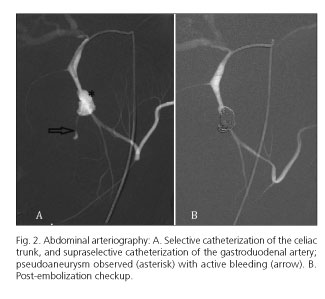
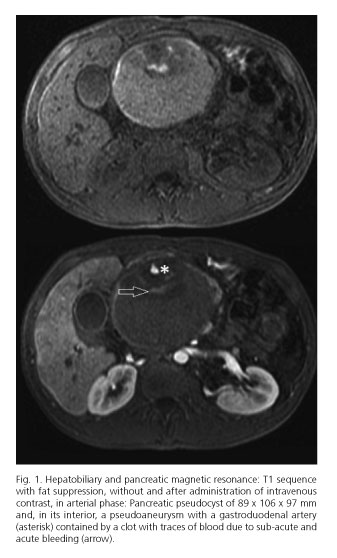
<body><![CDATA[<p><font face="Verdana" size="2"><b>Introduction</b></font></p>     <p><font face="Verdana" size="2">A pseudoaneurysm (PSA) associated with pancreas pseudocyst (PSC) is an uncommon complication that generally occurs in patients with chronic pancreatitis (CP). Its early diagnosis and individualized management are essential given that it can reach mortality rates of up to 24% (10-57%) (1).</font></p>     <p><font face="Verdana" size="2">To present, the therapeutic strategy for PSA hemorrhages is controversial due to the lack of prospective random trials, as the data available based on very heterogeneous studies is scarce.</font></p>     <p><font face="Verdana" size="2">The initial management strategy that is most broadly utilized in current clinical practice consists of the localization of the hemorrhage through abdominal dynamic computerized tomographies (CT) and arteriography, following therapeutic artery embolization (AE) (2).</font></p>     <p><font face="Verdana" size="2">We present a complicated case of CP with PSA associated with PSC (PSC-PSA) that we consider to be of interest due to the confluence in one patient of all the complications that this entity may cause; the complex diagnostic process, which included endoscopic ultrasound; and the therapeutic process, which was carried out in a pathological process that was serious, and that finally ended successfully.</font></p>     <p>&nbsp;</p>     <p><font face="Verdana" size="2"><b>Case Report</b></font></p>     <p><font face="Verdana" size="2">This case was of a 40-year-old man with a history of CP of toxic origin (tobacco, alcohol and cocaine) complicated by PSC in the head of the pancreas, known for the last nine months, who came to the Emergency Room of the clinic over three days, with epigastric abdominal pain radiating to both hypochondria with growing intensity and without other associated symptomatology. Upon examination, the patient presents a regular general state, an under-nourished appearance and upon abdominal palpation, a sensation of painful occupation in the epi-mesogastrium, without signs of peritoneal irritation.</font></p>     <p><font face="Verdana" size="2">During admission, medical treatment is begun with good progress in terms of pain, but presents progressive cutaneous-mucous jaundice, and a magnetic resonance (MR) is thus indicated for the Hepatobiliary and pancreatic area with cholangiography (<a href="#f1">Fig. 1</a>) objectivizing PSC with a known increase in size, producing extrinsic compression of the extrahepatic bile duct and in its interior, PSA, caused by a gastroduodenal artery contained by a clot with remnants of blood due to acute and sub-acute bleeding. An arteriography is ordered, showing the PSA of the gastroduodenal artery with active bleeding in the interior of the PSC, and a supra-selective AE is performed on the same via metallic spirals (coils), without incident (<a href="#f2">Fig. 2</a>)</font></p>     <p>&nbsp;</p>     ]]></body>
<body><![CDATA[<p align="center"><font face="Verdana" size="2"><a name="f1"><img src="/img/revistas/diges/v108n9/notas1_figure1.jpg"></a></font></p>     <p>&nbsp;</p>     <p align="center"><font face="Verdana" size="2"><a name="f2"><img src="/img/revistas/diges/v108n9/notas1_figure2.jpg"></a></font></p>     <p>&nbsp;</p>     <p><font face="Verdana" size="2">After five days, the AE presents melena and anemization without hemodynamic repercussion. An endoscopic ultrasound (EUS) is performed, showing traces of blood in the gastric cavity and a large cystic collection reaching from the posterior face of the gastric body to the second duodenal portion. On the posterior face of the bulb, there is a small ulceration on a rounded and pulsing mucosa suggestive of corresponding to the fistulization of the PSC-PSA, which is confirmed by the presence of arterial flow in Doppler mode (<a href="#f3">Fig. 3</a>). An urgent arteriography is performed in which there are several pseudoaneurysmal formations dependent on the PSA, previously treated proceeding to the AE with coils of the same.</font></p>     <p>&nbsp;</p>     <p align="center"><font face="Verdana" size="2"><a name="f3"><img src="/img/revistas/diges/v108n9/notas1_figure3.jpg"></a></font></p>     <p>&nbsp;</p>     <p><font face="Verdana" size="2">Following the new AE, the patient continues to be clinically and hemodynamically stable, with significant cutaneous-mucous depigmentation 48 hours after the spontaneous drainage of the PSC, pending a scheduled surgical operation. However, four days after the second AE, the patient presents hematemesis and rectal bleeding with hemodynamic compromise, requiring urgent surgical operation. During the same, an active digestive hemorrhage is shown with a discharge of blood through pylorus from the PSC. A cystic gastrostomy is performed, suture of the gastroduodenal artery and its collaterals. Following the same, an antrectomy is completed, with Billroth II-type reconstruction.</font></p>     <p><font face="Verdana" size="2">The patient presents favorable progress with clinical and analytical stability in the post-operative phase and up until the current day.</font></p>     ]]></body>
<body><![CDATA[<p>&nbsp;</p>     <p><font face="Verdana" size="2"><b>Discussion</b></font></p>     <p><font face="Verdana" size="2">The occurrence of spontaneous hemorrhage of a PSC is very low (1.4-8.4%), this being in prospective series with follow-up during more than 10 years, approximately 6% (3) and in retrospective series of 8 years of 10.4% (1).</font></p>     <p><font face="Verdana" size="2">Regarding the PSC-PSA, as in the case of our patient, there are very few published cases, and they should be differentiated from the simple isolated pancreatic PSAs, without PSC that have been described in 10% of the cases of pancreatitis evaluated through arteriography (1). In the majority of these, the characteristics of the patients are similar to ours, young (around 39-45 years of age) who frequently present a CP underlying the alcoholic etiology, although this can also happen in 3.5-10% of acute pancreatitis (4). The most frequent form of presentation is manifest gastrointestinal bleeding (&gt; 80% of cases), although it can also present itself as abdominal pain or jaundice (5).</font></p>     <p><font face="Verdana" size="2">The three possible mechanisms described in the formation of PSA of the pancreas are: serious swelling and/or enzymatic self-digestion of pancreatic or peri-pancreatic arteries; the transfer of an established PSC in a peri-pancreatic vessel, which becomes a large PSA; and a PSC which erodes the intestinal wall and produces digestive bleeding (2). All three situations coincided in our case.</font></p>     <p><font face="Verdana" size="2">The arteries involved with greatest frequency by decreasing order are the spleen artery (40%), followed by the gastro-duodenal artery (30%), the pancreatic duodenal artery (20%), the gastric (5%), and the hepatic arteries (2%) (6,7).</font></p>     <p><font face="Verdana" size="2">The early diagnosis of the PSA is key to scheduling the most efficient treatment. The technique of choice is arteriography, which offers 100% sensitivity for its detection (8%). Other Methods help a diagnosis of suspected CT which allow the elimination of other complications associated with CP (9) or EUS, with Doppler being useful in the evaluation of peri-pancreatic liquid collections and its complications, such as aneurysms or pseudoaneurysms upon observing a flow with an arterial pattern within a collection (10).</font></p>     <p><font face="Verdana" size="2">The handling of the PSA-PSC is complex given the high morbi-mortality associated with the same. The AE and the surgery are currently the most used therapeutic strategies, such as we performed in our case, and which are considered to be complementary treatments. The AE is recommended as an initial approach in hemodynamically stable patients and represents the treatment of choice in 80% of cases (11,12).</font></p>     <p><font face="Verdana" size="2">The majority of PSA-PSC in CP can be treated successfully and safely through a combination of radiological obliteration of the PSA and subsequent trans-papillary endoscopic drainage of the PSC through an ERCP (5). On other occasions, the ERCP is not necessary, such as in our case, because a spontaneous drainage of the PSC occurs to the digestive tract (13).</font></p>     <p><font face="Verdana" size="2">The surgery should be reserved for those cases with an active hemorrhage; in the case of hemodynamic instability; when the AE is not possible or fails (such as with our patient); if the endoscopic care of the PSC is unsuccessful; when the hemorrhage proceeds to the pancreatic tail; and in the case of applications, such as infection or extrinsic compression (1,4,14). However, other authors recommend early surgical intervention following the AER to avoid re-bleeding (1,2,12). In our case, re-bleeding occurred a few days after the AE and required a second embolization while waiting for the surgery to be scheduled.</font></p>     ]]></body>
<body><![CDATA[<p><font face="Verdana" size="2">If the hemorrhage caused by PSA is located in the pancreatic tail or a free hemorrhage occurs in the peritoneal cavity, removal is the most utilized procedure, while for lesions located on the head or body of the pancreas, more conservative surgical procedures are recommended (12,15).</font></p>     <p><font face="Verdana" size="2">In conclusion, we present this case of PSC in a patient with CP which presented several serious complications that required multidisciplinary care with satisfactory resolution. It began with a digestive clinic secondary to its increase in size, and the formation of a PSA required an AE due to intra-cystic hemorrhage. Subsequently, the patient presented digestive hemorrhaging secondary to fistulization of the PSC to the digestive tract, along with post-embolization relapse of the PSA which required a second AE, and both of which were resolved through a definitive surgery.</font></p>     <p>&nbsp;</p>     <p><font face="Verdana" size="2"><b>References</b></font></p>     <!-- ref --><p><font face="Verdana" size="2">1. Bender JS, Bouwman DL, Levison MA, et al. Pseudocysts and pseudoaneurysms: surgical strategy. Pancreas 1995; 10: 143-7.    &nbsp;&nbsp;&nbsp;&nbsp;&nbsp;&nbsp;&nbsp;&nbsp;[&#160;<a href="javascript:void(0);" onclick="javascript: window.open('/scielo.php?script=sci_nlinks&ref=5431868&pid=S1130-0108201600090001400001&lng=','','width=640,height=500,resizable=yes,scrollbars=1,menubar=yes,');">Links</a>&#160;]<!-- end-ref --></font></p>    <!-- ref --><p><font face="Verdana" size="2">2. Chiang KC, Chen TH, Hsu JT. Management of chronic pancreatitis complicated with a bleeding pseudoaneurysm. World J Gastroenterol 2014; 20: 16132-7. DOI: 10.3748/wjg.v20.i43.16132.    &nbsp;&nbsp;&nbsp;&nbsp;&nbsp;&nbsp;&nbsp;&nbsp;[&#160;<a href="javascript:void(0);" onclick="javascript: window.open('/scielo.php?script=sci_nlinks&ref=5431870&pid=S1130-0108201600090001400002&lng=','','width=640,height=500,resizable=yes,scrollbars=1,menubar=yes,');">Links</a>&#160;]<!-- end-ref --></font></p>    <!-- ref --><p><font face="Verdana" size="2">3. Carr JA, Cho JS, Shepard AD, et al. Visceral pseudoaneurysms due to pancreatic pseudocysts: rare but lethal complications of pancreatitis. J Vasc Surg. 2000; 32: 722-30. DOI: 10.1067/mva.2000.110055.    &nbsp;&nbsp;&nbsp;&nbsp;&nbsp;&nbsp;&nbsp;&nbsp;[&#160;<a href="javascript:void(0);" onclick="javascript: window.open('/scielo.php?script=sci_nlinks&ref=5431872&pid=S1130-0108201600090001400003&lng=','','width=640,height=500,resizable=yes,scrollbars=1,menubar=yes,');">Links</a>&#160;]<!-- end-ref --></font></p>    ]]></body>
<body><![CDATA[<!-- ref --><p><font face="Verdana" size="2">4. O'Connor OJ, Buckley JM, Maher MM. Imaging of the complications of acute pancreatitis. AJR Am J Roentgenol. 2011; 197: W375-81. DOI:10.2214/AJR.10.4339.    &nbsp;&nbsp;&nbsp;&nbsp;&nbsp;&nbsp;&nbsp;&nbsp;[&#160;<a href="javascript:void(0);" onclick="javascript: window.open('/scielo.php?script=sci_nlinks&ref=5431874&pid=S1130-0108201600090001400004&lng=','','width=640,height=500,resizable=yes,scrollbars=1,menubar=yes,');">Links</a>&#160;]<!-- end-ref --></font></p>    <!-- ref --><p><font face="Verdana" size="2">5. Bhasin DK, Rana SS, Sharma V, et al. Non-surgical management of pancreatic pseudocysts associated with arterial pseudoaneurysm. Pancreatology 2013; 13: 250-3. DOI: 10.1016/j.pan.2013.02.011.    &nbsp;&nbsp;&nbsp;&nbsp;&nbsp;&nbsp;&nbsp;&nbsp;[&#160;<a href="javascript:void(0);" onclick="javascript: window.open('/scielo.php?script=sci_nlinks&ref=5431876&pid=S1130-0108201600090001400005&lng=','','width=640,height=500,resizable=yes,scrollbars=1,menubar=yes,');">Links</a>&#160;]<!-- end-ref --></font></p>    <!-- ref --><p><font face="Verdana" size="2">6. Mallick IH, Winslet MC. Vascular complications of pancreatitis. JOP 2004; 5: 328-37.    &nbsp;&nbsp;&nbsp;&nbsp;&nbsp;&nbsp;&nbsp;&nbsp;[&#160;<a href="javascript:void(0);" onclick="javascript: window.open('/scielo.php?script=sci_nlinks&ref=5431878&pid=S1130-0108201600090001400006&lng=','','width=640,height=500,resizable=yes,scrollbars=1,menubar=yes,');">Links</a>&#160;]<!-- end-ref --></font></p>    <!-- ref --><p><font face="Verdana" size="2">7. Balachandra S, Siriwardena AK. Systematic appraisal of the management of the major vascular complications of pancreatitis. Am J Surg 2005; 190: 489-95. DOI: 10.1016/j.amjsurg.2005.03.009.    &nbsp;&nbsp;&nbsp;&nbsp;&nbsp;&nbsp;&nbsp;&nbsp;[&#160;<a href="javascript:void(0);" onclick="javascript: window.open('/scielo.php?script=sci_nlinks&ref=5431880&pid=S1130-0108201600090001400007&lng=','','width=640,height=500,resizable=yes,scrollbars=1,menubar=yes,');">Links</a>&#160;]<!-- end-ref --></font></p>    <!-- ref --><p><font face="Verdana" size="2">8. Hsu JT, Yeh CN, Hung CF, et al. Management and outcome of bleeding pseudoaneurysm associated with chronic pancreatitis. BMC Gastroenterology 2006; 6: 3. DOI: 10.1186/1471-230X-6-3.    &nbsp;&nbsp;&nbsp;&nbsp;&nbsp;&nbsp;&nbsp;&nbsp;[&#160;<a href="javascript:void(0);" onclick="javascript: window.open('/scielo.php?script=sci_nlinks&ref=5431882&pid=S1130-0108201600090001400008&lng=','','width=640,height=500,resizable=yes,scrollbars=1,menubar=yes,');">Links</a>&#160;]<!-- end-ref --></font></p>    ]]></body>
<body><![CDATA[<!-- ref --><p><font face="Verdana" size="2">9. Balthazar EJ, Fisher LA. Hemorrhagic complications of pancreatitis: radiologic evaluation with emphasis on CT imaging. Pancreatology 2001; 1: 306-13. DOI: 10.1159/000055829.    &nbsp;&nbsp;&nbsp;&nbsp;&nbsp;&nbsp;&nbsp;&nbsp;[&#160;<a href="javascript:void(0);" onclick="javascript: window.open('/scielo.php?script=sci_nlinks&ref=5431884&pid=S1130-0108201600090001400009&lng=','','width=640,height=500,resizable=yes,scrollbars=1,menubar=yes,');">Links</a>&#160;]<!-- end-ref --></font></p>    <!-- ref --><p><font face="Verdana" size="2">10. Fukatsu K, Ueda K, Maeda H, et al. A case of chronic pancreatitis in which endoscopic ultrasonography was effective in the diagnosis of a pseudoaneurysm. World J Gastrointest Endosc 2012; 4: 335-8. DOI: 10.4253/wjge.v4.i7.335.    &nbsp;&nbsp;&nbsp;&nbsp;&nbsp;&nbsp;&nbsp;&nbsp;[&#160;<a href="javascript:void(0);" onclick="javascript: window.open('/scielo.php?script=sci_nlinks&ref=5431886&pid=S1130-0108201600090001400010&lng=','','width=640,height=500,resizable=yes,scrollbars=1,menubar=yes,');">Links</a>&#160;]<!-- end-ref --></font></p>    <!-- ref --><p><font face="Verdana" size="2">11. V&aacute;zquez J, Mansilla D, Civera JF, et al. Therapeutic options in pancreatic pseudoaneurysms. Rev Esp Enferm Dig 2012; 104: 502-3.    &nbsp;&nbsp;&nbsp;&nbsp;&nbsp;&nbsp;&nbsp;&nbsp;[&#160;<a href="javascript:void(0);" onclick="javascript: window.open('/scielo.php?script=sci_nlinks&ref=5431888&pid=S1130-0108201600090001400011&lng=','','width=640,height=500,resizable=yes,scrollbars=1,menubar=yes,');">Links</a>&#160;]<!-- end-ref --></font></p>    <!-- ref --><p><font face="Verdana" size="2">12. Udd M, Lepp&auml;niemi AK, Bidel S, et al. Treatment of bleeding pseudoaneurysms in patients with chronic pancreatitis. World J Surg 2007; 31: 504-10. DOI: 10.1007/s00268-006-0209-z.    &nbsp;&nbsp;&nbsp;&nbsp;&nbsp;&nbsp;&nbsp;&nbsp;[&#160;<a href="javascript:void(0);" onclick="javascript: window.open('/scielo.php?script=sci_nlinks&ref=5431890&pid=S1130-0108201600090001400012&lng=','','width=640,height=500,resizable=yes,scrollbars=1,menubar=yes,');">Links</a>&#160;]<!-- end-ref --></font></p>    <!-- ref --><p><font face="Verdana" size="2">13. Azcano E, &Aacute;lvarez CJ, Irurzun J, et al. Gastrointestinal bleeding due to pseudoaneurism with spontaneous pancreatic pseudocyst drainage. Rev EspEnferm Dig 2008; 100; 179-87.    &nbsp;&nbsp;&nbsp;&nbsp;&nbsp;&nbsp;&nbsp;&nbsp;[&#160;<a href="javascript:void(0);" onclick="javascript: window.open('/scielo.php?script=sci_nlinks&ref=5431892&pid=S1130-0108201600090001400013&lng=','','width=640,height=500,resizable=yes,scrollbars=1,menubar=yes,');">Links</a>&#160;]<!-- end-ref --></font></p>    ]]></body>
<body><![CDATA[<!-- ref --><p><font face="Verdana" size="2">14. Pang TC, Maher R, Gananadha S, et al. Peripancreatic pseudoaneurysms: a management based classification system. Surg Endosc 2014; 28: 2027-38. DOI: 10.1007/s00464-014-3434-9.    &nbsp;&nbsp;&nbsp;&nbsp;&nbsp;&nbsp;&nbsp;&nbsp;[&#160;<a href="javascript:void(0);" onclick="javascript: window.open('/scielo.php?script=sci_nlinks&ref=5431894&pid=S1130-0108201600090001400014&lng=','','width=640,height=500,resizable=yes,scrollbars=1,menubar=yes,');">Links</a>&#160;]<!-- end-ref --></font></p>    <!-- ref --><p><font face="Verdana" size="2">15. Chong CN, Lee KF, Wong KT, et al. Ruptured gastroduodenal artery pseudoaneurysm as the initial presentation of chronic pancreatitis. Am J Surg 2009; 197: e38-40. DOI: 10.1016/j.amjsurg.2008.05.014.    &nbsp;&nbsp;&nbsp;&nbsp;&nbsp;&nbsp;&nbsp;&nbsp;[&#160;<a href="javascript:void(0);" onclick="javascript: window.open('/scielo.php?script=sci_nlinks&ref=5431896&pid=S1130-0108201600090001400015&lng=','','width=640,height=500,resizable=yes,scrollbars=1,menubar=yes,');">Links</a>&#160;]<!-- end-ref --></font></p>     <p>&nbsp;</p>     <p>&nbsp;</p>     <p><font face="Verdana" size="2"><a href="#top"><img border="0" src="/img/revistas/diges/v108n9/seta.gif" width="15" height="17"></a><a name="bajo"></a><b>Correspondence:</b>    <br>Laura Larrey-Ruiz.    <br>Department of Digestive Diseases.    <br>Consorcio Hospital General Universitario de Valencia.    ]]></body>
<body><![CDATA[<br>Av. Tres Cruces n<sup>o</sup>2.    <br>46014 Valencia, Spain    <br>e-mail: <a href="mailto:larrey.laura@gmail.com">larrey.laura@gmail.com</a></font></p>     <p><font face="Verdana" size="2">Received: 20/05/2015    <br>Accepted: 08/06/2015</font></p>      ]]></body><back>
<ref-list>
<ref id="B1">
<label>1</label><nlm-citation citation-type="journal">
<person-group person-group-type="author">
<name>
<surname><![CDATA[Bender]]></surname>
<given-names><![CDATA[JS]]></given-names>
</name>
<name>
<surname><![CDATA[Bouwman]]></surname>
<given-names><![CDATA[DL]]></given-names>
</name>
<name>
<surname><![CDATA[Levison]]></surname>
<given-names><![CDATA[MA]]></given-names>
</name>
</person-group>
<article-title xml:lang="en"><![CDATA[Pseudocysts and pseudoaneurysms: surgical strategy]]></article-title>
<source><![CDATA[Pancreas]]></source>
<year>1995</year>
<volume>10</volume>
<page-range>143-7</page-range></nlm-citation>
</ref>
<ref id="B2">
<label>2</label><nlm-citation citation-type="journal">
<person-group person-group-type="author">
<name>
<surname><![CDATA[Chiang]]></surname>
<given-names><![CDATA[KC]]></given-names>
</name>
<name>
<surname><![CDATA[Chen]]></surname>
<given-names><![CDATA[TH]]></given-names>
</name>
<name>
<surname><![CDATA[Hsu]]></surname>
<given-names><![CDATA[JT]]></given-names>
</name>
</person-group>
<article-title xml:lang="en"><![CDATA[Management of chronic pancreatitis complicated with a bleeding pseudoaneurysm]]></article-title>
<source><![CDATA[World J Gastroenterol]]></source>
<year>2014</year>
<volume>20</volume>
<page-range>16132-7</page-range></nlm-citation>
</ref>
<ref id="B3">
<label>3</label><nlm-citation citation-type="journal">
<person-group person-group-type="author">
<name>
<surname><![CDATA[Carr]]></surname>
<given-names><![CDATA[JA]]></given-names>
</name>
<name>
<surname><![CDATA[Cho]]></surname>
<given-names><![CDATA[JS]]></given-names>
</name>
<name>
<surname><![CDATA[Shepard]]></surname>
<given-names><![CDATA[AD]]></given-names>
</name>
</person-group>
<article-title xml:lang="en"><![CDATA[Visceral pseudoaneurysms due to pancreatic pseudocysts: rare but lethal complications of pancreatitis]]></article-title>
<source><![CDATA[J Vasc Surg.]]></source>
<year>2000</year>
<volume>32</volume>
<page-range>722-30</page-range></nlm-citation>
</ref>
<ref id="B4">
<label>4</label><nlm-citation citation-type="journal">
<person-group person-group-type="author">
<name>
<surname><![CDATA[O'Connor]]></surname>
<given-names><![CDATA[OJ]]></given-names>
</name>
<name>
<surname><![CDATA[Buckley]]></surname>
<given-names><![CDATA[JM]]></given-names>
</name>
<name>
<surname><![CDATA[Maher]]></surname>
<given-names><![CDATA[MM]]></given-names>
</name>
</person-group>
<article-title xml:lang="en"><![CDATA[Imaging of the complications of acute pancreatitis]]></article-title>
<source><![CDATA[AJR Am J Roentgenol.]]></source>
<year>2011</year>
<volume>197</volume>
<page-range>W375-81</page-range></nlm-citation>
</ref>
<ref id="B5">
<label>5</label><nlm-citation citation-type="journal">
<person-group person-group-type="author">
<name>
<surname><![CDATA[Bhasin]]></surname>
<given-names><![CDATA[DK]]></given-names>
</name>
<name>
<surname><![CDATA[Rana]]></surname>
<given-names><![CDATA[SS]]></given-names>
</name>
<name>
<surname><![CDATA[Sharma]]></surname>
<given-names><![CDATA[V]]></given-names>
</name>
</person-group>
<article-title xml:lang="en"><![CDATA[Non-surgical management of pancreatic pseudocysts associated with arterial pseudoaneurysm]]></article-title>
<source><![CDATA[Pancreatology]]></source>
<year>2013</year>
<volume>13</volume>
<page-range>250-3</page-range></nlm-citation>
</ref>
<ref id="B6">
<label>6</label><nlm-citation citation-type="journal">
<person-group person-group-type="author">
<name>
<surname><![CDATA[Mallick]]></surname>
<given-names><![CDATA[IH]]></given-names>
</name>
<name>
<surname><![CDATA[Winslet]]></surname>
<given-names><![CDATA[MC]]></given-names>
</name>
</person-group>
<article-title xml:lang="en"><![CDATA[Vascular complications of pancreatitis]]></article-title>
<source><![CDATA[JOP]]></source>
<year>2004</year>
<volume>5</volume>
<page-range>328-37</page-range></nlm-citation>
</ref>
<ref id="B7">
<label>7</label><nlm-citation citation-type="journal">
<person-group person-group-type="author">
<name>
<surname><![CDATA[Balachandra]]></surname>
<given-names><![CDATA[S]]></given-names>
</name>
<name>
<surname><![CDATA[Siriwardena]]></surname>
<given-names><![CDATA[AK]]></given-names>
</name>
</person-group>
<article-title xml:lang="en"><![CDATA[Systematic appraisal of the management of the major vascular complications of pancreatitis]]></article-title>
<source><![CDATA[Am J Surg]]></source>
<year>2005</year>
<volume>190</volume>
<page-range>489-95</page-range></nlm-citation>
</ref>
<ref id="B8">
<label>8</label><nlm-citation citation-type="journal">
<person-group person-group-type="author">
<name>
<surname><![CDATA[Hsu]]></surname>
<given-names><![CDATA[JT]]></given-names>
</name>
<name>
<surname><![CDATA[Yeh]]></surname>
<given-names><![CDATA[CN]]></given-names>
</name>
<name>
<surname><![CDATA[Hung]]></surname>
<given-names><![CDATA[CF]]></given-names>
</name>
</person-group>
<article-title xml:lang="en"><![CDATA[Management and outcome of bleeding pseudoaneurysm associated with chronic pancreatitis]]></article-title>
<source><![CDATA[BMC Gastroenterology]]></source>
<year>2006</year>
<volume>6</volume>
</nlm-citation>
</ref>
<ref id="B9">
<label>9</label><nlm-citation citation-type="journal">
<person-group person-group-type="author">
<name>
<surname><![CDATA[Balthazar]]></surname>
<given-names><![CDATA[EJ]]></given-names>
</name>
<name>
<surname><![CDATA[Fisher]]></surname>
<given-names><![CDATA[LA]]></given-names>
</name>
</person-group>
<article-title xml:lang="en"><![CDATA[Hemorrhagic complications of pancreatitis: radiologic evaluation with emphasis on CT imaging]]></article-title>
<source><![CDATA[Pancreatology]]></source>
<year>2001</year>
<volume>1</volume>
<page-range>306-13</page-range></nlm-citation>
</ref>
<ref id="B10">
<label>10</label><nlm-citation citation-type="journal">
<person-group person-group-type="author">
<name>
<surname><![CDATA[Fukatsu]]></surname>
<given-names><![CDATA[K]]></given-names>
</name>
<name>
<surname><![CDATA[Ueda]]></surname>
<given-names><![CDATA[K]]></given-names>
</name>
<name>
<surname><![CDATA[Maeda]]></surname>
<given-names><![CDATA[H]]></given-names>
</name>
</person-group>
<article-title xml:lang="en"><![CDATA[A case of chronic pancreatitis in which endoscopic ultrasonography was effective in the diagnosis of a pseudoaneurysm]]></article-title>
<source><![CDATA[World J Gastrointest Endosc]]></source>
<year>2012</year>
<volume>4</volume>
<page-range>335-8</page-range></nlm-citation>
</ref>
<ref id="B11">
<label>11</label><nlm-citation citation-type="journal">
<person-group person-group-type="author">
<name>
<surname><![CDATA[Vázquez]]></surname>
<given-names><![CDATA[J]]></given-names>
</name>
<name>
<surname><![CDATA[Mansilla]]></surname>
<given-names><![CDATA[D]]></given-names>
</name>
<name>
<surname><![CDATA[Civera]]></surname>
<given-names><![CDATA[JF]]></given-names>
</name>
</person-group>
<article-title xml:lang="en"><![CDATA[Therapeutic options in pancreatic pseudoaneurysms]]></article-title>
<source><![CDATA[Rev Esp Enferm Dig]]></source>
<year>2012</year>
<volume>104</volume>
<page-range>502-3</page-range></nlm-citation>
</ref>
<ref id="B12">
<label>12</label><nlm-citation citation-type="journal">
<person-group person-group-type="author">
<name>
<surname><![CDATA[Udd]]></surname>
<given-names><![CDATA[M]]></given-names>
</name>
<name>
<surname><![CDATA[Leppäniemi]]></surname>
<given-names><![CDATA[AK]]></given-names>
</name>
<name>
<surname><![CDATA[Bidel]]></surname>
<given-names><![CDATA[S]]></given-names>
</name>
</person-group>
<article-title xml:lang="en"><![CDATA[Treatment of bleeding pseudoaneurysms in patients with chronic pancreatitis]]></article-title>
<source><![CDATA[World J Surg]]></source>
<year>2007</year>
<volume>31</volume>
<page-range>504-10</page-range></nlm-citation>
</ref>
<ref id="B13">
<label>13</label><nlm-citation citation-type="journal">
<person-group person-group-type="author">
<name>
<surname><![CDATA[Azcano]]></surname>
<given-names><![CDATA[E]]></given-names>
</name>
<name>
<surname><![CDATA[Álvarez]]></surname>
<given-names><![CDATA[CJ]]></given-names>
</name>
<name>
<surname><![CDATA[Irurzun]]></surname>
<given-names><![CDATA[J]]></given-names>
</name>
</person-group>
<article-title xml:lang="en"><![CDATA[Gastrointestinal bleeding due to pseudoaneurism with spontaneous pancreatic pseudocyst drainage]]></article-title>
<source><![CDATA[Rev EspEnferm Dig]]></source>
<year>2008</year>
<volume>100</volume>
<page-range>179-87</page-range></nlm-citation>
</ref>
<ref id="B14">
<label>14</label><nlm-citation citation-type="journal">
<person-group person-group-type="author">
<name>
<surname><![CDATA[Pang]]></surname>
<given-names><![CDATA[TC]]></given-names>
</name>
<name>
<surname><![CDATA[Maher]]></surname>
<given-names><![CDATA[R]]></given-names>
</name>
<name>
<surname><![CDATA[Gananadha]]></surname>
<given-names><![CDATA[S]]></given-names>
</name>
</person-group>
<article-title xml:lang="en"><![CDATA[Peripancreatic pseudoaneurysms: a management based classification system]]></article-title>
<source><![CDATA[Surg Endosc]]></source>
<year>2014</year>
<volume>28</volume>
<page-range>2027-38</page-range></nlm-citation>
</ref>
<ref id="B15">
<label>15</label><nlm-citation citation-type="journal">
<person-group person-group-type="author">
<name>
<surname><![CDATA[Chong]]></surname>
<given-names><![CDATA[CN]]></given-names>
</name>
<name>
<surname><![CDATA[Lee]]></surname>
<given-names><![CDATA[KF]]></given-names>
</name>
<name>
<surname><![CDATA[Wong]]></surname>
<given-names><![CDATA[KT]]></given-names>
</name>
</person-group>
<article-title xml:lang="en"><![CDATA[Ruptured gastroduodenal artery pseudoaneurysm as the initial presentation of chronic pancreatitis]]></article-title>
<source><![CDATA[Am J Surg]]></source>
<year>2009</year>
<volume>197</volume>
<page-range>e38-40</page-range></nlm-citation>
</ref>
</ref-list>
</back>
</article>