<?xml version="1.0" encoding="ISO-8859-1"?><article xmlns:mml="http://www.w3.org/1998/Math/MathML" xmlns:xlink="http://www.w3.org/1999/xlink" xmlns:xsi="http://www.w3.org/2001/XMLSchema-instance">
<front>
<journal-meta>
<journal-id>1130-0108</journal-id>
<journal-title><![CDATA[Revista Española de Enfermedades Digestivas]]></journal-title>
<abbrev-journal-title><![CDATA[Rev. esp. enferm. dig.]]></abbrev-journal-title>
<issn>1130-0108</issn>
<publisher>
<publisher-name><![CDATA[Sociedad Española de Patología Digestiva]]></publisher-name>
</publisher>
</journal-meta>
<article-meta>
<article-id>S1130-01082017000100017</article-id>
<article-id pub-id-type="doi">10.17235/reed.2016.4225/2016</article-id>
<title-group>
<article-title xml:lang="en"><![CDATA[Endoscopic removal of retained large surgical gauze: a case report]]></article-title>
</title-group>
<contrib-group>
<contrib contrib-type="author">
<name>
<surname><![CDATA[Khoshbaten]]></surname>
<given-names><![CDATA[Manouchehr]]></given-names>
</name>
<xref ref-type="aff" rid="A01"/>
<xref ref-type="aff" rid="A02"/>
</contrib>
<contrib contrib-type="author">
<name>
<surname><![CDATA[Tahsini-Tekantapeh]]></surname>
<given-names><![CDATA[Sepideh]]></given-names>
</name>
<xref ref-type="aff" rid="A03"/>
<xref ref-type="aff" rid="A04"/>
</contrib>
</contrib-group>
<aff id="A01">
<institution><![CDATA[,Tabriz University of Medical Science Drug Applied Research Center ]]></institution>
<addr-line><![CDATA[ ]]></addr-line>
</aff>
<aff id="A02">
<institution><![CDATA[,EmamReza Hospital Internal Medicine Department Endoscopy Unit]]></institution>
<addr-line><![CDATA[Tabriz ]]></addr-line>
<country>Iran</country>
</aff>
<aff id="A03">
<institution><![CDATA[,Tabriz University of Medical Science Internal Medicine Department ]]></institution>
<addr-line><![CDATA[ ]]></addr-line>
</aff>
<aff id="A04">
<institution><![CDATA[,Emamreza Hospital Liver and Gastrointestinal Diseases Research Center Endoscopy Unit]]></institution>
<addr-line><![CDATA[Tabriz ]]></addr-line>
<country>Iran</country>
</aff>
<pub-date pub-type="pub">
<day>00</day>
<month>01</month>
<year>2017</year>
</pub-date>
<pub-date pub-type="epub">
<day>00</day>
<month>01</month>
<year>2017</year>
</pub-date>
<volume>109</volume>
<numero>1</numero>
<fpage>73</fpage>
<lpage>75</lpage>
<copyright-statement/>
<copyright-year/>
<self-uri xlink:href="http://scielo.isciii.es/scielo.php?script=sci_arttext&amp;pid=S1130-01082017000100017&amp;lng=en&amp;nrm=iso"></self-uri><self-uri xlink:href="http://scielo.isciii.es/scielo.php?script=sci_abstract&amp;pid=S1130-01082017000100017&amp;lng=en&amp;nrm=iso"></self-uri><self-uri xlink:href="http://scielo.isciii.es/scielo.php?script=sci_pdf&amp;pid=S1130-01082017000100017&amp;lng=en&amp;nrm=iso"></self-uri><abstract abstract-type="short" xml:lang="en"><p><![CDATA[In this paper, a 63-year-old woman was reported with recurrent abdominal pain after cholecystectomy. A retained surgical towel was seen by CT-scan in the peritoneal cavity, where it migrated across duodenum wall toward pre-pyloric region of the stomach. Endoscopic removal of the large retained gauze in size of 40 cm x 40 cm was successfully performed without laparotomy and with no complication. In the last years, the main method for removal of retained foreign objects has been open laparotomy or laparoscopy. We claimed that removal of large retained surgical long gauze is actually possible using upper GI endoscopy by expert endoscopists, and, therefore, there is no need for anesthesia or surgery as well as no occurrence of complication and laceration.]]></p></abstract>
<kwd-group>
<kwd lng="en"><![CDATA[Gossypiboma]]></kwd>
<kwd lng="en"><![CDATA[Retained foreign body]]></kwd>
<kwd lng="en"><![CDATA[Retained surgical towel]]></kwd>
<kwd lng="en"><![CDATA[Surgical long gauze]]></kwd>
<kwd lng="en"><![CDATA[Textiloma]]></kwd>
</kwd-group>
</article-meta>
</front><body><![CDATA[ 
    <p><a name="top"></a><font face="Verdana" size="2"><b>CASE REPORTS</b></font></p>
    <p>&nbsp;</p>
    <p><font face="Verdana" size="4"><b>Endoscopic removal of retained large surgical gauze: a case report</b></font></p>
    <p>&nbsp;</p>
    <p>&nbsp;</p>
    <p><font face="Verdana" size="2"><b>Manouchehr Khoshbaten<sup>1</sup> and Sepideh Tahsini-Tekantapeh<sup>2</sup></b></font></p>
    <p><font face="Verdana" size="2"><sup>1</sup>Drug Applied Research Center. Tabriz University of Medical Science. Internal Medicine Department. Endoscopy Unit. EmamReza Hospital. Tabriz, Iran.    <br><sup>2</sup>Internal Medicine Department. Tabriz University of Medical Science. Liver and Gastrointestinal Diseases Research Center. Endoscopy Unit. Emamreza Hospital. Tabriz, Iran</font></p>
    <p><font face="Verdana" size="2"><a href="#bajo">Correspondence</a></font></p>
    ]]></body>
<body><![CDATA[<p>&nbsp;</p>
    <p>&nbsp;</p>
<hr size="1">
    <p><font face="Verdana" size="2"><b>ABSTRACT</b></font></p>
    <p><font face="Verdana" size="2">In this paper, a 63-year-old woman was reported with recurrent abdominal pain after cholecystectomy. A retained surgical towel was seen by CT-scan in the peritoneal cavity, where it migrated across duodenum wall toward pre-pyloric region of the stomach. Endoscopic removal of the large retained gauze in size of 40 cm x 40 cm was successfully performed without laparotomy and with no complication. In the last years, the main method for removal of retained foreign objects has been open laparotomy or laparoscopy. We claimed that removal of large retained surgical long gauze is actually possible using upper GI endoscopy by expert endoscopists, and, therefore, there is no need for anesthesia or surgery as well as no occurrence of complication and laceration.</font></p>
    <p><font face="Verdana" size="2"><b>Key words:</b> Gossypiboma. Retained foreign body. Retained surgical towel. Surgical long gauze. Textiloma.</font></p>
<hr size="1">
    <p>&nbsp;</p>
    <p><font face="Verdana" size="2"><b>Introduction</b></font></p>
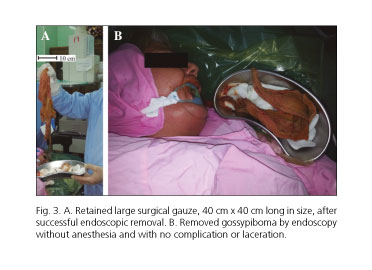
    <p><font face="Verdana" size="2">"Textiloma" or "gossypiboma" are terms used to express a rare iatrogenic mass due to remained non-radiopaque cotton sponge that has been forgotten after abdominal surgeries (1). The first case of a gastric gossypiboma was diagnosed by Erbay G endoscopically in 2012 (2). Gossypiboma is composed of a cotton material that approximately remains in 1/3,000 surgical processes, such as emergency surgeries, unexpected surgical procedures, poor organization, rapid sponge count, failure in sponge counting, prolonged operations, unstable patients and operations by assistants (1-4). Retained surgical towel may present as chronic abdominal pain, nausea and vomiting after feeding because of gastric outlet obstruction, when it migrates into the GI lumen (3,5,6). Diagnosis of retained surgical gauze is difficult in CT-scan without contrast, nevertheless it is possible to detect the spongiform structure, air bubbles, hyperdense regions, and spotted calcifications using contrast (1,7). During the last years, retained foreign bodies have been usually removed by open laparotomy.</font></p>
    <p>&nbsp;</p>
    <p><font face="Verdana" size="2"><b>Case report</b></font></p>
    ]]></body>
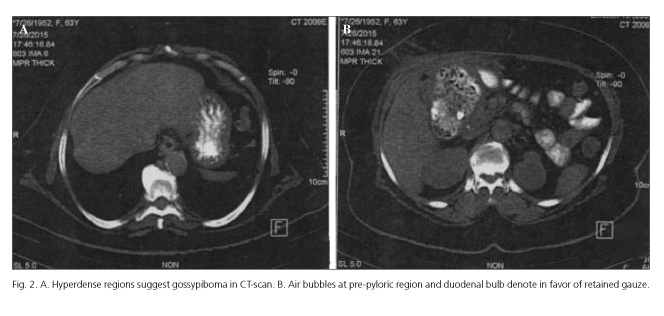
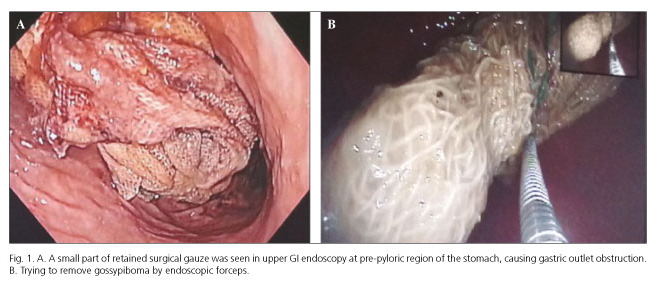
<body><![CDATA[<p><font face="Verdana" size="2">A 63-year-old woman in whom an open cholecystectomy had been performed the previous year consulted our department. During 6 months, 20 kg significant weight loss occurred. During upper GI endoscopy, a white membrane was seen at pre-pyloric zone of the stomach. Removing it by endoscopic forceps was not possible initially and obstruction of pre-pyloric canal occurred (<a href="#f1">Fig. 1 A and B</a>). It appeared that this retained gauze was too massive and long. A new endoscopy was performed one day after; we tried to remove it by endoscopic foreign body forceps, but after several hours, the retained surgical gauze entered the stomach gradually and it was impossible to pulling it out completely. A spongiform foreign body was seen in the peritoneal cavity by CT-scan, where it passed across the duodenal bulb wall, and then migrated to the prepyloric region of the stomach (<a href="#f2">Fig. 2 A and B</a>). Due to the existing granulation tissue, it was impossible to suture as well as probable many post-operation complications such as fistula formation, the surgeons did not agree on removing gauze by laparotomy. Because of the need of emergency surgery, upper GI endoscopy was performed in the presence of the surgical team in operation room. At first, a cylinder-shaped part of gauze was removed and then its long tail was pulled out of the stomach (<a href="#f3">Fig. 3 A and B</a>). Finally, removal of a 40 cm x 40 cm size long gauze by endoscopic forceps was accomplished successfully. After two days, the patient was discharged in well-being feeling and good feeding tolerance conditions, and with no abdominal pain. In follow-up endoscopy, complete healing of the duodenal wall was seen, without inflammation signs or fistulas after two month.</font></p>
    <p>&nbsp;</p>
    <p align="center"><font face="Verdana" size="2"><a name="f1"><img src="/img/revistas/diges/v109n1/nota_clinica4_figure1.jpg"></a></font></p>
    <p>&nbsp;</p>
    <p align="center"><font face="Verdana" size="2"><a name="f2"><img src="/img/revistas/diges/v109n1/nota_clinica4_figure2.jpg"></a></font></p>
    <p>&nbsp;</p>
    <p align="center"><font face="Verdana" size="2"><a name="f3"><img src="/img/revistas/diges/v109n1/nota_clinica4_figure3.jpg"></a></font></p>
    <p>&nbsp;</p>
    <p><font face="Verdana" size="2"><b>Discussion</b></font></p>
    <p><font face="Verdana" size="2">Over the years, open surgery has been the mainstay method for retained surgical gauze removal. Up today, few cases have been reported in relation with removal of retained surgical gauze by upper GI endoscopy. The first case was performed by Sozutek et al. in 2013, where a 20 cm x 20 cm surgical sponge was removed while the patient was in anesthesia conditions in the operation room because of probable need for urgent surgery (8). In 2014, Henriques et al. removed endoscopically a gossypiboma migrated into the stomach leading to pre-pyloric obstruction (5). We report this case because of its large size and noninvasive removal by endoscopy without sedation or complication, and with no need of laparotomy. To our knowledge, we performed successfully and without complications the removal of intra-peritoneal retained 40 cm x 40 cm long surgical gauze by endoscopy, the major part of which was located at peritoneum and outside of duodenal wall.</font></p>
    ]]></body>
<body><![CDATA[<p>&nbsp;</p>
    <p><font face="Verdana" size="2"><b>References</b></font></p>
    <!-- ref --><p><font face="Verdana" size="2">1. Aydogan A, Akkucuk S, Yetim I, et al. Gossypiboma causing mechanical intestinal obstruction: A case report. Case Rep Surg 2012;2012:543203. DOI: 10.1155/2012/543203.    &nbsp;&nbsp;&nbsp;&nbsp;&nbsp;&nbsp;&nbsp;&nbsp;[&#160;<a href="javascript:void(0);" onclick="javascript: window.open('/scielo.php?script=sci_nlinks&ref=5442054&pid=S1130-0108201700010001700001&lng=','','width=640,height=500,resizable=yes,scrollbars=1,menubar=yes,');">Links</a>&#160;]<!-- end-ref --></font></p>    <!-- ref --><p><font face="Verdana" size="2">2. Erbay G, Ko&ccedil; Z, Cali&#351;kan K, et al. Imaging and clinical findings of a gossypiboma migrated into the stomach. Turk J Gastroenterol 2012;23:54-7.    &nbsp;&nbsp;&nbsp;&nbsp;&nbsp;&nbsp;&nbsp;&nbsp;[&#160;<a href="javascript:void(0);" onclick="javascript: window.open('/scielo.php?script=sci_nlinks&ref=5442056&pid=S1130-0108201700010001700002&lng=','','width=640,height=500,resizable=yes,scrollbars=1,menubar=yes,');">Links</a>&#160;]<!-- end-ref --></font></p>    <!-- ref --><p><font face="Verdana" size="2">3. Govarjin HM, Talebianfar M, Fattahi F, et al. Textiloma, migration of retained long gauze from abdominal cavity to intestine. J Res Med Sci 2010;15:54-7.    &nbsp;&nbsp;&nbsp;&nbsp;&nbsp;&nbsp;&nbsp;&nbsp;[&#160;<a href="javascript:void(0);" onclick="javascript: window.open('/scielo.php?script=sci_nlinks&ref=5442058&pid=S1130-0108201700010001700003&lng=','','width=640,height=500,resizable=yes,scrollbars=1,menubar=yes,');">Links</a>&#160;]<!-- end-ref --></font></p>    <!-- ref --><p><font face="Verdana" size="2">4. Henriques AC, Segre JM, Silva PA, et al. Endoscopic removal of foreign body abandoned in prior laparotomy. Arq Bras Cir Dig 2014;27:310-1. DOI: 10.1590/S0102-67202014000400023.    &nbsp;&nbsp;&nbsp;&nbsp;&nbsp;&nbsp;&nbsp;&nbsp;[&#160;<a href="javascript:void(0);" onclick="javascript: window.open('/scielo.php?script=sci_nlinks&ref=5442060&pid=S1130-0108201700010001700004&lng=','','width=640,height=500,resizable=yes,scrollbars=1,menubar=yes,');">Links</a>&#160;]<!-- end-ref --></font></p>    ]]></body>
<body><![CDATA[<!-- ref --><p><font face="Verdana" size="2">5. Kansakar R, Thapa P, Adhikari S. Intraluminal migration of gossypiboma without intestinal obstruction for fourteen years. JNMA J Nepal Med Assoc 2008;47:136-8.    &nbsp;&nbsp;&nbsp;&nbsp;&nbsp;&nbsp;&nbsp;&nbsp;[&#160;<a href="javascript:void(0);" onclick="javascript: window.open('/scielo.php?script=sci_nlinks&ref=5442062&pid=S1130-0108201700010001700005&lng=','','width=640,height=500,resizable=yes,scrollbars=1,menubar=yes,');">Links</a>&#160;]<!-- end-ref --></font></p>    <!-- ref --><p><font face="Verdana" size="2">6. Khan HS, Malik AA, Ali S, et al. Gossypiboma as a cause of intestinal obstruction. J Coll Physicians Surg Pak 2014;24(Suppl. 3):S188-9.    &nbsp;&nbsp;&nbsp;&nbsp;&nbsp;&nbsp;&nbsp;&nbsp;[&#160;<a href="javascript:void(0);" onclick="javascript: window.open('/scielo.php?script=sci_nlinks&ref=5442064&pid=S1130-0108201700010001700006&lng=','','width=640,height=500,resizable=yes,scrollbars=1,menubar=yes,');">Links</a>&#160;]<!-- end-ref --></font></p>    <!-- ref --><p><font face="Verdana" size="2">7. Kohli S, Singhal A, Tiwari B, et al. Gossypiboma, varied presentations: A report of two cases. J Clin Imaging Sci 2013;3:11. DOI: 10.4103/2156-7514.107998.    &nbsp;&nbsp;&nbsp;&nbsp;&nbsp;&nbsp;&nbsp;&nbsp;[&#160;<a href="javascript:void(0);" onclick="javascript: window.open('/scielo.php?script=sci_nlinks&ref=5442066&pid=S1130-0108201700010001700007&lng=','','width=640,height=500,resizable=yes,scrollbars=1,menubar=yes,');">Links</a>&#160;]<!-- end-ref --></font></p>    <!-- ref --><p><font face="Verdana" size="2">8. Ogundiran T, Ayandipo O, Adeniji-Sofoluwe A, et al. Gossypiboma: Complete transmural migration of retained surgical sponge causing small bowel obstruction. BMJ Case Rep 2011;2011.pii:bcr0420114073. DOI: 10.1136/bcr.04.2011.4073.    &nbsp;&nbsp;&nbsp;&nbsp;&nbsp;&nbsp;&nbsp;&nbsp;[&#160;<a href="javascript:void(0);" onclick="javascript: window.open('/scielo.php?script=sci_nlinks&ref=5442068&pid=S1130-0108201700010001700008&lng=','','width=640,height=500,resizable=yes,scrollbars=1,menubar=yes,');">Links</a>&#160;]<!-- end-ref --></font></p>    <!-- ref --><p><font face="Verdana" size="2">9. Sozutek A, Yormaz S, Kupeli H, et al. Transgastric migration of gossypiboma remedied with endoscopic removal: A case report. BMC Res Notes 2013;6:413. DOI: 10.1186/1756-0500-6-413.    &nbsp;&nbsp;&nbsp;&nbsp;&nbsp;&nbsp;&nbsp;&nbsp;[&#160;<a href="javascript:void(0);" onclick="javascript: window.open('/scielo.php?script=sci_nlinks&ref=5442070&pid=S1130-0108201700010001700009&lng=','','width=640,height=500,resizable=yes,scrollbars=1,menubar=yes,');">Links</a>&#160;]<!-- end-ref --></font></p>    ]]></body>
<body><![CDATA[<!-- ref --><p><font face="Verdana" size="2">10. Xu J, Wang H, Song ZW, et al. Foreign body retained in liver long after gauze packing. World J Gastroenterol 2013;19(21):3364-8. DOI: 10.3748/wjg.v19.i21.3364.    &nbsp;&nbsp;&nbsp;&nbsp;&nbsp;&nbsp;&nbsp;&nbsp;[&#160;<a href="javascript:void(0);" onclick="javascript: window.open('/scielo.php?script=sci_nlinks&ref=5442072&pid=S1130-0108201700010001700010&lng=','','width=640,height=500,resizable=yes,scrollbars=1,menubar=yes,');">Links</a>&#160;]<!-- end-ref --></font></p>
    <p>&nbsp;</p>
    <p>&nbsp;</p>
    <p><font face="Verdana" size="2"><a href="#top"><img border="0" src="/img/revistas/diges/v109n1/seta.gif" width="15" height="17"></a><a name="bajo"></a><b>Correspondence:</b>    <br>Sepideh Tahsini Tekentapeh.    <br>Tabriz University of Medical Science.    <br>Internal Medicine Department.    <br>Liver and Gastrointestinal Diseases Research Center.    <br>Endoscopy Unit.    ]]></body>
<body><![CDATA[<br>Emamreza Hospital.    <br>51739-65673 Tabriz, Iran    <br>e-mail: <a href="mailto:tahsinis@tbzmed.ac.ir">tahsinis@tbzmed.ac.ir</a></font></p>
    <p><font face="Verdana" size="2">Received: 29-01-2016    <br>Accepted: 12-02-2016</font></p>
     ]]></body><back>
<ref-list>
<ref id="B1">
<label>1</label><nlm-citation citation-type="journal">
<person-group person-group-type="author">
<name>
<surname><![CDATA[Aydogan]]></surname>
<given-names><![CDATA[A]]></given-names>
</name>
<name>
<surname><![CDATA[Akkucuk]]></surname>
<given-names><![CDATA[S]]></given-names>
</name>
<name>
<surname><![CDATA[Yetim]]></surname>
<given-names><![CDATA[I]]></given-names>
</name>
</person-group>
<article-title xml:lang="en"><![CDATA[Gossypiboma causing mechanical intestinal obstruction: A case report]]></article-title>
<source><![CDATA[Case Rep Surg]]></source>
<year>2012</year>
<volume>2012</volume>
</nlm-citation>
</ref>
<ref id="B2">
<label>2</label><nlm-citation citation-type="journal">
<person-group person-group-type="author">
<name>
<surname><![CDATA[Erbay]]></surname>
<given-names><![CDATA[G]]></given-names>
</name>
<name>
<surname><![CDATA[Koç]]></surname>
<given-names><![CDATA[Z]]></given-names>
</name>
<name>
<surname><![CDATA[Cali&#351;kan]]></surname>
<given-names><![CDATA[K]]></given-names>
</name>
</person-group>
<article-title xml:lang="en"><![CDATA[Imaging and clinical findings of a gossypiboma migrated into the stomach]]></article-title>
<source><![CDATA[Turk J Gastroenterol]]></source>
<year>2012</year>
<volume>23</volume>
<page-range>54-7</page-range></nlm-citation>
</ref>
<ref id="B3">
<label>3</label><nlm-citation citation-type="journal">
<person-group person-group-type="author">
<name>
<surname><![CDATA[Govarjin]]></surname>
<given-names><![CDATA[HM]]></given-names>
</name>
<name>
<surname><![CDATA[Talebianfar]]></surname>
<given-names><![CDATA[M]]></given-names>
</name>
<name>
<surname><![CDATA[Fattahi]]></surname>
<given-names><![CDATA[F]]></given-names>
</name>
</person-group>
<article-title xml:lang="en"><![CDATA[Textiloma, migration of retained long gauze from abdominal cavity to intestine]]></article-title>
<source><![CDATA[J Res Med Sci]]></source>
<year>2010</year>
<volume>15</volume>
<page-range>54-7</page-range></nlm-citation>
</ref>
<ref id="B4">
<label>4</label><nlm-citation citation-type="journal">
<person-group person-group-type="author">
<name>
<surname><![CDATA[Henriques]]></surname>
<given-names><![CDATA[AC]]></given-names>
</name>
<name>
<surname><![CDATA[Segre]]></surname>
<given-names><![CDATA[JM]]></given-names>
</name>
<name>
<surname><![CDATA[Silva]]></surname>
<given-names><![CDATA[PA]]></given-names>
</name>
</person-group>
<article-title xml:lang="en"><![CDATA[Endoscopic removal of foreign body abandoned in prior laparotomy]]></article-title>
<source><![CDATA[Arq Bras Cir Dig]]></source>
<year>2014</year>
<volume>27</volume>
<page-range>310-1</page-range></nlm-citation>
</ref>
<ref id="B5">
<label>5</label><nlm-citation citation-type="journal">
<person-group person-group-type="author">
<name>
<surname><![CDATA[Kansakar]]></surname>
<given-names><![CDATA[R]]></given-names>
</name>
<name>
<surname><![CDATA[Thapa]]></surname>
<given-names><![CDATA[P]]></given-names>
</name>
<name>
<surname><![CDATA[Adhikari]]></surname>
<given-names><![CDATA[S]]></given-names>
</name>
</person-group>
<article-title xml:lang="en"><![CDATA[Intraluminal migration of gossypiboma without intestinal obstruction for fourteen years]]></article-title>
<source><![CDATA[JNMA J Nepal Med Assoc]]></source>
<year>2008</year>
<volume>47</volume>
<page-range>136-8</page-range></nlm-citation>
</ref>
<ref id="B6">
<label>6</label><nlm-citation citation-type="journal">
<person-group person-group-type="author">
<name>
<surname><![CDATA[Khan]]></surname>
<given-names><![CDATA[HS]]></given-names>
</name>
<name>
<surname><![CDATA[Malik]]></surname>
<given-names><![CDATA[AA]]></given-names>
</name>
<name>
<surname><![CDATA[Ali]]></surname>
<given-names><![CDATA[S]]></given-names>
</name>
</person-group>
<article-title xml:lang="en"><![CDATA[Gossypiboma as a cause of intestinal obstruction]]></article-title>
<source><![CDATA[J Coll Physicians Surg Pak]]></source>
<year>2014</year>
<volume>24</volume>
<numero>^s3</numero>
<issue>^s3</issue>
<supplement>3</supplement>
<page-range>S188-9</page-range></nlm-citation>
</ref>
<ref id="B7">
<label>7</label><nlm-citation citation-type="journal">
<person-group person-group-type="author">
<name>
<surname><![CDATA[Kohli]]></surname>
<given-names><![CDATA[S]]></given-names>
</name>
<name>
<surname><![CDATA[Singhal]]></surname>
<given-names><![CDATA[A]]></given-names>
</name>
<name>
<surname><![CDATA[Tiwari]]></surname>
<given-names><![CDATA[B]]></given-names>
</name>
</person-group>
<article-title xml:lang="en"><![CDATA[Gossypiboma, varied presentations: A report of two cases]]></article-title>
<source><![CDATA[J Clin Imaging Sci]]></source>
<year>2013</year>
<volume>3</volume>
</nlm-citation>
</ref>
<ref id="B8">
<label>8</label><nlm-citation citation-type="journal">
<person-group person-group-type="author">
<name>
<surname><![CDATA[Ogundiran]]></surname>
<given-names><![CDATA[T]]></given-names>
</name>
<name>
<surname><![CDATA[Ayandipo]]></surname>
<given-names><![CDATA[O]]></given-names>
</name>
<name>
<surname><![CDATA[Adeniji-Sofoluwe]]></surname>
<given-names><![CDATA[A]]></given-names>
</name>
</person-group>
<article-title xml:lang="en"><![CDATA[Gossypiboma: Complete transmural migration of retained surgical sponge causing small bowel obstruction]]></article-title>
<source><![CDATA[BMJ Case Rep]]></source>
<year>2011</year>
<volume>2011</volume>
</nlm-citation>
</ref>
<ref id="B9">
<label>9</label><nlm-citation citation-type="journal">
<person-group person-group-type="author">
<name>
<surname><![CDATA[Sozutek]]></surname>
<given-names><![CDATA[A]]></given-names>
</name>
<name>
<surname><![CDATA[Yormaz]]></surname>
<given-names><![CDATA[S]]></given-names>
</name>
<name>
<surname><![CDATA[Kupeli]]></surname>
<given-names><![CDATA[H]]></given-names>
</name>
</person-group>
<article-title xml:lang="en"><![CDATA[Transgastric migration of gossypiboma remedied with endoscopic removal: A case report]]></article-title>
<source><![CDATA[BMC Res Notes]]></source>
<year>2013</year>
<volume>6</volume>
</nlm-citation>
</ref>
<ref id="B10">
<label>10</label><nlm-citation citation-type="journal">
<person-group person-group-type="author">
<name>
<surname><![CDATA[Xu]]></surname>
<given-names><![CDATA[J]]></given-names>
</name>
<name>
<surname><![CDATA[Wang]]></surname>
<given-names><![CDATA[H]]></given-names>
</name>
<name>
<surname><![CDATA[Song]]></surname>
<given-names><![CDATA[ZW]]></given-names>
</name>
</person-group>
<article-title xml:lang="en"><![CDATA[Foreign body retained in liver long after gauze packing]]></article-title>
<source><![CDATA[World J Gastroenterol]]></source>
<year>2013</year>
<volume>19</volume>
<numero>21</numero>
<issue>21</issue>
<page-range>3364-8</page-range></nlm-citation>
</ref>
</ref-list>
</back>
</article>