<?xml version="1.0" encoding="ISO-8859-1"?><article xmlns:mml="http://www.w3.org/1998/Math/MathML" xmlns:xlink="http://www.w3.org/1999/xlink" xmlns:xsi="http://www.w3.org/2001/XMLSchema-instance">
<front>
<journal-meta>
<journal-id>1130-0108</journal-id>
<journal-title><![CDATA[Revista Española de Enfermedades Digestivas]]></journal-title>
<abbrev-journal-title><![CDATA[Rev. esp. enferm. dig.]]></abbrev-journal-title>
<issn>1130-0108</issn>
<publisher>
<publisher-name><![CDATA[Sociedad Española de Patología Digestiva]]></publisher-name>
</publisher>
</journal-meta>
<article-meta>
<article-id>S1130-01082017000200002</article-id>
<article-id pub-id-type="doi">10.17235/reed.2016.4441/2016</article-id>
<title-group>
<article-title xml:lang="en"><![CDATA[Practical aspects of high resolution esophageal manometry]]></article-title>
<article-title xml:lang="es"><![CDATA[Aspectos prácticos para la manometría esofágica de alta resolución]]></article-title>
</title-group>
<contrib-group>
<contrib contrib-type="author">
<name>
<surname><![CDATA[Ruiz-de-León-San-Juan]]></surname>
<given-names><![CDATA[Antonio]]></given-names>
</name>
<xref ref-type="aff" rid="A01"/>
</contrib>
<contrib contrib-type="author">
<name>
<surname><![CDATA[Ciriza-de-los-Ríos]]></surname>
<given-names><![CDATA[Constanza]]></given-names>
</name>
<xref ref-type="aff" rid="A02"/>
</contrib>
<contrib contrib-type="author">
<name>
<surname><![CDATA[Pérez-de-la-Serna-Bueno]]></surname>
<given-names><![CDATA[Julio]]></given-names>
</name>
<xref ref-type="aff" rid="A01"/>
</contrib>
<contrib contrib-type="author">
<name>
<surname><![CDATA[Canga-Rodríguez-Valcárcel]]></surname>
<given-names><![CDATA[Fernando]]></given-names>
</name>
<xref ref-type="aff" rid="A02"/>
</contrib>
<contrib contrib-type="author">
<name>
<surname><![CDATA[Estremera-Arévalo]]></surname>
<given-names><![CDATA[Fermín]]></given-names>
</name>
<xref ref-type="aff" rid="A03"/>
</contrib>
<contrib contrib-type="author">
<name>
<surname><![CDATA[García-Sánchez]]></surname>
<given-names><![CDATA[Raquel]]></given-names>
</name>
<xref ref-type="aff" rid="A04"/>
</contrib>
<contrib contrib-type="author">
<name>
<surname><![CDATA[Walter Huamán-Ríos]]></surname>
<given-names><![CDATA[Jose]]></given-names>
</name>
<xref ref-type="aff" rid="A05"/>
</contrib>
<contrib contrib-type="author">
<name>
<surname><![CDATA[Pérez-Fernández]]></surname>
<given-names><![CDATA[María Teresa]]></given-names>
</name>
<xref ref-type="aff" rid="A06"/>
</contrib>
<contrib contrib-type="author">
<name>
<surname><![CDATA[Santander-Vaquero]]></surname>
<given-names><![CDATA[Cecilio]]></given-names>
</name>
<xref ref-type="aff" rid="A06"/>
</contrib>
<contrib contrib-type="author">
<name>
<surname><![CDATA[Serra-Pueyo]]></surname>
<given-names><![CDATA[Jordi]]></given-names>
</name>
<xref ref-type="aff" rid="A07"/>
</contrib>
<contrib contrib-type="author">
<name>
<surname><![CDATA[Sevilla-Mantilla]]></surname>
<given-names><![CDATA[Concepción]]></given-names>
</name>
<xref ref-type="aff" rid="A01"/>
</contrib>
<contrib contrib-type="author">
<name>
<surname><![CDATA[Barba-Orozco]]></surname>
<given-names><![CDATA[Elisabeth]]></given-names>
</name>
<xref ref-type="aff" rid="A08"/>
</contrib>
<contrib contrib-type="author">
<name>
<surname><![CDATA[Bosque-López]]></surname>
<given-names><![CDATA[María José]]></given-names>
</name>
<xref ref-type="aff" rid="A09"/>
</contrib>
<contrib contrib-type="author">
<name>
<surname><![CDATA[Casabona-Francés]]></surname>
<given-names><![CDATA[Sergio]]></given-names>
</name>
<xref ref-type="aff" rid="A06"/>
</contrib>
<contrib contrib-type="author">
<name>
<surname><![CDATA[Carrión-Bolorino]]></surname>
<given-names><![CDATA[Silvia]]></given-names>
</name>
<xref ref-type="aff" rid="A10"/>
</contrib>
<contrib contrib-type="author">
<name>
<surname><![CDATA[Castillo-Grau]]></surname>
<given-names><![CDATA[Pilar]]></given-names>
</name>
<xref ref-type="aff" rid="A11"/>
</contrib>
<contrib contrib-type="author">
<name>
<surname><![CDATA[Delgado-Aros]]></surname>
<given-names><![CDATA[Silvia]]></given-names>
</name>
<xref ref-type="aff" rid="A12"/>
</contrib>
<contrib contrib-type="author">
<name>
<surname><![CDATA[Domínguez-Carbajo]]></surname>
<given-names><![CDATA[Ana Belén]]></given-names>
</name>
<xref ref-type="aff" rid="A13"/>
</contrib>
<contrib contrib-type="author">
<name>
<surname><![CDATA[Fernández-Orcajo]]></surname>
<given-names><![CDATA[Pilar]]></given-names>
</name>
<xref ref-type="aff" rid="A14"/>
</contrib>
<contrib contrib-type="author">
<name>
<surname><![CDATA[García-Lledó]]></surname>
<given-names><![CDATA[Javier]]></given-names>
</name>
<xref ref-type="aff" rid="A15"/>
</contrib>
<contrib contrib-type="author">
<name>
<surname><![CDATA[Gigantó-Tomé]]></surname>
<given-names><![CDATA[Froilán]]></given-names>
</name>
<xref ref-type="aff" rid="A16"/>
</contrib>
<contrib contrib-type="author">
<name>
<surname><![CDATA[Iglesias-Picazo]]></surname>
<given-names><![CDATA[Rosa]]></given-names>
</name>
<xref ref-type="aff" rid="A03"/>
</contrib>
<contrib contrib-type="author">
<name>
<surname><![CDATA[Lacima-Vidal]]></surname>
<given-names><![CDATA[Gloria]]></given-names>
</name>
<xref ref-type="aff" rid="A17"/>
</contrib>
<contrib contrib-type="author">
<name>
<surname><![CDATA[López-López]]></surname>
<given-names><![CDATA[Pilar]]></given-names>
</name>
<xref ref-type="aff" rid="A18"/>
</contrib>
<contrib contrib-type="author">
<name>
<surname><![CDATA[Llabrés-Rosselló]]></surname>
<given-names><![CDATA[Magdalena]]></given-names>
</name>
<xref ref-type="aff" rid="A09"/>
</contrib>
<contrib contrib-type="author">
<name>
<surname><![CDATA[Mas-Mercader]]></surname>
<given-names><![CDATA[Pilar]]></given-names>
</name>
<xref ref-type="aff" rid="A19"/>
</contrib>
<contrib contrib-type="author">
<name>
<surname><![CDATA[Mego-Silva]]></surname>
<given-names><![CDATA[Marianela]]></given-names>
</name>
<xref ref-type="aff" rid="A08"/>
</contrib>
<contrib contrib-type="author">
<name>
<surname><![CDATA[Mendarte-Barrenetxea]]></surname>
<given-names><![CDATA[María Usua]]></given-names>
</name>
<xref ref-type="aff" rid="A19"/>
</contrib>
<contrib contrib-type="author">
<name>
<surname><![CDATA[Miliani-Molina]]></surname>
<given-names><![CDATA[Carlos]]></given-names>
</name>
<xref ref-type="aff" rid="A20"/>
<xref ref-type="aff" rid="A21"/>
</contrib>
<contrib contrib-type="author">
<name>
<surname><![CDATA[Oreja-Arrayago]]></surname>
<given-names><![CDATA[Milagros]]></given-names>
</name>
<xref ref-type="aff" rid="A03"/>
</contrib>
<contrib contrib-type="author">
<name>
<surname><![CDATA[Sánchez-Ceballos]]></surname>
<given-names><![CDATA[Francisco]]></given-names>
</name>
<xref ref-type="aff" rid="A01"/>
</contrib>
<contrib contrib-type="author">
<name>
<surname><![CDATA[Sánchez- Prudencio]]></surname>
<given-names><![CDATA[Sandra]]></given-names>
</name>
<xref ref-type="aff" rid="A22"/>
</contrib>
</contrib-group>
<aff id="A01">
<institution><![CDATA[,Hospital Clínico San Carlos  ]]></institution>
<addr-line><![CDATA[Madrid ]]></addr-line>
<country>Spain</country>
</aff>
<aff id="A02">
<institution><![CDATA[,Hospital Universitario 12 de Octubre  ]]></institution>
<addr-line><![CDATA[Madrid ]]></addr-line>
<country>Spain</country>
</aff>
<aff id="A03">
<institution><![CDATA[,Complejo Hospitalario de Navarra  ]]></institution>
<addr-line><![CDATA[Pamplona ]]></addr-line>
<country>Spain</country>
</aff>
<aff id="A04">
<institution><![CDATA[,Hospital Sanitas la Moraleja  ]]></institution>
<addr-line><![CDATA[Madrid ]]></addr-line>
<country>Spain</country>
</aff>
<aff id="A05">
<institution><![CDATA[,Hospital General de Catalunya  ]]></institution>
<addr-line><![CDATA[Sant Cugat del Vallès ]]></addr-line>
<country>Spain</country>
</aff>
<aff id="A06">
<institution><![CDATA[,Hospital de La Princesa  ]]></institution>
<addr-line><![CDATA[Madrid ]]></addr-line>
<country>Spain</country>
</aff>
<aff id="A07">
<institution><![CDATA[,Hospital Germans Trias i Pujol  ]]></institution>
<addr-line><![CDATA[Barcelona ]]></addr-line>
<country>Spain</country>
</aff>
<aff id="A08">
<institution><![CDATA[,Hospital Vall d´Hebron  ]]></institution>
<addr-line><![CDATA[Barcelona ]]></addr-line>
<country>Spain</country>
</aff>
<aff id="A09">
<institution><![CDATA[,Hospital Universitario Son Espases  ]]></institution>
<addr-line><![CDATA[Palma de Mallorca ]]></addr-line>
<country>Spain</country>
</aff>
<aff id="A10">
<institution><![CDATA[,Hospital de Mataró  ]]></institution>
<addr-line><![CDATA[Mataró ]]></addr-line>
<country>Spain</country>
</aff>
<aff id="A11">
<institution><![CDATA[,Hospital Universitario La Paz  ]]></institution>
<addr-line><![CDATA[Madrid ]]></addr-line>
<country>Spain</country>
</aff>
<aff id="A12">
<institution><![CDATA[,Hospital del Mar  ]]></institution>
<addr-line><![CDATA[Barcelona ]]></addr-line>
<country>Spain</country>
</aff>
<aff id="A13">
<institution><![CDATA[,Complejo Hospitalario de León  ]]></institution>
<addr-line><![CDATA[León ]]></addr-line>
<country>Spain</country>
</aff>
<aff id="A14">
<institution><![CDATA[,Hospital Río Hortega  ]]></institution>
<addr-line><![CDATA[Valladolid ]]></addr-line>
<country>Spain</country>
</aff>
<aff id="A15">
<institution><![CDATA[,Hospital General Universitario Gregorio Marañón  ]]></institution>
<addr-line><![CDATA[Madrid ]]></addr-line>
<country>Spain</country>
</aff>
<aff id="A16">
<institution><![CDATA[,Hospital Universitario Central de Asturias  ]]></institution>
<addr-line><![CDATA[Oviedo ]]></addr-line>
<country>Spain</country>
</aff>
<aff id="A17">
<institution><![CDATA[,Hospital Clínic  ]]></institution>
<addr-line><![CDATA[Barcelona ]]></addr-line>
<country>Spain</country>
</aff>
<aff id="A18">
<institution><![CDATA[,Hospital Universitario Donostia  ]]></institution>
<addr-line><![CDATA[Donostia ]]></addr-line>
<country>Spain</country>
</aff>
<aff id="A19">
<institution><![CDATA[,Hospital Clínico Universitario de Valencia  ]]></institution>
<addr-line><![CDATA[Valencia ]]></addr-line>
<country>Spain</country>
</aff>
<aff id="A20">
<institution><![CDATA[,Hospital Sur Alcorcón  ]]></institution>
<addr-line><![CDATA[Alcorcón ]]></addr-line>
</aff>
<aff id="A21">
<institution><![CDATA[,Clínica La Luz  ]]></institution>
<addr-line><![CDATA[Alcorcón ]]></addr-line>
</aff>
<aff id="A22">
<institution><![CDATA[,Hospital Universitario Infanta Cristina de Parla  ]]></institution>
<addr-line><![CDATA[Parla ]]></addr-line>
<country>Spain</country>
</aff>
<pub-date pub-type="pub">
<day>00</day>
<month>02</month>
<year>2017</year>
</pub-date>
<pub-date pub-type="epub">
<day>00</day>
<month>02</month>
<year>2017</year>
</pub-date>
<volume>109</volume>
<numero>2</numero>
<fpage>91</fpage>
<lpage>105</lpage>
<copyright-statement/>
<copyright-year/>
<self-uri xlink:href="http://scielo.isciii.es/scielo.php?script=sci_arttext&amp;pid=S1130-01082017000200002&amp;lng=en&amp;nrm=iso"></self-uri><self-uri xlink:href="http://scielo.isciii.es/scielo.php?script=sci_abstract&amp;pid=S1130-01082017000200002&amp;lng=en&amp;nrm=iso"></self-uri><self-uri xlink:href="http://scielo.isciii.es/scielo.php?script=sci_pdf&amp;pid=S1130-01082017000200002&amp;lng=en&amp;nrm=iso"></self-uri><abstract abstract-type="short" xml:lang="en"><p><![CDATA[High resolution esophageal manometry (HRM) is currently under development as can be seen in the various Chicago classifications. In order to standardize criteria in certain practical aspects with limited scientific evidence, the First National Meeting for Consensus in High Resolution Manometry of the Spanish Digestive Motility Group took place, bringing together a wide group of experts. The proposals were based on a prior survey composed of 47 questions, an exhaustive review of the available literature and the experience of the participants. Methodological aspects relating to the poorly defined analysis criteria of certain new high resolution parameters were discussed, as well as other issues previously overlooked such as spontaneous activity or secondary waves. Final conclusions were drawn with practical applications.]]></p></abstract>
<abstract abstract-type="short" xml:lang="es"><p><![CDATA[La manometría esofágica de alta resolución (MAR) está en fase de desarrollo, como se evidencia por las diferentes clasificaciones de Chicago. Con el fin de unificar criterios en algunos aspectos prácticos con limitada evidencia científica se llevó a cabo la Primera Reunión Nacional de Consenso en Manometría de Alta Resolución del Grupo Español de Motilidad Digestiva, en la que participaron un amplio grupo de expertos. Las propuestas se basaron en una encuesta previa con 47 preguntas, la exhaustiva revisión de la bibliografía disponible y la experiencia de los participantes. Se plantearon aspectos metodológicos sobre criterios de análisis poco definidos de algunos nuevos parámetros de alta resolución y otros aspectos no considerados, como la actividad espontánea o las ondas secundarias, elaborándose conclusiones finales con utilidad práctica.]]></p></abstract>
<kwd-group>
<kwd lng="en"><![CDATA[High resolution esophageal manometry]]></kwd>
<kwd lng="en"><![CDATA[Consensus meeting]]></kwd>
<kwd lng="en"><![CDATA[Spanish Digestive Motility Group]]></kwd>
<kwd lng="es"><![CDATA[Manometría esofágica de alta resolución]]></kwd>
<kwd lng="es"><![CDATA[Reunión de consenso]]></kwd>
<kwd lng="es"><![CDATA[Grupo Español de Motilidad Digestiva]]></kwd>
</kwd-group>
</article-meta>
</front><body><![CDATA[  <a name="top"></a>     <p><font face="Verdana" size="2"><b>ORIGINAL PAPERS</b></font></p>     <p>&nbsp;</p>     <p><font face="Verdana" size="4"><b>Practical aspects of high resolution esophageal manometry</b></font></p>     <p><font face="Verdana" size="4"><b>Aspectos pr&aacute;cticos para la manometr&iacute;a esof&aacute;gica de alta resoluci&oacute;n</b></font></p>     <p>&nbsp;</p>     <p>&nbsp;</p>     <p><font face="Verdana" size="2"><b>Antonio Ruiz-de-Le&oacute;n-San-Juan<sup>1</sup>, Constanza Ciriza-de-los-R&iacute;os<sup>2</sup>, Julio P&eacute;rez-de-la-Serna-Bueno<sup>1</sup>, Fernando Canga-Rodr&iacute;guez-Valc&aacute;rcel<sup>2</sup>, Ferm&iacute;n Estremera-Ar&eacute;valo<sup>3</sup>, Raquel Garc&iacute;a-S&aacute;nchez<sup>4</sup>, Jose Walter Huam&aacute;n-R&iacute;os<sup>5</sup>, Mar&iacute;a Teresa P&eacute;rez-Fern&aacute;ndez<sup>6</sup>, Cecilio Santander-Vaquero<sup>6</sup>, Jordi Serra-Pueyo<sup>7</sup>, Concepci&oacute;n Sevilla-Mantilla<sup>1</sup>, Elisabeth Barba-Orozco<sup>8</sup>, Mar&iacute;a Jos&eacute; Bosque-L&oacute;pez<sup>9</sup>, Sergio Casabona-Franc&eacute;s<sup>6</sup>, Silvia Carri&oacute;n-Bolorino<sup>10</sup>, Pilar Castillo-Grau<sup>11</sup>, Silvia Delgado-Aros<sup>12</sup>, Ana Bel&eacute;n Dom&iacute;nguez-Carbajo<sup>13</sup>, Pilar Fern&aacute;ndez-Orcajo<sup>14</sup>, Javier Garc&iacute;a-Lled&oacute;<sup>15</sup>, Froil&aacute;n Gigant&oacute;-Tom&eacute;<sup>16</sup>, Rosa Iglesias-Picazo<sup>3</sup>, Gloria Lacima-Vidal<sup>17</sup>, Pilar L&oacute;pez-L&oacute;pez<sup>18</sup>, Magdalena Llabr&eacute;s-Rossell&oacute;<sup>9</sup>, Pilar Mas-Mercader<sup>19</sup>, Marianela Mego-Silva<sup>8</sup>, Mar&iacute;a Usua Mendarte-Barrenetxea<sup>19</sup>, Carlos Miliani-Molina<sup>20</sup>, Milagros Oreja-Arrayago<sup>3</sup>, Francisco S&aacute;nchez-Ceballos<sup>1</sup> and Sandra S&aacute;nchez- Prudencio<sup>21</sup></b></font></p>     <p><font face="Verdana" size="2"><sup>1</sup>Hospital Cl&iacute;nico San Carlos. Madrid, Spain.    <br><sup>2</sup>Hospital Universitario 12 de Octubre. Madrid, Spain.    ]]></body>
<body><![CDATA[<br><sup>3</sup>Complejo Hospitalario de Navarra. Pamplona, Navarra. Spain.    <br><sup>4</sup>Hospital Sanitas La Moraleja. Madrid, Spain.    <br><sup>5</sup>Hospital General de Catalunya. Sant Cugat del Vall&egrave;s, Barcelona. Spain.    <br><sup>6</sup>Hospital de La Princesa. Madrid, Spain.    <br><sup>7</sup>Hospital Germans Trias i Pujol. Barcelona, Spain.    <br><sup>8</sup>Hospital Vall d'Hebron. Barcelona, Spain.    <br><sup>9</sup>Hospital Universitario Son Espases. Palma de Mallorca, Spain.    <br><sup>10</sup>Hospital de Matar&oacute;. Barcelona, Spain.    <br><sup>11</sup>Hospital Universitario La Paz. Madrid, Spain.    <br><sup>12</sup>Hospital del Mar. Barcelona, Spain.    ]]></body>
<body><![CDATA[<br><sup>13</sup>Complejo Hospitalario de Le&oacute;n. Le&oacute;n, Spain.    <br><sup>14</sup>Hospital R&iacute;o Hortega. Valladolid, Spain.    <br><sup>15</sup>Hospital General Universitario Gregorio Mara&ntilde;&oacute;n. Madrid, Spain.    <br><sup>16</sup>Hospital Universitario Central de Asturias. Oviedo, Spain.    <br><sup>17</sup>Hospital Clinic. Barcelona, Spain.    <br><sup>18</sup>Hospital Universitario Donostia. Donostia, Guip&uacute;zcoa. Spain.    <br><sup>19</sup>Hospital Cl&iacute;nico Universitario. Valencia, Spain.    <br><sup>20</sup>Hospital Sur Alcorc&oacute;n/Cl&iacute;nica La Luz. Alcorc&oacute;n, Madrid. Spain.    <br><sup>21</sup>Infanta Cristina. Parla, Madrid. Spain</font></p>     <p><font face="Verdana" size="2">Conflict of interests: The consensus meeting was sponsored by Covidien, Medtronic, Given Imaging and Synmed.</font></p>     ]]></body>
<body><![CDATA[<p><font face="Verdana" size="2"><a href="#bajo">Correspondence</a></font></p>     <p>&nbsp;</p>     <p>&nbsp;</p> <hr size="1">     <p><font face="Verdana" size="2"><b>ABSTRACT</b></font></p>     <p><font face="Verdana" size="2">High resolution esophageal manometry (HRM) is currently under development as can be seen in the various Chicago classifications. In order to standardize criteria in certain practical aspects with limited scientific evidence, the First National Meeting for Consensus in High Resolution Manometry of the Spanish Digestive Motility Group took place, bringing together a wide group of experts. The proposals were based on a prior survey composed of 47 questions, an exhaustive review of the available literature and the experience of the participants. Methodological aspects relating to the poorly defined analysis criteria of certain new high resolution parameters were discussed, as well as other issues previously overlooked such as spontaneous activity or secondary waves. Final conclusions were drawn with practical applications.</font></p>     <p><font face="Verdana" size="2"><b>Key words:</b> High resolution esophageal manometry. Consensus meeting. Spanish Digestive Motility Group.</font></p> <hr size="1">     <p><font face="Verdana" size="2"><b>RESUMEN</b></font></p>     <p><font face="Verdana" size="2">La manometr&iacute;a esof&aacute;gica de alta resoluci&oacute;n (MAR) est&aacute; en fase de desarrollo, como se evidencia por las diferentes clasificaciones de Chicago. Con el fin de unificar criterios en algunos aspectos pr&aacute;cticos con limitada evidencia cient&iacute;fica se llev&oacute; a cabo la Primera Reuni&oacute;n Nacional de Consenso en Manometr&iacute;a de Alta Resoluci&oacute;n del Grupo Espa&ntilde;ol de Motilidad Digestiva, en la que participaron un amplio grupo de expertos. Las propuestas se basaron en una encuesta previa con 47 preguntas, la exhaustiva revisi&oacute;n de la bibliograf&iacute;a disponible y la experiencia de los participantes. Se plantearon aspectos metodol&oacute;gicos sobre criterios de an&aacute;lisis poco definidos de algunos nuevos par&aacute;metros de alta resoluci&oacute;n y otros aspectos no considerados, como la actividad espont&aacute;nea o las ondas secundarias, elabor&aacute;ndose conclusiones finales con utilidad pr&aacute;ctica.</font></p>     <p><font face="Verdana" size="2"><b>Palabras clave:</b> Manometr&iacute;a esof&aacute;gica de alta resoluci&oacute;n. Reuni&oacute;n de consenso. Grupo Espa&ntilde;ol de Motilidad Digestiva.</font></p> <hr size="1">     <p>&nbsp;</p>     ]]></body>
<body><![CDATA[<p><font face="Verdana" size="2"><b>Introduction</b></font></p>     <p><font face="Verdana" size="2">Since esophageal manometry was introduced into clinical practice in the mid-70s, technical and methodological changes have taken place that require standardization and a common set of reference values and analysis criteria between laboratories. High resolution esophageal manometry (HRM) has led to advances in the diagnosis and treatment of esophageal motor disorders (1,2). Its incorporation was led by the International High Resolution Manometry Working Group, and provided an opportunity for updating and harmonizing concepts and criteria. The different versions of the Chicago Classification (CCH) which this group created were a significant advance; however, the latest version (3) is incomplete, failing to describe over 30% of patients with manometric findings (4).</font></p>     <p><font face="Verdana" size="2">Furthermore, the results depend on technical factors: perfusion or micro-driver systems, catheter characteristics, system sensitivity, and probably the software used; and methodological factors: the patient's position, volume and consistency of the bolus, measuring points and parameters used for analysis. The job of improving the harmonization of the techniques and analysis criteria is something that only specialists in the field can and should perform. To this end, the First National Meeting for Consensus in High Resolution Manometry of the Spanish Digestive Motility Group (GEMD) took place on the 7<sup>th</sup> and 8<sup>th</sup> of May 2015, the results of which are presented in this article.</font></p>     <p><font face="Verdana" size="2">The aims of this study were to contribute to the knowledge of the methodology used in this area, to guide and make recommendations on poorly defined and/or controversial aspects and to harmonize the analysis criteria and procedures as far as possible.</font></p>     <p>&nbsp;</p>     <p><font face="Verdana" size="2"><b>Material and methods</b></font></p>     <p><font face="Verdana" size="2">The meeting was attended by 30 specialists from 24 motility units with extensive experience. The number of manometries performed each year by all participants was estimated at between 10,000 and 12,000. During the previous months, a survey was conducted with participants with 47 questions designed to evaluate the following: the characteristics of the participating groups, technical and/or methodological aspects and theoretical/practical concepts. The meeting was organized with seven round tables, and the topics and presentations were selected on the basis of the survey results and a review of the published literature (PubMed). The questions selected were those of the most practical interest and on issues with little or no published scientific evidence. Depending on the issues, and where possible, the round tables were supplemented with case studies provided by the participants.</font></p>     <p>&nbsp;</p>     <p><font face="Verdana" size="2"><b>Results and discussion</b></font></p>     <p><font face="Verdana" size="2"><b>Should some form of topical anesthesia be used?</b></font></p>     ]]></body>
<body><![CDATA[<p><font face="Verdana" size="2">Fifty per cent of respondents did not use anesthesia to perform HRM; 20% used aerosol lidocaine and 30% used lidocaine gel.</font></p>     <p><font face="Verdana" size="2"><i><b>Current situation</b></i></font></p>     <p><font face="Verdana" size="2">The use of topical anesthetics is optional (5). There are no well-designed multicenter studies to assess their impact on manometry records. The information available suggests that its use does not alter the motor activity of the esophagus, although it could alter the dynamics of the early stages of swallowing (6). Both lidocaine and benzocaine are useful to reduce the discomfort caused by catheterization (7,8). It is recommended that their use be specified in the final report (9).</font></p>     <p><font face="Verdana" size="2"><i><b>Conclusions</b></i></font></p>     <p><font face="Verdana" size="2">It is agreed that the use of topical anesthetics:</font></p>     <blockquote>     <p><font face="Verdana" size="2">- Is not essential.</font></p>     <p><font face="Verdana" size="2">- The existence of possible allergies should be assessed, and the gel should be used for nasal access and the aerosol for oral access.</font></p>     <p><font face="Verdana" size="2">- This should be specified in the report.</font></p> </blockquote>     <p><font face="Verdana" size="2"><b>Should usual medication be withdrawn in studies or should studies reflect the medication taken by the patient?</b></font></p>     ]]></body>
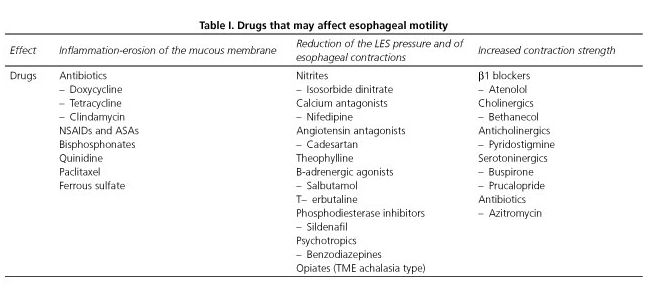
<body><![CDATA[<p><font face="Verdana" size="2">Forty per cent of respondents felt that any medication that could alter esophageal motor activity should be withdrawn; 35% felt it should only be removed for specific studies; 15% felt that only medication that is "not essential" to the patient should be withdrawn; and 10% thought that no medication should be withdrawn.</font></p>     <p><font face="Verdana" size="2"><i><b>Current situation</b></i></font></p>     <p><font face="Verdana" size="2">The HRM protocol recommends fasting for six hours and withdrawal of any medication that might alter normal esophageal function at least 24-48 hours before the examination. However, in some circumstances, although the action of a drug is known to affect esophageal motility, this drug may be essential for the patient and therefore withdrawing or maintaining it could alter the final interpretation of the study. The length of time that the treatment should be suspended in order to eliminate the effect of a drug on esophageal motility has not been established, as it varies according to the type of drug.</font></p>     <p><font face="Verdana" size="2">In studies with protocols that aim to assess motor impairment related to certain pathologies, any medication that could alter the contractile capacity of the esophagus should be withdrawn. This would not be necessary in normal clinical studies.</font></p>     <p><font face="Verdana" size="2">Some of the most important drugs that can in some way alter esophageal motility are included in <a href="#t1">table I</a> (10-23).</font></p>     <p>&nbsp;</p>     <p align="center"><font face="Verdana" size="2"><a name="t1"><img src="/img/revistas/diges/v109n2/original1_table1.jpg"></a></font></p>     <p>&nbsp;</p>     <p><font face="Verdana" size="2">On the other hand, there is no evidence that it is useful to perform examinations with or without medication, although it may be relevant and improve therapeutic management in certain processes. However, if the usual medication is maintained we recommend that this be specified in the report; and if any medication is withdrawn, this should be recorded and the time of withdrawal should be specified.</font></p>     <p><font face="Verdana" size="2"><b><i>Conclusions</i></b></font></p>     ]]></body>
<body><![CDATA[<blockquote>     <p><font face="Verdana" size="2">- In studies specifically designed to detect esophageal motor disorders, any medication that could alter the contractile capacity of the esophagus should be withdrawn.</font></p>     <p><font face="Verdana" size="2">- Some drugs can cause changes in esophageal motility but no studies have shown that it is useful to perform examinations in "ON" or "OFF".</font></p>     <p><font face="Verdana" size="2">- Studies that include the "ON-OFF" effect could provide relevant data and improve diagnostic and/or therapeutic management.</font></p>     <p><font face="Verdana" size="2">- If variations occur in diagnosis, it should be specified in the reports that they may have been caused by medication.</font></p> </blockquote>     <p><font face="Verdana" size="2"><b>What interval should be maintained between swallows?</b></font></p>     <p><font face="Verdana" size="2">Sixty per cent of those surveyed thought that the interval should be at least of ten seconds; 25% advocated for 30 seconds or more, and 15%, as soon as the LES reaches it basal value.</font></p>     <p><font face="Verdana" size="2"><i><b>Current situation</b></i></font></p>     <p><font face="Verdana" size="2">In the lower 2/3 of the esophageal body (esophagus made of smooth muscle fiber), the peristaltic contraction is followed by a period of refractoriness during which the esophageal muscle does not respond to excitatory stimuli (24). Swallows performed at intervals of &lt; 10 to 15 seconds can cause an inhibition of the contraction response (5,24,25). Intervals above these limits are recommended. Some protocols recommend 20 seconds (27); others, which include the HRM standard in the CCH, establish periods of 30 seconds (26,28). It is important to note that the greater the interval between swallows, the greater the risk that "spontaneous" anti-protocol swallows occur.</font></p>     <p><font face="Verdana" size="2"><i><b>Conclusions</b></i></font></p>     ]]></body>
<body><![CDATA[<blockquote>     <p><font face="Verdana" size="2">- A &ge; 20 seconds minimum time or interval between liquid swallows is generally sufficient, providing that the contraction activity triggered by the previous swallow has disappeared.</font></p> </blockquote>     <p><font face="Verdana" size="2"><b>Should a survey be conducted prior to the HRM study? Is a unified protocol required for data collection?</b></font></p>     <p><font face="Verdana" size="2">All respondents believed that a survey should be conducted to assess clinical aspects. Fifty-five per cent believed it should be supervised by the physician, 30% believed it should be supervised by the nurse and 15%, that it should only be conducted in special cases or for specific studies.</font></p>     <p><font face="Verdana" size="2">Regarding the <i>need for a unified protocol</i>, 65% thought that the survey should be unified and common at a national level, 30% thought it was required only for very specific studies and 5% considered it as unnecessary.</font></p>     <p><font face="Verdana" size="2"><i><b>Current situation</b></i></font></p>     <p><font face="Verdana" size="2">Data collection prior to manometry studies is not performed according to an agreed protocol. Each group uses their own protocol, often designed for a specific pathology (GERD, dysphagia, chest pain, etc.). The general surveys are often sent alongside rules for preparing the study and vary greatly in their content. No well-structured articles have been found for the specific study of this subject.</font></p>     <p><font face="Verdana" size="2"><b><i>Conclusions</i></b></font></p>     <blockquote>     <p><font face="Verdana" size="2">- Surveys for evaluating symptoms should be conducted prior to manometry studies, as they provide information that simplifies data collection and analysis.</font></p> </blockquote>     ]]></body>
<body><![CDATA[<p><font face="Verdana" size="2"><b>Should the landmark resting pressures of the sphincters be recorded at the beginning, during the study, or at the end?</b></font></p>     <p><font face="Verdana" size="2">Fifty per cent of respondents said that it should be sometimes be done at the beginning and sometimes at the end, depending on the patient's collaboration. 30% said it should be recorded at the beginning, 15% at the end, and 5% wanted an average of various measurements.</font></p>     <p><font face="Verdana" size="2"><b><i>Current situation</i></b></font></p>     <p><font face="Verdana" size="2">In some programs it is essential for a reference point for the resting pressures of both sphincters (landmark) to be taken at baseline. These pressures, and particularly that of the upper esophageal sphincter (UES), vary significantly throughout the recorded procedure. Some authors (29) suggest that the values obtained at the end of the test may better reflect its clinical utility.</font></p>     <p><font face="Verdana" size="2"><b><i>Conclusions</i></b></font></p>     <blockquote>     <p><font face="Verdana" size="2">- Although it is recommended that the reference points are recorded at baseline, in certain cases this should be carried out during or at the end of the procedure, especially in patients with poor initial tolerance.</font></p> </blockquote>     <p><font face="Verdana" size="2"><b>Should reference be taken on gastric or atmospheric pressure? (Multiple answers)</b></font></p>     <p><font face="Verdana" size="2">Twenty per cent of respondents felt that the reference value to assess the resting pressure of the lower sphincter should be gastric pressure in the lowest channel; another 20% opted for the average pressure of all gastric channels; and 5%, for the gastric pressure in the highest channel. Thirty-five per cent thought that atmospheric pressure should be used as a reference.</font></p>     <p><font face="Verdana" size="2"><b><i>Current situation</i></b></font></p>     ]]></body>
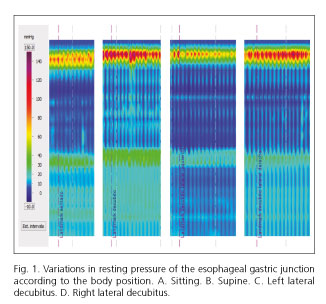
<body><![CDATA[<p><font face="Verdana" size="2">Although atmospheric pressure (AP) is considered to be more accurate and reliable (30), most studies use intra-gastric pressure as a reference. This is due to the technical limitations of perfusion systems (30). Besides, the CCH uses AP for all pressure measurements except for integrated relaxation pressure (IRP), which is referenced to gastric pressure (31). While this approach is justified in that it better reflects the resistance of the bolus during its transit through the esophagogastric junction (EGJ), it is much less useful when certain sensors cannot be placed in the gastric cavity of patients with large hiatal hernias, anti-reflux surgery or after some bariatric surgery techniques (<a href="#f1">Fig. 1</a>).</font></p>     <p>&nbsp;</p>     <p align="center"><font face="Verdana" size="2"><a name="f1"><img src="/img/revistas/diges/v109n2/original1_fig1.jpg"></a></font></p>     <p>&nbsp;</p>     <p><font face="Verdana" size="2"><b><i>Conclusions</i></b></font></p>     <blockquote>     <p><font face="Verdana" size="2">- In HRM both pressures, atmospheric and gastric, are used as a zero reference; changes in the reference points would require a broad international consensus.</font></p> </blockquote>     <p><font face="Verdana" size="2"><b>Are there significant differences between the various analysis systems and programs? (Multiple answers)</b></font></p>     <p><font face="Verdana" size="2">Fifty per cent of respondents felt that there were differences between infusion equipment and microtransducers, 40% felt that the catheters had different characteristics, another 40% pointed to differences in software, and 15% found no differences.</font></p>     <p><font face="Verdana" size="2">Variations of normal values are described in relation to demographic factors (age, obesity, etc.), and technical ones (diameter of the catheter, position of the patient, consistency of the bolus, etc.) (32-36). In addition, the analysis programs are not compatible and the elements of analysis cannot be superimposed. For example, the relaxation of the lower esophageal sphincter (LES) by IRP varies according to the equipment used and to aspects related to the analytical system (e-sleeve).</font></p>     ]]></body>
<body><![CDATA[<p><font face="Verdana" size="2"><b><i>Conclusions</i></b></font></p>     <blockquote>     <p><font face="Verdana" size="2">- It is advisable to have normal values for each HRM system and protocols suited to the characteristics of each piece of equipment. The data should be exportable and compatible with different analysis programs.</font></p> </blockquote>     <p><font face="Verdana" size="2"><b>Should the study be conducted in different positions and/or with different boluses or textures?</b></font></p>     <p><font face="Verdana" size="2">With regard to the necessity of performing studies in different positions, 60% of respondents considered them as necessary only in specific studies; 35%, only exceptionally; for a 10% they were not necessary, and 5% believed they should always be done in the supine and sitting position. As for swallows with different boluses and textures, 75% of respondents felt they were only required in protocols or specific studies and for a 25% they were necessary in patients with dysphagia.</font></p>     <p><font face="Verdana" size="2"><b><i>Current situation</i></b></font></p>     <p><font face="Verdana" size="2">The standard HRM protocol is designed for a patient in a recumbent position and with liquid swallows (3,37,38). However, advantages have been identified in certain situations with the patient sitting (39) and using a solid bolus or standardized food (40-42). Although some studies have been published with reference values under these conditions (43,44), such conditions are not common and are not covered by the CCH, which is most commonly used to define esophageal motor disorders (3,31). The fact that the reference values vary significantly depending on the position (recumbent/sitting) at rest (<a href="#f1">Fig. 1</a>) and on crucial parameters such as the IRP-4s or the distal contractile integral (DCI) (44) raises further doubts about its practical use.</font></p>     <p><font face="Verdana" size="2"><b><i>Conclusions</i></b></font></p>     <blockquote>     <p><font face="Verdana" size="2">- Currently, HRM studies are standardized for recumbent position and liquid swallows. For the time being it is recommended that this system be maintained.</font></p>     ]]></body>
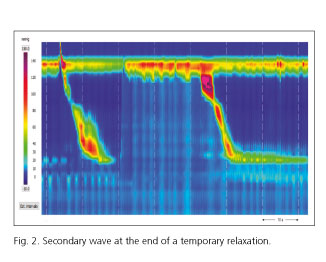
<body><![CDATA[<p><font face="Verdana" size="2">- It may be useful, especially in patients with dysphagia, to complete studies with swallows in more physiological positions and with different textures.</font></p> </blockquote>     <p><font face="Verdana" size="2"><b>How much importance should be given to transient relaxations?</b></font></p>     <p><font face="Verdana" size="2">Sixty-five per cent of respondents believed that if they occur, they should be specified in the report, 15% considered that their presence indicates an increased likelihood of GER, and another 15% thought that they should only be reported if they were very intense or frequent.</font></p>     <p><font face="Verdana" size="2"><b><i>Current situation</i></b></font></p>     <p><font face="Verdana" size="2">Transient lower esophageal sphincter relaxations (tLESRs) are accompanied by esophageal longitudinal muscle contraction and relaxation of the crural diaphragm. They are usually caused by gastric distention and are mediated by a vagal reflex. They occur at a frequency of about 3-6/h. They are considered as a physiological phenomenon that allows gastric gas to be released through eructation (45).</font></p>     <p><font face="Verdana" size="2">TLESRs are responsible for 64-74% of GER episodes (46,47). Characteristically, TLESRs with longer duration, lower nadir pressure, more diaphragmatic inhibition and ending with a secondary wave are those accompanied by reflux (48) (<a href="#f2">Fig. 2</a>).</font></p>     <p>&nbsp;</p>     <p align="center"><font face="Verdana" size="2"><a name="f2"><img src="/img/revistas/diges/v109n2/original1_fig2.jpg"></a></font></p>     <p>&nbsp;</p>     <p><font face="Verdana" size="2">GER episodes associated with tLESRs occur more frequently in standing or right lateral recumbent position, and in obese patients (49). The main determinant of GERD is an increased proportion of tLESRs associated with acid reflux and a higher gastro-esophageal pressure gradient before and during tLESRs than in healthy subjects (45,50).</font></p>     ]]></body>
<body><![CDATA[<p><font face="Verdana" size="2"><b><i>Conclusions</i></b></font></p>     <blockquote>     <p><font face="Verdana" size="2">- The presence of reflux during tLESRs is not always easy to identify if combined studies with impedanciometry were not performed.</font></p>     <p><font face="Verdana" size="2">- No data are available to set normal limits on the number and characteristics of tLESRs during a conventional study. It would be interesting to know the averages and characteristics of tLESRs that appear in diagnostic studies and their relationship with clinical practice, esophageal pH monitoring and endoscopy.</font></p> </blockquote>     <p><font face="Verdana" size="2"><b>In patients with a hiatal hernia &le; 4 cm, where should the LES and gastric pressure sensors be placed? (Multiple answers)</b></font></p>     <p><font face="Verdana" size="2">Fifty per cent of respondents felt that the pressure sensors should be placed above and below the high pressure zone, including the crural diaphragm (CD); 35% would place them above and below the high pressure area of the LES excluding the DC, and 25% considered LES and CD should be measured separately, specifying both results. Regarding the gastric sensor, 60% believed it should be placed outside of the hiatal hernia (HH) in the stomach and 15%, within the HH.</font></p>     <p><font face="Verdana" size="2"><b>In patients with a hiatal hernia &gt; 4 cm, where should the LES and gastric pressure sensors be placed? (Multiple answers)</b></font></p>     <p><font face="Verdana" size="2">Thirty per cent of respondents considered that the LES pressure sensors should be placed above and below the high pressure zone of the LES excluding the DC; 35% preferred above and below the high pressure area of the LES including the DC; and 30% recommended separate measurements for LES and CD if the latter is passed, and specifying the results. Regarding the gastric sensor, 60% felt that if the diaphragm had not been passed, the gastric sensor would remain intra hernia and the reference should be AP, or it should be specified that the analysis is made with reference to intra hernial pressure. According to a 10% of respondents, the sensor should be placed within the hiatal hernia, and a 30% would place it outside it.</font></p>     <p><font face="Verdana" size="2"><b><i>Current situation</i></b></font></p>     <p><font face="Verdana" size="2">It is believed that the pressure of the EGJ as a whole depends on the LES and CD pressures, which helps to increase the pressure especially on inspiration (51). Under normal circumstances, the esophagus is attached to the diaphragm by the phreno-esophageal membrane, a key structure in the pathogenesis of HH (52-54). From a manometric point of view, three subtypes of EGJ have been described according to their morphology: subtype I (LES and overlapping DC), subtype II (separation between the LES and CD &lt; 2 cm), and subtype III or hiatal hernia (separation between EGJ and CD &gt; 2 cm). This latter subtype is in turn subdivided into IIIa and IIIb (55). The degree of disruption of the EGJ influences the pattern of GER (56). Moreover, the EGJ is a dynamic structure that changes depending on the position of the body, the state of rest or swallowing and breathing movements; thus, when the HH is reduced, fewer episodes of GER occur, and these are caused by tLESRs; however, when it is not reduced, other mechanisms such as relaxation induced by swallowing or hypotonia of the LES become more important (57).</font></p>     ]]></body>
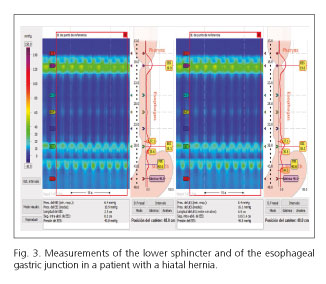
<body><![CDATA[<p><font face="Verdana" size="2">Regarding the metric designed to assess the competence of the EGJ, different values of normal resting pressure have been published, considering the median expiratory and inspiratory pressure, and they vary depending on the type of equipment and catheter used (3). Other possible parameters are being evaluated such as inspiratory increase (55), integral LES pressure (58), the contractile integral of the EGJ (59) and the valuation of intragastric pressure (60).</font></p>     <p><font face="Verdana" size="2">The published normality limits are so broad that they do not help to distinguish between normal subjects and patients with EGJ dysfunction, so more studies are required to determine the usefulness of the new proposed parameters.</font></p>     <p><font face="Verdana" size="2"><b><i>Conclusions</i></b></font></p>     <blockquote>     <p><font face="Verdana" size="2">- It is recommended that the morphology of the EGJ be described by defining its subtypes.</font></p>     <p><font face="Verdana" size="2">- The HH should be measured. If the abdominal cavity can be passed, there is a consensus on measuring the pressure of the whole EGJ and of the LES, separately (<a href="#f3">Fig. 3</a>).</font></p> </blockquote>     <p>&nbsp;</p>     <p align="center"><font face="Verdana" size="2"><a name="f3"><img src="/img/revistas/diges/v109n2/original1_fig3.jpg"></a></font></p>     <p>&nbsp;</p>     <blockquote>     ]]></body>
<body><![CDATA[<p><font face="Verdana" size="2">- In cases where the HH is very large and the abdominal cavity cannot be passed, pressure should be referenced to AP or intrahernia (specifying in the report that it was not possible to pass the abdominal cavity as well as the reference point taken).</font></p>     <p><font face="Verdana" size="2">- Although the new metric for EGJ pressure may be promising, there is insufficient evidence for its routine use in clinical practice, thus for now it seems reasonable to continue using the "classical" criteria.</font></p>     <p><font face="Verdana" size="2">- It is considered as important to specify, if applicable, the existence of compartmentalization between the sphincter and the diaphragm in patients with HH.</font></p> </blockquote>     <p><font face="Verdana" size="2"><b>Should the cutoff value for the integrated relaxation pressure (IRP) be fixed or adjusted according to the pattern of esophageal contractility?</b></font></p>     <p><font face="Verdana" size="2">Fifty-five of respondents considered that it could vary depending on the equipment, the position and on whether the patients had been operated on; 15% thought it should be a fixed value; another 15% deemed it as depended on the system used, and 5% thought it should be adjusted to the pattern of esophageal contractility.</font></p>     <p><font face="Verdana" size="2"><b><i>Current situation</i></b></font></p>     <p><font face="Verdana" size="2">The IRP reports the lowest average relaxation pressure, which is determined by using an e-sleeve for four seconds (either continuous or non-continuous) within a window of ten seconds. Initially, the normal value was established as IRP-4s &lt; 15 mmHg with solid state equipment (61). Subsequent studies suggest that a cutoff of &le; 10 mmHg has greater clinical utility (62,63). In any case, this value should be adjusted according to the pattern of esophageal contractility, the patient's position, whether the patient has been operated on, the equipment used (perfusion systems or solid state) and aspects related to the method of analysis (e-sleeve) (3,53,64-67).</font></p>     <p><font face="Verdana" size="2"><b><i>Conclusions</i></b></font></p>     <blockquote>     <p><font face="Verdana" size="2">- The IRP must be adjusted according to the equipment used, the patient's position, previous surgery on the EGJ and the pattern of esophageal contractility.</font></p> </blockquote>     ]]></body>
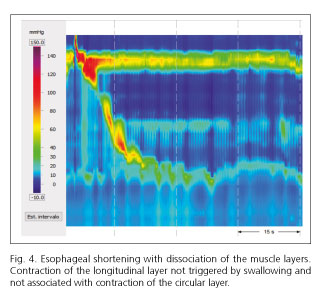
<body><![CDATA[<p><font face="Verdana" size="2"><b>What importance should be given to esophageal shortening? (More than one answer)</b></font></p>     <p><font face="Verdana" size="2">Thirty-five percent of respondents felt that the esophageal shortening is more common in patients with motor impairment, 15% felt that it should only be specified if the episodes are particularly severe or frequent and 65% said that they should be reported whenever they occur.</font></p>     <p><font face="Verdana" size="2"><i><b>Current situation</b></i></font></p>     <p><font face="Verdana" size="2">Coordination between the longitudinal and circular muscle is the basis of the pathophysiology of motor disorders (<a href="#f4">Fig. 4</a>). One of the most interesting contributions of HRM has been its emphasis on the contractile activity of the longitudinal muscle layer identified by esophageal shortening. This technique allows the degree of EGJ sliding to be measured, a better assessment of the coordination between the two muscle layers and a better characterization of the function of the longitudinal muscle (68).</font></p>     <p>&nbsp;</p>     <p align="center"><font face="Verdana" size="2"><a name="f4"><img src="/img/revistas/diges/v109n2/original1_fig4.jpg"></a></font></p>     <p>&nbsp;</p>     <p><font face="Verdana" size="2">In healthy patients, the mechanism that produces most GER episodes is tLESR (69). There is controversy over whether the phenomenon of esophageal shortening precedes the tLESR, helping to "un-anchor" the LES, or occurs later (70,71). The contraction of the longitudinal muscle during the tLESR produces esophageal shortenings of between 4.3 and 8 cm, while the shortening of swallowing does not exceed 1.8 cm (72).</font></p>     <p><font face="Verdana" size="2">The latest evidence postulates that the differences between patients with or without GERD depend on the number of tLESRs accompanied by reflux (73). Thus, when the esophageal shortening is &gt; 3 cm, 100% of tLESRs are accompanied by reflux (45). It therefore appears that esophageal shortenings play a key role in GERD.</font></p>     <p><font face="Verdana" size="2">In patients with a hypercontractile esophagus, dissociation has been observed at the beginning of the contraction of both muscle layers, causing dysphagia by trapping the bolus (68).</font></p>     ]]></body>
<body><![CDATA[<p><font face="Verdana" size="2">The pattern of longitudinal muscle contraction has been associated with the manometric subtypes of achalasia (74): in type I, no contraction occurs; in type II, the contraction is responsible for pan-esophageal pressurization; and in type III, the contraction is not coordinated with the circular layer.</font></p>     <p><font face="Verdana" size="2">Hypoperfusion of the esophageal wall during longitudinal muscle contraction has been associated with chest pain and treatment-resistant heartburn, by pain related to smooth muscle ischemia (75). Some studies suggest that mild pharyngeal stimuli may cause contraction of the proximal longitudinal muscle, which in turn has been associated with increased tLESRs (76).</font></p>     <p><font face="Verdana" size="2"><b><i>Conclusions</i></b></font></p>     <blockquote>     <p><font face="Verdana" size="2">- The ability to identify esophageal shortening is a breakthrough in our physiological understanding of GERD and of motor disorders, and in the future it may be a target for new treatments. It seems reasonable that they be reported if they occur during the study.</font></p> </blockquote>     <p><font face="Verdana" size="2"><b>What is the significance of different aspects of hypercontractile/jackhammer esophagus? (More than one answer)</b></font></p>     <p><font face="Verdana" size="2">Seventy-five percent of respondents considered that it is only pathologically significant if the DCI is &gt; 8,000 mmHg cm<sup>-1</sup>/s<sup>-1</sup>. Sixty per cent said it does not always occur after swallowing, 45% thought it was not always associated with symptoms, and 10% considered that it is not possible to determine the limit of the upper edge of the EGJ.</font></p>     <p><font face="Verdana" size="2"><b><i>Current situation</i></b></font></p>     <p><font face="Verdana" size="2">Jackhammer or hypercontractile peristalsis is an esophageal motility disorder characterized by long duration spastic contractions and involving most of the smooth fiber esophagus. In HRM it is defined as a DCI of over 8,000 mmHg cm<sup>-1</sup>/s<sup>-1</sup> in &ge; 20% of swallows, alongside a normal distal latency and an LES that relaxes normally (3) (<a href="#f5">Fig. 5</a>). This disorder has not been described in healthy controls, although the patients affected by it not always present with symptoms. Some authors suggest that there is not yet sufficient evidence available to definitively set the limit value above 8,000 mmHg cm<sup>-1</sup>/s<sup>-1</sup> (77).</font></p>     <p>&nbsp;</p>     ]]></body>
<body><![CDATA[<p align="center"><font face="Verdana" size="2"><a name="f5"><img src="/img/revistas/diges/v109n2/original1_fig5.jpg"></a></font></p>     <p>&nbsp;</p>     <p><font face="Verdana" size="2"><b><i>Conclusions</i></b></font></p>     <blockquote>     <p><font face="Verdana" size="2">- There is not sufficient evidence available to definitively set the upper DCI diagnostic limit at 8,000 mmHg cm<sup>-1</sup>/s<sup>-1</sup>.</font></p>     <p><font face="Verdana" size="2">- In some cases it is difficult to differentiate the S3 and S4 esophageal segments during contraction, especially if they are associated with esophageal shortening.</font></p>     <p><font face="Verdana" size="2">- One option is to include global contractility (S2, S3 and S4) or to establish a theoretical limit by locating the upper border 3 cm above the lower border of the UEG.</font></p> </blockquote>     <p><font face="Verdana" size="2"><b>Should the basal esophageal pressure be assessed?</b></font></p>     <p><font face="Verdana" size="2">Forty per cent of respondents felt that it should always be evaluated; another 40% considered it should be evaluated when relevant, as in achalasia, and 25% would only evaluate it when associated with retention symptoms.</font></p>     <p><font face="Verdana" size="2"><b><i>Current situation</i></b></font></p>     ]]></body>
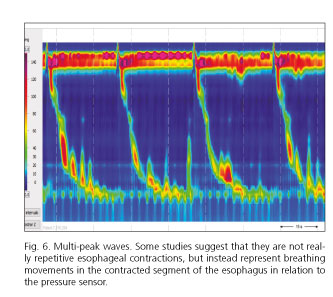
<body><![CDATA[<p><font face="Verdana" size="2">In conventional manometry, basal esophageal pressure has been considered to be a useful parameter in the diagnosis of achalasia (78,79). Various criteria have been used for its analysis, and the most common one consists in measuring the nadir of expiration at rest. Its normal value is negative with respect to the gastric expiratory pressure and may vary, increasing throughout the study when the swallowed water is retained in the esophageal body (<i>e.g</i>., achalasia). No limit values have been established, but it is considered to be pathological when equal to or above gastric pressure.</font></p>     <p><font face="Verdana" size="2"><b><i>Conclusions</i></b></font></p>     <blockquote>     <p><font face="Verdana" size="2">- In HRM the baseline esophageal pressure has not been included among the parameters used in the CCH; however, this information is of great interest as it evaluates retention in the esophageal body. When it is abnormal it should be described in the report.</font></p> </blockquote>     <p><font face="Verdana" size="2"><b>What is the significance of double-peak and multi-peak waves? (More than one answer)</b></font></p>     <p><font face="Verdana" size="2">Forty-five per cent of respondents believed that the presence of waves with three or more peaks was associated with motor disorder, another 45% felt multi-peak waves are always important when they are also simultaneous, and 10% considered them as irrelevant.</font></p>     <p><font face="Verdana" size="2"><b><i>Current situation</i></b></font></p>     <p><font face="Verdana" size="2">Double peak waves generally occur in the lower esophagus and indicate a delay in the onset of contraction of contractile segment S3 compared to S2. They have no clear pathological significance, but they may suggest the presence of hyper-contractile disorders (80,81). The appearance of waves with three or more peaks (multi-peak waves) is usually associated with an esophageal motor disorder (81). There are no studies to support their clinical relevance as an isolated motor impairment. Some studies suggest that they are not in fact repetitive esophageal contractions, but instead represent respiration movements in the contracted segment of the esophagus in relation to the pressure sensor (82) (<a href="#f6">Fig. 6</a>). These findings have not been corroborated by subsequent studies (83,84).</font></p>     <p>&nbsp;</p>     <p align="center"><font face="Verdana" size="2"><a name="f6"><img src="/img/revistas/diges/v109n2/original1_fig6.jpg"></a></font></p>     ]]></body>
<body><![CDATA[<p>&nbsp;</p>     <p><font face="Verdana" size="2"><b><i>Conclusions</i></b></font></p>     <blockquote>     <p><font face="Verdana" size="2">- Multi-peak waves are usually associated with an esophageal motor disorder, although their association with an isolated motor impairment has not been demonstrated.</font></p> </blockquote>     <p><font face="Verdana" size="2"><b>How should simultaneous repetitive contractions be assessed?</b></font></p>     <p><font face="Verdana" size="2">Forty-five per cent felt that their presence should be reported but without influencing the assessment of other waves, 15% deemed them as equivalent to a multi-peak wave, and 5% considered that they should not be taken into account.</font></p>     <p><font face="Verdana" size="2"><b><i>Current situation</i></b></font></p>     <p><font face="Verdana" size="2">Repeated simultaneous contractions are pathological and their occurrence should be reported. Some authors consider them to be diagnostic criteria for some forms of achalasia and for diffuse spasms (DES) (85,86). The CCH does not assign a precise meaning to them. They sometimes follow respiratory movements.</font></p>     <p><font face="Verdana" size="2"><b><i>Conclusions</i></b></font></p>     <blockquote>     ]]></body>
<body><![CDATA[<p><font face="Verdana" size="2">- Spontaneous activity in the form of simultaneous esophageal contractions is not seen in young healthy subjects and should therefore be considered as pathological. It indicates "esophageal irritability" and can be seen in esophageal motor disorder or GERD.</font></p> </blockquote>     <p><font face="Verdana" size="2"><b>Should spontaneous activity and activity not related to protocol swallows be assessed?</b></font></p>     <p><font face="Verdana" size="2">Forty-five per cent of respondents thought assessment was required only when activity was relevant and unrelated to intubation; 25%, only if associated with symptoms; 15% considered that it should always be assessed, and another 15%, that it should not be assessed.</font></p>     <p><font face="Verdana" size="2"><b><i>Current situation</i></b></font></p>     <p><font face="Verdana" size="2">The spontaneous activity in the form of simultaneous esophageal contractions (tertiary waves in classical terminology) is common in the elderly and is not observed in young healthy subjects; it should therefore be considered as pathological in this population group. It indicates "esophageal irritability" and can be seen in esophageal motor disorders or GERD.</font></p>     <p><font face="Verdana" size="2">Although they are not included in the CCH, in "conventional" manometry their presence is considered as a manometric diagnostic criterion for DES (87). Clearly abnormal contractions that are unrelated to programmed swallows are often recorded. They are not included in the CCH, but they may have clinical significance.</font></p>     <p><font face="Verdana" size="2"><b><i>Conclusions</i></b></font></p>     <blockquote>     <p><font face="Verdana" size="2">- The presence and possible causal mechanism of simultaneous contractions and of contractile activity recorded "off-protocol" should be described in the final report according to its characteristics, frequency, and likely clinical relevance.</font></p> </blockquote>     <p><font face="Verdana" size="2"><b>Should secondary waves be assessed?</b></font></p>     ]]></body>
<body><![CDATA[<p><font face="Verdana" size="2">Eighty per cent of respondents felt that their presence should be reported but without influencing the assessment of other waves.</font></p>     <p><font face="Verdana" size="2"><b><i>Current situation</i></b></font></p>     <p><font face="Verdana" size="2">The characteristics of secondary peristalsis are well known (88,89) and can be easily seen with HRM; however, they are not covered by the CCH. They are defined as peristaltic contractions that are not preceded by swallowing, that respond to the stimulation of mechanoreceptors and/or chemoreceptors of the esophageal wall and the aim of which is to "cleanse" the esophageal body content. They may appear as a consequence of a swallow with weak primary peristalsis that did not effectively clear the swallowed bolus, due to partial retention of swallowed material caused by distal flow obstruction (high IRP), or in response to an episode of GER. HRM can easily identify both situations.</font></p>     <p><font face="Verdana" size="2"><b><i>Conclusions</i></b></font></p>     <blockquote>     <p><font face="Verdana" size="2">- Although they are a physiological response to the presence of esophageal intraluminal content, if they are frequent during the study, their presence should be reported in the report along with their possible causal mechanism.</font></p> </blockquote>     <p><font face="Verdana" size="2"><b>What parameters should be analyzed?</b></font></p>     <p><font face="Verdana" size="2">One hundred per cent of those attending believed that the IRP-4s should be analyzed, and 90% considered the DCI, the resting pressure of the EGJ and the integrity of the contractile front to be susceptible to analysis. Eighty per cent thought that the total length of the LES should be indicated, 75% focused on the pressure inversion point; 70%, on the intrabolus pressure and distal latency; 60%, on the contractile front velocity, and 45%, on the length of the LES abdominal portion.</font></p>     <p><font face="Verdana" size="2"><b><i>Current situation</i></b></font></p>     <p><font face="Verdana" size="2">In the CCH version 3.0 (3) the classical parameters of contraction in the esophageal body (wave amplitude, velocity and duration) are combined into a single parameter called DCI, which defines the force or strength of the contraction. Weak contractions with values below 450 mmHg cm<sup>-1</sup>/s<sup>-1</sup>, or failed peristalsis (interrupted) below 100 mmHg cm<sup>-1</sup>/s<sup>-1</sup> are considered as ineffective contractions. Peristaltic waves with DCI &gt; 8,000 mmHg cm<sup>-1</sup>/s<sup>-1</sup> are considered to be hyper-contractile, and a hyper-contractile esophagus is defined by the presence of at least 20% of contractions with DCI &gt; 8,000 mmHg cm<sup>-1</sup>/s<sup>-1</sup>. The morphology, the type of contraction and the relationship between the contraction of the esophageal body and the EGJ resistance to flow are determined only with waves with DCI &gt; 450 mmHg cm<sup>-1</sup>/s<sup>-1</sup> using criteria based on distal latency and the isobaric contour &gt; 20 mmHg.</font></p>     ]]></body>
<body><![CDATA[<p><font face="Verdana" size="2">Regarding the evaluation of the EGJ resistance to flow by determining the intrabolus pressure, pan-pressurization and compartmentalized pressurization of the UEG, its limits are not clear, nor is it clear whether to consider using values above 17 mmHg (67) or only with pressurization &gt; 30 mmHg as measured by the isobaric contour (3).</font></p>     <p><font face="Verdana" size="2"><b><i>Conclusions</i></b></font></p>     <blockquote>     <p><font face="Verdana" size="2">- There is insufficient clarity on the clinical significance or how to grade patients presenting contractions with values between 5,000 and 8,000 mmHg cm<sup>-1/</sup>s<sup>-1</sup>, according to different criteria (95<sup>th</sup> percentile or never seen in normal subjects) but both with sufficient specific weight.</font></p>     <p><font face="Verdana" size="2">- It is difficult to assess these amendments as they were published only recently. Although these changes are generally considered as appropriate, their application to everyday clinical practice presents some difficulties. In general, a careful assessment of the new criteria is deemed as necessary once more experience has been gained on how to apply them.</font></p> </blockquote>     <p><font face="Verdana" size="2"><b>How should the multiple swallow test be performed?</b></font></p>     <p><font face="Verdana" size="2">Sixty per cent of respondents felt it should be done with the patient seated and 25% opted for supine position; 45% felt that the patient should drink directly from the glass and for a 30% a "straw" should be used. In terms of volume, 45% felt that 100 cc should be given, and 25%, that 200 cc are required.</font></p>     <p><font face="Verdana" size="2">In order to evaluate the rapid swallow test, 40% felt that a series of small volumes of water should be given.</font></p>     <p><font face="Verdana" size="2"><b>What is assessed in the multiple swallow test?</b></font></p>     <p><font face="Verdana" size="2">Seventy-five per cent of respondents considered that the object of assessment is whether inhibition occurs in the esophageal body and the LES in addition to retention in the esophagus; 80% considered the presence or absence of an effective contraction following the last swallow as the object of analysis; 65% thought the test focusses on the characteristics of this contraction; and 5% considered it assesses whether the test was completed.</font></p>     ]]></body>
<body><![CDATA[<p><font face="Verdana" size="2"><b><i>Current situation</i></b></font></p>     <p><font face="Verdana" size="2">Both the rapid swallow test (RS) (4-6 swallows of 5 ml every 2-3 seconds) (90,91) and the stress test with multiple swallows (MS) (100-200 ml with swallows in quick succession without breaks) (40,41,94) are easy to perform and do not require a significant prolongation of the test, so they should be performed to complete the HRM study.</font></p>     <p><font face="Verdana" size="2">The RS test should be done with the patient recumbent, administering the bolus by syringe. In the MS test the patient should be sitting and drinking with a straw or directly from the cup. Drinking from the cup is more physiological but not always easier, because if more than three seconds elapse between swallows the test is no longer valid (94). The RS test is especially suitable for patients with hypomotility, as it allows the functional peristaltic reserve that has been linked with the appearance of dysphagia after fundoplication (91,95,96) to be assessed.</font></p>     <p><font face="Verdana" size="2">Regarding the stress test with MS, although a 200 ml volume can discriminate better than one of 100 ml, many patients with severe dysphagia do not tolerate it (94).</font></p>     <p><font face="Verdana" size="2">Unlike what occurs after the RS test, the absence of a final peristaltic wave after the stress test with MS does not appear to be relevant (it does not show up in 50% of normal controls) (40,41,94).</font></p>     <p><font face="Verdana" size="2">The MS stress test is especially suitable for patients with dysphagia (94,96). It is highly recommended when medical records are compatible with achalasia but with IRP below the lower limit (specific to the equipment used), in tracings with increased flow resistance and in patients with esophageal-gastric surgery (92). In some cases, studies with impedance can be useful, having been related to radiological contrast studies in patients with achalasia (93).</font></p>     <p><font face="Verdana" size="2"><b><i>Conclusions</i></b></font></p>     <blockquote>     <p><font face="Verdana" size="2">- The RS and MS tests are easy to perform and do not excessively prolong the examination.</font></p>     <p><font face="Verdana" size="2">- The RS test evaluates the functional peristaltic reserve of the esophagus, which may be important in patients with hypomotility-type motor disorders.</font></p>     ]]></body>
<body><![CDATA[<p><font face="Verdana" size="2">- The MS test is useful in the study of dysphagia. It is therefore recommended that it be performed as part of the HRM study.</font></p> </blockquote>     <p><font face="Verdana" size="2"><b>What is assessed in the upper esophageal sphincter?</b></font></p>     <p><font face="Verdana" size="2">Ninety per cent of respondents felt that the objects of assessment are the resting and residual pressures, the length and the contractile activity with and without swallowing.</font></p>     <p><font face="Verdana" size="2"><b><i>Current situation</i></b></font></p>     <p><font face="Verdana" size="2">The UES resting pressure varies throughout the study, and the value obtained at the end of the test will likely be more useful with regard to symptoms (29). Although several studies have demonstrated that HRM is useful in identifying the motor behavior of the different elements involved in the pharyngo-esophageal phase of swallowing (97) and the prospect of automatically analyzing this area seems ever closer (98), the current situation shows that:</font></p>     <blockquote>     <p><font face="Verdana" size="2">1. In the UES, the lower fascicle of the lower pharyngeal constrictor and the first few cm of the circular layer of the cervical esophagus work alongside the cricopharyngeal muscle.</font></p>     <p><font face="Verdana" size="2">2. The CCH does not provide criteria or analytical tools for the UES, although this does not prevent functional impairments from being recognized in different pathologies that affect this complex region.</font></p>     <p><font face="Verdana" size="2">3. The UES motor behavior should not be considered as an isolated event as it is closely linked to reflex mechanisms triggered at the level of the pharynx, esophageal body and/or EGJ.</font></p>     <p><font face="Verdana" size="2">4. Assessment of the morphology of the pharyngo-esophageal junction at baseline (without swallowing), and of the behavior of the pharynx, UES and upper esophagus after swallowing, can provide information that may improve the diagnostic and therapeutic approach to various degenerative and/or neurological pathologies.</font></p> </blockquote>     ]]></body>
<body><![CDATA[<p><font face="Verdana" size="2"><b><i>Conclusions</i></b></font></p>     <blockquote>     <p><font face="Verdana" size="2">- HRM is no doubt a great advance in the study of the UES. Currently, no specific software is available for assessing the pharynx and UES; however, it should not be studied in isolation from the rest of the esophagus.</font></p> </blockquote>     <p><font face="Verdana" size="2"><b>What normal values are used in HRM?</b></font></p>     <p><font face="Verdana" size="2">Seventy per cent of respondents use the CCH values; 25% utilize the values by each manufacturer; 15%, the values of the classical system; 10%, the locally validated values, and 5% thought that there were no well-defined values.</font></p>     <p><font face="Verdana" size="2"><b><i>Current situation</i></b></font></p>     <p><font face="Verdana" size="2">The findings made in conventional manometry studies, later confirmed by HRM, have described variations of normal values according to technical, ethnic and demographic factors. Moreover, HRM has modified concepts, parameters and assessment methods with clear differences between different analysis programs (32,34).</font></p>     <p><font face="Verdana" size="2"><b>What normal values are used in HRM with impedanciometry?</b></font></p>     <p><font face="Verdana" size="2">The survey could not be evaluated due to the low number of responses.</font></p>     <p><font face="Verdana" size="2">Combined high resolution manometry studies with impedanciometry (HRM -I) are relatively recent, and neither their methodology nor their analysis parameters are completely defined. The normal values of this technique are based on various studies made with healthy volunteers using liquid and viscous boluses. Swallows with incomplete clearing were considered as pathological in over 20% of liquid swallows and over 30% of swallows with viscous boluses (99). A 2,400 &Omega; cutoff point was established to distinguish between patients with dysphagia and healthy controls (100). New studies are needed to confirm these results.</font></p>     ]]></body>
<body><![CDATA[<p><font face="Verdana" size="2"><b><i>Conclusions</i></b></font></p>     <blockquote>     <p><font face="Verdana" size="2">- It is recommended that, as far as possible, normal values are available for each laboratory. Failing that, values should be applied from studies made with equipment and protocols similar to those being used.</font></p> </blockquote>     <p><font face="Verdana" size="2"><b>How should the report be drafted? (More than one answer)</b></font></p>     <p><font face="Verdana" size="2">Seventy per cent of respondents said that the CCH diagnosis should be included, 65% recommended a clinical diagnosis, 60% also thought that treatment recommendations should be included, and 50% deemed a summary of manometry results as necessary.</font></p>     <p><font face="Verdana" size="2"><b><i>Current situation</i></b></font></p>     <p><font face="Verdana" size="2">The report must include general information and manometric aspects of the LES and esophageal body motor behavior; there is no unanimous agreement on whether the LES should be included or not. General information includes: patient identification, date, equipment used, indication, tolerance to the test, topical anesthesia, etc. The description of motility includes: EGJ morphology, the resting and relaxation pressures of the LES, baseline pressure of the esophageal body and the characteristics of motor behavior after swallowing (timing, amplitude and duration of contractions) (9). In general terms, it is recommended that the HRM guidelines established by the Mayo Clinic for conventional esophageal manometry be followed (9).</font></p>     <p><font face="Verdana" size="2"><b>Conclusions</b></font></p>     <blockquote>     <p><font face="Verdana" size="2">- The CCH leaves out of its assessment certain data that have so far been considered as essential, such as the LES resting pressure.</font></p>     ]]></body>
<body><![CDATA[<p><font face="Verdana" size="2">- It uses new, less commonly known concepts and terminology in non-specialized areas. It is important to use "understandable" terms, to try to stick to new classifications and to refer to well-established concepts whenever necessary.</font></p>     <p><font face="Verdana" size="2">- The possible relation to organic disorders (secondary motor disorders) should be considered, making treatment management recommendations whenever possible.</font></p> </blockquote>     <p><font face="Verdana" size="2">In summary, HRM is under development as is clear from the succession of Chicago classifications. Some practical aspects are not sufficiently well defined, whereas in other areas the fact that certain parameters have been recently introduced means that there is very little accumulated experience. The aim of this meeting was to guide and harmonize as far as possible the criteria to be followed in situations in daily practice where current guidelines are poorly defined. We are aware that decisions by consensus have a "limited value" compared to scientific evidence obtained in well-designed, randomized, double blind studies, and for this reason the conclusions of this meeting do not intend to be dogmatic, and do not attempt to impose criteria.</font></p>     <p>&nbsp;</p>     <p><font face="Verdana" size="2"><b>References</b></font></p>     <!-- ref --><p><font face="Verdana" size="2">1. Carlson DA, Ravi K, Kahrilas PJ, et al. Diagnosis of esophageal motility disorders: Esophageal pressure topography vs. conventional line tracing. Am J Gastroenterol 2015;110(7):967-77;quiz78. DOI: 10.1038/ajg.2015.159.    &nbsp;&nbsp;&nbsp;&nbsp;&nbsp;&nbsp;&nbsp;&nbsp;[&#160;<a href="javascript:void(0);" onclick="javascript: window.open('/scielo.php?script=sci_nlinks&ref=5438198&pid=S1130-0108201700020000200001&lng=','','width=640,height=500,resizable=yes,scrollbars=1,menubar=yes,');">Links</a>&#160;]<!-- end-ref --></font></p>    <!-- ref --><p><font face="Verdana" size="2">2. Ciriza-de-los-R&iacute;os C, Canga-Rodr&iacute;guez-Valc&aacute;rcel F. High-resolution manometry and impedance-pH/manometry: Novel techniques for the advancement of knowledge on esophageal function and their clinical role. Rev Esp Enferm Dig 2009;101(12):861-9. DOI: 10.4321/S1130-01082009001200006.    &nbsp;&nbsp;&nbsp;&nbsp;&nbsp;&nbsp;&nbsp;&nbsp;[&#160;<a href="javascript:void(0);" onclick="javascript: window.open('/scielo.php?script=sci_nlinks&ref=5438200&pid=S1130-0108201700020000200002&lng=','','width=640,height=500,resizable=yes,scrollbars=1,menubar=yes,');">Links</a>&#160;]<!-- end-ref --></font></p>    <!-- ref --><p><font face="Verdana" size="2">3. Kahrilas PJ, Bredenoord AJ, Fox M, et al. The Chicago Classification of esophageal motility disorders, v3.0. Neurogastroenterol Motil2015;27(2):160-74. DOI: 10.1111/nmo.12477.    &nbsp;&nbsp;&nbsp;&nbsp;&nbsp;&nbsp;&nbsp;&nbsp;[&#160;<a href="javascript:void(0);" onclick="javascript: window.open('/scielo.php?script=sci_nlinks&ref=5438202&pid=S1130-0108201700020000200003&lng=','','width=640,height=500,resizable=yes,scrollbars=1,menubar=yes,');">Links</a>&#160;]<!-- end-ref --></font></p>    <!-- ref --><p><font face="Verdana" size="2">4. Wang YT, Yazaki E, Sifrim D. High-resolution manometry: Esophageal disorders not addressed by the "Chicago Classification". J Neurogastroenterol Motil2012;18(4):365-72. DOI: 10.5056/jnm.2012.18.4.365.    &nbsp;&nbsp;&nbsp;&nbsp;&nbsp;&nbsp;&nbsp;&nbsp;[&#160;<a href="javascript:void(0);" onclick="javascript: window.open('/scielo.php?script=sci_nlinks&ref=5438204&pid=S1130-0108201700020000200004&lng=','','width=640,height=500,resizable=yes,scrollbars=1,menubar=yes,');">Links</a>&#160;]<!-- end-ref --></font></p>    <!-- ref --><p><font face="Verdana" size="2">5. Castell JA, Castell DO. Manometr&iacute;a esof&aacute;gica. En: Scarpignato C,Galmiche J, editores. Exploraciones funcionales en la enfermedad esof&aacute;gica: EDIKA MED; 1994. p. 109-29.    &nbsp;&nbsp;&nbsp;&nbsp;&nbsp;&nbsp;&nbsp;&nbsp;[&#160;<a href="javascript:void(0);" onclick="javascript: window.open('/scielo.php?script=sci_nlinks&ref=5438206&pid=S1130-0108201700020000200005&lng=','','width=640,height=500,resizable=yes,scrollbars=1,menubar=yes,');">Links</a>&#160;]<!-- end-ref --></font></p>    <!-- ref --><p><font face="Verdana" size="2">6. Mansson I, Sandberg N. Oro-pharyngeal sensitivity and elicitation of swallowing in man. Acta Otolaryngol 1975;79:140-5. DOI: 10.3109/00016487509124666.    &nbsp;&nbsp;&nbsp;&nbsp;&nbsp;&nbsp;&nbsp;&nbsp;[&#160;<a href="javascript:void(0);" onclick="javascript: window.open('/scielo.php?script=sci_nlinks&ref=5438208&pid=S1130-0108201700020000200006&lng=','','width=640,height=500,resizable=yes,scrollbars=1,menubar=yes,');">Links</a>&#160;]<!-- end-ref --></font></p>    <!-- ref --><p><font face="Verdana" size="2">7. Carmona-S&aacute;nchez R, Valerio Ure&ntilde;a J, Valdovinos D&iacute;az MA. The usefulness of lidocaine in gel in esophageal manometry. Rev Gastroenterol Mex 2001;66(3):137-40.    &nbsp;&nbsp;&nbsp;&nbsp;&nbsp;&nbsp;&nbsp;&nbsp;[&#160;<a href="javascript:void(0);" onclick="javascript: window.open('/scielo.php?script=sci_nlinks&ref=5438210&pid=S1130-0108201700020000200007&lng=','','width=640,height=500,resizable=yes,scrollbars=1,menubar=yes,');">Links</a>&#160;]<!-- end-ref --></font></p>    <!-- ref --><p><font face="Verdana" size="2">8. Carmona-S&aacute;nchez R, Esmer-S&aacute;nchez D, Tostado-Fern&aacute;ndez FA. Comparison of two forms of nasal and pharyngeal topical anesthesia for performing esophageal manometry. Rev Gastroenterol Mex 2007;72(2):100-3.    &nbsp;&nbsp;&nbsp;&nbsp;&nbsp;&nbsp;&nbsp;&nbsp;[&#160;<a href="javascript:void(0);" onclick="javascript: window.open('/scielo.php?script=sci_nlinks&ref=5438212&pid=S1130-0108201700020000200008&lng=','','width=640,height=500,resizable=yes,scrollbars=1,menubar=yes,');">Links</a>&#160;]<!-- end-ref --></font></p>    <!-- ref --><p><font face="Verdana" size="2">9. Murray JA, Clouse RE, Conklin JL. Components of the standard oesophageal manometry. Neurogastroenterol Motil 2005;15:591-606. DOI: 10.1046/j.1365-2982.2003.00446.x.    &nbsp;&nbsp;&nbsp;&nbsp;&nbsp;&nbsp;&nbsp;&nbsp;[&#160;<a href="javascript:void(0);" onclick="javascript: window.open('/scielo.php?script=sci_nlinks&ref=5438214&pid=S1130-0108201700020000200009&lng=','','width=640,height=500,resizable=yes,scrollbars=1,menubar=yes,');">Links</a>&#160;]<!-- end-ref --></font></p>    <!-- ref --><p><font face="Verdana" size="2">10. Tutuian R. Adverse effects of drugs on the esophagus. Gastroenterology 2010;24:91-7. DOI: 10.1016/j.bpg.2010.02.005.    &nbsp;&nbsp;&nbsp;&nbsp;&nbsp;&nbsp;&nbsp;&nbsp;[&#160;<a href="javascript:void(0);" onclick="javascript: window.open('/scielo.php?script=sci_nlinks&ref=5438216&pid=S1130-0108201700020000200010&lng=','','width=640,height=500,resizable=yes,scrollbars=1,menubar=yes,');">Links</a>&#160;]<!-- end-ref --></font></p>    <!-- ref --><p><font face="Verdana" size="2">11. Stacher G, Schneider C, Steinringer H, et al. Effects of 3-days' intake of a sustained-release preparation of the nitric oxide donor, isosorbide dinitrate, on oesophageal motility. Aliment Pharmacol Ther 1997;11:967-71. DOI: 10.1046/j.1365-2036.1997.00241.x.    &nbsp;&nbsp;&nbsp;&nbsp;&nbsp;&nbsp;&nbsp;&nbsp;[&#160;<a href="javascript:void(0);" onclick="javascript: window.open('/scielo.php?script=sci_nlinks&ref=5438218&pid=S1130-0108201700020000200011&lng=','','width=640,height=500,resizable=yes,scrollbars=1,menubar=yes,');">Links</a>&#160;]<!-- end-ref --></font></p>    <!-- ref --><p><font face="Verdana" size="2">12. Ishikawa H, Iwakiri K, Sugiura T, et al. Effect of nifedipine administration (10 mg) on esophageal acid exposure time. J Gastroenterol 2000;35:43-6. DOI: 10.1007/s005350050008.    &nbsp;&nbsp;&nbsp;&nbsp;&nbsp;&nbsp;&nbsp;&nbsp;[&#160;<a href="javascript:void(0);" onclick="javascript: window.open('/scielo.php?script=sci_nlinks&ref=5438220&pid=S1130-0108201700020000200012&lng=','','width=640,height=500,resizable=yes,scrollbars=1,menubar=yes,');">Links</a>&#160;]<!-- end-ref --></font></p>    <!-- ref --><p><font face="Verdana" size="2">13. Yoshida K, Furuta K, Adachi K, et al. Effects of anti-hypertensive drugs on esophageal body contraction. World J Gastroenterol 2010;16:987-91. DOI: 10.3748/wjg.v16.i8.987.    &nbsp;&nbsp;&nbsp;&nbsp;&nbsp;&nbsp;&nbsp;&nbsp;[&#160;<a href="javascript:void(0);" onclick="javascript: window.open('/scielo.php?script=sci_nlinks&ref=5438222&pid=S1130-0108201700020000200013&lng=','','width=640,height=500,resizable=yes,scrollbars=1,menubar=yes,');">Links</a>&#160;]<!-- end-ref --></font></p>    <!-- ref --><p><font face="Verdana" size="2">14. Kim HS, Conklin JL, Park H. The effect of sildenafil on segmental oesophageal motility and gastro-oesophageal reflux. Aliment Pharmacol Ther 2006;24:1029-36. DOI: 10.1111/j.1365-2036.2006.03091.x.    &nbsp;&nbsp;&nbsp;&nbsp;&nbsp;&nbsp;&nbsp;&nbsp;[&#160;<a href="javascript:void(0);" onclick="javascript: window.open('/scielo.php?script=sci_nlinks&ref=5438224&pid=S1130-0108201700020000200014&lng=','','width=640,height=500,resizable=yes,scrollbars=1,menubar=yes,');">Links</a>&#160;]<!-- end-ref --></font></p>    <!-- ref --><p><font face="Verdana" size="2">15. Corley DA, Levin T, Habel LA, et al. Barrett's esophagus and medications that relax the lower esophageal sphincter. Am J Gastroenterol 2006;101:937-44. DOI: 10.1111/j.1572-0241.2006.00539.x.    &nbsp;&nbsp;&nbsp;&nbsp;&nbsp;&nbsp;&nbsp;&nbsp;[&#160;<a href="javascript:void(0);" onclick="javascript: window.open('/scielo.php?script=sci_nlinks&ref=5438226&pid=S1130-0108201700020000200015&lng=','','width=640,height=500,resizable=yes,scrollbars=1,menubar=yes,');">Links</a>&#160;]<!-- end-ref --></font></p>    <!-- ref --><p><font face="Verdana" size="2">16. Storr M, Allescher H. Esophageal pharmacology and treatment of primary motility disorders. Dis Esophagus 1999;12:241-57. DOI: 10.1046/j.1442-2050.1999.00059.x.    &nbsp;&nbsp;&nbsp;&nbsp;&nbsp;&nbsp;&nbsp;&nbsp;[&#160;<a href="javascript:void(0);" onclick="javascript: window.open('/scielo.php?script=sci_nlinks&ref=5438228&pid=S1130-0108201700020000200016&lng=','','width=640,height=500,resizable=yes,scrollbars=1,menubar=yes,');">Links</a>&#160;]<!-- end-ref --></font></p>    <!-- ref --><p><font face="Verdana" size="2">17. Scheerens C, Tack J, Rommel N. Buspirone, a new drug for the management of patients with ineffective esophageal motility? United European Gastroenterol J 2015;3(3):261-5. DOI: 10.1177/2050640615585688.    &nbsp;&nbsp;&nbsp;&nbsp;&nbsp;&nbsp;&nbsp;&nbsp;[&#160;<a href="javascript:void(0);" onclick="javascript: window.open('/scielo.php?script=sci_nlinks&ref=5438230&pid=S1130-0108201700020000200017&lng=','','width=640,height=500,resizable=yes,scrollbars=1,menubar=yes,');">Links</a>&#160;]<!-- end-ref --></font></p>    <!-- ref --><p><font face="Verdana" size="2">18. Blonski W, Vela M, Freeman J, et al. The effect of oral buspirone, pyridostigmine, and bethanechol on esophageal function evaluated with combined multichannel esophageal impedance-manometry in healthy volunteers. J Clin Gastroenterol 2009;43:253-60. DOI: 10.1097/MCG.0b013e318167b89d.    &nbsp;&nbsp;&nbsp;&nbsp;&nbsp;&nbsp;&nbsp;&nbsp;[&#160;<a href="javascript:void(0);" onclick="javascript: window.open('/scielo.php?script=sci_nlinks&ref=5438232&pid=S1130-0108201700020000200018&lng=','','width=640,height=500,resizable=yes,scrollbars=1,menubar=yes,');">Links</a>&#160;]<!-- end-ref --></font></p>    <!-- ref --><p><font face="Verdana" size="2">19. Kraichely RE, Arora A, Murray JA. Opiate-induced oesophageal dysmotility. Aliment Pharmacol Ther 2010;31:601-6. DOI: 10.1111/j.1365-2036.2009.04212.x.    &nbsp;&nbsp;&nbsp;&nbsp;&nbsp;&nbsp;&nbsp;&nbsp;[&#160;<a href="javascript:void(0);" onclick="javascript: window.open('/scielo.php?script=sci_nlinks&ref=5438234&pid=S1130-0108201700020000200019&lng=','','width=640,height=500,resizable=yes,scrollbars=1,menubar=yes,');">Links</a>&#160;]<!-- end-ref --></font></p>    <!-- ref --><p><font face="Verdana" size="2">20. Kessing BF, Smout AJ, Bennink RJ, et al. Prucalopride decreases esophageal acid exposure and accelerates gastric emptying in healthy subjects. Neurogastroenterol Motil 2014;26(8):1079-86. DOI: 10.1111/nmo.12359.    &nbsp;&nbsp;&nbsp;&nbsp;&nbsp;&nbsp;&nbsp;&nbsp;[&#160;<a href="javascript:void(0);" onclick="javascript: window.open('/scielo.php?script=sci_nlinks&ref=5438236&pid=S1130-0108201700020000200020&lng=','','width=640,height=500,resizable=yes,scrollbars=1,menubar=yes,');">Links</a>&#160;]<!-- end-ref --></font></p>    <!-- ref --><p><font face="Verdana" size="2">21. Di Stefano M, Papathanasopoulos A, Blondeau K, et al. Effect of buspirone, a 5-HT1A receptor agonist, on esophageal motility in healthy volunteers. Dis Esophagus 2012;25:470-6. DOI: 10.1111/j.1442-2050.2011.01275.x.    &nbsp;&nbsp;&nbsp;&nbsp;&nbsp;&nbsp;&nbsp;&nbsp;[&#160;<a href="javascript:void(0);" onclick="javascript: window.open('/scielo.php?script=sci_nlinks&ref=5438238&pid=S1130-0108201700020000200021&lng=','','width=640,height=500,resizable=yes,scrollbars=1,menubar=yes,');">Links</a>&#160;]<!-- end-ref --></font></p>    <!-- ref --><p><font face="Verdana" size="2">22. Broekaert D, Fischler B, Sifrim D, et al. Influence of citalopram, a selective serotonin reuptake inhibitor, on oesophageal hypersensitivity: A double-blind, placebo-controlled study. Aliment Pharmacol Ther 2006;23:365-70. DOI: 10.1111/j.1365-2036.2006.02772.x.    &nbsp;&nbsp;&nbsp;&nbsp;&nbsp;&nbsp;&nbsp;&nbsp;[&#160;<a href="javascript:void(0);" onclick="javascript: window.open('/scielo.php?script=sci_nlinks&ref=5438240&pid=S1130-0108201700020000200022&lng=','','width=640,height=500,resizable=yes,scrollbars=1,menubar=yes,');">Links</a>&#160;]<!-- end-ref --></font></p>    <!-- ref --><p><font face="Verdana" size="2">23. Jafari J, Yazaki E, Woodland P, et al. Effect of azithromycin on esophageal hypomotility (EH) and prediction of response by esophageal stimulations. Tests during high resolution manometry. Gastroenterology 2015;148(Suppl 1):S75. DOI: 10.1016/S0016-5085(15)30264-X.    &nbsp;&nbsp;&nbsp;&nbsp;&nbsp;&nbsp;&nbsp;&nbsp;[&#160;<a href="javascript:void(0);" onclick="javascript: window.open('/scielo.php?script=sci_nlinks&ref=5438242&pid=S1130-0108201700020000200023&lng=','','width=640,height=500,resizable=yes,scrollbars=1,menubar=yes,');">Links</a>&#160;]<!-- end-ref --></font></p>    <!-- ref --><p><font face="Verdana" size="2">24. Meyer GW, Castell D. Fisiolog&iacute;a del es&oacute;fago. Cl&iacute;nica Gastroenterol&oacute;gica Trastornos de la Motilidad: Ed. Esp. Salvat; 1984. p. 1-14.    &nbsp;&nbsp;&nbsp;&nbsp;&nbsp;&nbsp;&nbsp;&nbsp;[&#160;<a href="javascript:void(0);" onclick="javascript: window.open('/scielo.php?script=sci_nlinks&ref=5438244&pid=S1130-0108201700020000200024&lng=','','width=640,height=500,resizable=yes,scrollbars=1,menubar=yes,');">Links</a>&#160;]<!-- end-ref --></font></p>    <!-- ref --><p><font face="Verdana" size="2">25. Sifrim D, Janssens J, Vantrappen G. A wave of inhibition precedes primary peristaltic contractions in the human esophagus. Gastroenterology 1992;103:876-82. DOI: 10.1016/0016-5085(92)90020-Y.    &nbsp;&nbsp;&nbsp;&nbsp;&nbsp;&nbsp;&nbsp;&nbsp;[&#160;<a href="javascript:void(0);" onclick="javascript: window.open('/scielo.php?script=sci_nlinks&ref=5438246&pid=S1130-0108201700020000200025&lng=','','width=640,height=500,resizable=yes,scrollbars=1,menubar=yes,');">Links</a>&#160;]<!-- end-ref --></font></p>    <!-- ref --><p><font face="Verdana" size="2">26. Santander Vaquero C, Ruiz de Le&oacute;n A. Manometr&iacute;a esof&aacute;gica de alta resoluci&oacute;n. En: Lacima G, Serra J, M&iacute;nguez M, Accarino A., editores. Tratado de neurogastroenterolog&iacute;a y motilidad digestiva. T&eacute;cnicas para el estudio de la funci&oacute;n motora sensorial del tubo digestivo. Madrid: Panmericana; 2014. p. 56-66.    &nbsp;&nbsp;&nbsp;&nbsp;&nbsp;&nbsp;&nbsp;&nbsp;[&#160;<a href="javascript:void(0);" onclick="javascript: window.open('/scielo.php?script=sci_nlinks&ref=5438248&pid=S1130-0108201700020000200026&lng=','','width=640,height=500,resizable=yes,scrollbars=1,menubar=yes,');">Links</a>&#160;]<!-- end-ref --></font></p>    <!-- ref --><p><font face="Verdana" size="2">27. Soria de la Cruz MJ,Garrigues Gil V. Manometr&iacute;a esof&aacute;gica convencional. En: Lacima G, Serra J, M&iacute;nguez M, Accarino A, editores. Tratado de neurogastroenterolog&iacute;a y motilidad digestiva. T&eacute;cnicas para el estudio de la funci&oacute;n motora sensorial del tubo digestivo Madrid: Panamericana; 2014. p. 30-40.    &nbsp;&nbsp;&nbsp;&nbsp;&nbsp;&nbsp;&nbsp;&nbsp;[&#160;<a href="javascript:void(0);" onclick="javascript: window.open('/scielo.php?script=sci_nlinks&ref=5438250&pid=S1130-0108201700020000200027&lng=','','width=640,height=500,resizable=yes,scrollbars=1,menubar=yes,');">Links</a>&#160;]<!-- end-ref --></font></p>    <!-- ref --><p><font face="Verdana" size="2">28. Roman S, Kahrilas PJ, Boris L, et al. High-resolution manometry studies are frequently imperfect but usually still interpretable. Clin Gastroenterol Hepatol 2011;9(12):1050-5. DOI: 10.1016/j.cgh.2011.08.007.    &nbsp;&nbsp;&nbsp;&nbsp;&nbsp;&nbsp;&nbsp;&nbsp;[&#160;<a href="javascript:void(0);" onclick="javascript: window.open('/scielo.php?script=sci_nlinks&ref=5438252&pid=S1130-0108201700020000200028&lng=','','width=640,height=500,resizable=yes,scrollbars=1,menubar=yes,');">Links</a>&#160;]<!-- end-ref --></font></p>    <!-- ref --><p><font face="Verdana" size="2">29. Rezende DT, Herbella FA, Silva LC, et al. Upper esophageal sphincter resting pressure varies during esophageal manometry. Arq Bras Cir Dig 2014;27(3):182-3. DOI: 10.1590/S0102-67202014000300005.    &nbsp;&nbsp;&nbsp;&nbsp;&nbsp;&nbsp;&nbsp;&nbsp;[&#160;<a href="javascript:void(0);" onclick="javascript: window.open('/scielo.php?script=sci_nlinks&ref=5438254&pid=S1130-0108201700020000200029&lng=','','width=640,height=500,resizable=yes,scrollbars=1,menubar=yes,');">Links</a>&#160;]<!-- end-ref --></font></p>    <!-- ref --><p><font face="Verdana" size="2">30. Weihrauch TR. Factors influencing pressure recording. Esophageal, manometry methods and clinical practice: Urban&amp;Schwarzenberg; 1981. p. 38-63.    &nbsp;&nbsp;&nbsp;&nbsp;&nbsp;&nbsp;&nbsp;&nbsp;[&#160;<a href="javascript:void(0);" onclick="javascript: window.open('/scielo.php?script=sci_nlinks&ref=5438256&pid=S1130-0108201700020000200030&lng=','','width=640,height=500,resizable=yes,scrollbars=1,menubar=yes,');">Links</a>&#160;]<!-- end-ref --></font></p>    <!-- ref --><p><font face="Verdana" size="2">31. Bredenoord AJ, Fox M, Kahrilas PJ, et al. Chicago classification criteria of esophageal motility disorders defined in high resolution esophageal pressure topography. Neurogastroenterol Motil 2012;24(Suppl 1):57-65. DOI: 10.1111/j.1365-2982.2011.01834.x.    &nbsp;&nbsp;&nbsp;&nbsp;&nbsp;&nbsp;&nbsp;&nbsp;[&#160;<a href="javascript:void(0);" onclick="javascript: window.open('/scielo.php?script=sci_nlinks&ref=5438258&pid=S1130-0108201700020000200031&lng=','','width=640,height=500,resizable=yes,scrollbars=1,menubar=yes,');">Links</a>&#160;]<!-- end-ref --></font></p>    <!-- ref --><p><font face="Verdana" size="2">32. Gyawali CP, Bredenoord AJ, Conklin JL, et al. Evaluation of esophageal motor function in clinical practice. Neurogastroenterol Motil 2013;25(2):99-133. DOI: 10.1111/nmo.12071.    &nbsp;&nbsp;&nbsp;&nbsp;&nbsp;&nbsp;&nbsp;&nbsp;[&#160;<a href="javascript:void(0);" onclick="javascript: window.open('/scielo.php?script=sci_nlinks&ref=5438260&pid=S1130-0108201700020000200032&lng=','','width=640,height=500,resizable=yes,scrollbars=1,menubar=yes,');">Links</a>&#160;]<!-- end-ref --></font></p>    <!-- ref --><p><font face="Verdana" size="2">33. Capovilla G, Salvador R, Savarino E, et al. Comparative assessment of tolerability, duration and costs between solid-state and water-perfused system for esophageal motility testing - Data from a prospective, randomized, double blind, crossover study. Gastroenterology 2014;146(Suppl 1):S-680-1. DOI: 10.1016/S0016-5085(14)62473-2.    &nbsp;&nbsp;&nbsp;&nbsp;&nbsp;&nbsp;&nbsp;&nbsp;[&#160;<a href="javascript:void(0);" onclick="javascript: window.open('/scielo.php?script=sci_nlinks&ref=5438262&pid=S1130-0108201700020000200033&lng=','','width=640,height=500,resizable=yes,scrollbars=1,menubar=yes,');">Links</a>&#160;]<!-- end-ref --></font></p>    <!-- ref --><p><font face="Verdana" size="2">34. Herregods TV, Roman S, Kahrilas PJ, et al. Normative values in esophageal high-resolution manometry. Neurogastroenterol Motil 2015;27(2):175-87. DOI: 10.1111/nmo.12500.    &nbsp;&nbsp;&nbsp;&nbsp;&nbsp;&nbsp;&nbsp;&nbsp;[&#160;<a href="javascript:void(0);" onclick="javascript: window.open('/scielo.php?script=sci_nlinks&ref=5438264&pid=S1130-0108201700020000200034&lng=','','width=640,height=500,resizable=yes,scrollbars=1,menubar=yes,');">Links</a>&#160;]<!-- end-ref --></font></p>    <!-- ref --><p><font face="Verdana" size="2">35. Bogte A, Bredenoord AJ, Oors J, et al. Normal values for esophageal high-resolution manometry. Neurogastroenterol Motil 2013;25(9):762-e579. DOI: 10.1111/nmo.12167.    &nbsp;&nbsp;&nbsp;&nbsp;&nbsp;&nbsp;&nbsp;&nbsp;[&#160;<a href="javascript:void(0);" onclick="javascript: window.open('/scielo.php?script=sci_nlinks&ref=5438266&pid=S1130-0108201700020000200035&lng=','','width=640,height=500,resizable=yes,scrollbars=1,menubar=yes,');">Links</a>&#160;]<!-- end-ref --></font></p>    <!-- ref --><p><font face="Verdana" size="2">36. Xiang X, Tu L, Zhang X, et al. Influence of the catheter diameter on the investigation of the esophageal motility through solid-state high-resolution manometry. Dis Esophagus 2013;26(7):661-7. DOI: 10.1111/dote.12029.    &nbsp;&nbsp;&nbsp;&nbsp;&nbsp;&nbsp;&nbsp;&nbsp;[&#160;<a href="javascript:void(0);" onclick="javascript: window.open('/scielo.php?script=sci_nlinks&ref=5438268&pid=S1130-0108201700020000200036&lng=','','width=640,height=500,resizable=yes,scrollbars=1,menubar=yes,');">Links</a>&#160;]<!-- end-ref --></font></p>    <!-- ref --><p><font face="Verdana" size="2">37. Bredenoord AJ, Hebbard G. Technical aspects of clinical high-resolution manometry studies. Neurogastroenterol Motil 2012;24(Suppl 1):5-10. DOI: 10.1111/j.1365-2982.2011.01830.x.    &nbsp;&nbsp;&nbsp;&nbsp;&nbsp;&nbsp;&nbsp;&nbsp;[&#160;<a href="javascript:void(0);" onclick="javascript: window.open('/scielo.php?script=sci_nlinks&ref=5438270&pid=S1130-0108201700020000200037&lng=','','width=640,height=500,resizable=yes,scrollbars=1,menubar=yes,');">Links</a>&#160;]<!-- end-ref --></font></p>    <!-- ref --><p><font face="Verdana" size="2">38. Weijenborg PW, Kessing BF, Smout AJ, et al. Normal values for solid-state esophageal high-resolution manometry in a European population - An overview of all current metrics. Neurogastroenterol Motil 2014;26(5):654-9. DOI: 10.1111/nmo.12314.    &nbsp;&nbsp;&nbsp;&nbsp;&nbsp;&nbsp;&nbsp;&nbsp;[&#160;<a href="javascript:void(0);" onclick="javascript: window.open('/scielo.php?script=sci_nlinks&ref=5438272&pid=S1130-0108201700020000200038&lng=','','width=640,height=500,resizable=yes,scrollbars=1,menubar=yes,');">Links</a>&#160;]<!-- end-ref --></font></p>    <!-- ref --><p><font face="Verdana" size="2">39. Ciriza-de-Los-R&iacute;os C, Canga-Rodr&iacute;guez-Valc&aacute;rcel F, Lora-Pablos D, et al. How the body position can influence high-resolution manometry results in the study of esophageal dysphagia and gastroesophageal reflux disease. J Neurogastroenterol Motil 2015;21(3):370-9. DOI: 10.5056/jnm14110.    &nbsp;&nbsp;&nbsp;&nbsp;&nbsp;&nbsp;&nbsp;&nbsp;[&#160;<a href="javascript:void(0);" onclick="javascript: window.open('/scielo.php?script=sci_nlinks&ref=5438274&pid=S1130-0108201700020000200039&lng=','','width=640,height=500,resizable=yes,scrollbars=1,menubar=yes,');">Links</a>&#160;]<!-- end-ref --></font></p>    <!-- ref --><p><font face="Verdana" size="2">40. Sweis R, Anggiansah A, Wong T, et al. Assessment of esophageal dysfunction and symptoms during and after a standardized test meal: Development and clinical validation of a new methodology utilizing high-resolution manometry. Neurogastroenterol Motil 2014;26(2):215-28. DOI: 10.1111/nmo.12252.    &nbsp;&nbsp;&nbsp;&nbsp;&nbsp;&nbsp;&nbsp;&nbsp;[&#160;<a href="javascript:void(0);" onclick="javascript: window.open('/scielo.php?script=sci_nlinks&ref=5438276&pid=S1130-0108201700020000200040&lng=','','width=640,height=500,resizable=yes,scrollbars=1,menubar=yes,');">Links</a>&#160;]<!-- end-ref --></font></p>    <!-- ref --><p><font face="Verdana" size="2">41. Daum C, Sweis R, Kaufman E, et al. Failure to respond to physiologic challenge characterizes esophageal motility in erosive gastro-esophageal reflux disease. Neurogastroenterol Motil 2011;23(6):517-e200. DOI: 10.1111/j.1365-2982.2011.01669.x.    &nbsp;&nbsp;&nbsp;&nbsp;&nbsp;&nbsp;&nbsp;&nbsp;[&#160;<a href="javascript:void(0);" onclick="javascript: window.open('/scielo.php?script=sci_nlinks&ref=5438278&pid=S1130-0108201700020000200041&lng=','','width=640,height=500,resizable=yes,scrollbars=1,menubar=yes,');">Links</a>&#160;]<!-- end-ref --></font></p>    <!-- ref --><p><font face="Verdana" size="2">42. Ang D, Tucker E, Wright J, et al. High resolution manometry with multiple water swallows: A complementary role in the detection of esophageal pathology. Gastroenterology 2015;148(Suppl 1):S814-5. DOI: 10.1016/S0016-5085(15)32772-4.    &nbsp;&nbsp;&nbsp;&nbsp;&nbsp;&nbsp;&nbsp;&nbsp;[&#160;<a href="javascript:void(0);" onclick="javascript: window.open('/scielo.php?script=sci_nlinks&ref=5438280&pid=S1130-0108201700020000200042&lng=','','width=640,height=500,resizable=yes,scrollbars=1,menubar=yes,');">Links</a>&#160;]<!-- end-ref --></font></p>    <!-- ref --><p><font face="Verdana" size="2">43. Sweis R, Anggiansah A, Wong T, et al. Normative values and inter-observer agreement for liquid and solid bolus swallows in upright and supine positions as assessed by esophageal high-resolution manometry. Neurogastroenterol Motil 2011;23(6):509-e198. DOI: 10.1111/j.1365-2982.2011.01682.x.    &nbsp;&nbsp;&nbsp;&nbsp;&nbsp;&nbsp;&nbsp;&nbsp;[&#160;<a href="javascript:void(0);" onclick="javascript: window.open('/scielo.php?script=sci_nlinks&ref=5438282&pid=S1130-0108201700020000200043&lng=','','width=640,height=500,resizable=yes,scrollbars=1,menubar=yes,');">Links</a>&#160;]<!-- end-ref --></font></p>    <!-- ref --><p><font face="Verdana" size="2">44. Xiao Y, Read A, Nicodeme F, et al. The effect of a sitting vs supine posture on normative esophageal pressure topography metrics and Chicago Classification diagnosis of esophageal motility disorders. Neurogastroenterol Motil 2012;24(10):e509-16. DOI: 10.1111/j.1365-2982.2012.02001.x.    &nbsp;&nbsp;&nbsp;&nbsp;&nbsp;&nbsp;&nbsp;&nbsp;[&#160;<a href="javascript:void(0);" onclick="javascript: window.open('/scielo.php?script=sci_nlinks&ref=5438284&pid=S1130-0108201700020000200044&lng=','','width=640,height=500,resizable=yes,scrollbars=1,menubar=yes,');">Links</a>&#160;]<!-- end-ref --></font></p>    <!-- ref --><p><font face="Verdana" size="2">45. Pandolfino JE, Zhang QG, Ghosh SK, et al. Transient lower esophageal sphincter relaxations and reflux: Mechanistic analysis using concurrent fluoroscopy and high-resolution manometry. Gastroenterology 2006;131(6):1725-33. DOI: 10.1053/j.gastro.2006.09.009.    &nbsp;&nbsp;&nbsp;&nbsp;&nbsp;&nbsp;&nbsp;&nbsp;[&#160;<a href="javascript:void(0);" onclick="javascript: window.open('/scielo.php?script=sci_nlinks&ref=5438286&pid=S1130-0108201700020000200045&lng=','','width=640,height=500,resizable=yes,scrollbars=1,menubar=yes,');">Links</a>&#160;]<!-- end-ref --></font></p>    <!-- ref --><p><font face="Verdana" size="2">46. Mittal RK, Chiareli C, Liu J, et al. Characteristics of lower esophageal sphincter relaxation induced by pharyngeal stimulation with minute amounts of water. Gastroenterology 1996;111(2):378-84. DOI: 10.1053/gast.1996.v111.pm8690202.    &nbsp;&nbsp;&nbsp;&nbsp;&nbsp;&nbsp;&nbsp;&nbsp;[&#160;<a href="javascript:void(0);" onclick="javascript: window.open('/scielo.php?script=sci_nlinks&ref=5438288&pid=S1130-0108201700020000200046&lng=','','width=640,height=500,resizable=yes,scrollbars=1,menubar=yes,');">Links</a>&#160;]<!-- end-ref --></font></p>    <!-- ref --><p><font face="Verdana" size="2">47. Hershcovici T, Mashimo H, Fass R. The lower esophageal sphincter. Neurogastroenterol Motil 2011;23(9):819-30. DOI: 10.1111/j.1365-2982.2011.01738.x.    &nbsp;&nbsp;&nbsp;&nbsp;&nbsp;&nbsp;&nbsp;&nbsp;[&#160;<a href="javascript:void(0);" onclick="javascript: window.open('/scielo.php?script=sci_nlinks&ref=5438290&pid=S1130-0108201700020000200047&lng=','','width=640,height=500,resizable=yes,scrollbars=1,menubar=yes,');">Links</a>&#160;]<!-- end-ref --></font></p>    <!-- ref --><p><font face="Verdana" size="2">48. Kuribayashi S, Massey B, HafeezullahM, et al. Terminating motor events for TLESR are influenced by the presence and distribution of refluxate. Am J Physiol Gastrointest Liver Physiol 2009;297:G71-5. DOI: 10.1152/ajpgi.00017.2009.    &nbsp;&nbsp;&nbsp;&nbsp;&nbsp;&nbsp;&nbsp;&nbsp;[&#160;<a href="javascript:void(0);" onclick="javascript: window.open('/scielo.php?script=sci_nlinks&ref=5438292&pid=S1130-0108201700020000200048&lng=','','width=640,height=500,resizable=yes,scrollbars=1,menubar=yes,');">Links</a>&#160;]<!-- end-ref --></font></p>    <!-- ref --><p><font face="Verdana" size="2">49. Van Herwaarden MA, Katzka D, Smout AJ, et al. Effect of different recumbent positions on postprandial gastroesophageal reflux in normal subjects. Am J Gastroenterol 2000;95:2731-6. DOI: 10.1016/S0002-9270(00)01973-0.    &nbsp;&nbsp;&nbsp;&nbsp;&nbsp;&nbsp;&nbsp;&nbsp;[&#160;<a href="javascript:void(0);" onclick="javascript: window.open('/scielo.php?script=sci_nlinks&ref=5438294&pid=S1130-0108201700020000200049&lng=','','width=640,height=500,resizable=yes,scrollbars=1,menubar=yes,');">Links</a>&#160;]<!-- end-ref --></font></p>    <!-- ref --><p><font face="Verdana" size="2">50. Frankhuisen R, Van Herwaarden MA, Scheffer RC, et al. Increased intragastric pressure gradients are involved in the occurrence of acid reflux in gastroesophageal reflux disease. Scand J Gastroenterol 2009;44:545-50. DOI: 10.1080/00365520902718903.    &nbsp;&nbsp;&nbsp;&nbsp;&nbsp;&nbsp;&nbsp;&nbsp;[&#160;<a href="javascript:void(0);" onclick="javascript: window.open('/scielo.php?script=sci_nlinks&ref=5438296&pid=S1130-0108201700020000200050&lng=','','width=640,height=500,resizable=yes,scrollbars=1,menubar=yes,');">Links</a>&#160;]<!-- end-ref --></font></p>    <!-- ref --><p><font face="Verdana" size="2">51. Kwiatek MA, Pandolfino JE, Kahrilas PJ. 3D-high resolution manometry of the esophagogastric junction. Neurogastroenterol Motil 2011;23(11):e461-9. DOI: 10.1111/j.1365-2982.2011.01733.x.    &nbsp;&nbsp;&nbsp;&nbsp;&nbsp;&nbsp;&nbsp;&nbsp;[&#160;<a href="javascript:void(0);" onclick="javascript: window.open('/scielo.php?script=sci_nlinks&ref=5438298&pid=S1130-0108201700020000200051&lng=','','width=640,height=500,resizable=yes,scrollbars=1,menubar=yes,');">Links</a>&#160;]<!-- end-ref --></font></p>    <!-- ref --><p><font face="Verdana" size="2">52. Kahrilas PJ, Kim HC, Pandolfino JE. Approaches to the diagnosis and grading hiatal hernia. Best Pract Res Clin Gastroenterol 2008;22(4):601-16. DOI: 10.1016/j.bpg.2007.12.007.    &nbsp;&nbsp;&nbsp;&nbsp;&nbsp;&nbsp;&nbsp;&nbsp;[&#160;<a href="javascript:void(0);" onclick="javascript: window.open('/scielo.php?script=sci_nlinks&ref=5438300&pid=S1130-0108201700020000200052&lng=','','width=640,height=500,resizable=yes,scrollbars=1,menubar=yes,');">Links</a>&#160;]<!-- end-ref --></font></p>    <!-- ref --><p><font face="Verdana" size="2">53. Kahrilas PJ, Peters JH. Evaluation of the esophagogastric junction using high resolution manometry and esophageal pressure topography. Neurogastroenterol Motil 2012;24(Suppl 1):11-9. DOI: 10.1111/j.1365-2982.2011.01829.x.    &nbsp;&nbsp;&nbsp;&nbsp;&nbsp;&nbsp;&nbsp;&nbsp;[&#160;<a href="javascript:void(0);" onclick="javascript: window.open('/scielo.php?script=sci_nlinks&ref=5438302&pid=S1130-0108201700020000200053&lng=','','width=640,height=500,resizable=yes,scrollbars=1,menubar=yes,');">Links</a>&#160;]<!-- end-ref --></font></p>    <!-- ref --><p><font face="Verdana" size="2">54. Pandolfino JE, Ghosh SK, Zhang Q, et al. Quantifying EGJ morphology and relaxation with high-resolution manometry: A study of 75 asymptomatic volunteers. Am J Physiol Gastrointest Liver Physiol 2006;290(5):G1033-40.    &nbsp;&nbsp;&nbsp;&nbsp;&nbsp;&nbsp;&nbsp;&nbsp;[&#160;<a href="javascript:void(0);" onclick="javascript: window.open('/scielo.php?script=sci_nlinks&ref=5438304&pid=S1130-0108201700020000200054&lng=','','width=640,height=500,resizable=yes,scrollbars=1,menubar=yes,');">Links</a>&#160;]<!-- end-ref --></font></p>    <!-- ref --><p><font face="Verdana" size="2">55. Pandolfino JE, Kim H, Ghosh SK, et al. High-resolution manometry of the EGJ: an analysis of crural diaphragm function in GERD. Am J Gastroenterol. 2007;102(5):1056-63. DOI: 10.1111/j.1572-0241. 2007.01138.x.    &nbsp;&nbsp;&nbsp;&nbsp;&nbsp;&nbsp;&nbsp;&nbsp;[&#160;<a href="javascript:void(0);" onclick="javascript: window.open('/scielo.php?script=sci_nlinks&ref=5438306&pid=S1130-0108201700020000200055&lng=','','width=640,height=500,resizable=yes,scrollbars=1,menubar=yes,');">Links</a>&#160;]<!-- end-ref --></font></p>    <!-- ref --><p><font face="Verdana" size="2">56. Ciriza-de-los-R&iacute;os C, Canga-Rodr&iacute;guez-Valc&aacute;rcel F, Castel-de-Lucas I, et al. How useful is esophageal high resolution manometry in diagnosing gastroesophageal junction disruption: Causes affecting this disruption and its relationship with manometric alterations and gastroesophageal reflux. Rev Esp Enferm Dig 2014;106(1):22-9. DOI: 10.4321/S1130-01082014000100004.    &nbsp;&nbsp;&nbsp;&nbsp;&nbsp;&nbsp;&nbsp;&nbsp;[&#160;<a href="javascript:void(0);" onclick="javascript: window.open('/scielo.php?script=sci_nlinks&ref=5438308&pid=S1130-0108201700020000200056&lng=','','width=640,height=500,resizable=yes,scrollbars=1,menubar=yes,');">Links</a>&#160;]<!-- end-ref --></font></p>    <!-- ref --><p><font face="Verdana" size="2">57. Bredenoord AJ, Weusten BL, Timmer R, et al. Intermittent spatial separation of diaphragm and lower esophageal sphincter favors acidic and weakly acidic reflux. Gastroenterology 2006;130(2):334-40. DOI: 10.1053/j.gastro.2005.10.053.    &nbsp;&nbsp;&nbsp;&nbsp;&nbsp;&nbsp;&nbsp;&nbsp;[&#160;<a href="javascript:void(0);" onclick="javascript: window.open('/scielo.php?script=sci_nlinks&ref=5438310&pid=S1130-0108201700020000200057&lng=','','width=640,height=500,resizable=yes,scrollbars=1,menubar=yes,');">Links</a>&#160;]<!-- end-ref --></font></p>    <!-- ref --><p><font face="Verdana" size="2">58. Hoshino M, Sundaram A, Mittal SK. Role of the lower esophageal sphincter on acid exposure revisited with high-resolution manometry. J Am Coll Surg 2011;213(6):743-50. DOI: 10.1016/j.jamcollsurg.2011.09.002.    &nbsp;&nbsp;&nbsp;&nbsp;&nbsp;&nbsp;&nbsp;&nbsp;[&#160;<a href="javascript:void(0);" onclick="javascript: window.open('/scielo.php?script=sci_nlinks&ref=5438312&pid=S1130-0108201700020000200058&lng=','','width=640,height=500,resizable=yes,scrollbars=1,menubar=yes,');">Links</a>&#160;]<!-- end-ref --></font></p>    <!-- ref --><p><font face="Verdana" size="2">59. Nicodeme F, Pipa-Muniz M, Khanna K, et al. Quantifying esophagogastric junction contractility with a novel HRM topographic metric, the EGJ-Contractile Integral: Normative values and preliminary evaluation in PPI non-responders. Neurogastroenterol Motil 2014;26(3):353-60. DOI: 10.1111/nmo.12267.    &nbsp;&nbsp;&nbsp;&nbsp;&nbsp;&nbsp;&nbsp;&nbsp;[&#160;<a href="javascript:void(0);" onclick="javascript: window.open('/scielo.php?script=sci_nlinks&ref=5438314&pid=S1130-0108201700020000200059&lng=','','width=640,height=500,resizable=yes,scrollbars=1,menubar=yes,');">Links</a>&#160;]<!-- end-ref --></font></p>    <!-- ref --><p><font face="Verdana" size="2">60. Pandolfino JE, El-Serag HB, Zhang Q, et al. Obesity: A challenge to esophagogastric junction integrity. Gastroenterology 2006;130(3):639-49. DOI: 10.1053/j.gastro.2005.12.016.    &nbsp;&nbsp;&nbsp;&nbsp;&nbsp;&nbsp;&nbsp;&nbsp;[&#160;<a href="javascript:void(0);" onclick="javascript: window.open('/scielo.php?script=sci_nlinks&ref=5438316&pid=S1130-0108201700020000200060&lng=','','width=640,height=500,resizable=yes,scrollbars=1,menubar=yes,');">Links</a>&#160;]<!-- end-ref --></font></p>    <!-- ref --><p><font face="Verdana" size="2">61. Ghosh SK, Pandolfino JE, Rice J, et al. Impaired deglutitive EGJ relaxation in clinical esophageal manometry: A quantitative analysis of 400 patients and 75 controls. Am J Physiol Gastrointest Liver Physiol 2007;293(4):G878-85. DOI: 10.1152/ajpgi.00252.2007.    &nbsp;&nbsp;&nbsp;&nbsp;&nbsp;&nbsp;&nbsp;&nbsp;[&#160;<a href="javascript:void(0);" onclick="javascript: window.open('/scielo.php?script=sci_nlinks&ref=5438318&pid=S1130-0108201700020000200061&lng=','','width=640,height=500,resizable=yes,scrollbars=1,menubar=yes,');">Links</a>&#160;]<!-- end-ref --></font></p>    <!-- ref --><p><font face="Verdana" size="2">62. Pandolfino JE, Kahrilas PJ. Presentation, diagnosis, and management of achalasia. Clin Gastroenterol Hepatol 2013;11(8):887-97. DOI: 10.1016/j.cgh.2013.01.032.    &nbsp;&nbsp;&nbsp;&nbsp;&nbsp;&nbsp;&nbsp;&nbsp;[&#160;<a href="javascript:void(0);" onclick="javascript: window.open('/scielo.php?script=sci_nlinks&ref=5438320&pid=S1130-0108201700020000200062&lng=','','width=640,height=500,resizable=yes,scrollbars=1,menubar=yes,');">Links</a>&#160;]<!-- end-ref --></font></p>    <!-- ref --><p><font face="Verdana" size="2">63. Ruiz de Le&oacute;n San Juan A, Casabona Franc&eacute;s S, Mestanza Rivas Plata AL, et al. Presi&oacute;n integrada de relajaci&oacute;n (IRP) en pacientes con acalasia. Estudio en sedestaci&oacute;n. Rev Esp Enferm Dig 2013;105(Suppl 1):235-6.    &nbsp;&nbsp;&nbsp;&nbsp;&nbsp;&nbsp;&nbsp;&nbsp;[&#160;<a href="javascript:void(0);" onclick="javascript: window.open('/scielo.php?script=sci_nlinks&ref=5438322&pid=S1130-0108201700020000200063&lng=','','width=640,height=500,resizable=yes,scrollbars=1,menubar=yes,');">Links</a>&#160;]<!-- end-ref --></font></p>    <!-- ref --><p><font face="Verdana" size="2">64. Ortiz V, Poppele G, Alonso N, et al. Evaluation of esophagogastric junction relaxation by 4-second integrated relaxation pressure in achalasia using high resolution manometry with water-perfused catheters. Neurogastroenterol Motil 2014;26(11):1551-6. DOI: 10.1111/nmo.12415.    &nbsp;&nbsp;&nbsp;&nbsp;&nbsp;&nbsp;&nbsp;&nbsp;[&#160;<a href="javascript:void(0);" onclick="javascript: window.open('/scielo.php?script=sci_nlinks&ref=5438324&pid=S1130-0108201700020000200064&lng=','','width=640,height=500,resizable=yes,scrollbars=1,menubar=yes,');">Links</a>&#160;]<!-- end-ref --></font></p>    <!-- ref --><p><font face="Verdana" size="2">65. Xiao Y, Nicodeme F, Kahrilas PJ, et al. Optimizing the swallow protocol of clinical high-resolution esophageal manometry studies. Neurogastroenterol Motil 2012;24(10):e489-96. DOI: 10.1111/j.1365-2982.2012.01989.x.    &nbsp;&nbsp;&nbsp;&nbsp;&nbsp;&nbsp;&nbsp;&nbsp;[&#160;<a href="javascript:void(0);" onclick="javascript: window.open('/scielo.php?script=sci_nlinks&ref=5438326&pid=S1130-0108201700020000200065&lng=','','width=640,height=500,resizable=yes,scrollbars=1,menubar=yes,');">Links</a>&#160;]<!-- end-ref --></font></p>    <!-- ref --><p><font face="Verdana" size="2">66. Do Carmo GC, Jafari J, Sifrim D, et al. Normal esophageal pressure topography metrics for data derived from the Sandhill-Unisensor high-resolution manometry assembly in supine and sitting positions. Neurogastroenterol Motil 2015;27(2):285-92. DOI: 10.1111/nmo.12501.    &nbsp;&nbsp;&nbsp;&nbsp;&nbsp;&nbsp;&nbsp;&nbsp;[&#160;<a href="javascript:void(0);" onclick="javascript: window.open('/scielo.php?script=sci_nlinks&ref=5438328&pid=S1130-0108201700020000200066&lng=','','width=640,height=500,resizable=yes,scrollbars=1,menubar=yes,');">Links</a>&#160;]<!-- end-ref --></font></p>    <!-- ref --><p><font face="Verdana" size="2">67. Lin Z, Kahrilas PJ, Roman S, et al. Refining the criterion for an abnormal integrated relaxation pressure in esophageal pressure topography based on the pattern of esophageal contractility using a classification and regression tree model. Neurogastroenterol Motil 2012;24(8):356-63. DOI: 10.1111/j.1365-2982.2012.01952.x.    &nbsp;&nbsp;&nbsp;&nbsp;&nbsp;&nbsp;&nbsp;&nbsp;[&#160;<a href="javascript:void(0);" onclick="javascript: window.open('/scielo.php?script=sci_nlinks&ref=5438330&pid=S1130-0108201700020000200067&lng=','','width=640,height=500,resizable=yes,scrollbars=1,menubar=yes,');">Links</a>&#160;]<!-- end-ref --></font></p>    <!-- ref --><p><font face="Verdana" size="2">68. Jung HY, Puckett JL, Bhalla V, et al. Asynchrony between the circular and the longitudinal muscle contraction in patients with nutcracker esophagus. Am J Gastroenterol 2005;128(5):1179-86. DOI: 10.1053/j.gastro.2005.02.002.    &nbsp;&nbsp;&nbsp;&nbsp;&nbsp;&nbsp;&nbsp;&nbsp;[&#160;<a href="javascript:void(0);" onclick="javascript: window.open('/scielo.php?script=sci_nlinks&ref=5438332&pid=S1130-0108201700020000200068&lng=','','width=640,height=500,resizable=yes,scrollbars=1,menubar=yes,');">Links</a>&#160;]<!-- end-ref --></font></p>    <!-- ref --><p><font face="Verdana" size="2">69. Mittal RK, Holloway RH, Penagini R, et al. Transient lower esophageal sphincter relaxation. Gastroenterology 1995;109:601-10. DOI: 10.1016/0016-5085(95)90351-8.    &nbsp;&nbsp;&nbsp;&nbsp;&nbsp;&nbsp;&nbsp;&nbsp;[&#160;<a href="javascript:void(0);" onclick="javascript: window.open('/scielo.php?script=sci_nlinks&ref=5438334&pid=S1130-0108201700020000200069&lng=','','width=640,height=500,resizable=yes,scrollbars=1,menubar=yes,');">Links</a>&#160;]<!-- end-ref --></font></p>    <!-- ref --><p><font face="Verdana" size="2">70. Sifrim D, Tack J, Zhang X, et al. Continuous monitoring of esophageal shortening in man during swallowing, transient LES relaxations and intraesophageal acid perfusion. Gastroenterology 2002;122(Suppl 1):188.    &nbsp;&nbsp;&nbsp;&nbsp;&nbsp;&nbsp;&nbsp;&nbsp;[&#160;<a href="javascript:void(0);" onclick="javascript: window.open('/scielo.php?script=sci_nlinks&ref=5438336&pid=S1130-0108201700020000200070&lng=','','width=640,height=500,resizable=yes,scrollbars=1,menubar=yes,');">Links</a>&#160;]<!-- end-ref --></font></p>    <!-- ref --><p><font face="Verdana" size="2">71. Shi G, Pandolfino JE, Joehl RJ, et al. Distinct patterns of oesophageal shortening during primary peristalsis, secondary peristalsis and transient lower oesophageal sphincter relaxation. Neurogastroenterol Motil 2002;14:505-12. DOI: 10.1046/j.1365-2982.2002.00351.x.    &nbsp;&nbsp;&nbsp;&nbsp;&nbsp;&nbsp;&nbsp;&nbsp;[&#160;<a href="javascript:void(0);" onclick="javascript: window.open('/scielo.php?script=sci_nlinks&ref=5438338&pid=S1130-0108201700020000200071&lng=','','width=640,height=500,resizable=yes,scrollbars=1,menubar=yes,');">Links</a>&#160;]<!-- end-ref --></font></p>    <!-- ref --><p><font face="Verdana" size="2">72. Lee YY, Whiting J, Robertson EV, et al. Kinetics of transient hiatus hernia during transient lower esophageal sphincter relaxations and swallows in healthy subjects. Neurogastroenterol Motil 2012;24(11):990-e539. DOI: 10.1111/j.1365-2982.2012.01948.x.    &nbsp;&nbsp;&nbsp;&nbsp;&nbsp;&nbsp;&nbsp;&nbsp;[&#160;<a href="javascript:void(0);" onclick="javascript: window.open('/scielo.php?script=sci_nlinks&ref=5438340&pid=S1130-0108201700020000200072&lng=','','width=640,height=500,resizable=yes,scrollbars=1,menubar=yes,');">Links</a>&#160;]<!-- end-ref --></font></p>    <!-- ref --><p><font face="Verdana" size="2">73. Sifrim D, Holloway R. Transient lower esophageal sphincter relaxations: How many or how harmful? Am J Gastroenterol 2001;96:2529-32. DOI: 10.1111/j.1572-0241.2001.04095.x.    &nbsp;&nbsp;&nbsp;&nbsp;&nbsp;&nbsp;&nbsp;&nbsp;[&#160;<a href="javascript:void(0);" onclick="javascript: window.open('/scielo.php?script=sci_nlinks&ref=5438342&pid=S1130-0108201700020000200073&lng=','','width=640,height=500,resizable=yes,scrollbars=1,menubar=yes,');">Links</a>&#160;]<!-- end-ref --></font></p>    <!-- ref --><p><font face="Verdana" size="2">74. Hong SJ, Bhargava V, Jiang Y, et al. A unique esophageal motor pattern that involves longitudinal muscles is responsible for emptying in achalasia esophagus. Gastroenterology 2010;139(1):102-11. DOI: 10.1053/j.gastro.2010.03.058.    &nbsp;&nbsp;&nbsp;&nbsp;&nbsp;&nbsp;&nbsp;&nbsp;[&#160;<a href="javascript:void(0);" onclick="javascript: window.open('/scielo.php?script=sci_nlinks&ref=5438344&pid=S1130-0108201700020000200074&lng=','','width=640,height=500,resizable=yes,scrollbars=1,menubar=yes,');">Links</a>&#160;]<!-- end-ref --></font></p>    <!-- ref --><p><font face="Verdana" size="2">75. Jiang Y, Bhargava V, Kim YS, et al. Esophageal wall blood perfusion during contraction and transient lower esophageal sphincter relaxation in humans. Am J Physiol Gastrointest Liver Physiol 2012;303(5):G529-35. DOI: 10.1152/ajpgi.00200.2012.    &nbsp;&nbsp;&nbsp;&nbsp;&nbsp;&nbsp;&nbsp;&nbsp;[&#160;<a href="javascript:void(0);" onclick="javascript: window.open('/scielo.php?script=sci_nlinks&ref=5438346&pid=S1130-0108201700020000200075&lng=','','width=640,height=500,resizable=yes,scrollbars=1,menubar=yes,');">Links</a>&#160;]<!-- end-ref --></font></p>    <!-- ref --><p><font face="Verdana" size="2">76. Mittal RK. Esophageal function testing: Beyond manometry and impedance. Gastrointest Endosc Clin N Am 2014;24(4):667-85. DOI: 10.1016/j.giec.2014.06.006.    &nbsp;&nbsp;&nbsp;&nbsp;&nbsp;&nbsp;&nbsp;&nbsp;[&#160;<a href="javascript:void(0);" onclick="javascript: window.open('/scielo.php?script=sci_nlinks&ref=5438348&pid=S1130-0108201700020000200076&lng=','','width=640,height=500,resizable=yes,scrollbars=1,menubar=yes,');">Links</a>&#160;]<!-- end-ref --></font></p>    <!-- ref --><p><font face="Verdana" size="2">77. Park JH. Clinical significance of esophageal hypertensive peristaltic contractions on high-resolution manometry. J Neurogastroenterol Motil 2015;21(4):616-7. DOI: 10.5056/jnm15106.    &nbsp;&nbsp;&nbsp;&nbsp;&nbsp;&nbsp;&nbsp;&nbsp;[&#160;<a href="javascript:void(0);" onclick="javascript: window.open('/scielo.php?script=sci_nlinks&ref=5438350&pid=S1130-0108201700020000200077&lng=','','width=640,height=500,resizable=yes,scrollbars=1,menubar=yes,');">Links</a>&#160;]<!-- end-ref --></font></p>    <!-- ref --><p><font face="Verdana" size="2">78. Weihrauch TR. Manometric findings in different motor disorders. Esophageal Manometry Methods and Clinical Practice: Urban&amp; Schwarzenberg; 1981. p. 109-22.    &nbsp;&nbsp;&nbsp;&nbsp;&nbsp;&nbsp;&nbsp;&nbsp;[&#160;<a href="javascript:void(0);" onclick="javascript: window.open('/scielo.php?script=sci_nlinks&ref=5438352&pid=S1130-0108201700020000200078&lng=','','width=640,height=500,resizable=yes,scrollbars=1,menubar=yes,');">Links</a>&#160;]<!-- end-ref --></font></p>    <!-- ref --><p><font face="Verdana" size="2">79. Hirano I, Tatum RP, Shi G, et al. Manometric heterogeneity in patients with idiopathic achalasia. Gastroenterology 2001;120:789-98. DOI: 10.1053/gast.2001.22539.    &nbsp;&nbsp;&nbsp;&nbsp;&nbsp;&nbsp;&nbsp;&nbsp;[&#160;<a href="javascript:void(0);" onclick="javascript: window.open('/scielo.php?script=sci_nlinks&ref=5438354&pid=S1130-0108201700020000200079&lng=','','width=640,height=500,resizable=yes,scrollbars=1,menubar=yes,');">Links</a>&#160;]<!-- end-ref --></font></p>    <!-- ref --><p><font face="Verdana" size="2">80. Clouse RE, Staiano A, Alrakawi A. Topographic analysis of esophageal double-peaked waves. Gastroenterology 2000;118:469-76. DOI: 10.1016/S0016-5085(00)70252-6.    &nbsp;&nbsp;&nbsp;&nbsp;&nbsp;&nbsp;&nbsp;&nbsp;[&#160;<a href="javascript:void(0);" onclick="javascript: window.open('/scielo.php?script=sci_nlinks&ref=5438356&pid=S1130-0108201700020000200080&lng=','','width=640,height=500,resizable=yes,scrollbars=1,menubar=yes,');">Links</a>&#160;]<!-- end-ref --></font></p>    <!-- ref --><p><font face="Verdana" size="2">81. Roman S, Tutuian R. Esophageal hypertensive peristaltic disorders. Neurogastroenterol Motil 2012;24(Suppl 1):32-9. DOI: 10.1111/ j.1365-2982.2011.01837.x.    &nbsp;&nbsp;&nbsp;&nbsp;&nbsp;&nbsp;&nbsp;&nbsp;[&#160;<a href="javascript:void(0);" onclick="javascript: window.open('/scielo.php?script=sci_nlinks&ref=5438358&pid=S1130-0108201700020000200081&lng=','','width=640,height=500,resizable=yes,scrollbars=1,menubar=yes,');">Links</a>&#160;]<!-- end-ref --></font></p>    <!-- ref --><p><font face="Verdana" size="2">82. Sampath NJ, Bhargava V, Mittal RK. Genesis of multipeaked waves of the esophagus: Repetitive contractions or motion artifact? Am J Physiol Gastrointest Liver Physiol 2010;298(6):G927-33. DOI: 10.1152/ajpgi.00044.2010.    &nbsp;&nbsp;&nbsp;&nbsp;&nbsp;&nbsp;&nbsp;&nbsp;[&#160;<a href="javascript:void(0);" onclick="javascript: window.open('/scielo.php?script=sci_nlinks&ref=5438360&pid=S1130-0108201700020000200082&lng=','','width=640,height=500,resizable=yes,scrollbars=1,menubar=yes,');">Links</a>&#160;]<!-- end-ref --></font></p>    <!-- ref --><p><font face="Verdana" size="2">83. Roman S, Pandolfino JE, Chen J, et al. Phenotypes and clinical context of hypercontractility in high-resolution esophageal pressure topography (EPT). Am J Gastroenterol 2012;107(1):37-45. DOI: 10.1038/ajg.2011.313.    &nbsp;&nbsp;&nbsp;&nbsp;&nbsp;&nbsp;&nbsp;&nbsp;[&#160;<a href="javascript:void(0);" onclick="javascript: window.open('/scielo.php?script=sci_nlinks&ref=5438362&pid=S1130-0108201700020000200083&lng=','','width=640,height=500,resizable=yes,scrollbars=1,menubar=yes,');">Links</a>&#160;]<!-- end-ref --></font></p>    <!-- ref --><p><font face="Verdana" size="2">84. Mart&iacute;n-Dom&iacute;nguez V, P&eacute;rez-Fern&aacute;ndez MT, Marinero A, et al. Hypercontractile esophagus: Clinical context and motors findings in high resolution manometry. Rev Esp Enferm Dig 2015;107(5):274-9.    &nbsp;&nbsp;&nbsp;&nbsp;&nbsp;&nbsp;&nbsp;&nbsp;[&#160;<a href="javascript:void(0);" onclick="javascript: window.open('/scielo.php?script=sci_nlinks&ref=5438364&pid=S1130-0108201700020000200084&lng=','','width=640,height=500,resizable=yes,scrollbars=1,menubar=yes,');">Links</a>&#160;]<!-- end-ref --></font></p>    <!-- ref --><p><font face="Verdana" size="2">85. Richter JE. Diffuse esophageal spasm. En: Castell DO, Richter J, Dalton ChB, editors. Esophageal motility testing: Elsevier Science Publishing; 1987. p. 118-29.    &nbsp;&nbsp;&nbsp;&nbsp;&nbsp;&nbsp;&nbsp;&nbsp;[&#160;<a href="javascript:void(0);" onclick="javascript: window.open('/scielo.php?script=sci_nlinks&ref=5438366&pid=S1130-0108201700020000200085&lng=','','width=640,height=500,resizable=yes,scrollbars=1,menubar=yes,');">Links</a>&#160;]<!-- end-ref --></font></p>    <!-- ref --><p><font face="Verdana" size="2">86. Fox MR, Bredenoord AJ. Oesophageal high-resolution manometry: Moving from research into clinical practice. Gut 2008;57(3):405-23. DOI: 10.1136/gut.2007.127993.    &nbsp;&nbsp;&nbsp;&nbsp;&nbsp;&nbsp;&nbsp;&nbsp;[&#160;<a href="javascript:void(0);" onclick="javascript: window.open('/scielo.php?script=sci_nlinks&ref=5438368&pid=S1130-0108201700020000200086&lng=','','width=640,height=500,resizable=yes,scrollbars=1,menubar=yes,');">Links</a>&#160;]<!-- end-ref --></font></p>    <!-- ref --><p><font face="Verdana" size="2">87. Stendal C. Practical guide to gastrointestinal function testing. Swallowing disorders: Alckwell Science Ltd. Medtronic Gastrointestinal; 1997. p. 27-45.    &nbsp;&nbsp;&nbsp;&nbsp;&nbsp;&nbsp;&nbsp;&nbsp;[&#160;<a href="javascript:void(0);" onclick="javascript: window.open('/scielo.php?script=sci_nlinks&ref=5438370&pid=S1130-0108201700020000200087&lng=','','width=640,height=500,resizable=yes,scrollbars=1,menubar=yes,');">Links</a>&#160;]<!-- end-ref --></font></p>    <!-- ref --><p><font face="Verdana" size="2">88. Chen C, Liu LT, Yi CH. Control of esophageal distension-induced secondary peristalsis by the GABAB agonist baclofen in humans. Neurogastroenterol Motil 2011;23:612-e250. DOI: 10.1111/j.1365-2982.2011.01716.x.    &nbsp;&nbsp;&nbsp;&nbsp;&nbsp;&nbsp;&nbsp;&nbsp;[&#160;<a href="javascript:void(0);" onclick="javascript: window.open('/scielo.php?script=sci_nlinks&ref=5438372&pid=S1130-0108201700020000200088&lng=','','width=640,height=500,resizable=yes,scrollbars=1,menubar=yes,');">Links</a>&#160;]<!-- end-ref --></font></p>    <!-- ref --><p><font face="Verdana" size="2">89. Ruiz de Le&oacute;n, Farr&eacute; Mart&iacute; R. Funci&oacute;n motora esof&aacute;gica. En: Lacima G,Serra J, M&iacute;nguez M, Accarino A, editores. Tratado de neurogastroenterolog&iacute;a y motilidad digestiva. Neurogastroenterolog&iacute;a b&aacute;sica para cl&iacute;nicos. Madrid: Panamericana 2014. p. 110-20.    &nbsp;&nbsp;&nbsp;&nbsp;&nbsp;&nbsp;&nbsp;&nbsp;[&#160;<a href="javascript:void(0);" onclick="javascript: window.open('/scielo.php?script=sci_nlinks&ref=5438374&pid=S1130-0108201700020000200089&lng=','','width=640,height=500,resizable=yes,scrollbars=1,menubar=yes,');">Links</a>&#160;]<!-- end-ref --></font></p>    <!-- ref --><p><font face="Verdana" size="2">90. Fornari F, Bravi I, Penagini R, et al. Multiple rapid swallowing: A complementary test during standard oesophageal manometry. Neurogastroenterol Motil 2009;21:718-e41. DOI: 10.1111/j.1365-2982.2009.01273.x.    &nbsp;&nbsp;&nbsp;&nbsp;&nbsp;&nbsp;&nbsp;&nbsp;[&#160;<a href="javascript:void(0);" onclick="javascript: window.open('/scielo.php?script=sci_nlinks&ref=5438376&pid=S1130-0108201700020000200090&lng=','','width=640,height=500,resizable=yes,scrollbars=1,menubar=yes,');">Links</a>&#160;]<!-- end-ref --></font></p>    <!-- ref --><p><font face="Verdana" size="2">91. Shaker A, Stoikes N, Drapekin J, et al. Multiple rapid swallow responses during esophageal high-resolution manometry reflect esophageal body peristaltic reserve. Am J Gastroenterol 2013;108(11):1706-12. DOI: 10.1038/ajg.2013.289.    &nbsp;&nbsp;&nbsp;&nbsp;&nbsp;&nbsp;&nbsp;&nbsp;[&#160;<a href="javascript:void(0);" onclick="javascript: window.open('/scielo.php?script=sci_nlinks&ref=5438378&pid=S1130-0108201700020000200091&lng=','','width=640,height=500,resizable=yes,scrollbars=1,menubar=yes,');">Links</a>&#160;]<!-- end-ref --></font></p>    <!-- ref --><p><font face="Verdana" size="2">92. Wang YT, Tai LF, Yazaki E, et al. Investigation of dysphagia after antireflux surgery by high resolution manometry: Impact of multiple water swallows and a solid test meal on diagnosis, management and clinical outcome. Clin Gastroenterol Hepatol 2015;13:1575-83. DOI: 10.1016/j.cgh.2015.04.181.    &nbsp;&nbsp;&nbsp;&nbsp;&nbsp;&nbsp;&nbsp;&nbsp;[&#160;<a href="javascript:void(0);" onclick="javascript: window.open('/scielo.php?script=sci_nlinks&ref=5438380&pid=S1130-0108201700020000200092&lng=','','width=640,height=500,resizable=yes,scrollbars=1,menubar=yes,');">Links</a>&#160;]<!-- end-ref --></font></p>    <!-- ref --><p><font face="Verdana" size="2">93. Cho YK, Lipowska AM, Nicodeme F, et al. Assessing bolus retention in achalasia using high-resolution manometry with impedance: A comparator study with timed barium esophagram. Am J Gastroenterol 2014;109(6):829-35. DOI: 10.1038/ajg.2014.61.    &nbsp;&nbsp;&nbsp;&nbsp;&nbsp;&nbsp;&nbsp;&nbsp;[&#160;<a href="javascript:void(0);" onclick="javascript: window.open('/scielo.php?script=sci_nlinks&ref=5438382&pid=S1130-0108201700020000200093&lng=','','width=640,height=500,resizable=yes,scrollbars=1,menubar=yes,');">Links</a>&#160;]<!-- end-ref --></font></p>    <!-- ref --><p><font face="Verdana" size="2">94. Marin I, Serra J. Patterns of esophageal pressure responses to a rapid drink challenge test in patients with esophageal motility disorders. Neurogastroenterol Motil 2015. DOI: 10.1111/nmo.12749.    &nbsp;&nbsp;&nbsp;&nbsp;&nbsp;&nbsp;&nbsp;&nbsp;[&#160;<a href="javascript:void(0);" onclick="javascript: window.open('/scielo.php?script=sci_nlinks&ref=5438384&pid=S1130-0108201700020000200094&lng=','','width=640,height=500,resizable=yes,scrollbars=1,menubar=yes,');">Links</a>&#160;]<!-- end-ref --></font></p>    <!-- ref --><p><font face="Verdana" size="2">95. Stoikes N, Drapekin J, Kushnir V, et al. The value of multiple rapid swallows during preoperative esophageal manometry before laparoscopic antireflux surgery. Surg Endosc 2012;26(12):3401-7. DOI: 10.1007/s00464-012-2350-0.    &nbsp;&nbsp;&nbsp;&nbsp;&nbsp;&nbsp;&nbsp;&nbsp;[&#160;<a href="javascript:void(0);" onclick="javascript: window.open('/scielo.php?script=sci_nlinks&ref=5438386&pid=S1130-0108201700020000200095&lng=','','width=640,height=500,resizable=yes,scrollbars=1,menubar=yes,');">Links</a>&#160;]<!-- end-ref --></font></p>    <!-- ref --><p><font face="Verdana" size="2">96. Elvevi A, Mauro A, Pugliese D, et al. Usefulness of low- and high-volume multiple rapid swallowing during high-resolution manometry. Dig Liver Dis 2015;47(2):103-7. DOI: 10.1016/j.dld.2014. 10.007.    &nbsp;&nbsp;&nbsp;&nbsp;&nbsp;&nbsp;&nbsp;&nbsp;[&#160;<a href="javascript:void(0);" onclick="javascript: window.open('/scielo.php?script=sci_nlinks&ref=5438388&pid=S1130-0108201700020000200096&lng=','','width=640,height=500,resizable=yes,scrollbars=1,menubar=yes,');">Links</a>&#160;]<!-- end-ref --></font></p>    <!-- ref --><p><font face="Verdana" size="2">97. Takasaki K, Umeki H, Enatsu K, et al. Investigation of pharyngeal swallowing function using high-resolution manometry. Laryngoscope 2008;118(10):1729-32. DOI: 10.1097/MLG.0b013e31817dfd02.    &nbsp;&nbsp;&nbsp;&nbsp;&nbsp;&nbsp;&nbsp;&nbsp;[&#160;<a href="javascript:void(0);" onclick="javascript: window.open('/scielo.php?script=sci_nlinks&ref=5438390&pid=S1130-0108201700020000200097&lng=','','width=640,height=500,resizable=yes,scrollbars=1,menubar=yes,');">Links</a>&#160;]<!-- end-ref --></font></p>    <!-- ref --><p><font face="Verdana" size="2">98. Mielens JD, Hoffman M, Ciucci MR, et al. Automated analysis of pharyngeal pressure data obtained with high-resolution manometry. Dysphagia 2011;26(1):3-12. DOI: 10.1007/s00455-010-9320-2.    &nbsp;&nbsp;&nbsp;&nbsp;&nbsp;&nbsp;&nbsp;&nbsp;[&#160;<a href="javascript:void(0);" onclick="javascript: window.open('/scielo.php?script=sci_nlinks&ref=5438392&pid=S1130-0108201700020000200098&lng=','','width=640,height=500,resizable=yes,scrollbars=1,menubar=yes,');">Links</a>&#160;]<!-- end-ref --></font></p>    <!-- ref --><p><font face="Verdana" size="2">99. Tutuian R. Evaluating esophageal bolus transit by impedance monitoring. Gastrointest Endosc Clin N Am 2014;24(4):595-605. DOI: 10.1016/j.giec.2014.06.009.    &nbsp;&nbsp;&nbsp;&nbsp;&nbsp;&nbsp;&nbsp;&nbsp;[&#160;<a href="javascript:void(0);" onclick="javascript: window.open('/scielo.php?script=sci_nlinks&ref=5438394&pid=S1130-0108201700020000200099&lng=','','width=640,height=500,resizable=yes,scrollbars=1,menubar=yes,');">Links</a>&#160;]<!-- end-ref --></font></p>    <!-- ref --><p><font face="Verdana" size="2">100. Rommel N, Van Oudenhove L, Tack J, et al. Automated impedance manometry analysis as a method to assess esophageal function. Neurogastroenterol Motil 2014;26(5):636-45. DOI: 10.1111/nmo.12308.    &nbsp;&nbsp;&nbsp;&nbsp;&nbsp;&nbsp;&nbsp;&nbsp;[&#160;<a href="javascript:void(0);" onclick="javascript: window.open('/scielo.php?script=sci_nlinks&ref=5438396&pid=S1130-0108201700020000200100&lng=','','width=640,height=500,resizable=yes,scrollbars=1,menubar=yes,');">Links</a>&#160;]<!-- end-ref --></font></p>     <p>&nbsp;</p>     <p>&nbsp;</p>     <p><font face="Verdana" size="2"><a href="#top"><img border="0" src="/img/revistas/diges/v109n2/seta.gif" width="15" height="17"></a><a name="bajo"></a><b>Correspondence:</b>    <br>Constanza Ciriza-de-los-R&iacute;os.    <br>Department of Digestive Diseases.    ]]></body>
<body><![CDATA[<br>Hospital Universitario 12 de Octubre.    <br>Av. de C&oacute;rdoba, s/n.    <br>28041 Madrid, Spain    <br>e-mail: <a href="mailto:constanzacarpa@gmail.com">constanzacarpa@gmail.com</a></font></p>     <p><font face="Verdana" size="2">Received: 02-06-2016    <br>Accepted: 01-10-2016</font></p>      ]]></body><back>
<ref-list>
<ref id="B1">
<label>1</label><nlm-citation citation-type="journal">
<person-group person-group-type="author">
<name>
<surname><![CDATA[Carlson]]></surname>
<given-names><![CDATA[DA]]></given-names>
</name>
<name>
<surname><![CDATA[Ravi]]></surname>
<given-names><![CDATA[K]]></given-names>
</name>
<name>
<surname><![CDATA[Kahrilas]]></surname>
<given-names><![CDATA[PJ]]></given-names>
</name>
</person-group>
<article-title xml:lang="en"><![CDATA[Diagnosis of esophageal motility disorders: Esophageal pressure topography vs. conventional line tracing]]></article-title>
<source><![CDATA[Am J Gastroenterol]]></source>
<year>2015</year>
<volume>110</volume>
<numero>7</numero>
<issue>7</issue>
<page-range>967-77;quiz78</page-range></nlm-citation>
</ref>
<ref id="B2">
<label>2</label><nlm-citation citation-type="journal">
<person-group person-group-type="author">
<name>
<surname><![CDATA[Ciriza-de-los-Ríos]]></surname>
<given-names><![CDATA[C]]></given-names>
</name>
<name>
<surname><![CDATA[Canga-Rodríguez-Valcárcel]]></surname>
<given-names><![CDATA[F]]></given-names>
</name>
</person-group>
<article-title xml:lang="en"><![CDATA[High-resolution manometry and impedance-pH/manometry: Novel techniques for the advancement of knowledge on esophageal function and their clinical role]]></article-title>
<source><![CDATA[Rev Esp Enferm Dig]]></source>
<year>2009</year>
<volume>101</volume>
<numero>12</numero>
<issue>12</issue>
<page-range>861-9</page-range></nlm-citation>
</ref>
<ref id="B3">
<label>3</label><nlm-citation citation-type="journal">
<person-group person-group-type="author">
<name>
<surname><![CDATA[Kahrilas]]></surname>
<given-names><![CDATA[PJ]]></given-names>
</name>
<name>
<surname><![CDATA[Bredenoord]]></surname>
<given-names><![CDATA[AJ]]></given-names>
</name>
<name>
<surname><![CDATA[Fox]]></surname>
<given-names><![CDATA[M]]></given-names>
</name>
</person-group>
<article-title xml:lang="en"><![CDATA[The Chicago Classification of esophageal motility disorders, v3. 0]]></article-title>
<source><![CDATA[Neurogastroenterol Motil]]></source>
<year>2015</year>
<volume>27</volume>
<numero>2</numero>
<issue>2</issue>
<page-range>160-74</page-range></nlm-citation>
</ref>
<ref id="B4">
<label>4</label><nlm-citation citation-type="journal">
<person-group person-group-type="author">
<name>
<surname><![CDATA[Wang]]></surname>
<given-names><![CDATA[YT]]></given-names>
</name>
<name>
<surname><![CDATA[Yazaki]]></surname>
<given-names><![CDATA[E]]></given-names>
</name>
<name>
<surname><![CDATA[Sifrim]]></surname>
<given-names><![CDATA[D]]></given-names>
</name>
</person-group>
<article-title xml:lang="en"><![CDATA[High-resolution manometry: Esophageal disorders not addressed by the "Chicago Classification"]]></article-title>
<source><![CDATA[J Neurogastroenterol Motil]]></source>
<year>2012</year>
<volume>18</volume>
<numero>4</numero>
<issue>4</issue>
<page-range>365-72</page-range></nlm-citation>
</ref>
<ref id="B5">
<label>5</label><nlm-citation citation-type="book">
<person-group person-group-type="author">
<name>
<surname><![CDATA[Castell]]></surname>
<given-names><![CDATA[JA]]></given-names>
</name>
<name>
<surname><![CDATA[Castell]]></surname>
<given-names><![CDATA[DO.]]></given-names>
</name>
</person-group>
<article-title xml:lang="es"><![CDATA[Manometría esofágica]]></article-title>
<person-group person-group-type="editor">
<name>
<surname><![CDATA[Scarpignato]]></surname>
<given-names><![CDATA[C]]></given-names>
</name>
<name>
<surname><![CDATA[Galmiche]]></surname>
<given-names><![CDATA[J]]></given-names>
</name>
</person-group>
<source><![CDATA[Exploraciones funcionales en la enfermedad esofágica]]></source>
<year>1994</year>
<page-range>109-29</page-range><publisher-name><![CDATA[EDIKA MED]]></publisher-name>
</nlm-citation>
</ref>
<ref id="B6">
<label>6</label><nlm-citation citation-type="journal">
<person-group person-group-type="author">
<name>
<surname><![CDATA[Mansson]]></surname>
<given-names><![CDATA[I]]></given-names>
</name>
<name>
<surname><![CDATA[Sandberg]]></surname>
<given-names><![CDATA[N]]></given-names>
</name>
</person-group>
<article-title xml:lang="en"><![CDATA[Oro-pharyngeal sensitivity and elicitation of swallowing in man]]></article-title>
<source><![CDATA[Acta Otolaryngol]]></source>
<year>1975</year>
<volume>79</volume>
<page-range>140-5</page-range></nlm-citation>
</ref>
<ref id="B7">
<label>7</label><nlm-citation citation-type="journal">
<person-group person-group-type="author">
<name>
<surname><![CDATA[Carmona-Sánchez]]></surname>
<given-names><![CDATA[R]]></given-names>
</name>
<name>
<surname><![CDATA[Valerio Ureña]]></surname>
<given-names><![CDATA[J]]></given-names>
</name>
<name>
<surname><![CDATA[Valdovinos Díaz]]></surname>
<given-names><![CDATA[MA]]></given-names>
</name>
</person-group>
<article-title xml:lang="en"><![CDATA[The usefulness of lidocaine in gel in esophageal manometry]]></article-title>
<source><![CDATA[Rev Gastroenterol Mex]]></source>
<year>2001</year>
<volume>66</volume>
<numero>3</numero>
<issue>3</issue>
<page-range>137-40</page-range></nlm-citation>
</ref>
<ref id="B8">
<label>8</label><nlm-citation citation-type="journal">
<person-group person-group-type="author">
<name>
<surname><![CDATA[Carmona-Sánchez]]></surname>
<given-names><![CDATA[R]]></given-names>
</name>
<name>
<surname><![CDATA[Esmer-Sánchez]]></surname>
<given-names><![CDATA[D]]></given-names>
</name>
<name>
<surname><![CDATA[Tostado-Fernández]]></surname>
<given-names><![CDATA[FA]]></given-names>
</name>
</person-group>
<article-title xml:lang="en"><![CDATA[Comparison of two forms of nasal and pharyngeal topical anesthesia for performing esophageal manometry]]></article-title>
<source><![CDATA[Rev Gastroenterol Mex]]></source>
<year>2007</year>
<volume>72</volume>
<numero>2</numero>
<issue>2</issue>
<page-range>100-3</page-range></nlm-citation>
</ref>
<ref id="B9">
<label>9</label><nlm-citation citation-type="journal">
<person-group person-group-type="author">
<name>
<surname><![CDATA[Murray]]></surname>
<given-names><![CDATA[JA]]></given-names>
</name>
<name>
<surname><![CDATA[Clouse]]></surname>
<given-names><![CDATA[RE]]></given-names>
</name>
<name>
<surname><![CDATA[Conklin]]></surname>
<given-names><![CDATA[JL]]></given-names>
</name>
</person-group>
<article-title xml:lang="en"><![CDATA[Components of the standard oesophageal manometry]]></article-title>
<source><![CDATA[Neurogastroenterol Motil]]></source>
<year>2005</year>
<volume>15</volume>
<page-range>591-606</page-range></nlm-citation>
</ref>
<ref id="B10">
<label>10</label><nlm-citation citation-type="journal">
<person-group person-group-type="author">
<name>
<surname><![CDATA[Tutuian]]></surname>
<given-names><![CDATA[R]]></given-names>
</name>
</person-group>
<article-title xml:lang="en"><![CDATA[Adverse effects of drugs on the esophagus]]></article-title>
<source><![CDATA[Gastroenterology]]></source>
<year>2010</year>
<volume>24</volume>
<page-range>91-7</page-range></nlm-citation>
</ref>
<ref id="B11">
<label>11</label><nlm-citation citation-type="journal">
<person-group person-group-type="author">
<name>
<surname><![CDATA[Stacher]]></surname>
<given-names><![CDATA[G]]></given-names>
</name>
<name>
<surname><![CDATA[Schneider]]></surname>
<given-names><![CDATA[C]]></given-names>
</name>
<name>
<surname><![CDATA[Steinringer]]></surname>
<given-names><![CDATA[H]]></given-names>
</name>
</person-group>
<article-title xml:lang="en"><![CDATA[Effects of 3-days' intake of a sustained-release preparation of the nitric oxide donor, isosorbide dinitrate, on oesophageal motility]]></article-title>
<source><![CDATA[Aliment Pharmacol Ther]]></source>
<year>1997</year>
<volume>11</volume>
<page-range>967-71</page-range></nlm-citation>
</ref>
<ref id="B12">
<label>12</label><nlm-citation citation-type="journal">
<person-group person-group-type="author">
<name>
<surname><![CDATA[Ishikawa]]></surname>
<given-names><![CDATA[H]]></given-names>
</name>
<name>
<surname><![CDATA[Iwakiri]]></surname>
<given-names><![CDATA[K]]></given-names>
</name>
<name>
<surname><![CDATA[Sugiura]]></surname>
<given-names><![CDATA[T]]></given-names>
</name>
</person-group>
<article-title xml:lang="en"><![CDATA[Effect of nifedipine administration (10 mg) on esophageal acid exposure time]]></article-title>
<source><![CDATA[J Gastroenterol]]></source>
<year>2000</year>
<volume>35</volume>
<page-range>43-6</page-range></nlm-citation>
</ref>
<ref id="B13">
<label>13</label><nlm-citation citation-type="journal">
<person-group person-group-type="author">
<name>
<surname><![CDATA[Yoshida]]></surname>
<given-names><![CDATA[K]]></given-names>
</name>
<name>
<surname><![CDATA[Furuta]]></surname>
<given-names><![CDATA[K]]></given-names>
</name>
<name>
<surname><![CDATA[Adachi]]></surname>
<given-names><![CDATA[K]]></given-names>
</name>
</person-group>
<article-title xml:lang="en"><![CDATA[Effects of anti-hypertensive drugs on esophageal body contraction]]></article-title>
<source><![CDATA[World J Gastroenterol]]></source>
<year>2010</year>
<volume>16</volume>
<page-range>987-91</page-range></nlm-citation>
</ref>
<ref id="B14">
<label>14</label><nlm-citation citation-type="journal">
<person-group person-group-type="author">
<name>
<surname><![CDATA[Kim]]></surname>
<given-names><![CDATA[HS]]></given-names>
</name>
<name>
<surname><![CDATA[Conklin]]></surname>
<given-names><![CDATA[JL]]></given-names>
</name>
<name>
<surname><![CDATA[Park]]></surname>
<given-names><![CDATA[H]]></given-names>
</name>
</person-group>
<article-title xml:lang="en"><![CDATA[The effect of sildenafil on segmental oesophageal motility and gastro-oesophageal reflux]]></article-title>
<source><![CDATA[Aliment Pharmacol Ther]]></source>
<year>2006</year>
<volume>24</volume>
<page-range>1029-36</page-range></nlm-citation>
</ref>
<ref id="B15">
<label>15</label><nlm-citation citation-type="journal">
<person-group person-group-type="author">
<name>
<surname><![CDATA[Corley]]></surname>
<given-names><![CDATA[DA]]></given-names>
</name>
<name>
<surname><![CDATA[Levin]]></surname>
<given-names><![CDATA[T]]></given-names>
</name>
<name>
<surname><![CDATA[Habel]]></surname>
<given-names><![CDATA[LA]]></given-names>
</name>
</person-group>
<article-title xml:lang="en"><![CDATA[Barrett's esophagus and medications that relax the lower esophageal sphincter]]></article-title>
<source><![CDATA[Am J Gastroenterol]]></source>
<year>2006</year>
<volume>101</volume>
<page-range>937-44</page-range></nlm-citation>
</ref>
<ref id="B16">
<label>16</label><nlm-citation citation-type="journal">
<person-group person-group-type="author">
<name>
<surname><![CDATA[Storr]]></surname>
<given-names><![CDATA[M]]></given-names>
</name>
<name>
<surname><![CDATA[Allescher]]></surname>
<given-names><![CDATA[H]]></given-names>
</name>
</person-group>
<article-title xml:lang="en"><![CDATA[Esophageal pharmacology and treatment of primary motility disorders]]></article-title>
<source><![CDATA[Dis Esophagus]]></source>
<year>1999</year>
<volume>12</volume>
<page-range>241-57</page-range></nlm-citation>
</ref>
<ref id="B17">
<label>17</label><nlm-citation citation-type="journal">
<person-group person-group-type="author">
<name>
<surname><![CDATA[Scheerens]]></surname>
<given-names><![CDATA[C]]></given-names>
</name>
<name>
<surname><![CDATA[Tack]]></surname>
<given-names><![CDATA[J]]></given-names>
</name>
<name>
<surname><![CDATA[Rommel]]></surname>
<given-names><![CDATA[N]]></given-names>
</name>
</person-group>
<article-title xml:lang="en"><![CDATA[Buspirone, a new drug for the management of patients with ineffective esophageal motility?]]></article-title>
<source><![CDATA[United European Gastroenterol J]]></source>
<year>2015</year>
<volume>3</volume>
<numero>3</numero>
<issue>3</issue>
<page-range>261-5</page-range></nlm-citation>
</ref>
<ref id="B18">
<label>18</label><nlm-citation citation-type="journal">
<person-group person-group-type="author">
<name>
<surname><![CDATA[Blonski]]></surname>
<given-names><![CDATA[W]]></given-names>
</name>
<name>
<surname><![CDATA[Vela]]></surname>
<given-names><![CDATA[M]]></given-names>
</name>
<name>
<surname><![CDATA[Freeman]]></surname>
<given-names><![CDATA[J]]></given-names>
</name>
</person-group>
<article-title xml:lang="en"><![CDATA[The effect of oral buspirone, pyridostigmine, and bethanechol on esophageal function evaluated with combined multichannel esophageal impedance-manometry in healthy volunteers]]></article-title>
<source><![CDATA[J Clin Gastroenterol]]></source>
<year>2009</year>
<volume>43</volume>
<page-range>253-60</page-range></nlm-citation>
</ref>
<ref id="B19">
<label>19</label><nlm-citation citation-type="journal">
<person-group person-group-type="author">
<name>
<surname><![CDATA[Kraichely]]></surname>
<given-names><![CDATA[RE]]></given-names>
</name>
<name>
<surname><![CDATA[Arora]]></surname>
<given-names><![CDATA[A]]></given-names>
</name>
<name>
<surname><![CDATA[Murray]]></surname>
<given-names><![CDATA[JA]]></given-names>
</name>
</person-group>
<article-title xml:lang="en"><![CDATA[Opiate-induced oesophageal dysmotility]]></article-title>
<source><![CDATA[Aliment Pharmacol Ther]]></source>
<year>2010</year>
<volume>31</volume>
<page-range>601-6</page-range></nlm-citation>
</ref>
<ref id="B20">
<label>20</label><nlm-citation citation-type="journal">
<person-group person-group-type="author">
<name>
<surname><![CDATA[Kessing]]></surname>
<given-names><![CDATA[BF]]></given-names>
</name>
<name>
<surname><![CDATA[Smout]]></surname>
<given-names><![CDATA[AJ]]></given-names>
</name>
<name>
<surname><![CDATA[Bennink]]></surname>
<given-names><![CDATA[RJ]]></given-names>
</name>
</person-group>
<article-title xml:lang="en"><![CDATA[Prucalopride decreases esophageal acid exposure and accelerates gastric emptying in healthy subjects]]></article-title>
<source><![CDATA[Neurogastroenterol Motil]]></source>
<year>2014</year>
<volume>26</volume>
<numero>8</numero>
<issue>8</issue>
<page-range>1079-86</page-range></nlm-citation>
</ref>
<ref id="B21">
<label>21</label><nlm-citation citation-type="journal">
<person-group person-group-type="author">
<name>
<surname><![CDATA[Di Stefano]]></surname>
<given-names><![CDATA[M]]></given-names>
</name>
<name>
<surname><![CDATA[Papathanasopoulos]]></surname>
<given-names><![CDATA[A]]></given-names>
</name>
<name>
<surname><![CDATA[Blondeau]]></surname>
<given-names><![CDATA[K]]></given-names>
</name>
</person-group>
<article-title xml:lang="en"><![CDATA[Effect of buspirone, a 5-HT1A receptor agonist, on esophageal motility in healthy volunteers]]></article-title>
<source><![CDATA[Dis Esophagus]]></source>
<year>2012</year>
<volume>25</volume>
<page-range>470-6</page-range></nlm-citation>
</ref>
<ref id="B22">
<label>22</label><nlm-citation citation-type="journal">
<person-group person-group-type="author">
<name>
<surname><![CDATA[Broekaert]]></surname>
<given-names><![CDATA[D]]></given-names>
</name>
<name>
<surname><![CDATA[Fischler]]></surname>
<given-names><![CDATA[B]]></given-names>
</name>
<name>
<surname><![CDATA[Sifrim]]></surname>
<given-names><![CDATA[D]]></given-names>
</name>
</person-group>
<article-title xml:lang="en"><![CDATA[Influence of citalopram, a selective serotonin reuptake inhibitor, on oesophageal hypersensitivity: A double-blind, placebo-controlled study]]></article-title>
<source><![CDATA[Aliment Pharmacol Ther]]></source>
<year>2006</year>
<volume>23</volume>
<page-range>365-70</page-range></nlm-citation>
</ref>
<ref id="B23">
<label>23</label><nlm-citation citation-type="journal">
<person-group person-group-type="author">
<name>
<surname><![CDATA[Jafari]]></surname>
<given-names><![CDATA[J]]></given-names>
</name>
<name>
<surname><![CDATA[Yazaki]]></surname>
<given-names><![CDATA[E]]></given-names>
</name>
<name>
<surname><![CDATA[Woodland]]></surname>
<given-names><![CDATA[P]]></given-names>
</name>
</person-group>
<article-title xml:lang="en"><![CDATA[Effect of azithromycin on esophageal hypomotility (EH) and prediction of response by esophageal stimulations: Tests during high resolution manometry]]></article-title>
<source><![CDATA[Gastroenterology]]></source>
<year>2015</year>
<volume>148</volume>
<numero>^s1</numero>
<issue>^s1</issue>
<supplement>1</supplement>
<page-range>S75</page-range></nlm-citation>
</ref>
<ref id="B24">
<label>24</label><nlm-citation citation-type="book">
<person-group person-group-type="author">
<name>
<surname><![CDATA[Meyer]]></surname>
<given-names><![CDATA[GW]]></given-names>
</name>
<name>
<surname><![CDATA[Castell]]></surname>
<given-names><![CDATA[D]]></given-names>
</name>
</person-group>
<source><![CDATA[Fisiología del esófago: Clínica Gastroenterológica Trastornos de la Motilidad]]></source>
<year>1984</year>
<page-range>1-14</page-range><publisher-name><![CDATA[Salvat]]></publisher-name>
</nlm-citation>
</ref>
<ref id="B25">
<label>25</label><nlm-citation citation-type="journal">
<person-group person-group-type="author">
<name>
<surname><![CDATA[Sifrim]]></surname>
<given-names><![CDATA[D]]></given-names>
</name>
<name>
<surname><![CDATA[Janssens]]></surname>
<given-names><![CDATA[J]]></given-names>
</name>
<name>
<surname><![CDATA[Vantrappen]]></surname>
<given-names><![CDATA[G]]></given-names>
</name>
</person-group>
<article-title xml:lang="en"><![CDATA[A wave of inhibition precedes primary peristaltic contractions in the human esophagus]]></article-title>
<source><![CDATA[Gastroenterology]]></source>
<year>1992</year>
<volume>103</volume>
<page-range>876-82</page-range></nlm-citation>
</ref>
<ref id="B26">
<label>26</label><nlm-citation citation-type="book">
<person-group person-group-type="author">
<name>
<surname><![CDATA[Santander Vaquero]]></surname>
<given-names><![CDATA[C]]></given-names>
</name>
<name>
<surname><![CDATA[Ruiz de León]]></surname>
<given-names><![CDATA[A]]></given-names>
</name>
</person-group>
<article-title xml:lang="es"><![CDATA[Manometría esofágica de alta resolución]]></article-title>
<person-group person-group-type="editor">
<name>
<surname><![CDATA[Lacima]]></surname>
<given-names><![CDATA[G]]></given-names>
</name>
<name>
<surname><![CDATA[Serra]]></surname>
<given-names><![CDATA[J]]></given-names>
</name>
<name>
<surname><![CDATA[Mínguez]]></surname>
<given-names><![CDATA[M]]></given-names>
</name>
<name>
<surname><![CDATA[Accarino]]></surname>
<given-names><![CDATA[A.]]></given-names>
</name>
</person-group>
<source><![CDATA[Tratado de neurogastroenterología y motilidad digestiva: Técnicas para el estudio de la función motora sensorial del tubo digestivo]]></source>
<year>2014</year>
<page-range>56-66</page-range><publisher-loc><![CDATA[Madrid ]]></publisher-loc>
<publisher-name><![CDATA[Panmericana]]></publisher-name>
</nlm-citation>
</ref>
<ref id="B27">
<label>27</label><nlm-citation citation-type="book">
<person-group person-group-type="author">
<name>
<surname><![CDATA[Soria de la Cruz]]></surname>
<given-names><![CDATA[MJ]]></given-names>
</name>
<name>
<surname><![CDATA[Garrigues Gil]]></surname>
<given-names><![CDATA[V]]></given-names>
</name>
</person-group>
<article-title xml:lang="es"><![CDATA[Manometría esofágica convencional]]></article-title>
<person-group person-group-type="editor">
<name>
<surname><![CDATA[Lacima]]></surname>
<given-names><![CDATA[G]]></given-names>
</name>
<name>
<surname><![CDATA[Serra]]></surname>
<given-names><![CDATA[J]]></given-names>
</name>
<name>
<surname><![CDATA[Mínguez]]></surname>
<given-names><![CDATA[M]]></given-names>
</name>
<name>
<surname><![CDATA[Accarino]]></surname>
<given-names><![CDATA[A]]></given-names>
</name>
</person-group>
<source><![CDATA[Tratado de neurogastroenterología y motilidad digestiva: Técnicas para el estudio de la función motora sensorial del tubo digestivo]]></source>
<year>2014</year>
<page-range>30-40</page-range><publisher-loc><![CDATA[Madrid ]]></publisher-loc>
<publisher-name><![CDATA[Panamericana]]></publisher-name>
</nlm-citation>
</ref>
<ref id="B28">
<label>28</label><nlm-citation citation-type="journal">
<person-group person-group-type="author">
<name>
<surname><![CDATA[Roman]]></surname>
<given-names><![CDATA[S]]></given-names>
</name>
<name>
<surname><![CDATA[Kahrilas]]></surname>
<given-names><![CDATA[PJ]]></given-names>
</name>
<name>
<surname><![CDATA[Boris]]></surname>
<given-names><![CDATA[L]]></given-names>
</name>
</person-group>
<article-title xml:lang="en"><![CDATA[High-resolution manometry studies are frequently imperfect but usually still interpretable]]></article-title>
<source><![CDATA[Clin Gastroenterol Hepatol]]></source>
<year>2011</year>
<volume>9</volume>
<numero>12</numero>
<issue>12</issue>
<page-range>1050-5</page-range></nlm-citation>
</ref>
<ref id="B29">
<label>29</label><nlm-citation citation-type="journal">
<person-group person-group-type="author">
<name>
<surname><![CDATA[Rezende]]></surname>
<given-names><![CDATA[DT]]></given-names>
</name>
<name>
<surname><![CDATA[Herbella]]></surname>
<given-names><![CDATA[FA]]></given-names>
</name>
<name>
<surname><![CDATA[Silva]]></surname>
<given-names><![CDATA[LC]]></given-names>
</name>
</person-group>
<article-title xml:lang="en"><![CDATA[Upper esophageal sphincter resting pressure varies during esophageal manometry]]></article-title>
<source><![CDATA[Arq Bras Cir Dig]]></source>
<year>2014</year>
<volume>27</volume>
<numero>3</numero>
<issue>3</issue>
<page-range>182-3</page-range></nlm-citation>
</ref>
<ref id="B30">
<label>30</label><nlm-citation citation-type="book">
<person-group person-group-type="author">
<name>
<surname><![CDATA[Weihrauch]]></surname>
<given-names><![CDATA[TR]]></given-names>
</name>
</person-group>
<source><![CDATA[Factors influencing pressure recording: Esophageal, manometry methods and clinical practice]]></source>
<year>1981</year>
<page-range>38-63</page-range><publisher-name><![CDATA[Urban & Schwarzenberg]]></publisher-name>
</nlm-citation>
</ref>
<ref id="B31">
<label>31</label><nlm-citation citation-type="journal">
<person-group person-group-type="author">
<name>
<surname><![CDATA[Bredenoord]]></surname>
<given-names><![CDATA[AJ]]></given-names>
</name>
<name>
<surname><![CDATA[Fox]]></surname>
<given-names><![CDATA[M]]></given-names>
</name>
<name>
<surname><![CDATA[Kahrilas]]></surname>
<given-names><![CDATA[PJ]]></given-names>
</name>
</person-group>
<article-title xml:lang="en"><![CDATA[Chicago classification criteria of esophageal motility disorders defined in high resolution esophageal pressure topography]]></article-title>
<source><![CDATA[Neurogastroenterol Motil]]></source>
<year>2012</year>
<volume>24</volume>
<numero>^s1</numero>
<issue>^s1</issue>
<supplement>1</supplement>
<page-range>57-65</page-range></nlm-citation>
</ref>
<ref id="B32">
<label>32</label><nlm-citation citation-type="journal">
<person-group person-group-type="author">
<name>
<surname><![CDATA[Gyawali]]></surname>
<given-names><![CDATA[CP]]></given-names>
</name>
<name>
<surname><![CDATA[Bredenoord]]></surname>
<given-names><![CDATA[AJ]]></given-names>
</name>
<name>
<surname><![CDATA[Conklin]]></surname>
<given-names><![CDATA[JL]]></given-names>
</name>
</person-group>
<article-title xml:lang="en"><![CDATA[Evaluation of esophageal motor function in clinical practice]]></article-title>
<source><![CDATA[Neurogastroenterol Motil]]></source>
<year>2013</year>
<volume>25</volume>
<numero>2</numero>
<issue>2</issue>
<page-range>99-133</page-range></nlm-citation>
</ref>
<ref id="B33">
<label>33</label><nlm-citation citation-type="journal">
<person-group person-group-type="author">
<name>
<surname><![CDATA[Capovilla]]></surname>
<given-names><![CDATA[G]]></given-names>
</name>
<name>
<surname><![CDATA[Salvador]]></surname>
<given-names><![CDATA[R]]></given-names>
</name>
<name>
<surname><![CDATA[Savarino]]></surname>
<given-names><![CDATA[E]]></given-names>
</name>
</person-group>
<article-title xml:lang="en"><![CDATA[Comparative assessment of tolerability, duration and costs between solid-state and water-perfused system for esophageal motility testing: Data from a prospective, randomized, double blind, crossover study]]></article-title>
<source><![CDATA[Gastroenterology]]></source>
<year>2014</year>
<volume>146</volume>
<numero>^s1</numero>
<issue>^s1</issue>
<supplement>1</supplement>
<page-range>S-680-1</page-range></nlm-citation>
</ref>
<ref id="B34">
<label>34</label><nlm-citation citation-type="journal">
<person-group person-group-type="author">
<name>
<surname><![CDATA[Herregods]]></surname>
<given-names><![CDATA[TV]]></given-names>
</name>
<name>
<surname><![CDATA[Roman]]></surname>
<given-names><![CDATA[S]]></given-names>
</name>
<name>
<surname><![CDATA[Kahrilas]]></surname>
<given-names><![CDATA[PJ]]></given-names>
</name>
</person-group>
<article-title xml:lang="en"><![CDATA[Normative values in esophageal high-resolution manometry]]></article-title>
<source><![CDATA[Neurogastroenterol Motil]]></source>
<year>2015</year>
<volume>27</volume>
<numero>2</numero>
<issue>2</issue>
<page-range>175-87</page-range></nlm-citation>
</ref>
<ref id="B35">
<label>35</label><nlm-citation citation-type="journal">
<person-group person-group-type="author">
<name>
<surname><![CDATA[Bogte]]></surname>
<given-names><![CDATA[A]]></given-names>
</name>
<name>
<surname><![CDATA[Bredenoord]]></surname>
<given-names><![CDATA[AJ]]></given-names>
</name>
<name>
<surname><![CDATA[Oors]]></surname>
<given-names><![CDATA[J]]></given-names>
</name>
</person-group>
<article-title xml:lang="en"><![CDATA[Normal values for esophageal high-resolution manometry]]></article-title>
<source><![CDATA[Neurogastroenterol Motil]]></source>
<year>2013</year>
<volume>25</volume>
<numero>9</numero>
<issue>9</issue>
<page-range>762-e579</page-range></nlm-citation>
</ref>
<ref id="B36">
<label>36</label><nlm-citation citation-type="journal">
<person-group person-group-type="author">
<name>
<surname><![CDATA[Xiang]]></surname>
<given-names><![CDATA[X]]></given-names>
</name>
<name>
<surname><![CDATA[Tu]]></surname>
<given-names><![CDATA[L]]></given-names>
</name>
<name>
<surname><![CDATA[Zhang]]></surname>
<given-names><![CDATA[X]]></given-names>
</name>
</person-group>
<article-title xml:lang="en"><![CDATA[Influence of the catheter diameter on the investigation of the esophageal motility through solid-state high-resolution manometry]]></article-title>
<source><![CDATA[Dis Esophagus]]></source>
<year>2013</year>
<volume>26</volume>
<numero>7</numero>
<issue>7</issue>
<page-range>661-7</page-range></nlm-citation>
</ref>
<ref id="B37">
<label>37</label><nlm-citation citation-type="journal">
<person-group person-group-type="author">
<name>
<surname><![CDATA[Bredenoord]]></surname>
<given-names><![CDATA[AJ]]></given-names>
</name>
<name>
<surname><![CDATA[Hebbard]]></surname>
<given-names><![CDATA[G]]></given-names>
</name>
</person-group>
<article-title xml:lang="en"><![CDATA[Technical aspects of clinical high-resolution manometry studies]]></article-title>
<source><![CDATA[Neurogastroenterol Motil]]></source>
<year>2012</year>
<volume>24</volume>
<numero>^s1</numero>
<issue>^s1</issue>
<supplement>1</supplement>
<page-range>5-10</page-range></nlm-citation>
</ref>
<ref id="B38">
<label>38</label><nlm-citation citation-type="journal">
<person-group person-group-type="author">
<name>
<surname><![CDATA[Weijenborg]]></surname>
<given-names><![CDATA[PW]]></given-names>
</name>
<name>
<surname><![CDATA[Kessing]]></surname>
<given-names><![CDATA[BF]]></given-names>
</name>
<name>
<surname><![CDATA[Smout]]></surname>
<given-names><![CDATA[AJ]]></given-names>
</name>
</person-group>
<article-title xml:lang="en"><![CDATA[Normal values for solid-state esophageal high-resolution manometry in a European population: An overview of all current metrics]]></article-title>
<source><![CDATA[Neurogastroenterol Motil]]></source>
<year>2014</year>
<volume>26</volume>
<numero>5</numero>
<issue>5</issue>
<page-range>654-9</page-range></nlm-citation>
</ref>
<ref id="B39">
<label>39</label><nlm-citation citation-type="journal">
<person-group person-group-type="author">
<name>
<surname><![CDATA[Ciriza-de-Los-Ríos]]></surname>
<given-names><![CDATA[C]]></given-names>
</name>
<name>
<surname><![CDATA[Canga-Rodríguez-Valcárcel]]></surname>
<given-names><![CDATA[F]]></given-names>
</name>
<name>
<surname><![CDATA[Lora-Pablos]]></surname>
<given-names><![CDATA[D]]></given-names>
</name>
</person-group>
<article-title xml:lang="en"><![CDATA[How the body position can influence high-resolution manometry results in the study of esophageal dysphagia and gastroesophageal reflux disease]]></article-title>
<source><![CDATA[J Neurogastroenterol Motil]]></source>
<year>2015</year>
<volume>21</volume>
<numero>3</numero>
<issue>3</issue>
<page-range>370-9</page-range></nlm-citation>
</ref>
<ref id="B40">
<label>40</label><nlm-citation citation-type="journal">
<person-group person-group-type="author">
<name>
<surname><![CDATA[Sweis]]></surname>
<given-names><![CDATA[R]]></given-names>
</name>
<name>
<surname><![CDATA[Anggiansah]]></surname>
<given-names><![CDATA[A]]></given-names>
</name>
<name>
<surname><![CDATA[Wong]]></surname>
<given-names><![CDATA[T]]></given-names>
</name>
</person-group>
<article-title xml:lang="en"><![CDATA[Assessment of esophageal dysfunction and symptoms during and after a standardized test meal: Development and clinical validation of a new methodology utilizing high-resolution manometry]]></article-title>
<source><![CDATA[Neurogastroenterol Motil]]></source>
<year>2014</year>
<volume>26</volume>
<numero>2</numero>
<issue>2</issue>
<page-range>215-28</page-range></nlm-citation>
</ref>
<ref id="B41">
<label>41</label><nlm-citation citation-type="journal">
<person-group person-group-type="author">
<name>
<surname><![CDATA[Daum]]></surname>
<given-names><![CDATA[C]]></given-names>
</name>
<name>
<surname><![CDATA[Sweis]]></surname>
<given-names><![CDATA[R]]></given-names>
</name>
<name>
<surname><![CDATA[Kaufman]]></surname>
<given-names><![CDATA[E]]></given-names>
</name>
</person-group>
<article-title xml:lang="en"><![CDATA[Failure to respond to physiologic challenge characterizes esophageal motility in erosive gastro-esophageal reflux disease]]></article-title>
<source><![CDATA[Neurogastroenterol Motil]]></source>
<year>2011</year>
<volume>23</volume>
<numero>6</numero>
<issue>6</issue>
<page-range>517-e200</page-range></nlm-citation>
</ref>
<ref id="B42">
<label>42</label><nlm-citation citation-type="journal">
<person-group person-group-type="author">
<name>
<surname><![CDATA[Ang]]></surname>
<given-names><![CDATA[D]]></given-names>
</name>
<name>
<surname><![CDATA[Tucker]]></surname>
<given-names><![CDATA[E]]></given-names>
</name>
<name>
<surname><![CDATA[Wright]]></surname>
<given-names><![CDATA[J]]></given-names>
</name>
</person-group>
<article-title xml:lang="en"><![CDATA[High resolution manometry with multiple water swallows: A complementary role in the detection of esophageal pathology]]></article-title>
<source><![CDATA[Gastroenterology]]></source>
<year>2015</year>
<volume>148</volume>
<numero>^s1</numero>
<issue>^s1</issue>
<supplement>1</supplement>
<page-range>S814-5</page-range></nlm-citation>
</ref>
<ref id="B43">
<label>43</label><nlm-citation citation-type="journal">
<person-group person-group-type="author">
<name>
<surname><![CDATA[Sweis]]></surname>
<given-names><![CDATA[R]]></given-names>
</name>
<name>
<surname><![CDATA[Anggiansah]]></surname>
<given-names><![CDATA[A]]></given-names>
</name>
<name>
<surname><![CDATA[Wong]]></surname>
<given-names><![CDATA[T]]></given-names>
</name>
</person-group>
<article-title xml:lang="en"><![CDATA[Normative values and inter-observer agreement for liquid and solid bolus swallows in upright and supine positions as assessed by esophageal high-resolution manometry]]></article-title>
<source><![CDATA[Neurogastroenterol Motil]]></source>
<year>2011</year>
<volume>23</volume>
<numero>6</numero>
<issue>6</issue>
<page-range>509-e198</page-range></nlm-citation>
</ref>
<ref id="B44">
<label>44</label><nlm-citation citation-type="journal">
<person-group person-group-type="author">
<name>
<surname><![CDATA[Xiao]]></surname>
<given-names><![CDATA[Y]]></given-names>
</name>
<name>
<surname><![CDATA[Read]]></surname>
<given-names><![CDATA[A]]></given-names>
</name>
<name>
<surname><![CDATA[Nicodeme]]></surname>
<given-names><![CDATA[F]]></given-names>
</name>
</person-group>
<article-title xml:lang="en"><![CDATA[The effect of a sitting vs supine posture on normative esophageal pressure topography metrics and Chicago Classification diagnosis of esophageal motility disorders]]></article-title>
<source><![CDATA[Neurogastroenterol Motil]]></source>
<year>2012</year>
<volume>24</volume>
<numero>10</numero>
<issue>10</issue>
<page-range>e509-16</page-range></nlm-citation>
</ref>
<ref id="B45">
<label>45</label><nlm-citation citation-type="journal">
<person-group person-group-type="author">
<name>
<surname><![CDATA[Pandolfino]]></surname>
<given-names><![CDATA[JE]]></given-names>
</name>
<name>
<surname><![CDATA[Zhang]]></surname>
<given-names><![CDATA[QG]]></given-names>
</name>
<name>
<surname><![CDATA[Ghosh]]></surname>
<given-names><![CDATA[SK]]></given-names>
</name>
</person-group>
<article-title xml:lang="en"><![CDATA[Transient lower esophageal sphincter relaxations and reflux: Mechanistic analysis using concurrent fluoroscopy and high-resolution manometry]]></article-title>
<source><![CDATA[Gastroenterology]]></source>
<year>2006</year>
<volume>131</volume>
<numero>6</numero>
<issue>6</issue>
<page-range>1725-33</page-range></nlm-citation>
</ref>
<ref id="B46">
<label>46</label><nlm-citation citation-type="journal">
<person-group person-group-type="author">
<name>
<surname><![CDATA[Mittal]]></surname>
<given-names><![CDATA[RK]]></given-names>
</name>
<name>
<surname><![CDATA[Chiareli]]></surname>
<given-names><![CDATA[C]]></given-names>
</name>
<name>
<surname><![CDATA[Liu]]></surname>
<given-names><![CDATA[J]]></given-names>
</name>
</person-group>
<article-title xml:lang="en"><![CDATA[Characteristics of lower esophageal sphincter relaxation induced by pharyngeal stimulation with minute amounts of water]]></article-title>
<source><![CDATA[Gastroenterology]]></source>
<year>1996</year>
<volume>111</volume>
<numero>2</numero>
<issue>2</issue>
<page-range>378-84</page-range></nlm-citation>
</ref>
<ref id="B47">
<label>47</label><nlm-citation citation-type="journal">
<person-group person-group-type="author">
<name>
<surname><![CDATA[Hershcovici]]></surname>
<given-names><![CDATA[T]]></given-names>
</name>
<name>
<surname><![CDATA[Mashimo]]></surname>
<given-names><![CDATA[H]]></given-names>
</name>
<name>
<surname><![CDATA[Fass]]></surname>
<given-names><![CDATA[R]]></given-names>
</name>
</person-group>
<article-title xml:lang="en"><![CDATA[The lower esophageal sphincter]]></article-title>
<source><![CDATA[Neurogastroenterol Motil]]></source>
<year>2011</year>
<volume>23</volume>
<numero>9</numero>
<issue>9</issue>
<page-range>819-30</page-range></nlm-citation>
</ref>
<ref id="B48">
<label>48</label><nlm-citation citation-type="journal">
<person-group person-group-type="author">
<name>
<surname><![CDATA[Kuribayashi]]></surname>
<given-names><![CDATA[S]]></given-names>
</name>
<name>
<surname><![CDATA[Massey]]></surname>
<given-names><![CDATA[B]]></given-names>
</name>
<name>
<surname><![CDATA[Hafeezullah]]></surname>
<given-names><![CDATA[M]]></given-names>
</name>
</person-group>
<article-title xml:lang="en"><![CDATA[Terminating motor events for TLESR are influenced by the presence and distribution of refluxate]]></article-title>
<source><![CDATA[Am J Physiol Gastrointest Liver Physiol]]></source>
<year>2009</year>
<volume>297</volume>
<page-range>G71-5</page-range></nlm-citation>
</ref>
<ref id="B49">
<label>49</label><nlm-citation citation-type="journal">
<person-group person-group-type="author">
<name>
<surname><![CDATA[Van Herwaarden]]></surname>
<given-names><![CDATA[MA]]></given-names>
</name>
<name>
<surname><![CDATA[Katzka]]></surname>
<given-names><![CDATA[D]]></given-names>
</name>
<name>
<surname><![CDATA[Smout]]></surname>
<given-names><![CDATA[AJ]]></given-names>
</name>
</person-group>
<article-title xml:lang="en"><![CDATA[Effect of different recumbent positions on postprandial gastroesophageal reflux in normal subjects]]></article-title>
<source><![CDATA[Am J Gastroenterol]]></source>
<year>2000</year>
<volume>95</volume>
<page-range>2731-6</page-range></nlm-citation>
</ref>
<ref id="B50">
<label>50</label><nlm-citation citation-type="journal">
<person-group person-group-type="author">
<name>
<surname><![CDATA[Frankhuisen]]></surname>
<given-names><![CDATA[R]]></given-names>
</name>
<name>
<surname><![CDATA[Van Herwaarden]]></surname>
<given-names><![CDATA[MA]]></given-names>
</name>
<name>
<surname><![CDATA[Scheffer]]></surname>
<given-names><![CDATA[RC]]></given-names>
</name>
</person-group>
<article-title xml:lang="en"><![CDATA[Increased intragastric pressure gradients are involved in the occurrence of acid reflux in gastroesophageal reflux disease]]></article-title>
<source><![CDATA[Scand J Gastroenterol]]></source>
<year>2009</year>
<volume>44</volume>
<page-range>545-50</page-range></nlm-citation>
</ref>
<ref id="B51">
<label>51</label><nlm-citation citation-type="journal">
<person-group person-group-type="author">
<name>
<surname><![CDATA[Kwiatek]]></surname>
<given-names><![CDATA[MA]]></given-names>
</name>
<name>
<surname><![CDATA[Pandolfino]]></surname>
<given-names><![CDATA[JE]]></given-names>
</name>
<name>
<surname><![CDATA[Kahrilas]]></surname>
<given-names><![CDATA[PJ]]></given-names>
</name>
</person-group>
<article-title xml:lang="en"><![CDATA[3D-high resolution manometry of the esophagogastric junction]]></article-title>
<source><![CDATA[Neurogastroenterol Motil]]></source>
<year>2011</year>
<volume>23</volume>
<numero>11</numero>
<issue>11</issue>
<page-range>e461-9</page-range></nlm-citation>
</ref>
<ref id="B52">
<label>52</label><nlm-citation citation-type="journal">
<person-group person-group-type="author">
<name>
<surname><![CDATA[Kahrilas]]></surname>
<given-names><![CDATA[PJ]]></given-names>
</name>
<name>
<surname><![CDATA[Kim]]></surname>
<given-names><![CDATA[HC]]></given-names>
</name>
<name>
<surname><![CDATA[Pandolfino]]></surname>
<given-names><![CDATA[JE]]></given-names>
</name>
</person-group>
<article-title xml:lang="en"><![CDATA[Approaches to the diagnosis and grading hiatal hernia]]></article-title>
<source><![CDATA[Best Pract Res Clin Gastroenterol]]></source>
<year>2008</year>
<volume>22</volume>
<numero>4</numero>
<issue>4</issue>
<page-range>601-16</page-range></nlm-citation>
</ref>
<ref id="B53">
<label>53</label><nlm-citation citation-type="journal">
<person-group person-group-type="author">
<name>
<surname><![CDATA[Kahrilas]]></surname>
<given-names><![CDATA[PJ]]></given-names>
</name>
<name>
<surname><![CDATA[Peters]]></surname>
<given-names><![CDATA[JH]]></given-names>
</name>
</person-group>
<article-title xml:lang="en"><![CDATA[Evaluation of the esophagogastric junction using high resolution manometry and esophageal pressure topography]]></article-title>
<source><![CDATA[Neurogastroenterol Motil]]></source>
<year>2012</year>
<volume>24</volume>
<numero>^s1</numero>
<issue>^s1</issue>
<supplement>1</supplement>
<page-range>11-9</page-range></nlm-citation>
</ref>
<ref id="B54">
<label>54</label><nlm-citation citation-type="journal">
<person-group person-group-type="author">
<name>
<surname><![CDATA[Pandolfino]]></surname>
<given-names><![CDATA[JE]]></given-names>
</name>
<name>
<surname><![CDATA[Ghosh]]></surname>
<given-names><![CDATA[SK]]></given-names>
</name>
<name>
<surname><![CDATA[Zhang]]></surname>
<given-names><![CDATA[Q]]></given-names>
</name>
</person-group>
<article-title xml:lang="en"><![CDATA[Quantifying EGJ morphology and relaxation with high-resolution manometry: A study of 75 asymptomatic volunteers]]></article-title>
<source><![CDATA[Am J Physiol Gastrointest Liver Physiol]]></source>
<year>2006</year>
<volume>290</volume>
<numero>5</numero>
<issue>5</issue>
<page-range>G1033-40</page-range></nlm-citation>
</ref>
<ref id="B55">
<label>55</label><nlm-citation citation-type="journal">
<person-group person-group-type="author">
<name>
<surname><![CDATA[Pandolfino]]></surname>
<given-names><![CDATA[JE]]></given-names>
</name>
<name>
<surname><![CDATA[Kim]]></surname>
<given-names><![CDATA[H]]></given-names>
</name>
<name>
<surname><![CDATA[Ghosh]]></surname>
<given-names><![CDATA[SK]]></given-names>
</name>
</person-group>
<article-title xml:lang="en"><![CDATA[High-resolution manometry of the EGJ: an analysis of crural diaphragm function in GERD]]></article-title>
<source><![CDATA[Am J Gastroenterol.]]></source>
<year>2007</year>
<volume>102</volume>
<numero>5</numero>
<issue>5</issue>
<page-range>1056-63</page-range></nlm-citation>
</ref>
<ref id="B56">
<label>56</label><nlm-citation citation-type="journal">
<person-group person-group-type="author">
<name>
<surname><![CDATA[Ciriza-de-los-Ríos]]></surname>
<given-names><![CDATA[C]]></given-names>
</name>
<name>
<surname><![CDATA[Canga-Rodríguez-Valcárcel]]></surname>
<given-names><![CDATA[F]]></given-names>
</name>
<name>
<surname><![CDATA[Castel-de-Lucas]]></surname>
<given-names><![CDATA[I]]></given-names>
</name>
</person-group>
<article-title xml:lang="en"><![CDATA[How useful is esophageal high resolution manometry in diagnosing gastroesophageal junction disruption: Causes affecting this disruption and its relationship with manometric alterations and gastroesophageal reflux]]></article-title>
<source><![CDATA[Rev Esp Enferm Dig]]></source>
<year>2014</year>
<volume>106</volume>
<numero>1</numero>
<issue>1</issue>
<page-range>22-9</page-range></nlm-citation>
</ref>
<ref id="B57">
<label>57</label><nlm-citation citation-type="journal">
<person-group person-group-type="author">
<name>
<surname><![CDATA[Bredenoord]]></surname>
<given-names><![CDATA[AJ]]></given-names>
</name>
<name>
<surname><![CDATA[Weusten]]></surname>
<given-names><![CDATA[BL]]></given-names>
</name>
<name>
<surname><![CDATA[Timmer]]></surname>
<given-names><![CDATA[R]]></given-names>
</name>
</person-group>
<article-title xml:lang="en"><![CDATA[Intermittent spatial separation of diaphragm and lower esophageal sphincter favors acidic and weakly acidic reflux]]></article-title>
<source><![CDATA[Gastroenterology]]></source>
<year>2006</year>
<volume>130</volume>
<numero>2</numero>
<issue>2</issue>
<page-range>334-40</page-range></nlm-citation>
</ref>
<ref id="B58">
<label>58</label><nlm-citation citation-type="journal">
<person-group person-group-type="author">
<name>
<surname><![CDATA[Hoshino]]></surname>
<given-names><![CDATA[M]]></given-names>
</name>
<name>
<surname><![CDATA[Sundaram]]></surname>
<given-names><![CDATA[A]]></given-names>
</name>
<name>
<surname><![CDATA[Mittal]]></surname>
<given-names><![CDATA[SK]]></given-names>
</name>
</person-group>
<article-title xml:lang="en"><![CDATA[Role of the lower esophageal sphincter on acid exposure revisited with high-resolution manometry]]></article-title>
<source><![CDATA[J Am Coll Surg]]></source>
<year>2011</year>
<volume>213</volume>
<numero>6</numero>
<issue>6</issue>
<page-range>743-50</page-range></nlm-citation>
</ref>
<ref id="B59">
<label>59</label><nlm-citation citation-type="journal">
<person-group person-group-type="author">
<name>
<surname><![CDATA[Nicodeme]]></surname>
<given-names><![CDATA[F]]></given-names>
</name>
<name>
<surname><![CDATA[Pipa-Muniz]]></surname>
<given-names><![CDATA[M]]></given-names>
</name>
<name>
<surname><![CDATA[Khanna]]></surname>
<given-names><![CDATA[K]]></given-names>
</name>
</person-group>
<article-title xml:lang="en"><![CDATA[Quantifying esophagogastric junction contractility with a novel HRM topographic metric, the EGJ-Contractile Integral: Normative values and preliminary evaluation in PPI non-responders]]></article-title>
<source><![CDATA[Neurogastroenterol Motil]]></source>
<year>2014</year>
<volume>26</volume>
<numero>3</numero>
<issue>3</issue>
<page-range>353-60</page-range></nlm-citation>
</ref>
<ref id="B60">
<label>60</label><nlm-citation citation-type="journal">
<person-group person-group-type="author">
<name>
<surname><![CDATA[Pandolfino]]></surname>
<given-names><![CDATA[JE]]></given-names>
</name>
<name>
<surname><![CDATA[El-Serag]]></surname>
<given-names><![CDATA[HB]]></given-names>
</name>
<name>
<surname><![CDATA[Zhang]]></surname>
<given-names><![CDATA[Q]]></given-names>
</name>
</person-group>
<article-title xml:lang="en"><![CDATA[Obesity: A challenge to esophagogastric junction integrity]]></article-title>
<source><![CDATA[Gastroenterology]]></source>
<year>2006</year>
<volume>130</volume>
<numero>3</numero>
<issue>3</issue>
<page-range>639-49</page-range></nlm-citation>
</ref>
<ref id="B61">
<label>61</label><nlm-citation citation-type="journal">
<person-group person-group-type="author">
<name>
<surname><![CDATA[Ghosh]]></surname>
<given-names><![CDATA[SK]]></given-names>
</name>
<name>
<surname><![CDATA[Pandolfino]]></surname>
<given-names><![CDATA[JE]]></given-names>
</name>
<name>
<surname><![CDATA[Rice]]></surname>
<given-names><![CDATA[J]]></given-names>
</name>
</person-group>
<article-title xml:lang="en"><![CDATA[Impaired deglutitive EGJ relaxation in clinical esophageal manometry: A quantitative analysis of 400 patients and 75 controls]]></article-title>
<source><![CDATA[Am J Physiol Gastrointest Liver Physiol]]></source>
<year>2007</year>
<volume>293</volume>
<numero>4</numero>
<issue>4</issue>
<page-range>G878-85</page-range></nlm-citation>
</ref>
<ref id="B62">
<label>62</label><nlm-citation citation-type="journal">
<person-group person-group-type="author">
<name>
<surname><![CDATA[Pandolfino]]></surname>
<given-names><![CDATA[JE]]></given-names>
</name>
<name>
<surname><![CDATA[Kahrilas]]></surname>
<given-names><![CDATA[PJ]]></given-names>
</name>
</person-group>
<article-title xml:lang="en"><![CDATA[Presentation, diagnosis, and management of achalasia]]></article-title>
<source><![CDATA[Clin Gastroenterol Hepatol]]></source>
<year>2013</year>
<volume>11</volume>
<numero>8</numero>
<issue>8</issue>
<page-range>887-97</page-range></nlm-citation>
</ref>
<ref id="B63">
<label>63</label><nlm-citation citation-type="journal">
<person-group person-group-type="author">
<name>
<surname><![CDATA[Ruiz de León San Juan]]></surname>
<given-names><![CDATA[A]]></given-names>
</name>
<name>
<surname><![CDATA[Casabona Francés]]></surname>
<given-names><![CDATA[S]]></given-names>
</name>
<name>
<surname><![CDATA[Mestanza Rivas Plata]]></surname>
<given-names><![CDATA[AL]]></given-names>
</name>
</person-group>
<article-title xml:lang="es"><![CDATA[Presión integrada de relajación (IRP) en pacientes con acalasia: Estudio en sedestación]]></article-title>
<source><![CDATA[Rev Esp Enferm Dig]]></source>
<year>2013</year>
<volume>105</volume>
<numero>^s1</numero>
<issue>^s1</issue>
<supplement>1</supplement>
<page-range>235-6</page-range></nlm-citation>
</ref>
<ref id="B64">
<label>64</label><nlm-citation citation-type="journal">
<person-group person-group-type="author">
<name>
<surname><![CDATA[Ortiz]]></surname>
<given-names><![CDATA[V]]></given-names>
</name>
<name>
<surname><![CDATA[Poppele]]></surname>
<given-names><![CDATA[G]]></given-names>
</name>
<name>
<surname><![CDATA[Alonso]]></surname>
<given-names><![CDATA[N]]></given-names>
</name>
</person-group>
<article-title xml:lang="en"><![CDATA[Evaluation of esophagogastric junction relaxation by 4-second integrated relaxation pressure in achalasia using high resolution manometry with water-perfused catheters]]></article-title>
<source><![CDATA[Neurogastroenterol Motil]]></source>
<year>2014</year>
<volume>26</volume>
<numero>11</numero>
<issue>11</issue>
<page-range>1551-6</page-range></nlm-citation>
</ref>
<ref id="B65">
<label>65</label><nlm-citation citation-type="journal">
<person-group person-group-type="author">
<name>
<surname><![CDATA[Xiao]]></surname>
<given-names><![CDATA[Y]]></given-names>
</name>
<name>
<surname><![CDATA[Nicodeme]]></surname>
<given-names><![CDATA[F]]></given-names>
</name>
<name>
<surname><![CDATA[Kahrilas]]></surname>
<given-names><![CDATA[PJ]]></given-names>
</name>
</person-group>
<article-title xml:lang="en"><![CDATA[Optimizing the swallow protocol of clinical high-resolution esophageal manometry studies]]></article-title>
<source><![CDATA[Neurogastroenterol Motil]]></source>
<year>2012</year>
<volume>24</volume>
<numero>10</numero>
<issue>10</issue>
<page-range>e489-96</page-range></nlm-citation>
</ref>
<ref id="B66">
<label>66</label><nlm-citation citation-type="journal">
<person-group person-group-type="author">
<name>
<surname><![CDATA[Do Carmo]]></surname>
<given-names><![CDATA[GC]]></given-names>
</name>
<name>
<surname><![CDATA[Jafari]]></surname>
<given-names><![CDATA[J]]></given-names>
</name>
<name>
<surname><![CDATA[Sifrim]]></surname>
<given-names><![CDATA[D]]></given-names>
</name>
</person-group>
<article-title xml:lang="en"><![CDATA[Normal esophageal pressure topography metrics for data derived from the Sandhill-Unisensor high-resolution manometry assembly in supine and sitting positions]]></article-title>
<source><![CDATA[Neurogastroenterol Motil]]></source>
<year>2015</year>
<volume>27</volume>
<numero>2</numero>
<issue>2</issue>
<page-range>285-92</page-range></nlm-citation>
</ref>
<ref id="B67">
<label>67</label><nlm-citation citation-type="journal">
<person-group person-group-type="author">
<name>
<surname><![CDATA[Lin]]></surname>
<given-names><![CDATA[Z]]></given-names>
</name>
<name>
<surname><![CDATA[Kahrilas]]></surname>
<given-names><![CDATA[PJ]]></given-names>
</name>
<name>
<surname><![CDATA[Roman]]></surname>
<given-names><![CDATA[S]]></given-names>
</name>
</person-group>
<article-title xml:lang="en"><![CDATA[Refining the criterion for an abnormal integrated relaxation pressure in esophageal pressure topography based on the pattern of esophageal contractility using a classification and regression tree model]]></article-title>
<source><![CDATA[Neurogastroenterol Motil]]></source>
<year>2012</year>
<volume>24</volume>
<numero>8</numero>
<issue>8</issue>
<page-range>356-63</page-range></nlm-citation>
</ref>
<ref id="B68">
<label>68</label><nlm-citation citation-type="journal">
<person-group person-group-type="author">
<name>
<surname><![CDATA[Jung]]></surname>
<given-names><![CDATA[HY]]></given-names>
</name>
<name>
<surname><![CDATA[Puckett]]></surname>
<given-names><![CDATA[JL]]></given-names>
</name>
<name>
<surname><![CDATA[Bhalla]]></surname>
<given-names><![CDATA[V]]></given-names>
</name>
</person-group>
<article-title xml:lang="en"><![CDATA[Asynchrony between the circular and the longitudinal muscle contraction in patients with nutcracker esophagus]]></article-title>
<source><![CDATA[Am J Gastroenterol]]></source>
<year>2005</year>
<volume>128</volume>
<numero>5</numero>
<issue>5</issue>
<page-range>1179-86</page-range></nlm-citation>
</ref>
<ref id="B69">
<label>69</label><nlm-citation citation-type="journal">
<person-group person-group-type="author">
<name>
<surname><![CDATA[Mittal]]></surname>
<given-names><![CDATA[RK]]></given-names>
</name>
<name>
<surname><![CDATA[Holloway]]></surname>
<given-names><![CDATA[RH]]></given-names>
</name>
<name>
<surname><![CDATA[Penagini]]></surname>
<given-names><![CDATA[R]]></given-names>
</name>
</person-group>
<article-title xml:lang="en"><![CDATA[Transient lower esophageal sphincter relaxation]]></article-title>
<source><![CDATA[Gastroenterology]]></source>
<year>1995</year>
<volume>109</volume>
<page-range>601-10</page-range></nlm-citation>
</ref>
<ref id="B70">
<label>70</label><nlm-citation citation-type="journal">
<person-group person-group-type="author">
<name>
<surname><![CDATA[Sifrim]]></surname>
<given-names><![CDATA[D]]></given-names>
</name>
<name>
<surname><![CDATA[Tack]]></surname>
<given-names><![CDATA[J]]></given-names>
</name>
<name>
<surname><![CDATA[Zhang]]></surname>
<given-names><![CDATA[X]]></given-names>
</name>
</person-group>
<article-title xml:lang="en"><![CDATA[Continuous monitoring of esophageal shortening in man during swallowing, transient LES relaxations and intraesophageal acid perfusion]]></article-title>
<source><![CDATA[Gastroenterology]]></source>
<year>2002</year>
<volume>122</volume>
<numero>^s1</numero>
<issue>^s1</issue>
<supplement>1</supplement>
<page-range>188</page-range></nlm-citation>
</ref>
<ref id="B71">
<label>71</label><nlm-citation citation-type="journal">
<person-group person-group-type="author">
<name>
<surname><![CDATA[Shi]]></surname>
<given-names><![CDATA[G]]></given-names>
</name>
<name>
<surname><![CDATA[Pandolfino]]></surname>
<given-names><![CDATA[JE]]></given-names>
</name>
<name>
<surname><![CDATA[Joehl]]></surname>
<given-names><![CDATA[RJ]]></given-names>
</name>
</person-group>
<article-title xml:lang="en"><![CDATA[Distinct patterns of oesophageal shortening during primary peristalsis, secondary peristalsis and transient lower oesophageal sphincter relaxation]]></article-title>
<source><![CDATA[Neurogastroenterol Motil]]></source>
<year>2002</year>
<volume>14</volume>
<page-range>505-12</page-range></nlm-citation>
</ref>
<ref id="B72">
<label>72</label><nlm-citation citation-type="journal">
<person-group person-group-type="author">
<name>
<surname><![CDATA[Lee]]></surname>
<given-names><![CDATA[YY]]></given-names>
</name>
<name>
<surname><![CDATA[Whiting]]></surname>
<given-names><![CDATA[J]]></given-names>
</name>
<name>
<surname><![CDATA[Robertson]]></surname>
<given-names><![CDATA[EV]]></given-names>
</name>
</person-group>
<article-title xml:lang="en"><![CDATA[Kinetics of transient hiatus hernia during transient lower esophageal sphincter relaxations and swallows in healthy subjects]]></article-title>
<source><![CDATA[Neurogastroenterol Motil]]></source>
<year>2012</year>
<volume>24</volume>
<numero>11</numero>
<issue>11</issue>
<page-range>990-e539</page-range></nlm-citation>
</ref>
<ref id="B73">
<label>73</label><nlm-citation citation-type="journal">
<person-group person-group-type="author">
<name>
<surname><![CDATA[Sifrim]]></surname>
<given-names><![CDATA[D]]></given-names>
</name>
<name>
<surname><![CDATA[Holloway]]></surname>
<given-names><![CDATA[R]]></given-names>
</name>
</person-group>
<article-title xml:lang="en"><![CDATA[Transient lower esophageal sphincter relaxations: How many or how harmful?]]></article-title>
<source><![CDATA[Am J Gastroenterol]]></source>
<year>2001</year>
<volume>96</volume>
<page-range>2529-32</page-range></nlm-citation>
</ref>
<ref id="B74">
<label>74</label><nlm-citation citation-type="journal">
<person-group person-group-type="author">
<name>
<surname><![CDATA[Hong]]></surname>
<given-names><![CDATA[SJ]]></given-names>
</name>
<name>
<surname><![CDATA[Bhargava]]></surname>
<given-names><![CDATA[V]]></given-names>
</name>
<name>
<surname><![CDATA[Jiang]]></surname>
<given-names><![CDATA[Y]]></given-names>
</name>
</person-group>
<article-title xml:lang="en"><![CDATA[A unique esophageal motor pattern that involves longitudinal muscles is responsible for emptying in achalasia esophagus]]></article-title>
<source><![CDATA[Gastroenterology]]></source>
<year>2010</year>
<volume>139</volume>
<numero>1</numero>
<issue>1</issue>
<page-range>102-11</page-range></nlm-citation>
</ref>
<ref id="B75">
<label>75</label><nlm-citation citation-type="journal">
<person-group person-group-type="author">
<name>
<surname><![CDATA[Jiang]]></surname>
<given-names><![CDATA[Y]]></given-names>
</name>
<name>
<surname><![CDATA[Bhargava]]></surname>
<given-names><![CDATA[V]]></given-names>
</name>
<name>
<surname><![CDATA[Kim]]></surname>
<given-names><![CDATA[YS]]></given-names>
</name>
</person-group>
<article-title xml:lang="en"><![CDATA[Esophageal wall blood perfusion during contraction and transient lower esophageal sphincter relaxation in humans]]></article-title>
<source><![CDATA[Am J Physiol Gastrointest Liver Physiol]]></source>
<year>2012</year>
<volume>303</volume>
<numero>5</numero>
<issue>5</issue>
<page-range>G529-35</page-range></nlm-citation>
</ref>
<ref id="B76">
<label>76</label><nlm-citation citation-type="journal">
<person-group person-group-type="author">
<name>
<surname><![CDATA[Mittal]]></surname>
<given-names><![CDATA[RK]]></given-names>
</name>
</person-group>
<article-title xml:lang="en"><![CDATA[Esophageal function testing: Beyond manometry and impedance]]></article-title>
<source><![CDATA[Gastrointest Endosc Clin N Am]]></source>
<year>2014</year>
<volume>24</volume>
<numero>4</numero>
<issue>4</issue>
<page-range>667-85</page-range></nlm-citation>
</ref>
<ref id="B77">
<label>77</label><nlm-citation citation-type="journal">
<person-group person-group-type="author">
<name>
<surname><![CDATA[Park]]></surname>
<given-names><![CDATA[JH]]></given-names>
</name>
</person-group>
<article-title xml:lang="en"><![CDATA[Clinical significance of esophageal hypertensive peristaltic contractions on high-resolution manometry]]></article-title>
<source><![CDATA[J Neurogastroenterol Motil]]></source>
<year>2015</year>
<volume>21</volume>
<numero>4</numero>
<issue>4</issue>
<page-range>616-7</page-range></nlm-citation>
</ref>
<ref id="B78">
<label>78</label><nlm-citation citation-type="book">
<person-group person-group-type="author">
<name>
<surname><![CDATA[Weihrauch]]></surname>
<given-names><![CDATA[TR]]></given-names>
</name>
</person-group>
<source><![CDATA[Manometric findings in different motor disorders: Esophageal Manometry Methods and Clinical Practice]]></source>
<year>1981</year>
<page-range>109-22</page-range><publisher-name><![CDATA[Urban& Schwarzenberg]]></publisher-name>
</nlm-citation>
</ref>
<ref id="B79">
<label>79</label><nlm-citation citation-type="journal">
<person-group person-group-type="author">
<name>
<surname><![CDATA[Hirano]]></surname>
<given-names><![CDATA[I]]></given-names>
</name>
<name>
<surname><![CDATA[Tatum]]></surname>
<given-names><![CDATA[RP]]></given-names>
</name>
<name>
<surname><![CDATA[Shi]]></surname>
<given-names><![CDATA[G]]></given-names>
</name>
</person-group>
<article-title xml:lang="en"><![CDATA[Manometric heterogeneity in patients with idiopathic achalasia]]></article-title>
<source><![CDATA[Gastroenterology]]></source>
<year>2001</year>
<volume>120</volume>
<page-range>789-98</page-range></nlm-citation>
</ref>
<ref id="B80">
<label>80</label><nlm-citation citation-type="journal">
<person-group person-group-type="author">
<name>
<surname><![CDATA[Clouse]]></surname>
<given-names><![CDATA[RE]]></given-names>
</name>
<name>
<surname><![CDATA[Staiano]]></surname>
<given-names><![CDATA[A]]></given-names>
</name>
<name>
<surname><![CDATA[Alrakawi]]></surname>
<given-names><![CDATA[A]]></given-names>
</name>
</person-group>
<article-title xml:lang="en"><![CDATA[Topographic analysis of esophageal double-peaked waves]]></article-title>
<source><![CDATA[Gastroenterology]]></source>
<year>2000</year>
<volume>118</volume>
<page-range>469-76</page-range></nlm-citation>
</ref>
<ref id="B81">
<label>81</label><nlm-citation citation-type="journal">
<person-group person-group-type="author">
<name>
<surname><![CDATA[Roman]]></surname>
<given-names><![CDATA[S]]></given-names>
</name>
<name>
<surname><![CDATA[Tutuian]]></surname>
<given-names><![CDATA[R]]></given-names>
</name>
</person-group>
<article-title xml:lang="en"><![CDATA[Esophageal hypertensive peristaltic disorders]]></article-title>
<source><![CDATA[Neurogastroenterol Motil]]></source>
<year>2012</year>
<volume>24</volume>
<numero>^s1</numero>
<issue>^s1</issue>
<supplement>1</supplement>
<page-range>32-9</page-range></nlm-citation>
</ref>
<ref id="B82">
<label>82</label><nlm-citation citation-type="journal">
<person-group person-group-type="author">
<name>
<surname><![CDATA[Sampath]]></surname>
<given-names><![CDATA[NJ]]></given-names>
</name>
<name>
<surname><![CDATA[Bhargava]]></surname>
<given-names><![CDATA[V]]></given-names>
</name>
<name>
<surname><![CDATA[Mittal]]></surname>
<given-names><![CDATA[RK]]></given-names>
</name>
</person-group>
<article-title xml:lang="en"><![CDATA[Genesis of multipeaked waves of the esophagus: Repetitive contractions or motion artifact?]]></article-title>
<source><![CDATA[Am J Physiol Gastrointest Liver Physiol]]></source>
<year>2010</year>
<volume>298</volume>
<numero>6</numero>
<issue>6</issue>
<page-range>G927-33</page-range></nlm-citation>
</ref>
<ref id="B83">
<label>83</label><nlm-citation citation-type="journal">
<person-group person-group-type="author">
<name>
<surname><![CDATA[Roman]]></surname>
<given-names><![CDATA[S]]></given-names>
</name>
<name>
<surname><![CDATA[Pandolfino]]></surname>
<given-names><![CDATA[JE]]></given-names>
</name>
<name>
<surname><![CDATA[Chen]]></surname>
<given-names><![CDATA[J]]></given-names>
</name>
</person-group>
<article-title xml:lang="en"><![CDATA[Phenotypes and clinical context of hypercontractility in high-resolution esophageal pressure topography (EPT)]]></article-title>
<source><![CDATA[Am J Gastroenterol]]></source>
<year>2012</year>
<volume>107</volume>
<numero>1</numero>
<issue>1</issue>
<page-range>37-45</page-range></nlm-citation>
</ref>
<ref id="B84">
<label>84</label><nlm-citation citation-type="journal">
<person-group person-group-type="author">
<name>
<surname><![CDATA[Martín-Domínguez]]></surname>
<given-names><![CDATA[V]]></given-names>
</name>
<name>
<surname><![CDATA[Pérez-Fernández]]></surname>
<given-names><![CDATA[MT]]></given-names>
</name>
<name>
<surname><![CDATA[Marinero]]></surname>
<given-names><![CDATA[A]]></given-names>
</name>
</person-group>
<article-title xml:lang="en"><![CDATA[Hypercontractile esophagus: Clinical context and motors findings in high resolution manometry]]></article-title>
<source><![CDATA[Rev Esp Enferm Dig]]></source>
<year>2015</year>
<volume>107</volume>
<numero>5</numero>
<issue>5</issue>
<page-range>274-9</page-range></nlm-citation>
</ref>
<ref id="B85">
<label>85</label><nlm-citation citation-type="book">
<person-group person-group-type="author">
<name>
<surname><![CDATA[Richter]]></surname>
<given-names><![CDATA[JE]]></given-names>
</name>
</person-group>
<article-title xml:lang="en"><![CDATA[Diffuse esophageal spasm]]></article-title>
<person-group person-group-type="editor">
<name>
<surname><![CDATA[Castell]]></surname>
<given-names><![CDATA[DO]]></given-names>
</name>
<name>
<surname><![CDATA[Richter]]></surname>
<given-names><![CDATA[J]]></given-names>
</name>
<name>
<surname><![CDATA[Dalton]]></surname>
<given-names><![CDATA[ChB]]></given-names>
</name>
</person-group>
<source><![CDATA[Esophageal motility testing]]></source>
<year>1987</year>
<page-range>118-29</page-range><publisher-name><![CDATA[Elsevier Science Publishing]]></publisher-name>
</nlm-citation>
</ref>
<ref id="B86">
<label>86</label><nlm-citation citation-type="journal">
<person-group person-group-type="author">
<name>
<surname><![CDATA[Fox]]></surname>
<given-names><![CDATA[MR]]></given-names>
</name>
<name>
<surname><![CDATA[Bredenoord]]></surname>
<given-names><![CDATA[AJ]]></given-names>
</name>
</person-group>
<article-title xml:lang="en"><![CDATA[Oesophageal high-resolution manometry: Moving from research into clinical practice]]></article-title>
<source><![CDATA[Gut]]></source>
<year>2008</year>
<volume>57</volume>
<numero>3</numero>
<issue>3</issue>
<page-range>405-23</page-range></nlm-citation>
</ref>
<ref id="B87">
<label>87</label><nlm-citation citation-type="book">
<person-group person-group-type="author">
<name>
<surname><![CDATA[Stendal]]></surname>
<given-names><![CDATA[C]]></given-names>
</name>
</person-group>
<source><![CDATA[Practical guide to gastrointestinal function testing: Swallowing disorders]]></source>
<year>1997</year>
<page-range>27-45</page-range><publisher-name><![CDATA[Alckwell ScienceMedtronic Gastrointestinal]]></publisher-name>
</nlm-citation>
</ref>
<ref id="B88">
<label>88</label><nlm-citation citation-type="journal">
<person-group person-group-type="author">
<name>
<surname><![CDATA[Chen]]></surname>
<given-names><![CDATA[C]]></given-names>
</name>
<name>
<surname><![CDATA[Liu]]></surname>
<given-names><![CDATA[LT]]></given-names>
</name>
<name>
<surname><![CDATA[Yi]]></surname>
<given-names><![CDATA[CH]]></given-names>
</name>
</person-group>
<article-title xml:lang="en"><![CDATA[Control of esophageal distension-induced secondary peristalsis by the GABAB agonist baclofen in humans]]></article-title>
<source><![CDATA[Neurogastroenterol Motil]]></source>
<year>2011</year>
<volume>23</volume>
<page-range>612-e250</page-range></nlm-citation>
</ref>
<ref id="B89">
<label>89</label><nlm-citation citation-type="book">
<person-group person-group-type="author">
<name>
<surname><![CDATA[Ruiz de León]]></surname>
</name>
<name>
<surname><![CDATA[Farré Martí]]></surname>
<given-names><![CDATA[R]]></given-names>
</name>
</person-group>
<article-title xml:lang="es"><![CDATA[Función motora esofágica]]></article-title>
<person-group person-group-type="editor">
<name>
<surname><![CDATA[Lacima]]></surname>
<given-names><![CDATA[G]]></given-names>
</name>
<name>
<surname><![CDATA[Serra]]></surname>
<given-names><![CDATA[J]]></given-names>
</name>
<name>
<surname><![CDATA[Mínguez]]></surname>
<given-names><![CDATA[M]]></given-names>
</name>
<name>
<surname><![CDATA[Accarino]]></surname>
<given-names><![CDATA[A]]></given-names>
</name>
</person-group>
<source><![CDATA[Tratado de neurogastroenterología y motilidad digestiva: Neurogastroenterología básica para clínicos]]></source>
<year>2014</year>
<page-range>110-20</page-range><publisher-loc><![CDATA[Madrid ]]></publisher-loc>
<publisher-name><![CDATA[Panamericana]]></publisher-name>
</nlm-citation>
</ref>
<ref id="B90">
<label>90</label><nlm-citation citation-type="journal">
<person-group person-group-type="author">
<name>
<surname><![CDATA[Fornari]]></surname>
<given-names><![CDATA[F]]></given-names>
</name>
<name>
<surname><![CDATA[Bravi]]></surname>
<given-names><![CDATA[I]]></given-names>
</name>
<name>
<surname><![CDATA[Penagini]]></surname>
<given-names><![CDATA[R]]></given-names>
</name>
</person-group>
<article-title xml:lang="en"><![CDATA[Multiple rapid swallowing: A complementary test during standard oesophageal manometry]]></article-title>
<source><![CDATA[Neurogastroenterol Motil]]></source>
<year>2009</year>
<volume>21</volume>
<page-range>718-e41</page-range></nlm-citation>
</ref>
<ref id="B91">
<label>91</label><nlm-citation citation-type="journal">
<person-group person-group-type="author">
<name>
<surname><![CDATA[Shaker]]></surname>
<given-names><![CDATA[A]]></given-names>
</name>
<name>
<surname><![CDATA[Stoikes]]></surname>
<given-names><![CDATA[N]]></given-names>
</name>
<name>
<surname><![CDATA[Drapekin]]></surname>
<given-names><![CDATA[J]]></given-names>
</name>
</person-group>
<article-title xml:lang="en"><![CDATA[Multiple rapid swallow responses during esophageal high-resolution manometry reflect esophageal body peristaltic reserve]]></article-title>
<source><![CDATA[Am J Gastroenterol]]></source>
<year>2013</year>
<volume>108</volume>
<numero>11</numero>
<issue>11</issue>
<page-range>1706-12</page-range></nlm-citation>
</ref>
<ref id="B92">
<label>92</label><nlm-citation citation-type="journal">
<person-group person-group-type="author">
<name>
<surname><![CDATA[Wang]]></surname>
<given-names><![CDATA[YT]]></given-names>
</name>
<name>
<surname><![CDATA[Tai]]></surname>
<given-names><![CDATA[LF]]></given-names>
</name>
<name>
<surname><![CDATA[Yazaki]]></surname>
<given-names><![CDATA[E]]></given-names>
</name>
</person-group>
<article-title xml:lang="en"><![CDATA[Investigation of dysphagia after antireflux surgery by high resolution manometry: Impact of multiple water swallows and a solid test meal on diagnosis, management and clinical outcome]]></article-title>
<source><![CDATA[Clin Gastroenterol Hepatol]]></source>
<year>2015</year>
<volume>13</volume>
<page-range>1575-83</page-range></nlm-citation>
</ref>
<ref id="B93">
<label>93</label><nlm-citation citation-type="journal">
<person-group person-group-type="author">
<name>
<surname><![CDATA[Cho]]></surname>
<given-names><![CDATA[YK]]></given-names>
</name>
<name>
<surname><![CDATA[Lipowska]]></surname>
<given-names><![CDATA[AM]]></given-names>
</name>
<name>
<surname><![CDATA[Nicodeme]]></surname>
<given-names><![CDATA[F]]></given-names>
</name>
</person-group>
<article-title xml:lang="en"><![CDATA[Assessing bolus retention in achalasia using high-resolution manometry with impedance: A comparator study with timed barium esophagram]]></article-title>
<source><![CDATA[Am J Gastroenterol]]></source>
<year>2014</year>
<volume>109</volume>
<numero>6</numero>
<issue>6</issue>
<page-range>829-35</page-range></nlm-citation>
</ref>
<ref id="B94">
<label>94</label><nlm-citation citation-type="journal">
<person-group person-group-type="author">
<name>
<surname><![CDATA[Marin]]></surname>
<given-names><![CDATA[I]]></given-names>
</name>
<name>
<surname><![CDATA[Serra]]></surname>
<given-names><![CDATA[J]]></given-names>
</name>
</person-group>
<article-title xml:lang="en"><![CDATA[Patterns of esophageal pressure responses to a rapid drink challenge test in patients with esophageal motility disorders]]></article-title>
<source><![CDATA[Neurogastroenterol Motil]]></source>
<year>2015</year>
</nlm-citation>
</ref>
<ref id="B95">
<label>95</label><nlm-citation citation-type="journal">
<person-group person-group-type="author">
<name>
<surname><![CDATA[Stoikes]]></surname>
<given-names><![CDATA[N]]></given-names>
</name>
<name>
<surname><![CDATA[Drapekin]]></surname>
<given-names><![CDATA[J]]></given-names>
</name>
<name>
<surname><![CDATA[Kushnir]]></surname>
<given-names><![CDATA[V]]></given-names>
</name>
</person-group>
<article-title xml:lang="en"><![CDATA[The value of multiple rapid swallows during preoperative esophageal manometry before laparoscopic antireflux surgery]]></article-title>
<source><![CDATA[Surg Endosc]]></source>
<year>2012</year>
<volume>26</volume>
<numero>12</numero>
<issue>12</issue>
<page-range>3401-7</page-range></nlm-citation>
</ref>
<ref id="B96">
<label>96</label><nlm-citation citation-type="journal">
<person-group person-group-type="author">
<name>
<surname><![CDATA[Elvevi]]></surname>
<given-names><![CDATA[A]]></given-names>
</name>
<name>
<surname><![CDATA[Mauro]]></surname>
<given-names><![CDATA[A]]></given-names>
</name>
<name>
<surname><![CDATA[Pugliese]]></surname>
<given-names><![CDATA[D]]></given-names>
</name>
</person-group>
<article-title xml:lang="en"><![CDATA[Usefulness of low- and high-volume multiple rapid swallowing during high-resolution manometry]]></article-title>
<source><![CDATA[Dig Liver Dis]]></source>
<year>2015</year>
<volume>47</volume>
<numero>2</numero>
<issue>2</issue>
<page-range>103-7</page-range></nlm-citation>
</ref>
<ref id="B97">
<label>97</label><nlm-citation citation-type="journal">
<person-group person-group-type="author">
<name>
<surname><![CDATA[Takasaki]]></surname>
<given-names><![CDATA[K]]></given-names>
</name>
<name>
<surname><![CDATA[Umeki]]></surname>
<given-names><![CDATA[H]]></given-names>
</name>
<name>
<surname><![CDATA[Enatsu]]></surname>
<given-names><![CDATA[K]]></given-names>
</name>
</person-group>
<article-title xml:lang="en"><![CDATA[Investigation of pharyngeal swallowing function using high-resolution manometry]]></article-title>
<source><![CDATA[Laryngoscope]]></source>
<year>2008</year>
<volume>118</volume>
<numero>10</numero>
<issue>10</issue>
<page-range>1729-32</page-range></nlm-citation>
</ref>
<ref id="B98">
<label>98</label><nlm-citation citation-type="journal">
<person-group person-group-type="author">
<name>
<surname><![CDATA[Mielens]]></surname>
<given-names><![CDATA[JD]]></given-names>
</name>
<name>
<surname><![CDATA[Hoffman]]></surname>
<given-names><![CDATA[M]]></given-names>
</name>
<name>
<surname><![CDATA[Ciucci]]></surname>
<given-names><![CDATA[MR]]></given-names>
</name>
</person-group>
<article-title xml:lang="en"><![CDATA[Automated analysis of pharyngeal pressure data obtained with high-resolution manometry]]></article-title>
<source><![CDATA[Dysphagia]]></source>
<year>2011</year>
<volume>26</volume>
<numero>1</numero>
<issue>1</issue>
<page-range>3-12</page-range></nlm-citation>
</ref>
<ref id="B99">
<label>99</label><nlm-citation citation-type="journal">
<person-group person-group-type="author">
<name>
<surname><![CDATA[Tutuian]]></surname>
<given-names><![CDATA[R]]></given-names>
</name>
</person-group>
<article-title xml:lang="en"><![CDATA[Evaluating esophageal bolus transit by impedance monitoring]]></article-title>
<source><![CDATA[Gastrointest Endosc Clin N Am]]></source>
<year>2014</year>
<volume>24</volume>
<numero>4</numero>
<issue>4</issue>
<page-range>595-605</page-range></nlm-citation>
</ref>
<ref id="B100">
<label>100</label><nlm-citation citation-type="journal">
<person-group person-group-type="author">
<name>
<surname><![CDATA[Rommel]]></surname>
<given-names><![CDATA[N]]></given-names>
</name>
<name>
<surname><![CDATA[Van Oudenhove]]></surname>
<given-names><![CDATA[L]]></given-names>
</name>
<name>
<surname><![CDATA[Tack]]></surname>
<given-names><![CDATA[J]]></given-names>
</name>
</person-group>
<article-title xml:lang="en"><![CDATA[Automated impedance manometry analysis as a method to assess esophageal function]]></article-title>
<source><![CDATA[Neurogastroenterol Motil]]></source>
<year>2014</year>
<volume>26</volume>
<numero>5</numero>
<issue>5</issue>
<page-range>636-45</page-range></nlm-citation>
</ref>
</ref-list>
</back>
</article>