<?xml version="1.0" encoding="ISO-8859-1"?><article xmlns:mml="http://www.w3.org/1998/Math/MathML" xmlns:xlink="http://www.w3.org/1999/xlink" xmlns:xsi="http://www.w3.org/2001/XMLSchema-instance">
<front>
<journal-meta>
<journal-id>1130-0108</journal-id>
<journal-title><![CDATA[Revista Española de Enfermedades Digestivas]]></journal-title>
<abbrev-journal-title><![CDATA[Rev. esp. enferm. dig.]]></abbrev-journal-title>
<issn>1130-0108</issn>
<publisher>
<publisher-name><![CDATA[Sociedad Española de Patología Digestiva]]></publisher-name>
</publisher>
</journal-meta>
<article-meta>
<article-id>S1130-01082017000700006</article-id>
<article-id pub-id-type="doi">10.17235/reed.2017.4795/2016</article-id>
<title-group>
<article-title xml:lang="en"><![CDATA[Endoscopically placed stents: a useful alternative for the management of refractory benign cervical esophageal stenosis]]></article-title>
</title-group>
<contrib-group>
<contrib contrib-type="author">
<name>
<surname><![CDATA[Nogales]]></surname>
<given-names><![CDATA[Óscar]]></given-names>
</name>
<xref ref-type="aff" rid="A01"/>
<xref ref-type="aff" rid="A02"/>
</contrib>
<contrib contrib-type="author">
<name>
<surname><![CDATA[Clemente]]></surname>
<given-names><![CDATA[Ana]]></given-names>
</name>
<xref ref-type="aff" rid="A01"/>
<xref ref-type="aff" rid="A02"/>
</contrib>
<contrib contrib-type="author">
<name>
<surname><![CDATA[Caballero-Marcos]]></surname>
<given-names><![CDATA[Aránzazu]]></given-names>
</name>
<xref ref-type="aff" rid="A01"/>
<xref ref-type="aff" rid="A02"/>
</contrib>
<contrib contrib-type="author">
<name>
<surname><![CDATA[García-Lledó]]></surname>
<given-names><![CDATA[Javier]]></given-names>
</name>
<xref ref-type="aff" rid="A01"/>
<xref ref-type="aff" rid="A02"/>
</contrib>
<contrib contrib-type="author">
<name>
<surname><![CDATA[Pérez-Carazo]]></surname>
<given-names><![CDATA[Leticia]]></given-names>
</name>
<xref ref-type="aff" rid="A01"/>
<xref ref-type="aff" rid="A02"/>
</contrib>
<contrib contrib-type="author">
<name>
<surname><![CDATA[Merino]]></surname>
<given-names><![CDATA[Beatriz]]></given-names>
</name>
<xref ref-type="aff" rid="A01"/>
<xref ref-type="aff" rid="A02"/>
</contrib>
<contrib contrib-type="author">
<name>
<surname><![CDATA[López-Ibáñez]]></surname>
<given-names><![CDATA[María]]></given-names>
</name>
<xref ref-type="aff" rid="A01"/>
<xref ref-type="aff" rid="A02"/>
</contrib>
<contrib contrib-type="author">
<name>
<surname><![CDATA[Pérez-Valderas]]></surname>
<given-names><![CDATA[M. Dolores]]></given-names>
</name>
<xref ref-type="aff" rid="A01"/>
<xref ref-type="aff" rid="A02"/>
</contrib>
<contrib contrib-type="author">
<name>
<surname><![CDATA[Bañares]]></surname>
<given-names><![CDATA[Rafael]]></given-names>
</name>
<xref ref-type="aff" rid="A01"/>
<xref ref-type="aff" rid="A02"/>
<xref ref-type="aff" rid="A03"/>
<xref ref-type="aff" rid="A04"/>
</contrib>
<contrib contrib-type="author">
<name>
<surname><![CDATA[González-Asanza]]></surname>
<given-names><![CDATA[Cecilia]]></given-names>
</name>
<xref ref-type="aff" rid="A01"/>
<xref ref-type="aff" rid="A02"/>
</contrib>
</contrib-group>
<aff id="A01">
<institution><![CDATA[,Hospital General Universitario Gregorio Marañón Department of Gastroenterology ]]></institution>
<addr-line><![CDATA[ ]]></addr-line>
</aff>
<aff id="A02">
<institution><![CDATA[,Instituto de Investigación Sanitaria Gregorio Marañón  ]]></institution>
<addr-line><![CDATA[Madrid ]]></addr-line>
<country>Spain</country>
</aff>
<aff id="A03">
<institution><![CDATA[,Centro de Investigación Biomédica en Red en el Área temática de Enfermedades Hepáticas (CIBEREHD)  ]]></institution>
<addr-line><![CDATA[Madrid ]]></addr-line>
<country>Spain</country>
</aff>
<aff id="A04">
<institution><![CDATA[,Universidad Complutense de Madrid Faculty of Medicine ]]></institution>
<addr-line><![CDATA[Madrid ]]></addr-line>
<country>Spain</country>
</aff>
<pub-date pub-type="pub">
<day>00</day>
<month>07</month>
<year>2017</year>
</pub-date>
<pub-date pub-type="epub">
<day>00</day>
<month>07</month>
<year>2017</year>
</pub-date>
<volume>109</volume>
<numero>7</numero>
<fpage>510</fpage>
<lpage>515</lpage>
<copyright-statement/>
<copyright-year/>
<self-uri xlink:href="http://scielo.isciii.es/scielo.php?script=sci_arttext&amp;pid=S1130-01082017000700006&amp;lng=en&amp;nrm=iso"></self-uri><self-uri xlink:href="http://scielo.isciii.es/scielo.php?script=sci_abstract&amp;pid=S1130-01082017000700006&amp;lng=en&amp;nrm=iso"></self-uri><self-uri xlink:href="http://scielo.isciii.es/scielo.php?script=sci_pdf&amp;pid=S1130-01082017000700006&amp;lng=en&amp;nrm=iso"></self-uri><abstract abstract-type="short" xml:lang="en"><p><![CDATA[Introduction: Benign esophageal strictures are relatively frequent and can severely affect the quality of life of a patient. Stenting has been proposed for the treatment of refractory cases. Lesions affecting the cervical esophagus are more difficult to treat, and the placement of stents in this location has traditionally been restricted due to potential adverse events. The aim of this study was to describe the efficacy and safety of endoscopic stenting in the management of refractory benign cervical esophageal strictures (RBCES) in a single-center cohort study. Methods: We analyzed 12 patients with RBCES (Kochman's criteria) and severe dysphagia. We recorded previous endoscopic treatments, stricture characteristics and demographic data. The two types of stents used were fully covered self-expandable metallic stents (FCSEMS) and uncovered biodegradable stents (BDS). FCSEMS were removed eight weeks after placement, and BDS were followed-up until degradation. We assessed technical and clinical success, rate of stricture recurrence and adverse events. Results: The mean age of participants was 64 years (range 30-85). A total of 23 stents (13 FCSEMS and 10 BDS) were placed in 12 patients (median 1.92, range 1-4). The technical success rate was 96% (22/23 stents). Eight patients (66.6%) maintained adequate oral intake at the end of follow-up (median 33.3 months, range 3-84 months). Migration was recorded in 7/23 stents (30.4%) and epithelial hyperplasia in 4/23 stents (17.4%). No severe adverse events were noted. All patients complained of minor cervical pain after placement that was well controlled with mild analgesia. Conclusions: Endoscopic stent therapy seems to be effective and safe in the management of RBCES.]]></p></abstract>
<kwd-group>
<kwd lng="en"><![CDATA[Esophageal stents]]></kwd>
<kwd lng="en"><![CDATA[Benign esophageal strictures]]></kwd>
<kwd lng="en"><![CDATA[Cervical esophagus]]></kwd>
</kwd-group>
</article-meta>
</front><body><![CDATA[  <a name="top"></a>    <p><font face="Verdana" size="2"><b>ORIGINAL PAPERS</b></font></p>     <p>&nbsp;</p>     <p><font face="Verdana" size="4"><b>Endoscopically placed stents: a useful alternative for the management of refractory benign cervical esophageal stenosis</b></font></p>     <p>&nbsp;</p>     <p>&nbsp;</p>     <p><font face="Verdana" size="2"><b>&Oacute;scar Nogales<sup>1</sup>, Ana Clemente<sup>1</sup>, Ar&aacute;nzazu Caballero-Marcos<sup>1</sup>, Javier Garc&iacute;a-Lled&oacute;<sup>1</sup>, Leticia P&eacute;rez-Carazo<sup>1</sup>, Beatriz Merino<sup>1</sup>, Mar&iacute;a L&oacute;pez-Ib&aacute;&ntilde;ez<sup>1</sup>, M. Dolores P&eacute;rez-Valderas<sup>1</sup>, Rafael Ba&ntilde;ares<sup>1,2,3</sup> and Cecilia Gonz&aacute;lez-Asanza<sup>1</sup></b></font></p>     <p><font face="Verdana" size="2"><sup>1</sup>Department of Gastroenterology. Hospital General Universitario Gregorio Mara&ntilde;&oacute;n. Instituto de Investigaci&oacute;n Sanitaria Gregorio Mara&ntilde;&oacute;n. Madrid, Spain.    <br><sup>2</sup>CIBEREHD. Madrid, Spain.    <br><sup>3</sup>Faculty of Medicine. Universidad Complutense de Madrid. Madrid, Spain</font></p>     ]]></body>
<body><![CDATA[<p><font face="Verdana" size="2"><a href="#bajo">Correspondence</a></font></p>     <p>&nbsp;</p>     <p>&nbsp;</p> <hr size="1">     <p><font face="Verdana" size="2"><b>ABSTRACT</b></font></p>     <p><font face="Verdana" size="2"><b>Introduction:</b> Benign esophageal strictures are relatively frequent and can severely affect the quality of life of a patient. Stenting has been proposed for the treatment of refractory cases. Lesions affecting the cervical esophagus are more difficult to treat, and the placement of stents in this location has traditionally been restricted due to potential adverse events. The aim of this study was to describe the efficacy and safety of endoscopic stenting in the management of refractory benign cervical esophageal strictures (RBCES) in a single-center cohort study.    <br><b>Methods:</b> We analyzed 12 patients with RBCES (Kochman's criteria) and severe dysphagia. We recorded previous endoscopic treatments, stricture characteristics and demographic data. The two types of stents used were fully covered self-expandable metallic stents (FCSEMS) and uncovered biodegradable stents (BDS). FCSEMS were removed eight weeks after placement, and BDS were followed-up until degradation. We assessed technical and clinical success, rate of stricture recurrence and adverse events.    <br><b>Results:</b> The mean age of participants was 64 years (range 30-85). A total of 23 stents (13 FCSEMS and 10 BDS) were placed in 12 patients (median 1.92, range 1-4). The technical success rate was 96% (22/23 stents). Eight patients (66.6%) maintained adequate oral intake at the end of follow-up (median 33.3 months, range 3-84 months). Migration was recorded in 7/23 stents (30.4%) and epithelial hyperplasia in 4/23 stents (17.4%). No severe adverse events were noted. All patients complained of minor cervical pain after placement that was well controlled with mild analgesia.    <br><b>Conclusions:</b> Endoscopic stent therapy seems to be effective and safe in the management of RBCES.</font></p>     <p><font face="Verdana" size="2"><b>Key words:</b> Esophageal stents. Benign esophageal strictures. Cervical esophagus.</font></p> <hr size="1">     <p>&nbsp;</p>     ]]></body>
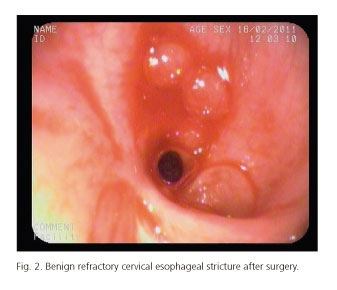
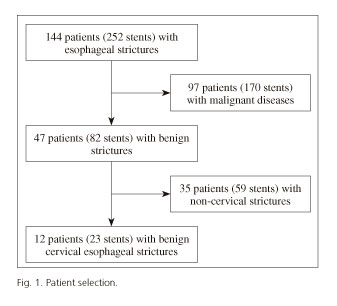
<body><![CDATA[<p><font face="Verdana" size="2"><b>Introduction</b></font></p>     <p><font face="Verdana" size="2">Benign esophageal strictures are associated with gastroesophageal reflux disease, caustic ingestion, esophageal surgery and radiotherapy (1). This condition can diminish quality of life due to severe dysphagia, malnutrition and weight loss. Additionally, patients have an increased risk of aspiration pneumonia. Endoscopic dilatation has traditionally been treated with bougies or balloons. However, up to 10-15% of benign esophageal strictures are refractory according to Kochman's criteria (4), thus indicating a lack of improvement after endoscopic dilatation (2,3). Although an algorithm for the management of these strictures has not been established, the use of esophageal stents has been proposed (5-9).</font></p>     <p><font face="Verdana" size="2">Lesions affecting the cervical esophagus are particularly difficult to treat due to their location. In fact, the placement of a stent in the cervical esophagus has traditionally been restricted because of the risk of potential adverse events such as tracheal compression, proximal migration, intractable pain and, most commonly, foreign body sensation (10,11). Nevertheless, some reports have suggested the possibility of treating this type of stricture by placing a stent in the cervical esophagus (12). Optimal management is unclear due to the fact that findings in the literature are heterogeneous and include both malignant and benign strictures, and the recommendation for radiological or endoscopic approaches differ between studies. Appropriate management is especially important in the case of benign stenosis, in which survival is longer and the impact of the stricture on the patient's quality of life may be more significant. The type of stent to be used in this context is also controversial.</font></p>     <p><font face="Verdana" size="2">The aim of this study was to describe the feasibility, efficacy and safety of endoscopic stenting in the management of refractory benign cervical esophageal strictures (RBCES).</font></p>     <p>&nbsp;</p>     <p><font face="Verdana" size="2"><b>Patients and methods</b></font></p>     <p><font face="Verdana" size="2"><b>Patients</b></font></p>     <p><font face="Verdana" size="2">We performed a non-randomized, retrospective cohort study at a single, tertiary-care center. We searched our endoscopy database for all patients treated with stents in the last seven years and selected those where the stricture was the consequence of a benign process in the cervical esophagus (n = 12) (<a href="#f1">Fig. 1</a>). The cervical location of the stricture was defined as between 15 and 19 cm from the incisors (<a href="#f2">Fig. 2</a>).</font></p>     <p>&nbsp;</p>     <p align="center"><a name="f1"></a><img src="/img/revistas/diges/v109n7/original5_fig1.jpg"></p>     ]]></body>
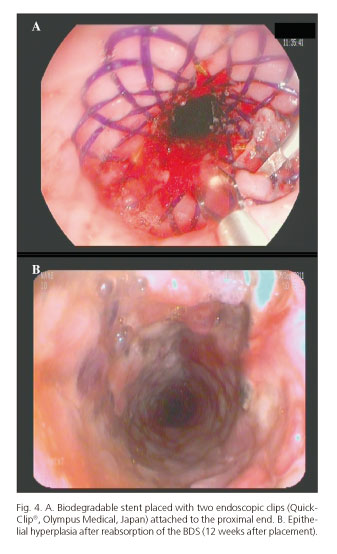
<body><![CDATA[<p>&nbsp;</p>     <p align="center"><a name="f2"></a><img src="/img/revistas/diges/v109n7/original5_fig2.jpg"></p>     <p>&nbsp;</p>     <p><font face="Verdana" size="2">We assessed demographic data (sex, gender), the etiology and characteristics of the stricture, previous endoscopic treatments, severity of dysphagia before and after endoscopic treatment(s) (according to a previously defined dysphagia score &#091;13&#093;), type of stent, technical and clinical success and need for additional interventions (other endoscopic procedures or surgery).</font></p>     <p><font face="Verdana" size="2">Ten patients received through-the-scope (TTS) balloon dilatation prior to stent placement (median number of procedures: 6, range 5-10). The median maximum balloon diameter was 14 mm (range 12-16 mm). Wider diameters were achieved due to the severe fibrosis in most of cases and the risk of perforation. Two patients did not strictly fulfill Kochman's criteria as previous balloon dilatation was not performed. One patient had a long (3 cm), subacute (30 days after caustic ingestion) caustic injury with concomitant strictures in the middle and distal esophagus and was considered as a better candidate for stenting as a first option (patient &#35; 6). The other patient had complete aphagia due to a long post-radiotherapy stricture, clearly suggesting that the initial treatment should be stent placement (patient &#35; 9).</font></p>     <p><font face="Verdana" size="2"><b>Stent type and placement</b></font></p>     <p><font face="Verdana" size="2">The two types of stent used were a fully-covered self-expandable metal stent (FCSEMS) (Hanarostent Esophagus Asymmetric and Hanarostent Colon/Rectum TTS, M.I. Tech, South Korea) with a diameter of 20 mm, and an uncovered biodegradable stent (BDS) (SX-ELLA, ELLA-CS, Czech Republic), with a diameter of 30 x 25 x 30 mm. The type of stent was chosen according to its availability at the time of the procedure.</font></p>     <p><font face="Verdana" size="2">All endoscopic procedures were performed in the Endoscopy Unit of the Hospital General Universitario Gregorio Mara&ntilde;&oacute;n, in Madrid (Spain), using deep sedation without orotracheal intubation. The endoscopist decided whether or not to use fluoroscopy depending on the individual characteristics of the patients. This was necessary in cases where the stricture was located in the first 3 cm distal to the upper esophageal sphincter, thus the gastroscope for control or stent deployment was placed above the upper esophageal sphincter to complete the procedure. All stents were placed over a guide wire that was advanced through the stricture using fluoroscopy or under direct visualization with a gastroscope (EVIS EXERA III video system and GIF-H190 gastroscope, Olympus Medical, Japan; and Pentax Medical EPK-1000 processor and EG-3490K Pentax gastroscope). Prior dilatation was only performed when the delivery system could not be passed through the stricture. Stents were placed at least 2 cm above the proximal end of the stenosis in an attempt to achieve minimal sensation of pain and decrease the risk of migration. Endoscopic clips (1-3 clips per stent; QuickClip2 Long, Olympus Medical, Japan) were placed at the proximal end of the stent to anchor it in place and prevent distal migration.</font></p>     <p><font face="Verdana" size="2">Patients were instructed to call the unit if clinically relevant events appeared during the follow-up period. No intermediate endoscopic procedures were scheduled, although endoscopic examinations were performed when dysphagia worsened during follow-up or when another significant symptom appeared.</font></p>     <p><font face="Verdana" size="2">According to usual clinical practice, FCSEMS were scheduled to be removed eight weeks after placement (<a href="#f3">Fig. 3</a>). BDS-treated patients received endoscopic examinations every eight weeks until the stent was completely degraded or when another significant symptom appeared (<a href="#f4">Fig. 4</a>).</font></p>     ]]></body>
<body><![CDATA[<p>&nbsp;</p>     <p align="center"><a name="f3"></a><img src="/img/revistas/diges/v109n7/original5_fig3.jpg"></p>     <p>&nbsp;</p>     <p align="center"><a name="f4"></a><img src="/img/revistas/diges/v109n7/original5_fig4.jpg"></p>     <p>&nbsp;</p>     <p><font face="Verdana" size="2"><b>Definitions</b></font></p>     <p><font face="Verdana" size="2">Placement was considered to be technically successful when the stent could be deployed in the correct pre-established location. According to the expected maximal expansion time, clinical success was pre-defined as the presence of a dysphagia score &lt; 2 one week after the procedure.</font></p>     <p><font face="Verdana" size="2">Recurrence of dysphagia was defined as worsening of at least 1 point in the dysphagia score at any time during follow-up. Recurrence of dysphagia was treated by insertion of an additional stent and/or endoscopic balloon dilatation.</font></p>     <p><font face="Verdana" size="2">Significant epithelial hyperplasia was defined as worsening of the dysphagia score by at least 1 point.</font></p>     <p><font face="Verdana" size="2"><b>Statistical analysis</b></font></p>     ]]></body>
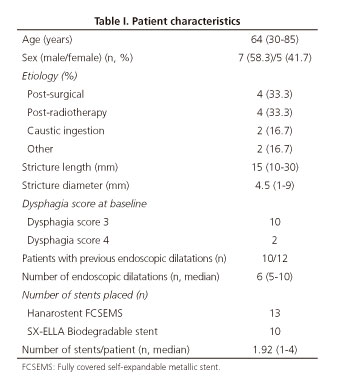
<body><![CDATA[<p><font face="Verdana" size="2">Descriptive data are presented as mean, median (range), or percentage, as appropriate. The t test was used to compare continuous variables. Fisher's exact test was used to compare proportions. All analyses were performed using IBM SPSS Statistics for Windows, version 19.0 (IBM Corp., Armonk, New York, USA). Statistical significance was set at p &lt; 0.05; all p values were two-tailed.</font></p>     <p>&nbsp;</p>     <p><font face="Verdana" size="2"><b>Results</b></font></p>     <p><font face="Verdana" size="2">Twelve patients with RBCES were treated with stents at our institution from February 2008 to January 2015. The median age was 64 years (range 30-85). Five patients were women (41.7%) and seven were men (58.3%). The etiology of the strictures is shown in <a href="#t1">table I</a>.</font></p>     <p>&nbsp;</p>     <p align="center"><a name="t1"></a><img src="/img/revistas/diges/v109n7/original5_t1.jpg"></p>     <p>&nbsp;</p>     <p><font face="Verdana" size="2">The dysphagia score before endoscopic treatment was &ge; 3 in all patients. Median stricture length and diameter were 15 mm (range 10-30 mm) and 4.5 mm (range 1-9 mm), respectively. Two patients had at least another stricture in the medium or distal esophagus.</font></p>     <p><font face="Verdana" size="2">Treatment and outcome are summarized in <a target="_blank" href="/img/revistas/diges/v109n7/original5_t2.jpg">table II</a>. A total of 23 stents were placed in 12 patients (median stents per patient: 1.92, range 1-4). Thirteen of the stents were FCSEMS and ten were BDS. Twenty-two of the 23 stents were correctly deployed (technical success: 96%). Only one patient required the insertion of a second stent (during the same procedure) due to the misplacement of a BDS distal to the stricture. Three patients did not have an initial clinical response and received alternative therapy (two surgical interventions and one endoscopic gastrostomy with a pediatric endoscope). Four of the remaining patients had a complete response with resolution of dysphagia and did not require an additional intervention. In the remaining five patients (three with FCSEMS and two with BDS), dysphagia reappeared after stent removal or reabsorption and was successfully treated with additional stenting in four cases, plus additional TTS balloon dilatations (1-3 sessions per patient) in three cases. Therefore, 8/12 (66.6%) patients maintained an adequate oral intake at the end of follow-up (median: 33.3 months, range 3-84 months). Those patients who did not respond to stent therapy (4/12 patients) underwent percutaneous endoscopic gastrostomy with a pediatric endoscope (n = 2) or surgery (n = 2).</font></p>     <p><font face="Verdana" size="2">All patients complained of mild cervical pain after placement, although this was well controlled with non-steroidal anti-inflammatory drugs during the first 3-5 days, except for one patient who required early stent removal (third day post-placement) due to uncontrollable pain and foreign body sensation.</font></p>     ]]></body>
<body><![CDATA[<p><font face="Verdana" size="2">The stent migrated in seven of the 23 cases (30.4%). Interestingly, migration was observed in 7/13 FCSEMS (53.8%) but not in BDS (0%; p = 0.005) cases. All the migrated FCSEMS were successfully repositioned using endoscopy. In addition, significant epithelial hyperplasia was recorded in four of 23 stent cases (17.4%), all of which involved BDS. No hyperplasia was recorded in patients who received an FCSEMS (40% <i>vs</i> 0%; p = 0.01). Argon plasma coagulation plus TTS balloon dilatation was used as a rescue treatment in patients who developed hyperplasia, although the results were poor. No severe adverse events (including perforation, hemorrhage, pulmonary aspiration, death) were observed.</font></p>     <p>&nbsp;</p>     <p><font face="Verdana" size="2"><b>Discussion</b></font></p>     <p><font face="Verdana" size="2">Refractory benign esophageal cervical strictures represent a real clinical challenge as they usually require complex surgical procedures, the consequences of the condition are severe and few efficacious therapeutic alternatives are available. Although endoscopic alternatives for the management of this condition have been reported, the findings are heterogeneous and based on studies of both benign and malignant stenosis. Consequently, the results are not easily generalized. In this study, we show that endoscopic management of this complex condition based on sequential dilatation and stenting is both safe and effective. First, our approach was easily applied as shown by the fact that the scheduled procedure could be completed in all cases. This finding is consistent with previous reports showing similar success rates, suggesting that the endoscopic approach should probably be the first option for RBCES. Importantly, the current series included very severe cases, as indicated by the degree of dysphagia, which prevented solid oral intake in all cases. Second, our approach proved to be successful with two-thirds of patients able to resume normal oral intake in the long term. This finding is especially relevant as other series failed to show similar results in benign strictures, mainly owing to the heterogeneity of the findings, which also included malignant stenosis. In the study of malignant and benign cervical strictures by Choi et al. (14), 16 patients were treated, of whom only four had benign stenosis (three caustic injuries, one post-surgical) and were treated with FCSEMS (covered nitinol stents). Temporary stent placement was unable to achieve a long-lasting improvement in any of the four patients. Gallo et al. (15) performed a retrospective study of ten patients with benign strictures that were treated with three different stent types, and found a 100% clinical response rate. As in our study, additional dilatation sessions (1-3 sessions) were necessary to maintain oral intake in three cases.</font></p>     <p><font face="Verdana" size="2">We also showed the procedure to be safe. There were no severe adverse events and all the patients were discharged early from hospital. Of note, pain was recorded in all cases, although this was transient and easily controlled. In one case, the stent had to be removed due to intractable pain. Our approach required consecutive endoscopic interventions for various reasons, such as stent migration, epithelial hyperplasia and, more commonly, early recurrence of dysphagia after removal or reabsorption of the stent. It is noteworthy that a relatively high number of stents were required to maintain clinical efficacy. In fact, only four cases were successfully treated with a single stent. Consequently, intensive follow-up with an early and aggressive endoscopic approach is clearly recommended in the management of this condition.</font></p>     <p><font face="Verdana" size="2">Our study is not without limitations. Our series was retrospective and the endoscopic intervention was designed case by case. Therefore, we are unable to recommend a homogeneous approach for the management of RBCES. In fact, we used two types of stent that differ in their mechanical characteristics and natural history. No specific stent for the upper esophagus (asymmetrical design) was used (except in one case, patient &#35; 1) due to a lack of availability at our institution. Colorectal stents used in our cohort had the advantage that they are TTS devices, easier to deploy compared to those that have to be placed in parallel. Although the small sample size precludes a definitive conclusion, it seems that both types of stent provided similar results. Not surprisingly, a greater incidence of epithelial hyperplasia was observed with the BDS, and the FCSEMS migrated more frequently. Nevertheless, further studies are required to confirm these promising results.</font></p>     <p><font face="Verdana" size="2">No additional fixation (except for endoscopic clips) was used to prevent migration, especially for FCSEMS (more prone to migration). Perhaps other fixation devices such as endoscopic suturing could reduce migration, but the cervical esophagus can be a cumbersome and is also a difficult location to perform these techniques due to technical problems (narrow working area). Moreover, the availability of these devices is low in endoscopy units and could increase the costs to the procedure.</font></p>     <p><font face="Verdana" size="2">In conclusion, endoscopic stent placement seems to be effective and safe in the management of refractory benign cervical esophageal strictures. However, consecutive endoscopic interventions are commonly required to maintain clinical efficacy.</font></p>     <p>&nbsp;</p>     <p><font face="Verdana" size="2"><b>References</b></font></p>     ]]></body>
<body><![CDATA[<!-- ref --><p><font face="Verdana" size="2">1. De Wijkerslooth LR, Vleggaar FP, Siersema PD. Endoscopic management of difficult or recurrent esophageal strictures. Am J Gastroenterol 2011;106(12):2080-91;quiz2092. DOI: 10.1038/ajg.2011.348.    &nbsp;&nbsp;&nbsp;&nbsp;&nbsp;&nbsp;&nbsp;&nbsp;[&#160;<a href="javascript:void(0);" onclick="javascript: window.open('/scielo.php?script=sci_nlinks&ref=5455061&pid=S1130-0108201700070000600001&lng=','','width=640,height=500,resizable=yes,scrollbars=1,menubar=yes,');">Links</a>&#160;]<!-- end-ref --></font></p>    <!-- ref --><p><font face="Verdana" size="2">2. Didden P, Spaander MC, Bruno MJ, et al. Esophageal stents in malignant and benign disorders. Curr Gastroenterol Rep 2013;15(4):319. DOI: 10.1007/s11894-013-0319-3.    &nbsp;&nbsp;&nbsp;&nbsp;&nbsp;&nbsp;&nbsp;&nbsp;[&#160;<a href="javascript:void(0);" onclick="javascript: window.open('/scielo.php?script=sci_nlinks&ref=5455063&pid=S1130-0108201700070000600002&lng=','','width=640,height=500,resizable=yes,scrollbars=1,menubar=yes,');">Links</a>&#160;]<!-- end-ref --></font></p>    <!-- ref --><p><font face="Verdana" size="2">3. Raymondi R, Pereira-Lima JC, Valves A, et al. Endoscopic dilation of benign esophageal strictures without fluoroscopy: Experience of 2,750 procedures. Hepatogastroenterol 2008;55(85):1342-8.    &nbsp;&nbsp;&nbsp;&nbsp;&nbsp;&nbsp;&nbsp;&nbsp;[&#160;<a href="javascript:void(0);" onclick="javascript: window.open('/scielo.php?script=sci_nlinks&ref=5455065&pid=S1130-0108201700070000600003&lng=','','width=640,height=500,resizable=yes,scrollbars=1,menubar=yes,');">Links</a>&#160;]<!-- end-ref --></font></p>    <!-- ref --><p><font face="Verdana" size="2">4. Kochman ML, McClave SA, Boyce HW. The refractory and the recurrent esophageal stricture: A definition. Gastrointest Endosc 2005;62(3):474-5. DOI: 10.1016/j.gie.2005.04.050.    &nbsp;&nbsp;&nbsp;&nbsp;&nbsp;&nbsp;&nbsp;&nbsp;[&#160;<a href="javascript:void(0);" onclick="javascript: window.open('/scielo.php?script=sci_nlinks&ref=5455067&pid=S1130-0108201700070000600004&lng=','','width=640,height=500,resizable=yes,scrollbars=1,menubar=yes,');">Links</a>&#160;]<!-- end-ref --></font></p>    <!-- ref --><p><font face="Verdana" size="2">5. Repici A, Conio M, De Angelis C, et al. Temporary placement of an expandable polyester silicone-covered stent for treatment of refractory benign esophageal strictures. Gastrointest Endosc 2004;60(4):513-9. DOI: 10.1016/S0016-5107(04)01882-6.    &nbsp;&nbsp;&nbsp;&nbsp;&nbsp;&nbsp;&nbsp;&nbsp;[&#160;<a href="javascript:void(0);" onclick="javascript: window.open('/scielo.php?script=sci_nlinks&ref=5455069&pid=S1130-0108201700070000600005&lng=','','width=640,height=500,resizable=yes,scrollbars=1,menubar=yes,');">Links</a>&#160;]<!-- end-ref --></font></p>    ]]></body>
<body><![CDATA[<!-- ref --><p><font face="Verdana" size="2">6. Sharma P, Kozarek R, Practice Parameters Committee of American College of Gastroenterology. Role of esophageal stents in benign and malignant diseases. Am J Gastroenterol 2010;105(2):258-73;quiz274. DOI: 10.1038/ajg.2009.684.    &nbsp;&nbsp;&nbsp;&nbsp;&nbsp;&nbsp;&nbsp;&nbsp;[&#160;<a href="javascript:void(0);" onclick="javascript: window.open('/scielo.php?script=sci_nlinks&ref=5455071&pid=S1130-0108201700070000600006&lng=','','width=640,height=500,resizable=yes,scrollbars=1,menubar=yes,');">Links</a>&#160;]<!-- end-ref --></font></p>    <!-- ref --><p><font face="Verdana" size="2">7. Siersema PD. Treatment options for esophageal strictures. Nat Clin Pract Gastroenterol Hepatol 2008;5(3):142-52. DOI: 10.1038/ncpgasthep1053.    &nbsp;&nbsp;&nbsp;&nbsp;&nbsp;&nbsp;&nbsp;&nbsp;[&#160;<a href="javascript:void(0);" onclick="javascript: window.open('/scielo.php?script=sci_nlinks&ref=5455073&pid=S1130-0108201700070000600007&lng=','','width=640,height=500,resizable=yes,scrollbars=1,menubar=yes,');">Links</a>&#160;]<!-- end-ref --></font></p>    <!-- ref --><p><font face="Verdana" size="2">8. Wadhwa RP, Kozarek RA, France RE, et al. Use of self-expandable metallic stents in benign GI diseases. Gastrointest Endosc 2003;58(2):207-12. DOI: 10.1067/mge.2003.343.    &nbsp;&nbsp;&nbsp;&nbsp;&nbsp;&nbsp;&nbsp;&nbsp;[&#160;<a href="javascript:void(0);" onclick="javascript: window.open('/scielo.php?script=sci_nlinks&ref=5455075&pid=S1130-0108201700070000600008&lng=','','width=640,height=500,resizable=yes,scrollbars=1,menubar=yes,');">Links</a>&#160;]<!-- end-ref --></font></p>    <!-- ref --><p><font face="Verdana" size="2">9. Repici A, Vleggaar FP, Hassan C, et al. Efficacy and safety of biodegradable stents for refractory benign esophageal strictures: The BEST (Biodegradable Esophageal Stent) study. Gastrointest Endosc 2010;72(5):927-34. DOI: 10.1016/j.gie.2010.07.031.    &nbsp;&nbsp;&nbsp;&nbsp;&nbsp;&nbsp;&nbsp;&nbsp;[&#160;<a href="javascript:void(0);" onclick="javascript: window.open('/scielo.php?script=sci_nlinks&ref=5455077&pid=S1130-0108201700070000600009&lng=','','width=640,height=500,resizable=yes,scrollbars=1,menubar=yes,');">Links</a>&#160;]<!-- end-ref --></font></p>    <!-- ref --><p><font face="Verdana" size="2">10. Shim CS, Jung IS, Bhandari S, et al. Management of malignant strictures of the cervical esophagus with a newly-designed self-expanding metal stent. Endoscopy 2004;36(6):554-7. DOI: 10.1055/s-2004-814555.    &nbsp;&nbsp;&nbsp;&nbsp;&nbsp;&nbsp;&nbsp;&nbsp;[&#160;<a href="javascript:void(0);" onclick="javascript: window.open('/scielo.php?script=sci_nlinks&ref=5455079&pid=S1130-0108201700070000600010&lng=','','width=640,height=500,resizable=yes,scrollbars=1,menubar=yes,');">Links</a>&#160;]<!-- end-ref --></font></p>    ]]></body>
<body><![CDATA[<!-- ref --><p><font face="Verdana" size="2">11. Conio M, Caroli-Bosc F, Demarquay JF, et al. Self-expanding metal stents in the palliation of neoplasms of the cervical esophagus. Hepatogastroenterol 1999;46(25):272-7.    &nbsp;&nbsp;&nbsp;&nbsp;&nbsp;&nbsp;&nbsp;&nbsp;[&#160;<a href="javascript:void(0);" onclick="javascript: window.open('/scielo.php?script=sci_nlinks&ref=5455081&pid=S1130-0108201700070000600011&lng=','','width=640,height=500,resizable=yes,scrollbars=1,menubar=yes,');">Links</a>&#160;]<!-- end-ref --></font></p>    <!-- ref --><p><font face="Verdana" size="2">12. Profili S, Meloni GB, Feo CF, et al. Self-expandable metal stents in the management of cervical oesophageal and/or hypopharyngeal strictures. Clin Radiol 2002;57(11):1028-33. DOI: 10.1053/crad.2002.0988.    &nbsp;&nbsp;&nbsp;&nbsp;&nbsp;&nbsp;&nbsp;&nbsp;[&#160;<a href="javascript:void(0);" onclick="javascript: window.open('/scielo.php?script=sci_nlinks&ref=5455083&pid=S1130-0108201700070000600012&lng=','','width=640,height=500,resizable=yes,scrollbars=1,menubar=yes,');">Links</a>&#160;]<!-- end-ref --></font></p>    <!-- ref --><p><font face="Verdana" size="2">13. Gaspar LE, Winter K, Kocha WI, et al. Swallowing function and weight change observed in a phase I/II study of external-beam radiation, brachytherapy and concurrent chemotherapy in localized cancer of the esophagus (RTOG 9207). Cancer J 2001;7(5):388-94.    &nbsp;&nbsp;&nbsp;&nbsp;&nbsp;&nbsp;&nbsp;&nbsp;[&#160;<a href="javascript:void(0);" onclick="javascript: window.open('/scielo.php?script=sci_nlinks&ref=5455085&pid=S1130-0108201700070000600013&lng=','','width=640,height=500,resizable=yes,scrollbars=1,menubar=yes,');">Links</a>&#160;]<!-- end-ref --></font></p>    <!-- ref --><p><font face="Verdana" size="2">14. Choi EK, Song HY, Kim JW, et al. Covered metallic stent placement in the management of cervical esophageal strictures. J Vasc Interv Radiol 2007;18(7):888-95. DOI: 10.1016/j.jvir.2007.04.017.    &nbsp;&nbsp;&nbsp;&nbsp;&nbsp;&nbsp;&nbsp;&nbsp;[&#160;<a href="javascript:void(0);" onclick="javascript: window.open('/scielo.php?script=sci_nlinks&ref=5455087&pid=S1130-0108201700070000600014&lng=','','width=640,height=500,resizable=yes,scrollbars=1,menubar=yes,');">Links</a>&#160;]<!-- end-ref --></font></p>    <!-- ref --><p><font face="Verdana" size="2">15. Gallo A, Pagliuca G, De Vincentiis M, et al. Endoscopic treatment of benign and malignant strictures of the cervical esophagus and hypopharynx. Ann Otol Rhinol Laryngol 2012;121(2):104-9. DOI: 10.1177/000348941212100206.    &nbsp;&nbsp;&nbsp;&nbsp;&nbsp;&nbsp;&nbsp;&nbsp;[&#160;<a href="javascript:void(0);" onclick="javascript: window.open('/scielo.php?script=sci_nlinks&ref=5455089&pid=S1130-0108201700070000600015&lng=','','width=640,height=500,resizable=yes,scrollbars=1,menubar=yes,');">Links</a>&#160;]<!-- end-ref --></font></p>     ]]></body>
<body><![CDATA[<p>&nbsp;</p>     <p>&nbsp;</p>     <p><font face="Verdana" size="2"><a href="#top"><img border="0" src="/img/revistas/diges/v109n7/seta.gif" width="15" height="17"></a><a name="bajo"></a><b>Correspondence:</b>    <br>&Oacute;scar Nogales Rinc&oacute;n.    <br>Department of Gastroenterology.    <br>Hospital General Universitario Gregorio Mara&ntilde;&oacute;n.    <br>C/ Doctor Esquerdo, 46.    <br>28007 Madrid, Spain    <br>e-mail: <a href="mailto:oscar.nogales@salud.madrid.com">oscar.nogales@salud.madrid.com</a></font></p>     <p><font face="Verdana" size="2">Received: 25-12-2016    ]]></body>
<body><![CDATA[<br>Accepted: 13-03-2017</font></p>      ]]></body><back>
<ref-list>
<ref id="B1">
<label>1</label><nlm-citation citation-type="journal">
<person-group person-group-type="author">
<name>
<surname><![CDATA[De Wijkerslooth]]></surname>
<given-names><![CDATA[LR]]></given-names>
</name>
<name>
<surname><![CDATA[Vleggaar]]></surname>
<given-names><![CDATA[FP]]></given-names>
</name>
<name>
<surname><![CDATA[Siersema]]></surname>
<given-names><![CDATA[PD]]></given-names>
</name>
</person-group>
<article-title xml:lang="en"><![CDATA[Endoscopic management of difficult or recurrent esophageal strictures]]></article-title>
<source><![CDATA[Am J Gastroenterol]]></source>
<year>2011</year>
<volume>106</volume>
<numero>12</numero>
<issue>12</issue>
<page-range>2080-91;quiz2092</page-range></nlm-citation>
</ref>
<ref id="B2">
<label>2</label><nlm-citation citation-type="journal">
<person-group person-group-type="author">
<name>
<surname><![CDATA[Didden]]></surname>
<given-names><![CDATA[P]]></given-names>
</name>
<name>
<surname><![CDATA[Spaander]]></surname>
<given-names><![CDATA[MC]]></given-names>
</name>
<name>
<surname><![CDATA[Bruno]]></surname>
<given-names><![CDATA[MJ]]></given-names>
</name>
</person-group>
<article-title xml:lang="en"><![CDATA[Esophageal stents in malignant and benign disorders]]></article-title>
<source><![CDATA[Curr Gastroenterol Rep]]></source>
<year>2013</year>
<volume>15</volume>
<numero>4</numero>
<issue>4</issue>
<page-range>319</page-range></nlm-citation>
</ref>
<ref id="B3">
<label>3</label><nlm-citation citation-type="journal">
<person-group person-group-type="author">
<name>
<surname><![CDATA[Raymondi]]></surname>
<given-names><![CDATA[R]]></given-names>
</name>
<name>
<surname><![CDATA[Pereira-Lima]]></surname>
<given-names><![CDATA[JC]]></given-names>
</name>
<name>
<surname><![CDATA[Valves]]></surname>
<given-names><![CDATA[A]]></given-names>
</name>
</person-group>
<article-title xml:lang="en"><![CDATA[Endoscopic dilation of benign esophageal strictures without fluoroscopy: Experience of 2,750 procedures]]></article-title>
<source><![CDATA[Hepatogastroenterol]]></source>
<year>2008</year>
<volume>55</volume>
<numero>85</numero>
<issue>85</issue>
<page-range>1342-8</page-range></nlm-citation>
</ref>
<ref id="B4">
<label>4</label><nlm-citation citation-type="journal">
<person-group person-group-type="author">
<name>
<surname><![CDATA[Kochman]]></surname>
<given-names><![CDATA[ML]]></given-names>
</name>
<name>
<surname><![CDATA[McClave]]></surname>
<given-names><![CDATA[SA]]></given-names>
</name>
<name>
<surname><![CDATA[Boyce]]></surname>
<given-names><![CDATA[HW]]></given-names>
</name>
</person-group>
<article-title xml:lang="en"><![CDATA[The refractory and the recurrent esophageal stricture: A definition]]></article-title>
<source><![CDATA[Gastrointest Endosc]]></source>
<year>2005</year>
<volume>62</volume>
<numero>3</numero>
<issue>3</issue>
<page-range>474-5</page-range></nlm-citation>
</ref>
<ref id="B5">
<label>5</label><nlm-citation citation-type="journal">
<person-group person-group-type="author">
<name>
<surname><![CDATA[Repici]]></surname>
<given-names><![CDATA[A]]></given-names>
</name>
<name>
<surname><![CDATA[Conio]]></surname>
<given-names><![CDATA[M]]></given-names>
</name>
<name>
<surname><![CDATA[De Angelis]]></surname>
<given-names><![CDATA[C]]></given-names>
</name>
</person-group>
<article-title xml:lang="en"><![CDATA[Temporary placement of an expandable polyester silicone-covered stent for treatment of refractory benign esophageal strictures]]></article-title>
<source><![CDATA[Gastrointest Endosc]]></source>
<year>2004</year>
<volume>60</volume>
<numero>4</numero>
<issue>4</issue>
<page-range>513-9</page-range></nlm-citation>
</ref>
<ref id="B6">
<label>6</label><nlm-citation citation-type="journal">
<person-group person-group-type="author">
<name>
<surname><![CDATA[Sharma]]></surname>
<given-names><![CDATA[P]]></given-names>
</name>
<name>
<surname><![CDATA[Kozarek]]></surname>
<given-names><![CDATA[R]]></given-names>
</name>
</person-group>
<collab>American College of Gastroenterology^dPractice Parameters Committee</collab>
<article-title xml:lang="en"><![CDATA[Role of esophageal stents in benign and malignant diseases]]></article-title>
<source><![CDATA[Am J Gastroenterol]]></source>
<year>2010</year>
<volume>105</volume>
<numero>2</numero>
<issue>2</issue>
<page-range>258-73;quiz274</page-range></nlm-citation>
</ref>
<ref id="B7">
<label>7</label><nlm-citation citation-type="journal">
<person-group person-group-type="author">
<name>
<surname><![CDATA[Siersema]]></surname>
<given-names><![CDATA[PD]]></given-names>
</name>
</person-group>
<article-title xml:lang="en"><![CDATA[Treatment options for esophageal strictures]]></article-title>
<source><![CDATA[Nat Clin Pract Gastroenterol Hepatol]]></source>
<year>2008</year>
<volume>5</volume>
<numero>3</numero>
<issue>3</issue>
<page-range>142-52</page-range></nlm-citation>
</ref>
<ref id="B8">
<label>8</label><nlm-citation citation-type="journal">
<person-group person-group-type="author">
<name>
<surname><![CDATA[Wadhwa]]></surname>
<given-names><![CDATA[RP]]></given-names>
</name>
<name>
<surname><![CDATA[Kozarek]]></surname>
<given-names><![CDATA[RA]]></given-names>
</name>
<name>
<surname><![CDATA[France]]></surname>
<given-names><![CDATA[RE]]></given-names>
</name>
</person-group>
<article-title xml:lang="en"><![CDATA[Use of self-expandable metallic stents in benign GI diseases]]></article-title>
<source><![CDATA[Gastrointest Endosc]]></source>
<year>2003</year>
<volume>58</volume>
<numero>2</numero>
<issue>2</issue>
<page-range>207-12</page-range></nlm-citation>
</ref>
<ref id="B9">
<label>9</label><nlm-citation citation-type="journal">
<person-group person-group-type="author">
<name>
<surname><![CDATA[Repici]]></surname>
<given-names><![CDATA[A]]></given-names>
</name>
<name>
<surname><![CDATA[Vleggaar]]></surname>
<given-names><![CDATA[FP]]></given-names>
</name>
<name>
<surname><![CDATA[Hassan]]></surname>
<given-names><![CDATA[C]]></given-names>
</name>
</person-group>
<article-title xml:lang="en"><![CDATA[Efficacy and safety of biodegradable stents for refractory benign esophageal strictures: The BEST (Biodegradable Esophageal Stent) study]]></article-title>
<source><![CDATA[Gastrointest Endosc]]></source>
<year>2010</year>
<volume>72</volume>
<numero>5</numero>
<issue>5</issue>
<page-range>927-34</page-range></nlm-citation>
</ref>
<ref id="B10">
<label>10</label><nlm-citation citation-type="journal">
<person-group person-group-type="author">
<name>
<surname><![CDATA[Shim]]></surname>
<given-names><![CDATA[CS]]></given-names>
</name>
<name>
<surname><![CDATA[Jung]]></surname>
<given-names><![CDATA[IS]]></given-names>
</name>
<name>
<surname><![CDATA[Bhandari]]></surname>
<given-names><![CDATA[S]]></given-names>
</name>
</person-group>
<article-title xml:lang="en"><![CDATA[Management of malignant strictures of the cervical esophagus with a newly-designed self-expanding metal stent]]></article-title>
<source><![CDATA[Endoscopy]]></source>
<year>2004</year>
<volume>36</volume>
<numero>6</numero>
<issue>6</issue>
<page-range>554-7</page-range></nlm-citation>
</ref>
<ref id="B11">
<label>11</label><nlm-citation citation-type="journal">
<person-group person-group-type="author">
<name>
<surname><![CDATA[Conio]]></surname>
<given-names><![CDATA[M]]></given-names>
</name>
<name>
<surname><![CDATA[Caroli-Bosc]]></surname>
<given-names><![CDATA[F]]></given-names>
</name>
<name>
<surname><![CDATA[Demarquay]]></surname>
<given-names><![CDATA[JF]]></given-names>
</name>
</person-group>
<article-title xml:lang="en"><![CDATA[Self-expanding metal stents in the palliation of neoplasms of the cervical esophagus]]></article-title>
<source><![CDATA[Hepatogastroenterol]]></source>
<year>1999</year>
<volume>46</volume>
<numero>25</numero>
<issue>25</issue>
<page-range>272-7</page-range></nlm-citation>
</ref>
<ref id="B12">
<label>12</label><nlm-citation citation-type="journal">
<person-group person-group-type="author">
<name>
<surname><![CDATA[Profili]]></surname>
<given-names><![CDATA[S]]></given-names>
</name>
<name>
<surname><![CDATA[Meloni]]></surname>
<given-names><![CDATA[GB]]></given-names>
</name>
<name>
<surname><![CDATA[Feo]]></surname>
<given-names><![CDATA[CF]]></given-names>
</name>
</person-group>
<article-title xml:lang="en"><![CDATA[Self-expandable metal stents in the management of cervical oesophageal and/or hypopharyngeal strictures]]></article-title>
<source><![CDATA[Clin Radiol]]></source>
<year>2002</year>
<volume>57</volume>
<numero>11</numero>
<issue>11</issue>
<page-range>1028-33</page-range></nlm-citation>
</ref>
<ref id="B13">
<label>13</label><nlm-citation citation-type="journal">
<person-group person-group-type="author">
<name>
<surname><![CDATA[Gaspar]]></surname>
<given-names><![CDATA[LE]]></given-names>
</name>
<name>
<surname><![CDATA[Winter]]></surname>
<given-names><![CDATA[K]]></given-names>
</name>
<name>
<surname><![CDATA[Kocha]]></surname>
<given-names><![CDATA[WI]]></given-names>
</name>
</person-group>
<article-title xml:lang="en"><![CDATA[Swallowing function and weight change observed in a phase I/II study of external-beam radiation, brachytherapy and concurrent chemotherapy in localized cancer of the esophagus (RTOG 9207)]]></article-title>
<source><![CDATA[Cancer J]]></source>
<year>2001</year>
<volume>7</volume>
<numero>5</numero>
<issue>5</issue>
<page-range>388-94</page-range></nlm-citation>
</ref>
<ref id="B14">
<label>14</label><nlm-citation citation-type="journal">
<person-group person-group-type="author">
<name>
<surname><![CDATA[Choi]]></surname>
<given-names><![CDATA[EK]]></given-names>
</name>
<name>
<surname><![CDATA[Song]]></surname>
<given-names><![CDATA[HY]]></given-names>
</name>
<name>
<surname><![CDATA[Kim]]></surname>
<given-names><![CDATA[JW]]></given-names>
</name>
</person-group>
<article-title xml:lang="en"><![CDATA[Covered metallic stent placement in the management of cervical esophageal strictures]]></article-title>
<source><![CDATA[J Vasc Interv Radiol]]></source>
<year>2007</year>
<volume>18</volume>
<numero>7</numero>
<issue>7</issue>
<page-range>888-95</page-range></nlm-citation>
</ref>
<ref id="B15">
<label>15</label><nlm-citation citation-type="journal">
<person-group person-group-type="author">
<name>
<surname><![CDATA[Gallo]]></surname>
<given-names><![CDATA[A]]></given-names>
</name>
<name>
<surname><![CDATA[Pagliuca]]></surname>
<given-names><![CDATA[G]]></given-names>
</name>
<name>
<surname><![CDATA[De Vincentiis]]></surname>
<given-names><![CDATA[M]]></given-names>
</name>
</person-group>
<article-title xml:lang="en"><![CDATA[Endoscopic treatment of benign and malignant strictures of the cervical esophagus and hypopharynx]]></article-title>
<source><![CDATA[Ann Otol Rhinol Laryngol]]></source>
<year>2012</year>
<volume>121</volume>
<numero>2</numero>
<issue>2</issue>
<page-range>104-9</page-range></nlm-citation>
</ref>
</ref-list>
</back>
</article>