<?xml version="1.0" encoding="ISO-8859-1"?><article xmlns:mml="http://www.w3.org/1998/Math/MathML" xmlns:xlink="http://www.w3.org/1999/xlink" xmlns:xsi="http://www.w3.org/2001/XMLSchema-instance">
<front>
<journal-meta>
<journal-id>1130-0108</journal-id>
<journal-title><![CDATA[Revista Española de Enfermedades Digestivas]]></journal-title>
<abbrev-journal-title><![CDATA[Rev. esp. enferm. dig.]]></abbrev-journal-title>
<issn>1130-0108</issn>
<publisher>
<publisher-name><![CDATA[Sociedad Española de Patología Digestiva]]></publisher-name>
</publisher>
</journal-meta>
<article-meta>
<article-id>S1130-01082017001100012</article-id>
<article-id pub-id-type="doi">10.17235/reed.2017.4949/2017</article-id>
<title-group>
<article-title xml:lang="en"><![CDATA[The endoscopic ultrasound-assisted Rendez-Vous technique for treatment of recurrent pancreatitis due to pancreas divisum and ansa pancreatica]]></article-title>
<article-title xml:lang="es"><![CDATA[Tratamiento de pancreatitis recidivante por páncreas divisum y ansa pancreática mediante técnica de Rendez-Vous guiada por ecoendoscopia]]></article-title>
</title-group>
<contrib-group>
<contrib contrib-type="author">
<name>
<surname><![CDATA[López-Durán]]></surname>
<given-names><![CDATA[Sergio]]></given-names>
</name>
<xref ref-type="aff" rid="A01"/>
</contrib>
<contrib contrib-type="author">
<name>
<surname><![CDATA[Zaera]]></surname>
<given-names><![CDATA[Celia]]></given-names>
</name>
<xref ref-type="aff" rid="A01"/>
</contrib>
<contrib contrib-type="author">
<name>
<surname><![CDATA[González-Martín]]></surname>
<given-names><![CDATA[Juan Ángel]]></given-names>
</name>
<xref ref-type="aff" rid="A01"/>
</contrib>
<contrib contrib-type="author">
<name>
<surname><![CDATA[Foruny]]></surname>
<given-names><![CDATA[José Ramón]]></given-names>
</name>
<xref ref-type="aff" rid="A01"/>
</contrib>
<contrib contrib-type="author">
<name>
<surname><![CDATA[Albillos]]></surname>
<given-names><![CDATA[Agustín]]></given-names>
</name>
<xref ref-type="aff" rid="A01"/>
</contrib>
<contrib contrib-type="author">
<name>
<surname><![CDATA[Vázquez-Sequeiros]]></surname>
<given-names><![CDATA[Enrique]]></given-names>
</name>
<xref ref-type="aff" rid="A01"/>
</contrib>
</contrib-group>
<aff id="A01">
<institution><![CDATA[,Hospital Universitario Ramón y Cajal Gastroenterology Department Endoscopy Unit]]></institution>
<addr-line><![CDATA[ ]]></addr-line>
</aff>
<aff id="A02">
<institution><![CDATA[,Instituto Ramón y Cajal de Investigación Sanitaria (IRYCIS)  ]]></institution>
<addr-line><![CDATA[ ]]></addr-line>
</aff>
<aff id="A03">
<institution><![CDATA[,Universidad de Alcalá de Henares  ]]></institution>
<addr-line><![CDATA[Madrid ]]></addr-line>
<country>Spain</country>
</aff>
<pub-date pub-type="pub">
<day>00</day>
<month>11</month>
<year>2017</year>
</pub-date>
<pub-date pub-type="epub">
<day>00</day>
<month>11</month>
<year>2017</year>
</pub-date>
<volume>109</volume>
<numero>11</numero>
<fpage>798</fpage>
<lpage>800</lpage>
<copyright-statement/>
<copyright-year/>
<self-uri xlink:href="http://scielo.isciii.es/scielo.php?script=sci_arttext&amp;pid=S1130-01082017001100012&amp;lng=en&amp;nrm=iso"></self-uri><self-uri xlink:href="http://scielo.isciii.es/scielo.php?script=sci_abstract&amp;pid=S1130-01082017001100012&amp;lng=en&amp;nrm=iso"></self-uri><self-uri xlink:href="http://scielo.isciii.es/scielo.php?script=sci_pdf&amp;pid=S1130-01082017001100012&amp;lng=en&amp;nrm=iso"></self-uri><abstract abstract-type="short" xml:lang="en"><p><![CDATA[Endoscopic treatment of pancreatic ductal malformations causing recurrent acute pancreatitis, such as pancreas divisum or ansa pancreatica, is mainly based on the sphincterotomy of the minor papilla. However, the technical complexity of conventional endoscopic retrograde cholangiopancreatography (ERCP) is increased in patients presenting anatomical variants like these and it may be unsuccessful. We report the case of a pancreas divisum combined with ansa pancreatica and describe the cannulation and sphincterotomy of the minor papilla using an ultrasound-assisted Rendez-Vous technique.]]></p></abstract>
<abstract abstract-type="short" xml:lang="es"><p><![CDATA[El tratamiento endoscópico de malformaciones ductales pancreáticas causantes de pancreatitis aguda de repetición, como el páncreas divisum o el ansa pancreática, se basa fundamentalmente en la esfinterotomía de la papila minor. En estos casos, no obstante, la complejidad técnica de la colangiopancreatografía endoscópica retrógrada (CPRE) convencional es mayor, pudiendo resultar fallida. Presentamos el caso de un páncreas divisum completo combinado con ansa pancreática, sintomático, en el que, tras fracasar el acceso endoscópico convencional a la papila minor, se logra la canulación y esfinterotomía de esta mediante técnica de Rendez-Vous guiada ecoendoscópicamente.]]></p></abstract>
<kwd-group>
<kwd lng="en"><![CDATA[Pancreatitis]]></kwd>
<kwd lng="en"><![CDATA[Rendez-Vous]]></kwd>
<kwd lng="en"><![CDATA[Treatment]]></kwd>
<kwd lng="en"><![CDATA[Endoscopic ultrasound]]></kwd>
<kwd lng="es"><![CDATA[Pancreatitis]]></kwd>
<kwd lng="es"><![CDATA[Rendez-Vous]]></kwd>
<kwd lng="es"><![CDATA[Tratamiento]]></kwd>
<kwd lng="es"><![CDATA[Ecoendoscopia]]></kwd>
</kwd-group>
</article-meta>
</front><body><![CDATA[ <p><a name="top"></a><font face="Verdana" size="2"><b>CASE REPORT</b></font></p>     <p>&nbsp;</p>     <p><font face="Verdana" size="4"><b>The endoscopic ultrasound-assisted Rendez-Vous technique for treatment of recurrent pancreatitis due to pancreas <i>divisum</i> and <i>ansa pancreatica</i></b></font></p>     <p><font face="Verdana" size="4"><b>Tratamiento de pancreatitis recidivante por p&aacute;ncreas <i>divisum</i> y <i>ansa</i> pancre&aacute;tica mediante t&eacute;cnica de Rendez-Vous guiada por ecoendoscopia</b></font></p>     <p>&nbsp;</p>     <p>&nbsp;</p>     <p><font face="Verdana" size="2"><b>Sergio L&oacute;pez-Dur&aacute;n, Celia Zaera, Juan &Aacute;ngel Gonz&aacute;lez-Mart&iacute;n, Jos&eacute; Ram&oacute;n Foruny, Agust&iacute;n Albillos and Enrique V&aacute;zquez-Sequeiros</b></font></p>     <p><font face="Verdana" size="2">Endoscopy Unit. Gastroenterology Department. Hospital Universitario Ram&oacute;n y Cajal, IRYCIS. Universidad de Alcal&aacute;. Alcal&aacute; de Henares, Madrid. Spain</font></p>     <p><font face="Verdana" size="2"><a href="#bajo">Correspondence</a></font></p>     <p>&nbsp;</p>     ]]></body>
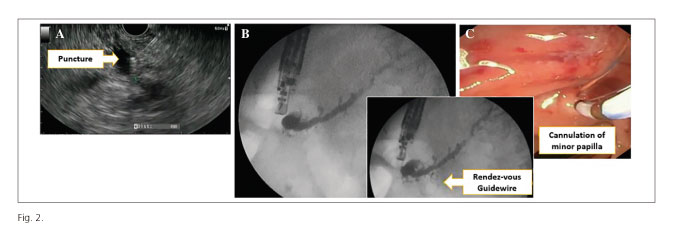
<body><![CDATA[<p>&nbsp;</p> <hr size="1">     <p><font face="Verdana" size="2"><b>ABSTRACT</b></font></p>     <p><font face="Verdana" size="2">Endoscopic treatment of pancreatic ductal malformations causing recurrent acute pancreatitis, such as <i>pancreas divisum</i> or <i>ansa pancreatica</i>, is mainly based on the sphincterotomy of the minor papilla. However, the technical complexity of conventional endoscopic retrograde cholangiopancreatography (ERCP) is increased in patients presenting anatomical variants like these and it may be unsuccessful. We report the case of a <i>pancreas divisum</i> combined with <i>ansa pancreatica</i> and describe the cannulation and sphincterotomy of the minor papilla using an ultrasound-assisted Rendez-Vous technique.</font></p>     <p><font face="Verdana" size="2"><b>Key words:</b> Pancreatitis. Rendez-Vous. Treatment. Endoscopic ultrasound.</font></p> <hr size="1">     <p><font face="Verdana" size="2"><b>RESUMEN</b></font></p>     <p><font face="Verdana" size="2">El tratamiento endosc&oacute;pico de malformaciones ductales pancre&aacute;ticas causantes de pancreatitis aguda de repetici&oacute;n, como el p&aacute;ncreas <i>divisum</i> o el <i>ansa</i> pancre&aacute;tica, se basa fundamentalmente en la esfinterotom&iacute;a de la papila <i>minor</i>. En estos casos, no obstante, la complejidad t&eacute;cnica de la colangiopancreatograf&iacute;a endosc&oacute;pica retr&oacute;grada (CPRE) convencional es mayor, pudiendo resultar fallida. Presentamos el caso de un p&aacute;ncreas <i>divisum</i> completo combinado con <i>ansa</i> pancre&aacute;tica, sintom&aacute;tico, en el que, tras fracasar el acceso endosc&oacute;pico convencional a la papila <i>minor</i>, se logra la canulaci&oacute;n y esfinterotom&iacute;a de esta mediante t&eacute;cnica de Rendez-Vous guiada ecoendosc&oacute;picamente.</font></p>     <p><font face="Verdana" size="2"><b>Palabras clave:</b> Pancreatitis. Rendez-Vous. Tratamiento. Ecoendoscopia.</font></p> <hr size="1">     <p>&nbsp;</p>     <p><font face="Verdana" size="2"><b>Introduction</b></font></p>     <p><font face="Verdana" size="2">The cornerstone for treatment of symptomatic <i>pancreas divisum</i> is the decompression of minor duodenal papilla by sphincterotomy (1), which has also served for the treatment of other less frequent ductal malformations of the pancreas such as <i>ansa pancreatica</i> (2). The latter consists of an additional arcuate branch that connects the dorsal and ventral ducts that is associated with a proximal obstruction of the accessory pancreatic duct (<a href="#f1">Fig. 1</a>). Endoscopic access to minor papilla in patients presenting anatomical variants such as these increases the technical difficulty and probability of failure, even more so if combined. As conventional endoscopic treatment by endoscopic retrograde cholangiopancreatography (ERCP) may be unsuccessful in these and other situations of a similar nature, an endoscopic ultrasonography-guided access could be attempted in order to achieve the cannulation and sphincterotomy of the minor papilla by the Rendez-Vous technique (3).</font></p>     ]]></body>
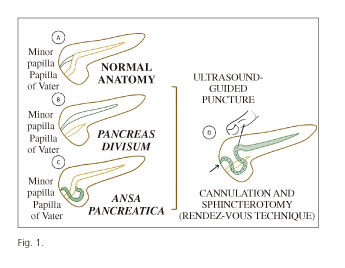
<body><![CDATA[<p>&nbsp;</p>     <p align="center"><font face="Verdana" size="2"><a name="f1"><img src="/img/revistas/diges/v109n11/nota2_fig1.jpg"></a></font></p>     <p>&nbsp;</p>     <p><font face="Verdana" size="2"><b>Case Report</b></font></p>     <p><font face="Verdana" size="2">We report the case of a 72-year-old man with a well-documented history of recurrent acute pancreatitis due to a <i>pancreas divisum</i> combined with <i>ansa pancreatica</i> (<a href="#f1">Fig. 1D</a>). This anatomical abnormality was diagnosed by abdominal magnetic resonance imaging (MRI) and confirmed by endoscopic ultrasonography (EUS). The patient was referred to our center for endoscopic treatment (minor papilla sphincterotomy) after two failed attempts using conventional ERCP.</font></p>     <p><font face="Verdana" size="2">The pancreatic gland was initially examined using an echoendoscope. The accessory duct ran in a curved manner (<i>ansa</i>) from the minor papilla to the main pancreatic duct, which in turn had a retrograde dilation of 5 mm. As the initial cannulation attempt of the papilla minor was unsuccessful, insertion using a Rendez-Vous technique was attempted. The procedure began with a transgastric ultrasound-assisted puncture into the <i>ansa</i> with a 19G needle (Figs. <a href="#f1">1D</a> and <a href="#f2">2A</a>) and the known anomaly was confirmed by a pancreatogram (<a href="#f2">Fig. 2B</a>). Subsequently, a 0.021 inch guidewire was introduced and advanced toward the minor papilla through the <i>ansa</i>. When the duodenal lumen was reached, the echoendoscope was removed and a duodenoscope inserted parallel to the guidewire. Biopsy forceps were introduced using a Rendez-Vous technique through the instrumental channel of the duodoscope in order to pull the widewire out from the duodenum and finally achieve a guidewire-assisted cannulation of the minor papilla (<a href="#f2">Fig. 2C</a>). The guidewire was then removed until it reached the tip of the sphincterotome DASH-21-480 (Cook<sup>&reg;</sup>) and moved again toward the pancreas tail (<a href="#f3">Figs. 3 A and B</a>). At this point, a sphincterotomy of the <i>minor</i> papilla was performed and a pancreatic stent (a 5 Fr, 5 cm straight plastic stent with side flaps) was inserted endoscopically in order to ensure pancreatic drainage and prevent acute pancreatitis.</font></p>     <p>&nbsp;</p>     <p align="center"><font face="Verdana" size="2"><a name="f2"><img src="/img/revistas/diges/v109n11/nota2_fig2.jpg"></a></font></p>     <p>&nbsp;</p>     <p align="center"><font face="Verdana" size="2"><a name="f3"><img src="/img/revistas/diges/v109n11/nota2_fig3.jpg"></a></font></p>     ]]></body>
<body><![CDATA[<p>&nbsp;</p>     <p><font face="Verdana" size="2"><b>Discussion</b></font></p>     <p><font face="Verdana" size="2"><i>Pancreas divisum</i> is the most common congenital variant of the pancreatic duct system and is present in up to 10% of the population according to some studies (4). Nevertheless, it is mostly asymptomatic. This entity occurs due to the lack of fusion of the ventral and dorsal pancreatic ducts during embryological development. Therefore, the dorsal duct must drain the majority of the pancreas into the minor papilla (5).</font></p>     <p><font face="Verdana" size="2"><i>Ansa pancreatica</i> malformation is considered as another congenital variant in the anatomy of the pancreatic duct system. It is called <i>ansa</i> (in Latin this means "handle") because of its curved morphology. It consists of an aberrant branch that arises from the main pancreatic duct and disembogues into the minor papilla, forming a loop with caudal convexity. (6) (<a href="#f1">Fig. 1C</a>).</font></p>     <p><font face="Verdana" size="2">The duct of Santorini (accessory pancreatic duct) produces a decompressive effect on the duct of Wirsung (main pancreatic duct) in a normal pancreatic duct system. However, patients with <i>pancreas divisum</i> and/or <i>ansa pancreatica</i> would hypothetically have an inadequate drainage of the pancreatic duct system and consequently have a relative increase of intraductal pressure into the main pancreatic duct. This has been suggested as a causative factor of pancreatitis (6,7).</font></p>     <p><font face="Verdana" size="2">Due to the aforementioned, endoscopic treatment of <i>pancreas divisum</i> (or more rarely treatment of <i>ansa pancreatica</i> &#091;2&#093;) is based on minor papilla decompression, mainly by sphincterotomy. This therapeutic option has been shown to be more effective in patients with acute recurrent pancreatitis than in other clinical settings (9,10).</font></p>     <p><font face="Verdana" size="2">Isolated endoscopic cannulation of the minor papilla may be technically challenging. As presented above, any combination of different types of ductal abnormalities further increases this complexity. Therefore, the introduction and movement of the guidewires into the duct system may become a great challenge (<a href="#f1">Fig. 1D</a>). In this report, we describe for the first time an endoscopic approach for the cannulation of the minor papilla via the <i>ansa</i>, using an ultrasound-assisted Rendez-Vous technique. However, this is actually considered as a "typical" indication for this kind of procedure, specifically, pancreatic drainage abnormalities with clinical impact and previous failed ERCP attempts (3,10). Even though this is not the most common indication in clinical practice, it is important to keep it in mind as a therapeutic option in complicated cases.</font></p>     <p><font face="Verdana" size="2">In conclusion, when performed by expert endoscopists, therapeutic endoscopic ultrasonography is an effective and safe pancreatic drainage option in complex cases where conventional endoscopic procedures have failed.</font></p>     <p>&nbsp;</p>     <p><font face="Verdana" size="2"><b>References</b></font></p>     ]]></body>
<body><![CDATA[<!-- ref --><p><font face="Verdana" size="2">1. Riff PB, Chandrasekhara V. The Role of Endoscopic Retrograde Cholangiopancreatography in Management of Pancreatic Diseases. Gastroenterol Clin North Am 2016;45:45-65. DOI: 10.1016/j.gtc.2015.10.009.    &nbsp;&nbsp;&nbsp;&nbsp;&nbsp;&nbsp;&nbsp;&nbsp;[&#160;<a href="javascript:void(0);" onclick="javascript: window.open('/scielo.php?script=sci_nlinks&ref=5469920&pid=S1130-0108201700110001200001&lng=','','width=640,height=500,resizable=yes,scrollbars=1,menubar=yes,');">Links</a>&#160;]<!-- end-ref --></font></p>    <!-- ref --><p><font face="Verdana" size="2">2. Bhasin DK, Rana SS, Nanda M, et al. <i>Ansa Pancreatica</i> Type of Ductal Anatomy in a Patient with Idiopathic Acute Pancreatitis. J Pancreas 2006;7:315-20.    &nbsp;&nbsp;&nbsp;&nbsp;&nbsp;&nbsp;&nbsp;&nbsp;[&#160;<a href="javascript:void(0);" onclick="javascript: window.open('/scielo.php?script=sci_nlinks&ref=5469922&pid=S1130-0108201700110001200002&lng=','','width=640,height=500,resizable=yes,scrollbars=1,menubar=yes,');">Links</a>&#160;]<!-- end-ref --></font></p>    <!-- ref --><p><font face="Verdana" size="2">3. Prachayakul V, Aswakul P. Endoscopic ultrasound-guided interventions in special situations. World J Gastrointest Endosc 2016;8:104-12. DOI: 10.4253/wjge.v8.i2.104.    &nbsp;&nbsp;&nbsp;&nbsp;&nbsp;&nbsp;&nbsp;&nbsp;[&#160;<a href="javascript:void(0);" onclick="javascript: window.open('/scielo.php?script=sci_nlinks&ref=5469924&pid=S1130-0108201700110001200003&lng=','','width=640,height=500,resizable=yes,scrollbars=1,menubar=yes,');">Links</a>&#160;]<!-- end-ref --></font></p>    <!-- ref --><p><font face="Verdana" size="2">4. Lehman GA, Sherman S. Diagnosis and therapy of <i>pancreas divisum</i>. Gastrointest Endosc Clin N Am 1998;8:55-77.    &nbsp;&nbsp;&nbsp;&nbsp;&nbsp;&nbsp;&nbsp;&nbsp;[&#160;<a href="javascript:void(0);" onclick="javascript: window.open('/scielo.php?script=sci_nlinks&ref=5469926&pid=S1130-0108201700110001200004&lng=','','width=640,height=500,resizable=yes,scrollbars=1,menubar=yes,');">Links</a>&#160;]<!-- end-ref --></font></p>    <!-- ref --><p><font face="Verdana" size="2">5. Saltzman JR. Endoscopic treatment of <i>pancreas divisum</i>: why, when and how? Gastrointest Endosc 2006;64:712-5.    &nbsp;&nbsp;&nbsp;&nbsp;&nbsp;&nbsp;&nbsp;&nbsp;[&#160;<a href="javascript:void(0);" onclick="javascript: window.open('/scielo.php?script=sci_nlinks&ref=5469928&pid=S1130-0108201700110001200005&lng=','','width=640,height=500,resizable=yes,scrollbars=1,menubar=yes,');">Links</a>&#160;]<!-- end-ref --></font></p>    ]]></body>
<body><![CDATA[<!-- ref --><p><font face="Verdana" size="2">6. Kamisawa T, Takuma K, Tabata T, et al. Clinical implications of accessory pancreatic duct. World J Gastroenterol 2010;16:4499-503. DOI: 10.3748/wjg.v16.i36.4499.    &nbsp;&nbsp;&nbsp;&nbsp;&nbsp;&nbsp;&nbsp;&nbsp;[&#160;<a href="javascript:void(0);" onclick="javascript: window.open('/scielo.php?script=sci_nlinks&ref=5469930&pid=S1130-0108201700110001200006&lng=','','width=640,height=500,resizable=yes,scrollbars=1,menubar=yes,');">Links</a>&#160;]<!-- end-ref --></font></p>    <!-- ref --><p><font face="Verdana" size="2">7. Jarrar MS, Khenissi A, Ghrissi R, et al. <i>Ansa Pancreatica</i>: an anatomic variation and a rare cause of acute pancreatitis. Surg Radiol Anat 2013;35:745-8. DOI: 10.1007/s00276-013-1103-7.    &nbsp;&nbsp;&nbsp;&nbsp;&nbsp;&nbsp;&nbsp;&nbsp;[&#160;<a href="javascript:void(0);" onclick="javascript: window.open('/scielo.php?script=sci_nlinks&ref=5469932&pid=S1130-0108201700110001200007&lng=','','width=640,height=500,resizable=yes,scrollbars=1,menubar=yes,');">Links</a>&#160;]<!-- end-ref --></font></p>    <!-- ref --><p><font face="Verdana" size="2">8. Lans J, Geenen J, Johanson J, et al. Endoscopic therapy in patients with <i>pancreas divisum</i> and acute pancreatitis: a prospective, randomized, controlled clinical trial. Gastrointest Endosc 1992;38:430-4. DOI: 10.1016/S0016-5107(92)70471-4.    &nbsp;&nbsp;&nbsp;&nbsp;&nbsp;&nbsp;&nbsp;&nbsp;[&#160;<a href="javascript:void(0);" onclick="javascript: window.open('/scielo.php?script=sci_nlinks&ref=5469934&pid=S1130-0108201700110001200008&lng=','','width=640,height=500,resizable=yes,scrollbars=1,menubar=yes,');">Links</a>&#160;]<!-- end-ref --></font></p>    <!-- ref --><p><font face="Verdana" size="2">9. Heyries L, Barthet M, Delvasto C, et al. Long-term results of endoscopic management of <i>pancreas divisum</i> with recurrent acute pancreatitis. Gastrointest Endosc 2002;55:376-81. DOI: 10.1067/mge.2002.121602.    &nbsp;&nbsp;&nbsp;&nbsp;&nbsp;&nbsp;&nbsp;&nbsp;[&#160;<a href="javascript:void(0);" onclick="javascript: window.open('/scielo.php?script=sci_nlinks&ref=5469936&pid=S1130-0108201700110001200009&lng=','','width=640,height=500,resizable=yes,scrollbars=1,menubar=yes,');">Links</a>&#160;]<!-- end-ref --></font></p>    <!-- ref --><p><font face="Verdana" size="2">10. Rana SS, Gonen C, Vilmann P. Endoscopic ultrasound and p&aacute;ncreas divisum. J Pancreas 2012;13:252-7.    &nbsp;&nbsp;&nbsp;&nbsp;&nbsp;&nbsp;&nbsp;&nbsp;[&#160;<a href="javascript:void(0);" onclick="javascript: window.open('/scielo.php?script=sci_nlinks&ref=5469938&pid=S1130-0108201700110001200010&lng=','','width=640,height=500,resizable=yes,scrollbars=1,menubar=yes,');">Links</a>&#160;]<!-- end-ref --></font></p>     ]]></body>
<body><![CDATA[<p>&nbsp;</p>     <p>&nbsp;</p>     <p><font face="Verdana" size="2"><a href="#top"><img border="0" src="/img/revistas/diges/v109n11/seta.gif" width="15" height="17"></a><a name="bajo"></a><b>Correspondence:</b>    <br>Enrique Vazquez-Sequeiros.    <br>Endoscopy Unit.    <br>Gastroenterology Department.    <br>Hospital Universitario Ram&oacute;n y Cajal, IRYCIS.    <br>Ctra. Colmenar Viejo, km. 9,100,    <br>28034 Madrid, Spain    <br>e-mail: <a href="mailto:evazquezse@gmail.com">evazquezse@gmail.com</a></font></p>     ]]></body>
<body><![CDATA[<p><font face="Verdana" size="2">Received: 14-03-2017    <br>Accepted: 14-07-2017</font></p>      ]]></body><back>
<ref-list>
<ref id="B1">
<label>1</label><nlm-citation citation-type="journal">
<person-group person-group-type="author">
<name>
<surname><![CDATA[Riff]]></surname>
<given-names><![CDATA[PB]]></given-names>
</name>
<name>
<surname><![CDATA[Chandrasekhara]]></surname>
<given-names><![CDATA[V]]></given-names>
</name>
</person-group>
<article-title xml:lang="en"><![CDATA[The Role of Endoscopic Retrograde Cholangiopancreatography in Management of Pancreatic Diseases]]></article-title>
<source><![CDATA[Gastroenterol Clin North Am]]></source>
<year>2016</year>
<volume>45</volume>
<page-range>45-65</page-range></nlm-citation>
</ref>
<ref id="B2">
<label>2</label><nlm-citation citation-type="journal">
<person-group person-group-type="author">
<name>
<surname><![CDATA[Bhasin]]></surname>
<given-names><![CDATA[DK]]></given-names>
</name>
<name>
<surname><![CDATA[Rana]]></surname>
<given-names><![CDATA[SS]]></given-names>
</name>
<name>
<surname><![CDATA[Nanda]]></surname>
<given-names><![CDATA[M]]></given-names>
</name>
</person-group>
<article-title xml:lang="en"><![CDATA[Ansa Pancreatica Type of Ductal Anatomy in a Patient with Idiopathic Acute Pancreatitis]]></article-title>
<source><![CDATA[J Pancreas]]></source>
<year>2006</year>
<volume>7</volume>
<page-range>315-20</page-range></nlm-citation>
</ref>
<ref id="B3">
<label>3</label><nlm-citation citation-type="journal">
<person-group person-group-type="author">
<name>
<surname><![CDATA[Prachayakul]]></surname>
<given-names><![CDATA[V]]></given-names>
</name>
<name>
<surname><![CDATA[Aswakul]]></surname>
<given-names><![CDATA[P]]></given-names>
</name>
</person-group>
<article-title xml:lang="en"><![CDATA[Endoscopic ultrasound-guided interventions in special situations]]></article-title>
<source><![CDATA[World J Gastrointest Endosc]]></source>
<year>2016</year>
<volume>8</volume>
<page-range>104-12</page-range></nlm-citation>
</ref>
<ref id="B4">
<label>4</label><nlm-citation citation-type="journal">
<person-group person-group-type="author">
<name>
<surname><![CDATA[Lehman]]></surname>
<given-names><![CDATA[GA]]></given-names>
</name>
<name>
<surname><![CDATA[Sherman]]></surname>
<given-names><![CDATA[S.]]></given-names>
</name>
</person-group>
<article-title xml:lang="en"><![CDATA[Diagnosis and therapy of pancreas divisum]]></article-title>
<source><![CDATA[Gastrointest Endosc Clin N Am]]></source>
<year>1998</year>
<volume>8</volume>
<page-range>55-77</page-range></nlm-citation>
</ref>
<ref id="B5">
<label>5</label><nlm-citation citation-type="journal">
<person-group person-group-type="author">
<name>
<surname><![CDATA[Saltzman]]></surname>
<given-names><![CDATA[JR.]]></given-names>
</name>
</person-group>
<article-title xml:lang="en"><![CDATA[Endoscopic treatment of pancreas divisum: why, when and how?]]></article-title>
<source><![CDATA[Gastrointest Endosc]]></source>
<year>2006</year>
<volume>64</volume>
<page-range>712-5</page-range></nlm-citation>
</ref>
<ref id="B6">
<label>6</label><nlm-citation citation-type="journal">
<person-group person-group-type="author">
<name>
<surname><![CDATA[Kamisawa]]></surname>
<given-names><![CDATA[T]]></given-names>
</name>
<name>
<surname><![CDATA[Takuma]]></surname>
<given-names><![CDATA[K]]></given-names>
</name>
<name>
<surname><![CDATA[Tabata]]></surname>
<given-names><![CDATA[T]]></given-names>
</name>
</person-group>
<article-title xml:lang="en"><![CDATA[Clinical implications of accessory pancreatic duct]]></article-title>
<source><![CDATA[World J Gastroenterol]]></source>
<year>2010</year>
<volume>16</volume>
<page-range>4499-503</page-range></nlm-citation>
</ref>
<ref id="B7">
<label>7</label><nlm-citation citation-type="journal">
<person-group person-group-type="author">
<name>
<surname><![CDATA[Jarrar]]></surname>
<given-names><![CDATA[MS]]></given-names>
</name>
<name>
<surname><![CDATA[Khenissi]]></surname>
<given-names><![CDATA[A]]></given-names>
</name>
<name>
<surname><![CDATA[Ghrissi]]></surname>
<given-names><![CDATA[R]]></given-names>
</name>
</person-group>
<article-title xml:lang="en"><![CDATA[Ansa Pancreatica: an anatomic variation and a rare cause of acute pancreatitis]]></article-title>
<source><![CDATA[Surg Radiol Anat]]></source>
<year>2013</year>
<volume>35</volume>
<page-range>745-8</page-range></nlm-citation>
</ref>
<ref id="B8">
<label>8</label><nlm-citation citation-type="journal">
<person-group person-group-type="author">
<name>
<surname><![CDATA[Lans]]></surname>
<given-names><![CDATA[J]]></given-names>
</name>
<name>
<surname><![CDATA[Geenen]]></surname>
<given-names><![CDATA[J]]></given-names>
</name>
<name>
<surname><![CDATA[Johanson]]></surname>
<given-names><![CDATA[J]]></given-names>
</name>
</person-group>
<article-title xml:lang="en"><![CDATA[Endoscopic therapy in patients with pancreas divisum and acute pancreatitis: a prospective, randomized, controlled clinical trial]]></article-title>
<source><![CDATA[Gastrointest Endosc]]></source>
<year>1992</year>
<volume>38</volume>
<page-range>430-4</page-range></nlm-citation>
</ref>
<ref id="B9">
<label>9</label><nlm-citation citation-type="journal">
<person-group person-group-type="author">
<name>
<surname><![CDATA[Heyries]]></surname>
<given-names><![CDATA[L]]></given-names>
</name>
<name>
<surname><![CDATA[Barthet]]></surname>
<given-names><![CDATA[M]]></given-names>
</name>
<name>
<surname><![CDATA[Delvasto]]></surname>
<given-names><![CDATA[C]]></given-names>
</name>
</person-group>
<article-title xml:lang="en"><![CDATA[Long-term results of endoscopic management of pancreas divisum with recurrent acute pancreatitis]]></article-title>
<source><![CDATA[Gastrointest Endosc]]></source>
<year>2002</year>
<volume>55</volume>
<page-range>376-81</page-range></nlm-citation>
</ref>
<ref id="B10">
<label>10</label><nlm-citation citation-type="journal">
<person-group person-group-type="author">
<name>
<surname><![CDATA[Rana]]></surname>
<given-names><![CDATA[SS]]></given-names>
</name>
<name>
<surname><![CDATA[Gonen]]></surname>
<given-names><![CDATA[C]]></given-names>
</name>
<name>
<surname><![CDATA[Vilmann]]></surname>
<given-names><![CDATA[P.]]></given-names>
</name>
</person-group>
<article-title xml:lang="en"><![CDATA[Endoscopic ultrasound and páncreas divisum]]></article-title>
<source><![CDATA[J Pancreas]]></source>
<year>2012</year>
<volume>13</volume>
<page-range>252-7</page-range></nlm-citation>
</ref>
</ref-list>
</back>
</article>