<?xml version="1.0" encoding="ISO-8859-1"?><article xmlns:mml="http://www.w3.org/1998/Math/MathML" xmlns:xlink="http://www.w3.org/1999/xlink" xmlns:xsi="http://www.w3.org/2001/XMLSchema-instance">
<front>
<journal-meta>
<journal-id>1130-0558</journal-id>
<journal-title><![CDATA[Revista Española de Cirugía Oral y Maxilofacial]]></journal-title>
<abbrev-journal-title><![CDATA[Rev Esp Cirug Oral y Maxilofac]]></abbrev-journal-title>
<issn>1130-0558</issn>
<publisher>
<publisher-name><![CDATA[ Sociedad Española de Cirugía Oral y Maxilofacial y de Cabeza y Cuello]]></publisher-name>
</publisher>
</journal-meta>
<article-meta>
<article-id>S1130-05582016000200008</article-id>
<article-id pub-id-type="doi">10.1016/j.maxilo.2014.05.001</article-id>
<title-group>
<article-title xml:lang="en"><![CDATA[The treatment of oral lesions in Behçet's Syndrome: case report]]></article-title>
<article-title xml:lang="es"><![CDATA[El tratamiento de las lesiones orales en el síndrome Behçet: a propósito de un caso]]></article-title>
</title-group>
<contrib-group>
<contrib contrib-type="author">
<name>
<surname><![CDATA[Tarquinio Marinho]]></surname>
<given-names><![CDATA[Kelly Cristine]]></given-names>
</name>
<xref ref-type="aff" rid="A01"/>
</contrib>
<contrib contrib-type="author">
<name>
<surname><![CDATA[Magdalena Giovani]]></surname>
<given-names><![CDATA[Elcio]]></given-names>
</name>
<xref ref-type="aff" rid="A01"/>
</contrib>
</contrib-group>
<aff id="A01">
<institution><![CDATA[,Paulista University  ]]></institution>
<addr-line><![CDATA[São Paulo SP]]></addr-line>
<country>Brazil</country>
</aff>
<pub-date pub-type="pub">
<day>00</day>
<month>06</month>
<year>2016</year>
</pub-date>
<pub-date pub-type="epub">
<day>00</day>
<month>06</month>
<year>2016</year>
</pub-date>
<volume>38</volume>
<numero>2</numero>
<fpage>101</fpage>
<lpage>104</lpage>
<copyright-statement/>
<copyright-year/>
<self-uri xlink:href="http://scielo.isciii.es/scielo.php?script=sci_arttext&amp;pid=S1130-05582016000200008&amp;lng=en&amp;nrm=iso"></self-uri><self-uri xlink:href="http://scielo.isciii.es/scielo.php?script=sci_abstract&amp;pid=S1130-05582016000200008&amp;lng=en&amp;nrm=iso"></self-uri><self-uri xlink:href="http://scielo.isciii.es/scielo.php?script=sci_pdf&amp;pid=S1130-05582016000200008&amp;lng=en&amp;nrm=iso"></self-uri><abstract abstract-type="short" xml:lang="en"><p><![CDATA[Behçet's disease (BD) is a multi-systemic vascular disorder characterized by oral and genital ulcers, cutaneous, ocular, arthritic, vascular, central nervous system and gastrointestinal involvement. It usually affects young adults and the etiopathogenesis is unknown. A 21-year-old girl, Caucasian, with diagnostic BD, presented with rheumatoid arthritis, genital lesions and multiple recurrent ulcers inside the mouth, with an erythematous halo, covered by yellowish exudates exacerbated during menstrual periods, and in situations of stress and anxiety. The application of low power laser in ulcers was considered in order to decrease the inflammatory symptoms and pain, beyond getting the healing process accelerated. The proposed therapy was able to promote pain relief, increase local microcirculation and repair ulcerated lesions, eliminating the need for administration of systemic or topical medications, leading to improved quality of life.]]></p></abstract>
<abstract abstract-type="short" xml:lang="es"><p><![CDATA[La enfermedad de Behçet (EB) es un trastorno vascular multisistémico caracterizado por úlceras orales y genitales, cutáneas, oculares, artritis, vascular, sistema nervioso central y afectación gastrointestinal. Afecta a los adultos jóvenes y la etiopatogenia es desconocida. Una paciente de 21 años de edad, caucásica, diagnosticada de EB, artritis reumatoide, lesiones genitales y múltiples úlceras recurrentes dentro de la boca, con un halo eritematoso, cubiertas por exudado amarillento exacerbadas durante los períodos menstruales y en situaciones de estrés y ansiedad. Se considera el tratamiento con láser de baja potencia en las úlceras con el fin de disminuir los síntomas inflamatorios y de dolor, más allá de lograr la aceleración del proceso de regeneración. El tratamiento propuesto fue capaz de proporcionar el alivio del dolor, aumentar la microcirculación local y reparar las lesiones ulceradas, eliminando la necesidad de administrar medicamentos sistémicos o tópicos, que conduce a mejorar la calidad de vida.]]></p></abstract>
<kwd-group>
<kwd lng="en"><![CDATA[Behçet's syndrome]]></kwd>
<kwd lng="en"><![CDATA[Oral ulcer]]></kwd>
<kwd lng="en"><![CDATA[Low-level laser therapy]]></kwd>
<kwd lng="es"><![CDATA[Enfermedad de Behçet]]></kwd>
<kwd lng="es"><![CDATA[Úlceras bucales]]></kwd>
<kwd lng="es"><![CDATA[Tratamiento por láser de baja intensidad]]></kwd>
</kwd-group>
</article-meta>
</front><body><![CDATA[  <a name="top"></a>     <p><font face="Verdana" size="2"><b>CLINICAL REPORT</b></font></p>     <p>&nbsp;</p>     <p><font face="Verdana" size="4"><b>The treatment of oral lesions in Beh&ccedil;et's Syndrome: Case report</b></font></p>     <p><font face="Verdana" size="4"><b>El tratamiento de las lesiones orales en el s&iacute;ndrome Beh&ccedil;et: a prop&oacute;sito de un caso</b></font></p>     <p>&nbsp;</p>     <p>&nbsp;</p>     <p><font face="Verdana" size="2"><b>Kelly Cristine Tarquinio Marinho and Elcio Magdalena Giovani</b></font></p>     <p><font face="Verdana" size="2">Paulista University, S&atilde;o Paulo, SP, Brazil</font></p>     <p><font face="Verdana" size="2"><a href="#bajo">Correspondence</a></font></p>     ]]></body>
<body><![CDATA[<p>&nbsp;</p>     <p>&nbsp;</p> <hr size="1">     <p><font face="Verdana" size="2"><b>ABSTRACT</b></font></p>     <p><font face="Verdana" size="2">Beh&ccedil;et's disease (BD) is a multi-systemic vascular disorder characterized by oral and genital ulcers, cutaneous, ocular, arthritic, vascular, central nervous system and gastrointestinal involvement. It usually affects young adults and the etiopathogenesis is unknown. A 21-year-old girl, Caucasian, with diagnostic BD, presented with rheumatoid arthritis, genital lesions and multiple recurrent ulcers inside the mouth, with an erythematous halo, covered by yellowish exudates exacerbated during menstrual periods, and in situations of stress and anxiety. The application of low power laser in ulcers was considered in order to decrease the inflammatory symptoms and pain, beyond getting the healing process accelerated. The proposed therapy was able to promote pain relief, increase local microcirculation and repair ulcerated lesions, eliminating the need for administration of systemic or topical medications, leading to improved quality of life.</font></p>     <p><font face="Verdana" size="2"><b>Key words:</b> Beh&ccedil;et's syndrome. Oral ulcer. Low-level laser therapy.</font></p> <hr size="1">     <p><font face="Verdana" size="2"><b>RESUMEN</b></font></p>     <p><font face="Verdana" size="2">La enfermedad de Beh&ccedil;et (EB) es un trastorno vascular multisist&eacute;mico caracterizado por &uacute;lceras orales y genitales, cut&aacute;neas, oculares, artritis, vascular, sistema nervioso central y afectaci&oacute;n gastrointestinal. Afecta a los adultos j&oacute;venes y la etiopatogenia es desconocida. Una paciente de 21 a&ntilde;os de edad, cauc&aacute;sica, diagnosticada de EB, artritis reumatoide, lesiones genitales y m&uacute;ltiples &uacute;lceras recurrentes dentro de la boca, con un halo eritematoso, cubiertas por exudado amarillento exacerbadas durante los per&iacute;odos menstruales y en situaciones de estr&eacute;s y ansiedad. Se considera el tratamiento con l&aacute;ser de baja potencia en las &uacute;lceras con el fin de disminuir los s&iacute;ntomas inflamatorios y de dolor, m&aacute;s all&aacute; de lograr la aceleraci&oacute;n del proceso de regeneraci&oacute;n. El tratamiento propuesto fue capaz de proporcionar el alivio del dolor, aumentar la microcirculaci&oacute;n local y reparar las lesiones ulceradas, eliminando la necesidad de administrar medicamentos sist&eacute;micos o t&oacute;picos, que conduce a mejorar la calidad de vida.</font></p>     <p><font face="Verdana" size="2"><b>Palabras clave:</b> Enfermedad de Beh&ccedil;et. &Uacute;lceras bucales. Tratamiento por l&aacute;ser de baja intensidad.</font></p> <hr size="1">     <p>&nbsp;</p>     <p><font face="Verdana" size="2"><b>Introduction</b></font></p>     ]]></body>
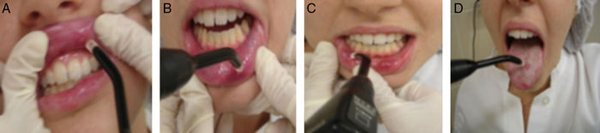
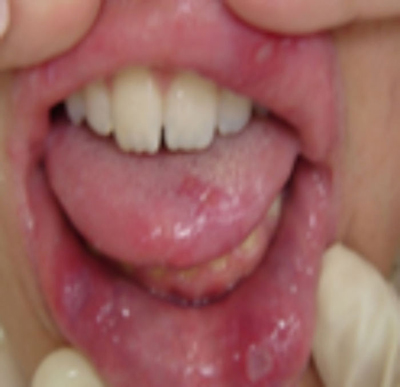
<body><![CDATA[<p><font face="Verdana" size="2">Beh&ccedil;et's disease (BD) is a chronic inflammatory vascular disorder characterized by genital and oral recurrent ulcers, ocular, arthritic, cutaneous, blood vessels and central nervous system involvement, described in 1937 by Hulusi Beh&ccedil;et.<sup>1-5</sup></font></p>     <p><font face="Verdana" size="2">The etiopathogenesis of Beh&ccedil;et's disease is unknown. It has been postulated that immunological abnormalities, which are possibly induced by microbial pathogens in genetically susceptible individuals, are important in its pathogenesis. Recent findings have both supported the significance of genetic factors and defined better the nature of inflammation in Beh&ccedil;et's disease.<sup>1,2,5</sup></font></p>     <p><font face="Verdana" size="2">Usually the diagnosis is established in young adults and the manifestations are more prevalent inside the mouth, followed by genital areas.<sup>6</sup> With the consensus on one set of criteria created in 1990 by The International Study Group,<sup>7</sup> and further development of clinical protocols to measure their activity,<sup>8</sup> instruments for standardization of research, BD has aroused great interest in recent years. However, BD's treatment comprises several strategies, which have been shown empirically, due to the lack of evidence-based information area. Laboratory tests are not useful in the diagnostic BD. This must be done from the specific criteria proposed by the International Study Group for Beh&ccedil;et,<sup>7</sup> which preconizes recurrent oral ulcerations added to two ocular, cutaneous or genital expressions or rheumatoid arthritis.<sup>1,6,9,10</sup> The prognosis for BD has a highly variable course, quite typical with frequent relapses and remissions.<sup>9</sup> The mortality rate is low and when it occurs it is due to pulmonary hemorrhage, central nervous system or intestinal perforation. In the absence of these complications, the prognosis is generally good.<sup>1,8,9</sup> The application of low power laser for treatment of oral lesions aims to reduce the painful symptoms, accelerating the healing process and decrease inflammation, as reported in this case.<sup>11-13</sup> We reported a clinical case of a 21-year-old girl, Caucasian, with frequent and recurrent oral ulcers inside the mouth and genital lesions. The application of low power laser in ulcers was considered in order to decrease the inflammatory symptoms and pain, beyond getting the healing process accelerated.</font></p>     <p>&nbsp;</p>     <p><font face="Verdana" size="2"><b>Case report</b></font></p>     <p><font face="Verdana" size="2">A female patient, 21-year-old Caucasian, university student, visited the Center for Study and Care of Special Patients (CEAPE) - Universidade Paulista - UNIP - Indianapolis Campus - S&atilde;o Paulo - Brazil, for diagnosis and treatment of frequent and recurrent oral ulcers. The anamnesis was done and the patient reported that she had been suffering from oral and genital lesions episodes that were exacerbated during menstrual periods, and in situations of stress and anxiety. The oral examination (<a href="#f1">fig. 1</a>) revealed multiple oral ulcers in the edge and back of the tongue, lips and mucosa bilaterally measuring approximately 0.5-1.2 cm with erythematous halo and covered by yellowish exudates. The biopsy was performed and the material was sent to the pathology's lab: 3 fragments of tissue with different sizes and shapes, approximately measuring 0.2 cm &times; 0.2 cm &times; 0.1 cm, brownish and friable. The microscopical examination of the histological specimen revealed a mucosa fragment lined by keratinized stratified squamous epithelia showing acanthosis areas and hydropic degeneration. The own lamina consists of dense tissue showing chronic inflammatory infiltrate. There was no evidence of granulomatous inflammation and the result presented chronic inflammatory process. In this case, low power diode laser using Gallium Aluminum Arsenide (GaAIAs) with a wavelength of 790 nm, power 30 mW, was punctually applied for 2 min and 20 s, in each clinical lesion with energy density of 4J/cm<sup>2</sup> each point (<a href="#f2">fig. 2a-d</a>). On the 7th day we had observed total regression of the oral lesions (<a href="#f3">fig. 3</a>); however, the genital lesions had increased and had appeared edema on knees, pain and difficulty to walk. The patient had gone through medical evaluation, and the gynecological examination reported multiple ulcerations of the posterior vaginal wall with 1.5-2 cm, with a hyperemic halo, pain on palpation and abundant leucorrhea. In occasion, vaginal cytology, colposcopy and pathologic anatomy of the lesion and blood tests were conduced. We had obtained the following results: non-specific colpite chronic with acute fibrin-leukocyte crust, erosion's foci, exocytosis and spongiosis; vaginal and urethral culture positive for Enterococcus sp, FAN/anti-DNA negative and rheumatoid factor &lt;20. Considering the stories and laboratory data, the physician prescribed prednisone 20 mg/day for 15 days and maintenance of 15 mg/day. Complete regression of the lesions previously reported was noted, with disappearance of all preexisting symptoms. Now she is under observation.</font></p>     <p>&nbsp;</p>     <p align="center"><font face="Verdana" size="2"><a name="f1"><img src="/img/revistas/maxi/v38n2/caso_clinico5_f1.jpg"></a>    <br><b>Fig. 1 - The oral ulcers in the edge and back of the tongue and lips.</b></font></p>     <p>&nbsp;</p>     ]]></body>
<body><![CDATA[<p align="center"><font face="Verdana" size="2"><a name="f2"><img src="/img/revistas/maxi/v38n2/caso_clinico5_f2.jpg"></a>    <br><b>Fig. 2 - (a-d) Application of low power laser (GaAlAS) in each clinical lesion.</b></font></p>     <p>&nbsp;</p>     <p align="center"><font face="Verdana" size="2"><a name="f3"><img src="/img/revistas/maxi/v38n2/caso_clinico5_f3.jpg"></a>    <br><b>Fig. 3 - On the 7th day we had observed total regression of the oral lesions.</b></font></p>     <p>&nbsp;</p>     <p><font face="Verdana" size="2"><b>Discussion</b></font></p>     <p><font face="Verdana" size="2">Beh&ccedil;et's disease (BD) is a chronic inflammatory vascular disorder characterized by genital and oral recurrent ulcers, ocular, arthritic, cutaneous, blood vessels and central nervous system involvement.<sup>1-5</sup></font></p>     <p><font face="Verdana" size="2">The International Study Group for Beh&ccedil;et<sup>7</sup> preconizes recurrent oral ulcerations added to two ocular, cutaneous or genital expressions or rheumatoid arthritis.<sup>1,6,9,10</sup></font></p>     <p><font face="Verdana" size="2">The patient presented with rheumatoid arthritis, genital lesions and multiple recurrent ulcers inside the mouth, with an erythematous halo, covered by yellowish exudates exacerbated during menstrual periods, and in situations of stress and anxiety being in agreement with The International Criteria for Beh&ccedil;et's Disease.</font></p>     ]]></body>
<body><![CDATA[<p>&nbsp;</p>     <p><font face="Verdana" size="2"><b>Conclusion</b></font></p>     <p><font face="Verdana" size="2">The treatment of oral ulcers in BD by low laser therapy provides decreasing of the painful symptoms, stimulates the local microcirculation, accelerates the healing process and decreases inflammation, remission from ulcerative lesions, in a short time, eliminating the need for administration of systemic or topical medications, avoiding undesirable side effects and improving the patient's quality of life.</font></p>     <p>&nbsp;</p>     <p><font face="Verdana" size="2"><b>Ethical disclosures</b></font></p>     <p><font face="Verdana" size="2"><b>Protection of human and animal subjects.</b> The authors declare that the procedures followed were in accordance with the regulations of the relevant clinical research ethics committee and with those of the Code of Ethics of the World Medical Association (Declaration of Helsinki).</font></p>     <p><font face="Verdana" size="2"><b>Confidentiality of data.</b> The authors declare that they have followed the protocols of their work center on the publication of patient data.</font></p>     <p><font face="Verdana" size="2"><b>Right to privacy and informed consent.</b> The authors have obtained the written informed consent of the patients or subjects mentioned in the article. The corresponding author is in possession of this document.</font></p>     <p>&nbsp;</p>     <p><font face="Verdana" size="2"><b>Ethical approval</b></font></p>     ]]></body>
<body><![CDATA[<p><font face="Verdana" size="2">The case report was approved by the Ethics Committee of Paulista University (643/09). Written informed consent was obtained from the patient for publication of this Case report and any accompanying images.</font></p>     <p>&nbsp;</p>     <p><font face="Verdana" size="2"><b>Conflicts of interests</b></font></p>     <p><font face="Verdana" size="2">The authors declare that they have no conflicts of interests.</font></p>     <p>&nbsp;</p>     <p><font face="Verdana" size="2"><b>Funding</b></font></p>     <p><font face="Verdana" size="2">The manuscript has no external financial support.</font></p>     <p>&nbsp;</p>     <p><font face="Verdana" size="2"><b>References</b></font></p>     <!-- ref --><p><font face="Verdana" size="2">1. G&uuml;l A. Behcet's disease: an update on the pathogenesis. Clin Exp Rheumatol.  2001;19 Suppl. 24:6-12.    &nbsp;&nbsp;&nbsp;&nbsp;&nbsp;&nbsp;&nbsp;&nbsp;[&#160;<a href="javascript:void(0);" onclick="javascript: window.open('/scielo.php?script=sci_nlinks&ref=5150756&pid=S1130-0558201600020000800001&lng=','','width=640,height=500,resizable=yes,scrollbars=1,menubar=yes,');">Links</a>&#160;]<!-- end-ref --></font></p>    <!-- ref --><p><font face="Verdana" size="2">2. Neves F.S., Moraes J.C.B., Gon&ccedil;alves C.R. S&iacute;ndrome de Beh&ccedil;et: &Agrave; procura de evidencias. Rev Bras Reumatol. 2006;46 Suppl. 1:21-9.    &nbsp;&nbsp;&nbsp;&nbsp;&nbsp;&nbsp;&nbsp;&nbsp;[&#160;<a href="javascript:void(0);" onclick="javascript: window.open('/scielo.php?script=sci_nlinks&ref=5150758&pid=S1130-0558201600020000800002&lng=','','width=640,height=500,resizable=yes,scrollbars=1,menubar=yes,');">Links</a>&#160;]<!-- end-ref --></font></p>    <!-- ref --><p><font face="Verdana" size="2">3. Hirohata S., Kikuchi H. Beh&ccedil;et's disease. Arthritis Res Ther. 2003;5:139-46.    &nbsp;&nbsp;&nbsp;&nbsp;&nbsp;&nbsp;&nbsp;&nbsp;[&#160;<a href="javascript:void(0);" onclick="javascript: window.open('/scielo.php?script=sci_nlinks&ref=5150760&pid=S1130-0558201600020000800003&lng=','','width=640,height=500,resizable=yes,scrollbars=1,menubar=yes,');">Links</a>&#160;]<!-- end-ref --></font></p>    <!-- ref --><p><font face="Verdana" size="2">4. Yazici Y., Yurdakul S., Yazici H. Beh&ccedil;et's syndrome. Curr Rheumatol Rep. 2010;12:429-35.    &nbsp;&nbsp;&nbsp;&nbsp;&nbsp;&nbsp;&nbsp;&nbsp;[&#160;<a href="javascript:void(0);" onclick="javascript: window.open('/scielo.php?script=sci_nlinks&ref=5150762&pid=S1130-0558201600020000800004&lng=','','width=640,height=500,resizable=yes,scrollbars=1,menubar=yes,');">Links</a>&#160;]<!-- end-ref --></font></p>    <!-- ref --><p><font face="Verdana" size="2">5. Maldini C., La M.P., Cheminant M., Menthon M., Mahr A. Relationships of HLA-B51 or B5 genotype with Beh&ccedil;et's disease clinical characteristics: systematic review and meta-analyses of observational studies. Rheumatol. 2012;51:887-900.    &nbsp;&nbsp;&nbsp;&nbsp;&nbsp;&nbsp;&nbsp;&nbsp;[&#160;<a href="javascript:void(0);" onclick="javascript: window.open('/scielo.php?script=sci_nlinks&ref=5150764&pid=S1130-0558201600020000800005&lng=','','width=640,height=500,resizable=yes,scrollbars=1,menubar=yes,');">Links</a>&#160;]<!-- end-ref --></font></p>    <!-- ref --><p><font face="Verdana" size="2">6. Kokturk A. Clinical and pathological manifestations with differential diagnosis in Beh&ccedil;et's disease. Patholog  Res Int. 2012 (on line version). Available in: http://dx.doi.org/10.1155/2012/690390.    &nbsp;&nbsp;&nbsp;&nbsp;&nbsp;&nbsp;&nbsp;&nbsp;[&#160;<a href="javascript:void(0);" onclick="javascript: window.open('/scielo.php?script=sci_nlinks&ref=5150766&pid=S1130-0558201600020000800006&lng=','','width=640,height=500,resizable=yes,scrollbars=1,menubar=yes,');">Links</a>&#160;]<!-- end-ref --></font></p>    <!-- ref --><p><font face="Verdana" size="2">7. International Study Group for Behçet’s Disease. Criteria for diagnosis of Beh&ccedil;et's disease. Lancet. 1990;335:1078-80.    &nbsp;&nbsp;&nbsp;&nbsp;&nbsp;&nbsp;&nbsp;&nbsp;[&#160;<a href="javascript:void(0);" onclick="javascript: window.open('/scielo.php?script=sci_nlinks&ref=5150768&pid=S1130-0558201600020000800007&lng=','','width=640,height=500,resizable=yes,scrollbars=1,menubar=yes,');">Links</a>&#160;]<!-- end-ref --></font></p>    <!-- ref --><p><font face="Verdana" size="2">8. Bhakta B.B., Brennan P., James T.E., Chamberlain M.A., Noble B.A., Silman A.J. Beh&ccedil;et's disease: evaluation of a new instrument to measure clinical activity. Rheumatol. 2011;38:728-33.    &nbsp;&nbsp;&nbsp;&nbsp;&nbsp;&nbsp;&nbsp;&nbsp;[&#160;<a href="javascript:void(0);" onclick="javascript: window.open('/scielo.php?script=sci_nlinks&ref=5150770&pid=S1130-0558201600020000800008&lng=','','width=640,height=500,resizable=yes,scrollbars=1,menubar=yes,');">Links</a>&#160;]<!-- end-ref --></font></p>    <!-- ref --><p><font face="Verdana" size="2">9. Davatchi F., Shahram F., Chams-Davatchi C., Shams H., Nadji A., Akhlaghi M., et al. Behcet's disease: from east to west. Clin Rheumatol. 2010;29:823-33.    &nbsp;&nbsp;&nbsp;&nbsp;&nbsp;&nbsp;&nbsp;&nbsp;[&#160;<a href="javascript:void(0);" onclick="javascript: window.open('/scielo.php?script=sci_nlinks&ref=5150772&pid=S1130-0558201600020000800009&lng=','','width=640,height=500,resizable=yes,scrollbars=1,menubar=yes,');">Links</a>&#160;]<!-- end-ref --></font></p>    <!-- ref --><p><font face="Verdana" size="2">10. Saadoun D., Cassoux N., Wechsler B., Boutin D., Terrada C., Lehoang P., et al. Ocular manifestations of Beh&ccedil;et's disease. Rev Med Intern. 2010;31:545-50.    &nbsp;&nbsp;&nbsp;&nbsp;&nbsp;&nbsp;&nbsp;&nbsp;[&#160;<a href="javascript:void(0);" onclick="javascript: window.open('/scielo.php?script=sci_nlinks&ref=5150774&pid=S1130-0558201600020000800010&lng=','','width=640,height=500,resizable=yes,scrollbars=1,menubar=yes,');">Links</a>&#160;]<!-- end-ref --></font></p>    <!-- ref --><p><font face="Verdana" size="2">11. Galdames I.C.S., Sep&uacute;lveda M.C.L., L&oacute;pez M.G.C., Matamala D.A.Z. Efecto de la Aplicaci&oacute;n de L&aacute;ser de Baja Potencia Sobre la Mucosa Oral Lesionada. Int J Morphol. 2007;25:523-8.    &nbsp;&nbsp;&nbsp;&nbsp;&nbsp;&nbsp;&nbsp;&nbsp;[&#160;<a href="javascript:void(0);" onclick="javascript: window.open('/scielo.php?script=sci_nlinks&ref=5150776&pid=S1130-0558201600020000800011&lng=','','width=640,height=500,resizable=yes,scrollbars=1,menubar=yes,');">Links</a>&#160;]<!-- end-ref --></font></p>    <!-- ref --><p><font face="Verdana" size="2">12. Demetriades N., Hanford H., Laskarides C. General manifestations of Beh&ccedil;et's syndrome and the success of CO2-laser as treatment for oral lesions: a review of the literature and case presentation. J Mass Dent Soc. 2009;58:24-7.    &nbsp;&nbsp;&nbsp;&nbsp;&nbsp;&nbsp;&nbsp;&nbsp;[&#160;<a href="javascript:void(0);" onclick="javascript: window.open('/scielo.php?script=sci_nlinks&ref=5150778&pid=S1130-0558201600020000800012&lng=','','width=640,height=500,resizable=yes,scrollbars=1,menubar=yes,');">Links</a>&#160;]<!-- end-ref --></font></p>    <!-- ref --><p><font face="Verdana" size="2">13. Caputo B.V., Noro-Filho G.A., Santos C.C., Okida Y., Giovani M.G. Laser therapy of recurrent aphthous ulcer in patient with HIV infection. Case Rep Med. 2012. (online version) 2012. Available in: http://dx.doi.org/10.1155/2012/695642</font>&nbsp;&nbsp;&nbsp;&nbsp;&nbsp;&nbsp;&nbsp;&nbsp;[&#160;<a href="javascript:void(0);" onclick="javascript: window.open('/scielo.php?script=sci_nlinks&ref=5150780&pid=S1130-0558201600020000800013&lng=','','width=640,height=500,resizable=yes,scrollbars=1,menubar=yes,');">Links</a>&#160;]<!-- end-ref --><p>&nbsp;</p>     <p>&nbsp;</p>     <p><font face="Verdana" size="2"><a href="#top"><img border="0" src="/img/revistas/maxi/v38n2/seta.gif" width="15" height="17"></a><a name="bajo"></a><b>Direcci&oacute;n para correspondencia:</b>    <br>Kelly Cristine Tarquinio Marinho    <br><a href="mailto:kekeodonto@gmail.com">kekeodonto@gmail.com</a>    <br><a href="mailto:Kekeodonto@yahoo.com.br">Kekeodonto@yahoo.com.br</a></font></p>     ]]></body>
<body><![CDATA[<p><font face="Verdana" size="2">Received 20 March 2014    <br>Accepted 19 May 2014</font></p>      ]]></body><back>
<ref-list>
<ref id="B1">
<label>1</label><nlm-citation citation-type="journal">
<person-group person-group-type="author">
<name>
<surname><![CDATA[Gül]]></surname>
<given-names><![CDATA[A]]></given-names>
</name>
</person-group>
<article-title xml:lang="en"><![CDATA[Behcet's disease: an update on the pathogenesis]]></article-title>
<source><![CDATA[Clin Exp Rheumatol.]]></source>
<year>2001</year>
<volume>19</volume>
<numero>^s24</numero>
<issue>^s24</issue>
<supplement>24</supplement>
<page-range>6-12</page-range></nlm-citation>
</ref>
<ref id="B2">
<label>2</label><nlm-citation citation-type="journal">
<person-group person-group-type="author">
<name>
<surname><![CDATA[Neves]]></surname>
<given-names><![CDATA[F.S.]]></given-names>
</name>
<name>
<surname><![CDATA[Moraes]]></surname>
<given-names><![CDATA[J.C.B.]]></given-names>
</name>
<name>
<surname><![CDATA[Gonçalves]]></surname>
<given-names><![CDATA[C.R]]></given-names>
</name>
</person-group>
<article-title xml:lang="pt"><![CDATA[Síndrome de Behçet: À procura de evidencias]]></article-title>
<source><![CDATA[Rev Bras Reumatol.]]></source>
<year>2006</year>
<volume>46</volume>
<numero>^s1</numero>
<issue>^s1</issue>
<supplement>1</supplement>
<page-range>21-9</page-range></nlm-citation>
</ref>
<ref id="B3">
<label>3</label><nlm-citation citation-type="journal">
<person-group person-group-type="author">
<name>
<surname><![CDATA[Hirohata]]></surname>
<given-names><![CDATA[S.]]></given-names>
</name>
<name>
<surname><![CDATA[Kikuchi]]></surname>
<given-names><![CDATA[H]]></given-names>
</name>
</person-group>
<article-title xml:lang="en"><![CDATA[Behçet's disease]]></article-title>
<source><![CDATA[Arthritis Res Ther.]]></source>
<year>2003</year>
<volume>5</volume>
<page-range>139-46</page-range></nlm-citation>
</ref>
<ref id="B4">
<label>4</label><nlm-citation citation-type="journal">
<person-group person-group-type="author">
<name>
<surname><![CDATA[Yazici]]></surname>
<given-names><![CDATA[Y.]]></given-names>
</name>
<name>
<surname><![CDATA[Yurdakul]]></surname>
<given-names><![CDATA[S.]]></given-names>
</name>
<name>
<surname><![CDATA[Yazici]]></surname>
<given-names><![CDATA[H]]></given-names>
</name>
</person-group>
<article-title xml:lang="en"><![CDATA[Behçet's syndrome]]></article-title>
<source><![CDATA[Curr Rheumatol Rep.]]></source>
<year>2010</year>
<volume>12</volume>
<page-range>429-35</page-range></nlm-citation>
</ref>
<ref id="B5">
<label>5</label><nlm-citation citation-type="journal">
<person-group person-group-type="author">
<name>
<surname><![CDATA[Maldini]]></surname>
<given-names><![CDATA[C.]]></given-names>
</name>
<name>
<surname><![CDATA[La]]></surname>
<given-names><![CDATA[M.P.]]></given-names>
</name>
<name>
<surname><![CDATA[Cheminant]]></surname>
<given-names><![CDATA[M.]]></given-names>
</name>
<name>
<surname><![CDATA[Menthon]]></surname>
<given-names><![CDATA[M.]]></given-names>
</name>
<name>
<surname><![CDATA[Mahr]]></surname>
<given-names><![CDATA[A]]></given-names>
</name>
</person-group>
<article-title xml:lang="en"><![CDATA[Relationships of HLA-B51 or B5 genotype with Behçet's disease clinical characteristics: systematic review and meta-analyses of observational studies]]></article-title>
<source><![CDATA[Rheumatol.]]></source>
<year>2012</year>
<volume>51</volume>
<page-range>887-900</page-range></nlm-citation>
</ref>
<ref id="B6">
<label>6.</label><nlm-citation citation-type="journal">
<person-group person-group-type="author">
<name>
<surname><![CDATA[Kokturk]]></surname>
<given-names><![CDATA[A]]></given-names>
</name>
</person-group>
<article-title xml:lang="en"><![CDATA[Clinical and pathological manifestations with differential diagnosis in Behçet's disease]]></article-title>
<source><![CDATA[Patholog Res Int.]]></source>
<year>2012</year>
</nlm-citation>
</ref>
<ref id="B7">
<label>7</label><nlm-citation citation-type="journal">
<collab>International Study Group for Behçet’s Disease</collab>
<article-title xml:lang="en"><![CDATA[Criteria for diagnosis of Behçet's disease]]></article-title>
<source><![CDATA[Lancet]]></source>
<year>1990</year>
<volume>335</volume>
<page-range>1078-80</page-range></nlm-citation>
</ref>
<ref id="B8">
<label>8</label><nlm-citation citation-type="journal">
<person-group person-group-type="author">
<name>
<surname><![CDATA[Bhakta]]></surname>
<given-names><![CDATA[B.B.]]></given-names>
</name>
<name>
<surname><![CDATA[Brennan]]></surname>
<given-names><![CDATA[P.]]></given-names>
</name>
<name>
<surname><![CDATA[James]]></surname>
<given-names><![CDATA[T.E.]]></given-names>
</name>
<name>
<surname><![CDATA[Chamberlain]]></surname>
<given-names><![CDATA[M.A.]]></given-names>
</name>
<name>
<surname><![CDATA[Noble]]></surname>
<given-names><![CDATA[B.A.]]></given-names>
</name>
<name>
<surname><![CDATA[Silman]]></surname>
<given-names><![CDATA[A.J]]></given-names>
</name>
</person-group>
<article-title xml:lang="en"><![CDATA[Behçet's disease: evaluation of a new instrument to measure clinical activity]]></article-title>
<source><![CDATA[Rheumatol.]]></source>
<year>2011</year>
<volume>38</volume>
<page-range>728-33</page-range></nlm-citation>
</ref>
<ref id="B9">
<label>9</label><nlm-citation citation-type="journal">
<person-group person-group-type="author">
<name>
<surname><![CDATA[Davatchi]]></surname>
<given-names><![CDATA[F.]]></given-names>
</name>
<name>
<surname><![CDATA[Shahram]]></surname>
<given-names><![CDATA[F.]]></given-names>
</name>
<name>
<surname><![CDATA[Chams-Davatchi]]></surname>
<given-names><![CDATA[C.]]></given-names>
</name>
<name>
<surname><![CDATA[Shams]]></surname>
<given-names><![CDATA[H.]]></given-names>
</name>
<name>
<surname><![CDATA[Nadji]]></surname>
<given-names><![CDATA[A.]]></given-names>
</name>
<name>
<surname><![CDATA[Akhlaghi]]></surname>
<given-names><![CDATA[M.]]></given-names>
</name>
</person-group>
<article-title xml:lang="en"><![CDATA[Behcet's disease: from east to west]]></article-title>
<source><![CDATA[Clin Rheumatol.]]></source>
<year>2010</year>
<volume>29</volume>
<page-range>823-33</page-range></nlm-citation>
</ref>
<ref id="B10">
<label>10</label><nlm-citation citation-type="journal">
<person-group person-group-type="author">
<name>
<surname><![CDATA[Saadoun]]></surname>
<given-names><![CDATA[D.]]></given-names>
</name>
<name>
<surname><![CDATA[Cassoux]]></surname>
<given-names><![CDATA[N.]]></given-names>
</name>
<name>
<surname><![CDATA[Wechsler]]></surname>
<given-names><![CDATA[B.]]></given-names>
</name>
<name>
<surname><![CDATA[Boutin]]></surname>
<given-names><![CDATA[D.]]></given-names>
</name>
<name>
<surname><![CDATA[Terrada]]></surname>
<given-names><![CDATA[C.]]></given-names>
</name>
<name>
<surname><![CDATA[Lehoang]]></surname>
<given-names><![CDATA[P.]]></given-names>
</name>
</person-group>
<article-title xml:lang="en"><![CDATA[Ocular manifestations of Behçet's disease]]></article-title>
<source><![CDATA[Rev Med Intern.]]></source>
<year>2010</year>
<volume>31</volume>
<page-range>545-50</page-range></nlm-citation>
</ref>
<ref id="B11">
<label>11</label><nlm-citation citation-type="journal">
<person-group person-group-type="author">
<name>
<surname><![CDATA[Galdames]]></surname>
<given-names><![CDATA[I.C.S.]]></given-names>
</name>
<name>
<surname><![CDATA[Sepúlveda]]></surname>
<given-names><![CDATA[M.C.L.]]></given-names>
</name>
<name>
<surname><![CDATA[López]]></surname>
<given-names><![CDATA[M.G.C.]]></given-names>
</name>
<name>
<surname><![CDATA[Matamala]]></surname>
<given-names><![CDATA[D.A.Z]]></given-names>
</name>
</person-group>
<article-title xml:lang="es"><![CDATA[Efecto de la Aplicación de Láser de Baja Potencia Sobre la Mucosa Oral Lesionada]]></article-title>
<source><![CDATA[Int J Morphol.]]></source>
<year>2007</year>
<volume>25</volume>
<page-range>523-8</page-range></nlm-citation>
</ref>
<ref id="B12">
<label>12</label><nlm-citation citation-type="journal">
<person-group person-group-type="author">
<name>
<surname><![CDATA[Demetriades]]></surname>
<given-names><![CDATA[N.]]></given-names>
</name>
<name>
<surname><![CDATA[Hanford]]></surname>
<given-names><![CDATA[H.]]></given-names>
</name>
<name>
<surname><![CDATA[Laskarides]]></surname>
<given-names><![CDATA[C]]></given-names>
</name>
</person-group>
<article-title xml:lang="en"><![CDATA[General manifestations of Behçet's syndrome and the success of CO2-laser as treatment for oral lesions: a review of the literature and case presentation]]></article-title>
<source><![CDATA[J Mass Dent Soc.]]></source>
<year>2009</year>
<volume>58</volume>
<page-range>24-7</page-range></nlm-citation>
</ref>
<ref id="B13">
<label>13</label><nlm-citation citation-type="journal">
<person-group person-group-type="author">
<name>
<surname><![CDATA[Caputo]]></surname>
<given-names><![CDATA[B.V.]]></given-names>
</name>
<name>
<surname><![CDATA[Noro-Filho]]></surname>
<given-names><![CDATA[G.A.]]></given-names>
</name>
<name>
<surname><![CDATA[Santos]]></surname>
<given-names><![CDATA[C.C.]]></given-names>
</name>
<name>
<surname><![CDATA[Okida]]></surname>
<given-names><![CDATA[Y.]]></given-names>
</name>
<name>
<surname><![CDATA[Giovani]]></surname>
<given-names><![CDATA[M.G]]></given-names>
</name>
</person-group>
<article-title xml:lang="en"><![CDATA[Laser therapy of recurrent aphthous ulcer in patient with HIV infection]]></article-title>
<source><![CDATA[Case Rep Med.]]></source>
<year>2012</year>
<volume>2012</volume>
</nlm-citation>
</ref>
</ref-list>
</back>
</article>