<?xml version="1.0" encoding="ISO-8859-1"?><article xmlns:mml="http://www.w3.org/1998/Math/MathML" xmlns:xlink="http://www.w3.org/1999/xlink" xmlns:xsi="http://www.w3.org/2001/XMLSchema-instance">
<front>
<journal-meta>
<journal-id>1130-1473</journal-id>
<journal-title><![CDATA[Neurocirugía]]></journal-title>
<abbrev-journal-title><![CDATA[Neurocirugía]]></abbrev-journal-title>
<issn>1130-1473</issn>
<publisher>
<publisher-name><![CDATA[Sociedad Española de Neurocirugía]]></publisher-name>
</publisher>
</journal-meta>
<article-meta>
<article-id>S1130-14732006000300004</article-id>
<title-group>
<article-title xml:lang="en"><![CDATA[Metastatic meningioma to the eleventh dorsal vertebral body: total en bloc spondylectomy. Case report and review of the literature]]></article-title>
<article-title xml:lang="es"><![CDATA[Metástasis de meningioma en la undécima vértebra dorsal: vertebrectomía total en bloque. Caso clínico y revisión de la literatura]]></article-title>
</title-group>
<contrib-group>
<contrib contrib-type="author">
<name>
<surname><![CDATA[Delgado-López]]></surname>
<given-names><![CDATA[P.D.]]></given-names>
</name>
<xref ref-type="aff" rid="A01"/>
</contrib>
<contrib contrib-type="author">
<name>
<surname><![CDATA[Martín-Velasco]]></surname>
<given-names><![CDATA[V.]]></given-names>
</name>
<xref ref-type="aff" rid="A01"/>
</contrib>
<contrib contrib-type="author">
<name>
<surname><![CDATA[Castilla-Díez]]></surname>
<given-names><![CDATA[J.M.]]></given-names>
</name>
<xref ref-type="aff" rid="A01"/>
</contrib>
<contrib contrib-type="author">
<name>
<surname><![CDATA[Fernández-Arconada]]></surname>
<given-names><![CDATA[O.]]></given-names>
</name>
<xref ref-type="aff" rid="A01"/>
</contrib>
<contrib contrib-type="author">
<name>
<surname><![CDATA[Corrales-García]]></surname>
<given-names><![CDATA[E.Mª]]></given-names>
</name>
<xref ref-type="aff" rid="A02"/>
</contrib>
<contrib contrib-type="author">
<name>
<surname><![CDATA[Galacho-Harnero]]></surname>
<given-names><![CDATA[A.]]></given-names>
</name>
<xref ref-type="aff" rid="A01"/>
</contrib>
<contrib contrib-type="author">
<name>
<surname><![CDATA[Rodríguez-Salazar]]></surname>
<given-names><![CDATA[A.]]></given-names>
</name>
<xref ref-type="aff" rid="A01"/>
</contrib>
<contrib contrib-type="author">
<name>
<surname><![CDATA[Pérez-Mies]]></surname>
<given-names><![CDATA[B.]]></given-names>
</name>
<xref ref-type="aff" rid="A03"/>
</contrib>
</contrib-group>
<aff id="A01">
<institution><![CDATA[,Hospital General Yagüe Servicio de Neurocirugía ]]></institution>
<addr-line><![CDATA[ ]]></addr-line>
</aff>
<aff id="A03">
<institution><![CDATA[,Hospital General Yagüe Servicio de Anatomía Patológica ]]></institution>
<addr-line><![CDATA[Burgos ]]></addr-line>
</aff>
<aff id="A02">
<institution><![CDATA[,Hospital Divino Valles Servicio de Oncología Radioterápica ]]></institution>
<addr-line><![CDATA[Burgos ]]></addr-line>
</aff>
<pub-date pub-type="pub">
<day>00</day>
<month>06</month>
<year>2006</year>
</pub-date>
<pub-date pub-type="epub">
<day>00</day>
<month>06</month>
<year>2006</year>
</pub-date>
<volume>17</volume>
<numero>3</numero>
<fpage>240</fpage>
<lpage>249</lpage>
<copyright-statement/>
<copyright-year/>
<self-uri xlink:href="http://scielo.isciii.es/scielo.php?script=sci_arttext&amp;pid=S1130-14732006000300004&amp;lng=en&amp;nrm=iso"></self-uri><self-uri xlink:href="http://scielo.isciii.es/scielo.php?script=sci_abstract&amp;pid=S1130-14732006000300004&amp;lng=en&amp;nrm=iso"></self-uri><self-uri xlink:href="http://scielo.isciii.es/scielo.php?script=sci_pdf&amp;pid=S1130-14732006000300004&amp;lng=en&amp;nrm=iso"></self-uri><abstract abstract-type="short" xml:lang="en"><p><![CDATA[Introduction. One in every thousand intracranial meningiomas metastatize extracranially. Lung and intraabdominal organs are most frequently affected. Only 7% involve vertebrae and just a dozen cases have been reported in the literature. To our knowledge, this is the first description of a total en bloc spondylectomy through a posterior approach for the treatment of an intraosseous metastatic meningioma to the eleventh dorsal vertebra. Case report. In March 1996, a 37 year-old male underwent surgical resection for a left occipital intraventricular benign meningioma (WHO I). He was reoperated in February 2002 due to local recurrence. By the end on 2003 he developed progressively invalidating dorsolumbar pain. MRI studies revealed a T11 intraosseous mass. In March 2004, a percutaneous biopsy and vertebroplasty were performed. The pathological specimen was identified as adenocarcinoma and he initiated chemotherapy. Advice from a second pathologist was seeked, who suggested the diagnosis of intraosseous meningioma. Workup studies failed to reveal any primary tumor. In May 2004 the patient was admitted to our department and a new transpedicular biopsy confirmed the diagnosis. In June 2004 he underwent T11 total en bloc spondylectomy (Tomita's procedure), fusion with bone and calcium substitute-filled stackable carbon-fiber cages, and T9 to L1 transpedicular screw fixation. No postoperative complications ocurred and he is, so far, free from primary and secondary disease. Definite pathology: benign meningioma (WHO I). Discussion. Distant metastases from intracranial meningiomas are rare entities, arising from benign lesions in, at least, 60% of cases. Enam et al proposed a specific pathological score to differentiate benign, atypic and malignant meningiomas. Such score correlates with the chance of metastatizing: more than 40% in malignant meningiomas compared to 3.8% of brain tumors overall. The ability to metastatize seems to be linked to vascular or lifatic invasiveness. Metastases ocurr more frequently in angioblastic, papillary and meningothelial variants. Hematogenous (especially venous; Batson's perivertebral plexus), linfatic and cerebrospinal fluid are the main routes involved in the spreading of the tumor. Craniotomy itself may also play a role, for the majority of patients have been previously operated on repeatedly. The interval between the onset of the intracranial disease and the appearance of the metastasis varies from months to many years. The value of transpedicular biopsy is widely recognized (efficacy over 80%) and the suitability of the specimen for pathological examination improves when wide inner caliber trephines are used. In the case presented we applied the oncologic concept of vertebral en bloc resection. We believe this case represents a paradigmatic indication of this technique because it respects the concepts of radical resection and spinal stability, and offers an opportunity for the curation of the disease.]]></p></abstract>
<abstract abstract-type="short" xml:lang="es"><p><![CDATA[Introducción. Las metástasis distantes de meningioma intracraneal ocurren en uno de cada mil meningiomas. La mayor parte afectan a pulmón u órganos intraabdominales. Sólo un 7% aparecen en vértebras. Se han publicado en torno a una docena de casos. Presentamos la primera descripción hasta la fecha de una vertebrectomía completa por vía posterior para tratar una metástasis intraósea de meningioma benigno en el cuerpo de T11. Caso clínico. Varón de 37 años de edad, intervenido en otro centro en Marzo de 1996 de meningioma benigno intraventricular occipital izquierdo de tipo transicional (OMS tipo I). Precisó reintervención por recidiva local en Febrero de 2002. A finales de 2003 comenzó con dolor dorsolumbar intenso y el estudio de RM espinal evidenció una masa intrósea en T11. En Marzo de 2004 se realizó biopsia transpedicular y vertebroplastia acrílica. El resultado histológico fue de adenocarcinoma y el paciente comenzó a recibir quimioterapia. Una segunda opinión sobre las muestras histológicas sugirió el diagnóstico de meningioma. El estudio de extensión tumoral no evidenció otra neoplasia primaria. En Mayo de 2004 ingresó en nuestro servicio donde se repite la biopsia transpedicular que confirma el diagnóstico de meningioma. En Junio de 2004 se realizó vertebrectomía T11 completa por vía posterior, según técnica de Tomita, artrodesis intersomática con cajas apilables de fibra de carbono rellenas de injerto óseo y sustituto cálcico, y fijación transpedicular T9 a L1. La evolución postoperatoria fue satisfactoria y, actualmente, se encuentra libre de enfermedad primaria y secundaria. Anatomía patológica definitiva: meningioma benigno (OMS I). Discusión. Las metástasis distantes de meningiomas intracraneales son entidades raras que en más del 60% de los casos provienen de meningiomas benignos. Enam y cols diseñaron una gradación según parámetros histológicos para diferenciar los meningiomas benignos de los atípicos y malignos. Dicha gradación correlaciona con la probabilidad de producir metástasis distantes: más del 40% en los meningiomas malignos frente a una media del 3.8% de todos los tumores cerebrales. La posibilidad de metastatizar parece relacionarse con la capacidad de invasividad vascular o linfática. Las metástasis son más frecuentes en las variantes angioblástica, papilar y meningotelial. Se describen tres vías de diseminación: hematógena (sobre todo venosa; plexo perivertebral de Batson) linfática y por LCR. La craneotomía podría ser otra vía de diseminación pues la mayoría de los pacientes han sido previamente multioperados del tumor craneal. El tiempo transcurrido entre el diagnóstico del meningioma intracraneal y la aparición de la metástasis vertebral puede variar entre meses y años. La rentabilidad diagnóstica de la biopsia transpedicular es mayor del 80% y mejora cuanto mayor es el diámetro interno de la trefina utilizada. En el caso descrito, aplicamos el concepto oncológico de resección en bloque de la vértebra afectada. Creemos que se trata de una indicación paradigmática de esta técnica pues respeta los conceptos de resección radical y estabilidad de la columna, y otorga una oportunidad de curación de la enfermedad.]]></p></abstract>
<kwd-group>
<kwd lng="en"><![CDATA[Total spondylectomy]]></kwd>
<kwd lng="en"><![CDATA[Meningioma]]></kwd>
<kwd lng="en"><![CDATA[Metastasis]]></kwd>
<kwd lng="en"><![CDATA[radical resection]]></kwd>
<kwd lng="en"><![CDATA[en bloc resection]]></kwd>
<kwd lng="es"><![CDATA[Vertebrectomía total]]></kwd>
<kwd lng="es"><![CDATA[Meningioma]]></kwd>
<kwd lng="es"><![CDATA[Metástasis]]></kwd>
<kwd lng="es"><![CDATA[Resección radical]]></kwd>
<kwd lng="es"><![CDATA[Resección en bloque]]></kwd>
</kwd-group>
</article-meta>
</front><body><![CDATA[ <p   align="justify" >&nbsp;</p >     <p   align="justify" ><B><font face="Verdana" size="4"><a name="top 10"></a>Metastatic meningioma to the eleventh    dorsal vertebral body: total en bloc spondylectomy. Case report and review of    the literature</font> </b></p >     <P ><B><font face="Verdana" size="4">Met&aacute;stasis de meningioma en la und&eacute;cima    v&eacute;rtebra dorsal: vertebrectom&iacute;a total en bloque. Caso cl&iacute;nico    y revisi&oacute;n de la literatura</font> </b></P >     <p   align="justify" >&nbsp;</p >     <P >&nbsp;</P >     <P ><font face="Verdana" size="2"><b>P.D. Delgado-L&oacute;pez; V. Mart&iacute;n-Velasco;    J.M. Castilla-D&iacute;ez; O. Fern&aacute;ndez-Arconada; *E.Mª Corrales-Garc&iacute;a;    A.Galacho-Harnero; A. Rodr&iacute;guez-Salazar y **B. P&eacute;rez-Mies</b></font></P >     <P ><font size="-1" face="Verdana">Servicios de Neurocirug&iacute;a y de    **Anatom&iacute;a Patol&oacute;gica. Hospital General Yag&uuml;e. Burgos. *Servicio    de Oncolog&iacute;a Radioter&aacute;pica. Hospital Divino Valles. Burgos. </font></P >     <P ><font size="-1" face="Verdana"><a href="#Dirección">Dirección para correspondencia</a></font></P >     <P >&nbsp;</P >     <P >&nbsp;</P > <hr size="1">     ]]></body>
<body><![CDATA[<P ><b><font face="Verdana" size="2">SUMMARY</font></b></P >     <P ><font face="Verdana" size="2"><b>Introduction</b>. One in every thousand    intracranial meningiomas metastatize extracranially. Lung and intraabdominal    organs are most frequently affected. Only 7% involve vertebrae and just a dozen    cases have been reported in the literature. To our knowledge, this is the first    description of a total en bloc spondylectomy through a posterior approach for    the treatment of an intraosseous metastatic meningioma to the eleventh dorsal vertebra.<b>    <br> Case report</b>. In March 1996, a 37    year-old male underwent surgical resection for a left occipital intraventricular    benign meningioma (WHO I). He was reoperated in February 2002 due to local recurrence.    By the end on 2003 he developed progressively invalidating dorsolumbar pain.    MRI studies revealed a T11 intraosseous mass. In March 2004, a percutaneous    biopsy and vertebroplasty were performed. The pathological specimen was identified    as adenocarcinoma and he initiated chemotherapy. Advice from a second pathologist    was seeked, who suggested the diagnosis of intraosseous meningioma. Workup studies    failed to reveal any primary tumor. In May 2004 the patient was admitted to    our department and a new transpedicular biopsy confirmed the diagnosis. In June    2004 he underwent T11 total en bloc spondylectomy (Tomita's procedure), fusion    with bone and calcium substitute-filled stackable carbon-fiber cages, and T9    to L1 transpedicular screw fixation. No postoperative complications ocurred    and he is, so far, free from primary and secondary disease. Definite pathology:    benign meningioma (WHO I).<b>    <br> Discussion</b>. Distant metastases    from intracranial meningiomas are rare entities, arising from benign lesions    in, at least, 60% of cases. Enam et al proposed a specific pathological score    to differentiate benign, atypic and malignant meningiomas. Such score correlates    with the chance of metastatizing: more than 40% in malignant meningiomas compared    to 3.8% of brain tumors overall.    The ability to metastatize seems to be linked to vascular or lifatic invasiveness.    Metastases ocurr more frequently in angioblastic, papillary and meningothelial    variants. Hematogenous (especially venous; Batson's perivertebral plexus), linfatic    and cerebrospinal fluid are the main routes involved in the spreading of the    tumor. Craniotomy itself may also play a role, for the majority of patients    have been previously operated on repeatedly. The interval between the onset    of the intracranial disease and the appearance of the metastasis varies from    months to many years. The value of transpedicular biopsy is widely recognized    (efficacy over 80%) and the suitability of the specimen for pathological examination    improves when wide inner caliber trephines are used. In the case presented we    applied the oncologic concept of vertebral en bloc resection. We believe this    case represents a paradigmatic indication of this technique because it respects    the concepts of radical resection and spinal stability, and offers an opportunity    for the curation of the disease.</font></P >     <P ><font face="Verdana" size="2"><b>Key words</b>: Total spondylectomy. Meningioma. Metastasis,    radical resection, en bloc resection.</font></P > <hr size="1">     <P ><b><font face="Verdana" size="2">RESUMEN</font></b></P >     <P ><font face="Verdana" size="2"><b>Introducci&oacute;n</b>. Las met&aacute;stasis    distantes de meningioma intracraneal ocurren en uno de cada mil meningiomas.    La mayor parte afectan a pulm&oacute;n u &oacute;rganos intraabdominales. S&oacute;lo    un 7% aparecen en v&eacute;rtebras. Se han publicado en torno a una docena de    casos. Presentamos la primera descripci&oacute;n hasta la fecha de una vertebrectom&iacute;a    completa por v&iacute;a posterior para tratar una met&aacute;stasis intra&oacute;sea    de meningioma benigno en el cuerpo de T11.<b>    <br> Caso cl&iacute;nico</b>. Var&oacute;n    de 37 a&ntilde;os de edad, intervenido en otro centro en Marzo de 1996 de meningioma    benigno intraventricular occipital izquierdo de tipo transicional (OMS tipo    I). Precis&oacute; reintervenci&oacute;n por recidiva local en Febrero de 2002.    A finales de 2003 comenz&oacute; con dolor dorsolumbar intenso y el estudio    de RM espinal evidenci&oacute; una masa intr&oacute;sea en T11. En Marzo de    2004 se realiz&oacute; biopsia transpedicular y vertebroplastia acr&iacute;lica.    El resultado histol&oacute;gico fue de adenocarcinoma y el paciente comenz&oacute;    a recibir quimioterapia. Una segunda opini&oacute;n sobre las muestras histol&oacute;gicas    sugiri&oacute; el diagn&oacute;stico de meningioma. El estudio de extensi&oacute;n    tumoral no evidenci&oacute; otra neoplasia primaria. En Mayo de 2004 ingres&oacute;    en nuestro servicio donde se repite la biopsia transpedicular que confirma el    diagn&oacute;stico de meningioma. En Junio de 2004 se realiz&oacute; vertebrectom&iacute;a    T11 completa por v&iacute;a posterior, seg&uacute;n t&eacute;cnica de Tomita,    artrodesis intersom&aacute;tica con cajas apilables de fibra de carbono rellenas    de injerto &oacute;seo y sustituto c&aacute;lcico, y fijaci&oacute;n transpedicular    T9 a L1. La evoluci&oacute;n postoperatoria fue satisfactoria y, actualmente,    se encuentra libre de enfermedad primaria y secundaria. Anatom&iacute;a patol&oacute;gica    definitiva: meningioma benigno (OMS I).&nbsp;<b>    <br> Discusi&oacute;n</b>. Las    met&aacute;stasis distantes de meningiomas intracraneales son entidades raras    que en m&aacute;s del 60% de los casos provienen de meningiomas benignos. Enam    y cols dise&ntilde;aron una gradaci&oacute;n seg&uacute;n par&aacute;metros    histol&oacute;gicos para diferenciar los meningiomas benignos de los at&iacute;picos    y malignos. Dicha gradaci&oacute;n correlaciona con la probabilidad de producir    met&aacute;stasis distantes: m&aacute;s del 40% en los meningiomas malignos    frente a una media del 3.8% de todos los tumores cerebrales. La posibilidad    de metastatizar parece relacionarse con la capacidad de invasividad vascular    o linf&aacute;tica. Las met&aacute;stasis son m&aacute;s frecuentes en las variantes    angiobl&aacute;stica, papilar y meningotelial. Se describen tres v&iacute;as    de diseminaci&oacute;n: hemat&oacute;gena (sobre todo venosa; plexo perivertebral    de Batson) linf&aacute;tica y por LCR. La craneotom&iacute;a podr&iacute;a ser    otra v&iacute;a de diseminaci&oacute;n pues la mayor&iacute;a de los pacientes    han sido previamente multioperados del tumor craneal. El tiempo transcurrido    entre el diagn&oacute;stico del meningioma intracraneal y la aparici&oacute;n    de la met&aacute;stasis vertebral puede variar entre meses y a&ntilde;os. La    rentabilidad diagn&oacute;stica de la biopsia transpedicular es mayor del 80%    y mejora cuanto mayor es el di&aacute;metro interno de la trefina utilizada.    En el caso descrito, aplicamos el concepto oncol&oacute;gico de resecci&oacute;n    en bloque de la v&eacute;rtebra afectada. Creemos que se trata de una indicaci&oacute;n    paradigm&aacute;tica de esta t&eacute;cnica pues respeta los conceptos de resecci&oacute;n    radical y estabilidad de la columna, y otorga una oportunidad de curaci&oacute;n    de la enfermedad.</font></P >     <P   ><font face="Verdana" size="2"><b>Palabras clave</b>: Vertebrectom&iacute;a total. Meningioma. Met&aacute;stasis. Resecci&oacute;n radical.    Resecci&oacute;n en bloque.</font></P > <hr size="1">     ]]></body>
<body><![CDATA[<P >&nbsp;</P >     <P ><B><font face="Verdana">Introduction</font> </b></P >     <P ><font face="Verdana" size="2">Meningiomas are common neoplasms derived from the    arachnoid tissue. The incidence of meningioma in the general population has    been estimated as 2-3 new cases per 100,000 every year, slightly more frequent    in females (ratio 1.8:1)<sup>8,11,21,26</sup>. Overall, meningiomas comprise    15-20% of all primary intracranial tumors and 10-20% of all spinal tumors<sup>11</sup>.    The vast majority are considered benign lesions. They present a moderate tendency    to local recurrence which seems to depend on the histological type and the extent    of resection. Very rarely (0.1%) they are able to produce distant extracranial    metastases. They may arise from either benign or atypical/malignant lesions    after a variable period of time, lasting from a few months to several years.    Lung and intraabdominal organs are most frequently affected. Long bones and    vertebrae are rare sites for distant metastases<sup>8,9,41</sup>.</font></P >     <P ><font face="Verdana" size="2">Hardly a dozen vertebral intraosseous metastases    originated from intracranial meningiomas are reported in the literature<sup>8,9,20,25,41</sup>.    We describe a metastatic meningioma to the eleventh dorsal vertebral body in    a patient previously operated on for a benign intraventricular meningioma. Concepts    and surgical techniques of oncologic staging and resection were applied<sup>5</sup>,    such as, total en bloc spondylectomy through a posterior approach (Tomita's    procedure)<sup>42,43</sup>. The literature concerning vertebral metastatic meningiomas    is reviewed.</font></P >     <P >&nbsp;</P >     <P ><B><font face="Verdana" size="3">Case report</font> </b></P >     <P ><font face="Verdana" size="2">A 37 year-old male with unremarkable previous history    underwent, elsewhere, surgical resection for a left occipital intraventricular    meningioma in March 1996. The pathological findings were consistent with a benign    tumor (transitional type; few Psammoma bodies and no mitotic activity) considered    WHO class I. In February 2002 the patient presented with focal seizures and    a local recurrence. He was reoperated on and the pathological study confirmed    the initial diagnosis although two mitoses per ten high-power fields were then described.</font></P >     <P ><font face="Verdana" size="2">By the end of 2003 the patient developed progressively    invalidating dorso-lumbar pain. Spinal MRI showed a slightly circumscribed mass    within the T11 vertebral body with prevertebral, but no epidural, extension.    In March 2004 a percutaneous transpedicular biopsy, as well as an acrylic vertebroplasty    were performed during the same procedure. Pathological findings were described    as suggestive of adenocarcinoma at that time. Workup studies (whole body CT    scan, bone scintigraphy, tumoral serum markers, gastroscopy and colonoscopy)    revealed no primary source of tumor and the patient initiated empiric chemotherapy.    Advice from a second pathologist was seeked regarding the biopsy material, and    a diagnosis of intraosseous benign menigioma was suggested.</font></P >     <P ><font face="Verdana" size="2">In May 2004 the patient was referred to our department    and a new percutaneous transpedicular needle biopsy was performed. Again, the    specimen was consistent with benign meningioma. In June 2004 the patient underwent    T11 total en bloc spondylectomy through a single posterior approach, interbody    fusion with stackable bone-filled carbon-fiber cages, and transpedicular screw    fixation from T9 to L1, following Tomita's technique<sup>42,43</sup>. The patient    required repositioning of two pedicular screws. He recovered uneventfully thereafter    and he is, so far, free from both primary and secondary disease. Final pathological    study of the resected vertebra revealed a benign intraosseous meningioma without    mitoses nor other signs of malignant behaviour (WHO class I).</font></P >     <P >&nbsp;</P >     ]]></body>
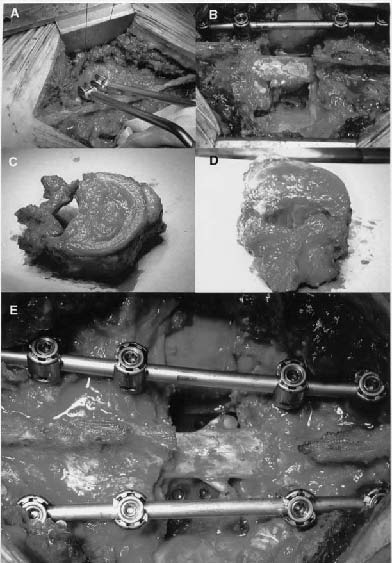
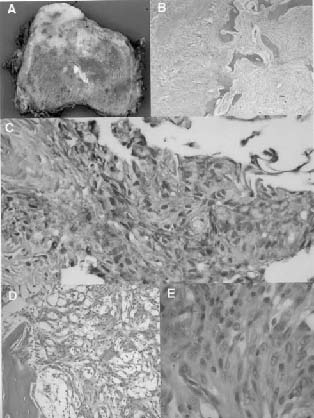
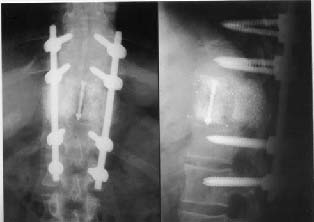
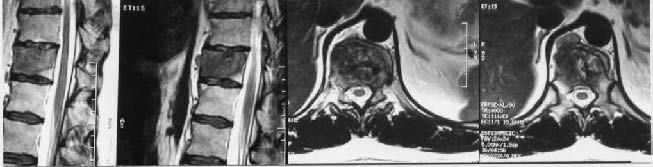
<body><![CDATA[<P ><B><font face="Verdana" size="3">Intervention</font> </b></P >     <P ><font face="Verdana" size="2">The operation above mentioned needs a wide posterior    midline exposure, including the proximal 4-5 cm of the ribs, bilaterally. The    section of the pedicles is done with a special threaded saw (T-saw<sup>TM</sup>,    DePuy Spine, Johnson&amp;Johnson, Raynham, MA., U.S.A.) introduced through the    foramen, around the pedicle, inside a thin maleable guide. It is neccessary    to resect the proximal 3-4 cm of the ribs, including their heads, in order to    remove the posterior arch in one piece. Segmental radicular vessels must be    identified and divided on both sides. The remaining vertebral body needs to    be dissected away from the surrounding structures: parietal pleural, prevertebral    soft tissue, aorta and dura. Prevertebral dissection is done bluntly by using    the fingertips of both hands until the guide for the T-saw<sup>TM </sup>can    be introduced around the vertebral body. Dura mater is gently dissected away    from the posterior longitudinal ligament and venous epidural bleeding is controlled.    At this point, unilateral pedicle screw fixation is mandatory. The vertebral    body is cut at the level of the superior and inferior disks, taking special    care not to damage the dural sac when approaching the posterior wall (a wide    spatula behind the sac is strongly recommended). Once the disks are sectioned,    it is helpful to perform gentle distraction. This allows easier removal of the    vertebra through the opposite side of the fixation. Careful hemostasis is generally    required at this stage. The intersomatic cages (Stackable Cages<sup>TM</sup>,    DePuy Spine, Johnson&amp;Johnson, Raynham, MA., U.S.A.) are filled with bone    or other substitute (pieces of the resected ribs can be used if tumoral invasion    has been previously ruled out) and introduced by the side until a proper anterior    location is achieved. Then, posterior fixation is completed (Monarch Spine System<sup>TM</sup>,    DePuy Spine, Johnson&amp;Johnson, Raynham,    MA., U.S.A.). Additional material (we used calcium carbonate <I>chips </I>and    fibrin glue) can be placed bilaterally to enforce fusion. Standard closure is    performed and a wound aspirative drain may be left. The patient is allowed to    ambulate (wearing a corset) after 2-3 days if no postoperative complications    occur. We routinely use intraoperative irrigation with antibiotic-Ringer dilution    and also postoperative low molecular weight heparin and wide-spectrum antibiotics.</font></P >     <P ><font face="Verdana" size="2"><a href="#f1">Figure 1</a> shows preoperative MRI studies; <a href="#f2"> Figure    2</a> details several stages of the en bloc vertebral resection; <a href="#f3"> Figure 3</a> shows    macroscopic as well as microscopic pathological views of the specimen; and <a href="#f4"> Figure    4 </a> shows postoperative X-rays: fusion and instrumentation devices.</font></P >     <P >&nbsp;</P >     <p align="center"><font face="Verdana" size="2"><a name="f1"> <img src="/img/revistas/neuro/v17n3/4_1.jpg" width="653" height="167"></a></font>     <P align="center" ><font face="Verdana" size="2">Figure1. <I>Preoperative spinal magnetic resonance    images:&nbsp;    <br>  intraosseous T11 mass with prevertebral paraaortic extension</I>.</font></P >     <P >&nbsp;</P >     <p align="center"><font face="Verdana" size="2"><a name="f2"> <img src="/img/revistas/neuro/v17n3/4_2.jpg" width="392" height="563"></a></font>     <P align="center" ><font face="Verdana" size="2">Figure 2. <I>A: Horizontal cut of vertebral pedicles    using the threaded saw&nbsp;    ]]></body>
<body><![CDATA[<br> (T-Saw</I><sup><I>TM</I></sup><I>, DePuy Spine, Johnson&amp;Johnson,    Raynham, MA., U.S.A.)&nbsp;    <br>  and pulley device for posterior arch en bloc removal.        <br>   B. En bloc T11 corpectomy after unilateral pedicular fixation.&nbsp;    <br>  Note that both    nerve roots need to be ligated and sectioned&nbsp;    <br>  for dissecting the vertebral body    away from the pleura, aorta and dura,&nbsp;    <br>  in order to remove the vertebral body    and pellicles in one piece.&nbsp;    <br>  Segmental radicular vessels need also to be divided.        <br>   C: Superolateral view of the resected vertebra.&nbsp;    <br>  Note the prevertebral extension    in&nbsp;    <br>  the anterior aspect of the vertebral body.     ]]></body>
<body><![CDATA[<br>   D: Posterior view of the resected vertebra.     <br>   E: Stackable carbon-fiber cages are used for interbody fusion&nbsp;    <br> (Stackable Cages</I><sup><I>TM</I></sup><I>,    DePuy Spine, Johnson&amp;Johnson, Raynham, MA., U.S.A.).&nbsp;    <br> Afterwards, pedicular    screw fixation is completed (    <br> Monarch Spine System</I><sup><I>TM</I></sup><I>,    DePuy Spine, Johnson&amp;Johnson, Raynham, MA., U.S.A.).&nbsp;    <br>  See explanation in    the text. </I></font></P >     <P align="center" >&nbsp;</P >     <p align="center"> <i><font face="Verdana" size="2"><a name="f3"><img src="/img/revistas/neuro/v17n3/4_3.jpg" width="314" height="418"></a></font></i>     <P align="center" ><font face="Verdana" size="2">Figure 3. <i>A: Macroscopic view of the affected vertebral body:&nbsp;    <br>  intraosseous    yellowish spotted lesion infiltrating the vertebral body,&nbsp;    ]]></body>
<body><![CDATA[<br>  with anterior extravertebral    extension.    <br>   B: Microscopic view corresponding to hematoxylin-eosin stain of the specimen&nbsp;    <br>   in the area of transition between intraosseous tumoral proliferation,&nbsp;    <br>  cortical    vertebral bone and prevertebral tumoral extension.    <br>   C: Microscopic view of marked EMA&nbsp;    <br> (Epithelial Membrane Antigen) positivity of    tumoral cells.    <br>   D: Meningothelial cells with clear foamy histiocytes.&nbsp;    <br>  Osteoid matrix and ostocytes    are visible in the left lower corner of the image.    <br>   E: Detail of meningothelial cells:&nbsp;    <br>  no figures of mitosis or nuclear atypia can    be observed.</i></font></P >     ]]></body>
<body><![CDATA[<P align="center" >&nbsp;</P >     <p align="center"> <i><font face="Verdana" size="2"><a name="f4"><img src="/img/revistas/neuro/v17n3/4_4.jpg" width="314" height="222"></a></font></i>     <P align="center" ><font face="Verdana" size="2">Figure 4. <i>Postoperative X-ray examination:&nbsp;    <br>  correct alignment of the interbody    fusion&nbsp;    <br>  material and multi-level pedicular screw fixation is shown</i>.</font></P >     <P >&nbsp;</P >     <P ><B><font face="Verdana" size="3">Discussion</font> </b></P >     <P ><font face="Verdana" size="2">Distant metastases from intracranial meningiomas    are rare entities with an estimated incidence of one in every thousand meningiomas<sup>12,17,31,32,35,36</sup>.    In their own experience, Enam et aI<sup>8 </sup>have reported an incidence ten    times higher (1%) over 396 surgically resected meningiomas. They also reported    a 43% chance of metastatic spread when only malignant meningiomas were considered.</font></P >     <P >&nbsp;</P >     <P ><B><font face="Verdana" size="3">Metastatic meningiomas</font> </b></P >     ]]></body>
<body><![CDATA[<P ><font face="Verdana" size="2">Over a hundred cases of extracranial metastases    arising from intracranial meningiomas are reported in the recent literature<sup>8,17,41</sup>.    About 60% of such distant metastases are localized in lungs; around 30% affect    intraabdominal organs (mainly liver), and just 10% spread to the bones<sup>17,31,32</sup>.    Only 7% occur in vertebrae<sup>17,45</sup>. A few cases of spinal metastases    have been published to date<sup>2,16,20,22,26,28,34,46</sup>. Some of them were    intrarrachidian metastases<sup>7,19 </sup>and others were intraosseous; in C-2<sup>41</sup>,    T-1<sup>9</sup>, T-10<sup>8</sup>, L-2<sup>8</sup>, L-5<sup>25</sup>, sacrum<sup>20    </sup>and multiple<sup>8</sup>. Three cases were pathologically unconfirmed<sup>19    </sup>(see <a target="_blank" href="/img/revistas/neuro/v17n3/4_t1.jpg"> Table 1</a> for a detailed description of these cases).</font></P >     <P ><font face="Verdana" size="2">From an empiric and pathological point of view,    it does not seem possible to dearly differentiate a vertebral metastatic meningioma    from another developed <I>de novo </I>within the vertebra. Citogenetic studies<sup>6    </sup>may contribute to elucidate their true origin although not an evident    influence in their therapeutic management should be expected. Primary extracranial    meningiomas may arise in unusual locations, other than leptomeninges and choroid    plexuses, such as vertebrae. Typical meningiomas originate from arachnoid <I>cap    cells </I>near arachnoid villi, structures that <I>do not </I>belong to the    central nervous system itself but which are present nearby the anatomical limits    of the blood-brain barrier. This may explain why meningiomas, overall, tend    to metastatize more frequently than primary neuroepithelial brain tumors<sup>8,12</sup>.</font>  </P >     <P ><font face="Verdana" size="2">Although 90% of intracranial meningiomas are histologically benign7,21,24, more    than 60% of the distant metastases reported are paradoxically originated from    them<sup>8,31,35,40</sup>. Nevertheless, distant metastases are known to be    relatively more frequent arising from atypical or malignant subtypes<sup>7,8,21</sup>.    Atypical and malignant meningiomas (only 1.7-4.2% of all)<sup>21,24</sup>, differ    from benign lesions according to several histological features, such as, increased    mitotic activity (more than four mitotic figures in atypical and more than twenty    mitoses in malignant, per ten high-power fields), increased cell density, presence    of nuclear pleomorphism, loss of architectural cell disposition, existence of    tumoral necrosis and brain invasion, papillary transformation and carcinoma,    melanoma or sarcomatous appearance<sup>7,8,9,18,21,39</sup>.</font> </P >     <P ><font face="Verdana" size="2">Enam et al<sup>8 </sup>classified meningiomas in benign, atypical and malignant    according to the above mentioned features. They proposed a simple 0-3 specific    score involving just six items: hypercelularity, loss of architecture, nuclear    pleomorphism, high mitotic index, tumor necrosis and brain invasion. Thus, meningiomas    scoring 0-4 points were considered benign, those scoring 5-11 were atypical    and those over 11 points were malignant (for a detailed explanation, see Mahmood    et al<sup>24</sup>). The higher the score, the higher the risk of distant metastasis:    more than 40% in malignant versus an average of 3.8% for all intracranial tumors.    According to World Health Organization Classification of tumors of the nervous    system (published in 2000)<sup>21</sup>, types II (atypical, clear cell and    chordoid variants) and III (rabdoid, papillary and anaplastic variants), and    the presence of brain invasion in either benign or malignant meningiomas, seem    to favour metastatic spread. Hemangiopericytomas are no longer considered a    subtype of meningiomas and they are actually classified separately. They also    metastatize rather frequently (23%)<sup>8</sup>.</font> </P >     <P ><font face="Verdana" size="2">The fact that distant metastases may originate from benign meningiomas suggest    that this capacity may be linked to the ability of the tumor to produce vascular    and linfatic invasion (secretion of substances such as colagenase), rather than    to the pattern of growth or the mitotic index<sup>4,13</sup>. In fact, the chances    of metastatic disease are higher in angioblastic, papillary and meningothelial    variants<sup>21,31,32</sup>. The ability to metastatize does not seem to be    related to the primary intracranial location and dubiously to the type of intervention    or the extent of resection<sup>17,23</sup>.</font> </P >     <P ><font face="Verdana" size="2">Meningiomas seem to metastatize via three main routes: hematogenous, linfatic    and through the cerebrospinal fluid<sup>8,18,22,23,41.47</sup>. It is generally    accepted that hematogenous spread is the most common pathway, especially through    the veins, given its tendency towards lung and liver invasion. It has been deemed    reasonable to relate vertebral metastatic involvement to the existence of Batson's    perivertebral venous plexus<sup>3,20</sup>. Malignant meningiomas (more prevalent in male<sup>21</sup>) seem to spread through the    cerebrospinal fluid more frequently<sup>18,39</sup>. Once inside the vertebral    body, the tumor may reach other vertebral levels by growing beneath the posterior    longitudinal ligament (considered a weak anatomical barrier) to the epidural    space, or through the paraspinal muscles to the nearby laminae<sup>10</sup>.</font></P >     <P ><font face="Verdana" size="2">It remains controversial whether craniotomy itself    may play a role in the spread of the tumor, especially in those patients harbouring    intraventricular lesions, as in the case above. The fact that most patients    are operated on several times before a metastasis occurs, supports this idea,    although some cases seem to occur in non-operated patients, as well<sup>18,37</sup>.</font></P >     <P ><font face="Verdana" size="2">There is quite a variable latency period between    the diagnosis of the intracranial tumor and the appearance of the metastasis,    ranging from a few months to more than twenty years<sup>23,30</sup>. The intracranial    lesion usually recurs locally several times before it metastatizes. This interval    appears to be shorter for atypical and malignant tumors (about a year) compared    to benign lesions (over five years). The explanation for this variety remains    unclear. It should be remembered that the overall recurrence rate of totally    resected meningiomas is 11-15% and, as much as, 30% for partially resected ones<sup>11</sup>.    The estimated recurrence rate for benign meningiomas is 3% after 5 years and    31% after 25 years. These figures turn to 38% for atypical and 50-78% for malignant    after 5 years<sup>8,14</sup>.</font></P >     <P >&nbsp;</P >     <P ><B><font face="Verdana" size="3">Total en bloc vertebrectomy</font> </b></P >     ]]></body>
<body><![CDATA[<P ><font face="Verdana" size="2">The management of metastatic disease of any kind    is generally considered to be palliative. En bloc excision of a solitary vertebral    metastasis originated from a resected intracranial meningioma is, in our opinion,    a paradigm of radical oncologic resection. It provides a chance for a possible    cure of the disease with acceptable surgical risks<sup>42,43</sup>. Radiation    and chemotherapy do play a role especially in pathologically aggressive lesions    and after local recurrence.</font></P >     <P ><font face="Verdana" size="2">In the case presented we applied the concept of    complete en bloc vertebral resection, carefully described by Tomita et al for    both vertebral metastases<sup>43 </sup>and primary vertebral tumors<sup>42</sup>.    Due to the anatomical location of the dural sac, the most radical manouver for    total spondylectomy involves the removal of the vertebra in two pieces: posterior    arch and vertebral body, separately<sup>5</sup>. Such resection must neccessarily    be accompanied by circunferencial stabilization of the spinal axis. This procedure    includes interbody fusion (bone or other substitute may be used to fill stackable    high-ressistance carbon-fiber cages) and internal fixation (pedicular screws    and bars placement). Akamaru et al<sup>1 </sup>have reported adecuate spine    reconstruction and bony fusion in a postmortem study of a patient who had undergone    an en bloc spondylectomy for Ewing's sarcoma. Interestingly, Tomita's technique    allows both resection and stabilization in a single posterior approach, which    it is believed to reduce the morbidity of a combined approach. For a detailed    description of the technique, indications and surgical risks we refer the reader    to the original papers<sup>42,43</sup>.</font></P >     <P ><font face="Verdana" size="2">The value of percutaneous biopsy for vertebral tumors    is widely recognized. The transpedicular approach is known to be safe and effective    in about 80% of cases<sup>15,27,38</sup>. In the case presented, a wrong pathological    identification of the specimen led to an initial confusion, which delayed the    real diagnosis, and supported the use of unneccessary chemotherapy. A wider    inner caliber of the biopsy trephine seems to correlate with the quality of    the specimen obtained and its suitability for pathological examination<sup>44</sup>.</font></P >     <P ><font face="Verdana" size="2">The prognosis of these patients depends on the histological    grade, which in turn conditionates both primary and secondary disease's response    to the treatment applied<sup>9</sup>. Table 1 summarizes several items of the    cases published to date. Only five cases were originally benign tumors (one    malignized after recurrence). Surgical resection was used only in benign lesions    and in just one malignant tumor, with variable results. Palliative radiation    therapy was the preferred modality of treatment. The extraosseous lesions reported    by Lee et aI<sup>19 </sup>could not be pathologically confirmed. The authors    describe several surgical procedures including partial bilateral sacrectomy,    T1, L2 and C2 corpectomies and internal fixation, through some well-known approaches.    The surgical option we chose is original in the context of surgical indication    and, we believe, appropriate in terms of efficacy and safety. Further follow-up    should confirm this statement.</font></p>     <p><font face="Verdana" size="2">To our best knowledge this is the first description    of a total en bloc thoracic spondylectomy through a single posterior approach    for a benign metastatic meningioma. Intraosseous vertebral metastatic meningiomas    are rare entities suitable for radical resection, that provide a chance for    curation with acceptable surgical risks.</font></p>      <p><I><font face="Verdana" size="2">Acknowlegments</font></I></p>     <p><font face="Verdana" size="2">Maite Incl&aacute;n, Rosana Gir&oacute;n, Carlos Escudero and Angel Velasco for their useful remarks and their help in prepairing the manuscript.</font></p>      <p>&nbsp;</p>     <p><b><font face="Verdana" size="3">References</font></b></p>     <!-- ref --><p><font face="Verdana" size="2">1. Akamaru, T., Kawahara, N., Tsuchiya, H., Kobayashi, T., Murakami, H., Tomita, K.: Healing of autologous bone in a titanium mesh cage used in anterior reconstruction after total spondylectomy. Spine 2002; 27: E329-333.</font>&nbsp;&nbsp;&nbsp;&nbsp;&nbsp;&nbsp;&nbsp;&nbsp;[&#160;<a href="javascript:void(0);" onclick="javascript: window.open('/scielo.php?script=sci_nlinks&ref=3349285&pid=S1130-1473200600030000400001&lng=','','width=640,height=500,resizable=yes,scrollbars=1,menubar=yes,');">Links</a>&#160;]<!-- end-ref --><!-- ref --><p><font face="Verdana" size="2">2. Akimura,T., Orita, T., Hayashida, O., Nishizaki, T., Fudaba, H.: Malignant meningiomas metastatizing through the cerebrospinal pathway. Acta Neurol Scand 1992; 85: 368-371.</font>&nbsp;&nbsp;&nbsp;&nbsp;&nbsp;&nbsp;&nbsp;&nbsp;[&#160;<a href="javascript:void(0);" onclick="javascript: window.open('/scielo.php?script=sci_nlinks&ref=3349286&pid=S1130-1473200600030000400002&lng=','','width=640,height=500,resizable=yes,scrollbars=1,menubar=yes,');">Links</a>&#160;]<!-- end-ref --><!-- ref --><p><font face="Verdana" size="2">3. Batson, O.V.: The function of the vertebral veins and their role in the spread of metastases. Ann Surg 1940; 112: 138-149.</font>&nbsp;&nbsp;&nbsp;&nbsp;&nbsp;&nbsp;&nbsp;&nbsp;[&#160;<a href="javascript:void(0);" onclick="javascript: window.open('/scielo.php?script=sci_nlinks&ref=3349287&pid=S1130-1473200600030000400003&lng=','','width=640,height=500,resizable=yes,scrollbars=1,menubar=yes,');">Links</a>&#160;]<!-- end-ref --><!-- ref --><p><font face="Verdana" size="2">4. Black, P.M.: Meningiomas. En: Black PM, Loeffler JS (eds). Cancer of the Nervous System. Oxford; Blackwell Science, 1977; pp. 349-362.</font>&nbsp;&nbsp;&nbsp;&nbsp;&nbsp;&nbsp;&nbsp;&nbsp;[&#160;<a href="javascript:void(0);" onclick="javascript: window.open('/scielo.php?script=sci_nlinks&ref=3349288&pid=S1130-1473200600030000400004&lng=','','width=640,height=500,resizable=yes,scrollbars=1,menubar=yes,');">Links</a>&#160;]<!-- end-ref --><!-- ref --><p><font face="Verdana" size="2">5. Boriani, S., Weinstein, J.N., Biagini, R.: Primary bone tumors of the spine.Terminology and surgical staging. Spine 1997; 22: 1036-1044.</font>&nbsp;&nbsp;&nbsp;&nbsp;&nbsp;&nbsp;&nbsp;&nbsp;[&#160;<a href="javascript:void(0);" onclick="javascript: window.open('/scielo.php?script=sci_nlinks&ref=3349289&pid=S1130-1473200600030000400005&lng=','','width=640,height=500,resizable=yes,scrollbars=1,menubar=yes,');">Links</a>&#160;]<!-- end-ref --><!-- ref --><p><font face="Verdana" size="2">6. Cerd&aacute;-Nicol&aacute;s, M., L&oacute;pez-Gines, C., P&eacute;rez-Bacete, M., Rold&aacute;n, P., Talamantes, F., Barber&aacute;, J.: Histologically benign metastatic meningioma: morphological and citogenetic study. Case report. J Neurosurg 2003; 98: 194-198.</font>&nbsp;&nbsp;&nbsp;&nbsp;&nbsp;&nbsp;&nbsp;&nbsp;[&#160;<a href="javascript:void(0);" onclick="javascript: window.open('/scielo.php?script=sci_nlinks&ref=3349290&pid=S1130-1473200600030000400006&lng=','','width=640,height=500,resizable=yes,scrollbars=1,menubar=yes,');">Links</a>&#160;]<!-- end-ref --><!-- ref --><p><font face="Verdana" size="2">7. Conrad, M.D., Schonauer, C., Pelissou-Guyotat, I., Morel, C., Madarassy, G., Deruty, R.: Recurrent lumbosacral metastases from intracranial meningioma. Report of a case and review of the literature. Acta Neurochir (Wien) 2001; 143: 935-937.</font>&nbsp;&nbsp;&nbsp;&nbsp;&nbsp;&nbsp;&nbsp;&nbsp;[&#160;<a href="javascript:void(0);" onclick="javascript: window.open('/scielo.php?script=sci_nlinks&ref=3349291&pid=S1130-1473200600030000400007&lng=','','width=640,height=500,resizable=yes,scrollbars=1,menubar=yes,');">Links</a>&#160;]<!-- end-ref --><!-- ref --><p><font face="Verdana" size="2">8. Enam, S.A., Abdulrauf, S., Mehta, B., Malik, G.M., Mahmood, A.: Metastasis in meningioma. Acta Neurochir (Wien) 1996; 138: 1172-1178.</font>&nbsp;&nbsp;&nbsp;&nbsp;&nbsp;&nbsp;&nbsp;&nbsp;[&#160;<a href="javascript:void(0);" onclick="javascript: window.open('/scielo.php?script=sci_nlinks&ref=3349292&pid=S1130-1473200600030000400008&lng=','','width=640,height=500,resizable=yes,scrollbars=1,menubar=yes,');">Links</a>&#160;]<!-- end-ref --><!-- ref --><p><font face="Verdana" size="2">9. Fuentes, S., Metellus, P., Bouvier, C., Dufour, H., Do, L., Grisoli, F.: Metastatic meningioma to the first thoracic vertebral body. A case report and review of the literature. Neurochirurgie 2002; 48: 53-56.</font>&nbsp;&nbsp;&nbsp;&nbsp;&nbsp;&nbsp;&nbsp;&nbsp;[&#160;<a href="javascript:void(0);" onclick="javascript: window.open('/scielo.php?script=sci_nlinks&ref=3349293&pid=S1130-1473200600030000400009&lng=','','width=640,height=500,resizable=yes,scrollbars=1,menubar=yes,');">Links</a>&#160;]<!-- end-ref --><!-- ref --><p><font face="Verdana" size="2">10. Fujita, T., Ueda, Y., Kawahara, N., Baba, H., Tomita, K.: Local spread of metastatic vertebral tumors. A histologic study. Spine 1997; 22: 1905-1912.</font>&nbsp;&nbsp;&nbsp;&nbsp;&nbsp;&nbsp;&nbsp;&nbsp;[&#160;<a href="javascript:void(0);" onclick="javascript: window.open('/scielo.php?script=sci_nlinks&ref=3349294&pid=S1130-1473200600030000400010&lng=','','width=640,height=500,resizable=yes,scrollbars=1,menubar=yes,');">Links</a>&#160;]<!-- end-ref --><!-- ref --><p><font face="Verdana" size="2">11. Greenberg, M.S.: Meningiomas. En: Greenberg MS (ed). Handbook of Neurosurgery, Volume One. Lakeland, Florida; Greenberg Graphics, Inc., 1997; pp. 258-261.</font>&nbsp;&nbsp;&nbsp;&nbsp;&nbsp;&nbsp;&nbsp;&nbsp;[&#160;<a href="javascript:void(0);" onclick="javascript: window.open('/scielo.php?script=sci_nlinks&ref=3349295&pid=S1130-1473200600030000400011&lng=','','width=640,height=500,resizable=yes,scrollbars=1,menubar=yes,');">Links</a>&#160;]<!-- end-ref --><!-- ref --><p><font face="Verdana" size="2">12. Guthrie, B.L., Ebersold, M.J., Sheithauer, B.W.: Neoplasms of the intracranial meninges. En: Youmans JR (ed). Neurological Survey. A comprehensive reference guide to the diagnosis and management of neurosurgical problems. Philadelphia; Saunders, 1990; pp. 3250-3315.</font>&nbsp;&nbsp;&nbsp;&nbsp;&nbsp;&nbsp;&nbsp;&nbsp;[&#160;<a href="javascript:void(0);" onclick="javascript: window.open('/scielo.php?script=sci_nlinks&ref=3349296&pid=S1130-1473200600030000400012&lng=','','width=640,height=500,resizable=yes,scrollbars=1,menubar=yes,');">Links</a>&#160;]<!-- end-ref --><!-- ref --><p><font face="Verdana" size="2">13. Halaka, A.N., Bunning, R.A., Bird, C.C., Gibson, M., Reynolds, J.J.: Production of collagenase and inhibitor (TIMP) by intracranial tumors and dura in vitro. J Neurosurg 1983; 59: 461-466.</font>&nbsp;&nbsp;&nbsp;&nbsp;&nbsp;&nbsp;&nbsp;&nbsp;[&#160;<a href="javascript:void(0);" onclick="javascript: window.open('/scielo.php?script=sci_nlinks&ref=3349297&pid=S1130-1473200600030000400013&lng=','','width=640,height=500,resizable=yes,scrollbars=1,menubar=yes,');">Links</a>&#160;]<!-- end-ref --><!-- ref --><p><font face="Verdana" size="2">14. Jaaskelainen, J., Haltia, M., Servo, A.: Atypical and anaplastic meningiomas: radiology, surgery, radiotherapy and outcome. Surg Neurol 1986; 25: 233-42</font>&nbsp;&nbsp;&nbsp;&nbsp;&nbsp;&nbsp;&nbsp;&nbsp;[&#160;<a href="javascript:void(0);" onclick="javascript: window.open('/scielo.php?script=sci_nlinks&ref=3349298&pid=S1130-1473200600030000400014&lng=','','width=640,height=500,resizable=yes,scrollbars=1,menubar=yes,');">Links</a>&#160;]<!-- end-ref --><!-- ref --><p><font face="Verdana" size="2">15. Jelinek, J.S., Kransdorf, M.J., Gray, R., Aboulafia, A.J., Malawer, M.M.: Percutaneous transpedicular biopsy of vertebral body lesions. Spine 1996 ; 21: 2035-2040.</font>&nbsp;&nbsp;&nbsp;&nbsp;&nbsp;&nbsp;&nbsp;&nbsp;[&#160;<a href="javascript:void(0);" onclick="javascript: window.open('/scielo.php?script=sci_nlinks&ref=3349299&pid=S1130-1473200600030000400015&lng=','','width=640,height=500,resizable=yes,scrollbars=1,menubar=yes,');">Links</a>&#160;]<!-- end-ref --><!-- ref --><p><font face="Verdana" size="2">16. Kamiya, K., Inagawa, T., Nagasako, R.: Malignant intraventricular menigioma with spinal metastasis through the cerebrospinal fluid. Surg Neurol 1989; 32: 213-18.</font>&nbsp;&nbsp;&nbsp;&nbsp;&nbsp;&nbsp;&nbsp;&nbsp;[&#160;<a href="javascript:void(0);" onclick="javascript: window.open('/scielo.php?script=sci_nlinks&ref=3349300&pid=S1130-1473200600030000400016&lng=','','width=640,height=500,resizable=yes,scrollbars=1,menubar=yes,');">Links</a>&#160;]<!-- end-ref --><!-- ref --><p><font face="Verdana" size="2">17. Karasik, J.L., Mullens, S.: A survey of metastatic meningiomas. J Neurosurg 1974; 40: 206- 212.</font>&nbsp;&nbsp;&nbsp;&nbsp;&nbsp;&nbsp;&nbsp;&nbsp;[&#160;<a href="javascript:void(0);" onclick="javascript: window.open('/scielo.php?script=sci_nlinks&ref=3349301&pid=S1130-1473200600030000400017&lng=','','width=640,height=500,resizable=yes,scrollbars=1,menubar=yes,');">Links</a>&#160;]<!-- end-ref --><!-- ref --><p><font face="Verdana" size="2">18. Kepes, K.K.: Meningiomas: biology, pathology and differential diagnosis. New York; Masson Publishing USA, Inc., 1982; pp. 190-200.</font>&nbsp;&nbsp;&nbsp;&nbsp;&nbsp;&nbsp;&nbsp;&nbsp;[&#160;<a href="javascript:void(0);" onclick="javascript: window.open('/scielo.php?script=sci_nlinks&ref=3349302&pid=S1130-1473200600030000400018&lng=','','width=640,height=500,resizable=yes,scrollbars=1,menubar=yes,');">Links</a>&#160;]<!-- end-ref --><!-- ref --><p><font face="Verdana" size="2">19. Lee, T.T., Landy, H.J.: Spinal metastases of malignant intracranial menigioma. Surg Neurol 1998; 50: 437-441.</font>&nbsp;&nbsp;&nbsp;&nbsp;&nbsp;&nbsp;&nbsp;&nbsp;[&#160;<a href="javascript:void(0);" onclick="javascript: window.open('/scielo.php?script=sci_nlinks&ref=3349303&pid=S1130-1473200600030000400019&lng=','','width=640,height=500,resizable=yes,scrollbars=1,menubar=yes,');">Links</a>&#160;]<!-- end-ref --><!-- ref --><p><font face="Verdana" size="2">20. Lee, Y.Y., Wen-Wei Hsu, R., Huang, T.J., Hshue, S., Wang, J.Y.: Metastatic meningioma in the sacrum: a case report. Spine 2002; 27: E100-103.</font>&nbsp;&nbsp;&nbsp;&nbsp;&nbsp;&nbsp;&nbsp;&nbsp;[&#160;<a href="javascript:void(0);" onclick="javascript: window.open('/scielo.php?script=sci_nlinks&ref=3349304&pid=S1130-1473200600030000400020&lng=','','width=640,height=500,resizable=yes,scrollbars=1,menubar=yes,');">Links</a>&#160;]<!-- end-ref --><!-- ref --><p><font face="Verdana" size="2">21. Louis, D.N., Scheitauer, B.W., Budka, H., Von Deimling, A., Kepes, J.J.: Meningiomas. En: Kleihues P, Cavenee WK (eds). World Health Organization Classification of Tumours. Pathology and Genetics of Tumours of the Nervous System. Lyon; IARC Press, 2000; pp. 176-184.</font>&nbsp;&nbsp;&nbsp;&nbsp;&nbsp;&nbsp;&nbsp;&nbsp;[&#160;<a href="javascript:void(0);" onclick="javascript: window.open('/scielo.php?script=sci_nlinks&ref=3349305&pid=S1130-1473200600030000400021&lng=','','width=640,height=500,resizable=yes,scrollbars=1,menubar=yes,');">Links</a>&#160;]<!-- end-ref --><!-- ref --><p><font face="Verdana" size="2">22. Ludwin, S.K., Conley, F.K.: Malignant meningioma metastatizing through the cerebral pathways. J Neurol Neurosurg Psychiatry 1975; 38: 136-142.</font>&nbsp;&nbsp;&nbsp;&nbsp;&nbsp;&nbsp;&nbsp;&nbsp;[&#160;<a href="javascript:void(0);" onclick="javascript: window.open('/scielo.php?script=sci_nlinks&ref=3349306&pid=S1130-1473200600030000400022&lng=','','width=640,height=500,resizable=yes,scrollbars=1,menubar=yes,');">Links</a>&#160;]<!-- end-ref --><!-- ref --><p><font face="Verdana" size="2">23. Miller, D.C., Ojemann, R.G., Proppe, K.H., et al. Benign metastatic meningioma: case report. J Neurosurg 1985; 62: 763-766.</font>&nbsp;&nbsp;&nbsp;&nbsp;&nbsp;&nbsp;&nbsp;&nbsp;[&#160;<a href="javascript:void(0);" onclick="javascript: window.open('/scielo.php?script=sci_nlinks&ref=3349307&pid=S1130-1473200600030000400023&lng=','','width=640,height=500,resizable=yes,scrollbars=1,menubar=yes,');">Links</a>&#160;]<!-- end-ref --><!-- ref --><p><font face="Verdana" size="2">24. Mahmood, A., Caccamo, D.V., Tomecek, F.J., Malik, G.M.: Atypical and malignant meningiomas: a clinicopathological review. Neurosurgery 1993; 33: 955-963.</font>&nbsp;&nbsp;&nbsp;&nbsp;&nbsp;&nbsp;&nbsp;&nbsp;[&#160;<a href="javascript:void(0);" onclick="javascript: window.open('/scielo.php?script=sci_nlinks&ref=3349308&pid=S1130-1473200600030000400024&lng=','','width=640,height=500,resizable=yes,scrollbars=1,menubar=yes,');">Links</a>&#160;]<!-- end-ref --><!-- ref --><p><font face="Verdana" size="2">25. Palmer, J.D., Cook, P.L., Ellison, D.W.: Extracranial osseous metastases from intracranial meningioma. Br J Neurosurg 1994; 8: 215-218.</font>&nbsp;&nbsp;&nbsp;&nbsp;&nbsp;&nbsp;&nbsp;&nbsp;[&#160;<a href="javascript:void(0);" onclick="javascript: window.open('/scielo.php?script=sci_nlinks&ref=3349309&pid=S1130-1473200600030000400025&lng=','','width=640,height=500,resizable=yes,scrollbars=1,menubar=yes,');">Links</a>&#160;]<!-- end-ref --><!-- ref --><p><font face="Verdana" size="2">26. Peh, W.C., Fan, Y.W.: Case report: intraventricular meningioma with cerebellopontine angle and drop metastases. Br J Radiol 1995; 68: 428-430 (abstract).</font>&nbsp;&nbsp;&nbsp;&nbsp;&nbsp;&nbsp;&nbsp;&nbsp;[&#160;<a href="javascript:void(0);" onclick="javascript: window.open('/scielo.php?script=sci_nlinks&ref=3349310&pid=S1130-1473200600030000400026&lng=','','width=640,height=500,resizable=yes,scrollbars=1,menubar=yes,');">Links</a>&#160;]<!-- end-ref --><!-- ref --><p><font face="Verdana" size="2">27. Pierot, L., Boulin, A.: Percutaneous biopsy of the thoracic and lumbar spine: transpedicular approach under fluoroscopic guidance. AJNR Am J Neuroradiol 1999; 20: 23-25.</font>&nbsp;&nbsp;&nbsp;&nbsp;&nbsp;&nbsp;&nbsp;&nbsp;[&#160;<a href="javascript:void(0);" onclick="javascript: window.open('/scielo.php?script=sci_nlinks&ref=3349311&pid=S1130-1473200600030000400027&lng=','','width=640,height=500,resizable=yes,scrollbars=1,menubar=yes,');">Links</a>&#160;]<!-- end-ref --><!-- ref --><p><font face="Verdana" size="2">28. Riley, C.G.: Metastatizing meningeal tumor case report. N Z Med J 1974; 73: 210-14 (abstract).</font>&nbsp;&nbsp;&nbsp;&nbsp;&nbsp;&nbsp;&nbsp;&nbsp;[&#160;<a href="javascript:void(0);" onclick="javascript: window.open('/scielo.php?script=sci_nlinks&ref=3349312&pid=S1130-1473200600030000400028&lng=','','width=640,height=500,resizable=yes,scrollbars=1,menubar=yes,');">Links</a>&#160;]<!-- end-ref --><!-- ref --><p><font face="Verdana" size="2">29. Rohringer, M., Sutherland, G.R., Louw, D.F., Sima, A.A.F.: Incidence and clinicopathological features of meningioma. J Neurosurg 1989; 71: 665-672.</font>&nbsp;&nbsp;&nbsp;&nbsp;&nbsp;&nbsp;&nbsp;&nbsp;[&#160;<a href="javascript:void(0);" onclick="javascript: window.open('/scielo.php?script=sci_nlinks&ref=3349313&pid=S1130-1473200600030000400029&lng=','','width=640,height=500,resizable=yes,scrollbars=1,menubar=yes,');">Links</a>&#160;]<!-- end-ref --><!-- ref --><p><font face="Verdana" size="2">30. Russell, T., Moss, T.: Metastatizing meningioma. Neurosurgery 1985; 19: 1028-1030.</font>&nbsp;&nbsp;&nbsp;&nbsp;&nbsp;&nbsp;&nbsp;&nbsp;[&#160;<a href="javascript:void(0);" onclick="javascript: window.open('/scielo.php?script=sci_nlinks&ref=3349314&pid=S1130-1473200600030000400030&lng=','','width=640,height=500,resizable=yes,scrollbars=1,menubar=yes,');">Links</a>&#160;]<!-- end-ref --><!-- ref --><p><font face="Verdana" size="2">31. Salcman, M.: Malignant meningiomas. En: Al-Mefti O (ed). Meningioma. New York; Raven Press, 1991; pp. 75-85.</font>&nbsp;&nbsp;&nbsp;&nbsp;&nbsp;&nbsp;&nbsp;&nbsp;[&#160;<a href="javascript:void(0);" onclick="javascript: window.open('/scielo.php?script=sci_nlinks&ref=3349315&pid=S1130-1473200600030000400031&lng=','','width=640,height=500,resizable=yes,scrollbars=1,menubar=yes,');">Links</a>&#160;]<!-- end-ref --><!-- ref --><p><font face="Verdana" size="2">32. Shuangshoti, S., Hongsaprabhas, C., Netsky, M.G.: Metastatizing meningiomas. Cancer 1970; 26: 832-841.</font>&nbsp;&nbsp;&nbsp;&nbsp;&nbsp;&nbsp;&nbsp;&nbsp;[&#160;<a href="javascript:void(0);" onclick="javascript: window.open('/scielo.php?script=sci_nlinks&ref=3349316&pid=S1130-1473200600030000400032&lng=','','width=640,height=500,resizable=yes,scrollbars=1,menubar=yes,');">Links</a>&#160;]<!-- end-ref --><!-- ref --><p><font face="Verdana" size="2">33. Simpson, D.: Recurrence of intracranial meningiomas after surgical treatment. J Neural Neurosurg Psychiatry 1957; 20: 22-39.</font>&nbsp;&nbsp;&nbsp;&nbsp;&nbsp;&nbsp;&nbsp;&nbsp;[&#160;<a href="javascript:void(0);" onclick="javascript: window.open('/scielo.php?script=sci_nlinks&ref=3349317&pid=S1130-1473200600030000400033&lng=','','width=640,height=500,resizable=yes,scrollbars=1,menubar=yes,');">Links</a>&#160;]<!-- end-ref --><!-- ref --><p><font face="Verdana" size="2">34. Solero, C.L., Fomari, M., Biombini, S., et al.: Spinal meningiomas: review of 174 operated cases. Neurosurgery 1989; 125: 153-160.</font>&nbsp;&nbsp;&nbsp;&nbsp;&nbsp;&nbsp;&nbsp;&nbsp;[&#160;<a href="javascript:void(0);" onclick="javascript: window.open('/scielo.php?script=sci_nlinks&ref=3349318&pid=S1130-1473200600030000400034&lng=','','width=640,height=500,resizable=yes,scrollbars=1,menubar=yes,');">Links</a>&#160;]<!-- end-ref --><!-- ref --><p><font face="Verdana" size="2">35. Son, P.M., Sacher, M., Strenger, S.W., et al.: &quot;Benign&quot;metastatizing meningiomas. AJNR Am J Neuroradiol 1987; 8: 127-130.</font>&nbsp;&nbsp;&nbsp;&nbsp;&nbsp;&nbsp;&nbsp;&nbsp;[&#160;<a href="javascript:void(0);" onclick="javascript: window.open('/scielo.php?script=sci_nlinks&ref=3349319&pid=S1130-1473200600030000400035&lng=','','width=640,height=500,resizable=yes,scrollbars=1,menubar=yes,');">Links</a>&#160;]<!-- end-ref --><!-- ref --><p><font face="Verdana" size="2">36. Strang, R.R., Ton, D., Nordenstam, H.: Meningioma with intracerebral, cerebellar and visceral metastases. J Neurosurg 1964; 21: 1098-1102.</font>&nbsp;&nbsp;&nbsp;&nbsp;&nbsp;&nbsp;&nbsp;&nbsp;[&#160;<a href="javascript:void(0);" onclick="javascript: window.open('/scielo.php?script=sci_nlinks&ref=3349320&pid=S1130-1473200600030000400036&lng=','','width=640,height=500,resizable=yes,scrollbars=1,menubar=yes,');">Links</a>&#160;]<!-- end-ref --><!-- ref --><p><font face="Verdana" size="2">37. Strenger, S.W., Huang, Y.P., Sachdez, V.P.: Malignant menignioma within the third ventricle: a case report. Neurosurgery 1987; 20: 465-468.</font>&nbsp;&nbsp;&nbsp;&nbsp;&nbsp;&nbsp;&nbsp;&nbsp;[&#160;<a href="javascript:void(0);" onclick="javascript: window.open('/scielo.php?script=sci_nlinks&ref=3349321&pid=S1130-1473200600030000400037&lng=','','width=640,height=500,resizable=yes,scrollbars=1,menubar=yes,');">Links</a>&#160;]<!-- end-ref --><!-- ref --><p><font face="Verdana" size="2">38. Stringham, D.R., Hadjipavlou, A., Dzioba, R.B., Lander, P.: Percutaneous transpedicular biopsy of the spine. Spine 1994; 19: 1985-1991.</font>&nbsp;&nbsp;&nbsp;&nbsp;&nbsp;&nbsp;&nbsp;&nbsp;[&#160;<a href="javascript:void(0);" onclick="javascript: window.open('/scielo.php?script=sci_nlinks&ref=3349322&pid=S1130-1473200600030000400038&lng=','','width=640,height=500,resizable=yes,scrollbars=1,menubar=yes,');">Links</a>&#160;]<!-- end-ref --><!-- ref --><p><font face="Verdana" size="2">39. Thomas, H.G., Clarisse, L.D., Berry, K.: Malignant meningioma: clinical and pathological features. J Neurosurg 1981; 55: 929-934.</font>&nbsp;&nbsp;&nbsp;&nbsp;&nbsp;&nbsp;&nbsp;&nbsp;[&#160;<a href="javascript:void(0);" onclick="javascript: window.open('/scielo.php?script=sci_nlinks&ref=3349323&pid=S1130-1473200600030000400039&lng=','','width=640,height=500,resizable=yes,scrollbars=1,menubar=yes,');">Links</a>&#160;]<!-- end-ref --><!-- ref --><p><font face="Verdana" size="2">40 Tognetti, C., Dorati, R., Bollini, C.: Metastatic spread of benign intracranial meningiomas. J Neurosurg Sci 1987; 31: 23-27.</font>&nbsp;&nbsp;&nbsp;&nbsp;&nbsp;&nbsp;&nbsp;&nbsp;[&#160;<a href="javascript:void(0);" onclick="javascript: window.open('/scielo.php?script=sci_nlinks&ref=3349324&pid=S1130-1473200600030000400040&lng=','','width=640,height=500,resizable=yes,scrollbars=1,menubar=yes,');">Links</a>&#160;]<!-- end-ref --><!-- ref --><p><font face="Verdana" size="2">41. Tominaga, T., Koshu, K., Narita, N., Yoshimoto, T.: Metastatic meningioma to the second cervical vertebral body: a case report. Neurosurgery 1994; 34: 538-540.</font>&nbsp;&nbsp;&nbsp;&nbsp;&nbsp;&nbsp;&nbsp;&nbsp;[&#160;<a href="javascript:void(0);" onclick="javascript: window.open('/scielo.php?script=sci_nlinks&ref=3349325&pid=S1130-1473200600030000400041&lng=','','width=640,height=500,resizable=yes,scrollbars=1,menubar=yes,');">Links</a>&#160;]<!-- end-ref --><!-- ref --><p><font face="Verdana" size="2">42. Tomita, K., Kawahara, N., Baba, H., Tsuchiya, H., Fujita, T., Toribatake, Y.: Total en bloc spondylectomy. A new surgical technique for primary malignant vertebral tumors. Spine 1997; 22: 324-333.</font>&nbsp;&nbsp;&nbsp;&nbsp;&nbsp;&nbsp;&nbsp;&nbsp;[&#160;<a href="javascript:void(0);" onclick="javascript: window.open('/scielo.php?script=sci_nlinks&ref=3349326&pid=S1130-1473200600030000400042&lng=','','width=640,height=500,resizable=yes,scrollbars=1,menubar=yes,');">Links</a>&#160;]<!-- end-ref --><!-- ref --><p><font face="Verdana" size="2">43. Tomita, K., Kawahara, N., Kobayashi, T., Yoshida, A., Murakami, H., Akamaru, T.: Surgical strategy for spinal metastases. Spine 2001; 26: 298-306.</font>&nbsp;&nbsp;&nbsp;&nbsp;&nbsp;&nbsp;&nbsp;&nbsp;[&#160;<a href="javascript:void(0);" onclick="javascript: window.open('/scielo.php?script=sci_nlinks&ref=3349327&pid=S1130-1473200600030000400043&lng=','','width=640,height=500,resizable=yes,scrollbars=1,menubar=yes,');">Links</a>&#160;]<!-- end-ref --><!-- ref --><p><font face="Verdana" size="2">44. Ward, J.C., Jeanneret, B., Oehlschlegel, C., Magerl, F.: The value of percutaneous transpedicular vertebral bone biopsies for histologic examination. Results of an experimental histopathologic study comparing two biopsy needles. Spine 1996; 21: 2484-2490.</font>&nbsp;&nbsp;&nbsp;&nbsp;&nbsp;&nbsp;&nbsp;&nbsp;[&#160;<a href="javascript:void(0);" onclick="javascript: window.open('/scielo.php?script=sci_nlinks&ref=3349328&pid=S1130-1473200600030000400044&lng=','','width=640,height=500,resizable=yes,scrollbars=1,menubar=yes,');">Links</a>&#160;]<!-- end-ref --><!-- ref --><p><font face="Verdana" size="2">45. Wasserkrug, R., Peyser, E., Lichtig, C.: Extracranial bone metastases from intracranial meningiomas. Surg Neurol 1979; 12: 480-484.</font>&nbsp;&nbsp;&nbsp;&nbsp;&nbsp;&nbsp;&nbsp;&nbsp;[&#160;<a href="javascript:void(0);" onclick="javascript: window.open('/scielo.php?script=sci_nlinks&ref=3349329&pid=S1130-1473200600030000400045&lng=','','width=640,height=500,resizable=yes,scrollbars=1,menubar=yes,');">Links</a>&#160;]<!-- end-ref --><!-- ref --><p><font face="Verdana" size="2">46. Wippold II, F.J., Smimoitopoulos, J.G., Pilgram, T.K.: Lesions of the cauda equina: a clinical pathology review from the Armed Forces Institute of Pathology. Clin Neurol Neurosurg 1997; 9: 229-234.</font>&nbsp;&nbsp;&nbsp;&nbsp;&nbsp;&nbsp;&nbsp;&nbsp;[&#160;<a href="javascript:void(0);" onclick="javascript: window.open('/scielo.php?script=sci_nlinks&ref=3349330&pid=S1130-1473200600030000400046&lng=','','width=640,height=500,resizable=yes,scrollbars=1,menubar=yes,');">Links</a>&#160;]<!-- end-ref --><!-- ref --><p><font face="Verdana" size="2">47. Wu, J.K., Kasdon, D.L., Whitmore, E.L.: Metastatic meningioma to the cervical vertebra: a case report. Neurosurgery 1985; 17: 75-79.</font>&nbsp;&nbsp;&nbsp;&nbsp;&nbsp;&nbsp;&nbsp;&nbsp;[&#160;<a href="javascript:void(0);" onclick="javascript: window.open('/scielo.php?script=sci_nlinks&ref=3349331&pid=S1130-1473200600030000400047&lng=','','width=640,height=500,resizable=yes,scrollbars=1,menubar=yes,');">Links</a>&#160;]<!-- end-ref --><p>&nbsp; </p>     <p>&nbsp;</p>     <p><font face="Verdana" size="2"><a href="#top 10"><img border="0" src="/img/revistas/neuro/v17n3/seta.gif" width="15" height="17"></a> <b><a name="Dirección">Dirección</a> para correspondencia</b><I>:&nbsp;    <br> </I>Pedro David Delgado  L&oacute;pez.&nbsp;    ]]></body>
<body><![CDATA[<br> Servicio de Neurocirug&iacute;a.&nbsp;    <br> Hospital General Yag&uuml;e. Avda Cid 96. 09005 Burgos.</font></p>     <p><font face="Verdana" size="2">Recibido: 31-03-05.&nbsp;    <br> Aceptado: 19-05-05</font></p>       ]]></body><back>
<ref-list>
<ref id="B1">
<label>1</label><nlm-citation citation-type="journal">
<person-group person-group-type="author">
<name>
<surname><![CDATA[Akamaru]]></surname>
<given-names><![CDATA[T.]]></given-names>
</name>
<name>
<surname><![CDATA[Kawahara]]></surname>
<given-names><![CDATA[N.]]></given-names>
</name>
<name>
<surname><![CDATA[Tsuchiya]]></surname>
<given-names><![CDATA[H.]]></given-names>
</name>
<name>
<surname><![CDATA[Kobayashi]]></surname>
<given-names><![CDATA[T.]]></given-names>
</name>
<name>
<surname><![CDATA[Murakami]]></surname>
<given-names><![CDATA[H.]]></given-names>
</name>
<name>
<surname><![CDATA[Tomita]]></surname>
<given-names><![CDATA[K.]]></given-names>
</name>
</person-group>
<article-title xml:lang="en"><![CDATA[Healing of autologous bone in a titanium mesh cage used in anterior reconstruction after total spondylectomy]]></article-title>
<source><![CDATA[Spine]]></source>
<year>2002</year>
<volume>27</volume>
<page-range>E329-333</page-range></nlm-citation>
</ref>
<ref id="B2">
<label>2</label><nlm-citation citation-type="journal">
<person-group person-group-type="author">
<name>
<surname><![CDATA[Akimura]]></surname>
<given-names><![CDATA[T.]]></given-names>
</name>
<name>
<surname><![CDATA[Orita]]></surname>
<given-names><![CDATA[T.]]></given-names>
</name>
<name>
<surname><![CDATA[Hayashida]]></surname>
<given-names><![CDATA[O.]]></given-names>
</name>
<name>
<surname><![CDATA[Nishizaki]]></surname>
<given-names><![CDATA[T.]]></given-names>
</name>
<name>
<surname><![CDATA[Fudaba]]></surname>
<given-names><![CDATA[H.]]></given-names>
</name>
</person-group>
<article-title xml:lang="en"><![CDATA[Malignant meningiomas metastatizing through the cerebrospinal pathway]]></article-title>
<source><![CDATA[Acta Neurol Scand]]></source>
<year>1992</year>
<volume>85</volume>
<page-range>368-371</page-range></nlm-citation>
</ref>
<ref id="B3">
<label>3</label><nlm-citation citation-type="journal">
<person-group person-group-type="author">
<name>
<surname><![CDATA[Batson]]></surname>
<given-names><![CDATA[O.V.]]></given-names>
</name>
</person-group>
<article-title xml:lang="en"><![CDATA[The function of the vertebral veins and their role in the spread of metastases]]></article-title>
<source><![CDATA[Ann Surg]]></source>
<year>1940</year>
<volume>112</volume>
<page-range>138-149</page-range></nlm-citation>
</ref>
<ref id="B4">
<label>4</label><nlm-citation citation-type="book">
<person-group person-group-type="author">
<name>
<surname><![CDATA[Black]]></surname>
<given-names><![CDATA[P.M]]></given-names>
</name>
</person-group>
<article-title xml:lang="es"><![CDATA[Meningiomas]]></article-title>
<person-group person-group-type="editor">
<name>
<surname><![CDATA[Black]]></surname>
<given-names><![CDATA[PM]]></given-names>
</name>
<name>
<surname><![CDATA[Loeffler]]></surname>
<given-names><![CDATA[JS]]></given-names>
</name>
</person-group>
<source><![CDATA[Cancer of the Nervous System]]></source>
<year>1977</year>
<page-range>349-362</page-range><publisher-loc><![CDATA[Oxford ]]></publisher-loc>
<publisher-name><![CDATA[Blackwell Science]]></publisher-name>
</nlm-citation>
</ref>
<ref id="B5">
<label>5</label><nlm-citation citation-type="journal">
<person-group person-group-type="author">
<name>
<surname><![CDATA[Boriani]]></surname>
<given-names><![CDATA[S.]]></given-names>
</name>
<name>
<surname><![CDATA[Weinstein]]></surname>
<given-names><![CDATA[J.N.]]></given-names>
</name>
<name>
<surname><![CDATA[Biagini]]></surname>
<given-names><![CDATA[R.]]></given-names>
</name>
</person-group>
<article-title xml:lang="en"><![CDATA[Primary bone tumors of the spine: Terminology and surgical staging]]></article-title>
<source><![CDATA[Spine]]></source>
<year>1997</year>
<volume>22</volume>
<page-range>1036-1044</page-range></nlm-citation>
</ref>
<ref id="B6">
<label>6</label><nlm-citation citation-type="journal">
<person-group person-group-type="author">
<name>
<surname><![CDATA[Cerdá-Nicolás]]></surname>
<given-names><![CDATA[M.]]></given-names>
</name>
<name>
<surname><![CDATA[López-Gines]]></surname>
<given-names><![CDATA[C.]]></given-names>
</name>
<name>
<surname><![CDATA[Pérez-Bacete]]></surname>
<given-names><![CDATA[M.]]></given-names>
</name>
<name>
<surname><![CDATA[Roldán]]></surname>
<given-names><![CDATA[P.]]></given-names>
</name>
<name>
<surname><![CDATA[Talamantes]]></surname>
<given-names><![CDATA[F.]]></given-names>
</name>
<name>
<surname><![CDATA[Barberá]]></surname>
<given-names><![CDATA[J.]]></given-names>
</name>
</person-group>
<article-title xml:lang="en"><![CDATA[Histologically benign metastatic meningioma: morphological and citogenetic study. Case report]]></article-title>
<source><![CDATA[J Neurosurg]]></source>
<year>2003</year>
<volume>98</volume>
<page-range>194-198</page-range></nlm-citation>
</ref>
<ref id="B7">
<label>7</label><nlm-citation citation-type="journal">
<person-group person-group-type="author">
<name>
<surname><![CDATA[Conrad]]></surname>
<given-names><![CDATA[M.D.]]></given-names>
</name>
<name>
<surname><![CDATA[Schonauer]]></surname>
<given-names><![CDATA[C.]]></given-names>
</name>
<name>
<surname><![CDATA[Pelissou-Guyotat]]></surname>
<given-names><![CDATA[I.]]></given-names>
</name>
<name>
<surname><![CDATA[Morel]]></surname>
<given-names><![CDATA[C.]]></given-names>
</name>
<name>
<surname><![CDATA[Madarassy]]></surname>
<given-names><![CDATA[G.]]></given-names>
</name>
<name>
<surname><![CDATA[Deruty]]></surname>
<given-names><![CDATA[R.]]></given-names>
</name>
</person-group>
<article-title xml:lang="en"><![CDATA[Recurrent lumbosacral metastases from intracranial meningioma: Report of a case and review of the literature]]></article-title>
<source><![CDATA[Acta Neurochir (Wien)]]></source>
<year>2001</year>
<volume>143</volume>
<page-range>935-937</page-range></nlm-citation>
</ref>
<ref id="B8">
<label>8</label><nlm-citation citation-type="journal">
<person-group person-group-type="author">
<name>
<surname><![CDATA[Enam]]></surname>
<given-names><![CDATA[S.A.]]></given-names>
</name>
<name>
<surname><![CDATA[Abdulrauf]]></surname>
<given-names><![CDATA[S.]]></given-names>
</name>
<name>
<surname><![CDATA[Mehta]]></surname>
<given-names><![CDATA[B.]]></given-names>
</name>
<name>
<surname><![CDATA[Malik]]></surname>
<given-names><![CDATA[G.M.]]></given-names>
</name>
<name>
<surname><![CDATA[Mahmood]]></surname>
<given-names><![CDATA[A.]]></given-names>
</name>
</person-group>
<article-title xml:lang="en"><![CDATA[Metastasis in meningioma]]></article-title>
<source><![CDATA[Acta Neurochir (Wien)]]></source>
<year>1996</year>
<volume>138</volume>
<page-range>1172-1178</page-range></nlm-citation>
</ref>
<ref id="B9">
<label>9</label><nlm-citation citation-type="journal">
<person-group person-group-type="author">
<name>
<surname><![CDATA[Fuentes]]></surname>
<given-names><![CDATA[S.]]></given-names>
</name>
<name>
<surname><![CDATA[Metellus]]></surname>
<given-names><![CDATA[P.]]></given-names>
</name>
<name>
<surname><![CDATA[Bouvier]]></surname>
<given-names><![CDATA[C.]]></given-names>
</name>
<name>
<surname><![CDATA[Dufour]]></surname>
<given-names><![CDATA[H.]]></given-names>
</name>
<name>
<surname><![CDATA[Do]]></surname>
<given-names><![CDATA[L.]]></given-names>
</name>
<name>
<surname><![CDATA[Grisoli]]></surname>
<given-names><![CDATA[F.]]></given-names>
</name>
</person-group>
<article-title xml:lang="en"><![CDATA[Metastatic meningioma to the first thoracic vertebral body: A case report and review of the literature]]></article-title>
<source><![CDATA[Neurochirurgie]]></source>
<year>2002</year>
<volume>48</volume>
<page-range>53-56</page-range></nlm-citation>
</ref>
<ref id="B10">
<label>10</label><nlm-citation citation-type="journal">
<person-group person-group-type="author">
<name>
<surname><![CDATA[Fujita]]></surname>
<given-names><![CDATA[T.]]></given-names>
</name>
<name>
<surname><![CDATA[Ueda]]></surname>
<given-names><![CDATA[Y.]]></given-names>
</name>
<name>
<surname><![CDATA[Kawahara]]></surname>
<given-names><![CDATA[N.]]></given-names>
</name>
<name>
<surname><![CDATA[Baba]]></surname>
<given-names><![CDATA[H.]]></given-names>
</name>
<name>
<surname><![CDATA[Tomita]]></surname>
<given-names><![CDATA[K.]]></given-names>
</name>
</person-group>
<article-title xml:lang="en"><![CDATA[Local spread of metastatic vertebral tumors: A histologic study]]></article-title>
<source><![CDATA[Spine]]></source>
<year>1997</year>
<volume>22</volume>
<page-range>1905-1912</page-range></nlm-citation>
</ref>
<ref id="B11">
<label>11</label><nlm-citation citation-type="book">
<person-group person-group-type="author">
<name>
<surname><![CDATA[Greenberg]]></surname>
<given-names><![CDATA[M.S]]></given-names>
</name>
</person-group>
<article-title xml:lang="en"><![CDATA[Meningiomas]]></article-title>
<person-group person-group-type="editor">
<name>
<surname><![CDATA[Greenberg]]></surname>
<given-names><![CDATA[MS]]></given-names>
</name>
</person-group>
<source><![CDATA[Handbook of Neurosurgery]]></source>
<year>1997</year>
<page-range>258-261</page-range><publisher-loc><![CDATA[Lakeland^eFlorida Florida]]></publisher-loc>
<publisher-name><![CDATA[Greenberg Graphics]]></publisher-name>
</nlm-citation>
</ref>
<ref id="B12">
<label>12</label><nlm-citation citation-type="book">
<person-group person-group-type="author">
<name>
<surname><![CDATA[Guthrie]]></surname>
<given-names><![CDATA[B.L]]></given-names>
</name>
<name>
<surname><![CDATA[Ebersold]]></surname>
<given-names><![CDATA[M.J]]></given-names>
</name>
<name>
<surname><![CDATA[Sheithauer]]></surname>
<given-names><![CDATA[B.W]]></given-names>
</name>
</person-group>
<article-title xml:lang="en"><![CDATA[Neoplasms of the intracranial meninges]]></article-title>
<person-group person-group-type="editor">
<name>
<surname><![CDATA[Youmans]]></surname>
<given-names><![CDATA[JR]]></given-names>
</name>
</person-group>
<source><![CDATA[Neurological Survey: A comprehensive reference guide to the diagnosis and management of neurosurgical problems]]></source>
<year>1990</year>
<page-range>3250-3315</page-range><publisher-loc><![CDATA[Philadelphia ]]></publisher-loc>
<publisher-name><![CDATA[Saunders]]></publisher-name>
</nlm-citation>
</ref>
<ref id="B13">
<label>13</label><nlm-citation citation-type="journal">
<person-group person-group-type="author">
<name>
<surname><![CDATA[Halaka]]></surname>
<given-names><![CDATA[A.N.]]></given-names>
</name>
<name>
<surname><![CDATA[Bunning]]></surname>
<given-names><![CDATA[R.A.]]></given-names>
</name>
<name>
<surname><![CDATA[Bird]]></surname>
<given-names><![CDATA[C.C.]]></given-names>
</name>
<name>
<surname><![CDATA[Gibson]]></surname>
<given-names><![CDATA[M.]]></given-names>
</name>
<name>
<surname><![CDATA[Reynolds]]></surname>
<given-names><![CDATA[J.J.]]></given-names>
</name>
</person-group>
<article-title xml:lang="en"><![CDATA[Production of collagenase and inhibitor (TIMP) by intracranial tumors and dura in vitro]]></article-title>
<source><![CDATA[J Neurosurg]]></source>
<year>1983</year>
<volume>59</volume>
<page-range>461-466</page-range></nlm-citation>
</ref>
<ref id="B14">
<label>14</label><nlm-citation citation-type="journal">
<person-group person-group-type="author">
<name>
<surname><![CDATA[Jaaskelainen]]></surname>
<given-names><![CDATA[J.]]></given-names>
</name>
<name>
<surname><![CDATA[Haltia]]></surname>
<given-names><![CDATA[M.]]></given-names>
</name>
<name>
<surname><![CDATA[Servo]]></surname>
<given-names><![CDATA[A.]]></given-names>
</name>
</person-group>
<article-title xml:lang="en"><![CDATA[Atypical and anaplastic meningiomas: radiology, surgery, radiotherapy and outcome]]></article-title>
<source><![CDATA[Surg Neurol]]></source>
<year>1986</year>
<volume>25</volume>
<page-range>233-42</page-range></nlm-citation>
</ref>
<ref id="B15">
<label>15</label><nlm-citation citation-type="journal">
<person-group person-group-type="author">
<name>
<surname><![CDATA[Jelinek]]></surname>
<given-names><![CDATA[J.S.]]></given-names>
</name>
<name>
<surname><![CDATA[Kransdorf]]></surname>
<given-names><![CDATA[M.J.]]></given-names>
</name>
<name>
<surname><![CDATA[Gray]]></surname>
<given-names><![CDATA[R.]]></given-names>
</name>
<name>
<surname><![CDATA[Aboulafia]]></surname>
<given-names><![CDATA[A.J.]]></given-names>
</name>
<name>
<surname><![CDATA[Malawer]]></surname>
<given-names><![CDATA[M.M.]]></given-names>
</name>
</person-group>
<article-title xml:lang="en"><![CDATA[Percutaneous transpedicular biopsy of vertebral body lesions]]></article-title>
<source><![CDATA[Spine]]></source>
<year>1996</year>
<volume>21</volume>
<page-range>2035-2040</page-range></nlm-citation>
</ref>
<ref id="B16">
<label>16</label><nlm-citation citation-type="journal">
<person-group person-group-type="author">
<name>
<surname><![CDATA[Kamiya]]></surname>
<given-names><![CDATA[K.]]></given-names>
</name>
<name>
<surname><![CDATA[Inagawa]]></surname>
<given-names><![CDATA[T.]]></given-names>
</name>
<name>
<surname><![CDATA[Nagasako]]></surname>
<given-names><![CDATA[R.]]></given-names>
</name>
</person-group>
<article-title xml:lang="en"><![CDATA[Malignant intraventricular menigioma with spinal metastasis through the cerebrospinal fluid]]></article-title>
<source><![CDATA[Surg Neurol]]></source>
<year>1989</year>
<volume>32</volume>
<page-range>213-18</page-range></nlm-citation>
</ref>
<ref id="B17">
<label>17</label><nlm-citation citation-type="journal">
<person-group person-group-type="author">
<name>
<surname><![CDATA[Karasik]]></surname>
<given-names><![CDATA[J.L.]]></given-names>
</name>
<name>
<surname><![CDATA[Mullens]]></surname>
<given-names><![CDATA[S.]]></given-names>
</name>
</person-group>
<article-title xml:lang="en"><![CDATA[A survey of metastatic meningiomas]]></article-title>
<source><![CDATA[J Neurosurg]]></source>
<year>1974</year>
<volume>40</volume>
<page-range>206- 212</page-range></nlm-citation>
</ref>
<ref id="B18">
<label>18</label><nlm-citation citation-type="book">
<person-group person-group-type="author">
<name>
<surname><![CDATA[Kepes]]></surname>
<given-names><![CDATA[K.K]]></given-names>
</name>
</person-group>
<source><![CDATA[Meningiomas: biology, pathology and differential diagnosis]]></source>
<year>1982</year>
<page-range>190-200</page-range><publisher-loc><![CDATA[New York ]]></publisher-loc>
<publisher-name><![CDATA[Masson Publishing USA]]></publisher-name>
</nlm-citation>
</ref>
<ref id="B19">
<label>19</label><nlm-citation citation-type="journal">
<person-group person-group-type="author">
<name>
<surname><![CDATA[Lee]]></surname>
<given-names><![CDATA[T.T.]]></given-names>
</name>
<name>
<surname><![CDATA[Landy]]></surname>
<given-names><![CDATA[H.J.]]></given-names>
</name>
</person-group>
<article-title xml:lang="en"><![CDATA[Spinal metastases of malignant intracranial menigioma]]></article-title>
<source><![CDATA[Surg Neurol]]></source>
<year>1998</year>
<volume>50</volume>
<page-range>437-441</page-range></nlm-citation>
</ref>
<ref id="B20">
<label>20</label><nlm-citation citation-type="journal">
<person-group person-group-type="author">
<name>
<surname><![CDATA[Lee]]></surname>
<given-names><![CDATA[Y.Y.]]></given-names>
</name>
<name>
<surname><![CDATA[Wen-Wei Hsu]]></surname>
<given-names><![CDATA[R.]]></given-names>
</name>
<name>
<surname><![CDATA[Huang]]></surname>
<given-names><![CDATA[T.J.]]></given-names>
</name>
<name>
<surname><![CDATA[Hshue]]></surname>
<given-names><![CDATA[S.]]></given-names>
</name>
<name>
<surname><![CDATA[Wang]]></surname>
<given-names><![CDATA[J.Y.]]></given-names>
</name>
</person-group>
<article-title xml:lang="en"><![CDATA[Metastatic meningioma in the sacrum: a case report]]></article-title>
<source><![CDATA[Spine]]></source>
<year>2002</year>
<volume>27</volume>
<page-range>E100-103</page-range></nlm-citation>
</ref>
<ref id="B21">
<label>21</label><nlm-citation citation-type="book">
<person-group person-group-type="author">
<name>
<surname><![CDATA[Louis]]></surname>
<given-names><![CDATA[D.N.]]></given-names>
</name>
<name>
<surname><![CDATA[Scheitauer]]></surname>
<given-names><![CDATA[B.W.]]></given-names>
</name>
<name>
<surname><![CDATA[Budka]]></surname>
<given-names><![CDATA[H.]]></given-names>
</name>
<name>
<surname><![CDATA[Von Deimling]]></surname>
<given-names><![CDATA[A.]]></given-names>
</name>
<name>
<surname><![CDATA[Kepes]]></surname>
<given-names><![CDATA[J.J.]]></given-names>
</name>
</person-group>
<article-title xml:lang="en"><![CDATA[Meningiomas]]></article-title>
<person-group person-group-type="editor">
<name>
<surname><![CDATA[Kleihues]]></surname>
<given-names><![CDATA[P]]></given-names>
</name>
<name>
<surname><![CDATA[Cavenee]]></surname>
<given-names><![CDATA[WK]]></given-names>
</name>
</person-group>
<source><![CDATA[World Health Organization Classification of Tumours: Pathology and Genetics of Tumours of the Nervous System]]></source>
<year>2000</year>
<page-range>176-184</page-range><publisher-loc><![CDATA[Lyon ]]></publisher-loc>
<publisher-name><![CDATA[IARC Press]]></publisher-name>
</nlm-citation>
</ref>
<ref id="B22">
<label>22</label><nlm-citation citation-type="journal">
<person-group person-group-type="author">
<name>
<surname><![CDATA[Ludwin]]></surname>
<given-names><![CDATA[S.K.]]></given-names>
</name>
<name>
<surname><![CDATA[Conley]]></surname>
<given-names><![CDATA[F.K.]]></given-names>
</name>
</person-group>
<article-title xml:lang="en"><![CDATA[Malignant meningioma metastatizing through the cerebral pathways]]></article-title>
<source><![CDATA[J Neurol Neurosurg Psychiatry]]></source>
<year>1975</year>
<volume>38</volume>
<page-range>136-142</page-range></nlm-citation>
</ref>
<ref id="B23">
<label>23</label><nlm-citation citation-type="journal">
<person-group person-group-type="author">
<name>
<surname><![CDATA[Miller]]></surname>
<given-names><![CDATA[D.C]]></given-names>
</name>
<name>
<surname><![CDATA[Ojemann]]></surname>
<given-names><![CDATA[R.G]]></given-names>
</name>
<name>
<surname><![CDATA[Proppe]]></surname>
<given-names><![CDATA[K.H]]></given-names>
</name>
</person-group>
<article-title xml:lang="en"><![CDATA[Benign metastatic meningioma: case report]]></article-title>
<source><![CDATA[J Neurosurg]]></source>
<year>1985</year>
<volume>62</volume>
<page-range>763-766</page-range></nlm-citation>
</ref>
<ref id="B24">
<label>24</label><nlm-citation citation-type="journal">
<person-group person-group-type="author">
<name>
<surname><![CDATA[Mahmood]]></surname>
<given-names><![CDATA[A.]]></given-names>
</name>
<name>
<surname><![CDATA[Caccamo]]></surname>
<given-names><![CDATA[D.V.]]></given-names>
</name>
<name>
<surname><![CDATA[Tomecek]]></surname>
<given-names><![CDATA[F.J.]]></given-names>
</name>
<name>
<surname><![CDATA[Malik]]></surname>
<given-names><![CDATA[G.M.]]></given-names>
</name>
</person-group>
<article-title xml:lang="en"><![CDATA[Atypical and malignant meningiomas: a clinicopathological review]]></article-title>
<source><![CDATA[Neurosurgery]]></source>
<year>1993</year>
<volume>33</volume>
<page-range>955-963</page-range></nlm-citation>
</ref>
<ref id="B25">
<label>25</label><nlm-citation citation-type="journal">
<person-group person-group-type="author">
<name>
<surname><![CDATA[Palmer]]></surname>
<given-names><![CDATA[J.D.]]></given-names>
</name>
<name>
<surname><![CDATA[Cook]]></surname>
<given-names><![CDATA[P.L.]]></given-names>
</name>
<name>
<surname><![CDATA[Ellison]]></surname>
<given-names><![CDATA[D.W.]]></given-names>
</name>
</person-group>
<article-title xml:lang="en"><![CDATA[Extracranial osseous metastases from intracranial meningioma]]></article-title>
<source><![CDATA[Br J Neurosurg]]></source>
<year>1994</year>
<volume>8</volume>
<page-range>215-218</page-range></nlm-citation>
</ref>
<ref id="B26">
<label>26</label><nlm-citation citation-type="journal">
<person-group person-group-type="author">
<name>
<surname><![CDATA[Peh]]></surname>
<given-names><![CDATA[W.C.]]></given-names>
</name>
<name>
<surname><![CDATA[Fan]]></surname>
<given-names><![CDATA[Y.W.]]></given-names>
</name>
</person-group>
<article-title xml:lang="en"><![CDATA[Case report: intraventricular meningioma with cerebellopontine angle and drop metastases]]></article-title>
<source><![CDATA[Br J Radiol]]></source>
<year>1995</year>
<volume>68</volume>
<page-range>428-430 (abstract)</page-range></nlm-citation>
</ref>
<ref id="B27">
<label>27</label><nlm-citation citation-type="journal">
<person-group person-group-type="author">
<name>
<surname><![CDATA[Pierot]]></surname>
<given-names><![CDATA[L.]]></given-names>
</name>
<name>
<surname><![CDATA[Boulin]]></surname>
<given-names><![CDATA[A.]]></given-names>
</name>
</person-group>
<article-title xml:lang="en"><![CDATA[Percutaneous biopsy of the thoracic and lumbar spine: transpedicular approach under fluoroscopic guidance]]></article-title>
<source><![CDATA[AJNR Am J Neuroradiol]]></source>
<year>1999</year>
<volume>20</volume>
<page-range>23-25</page-range></nlm-citation>
</ref>
<ref id="B28">
<label>28</label><nlm-citation citation-type="journal">
<person-group person-group-type="author">
<name>
<surname><![CDATA[Riley]]></surname>
<given-names><![CDATA[C.G.]]></given-names>
</name>
</person-group>
<article-title xml:lang="en"><![CDATA[Metastatizing meningeal tumor case report]]></article-title>
<source><![CDATA[N Z Med J]]></source>
<year>1974</year>
<volume>73</volume>
<page-range>210-14</page-range></nlm-citation>
</ref>
<ref id="B29">
<label>29</label><nlm-citation citation-type="journal">
<person-group person-group-type="author">
<name>
<surname><![CDATA[Rohringer]]></surname>
<given-names><![CDATA[M.]]></given-names>
</name>
<name>
<surname><![CDATA[Sutherland]]></surname>
<given-names><![CDATA[G.R.]]></given-names>
</name>
<name>
<surname><![CDATA[Louw]]></surname>
<given-names><![CDATA[D.F.]]></given-names>
</name>
<name>
<surname><![CDATA[Sima]]></surname>
<given-names><![CDATA[A.A.F.]]></given-names>
</name>
</person-group>
<article-title xml:lang="en"><![CDATA[Incidence and clinicopathological features of meningioma]]></article-title>
<source><![CDATA[J Neurosurg]]></source>
<year>1989</year>
<volume>71</volume>
<page-range>665-672</page-range></nlm-citation>
</ref>
<ref id="B30">
<label>30</label><nlm-citation citation-type="journal">
<person-group person-group-type="author">
<name>
<surname><![CDATA[Russell]]></surname>
<given-names><![CDATA[T.]]></given-names>
</name>
<name>
<surname><![CDATA[Moss]]></surname>
<given-names><![CDATA[T.]]></given-names>
</name>
</person-group>
<article-title xml:lang="en"><![CDATA[Metastatizing meningioma]]></article-title>
<source><![CDATA[Neurosurgery]]></source>
<year>1985</year>
<volume>19</volume>
<page-range>1028-1030</page-range></nlm-citation>
</ref>
<ref id="B31">
<label>31</label><nlm-citation citation-type="book">
<person-group person-group-type="author">
<name>
<surname><![CDATA[Salcman]]></surname>
<given-names><![CDATA[M.]]></given-names>
</name>
</person-group>
<article-title xml:lang="en"><![CDATA[Malignant meningiomas]]></article-title>
<person-group person-group-type="editor">
<name>
<surname><![CDATA[Al-Mefti]]></surname>
<given-names><![CDATA[O]]></given-names>
</name>
</person-group>
<source><![CDATA[Meningioma]]></source>
<year>1991</year>
<page-range>75-85</page-range><publisher-loc><![CDATA[New York ]]></publisher-loc>
<publisher-name><![CDATA[Raven Press]]></publisher-name>
</nlm-citation>
</ref>
<ref id="B32">
<label>32</label><nlm-citation citation-type="journal">
<person-group person-group-type="author">
<name>
<surname><![CDATA[Shuangshoti]]></surname>
<given-names><![CDATA[S.]]></given-names>
</name>
<name>
<surname><![CDATA[Hongsaprabhas]]></surname>
<given-names><![CDATA[C.]]></given-names>
</name>
<name>
<surname><![CDATA[Netsky]]></surname>
<given-names><![CDATA[M.G.]]></given-names>
</name>
</person-group>
<article-title xml:lang="en"><![CDATA[Metastatizing meningiomas]]></article-title>
<source><![CDATA[Cancer]]></source>
<year>1970</year>
<volume>26</volume>
<page-range>832-841</page-range></nlm-citation>
</ref>
<ref id="B33">
<label>33</label><nlm-citation citation-type="journal">
<person-group person-group-type="author">
<name>
<surname><![CDATA[Simpson]]></surname>
<given-names><![CDATA[D.]]></given-names>
</name>
</person-group>
<article-title xml:lang="en"><![CDATA[Recurrence of intracranial meningiomas after surgical treatment]]></article-title>
<source><![CDATA[J Neural Neurosurg Psychiatry]]></source>
<year>1957</year>
<volume>20</volume>
<page-range>22-39</page-range></nlm-citation>
</ref>
<ref id="B34">
<label>34</label><nlm-citation citation-type="journal">
<person-group person-group-type="author">
<name>
<surname><![CDATA[Solero]]></surname>
<given-names><![CDATA[C.L.]]></given-names>
</name>
<name>
<surname><![CDATA[Fomari]]></surname>
<given-names><![CDATA[M.]]></given-names>
</name>
<name>
<surname><![CDATA[Biombini]]></surname>
<given-names><![CDATA[S.]]></given-names>
</name>
</person-group>
<article-title xml:lang="en"><![CDATA[Spinal meningiomas: review of 174 operated cases]]></article-title>
<source><![CDATA[Neurosurgery]]></source>
<year>1989</year>
<volume>125</volume>
<page-range>153-160</page-range></nlm-citation>
</ref>
<ref id="B35">
<label>35</label><nlm-citation citation-type="journal">
<person-group person-group-type="author">
<name>
<surname><![CDATA[Son]]></surname>
<given-names><![CDATA[P.M.]]></given-names>
</name>
<name>
<surname><![CDATA[Sacher]]></surname>
<given-names><![CDATA[M.]]></given-names>
</name>
<name>
<surname><![CDATA[Strenger]]></surname>
<given-names><![CDATA[S.W.]]></given-names>
</name>
</person-group>
<article-title xml:lang="en"><![CDATA["Benign"metastatizing meningiomas]]></article-title>
<source><![CDATA[AJNR Am J Neuroradiol]]></source>
<year>1987</year>
<volume>8</volume>
<page-range>127-130</page-range></nlm-citation>
</ref>
<ref id="B36">
<label>36</label><nlm-citation citation-type="journal">
<person-group person-group-type="author">
<name>
<surname><![CDATA[Strang]]></surname>
<given-names><![CDATA[R.R.]]></given-names>
</name>
<name>
<surname><![CDATA[Ton]]></surname>
<given-names><![CDATA[D.]]></given-names>
</name>
<name>
<surname><![CDATA[Nordenstam]]></surname>
<given-names><![CDATA[H.]]></given-names>
</name>
</person-group>
<article-title xml:lang="en"><![CDATA[Meningioma with intracerebral, cerebellar and visceral metastases]]></article-title>
<source><![CDATA[J Neurosurg]]></source>
<year>1964</year>
<volume>21</volume>
<page-range>1098-1102</page-range></nlm-citation>
</ref>
<ref id="B37">
<label>37</label><nlm-citation citation-type="journal">
<person-group person-group-type="author">
<name>
<surname><![CDATA[Strenger]]></surname>
<given-names><![CDATA[S.W.]]></given-names>
</name>
<name>
<surname><![CDATA[Huang]]></surname>
<given-names><![CDATA[Y.P.]]></given-names>
</name>
<name>
<surname><![CDATA[Sachdez]]></surname>
<given-names><![CDATA[V.P.]]></given-names>
</name>
</person-group>
<article-title xml:lang="en"><![CDATA[Malignant menignioma within the third ventricle: a case report]]></article-title>
<source><![CDATA[Neurosurgery]]></source>
<year>1987</year>
<volume>20</volume>
<page-range>465-468</page-range></nlm-citation>
</ref>
<ref id="B38">
<label>38</label><nlm-citation citation-type="journal">
<person-group person-group-type="author">
<name>
<surname><![CDATA[Stringham]]></surname>
<given-names><![CDATA[D.R.]]></given-names>
</name>
<name>
<surname><![CDATA[Hadjipavlou]]></surname>
<given-names><![CDATA[A.]]></given-names>
</name>
<name>
<surname><![CDATA[Dzioba]]></surname>
<given-names><![CDATA[R.B.]]></given-names>
</name>
<name>
<surname><![CDATA[Lander]]></surname>
<given-names><![CDATA[P.]]></given-names>
</name>
</person-group>
<article-title xml:lang="en"><![CDATA[Percutaneous transpedicular biopsy of the spine]]></article-title>
<source><![CDATA[Spine]]></source>
<year>1994</year>
<volume>19</volume>
<page-range>1985-1991</page-range></nlm-citation>
</ref>
<ref id="B39">
<label>39</label><nlm-citation citation-type="journal">
<person-group person-group-type="author">
<name>
<surname><![CDATA[Thomas]]></surname>
<given-names><![CDATA[H.G.]]></given-names>
</name>
<name>
<surname><![CDATA[Clarisse]]></surname>
<given-names><![CDATA[L.D.]]></given-names>
</name>
<name>
<surname><![CDATA[Berry]]></surname>
<given-names><![CDATA[K.]]></given-names>
</name>
</person-group>
<article-title xml:lang="en"><![CDATA[Malignant meningioma: clinical and pathological features]]></article-title>
<source><![CDATA[J Neurosurg]]></source>
<year>1981</year>
<volume>55</volume>
<page-range>929-934</page-range></nlm-citation>
</ref>
<ref id="B40">
<label>40</label><nlm-citation citation-type="journal">
<person-group person-group-type="author">
<name>
<surname><![CDATA[Tognetti]]></surname>
<given-names><![CDATA[C.]]></given-names>
</name>
<name>
<surname><![CDATA[Dorati]]></surname>
<given-names><![CDATA[R.]]></given-names>
</name>
<name>
<surname><![CDATA[Bollini]]></surname>
<given-names><![CDATA[C.]]></given-names>
</name>
</person-group>
<article-title xml:lang="en"><![CDATA[Metastatic spread of benign intracranial meningiomas]]></article-title>
<source><![CDATA[J Neurosurg Sci]]></source>
<year>1987</year>
<volume>31</volume>
<page-range>23-27</page-range></nlm-citation>
</ref>
<ref id="B41">
<label>41</label><nlm-citation citation-type="journal">
<person-group person-group-type="author">
<name>
<surname><![CDATA[Tominaga]]></surname>
<given-names><![CDATA[T.]]></given-names>
</name>
<name>
<surname><![CDATA[Koshu]]></surname>
<given-names><![CDATA[K.]]></given-names>
</name>
<name>
<surname><![CDATA[Narita]]></surname>
<given-names><![CDATA[N.]]></given-names>
</name>
<name>
<surname><![CDATA[Yoshimoto]]></surname>
<given-names><![CDATA[T.]]></given-names>
</name>
</person-group>
<article-title xml:lang="en"><![CDATA[Metastatic meningioma to the second cervical vertebral body: a case report]]></article-title>
<source><![CDATA[Neurosurgery]]></source>
<year>1994</year>
<volume>34</volume>
<page-range>538-540</page-range></nlm-citation>
</ref>
<ref id="B42">
<label>42</label><nlm-citation citation-type="journal">
<person-group person-group-type="author">
<name>
<surname><![CDATA[Tomita]]></surname>
<given-names><![CDATA[K.]]></given-names>
</name>
<name>
<surname><![CDATA[Kawahara]]></surname>
<given-names><![CDATA[N.]]></given-names>
</name>
<name>
<surname><![CDATA[Baba]]></surname>
<given-names><![CDATA[H.]]></given-names>
</name>
<name>
<surname><![CDATA[Tsuchiya]]></surname>
<given-names><![CDATA[H.]]></given-names>
</name>
<name>
<surname><![CDATA[Fujita]]></surname>
<given-names><![CDATA[T.]]></given-names>
</name>
<name>
<surname><![CDATA[Toribatake]]></surname>
<given-names><![CDATA[Y.]]></given-names>
</name>
</person-group>
<article-title xml:lang="en"><![CDATA[Total en bloc spondylectomy: A new surgical technique for primary malignant vertebral tumors]]></article-title>
<source><![CDATA[Spine]]></source>
<year>1997</year>
<volume>22</volume>
<page-range>324-333</page-range></nlm-citation>
</ref>
<ref id="B43">
<label>43</label><nlm-citation citation-type="journal">
<person-group person-group-type="author">
<name>
<surname><![CDATA[Tomita]]></surname>
<given-names><![CDATA[K.]]></given-names>
</name>
<name>
<surname><![CDATA[Kawahara]]></surname>
<given-names><![CDATA[N.]]></given-names>
</name>
<name>
<surname><![CDATA[Kobayashi]]></surname>
<given-names><![CDATA[T.]]></given-names>
</name>
<name>
<surname><![CDATA[Yoshida]]></surname>
<given-names><![CDATA[A.]]></given-names>
</name>
<name>
<surname><![CDATA[Murakami]]></surname>
<given-names><![CDATA[H.]]></given-names>
</name>
<name>
<surname><![CDATA[Akamaru]]></surname>
<given-names><![CDATA[T.]]></given-names>
</name>
</person-group>
<article-title xml:lang="en"><![CDATA[Surgical strategy for spinal metastases]]></article-title>
<source><![CDATA[Spine]]></source>
<year>2001</year>
<volume>26</volume>
<page-range>298-306</page-range></nlm-citation>
</ref>
<ref id="B44">
<label>44</label><nlm-citation citation-type="journal">
<person-group person-group-type="author">
<name>
<surname><![CDATA[Ward]]></surname>
<given-names><![CDATA[J.C.]]></given-names>
</name>
<name>
<surname><![CDATA[Jeanneret]]></surname>
<given-names><![CDATA[B.]]></given-names>
</name>
<name>
<surname><![CDATA[Oehlschlegel]]></surname>
<given-names><![CDATA[C.]]></given-names>
</name>
<name>
<surname><![CDATA[Magerl]]></surname>
<given-names><![CDATA[F.]]></given-names>
</name>
</person-group>
<article-title xml:lang="en"><![CDATA[The value of percutaneous transpedicular vertebral bone biopsies for histologic examination: Results of an experimental histopathologic study comparing two biopsy needles]]></article-title>
<source><![CDATA[Spine]]></source>
<year>1996</year>
<volume>21</volume>
<page-range>2484-2490</page-range></nlm-citation>
</ref>
<ref id="B45">
<label>45</label><nlm-citation citation-type="journal">
<person-group person-group-type="author">
<name>
<surname><![CDATA[Wasserkrug]]></surname>
<given-names><![CDATA[R.]]></given-names>
</name>
<name>
<surname><![CDATA[Peyser]]></surname>
<given-names><![CDATA[E.]]></given-names>
</name>
<name>
<surname><![CDATA[Lichtig]]></surname>
<given-names><![CDATA[C.]]></given-names>
</name>
</person-group>
<article-title xml:lang="en"><![CDATA[Extracranial bone metastases from intracranial meningiomas]]></article-title>
<source><![CDATA[Surg Neurol]]></source>
<year>1979</year>
<volume>12</volume>
<page-range>480-484</page-range></nlm-citation>
</ref>
<ref id="B46">
<label>46</label><nlm-citation citation-type="journal">
<person-group person-group-type="author">
<name>
<surname><![CDATA[Wippold II]]></surname>
<given-names><![CDATA[F.J.]]></given-names>
</name>
<name>
<surname><![CDATA[Smimoitopoulos]]></surname>
<given-names><![CDATA[J.G.]]></given-names>
</name>
<name>
<surname><![CDATA[Pilgram]]></surname>
<given-names><![CDATA[T.K.]]></given-names>
</name>
</person-group>
<article-title xml:lang="en"><![CDATA[Lesions of the cauda equina: a clinical pathology review from the Armed Forces Institute of Pathology]]></article-title>
<source><![CDATA[Clin Neurol Neurosurg]]></source>
<year>1997</year>
<volume>9</volume>
<page-range>229-234</page-range></nlm-citation>
</ref>
<ref id="B47">
<label>47</label><nlm-citation citation-type="journal">
<person-group person-group-type="author">
<name>
<surname><![CDATA[Wu]]></surname>
<given-names><![CDATA[J.K.]]></given-names>
</name>
<name>
<surname><![CDATA[Kasdon]]></surname>
<given-names><![CDATA[D.L.]]></given-names>
</name>
<name>
<surname><![CDATA[Whitmore]]></surname>
<given-names><![CDATA[E.L.]]></given-names>
</name>
</person-group>
<article-title xml:lang="en"><![CDATA[Metastatic meningioma to the cervical vertebra: a case report]]></article-title>
<source><![CDATA[Neurosurgery]]></source>
<year>1985</year>
<volume>17</volume>
<page-range>75-79</page-range></nlm-citation>
</ref>
</ref-list>
</back>
</article>