<?xml version="1.0" encoding="ISO-8859-1"?><article xmlns:mml="http://www.w3.org/1998/Math/MathML" xmlns:xlink="http://www.w3.org/1999/xlink" xmlns:xsi="http://www.w3.org/2001/XMLSchema-instance">
<front>
<journal-meta>
<journal-id>1130-1473</journal-id>
<journal-title><![CDATA[Neurocirugía]]></journal-title>
<abbrev-journal-title><![CDATA[Neurocirugía]]></abbrev-journal-title>
<issn>1130-1473</issn>
<publisher>
<publisher-name><![CDATA[Sociedad Española de Neurocirugía]]></publisher-name>
</publisher>
</journal-meta>
<article-meta>
<article-id>S1130-14732007000600007</article-id>
<title-group>
<article-title xml:lang="en"><![CDATA[Cervical lipomyelomeningocele: case Illustration]]></article-title>
<article-title xml:lang="es"><![CDATA[Lipomielomeningocele cervical: Caso clínico]]></article-title>
</title-group>
<contrib-group>
<contrib contrib-type="author">
<name>
<surname><![CDATA[Gürkanlar]]></surname>
<given-names><![CDATA[D.]]></given-names>
</name>
<xref ref-type="aff" rid="A01"/>
</contrib>
<contrib contrib-type="author">
<name>
<surname><![CDATA[Gonul]]></surname>
<given-names><![CDATA[M.]]></given-names>
</name>
<xref ref-type="aff" rid="A02"/>
</contrib>
</contrib-group>
<aff id="A01">
<institution><![CDATA[,Akdeniz University School of Medicine Department of Neurosurgery ]]></institution>
<addr-line><![CDATA[Antalya ]]></addr-line>
<country>Turkey</country>
</aff>
<aff id="A02">
<institution><![CDATA[,Ankara Numune Hospital Department of Dermatology ]]></institution>
<addr-line><![CDATA[Ankara ]]></addr-line>
<country>Turkey</country>
</aff>
<pub-date pub-type="pub">
<day>00</day>
<month>12</month>
<year>2007</year>
</pub-date>
<pub-date pub-type="epub">
<day>00</day>
<month>12</month>
<year>2007</year>
</pub-date>
<volume>18</volume>
<numero>6</numero>
<fpage>505</fpage>
<lpage>507</lpage>
<copyright-statement/>
<copyright-year/>
<self-uri xlink:href="http://scielo.isciii.es/scielo.php?script=sci_arttext&amp;pid=S1130-14732007000600007&amp;lng=en&amp;nrm=iso"></self-uri><self-uri xlink:href="http://scielo.isciii.es/scielo.php?script=sci_abstract&amp;pid=S1130-14732007000600007&amp;lng=en&amp;nrm=iso"></self-uri><self-uri xlink:href="http://scielo.isciii.es/scielo.php?script=sci_pdf&amp;pid=S1130-14732007000600007&amp;lng=en&amp;nrm=iso"></self-uri><abstract abstract-type="short" xml:lang="es"><p><![CDATA[Cervical lipomyelomeningocele is a rare congenital spinal pathology. Lipomyelomeningocele is the commonest cause of congenital tethering, which causes neurological deterioration due to the conus medullaris and root ischemia. Early intervention is recommended even in cases with normal neurological examinations in order to prevent deterioration but our patient with cervical lipomyelomeningocele had a normal neurological examination despite his age (22 year-old) and had no urodynamic dysfunction.]]></p></abstract>
<abstract abstract-type="short" xml:lang="en"><p><![CDATA[El lipomielomeningocele cervical es una patología raquídea congénita rara. El lipomielomeningocele es la causa más frecuente de anclaje medular, que da lugar a deterioro neurológico, debido a isquemia del cono medular y de las raíces. Se recomienda la intervención precoz, incluso en casos con examen neurológico normal, con el fin de prevenir un deterioro, pero nuestro paciente con lipomielomeningocele cervical tenía un examen neurológico normal, a pesar de su edad (22 años) y no tenía ninguna disfunción urinaria.]]></p></abstract>
<kwd-group>
<kwd lng="es"><![CDATA[Lipomyelomeningocele]]></kwd>
<kwd lng="es"><![CDATA[Cervical]]></kwd>
<kwd lng="es"><![CDATA[Occult spinal dysraphism]]></kwd>
<kwd lng="en"><![CDATA[Lipomielomeningocele]]></kwd>
<kwd lng="en"><![CDATA[Cervical]]></kwd>
<kwd lng="en"><![CDATA[Disrafismo espinal oculto]]></kwd>
</kwd-group>
</article-meta>
</front><body><![CDATA[ <p>&nbsp;</p>     <p>&nbsp;</p>     <p><B><font face="Verdana" size="4"><a name="top"></a>Cervical lipomyelomeningocele: case Illustration</font></b></p>     <P><B><font face="Verdana" size="4">Lipomielomeningocele cervical. Caso cl&iacute;nico</font></b></p>     <P>&nbsp;</p>     <P>&nbsp;</p>     <P><B><font face="Verdana" size="2">D. G&uuml;rkanlar and M. Gonul<sup>*</sup></font></b></p>     <P><font face="Verdana" size="2">Akdeniz University School of Medicine, Department of Neurosurgery Antalya, Turkey.    <br>*Ankara Numune Hospital, Department of Dermatology Ankara, Turkey.</font></p>     <P><font face="Verdana" size="2"><a href="#bajo">Correspondence</a></font></p>     ]]></body>
<body><![CDATA[<P>&nbsp;</p>     <P>&nbsp;</p><hr size="1">     <P><B><font face="Verdana" size="2">SUMMARY</font></b></p>     <P><font face="Verdana" size="2">Cervical lipomyelomeningocele is a rare congenital spinal pathology. Lipomyelomeningocele is the commonest cause of congenital tethering, which causes neurological deterioration due to the conus medullaris and root ischemia. Early intervention is recommended even in cases with normal neurological examinations in order to prevent deterioration but our patient with cervical lipomyelomeningocele had a normal neurological examination despite his age (22 year-old) and had no urodynamic dysfunction.</font></p>     <P><font face="Verdana" size="2"><B>Key words:</B> Lipomyelomeningocele. Cervical. Occult spinal dysraphism.</font></p> <hr size="1">     <P><b><font face="Verdana" size="2">RESUMEN</font></b></p>     <P><font face="Verdana" size="2">El lipomielomeningocele cervical es una patolog&iacute;a raqu&iacute;dea cong&eacute;nita rara. El lipomielomeningocele es la causa m&aacute;s frecuente de anclaje medular, que da lugar a deterioro neurol&oacute;gico, debido a isquemia del cono medular y de las ra&iacute;ces. Se recomienda la intervenci&oacute;n precoz, incluso en casos con examen neurol&oacute;gico normal, con el fin de prevenir un deterioro, pero nuestro paciente con lipomielomeningocele cervical ten&iacute;a un examen neurol&oacute;gico normal, a pesar de su edad (22 a&ntilde;os) y no ten&iacute;a ninguna disfunci&oacute;n urinaria.</font></p>     <P><font face="Verdana" size="2"><B>Palabras clave:</B> Lipomielomeningocele. Cervical. Disrafismo espinal oculto.</font></p> <hr size="1">     <p>&nbsp;</p>     <P><B><font face="Verdana">Introduction</font></b></p>     ]]></body>
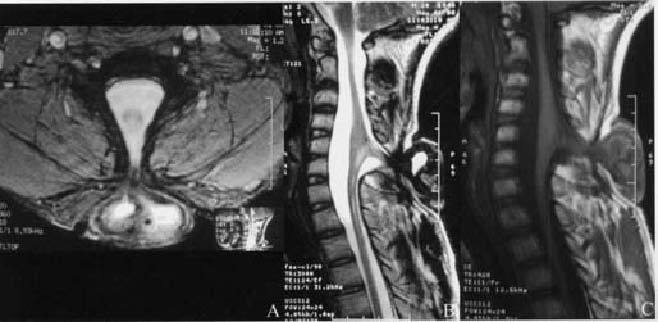
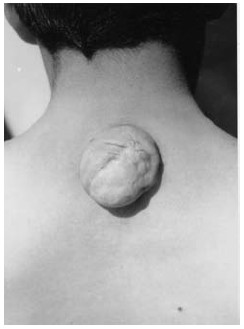
<body><![CDATA[<P><font face="Verdana" size="2">Lipomyelomeningocele is a type of congenital occult spinal dysraphism consisting of the presence of lipomatous tissue attached to the dorsal spinal cord, which protrudes though a spinal defect along with the menings or spinal cord to form a posterior mass under the skin, usually in the lumbosacral region. Neural ectoderm separates from the cutaneous ectoderm and periaxial mesoderm comes in intact with the unfused ventral neural ectoderm. The mesoderm then differentiates into fatty tissue, thus preventing the neural canal and the posterior aspect of the spine from fusing<sup>4,5</sup>.</font></p>     <P><font face="Verdana" size="2">Lipomyelomeningocele is the commonest cause of con-genital tethering and causes neurological deterioration due to the conus medullaris and root ischemia<sup>1</sup>.</font></p>     <P><font face="Verdana" size="2">Here we presented a 22 year-old patient harboring a lipomyelomeningocel in the cervical region without any neurological deficit and tethered cord.</font></p>     <P>&nbsp;</p>     <P><B><font face="Verdana">Case</font></b></p>     <P><font face="Verdana" size="2">A 22 year-old man suffering from a posterior mass in the cervical region was admitted to our out-patient clinic (<a href="#f1">Figure 1</a>). Neurological examination of the patient was unremarkable and he had no urinary dysfunction. Plain xray films of the cervical vertebrae revealed C5-6 posterior fusion defect (<a href="#f2">Figure 2</a>). The magnetic resonance imaging (MRI) of the cervical spine revealed a lipomyelomeningocel at C6 level (<a href="#f3">Figure 3</a>).</font></p>     <P align="center"><font face="Verdana" size="2"><a name="f1"><img src="/img/revistas/neuro/v18n6/7_1.jpg" width="244" height="329"></a>    <BR>Figure 1. <I>Our patient with cervical lipomyelomeningocele</I>.</font></p>     <P align="center">&nbsp;</p>     <P align="center"><font face="Verdana" size="2"><a name="f2"><img src="/img/revistas/neuro/v18n6/7_2.jpg" width="241" height="325"></a>    ]]></body>
<body><![CDATA[<BR>Figure 2. <I>Cervical plain x-ray film showing C5      <br> and C6 posterior fusion defect.</I></font></p>     <P align="center">&nbsp;</p>     <P align="center"><font face="Verdana" size="2"><a name="f3"><img src="/img/revistas/neuro/v18n6/7_3.jpg" width="658" height="322"></a>    <BR>Figure 3. <I>MRI revealing lypomyelomeningocele at C6 level</I>.</font></p>     <P align="center">&nbsp;</p>     <P><font face="Verdana" size="2">The patient was operated under general anesthesia in prone position and the lipomyelomeningocele was corrected without any complication. Postoperative neurological examination of the patient was unremarkable.</font></p>     <P>&nbsp;</p>     <P><B><font face="Verdana">Discussion</font></b></p>     <P><font face="Verdana" size="2">The lipomyelomeningocele rate has been estimated to be 2,5 per 10000 births<sup>5</sup>. Their occurrence in the cervical region is even rarer<sup>6</sup>. The defect is more commonly found in females<sup>2</sup>. An autosomal inheritance is also suggested for lipomyelomeningocele<sup>3</sup>.</font></p>     ]]></body>
<body><![CDATA[<P><font face="Verdana" size="2">Cervical and upper thoracic myelomeningoceles account for only 1-5% of all spinal dysraphism and lipomyelomeningocele as an additional congenital spinal pathology is very rare<sup>6</sup>. Although lipomyelomeningocele is the commonest cause of tethering, our patient was not harboring a tethered cord and had no urologic dysfunction<sup>1</sup>. Unless other significant spinal anomalies exist, such as a tethered cord, the risk of voiding disorders and upper tract deterioration is minimal<sup>7</sup>. Although early intervention is recommended even in cases with normal neurological examinations in order to prevent deterioration<sup>8</sup>, our patient was 22 years old and still had a normal neurological examination probably due to the lack of an additional significant spinal pathology.</font></p>     <P><font face="Verdana" size="2">It has been 5 years since we have operated the patient, and we are still following the patient's urodynamic functions because deterioration can occur up to 8 years postoperatively<sup>8</sup>.</font></p>     <P><I><font face="Verdana" size="2">Acknowledgement</font></I></p>     <P><font face="Verdana" size="2">This study was supported by Akdeniz University Research Foundation.</font></p>     <P>&nbsp;</p>     <P><B><font face="Verdana">References</font></b></p>     <!-- ref --><P><font face="Verdana" size="2">1. Cochrane, D.D., Finley, C., Kestle, J., Steinbok, P.: The patterns of late deterioration in patients with transitional lipmyelomeningocele. Eur J Pediatr Surg 2000; 10 (Suppl I) : 13-17.</font>&nbsp;&nbsp;&nbsp;&nbsp;&nbsp;&nbsp;&nbsp;&nbsp;[&#160;<a href="javascript:void(0);" onclick="javascript: window.open('/scielo.php?script=sci_nlinks&ref=3366613&pid=S1130-1473200700060000700001&lng=','','width=640,height=500,resizable=yes,scrollbars=1,menubar=yes,');">Links</a>&#160;]<!-- end-ref --><!-- ref --><p><font face="Verdana" size="2">2. Kanev, P.M., Bierbrauer, K.S.: Reflections on the natural history of lipomyelomeningocele. Pediatr Neurosurg 1995; 22: 137-140.</font>&nbsp;&nbsp;&nbsp;&nbsp;&nbsp;&nbsp;&nbsp;&nbsp;[&#160;<a href="javascript:void(0);" onclick="javascript: window.open('/scielo.php?script=sci_nlinks&ref=3366614&pid=S1130-1473200700060000700002&lng=','','width=640,height=500,resizable=yes,scrollbars=1,menubar=yes,');">Links</a>&#160;]<!-- end-ref --><!-- ref --><p><font face="Verdana" size="2">3. Kannu, P., Furneaux, C., Aftimos, S.: Familial lipomyelomeningocele. A further report. American Journal of Medical Genetics 2005; 132A: 90-92.</font>&nbsp;&nbsp;&nbsp;&nbsp;&nbsp;&nbsp;&nbsp;&nbsp;[&#160;<a href="javascript:void(0);" onclick="javascript: window.open('/scielo.php?script=sci_nlinks&ref=3366615&pid=S1130-1473200700060000700003&lng=','','width=640,height=500,resizable=yes,scrollbars=1,menubar=yes,');">Links</a>&#160;]<!-- end-ref --><!-- ref --><p><font face="Verdana" size="2">4. McLone, D.G.: The biological resolution of malformations of the central nervous system. Neurosurgery 1998; 43: 1375-1380.</font>&nbsp;&nbsp;&nbsp;&nbsp;&nbsp;&nbsp;&nbsp;&nbsp;[&#160;<a href="javascript:void(0);" onclick="javascript: window.open('/scielo.php?script=sci_nlinks&ref=3366616&pid=S1130-1473200700060000700004&lng=','','width=640,height=500,resizable=yes,scrollbars=1,menubar=yes,');">Links</a>&#160;]<!-- end-ref --><!-- ref --><p><font face="Verdana" size="2">5. McLone, D.G., Thompson, D.N.: Lipomas of the spine. In McLone DG, editor. Pediatric neurosurgery: surgery of the developing nervous system. 4<sup>th</sup> ed. Philadelphia 2001: WB Saunders. pp. 289-301.</font>&nbsp;&nbsp;&nbsp;&nbsp;&nbsp;&nbsp;&nbsp;&nbsp;[&#160;<a href="javascript:void(0);" onclick="javascript: window.open('/scielo.php?script=sci_nlinks&ref=3366617&pid=S1130-1473200700060000700005&lng=','','width=640,height=500,resizable=yes,scrollbars=1,menubar=yes,');">Links</a>&#160;]<!-- end-ref --><!-- ref --><p><font face="Verdana" size="2">6. Perez, L.M., Waxman, S.W., Webster, G.D.: Urologic management of the patient with spinal dysraphism. In Textbook of Genitourinary Surgery, 2<sup>nd</sup> ed. Edited by H.N. Whitfield, W.F. Hendry, R.S. Kirby et al. Oxford 1998: Blackwell Science LTD, pp. 926-936.</font>&nbsp;&nbsp;&nbsp;&nbsp;&nbsp;&nbsp;&nbsp;&nbsp;[&#160;<a href="javascript:void(0);" onclick="javascript: window.open('/scielo.php?script=sci_nlinks&ref=3366618&pid=S1130-1473200700060000700006&lng=','','width=640,height=500,resizable=yes,scrollbars=1,menubar=yes,');">Links</a>&#160;]<!-- end-ref --><!-- ref --><p><font face="Verdana" size="2">7. Perez, L.M., Wilbanks, J.T., Joseph, D.B., Oakes, J.W.: Urological outcome of patients with cervical and upper thoracic myelomeningocele. J Urol 2000;164: 962 -964.</font>&nbsp;&nbsp;&nbsp;&nbsp;&nbsp;&nbsp;&nbsp;&nbsp;[&#160;<a href="javascript:void(0);" onclick="javascript: window.open('/scielo.php?script=sci_nlinks&ref=3366619&pid=S1130-1473200700060000700007&lng=','','width=640,height=500,resizable=yes,scrollbars=1,menubar=yes,');">Links</a>&#160;]<!-- end-ref --><!-- ref --><p><font face="Verdana" size="2">8. Wu, H., Kogan, B.A., Baskin, L.S., Edwards, M.S.B.: Long-term benefits of early neurosurgery for lipomyelomeningocele. J Urol 1998;160: 511-514.</font>&nbsp;&nbsp;&nbsp;&nbsp;&nbsp;&nbsp;&nbsp;&nbsp;[&#160;<a href="javascript:void(0);" onclick="javascript: window.open('/scielo.php?script=sci_nlinks&ref=3366620&pid=S1130-1473200700060000700008&lng=','','width=640,height=500,resizable=yes,scrollbars=1,menubar=yes,');">Links</a>&#160;]<!-- end-ref --><p>&nbsp;</p>     <p>&nbsp;</p>     <p><font face="Verdana" size="2"><b><a href="#top"> <img border="0" src="/img/revistas/neuro/v18n6/seta.gif" width="15" height="17"></a> <a name="bajo"></a>Correspondence:</b>    <BR>Do&#287;a G&uuml;rkanlar.    <BR>M.D. Ye&#351;ilbah&ccedil;e Mah.    <br> Portakal&ccedil;i&ccedil;e&#287;i Bulvari. 1447 sk.    ]]></body>
<body><![CDATA[<br> B.G&uuml;rkanlar Apt. 3/11. Antalya/ T&uuml;rkiye.</font></p>     <P><font face="Verdana" size="2">Recibido: 29-11-06.    <br> Aceptado: 6-06-07</font></p>     <P>&nbsp;</p>     <P><B><font face="Verdana" size="2">Comentario al trabajo</font></b></p>     <P><B><font face="Verdana" size="2"><I>Cervical lipomyelomeningocele: case Illustration</I> de G&uuml;rkanlar and col.</font></b></p>     <P><font face="Verdana" size="2">We read with great interest the article bu Gurkanlar and al, entitled &quot;Cervical lipomyelomeningocele&quot;. The author describes a fatty mass starting under the skin of the child's back, in the cervical midline line. The mass extended inward to the spinal canal and was covered by skin and visible from outside. The two biggest problems lipomyelomeningoceles have in children are: The spinal cord is stuck (fixed) to the fatty mass and the fatty mass puts pressure on the spinal cord. The defect happens early in the mother's pregnancy, (about the fourth to sixth week) and has no known cause. Unlike a mielomeningocele, it does not have a genetic component nor it is due to a lack of folic acid during pregnancy. The authors describe very well a rare cause of cervical lipomyelomeningocele.</font></p>     <P align="right"><I><font face="Verdana" size="2">A. Kaen    <br> R.D.Lobato</font></I></p>     <P align="right"><font face="Verdana" size="2">Madrid</font></p>     ]]></body>
<body><![CDATA[ ]]></body><back>
<ref-list>
<ref id="B1">
<label>1</label><nlm-citation citation-type="journal">
<person-group person-group-type="author">
<name>
<surname><![CDATA[Cochrane]]></surname>
<given-names><![CDATA[D.D.]]></given-names>
</name>
<name>
<surname><![CDATA[Finley]]></surname>
<given-names><![CDATA[C.]]></given-names>
</name>
<name>
<surname><![CDATA[Kestle]]></surname>
<given-names><![CDATA[J.]]></given-names>
</name>
<name>
<surname><![CDATA[Steinbok]]></surname>
<given-names><![CDATA[P.]]></given-names>
</name>
</person-group>
<article-title xml:lang="en"><![CDATA[The patterns of late deterioration in patients with transitional lipmyelomeningocele]]></article-title>
<source><![CDATA[Eur J Pediatr Surg]]></source>
<year>2000</year>
<volume>10</volume>
<numero>^sI</numero>
<issue>^sI</issue>
<supplement>I</supplement>
<page-range>13-17</page-range></nlm-citation>
</ref>
<ref id="B2">
<label>2</label><nlm-citation citation-type="journal">
<person-group person-group-type="author">
<name>
<surname><![CDATA[Kanev]]></surname>
<given-names><![CDATA[P.M.]]></given-names>
</name>
<name>
<surname><![CDATA[Bierbrauer]]></surname>
<given-names><![CDATA[K.S.]]></given-names>
</name>
</person-group>
<article-title xml:lang="en"><![CDATA[Reflections on the natural history of lipomyelomeningocele]]></article-title>
<source><![CDATA[Pediatr Neurosurg]]></source>
<year>1995</year>
<volume>22</volume>
<page-range>137-140</page-range></nlm-citation>
</ref>
<ref id="B3">
<label>3</label><nlm-citation citation-type="journal">
<person-group person-group-type="author">
<name>
<surname><![CDATA[Kannu]]></surname>
<given-names><![CDATA[P.]]></given-names>
</name>
<name>
<surname><![CDATA[Furneaux]]></surname>
<given-names><![CDATA[C.]]></given-names>
</name>
<name>
<surname><![CDATA[Aftimos]]></surname>
<given-names><![CDATA[S.]]></given-names>
</name>
</person-group>
<article-title xml:lang="en"><![CDATA[Familial lipomyelomeningocele: A further report]]></article-title>
<source><![CDATA[American Journal of Medical Genetics]]></source>
<year>2005</year>
<volume>132A</volume>
<page-range>90-92</page-range></nlm-citation>
</ref>
<ref id="B4">
<label>4</label><nlm-citation citation-type="journal">
<person-group person-group-type="author">
<name>
<surname><![CDATA[McLone]]></surname>
<given-names><![CDATA[D.G.]]></given-names>
</name>
</person-group>
<article-title xml:lang="en"><![CDATA[The biological resolution of malformations of the central nervous system]]></article-title>
<source><![CDATA[Neurosurgery]]></source>
<year>1998</year>
<volume>43</volume>
<page-range>1375-1380</page-range></nlm-citation>
</ref>
<ref id="B5">
<label>5</label><nlm-citation citation-type="book">
<person-group person-group-type="author">
<name>
<surname><![CDATA[McLone]]></surname>
<given-names><![CDATA[D.G]]></given-names>
</name>
<name>
<surname><![CDATA[Thompson]]></surname>
<given-names><![CDATA[D.N.]]></given-names>
</name>
</person-group>
<article-title xml:lang="en"><![CDATA[Lipomas of the spine]]></article-title>
<person-group person-group-type="editor">
<name>
<surname><![CDATA[McLone]]></surname>
<given-names><![CDATA[DG]]></given-names>
</name>
</person-group>
<source><![CDATA[Pediatric neurosurgery: surgery of the developing nervous system]]></source>
<year>2001</year>
<edition>4</edition>
<page-range>289-301</page-range><publisher-loc><![CDATA[Philadelphia ]]></publisher-loc>
<publisher-name><![CDATA[WB Saunders]]></publisher-name>
</nlm-citation>
</ref>
<ref id="B6">
<label>6</label><nlm-citation citation-type="book">
<person-group person-group-type="author">
<name>
<surname><![CDATA[Perez]]></surname>
<given-names><![CDATA[L.M]]></given-names>
</name>
<name>
<surname><![CDATA[Waxman]]></surname>
<given-names><![CDATA[S.W.]]></given-names>
</name>
<name>
<surname><![CDATA[Webster]]></surname>
<given-names><![CDATA[G.D.]]></given-names>
</name>
</person-group>
<article-title xml:lang="en"><![CDATA[Urologic management of the patient with spinal dysraphism]]></article-title>
<person-group person-group-type="editor">
<name>
<surname><![CDATA[Whitfield]]></surname>
<given-names><![CDATA[H.N.]]></given-names>
</name>
<name>
<surname><![CDATA[Hendry]]></surname>
<given-names><![CDATA[W.F.]]></given-names>
</name>
<name>
<surname><![CDATA[Kirby]]></surname>
<given-names><![CDATA[R.S.]]></given-names>
</name>
</person-group>
<source><![CDATA[Textbook of Genitourinary Surgery]]></source>
<year>1998</year>
<edition>2</edition>
<page-range>926-936</page-range><publisher-loc><![CDATA[Oxford ]]></publisher-loc>
<publisher-name><![CDATA[Blackwell Science LTD]]></publisher-name>
</nlm-citation>
</ref>
<ref id="B7">
<label>7</label><nlm-citation citation-type="journal">
<person-group person-group-type="author">
<name>
<surname><![CDATA[Perez]]></surname>
<given-names><![CDATA[L.M.]]></given-names>
</name>
<name>
<surname><![CDATA[Wilbanks]]></surname>
<given-names><![CDATA[J.T.]]></given-names>
</name>
<name>
<surname><![CDATA[Joseph]]></surname>
<given-names><![CDATA[D.B.]]></given-names>
</name>
<name>
<surname><![CDATA[Oakes]]></surname>
<given-names><![CDATA[J.W.]]></given-names>
</name>
</person-group>
<article-title xml:lang="en"><![CDATA[Urological outcome of patients with cervical and upper thoracic myelomeningocele]]></article-title>
<source><![CDATA[J Urol]]></source>
<year>2000</year>
<volume>164</volume>
<page-range>962 -964</page-range></nlm-citation>
</ref>
<ref id="B8">
<label>8</label><nlm-citation citation-type="journal">
<person-group person-group-type="author">
<name>
<surname><![CDATA[Wu]]></surname>
<given-names><![CDATA[H.]]></given-names>
</name>
<name>
<surname><![CDATA[Kogan]]></surname>
<given-names><![CDATA[B.A.]]></given-names>
</name>
<name>
<surname><![CDATA[Baskin]]></surname>
<given-names><![CDATA[L.S.]]></given-names>
</name>
<name>
<surname><![CDATA[Edwards]]></surname>
<given-names><![CDATA[M.S.B.]]></given-names>
</name>
</person-group>
<article-title xml:lang="en"><![CDATA[Long-term benefits of early neurosurgery for lipomyelomeningocele]]></article-title>
<source><![CDATA[J Urol]]></source>
<year>1998</year>
<volume>160</volume>
<page-range>511-514</page-range></nlm-citation>
</ref>
</ref-list>
</back>
</article>