<?xml version="1.0" encoding="ISO-8859-1"?><article xmlns:mml="http://www.w3.org/1998/Math/MathML" xmlns:xlink="http://www.w3.org/1999/xlink" xmlns:xsi="http://www.w3.org/2001/XMLSchema-instance">
<front>
<journal-meta>
<journal-id>1130-5274</journal-id>
<journal-title><![CDATA[Clínica y Salud]]></journal-title>
<abbrev-journal-title><![CDATA[Clínica y Salud]]></abbrev-journal-title>
<issn>1130-5274</issn>
<publisher>
<publisher-name><![CDATA[Colegio Oficial de la Psicología de Madrid]]></publisher-name>
</publisher>
</journal-meta>
<article-meta>
<article-id>S1130-52742016000200003</article-id>
<article-id pub-id-type="doi">10.1016/j.clysa.2016.04.001</article-id>
<title-group>
<article-title xml:lang="es"><![CDATA[Factores de riesgo psicopatológicos para la agresión en la pareja en una muestra comunitaria]]></article-title>
<article-title xml:lang="en"><![CDATA[Psychopathological risk factors for partner aggression in a community sample]]></article-title>
</title-group>
<contrib-group>
<contrib contrib-type="author">
<name>
<surname><![CDATA[Cuenca]]></surname>
<given-names><![CDATA[María Luisa]]></given-names>
</name>
<xref ref-type="aff" rid="A01"/>
</contrib>
<contrib contrib-type="author">
<name>
<surname><![CDATA[Graña]]></surname>
<given-names><![CDATA[José Luis]]></given-names>
</name>
<xref ref-type="aff" rid="A01"/>
</contrib>
</contrib-group>
<aff id="A01">
<institution><![CDATA[,Universidad Complutense de Madrid  ]]></institution>
<addr-line><![CDATA[Madrid ]]></addr-line>
<country>España</country>
</aff>
<pub-date pub-type="pub">
<day>00</day>
<month>07</month>
<year>2016</year>
</pub-date>
<pub-date pub-type="epub">
<day>00</day>
<month>07</month>
<year>2016</year>
</pub-date>
<volume>27</volume>
<numero>2</numero>
<fpage>57</fpage>
<lpage>63</lpage>
<copyright-statement/>
<copyright-year/>
<self-uri xlink:href="http://scielo.isciii.es/scielo.php?script=sci_arttext&amp;pid=S1130-52742016000200003&amp;lng=en&amp;nrm=iso"></self-uri><self-uri xlink:href="http://scielo.isciii.es/scielo.php?script=sci_abstract&amp;pid=S1130-52742016000200003&amp;lng=en&amp;nrm=iso"></self-uri><self-uri xlink:href="http://scielo.isciii.es/scielo.php?script=sci_pdf&amp;pid=S1130-52742016000200003&amp;lng=en&amp;nrm=iso"></self-uri><abstract abstract-type="short" xml:lang="es"><p><![CDATA[El presente estudio examina desde las perspectivas del desarrollo y diádica el valor predictivo de determinadas variables psicopatológicas para la agresión física en una muestra de 2.032 parejas heterosexuales pertenecientes a la Comunidad de Madrid, mediante la Escala de Tácticas para el Conflicto (CTS-2). Los resultados mostraron una prevalencia de agresión psicológica superior a la agresión física y diferencias significativas en agresión física de bajo nivel en el caso de las mujeres, 13% vs. 10%, &#967;²(1, N = 4.064) = 7.43, p < .001. Los resultados confirman que los síntomas de hostilidad, los rasgos de personalidad impulsiva, límite, antisocial, el consumo de alcohol y la experiencia de victimización tienen un mayor impacto en hombres y mujeres jóvenes (18-29 años). Se discuten las implicaciones de los resultados para la prevención y terapia de pareja.]]></p></abstract>
<abstract abstract-type="short" xml:lang="en"><p><![CDATA[The present study examines the predictive value of certain psychopathological variables for physical aggression, from the developmental and dyadic perspectives, in a sample of 2,032 heterosexual couples from the Madrid Region, through the Conflict Tactics Scale (CTS-2). The results showed a higher prevalence of psychological aggression than of physical aggression, and significant differences in low level physical aggression in the case of women, 13% vs. 10%, &#967;²(1, N = 4.064) = 7.43, p < .001. The results confirm that symptoms of hostility, impulsive, borderline, and antisocial personality traits, alcohol consumption, and the experience of victimization have a greater impact on younger men and women (18-29 years). The implications of the results for prevention of partner violence and for couple therapy are discussed.]]></p></abstract>
<kwd-group>
<kwd lng="es"><![CDATA[Agresión física]]></kwd>
<kwd lng="es"><![CDATA[Datos diádicos]]></kwd>
<kwd lng="es"><![CDATA[Factores de riesgo]]></kwd>
<kwd lng="es"><![CDATA[Agresión en la pareja]]></kwd>
<kwd lng="es"><![CDATA[Victimización]]></kwd>
<kwd lng="en"><![CDATA[Physical aggression]]></kwd>
<kwd lng="en"><![CDATA[Dyadic data]]></kwd>
<kwd lng="en"><![CDATA[Risk factors]]></kwd>
<kwd lng="en"><![CDATA[Partner aggression]]></kwd>
<kwd lng="en"><![CDATA[Victimization]]></kwd>
</kwd-group>
</article-meta>
</front><body><![CDATA[ <p><a name="top"></a>&nbsp;</p>     <p>&nbsp;</p>     <p><font face="Verdana" size="4"><b>Factores de riesgo psicopatol&oacute;gicos para la agresi&oacute;n en la pareja en una muestra comunitaria</b></font></p>     <p><font face="Verdana" size="4"><b>Psychopathological risk factors for partner aggression in a community sample</b></font></p>     <p>&nbsp;</p>     <p>&nbsp;</p>     <p><font face="Verdana" size="2"><b>Mar&iacute;a Luisa Cuenca y Jos&eacute; Luis Gra&ntilde;a</b></font></p>     <p><font face="Verdana" size="2">Universidad Complutense de Madrid, Espa&ntilde;a</font></p>     <p><font face="Verdana" size="2"><a href="#bajo">Direcci&oacute;n para correspondencia</a></font></p>     <p>&nbsp;</p>     ]]></body>
<body><![CDATA[<p>&nbsp;</p> <hr size="1">     <p><font face="Verdana" size="2"><b>RESUMEN</b></font></p>     <p><font face="Verdana" size="2">El presente estudio examina desde las perspectivas del desarrollo y di&aacute;dica el valor predictivo de determinadas variables psicopatol&oacute;gicas para la agresi&oacute;n f&iacute;sica en una muestra de 2.032 parejas heterosexuales pertenecientes a la Comunidad de Madrid, mediante la Escala de T&aacute;cticas para el Conflicto (CTS-2). Los resultados mostraron una prevalencia de agresi&oacute;n psicol&oacute;gica superior a la agresi&oacute;n f&iacute;sica y diferencias significativas en agresi&oacute;n f&iacute;sica de bajo nivel en el caso de las mujeres, 13% vs. 10%, &chi;<sup>2</sup>(1, <i>N</i> = 4.064) = 7.43, <i>p</i> &lt; .001. Los resultados confirman que los s&iacute;ntomas de hostilidad, los rasgos de personalidad impulsiva, l&iacute;mite, antisocial, el consumo de alcohol y la experiencia de victimizaci&oacute;n tienen un mayor impacto en hombres y mujeres j&oacute;venes (18-29 a&ntilde;os). Se discuten las implicaciones de los resultados para la prevenci&oacute;n y terapia de pareja.</font></p>     <p><font face="Verdana" size="2"><b>Palabras clave:</b> Agresi&oacute;n f&iacute;sica. Datos di&aacute;dicos. Factores de riesgo. Agresi&oacute;n en la pareja. Victimizaci&oacute;n.</font></p> <hr size="1">     <p><font face="Verdana" size="2"><b>ABSTRACT</b></font></p>     <p><font face="Verdana" size="2">The present study examines the predictive value of certain psychopathological variables for physical aggression, from the developmental and dyadic perspectives, in a sample of 2,032 heterosexual couples from the Madrid Region, through the Conflict Tactics Scale (CTS-2). The results showed a higher prevalence of psychological aggression than of physical aggression, and significant differences in low level physical aggression in the case of women, 13% vs. 10%, &chi;<sup>2</sup>(1, <i>N</i> = 4.064) = 7.43, <i>p</i> &lt; .001. The results confirm that symptoms of hostility, impulsive, borderline, and antisocial personality traits, alcohol consumption, and the experience of victimization have a greater impact on younger men and women (18-29 years). The implications of the results for prevention of partner violence and for couple therapy are discussed.</font></p>     <p><font face="Verdana" size="2"><b>Key words:</b> Physical aggression. Dyadic data. Risk factors. Partner aggression. Victimization.</font></p> <hr size="1">     <p>&nbsp;</p>     <p><font face="Verdana" size="2">En los &uacute;ltimos a&ntilde;os, la violencia en las relaciones de pareja se ha convertido en un objetivo prioritario de la investigaci&oacute;n en el campo de las ciencias sociales, a la vista del n&uacute;mero de estudios epidemiol&oacute;gicos, encuestas sociales y publicaciones cient&iacute;ficas que han examinado este fen&oacute;meno mediante la Escala de T&aacute;cticas de Conflicto (CTS; Straus, 1979; Straus, Hamby, Boney-McCoy y Sugarman, 1996).</font></p>     <p><font face="Verdana" size="2">La investigaci&oacute;n en este &aacute;mbito sostiene que hombres y mujeres utilizan t&aacute;cticas agresivas durante los conflictos de relaci&oacute;n, dimensi&oacute;n que Capaldi y Langhinrichsen-Rohling (2012) consideran cr&iacute;tica en el estudio de la violencia en la pareja &#091;<i>intimate partner violence</i>, IPV&#093;. Este tipo de agresi&oacute;n, conceptualizada por Johnson (2011) como <i>violencia situacional</i>, se caracteriza por que no se basa en una din&aacute;mica de coerci&oacute;n y control, es menos grave y generalmente se basa en un patr&oacute;n de comportamiento agresivo de tipo epis&oacute;dico o reactivo, generalmente asociado a conflictos de relaci&oacute;n o a la gesti&oacute;n de situaciones cr&iacute;ticas en la relaci&oacute;n de pareja, como puede suceder en los procesos de separaci&oacute;n o divorcio (Mu&ntilde;oz y Echebur&uacute;a, 2016).</font></p>     ]]></body>
<body><![CDATA[<p><font face="Verdana" size="2">La complejidad y multicausalidad de este fen&oacute;meno son aspectos que repercuten en su din&aacute;mica y en las consecuencias para la salud f&iacute;sica y mental (Coker et al., 2002). En el momento actual se pone de relieve la necesidad de prevenir los comportamientos agresivos e intervenir en los mismos, con el objetivo de disminuir su impacto, persistencia y victimizaci&oacute;n asociada (Desmarais, Reeves, Nicholls, Telford y Fiebert, 2012a, 2012b; Llorens, Salis, O'Leary y Hayward, 2016; O'Leary, 2015).</font></p>     <p><font face="Verdana" size="2">Los estudios epidemiol&oacute;gicos realizados en muestras representativas estadounidenses muestran que aproximadamente un 10% de los hombres y las mujeres han experimentado agresiones f&iacute;sicas por parte de sus parejas (Esquivel-Santove&ntilde;a y Dixon, 2012; Jose y O'Leary, 2009), porcentajes que se han confirmado en los estudios realizados a nivel comunitario en nuestro pa&iacute;s (Cuenca-Montesino, Gra&ntilde;a y Mart&iacute;nez-Arias, 2014; Gra&ntilde;a, 2009; Gra&ntilde;a y Cuenca-Montesino, 2014).</font></p>     <p><font face="Verdana" size="2">En el momento actual se sabe muy poco de los factores de riesgo psicopatol&oacute;gicos asociados a la perpetraci&oacute;n de agresi&oacute;n f&iacute;sica en hombres y mujeres y hasta la fecha la mayor parte de la investigaci&oacute;n se ha desarrollado en Estados Unidos. En conjunto, Stith, Smith y Penn (2004) sostienen que el abuso emocional, las relaciones sexuales forzadas, el consumo de drogas, las actitudes hacia la violencia y la satisfacci&oacute;n marital representan los factores de riesgo m&aacute;s significativos para perpetrar agresi&oacute;n f&iacute;sica. O'Leary, Smith Slep y O'Leary (2007) encontraron que los comportamientos dominantes y celosos as&iacute; como el ajuste di&aacute;dico resultaron predictores significativos para la agresi&oacute;n f&iacute;sica en hombres y mujeres. O'Leary, Tintle, Bromet y Gluzman (2008) observaron que en Ucrania el inicio temprano en el consumo de alcohol y los problemas psiqui&aacute;tricos (trastorno explosivo intermitente) resultaban predictores significativos de los informes de perpetraci&oacute;n de agresi&oacute;n f&iacute;sica en los hombres casados. En el caso de las mujeres, el inicio temprano en el consumo de alcohol, la edad (ser joven) y los problemas de relaci&oacute;n resultaron predictores significativos de los informes de victimizaci&oacute;n. Stith et al. (2011) identificaron una serie de factores de vulnerabilidad (caracter&iacute;sticas propias de la persona, experiencia acumulada y creencias sobre la relaci&oacute;n) que en combinaci&oacute;n con sucesos estresantes (cambios a lo largo de la vida o circunstanciales) produc&iacute;an cambios adaptativos en las habilidades de resoluci&oacute;n de conflictos (definidas como conformidad, escalada y evitaci&oacute;n de los conflictos) y que predispon&iacute;an a la violencia f&iacute;sica. Recientemente, O'Leary, Tintle y Bromet (2014) vieron que dos variables di&aacute;dicas, la experiencia de victimizaci&oacute;n y los problemas de relaci&oacute;n, eran los predictores m&aacute;s significativos para perpetrar agresi&oacute;n f&iacute;sica. Adem&aacute;s, la agresi&oacute;n en las citas y el trastorno explosivo-intermitente resultaban ser factores de riesgo de la agresi&oacute;n f&iacute;sica en hombres y mujeres.</font></p>     <p><font face="Verdana" size="2">El presente estudio se ha dise&ntilde;ado para examinar los factores de riesgo psicopatol&oacute;gicos en hombres y mujeres de agresi&oacute;n f&iacute;sica. En el desarrollo del presente estudio se han considerado tres perspectivas te&oacute;ricas a la hora de abordar el an&aacute;lisis de los factores de riesgo (O'Leary et al., 2007; O'Leary, Tintle y Bromet, 2014; Shumacher y Leonard, 2005; Stith et al., 2004): (1) perspectiva del desarrollo (edad), (2) perspectiva psicopatol&oacute;gica (sintomatolog&iacute;a psicopatol&oacute;gica, rasgos disfuncionales de personalidad, abuso de alcohol y nivel de autoestima) y (3) perspectiva di&aacute;dica de la relaci&oacute;n (experiencia de victimizaci&oacute;n y calidad marital).</font></p>     <p><font face="Verdana" size="2">Dada la similitud entre los Estados Unidos y la cultura espa&ntilde;ola en cuanto a &iacute;ndices de alfabetizaci&oacute;n, esperanza de vida y nivel de educaci&oacute;n, este dato nos permite comparar los &iacute;ndices de prevalencia de agresi&oacute;n. En segundo lugar, seg&uacute;n Jose, O'Leary, Gra&ntilde;a y Foran (2014) en Espa&ntilde;a la agresi&oacute;n en la pareja se considera un importante problema de salud p&uacute;blica en mayor medida que en Estados Unidos, aspecto que sugiere diferentes &iacute;ndices de prevalencia y factores de riesgo en comparaci&oacute;n con muestras estadounidenses. Por &uacute;ltimo, en el presente estudio se examinan todas las variables en la edad adulta y su impacto en los informes de perpetraci&oacute;n de agresi&oacute;n f&iacute;sica en hombres y mujeres.</font></p>     <p>&nbsp;</p>     <p><font face="Verdana" size="2"><b>M&eacute;todo</b></font></p>     <p><font face="Verdana" size="2"><i>Participantes</i></font></p>     <p><font face="Verdana" size="2">La muestra total de estudio est&aacute; compuesta por 2.032 parejas heterosexuales con edades comprendidas entre los 18 y los 80 a&ntilde;os de edad, pertenecientes a poblaci&oacute;n comunitaria de Madrid. Los criterios de inclusi&oacute;n fueron: tener 18 a&ntilde;os de edad o m&aacute;s y mantener una relaci&oacute;n de pareja en el momento actual o en los &uacute;ltimos 12 meses.</font></p>     <p><font face="Verdana" size="2">La mayor&iacute;a de los participantes estaban casados (58.9%), el 32% solteros en relaci&oacute;n de noviazgo, el 7.3% parejas de hecho y el 2% viudos, separados y divorciados conviviendo con una pareja. La edad media de los hombres fue 40.51 a&ntilde;os (<i>DT</i> = 14.38) y la edad media de las mujeres fue 38.44 a&ntilde;os (<i>DT</i> = 13.85). La duraci&oacute;n media de la relaci&oacute;n fue de 14 a&ntilde;os (<i>DT</i> = 12.93). De la muestra, un 97% eran espa&ntilde;oles y un 3% de otras nacionalidades. En lo relativo a la profesi&oacute;n, 40% estaban empleados, 14% eran funcionarios, 8% aut&oacute;nomos, 5% empresarios, 16% estaban desempleados y un eran 17% estudiantes.</font></p>     ]]></body>
<body><![CDATA[<p><font face="Verdana" size="2"><i>Instrumentos y variables</i></font></p>     <p><font face="Verdana" size="2"><i>Caracter&iacute;sticas demogr&aacute;ficas y relacionales</i>. Edad (18-29, 30-50, 50 + ), sexo, estado civil, nacionalidad, actividad profesional, edad en la primera relaci&oacute;n de pareja, n&uacute;mero de parejas, edad pareja actual y tiempo de convivencia.</font></p>     <p><font face="Verdana" size="2"><i>Escala Revisada de T&aacute;cticas para el Conflicto</i> (Conflict Tactics Scale, CTS2; Gra&ntilde;a, Andreu, Pe&ntilde;a y Rodr&iacute;guez-Biezma, 2013). Se incluyen 66 &iacute;tems que eval&uacute;an la presencia/ausencia de actos de agresi&oacute;n psicol&oacute;gica, f&iacute;sica y lesiones. El coeficiente alfa de Cronbach de la escala total fue satisfactorio en hombres y mujeres (&#945; = .90) y en todas las subescalas medidas (&#945; = .90).</font></p>     <p><font face="Verdana" size="2"><i>&Iacute;ndice de Calidad Marital</i> (Quality Marriage Index, QMI; Norton, 1983). Escala de 6 &iacute;tems que mide la calidad general en la relaci&oacute;n. El coeficiente alfa de Cronbach en la escala total fue satisfactorio y elevado para hombres (&#945; = .91) y mujeres (&#945; = .90).</font></p>     <p><font face="Verdana" size="2"><i>Cuestionario de Screening de McLean para el Trastorno L&iacute;mite de la Personalidad</i> (MSI-BPD; Zanarini et al., 2003), basado en los criterios diagn&oacute;sticos del DSM-IV. Se incluyen 10 &iacute;tems cr&iacute;ticos que eval&uacute;an el trastorno de personalidad limite. El coeficiente alfa de Cronbach fue satisfactorio en hombres y mujeres (&#945; = .61 y &#945; = .67, respectivamente).</font></p>     <p><font face="Verdana" size="2"><i>Escala de Psicopat&iacute;a Autoinformada de Levenson</i> (LPSP; Levenson, Kiehl y Fitzpatrick, 1995). Se incluyen 26 &iacute;tems cr&iacute;ticos que eval&uacute;an los dominios de manipulaci&oacute;n e insensibilidad (psicopat&iacute;a primaria) e impulsividad (psicopat&iacute;a secundaria). El coeficiente alfa de Cronbach fue satisfactorio en hombres y mujeres (&#945; = .77 y &#945; = .74, respectivamente).</font></p>     <p><font face="Verdana" size="2"><i>Inventario Breve de S&iacute;ntomas</i> (Brief Symptoms Inventory, BSI; Derogatis y Melisaratos, 1983). Se incluyen 38 &iacute;tems cr&iacute;ticos que eval&uacute;an el estado psicopatol&oacute;gico. El coeficiente alfa de Cronbach fue satisfactorio, en hombres y mujeres, en las escalas obsesivo-compulsivo (&#945; = .81 y &#945; = .83), sensibilidad interpersonal (&#945; = .79 y &#945; = .83), depresi&oacute;n (&#945; = .83 y &#945; = .87), ansiedad (&#945; = .76 y &#945; = .82), hostilidad (&#945; = .76 y &#945; = .75), fobias (&#945; = .67 y &#945; = .77), paranoidismo (&#945; = .74 y &#945; = .79) y psicoticismo (&#945; = .70 y &#945; = .72).</font></p>     <p><font face="Verdana" size="2"><i>Versi&oacute;n Abreviada de la IPDE</i> (M&oacute;dulo DSM-IVTR, OMS). Se incluyen 20 &iacute;tems que eval&uacute;an la presencia o ausencia de trastornos de personalidad. El coeficiente alfa de Cronbach de la escala fue satisfactorio en hombres y mujeres (&#945; = .88 y &#945; = .89, respectivamente).</font></p>     <p><font face="Verdana" size="2"><i>Escala de Autoestima de Rosenberg</i> (Self-Esteem Scale; Rosenberg, 1965). Escala de 10 &iacute;tems que eval&uacute;a la autoestima. El coeficiente alfa de Cronbach fue satisfactorio en la escala total en hombres y mujeres (&#945; = 83 y &#945; = .86, respectivamente).</font></p>     <p><font face="Verdana" size="2"><i>Escala de Comportamiento Impulsivo</i> (Impulsive Behavior Scale. UPPS; Whiteside y Lynam, 2001). Se incluyen 12 &iacute;tems cr&iacute;ticos que eval&uacute;an cuatro factores que conducen al comportamiento impulsivo (urgencia, escasa premeditaci&oacute;n, escasa perseverancia y b&uacute;squeda de sensaciones). El coeficiente alfa de Cronbach fue satisfactorio en hombres y mujeres en la escala total (&#945; = .58 y &#945; = .53, respetivamente).</font></p>     ]]></body>
<body><![CDATA[<p><font face="Verdana" size="2"><i>Test de Identificaci&oacute;n de Trastornos de Uso del Alcohol</i> (Alcohol Use Disorders Identification Test, AUDIT; Saunders, Aasland, Babor, de la Fuente y Grant, 1993). Escala de 10 &iacute;tems que eval&uacute;an la cantidad y frecuencia del consumo de alcohol, dificultad para controlar la bebida, abandono de aficiones y s&iacute;ntomas de abstinencia, reacciones adversas como problemas en el funcionamiento derivados del consumo de alcohol y problemas relacionados con el consumo de alcohol. El coeficiente alfa de Cronbach fue satisfactorio en hombres y mujeres (&#945; = 71 y &#945; = 72, respectivamente).</font></p>     <p><font face="Verdana" size="2"><i>Cuestionnario CAGE</i> (Ewing, 1984). Escala de 4 &iacute;tems que eval&uacute;an los comportamientos y problemas asociados al consumo de alcohol. El coeficiente alfa de Cronbach fue satisfactorio en hombres y mujeres (&#945; = 61 y &#945; = 64, respectivamente).</font></p>     <p><font face="Verdana" size="2"><i>Procedimiento</i></font></p>     <p><font face="Verdana" size="2">En el presente estudio se utiliz&oacute; el m&eacute;todo de muestreo por cuotas para reclutar una muestra de parejas casadas, en relaciones de noviazgo y que conviven representativa de la poblaci&oacute;n activa de las distintas &aacute;reas urbanas de la Comunidad de Madrid. Con este objetivo se seleccionaron asistentes de investigaci&oacute;n (AI) de un total de 300 candidatos del Departamento de Psicolog&iacute;a Cl&iacute;nica de la Universidad Complutense de Madrid que estaban interesados en obtener cr&eacute;ditos de investigaci&oacute;n. Para hacer la distribuci&oacute;n de los AI, en cada a&ntilde;o (2010-2012) se tom&oacute; como referencia el censo de poblaci&oacute;n de la Comunidad de Madrid y las siguientes zonas geogr&aacute;ficas para obtener la muestra para el estudio: a) Madrid capital 61% (183 AI), b) &aacute;rea metropolitana norte 5% (15 AI), c) &aacute;rea metropolitana este 9% (27 AI), d) &aacute;rea metropolitana sur 21% (62 AI), e) &aacute;rea metropolitana oeste 6% (17 AI) y f) &aacute;rea no metropolitana 12% (36 AI).</font></p>     <p><font face="Verdana" size="2">Los AI recibieron informaci&oacute;n de las caracter&iacute;sticas generales y del objetivo general del estudio, que fue analizar diferentes aspectos de la convivencia diaria en las relaciones de pareja en lo relativo al modo en que se negocian y resuelven conflictos de relaci&oacute;n, estado psicol&oacute;gico general y h&aacute;bitos de consumo. Asimismo, se inform&oacute; sobre c&oacute;mo proceder en el caso de detectar una v&iacute;ctima de maltrato, facilitando a todos los asistentes de investigaci&oacute;n una gu&iacute;a para mujeres v&iacute;ctimas de violencia de g&eacute;nero y una gu&iacute;a de recursos asistenciales para los maltratadores.</font></p>     <p><font face="Verdana" size="2">El cuestionario fue an&oacute;nimo, el consentimiento fue introducido en la primera parte del protocolo y se coment&oacute; a los participantes que deber&iacute;an dar su consentimiento completando el cuestionario y envi&aacute;ndolo de forma an&oacute;nima e independiente de su pareja a un apartado de correos.</font></p>     <p><font face="Verdana" size="2">El procedimiento fue el siguiente: (a) cada asistente de investigaci&oacute;n ten&iacute;a que reclutar una cuota de 8 parejas de su &aacute;rea censal, 1/3 de las cuales podr&iacute;an ser conocidas y el resto desconocidas, (b) las parejas se seleccionaron teniendo en cuenta el siguiente rango de edad (18-29; 30-50; +50) y (c) despu&eacute;s de obtener la cuota de estudio el asistente de investigaci&oacute;n ten&iacute;a que dar el c&oacute;digo de cada miembro de la pareja al director de proyecto (p. ej., 1-a y 1-b hasta 8-a y 8-b) y un n&uacute;mero de tel&eacute;fono o direcci&oacute;n de correo de cada pareja.</font></p>     <p><font face="Verdana" size="2">El n&uacute;mero total de protocolos iniciales fue 5.440, el retorno total fue de un 78.7%, el rechazo total fue de un 5% (los protocolos se rechazaron por falta de datos o incompletos y por baja consistencia de respuesta) y el n&uacute;mero total de participantes fue 4.064 (2.032 parejas).</font></p>     <p><font face="Verdana" size="2">Los datos <i>missing</i> fueron reemplazados mediante el m&eacute;todo del algoritmo EM (expectation-maximization algorithm) (SPSS, versi&oacute;n 19.0). La prevalencia estad&iacute;stica informada en el presente estudio se basa en casos v&aacute;lidos (p. ej., los datos <i>missing</i> no se reemplazaron antes de computar este estad&iacute;stico y no se encontraron diferencias cuando se reemplazaron los valores imputados).</font></p>     <p><font face="Verdana" size="2"><i>An&aacute;lisis de datos</i></font></p>     ]]></body>
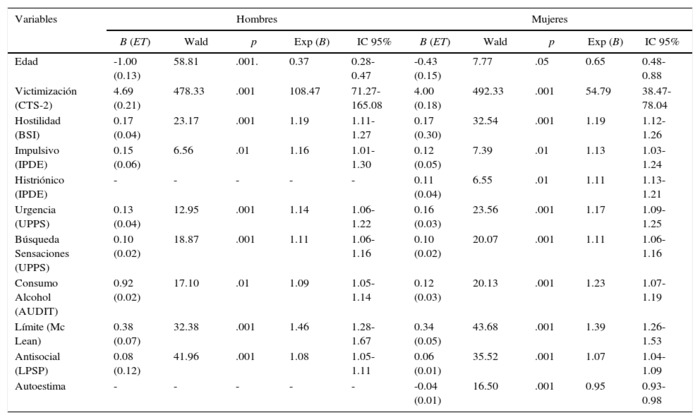
<body><![CDATA[<p><font face="Verdana" size="2">El paquete estad&iacute;stico SPSS vs.19 se utiliz&oacute; para realizar diversos an&aacute;lisis estad&iacute;sticos. En primer lugar, se utiliz&oacute; la prueba chi-cuadrado de Pearson para estimar la relaci&oacute;n entre el uso y/o victimizaci&oacute;n de agresi&oacute;n y el sexo en la muestra total. En segundo lugar, se utiliz&oacute; la prueba <i>t</i> de Student (muestras relacionadas) para analizar las diferencias entre hombres y mujeres en las variables referidas a las caracter&iacute;sticas de la relaci&oacute;n de pareja y en los factores de riesgo para la agresi&oacute;n f&iacute;sica. En tercer lugar, se realiz&oacute; un an&aacute;lisis de regresi&oacute;n log&iacute;stica binaria (m&eacute;todo Enter) para identificar los factores de riesgo para perpetrar agresi&oacute;n f&iacute;sica en hombres y mujeres.</font></p>     <p>&nbsp;</p>     <p><font face="Verdana" size="2"><b>Resultados</b></font></p>     <p><font face="Verdana" size="2"><i>Caracter&iacute;sticas de las variables relacionales y psicopatol&oacute;gicas</i></font></p>     <p><font face="Verdana" size="2">En lo relativo a las caracter&iacute;sticas de las relaciones de pareja, la edad media de inicio de la primera relaci&oacute;n de pareja es de 18 a&ntilde;os, siendo significativamente mayor en los hombres, <i>t</i>(2031) = 8.55, <i>p</i> &lt; .001, <i>d</i> = .038. Sobre el n&uacute;mero de relaciones mantenidas, los hombres han tenido significativamente un mayor n&uacute;mero de parejas, <i>t</i>(2031) = 5.79, <i>p</i> &lt; .001, <i>d</i> = 0.26. La edad de la pareja actual es significativamente m&aacute;s joven en los hombres, <i>t</i>(2031) = -10.69, <i>p</i> &lt; .001, <i>d</i> = 0.47 y el tiempo medio de convivencia con la pareja actual es de 14 a&ntilde;os. La media de mujeres en situaci&oacute;n de desempleo es significativamente mayor que en el caso de sus parejas, <i>t</i>(2031) = -17.42, <i>p</i> &lt; .001, <i>d</i> = .77.</font></p>     <p><font face="Verdana" size="2">En lo relativo a los factores de psicopatolog&iacute;a adulta, hombres y mujeres no presentaron indicios de abuso o dependencia del alcohol, si bien los hombres consumen significativamente m&aacute;s alcohol que las mujeres, <i>t</i>(2031) = 16.56, <i>p</i> &lt; .001, <i>d</i> = 0.74. En lo relativo a la conducta antisocial, los hombres presentaron una tendencia mayor a mentir, m&aacute;s insensibilidad, ausencia de remordimientos y conductas de manipulaci&oacute;n, <i>t</i>(2031) = 3.17, <i>p</i> &lt; .01, <i>d</i> = 0.14. Asimismo, presentaron m&aacute;s comportamientos de tipo impulsivo: escasa premeditaci&oacute;n, <i>t</i>(2031) = 2.76, <i>p</i> &lt; .01, <i>d</i> = .12, y b&uacute;squeda de sensaciones, <i>t</i>(2031) = 13.98, <i>p</i> &lt; .01, <i>d</i> = 0.62. En cuanto a la personalidad de tipo l&iacute;mite, las mujeres presentaron m&aacute;s comportamientos de este tipo, <i>t</i>(2031) = -10.16, <i>p</i> &lt; .001, <i>d</i> = 0.45, y en general m&aacute;s s&iacute;ntomas de malestar psicol&oacute;gico y rasgos de personalidad patol&oacute;gica que los hombres. En cuanto a la autoestima, las mujeres presentan una autoestima m&aacute;s elevada, <i>t</i>(2031) = 5.70, <i>p</i> &lt; .001, <i>d</i> = 0.25.</font></p>     <p><font face="Verdana" size="2"><i>Prevalencia de agresi&oacute;n psicol&oacute;gica y f&iacute;sica</i></font></p>     <p><font face="Verdana" size="2">La agresi&oacute;n psicol&oacute;gica present&oacute; una prevalencia superior a la agresi&oacute;n f&iacute;sica (<a href="#t1">tabla 1</a>). El an&aacute;lisis de las tasas de prevalencia obtenidas en agresi&oacute;n psicol&oacute;gica revel&oacute; diferencias significativas en las mujeres, en las escalas de perpetraci&oacute;n menor (63.5% vs. 55.5%, &chi;<sup>2</sup> &#091;1, <i>N</i> = 4.064&#093; = 26.79, <i>p</i> &lt; .00) y grave (18.6% vs. 15.7%, &chi;<sup>2</sup> &#091;1, <i>N</i> = 4.064&#093; = 5.82, <i>p</i> &lt; .001), y en las escalas de victimizaci&oacute;n total, 59.2% vs. 56.1%, &chi;<sup>2</sup> &#091;1, <i>N</i> = 4.064&#093; = 3.99, <i>p</i> &lt; .05) y menor, 58.4% vs. 55%, &chi;<sup>2</sup> &#091;1, <i>N</i> = 4.064&#093; = 4.63, <i>p</i> &lt; .03). En agresión física, se encontraron diferencias significativas en las mujeres en las escalas de perpetración menor, 12.6% vs. 9.9%, 2(1, <i>N</i> = 4.064) = 7.43, <i>p</i> &lt; .001, y total, 13.2% vs. 10.4%, 2(1, <i>N</i> = 4.064) = 7.69, <i>p</i> &lt; 001. La tasa de prevalencia de lesiones infligidas en hombre y mujeres fue baja (2%).</font></p>     <p>&nbsp;</p>     <p align="center"><font face="Verdana" size="2"><a name="t1"></a><b>Tabla 1.</b> Prevalencia de perpetratedores y víctimas (N = 4.064)    ]]></body>
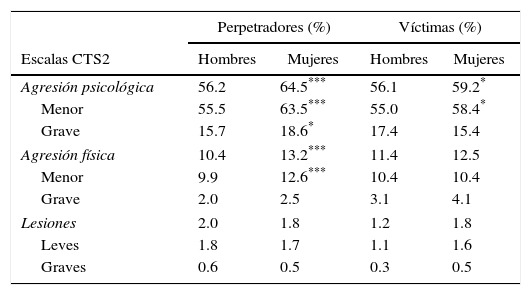
<body><![CDATA[<br><img src="/img/revistas/clinsa/v27n2/original3_t1.jpg">    <br><i>Nota.</i> Prueba chi-cuadrado.    <br>Tabla tomada de Gra&ntilde;a y Cuenca-Montesino (2014).    <br><sup>*</sup><i>p</i> &lt; .05,<sup>***</sup><i>p</i> &lt; .001.</font></p>     <p>&nbsp;</p>     <p><font face="Verdana" size="2"><i>Factores de riesgo para la agresi&oacute;n f&iacute;sica en hombres y en mujeres</i></font></p>     <p><font face="Verdana" size="2">En lo relativo a los factores de riesgo para la agresi&oacute;n f&iacute;sica (<a href="#t2">tabla 2</a>), los resultados respecto a las variables relacionales y demogr&aacute;ficas en hombres y mujeres fueron: ser joven (<i>b</i> = -1.00, <i>p</i> &lt; .001 y <i>b</i> = -.43, <i>p</i> &lt; .05, respectivamente), llevar poco tiempo de relaci&oacute;n (<i>b</i> = -.02, <i>p</i> &lt; .04 y <i>b</i> = -.02, <i>p</i> &lt; .02, respectivamente) y estar en situaci&oacute;n de desempleo (<i>b</i> = .57, <i>p</i> &lt; .001 y <i>b</i> = .45, <i>p</i> &lt; .001, respectivamente). En lo relativo a la calidad de la relaci&oacute;n, la experiencia de victimizaci&oacute;n (<i>b</i> = 4.69, <i>p</i> &lt; .001 y <i>b</i> = 4.00, <i>p</i> &lt; .001, respectivamente). Por &uacute;ltimo, los s&iacute;ntomas de agresividad-hostilidad (<i>b</i> = .17, <i>p</i> &lt; .001 y <i>b</i> = .17, <i>p</i> &lt; .001, respectivamente), los rasgos de personalidad impulsiva (<i>b</i> = .15, <i>p</i> &lt; .001 y <i>b</i> = .12, <i>p</i> &lt; .001, respectivamente), l&iacute;mite (<i>b</i> = .38, <i>p</i> &lt; .001 y <i>b</i> = .34, <i>p</i> &lt; .001, respectivamente) y antisocial (<i>b</i> = .08 <i>p</i> &lt; .001 y <i>b</i> = .06, <i>p</i> &lt; .001, respectivamente) y los comportamientos de urgencia (<i>b</i> = .13, <i>p</i> &lt; .001 y <i>b</i> = .16, <i>p</i> &lt; .001, respectivamente) y de b&uacute;squeda de sensaciones <i>(b</i> = .10, <i>p</i> &lt; .001 y <i>b</i> = .10, <i>p</i> &lt; .001, respectivamente), adem&aacute;s del consumo de alcohol (<i>b</i> = .92, <i>p</i> &lt; .01 y <i>b</i> = .12, <i>p</i> &lt; .001, respectivamente).</font></p>     <p>&nbsp;</p>     <p align="center"><font face="Verdana" size="2"><a name="t2"></a><b>Tabla 2.</b> Factores de riesgo psicopatol&oacute;gicos para la agresi&oacute;n f&iacute;sica    <br><img src="/img/revistas/clinsa/v27n2/original3_t2.jpg"></font></p>     ]]></body>
<body><![CDATA[<p>&nbsp;</p>     <p><font face="Verdana" size="2"><b>Discusi&oacute;n</b></font></p>     <p><font face="Verdana" size="2">El presente estudio examina los factores de riesgo para la agresi&oacute;n f&iacute;sica en hombres y mujeres mediante la CTS-2 (Straus et al., 1996) en una muestra representativa a nivel comunitario de parejas adultas residentes en la Comunidad de Madrid.</font></p>     <p><font face="Verdana" size="2">La prevalencia de agresi&oacute;n psicol&oacute;gica fue superior a la f&iacute;sica, resultado que era congruente con la investigaci&oacute;n previa en este &aacute;mbito (O'Leary y Williams, 2006; Panuzio y DiLillo, 2010; Salis, Salwen y O'Leary, 2014; Taft et al., 2006). En nuestro pa&iacute;s, estos resultados confirman las conclusiones de los estudios desarrollados en un contexto di&aacute;dico (Gra&ntilde;a y Cuenca-Montesino, 2014) y multinivel (Cuenca-Montesino et al., 2014). Factores como la deseabilidad social (O'Leary y Williams, 2006), la satisfacci&oacute;n en la relaci&oacute;n (Marshall, Panuzio, Makin-Byrd, Taft y Holtz-Munroe, 2011) o la tolerancia hacia este tipo de actos (Cuenca-Montesino et al., 2014) pueden explicar las diferencias encontradas en hombres y mujeres.</font></p>     <p><font face="Verdana" size="2">En muestras representativas y comunitarias la prevalencia de agresi&oacute;n f&iacute;sica es ligeramente m&aacute;s elevada en las mujeres, como sucede en el presente estudio, y corrobora la tendencia encontrada en las revisiones realizadas sobre este fen&oacute;meno (Desmarais et al., 2012a, 2012b).</font></p>     <p><font face="Verdana" size="2">En la presente investigaci&oacute;n, tres perspectivas te&oacute;ricas relativas a la predicci&oacute;n de agresi&oacute;n f&iacute;sica en la pareja se asociaron con factores de riesgo significativos para perpetrar agresi&oacute;n f&iacute;sica, espec&iacute;ficamente: (1) la perspectiva del desarrollo que incluye la edad, (2) la perspectiva psicopatol&oacute;gica, que incluye s&iacute;ntomas psicopatol&oacute;gicos de ira/hostilidad, rasgos de personalidad (impulsiva, histri&oacute;nica, l&iacute;mite y antisocial) y el consumo de alcohol y (3) la perspectiva de la relaci&oacute;n di&aacute;dica, que incluye la experiencia de victimizaci&oacute;n.</font></p>     <p><font face="Verdana" size="2">En el presente estudio los modelos de regresi&oacute;n confirman que el grupo de edad m&aacute;s joven (18-29 a&ntilde;os) representa el grupo de edad en el que tienen una mayor relevancia las variables psicopatol&oacute;gicas y en este sentido el grupo de riesgo para la agresi&oacute;n f&iacute;sica en hombres y mujeres (Murphy y O'Leary, 1989). Asimismo, desde un punto de vista psicopatol&oacute;gico estas variables tienen un mayor impacto en hombres y mujeres j&oacute;venes. El an&aacute;lisis de los factores de riesgo para la agresi&oacute;n f&iacute;sica nos permite desarrollar un marco conceptual en la interpretaci&oacute;n de algunos de los resultados y examinar la naturaleza de la agresi&oacute;n f&iacute;sica en las relaciones de pareja.</font></p>     <p><font face="Verdana" size="2">Las variables implicadas en el modelo son relevantes a la hora de explicar la perpetraci&oacute;n de agresi&oacute;n f&iacute;sica. Desde el punto de vista psicopatol&oacute;gico, en hombres y mujeres tienen una mayor relevancia variables tales como los s&iacute;ntomas de hostilidad, los rasgos de personalidad limite, antisocial e histri&oacute;nica, as&iacute; como los comportamientos impulsivos y el consumo de alcohol.</font></p>     <p><font face="Verdana" size="2">En general, estos rasgos de personalidad reflejan dificultades interpersonales que pueden afectar negativamente a la relaci&oacute;n de pareja incrementando la probabilidad de conflicto. Espec&iacute;ficamente, los rasgos de personalidad limite y antisocial se caracterizan por la presencia de comportamientos impulsivos y la impulsividad se ha relacionado frecuentemente con el consumo de sustancias. Estos resultados sugieren que es posible que los problemas de consumo de alcohol sean mayores en aquellos que presentan estos rasgos de personalidad, lo cual es congruente con el hecho de que ambos sean factores de riesgo significativos para la agresi&oacute;n. Asimismo, estos resultados sugieren la posibilidad de trastornos de conducta en aquellos que presentan rasgos de personalidad limite y antisocial en la vida adulta.</font></p>     <p><font face="Verdana" size="2">Sucesos estresantes, como estar en situaci&oacute;n de desempleo, pueden producir cambios en las habilidades de resoluci&oacute;n de conflictos que predisponen a la agresi&oacute;n f&iacute;sica (Stith et al., 2011). Por otro lado, la experiencia de victimizaci&oacute;n fue un predictor significativo para la agresi&oacute;n f&iacute;sica, resultado que es congruente con los resultados observados por O'Leary et al. (2014), que encontraron que la experiencia de victimizaci&oacute;n y los problemas de relaci&oacute;n fueron los predictores m&aacute;s significativos para perpetrar agresi&oacute;n f&iacute;sica.</font></p>     ]]></body>
<body><![CDATA[<p><font face="Verdana" size="2">El presente estudio muestra que desde el punto de vista psicopatol&oacute;gico determinadas variables tienen un impacto en hombres y mujeres, ya que predicen agresi&oacute;n f&iacute;sica, si bien este tipo de violencia se corresponde con la <i>violencia situacional</i>, que es la que predomina en este tipo de muestras (Johnson, 2011). Desde el punto de vista cl&iacute;nico, los conflictos de relaci&oacute;n en parejas cl&iacute;nicas representan una fuente de estr&eacute;s que puede tener un impacto en la salud mental (C&aacute;ceres, 2012). De acuerdo con Labrador (2015), este tipo de violencia es susceptible de tratamiento terap&eacute;utico para reorientar la relaci&oacute;n, adem&aacute;s de facilitar la ruptura de una manera adecuada y en consecuencia disminuir su impacto y posible victimizaci&oacute;n.</font></p>     <p><font face="Verdana" size="2">Este estudio tiene varias limitaciones que deben ser considerados. En primer lugar, la muestra representa el &aacute;rea metropolitana de Madrid, que como tal no puede ser considerada como una muestra que sea representativa de toda Espa&ntilde;a. En segundo lugar, la validez y la exactitud de los informes de agresi&oacute;n dependen de la exactitud de los informes de las parejas; as&iacute;, la CTS2 tiene que ser administrada a ambos miembros de la pareja. Por &uacute;ltimo, los informes de agresi&oacute;n pueden estar influenciados por la respuesta de la pareja o por lo que la pareja espera escuchar, debido a factores tales como deseabilidad social, que es un sesgo de respuesta importante. Consideramos que en este contexto no es f&aacute;cil garantizar medidas independientes a pesar del hecho de que los cuestionarios se distribuyeron y entregaron a un apartado de correos de forma an&oacute;nima y con independencia de la pareja.</font></p>     <p>&nbsp;</p>     <p><font face="Verdana" size="2"><b>Extended Summary</b></font></p>     <p><font face="Verdana" size="2">Violence in couple relationships is a phenomenon of great concern in the contemporary society. In recent years, epidemiological studies of representative samples in the United States indicate a 10% prevalence rate of physical aggression in couple relationships (Esquivel-Santove&ntilde;a &amp; Dixon, 2012; Jose &amp; O'Leary, 2009), rates that have been confirmed in community-level studies in Spain (Cuenca-Montesino, Gra&ntilde;a, &amp; Mart&iacute;nez-Arias, 2014; Gra&ntilde;a, 2009; Gra&ntilde;a &amp; Cuenca-Montesino, 2014).</font></p>     <p><font face="Verdana" size="2">Research of this area argues that men and women use aggressive tactics during relationship conflicts, a dimension that Capaldi and Langhinrichsen-Rohling (2012) considered to be critical in the study of couple violence o "intimate partner violence" (IPV). This type of IPV, conceptualized by Johnson (2011) as <i>situational violence</i>, is not based on a dynamic of coercion and control, is less severe and usually based on a pattern of episodic or reactive aggressive behavior, and is generally associated with relational conflicts or critical situations in the couple relationship, such as processes of separation or divorce (Mu&ntilde;oz &amp; Echebur&uacute;a, 2016).</font></p>     <p><font face="Verdana" size="2">The complexity and multidimensional nature of this phenomenon are aspects that affect not only its dynamics, but also its consequences for physical and mental health (Coker et al., 2002). At present, prevention and intervention in aggressive behaviors are needed in order to decrease their impact, persistence, and associated victimization (Desmarais, Reeves, Nicholls, Telford, &amp; Fiebert, 2012a, 2012b; Llorens et al., 2016; O'Leary, 2015).</font></p>     <p><font face="Verdana" size="2">The present study is designed to address a series of critical issues related to psychopathological risk factors for physical aggression in men and women. With this goal, we analyzed the role of certain psychopathological risk factors for physical aggression in a sample of 2,032 heterosexual adult couples from Madrid Region, using the Conflict Tactics Scale (CTS-2; Straus, Hamby, Boney-McCoy, &amp; Sugarman, 1996).</font></p>     <p><font face="Verdana" size="2">Very little is currently known about the psychopathological risk factors associated with physical aggression in men and women and, to date, most of the research has been conducted in the United States. In accordance with this research, in the development of the present study three theoretical perspectives were used to address the analysis of the risk factors (O'Leary, Smith Slep, &amp; O'Leary, 2007; O'Leary, Tintle, &amp; Bromet, 2014; Schumacher &amp; Leonard, 2005; Stith, Smith, &amp; Penn, 2004): (1) developmental perspective (age), (2) psychopathological perspective (psychopathological symptomatology, dysfunctional personality traits, alcohol abuse and level of self-esteem), and (3) dyadic perspective of the relationship (experience of victimization and marital quality).</font></p>     <p><font face="Verdana" size="2">Given the similarity between the United States and Spain in terms of literacy rates, life expectancy, and level of education, these data allow us to compare the prevalence rates of aggression. Secondly, according to Jose, O'Leary, Gra&ntilde;a, and Foran (2014), in Spain, partner aggression is considered to be an important public health problem more so than it is in the USA, an aspect that suggests different prevalence rates and risk factors in comparison with samples from the USA. Lastly, in the present study, we examined all the variables in adulthood and their impact on the reports of perpetration of physical aggression in men and women.</font></p>     ]]></body>
<body><![CDATA[<p><font face="Verdana" size="2"><b>Method</b></font></p>     <p><font face="Verdana" size="2"><i>Participants</i></font></p>     <p><font face="Verdana" size="2">The participants of the study were 2,032 adult heterosexual couples, aged between 18 and 80 years, from the Region of Madrid. All participants provided the following sociodemographic data: age, sex, civil status, nationality, and partner's sex.</font></p>     <p><font face="Verdana" size="2">As a function of the goals of the study, the inclusion criteria were being over 18 years of age and being in a heterosexual couple relationship, either currently or in the past 12 months.</font></p>     <p><font face="Verdana" size="2"><i>Instruments and variables</i></font></p>     <p><font face="Verdana" size="2"><i>Sociodemographic Questionnaire</i>. Diverse items were included to assess participants' characteristics in the following sociodemographic and personal variables: age, sex, civil status, nationality, professional activity, and current partner's sex and age.</font></p>     <p><font face="Verdana" size="2"><i>Revised Conflict Tactics Scale</i> - CTS-2 (Straus et al., 1996). We used the Spanish version of the CTS2 by Gra&ntilde;a, Andreu, Pe&ntilde;a, and Rodr&iacute;guez-Biezma (2013). We included 66 items that assess the presence/absence of acts of psychological and physical aggression and injury. The Cronbach's alpha coefficient of the total scale was satisfactory in men and women (&#945; = .90) and in all the subscales measured (&#945; = .90).</font></p>     <p><font face="Verdana" size="2"><i>Psychopathological Risk Factors</i>. We used diverse clinical scales that include critical items according to the criterion of experts based on the diagnostic criteria of the Diagnostic and Statistical Manual of Mental Disorders-IV and on the level of self-esteem.</font></p>     <p><font face="Verdana" size="2"><i>Procedure</i></font></p>     <p><font face="Verdana" size="2">The study used a quota sampling method to recruit a community sample of married or cohabitating couples from the Region of Madrid. In order to obtain a representative sample of the active population of the diverse urban areas, the research was conducted with research assistants (RAs) who were selected from 300 candidates from the Department of Clinical Psychology of the Complutense University of Madrid, who wished to obtain research credits. We took as reference for the distribution of the RAs the population according to the census of the Region of Madrid. To distribute the research assistants in each year (2010-2012) we took as reference the population census of the Region of Madrid and the following geographic areas to obtain the sample for the study: a) Madrid capital 61% (183 RAs), b) northern metropolitan area 5% (15 RAs), c) eastern metropolitan area 9% (27 RAs), d) southern metropolitan area 21% (62 RAs), e) western metropolitan area 6% (17 RAs), and f) no metropolitan area12% (36 RAs).</font></p>     ]]></body>
<body><![CDATA[<p><font face="Verdana" size="2">The RAs were informed of the general characteristics of the study and that the general goal was to analyze different aspects of daily cohabitation of intimate couple relationships regarding the way they negotiate and resolve conflicts. The purpose of this research was explained to the participants and, as the questionnaire was anonymous, the consent form was introduced in the first part of the protocol and participants were told that they could give their consent by completing the questionnaire and sending it anonymously and independently of their couple to a PO Box.</font></p>     <p><font face="Verdana" size="2">The procedure was as follows: (a) each research assistant had to collect a quota of 8 couples from the assigned census area, 1/3 of whom could be acquaintances and the rest unknown; (b) the couples were selected taking into account the following age range: 18-29, 30-50, +50; and (c) after obtaining the study quota, the research assistant had to give the code of each couple member to the director of the project (e.g., 1-a and 1-b up to 8-a and 8-b) and the phone number or of each couple.</font></p>     <p><font face="Verdana" size="2">Initially, 5,440 protocols were handed out, and the response rate was 78.7%, that is, a total of 4,284 protocols were returned, of which 5% (220) were rejected because they had faulty data, had been completed randomly, or had low response consistency.</font></p>     <p><font face="Verdana" size="2">The missing data were replaced through the expectation-maximization (EM) algorithm (SPSS, version 19.0). The prevalence statistics reported in the present study are based on valid cases (i.e., missing data were not replaced prior to computing this statistic and, as no differences were obtained then, they were replaced with imputed values).</font></p>     <p><font face="Verdana" size="2"><b>Results</b></font></p>     <p><font face="Verdana" size="2">The analysis of the obtained prevalence rates reveals significant differences in perpetration and victimization of psychological aggression in women (<a href="#t1">table 1</a>). Specifically, on the scales of minor, 63.5% vs. 55.5%, &chi;<sup>2</sup>(1, <i>N</i> = 4.064) = 26.79, <i>p</i> &lt; .00, and severe perpetration,18.6% vs. 15.7%, &chi;<sup>2</sup>(1, <i>N</i> = 4.064) = 5.82, <i>p</i> &lt; .001, and on the scales of total, 59.2% vs. 56.1%, &chi;<sup>2</sup>(1, <i>N</i> = 4.064) = 3.99, <i>p</i> &lt; .05, and minor victimization, 58.4% vs. 55%, &chi;<sup>2</sup>(1, <i>N</i> = 4.064) = 4.63, <i>p</i> &lt; .03. In physical aggression, significant differences were found in women on the scales of minor, 12.6% vs. 9.9%, &chi;<sup>2</sup>(1, <i>N</i> = 4.064) = 7.43, <i>p</i> &lt; .001, and total perpetration, 13.2% vs. 10.4%, &chi;<sup>2</sup>(1, <i>N</i> = 4.064) = 7.69, <i>p</i> &lt; .001. The prevalence rate of inflicted injuries in men and women was low (2%).</font></p>     <p><font face="Verdana" size="2">With regard to the significant risk factors for physical aggression in men and women (<a href="#t2">table 2</a>), the results regarding relational and demographic variables were: being young, having been in the relationship for a short time, and being unemployed. With regard to the quality of the relationship, the experience of victimization was significant. Lastly, from a psychopathological perspective, symptoms of aggressiveness-hostility, impulsivity, borderline, and antisocial personality traits, along with impulsive behaviors of sensation seeking and alcohol consumption were the most relevant variables.</font></p>     <p><font face="Verdana" size="2"><b>Discussion</b></font></p>     <p><font face="Verdana" size="2">The results of the study confirm the tendency observed in prior research of the high prevalence of psychological aggression in contrast to physical aggression (O'Leary &amp; Williams, 2006; Panuzio &amp; DiLillo, 2010; Salis et al., 2014; Taft et al., 2006). In Spain, these results confirm the conclusions of the studies conducted in a dyadic (Gra&ntilde;a &amp; Cuenca-Montesino, 2014) and multilevel context (Cuenca-Montesino, Gra&ntilde;a, &amp; Mart&iacute;nez-Arias, 2014). The prevalence of physical aggression was slightly higher in women and confirms the tendency found in the reviews of this phenomenon (Desmarais et al., 2012a, 2012b).</font></p>     <p><font face="Verdana" size="2">In the present study, the regression models confirm that psychopathological variables were more relevant in the youngest age group (18-29 years) and, accordingly, this is the group at highest risk for physical aggression in men and women (Murphy &amp; O'Leary, 1989). Also, from a psychopathological viewpoint, these variables have a greater impact on younger men and women.</font></p>     ]]></body>
<body><![CDATA[<p><font face="Verdana" size="2">Analysis of the risk factors allowed us to develop a conceptual framework to explain the nature of physical aggression in couple relationships and, from the psychopathological viewpoint, the following variables are more relevant in men and women: symptoms of hostility, borderline, antisocial, and histrionic personality traits, impulsive behaviors, and alcohol consumption. In general, these personality traits reflect interpersonal difficulties that can affect the couple relationship negatively, increasing the probability of conflict. Specifically, borderline and antisocial personality traits are characterized by the presence of impulsive behaviors, and impulsivity has often been linked to substance consumption. These results suggest that problems of alcohol consumption may be higher in people who present these personality traits and they are consistent with the fact that both these variables are significant risk factors for aggression. In addition, these results suggest the possibility of behavior disorders in people who present borderline and antisocial personality traits in adulthood.</font></p>     <p><font face="Verdana" size="2">Stressful events such as unemployment can produce changes in conflict resolution skills that predispose one to physical aggression (Stith et al., 2011). In addition, the experience of victimization was a significant predictor of physical aggression, a fact that confirms the results observed by O'Leary et al. (2014), who found that the experience of victimization and interrelational problems were the most significant predictors of perpetration of physical aggression.</font></p>     <p><font face="Verdana" size="2">The present study shows that, from the psychopathological viewpoint, certain variables have an impact on men and women because they predict physical aggression, although this type of violence corresponds to situational violence, which is the kind of violence predominating in this type of samples (Johnson, 2011). From the clinical viewpoint, relational conflicts represent an important source of stress that can have an impact on mental health (C&aacute;ceres, 2012). According to Labrador (2015), this type of violence is susceptible to therapeutic treatment to re-orient the relationship, in addition to adequately facilitating a breakup and, as a result, decreasing its impact and possible victimization.</font></p>     <p>&nbsp;</p>     <p><font face="Verdana" size="2"><b>Conflicto de intereses</b></font></p>     <p><font face="Verdana" size="2">Los autores de este art&iacute;culo declaran que no tienen ning&uacute;n conflicto de intereses.</font></p>     <p>&nbsp;</p>     <p><font face="Verdana" size="2"><b>Referencias</b></font></p>     <!-- ref --><p><font face="Verdana" size="2">1. C&aacute;ceres J. Separaci&oacute;n y divorcio. Manual del Psic&oacute;logo de Familia, Madrid: Pir&aacute;mide, 2012. pp. 215-30.    &nbsp;&nbsp;&nbsp;&nbsp;&nbsp;&nbsp;&nbsp;&nbsp;[&#160;<a href="javascript:void(0);" onclick="javascript: window.open('/scielo.php?script=sci_nlinks&ref=1520393&pid=S1130-5274201600020000300001&lng=','','width=640,height=500,resizable=yes,scrollbars=1,menubar=yes,');">Links</a>&#160;]<!-- end-ref --></font></p>    ]]></body>
<body><![CDATA[<!-- ref --><p><font face="Verdana" size="2">2. Capaldi D.M., Langhinrichsen-Rohling J. Informing intimate partner violence prevention efforts: Dyadic, developmental, and contextual considerations. Prevention Science. 2012;13:323-8.    &nbsp;&nbsp;&nbsp;&nbsp;&nbsp;&nbsp;&nbsp;&nbsp;[&#160;<a href="javascript:void(0);" onclick="javascript: window.open('/scielo.php?script=sci_nlinks&ref=1520395&pid=S1130-5274201600020000300002&lng=','','width=640,height=500,resizable=yes,scrollbars=1,menubar=yes,');">Links</a>&#160;]<!-- end-ref --></font></p>    <!-- ref --><p><font face="Verdana" size="2">3. Coker A.L., Davis K.E., Arias I., Desai S., Sanderson M., Brandt H.M., Smith P.H. Physical and mental health effects of intimate partner violence for men and women. American Journal of Preventive Medicine. 2002;23:260-8.    &nbsp;&nbsp;&nbsp;&nbsp;&nbsp;&nbsp;&nbsp;&nbsp;[&#160;<a href="javascript:void(0);" onclick="javascript: window.open('/scielo.php?script=sci_nlinks&ref=1520397&pid=S1130-5274201600020000300003&lng=','','width=640,height=500,resizable=yes,scrollbars=1,menubar=yes,');">Links</a>&#160;]<!-- end-ref --></font></p>    <!-- ref --><p><font face="Verdana" size="2">4. Cuenca-Montesino M.L., Gra&ntilde;a J.L., Mart&iacute;nez-Arias R. Reciprocal Psychological Aggression in Couples A Multi-Level Analysis in a Community Sample. Publicado online en Journal of Interpersonal Violence. 2014;    &nbsp;&nbsp;&nbsp;&nbsp;&nbsp;&nbsp;&nbsp;&nbsp;[&#160;<a href="javascript:void(0);" onclick="javascript: window.open('/scielo.php?script=sci_nlinks&ref=1520399&pid=S1130-5274201600020000300004&lng=','','width=640,height=500,resizable=yes,scrollbars=1,menubar=yes,');">Links</a>&#160;]<!-- end-ref -->.</font></p>    <!-- ref --><p><font face="Verdana" size="2">5. Derogatis L.R., Melisaratos N. The Brief Symptom Inventory. An introductory report. Psychological Medicine. 1983;13:596-605.    &nbsp;&nbsp;&nbsp;&nbsp;&nbsp;&nbsp;&nbsp;&nbsp;[&#160;<a href="javascript:void(0);" onclick="javascript: window.open('/scielo.php?script=sci_nlinks&ref=1520401&pid=S1130-5274201600020000300005&lng=','','width=640,height=500,resizable=yes,scrollbars=1,menubar=yes,');">Links</a>&#160;]<!-- end-ref --></font></p>    <!-- ref --><p><font face="Verdana" size="2">6. Desmarais S.L., Reeves K.A., Nicholls T.L., Telford R.P., Fiebert M.S. Prevalence of physical violence in intimate relationships, Part 1: Rates of male and female victimization. Partner Abuse. 2012;3:140-69.    &nbsp;&nbsp;&nbsp;&nbsp;&nbsp;&nbsp;&nbsp;&nbsp;[&#160;<a href="javascript:void(0);" onclick="javascript: window.open('/scielo.php?script=sci_nlinks&ref=1520403&pid=S1130-5274201600020000300006&lng=','','width=640,height=500,resizable=yes,scrollbars=1,menubar=yes,');">Links</a>&#160;]<!-- end-ref --></font></p>    ]]></body>
<body><![CDATA[<!-- ref --><p><font face="Verdana" size="2">7. Desmarais S.L., Reeves K.A., Nicholls T.L., Telford R.P., Fiebert M.S. Prevalence of physical violence in intimate relationships, Part 2: Rates of male and female perpetration. Partner Abuse. 2012;3:170-98.    &nbsp;&nbsp;&nbsp;&nbsp;&nbsp;&nbsp;&nbsp;&nbsp;[&#160;<a href="javascript:void(0);" onclick="javascript: window.open('/scielo.php?script=sci_nlinks&ref=1520405&pid=S1130-5274201600020000300007&lng=','','width=640,height=500,resizable=yes,scrollbars=1,menubar=yes,');">Links</a>&#160;]<!-- end-ref --></font></p>    <!-- ref --><p><font face="Verdana" size="2"> 8. Esquivel-Santove&ntilde;a E.E., Dixon L. Investigating the true rate of physical intimate partner violence: A review of nationally representative surveys. Aggression and Violent Behavior. 2012;17:208-19.    &nbsp;&nbsp;&nbsp;&nbsp;&nbsp;&nbsp;&nbsp;&nbsp;[&#160;<a href="javascript:void(0);" onclick="javascript: window.open('/scielo.php?script=sci_nlinks&ref=1520407&pid=S1130-5274201600020000300008&lng=','','width=640,height=500,resizable=yes,scrollbars=1,menubar=yes,');">Links</a>&#160;]<!-- end-ref --></font></p>    <!-- ref --><p><font face="Verdana" size="2">9. Ewing J.A. Detecting alcoholism. The cage questionnaire. Journal of the American Medical Association. 1984;252:1905-7.    &nbsp;&nbsp;&nbsp;&nbsp;&nbsp;&nbsp;&nbsp;&nbsp;[&#160;<a href="javascript:void(0);" onclick="javascript: window.open('/scielo.php?script=sci_nlinks&ref=1520409&pid=S1130-5274201600020000300009&lng=','','width=640,height=500,resizable=yes,scrollbars=1,menubar=yes,');">Links</a>&#160;]<!-- end-ref --></font></p>    <!-- ref --><p><font face="Verdana" size="2">10. Gra&ntilde;a, J. L. (2009, November). Prevalence of partner aggression in a Spanish sample belonging to the Comunidad of Madrid. En K. D. O'Leary (Chair), Universal or Country-Specific Vulnerability Factors for Partner Violence: Intervention Implications. Symposium conducted at the 43rd annual meeting of the Association for Behavioral and Cognitive Therapies, New York, NY.    &nbsp;&nbsp;&nbsp;&nbsp;&nbsp;&nbsp;&nbsp;&nbsp;[&#160;<a href="javascript:void(0);" onclick="javascript: window.open('/scielo.php?script=sci_nlinks&ref=1520411&pid=S1130-5274201600020000300010&lng=','','width=640,height=500,resizable=yes,scrollbars=1,menubar=yes,');">Links</a>&#160;]<!-- end-ref --></font></p>    <!-- ref --><p><font face="Verdana" size="2">11. Gra&ntilde;a J.L., Andreu J.M., Pe&ntilde;a M., Rodr&iacute;guez-Biezma M.J. Validez factorial y fiabilidad de la Escala de t&aacute;cticas para el conflicto revisada(Revised Conflict Tactics Scale, CTS2) en poblaci&oacute;n adulta espa&ntilde;ola. Behavioral Psychology/Psicologia Conductual. 2013;21(3).    &nbsp;&nbsp;&nbsp;&nbsp;&nbsp;&nbsp;&nbsp;&nbsp;[&#160;<a href="javascript:void(0);" onclick="javascript: window.open('/scielo.php?script=sci_nlinks&ref=1520413&pid=S1130-5274201600020000300011&lng=','','width=640,height=500,resizable=yes,scrollbars=1,menubar=yes,');">Links</a>&#160;]<!-- end-ref --></font></p>    ]]></body>
<body><![CDATA[<!-- ref --><p><font face="Verdana" size="2">12. Gra&ntilde;a J.L., Cuenca-Montesino M.L. Prevalence of psychological and physical intimate partner aggression in Madrid (Spain): A dyadic analysis. Psicothema. 2014;26:343-8.    &nbsp;&nbsp;&nbsp;&nbsp;&nbsp;&nbsp;&nbsp;&nbsp;[&#160;<a href="javascript:void(0);" onclick="javascript: window.open('/scielo.php?script=sci_nlinks&ref=1520415&pid=S1130-5274201600020000300012&lng=','','width=640,height=500,resizable=yes,scrollbars=1,menubar=yes,');">Links</a>&#160;]<!-- end-ref --></font></p>    <!-- ref --><p><font face="Verdana" size="2">13. Johnson M.P. Gender and types of intimate partner violence: A response to an anti-feminist literature review. Aggression and Violent Behavior. 2011;16:289-96.    &nbsp;&nbsp;&nbsp;&nbsp;&nbsp;&nbsp;&nbsp;&nbsp;[&#160;<a href="javascript:void(0);" onclick="javascript: window.open('/scielo.php?script=sci_nlinks&ref=1520417&pid=S1130-5274201600020000300013&lng=','','width=640,height=500,resizable=yes,scrollbars=1,menubar=yes,');">Links</a>&#160;]<!-- end-ref --></font></p>    <!-- ref --><p><font face="Verdana" size="2">14. Jose A., O'Leary K.D. Prevalence of partner aggression in representative and clinic samples. Psychological and Physical Aggression in Couples: Causes and Interventions, Washington, DC: American Psychological Association, 2009. pp. 15-35.    &nbsp;&nbsp;&nbsp;&nbsp;&nbsp;&nbsp;&nbsp;&nbsp;[&#160;<a href="javascript:void(0);" onclick="javascript: window.open('/scielo.php?script=sci_nlinks&ref=1520419&pid=S1130-5274201600020000300014&lng=','','width=640,height=500,resizable=yes,scrollbars=1,menubar=yes,');">Links</a>&#160;]<!-- end-ref --></font></p>    <!-- ref --><p><font face="Verdana" size="2">15. Jose A., O'Leary K.D., Gra&ntilde;a J.L., Foran H.M. Risk factors for male intimate partner physical aggression in Spain. Journal of Family Violence. 2014;29:287-97.    &nbsp;&nbsp;&nbsp;&nbsp;&nbsp;&nbsp;&nbsp;&nbsp;[&#160;<a href="javascript:void(0);" onclick="javascript: window.open('/scielo.php?script=sci_nlinks&ref=1520421&pid=S1130-5274201600020000300015&lng=','','width=640,height=500,resizable=yes,scrollbars=1,menubar=yes,');">Links</a>&#160;]<!-- end-ref --></font></p>    <!-- ref --><p><font face="Verdana" size="2">16. Labrador, F. (Coord.) (2015). Intervenci&oacute;n psicol&oacute;gica en terapia de pareja. Madrid: Pir&aacute;mide.    &nbsp;&nbsp;&nbsp;&nbsp;&nbsp;&nbsp;&nbsp;&nbsp;[&#160;<a href="javascript:void(0);" onclick="javascript: window.open('/scielo.php?script=sci_nlinks&ref=1520423&pid=S1130-5274201600020000300016&lng=','','width=640,height=500,resizable=yes,scrollbars=1,menubar=yes,');">Links</a>&#160;]<!-- end-ref --></font></p>    ]]></body>
<body><![CDATA[<!-- ref --><p><font face="Verdana" size="2">17. Levenson M.R., Kiehl K.A., Fitzpatrick C.M. Assessing psychopathic attributes in a noninstitutionalized population. Journal of Personality and Social Psychology. 1995;68:151-8.    &nbsp;&nbsp;&nbsp;&nbsp;&nbsp;&nbsp;&nbsp;&nbsp;[&#160;<a href="javascript:void(0);" onclick="javascript: window.open('/scielo.php?script=sci_nlinks&ref=1520425&pid=S1130-5274201600020000300017&lng=','','width=640,height=500,resizable=yes,scrollbars=1,menubar=yes,');">Links</a>&#160;]<!-- end-ref --></font></p>    <!-- ref --><p><font face="Verdana" size="2">18. Llorens N.G., Salis K.L., O'Leary D.K., Hayward J. A Focus on the Positive: Reasons for Not Engaging in Physical Aggression Against a Dating Partner. Journal of Family Violence. 2016;31:75-83.    &nbsp;&nbsp;&nbsp;&nbsp;&nbsp;&nbsp;&nbsp;&nbsp;[&#160;<a href="javascript:void(0);" onclick="javascript: window.open('/scielo.php?script=sci_nlinks&ref=1520427&pid=S1130-5274201600020000300018&lng=','','width=640,height=500,resizable=yes,scrollbars=1,menubar=yes,');">Links</a>&#160;]<!-- end-ref --></font></p>    <!-- ref --><p><font face="Verdana" size="2">19. Marshall A.D., Panuzio J., Makin-Byrd K.N., Taft C.T., Holtzworth-Munroe A. A multilevel examination of interpartner intimate partner violence and psychological aggression reporting concordance. Behavior Therapy. 2011;42:364-77.    &nbsp;&nbsp;&nbsp;&nbsp;&nbsp;&nbsp;&nbsp;&nbsp;[&#160;<a href="javascript:void(0);" onclick="javascript: window.open('/scielo.php?script=sci_nlinks&ref=1520429&pid=S1130-5274201600020000300019&lng=','','width=640,height=500,resizable=yes,scrollbars=1,menubar=yes,');">Links</a>&#160;]<!-- end-ref --></font></p>    <!-- ref --><p><font face="Verdana" size="2"> 20. Mu&ntilde;oz, J. M. y Echebur&uacute;a, E. (2016). Diferentes modalidades de violencia en la relaci&oacute;n de pareja: implicaciones para la evaluaci&oacute;n psicol&oacute;gica forense en el contexto legal espa&ntilde;ol. Anuario de Psicolog&iacute;a Jur&iacute;dica. http://dx.doi.org/10.1016/j.apj.2015.10.001.    &nbsp;&nbsp;&nbsp;&nbsp;&nbsp;&nbsp;&nbsp;&nbsp;[&#160;<a href="javascript:void(0);" onclick="javascript: window.open('/scielo.php?script=sci_nlinks&ref=1520431&pid=S1130-5274201600020000300020&lng=','','width=640,height=500,resizable=yes,scrollbars=1,menubar=yes,');">Links</a>&#160;]<!-- end-ref --></font></p>    <!-- ref --><p><font face="Verdana" size="2"> 21. Murphy C.M., O'Leary K.D. Psychological aggression predicts physical aggression in early marriage. Journal of Consulting and Clinical Psychology. 1989;57:579-82.    &nbsp;&nbsp;&nbsp;&nbsp;&nbsp;&nbsp;&nbsp;&nbsp;[&#160;<a href="javascript:void(0);" onclick="javascript: window.open('/scielo.php?script=sci_nlinks&ref=1520433&pid=S1130-5274201600020000300021&lng=','','width=640,height=500,resizable=yes,scrollbars=1,menubar=yes,');">Links</a>&#160;]<!-- end-ref --></font></p>    ]]></body>
<body><![CDATA[<!-- ref --><p><font face="Verdana" size="2">22. Norton R. Measuring marital quality: A critical look at the dependent variable. Journal of Marriage and the Family. 1983;45:141-51.    &nbsp;&nbsp;&nbsp;&nbsp;&nbsp;&nbsp;&nbsp;&nbsp;[&#160;<a href="javascript:void(0);" onclick="javascript: window.open('/scielo.php?script=sci_nlinks&ref=1520435&pid=S1130-5274201600020000300022&lng=','','width=640,height=500,resizable=yes,scrollbars=1,menubar=yes,');">Links</a>&#160;]<!-- end-ref --></font></p>    <!-- ref --><p><font face="Verdana" size="2">23. O'Leary K.D. Time for dyadic treatments for low-level partner aggression. The Journal of Clinical Psychiatry. 2015;76.    &nbsp;&nbsp;&nbsp;&nbsp;&nbsp;&nbsp;&nbsp;&nbsp;[&#160;<a href="javascript:void(0);" onclick="javascript: window.open('/scielo.php?script=sci_nlinks&ref=1520437&pid=S1130-5274201600020000300023&lng=','','width=640,height=500,resizable=yes,scrollbars=1,menubar=yes,');">Links</a>&#160;]<!-- end-ref --></font></p>    <!-- ref --><p><font face="Verdana" size="2">24. O'Leary K.D., Smith A.M., O'Leary S.G. Multivariate models of men's and women's partner aggression. Journal of Consulting and Clinical Psychology. 2007;75:752-64.    &nbsp;&nbsp;&nbsp;&nbsp;&nbsp;&nbsp;&nbsp;&nbsp;[&#160;<a href="javascript:void(0);" onclick="javascript: window.open('/scielo.php?script=sci_nlinks&ref=1520439&pid=S1130-5274201600020000300024&lng=','','width=640,height=500,resizable=yes,scrollbars=1,menubar=yes,');">Links</a>&#160;]<!-- end-ref --></font></p>    <!-- ref --><p><font face="Verdana" size="2">25. O'Leary K.D., Tintle N., Bromet E. Risk factors for physical violence against partners in the US. Psychology of Violence. 2014;4:65-77.    &nbsp;&nbsp;&nbsp;&nbsp;&nbsp;&nbsp;&nbsp;&nbsp;[&#160;<a href="javascript:void(0);" onclick="javascript: window.open('/scielo.php?script=sci_nlinks&ref=1520441&pid=S1130-5274201600020000300025&lng=','','width=640,height=500,resizable=yes,scrollbars=1,menubar=yes,');">Links</a>&#160;]<!-- end-ref --></font></p>    <!-- ref --><p><font face="Verdana" size="2">26. O'Leary K.D., Tintle N., Bromet E.J., Gluzman S.F. Descriptive epidemiology of intimate partner aggression in Ukraine. Social Psychiatry and Psychiatric Epidemiology. 2008;43:619-26.    &nbsp;&nbsp;&nbsp;&nbsp;&nbsp;&nbsp;&nbsp;&nbsp;[&#160;<a href="javascript:void(0);" onclick="javascript: window.open('/scielo.php?script=sci_nlinks&ref=1520443&pid=S1130-5274201600020000300026&lng=','','width=640,height=500,resizable=yes,scrollbars=1,menubar=yes,');">Links</a>&#160;]<!-- end-ref --></font></p>    ]]></body>
<body><![CDATA[<!-- ref --><p><font face="Verdana" size="2">27. O'Leary K.D., Williams M.C. Agreement about acts of physical aggression in marriage. Journal of Family Psychology. 2006;20:656-62.    &nbsp;&nbsp;&nbsp;&nbsp;&nbsp;&nbsp;&nbsp;&nbsp;[&#160;<a href="javascript:void(0);" onclick="javascript: window.open('/scielo.php?script=sci_nlinks&ref=1520445&pid=S1130-5274201600020000300027&lng=','','width=640,height=500,resizable=yes,scrollbars=1,menubar=yes,');">Links</a>&#160;]<!-- end-ref --></font></p>    <!-- ref --><p><font face="Verdana" size="2">28. Panuzio J., DiLillo D. Physical, psychological, and sexual intimate partner aggression among newlywed couples: Longitudinal prediction of marital satisfaction. Journal of Family Violence. 2010;25:689-99.    &nbsp;&nbsp;&nbsp;&nbsp;&nbsp;&nbsp;&nbsp;&nbsp;[&#160;<a href="javascript:void(0);" onclick="javascript: window.open('/scielo.php?script=sci_nlinks&ref=1520447&pid=S1130-5274201600020000300028&lng=','','width=640,height=500,resizable=yes,scrollbars=1,menubar=yes,');">Links</a>&#160;]<!-- end-ref --></font></p>    <!-- ref --><p><font face="Verdana" size="2">29. Rosenberg M. Society and the adolescent self-image. Princeton. NJ: Princeton University Press, (1965).    &nbsp;&nbsp;&nbsp;&nbsp;&nbsp;&nbsp;&nbsp;&nbsp;[&#160;<a href="javascript:void(0);" onclick="javascript: window.open('/scielo.php?script=sci_nlinks&ref=1520449&pid=S1130-5274201600020000300029&lng=','','width=640,height=500,resizable=yes,scrollbars=1,menubar=yes,');">Links</a>&#160;]<!-- end-ref --></font></p>    <!-- ref --><p><font face="Verdana" size="2">30. Salis K.L., Salwen J., O'Leary K.D. The predictive utility of psychological aggression for intimate partner violence. Partner Abuse. 2014;5:83-97.    &nbsp;&nbsp;&nbsp;&nbsp;&nbsp;&nbsp;&nbsp;&nbsp;[&#160;<a href="javascript:void(0);" onclick="javascript: window.open('/scielo.php?script=sci_nlinks&ref=1520451&pid=S1130-5274201600020000300030&lng=','','width=640,height=500,resizable=yes,scrollbars=1,menubar=yes,');">Links</a>&#160;]<!-- end-ref --></font></p>    <!-- ref --><p><font face="Verdana" size="2">31. Saunders J.B., Aasland O.G., Babor T.F., de J.R., Grant M. Development of the Alcohol Use disorders Identification Test (AUDIT): WHO Collaborative Project on Early Detection of Persons with Harmful alcohol consumption-II. Addiction. 1993;88:791-804.    &nbsp;&nbsp;&nbsp;&nbsp;&nbsp;&nbsp;&nbsp;&nbsp;[&#160;<a href="javascript:void(0);" onclick="javascript: window.open('/scielo.php?script=sci_nlinks&ref=1520453&pid=S1130-5274201600020000300031&lng=','','width=640,height=500,resizable=yes,scrollbars=1,menubar=yes,');">Links</a>&#160;]<!-- end-ref --></font></p>    ]]></body>
<body><![CDATA[<!-- ref --><p><font face="Verdana" size="2">32. Schumacher J.A., Leonard K.E. Husbands' and wives' marital adjustment, verbal aggression, and physical aggression as longitudinal predictors of physical aggression in early marriage. Journal of Consulting and Clinical Psychology. 2005;73:28-37.    &nbsp;&nbsp;&nbsp;&nbsp;&nbsp;&nbsp;&nbsp;&nbsp;[&#160;<a href="javascript:void(0);" onclick="javascript: window.open('/scielo.php?script=sci_nlinks&ref=1520455&pid=S1130-5274201600020000300032&lng=','','width=640,height=500,resizable=yes,scrollbars=1,menubar=yes,');">Links</a>&#160;]<!-- end-ref --></font></p>    <!-- ref --><p><font face="Verdana" size="2">33. Stith S.M., Amanor-Boadu Y., Miller M.S., Menhusen E., Morgan C., Few-Demo A. Vulnerabilities, stressors, and adaptations in situationally violent relationships. Family Relations: Interdisciplinary Journal of Applied Family Studies. 2011;60:73-89.    &nbsp;&nbsp;&nbsp;&nbsp;&nbsp;&nbsp;&nbsp;&nbsp;[&#160;<a href="javascript:void(0);" onclick="javascript: window.open('/scielo.php?script=sci_nlinks&ref=1520457&pid=S1130-5274201600020000300033&lng=','','width=640,height=500,resizable=yes,scrollbars=1,menubar=yes,');">Links</a>&#160;]<!-- end-ref --></font></p>    <!-- ref --><p><font face="Verdana" size="2">34. Stith S.M., Smith D.B., Penn C.E. Intimate partner physical abuse perpetration and victimization risk factors: A meta-analytic review. Aggression and Violent Behavior. 2004;10:65-98.    &nbsp;&nbsp;&nbsp;&nbsp;&nbsp;&nbsp;&nbsp;&nbsp;[&#160;<a href="javascript:void(0);" onclick="javascript: window.open('/scielo.php?script=sci_nlinks&ref=1520459&pid=S1130-5274201600020000300034&lng=','','width=640,height=500,resizable=yes,scrollbars=1,menubar=yes,');">Links</a>&#160;]<!-- end-ref --></font></p>    <!-- ref --><p><font face="Verdana" size="2">35. Straus M.A. Measuring intrafamily conflict and aggression: The Conflict Tactics Scale (CTS). Journal of Marriage and the Family. 1979;41:75-88.    &nbsp;&nbsp;&nbsp;&nbsp;&nbsp;&nbsp;&nbsp;&nbsp;[&#160;<a href="javascript:void(0);" onclick="javascript: window.open('/scielo.php?script=sci_nlinks&ref=1520461&pid=S1130-5274201600020000300035&lng=','','width=640,height=500,resizable=yes,scrollbars=1,menubar=yes,');">Links</a>&#160;]<!-- end-ref --></font></p>    <!-- ref --><p><font face="Verdana" size="2">36. Straus M.A., Hamby S., Boney-McCoy S., Sugarman D. The Revised Conflict Tactics Scales: Development and preliminary psychometric data. Journal of Family Issues. 1996;17:283-316.    &nbsp;&nbsp;&nbsp;&nbsp;&nbsp;&nbsp;&nbsp;&nbsp;[&#160;<a href="javascript:void(0);" onclick="javascript: window.open('/scielo.php?script=sci_nlinks&ref=1520463&pid=S1130-5274201600020000300036&lng=','','width=640,height=500,resizable=yes,scrollbars=1,menubar=yes,');">Links</a>&#160;]<!-- end-ref --></font></p>    ]]></body>
<body><![CDATA[<!-- ref --><p><font face="Verdana" size="2">37. Taft C.T., O'Farrell T.J., Torres S.E., Panuzio J., Monson C.M., Murphy M., Murphy C.M. Examining the correlates of psychological aggression among a community sample of couples. Journal of Family Psychology. 2006;20:581-8.    &nbsp;&nbsp;&nbsp;&nbsp;&nbsp;&nbsp;&nbsp;&nbsp;[&#160;<a href="javascript:void(0);" onclick="javascript: window.open('/scielo.php?script=sci_nlinks&ref=1520465&pid=S1130-5274201600020000300037&lng=','','width=640,height=500,resizable=yes,scrollbars=1,menubar=yes,');">Links</a>&#160;]<!-- end-ref --></font></p>    <!-- ref --><p><font face="Verdana" size="2">38. Whiteside S.P., Lynam D.R. The five factor model and impulsivity: Using a structural model of personality to understand impulsivity. Personality and Individual Differences. 2001;30:669-89.    &nbsp;&nbsp;&nbsp;&nbsp;&nbsp;&nbsp;&nbsp;&nbsp;[&#160;<a href="javascript:void(0);" onclick="javascript: window.open('/scielo.php?script=sci_nlinks&ref=1520467&pid=S1130-5274201600020000300038&lng=','','width=640,height=500,resizable=yes,scrollbars=1,menubar=yes,');">Links</a>&#160;]<!-- end-ref --></font></p>    <!-- ref --><p><font face="Verdana" size="2">39. Zanarini M.C., Vujanovic A.A., Parachini E.A., Boulanger J.L., Frankenburg F.R., Hennen J. A screening measure for BPD: The McLean Screening Instrument for Borderline Personality Disorder (MSI-BPD). Journal of Personality Disorders. 2003;17:568-73.    &nbsp;&nbsp;&nbsp;&nbsp;&nbsp;&nbsp;&nbsp;&nbsp;[&#160;<a href="javascript:void(0);" onclick="javascript: window.open('/scielo.php?script=sci_nlinks&ref=1520469&pid=S1130-5274201600020000300039&lng=','','width=640,height=500,resizable=yes,scrollbars=1,menubar=yes,');">Links</a>&#160;]<!-- end-ref --></font></p>     <p>&nbsp;</p>     <p>&nbsp;</p>     <p><font face="Verdana" size="2"><a href="#top"><img border="0" src="/img/revistas/clinsa/v27n2/seta.gif" width="15" height="17"></a><a name="bajo"></a><b>Direcci&oacute;n para correspondencia:</b>    <br>Mar&iacute;a Luisa Cuenca    ]]></body>
<body><![CDATA[<br><a href="mailto:ml.cuenca@ucm.es">ml.cuenca@ucm.es</a>    <br><a href="mailto:marisacuencamontesino@gmail.com">marisacuencamontesino@gmail.com</a></font></p>     <p><font face="Verdana" size="2">Recibido el 1 de abril de 2016    <br>Aceptado el 1 de abril de 2016</font></p>      ]]></body><back>
<ref-list>
<ref id="B1">
<label>1</label><nlm-citation citation-type="book">
<person-group person-group-type="author">
<name>
<surname><![CDATA[Cáceres]]></surname>
<given-names><![CDATA[J.]]></given-names>
</name>
</person-group>
<source><![CDATA[Separación y divorcio: Manual del Psicólogo de Familia]]></source>
<year>2012</year>
<page-range>215-30</page-range><publisher-loc><![CDATA[Madrid ]]></publisher-loc>
<publisher-name><![CDATA[Pirámide]]></publisher-name>
</nlm-citation>
</ref>
<ref id="B2">
<label>2</label><nlm-citation citation-type="journal">
<person-group person-group-type="author">
<name>
<surname><![CDATA[Capaldi]]></surname>
<given-names><![CDATA[D.M.]]></given-names>
</name>
<name>
<surname><![CDATA[Langhinrichsen-Rohling]]></surname>
<given-names><![CDATA[J]]></given-names>
</name>
</person-group>
<article-title xml:lang="en"><![CDATA[Informing intimate partner violence prevention efforts: Dyadic, developmental, and contextual considerations]]></article-title>
<source><![CDATA[Prevention Science]]></source>
<year>2012</year>
<volume>13</volume>
<page-range>323-8</page-range></nlm-citation>
</ref>
<ref id="B3">
<label>3</label><nlm-citation citation-type="journal">
<person-group person-group-type="author">
<name>
<surname><![CDATA[Coker]]></surname>
<given-names><![CDATA[A.L.]]></given-names>
</name>
<name>
<surname><![CDATA[Davis]]></surname>
<given-names><![CDATA[K.E.]]></given-names>
</name>
<name>
<surname><![CDATA[Arias]]></surname>
<given-names><![CDATA[I.]]></given-names>
</name>
<name>
<surname><![CDATA[Desai]]></surname>
<given-names><![CDATA[S.]]></given-names>
</name>
<name>
<surname><![CDATA[Sanderson]]></surname>
<given-names><![CDATA[M.]]></given-names>
</name>
<name>
<surname><![CDATA[Brandt]]></surname>
<given-names><![CDATA[H.M.]]></given-names>
</name>
<name>
<surname><![CDATA[Smith]]></surname>
<given-names><![CDATA[P.H.]]></given-names>
</name>
</person-group>
<article-title xml:lang="en"><![CDATA[Physical and mental health effects of intimate partner violence for men and women]]></article-title>
<source><![CDATA[American Journal of Preventive Medicine]]></source>
<year>2002</year>
<volume>23</volume>
<page-range>260-8</page-range></nlm-citation>
</ref>
<ref id="B4">
<label>4</label><nlm-citation citation-type="journal">
<person-group person-group-type="author">
<name>
<surname><![CDATA[Cuenca-Montesino]]></surname>
<given-names><![CDATA[M.L.]]></given-names>
</name>
<name>
<surname><![CDATA[Graña]]></surname>
<given-names><![CDATA[J.L.]]></given-names>
</name>
<name>
<surname><![CDATA[Martínez-Arias]]></surname>
<given-names><![CDATA[R.]]></given-names>
</name>
</person-group>
<article-title xml:lang="en"><![CDATA[Reciprocal Psychological Aggression in Couples A Multi-Level Analysis in a Community Sample]]></article-title>
<source><![CDATA[Journal of Interpersonal Violence]]></source>
<year>2014</year>
</nlm-citation>
</ref>
<ref id="B5">
<label>5</label><nlm-citation citation-type="journal">
<person-group person-group-type="author">
<name>
<surname><![CDATA[Derogatis]]></surname>
<given-names><![CDATA[L.R.]]></given-names>
</name>
<name>
<surname><![CDATA[Melisaratos]]></surname>
<given-names><![CDATA[N]]></given-names>
</name>
</person-group>
<article-title xml:lang="en"><![CDATA[The Brief Symptom Inventory: An introductory report]]></article-title>
<source><![CDATA[Psychological Medicine]]></source>
<year>1983</year>
<volume>13</volume>
<page-range>596-605</page-range></nlm-citation>
</ref>
<ref id="B6">
<label>6</label><nlm-citation citation-type="journal">
<person-group person-group-type="author">
<name>
<surname><![CDATA[Desmarais]]></surname>
<given-names><![CDATA[S.L.]]></given-names>
</name>
<name>
<surname><![CDATA[Reeves]]></surname>
<given-names><![CDATA[K.A.]]></given-names>
</name>
<name>
<surname><![CDATA[Nicholls]]></surname>
<given-names><![CDATA[T.L.]]></given-names>
</name>
<name>
<surname><![CDATA[Telford]]></surname>
<given-names><![CDATA[R.P.]]></given-names>
</name>
<name>
<surname><![CDATA[Fiebert]]></surname>
<given-names><![CDATA[M.S.]]></given-names>
</name>
</person-group>
<article-title xml:lang="en"><![CDATA[Prevalence of physical violence in intimate relationships, Part 1: Rates of male and female victimization]]></article-title>
<source><![CDATA[Partner Abuse]]></source>
<year>2012</year>
<volume>3</volume>
<page-range>140-69</page-range></nlm-citation>
</ref>
<ref id="B7">
<label>7</label><nlm-citation citation-type="journal">
<person-group person-group-type="author">
<name>
<surname><![CDATA[Desmarais]]></surname>
<given-names><![CDATA[S.L.]]></given-names>
</name>
<name>
<surname><![CDATA[Reeves]]></surname>
<given-names><![CDATA[K.A.]]></given-names>
</name>
<name>
<surname><![CDATA[Nicholls]]></surname>
<given-names><![CDATA[T.L.]]></given-names>
</name>
<name>
<surname><![CDATA[Telford]]></surname>
<given-names><![CDATA[R.P.]]></given-names>
</name>
<name>
<surname><![CDATA[Fiebert]]></surname>
<given-names><![CDATA[M.S.]]></given-names>
</name>
</person-group>
<article-title xml:lang="en"><![CDATA[Prevalence of physical violence in intimate relationships, Part 2: Rates of male and female perpetration]]></article-title>
<source><![CDATA[Partner Abuse]]></source>
<year>2012</year>
<volume>3</volume>
<page-range>170-98</page-range></nlm-citation>
</ref>
<ref id="B8">
<label>8</label><nlm-citation citation-type="journal">
<person-group person-group-type="author">
<name>
<surname><![CDATA[Esquivel-Santoveña]]></surname>
<given-names><![CDATA[E.E.]]></given-names>
</name>
<name>
<surname><![CDATA[Dixon]]></surname>
<given-names><![CDATA[L]]></given-names>
</name>
</person-group>
<article-title xml:lang="en"><![CDATA[Investigating the true rate of physical intimate partner violence: A review of nationally representative surveys]]></article-title>
<source><![CDATA[Aggression and Violent Behavior]]></source>
<year>2012</year>
<volume>17</volume>
<page-range>208-19</page-range></nlm-citation>
</ref>
<ref id="B9">
<label>9</label><nlm-citation citation-type="journal">
<person-group person-group-type="author">
<name>
<surname><![CDATA[Ewing]]></surname>
<given-names><![CDATA[J.A.]]></given-names>
</name>
</person-group>
<article-title xml:lang="en"><![CDATA[Detecting alcoholism: The cage questionnaire]]></article-title>
<source><![CDATA[Journal of the American Medical Association]]></source>
<year>1984</year>
<volume>252</volume>
<page-range>1905-7</page-range></nlm-citation>
</ref>
<ref id="B10">
<label>10</label><nlm-citation citation-type="confpro">
<person-group person-group-type="author">
<name>
<surname><![CDATA[Graña]]></surname>
<given-names><![CDATA[J. L.]]></given-names>
</name>
</person-group>
<article-title xml:lang="en"><![CDATA[Prevalence of partner aggression in a Spanish sample belonging to the Comunidad of Madrid]]></article-title>
<person-group person-group-type="editor">
<name>
<surname><![CDATA[O'Leary]]></surname>
<given-names><![CDATA[K. D.]]></given-names>
</name>
</person-group>
<source><![CDATA[Universal or Country-Specific Vulnerability Factors for Partner Violence: Intervention Implications]]></source>
<year>2009</year>
<month>, </month>
<day>No</day>
<conf-name><![CDATA[43 annual meeting of the Association for Behavioral and Cognitive Therapies]]></conf-name>
<conf-loc>New York NY</conf-loc>
</nlm-citation>
</ref>
<ref id="B11">
<label>11</label><nlm-citation citation-type="journal">
<person-group person-group-type="author">
<name>
<surname><![CDATA[Graña]]></surname>
<given-names><![CDATA[J.L.]]></given-names>
</name>
<name>
<surname><![CDATA[Andreu]]></surname>
<given-names><![CDATA[J.M.]]></given-names>
</name>
<name>
<surname><![CDATA[Peña]]></surname>
<given-names><![CDATA[M.]]></given-names>
</name>
<name>
<surname><![CDATA[Rodríguez-Biezma]]></surname>
<given-names><![CDATA[M.J.]]></given-names>
</name>
</person-group>
<article-title xml:lang="es"><![CDATA[Validez factorial y fiabilidad de la Escala de tácticas para el conflicto revisada(Revised Conflict Tactics Scale, CTS2) en población adulta española]]></article-title>
<source><![CDATA[Behavioral Psychology/Psicologia Conductual]]></source>
<year>2013</year>
<volume>21</volume>
<numero>3</numero>
<issue>3</issue>
</nlm-citation>
</ref>
<ref id="B12">
<label>12</label><nlm-citation citation-type="journal">
<person-group person-group-type="author">
<name>
<surname><![CDATA[Graña]]></surname>
<given-names><![CDATA[J.L.]]></given-names>
</name>
<name>
<surname><![CDATA[Cuenca-Montesino]]></surname>
<given-names><![CDATA[M.L.]]></given-names>
</name>
</person-group>
<article-title xml:lang="en"><![CDATA[Prevalence of psychological and physical intimate partner aggression in Madrid (Spain): A dyadic analysis]]></article-title>
<source><![CDATA[Psicothema.]]></source>
<year>2014</year>
<volume>26</volume>
<page-range>343-8</page-range></nlm-citation>
</ref>
<ref id="B13">
<label>13</label><nlm-citation citation-type="journal">
<person-group person-group-type="author">
<name>
<surname><![CDATA[Johnson]]></surname>
<given-names><![CDATA[M.P.]]></given-names>
</name>
</person-group>
<article-title xml:lang="en"><![CDATA[Gender and types of intimate partner violence: A response to an anti-feminist literature review]]></article-title>
<source><![CDATA[Aggression and Violent Behavior]]></source>
<year>2011</year>
<volume>16</volume>
<page-range>289-96</page-range></nlm-citation>
</ref>
<ref id="B14">
<label>14</label><nlm-citation citation-type="book">
<person-group person-group-type="author">
<name>
<surname><![CDATA[Jose]]></surname>
<given-names><![CDATA[A.]]></given-names>
</name>
<name>
<surname><![CDATA[O'Leary]]></surname>
<given-names><![CDATA[K.D.]]></given-names>
</name>
</person-group>
<source><![CDATA[Prevalence of partner aggression in representative and clinic samples: Psychological and Physical Aggression in Couples: Causes and Interventions]]></source>
<year>2009</year>
<page-range>15-35</page-range><publisher-loc><![CDATA[Washington^eDC DC]]></publisher-loc>
<publisher-name><![CDATA[American Psychological Association]]></publisher-name>
</nlm-citation>
</ref>
<ref id="B15">
<label>15</label><nlm-citation citation-type="journal">
<person-group person-group-type="author">
<name>
<surname><![CDATA[Jose]]></surname>
<given-names><![CDATA[A.]]></given-names>
</name>
<name>
<surname><![CDATA[O'Leary]]></surname>
<given-names><![CDATA[K.D.]]></given-names>
</name>
<name>
<surname><![CDATA[Graña]]></surname>
<given-names><![CDATA[J.L.]]></given-names>
</name>
<name>
<surname><![CDATA[Foran]]></surname>
<given-names><![CDATA[H.M.]]></given-names>
</name>
</person-group>
<article-title xml:lang="en"><![CDATA[Risk factors for male intimate partner physical aggression in Spain]]></article-title>
<source><![CDATA[Journal of Family Violence]]></source>
<year>2014</year>
<volume>29</volume>
<page-range>287-97</page-range></nlm-citation>
</ref>
<ref id="B16">
<label>16</label><nlm-citation citation-type="book">
<person-group person-group-type="author">
<name>
<surname><![CDATA[Labrador]]></surname>
<given-names><![CDATA[F.]]></given-names>
</name>
</person-group>
<source><![CDATA[Intervención psicológica en terapia de pareja]]></source>
<year>2015</year>
<publisher-loc><![CDATA[Madrid ]]></publisher-loc>
<publisher-name><![CDATA[Pirámide]]></publisher-name>
</nlm-citation>
</ref>
<ref id="B17">
<label>17</label><nlm-citation citation-type="journal">
<person-group person-group-type="author">
<name>
<surname><![CDATA[Levenson]]></surname>
<given-names><![CDATA[M.R.]]></given-names>
</name>
<name>
<surname><![CDATA[Kiehl]]></surname>
<given-names><![CDATA[K.A.]]></given-names>
</name>
<name>
<surname><![CDATA[Fitzpatrick]]></surname>
<given-names><![CDATA[C.M.]]></given-names>
</name>
</person-group>
<article-title xml:lang="en"><![CDATA[Assessing psychopathic attributes in a noninstitutionalized population]]></article-title>
<source><![CDATA[Journal of Personality and Social Psychology]]></source>
<year>1995</year>
<volume>68</volume>
<page-range>151-8</page-range></nlm-citation>
</ref>
<ref id="B18">
<label>18</label><nlm-citation citation-type="journal">
<person-group person-group-type="author">
<name>
<surname><![CDATA[Llorens]]></surname>
<given-names><![CDATA[N.G.]]></given-names>
</name>
<name>
<surname><![CDATA[Salis]]></surname>
<given-names><![CDATA[K.L.]]></given-names>
</name>
<name>
<surname><![CDATA[O'Leary]]></surname>
<given-names><![CDATA[D.K.]]></given-names>
</name>
<name>
<surname><![CDATA[Hayward]]></surname>
<given-names><![CDATA[J]]></given-names>
</name>
</person-group>
<article-title xml:lang="en"><![CDATA[A Focus on the Positive: Reasons for Not Engaging in Physical Aggression Against a Dating Partner]]></article-title>
<source><![CDATA[Journal of Family Violence]]></source>
<year>2016</year>
<volume>31</volume>
<page-range>75-83</page-range></nlm-citation>
</ref>
<ref id="B19">
<label>19</label><nlm-citation citation-type="journal">
<person-group person-group-type="author">
<name>
<surname><![CDATA[Marshall]]></surname>
<given-names><![CDATA[A.D.]]></given-names>
</name>
<name>
<surname><![CDATA[Panuzio]]></surname>
<given-names><![CDATA[J.]]></given-names>
</name>
<name>
<surname><![CDATA[Makin-Byrd]]></surname>
<given-names><![CDATA[K.N.]]></given-names>
</name>
<name>
<surname><![CDATA[Taft]]></surname>
<given-names><![CDATA[C.T.]]></given-names>
</name>
<name>
<surname><![CDATA[Holtzworth-Munroe]]></surname>
<given-names><![CDATA[A]]></given-names>
</name>
</person-group>
<article-title xml:lang="en"><![CDATA[A multilevel examination of interpartner intimate partner violence and psychological aggression reporting concordance]]></article-title>
<source><![CDATA[Behavior Therapy]]></source>
<year>2011</year>
<volume>42</volume>
<page-range>364-77</page-range></nlm-citation>
</ref>
<ref id="B20">
<label>20</label><nlm-citation citation-type="">
<person-group person-group-type="author">
<name>
<surname><![CDATA[Muñoz]]></surname>
<given-names><![CDATA[J. M.]]></given-names>
</name>
<name>
<surname><![CDATA[Echeburúa]]></surname>
<given-names><![CDATA[E.]]></given-names>
</name>
</person-group>
<article-title xml:lang="es"><![CDATA[Diferentes modalidades de violencia en la relación de pareja: implicaciones para la evaluación psicológica forense en el contexto legal español]]></article-title>
<source><![CDATA[Anuario de Psicología Jurídica]]></source>
<year>2016</year>
</nlm-citation>
</ref>
<ref id="B21">
<label>21</label><nlm-citation citation-type="journal">
<person-group person-group-type="author">
<name>
<surname><![CDATA[Murphy]]></surname>
<given-names><![CDATA[C.M.]]></given-names>
</name>
<name>
<surname><![CDATA[O'Leary]]></surname>
<given-names><![CDATA[K.D.]]></given-names>
</name>
</person-group>
<article-title xml:lang="en"><![CDATA[Psychological aggression predicts physical aggression in early marriage]]></article-title>
<source><![CDATA[Journal of Consulting and Clinical Psychology]]></source>
<year>1989</year>
<volume>57</volume>
<page-range>579-82</page-range></nlm-citation>
</ref>
<ref id="B22">
<label>22</label><nlm-citation citation-type="journal">
<person-group person-group-type="author">
<name>
<surname><![CDATA[Norton]]></surname>
<given-names><![CDATA[R]]></given-names>
</name>
</person-group>
<article-title xml:lang="en"><![CDATA[Measuring marital quality: A critical look at the dependent variable]]></article-title>
<source><![CDATA[Journal of Marriage and the Family]]></source>
<year>1983</year>
<volume>45</volume>
<page-range>141-51</page-range></nlm-citation>
</ref>
<ref id="B23">
<label>23</label><nlm-citation citation-type="journal">
<person-group person-group-type="author">
<name>
<surname><![CDATA[O'Leary]]></surname>
<given-names><![CDATA[K.D.]]></given-names>
</name>
</person-group>
<article-title xml:lang="en"><![CDATA[Time for dyadic treatments for low-level partner aggression]]></article-title>
<source><![CDATA[The Journal of Clinical Psychiatry]]></source>
<year>2015</year>
<page-range>76</page-range></nlm-citation>
</ref>
<ref id="B24">
<label>24</label><nlm-citation citation-type="journal">
<person-group person-group-type="author">
<name>
<surname><![CDATA[O'Leary]]></surname>
<given-names><![CDATA[K.D.]]></given-names>
</name>
<name>
<surname><![CDATA[Smith]]></surname>
<given-names><![CDATA[A.M.]]></given-names>
</name>
<name>
<surname><![CDATA[O'Leary]]></surname>
<given-names><![CDATA[S.G.]]></given-names>
</name>
</person-group>
<article-title xml:lang="en"><![CDATA[Multivariate models of men's and women's partner aggression]]></article-title>
<source><![CDATA[Journal of Consulting and Clinical Psychology.]]></source>
<year>2007</year>
<volume>75</volume>
<page-range>752-64</page-range></nlm-citation>
</ref>
<ref id="B25">
<label>25</label><nlm-citation citation-type="journal">
<person-group person-group-type="author">
<name>
<surname><![CDATA[O'Leary]]></surname>
<given-names><![CDATA[K.D.]]></given-names>
</name>
<name>
<surname><![CDATA[Tintle]]></surname>
<given-names><![CDATA[N.]]></given-names>
</name>
<name>
<surname><![CDATA[Bromet]]></surname>
<given-names><![CDATA[E]]></given-names>
</name>
</person-group>
<article-title xml:lang="en"><![CDATA[Risk factors for physical violence against partners in the US]]></article-title>
<source><![CDATA[Psychology of Violence]]></source>
<year>2014</year>
<volume>4</volume>
<page-range>65-77</page-range></nlm-citation>
</ref>
<ref id="B26">
<label>26</label><nlm-citation citation-type="journal">
<person-group person-group-type="author">
<name>
<surname><![CDATA[O'Leary]]></surname>
<given-names><![CDATA[K.D.]]></given-names>
</name>
<name>
<surname><![CDATA[Tintle]]></surname>
<given-names><![CDATA[N.]]></given-names>
</name>
<name>
<surname><![CDATA[Bromet]]></surname>
<given-names><![CDATA[E.J.]]></given-names>
</name>
<name>
<surname><![CDATA[Gluzman]]></surname>
<given-names><![CDATA[S.F.]]></given-names>
</name>
</person-group>
<article-title xml:lang="en"><![CDATA[Descriptive epidemiology of intimate partner aggression in Ukraine]]></article-title>
<source><![CDATA[Social Psychiatry and Psychiatric Epidemiology]]></source>
<year>2008</year>
<volume>43</volume>
<page-range>619-26</page-range></nlm-citation>
</ref>
<ref id="B27">
<label>27</label><nlm-citation citation-type="journal">
<person-group person-group-type="author">
<name>
<surname><![CDATA[O'Leary]]></surname>
<given-names><![CDATA[K.D.]]></given-names>
</name>
<name>
<surname><![CDATA[Williams]]></surname>
<given-names><![CDATA[M.C.]]></given-names>
</name>
</person-group>
<article-title xml:lang="en"><![CDATA[Agreement about acts of physical aggression in marriage]]></article-title>
<source><![CDATA[Journal of Family Psychology]]></source>
<year>2006</year>
<volume>20</volume>
<page-range>656-62</page-range></nlm-citation>
</ref>
<ref id="B28">
<label>28</label><nlm-citation citation-type="journal">
<person-group person-group-type="author">
<name>
<surname><![CDATA[Panuzio]]></surname>
<given-names><![CDATA[J.]]></given-names>
</name>
<name>
<surname><![CDATA[DiLillo]]></surname>
<given-names><![CDATA[D]]></given-names>
</name>
</person-group>
<article-title xml:lang="en"><![CDATA[Physical, psychological, and sexual intimate partner aggression among newlywed couples: Longitudinal prediction of marital satisfaction]]></article-title>
<source><![CDATA[Journal of Family Violence]]></source>
<year>2010</year>
<volume>25</volume>
<page-range>689-99</page-range></nlm-citation>
</ref>
<ref id="B29">
<label>29</label><nlm-citation citation-type="book">
<person-group person-group-type="author">
<name>
<surname><![CDATA[Rosenberg]]></surname>
<given-names><![CDATA[M.]]></given-names>
</name>
</person-group>
<source><![CDATA[Society and the adolescent self-image]]></source>
<year>1965</year>
<publisher-loc><![CDATA[Princeton^eNJ NJ]]></publisher-loc>
<publisher-name><![CDATA[Princeton University Press]]></publisher-name>
</nlm-citation>
</ref>
<ref id="B30">
<label>30</label><nlm-citation citation-type="journal">
<person-group person-group-type="author">
<name>
<surname><![CDATA[Salis]]></surname>
<given-names><![CDATA[K.L.]]></given-names>
</name>
<name>
<surname><![CDATA[Salwen]]></surname>
<given-names><![CDATA[J.]]></given-names>
</name>
<name>
<surname><![CDATA[O'Leary]]></surname>
<given-names><![CDATA[K.D.]]></given-names>
</name>
</person-group>
<article-title xml:lang="en"><![CDATA[The predictive utility of psychological aggression for intimate partner violence]]></article-title>
<source><![CDATA[Partner Abuse]]></source>
<year>2014</year>
<volume>5</volume>
<page-range>83-97</page-range></nlm-citation>
</ref>
<ref id="B31">
<label>31</label><nlm-citation citation-type="journal">
<person-group person-group-type="author">
<name>
<surname><![CDATA[Saunders]]></surname>
<given-names><![CDATA[J.B.]]></given-names>
</name>
<name>
<surname><![CDATA[Aasland]]></surname>
<given-names><![CDATA[O.G.]]></given-names>
</name>
<name>
<surname><![CDATA[Babor]]></surname>
<given-names><![CDATA[T.F.]]></given-names>
</name>
<name>
<surname><![CDATA[de]]></surname>
<given-names><![CDATA[J.R.]]></given-names>
</name>
<name>
<surname><![CDATA[Grant]]></surname>
<given-names><![CDATA[M]]></given-names>
</name>
</person-group>
<article-title xml:lang="en"><![CDATA[Development of the Alcohol Use disorders Identification Test (AUDIT): WHO Collaborative Project on Early Detection of Persons with Harmful alcohol consumption-II]]></article-title>
<source><![CDATA[Addiction.]]></source>
<year>1993</year>
<volume>88</volume>
<page-range>791-804</page-range></nlm-citation>
</ref>
<ref id="B32">
<label>32</label><nlm-citation citation-type="journal">
<person-group person-group-type="author">
<name>
<surname><![CDATA[Schumacher]]></surname>
<given-names><![CDATA[J.A.]]></given-names>
</name>
<name>
<surname><![CDATA[Leonard]]></surname>
<given-names><![CDATA[K.E.]]></given-names>
</name>
</person-group>
<article-title xml:lang="en"><![CDATA[Husbands' and wives' marital adjustment, verbal aggression, and physical aggression as longitudinal predictors of physical aggression in early marriage]]></article-title>
<source><![CDATA[Journal of Consulting and Clinical Psychology]]></source>
<year>2005</year>
<volume>73</volume>
<page-range>28-37</page-range></nlm-citation>
</ref>
<ref id="B33">
<label>33</label><nlm-citation citation-type="journal">
<person-group person-group-type="author">
<name>
<surname><![CDATA[Stith]]></surname>
<given-names><![CDATA[S.M.]]></given-names>
</name>
<name>
<surname><![CDATA[Amanor-Boadu]]></surname>
<given-names><![CDATA[Y.]]></given-names>
</name>
<name>
<surname><![CDATA[Miller]]></surname>
<given-names><![CDATA[M.S.]]></given-names>
</name>
<name>
<surname><![CDATA[Menhusen]]></surname>
<given-names><![CDATA[E.]]></given-names>
</name>
<name>
<surname><![CDATA[Morgan]]></surname>
<given-names><![CDATA[C.]]></given-names>
</name>
<name>
<surname><![CDATA[Few-Demo]]></surname>
<given-names><![CDATA[A]]></given-names>
</name>
</person-group>
<article-title xml:lang="en"><![CDATA[Vulnerabilities, stressors, and adaptations in situationally violent relationships]]></article-title>
<source><![CDATA[Family Relations: Interdisciplinary Journal of Applied Family Studies]]></source>
<year>2011</year>
<volume>60</volume>
<page-range>73-89</page-range></nlm-citation>
</ref>
<ref id="B34">
<label>34</label><nlm-citation citation-type="journal">
<person-group person-group-type="author">
<name>
<surname><![CDATA[Stith]]></surname>
<given-names><![CDATA[S.M.]]></given-names>
</name>
<name>
<surname><![CDATA[Smith]]></surname>
<given-names><![CDATA[D.B.]]></given-names>
</name>
<name>
<surname><![CDATA[Penn]]></surname>
<given-names><![CDATA[C.E.]]></given-names>
</name>
</person-group>
<article-title xml:lang="en"><![CDATA[Intimate partner physical abuse perpetration and victimization risk factors: A meta-analytic review]]></article-title>
<source><![CDATA[Aggression and Violent Behavior]]></source>
<year>2004</year>
<volume>10</volume>
<page-range>65-98</page-range></nlm-citation>
</ref>
<ref id="B35">
<label>35</label><nlm-citation citation-type="journal">
<person-group person-group-type="author">
<name>
<surname><![CDATA[Straus]]></surname>
<given-names><![CDATA[M.A.]]></given-names>
</name>
</person-group>
<article-title xml:lang="en"><![CDATA[Measuring intrafamily conflict and aggression: The Conflict Tactics Scale (CTS)]]></article-title>
<source><![CDATA[Journal of Marriage and the Family]]></source>
<year>1979</year>
<volume>41</volume>
<page-range>75-88</page-range></nlm-citation>
</ref>
<ref id="B36">
<label>36</label><nlm-citation citation-type="journal">
<person-group person-group-type="author">
<name>
<surname><![CDATA[Straus]]></surname>
<given-names><![CDATA[M.A.]]></given-names>
</name>
<name>
<surname><![CDATA[Hamby]]></surname>
<given-names><![CDATA[S.]]></given-names>
</name>
<name>
<surname><![CDATA[Boney-McCoy]]></surname>
<given-names><![CDATA[S.]]></given-names>
</name>
<name>
<surname><![CDATA[Sugarman]]></surname>
<given-names><![CDATA[D]]></given-names>
</name>
</person-group>
<article-title xml:lang="en"><![CDATA[The Revised Conflict Tactics Scales: Development and preliminary psychometric data]]></article-title>
<source><![CDATA[Journal of Family Issues]]></source>
<year>1996</year>
<volume>17</volume>
<page-range>283-316</page-range></nlm-citation>
</ref>
<ref id="B37">
<label>37</label><nlm-citation citation-type="journal">
<person-group person-group-type="author">
<name>
<surname><![CDATA[Taft]]></surname>
<given-names><![CDATA[C.T.]]></given-names>
</name>
<name>
<surname><![CDATA[O'Farrell]]></surname>
<given-names><![CDATA[T.J.]]></given-names>
</name>
<name>
<surname><![CDATA[Torres]]></surname>
<given-names><![CDATA[S.E.]]></given-names>
</name>
<name>
<surname><![CDATA[Panuzio]]></surname>
<given-names><![CDATA[J.]]></given-names>
</name>
<name>
<surname><![CDATA[Monson]]></surname>
<given-names><![CDATA[C.M.]]></given-names>
</name>
<name>
<surname><![CDATA[Murphy]]></surname>
<given-names><![CDATA[M.]]></given-names>
</name>
<name>
<surname><![CDATA[Murphy]]></surname>
<given-names><![CDATA[C.M.]]></given-names>
</name>
</person-group>
<article-title xml:lang="en"><![CDATA[Examining the correlates of psychological aggression among a community sample of couples]]></article-title>
<source><![CDATA[Journal of Family Psychology]]></source>
<year>2006</year>
<volume>20</volume>
<page-range>581-8</page-range></nlm-citation>
</ref>
<ref id="B38">
<label>38</label><nlm-citation citation-type="journal">
<person-group person-group-type="author">
<name>
<surname><![CDATA[Whiteside]]></surname>
<given-names><![CDATA[S.P.]]></given-names>
</name>
<name>
<surname><![CDATA[Lynam]]></surname>
<given-names><![CDATA[D.R.]]></given-names>
</name>
</person-group>
<article-title xml:lang="en"><![CDATA[The five factor model and impulsivity: Using a structural model of personality to understand impulsivity]]></article-title>
<source><![CDATA[Personality and Individual Differences]]></source>
<year>2001</year>
<volume>30</volume>
<page-range>669-89</page-range></nlm-citation>
</ref>
<ref id="B39">
<label>39</label><nlm-citation citation-type="journal">
<person-group person-group-type="author">
<name>
<surname><![CDATA[Zanarini]]></surname>
<given-names><![CDATA[M.C.]]></given-names>
</name>
<name>
<surname><![CDATA[Vujanovic]]></surname>
<given-names><![CDATA[A.A.]]></given-names>
</name>
<name>
<surname><![CDATA[Parachini]]></surname>
<given-names><![CDATA[E.A.]]></given-names>
</name>
<name>
<surname><![CDATA[Boulanger]]></surname>
<given-names><![CDATA[J.L.]]></given-names>
</name>
<name>
<surname><![CDATA[Frankenburg]]></surname>
<given-names><![CDATA[F.R.]]></given-names>
</name>
<name>
<surname><![CDATA[Hennen]]></surname>
<given-names><![CDATA[J]]></given-names>
</name>
</person-group>
<article-title xml:lang="en"><![CDATA[A screening measure for BPD: The McLean Screening Instrument for Borderline Personality Disorder (MSI-BPD)]]></article-title>
<source><![CDATA[Journal of Personality Disorders]]></source>
<year>2003</year>
<volume>17</volume>
<page-range>568-73</page-range></nlm-citation>
</ref>
</ref-list>
</back>
</article>