<?xml version="1.0" encoding="ISO-8859-1"?><article xmlns:mml="http://www.w3.org/1998/Math/MathML" xmlns:xlink="http://www.w3.org/1999/xlink" xmlns:xsi="http://www.w3.org/2001/XMLSchema-instance">
<front>
<journal-meta>
<journal-id>1130-6343</journal-id>
<journal-title><![CDATA[Farmacia Hospitalaria]]></journal-title>
<abbrev-journal-title><![CDATA[Farm Hosp.]]></abbrev-journal-title>
<issn>1130-6343</issn>
<publisher>
<publisher-name><![CDATA[Grupo Aula Médica]]></publisher-name>
</publisher>
</journal-meta>
<article-meta>
<article-id>S1130-63432014000400009</article-id>
<article-id pub-id-type="doi">10.7399/FH.2014.38.4.7660</article-id>
<title-group>
<article-title xml:lang="en"><![CDATA[Medication non-adherence as a cause of hospital admissions]]></article-title>
<article-title xml:lang="es"><![CDATA[Falta de adherencia al tratamiento como causa de hospitalización]]></article-title>
</title-group>
<contrib-group>
<contrib contrib-type="author">
<name>
<surname><![CDATA[Álvarez Payero]]></surname>
<given-names><![CDATA[M.]]></given-names>
</name>
<xref ref-type="aff" rid="A01"/>
</contrib>
<contrib contrib-type="author">
<name>
<surname><![CDATA[Martínez López de Castro]]></surname>
<given-names><![CDATA[N.]]></given-names>
</name>
<xref ref-type="aff" rid="A01"/>
</contrib>
<contrib contrib-type="author">
<name>
<surname><![CDATA[Ucha Samartín]]></surname>
<given-names><![CDATA[M.]]></given-names>
</name>
<xref ref-type="aff" rid="A01"/>
</contrib>
<contrib contrib-type="author">
<name>
<surname><![CDATA[Martín Vila]]></surname>
<given-names><![CDATA[A.]]></given-names>
</name>
<xref ref-type="aff" rid="A01"/>
</contrib>
<contrib contrib-type="author">
<name>
<surname><![CDATA[Vázquez López]]></surname>
<given-names><![CDATA[C.]]></given-names>
</name>
<xref ref-type="aff" rid="A01"/>
</contrib>
<contrib contrib-type="author">
<name>
<surname><![CDATA[Piñeiro Corrales]]></surname>
<given-names><![CDATA[G.]]></given-names>
</name>
<xref ref-type="aff" rid="A01"/>
</contrib>
</contrib-group>
<aff id="A01">
<institution><![CDATA[,Xerencia de Xestión Integrada de Vigo Complejo Hospitalario Universitario de Vigo Servicio de Farmacia]]></institution>
<addr-line><![CDATA[Vigo ]]></addr-line>
</aff>
<pub-date pub-type="pub">
<day>00</day>
<month>08</month>
<year>2014</year>
</pub-date>
<pub-date pub-type="epub">
<day>00</day>
<month>08</month>
<year>2014</year>
</pub-date>
<volume>38</volume>
<numero>4</numero>
<fpage>328</fpage>
<lpage>333</lpage>
<copyright-statement/>
<copyright-year/>
<self-uri xlink:href="http://scielo.isciii.es/scielo.php?script=sci_arttext&amp;pid=S1130-63432014000400009&amp;lng=en&amp;nrm=iso"></self-uri><self-uri xlink:href="http://scielo.isciii.es/scielo.php?script=sci_abstract&amp;pid=S1130-63432014000400009&amp;lng=en&amp;nrm=iso"></self-uri><self-uri xlink:href="http://scielo.isciii.es/scielo.php?script=sci_pdf&amp;pid=S1130-63432014000400009&amp;lng=en&amp;nrm=iso"></self-uri><abstract abstract-type="short" xml:lang="en"><p><![CDATA[Objectives: 1. To determine the profile of patients who are admitted to hospital as a result of non-adherence. 2. To obtain an estimate of the economic impact for the hospital. Methods: Observational and retrospective study that included patients who were admitted to hospital with a secondary diagnosis of "Personal history of non-compliance with chronic medication" according to International Classification of Diseases, during 2012. Data collected: demographics; socioeconomic and clinical data; data related to the treatment; readmissions; hospital days; degree of adherence: < 75% or severe non-adherence and &gt; 75% or moderate non-adherence; type of non-adherence: non-persistence and non-compliance; hospitalization costs. Statistical analysis was performed. Results: Eighty-seven patients were admitted. These patients caused 104 episodes (16.3% were readmissions). 71.2% were men, and 51.5 (SD 17.8) years old. All patients had a chronic disease, adherence < 75% (76%) and non-persistence (63.5%). Polypharmacy (47.1%) was not associated with non-adherence. Total stay was 1,527 days (mean stay was 14.7 (SD 14.0) days/episode): psychiatry 827 days (54.2%); cardiology 174 days (11.4%); critical unit 48 days (3.1%). Patients with a degree of adherence < 75% had a mean stay/episode higher than those with a degree of adherence &gt; 75%, without significant differences (p &gt; 0.05, t-Student). Overall cost of hospitalization was € 594,230.8, with a mean cost/episode: € 5,713.6 (SD 5,039.5). Mean cost/episode for adherence < 75% was higher than &gt; 75%, € 6,275.8 (SD 5,526.2) vs € 3,895.6 (SD 2,371.3), (p < 0.05, t-Student). Conclusions: The profile of this patient is fundamentally, a male psychiatric or chronic cardiac patient with a degree of adherence < 75% due to abandoning domiciliary treatment. Admissions due to medication non-adherence are associated with an important depletion of economic resources in the hospital.]]></p></abstract>
<abstract abstract-type="short" xml:lang="es"><p><![CDATA[Objetivo: 1. Determinar el perfil del paciente hospitalizado por falta adherencia. 2. Estimar el impacto económico generado al hospital. Método: Estudio retrospectivo observacional, en pacientes hospitalizados con diagnóstico secundario de "historia personal de no cumplimiento del tratamiento crónico" según la Clasificación Internacional de Enfermedades, durante 2012. Variables recogidas: demográficas; datos socio-económicos y clínicos; datos relacionados con el tratamiento; reingresos; estancia (días); grado de adherencia: < 75% o no adherencia severa y &gt; 75% o no adherencia moderada; tipo no adherencia: no persistencia e incumplimiento; costes de hospitalización. Se realizó análisis estadístico. Resultados: Ingresaron 87 pacientes generando 104 episodios (16,3% reingresos). El 71,2% fueron hombres con una edad media de 51,5 (DE 17,8) años. Todos los pacientes tenían una patología crónica, el 76% una adherencia < 75% y el 63,5% falta de persistencia. La polifarmacia (47,1%) fue independiente del grado de adherencia. La estancia total fue 1.527 días (estancia media de 14,7 (DE 14,0) días/episodio): psiquiatría 827 días (54,2%); cardiología 174 días (11,4%); unidad de críticos 48 días (3,1%). Los pacientes con un grado de adherencia < 75% tuvieron una estancia media mayor que los pacientes con un grado de adherencia &gt; 75%, aunque no alcanzó significación estadística (p &gt; 0,05, t-Student).El coste total fue de 594.230,8 € con un coste medio de 5.713,6 (DE 5.039,5) €/episodio. El coste medio de hospitalización en pacientes con adherencia < 75% fue mayor que en el caso de adherencia &gt; 75%, 6.275,8 (DE 5.526,2) € vs 3.895,6 (DE 2.371,3) €, (p < 0,05, t-Student). Conclusiones: El perfil de este tipo de paciente es fundamentalmente, varón psiquiátrico o cardiológico crónico, con adherencia < 75% por abandono del tratamiento. Las hospitalizaciones por falta de adherencia al tratamiento generan un importante consumo de recursos económicos en el hospital.]]></p></abstract>
<kwd-group>
<kwd lng="en"><![CDATA[Adherence]]></kwd>
<kwd lng="en"><![CDATA[Hospitalization]]></kwd>
<kwd lng="en"><![CDATA[Persistence]]></kwd>
<kwd lng="en"><![CDATA[Costs]]></kwd>
<kwd lng="en"><![CDATA[Domiciliary medication]]></kwd>
<kwd lng="es"><![CDATA[Adherencia]]></kwd>
<kwd lng="es"><![CDATA[Hospitalización]]></kwd>
<kwd lng="es"><![CDATA[Persistencia]]></kwd>
<kwd lng="es"><![CDATA[Costes]]></kwd>
<kwd lng="es"><![CDATA[Tratamiento domiciliario]]></kwd>
</kwd-group>
</article-meta>
</front><body><![CDATA[ <p><a name="top"></a></p>     <p><font face="Verdana" size="2"><b>ORIGINALES</b></font></p>     <p>&nbsp;</p>     <p><font face="Verdana" size="4"><b>Medication non-adherence as a cause of hospital admissions</b></font></p>     <p><font face="Verdana" size="4"><b>Falta de adherencia al tratamiento como causa de hospitalización</b></font></p>     <p>&nbsp;</p>     <p>&nbsp;</p>     <p><font face="Verdana" size="2"><b>M. Álvarez Payero, N. Martínez López de Castro, M. Ucha Samartín, A. Martín Vila, C. Vázquez López y G. Piñeiro Corrales</b></font></p>     <p><font face="Verdana" size="2">Servicio de Farmacia. Complejo Hospitalario Universitario de Vigo. Xerencia de Xestión Integrada de Vigo.</font></p>     <p><font face="Verdana" size="2"><a href="#bajo">Correspondence</a></font></p>     ]]></body>
<body><![CDATA[<p>&nbsp;</p>     <p>&nbsp;</p> <hr size="1">    <p><font face="Verdana" size="2"><b>ABSTRACT</b></font></p>     <p><font face="Verdana" size="2"><b>Objectives:</b> 1. To determine the profile of patients who are admitted to hospital as a result of non-adherence. 2. To obtain an estimate of the economic impact for the hospital.    <br><b>Methods:</b> Observational and retrospective study that included patients who were admitted to hospital with a secondary diagnosis of "Personal history of non-compliance with chronic medication" according to International Classification of Diseases, during 2012. Data collected: demographics; socioeconomic and clinical data; data related to the treatment; readmissions; hospital days; degree of adherence: <u>&lt;</u> <i>75% or severe non-adherence</i> and &gt; <i>75% or moderate non-adherence</i>; type of non-adherence: <i>non-persistence</i> and <i>non-compliance</i>; hospitalization costs. Statistical analysis was performed.    <br><b>Results:</b> Eighty-seven patients were admitted. These patients caused 104 episodes (16.3% were readmissions). 71.2% were men, and 51.5 (SD 17.8) years old. All patients had a chronic disease, adherence <u>&lt;</u> 75% (76%) and non-persistence (63.5%). Polypharmacy (47.1%) was not associated with non-adherence. Total stay was 1,527 days (mean stay was 14.7 (SD 14.0) days/episode): psychiatry 827 days (54.2%); cardiology 174 days (11.4%); critical unit 48 days (3.1%). Patients with a degree of adherence <u>&lt;</u> 75% had a mean stay/episode higher than those with a degree of adherence &gt; 75%, without significant differences (p &gt; 0.05, t-Student). Overall cost of hospitalization was &#x20ac; 594,230.8, with a mean cost/episode: &#x20ac; 5,713.6 (SD 5,039.5). Mean cost/episode for adherence <u>&lt;</u> 75% was higher than &gt; 75%, &#x20ac; 6,275.8 (SD 5,526.2) <i>vs</i> &#x20ac; 3,895.6 (SD 2,371.3), (p &lt; 0.05, t-Student).    <br><b>Conclusions:</b> The profile of this patient is fundamentally, a male psychiatric or chronic cardiac patient with a degree of adherence <u>&lt;</u> 75% due to abandoning domiciliary treatment. Admissions due to medication non-adherence are associated with an important depletion of economic resources in the hospital.</font></p>     <p><font face="Verdana" size="2"><b>Key words:</b> Adherence; Hospitalization; Persistence; Costs; Domiciliary medication.</font></p> <hr size="1">    <p><font face="Verdana" size="2"><b>RESUMEN</b></font></p>     <p><font face="Verdana" size="2"><b>Objetivo:</b> 1. Determinar el perfil del paciente hospitalizado por falta adherencia. 2. Estimar el impacto económico generado al hospital.    ]]></body>
<body><![CDATA[<br><b>Método:</b> Estudio retrospectivo observacional, en pacientes hospitalizados con diagnóstico secundario de "<i>historia personal de no cumplimiento del tratamiento crónico</i>" según la Clasificación Internacional de Enfermedades, durante 2012. Variables recogidas: demográficas; datos socio-económicos y clínicos; datos relacionados con el tratamiento; reingresos; estancia (días); grado de adherencia: <u>&lt;</u> 75% o no adherencia severa y &gt; 75% o no adherencia moderada; tipo no adherencia: no persistencia e incumplimiento; costes de hospitalización. Se realizó análisis estadístico.    <br><b>Resultados:</b> Ingresaron 87 pacientes generando 104 episodios (16,3% reingresos). El 71,2% fueron hombres con una edad media de 51,5 (DE 17,8) años. Todos los pacientes tenían una patología crónica, el 76% una adherencia <u>&lt;</u> 75% y el 63,5% falta de persistencia. La polifarmacia (47,1%) fue independiente del grado de adherencia. La estancia total fue 1.527 días (estancia media de 14,7 (DE 14,0) días/episodio): psiquiatría 827 días (54,2%); cardiología 174 días (11,4%); unidad de críticos 48 días (3,1%). Los pacientes con un grado de adherencia <u>&lt;</u> 75% tuvieron una estancia media mayor que los pacientes con un grado de adherencia &gt; 75%, aunque no alcanzó significación estadística (p &gt; 0,05, t-Student).El coste total fue de 594.230,8 &#x20ac; con un coste medio de 5.713,6 (DE 5.039,5) &#x20ac;/episodio. El coste medio de hospitalización en pacientes con adherencia <u>&lt;</u> 75% fue mayor que en el caso de adherencia &gt; 75%, 6.275,8 (DE 5.526,2) &#x20ac; <i>vs</i> 3.895,6 (DE 2.371,3) &#x20ac;, (p &lt; 0,05, t-Student).    <br><b>Conclusiones:</b> El perfil de este tipo de paciente es fundamentalmente, varón psiquiátrico o cardiológico crónico, con adherencia <u>&lt;</u> 75% por abandono del tratamiento. Las hospitalizaciones por falta de adherencia al tratamiento generan un importante consumo de recursos económicos en el hospital.</font></p>     <p><font face="Verdana" size="2"><b>Palabras clave:</b> Adherencia; Hospitalización; Persistencia; Costes; Tratamiento domiciliario.</font></p> <hr size="1">     <p>&nbsp;</p>     <p><font face="Verdana" size="2"><b>Introduction</b></font></p>     <p><font face="Verdana" size="2">The World Health Organization (WHO) defines the concept of adherence as<sup>1</sup> "the extent to which a person's behavior - taking medication, following a diet, and/or executing lifestyle changes, corresponds with agreed recommendations from a health care provider*. In chronic treatments, three complementary concepts interact: acceptance of the disease, compliance (taking the medication, in the short-term, according to the prescription) and persistence in time (continuous medication aimed at getting long-term clinical benefit). To obtain a good therapeutic result a degree of adherence (DA) higher than 80% is generally considered to be acceptable, although the ideal value would be greater than 95%<sup>1</sup>. Clinical practice data indicate that the rate of adherence in chronic diseases is variable (30-100%)<sup>2-5</sup>. Nevertheless, it is generally low and independent of the disease. Various factors such as forgetfulness or confusion explain involuntarily poor adherence to therapy. On the other hand, others factors such as the chronicity of the disease, fear of adverse reactions, polypharmacy, lack of understanding, sociocultural and economic factors, may condition a lack of voluntary adherence<sup>6</sup>.</font></p>     <p><font face="Verdana" size="2">Non-adherence is a major world public health problem, due to its negative consequences both for the patient: worse clinical results, quality of life and greater morbidity and mortality<sup>7</sup>; and for the health system<sup>1,6-7</sup>. It is estimated that non-adherence generates an annual cost of $100 billion in the United States<sup>6-7</sup> and 125 billion Euros (&#x20ac;) in Europe<sup>8</sup>. In Spain this figure could be estimated at 11 thousand million &#x20ac; per year<sup>8</sup>.</font></p>     <p><font face="Verdana" size="2">Numerous works<sup>2-5,9-12</sup> evaluate the DA in different diseases, the causes of non-compliance and abandonment, and refer to the important economic impact this degree of adherence has. Nonetheless, on the other hand, few works<sup>13</sup> sub-analyse the role of non-adherence as a cause of hospitalization.</font></p>     <p><font face="Verdana" size="2">The objectives of this study are:</font></p>     ]]></body>
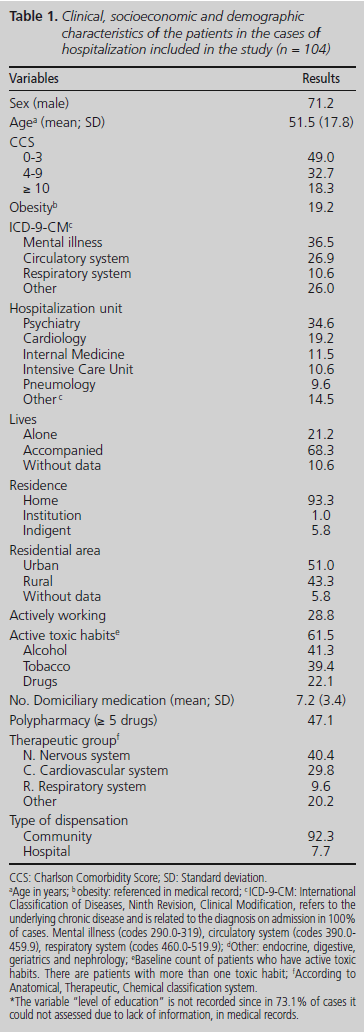
<body><![CDATA[<blockquote>     <p><font face="Verdana" size="2">1. To determine the profile of patients who are hospitalized as a result of non-adherence to domiciliary pharmacological treatment.</font></p>     <p><font face="Verdana" size="2">2. To obtain an estimate of the economic impact for the hospital.</font></p> </blockquote>     <p>&nbsp;</p>     <p><font face="Verdana" size="2"><b>Method</b></font></p>     <p><font face="Verdana" size="2">We performed an observational retrospective study conducted in a 1,250-bed universitary hospital. We included patients over 18 years old that were admitted in 2012 with a secondary diagnosis of "Personal history of non-compliance with chronic medication" (code V15.81) of the International Classification of Diseases, Ninth Revision, Clinical Modification (ICD-9-CM) format. We obtained the initial sample of patients from the coding department of the hospital and other data by digital medical record (IANUS<sup>&reg;</sup> v.04.10.0323). Variables collected: demographics; Charlson comorbidity score<sup>14</sup>; obesity (referenced in medical record); basal diagnosis (according to ICD-9-CM); hospitalization unit; socioeconomic data (level of education, type of residence, residential area, living alone/accompanied, work activity, active toxic habits: tobacco, alcohol and drugs); number (No.) of domiciliary medicines (DM) on admission; polypharmacy (<u>&gt;</u> 5 drugs)<sup>15</sup>; therapeutic group (according to official Anatomical, Therapeutic, Chemical classification (ATC) system); type of medication dispensed: hospital (HD) /community (CD); hospital days; re-admissions (days); DA, we defined: <u>&lt;</u> <i>75% or severe non-adherence</i> (unjustified discontinuity of <u>&gt;</u> 1 month in the collection of medication from the pharmacy and/or hospital outpatient dispensing area, in the 4 months prior to admission) and &gt; <i>75% or moderate non-adherence</i> (no discontinuity in the collection); type of non-adherence: we defined <i>non-persistence</i> (proof of abandonment of the treatment in the medical report on release from the hospital) and <i>non-compliance</i> (evidence of irregular intake of medicines in the medical report); hospitalization prevalence; hospitalization costs (overall cost, cost per episode, cost per unit and cost of readmission). In order to estimate the economic impact we only evaluated the cost associated with the hospital stay, according to Royal Decree-Law 221/2012, 31 October, in which the rates for health services provided at the centres of the Galician health service are establish (taking into account the difference in the cost for acute psychiatric and critical care units).</font></p>     <p><font face="Verdana" size="2">We performed descriptive statistical analysis expressing the quantitative variables such as mean (standard deviation) and the categorical such as percentages and frequencies using the SPSS version 15 programme. We associated the degree and type of non-adherence with the categorical variables using contingency and Chi-square tables; and using the T-Student test and variance analysis (ANOVA) with the quantitative variables. We established a significance level of p &lt; 0.05.</font></p>     <p>&nbsp;</p>     <p><font face="Verdana" size="2"><b>Results</b></font></p>     <p><font face="Verdana" size="2">A total of 106 patients were admitted with a secondary diagnosis of lack of adherence to medication. Nineteen patients were excluded from the study because the relationship between the reason for admission and non-adherence to DM did not exist, or was unclear. The 87 patients with a confirmed diagnosis, resulted in 104 hospitalizations or episodes (seven patients were readmitted once, and three patients were readmitted two or more times). There were four exitus in patients with human immunodeficiency virus (HIV): three due to acquired immunodeficiency syndrome and one due to pneumococcal sepsis.</font></p>     ]]></body>
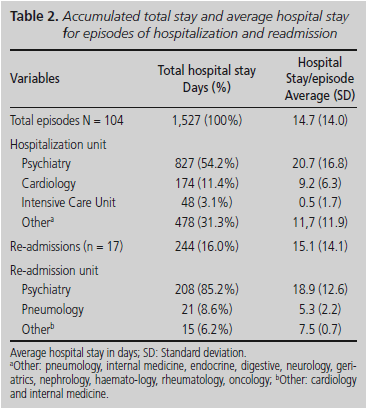
<body><![CDATA[<p><font face="Verdana" size="2">All of the patients had basal chronic pathologies, which were primarily psychiatric or cardiac in origin. <a href="#t1">Table 1</a> gives the general and clinical characteristics of the hospitalized patients.</font></p>     <p>&nbsp;</p>     <p align="center"><a name="t1"><img src="/img/revistas/fh/v38n4/09original09_t1.gif"></a></font></p>     <p>&nbsp;</p>     <p><font face="Verdana" size="2">The cardiologic patients took more DM than the psychiatric &#091;6.9 (4.0) <i>vs</i>. 4.2 (2.4) drugs, p &lt; 0.05, ANOVA&#093;; although polypharmacy and the number of DM was not related to the degree or type of non-adherence, (p &gt; 0.05, Chi-square and t-Student test). All of the HD drugs were antiretrovirals for HIV</font></p>     <p><font face="Verdana" size="2">Severe lack of adherence was identified in 76% (79/104) of episodes. Patients with mental illness (ICD-9-CM, codes 290.0-319.9) had a DA <u>&lt;</u> 75% in 70.3% (26/37) of psychiatric episodes and in 8.7% with respect to total admissions to psychiatry unit (26/297) in 2012. Patients with cardiac disorders had a severe non-adherence in 63.6% (14/22) of cardiologic episodes. The mean age in patients with severe lack of adherence (<u>&lt;</u> 75%) was lower than in moderate non-adherence (&gt; 75%): 48.5 (16.7) <i>vs</i>. 60.4 (18.2) years in moderate, p &lt; 0.05, t-Student. There was non-persistence in the treatment in 63.5% of the cases, with this being the main reason for the lack of adherence in therapeutic groups N (nervous system), C (circulatory system), R (respiratory system) and J (anti-infective).</font></p>     <p><font face="Verdana" size="2">Other significant differences did not observe among the rest of the clinical, socioeconomic and demographic characteristics of the patients for DA and type of non-adherence.</font></p>     <p><font face="Verdana" size="2"><a href="#t2">Table 2</a> gives the total and mean hospital stay for the episodes and re-admissions with respect to hospitalization units.</font></p>     <p>&nbsp;</p>     <p align="center"><a name="t2"><img src="/img/revistas/fh/v38n4/09original09_t2.gif"></a></font></p>     ]]></body>
<body><![CDATA[<p>&nbsp;</p>     <p><font face="Verdana" size="2">The hospitalization units with increased overall and longer average stays per episode were psychiatry and cardiology with 54.2% and 11.4% of the cumulative total, respectively. We recorded that 10.6% of the total number of cases were in the intensive care unit; with a total stay of 48 days, but with a short mean length of stay in this unit per episode (standard deviation), 0.5 (1.7) days. Furthermore, 16.3% (17/104) of the total cases were re-admissions; mainly psychiatric (64.7%) and respiratory (23.5%) patients.</font></p>     <p><font face="Verdana" size="2"><a href="#t3">Table 3</a> gives the stay and the average cost in each case of hospitalization depending on the DA and type of non-adherence.</font></p>     <p>&nbsp;</p>     <p align="center"><a name="t3"><img src="/img/revistas/fh/v38n4/09original09_t3.gif"></a></font></p>     <p>&nbsp;</p>     <p><font face="Verdana" size="2">Patients with a DA <u>&lt;</u> 75% had a length of hospitalization/episode higher than those with a DA &gt; 75%; nevertheless, no statistically significant difference was observed, p &gt; 0.05, t-Student test.</font></p>     <p><font face="Verdana" size="2">The average costs associated with hospitalization resulting from a severe non-adherence (DA <u>&lt;</u> 75%) and those caused by lack of persistence to treatment were significantly higher than in hospital admissions due to moderate non-adherence or slight interruption of treatment, p &lt; 0.05, t-Student test (<a href="#t3">Table 3</a>). Overall cost of hospitalization was &#x20ac; 594,230.8 (&#x20ac; 203,829.88 in psychiatry, &#x20ac; 84,566.6 in the intensive care unit and the rest due to hospitalization in other medical units), with an average cost/episode of &#x20ac; 5,713.6 &plusmn; 5,039.5. Re-admission cases amounted to &#x20ac; 83,211.3.</font></p>     <p><font face="Verdana" size="2">The hospitalization prevalence due to lack of adherence to DM, was 0.30% (104/ 34,195) for adults, in period of study.</font></p>     <p>&nbsp;</p>     ]]></body>
<body><![CDATA[<p><font face="Verdana" size="2"><b>Discussion</b></font></p>     <p><font face="Verdana" size="2">This study showed that 76% of the cases took less than 75% of their chronic medication during the four previous months. In the majority of the cases, this was because the patient abandoned the treatment. This also causes a longer hospital stay with respect to the average global hospital stay (8.6 days). Nonetheless, we cannot confirm if this finding is significant due to lack of a group control. These patients were mainly young men with little co-morbidity (although in the study period the majority of the scheduled admissions for other causes were for women). These results are similar to those found by Ambadekar<sup>16</sup> in cardiology patients. Other studies in chronic obstructive pulmonary disease patients<sup>4</sup> point to the elderly with comorbidities as being less adherent, and Flovig<sup>13</sup> points to a lower DA in women with psychiatric pathologies.</font></p>     <p><font face="Verdana" size="2">Although the presence of polypharmacy is important (47.1%), is not associated with lower adherence, in our study. This finding coincides with other authors<sup>17</sup> where the number of daily tablets taken for antiretrovirals are not associated with adherence (10.6 (4.6) <i>vs</i> 9.5 (3.2) tablets). This relationship, between polypharmacy and poor adherence, appears to be greater in the frail elderly and pluripathological patient<sup>18-19</sup>. Whenever possible, the medication regimen should be simplified.</font></p>     <p><font face="Verdana" size="2">In this study, patients with psychiatric illness have a severe non-adherence (DA <u>&lt;</u> 75%) to medication regime. A lack of adherence for psychiatric treatment was recorded by literature; Cramer et al.<sup>20</sup>, showed a mean level of adherence for antipsychotic medication of 58 (19) percent (range 24-90 percent). Hong et al.<sup>21</sup> estimated non-adherence rate (23.6%) over 21 months follow-up in the treatment of bipolar disorder. A recent study<sup>13</sup> in psychiatric patients, analysed the adherence of the week prior to admission and found 15% of DA &lt; 75% (and 82% of DA &gt; 75%). In our case, we obtained a higher percentage (72.2%) of DA <u>&lt;</u> 75% for psychiatric patient cohort (26/36) in the 4 months prior to admission. Although it is not comparable since the methodology differs, the high adherence to medication one week prior to admission might be related to increased experience of serious symptoms.</font></p>     <p><font face="Verdana" size="2">In a meta-analysis<sup>22</sup>, non-adherence was shown to be &gt; 1.5 times higher among individuals who did not perceive their disease as severe or as a threat. To achieve optimal adherence, the first step is to accept the disease and actively engage in its treatment and this seems to be one of the main problems identified in psychiatric patients (little or no awareness of their illness)<sup>1</sup>. Unfortunately, with the data available, we do not know if non-adherence is voluntary or involuntary. Nevertheless, substance abuse as alcohol (41%) and drugs (22%) seem to be common in our patients' habits, which leads us to think that voluntary abandonment probably predominates. This perception is similar to reported in other studies<sup>17,23</sup>, although our study, the active toxic habits showed no statistical significance for DA. For example, Riera et al.<sup>17</sup> concluded that active consumption of toxic and psychiatric problems, mainly depression, seem determinants on adherence to antiretroviral drugs; In recent study, Hapangama et al.<sup>23</sup> found a significant proportion (43%, range 39-48) of mentally ill patients that have a comorbid substance use diagnosis and associated complications. They were also found to have poorer treatment adherence (56.9% of them were substance abusers), increased number of hospital admissions (55.3% of readmissions corresponded to substance abusers), and higher rates of violence. For diabetes, dyslipidemia, and hypertension, medication non-adherence has been associated, also, with higher hospitalization rates<sup>22,24</sup>.</font></p>     <p><font face="Verdana" size="2">Lack of adherence as a cause for hospitalizations is associated with a high economic impact in our study, (p &lt; 0.05, t-Student). These results are consistent with other studies<sup>9,21,25</sup> which evaluate the cost associated with non-adherence in different diseases, although the amounts differ due to the difference in the type of patient and the methodology. In a review, Touchette et al.<sup>24</sup> described that total disease-related health care costs were lower for adherent diabetic patients compared with nonadherent patients ($4,570 for DA of 80%-100% <i>vs</i>. $8,867 for DA of 0%-19%). Similarly, adherent patients with dyslipidemia had lower total disease-related health care costs than did nonadherent patients ($ 3,924 for DA of 80%-100% of <i>vs</i>. $ 6,888 for DA of 0%-19%). In our study, costs generated for hospitalizations were &#x20ac; 3,895.6 for episodes with DA &gt; 75% <i>vs</i>. &#x20ac; 6,275.8 for episodes with DA <u>&lt;</u> 75%; our result is similar to previous if we consider $ instead &#x20ac;.</font></p>     <p>&nbsp;</p>     <p><font face="Verdana" size="2"><b>Limitations</b></font></p>     <p><font face="Verdana" size="2">This study has several limitations which are related to the nature of patient cohort and data used, study design, variable definitions and measure of DA and cost.</font></p>     <p><font face="Verdana" size="2">First, it is likely that the prevalence of hospitalization (0.30%) has been underestimated because we start from a sample which was already defined as such according to the encoding of the doctors. This leads us to believe that the magnitude of the problem in our area would be higher. Therefore, once again the problem of insufficient adherence that exists in the chronic patients manifests itself.</font></p>     ]]></body>
<body><![CDATA[<p><font face="Verdana" size="2">Second limitation is the retrospective design without a control group. Thus new prospective controlled studies are needed to more firmly demonstrate our results, evaluating socioeconomic characteristics that we did not cover, or that could not be adequately assessed due to lack of information, and by measuring the DA with more appropriate methods such as validated questionnaires. In the same way, in the subgroup of psychiatric patients, it is necessary to learn more about their diagnoses, socioeconomic and pharmacotherapeutic profiles and record the influence on the DA.</font></p>     <p><font face="Verdana" size="2">Third, as we considered a value of DA &gt; 75% as being the optimal, while the literature<sup>1</sup> establishes it as &gt; 80% may limit comparisons. This is justified by the difficulty of retrospectively assessing the adherence with the data available (we considered 4 months so it is easier to divide the adherence into four parts (25-50-75-100%). If during at least one month, the patient did not collect their medication the adherence was taken to be <u>&lt;</u> 75%.</font></p>     <p><font face="Verdana" size="2">Fourth, to compare our work with others is difficult because there are few existing works that sub-analyse hospitalisations resulting from a complication of the basal disease due to the lack of adherence to domiciliary medication.</font></p>     <p><font face="Verdana" size="2">Fifth, we consider the economic valuation to be underestimated as it does not include indirect costs, emergency visits, tests or surgical procedures. Finally, the degree to which medication use may be impacted appears to depend on the patient's ability to pay for medications as well as the condition being treated<sup>24</sup>. Taking into account that in 29% of the cases the patients are actively working, and in 71% of the cases they are retired or unemployed; it would be interesting to study the costs due to loss of productivity during hospitalization and the influence that the new Spanish regime of pharmaceutical delivery has had (Royal Decree-Law 16/2012, April 20) on adherence to medication.</font></p>     <p><font face="Verdana" size="2">This study shows that the profile of the patient with hospitalization due to insufficient adherence to medication is fundamentally, male psychiatric or chronic cardiac patient, with a DA <u>&lt;</u> 75% due to abandoning domiciliary medication. Patients with psychiatric and/or respiratory pathologies generate successive re-admissions and others are sent to critical care unit. All this generates long hospital stays with an elevated average cost of hospitalization which are associated with an important depletion of economic resources in the hospital.</font></p>     <p><font face="Verdana" size="2">Preventive measures in the short-term, such as the establishment of follow-up units for patients with increased risk, adaptations of dosing and/or presentations regimes could be implanted. This would be also very cost-effective for the health system, in view of the results.</font></p>     <p>&nbsp;</p>     <p><font face="Verdana" size="2"><b>Bibliography</b></font></p>     <!-- ref --><p><font face="Verdana" size="2">1. World Health Organization. Adherence to long-term therapies: Evidence for action. Geneva. World Health Organization; 2003. Available at: <a target="_blank" href="http://www.who.int/chp/knowledge/publications/adherence_report/en/">http://www.who.int/chp/knowledge/publications/adherence_report/en/</a>. Accessed July 23, 2013.    &nbsp;&nbsp;&nbsp;&nbsp;&nbsp;&nbsp;&nbsp;&nbsp;[&#160;<a href="javascript:void(0);" onclick="javascript: window.open('/scielo.php?script=sci_nlinks&ref=2212738&pid=S1130-6343201400040000900001&lng=','','width=640,height=500,resizable=yes,scrollbars=1,menubar=yes,');">Links</a>&#160;]<!-- end-ref --></font></p>    ]]></body>
<body><![CDATA[<!-- ref --><p><font face="Verdana" size="2">2. Lee WC, Balu S, Cobden D, Joshi AV, Pashos CL. Prevalence and economic consequences of medication adherence in diabetes: A systematic literature review. Manag Care Interface. 2006;19: 31-41.    &nbsp;&nbsp;&nbsp;&nbsp;&nbsp;&nbsp;&nbsp;&nbsp;[&#160;<a href="javascript:void(0);" onclick="javascript: window.open('/scielo.php?script=sci_nlinks&ref=2212740&pid=S1130-6343201400040000900002&lng=','','width=640,height=500,resizable=yes,scrollbars=1,menubar=yes,');">Links</a>&#160;]<!-- end-ref --></font></p>    <!-- ref --><p><font face="Verdana" size="2">3. Conlin PR, Gerth WC, Fox J, Roehm JB, Boccuzzi SJ. Four-year persistence patterns among patients initiating therapy with the angiotensin II receptor antagonist losartan <i>versus</i> other antihypertensive drug classes. Clin Ther. 2001; 23: 1999-2010.    &nbsp;&nbsp;&nbsp;&nbsp;&nbsp;&nbsp;&nbsp;&nbsp;[&#160;<a href="javascript:void(0);" onclick="javascript: window.open('/scielo.php?script=sci_nlinks&ref=2212742&pid=S1130-6343201400040000900003&lng=','','width=640,height=500,resizable=yes,scrollbars=1,menubar=yes,');">Links</a>&#160;]<!-- end-ref --></font></p>    <!-- ref --><p><font face="Verdana" size="2">4. Bourbeau J, Bartlett SJ. Patient adherence in COPD. Thorax. 2008; 63: 831-8.    &nbsp;&nbsp;&nbsp;&nbsp;&nbsp;&nbsp;&nbsp;&nbsp;[&#160;<a href="javascript:void(0);" onclick="javascript: window.open('/scielo.php?script=sci_nlinks&ref=2212744&pid=S1130-6343201400040000900004&lng=','','width=640,height=500,resizable=yes,scrollbars=1,menubar=yes,');">Links</a>&#160;]<!-- end-ref --></font></p>    <!-- ref --><p><font face="Verdana" size="2">5. Williams M, Clarke T, Williams P, Barton EN. The mean levels of adherence and factors contributing to non-adherence in patients on highly active antiretroviral therapy. West Indian Med J. 2007; 56: 270-4.    &nbsp;&nbsp;&nbsp;&nbsp;&nbsp;&nbsp;&nbsp;&nbsp;[&#160;<a href="javascript:void(0);" onclick="javascript: window.open('/scielo.php?script=sci_nlinks&ref=2212746&pid=S1130-6343201400040000900005&lng=','','width=640,height=500,resizable=yes,scrollbars=1,menubar=yes,');">Links</a>&#160;]<!-- end-ref --></font></p>    <!-- ref --><p><font face="Verdana" size="2">6. Osterberg L, Blaschke T. Adherence to medication. N Engl J Med. 2005; 353: 487-97.    &nbsp;&nbsp;&nbsp;&nbsp;&nbsp;&nbsp;&nbsp;&nbsp;[&#160;<a href="javascript:void(0);" onclick="javascript: window.open('/scielo.php?script=sci_nlinks&ref=2212748&pid=S1130-6343201400040000900006&lng=','','width=640,height=500,resizable=yes,scrollbars=1,menubar=yes,');">Links</a>&#160;]<!-- end-ref --></font></p>    ]]></body>
<body><![CDATA[<!-- ref --><p><font face="Verdana" size="2">7. New England Healthcare Institute. Thinking outside the pillbox. A system-wide approach to improving patient medication adherence for chronic disease. August 12, 2009. Avaliable at: <a target="_blank" href="http://www.nehi.net/publications/44/thinking_outside_the_pillbox_a_systemwide_approach_to_improving_patient_medication_adherence_for_chronic_disease">http://www.nehi.net/publications/44/thinking_outside_the_pillbox_a_systemwide_approach_to_improving_patient_medication_adherence_for_chronic_disease</a>. Accessed July 23, 2013.    &nbsp;&nbsp;&nbsp;&nbsp;&nbsp;&nbsp;&nbsp;&nbsp;[&#160;<a href="javascript:void(0);" onclick="javascript: window.open('/scielo.php?script=sci_nlinks&ref=2212750&pid=S1130-6343201400040000900007&lng=','','width=640,height=500,resizable=yes,scrollbars=1,menubar=yes,');">Links</a>&#160;]<!-- end-ref --></font></p>    <!-- ref --><p><font face="Verdana" size="2">8. Bioindustries Unit and Pharmacy. Antares Consulting. Economic impact of non-adherence in pharmaceutical costs. Third newsletter. February 5, 2013. Avaliable to: <a target="_blank" href="http://www.antares-consulting.com/es_ES/main/detallepublicacion/Publicacion/79/apartado/B/idUnidad/1">http://www.antares-consulting.com/es_ES/main/detallepublicacion/Publicacion/79/apartado/B/idUnidad/1</a>. Accessed July 27, 2013.    &nbsp;&nbsp;&nbsp;&nbsp;&nbsp;&nbsp;&nbsp;&nbsp;[&#160;<a href="javascript:void(0);" onclick="javascript: window.open('/scielo.php?script=sci_nlinks&ref=2212752&pid=S1130-6343201400040000900008&lng=','','width=640,height=500,resizable=yes,scrollbars=1,menubar=yes,');">Links</a>&#160;]<!-- end-ref --></font></p>    <!-- ref --><p><font face="Verdana" size="2">9. Desborough JA, Sach T, Bhattacharya D, Holland RC, Wright DJ. A cost-consequences analysis of an adherence focused pharmacist-led medication review service. Int J Pharm Pract. 2012; 20: 41-9.    &nbsp;&nbsp;&nbsp;&nbsp;&nbsp;&nbsp;&nbsp;&nbsp;[&#160;<a href="javascript:void(0);" onclick="javascript: window.open('/scielo.php?script=sci_nlinks&ref=2212754&pid=S1130-6343201400040000900009&lng=','','width=640,height=500,resizable=yes,scrollbars=1,menubar=yes,');">Links</a>&#160;]<!-- end-ref --></font></p>    <!-- ref --><p><font face="Verdana" size="2">10. Ventura-Cerdá JM, Mínguez-Gallego C, Fernández-Villalba EM, Alós-Almiñana M, Andrés-Soler J. Escala simplificada para detectar problemas de adherencia (ESPA) al tratamiento antirretroviral. Farm Hosp. 2006; 30: 171-6.    &nbsp;&nbsp;&nbsp;&nbsp;&nbsp;&nbsp;&nbsp;&nbsp;[&#160;<a href="javascript:void(0);" onclick="javascript: window.open('/scielo.php?script=sci_nlinks&ref=2212756&pid=S1130-6343201400040000900010&lng=','','width=640,height=500,resizable=yes,scrollbars=1,menubar=yes,');">Links</a>&#160;]<!-- end-ref --></font></p>    <!-- ref --><p><font face="Verdana" size="2">11. Treadaway K, Cutter G, Salter A, et al. Factors that influence adherence with disease-modifying therapy in MS. J Neurol. 2009; 256: 568-76.    &nbsp;&nbsp;&nbsp;&nbsp;&nbsp;&nbsp;&nbsp;&nbsp;[&#160;<a href="javascript:void(0);" onclick="javascript: window.open('/scielo.php?script=sci_nlinks&ref=2212758&pid=S1130-6343201400040000900011&lng=','','width=640,height=500,resizable=yes,scrollbars=1,menubar=yes,');">Links</a>&#160;]<!-- end-ref --></font></p>    ]]></body>
<body><![CDATA[<!-- ref --><p><font face="Verdana" size="2">12. Santolaya Perrín R, Fernández-Pacheco García Valdecasas M, Arteche Eguizabal L, Gema Pérez Pérez I, Muñoz Muñoz N, Ibarra Barrueta O, et al. Adherencia subóptima al tratamiento en la esclerosis múltiple. Farm Hosp. 2012; 36: 124-9.    &nbsp;&nbsp;&nbsp;&nbsp;&nbsp;&nbsp;&nbsp;&nbsp;[&#160;<a href="javascript:void(0);" onclick="javascript: window.open('/scielo.php?script=sci_nlinks&ref=2212760&pid=S1130-6343201400040000900012&lng=','','width=640,height=500,resizable=yes,scrollbars=1,menubar=yes,');">Links</a>&#160;]<!-- end-ref --></font></p>    <!-- ref --><p><font face="Verdana" size="2">13. Flovig JC, Morken G, Güzey IC, Vaaler AE. Pharmacological treatment and adherence one week prior to acute psychiatric admissions. Nord J Psychiatry. 2012; 66: 222-4.    &nbsp;&nbsp;&nbsp;&nbsp;&nbsp;&nbsp;&nbsp;&nbsp;[&#160;<a href="javascript:void(0);" onclick="javascript: window.open('/scielo.php?script=sci_nlinks&ref=2212762&pid=S1130-6343201400040000900013&lng=','','width=640,height=500,resizable=yes,scrollbars=1,menubar=yes,');">Links</a>&#160;]<!-- end-ref --></font></p>    <!-- ref --><p><font face="Verdana" size="2">14. Charlson ME, Pompei P, Ales KL, McKenzie CR. A new method of classifying prognostic comorbidity in longitudinal studies: development and validation. J Chron Dis. 1987; 40: 373-83.    &nbsp;&nbsp;&nbsp;&nbsp;&nbsp;&nbsp;&nbsp;&nbsp;[&#160;<a href="javascript:void(0);" onclick="javascript: window.open('/scielo.php?script=sci_nlinks&ref=2212764&pid=S1130-6343201400040000900014&lng=','','width=640,height=500,resizable=yes,scrollbars=1,menubar=yes,');">Links</a>&#160;]<!-- end-ref --></font></p>    <!-- ref --><p><font face="Verdana" size="2">15. Monane M, Monane S, Semla T. Optimal medication use in elders. Key to successful aging. West J Med. 1997; 167: 233-7.    &nbsp;&nbsp;&nbsp;&nbsp;&nbsp;&nbsp;&nbsp;&nbsp;[&#160;<a href="javascript:void(0);" onclick="javascript: window.open('/scielo.php?script=sci_nlinks&ref=2212766&pid=S1130-6343201400040000900015&lng=','','width=640,height=500,resizable=yes,scrollbars=1,menubar=yes,');">Links</a>&#160;]<!-- end-ref --></font></p>    <!-- ref --><p><font face="Verdana" size="2">16. Ambardekar AV, Fonarow GC, Hernandez AF, Pan W, Yancy CW, Krantz MJ. Characteristics and in-hospital outcomes for nonadherent patients with heart failure: Findings from Get With The Guidelines-Heart Failure (GWTG-HF). Am Heart J. 2009; 158: 644-52.    &nbsp;&nbsp;&nbsp;&nbsp;&nbsp;&nbsp;&nbsp;&nbsp;[&#160;<a href="javascript:void(0);" onclick="javascript: window.open('/scielo.php?script=sci_nlinks&ref=2212768&pid=S1130-6343201400040000900016&lng=','','width=640,height=500,resizable=yes,scrollbars=1,menubar=yes,');">Links</a>&#160;]<!-- end-ref --></font></p>    ]]></body>
<body><![CDATA[<!-- ref --><p><font face="Verdana" size="2">17. Riera M, De la Fuente L, Castanyer B, Puigventós F, Villalonga C, Ribas MA, et al. Adherencia a los fármacos antirretrovirales medida por la concentración de fármacos y el recuento de comprimidos. Variables relacionadas con una mala adherencia. Med Clin (Barc). 2002; 1 19: 286-92.    &nbsp;&nbsp;&nbsp;&nbsp;&nbsp;&nbsp;&nbsp;&nbsp;[&#160;<a href="javascript:void(0);" onclick="javascript: window.open('/scielo.php?script=sci_nlinks&ref=2212770&pid=S1130-6343201400040000900017&lng=','','width=640,height=500,resizable=yes,scrollbars=1,menubar=yes,');">Links</a>&#160;]<!-- end-ref --></font></p>    <!-- ref --><p><font face="Verdana" size="2">18. Shah BM, Hajjar ER. Polypharmacy, adverse drug reactions, and geriatric syndromes. Clin Geriatr Med. 2012; 28: 173-86.    &nbsp;&nbsp;&nbsp;&nbsp;&nbsp;&nbsp;&nbsp;&nbsp;[&#160;<a href="javascript:void(0);" onclick="javascript: window.open('/scielo.php?script=sci_nlinks&ref=2212772&pid=S1130-6343201400040000900018&lng=','','width=640,height=500,resizable=yes,scrollbars=1,menubar=yes,');">Links</a>&#160;]<!-- end-ref --></font></p>    <!-- ref --><p><font face="Verdana" size="2">19. Hubbard RE, O'Mahony MS, Woodhouse KW. Medication prescribing in frail older people. Eur J Clin Pharmacol. 2013; 69: 319-26.    &nbsp;&nbsp;&nbsp;&nbsp;&nbsp;&nbsp;&nbsp;&nbsp;[&#160;<a href="javascript:void(0);" onclick="javascript: window.open('/scielo.php?script=sci_nlinks&ref=2212774&pid=S1130-6343201400040000900019&lng=','','width=640,height=500,resizable=yes,scrollbars=1,menubar=yes,');">Links</a>&#160;]<!-- end-ref --></font></p>    <!-- ref --><p><font face="Verdana" size="2">20. Cramer JA, Rosenheck R. Compliance with medication regimens for mental and physical disorders. Psychiatr Serv. 1998; 49: 196-201.    &nbsp;&nbsp;&nbsp;&nbsp;&nbsp;&nbsp;&nbsp;&nbsp;[&#160;<a href="javascript:void(0);" onclick="javascript: window.open('/scielo.php?script=sci_nlinks&ref=2212776&pid=S1130-6343201400040000900020&lng=','','width=640,height=500,resizable=yes,scrollbars=1,menubar=yes,');">Links</a>&#160;]<!-- end-ref --></font></p>    <!-- ref --><p><font face="Verdana" size="2">21. Hong J, Reed C, Novick D, Haro JM, Aguado J. Clinical and economic consequences of medication non-adherence in the treatment of patients with a manic/mixed episode of bipolar disorder: results from the European Mania in Bipolar Longitudinal Evaluation of Medication (EMBLEM) study. Psychiatry Res. 2011; 190: 110-4.    &nbsp;&nbsp;&nbsp;&nbsp;&nbsp;&nbsp;&nbsp;&nbsp;[&#160;<a href="javascript:void(0);" onclick="javascript: window.open('/scielo.php?script=sci_nlinks&ref=2212778&pid=S1130-6343201400040000900021&lng=','','width=640,height=500,resizable=yes,scrollbars=1,menubar=yes,');">Links</a>&#160;]<!-- end-ref --></font></p>    ]]></body>
<body><![CDATA[<!-- ref --><p><font face="Verdana" size="2">22. DiMatteo MR, Haskard KB, Williams SL. Health beliefs, disease severity, and patient adherence: a meta-analysis. Med Care. 2007; 45: 521-8.    &nbsp;&nbsp;&nbsp;&nbsp;&nbsp;&nbsp;&nbsp;&nbsp;[&#160;<a href="javascript:void(0);" onclick="javascript: window.open('/scielo.php?script=sci_nlinks&ref=2212780&pid=S1130-6343201400040000900022&lng=','','width=640,height=500,resizable=yes,scrollbars=1,menubar=yes,');">Links</a>&#160;]<!-- end-ref --></font></p>    <!-- ref --><p><font face="Verdana" size="2">23. Hapangama A, Kuruppuarachchi KA, Pathmeswaran A. Substance use disorders among mentally ill patients in a General Hospital in Sri Lanka: prevalence and correlates. Ceylon Med J. 2013; 58: 111-5.    &nbsp;&nbsp;&nbsp;&nbsp;&nbsp;&nbsp;&nbsp;&nbsp;[&#160;<a href="javascript:void(0);" onclick="javascript: window.open('/scielo.php?script=sci_nlinks&ref=2212782&pid=S1130-6343201400040000900023&lng=','','width=640,height=500,resizable=yes,scrollbars=1,menubar=yes,');">Links</a>&#160;]<!-- end-ref --></font></p>    <!-- ref --><p><font face="Verdana" size="2">24. Touchette D, Shapiro NL. Medication Compliance, Adherence, and Persistence: Current Status of Behavioral and Educational Interventions to Improve Outcomes. J Manag Care Pharm. 2008; 14 (Suppl. S-d): S2-S10.    &nbsp;&nbsp;&nbsp;&nbsp;&nbsp;&nbsp;&nbsp;&nbsp;[&#160;<a href="javascript:void(0);" onclick="javascript: window.open('/scielo.php?script=sci_nlinks&ref=2212784&pid=S1130-6343201400040000900024&lng=','','width=640,height=500,resizable=yes,scrollbars=1,menubar=yes,');">Links</a>&#160;]<!-- end-ref --></font></p>    <!-- ref --><p><font face="Verdana" size="2">25. Sun SX, Liu GG, Christensen DB, Fu AZ. Review and analysis of hospitalization costs associated with antipsychotic nonadherence in the treatment of schizophrenia in the United States. Curr Med Res Opin. 2007; 23: 2305-12.    &nbsp;&nbsp;&nbsp;&nbsp;&nbsp;&nbsp;&nbsp;&nbsp;[&#160;<a href="javascript:void(0);" onclick="javascript: window.open('/scielo.php?script=sci_nlinks&ref=2212786&pid=S1130-6343201400040000900025&lng=','','width=640,height=500,resizable=yes,scrollbars=1,menubar=yes,');">Links</a>&#160;]<!-- end-ref --></font></p>     <p>&nbsp;</p>     <p>&nbsp;</p>     ]]></body>
<body><![CDATA[<p><font face="Verdana" size="2"><a href="#top"><img border="0" src="/img/revistas/fh/v38n4/seta.gif" width="15" height="17"></a><a name="bajo"></a><b>Correspondence:</b>    <br>Correo electrónico: <a href="mailto:miriamal_5@hotmail.com">miriamal_5@hotmail.com</a>    <br>(Miriam Álvarez Payero).</font></p>     <p><font face="Verdana" size="2">Recibido el 3 de junio de 2014;    <br>Aceptado el 19 de junio de 2014.</font></p>      ]]></body><back>
<ref-list>
<ref id="B1">
<label>1</label><nlm-citation citation-type="book">
<collab>World Health Organization</collab>
<source><![CDATA[Adherence to long-term therapies: Evidence for action]]></source>
<year>2003</year>
<publisher-loc><![CDATA[Geneva ]]></publisher-loc>
<publisher-name><![CDATA[World Health Organization]]></publisher-name>
</nlm-citation>
</ref>
<ref id="B2">
<label>2</label><nlm-citation citation-type="journal">
<person-group person-group-type="author">
<name>
<surname><![CDATA[Lee]]></surname>
<given-names><![CDATA[WC]]></given-names>
</name>
<name>
<surname><![CDATA[Balu]]></surname>
<given-names><![CDATA[S]]></given-names>
</name>
<name>
<surname><![CDATA[Cobden]]></surname>
<given-names><![CDATA[D]]></given-names>
</name>
<name>
<surname><![CDATA[Joshi]]></surname>
<given-names><![CDATA[AV]]></given-names>
</name>
<name>
<surname><![CDATA[Pashos]]></surname>
<given-names><![CDATA[CL]]></given-names>
</name>
</person-group>
<article-title xml:lang="en"><![CDATA[Prevalence and economic consequences of medication adherence in diabetes: A systematic literature review]]></article-title>
<source><![CDATA[Manag Care Interface]]></source>
<year>2006</year>
<volume>19</volume>
<page-range>31-41</page-range></nlm-citation>
</ref>
<ref id="B3">
<label>3</label><nlm-citation citation-type="journal">
<person-group person-group-type="author">
<name>
<surname><![CDATA[Conlin]]></surname>
<given-names><![CDATA[PR]]></given-names>
</name>
<name>
<surname><![CDATA[Gerth]]></surname>
<given-names><![CDATA[WC]]></given-names>
</name>
<name>
<surname><![CDATA[Fox]]></surname>
<given-names><![CDATA[J]]></given-names>
</name>
<name>
<surname><![CDATA[Roehm]]></surname>
<given-names><![CDATA[JB]]></given-names>
</name>
<name>
<surname><![CDATA[Boccuzzi]]></surname>
<given-names><![CDATA[SJ]]></given-names>
</name>
</person-group>
<article-title xml:lang="en"><![CDATA[Four-year persistence patterns among patients initiating therapy with the angiotensin II receptor antagonist losartan versus other antihypertensive drug classes]]></article-title>
<source><![CDATA[Clin Ther.]]></source>
<year>2001</year>
<volume>23</volume>
<page-range>1999-2010</page-range></nlm-citation>
</ref>
<ref id="B4">
<label>4</label><nlm-citation citation-type="journal">
<person-group person-group-type="author">
<name>
<surname><![CDATA[Bourbeau]]></surname>
<given-names><![CDATA[J]]></given-names>
</name>
<name>
<surname><![CDATA[Bartlett]]></surname>
<given-names><![CDATA[SJ]]></given-names>
</name>
</person-group>
<article-title xml:lang="en"><![CDATA[Patient adherence in COPD]]></article-title>
<source><![CDATA[Thorax]]></source>
<year>2008</year>
<volume>63</volume>
<page-range>831-8</page-range></nlm-citation>
</ref>
<ref id="B5">
<label>5</label><nlm-citation citation-type="journal">
<person-group person-group-type="author">
<name>
<surname><![CDATA[Williams]]></surname>
<given-names><![CDATA[M]]></given-names>
</name>
<name>
<surname><![CDATA[Clarke]]></surname>
<given-names><![CDATA[T]]></given-names>
</name>
<name>
<surname><![CDATA[Williams]]></surname>
<given-names><![CDATA[P]]></given-names>
</name>
<name>
<surname><![CDATA[Barton]]></surname>
<given-names><![CDATA[EN]]></given-names>
</name>
</person-group>
<article-title xml:lang="en"><![CDATA[The mean levels of adherence and factors contributing to non-adherence in patients on highly active antiretroviral therapy]]></article-title>
<source><![CDATA[West Indian Med J.]]></source>
<year>2007</year>
<volume>56</volume>
<page-range>270-4</page-range></nlm-citation>
</ref>
<ref id="B6">
<label>6</label><nlm-citation citation-type="journal">
<person-group person-group-type="author">
<name>
<surname><![CDATA[Osterberg]]></surname>
<given-names><![CDATA[L]]></given-names>
</name>
<name>
<surname><![CDATA[Blaschke]]></surname>
<given-names><![CDATA[T]]></given-names>
</name>
</person-group>
<article-title xml:lang="en"><![CDATA[Adherence to medication]]></article-title>
<source><![CDATA[N Engl J Med.]]></source>
<year>2005</year>
<volume>353</volume>
<page-range>487-97</page-range></nlm-citation>
</ref>
<ref id="B7">
<label>7</label><nlm-citation citation-type="">
<collab>New England Healthcare Institute</collab>
<source><![CDATA[Thinking outside the pillbox: A system-wide approach to improving patient medication adherence for chronic disease]]></source>
<year>Augu</year>
<month>st</month>
<day> 1</day>
</nlm-citation>
</ref>
<ref id="B8">
<label>8</label><nlm-citation citation-type="">
<collab>Antares Consulting^dBioindustries Unit and Pharmacy</collab>
<source><![CDATA[Economic impact of non-adherence in pharmaceutical costs]]></source>
<year>Febr</year>
<month>ua</month>
<day>ry</day>
</nlm-citation>
</ref>
<ref id="B9">
<label>9</label><nlm-citation citation-type="journal">
<person-group person-group-type="author">
<name>
<surname><![CDATA[Desborough]]></surname>
<given-names><![CDATA[JA]]></given-names>
</name>
<name>
<surname><![CDATA[Sach]]></surname>
<given-names><![CDATA[T]]></given-names>
</name>
<name>
<surname><![CDATA[Bhattacharya]]></surname>
<given-names><![CDATA[D]]></given-names>
</name>
<name>
<surname><![CDATA[Holland]]></surname>
<given-names><![CDATA[RC]]></given-names>
</name>
<name>
<surname><![CDATA[Wright]]></surname>
<given-names><![CDATA[DJ]]></given-names>
</name>
</person-group>
<article-title xml:lang="en"><![CDATA[A cost-consequences analysis of an adherence focused pharmacist-led medication review service]]></article-title>
<source><![CDATA[Int J Pharm Pract.]]></source>
<year>2012</year>
<volume>20</volume>
<page-range>41-9</page-range></nlm-citation>
</ref>
<ref id="B10">
<label>10</label><nlm-citation citation-type="journal">
<person-group person-group-type="author">
<name>
<surname><![CDATA[Ventura-Cerdá]]></surname>
<given-names><![CDATA[JM]]></given-names>
</name>
<name>
<surname><![CDATA[Mínguez-Gallego]]></surname>
<given-names><![CDATA[C]]></given-names>
</name>
<name>
<surname><![CDATA[Fernández-Villalba]]></surname>
<given-names><![CDATA[EM]]></given-names>
</name>
<name>
<surname><![CDATA[Alós-Almiñana]]></surname>
<given-names><![CDATA[M]]></given-names>
</name>
<name>
<surname><![CDATA[Andrés-Soler]]></surname>
<given-names><![CDATA[J]]></given-names>
</name>
</person-group>
<article-title xml:lang="es"><![CDATA[Escala simplificada para detectar problemas de adherencia (ESPA) al tratamiento antirretroviral]]></article-title>
<source><![CDATA[Farm Hosp.]]></source>
<year>2006</year>
<volume>30</volume>
<page-range>171-6</page-range></nlm-citation>
</ref>
<ref id="B11">
<label>11</label><nlm-citation citation-type="journal">
<person-group person-group-type="author">
<name>
<surname><![CDATA[Treadaway]]></surname>
<given-names><![CDATA[K]]></given-names>
</name>
<name>
<surname><![CDATA[Cutter]]></surname>
<given-names><![CDATA[G]]></given-names>
</name>
<name>
<surname><![CDATA[Salter]]></surname>
<given-names><![CDATA[A]]></given-names>
</name>
</person-group>
<article-title xml:lang="en"><![CDATA[Factors that influence adherence with disease-modifying therapy in MS]]></article-title>
<source><![CDATA[J Neurol.]]></source>
<year>2009</year>
<volume>256</volume>
<page-range>568-76</page-range></nlm-citation>
</ref>
<ref id="B12">
<label>12</label><nlm-citation citation-type="journal">
<person-group person-group-type="author">
<name>
<surname><![CDATA[Santolaya Perrín]]></surname>
<given-names><![CDATA[R]]></given-names>
</name>
<name>
<surname><![CDATA[Fernández-Pacheco García Valdecasas]]></surname>
<given-names><![CDATA[M]]></given-names>
</name>
<name>
<surname><![CDATA[Arteche Eguizabal]]></surname>
<given-names><![CDATA[L]]></given-names>
</name>
<name>
<surname><![CDATA[Gema Pérez Pérez]]></surname>
<given-names><![CDATA[I]]></given-names>
</name>
<name>
<surname><![CDATA[Muñoz Muñoz]]></surname>
<given-names><![CDATA[N]]></given-names>
</name>
<name>
<surname><![CDATA[Ibarra Barrueta]]></surname>
<given-names><![CDATA[O]]></given-names>
</name>
</person-group>
<article-title xml:lang="es"><![CDATA[Adherencia subóptima al tratamiento en la esclerosis múltiple]]></article-title>
<source><![CDATA[Farm Hosp.]]></source>
<year>2012</year>
<volume>36</volume>
<page-range>124-9</page-range></nlm-citation>
</ref>
<ref id="B13">
<label>13</label><nlm-citation citation-type="journal">
<person-group person-group-type="author">
<name>
<surname><![CDATA[Flovig]]></surname>
<given-names><![CDATA[JC]]></given-names>
</name>
<name>
<surname><![CDATA[Morken]]></surname>
<given-names><![CDATA[G]]></given-names>
</name>
<name>
<surname><![CDATA[Güzey]]></surname>
<given-names><![CDATA[IC]]></given-names>
</name>
<name>
<surname><![CDATA[Vaaler]]></surname>
<given-names><![CDATA[AE]]></given-names>
</name>
</person-group>
<article-title xml:lang="en"><![CDATA[Pharmacological treatment and adherence one week prior to acute psychiatric admissions]]></article-title>
<source><![CDATA[Nord J Psychiatry]]></source>
<year>2012</year>
<volume>66</volume>
<page-range>222-4</page-range></nlm-citation>
</ref>
<ref id="B14">
<label>14</label><nlm-citation citation-type="journal">
<person-group person-group-type="author">
<name>
<surname><![CDATA[Charlson]]></surname>
<given-names><![CDATA[ME]]></given-names>
</name>
<name>
<surname><![CDATA[Pompei]]></surname>
<given-names><![CDATA[P]]></given-names>
</name>
<name>
<surname><![CDATA[Ales]]></surname>
<given-names><![CDATA[KL]]></given-names>
</name>
<name>
<surname><![CDATA[McKenzie]]></surname>
<given-names><![CDATA[CR]]></given-names>
</name>
</person-group>
<article-title xml:lang="en"><![CDATA[A new method of classifying prognostic comorbidity in longitudinal studies: development and validation]]></article-title>
<source><![CDATA[J Chron Dis.]]></source>
<year>1987</year>
<volume>40</volume>
<page-range>373-83</page-range></nlm-citation>
</ref>
<ref id="B15">
<label>15</label><nlm-citation citation-type="journal">
<person-group person-group-type="author">
<name>
<surname><![CDATA[Monane]]></surname>
<given-names><![CDATA[M]]></given-names>
</name>
<name>
<surname><![CDATA[Monane]]></surname>
<given-names><![CDATA[S]]></given-names>
</name>
<name>
<surname><![CDATA[Semla]]></surname>
<given-names><![CDATA[T]]></given-names>
</name>
</person-group>
<article-title xml:lang="en"><![CDATA[Optimal medication use in elders: Key to successful aging]]></article-title>
<source><![CDATA[West J Med.]]></source>
<year>1997</year>
<volume>167</volume>
<page-range>233-7</page-range></nlm-citation>
</ref>
<ref id="B16">
<label>16</label><nlm-citation citation-type="journal">
<person-group person-group-type="author">
<name>
<surname><![CDATA[Ambardekar]]></surname>
<given-names><![CDATA[AV]]></given-names>
</name>
<name>
<surname><![CDATA[Fonarow]]></surname>
<given-names><![CDATA[GC]]></given-names>
</name>
<name>
<surname><![CDATA[Hernandez]]></surname>
<given-names><![CDATA[AF]]></given-names>
</name>
<name>
<surname><![CDATA[Pan]]></surname>
<given-names><![CDATA[W]]></given-names>
</name>
<name>
<surname><![CDATA[Yancy]]></surname>
<given-names><![CDATA[CW]]></given-names>
</name>
<name>
<surname><![CDATA[Krantz]]></surname>
<given-names><![CDATA[MJ]]></given-names>
</name>
</person-group>
<article-title xml:lang="en"><![CDATA[Characteristics and in-hospital outcomes for nonadherent patients with heart failure: Findings from Get With The Guidelines-Heart Failure (GWTG-HF)]]></article-title>
<source><![CDATA[Am Heart J.]]></source>
<year>2009</year>
<volume>158</volume>
<page-range>644-52</page-range></nlm-citation>
</ref>
<ref id="B17">
<label>17</label><nlm-citation citation-type="journal">
<person-group person-group-type="author">
<name>
<surname><![CDATA[Riera]]></surname>
<given-names><![CDATA[M]]></given-names>
</name>
<name>
<surname><![CDATA[De la Fuente]]></surname>
<given-names><![CDATA[L]]></given-names>
</name>
<name>
<surname><![CDATA[Castanyer]]></surname>
<given-names><![CDATA[B]]></given-names>
</name>
<name>
<surname><![CDATA[Puigventós]]></surname>
<given-names><![CDATA[F]]></given-names>
</name>
<name>
<surname><![CDATA[Villalonga]]></surname>
<given-names><![CDATA[C]]></given-names>
</name>
<name>
<surname><![CDATA[Ribas]]></surname>
<given-names><![CDATA[MA]]></given-names>
</name>
</person-group>
<article-title xml:lang="es"><![CDATA[Adherencia a los fármacos antirretrovirales medida por la concentración de fármacos y el recuento de comprimidos: Variables relacionadas con una mala adherencia]]></article-title>
<source><![CDATA[Med Clin (Barc)]]></source>
<year>2002</year>
<volume>1</volume>
<numero>19</numero>
<issue>19</issue>
<page-range>286-92</page-range></nlm-citation>
</ref>
<ref id="B18">
<label>18</label><nlm-citation citation-type="journal">
<person-group person-group-type="author">
<name>
<surname><![CDATA[Shah]]></surname>
<given-names><![CDATA[BM]]></given-names>
</name>
<name>
<surname><![CDATA[Hajjar]]></surname>
<given-names><![CDATA[ER]]></given-names>
</name>
</person-group>
<article-title xml:lang="en"><![CDATA[Polypharmacy, adverse drug reactions, and geriatric syndromes]]></article-title>
<source><![CDATA[Clin Geriatr Med.]]></source>
<year>2012</year>
<volume>28</volume>
<page-range>173-86</page-range></nlm-citation>
</ref>
<ref id="B19">
<label>19</label><nlm-citation citation-type="journal">
<person-group person-group-type="author">
<name>
<surname><![CDATA[Hubbard]]></surname>
<given-names><![CDATA[RE]]></given-names>
</name>
<name>
<surname><![CDATA[O'Mahony]]></surname>
<given-names><![CDATA[MS]]></given-names>
</name>
<name>
<surname><![CDATA[Woodhouse]]></surname>
<given-names><![CDATA[KW]]></given-names>
</name>
</person-group>
<article-title xml:lang="en"><![CDATA[Medication prescribing in frail older people]]></article-title>
<source><![CDATA[Eur J Clin Pharmacol.]]></source>
<year>2013</year>
<volume>69</volume>
<page-range>319-26</page-range></nlm-citation>
</ref>
<ref id="B20">
<label>20</label><nlm-citation citation-type="journal">
<person-group person-group-type="author">
<name>
<surname><![CDATA[Cramer]]></surname>
<given-names><![CDATA[JA]]></given-names>
</name>
<name>
<surname><![CDATA[Rosenheck]]></surname>
<given-names><![CDATA[R]]></given-names>
</name>
</person-group>
<article-title xml:lang="en"><![CDATA[Compliance with medication regimens for mental and physical disorders]]></article-title>
<source><![CDATA[Psychiatr Serv.]]></source>
<year>1998</year>
<volume>49</volume>
<page-range>196-201</page-range></nlm-citation>
</ref>
<ref id="B21">
<label>21</label><nlm-citation citation-type="journal">
<person-group person-group-type="author">
<name>
<surname><![CDATA[Hong]]></surname>
<given-names><![CDATA[J]]></given-names>
</name>
<name>
<surname><![CDATA[Reed]]></surname>
<given-names><![CDATA[C]]></given-names>
</name>
<name>
<surname><![CDATA[Novick]]></surname>
<given-names><![CDATA[D]]></given-names>
</name>
<name>
<surname><![CDATA[Haro]]></surname>
<given-names><![CDATA[JM]]></given-names>
</name>
<name>
<surname><![CDATA[Aguado]]></surname>
<given-names><![CDATA[J]]></given-names>
</name>
</person-group>
<article-title xml:lang="en"><![CDATA[Clinical and economic consequences of medication non-adherence in the treatment of patients with a manic/mixed episode of bipolar disorder: results from the European Mania in Bipolar Longitudinal Evaluation of Medication (EMBLEM) study]]></article-title>
<source><![CDATA[Psychiatry Res.]]></source>
<year>2011</year>
<volume>190</volume>
<page-range>110-4</page-range></nlm-citation>
</ref>
<ref id="B22">
<label>22</label><nlm-citation citation-type="journal">
<person-group person-group-type="author">
<name>
<surname><![CDATA[DiMatteo]]></surname>
<given-names><![CDATA[MR]]></given-names>
</name>
<name>
<surname><![CDATA[Haskard]]></surname>
<given-names><![CDATA[KB]]></given-names>
</name>
<name>
<surname><![CDATA[Williams]]></surname>
<given-names><![CDATA[SL]]></given-names>
</name>
</person-group>
<article-title xml:lang="en"><![CDATA[Health beliefs, disease severity, and patient adherence: a meta-analysis]]></article-title>
<source><![CDATA[Med Care]]></source>
<year>2007</year>
<volume>45</volume>
<page-range>521-8</page-range></nlm-citation>
</ref>
<ref id="B23">
<label>23</label><nlm-citation citation-type="journal">
<person-group person-group-type="author">
<name>
<surname><![CDATA[Hapangama]]></surname>
<given-names><![CDATA[A]]></given-names>
</name>
<name>
<surname><![CDATA[Kuruppuarachchi]]></surname>
<given-names><![CDATA[KA]]></given-names>
</name>
<name>
<surname><![CDATA[Pathmeswaran]]></surname>
<given-names><![CDATA[A]]></given-names>
</name>
</person-group>
<article-title xml:lang="en"><![CDATA[Substance use disorders among mentally ill patients in a General Hospital in Sri Lanka: prevalence and correlates]]></article-title>
<source><![CDATA[Ceylon Med J.]]></source>
<year>2013</year>
<volume>58</volume>
<page-range>111-5</page-range></nlm-citation>
</ref>
<ref id="B24">
<label>24</label><nlm-citation citation-type="journal">
<person-group person-group-type="author">
<name>
<surname><![CDATA[Touchette]]></surname>
<given-names><![CDATA[D]]></given-names>
</name>
<name>
<surname><![CDATA[Shapiro]]></surname>
<given-names><![CDATA[NL]]></given-names>
</name>
</person-group>
<article-title xml:lang="en"><![CDATA[Medication Compliance, Adherence, and Persistence: Current Status of Behavioral and Educational Interventions to Improve Outcomes]]></article-title>
<source><![CDATA[J Manag Care Pharm.]]></source>
<year>2008</year>
<volume>14</volume>
<page-range>S2-S10</page-range></nlm-citation>
</ref>
<ref id="B25">
<label>25</label><nlm-citation citation-type="journal">
<person-group person-group-type="author">
<name>
<surname><![CDATA[Sun]]></surname>
<given-names><![CDATA[SX]]></given-names>
</name>
<name>
<surname><![CDATA[Liu]]></surname>
<given-names><![CDATA[GG]]></given-names>
</name>
<name>
<surname><![CDATA[Christensen]]></surname>
<given-names><![CDATA[DB]]></given-names>
</name>
<name>
<surname><![CDATA[Fu]]></surname>
<given-names><![CDATA[AZ]]></given-names>
</name>
</person-group>
<article-title xml:lang="en"><![CDATA[Review and analysis of hospitalization costs associated with antipsychotic nonadherence in the treatment of schizophrenia in the United States]]></article-title>
<source><![CDATA[Curr Med Res Opin.]]></source>
<year>2007</year>
<volume>23</volume>
<page-range>2305-12</page-range></nlm-citation>
</ref>
</ref-list>
</back>
</article>