<?xml version="1.0" encoding="ISO-8859-1"?><article xmlns:mml="http://www.w3.org/1998/Math/MathML" xmlns:xlink="http://www.w3.org/1999/xlink" xmlns:xsi="http://www.w3.org/2001/XMLSchema-instance">
<front>
<journal-meta>
<journal-id>1130-6343</journal-id>
<journal-title><![CDATA[Farmacia Hospitalaria]]></journal-title>
<abbrev-journal-title><![CDATA[Farm Hosp.]]></abbrev-journal-title>
<issn>1130-6343</issn>
<publisher>
<publisher-name><![CDATA[Grupo Aula Médica]]></publisher-name>
</publisher>
</journal-meta>
<article-meta>
<article-id>S1130-63432016000500006</article-id>
<article-id pub-id-type="doi">10.7399/fh.2016.40.5.10180</article-id>
<title-group>
<article-title xml:lang="en"><![CDATA[Interdisciplinary recommendations document to improve adherence in patients with chronic inflammatory diseases: Adhing recommendations]]></article-title>
<article-title xml:lang="es"><![CDATA[Documento interdisciplinar de recomendaciones para mejorar la adherencia en pacientes con enfermedades inflamatorias crónicas: recomendaciones Adhing]]></article-title>
</title-group>
<contrib-group>
<contrib contrib-type="author">
<name>
<surname><![CDATA[Bermejo-San José]]></surname>
<given-names><![CDATA[Fernando]]></given-names>
</name>
<xref ref-type="aff" rid="A01"/>
</contrib>
<contrib contrib-type="author">
<name>
<surname><![CDATA[Barceló-Bru]]></surname>
<given-names><![CDATA[Mireia]]></given-names>
</name>
<xref ref-type="aff" rid="A02"/>
</contrib>
<contrib contrib-type="author">
<name>
<surname><![CDATA[Ribera-Pibernat]]></surname>
<given-names><![CDATA[Miquel]]></given-names>
</name>
<xref ref-type="aff" rid="A03"/>
</contrib>
<contrib contrib-type="author">
<name>
<surname><![CDATA[Poveda-Andrés]]></surname>
<given-names><![CDATA[José Luís]]></given-names>
</name>
<xref ref-type="aff" rid="A04"/>
</contrib>
<contrib contrib-type="author">
<name>
<surname><![CDATA[Sanromán-Álvarez]]></surname>
<given-names><![CDATA[Luciano]]></given-names>
</name>
<xref ref-type="aff" rid="A05"/>
</contrib>
</contrib-group>
<aff id="A01">
<institution><![CDATA[,Hospital Universitario de Fuenlabrada Servicio de Digestivo ]]></institution>
<addr-line><![CDATA[Fuenlabrada ]]></addr-line>
</aff>
<aff id="A02">
<institution><![CDATA[,Hospital Vall d'Hebron Unidad de Reumatología ]]></institution>
<addr-line><![CDATA[Barcelona ]]></addr-line>
</aff>
<aff id="A03">
<institution><![CDATA[,Corporació Parc Taulí Hospital Universitari de Sabadell Servicio de Dermatología]]></institution>
<addr-line><![CDATA[Sabadell ]]></addr-line>
</aff>
<aff id="A04">
<institution><![CDATA[,Hospital Universitario y Politécnico la Fe Servicio Farmacia ]]></institution>
<addr-line><![CDATA[Valencia ]]></addr-line>
</aff>
<aff id="A05">
<institution><![CDATA[,Complexo Hospitalario Universitario de Vigo Servicio de Aparato Dixestivo ]]></institution>
<addr-line><![CDATA[Vigo ]]></addr-line>
<country>Spain</country>
</aff>
<pub-date pub-type="pub">
<day>00</day>
<month>10</month>
<year>2016</year>
</pub-date>
<pub-date pub-type="epub">
<day>00</day>
<month>10</month>
<year>2016</year>
</pub-date>
<volume>40</volume>
<numero>5</numero>
<fpage>394</fpage>
<lpage>411</lpage>
<copyright-statement/>
<copyright-year/>
<self-uri xlink:href="http://scielo.isciii.es/scielo.php?script=sci_arttext&amp;pid=S1130-63432016000500006&amp;lng=en&amp;nrm=iso"></self-uri><self-uri xlink:href="http://scielo.isciii.es/scielo.php?script=sci_abstract&amp;pid=S1130-63432016000500006&amp;lng=en&amp;nrm=iso"></self-uri><self-uri xlink:href="http://scielo.isciii.es/scielo.php?script=sci_pdf&amp;pid=S1130-63432016000500006&amp;lng=en&amp;nrm=iso"></self-uri><abstract abstract-type="short" xml:lang="en"><p><![CDATA[Objective: Patient compliance in chronic inflammatory diseases is essential to achieve treatment effectiveness. The study objective is to develop a recommendations document for healthcare professionals to encourage treatment compliance. Methods: A sequential methodology was followed: 1. Systematic review of EBM Reviews, Embase and MedLine without time restriction of interventions on compliance in chronic inflammatory diseases. Studies were selected according to previously defined criteria (confirmed diagnosis of chronic inflammatory disease of patients included, assessment of adherence interventions and experimental study design). 2. Three expert workshops (hospital pharmacy, nursing and medical specialties) to elaborate recommendations. 3. Expert online voting about the degree of agreement with recommendations. 4. Final face to face consensus workshop. Results: A total of 1 115 papers were identified, 84 were fully reviewed and 30 were selected according to criteria. A preliminary list of 8 recommendations based on evidence was developed and discussed in the expert workshops. As a result, a new version of 14 recommendations was created. Later, online voting showed a high degree of agreement among experts: 7 out of 14 recommendations obtained unanimous approval; in the other 7, 1 to 3 experts were partially in disagreement. Recommendations without unanimous agreement were further reviewed and modified in the face to face meeting and final recommendations were approved unanimously. Conclusions: This consensus statement gathers all relevant aspects to be interdisciplinary considered to detect, monitor and assess medication adherence, involving the patient in the process. Further studies are needed to assess the impact of interventions to improve compliance in patients with chronic inflammatory diseases both in terms of adherence and in health outcomes.]]></p></abstract>
<abstract abstract-type="short" xml:lang="es"><p><![CDATA[Objetivo: La adherencia terapéutica en los pacientes con enfermedades inflamatorias crónicas es fundamental para alcanzar la efectividad del tratamiento. El objetivo de este trabajo es crear un documento de recomendaciones para los profesionales de la salud que promueva la adherencia al tratamiento. Métodos: Se siguió una metodología secuencial: 1. Revisión sistemática en Evidence Based Medicine Reviews (EBMR), Embase y MedLine de intervenciones en adherencia en enfermedades inflamatorias crónicas sin restriciones temporales. Los estudios se seleccionaron según criterios previamente definidos (pacientes diagnosticados de enfermedad inflamatoria crónica, evaluación de intervenciones para la mejora de la adherencia y diseño experimental de estudio). 2. Reunión con tres grupos de expertos (farmacia hospitalaria, enfermería y especialidades médicas) para generar recomendaciones. 3. Votación electrónica de los expertos sobre el grado de acuerdo con las recomendaciones. 4. Reunión presencial final de las recomendaciones. Resultados: Se identificaron 1.115 citas, se revisaron 84 y se seleccionaron 30 de acuerdo a los criterios de elegibilidad. Se redactó un listado inicial de 8 recomendaciones basadas en la evidencia, que se discutió en las reuniones de expertos y dio lugar a una nueva versión de 14 recomendaciones. La posterior votación electrónica de esta versión evidenció un elevado grado de acuerdo entre los expertos: en 7 recomendaciones, acuerdo unánime; en las 7 restantes, entre 1 y 3 expertos parcialmente en desacuerdo. En la reunión presencial se volvieron a revisar y modificar las recomendaciones, sin acuerdo unánime, que finalmente se aprobaron por unanimidad. Conclusiones: Estas recomendaciones recogen los aspectos relevantes para detectar, monitorizar y evaluar la adherencia terapéutica de forma multidisciplinar, implicando de forma activa al paciente. Son necesarios nuevos estudios para evaluar el impacto de las intervenciones para mejorar la adherencia en los pacientes con enfermedades inflamatorias crónicas y su influencia tanto en los aspectos relativos al cumplimiento como en los resultados en salud.]]></p></abstract>
<kwd-group>
<kwd lng="en"><![CDATA[Patient compliance]]></kwd>
<kwd lng="en"><![CDATA[Chronic disease]]></kwd>
<kwd lng="en"><![CDATA[Inflammation]]></kwd>
<kwd lng="en"><![CDATA[Recommendations]]></kwd>
<kwd lng="es"><![CDATA[Adherencia terapéutica]]></kwd>
<kwd lng="es"><![CDATA[Enfermedad crónica]]></kwd>
<kwd lng="es"><![CDATA[Inflamación]]></kwd>
<kwd lng="es"><![CDATA[Recomendaciones]]></kwd>
</kwd-group>
</article-meta>
</front><body><![CDATA[  <a name="top"></a>    <p><font face="Verdana" size="2"><b>ORIGINALES</b></font></p>     <p>&nbsp;</p>     <p><font face="Verdana" size="4"><b>Interdisciplinary recommendations document to improve adherence in patients with chronic inflammatory diseases: Adhing recommendations</b></font></p>     <p><font face="Verdana" size="4"><b>Documento interdisciplinar de recomendaciones para mejorar la adherencia en pacientes con enfermedades inflamatorias crónicas: recomendaciones Adhing</b></font></p>     <p>&nbsp;</p>     <p>&nbsp;</p>     <p><font face="Verdana" size="2"><b>Fernando Bermejo-San José<sup>1</sup>, Mireia Barceló-Bru<sup>2</sup>, Miquel Ribera-Pibernat<sup>3</sup>, José Luís Poveda-Andrés<sup>4</sup> and Luciano Sanromán-Álvarez<sup>5</sup> en representación del Grupo de Trabajo Recomendaciones Adhing</b></font></p>     <p><font face="Verdana" size="2"><sup>1</sup>Servicio de Digestivo. Hospital Universitario de Fuenlabrada, Fuenlabrada. Madrid.    <br><sup>2</sup>Unidad de Reumatología. Hospital Vall d'Hebron. Barcelona.    ]]></body>
<body><![CDATA[<br><sup>3</sup>Servicio de Dermatología. Hospital Universitari de Sabadell - Corporació Parc Taulí, Sabadell.    <br><sup>4</sup>Servicio Farmacia. Hospital Universitario y Politécnico la Fe. Valencia.    <br><sup>5</sup>Servicio de Ap. Dixestivo.Complexo Hospitalario Universitario de Vigo, Vigo. Spain.</font></p>     <p><font face="Verdana" size="2">Miquel Ribera hereby declares that he has received grants and payments for research, advisory activities and training from the following companies: Abbvie, Almirall, Janssen, Leo Pharma, MSD, Novartis and Pfizer.</font></p>     <p><font face="Verdana" size="2"><a href="#bajo">Correspondence</a></font></p>     <p>&nbsp;</p>     <p>&nbsp;</p> <hr size="1">     <p><font face="Verdana" size="2"><b>ABSTRACT</b></font></p>     <p><font face="Verdana" size="2"><b>Objective:</b> Patient compliance in chronic inflammatory diseases is essential to achieve treatment effectiveness. The study objective is to develop a recommendations document for healthcare professionals to encourage treatment compliance.    <br><b>Methods:</b> A sequential methodology was followed: 1. Systematic review of EBM Reviews, Embase and MedLine without time restriction of interventions on compliance in chronic inflammatory diseases. Studies were selected according to previously defined criteria (confirmed diagnosis of chronic inflammatory disease of patients included, assessment of adherence interventions and experimental study design). 2. Three expert workshops (hospital pharmacy, nursing and medical specialties) to elaborate recommendations. 3. Expert online voting about the degree of agreement with recommendations. 4. Final face to face consensus workshop.    ]]></body>
<body><![CDATA[<br><b>Results:</b> A total of 1 115 papers were identified, 84 were fully reviewed and 30 were selected according to criteria. A preliminary list of 8 recommendations based on evidence was developed and discussed in the expert workshops. As a result, a new version of 14 recommendations was created. Later, online voting showed a high degree of agreement among experts: 7 out of 14 recommendations obtained unanimous approval; in the other 7, 1 to 3 experts were partially in disagreement. Recommendations without unanimous agreement were further reviewed and modified in the face to face meeting and final recommendations were approved unanimously.    <br><b>Conclusions:</b> This consensus statement gathers all relevant aspects to be interdisciplinary considered to detect, monitor and assess medication adherence, involving the patient in the process. Further studies are needed to assess the impact of interventions to improve compliance in patients with chronic inflammatory diseases both in terms of adherence and in health outcomes.</font></p>     <p><font face="Verdana" size="2"><b>Key words:</b> Patient compliance; Chronic disease; Inflammation; Recommendations.</font></p> <hr size="1">     <p><font face="Verdana" size="2"><b>RESUMEN</b></font></p>     <p><font face="Verdana" size="2"><b>Objetivo:</b> La adherencia terapéutica en los pacientes con enfermedades inflamatorias crónicas es fundamental para alcanzar la efectividad del tratamiento. El objetivo de este trabajo es crear un documento de recomendaciones para los profesionales de la salud que promueva la adherencia al tratamiento.    <br><b>Métodos:</b> Se siguió una metodología secuencial: 1. Revisión sistemática en Evidence Based Medicine Reviews (EBMR), Embase y MedLine de intervenciones en adherencia en enfermedades inflamatorias crónicas sin restriciones temporales. Los estudios se seleccionaron según criterios previamente definidos (pacientes diagnosticados de enfermedad inflamatoria crónica, evaluación de intervenciones para la mejora de la adherencia y diseño experimental de estudio). 2. Reunión con tres grupos de expertos (farmacia hospitalaria, enfermería y especialidades médicas) para generar recomendaciones. 3. Votación electrónica de los expertos sobre el grado de acuerdo con las recomendaciones. 4. Reunión presencial final de las recomendaciones.    <br><b>Resultados:</b> Se identificaron 1.115 citas, se revisaron 84 y se seleccionaron 30 de acuerdo a los criterios de elegibilidad. Se redactó un listado inicial de 8 recomendaciones basadas en la evidencia, que se discutió en las reuniones de expertos y dio lugar a una nueva versión de 14 recomendaciones. La posterior votación electrónica de esta versión evidenció un elevado grado de acuerdo entre los expertos: en 7 recomendaciones, acuerdo unánime; en las 7 restantes, entre 1 y 3 expertos parcialmente en desacuerdo. En la reunión presencial se volvieron a revisar y modificar las recomendaciones, sin acuerdo unánime, que finalmente se aprobaron por unanimidad.    <br><b>Conclusiones:</b> Estas recomendaciones recogen los aspectos relevantes para detectar, monitorizar y evaluar la adherencia terapéutica de forma multidisciplinar, implicando de forma activa al paciente. Son necesarios nuevos estudios para evaluar el impacto de las intervenciones para mejorar la adherencia en los pacientes con enfermedades inflamatorias crónicas y su influencia tanto en los aspectos relativos al cumplimiento como en los resultados en salud.</font></p>     <p><font face="Verdana" size="2"><b>Palabras clave:</b> Adherencia terapéutica; Enfermedad crónica; Inflamación; Recomendaciones.</font></p> <hr size="1">     <p>&nbsp;</p>     ]]></body>
<body><![CDATA[<p><font face="Verdana" size="2"><b>Contribution to Scientific Literature</b></font></p>     <p><font face="Verdana" size="2">In a social context of polymedicated patients, with an ageing population and a tendency to chronic conditions, the concepts of self-care, treatment adherence, and health outcomes have become particularly relevant. It is necessary to prepare recommendations targeted to and designed by healthcare professionals, in order to improve treatment adherence in their patients, and therefore improve disease control and their overall health status.</font></p>     <p><font face="Verdana" size="2">The innovative contribution of our study is its approach, which allows us to cover a need unmet so far: developing recommendation guidelines in order to increase patient adherence to treatments for inflammatory conditions.</font></p>     <p><font face="Verdana" size="2">This study was conducted sequentially, through systematic literature review of interventions on treatment adherence for chronic inflammatory conditions, without any time limitations. The result of said review was the selection of different studies according to previously defined criteria. Meetings were set up with three groups of experts from different settings (hospital pharmacy, nursing, and different medical specialties), to provide the recommendations with a multidisciplinary and plural perspective. Finally, a series of structured recommendations were established, highlighting the need for actions targeted to identifying the causes for lack of patient adherence to treatment, and to define informative and educational actions, as well as reminders (emails, apps, etc.). Another suggestion from the conclusions was to set up new lines of research, with studies assessing the implementation of guidelines for treatment adherence and their monitoring, in order to determine the health outcomes derived of said implementation, also assessing the opinion of patient associations.</font></p>     <p>&nbsp;</p>     <p><font face="Verdana" size="2"><b>Introduction</b></font></p>     <p><font face="Verdana" size="2">In recent years, the treatment armamentarium for chronic inflammatory conditions has been increased with the launch of new biologic drugs, which have improved the progression of said diseases, with a positive impact on patient satisfaction with treatments and on their quality of life. However, for any drug to reach its optimal levels of efficacy, it is essential to create awareness in patients about the importance of treatment adherence. In the case of biologic drugs, the treatment adherence rate for inflammatory diseases would be between 22 and 99%<sup>1,2</sup>, depending on the drug and the method for assessing adherence; though generally it is estimated at around 70%.</font></p>     <p><font face="Verdana" size="2">The attitude of patients regarding adherence will be mainly determined by their knowledge about their disease and its treatment; on the other hand, sociodemographical aspects are not so important. These aspects can also explain why a patient can be compliant and have good adherence to treatments for one disease, while not being compliant with another treatment (for another concomitant disease, or the same one)<sup>3</sup>. Therefore, interventions targeted to improving adherence must be, as far as possible, individualized for each patient; and to this aim, it is necessary to try and learn the causes for the lack of adherence in a tailored way, in order to select the adequate strategies for each patient<sup>4,5</sup>.</font></p>     <p><font face="Verdana" size="2">The objective of this study has been the preparation of recommendations, supported by the main healthcare professionals (hospital pharmacy, nursing, and medical specialties) involved in managing patients with chronic inflammatory diseases, who encourage treatment adherence from their clinical practice.</font></p>     <p>&nbsp;</p>     ]]></body>
<body><![CDATA[<p><font face="Verdana" size="2"><b>Material and methods</b></font></p>     <p><font face="Verdana" size="2">A sequential methodology in four stages was followed for the development of these recommendations.</font></p>     <p><font face="Verdana" size="2"><b>Systematic review of evidence</b></font></p>     <p><font face="Verdana" size="2">Firstly, a systematic review was conducted of the interventions for improving treatment adherence in inflammatory conditions, which was used as the basis for preparing the initial recommendations. The search was started on March, 24<sup>th</sup>, 2013, without any time limitations, in the following databases: EBM Reviews, Cochrane Database of Systematic Reviews (2005 to March 2013), Embase (1988 to 2013, week 16) and MedLine through the OVID platform (1946 until the current day). The search strategy in order to identify all relevant studies included terms associated with the conditions studied, adherence and persistence, and was limited to studies published in English and Spanish (<a target="_blank" href="/img/revistas/fh/v40n5/06_ing_original06_t1.gif">Table 1</a>). Studies were considered eligible if: (i) they included patients with a confirmed diagnosis of an inflammatory condition (Rheumatoid Arthritis, Polyarticular Juvenile Idiopathic Arthritis, Axial Spondyloarthritis, Ankylosing Spondylitis, Psoriatic Arthritis, Psoriasis, Crohn's Disease, and Ulcerative Colitis) under drug treatment; (ii) there was an assessment of any intervention or method used for improving drug treatment adherence; and (iii) they presented a comparative or non-comparative experimental design, including observational studies or systematic reviews. The following were excluded: non-systematic bibliographic reviews, editorials and opinion articles, as well as presentations to congresses. Two independent reviewers selected the studies according to previously defined criteria, in two structured stages of reading the title and abstract (1) and the complete text (2). Discrepancies were sorted out by consensus.</font></p>     <p><font face="Verdana" size="2">The relevant data from the studies selected were extracted in evidence tables, where interventions for improving treatment adherence were classified, according to their nature, into informative (targeted to promote higher knowledge and awareness among patients about their condition and treatment), educational/behavioural (developed to influence and modify patient behaviour, through reminders for taking their medication, or rewarding the desired behaviour), or mixed (including both types of interventions previously mentioned)<sup>6</sup>. Finally, preliminary recommendations were prepared, based on evidence and classified according to the recommendations by the <i>Oxford Centre for Evidence-Based Medicine</i> (Randomized Clinical Trials (RCTs), Cohort Studies (CS) and CT systematic reviews: levels 2a-2c; Case-Control Studies (CCS) and CCS systematic reviews: level 3a-3b; Series of cases: Level 4; Expert opinion: Level 5)<sup>7</sup>, and these were subsequently presented to the experts involved.</font></p>     <p><font face="Verdana" size="2"><b>Expert Group Meeting</b></font></p>     <p><font face="Verdana" size="2">During June, 2013, the contents of the initial recommendations were discussed in 3 sequential meetings, following a methodology of nominal groups with the different expert groups: hospital pharmacy, nursing, and medical specialties (Rheumatology, Gastroenterology, and Dermatology). Experts were selected according to their professional experience regarding treatment of patients diagnosed with chronic inflammatory conditions, and their previous experience in terms of initiatives for improving treatment adherence. The meetings included 12 Hospital Pharmacists, 7 nurses, and 11 physicians (5 Rheumatologists, 3 Gastroenterologists, and 3 Dermatologists). The evidence outcomes were presented in each meeting, and the main points of interest were discussed, as well as the preliminary recommendations. Based on the comments and suggestions by each expert group, a second version of the recommendations was prepared.</font></p>     <p><font face="Verdana" size="2"><b>Electronic vote of recommendations</b></font></p>     <p><font face="Verdana" size="2">The second version of recommendations was submitted to one single individual vote through an electronic survey with a 5-item Likert Scale (from &quot;Complete agreement&quot; to &quot;Complete disagreement&quot;), in order to assess the level of agreement with each recommendation. Those experts who showed a certain degree of disagreement with any of the recommendations were asked to provide comments for improving and accepting the wording.</font></p>     <p><font face="Verdana" size="2"><b>Final Meeting for Recommendations</b></font></p>     ]]></body>
<body><![CDATA[<p><font face="Verdana" size="2">On September, 2013, the final meeting was held in order to establish the recommendations, with the participation of all experts. The outcomes of the electronic survey were presented, and those recommendations without unanimous agreement were discussed and modified, while the rest were considered as final recommendations. Those new recommendations created by discussion underwent a final vote within the same meeting, and a final agreement was reached in terms of their final version.</font></p>     <p>&nbsp;</p>     <p><font face="Verdana" size="2"><b>Results</b></font></p>     <p><font face="Verdana" size="2"><b>Systematic Review results</b></font></p>     <p><font face="Verdana" size="2">A total of 1,115 single quotes were identified based on the search strategy (<a target="_blank" href="/img/revistas/fh/v40n5/06_ing_original06_f1.gif">Fig. 1</a>), while 84 articles were considered potentially relevant based on the review of title and abstract. The complete text of these articles was then reviewed. After applying the eligibility criteria, 30 articles were selected which, after review, were classified as publications assessing: informative interventions (n = 7), educational or behavioural interventions (n = 2) or mixed interventions (n = 17, belonging to 15 studies). Four (4) systematic reviews of evidence were also included.</font></p>     <p><font face="Verdana" size="2"><b>Preparation of Recommendations</b></font></p>     <p><font face="Verdana" size="2">Literature review resulted in an initial list of 8 recommendations based on evidence, which was discussed and modified at each of the three expert meetings, thus reaching a preliminary list of recommendations with an Expert Level of Evidence in the majority of cases. This preliminary list of recommendations was distributed into 7 blocks that describe the process of assessment for treatment adherence: the importance of adherence, communication with patients, patient stratification according to their risk of non-adherence, estimating/assessing/monitoring adherence, interdisciplinary approach of the intervention, individualization, and strategies in order to improve adherence. The individual voting through electronic questionnaire showed a very high level of agreement among experts. From the 14 recommendations submitted to vote, the experts showed a unanimous level of agreement for 7, and for the remaining 7, only 1 to 3 experts declared to be partially in disagreement. The latter were reviewed, modified, and a consensus was reached in the final meeting, with a unanimous vote (<a target="_blank" href="/img/revistas/fh/v40n5/06_ing_original06_t2.gif">Table 2</a>). Each one of the 14 final recommendations are detailed below, divided into blocks, as well as their justification according to the level of evidence for each one:</font></p>     <p><font face="Verdana" size="2"><b>Block 1: The importance of Adherence</b></font></p>     <p><font face="Verdana" size="2"><i>Recomendation 1.1</i></font></p>     <p><font face="Verdana" size="2"><i>To promote and generate lines of research in order to determine the relationship between the level of treatment adherence and health outcomes.</i></font></p>     ]]></body>
<body><![CDATA[<p><font face="Verdana" size="2"><i>Level of evidence: 5.</i></font></p>     <p><font face="Verdana" size="2"><b>Block 2: Communication with Patients</b></font></p>     <p><font face="Verdana" size="2"><i>Recommendation 2.1</i></font></p>     <p><font face="Verdana" size="2"><i>To promote the development of communication abilities in healthcare professionals in order to encourage a fluent and honest communication with patients based on mutual trust.</i></font></p>     <p><font face="Verdana" size="2"><i>Level of evidence: 2a</i></font></p>     <p><font face="Verdana" size="2"><i>Comments to the recommendation:</i> A systematic review by Pasma <i>et al.<sup>8</sup></i> about the factors associated with treatment adherence in patients with Rheumatoid Arthritis identified that a good communication between healthcare professional and patient is required in order to convince the patient of the importance of treatment.</font></p>     <p><font face="Verdana" size="2"><i>Recommendation 2.2</i></font></p>     <p><font face="Verdana" size="2"><i>In order to achieve higher treatment adherence and, consequently, better health outcomes, the following are necessary:</i></font></p>     <blockquote>     <p><font face="Verdana" size="2">&bull; <i>Early and continuous information and education for patients about the disease.</i></font></p>     ]]></body>
<body><![CDATA[<p><font face="Verdana" size="2">&bull; <i>Acceptance of their disease by patients.</i></font></p>     <p><font face="Verdana" size="2">&bull; <i>Patient commitment with the agreed-upon treatment strategy.</i></font></p> </blockquote>     <p><font face="Verdana" size="2"><i>Level of evidence: 1a</i></font></p>     <p><font face="Verdana" size="2"><i>Comments to the recommendation:</i> Joosten <i>et</i> al.<sup>9</sup> studied the evidence of efficacy in shared decision making in terms of health outcomes. The authors reviewed 11 relevant publications about different conditions, and reached the conclusion that the process of shared decision making can be a good method in order to achieve patient commitment, particularly in chronic conditions. However, they identified the need for further studies in order to assess its efficacy. Likewise, the most recent recommendations by EULAR (European League Against Rheumatism) for management of Rheumatoid Arthritis with Disease Modifying Drugs<sup>10</sup> have also included as one of its essential principles the concept of treatment as a shared decision between patient and Rheumatologist. This principle is based on the discussion of the treatment plan, its objectives, and the reasons for its selection.</font></p>     <p><font face="Verdana" size="2"><i>Recommendation 2.3</i></font></p>     <p><font face="Verdana" size="2"><i>Healthcare professionals must advice patients about reliable information sources regarding their disease and treatment, adapted to their information needs (for example, web-pages of patient associations or scientific societies).</i></font></p>     <p><font face="Verdana" size="2"><i>Level of evidence: 5.</i></font></p>     <p><font face="Verdana" size="2"><b>Block 3: Patient Stratification according to their Risk of Non-Adherence</b></font></p>     <p><font face="Verdana" size="2"><i>Recommendation 3.1</i></font></p>     <p><font face="Verdana" size="2"><i>For the patient stratification process, the following must be taken into account:</i></font></p>     ]]></body>
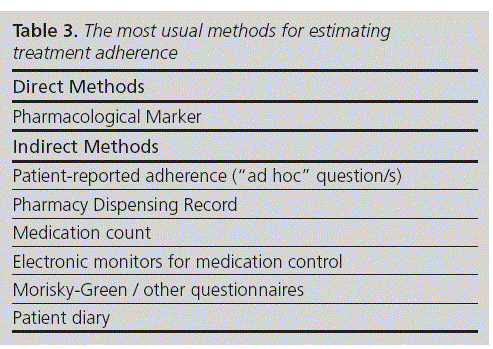
<body><![CDATA[<blockquote>     <p><font face="Verdana" size="2"><i>&bull; Aspects associated with the knowledge and acceptance of patients of their disease, their sociocultural and economic setting, their expectations, fear of adverse effects, their comorbidities, physical difficulties for administration, etc.</i></font></p>     <p><font face="Verdana" size="2"><i>&bull; Potential barriers for treatment adherence: treatment complexity, treatment tolerability, easy access to health professionals, etc. Level of evidence: 2b.</i></font></p> </blockquote>     <p><font face="Verdana" size="2"><i>Comments to the recommendation:</i> Patient stratification according to their risk of non-adherence has been identified as an increasing need in order to personalize the strategies for improving adherence. Even though no specific risk pattern has been identified for non-adherent patients, some tools have been developed<sup>11</sup>, which have been used in prospective studies with positive results<sup>12</sup>.</font></p>     <p><font face="Verdana" size="2"><b>Block 4: Estimating / Assessing / Monitoring Adherence</b></font></p>     <p><font face="Verdana" size="2"><i>Recommendation 4.1</i></font></p>     <p><font face="Verdana" size="2"><i>To estimate and analyze adherence periodical/y is a key aspect in the management of patients with chronic diseases, and essential for making informed decisions about patient treatment.</i></font></p>     <p><font face="Verdana" size="2"><i>Level of evidence: 5.</i></font></p>     <p><font face="Verdana" size="2"><i>Recommendation 4.2</i></font></p>     <p><font face="Verdana" size="2"><i>Tools for assessing adherence must be simple, in order to encourage their use in daily c/inical practice, and they should be preferab/y validated in the population of interest (<a href="#t3">Table 3</a>). It is advisable to use simultaneous/y at least two tools for assessing adherence, adapted to the daily practice of each healthcare professional.</i></font></p>     ]]></body>
<body><![CDATA[<p>&nbsp;</p>     <p align="center"><font face="Verdana" size="2"><a name="t3"><img src="/img/revistas/fh/v40n5/06_ing_original06_t3.gif"></a></font></p>     <p>&nbsp;</p>     <p><font face="Verdana" size="2"><i>Level of evidence: 5.</i></font></p>     <p><font face="Verdana" size="2"><b>Block 5: Interdisciplinary Approach of the Intervention</b></font></p>     <p><font face="Verdana" size="2"><i>Recommendation 5.1</i></font></p>     <p><font face="Verdana" size="2"><i>Adherence must be approached by consensus and in an interdiscip/inary manner by al/ agents (healthcare professionals, patients, caregivers and relatives, and managers) involved in comprehensive patient care; it would be advisable to encourage dialogue forums between them. Level of evidence: 5.</i></font></p>     <p><font face="Verdana" size="2"><i>Recommendation 5.2</i></font></p>     <p><font face="Verdana" size="2"><i>Healthcare professionals involved in patient care should share direct technologies for information and communication in the clinical record setting, to allow a better coordination.</i></font></p>     <p><font face="Verdana" size="2"><i>Level of evidence: 5.</i></font></p>     ]]></body>
<body><![CDATA[<p><font face="Verdana" size="2"><b>Block 6: Individualization</b></font></p>     <p><font face="Verdana" size="2"><i>Recommendation 6.1</i></font></p>     <p><font face="Verdana" size="2"><i>For each patient, it is recommended to assess the factors predicting treatment adherence before and after treatment. It is recommended that these interventions should be individualized, because:</i></font></p>     <blockquote>     <p><font face="Verdana" size="2">&bull; <i>There is no unique intervention that can be recommended to all patients.</i></font></p>     <p><font face="Verdana" size="2">&bull; <i>Risk factors differ according to patient characteristics, type of disease, and treatment.</i></font></p>     <p><font face="Verdana" size="2">&bull; <i>The needs and beliefs of each patient are varied, regarding their disease, its treatment, and potential side effects.</i></font></p> </blockquote>     <p><font face="Verdana" size="2"><i>Level of evidence: 5.</i></font></p>     <p><font face="Verdana" size="2"><b>Block 7: Strategies</b></font></p>     <p><font face="Verdana" size="2"><i>Recommendation 7.1</i></font></p>     ]]></body>
<body><![CDATA[<p><font face="Verdana" size="2"><i>Interventions targeted to improving treatment adherence, adapted to the individual needs of patients, and approved by consensus by the interdisciplinary teams, should include standard informative aspects, educational / behavioural aspects, or a combination of both.</i></font></p>     <p><font face="Verdana" size="2"><i>Level of evidence: 5.</i></font></p>     <p><font face="Verdana" size="2"><i>Recommendation 7.2</i></font></p>     <p><font face="Verdana" size="2"><i>In paediatric patients, programs for improving treatment adherence should include the active participation of their relatives or carers.</i></font></p>     <p><font face="Verdana" size="2"><i>Level of evidence: 1b</i></font></p>     <p><font face="Verdana" size="2"><i>Comments to the recommendation:</i> Carers or relatives will usually play an active role in the studies of interventions for treatment adherence in paediatric patients. Those studies identified in the process of systematic review that included paediatric population involved carers or relatives in all cases, as active participants of the strategy<sup>13,14</sup>.</font></p>     <p><font face="Verdana" size="2"><i>Recommendation 7.3</i></font></p>     <p><font face="Verdana" size="2"><i>For dependent patients, or those who require assistance by a carer or relative, the intervention programs for improving adherence must include the active participation by their carers or relatives.</i></font></p>     <p><font face="Verdana" size="2"><i>Level of evidence: 5.</i></font></p>     <p><font face="Verdana" size="2"><i>Recommendation 7.4</i></font></p>     ]]></body>
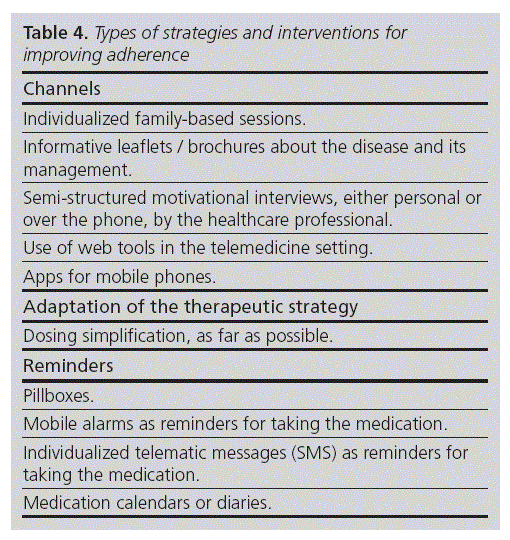
<body><![CDATA[<p><font face="Verdana" size="2"><i>It is recommended to use comprehensive strategies sustained over time between the healthcare professional and the patient, targeted to encourage treatment adherence. These should include, for example (<a href="#t4">Table 4</a>):</i></font></p>     <p>&nbsp;</p>     <p align="center"><font face="Verdana" size="2"><a name="t4"><img src="/img/revistas/fh/v40n5/06_ing_original06_t4.gif"></a></font></p>     <p>&nbsp;</p>     <blockquote>     <p><font face="Verdana" size="2">&bull; <i>Oral, written and/or electronic channels of information.</i></font></p>     <p><font face="Verdana" size="2">&bull; <i>Adaptation of the treatment strategy.</i></font></p>     <p><font face="Verdana" size="2">&bull; <i>Tools as reminders for administration as well as for collecting medication.</i></font></p> </blockquote>     <p><font face="Verdana" size="2"><i>Level of evidence: 1b</i></font></p>     <p><font face="Verdana" size="2"><i>Comments to recommendation:</i> In the process of evidence systematic review, different articles were identified that assessed the use of various interventions for improving treatment adherence in patients with systemic inflammatory diseases<sup>15,16,17,18</sup>. To develop this Recommendation, those interventions that had proven efficacy for improving adherence were included, as well as other potential strategies suggested by experts and agreed upon during the consensus process.</font></p>     ]]></body>
<body><![CDATA[<p>&nbsp;</p>     <p><font face="Verdana" size="2"><b>Discussion</b></font></p>     <p><font face="Verdana" size="2">The objective of these recommendations is to create awareness among all healthcare professionals involved in managing patients diagnosed with systemic inflammatory conditions about the importance of treatment adherence, how to communicate with patients, how to detect and assess patient adherence, and which strategies could be applied in order to improve adherence. This is the first multidisciplinary document of recommendations prepared in Spain for this area.</font></p>     <p><font face="Verdana" size="2">Regarding the methodology used in the development of recommendations, standard processes have been taken into account, such as a systematic literature review, as well as more qualitative aspects, such as the dynamics of recommendations conducted in each one of the meetings with healthcare professionals. A structured survey has also been used, as the most adequate tool for the final quantification of the degree of agreement with each one of the recommendations, so that all participants had the same level of representation in the final recommendations. All this leads to a robust process of preparation of recommendations, at a methodological level, due to the combination of different strategies.</font></p>     <p><font face="Verdana" size="2">On the other hand, if we review the different consensus or recommendations published so far in Spain, the majority have focused on HIV infection<sup>19</sup> and psychiatric conditions<sup>20,21,22</sup>. The GESIDA/SEFH/PNS multidisciplinary consensus on adherence in HIV infection shares some of the recommendations collected in our study. Particularly, these show the importance of assessing the factors of risk for non-adherence, the need of a multidisciplinary approach to address adherence, the need to assess it through different methods, the importance of communication between the healthcare professional and the patient, and the need to individualize those interventions targeted to improve treatment adherence<sup>19</sup>. The GESIDA recommendations have been recently used to assess the perspective of the different healthcare professionals involved (hospital pharmacists, physicians and nurses) regarding the support measures for treatment adherence; differences in their perspectives have been observed, based on lack of time and training<sup>23</sup>. In the Psychiatry area, consensus has focused on schizophrenia and major depression. In the case of schizophrenia, 2 unidisciplinary consensuses have been developed by Psychiatrists<sup>20</sup> and nurses<sup>21</sup>, with different perspectives, because the former is mostly focused on improving adherence through psycho-educational strategies targeted to increasing patient awareness of their condition, and the latter on improving strategies to be implemented in daily practice. The consensus on major depression also stresses that knowledge about the disease and the importance of receiving drug treatment in order to improve the disease symptoms are the essential aspects in order to improve treatment adherence<sup>22</sup>.</font></p>     <p><font face="Verdana" size="2">Also regarding chronic conditions, different regional and national agencies have driven initiatives and policies for the improvement of treatment adherence<sup>24,25</sup>. In the European setting, a consensus document for improving treatment adherence has been recently published<sup>26</sup>, developed through the Delphi methodology, with a panel of 50 experts from 14 countries representing organizations of patients, carers, health providers and professionals, politicians, academicians, and industry representatives. Twenty-five (25) potential solutions were prioritized for improving adherence, primarily an improvement in education and information for patients, patient involvement in drug therapy decisions taking into account their preferences, and a higher education and training for healthcare professionals.</font></p>     <p><font face="Verdana" size="2">Another important aspect to be considered is the impact of non-adherence in health outcomes. The impact of lack of adherence has been widely studied in conditions such as HIV infection<sup>27</sup>, psychiatric disorders<sup>28</sup>, or cardiovascular conditions<sup>29</sup>, demonstrating the association between the lack of adherence in a generic way with a higher mortality rate<sup>4</sup>. However, this impact has not been so widely explored in systemic inflammatory conditions.</font></p>     <p><font face="Verdana" size="2">This is a dynamic document that is open to review, in order to incorporate any new recommendations based on the outcomes of new studies assessing strategies targeted to improving therapeutic adherence in these patients, and showing improvements in health outcomes. Among many discussions and debates generated during the meetings of the expert panel, one need stood out: to generate new evidence through pilot studies or other type of observational studies to assess the impact of interventions for improving adherence in patients with inflammatory diseases, and the optimal frequency for this assessment from the point of health outcomes, and always from the multidisciplinary perspective of healthcare professionals involved in the process.</font></p>     <p><font face="Verdana" size="2">In the conditions studied, there is a variation in the type of population affected, and their course and prognosis; this could represent a limitation for their joint analysis. However, these are chronic clinical entities that share common characteristics, and have a high impact on the quality of life of patients; therefore, an overall document can allow the healthcare professional to apply the recommendations which are more adequate for each case.</font></p>     <p><font face="Verdana" size="2">On of the main limitations of this document is the lack of involvement by patient associations in these recommendations. As previously discussed, the point of view of patients is essential in order to approach adherence from a comprehensive perspective. However, this group has not been involved in the development of this first document.</font></p>     ]]></body>
<body><![CDATA[<p><font face="Verdana" size="2">New studies are required in the setting of daily clinical practice, to generate evidence regarding the impact of interventions on improving adherence in patients with inflammatory diseases and their association with health outcomes. However, this article collects all aspects to be taken into account in order to detect, monitor and assess therapeutic adherence in a multidisciplinary manner, actively involving the patient in this process, and allowing all healthcare professionals in Spain to consult and use it at any time.</font></p>     <p>&nbsp;</p>     <p><font face="Verdana" size="2"><b>Conflict of Interests</b></font></p>     <p><font face="Verdana" size="2">Fernando Bermejo hereby declares that he has received grants for research, and has worked as a lecturer and advisor for MSD and Abbvie.</font></p>     <p>&nbsp;</p>     <p><font face="Verdana" size="2"><b>Bibliography</b></font></p>     <!-- ref --><p><font face="Verdana" size="2">1. Thorneloe RJ, Bundy C, Griffiths CE, Ashcroft DM, Cordingley L. Adherence to medication in patients with psoriasis: a systematic literature review. Br J Dermatol. 2013;168:20-31.    &nbsp;&nbsp;&nbsp;&nbsp;&nbsp;&nbsp;&nbsp;&nbsp;[&#160;<a href="javascript:void(0);" onclick="javascript: window.open('/scielo.php?script=sci_nlinks&ref=2230986&pid=S1130-6343201600050000600001&lng=','','width=640,height=500,resizable=yes,scrollbars=1,menubar=yes,');">Links</a>&#160;]<!-- end-ref --></font></p>    <!-- ref --><p><font face="Verdana" size="2">2. Lopez A, Billioud V, Peyrin-Biroulet C, Peyrin-Biroulet L. Adherence to Anti-TNF Therapy in Inflammatory Bowel Diseases: A Systematic Review. Inflamm Bowel Dis. 2013;19:1528-33.    &nbsp;&nbsp;&nbsp;&nbsp;&nbsp;&nbsp;&nbsp;&nbsp;[&#160;<a href="javascript:void(0);" onclick="javascript: window.open('/scielo.php?script=sci_nlinks&ref=2230988&pid=S1130-6343201600050000600002&lng=','','width=640,height=500,resizable=yes,scrollbars=1,menubar=yes,');">Links</a>&#160;]<!-- end-ref --></font></p>    ]]></body>
<body><![CDATA[<!-- ref --><p><font face="Verdana" size="2">3. McHorney CA, Victor Spain C, Alexander CM, Simmons J. Validity of the Adherence Estimator in the Prediction of 9-Month Persistence with medications prescribed for chronic diseases: A prospective analysis of Data from pharmacy claims. Clin Ther. 2009;31:2584-607.    &nbsp;&nbsp;&nbsp;&nbsp;&nbsp;&nbsp;&nbsp;&nbsp;[&#160;<a href="javascript:void(0);" onclick="javascript: window.open('/scielo.php?script=sci_nlinks&ref=2230990&pid=S1130-6343201600050000600003&lng=','','width=640,height=500,resizable=yes,scrollbars=1,menubar=yes,');">Links</a>&#160;]<!-- end-ref --></font></p>    <!-- ref --><p><font face="Verdana" size="2">4. Hugtenburg JG, Timmers L, Elders PJ, Vervloet M, van Dijk L. Definitions, variants, and causes of nonadherence with medication: a challenge for tailored interventions. Patient Prefer Adherence. 2013 ;7:675-82.    &nbsp;&nbsp;&nbsp;&nbsp;&nbsp;&nbsp;&nbsp;&nbsp;[&#160;<a href="javascript:void(0);" onclick="javascript: window.open('/scielo.php?script=sci_nlinks&ref=2230992&pid=S1130-6343201600050000600004&lng=','','width=640,height=500,resizable=yes,scrollbars=1,menubar=yes,');">Links</a>&#160;]<!-- end-ref --></font></p>    <!-- ref --><p><font face="Verdana" size="2">5. Medicines adherence: involving patients in decisions about prescribed medicines and supporting adherence. National Collaborating Centre for Primary Care (UK). Royal College of General Practitioners (UK); 2009 Jan.    &nbsp;&nbsp;&nbsp;&nbsp;&nbsp;&nbsp;&nbsp;&nbsp;[&#160;<a href="javascript:void(0);" onclick="javascript: window.open('/scielo.php?script=sci_nlinks&ref=2230994&pid=S1130-6343201600050000600005&lng=','','width=640,height=500,resizable=yes,scrollbars=1,menubar=yes,');">Links</a>&#160;]<!-- end-ref --></font></p>    <!-- ref --><p><font face="Verdana" size="2">6. Kripalani S, Yao X, Haynes RB. Interventions to enhance medication adherence in chronic medical conditions: a systematic review. Arch Intern Med. 2007;167:540-50.    &nbsp;&nbsp;&nbsp;&nbsp;&nbsp;&nbsp;&nbsp;&nbsp;[&#160;<a href="javascript:void(0);" onclick="javascript: window.open('/scielo.php?script=sci_nlinks&ref=2230996&pid=S1130-6343201600050000600006&lng=','','width=640,height=500,resizable=yes,scrollbars=1,menubar=yes,');">Links</a>&#160;]<!-- end-ref --></font></p>    <!-- ref --><p><font face="Verdana" size="2">7. Oxford Centre for Evidence-based Medicine - Levels of Evidence. Oxford, UK, Marzo 2009 (consultado 12 de diciembre de 2014). Disponible en: <a target="_blank" href="http://www.cebm.net/oxford-centre-evidence-based-medicine-levels-evidence-march-2009/">http://www.cebm.net/oxford-centre-evidence-based-medicine-levels-evidence-march-2009/</a>.    &nbsp;&nbsp;&nbsp;&nbsp;&nbsp;&nbsp;&nbsp;&nbsp;[&#160;<a href="javascript:void(0);" onclick="javascript: window.open('/scielo.php?script=sci_nlinks&ref=2230998&pid=S1130-6343201600050000600007&lng=','','width=640,height=500,resizable=yes,scrollbars=1,menubar=yes,');">Links</a>&#160;]<!-- end-ref --></font></p>    ]]></body>
<body><![CDATA[<!-- ref --><p><font face="Verdana" size="2">8. Pasma A, van't Spijker A, Hazes JM, Busschbach JJ, Luime JJ. Factors associated with adherence to pharmaceutical treatment for rheumatoid arthritis patients: a systematic review. Semin Arthritis Rheum. 2013;43:18-28.    &nbsp;&nbsp;&nbsp;&nbsp;&nbsp;&nbsp;&nbsp;&nbsp;[&#160;<a href="javascript:void(0);" onclick="javascript: window.open('/scielo.php?script=sci_nlinks&ref=2231000&pid=S1130-6343201600050000600008&lng=','','width=640,height=500,resizable=yes,scrollbars=1,menubar=yes,');">Links</a>&#160;]<!-- end-ref --></font></p>    <!-- ref --><p><font face="Verdana" size="2">9. Joosten EA, DeFuentes-Merillas L, de Weert GH, Sensky T, van der Staak CP, de Jong CA. Systematic review of the effects of shared decision-making on patient satisfaction, treatment adherence and health status. Psychother Psychosom. 2008;77:219-26.    &nbsp;&nbsp;&nbsp;&nbsp;&nbsp;&nbsp;&nbsp;&nbsp;[&#160;<a href="javascript:void(0);" onclick="javascript: window.open('/scielo.php?script=sci_nlinks&ref=2231002&pid=S1130-6343201600050000600009&lng=','','width=640,height=500,resizable=yes,scrollbars=1,menubar=yes,');">Links</a>&#160;]<!-- end-ref --></font></p>    <!-- ref --><p><font face="Verdana" size="2">10. Smolen JS, Landewe R, Breedveld FC, Dougados M, Emery P, Gaujoux-Viala C, <i>et al.</i> EULAR recommendations for the management of rheumatoid arthritis with synthetic and biological disease-modifying antirheumatic drugs. Ann Rheum Dis. 2010;69:964-75.    &nbsp;&nbsp;&nbsp;&nbsp;&nbsp;&nbsp;&nbsp;&nbsp;[&#160;<a href="javascript:void(0);" onclick="javascript: window.open('/scielo.php?script=sci_nlinks&ref=2231004&pid=S1130-6343201600050000600010&lng=','','width=640,height=500,resizable=yes,scrollbars=1,menubar=yes,');">Links</a>&#160;]<!-- end-ref --></font></p>    <!-- ref --><p><font face="Verdana" size="2">11. INTERMED Complexity Assessment Grid (IM CAG version 6). INTERMED Foundation. Amsterdam, The Netherlands, 2009 (consultado 10 de octubre de 2013). Disponible en: <a target="_blank" href="http://www.intermedfoundation.org/uploads/10/32/103299ff97ac58bcee216085ec23a708/Description-of-IM-CAG-v6-including-interview-and-score-December-2009.pdf">http://www.intermedfoundation.org/uploads/10/32/103299ff97ac58bcee216085ec23a708/Description-of-IM-CAG-v6-including-interview-and-score-December-2009.pdf</a>.    &nbsp;&nbsp;&nbsp;&nbsp;&nbsp;&nbsp;&nbsp;&nbsp;[&#160;<a href="javascript:void(0);" onclick="javascript: window.open('/scielo.php?script=sci_nlinks&ref=2231006&pid=S1130-6343201600050000600011&lng=','','width=640,height=500,resizable=yes,scrollbars=1,menubar=yes,');">Links</a>&#160;]<!-- end-ref --></font></p>    <!-- ref --><p><font face="Verdana" size="2">12. Stockl KM, Shin JS, Lew HC, Zakharyan A, Harada AS, Solow BK, <i>et al.</i> Outcomes of a rheumatoid arthritis disease therapy management program focusing on medication adherence. J Manag Care Pharm. 2010;16:593-604.    &nbsp;&nbsp;&nbsp;&nbsp;&nbsp;&nbsp;&nbsp;&nbsp;[&#160;<a href="javascript:void(0);" onclick="javascript: window.open('/scielo.php?script=sci_nlinks&ref=2231008&pid=S1130-6343201600050000600012&lng=','','width=640,height=500,resizable=yes,scrollbars=1,menubar=yes,');">Links</a>&#160;]<!-- end-ref --></font></p>    ]]></body>
<body><![CDATA[<!-- ref --><p><font face="Verdana" size="2">13. Hommel KA, Hente E, Herzer M, Ingerski LM, Denson LA. Tele-health behavioral treatment for medication nonadherence: A pilot and feasibility study. Eur J Gastroenterol Hepatol. 2013 ;25:469-73.    &nbsp;&nbsp;&nbsp;&nbsp;&nbsp;&nbsp;&nbsp;&nbsp;[&#160;<a href="javascript:void(0);" onclick="javascript: window.open('/scielo.php?script=sci_nlinks&ref=2231010&pid=S1130-6343201600050000600013&lng=','','width=640,height=500,resizable=yes,scrollbars=1,menubar=yes,');">Links</a>&#160;]<!-- end-ref --></font></p>    <!-- ref --><p><font face="Verdana" size="2">14. Hommel KA, Hente EA, Odell S, Herzer M, Ingerski LM, Guilfoyle SM, <i>et al.</i> Evaluation of a group-based behavioral intervention to promote adherence in adolescents with inflammatory bowel disease. Eur J Gastroenterol Hepatol. 2012;24:64-9.    &nbsp;&nbsp;&nbsp;&nbsp;&nbsp;&nbsp;&nbsp;&nbsp;[&#160;<a href="javascript:void(0);" onclick="javascript: window.open('/scielo.php?script=sci_nlinks&ref=2231012&pid=S1130-6343201600050000600014&lng=','','width=640,height=500,resizable=yes,scrollbars=1,menubar=yes,');">Links</a>&#160;]<!-- end-ref --></font></p>    <!-- ref --><p><font face="Verdana" size="2">15. Balato N, Megna M, Di Costanzo L, Balato A, Ayala F. Educational and motivational support service: A pilot study for mobile-phone-based interventions in patients with psoriasis. Br J Dermatol. 2013;168:201-5.    &nbsp;&nbsp;&nbsp;&nbsp;&nbsp;&nbsp;&nbsp;&nbsp;[&#160;<a href="javascript:void(0);" onclick="javascript: window.open('/scielo.php?script=sci_nlinks&ref=2231014&pid=S1130-6343201600050000600015&lng=','','width=640,height=500,resizable=yes,scrollbars=1,menubar=yes,');">Links</a>&#160;]<!-- end-ref --></font></p>    <!-- ref --><p><font face="Verdana" size="2">16. Cook PF, Emiliozzi S, El-Hajj D, McCabe MM. Telephone nurse counseling for medication adherence in ulcerative colitis: A preliminary study. Patient Educ Couns. 2010;81:182-6.    &nbsp;&nbsp;&nbsp;&nbsp;&nbsp;&nbsp;&nbsp;&nbsp;[&#160;<a href="javascript:void(0);" onclick="javascript: window.open('/scielo.php?script=sci_nlinks&ref=2231016&pid=S1130-6343201600050000600016&lng=','','width=640,height=500,resizable=yes,scrollbars=1,menubar=yes,');">Links</a>&#160;]<!-- end-ref --></font></p>    <!-- ref --><p><font face="Verdana" size="2">17. Elkjaer M, Shuhaibar M, Burisch J, Bailey Y, Scherfig H, Laugesen B, <i>etal.</i> E-health empowers patients with Ulcerative Colitis - a randomised controlled trial of the web-guided Constant-care approach. Gut. 2010;59:1652-61.    &nbsp;&nbsp;&nbsp;&nbsp;&nbsp;&nbsp;&nbsp;&nbsp;[&#160;<a href="javascript:void(0);" onclick="javascript: window.open('/scielo.php?script=sci_nlinks&ref=2231018&pid=S1130-6343201600050000600017&lng=','','width=640,height=500,resizable=yes,scrollbars=1,menubar=yes,');">Links</a>&#160;]<!-- end-ref --></font></p>    ]]></body>
<body><![CDATA[<!-- ref --><p><font face="Verdana" size="2">18. Cross RK, Cheevers N, Rustgi A, Langenberg P, Finkelstein J. Randomized, controlled trial of home telemanagement in patients with ulcerative colitis (UC HAT) Inflamm Bowel Dis. 2012;18:1018-25.    &nbsp;&nbsp;&nbsp;&nbsp;&nbsp;&nbsp;&nbsp;&nbsp;[&#160;<a href="javascript:void(0);" onclick="javascript: window.open('/scielo.php?script=sci_nlinks&ref=2231020&pid=S1130-6343201600050000600018&lng=','','width=640,height=500,resizable=yes,scrollbars=1,menubar=yes,');">Links</a>&#160;]<!-- end-ref --></font></p>    <!-- ref --><p><font face="Verdana" size="2">19. Panel de Expertos de Gesida Recomendaciones GESIDA/SEFH/PNS para mejorar la adherencia al tratamiento antirretroviral (actualizado Junio 2008; consultado 21 octubre 2013). Disponible en: <a target="_blank" href="http://www.gesida-seimc.org/pcientifica/fuentes/DcyRc/Gesida_dcyrc2008_adherenciaTAR.pdf">http://www.gesida-seimc.org/pcientifica/fuentes/DcyRc/Gesida_dcyrc2008_adherenciaTAR.pdf</a>.    &nbsp;&nbsp;&nbsp;&nbsp;&nbsp;&nbsp;&nbsp;&nbsp;[&#160;<a href="javascript:void(0);" onclick="javascript: window.open('/scielo.php?script=sci_nlinks&ref=2231022&pid=S1130-6343201600050000600019&lng=','','width=640,height=500,resizable=yes,scrollbars=1,menubar=yes,');">Links</a>&#160;]<!-- end-ref --></font></p>    <!-- ref --><p><font face="Verdana" size="2">20. Roca M, Cañas F, Olivares J, Rodríguez A, Giner J. Treatment adherence in schizophrenia. Spanish clinical consensus. Actas Esp Psiquiatr. 2007;35(1 Suppl):1-6.    &nbsp;&nbsp;&nbsp;&nbsp;&nbsp;&nbsp;&nbsp;&nbsp;[&#160;<a href="javascript:void(0);" onclick="javascript: window.open('/scielo.php?script=sci_nlinks&ref=2231024&pid=S1130-6343201600050000600020&lng=','','width=640,height=500,resizable=yes,scrollbars=1,menubar=yes,');">Links</a>&#160;]<!-- end-ref --></font></p>    <!-- ref --><p><font face="Verdana" size="2">21. García I, Granada JM, Leal MI, Sales R. LLuch MT, Fornés J, <i>et al.</i> Adherencia al tratamiento en la esquizofrenia: Consenso de enfermería en salud mental. Actas Esp Psiquiatr. 2010;38(Suppl 1):1-45.    &nbsp;&nbsp;&nbsp;&nbsp;&nbsp;&nbsp;&nbsp;&nbsp;[&#160;<a href="javascript:void(0);" onclick="javascript: window.open('/scielo.php?script=sci_nlinks&ref=2231026&pid=S1130-6343201600050000600021&lng=','','width=640,height=500,resizable=yes,scrollbars=1,menubar=yes,');">Links</a>&#160;]<!-- end-ref --></font></p>    <!-- ref --><p><font face="Verdana" size="2">22. Montejo AL, Menchón JM, Carrasco JL, Franco M, Martín Carrasco M, Moriñigo A. Guía de evaluación y mejora del cumplimiento en el tratamiento a largo plazo del Trastorno Depresivo Mayor. Actas Esp Psiquiatr 2010;38(Suppl. 2):1-27.    &nbsp;&nbsp;&nbsp;&nbsp;&nbsp;&nbsp;&nbsp;&nbsp;[&#160;<a href="javascript:void(0);" onclick="javascript: window.open('/scielo.php?script=sci_nlinks&ref=2231028&pid=S1130-6343201600050000600022&lng=','','width=640,height=500,resizable=yes,scrollbars=1,menubar=yes,');">Links</a>&#160;]<!-- end-ref --></font></p>    ]]></body>
<body><![CDATA[<!-- ref --><p><font face="Verdana" size="2">23. Morillo Verdugo R, Jiménez Galán R, Almeida González C. Perspectiva multidisplicinaria del apoyo a la adherencia antirretroviral en Andalucía. Estudio Andhalusida. Farm Hosp. 2012;36:410-23.    &nbsp;&nbsp;&nbsp;&nbsp;&nbsp;&nbsp;&nbsp;&nbsp;[&#160;<a href="javascript:void(0);" onclick="javascript: window.open('/scielo.php?script=sci_nlinks&ref=2231030&pid=S1130-6343201600050000600023&lng=','','width=640,height=500,resizable=yes,scrollbars=1,menubar=yes,');">Links</a>&#160;]<!-- end-ref --></font></p>    <!-- ref --><p><font face="Verdana" size="2">24. Plan de Salud de Cataluña 2011-2015. Generalitat de Catalunya. Departamento de Salud, 2012. Consultado 21 octubre 2013. Disponible en: <a target="_blank" href="http://www20.gencat.cat/docs/salut/Home/El_Departament/Pla_de_Salut_2011_2015/documents/arxius/plan_de_salud_Catalunya_es.pdf">http://www20.gencat.cat/docs/salut/Home/El%20Departament/Pla_de_Salut_2011_2015/documents/arxius/plan%20de%20salud%20Catalunya_es.pdf</a>.    &nbsp;&nbsp;&nbsp;&nbsp;&nbsp;&nbsp;&nbsp;&nbsp;[&#160;<a href="javascript:void(0);" onclick="javascript: window.open('/scielo.php?script=sci_nlinks&ref=2231032&pid=S1130-6343201600050000600024&lng=','','width=640,height=500,resizable=yes,scrollbars=1,menubar=yes,');">Links</a>&#160;]<!-- end-ref --></font></p>    <!-- ref --><p><font face="Verdana" size="2">25. Navarra. ORDEN FORAL 146/2013, de 4 de octubre, de la Consejera de Salud, por la que se crea el Comité de Expertos para la conciliación y la mejora de la adherencia al tratamiento de los pacientes crónicos. Boletín Oficial de Navarra, 29 de octubre de 2013, núm 209, pp. 11356-7.    &nbsp;&nbsp;&nbsp;&nbsp;&nbsp;&nbsp;&nbsp;&nbsp;[&#160;<a href="javascript:void(0);" onclick="javascript: window.open('/scielo.php?script=sci_nlinks&ref=2231034&pid=S1130-6343201600050000600025&lng=','','width=640,height=500,resizable=yes,scrollbars=1,menubar=yes,');">Links</a>&#160;]<!-- end-ref --></font></p>    <!-- ref --><p><font face="Verdana" size="2">26. Clyne W, White S, McLachlan S. Developing consensus-based policy solutions for medicines adherence for Europe: a Delphi study. BMC Health Serv Res. 2012;12:425.    &nbsp;&nbsp;&nbsp;&nbsp;&nbsp;&nbsp;&nbsp;&nbsp;[&#160;<a href="javascript:void(0);" onclick="javascript: window.open('/scielo.php?script=sci_nlinks&ref=2231036&pid=S1130-6343201600050000600026&lng=','','width=640,height=500,resizable=yes,scrollbars=1,menubar=yes,');">Links</a>&#160;]<!-- end-ref --></font></p>    <!-- ref --><p><font face="Verdana" size="2">27. García de Olalla P, Knobel H, Carmona A, Guelar A, López-Colomés JL, Caylà JA. Impact of adherence and highly active antiretroviral therapy on survival in HIV-infected patients. J Acquir Immune Defic Syndr. 2002;30:105-10.    &nbsp;&nbsp;&nbsp;&nbsp;&nbsp;&nbsp;&nbsp;&nbsp;[&#160;<a href="javascript:void(0);" onclick="javascript: window.open('/scielo.php?script=sci_nlinks&ref=2231038&pid=S1130-6343201600050000600027&lng=','','width=640,height=500,resizable=yes,scrollbars=1,menubar=yes,');">Links</a>&#160;]<!-- end-ref --></font></p>    ]]></body>
<body><![CDATA[<!-- ref --><p><font face="Verdana" size="2">28. Ascher-Svanum H, Faries DE, Zhu B, Ernst FR, Swartz MS, Swanson JW. Medication adherence and long-term functional outcomes in the treatment of schizophrenia in usual care. J Clin Psychiatry. 2006;67:453-60.    &nbsp;&nbsp;&nbsp;&nbsp;&nbsp;&nbsp;&nbsp;&nbsp;[&#160;<a href="javascript:void(0);" onclick="javascript: window.open('/scielo.php?script=sci_nlinks&ref=2231040&pid=S1130-6343201600050000600028&lng=','','width=640,height=500,resizable=yes,scrollbars=1,menubar=yes,');">Links</a>&#160;]<!-- end-ref --></font></p>    <!-- ref --><p><font face="Verdana" size="2">29. Corrao G, Parodi A, Nicotra F, Zambon A, Merlino L, Cesana G, <i>et al.</i> Better adherence to antihypertensive medications reduces cardiovascular risk. J Hypertens.2011; 29:610-18.    &nbsp;&nbsp;&nbsp;&nbsp;&nbsp;&nbsp;&nbsp;&nbsp;[&#160;<a href="javascript:void(0);" onclick="javascript: window.open('/scielo.php?script=sci_nlinks&ref=2231042&pid=S1130-6343201600050000600029&lng=','','width=640,height=500,resizable=yes,scrollbars=1,menubar=yes,');">Links</a>&#160;]<!-- end-ref --></font></p>     <p>&nbsp;</p>     <p>&nbsp;</p>     <p><font face="Verdana" size="2"><a href="#top"><img border="0" src="/img/revistas/fh/v40n5/seta.gif" width="15" height="17"></a><a name="bajo"></a><b>Dirección para correspondencia:</b>    <br>Correo electrónico: <a href="mailto:miquel.ribera@uab.cat">miquel.ribera@uab.cat</a>    <br>(Miquel Ribera-Pibernat).</font></p>     <p><font face="Verdana" size="2">Recibido el 3 de noviembre de 2015;    ]]></body>
<body><![CDATA[<br>aceptado el 23 de junio de 2016.</font></p>      ]]></body><back>
<ref-list>
<ref id="B1">
<label>1</label><nlm-citation citation-type="journal">
<person-group person-group-type="author">
<name>
<surname><![CDATA[Thorneloe]]></surname>
<given-names><![CDATA[RJ]]></given-names>
</name>
<name>
<surname><![CDATA[Bundy]]></surname>
<given-names><![CDATA[C]]></given-names>
</name>
<name>
<surname><![CDATA[Griffiths]]></surname>
<given-names><![CDATA[CE]]></given-names>
</name>
<name>
<surname><![CDATA[Ashcroft]]></surname>
<given-names><![CDATA[DM]]></given-names>
</name>
<name>
<surname><![CDATA[Cordingley]]></surname>
<given-names><![CDATA[L]]></given-names>
</name>
</person-group>
<article-title xml:lang="en"><![CDATA[Adherence to medication in patients with psoriasis: a systematic literature review]]></article-title>
<source><![CDATA[Br J Dermatol.]]></source>
<year>2013</year>
<volume>168</volume>
<page-range>20-31</page-range></nlm-citation>
</ref>
<ref id="B2">
<label>2</label><nlm-citation citation-type="journal">
<person-group person-group-type="author">
<name>
<surname><![CDATA[Lopez]]></surname>
<given-names><![CDATA[A]]></given-names>
</name>
<name>
<surname><![CDATA[Billioud]]></surname>
<given-names><![CDATA[V]]></given-names>
</name>
<name>
<surname><![CDATA[Peyrin-Biroulet]]></surname>
<given-names><![CDATA[C]]></given-names>
</name>
<name>
<surname><![CDATA[Peyrin-Biroulet]]></surname>
<given-names><![CDATA[L]]></given-names>
</name>
</person-group>
<article-title xml:lang="en"><![CDATA[Adherence to Anti-TNF Therapy in Inflammatory Bowel Diseases: A Systematic Review]]></article-title>
<source><![CDATA[Inflamm Bowel Dis.]]></source>
<year>2013</year>
<volume>19</volume>
<page-range>1528-33</page-range></nlm-citation>
</ref>
<ref id="B3">
<label>3</label><nlm-citation citation-type="journal">
<person-group person-group-type="author">
<name>
<surname><![CDATA[McHorney]]></surname>
<given-names><![CDATA[CA]]></given-names>
</name>
<name>
<surname><![CDATA[Victor Spain]]></surname>
<given-names><![CDATA[C]]></given-names>
</name>
<name>
<surname><![CDATA[Alexander]]></surname>
<given-names><![CDATA[CM]]></given-names>
</name>
<name>
<surname><![CDATA[Simmons]]></surname>
<given-names><![CDATA[J]]></given-names>
</name>
</person-group>
<article-title xml:lang="en"><![CDATA[Validity of the Adherence Estimator in the Prediction of 9-Month Persistence with medications prescribed for chronic diseases: A prospective analysis of Data from pharmacy claims]]></article-title>
<source><![CDATA[Clin Ther.]]></source>
<year>2009</year>
<volume>31</volume>
<page-range>2584-607</page-range></nlm-citation>
</ref>
<ref id="B4">
<label>4</label><nlm-citation citation-type="journal">
<person-group person-group-type="author">
<name>
<surname><![CDATA[Hugtenburg]]></surname>
<given-names><![CDATA[JG]]></given-names>
</name>
<name>
<surname><![CDATA[Timmers]]></surname>
<given-names><![CDATA[L]]></given-names>
</name>
<name>
<surname><![CDATA[Elders]]></surname>
<given-names><![CDATA[PJ]]></given-names>
</name>
<name>
<surname><![CDATA[Vervloet]]></surname>
<given-names><![CDATA[M]]></given-names>
</name>
<name>
<surname><![CDATA[van Dijk]]></surname>
<given-names><![CDATA[L]]></given-names>
</name>
</person-group>
<article-title xml:lang="en"><![CDATA[Definitions, variants, and causes of nonadherence with medication: a challenge for tailored interventions]]></article-title>
<source><![CDATA[Patient Prefer Adherence]]></source>
<year>2013</year>
<volume>7</volume>
<page-range>675-82</page-range></nlm-citation>
</ref>
<ref id="B5">
<label>5</label><nlm-citation citation-type="book">
<source><![CDATA[Medicines adherence: involving patients in decisions about prescribed medicines and supporting adherence]]></source>
<year>2009</year>
<month> J</month>
<day>an</day>
<publisher-name><![CDATA[National Collaborating Centre for Primary Care (UK)Royal College of General Practitioners (UK)]]></publisher-name>
</nlm-citation>
</ref>
<ref id="B6">
<label>6</label><nlm-citation citation-type="journal">
<person-group person-group-type="author">
<name>
<surname><![CDATA[Kripalani]]></surname>
<given-names><![CDATA[S]]></given-names>
</name>
<name>
<surname><![CDATA[Yao]]></surname>
<given-names><![CDATA[X]]></given-names>
</name>
<name>
<surname><![CDATA[Haynes]]></surname>
<given-names><![CDATA[RB]]></given-names>
</name>
</person-group>
<article-title xml:lang="en"><![CDATA[Interventions to enhance medication adherence in chronic medical conditions: a systematic review]]></article-title>
<source><![CDATA[Arch Intern Med.]]></source>
<year>2007</year>
<volume>167</volume>
<page-range>540-50</page-range></nlm-citation>
</ref>
<ref id="B7">
<label>7</label><nlm-citation citation-type="">
<collab>Oxford Centre for Evidence-based Medicine</collab>
<source><![CDATA[Levels of Evidence]]></source>
<year>Marz</year>
<month>o </month>
<day>20</day>
<publisher-loc><![CDATA[Oxford ]]></publisher-loc>
</nlm-citation>
</ref>
<ref id="B8">
<label>8</label><nlm-citation citation-type="journal">
<person-group person-group-type="author">
<name>
<surname><![CDATA[Pasma]]></surname>
<given-names><![CDATA[A]]></given-names>
</name>
<name>
<surname><![CDATA[van't Spijker]]></surname>
<given-names><![CDATA[A]]></given-names>
</name>
<name>
<surname><![CDATA[Hazes]]></surname>
<given-names><![CDATA[JM]]></given-names>
</name>
<name>
<surname><![CDATA[Busschbach]]></surname>
<given-names><![CDATA[JJ]]></given-names>
</name>
<name>
<surname><![CDATA[Luime]]></surname>
<given-names><![CDATA[JJ]]></given-names>
</name>
</person-group>
<article-title xml:lang="en"><![CDATA[Factors associated with adherence to pharmaceutical treatment for rheumatoid arthritis patients: a systematic review]]></article-title>
<source><![CDATA[Semin Arthritis Rheum.]]></source>
<year>2013</year>
<volume>43</volume>
<page-range>18-28</page-range></nlm-citation>
</ref>
<ref id="B9">
<label>9</label><nlm-citation citation-type="journal">
<person-group person-group-type="author">
<name>
<surname><![CDATA[Joosten]]></surname>
<given-names><![CDATA[EA]]></given-names>
</name>
<name>
<surname><![CDATA[DeFuentes-Merillas]]></surname>
<given-names><![CDATA[L]]></given-names>
</name>
<name>
<surname><![CDATA[de Weert]]></surname>
<given-names><![CDATA[GH]]></given-names>
</name>
<name>
<surname><![CDATA[Sensky]]></surname>
<given-names><![CDATA[T]]></given-names>
</name>
<name>
<surname><![CDATA[van der Staak]]></surname>
<given-names><![CDATA[CP]]></given-names>
</name>
<name>
<surname><![CDATA[de Jong]]></surname>
<given-names><![CDATA[CA]]></given-names>
</name>
</person-group>
<article-title xml:lang="en"><![CDATA[Systematic review of the effects of shared decision-making on patient satisfaction, treatment adherence and health status]]></article-title>
<source><![CDATA[Psychother Psychosom.]]></source>
<year>2008</year>
<volume>77</volume>
<page-range>219-26</page-range></nlm-citation>
</ref>
<ref id="B10">
<label>10</label><nlm-citation citation-type="journal">
<person-group person-group-type="author">
<name>
<surname><![CDATA[Smolen]]></surname>
<given-names><![CDATA[JS]]></given-names>
</name>
<name>
<surname><![CDATA[Landewe]]></surname>
<given-names><![CDATA[R]]></given-names>
</name>
<name>
<surname><![CDATA[Breedveld]]></surname>
<given-names><![CDATA[FC]]></given-names>
</name>
<name>
<surname><![CDATA[Dougados]]></surname>
<given-names><![CDATA[M]]></given-names>
</name>
<name>
<surname><![CDATA[Emery]]></surname>
<given-names><![CDATA[P]]></given-names>
</name>
<name>
<surname><![CDATA[Gaujoux-Viala]]></surname>
<given-names><![CDATA[C]]></given-names>
</name>
</person-group>
<article-title xml:lang="en"><![CDATA[EULAR recommendations for the management of rheumatoid arthritis with synthetic and biological disease-modifying antirheumatic drugs]]></article-title>
<source><![CDATA[Ann Rheum Dis.]]></source>
<year>2010</year>
<volume>69</volume>
<page-range>964-75</page-range></nlm-citation>
</ref>
<ref id="B11">
<label>11</label><nlm-citation citation-type="">
<collab>INTERMED Foundation</collab>
<source><![CDATA[INTERMED Complexity Assessment Grid (IM CAG version 6)]]></source>
<year>2009</year>
<publisher-loc><![CDATA[Amsterdam ]]></publisher-loc>
</nlm-citation>
</ref>
<ref id="B12">
<label>12</label><nlm-citation citation-type="journal">
<person-group person-group-type="author">
<name>
<surname><![CDATA[Stockl]]></surname>
<given-names><![CDATA[KM]]></given-names>
</name>
<name>
<surname><![CDATA[Shin]]></surname>
<given-names><![CDATA[JS]]></given-names>
</name>
<name>
<surname><![CDATA[Lew]]></surname>
<given-names><![CDATA[HC]]></given-names>
</name>
<name>
<surname><![CDATA[Zakharyan]]></surname>
<given-names><![CDATA[A]]></given-names>
</name>
<name>
<surname><![CDATA[Harada]]></surname>
<given-names><![CDATA[AS]]></given-names>
</name>
<name>
<surname><![CDATA[Solow]]></surname>
<given-names><![CDATA[BK]]></given-names>
</name>
</person-group>
<article-title xml:lang="en"><![CDATA[Outcomes of a rheumatoid arthritis disease therapy management program focusing on medication adherence]]></article-title>
<source><![CDATA[J Manag Care Pharm.]]></source>
<year>2010</year>
<volume>16</volume>
<page-range>593-604</page-range></nlm-citation>
</ref>
<ref id="B13">
<label>13</label><nlm-citation citation-type="journal">
<person-group person-group-type="author">
<name>
<surname><![CDATA[Hommel]]></surname>
<given-names><![CDATA[KA]]></given-names>
</name>
<name>
<surname><![CDATA[Hente]]></surname>
<given-names><![CDATA[E]]></given-names>
</name>
<name>
<surname><![CDATA[Herzer]]></surname>
<given-names><![CDATA[M]]></given-names>
</name>
<name>
<surname><![CDATA[Ingerski]]></surname>
<given-names><![CDATA[LM]]></given-names>
</name>
<name>
<surname><![CDATA[Denson]]></surname>
<given-names><![CDATA[LA]]></given-names>
</name>
</person-group>
<article-title xml:lang="en"><![CDATA[Tele-health behavioral treatment for medication nonadherence: A pilot and feasibility study]]></article-title>
<source><![CDATA[Eur J Gastroenterol Hepatol.]]></source>
<year>2013</year>
<volume>25</volume>
<page-range>469-73</page-range></nlm-citation>
</ref>
<ref id="B14">
<label>14</label><nlm-citation citation-type="journal">
<person-group person-group-type="author">
<name>
<surname><![CDATA[Hommel]]></surname>
<given-names><![CDATA[KA]]></given-names>
</name>
<name>
<surname><![CDATA[Hente]]></surname>
<given-names><![CDATA[EA]]></given-names>
</name>
<name>
<surname><![CDATA[Odell]]></surname>
<given-names><![CDATA[S]]></given-names>
</name>
<name>
<surname><![CDATA[Herzer]]></surname>
<given-names><![CDATA[M]]></given-names>
</name>
<name>
<surname><![CDATA[Ingerski]]></surname>
<given-names><![CDATA[LM]]></given-names>
</name>
<name>
<surname><![CDATA[Guilfoyle]]></surname>
<given-names><![CDATA[SM]]></given-names>
</name>
</person-group>
<article-title xml:lang="en"><![CDATA[Evaluation of a group-based behavioral intervention to promote adherence in adolescents with inflammatory bowel disease]]></article-title>
<source><![CDATA[Eur J Gastroenterol Hepatol.]]></source>
<year>2012</year>
<volume>24</volume>
<page-range>64-9</page-range></nlm-citation>
</ref>
<ref id="B15">
<label>15</label><nlm-citation citation-type="journal">
<person-group person-group-type="author">
<name>
<surname><![CDATA[Balato]]></surname>
<given-names><![CDATA[N]]></given-names>
</name>
<name>
<surname><![CDATA[Megna]]></surname>
<given-names><![CDATA[M]]></given-names>
</name>
<name>
<surname><![CDATA[Di Costanzo]]></surname>
<given-names><![CDATA[L]]></given-names>
</name>
<name>
<surname><![CDATA[Balato]]></surname>
<given-names><![CDATA[A]]></given-names>
</name>
<name>
<surname><![CDATA[Ayala]]></surname>
<given-names><![CDATA[F]]></given-names>
</name>
</person-group>
<article-title xml:lang="en"><![CDATA[Educational and motivational support service: A pilot study for mobile-phone-based interventions in patients with psoriasis]]></article-title>
<source><![CDATA[Br J Dermatol.]]></source>
<year>2013</year>
<volume>168</volume>
<page-range>201-5</page-range></nlm-citation>
</ref>
<ref id="B16">
<label>16</label><nlm-citation citation-type="journal">
<person-group person-group-type="author">
<name>
<surname><![CDATA[Cook]]></surname>
<given-names><![CDATA[PF]]></given-names>
</name>
<name>
<surname><![CDATA[Emiliozzi]]></surname>
<given-names><![CDATA[S]]></given-names>
</name>
<name>
<surname><![CDATA[El-Hajj]]></surname>
<given-names><![CDATA[D]]></given-names>
</name>
<name>
<surname><![CDATA[McCabe]]></surname>
<given-names><![CDATA[MM]]></given-names>
</name>
</person-group>
<article-title xml:lang="en"><![CDATA[Telephone nurse counseling for medication adherence in ulcerative colitis: A preliminary study]]></article-title>
<source><![CDATA[Patient Educ Couns.]]></source>
<year>2010</year>
<volume>81</volume>
<page-range>182-6</page-range></nlm-citation>
</ref>
<ref id="B17">
<label>17</label><nlm-citation citation-type="journal">
<person-group person-group-type="author">
<name>
<surname><![CDATA[Elkjaer]]></surname>
<given-names><![CDATA[M]]></given-names>
</name>
<name>
<surname><![CDATA[Shuhaibar]]></surname>
<given-names><![CDATA[M]]></given-names>
</name>
<name>
<surname><![CDATA[Burisch]]></surname>
<given-names><![CDATA[J]]></given-names>
</name>
<name>
<surname><![CDATA[Bailey]]></surname>
<given-names><![CDATA[Y]]></given-names>
</name>
<name>
<surname><![CDATA[Scherfig]]></surname>
<given-names><![CDATA[H]]></given-names>
</name>
<name>
<surname><![CDATA[Laugesen]]></surname>
<given-names><![CDATA[B]]></given-names>
</name>
</person-group>
<article-title xml:lang="en"><![CDATA[E-health empowers patients with Ulcerative Colitis: a randomised controlled trial of the web-guided Constant-care approach]]></article-title>
<source><![CDATA[Gut]]></source>
<year>2010</year>
<volume>59</volume>
<page-range>1652-61</page-range></nlm-citation>
</ref>
<ref id="B18">
<label>18</label><nlm-citation citation-type="journal">
<person-group person-group-type="author">
<name>
<surname><![CDATA[Cross]]></surname>
<given-names><![CDATA[RK]]></given-names>
</name>
<name>
<surname><![CDATA[Cheevers]]></surname>
<given-names><![CDATA[N]]></given-names>
</name>
<name>
<surname><![CDATA[Rustgi]]></surname>
<given-names><![CDATA[A]]></given-names>
</name>
<name>
<surname><![CDATA[Langenberg]]></surname>
<given-names><![CDATA[P]]></given-names>
</name>
<name>
<surname><![CDATA[Finkelstein]]></surname>
<given-names><![CDATA[J]]></given-names>
</name>
</person-group>
<article-title xml:lang="en"><![CDATA[Randomized, controlled trial of home telemanagement in patients with ulcerative colitis (UC HAT)]]></article-title>
<source><![CDATA[Inflamm Bowel Dis.]]></source>
<year>2012</year>
<volume>18</volume>
<page-range>1018-25</page-range></nlm-citation>
</ref>
<ref id="B19">
<label>19</label><nlm-citation citation-type="">
<collab>Panel de Expertos de Gesida</collab>
<source><![CDATA[Recomendaciones GESIDA/SEFH/PNS para mejorar la adherencia al tratamiento antirretroviral]]></source>
<year></year>
</nlm-citation>
</ref>
<ref id="B20">
<label>20</label><nlm-citation citation-type="journal">
<person-group person-group-type="author">
<name>
<surname><![CDATA[Roca]]></surname>
<given-names><![CDATA[M]]></given-names>
</name>
<name>
<surname><![CDATA[Cañas]]></surname>
<given-names><![CDATA[F]]></given-names>
</name>
<name>
<surname><![CDATA[Olivares]]></surname>
<given-names><![CDATA[J]]></given-names>
</name>
<name>
<surname><![CDATA[Rodríguez]]></surname>
<given-names><![CDATA[A]]></given-names>
</name>
<name>
<surname><![CDATA[Giner]]></surname>
<given-names><![CDATA[J]]></given-names>
</name>
</person-group>
<article-title xml:lang="en"><![CDATA[Treatment adherence in schizophrenia: Spanish clinical consensus]]></article-title>
<source><![CDATA[Actas Esp Psiquiatr.]]></source>
<year>2007</year>
<volume>35</volume>
<numero>1</numero>
<issue>1</issue>
<page-range>1-6</page-range></nlm-citation>
</ref>
<ref id="B21">
<label>21</label><nlm-citation citation-type="journal">
<person-group person-group-type="author">
<name>
<surname><![CDATA[García]]></surname>
<given-names><![CDATA[I]]></given-names>
</name>
<name>
<surname><![CDATA[Granada]]></surname>
<given-names><![CDATA[JM]]></given-names>
</name>
<name>
<surname><![CDATA[Leal]]></surname>
<given-names><![CDATA[MI]]></given-names>
</name>
<name>
<surname><![CDATA[Sales]]></surname>
<given-names><![CDATA[R.]]></given-names>
</name>
<name>
<surname><![CDATA[LLuch]]></surname>
<given-names><![CDATA[MT]]></given-names>
</name>
<name>
<surname><![CDATA[Fornés]]></surname>
<given-names><![CDATA[J]]></given-names>
</name>
</person-group>
<article-title xml:lang="es"><![CDATA[Adherencia al tratamiento en la esquizofrenia: Consenso de enfermería en salud mental]]></article-title>
<source><![CDATA[Actas Esp Psiquiatr.]]></source>
<year>2010</year>
<volume>38</volume>
<numero>^s1</numero>
<issue>^s1</issue>
<supplement>1</supplement>
<page-range>1-45</page-range></nlm-citation>
</ref>
<ref id="B22">
<label>22</label><nlm-citation citation-type="journal">
<person-group person-group-type="author">
<name>
<surname><![CDATA[Montejo]]></surname>
<given-names><![CDATA[AL]]></given-names>
</name>
<name>
<surname><![CDATA[Menchón]]></surname>
<given-names><![CDATA[JM]]></given-names>
</name>
<name>
<surname><![CDATA[Carrasco]]></surname>
<given-names><![CDATA[JL]]></given-names>
</name>
<name>
<surname><![CDATA[Franco]]></surname>
<given-names><![CDATA[M]]></given-names>
</name>
<name>
<surname><![CDATA[Martín Carrasco]]></surname>
<given-names><![CDATA[M]]></given-names>
</name>
<name>
<surname><![CDATA[Moriñigo]]></surname>
<given-names><![CDATA[A]]></given-names>
</name>
</person-group>
<article-title xml:lang="es"><![CDATA[Guía de evaluación y mejora del cumplimiento en el tratamiento a largo plazo del Trastorno Depresivo Mayor]]></article-title>
<source><![CDATA[Actas Esp Psiquiatr]]></source>
<year>2010</year>
<volume>38</volume>
<numero>^s2</numero>
<issue>^s2</issue>
<supplement>2</supplement>
<page-range>1-27</page-range></nlm-citation>
</ref>
<ref id="B23">
<label>23</label><nlm-citation citation-type="journal">
<person-group person-group-type="author">
<name>
<surname><![CDATA[Morillo Verdugo]]></surname>
<given-names><![CDATA[R]]></given-names>
</name>
<name>
<surname><![CDATA[Jiménez Galán]]></surname>
<given-names><![CDATA[R]]></given-names>
</name>
<name>
<surname><![CDATA[Almeida González]]></surname>
<given-names><![CDATA[C]]></given-names>
</name>
</person-group>
<article-title xml:lang="es"><![CDATA[Perspectiva multidisplicinaria del apoyo a la adherencia antirretroviral en Andalucía: Estudio Andhalusida]]></article-title>
<source><![CDATA[Farm Hosp.]]></source>
<year>2012</year>
<volume>36</volume>
<page-range>410-23</page-range></nlm-citation>
</ref>
<ref id="B24">
<label>24</label><nlm-citation citation-type="">
<collab>Generalitat de Catalunya^dDepartamento de Salud</collab>
<source><![CDATA[Plan de Salud de Cataluña 2011-2015]]></source>
<year>2012</year>
</nlm-citation>
</ref>
<ref id="B25">
<label>25</label><nlm-citation citation-type="journal">
<article-title xml:lang="es"><![CDATA[ORDEN FORAL 146/2013, de 4 de octubre, de la Consejera de Salud, por la que se crea el Comité de Expertos para la conciliación y la mejora de la adherencia al tratamiento de los pacientes crónicos]]></article-title>
<source><![CDATA[Boletín Oficial de Navarra]]></source>
<year>29 d</year>
<month>e </month>
<day>oc</day>
<numero>209</numero>
<issue>209</issue>
<page-range>11356-7</page-range></nlm-citation>
</ref>
<ref id="B26">
<label>26</label><nlm-citation citation-type="journal">
<person-group person-group-type="author">
<name>
<surname><![CDATA[Clyne]]></surname>
<given-names><![CDATA[W]]></given-names>
</name>
<name>
<surname><![CDATA[White]]></surname>
<given-names><![CDATA[S]]></given-names>
</name>
<name>
<surname><![CDATA[McLachlan]]></surname>
<given-names><![CDATA[S]]></given-names>
</name>
</person-group>
<article-title xml:lang="en"><![CDATA[Developing consensus-based policy solutions for medicines adherence for Europe: a Delphi study]]></article-title>
<source><![CDATA[BMC Health Serv Res.]]></source>
<year>2012</year>
<volume>12</volume>
</nlm-citation>
</ref>
<ref id="B27">
<label>27</label><nlm-citation citation-type="journal">
<person-group person-group-type="author">
<name>
<surname><![CDATA[García de Olalla]]></surname>
<given-names><![CDATA[P]]></given-names>
</name>
<name>
<surname><![CDATA[Knobel]]></surname>
<given-names><![CDATA[H]]></given-names>
</name>
<name>
<surname><![CDATA[Carmona]]></surname>
<given-names><![CDATA[A]]></given-names>
</name>
<name>
<surname><![CDATA[Guelar]]></surname>
<given-names><![CDATA[A]]></given-names>
</name>
<name>
<surname><![CDATA[López-Colomés]]></surname>
<given-names><![CDATA[JL]]></given-names>
</name>
<name>
<surname><![CDATA[Caylà]]></surname>
<given-names><![CDATA[JA]]></given-names>
</name>
</person-group>
<article-title xml:lang="en"><![CDATA[Impact of adherence and highly active antiretroviral therapy on survival in HIV-infected patients]]></article-title>
<source><![CDATA[J Acquir Immune Defic Syndr.]]></source>
<year>2002</year>
<volume>30</volume>
<page-range>105-10</page-range></nlm-citation>
</ref>
<ref id="B28">
<label>28</label><nlm-citation citation-type="journal">
<person-group person-group-type="author">
<name>
<surname><![CDATA[Ascher-Svanum]]></surname>
<given-names><![CDATA[H]]></given-names>
</name>
<name>
<surname><![CDATA[Faries]]></surname>
<given-names><![CDATA[DE]]></given-names>
</name>
<name>
<surname><![CDATA[Zhu]]></surname>
<given-names><![CDATA[B]]></given-names>
</name>
<name>
<surname><![CDATA[Ernst]]></surname>
<given-names><![CDATA[FR]]></given-names>
</name>
<name>
<surname><![CDATA[Swartz]]></surname>
<given-names><![CDATA[MS]]></given-names>
</name>
<name>
<surname><![CDATA[Swanson]]></surname>
<given-names><![CDATA[JW]]></given-names>
</name>
</person-group>
<article-title xml:lang="en"><![CDATA[Medication adherence and long-term functional outcomes in the treatment of schizophrenia in usual care]]></article-title>
<source><![CDATA[J Clin Psychiatry]]></source>
<year>2006</year>
<volume>67</volume>
<page-range>453-60</page-range></nlm-citation>
</ref>
<ref id="B29">
<label>29</label><nlm-citation citation-type="journal">
<person-group person-group-type="author">
<name>
<surname><![CDATA[Corrao]]></surname>
<given-names><![CDATA[G]]></given-names>
</name>
<name>
<surname><![CDATA[Parodi]]></surname>
<given-names><![CDATA[A]]></given-names>
</name>
<name>
<surname><![CDATA[Nicotra]]></surname>
<given-names><![CDATA[F]]></given-names>
</name>
<name>
<surname><![CDATA[Zambon]]></surname>
<given-names><![CDATA[A]]></given-names>
</name>
<name>
<surname><![CDATA[Merlino]]></surname>
<given-names><![CDATA[L]]></given-names>
</name>
<name>
<surname><![CDATA[Cesana]]></surname>
<given-names><![CDATA[G]]></given-names>
</name>
</person-group>
<article-title xml:lang="en"><![CDATA[Better adherence to antihypertensive medications reduces cardiovascular risk]]></article-title>
<source><![CDATA[J Hypertens.]]></source>
<year>2011</year>
<volume>29</volume>
<page-range>610-18</page-range></nlm-citation>
</ref>
</ref-list>
</back>
</article>