<?xml version="1.0" encoding="ISO-8859-1"?><article xmlns:mml="http://www.w3.org/1998/Math/MathML" xmlns:xlink="http://www.w3.org/1999/xlink" xmlns:xsi="http://www.w3.org/2001/XMLSchema-instance">
<front>
<journal-meta>
<journal-id>1130-6343</journal-id>
<journal-title><![CDATA[Farmacia Hospitalaria]]></journal-title>
<abbrev-journal-title><![CDATA[Farm Hosp.]]></abbrev-journal-title>
<issn>1130-6343</issn>
<publisher>
<publisher-name><![CDATA[Grupo Aula Médica]]></publisher-name>
</publisher>
</journal-meta>
<article-meta>
<article-id>S1130-63432016000600012</article-id>
<article-id pub-id-type="doi">10.7399/fh.2016.40.6.9103</article-id>
<title-group>
<article-title xml:lang="en"><![CDATA[Evidence of exposure to cytostatic drugs in healthcare staff: a review of recent literature]]></article-title>
<article-title xml:lang="es"><![CDATA[Evidencia de la exposición a fármacos citostáticos del personal sanitario: revisión de la literatura reciente]]></article-title>
</title-group>
<contrib-group>
<contrib contrib-type="author">
<name>
<surname><![CDATA[Martín Lancharro]]></surname>
<given-names><![CDATA[Pablo]]></given-names>
</name>
<xref ref-type="aff" rid="A01"/>
</contrib>
<contrib contrib-type="author">
<name>
<surname><![CDATA[Castro-Acuña Iglesias]]></surname>
<given-names><![CDATA[Nuria de]]></given-names>
</name>
<xref ref-type="aff" rid="A02"/>
</contrib>
<contrib contrib-type="author">
<name>
<surname><![CDATA[González-Barcala]]></surname>
<given-names><![CDATA[Francisco-Javier]]></given-names>
</name>
<xref ref-type="aff" rid="A03"/>
</contrib>
<contrib contrib-type="author">
<name>
<surname><![CDATA[Moure González]]></surname>
<given-names><![CDATA[José Domingo]]></given-names>
</name>
<xref ref-type="aff" rid="A04"/>
</contrib>
</contrib-group>
<aff id="A01">
<institution><![CDATA[,Complejo Universitario de Santiago de Compostela Occupational Risk Prevention Unit ]]></institution>
<addr-line><![CDATA[Santiago de Compostela ]]></addr-line>
</aff>
<aff id="A02">
<institution><![CDATA[,Galician Health System Central Department for Occupational Risk Prevention ]]></institution>
<addr-line><![CDATA[ ]]></addr-line>
</aff>
<aff id="A03">
<institution><![CDATA[,Complejo Hospitalario Universitario de Santiago de Compostela Pulmonology Department ]]></institution>
<addr-line><![CDATA[Santiago de Compostela ]]></addr-line>
</aff>
<aff id="A04">
<institution><![CDATA[,Complejo Hospitalario Universitario de Santiago de Compostela Pediatrics Department ]]></institution>
<addr-line><![CDATA[Santiago de Compostela ]]></addr-line>
<country>Spain</country>
</aff>
<pub-date pub-type="pub">
<day>00</day>
<month>12</month>
<year>2016</year>
</pub-date>
<pub-date pub-type="epub">
<day>00</day>
<month>12</month>
<year>2016</year>
</pub-date>
<volume>40</volume>
<numero>6</numero>
<fpage>604</fpage>
<lpage>621</lpage>
<copyright-statement/>
<copyright-year/>
<self-uri xlink:href="http://scielo.isciii.es/scielo.php?script=sci_arttext&amp;pid=S1130-63432016000600012&amp;lng=en&amp;nrm=iso"></self-uri><self-uri xlink:href="http://scielo.isciii.es/scielo.php?script=sci_abstract&amp;pid=S1130-63432016000600012&amp;lng=en&amp;nrm=iso"></self-uri><self-uri xlink:href="http://scielo.isciii.es/scielo.php?script=sci_pdf&amp;pid=S1130-63432016000600012&amp;lng=en&amp;nrm=iso"></self-uri><abstract abstract-type="short" xml:lang="en"><p><![CDATA[Objective: Provide updated evidence and learn about the actions that must be implemented in order to prevent the occupational exposure to cytostatic drugs. Method: A bibliographic search was carried out on the MEDLINE, COCHRANE PLUS and WEB OF SCIENCE databases, with the terms "surface contamination", "cytostatic drug", "drug preparation", "occupational exposure", "safe handling" and "closed-system transfer device", within the 2010-2015 period. Results: Thirteen articles were selected for review. These articles are from hospitals in U.S.A., Canada, Japan, Australia, Spain, Portugal and Germany. In all of them, surface contamination by cytostatic agents was found in over 15 different surfaces, with concentrations ranging from 1.69 ng/cm² to 4-784 &#956;g/cm². The specific drugs were cyclophosphamide, ifosfamide, 5-fluorouracil, methotrexate, paclitaxel, cisplatin, gemcitabine, and docetaxel. Closed-system transfer devices can reduce the contamination in work surfaces significantly, but do not eliminate it. Conclusions: Presence of contamination by cytostatic drugs was confirmed in many hospitals across all 5 continents. In all cases, contamination was found in the cabinet, on the floor in front of the cabinet, and in other places of the Hospital Pharmacy. The drug most frequently found was cyclophosphamide. The most effective action used to reduce contamination was the closed-system transfer devices (CSTDs).]]></p></abstract>
<abstract abstract-type="short" xml:lang="es"><p><![CDATA[Objetivo: Disponer de la evidencia más actual y conocer las medidas a aplicar para evitar la exposición laboral a citostáticos. Método: Se realizó una búsqueda bibliográfica en las bases de datos MEDLINE, COCHRANE PLUS y WEB OF SCIENCE con los términos "surface contamination", "antineoplastic drug", "drug preparation", "occupational exposure", "safe handling" y "closed-system transfer device" para el periodo 2010-2015. Resultados: Se seleccionaron 13 artículos para la revisión. Estos artículos corresponden a hospitales de USA, Canadá, Japón, Australia, España, Portugal y Alemania. En todos ellos se ha encontrado contaminación por fármacos citostáticos en más de 15 superficies distintas con concentraciones que van desde los 1,69 ng/cm² hasta 4,784 &#956;g/cm². Los fármacos determinados han sido ciclofosfamida, ifosfamida, 5-fluorouracilo, metotrexato, paclitaxel, cisplatino, gemcitabina y docetaxel. El sistema cerrado reduce la contaminación de las superficies de trabajo significativamente, pero no la elimina. Conclusiones: Se verifica la presencia de contaminación por fármacos citostáticos en numerosos hospitales de los 5 continentes. En todos los casos se ha encontrado contaminación en la cabina, en el suelo frente a la cabina y en otros lugares de la farmacia. El fármaco más frecuentemente encontrado es la ciclofosfamida. El sistema empleado más eficaz para reducir la contaminación es el uso de dispositivos cerrados de transferencia (CSTD-closed system transfer device).]]></p></abstract>
<kwd-group>
<kwd lng="en"><![CDATA[Cytostatic drugs]]></kwd>
<kwd lng="en"><![CDATA[Surface contamination]]></kwd>
<kwd lng="en"><![CDATA[Occupational exposure]]></kwd>
<kwd lng="en"><![CDATA[Safe handling]]></kwd>
<kwd lng="es"><![CDATA[Fármacos citostáticos]]></kwd>
<kwd lng="es"><![CDATA[Contaminación superficial]]></kwd>
<kwd lng="es"><![CDATA[Exposición laboral]]></kwd>
<kwd lng="es"><![CDATA[Manipulación segura]]></kwd>
</kwd-group>
</article-meta>
</front><body><![CDATA[ <p><a name="top"></a><font size="2" face="Verdana"><b>REVISIÓN</b></font></p>     <p>&nbsp;</p>     <p><font face="Verdana" size="4"><b>Evidence of exposure to cytostatic drugs in healthcare staff: a review of recent literature</b></font></p>     <p><font face="Verdana" size="4"><b>Evidencia de la exposición a fármacos citostáticos del personal sanitario: revisión de la literatura reciente</b></font></p>     <p>&nbsp;</p>     <p>&nbsp;</p>     <p><font size="2" face="Verdana"><b>Pablo Martín Lancharro<sup>1</sup>, Nuria de Castro-Acuña Iglesias<sup>2</sup>, Francisco-Javier González-Barcala<sup>3</sup> and José Domingo Moure González<sup>4</sup></b></font></p>     <p><font size="2" face="Verdana"><sup>1</sup> Occupational Risk Prevention Unit. Complejo Hospitalario Universitario de Santiago de Compostela.    <br><sup>2</sup> Central Department for Occupational Risk Prevention. Galician Health System.    <br><sup>3</sup> Pulmonology Department. Complejo Hospitalario Universitario de Santiago de Compostela.    ]]></body>
<body><![CDATA[<br><sup>4</sup> Paediatrics Department. Complejo Hospitalario Universitario de Santiago de Compostela. Spain.</font></p>     <p><font size="2" face="Verdana"><a href="#back">Correspondence</a></font></p>     <p>&nbsp;</p>     <p>&nbsp;</p> <hr size="1">     <p><font size="2" face="Verdana"><b>ABSTRACT</b></font></p>     <p><font size="2" face="Verdana"><b>Objective:</b> Provide updated evidence and learn about the actions that must be implemented in order to prevent the occupational exposure to cytostatic drugs.    <br><b>Method:</b> A bibliographic search was carried out on the MEDLINE, COCHRANE PLUS and WEB OF SCIENCE databases, with the terms &quot;surface contamination&quot;, &quot;cytostatic drug&quot;, &quot;drug preparation&quot;, &quot;occupational exposure&quot;, &quot;safe handling&quot; and &quot;closed-system transfer device&quot;, within the 2010-2015 period.    <br><b>Results:</b> Thirteen articles were selected for review. These articles are from hospitals in U.S.A., Canada, Japan, Australia, Spain, Portugal and Germany. In all of them, surface contamination by cytostatic agents was found in over 15 different surfaces, with concentrations ranging from 1.69 ng/cm<sup>2</sup> to 4-784 &mu;g/cm<sup>2</sup>. The specific drugs were cyclophosphamide, ifosfamide, 5-fluorouracil, methotrexate, paclitaxel, cisplatin, gemcitabine, and docetaxel. Closed-system transfer devices can reduce the contamination in work surfaces significantly, but do not eliminate it.    <br><b>Conclusions:</b> Presence of contamination by cytostatic drugs was confirmed in many hospitals across all 5 continents. In all cases, contamination was found in the cabinet, on the floor in front of the cabinet, and in other places of the Hospital Pharmacy. The drug most frequently found was cyclophosphamide. The most effective action used to reduce contamination was the closed-system transfer devices (CSTDs).</font></p>     <p><font size="2" face="Verdana"><b>Key words:</b> Cytostatic drugs; Surface contamination; Occupational exposure; Safe handling.</font></p> <hr size="1">     ]]></body>
<body><![CDATA[<p><font size="2" face="Verdana"><b>RESUMEN</b></font></p>     <p><font size="2" face="Verdana"><b>Objetivo:</b> Disponer de la evidencia más actual y conocer las medidas a aplicar para evitar la exposición laboral a citostáticos.    <br><b>Método:</b> Se realizó una búsqueda bibliográfica en las bases de datos MEDLINE, COCHRANE PLUS y WEB OF SCIENCE con los términos &quot;surface contamination&quot;, &quot;antineoplastic drug&quot;, &quot;drug preparation&quot;, &quot;occupational exposure&quot;, &quot;safe handling&quot; y &quot;closed-system transfer device&quot; para el periodo 2010-2015.    <br><b>Resultados:</b> Se seleccionaron 13 artículos para la revisión. Estos artículos corresponden a hospitales de USA, Canadá, Japón, Australia, España, Portugal y Alemania. En todos ellos se ha encontrado contaminación por fármacos citostáticos en más de 15 superficies distintas con concentraciones que van desde los 1,69 ng/cm<sup>2</sup> hasta 4,784 &mu;g/cm<sup>2</sup>. Los fármacos determinados han sido ciclofosfamida, ifosfamida, 5-fluorouracilo, metotrexato, paclitaxel, cisplatino, gemcitabina y docetaxel. El sistema cerrado reduce la contaminación de las superficies de trabajo significativamente, pero no la elimina.    <br><b>Conclusiones:</b> Se verifica la presencia de contaminación por fármacos citostáticos en numerosos hospitales de los 5 continentes. En todos los casos se ha encontrado contaminación en la cabina, en el suelo frente a la cabina y en otros lugares de la farmacia. El fármaco más frecuentemente encontrado es la ciclofosfamida. El sistema empleado más eficaz para reducir la contaminación es el uso de dispositivos cerrados de transferencia (CSTD-closed system transfer device).</font></p>     <p><font size="2" face="Verdana"><b>Palabras clave:</b> Fármacos citostáticos; Contaminación superficial; Exposición laboral; Manipulación segura.</font></p> <hr size="1">     <p>&nbsp;</p>     <p><font size="2" face="Verdana"><b>Introduction</b></font></p>     <p><font size="2" face="Verdana">Cytostatic drugs are cytotoxic substances designed and used to cause cell dysfunction, thus inhibiting cancer cell growth through the alteration of their metabolism and by blocking cell division and reproduction. This damage is not selective for tumour cells, but it affects all cells in the body, causing adverse toxic effects that are mostly hematopoietic, renal, liver, digestive and dermal.</font></p>     <p><font size="2" face="Verdana">Their use started in the 50s decade, after observing aplastic anemia cases in soldiers exposed to mustard gas during Second World War, which led to the use of nitrogen mustards for Hodgkin's disease treatment<sup>1</sup>.</font></p>     ]]></body>
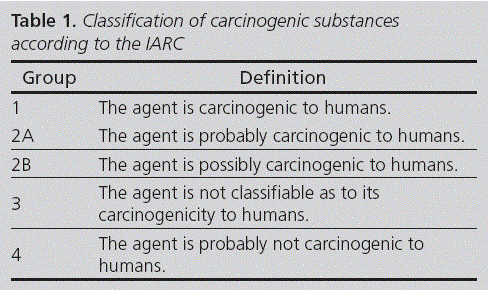
<body><![CDATA[<p><font size="2" face="Verdana">The International Agency for Research on Cancer (IARC) has classified many of these drugs as carcinogenic, mutagenic and/or toxic for reproduction. In Monographs 26<sup>2</sup> and 76<sup>3</sup>, both available at the IARC website, there is a list of the cytostatic agents included and their classification, shown here in <a href="#t1">table 1</a>.</font></p>     <p>&nbsp;</p>     <p align="center"><font size="2" face="Verdana"><a name="t1"></a><img src="/img/revistas/fh/v40n6/12revision01_t1.gif"></font></p>     <p>&nbsp;</p>     <p><font size="2" face="Verdana">Currently, eleven drugs and certain combination therapies are included in Group 1 (azathioprine, busulfan, cyclophosphamide, chlorambucil, chlornaphazine, diethylstilbestrol, melphalan, semustine, tamoxifen, thiotepa, treosulfan, and MOPP), twelve drugs are included in Group 2A (adriamycin, azacitidine, carmustine, cyclosporine, cisplatin, chlorozotocin, etoposide, lomustine, mechlorethamine, procarbazine, teniposide, and testosterone), and eleven drugs are included in Group 2B.</font></p>     <p><font size="2" face="Verdana">In 1979, the first publication about occupational exposure to cytostatic agents and its association with health risks appeared in the study by Falck <i>et al.<sup>4</sup>.</i> In this study, through Ames test, the mutagen activity was analyzed in the urine of nurses who prepared and administered cytostatic agents without protection measures. The existence of risks for health was demonstrated in cases of chronic exposure to some of these drugs in small amounts.</font></p>     <p><font size="2" face="Verdana">Subsequent studies have shown the likelihood of damage for workers exposed to cytostatic agents, with impact on pregnancy<sup>5,6,7,8,9,10</sup> (miscarriages, birth defects), chronic effects<sup>11,12</sup> and acute effects<sup>13,14,15,16</sup>.</font></p>     <p><font size="2" face="Verdana">Based on occupational exposure, different authors studied the potential association with oncogenic effects<sup>17,18,19,20,21</sup>. Though the relationship between prolonged exposure at low levels (the case of occupational activity) and oncogenic effect has not been clearly established, it is considered a potential factor of risk, and therefore all measures available should be implemented in order to minimize the risk of exposure.</font></p>     <p><font size="2" face="Verdana">Those workers who come into contact with cytostatic agents could be exposed to a risk for their health. This exposure could occur at any point during the drug cycle, from its manufacturing and distribution to its preparation, administration, and waste disposal. Therefore, the workers exposed could be both from the pharmaceutical industry and healthcare staff (physicians, pharmacists, nursing staff, healthcare technicians, and hospital attendants) in charge of preparation, administration, transportation, and waste disposal.</font></p>     <p><font size="2" face="Verdana">The concern around cytostatic handling has led different countries and organizations to prepare Guidelines for their correct handling. <a target="_blank" href="/img/revistas/fh/v40n6/12revision01_t2.gif">Table 2</a> shows some of the significant and recent Guidelines<sup>22-40</sup> that have been published.</font></p>     ]]></body>
<body><![CDATA[<p><font size="2" face="Verdana">One way of exposure to cytostatic agents could be through workplace contamination. Therefore, it is very important to determine the presence of cytostatic substances in work surfaces and, most of all, to be aware of the potential measures that should be implemented in order to eliminate or reduce said contamination.</font></p>     <p><font size="2" face="Verdana">The objective of this bibliographic review is to provide the most updated evidence about exposure to cytostatic agents in the work setting, and to learn about the potential preventive measures that can be implemented to prevent occupational exposure to cytostatic agents.</font></p>     <p>&nbsp;</p>     <p><font size="2" face="Verdana"><b>Material and methods</b></font></p>     <p><font size="2" face="Verdana">A bibliographic review was conducted using as information sources the following databases: MEDLINE, COCHRANE PLUS and WEB OF SCIENCE.</font></p>     <p><font size="2" face="Verdana">The period of study was established as the past 5 years.</font></p>     <p><font size="2" face="Verdana">The search was conducted based on the following key words: surface contamination, cytostatic drug, hazardous drug, drug preparation, occupational exposure, safe handling, closed-system transfer device. Afterwards, a combination of these key words was also used (for example: surface contamination AND hazardous drug, safe handling AND cytostatic, surface contamination AND cytostatic) in the different databases, defining the search according to the following criteria:</font></p>     <p><font size="2" face="Verdana"><b>Inclusion Criteria</b></font></p>     <blockquote>     <p><font size="2" face="Verdana">1. Studies describing the association between cytostatic handling and occupational exposure.</font></p>     ]]></body>
<body><![CDATA[<p><font size="2" face="Verdana">2. Human.</font></p>     <p><font size="2" face="Verdana">3. Publication date: Between 2010 and 2015.</font></p>     <p><font size="2" face="Verdana">4. Articles published in English and in Spanish.</font></p> </blockquote>     <p><font size="2" face="Verdana"><b>Exclusion Criteria</b></font></p>     <blockquote>     <p><font size="2" face="Verdana">1. Redundant articles.</font></p>     <p><font size="2" face="Verdana">2. Not original or reviews (for example: letters to the editor, editorials).</font></p> </blockquote>     <p><font size="2" face="Verdana">Ninety-one (91) articles were collected; duplicates or redundant articles were eliminated, and a relevance analysis was conducted by reviewing the article titles and abstracts, leading to a final selection of 13 articles, which are the basis for this study.</font></p>     <p>&nbsp;</p>     <p><font size="2" face="Verdana"><b>Results</b></font></p>     ]]></body>
<body><![CDATA[<p><font size="2" face="Verdana"><a target="_blank" href="/img/revistas/fh/v40n6/12revision01_t3.gif">Table 3</a> shows the main characteristics of the 13 articles that form the study, such as: authors, title, year, aspect studied, and main outcomes of the study.</font></p>     <p><font size="2" face="Verdana">The main outcomes of each article selected are described below; articles have been grouped by geographical area.</font></p>     <p><font size="2" face="Verdana"><b>Sessink PJ</b> <i>et al.<sup>41</sup></i> (2013) published a study where they measured superficial contamination by cyclophosphamide in 30 Hospital Pharmacies in the United States from 2004 to 2010, and compared the outcomes when using standard techniques for cytostatic preparation (use of Class II biological safety cabinets, gloves, disposable lab coats, negative pressure techniques with vent filters) vs. the use of a closed system (PhaSeal<sup>&reg;</sup>). Samples were taken from the inner surfaces of the biological safety cabinet, and floors and tables in the preparation room.</font></p>     <p><font size="2" face="Verdana">Among their outcomes, they found contamination in all the surfaces studied, both when using standard techniques and when the closed system was used. There was an 86% reduction in the levels of contamination with cyclophosphamide with the use of the closed system, compared with the standard preparation techniques (a mean difference from 0.22 to 0.03 ng/cm<sup>2</sup>, p &lt; 0.001).</font></p>     <p><font size="2" face="Verdana">Previously, <b>Sessink PJ</b> <i>et al.<sup>42</sup></i> (2010) published the outcomes of another study with a similar design, measuring superficial contamination in 22 Hospital Pharmacies in the United States (from 2000 to 2005), caused by cyclophosphamide, ifosfamide and 5-fluorouracil. Initially, samples were taken from all surfaces, with workers using standard techniques. Afterwards, a closed system (PhaSeal<sup>&reg;</sup>) was introduced for cytostatic preparation, and some months afterwards, samples were taken from the same surfaces again.</font></p>     <p><font size="2" face="Verdana">The results showed that 78%, 54% and 33% of samples tested positive for cyclophosphamide, ifosfamide and 5-fluorouracil. Subsequently, 68%, 45% and 20% of samples tested positive again for the same drugs. Once again, a statistically significant reduction was obtained in the concentrations of cyclophosphamide (p &lt; 0.001), ifosfamide (p &lt; 0.001) and 5-fluorouracil (p &lt; 0.01), of 95%, 90% and 65% respectively.</font></p>     <p><font size="2" face="Verdana">There is a series of studies in Canada about contamination, involving an important number of hospitals. The first of these studies was the one by <b>Bussi&#232;res</b> <i>et al.<sup>43</sup></i> (2012), including 25 hospitals out of the 68 hospitals that had been invited to participate. The same 12 zones and the same drugs were determined, and 147 pharmacy samples were obtained in total from the 25 hospitals, as well as 112 samples from the patient care areas of 24 hospitals. The outcomes showed 52% positive samples for cyclophosphamide, 20% for ifosfamide, and 3% for methotrexate. This first study was the one that suggested conducting periodical measurements in order to ensure an adequate practice that reduced the exposure to cytostatic agents.</font></p>     <p><font size="2" face="Verdana">The most recent is the study by <b>Berruyer M</b> <i>et al.<sup>44</sup> </i>(2014), which studied contamination in 36 hospitals, determining 6 pharmacy areas and 6 patient care areas. The drugs studied were cyclophosphamide, ifosfamide and methotrexate. There was an analysis of 422 samples; 47% of these samples tested positive for cyclophosphamide, 18% for ifosfamide, and 3% for methotrexate.</font></p>     <p><font size="2" face="Verdana">The study by <b>Merger D</b> <i>et al.<sup>45</sup></i> (2014) involved 33 hospitals in Canada. Samples were taken from the same 12 areas (6 from the pharmacy and 6 from patient care areas), and with the same drugs, during 2012. In this case, 363 samples were analyzed, with positive results in 40% of cases for cyclophosphamide, 18% for ifosfamide, and 5% for methotrexate.</font></p>     <p><font size="2" face="Verdana">In these studies conducted in Canada, no closed systems were used for preparation or administration, and the contamination outcomes in both settings showed higher percentages for preparation. In all cases, the Heads of Pharmacy in hospitals with at lest 50 beds were contacted and invited to participate in the study, and there was an increasingly higher level of participation, applying the same methodology.</font></p>     ]]></body>
<body><![CDATA[<p><font size="2" face="Verdana">In Spain, <b>González Álvarez A</b> <i>et al.<sup>46</sup></i> (2012) measured the contamination by 5-fluorouracil, gemcitabine and cyclophosphamide in the surfaces of the biological safety cabinet, the table for treatment preparation in the waiting room, and the table in the administration ward at Day Hospital, by taking 30 samples from each surface. The outcomes showed higher concentrations in the biological safety cabinet, and the drug with the highest concentration was gemcitabine, even though less preparations were conducted per day (1.75) vs. 5-fluorouracil (6.5). The lowest concentrations were found at the table in the administration ward at Day Hospital.</font></p>     <p><font size="2" face="Verdana">In Portugal, <b>Viegas S</b> <i>et al.<sup>47</sup></i> (2014) analyzed the superficial concentration in 2 hospitals during 2013; for this aim, there was a selection of 5 places associated with preparation and 5 places of administration, and 327 samples were taken, in order to analyze the presence of cyclophosphamide (CP), 5-fluorouracil (5FU) and paclitaxel (PTX). Both hospitals used standard preparation techniques in Class II biological safety cabinets, and personal protection equipment. The outcomes showed that 37% of samples exceeded the limit of quantification, and tested positive for one or more drugs. An additional 35.8% tested positive for one or more drugs, exceeding the limit of detection (LOD) but not the limit of quantification (LOD CP = 0.10 &mu;g/cm<sup>2</sup>; 5FU = 3.30 ng/cm<sup>2</sup> and PTX = 0.167 ng/cm<sup>2</sup>). It was observed that in the two hospitals, the highest levels of concentration appeared in administration settings, because preparation is highly controlled by the Portuguese Health Authorities.</font></p>     <p><font size="2" face="Verdana"><b>Kopp B</b> <i>et al.<sup>48</sup></i> (2012) initially sent questionnaires to 137 Day Hospitals in Germany; 39 of these were public and 98 were private. Answers were received from 96 Day Hospitals. From these, only 28 were interested in participating in a test of surface samples in order to detect the presence of 5-fluorouracil, cisplatin, gemcitabine, cyclophosphamide, ifosfamide, methotrexate, docetaxel and paclitaxel. A 60.9% of samples tested positive (153 for 5-fluorouracil, 172 for cisplatin and 73 for the rest of drugs); the drugs most frequently found were 5-fluorouracil (93.5%) and cisplatin (88.4%), and the least frequent were methotrexate (6.8%) and ifosfamide (26%). No association was found between the amount of drug handled and the level of contamination; but they observed that certain work practices, such as the use of multi-channel closed systems for infusion, and administration systems purged and connected in the Pharmacy Unit, led to a lower number of positive samples.</font></p>     <p><font size="2" face="Verdana"><b>Miyake T</b> <i>et al.<sup>49</sup></i> (2013) conducted a study at the Ise Red Cross Hospital in Japan, in order to assess the impact on superficial contamination and occupational exposure of using a closed system (PhaSeal<sup>&reg;</sup>) for cytostatic preparation. For this aim, they selected 6 places to take samples in the preparation area, and they took 24hour urine samples from 4 pharmacists. The outcomes showed that 4 out of the 6 surfaces tested positive for cyclophosphamide before the introduction of the closed system, and 7 months after implementing it, only 1 of the 6 surfaces tested positive. Regarding urine, 34 samples were taken, and 26 tested positive for cyclophosphamide (77.9% of samples) before using the closed system; again, 31 samples were taken after 7 months, and only 2 tested positive (6.3% of cases).</font></p>     <p><font size="2" face="Verdana"><b>Sugiura S</b> <i>et al.<sup>50</sup></i> (2011) evaluated the presence of cyclophosphamide at the University Hospital in Nagoya, also in Japan, in 2 departments, Paediatric Haematology and Oncology, which had a biological safety cabinet; and in Haematology and Oncology for adults, which did not have a biological safety cabinet. Surface and urine samples were taken; all superficial samples but one tested positive for cyclophosphamide (93.75% of cases), and concentrations were higher in the department without a biological safety cabinet. In the case of urine samples, only 11 out of 62 samples tested positive (17.7% of cases). The values obtained were higher for those workers that administered than for those who prepared, probably due to the fact that no gloves were used for administration, thus favouring dermal absorption.</font></p>     <p><font size="2" face="Verdana"><b>Siderov J</b> <i>et al.<sup>51</sup></i> (2010) studied superficial contamination by cyclophosphamide in 2 public hospitals in Australia. Twelve (12) places were selected for taking samples in the preparation area, and this was conducted before the introduction of the closed system (PhaSeal<sup>&reg;</sup>), as well as at 5 months and 12 months after its introduction; however, one of the hospitals withdrew from the study after the first five months. The outcomes showed that at 5 months the contamination by cyclophosphamide was reduced in 24% (from 82.28 to 62.55 ng/cm<sup>2</sup>), and at 12 months, the reduction was of 68% (80.65 to 25.98 ng/cm<sup>2</sup>).</font></p>     <p><font size="2" face="Verdana">The article by <b>Hon C-Y</b> <i>et al.<sup>52</sup></i> (2014) conducted a comparative literature review for Europe and North America during the 2004-2012 period. They selected 71 articles in total, with 55 for Europe and 16 for North America; &quot;superficial contamination&quot; was the most frequent term, appearing in 50 of the 71 articles. The authors stated that the majority of the outcomes of European articles could not be extrapolated to North America, due to the different regulations and work practices. They also reached the conclusion that there is a lack of publications in North America studying the occupational exposure to cytostatic agents in biologic samples.</font></p>     <p><font size="2" face="Verdana">Considering the new technological developments, <b>Sessink PJ</b> <i>et al.<sup>53</sup></i> (2015) measured contamination when medication was prepared in bags through a robotic system (CytoCare) by sampling cyclophosphamide; contamination was found inside the robot before and after preparation. Specifically, contamination was found in the reconstituted vials and in the bags after preparation (but not before preparation), as well as in the connections. There was also contamination in the gloves used for preparation and cleaning. On the contrary, no contamination was found in the vials with powder, the environmental samples, and the urine of the staff.</font></p>     <p>&nbsp;</p>     <p><font size="2" face="Verdana"><b>Discussion</b></font></p>     ]]></body>
<body><![CDATA[<p><font size="2" face="Verdana">Studies before 2010 showed the presence of contamination in different surfaces from the areas of cytostatic preparation and administration. In 1992, Sessink <i>et al.<sup>54</sup></i> had already published an article about the presence of cytostatics in work surfaces and staff urine when measuring the presence of various drugs (4 in total). Many more studies have been published since then, taking measurements in hospital pharmacies and administration areas in all continents, and the vast majority have indicated the existence of different types of contamination.</font></p>     <p><font size="2" face="Verdana">The more recent studies continue demonstrating the presence of different drugs both in surfaces and in the urine and those handling them. Our analysis suggests that, regardless of the numerous guidelines edited in many countries, and the more or less general use of protection measures, there is still an external release of cytostatic substances when these are reconstituted, prepared and administered in many Hospital Pharmacies, onco-haematological hospitalization wards, and Day Hospitals in many hospitals throughout the 5 continents.</font></p>     <p><font size="2" face="Verdana">Regarding the surfaces tested, we should highlight that Sessink<sup>41,42</sup>, in their 2 studies, took samples from the cabinet surfaces and profiles, the floor in front of the cabinet, and the counter where medication is placed. Berruyer<sup>44</sup>, Merger<sup>45</sup> and Bussi&#232;res<sup>43</sup> increased the number of surfaces to be sampled, including the counter for delivery reception, the shelves for drug storage, the inner front grille of the hood, the floor in front of the cabinet, the counter where medication is placed, and the tray used for transporting the drug to the administration area. Besides, they included 6 surfaces in the administration areas, such as the storage shelves, the counter where saline bags are purged, the arm of the administration armchair, bedside tables in patient rooms, the drug reception table, and the exterior of administration bags or syringes.</font></p>     <p><font size="2" face="Verdana">González Álvarez <i>et al.<sup>46</sup></i> measured the surfaces in the biological safety cabinet, the treatment preparation table in the waiting room, and the table at the administration ward in the Day Hospital. Viegas<sup>47</sup> selected 4 preparation areas for sampling: door handles and shelves in the service area; countertops, trays and handles in the clean room; countertops and trays in the waiting room, and shelves and knobs of the storage cupboard. Samples were also taken from countertops, infusion pumps, and the reception counter in the administration areas. Though Kopp<sup>48</sup> provides a less accurate description of the places from which samples were taken, there is a reference to selecting the settings so that the whole work circuit was represented, from drug unpacking, preparation and administration, to waste disposal. It is explained that samples were taken from the floor of the rooms, therapy wards, and toilets. Besides, samples were taken from those work areas where drugs are received and verified, and where the system is purged. It is worth highlighting that samples were taken from IV poles, infusion pumps, treatment chair armrests, and the lids of waste containers.</font></p>     <p><font size="2" face="Verdana">Siderov<sup>51</sup> defined 12 preparation settings in the Oncology Pharmacy, where samples were taken from: the cabinet workspace, the HEPA filter grille, the front grille, around the cabinet air collector, under the work area, the floor in front of the cabin, the floor of the clean room closer to the waiting room, in the middle of the waiting room, verification areas, mixing device, and preparation and storage trays. In this study, samples were also taken from vials.</font></p>     <p><font size="2" face="Verdana">Reviewed as a whole, these studies show the important variety of settings and materials where contamination has been looked for and found, both in preparation and in administration.</font></p>     <p><font size="2" face="Verdana">There are a much lower number of studies testing for the presence of cytostatic substances in urine, if compared with those where samples were taken from surfaces. Only the studies by Miyake<sup>49</sup>, Sugiura<sup>50</sup> and Sessink<sup>53</sup>, the latter with a robotic system, tested the presence of cyclophosphamide in urine, which was positive in the two Japanese studies, and negative with the robotic system. This could be due to the joint action of using a double pair of gloves and lab coat, together with less handling of the drug, because this was conducted by the robot. It is important to point out that, from the perspective of legal consequences, the presence of contamination in surfaces implies the likelihood of drug exposure for the staff member, while the presence in urine implies that the staff member came into contact with the drug, metabolized it and finally excreted it.</font></p>     <p><font size="2" face="Verdana">Regarding the drugs determined by sampling, the most usual was cyclophosphamide, because it appears in all articles studied. Besides cyclophosphamide, other drugs determined were ifosfamide<sup>42,43,44,45,51</sup>, 5-fluorouracil<sup>42,46,51</sup>, methotrexate<sup>43,44,45,51</sup>, paclitaxel<sup>46,51</sup>, cisplatin<sup>51</sup>, gemcitabine<sup>46</sup> and docetaxel<sup>51</sup>. The systems used for sampling were those described by Schamus <i>et al.<sup>55</sup> </i>and by Larson <i>et al.<sup>56</sup></i>, as well as the Cyto Wipe Kit (Exposure Control Sweden AB, Bohus-Bjórkó, Sweden), which was the most frequently used, but with a lower variety of drugs. The advantage of this system is that all materials are included in a kit, and cold samples can be sent to a predetermined lab.</font></p>     <p><font size="2" face="Verdana">In the majority of the studies, except for González Álvarez <i>et al.<sup>46</sup></i>, the dosing used or the doses handled were not defined, or the volume of work conducted. This means that no conclusions can be made when testing the concentrations observed in different studies. Only as an example: if we observe the most frequent drug (cyclophosphamide), we find the highest values inside the cabinets (3.86 ng/cm<sup>2</sup> in Sessink<sup>41</sup>) and outside the cabinets (60.5 ng/cm<sup>2</sup> and 7.18 ng/cm<sup>2</sup> in administration counters in Viegas<sup>47</sup> and Sugiura<sup>50</sup> respectively). The robotic system also showed significant levels of contamination in vials and preparation bags (4.78 &mu;g/cm<sup>2</sup> and 1.1 &mu;g/cm<sup>2</sup> respectively).</font></p>     <p><font size="2" face="Verdana">When analyzing the proportion of samples that tested positive for superficial contamination, it is observed that there were very high proportions for the majority of the drugs studied, such as cyclophosphamide (93.75%, 78% and 52%), 5-fluorouracil (93.5% and 33%), ifosfamide (54%, 26% and 20%) or cisplatin (88.4%). These proportions demonstrated that the work procedures used in the different hospitals studied around the world led to contamination by different drugs of the places where these were handled, both in the Pharmacy and in the administration areas, with the risk entailed for the health of the staff and even for those people accompanying patients.</font></p>     ]]></body>
<body><![CDATA[<p><font size="2" face="Verdana">Some of the articles reviewed<sup>41,42,49,51</sup> valued the use of closed systems to reduce the contamination in surfaces and/or biological fluids of handlers. Both articles by Sessink in American hospitals, excluding his article about robots, showed a reduction in contamination. In 2010, the reduction obtained was of 95%, 90% and 65% for cyclophosphamide, ifosfamide and 5-fluorouracil, respectively, while in 2013 the reduction in contamination levels was of 86% for cyclophosphamide, after 6 months of using the closed system. The article by Miyake achieved a 91.9% reduction in the number of positive results in the urine samples of staff members exposed to cyclophosphamide, after 7 months of using closed systems. The outcomes of the study by Siderov showed a 24% reduction at 5 months, and a 68% reduction at 12 months for cyclophosphamide. In the study by Kopp, no reduction percentage was established, but a correlation was estimated between the use of closed systems and the reduction in superficial contamination (p = 0.01). These outcomes allow to claim that the closed system reduced significantly, but did not eliminate completely, the contamination in work surfaces.</font></p>     <p><font size="2" face="Verdana">In the year 2000, the NIOSH (National Institute for Occupational Safety and Health) created a team to review the studies on hazardous drugs. This study resulted in the document from 2004: &quot;Alert: Preventing Occupational Exposure to Antineoplastic and Other Hazardous Drugs in Health Care Settings&quot;<sup>57</sup>, where a closed system was defined for the first time. This definition was subsequently modified, and the term CSTD (closed system drug transfer device) was created to define a system of drug transfer that prevents mechanically the entry of contaminants inside the system, and the leak of hazardous drugs or vapour concentrations outside the system. This definition was adopted by the ISOPP<sup>51</sup>, establishing the division between microbiological contamination and chemical contamination.</font></p>     <p><font size="2" face="Verdana">The interpretation of this definition has created a discussion about what is understood by closed system<sup>58</sup>. Fortunately, the FDA (U.S. Food and Drug Administration) established in 2012 a new category for CSTDs under the ONB code<sup>59</sup>, defining it as: reconstitution and transfer of cytostatic and other hazardous drugs in the healthcare setting, indicated to reduce the exposure of healthcare staff to chemotherapeutical agents in the healthcare setting. This new ONB code provides an additional specification about closed systems in terms of staff protection.</font></p>     <p><font size="2" face="Verdana">As a conclusion, we can say that in the most recent literature it has been observed that there is superficial contamination in different settings and by different cytostatic drugs. There are a lower number of studies where the presence of cytostatics has also been detected in the urine of handlers. This contamination has been verified in many hospitals from different countries and in different continents, including Spain; this shows the globalization of the problem.</font></p>     <p><font size="2" face="Verdana">Work setting contamination appears in numerous and different places, both in preparation and in administration; it is usually higher during preparation. In all the cases studied, contamination has been found in the cabinet, in the floor in front of the cabinet, in different tables where drugs are temporarily placed, in the waiting room, and in the storage areas. Different drugs have also been studied, with cyclophosphamide being the most frequent.</font></p>     <p><font size="2" face="Verdana">The introduction of a closed system drug transfer device (CSTD)<sup>41,42,49,51</sup> reduced the levels of contamination up to a 95%; these reduction rates increased as the closed systems were used over a longer time.</font></p>     <p><font size="2" face="Verdana">There is no conflict of interests by the authors (captured in the Coi-Disclosure documents).</font></p>     <p>&nbsp;</p>     <p><font size="2" face="Verdana"><b>Bibliography</b></font></p>     <!-- ref --><p><font size="2" face="Verdana">1. Goodman LS, Wintrobe MM, et al. Nitrogen mustard therapy. Use of methylbis (beta-chloroethyl) amine hydrochloride and tris (beta-chloroethyl) amine hydrochloride for Hodgkin's disease, lymphosarcoma, leukemia and certain allied and miscellaneous disorders. J Am Med Assoc. 1946 Sep 21:132:126-32.    &nbsp;&nbsp;&nbsp;&nbsp;&nbsp;&nbsp;&nbsp;&nbsp;[&#160;<a href="javascript:void(0);" onclick="javascript: window.open('/scielo.php?script=sci_nlinks&ref=2243351&pid=S1130-6343201600060001200001&lng=','','width=640,height=500,resizable=yes,scrollbars=1,menubar=yes,');">Links</a>&#160;]<!-- end-ref --></font></p>    <!-- ref --><p><font size="2" face="Verdana">2. International Agency for Research on Cancer. Improving Evaluation of the Carcinogenic Risk of Chemicals to Humans, Vol. 26, Sorne Antineoplastic and Immunosuppressive Agents (monografia en Internet). Lyon: IARC Press; 1981 (citado 09-04-2015). Disponible en: <a target="_blank" href="http://monographs.iarc.fr/ENG/Monographs/vol1-42/mono26.pdf">http://monographs.iarc.fr/ENG/Monographs/vol1-42/mono26.pdf</a>.    &nbsp;&nbsp;&nbsp;&nbsp;&nbsp;&nbsp;&nbsp;&nbsp;[&#160;<a href="javascript:void(0);" onclick="javascript: window.open('/scielo.php?script=sci_nlinks&ref=2243353&pid=S1130-6343201600060001200002&lng=','','width=640,height=500,resizable=yes,scrollbars=1,menubar=yes,');">Links</a>&#160;]<!-- end-ref --></font></p>    <!-- ref --><p><font size="2" face="Verdana">3. International Agency for Research on Cancer. IARC Monographs on the Evaluation of the Carcinogenic Risk to Humans: Some antiviral and antineoplastic drugs, and other pharmaceutical agents, Vol. 76 (monografia en Internet). Lyon;2000 (citado 09-04-2015). Disponible en <a target="_blank" href="http://monographs.iarc.fr/ENG/Monographs/vol76/mono76.pdf">http://monographs.iarc.fr/ENG/Monographs/vol76/mono76.pdf</a>.    &nbsp;&nbsp;&nbsp;&nbsp;&nbsp;&nbsp;&nbsp;&nbsp;[&#160;<a href="javascript:void(0);" onclick="javascript: window.open('/scielo.php?script=sci_nlinks&ref=2243355&pid=S1130-6343201600060001200003&lng=','','width=640,height=500,resizable=yes,scrollbars=1,menubar=yes,');">Links</a>&#160;]<!-- end-ref --></font></p>    <!-- ref --><p><font size="2" face="Verdana">4. Falck, K., Grohn, P., Sorsa, M., Vainio, H., Heinonen, E., Holsti, L.R., 1979. Mutagenicity in urine of nurses handling cytostatic drugs. Lancet. 1979 Jun 9;1(8128):1250-1.    &nbsp;&nbsp;&nbsp;&nbsp;&nbsp;&nbsp;&nbsp;&nbsp;[&#160;<a href="javascript:void(0);" onclick="javascript: window.open('/scielo.php?script=sci_nlinks&ref=2243357&pid=S1130-6343201600060001200004&lng=','','width=640,height=500,resizable=yes,scrollbars=1,menubar=yes,');">Links</a>&#160;]<!-- end-ref --></font></p>    <!-- ref --><p><font size="2" face="Verdana">5. Dranitsaris G, Johnston M, Poirier S, Schueller T, Milliken D, Green E and Zanke B. Are health care providers who work with cancer drugs at an increased risk for toxic events? A systematic review and meta-analysis of the literature. J Oncol Pharm practice. 2005: 11:69-78.    &nbsp;&nbsp;&nbsp;&nbsp;&nbsp;&nbsp;&nbsp;&nbsp;[&#160;<a href="javascript:void(0);" onclick="javascript: window.open('/scielo.php?script=sci_nlinks&ref=2243359&pid=S1130-6343201600060001200005&lng=','','width=640,height=500,resizable=yes,scrollbars=1,menubar=yes,');">Links</a>&#160;]<!-- end-ref --></font></p>    <!-- ref --><p><font size="2" face="Verdana">6. Bouyer J, Saurel-Cubizolles M-J, Grenier C, Aussel L and Job-Spira N. Ectopic pregancy and occupational exposure of hospital personnel. Scand J Work Environ Health. 1998; 24:98-103.    &nbsp;&nbsp;&nbsp;&nbsp;&nbsp;&nbsp;&nbsp;&nbsp;[&#160;<a href="javascript:void(0);" onclick="javascript: window.open('/scielo.php?script=sci_nlinks&ref=2243361&pid=S1130-6343201600060001200006&lng=','','width=640,height=500,resizable=yes,scrollbars=1,menubar=yes,');">Links</a>&#160;]<!-- end-ref --></font></p>    <!-- ref --><p><font size="2" face="Verdana">7. Hoffman DM. Reproductive risks associated with exposure to antineoplastic agents: a review of the literature. Hosp Pharm.1986;21: 930-932.    &nbsp;&nbsp;&nbsp;&nbsp;&nbsp;&nbsp;&nbsp;&nbsp;[&#160;<a href="javascript:void(0);" onclick="javascript: window.open('/scielo.php?script=sci_nlinks&ref=2243363&pid=S1130-6343201600060001200007&lng=','','width=640,height=500,resizable=yes,scrollbars=1,menubar=yes,');">Links</a>&#160;]<!-- end-ref --></font></p>    <!-- ref --><p><font size="2" face="Verdana">8. McDonald AD, McDonald JC, Armstrong B, Cherry NM, C&#244;té R, Lavoie J, Nolin AD and Robert D. Congenital defects and work in pregnancy. Br J Ind Med. 1988;45:581-588.    &nbsp;&nbsp;&nbsp;&nbsp;&nbsp;&nbsp;&nbsp;&nbsp;[&#160;<a href="javascript:void(0);" onclick="javascript: window.open('/scielo.php?script=sci_nlinks&ref=2243365&pid=S1130-6343201600060001200008&lng=','','width=640,height=500,resizable=yes,scrollbars=1,menubar=yes,');">Links</a>&#160;]<!-- end-ref --></font></p>    <!-- ref --><p><font size="2" face="Verdana">9. Peelen S, Roeleveld N, Heederik D, Krombout H and de Kort W. Toxic effects on reproduction in hospital personnel. 1999; Dutch Ministry of Social Affairs and Employment.    &nbsp;&nbsp;&nbsp;&nbsp;&nbsp;&nbsp;&nbsp;&nbsp;[&#160;<a href="javascript:void(0);" onclick="javascript: window.open('/scielo.php?script=sci_nlinks&ref=2243367&pid=S1130-6343201600060001200009&lng=','','width=640,height=500,resizable=yes,scrollbars=1,menubar=yes,');">Links</a>&#160;]<!-- end-ref --></font></p>    <!-- ref --><p><font size="2" face="Verdana">10. Valanis B, Vollmer W, Labuhn K and Glass A. Occupational exposure to antineoplastic agents and self-reported infertility among nurses and pharmacists. J Occup Environ Med. 1997; 39:574-580.    &nbsp;&nbsp;&nbsp;&nbsp;&nbsp;&nbsp;&nbsp;&nbsp;[&#160;<a href="javascript:void(0);" onclick="javascript: window.open('/scielo.php?script=sci_nlinks&ref=2243369&pid=S1130-6343201600060001200010&lng=','','width=640,height=500,resizable=yes,scrollbars=1,menubar=yes,');">Links</a>&#160;]<!-- end-ref --></font></p>    <!-- ref --><p><font size="2" face="Verdana">11. Lassila O, Toivanen A and Nordman E. Immune function in nurses handling cytostatic drugs. Lancet. 1980; 2:482.    &nbsp;&nbsp;&nbsp;&nbsp;&nbsp;&nbsp;&nbsp;&nbsp;[&#160;<a href="javascript:void(0);" onclick="javascript: window.open('/scielo.php?script=sci_nlinks&ref=2243371&pid=S1130-6343201600060001200011&lng=','','width=640,height=500,resizable=yes,scrollbars=1,menubar=yes,');">Links</a>&#160;]<!-- end-ref --></font></p>    <!-- ref --><p><font size="2" face="Verdana">12. Sessink PJM, Verplanke AJW, Herber RFM and Bos RP. Occupational exposure to antineoplastic agents and parameters for renal dysfunction. Int Arch Occup Environ Health. 1997; 69:215-218.    &nbsp;&nbsp;&nbsp;&nbsp;&nbsp;&nbsp;&nbsp;&nbsp;[&#160;<a href="javascript:void(0);" onclick="javascript: window.open('/scielo.php?script=sci_nlinks&ref=2243373&pid=S1130-6343201600060001200012&lng=','','width=640,height=500,resizable=yes,scrollbars=1,menubar=yes,');">Links</a>&#160;]<!-- end-ref --></font></p>    <!-- ref --><p><font size="2" face="Verdana">13. McDiarmid M and Egan T. Acute occupational exposure to antineoplastic agents. J Occup Med. 1988; 30:984-987.    &nbsp;&nbsp;&nbsp;&nbsp;&nbsp;&nbsp;&nbsp;&nbsp;[&#160;<a href="javascript:void(0);" onclick="javascript: window.open('/scielo.php?script=sci_nlinks&ref=2243375&pid=S1130-6343201600060001200013&lng=','','width=640,height=500,resizable=yes,scrollbars=1,menubar=yes,');">Links</a>&#160;]<!-- end-ref --></font></p>    <!-- ref --><p><font size="2" face="Verdana">14. Valanis BG, Vollmer WM, Labuhn KT and Glass AG. Acute symptoms associated with antineoplastic drug handling among nurses. Cancer Nurs. 1993; 16:288-295.    &nbsp;&nbsp;&nbsp;&nbsp;&nbsp;&nbsp;&nbsp;&nbsp;[&#160;<a href="javascript:void(0);" onclick="javascript: window.open('/scielo.php?script=sci_nlinks&ref=2243377&pid=S1130-6343201600060001200014&lng=','','width=640,height=500,resizable=yes,scrollbars=1,menubar=yes,');">Links</a>&#160;]<!-- end-ref --></font></p>    <!-- ref --><p><font size="2" face="Verdana">15. Jochimsen PR, Corder MP, Lachenbruch AP and Spaight ME. Preparation and administration of chemotherapy: Haematological consequences for hospital-based nurses. Med Toxicol. 1988; 3:59-63.    &nbsp;&nbsp;&nbsp;&nbsp;&nbsp;&nbsp;&nbsp;&nbsp;[&#160;<a href="javascript:void(0);" onclick="javascript: window.open('/scielo.php?script=sci_nlinks&ref=2243379&pid=S1130-6343201600060001200015&lng=','','width=640,height=500,resizable=yes,scrollbars=1,menubar=yes,');">Links</a>&#160;]<!-- end-ref --></font></p>    <!-- ref --><p><font size="2" face="Verdana">16. Valanis BG, Vollmer WM, Labuhn KT and Glass AG. Association of antineoplastic drug handling with acute adverse effects in pharmacy personnel. Am J Hosp Pharm. 1993; 50:455-462.    &nbsp;&nbsp;&nbsp;&nbsp;&nbsp;&nbsp;&nbsp;&nbsp;[&#160;<a href="javascript:void(0);" onclick="javascript: window.open('/scielo.php?script=sci_nlinks&ref=2243381&pid=S1130-6343201600060001200016&lng=','','width=640,height=500,resizable=yes,scrollbars=1,menubar=yes,');">Links</a>&#160;]<!-- end-ref --></font></p>    <!-- ref --><p><font size="2" face="Verdana">17. Blair A, Zheng T, Linos A, Stewart PA, Zhang YW and Cantor KP. Occupation and leukemia: A population-based case-control study in Iowa and Minnesota. Am J Ind Med. 2001; 40: 3-14.    &nbsp;&nbsp;&nbsp;&nbsp;&nbsp;&nbsp;&nbsp;&nbsp;[&#160;<a href="javascript:void(0);" onclick="javascript: window.open('/scielo.php?script=sci_nlinks&ref=2243383&pid=S1130-6343201600060001200017&lng=','','width=640,height=500,resizable=yes,scrollbars=1,menubar=yes,');">Links</a>&#160;]<!-- end-ref --></font></p>    <!-- ref --><p><font size="2" face="Verdana">18. Skov T, Maarup B, Olsen J, R&#248;rth M, Winthereik H and Lynge E. Leukaemia and reproductive outcome among nurses handling antineoplastic drugs. Brit J Ind Med. 1992;49:855-861.    &nbsp;&nbsp;&nbsp;&nbsp;&nbsp;&nbsp;&nbsp;&nbsp;[&#160;<a href="javascript:void(0);" onclick="javascript: window.open('/scielo.php?script=sci_nlinks&ref=2243385&pid=S1130-6343201600060001200018&lng=','','width=640,height=500,resizable=yes,scrollbars=1,menubar=yes,');">Links</a>&#160;]<!-- end-ref --></font></p>    <!-- ref --><p><font size="2" face="Verdana">19. Sessink PJM, Kroese ED, van Kranen HJ and Bos RP. Cancer risk assessment for health care workers occupationally exposed to cyclophosphamide. Inter Arch Occup Environ Health. 1993; 67:317-323.    &nbsp;&nbsp;&nbsp;&nbsp;&nbsp;&nbsp;&nbsp;&nbsp;[&#160;<a href="javascript:void(0);" onclick="javascript: window.open('/scielo.php?script=sci_nlinks&ref=2243387&pid=S1130-6343201600060001200019&lng=','','width=640,height=500,resizable=yes,scrollbars=1,menubar=yes,');">Links</a>&#160;]<!-- end-ref --></font></p>    <!-- ref --><p><font size="2" face="Verdana">20. Gunnarsdottir HK, Aspelund T, Karlsson T and Rafnsson V. Occupational risk factors for breast cancer among nurses. Int J Occup Environ Health.1997; 3: 254-258.    &nbsp;&nbsp;&nbsp;&nbsp;&nbsp;&nbsp;&nbsp;&nbsp;[&#160;<a href="javascript:void(0);" onclick="javascript: window.open('/scielo.php?script=sci_nlinks&ref=2243389&pid=S1130-6343201600060001200020&lng=','','width=640,height=500,resizable=yes,scrollbars=1,menubar=yes,');">Links</a>&#160;]<!-- end-ref --></font></p>    <!-- ref --><p><font size="2" face="Verdana">21. Hansen, J and Olsen JH. Cancer morbidity among Danish female pharmacy technicians. Scand J Work Environ Health. 1994; 20:22-26.    &nbsp;&nbsp;&nbsp;&nbsp;&nbsp;&nbsp;&nbsp;&nbsp;[&#160;<a href="javascript:void(0);" onclick="javascript: window.open('/scielo.php?script=sci_nlinks&ref=2243391&pid=S1130-6343201600060001200021&lng=','','width=640,height=500,resizable=yes,scrollbars=1,menubar=yes,');">Links</a>&#160;]<!-- end-ref --></font></p>    <!-- ref --><p><font size="2" face="Verdana">22. Jacobson JO, et al. American Society of Clinical Oncology/Oncology Nursing Society chemotherapy administration safety standards. Oncol Nurs Forum. 2009 Nov;36(6):651-8.    &nbsp;&nbsp;&nbsp;&nbsp;&nbsp;&nbsp;&nbsp;&nbsp;[&#160;<a href="javascript:void(0);" onclick="javascript: window.open('/scielo.php?script=sci_nlinks&ref=2243393&pid=S1130-6343201600060001200022&lng=','','width=640,height=500,resizable=yes,scrollbars=1,menubar=yes,');">Links</a>&#160;]<!-- end-ref --></font></p>    <!-- ref --><p><font size="2" face="Verdana">23. American Society of Health-System Pharmacists. ASHP Guidelines on Handling Hazardous Drugs: Am J Health-Syst Pharm. 2006; 63:1172-1193.    &nbsp;&nbsp;&nbsp;&nbsp;&nbsp;&nbsp;&nbsp;&nbsp;[&#160;<a href="javascript:void(0);" onclick="javascript: window.open('/scielo.php?script=sci_nlinks&ref=2243395&pid=S1130-6343201600060001200023&lng=','','width=640,height=500,resizable=yes,scrollbars=1,menubar=yes,');">Links</a>&#160;]<!-- end-ref --></font></p>    <!-- ref --><p><font size="2" face="Verdana">24. Alexander M, et al. Australian consensus guidelines for the safe handling of monoclonal antibodies for cancer treatment by healthcare personnel. Intern Med J. 2014; (Epub ahead of print) DOI: 10.111/imj.12564.    &nbsp;&nbsp;&nbsp;&nbsp;&nbsp;&nbsp;&nbsp;&nbsp;[&#160;<a href="javascript:void(0);" onclick="javascript: window.open('/scielo.php?script=sci_nlinks&ref=2243397&pid=S1130-6343201600060001200024&lng=','','width=640,height=500,resizable=yes,scrollbars=1,menubar=yes,');">Links</a>&#160;]<!-- end-ref --></font></p>    <!-- ref --><p><font size="2" face="Verdana">25. Brown KA, Esper P, Kelleher LO, O'Neill JEB, Polovich M and White JM (eds.) 2001. Chemotherapy and biotherapy guidelines and recommendations for practice. Pittsburgh, PA: Oncology Nursing Society.    &nbsp;&nbsp;&nbsp;&nbsp;&nbsp;&nbsp;&nbsp;&nbsp;[&#160;<a href="javascript:void(0);" onclick="javascript: window.open('/scielo.php?script=sci_nlinks&ref=2243399&pid=S1130-6343201600060001200025&lng=','','width=640,height=500,resizable=yes,scrollbars=1,menubar=yes,');">Links</a>&#160;]<!-- end-ref --></font></p>    <!-- ref --><p><font size="2" face="Verdana">26. OSHA (1999). OSHA technical manual, TED 1-0.1<sup>5</sup>A, Sec VI, Cap II: Controlling occupational exposure to hazardous drug. (citado 15-04-2015).    &nbsp;&nbsp;&nbsp;&nbsp;&nbsp;&nbsp;&nbsp;&nbsp;[&#160;<a href="javascript:void(0);" onclick="javascript: window.open('/scielo.php?script=sci_nlinks&ref=2243401&pid=S1130-6343201600060001200026&lng=','','width=640,height=500,resizable=yes,scrollbars=1,menubar=yes,');">Links</a>&#160;]<!-- end-ref --></font></p>    <!-- ref --><p><font size="2" face="Verdana">27. Occupational Safety and Health Service. Department of Labour. Guidelines for the safe handling of cytotoxic drugs and related waste. Wellington. New Zealand Publisher: The Service. 1997.    &nbsp;&nbsp;&nbsp;&nbsp;&nbsp;&nbsp;&nbsp;&nbsp;[&#160;<a href="javascript:void(0);" onclick="javascript: window.open('/scielo.php?script=sci_nlinks&ref=2243403&pid=S1130-6343201600060001200027&lng=','','width=640,height=500,resizable=yes,scrollbars=1,menubar=yes,');">Links</a>&#160;]<!-- end-ref --></font></p>    <!-- ref --><p><font size="2" face="Verdana">28. Chaffee BW, Armistead JA, Benjamin BE, Cotugno MC, Forrey RA, Hintzen BL, Pfeiffenberger T and Stevenson JG. Guidelines for the safe handling of hazardous drugs: consensus recommendations. Am J Health-Syst Pharm. 2010; 67:1545-1546.    &nbsp;&nbsp;&nbsp;&nbsp;&nbsp;&nbsp;&nbsp;&nbsp;[&#160;<a href="javascript:void(0);" onclick="javascript: window.open('/scielo.php?script=sci_nlinks&ref=2243405&pid=S1130-6343201600060001200028&lng=','','width=640,height=500,resizable=yes,scrollbars=1,menubar=yes,');">Links</a>&#160;]<!-- end-ref --></font></p>    <!-- ref --><p><font size="2" face="Verdana">29. The Joint Commission. Improving Patient and Worker Safety: Opportunities for Synergy, Collaboration and Innovation. The Joint Commission Monograph. Oakbrook Terrace, IL: The Joint Commission, 2012 Nov; :1-162.    &nbsp;&nbsp;&nbsp;&nbsp;&nbsp;&nbsp;&nbsp;&nbsp;[&#160;<a href="javascript:void(0);" onclick="javascript: window.open('/scielo.php?script=sci_nlinks&ref=2243407&pid=S1130-6343201600060001200029&lng=','','width=640,height=500,resizable=yes,scrollbars=1,menubar=yes,');">Links</a>&#160;]<!-- end-ref --></font></p>    <!-- ref --><p><font size="2" face="Verdana">30. International Society of Oncology Pharmacy Practitioners. Standards of Practice: Safe Handling of Cytotoxics. J Oncol Pharm Pract. 2007; 13:1-81.    &nbsp;&nbsp;&nbsp;&nbsp;&nbsp;&nbsp;&nbsp;&nbsp;[&#160;<a href="javascript:void(0);" onclick="javascript: window.open('/scielo.php?script=sci_nlinks&ref=2243409&pid=S1130-6343201600060001200030&lng=','','width=640,height=500,resizable=yes,scrollbars=1,menubar=yes,');">Links</a>&#160;]<!-- end-ref --></font></p>    <!-- ref --><p><font size="2" face="Verdana">31. Gamundi MC, coord. Medicamentos Citostáticos. 3<sup>a</sup> edición. Madrid: Sociedad Española de Farmacia Hospitalaria; 2003.    &nbsp;&nbsp;&nbsp;&nbsp;&nbsp;&nbsp;&nbsp;&nbsp;[&#160;<a href="javascript:void(0);" onclick="javascript: window.open('/scielo.php?script=sci_nlinks&ref=2243411&pid=S1130-6343201600060001200031&lng=','','width=640,height=500,resizable=yes,scrollbars=1,menubar=yes,');">Links</a>&#160;]<!-- end-ref --></font></p>    <!-- ref --><p><font size="2" face="Verdana">32. NIOSH. Preventing Occupational Exposure to Antineoplastic and Other Hazardous Drugs in Health Care Settings (citado 15-042015). Disponible en: <a target="_blank" href="http://www.cdc.gov/niosh/docs/2004-165/">http://www.cdc.gov/niosh/docs/2004-165/</a>.    &nbsp;&nbsp;&nbsp;&nbsp;&nbsp;&nbsp;&nbsp;&nbsp;[&#160;<a href="javascript:void(0);" onclick="javascript: window.open('/scielo.php?script=sci_nlinks&ref=2243413&pid=S1130-6343201600060001200032&lng=','','width=640,height=500,resizable=yes,scrollbars=1,menubar=yes,');">Links</a>&#160;]<!-- end-ref --></font></p>    <!-- ref --><p><font size="2" face="Verdana">33. Eisenberg, S. Safe handling and administration of antineoplastic chemotherapy. J Infus Nurs. 2009; 32:23-32.    &nbsp;&nbsp;&nbsp;&nbsp;&nbsp;&nbsp;&nbsp;&nbsp;[&#160;<a href="javascript:void(0);" onclick="javascript: window.open('/scielo.php?script=sci_nlinks&ref=2243415&pid=S1130-6343201600060001200033&lng=','','width=640,height=500,resizable=yes,scrollbars=1,menubar=yes,');">Links</a>&#160;]<!-- end-ref --></font></p>    <!-- ref --><p><font size="2" face="Verdana">34. Health and Safety Executive. Safe handling of cytotoxic drugs in the workplace (citado 15-04-2015). Disponible en: <a target="_blank" href="http://www.hse.gov.uk/healthservices/safe-use-cytotoxic-drugs.htm">http://www.hse.gov.uk/healthservices/safe-use-cytotoxic-drugs.htm</a>.    &nbsp;&nbsp;&nbsp;&nbsp;&nbsp;&nbsp;&nbsp;&nbsp;[&#160;<a href="javascript:void(0);" onclick="javascript: window.open('/scielo.php?script=sci_nlinks&ref=2243417&pid=S1130-6343201600060001200034&lng=','','width=640,height=500,resizable=yes,scrollbars=1,menubar=yes,');">Links</a>&#160;]<!-- end-ref --></font></p>    <!-- ref --><p><font size="2" face="Verdana">35. PAHO/WHO. Safe handling of hazardous chemotherapy drugs in limited-resource settings: Washington, DC: PAHO 2013.    &nbsp;&nbsp;&nbsp;&nbsp;&nbsp;&nbsp;&nbsp;&nbsp;[&#160;<a href="javascript:void(0);" onclick="javascript: window.open('/scielo.php?script=sci_nlinks&ref=2243419&pid=S1130-6343201600060001200035&lng=','','width=640,height=500,resizable=yes,scrollbars=1,menubar=yes,');">Links</a>&#160;]<!-- end-ref --></font></p>    <!-- ref --><p><font size="2" face="Verdana">36. Oncology Nursing Society. Safe handling of hazardous drugs. En: Polovich M, editor. 2<sup>nd</sup> ed. Oncol Nurs Soc. 2011.    &nbsp;&nbsp;&nbsp;&nbsp;&nbsp;&nbsp;&nbsp;&nbsp;[&#160;<a href="javascript:void(0);" onclick="javascript: window.open('/scielo.php?script=sci_nlinks&ref=2243421&pid=S1130-6343201600060001200036&lng=','','width=640,height=500,resizable=yes,scrollbars=1,menubar=yes,');">Links</a>&#160;]<!-- end-ref --></font></p>    <!-- ref --><p><font size="2" face="Verdana">37. Power LA and Polovich M. Safe handling of hazardous drugs: reviewing standards for worker protection. Pharm Practice News. March 2012; 1-12.    &nbsp;&nbsp;&nbsp;&nbsp;&nbsp;&nbsp;&nbsp;&nbsp;[&#160;<a href="javascript:void(0);" onclick="javascript: window.open('/scielo.php?script=sci_nlinks&ref=2243423&pid=S1130-6343201600060001200037&lng=','','width=640,height=500,resizable=yes,scrollbars=1,menubar=yes,');">Links</a>&#160;]<!-- end-ref --></font></p>    <!-- ref --><p><font size="2" face="Verdana">38. Power LA and Polovich M. Safe handling of hazardous drugs: reviewing standards for worker protection. Pharm Pract News (special edition). 2012; 31-42.    &nbsp;&nbsp;&nbsp;&nbsp;&nbsp;&nbsp;&nbsp;&nbsp;[&#160;<a href="javascript:void(0);" onclick="javascript: window.open('/scielo.php?script=sci_nlinks&ref=2243425&pid=S1130-6343201600060001200038&lng=','','width=640,height=500,resizable=yes,scrollbars=1,menubar=yes,');">Links</a>&#160;]<!-- end-ref --></font></p>    <!-- ref --><p><font size="2" face="Verdana">39. Goodin S, et al. Safe handling of oral chemotherapeutic agents in clinical practice: recommendations from an international pharmacy panel. J Oncol Prac. 2011; 7:7-12.    &nbsp;&nbsp;&nbsp;&nbsp;&nbsp;&nbsp;&nbsp;&nbsp;[&#160;<a href="javascript:void(0);" onclick="javascript: window.open('/scielo.php?script=sci_nlinks&ref=2243427&pid=S1130-6343201600060001200039&lng=','','width=640,height=500,resizable=yes,scrollbars=1,menubar=yes,');">Links</a>&#160;]<!-- end-ref --></font></p>    <!-- ref --><p><font size="2" face="Verdana">40. International Society of Oncology Pharmacy Practitioners. Standards of Practice: Safe Handling of Cytotoxics. J Oncol Pharm Pract. 2007; 13:1-81.    &nbsp;&nbsp;&nbsp;&nbsp;&nbsp;&nbsp;&nbsp;&nbsp;[&#160;<a href="javascript:void(0);" onclick="javascript: window.open('/scielo.php?script=sci_nlinks&ref=2243429&pid=S1130-6343201600060001200040&lng=','','width=640,height=500,resizable=yes,scrollbars=1,menubar=yes,');">Links</a>&#160;]<!-- end-ref --></font></p>    <!-- ref --><p><font size="2" face="Verdana">41. Sessink PJ, Trahan J, Coyne JW. Reduction in Surface Contamination with Cyclophosphamide in 30 US Hospital Pharmacies Following Implementation of a Closed-System Drug Transfer Device. Hosp Pharm. 2013 Mar;48(3):204-12.    &nbsp;&nbsp;&nbsp;&nbsp;&nbsp;&nbsp;&nbsp;&nbsp;[&#160;<a href="javascript:void(0);" onclick="javascript: window.open('/scielo.php?script=sci_nlinks&ref=2243431&pid=S1130-6343201600060001200041&lng=','','width=640,height=500,resizable=yes,scrollbars=1,menubar=yes,');">Links</a>&#160;]<!-- end-ref --></font></p>    <!-- ref --><p><font size="2" face="Verdana">42. Sessink PJ, Connor TH, Jorgenson JA, Tyler TG. Reduction in surface contamination with antineoplastic drugs in 22 hospital pharmacies in the US following implementation of a closed-system drug transfer device. J Oncol Pharm Pract. 2011 Mar;17(1):39-48.    &nbsp;&nbsp;&nbsp;&nbsp;&nbsp;&nbsp;&nbsp;&nbsp;[&#160;<a href="javascript:void(0);" onclick="javascript: window.open('/scielo.php?script=sci_nlinks&ref=2243433&pid=S1130-6343201600060001200042&lng=','','width=640,height=500,resizable=yes,scrollbars=1,menubar=yes,');">Links</a>&#160;]<!-- end-ref --></font></p>    <!-- ref --><p><font size="2" face="Verdana">43. Bussi&#232;res JF, Tanguay C, Touzin K, Langlois E, Lefebvre M. Environmental contamination with hazardous drugs in Quebec hospitals. Can J Hosp Pharm. 2012 Nov;65(6):428-35.    &nbsp;&nbsp;&nbsp;&nbsp;&nbsp;&nbsp;&nbsp;&nbsp;[&#160;<a href="javascript:void(0);" onclick="javascript: window.open('/scielo.php?script=sci_nlinks&ref=2243435&pid=S1130-6343201600060001200043&lng=','','width=640,height=500,resizable=yes,scrollbars=1,menubar=yes,');">Links</a>&#160;]<!-- end-ref --></font></p>    <!-- ref --><p><font size="2" face="Verdana">44. Berruyer M, Tanguay C, Caron NJ, Lefebvre M, Bussi&#232;res JF. Multicenter study of environmental contamination with antineoplastic drugs in 36 Canadian hospitals: a 2013 follow-up study. J Occup Environ Hyg. 2015;12(2):87-94.    &nbsp;&nbsp;&nbsp;&nbsp;&nbsp;&nbsp;&nbsp;&nbsp;[&#160;<a href="javascript:void(0);" onclick="javascript: window.open('/scielo.php?script=sci_nlinks&ref=2243437&pid=S1130-6343201600060001200044&lng=','','width=640,height=500,resizable=yes,scrollbars=1,menubar=yes,');">Links</a>&#160;]<!-- end-ref --></font></p>    <!-- ref --><p><font size="2" face="Verdana">45. Merger D, Tanguay C, Langlois E, Lefebvre M, Bussi&#232;res JF. Multicenter study of environmental contamination with antineoplastic drugs in 33 Canadian hospitals. Int Arch Occup Environ Health. 2014 Apr;87(3):307-13.    &nbsp;&nbsp;&nbsp;&nbsp;&nbsp;&nbsp;&nbsp;&nbsp;[&#160;<a href="javascript:void(0);" onclick="javascript: window.open('/scielo.php?script=sci_nlinks&ref=2243439&pid=S1130-6343201600060001200045&lng=','','width=640,height=500,resizable=yes,scrollbars=1,menubar=yes,');">Links</a>&#160;]<!-- end-ref --></font></p>    <!-- ref --><p><font size="2" face="Verdana">46. González Álvarez A, López-Montenegro Soria M.A., Albert Marí A., Martínez Gómez M.A., Porta Oltra B., Jiménez Torres N.V. Exposición a fármacos citotóxicos en el personal sanitario. Farmacia Hospitalaria. 2012 Sept-Oct: 36(5):368-373.    &nbsp;&nbsp;&nbsp;&nbsp;&nbsp;&nbsp;&nbsp;&nbsp;[&#160;<a href="javascript:void(0);" onclick="javascript: window.open('/scielo.php?script=sci_nlinks&ref=2243441&pid=S1130-6343201600060001200046&lng=','','width=640,height=500,resizable=yes,scrollbars=1,menubar=yes,');">Links</a>&#160;]<!-- end-ref --></font></p>    <!-- ref --><p><font size="2" face="Verdana">47. Viegas S, Pádua M, Veiga AC, Carolino E, Gomes M. Antineoplastic drugs contamination of workplace surfaces in two Portuguese hospitals. Environ Monit Assess. 2014 Nov;186(11):7807-18.    &nbsp;&nbsp;&nbsp;&nbsp;&nbsp;&nbsp;&nbsp;&nbsp;[&#160;<a href="javascript:void(0);" onclick="javascript: window.open('/scielo.php?script=sci_nlinks&ref=2243443&pid=S1130-6343201600060001200047&lng=','','width=640,height=500,resizable=yes,scrollbars=1,menubar=yes,');">Links</a>&#160;]<!-- end-ref --></font></p>    <!-- ref --><p><font size="2" face="Verdana">48. Kopp B, Schierl R, Nowak D. Evaluation of working practices and surface contamination with antineoplastic drugs in outpatient oncology health care settings. Int Arch Occup Environ Health. 2013 Jan;86(1):47-55.    &nbsp;&nbsp;&nbsp;&nbsp;&nbsp;&nbsp;&nbsp;&nbsp;[&#160;<a href="javascript:void(0);" onclick="javascript: window.open('/scielo.php?script=sci_nlinks&ref=2243445&pid=S1130-6343201600060001200048&lng=','','width=640,height=500,resizable=yes,scrollbars=1,menubar=yes,');">Links</a>&#160;]<!-- end-ref --></font></p>    <!-- ref --><p><font size="2" face="Verdana">49. Miyake T, Iwamoto T, Tanimura M, Okuda M. Impact of closed-system drug transfer device on exposure of environment and healthcare provider to cyclophosphamide in Japanese hospital. Springer Plus. 2013;2:273.    &nbsp;&nbsp;&nbsp;&nbsp;&nbsp;&nbsp;&nbsp;&nbsp;[&#160;<a href="javascript:void(0);" onclick="javascript: window.open('/scielo.php?script=sci_nlinks&ref=2243447&pid=S1130-6343201600060001200049&lng=','','width=640,height=500,resizable=yes,scrollbars=1,menubar=yes,');">Links</a>&#160;]<!-- end-ref --></font></p>    <!-- ref --><p><font size="2" face="Verdana">50. Sugiura S, Asano M, Kinoshita K, Tanimura M, Nabeshima T. Risks to health professionals from hazardous drugs in Japan: a pilot study of environmental and biological monitoring of occupational exposure to cyclophosphamide. J Oncol Pharm Pract. 2011 Mar;17(1):14-9.    &nbsp;&nbsp;&nbsp;&nbsp;&nbsp;&nbsp;&nbsp;&nbsp;[&#160;<a href="javascript:void(0);" onclick="javascript: window.open('/scielo.php?script=sci_nlinks&ref=2243449&pid=S1130-6343201600060001200050&lng=','','width=640,height=500,resizable=yes,scrollbars=1,menubar=yes,');">Links</a>&#160;]<!-- end-ref --></font></p>    <!-- ref --><p><font size="2" face="Verdana">51. Siderov J, Kirsa S, McLauchlan R. Reducing workplace cytotoxic surface contamination using a closed-system drug transfer device. J Oncol Pharm Pract. 2010 Mar;16(1):19-25.    &nbsp;&nbsp;&nbsp;&nbsp;&nbsp;&nbsp;&nbsp;&nbsp;[&#160;<a href="javascript:void(0);" onclick="javascript: window.open('/scielo.php?script=sci_nlinks&ref=2243451&pid=S1130-6343201600060001200051&lng=','','width=640,height=500,resizable=yes,scrollbars=1,menubar=yes,');">Links</a>&#160;]<!-- end-ref --></font></p>    <!-- ref --><p><font size="2" face="Verdana">52. Hon C-Y, Barzan C, Astrakianakis G. Identification of Knowledge Gaps Regarding Healthcare Workers' Exposure to Antineoplastic Drugs: Review of Literature, North America versus Europe. Safety and Health at Work. 2014;5(4):169-174.    &nbsp;&nbsp;&nbsp;&nbsp;&nbsp;&nbsp;&nbsp;&nbsp;[&#160;<a href="javascript:void(0);" onclick="javascript: window.open('/scielo.php?script=sci_nlinks&ref=2243453&pid=S1130-6343201600060001200052&lng=','','width=640,height=500,resizable=yes,scrollbars=1,menubar=yes,');">Links</a>&#160;]<!-- end-ref --></font></p>    <!-- ref --><p><font size="2" face="Verdana">53. Sessink PJ, Leclercq GM, Wouters DM, Halbardier L, Hammad C, Kassoul N. Environmental contamination, product contamination and workers exposure using a robotic system for antineoplastic drug preparation. J Oncol Pharm Pract. 2015 Apr;21(2):118-27.    &nbsp;&nbsp;&nbsp;&nbsp;&nbsp;&nbsp;&nbsp;&nbsp;[&#160;<a href="javascript:void(0);" onclick="javascript: window.open('/scielo.php?script=sci_nlinks&ref=2243455&pid=S1130-6343201600060001200053&lng=','','width=640,height=500,resizable=yes,scrollbars=1,menubar=yes,');">Links</a>&#160;]<!-- end-ref --></font></p>    <!-- ref --><p><font size="2" face="Verdana">54. Sesink, PJ., Boer, KA., Schefhals, AP., Anzion, RB.y Bos RP. Occupational exposure to antineoplastic agents at several departments in a hospital. Environmental contamination and excretion of cyclophosphamide and ifosfamide in urine of exposed workers. Int Arch Occup Environ Health, 1992; 64(2):105-112.    &nbsp;&nbsp;&nbsp;&nbsp;&nbsp;&nbsp;&nbsp;&nbsp;[&#160;<a href="javascript:void(0);" onclick="javascript: window.open('/scielo.php?script=sci_nlinks&ref=2243457&pid=S1130-6343201600060001200054&lng=','','width=640,height=500,resizable=yes,scrollbars=1,menubar=yes,');">Links</a>&#160;]<!-- end-ref --></font></p>    <!-- ref --><p><font size="2" face="Verdana">55. Schmaus G, Schierl R, Funck S (2002) Monitoring surface contamination by antineoplastic drugs using gas chromatography-mass spectrometry and voltammetry. Am J Health Syst Pharm 59(10):956-961.    &nbsp;&nbsp;&nbsp;&nbsp;&nbsp;&nbsp;&nbsp;&nbsp;[&#160;<a href="javascript:void(0);" onclick="javascript: window.open('/scielo.php?script=sci_nlinks&ref=2243459&pid=S1130-6343201600060001200055&lng=','','width=640,height=500,resizable=yes,scrollbars=1,menubar=yes,');">Links</a>&#160;]<!-- end-ref --></font></p>    <!-- ref --><p><font size="2" face="Verdana">56. Larson RR, Khazaeli MB, Dillon HK (2002) Monitoring method for surface contamination caused by selected antineoplastic agents. Am J Health Syst Pharm 59(3):270-277.    &nbsp;&nbsp;&nbsp;&nbsp;&nbsp;&nbsp;&nbsp;&nbsp;[&#160;<a href="javascript:void(0);" onclick="javascript: window.open('/scielo.php?script=sci_nlinks&ref=2243461&pid=S1130-6343201600060001200056&lng=','','width=640,height=500,resizable=yes,scrollbars=1,menubar=yes,');">Links</a>&#160;]<!-- end-ref --></font></p>    <!-- ref --><p><font size="2" face="Verdana">57. Centers for Disease Control and Prevention. Preventing occupational exposure to antineoplastic and other hazardous drugs in health care settings. Sept 2004. DHHS (NIOSH) publication no. 2004-165.    &nbsp;&nbsp;&nbsp;&nbsp;&nbsp;&nbsp;&nbsp;&nbsp;[&#160;<a href="javascript:void(0);" onclick="javascript: window.open('/scielo.php?script=sci_nlinks&ref=2243463&pid=S1130-6343201600060001200057&lng=','','width=640,height=500,resizable=yes,scrollbars=1,menubar=yes,');">Links</a>&#160;]<!-- end-ref --></font></p>    <!-- ref --><p><font size="2" face="Verdana">58. Nygren O, Olofsson E, Johannson L. NIOSH Definition of Closed-System Drug-Transfer Devices. Annals of Occupational Hygiene. 2009;53(5):549.    &nbsp;&nbsp;&nbsp;&nbsp;&nbsp;&nbsp;&nbsp;&nbsp;[&#160;<a href="javascript:void(0);" onclick="javascript: window.open('/scielo.php?script=sci_nlinks&ref=2243465&pid=S1130-6343201600060001200058&lng=','','width=640,height=500,resizable=yes,scrollbars=1,menubar=yes,');">Links</a>&#160;]<!-- end-ref --></font></p>    <!-- ref --><p><font size="2" face="Verdana">59. U.S. Food and Drug Administration. Silver Spring (citado 15-042015). FDA Office of Device Evaluation. Disponible en: <a target="_blank" href="https://www.accessdata.fda.gov/scripts/cdrh/cfdocs/cfpcd/classification.cfm?ID=ONB">https://www.accessdata.fda.gov/scripts/cdrh/cfdocs/cfpcd/classification.cfm?ID=ONB </a>.    &nbsp;&nbsp;&nbsp;&nbsp;&nbsp;&nbsp;&nbsp;&nbsp;[&#160;<a href="javascript:void(0);" onclick="javascript: window.open('/scielo.php?script=sci_nlinks&ref=2243467&pid=S1130-6343201600060001200059&lng=','','width=640,height=500,resizable=yes,scrollbars=1,menubar=yes,');">Links</a>&#160;]<!-- end-ref --></font></p>     <p>&nbsp;</p>     <p>&nbsp;</p>     <p><font size="2" face="Verdana"><b><a name="back"></a><a href="#top"><img border="0" src="/img/revistas/fh/v40n6/seta.gif" width="15" height="17"></a>Correspondence:</b>    ]]></body>
<body><![CDATA[<br>Correo electrónico: <a href="mailto:pablo.martin.lancharro@sergas.es">pablo.martin.lancharro@sergas.es</a>    <br>(Pablo Martín Lancharro).</font></p>     <p><font size="2" face="Verdana">Recibido el 12 de abril de 2016;    <br>aceptado el 8 de agosto de 2016.</font></p>      ]]></body><back>
<ref-list>
<ref id="B1">
<label>1</label><nlm-citation citation-type="journal">
<person-group person-group-type="author">
<name>
<surname><![CDATA[Goodman]]></surname>
<given-names><![CDATA[LS]]></given-names>
</name>
<name>
<surname><![CDATA[Wintrobe]]></surname>
<given-names><![CDATA[MM]]></given-names>
</name>
</person-group>
<article-title xml:lang="en"><![CDATA[Nitrogen mustard therapy: Use of methylbis (beta-chloroethyl) amine hydrochloride and tris (beta-chloroethyl) amine hydrochloride for Hodgkin's disease, lymphosarcoma, leukemia and certain allied and miscellaneous disorders]]></article-title>
<source><![CDATA[J Am Med Assoc.]]></source>
<year>1946</year>
<month> S</month>
<day>ep</day>
<volume>132</volume>
<page-range>126-32</page-range></nlm-citation>
</ref>
<ref id="B2">
<label>2</label><nlm-citation citation-type="book">
<collab>International Agency for Research on Cancer</collab>
<source><![CDATA[Improving Evaluation of the Carcinogenic Risk of Chemicals to Humans, Vol. 26: Sorne Antineoplastic and Immunosuppressive Agents]]></source>
<year>1981</year>
<publisher-loc><![CDATA[Lyon ]]></publisher-loc>
<publisher-name><![CDATA[IARC Press]]></publisher-name>
</nlm-citation>
</ref>
<ref id="B3">
<label>3</label><nlm-citation citation-type="">
<collab>International Agency for Research on Cancer</collab>
<source><![CDATA[IARC Monographs on the Evaluation of the Carcinogenic Risk to Humans: Some antiviral and antineoplastic drugs, and other pharmaceutical agents, Vol. 76]]></source>
<year>2000</year>
<publisher-loc><![CDATA[Lyon ]]></publisher-loc>
</nlm-citation>
</ref>
<ref id="B4">
<label>4</label><nlm-citation citation-type="journal">
<person-group person-group-type="author">
<name>
<surname><![CDATA[Falck]]></surname>
<given-names><![CDATA[K.]]></given-names>
</name>
<name>
<surname><![CDATA[Grohn]]></surname>
<given-names><![CDATA[P.]]></given-names>
</name>
<name>
<surname><![CDATA[Sorsa]]></surname>
<given-names><![CDATA[M.]]></given-names>
</name>
<name>
<surname><![CDATA[Vainio]]></surname>
<given-names><![CDATA[H.]]></given-names>
</name>
<name>
<surname><![CDATA[Heinonen]]></surname>
<given-names><![CDATA[E.]]></given-names>
</name>
<name>
<surname><![CDATA[Holsti]]></surname>
<given-names><![CDATA[L.R.]]></given-names>
</name>
</person-group>
<article-title xml:lang="en"><![CDATA[Mutagenicity in urine of nurses handling cytostatic drugs]]></article-title>
<source><![CDATA[Lancet.]]></source>
<year>1979</year>
<month>19</month>
<day>79</day>
<volume>1</volume>
<numero>8128</numero>
<issue>8128</issue>
<page-range>1250-1</page-range></nlm-citation>
</ref>
<ref id="B5">
<label>5</label><nlm-citation citation-type="journal">
<person-group person-group-type="author">
<name>
<surname><![CDATA[Dranitsaris]]></surname>
<given-names><![CDATA[G]]></given-names>
</name>
<name>
<surname><![CDATA[Johnston]]></surname>
<given-names><![CDATA[M]]></given-names>
</name>
<name>
<surname><![CDATA[Poirier]]></surname>
<given-names><![CDATA[S]]></given-names>
</name>
<name>
<surname><![CDATA[Schueller]]></surname>
<given-names><![CDATA[T]]></given-names>
</name>
<name>
<surname><![CDATA[Milliken]]></surname>
<given-names><![CDATA[D]]></given-names>
</name>
<name>
<surname><![CDATA[Green]]></surname>
<given-names><![CDATA[E]]></given-names>
</name>
<name>
<surname><![CDATA[Zanke]]></surname>
<given-names><![CDATA[B.]]></given-names>
</name>
</person-group>
<article-title xml:lang="en"><![CDATA[Are health care providers who work with cancer drugs at an increased risk for toxic events?: A systematic review and meta-analysis of the literature]]></article-title>
<source><![CDATA[J Oncol Pharm practice.]]></source>
<year>2005</year>
<volume>11</volume>
<page-range>69-78</page-range></nlm-citation>
</ref>
<ref id="B6">
<label>6</label><nlm-citation citation-type="journal">
<person-group person-group-type="author">
<name>
<surname><![CDATA[Bouyer]]></surname>
<given-names><![CDATA[J]]></given-names>
</name>
<name>
<surname><![CDATA[Saurel-Cubizolles]]></surname>
<given-names><![CDATA[M-J]]></given-names>
</name>
<name>
<surname><![CDATA[Grenier]]></surname>
<given-names><![CDATA[C]]></given-names>
</name>
<name>
<surname><![CDATA[Aussel]]></surname>
<given-names><![CDATA[L]]></given-names>
</name>
<name>
<surname><![CDATA[Job-Spira]]></surname>
<given-names><![CDATA[N.]]></given-names>
</name>
</person-group>
<article-title xml:lang="en"><![CDATA[Ectopic pregancy and occupational exposure of hospital personnel]]></article-title>
<source><![CDATA[Scand J Work Environ Health.]]></source>
<year>1998</year>
<volume>24</volume>
<page-range>98-103</page-range></nlm-citation>
</ref>
<ref id="B7">
<label>7</label><nlm-citation citation-type="journal">
<person-group person-group-type="author">
<name>
<surname><![CDATA[Hoffman]]></surname>
<given-names><![CDATA[DM]]></given-names>
</name>
</person-group>
<article-title xml:lang="en"><![CDATA[Reproductive risks associated with exposure to antineoplastic agents: a review of the literature]]></article-title>
<source><![CDATA[Hosp Pharm.]]></source>
<year>1986</year>
<volume>21</volume>
<page-range>930-932</page-range></nlm-citation>
</ref>
<ref id="B8">
<label>8</label><nlm-citation citation-type="journal">
<person-group person-group-type="author">
<name>
<surname><![CDATA[McDonald]]></surname>
<given-names><![CDATA[AD]]></given-names>
</name>
<name>
<surname><![CDATA[McDonald]]></surname>
<given-names><![CDATA[JC]]></given-names>
</name>
<name>
<surname><![CDATA[Armstrong]]></surname>
<given-names><![CDATA[B]]></given-names>
</name>
<name>
<surname><![CDATA[Cherry]]></surname>
<given-names><![CDATA[NM]]></given-names>
</name>
<name>
<surname><![CDATA[Côté]]></surname>
<given-names><![CDATA[R]]></given-names>
</name>
<name>
<surname><![CDATA[Lavoie]]></surname>
<given-names><![CDATA[J]]></given-names>
</name>
<name>
<surname><![CDATA[Nolin]]></surname>
<given-names><![CDATA[AD]]></given-names>
</name>
<name>
<surname><![CDATA[Robert]]></surname>
<given-names><![CDATA[D.]]></given-names>
</name>
</person-group>
<article-title xml:lang="en"><![CDATA[Congenital defects and work in pregnancy]]></article-title>
<source><![CDATA[Br J Ind Med.]]></source>
<year>1988</year>
<volume>45</volume>
<page-range>581-588</page-range></nlm-citation>
</ref>
<ref id="B9">
<label>9</label><nlm-citation citation-type="book">
<person-group person-group-type="author">
<name>
<surname><![CDATA[Peelen]]></surname>
<given-names><![CDATA[S]]></given-names>
</name>
<name>
<surname><![CDATA[Roeleveld]]></surname>
<given-names><![CDATA[N]]></given-names>
</name>
<name>
<surname><![CDATA[Heederik]]></surname>
<given-names><![CDATA[D]]></given-names>
</name>
<name>
<surname><![CDATA[Krombout]]></surname>
<given-names><![CDATA[H]]></given-names>
</name>
<name>
<surname><![CDATA[de Kort]]></surname>
<given-names><![CDATA[W.]]></given-names>
</name>
</person-group>
<source><![CDATA[Toxic effects on reproduction in hospital personnel]]></source>
<year>1999</year>
<publisher-name><![CDATA[Dutch Ministry of Social Affairs and Employment]]></publisher-name>
</nlm-citation>
</ref>
<ref id="B10">
<label>10</label><nlm-citation citation-type="journal">
<person-group person-group-type="author">
<name>
<surname><![CDATA[Valanis]]></surname>
<given-names><![CDATA[B]]></given-names>
</name>
<name>
<surname><![CDATA[Vollmer]]></surname>
<given-names><![CDATA[W]]></given-names>
</name>
<name>
<surname><![CDATA[Labuhn]]></surname>
<given-names><![CDATA[K]]></given-names>
</name>
<name>
<surname><![CDATA[Glass]]></surname>
<given-names><![CDATA[A.]]></given-names>
</name>
</person-group>
<article-title xml:lang="en"><![CDATA[Occupational exposure to antineoplastic agents and self-reported infertility among nurses and pharmacists]]></article-title>
<source><![CDATA[J Occup Environ Med.]]></source>
<year>1997</year>
<volume>39</volume>
<page-range>574-580</page-range></nlm-citation>
</ref>
<ref id="B11">
<label>11</label><nlm-citation citation-type="journal">
<person-group person-group-type="author">
<name>
<surname><![CDATA[Lassila]]></surname>
<given-names><![CDATA[O]]></given-names>
</name>
<name>
<surname><![CDATA[Toivanen]]></surname>
<given-names><![CDATA[A]]></given-names>
</name>
<name>
<surname><![CDATA[Nordman]]></surname>
<given-names><![CDATA[E.]]></given-names>
</name>
</person-group>
<article-title xml:lang="en"><![CDATA[Immune function in nurses handling cytostatic drugs]]></article-title>
<source><![CDATA[Lancet.]]></source>
<year>1980</year>
<volume>2</volume>
<page-range>482</page-range></nlm-citation>
</ref>
<ref id="B12">
<label>12</label><nlm-citation citation-type="journal">
<person-group person-group-type="author">
<name>
<surname><![CDATA[Sessink]]></surname>
<given-names><![CDATA[PJM]]></given-names>
</name>
<name>
<surname><![CDATA[Verplanke]]></surname>
<given-names><![CDATA[AJW]]></given-names>
</name>
<name>
<surname><![CDATA[Herber]]></surname>
<given-names><![CDATA[RFM]]></given-names>
</name>
<name>
<surname><![CDATA[Bos]]></surname>
<given-names><![CDATA[RP.]]></given-names>
</name>
</person-group>
<article-title xml:lang="en"><![CDATA[Occupational exposure to antineoplastic agents and parameters for renal dysfunction]]></article-title>
<source><![CDATA[Int Arch Occup Environ Health.]]></source>
<year>1997</year>
<volume>69</volume>
<page-range>215-218</page-range></nlm-citation>
</ref>
<ref id="B13">
<label>13</label><nlm-citation citation-type="journal">
<person-group person-group-type="author">
<name>
<surname><![CDATA[McDiarmid]]></surname>
<given-names><![CDATA[M]]></given-names>
</name>
<name>
<surname><![CDATA[Egan]]></surname>
<given-names><![CDATA[T.]]></given-names>
</name>
</person-group>
<article-title xml:lang="en"><![CDATA[Acute occupational exposure to antineoplastic agents]]></article-title>
<source><![CDATA[J Occup Med.]]></source>
<year>1988</year>
<volume>30</volume>
<page-range>984-987</page-range></nlm-citation>
</ref>
<ref id="B14">
<label>14</label><nlm-citation citation-type="journal">
<person-group person-group-type="author">
<name>
<surname><![CDATA[Valanis]]></surname>
<given-names><![CDATA[BG]]></given-names>
</name>
<name>
<surname><![CDATA[Vollmer]]></surname>
<given-names><![CDATA[WM]]></given-names>
</name>
<name>
<surname><![CDATA[Labuhn]]></surname>
<given-names><![CDATA[KT]]></given-names>
</name>
<name>
<surname><![CDATA[Glass]]></surname>
<given-names><![CDATA[AG.]]></given-names>
</name>
</person-group>
<article-title xml:lang="en"><![CDATA[Acute symptoms associated with antineoplastic drug handling among nurses]]></article-title>
<source><![CDATA[Cancer Nurs.]]></source>
<year>1993</year>
<volume>16</volume>
<page-range>288-295</page-range></nlm-citation>
</ref>
<ref id="B15">
<label>15</label><nlm-citation citation-type="journal">
<person-group person-group-type="author">
<name>
<surname><![CDATA[Jochimsen]]></surname>
<given-names><![CDATA[PR]]></given-names>
</name>
<name>
<surname><![CDATA[Corder]]></surname>
<given-names><![CDATA[MP]]></given-names>
</name>
<name>
<surname><![CDATA[Lachenbruch]]></surname>
<given-names><![CDATA[AP]]></given-names>
</name>
<name>
<surname><![CDATA[Spaight]]></surname>
<given-names><![CDATA[ME.]]></given-names>
</name>
</person-group>
<article-title xml:lang="en"><![CDATA[Preparation and administration of chemotherapy: Haematological consequences for hospital-based nurses]]></article-title>
<source><![CDATA[Med Toxicol.]]></source>
<year>1988</year>
<volume>3</volume>
<page-range>59-63</page-range></nlm-citation>
</ref>
<ref id="B16">
<label>16</label><nlm-citation citation-type="journal">
<person-group person-group-type="author">
<name>
<surname><![CDATA[Valanis]]></surname>
<given-names><![CDATA[BG]]></given-names>
</name>
<name>
<surname><![CDATA[Vollmer]]></surname>
<given-names><![CDATA[WM]]></given-names>
</name>
<name>
<surname><![CDATA[Labuhn]]></surname>
<given-names><![CDATA[KT]]></given-names>
</name>
<name>
<surname><![CDATA[Glass]]></surname>
<given-names><![CDATA[AG.]]></given-names>
</name>
</person-group>
<article-title xml:lang="en"><![CDATA[Association of antineoplastic drug handling with acute adverse effects in pharmacy personnel]]></article-title>
<source><![CDATA[Am J Hosp Pharm.]]></source>
<year>1993</year>
<volume>50</volume>
<page-range>455-462</page-range></nlm-citation>
</ref>
<ref id="B17">
<label>17</label><nlm-citation citation-type="journal">
<person-group person-group-type="author">
<name>
<surname><![CDATA[Blair]]></surname>
<given-names><![CDATA[A]]></given-names>
</name>
<name>
<surname><![CDATA[Zheng]]></surname>
<given-names><![CDATA[T]]></given-names>
</name>
<name>
<surname><![CDATA[Linos]]></surname>
<given-names><![CDATA[A]]></given-names>
</name>
<name>
<surname><![CDATA[Stewart]]></surname>
<given-names><![CDATA[PA]]></given-names>
</name>
<name>
<surname><![CDATA[Zhang]]></surname>
<given-names><![CDATA[YW]]></given-names>
</name>
<name>
<surname><![CDATA[Cantor]]></surname>
<given-names><![CDATA[KP.]]></given-names>
</name>
</person-group>
<article-title xml:lang="en"><![CDATA[Occupation and leukemia: A population-based case-control study in Iowa and Minnesota]]></article-title>
<source><![CDATA[Am J Ind Med.]]></source>
<year>2001</year>
<volume>40</volume>
<page-range>3-14</page-range></nlm-citation>
</ref>
<ref id="B18">
<label>18</label><nlm-citation citation-type="journal">
<person-group person-group-type="author">
<name>
<surname><![CDATA[Skov]]></surname>
<given-names><![CDATA[T]]></given-names>
</name>
<name>
<surname><![CDATA[Maarup]]></surname>
<given-names><![CDATA[B]]></given-names>
</name>
<name>
<surname><![CDATA[Olsen]]></surname>
<given-names><![CDATA[J]]></given-names>
</name>
<name>
<surname><![CDATA[Rørth]]></surname>
<given-names><![CDATA[M]]></given-names>
</name>
<name>
<surname><![CDATA[Winthereik]]></surname>
<given-names><![CDATA[H]]></given-names>
</name>
<name>
<surname><![CDATA[Lynge]]></surname>
<given-names><![CDATA[E.]]></given-names>
</name>
</person-group>
<article-title xml:lang="en"><![CDATA[Leukaemia and reproductive outcome among nurses handling antineoplastic drugs]]></article-title>
<source><![CDATA[Brit J Ind Med.]]></source>
<year>1992</year>
<volume>49</volume>
<page-range>855-861</page-range></nlm-citation>
</ref>
<ref id="B19">
<label>19</label><nlm-citation citation-type="journal">
<person-group person-group-type="author">
<name>
<surname><![CDATA[Sessink]]></surname>
<given-names><![CDATA[PJM]]></given-names>
</name>
<name>
<surname><![CDATA[Kroese]]></surname>
<given-names><![CDATA[ED]]></given-names>
</name>
<name>
<surname><![CDATA[van Kranen]]></surname>
<given-names><![CDATA[HJ]]></given-names>
</name>
<name>
<surname><![CDATA[Bos]]></surname>
<given-names><![CDATA[RP.]]></given-names>
</name>
</person-group>
<article-title xml:lang="en"><![CDATA[Cancer risk assessment for health care workers occupationally exposed to cyclophosphamide]]></article-title>
<source><![CDATA[Inter Arch Occup Environ Health.]]></source>
<year>1993</year>
<volume>67</volume>
<page-range>317-323</page-range></nlm-citation>
</ref>
<ref id="B20">
<label>20</label><nlm-citation citation-type="journal">
<person-group person-group-type="author">
<name>
<surname><![CDATA[Gunnarsdottir]]></surname>
<given-names><![CDATA[HK]]></given-names>
</name>
<name>
<surname><![CDATA[Aspelund]]></surname>
<given-names><![CDATA[T]]></given-names>
</name>
<name>
<surname><![CDATA[Karlsson]]></surname>
<given-names><![CDATA[T]]></given-names>
</name>
<name>
<surname><![CDATA[Rafnsson]]></surname>
<given-names><![CDATA[V.]]></given-names>
</name>
</person-group>
<article-title xml:lang="en"><![CDATA[Occupational risk factors for breast cancer among nurses]]></article-title>
<source><![CDATA[Int J Occup Environ Health.]]></source>
<year>1997</year>
<volume>3</volume>
<page-range>254-258</page-range></nlm-citation>
</ref>
<ref id="B21">
<label>21</label><nlm-citation citation-type="journal">
<person-group person-group-type="author">
<name>
<surname><![CDATA[Hansen]]></surname>
<given-names><![CDATA[J]]></given-names>
</name>
<name>
<surname><![CDATA[Olsen]]></surname>
<given-names><![CDATA[JH.]]></given-names>
</name>
</person-group>
<article-title xml:lang="en"><![CDATA[Cancer morbidity among Danish female pharmacy technicians]]></article-title>
<source><![CDATA[Scand J Work Environ Health.]]></source>
<year>1994</year>
<volume>20</volume>
<page-range>22-26</page-range></nlm-citation>
</ref>
<ref id="B22">
<label>22</label><nlm-citation citation-type="journal">
<person-group person-group-type="author">
<name>
<surname><![CDATA[Jacobson]]></surname>
<given-names><![CDATA[JO]]></given-names>
</name>
</person-group>
<article-title xml:lang="en"><![CDATA[American Society of Clinical Oncology/Oncology Nursing Society chemotherapy administration safety standards]]></article-title>
<source><![CDATA[Oncol Nurs Forum.]]></source>
<year>2009</year>
<month> N</month>
<day>ov</day>
<volume>36</volume>
<numero>6</numero>
<issue>6</issue>
<page-range>651-8</page-range></nlm-citation>
</ref>
<ref id="B23">
<label>23</label><nlm-citation citation-type="journal">
<collab>American Society of Health-System Pharmacists</collab>
<article-title xml:lang="en"><![CDATA[ASHP Guidelines on Handling Hazardous Drugs]]></article-title>
<source><![CDATA[Am J Health-Syst Pharm.]]></source>
<year>2006</year>
<volume>63</volume>
<page-range>1172-1193</page-range></nlm-citation>
</ref>
<ref id="B24">
<label>24</label><nlm-citation citation-type="journal">
<person-group person-group-type="author">
<name>
<surname><![CDATA[Alexander]]></surname>
<given-names><![CDATA[M]]></given-names>
</name>
</person-group>
<article-title xml:lang="en"><![CDATA[Australian consensus guidelines for the safe handling of monoclonal antibodies for cancer treatment by healthcare personnel]]></article-title>
<source><![CDATA[Intern Med J.]]></source>
<year>2014</year>
</nlm-citation>
</ref>
<ref id="B25">
<label>25</label><nlm-citation citation-type="book">
<person-group person-group-type="author">
<name>
<surname><![CDATA[Brown]]></surname>
<given-names><![CDATA[KA]]></given-names>
</name>
<name>
<surname><![CDATA[Esper]]></surname>
<given-names><![CDATA[P]]></given-names>
</name>
<name>
<surname><![CDATA[Kelleher]]></surname>
<given-names><![CDATA[LO]]></given-names>
</name>
<name>
<surname><![CDATA[O'Neill]]></surname>
<given-names><![CDATA[JEB]]></given-names>
</name>
<name>
<surname><![CDATA[Polovich]]></surname>
<given-names><![CDATA[M]]></given-names>
</name>
<name>
<surname><![CDATA[White]]></surname>
<given-names><![CDATA[JM]]></given-names>
</name>
</person-group>
<source><![CDATA[Chemotherapy and biotherapy guidelines and recommendations for practice]]></source>
<year>2001</year>
<publisher-loc><![CDATA[Pittsburgh^ePA PA]]></publisher-loc>
<publisher-name><![CDATA[Oncology Nursing Society]]></publisher-name>
</nlm-citation>
</ref>
<ref id="B26">
<label>26</label><nlm-citation citation-type="">
<collab>OSHA</collab>
<source><![CDATA[OSHA technical manual, TED 1-0.1(5)A, Sec VI, Cap II: Controlling occupational exposure to hazardous drug]]></source>
<year>1999</year>
</nlm-citation>
</ref>
<ref id="B27">
<label>27</label><nlm-citation citation-type="book">
<collab>Occupational Safety and Health Service^dDepartment of Labour</collab>
<source><![CDATA[Guidelines for the safe handling of cytotoxic drugs and related waste]]></source>
<year>1997</year>
<publisher-loc><![CDATA[Wellington ]]></publisher-loc>
<publisher-name><![CDATA[New Zealand Publisher: The Service]]></publisher-name>
</nlm-citation>
</ref>
<ref id="B28">
<label>28</label><nlm-citation citation-type="journal">
<person-group person-group-type="author">
<name>
<surname><![CDATA[Chaffee]]></surname>
<given-names><![CDATA[BW]]></given-names>
</name>
<name>
<surname><![CDATA[Armistead]]></surname>
<given-names><![CDATA[JA]]></given-names>
</name>
<name>
<surname><![CDATA[Benjamin]]></surname>
<given-names><![CDATA[BE]]></given-names>
</name>
<name>
<surname><![CDATA[Cotugno]]></surname>
<given-names><![CDATA[MC]]></given-names>
</name>
<name>
<surname><![CDATA[Forrey]]></surname>
<given-names><![CDATA[RA]]></given-names>
</name>
<name>
<surname><![CDATA[Hintzen]]></surname>
<given-names><![CDATA[BL]]></given-names>
</name>
<name>
<surname><![CDATA[Pfeiffenberger]]></surname>
<given-names><![CDATA[T]]></given-names>
</name>
<name>
<surname><![CDATA[Stevenson]]></surname>
<given-names><![CDATA[JG.]]></given-names>
</name>
</person-group>
<article-title xml:lang="en"><![CDATA[Guidelines for the safe handling of hazardous drugs: consensus recommendations]]></article-title>
<source><![CDATA[Am J Health-Syst Pharm.]]></source>
<year>2010</year>
<volume>67</volume>
<page-range>1545-1546</page-range></nlm-citation>
</ref>
<ref id="B29">
<label>29</label><nlm-citation citation-type="book">
<collab>The Joint Commission</collab>
<source><![CDATA[Improving Patient and Worker Safety: Opportunities for Synergy, Collaboration and Innovation. The Joint Commission Monograph]]></source>
<year>2012</year>
<month> N</month>
<day>ov</day>
<page-range>1-162</page-range><publisher-loc><![CDATA[Oakbrook Terrace^eIL IL]]></publisher-loc>
<publisher-name><![CDATA[The Joint Commission]]></publisher-name>
</nlm-citation>
</ref>
<ref id="B30">
<label>30</label><nlm-citation citation-type="journal">
<collab>International Society of Oncology Pharmacy Practitioners</collab>
<article-title xml:lang="en"><![CDATA[Standards of Practice: Safe Handling of Cytotoxics]]></article-title>
<source><![CDATA[J Oncol Pharm Pract.]]></source>
<year>2007</year>
<volume>13</volume>
<page-range>1-81</page-range></nlm-citation>
</ref>
<ref id="B31">
<label>31</label><nlm-citation citation-type="book">
<person-group person-group-type="author">
<name>
<surname><![CDATA[Gamundi]]></surname>
<given-names><![CDATA[MC]]></given-names>
</name>
</person-group>
<source><![CDATA[Medicamentos Citostáticos]]></source>
<year>2003</year>
<edition>3</edition>
<publisher-loc><![CDATA[Madrid ]]></publisher-loc>
<publisher-name><![CDATA[Sociedad Española de Farmacia Hospitalaria]]></publisher-name>
</nlm-citation>
</ref>
<ref id="B32">
<label>32</label><nlm-citation citation-type="">
<collab>NIOSH</collab>
<source><![CDATA[Preventing Occupational Exposure to Antineoplastic and Other Hazardous Drugs in Health Care Settings]]></source>
<year></year>
</nlm-citation>
</ref>
<ref id="B33">
<label>33</label><nlm-citation citation-type="journal">
<person-group person-group-type="author">
<name>
<surname><![CDATA[Eisenberg]]></surname>
<given-names><![CDATA[S]]></given-names>
</name>
</person-group>
<article-title xml:lang="en"><![CDATA[Safe handling and administration of antineoplastic chemotherapy]]></article-title>
<source><![CDATA[J Infus Nurs.]]></source>
<year>2009</year>
<volume>32</volume>
<page-range>23-32</page-range></nlm-citation>
</ref>
<ref id="B34">
<label>34</label><nlm-citation citation-type="">
<collab>Health and Safety Executive</collab>
<source><![CDATA[Safe handling of cytotoxic drugs in the workplace]]></source>
<year></year>
</nlm-citation>
</ref>
<ref id="B35">
<label>35</label><nlm-citation citation-type="book">
<collab>PAHO</collab>
<collab>WHO</collab>
<source><![CDATA[Safe handling of hazardous chemotherapy drugs in limited-resource settings]]></source>
<year>2013</year>
<publisher-loc><![CDATA[Washington^eDC DC]]></publisher-loc>
<publisher-name><![CDATA[PAHO]]></publisher-name>
</nlm-citation>
</ref>
<ref id="B36">
<label>36</label><nlm-citation citation-type="book">
<collab>Oncology Nursing Society</collab>
<article-title xml:lang="en"><![CDATA[Safe handling of hazardous drugs]]></article-title>
<person-group person-group-type="author">
<name>
<surname><![CDATA[Polovich]]></surname>
<given-names><![CDATA[M]]></given-names>
</name>
</person-group>
<source><![CDATA[]]></source>
<year>2011</year>
<edition>2</edition>
<publisher-name><![CDATA[Oncol Nurs Soc]]></publisher-name>
</nlm-citation>
</ref>
<ref id="B37">
<label>37</label><nlm-citation citation-type="journal">
<person-group person-group-type="author">
<name>
<surname><![CDATA[Power]]></surname>
<given-names><![CDATA[LA]]></given-names>
</name>
<name>
<surname><![CDATA[Polovich]]></surname>
<given-names><![CDATA[M.]]></given-names>
</name>
</person-group>
<article-title xml:lang="en"><![CDATA[Safe handling of hazardous drugs: reviewing standards for worker protection]]></article-title>
<source><![CDATA[Pharm Practice News]]></source>
<year>Marc</year>
<month>h </month>
<day>20</day>
<page-range>1-12</page-range></nlm-citation>
</ref>
<ref id="B38">
<label>38</label><nlm-citation citation-type="journal">
<person-group person-group-type="author">
<name>
<surname><![CDATA[Power]]></surname>
<given-names><![CDATA[LA]]></given-names>
</name>
<name>
<surname><![CDATA[Polovich]]></surname>
<given-names><![CDATA[M.]]></given-names>
</name>
</person-group>
<article-title xml:lang="en"><![CDATA[Safe handling of hazardous drugs: reviewing standards for worker protection]]></article-title>
<source><![CDATA[Pharm Pract News]]></source>
<year>2012</year>
<page-range>31-42</page-range></nlm-citation>
</ref>
<ref id="B39">
<label>39</label><nlm-citation citation-type="journal">
<person-group person-group-type="author">
<name>
<surname><![CDATA[Goodin]]></surname>
<given-names><![CDATA[S]]></given-names>
</name>
</person-group>
<article-title xml:lang="en"><![CDATA[Safe handling of oral chemotherapeutic agents in clinical practice: recommendations from an international pharmacy panel]]></article-title>
<source><![CDATA[J Oncol Prac.]]></source>
<year>2011</year>
<volume>7</volume>
<page-range>7-12</page-range></nlm-citation>
</ref>
<ref id="B40">
<label>40</label><nlm-citation citation-type="journal">
<collab>International Society of Oncology Pharmacy Practitioners</collab>
<article-title xml:lang="en"><![CDATA[Standards of Practice: Safe Handling of Cytotoxics]]></article-title>
<source><![CDATA[J Oncol Pharm Pract.]]></source>
<year>2007</year>
<volume>13</volume>
<page-range>1-81</page-range></nlm-citation>
</ref>
<ref id="B41">
<label>41</label><nlm-citation citation-type="journal">
<person-group person-group-type="author">
<name>
<surname><![CDATA[Sessink]]></surname>
<given-names><![CDATA[PJ]]></given-names>
</name>
<name>
<surname><![CDATA[Trahan]]></surname>
<given-names><![CDATA[J]]></given-names>
</name>
<name>
<surname><![CDATA[Coyne]]></surname>
<given-names><![CDATA[JW]]></given-names>
</name>
</person-group>
<article-title xml:lang="en"><![CDATA[Reduction in Surface Contamination with Cyclophosphamide in 30 US Hospital Pharmacies Following Implementation of a Closed-System Drug Transfer Device]]></article-title>
<source><![CDATA[Hosp Pharm.]]></source>
<year>2013</year>
<month> M</month>
<day>ar</day>
<volume>48</volume>
<numero>3</numero>
<issue>3</issue>
<page-range>204-12</page-range></nlm-citation>
</ref>
<ref id="B42">
<label>42</label><nlm-citation citation-type="journal">
<person-group person-group-type="author">
<name>
<surname><![CDATA[Sessink]]></surname>
<given-names><![CDATA[PJ]]></given-names>
</name>
<name>
<surname><![CDATA[Connor]]></surname>
<given-names><![CDATA[TH]]></given-names>
</name>
<name>
<surname><![CDATA[Jorgenson]]></surname>
<given-names><![CDATA[JA]]></given-names>
</name>
<name>
<surname><![CDATA[Tyler]]></surname>
<given-names><![CDATA[TG]]></given-names>
</name>
</person-group>
<article-title xml:lang="en"><![CDATA[Reduction in surface contamination with antineoplastic drugs in 22 hospital pharmacies in the US following implementation of a closed-system drug transfer device]]></article-title>
<source><![CDATA[J Oncol Pharm Pract.]]></source>
<year>2011</year>
<month> M</month>
<day>ar</day>
<volume>17</volume>
<numero>1</numero>
<issue>1</issue>
<page-range>39-48</page-range></nlm-citation>
</ref>
<ref id="B43">
<label>43</label><nlm-citation citation-type="journal">
<person-group person-group-type="author">
<name>
<surname><![CDATA[Bussières]]></surname>
<given-names><![CDATA[JF]]></given-names>
</name>
<name>
<surname><![CDATA[Tanguay]]></surname>
<given-names><![CDATA[C]]></given-names>
</name>
<name>
<surname><![CDATA[Touzin]]></surname>
<given-names><![CDATA[K]]></given-names>
</name>
<name>
<surname><![CDATA[Langlois]]></surname>
<given-names><![CDATA[E]]></given-names>
</name>
<name>
<surname><![CDATA[Lefebvre]]></surname>
<given-names><![CDATA[M]]></given-names>
</name>
</person-group>
<article-title xml:lang="en"><![CDATA[Environmental contamination with hazardous drugs in Quebec hospitals]]></article-title>
<source><![CDATA[Can J Hosp Pharm.]]></source>
<year>2012</year>
<month> N</month>
<day>ov</day>
<volume>65</volume>
<numero>6</numero>
<issue>6</issue>
<page-range>428-35</page-range></nlm-citation>
</ref>
<ref id="B44">
<label>44</label><nlm-citation citation-type="journal">
<person-group person-group-type="author">
<name>
<surname><![CDATA[Berruyer]]></surname>
<given-names><![CDATA[M]]></given-names>
</name>
<name>
<surname><![CDATA[Tanguay]]></surname>
<given-names><![CDATA[C]]></given-names>
</name>
<name>
<surname><![CDATA[Caron]]></surname>
<given-names><![CDATA[NJ]]></given-names>
</name>
<name>
<surname><![CDATA[Lefebvre]]></surname>
<given-names><![CDATA[M]]></given-names>
</name>
<name>
<surname><![CDATA[Bussières]]></surname>
<given-names><![CDATA[JF]]></given-names>
</name>
</person-group>
<article-title xml:lang="en"><![CDATA[Multicenter study of environmental contamination with antineoplastic drugs in 36 Canadian hospitals: a 2013 follow-up study]]></article-title>
<source><![CDATA[J Occup Environ Hyg.]]></source>
<year>2015</year>
<volume>12</volume>
<numero>2</numero>
<issue>2</issue>
<page-range>87-94</page-range></nlm-citation>
</ref>
<ref id="B45">
<label>45</label><nlm-citation citation-type="journal">
<person-group person-group-type="author">
<name>
<surname><![CDATA[Merger]]></surname>
<given-names><![CDATA[D]]></given-names>
</name>
<name>
<surname><![CDATA[Tanguay]]></surname>
<given-names><![CDATA[C]]></given-names>
</name>
<name>
<surname><![CDATA[Langlois]]></surname>
<given-names><![CDATA[E]]></given-names>
</name>
<name>
<surname><![CDATA[Lefebvre]]></surname>
<given-names><![CDATA[M]]></given-names>
</name>
<name>
<surname><![CDATA[Bussières]]></surname>
<given-names><![CDATA[JF]]></given-names>
</name>
</person-group>
<article-title xml:lang="en"><![CDATA[Multicenter study of environmental contamination with antineoplastic drugs in 33 Canadian hospitals]]></article-title>
<source><![CDATA[Int Arch Occup Environ Health.]]></source>
<year>2014</year>
<month> A</month>
<day>pr</day>
<volume>87</volume>
<numero>3</numero>
<issue>3</issue>
<page-range>307-13</page-range></nlm-citation>
</ref>
<ref id="B46">
<label>46</label><nlm-citation citation-type="journal">
<person-group person-group-type="author">
<name>
<surname><![CDATA[González Álvarez]]></surname>
<given-names><![CDATA[A]]></given-names>
</name>
<name>
<surname><![CDATA[López-Montenegro Soria]]></surname>
<given-names><![CDATA[M.A.]]></given-names>
</name>
<name>
<surname><![CDATA[Albert Marí]]></surname>
<given-names><![CDATA[A.]]></given-names>
</name>
<name>
<surname><![CDATA[Martínez Gómez]]></surname>
<given-names><![CDATA[M.A.]]></given-names>
</name>
<name>
<surname><![CDATA[Porta Oltra]]></surname>
<given-names><![CDATA[B.]]></given-names>
</name>
<name>
<surname><![CDATA[Jiménez Torres]]></surname>
<given-names><![CDATA[N.V.]]></given-names>
</name>
</person-group>
<article-title xml:lang="es"><![CDATA[Exposición a fármacos citotóxicos en el personal sanitario]]></article-title>
<source><![CDATA[Farmacia Hospitalaria.]]></source>
<year>2012</year>
<month> S</month>
<day>ep</day>
<volume>36</volume>
<numero>5</numero>
<issue>5</issue>
<page-range>368-373</page-range></nlm-citation>
</ref>
<ref id="B47">
<label>47</label><nlm-citation citation-type="journal">
<person-group person-group-type="author">
<name>
<surname><![CDATA[Viegas]]></surname>
<given-names><![CDATA[S]]></given-names>
</name>
<name>
<surname><![CDATA[Pádua]]></surname>
<given-names><![CDATA[M]]></given-names>
</name>
<name>
<surname><![CDATA[Veiga]]></surname>
<given-names><![CDATA[AC]]></given-names>
</name>
<name>
<surname><![CDATA[Carolino]]></surname>
<given-names><![CDATA[E]]></given-names>
</name>
<name>
<surname><![CDATA[Gomes]]></surname>
<given-names><![CDATA[M]]></given-names>
</name>
</person-group>
<article-title xml:lang="en"><![CDATA[Antineoplastic drugs contamination of workplace surfaces in two Portuguese hospitals]]></article-title>
<source><![CDATA[Environ Monit Assess.]]></source>
<year>2014</year>
<month> N</month>
<day>ov</day>
<volume>186</volume>
<numero>11</numero>
<issue>11</issue>
<page-range>7807-18</page-range></nlm-citation>
</ref>
<ref id="B48">
<label>48</label><nlm-citation citation-type="journal">
<person-group person-group-type="author">
<name>
<surname><![CDATA[Kopp]]></surname>
<given-names><![CDATA[B]]></given-names>
</name>
<name>
<surname><![CDATA[Schierl]]></surname>
<given-names><![CDATA[R]]></given-names>
</name>
<name>
<surname><![CDATA[Nowak]]></surname>
<given-names><![CDATA[D]]></given-names>
</name>
</person-group>
<article-title xml:lang="en"><![CDATA[Evaluation of working practices and surface contamination with antineoplastic drugs in outpatient oncology health care settings]]></article-title>
<source><![CDATA[Int Arch Occup Environ Health.]]></source>
<year>2013</year>
<month> J</month>
<day>an</day>
<volume>86</volume>
<numero>1</numero>
<issue>1</issue>
<page-range>47-55</page-range></nlm-citation>
</ref>
<ref id="B49">
<label>49</label><nlm-citation citation-type="journal">
<person-group person-group-type="author">
<name>
<surname><![CDATA[Miyake]]></surname>
<given-names><![CDATA[T]]></given-names>
</name>
<name>
<surname><![CDATA[Iwamoto]]></surname>
<given-names><![CDATA[T]]></given-names>
</name>
<name>
<surname><![CDATA[Tanimura]]></surname>
<given-names><![CDATA[M]]></given-names>
</name>
<name>
<surname><![CDATA[Okuda]]></surname>
<given-names><![CDATA[M]]></given-names>
</name>
</person-group>
<article-title xml:lang="en"><![CDATA[Impact of closed-system drug transfer device on exposure of environment and healthcare provider to cyclophosphamide in Japanese hospital]]></article-title>
<source><![CDATA[Springer Plus.]]></source>
<year>2013</year>
<volume>2</volume>
<page-range>273</page-range></nlm-citation>
</ref>
<ref id="B50">
<label>50</label><nlm-citation citation-type="journal">
<person-group person-group-type="author">
<name>
<surname><![CDATA[Sugiura]]></surname>
<given-names><![CDATA[S]]></given-names>
</name>
<name>
<surname><![CDATA[Asano]]></surname>
<given-names><![CDATA[M]]></given-names>
</name>
<name>
<surname><![CDATA[Kinoshita]]></surname>
<given-names><![CDATA[K]]></given-names>
</name>
<name>
<surname><![CDATA[Tanimura]]></surname>
<given-names><![CDATA[M]]></given-names>
</name>
<name>
<surname><![CDATA[Nabeshima]]></surname>
<given-names><![CDATA[T]]></given-names>
</name>
</person-group>
<article-title xml:lang="en"><![CDATA[Risks to health professionals from hazardous drugs in Japan: a pilot study of environmental and biological monitoring of occupational exposure to cyclophosphamide]]></article-title>
<source><![CDATA[J Oncol Pharm Pract.]]></source>
<year>2011</year>
<month> M</month>
<day>ar</day>
<volume>17</volume>
<numero>1</numero>
<issue>1</issue>
<page-range>14-9</page-range></nlm-citation>
</ref>
<ref id="B51">
<label>51</label><nlm-citation citation-type="journal">
<person-group person-group-type="author">
<name>
<surname><![CDATA[Siderov]]></surname>
<given-names><![CDATA[J]]></given-names>
</name>
<name>
<surname><![CDATA[Kirsa]]></surname>
<given-names><![CDATA[S]]></given-names>
</name>
<name>
<surname><![CDATA[McLauchlan]]></surname>
<given-names><![CDATA[R]]></given-names>
</name>
</person-group>
<article-title xml:lang="en"><![CDATA[Reducing workplace cytotoxic surface contamination using a closed-system drug transfer device]]></article-title>
<source><![CDATA[J Oncol Pharm Pract.]]></source>
<year>2010</year>
<month> M</month>
<day>ar</day>
<volume>16</volume>
<numero>1</numero>
<issue>1</issue>
<page-range>19-25</page-range></nlm-citation>
</ref>
<ref id="B52">
<label>52</label><nlm-citation citation-type="journal">
<person-group person-group-type="author">
<name>
<surname><![CDATA[Hon]]></surname>
<given-names><![CDATA[C-Y]]></given-names>
</name>
<name>
<surname><![CDATA[Barzan]]></surname>
<given-names><![CDATA[C]]></given-names>
</name>
<name>
<surname><![CDATA[Astrakianakis]]></surname>
<given-names><![CDATA[G]]></given-names>
</name>
</person-group>
<article-title xml:lang="en"><![CDATA[Identification of Knowledge Gaps Regarding Healthcare Workers' Exposure to Antineoplastic Drugs: Review of Literature, North America versus Europe]]></article-title>
<source><![CDATA[Safety and Health at Work]]></source>
<year>2014</year>
<volume>5</volume>
<numero>4</numero>
<issue>4</issue>
<page-range>169-174</page-range></nlm-citation>
</ref>
<ref id="B53">
<label>53</label><nlm-citation citation-type="journal">
<person-group person-group-type="author">
<name>
<surname><![CDATA[Sessink]]></surname>
<given-names><![CDATA[PJ]]></given-names>
</name>
<name>
<surname><![CDATA[Leclercq]]></surname>
<given-names><![CDATA[GM]]></given-names>
</name>
<name>
<surname><![CDATA[Wouters]]></surname>
<given-names><![CDATA[DM]]></given-names>
</name>
<name>
<surname><![CDATA[Halbardier]]></surname>
<given-names><![CDATA[L]]></given-names>
</name>
<name>
<surname><![CDATA[Hammad]]></surname>
<given-names><![CDATA[C]]></given-names>
</name>
<name>
<surname><![CDATA[Kassoul]]></surname>
<given-names><![CDATA[N.]]></given-names>
</name>
</person-group>
<article-title xml:lang="en"><![CDATA[Environmental contamination, product contamination and workers exposure using a robotic system for antineoplastic drug preparation]]></article-title>
<source><![CDATA[J Oncol Pharm Pract.]]></source>
<year>2015</year>
<month> A</month>
<day>pr</day>
<volume>21</volume>
<numero>2</numero>
<issue>2</issue>
<page-range>118-27</page-range></nlm-citation>
</ref>
<ref id="B54">
<label>54</label><nlm-citation citation-type="journal">
<person-group person-group-type="author">
<name>
<surname><![CDATA[Sesink]]></surname>
<given-names><![CDATA[PJ.]]></given-names>
</name>
<name>
<surname><![CDATA[Boer]]></surname>
<given-names><![CDATA[KA.]]></given-names>
</name>
<name>
<surname><![CDATA[Schefhals]]></surname>
<given-names><![CDATA[AP.]]></given-names>
</name>
<name>
<surname><![CDATA[Anzion]]></surname>
<given-names><![CDATA[RB.]]></given-names>
</name>
<name>
<surname><![CDATA[Bos]]></surname>
<given-names><![CDATA[RP.]]></given-names>
</name>
</person-group>
<article-title xml:lang="en"><![CDATA[Occupational exposure to antineoplastic agents at several departments in a hospital: Environmental contamination and excretion of cyclophosphamide and ifosfamide in urine of exposed workers]]></article-title>
<source><![CDATA[Int Arch Occup Environ Health,]]></source>
<year>1992</year>
<volume>64</volume>
<numero>2</numero>
<issue>2</issue>
<page-range>105-112</page-range></nlm-citation>
</ref>
<ref id="B55">
<label>55</label><nlm-citation citation-type="journal">
<person-group person-group-type="author">
<name>
<surname><![CDATA[Schmaus]]></surname>
<given-names><![CDATA[G]]></given-names>
</name>
<name>
<surname><![CDATA[Schierl]]></surname>
<given-names><![CDATA[R]]></given-names>
</name>
<name>
<surname><![CDATA[Funck]]></surname>
<given-names><![CDATA[S]]></given-names>
</name>
</person-group>
<article-title xml:lang="en"><![CDATA[Monitoring surface contamination by antineoplastic drugs using gas chromatography-mass spectrometry and voltammetry]]></article-title>
<source><![CDATA[Am J Health Syst Pharm]]></source>
<year>2002</year>
<volume>59</volume>
<numero>10</numero>
<issue>10</issue>
<page-range>956-961</page-range></nlm-citation>
</ref>
<ref id="B56">
<label>56</label><nlm-citation citation-type="journal">
<person-group person-group-type="author">
<name>
<surname><![CDATA[Larson]]></surname>
<given-names><![CDATA[RR]]></given-names>
</name>
<name>
<surname><![CDATA[Khazaeli]]></surname>
<given-names><![CDATA[MB]]></given-names>
</name>
<name>
<surname><![CDATA[Dillon]]></surname>
<given-names><![CDATA[HK]]></given-names>
</name>
</person-group>
<article-title xml:lang="en"><![CDATA[Monitoring method for surface contamination caused by selected antineoplastic agents]]></article-title>
<source><![CDATA[Am J Health Syst Pharm]]></source>
<year>2002</year>
<volume>59</volume>
<numero>3</numero>
<issue>3</issue>
<page-range>270-277</page-range></nlm-citation>
</ref>
<ref id="B57">
<label>57</label><nlm-citation citation-type="">
<collab>Centers for Disease Control and Prevention</collab>
<source><![CDATA[Preventing occupational exposure to antineoplastic and other hazardous drugs in health care settings]]></source>
<year>Sept</year>
<month> 2</month>
<day>00</day>
<volume>2004-165</volume>
</nlm-citation>
</ref>
<ref id="B58">
<label>58</label><nlm-citation citation-type="journal">
<person-group person-group-type="author">
<name>
<surname><![CDATA[Nygren]]></surname>
<given-names><![CDATA[O]]></given-names>
</name>
<name>
<surname><![CDATA[Olofsson]]></surname>
<given-names><![CDATA[E]]></given-names>
</name>
<name>
<surname><![CDATA[Johannson]]></surname>
<given-names><![CDATA[L]]></given-names>
</name>
</person-group>
<article-title xml:lang="en"><![CDATA[NIOSH Definition of Closed-System Drug-Transfer Devices]]></article-title>
<source><![CDATA[Annals of Occupational Hygiene]]></source>
<year>2009</year>
<volume>53</volume>
<numero>5</numero>
<issue>5</issue>
<page-range>549</page-range></nlm-citation>
</ref>
<ref id="B59">
<label>59</label><nlm-citation citation-type="book">
<collab>U.S. Food and Drug Administration</collab>
<source><![CDATA[Silver Spring]]></source>
<year></year>
<publisher-name><![CDATA[FDA Office of Device Evaluation]]></publisher-name>
</nlm-citation>
</ref>
</ref-list>
</back>
</article>
