<?xml version="1.0" encoding="ISO-8859-1"?><article xmlns:mml="http://www.w3.org/1998/Math/MathML" xmlns:xlink="http://www.w3.org/1999/xlink" xmlns:xsi="http://www.w3.org/2001/XMLSchema-instance">
<front>
<journal-meta>
<journal-id>1132-0559</journal-id>
<journal-title><![CDATA[Psychosocial Intervention]]></journal-title>
<abbrev-journal-title><![CDATA[Psychosocial Intervention]]></abbrev-journal-title>
<issn>1132-0559</issn>
<publisher>
<publisher-name><![CDATA[Colegio Oficial de la Psicología de Madrid]]></publisher-name>
</publisher>
</journal-meta>
<article-meta>
<article-id>S1132-05592011000100003</article-id>
<article-id pub-id-type="doi">10.5093/in2011v20n1a2</article-id>
<title-group>
<article-title xml:lang="en"><![CDATA[Social support and personal agency in at-risk mothers]]></article-title>
<article-title xml:lang="es"><![CDATA[Apoyo social y agencia personal en madres en situación de riesgo]]></article-title>
</title-group>
<contrib-group>
<contrib contrib-type="author">
<name>
<surname><![CDATA[Rodrigo]]></surname>
<given-names><![CDATA[María José]]></given-names>
</name>
<xref ref-type="aff" rid="A01"/>
</contrib>
<contrib contrib-type="author">
<name>
<surname><![CDATA[Byrne]]></surname>
<given-names><![CDATA[Sonia]]></given-names>
</name>
<xref ref-type="aff" rid="A01"/>
</contrib>
</contrib-group>
<aff id="A01">
<institution><![CDATA[,Universidad de La Laguna  ]]></institution>
<addr-line><![CDATA[ ]]></addr-line>
<country>Spain</country>
</aff>
<pub-date pub-type="pub">
<day>00</day>
<month>04</month>
<year>2011</year>
</pub-date>
<pub-date pub-type="epub">
<day>00</day>
<month>04</month>
<year>2011</year>
</pub-date>
<volume>20</volume>
<numero>1</numero>
<fpage>13</fpage>
<lpage>24</lpage>
<copyright-statement/>
<copyright-year/>
<self-uri xlink:href="http://scielo.isciii.es/scielo.php?script=sci_arttext&amp;pid=S1132-05592011000100003&amp;lng=en&amp;nrm=iso"></self-uri><self-uri xlink:href="http://scielo.isciii.es/scielo.php?script=sci_abstract&amp;pid=S1132-05592011000100003&amp;lng=en&amp;nrm=iso"></self-uri><self-uri xlink:href="http://scielo.isciii.es/scielo.php?script=sci_pdf&amp;pid=S1132-05592011000100003&amp;lng=en&amp;nrm=iso"></self-uri><abstract abstract-type="short" xml:lang="en"><p><![CDATA[This study investigated: a) mothers' use and satisfaction with informal and formal supports in at-risk psychosocial contexts, and b) the relationships between satisfaction with help and the mothers' perception of their role (personal agency). Self-report data about the use and satisfaction with sources of help, and levels of internal control, self-efficacy, couple agreement, role difficulty and motivation for change were obtained from 519 mothers referred by Social Services and 519 non-referred mothers. Results indicated that at-risk mothers relied less upon close informal support and more on formal support than non at-risk mothers. They were also more satisfied with the formal sources of support and had lower levels of personal agency. There were beneficial effects of satisfaction with informal help and school support on several aspects of personal agency for both groups. However, satisfaction with school and social services support had a detrimental effect on couple agreement in the at-risk group. Implications of the results for providing social support to at-risk families are discussed.]]></p></abstract>
<abstract abstract-type="short" xml:lang="es"><p><![CDATA[El presente estudio investiga: a) el uso y la satisfacción con las fuentes de apoyo informal y formal de las madres en contextos de riesgo psicosocial y b) la relación existente entre la satisfacción con el apoyo social y la percepción del rol parental (agencia personal). Se obtuvieron datos con respecto al uso y la satisfacción con las fuentes de apoyo social, así como los niveles de control interno, autoeficacia, acuerdo en la pareja, dificultad del rol y motivación para el cambio, de 519 madres referidas por los Servicios Sociales y 519 madres no referidas. Los resultados indicaron que las madres en situación de riesgo psicosocial dependen menos de los apoyos informales y más de los formales que las madres en situación de no riesgo. Asimismo las madres en riesgo se encontraban más satisfechas con las fuentes de apoyo formal y presentaban niveles más bajos de agencia personal. Se obtuvieron efectos beneficiosos de la satisfacción con las fuentes informales de apoyo y el apoyo de la escuela en diversos aspectos de la agencia personal en ambos grupos. Sin embargo, la satisfacción con el apoyo proporcionado por la escuela y los servicios sociales tuvieron un efecto perjudicial en el acuerdo en la pareja en el grupo en situación de riesgo psicosocial. Se discuten las implicaciones de estos resultados con respecto a la provisión de apoyo social en las familias en situación de riesgo psicosocial.]]></p></abstract>
<kwd-group>
<kwd lng="en"><![CDATA[at-risk families]]></kwd>
<kwd lng="en"><![CDATA[informal and formal use and source satisfaction]]></kwd>
<kwd lng="en"><![CDATA[personal agency]]></kwd>
<kwd lng="en"><![CDATA[social support]]></kwd>
<kwd lng="es"><![CDATA[agencia personal]]></kwd>
<kwd lng="es"><![CDATA[apoyo social]]></kwd>
<kwd lng="es"><![CDATA[familias en riesgo]]></kwd>
<kwd lng="es"><![CDATA[uso y satisfacción con el apoyo informal y formal]]></kwd>
</kwd-group>
</article-meta>
</front><body><![CDATA[ <p align="left"><font size="2" face="Verdana, Arial, Helvetica, sans-serif"><b>FAMILY    AND PSYCHOSOCIAL RISK / FAMILIA Y RIESGO PSICOSOCIAL</b></font></p>     <p>&nbsp;</p>     <p><font face="Verdana, Arial, Helvetica, sans-serif" size="4"><b><a name="top"></a>Social    Support and Personal Agency in At-Risk Mothers</b></font></p>     <p><font face="Verdana, Arial, Helvetica, sans-serif" size="4"><b>Apoyo Social    y Agencia Personal en Madres en Situaci&oacute;n de Riesgo</b></font></p>     <p>&nbsp;</p>     <p>&nbsp;</p>     <p><font face="Verdana, Arial, Helvetica, sans-serif" size="2"><b>Mar&iacute;a    Jos&eacute; Rodrigo y Sonia Byrne</b></font></p>     <p><font face="Verdana, Arial, Helvetica, sans-serif" size="2">Universidad de    La Laguna, Spain</font></p>     <p><font face="Verdana, Arial, Helvetica, sans-serif" size="2">We would like to    express our appreciation to all the social agents of the municipalities of the    Autonomous Community of Castilla y Le&oacute;n, Spain, and all the mothers who    participated in this study. The implementation and evaluation of the parenting    program, "<i>Apoyo Personal y Familiar</i>", for at-risk parents, was supported    by the <i>Junta de Castilla-Le&oacute;n</i>, the ECCA Foundation and the University    of La Laguna, Spain. The study was supported by the Spanish <i>Ministerio de    Ciencia e Innovaci&oacute;n </i>(TRA2009_0145) to the first author and a research    grant to the second author.</font></p>     <p><font face="Verdana, Arial, Helvetica, sans-serif" size="2"><a href="#corresp">Correspondence</a></font></p>     ]]></body>
<body><![CDATA[<p>&nbsp;</p>     <p>&nbsp;</p> <hr noshade size="1">     <p><font face="Verdana, Arial, Helvetica, sans-serif" size="2"><b>ABSTRACT</b></font></p>     <p><font face="Verdana, Arial, Helvetica, sans-serif" size="2"> This study investigated:    a) mothers' use and satisfaction with informal and formal supports in at-risk    psychosocial contexts, and b) the relationships between satisfaction with help    and the mothers' perception of their role (personal agency). Self-report data    about the use and satisfaction with sources of help, and levels of internal    control, self-efficacy, couple agreement, role difficulty and motivation for    change were obtained from 519 mothers referred by Social Services and 519 non-referred    mothers. Results indicated that at-risk mothers relied less upon close informal    support and more on formal support than non at-risk mothers. They were also    more satisfied with the formal sources of support and had lower levels of personal    agency. There were beneficial effects of satisfaction with informal help and    school support on several aspects of personal agency for both groups. However,    satisfaction with school and social services support had a detrimental effect    on couple agreement in the at-risk group. Implications of the results for providing    social support to at-risk families are discussed.</font></p>     <p><font face="Verdana, Arial, Helvetica, sans-serif" size="2"><b>Keywords</b>:    at-risk families, informal and formal use and source satisfaction, personal    agency, social support.</font></p> <hr noshade size="1">     <p><font face="Verdana, Arial, Helvetica, sans-serif" size="2"><b>RESUMEN</b></font></p>     <p><font face="Verdana, Arial, Helvetica, sans-serif" size="2"> El presente estudio    investiga: a) el uso y la satisfacci&oacute;n con las fuentes de apoyo informal    y formal de las madres en contextos de riesgo psicosocial y b) la relaci&oacute;n    existente entre la satisfacci&oacute;n con el apoyo social y la percepci&oacute;n    del rol parental (agencia personal). Se obtuvieron datos con respecto al uso    y la satisfacci&oacute;n con las fuentes de apoyo social, as&iacute; como los    niveles de control interno, autoeficacia, acuerdo en la pareja, dificultad del    rol y motivaci&oacute;n para el cambio, de 519 madres referidas por los Servicios    Sociales y 519 madres no referidas. Los resultados indicaron que las madres    en situaci&oacute;n de riesgo psicosocial dependen menos de los apoyos informales    y m&aacute;s de los formales que las madres en situaci&oacute;n de no riesgo.    Asimismo las madres en riesgo se encontraban m&aacute;s satisfechas con las    fuentes de apoyo formal y presentaban niveles m&aacute;s bajos de agencia personal.    Se obtuvieron efectos beneficiosos de la satisfacci&oacute;n con las fuentes    informales de apoyo y el apoyo de la escuela en diversos aspectos de la agencia    personal en ambos grupos. Sin embargo, la satisfacci&oacute;n con el apoyo proporcionado    por la escuela y los servicios sociales tuvieron un efecto perjudicial en el    acuerdo en la pareja en el grupo en situaci&oacute;n de riesgo psicosocial.    Se discuten las implicaciones de estos resultados con respecto a la provisi&oacute;n    de apoyo social en las familias en situaci&oacute;n de riesgo psicosocial.</font></p>     <p><font face="Verdana, Arial, Helvetica, sans-serif" size="2"><b>Palabras clave</b>:    agencia personal, apoyo social, familias en riesgo, uso y satisfacci&oacute;n    con el apoyo informal y formal.</font></p> <hr noshade size="1">     <p>&nbsp;</p>     <p>&nbsp;</p>     ]]></body>
<body><![CDATA[<p><font face="Verdana, Arial, Helvetica, sans-serif" size="2">Social support    is an important part of the family's everyday experience. Social support is    defined as the process by which the social resources provided by the informal    and formal networks allow instrumental and expressive personal and family needs    to be met in everyday situations as well as under crisis conditions (Lin &amp;    Ensel, 1989). Family members usually rely on a great variety of sources of help    that support them in their everyday functioning. The informal networks are comprised    of the intimate and confiding relationships with relatives, friends and neighbors.    They also include the individual's participation in voluntary organizations,    clubs and services, and political and civic organizations. The formal network    used by family members is comprised of the services provided by professionals    belonging to institutions (e.g., school, church, and social services). Therefore,    families could potentially enjoy a supportive network of relationships which    may have a positive impact on the parents' well-being (Pierce, Sarason, &amp;    Sarason, 1996)</font></p>     <p><font face="Verdana, Arial, Helvetica, sans-serif" size="2">An interesting    topic of research is the social network used by families described by social    services as living in at-risk psychosocial conditions (e.g., marital violence,    low educational background, poverty, substance abuse). Families receiving social    assistance are usually multi-assisted, since the various problems they live    with attract many forms of formal support provided by the social agencies (Matos    &amp; Sousa, 2004). Thus, they tend to interact with many help providers and    are very good at seeking support from a variety of agencies. Likewise, it is    likely that they interact with some members of the immediate family, the extended    family and the community. This study investigated two questions. First, the    use of informal and formal support and the level of satisfaction with the sources    of help exhibited by at-risk mothers in comparison with those used by non at-risk    mothers. Second, the relationships between satisfaction with certain sources    of help and the mothers' perception of their role, that is, personal agency,    according to their risk status.</font></p>     <p>&nbsp;</p>     <p><font face="Verdana, Arial, Helvetica, sans-serif" size="2"><b>Social networks    of at-risk parents</b></font></p>     <p><font face="Verdana, Arial, Helvetica, sans-serif" size="2">Identification,    development and protection of sources of social support for at-risk families    are key tasks for social workers and other welfare professionals (Jack, 2000).    Thus, it is important to know the particular use of informal and formal sources    of help in at-risk families since they may have different impacts on family    functioning. Informal support may have a positive impact as they consist of    a rich system of private exchanges embedded in a natural framework of mutual    assistance and obligations in the primary group, the neighborhood and the community.    Individuals can be providers as well as recipients of help and this reciprocity    ensures feelings of mutual respect that contribute to relational satisfaction    (Gottlieb, 1983; 2000). By contrast, service delivery in formal support is embedded    in a framework of unidirectional exchanges, guided by protocols and applied    by experts in accordance with standards of quality. When help giving is unidirectional,    it can make the recipient feel inferior and vulnerable, and this can quickly    undermine the helping relationship (Shumaker &amp; Brownell, 1984). Receiving    help can be humiliating and stigmatizing, especially when the need for assistance    derives from inadequacies in the recipient (such as poor parenting skills, substance    abuse, or inadequate personal or financial management). Therefore, it is important    not to rely exclusively upon formal sources of help to avoid recipients having    feelings of inadequacy.</font></p>     <p><font face="Verdana, Arial, Helvetica, sans-serif" size="2">In a recent study,    Rodrigo, Mart&iacute;n, M&aacute;iquez, and Rodr&iacute;guez (2007) examined    the differences between the social networks called on to solve problems of at-risk    and non at-risk mothers referred by the Social Services. Results indicated that,    comparatively with the at-risk mothers, the social support for non at-risk families    relied heavily on the partner and the school. At-risk families have to open    their personal and family space to the external sources of support (social services,    voluntary associations, neighbors, friends, police, other supporting people    and the child protection agency), which makes the well-being of vulnerable families    more dependent on the quality of the neighborhood (Garbarino &amp; Kostelny,    1992). They are also more in danger of suffering the negative consequences of    a poor coordination among different agencies and social providers (Matos &amp;    Sousa, 2004). The existence of multiple help providers from outside the natural    networks may also interfere in the everyday life of the family, diminishing    the sense of privacy its member have and promoting a lack of responsibility    for their own lives (Evans &amp; Harris, 2004). As at-risk mothers show a greater    reliance on formal support than non at-risk mothers, this would be potentially    damaging to perceptions of their role.</font></p>     <p>&nbsp;</p>     <p><font face="Verdana, Arial, Helvetica, sans-serif" size="2"><b>Parental social    support and personal agency</b></font></p>     <p><font face="Verdana, Arial, Helvetica, sans-serif" size="2">According to Azar    (1998), effective parenting involves a set of personal competencies related    to the performing of the parenting task. One of these competences is the parental    perception of their role, or personal agency. Personal agency encompasses concepts    such as <i>Control </i>and <i>Self-efficacy </i>(Turner &amp; Roszell, 1994).    Agency is improved when parents think they are able to take control of their    lives (<i>Interna</i><i>l Control</i>) by acting upon everyday events with the    potential goal of changing or keeping things the same (a mixture of internal    locus of control: Koeske &amp; Koeske, 1992; and coping skills: Folkman &amp;    Lazarus, 1988). Parents who feel less in control, show depression and less effective    interactions with their children than parents with higher levels of control    over their lives (Donovan &amp; Leavitt, 1989). Personal agency is also improved    by increasing a sense of <i>Self-efficacy, </i>defined as an individual judgment    about how well a person can carry out the necessary steps to deal with a specific    task or challenge (Bandura, 1982; 1997). Women who feel more competent in their    role as mothers have been found to parent in ways that promote developmental    opportunities and minimize risk (e.g., Elder, Eccles, Ardelt, &amp; Lord, 1995).    Parents with low self-efficacy may struggle to use positive parenting strategies    and give up easily when challenges arise (Ardelt &amp; Eccles, 2001). Increasing    <i>Couple Agreement </i>on child education is also an important aspect of parental    competence (e.g., the "co-parenting alliance" suggested by McHale &amp; Cowan,    1996). Agency is also improved when parents have a better understanding of what    it takes to be a parent, or perceived <i>Role Difficulty </i>(McLoyd, Jayaratne,    Ceballo, &amp; Borquez, 1994). Finally, parental <i>Motivation for change </i>refers    to their readiness to participate and collaborate in activities with the social    agents aiming to improve their functioning (Littell &amp; Girvin, 2005).</font></p>     <p><font face="Verdana, Arial, Helvetica, sans-serif" size="2">Researchers and    practitioners are only starting to discover the influence of different sources    of help on parental functioning in at-risk families. For example, it is not    yet evident what kind of help would best promote personal agency in those families.    As mentioned before, it could be the case that satisfaction with a formal source    of help may undermine the parental feelings of adequacy and confidence in their    role (Doherty &amp; Beaton, 2000). Among the studies which have shown effects    of social support on parenting according to the risk status two compelling hypotheses    seem to be at work: the buffering and the depleting hypotheses that lead to    opposite results. The buffering hypothesis suggests that support has greater    effects among individuals currently facing stressors and challenges, although    supportive functions are not irrelevant for generally non-stressed populations    as well (Cochran &amp; Niego, 1995; Cohen &amp; Wills, 1985; Cutrona, 1996).    Social resources may reduce the parental stress experienced through living under    negative conditions by contributing to strategies for coping with stressors    (Schwarzer &amp; Knoll, 2007; Wills &amp; Shinar, 2000). Among high-risk parents,    social support appears to contribute to more maternal enjoyment of the child,    and to greater parental self-efficacy (Corse, Schmid, &amp; Trickett, 1990).    In turn, mothers from disadvantaged communities or environments with a lack    of social support are unlikely to report high levels of parenting self-efficacy    (Coleman &amp; Karraker, 1997; Raver &amp; Leadbeater, 1999). Less mobilization    of spousal and social support has been related to couple distress and higher    levels of conflicts and disagreements (Beach, Fincham, Katz, &amp; Bradbury,    1996). Mothers with larger and more supportive networks perceive the tasks of    helping their child develop socially and cognitively to be less difficult than    mothers with smaller and less supportive networks (Melson, Ladd, &amp; Hsu,    1993).</font></p>     ]]></body>
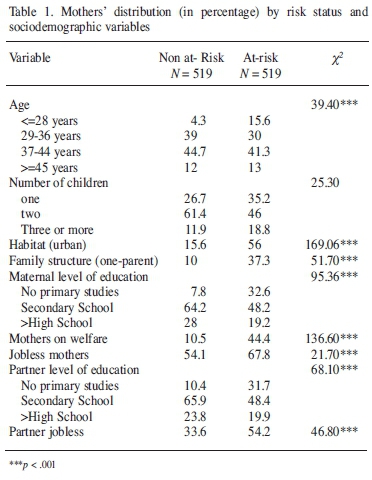
<body><![CDATA[<p><font face="Verdana, Arial, Helvetica, sans-serif" size="2">Conversely, the    depleting hypothesis suggests that the presence of social stressors may attenuate    the positive effects of social support (Ceballo &amp; McLoyd, 2002). When people    actually draw on specific members of their social support networks for help    during stressful times, support seeking often serves as an additional cause    of distress (Bolger, Zuckerman, &amp; Kessler, 2000; Collins &amp; Feeney, 2000).    At-risk mothers might fail to cultivate mutually supportive relationships with    the partner and with the brother/sister and these relationships were more likely    to be associated to neglectful attitudes (Rodrigo et al., 2007). The perception    of the social support might also be negative, specifically when the support    comes from formal sources. There is a fine line between help and interference    or losing control over one's life and one's children (Ghate &amp; Hazel, 2002).    Consequently, the conditions of at-risk parenting are extremely taxing and may    leave parents depleted of the energy needed to seek more positive social contacts.</font></p>     <p><font face="Verdana, Arial, Helvetica, sans-serif" size="2">Our study tries    to shed light on these hypotheses. According to the buffering hypothesis, social    support might have greater or equal benefits on personal agency in the at-risk    group of mothers as compared to the non at-risk group. According to the depleting    hypothesis, social support might have less benefit for personal agency in the    at-risk group of mothers as compared to the non at-risk group. Moreover, we    want to know whether the source of support (informal or formal) also matters.    For instance, it might be that the buffering hypothesis may hold for informal    sources but not for formal sources.</font></p>     <p>&nbsp;</p>     <p><font face="Verdana, Arial, Helvetica, sans-serif" size="2"><b>Method</b></font></p>     <p><font face="Verdana, Arial, Helvetica, sans-serif" size="2"><b><i>Participants</i></b></font></p>     <p><font face="Verdana, Arial, Helvetica, sans-serif" size="2">Participants were    1038 mothers, 519 referred by the municipal social services and 519 non-referred    mothers living in the Autonomous Community of Castilla-Le&oacute;n, Spain. Both    groups were recruited while participating in a parenting program called "<i>Apoyo    Personal y Familiar</i>" (<i>APF</i>, Family and Personal Support). The program    is aimed at increasing parental and personal competence, in order to improve    the autonomous functioning of poorly-educated parents at psychosocial risk (Rodrigo,    Correa, M&aacute;iquez, Mart&iacute;n, &amp; Rodr&iacute;guez, 2006). <i>APF    </i>is implemented by the social services personnel through weekly group meetings    in community centres and is offered to families with and without risk indicators.    Parents at risk were particularly invited to participate whereas non at-risk    parents attend the program on a more voluntarily basis. The referral criterion    of the at-risk group was having an at-risk minor. A minor is considered to be    at-risk when several psychosocial family and personal factors indicate a situation    that is potentially harmful to his or her healthy development. Social services    personnel in each municipality (psychologists, social workers and educators)    specially trained for working with at-risk families were requested to perform    this evaluation. Protocols for the assessment of risk to the minor have been    designed to provide a homogeneous criterion for the definition of risk in two-parent    and one-parent families (Rodr&iacute;guez, Camacho, Rodrigo, Mart&iacute;n &amp;    M&aacute;iquez, 2006). The protocols analysed 42 indicators with a yes/no scoring    in the following areas: sociodemographic factors (8 items), family social network    (2 items), family organization and household conditions (7 items), caregiver's    history of maltreatment and personal characteristics (7 items), quality of relationships    within the family (7 items), inadequate child-rearing practices (5 items), and    child adjustment problems (6 items). Mothers in the at-risk group had an average    of 17.5 risk indicators with a 6.23 standard deviation.</font></p>     <p><font face="Verdana, Arial, Helvetica, sans-serif" size="2">Socio-demographic    characteristics of the mothers who participated in this study are presented    in <a href="#t1">Table 1</a> by risk status. Mothers ranged in age from 17 to    66 years old, with an average of 37.1 (<i>SD </i>= 6.9). Mothers had an average    of 1.9 (<i>SD = </i>0.8) children, ranging from 0 to 9 children. At-risk mothers    in comparison to non at-risk mothers were more likely to be younger than 28    years old, and live in urban areas. Likewise at-risk mothers tended to live    more in one-parent families, had a lower level of education, were jobless and    on welfare more than non at-risk mothers. At-risk mothers also had a partner    with a lower level of education and jobless.</font></p>     <p><a name="t1"></a></p>     <p>&nbsp;</p>     <p align="center"><img src="/img/revistas/inter/v20n1/03t1.jpg"></p>     ]]></body>
<body><![CDATA[<p>&nbsp;</p>     <p><font face="Verdana, Arial, Helvetica, sans-serif" size="2"><b><i>Measures</i></b></font></p>     <p><font face="Verdana, Arial, Helvetica, sans-serif" size="2"><b>Scale of Personal    and Social Support </b>(<i>Escala de Apoyo Personal y Social</i>), adapted from    the Scale of Social Support in the Informal and Formal Systems (<i>Escala de    apoyo social en los sistemas informales y formales</i>) by Gracia, Herrero,    and Musitu (2002), and the Social Support Questionnaire (SSQ; Sarason, Levine,    Basham, &amp; Sarason, 1983). By means of eight questions, four when the mother    has a problem with her child and four when she has a personal problem, it explores    the sources of informal and formal support. In each case, the respondent is    first asked a general question (yes/no answer): Do you seek personal support    when you are facing a child problem? Second, the respondent is provided with    a list of potential sources of informal support: partner, older sibling, father,    mother, brother/sister, aunt/uncle, friend, neighbor, others, and she has to    mark the ones she uses. Personal sources are named from the point of view of    the mother. There is no limitation to sources of support or to the number of    supporters who can be listed. Third, the respondent is asked a general question    about seeking sources of support from the institutions when they face a child    problem (yes/no answer). Fourth, a list of options is given: school, social    services, parochial support, Caritas, police, neighbourhood association, child    protection agency, and other institutions with similar purposes. The same sequence    of four items is given for when the mother has to solve a personal problem.    Ratings of support satisfaction (1-5 rating scale) are obtained for each of    the informal and formal sources of support actually used in each situation.</font></p>     <p><font face="Verdana, Arial, Helvetica, sans-serif" size="2"><b>Parental Questionnaire    on Personal Agency </b>(M&aacute;iquez, Rodrigo, Capote, &amp; Vermaes, 2000)    includes five scales (7-point agreement scale): Internal Control (5 items; Cronbach    alpha reliability = .82; sample item: "I think that things can be changed if    I try"); Self-efficacy (4 items; Cronbach alpha reliability = .80; sample item:    "I believe in my capacity to solve family problems"); Couple Agreement (2 items;    Cronbach alpha reliability = .75; sample items: "We have reached consensus about    educational matters"); Role Difficulty (5 items; Cronbach alpha reliability    = .84; sample item: "The task of parenting implies much effort"); and Motivation    for change (3 items; Cronbach alpha reliability = .72; sample item: "I think    that this meeting could give me more information about educational matters").    We computed five average scores for each mother. A high score in internal control    means that a mother endorses the idea that she has control over her life and    that things can be changed. A high score in self-efficacy means that a mother    believes in her own capacity to solve family problems and has confidence in    her role. A high score in marital agreement means that a mother talks to her    partner often about child education and tries to reach consensus about important    family matters. A high score in role difficulty means that a mother thinks that    the task of parenting is very complicated, time consuming and requires much    effort. A high score in motivation for change means that a mother thinks that    she is ready to improve her educational practices and to make the most of a    parenting program.</font></p>     <p><font face="Verdana, Arial, Helvetica, sans-serif" size="2"><b><i>Procedure</i></b></font></p>     <p><font face="Verdana, Arial, Helvetica, sans-serif" size="2">Prior to the initial    session of the parenting program, the social services personnel in each municipality    who were in charge of the referred mothers filled in the protocol of risk assessment.    For the non-referred attendees no protocol was used. Risk and non at-risk mothers    were similarly distributed among the provinces. The groups were formed following    the criteria of mixing risk status to facilitate the exchange of a variety of    parenting experiences during the program sessions. The first session of the    parenting program was used to fill in the two questionnaires by the mothers.    The sample of at-risk and non at-risk mothers was drawn from 148 groups (about    seven people per group) monitored by 73 social agents (about one monitor for    every two groups), but the conditions of administration of the questionnaires    were the same.</font></p>     <p>&nbsp;</p>     <p><font face="Verdana, Arial, Helvetica, sans-serif" size="2"><b>Results</b></font></p>     <p><font face="Verdana, Arial, Helvetica, sans-serif" size="2"><b><i>Differences    in the use of social networks and support satisfaction according to the risk    status</i></b></font></p>     <p><font face="Verdana, Arial, Helvetica, sans-serif" size="2">Responses to the    four general questions concerning the use of informal and formal support when    facing either child problems or personal problems were averaged for the non    at-risk and at-risk groups (see <a href="/img/revistas/inter/v20n1/03f01.jpg" target="_blank">Figure    1</a>). An ANOVA with risk status as a between-subjects variable, and repeated    measures for social network (informal/formal) and type of problem (child/personal)    were all performed on the use of social support. A main effect was obtained    for the risk status, <i>F</i>(1, 1036) = 30.8, <i>p </i>&lt; .001, indicating    that at-risk mothers sought support significantly more (72%) than non-at risk    mothers (62%). Seeking support in the informal network was more frequent (88%)    than in the formal network (46%) in both groups, <i>F</i>(1, 1036) = 928.4,    <i>p </i>&lt; .001. Seeking support also differed according to the type of problem    in both groups, more for child problems (73%) than for personal problems (61%),    <i>F</i>(1, 1036) = 159, <i>p </i>&lt; .001. However, patterns differed according    to the risk status. The two groups did not differ in their use of informal help    (88%, 87%) but at-risk mothers used more formal help (57%) than non at-risk    mothers (35%), <i>F</i>(1, 1036) = 73.1, <i>p </i>&lt; .001. In turn, atrisk    mothers looked for help, both for child problems (76%) and for personal problems    (68%), whereas the non at-risk mothers tended to use help mostly for child problems    (69%) and much less for personal problems (44%), <i>F</i>(1, 1036) = 14.6, <i>p    </i>&lt; .001. Even after adding the socio-demographic variables, the previously    significant findings were still significant, indicating that this pattern of    results was quite stable.</font></p>     ]]></body>
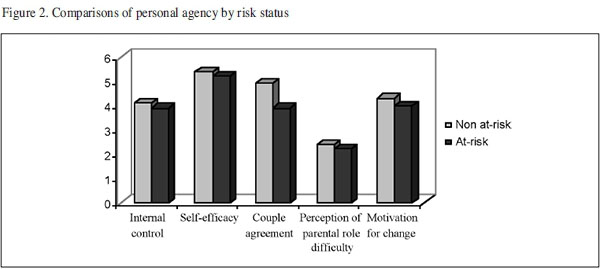
<body><![CDATA[<p><font face="Verdana, Arial, Helvetica, sans-serif" size="2">With respect to    the particular source of support, means and standard deviations of use of the    source and the satisfaction with it were calculated by risk status (see <a href="/img/revistas/inter/v20n1/03t2.jpg" target="_blank">Table    2</a> &amp; <a href="/img/revistas/inter/v20n1/03t3.jpg" target="_blank">3</a>).    Ratings of support satisfaction for each source were only averaged when the    source was actually used. One-way ANOVAs using risk status as a between-subject    factor were performed on the use and satisfaction of each source. As expected,    components of the social network called on for solving problems varied according    to the risk status. The social support in non at-risk mothers relied comparatively    more on the partner (child problem: <i>F</i>(1, 926) = 76.62, <i>p </i>&lt;    .001; personal problem: <i>F</i>(1, 901) = 71.633, <i>p </i>&lt; .001), and    school support (child problem: <i>F</i>(1, 588) = 23.23, <i>p </i>&lt; .001;    personal problem: <i>F</i>(1, 357) = 18.28, <i>p </i>&lt; .001), no matter what    type of problem was faced. At-risk mothers relied more on a less close and more    formal network than non at-risk mothers: the brother/sister (child problem:    <i>F</i>(1, 926) = 7.64, <i>p </i>&lt; .001; personal problem: <i>F</i>(1, 901)    = 4.26, <i>p </i>&lt; .05), other persons (child problems: <i>F</i>(1, 926)    = 7.37, <i>p </i>&lt; .001; personal problem: <i>F</i>(1, 901) = 8.96, <i>p    </i>&lt; .001), social services (child problem: <i>F</i>(1, 588) = 39.75, <i>p    </i>&lt; .001; personal problem: <i>F</i>(1, 537) = 8.45, <i>p </i>&lt; .001),    an NGO called Caritas (child problem: <i>F</i>(1, 588) = 9.38, <i>p </i>&lt;    .001; personal problem: <i>F</i>(1, 357) = 4.65, <i>p </i>&lt; .05), and police    support (personal problem: <i>F</i>(1, 357) = 7.85, <i>p </i>&lt; .001).</font></p>     <p><font face="Verdana, Arial, Helvetica, sans-serif" size="2">Overall, satisfaction    with the support source varied according to the risk status (<a href="/img/revistas/inter/v20n1/03t2.jpg" target="_blank">Tables    2</a> &amp; <a href="/img/revistas/inter/v20n1/03t3.jpg" target="_blank">3</a>).    Satisfaction with the partner (child problem: <i>F</i>(1, 807) = 17.52, <i>p    </i>&lt; .001; personal problem: <i>F</i>(1, 756) = 11.92, <i>p </i>&lt; .001)    and mother supports (personal problem: <i>F</i>(1, 487) = 5.53, <i>p</i> &lt;    .001) were higher in the non at-risk than in at-risk mothers. Satisfaction with    the social services (child problem: <i>F</i>(1, 298) = 8.78, <i>p </i>&lt; .001;    personal problem: <i>F</i>(1, 254) = 6.23, <i>p </i>&lt; .001), Caritas (child    problem: <i>F</i>(1, 57) = 5.25, <i>p </i>&lt; .05), and neighbourhood association    supports (personal problem: <i>F</i>(1, 35) = 4.97, <i>p </i>&lt; .05) were    higher in the at-risk mothers. These results were not accounted for by socio-demographic    differences.</font></p>     <p><font face="Verdana, Arial, Helvetica, sans-serif" size="2"><b><i>Relations    between support satisfaction and personal agency</i></b></font></p>     <p><font face="Verdana, Arial, Helvetica, sans-serif" size="2">Means and standard    deviations of personal agency were calculated by risk status. One-way ANOVAs    were performed for the group comparison and results are shown in <a href="#f02">Figure    2</a>. As expected, perceived personal agency was higher across all the factors    in the non at-risk mothers than in the at-risk group: internal control, <i>F</i>(1,    1036) = 13.97, <i>p </i>&lt; .001, self-efficacy, <i>F</i>(1, 1036) = 31.19,    <i>p </i>&lt; .001, couple agreement, <i>F</i>(1, 1036) = 124.13, <i>p </i>&lt;    .001, perception of parental role difficulty, <i>F</i>(1, 1036) = 8.21, <i>p    </i>&lt; .01, and motivation for change <i>F</i>(1, 1036) = 34.79, <i>p </i>&lt;    .001. When socio-demographic variables were entered in the analyses as covariables,    only the level of education yielded significant results though risk status remained    significant. Mothers with higher levels of education had more internal control,    <i>F</i>(1, 967) = 11.62, <i>p </i>&lt; .001, perceived more parental role difficulty,    <i>F</i>(1, 967) = 7.026, <i>p </i>&lt; .001, and had more motivation for change,    <i>F</i>(1, 967) = 4.16, <i>p </i>&lt; .001, than mothers with lower levels.</font></p>     <p><a name="f02"></a></p>     <p>&nbsp;</p>     <p align="center"><img src="/img/revistas/inter/v20n1/03f02.jpg"></p>     <p>&nbsp;</p>     <p><font face="Verdana, Arial, Helvetica, sans-serif" size="2">To highlight the    possible evidence of risk status moderation, regression analyses were performed    using the level of education, support satisfaction with each informal and formal    source averaged across type of problems, and support satisfaction x risk status    as predictors of the factors of personal agency. In this way, we would see whether    higher or lower levels of personal agency are predicted either by support satisfaction    plus the interaction term (weak moderation effect) or just by the interaction    term (strong moderation effect). Only significant results and standardized beta    are reported.</font></p>     <p><font face="Verdana, Arial, Helvetica, sans-serif" size="2">Concerning internal    control, mothers' satisfaction with partner, <i>F</i>(3, 761) = 11.19, <i>p    </i>&lt; .001; <i>adjusted R</i><i>2</i> = .07, mother, <i>F</i>(3, 486) = 4.78,    <i>p </i>&lt; .01; <i>adjusted R</i><i>2 </i>= .04, brother/sister, <i>F</i>(3,    431) = 5.22, <i>p </i>&lt; .001; <i>adjusted</i><i> R</i><i>2 </i>= .04, and    school supports, <i>F</i>(3, 489) = 3.52, <i>p </i>&lt; .01; <i>adjusted R</i><i>2    </i>= .04, significantly predicted the level of internal control. Higher levels    of education significantly predicted more internal control when considering    satisfaction with partner, </font><font size="2">&#946;</font><font face="Verdana, Arial, Helvetica, sans-serif" size="2">    = .167, <i>p </i>&lt; .001, mother, </font><font size="2">&#946;</font><font face="Verdana, Arial, Helvetica, sans-serif" size="2">    = .095, <i>p </i>&lt; .05, brother/sister, </font><font size="2">&#946;</font><font face="Verdana, Arial, Helvetica, sans-serif" size="2">    = .147, <i>p </i>&lt; .01, and school supports, </font><font size="2">&#946;</font><font face="Verdana, Arial, Helvetica, sans-serif" size="2">    = .171, <i>p </i>&lt; .05. Higher satisfaction for partner, </font><font size="2">&#946;</font><font face="Verdana, Arial, Helvetica, sans-serif" size="2">    = .140, <i>p </i>&lt; .01, mother, </font><font size="2">&#946;</font><font face="Verdana, Arial, Helvetica, sans-serif" size="2">    = .166, <i>p </i>&lt; .05, brother/sister, </font><font size="2">&#946;</font><font face="Verdana, Arial, Helvetica, sans-serif" size="2">    = .206, <i>p </i>&lt; .05, and school supports, </font><font size="2">&#946;</font><font face="Verdana, Arial, Helvetica, sans-serif" size="2">    = .185, <i>p </i>&lt; .01, predicted higher levels of internal control. However,    the interaction term was not significant with any source of support, indicating    a direct link between support satisfaction and higher levels of internal control    whatever the risk status.</font></p>     ]]></body>
<body><![CDATA[<p><font face="Verdana, Arial, Helvetica, sans-serif" size="2">Concerning self-efficacy,    mothers' satisfaction with partner, <i>F</i>(3, 761) = 3.32, <i>p </i>&lt; .01;    <i>adjusted R</i><i>2 </i>= .04, mother, <i>F</i>(3, 459) = 12.65, <i>p </i>&lt;    .001; <i>adjusted R</i><i>2 </i>= .08, and school supports, <i>F</i>(3, 489)    = 3.73, <i>p </i>&lt; .01; <i>adjusted R</i><i>2 </i>= .04, predicted the level    of self-efficacy. Higher levels of support satisfaction for partner, </font><font size="2">&#946;</font><font face="Verdana, Arial, Helvetica, sans-serif" size="2">    = .176, <i>p </i>&lt; .01, mother, </font><font size="2">&#946;</font><font face="Verdana, Arial, Helvetica, sans-serif" size="2">    = .131, <i>p </i>&lt; .01, and school supports, </font><font size="2">&#946;</font><font face="Verdana, Arial, Helvetica, sans-serif" size="2">    = .107, <i>p </i>&lt; .01, predicted higher levels of self-efficacy. The interaction    term was not significant in any case indicating a direct link of satisfaction    with partner, mother and school supports, and higher levels of self-efficacy    whatever the risk status.</font></p>     <p><font face="Verdana, Arial, Helvetica, sans-serif" size="2">Risk status played    a more prominent role in the influence of social support on couple agreement    for educational matters. Mothers' higher satisfaction with partner, mother,    brother/sister, school and social services support significantly predicted higher    levels of couple agreement, even when controlling the effects of level of education    (<a href="/img/revistas/inter/v20n1/03t4.jpg" target="_blank">Table 4</a>).    The interaction term was not significant for mother support, indicating a direct    link with higher levels of couple agreement whatever the risk status. However,    for the rest of the sources of help the interaction term significantly predicted    the decreasing level of couple agreement, showing evidence of the weak (couple,    brother/sister and social services) and strong (school) moderation effects of    risk status.</font></p>     <p><font face="Verdana, Arial, Helvetica, sans-serif" size="2">To illustrate the    above interactive effects, high and low levels of satisfaction of each source,    defined by a mean split, and the mean reported level of couple agreement were    plotted for the non at-risk and at-risk groups. ANCOVAs were calculated using    risk status and high/low levels of satisfaction as between-subject variables    and couple agreement as a dependent variable, and controlling the level of education    as a covariate. Interactive effects were significant for partner, <i>F</i>(1,    805) = 6.017, <i>p </i>&lt; .01, brother/sister, <i>F</i>(1, 427) = 3.910, <i>p    </i>&lt; .05, school, <i>F</i>(1, 168) = 4.464, <i>p </i>&lt; .05, and social    services support, <i>F</i>(1, 296) = 5.542, <i>p </i>&lt; .01. Atrisk mothers    who were highly satisfied with couple support reported the highest level of    couple agreement, and those with low satisfaction reported the lowest level    of couple agreement. The pattern was similar but not so extreme in non at-risk    mothers. At-risk mothers' level of couple agreement was not affected by the    satisfaction with brother/sister support. Non at-risk mothers who were highly    satisfied with brother/sister support reported the highest level of couple agreement,    and those who had low satisfaction reported the lowest level. However, for the    two formal sources the pattern strongly differed by risk status. At-risk mothers    who were highly satisfied with school and social services support reported the    lowest level of couple agreement, and those with low satisfaction reported the    highest level of couple agreement. The results were totally reversed for both    sources in non at-risk mothers, that is, those mothers who were highly satisfied    with school and social services support reported the highest level of couple    agreement (see <a href="/img/revistas/inter/v20n1/03f03.jpg" target="_blank">Figure    3</a>).</font></p>     <p><font face="Verdana, Arial, Helvetica, sans-serif" size="2">Concerning the    perception of parental role difficulty, mothers' satisfaction with father, <i>F</i>(3,    145) = 3.5, <i>p</i> &lt; .01; <i>adjusted R</i><i>2 </i>= .05, mother, <i>F</i>(3,    459) = 2.77, <i>p </i>&lt; .05; <i>adjusted R</i><i>2 </i>= .04, and school    supports, <i>F</i>(3, 489) = 7.298, <i>p </i>&lt; .001; <i>adjusted R</i><i>2    </i>= .07, predicted the level of parental role difficulty. Higher levels of    education significantly predicted less perceived difficulty in the parental    role when considering satisfaction with school, </font><font size="2">&#946;</font><font face="Verdana, Arial, Helvetica, sans-serif" size="2">    = -.186, <i>p </i>&lt; .001. Higher levels of support satisfaction with father,    </font><font size="2">&#946;</font><font face="Verdana, Arial, Helvetica, sans-serif" size="2">    = -.260, <i>p </i>&lt; .05, and mother, </font><font size="2">&#946;</font><font face="Verdana, Arial, Helvetica, sans-serif" size="2">    = -.156, <i>p </i>&lt; .05, also predicted less perceived difficulty in the    parental role. The interaction term was not significant for father and mother    indicating a direct link of satisfaction with both sources and lower levels    of perceived role difficulty whatever the risk status. However, the interaction    term significantly predicted higher levels of parental role difficulty, <i>F</i>(1,    168) = 5.35, <i>p </i>&lt; .05, showing evidence of a strong moderation effect    of risk status when considering satisfaction with school, </font><font size="2">&#946;</font><font face="Verdana, Arial, Helvetica, sans-serif" size="2">    = .133, <i>p </i>&lt; .05. At-risk mothers who were highly satisfied with school    support reported the highest level of parental role difficulty, and those who    with low satisfaction reported the lowest level of parental role difficulty.    The reverse was found for non at-risk mothers (see <a href="/img/revistas/inter/v20n1/03f04.jpg" target="_blank">Figure    4</a>).</font></p>     <p><font face="Verdana, Arial, Helvetica, sans-serif" size="2">As for motivation    for change, mothers' satisfaction with partner, <i>F</i>(3, 761) = 11.19, <i>p    </i>&lt; .001; <i>adjusted R</i><i>2</i> = .07, and school support, <i>F</i>(3,    489) = 3.169, <i>p </i>&lt; .024; <i>adjusted R</i><i>2 </i>= .04, significantly    predicted the level of motivation for change. Higher levels of education significantly    predicted more motivation for change considering satisfaction with partner,    </font><font size="2">&#946;</font><font face="Verdana, Arial, Helvetica, sans-serif" size="2">    = .167, <i>p </i>&lt; .001. Higher levels of satisfaction for partner support    </font><font size="2">&#946;</font><font face="Verdana, Arial, Helvetica, sans-serif" size="2">    = .140, <i>p </i>&lt; .01, predicted higher levels of motivation for change.    The interaction term was not significant for partner support, indicating a direct    link with higher levels of motivation for change whatever the risk status. However,    the interaction term significantly predicted higher levels of motivation for    change showing evidence of a strong moderation effect of risk status when considering    satisfaction with school, </font><font size="2">&#946;</font><font face="Verdana, Arial, Helvetica, sans-serif" size="2">    = .176, <i>p</i> &lt; .05. A significant effect for school support was found,    <i>F</i>(1, 485) = 6.739, <i>p </i>&lt; .01, indicating that at-risk mothers    who were highly satisfied with school support reported higher levels of motivation    for change, and those with low satisfaction reported lower levels of motivation    for change. Non at-risk mothers' motivation for change was independent of the    satisfaction with school support (see <a href="/img/revistas/inter/v20n1/03f04.jpg" target="_blank">Figure    4</a>).</font></p>     <p>&nbsp;</p>     <p><font face="Verdana, Arial, Helvetica, sans-serif" size="2"><b>Discussion</b></font></p>     <p><font face="Verdana, Arial, Helvetica, sans-serif" size="2">Concerning the    first research question, all groups sought more support in the informal than    in the formal sources, whatever the type of problem. Going to the proximal sources    for help, where people can find natural, reciprocal and more satisfactory support    is a general tendency (Gottlieb, 1983; 2000). However, as expected, at-risk    mothers look for more formal help than non at-risk mothers, given that these    mothers belong to multi-assisted families (Matos &amp; Sousa, 2004). Both groups    sought more support when facing child problems than when facing personal problems.    In particular, at-risk mothers looked for help both for solving child problems    and personal problems, whereas the non at-risk mothers tended to use help mostly    for child problems (Rodrigo et al., 2007). These results are not surprising    given that vulnerable mothers who turn to social services lack personal resources    to solve their everyday problems by themselves (Azar, 1998).</font></p>     <p><font face="Verdana, Arial, Helvetica, sans-serif" size="2">The use of informal    and formal sources of help differed according to risk status, regardless of    the type of problem. The social support of non at-risk mothers relied comparatively    more on the partner and on the school, both of which are resources available    in the micro-system (Rodrigo et al., 2007). By contrast, at-risk mothers relied    comparatively less upon couple support and more on less close individuals (brother/    sister and others) and formal sources of help such as social services, Caritas    and Police. The formal sources are mainly in the exo-system, meaning that the    at-risk mothers' well-being is heavily dependent on the quality of the resources    in the neighborhood (Garbarino &amp; Kostelny, 1992) and on the quality of the    help providers from the social agencies (Matos &amp; Sousa, 2004; Evans &amp;    Harris, 2004).</font></p>     <p><font face="Verdana, Arial, Helvetica, sans-serif" size="2">Rates of support    satisfaction for each source used also differ by risk status. Satisfaction with    partner and mother support was higher in the non at-risk mothers than in at-risk    mothers, whereas satisfaction with social services, Caritas and neighbourhood    association were higher in the at-risk mothers. At-risk mothers might fail to    cultivate mutually supportive relationships with the partner and mother and    these working models of attachment may shape their low satisfaction perceptions    with those sources of support (Collins &amp; Feeney, 2000). In turn, their negative    psychosocial risk conditions lead them to ask for assistance from institutions    in many situations, which may increase their level of satisfaction with the    help providers as a sign of personal gratitude (Matos &amp; Sousa, 2004).</font></p>     ]]></body>
<body><![CDATA[<p><font face="Verdana, Arial, Helvetica, sans-serif" size="2">Concerning the    second research question, perceived personal agency was higher across all factors    in the non at-risk mothers than in the at-risk group. These results are consistent    with those from the literature (Bandura, 1997; Donovan &amp; Leavitt, 1989;    Elder et al., 1995; Littell &amp; Girvin, 2005), with the exception that non    at-risk mothers experience more parental role difficulty than at-risk mothers.    However, adequate parenting requires an accurate estimation of the parenting    task (McLoyd et al., 1994). In fact, at-risk mothers who completed a parenting    support program experienced more difficulty in their role as a result of the    program (Rodrigo, et al., 2006). It is likely that, during the program, mothers    had the opportunity to focus on many aspects of the maternal role that had remained    unnoticed. Therefore, a good result for non at-risk mothers is to lower their    perception of parental difficulty, whereas for at-risk mothers it is to increase    their perception of role difficulty. A convergent result in our study is that    mothers with higher levels of education (which is typical of non at-risk mothers)    had more internal control, perceived more parental role difficulty and had more    motivation for change than mothers with lower levels.</font></p>     <p><font face="Verdana, Arial, Helvetica, sans-serif" size="2">The second research    question also examined the pattern of associations between support satisfaction    and perceived personal agency by risk status. With the present data set it is    not possible to test the causal direction of the relationship between support    and personal agency. This is the case for a good deal of other research on personal    agency. For instance, one aspect of personal agency, parental self-efficacy    has been posited as an antecedent, a consequence, a mediator, and a transactional    variable with respect to parent and child adjustment (Jones &amp; Prinz, 2005).    It is also a limitation that there is a lack of information concerning types    of support and recipients' feelings or motivations for seeking support. This    might help to understand better the different natures of social support revealed    in our study. However, it is possible to examine the systematic variation in    the pattern of associations depending on the type of source and risk status.</font></p>     <p><font face="Verdana, Arial, Helvetica, sans-serif" size="2">Overall, we have    found more evidence in favor of the buffering than the depleting hypotheses    and the buffering hypothesis held, always for informal sources but also in most    cases for the formal sources. Direct links were found between satisfaction with    informal sources of help and the five aspects of personal agency, indicating    that the nature of these associations was not affected by the risk status. In    both groups of mothers, satisfaction with the partner, mother (grandmother),    and brother/sister supports represent a buffering factor associated with an    increase in the reported level of control over their lives and in their perceived    capacity to solve family problems and to have confidence in their role. Direct    links were also found for satisfaction with mother support and couple agreement,    satisfaction with mother and father support and role difficulty, and satisfaction    with partner support and motivation for change. Therefore, satisfaction with    the help provided by close relatives represents a buffering factor for all the    facets of personal agency in at-risk and non at-risk mothers. There are at least    two explanations of these results, and which could be complementary. Firstly,    seeking relief care from close relatives is a strategy that may increase the    chances of experiencing a less stressful parenting processe. Many studies have    shown that social support may reduce the parental stress experienced through    living under negative conditions by contributing to strategies for coping with    stressors (Cochran &amp; Niego, 1995; Coleman &amp; Karraker, 1997; Cutrona,    1996; Schwarzer &amp; Knoll, 2007; Wills &amp; Shinar, 2000). Secondly, the    help is embedded in a natural and mutual network of affectionate exchanges (Collins    &amp; Feeney, 2000), which makes the mothers feel valuable, effective and capable    of the parenting task. In line with this interpretation, beneficial effects    of satisfaction with mother and father support have been found for positive    and negative parental behavior regardless of the risk status (Rodrigo et al.,    2007).</font></p>     <p><font face="Verdana, Arial, Helvetica, sans-serif" size="2">Concerning the    formal sources of help, satisfaction with school support was a buffering factor    directly associated with higher internal control and self-efficacy no matter    the risk status. However, the risk status played a more important role in those    aspects of personal agency more closely related to the parenting role: couple    agreement on educational matters, role difficulty and motivation for change.    It seems that living in a stressful environment modifies the influence of formal    support on parental functioning (Doherty &amp; Beaton, 2000), specifically on    those aspects of parental agency more related to educational matters. A buffering    effect of the school support, specially tailored to the at-risk and non at-risk    mothers' perception of the parental role, was found. As expected, in at-risk    mothers, satisfaction with school support was positively related to higher perceived    role difficulty and motivation for change. At-risk mothers who completed a parenting    support program experienced more difficulty in their role as a positive result    of the program, while at the beginning they tend to underestimate their importance    (Rodrigo, et al., 2006). By contrast, in non at-risk mothers support satisfaction    with the school and other institutions were associated to lower perceived difficulty    in the parental role. Non at-risk mothers with larger and more supportive networks    should normally perceive the tasks of parenting to be less difficult than mothers    with smaller and less supportive networks (Melson, Ladd, &amp; Hsu, 1993). School    support is an interesting case of a buffering factor adjusted to the specific    needs of the at-risk and non at-risk mothers (Ghate &amp; Hazel, 2002).</font></p>     <p><font face="Verdana, Arial, Helvetica, sans-serif" size="2">The only depleting    effect of risk status was found for the links between school and social services    support and couple agreement. This means that, for this particular aspect, the    quality of school and social service influences are clearly mediated by the    family&acute;s psychosocial conditions. At-risk mothers who were highly satisfied    with these types of professional help reported the lowest level of couple agreement,    and those who were least satisfied reported the highest level of couple agreement.    In contrast, higher satisfaction with professional help was related to higher    couple agreement on educational matters in non at-risk mothers. In all probability,    non at-risk mothers might consider professional help to be a complementary support    whereas this type of help plays a more substitutive role for at-risk mothers    who frequently have problems with their partners. This might be especially true    for social service professionals and school teachers, who might have the tendency    to substitute the role of vulnerable parents or criticize them, thus taking    responsibility away from the family (Woodcock, 2003). In addition, parental    agreement may be lower in at-risk mothers because mothers (but not usually fathers,    who rarely attend meetings with these professionals) are under the positive    influence of the school and social services. However, professionals should know    that this is a depleting effect since the educational message that the couple    conveys to the children would be totally inconsistent.</font></p>     <p><font face="Verdana, Arial, Helvetica, sans-serif" size="2">With regard to    the practical implications, this study showed that enrolling informal support    for at-risk and non at-risk mothers is the most straightforward way of reinforcing    their personal agency. It is also important to increase satisfaction with school    support which is less used by at-risk mothers and may also have positive consequences    on their parenting role. However, higher satisfaction with professional support    may be associated with an increasing distance between the couple on educational    matters in at-risk parents. Social support is an essential component of any    multifaceted effort to prevent psychological difficulties in at-risk families    and children. The challenge is to craft well-designed interventions that improve    the social support afforded by natural helpers and enlist the assistance of    formal helpers, specially trained to overcome the negative side of social support    by paying special attention to reinforcing mothers' personal agency.</font></p>     <p>&nbsp;</p>     <p><font face="Verdana, Arial, Helvetica, sans-serif" size="2"><b>References</b></font></p>     <!-- ref --><p><font face="Verdana, Arial, Helvetica, sans-serif" size="2">Ardelt, M. &amp;    Eccles, J. S. (2001). Effects of mothers' parental efficacy beliefs and promotive    parenting strategies on inner-city youth. <i>Journal of Family Issues, 22</i>,    944-972.    &nbsp;&nbsp;&nbsp;&nbsp;&nbsp;&nbsp;&nbsp;&nbsp;[&#160;<a href="javascript:void(0);" onclick="javascript: window.open('/scielo.php?script=sci_nlinks&ref=4357256&pid=S1132-0559201100010000300001&lng=','','width=640,height=500,resizable=yes,scrollbars=1,menubar=yes,');">Links</a>&#160;]<!-- end-ref --></font></p>     ]]></body>
<body><![CDATA[<!-- ref --><p><font face="Verdana, Arial, Helvetica, sans-serif" size="2">Azar, S. T. (1998).    Parenting and child maltreatment. In W. Damon, R. M. Lerner, K. A. Renninger,    and I. E. Sigel (Eds), <i>Handbook of child psychology. Child psychology in    practice (Volume 4, 5</i><i>th </i><i>edition) </i>(pp. 361-388). New York:    John Wiley &amp; Sons.    &nbsp;&nbsp;&nbsp;&nbsp;&nbsp;&nbsp;&nbsp;&nbsp;[&#160;<a href="javascript:void(0);" onclick="javascript: window.open('/scielo.php?script=sci_nlinks&ref=4357258&pid=S1132-0559201100010000300002&lng=','','width=640,height=500,resizable=yes,scrollbars=1,menubar=yes,');">Links</a>&#160;]<!-- end-ref --></font></p>     <!-- ref --><p><font face="Verdana, Arial, Helvetica, sans-serif" size="2">Bandura, A. (1982).    Self-efficacy mechanism in human agency. <i>American Psychologist, 37</i>, 122-147.    &nbsp;&nbsp;&nbsp;&nbsp;&nbsp;&nbsp;&nbsp;&nbsp;[&#160;<a href="javascript:void(0);" onclick="javascript: window.open('/scielo.php?script=sci_nlinks&ref=4357260&pid=S1132-0559201100010000300003&lng=','','width=640,height=500,resizable=yes,scrollbars=1,menubar=yes,');">Links</a>&#160;]<!-- end-ref --></font></p>     <!-- ref --><p><font face="Verdana, Arial, Helvetica, sans-serif" size="2">Bandura, A. (1997).    <i>Social learning theory</i>. New York, Englewood Cliffs: Prentice Hall.    &nbsp;&nbsp;&nbsp;&nbsp;&nbsp;&nbsp;&nbsp;&nbsp;[&#160;<a href="javascript:void(0);" onclick="javascript: window.open('/scielo.php?script=sci_nlinks&ref=4357262&pid=S1132-0559201100010000300004&lng=','','width=640,height=500,resizable=yes,scrollbars=1,menubar=yes,');">Links</a>&#160;]<!-- end-ref --></font></p>     <!-- ref --><p><font face="Verdana, Arial, Helvetica, sans-serif" size="2">Beach, S. R., Fincham,    F. D., Katz, J., &amp; Bradbury, T. (1996). Social support in marriage: A cognitive    perspective. In G. R. Pierce, B. R. Sarason, &amp; I. G. Sarason (Eds.), <i>Handbook    of social support and the family </i>(pp. 43-66). New York: Plenum.    &nbsp;&nbsp;&nbsp;&nbsp;&nbsp;&nbsp;&nbsp;&nbsp;[&#160;<a href="javascript:void(0);" onclick="javascript: window.open('/scielo.php?script=sci_nlinks&ref=4357264&pid=S1132-0559201100010000300005&lng=','','width=640,height=500,resizable=yes,scrollbars=1,menubar=yes,');">Links</a>&#160;]<!-- end-ref --></font></p>     <!-- ref --><p><font face="Verdana, Arial, Helvetica, sans-serif" size="2">Bolger, N., Zuckerman,    A., &amp; Kessler, R. C. (2000). Invisible support and adjustment to stress.    <i>Journal of Personality and Social Psychology, 79</i>, 953-961.    &nbsp;&nbsp;&nbsp;&nbsp;&nbsp;&nbsp;&nbsp;&nbsp;[&#160;<a href="javascript:void(0);" onclick="javascript: window.open('/scielo.php?script=sci_nlinks&ref=4357266&pid=S1132-0559201100010000300006&lng=','','width=640,height=500,resizable=yes,scrollbars=1,menubar=yes,');">Links</a>&#160;]<!-- end-ref --></font></p>     ]]></body>
<body><![CDATA[<!-- ref --><p><font face="Verdana, Arial, Helvetica, sans-serif" size="2">Ceballo, R. &amp;    McLoyd, V. C. (2002). Social support and parenting in poor, dangerous neighbourhoods.    <i>Child Development, 73</i>, 1310-1321.    &nbsp;&nbsp;&nbsp;&nbsp;&nbsp;&nbsp;&nbsp;&nbsp;[&#160;<a href="javascript:void(0);" onclick="javascript: window.open('/scielo.php?script=sci_nlinks&ref=4357268&pid=S1132-0559201100010000300007&lng=','','width=640,height=500,resizable=yes,scrollbars=1,menubar=yes,');">Links</a>&#160;]<!-- end-ref --></font></p>     <!-- ref --><p><font face="Verdana, Arial, Helvetica, sans-serif" size="2">Cochran, M. &amp;    Niego, S. (1995). Parenting and Social Networks. In M. H. Bornstein (Ed.), <i>Handbook    of parenting, Volume 3: Status and social conditions of parenting </i>(pp. 393-418).    Mahwah, NJ: Lawrence Erlbaum Associates.    &nbsp;&nbsp;&nbsp;&nbsp;&nbsp;&nbsp;&nbsp;&nbsp;[&#160;<a href="javascript:void(0);" onclick="javascript: window.open('/scielo.php?script=sci_nlinks&ref=4357270&pid=S1132-0559201100010000300008&lng=','','width=640,height=500,resizable=yes,scrollbars=1,menubar=yes,');">Links</a>&#160;]<!-- end-ref --></font></p>     <!-- ref --><p><font face="Verdana, Arial, Helvetica, sans-serif" size="2">Cohen, S. &amp;    Wills, T. (1985). Stress, social support, and the buffering hypothesis. <i>Psychological    Bulletin, 98</i>, 310-357.    &nbsp;&nbsp;&nbsp;&nbsp;&nbsp;&nbsp;&nbsp;&nbsp;[&#160;<a href="javascript:void(0);" onclick="javascript: window.open('/scielo.php?script=sci_nlinks&ref=4357272&pid=S1132-0559201100010000300009&lng=','','width=640,height=500,resizable=yes,scrollbars=1,menubar=yes,');">Links</a>&#160;]<!-- end-ref --></font></p>     <!-- ref --><p><font face="Verdana, Arial, Helvetica, sans-serif" size="2">Coleman, P. K.    &amp; Karraker, K. H. (1997). Self-efficacy and parenting quality: Findings    and future applications.<i> D</i><i>evelopmental Review</i>, <i>18</i>, 47-85.    &nbsp;&nbsp;&nbsp;&nbsp;&nbsp;&nbsp;&nbsp;&nbsp;[&#160;<a href="javascript:void(0);" onclick="javascript: window.open('/scielo.php?script=sci_nlinks&ref=4357274&pid=S1132-0559201100010000300010&lng=','','width=640,height=500,resizable=yes,scrollbars=1,menubar=yes,');">Links</a>&#160;]<!-- end-ref --></font></p>     <!-- ref --><p><font face="Verdana, Arial, Helvetica, sans-serif" size="2">Collins, N. L.    &amp; Feeney, B. C. (2000). A safe heaven: An attachment theory perspective    on support-seeking and caregiving in intimate relationships. <i>Journal of Personality    and Social Psychology, 78, </i>1053-1073.    &nbsp;&nbsp;&nbsp;&nbsp;&nbsp;&nbsp;&nbsp;&nbsp;[&#160;<a href="javascript:void(0);" onclick="javascript: window.open('/scielo.php?script=sci_nlinks&ref=4357276&pid=S1132-0559201100010000300011&lng=','','width=640,height=500,resizable=yes,scrollbars=1,menubar=yes,');">Links</a>&#160;]<!-- end-ref --></font></p>     ]]></body>
<body><![CDATA[<!-- ref --><p><font face="Verdana, Arial, Helvetica, sans-serif" size="2">Corse, S. J., Schmid,    K., &amp; Trickett, P. K. (1990). Social network characteristics of mothers    in abusing and nonabusing families and their relationships to parenting beliefs.    <i>Journal of Community Psychology, 18</i>, 44-59.    &nbsp;&nbsp;&nbsp;&nbsp;&nbsp;&nbsp;&nbsp;&nbsp;[&#160;<a href="javascript:void(0);" onclick="javascript: window.open('/scielo.php?script=sci_nlinks&ref=4357278&pid=S1132-0559201100010000300012&lng=','','width=640,height=500,resizable=yes,scrollbars=1,menubar=yes,');">Links</a>&#160;]<!-- end-ref --></font></p>     <!-- ref --><p><font face="Verdana, Arial, Helvetica, sans-serif" size="2">Cutrona, C. E.    (1996). Social support as determinant of marital quality: The interplay of negative    and supportive behaviours. In G. R. Pierce, B. R. Sarason, &amp; I. G. Sarason    (Eds.), <i>Handbook of social support and the family </i>(pp.173-194). New York:    Plenum Press.    &nbsp;&nbsp;&nbsp;&nbsp;&nbsp;&nbsp;&nbsp;&nbsp;[&#160;<a href="javascript:void(0);" onclick="javascript: window.open('/scielo.php?script=sci_nlinks&ref=4357280&pid=S1132-0559201100010000300013&lng=','','width=640,height=500,resizable=yes,scrollbars=1,menubar=yes,');">Links</a>&#160;]<!-- end-ref --></font></p>     <!-- ref --><p><font face="Verdana, Arial, Helvetica, sans-serif" size="2">Doherty, W. &amp;    Beaton, J. (2000). Family therapists, community, and civic renewal. <i>Family    Process, 39, </i>149-161.    &nbsp;&nbsp;&nbsp;&nbsp;&nbsp;&nbsp;&nbsp;&nbsp;[&#160;<a href="javascript:void(0);" onclick="javascript: window.open('/scielo.php?script=sci_nlinks&ref=4357282&pid=S1132-0559201100010000300014&lng=','','width=640,height=500,resizable=yes,scrollbars=1,menubar=yes,');">Links</a>&#160;]<!-- end-ref --></font></p>     <!-- ref --><p><font face="Verdana, Arial, Helvetica, sans-serif" size="2">Donovan, W. L.    &amp; Leavitt, L. A. (1989). Maternal self-efficacy and infant attachment: Integrating    physiology, perception and behavior. <i>Child Development</i>, <i>60</i>, 460-472.    &nbsp;&nbsp;&nbsp;&nbsp;&nbsp;&nbsp;&nbsp;&nbsp;[&#160;<a href="javascript:void(0);" onclick="javascript: window.open('/scielo.php?script=sci_nlinks&ref=4357284&pid=S1132-0559201100010000300015&lng=','','width=640,height=500,resizable=yes,scrollbars=1,menubar=yes,');">Links</a>&#160;]<!-- end-ref --></font></p>     <!-- ref --><p><font face="Verdana, Arial, Helvetica, sans-serif" size="2">Elder, G. H., Eccles,    J. S., Ardelt, M., &amp; Lord, S. (1995). Inner-city parents under economic    pressure: Perspectives on the strategies of parenting. <i>Journal of Marriage    and the Family</i>, <i>57</i>, 771-784.    &nbsp;&nbsp;&nbsp;&nbsp;&nbsp;&nbsp;&nbsp;&nbsp;[&#160;<a href="javascript:void(0);" onclick="javascript: window.open('/scielo.php?script=sci_nlinks&ref=4357286&pid=S1132-0559201100010000300016&lng=','','width=640,height=500,resizable=yes,scrollbars=1,menubar=yes,');">Links</a>&#160;]<!-- end-ref --></font></p>     ]]></body>
<body><![CDATA[<!-- ref --><p><font face="Verdana, Arial, Helvetica, sans-serif" size="2">Evans, T. &amp;    Harris, J. (2004). Citizenship, social inclusion and confidentiality<i>. British    Journal of Social Work, 34</i>, 69-91.    &nbsp;&nbsp;&nbsp;&nbsp;&nbsp;&nbsp;&nbsp;&nbsp;[&#160;<a href="javascript:void(0);" onclick="javascript: window.open('/scielo.php?script=sci_nlinks&ref=4357288&pid=S1132-0559201100010000300017&lng=','','width=640,height=500,resizable=yes,scrollbars=1,menubar=yes,');">Links</a>&#160;]<!-- end-ref --></font></p>     <!-- ref --><p><font face="Verdana, Arial, Helvetica, sans-serif" size="2">Folkman, S. &amp;    Lazarus, R. S. (1988). Coping as a mediator of emotion. <i>Journal of Personality    and Social Psychology</i>, <i>48</i>, 150-170.    &nbsp;&nbsp;&nbsp;&nbsp;&nbsp;&nbsp;&nbsp;&nbsp;[&#160;<a href="javascript:void(0);" onclick="javascript: window.open('/scielo.php?script=sci_nlinks&ref=4357290&pid=S1132-0559201100010000300018&lng=','','width=640,height=500,resizable=yes,scrollbars=1,menubar=yes,');">Links</a>&#160;]<!-- end-ref --></font></p>     <!-- ref --><p><font face="Verdana, Arial, Helvetica, sans-serif" size="2">Garbarino, J. &amp;    Kostelny, K. (1992). Child maltreatment as a community problem. <i>Child Abuse    &amp; Neglect, 16</i>, 455-464.    &nbsp;&nbsp;&nbsp;&nbsp;&nbsp;&nbsp;&nbsp;&nbsp;[&#160;<a href="javascript:void(0);" onclick="javascript: window.open('/scielo.php?script=sci_nlinks&ref=4357292&pid=S1132-0559201100010000300019&lng=','','width=640,height=500,resizable=yes,scrollbars=1,menubar=yes,');">Links</a>&#160;]<!-- end-ref --></font></p>     <!-- ref --><p><font face="Verdana, Arial, Helvetica, sans-serif" size="2">Ghate, D. &amp;    Hazel, N. (2002). <i>Parenting in poor environments. Stress, support and coping</i>.    London: Jessica Kingsley.    &nbsp;&nbsp;&nbsp;&nbsp;&nbsp;&nbsp;&nbsp;&nbsp;[&#160;<a href="javascript:void(0);" onclick="javascript: window.open('/scielo.php?script=sci_nlinks&ref=4357294&pid=S1132-0559201100010000300020&lng=','','width=640,height=500,resizable=yes,scrollbars=1,menubar=yes,');">Links</a>&#160;]<!-- end-ref --></font></p>     <!-- ref --><p><font face="Verdana, Arial, Helvetica, sans-serif" size="2">Gottlieb, B. H.    (1983). <i>Social support strategies: Guidelines for mental health practice.    </i>London: Sage.    &nbsp;&nbsp;&nbsp;&nbsp;&nbsp;&nbsp;&nbsp;&nbsp;[&#160;<a href="javascript:void(0);" onclick="javascript: window.open('/scielo.php?script=sci_nlinks&ref=4357296&pid=S1132-0559201100010000300021&lng=','','width=640,height=500,resizable=yes,scrollbars=1,menubar=yes,');">Links</a>&#160;]<!-- end-ref --></font></p>     ]]></body>
<body><![CDATA[<!-- ref --><p><font face="Verdana, Arial, Helvetica, sans-serif" size="2">Gottlieb, B. H.    (2000). Selecting and planning support interventions. In S. Cohen, L. G. Underwood,    &amp; B. H. Gottlieb (Eds.), <i>Social support measurement and intervention:    A guide for health and social scientists </i>(pp. 195-220). New York: Oxford    University Press.    &nbsp;&nbsp;&nbsp;&nbsp;&nbsp;&nbsp;&nbsp;&nbsp;[&#160;<a href="javascript:void(0);" onclick="javascript: window.open('/scielo.php?script=sci_nlinks&ref=4357298&pid=S1132-0559201100010000300022&lng=','','width=640,height=500,resizable=yes,scrollbars=1,menubar=yes,');">Links</a>&#160;]<!-- end-ref --></font></p>     <!-- ref --><p><font face="Verdana, Arial, Helvetica, sans-serif" size="2">Gracia, E., Herrero,    J., &amp; Musitu, G. (2002). <i>Evaluaci&oacute;n de estresores psicosociales    en la comunidad</i>. Madrid: S&iacute;ntesis.    &nbsp;&nbsp;&nbsp;&nbsp;&nbsp;&nbsp;&nbsp;&nbsp;[&#160;<a href="javascript:void(0);" onclick="javascript: window.open('/scielo.php?script=sci_nlinks&ref=4357300&pid=S1132-0559201100010000300023&lng=','','width=640,height=500,resizable=yes,scrollbars=1,menubar=yes,');">Links</a>&#160;]<!-- end-ref --></font></p>     <!-- ref --><p><font face="Verdana, Arial, Helvetica, sans-serif" size="2">Jack, G. (2000).    Ecological influences on parenting and child development. <i>British Journal    of Social Work, 30, </i>703-720.    &nbsp;&nbsp;&nbsp;&nbsp;&nbsp;&nbsp;&nbsp;&nbsp;[&#160;<a href="javascript:void(0);" onclick="javascript: window.open('/scielo.php?script=sci_nlinks&ref=4357302&pid=S1132-0559201100010000300024&lng=','','width=640,height=500,resizable=yes,scrollbars=1,menubar=yes,');">Links</a>&#160;]<!-- end-ref --></font></p>     <!-- ref --><p><font face="Verdana, Arial, Helvetica, sans-serif" size="2">Jones, T. L &amp;    Prinz, R. J. (2005). Potential roles of parental self-efficacy in parent and    child adjustment: A review. <i>Clinical Psychology Review, 25</i>, 341-363.    &nbsp;&nbsp;&nbsp;&nbsp;&nbsp;&nbsp;&nbsp;&nbsp;[&#160;<a href="javascript:void(0);" onclick="javascript: window.open('/scielo.php?script=sci_nlinks&ref=4357304&pid=S1132-0559201100010000300025&lng=','','width=640,height=500,resizable=yes,scrollbars=1,menubar=yes,');">Links</a>&#160;]<!-- end-ref --></font></p>     <!-- ref --><p><font face="Verdana, Arial, Helvetica, sans-serif" size="2">Koeske, G. F. &amp;    Koeske, R. D. (1992). Parenting locus of control: Measurement, construct validation,    and a proposed conceptual model. <i>Social Work Research and Abstracts, 28</i>,    37-46.    &nbsp;&nbsp;&nbsp;&nbsp;&nbsp;&nbsp;&nbsp;&nbsp;[&#160;<a href="javascript:void(0);" onclick="javascript: window.open('/scielo.php?script=sci_nlinks&ref=4357306&pid=S1132-0559201100010000300026&lng=','','width=640,height=500,resizable=yes,scrollbars=1,menubar=yes,');">Links</a>&#160;]<!-- end-ref --></font></p>     ]]></body>
<body><![CDATA[<!-- ref --><p><font face="Verdana, Arial, Helvetica, sans-serif" size="2">Lin, N. &amp; Ensel,    W. M. (1989). Life stress and health: Stressors and resources. <i>American Sociological    Review, 54</i>, 382-399.    &nbsp;&nbsp;&nbsp;&nbsp;&nbsp;&nbsp;&nbsp;&nbsp;[&#160;<a href="javascript:void(0);" onclick="javascript: window.open('/scielo.php?script=sci_nlinks&ref=4357308&pid=S1132-0559201100010000300027&lng=','','width=640,height=500,resizable=yes,scrollbars=1,menubar=yes,');">Links</a>&#160;]<!-- end-ref --></font></p>     <!-- ref --><p><font face="Verdana, Arial, Helvetica, sans-serif" size="2">Littell, J. H.    &amp; Girvin, H. (2005). Caregivers' readiness for change: predictive validity    in a child welfare sample. <i>Child Abuse &amp; Neglect, 29, </i>59-80.    &nbsp;&nbsp;&nbsp;&nbsp;&nbsp;&nbsp;&nbsp;&nbsp;[&#160;<a href="javascript:void(0);" onclick="javascript: window.open('/scielo.php?script=sci_nlinks&ref=4357310&pid=S1132-0559201100010000300028&lng=','','width=640,height=500,resizable=yes,scrollbars=1,menubar=yes,');">Links</a>&#160;]<!-- end-ref --></font></p>     <!-- ref --><p><font face="Verdana, Arial, Helvetica, sans-serif" size="2">M&aacute;iquez,    M. L., Rodrigo, M. J., Capote, C., &amp; Vermaes, I. (2000). <i>Aprender en    la vida cotidiana: un programa experiencial para padres. </i>Madrid: Visor.    &nbsp;&nbsp;&nbsp;&nbsp;&nbsp;&nbsp;&nbsp;&nbsp;[&#160;<a href="javascript:void(0);" onclick="javascript: window.open('/scielo.php?script=sci_nlinks&ref=4357312&pid=S1132-0559201100010000300029&lng=','','width=640,height=500,resizable=yes,scrollbars=1,menubar=yes,');">Links</a>&#160;]<!-- end-ref --></font></p>     <!-- ref --><p><font face="Verdana, Arial, Helvetica, sans-serif" size="2">Matos, A. R. &amp;    Sousa, L. M. (2004). How multiproblem families try to find support in Social    Services. <i>Journal of Social Work Practice, 18</i>, 65-80.    &nbsp;&nbsp;&nbsp;&nbsp;&nbsp;&nbsp;&nbsp;&nbsp;[&#160;<a href="javascript:void(0);" onclick="javascript: window.open('/scielo.php?script=sci_nlinks&ref=4357314&pid=S1132-0559201100010000300030&lng=','','width=640,height=500,resizable=yes,scrollbars=1,menubar=yes,');">Links</a>&#160;]<!-- end-ref --></font></p>     <!-- ref --><p><font face="Verdana, Arial, Helvetica, sans-serif" size="2">McHale, J. P. &amp;    Cowan, P. A (1996). <i>Understanding how family-level dynamics affects children's    development: Studies of two-parent families</i>. San Francisco, CA, US: Jossey-Bass.    &nbsp;&nbsp;&nbsp;&nbsp;&nbsp;&nbsp;&nbsp;&nbsp;[&#160;<a href="javascript:void(0);" onclick="javascript: window.open('/scielo.php?script=sci_nlinks&ref=4357316&pid=S1132-0559201100010000300031&lng=','','width=640,height=500,resizable=yes,scrollbars=1,menubar=yes,');">Links</a>&#160;]<!-- end-ref --></font></p>     ]]></body>
<body><![CDATA[<!-- ref --><p><font face="Verdana, Arial, Helvetica, sans-serif" size="2">McLoyd, V. C.,    Jayaratne, T. E., Ceballo, R., &amp; Borquez, J. (1994). Unemployment and work    interruption among African-American single mothers: Effects on parenting and    adolescent socioemotional functioning. <i>Child Development, 65</i>, 562-589.    &nbsp;&nbsp;&nbsp;&nbsp;&nbsp;&nbsp;&nbsp;&nbsp;[&#160;<a href="javascript:void(0);" onclick="javascript: window.open('/scielo.php?script=sci_nlinks&ref=4357318&pid=S1132-0559201100010000300032&lng=','','width=640,height=500,resizable=yes,scrollbars=1,menubar=yes,');">Links</a>&#160;]<!-- end-ref --></font></p>     <!-- ref --><p><font face="Verdana, Arial, Helvetica, sans-serif" size="2">Melson, G. F.,    Ladd, G. W., &amp; Hsu, H. C. (1993). Maternal support networks, maternal cognitions,    and young children's social and cognitive development. <i>Child Development,    64</i>, 1401-1417.    &nbsp;&nbsp;&nbsp;&nbsp;&nbsp;&nbsp;&nbsp;&nbsp;[&#160;<a href="javascript:void(0);" onclick="javascript: window.open('/scielo.php?script=sci_nlinks&ref=4357320&pid=S1132-0559201100010000300033&lng=','','width=640,height=500,resizable=yes,scrollbars=1,menubar=yes,');">Links</a>&#160;]<!-- end-ref --></font></p>     <!-- ref --><p><font face="Verdana, Arial, Helvetica, sans-serif" size="2">Pierce, G. R.,    Sarason, I. G., &amp; Sarason, B. R. (1996). The role of social support in coping.    In M. Zeidner &amp; N. Endler (Eds.), <i>Handbook of coping: Theory, research,    and applications </i>(pp. 434-451). New York: Wiley.    &nbsp;&nbsp;&nbsp;&nbsp;&nbsp;&nbsp;&nbsp;&nbsp;[&#160;<a href="javascript:void(0);" onclick="javascript: window.open('/scielo.php?script=sci_nlinks&ref=4357322&pid=S1132-0559201100010000300034&lng=','','width=640,height=500,resizable=yes,scrollbars=1,menubar=yes,');">Links</a>&#160;]<!-- end-ref --></font></p>     <!-- ref --><p><font face="Verdana, Arial, Helvetica, sans-serif" size="2">Raver, C. C. &amp;    Leadbeater, B. J. (1999). Mothering under pressure: Environmental, child and    dyadic correlates of maternal self-efficacy among low-income women. <i>Journal    of Family Psychology</i>, <i>13</i>, 523-534.    &nbsp;&nbsp;&nbsp;&nbsp;&nbsp;&nbsp;&nbsp;&nbsp;[&#160;<a href="javascript:void(0);" onclick="javascript: window.open('/scielo.php?script=sci_nlinks&ref=4357324&pid=S1132-0559201100010000300035&lng=','','width=640,height=500,resizable=yes,scrollbars=1,menubar=yes,');">Links</a>&#160;]<!-- end-ref --></font></p>     <!-- ref --><p><font face="Verdana, Arial, Helvetica, sans-serif" size="2">Rodrigo, M. J.,    Correa, A. D., M&aacute;iquez, M. L., Mart&iacute;n, J. C., &amp; Rodr&iacute;guez,    G. (2006). Family preservation services on the Canary Islands: Predictors of    the efficacy of a parenting program for families at-risk of social exclusion.    <i>European Psychologist, 11</i>, 57-70.    &nbsp;&nbsp;&nbsp;&nbsp;&nbsp;&nbsp;&nbsp;&nbsp;[&#160;<a href="javascript:void(0);" onclick="javascript: window.open('/scielo.php?script=sci_nlinks&ref=4357326&pid=S1132-0559201100010000300036&lng=','','width=640,height=500,resizable=yes,scrollbars=1,menubar=yes,');">Links</a>&#160;]<!-- end-ref --></font></p>     ]]></body>
<body><![CDATA[<!-- ref --><p><font face="Verdana, Arial, Helvetica, sans-serif" size="2">Rodrigo, M. J.,    Mart&iacute;n, J. C., M&aacute;iquez, M. L., &amp; Rodr&iacute;guez, G. (2007).    Informal and formal supports and maternal child-rearing practices in at-risk    and non at-risk psychosocial contexts. <i>Children and Youth Services Review,    29</i>, 329-347.    &nbsp;&nbsp;&nbsp;&nbsp;&nbsp;&nbsp;&nbsp;&nbsp;[&#160;<a href="javascript:void(0);" onclick="javascript: window.open('/scielo.php?script=sci_nlinks&ref=4357328&pid=S1132-0559201100010000300037&lng=','','width=640,height=500,resizable=yes,scrollbars=1,menubar=yes,');">Links</a>&#160;]<!-- end-ref --></font></p>     <!-- ref --><p><font face="Verdana, Arial, Helvetica, sans-serif" size="2">Rodr&iacute;guez,    G., Camacho, J., Rodrigo, M. J., Mart&iacute;n, J. C., &amp; M&aacute;iquez,    M. L. (2006). La evaluaci&oacute;n del riesgo psicosocial en las familias usuarias    de los servicios sociales municipales. <i>Psicothema, 18</i>, 200-206.    &nbsp;&nbsp;&nbsp;&nbsp;&nbsp;&nbsp;&nbsp;&nbsp;[&#160;<a href="javascript:void(0);" onclick="javascript: window.open('/scielo.php?script=sci_nlinks&ref=4357330&pid=S1132-0559201100010000300038&lng=','','width=640,height=500,resizable=yes,scrollbars=1,menubar=yes,');">Links</a>&#160;]<!-- end-ref --></font></p>     <!-- ref --><p><font face="Verdana, Arial, Helvetica, sans-serif" size="2">Sarason, I. G.,    Levine, H. M., Basham, R. B., &amp; Sarason, B. R. (1983). Assessing social    support: The Social Support Questionnaire. <i>Journal of Personality and Social    Psychology, 44, </i>127-139.    &nbsp;&nbsp;&nbsp;&nbsp;&nbsp;&nbsp;&nbsp;&nbsp;[&#160;<a href="javascript:void(0);" onclick="javascript: window.open('/scielo.php?script=sci_nlinks&ref=4357332&pid=S1132-0559201100010000300039&lng=','','width=640,height=500,resizable=yes,scrollbars=1,menubar=yes,');">Links</a>&#160;]<!-- end-ref --></font></p>     <!-- ref --><p><font face="Verdana, Arial, Helvetica, sans-serif" size="2">Schwarzer, R. &amp;    Knoll, N. (2007). Functional roles of social support within the stress and coping    process: A theoretical and empirical overview. <i>International Journal of Psychology,    42</i>, 243-252.    &nbsp;&nbsp;&nbsp;&nbsp;&nbsp;&nbsp;&nbsp;&nbsp;[&#160;<a href="javascript:void(0);" onclick="javascript: window.open('/scielo.php?script=sci_nlinks&ref=4357334&pid=S1132-0559201100010000300040&lng=','','width=640,height=500,resizable=yes,scrollbars=1,menubar=yes,');">Links</a>&#160;]<!-- end-ref --></font></p>     <!-- ref --><p><font face="Verdana, Arial, Helvetica, sans-serif" size="2">Shumaker, S. A.    &amp; Brownell, A. (1984). Toward a theory of social support: Closing conceptual    gaps. <i>Journal of Social Issues, 40</i>, 11-36.    &nbsp;&nbsp;&nbsp;&nbsp;&nbsp;&nbsp;&nbsp;&nbsp;[&#160;<a href="javascript:void(0);" onclick="javascript: window.open('/scielo.php?script=sci_nlinks&ref=4357336&pid=S1132-0559201100010000300041&lng=','','width=640,height=500,resizable=yes,scrollbars=1,menubar=yes,');">Links</a>&#160;]<!-- end-ref --></font></p>     ]]></body>
<body><![CDATA[<!-- ref --><p><font face="Verdana, Arial, Helvetica, sans-serif" size="2">Turner, R. J. &amp;    Roszell, P. (1994). Personal resources and the stress process. In W. Avison    &amp; I. Gotlib (Eds.), <i>Stress and mental health: Contemporary issues and    prospects for the future </i>(pp. 179-210). New York: Plenum.    &nbsp;&nbsp;&nbsp;&nbsp;&nbsp;&nbsp;&nbsp;&nbsp;[&#160;<a href="javascript:void(0);" onclick="javascript: window.open('/scielo.php?script=sci_nlinks&ref=4357338&pid=S1132-0559201100010000300042&lng=','','width=640,height=500,resizable=yes,scrollbars=1,menubar=yes,');">Links</a>&#160;]<!-- end-ref --></font></p>     <!-- ref --><p><font face="Verdana, Arial, Helvetica, sans-serif" size="2">Wills, T. A. &amp;    Shinar, O. (2000). Measuring perceived and received social support. In S. Cohen,    L. Gordon, &amp; B. Gottlieb (Eds.), <i>Social support measurement and intervention:    A guide for health and social scientists </i>(pp. 86-135). New York: Oxford    University Press.    &nbsp;&nbsp;&nbsp;&nbsp;&nbsp;&nbsp;&nbsp;&nbsp;[&#160;<a href="javascript:void(0);" onclick="javascript: window.open('/scielo.php?script=sci_nlinks&ref=4357340&pid=S1132-0559201100010000300043&lng=','','width=640,height=500,resizable=yes,scrollbars=1,menubar=yes,');">Links</a>&#160;]<!-- end-ref --></font></p>     <!-- ref --><p><font face="Verdana, Arial, Helvetica, sans-serif" size="2">Woodcock, J. (2003).    The social work assessment of parenting: An exploration. <i>British Journal    of Social Work, 33, </i>87-106.    &nbsp;&nbsp;&nbsp;&nbsp;&nbsp;&nbsp;&nbsp;&nbsp;[&#160;<a href="javascript:void(0);" onclick="javascript: window.open('/scielo.php?script=sci_nlinks&ref=4357342&pid=S1132-0559201100010000300044&lng=','','width=640,height=500,resizable=yes,scrollbars=1,menubar=yes,');">Links</a>&#160;]<!-- end-ref --></font></p>     <p>&nbsp;</p>     <p>&nbsp;</p>     <p><font face="Verdana, Arial, Helvetica, sans-serif" size="2"><a href="#top" name="corresp"><img src="/img/revistas/inter/v20n1/seta.jpg" border="0"></a>    <b>Correspondence</b>:    <br>   Mar&iacute;a Jos&eacute; Rodrigo    ]]></body>
<body><![CDATA[<br>   Faculty of Psychology. Campus of Guajara. University of La Laguna    <br>   La Laguna. Tenerife, Spain.    <br>   E-mail: <a href="mailto:mjrodri@ull.es">mjrodri@ull.es</a></font></p>     <p><font face="Verdana, Arial, Helvetica, sans-serif" size="2">Manuscript received:    29/09/2010    <br>   Review received: 11/01/2011    <br>   Accepted: 12/01/2011</font></p>      ]]></body><back>
<ref-list>
<ref id="B1">
<nlm-citation citation-type="journal">
<person-group person-group-type="author">
<name>
<surname><![CDATA[Ardelt]]></surname>
<given-names><![CDATA[M.]]></given-names>
</name>
<name>
<surname><![CDATA[Eccles]]></surname>
<given-names><![CDATA[J. S.]]></given-names>
</name>
</person-group>
<article-title xml:lang="en"><![CDATA[Effects of mothers' parental efficacy beliefs and promotive parenting strategies on inner-city youth]]></article-title>
<source><![CDATA[Journal of Family Issues]]></source>
<year>2001</year>
<volume>22</volume>
<page-range>944-972</page-range></nlm-citation>
</ref>
<ref id="B2">
<nlm-citation citation-type="book">
<person-group person-group-type="author">
<name>
<surname><![CDATA[Azar]]></surname>
<given-names><![CDATA[S. T.]]></given-names>
</name>
</person-group>
<article-title xml:lang="en"><![CDATA[Parenting and child maltreatment]]></article-title>
<person-group person-group-type="editor">
<name>
<surname><![CDATA[Damon]]></surname>
<given-names><![CDATA[W.]]></given-names>
</name>
<name>
<surname><![CDATA[Lerner]]></surname>
<given-names><![CDATA[R. M.]]></given-names>
</name>
<name>
<surname><![CDATA[Renninger]]></surname>
<given-names><![CDATA[K. A.]]></given-names>
</name>
<name>
<surname><![CDATA[Sigel]]></surname>
<given-names><![CDATA[I. E.]]></given-names>
</name>
</person-group>
<source><![CDATA[Handbook of child psychology: Child psychology in practice]]></source>
<year>1998</year>
<volume>4</volume>
<edition>5th</edition>
<page-range>361-388</page-range><publisher-loc><![CDATA[New York ]]></publisher-loc>
<publisher-name><![CDATA[John Wiley & Sons]]></publisher-name>
</nlm-citation>
</ref>
<ref id="B3">
<nlm-citation citation-type="journal">
<person-group person-group-type="author">
<name>
<surname><![CDATA[Bandura]]></surname>
<given-names><![CDATA[A.]]></given-names>
</name>
</person-group>
<article-title xml:lang="en"><![CDATA[Self-efficacy mechanism in human agency]]></article-title>
<source><![CDATA[American Psychologist]]></source>
<year>1982</year>
<volume>37</volume>
<page-range>122-147</page-range></nlm-citation>
</ref>
<ref id="B4">
<nlm-citation citation-type="book">
<person-group person-group-type="author">
<name>
<surname><![CDATA[Bandura]]></surname>
<given-names><![CDATA[A.]]></given-names>
</name>
</person-group>
<source><![CDATA[Social learning theory]]></source>
<year>1997</year>
<publisher-loc><![CDATA[Englewood Cliffs^eNew York New York]]></publisher-loc>
<publisher-name><![CDATA[Prentice Hall]]></publisher-name>
</nlm-citation>
</ref>
<ref id="B5">
<nlm-citation citation-type="book">
<person-group person-group-type="author">
<name>
<surname><![CDATA[Beach]]></surname>
<given-names><![CDATA[S. R.]]></given-names>
</name>
<name>
<surname><![CDATA[Fincham]]></surname>
<given-names><![CDATA[F. D.]]></given-names>
</name>
<name>
<surname><![CDATA[Katz]]></surname>
<given-names><![CDATA[J.]]></given-names>
</name>
<name>
<surname><![CDATA[Bradbury]]></surname>
<given-names><![CDATA[T.]]></given-names>
</name>
</person-group>
<article-title xml:lang="en"><![CDATA[Social support in marriage: A cognitive perspective]]></article-title>
<person-group person-group-type="editor">
<name>
<surname><![CDATA[Pierce]]></surname>
<given-names><![CDATA[G. R.]]></given-names>
</name>
<name>
<surname><![CDATA[Sarason]]></surname>
<given-names><![CDATA[B. R.]]></given-names>
</name>
<name>
<surname><![CDATA[Sarason]]></surname>
<given-names><![CDATA[I. G.]]></given-names>
</name>
</person-group>
<source><![CDATA[Handbook of social support and the family]]></source>
<year>1996</year>
<page-range>43-66</page-range><publisher-loc><![CDATA[New York ]]></publisher-loc>
<publisher-name><![CDATA[Plenum]]></publisher-name>
</nlm-citation>
</ref>
<ref id="B6">
<nlm-citation citation-type="journal">
<person-group person-group-type="author">
<name>
<surname><![CDATA[Bolger]]></surname>
<given-names><![CDATA[N.]]></given-names>
</name>
<name>
<surname><![CDATA[Zuckerman]]></surname>
<given-names><![CDATA[A.]]></given-names>
</name>
<name>
<surname><![CDATA[Kessler]]></surname>
<given-names><![CDATA[R. C.]]></given-names>
</name>
</person-group>
<article-title xml:lang="en"><![CDATA[Invisible support and adjustment to stress]]></article-title>
<source><![CDATA[Journal of Personality and Social Psychology]]></source>
<year>2000</year>
<volume>79</volume>
<page-range>953-961</page-range></nlm-citation>
</ref>
<ref id="B7">
<nlm-citation citation-type="journal">
<person-group person-group-type="author">
<name>
<surname><![CDATA[Ceballo]]></surname>
<given-names><![CDATA[R.]]></given-names>
</name>
<name>
<surname><![CDATA[McLoyd]]></surname>
<given-names><![CDATA[V. C.]]></given-names>
</name>
</person-group>
<article-title xml:lang="en"><![CDATA[Social support and parenting in poor, dangerous neighbourhoods]]></article-title>
<source><![CDATA[Child Development]]></source>
<year>2002</year>
<volume>73</volume>
<page-range>1310-1321</page-range></nlm-citation>
</ref>
<ref id="B8">
<nlm-citation citation-type="book">
<person-group person-group-type="author">
<name>
<surname><![CDATA[Cochran]]></surname>
<given-names><![CDATA[M.]]></given-names>
</name>
<name>
<surname><![CDATA[Niego]]></surname>
<given-names><![CDATA[S.]]></given-names>
</name>
</person-group>
<article-title xml:lang="en"><![CDATA[Parenting and Social Networks]]></article-title>
<person-group person-group-type="editor">
<name>
<surname><![CDATA[Bornstein]]></surname>
<given-names><![CDATA[M. H.]]></given-names>
</name>
</person-group>
<source><![CDATA[Handbook of parenting, Volume 3: Status and social conditions of parenting]]></source>
<year>1995</year>
<page-range>393-418</page-range><publisher-loc><![CDATA[Mahwah^eNJ NJ]]></publisher-loc>
<publisher-name><![CDATA[Lawrence Erlbaum Associates]]></publisher-name>
</nlm-citation>
</ref>
<ref id="B9">
<nlm-citation citation-type="journal">
<person-group person-group-type="author">
<name>
<surname><![CDATA[Cohen]]></surname>
<given-names><![CDATA[S.]]></given-names>
</name>
<name>
<surname><![CDATA[Wills]]></surname>
<given-names><![CDATA[T.]]></given-names>
</name>
</person-group>
<article-title xml:lang="en"><![CDATA[Stress, social support, and the buffering hypothesis]]></article-title>
<source><![CDATA[Psychological Bulletin]]></source>
<year>1985</year>
<volume>98</volume>
<page-range>310-357</page-range></nlm-citation>
</ref>
<ref id="B10">
<nlm-citation citation-type="journal">
<person-group person-group-type="author">
<name>
<surname><![CDATA[Coleman]]></surname>
<given-names><![CDATA[P. K.]]></given-names>
</name>
<name>
<surname><![CDATA[Karraker]]></surname>
<given-names><![CDATA[K. H.]]></given-names>
</name>
</person-group>
<article-title xml:lang="en"><![CDATA[Self-efficacy and parenting quality: Findings and future applications]]></article-title>
<source><![CDATA[Developmental Review]]></source>
<year>1997</year>
<volume>18</volume>
<page-range>47-85</page-range></nlm-citation>
</ref>
<ref id="B11">
<nlm-citation citation-type="journal">
<person-group person-group-type="author">
<name>
<surname><![CDATA[Collins]]></surname>
<given-names><![CDATA[N. L.]]></given-names>
</name>
<name>
<surname><![CDATA[Feeney]]></surname>
<given-names><![CDATA[B. C.]]></given-names>
</name>
</person-group>
<article-title xml:lang="en"><![CDATA[A safe heaven: An attachment theory perspective on support-seeking and caregiving in intimate relationships]]></article-title>
<source><![CDATA[Journal of Personality and Social Psychology]]></source>
<year>2000</year>
<volume>78</volume>
<page-range>1053-1073</page-range></nlm-citation>
</ref>
<ref id="B12">
<nlm-citation citation-type="journal">
<person-group person-group-type="author">
<name>
<surname><![CDATA[Corse]]></surname>
<given-names><![CDATA[S. J.]]></given-names>
</name>
<name>
<surname><![CDATA[Schmid]]></surname>
<given-names><![CDATA[K.]]></given-names>
</name>
<name>
<surname><![CDATA[Trickett]]></surname>
<given-names><![CDATA[P. K.]]></given-names>
</name>
</person-group>
<article-title xml:lang="en"><![CDATA[Social network characteristics of mothers in abusing and nonabusing families and their relationships to parenting beliefs]]></article-title>
<source><![CDATA[Journal of Community Psychology]]></source>
<year>1990</year>
<volume>18</volume>
<page-range>44-59</page-range></nlm-citation>
</ref>
<ref id="B13">
<nlm-citation citation-type="book">
<person-group person-group-type="author">
<name>
<surname><![CDATA[Cutrona]]></surname>
<given-names><![CDATA[C. E.]]></given-names>
</name>
</person-group>
<article-title xml:lang="en"><![CDATA[Social support as determinant of marital quality: The interplay of negative and supportive behaviours]]></article-title>
<person-group person-group-type="editor">
<name>
<surname><![CDATA[Pierce]]></surname>
<given-names><![CDATA[G. R.]]></given-names>
</name>
<name>
<surname><![CDATA[Sarason]]></surname>
<given-names><![CDATA[B. R.]]></given-names>
</name>
<name>
<surname><![CDATA[Sarason]]></surname>
<given-names><![CDATA[I. G.]]></given-names>
</name>
</person-group>
<source><![CDATA[Handbook of social support and the family]]></source>
<year>1996</year>
<page-range>173-194</page-range><publisher-loc><![CDATA[New York ]]></publisher-loc>
<publisher-name><![CDATA[Plenum Press]]></publisher-name>
</nlm-citation>
</ref>
<ref id="B14">
<nlm-citation citation-type="journal">
<person-group person-group-type="author">
<name>
<surname><![CDATA[Doherty]]></surname>
<given-names><![CDATA[W.]]></given-names>
</name>
<name>
<surname><![CDATA[Beaton]]></surname>
<given-names><![CDATA[J.]]></given-names>
</name>
</person-group>
<article-title xml:lang="en"><![CDATA[Family therapists, community, and civic renewal]]></article-title>
<source><![CDATA[Family Process]]></source>
<year>2000</year>
<volume>39</volume>
<page-range>149-161</page-range></nlm-citation>
</ref>
<ref id="B15">
<nlm-citation citation-type="journal">
<person-group person-group-type="author">
<name>
<surname><![CDATA[Donovan]]></surname>
<given-names><![CDATA[W. L.]]></given-names>
</name>
<name>
<surname><![CDATA[Leavitt]]></surname>
<given-names><![CDATA[L. A.]]></given-names>
</name>
</person-group>
<article-title xml:lang="en"><![CDATA[Maternal self-efficacy and infant attachment: Integrating physiology, perception and behavior]]></article-title>
<source><![CDATA[Child Development]]></source>
<year>1989</year>
<volume>60</volume>
<page-range>460-472</page-range></nlm-citation>
</ref>
<ref id="B16">
<nlm-citation citation-type="journal">
<person-group person-group-type="author">
<name>
<surname><![CDATA[Elder]]></surname>
<given-names><![CDATA[G. H.]]></given-names>
</name>
<name>
<surname><![CDATA[Eccles]]></surname>
<given-names><![CDATA[J. S.]]></given-names>
</name>
<name>
<surname><![CDATA[Ardelt]]></surname>
<given-names><![CDATA[M.]]></given-names>
</name>
<name>
<surname><![CDATA[Lord]]></surname>
<given-names><![CDATA[S.]]></given-names>
</name>
</person-group>
<article-title xml:lang="en"><![CDATA[Inner-city parents under economic pressure: Perspectives on the strategies of parenting]]></article-title>
<source><![CDATA[Journal of Marriage and the Family]]></source>
<year>1995</year>
<volume>57</volume>
<page-range>771-784</page-range></nlm-citation>
</ref>
<ref id="B17">
<nlm-citation citation-type="journal">
<person-group person-group-type="author">
<name>
<surname><![CDATA[Evans]]></surname>
<given-names><![CDATA[T.]]></given-names>
</name>
<name>
<surname><![CDATA[Harris]]></surname>
<given-names><![CDATA[J.]]></given-names>
</name>
</person-group>
<article-title xml:lang="en"><![CDATA[Citizenship, social inclusion and confidentiality]]></article-title>
<source><![CDATA[British Journal of Social Work]]></source>
<year>2004</year>
<volume>34</volume>
<page-range>69-91</page-range></nlm-citation>
</ref>
<ref id="B18">
<nlm-citation citation-type="journal">
<person-group person-group-type="author">
<name>
<surname><![CDATA[Folkman]]></surname>
<given-names><![CDATA[S.]]></given-names>
</name>
<name>
<surname><![CDATA[Lazarus]]></surname>
<given-names><![CDATA[R. S.]]></given-names>
</name>
</person-group>
<article-title xml:lang="en"><![CDATA[Coping as a mediator of emotion]]></article-title>
<source><![CDATA[Journal of Personality and Social Psychology]]></source>
<year>1988</year>
<volume>48</volume>
<page-range>150-170</page-range></nlm-citation>
</ref>
<ref id="B19">
<nlm-citation citation-type="journal">
<person-group person-group-type="author">
<name>
<surname><![CDATA[Garbarino]]></surname>
<given-names><![CDATA[J.]]></given-names>
</name>
<name>
<surname><![CDATA[Kostelny]]></surname>
<given-names><![CDATA[K.]]></given-names>
</name>
</person-group>
<article-title xml:lang="en"><![CDATA[Child maltreatment as a community problem]]></article-title>
<source><![CDATA[Child Abuse & Neglect]]></source>
<year>1992</year>
<volume>16</volume>
<page-range>455-464</page-range></nlm-citation>
</ref>
<ref id="B20">
<nlm-citation citation-type="book">
<person-group person-group-type="author">
<name>
<surname><![CDATA[Ghate]]></surname>
<given-names><![CDATA[D.]]></given-names>
</name>
<name>
<surname><![CDATA[Hazel]]></surname>
<given-names><![CDATA[N.]]></given-names>
</name>
</person-group>
<source><![CDATA[Parenting in poor environments: Stress, support and coping]]></source>
<year>2002</year>
<publisher-loc><![CDATA[London ]]></publisher-loc>
<publisher-name><![CDATA[Jessica Kingsley]]></publisher-name>
</nlm-citation>
</ref>
<ref id="B21">
<nlm-citation citation-type="book">
<person-group person-group-type="author">
<name>
<surname><![CDATA[Gottlieb]]></surname>
<given-names><![CDATA[B. H.]]></given-names>
</name>
</person-group>
<source><![CDATA[Social support strategies: Guidelines for mental health practice]]></source>
<year>1983</year>
<publisher-loc><![CDATA[London ]]></publisher-loc>
<publisher-name><![CDATA[Sage]]></publisher-name>
</nlm-citation>
</ref>
<ref id="B22">
<nlm-citation citation-type="book">
<person-group person-group-type="author">
<name>
<surname><![CDATA[Gottlieb]]></surname>
<given-names><![CDATA[B. H.]]></given-names>
</name>
</person-group>
<article-title xml:lang="en"><![CDATA[Selecting and planning support interventions]]></article-title>
<person-group person-group-type="editor">
<name>
<surname><![CDATA[Cohen]]></surname>
<given-names><![CDATA[S.]]></given-names>
</name>
<name>
<surname><![CDATA[Underwood]]></surname>
<given-names><![CDATA[L. G.]]></given-names>
</name>
<name>
<surname><![CDATA[Gottlieb]]></surname>
<given-names><![CDATA[B. H.]]></given-names>
</name>
</person-group>
<source><![CDATA[Social support measurement and intervention: A guide for health and social scientists]]></source>
<year>2000</year>
<page-range>195-220</page-range><publisher-loc><![CDATA[New York ]]></publisher-loc>
<publisher-name><![CDATA[Oxford University Press]]></publisher-name>
</nlm-citation>
</ref>
<ref id="B23">
<nlm-citation citation-type="book">
<person-group person-group-type="author">
<name>
<surname><![CDATA[Gracia]]></surname>
<given-names><![CDATA[E.]]></given-names>
</name>
<name>
<surname><![CDATA[Herrero]]></surname>
<given-names><![CDATA[J.]]></given-names>
</name>
<name>
<surname><![CDATA[Musitu]]></surname>
<given-names><![CDATA[G.]]></given-names>
</name>
</person-group>
<source><![CDATA[Evaluación de estresores psicosociales en la comunidad]]></source>
<year>2002</year>
<publisher-loc><![CDATA[Madrid ]]></publisher-loc>
<publisher-name><![CDATA[Síntesis]]></publisher-name>
</nlm-citation>
</ref>
<ref id="B24">
<nlm-citation citation-type="journal">
<person-group person-group-type="author">
<name>
<surname><![CDATA[Jack]]></surname>
<given-names><![CDATA[G.]]></given-names>
</name>
</person-group>
<article-title xml:lang="en"><![CDATA[Ecological influences on parenting and child development]]></article-title>
<source><![CDATA[British Journal of Social Work]]></source>
<year>2000</year>
<volume>30</volume>
<page-range>703-720</page-range></nlm-citation>
</ref>
<ref id="B25">
<nlm-citation citation-type="journal">
<person-group person-group-type="author">
<name>
<surname><![CDATA[Jones]]></surname>
<given-names><![CDATA[T. L]]></given-names>
</name>
<name>
<surname><![CDATA[Prinz]]></surname>
<given-names><![CDATA[R. J.]]></given-names>
</name>
</person-group>
<article-title xml:lang="en"><![CDATA[Potential roles of parental self-efficacy in parent and child adjustment: A review]]></article-title>
<source><![CDATA[Clinical Psychology Review]]></source>
<year>2005</year>
<volume>25</volume>
<page-range>341-363</page-range></nlm-citation>
</ref>
<ref id="B26">
<nlm-citation citation-type="journal">
<person-group person-group-type="author">
<name>
<surname><![CDATA[Koeske]]></surname>
<given-names><![CDATA[G. F.]]></given-names>
</name>
<name>
<surname><![CDATA[Koeske]]></surname>
<given-names><![CDATA[R. D.]]></given-names>
</name>
</person-group>
<article-title xml:lang="en"><![CDATA[Parenting locus of control: Measurement, construct validation, and a proposed conceptual model]]></article-title>
<source><![CDATA[Social Work Research and Abstracts]]></source>
<year>1992</year>
<volume>28</volume>
<page-range>37-46</page-range></nlm-citation>
</ref>
<ref id="B27">
<nlm-citation citation-type="journal">
<person-group person-group-type="author">
<name>
<surname><![CDATA[Lin]]></surname>
<given-names><![CDATA[N.]]></given-names>
</name>
<name>
<surname><![CDATA[Ensel]]></surname>
<given-names><![CDATA[W. M.]]></given-names>
</name>
</person-group>
<article-title xml:lang="en"><![CDATA[Life stress and health: Stressors and resources]]></article-title>
<source><![CDATA[American Sociological Review]]></source>
<year>1989</year>
<volume>54</volume>
<page-range>382-399</page-range></nlm-citation>
</ref>
<ref id="B28">
<nlm-citation citation-type="journal">
<person-group person-group-type="author">
<name>
<surname><![CDATA[Littell]]></surname>
<given-names><![CDATA[J. H.]]></given-names>
</name>
<name>
<surname><![CDATA[Girvin]]></surname>
<given-names><![CDATA[H.]]></given-names>
</name>
</person-group>
<article-title xml:lang="en"><![CDATA[Caregivers' readiness for change: predictive validity in a child welfare sample]]></article-title>
<source><![CDATA[Child Abuse & Neglect]]></source>
<year>2005</year>
<volume>29</volume>
<page-range>59-80</page-range></nlm-citation>
</ref>
<ref id="B29">
<nlm-citation citation-type="book">
<person-group person-group-type="author">
<name>
<surname><![CDATA[Máiquez]]></surname>
<given-names><![CDATA[M. L.]]></given-names>
</name>
<name>
<surname><![CDATA[Rodrigo]]></surname>
<given-names><![CDATA[M. J.]]></given-names>
</name>
<name>
<surname><![CDATA[Capote]]></surname>
<given-names><![CDATA[C.]]></given-names>
</name>
<name>
<surname><![CDATA[Vermaes]]></surname>
<given-names><![CDATA[I.]]></given-names>
</name>
</person-group>
<source><![CDATA[Aprender en la vida cotidiana: un programa experiencial para padres]]></source>
<year>2000</year>
<publisher-loc><![CDATA[Madrid ]]></publisher-loc>
<publisher-name><![CDATA[Visor]]></publisher-name>
</nlm-citation>
</ref>
<ref id="B30">
<nlm-citation citation-type="journal">
<person-group person-group-type="author">
<name>
<surname><![CDATA[Matos]]></surname>
<given-names><![CDATA[A. R.]]></given-names>
</name>
<name>
<surname><![CDATA[Sousa]]></surname>
<given-names><![CDATA[L. M.]]></given-names>
</name>
</person-group>
<article-title xml:lang="en"><![CDATA[How multiproblem families try to find support in Social Services]]></article-title>
<source><![CDATA[Journal of Social Work Practice]]></source>
<year>2004</year>
<volume>18</volume>
<page-range>65-80</page-range></nlm-citation>
</ref>
<ref id="B31">
<nlm-citation citation-type="book">
<person-group person-group-type="author">
<name>
<surname><![CDATA[McHale]]></surname>
<given-names><![CDATA[J. P.]]></given-names>
</name>
<name>
<surname><![CDATA[Cowan]]></surname>
<given-names><![CDATA[P. A]]></given-names>
</name>
</person-group>
<source><![CDATA[Understanding how family-level dynamics affects children's development: Studies of two-parent families]]></source>
<year>1996</year>
<publisher-loc><![CDATA[San Francisco^eCA CA]]></publisher-loc>
<publisher-name><![CDATA[Jossey-Bass]]></publisher-name>
</nlm-citation>
</ref>
<ref id="B32">
<nlm-citation citation-type="journal">
<person-group person-group-type="author">
<name>
<surname><![CDATA[McLoyd]]></surname>
<given-names><![CDATA[V. C.]]></given-names>
</name>
<name>
<surname><![CDATA[Jayaratne]]></surname>
<given-names><![CDATA[T. E.]]></given-names>
</name>
<name>
<surname><![CDATA[Ceballo]]></surname>
<given-names><![CDATA[R.]]></given-names>
</name>
<name>
<surname><![CDATA[Borquez]]></surname>
<given-names><![CDATA[J.]]></given-names>
</name>
</person-group>
<article-title xml:lang="en"><![CDATA[Unemployment and work interruption among African-American single mothers: Effects on parenting and adolescent socioemotional functioning]]></article-title>
<source><![CDATA[Child Development]]></source>
<year>1994</year>
<volume>65</volume>
<page-range>562-589</page-range></nlm-citation>
</ref>
<ref id="B33">
<nlm-citation citation-type="journal">
<person-group person-group-type="author">
<name>
<surname><![CDATA[Melson]]></surname>
<given-names><![CDATA[G. F.]]></given-names>
</name>
<name>
<surname><![CDATA[Ladd]]></surname>
<given-names><![CDATA[G. W.]]></given-names>
</name>
<name>
<surname><![CDATA[Hsu]]></surname>
<given-names><![CDATA[H. C.]]></given-names>
</name>
</person-group>
<article-title xml:lang="en"><![CDATA[Maternal support networks, maternal cognitions, and young children's social and cognitive development]]></article-title>
<source><![CDATA[Child Development]]></source>
<year>1993</year>
<volume>64</volume>
<page-range>1401-1417</page-range></nlm-citation>
</ref>
<ref id="B34">
<nlm-citation citation-type="book">
<person-group person-group-type="author">
<name>
<surname><![CDATA[Pierce]]></surname>
<given-names><![CDATA[G. R.]]></given-names>
</name>
<name>
<surname><![CDATA[Sarason]]></surname>
<given-names><![CDATA[I. G.]]></given-names>
</name>
<name>
<surname><![CDATA[Sarason]]></surname>
<given-names><![CDATA[B. R.]]></given-names>
</name>
</person-group>
<article-title xml:lang="en"><![CDATA[The role of social support in coping]]></article-title>
<person-group person-group-type="editor">
<name>
<surname><![CDATA[Zeidner]]></surname>
<given-names><![CDATA[M.]]></given-names>
</name>
<name>
<surname><![CDATA[Endler]]></surname>
<given-names><![CDATA[N.]]></given-names>
</name>
</person-group>
<source><![CDATA[Handbook of coping: Theory, research, and applications]]></source>
<year>1996</year>
<page-range>434-451</page-range><publisher-loc><![CDATA[New York ]]></publisher-loc>
<publisher-name><![CDATA[Wiley]]></publisher-name>
</nlm-citation>
</ref>
<ref id="B35">
<nlm-citation citation-type="journal">
<person-group person-group-type="author">
<name>
<surname><![CDATA[Raver]]></surname>
<given-names><![CDATA[C. C.]]></given-names>
</name>
<name>
<surname><![CDATA[Leadbeater]]></surname>
<given-names><![CDATA[B. J.]]></given-names>
</name>
</person-group>
<article-title xml:lang="en"><![CDATA[Mothering under pressure: Environmental, child and dyadic correlates of maternal self-efficacy among low-income women]]></article-title>
<source><![CDATA[Journal of Family Psychology]]></source>
<year>1999</year>
<volume>13</volume>
<page-range>523-534</page-range></nlm-citation>
</ref>
<ref id="B36">
<nlm-citation citation-type="journal">
<person-group person-group-type="author">
<name>
<surname><![CDATA[Rodrigo]]></surname>
<given-names><![CDATA[M. J.]]></given-names>
</name>
<name>
<surname><![CDATA[Correa]]></surname>
<given-names><![CDATA[A. D.]]></given-names>
</name>
<name>
<surname><![CDATA[Máiquez]]></surname>
<given-names><![CDATA[M. L.]]></given-names>
</name>
<name>
<surname><![CDATA[Martín]]></surname>
<given-names><![CDATA[J. C.]]></given-names>
</name>
<name>
<surname><![CDATA[Rodríguez]]></surname>
<given-names><![CDATA[G.]]></given-names>
</name>
</person-group>
<article-title xml:lang="en"><![CDATA[Family preservation services on the Canary Islands: Predictors of the efficacy of a parenting program for families at-risk of social exclusion]]></article-title>
<source><![CDATA[European Psychologist]]></source>
<year>2006</year>
<volume>11</volume>
<page-range>57-70</page-range></nlm-citation>
</ref>
<ref id="B37">
<nlm-citation citation-type="journal">
<person-group person-group-type="author">
<name>
<surname><![CDATA[Rodrigo]]></surname>
<given-names><![CDATA[M. J.]]></given-names>
</name>
<name>
<surname><![CDATA[Martín]]></surname>
<given-names><![CDATA[J. C.]]></given-names>
</name>
<name>
<surname><![CDATA[Máiquez]]></surname>
<given-names><![CDATA[M. L.]]></given-names>
</name>
<name>
<surname><![CDATA[Rodríguez]]></surname>
<given-names><![CDATA[G.]]></given-names>
</name>
</person-group>
<article-title xml:lang="en"><![CDATA[Informal and formal supports and maternal child-rearing practices in at-risk and non at-risk psychosocial contexts]]></article-title>
<source><![CDATA[Children and Youth Services Review]]></source>
<year>2007</year>
<volume>29</volume>
<page-range>329-347</page-range></nlm-citation>
</ref>
<ref id="B38">
<nlm-citation citation-type="journal">
<person-group person-group-type="author">
<name>
<surname><![CDATA[Rodríguez]]></surname>
<given-names><![CDATA[G.]]></given-names>
</name>
<name>
<surname><![CDATA[Camacho]]></surname>
<given-names><![CDATA[J.]]></given-names>
</name>
<name>
<surname><![CDATA[Rodrigo]]></surname>
<given-names><![CDATA[M. J.]]></given-names>
</name>
<name>
<surname><![CDATA[Martín]]></surname>
<given-names><![CDATA[J. C.]]></given-names>
</name>
<name>
<surname><![CDATA[Máiquez]]></surname>
<given-names><![CDATA[M. L.]]></given-names>
</name>
</person-group>
<article-title xml:lang="es"><![CDATA[La evaluación del riesgo psicosocial en las familias usuarias de los servicios sociales municipales]]></article-title>
<source><![CDATA[Psicothema]]></source>
<year>2006</year>
<volume>18</volume>
<page-range>200-206</page-range></nlm-citation>
</ref>
<ref id="B39">
<nlm-citation citation-type="journal">
<person-group person-group-type="author">
<name>
<surname><![CDATA[Sarason]]></surname>
<given-names><![CDATA[I. G.]]></given-names>
</name>
<name>
<surname><![CDATA[Levine]]></surname>
<given-names><![CDATA[H. M.]]></given-names>
</name>
<name>
<surname><![CDATA[Basham]]></surname>
<given-names><![CDATA[R. B.]]></given-names>
</name>
<name>
<surname><![CDATA[Sarason]]></surname>
<given-names><![CDATA[B. R.]]></given-names>
</name>
</person-group>
<article-title xml:lang="en"><![CDATA[Assessing social support: The Social Support Questionnaire]]></article-title>
<source><![CDATA[Journal of Personality and Social Psychology]]></source>
<year>1983</year>
<volume>44</volume>
<page-range>127-139</page-range></nlm-citation>
</ref>
<ref id="B40">
<nlm-citation citation-type="journal">
<person-group person-group-type="author">
<name>
<surname><![CDATA[Schwarzer]]></surname>
<given-names><![CDATA[R.]]></given-names>
</name>
<name>
<surname><![CDATA[Knoll]]></surname>
<given-names><![CDATA[N.]]></given-names>
</name>
</person-group>
<article-title xml:lang="en"><![CDATA[Functional roles of social support within the stress and coping process: A theoretical and empirical overview]]></article-title>
<source><![CDATA[International Journal of Psychology]]></source>
<year>2007</year>
<volume>42</volume>
<page-range>243-252</page-range></nlm-citation>
</ref>
<ref id="B41">
<nlm-citation citation-type="journal">
<person-group person-group-type="author">
<name>
<surname><![CDATA[Shumaker]]></surname>
<given-names><![CDATA[S. A.]]></given-names>
</name>
<name>
<surname><![CDATA[Brownell]]></surname>
<given-names><![CDATA[A.]]></given-names>
</name>
</person-group>
<article-title xml:lang="en"><![CDATA[Toward a theory of social support: Closing conceptual gaps]]></article-title>
<source><![CDATA[Journal of Social Issues]]></source>
<year>1984</year>
<volume>40</volume>
<page-range>11-36</page-range></nlm-citation>
</ref>
<ref id="B42">
<nlm-citation citation-type="book">
<person-group person-group-type="author">
<name>
<surname><![CDATA[Turner]]></surname>
<given-names><![CDATA[R. J.]]></given-names>
</name>
<name>
<surname><![CDATA[Roszell]]></surname>
<given-names><![CDATA[P.]]></given-names>
</name>
</person-group>
<article-title xml:lang="en"><![CDATA[Personal resources and the stress process]]></article-title>
<person-group person-group-type="editor">
<name>
<surname><![CDATA[Avison]]></surname>
<given-names><![CDATA[W.]]></given-names>
</name>
<name>
<surname><![CDATA[Gotlib]]></surname>
<given-names><![CDATA[I.]]></given-names>
</name>
</person-group>
<source><![CDATA[Stress and mental health: Contemporary issues and prospects for the future]]></source>
<year>1994</year>
<page-range>179-210</page-range><publisher-loc><![CDATA[New York ]]></publisher-loc>
<publisher-name><![CDATA[Plenum]]></publisher-name>
</nlm-citation>
</ref>
<ref id="B43">
<nlm-citation citation-type="book">
<person-group person-group-type="author">
<name>
<surname><![CDATA[Wills]]></surname>
<given-names><![CDATA[T. A.]]></given-names>
</name>
<name>
<surname><![CDATA[Shinar]]></surname>
<given-names><![CDATA[O.]]></given-names>
</name>
</person-group>
<article-title xml:lang="en"><![CDATA[Measuring perceived and received social support]]></article-title>
<person-group person-group-type="editor">
<name>
<surname><![CDATA[Cohen]]></surname>
<given-names><![CDATA[S.]]></given-names>
</name>
<name>
<surname><![CDATA[Gordon]]></surname>
<given-names><![CDATA[L.]]></given-names>
</name>
<name>
<surname><![CDATA[Gottlieb]]></surname>
<given-names><![CDATA[B.]]></given-names>
</name>
</person-group>
<source><![CDATA[Social support measurement and intervention: A guide for health and social scientists]]></source>
<year>2000</year>
<page-range>86-135</page-range><publisher-loc><![CDATA[New York ]]></publisher-loc>
<publisher-name><![CDATA[Oxford University Press]]></publisher-name>
</nlm-citation>
</ref>
<ref id="B44">
<nlm-citation citation-type="journal">
<person-group person-group-type="author">
<name>
<surname><![CDATA[Woodcock]]></surname>
<given-names><![CDATA[J.]]></given-names>
</name>
</person-group>
<article-title xml:lang="en"><![CDATA[The social work assessment of parenting: An exploration]]></article-title>
<source><![CDATA[British Journal of Social Work]]></source>
<year>2003</year>
<volume>33</volume>
<page-range>87-106</page-range></nlm-citation>
</ref>
</ref-list>
</back>
</article>