<?xml version="1.0" encoding="ISO-8859-1"?><article xmlns:mml="http://www.w3.org/1998/Math/MathML" xmlns:xlink="http://www.w3.org/1999/xlink" xmlns:xsi="http://www.w3.org/2001/XMLSchema-instance">
<front>
<journal-meta>
<journal-id>1132-0559</journal-id>
<journal-title><![CDATA[Psychosocial Intervention]]></journal-title>
<abbrev-journal-title><![CDATA[Psychosocial Intervention]]></abbrev-journal-title>
<issn>1132-0559</issn>
<publisher>
<publisher-name><![CDATA[Colegio Oficial de la Psicología de Madrid]]></publisher-name>
</publisher>
</journal-meta>
<article-meta>
<article-id>S1132-05592012000200004</article-id>
<article-id pub-id-type="doi">10.5093/in2012a16</article-id>
<title-group>
<article-title xml:lang="en"><![CDATA[Parent-Child Interaction Therapy: enhancing parent-child relationships]]></article-title>
<article-title xml:lang="es"><![CDATA[Un programa para la mejora de las relaciones padres-hijos: la Terapia de Interacción Padres-Hijos]]></article-title>
</title-group>
<contrib-group>
<contrib contrib-type="author">
<name>
<surname><![CDATA[Urquiza]]></surname>
<given-names><![CDATA[Anthony J.]]></given-names>
</name>
<xref ref-type="aff" rid="A01"/>
</contrib>
<contrib contrib-type="author">
<name>
<surname><![CDATA[Timmer]]></surname>
<given-names><![CDATA[Susan]]></given-names>
</name>
</contrib>
</contrib-group>
<aff id="A01">
<institution><![CDATA[,University of California at Davis Children's Hospital  ]]></institution>
<addr-line><![CDATA[ ]]></addr-line>
<country>USA</country>
</aff>
<pub-date pub-type="pub">
<day>00</day>
<month>08</month>
<year>2012</year>
</pub-date>
<pub-date pub-type="epub">
<day>00</day>
<month>08</month>
<year>2012</year>
</pub-date>
<volume>21</volume>
<numero>2</numero>
<fpage>145</fpage>
<lpage>156</lpage>
<copyright-statement/>
<copyright-year/>
<self-uri xlink:href="http://scielo.isciii.es/scielo.php?script=sci_arttext&amp;pid=S1132-05592012000200004&amp;lng=en&amp;nrm=iso"></self-uri><self-uri xlink:href="http://scielo.isciii.es/scielo.php?script=sci_abstract&amp;pid=S1132-05592012000200004&amp;lng=en&amp;nrm=iso"></self-uri><self-uri xlink:href="http://scielo.isciii.es/scielo.php?script=sci_pdf&amp;pid=S1132-05592012000200004&amp;lng=en&amp;nrm=iso"></self-uri><abstract abstract-type="short" xml:lang="en"><p><![CDATA[Disruptive child behavior problems are common problems for parents and can be associated with serious delinquent behaviors and aggressive/violent behaviors in adolescence and adulthood. Parenting interventions to address disruptive child behavior problems has gained widespread acceptance. One of these parenting interventions is Parent-Child Interaction Therapy (PCIT). PCIT is a 14- to 20-week, founded on social learning and attachment theories, designed for children between 2 and 7 years of age with disruptive, or externalizing, behavior problems. This article will provide a brief review of the history of PCIT, a description of the basic components of PCIT, and an overview of recent developments that highlight the promise of PCIT with maltreating parent-child relationships, traumatized children, and in developing resilience in young children. In addressing the three basic treatment objectives for PCIT (i.e., reduction in child behavior problems, improving parenting skills, enhancing the quality of parent-child relationships), there is an abundance of research demonstrating very strong treatment effects and therefore, its value to the field. Recent research has also demonstrated the value of PCIT in reducing trauma symptoms in young children.]]></p></abstract>
<abstract abstract-type="short" xml:lang="es"><p><![CDATA[Los problemas de comportamiento infantil disruptivo son frecuentes para muchos padres y pueden estar asociados con graves conductas delictivas o agresivas/violentas en la adolescencia o en la edad adulta. Las intervenciones con los padres que tratan este tipo de problemas de comportamiento disruptivo han ganado aceptación. Unos de estos programas de intervención con los padres es la Terapia de Interacción Padres-Hijos (PCIT). El PCIT es un programa, basado en las teorías del apego y del aprendizaje social, diseñado para niños y niñas de entre 2 y 7 años de edad que presenten problemas de conducta disruptiva o externalizados, y que tiene una duración de entre 14 y 20 semanas. En este artículo se presentará una breve revisión de la historia del PCIT, una descripción de sus componentes básicos, y una visión general de los avances recientes que subrayan las posibilidades del PCIT para mejorar las relaciones padres-hijos en familias maltratantes, para tratar a niños y niñas víctimas de situaciones traumáticas y para mejorar la resiliencia en niños y niñas de corta edad. En relación con los tres objetivos básicos del PCIT (es decir, reducción de los problemas de conducta, mejora de las habilidades parentales y mejora de la calidad de las relaciones entre padres e hijos), hay una abundancia de investigaciones que demuestran robustos efectos del tratamiento y, por tanto, su validez para ser aplicado de manera generalizada. La investigación más reciente ha demostrado también el valor de PCIT en la reducción de síntomas traumáticos en niños y niñas de corta edad.]]></p></abstract>
<kwd-group>
<kwd lng="en"><![CDATA[behavior problems]]></kwd>
<kwd lng="en"><![CDATA[Parent-Child Interaction Therapy]]></kwd>
<kwd lng="en"><![CDATA[parenting skills]]></kwd>
<kwd lng="en"><![CDATA[treatment]]></kwd>
<kwd lng="es"><![CDATA[Palabras clave]]></kwd>
<kwd lng="es"><![CDATA[habilidades parentales]]></kwd>
<kwd lng="es"><![CDATA[problemas de conducta]]></kwd>
<kwd lng="es"><![CDATA[Terapia de Interacción Padres-Hijos]]></kwd>
<kwd lng="es"><![CDATA[tratamiento]]></kwd>
</kwd-group>
</article-meta>
</front><body><![CDATA[ <p><font face="Verdana, Arial, Helvetica, sans-serif" size="4"><b><a name="top"></a>Parent-Child    Interaction Therapy: Enhancing Parent-Child Relationships</b></font></p>     <p><font face="Verdana, Arial, Helvetica, sans-serif" size="4"><b>Un Programa    para la Mejora de las Relaciones Padres-Hijos. La Terapia de Interacci&oacute;n    Padres-Hijos</b></font></p>     <p>&nbsp;</p>     <p>&nbsp;</p>     <p><font face="Verdana, Arial, Helvetica, sans-serif" size="2"><b>Anthony J. Urquiza    y Susan Timmer</b></font></p>     <p><font face="Verdana, Arial, Helvetica, sans-serif" size="2">University of California    at Davis Children's Hospital, USA</font></p>     <p><font face="Verdana, Arial, Helvetica, sans-serif" size="2"><a href="#corresp">Correspondence</a></font></p>     <p>&nbsp;</p>     <p>&nbsp;</p> <hr noshade size="1">     <p><font face="Verdana, Arial, Helvetica, sans-serif" size="2"><b>ABSTRACT</b></font></p>     ]]></body>
<body><![CDATA[<p><font face="Verdana, Arial, Helvetica, sans-serif" size="2">Disruptive child    behavior problems are common problems for parents and can be associated with    serious delinquent behaviors and aggressive/violent behaviors in adolescence    and adulthood. Parenting interventions to address disruptive child behavior    problems has gained widespread acceptance. One of these parenting interventions    is Parent-Child Interaction Therapy (PCIT). PCIT is a 14- to 20-week, founded    on social learning and attachment theories, designed for children between 2    and 7 years of age with disruptive, or externalizing, behavior problems. This    article will provide a brief review of the history of PCIT, a description of    the basic components of PCIT, and an overview of recent developments that highlight    the promise of PCIT with maltreating parent-child relationships, traumatized    children, and in developing resilience in young children. In addressing the    three basic treatment objectives for PCIT (i.e., reduction in child behavior    problems, improving parenting skills, enhancing the quality of parent-child    relationships), there is an abundance of research demonstrating very strong    treatment effects and therefore, its value to the field. Recent research has    also demonstrated the value of PCIT in reducing trauma symptoms in young children.</font></p>     <p><font face="Verdana, Arial, Helvetica, sans-serif" size="2"><b>Keywords</b>:    behavior problems, Parent-Child Interaction Therapy, parenting skills, treatment.</font></p> <hr noshade size="1">     <p><font face="Verdana, Arial, Helvetica, sans-serif" size="2"><b>RESUMEN</b></font></p>     <p><font face="Verdana, Arial, Helvetica, sans-serif" size="2">Los problemas de    comportamiento infantil disruptivo son frecuentes para muchos padres y pueden    estar asociados con graves conductas delictivas o agresivas/violentas en la    adolescencia o en la edad adulta. Las intervenciones con los padres que tratan    este tipo de problemas de comportamiento disruptivo han ganado aceptaci&oacute;n.    Unos de estos programas de intervenci&oacute;n con los padres es la Terapia    de Interacci&oacute;n Padres-Hijos (PCIT). El PCIT es un programa, basado en    las teor&iacute;as del apego y del aprendizaje social, dise&ntilde;ado para    ni&ntilde;os y ni&ntilde;as de entre 2 y 7 a&ntilde;os de edad que presenten    problemas de conducta disruptiva o externalizados, y que tiene una duraci&oacute;n    de entre 14 y 20 semanas. En este art&iacute;culo se presentar&aacute; una breve    revisi&oacute;n de la historia del PCIT, una descripci&oacute;n de sus componentes    b&aacute;sicos, y una visi&oacute;n general de los avances recientes que subrayan    las posibilidades del PCIT para mejorar las relaciones padres-hijos en familias    maltratantes, para tratar a ni&ntilde;os y ni&ntilde;as v&iacute;ctimas de situaciones    traum&aacute;ticas y para mejorar la resiliencia en ni&ntilde;os y ni&ntilde;as    de corta edad. En relaci&oacute;n con los tres objetivos b&aacute;sicos del    PCIT (es decir, reducci&oacute;n de los problemas de conducta, mejora de las    habilidades parentales y mejora de la calidad de las relaciones entre padres    e hijos), hay una abundancia de investigaciones que demuestran robustos efectos    del tratamiento y, por tanto, su validez para ser aplicado de manera generalizada.    La investigaci&oacute;n m&aacute;s reciente ha demostrado tambi&eacute;n el    valor de PCIT en la reducci&oacute;n de s&iacute;ntomas traum&aacute;ticos en    ni&ntilde;os y ni&ntilde;as de corta edad.</font></p>     <p><font face="Verdana, Arial, Helvetica, sans-serif" size="2"><b>Palabras clave</b>:    <i>Palabra</i><i>s clave: </i>habilidades parentales, problemas de conducta,    Terapia de Interacci&oacute;n Padres-Hijos, tratamiento.</font></p> <hr noshade size="1">     <p>&nbsp;</p>     <p>&nbsp;</p>     <p><font face="Verdana, Arial, Helvetica, sans-serif" size="2">Disruptive child    behavior problems -including aggression, oppositional behaviors, and noncompliance-    are the most common problems for which parents seek professional intervention    (Kazdin, Bass, Ayers, &amp; Rodgers, 1990). Although discrete instances of oppositional    or defiant behaviors are fairly common throughout childhood, a stable pattern    of disruptive behavior is strongly associated with serious delinquent behaviors    and aggressive/violent behaviors in adolescence and adulthood (Broidy et al.,    2003; Fergusson, Horwood, &amp; Lynskey, 1994; Tolan &amp; Gorman-Smith 1998).    Throughout the history of delivery of child mental health services, 'child-only'    approaches (e.g., play therapy, individual therapy) have been the primary interventions    to reduce these types of behavioral problems. However, during the last few decades    there has been a strong movement toward treating these types of disruptive child    behavior problems through interventions that incorporate parents or are focused    on enhancing parenting skills (Bourke &amp; Nielsen, 1995; Graziano &amp; Diament,    1992). This movement toward using parenting interventions to address disruptive    child behavior problems has gained widespread acceptance (Kazdin &amp; Weisz,    2003). Further, this approach is also supported by a recent meta-analysis of    parenting interventions (Kaminski, Valle, Filene, &amp; Boyle, 2008) that found    interventions with the largest effects focused on increasing positive parent-child    interactions and emotional communication skills, teaching parents to use time-out    and the importance of parenting consistency, and requiring parents to practice    new skills with their children during parent training session. One of these    parenting interventions, Parent-Child Interaction Therapy (PCIT; Eyberg &amp;    Robinson, 1983) incorporates all three of these elements.</font></p>     <p><font face="Verdana, Arial, Helvetica, sans-serif" size="2">In the following    pages, this chapter will provide a brief review of the history of PCIT, a description    of the basic components of PCIT, and an overview of recent developments that    highlight the promise of PCIT with maltreating parent-child relationships, traumatized    children, and in developing resilience in young children.</font></p>     <p><font face="Verdana, Arial, Helvetica, sans-serif" size="2">Initially Sheila    Eyberg emphasized PCIT's consistency with principles of operant conditioning,    with stated objectives of decreasing child disruptive behavior and improving    parenting skills. However, Eyberg (2004) has also noted the influences of early    pioneers in play therapy in the development of PCIT: Virginia Axline (1947)    and Bernard Guerney (1964). In her description of the origin of PCIT, Eyberg    (2004) expressed her support of the play therapy goals and techniques proposed    by the Axline and Guerney therapeutic approaches of promoting warmth and acceptance.    Eyberg (2004) added that Diana Baumrind's work (1966; 1967) encouraged her to    conceptualize healthy parenting as including clear communication and firm limit-setting,    reflected in authoritative parenting. As a result, Eyberg developed PCIT with    the objective of increasing positive parent and child relationship skills to    achieve the underlying objective of promoting the foundational elements of a    healthy parent-child relationship. The genius of Eyberg's innovation was to    expand upon Hanf's (1968) ideas of <i>in vivo </i>parenting and use the structure    of a 'coaching' paradigm to teach parents the skills employed by child therapists    (e.g., nurturing, warmth, and responsiveness, enhancing the relationship) and    the skills needed for managing children's difficult behavior.</font></p>     ]]></body>
<body><![CDATA[<p><font face="Verdana, Arial, Helvetica, sans-serif" size="2"><b><i>What is Parent-Child    Interaction Therapy?</i></b></font></p>     <p><font face="Verdana, Arial, Helvetica, sans-serif" size="2">Parent-Child Interaction    Therapy (PCIT) is a 14- to 20-week, manualized intervention founded on social    learning and attachment theories. PCIT is designed for children between 2 and    7 years of age with disruptive, or externalizing, behavior problems (Eyberg    &amp; Robinson, 1983). The underlying model of change is similar to that of    other parent-training programs. These programs promote the idea that through    positive parenting and behavior modification skills, the parents themselves    become the agent of change in reducing their child's behavior problems. However,    unlike other parenting-focused interventions, PCIT incorporates both parent    and child in the treatment sessions and uses live, individualized therapist    coaching for an idiographic approach to changing the dysfunctional parent-child    relationship.</font></p>     <p><font face="Verdana, Arial, Helvetica, sans-serif" size="2">PCIT is conducted    in two phases. The first phase focuses on enhancing the parent-child relationship    (Child-Directed Interaction; CDI), and the second on improving child compliance    (Parent-Directed Interaction; PDI). Both phases of treatment begin with an hour    of didactic training, followed by sessions in which the therapist coaches the    parent during play with the child. From an observation room behind a two-way    mirror, via a 'bug-in-the-ear' receiver that the parent wears, the therapist    provides the parent with feedback on their use of the skills. Parents are taught    and practice specific skills of communication and behavior management with their    children. In addition to practicing these skills during clinic sessions, parents    are asked to practice with their children at home for 5 minutes every day.</font></p>     <p><font face="Verdana, Arial, Helvetica, sans-serif" size="2">In CDI (typically    7-10 sessions), parents are coached to follow their children's lead in play    by describing their activities, reflecting their appropriate verbalizations,    and praising their positive behavior. By the end of CDI, parents generally have    shifted from rarely noticing their children's positive behavior to more consistently    attending to or praising appropriate behavior. When caregivers master the skills    taught in CDI by demonstrating that they can give behavior descriptions (e.g.,    "You are building a tall tower"), reflections (i.e., repeating back or paraphrasing    the child's words), and praises (e.g., "Thank you for playing so gently with    these toys"), with few instances of asking a question, giving a command, and    eliminate criticizing their child in a 5-minute assessment, they move to the    second phase of treatment. An example of CDI coaching would include:</font></p>     <p><font face="Verdana, Arial, Helvetica, sans-serif" size="2">(Parent and child    are playing with Legos; the therapist is watching from an adjacent observation    room and talking to the parent through the 'bug-in-the-ear' system)</font></p>     <blockquote>        <p><font face="Verdana, Arial, Helvetica, sans-serif" size="2">Therapist: Describe      to Robert what he is doing with    <br>     &nbsp;&nbsp;&nbsp;&nbsp;&nbsp;&nbsp;&nbsp;&nbsp;&nbsp;&nbsp;&nbsp;&nbsp;&nbsp;&nbsp;      his hands.</font></p>       <p><font face="Verdana, Arial, Helvetica, sans-serif" size="2">Parent: You put      all of the blue Legos on the table.    <br>     &nbsp;&nbsp;&nbsp;&nbsp;&nbsp;&nbsp;&nbsp;&nbsp;&nbsp; [Behavioral Description]</font></p>       ]]></body>
<body><![CDATA[<p><font face="Verdana, Arial, Helvetica, sans-serif" size="2">Therapist: That      was a great behavioral description! Child: Yes, I'm going to make a big blue      tower.</font></p>       <p><font face="Verdana, Arial, Helvetica, sans-serif" size="2">Parent: You're      going to make a big blue tower    <br>     &nbsp;&nbsp;&nbsp;&nbsp;&nbsp;&nbsp;&nbsp;&nbsp;&nbsp;&nbsp; [Reflection]</font></p>       <p><font face="Verdana, Arial, Helvetica, sans-serif" size="2">Coach: You got      it! That was a perfect reflection of    <br>     &nbsp;&nbsp;&nbsp;&nbsp;&nbsp;&nbsp;&nbsp;&nbsp;&nbsp;&nbsp;what Robert said.      He knows you are paying attention to what he is doing. When    <br>     &nbsp;&nbsp;&nbsp;&nbsp;&nbsp;&nbsp;&nbsp;&nbsp;&nbsp;&nbsp;you give him praise      and attention for his     <br>     &nbsp;&nbsp;&nbsp;&nbsp;&nbsp;&nbsp;&nbsp;&nbsp;&nbsp; good behavior, he will      do more of that    <br>     &nbsp;&nbsp;&nbsp;&nbsp;&nbsp;&nbsp;&nbsp;&nbsp;&nbsp;&nbsp; behavior.</font></p>       <p><font face="Verdana, Arial, Helvetica, sans-serif" size="2">Parent: I like      it when you play nicely with the toys. [Labeled Praise]</font></p>       <p><font face="Verdana, Arial, Helvetica, sans-serif" size="2">Therapist: Great      labeled praise.</font></p>       ]]></body>
<body><![CDATA[<p><font face="Verdana, Arial, Helvetica, sans-serif" size="2">Child: And I'm      going to make a red tower too!    <br>     </font>&nbsp;&nbsp;&nbsp;&nbsp;&nbsp;&nbsp;&nbsp;&nbsp;&nbsp;&nbsp;<font face="Verdana, Arial, Helvetica, sans-serif" size="2">And      a yellow one!</font></p> </blockquote>     <p><font face="Verdana, Arial, Helvetica, sans-serif" size="2">In PDI (typically    7-10 sessions) therapists train parents to give only essential commands, to    make them clear and direct, maximizing chances for compliance. Parents participating    in PCIT traditionally learn a specific method of using time-out for dealing    with non-compliance. Parents also may be taught "hands-off" strategies (e.g.,    removal of privileges) if indicated. These strategies are designed to provide    caregivers tools for managing their children's behavior while helping them to    avoid using physical power, focusing instead on using positive incentives and    promoting children's emotional regulation. Mastery of behavior management skills    during PDI is achieved when therapists observe that caregivers are able to use    the behavior management strategies they were taught without being coached and    when parents report that these strategies are effective. By the end of PDI,    the process of giving commands and obtaining compliance are predictable and    safe for parents and children. An example of PDI coaching would include:</font></p>     <p><font face="Verdana, Arial, Helvetica, sans-serif" size="2">(Parent and child    are playing with Legos; the therapist is watching from an adjacent observation    room and talking to the parent through the 'bug-in-the-ear' system)</font></p>     <blockquote>        <p><font face="Verdana, Arial, Helvetica, sans-serif" size="2">Therapist: It      is now time to clean up the toys. Tell    <br>     &nbsp;&nbsp;&nbsp;&nbsp;&nbsp;&nbsp;&nbsp;&nbsp;&nbsp;&nbsp;&nbsp;&nbsp;&nbsp;&nbsp;</font><font face="Verdana, Arial, Helvetica, sans-serif" size="2">Robert      to put the Legos back in the box.</font></p>       <p><font face="Verdana, Arial, Helvetica, sans-serif" size="2">Parent: Robert,      it's time to clean up. Please put the    <br>     &nbsp;&nbsp;&nbsp;&nbsp;&nbsp;&nbsp;&nbsp;&nbsp;&nbsp;&nbsp; Legos back in      the box. [Direct Command]</font></p>       <p><font face="Verdana, Arial, Helvetica, sans-serif" size="2">Therapist: That      was a wonderful Direct Command.</font>    ]]></body>
<body><![CDATA[<br>     &nbsp;&nbsp;&nbsp;&nbsp;&nbsp;&nbsp;&nbsp;&nbsp;&nbsp;&nbsp;&nbsp;&nbsp;&nbsp;&nbsp;&nbsp;&nbsp;&nbsp;      <font face="Verdana, Arial, Helvetica, sans-serif" size="2">Now Robert knows      exactly what he is supposed to do.</font></p>       <p><font face="Verdana, Arial, Helvetica, sans-serif" size="2">Child: (Robert      starts to put a couple of Legos in the    <br>     &nbsp;&nbsp;&nbsp;&nbsp;&nbsp;&nbsp;&nbsp;&nbsp;&nbsp; box)</font></p>       <p><font face="Verdana, Arial, Helvetica, sans-serif" size="2">Parent: Great      job of putting the Legos back in the box!     <br>     &nbsp;&nbsp;&nbsp;&nbsp;&nbsp;&nbsp;&nbsp;&nbsp;&nbsp;&nbsp; [Labeled Praise]</font></p>       <p><font face="Verdana, Arial, Helvetica, sans-serif" size="2">Therapist: That      was a great praise for putting the    <br>     &nbsp;&nbsp;&nbsp;&nbsp;&nbsp;&nbsp;&nbsp;&nbsp;&nbsp;&nbsp;&nbsp;&nbsp;&nbsp;&nbsp;      Legos away. The will help Robert want to    <br>     </font>&nbsp;&nbsp;&nbsp;&nbsp;&nbsp;&nbsp;&nbsp;&nbsp;&nbsp;&nbsp;&nbsp;&nbsp;&nbsp;&nbsp;&nbsp;&nbsp;&nbsp;&nbsp;<font face="Verdana, Arial, Helvetica, sans-serif" size="2">clean-up      more in the future.</font></p> </blockquote>     <p><font face="Verdana, Arial, Helvetica, sans-serif" size="2"><b><i>PCIT with    Oppositional, Defiant Children</i></b></font></p>     <p><font face="Verdana, Arial, Helvetica, sans-serif" size="2">There have been    numerous studies demonstrating the efficacy of PCIT for reducing child behavior    problems (Eisenstadt, Eyberg, McNeil, Newcomb, &amp; Funderburk, 1993; Eyberg,    1988; Eyberg &amp; Robinson, 1982). Positive effects have been maintained for    up to six years post-treatment (Hood &amp; Eyberg, 2003). In addition, treatment    effects have been shown to generalize to the home (Boggs, Eyberg, &amp; Reynolds,    1990), school settings (McNeil, Eyberg, Eisenstadt, Newcomb, &amp; Funderburk,    1991), and to untreated siblings (Eyberg &amp; Robinson, 1982). In addition,    there is research indicating that PCIT yields positive treatment outcomes with    different types of cultural and language groups, including Spanish-speaking    families (McCabe, Yeh, Garland, Lau, &amp; Chavez, 2005), Chinese-speaking families    (Leung, Tsang, Heunh, &amp; Yiu, 1999), and African-American families (Fernandez,    Butler, &amp; Eyberg, 2011).</font></p>     ]]></body>
<body><![CDATA[<p><font face="Verdana, Arial, Helvetica, sans-serif" size="2"><b><i>PCIT with    Abusive Families</i></b></font></p>     <p><font face="Verdana, Arial, Helvetica, sans-serif" size="2">With the numerous    studies demonstrating the value of PCIT with oppositional and defiant children,    Urquiza and McNeil (1996) argued that some (if not many) of the children involved    in PCIT studies were also victims of physical abuse and/or exposed to domestic    violence and promoted the use of PCIT with maltreatment and exposure to domestic    violence. There are many reasons to expect that PCIT would be a beneficial treatment    for maltreating families. Effective treatments for these families should incorporate    both the parent and the child because the behaviors of each contribute to the    maladaptive responses of each, feeding a continuing cycle of hostility and coercion.    The treatment should also provide a means to directly decrease negative affect    and coercive control, while promoting (i.e., teaching, coaching) greater positive    affect and discipline strategies. PCIT satisfies both of these conditions; and    it has been demonstrated to be a highly effective treatment. It is for these    reasons that in the last decade there has been a pattern of research findings    showing positive outcomes with physically abusive parent-child dyads (Timmer,    Urquiza, Zebell, &amp; McGrath, 2005), and other types of maltreated children,    including abused children, children exposed to domestic violence, and children    with their foster parents (Borrego, Timmer, Urquiza, &amp; Follette, 2004; Chaffin    et al., 2004; Timmer, Borrego, &amp; Urquiza, 2002; Timmer, Urquiza, &amp; Zebell,    2006; Timmer, Ware, Zebell, &amp; Urquiza, 2010). In summary, while PCIT was    initially developed as an intervention specifically for children with disruptive    behavioral problems, there is currently ample research that identifies PCIT    as an effective evidence-based parenting program for high-risk and abusive families.</font></p>     <p><font face="Verdana, Arial, Helvetica, sans-serif" size="2"><b><i>PCIT and    Child Trauma</i></b></font></p>     <p><font face="Verdana, Arial, Helvetica, sans-serif" size="2">Urquiza and colleagues    (Mannarino, Lieberman, Urquiza, &amp; Cohen, 2010) have reported several interventions    that are effective at reducing trauma symptoms with young children- including    PCIT. Research conducted by Urquiza &amp; Timmer (2008) found that young children    with trauma symptoms <i>and </i>disruptive behavior problems had a significant    reduction in both types of problems after receiving traditional PCIT treatment.    However, this research raises questions regarding why child trauma symptoms    would decrease as a result of involvement in a parenting program. To better    understand why young traumatized children improve as a result of involvement    in PCIT, it is important to examine developmental characteristics associated    with children's expression of trauma, parent-child relationships, and resiliency.</font></p>     <p><font face="Verdana, Arial, Helvetica, sans-serif" size="2">Younger and older    children respond differently to trauma, with younger children appearing to be    more responsive to the stability (or lack of stability) of parental functioning    and older children less likely to be adversely affected by parent instability    (Scheeringa &amp; Zeanah, 2001). In particular, younger children (i.e., toddlers,    preschool-age, elementary-age children) are highly responsive to parent cues    of affective stability, instability, and distress related to adverse family    events (e.g., interpersonal violence), often because their means of coping is    still co-regulated by the parent (Chu &amp; Lieberman, 2010; Fogel, Garvey,    Hsu, &amp; West-Stroming, 2006). In contrast, older children (i.e., schoolage,    adolescents) tend to rely more on their own coping skills and cognitions, may    be more independent, developing other sources of support, such as peers or kin    (Werner, 1995). Because of these factors, approaches to treatment including    both the parent and child are likely to be more effective with younger than    older children (Runyon, Deblinger, Ryan, &amp; Thakkar-Kolar, 2004).</font></p>     <p><font face="Verdana, Arial, Helvetica, sans-serif" size="2">Many common child    traumas (e.g., child physical abuse, child sexual abuse, exposure to domestic    violence) have a range of common and disturbing responses. Children who experience    traumatic events exhibit symptoms consistent with Posttraumatic Stress Disorder    (American Psychiatric Association, 2000), including nightmares, affective dysregulation,    intrusive imagery, and intense distress related to internal or external cues    associated with the traumatic event (Copeland, Keeler, Angold, &amp; Costello,    2007). However, it is more difficult to detect the effects of trauma in young    children, because they do not recognize or cannot articulate the connection    between the traumatic event and how they feel and behave because of limitations    in their expressive language ability, social cognition, and cognitive functioning.</font></p>     <p><font face="Verdana, Arial, Helvetica, sans-serif" size="2">One characteristic    of many violent families that contributes to children's disruptive behavior    problems is the absence of positive, warm, and nurturing parenting (Fantuzzo,    DePaola, Lambert, Martino, Anderson, &amp; Sutton, 1991). When traumatized children    live in families with chaotic lifestyles, in which consistent and positive parent-child    relationships are infrequent or nearly nonexistent, their behavioral problems    may be less related to their trauma than the overall chaotic and dysfunctional    lifestyle in which they are being raised. The population of children who have    disruptive behavioral problems resulting from inconsistent and poor parenting    is the group for whom some type of intensive parenting intervention may be most    effective (Kaminski et al., 2008), although this type of intervention may not    <i>directly </i>address the cognitions and affect related to the child's trauma.</font></p>     <p><font face="Verdana, Arial, Helvetica, sans-serif" size="2"><i>Improved child    relationship security and stability with their primary caregiver. </i>One of    the avenues to recovery from child trauma involves eliciting support from important    caregivers. That is, supportive parenting is associated with positive child    outcomes in many domains (Greenberg, 1999; Kim et al., 2003), especially when    a child is required to deal with some type of adverse experience. Therefore,    it is essential to sustain a positive parent-child relationship and parental    support in order to optimize the child's ability to deal with any adverse or    traumatic experience. The combination of parental stress associated with child    trauma and problematic child symptoms can erode a parent's ability to be supportive,    warm, and understanding. By teaching parents child-centered play skills, warmth    and positive affiliation increase, thereby strengthening the parent-child relationship.</font></p>     <p><font face="Verdana, Arial, Helvetica, sans-serif" size="2"><i>Decreasing Child    Behavioral Problems May Increase Parental Capacities. </i>For relationship-based    interventions to be effective, the caregiver must be able to participate and    implement the skills learned or ideas discussed during therapy sessions. When    primary caregivers have other sources of stress and trying to cope with the    effects of their own traumatic experiences, these problems contribute to children's    mental health problems, dampening parents' warmth and sensitivity and interfere    with effective parenting (Lovejoy, Graczyk, O'Hare, &amp; Neuman, 2000), and    disrupt treatment effectiveness (Stevens, Ammerman, Putnam, &amp; Van Ginkel,    2002). Symptoms of post-traumatic stress, such as depression, fatigue, dissociation    and poor concentration can interfere with the acquisition of parenting skills    (Reyno &amp; McGrath, 2006). Furthermore, parental depression increases the    likelihood of early treatment termination (Kazdin, 2000), completely removing    the children from the possibility of being helped. However, research has shown    that if traumatized parents can overcome their tendencies to drop out of treatment    and are motivated to participate in a relationship-based treatment their own    psychological symptoms can be relieved (Timmer et al., 2011). In PCIT, parents    are taught how to cope with the emotions that often accompany their children's    disruptive behavior by using anxiety reduction skills such as deep-breathing    and counting silently when frustrated. They are coached to observe, notice,    and react to their children's positive behavior. They are coached to show warmth,    enthusiasm, and enjoyment in their interactions with their children. When traumatized    parents repeatedly perform these positive and adaptive behaviors throughout    the course of PCIT, it is thought that these adaptive responses may begin to    generalize, or "spill over" into other parts of their lives, replacing maladaptive    responses (Timmer et al., 2011).</font></p>     <p>&nbsp;</p>     ]]></body>
<body><![CDATA[<p><font face="Verdana, Arial, Helvetica, sans-serif" size="2"><b>PCIT Case Study</b></font></p>     <p><font face="Verdana, Arial, Helvetica, sans-serif" size="2">The family in treatment    was a 27-year-old mother and her 4 year-old son, "A." The mother was married,    but had been separated from her husband, the boy's biological father, for approximately    two years. The family was referred to treatment by their Child Protective Services    (CPS) social worker because of the child's extremely aggressive verbal and physical    behavior towards his mother, his temper tantrums, destructiveness, and impulsive    behavior. The referral also noted that the child displayed separation anxiety,    crying uncontrollably whenever the mother left him. The therapist saw the mother    and A for 34 PCIT sessions in the clinic: 2 assessment sessions, 2 teaching    sessions, and 30 coaching sessions (these were more than the typical 14-20 sessions).    In addition to these inclinic PCIT sessions, the mother intermittently received    her own individual therapy. Toward the end of treatment, the family received    adjunct, in-home support services (4 sessions) to help the mother generalize    her PCIT skills to the home setting.</font></p>     <p><font face="Verdana, Arial, Helvetica, sans-serif" size="2"><i>Child History.    </i>"A" lived with his mother and 6 year- old brother, visiting with his father    on weekends at the home of his paternal grandmother. A's mother and father had    a long history of domestic violence; the most recent incident of extreme violence    took place approximately a year before their referral to PCIT. The mother had    arranged to pick the children up after the father's visitation in the parking    lot of a grocery store. While the mother was trying to get A out of his car    seat, she and the father's girlfriend began exchanging insults, which escalated    into scratching and hair pulling. The father, who had been putting the brother    into the mother's vehicle, pulled the mother out of his car and held her while    the girlfriend physically assaulted the mother, then pushed her back into his    car and continued to kick and punch her in front of A. Bystanders called the    police and emergency medical services.</font></p>     <p><font face="Verdana, Arial, Helvetica, sans-serif" size="2">In the initial    clinical interview, the mother reported that A had been aggressive, destructive,    defiant, and impulsive "for years." She believed that the child's behavioral    problems resulted from his witnessing domestic violence. However, it should    be noted that in addition to being exposed to violence between his parents,    the mother had a history of severe depression. It is suspected that the mother    was experiencing depressive symptoms throughout A's life. At the time she brought    A for PCIT services, she was not receiving any counseling, nor was she taking    medication. The mother denied any drug or alcohol abuse.</font></p>     <p><font face="Verdana, Arial, Helvetica, sans-serif" size="2"><b><i>PCIT Assessment    and Treatment Procedures</i></b></font></p>     <p><font face="Verdana, Arial, Helvetica, sans-serif" size="2">PCIT is an assessment    driven treatment. Prior to treatment and upon graduation, parents complete a    battery of standardized assessments including the following measures: Child    Behavior Checklist (CBCL, 1 &frac12;- 5 yrs; Achenbach &amp; Rescorla, 2000)    and the Eyberg Child Behavior Inventory (ECBI; Eyberg &amp; Pincus, 1999), two    standardized measures of the severity of children's behavior problems; the Trauma    Symptom Checklist for Young Children (TSCYC; Briere et al., 2001), a measure    of the severity of children's trauma symptoms; the Brief Symptom Inventory (BSI;    Derogatis, 1993), a self-report measure of the parent's psychological symptoms;    and the short form of the Parenting Stress Index (PSI; Abidin, 1995), a measure    of the severity of three sources of stress in the parent role: parental distress,    dysfunction in the parent-child relationship, and difficult child behavior.</font></p>     <p><font face="Verdana, Arial, Helvetica, sans-serif" size="2">In addition, the    therapist conducts a behavioral assessment pre- and post-treatment, observing    the dyad as they play together in three semi-structured activities, using the    Dyadic Parent-Child Coding System-III (DPICS-III; Eyberg, Nelson, Duke, &amp;    Boggs, 2005), a micro-analytic coding system, designed by Eyberg and her colleagues    (2005) to categorize parent verbalizations in parent-child interactions. The    three play situations vary in the amount of control the parent is asked to use.    In the first situation (Child-Directed Interaction), the parent is asked to    follow the child's lead in play. Parents are told to let the child pick an activity    and to play along. In the Parent- Directed Interaction, parents are instructed    to pick an activity and have the child play with the parent according to the    parent's rules. In the third, and final situation, the parent is directed to    have the child to 'clean up' without the parent's assistance. For research purposes,    we also used a global assessment of the quality of the caregiver-child relationship,    the Emotional Availability Scales (EAS, 3rd Ed.; Biringen, 2000), to illustrate    the quality of change in the parent-child relationship from pre- to post-treatment.    The EAS consists of four scales measuring aspects of the parent's behavior toward    the child and two scales measuring qualities of the child's behavior toward    the parent. In addition to assessing the parent and child behavior in the DPICS    sessions, the therapist uses the first 5 minutes of each weekly treatment session    to observe the parent-child interactions in child-directed play. The therapist    remains silent during this time, coding the parent-child verbalizations.</font></p>     <p><font face="Verdana, Arial, Helvetica, sans-serif" size="2"><b><i>Course of    Treatment in PCIT</i></b></font></p>     <p><font face="Verdana, Arial, Helvetica, sans-serif" size="2">The mother agreed    with the therapist's suggestion that PCIT would fit their needs, and weekly    sessions were scheduled. After the therapist conducted a CDI teaching session,    teaching the mother about the skills she would need and what to expect from    treatment, coaching sessions began. At the beginning of each session, the therapist    talked briefly with the mother, asking how A had behaved since she had last    seen her and how the mother was doing. During the third session, the mother    complained about feeling stressed by financial difficulties and depressed by    breaking up with her boyfriend. Her children were also more difficult to manage.    The therapist referred mother for her own counseling, suggesting that if she    had some support it might be easier for her to make progress in PCIT. Two weeks    later, the mother reported that her depressive symptoms were worsening, but    that she had an appointment with her physician in two weeks to obtain anti-depressant    medication. According to the children's social worker, a few days later (just    before the 6th coaching session), the mother phoned the social worker and told    her that she was too depressed and overwhelmed to take care of the children.    The social worker decided to remove the children from the mother's custody temporarily.</font></p>     <p><font face="Verdana, Arial, Helvetica, sans-serif" size="2">A little more than    a month later, A and his mother began coming in to PCIT again. At this time    the mother had two days of visitation a week and had been taking anti-depressants    for about a month, and reported some decrease in depressive symptoms. A and    his mother made unsteady progress over the next month. At times, she seemed    focused and able to use her PCIT skills, reporting better and calmer behavior    in her son. At other times, she reported that A kicked and hit her. At these    times she also seemed disconnected from treatment and the child unresponsive    to her attempts to perform the skills. The therapist arranged for the mother    to receive weekly adjunct services to the mother for problems related to depression    and trauma. Two weeks after beginning adjunct individual treatment, the mother    regained full custody of both boys. Two weeks after this, on the 15th coaching    session (3 months after returning to PCIT), A and his mother moved on to the    second phase of treatment: the mother showed mastery of play therapy skills    and her son was more consistently responsive to her.</font></p>     ]]></body>
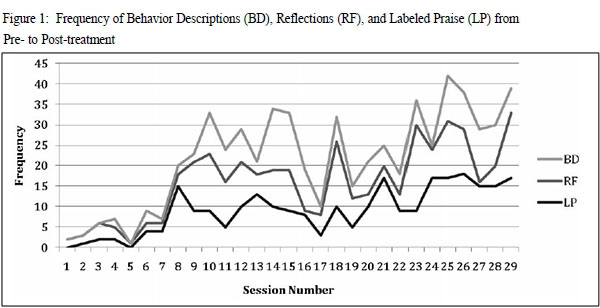
<body><![CDATA[<p><font face="Verdana, Arial, Helvetica, sans-serif" size="2">Altogether, the    dyad received 14 PDI coaching sessions before the therapist was confident that    the mother could manage her son's behavior, and that her son's behavior problems    were sufficiently diminished. During this time, the mother received 15 of her    own weekly individual services. At PDI session number 12, the family began to    receive in-home services to help the mother generalize her skills to the home    setting.</font></p>     <p><font face="Verdana, Arial, Helvetica, sans-serif" size="2"><b><i>Description    of Mother's Treatment</i></b></font></p>     <p><font face="Verdana, Arial, Helvetica, sans-serif" size="2">Knowing that the    mother had a long history of domestic violence and a previous history of abuse    and foster care, the therapist anticipated that he would be doing trauma-related    therapy with the mother, uncovering triggers that made it difficult for her    to implement the skills she was learning in PCIT. After initial clinical interviews,    it was the therapist's opinion that the mother's depressive symptoms, dependency    needs, helplessness, and low self-efficacy were the greatest barriers to progress    in PCIT. Consequently, he implemented two-pronged approach for treatment: a    cognitive-behavioral approach to help promote healthy cognitions and discourage    depressive ones, and mindfulness training to help her control impulsivity and    solve problems. Sessions were mostly devoted to disentangling problems she was    having with her ex-husband and his girlfriend, the schools, the custody dispute,    and how she could use the skills she was learning in PCIT better.</font></p>     <p><font face="Verdana, Arial, Helvetica, sans-serif" size="2"><b><i>Standardized    Measures</i></b></font></p>     <p><font face="Verdana, Arial, Helvetica, sans-serif" size="2"><i>Child behavior    problems</i>. <a href="/img/revistas/inter/v21n2/04t1.jpg" target="_blank">Table    1</a> shows the scores of measures completed by A's mother pre-treatment, the    7th session (ECBI only) and post-treatment. The mother's ratings of her son    on the ECBI and the CBCL show that the number and frequency of his behavior    problems are in the clinical range at pre-treatment. In particular, the mother    noted problems with A's emotional reactivity (e.g., sulky, whiny, moody, upset    by new things), anxiety/depression (e.g., clingy, nervous, fearful), aggressiveness    (e.g., angry, destructive, temper tantrums), resulting in elevated scores on    the internalizing and externalizing behavior problems scales. By the 7th session,    the intensity of disruptive behavior problems reported on the ECBI had dropped    more than one standard deviation and was just out of the clinical range. By    the end of treatment, the intensity of problems had dropped another 1.5 standard    deviations. Similar decreases in the severity of A's behavior problems were    also reported on the CBCL. In contrast to the mother's report of A's behaviors,    the change in the degree to which A's problems were still a problem for her    decreased more slowly and less dramatically. We observed no change in the numbers    of behaviors considered as problems for her from pre-treatment to the 7th coaching    session (26 out of 36 behaviors), but a change in more than one standard deviation    from pre- to post-treatment, although the post-treatment score remained in the    clinical range.</font></p>     <p><font face="Verdana, Arial, Helvetica, sans-serif" size="2"><i>Child trauma    symptoms. </i>A's scores on the TSCYC pre-treatment (per mother's report) show    symptoms of post-traumatic stress in the clinical range. In particular, the    mother reported that A was bothered and still frightened by his bad memories.    Additionally, A's mother reported that he exhibited clinical levels of anxiety,    depressive symptoms, anger and aggression, and sexual concerns. By post-treatment,    T-scores had dropped at least two standard deviations, and all of the TSCYC    scales were out of the clinical range.</font></p>     <p><font face="Verdana, Arial, Helvetica, sans-serif" size="2"><i>Parent functioning</i>.    In addition to measures of her child's functioning, A's mother completed the    BSI, measuring her own psychological symptoms, and the short form of the PSI,    a measure of the severity stress in the parent role. As can be seen in <a href="/img/revistas/inter/v21n2/04t1.jpg" target="_blank">Table    1</a>, at pretreatment her symptom profile on the BSI showed general symptomatic    distress in the clinical range, endorsing clinical levels of symptoms on the    depression, anxiety, hostility, and phobic anxiety scales. Post-treatment, scores    on these scales reflecting self-reported psychological symptoms decreased at    least 1.5 standard deviations and were within normal limits. The mother's reporting    on the PSI pre-treatment suggests that she was experiencing considerable stress    in the parent role. Her distress related to feelings of incompetence, of being    restricted in other parts of her life because of being a parent, depression,    and conflict with her spouse. She reported significant stress in her relationship    with A, noting that he would "do things that bother her just to be mean." She    also reported clinical levels of stress resulting from parenting a child with    difficult behaviors. As <a href="/img/revistas/inter/v21n2/04t1.jpg" target="_blank">Table    1</a> shows, the mother's parental stress decreased from pre- to post-treatment.</font></p>     <p><font face="Verdana, Arial, Helvetica, sans-serif" size="2"><i>Parent verbalizations.    </i><a href="#f01">Figure 1</a> and Figure 2 show the results of coding the    mother for the first 5 minutes of the observational assessment (child-led play)    as well as the 5-minute observations at the beginning of each treatment session,    using the DPICS coding system. In the first phase of treatment (CDI), the goal    is to increase parents' praise, reflections, and behavioral descriptions and    reducing commands, questions, and negative talk. The variability of the mother's    performance is notable in CDI. During the first five sessions, when A's mother    is suffering most from depression, she shows little change in the way she interacts    with her son. After a brief hiatus, she returns to PCIT and slowly improves    until she meets "CDI mastery" (i.e.,giving 10 praises, 10 reflections, and 10    behavior descriptions in the 5 minute observation, and gives no more than 3    commands, questions, or negative verbalizations). Once the parent meets CDI    mastery, instructions during the 5 minutes change slightly in order to give    the parent a chance to practice giving effective commands. During PDI the mother    was instructed to give four commands during the five minutes of play, but was    still expected to use her CDI skills (i.e., PRIDE skills). The first four months    of PDI when the dyad inconsistently attended PCIT, the mother's performance    in the 5-minute observational assessment was also inconsistent to poor. As A    and his mother attended more regularly, her performance improved markedly. While    the mother never gave consistently effective commands during the observational    assessment in the latter part of PDI, the child was compliant with her commands.</font></p>     <p><a name="f01"></a></p>     <p>&nbsp;</p>     ]]></body>
<body><![CDATA[<p align="center"><img src="/img/revistas/inter/v21n2/04f01.jpg"></p>     <p>&nbsp;</p>     <p>&nbsp;</p>     <p align="center"><img src="/img/revistas/inter/v21n2/04f02.jpg"></p>     <p>&nbsp;</p>     <p><font face="Verdana, Arial, Helvetica, sans-serif" size="2"><i>Emotional Availability</i>.    <a href="/img/revistas/inter/v21n2/04t2.jpg" target="_blank">Table 2</a> shows    the pre- and post-treatment Emotional Availability scale scores for A and his    mother. When they came into treatment, A's mother was mostly quiet and withdrawn.    When she participated in play, her voice was well-modulated (i.e., not flat    or depressed), but she primarily varied between trying a little too hard to    be cheerful and long periods of silence. In parent-led play and clean up, she    appeared afraid to give her son a command to change the activity, asking "Okay,    honey? Okay, hostility, so received optimal scores on that scale in all three    activities.</font></p>     <p><font face="Verdana, Arial, Helvetica, sans-serif" size="2">As for the child,    A seemed only marginally interested in playing with his mother in the pre-treatment    assessment, making little eye-contact, and not really responding to her overtures    or suggestions, though he asked her for help at one point in CDI. For this reason    he received non-optimal scores in responsiveness in all three activities, and    received an optimal score in Involvement in CDI, but non-optimal scores in PDI    and Clean Up. Post-treatment, A involved his mother in his play and responded    to her statements and questions. However, he wouldn't let her look while he    "made a meal" in PDI and was a little sassy, asking her "how many times do I    have to ask you (not to look)?" For this behavior, A received optimal scores    in Responsiveness and Involvement in CDI, and nonoptimal scores in PDI and Clean    Up.</font></p>     <p><font face="Verdana, Arial, Helvetica, sans-serif" size="2">honey?" multiple    times; or clean up, when, checking with the therapist, she made it clear to    the child that it was not <i>her </i>choice to clean up. The mother also had    a difficult time setting limits. After cleaning up, the child told the mother    to give him her keys and tried to put holes in the booster seat. She merely    stared into space, not responding to this inappropriate behavior. For these    reasons, the mother scored in the non-optimal range of sensitivity and structuring.    She showed no hostility and was not intrusive, so she scored in the optimal    range on these scales. Post-treatment, the mother appeared significantly more    engaged in the child-led play, describing and praising the child's positive    behaviors. She stayed involved in play, but primarily followed A's lead, not    really making any contributions of her own. When she needed to take more control    of the interaction, in PDI and Clean Up, she used many PRIDE skills, and the    child complied with her directions. At one point after A had cleaned up, he    nattered her about a surprise she had promised, being a little sassy. She wheedled    a little in response, quietly, then changed the subject and disengaged a bit.    As a result, her Sensitivity, Intrusiveness, and Structuring scores were in    the optimal range in CDI, but declined in PDI and Clean Up. She showed no</font></p>     <p><font face="Verdana, Arial, Helvetica, sans-serif" size="2"><i>Summary</i>.    We argue that the parenting skills taught in PCIT supported the mother's confidence    in taking a responsive and authoritative role with her son. In addition to giving    her an effective way to communicate with A, PCIT therapists also coach related    skills like positively attending to A's desirable behaviors, consistently and    calmly following through with negative consequences, planning ahead, considering    his limitations, communicating clearly and directly, and, practicing and eventually    mastering these skills helped A's mother to build self-efficacy as a parent,    which may spill over into other life roles.</font></p>     <p>&nbsp;</p>     ]]></body>
<body><![CDATA[<p><font face="Verdana, Arial, Helvetica, sans-serif" size="2"><b>Discussion</b></font></p>     <p><font face="Verdana, Arial, Helvetica, sans-serif" size="2">After three decades    of efficacy and effectiveness research, there is no question that PCIT is a    highly effective and well-supported intervention. In addressing the three basic    treatment objectives for PCIT (i.e., reduction in child behavior problems, improving    parenting skills, enhancing the quality of parent-child relationships), there    is an abundance of research demonstrating very strong treatment effects and    therefore, its value to the field (Eyberg &amp; Bussing, 2010).</font></p>     <p><font face="Verdana, Arial, Helvetica, sans-serif" size="2"><b><i>Why is PCIT    Effective?</i></b></font></p>     <p><font face="Verdana, Arial, Helvetica, sans-serif" size="2">Although grounded    in behavioral theory, social learning theory, and family systems theory, there    are also continuing questions concerning exactly what makes PCIT so effective.    The question of, 'Why is PCIT effective?' is not superfluous. As described by    behavioral theories, we know that consistently reinforcing desired behaviors    (e.g., therapist praise of positive parenting behaviors, parent praise of child    compliance) increases the frequency of this behavior. Additionally, social learning    theory explains why concepts such as modeling (e.g., parents demonstrating calm,    assertive, positive behaviors in interactions with their child models these    same behaviors to their child) can be an effective strategy within a PCIT session.    Finally, family systems theory explains why making changes in a parent's behavior    (e.g., increasing positive behaviors, decreasing negative behaviors) can influence    their child's behavior (child responses to positive parenting behaviors results    in a decrease in oppositional behavior). However, there are additional processes    that are likely to change as a result of successful involvement in PCIT- especially    with children exposed to adverse or traumatic events.</font></p>     <p><font face="Verdana, Arial, Helvetica, sans-serif" size="2"><b><i>PCIT and    Child Trauma</i></b></font></p>     <p><font face="Verdana, Arial, Helvetica, sans-serif" size="2">Much of the research    and treatment on traumatized children has focused solely on the traumatized    child's trauma symptoms, with much less attention to the disruptive behavior    problems that are often present with these young children. As is evident in    this case, children who experience significant trauma often have both trauma    symptoms <i>and </i>disruptive behavioral problems. In examining the traumatized    child through a broad scope of functioning and social contexts, it becomes apparent    that the parent-child relationship may be <i>both </i>a protective factor and    a risk factor, which can assist and hinder the child in their recovery from    the traumatic event. For young children, this parent- child protective/risk    conundrum suggests that any intervention for the child needs to incorporate    both the parent in the treatment process and address the parent's capacity to    provide a warm, positive, and protective relationship. In the same way that    negative, coercive parent-child interactions can lead to a multitude of adverse    outcomes, warm, nurturing, and supportive parent-child interactions can promote    resilience. The focus of PCIT is to decrease negative interactions and increase    positive interactions, increasing the parent- child dyad's capacity to support    resilience in both members of the dyad. We argue that by supporting and building    strength in the parent-child dyad, we help leverage ongoing mental health and    well being in traumatized young children. Recent literature has reported that    a positive parent-child relationship is an important protective factor, promoting    resilience in distressed and traumatized children (Ellis, Saxe, &amp; Twiss,    2011). Unfortunately, for children who exhibited aggressive and defiant behavior,    their ability to sustain a positive relationship with their parents are severely    compromised, thus hindering their development of resilience. The stable pattern    of positive parent-child interactions sets in place a series of positive, constructive    capacities for both parent and child. One asset of PCIT is that it is an intervention    that promotes 'natural' resilience- developing processes by strengthening positive    parent- child relationships (Ellis, Saxe, &amp; Twiss, 2011).</font></p>     <p><font face="Verdana, Arial, Helvetica, sans-serif" size="2">We believe the    potential gain of strengthening the parent-child relationship is great, and    that this case illustrates the complexity of people's lives and their ongoing    vulnerability to risk. At several points in the course of treatment, this family    could have terminated services. The mother was depressed and not really making    much positive change; she was having trouble getting out of bed and attending    her child's therapy appointment. At one point, she lost custody of her children.    In the face of seemingly overwhelming obstacles, the mother felt helped and    supported, retaining her belief that the services make a difference for her    future. By recognizing the mother's contributions and hindrance to her son's    mental health, interventions could be put in place to support treatment of her    son's mental health problems. All things taken together, we hope this case illustrates    the way in which supporting and building a secure and nurturing parent-child    relationship is both the mechanism by which some trauma symptoms can be treated    and the source of a resilience- developing parent-child relationship.</font></p>     <p>&nbsp;</p>     <p><font face="Verdana, Arial, Helvetica, sans-serif" size="2"><b>References</b></font></p>     <!-- ref --><p><font face="Verdana, Arial, Helvetica, sans-serif" size="2">Abidin, R. R. (1995).    <i>Parenting Stress Index: Professional manual</i>. Odessa, FL: Psychological    Assessment Resources.    &nbsp;&nbsp;&nbsp;&nbsp;&nbsp;&nbsp;&nbsp;&nbsp;[&#160;<a href="javascript:void(0);" onclick="javascript: window.open('/scielo.php?script=sci_nlinks&ref=4342874&pid=S1132-0559201200020000400001&lng=','','width=640,height=500,resizable=yes,scrollbars=1,menubar=yes,');">Links</a>&#160;]<!-- end-ref --></font></p>     <!-- ref --><p><font face="Verdana, Arial, Helvetica, sans-serif" size="2">Achenbach, T. M.,    &amp; Rescorla, L. (2000). <i>Manual for the ASEBA Preschool Forms &amp; Profiles</i>.    Burlington, VT: University of Vermont, Research Center for Children, Youth &amp;    Families.    &nbsp;&nbsp;&nbsp;&nbsp;&nbsp;&nbsp;&nbsp;&nbsp;[&#160;<a href="javascript:void(0);" onclick="javascript: window.open('/scielo.php?script=sci_nlinks&ref=4342876&pid=S1132-0559201200020000400002&lng=','','width=640,height=500,resizable=yes,scrollbars=1,menubar=yes,');">Links</a>&#160;]<!-- end-ref --></font></p>     <!-- ref --><p><font face="Verdana, Arial, Helvetica, sans-serif" size="2">American Psychiatric    Association (2000). <i>Diagnostic and statistical manual of mental disorders,    IVth Edition - Text Revision</i>. Arlington, VA: American Psychiatric Association.    &nbsp;&nbsp;&nbsp;&nbsp;&nbsp;&nbsp;&nbsp;&nbsp;[&#160;<a href="javascript:void(0);" onclick="javascript: window.open('/scielo.php?script=sci_nlinks&ref=4342878&pid=S1132-0559201200020000400003&lng=','','width=640,height=500,resizable=yes,scrollbars=1,menubar=yes,');">Links</a>&#160;]<!-- end-ref --></font></p>     <!-- ref --><p><font face="Verdana, Arial, Helvetica, sans-serif" size="2">Axline, V. (1947).    <i>Play Therapy</i>. London: Ballantine Books.    &nbsp;&nbsp;&nbsp;&nbsp;&nbsp;&nbsp;&nbsp;&nbsp;[&#160;<a href="javascript:void(0);" onclick="javascript: window.open('/scielo.php?script=sci_nlinks&ref=4342880&pid=S1132-0559201200020000400004&lng=','','width=640,height=500,resizable=yes,scrollbars=1,menubar=yes,');">Links</a>&#160;]<!-- end-ref --><!-- ref --> Baumrind, D. (1966). Effects    of authoritative parental control on child behavior. <i>Child Development, 37</i>,    887-907.    &nbsp;&nbsp;&nbsp;&nbsp;&nbsp;&nbsp;&nbsp;&nbsp;[&#160;<a href="javascript:void(0);" onclick="javascript: window.open('/scielo.php?script=sci_nlinks&ref=4342881&pid=S1132-0559201200020000400005&lng=','','width=640,height=500,resizable=yes,scrollbars=1,menubar=yes,');">Links</a>&#160;]<!-- end-ref --></font></p>     <!-- ref --><p><font face="Verdana, Arial, Helvetica, sans-serif" size="2">Baumrind, D. (1967).    Child care practices anteceding three patterns of preschool behavior. <i>Genetic    Psychology Monographs, 75</i>, 43-88.    &nbsp;&nbsp;&nbsp;&nbsp;&nbsp;&nbsp;&nbsp;&nbsp;[&#160;<a href="javascript:void(0);" onclick="javascript: window.open('/scielo.php?script=sci_nlinks&ref=4342883&pid=S1132-0559201200020000400006&lng=','','width=640,height=500,resizable=yes,scrollbars=1,menubar=yes,');">Links</a>&#160;]<!-- end-ref --></font></p>     ]]></body>
<body><![CDATA[<!-- ref --><p><font face="Verdana, Arial, Helvetica, sans-serif" size="2">Biringen, Z. (2000).    Emotional availability: Conceptualization and research findings. <i>American    Journal of Orthopsychiatry 70, </i>104-111.    &nbsp;&nbsp;&nbsp;&nbsp;&nbsp;&nbsp;&nbsp;&nbsp;[&#160;<a href="javascript:void(0);" onclick="javascript: window.open('/scielo.php?script=sci_nlinks&ref=4342885&pid=S1132-0559201200020000400007&lng=','','width=640,height=500,resizable=yes,scrollbars=1,menubar=yes,');">Links</a>&#160;]<!-- end-ref --></font></p>     <!-- ref --><p><font face="Verdana, Arial, Helvetica, sans-serif" size="2">Boggs, S. R., Eyberg,    S. M., &amp; Reynolds, L. (1990). Concurrent validity of the Eyberg Child Behavior    Inventory. <i>Journal of Clinical Child Psychology, 19, </i>75-78.    &nbsp;&nbsp;&nbsp;&nbsp;&nbsp;&nbsp;&nbsp;&nbsp;[&#160;<a href="javascript:void(0);" onclick="javascript: window.open('/scielo.php?script=sci_nlinks&ref=4342887&pid=S1132-0559201200020000400008&lng=','','width=640,height=500,resizable=yes,scrollbars=1,menubar=yes,');">Links</a>&#160;]<!-- end-ref --></font></p>     <!-- ref --><p><font face="Verdana, Arial, Helvetica, sans-serif" size="2">Borrego, Jr., J.,    Timmer, S. G., Urquiza, A. J., &amp; Follette, W. C. (2004). Physically abusive    mothers' responses following episodes of child noncompliance and compliance.    <i>Journal of Consulting and Clinical Psychology, 72, 8</i>97- 903.    &nbsp;&nbsp;&nbsp;&nbsp;&nbsp;&nbsp;&nbsp;&nbsp;[&#160;<a href="javascript:void(0);" onclick="javascript: window.open('/scielo.php?script=sci_nlinks&ref=4342889&pid=S1132-0559201200020000400009&lng=','','width=640,height=500,resizable=yes,scrollbars=1,menubar=yes,');">Links</a>&#160;]<!-- end-ref --></font></p>     <!-- ref --><p><font face="Verdana, Arial, Helvetica, sans-serif" size="2">Bourke, M. L.,    &amp; Nielsen, B. A. (1995). Parent training: Getting the most effective help    for the most children. <i>Journal of Psychological Practice, 1</i>, 142-152.    &nbsp;&nbsp;&nbsp;&nbsp;&nbsp;&nbsp;&nbsp;&nbsp;[&#160;<a href="javascript:void(0);" onclick="javascript: window.open('/scielo.php?script=sci_nlinks&ref=4342891&pid=S1132-0559201200020000400010&lng=','','width=640,height=500,resizable=yes,scrollbars=1,menubar=yes,');">Links</a>&#160;]<!-- end-ref --></font></p>     <!-- ref --><p><font face="Verdana, Arial, Helvetica, sans-serif" size="2">Briere, J., Johnson,    K., Bissada, A., Damon, L., Crouch, J., Gil, E., </font><font size="2">&#8230;</font><font face="Verdana, Arial, Helvetica, sans-serif" size="2">    Ernst, V. (2001). The Trauma Symptom Checklist for Young Children (TSCYC): Reliability    and association with abuse exposure in a multi-site study. <i>Child Abuse &amp;    Neglect, 25, </i>1001-1014.    &nbsp;&nbsp;&nbsp;&nbsp;&nbsp;&nbsp;&nbsp;&nbsp;[&#160;<a href="javascript:void(0);" onclick="javascript: window.open('/scielo.php?script=sci_nlinks&ref=4342893&pid=S1132-0559201200020000400011&lng=','','width=640,height=500,resizable=yes,scrollbars=1,menubar=yes,');">Links</a>&#160;]<!-- end-ref --></font></p>     ]]></body>
<body><![CDATA[<!-- ref --><p><font face="Verdana, Arial, Helvetica, sans-serif" size="2">Broidy, L. M.,    Nagin, D. S., Tremblay, R. E., Bates, J. E., Brame, B., Dodge, K. A., ... Vitaro,    F. (2003). Developmental trajectories of childhood disruptive behaviors and    adolescent delinquency: A six-site, cross-national study. <i>Developmental Psychology,    39, </i>222-245.    &nbsp;&nbsp;&nbsp;&nbsp;&nbsp;&nbsp;&nbsp;&nbsp;[&#160;<a href="javascript:void(0);" onclick="javascript: window.open('/scielo.php?script=sci_nlinks&ref=4342895&pid=S1132-0559201200020000400012&lng=','','width=640,height=500,resizable=yes,scrollbars=1,menubar=yes,');">Links</a>&#160;]<!-- end-ref --></font></p>     <!-- ref --><p><font face="Verdana, Arial, Helvetica, sans-serif" size="2">Chaffin, M., Silovsky,    J. F., Funderburk, B., Valle, L., Brestan, E. V., Balachova, T., ... Bonner,    B. L. (2004). Parent-Child Interaction Therapy with physically abusive parents:    Efficacy for reducing future abuse reports. <i>Journal of Consulting and Clinical    Psychology, 72, </i>500- 510.    &nbsp;&nbsp;&nbsp;&nbsp;&nbsp;&nbsp;&nbsp;&nbsp;[&#160;<a href="javascript:void(0);" onclick="javascript: window.open('/scielo.php?script=sci_nlinks&ref=4342897&pid=S1132-0559201200020000400013&lng=','','width=640,height=500,resizable=yes,scrollbars=1,menubar=yes,');">Links</a>&#160;]<!-- end-ref --></font></p>     <!-- ref --><p><font face="Verdana, Arial, Helvetica, sans-serif" size="2">Chu, A. T., &amp;    Lieberman, A. (2010). Clinical implications of traumatic stress from birth to    age five. <i>Annual Review of Clinical Psychology, 6, </i>469-494.    &nbsp;&nbsp;&nbsp;&nbsp;&nbsp;&nbsp;&nbsp;&nbsp;[&#160;<a href="javascript:void(0);" onclick="javascript: window.open('/scielo.php?script=sci_nlinks&ref=4342899&pid=S1132-0559201200020000400014&lng=','','width=640,height=500,resizable=yes,scrollbars=1,menubar=yes,');">Links</a>&#160;]<!-- end-ref --></font></p>     <!-- ref --><p><font face="Verdana, Arial, Helvetica, sans-serif" size="2">Copeland, W. E.,    Keeler, G., Angold, A., &amp; Costello, E. J. (2007). Traumatic events and posttraumatic    stress in childhood. <i>Archives of General Psychiatry, 64, </i>577-584.    &nbsp;&nbsp;&nbsp;&nbsp;&nbsp;&nbsp;&nbsp;&nbsp;[&#160;<a href="javascript:void(0);" onclick="javascript: window.open('/scielo.php?script=sci_nlinks&ref=4342901&pid=S1132-0559201200020000400015&lng=','','width=640,height=500,resizable=yes,scrollbars=1,menubar=yes,');">Links</a>&#160;]<!-- end-ref --></font></p>     <!-- ref --><p><font face="Verdana, Arial, Helvetica, sans-serif" size="2">Derogatis, L. R.    (1993). <i>BSI Brief Symptom Inventory.</i><i> Administration, Scoring, and    Procedures Manual </i>(4th ed.). Minneapolis, MN: National Computer Systems.    &nbsp;&nbsp;&nbsp;&nbsp;&nbsp;&nbsp;&nbsp;&nbsp;[&#160;<a href="javascript:void(0);" onclick="javascript: window.open('/scielo.php?script=sci_nlinks&ref=4342903&pid=S1132-0559201200020000400016&lng=','','width=640,height=500,resizable=yes,scrollbars=1,menubar=yes,');">Links</a>&#160;]<!-- end-ref --></font></p>     ]]></body>
<body><![CDATA[<!-- ref --><p><font face="Verdana, Arial, Helvetica, sans-serif" size="2">Eisenstadt, T.    H., Eyberg, S., McNeil, C. B., Newcomb, K., &amp; Funderburk, B. (1993). Parent-child    interaction therapy with behavior problem children: Relative effectiveness of    two stages and overall treatment outcome. <i>Journal of Clinical Child Psychology,    22</i>, 42-51.    &nbsp;&nbsp;&nbsp;&nbsp;&nbsp;&nbsp;&nbsp;&nbsp;[&#160;<a href="javascript:void(0);" onclick="javascript: window.open('/scielo.php?script=sci_nlinks&ref=4342905&pid=S1132-0559201200020000400017&lng=','','width=640,height=500,resizable=yes,scrollbars=1,menubar=yes,');">Links</a>&#160;]<!-- end-ref --></font></p>     <!-- ref --><p><font face="Verdana, Arial, Helvetica, sans-serif" size="2">Ellis, B. H., Saxe,    G. N., &amp; Twiss, J. (2011). Trauma Systems Therapy: Intervening in the interaction    between the social environment and a child's emotional regulation. In V. Ardino    (Ed.), <i>Post-traumatic syndromes in childhood and adolescence</i>. Wiley:    Oxford.    &nbsp;&nbsp;&nbsp;&nbsp;&nbsp;&nbsp;&nbsp;&nbsp;[&#160;<a href="javascript:void(0);" onclick="javascript: window.open('/scielo.php?script=sci_nlinks&ref=4342907&pid=S1132-0559201200020000400018&lng=','','width=640,height=500,resizable=yes,scrollbars=1,menubar=yes,');">Links</a>&#160;]<!-- end-ref --></font></p>     <!-- ref --><p><font face="Verdana, Arial, Helvetica, sans-serif" size="2">Eyberg, S. M. (1988).    Parent-child interaction therapy: Integration of traditional and behavioral    concerns. <i>Child &amp; Family Behavior Therapy, 10</i>, 33-46.    &nbsp;&nbsp;&nbsp;&nbsp;&nbsp;&nbsp;&nbsp;&nbsp;[&#160;<a href="javascript:void(0);" onclick="javascript: window.open('/scielo.php?script=sci_nlinks&ref=4342909&pid=S1132-0559201200020000400019&lng=','','width=640,height=500,resizable=yes,scrollbars=1,menubar=yes,');">Links</a>&#160;]<!-- end-ref --></font></p>     <!-- ref --><p><font face="Verdana, Arial, Helvetica, sans-serif" size="2">Eyberg, S. M. (2004).    The PCIT story-part one: The conceptual foundation of PCIT. <i>The Parent-Child    Interaction Therapy Newsletter, 1</i>, 1-2.    &nbsp;&nbsp;&nbsp;&nbsp;&nbsp;&nbsp;&nbsp;&nbsp;[&#160;<a href="javascript:void(0);" onclick="javascript: window.open('/scielo.php?script=sci_nlinks&ref=4342911&pid=S1132-0559201200020000400020&lng=','','width=640,height=500,resizable=yes,scrollbars=1,menubar=yes,');">Links</a>&#160;]<!-- end-ref --></font></p>     <!-- ref --><p><font face="Verdana, Arial, Helvetica, sans-serif" size="2">Eyberg, S., &amp;    Bussing, R. (2010). Parent-child interaction therapy. In M. Murrihy, A. Kidman,    &amp; T. Ollendick (Eds.), <i>A Clinicians Handbook for the Assessment and Treatment    of Conduct Problems in Youth </i>(pp. 139-162). New York: Springer.    &nbsp;&nbsp;&nbsp;&nbsp;&nbsp;&nbsp;&nbsp;&nbsp;[&#160;<a href="javascript:void(0);" onclick="javascript: window.open('/scielo.php?script=sci_nlinks&ref=4342913&pid=S1132-0559201200020000400021&lng=','','width=640,height=500,resizable=yes,scrollbars=1,menubar=yes,');">Links</a>&#160;]<!-- end-ref --></font></p>     ]]></body>
<body><![CDATA[<!-- ref --><p><font face="Verdana, Arial, Helvetica, sans-serif" size="2">Eyberg, S., Nelson,    M., Duke, M., &amp; Boggs, S. (2005).<i> Manual for the Dyadic Parent-Child    Interaction Coding System</i>, (3rd ed.)<i>. </i>Unpublished manuscript.    &nbsp;&nbsp;&nbsp;&nbsp;&nbsp;&nbsp;&nbsp;&nbsp;[&#160;<a href="javascript:void(0);" onclick="javascript: window.open('/scielo.php?script=sci_nlinks&ref=4342915&pid=S1132-0559201200020000400022&lng=','','width=640,height=500,resizable=yes,scrollbars=1,menubar=yes,');">Links</a>&#160;]<!-- end-ref --></font></p>     <!-- ref --><p><font face="Verdana, Arial, Helvetica, sans-serif" size="2">Eyberg, S., &amp;    Pincus, D. (1999). <i>ECBI &amp; SESBI-R: Eyberg Child Behavior Inventory and    Sutter-Eyberg Student Behavior Inventory-Revised, Professional Manual</i>. Odessa,    FL: Psychological Assessment Resources.    &nbsp;&nbsp;&nbsp;&nbsp;&nbsp;&nbsp;&nbsp;&nbsp;[&#160;<a href="javascript:void(0);" onclick="javascript: window.open('/scielo.php?script=sci_nlinks&ref=4342917&pid=S1132-0559201200020000400023&lng=','','width=640,height=500,resizable=yes,scrollbars=1,menubar=yes,');">Links</a>&#160;]<!-- end-ref --></font></p>     <!-- ref --><p><font face="Verdana, Arial, Helvetica, sans-serif" size="2">Eyberg, S. M.,    &amp; Robinson, E. (1982). Parent-child interaction training: Effects on family    functioning. <i>Journal of Clinical Child Psychology, 11</i>, 130-137.    &nbsp;&nbsp;&nbsp;&nbsp;&nbsp;&nbsp;&nbsp;&nbsp;[&#160;<a href="javascript:void(0);" onclick="javascript: window.open('/scielo.php?script=sci_nlinks&ref=4342919&pid=S1132-0559201200020000400024&lng=','','width=640,height=500,resizable=yes,scrollbars=1,menubar=yes,');">Links</a>&#160;]<!-- end-ref --></font></p>     <!-- ref --><p><font face="Verdana, Arial, Helvetica, sans-serif" size="2">Eyberg, S., &amp;    Robinson, E. (1983). Conduct problem behavior: Standardization of a behavioral    rating scale with adolescents. <i>Journal of Clinical Child Psychology, 12,    </i>347- 354.    &nbsp;&nbsp;&nbsp;&nbsp;&nbsp;&nbsp;&nbsp;&nbsp;[&#160;<a href="javascript:void(0);" onclick="javascript: window.open('/scielo.php?script=sci_nlinks&ref=4342921&pid=S1132-0559201200020000400025&lng=','','width=640,height=500,resizable=yes,scrollbars=1,menubar=yes,');">Links</a>&#160;]<!-- end-ref --></font></p>     <!-- ref --><p><font face="Verdana, Arial, Helvetica, sans-serif" size="2">Fantuzzo, J. W.,    DePaola, L. M., Lambert, L., Martino, T., Anderson, T., &amp; Sutton, B. (1991).    Effects of interparental violence on the psychological adjustment and competencies    of young children. <i>Journal of Consulting and Clinical Psychology, 59</i>,    258-265.    &nbsp;&nbsp;&nbsp;&nbsp;&nbsp;&nbsp;&nbsp;&nbsp;[&#160;<a href="javascript:void(0);" onclick="javascript: window.open('/scielo.php?script=sci_nlinks&ref=4342923&pid=S1132-0559201200020000400026&lng=','','width=640,height=500,resizable=yes,scrollbars=1,menubar=yes,');">Links</a>&#160;]<!-- end-ref --></font></p>     ]]></body>
<body><![CDATA[<!-- ref --><p><font face="Verdana, Arial, Helvetica, sans-serif" size="2">Fergusson, D. M.,    Horwood, L. J., &amp; Lynskey, M. (1994). The childhoods of multiple problem    adolescents: A 15- year longitudinal study. <i>Journal of Child Psychology and    Psychiatry, 35, </i>1123-1140.    &nbsp;&nbsp;&nbsp;&nbsp;&nbsp;&nbsp;&nbsp;&nbsp;[&#160;<a href="javascript:void(0);" onclick="javascript: window.open('/scielo.php?script=sci_nlinks&ref=4342925&pid=S1132-0559201200020000400027&lng=','','width=640,height=500,resizable=yes,scrollbars=1,menubar=yes,');">Links</a>&#160;]<!-- end-ref --></font></p>     <!-- ref --><p><font face="Verdana, Arial, Helvetica, sans-serif" size="2">Fernandez, M. A.,    Butler, A. M., &amp; Eyberg, S. M. (2011). Treatment outcome for low socioeconomic    status African American families in Parent-Child Interaction Therapy: A pilot    study. <i>Child and Family Behavior Therapy, 33</i>(1), 32-48.    &nbsp;&nbsp;&nbsp;&nbsp;&nbsp;&nbsp;&nbsp;&nbsp;[&#160;<a href="javascript:void(0);" onclick="javascript: window.open('/scielo.php?script=sci_nlinks&ref=4342927&pid=S1132-0559201200020000400028&lng=','','width=640,height=500,resizable=yes,scrollbars=1,menubar=yes,');">Links</a>&#160;]<!-- end-ref --></font></p>     <!-- ref --><p><font face="Verdana, Arial, Helvetica, sans-serif" size="2">Fogel, A., Garvey,    A., Hsu, H., &amp; West-Stroming, D. (2006).<i> Change processes in relationships:    A relational-historical research approach</i>. Cambridge, UK: Cambridge University    Press.    &nbsp;&nbsp;&nbsp;&nbsp;&nbsp;&nbsp;&nbsp;&nbsp;[&#160;<a href="javascript:void(0);" onclick="javascript: window.open('/scielo.php?script=sci_nlinks&ref=4342929&pid=S1132-0559201200020000400029&lng=','','width=640,height=500,resizable=yes,scrollbars=1,menubar=yes,');">Links</a>&#160;]<!-- end-ref --></font></p>     <!-- ref --><p><font face="Verdana, Arial, Helvetica, sans-serif" size="2">Graziano, A. M.,    &amp; Diament, D. M. (1992). Parent behavioral training: An examination of the    paradigm. <i>Behavior Modification, 16, </i>3-38.    &nbsp;&nbsp;&nbsp;&nbsp;&nbsp;&nbsp;&nbsp;&nbsp;[&#160;<a href="javascript:void(0);" onclick="javascript: window.open('/scielo.php?script=sci_nlinks&ref=4342931&pid=S1132-0559201200020000400030&lng=','','width=640,height=500,resizable=yes,scrollbars=1,menubar=yes,');">Links</a>&#160;]<!-- end-ref --></font></p>     <!-- ref --><p><font face="Verdana, Arial, Helvetica, sans-serif" size="2">Greenberg, M. T.    (1999). Attachment and psychopathology in childhood. In J. Cassidy and P. R.    Shaver (Eds.), <i>Handbook of attachment: Theory, research, and clinical applications</i>.    New York: Guilford Press.    &nbsp;&nbsp;&nbsp;&nbsp;&nbsp;&nbsp;&nbsp;&nbsp;[&#160;<a href="javascript:void(0);" onclick="javascript: window.open('/scielo.php?script=sci_nlinks&ref=4342933&pid=S1132-0559201200020000400031&lng=','','width=640,height=500,resizable=yes,scrollbars=1,menubar=yes,');">Links</a>&#160;]<!-- end-ref --></font></p>     ]]></body>
<body><![CDATA[<!-- ref --><p><font face="Verdana, Arial, Helvetica, sans-serif" size="2">Guerney, B., Jr.    (1964). Filial therapy: Description and rationale. <i>Journal of Consulting    Psychology, 28</i>, 304-310.    &nbsp;&nbsp;&nbsp;&nbsp;&nbsp;&nbsp;&nbsp;&nbsp;[&#160;<a href="javascript:void(0);" onclick="javascript: window.open('/scielo.php?script=sci_nlinks&ref=4342935&pid=S1132-0559201200020000400032&lng=','','width=640,height=500,resizable=yes,scrollbars=1,menubar=yes,');">Links</a>&#160;]<!-- end-ref --> </font></p>     <!-- ref --><p><font face="Verdana, Arial, Helvetica, sans-serif" size="2">Hanf, C. (1968).    <i>A two-stage program for modifying maternal controlling during mother-child    (M-C) interaction</i>. Paper presented at the meeting of the Western Psychological    Association, Vancouver, BC.    &nbsp;&nbsp;&nbsp;&nbsp;&nbsp;&nbsp;&nbsp;&nbsp;[&#160;<a href="javascript:void(0);" onclick="javascript: window.open('/scielo.php?script=sci_nlinks&ref=4342937&pid=S1132-0559201200020000400033&lng=','','width=640,height=500,resizable=yes,scrollbars=1,menubar=yes,');">Links</a>&#160;]<!-- end-ref --></font></p>     <!-- ref --><p><font face="Verdana, Arial, Helvetica, sans-serif" size="2">Hood, K., &amp;    Eyberg, S. (2003). Outcomes of Parent-child Interaction Therapy: Mothers' reports    of maintenance three to six years after treatment. <i>Journal of Clinical Child    and Adolescent Psychology, 32</i>, 412-429.    &nbsp;&nbsp;&nbsp;&nbsp;&nbsp;&nbsp;&nbsp;&nbsp;[&#160;<a href="javascript:void(0);" onclick="javascript: window.open('/scielo.php?script=sci_nlinks&ref=4342939&pid=S1132-0559201200020000400034&lng=','','width=640,height=500,resizable=yes,scrollbars=1,menubar=yes,');">Links</a>&#160;]<!-- end-ref --></font></p>     <!-- ref --><p><font face="Verdana, Arial, Helvetica, sans-serif" size="2">Kaminski, J. W.,    Valle, L. A., Filene, J. H., &amp; Boyle, C. L. (2008). A meta-analytic review    of components associated with parent training program effectiveness. <i>Journal    of Abnormal Psychology, 36</i>, 567-589.    &nbsp;&nbsp;&nbsp;&nbsp;&nbsp;&nbsp;&nbsp;&nbsp;[&#160;<a href="javascript:void(0);" onclick="javascript: window.open('/scielo.php?script=sci_nlinks&ref=4342941&pid=S1132-0559201200020000400035&lng=','','width=640,height=500,resizable=yes,scrollbars=1,menubar=yes,');">Links</a>&#160;]<!-- end-ref --></font></p>     <!-- ref --><p><font face="Verdana, Arial, Helvetica, sans-serif" size="2">Kazdin, A. E. (2000).    Perceived barriers to treatment participation and treatment acceptability among    antisocial and their families. <i>Journal of Child &amp; Family Studies, 9,    </i>157- 174.    &nbsp;&nbsp;&nbsp;&nbsp;&nbsp;&nbsp;&nbsp;&nbsp;[&#160;<a href="javascript:void(0);" onclick="javascript: window.open('/scielo.php?script=sci_nlinks&ref=4342943&pid=S1132-0559201200020000400036&lng=','','width=640,height=500,resizable=yes,scrollbars=1,menubar=yes,');">Links</a>&#160;]<!-- end-ref --></font></p>     ]]></body>
<body><![CDATA[<!-- ref --><p><font face="Verdana, Arial, Helvetica, sans-serif" size="2">Kazdin, A. E.,    Bass, D., Ayers, W. A., &amp; Rodgers, A. (1990). Empirical and clinical focus    of child and adolescent psy-chotherapy research. <i>Journal of Consulting and    Clinical Psychology, 58, </i>729-740.    &nbsp;&nbsp;&nbsp;&nbsp;&nbsp;&nbsp;&nbsp;&nbsp;[&#160;<a href="javascript:void(0);" onclick="javascript: window.open('/scielo.php?script=sci_nlinks&ref=4342945&pid=S1132-0559201200020000400037&lng=','','width=640,height=500,resizable=yes,scrollbars=1,menubar=yes,');">Links</a>&#160;]<!-- end-ref --></font></p>     <!-- ref --><p><font face="Verdana, Arial, Helvetica, sans-serif" size="2">Kazdin, A. E.,    &amp; Weisz, J. R. (2003). <i>Evidence-based therapies for children and adolescents</i>.    New York, NY: Guilford.    &nbsp;&nbsp;&nbsp;&nbsp;&nbsp;&nbsp;&nbsp;&nbsp;[&#160;<a href="javascript:void(0);" onclick="javascript: window.open('/scielo.php?script=sci_nlinks&ref=4342947&pid=S1132-0559201200020000400038&lng=','','width=640,height=500,resizable=yes,scrollbars=1,menubar=yes,');">Links</a>&#160;]<!-- end-ref --></font></p>     <!-- ref --><p><font face="Verdana, Arial, Helvetica, sans-serif" size="2">Kim, I. J., Ge,    X., Brody, G. H., Conger, R., Gibbons, F. X., &amp; Simons, R. I. (2003). Parenting    behaviors and the occurrence and co-occurrence of depressive symptoms and conduct    problems among African American children. <i>Depression, Marriage, &amp; Families,    17</i>, 571-583.    &nbsp;&nbsp;&nbsp;&nbsp;&nbsp;&nbsp;&nbsp;&nbsp;[&#160;<a href="javascript:void(0);" onclick="javascript: window.open('/scielo.php?script=sci_nlinks&ref=4342949&pid=S1132-0559201200020000400039&lng=','','width=640,height=500,resizable=yes,scrollbars=1,menubar=yes,');">Links</a>&#160;]<!-- end-ref --></font></p>     <!-- ref --><p><font face="Verdana, Arial, Helvetica, sans-serif" size="2">Leung, C., Tsang,    S., Heung, K., &amp; Yiu, I. (1999). Effectiveness of Parent Child Interaction    Therapy (PCIT) in Hong Kong. <i>Research on Social Work Practice, 19</i>, 304-313.    &nbsp;&nbsp;&nbsp;&nbsp;&nbsp;&nbsp;&nbsp;&nbsp;[&#160;<a href="javascript:void(0);" onclick="javascript: window.open('/scielo.php?script=sci_nlinks&ref=4342951&pid=S1132-0559201200020000400040&lng=','','width=640,height=500,resizable=yes,scrollbars=1,menubar=yes,');">Links</a>&#160;]<!-- end-ref --></font></p>     <!-- ref --><p><font face="Verdana, Arial, Helvetica, sans-serif" size="2">Lovejoy, M. C.,    Graczyk, P. A., O'Hare, E., &amp; Neuman, G. (2000). Maternal depression and    parenting behavior: A meta-analytic review. <i>Clinical Psychology Review, 20</i>,    561-592.    &nbsp;&nbsp;&nbsp;&nbsp;&nbsp;&nbsp;&nbsp;&nbsp;[&#160;<a href="javascript:void(0);" onclick="javascript: window.open('/scielo.php?script=sci_nlinks&ref=4342953&pid=S1132-0559201200020000400041&lng=','','width=640,height=500,resizable=yes,scrollbars=1,menubar=yes,');">Links</a>&#160;]<!-- end-ref --></font></p>     ]]></body>
<body><![CDATA[<!-- ref --><p><font face="Verdana, Arial, Helvetica, sans-serif" size="2">Mannarino, A.,    Lieberman, A., Urquiza, A., &amp; Cohen, J. (2010, August). <i>Evidence-based    treatments for traumatized children. </i>Paper presented at the 118th Annual    Convention of the American Psychological Association, San Diego, CA.    &nbsp;&nbsp;&nbsp;&nbsp;&nbsp;&nbsp;&nbsp;&nbsp;[&#160;<a href="javascript:void(0);" onclick="javascript: window.open('/scielo.php?script=sci_nlinks&ref=4342955&pid=S1132-0559201200020000400042&lng=','','width=640,height=500,resizable=yes,scrollbars=1,menubar=yes,');">Links</a>&#160;]<!-- end-ref --></font></p>     <!-- ref --><p><font face="Verdana, Arial, Helvetica, sans-serif" size="2">McCabe, K. M.,    Yeh, M., Garland, A. F., Lau, A. S., &amp; Chavez, G. (2005). The GANA program:    A tailoring approach to adapting parent-child interaction therapy for Mexican    Americans. <i>Education and Treatment of Children, 28</i>, 111-129.    &nbsp;&nbsp;&nbsp;&nbsp;&nbsp;&nbsp;&nbsp;&nbsp;[&#160;<a href="javascript:void(0);" onclick="javascript: window.open('/scielo.php?script=sci_nlinks&ref=4342957&pid=S1132-0559201200020000400043&lng=','','width=640,height=500,resizable=yes,scrollbars=1,menubar=yes,');">Links</a>&#160;]<!-- end-ref --></font></p>     <!-- ref --><p><font face="Verdana, Arial, Helvetica, sans-serif" size="2">McNeil, C., Eyberg,    S., Eisenstadt, T., Newcomb, K., &amp; Funderburk, B. (1991). Parent-child interaction    therapy with behavior problem children: Generalization of treatment effects    to the school setting. <i>Journal of Clinical Child Psychology, 20, </i>140-151.    &nbsp;&nbsp;&nbsp;&nbsp;&nbsp;&nbsp;&nbsp;&nbsp;[&#160;<a href="javascript:void(0);" onclick="javascript: window.open('/scielo.php?script=sci_nlinks&ref=4342959&pid=S1132-0559201200020000400044&lng=','','width=640,height=500,resizable=yes,scrollbars=1,menubar=yes,');">Links</a>&#160;]<!-- end-ref --></font></p>     <!-- ref --><p><font face="Verdana, Arial, Helvetica, sans-serif" size="2">Reyno, S., &amp;    McGrath, P. (2006). Predictors of parent training efficacy for child externalizing    behavior problems- a meta-analytic review. <i>Journal of Child Psychology and    Psychiatry, 47, </i>99-111.    &nbsp;&nbsp;&nbsp;&nbsp;&nbsp;&nbsp;&nbsp;&nbsp;[&#160;<a href="javascript:void(0);" onclick="javascript: window.open('/scielo.php?script=sci_nlinks&ref=4342961&pid=S1132-0559201200020000400045&lng=','','width=640,height=500,resizable=yes,scrollbars=1,menubar=yes,');">Links</a>&#160;]<!-- end-ref --></font></p>     <!-- ref --><p><font face="Verdana, Arial, Helvetica, sans-serif" size="2">Runyon, M. K.,    Deblinger, E., Ryan, E. E., &amp; Thakkar-Kolar, R. (2004). An overview of child    physical abuse: Developing an integrated parent-child cognitive-behavioral treatment    approach. <i>Trauma, Violence, &amp; Abuse, 5</i>, 65-85.    &nbsp;&nbsp;&nbsp;&nbsp;&nbsp;&nbsp;&nbsp;&nbsp;[&#160;<a href="javascript:void(0);" onclick="javascript: window.open('/scielo.php?script=sci_nlinks&ref=4342963&pid=S1132-0559201200020000400046&lng=','','width=640,height=500,resizable=yes,scrollbars=1,menubar=yes,');">Links</a>&#160;]<!-- end-ref --></font></p>     ]]></body>
<body><![CDATA[<!-- ref --><p><font face="Verdana, Arial, Helvetica, sans-serif" size="2">Scheeringa, M.    S., &amp; Zeanah, C. (2001). A relational perspective of PTSD in early childhood.    <i>Journal of T</i><i>raumatic Stress, 14</i>, 799-815.    &nbsp;&nbsp;&nbsp;&nbsp;&nbsp;&nbsp;&nbsp;&nbsp;[&#160;<a href="javascript:void(0);" onclick="javascript: window.open('/scielo.php?script=sci_nlinks&ref=4342965&pid=S1132-0559201200020000400047&lng=','','width=640,height=500,resizable=yes,scrollbars=1,menubar=yes,');">Links</a>&#160;]<!-- end-ref --></font></p>     <!-- ref --><p><font face="Verdana, Arial, Helvetica, sans-serif" size="2">Stevens, J., Ammerman,    R., Putnam, F., &amp; Van Ginkel, J. (2002). Depression and trauma history in    first-time mothers receiving home visitation. <i>Journal of Community Psychology,    30</i>, 551-564.    &nbsp;&nbsp;&nbsp;&nbsp;&nbsp;&nbsp;&nbsp;&nbsp;[&#160;<a href="javascript:void(0);" onclick="javascript: window.open('/scielo.php?script=sci_nlinks&ref=4342967&pid=S1132-0559201200020000400048&lng=','','width=640,height=500,resizable=yes,scrollbars=1,menubar=yes,');">Links</a>&#160;]<!-- end-ref --></font></p>     <!-- ref --><p><font face="Verdana, Arial, Helvetica, sans-serif" size="2">Timmer, S. G.,    Borrego, J., &amp; Urquiza, A. J. (2002). Antecedents of coercive interactions    in physically abusive mother-child dyads. <i>Journal of Interpersonal Violence,    17</i>, 836-853.    &nbsp;&nbsp;&nbsp;&nbsp;&nbsp;&nbsp;&nbsp;&nbsp;[&#160;<a href="javascript:void(0);" onclick="javascript: window.open('/scielo.php?script=sci_nlinks&ref=4342969&pid=S1132-0559201200020000400049&lng=','','width=640,height=500,resizable=yes,scrollbars=1,menubar=yes,');">Links</a>&#160;]<!-- end-ref --></font></p>     <!-- ref --><p><font face="Verdana, Arial, Helvetica, sans-serif" size="2">Timmer, S., Ho,    L., Urquiza, A., Zebell, N., Fernandez y Garcia, E., &amp; Boys, D. (2011).    The effectiveness of Parent-Child Interaction Therapy with depressive mothers:    The changing relationship as the agent of individual change. <i>Child Psychiatry    &amp; Human Development, 42, </i>406-423.    &nbsp;&nbsp;&nbsp;&nbsp;&nbsp;&nbsp;&nbsp;&nbsp;[&#160;<a href="javascript:void(0);" onclick="javascript: window.open('/scielo.php?script=sci_nlinks&ref=4342971&pid=S1132-0559201200020000400050&lng=','','width=640,height=500,resizable=yes,scrollbars=1,menubar=yes,');">Links</a>&#160;]<!-- end-ref --></font></p>     <!-- ref --><p><font face="Verdana, Arial, Helvetica, sans-serif" size="2">Timmer, S. G.,    Urquiza, A. J., &amp; Zebell, N. (2006). Challenging foster caregiver-maltreated    child relationships: The effectiveness of Parent Child Interaction Therapy.    <i>Child &amp; Youth Services Review, 28, </i>1-19.    &nbsp;&nbsp;&nbsp;&nbsp;&nbsp;&nbsp;&nbsp;&nbsp;[&#160;<a href="javascript:void(0);" onclick="javascript: window.open('/scielo.php?script=sci_nlinks&ref=4342973&pid=S1132-0559201200020000400051&lng=','','width=640,height=500,resizable=yes,scrollbars=1,menubar=yes,');">Links</a>&#160;]<!-- end-ref --></font></p>     ]]></body>
<body><![CDATA[<!-- ref --><p><font face="Verdana, Arial, Helvetica, sans-serif" size="2">Timmer, S., Urquiza,    A., Zebell, N., &amp; McGrath, J. (2005). Parent-Child Interaction Therapy:    Application to physically abusive and high-risk dyads. <i>Child Abuse &amp;    Neglect, 29, </i>825-842.    &nbsp;&nbsp;&nbsp;&nbsp;&nbsp;&nbsp;&nbsp;&nbsp;[&#160;<a href="javascript:void(0);" onclick="javascript: window.open('/scielo.php?script=sci_nlinks&ref=4342975&pid=S1132-0559201200020000400052&lng=','','width=640,height=500,resizable=yes,scrollbars=1,menubar=yes,');">Links</a>&#160;]<!-- end-ref --></font></p>     <!-- ref --><p><font face="Verdana, Arial, Helvetica, sans-serif" size="2">Timmer, S., Ware,    L., Zebell, N., &amp; Urquiza, A. (2010). The effectiveness of Parent-Child    Interaction Therapy for victims of interparental violence. <i>Violence &amp;    Victims, 25, </i>486-503.    &nbsp;&nbsp;&nbsp;&nbsp;&nbsp;&nbsp;&nbsp;&nbsp;[&#160;<a href="javascript:void(0);" onclick="javascript: window.open('/scielo.php?script=sci_nlinks&ref=4342977&pid=S1132-0559201200020000400053&lng=','','width=640,height=500,resizable=yes,scrollbars=1,menubar=yes,');">Links</a>&#160;]<!-- end-ref --></font></p>     <!-- ref --><p><font face="Verdana, Arial, Helvetica, sans-serif" size="2">Tolan, P. H., &amp;    Gorman-Smith, D. (1998). Development of serious and violent offending careers.    In R. Loeber, &amp; D. P. Farrington (Eds.), <i>Serious and violent juvenile    offenders: Risk factors and successful interventions </i>(pp. 68-85). Thousand    Oaks, CA: Sage.    &nbsp;&nbsp;&nbsp;&nbsp;&nbsp;&nbsp;&nbsp;&nbsp;[&#160;<a href="javascript:void(0);" onclick="javascript: window.open('/scielo.php?script=sci_nlinks&ref=4342979&pid=S1132-0559201200020000400054&lng=','','width=640,height=500,resizable=yes,scrollbars=1,menubar=yes,');">Links</a>&#160;]<!-- end-ref --></font></p>     <!-- ref --><p><font face="Verdana, Arial, Helvetica, sans-serif" size="2">Urquiza, A. J.,    &amp; Timmer, S. G. (2008, February). <i>Trauma symptom reduction with delivery    of Parent-Child Interaction Therapy services. </i>Paper presented at the Twenty    second Annual San Diego International Conference on Child and Family Maltreatment.    San Diego, CA.    &nbsp;&nbsp;&nbsp;&nbsp;&nbsp;&nbsp;&nbsp;&nbsp;[&#160;<a href="javascript:void(0);" onclick="javascript: window.open('/scielo.php?script=sci_nlinks&ref=4342981&pid=S1132-0559201200020000400055&lng=','','width=640,height=500,resizable=yes,scrollbars=1,menubar=yes,');">Links</a>&#160;]<!-- end-ref --></font></p>     <!-- ref --><p><font face="Verdana, Arial, Helvetica, sans-serif" size="2">Urquiza, A. J.,    &amp; McNeil, C. B. (1996). Parent-Child Interaction Therapy: an intensive dyadic    intervention for physically abusive families. <i>Child Maltreatment, 1, </i>134-144.    &nbsp;&nbsp;&nbsp;&nbsp;&nbsp;&nbsp;&nbsp;&nbsp;[&#160;<a href="javascript:void(0);" onclick="javascript: window.open('/scielo.php?script=sci_nlinks&ref=4342983&pid=S1132-0559201200020000400056&lng=','','width=640,height=500,resizable=yes,scrollbars=1,menubar=yes,');">Links</a>&#160;]<!-- end-ref --></font></p>     ]]></body>
<body><![CDATA[<!-- ref --><p><font face="Verdana, Arial, Helvetica, sans-serif" size="2">Werner, E. (1995).    Resilience in Development. <i>Current Directions in Psychological Science 4(3)</i>,    81-85.    &nbsp;&nbsp;&nbsp;&nbsp;&nbsp;&nbsp;&nbsp;&nbsp;[&#160;<a href="javascript:void(0);" onclick="javascript: window.open('/scielo.php?script=sci_nlinks&ref=4342985&pid=S1132-0559201200020000400057&lng=','','width=640,height=500,resizable=yes,scrollbars=1,menubar=yes,');">Links</a>&#160;]<!-- end-ref --></font></p>     <p>&nbsp;</p>     <p>&nbsp;</p>     <p><font face="Verdana, Arial, Helvetica, sans-serif" size="2"><a href="#top" name="corresp"><img src="/img/revistas/inter/v21n2/seta.jpg" border="0"></a>    <b>Correspondence</b>:    <br>   Anthony J. Urquiz    <br>   CAARE Diagnostic &amp; Treatment Center, Dept. of Pediatrics, UC Davis Children's    Hospita    <br>   3300 Stockton Blvd., Sacramento, CA 95825, USA.    <br>   E-mail: <a href="mailto:anthony.urquiza@ucdmc.ucdavis.edu">anthony.urquiza@ucdmc.ucdavis.edu</a><i>    </i>    <br>   PCIT Training Center web site: <a href="http://www.pcit.tv" target="_blank">www.pcit.tv</a></font></p>     ]]></body>
<body><![CDATA[<p><font face="Verdana, Arial, Helvetica, sans-serif" size="2">Manuscript received:    28/02/2012    <br>   Review received: 08/05/2012    <br>   Accepted: 08/05/2012</font></p>      ]]></body><back>
<ref-list>
<ref id="B1">
<nlm-citation citation-type="book">
<person-group person-group-type="author">
<name>
<surname><![CDATA[Abidin]]></surname>
<given-names><![CDATA[R. R.]]></given-names>
</name>
</person-group>
<source><![CDATA[Parenting Stress Index: Professional manual]]></source>
<year>1995</year>
<publisher-loc><![CDATA[Odessa^eFL FL]]></publisher-loc>
<publisher-name><![CDATA[Psychological Assessment Resources]]></publisher-name>
</nlm-citation>
</ref>
<ref id="B2">
<nlm-citation citation-type="book">
<person-group person-group-type="author">
<name>
<surname><![CDATA[Achenbach]]></surname>
<given-names><![CDATA[T. M.]]></given-names>
</name>
<name>
<surname><![CDATA[Rescorla]]></surname>
<given-names><![CDATA[L.]]></given-names>
</name>
</person-group>
<source><![CDATA[Manual for the ASEBA Preschool Forms & Profiles]]></source>
<year>2000</year>
<publisher-loc><![CDATA[Burlington^eVT VT]]></publisher-loc>
<publisher-name><![CDATA[University of VermontResearch Center for ChildrenYouth & Families]]></publisher-name>
</nlm-citation>
</ref>
<ref id="B3">
<nlm-citation citation-type="book">
<collab>American Psychiatric Association</collab>
<source><![CDATA[Diagnostic and statistical manual of mental disorders, IVth Edition: Text Revision]]></source>
<year>2000</year>
<publisher-loc><![CDATA[Arlington^eVA VA]]></publisher-loc>
<publisher-name><![CDATA[American Psychiatric Association]]></publisher-name>
</nlm-citation>
</ref>
<ref id="B4">
<nlm-citation citation-type="book">
<person-group person-group-type="author">
<name>
<surname><![CDATA[Axline]]></surname>
<given-names><![CDATA[V.]]></given-names>
</name>
</person-group>
<source><![CDATA[Play Therapy]]></source>
<year>1947</year>
<publisher-loc><![CDATA[London ]]></publisher-loc>
<publisher-name><![CDATA[Ballantine Books]]></publisher-name>
</nlm-citation>
</ref>
<ref id="B5">
<nlm-citation citation-type="journal">
<person-group person-group-type="author">
<name>
<surname><![CDATA[Baumrind]]></surname>
<given-names><![CDATA[D.]]></given-names>
</name>
</person-group>
<article-title xml:lang="en"><![CDATA[Effects of authoritative parental control on child behavior]]></article-title>
<source><![CDATA[Child Development]]></source>
<year>1966</year>
<volume>37</volume>
<page-range>887-907</page-range></nlm-citation>
</ref>
<ref id="B6">
<nlm-citation citation-type="journal">
<person-group person-group-type="author">
<name>
<surname><![CDATA[Baumrind]]></surname>
<given-names><![CDATA[D.]]></given-names>
</name>
</person-group>
<article-title xml:lang="en"><![CDATA[Child care practices anteceding three patterns of preschool behavior]]></article-title>
<source><![CDATA[Genetic Psychology Monographs]]></source>
<year>1967</year>
<volume>75</volume>
<page-range>43-88</page-range></nlm-citation>
</ref>
<ref id="B7">
<nlm-citation citation-type="journal">
<person-group person-group-type="author">
<name>
<surname><![CDATA[Biringen]]></surname>
<given-names><![CDATA[Z.]]></given-names>
</name>
</person-group>
<article-title xml:lang="en"><![CDATA[Emotional availability: Conceptualization and research findings]]></article-title>
<source><![CDATA[American Journal of Orthopsychiatry]]></source>
<year>2000</year>
<volume>70</volume>
<page-range>104-111</page-range></nlm-citation>
</ref>
<ref id="B8">
<nlm-citation citation-type="journal">
<person-group person-group-type="author">
<name>
<surname><![CDATA[Boggs]]></surname>
<given-names><![CDATA[S. R.]]></given-names>
</name>
<name>
<surname><![CDATA[Eyberg]]></surname>
<given-names><![CDATA[S. M.]]></given-names>
</name>
<name>
<surname><![CDATA[Reynolds]]></surname>
<given-names><![CDATA[L.]]></given-names>
</name>
</person-group>
<article-title xml:lang="en"><![CDATA[Concurrent validity of the Eyberg Child Behavior Inventory]]></article-title>
<source><![CDATA[Journal of Clinical Child Psychology]]></source>
<year>1990</year>
<volume>19</volume>
<page-range>75-78</page-range></nlm-citation>
</ref>
<ref id="B9">
<nlm-citation citation-type="journal">
<person-group person-group-type="author">
<name>
<surname><![CDATA[Borrego]]></surname>
<given-names><![CDATA[Jr., J.]]></given-names>
</name>
<name>
<surname><![CDATA[Timmer]]></surname>
<given-names><![CDATA[S. G.]]></given-names>
</name>
<name>
<surname><![CDATA[Urquiza]]></surname>
<given-names><![CDATA[A. J.]]></given-names>
</name>
<name>
<surname><![CDATA[Follette]]></surname>
<given-names><![CDATA[W. C.]]></given-names>
</name>
</person-group>
<article-title xml:lang="en"><![CDATA[Physically abusive mothers' responses following episodes of child noncompliance and compliance]]></article-title>
<source><![CDATA[Journal of Consulting and Clinical Psychology]]></source>
<year>2004</year>
<volume>72</volume>
<page-range>897- 903</page-range></nlm-citation>
</ref>
<ref id="B10">
<nlm-citation citation-type="journal">
<person-group person-group-type="author">
<name>
<surname><![CDATA[Bourke]]></surname>
<given-names><![CDATA[M. L.]]></given-names>
</name>
<name>
<surname><![CDATA[Nielsen]]></surname>
<given-names><![CDATA[B. A.]]></given-names>
</name>
</person-group>
<article-title xml:lang="en"><![CDATA[Parent training: Getting the most effective help for the most children]]></article-title>
<source><![CDATA[Journal of Psychological Practice]]></source>
<year>1995</year>
<volume>1</volume>
<page-range>142-152</page-range></nlm-citation>
</ref>
<ref id="B11">
<nlm-citation citation-type="journal">
<person-group person-group-type="author">
<name>
<surname><![CDATA[Briere]]></surname>
<given-names><![CDATA[J.]]></given-names>
</name>
<name>
<surname><![CDATA[Johnson]]></surname>
<given-names><![CDATA[K.]]></given-names>
</name>
<name>
<surname><![CDATA[Bissada]]></surname>
<given-names><![CDATA[A.]]></given-names>
</name>
<name>
<surname><![CDATA[Damon]]></surname>
<given-names><![CDATA[L.]]></given-names>
</name>
<name>
<surname><![CDATA[Crouch]]></surname>
<given-names><![CDATA[J.]]></given-names>
</name>
<name>
<surname><![CDATA[Gil]]></surname>
<given-names><![CDATA[E.]]></given-names>
</name>
<name>
<surname><![CDATA[… Ernst]]></surname>
<given-names><![CDATA[V]]></given-names>
</name>
</person-group>
<article-title xml:lang="en"><![CDATA[The Trauma Symptom Checklist for Young Children (TSCYC): Reliability and association with abuse exposure in a multi-site study]]></article-title>
<source><![CDATA[Child Abuse & Neglect]]></source>
<year>2001</year>
<volume>25</volume>
<page-range>1001-1014</page-range></nlm-citation>
</ref>
<ref id="B12">
<nlm-citation citation-type="journal">
<person-group person-group-type="author">
<name>
<surname><![CDATA[Broidy]]></surname>
<given-names><![CDATA[L. M.]]></given-names>
</name>
<name>
<surname><![CDATA[Nagin]]></surname>
<given-names><![CDATA[D. S.]]></given-names>
</name>
<name>
<surname><![CDATA[Tremblay]]></surname>
<given-names><![CDATA[R. E.]]></given-names>
</name>
<name>
<surname><![CDATA[Bates]]></surname>
<given-names><![CDATA[J. E.]]></given-names>
</name>
<name>
<surname><![CDATA[Brame]]></surname>
<given-names><![CDATA[B.]]></given-names>
</name>
<name>
<surname><![CDATA[Dodge]]></surname>
<given-names><![CDATA[K. A.]]></given-names>
</name>
<name>
<surname><![CDATA[Vitaro]]></surname>
<given-names><![CDATA[F.]]></given-names>
</name>
</person-group>
<article-title xml:lang="en"><![CDATA[Developmental trajectories of childhood disruptive behaviors and adolescent delinquency: A six-site, cross-national study]]></article-title>
<source><![CDATA[Developmental Psychology]]></source>
<year>2003</year>
<volume>39</volume>
<page-range>222-245</page-range></nlm-citation>
</ref>
<ref id="B13">
<nlm-citation citation-type="journal">
<person-group person-group-type="author">
<name>
<surname><![CDATA[Chaffin]]></surname>
<given-names><![CDATA[M.]]></given-names>
</name>
<name>
<surname><![CDATA[Silovsky]]></surname>
<given-names><![CDATA[J. F.]]></given-names>
</name>
<name>
<surname><![CDATA[Funderburk]]></surname>
<given-names><![CDATA[B.]]></given-names>
</name>
<name>
<surname><![CDATA[Valle]]></surname>
<given-names><![CDATA[L.]]></given-names>
</name>
<name>
<surname><![CDATA[Brestan]]></surname>
<given-names><![CDATA[E. V.]]></given-names>
</name>
<name>
<surname><![CDATA[Balachova]]></surname>
<given-names><![CDATA[T.]]></given-names>
</name>
<name>
<surname><![CDATA[Bonner]]></surname>
<given-names><![CDATA[B. L.]]></given-names>
</name>
</person-group>
<article-title xml:lang="en"><![CDATA[Parent-Child Interaction Therapy with physically abusive parents: Efficacy for reducing future abuse reports]]></article-title>
<source><![CDATA[Journal of Consulting and Clinical Psychology]]></source>
<year>2004</year>
<volume>72</volume>
<page-range>500- 510</page-range></nlm-citation>
</ref>
<ref id="B14">
<nlm-citation citation-type="journal">
<person-group person-group-type="author">
<name>
<surname><![CDATA[Chu]]></surname>
<given-names><![CDATA[A. T.]]></given-names>
</name>
<name>
<surname><![CDATA[Lieberman]]></surname>
<given-names><![CDATA[A.]]></given-names>
</name>
</person-group>
<article-title xml:lang="en"><![CDATA[Clinical implications of traumatic stress from birth to age five]]></article-title>
<source><![CDATA[Annual Review of Clinical Psychology]]></source>
<year>2010</year>
<volume>6</volume>
<page-range>469-494</page-range></nlm-citation>
</ref>
<ref id="B15">
<nlm-citation citation-type="journal">
<person-group person-group-type="author">
<name>
<surname><![CDATA[Copeland]]></surname>
<given-names><![CDATA[W. E.]]></given-names>
</name>
<name>
<surname><![CDATA[Keeler]]></surname>
<given-names><![CDATA[G.]]></given-names>
</name>
<name>
<surname><![CDATA[Angold]]></surname>
<given-names><![CDATA[A.]]></given-names>
</name>
<name>
<surname><![CDATA[Costello]]></surname>
<given-names><![CDATA[E. J.]]></given-names>
</name>
</person-group>
<article-title xml:lang="en"><![CDATA[Traumatic events and posttraumatic stress in childhood]]></article-title>
<source><![CDATA[Archives of General Psychiatry]]></source>
<year>2007</year>
<volume>64</volume>
<page-range>577-584</page-range></nlm-citation>
</ref>
<ref id="B16">
<nlm-citation citation-type="book">
<person-group person-group-type="author">
<name>
<surname><![CDATA[Derogatis]]></surname>
<given-names><![CDATA[L. R.]]></given-names>
</name>
</person-group>
<source><![CDATA[BSI Brief Symptom Inventory: Administration, Scoring, and Procedures Manual]]></source>
<year>1993</year>
<edition>4th</edition>
<publisher-loc><![CDATA[Minneapolis^eMN MN]]></publisher-loc>
<publisher-name><![CDATA[National Computer Systems]]></publisher-name>
</nlm-citation>
</ref>
<ref id="B17">
<nlm-citation citation-type="journal">
<person-group person-group-type="author">
<name>
<surname><![CDATA[Eisenstadt]]></surname>
<given-names><![CDATA[T. H.]]></given-names>
</name>
<name>
<surname><![CDATA[Eyberg]]></surname>
<given-names><![CDATA[S.]]></given-names>
</name>
<name>
<surname><![CDATA[McNeil]]></surname>
<given-names><![CDATA[C. B.]]></given-names>
</name>
<name>
<surname><![CDATA[Newcomb]]></surname>
<given-names><![CDATA[K.]]></given-names>
</name>
<name>
<surname><![CDATA[Funderburk]]></surname>
<given-names><![CDATA[B.]]></given-names>
</name>
</person-group>
<article-title xml:lang="en"><![CDATA[Parent-child interaction therapy with behavior problem children: Relative effectiveness of two stages and overall treatment outcome]]></article-title>
<source><![CDATA[Journal of Clinical Child Psychology]]></source>
<year>1993</year>
<volume>22</volume>
<page-range>42-51</page-range></nlm-citation>
</ref>
<ref id="B18">
<nlm-citation citation-type="book">
<person-group person-group-type="author">
<name>
<surname><![CDATA[Ellis]]></surname>
<given-names><![CDATA[B. H.]]></given-names>
</name>
<name>
<surname><![CDATA[Saxe]]></surname>
<given-names><![CDATA[G. N.]]></given-names>
</name>
<name>
<surname><![CDATA[Twiss]]></surname>
<given-names><![CDATA[J.]]></given-names>
</name>
</person-group>
<article-title xml:lang="en"><![CDATA[Trauma Systems Therapy: Intervening in the interaction between the social environment and a child's emotional regulation]]></article-title>
<person-group person-group-type="editor">
<name>
<surname><![CDATA[Ardino]]></surname>
<given-names><![CDATA[V.]]></given-names>
</name>
</person-group>
<source><![CDATA[Post-traumatic syndromes in childhood and adolescence]]></source>
<year>2011</year>
<publisher-loc><![CDATA[Wiley ]]></publisher-loc>
<publisher-name><![CDATA[Oxford]]></publisher-name>
</nlm-citation>
</ref>
<ref id="B19">
<nlm-citation citation-type="journal">
<person-group person-group-type="author">
<name>
<surname><![CDATA[Eyberg]]></surname>
<given-names><![CDATA[S. M.]]></given-names>
</name>
</person-group>
<article-title xml:lang="en"><![CDATA[Parent-child interaction therapy: Integration of traditional and behavioral concerns]]></article-title>
<source><![CDATA[Child & Family Behavior Therapy]]></source>
<year>1988</year>
<volume>10</volume>
<page-range>33-46</page-range></nlm-citation>
</ref>
<ref id="B20">
<nlm-citation citation-type="journal">
<person-group person-group-type="author">
<name>
<surname><![CDATA[Eyberg]]></surname>
<given-names><![CDATA[S. M.]]></given-names>
</name>
</person-group>
<article-title xml:lang="en"><![CDATA[The PCIT story-part one: The conceptual foundation of PCIT]]></article-title>
<source><![CDATA[The Parent-Child Interaction Therapy Newsletter]]></source>
<year>2004</year>
<volume>1</volume>
<page-range>1-2</page-range></nlm-citation>
</ref>
<ref id="B21">
<nlm-citation citation-type="book">
<person-group person-group-type="author">
<name>
<surname><![CDATA[Eyberg]]></surname>
<given-names><![CDATA[S.]]></given-names>
</name>
<name>
<surname><![CDATA[Bussing]]></surname>
<given-names><![CDATA[R.]]></given-names>
</name>
</person-group>
<article-title xml:lang="en"><![CDATA[Parent-child interaction therapy]]></article-title>
<person-group person-group-type="editor">
<name>
<surname><![CDATA[Murrihy]]></surname>
<given-names><![CDATA[M.]]></given-names>
</name>
<name>
<surname><![CDATA[Kidman]]></surname>
<given-names><![CDATA[A.]]></given-names>
</name>
<name>
<surname><![CDATA[Ollendick]]></surname>
<given-names><![CDATA[T.]]></given-names>
</name>
</person-group>
<source><![CDATA[A Clinicians Handbook for the Assessment and Treatment of Conduct Problems in Youth]]></source>
<year>2010</year>
<page-range>139-162</page-range><publisher-loc><![CDATA[New York ]]></publisher-loc>
<publisher-name><![CDATA[Springer]]></publisher-name>
</nlm-citation>
</ref>
<ref id="B22">
<nlm-citation citation-type="book">
<person-group person-group-type="author">
<name>
<surname><![CDATA[Eyberg]]></surname>
<given-names><![CDATA[S.]]></given-names>
</name>
<name>
<surname><![CDATA[Nelson]]></surname>
<given-names><![CDATA[M.]]></given-names>
</name>
<name>
<surname><![CDATA[Duke]]></surname>
<given-names><![CDATA[M.]]></given-names>
</name>
<name>
<surname><![CDATA[Boggs]]></surname>
<given-names><![CDATA[S.]]></given-names>
</name>
</person-group>
<source><![CDATA[Manual for the Dyadic Parent-Child Interaction Coding System]]></source>
<year>2005</year>
<edition>3rd</edition>
<publisher-name><![CDATA[Unpublished manuscript]]></publisher-name>
</nlm-citation>
</ref>
<ref id="B23">
<nlm-citation citation-type="book">
<person-group person-group-type="author">
<name>
<surname><![CDATA[Eyberg]]></surname>
<given-names><![CDATA[S.]]></given-names>
</name>
<name>
<surname><![CDATA[Pincus]]></surname>
<given-names><![CDATA[D.]]></given-names>
</name>
</person-group>
<source><![CDATA[ECBI & SESBI-R: Eyberg Child Behavior Inventory and Sutter-Eyberg Student Behavior Inventory-Revised]]></source>
<year>1999</year>
<publisher-loc><![CDATA[Odessa^eFL FL]]></publisher-loc>
<publisher-name><![CDATA[Psychological Assessment Resources]]></publisher-name>
</nlm-citation>
</ref>
<ref id="B24">
<nlm-citation citation-type="journal">
<person-group person-group-type="author">
<name>
<surname><![CDATA[Eyberg]]></surname>
<given-names><![CDATA[S. M.]]></given-names>
</name>
<name>
<surname><![CDATA[Robinson]]></surname>
<given-names><![CDATA[E.]]></given-names>
</name>
</person-group>
<article-title xml:lang="en"><![CDATA[Parent-child interaction training: Effects on family functioning]]></article-title>
<source><![CDATA[Journal of Clinical Child Psychology]]></source>
<year>1982</year>
<volume>11</volume>
<page-range>130-137</page-range></nlm-citation>
</ref>
<ref id="B25">
<nlm-citation citation-type="journal">
<person-group person-group-type="author">
<name>
<surname><![CDATA[Eyberg]]></surname>
<given-names><![CDATA[S.]]></given-names>
</name>
<name>
<surname><![CDATA[Robinson]]></surname>
<given-names><![CDATA[E.]]></given-names>
</name>
</person-group>
<article-title xml:lang="en"><![CDATA[Conduct problem behavior: Standardization of a behavioral rating scale with adolescents]]></article-title>
<source><![CDATA[Journal of Clinical Child Psychology]]></source>
<year>1983</year>
<volume>12</volume>
<page-range>347- 354</page-range></nlm-citation>
</ref>
<ref id="B26">
<nlm-citation citation-type="journal">
<person-group person-group-type="author">
<name>
<surname><![CDATA[Fantuzzo]]></surname>
<given-names><![CDATA[J. W.]]></given-names>
</name>
<name>
<surname><![CDATA[DePaola]]></surname>
<given-names><![CDATA[L. M.]]></given-names>
</name>
<name>
<surname><![CDATA[Lambert]]></surname>
<given-names><![CDATA[L.]]></given-names>
</name>
<name>
<surname><![CDATA[Martino]]></surname>
<given-names><![CDATA[T.]]></given-names>
</name>
<name>
<surname><![CDATA[Anderson]]></surname>
<given-names><![CDATA[T.]]></given-names>
</name>
<name>
<surname><![CDATA[Sutton]]></surname>
<given-names><![CDATA[B.]]></given-names>
</name>
</person-group>
<article-title xml:lang="en"><![CDATA[Effects of interparental violence on the psychological adjustment and competencies of young children]]></article-title>
<source><![CDATA[Journal of Consulting and Clinical Psychology]]></source>
<year>1991</year>
<volume>59</volume>
<page-range>258-265</page-range></nlm-citation>
</ref>
<ref id="B27">
<nlm-citation citation-type="journal">
<person-group person-group-type="author">
<name>
<surname><![CDATA[Fergusson]]></surname>
<given-names><![CDATA[D. M.]]></given-names>
</name>
<name>
<surname><![CDATA[Horwood]]></surname>
<given-names><![CDATA[L. J.]]></given-names>
</name>
<name>
<surname><![CDATA[Lynskey]]></surname>
<given-names><![CDATA[M.]]></given-names>
</name>
</person-group>
<article-title xml:lang="en"><![CDATA[The childhoods of multiple problem adolescents: A 15- year longitudinal study]]></article-title>
<source><![CDATA[Journal of Child Psychology and Psychiatry]]></source>
<year>1994</year>
<volume>35</volume>
<page-range>1123-1140</page-range></nlm-citation>
</ref>
<ref id="B28">
<nlm-citation citation-type="journal">
<person-group person-group-type="author">
<name>
<surname><![CDATA[Fernandez]]></surname>
<given-names><![CDATA[M. A.]]></given-names>
</name>
<name>
<surname><![CDATA[Butler]]></surname>
<given-names><![CDATA[A. M.]]></given-names>
</name>
<name>
<surname><![CDATA[Eyberg]]></surname>
<given-names><![CDATA[S. M.]]></given-names>
</name>
</person-group>
<article-title xml:lang="en"><![CDATA[Treatment outcome for low socioeconomic status African American families in Parent-Child Interaction Therapy: A pilot study]]></article-title>
<source><![CDATA[Child and Family Behavior Therapy]]></source>
<year>2011</year>
<volume>33</volume>
<numero>1</numero>
<issue>1</issue>
<page-range>32-48</page-range></nlm-citation>
</ref>
<ref id="B29">
<nlm-citation citation-type="book">
<person-group person-group-type="author">
<name>
<surname><![CDATA[Fogel]]></surname>
<given-names><![CDATA[A.]]></given-names>
</name>
<name>
<surname><![CDATA[Garvey]]></surname>
<given-names><![CDATA[A.]]></given-names>
</name>
<name>
<surname><![CDATA[Hsu]]></surname>
<given-names><![CDATA[H.]]></given-names>
</name>
<name>
<surname><![CDATA[West-Stroming]]></surname>
<given-names><![CDATA[D.]]></given-names>
</name>
</person-group>
<source><![CDATA[Change processes in relationships: A relational-historical research approach]]></source>
<year>2006</year>
<publisher-loc><![CDATA[Cambridge^eUK UK]]></publisher-loc>
<publisher-name><![CDATA[Cambridge University Press]]></publisher-name>
</nlm-citation>
</ref>
<ref id="B30">
<nlm-citation citation-type="journal">
<person-group person-group-type="author">
<name>
<surname><![CDATA[Graziano]]></surname>
<given-names><![CDATA[A. M.]]></given-names>
</name>
<name>
<surname><![CDATA[Diament]]></surname>
<given-names><![CDATA[D. M.]]></given-names>
</name>
</person-group>
<article-title xml:lang="en"><![CDATA[Parent behavioral training: An examination of the paradigm]]></article-title>
<source><![CDATA[Behavior Modification]]></source>
<year>1992</year>
<volume>16</volume>
<page-range>3-38</page-range></nlm-citation>
</ref>
<ref id="B31">
<nlm-citation citation-type="book">
<person-group person-group-type="author">
<name>
<surname><![CDATA[Greenberg]]></surname>
<given-names><![CDATA[M. T.]]></given-names>
</name>
</person-group>
<article-title xml:lang="en"><![CDATA[Attachment and psychopathology in childhood]]></article-title>
<person-group person-group-type="editor">
<name>
<surname><![CDATA[Cassidy]]></surname>
<given-names><![CDATA[J.]]></given-names>
</name>
<name>
<surname><![CDATA[Shaver]]></surname>
<given-names><![CDATA[P. R.]]></given-names>
</name>
</person-group>
<source><![CDATA[Handbook of attachment: Theory, research, and clinical applications]]></source>
<year>1999</year>
<publisher-loc><![CDATA[New York ]]></publisher-loc>
<publisher-name><![CDATA[Guilford Press]]></publisher-name>
</nlm-citation>
</ref>
<ref id="B32">
<nlm-citation citation-type="journal">
<person-group person-group-type="author">
<name>
<surname><![CDATA[Guerney]]></surname>
<given-names><![CDATA[B., Jr.]]></given-names>
</name>
</person-group>
<article-title xml:lang="en"><![CDATA[Filial therapy: Description and rationale]]></article-title>
<source><![CDATA[Journal of Consulting Psychology]]></source>
<year>1964</year>
<volume>28</volume>
<page-range>304-310</page-range></nlm-citation>
</ref>
<ref id="B33">
<nlm-citation citation-type="">
<person-group person-group-type="author">
<name>
<surname><![CDATA[Hanf]]></surname>
<given-names><![CDATA[C.]]></given-names>
</name>
</person-group>
<source><![CDATA[A two-stage program for modifying maternal controlling during mother-child (M-C) interaction: Paper presented at the meeting of the Western Psychological Association]]></source>
<year>1968</year>
<publisher-loc><![CDATA[Vancouver^eBC BC]]></publisher-loc>
</nlm-citation>
</ref>
<ref id="B34">
<nlm-citation citation-type="journal">
<person-group person-group-type="author">
<name>
<surname><![CDATA[Hood]]></surname>
<given-names><![CDATA[K.]]></given-names>
</name>
<name>
<surname><![CDATA[Eyberg]]></surname>
<given-names><![CDATA[S.]]></given-names>
</name>
</person-group>
<article-title xml:lang="en"><![CDATA[Outcomes of Parent-child Interaction Therapy: Mothers' reports of maintenance three to six years after treatment]]></article-title>
<source><![CDATA[Journal of Clinical Child and Adolescent Psychology]]></source>
<year>2003</year>
<volume>32</volume>
<page-range>412-429</page-range></nlm-citation>
</ref>
<ref id="B35">
<nlm-citation citation-type="journal">
<person-group person-group-type="author">
<name>
<surname><![CDATA[Kaminski]]></surname>
<given-names><![CDATA[J. W.]]></given-names>
</name>
<name>
<surname><![CDATA[Valle]]></surname>
<given-names><![CDATA[L. A.]]></given-names>
</name>
<name>
<surname><![CDATA[Filene]]></surname>
<given-names><![CDATA[J. H.]]></given-names>
</name>
<name>
<surname><![CDATA[Boyle]]></surname>
<given-names><![CDATA[C. L.]]></given-names>
</name>
</person-group>
<article-title xml:lang="en"><![CDATA[A meta-analytic review of components associated with parent training program effectiveness]]></article-title>
<source><![CDATA[Journal of Abnormal Psychology]]></source>
<year>2008</year>
<volume>36</volume>
<page-range>567-589</page-range></nlm-citation>
</ref>
<ref id="B36">
<nlm-citation citation-type="journal">
<person-group person-group-type="author">
<name>
<surname><![CDATA[Kazdin]]></surname>
<given-names><![CDATA[A. E.]]></given-names>
</name>
</person-group>
<article-title xml:lang="en"><![CDATA[Perceived barriers to treatment participation and treatment acceptability among antisocial and their families]]></article-title>
<source><![CDATA[Journal of Child & Family Studies]]></source>
<year>2000</year>
<volume>9</volume>
<page-range>157- 174</page-range></nlm-citation>
</ref>
<ref id="B37">
<nlm-citation citation-type="journal">
<person-group person-group-type="author">
<name>
<surname><![CDATA[Kazdin]]></surname>
<given-names><![CDATA[A. E.]]></given-names>
</name>
<name>
<surname><![CDATA[Bass]]></surname>
<given-names><![CDATA[D.]]></given-names>
</name>
<name>
<surname><![CDATA[Ayers]]></surname>
<given-names><![CDATA[W. A.]]></given-names>
</name>
<name>
<surname><![CDATA[Rodgers]]></surname>
<given-names><![CDATA[A.]]></given-names>
</name>
</person-group>
<article-title xml:lang="en"><![CDATA[Empirical and clinical focus of child and adolescent psy-chotherapy research]]></article-title>
<source><![CDATA[Journal of Consulting and Clinical Psychology]]></source>
<year>1990</year>
<volume>58</volume>
<page-range>729-740</page-range></nlm-citation>
</ref>
<ref id="B38">
<nlm-citation citation-type="book">
<person-group person-group-type="author">
<name>
<surname><![CDATA[Kazdin]]></surname>
<given-names><![CDATA[A. E.]]></given-names>
</name>
<name>
<surname><![CDATA[Weisz]]></surname>
<given-names><![CDATA[J. R.]]></given-names>
</name>
</person-group>
<source><![CDATA[Evidence-based therapies for children and adolescents]]></source>
<year>2003</year>
<publisher-loc><![CDATA[New York^eNY NY]]></publisher-loc>
<publisher-name><![CDATA[Guilford]]></publisher-name>
</nlm-citation>
</ref>
<ref id="B39">
<nlm-citation citation-type="journal">
<person-group person-group-type="author">
<name>
<surname><![CDATA[Kim]]></surname>
<given-names><![CDATA[I. J.]]></given-names>
</name>
<name>
<surname><![CDATA[Ge]]></surname>
<given-names><![CDATA[X.]]></given-names>
</name>
<name>
<surname><![CDATA[Brody]]></surname>
<given-names><![CDATA[G. H.]]></given-names>
</name>
<name>
<surname><![CDATA[Conger]]></surname>
<given-names><![CDATA[R.]]></given-names>
</name>
<name>
<surname><![CDATA[Gibbons]]></surname>
<given-names><![CDATA[F. X.]]></given-names>
</name>
<name>
<surname><![CDATA[Simons]]></surname>
<given-names><![CDATA[R. I.]]></given-names>
</name>
</person-group>
<article-title xml:lang="en"><![CDATA[Parenting behaviors and the occurrence and co-occurrence of depressive symptoms and conduct problems among African American children]]></article-title>
<source><![CDATA[Depression, Marriage, & Families]]></source>
<year>2003</year>
<volume>17</volume>
<page-range>571-583</page-range></nlm-citation>
</ref>
<ref id="B40">
<nlm-citation citation-type="journal">
<person-group person-group-type="author">
<name>
<surname><![CDATA[Leung]]></surname>
<given-names><![CDATA[C.]]></given-names>
</name>
<name>
<surname><![CDATA[Tsang]]></surname>
<given-names><![CDATA[S.]]></given-names>
</name>
<name>
<surname><![CDATA[Heung]]></surname>
<given-names><![CDATA[K.]]></given-names>
</name>
<name>
<surname><![CDATA[Yiu]]></surname>
<given-names><![CDATA[I.]]></given-names>
</name>
</person-group>
<article-title xml:lang="en"><![CDATA[Effectiveness of Parent Child Interaction Therapy (PCIT) in Hong Kong]]></article-title>
<source><![CDATA[Research on Social Work Practice]]></source>
<year>1999</year>
<volume>19</volume>
<page-range>304-313</page-range></nlm-citation>
</ref>
<ref id="B41">
<nlm-citation citation-type="journal">
<person-group person-group-type="author">
<name>
<surname><![CDATA[Lovejoy]]></surname>
<given-names><![CDATA[M. C.]]></given-names>
</name>
<name>
<surname><![CDATA[Graczyk]]></surname>
<given-names><![CDATA[P. A.]]></given-names>
</name>
<name>
<surname><![CDATA[O'Hare]]></surname>
<given-names><![CDATA[E.]]></given-names>
</name>
<name>
<surname><![CDATA[Neuman]]></surname>
<given-names><![CDATA[G.]]></given-names>
</name>
</person-group>
<article-title xml:lang="en"><![CDATA[Maternal depression and parenting behavior: A meta-analytic review]]></article-title>
<source><![CDATA[Clinical Psychology Review]]></source>
<year>2000</year>
<volume>20</volume>
<page-range>561-592</page-range></nlm-citation>
</ref>
<ref id="B42">
<nlm-citation citation-type="confpro">
<person-group person-group-type="author">
<name>
<surname><![CDATA[Mannarino]]></surname>
<given-names><![CDATA[A.]]></given-names>
</name>
<name>
<surname><![CDATA[Lieberman]]></surname>
<given-names><![CDATA[A.]]></given-names>
</name>
<name>
<surname><![CDATA[Urquiza]]></surname>
<given-names><![CDATA[A.]]></given-names>
</name>
<name>
<surname><![CDATA[Cohen]]></surname>
<given-names><![CDATA[J.]]></given-names>
</name>
</person-group>
<source><![CDATA[Evidence-based treatments for traumatized children]]></source>
<year>2010</year>
<month>, </month>
<day>Au</day>
<conf-name><![CDATA[118th Annual Convention of the American Psychological Association]]></conf-name>
<conf-loc>San Diego CA</conf-loc>
</nlm-citation>
</ref>
<ref id="B43">
<nlm-citation citation-type="journal">
<person-group person-group-type="author">
<name>
<surname><![CDATA[McCabe]]></surname>
<given-names><![CDATA[K. M.]]></given-names>
</name>
<name>
<surname><![CDATA[Yeh]]></surname>
<given-names><![CDATA[M.]]></given-names>
</name>
<name>
<surname><![CDATA[Garland]]></surname>
<given-names><![CDATA[A. F.]]></given-names>
</name>
<name>
<surname><![CDATA[Lau]]></surname>
<given-names><![CDATA[A. S.]]></given-names>
</name>
<name>
<surname><![CDATA[Chavez]]></surname>
<given-names><![CDATA[G.]]></given-names>
</name>
</person-group>
<article-title xml:lang="en"><![CDATA[The GANA program: A tailoring approach to adapting parent-child interaction therapy for Mexican Americans]]></article-title>
<source><![CDATA[Education and Treatment of Children]]></source>
<year>2005</year>
<volume>28</volume>
<page-range>111-129</page-range></nlm-citation>
</ref>
<ref id="B44">
<nlm-citation citation-type="journal">
<person-group person-group-type="author">
<name>
<surname><![CDATA[McNeil]]></surname>
<given-names><![CDATA[C.]]></given-names>
</name>
<name>
<surname><![CDATA[Eyberg]]></surname>
<given-names><![CDATA[S.]]></given-names>
</name>
<name>
<surname><![CDATA[Eisenstadt]]></surname>
<given-names><![CDATA[T.]]></given-names>
</name>
<name>
<surname><![CDATA[Newcomb]]></surname>
<given-names><![CDATA[K.]]></given-names>
</name>
<name>
<surname><![CDATA[Funderburk]]></surname>
<given-names><![CDATA[B.]]></given-names>
</name>
</person-group>
<article-title xml:lang="en"><![CDATA[Parent-child interaction therapy with behavior problem children: Generalization of treatment effects to the school setting]]></article-title>
<source><![CDATA[Journal of Clinical Child Psychology]]></source>
<year>1991</year>
<volume>20</volume>
<page-range>140-151</page-range></nlm-citation>
</ref>
<ref id="B45">
<nlm-citation citation-type="journal">
<person-group person-group-type="author">
<name>
<surname><![CDATA[Reyno]]></surname>
<given-names><![CDATA[S.]]></given-names>
</name>
<name>
<surname><![CDATA[McGrath]]></surname>
<given-names><![CDATA[P.]]></given-names>
</name>
</person-group>
<article-title xml:lang="en"><![CDATA[Predictors of parent training efficacy for child externalizing behavior problems- a meta-analytic review]]></article-title>
<source><![CDATA[Journal of Child Psychology and Psychiatry]]></source>
<year>2006</year>
<volume>47</volume>
<page-range>99-111</page-range></nlm-citation>
</ref>
<ref id="B46">
<nlm-citation citation-type="journal">
<person-group person-group-type="author">
<name>
<surname><![CDATA[Runyon]]></surname>
<given-names><![CDATA[M. K.]]></given-names>
</name>
<name>
<surname><![CDATA[Deblinger]]></surname>
<given-names><![CDATA[E.]]></given-names>
</name>
<name>
<surname><![CDATA[Ryan]]></surname>
<given-names><![CDATA[E. E.]]></given-names>
</name>
<name>
<surname><![CDATA[Thakkar-Kolar]]></surname>
<given-names><![CDATA[R.]]></given-names>
</name>
</person-group>
<article-title xml:lang="en"><![CDATA[An overview of child physical abuse: Developing an integrated parent-child cognitive-behavioral treatment approach]]></article-title>
<source><![CDATA[Trauma, Violence, & Abuse]]></source>
<year>2004</year>
<volume>5</volume>
<page-range>65-85</page-range></nlm-citation>
</ref>
<ref id="B47">
<nlm-citation citation-type="journal">
<person-group person-group-type="author">
<name>
<surname><![CDATA[Scheeringa]]></surname>
<given-names><![CDATA[M. S.]]></given-names>
</name>
<name>
<surname><![CDATA[Zeanah]]></surname>
<given-names><![CDATA[C.]]></given-names>
</name>
</person-group>
<article-title xml:lang="en"><![CDATA[A relational perspective of PTSD in early childhood]]></article-title>
<source><![CDATA[Journal of Traumatic Stress]]></source>
<year>2001</year>
<volume>14</volume>
<page-range>799-815</page-range></nlm-citation>
</ref>
<ref id="B48">
<nlm-citation citation-type="journal">
<person-group person-group-type="author">
<name>
<surname><![CDATA[Stevens]]></surname>
<given-names><![CDATA[J.]]></given-names>
</name>
<name>
<surname><![CDATA[Ammerman]]></surname>
<given-names><![CDATA[R.]]></given-names>
</name>
<name>
<surname><![CDATA[Putnam]]></surname>
<given-names><![CDATA[F.]]></given-names>
</name>
<name>
<surname><![CDATA[Van Ginkel]]></surname>
<given-names><![CDATA[J.]]></given-names>
</name>
</person-group>
<article-title xml:lang="en"><![CDATA[Depression and trauma history in first-time mothers receiving home visitation]]></article-title>
<source><![CDATA[Journal of Community Psychology]]></source>
<year>2002</year>
<volume>30</volume>
<page-range>551-564</page-range></nlm-citation>
</ref>
<ref id="B49">
<nlm-citation citation-type="journal">
<person-group person-group-type="author">
<name>
<surname><![CDATA[Timmer]]></surname>
<given-names><![CDATA[S. G.]]></given-names>
</name>
<name>
<surname><![CDATA[Borrego]]></surname>
<given-names><![CDATA[J.]]></given-names>
</name>
<name>
<surname><![CDATA[Urquiza]]></surname>
<given-names><![CDATA[A. J.]]></given-names>
</name>
</person-group>
<article-title xml:lang="en"><![CDATA[Antecedents of coercive interactions in physically abusive mother-child dyads]]></article-title>
<source><![CDATA[Journal of Interpersonal Violence]]></source>
<year>2002</year>
<volume>17</volume>
<page-range>836-853</page-range></nlm-citation>
</ref>
<ref id="B50">
<nlm-citation citation-type="journal">
<person-group person-group-type="author">
<name>
<surname><![CDATA[Timmer]]></surname>
<given-names><![CDATA[S.]]></given-names>
</name>
<name>
<surname><![CDATA[Ho]]></surname>
<given-names><![CDATA[L.]]></given-names>
</name>
<name>
<surname><![CDATA[Urquiza]]></surname>
<given-names><![CDATA[A.]]></given-names>
</name>
<name>
<surname><![CDATA[Zebell]]></surname>
<given-names><![CDATA[N.]]></given-names>
</name>
<name>
<surname><![CDATA[Fernandez y Garcia]]></surname>
<given-names><![CDATA[E.]]></given-names>
</name>
<name>
<surname><![CDATA[Boys]]></surname>
<given-names><![CDATA[D.]]></given-names>
</name>
</person-group>
<article-title xml:lang="en"><![CDATA[The effectiveness of Parent-Child Interaction Therapy with depressive mothers: The changing relationship as the agent of individual change]]></article-title>
<source><![CDATA[Child Psychiatry & Human Development]]></source>
<year>2011</year>
<volume>42</volume>
<page-range>406-423</page-range></nlm-citation>
</ref>
<ref id="B51">
<nlm-citation citation-type="journal">
<person-group person-group-type="author">
<name>
<surname><![CDATA[Timmer]]></surname>
<given-names><![CDATA[S. G.]]></given-names>
</name>
<name>
<surname><![CDATA[Urquiza]]></surname>
<given-names><![CDATA[A. J.]]></given-names>
</name>
<name>
<surname><![CDATA[Zebell]]></surname>
<given-names><![CDATA[N.]]></given-names>
</name>
</person-group>
<article-title xml:lang="en"><![CDATA[Challenging foster caregiver-maltreated child relationships: The effectiveness of Parent Child Interaction Therapy]]></article-title>
<source><![CDATA[Child & Youth Services Review]]></source>
<year>2006</year>
<volume>28</volume>
<page-range>1-19</page-range></nlm-citation>
</ref>
<ref id="B52">
<nlm-citation citation-type="journal">
<person-group person-group-type="author">
<name>
<surname><![CDATA[Timmer]]></surname>
<given-names><![CDATA[S.]]></given-names>
</name>
<name>
<surname><![CDATA[Urquiza]]></surname>
<given-names><![CDATA[A.]]></given-names>
</name>
<name>
<surname><![CDATA[Zebell]]></surname>
<given-names><![CDATA[N.]]></given-names>
</name>
<name>
<surname><![CDATA[McGrath]]></surname>
<given-names><![CDATA[J.]]></given-names>
</name>
</person-group>
<article-title xml:lang="en"><![CDATA[Parent-Child Interaction Therapy: Application to physically abusive and high-risk dyads]]></article-title>
<source><![CDATA[Child Abuse & Neglect]]></source>
<year>2005</year>
<volume>29</volume>
<page-range>825-842</page-range></nlm-citation>
</ref>
<ref id="B53">
<nlm-citation citation-type="journal">
<person-group person-group-type="author">
<name>
<surname><![CDATA[Timmer]]></surname>
<given-names><![CDATA[S.]]></given-names>
</name>
<name>
<surname><![CDATA[Ware]]></surname>
<given-names><![CDATA[L.]]></given-names>
</name>
<name>
<surname><![CDATA[Zebell]]></surname>
<given-names><![CDATA[N.]]></given-names>
</name>
<name>
<surname><![CDATA[Urquiza]]></surname>
<given-names><![CDATA[A.]]></given-names>
</name>
</person-group>
<article-title xml:lang="en"><![CDATA[The effectiveness of Parent-Child Interaction Therapy for victims of interparental violence]]></article-title>
<source><![CDATA[Violence & Victims]]></source>
<year>2010</year>
<volume>25</volume>
<page-range>486-503</page-range></nlm-citation>
</ref>
<ref id="B54">
<nlm-citation citation-type="book">
<person-group person-group-type="author">
<name>
<surname><![CDATA[Tolan]]></surname>
<given-names><![CDATA[P. H.]]></given-names>
</name>
<name>
<surname><![CDATA[Gorman-Smith]]></surname>
<given-names><![CDATA[D.]]></given-names>
</name>
</person-group>
<article-title xml:lang="en"><![CDATA[Development of serious and violent offending careers]]></article-title>
<person-group person-group-type="editor">
<name>
<surname><![CDATA[Loeber]]></surname>
<given-names><![CDATA[R.]]></given-names>
</name>
<name>
<surname><![CDATA[Farrington]]></surname>
<given-names><![CDATA[D. P.]]></given-names>
</name>
</person-group>
<source><![CDATA[Serious and violent juvenile offenders: Risk factors and successful interventions]]></source>
<year>1998</year>
<page-range>68-85</page-range><publisher-loc><![CDATA[Thousand Oaks^eCA CA]]></publisher-loc>
<publisher-name><![CDATA[Sage]]></publisher-name>
</nlm-citation>
</ref>
<ref id="B55">
<nlm-citation citation-type="">
<person-group person-group-type="author">
<name>
<surname><![CDATA[Urquiza]]></surname>
<given-names><![CDATA[A. J.]]></given-names>
</name>
<name>
<surname><![CDATA[Timmer]]></surname>
<given-names><![CDATA[S. G.]]></given-names>
</name>
</person-group>
<source><![CDATA[Trauma symptom reduction with delivery of Parent-Child Interaction Therapy services: Paper presented at the Twenty second Annual San Diego International Conference on Child and Family Maltreatment]]></source>
<year>2008</year>
<month>, </month>
<day>Fe</day>
<publisher-loc><![CDATA[San Diego^eCA CA]]></publisher-loc>
</nlm-citation>
</ref>
<ref id="B56">
<nlm-citation citation-type="journal">
<person-group person-group-type="author">
<name>
<surname><![CDATA[Urquiza]]></surname>
<given-names><![CDATA[A. J.]]></given-names>
</name>
<name>
<surname><![CDATA[McNeil]]></surname>
<given-names><![CDATA[C. B.]]></given-names>
</name>
</person-group>
<article-title xml:lang="en"><![CDATA[Parent-Child Interaction Therapy: an intensive dyadic intervention for physically abusive families]]></article-title>
<source><![CDATA[Child Maltreatment]]></source>
<year>1996</year>
<volume>1</volume>
<page-range>134-144</page-range></nlm-citation>
</ref>
<ref id="B57">
<nlm-citation citation-type="journal">
<person-group person-group-type="author">
<name>
<surname><![CDATA[Werner]]></surname>
<given-names><![CDATA[E.]]></given-names>
</name>
</person-group>
<article-title xml:lang="en"><![CDATA[Resilience in Development]]></article-title>
<source><![CDATA[Current Directions in Psychological Science]]></source>
<year>1995</year>
<volume>4</volume>
<numero>3</numero>
<issue>3</issue>
<page-range>81-85</page-range></nlm-citation>
</ref>
</ref-list>
</back>
</article>