Medidas de protección a la infancia con separación familiar en Noruega y Suecia: Semejantes y diferentes
Elisabeth Backe-Hansena, Ingrid Højerb, Yvonne Sjöblomc y Jan Storød
a Norwegian Social Research (NOVA), Department for Research on Childhood, Family, and Child Welfare, Norway
b Department of Social Work, Göteborg Universitet, Sweden
c Department of Social Work, Stockholm Unversity, Sweden
d Oslo and Akershus University College of Applied Sciences, Child Welfare Program, Norway
ABSTRACT
An overview of the current situation in the out-of-home care in Norway and Sweden is presented in this article; also the development in later years is described and discussed. Socially, politically and culturally there are few differences between Norway and Sweden. Child protection and out-of-home placement of children and young people are integrated parts in the welfare state that are shared by the Nordic countries. It is a model that builds on principles of universalism and decommodification of social rights. The welfare model presupposes high public legitimacy for a high level of social expenditure. However the idea of marketization and privatization has also affected the welfare model in Sweden and Norway. Although there are more similarities than differences between the two countries' child protection systems, the article discusses some differences, for example the after care services, new groups of children and young people in the out-of-home care, like young unaccompanied asylum seekers. There are also some differences when it comes to privatization, the introduction of evidence-based methods in the child protection system and the tension between general and residual services for children and young people in the child protection system.
Keywords: Child protection. Out-of-home care. Welfare state. Nordic model.
RESUMEN
En este artículo se presenta una revisión de la situación actual de las medidas de acogimiento en Noruega y Suecia, a la vez que se describe y comenta el desarrollo en años posteriores. Hay pocas diferencias sociales, políticas y culturales entre Noruega y Suecia. La protección de la infancia y las medidas de acogimiento de niños y jóvenes son elementos integrantes del Estado de bienestar que comparten los países nórdicos. Se trata de un modelo que se cimenta en los principios de universalismo y desmercantilización de los derechos sociales. El modelo de bienestar presupone una elevada legitimidad del elevado nivel de gasto social. No obstante, la idea de mercantilización y privatización ha afectado también al modelo de bienestar en Suecia y Noruega. A pesar de que haya más semejanzas que diferencias entre los sistemas de protección de la infancia de los dos países, el artículo aborda algunas diferencias, como los servicios posacogida, los nuevos grupos de niños y jóvenes con medidas de separación familiar, como los menores extranjeros no acompañados. También hay algunas diferencias en cuanto a la privatización, la introducción de métodos empíricos en el sistema de protección de la infancia y la tensión entre los servicios generales y residuales para los niños y jóvenes en el sistema de protección infantil.
Palabras clave: Protección de la infancia. Medidas de separación familiar. Estado de bienestar. Modelo nórdico
]]> In this article, out-of-home care in Norway and Sweden will be presented through an overview of today's situation and a brief description of important developments in later years.
We regard child protection and, consequently, out-of-home placements of children and young people with problematic family backgrounds as an integrated part of the type of welfare state shared by the Nordic countries. Esping-Andersen (2006, p. 168) categorizes the Nordic model as the "social-democratic" regime type, and describes it as a model that builds on the principles of universalism and de-commodification of social rights. When the social-democratic party introduced the idea of the welfare state in Sweden, in the 1930s, the metaphor of "the people's home" was used, signifying that everyone was treated equally as well as aiming for a fair distribution of resources. In addition, the social-democratic welfare regime presupposes public legitimacy for a high level of social expenditure. Citizens generally have a high confidence in state interventions and expect the state to provide good care for children and for old people (Salonen, 2001).
However, the welfare model has changed greatly in Sweden during the last decade. Almost all sectors of the welfare system have been affected by the idea of marketization, which implies an ever-increasing privatization of the welfare system. By 2010 almost 20 per cent of all employees within the welfare sector had a private employer. The aim of this system change was to increase the choice for the service user and to save public money. However, privatization has led to very little economic gain (Hartman, 2011). Recently, there has also been a heated public debate about the high profits accrued by those involved in private care enterprises in Sweden.
The number of private, commercial actors within the care sector in Norway has increased as well during the last two decades, including out-of-home care for children and young people. Even if developments in Norway do not quite parallel those in Sweden, there seems to be a general agreement that the Nordic welfare states need to be restructured if they are to survive. This restructuring may well lead to more prominent roles for private actors in some sectors (Kvist, Fritzell, Hvinden, & Kangas, 2012).
Socially, politically and culturally there are few differences between Norway and Sweden. Both countries have traditionally had relatively homogenous populations, but this has changed during the last decades, largely due to extensive immigration (Höjer, 2008; Storø, 2008). One can often see references to the Nordic model (Esping-Andersen, 2006) in literature describing and discussing the welfare state. Of course such descriptions will highlight similarities between the Nordic countries. Several differences can be identified, however, for instance when it comes to out-of-home care (Grinde, 2003). Placement rates differ within the Nordic countries and the largest differences are between Norway (lowest) and Denmark (highest). According to Grinde (2003), one main reason for this is the large number of residential units in Denmark, with correspondingly low numbers in Norway. This again has to do with how practice traditions have been built up over time. Another difference has been the generally shorter duration of placements in Denmark than Norway. Different thresholds for using coercive measures have been identified as well. Another example of differences in child welfare legislation and practice concerns aftercare. While Denmark, Finland, and Norway have provision for aftercare within this legislation, Sweden does not.
Although the Nordic welfare model provides general benefits to the citizens, the model does not focus especially on children and young people. They are included in the welfare model through being members of a family, not as independent actors in their own right. "The idea of 'a good childhood' was never an intrisic part of the welfare state" (Qvortrup, 2008, p. 216). The UN Convention on the Rights of the Child has challenged this idea. The convention has led to a debate on whether child welfare services and other parts of the welfare state's practice and administration has done enough to take a special child perspective, and even a child's perspective when developing services.
And although it is evident that child welfare measures are, to a very high extent, directed towards marginalized and disadvantaged groups, such as single, unemployed mothers and their children, this fact is seldom discussed and analysed in terms of social politics (Andersson & Sallnäs, 2012; Lundström & Sallnäs, 2003).
Norway
Child protection framework
]]> The history of modern Norwegian child protection can be traced to the first years after World War II. As early as 1896 the Parliament agreed on legislation which was meant to change society's attitudes and actions towards children with problematic backgrounds and behaviour, from punishment to education. But it was with the Child Welfare Act of 1953 that the principles of the modern welfare state were implemented for marginalized children and young people (Hagen, 2001; Storø 2008, 2009). This legislation was replaced by the current legislation in 1993. The best interest of the child has been one of the main guiding principles in both laws. Even so, it has been discussed whether the child protection system protects parents more than children. In June 2013 a new guiding principle was added, as child protection workers were instructed to weigh the quality of the attachment between parents and children when assessing the care given by parents. As Skivenes (2011, p. 154) shows, the child protection services of Norway "... takes a family-sensitive and therapeutic approach to families and children...". Anchoring any action in the law is necessary as child welfare measures represent an invasion in the private sphere. A court order must be sought in all serious matters, especially cases where the parents oppose the suggested intervention, or a youth is opposed to being placed outside his or her home because of behavioural problems.In 1992 the existing Child Welfare Act was sanctioned by the Parliament. With this new law the Parliament wanted to lower the threshold for contacting the Child Welfare Services, to lessen the control aspect of child protection work, and to encourage the helping aspect. This has changed Norwegian child welfare work considerably during the last couple of decades.
When the current legislation was implemented in 1993 changes in practice were consequently sought in several areas. First, the legal rights of the individual, the client of the system, were strengthened. Second, regulations for compulsory treatment of young people with behaviour problems were introduced. Third, and maybe most importantly for the topic of this article, child protection workers were given a strengthened possibility to invite families to work cooperatively within the child protection frameworks on improving the situation in the family and preventing the development of problems. Several measures were mentioned in the text of the law as voluntary ones. Among these were inspection, financial support, weekend homes, and help to improve the general care in the home. This possibility was present in the old legislation as well, but the Parliament wished to emphasize the preventive direction of child welfare work even further. The development after this shows that the measure "advice and supervision" has increased and several of the other measures mentioned have become less frequently used (SSB, 2012). Since 1993, placement outside the home can take place on a voluntary basis as well and be defined as a preventive measure.
One clear development is the considerable growth which has taken place in the number of children receiving some kind of service from the child welfare system in Norway. This growth has almost exclusively pertained to voluntary services to families, in order to keep the family together and improve the parents' capabilities of care. This implies that a growing number of children and young people receive help in their families while still living at home instead of being placed outside their homes. From 2003 to 2011 the number of 0-22-year children living out-of-home based on a care order increased from 6,747 to 8,485, which represents a 25.7% increase. The number of children receiving voluntary services increased from 29,263 to 43,613, representing a 49% increase. This issue has been addressed by researchers and is seen as pointing to a tendency towards developing a more "friendly" and helpful service in accordance with the intentions of the Act from 1992 (Fauske et al., 2009).
Kojan (2011) shows that this type of measure in practice includes an underclass of clients (mostly single mothers) with low income. Thus, it is reasonable to ask whether the Norwegian child welfare system has moved towards contributing more to a general level of welfare than to addressing effects of dysfunctional and harmful care of children and young people. On the one hand, this is a policy-driven development inherent in the Child Welfare Law from 1992 but on the other hand, this may lead to fewer resources being used on cases where children and young people are at greater risk.
Since a policy aim of a more easily accessible child welfare system has existed for the last two decades, professionals and others are encouraged to notify the child welfare services more often than previously. In addition, notification is mandatory if a suspicion of severe abuse or neglect exists. The large increase in children and young people who receive child welfare measures is proof of the increasing amount of reports the child welfare services receive, which have to be dealt with within statutory time limits. However, one might raise the question of whether the child welfare system receives more notifications than it is capable of handling, even though the number of man-years has increased during recent years. The municipal Child Welfare Services function as gatekeepers since they are responsible for deciding whether there are grounds for intervention based on the report received and the results of further investigations. During 2012, 36,652 child welfare investigations were concluded, corresponding to around 100 investigations every day of the year. In all, 47.3 per cent of the investigations resulted in decisions to effect measures according to the law, mostly preventive measures. However, there has been a tendency for this rate to decrease steadily along with the increase in the number of investigations that are initiated. Between 2003 and 2009 the rate was above 50 per cent, with a maximum of 53.3 per cent in 2004. Since 2010 the rate has been below 50 per cent.
We do not know how targeted these notifications should be, that is, how many extraneous notifications the system "needs" in order to reach those who really need interventions. Our point is that the decrease in substantiated notifications which has taken place along with the increase in investigations may well indicate that many notifications are superfluous, and lead to an undesirable overload on the intake functions of the child welfare services. This is an issue, because, unlike for instance mental health services or school psychology services, the Child Welfare Services have to investigate cases if the reasons for the report seem reasonable. Other services may decline to intervene because of their own caseload or because of varying priorities. In other words, the question of who should receive child welfare measures cannot be seen independently of the dynamics between different helping services for children and families, which makes the issue raised by Kojan (2011) important to elaborate further.
Child welfare statistics (SSB 2012)
At the start of 2013, Norway's population was just over 5 million people: 1.1 million, or 22.2%, was between 0 and 17 years of age. The birth rate was 1.85 in 2012.
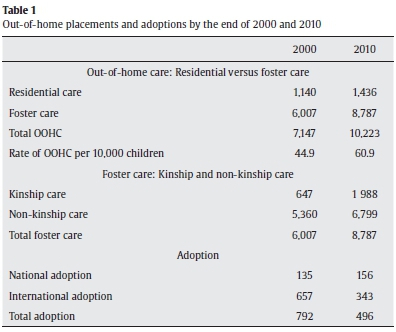
On December 31st 2011, 38,025 children and young people received some kind of child welfare measure. Table 1 shows the number of out-of-home placements and adoptions by the end of the year in 2000 and 2010 respectively.
]]>
The results show the shift from residential care to foster care. While the number of children in residential care increased by 25.9 per cent from 2000 to 2011, the number of children in foster care increased by 46.2 per cent.
In addition, we see that the number of international adoptions decreased by almost 50 per cent, while the number of national adoptions increased by 15 per cent. Of the national adoptions, almost all are by stepparents, while less than ten adoptions per year are effected as a child welfare measure. Although the legal possibility of adoption against the will of the parents has been present since the Child Welfare Law of 1953, the option is very rarely used.
Any out-of-home placement is supposed to be short-term, as the overall goal is reunification. However, and perhaps because preventive measures are tried for a long time in Norway before a child or young person is placed, foster care tends to be long-term once it happens. The Child Welfare Services are supposed to formulate a care plan within the first two years after placement, and it is possible to state here that a child is supposed to grow up in foster care. However, there is no provision of guardianship or transferal of custody in the Norwegian legislation, thus the inherent insecurity in the system will follow the child. Sometimes this precipitates unintended moves, particularly if the parents are very set against a placement and use every opportunity to appeal the decision to place their child.
Table 2 shows reasons for child welfare measures in 2000 and 2010. It must be noted that there may be more than one reason given, thus the number of reasons exceeds that of the number of children. Also these are reasons regardless of which measure was affected, whether preventive services or out-of-home care. Thus, it is not possible to analyze variations in reasons in relation to different types of measures based on the publicly accessible statistics alone.
]]>
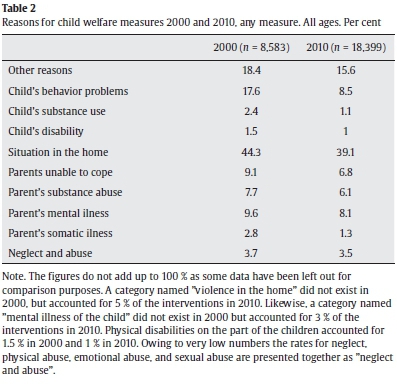
Table 2 shows that by far the most common reason for effecting child welfare measures both in 2000 and 2010 was the category called "situation in the home". However, this is a general category and it is difficult to know what it actually encompasses. In addition, we see that the categories specifying problems the parents have amounted to 29.2 per cent in 2000 and 22.3 per cent in 2010, 27.3 per cent if we add the five per cent attributed to violence in the home mentioned in the footnote. The rate of neglect and abuse as reasons for interventions was very low both of the years, and has, indeed, been low since these categories were introduced to the statistics. We do not know, however, how much abuse and neglect is hidden in the general category of "situation in the home".
The greatest change from 2000 to 2010 took place in the category "the child's behaviour problems", which was halved. The focus on behaviour problems was very strong from the last half of the 1990s. A policy interest in reducing prevalence motivated the introduction of new types of evidence-based interventions with parents and children as well as being an important premise for a major reorganization of the Child Welfare Services in 2004 (Backe-Hansen, Bakketeig, Gautun, & Backer-Grønningsæter, 2011). The reduction in behaviour problems as a reason for effecting child welfare interventions cannot necessarily be attributed to these initiatives, however. Actually, evidence-based programs aimed at reducing behaviour problems are offered as child welfare interventions. Nor can we presuppose that the prevalence of behaviour problems has been this drastically reduced during the last decade. Thus, how reasons for interventions are categorized will probably vary according to political focus, what is seen as expedient by the child welfare workers who transmit the data to Statistics Norway, lack of precise instructions from Statistics Norway, etc.
The shifting role of behaviour problems as a reason for interventions is also illustrated by some distributions of age and reasons for intervention, this time from 2010. During this year 6,116 new adolescents ("new" means not in the register the previous year; they might have received services during earlier years, however) aged 13-17 received child welfare measures. Not more than one in six did so because of their behavioural problems and not more than one in four did so if we add criminal acts and mental health problems on the part of the young person as well. Thus, three fourths of the measures for new adolescents during 2010 had other reasons than characteristics of the young person him or herself, even though one would expect a particularly high rate for this age group. Consequently, in analyzing child welfare clients and their problems it is important not to forget that young people may need help from the child welfare services for a host of other reasons than their own undesirable behaviour.
In table 3 we present data about age at admission to emergency foster care, foster care and residential care in 2000 and 2010.
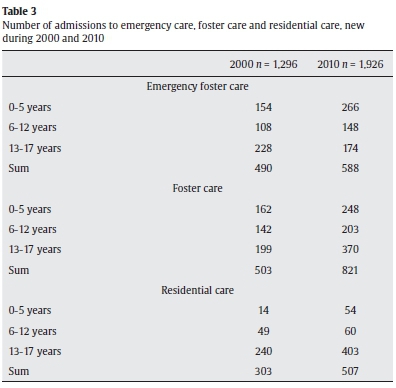
]]> First, the table shows that there has been a relative change in the use of these three measures from 2000 to 2010. The use of emergency foster care was reduced from 37.8 to 30.5 per cent of this total, leading to a correspondingly increased use of foster care and residential care.
The number of children between 0 and 5 who are placed outside their home has increased during the last decade as table 2 also shows (Clausen & Valset, 2012). When all three placement types are added together, the rate of 0-5 year olds was one in four in 2000 and one in three in 2010. However, emergency foster care placement is an emergency measure, and a majority of the children go back to their families after a while (Havik, Hjelmås, Johansson, & Jakobsen, 2012). If we just look at new placements in foster care and residential care we see that the rates for children between 0 and 5 years were very slightly reduced over time, from 21.8 per cent in 2000 to 20.3 per cent in 2010. Although there is agreement across professions that early intervention is important, it is difficult to argue that this insight has markedly influenced child protection practices in Norway when it comes to out-of-home placement.
The rate of children and young people with immigrant backgrounds who are placed in residential or foster care is increasing. In 2010 one in three in residential care came from other countries, mostly from Africa or Asia. Special residential homes for young unaccompanied asylum seekers aged 15 or younger are not included here (Backe-Hansen et al., 2011). During the same year, one in four foster children had immigrant backgrounds, an increase from 14 per cent in 1995 (Clausen, personal communication). Immigrant children or children born in Norway with two immigrant parents are over-represented in the child welfare services whether we look at preventive services or out-of-home care, however (Kalve & Dyrhaug, 2011).
Young, unaccompanied asylum seekers
In 2011, 858 young people arrived in Norway to seek asylum and in 2012 the number had increased to 964, a small number compared to Sweden. The majority come from Afghanistan and Somalia (DOI, 2013). The state is responsible for dealing with the asylum-seeking process, but the care of the young people depends on their age. Those who are 15 years old or younger become part of the child welfare system and are placed in special reception centres while their application to stay in Norway is being assessed. Those between 16 and 18 are taken care of by the general system for asylum seekers. This first entails being placed in a reception centre. If the application for asylum is successful, the young person is then placed in a municipality, which agrees to receive him or her. From then on, the municipality is responsible for the young person.
Main trends in Norwegian Child Welfare services during the last 10-15 years can be summed up as follows:
An increased focus on preventive services in the family as opposed to out-of-home placements. Although eight out of ten children and young people received preventive services during the 1990s, now the rate has increased and is around 84 per cent. Consequently, the issue of too much focus on the parents' interests has been raised as well.
The tendency in Norway has been towards increased focus on children and young people's participation rights since the UN Convention of the Rights of the Child was ratified by Norway in 1991 and incorporated into Norwegian legislation in 2003. An imminent change in the child welfare legislation, expected to come into effect in 2013, will further increase these rights. Although foster care has been the preferred option since the World War II, the drive has been towards increased use of foster care during the last 10-15 years. There is an increase in the use of kinship placement, but the main increase has taken place in the professionalization of foster care, that is, the use of foster homes that are paid wages and given extra supervision to take care of children and young people with special needs.
Children and young people with immigrant backgrounds are over-represented in the child welfare system, whether we look at preventive services or out-of-home care. However, we know very little about how to design good services for these groups or of possible differential effects of the services.
The focus has increased on evidence-based programs addressing behaviour problems in children and particularly young people from the last half of the 1990s, but the intensity of the focus seems to have decreased lately. More generally, several evidence-based programs have been introduced to child welfare during the last decade or so, but quite a lot of skepticism exists towards these programs as a sole remedy. Now one rather prefers to talk about evidence-informed programs and practices.
Research review
Reviews of research from Norway shows that both children and young people in foster care and in residential care may have severe emotional, mental and cognitive problems (Backe-Hansen, Egelund, & Havik, 2010; Backe-Hansen et al., 2011). These children mainly come from one-parent families, mostly female-headed. The families are clearly marginalized in society, characterized by several risk factors. Often the parents have themselves had care experiences while growing up.
In Norway, foster care has been the primary choice when children and young people are placed outside their homes ever since the Child Welfare Act of 1953, and slightly more than eight out of ten in care are fostered. There is, however, a clear age difference. While slightly below half of those in foster care are 12 years old or younger, 90 per cent of those in residential care are 13 years or older. In addition, significantly more teenagers with behaviour or drug problems are in residential care and not fostered (Backe-Hansen et al. 2011). When children are placed, the reasons for placement usually involve the parents (quality of care, misuse of drugs and alcohol, poor mental health). On the other hand, the problems of the young person him/herself are significantly more prominent reasons for placement of teenagers (deviant behaviour, misuse of drugs and alcohol, poor mental health, school dropout, crime), but far from the only reasons as shown above.
During the last decade, policy makers have argued for further reduction of the use of residential care in Norway. The reasons for this are mixed. One is something that has also been identified in research, namely, that young people with deviant behaviour continue to show this type of behaviour after they move out of care (Andreassen, 2003). Residential care is purported to bring them in contact with other young people with problems, rather than help them to overcome their problems (the so-called "contamination effect"). Another reason is that national authorities strongly argue for a family-based practice, on more value-based grounds. Third, the rising costs of residential care are important as well. These factors have resulted in a change in the state guidelines, underlining the focus on preventative work if possible. Also, the use of foster care even for young people has increased. This has again resulted in the shutting down of several residential units. As shown by Backe-Hansen et al. (2011), residential care has been seen as a last resort. This has led to a situation where staff often has felt left alone, without a strong bid for developing the potential of residential care.
Norwegian residential units are often quite small, often with only 5-6 young people living together. They are staffed with trained professionals, often more than one adult per young person.
Backe-Hansen et al. (2010) recommend that further research on foster care should include the social background of children in foster care, their education. They also claim that it is necessary to focus on foster children with a minority background, on effects of foster care, on kinship care, on foster children's physical and mental health, on contact with birth parents, on stability, on transition to adulthood, on recruiting foster parents and matching and supervision, and to find out more about foster children`s view on the placements. As well it is necessary to find out more about selection to foster care and how variations affect how children and young people experience different aspects of foster care.
]]> Norwegian legislation opens up for adoption as a child welfare measure, although this is only done in extremely rare cases. Young, Eide, and Fransson (2013) point this out as a paradox, since there is ample evidence that adopted children usually do better than children in foster care or residential care. In Norway, most children and young people who are placed outside their homes go into foster care, which is seen as the most desirable alternative. During the last twenty-five years the number of foster children has been tripled, from less than four thousand during 1987 to almost twelve thousand during 2012 (SSB, 2012). This increase has come as part of the move away from residential care towards an increased use of foster care which was mentioned above, partly for professional reasons and partly for economic reasons (Backe-Hansen et al., 2011).Although the rate of children and young people with immigrant backgrounds are over-represented within foster care and residential care, very little research has been done on their situation more specifically. We know more about unaccompanied young asylum seekers, though not from a child welfare and well-being perspective. Nor do we know much about their needs for mental health measures. Rather, focus has so far been more on legal and administrative issues connected with this group. When they are between 13 years of age, unaccompanied minors will be cared for in special receiving centres under the auspices of the Child Welfare Authorities. Those between 16 and 18 years of age will be placed in ordinary reception centres. Several researchers have expressed worry about the living conditions of unaccompanied asylum seekers for many years, and now a research project has been commissioned with the aim of developing tools which can be used to monitor this regularly. In addition, a study has been commissioned to find out what kind of mental health services this group is offered and how to develop timely and efficient services.
Aftercare services
Norwegian child welfare has a long history of aftercare services. It dates back to the legislation of 1896, but was not put into a system until 1953. In the following years, it was taken out of the legislation, and then put back in again (Storø, 2009). In recent years, researchers have taken more interest in this issue and researched different aspects of it (Bakketeig & Backe-Hansen, 2008; Kristofersen 2009). This has brought a clearer focus on the transition from care to adulthood. From this research we know that child welfare services say they offer aftercare services, that these often last less than one year, that they make a difference to the young people who receive them, and that the adult life of care leavers is difficult.
According to the current law, the child welfare services have a responsibility for children and young people who are placed outside their homes and for after care services when young people leave care. There is a duty to ask the young person if he/she needs services after 18. If they agree, a plan for such services should be written. The services can last up to 23 years of age. If the child welfare service decides not to give services to a young person after he/she turns 18, it is mandatory for the services to give the grounds for the decision. The legislation underlines that the decision not to offer after care services should be taken in the best interest of the child/young person. The young person can then appeal the decision to the County Governor. Even with this system, it is reported that a number of young people do not receive satisfactory after care services. There is no research available giving the full picture of this situation (Storø, 2012).
Sweden
Child protection framework in Sweden
Ellen Key, who was a Swedish child activist, wrote a famous book with the title The century of the child, during early 1900. A new middle class had started to grow in the cities and they discussed Ellen Key's ideas about how to bring up and educate children in new and modern ways. This discussion brought about a new interest in children, their education and their upbringing. The state was criticized for not paying enough attention to children placed in foster care. Thus, the first law which regulated foster care was passed in 1902. The same year, another law was passed as well, which regulated what means should be used towards children and young people with criminal and/or "immoral" behaviour. In Sweden, the first legislation addressing protection of children came in 1902, and was a copy of the earlier child protection law in Norway from 1896.
In 1924, the next law was instituted. This was the first law giving the authorities the means of taking children into custody, against the will of their parents. Child welfare legislation aimed to save young people from assumed future criminality. The responsibility for administration and enforcement was given to special child welfare committees in the local communities and not, as in other countries, to special family or youth courts (Lundström, 1993).
]]> When the next law was instituted, in 1960, Swedish society had gone through great changes. The economic situation was fairly stable, and the area of child welfare was much more populated with professional social workers than it was in 1924. The child welfare law of 1960 focused more on means of assessment and administrative procedures than its predecessor did. Still, all these laws were based on the notion that it is possible to predict the future of children by looking at the conduct of their parents, and the circumstances under which children are brought up. Children with parents who were drug or alcohol abusers or had mental disturbances were expected to develop similar problems as their parents, and thus end up as dysfunctional adults (Lundström, 1993).This notion was questioned in the next law, which was instituted in 1980. This law is still in use, although with some changes. What makes this law different from the other three was that legislators were no longer as convinced as before of the absolute connection between a "problematic childhood" -hereby mainly referring to parents who are drug or alcohol abusers, or/and parents with psychical disturbances- and poor future prospects for the child (Lundström, 1993).
This new legislation was an important step towards a broader and more integrative approach towards child welfare both in policy and practices. The law attempted to move from a residual system with a high degree of control to a child welfare services system aiming to meet the needs of families on a voluntary basis. This law has been amended several times but until today the general aims and principals from the legislation of 1982 are still in force (Andresen, 2011).
The Swedish welfare system is often defined in terms of a family service orientation system with elements of a child protection system (Gilbert, 1997). The characteristic of the family service orientation is that the focus of interest is on the needs of children and families. Also the investigation process is aiming at assessing the needs of the family. Another important principle which is stated in the act, and which is also typical of the family orientation system, is that the local social service agency should work in partnership with families to support children's personal and psychosocial development. The element of child protection is visible through the principle that the social services also should monitor families and children who show signs of different risk behaviour and unfavourable development.
As a consequence of not having a separated juvenile delinquency system in Sweden, the police are the main source of mandated reports to the social services. But also staff in schools and in child care gives mandated reports to the social services. The mandatory reporting system includes not only a wide range of authorities working with children but also the public.
The Swedish child welfare protection system is administrated by the local social service agencies in the different municipalities. There are 290 municipalities in Sweden. Many of them are small: for example 20 municipalities have less than 8 inhabitants per square km. Swedish municipalities operate with a high level of self-government and as long as they keep up the basic standard, the services can differ from one municipality to the other. Every municipality has an elected council of politicians which delegate most decisions to the civil servants but they also take decisions in both individual cases and in a wide range of other subjects from voluntary interventions to coercive decisions concerning children taken into care before these cases are sent to court for a judicial review (Gilbert, Parton, & Skivenes, 2011).
Most children who come into contact with social services because of the need of support and/or protection will probably receive some kind of non-institutional care, which means that they receive care while still living at home with their families. This type of care can consist of many different types of interventions but the most common one is to get support from a contact person or a contact family. There is an evident tendency that non-institutional care is increasing. But the trend is not that non-institutional care is compensating for out-of-home care, rather both of these forms of care are increasing (Sjöblom & Wiklund, 2012).
When a child or a young person is taken into care it means going to a foster home or to residential care. For centuries, foster care has been the preferred alternative as opposed to residential care, and about 75 per cent of children in out-of-home care are placed in foster families. Teen-agers are to a larger extent placed in residential care or in special residential homes for young people that have committed crimes or have serious psychosocial problems.
Out-of-home care is supposed to be a temporary solution, and one important principle of a placement is to work towards reunifying the child or young person with the birth family. The law explicitly emphasizes the importance of maintained contact between children and their biological network -parents and relatives. There is no time limit for the rehabilitation of parents, and it's not possible to adopt children without consent from the birth parents. A great majority of birth parents keep their legal custody of children throughout a placement in foster care, even if the placement lasts until the child ages out of care (Höjer, Sallnäs, & Sjöblom, 2012).
Leaving care in Sweden is stipulated by law at the age of 18 (or 21 in cases of mandatory care orders). Young people often remain in care until they have completed their upper secondary school education, which usually does not happen until the young person has reached the age of 19. Few young people under the age of 18 move from care to independent living. When young people under 18 leave care, they are much more likely to return to their parents or to commence a new placement (Socialstyrelsen, 2006).
]]> Sweden does not have any legislation or statutory requirements that specifically regulate the transition from care to independent life. Swedish social workers work with young care leavers on an individual basis. Due in part to the lack of regulations and in part to the jointly elaborated strategies for working with this group, the support and assistance that young care leavers receive from social services can vary significantly, often depending on local policies.The family-centred approach in child welfare is today completed with a strong child-centred approach. This is a process that started in the beginning of 1989 when Sweden ratified the UN Convention on the Rights of the Child as one of the first countries. Since then the child-centered approach has influenced both policy, legislation, and practices in child welfare.
Child care numbers
In the beginning of January 2013, Sweden had 9,555,893 inhabitants, whereof 1,928,121 were 0-17 years of age. The birth rate was 1.91 in 2012 (Statistics Sweden, 2013)
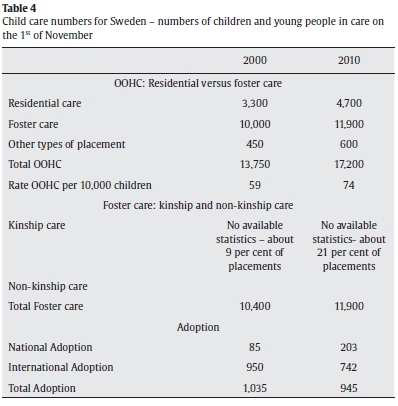
On the 1st of November 2011, 18,400 children were placed in outof-home care, 13,200 were placed in care on a voluntary basis, 4,900 were in care on mandatory measures, and 300 were placed in emergency care; 12,900 of those placed in care on the 1st of November 2011 were 13-20 years old. Foster care is the most preferred type of out-of-home placement: 72 per cent of those placed on voluntary measures were placed in foster care. The corresponding figure for those placed on mandatory measures were 67 per cent.
About 28,300 children and young people received non-institutional measures during 2011. Such measures consist of the following categories: Structured non-institutional care programmes (about 10,000), personal support (about 24,600) and contact person/ family (about 20,000).
Before 1999, kinship placements were not so common in Sweden. Although maybe not present in all municipalities, there was a general notion that kinship placements were problematic, and should be avoided. In 1999 there was an amendment in the law, were the legislators stated that social workers always had to investigate the child's own network -which included both relatives (grandparents, aunts, uncles) and others who may be close to the child (like teachers, neighbours, child minders). In the statistic collected by the National Board of Health and Welfare it is not possible to see if the child is placed with a relative or with other members of the network, as such placements are denominated "network placements". After this amendment in the law there was a gradual increase of "network placement", which is shown in the table below.
Unaccompanied asylum seeking young people
Sweden is the country in Europe which receives the highest number of unaccompanied asylum seeking young people. In 2011, 2,657 young people arrived in Sweden to seek asylum, and 2012 the number had increased to 3,578 young people. The majority of this group are boys and young men 16-17 years old, mainly from Afghanistan, Somalia, Eritrea, and Iraq (Socialstyrelsen, 2013b). The state is responsible for the asylum process and for finding the young person a place to live, which usually means a placement in residential care. One of the reasons for the increase of young people placed in residential care is the high number of unaccompanied young people seeking asylum in Sweden.
There is very little information to be found concerning the way in which the young asylum seeking young people reach Sweden. Some of them have been in transition from other countries, where they first arrived, and they have reached Sweden in different ways. Most children and young people have been brought to Sweden by smugglers, who previously have been unknown to them, and who have been paid to bring them to Sweden. Children and young people were often threatened by the smugglers and told not to reveal any information about them (Hessle, 2009). In a report from UNHCR (2010) it is also made clear that children and young people often are exposed to risks, abuse and trauma during their -often very long- journey to Europe.
Adoption and transferal of custody
Unlike the situation in some other countries, such as the UK, the US and Norway, adoption without birth parent's consent is not possible in Sweden. As described above, there is a strong family oriented perspective in Swedish social work with children and families. Accordingly, the aim of a placement in care is for the child to be reunited with parents as soon as possible, and for parents to receive support to improve their parental capacities. Although experiences from practice shows that parent's rehabilitation from drug/alcohol abuse and/or mental problems may take a long time and the child will stay in care several years, and sometimes reunification will not be possible at all, parents will keep their legal custody of the child, and the child will not be available for adoption without the parent's consent.
The concept of adoption in Swedish child welfare has been discussed and debated during recent years. It has been suggested that the possibility of adopting children placed in foster care would enhance permanency and give children in care "a family for life", and thereby also give them better future prospects. During the year of 2011, 22 children and young people were adopted by their foster carers, compared to 42 during the year of 2000 (Socialstyrelsen, 2013a).
In Sweden, it has since 1983 been possible to transfer custody from birth parents to foster carers, or to a legal guardian, as a measure to enhance stability for children in care. However, this measure was seldom used. In 2003 there was an amendment in the Social Service Act (chapter 6, 8th paragraph), and the Care of Young People Act (paragraph 13), where it is stated that the Social Services committee shall consider the possibility of transferal of custody when the child has been placed in the same foster home for more than three years. In 2003, 64 transferals were performed in 37 municipalities, in 2005 the number of transferals was 125 in 56 municipalities, and in 2011 it had further increased to 213.
This possibility has existed for ten years, but foster carers and social workers are still somewhat reluctant to perform transferals of custody. Foster carers can keep their foster care allowance when the take on the custody of a child but, according to a study from 2006, some carers were afraid that social services would change the amount of the allowance. Furthermore, foster carers will not have access to support from the foster care social workers, since the child is no longer in care after the transferal of custody has been performed. This might be a reason for their reluctance. Foster carers were also afraid that a transferal of custody would have a detrimental effect on their relationship with the child's birth parents (Socialstyrelsen, 2006). Thus, this attempt to guarantee stability for children placed in long-term foster care still needs to be evaluated. More research is needed to find out about the effect of transferals of custody.
Research review
]]> Research shows that the number of children and young people who have come in contact with the child welfare system has increased during the last two decades, both regarding non-institutional interventions and out-of-home care placements in residential units and in foster homes (National Board of Health, 2011). On one hand, this development might be explained by cuts in the general welfare system. On the other hand, another possible explanation is a change in attitudes which manifests itself in an increased willingness to report what are understood as social problems. This change is possibly due to an increased sensitivity to children's suffering in general in society (Bäck-Wiklund & Lundström, 2009). The majority of children which are reported to the social services agencies are teenagers who either have a problematic school situation and/or have issues of criminality (Höjer et al., 2012). Another reason for the increase of placements in care is the high number of unaccompanied asylum seeking young people coming to Sweden.Swedish research also shows that young people who have been placed in out-of-home care have increased risks in many different areas of life when they are adults. They have an elevated risk of early mortality, a higher incidence of mental health related problems, they are more prone to commit suicide, they have lower educational attainment and, for girls, an increased risk of teenage pregnancy (Franzén & Vinnerljung, 2006; Vinnerljung, Hjern, & Lindblad, 2005; Vinnerljung, Ömar, & Gunnarsson, 2005).
The parents of young people who have been placed in institutional care have often experienced difficult life situations (Hessle, 1988; Socialstyrelsen, 2006), which may result in a decreased capacity to provide support to their children. Contact between children in care and their parents also tend to decrease in frequency the longer children remain in care (Biehal & Wade, 1996; Höjer 2001). According to Franzén and Vinnerljung (2006), there is also an elevated risk for young care leavers to have lost at least one parent before 18 years of age.
However, at the same time, young people in care may not succeed in sustaining a continued relationship with foster carers or residential staff at the end of a placement (Andersson, 2005; Vinnerljung, 1996). Thus, when young people leave care, they may find themselves without access to support either from parents, or from former carers.
Important supportive factors during and after a placement in outof-home care are access to close and trusting relationships, a "secure base" and a sense of belonging (Andersson, 2005).
Research on leaving care in Sweden tells us that young people who leave care need support in many different ways in their transition towards independency and adulthood. At this point, they lack both practical and emotional support after leaving care. They can neither rely on support from their birth family or from the child welfare system. This makes them vulnerable in a twofold sense, as they both lack support from their family of origin as well as from the child protection system (Höjer & Sjöblom, 2010).
This fairly dark picture that Swedish research reveals about outcomes for out-of-home care can be partly contrasted with results from a qualitative longitudinal research study with a similar population which involved 26 individuals (Andersson, 2009). This research reveals a much more complex picture. Also, it points out how outcomes can differ for different groups. For instance, girls who are placed in foster care are doing much better as adults than boys with conduct disorders who have been placed in residential care. In the study, 20 of the 26 young people are satisfied with the experience of being placed in a foster home as adults. When looking back they could say that the decision to place them in a foster family was a good decision, and most of them had a lot of positive experiences from their time in care. Half of them still had contact with their foster parents. Throughout the placement they had kept up the contact with their birth family, but many of the parents still had a lot of psychosocial problems. One way of dealing with this was for the informants to distance themselves from their birth parents (Andersson, 2009).
One important conclusion from this research is the need of support for this group over a prolonged period of time after leaving placement. This is also something which has been pointed out by informants in Swedish leaving care studies (Höjer & Sjöblom, 2010).
Conclusions
]]> The Nordic model of the welfare state, also known as the social democratic model, has a solid basis in the Norwegian and in the Swedish societies. The systems for taking care of children at risk and in need are integrated parts of this. Even if we can point to similarities, it is also possible to find differences. Here we will address some issues of special interest.The use of out-of-home care
Out-of-home care is used within child welfare services both in Norway and Sweden, but to varying extent and in somewhat different ways. Sweden uses out-of-home care to a larger extent than Norway. This has been the case for many years. In addition, the child welfare population is younger in Norway than in Sweden, particularly among those in foster care.
Aftercare services
Norway and Sweden differ in the question of aftercare services. While Norway has quite good legislation on this area (even if many stakeholders do not feel it covers the young people's needs well enough), Sweden has no such legislation. Comparing the two countries in this matter is interesting, because one can assume that young people in care in the two countries by and large have relatively comparable experiences before coming into care (given the many similarities between the two societies), that their experiences while in care do not differ too much, and that they face more or less the same situation in the transition to adulthood. The difference in service level must then be ascribed to other conditions. It is reasonable to point to how the practical traditions have developed differently in the two countries. In Norway child welfare service is organized in an independent body, while it is part of the general social services in Sweden. It is reasonable to expect more targeted after-care services in Norway, but we do not know whether or to what extent this actually leads to significantly better outcomes for young people leaving care. This will depend on the quality of general services offered to care leavers.
Another angle to the development of targeted services can be discussed in the light of how special groups live and what conditions they live under. It is notable that youth unemployment for the time being is far higher in Sweden (23.3%) than in Norway (8.5%) (European Commission, 2012). Research has revealed that young people with a care experience face special challenges in the labour market (Kristofersen, 2009; Stein, 2012). It might therefore be expected that the high rate of youth unemployment in Sweden could be met with intensified measures for care leavers as a known vulnerable group, like prioritizing their educational attainments. The fact that Sweden does not have this type of services indicates that the relatively small group of care leavers may "disappear" in a welfare system based on universalistic distribution of services.
Young unaccompanied asylum seekers
Young unaccompanied asylum seekers have come to both Norway and Sweden during the last decade, although to a significantly greater degree to Sweden than to Norway. This is probably due to more inclusive immigrant policies in Sweden. Young people from Afghanistan and Somalia dominate in both countries, however.
Privatization
During the last decades there have been fundamental changes in Swedish welfare policies, including a shift from a general welfare state financed by taxes to a decreased welfare state with high level of privatization and market oriented policy. These changes toward a less general welfare system could be one explanation of the increasing number of children and youth entering the child welfare system in Sweden. The change has not been as marked in Norway, although the trend has been in the same direction as in Sweden. However, it is difficult to explain the significant increase of the numbers of children and young people receiving child welfare measures in Norway by a decrease in other welfare services. Rather, explanations based on analyses of the helping services' relationships with each other are called for, in addition to effects of the changed policy intended by the Act which was passed in 1992.
]]> Challenges concerning out-of-home care in the Nordic modelWhich welfare model to choose is open for discussion. Wilkerson and Pickett (2009) argue that societies building on equality are good for most inhabitants. The Nordic countries are often pointed to in order to exemplify this.
Even so, it is interesting to discuss a certain issue in light of the Nordic model, namely, how much and in what ways the state should intervene, or should be expected to intervene, in the lives of marginalized groups. Should the state bring in targeted measures within a model building on a universalistic approach? Such a model contains an interesting paradox: The universalistic condition serves to secure all citizens with general measures but also runs the risk of overlooking certain small groups with special needs. A generalist model thus needs to be supplemented by targeted services, which we see in both Sweden and Norway. One problem is that the universalistic state may not have good enough control mechanisms to identify such groups and such problems. In addition, even if they are identified, the system may still lack the targeted measures necessary. On the other hand, targeted measures seem to function best if they are offered within a context of generalist services.
In both countries it seems as if there still is a tension between child welfare services as a general and a residual service, although the way this tension plays itself out has changed during the last couple of decades. In one sense, the child welfare services must be a residual service in that the most marginalized groups are specifically targeted. This ought perhaps to imply that fewer children and young people receive child welfare services, while more are diverted to general services for children and families. In other words, one might argue that the welfare aspects of the child welfare system (Kojan, 2011) is redefined as the responsibility of other services. However, if there are cut-downs and capacity problems in these services, it might be better to remain a responsibility of the child welfare services. On the other hand, this may lead to poorer services for the most marginalized children and families, as they require more intensive, long-term and resource-demanding interventions. These issues are unresolved at present, and clarification of them would require more research.
Conflicts of interest
The authors of this article declare no conflicts of interest.
References
Andersson, G. (2005). Family relations, adjustment and well-being in a longitudinal study of children in care. Child and Family Social Work, 10, 43-56. [ Links ]
Andersson, G. (2009). Adoption som barnavårdsinsats. Bilaga till betänkandet; Lag om stöd och skydd för barn och unga (LBU) [Adoption as child welfare measure. [ Links ] Attacchment to judgement; Law on support and protection for children and young people]. Stockholm: Statens offentliga utredningar.
Andersson, G. & Sallnäs, M. (2012). Social barnavård och barns utsatthet [Child welfare and children at risk]. In I. Höjer, M. Sallnäs, & Y. Sjöblom (red.), När samhället träder in. Barn, föräldrar och social barnavård [When society intervenes. [ Links ] Children, parents and child welfare]. Lund: Studentlitteratur.
Andreassen, T. (2003). Behandling av ungdom i institusjoner - hva sier forskningen? [Treatment of young people in residential care - what is the message from research?]. [ Links ] Oslo: Kommuneforlaget.
Backe-Hansen, E., Bakketeig, E., Gautun, H., & BackerGrønningsæter, A. (2011). Institusjonsplassering- siste utvei? [Placement in residential care - a last resort] (Report no. [ Links ] 21/2011). Oslo: NOVA.
Backe-Hansen, E., Egelund, T., & Havik, T. (2010). Barn og unge i fosterhjem - en kunnskapstatus (Children and young people in foster care - a knowledge status). Oslo: NOVA. [ Links ]
Bakketeig, E., & Backe-Hansen, E. (Eds.) (2008). Forskingskunnskap om ettervern [Research knowledge on aftercare] (Report no. [ Links ] 17/08). Oslo: Nova.
Biehal, N., & Wade, J. (1996). Looking Back, Looking Forward: Care Leavers, Families and Change. Children and Youth Services Review, 18, 425-445. [ Links ]
Clausen, S.-E. & Valset, K. (2012). Spedbarn og småbarn med tiltak fra barnevernet 1995-2008: Utbredelse av omsorgssvikt og risikofaktorer [Infants and little children with measures from child welfare 1995 - 2008: Distribution of neglect and risk factors]. Tidsskrift for Norsk Psykologforening, 49, 642-648.
DOI (2013). Directorate of Immigration. http://www.udi.no [ Links ]
Esping-Andersen, G. (2006). Three Worlds of Welfare Capitalism. In C. Pierson & F. G. Castles (Eds.), The Welfare State Reader (2 Ed.). Cambridge: Polity Press. [ Links ]
European commission (2012). Eurostat. [ Links ]
Fauske, H., Lichtwark, W., Marthinsen, E., Willumsen, E., Clifford, G., & Kojan, B. H. (2009). Barnevernet på ny kurs? Det nye barnevernet-et-forsknings og utviklingsprosjekt i barnevernet [Child welfare on a new path? The new child welfare - a research-and-development project on child welfare] (NF-repport no. [ Links ] 8/2009). Bodø: Nordlandsforskning.
Franzén, E., & Vinnerljung, B. (2006). Foster children as young adults: many motherless, fatherless or orphans. A Swedish national cohort study. Child and Family Social Work, 3, 254-263. [ Links ]
Gilbert, N. (Ed.) (1997). Combatting child abuse: International perspectives and trends. New York: Oxford University Press. [ Links ]
Gilbert, N., Parton, N., & Skivenes, M. (2011). Introduction. In N. Gilbert, N. Parton, & M. Skivenes (Eds.), Child Protection Systems. International Trends and Orientations. New York: Oxford University Press. [ Links ]
Grinde, T. V. (2003). Nordisk barnevern: Likheter i lovgivning - forskjeller i praksis. Om kultur, normer og holdninger [Nordic child welfare: similarities in legislation - differences in practice. [ Links ] On culture, norms and attitudes] (Skriftserie 2/03). Oslo: NOVA.
Hagen, Gerd (2001). Barnevernets historie - om avmakt og makt i det 20. Århundret [History of child welfare - on powerlessness and power in the 20. [ Links ] Century]. Oslo: Akribe forlag.
Hartman, L. (Ed.) (2011). Konkurrensens konsekvenser. Vad händer med svensk välfärd? [Consequences of Competition. [ Links ] What is happening to Swedish Welfare?]. Stockholm: SNS förlag.
Havik, T., Hjelmås, M., Johansson, M. J., & Jakobsen, R. (2012). Plasseringer i beredskapshjem. Hvor lenge varer de og hvorfor? [Placements in emergency shelter homes. How long do they last and why?]. Tidsskriftet Norges barnevern, 4, 250-266.
Hessle, S. (1988). Familjer i sönderfall [Disintegrated families]. [ Links ] Göteborg: Norstedts.
Hessle, M. (2009). Ensamkommande men inte ensamma [Unaccompanied but not lonely (Dissertation). [ Links ] University of Stockholm.
]]>Höjer, I. (2001). Fosterfamiljens inre liv [The inner life of the foster family] (Dissertation). [ Links ] University of Gothenburg. Department of Social Work.
Højer, I. (2008). Sweden. In M. Stein & E. R. Munro (Eds.), Transitions from care to adulthood. International Research and Practice. London: Jessica Kingsley Publishers. [ Links ]
Höjer, I., & Sjöblom, Y. (2010). Young People Leaving Care in Sweden. Child and Family Social Work, 15, 118-127. [ Links ]
Höjer, I., Sallnäs, M., & Sjöblom, Y. (red.) (2012). När samhället träder in. Barn, föräldrar och social barnavård [When society intervenes. [ Links ] Children, parents and child welfare]. Lund: Studentlitteratur.
Kalve, T., & Dyrhaug, T. (2011). Barn og unge med innvandrerbakgrunn i Norge 2009 [Children and young people with immigrant background in Norway 2009] (Statistisk sentralbyrå [ Links ]. Rapport 2011/39.) Oslo: Kongsvinger.
]]>Kojan, B. H. (2011). Klasseblikk på et barnevern i vekst [A class view on a child welfare in growth] (Dissertation, [ Links ] PhD 2011, 134). NTNU. Trondheim.
Kristofersen, L. (2009). Barnevern og ettervern. Hjelpetiltak for 16 -22 åringer og levekår for unge voksne [Child welfare and aftercare. [ Links ] Support measures for 16-22 year olds and living conditions for young adults] (Nova-rapport 10/09). Oslo: NOVA.
Kvist, J., Fritzell, J., Hvinden, B., & Kangas, O. (Eds.) (2009). Changing social equality. The Nordic welfare model in the 21st century. Bristol: Policy Press. [ Links ]
Lundström, T. (1993) Tvångsomhändertagande av barn: en studie av lagarna, professionerna och praktiken under 1900-talet. Stockholms universitet, Socialhögskolan. Stockholm. [ Links ]
Lundström, T., & Sallnäs, M. (2003). Klass, kön och etnicitet i den sociala barnavården [Class, Gender and Ethnicity in Child Welfare]. Socialvetenskaplig tidskrift, 10(2-3), 192-213.
National Board of Health and Welfare (2011). Insatser för barn och unga 2010 [Interventions for Children and Youth 2010]. [ Links ] Stockholm: National Board of Health and Welfare (Socialstyrelsen).
Qvortrup, J. (2008). Childhood in the Welfare State. in A. James & A. L. James, European Childhoods: Culture, Politics and Childhoods in Europe. Basingstoke: Palgrave Macmillan. [ Links ]
Salonen, T. (2001). Sweden: Between Model and Reality. In P. Alcock & G. Craig (Eds.), International Social Policy (pp. 143-160). Basingstoke: Palgrave Macmillan. [ Links ]
Sjöblom, Y., & Wiklund, S. (2012). Öppenvård [Non-institutional measures]. In I. Höjer, M. Sallnäs, & Y. Sjöblom (red.) (2012), När samhället träder in. Barn, föräldrar och social barnavård [When society intervenes. Children, parents and child welfare]. Lund: Studentlitteratur.
Skivenes, M. (2011). Norway: Toward a child-centric perspective. In N. Gilbert, N. Parton, & M. Skivenes (Eds.), Child Protection Systems. International Trends and Orientations. New York: Oxford University Press. [ Links ]
Socialstyrelsen (2006). Vårdnadsöverflyttningar för barn placerade i familjehem - Uppföljning av lagändring enligt proposition 2002/03:53 - Stärkt skydd till barn i utsatta situationer [Care transferals for children placed in family homes - follow-up of change in legislation according to parliamentary bill 2002/03:53 - Strong protection for children in risk situations]. Stockholm: Socialstyrelsen.
Socialstyrelsen (2013a). Barns och ungas hälsa, vård och omsorg 2013 [Health, [ Links ] treatment and care for children and young people] (Artikelnummer 2013-3-15). Stockholm: Socialstyrelsen.
Socialstyrelsen (2013b). Socialtjänstens arbete med ensamkommande barn och ungdomar [Social service's work unaccompanied children and young people] (Artikelnummer 2013-5-2). [ Links ] Stockholm: Socialstyrelsen.
SSB (2012). Statistics Norway. http://www.ssb.no/en/sosiale-forhold-og-kriminalitet/statistikker/bave_statres/aar [ Links ]
Statistics Sweden (2013). Antal adoptioner av barn efter kön och födelseland. År 2000 - 2012 [Number of adoptions of children based on gender and birth country]. [ Links ] Stockholm: SCB. http://www.scb.se/Pages/SSD/SSD_SelectVariables____340487.aspx?google=true&px_tableid=ssd_ extern%3ABarnAdoption2
Stein, M. (2012). Young people leaving care: Supporting pathways to adulthood. London: Jessica Kingsley Publishers. [ Links ]
Storø, J. (2008). Norway. In M. Stein & E. R. Munro (Eds.), Transitions from care to adulthood. International Research and Practice. London: Jessica Kingsley Publishers. [ Links ]
]]>Storø, J. (2009). Fra eftertilsyn til overgang og selvbestemmelse - Ettervern i norsk barnevern gjennom en hundreårs periode [From after-inspection to transition and self-determination - aftercare in Norwegian child welfare through a hundred years period)]. [ Links ] Tidsskriftet Norges barnevern, 03/09.
Storø, J. (2012). Ettervern og overgang for ungdom i barnevernet [Aftercare and transition for young people in child welfare]. [ Links ] Oslo: Universitetsforlaget.
UNHCR (2010, June). Voices of Afghan children. United Nations High Commissioner for Refugees. Regional Office for the Baltic and Nordic Countries. [ Links ]
Vinnerljung, B. (1996). Svensk forskning om fosterbarnsvård: en översikt [Swedish research on foste care - an overview]. [ Links ] Stockholm: CUS/Liber utbildning.
Vinnerljung, B., Hjern, A., & Lindblad, F. (2005). Suicide attempts and severe psychiatric morbidity among former child welfare clients - a national cohort study. Journal of Child and Psychiatry, 47, 723 -733. [ Links ]
]]>Vinnerljung B., Öman, M., & Gunnarsson, T. (2005). Educational attainments of former child welfare clients - a Swedish national cohort study. International Journey of Social Welfare, 14, 265-276. [ Links ]
Wilkerson, R., & Pickett, K. (2009). The Spirit Level: Why More Equal Societies Almost Always Do Better. Penguin. [ Links ]
Young, E., Eide, K., & Fransson, E. (2013). Adopsjon som tekster i barnevernet [Adoptions as texts in child welfare]. [ Links ] Tidsskriftet Norges barnevern, 01/13.
 Correspondence:
e-mail: jan.storo@hioa.no