<?xml version="1.0" encoding="ISO-8859-1"?><article xmlns:mml="http://www.w3.org/1998/Math/MathML" xmlns:xlink="http://www.w3.org/1999/xlink" xmlns:xsi="http://www.w3.org/2001/XMLSchema-instance">
<front>
<journal-meta>
<journal-id>1132-0559</journal-id>
<journal-title><![CDATA[Psychosocial Intervention]]></journal-title>
<abbrev-journal-title><![CDATA[Psychosocial Intervention]]></abbrev-journal-title>
<issn>1132-0559</issn>
<publisher>
<publisher-name><![CDATA[Colegio Oficial de la Psicología de Madrid]]></publisher-name>
</publisher>
</journal-meta>
<article-meta>
<article-id>S1132-05592014000100006</article-id>
<article-id pub-id-type="doi">10.5093/in2014a5</article-id>
<title-group>
<article-title xml:lang="en"><![CDATA["It's like you're actually playing as yourself": development and preliminary evaluation of 'Green Acres High', a serious game-based primary intervention to combat adolescent dating violence]]></article-title>
<article-title xml:lang="es"><![CDATA["Es como si realmente actuaras como tú mismo": desarrollo y evaluación preliminar de "Green Acres High", una intervención que utiliza un juego serio para combatir la violencia en las relaciones sentimentales]]></article-title>
</title-group>
<contrib-group>
<contrib contrib-type="author">
<name>
<surname><![CDATA[Bowen]]></surname>
<given-names><![CDATA[Erica]]></given-names>
</name>
<xref ref-type="aff" rid="A01"/>
</contrib>
<contrib contrib-type="author">
<name>
<surname><![CDATA[Walker]]></surname>
<given-names><![CDATA[Kate]]></given-names>
</name>
<xref ref-type="aff" rid="A01"/>
</contrib>
<contrib contrib-type="author">
<name>
<surname><![CDATA[Mawer]]></surname>
<given-names><![CDATA[Matthew]]></given-names>
</name>
<xref ref-type="aff" rid="A01"/>
</contrib>
<contrib contrib-type="author">
<name>
<surname><![CDATA[Holdsworth]]></surname>
<given-names><![CDATA[Emma]]></given-names>
</name>
<xref ref-type="aff" rid="A01"/>
</contrib>
<contrib contrib-type="author">
<name>
<surname><![CDATA[Sorbring]]></surname>
<given-names><![CDATA[Emma]]></given-names>
</name>
<xref ref-type="aff" rid="A02"/>
</contrib>
<contrib contrib-type="author">
<name>
<surname><![CDATA[Helsing]]></surname>
<given-names><![CDATA[Bo]]></given-names>
</name>
<xref ref-type="aff" rid="A02"/>
</contrib>
<contrib contrib-type="author">
<name>
<surname><![CDATA[Bolin]]></surname>
<given-names><![CDATA[Annette]]></given-names>
</name>
<xref ref-type="aff" rid="A02"/>
</contrib>
<contrib contrib-type="author">
<name>
<surname><![CDATA[Leen]]></surname>
<given-names><![CDATA[Eline]]></given-names>
</name>
<xref ref-type="aff" rid="A03"/>
</contrib>
<contrib contrib-type="author">
<name>
<surname><![CDATA[Held]]></surname>
<given-names><![CDATA[Paul]]></given-names>
</name>
<xref ref-type="aff" rid="A03"/>
</contrib>
<contrib contrib-type="author">
<name>
<surname><![CDATA[Awouters]]></surname>
<given-names><![CDATA[Valère]]></given-names>
</name>
<xref ref-type="aff" rid="A04"/>
</contrib>
<contrib contrib-type="author">
<name>
<surname><![CDATA[Jans]]></surname>
<given-names><![CDATA[Sebastiaan]]></given-names>
</name>
<xref ref-type="aff" rid="A04"/>
</contrib>
</contrib-group>
<aff id="A01">
<institution><![CDATA[,Coventry University  ]]></institution>
<addr-line><![CDATA[ ]]></addr-line>
<country>England</country>
</aff>
<aff id="A02">
<institution><![CDATA[,University West  ]]></institution>
<addr-line><![CDATA[ ]]></addr-line>
<country>Sweden</country>
</aff>
<aff id="A03">
<institution><![CDATA[,Friedrich-Alexander University Erlangen  ]]></institution>
<addr-line><![CDATA[ ]]></addr-line>
<country>Germany</country>
</aff>
<aff id="A04">
<institution><![CDATA[,Limburg Catholic University College  ]]></institution>
<addr-line><![CDATA[ ]]></addr-line>
<country>Belgium</country>
</aff>
<pub-date pub-type="pub">
<day>00</day>
<month>04</month>
<year>2014</year>
</pub-date>
<pub-date pub-type="epub">
<day>00</day>
<month>04</month>
<year>2014</year>
</pub-date>
<volume>23</volume>
<numero>1</numero>
<fpage>43</fpage>
<lpage>55</lpage>
<copyright-statement/>
<copyright-year/>
<self-uri xlink:href="http://scielo.isciii.es/scielo.php?script=sci_arttext&amp;pid=S1132-05592014000100006&amp;lng=en&amp;nrm=iso"></self-uri><self-uri xlink:href="http://scielo.isciii.es/scielo.php?script=sci_abstract&amp;pid=S1132-05592014000100006&amp;lng=en&amp;nrm=iso"></self-uri><self-uri xlink:href="http://scielo.isciii.es/scielo.php?script=sci_pdf&amp;pid=S1132-05592014000100006&amp;lng=en&amp;nrm=iso"></self-uri><abstract abstract-type="short" xml:lang="en"><p><![CDATA[This paper provides an overview of the development of 'Green Acres High', a serious game-based primary intervention to raise awareness of and change attitudes towards dating violence in adolescents, and an analysis of how adolescents described their experience of playing this game. Transcripts from focus group data were analysed using thematic analysis. The global theme that was developed, Assessment of the game, was represented by two organising themes, Positive assessment: Pedagogical Underpinnings and Negative Assessment: Functionality Limitations and Frustrations. These represented the fact that overall the learning experience was positive based on the pedagogical principles and content that could be embedded in this digital game but that technical issues with the game needed to be addressed as these could impinge on the learning experience of the adolescents. It was seen that using a serious game was a valid and meaningful way for adolescents to learn about dating violence and that this is a viable alternative or adjunct to traditional teaching methods.]]></p></abstract>
<abstract abstract-type="short" xml:lang="es"><p><![CDATA[Este artículo presenta una revisión del desarrollo de "Green Acres High" &#91;la colina de los verdes acres&#93;, una intervención primaria de verdad utilizando un juego con la finalidad de despertar la conciencia adolescente acerca de la violencia en las relaciones sentimentales y cambiar sus actitudes, así como un análisis de la descripción de los adolescentes de su experiencia con el juego. Se utilizó el análisis temático para analizar las transcripciones del grupo de discusión. La temática desarrollada, Evaluación del juego, fue organizada mediante dos temas, La evaluación positiva: fundamentos pedagógicos y La evaluación negativa: limitaciones y frustraciones de la funcionalidad. Representaban el hecho de que en general la experiencia de aprendizaje fue positiva en cuanto a los principios pedagógicos y el contenido que podían incorporarse en este juego digital pero necesitaron abordarse los aspectos técnicos del juego, dada su posible influencia en la experiencia de aprendizaje de los adolescentes. Se vio que la utilización de un juego serio era un modo válido y con sentido para que los adolescentes aprendan acerca de la violencia en las relaciones sentimentales y que se trata de una alternativa viable o un complemento a los métodos de entrenamiento tradicionales.]]></p></abstract>
<kwd-group>
<kwd lng="en"><![CDATA[Serious games]]></kwd>
<kwd lng="en"><![CDATA[Primary intervention]]></kwd>
<kwd lng="en"><![CDATA[Adolescent dating violence]]></kwd>
<kwd lng="es"><![CDATA[Juegos serios]]></kwd>
<kwd lng="es"><![CDATA[Intervención primaria]]></kwd>
<kwd lng="es"><![CDATA[Violencia en las relaciones sentimentales]]></kwd>
<kwd lng="es"><![CDATA[adolescentes]]></kwd>
</kwd-group>
</article-meta>
</front><body><![CDATA[ <p><font face="Verdana, Arial, Helvetica, sans-serif" size="4"><b><a name="top"></a>"It's    like you're actually playing as yourself": Development and preliminary evaluation    of 'Green Acres High', a serious game-based primary intervention to combat adolescent    dating violence</b></font></p>     <p><font face="Verdana, Arial, Helvetica, sans-serif" size="4"><b>"Es como si    realmente actuaras como t&uacute; mismo": Desarrollo y evaluaci&oacute;n preliminar    de "Green Acres High", una intervenci&oacute;n que utiliza un juego serio para    combatir la violencia en las relaciones sentimentales</b></font></p>     <p>&nbsp;</p>     <p>&nbsp;</p>     <p><font face="Verdana, Arial, Helvetica, sans-serif" size="2"><b>Erica Bowen<sup>a</sup>,    Kate Walker<sup>a</sup>, Matthew Mawer<sup>a</sup>, Emma Holdsworth<sup>a</sup>,    Emma Sorbring<sup>b</sup>, Bo Helsing<sup>b</sup>, Annette Bolin<sup>b</sup>,    Eline Leen<sup>c</sup>, Paul Held<sup>c</sup>, Val&egrave;re Awouters<sup>d</sup>    y Sebastiaan Jans<sup>d</sup></b></font></p>     <p><font face="Verdana, Arial, Helvetica, sans-serif" size="2"><sup>a</sup> Coventry    University, England    <br>   <sup>b</sup> University West, Sweden    <br>   <sup>c</sup> Friedrich-Alexander University Erlangen, Germany    <br>   <sup>d</sup> Limburg Catholic University College, Belgium</font></p>     <p><font face="Verdana, Arial, Helvetica, sans-serif" size="2">The project was    funded through European Commission, Daphne III transnational action grant fund,    grant number JUST/2009/DAP3/ AG/1068-30-CE-0386806/00-15.</font></p>     ]]></body>
<body><![CDATA[<p><font face="Verdana, Arial, Helvetica, sans-serif" size="2"><a href="#corresp">Correspondence</a></font></p>     <p>&nbsp;</p>     <p>&nbsp;</p> <hr noshade size="1">     <p><font face="Verdana, Arial, Helvetica, sans-serif" size="2"><b>ABSTRACT</b></font></p>     <p><font face="Verdana, Arial, Helvetica, sans-serif" size="2">This paper provides    an overview of the development of 'Green Acres High', a serious game-based primary    intervention to raise awareness of and change attitudes towards dating violence    in adolescents, and an analysis of how adolescents described their experience    of playing this game. Transcripts from focus group data were analysed using    thematic analysis. The global theme that was developed, <i>Assessment of the    game</i>, was represented by two organising themes, <i>Positive assessment:    Pedagogical Underpinnings</i> and <i>Negative Assessment: Functionality Limitations    and Frustrations. </i>These represented the fact that overall the learning experience    was positive based on the pedagogical principles and content that could be embedded    in this digital game but that technical issues with the game needed to be addressed    as these could impinge on the learning experience of the adolescents. It was    seen that using a serious game was a valid and meaningful way for adolescents    to learn about dating violence and that this is a viable alternative or adjunct    to traditional teaching methods.</font></p>     <p><font face="Verdana, Arial, Helvetica, sans-serif" size="2"><b>Keywords</b>:    Serious games. Primary intervention. Adolescent dating violence</font></p> <hr noshade size="1">     <p><font face="Verdana, Arial, Helvetica, sans-serif" size="2"><b>RESUMEN</b></font></p>     <p><font face="Verdana, Arial, Helvetica, sans-serif" size="2">Este art&iacute;culo    presenta una revisi&oacute;n del desarrollo de "Green Acres High" [la colina    de los verdes acres], una intervenci&oacute;n primaria de verdad utilizando    un juego con la finalidad de despertar la conciencia adolescente acerca de la    violencia en las relaciones sentimentales y cambiar sus actitudes, as&iacute;    como un an&aacute;lisis de la descripci&oacute;n de los adolescentes de su experiencia    con el juego. Se utiliz&oacute; el an&aacute;lisis tem&aacute;tico para analizar    las transcripciones del grupo de discusi&oacute;n. La tem&aacute;tica desarrollada,    <i>Evaluaci&oacute;n del juego</i>, fue organizada mediante dos temas, <i>La    evaluaci&oacute;n positiva: fundamentos pedag&oacute;gicos</i> y <i>La evaluaci&oacute;n    negativa: limitaciones y frustraciones de la funcionalidad</i>. Representaban    el hecho de que en general la experiencia de aprendizaje fue positiva en cuanto    a los principios pedag&oacute;gicos y el contenido que pod&iacute;an incorporarse    en este juego digital pero necesitaron abordarse los aspectos t&eacute;cnicos    del juego, dada su posible influencia en la experiencia de aprendizaje de los    adolescentes. Se vio que la utilizaci&oacute;n de un juego serio era un modo    v&aacute;lido y con sentido para que los adolescentes aprendan acerca de la    violencia en las relaciones sentimentales y que se trata de una alternativa    viable o un complemento a los m&eacute;todos de entrenamiento tradicionales.</font></p>     <p><font face="Verdana, Arial, Helvetica, sans-serif" size="2"><b>Palabras clave</b>:    Juegos serios. Intervenci&oacute;n primaria. Violencia en las relaciones sentimentales.    adolescentes</font></p> <hr noshade size="1">     <p>&nbsp;</p>     ]]></body>
<body><![CDATA[<p>&nbsp;</p>     <p><font face="Verdana, Arial, Helvetica, sans-serif" size="2"><b>Adolescent Dating    Violence </b></font></p>     <p><font face="Verdana, Arial, Helvetica, sans-serif" size="2">Aggression and    violence perpetration and victimisation in intimate relationships begins during    adolescence (G&oacute;mez, 2011; Kury, Obergfell-Fuchs, &amp; Woessner, 2004;    Lewis &amp; Fremouw, 2001), and can be precursors to aggression in later adult    relationships (Capaldi, Shortt, &amp; Crosby, 2003; G&oacute;mez, 2011; Mu&ntilde;oz-Rivas,    Gra&ntilde;a, O'Leary, &amp; Gonz&aacute;lez, 2007; Whitaker, Le, &amp; Niolon,    2010). Verbal, psychological, physical and sexual aggression are common features    of adolescent dating relationships (e.g., Banyard &amp; Cross, 2008; Burman    &amp; Cartmel, 2005; Danielsson, Blom, Nilses, Heimer, &amp; H&ouml;gberg, 2009;    Krah&eacute; &amp; Berger, 2005; Reed, Silverman, Raj, Decker, &amp; Miller,    2011), and for many young people this is deemed as 'normal' within their relationships    (Hird, 2000). A comprehensive international (Europe and North America) review    of the prevalence of adolescent dating violence (ADV) by Leen at al. (2013)    found that rates of physical ADV ranged between 10 and 20% of the general population    samples with rates similar for boys and girls. Great variability was reported    in rates of sexual ADV (from 1.2% to 75%), although the inclusion of verbal    sexual aggression may account for some of the higher rates found. Across studies    however, victimisation was reported to be higher for girls than boys. Overall,    the authors identified two general trends despite methodological variations:    psychological ADV is more prevalent than physical and sexual ADV, and prevalence    rates are similar for girls and boys in the majority of the reported studies    across all forms of ADV (Leen et al., 2013).</font></p>     <p><font face="Verdana, Arial, Helvetica, sans-serif" size="2">ADV is associated    with a range of negative outcomes includinglower self-esteem and negative self-concept    (Ackard, Croll, &amp; Kearney-Cooke, 2002), anxiety and depressive symptoms    (Hanby, Fales, Nangle, Serwik, &amp; Hedrich, 2012; Holt &amp; Espelage, 2005;    Kaura &amp; Lohman, 2007), reported suicidal thoughts and attempts (Belshaw,    Siddique, Tanner, &amp; Osho, 2012; Coker et al., 2000; Howard, Wang, &amp;    Yan, 2008) and alcohol abuse (McNaughton Reyes, Foshee, Bauer, &amp; Ennett,    2012; Temple, Shorey, Fite, Stuart, &amp; Le, 2013). As summarised by Ackard,    Eisenberg and Neumark-Sztainer (2007), the long-term impact of ADV on the behavioural    and psychological health of male and female youths include smoking cigarettes    and suicide attempts for both sexes, binge eating and suicide ideation for males    and smoking marijuana and high depressive symptoms in females. This highlights    a need to educate adolescents about ADV so that they can recognise potential    problems with this in their own relationships and that of their peers and learn    how to deal with the situation should it arise. Indeed, school-based programmes    have been found to be effective in the prevention of violence within adolescent    (Foshee et al., 2004; Foshee et al., 2005; Wolfe et al., 2009) and adult intimate    relationships (Foshee, Reyes, &amp; Wyckoff, 2009).</font></p>     <p><font face="Verdana, Arial, Helvetica, sans-serif" size="2"><b>Digital-based    Learning </b></font></p>     <p><font face="Verdana, Arial, Helvetica, sans-serif" size="2">Digital technologies    are a ubiquitous feature of Western societyand their use is particularly salient    during adolescence. This age group is more likely to use the internet, own gaming    devices, go online wirelessly (via laptops and phones), use social networking    sites and download and use apps on their phones (Zickhur, 2011). The rise in    their popularity has raised questions about the potential pedagogical benefits    of incorporating digital media in the classroom (Smetana &amp; Bell, 2012).    Certainly the use of computer technology has become more and more popular in    elementary and secondary school (Li &amp; Ma, 2010). Computers are used to facilitate    learning across a range of different subjects and to gain experience in computer    technology skills and knowledge. Several meta-analyses identify positive effects    for the use of technology-assisted learning in maths (Li &amp; Ma, 2010), science    (Bayraktar, 2001), and reading progression (Blok, Oostdam, Otter, &amp; Overmaat,    2002). In addition, positive effects have been found when students participate    in distance learning (Cavanaugh, 2001) which is reliant on technology by its    very nature. Using technology as a teaching mechanism is also associated with    positive cognitive and affective outcomes (Lee, Waxman, Wu, Michko, &amp; Lin,    2013). It has also been suggested using technology to teach can be beneficial    for both individual learning as well as group learning, although the most positive    results have been found when using computer technology in small groups compared    to individuals when measuring amount of knowledge gained (Lou, Abrami, &amp;    d'Apollonia, 2001).</font></p>     <p><font face="Verdana, Arial, Helvetica, sans-serif" size="2">Preferred mode    of learning, or learning style, varies withinstudent groups (Felder &amp; Brent,    2005; Graf, Viola, Leo, &amp; Kinshuk, 2007). It has therefore been argued that    the reliance on print materials that are typically used in classroom teaching    may not meet the diverse needs of all the children in a classroom (Shin, Sutherland,    Norris, &amp; Soloway, 2012). Therefore, educational material that appeals to    multiple modes of learning e.g., text, picture, video, animation and audio,    will address the different abilities, needs, and interests of the individual    learner in the classroom (Rose, Meyer, &amp; Hitchcock, 2005). It has been suggested    that today's students see traditional methods of teaching unacceptable (Kova&egrave;evi&aelig;,    Minovi&aelig;, Milovanovi&aelig;, de Pablos, &amp; Star&egrave;evi&aelig;, 2013),    and there is interest in including student's daily activities, e.g., computer    games, within educational settings. These 'serious games' can encourage children    to explore new ideas (Hoffmann, 2009). By definition, a serious game (SG) is    an application developed that uses technologies from computer games that serve    purposes other than pure entertainment (Arnab et al., 2013). Modern educational    SGs are thought to be effective teaching tools for enhancing learning as they    use action, encourage motivation, accommodate multiple learning styles, reinforce    skills, and provide an interactive and decision making context (Charles &amp;    McAlister, 2004; Holland, Jenkins, &amp; Squire, 2003). In addition, SGs allow    students to gather new information and align this with previous knowledge and    experience as well as enabling them to be active in the control of their learning    in an individualised way (Dempsey, Haynes, Lucassen, &amp; Casey, 2002).</font></p>     <p><font face="Verdana, Arial, Helvetica, sans-serif" size="2">Researchers agree    that SGs have all the attributes to be effective learning platforms (Connolly,    Boyle, MacArthur, Hainey, &amp; Boyle, 2012; Moreno &amp; Mayer, 2007; Prensky,    2001). There is evidence to suggest that the use of digital games in educational    settings is a positive and beneficial experience for students across different    subject matters e.g., maths, (Ke, 2013; Kim &amp; Chang, 2010; Shin et al.,    2012), science (Sung &amp; Hwang, 2013), and geography (Virvou &amp; Katsionis,    2008). In addition there are reports of games promoting: active learning (Mellecker,    Witherspoon, &amp; Watterson, 2013); curiosity, positive learning attitudes    and motivation (Kova&egrave;evi&aelig; et al., 2013); improvement in learning    achievement and self-efficacy (Sung &amp; Hwang, 2013); learning of high level    or complex skills (Hainey, Connolly, Stansfield, &amp; Boyle, 2011); and engagement    with curriculum content (Walsh, 2010). Several literature reviews have also    corroborated that educational games have a positive effect on learning quality    in comparison with more formal traditional teaching methods (Hays, 2005; Randel    &amp; Morris, 1992; Vogel et al., 2006). However, some studies question this    and authors express reservations about the use of digital games as effective    educational mediums (e.g., Connolly et al., 2012; Girard, Ecalle, &amp; Magnan,    2013; Kebritchi, Hirumi, &amp; Bai, 2010; Papastergiou, 2009b). As Hays (2005)    suggests, it is possible that the observed benefits of using SGs in education    may only arise in certain situations. It could therefore be argued that games    should therefore not be seen as standalone sessions but perhaps something that    can be used as adjuncts (Hays, 2005; Shaffer, 2006).</font></p>     <p><font face="Verdana, Arial, Helvetica, sans-serif" size="2">The consensus view    is that SGs have a place in education,particularly for learning traditional    (or STEM) topics, e.g., maths (Kim &amp; Chang, 2010), science (Sung &amp; Hwang,    2013), geography (Virvou &amp; Katsionis, 2008), and reading (De Marco, Evain,    &amp; Gutierrez, 2013). A small corpus of literature also indicates that SGs    are now being used to teach more sensitive, non-STEM subjects, including healthy    eating(Majumdar et al., 2012), illegal substance abuse (Gamberini, Marchetti,    Martino, &amp; Spagnolli, 2009), diabetes (Thompson et al., 2010) and, most    relevant to the present paper, relationship and sex education (RSE; Arnab et    al., 2013). Arnab et al. (2013) reported positive outcomes using a game-based    approach intervention designed to teach adolescents how to identify and prevent    coercion in their relationships. In a cluster randomized controlled trial, engaging    with the game was found to lead to greater self-reported confidence to recognise    coercion, knowledge of how to say no to others, and understanding of personal    risk. The authors concluded that there is a real advantage for pedagogy-driven    game-based approaches to be utilized when delivering RSE in the classroom. This    supports the use of SG when dealing with non-STEM subjects, particularly those    of a sensitive nature. However, although quantitative outcomes were positive,    it was not clear what it was about the game environment that could have led    to such outcomes.</font></p>     <p><font face="Verdana, Arial, Helvetica, sans-serif" size="2">The game described    herein this paper 'Green Acres High' wasdeveloped to facilitate education regarding    dating violence and the promotion of healthy relationships for adolescents.    This topic area, if discussed and taught, is usually covered within part of    the broader Personal, Social, and Health Education (PSHE) curriculum, but this    remains a non-statutory element of teaching requirements in the UK (Department    for Education, 2012; H.M. Government, 2010). Although most schools do include    an element of relationship education in their teaching, this varies from school    to school in terms of content, style, and time spent and is very dependent on    the skill set, ability, and interest of individual teachers, so using digital    resources enables consistency of delivery (Arnab et al., 2013).</font></p>     ]]></body>
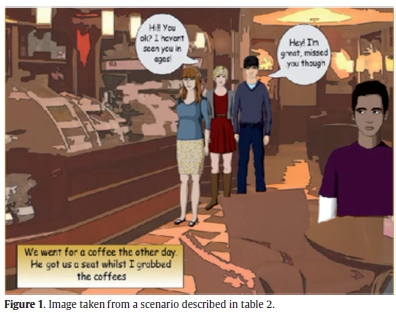
<body><![CDATA[<p><font face="Verdana, Arial, Helvetica, sans-serif" size="2">At both a European    and domestic level, policies focusing on combating violence against women and    girls highlight a need for prevention efforts located within school environments.    The European Convention on Violence against Women and Domestic Violence (2011)    has specified this. In addition, the British coalition government has also highlighted    the need for preventative measures, and also the role that teachers can play    in reducing violence against women and girls in its Action Plan (2011). Consequently,    through these two documents schools are identified as an important avenue through    which young people can be educated about the nature of, and factors associated    with, violence and abuse in relationships.</font></p>     <p><font face="Verdana, Arial, Helvetica, sans-serif" size="2">Although the policy    changes documented are important steps, their assumptions are challenged when    the characteristics of adolescent help-seeking are considered. The relationship    between adolescent help-seeking and problem severity is unclear; some studies    suggest that when encountering serious problems, adolescents are more likely    to seek help (Fallon &amp; Bowles, 1999), whereas others report that problems    can be perceived as too serious and consequently this perception incapacitates    adolescents and prevents them from seeking help (Seiffge-Krenke, 1993). It is    also evident that adolescents seek help from individuals and/or agencies that    represent the problem domain. Consequently, adolescents go to health professionals    for health care advice, family members or parents if the problem is located    within the family, teachers for problems with academic work, and peers for problems    with peers (Boldero &amp; Fallon, 1995). In relation to dating violence, adolescents    generally are unlikely to seek help (Ashley &amp; Foshee, 2005; Barter, McCarry,    Berridge, &amp; Evans, 2009; Jackson, Cram, &amp; Seymour, 2000; Molidor &amp;    Tolman, 1998), and when they do so, it is most likely to be from their peers,    not adults and not teachers (Ashley &amp; Foshee, 2005; Henton, Cate, Koval,    Lloyd, &amp; Christopher, 1983; Molidor &amp; Tolman, 1998). In light of the    tensions between policy and evidence, a SG was developed to raise awareness    of violence in adolescent relationships to be used in schools and specifically    targeted at adolescents to tackle ADV by raising awareness of, and challenging    attitudes towards, violence in adolescent dating relationships.</font></p>     <p><font face="Verdana, Arial, Helvetica, sans-serif" size="2"><b>Development    of the Game </b></font></p>     <p><font face="Verdana, Arial, Helvetica, sans-serif" size="2">Green Acres High    (GAH) is a SG based on Adobe Flash that runs inan internet browser (compatible    with Internet Explorer v 8.4 onwards) and comprises five, fully computer-mediated    'lessons', each of which concentrates on a different aspect of learning about    dating violence. Decisions about content were taken through two phases of research:    (i) a literature review to determine what is known about the prevalence of dating    violence in Europe, dynamic risk factors for adolescent dating violence, and    effective primary intervention approaches (submitting authors, 2013); and (ii)    a focus group study conducted with 86 young people (50 females, 36 males) aged    12-16 years across the four partner countries (submitting authors, 2013); The    premise of both aspects of the research was to determine what we know from a    European perspective about the nature of dating violence, effective primary    intervention approaches, and also attitudes about dating violence held by European    adolescents. This latter point was of particular relevance given the findings    from the first piece of research that attitudes towards dating violence have    been the most widely empirically supported dynamic risk factor for engaging    in dating violence behaviours (submitting authors, 2013). The focus group study    was a replication of the only other qualitative investigation of adolescent    attitudes that had been conducted in Canada (Sears, Byers, Whelan, &amp; Saint-Pierre,    2006).</font></p>     <p><font face="Verdana, Arial, Helvetica, sans-serif" size="2">Our focus group    data highlighted that European adolescentsshare many of the same attitudes towards    dating violence that have been reported in North American groups. Specifically,    although adolescents generally did not endorse the use of violence, there were    several clear contexts in which violence was not only permitted, but also in    some instances expected. These included violence as a oneoff, violence in retaliation    for being cheated on, violence in the context of a joke, violence used by girls.    It was also clear that adolescents upheld traditional gender-role stereotypes    in relation to violence, with violence by men towards women criticised, but    violence by women or girls towards men or boys viewed as not being violence.    Help-seeking was also gendered whereby males would not disclose abuse because    of stereotypical male identities, and because women's use of violence is less    severe and not defined as violence. Decisions to seek help were also related    to severity of the violence. There was a hierarchy of violent acts, with more    severe acts (punching, kicking) being less acceptable, and less severe acts    (pushing, slapping) being more acceptable. In addition, young people reported    that if they did seek help, they would be most likely to seek it from their    friends rather than adults. The findings from both these studies supported a    case for the potential impact of a brief (five-session) classroom-based intervention    on attitudes towards dating violence at least in the short term.</font></p>     <p><font face="Verdana, Arial, Helvetica, sans-serif" size="2">A decision was    taken therefore to review the content of existing classroom-based interventions    as these all focus on raising awareness about the nature of violence, as well    as challenging attitudes that support its use and stereotypical gender role    attitudes, and providing conflict resolution skills training and help-seeking    advice. A number of manuals and toolkits were obtained including Expect Respect    (Home Office and Women's Aid, n.d.), Save the Date (Family Violence Project,    2007) and Healthy Relationships (Men for Change, 1994), and descriptions of    key tasks were noted with regard to how they could inspire the content of the    game. In conjunction with the game developers, a narrative storyline was developed    within which the attitude-change and/or behavioural change techniques could    be implanted through interactive exercises. To ensure that the techniques employed    in the game were evidence-based, a mapping exercise was undertaken through which    the key techniques were identified in relation to their theory and utility using    the taxonomy identified by Abraham and Michie (2008). An overview of the lesson    aims, learning outcomes, and attitude/behaviour change techniques incorporated    in the game are presented in <a href="/img/revistas/inter/v23n1/06t1.jpg" target="_blank">Table    1</a> below.</font></p>     <p><font face="Verdana, Arial, Helvetica, sans-serif" size="2"><a href="/img/revistas/inter/v23n1/06t1.jpg" target="_blank">Table    1</a> shows that the majority of attitude/behaviour change techniques adopted    were based on four theories of behaviour change: Socio-cognitive, Information-motivation-behavioural    skills model, Control theory, and Operant conditioning. A more detailed example    of how each intervention scenario was devised and analysed in terms of behavioural/attitudinal    change techniques is presented in <a href="/img/revistas/inter/v23n1/06t2.jpg" target="_blank">Table    2</a> and a static image of the scenario described taken from the game is presented    in <a href="#f01">Figure 1</a>.</font></p>     <p><a name="f01"></a></p>     <p>&nbsp;</p>     <p align="center"><img src="/img/revistas/inter/v23n1/06f01.jpg"></p>     ]]></body>
<body><![CDATA[<p>&nbsp;</p>     <p><font face="Verdana, Arial, Helvetica, sans-serif" size="2">It is clear from    <a href="/img/revistas/inter/v23n1/06t2.jpg" target="_blank">Table 2</a> that    within each computerised scenario a number of different behavioural change techniques    are drawn upon.</font></p>     <p><font face="Verdana, Arial, Helvetica, sans-serif" size="2"><b>Evaluation </b></font></p>     <p><font face="Verdana, Arial, Helvetica, sans-serif" size="2">As reviewed, previous    research has identified the quantitativeimprovement associated with engaging    in serious games regarding coercion in relationships (Arnab et al, 2013) and    yet little is known about how young people view the experience of engaging with    serious games when learning about sensitive topics. Consequently, the aim of    the present study was to explore young people's views on the use of Green Acres    High as a method of being taught aboutadolescent dating violence. Of specific    interest was the question: How do adolescents describe their learning experience    of playing the "Green Acres High" game?</font></p>     <p>&nbsp;</p>     <p><font face="Verdana, Arial, Helvetica, sans-serif" size="2"><b>Method </b></font></p>     <p><font face="Verdana, Arial, Helvetica, sans-serif" size="2"><b>Design </b></font></p>     <p><font face="Verdana, Arial, Helvetica, sans-serif" size="2">The data for this    paper are drawn from the qualitative phase of a larger study of attitudinal    and knowledge change about ADV in an English schools sample. Focus groups were    conducted with adolescents who had played the SG on ADV and the transcripts    from these were analysed using thematic analysis.</font></p>     <p><font face="Verdana, Arial, Helvetica, sans-serif" size="2"><b>Participants    </b></font></p>     <p><font face="Verdana, Arial, Helvetica, sans-serif" size="2">Participants were    recruited from two of the four schools thatwere participating in a large evaluation    of the game. In total 13 young people agreed to take part in focus groups: eight    from Year 10 and five from Year 9. Focus group 1 comprised 5 adolescents (3    females and 2 males), focus group 2 also comprised 5 adolescents (4 females    and 1 male), and focus group 3 comprised 3 adolescents (2 females and 1 male).    The age range of the participants was from 13.75 to 15.60 years (<i>M </i>=    14.91, <i>SD </i>= .59). All participants except 1 were White British.</font></p>     ]]></body>
<body><![CDATA[<p><font face="Verdana, Arial, Helvetica, sans-serif" size="2"><b>Procedure </b></font></p>     <p><font face="Verdana, Arial, Helvetica, sans-serif" size="2">All participants    had played "Green Acres High". Three focus groups were recruited from two schools    and were run on the school premises. Consent was gained from all of the children    and their parents/guardians to participate in the focus groups. All of the focus    groups were asked to discuss their experience of playing the game based on a    standardised focus group schedule. The questions were formatted to get the adolescents    to talk about what they liked about the game, what they did not like about the    game and potential ideas for improving the game. The focus groups all lasted    approximately 30 minutes. The focus groups were audio recorded and the recordings    were then transcribed verbatim.</font></p>     <p><font face="Verdana, Arial, Helvetica, sans-serif" size="2"><b>Methodological    Approach </b></font></p>     <p><font face="Verdana, Arial, Helvetica, sans-serif" size="2">Thematic analysis    was used to analyse the data. This is a methodof identifying, analysing and    reporting patterns within data sets. A variety of methodologies can be aligned    with thematic analysis as can a range of ontological and epistemological positions    and theoretical frameworks. Braun and Clark (2006) have suggested that thematic    analysis can be an essentialist or realist method that reports meaning and the    reality of participants or constructionist method, which examines the way events,    realities, and experiences are the effects of different discourses that operate    within society (p. 81). The current study is ground within a realist method    and the themes were identified at a semantic level, i.e., within the explicit    or surface meaning of the data where patterns of themes found in the data are    organised, summarised, and interpreted in order to theorise the significance    of their patterns as well as their broader meaning and implications.</font></p>     <p><font face="Verdana, Arial, Helvetica, sans-serif" size="2"><b>Analysis </b></font></p>     <p><font face="Verdana, Arial, Helvetica, sans-serif" size="2">The focus groups    were analysed using inductive thematic analysisprocedure as guided by Hayes    (2000) and Braun and Clark (2006). The data were read and re-read carefully    in order to identify meaningful units of texts relevant to the focus of the    research. Next, units of text were then grouped together if they were dealing    with the same issues or were similar in their content. These groups weregiven    provisional names and definitions. Texts could be included in more than one    category if it was deemed appropriate. The data were then systematically reviewed    and refined and the themes were redefined. The data were then re-examined to    ensure that an exhaustive set of data was identified to support each theme identified.    The end result of this was that a Global theme was developed, and this was supported    in total by 14 associated themes and sub-themes.</font></p>     <p><font face="Verdana, Arial, Helvetica, sans-serif" size="2">When presenting    the results, in order to maintain confidentialityno names or identifying information    will be given. However, excerpts from the focus groups have been provided so,    in order to identify different focus groups and each participant, the following    coding has been used. The focus groups have been numbered either 1, 2, and 3    and within each group, each participant has been assigned a letter from A to    E. Comments or questions made by the researcher running the focus group have    been coded R.</font></p>     <p><font face="Verdana, Arial, Helvetica, sans-serif" size="2">No identifying    information is given about any of the participants. All excerpts have been reported    verbatim and no amendments have been made to the English or grammar used by    individual participants.</font></p>     <p>&nbsp;</p>     <p><font face="Verdana, Arial, Helvetica, sans-serif" size="2"><b>Results </b></font></p>     ]]></body>
<body><![CDATA[<p><font face="Verdana, Arial, Helvetica, sans-serif" size="2">From the focus    groups and following thematic analysis, a GlobalTheme <i>Assessment of the Game    </i>was developed and this was represented by two organising themes, <i>Positive    assessment: Pedagogical Underpinnings </i>and <i>Negative Assessment: Functionality    Limitations and Frustrations. </i>These themes and all their associated themes    and sub-themes are presented in <a href="/img/revistas/inter/v23n1/06t3.jpg" target="_blank">Table    3</a>.</font></p>     <p><font face="Verdana, Arial, Helvetica, sans-serif" size="2"><b>Assessment of    the Game </b></font></p>     <p><font face="Verdana, Arial, Helvetica, sans-serif" size="2">This global theme    is divided in to two organising themes that represent positive and negative    aspects of the children's experiences of playing the game. Overall it is fair    to argue that the assessment of the game was generally very positive. The common    insight that was gained from the focus group discussions was that this positivity    about of the game was experienced because of the <i>Pedagogical Underpinnings    </i>embedded within the game. Therefore the theme <i>Positive Assessment: Pedagogical    Underpinnings</i> was developed as an organising theme. Different elements of    the pedagogy that underpinned the game were then identified as associated themes.    These themes in effect encapsulated how the adolescents defined and explained    the different elements that they felt contributed to making playing the game    a positive and worthwhile experience. Interestingly when negative elements of    the game were identified this was not ground in pedagogy or the learning experience,    but around <i>Technical Limitations and Frustrations </i>that therefore formed    the organising theme <i>Negative Assessment: Functionality Limitations and Frustrations.    </i>The associated themes that were developed to explain this organising theme,    therefore present factors that were identified as encapsulating why the game    was deemed to be less successful.</font></p>     <p><font face="Verdana, Arial, Helvetica, sans-serif" size="2"><b>Positive assessment:    pedagogical underpinnings</b>. This organising theme is represented by themes    that symbolise how the game is deemed as positive due to the pedagogy that is    embedded within the structure of it. It has been suggested that modern educational    computer games are effective as they: (i) use action instead of explanation,    (ii) encourage motivation and satisfaction, (iii) accommodate multiple learning    styles, and (iv) provide interactive contexts that enable decision making (Charles    &amp; McAlister, 2004; Holland et al., 2003). Certainly, the adolescents identified    some of these factors and processes were embedded in the game and saw them as    positive elements in their assessment of the game. The<i> Positive Assessment:    Pedagogical Underpinnings</i> is represented in the data threefold by the themes    <i>Experiential Learning, Experiential Learning Environment </i>and by <i>Online    Game Education or Traditional Teaching. </i></font></p>     <p><font face="Verdana, Arial, Helvetica, sans-serif" size="2"><b><i>Experiential    learning</i></b>. This theme corresponds to how the adolescents found that a    positive aspect of the game was learning through experience, in that through    the online game the adolescents could come into contact with some of the issues,    decisions, factors, and processes related to ADV. This made learning more of    a hands-on experience. This organising theme portrays how the adolescents acknowledge    that learning has actually been achieved and therefore playing the game is positive    and worthwhile experience. It has been identified that experiential learning    engages individuals in real-life experiences that result due to an interaction    between humans and their environment in the form of seeing, feeling, and doing    and that this can be done in real life or artificial environments (Kebritchi    &amp; Hirumi, 2008). As this computer game has been designed in the context    of everyday life it connects the players to everyday life experiences, which    has been identified as the heart of experiential learning (Kebritchi &amp; Hirumi,    2008). The themes that represent this experiential learning are <i>Learning    through Doing and Interactive Engagement</i>,<i> Discovery through Autonomy    and Informed Choices </i>and <i>Transferable Knowledge Gathering. </i></font></p>     <p><font face="Verdana, Arial, Helvetica, sans-serif" size="2"><i>Learning through    doing and interactive engagement</i>. One of the positive features identified    was that the adolescents liked the fact that the game was interactive and that    they were able to achieve specific learning goals and accomplish specific tasks    within the context of a story. This was done by assuming roles and using different    resources within different scenarios. Learning by doing is a way of learning    factual information in the context of how this information can and will then    be used, but must be relevant, meaningful, and interesting to the students (Schank,    Berman, &amp; Macpherson, 1999). The adolescents identified that key to the    process of learning through 'doing' was the fact that the experiences were interactive.</font></p>     <blockquote>        <p><font face="Verdana, Arial, Helvetica, sans-serif" size="2">1A: I think people      are more likely to listen more instead of just a teacher telling you stuff;      people will actually interact with the game because it's just you and a computer.</font></p>       <p><font face="Verdana, Arial, Helvetica, sans-serif" size="2">2A: I think the      game is quite good because it's seen as a game but it's still educational      and there's still the sense that it, it's quite fun because it's interactive      and you get to pick where you're going and stuff.</font></p> </blockquote>     <p><font face="Verdana, Arial, Helvetica, sans-serif" size="2">This interaction    was achieved by getting the adolescents to assume roles or participate in activities    through computer generated real-life stories and experiences, and therefore    encouraging the adolescents make and take certain decisions. This finding raises    an important observation, that it is necessary to differentiate that it is not    just the case that the adolescents are using e-learning content (i.e., just    being given information but through a digital medium) butthat they are <i>playing    a game </i>(i.e., an interactive and participatory activity). As Squire (2005)    proposes, there is an important difference between e-learning and playing a    game - in e-learning content is the predominant feature, whilst experience is    the most important feature of a game. The adolescents reported that they did    experience different situations.</font></p>     ]]></body>
<body><![CDATA[<blockquote>        <p><font face="Verdana, Arial, Helvetica, sans-serif" size="2">2E: Well because      we were in that situation, in the game we were the ones giving the advice.</font></p> </blockquote>     <p><font face="Verdana, Arial, Helvetica, sans-serif" size="2">Part of the process    involved the players not only immersingthemselves in the different situations    but then making decisions based on the information they had been given and were    experiencing. This was discussed by two of the game-players.</font></p>     <blockquote>        <p><font face="Verdana, Arial, Helvetica, sans-serif" size="2">3B: Erm, I think      it was good that they included real scenarios that could happen and it made      you deal with them.</font></p>       <p><font face="Verdana, Arial, Helvetica, sans-serif" size="2">3C: I think it      was good because it showed, showed the thing from both points of view, like      from the male's point of view and the female's point of view and how they're      both feeling.</font></p> </blockquote>     <p><font face="Verdana, Arial, Helvetica, sans-serif" size="2">Finally part of    the experiential learning included doing tasks that would enable the adolescents    to learn through a process that was meaningful to them. For example, one of    the activities was identifying different types of abuse (physical, psychological,    and sexual) by placing certain behaviours in labeled bins. One of the adolescents    commented:</font></p>     <blockquote>        <p><font face="Verdana, Arial, Helvetica, sans-serif" size="2">2B: Putting the      different, the different actions (physical, psychological, and sexual abuse)      into the bins. I think that was quite good because it made you think that      actually that is physical abuse and it makes you put a title to it.</font></p> </blockquote>     <p><font face="Verdana, Arial, Helvetica, sans-serif" size="2"><i>Discovery through    autonomy and informed choices</i>. Discovery learning has been identified as    being where students 'interact with their environment by exploring and manipulating    objects, wrestling with questions and controversies, or performing experiments'    (Omrod, 1995, p. 442). Based on this it is suggested that if individuals discover    things on their own they are then likely to remember the concepts that they    are trying to learn (Kebritchi &amp; Hirumi, 2008). In alignment with this,    this theme was developed to explain that the adolescents identified that a positive    aspect of the game was that they were autonomous whilst playing and learned    through making various choices themselves, as they explored different scenarios,    dilemmas, and problems that were offered to them. This discovery through exploration    and making decisions themselves is discussed by one of the focus groups.</font></p>     ]]></body>
<body><![CDATA[<blockquote>        <p><font face="Verdana, Arial, Helvetica, sans-serif" size="2">1A: You're in      a classroom, you've got to talk to people, find stuff out.</font></p>       <p><font face="Verdana, Arial, Helvetica, sans-serif" size="2">1C: You become      a character then sort of go through their experiences I guess.</font></p>       <p><font face="Verdana, Arial, Helvetica, sans-serif" size="2">R: Yeah, so you      get to decide, do you get to decide what happensto them and their choices      and things like that?</font></p>       <p><font face="Verdana, Arial, Helvetica, sans-serif" size="2">1A: Yeah because      one thing there was a kind of counselling session and people would say this      has been happening what should I do and you have different options and then      you like click on an option and then it would give you points depending on      how good your decisions were.</font></p> </blockquote>     <p><font face="Verdana, Arial, Helvetica, sans-serif" size="2">The adolescents    saw the fact that they themselves had various choices in the game, as a positive    aspect of the game. As the adolescents were autonomous as they played the game    and were offered various choices that they then had to question and decipher    meant that they engaged with the game. This process is described by one of the    adolescents.</font></p>     <blockquote>        <p><font face="Verdana, Arial, Helvetica, sans-serif" size="2">2B: Yeah, it      [the game] gives you options. If you're just doing like a lesson of it the      teachers the one that does the speaking and you just write stuff down whereas      in the game you get to choose what you want to do and you don't, nobody else      can input on it it's your choice.</font></p> </blockquote>     <p><font face="Verdana, Arial, Helvetica, sans-serif" size="2">Overall, the benefit    of this feature of the game was that the adolescents identified that this was    an effective way of learning. This was noted by one of students.</font></p>     <blockquote>        ]]></body>
<body><![CDATA[<p><font face="Verdana, Arial, Helvetica, sans-serif" size="2">3C: It sort of      made us understand it more because you were like put in a situation where      you had to try and sort that situation out.</font></p> </blockquote>     <p><font face="Verdana, Arial, Helvetica, sans-serif" size="2"><i>Transferable    knowledge gathering</i>. Another element of the experiential learning was that    through the interactive games knowledge was gathered by the adolescents that    they then felt could be used in practice in real-life and on a day-to-day basis.    In effect knowledge is contextualised, which is a better way of learning (i.e.,    situated learning, Lave &amp; Wenger, 1991) as decontextualised knowledge gathering    is not an effective way of learning and understanding things. One of the elements    that the adolescents identified as being positive was that they learned how    to recognise different types of abusive behaviours and therefore relate that    to possible situations that they might find themselves in. Several of the adolescents    spoke about this, but the following represent generally what was discussed.</font></p>     <blockquote>        <p><font face="Verdana, Arial, Helvetica, sans-serif" size="2">1A: Yeah like      I didn't realise like pressuring someone to wear a t-shirt was considered      like violence and stuff.</font></p>       <p><font face="Verdana, Arial, Helvetica, sans-serif" size="2">1B: The abusive      cycle... That was very clear on like how you'd be able to see in a relationship      so you knew all the stages and would know what to do about it.</font></p> </blockquote>     <p><font face="Verdana, Arial, Helvetica, sans-serif" size="2">The theme, therefore,    represents how the experiential learning was in effect transferred from the    game and online interactions to interactions that might take place face-to-face.    This meant that the adolescents could understand when and how the information    that they were gathering could be useful in other situations and in effect be    a transferable skill that might help them in certain situations associated with    ADV.</font></p>     <blockquote>        <p><font face="Verdana, Arial, Helvetica, sans-serif" size="2">3A: Err, like      information that helps you learn [about abuse] but also it reminds you of      what's right and wrong.</font></p>       <p><font face="Verdana, Arial, Helvetica, sans-serif" size="2">3B: Erm, really      it's a useful tool, erm, that people that are either in a violent relationship      or out of one can use.</font></p> </blockquote>     <p><font face="Verdana, Arial, Helvetica, sans-serif" size="2"><b><i>Experiential    learning environment</i></b>. This theme and its respective sub-themes refer    to the factors and characteristics that were embedded within the game that then    enable experiential learning to happen. That is, this relates to the features    of the environment within which the game is played that the adolescents identified    as necessary for the game to be deemed as worthwhile and therefore effective.    As opposed to the previous theme which encapsulated the way or <i>how</i> the    adolescents learned through experiential learning, this theme has been developed    to portray <i>what </i>was required within the learning environment to enable    the <i>how</i> to happen. Four sub-themes, <i>Familiar Everyday Technology,    Age Appropriate, Feedback,</i> and <i>Merging the Cyber World into Day to Day    Reality, </i>represent this theme.</font></p>     ]]></body>
<body><![CDATA[<p><font face="Verdana, Arial, Helvetica, sans-serif" size="2"><i>Familiar everyday    technology</i>. The adolescents discussed that the use of everyday technology    was what was required for them to learn and therefore see the game in a positive    light. This can be seen in three slightly different although closely linked    ways. Firstly, they liked the fact that learning about ADV was named and presented    as an online <i>game</i> and not an intervention. Blumberg, Blades, and Oates    (2013) propose that the digital game play of adolescents is important as it    is an integral part of their lives and that such play can in fact contribute    to learning and cognitive development. It did seem that this format, i.e., a    digital game, was the type of technology that the adolescents preferred, suggesting    it would be more appealing to use and perhaps therefore encourage learning.</font></p>     <blockquote>        <p><font face="Verdana, Arial, Helvetica, sans-serif" size="2">2A: It was good      because most computer games are animated anyway and that's like what kids      like to see so it would have appealed to them more.</font></p> </blockquote>     <p><font face="Verdana, Arial, Helvetica, sans-serif" size="2">Secondly, playing    the game was also deemed to be a positiveexperience because it was completed    electronically and doing activities on computers seemed to be recognised as    the most appropriate and suitable way to receive and process data or information.    That is to say using a computer for the adolescents appears to be the 'norm'    and the preferred (or possibly expected) way to do things.</font></p>     <blockquote>        <p><font face="Verdana, Arial, Helvetica, sans-serif" size="2">3A: It's better      because erm, children are more like focused on the media now and it was good      that it was like on computers because that's what kids focus on.</font></p> </blockquote>     <p><font face="Verdana, Arial, Helvetica, sans-serif" size="2">Finally the fact    that within the game part of playing it involvedusing familiar technologies    meant that this was another factor that the adolescents identified as being    positive and a strength of the learning environment that they had participated    in.</font></p>     <blockquote>        <p><font face="Verdana, Arial, Helvetica, sans-serif" size="2">3C: Erm, probably      the fact you had like all the different tools that you could use like you      had the GPS, and like the texts and the emails and then, when it done the      little videos as well like, instead of just explaining what happened so...</font></p> </blockquote>     <p><font face="Verdana, Arial, Helvetica, sans-serif" size="2"><i>Age appropriate</i>.    Another part of the environment for the experiential learning was that the game    was deemed as age appropriate for those who played it. This theme portrays that    the <i>'what'</i> required in the learning environment was a game that was suitable    for the age of the audience that it was targeted for. In addressing what was    the most appropriate ages the following quotes represents what several participants    said.</font></p>     ]]></body>
<body><![CDATA[<blockquote>        <p><font face="Verdana, Arial, Helvetica, sans-serif" size="2">2D: Yeah it kind      of like suits for our age.</font></p>       <p><font face="Verdana, Arial, Helvetica, sans-serif" size="2">3A: Teenagers      because they need to get informed of what they're actually getting themselves      into.</font></p> </blockquote>     <p><font face="Verdana, Arial, Helvetica, sans-serif" size="2">Some of the students    did however see the benefits of using this for younger adolescents, however    that was with the caveat that some of the content would need to be modified    to ensure that it was then age appropriate for younger adolescents. One of the    adolescents felt it was appropriate for younger adolescents and explained why    and what would be required.</font></p>     <blockquote>        <p><font face="Verdana, Arial, Helvetica, sans-serif" size="2">1B: Yeah like      my younger sister [age 11] likes the games where you end up having to talk      to people... think maybe not the harder violence [for age 11], but maybe the      softer side because even from a young age you know stuff like peer pressure      andI think it's really good to be aware of that.</font></p> </blockquote>     <p><font face="Verdana, Arial, Helvetica, sans-serif" size="2"><i>Feedback</i>.    The adolescents identified that feedback was an important part of the learning    environment. It has been suggested that with digital learning the system should    provide students with encouraging feedback as this increases motivation, that    this should be immediate as this helps the student to identify any problematic    parts of their learning (Nokelainen, 2006), and that it is an opportunity not    just to take stock of the progress they have made, but also to improve their    self-regulation (Corbalan, Kester, &amp; Van Merri&euml;nboer, 2009; Spinath    &amp; Spinath, 2005). Feedback also enables individuals to acquire deep learning    (Erhel &amp; Jamet, 2013). Feedback seems to be a feature of the learning environment    that was seen as important and useful by those who played the game. In one conversation    when discussing why feedback was good, it was decided that it:</font></p>     <blockquote>        <p><font face="Verdana, Arial, Helvetica, sans-serif" size="2">2A: Made me understand      it, there was lots of different scenarios, lots of options and things you      could choose from and then about the abuse you saw, the different things to      look at it clearly showed you what to look out for.</font></p>       <p><font face="Verdana, Arial, Helvetica, sans-serif" size="2">2D: Gave you      a sense that if you did something good then it would tell you if you did it      good, but if you did something bad it would tell you why it was bad not just      oh you did it wrong... it was just helpful and it told us how we could do      better.</font></p> </blockquote>     ]]></body>
<body><![CDATA[<p><font face="Verdana, Arial, Helvetica, sans-serif" size="2">Part of what was    deemed as positive by the adolescents was that it included looking at different    options, which helped in the process of learning and understanding.</font></p>     <blockquote>        <p><font face="Verdana, Arial, Helvetica, sans-serif" size="2">3A: I liked how      they had someone there that gave you advice and told you like if you'd got      something wrong on the game how, what was the right answer and why it was      but also how your answer could link to it as well.</font></p> </blockquote>     <p><font face="Verdana, Arial, Helvetica, sans-serif" size="2">Some of the students    however did suggest that the feedback could be a little repetitive. However,    that being the case they did still feel this had its value based on the fact    that this would serve as reinforcement to what they already had learned or knew.</font></p>     <blockquote>        <p><font face="Verdana, Arial, Helvetica, sans-serif" size="2">3 A: It [feedback]      was repetitive because we've heard of it before so it was like reinforcing      it.</font></p> </blockquote>     <p><font face="Verdana, Arial, Helvetica, sans-serif" size="2">While feedback    was seen as a positive aspect, it was also suggestedhow the feedback that was    presented could be improved. An example of this are that the adolescents felt    perhaps too much information was given and how this could be modified.</font></p>     <blockquote>        <p><font face="Verdana, Arial, Helvetica, sans-serif" size="2">2B: It would      tell you if you gave a good answer or bad response but sometimes again there      was a lot of text and you didn't really want to read all of it... I think      if it [feedback] was arranged in a different way, just like break it up into      little bits.</font></p> </blockquote>     <p><font face="Verdana, Arial, Helvetica, sans-serif" size="2">Another suggestion    was that although feedback had been useful,being given a final solution and    being told what the best options were in each circumstance would improve the    feedback mechanism of the game.</font></p>     ]]></body>
<body><![CDATA[<blockquote>        <p><font face="Verdana, Arial, Helvetica, sans-serif" size="2">1B: I think it      would have been better if at the end it told you that this is definitely the      best way to do it because it was just kind of you guessing so you could have      been wrong and you wouldn't know which of the other ones is the right one.</font></p> </blockquote>     <p><font face="Verdana, Arial, Helvetica, sans-serif" size="2"><i>Merging the    cyber world into day to day reality</i>. As Egenfeldt-Nielsen (2005) stated,    'In today's computer games you are part of a living, breathing, simulated universe    with very concrete self-sustaining experiences - getting still closer to reality'    (p. 125). This sums up well the environment that the adolescents found themselves    in and that they enjoyed being in. A really interesting factor that came out    from the focus group was the blurred line between this being a game and the    adolescents almost talking about what they were doing as being a reality. For    example for many of the adolescents they discussed how they have to talk with    the characters and take on roles. For example:</font></p>     <blockquote>        <p><font face="Verdana, Arial, Helvetica, sans-serif" size="2">1A: You're in      a classroom, you've got to talk to people, find stuff out.</font></p>       <p><font face="Verdana, Arial, Helvetica, sans-serif" size="2">1C: That you      become a character then sort of go through their experiences I guess.</font></p> </blockquote>     <p><font face="Verdana, Arial, Helvetica, sans-serif" size="2">It seemed to be    taking on the role of the characters, andimportantly characters that were believable,    that was particularly appealing to the adolescents. This fact made it like a    reality for them.</font></p>     <blockquote>        <p><font face="Verdana, Arial, Helvetica, sans-serif" size="2">1B: And you kind      of got into it because you were almost like playing a character you kind of      got into it more than if you were just kind of answering questions.</font></p>       <p><font face="Verdana, Arial, Helvetica, sans-serif" size="2">2B: They [the      characters] were believable.</font></p> </blockquote>     ]]></body>
<body><![CDATA[<p><font face="Verdana, Arial, Helvetica, sans-serif" size="2">Making the situational    factors realistic and in line with what the adolescents would in fact experience    normally on a day-to-day basis meant that their cyber world was intrinsically    link to reality. The key is that the adolescents can relate to the environment    and the characters within the cyber world and so can therefore in effect merge    this into feeling like their own actual worlds as they got immersed in playing.    This was seen in the following excerpts.</font></p>     <blockquote>        <p><font face="Verdana, Arial, Helvetica, sans-serif" size="2">2E: It's like      you're actually like playing as yourself, like going around a school when      you're in a school yourself and it relates to what you are.</font></p>       <p><font face="Verdana, Arial, Helvetica, sans-serif" size="2">2A: They [the      characters] were around our age and experiencing the same problems that we      would.</font></p> </blockquote>     <p><font face="Verdana, Arial, Helvetica, sans-serif" size="2"><b><i>Online game    education or traditional teaching</i></b>. This theme represents the findings    that using an online game as a form of education was seen as an effective learning    experience and was compared to traditional teaching methods which was also seen    to have a place in the adolescents' learning. Many researchers agree that digital    learning games have everything it takes to become an effective learning medium    (e.g., Connolly et al., 2012; Moreno &amp; Mayer, 2007; Prensky, 2001). Conversely,    many researchers have also expressed reservations about the use of digital learning    games over traditional teaching (e.g., Connolly et al., 2012; Girard et al.,    2013; Papastergiou, 2009b). This suggests that the best approach could be a    combination of the two. As a rule of thumb, in the current research the use    of digital learning tools was generally seen as positive with all 5 participants    in focus group 2 saying they would prefer to use a computer game. In focus group    one, a participant explained:</font></p>     <blockquote>        <p><font face="Verdana, Arial, Helvetica, sans-serif" size="2">1A: I think people      are more likely to listen more instead of just a teacher telling you stuff;      people will actually interact with the game because it's just you and a computer.</font></p> </blockquote>     <p><font face="Verdana, Arial, Helvetica, sans-serif" size="2">However what was    debated was whether this should form the whole of the lesson, or perhaps part    of the lesson with traditional teaching methods being delivered alongside the    game. Some of the adolescents argued that the digital approach was appropriate    for the whole lesson.</font></p>     <blockquote>        <p><font face="Verdana, Arial, Helvetica, sans-serif" size="2">2D: It doesn't      feel like you're on the computer for an hour because it's like a game but      it's the whole lesson that you're going to need to actually play the game.</font></p> </blockquote>     ]]></body>
<body><![CDATA[<p><font face="Verdana, Arial, Helvetica, sans-serif" size="2">Others however    noted that while they agreed that the game was a welcome addition, this should    form part of a lesson, or be used in conjunction, with other traditional teaching    approaches.</font></p>     <blockquote>        <p><font face="Verdana, Arial, Helvetica, sans-serif" size="2">1A: Possibly      people, I don't know but people could feel like it's a bit detached, a bit      like this is just a game it isn't going to happen so I think like it should      be mixed with a few teacher based lessons to like say this can happen, this      is a real thing.</font></p> </blockquote>     <p><font face="Verdana, Arial, Helvetica, sans-serif" size="2">Opinion was divided    on the role of the teacher. It was identifiedthat not having a teacher to ask    questions was a potential problem. Conversely by just using a computer meant    that they felt they were not exposed to being coerced by a teacher to talk to    them or the class and that 'talking' to the computer meant they were more willing    to speak and more likely to say what they wanted to. The two excerpts below    show this.</font></p>     <blockquote>        <p><font face="Verdana, Arial, Helvetica, sans-serif" size="2">1B: But with      a teacher you can like ask questions and say yeah I don't get that and stuff.</font></p> </blockquote>     <blockquote>        <p><font face="Verdana, Arial, Helvetica, sans-serif" size="2">2A: And it's      not like, it's quite private as well because you don't have to, whereas teachers      encourage you to say stuff in front of everybody else but if it's just you,      you're more likely to say something that you'd actually want to say.</font></p> </blockquote>     <p><font face="Verdana, Arial, Helvetica, sans-serif" size="2"><b>Negative assessment:    functionality limitations and frustrations</b>. As seen in the previous organising    theme the general opinion about the game itself was positive; particularly in    relation to the pedagogy and experiential learning experience. However the adolescents    did identify that they felt there were some negative aspects of the game, but    generally they identified this being down to functionality of the game opposed    to content or the learning experience. This organising theme is made up of two    themes that represent the issues with functionality<i>, Technological inefficiencies    </i>and <i>inadequate instructions that hindered navigation. </i></font></p>     <p><font face="Verdana, Arial, Helvetica, sans-serif" size="2"><b><i>Technological    inefficiencies</i></b>. Adolescents today exist in a world of technology. Their    lives are digital with the expectation that they communicate instantly through,    to name but a few, messaging, emails, texts, social sites, and that they can    gain access immediately to files, games, films, and music (Ahmedani, Harold,    Fitton, &amp; Shifflet Gibson, 2011). The ability to do this is second nature    and therefore anything that hinders this is likely to cause frustrations and    fundamentally go against their expectations. These frustrations came through    in this theme in that technological issues were one of the most widely identified    negative aspect of the game. One of the issues raised was the efficacy and quality    of the games based on technological issues opposed to content matter.</font></p>     ]]></body>
<body><![CDATA[<blockquote>        <p><font face="Verdana, Arial, Helvetica, sans-serif" size="2">1B: I think the      game would be effective if it wasn't so slow... I didn't think the games were      very good, just because it was really slow so you were just focused on getting      it to work and actually doing it than focusing on what it was teaching you      and stuff.</font></p> </blockquote>     <p><font face="Verdana, Arial, Helvetica, sans-serif" size="2">One of the main    concerns related to speed and efficiency of technology. A frustration came out    in the focus groups, were issues with the speed at which the games were downloading/processing    or that the game would freeze and stop working. This seemed to be really problematic    for the adolescents and meant that their engagement with the game at times was    lost.</font></p>     <blockquote>        <p><font face="Verdana, Arial, Helvetica, sans-serif" size="2">1C: Oh yeah when      I was trying to load something different parts kept like freezing so like      I got bored and had to start the chapter all over again. So I just kept getting      bored doing that.</font></p> </blockquote>     <p><font face="Verdana, Arial, Helvetica, sans-serif" size="2">The end result    seems to be that for some it meant that they could not always complete the entire    chapter or that they got confused at times when playing the game.</font></p>     <blockquote>        <p><font face="Verdana, Arial, Helvetica, sans-serif" size="2">1A: But I didn't      get to play much of the game because it was very slow and wouldn't load and      stuff so.</font></p> </blockquote>     <p><font face="Verdana, Arial, Helvetica, sans-serif" size="2"><b><i>Inadequate    instructions that hindered navigation</i></b>. The other area of functionality    that the adolescents had frustrations with was in relation to the instructions    that were given and this let to difficulty navigating around the game and therefore    engagement became a problem. The instructions and then navigation appeared to    not be as intuitive as was hoped. In some respects this issue is intrinsically    linked to the preceding theme in that part of the issue with the instructions    may have been due to technological inefficiencies of the game.</font></p>     <blockquote>        ]]></body>
<body><![CDATA[<p><font face="Verdana, Arial, Helvetica, sans-serif" size="2">1B: On one of      mine it said like read the email you got or something and then once I'd read      it there wasn't really a next stage, I didn't know what to do.</font></p>       <p><font face="Verdana, Arial, Helvetica, sans-serif" size="2">1D: I think that      was because the thing, because it wasn't registering that you'd done it and      once you refresh it, it like registered it and I think that was probably just      another issue.</font></p> </blockquote>     <p><font face="Verdana, Arial, Helvetica, sans-serif" size="2">Several of the    adolescents said that they would have liked clearerinstructions and perhaps    some prompts along the way. It seemed that at times they were not always sure    about what they needed to do which caused confusion.</font></p>     <blockquote>        <p><font face="Verdana, Arial, Helvetica, sans-serif" size="2">R: Ok, what about      the instructions? Were you always sure what you had to do?</font></p>       <p><font face="Verdana, Arial, Helvetica, sans-serif" size="2">2A: Not really.</font></p>       <p><font face="Verdana, Arial, Helvetica, sans-serif" size="2">R: But you would      like clearer instructions.</font></p>       <p><font face="Verdana, Arial, Helvetica, sans-serif" size="2">2A: Yeah.</font></p>       <p><font face="Verdana, Arial, Helvetica, sans-serif" size="2">R: Ok, so how      do you think it might be improved? This issue with the instructions and that?</font></p>       <p><font face="Verdana, Arial, Helvetica, sans-serif" size="2">2B: Maybe if      you give shorter but simpler questions and like titles to things so people      would understand what it is.</font></p> </blockquote>     ]]></body>
<body><![CDATA[<p><font face="Verdana, Arial, Helvetica, sans-serif" size="2">The adolescents    identified that the instructions could have beenimproved with more detail. What    was also interesting was that a large proportion of the adolescents did not    realise there was a help button within the game that could be used for clarifying    instructions.</font></p>     <p>&nbsp;</p>     <p><font face="Verdana, Arial, Helvetica, sans-serif" size="2"><b>Discussion </b></font></p>     <p><font face="Verdana, Arial, Helvetica, sans-serif" size="2">The focus group    analysis overall revealed some encouraging findings regarding the positive benefits    of introducing a serious game (SG) as a way of teaching adolescents about dating    violence and the development of healthy relationships. The themes identified    clearly illustrate that the learning experience by the adolescents was a positive    one. This was specifically captured by the organising theme, <i>Positive Assessment:    Pedagogical Underpinnings, </i>which was associated with several themes and    sub-themes that showed that by using the game students learned, discovered,    and understood about ADV through interactive engagement and use of familiar    technology (<i>Experiential Learning</i>), used the digital environment effectively    to learn (<i>Experiential Learning Environment</i>), and found this a suitable    teaching tool in comparison with other teaching methods (<i>Online Game Education    or Traditional Teaching</i>). However, the analysis did reveal that the learning    experience had some limitations but this related to functionality not to content,    i.e., the organising theme <i>Negative Assessment: Functionality Limitations    and Frustrations</i>. It was clear that the adolescents did not like it when    technology did not work quickly and effectively (<i>Technological Inefficiencies</i>)    or when technology did not enable them to intuitively and easily navigate the    game (<i>Inadequate Instructions that Hinder Navigation</i>).</font></p>     <p><font face="Verdana, Arial, Helvetica, sans-serif" size="2">Initial findings    do suggest that those who played this seriousgame had a positive learning experience,    which led to perceived improvement and development of their understanding about    ADV, which would enable them to identify and manage problematic elements of    their own and other people's relationships. There is evidence that supports    the role of school-based intervention programmes to prevent ADV (Avery-Leaf,    Cascardi, O'Leary, &amp; Cano, 1997; Ball, Kerig, &amp; Rosenbluth, 2009; Foshee    et al., 2004; Foshee et al., 2005; Wolfe et al., 2009), where classroom activities    include didactic presentations, role-playing and skill building. Using these    interventions adolescents report learning new skills including improved communications    and alternatives to violence as well as increased knowledge about the signs    of ADV, awareness of their and others' abusive behaviours and about healthy    relationships (Ball et al., 2009). There is also evidence that using technology    such as a SG can enhance and benefit students' learning of a range of subject    matters (Charles &amp; McAlister, 2004; Ke, 2013; Kickmeier-Rust &amp; Albert,    2010; Prensky, 2001). The current work is therefore in-line with research findings    concerning the efficacy of school-based interventions and the use of SG in education.    The current work is a preliminary evaluation, and while the focus was not a    quantitative measure of learning but an evaluation of the subjective learning    experience, a positive aspect of using a SG to educate about ADV was the pedagogy    that can be embedded within the structure of a game, i.e., the experiential    learning through a digital medium.</font></p>     <p><font face="Verdana, Arial, Helvetica, sans-serif" size="2">The pedagogical    learning experience, i.e., experiential learning or active learning (Kolb, 1984),    was viewed as a positive feature of the game by all participants. The learning    format connected the adolescents to real life experiences, which is a core and    essential feature of experiential learning (Kebritchi &amp; Hirumi, 2008). The    adolescents reported that learning was achieved through the interactive element    of the game and the fact that they were autonomous in the process. This is a    finding similar to the one by Watson, Mong, and Harris (2011), who found that    an educational game (for history) meant that the learning experience shifted    from being teacher-centred to student-centred, and the students became more    active and engaged in the process. In addition, the adolescents when playing    Green Acres High seemed to engage with the process of having to make choices    and decisions and developed their ability to problem solving. It has been suggested    that problem-posing explorations can enhance students' thinking and create several    levels of learning opportunities (Chang, Wu, Weng, &amp; Sung, 2012; Silver    &amp; Cai, 2005; Whitin, 2004). Researchers suggest that students evidence better    problem-solving performance following the use of a SG, when compared to traditional    teaching methods (Chang et al., 2012). This highlights a critical observation    that a SG is not just e-learning content; the important fact is that the adolescents    are <i>playing</i> a game. It is the experience of the game and the fact that    games structure the whole experience around problem solving (Squire, 2005) that    is crucial. The adolescents also revealed that they were motivated to learn,    as using a SG they assumed roles and learned by doing, and as they were constantly    offered choices and had to make decisions they engaged with the game and therefore    their learning experience. It has been noted that SG used in education are an    intrinsic motivational factor and they can promote curiosity whilst enabling    the individual to be in control of their own learning (Dickey, 2007; Huizenga,    Admiraal, Akkerman, &amp; Dam, 2009; Papastergiou, 2009a). Indeed several studies    have shown that SG in education can enhance both learning motivation and performance    (Dickey, 2011; Sung &amp; Hwang, 2013; Wang &amp; Chen, 2010) and this is represented    in the themes that related to the learning experience and pedagogical underpinnings    that were found in the current study.</font></p>     <p><font face="Verdana, Arial, Helvetica, sans-serif" size="2">Another theme that    was seen in the data related to whether thestudents preferred to use a SG over    traditional teaching. Due to the qualitative nature of the research the numbers    of participants that made up the focus group are not adequate enough to make    generalisations. However, as an exploratory exercise, it was seen that the majority    of the adolescents said they would prefer to use a computer game for learning    about AVD. It has been identified by many researchers that SGs have all the    requirements to make them an effective learning medium (Connolly et al., 2012;    Moreno &amp; Mayer, 2007; Prensky, 2001). It has been suggested that when certain    studies have compared traditional teaching with digital teaching, SGs strengthen    knowledge skills and attitudes towards what is being taught (Serrano, 2004),    they are more motivating and educational (Barab, Warren, &amp; Ingram-Goble,    2009), enable more authenticity (Akpan, 2002), and students find this medium    far more enjoyable (Toprac, 2011; Vogel et al., 2006). However, the evidence    for this is not conclusive (e.g., Connolly et al., 2012; Girard et al., 2013;    Kebritchi et al., 2010; Papastergiou, 2009b), and it has been suggested that    games are not always the most effective tool for all subject matters in all    situations (Hays, 2005; Ke, 2009). The difficulty is that generally few games    have been actually tested against other teaching and learning approaches (Egenfeldt-Nielsen,    2006). It was identified by a couple of adolescents that digital technology    could be used alongside traditional teaching as adjuncts and this is worthy    or further investigation. Certainly some researches suggest that digital technologies    are more effective with support and guidance from the teachers (Mayer &amp;    Bekebreda, 2006), when delivered and considered alongside other relevant pedagogies    (Hays, 2005; Shaffer, 2006), and actually work best when adjunct with other    effective pedagogy (Squire, 2002). It would therefore seem logical to use both    SG and traditional teaching together in order to reap the benefits from both    types of learning mechanisms.</font></p>     <p><font face="Verdana, Arial, Helvetica, sans-serif" size="2">It was seen however    that the adolescents did have some issues with the game and, interestingly,    this had more to do with technical functionality and inefficiencies rather than    content or format. It is not clear, however, at this stage if part of the issue    had to do with the technological capacity of the school and the IT support available.    It was discussed by one of the groups that they thought some of the problems    were due to the IT infrastructure in the school. It is also not apparent if    and how teachers were able to assist the adolescents. It has been found that    the success of introducing digital technologies into classroom learning is associated    with certain characteristics of the teachers including ICT competence and ICT    confidence (Totter, St&uuml;tz, &amp; Grote, 2006), so this might have had an    impact on some of the functionality issues experienced. The adolescents however    did identify that the functionality, e.g., speed of download/processing and    freezing of game, and inadequate guidance and instruction around the game was    a negative experience associated with playing the game. Adolescents are one    of the heaviest users of technology as a group (Subrahmanyam &amp; Greenfield,    2008) and, as the world they grow up in is filled with technology, they have    been variously described as 'digital natives' and the 'net generation' (Jones,    Ramanau, Cross, &amp; Healing, 2010). It has been suggested that adolescents    are growing up in a world that offers them <i>instant</i> access to everywhere    and all knowledge (Anderson &amp; Rainie, 2012) and this therefore is their    expectation - immediate access. The lack of speed/technical issues and inadequate    guidance meant instant access to the game was not achieved and therefore this    was a frustration to the adolescents. This becomes problematic as it meant the    adolescents' attention and motivation to play the game was lost. This therefore    needs to be rectified, as it is likely to mean that more children can then engage    with and play the SG and reap the positive experiences that are seen by those    who have played the whole game.</font></p>     <p><font face="Verdana, Arial, Helvetica, sans-serif" size="2">This study was    an initial insight into the children's experience of playing a SG and is limited    by the fact that it is based on the experience of only a few children. Although    this is acceptable for qualitative exploratory research, it needs to be extended    to validate findings further. More focus groups are required across other schools    in order to assess for consistencies and contradictions in the children's reported    experiences. This initial research is part of a larger project that will measure    knowledge and attitude change pre- and post-intervention. This is paramount    as although it is of great importance that we understand the adolescents' experience    playing the game and if and how they felt that they had learned from this, evidence    is required that corroborates with these findings in the form of tangible measures    that relate to knowledge and attitude change. This type of research, alongside    extended qualitative investigation, will strengthen the evidence that this SG    about ADV is an appropriate and required intervention for school children. As    it stands currently it is fair to conclude that this SG had valid meaning for    learners and is a viable alternative or adjunct to traditional teaching. On    the basis that we know that dating violence is a recognised feature in adolescent    dating relationships (G&oacute;mez, 2011; Kury et al., 2004; Lewis &amp; Fremouw,    2001), and that this may be a precursor to aggression in later adult relationships    (Capaldi et al., 2003; G&oacute;mez, 2011; Mu&ntilde;oz-Rivas et al., 2007;    Whitaker et al., 2010), it makes sense to teach and inform adolescents as part    of their education about these problematic behaviours within relationships and    how to help themselves and others, if such situations do arise, using the most    effective and appropriate teaching formats.</font></p>     <p>&nbsp;</p>     ]]></body>
<body><![CDATA[<p><font face="Verdana, Arial, Helvetica, sans-serif" size="2"><b>Conflict of    Interest </b></font></p>     <p><font face="Verdana, Arial, Helvetica, sans-serif" size="2">The authors of    this article declare no conflicts of interest.</font></p>     <p><font face="Verdana, Arial, Helvetica, sans-serif" size="2"><b>Acknowledgements    </b></font></p>     <p><font face="Verdana, Arial, Helvetica, sans-serif" size="2">We are extremely    grateful to all the young people, teachers and schools who supported this project.</font></p>     <p>&nbsp;</p>     <p><font face="Verdana, Arial, Helvetica, sans-serif" size="2"><b>References</b></font></p>     <!-- ref --><p><font face="Verdana, Arial, Helvetica, sans-serif" size="2">Abraham, C., &amp;    Michie, S. (2008). A taxonomy of behaviour change techniques used in interventions.<i>    Health Psychology, 27</i>, 379-387. doi: 10.1037/0278-6133.27.3.379</font>&nbsp;&nbsp;&nbsp;&nbsp;&nbsp;&nbsp;&nbsp;&nbsp;[&#160;<a href="javascript:void(0);" onclick="javascript: window.open('/scielo.php?script=sci_nlinks&ref=4358518&pid=S1132-0559201400010000600001&lng=','','width=640,height=500,resizable=yes,scrollbars=1,menubar=yes,');">Links</a>&#160;]<!-- end-ref --><!-- ref --><p><font face="Verdana, Arial, Helvetica, sans-serif" size="2">Ackard, D. M.,    Eisenberg, M. E., &amp; Neumark-Sztainer, D. (2007). Long-term impact of adolescent    dating violence on the behavioral and psychological health of male and female    youth.<i> The Journal of Pediatrics, 151</i>, 476-481. doi: 10.1016/j.jpeds.2007.04.034</font>&nbsp;&nbsp;&nbsp;&nbsp;&nbsp;&nbsp;&nbsp;&nbsp;[&#160;<a href="javascript:void(0);" onclick="javascript: window.open('/scielo.php?script=sci_nlinks&ref=4358519&pid=S1132-0559201400010000600002&lng=','','width=640,height=500,resizable=yes,scrollbars=1,menubar=yes,');">Links</a>&#160;]<!-- end-ref --><!-- ref --><p><font face="Verdana, Arial, Helvetica, sans-serif" size="2">Ackard, D. M.,    Neumark-Sztainer, D. (2002). Date violence and date rape among adolescents:    Associations with disordered eating behaviors and psychological health. <i>Child    Abuse and Neglect, The International Journal, 26, </i>455-473.    &nbsp;&nbsp;&nbsp;&nbsp;&nbsp;&nbsp;&nbsp;&nbsp;[&#160;<a href="javascript:void(0);" onclick="javascript: window.open('/scielo.php?script=sci_nlinks&ref=4358520&pid=S1132-0559201400010000600003&lng=','','width=640,height=500,resizable=yes,scrollbars=1,menubar=yes,');">Links</a>&#160;]<!-- end-ref --></font></p>     ]]></body>
<body><![CDATA[<!-- ref --><p><font face="Verdana, Arial, Helvetica, sans-serif" size="2">Ackard, D. M.,    Neumark-Sztainer, D., &amp; Hannan, P. (2002). Dating violence among a nationally    representative sample of adolescent girls and boys: associations with behavioral    and mental health. <i>The Journal of Gender-specific Medicine: JGSM: The Official    Journal of the Partnership for Women's Health at Columbia, 6</i>(3), 39-48.    &nbsp;&nbsp;&nbsp;&nbsp;&nbsp;&nbsp;&nbsp;&nbsp;[&#160;<a href="javascript:void(0);" onclick="javascript: window.open('/scielo.php?script=sci_nlinks&ref=4358522&pid=S1132-0559201400010000600004&lng=','','width=640,height=500,resizable=yes,scrollbars=1,menubar=yes,');">Links</a>&#160;]<!-- end-ref --></font></p>     <!-- ref --><p><font face="Verdana, Arial, Helvetica, sans-serif" size="2">Ahmedani, B. K.,    Harold, R. D., Fitton, V. A., &amp; Shifflet Gibson, E. D. (2011). What adolescents    can tell us: Technology and the future of social work education.<i> Social Work    Education, 30</i>, 830-846. doi: 10.1080/02615479.2010.504767</font>&nbsp;&nbsp;&nbsp;&nbsp;&nbsp;&nbsp;&nbsp;&nbsp;[&#160;<a href="javascript:void(0);" onclick="javascript: window.open('/scielo.php?script=sci_nlinks&ref=4358524&pid=S1132-0559201400010000600005&lng=','','width=640,height=500,resizable=yes,scrollbars=1,menubar=yes,');">Links</a>&#160;]<!-- end-ref --><!-- ref --><p><font face="Verdana, Arial, Helvetica, sans-serif" size="2">Akpan, J. P. (2002).    Which comes first: Computer simulation of dissection or a traditional laboratory    practical method of dissection.<i> Electronic Journal of Science Education,    6</i>(4). Retrieved from <a href="http://wolfweb.unr.edu/homepage/crowther/ejse/akpan2.pdf" target="_blank">http://wolfweb.unr.edu/homepage/crowther/ejse/akpan2.pdf</a></font>&nbsp;&nbsp;&nbsp;&nbsp;&nbsp;&nbsp;&nbsp;&nbsp;[&#160;<a href="javascript:void(0);" onclick="javascript: window.open('/scielo.php?script=sci_nlinks&ref=4358525&pid=S1132-0559201400010000600006&lng=','','width=640,height=500,resizable=yes,scrollbars=1,menubar=yes,');">Links</a>&#160;]<!-- end-ref --><!-- ref --><p><font face="Verdana, Arial, Helvetica, sans-serif" size="2">Anderson, J. Q.,    &amp; Rainie, L. (2012). <i>Millennials will benefit and suffer due to their    hyperconnected lives</i>. Washington: Pew Research Center's Internet &amp; American    Life Project. Retrieved from <a href="http://www.pewinternet.org/~/media//Files/Reports/2012/PIP_Future_of_Internet_2012_Young_brains_PDF.pdf" target="_blank">http://www.pewinternet.org/~/media//Files/Reports/2012/PIP_Future_of_Internet_2012_Young_brains_PDF.pdf</a></font>&nbsp;&nbsp;&nbsp;&nbsp;&nbsp;&nbsp;&nbsp;&nbsp;[&#160;<a href="javascript:void(0);" onclick="javascript: window.open('/scielo.php?script=sci_nlinks&ref=4358526&pid=S1132-0559201400010000600007&lng=','','width=640,height=500,resizable=yes,scrollbars=1,menubar=yes,');">Links</a>&#160;]<!-- end-ref --><!-- ref --><p><font face="Verdana, Arial, Helvetica, sans-serif" size="2">Arnab, S., Brown,    K., Clarke, S., Dunwell, I., Lim, T., Suttie, N., ... de Freitas, S. (2013).    The development approach of a pedagogically-driven serious game to support relationship    and sex education (RSE) within a classroom setting.<i> Computers &amp; Education,    69</i>, 15-30. doi: 10.1016/j.compedu.2013.06.013</font>&nbsp;&nbsp;&nbsp;&nbsp;&nbsp;&nbsp;&nbsp;&nbsp;[&#160;<a href="javascript:void(0);" onclick="javascript: window.open('/scielo.php?script=sci_nlinks&ref=4358527&pid=S1132-0559201400010000600008&lng=','','width=640,height=500,resizable=yes,scrollbars=1,menubar=yes,');">Links</a>&#160;]<!-- end-ref --><!-- ref --><p><font face="Verdana, Arial, Helvetica, sans-serif" size="2">Ashley, O. S.,    &amp; Foshee, V. A. (2005). Adolescent help-seeking for dating violence: Prevalence,    sociodemographic correlates, and sources of help.<i> Journal of Adolescent Health,    36</i>(1), 25-31. doi: 10.1016/j.jadohealth.2003.12.014</font>&nbsp;&nbsp;&nbsp;&nbsp;&nbsp;&nbsp;&nbsp;&nbsp;[&#160;<a href="javascript:void(0);" onclick="javascript: window.open('/scielo.php?script=sci_nlinks&ref=4358528&pid=S1132-0559201400010000600009&lng=','','width=640,height=500,resizable=yes,scrollbars=1,menubar=yes,');">Links</a>&#160;]<!-- end-ref --><!-- ref --><p><font face="Verdana, Arial, Helvetica, sans-serif" size="2">Avery-Leaf, S.,    Cascardi, M., O'Leary, K. D., &amp; Cano, A. (1997). Efficacy of a dating violence    prevention program on attitudes justifying aggression.<i> Journal of Adolescent    Health, 21</i>(1), 11-17. doi: 10.1016/S1054-139X(96)00309-6</font>&nbsp;&nbsp;&nbsp;&nbsp;&nbsp;&nbsp;&nbsp;&nbsp;[&#160;<a href="javascript:void(0);" onclick="javascript: window.open('/scielo.php?script=sci_nlinks&ref=4358529&pid=S1132-0559201400010000600010&lng=','','width=640,height=500,resizable=yes,scrollbars=1,menubar=yes,');">Links</a>&#160;]<!-- end-ref --><!-- ref --><p><font face="Verdana, Arial, Helvetica, sans-serif" size="2">Ball, B., Kerig,    P. K., &amp; Rosenbluth, B. (2009). 'Like family but better because you can    actually trust each other': The expect respect dating violence prevention program    for at-risk youth.<i> Health Promotion Practice, 10</i>(1), 45S-58S. doi: 10.1177/1524839908322115</font>&nbsp;&nbsp;&nbsp;&nbsp;&nbsp;&nbsp;&nbsp;&nbsp;[&#160;<a href="javascript:void(0);" onclick="javascript: window.open('/scielo.php?script=sci_nlinks&ref=4358530&pid=S1132-0559201400010000600011&lng=','','width=640,height=500,resizable=yes,scrollbars=1,menubar=yes,');">Links</a>&#160;]<!-- end-ref --><!-- ref --><p><font face="Verdana, Arial, Helvetica, sans-serif" size="2">Banyard, V. L.,    &amp; Cross, C. (2008). Consequences of teen dating violence: Understanding    intervening variables in ecological context.<i> Violence Against Women, 14</i>,    998-1013. doi: 10.1177/1077801208322058</font>&nbsp;&nbsp;&nbsp;&nbsp;&nbsp;&nbsp;&nbsp;&nbsp;[&#160;<a href="javascript:void(0);" onclick="javascript: window.open('/scielo.php?script=sci_nlinks&ref=4358531&pid=S1132-0559201400010000600012&lng=','','width=640,height=500,resizable=yes,scrollbars=1,menubar=yes,');">Links</a>&#160;]<!-- end-ref --><!-- ref --><p><font face="Verdana, Arial, Helvetica, sans-serif" size="2">Barab, S., Warren,    S., &amp; Ingram-Goble, A. (2009). Academic play spaces. In R. Ferdig (Ed.),    <i>Handbook of research on effective electronic gaming in education</i> (pp.    989-1009). Hershey: Idea Group reference.    &nbsp;&nbsp;&nbsp;&nbsp;&nbsp;&nbsp;&nbsp;&nbsp;[&#160;<a href="javascript:void(0);" onclick="javascript: window.open('/scielo.php?script=sci_nlinks&ref=4358532&pid=S1132-0559201400010000600013&lng=','','width=640,height=500,resizable=yes,scrollbars=1,menubar=yes,');">Links</a>&#160;]<!-- end-ref --></font></p>     <!-- ref --><p><font face="Verdana, Arial, Helvetica, sans-serif" size="2">Barter, C., McCarry,    M., Berridge, D., &amp; Evans, K. (2009). <i>Partner exploitation and violence    in teenage intimate relationships</i>. London: NSPCC.    &nbsp;&nbsp;&nbsp;&nbsp;&nbsp;&nbsp;&nbsp;&nbsp;[&#160;<a href="javascript:void(0);" onclick="javascript: window.open('/scielo.php?script=sci_nlinks&ref=4358534&pid=S1132-0559201400010000600014&lng=','','width=640,height=500,resizable=yes,scrollbars=1,menubar=yes,');">Links</a>&#160;]<!-- end-ref --></font></p>     <!-- ref --><p><font face="Verdana, Arial, Helvetica, sans-serif" size="2">Bayraktar, S. (2001).    A meta-analysis of the effectiveness of computer-assisted instruction in science    education.<i> Journal of Research on Technology in Education, 34</i>(2), 173-188.    &nbsp;&nbsp;&nbsp;&nbsp;&nbsp;&nbsp;&nbsp;&nbsp;[&#160;<a href="javascript:void(0);" onclick="javascript: window.open('/scielo.php?script=sci_nlinks&ref=4358536&pid=S1132-0559201400010000600015&lng=','','width=640,height=500,resizable=yes,scrollbars=1,menubar=yes,');">Links</a>&#160;]<!-- end-ref --></font></p>     <!-- ref --><p><font face="Verdana, Arial, Helvetica, sans-serif" size="2">Belshaw, S. H.,    Siddique, J. A., Tanner, J., &amp; Osho, G. S. (2012). The relationship between    dating violence and suicidal behaviors in a national sample of adolescents.<i>    Violence and Victims, 27</i>, 580-591. doi: 10.1891/0886-6708.27.4.580</font>&nbsp;&nbsp;&nbsp;&nbsp;&nbsp;&nbsp;&nbsp;&nbsp;[&#160;<a href="javascript:void(0);" onclick="javascript: window.open('/scielo.php?script=sci_nlinks&ref=4358538&pid=S1132-0559201400010000600016&lng=','','width=640,height=500,resizable=yes,scrollbars=1,menubar=yes,');">Links</a>&#160;]<!-- end-ref --><!-- ref --><p><font face="Verdana, Arial, Helvetica, sans-serif" size="2">Blok, H., Oostdam,    R., Otter, M. E., &amp; Overmaat, M. (2002). Computer-assisted instruction in    support of beginning reading instruction: A review.<i> Review of Educational    Research, 72</i>(1), 101-130. doi: 10.3102/00346543072001101</font>&nbsp;&nbsp;&nbsp;&nbsp;&nbsp;&nbsp;&nbsp;&nbsp;[&#160;<a href="javascript:void(0);" onclick="javascript: window.open('/scielo.php?script=sci_nlinks&ref=4358539&pid=S1132-0559201400010000600017&lng=','','width=640,height=500,resizable=yes,scrollbars=1,menubar=yes,');">Links</a>&#160;]<!-- end-ref --><!-- ref --><p><font face="Verdana, Arial, Helvetica, sans-serif" size="2">Blumberg, F. C.,    Blades, M., &amp; Oates, C. (2013). Youth and new media: The appeal and educational    ramifications of digital game play for children and adolescents.<i> Zeitschrift    F&uuml;r Psychologie, 221</i>(2), 67-71. doi: 10.1027/2151-2604/a000133</font>&nbsp;&nbsp;&nbsp;&nbsp;&nbsp;&nbsp;&nbsp;&nbsp;[&#160;<a href="javascript:void(0);" onclick="javascript: window.open('/scielo.php?script=sci_nlinks&ref=4358540&pid=S1132-0559201400010000600018&lng=','','width=640,height=500,resizable=yes,scrollbars=1,menubar=yes,');">Links</a>&#160;]<!-- end-ref --><!-- ref --><p><font face="Verdana, Arial, Helvetica, sans-serif" size="2">Boldero, J., &amp;    Fallon, B. (1995). Adolescent help-seeking: What do they get help for and from    whom?<i> Journal of Adolescence, 18</i>(2), 193-209. doi: 10.1006/jado.1995.1013</font>&nbsp;&nbsp;&nbsp;&nbsp;&nbsp;&nbsp;&nbsp;&nbsp;[&#160;<a href="javascript:void(0);" onclick="javascript: window.open('/scielo.php?script=sci_nlinks&ref=4358541&pid=S1132-0559201400010000600019&lng=','','width=640,height=500,resizable=yes,scrollbars=1,menubar=yes,');">Links</a>&#160;]<!-- end-ref --><!-- ref --><p><font face="Verdana, Arial, Helvetica, sans-serif" size="2">Braun, V., &amp;    Clarke, V. (2006). Using thematic analysis in psychology.<i> Qualitative Research    in Psychology, 3</i>(2), 77-101. doi: 10.1191/1478088706qp063oa</font>&nbsp;&nbsp;&nbsp;&nbsp;&nbsp;&nbsp;&nbsp;&nbsp;[&#160;<a href="javascript:void(0);" onclick="javascript: window.open('/scielo.php?script=sci_nlinks&ref=4358542&pid=S1132-0559201400010000600020&lng=','','width=640,height=500,resizable=yes,scrollbars=1,menubar=yes,');">Links</a>&#160;]<!-- end-ref --><!-- ref --><p><font face="Verdana, Arial, Helvetica, sans-serif" size="2">Burman, M., &amp;    Cartmel, F. (2005). <i>Young people's attitudes towards gendered violence</i>.    Edinburgh, UK: Health Scotland.    &nbsp;&nbsp;&nbsp;&nbsp;&nbsp;&nbsp;&nbsp;&nbsp;[&#160;<a href="javascript:void(0);" onclick="javascript: window.open('/scielo.php?script=sci_nlinks&ref=4358543&pid=S1132-0559201400010000600021&lng=','','width=640,height=500,resizable=yes,scrollbars=1,menubar=yes,');">Links</a>&#160;]<!-- end-ref --></font></p>     <!-- ref --><p><font face="Verdana, Arial, Helvetica, sans-serif" size="2">Capaldi, D. M.,    Shortt, J. W., &amp; Crosby, L. (2003). Physical and psychological aggression    in at-risk young couples: Stability and change in young adulthood.<i> Merrill-Palmer    Quarterly, 49</i>(1), 1-27. doi: 10.1353/mpq.2003.0001</font>&nbsp;&nbsp;&nbsp;&nbsp;&nbsp;&nbsp;&nbsp;&nbsp;[&#160;<a href="javascript:void(0);" onclick="javascript: window.open('/scielo.php?script=sci_nlinks&ref=4358545&pid=S1132-0559201400010000600022&lng=','','width=640,height=500,resizable=yes,scrollbars=1,menubar=yes,');">Links</a>&#160;]<!-- end-ref --><!-- ref --><p><font face="Verdana, Arial, Helvetica, sans-serif" size="2">Cavanaugh, C. S.    (2001). The effectiveness of interactive distance education technologies in    K-12 learning: A meta-analysis.<i> International Journal of Educational Telecommunications,    7</i>(1), 73-88.    &nbsp;&nbsp;&nbsp;&nbsp;&nbsp;&nbsp;&nbsp;&nbsp;[&#160;<a href="javascript:void(0);" onclick="javascript: window.open('/scielo.php?script=sci_nlinks&ref=4358546&pid=S1132-0559201400010000600023&lng=','','width=640,height=500,resizable=yes,scrollbars=1,menubar=yes,');">Links</a>&#160;]<!-- end-ref --></font></p>     <!-- ref --><p><font face="Verdana, Arial, Helvetica, sans-serif" size="2">Chang, K. E., Wu,    L. J., Weng, S. E., &amp; Sung, Y. T. (2012). Embedding game-based problem-solving    phase into problem-posing system for mathematics learning.<i> Computers &amp;    Education, 58</i>, 775-786. doi: 10.1016/j.compedu.2011.10.002</font>&nbsp;&nbsp;&nbsp;&nbsp;&nbsp;&nbsp;&nbsp;&nbsp;[&#160;<a href="javascript:void(0);" onclick="javascript: window.open('/scielo.php?script=sci_nlinks&ref=4358548&pid=S1132-0559201400010000600024&lng=','','width=640,height=500,resizable=yes,scrollbars=1,menubar=yes,');">Links</a>&#160;]<!-- end-ref --><!-- ref --><p><font face="Verdana, Arial, Helvetica, sans-serif" size="2">Charles, D., &amp;    McAlister, M. (2004). Integrating ideas about invisible playgrounds from play    theory into online educational digital games. In M. Rauterberg (Ed.), <i>Entertaining    computing - ICEC 2004</i> (pp. 598-601). New York: Springer Berlin Heidelberg.    &nbsp;&nbsp;&nbsp;&nbsp;&nbsp;&nbsp;&nbsp;&nbsp;[&#160;<a href="javascript:void(0);" onclick="javascript: window.open('/scielo.php?script=sci_nlinks&ref=4358549&pid=S1132-0559201400010000600025&lng=','','width=640,height=500,resizable=yes,scrollbars=1,menubar=yes,');">Links</a>&#160;]<!-- end-ref --></font></p>     <!-- ref --><p><font face="Verdana, Arial, Helvetica, sans-serif" size="2">Coker, A. L., McKeown,    R. E., Sanderson, M., Davis, K. E., Valois, R. F., &amp; Huebner, E. S. (2000).    Severe dating violence and quality of life among South Carolina high school    students.<i> American Journal of Preventive Medicine, 19</i>, 220-227. doi:    10.1016/S0749-3797(00)00227-0</font>&nbsp;&nbsp;&nbsp;&nbsp;&nbsp;&nbsp;&nbsp;&nbsp;[&#160;<a href="javascript:void(0);" onclick="javascript: window.open('/scielo.php?script=sci_nlinks&ref=4358551&pid=S1132-0559201400010000600026&lng=','','width=640,height=500,resizable=yes,scrollbars=1,menubar=yes,');">Links</a>&#160;]<!-- end-ref --><!-- ref --><p><font face="Verdana, Arial, Helvetica, sans-serif" size="2">Connolly, T. M.,    Boyle, E. A., MacArthur, E., Hainey, T., &amp; Boyle, J. M. (2012). A systematic    literature review of empirical evidence on computer games and serious games.<i>    Computers &amp; Education, 59</i>, 661-686. doi: 10.1016/j.compedu.2012.03.004</font>&nbsp;&nbsp;&nbsp;&nbsp;&nbsp;&nbsp;&nbsp;&nbsp;[&#160;<a href="javascript:void(0);" onclick="javascript: window.open('/scielo.php?script=sci_nlinks&ref=4358552&pid=S1132-0559201400010000600027&lng=','','width=640,height=500,resizable=yes,scrollbars=1,menubar=yes,');">Links</a>&#160;]<!-- end-ref --><!-- ref --><p><font face="Verdana, Arial, Helvetica, sans-serif" size="2">Corbalan, G., Kester,    L., &amp; Van Merri&euml;nboer, J. J. G. (2009). Dynamic task selection: Effects    of feedback and learner control on efficiency and motivation.<i> Learning and    Instruction, 19</i>, 455-465. doi: 10.1016/j.learninstruc.2008.07.002</font>&nbsp;&nbsp;&nbsp;&nbsp;&nbsp;&nbsp;&nbsp;&nbsp;[&#160;<a href="javascript:void(0);" onclick="javascript: window.open('/scielo.php?script=sci_nlinks&ref=4358553&pid=S1132-0559201400010000600028&lng=','','width=640,height=500,resizable=yes,scrollbars=1,menubar=yes,');">Links</a>&#160;]<!-- end-ref --><!-- ref --><p><font face="Verdana, Arial, Helvetica, sans-serif" size="2">Danielsson, I.,    Blom, H., Nilses, C., Heimer, G., &amp; H&ouml;gberg, U. (2009). Gendered patterns    of high violence exposure among Swedish youth.<i> Acta Obstetricia Et Gynecologica    Scandinavica, 88</i>, 528-535. doi: 10.1080/00016340902846056</font>&nbsp;&nbsp;&nbsp;&nbsp;&nbsp;&nbsp;&nbsp;&nbsp;[&#160;<a href="javascript:void(0);" onclick="javascript: window.open('/scielo.php?script=sci_nlinks&ref=4358554&pid=S1132-0559201400010000600029&lng=','','width=640,height=500,resizable=yes,scrollbars=1,menubar=yes,');">Links</a>&#160;]<!-- end-ref --><!-- ref --><p><font face="Verdana, Arial, Helvetica, sans-serif" size="2">De Marco, C., Evain,    C., &amp; Gutierrez, F. (2013). Enhancing the reading experience through user-generated    serious games on the MyGame-4u platform.<i> Serious Games Development and Applications,    8101</i>, 96-107. doi: 10.1007/978-3-642-40790-1_10</font>&nbsp;&nbsp;&nbsp;&nbsp;&nbsp;&nbsp;&nbsp;&nbsp;[&#160;<a href="javascript:void(0);" onclick="javascript: window.open('/scielo.php?script=sci_nlinks&ref=4358555&pid=S1132-0559201400010000600030&lng=','','width=640,height=500,resizable=yes,scrollbars=1,menubar=yes,');">Links</a>&#160;]<!-- end-ref --><!-- ref --><p><font face="Verdana, Arial, Helvetica, sans-serif" size="2">Dempsey, J. V.,    Haynes, L. L., Lucassen, B. A., &amp; Casey, M. S. (2002). Forty simple computer    games and what they could mean to educators.<i> Simulation &amp; Gaming, 33</i>(2),    157-168. doi: 10.1177/1046878102332003</font>&nbsp;&nbsp;&nbsp;&nbsp;&nbsp;&nbsp;&nbsp;&nbsp;[&#160;<a href="javascript:void(0);" onclick="javascript: window.open('/scielo.php?script=sci_nlinks&ref=4358556&pid=S1132-0559201400010000600031&lng=','','width=640,height=500,resizable=yes,scrollbars=1,menubar=yes,');">Links</a>&#160;]<!-- end-ref --><!-- ref --><p><font face="Verdana, Arial, Helvetica, sans-serif" size="2">Department for    Education. (2012). <i>The importance of teaching: Schools white paper</i>. Retrieved    from <a href="http://www.education.gov.uk/schools/toolsandinitiatives/schoolswhitepaper/b0068570/the-importance-of-teaching" target="_blank">http://www.education.gov.uk/schools/toolsandinitiatives/schoolswhitepaper/b0068570/the-importance-of-teaching</a></font>&nbsp;&nbsp;&nbsp;&nbsp;&nbsp;&nbsp;&nbsp;&nbsp;[&#160;<a href="javascript:void(0);" onclick="javascript: window.open('/scielo.php?script=sci_nlinks&ref=4358557&pid=S1132-0559201400010000600032&lng=','','width=640,height=500,resizable=yes,scrollbars=1,menubar=yes,');">Links</a>&#160;]<!-- end-ref --><!-- ref --><p><font face="Verdana, Arial, Helvetica, sans-serif" size="2">Dickey, M. D. (2007).    Game design and learning: A conjectural analysis of how massively multiple online    role-playing games (MMORPGs) foster intrinsic motivation.<i> Educational Technology    Research &amp; Development, 55</i>, 253-273. doi: 10.1007/s11423-006-9004-7</font>&nbsp;&nbsp;&nbsp;&nbsp;&nbsp;&nbsp;&nbsp;&nbsp;[&#160;<a href="javascript:void(0);" onclick="javascript: window.open('/scielo.php?script=sci_nlinks&ref=4358558&pid=S1132-0559201400010000600033&lng=','','width=640,height=500,resizable=yes,scrollbars=1,menubar=yes,');">Links</a>&#160;]<!-- end-ref --><!-- ref --><p><font face="Verdana, Arial, Helvetica, sans-serif" size="2">Dickey, M. D. (2011).    Murder on Grimm Isle: The impact of game narrative design in an educational    game-based learning environment.<i> British Journal of Educational Technology,    42</i>, 456-469. doi: 10.1111/j.1467-8535.2009.01032.x</font>&nbsp;&nbsp;&nbsp;&nbsp;&nbsp;&nbsp;&nbsp;&nbsp;[&#160;<a href="javascript:void(0);" onclick="javascript: window.open('/scielo.php?script=sci_nlinks&ref=4358559&pid=S1132-0559201400010000600034&lng=','','width=640,height=500,resizable=yes,scrollbars=1,menubar=yes,');">Links</a>&#160;]<!-- end-ref --><!-- ref --><p><font face="Verdana, Arial, Helvetica, sans-serif" size="2">Egenfeldt-Nielsen,    S. (2005). <i>Beyond edutainment: Exploring the educational potential of computer    games. </i>(Unpublished Dissertation). University of Copenhagen, Denmark.    &nbsp;&nbsp;&nbsp;&nbsp;&nbsp;&nbsp;&nbsp;&nbsp;[&#160;<a href="javascript:void(0);" onclick="javascript: window.open('/scielo.php?script=sci_nlinks&ref=4358560&pid=S1132-0559201400010000600035&lng=','','width=640,height=500,resizable=yes,scrollbars=1,menubar=yes,');">Links</a>&#160;]<!-- end-ref --> </font></p>     ]]></body>
<body><![CDATA[<!-- ref --><p><font face="Verdana, Arial, Helvetica, sans-serif" size="2">Egenfeldt-Nielsen,    S. (2006). Overview of research on the educational use of video games.<i> Digital    Kompetense, 1</i>(3), 184-213.    &nbsp;&nbsp;&nbsp;&nbsp;&nbsp;&nbsp;&nbsp;&nbsp;[&#160;<a href="javascript:void(0);" onclick="javascript: window.open('/scielo.php?script=sci_nlinks&ref=4358562&pid=S1132-0559201400010000600036&lng=','','width=640,height=500,resizable=yes,scrollbars=1,menubar=yes,');">Links</a>&#160;]<!-- end-ref --></font></p>     <!-- ref --><p><font face="Verdana, Arial, Helvetica, sans-serif" size="2">Erhel, S., &amp;    Jamet, E. (2013). Digital game-based learning: Impact of instructions and feedback    on motivation and learning effectiveness.<i> Computers &amp; Education, 67</i>,    156-167. doi: 10.1016/j.compedu.2013.02.019</font>&nbsp;&nbsp;&nbsp;&nbsp;&nbsp;&nbsp;&nbsp;&nbsp;[&#160;<a href="javascript:void(0);" onclick="javascript: window.open('/scielo.php?script=sci_nlinks&ref=4358564&pid=S1132-0559201400010000600037&lng=','','width=640,height=500,resizable=yes,scrollbars=1,menubar=yes,');">Links</a>&#160;]<!-- end-ref --><!-- ref --><p><font face="Verdana, Arial, Helvetica, sans-serif" size="2">Fallon, B. J.,    &amp; Bowles, T. (1999). Adolescent help-seeking for major and minor problems.<i>    Australian Journal of Psychology, 51</i>(1), 12-18. doi: 10.1080/00049539908255329</font>&nbsp;&nbsp;&nbsp;&nbsp;&nbsp;&nbsp;&nbsp;&nbsp;[&#160;<a href="javascript:void(0);" onclick="javascript: window.open('/scielo.php?script=sci_nlinks&ref=4358565&pid=S1132-0559201400010000600038&lng=','','width=640,height=500,resizable=yes,scrollbars=1,menubar=yes,');">Links</a>&#160;]<!-- end-ref --><!-- ref --><p><font face="Verdana, Arial, Helvetica, sans-serif" size="2">Family Violence    Project (2007). <i>Save the Date: A curriculum for teens on developing healthy    dating relationships. </i>Santa Ana, CA: Author.    &nbsp;&nbsp;&nbsp;&nbsp;&nbsp;&nbsp;&nbsp;&nbsp;[&#160;<a href="javascript:void(0);" onclick="javascript: window.open('/scielo.php?script=sci_nlinks&ref=4358566&pid=S1132-0559201400010000600039&lng=','','width=640,height=500,resizable=yes,scrollbars=1,menubar=yes,');">Links</a>&#160;]<!-- end-ref --></font></p>     <!-- ref --><p><font face="Verdana, Arial, Helvetica, sans-serif" size="2">Felder, R. M.,    &amp; Brent, R. (2005). Understanding student differences.<i> Journal of Engineering    Education, 94</i>(1), 57-72.    &nbsp;&nbsp;&nbsp;&nbsp;&nbsp;&nbsp;&nbsp;&nbsp;[&#160;<a href="javascript:void(0);" onclick="javascript: window.open('/scielo.php?script=sci_nlinks&ref=4358568&pid=S1132-0559201400010000600040&lng=','','width=640,height=500,resizable=yes,scrollbars=1,menubar=yes,');">Links</a>&#160;]<!-- end-ref --></font></p>     <!-- ref --><p><font face="Verdana, Arial, Helvetica, sans-serif" size="2">Foshee, V. A.,    Bauman, K. E., Ennett, S. T., Linder, G. F., Benefield, T., &amp; Suchindran,    C. (2004). Assessing the long-term effects of the safe dates program and a booster    in preventing and reducing adolescent dating violence victimization and perpetration.<i>    American Journal of Public Health, 94</i>, 619-624. doi: org/10.2105/AJPH.94.4.619</font>&nbsp;&nbsp;&nbsp;&nbsp;&nbsp;&nbsp;&nbsp;&nbsp;[&#160;<a href="javascript:void(0);" onclick="javascript: window.open('/scielo.php?script=sci_nlinks&ref=4358570&pid=S1132-0559201400010000600041&lng=','','width=640,height=500,resizable=yes,scrollbars=1,menubar=yes,');">Links</a>&#160;]<!-- end-ref --><!-- ref --><p><font face="Verdana, Arial, Helvetica, sans-serif" size="2">Foshee, V. A.,    Bauman, K. E., Ennett, S. T., Suchindran, C., Benefield, T., &amp; Linder, G.    F. (2005). Assessing the effects of the dating violence prevention program 'safe    dates' using random coefficient regression modeling.<i> Prevention Science,    6</i>, 245-258. doi: 10.1007/s11121-005-0007-0</font>&nbsp;&nbsp;&nbsp;&nbsp;&nbsp;&nbsp;&nbsp;&nbsp;[&#160;<a href="javascript:void(0);" onclick="javascript: window.open('/scielo.php?script=sci_nlinks&ref=4358571&pid=S1132-0559201400010000600042&lng=','','width=640,height=500,resizable=yes,scrollbars=1,menubar=yes,');">Links</a>&#160;]<!-- end-ref --><!-- ref --><p><font face="Verdana, Arial, Helvetica, sans-serif" size="2">Foshee, V. A.,    Reyes, M. L., &amp; Wyckoff, S. (2009). Approaches to preventing psychological,    physical, and sexual partner abuse. In D. O'Leary, &amp; E. Woodin (Eds.), <i>Psychological    and physical aggression in couples: Causes and interventions</i> (pp. 165-190).    Washington DC: American Psychological Association.    &nbsp;&nbsp;&nbsp;&nbsp;&nbsp;&nbsp;&nbsp;&nbsp;[&#160;<a href="javascript:void(0);" onclick="javascript: window.open('/scielo.php?script=sci_nlinks&ref=4358572&pid=S1132-0559201400010000600043&lng=','','width=640,height=500,resizable=yes,scrollbars=1,menubar=yes,');">Links</a>&#160;]<!-- end-ref --></font></p>     <!-- ref --><p><font face="Verdana, Arial, Helvetica, sans-serif" size="2">Gamberini, L.,    Marchetti, F., Martino, F., &amp; Spagnolli, A. (2009). Designing a serious    game for young users: The case of happy farm.<i> Annual Review of CyberTherapy    and Telemedicine, 7</i>, 77-81.    &nbsp;&nbsp;&nbsp;&nbsp;&nbsp;&nbsp;&nbsp;&nbsp;[&#160;<a href="javascript:void(0);" onclick="javascript: window.open('/scielo.php?script=sci_nlinks&ref=4358574&pid=S1132-0559201400010000600044&lng=','','width=640,height=500,resizable=yes,scrollbars=1,menubar=yes,');">Links</a>&#160;]<!-- end-ref --></font></p>     <!-- ref --><p><font face="Verdana, Arial, Helvetica, sans-serif" size="2">Girard, C., Ecalle,    J., &amp; Magnan, A. (2013). Serious games as new educational tools: How effective    are they? A meta-analysis of recent studies.<i> Journal of Computer Assisted    Learning, 29, </i>207-219. doi: 10.1111/j.1365-2729.2012.00489.x</font>&nbsp;&nbsp;&nbsp;&nbsp;&nbsp;&nbsp;&nbsp;&nbsp;[&#160;<a href="javascript:void(0);" onclick="javascript: window.open('/scielo.php?script=sci_nlinks&ref=4358576&pid=S1132-0559201400010000600045&lng=','','width=640,height=500,resizable=yes,scrollbars=1,menubar=yes,');">Links</a>&#160;]<!-- end-ref --><!-- ref --><p><font face="Verdana, Arial, Helvetica, sans-serif" size="2">G&oacute;mez, A.    M. (2011). Testing the cycle of violence hypothesis: Child abuse and adolescent    dating violence as predictors of intimate partner violence in young adulthood.<i>    Youth &amp; Society, 43</i>(1), 171-192. doi: 10.1177/0044118X09358313</font>&nbsp;&nbsp;&nbsp;&nbsp;&nbsp;&nbsp;&nbsp;&nbsp;[&#160;<a href="javascript:void(0);" onclick="javascript: window.open('/scielo.php?script=sci_nlinks&ref=4358577&pid=S1132-0559201400010000600046&lng=','','width=640,height=500,resizable=yes,scrollbars=1,menubar=yes,');">Links</a>&#160;]<!-- end-ref --><!-- ref --><p><font face="Verdana, Arial, Helvetica, sans-serif" size="2">Graf, S., Viola,    S. R., Leo, T., &amp; Kinshuk. (2007). In-depth analysis of the Felder-Silverman    learning style dimensions.<i> Journal of Research on Technology in Education,    40</i>(1), 79-93.    &nbsp;&nbsp;&nbsp;&nbsp;&nbsp;&nbsp;&nbsp;&nbsp;[&#160;<a href="javascript:void(0);" onclick="javascript: window.open('/scielo.php?script=sci_nlinks&ref=4358578&pid=S1132-0559201400010000600047&lng=','','width=640,height=500,resizable=yes,scrollbars=1,menubar=yes,');">Links</a>&#160;]<!-- end-ref --></font></p>     <!-- ref --><p><font face="Verdana, Arial, Helvetica, sans-serif" size="2">Hainey, T., Connolly,    T. M., Stansfield, M., &amp; Boyle, E. A. (2011). Evaluation of a game to teach    requirements collection and analysis in software engineering at tertiary education    level.<i> Computers &amp; Education, 56</i>(1), 21-35. doi: 10.1016/j. compedu.2010.09.008</font>&nbsp;&nbsp;&nbsp;&nbsp;&nbsp;&nbsp;&nbsp;&nbsp;[&#160;<a href="javascript:void(0);" onclick="javascript: window.open('/scielo.php?script=sci_nlinks&ref=4358580&pid=S1132-0559201400010000600048&lng=','','width=640,height=500,resizable=yes,scrollbars=1,menubar=yes,');">Links</a>&#160;]<!-- end-ref --><!-- ref --><p><font face="Verdana, Arial, Helvetica, sans-serif" size="2">Hanby, M. S. R.,    Fales, J., Nangle, D. W., Serwik, A. K., &amp; Hedrich, U. J. (2012). Social    anxiety as a predictor of dating aggression.<i> Journal of Interpersonal Violence,    27</i>, 1867-1888. doi: 10.1177/0886260511431438</font>&nbsp;&nbsp;&nbsp;&nbsp;&nbsp;&nbsp;&nbsp;&nbsp;[&#160;<a href="javascript:void(0);" onclick="javascript: window.open('/scielo.php?script=sci_nlinks&ref=4358581&pid=S1132-0559201400010000600049&lng=','','width=640,height=500,resizable=yes,scrollbars=1,menubar=yes,');">Links</a>&#160;]<!-- end-ref --><!-- ref --><p><font face="Verdana, Arial, Helvetica, sans-serif" size="2">Hayes, N. (2000).    <i>Doing psychological research</i>. Buckingham, England: Open University Press.    &nbsp;&nbsp;&nbsp;&nbsp;&nbsp;&nbsp;&nbsp;&nbsp;[&#160;<a href="javascript:void(0);" onclick="javascript: window.open('/scielo.php?script=sci_nlinks&ref=4358582&pid=S1132-0559201400010000600050&lng=','','width=640,height=500,resizable=yes,scrollbars=1,menubar=yes,');">Links</a>&#160;]<!-- end-ref --></font></p>     <!-- ref --><p><font face="Verdana, Arial, Helvetica, sans-serif" size="2">Hays, R. T. (2005).    <i>The effectiveness of instructional games: A literature review and discussion</i>.    Orlando FL: Naval Air Welfare Center Training Systems Division.    &nbsp;&nbsp;&nbsp;&nbsp;&nbsp;&nbsp;&nbsp;&nbsp;[&#160;<a href="javascript:void(0);" onclick="javascript: window.open('/scielo.php?script=sci_nlinks&ref=4358584&pid=S1132-0559201400010000600051&lng=','','width=640,height=500,resizable=yes,scrollbars=1,menubar=yes,');">Links</a>&#160;]<!-- end-ref --></font></p>     <!-- ref --><p><font face="Verdana, Arial, Helvetica, sans-serif" size="2">Henton, J., Cate,    R., Koval, J., Lloyd, S., &amp; Christopher, S. (1983). Romance and violence    in dating relationships.<i> Journal of Family Issues, 4</i>, 467-482. doi: 10.1177/019251383004003004</font>&nbsp;&nbsp;&nbsp;&nbsp;&nbsp;&nbsp;&nbsp;&nbsp;[&#160;<a href="javascript:void(0);" onclick="javascript: window.open('/scielo.php?script=sci_nlinks&ref=4358586&pid=S1132-0559201400010000600052&lng=','','width=640,height=500,resizable=yes,scrollbars=1,menubar=yes,');">Links</a>&#160;]<!-- end-ref --><!-- ref --><p><font face="Verdana, Arial, Helvetica, sans-serif" size="2">Hird, M. J. (2000).    An empirical study of adolescent dating aggression in the U.K.<i> Journal of    Adolescence, 23</i>(1), 69-78. doi: 10.1006/jado.1999.0292</font>&nbsp;&nbsp;&nbsp;&nbsp;&nbsp;&nbsp;&nbsp;&nbsp;[&#160;<a href="javascript:void(0);" onclick="javascript: window.open('/scielo.php?script=sci_nlinks&ref=4358587&pid=S1132-0559201400010000600053&lng=','','width=640,height=500,resizable=yes,scrollbars=1,menubar=yes,');">Links</a>&#160;]<!-- end-ref --><!-- ref --><p><font face="Verdana, Arial, Helvetica, sans-serif" size="2">H.M. Government    (2010). <i>Healthy lives, healthy people: Our strategy for public health in    England</i>. London: The Stationary Office Ltd.    &nbsp;&nbsp;&nbsp;&nbsp;&nbsp;&nbsp;&nbsp;&nbsp;[&#160;<a href="javascript:void(0);" onclick="javascript: window.open('/scielo.php?script=sci_nlinks&ref=4358588&pid=S1132-0559201400010000600054&lng=','','width=640,height=500,resizable=yes,scrollbars=1,menubar=yes,');">Links</a>&#160;]<!-- end-ref --></font></p>     <!-- ref --><p><font face="Verdana, Arial, Helvetica, sans-serif" size="2">Hoffmann, L. (2009).    Learning through games.<i> Communications of the ACM, 52</i>(8), 21- 22. doi:    10.1145/1536616.1536624</font>&nbsp;&nbsp;&nbsp;&nbsp;&nbsp;&nbsp;&nbsp;&nbsp;[&#160;<a href="javascript:void(0);" onclick="javascript: window.open('/scielo.php?script=sci_nlinks&ref=4358590&pid=S1132-0559201400010000600055&lng=','','width=640,height=500,resizable=yes,scrollbars=1,menubar=yes,');">Links</a>&#160;]<!-- end-ref --><!-- ref --><p><font face="Verdana, Arial, Helvetica, sans-serif" size="2">Holland, W., Jenkins,    H., &amp; Squire, K. (2003). Theory by design. In B. Perron, &amp; M. Wolf (Eds.),    <i>Video game theory</i> (pp. 25-46). New York: Routledge.    &nbsp;&nbsp;&nbsp;&nbsp;&nbsp;&nbsp;&nbsp;&nbsp;[&#160;<a href="javascript:void(0);" onclick="javascript: window.open('/scielo.php?script=sci_nlinks&ref=4358591&pid=S1132-0559201400010000600056&lng=','','width=640,height=500,resizable=yes,scrollbars=1,menubar=yes,');">Links</a>&#160;]<!-- end-ref --></font></p>     <!-- ref --><p><font face="Verdana, Arial, Helvetica, sans-serif" size="2">Holt, M. K., &amp;    Espelage, D. L. (2005). Social support as a moderator between dating violence    victimization and Depression/Anxiety among African American and Caucasian adolescents.<i>    School Psychology Review, 34</i>, 309-328.    &nbsp;&nbsp;&nbsp;&nbsp;&nbsp;&nbsp;&nbsp;&nbsp;[&#160;<a href="javascript:void(0);" onclick="javascript: window.open('/scielo.php?script=sci_nlinks&ref=4358593&pid=S1132-0559201400010000600057&lng=','','width=640,height=500,resizable=yes,scrollbars=1,menubar=yes,');">Links</a>&#160;]<!-- end-ref --></font></p>     <!-- ref --><p><font face="Verdana, Arial, Helvetica, sans-serif" size="2">Home Office and    Women's Aid. (n.d.). <i>Expect respect</i>. Retrieved from <a href="http://www.gov.uk/government/uploads/system/uploads/attachment_data/file/97773/teen-abuse-toolkit.pdf" target="_blank">www.gov.uk/government/uploads/system/uploads/attachment_data/file/97773/teen-abuse-toolkit.pdf</a></font>&nbsp;&nbsp;&nbsp;&nbsp;&nbsp;&nbsp;&nbsp;&nbsp;[&#160;<a href="javascript:void(0);" onclick="javascript: window.open('/scielo.php?script=sci_nlinks&ref=4358595&pid=S1132-0559201400010000600058&lng=','','width=640,height=500,resizable=yes,scrollbars=1,menubar=yes,');">Links</a>&#160;]<!-- end-ref --><!-- ref --><p><font face="Verdana, Arial, Helvetica, sans-serif" size="2">Howard, D. E.,    Wang, M. Q., &amp; Yan, F. (2008). Psychosocial factors associated with reports    of physical dating violence victimization among U.S. adolescent males.<i> Adolescence,    43</i>, 449-460.    &nbsp;&nbsp;&nbsp;&nbsp;&nbsp;&nbsp;&nbsp;&nbsp;[&#160;<a href="javascript:void(0);" onclick="javascript: window.open('/scielo.php?script=sci_nlinks&ref=4358596&pid=S1132-0559201400010000600059&lng=','','width=640,height=500,resizable=yes,scrollbars=1,menubar=yes,');">Links</a>&#160;]<!-- end-ref --></font></p>     <!-- ref --><p><font face="Verdana, Arial, Helvetica, sans-serif" size="2">Huizenga, J., Admiraal,    W., Akkerman, S., &amp; Dam, G. (2009). Mobile game-based learning in secondary    education: Engagement, motivation and learning in a mobile city game.<i> Journal    of Computer Assisted Learning, 25</i>, 332-344. doi: 10.1111/j.1365-2729.2009.00316.x</font>&nbsp;&nbsp;&nbsp;&nbsp;&nbsp;&nbsp;&nbsp;&nbsp;[&#160;<a href="javascript:void(0);" onclick="javascript: window.open('/scielo.php?script=sci_nlinks&ref=4358598&pid=S1132-0559201400010000600060&lng=','','width=640,height=500,resizable=yes,scrollbars=1,menubar=yes,');">Links</a>&#160;]<!-- end-ref --><!-- ref --><p><font face="Verdana, Arial, Helvetica, sans-serif" size="2">Jackson, S. M.,    Cram, F., &amp; Seymour, F. W. (2000). Violence and sexual coercion in high    school students' dating relationships.<i> Journal of Family Violence, 15</i>(1),    23-36. doi: 10.1023/A:1007545302987</font>&nbsp;&nbsp;&nbsp;&nbsp;&nbsp;&nbsp;&nbsp;&nbsp;[&#160;<a href="javascript:void(0);" onclick="javascript: window.open('/scielo.php?script=sci_nlinks&ref=4358599&pid=S1132-0559201400010000600061&lng=','','width=640,height=500,resizable=yes,scrollbars=1,menubar=yes,');">Links</a>&#160;]<!-- end-ref --><!-- ref --><p><font face="Verdana, Arial, Helvetica, sans-serif" size="2">Jones, C., Ramanau,    R., Cross, S., &amp; Healing, G. (2010). Net generation or digital natives:    Is there a distinct new generation entering university?<i> Computers &amp; Education,    54</i>, 722-732. doi: 10.1016/j.compedu.2009.09.022</font>&nbsp;&nbsp;&nbsp;&nbsp;&nbsp;&nbsp;&nbsp;&nbsp;[&#160;<a href="javascript:void(0);" onclick="javascript: window.open('/scielo.php?script=sci_nlinks&ref=4358600&pid=S1132-0559201400010000600062&lng=','','width=640,height=500,resizable=yes,scrollbars=1,menubar=yes,');">Links</a>&#160;]<!-- end-ref --><!-- ref --><p><font face="Verdana, Arial, Helvetica, sans-serif" size="2">Kaura, S., &amp;    Lohman, B. (2007). Dating violence victimization, relationship satisfaction,    mental health problems, and acceptability of violence: A comparison of men and    women.<i> Journal of Family Violence, 22</i>, 367-381. doi: 10.1007/s10896-007-9092-0</font>&nbsp;&nbsp;&nbsp;&nbsp;&nbsp;&nbsp;&nbsp;&nbsp;[&#160;<a href="javascript:void(0);" onclick="javascript: window.open('/scielo.php?script=sci_nlinks&ref=4358601&pid=S1132-0559201400010000600063&lng=','','width=640,height=500,resizable=yes,scrollbars=1,menubar=yes,');">Links</a>&#160;]<!-- end-ref --><!-- ref --><p><font face="Verdana, Arial, Helvetica, sans-serif" size="2">Ke, F. (2009).    A qualitative meta-analysis of computer game as learning tool. In E. Ferdig    (Ed.), <i>Handbook of research on effective electronic gaming in education </i>(Vol.    4, pp. 1-32). New York: IGI Global.    &nbsp;&nbsp;&nbsp;&nbsp;&nbsp;&nbsp;&nbsp;&nbsp;[&#160;<a href="javascript:void(0);" onclick="javascript: window.open('/scielo.php?script=sci_nlinks&ref=4358602&pid=S1132-0559201400010000600064&lng=','','width=640,height=500,resizable=yes,scrollbars=1,menubar=yes,');">Links</a>&#160;]<!-- end-ref --></font></p>     <!-- ref --><p><font face="Verdana, Arial, Helvetica, sans-serif" size="2">Ke, F. (2013).    Computer-game-based tutoring of mathematics.<i> Computers &amp; Education, 60</i>,    448-457. doi: 10.1016/j.compedu.2012.08.012</font>&nbsp;&nbsp;&nbsp;&nbsp;&nbsp;&nbsp;&nbsp;&nbsp;[&#160;<a href="javascript:void(0);" onclick="javascript: window.open('/scielo.php?script=sci_nlinks&ref=4358604&pid=S1132-0559201400010000600065&lng=','','width=640,height=500,resizable=yes,scrollbars=1,menubar=yes,');">Links</a>&#160;]<!-- end-ref --><!-- ref --><p><font face="Verdana, Arial, Helvetica, sans-serif" size="2">Kebritchi, M.,    &amp; Hirumi, A. (2008). Examining the pedagogical foundations of modern educational    computer games.<i> Computers and Education, 51</i>, 1729-1743. doi: 10.1016/j.compedu.2008.05.004</font>&nbsp;&nbsp;&nbsp;&nbsp;&nbsp;&nbsp;&nbsp;&nbsp;[&#160;<a href="javascript:void(0);" onclick="javascript: window.open('/scielo.php?script=sci_nlinks&ref=4358605&pid=S1132-0559201400010000600066&lng=','','width=640,height=500,resizable=yes,scrollbars=1,menubar=yes,');">Links</a>&#160;]<!-- end-ref --><!-- ref --><p><font face="Verdana, Arial, Helvetica, sans-serif" size="2">Kebritchi, M.,    Hirumi, A., &amp; Bai, H. (2010). The effects of modern mathematics computer    games on mathematics achievement and class motivation.<i> Computers &amp; Education,    55</i>, 427-443. doi: 10.1016/j.compedu.2010.02.007</font>&nbsp;&nbsp;&nbsp;&nbsp;&nbsp;&nbsp;&nbsp;&nbsp;[&#160;<a href="javascript:void(0);" onclick="javascript: window.open('/scielo.php?script=sci_nlinks&ref=4358606&pid=S1132-0559201400010000600067&lng=','','width=640,height=500,resizable=yes,scrollbars=1,menubar=yes,');">Links</a>&#160;]<!-- end-ref --><!-- ref --><p><font face="Verdana, Arial, Helvetica, sans-serif" size="2">Kickmeier-Rust,    M. D., &amp; Albert, D. (2010). Micro-adaptivity: Protecting immersion in didactically    adaptive digital educational games.<i> Journal of Computer Assisted Learning,    26</i>, 95-105. doi: 10.1111/j.1365-2729.2009.00332.x</font>&nbsp;&nbsp;&nbsp;&nbsp;&nbsp;&nbsp;&nbsp;&nbsp;[&#160;<a href="javascript:void(0);" onclick="javascript: window.open('/scielo.php?script=sci_nlinks&ref=4358607&pid=S1132-0559201400010000600068&lng=','','width=640,height=500,resizable=yes,scrollbars=1,menubar=yes,');">Links</a>&#160;]<!-- end-ref --><!-- ref --><p><font face="Verdana, Arial, Helvetica, sans-serif" size="2">Kim, S., &amp;    Chang, M. (2010). Computer games for the math achievement of diverse students.<i>    Journal of Educational Technology &amp; Society, 13</i>, 224-232.    &nbsp;&nbsp;&nbsp;&nbsp;&nbsp;&nbsp;&nbsp;&nbsp;[&#160;<a href="javascript:void(0);" onclick="javascript: window.open('/scielo.php?script=sci_nlinks&ref=4358608&pid=S1132-0559201400010000600069&lng=','','width=640,height=500,resizable=yes,scrollbars=1,menubar=yes,');">Links</a>&#160;]<!-- end-ref --></font></p>     <!-- ref --><p><font face="Verdana, Arial, Helvetica, sans-serif" size="2">Kolb, D. A. (1984).    <i>Experiential learning: Experience as the source of learning and development</i>.    Englewood Cliffs, N.J.: Prentice-Hall, Inc.    &nbsp;&nbsp;&nbsp;&nbsp;&nbsp;&nbsp;&nbsp;&nbsp;[&#160;<a href="javascript:void(0);" onclick="javascript: window.open('/scielo.php?script=sci_nlinks&ref=4358610&pid=S1132-0559201400010000600070&lng=','','width=640,height=500,resizable=yes,scrollbars=1,menubar=yes,');">Links</a>&#160;]<!-- end-ref --></font></p>     ]]></body>
<body><![CDATA[<!-- ref --><p><font face="Verdana, Arial, Helvetica, sans-serif" size="2">Kova&egrave;evi&aelig;,    I., Minovi&aelig; , M., Milovanovi&aelig;, M., de Pablos, P. O., &amp; Star&egrave;evi&aelig;,    D. (2013). Motivational aspects of different learning contexts: "My mom won't    let me play this game...".<i> Computers in Human Behavior, 29</i>, 354-363.    doi: 10.1016/j. chb.2012.01.023</font>&nbsp;&nbsp;&nbsp;&nbsp;&nbsp;&nbsp;&nbsp;&nbsp;[&#160;<a href="javascript:void(0);" onclick="javascript: window.open('/scielo.php?script=sci_nlinks&ref=4358612&pid=S1132-0559201400010000600071&lng=','','width=640,height=500,resizable=yes,scrollbars=1,menubar=yes,');">Links</a>&#160;]<!-- end-ref --><!-- ref --><p><font face="Verdana, Arial, Helvetica, sans-serif" size="2">Krah&eacute;, B.,    &amp; Berger, A. (2005). Sex differences in relationship aggression among young    adults in Germany.<i> Sex Roles, 52</i>, 829-838. doi: 10.1007/s11199-005-4202-z</font>&nbsp;&nbsp;&nbsp;&nbsp;&nbsp;&nbsp;&nbsp;&nbsp;[&#160;<a href="javascript:void(0);" onclick="javascript: window.open('/scielo.php?script=sci_nlinks&ref=4358613&pid=S1132-0559201400010000600072&lng=','','width=640,height=500,resizable=yes,scrollbars=1,menubar=yes,');">Links</a>&#160;]<!-- end-ref --><!-- ref --><p><font face="Verdana, Arial, Helvetica, sans-serif" size="2">Kury, H., Obergfell-Fuchs,    J., &amp; Woessner, G. (2004). The extent of family violence in Europe: Comparison    of national surveys.<i> Violence Against Women, 10</i>, 749-769. doi: 10.1177/1077801204265550</font>&nbsp;&nbsp;&nbsp;&nbsp;&nbsp;&nbsp;&nbsp;&nbsp;[&#160;<a href="javascript:void(0);" onclick="javascript: window.open('/scielo.php?script=sci_nlinks&ref=4358614&pid=S1132-0559201400010000600073&lng=','','width=640,height=500,resizable=yes,scrollbars=1,menubar=yes,');">Links</a>&#160;]<!-- end-ref --><!-- ref --><p><font face="Verdana, Arial, Helvetica, sans-serif" size="2">Lave, J., &amp;    Wenger, E. (1991). <i>Situated learning. Legitimate peripheral participation</i>.    Cambridge: University of Cambridge Press.    &nbsp;&nbsp;&nbsp;&nbsp;&nbsp;&nbsp;&nbsp;&nbsp;[&#160;<a href="javascript:void(0);" onclick="javascript: window.open('/scielo.php?script=sci_nlinks&ref=4358615&pid=S1132-0559201400010000600074&lng=','','width=640,height=500,resizable=yes,scrollbars=1,menubar=yes,');">Links</a>&#160;]<!-- end-ref --></font></p>     <!-- ref --><p><font face="Verdana, Arial, Helvetica, sans-serif" size="2">Lee, Y. H., Waxman,    H., Wu, J. Y., Michko, G., &amp; Lin, G. (2013). Revisit the effect of teaching    and learning with technology.<i> Journal of Educational Technology &amp; Society,    16</i>(1), 133-146.    &nbsp;&nbsp;&nbsp;&nbsp;&nbsp;&nbsp;&nbsp;&nbsp;[&#160;<a href="javascript:void(0);" onclick="javascript: window.open('/scielo.php?script=sci_nlinks&ref=4358617&pid=S1132-0559201400010000600075&lng=','','width=640,height=500,resizable=yes,scrollbars=1,menubar=yes,');">Links</a>&#160;]<!-- end-ref --></font></p>     <!-- ref --><p><font face="Verdana, Arial, Helvetica, sans-serif" size="2">Leen, E., Sorbring,    E., Mawer, M., Holdsworth, E., Helsing, B., &amp; Bowen, E. (2013). Prevalence,    dynamic risk factors and the efficacy of primary interventions for adolescent    dating violence: An international review.<i> Aggression &amp; Violent Behavior,    18</i>, 159-174. doi:10.1016/j.avb.2012.11.015</font>&nbsp;&nbsp;&nbsp;&nbsp;&nbsp;&nbsp;&nbsp;&nbsp;[&#160;<a href="javascript:void(0);" onclick="javascript: window.open('/scielo.php?script=sci_nlinks&ref=4358619&pid=S1132-0559201400010000600076&lng=','','width=640,height=500,resizable=yes,scrollbars=1,menubar=yes,');">Links</a>&#160;]<!-- end-ref --><!-- ref --><p><font face="Verdana, Arial, Helvetica, sans-serif" size="2">Lewis, S. F., &amp;    Fremouw, W. (2001). Dating violence: A critical review of the literature.<i>    Clinical Psychology Review, 21</i>(1), 105-127. doi: 10.1016/S0272-7358(99)00042-2</font>&nbsp;&nbsp;&nbsp;&nbsp;&nbsp;&nbsp;&nbsp;&nbsp;[&#160;<a href="javascript:void(0);" onclick="javascript: window.open('/scielo.php?script=sci_nlinks&ref=4358620&pid=S1132-0559201400010000600077&lng=','','width=640,height=500,resizable=yes,scrollbars=1,menubar=yes,');">Links</a>&#160;]<!-- end-ref --><!-- ref --><p><font face="Verdana, Arial, Helvetica, sans-serif" size="2">Li, Q., &amp; Ma,    X. (2010). A meta-analysis of the effects of computer technology on school students'    mathematics learning.<i> Educational Psychology Review, 22</i>, 215-243. doi:    10.1007/s10648-010-9125-8</font>&nbsp;&nbsp;&nbsp;&nbsp;&nbsp;&nbsp;&nbsp;&nbsp;[&#160;<a href="javascript:void(0);" onclick="javascript: window.open('/scielo.php?script=sci_nlinks&ref=4358621&pid=S1132-0559201400010000600078&lng=','','width=640,height=500,resizable=yes,scrollbars=1,menubar=yes,');">Links</a>&#160;]<!-- end-ref --><!-- ref --><p><font face="Verdana, Arial, Helvetica, sans-serif" size="2">Lou, Y., Abrami,    P. C., &amp; d'Apollonia, S. (2001). Small group and individual learning with    technology: A meta-analysis.<i> Review of Educational Research, 71</i>, 449-521.    doi: 10.3102/00346543071003449</font>&nbsp;&nbsp;&nbsp;&nbsp;&nbsp;&nbsp;&nbsp;&nbsp;[&#160;<a href="javascript:void(0);" onclick="javascript: window.open('/scielo.php?script=sci_nlinks&ref=4358622&pid=S1132-0559201400010000600079&lng=','','width=640,height=500,resizable=yes,scrollbars=1,menubar=yes,');">Links</a>&#160;]<!-- end-ref --><!-- ref --><p><font face="Verdana, Arial, Helvetica, sans-serif" size="2">Majumdar, D., Koch,    P., Lee, H., Contento, I., Islas, A., &amp; Fu, D. (2012). "Creature-101": Using    a virtual reality, serious game to promote healthy eating and physical activity    behaviors among middle school students.<i> Journal of Nutrition Education &amp;    Behavior, 44</i>(4), 38-38.    &nbsp;&nbsp;&nbsp;&nbsp;&nbsp;&nbsp;&nbsp;&nbsp;[&#160;<a href="javascript:void(0);" onclick="javascript: window.open('/scielo.php?script=sci_nlinks&ref=4358623&pid=S1132-0559201400010000600080&lng=','','width=640,height=500,resizable=yes,scrollbars=1,menubar=yes,');">Links</a>&#160;]<!-- end-ref --></font></p>     <!-- ref --><p><font face="Verdana, Arial, Helvetica, sans-serif" size="2">Mayer, I., &amp;    Bekebreda, G. (2006). Serious games and 'simulation based e-learning' for infrastructure    management. In M. Pivec (Ed.), <i>Affective and emotional aspects of human-computer    interaction: Game-based and innovative learning approaches</i> (pp. 136-155).    Amsterdam: IOS Press.    &nbsp;&nbsp;&nbsp;&nbsp;&nbsp;&nbsp;&nbsp;&nbsp;[&#160;<a href="javascript:void(0);" onclick="javascript: window.open('/scielo.php?script=sci_nlinks&ref=4358625&pid=S1132-0559201400010000600081&lng=','','width=640,height=500,resizable=yes,scrollbars=1,menubar=yes,');">Links</a>&#160;]<!-- end-ref --></font></p>     <!-- ref --><p><font face="Verdana, Arial, Helvetica, sans-serif" size="2">McNaughton Reyes,    H. L., Foshee, V., Bauer, D., &amp; Ennett, S. (2012). Heavy alcohol use and    dating violence perpetration during adolescence: Family, peer and neighborhood    violence as moderators.<i> Prevention Science, 13</i>, 340-349. doi: 10.1007/    s11121-011-0215-8</font>&nbsp;&nbsp;&nbsp;&nbsp;&nbsp;&nbsp;&nbsp;&nbsp;[&#160;<a href="javascript:void(0);" onclick="javascript: window.open('/scielo.php?script=sci_nlinks&ref=4358627&pid=S1132-0559201400010000600082&lng=','','width=640,height=500,resizable=yes,scrollbars=1,menubar=yes,');">Links</a>&#160;]<!-- end-ref --><!-- ref --><p><font face="Verdana, Arial, Helvetica, sans-serif" size="2">Men for Change    (1994). <i>Healthy Relationships: A violence-prevention curriculum. </i>Nova    Scotia: Author.    &nbsp;&nbsp;&nbsp;&nbsp;&nbsp;&nbsp;&nbsp;&nbsp;[&#160;<a href="javascript:void(0);" onclick="javascript: window.open('/scielo.php?script=sci_nlinks&ref=4358628&pid=S1132-0559201400010000600083&lng=','','width=640,height=500,resizable=yes,scrollbars=1,menubar=yes,');">Links</a>&#160;]<!-- end-ref --></font></p>     <!-- ref --><p><font face="Verdana, Arial, Helvetica, sans-serif" size="2">Mellecker, R. R.,    Witherspoon, L., &amp; Watterson, T. (2013). Active learning: Educational experiences    enhanced through technology-driven active game play.<i> Journal of Educational    Research, 106</i>, 352-359. doi: 10.1080/00220671.2012.736429</font>&nbsp;&nbsp;&nbsp;&nbsp;&nbsp;&nbsp;&nbsp;&nbsp;[&#160;<a href="javascript:void(0);" onclick="javascript: window.open('/scielo.php?script=sci_nlinks&ref=4358630&pid=S1132-0559201400010000600084&lng=','','width=640,height=500,resizable=yes,scrollbars=1,menubar=yes,');">Links</a>&#160;]<!-- end-ref --><!-- ref --><p><font face="Verdana, Arial, Helvetica, sans-serif" size="2">Molidor, C., &amp;    Tolman, R. M. (1998). Gender and contextual factors in adolescent dating violence.<i>    Violence Against Women, 4</i>(2), 180-194. doi: 10.1177/1077801298004002004</font>&nbsp;&nbsp;&nbsp;&nbsp;&nbsp;&nbsp;&nbsp;&nbsp;[&#160;<a href="javascript:void(0);" onclick="javascript: window.open('/scielo.php?script=sci_nlinks&ref=4358631&pid=S1132-0559201400010000600085&lng=','','width=640,height=500,resizable=yes,scrollbars=1,menubar=yes,');">Links</a>&#160;]<!-- end-ref --><!-- ref --><p><font face="Verdana, Arial, Helvetica, sans-serif" size="2">Moreno, R., &amp;    Mayer, R. E. (2007). Interactive multimodal learning environments.<i> Educational    Psychology Review, 19</i>, 309-326. doi: 10.1007/s10648-007-9047-2</font>&nbsp;&nbsp;&nbsp;&nbsp;&nbsp;&nbsp;&nbsp;&nbsp;[&#160;<a href="javascript:void(0);" onclick="javascript: window.open('/scielo.php?script=sci_nlinks&ref=4358632&pid=S1132-0559201400010000600086&lng=','','width=640,height=500,resizable=yes,scrollbars=1,menubar=yes,');">Links</a>&#160;]<!-- end-ref --><!-- ref --><p><font face="Verdana, Arial, Helvetica, sans-serif" size="2">Mu&ntilde;oz-Rivas,    M. J., Gra&ntilde;a, J. L., O'Leary, K. D., &amp; Gonz&aacute;lez, M. P. (2007).    Aggression in adolescent dating relationships: Prevalence, justification, and    health consequences.<i> Journal of Adolescent Health, 40</i>, 298-304. doi:    10.1016/j.jadohealth.2006.11.137</font>&nbsp;&nbsp;&nbsp;&nbsp;&nbsp;&nbsp;&nbsp;&nbsp;[&#160;<a href="javascript:void(0);" onclick="javascript: window.open('/scielo.php?script=sci_nlinks&ref=4358633&pid=S1132-0559201400010000600087&lng=','','width=640,height=500,resizable=yes,scrollbars=1,menubar=yes,');">Links</a>&#160;]<!-- end-ref --><!-- ref --><p><font face="Verdana, Arial, Helvetica, sans-serif" size="2">Nokelainen, P.    (2006). An empirical assessment of pedagogical usability criteria for digital    learning material with elementary school students.<i> Journal of Educational    Technology &amp; Society, 9</i>(2), 178-197.    &nbsp;&nbsp;&nbsp;&nbsp;&nbsp;&nbsp;&nbsp;&nbsp;[&#160;<a href="javascript:void(0);" onclick="javascript: window.open('/scielo.php?script=sci_nlinks&ref=4358634&pid=S1132-0559201400010000600088&lng=','','width=640,height=500,resizable=yes,scrollbars=1,menubar=yes,');">Links</a>&#160;]<!-- end-ref --></font></p>     <!-- ref --><p><font face="Verdana, Arial, Helvetica, sans-serif" size="2">Omrod, J. (1995).    <i>Educational psychology: Principles and applications</i>. Englewood Cliffs:    Prentice-Hall.    &nbsp;&nbsp;&nbsp;&nbsp;&nbsp;&nbsp;&nbsp;&nbsp;[&#160;<a href="javascript:void(0);" onclick="javascript: window.open('/scielo.php?script=sci_nlinks&ref=4358636&pid=S1132-0559201400010000600089&lng=','','width=640,height=500,resizable=yes,scrollbars=1,menubar=yes,');">Links</a>&#160;]<!-- end-ref --></font></p>     <!-- ref --><p><font face="Verdana, Arial, Helvetica, sans-serif" size="2">Papastergiou, M.    (2009a). Digital game-based learning in high school computer science education:    Impact on educational effectiveness and student motivation.<i> Computers &amp;    Education, 52</i>(1), 1-12. doi: 10.1016/j.compedu.2008.06.004</font>&nbsp;&nbsp;&nbsp;&nbsp;&nbsp;&nbsp;&nbsp;&nbsp;[&#160;<a href="javascript:void(0);" onclick="javascript: window.open('/scielo.php?script=sci_nlinks&ref=4358638&pid=S1132-0559201400010000600090&lng=','','width=640,height=500,resizable=yes,scrollbars=1,menubar=yes,');">Links</a>&#160;]<!-- end-ref --><!-- ref --><p><font face="Verdana, Arial, Helvetica, sans-serif" size="2">Papastergiou, M.    (2009b). Exploring the potential of computer and video games for health and    physical education: A literature review.<i> Computers &amp; Education, 53</i>,    603-622. doi: 10.1016/j.compedu.2009.04.001</font>&nbsp;&nbsp;&nbsp;&nbsp;&nbsp;&nbsp;&nbsp;&nbsp;[&#160;<a href="javascript:void(0);" onclick="javascript: window.open('/scielo.php?script=sci_nlinks&ref=4358639&pid=S1132-0559201400010000600091&lng=','','width=640,height=500,resizable=yes,scrollbars=1,menubar=yes,');">Links</a>&#160;]<!-- end-ref --><!-- ref --><p><font face="Verdana, Arial, Helvetica, sans-serif" size="2">Prensky, M. (2001).    <i>Digital game-based learning</i>. New York: McGraw Hill.    &nbsp;&nbsp;&nbsp;&nbsp;&nbsp;&nbsp;&nbsp;&nbsp;[&#160;<a href="javascript:void(0);" onclick="javascript: window.open('/scielo.php?script=sci_nlinks&ref=4358640&pid=S1132-0559201400010000600092&lng=','','width=640,height=500,resizable=yes,scrollbars=1,menubar=yes,');">Links</a>&#160;]<!-- end-ref --></font></p>     ]]></body>
<body><![CDATA[<!-- ref --><p><font face="Verdana, Arial, Helvetica, sans-serif" size="2">Randel, J. M.,    &amp; Morris, B. A. (1992). The effectiveness of games for educational purposes:    A review of recent research.<i> Simulation &amp; Gaming, 23</i>, 261-276. doi:    10.1177/1046878192233001</font>&nbsp;&nbsp;&nbsp;&nbsp;&nbsp;&nbsp;&nbsp;&nbsp;[&#160;<a href="javascript:void(0);" onclick="javascript: window.open('/scielo.php?script=sci_nlinks&ref=4358642&pid=S1132-0559201400010000600093&lng=','','width=640,height=500,resizable=yes,scrollbars=1,menubar=yes,');">Links</a>&#160;]<!-- end-ref --><!-- ref --><p><font face="Verdana, Arial, Helvetica, sans-serif" size="2">Reed, E., Silverman,    J. G., Raj, A., Decker, M. R., &amp; Miller, E. (2011). Male perpetration of    teen dating violence: Associations with neighborhood violence involvement, gender    attitudes, and perceived peer and neighborhood norms.<i> Journal of Urban Health,    88</i>, 226-239. doi: 10.1007/s11524-011-9545-x</font>&nbsp;&nbsp;&nbsp;&nbsp;&nbsp;&nbsp;&nbsp;&nbsp;[&#160;<a href="javascript:void(0);" onclick="javascript: window.open('/scielo.php?script=sci_nlinks&ref=4358643&pid=S1132-0559201400010000600094&lng=','','width=640,height=500,resizable=yes,scrollbars=1,menubar=yes,');">Links</a>&#160;]<!-- end-ref --><!-- ref --><p><font face="Verdana, Arial, Helvetica, sans-serif" size="2">Rose, D. H., Meyer,    A., &amp; Hitchcock, C. (2005). <i>The universally designed classroom: Accessible    curriculum and digital technologies</i>. Cambridge, MA: Harvard Education Press.    &nbsp;&nbsp;&nbsp;&nbsp;&nbsp;&nbsp;&nbsp;&nbsp;[&#160;<a href="javascript:void(0);" onclick="javascript: window.open('/scielo.php?script=sci_nlinks&ref=4358644&pid=S1132-0559201400010000600095&lng=','','width=640,height=500,resizable=yes,scrollbars=1,menubar=yes,');">Links</a>&#160;]<!-- end-ref --></font></p>     <!-- ref --><p><font face="Verdana, Arial, Helvetica, sans-serif" size="2">Schank, R. C.,    Berman, T. R., &amp; Macpherson, K. A. (1999). Learning by doing. In C. M. Reigeluth    (Ed.), <i>Instructional-design theories and models: A new paradigm of instructional    theory</i> (pp. 633-651). Mahwah, NJ: Lawrence Erlbaum Associates.    &nbsp;&nbsp;&nbsp;&nbsp;&nbsp;&nbsp;&nbsp;&nbsp;[&#160;<a href="javascript:void(0);" onclick="javascript: window.open('/scielo.php?script=sci_nlinks&ref=4358646&pid=S1132-0559201400010000600096&lng=','','width=640,height=500,resizable=yes,scrollbars=1,menubar=yes,');">Links</a>&#160;]<!-- end-ref --></font></p>     <!-- ref --><p><font face="Verdana, Arial, Helvetica, sans-serif" size="2">Sears, H. A., Byers,    E. S., Whelan, J. J., &amp; Saint-Pierre, M. (2006). 'If it hurts you, then    it is not a joke': Adolescents' ideas about girls' and boys' use and experience    of abusive behavior in dating relationships.<i> Journal of Interpersonal Violence,    21</i>, 1191-1207. doi: 10.1177/0886260506290423</font>&nbsp;&nbsp;&nbsp;&nbsp;&nbsp;&nbsp;&nbsp;&nbsp;[&#160;<a href="javascript:void(0);" onclick="javascript: window.open('/scielo.php?script=sci_nlinks&ref=4358648&pid=S1132-0559201400010000600097&lng=','','width=640,height=500,resizable=yes,scrollbars=1,menubar=yes,');">Links</a>&#160;]<!-- end-ref --><!-- ref --><p><font face="Verdana, Arial, Helvetica, sans-serif" size="2">Seiffge-Krenke,    I. (1993). Coping behavior in normal and clinical samples: More similarities    than differences?<i> Journal of Adolescence, 16</i>, 285-303. doi: org/10.1006/    jado.1993.1026</font>&nbsp;&nbsp;&nbsp;&nbsp;&nbsp;&nbsp;&nbsp;&nbsp;[&#160;<a href="javascript:void(0);" onclick="javascript: window.open('/scielo.php?script=sci_nlinks&ref=4358649&pid=S1132-0559201400010000600098&lng=','','width=640,height=500,resizable=yes,scrollbars=1,menubar=yes,');">Links</a>&#160;]<!-- end-ref --><!-- ref --><p><font face="Verdana, Arial, Helvetica, sans-serif" size="2">Serrano, E. S.    (2004). The evaluation of food pyramid games, a bilingual computer nutrition    education program for Latino youth.<i> Journal of Family and Consumer Sciences    Education, 22</i>(1), 1-16.    &nbsp;&nbsp;&nbsp;&nbsp;&nbsp;&nbsp;&nbsp;&nbsp;[&#160;<a href="javascript:void(0);" onclick="javascript: window.open('/scielo.php?script=sci_nlinks&ref=4358650&pid=S1132-0559201400010000600099&lng=','','width=640,height=500,resizable=yes,scrollbars=1,menubar=yes,');">Links</a>&#160;]<!-- end-ref --></font></p>     ]]></body>
<body><![CDATA[<!-- ref --><p><font face="Verdana, Arial, Helvetica, sans-serif" size="2">Shaffer, D. W.    (2006). <i>How computer games help children learn</i>. New York: Palgrave Macmillam.    &nbsp;&nbsp;&nbsp;&nbsp;&nbsp;&nbsp;&nbsp;&nbsp;[&#160;<a href="javascript:void(0);" onclick="javascript: window.open('/scielo.php?script=sci_nlinks&ref=4358652&pid=S1132-0559201400010000600100&lng=','','width=640,height=500,resizable=yes,scrollbars=1,menubar=yes,');">Links</a>&#160;]<!-- end-ref --></font></p>     <!-- ref --><p><font face="Verdana, Arial, Helvetica, sans-serif" size="2">Shin, N., Sutherland,    L. M., Norris, C. A., &amp; Soloway, E. (2012). Effects of game technology on    elementary student learning in mathematics.<i> British Journal of Educational    Technology, 43</i>, 540-560. doi: 10.1111/j.1467-8535.2011.01197.x</font>&nbsp;&nbsp;&nbsp;&nbsp;&nbsp;&nbsp;&nbsp;&nbsp;[&#160;<a href="javascript:void(0);" onclick="javascript: window.open('/scielo.php?script=sci_nlinks&ref=4358654&pid=S1132-0559201400010000600101&lng=','','width=640,height=500,resizable=yes,scrollbars=1,menubar=yes,');">Links</a>&#160;]<!-- end-ref --><!-- ref --><p><font face="Verdana, Arial, Helvetica, sans-serif" size="2">Silver, E. A.,    &amp; Cai, J. (2005). Assessing students' mathematical problem posing.<i> Teaching    Children Mathematics, 12</i>(3), 129-135.    &nbsp;&nbsp;&nbsp;&nbsp;&nbsp;&nbsp;&nbsp;&nbsp;[&#160;<a href="javascript:void(0);" onclick="javascript: window.open('/scielo.php?script=sci_nlinks&ref=4358655&pid=S1132-0559201400010000600102&lng=','','width=640,height=500,resizable=yes,scrollbars=1,menubar=yes,');">Links</a>&#160;]<!-- end-ref --></font></p>     <!-- ref --><p><font face="Verdana, Arial, Helvetica, sans-serif" size="2">Smetana, L. K.,    &amp; Bell, R. L. (2012). Computer simulations to support science instruction    and learning: A critical review of the literature.<i> International Journal    of Science Education, 34</i>, 1337-1370. doi: 10.1080/09500693.2011.605182</font>&nbsp;&nbsp;&nbsp;&nbsp;&nbsp;&nbsp;&nbsp;&nbsp;[&#160;<a href="javascript:void(0);" onclick="javascript: window.open('/scielo.php?script=sci_nlinks&ref=4358657&pid=S1132-0559201400010000600103&lng=','','width=640,height=500,resizable=yes,scrollbars=1,menubar=yes,');">Links</a>&#160;]<!-- end-ref --><!-- ref --><p><font face="Verdana, Arial, Helvetica, sans-serif" size="2">Spinath, B., &amp;    Spinath, F. M. (2005). Longitudinal analysis of the link between learning motivation    and competence beliefs among elementary school children.<i> </i><i>Learning    and Instruction, 15</i>, 87-102. doi: 10.1016/j.learninstruc.2005.04.008</font>&nbsp;&nbsp;&nbsp;&nbsp;&nbsp;&nbsp;&nbsp;&nbsp;[&#160;<a href="javascript:void(0);" onclick="javascript: window.open('/scielo.php?script=sci_nlinks&ref=4358658&pid=S1132-0559201400010000600104&lng=','','width=640,height=500,resizable=yes,scrollbars=1,menubar=yes,');">Links</a>&#160;]<!-- end-ref --><!-- ref --><p><font face="Verdana, Arial, Helvetica, sans-serif" size="2">Squire, K. (2002).    Cultural framing of computer/video games.<i> Game Studies: International of    Computer Game Research, 1</i>(2) Retrieved from <a href="http://www.gamestudies.org/0102/squire/" target="_blank">http://www.gamestudies.org/0102/squire/</a></font>&nbsp;&nbsp;&nbsp;&nbsp;&nbsp;&nbsp;&nbsp;&nbsp;[&#160;<a href="javascript:void(0);" onclick="javascript: window.open('/scielo.php?script=sci_nlinks&ref=4358659&pid=S1132-0559201400010000600105&lng=','','width=640,height=500,resizable=yes,scrollbars=1,menubar=yes,');">Links</a>&#160;]<!-- end-ref --><!-- ref --><p><font face="Verdana, Arial, Helvetica, sans-serif" size="2">Squire, K. (2005).    <i>Game-based learning: Present and future state of the field</i>. Madison,    WI: University of Wisconsin Madison Press.    &nbsp;&nbsp;&nbsp;&nbsp;&nbsp;&nbsp;&nbsp;&nbsp;[&#160;<a href="javascript:void(0);" onclick="javascript: window.open('/scielo.php?script=sci_nlinks&ref=4358660&pid=S1132-0559201400010000600106&lng=','','width=640,height=500,resizable=yes,scrollbars=1,menubar=yes,');">Links</a>&#160;]<!-- end-ref --></font></p>     ]]></body>
<body><![CDATA[<!-- ref --><p><font face="Verdana, Arial, Helvetica, sans-serif" size="2">Subrahmanyam, K.,    &amp; Greenfield, P. (2008). Online communication and adolescent relationships.<i>    Future of Children, 18</i>(1), 119-146.    &nbsp;&nbsp;&nbsp;&nbsp;&nbsp;&nbsp;&nbsp;&nbsp;[&#160;<a href="javascript:void(0);" onclick="javascript: window.open('/scielo.php?script=sci_nlinks&ref=4358662&pid=S1132-0559201400010000600107&lng=','','width=640,height=500,resizable=yes,scrollbars=1,menubar=yes,');">Links</a>&#160;]<!-- end-ref --></font></p>     <!-- ref --><p><font face="Verdana, Arial, Helvetica, sans-serif" size="2">Sung, H. Y., &amp;    Hwang, G. J. (2013). A collaborative game-based learning approach to improving    students' learning performance in science courses.<i> Computers &amp; Education,    63</i>, 43-51. doi: 10.1016/j.compedu.2012.11.019</font>&nbsp;&nbsp;&nbsp;&nbsp;&nbsp;&nbsp;&nbsp;&nbsp;[&#160;<a href="javascript:void(0);" onclick="javascript: window.open('/scielo.php?script=sci_nlinks&ref=4358664&pid=S1132-0559201400010000600108&lng=','','width=640,height=500,resizable=yes,scrollbars=1,menubar=yes,');">Links</a>&#160;]<!-- end-ref --><!-- ref --><p><font face="Verdana, Arial, Helvetica, sans-serif" size="2">Temple, J., Shorey,    R., Fite, P., Stuart, G., &amp; Le, V. (2013). Substance use as a longitudinal    predictor of the perpetration of teen dating violence.<i> Journal of Youth &amp;    Adolescence, 42</i>, 596-606. doi: 10.1007/s10964-012-9877-1</font>&nbsp;&nbsp;&nbsp;&nbsp;&nbsp;&nbsp;&nbsp;&nbsp;[&#160;<a href="javascript:void(0);" onclick="javascript: window.open('/scielo.php?script=sci_nlinks&ref=4358665&pid=S1132-0559201400010000600109&lng=','','width=640,height=500,resizable=yes,scrollbars=1,menubar=yes,');">Links</a>&#160;]<!-- end-ref --><!-- ref --><p><font face="Verdana, Arial, Helvetica, sans-serif" size="2">Thompson, D., Baranowski,    T., Buday, R., Baranowski, J., Thompson, V., Jago, R., &amp; Griffith, M. J.    (2010). Serious video games for health: How behavioral science guided the development    of a serious video game.<i> Simulation &amp; Gaming, 41</i>, 587-606. doi: 10.1177/1046878108328087</font>&nbsp;&nbsp;&nbsp;&nbsp;&nbsp;&nbsp;&nbsp;&nbsp;[&#160;<a href="javascript:void(0);" onclick="javascript: window.open('/scielo.php?script=sci_nlinks&ref=4358666&pid=S1132-0559201400010000600110&lng=','','width=640,height=500,resizable=yes,scrollbars=1,menubar=yes,');">Links</a>&#160;]<!-- end-ref --><!-- ref --><p><font face="Verdana, Arial, Helvetica, sans-serif" size="2">Toprac, P. (2011).    Motivating by design: Using digital-game based learning techniques to create    an interesting problem-based learning environment. In P. Felicia (Ed.), <i>Handbook    of research on improving learning and motivation through educational games:    Multidisciplinary approaches</i> (pp. 283-309). Hershey: Idea Group Reference.    &nbsp;&nbsp;&nbsp;&nbsp;&nbsp;&nbsp;&nbsp;&nbsp;[&#160;<a href="javascript:void(0);" onclick="javascript: window.open('/scielo.php?script=sci_nlinks&ref=4358667&pid=S1132-0559201400010000600111&lng=','','width=640,height=500,resizable=yes,scrollbars=1,menubar=yes,');">Links</a>&#160;]<!-- end-ref --></font></p>     <!-- ref --><p><font face="Verdana, Arial, Helvetica, sans-serif" size="2">Totter, A., St&uuml;tz,    D., &amp; Grote (2006). G.ICT and schools: Identification of factors influencing    the use of new media in vocational training schools.<i> The Electronic Journal    of e-Learning, 4</i>(1), 96-103. Retrieved from <a href="http://www.ejel.org/volume4/issue1" target="_blank">http://www.ejel.org/volume4/issue1</a></font>&nbsp;&nbsp;&nbsp;&nbsp;&nbsp;&nbsp;&nbsp;&nbsp;[&#160;<a href="javascript:void(0);" onclick="javascript: window.open('/scielo.php?script=sci_nlinks&ref=4358669&pid=S1132-0559201400010000600112&lng=','','width=640,height=500,resizable=yes,scrollbars=1,menubar=yes,');">Links</a>&#160;]<!-- end-ref --><!-- ref --><p><font face="Verdana, Arial, Helvetica, sans-serif" size="2">Virvou, M., &amp;    Katsionis, G. (2008). On the usability and likeability of virtual reality games    for education: The case of VR-ENGAGE.<i> Computers &amp; Education, 50</i>,    154-178. doi: 10.1016/j.compedu.2006.04.004</font>&nbsp;&nbsp;&nbsp;&nbsp;&nbsp;&nbsp;&nbsp;&nbsp;[&#160;<a href="javascript:void(0);" onclick="javascript: window.open('/scielo.php?script=sci_nlinks&ref=4358670&pid=S1132-0559201400010000600113&lng=','','width=640,height=500,resizable=yes,scrollbars=1,menubar=yes,');">Links</a>&#160;]<!-- end-ref --><!-- ref --><p><font face="Verdana, Arial, Helvetica, sans-serif" size="2">Vogel, J. J., Vogel,    D. S., Cannon-Bowers, J., Bowers, C. A., Muse, K., &amp; Wright, M. (2006).    Computer gaming and interactive simulations for learning: A meta-analysis.<i>    Journal of Educational Computing Research, 34</i>, 229-243. doi: 10.2190/FLHV-K4WA-WPVQH0YM</font>&nbsp;&nbsp;&nbsp;&nbsp;&nbsp;&nbsp;&nbsp;&nbsp;[&#160;<a href="javascript:void(0);" onclick="javascript: window.open('/scielo.php?script=sci_nlinks&ref=4358671&pid=S1132-0559201400010000600114&lng=','','width=640,height=500,resizable=yes,scrollbars=1,menubar=yes,');">Links</a>&#160;]<!-- end-ref --><!-- ref --><p><font face="Verdana, Arial, Helvetica, sans-serif" size="2">Walsh, C. (2010).    Systems-based literacy practices: Digital games research, gameplay and design.<i>    Australian Journal of Language &amp; Literacy, 33</i>(1), 24-40.    &nbsp;&nbsp;&nbsp;&nbsp;&nbsp;&nbsp;&nbsp;&nbsp;[&#160;<a href="javascript:void(0);" onclick="javascript: window.open('/scielo.php?script=sci_nlinks&ref=4358672&pid=S1132-0559201400010000600115&lng=','','width=640,height=500,resizable=yes,scrollbars=1,menubar=yes,');">Links</a>&#160;]<!-- end-ref --></font></p>     <!-- ref --><p><font face="Verdana, Arial, Helvetica, sans-serif" size="2">Wang, L. C., &amp;    Chen, M. P. (2010). The effects of game strategy and preference-matching on    flow experience and programming performance in game-based learning.<i> Innovations    in Education &amp; Teaching International, 47</i>(1), 39-52. doi: 10.1080/14703290903525838</font>&nbsp;&nbsp;&nbsp;&nbsp;&nbsp;&nbsp;&nbsp;&nbsp;[&#160;<a href="javascript:void(0);" onclick="javascript: window.open('/scielo.php?script=sci_nlinks&ref=4358674&pid=S1132-0559201400010000600116&lng=','','width=640,height=500,resizable=yes,scrollbars=1,menubar=yes,');">Links</a>&#160;]<!-- end-ref --><!-- ref --><p><font face="Verdana, Arial, Helvetica, sans-serif" size="2">Watson, W. R.,    Mong, C. J., &amp; Harris, C. A. (2011). A case study of the in-class use of    a video game for teaching high school history.<i> Computers &amp; Education,    56</i>, 466-474. doi: 10.1016/j.compedu.2010.09.007</font>&nbsp;&nbsp;&nbsp;&nbsp;&nbsp;&nbsp;&nbsp;&nbsp;[&#160;<a href="javascript:void(0);" onclick="javascript: window.open('/scielo.php?script=sci_nlinks&ref=4358675&pid=S1132-0559201400010000600117&lng=','','width=640,height=500,resizable=yes,scrollbars=1,menubar=yes,');">Links</a>&#160;]<!-- end-ref --><!-- ref --><p><font face="Verdana, Arial, Helvetica, sans-serif" size="2">Whitaker, D. J.,    Le, B., &amp; Niolon, P. H. (2010). Persistence and desistance of the perpetration    of physical aggression across relationships.<i> Journal of Interpersonal Violence,    25</i>, 591-609. doi: 10.1177/0886260509334402</font>&nbsp;&nbsp;&nbsp;&nbsp;&nbsp;&nbsp;&nbsp;&nbsp;[&#160;<a href="javascript:void(0);" onclick="javascript: window.open('/scielo.php?script=sci_nlinks&ref=4358676&pid=S1132-0559201400010000600118&lng=','','width=640,height=500,resizable=yes,scrollbars=1,menubar=yes,');">Links</a>&#160;]<!-- end-ref --><!-- ref --><p><font face="Verdana, Arial, Helvetica, sans-serif" size="2">Whitin, P. (2004).    Promoting problem-posing explorations.<i> Teaching Children Mathematics, 11</i>(4),    180-186.    &nbsp;&nbsp;&nbsp;&nbsp;&nbsp;&nbsp;&nbsp;&nbsp;[&#160;<a href="javascript:void(0);" onclick="javascript: window.open('/scielo.php?script=sci_nlinks&ref=4358677&pid=S1132-0559201400010000600119&lng=','','width=640,height=500,resizable=yes,scrollbars=1,menubar=yes,');">Links</a>&#160;]<!-- end-ref --></font></p>     <!-- ref --><p><font face="Verdana, Arial, Helvetica, sans-serif" size="2">Wolfe, D. A., Crooks,    C., Jaffe, P., Chiodo, D., Hughes, R., Ellis, W., . . . Donner, A. (2009). A    school-based program to prevent adolescent dating violence.<i> Archives of Pediatrics    and Adolescent Medicine, 163</i>, 692-699. doi: 10.1001/archpediatrics.2009.69</font>&nbsp;&nbsp;&nbsp;&nbsp;&nbsp;&nbsp;&nbsp;&nbsp;[&#160;<a href="javascript:void(0);" onclick="javascript: window.open('/scielo.php?script=sci_nlinks&ref=4358679&pid=S1132-0559201400010000600120&lng=','','width=640,height=500,resizable=yes,scrollbars=1,menubar=yes,');">Links</a>&#160;]<!-- end-ref --><!-- ref --><p><font face="Verdana, Arial, Helvetica, sans-serif" size="2">Zickhur, K. (2011).    <i>Generations and gadgets. pew internet and family life project</i>. Retrieved    from <a href="http://www.pewinternet.org/Reports/2011/Generations-and-gadgets.aspx" target="_blank">www.pewinternet.org/Reports/2011/Generations-and-gadgets.aspx</a></font>&nbsp;&nbsp;&nbsp;&nbsp;&nbsp;&nbsp;&nbsp;&nbsp;[&#160;<a href="javascript:void(0);" onclick="javascript: window.open('/scielo.php?script=sci_nlinks&ref=4358680&pid=S1132-0559201400010000600121&lng=','','width=640,height=500,resizable=yes,scrollbars=1,menubar=yes,');">Links</a>&#160;]<!-- end-ref --><p>&nbsp;</p>     ]]></body>
<body><![CDATA[<p>&nbsp;</p>     <p><font face="Verdana, Arial, Helvetica, sans-serif" size="2"><a href="#top" name="corresp"><img src="/img/revistas/inter/v23n1/seta.jpg" border="0"></a>    <b>Correspondence</b>:    <br>   e-mail: <a href="mailto:E.Bowen@coventry.ac.uk">E.Bowen@coventry.ac.uk</a></font></p>     <p><font face="Verdana, Arial, Helvetica, sans-serif" size="2">Manuscript received:    28/11/2013    <br>   Accepted: 6/01/2014</font></p>      ]]></body><back>
<ref-list>
<ref id="B1">
<nlm-citation citation-type="journal">
<person-group person-group-type="author">
<name>
<surname><![CDATA[Abraham]]></surname>
<given-names><![CDATA[C.]]></given-names>
</name>
<name>
<surname><![CDATA[Michie]]></surname>
<given-names><![CDATA[S.]]></given-names>
</name>
</person-group>
<article-title xml:lang="en"><![CDATA[A taxonomy of behaviour change techniques used in interventions]]></article-title>
<source><![CDATA[Health Psychology]]></source>
<year>2008</year>
<volume>27</volume>
<page-range>379-387</page-range></nlm-citation>
</ref>
<ref id="B2">
<nlm-citation citation-type="journal">
<person-group person-group-type="author">
<name>
<surname><![CDATA[Ackard]]></surname>
<given-names><![CDATA[D. M.]]></given-names>
</name>
<name>
<surname><![CDATA[Eisenberg]]></surname>
<given-names><![CDATA[M. E.]]></given-names>
</name>
<name>
<surname><![CDATA[Neumark-Sztainer]]></surname>
<given-names><![CDATA[D.]]></given-names>
</name>
</person-group>
<article-title xml:lang="en"><![CDATA[Long-term impact of adolescent dating violence on the behavioral and psychological health of male and female youth]]></article-title>
<source><![CDATA[The Journal of Pediatrics]]></source>
<year>2007</year>
<volume>151</volume>
<page-range>476-481</page-range></nlm-citation>
</ref>
<ref id="B3">
<nlm-citation citation-type="journal">
<person-group person-group-type="author">
<name>
<surname><![CDATA[Ackard]]></surname>
<given-names><![CDATA[D. M.]]></given-names>
</name>
<name>
<surname><![CDATA[Neumark-Sztainer]]></surname>
<given-names><![CDATA[D.]]></given-names>
</name>
</person-group>
<article-title xml:lang="en"><![CDATA[Date violence and date rape among adolescents: Associations with disordered eating behaviors and psychological health]]></article-title>
<source><![CDATA[Child Abuse and Neglect, The International Journal]]></source>
<year>2002</year>
<volume>26</volume>
<page-range>455-473</page-range></nlm-citation>
</ref>
<ref id="B4">
<nlm-citation citation-type="journal">
<person-group person-group-type="author">
<name>
<surname><![CDATA[Ackard]]></surname>
<given-names><![CDATA[D. M.]]></given-names>
</name>
<name>
<surname><![CDATA[Neumark-Sztainer]]></surname>
<given-names><![CDATA[D.]]></given-names>
</name>
<name>
<surname><![CDATA[Hannan]]></surname>
<given-names><![CDATA[P.]]></given-names>
</name>
</person-group>
<article-title xml:lang="en"><![CDATA[Dating violence among a nationally representative sample of adolescent girls and boys: associations with behavioral and mental health]]></article-title>
<source><![CDATA[The Journal of Gender-specific Medicine: JGSM: The Official Journal of the Partnership for Women's Health at Columbia]]></source>
<year>2002</year>
<volume>6</volume>
<numero>3</numero>
<issue>3</issue>
<page-range>39-48</page-range></nlm-citation>
</ref>
<ref id="B5">
<nlm-citation citation-type="journal">
<person-group person-group-type="author">
<name>
<surname><![CDATA[Ahmedani]]></surname>
<given-names><![CDATA[B. K.]]></given-names>
</name>
<name>
<surname><![CDATA[Harold]]></surname>
<given-names><![CDATA[R. D.]]></given-names>
</name>
<name>
<surname><![CDATA[Fitton]]></surname>
<given-names><![CDATA[V. A.]]></given-names>
</name>
<name>
<surname><![CDATA[Shifflet Gibson]]></surname>
<given-names><![CDATA[E. D.]]></given-names>
</name>
</person-group>
<article-title xml:lang="en"><![CDATA[What adolescents can tell us: Technology and the future of social work education]]></article-title>
<source><![CDATA[Social Work Education]]></source>
<year>2011</year>
<volume>30</volume>
<page-range>830-846</page-range></nlm-citation>
</ref>
<ref id="B6">
<nlm-citation citation-type="journal">
<person-group person-group-type="author">
<name>
<surname><![CDATA[Akpan]]></surname>
<given-names><![CDATA[J. P.]]></given-names>
</name>
</person-group>
<article-title xml:lang="en"><![CDATA[Which comes first: Computer simulation of dissection or a traditional laboratory practical method of dissection]]></article-title>
<source><![CDATA[Electronic Journal of Science Education]]></source>
<year>2002</year>
<volume>6</volume>
<numero>4</numero>
<issue>4</issue>
</nlm-citation>
</ref>
<ref id="B7">
<nlm-citation citation-type="book">
<person-group person-group-type="author">
<name>
<surname><![CDATA[Anderson]]></surname>
<given-names><![CDATA[J. Q.]]></given-names>
</name>
<name>
<surname><![CDATA[Rainie]]></surname>
<given-names><![CDATA[L.]]></given-names>
</name>
</person-group>
<source><![CDATA[Millennials will benefit and suffer due to their hyperconnected lives]]></source>
<year>2012</year>
<publisher-loc><![CDATA[Washington ]]></publisher-loc>
<publisher-name><![CDATA[Pew Research Center's Internet & American Life Project]]></publisher-name>
</nlm-citation>
</ref>
<ref id="B8">
<nlm-citation citation-type="journal">
<person-group person-group-type="author">
<name>
<surname><![CDATA[Arnab]]></surname>
<given-names><![CDATA[S.]]></given-names>
</name>
<name>
<surname><![CDATA[Brown]]></surname>
<given-names><![CDATA[K.]]></given-names>
</name>
<name>
<surname><![CDATA[Clarke]]></surname>
<given-names><![CDATA[S.]]></given-names>
</name>
<name>
<surname><![CDATA[Dunwell]]></surname>
<given-names><![CDATA[I.]]></given-names>
</name>
<name>
<surname><![CDATA[Lim]]></surname>
<given-names><![CDATA[T.]]></given-names>
</name>
<name>
<surname><![CDATA[Suttie]]></surname>
<given-names><![CDATA[N.]]></given-names>
</name>
<name>
<surname><![CDATA[de Freitas]]></surname>
<given-names><![CDATA[S.]]></given-names>
</name>
</person-group>
<article-title xml:lang="en"><![CDATA[The development approach of a pedagogically-driven serious game to support relationship and sex education (RSE) within a classroom setting]]></article-title>
<source><![CDATA[Computers & Education]]></source>
<year>2013</year>
<volume>69</volume>
<page-range>15-30</page-range></nlm-citation>
</ref>
<ref id="B9">
<nlm-citation citation-type="journal">
<person-group person-group-type="author">
<name>
<surname><![CDATA[Ashley]]></surname>
<given-names><![CDATA[O. S.]]></given-names>
</name>
<name>
<surname><![CDATA[Foshee]]></surname>
<given-names><![CDATA[V. A.]]></given-names>
</name>
</person-group>
<article-title xml:lang="en"><![CDATA[Adolescent help-seeking for dating violence: Prevalence, sociodemographic correlates, and sources of help]]></article-title>
<source><![CDATA[Journal of Adolescent Health]]></source>
<year>2005</year>
<volume>36</volume>
<numero>1</numero>
<issue>1</issue>
<page-range>25-31</page-range></nlm-citation>
</ref>
<ref id="B10">
<nlm-citation citation-type="journal">
<person-group person-group-type="author">
<name>
<surname><![CDATA[Avery-Leaf]]></surname>
<given-names><![CDATA[S.]]></given-names>
</name>
<name>
<surname><![CDATA[Cascardi]]></surname>
<given-names><![CDATA[M.]]></given-names>
</name>
<name>
<surname><![CDATA[O'Leary]]></surname>
<given-names><![CDATA[K. D.]]></given-names>
</name>
<name>
<surname><![CDATA[Cano]]></surname>
<given-names><![CDATA[A.]]></given-names>
</name>
</person-group>
<article-title xml:lang="en"><![CDATA[Efficacy of a dating violence prevention program on attitudes justifying aggression]]></article-title>
<source><![CDATA[Journal of Adolescent Health]]></source>
<year>1997</year>
<volume>21</volume>
<numero>1</numero>
<issue>1</issue>
<page-range>11-17</page-range></nlm-citation>
</ref>
<ref id="B11">
<nlm-citation citation-type="journal">
<person-group person-group-type="author">
<name>
<surname><![CDATA[Ball]]></surname>
<given-names><![CDATA[B.]]></given-names>
</name>
<name>
<surname><![CDATA[Kerig]]></surname>
<given-names><![CDATA[P. K.]]></given-names>
</name>
<name>
<surname><![CDATA[Rosenbluth]]></surname>
<given-names><![CDATA[B.]]></given-names>
</name>
</person-group>
<article-title xml:lang="en"><![CDATA['Like family but better because you can actually trust each other': The expect respect dating violence prevention program for at-risk youth]]></article-title>
<source><![CDATA[Health Promotion Practice]]></source>
<year>2009</year>
<volume>10</volume>
<numero>1</numero>
<issue>1</issue>
<page-range>45S-58S</page-range></nlm-citation>
</ref>
<ref id="B12">
<nlm-citation citation-type="journal">
<person-group person-group-type="author">
<name>
<surname><![CDATA[Banyard]]></surname>
<given-names><![CDATA[V. L.]]></given-names>
</name>
<name>
<surname><![CDATA[Cross]]></surname>
<given-names><![CDATA[C.]]></given-names>
</name>
</person-group>
<article-title xml:lang="en"><![CDATA[Consequences of teen dating violence: Understanding intervening variables in ecological context]]></article-title>
<source><![CDATA[Violence Against Women]]></source>
<year>2008</year>
<volume>14</volume>
<page-range>998-1013</page-range></nlm-citation>
</ref>
<ref id="B13">
<nlm-citation citation-type="book">
<person-group person-group-type="author">
<name>
<surname><![CDATA[Barab]]></surname>
<given-names><![CDATA[S.]]></given-names>
</name>
<name>
<surname><![CDATA[Warren]]></surname>
<given-names><![CDATA[S.]]></given-names>
</name>
<name>
<surname><![CDATA[Ingram-Goble]]></surname>
<given-names><![CDATA[A.]]></given-names>
</name>
</person-group>
<article-title xml:lang="en"><![CDATA[Academic play spaces]]></article-title>
<person-group person-group-type="editor">
<name>
<surname><![CDATA[Ferdig]]></surname>
<given-names><![CDATA[R.]]></given-names>
</name>
</person-group>
<source><![CDATA[Handbook of research on effective electronic gaming in education]]></source>
<year>2009</year>
<page-range>989-1009</page-range><publisher-loc><![CDATA[Hershey ]]></publisher-loc>
<publisher-name><![CDATA[Idea Group reference]]></publisher-name>
</nlm-citation>
</ref>
<ref id="B14">
<nlm-citation citation-type="book">
<person-group person-group-type="author">
<name>
<surname><![CDATA[Barter]]></surname>
<given-names><![CDATA[C.]]></given-names>
</name>
<name>
<surname><![CDATA[McCarry]]></surname>
<given-names><![CDATA[M.]]></given-names>
</name>
<name>
<surname><![CDATA[Berridge]]></surname>
<given-names><![CDATA[D.]]></given-names>
</name>
<name>
<surname><![CDATA[Evans]]></surname>
<given-names><![CDATA[K.]]></given-names>
</name>
</person-group>
<source><![CDATA[Partner exploitation and violence in teenage intimate relationships]]></source>
<year>2009</year>
<publisher-loc><![CDATA[London ]]></publisher-loc>
<publisher-name><![CDATA[NSPCC]]></publisher-name>
</nlm-citation>
</ref>
<ref id="B15">
<nlm-citation citation-type="journal">
<person-group person-group-type="author">
<name>
<surname><![CDATA[Bayraktar]]></surname>
<given-names><![CDATA[S.]]></given-names>
</name>
</person-group>
<article-title xml:lang="en"><![CDATA[A meta-analysis of the effectiveness of computer-assisted instruction in science education]]></article-title>
<source><![CDATA[Journal of Research on Technology in Education]]></source>
<year>2001</year>
<volume>34</volume>
<numero>2</numero>
<issue>2</issue>
<page-range>173-188</page-range></nlm-citation>
</ref>
<ref id="B16">
<nlm-citation citation-type="journal">
<person-group person-group-type="author">
<name>
<surname><![CDATA[Belshaw]]></surname>
<given-names><![CDATA[S. H.]]></given-names>
</name>
<name>
<surname><![CDATA[Siddique]]></surname>
<given-names><![CDATA[J. A.]]></given-names>
</name>
<name>
<surname><![CDATA[Tanner]]></surname>
<given-names><![CDATA[J.]]></given-names>
</name>
<name>
<surname><![CDATA[Osho]]></surname>
<given-names><![CDATA[G. S.]]></given-names>
</name>
</person-group>
<article-title xml:lang="en"><![CDATA[The relationship between dating violence and suicidal behaviors in a national sample of adolescents]]></article-title>
<source><![CDATA[Violence and Victims]]></source>
<year>2012</year>
<volume>27</volume>
<page-range>580-591</page-range></nlm-citation>
</ref>
<ref id="B17">
<nlm-citation citation-type="journal">
<person-group person-group-type="author">
<name>
<surname><![CDATA[Blok]]></surname>
<given-names><![CDATA[H.]]></given-names>
</name>
<name>
<surname><![CDATA[Oostdam]]></surname>
<given-names><![CDATA[R.]]></given-names>
</name>
<name>
<surname><![CDATA[Otter]]></surname>
<given-names><![CDATA[M. E.]]></given-names>
</name>
<name>
<surname><![CDATA[Overmaat]]></surname>
<given-names><![CDATA[M.]]></given-names>
</name>
</person-group>
<article-title xml:lang="en"><![CDATA[Computer-assisted instruction in support of beginning reading instruction: A review]]></article-title>
<source><![CDATA[Review of Educational Research]]></source>
<year>2002</year>
<volume>72</volume>
<numero>1</numero>
<issue>1</issue>
<page-range>101-130</page-range></nlm-citation>
</ref>
<ref id="B18">
<nlm-citation citation-type="journal">
<person-group person-group-type="author">
<name>
<surname><![CDATA[Blumberg]]></surname>
<given-names><![CDATA[F. C.]]></given-names>
</name>
<name>
<surname><![CDATA[Blades]]></surname>
<given-names><![CDATA[M.]]></given-names>
</name>
<name>
<surname><![CDATA[Oates]]></surname>
<given-names><![CDATA[C.]]></given-names>
</name>
</person-group>
<article-title xml:lang="en"><![CDATA[Youth and new media: The appeal and educational ramifications of digital game play for children and adolescents]]></article-title>
<source><![CDATA[Zeitschrift Für Psychologie]]></source>
<year>2013</year>
<volume>221</volume>
<numero>2</numero>
<issue>2</issue>
<page-range>67-71</page-range></nlm-citation>
</ref>
<ref id="B19">
<nlm-citation citation-type="journal">
<person-group person-group-type="author">
<name>
<surname><![CDATA[Boldero]]></surname>
<given-names><![CDATA[J.]]></given-names>
</name>
<name>
<surname><![CDATA[Fallon]]></surname>
<given-names><![CDATA[B.]]></given-names>
</name>
</person-group>
<article-title xml:lang="en"><![CDATA[Adolescent help-seeking: What do they get help for and from whom?]]></article-title>
<source><![CDATA[Journal of Adolescence]]></source>
<year>1995</year>
<volume>18</volume>
<numero>2</numero>
<issue>2</issue>
<page-range>193-209</page-range></nlm-citation>
</ref>
<ref id="B20">
<nlm-citation citation-type="journal">
<person-group person-group-type="author">
<name>
<surname><![CDATA[Braun]]></surname>
<given-names><![CDATA[V.]]></given-names>
</name>
<name>
<surname><![CDATA[Clarke]]></surname>
<given-names><![CDATA[V.]]></given-names>
</name>
</person-group>
<article-title xml:lang="en"><![CDATA[Using thematic analysis in psychology]]></article-title>
<source><![CDATA[Qualitative Research in Psychology]]></source>
<year>2006</year>
<volume>3</volume>
<numero>2</numero>
<issue>2</issue>
<page-range>77-101</page-range></nlm-citation>
</ref>
<ref id="B21">
<nlm-citation citation-type="book">
<person-group person-group-type="author">
<name>
<surname><![CDATA[Burman]]></surname>
<given-names><![CDATA[M.]]></given-names>
</name>
<name>
<surname><![CDATA[Cartmel]]></surname>
<given-names><![CDATA[F.]]></given-names>
</name>
</person-group>
<source><![CDATA[Young people's attitudes towards gendered violence]]></source>
<year>2005</year>
<publisher-loc><![CDATA[Edinburgh ]]></publisher-loc>
<publisher-name><![CDATA[Health Scotland]]></publisher-name>
</nlm-citation>
</ref>
<ref id="B22">
<nlm-citation citation-type="journal">
<person-group person-group-type="author">
<name>
<surname><![CDATA[Capaldi]]></surname>
<given-names><![CDATA[D. M.]]></given-names>
</name>
<name>
<surname><![CDATA[Shortt]]></surname>
<given-names><![CDATA[J. W.]]></given-names>
</name>
<name>
<surname><![CDATA[Crosby]]></surname>
<given-names><![CDATA[L.]]></given-names>
</name>
</person-group>
<article-title xml:lang="en"><![CDATA[Physical and psychological aggression in at-risk young couples: Stability and change in young adulthood]]></article-title>
<source><![CDATA[Merrill-Palmer Quarterly]]></source>
<year>2003</year>
<volume>49</volume>
<numero>1</numero>
<issue>1</issue>
<page-range>1-27</page-range></nlm-citation>
</ref>
<ref id="B23">
<nlm-citation citation-type="journal">
<person-group person-group-type="author">
<name>
<surname><![CDATA[Cavanaugh]]></surname>
<given-names><![CDATA[C. S.]]></given-names>
</name>
</person-group>
<article-title xml:lang="en"><![CDATA[The effectiveness of interactive distance education technologies in K-12 learning: A meta-analysis]]></article-title>
<source><![CDATA[International Journal of Educational Telecommunications]]></source>
<year>2001</year>
<volume>7</volume>
<numero>1</numero>
<issue>1</issue>
<page-range>73-88</page-range></nlm-citation>
</ref>
<ref id="B24">
<nlm-citation citation-type="journal">
<person-group person-group-type="author">
<name>
<surname><![CDATA[Chang]]></surname>
<given-names><![CDATA[K. E.]]></given-names>
</name>
<name>
<surname><![CDATA[Wu]]></surname>
<given-names><![CDATA[L. J.]]></given-names>
</name>
<name>
<surname><![CDATA[Weng]]></surname>
<given-names><![CDATA[S. E.]]></given-names>
</name>
<name>
<surname><![CDATA[Sung]]></surname>
<given-names><![CDATA[Y. T.]]></given-names>
</name>
</person-group>
<article-title xml:lang="en"><![CDATA[Embedding game-based problem-solving phase into problem-posing system for mathematics learning]]></article-title>
<source><![CDATA[Computers & Education]]></source>
<year>2012</year>
<volume>58</volume>
<page-range>775-786</page-range></nlm-citation>
</ref>
<ref id="B25">
<nlm-citation citation-type="book">
<person-group person-group-type="author">
<name>
<surname><![CDATA[Charles]]></surname>
<given-names><![CDATA[D.]]></given-names>
</name>
<name>
<surname><![CDATA[McAlister]]></surname>
<given-names><![CDATA[M.]]></given-names>
</name>
</person-group>
<article-title xml:lang="en"><![CDATA[Integrating ideas about invisible playgrounds from play theory into online educational digital games]]></article-title>
<person-group person-group-type="editor">
<name>
<surname><![CDATA[Rauterberg]]></surname>
<given-names><![CDATA[M.]]></given-names>
</name>
</person-group>
<source><![CDATA[Entertaining computing - ICEC 2004]]></source>
<year>2004</year>
<page-range>598-601</page-range><publisher-loc><![CDATA[New York ]]></publisher-loc>
<publisher-name><![CDATA[Springer Berlin Heidelberg]]></publisher-name>
</nlm-citation>
</ref>
<ref id="B26">
<nlm-citation citation-type="journal">
<person-group person-group-type="author">
<name>
<surname><![CDATA[Coker]]></surname>
<given-names><![CDATA[A. L.]]></given-names>
</name>
<name>
<surname><![CDATA[McKeown]]></surname>
<given-names><![CDATA[R. E.]]></given-names>
</name>
<name>
<surname><![CDATA[Sanderson]]></surname>
<given-names><![CDATA[M.]]></given-names>
</name>
<name>
<surname><![CDATA[Davis]]></surname>
<given-names><![CDATA[K. E.]]></given-names>
</name>
<name>
<surname><![CDATA[Valois]]></surname>
<given-names><![CDATA[R. F.]]></given-names>
</name>
<name>
<surname><![CDATA[Huebner]]></surname>
<given-names><![CDATA[E. S.]]></given-names>
</name>
</person-group>
<article-title xml:lang="en"><![CDATA[Severe dating violence and quality of life among South Carolina high school students]]></article-title>
<source><![CDATA[American Journal of Preventive Medicine]]></source>
<year>2000</year>
<volume>19</volume>
<page-range>220-227</page-range></nlm-citation>
</ref>
<ref id="B27">
<nlm-citation citation-type="journal">
<person-group person-group-type="author">
<name>
<surname><![CDATA[Connolly]]></surname>
<given-names><![CDATA[T. M.]]></given-names>
</name>
<name>
<surname><![CDATA[Boyle]]></surname>
<given-names><![CDATA[E. A.]]></given-names>
</name>
<name>
<surname><![CDATA[MacArthur]]></surname>
<given-names><![CDATA[E.]]></given-names>
</name>
<name>
<surname><![CDATA[Hainey]]></surname>
<given-names><![CDATA[T.]]></given-names>
</name>
<name>
<surname><![CDATA[Boyle]]></surname>
<given-names><![CDATA[J. M.]]></given-names>
</name>
</person-group>
<article-title xml:lang="en"><![CDATA[A systematic literature review of empirical evidence on computer games and serious games]]></article-title>
<source><![CDATA[Computers & Education]]></source>
<year>2012</year>
<volume>59</volume>
<page-range>661-686</page-range></nlm-citation>
</ref>
<ref id="B28">
<nlm-citation citation-type="journal">
<person-group person-group-type="author">
<name>
<surname><![CDATA[Corbalan]]></surname>
<given-names><![CDATA[G.]]></given-names>
</name>
<name>
<surname><![CDATA[Kester]]></surname>
<given-names><![CDATA[L.]]></given-names>
</name>
<name>
<surname><![CDATA[Van Merriënboer]]></surname>
<given-names><![CDATA[J. J. G.]]></given-names>
</name>
</person-group>
<article-title xml:lang="en"><![CDATA[Dynamic task selection: Effects of feedback and learner control on efficiency and motivation]]></article-title>
<source><![CDATA[Learning and Instruction]]></source>
<year>2009</year>
<volume>19</volume>
<page-range>455-465</page-range></nlm-citation>
</ref>
<ref id="B29">
<nlm-citation citation-type="journal">
<person-group person-group-type="author">
<name>
<surname><![CDATA[Danielsson]]></surname>
<given-names><![CDATA[I.]]></given-names>
</name>
<name>
<surname><![CDATA[Blom]]></surname>
<given-names><![CDATA[H.]]></given-names>
</name>
<name>
<surname><![CDATA[Nilses]]></surname>
<given-names><![CDATA[C.]]></given-names>
</name>
<name>
<surname><![CDATA[Heimer]]></surname>
<given-names><![CDATA[G.]]></given-names>
</name>
<name>
<surname><![CDATA[Högberg]]></surname>
<given-names><![CDATA[U.]]></given-names>
</name>
</person-group>
<article-title xml:lang="en"><![CDATA[Gendered patterns of high violence exposure among Swedish youth]]></article-title>
<source><![CDATA[Acta Obstetricia Et Gynecologica Scandinavica]]></source>
<year>2009</year>
<volume>88</volume>
<page-range>528-535</page-range></nlm-citation>
</ref>
<ref id="B30">
<nlm-citation citation-type="journal">
<person-group person-group-type="author">
<name>
<surname><![CDATA[De Marco]]></surname>
<given-names><![CDATA[C.]]></given-names>
</name>
<name>
<surname><![CDATA[Evain]]></surname>
<given-names><![CDATA[C.]]></given-names>
</name>
<name>
<surname><![CDATA[Gutierrez]]></surname>
<given-names><![CDATA[F.]]></given-names>
</name>
</person-group>
<article-title xml:lang="en"><![CDATA[Enhancing the reading experience through user-generated serious games on the MyGame-4u platform]]></article-title>
<source><![CDATA[Serious Games Development and Applications]]></source>
<year>2013</year>
<volume>8101</volume>
<page-range>96-107</page-range></nlm-citation>
</ref>
<ref id="B31">
<nlm-citation citation-type="journal">
<person-group person-group-type="author">
<name>
<surname><![CDATA[Dempsey]]></surname>
<given-names><![CDATA[J. V.]]></given-names>
</name>
<name>
<surname><![CDATA[Haynes]]></surname>
<given-names><![CDATA[L. L.]]></given-names>
</name>
<name>
<surname><![CDATA[Lucassen]]></surname>
<given-names><![CDATA[B. A.]]></given-names>
</name>
<name>
<surname><![CDATA[Casey]]></surname>
<given-names><![CDATA[M. S.]]></given-names>
</name>
</person-group>
<article-title xml:lang="en"><![CDATA[Forty simple computer games and what they could mean to educators]]></article-title>
<source><![CDATA[Simulation & Gaming]]></source>
<year>2002</year>
<volume>33</volume>
<numero>2</numero>
<issue>2</issue>
<page-range>157-168</page-range></nlm-citation>
</ref>
<ref id="B32">
<nlm-citation citation-type="">
<collab>Department for Education</collab>
<source><![CDATA[The importance of teaching: Schools white paper]]></source>
<year>2012</year>
</nlm-citation>
</ref>
<ref id="B33">
<nlm-citation citation-type="journal">
<person-group person-group-type="author">
<name>
<surname><![CDATA[Dickey]]></surname>
<given-names><![CDATA[M. D.]]></given-names>
</name>
</person-group>
<article-title xml:lang="en"><![CDATA[Game design and learning: A conjectural analysis of how massively multiple online role-playing games (MMORPGs) foster intrinsic motivation]]></article-title>
<source><![CDATA[Educational Technology Research & Development]]></source>
<year>2007</year>
<volume>55</volume>
<page-range>253-273</page-range></nlm-citation>
</ref>
<ref id="B34">
<nlm-citation citation-type="journal">
<person-group person-group-type="author">
<name>
<surname><![CDATA[Dickey]]></surname>
<given-names><![CDATA[M. D.]]></given-names>
</name>
</person-group>
<article-title xml:lang="en"><![CDATA[Murder on Grimm Isle: The impact of game narrative design in an educational game-based learning environment]]></article-title>
<source><![CDATA[British Journal of Educational Technology]]></source>
<year>2011</year>
<volume>42</volume>
<page-range>456-469</page-range></nlm-citation>
</ref>
<ref id="B35">
<nlm-citation citation-type="book">
<person-group person-group-type="author">
<name>
<surname><![CDATA[Egenfeldt-Nielsen]]></surname>
<given-names><![CDATA[S.]]></given-names>
</name>
</person-group>
<source><![CDATA[Beyond edutainment: Exploring the educational potential of computer games]]></source>
<year>2005</year>
<publisher-name><![CDATA[University of Copenhagen]]></publisher-name>
</nlm-citation>
</ref>
<ref id="B36">
<nlm-citation citation-type="journal">
<person-group person-group-type="author">
<name>
<surname><![CDATA[Egenfeldt-Nielsen]]></surname>
<given-names><![CDATA[S.]]></given-names>
</name>
</person-group>
<article-title xml:lang="en"><![CDATA[Overview of research on the educational use of video games]]></article-title>
<source><![CDATA[Digital Kompetense]]></source>
<year>2006</year>
<volume>1</volume>
<numero>3</numero>
<issue>3</issue>
<page-range>184-213</page-range></nlm-citation>
</ref>
<ref id="B37">
<nlm-citation citation-type="journal">
<person-group person-group-type="author">
<name>
<surname><![CDATA[Erhel]]></surname>
<given-names><![CDATA[S.]]></given-names>
</name>
<name>
<surname><![CDATA[Jamet]]></surname>
<given-names><![CDATA[E.]]></given-names>
</name>
</person-group>
<article-title xml:lang="en"><![CDATA[Digital game-based learning: Impact of instructions and feedback on motivation and learning effectiveness]]></article-title>
<source><![CDATA[Computers & Education]]></source>
<year>2013</year>
<volume>67</volume>
<page-range>156-167</page-range></nlm-citation>
</ref>
<ref id="B38">
<nlm-citation citation-type="journal">
<person-group person-group-type="author">
<name>
<surname><![CDATA[Fallon]]></surname>
<given-names><![CDATA[B. J.]]></given-names>
</name>
<name>
<surname><![CDATA[Bowles]]></surname>
<given-names><![CDATA[T.]]></given-names>
</name>
</person-group>
<article-title xml:lang="en"><![CDATA[Adolescent help-seeking for major and minor problems]]></article-title>
<source><![CDATA[Australian Journal of Psychology]]></source>
<year>1999</year>
<volume>51</volume>
<numero>1</numero>
<issue>1</issue>
<page-range>12-18</page-range></nlm-citation>
</ref>
<ref id="B39">
<nlm-citation citation-type="book">
<collab>Family Violence Project</collab>
<source><![CDATA[Save the Date: A curriculum for teens on developing healthy dating relationships]]></source>
<year>2007</year>
<publisher-loc><![CDATA[Santa Ana^eCA CA]]></publisher-loc>
<publisher-name><![CDATA[Author]]></publisher-name>
</nlm-citation>
</ref>
<ref id="B40">
<nlm-citation citation-type="journal">
<person-group person-group-type="author">
<name>
<surname><![CDATA[Felder]]></surname>
<given-names><![CDATA[R. M.]]></given-names>
</name>
<name>
<surname><![CDATA[Brent]]></surname>
<given-names><![CDATA[R.]]></given-names>
</name>
</person-group>
<article-title xml:lang="en"><![CDATA[Understanding student differences]]></article-title>
<source><![CDATA[Journal of Engineering Education]]></source>
<year>2005</year>
<volume>94</volume>
<numero>1</numero>
<issue>1</issue>
<page-range>57-72</page-range></nlm-citation>
</ref>
<ref id="B41">
<nlm-citation citation-type="journal">
<person-group person-group-type="author">
<name>
<surname><![CDATA[Foshee]]></surname>
<given-names><![CDATA[V. A.]]></given-names>
</name>
<name>
<surname><![CDATA[Bauman]]></surname>
<given-names><![CDATA[K. E.]]></given-names>
</name>
<name>
<surname><![CDATA[Ennett]]></surname>
<given-names><![CDATA[S. T.]]></given-names>
</name>
<name>
<surname><![CDATA[Linder]]></surname>
<given-names><![CDATA[G. F.]]></given-names>
</name>
<name>
<surname><![CDATA[Benefield]]></surname>
<given-names><![CDATA[T.]]></given-names>
</name>
<name>
<surname><![CDATA[Suchindran]]></surname>
<given-names><![CDATA[C.]]></given-names>
</name>
</person-group>
<article-title xml:lang="en"><![CDATA[Assessing the long-term effects of the safe dates program and a booster in preventing and reducing adolescent dating violence victimization and perpetration]]></article-title>
<source><![CDATA[American Journal of Public Health]]></source>
<year>2004</year>
<volume>94</volume>
<page-range>619-624</page-range></nlm-citation>
</ref>
<ref id="B42">
<nlm-citation citation-type="journal">
<person-group person-group-type="author">
<name>
<surname><![CDATA[Foshee]]></surname>
<given-names><![CDATA[V. A.]]></given-names>
</name>
<name>
<surname><![CDATA[Bauman]]></surname>
<given-names><![CDATA[K. E.]]></given-names>
</name>
<name>
<surname><![CDATA[Ennett]]></surname>
<given-names><![CDATA[S. T.]]></given-names>
</name>
<name>
<surname><![CDATA[Suchindran]]></surname>
<given-names><![CDATA[C.]]></given-names>
</name>
<name>
<surname><![CDATA[Benefield]]></surname>
<given-names><![CDATA[T.]]></given-names>
</name>
<name>
<surname><![CDATA[Linder]]></surname>
<given-names><![CDATA[G. F.]]></given-names>
</name>
</person-group>
<article-title xml:lang="en"><![CDATA[Assessing the effects of the dating violence prevention program 'safe dates' using random coefficient regression modeling]]></article-title>
<source><![CDATA[Prevention Science]]></source>
<year>2005</year>
<volume>6</volume>
<numero>245-258</numero>
<issue>245-258</issue>
</nlm-citation>
</ref>
<ref id="B43">
<nlm-citation citation-type="book">
<person-group person-group-type="author">
<name>
<surname><![CDATA[Foshee]]></surname>
<given-names><![CDATA[V. A.]]></given-names>
</name>
<name>
<surname><![CDATA[Reyes]]></surname>
<given-names><![CDATA[M. L.]]></given-names>
</name>
<name>
<surname><![CDATA[Wyckoff]]></surname>
<given-names><![CDATA[S.]]></given-names>
</name>
</person-group>
<article-title xml:lang="en"><![CDATA[Approaches to preventing psychological, physical, and sexual partner abuse]]></article-title>
<person-group person-group-type="editor">
<name>
<surname><![CDATA[O'Leary]]></surname>
<given-names><![CDATA[D.]]></given-names>
</name>
<name>
<surname><![CDATA[Woodin]]></surname>
<given-names><![CDATA[E.]]></given-names>
</name>
</person-group>
<source><![CDATA[Psychological and physical aggression in couples: Causes and interventions]]></source>
<year>2009</year>
<page-range>165-190</page-range><publisher-loc><![CDATA[Washington^eDC DC]]></publisher-loc>
<publisher-name><![CDATA[American Psychological Association]]></publisher-name>
</nlm-citation>
</ref>
<ref id="B44">
<nlm-citation citation-type="journal">
<person-group person-group-type="author">
<name>
<surname><![CDATA[Gamberini]]></surname>
<given-names><![CDATA[L.]]></given-names>
</name>
<name>
<surname><![CDATA[Marchetti]]></surname>
<given-names><![CDATA[F.]]></given-names>
</name>
<name>
<surname><![CDATA[Martino]]></surname>
<given-names><![CDATA[F.]]></given-names>
</name>
<name>
<surname><![CDATA[Spagnolli]]></surname>
<given-names><![CDATA[A.]]></given-names>
</name>
</person-group>
<article-title xml:lang="en"><![CDATA[Designing a serious game for young users: The case of happy farm]]></article-title>
<source><![CDATA[Annual Review of CyberTherapy and Telemedicine]]></source>
<year>2009</year>
<volume>7</volume>
<page-range>77-81</page-range></nlm-citation>
</ref>
<ref id="B45">
<nlm-citation citation-type="journal">
<person-group person-group-type="author">
<name>
<surname><![CDATA[Girard]]></surname>
<given-names><![CDATA[C.]]></given-names>
</name>
<name>
<surname><![CDATA[Ecalle]]></surname>
<given-names><![CDATA[J.]]></given-names>
</name>
<name>
<surname><![CDATA[Magnan]]></surname>
<given-names><![CDATA[A.]]></given-names>
</name>
</person-group>
<article-title xml:lang="en"><![CDATA[Serious games as new educational tools: How effective are they? A meta-analysis of recent studies]]></article-title>
<source><![CDATA[Journal of Computer Assisted Learning]]></source>
<year>2013</year>
<volume>29</volume>
<page-range>207-219</page-range></nlm-citation>
</ref>
<ref id="B46">
<nlm-citation citation-type="journal">
<person-group person-group-type="author">
<name>
<surname><![CDATA[Gómez]]></surname>
<given-names><![CDATA[A. M.]]></given-names>
</name>
</person-group>
<article-title xml:lang="en"><![CDATA[Testing the cycle of violence hypothesis: Child abuse and adolescent dating violence as predictors of intimate partner violence in young adulthood]]></article-title>
<source><![CDATA[Youth & Society]]></source>
<year>2011</year>
<volume>43</volume>
<numero>1</numero>
<issue>1</issue>
<page-range>171-192</page-range></nlm-citation>
</ref>
<ref id="B47">
<nlm-citation citation-type="journal">
<person-group person-group-type="author">
<name>
<surname><![CDATA[Graf]]></surname>
<given-names><![CDATA[S.]]></given-names>
</name>
<name>
<surname><![CDATA[Viola]]></surname>
<given-names><![CDATA[S. R.]]></given-names>
</name>
<name>
<surname><![CDATA[Leo]]></surname>
<given-names><![CDATA[T.]]></given-names>
</name>
<name>
<surname><![CDATA[Kinshuk.]]></surname>
</name>
</person-group>
<article-title xml:lang="en"><![CDATA[In-depth analysis of the Felder-Silverman learning style dimensions]]></article-title>
<source><![CDATA[Journal of Research on Technology in Education]]></source>
<year>2007</year>
<volume>40</volume>
<numero>1</numero>
<issue>1</issue>
<page-range>79-93</page-range></nlm-citation>
</ref>
<ref id="B48">
<nlm-citation citation-type="journal">
<person-group person-group-type="author">
<name>
<surname><![CDATA[Hainey]]></surname>
<given-names><![CDATA[T.]]></given-names>
</name>
<name>
<surname><![CDATA[Connolly]]></surname>
<given-names><![CDATA[T. M.]]></given-names>
</name>
<name>
<surname><![CDATA[Stansfield]]></surname>
<given-names><![CDATA[M.]]></given-names>
</name>
<name>
<surname><![CDATA[Boyle]]></surname>
<given-names><![CDATA[E. A.]]></given-names>
</name>
</person-group>
<article-title xml:lang="en"><![CDATA[Evaluation of a game to teach requirements collection and analysis in software engineering at tertiary education level]]></article-title>
<source><![CDATA[Computers & Education]]></source>
<year>2011</year>
<volume>56</volume>
<numero>1</numero>
<issue>1</issue>
<page-range>21-35</page-range></nlm-citation>
</ref>
<ref id="B49">
<nlm-citation citation-type="journal">
<person-group person-group-type="author">
<name>
<surname><![CDATA[Hanby]]></surname>
<given-names><![CDATA[M. S. R.]]></given-names>
</name>
<name>
<surname><![CDATA[Fales]]></surname>
<given-names><![CDATA[J.]]></given-names>
</name>
<name>
<surname><![CDATA[Nangle]]></surname>
<given-names><![CDATA[D. W.]]></given-names>
</name>
<name>
<surname><![CDATA[Serwik]]></surname>
<given-names><![CDATA[A. K.]]></given-names>
</name>
<name>
<surname><![CDATA[Hedrich]]></surname>
<given-names><![CDATA[U. J.]]></given-names>
</name>
</person-group>
<article-title xml:lang="en"><![CDATA[Social anxiety as a predictor of dating aggression]]></article-title>
<source><![CDATA[Journal of Interpersonal Violence]]></source>
<year>2012</year>
<volume>27</volume>
<page-range>1867-1888</page-range></nlm-citation>
</ref>
<ref id="B50">
<nlm-citation citation-type="book">
<person-group person-group-type="author">
<name>
<surname><![CDATA[Hayes]]></surname>
<given-names><![CDATA[N.]]></given-names>
</name>
</person-group>
<source><![CDATA[Doing psychological research]]></source>
<year>2000</year>
<publisher-loc><![CDATA[Buckingham ]]></publisher-loc>
<publisher-name><![CDATA[Open University Press]]></publisher-name>
</nlm-citation>
</ref>
<ref id="B51">
<nlm-citation citation-type="book">
<person-group person-group-type="author">
<name>
<surname><![CDATA[Hays]]></surname>
<given-names><![CDATA[R. T.]]></given-names>
</name>
</person-group>
<source><![CDATA[The effectiveness of instructional games: A literature review and discussion]]></source>
<year>2005</year>
<publisher-loc><![CDATA[Orlando^eFL FL]]></publisher-loc>
<publisher-name><![CDATA[Naval Air Welfare Center Training Systems Division]]></publisher-name>
</nlm-citation>
</ref>
<ref id="B52">
<nlm-citation citation-type="journal">
<person-group person-group-type="author">
<name>
<surname><![CDATA[Henton]]></surname>
<given-names><![CDATA[J.]]></given-names>
</name>
<name>
<surname><![CDATA[Cate]]></surname>
<given-names><![CDATA[R.]]></given-names>
</name>
<name>
<surname><![CDATA[Koval]]></surname>
<given-names><![CDATA[J.]]></given-names>
</name>
<name>
<surname><![CDATA[Lloyd]]></surname>
<given-names><![CDATA[S.]]></given-names>
</name>
<name>
<surname><![CDATA[Christopher]]></surname>
<given-names><![CDATA[S.]]></given-names>
</name>
</person-group>
<article-title xml:lang="en"><![CDATA[Romance and violence in dating relationships]]></article-title>
<source><![CDATA[Journal of Family Issues]]></source>
<year>1983</year>
<volume>4</volume>
<page-range>467-482</page-range></nlm-citation>
</ref>
<ref id="B53">
<nlm-citation citation-type="journal">
<person-group person-group-type="author">
<name>
<surname><![CDATA[Hird]]></surname>
<given-names><![CDATA[M. J.]]></given-names>
</name>
</person-group>
<article-title xml:lang="en"><![CDATA[An empirical study of adolescent dating aggression in the U.K.]]></article-title>
<source><![CDATA[Journal of Adolescence]]></source>
<year>2000</year>
<volume>23</volume>
<numero>1</numero>
<issue>1</issue>
<page-range>69-78</page-range></nlm-citation>
</ref>
<ref id="B54">
<nlm-citation citation-type="book">
<person-group person-group-type="author">
<name>
<surname><![CDATA[Government]]></surname>
<given-names><![CDATA[H.M.]]></given-names>
</name>
</person-group>
<source><![CDATA[Healthy lives, healthy people: Our strategy for public health in England]]></source>
<year>2010</year>
<publisher-loc><![CDATA[London ]]></publisher-loc>
<publisher-name><![CDATA[The Stationary Office Ltd]]></publisher-name>
</nlm-citation>
</ref>
<ref id="B55">
<nlm-citation citation-type="journal">
<person-group person-group-type="author">
<name>
<surname><![CDATA[Hoffmann]]></surname>
<given-names><![CDATA[L.]]></given-names>
</name>
</person-group>
<article-title xml:lang="en"><![CDATA[Learning through games]]></article-title>
<source><![CDATA[Communications of the ACM]]></source>
<year>2009</year>
<volume>52</volume>
<numero>8</numero>
<issue>8</issue>
<page-range>21- 22</page-range></nlm-citation>
</ref>
<ref id="B56">
<nlm-citation citation-type="book">
<person-group person-group-type="author">
<name>
<surname><![CDATA[Holland]]></surname>
<given-names><![CDATA[W.]]></given-names>
</name>
<name>
<surname><![CDATA[Jenkins]]></surname>
<given-names><![CDATA[H.]]></given-names>
</name>
<name>
<surname><![CDATA[Squire]]></surname>
<given-names><![CDATA[K.]]></given-names>
</name>
</person-group>
<article-title xml:lang="en"><![CDATA[Theory by design]]></article-title>
<person-group person-group-type="editor">
<name>
<surname><![CDATA[Perron]]></surname>
<given-names><![CDATA[B.]]></given-names>
</name>
<name>
<surname><![CDATA[Wolf]]></surname>
<given-names><![CDATA[M.]]></given-names>
</name>
</person-group>
<source><![CDATA[Video game theory]]></source>
<year>2003</year>
<page-range>25-46</page-range><publisher-loc><![CDATA[New York ]]></publisher-loc>
<publisher-name><![CDATA[Routledge]]></publisher-name>
</nlm-citation>
</ref>
<ref id="B57">
<nlm-citation citation-type="journal">
<person-group person-group-type="author">
<name>
<surname><![CDATA[Holt]]></surname>
<given-names><![CDATA[M. K.]]></given-names>
</name>
<name>
<surname><![CDATA[Espelage]]></surname>
<given-names><![CDATA[D. L.]]></given-names>
</name>
</person-group>
<article-title xml:lang="en"><![CDATA[Social support as a moderator between dating violence victimization and Depression/Anxiety among African American and Caucasian adolescents]]></article-title>
<source><![CDATA[School Psychology Review]]></source>
<year>2005</year>
<volume>34</volume>
<page-range>309-328</page-range></nlm-citation>
</ref>
<ref id="B58">
<nlm-citation citation-type="">
<collab>Home Office and Women's Aid</collab>
<source><![CDATA[Expect respect]]></source>
<year></year>
</nlm-citation>
</ref>
<ref id="B59">
<nlm-citation citation-type="journal">
<person-group person-group-type="author">
<name>
<surname><![CDATA[Howard]]></surname>
<given-names><![CDATA[D. E.]]></given-names>
</name>
<name>
<surname><![CDATA[Wang]]></surname>
<given-names><![CDATA[M. Q.]]></given-names>
</name>
<name>
<surname><![CDATA[Yan]]></surname>
<given-names><![CDATA[F.]]></given-names>
</name>
</person-group>
<article-title xml:lang="en"><![CDATA[Psychosocial factors associated with reports of physical dating violence victimization among U.S. adolescent males]]></article-title>
<source><![CDATA[Adolescence]]></source>
<year>2008</year>
<volume>43</volume>
<page-range>449-460</page-range></nlm-citation>
</ref>
<ref id="B60">
<nlm-citation citation-type="journal">
<person-group person-group-type="author">
<name>
<surname><![CDATA[Huizenga]]></surname>
<given-names><![CDATA[J.]]></given-names>
</name>
<name>
<surname><![CDATA[Admiraal]]></surname>
<given-names><![CDATA[W.]]></given-names>
</name>
<name>
<surname><![CDATA[Akkerman]]></surname>
<given-names><![CDATA[S.]]></given-names>
</name>
<name>
<surname><![CDATA[Dam]]></surname>
<given-names><![CDATA[G.]]></given-names>
</name>
</person-group>
<article-title xml:lang="en"><![CDATA[Mobile game-based learning in secondary education: Engagement, motivation and learning in a mobile city game]]></article-title>
<source><![CDATA[Journal of Computer Assisted Learning]]></source>
<year>2009</year>
<volume>25</volume>
<page-range>332-344</page-range></nlm-citation>
</ref>
<ref id="B61">
<nlm-citation citation-type="journal">
<person-group person-group-type="author">
<name>
<surname><![CDATA[Jackson]]></surname>
<given-names><![CDATA[S. M.]]></given-names>
</name>
<name>
<surname><![CDATA[Cram]]></surname>
<given-names><![CDATA[F.]]></given-names>
</name>
<name>
<surname><![CDATA[Seymour]]></surname>
<given-names><![CDATA[F. W.]]></given-names>
</name>
</person-group>
<article-title xml:lang="en"><![CDATA[Violence and sexual coercion in high school students' dating relationships]]></article-title>
<source><![CDATA[Journal of Family Violence]]></source>
<year>2000</year>
<volume>15</volume>
<numero>1</numero>
<issue>1</issue>
<page-range>23-36</page-range></nlm-citation>
</ref>
<ref id="B62">
<nlm-citation citation-type="journal">
<person-group person-group-type="author">
<name>
<surname><![CDATA[Jones]]></surname>
<given-names><![CDATA[C.]]></given-names>
</name>
<name>
<surname><![CDATA[Ramanau]]></surname>
<given-names><![CDATA[R.]]></given-names>
</name>
<name>
<surname><![CDATA[Cross]]></surname>
<given-names><![CDATA[S.]]></given-names>
</name>
<name>
<surname><![CDATA[Healing]]></surname>
<given-names><![CDATA[G.]]></given-names>
</name>
</person-group>
<article-title xml:lang="en"><![CDATA[Net generation or digital natives: Is there a distinct new generation entering university?]]></article-title>
<source><![CDATA[Computers & Education]]></source>
<year>2010</year>
<volume>54</volume>
<page-range>722-732</page-range></nlm-citation>
</ref>
<ref id="B63">
<nlm-citation citation-type="journal">
<person-group person-group-type="author">
<name>
<surname><![CDATA[Kaura]]></surname>
<given-names><![CDATA[S.]]></given-names>
</name>
<name>
<surname><![CDATA[Lohman]]></surname>
<given-names><![CDATA[B.]]></given-names>
</name>
</person-group>
<article-title xml:lang="en"><![CDATA[Dating violence victimization, relationship satisfaction, mental health problems, and acceptability of violence: A comparison of men and women]]></article-title>
<source><![CDATA[Journal of Family Violence]]></source>
<year>2007</year>
<volume>22</volume>
<page-range>367-381</page-range></nlm-citation>
</ref>
<ref id="B64">
<nlm-citation citation-type="book">
<person-group person-group-type="author">
<name>
<surname><![CDATA[Ke]]></surname>
<given-names><![CDATA[F.]]></given-names>
</name>
</person-group>
<article-title xml:lang="en"><![CDATA[A qualitative meta-analysis of computer game as learning tool]]></article-title>
<person-group person-group-type="editor">
<name>
<surname><![CDATA[Ferdig]]></surname>
<given-names><![CDATA[E.]]></given-names>
</name>
</person-group>
<source><![CDATA[Handbook of research on effective electronic gaming in education]]></source>
<year>2009</year>
<volume>4</volume>
<page-range>1-32</page-range><publisher-loc><![CDATA[New York ]]></publisher-loc>
<publisher-name><![CDATA[IGI Global]]></publisher-name>
</nlm-citation>
</ref>
<ref id="B65">
<nlm-citation citation-type="journal">
<person-group person-group-type="author">
<name>
<surname><![CDATA[Ke]]></surname>
<given-names><![CDATA[F.]]></given-names>
</name>
</person-group>
<article-title xml:lang="en"><![CDATA[Computer-game-based tutoring of mathematics]]></article-title>
<source><![CDATA[Computers & Education]]></source>
<year>2013</year>
<volume>60</volume>
<page-range>448-457</page-range></nlm-citation>
</ref>
<ref id="B66">
<nlm-citation citation-type="journal">
<person-group person-group-type="author">
<name>
<surname><![CDATA[Kebritchi]]></surname>
<given-names><![CDATA[M.]]></given-names>
</name>
<name>
<surname><![CDATA[Hirumi]]></surname>
<given-names><![CDATA[A.]]></given-names>
</name>
</person-group>
<article-title xml:lang="en"><![CDATA[Examining the pedagogical foundations of modern educational computer games]]></article-title>
<source><![CDATA[Computers and Education]]></source>
<year>2008</year>
<volume>51</volume>
<page-range>1729-1743</page-range></nlm-citation>
</ref>
<ref id="B67">
<nlm-citation citation-type="journal">
<person-group person-group-type="author">
<name>
<surname><![CDATA[Kebritchi]]></surname>
<given-names><![CDATA[M.]]></given-names>
</name>
<name>
<surname><![CDATA[Hirumi]]></surname>
<given-names><![CDATA[A.]]></given-names>
</name>
<name>
<surname><![CDATA[Bai]]></surname>
<given-names><![CDATA[H.]]></given-names>
</name>
</person-group>
<article-title xml:lang="en"><![CDATA[The effects of modern mathematics computer games on mathematics achievement and class motivation]]></article-title>
<source><![CDATA[Computers & Education]]></source>
<year>2010</year>
<volume>55</volume>
<page-range>427-443</page-range></nlm-citation>
</ref>
<ref id="B68">
<nlm-citation citation-type="journal">
<person-group person-group-type="author">
<name>
<surname><![CDATA[Kickmeier-Rust]]></surname>
<given-names><![CDATA[M. D.]]></given-names>
</name>
<name>
<surname><![CDATA[Albert]]></surname>
<given-names><![CDATA[D.]]></given-names>
</name>
</person-group>
<article-title xml:lang="en"><![CDATA[Micro-adaptivity: Protecting immersion in didactically adaptive digital educational games]]></article-title>
<source><![CDATA[Journal of Computer Assisted Learning]]></source>
<year>2010</year>
<volume>26</volume>
<page-range>95-105</page-range></nlm-citation>
</ref>
<ref id="B69">
<nlm-citation citation-type="journal">
<person-group person-group-type="author">
<name>
<surname><![CDATA[Kim]]></surname>
<given-names><![CDATA[S.]]></given-names>
</name>
<name>
<surname><![CDATA[Chang]]></surname>
<given-names><![CDATA[M.]]></given-names>
</name>
</person-group>
<article-title xml:lang="en"><![CDATA[Computer games for the math achievement of diverse students]]></article-title>
<source><![CDATA[Journal of Educational Technology & Society]]></source>
<year>2010</year>
<volume>13</volume>
<page-range>224-232</page-range></nlm-citation>
</ref>
<ref id="B70">
<nlm-citation citation-type="book">
<person-group person-group-type="author">
<name>
<surname><![CDATA[Kolb]]></surname>
<given-names><![CDATA[D. A.]]></given-names>
</name>
</person-group>
<source><![CDATA[Experiential learning: Experience as the source of learning and development]]></source>
<year>1984</year>
<publisher-loc><![CDATA[Englewood Cliffs^eN.J. N.J.]]></publisher-loc>
<publisher-name><![CDATA[Prentice-Hall, Inc.]]></publisher-name>
</nlm-citation>
</ref>
<ref id="B71">
<nlm-citation citation-type="journal">
<person-group person-group-type="author">
<name>
<surname><![CDATA[Kovaèeviæ]]></surname>
<given-names><![CDATA[I.]]></given-names>
</name>
<name>
<surname><![CDATA[Minoviæ]]></surname>
<given-names><![CDATA[M.]]></given-names>
</name>
<name>
<surname><![CDATA[Milovanoviæ]]></surname>
<given-names><![CDATA[M.]]></given-names>
</name>
<name>
<surname><![CDATA[de Pablos]]></surname>
<given-names><![CDATA[P. O.]]></given-names>
</name>
<name>
<surname><![CDATA[Starèeviæ]]></surname>
<given-names><![CDATA[D.]]></given-names>
</name>
</person-group>
<article-title xml:lang="en"><![CDATA[Motivational aspects of different learning contexts: "My mom won't let me play this game..."]]></article-title>
<source><![CDATA[Computers in Human Behavior]]></source>
<year>2013</year>
<volume>29</volume>
<page-range>354-363</page-range></nlm-citation>
</ref>
<ref id="B72">
<nlm-citation citation-type="journal">
<person-group person-group-type="author">
<name>
<surname><![CDATA[Krahé]]></surname>
<given-names><![CDATA[B.]]></given-names>
</name>
<name>
<surname><![CDATA[Berger]]></surname>
<given-names><![CDATA[A.]]></given-names>
</name>
</person-group>
<article-title xml:lang="en"><![CDATA[Sex differences in relationship aggression among young adults in Germany]]></article-title>
<source><![CDATA[Sex Roles]]></source>
<year>2005</year>
<volume>52</volume>
<page-range>829-838</page-range></nlm-citation>
</ref>
<ref id="B73">
<nlm-citation citation-type="journal">
<person-group person-group-type="author">
<name>
<surname><![CDATA[Kury]]></surname>
<given-names><![CDATA[H.]]></given-names>
</name>
<name>
<surname><![CDATA[Obergfell-Fuchs]]></surname>
<given-names><![CDATA[J.]]></given-names>
</name>
<name>
<surname><![CDATA[Woessner]]></surname>
<given-names><![CDATA[G.]]></given-names>
</name>
</person-group>
<article-title xml:lang="en"><![CDATA[The extent of family violence in Europe: Comparison of national surveys]]></article-title>
<source><![CDATA[Violence Against Women]]></source>
<year>2004</year>
<volume>10</volume>
<page-range>749-769</page-range></nlm-citation>
</ref>
<ref id="B74">
<nlm-citation citation-type="book">
<person-group person-group-type="author">
<name>
<surname><![CDATA[Lave]]></surname>
<given-names><![CDATA[J.]]></given-names>
</name>
<name>
<surname><![CDATA[Wenger]]></surname>
<given-names><![CDATA[E.]]></given-names>
</name>
</person-group>
<source><![CDATA[Situated learning. Legitimate peripheral participation]]></source>
<year>1991</year>
<publisher-loc><![CDATA[Cambridge ]]></publisher-loc>
<publisher-name><![CDATA[University of Cambridge Press]]></publisher-name>
</nlm-citation>
</ref>
<ref id="B75">
<nlm-citation citation-type="journal">
<person-group person-group-type="author">
<name>
<surname><![CDATA[Lee]]></surname>
<given-names><![CDATA[Y. H.]]></given-names>
</name>
<name>
<surname><![CDATA[Waxman]]></surname>
<given-names><![CDATA[H.]]></given-names>
</name>
<name>
<surname><![CDATA[Wu]]></surname>
<given-names><![CDATA[J. Y.]]></given-names>
</name>
<name>
<surname><![CDATA[Michko]]></surname>
<given-names><![CDATA[G.]]></given-names>
</name>
<name>
<surname><![CDATA[Lin]]></surname>
<given-names><![CDATA[G.]]></given-names>
</name>
</person-group>
<article-title xml:lang="en"><![CDATA[Revisit the effect of teaching and learning with technology]]></article-title>
<source><![CDATA[Journal of Educational Technology & Society]]></source>
<year>2013</year>
<volume>16</volume>
<numero>1</numero>
<issue>1</issue>
<page-range>133-146</page-range></nlm-citation>
</ref>
<ref id="B76">
<nlm-citation citation-type="journal">
<person-group person-group-type="author">
<name>
<surname><![CDATA[Leen]]></surname>
<given-names><![CDATA[E.]]></given-names>
</name>
<name>
<surname><![CDATA[Sorbring]]></surname>
<given-names><![CDATA[E.]]></given-names>
</name>
<name>
<surname><![CDATA[Mawer]]></surname>
<given-names><![CDATA[M.]]></given-names>
</name>
<name>
<surname><![CDATA[Holdsworth]]></surname>
<given-names><![CDATA[E.]]></given-names>
</name>
<name>
<surname><![CDATA[Helsing]]></surname>
<given-names><![CDATA[B.]]></given-names>
</name>
<name>
<surname><![CDATA[Bowen]]></surname>
<given-names><![CDATA[E.]]></given-names>
</name>
</person-group>
<article-title xml:lang="en"><![CDATA[Prevalence, dynamic risk factors and the efficacy of primary interventions for adolescent dating violence: An international review]]></article-title>
<source><![CDATA[Aggression & Violent Behavior]]></source>
<year>2013</year>
<volume>18</volume>
<page-range>159-174</page-range></nlm-citation>
</ref>
<ref id="B77">
<nlm-citation citation-type="journal">
<person-group person-group-type="author">
<name>
<surname><![CDATA[Lewis]]></surname>
<given-names><![CDATA[S. F.]]></given-names>
</name>
<name>
<surname><![CDATA[Fremouw]]></surname>
<given-names><![CDATA[W.]]></given-names>
</name>
</person-group>
<article-title xml:lang="en"><![CDATA[Dating violence: A critical review of the literature]]></article-title>
<source><![CDATA[Clinical Psychology Review]]></source>
<year>2001</year>
<volume>21</volume>
<numero>1</numero>
<issue>1</issue>
<page-range>105-127</page-range></nlm-citation>
</ref>
<ref id="B78">
<nlm-citation citation-type="journal">
<person-group person-group-type="author">
<name>
<surname><![CDATA[Li]]></surname>
<given-names><![CDATA[Q.]]></given-names>
</name>
<name>
<surname><![CDATA[Ma]]></surname>
<given-names><![CDATA[X.]]></given-names>
</name>
</person-group>
<article-title xml:lang="en"><![CDATA[A meta-analysis of the effects of computer technology on school students' mathematics learning]]></article-title>
<source><![CDATA[Educational Psychology Review]]></source>
<year>2010</year>
<volume>22</volume>
<page-range>215-243</page-range></nlm-citation>
</ref>
<ref id="B79">
<nlm-citation citation-type="journal">
<person-group person-group-type="author">
<name>
<surname><![CDATA[Lou]]></surname>
<given-names><![CDATA[Y.]]></given-names>
</name>
<name>
<surname><![CDATA[Abrami]]></surname>
<given-names><![CDATA[P. C.]]></given-names>
</name>
<name>
<surname><![CDATA[d'Apollonia]]></surname>
<given-names><![CDATA[S.]]></given-names>
</name>
</person-group>
<article-title xml:lang="en"><![CDATA[Small group and individual learning with technology: A meta-analysis]]></article-title>
<source><![CDATA[Review of Educational Research]]></source>
<year>2001</year>
<volume>71</volume>
<page-range>449-521</page-range></nlm-citation>
</ref>
<ref id="B80">
<nlm-citation citation-type="journal">
<person-group person-group-type="author">
<name>
<surname><![CDATA[Majumdar]]></surname>
<given-names><![CDATA[D.]]></given-names>
</name>
<name>
<surname><![CDATA[Koch]]></surname>
<given-names><![CDATA[P.]]></given-names>
</name>
<name>
<surname><![CDATA[Lee]]></surname>
<given-names><![CDATA[H.]]></given-names>
</name>
<name>
<surname><![CDATA[Contento]]></surname>
<given-names><![CDATA[I.]]></given-names>
</name>
<name>
<surname><![CDATA[Islas]]></surname>
<given-names><![CDATA[A.]]></given-names>
</name>
<name>
<surname><![CDATA[Fu]]></surname>
<given-names><![CDATA[D.]]></given-names>
</name>
</person-group>
<article-title xml:lang="en"><![CDATA["Creature-101": Using a virtual reality, serious game to promote healthy eating and physical activity behaviors among middle school students]]></article-title>
<source><![CDATA[Journal of Nutrition Education & Behavior]]></source>
<year>2012</year>
<volume>44</volume>
<numero>4</numero>
<issue>4</issue>
<page-range>38-38</page-range></nlm-citation>
</ref>
<ref id="B81">
<nlm-citation citation-type="book">
<person-group person-group-type="author">
<name>
<surname><![CDATA[Mayer]]></surname>
<given-names><![CDATA[I.]]></given-names>
</name>
<name>
<surname><![CDATA[Bekebreda]]></surname>
<given-names><![CDATA[G.]]></given-names>
</name>
</person-group>
<article-title xml:lang="en"><![CDATA[Serious games and 'simulation based e-learning' for infrastructure management]]></article-title>
<person-group person-group-type="editor">
<name>
<surname><![CDATA[Pivec]]></surname>
<given-names><![CDATA[M.]]></given-names>
</name>
</person-group>
<source><![CDATA[Affective and emotional aspects of human-computer interaction: Game-based and innovative learning approaches]]></source>
<year>2006</year>
<page-range>136-155</page-range><publisher-loc><![CDATA[Amsterdam ]]></publisher-loc>
<publisher-name><![CDATA[IOS Press]]></publisher-name>
</nlm-citation>
</ref>
<ref id="B82">
<nlm-citation citation-type="journal">
<person-group person-group-type="author">
<name>
<surname><![CDATA[McNaughton Reyes]]></surname>
<given-names><![CDATA[H. L.]]></given-names>
</name>
<name>
<surname><![CDATA[Foshee]]></surname>
<given-names><![CDATA[V.]]></given-names>
</name>
<name>
<surname><![CDATA[Bauer]]></surname>
<given-names><![CDATA[D.]]></given-names>
</name>
<name>
<surname><![CDATA[Ennett]]></surname>
<given-names><![CDATA[S.]]></given-names>
</name>
</person-group>
<article-title xml:lang="en"><![CDATA[Heavy alcohol use and dating violence perpetration during adolescence: Family, peer and neighborhood violence as moderators]]></article-title>
<source><![CDATA[Prevention Science]]></source>
<year>2012</year>
<volume>13</volume>
<page-range>340-349</page-range></nlm-citation>
</ref>
<ref id="B83">
<nlm-citation citation-type="book">
<collab>Men for Change</collab>
<source><![CDATA[Healthy Relationships: A violence-prevention curriculum]]></source>
<year>1994</year>
<publisher-loc><![CDATA[Nova Scotia ]]></publisher-loc>
<publisher-name><![CDATA[Author]]></publisher-name>
</nlm-citation>
</ref>
<ref id="B84">
<nlm-citation citation-type="journal">
<person-group person-group-type="author">
<name>
<surname><![CDATA[Mellecker]]></surname>
<given-names><![CDATA[R. R.]]></given-names>
</name>
<name>
<surname><![CDATA[Witherspoon]]></surname>
<given-names><![CDATA[L.]]></given-names>
</name>
<name>
<surname><![CDATA[Watterson]]></surname>
<given-names><![CDATA[T.]]></given-names>
</name>
</person-group>
<article-title xml:lang="en"><![CDATA[Active learning: Educational experiences enhanced through technology-driven active game play]]></article-title>
<source><![CDATA[Journal of Educational Research]]></source>
<year>2013</year>
<volume>106</volume>
<page-range>352-359</page-range></nlm-citation>
</ref>
<ref id="B85">
<nlm-citation citation-type="journal">
<person-group person-group-type="author">
<name>
<surname><![CDATA[Molidor]]></surname>
<given-names><![CDATA[C.]]></given-names>
</name>
<name>
<surname><![CDATA[Tolman]]></surname>
<given-names><![CDATA[R. M.]]></given-names>
</name>
</person-group>
<article-title xml:lang="en"><![CDATA[Gender and contextual factors in adolescent dating violence]]></article-title>
<source><![CDATA[Violence Against Women]]></source>
<year>1998</year>
<volume>4</volume>
<numero>2</numero>
<issue>2</issue>
<page-range>180-194</page-range></nlm-citation>
</ref>
<ref id="B86">
<nlm-citation citation-type="journal">
<person-group person-group-type="author">
<name>
<surname><![CDATA[Moreno]]></surname>
<given-names><![CDATA[R.]]></given-names>
</name>
<name>
<surname><![CDATA[Mayer]]></surname>
<given-names><![CDATA[R. E.]]></given-names>
</name>
</person-group>
<article-title xml:lang="en"><![CDATA[Interactive multimodal learning environments]]></article-title>
<source><![CDATA[Educational Psychology Review]]></source>
<year>2007</year>
<volume>19</volume>
<page-range>309-326</page-range></nlm-citation>
</ref>
<ref id="B87">
<nlm-citation citation-type="journal">
<person-group person-group-type="author">
<name>
<surname><![CDATA[Muñoz-Rivas]]></surname>
<given-names><![CDATA[M. J.]]></given-names>
</name>
<name>
<surname><![CDATA[Graña]]></surname>
<given-names><![CDATA[J. L.]]></given-names>
</name>
<name>
<surname><![CDATA[O'Leary]]></surname>
<given-names><![CDATA[K. D.]]></given-names>
</name>
<name>
<surname><![CDATA[González]]></surname>
<given-names><![CDATA[M. P.]]></given-names>
</name>
</person-group>
<article-title xml:lang="en"><![CDATA[Aggression in adolescent dating relationships: Prevalence, justification, and health consequences]]></article-title>
<source><![CDATA[Journal of Adolescent Health]]></source>
<year>2007</year>
<volume>40</volume>
<page-range>298-304</page-range></nlm-citation>
</ref>
<ref id="B88">
<nlm-citation citation-type="journal">
<person-group person-group-type="author">
<name>
<surname><![CDATA[Nokelainen]]></surname>
<given-names><![CDATA[P.]]></given-names>
</name>
</person-group>
<article-title xml:lang="en"><![CDATA[An empirical assessment of pedagogical usability criteria for digital learning material with elementary school students]]></article-title>
<source><![CDATA[Journal of Educational Technology & Society]]></source>
<year>2006</year>
<volume>9</volume>
<numero>2</numero>
<issue>2</issue>
<page-range>178-197</page-range></nlm-citation>
</ref>
<ref id="B89">
<nlm-citation citation-type="book">
<person-group person-group-type="author">
<name>
<surname><![CDATA[Omrod]]></surname>
<given-names><![CDATA[J.]]></given-names>
</name>
</person-group>
<source><![CDATA[Educational psychology: Principles and applications]]></source>
<year>1995</year>
<publisher-loc><![CDATA[Englewood Cliffs ]]></publisher-loc>
<publisher-name><![CDATA[Prentice-Hall]]></publisher-name>
</nlm-citation>
</ref>
<ref id="B90">
<nlm-citation citation-type="journal">
<person-group person-group-type="author">
<name>
<surname><![CDATA[Papastergiou]]></surname>
<given-names><![CDATA[M.]]></given-names>
</name>
</person-group>
<article-title xml:lang="en"><![CDATA[Digital game-based learning in high school computer science education: Impact on educational effectiveness and student motivation]]></article-title>
<source><![CDATA[Computers & Education]]></source>
<year>2009</year>
<volume>52</volume>
<numero>1</numero>
<issue>1</issue>
<page-range>1-12</page-range></nlm-citation>
</ref>
<ref id="B91">
<nlm-citation citation-type="journal">
<person-group person-group-type="author">
<name>
<surname><![CDATA[Papastergiou]]></surname>
<given-names><![CDATA[M.]]></given-names>
</name>
</person-group>
<article-title xml:lang="en"><![CDATA[Exploring the potential of computer and video games for health and physical education: A literature review]]></article-title>
<source><![CDATA[Computers & Education]]></source>
<year>2009</year>
<volume>53</volume>
<page-range>603-622</page-range></nlm-citation>
</ref>
<ref id="B92">
<nlm-citation citation-type="book">
<person-group person-group-type="author">
<name>
<surname><![CDATA[Prensky]]></surname>
<given-names><![CDATA[M.]]></given-names>
</name>
</person-group>
<source><![CDATA[Digital game-based learning]]></source>
<year>2001</year>
<publisher-loc><![CDATA[New York ]]></publisher-loc>
<publisher-name><![CDATA[McGraw Hill]]></publisher-name>
</nlm-citation>
</ref>
<ref id="B93">
<nlm-citation citation-type="journal">
<person-group person-group-type="author">
<name>
<surname><![CDATA[Randel]]></surname>
<given-names><![CDATA[J. M.]]></given-names>
</name>
<name>
<surname><![CDATA[Morris]]></surname>
<given-names><![CDATA[B. A.]]></given-names>
</name>
</person-group>
<article-title xml:lang="en"><![CDATA[The effectiveness of games for educational purposes: A review of recent research]]></article-title>
<source><![CDATA[Simulation & Gaming]]></source>
<year>1992</year>
<volume>23</volume>
<page-range>261-276</page-range></nlm-citation>
</ref>
<ref id="B94">
<nlm-citation citation-type="journal">
<person-group person-group-type="author">
<name>
<surname><![CDATA[Reed]]></surname>
<given-names><![CDATA[E.]]></given-names>
</name>
<name>
<surname><![CDATA[Silverman]]></surname>
<given-names><![CDATA[J. G.]]></given-names>
</name>
<name>
<surname><![CDATA[Raj]]></surname>
<given-names><![CDATA[A.]]></given-names>
</name>
<name>
<surname><![CDATA[Decker]]></surname>
<given-names><![CDATA[M. R.]]></given-names>
</name>
<name>
<surname><![CDATA[Miller]]></surname>
<given-names><![CDATA[E.]]></given-names>
</name>
</person-group>
<article-title xml:lang="en"><![CDATA[Male perpetration of teen dating violence: Associations with neighborhood violence involvement, gender attitudes, and perceived peer and neighborhood norms]]></article-title>
<source><![CDATA[Journal of Urban Health]]></source>
<year>2011</year>
<volume>88</volume>
<page-range>226-239</page-range></nlm-citation>
</ref>
<ref id="B95">
<nlm-citation citation-type="book">
<person-group person-group-type="author">
<name>
<surname><![CDATA[Rose]]></surname>
<given-names><![CDATA[D. H.]]></given-names>
</name>
<name>
<surname><![CDATA[Meyer]]></surname>
<given-names><![CDATA[A.]]></given-names>
</name>
<name>
<surname><![CDATA[Hitchcock]]></surname>
<given-names><![CDATA[C.]]></given-names>
</name>
</person-group>
<source><![CDATA[The universally designed classroom: Accessible curriculum and digital technologies]]></source>
<year>2005</year>
<publisher-loc><![CDATA[Cambridge^eMA MA]]></publisher-loc>
<publisher-name><![CDATA[Harvard Education Press]]></publisher-name>
</nlm-citation>
</ref>
<ref id="B96">
<nlm-citation citation-type="book">
<person-group person-group-type="author">
<name>
<surname><![CDATA[Schank]]></surname>
<given-names><![CDATA[R. C.]]></given-names>
</name>
<name>
<surname><![CDATA[Berman]]></surname>
<given-names><![CDATA[T. R.]]></given-names>
</name>
<name>
<surname><![CDATA[Macpherson]]></surname>
<given-names><![CDATA[K. A.]]></given-names>
</name>
</person-group>
<article-title xml:lang="en"><![CDATA[Learning by doing]]></article-title>
<person-group person-group-type="editor">
<name>
<surname><![CDATA[Reigeluth]]></surname>
<given-names><![CDATA[C. M.]]></given-names>
</name>
</person-group>
<source><![CDATA[Instructional-design theories and models: A new paradigm of instructional theory]]></source>
<year>1999</year>
<page-range>633-651</page-range><publisher-loc><![CDATA[Mahwah^eNJ NJ]]></publisher-loc>
<publisher-name><![CDATA[Lawrence Erlbaum Associates]]></publisher-name>
</nlm-citation>
</ref>
<ref id="B97">
<nlm-citation citation-type="journal">
<person-group person-group-type="author">
<name>
<surname><![CDATA[Sears]]></surname>
<given-names><![CDATA[H. A.]]></given-names>
</name>
<name>
<surname><![CDATA[Byers]]></surname>
<given-names><![CDATA[E. S.]]></given-names>
</name>
<name>
<surname><![CDATA[Whelan]]></surname>
<given-names><![CDATA[J. J.]]></given-names>
</name>
<name>
<surname><![CDATA[Saint-Pierre]]></surname>
<given-names><![CDATA[M.]]></given-names>
</name>
</person-group>
<article-title xml:lang="en"><![CDATA['If it hurts you, then it is not a joke': Adolescents' ideas about girls' and boys' use and experience of abusive behavior in dating relationships]]></article-title>
<source><![CDATA[Journal of Interpersonal Violence]]></source>
<year>2006</year>
<volume>21</volume>
<page-range>1191-1207</page-range></nlm-citation>
</ref>
<ref id="B98">
<nlm-citation citation-type="journal">
<person-group person-group-type="author">
<name>
<surname><![CDATA[Seiffge-Krenke]]></surname>
<given-names><![CDATA[I.]]></given-names>
</name>
</person-group>
<article-title xml:lang="en"><![CDATA[Coping behavior in normal and clinical samples: More similarities than differences?]]></article-title>
<source><![CDATA[Journal of Adolescence]]></source>
<year>1993</year>
<volume>16</volume>
<page-range>285-303</page-range></nlm-citation>
</ref>
<ref id="B99">
<nlm-citation citation-type="journal">
<person-group person-group-type="author">
<name>
<surname><![CDATA[Serrano]]></surname>
<given-names><![CDATA[E. S.]]></given-names>
</name>
</person-group>
<article-title xml:lang="en"><![CDATA[The evaluation of food pyramid games, a bilingual computer nutrition education program for Latino youth]]></article-title>
<source><![CDATA[Journal of Family and Consumer Sciences Education]]></source>
<year>2004</year>
<volume>22</volume>
<numero>1</numero>
<issue>1</issue>
<page-range>1-16</page-range></nlm-citation>
</ref>
<ref id="B100">
<nlm-citation citation-type="book">
<person-group person-group-type="author">
<name>
<surname><![CDATA[Shaffer]]></surname>
<given-names><![CDATA[D. W.]]></given-names>
</name>
</person-group>
<source><![CDATA[How computer games help children learn]]></source>
<year>2006</year>
<publisher-loc><![CDATA[New York ]]></publisher-loc>
<publisher-name><![CDATA[Palgrave Macmillam]]></publisher-name>
</nlm-citation>
</ref>
<ref id="B101">
<nlm-citation citation-type="journal">
<person-group person-group-type="author">
<name>
<surname><![CDATA[Shin]]></surname>
<given-names><![CDATA[N]]></given-names>
</name>
<name>
<surname><![CDATA[Sutherland]]></surname>
<given-names><![CDATA[L. M.]]></given-names>
</name>
<name>
<surname><![CDATA[Norris]]></surname>
<given-names><![CDATA[C. A.]]></given-names>
</name>
<name>
<surname><![CDATA[Soloway]]></surname>
<given-names><![CDATA[E.]]></given-names>
</name>
</person-group>
<article-title xml:lang="en"><![CDATA[Effects of game technology on elementary student learning in mathematics]]></article-title>
<source><![CDATA[British Journal of Educational Technology]]></source>
<year>2012</year>
<volume>43</volume>
<page-range>540-560</page-range></nlm-citation>
</ref>
<ref id="B102">
<nlm-citation citation-type="journal">
<person-group person-group-type="author">
<name>
<surname><![CDATA[Silver]]></surname>
<given-names><![CDATA[E. A.]]></given-names>
</name>
<name>
<surname><![CDATA[Cai]]></surname>
<given-names><![CDATA[J.]]></given-names>
</name>
</person-group>
<article-title xml:lang="en"><![CDATA[Assessing students' mathematical problem posing]]></article-title>
<source><![CDATA[Teaching Children Mathematics]]></source>
<year>2005</year>
<volume>12</volume>
<numero>3</numero>
<issue>3</issue>
<page-range>129-135</page-range></nlm-citation>
</ref>
<ref id="B103">
<nlm-citation citation-type="journal">
<person-group person-group-type="author">
<name>
<surname><![CDATA[Smetana]]></surname>
<given-names><![CDATA[L. K.]]></given-names>
</name>
<name>
<surname><![CDATA[Bell]]></surname>
<given-names><![CDATA[R. L.]]></given-names>
</name>
</person-group>
<article-title xml:lang="en"><![CDATA[Computer simulations to support science instruction and learning: A critical review of the literature]]></article-title>
<source><![CDATA[International Journal of Science Education]]></source>
<year>2012</year>
<volume>34</volume>
<page-range>1337-1370</page-range></nlm-citation>
</ref>
<ref id="B104">
<nlm-citation citation-type="journal">
<person-group person-group-type="author">
<name>
<surname><![CDATA[Spinath]]></surname>
<given-names><![CDATA[B.]]></given-names>
</name>
<name>
<surname><![CDATA[Spinath]]></surname>
<given-names><![CDATA[F. M.]]></given-names>
</name>
</person-group>
<article-title xml:lang="en"><![CDATA[Longitudinal analysis of the link between learning motivation and competence beliefs among elementary school children]]></article-title>
<source><![CDATA[Learning and Instruction]]></source>
<year>2005</year>
<volume>15</volume>
<page-range>87-102</page-range></nlm-citation>
</ref>
<ref id="B105">
<nlm-citation citation-type="journal">
<person-group person-group-type="author">
<name>
<surname><![CDATA[Squire]]></surname>
<given-names><![CDATA[K.]]></given-names>
</name>
</person-group>
<article-title xml:lang="en"><![CDATA[Cultural framing of computer/video games]]></article-title>
<source><![CDATA[Game Studies: International of Computer Game Research]]></source>
<year>2002</year>
<volume>1</volume>
<numero>2</numero>
<issue>2</issue>
</nlm-citation>
</ref>
<ref id="B106">
<nlm-citation citation-type="book">
<person-group person-group-type="author">
<name>
<surname><![CDATA[Squire]]></surname>
<given-names><![CDATA[K.]]></given-names>
</name>
</person-group>
<source><![CDATA[Game-based learning: Present and future state of the field]]></source>
<year>2005</year>
<publisher-loc><![CDATA[Madison^eWI WI]]></publisher-loc>
<publisher-name><![CDATA[University of Wisconsin Madison Press]]></publisher-name>
</nlm-citation>
</ref>
<ref id="B107">
<nlm-citation citation-type="journal">
<person-group person-group-type="author">
<name>
<surname><![CDATA[Subrahmanyam]]></surname>
<given-names><![CDATA[K.]]></given-names>
</name>
<name>
<surname><![CDATA[Greenfield]]></surname>
<given-names><![CDATA[P.]]></given-names>
</name>
</person-group>
<article-title xml:lang="en"><![CDATA[Online communication and adolescent relationships]]></article-title>
<source><![CDATA[Future of Children]]></source>
<year>2008</year>
<volume>18</volume>
<numero>1</numero>
<issue>1</issue>
<page-range>119-146</page-range></nlm-citation>
</ref>
<ref id="B108">
<nlm-citation citation-type="journal">
<person-group person-group-type="author">
<name>
<surname><![CDATA[Sung]]></surname>
<given-names><![CDATA[H. Y.]]></given-names>
</name>
<name>
<surname><![CDATA[Hwang]]></surname>
<given-names><![CDATA[G. J.]]></given-names>
</name>
</person-group>
<article-title xml:lang="en"><![CDATA[A collaborative game-based learning approach to improving students' learning performance in science courses]]></article-title>
<source><![CDATA[Computers & Education]]></source>
<year>2013</year>
<volume>63</volume>
<page-range>43-51</page-range></nlm-citation>
</ref>
<ref id="B109">
<nlm-citation citation-type="journal">
<person-group person-group-type="author">
<name>
<surname><![CDATA[Temple]]></surname>
<given-names><![CDATA[J.]]></given-names>
</name>
<name>
<surname><![CDATA[Shorey]]></surname>
<given-names><![CDATA[R.]]></given-names>
</name>
<name>
<surname><![CDATA[Fite]]></surname>
<given-names><![CDATA[P.]]></given-names>
</name>
<name>
<surname><![CDATA[Stuart]]></surname>
<given-names><![CDATA[G.]]></given-names>
</name>
<name>
<surname><![CDATA[Le]]></surname>
<given-names><![CDATA[V.]]></given-names>
</name>
</person-group>
<article-title xml:lang="en"><![CDATA[Substance use as a longitudinal predictor of the perpetration of teen dating violence]]></article-title>
<source><![CDATA[Journal of Youth & Adolescence]]></source>
<year>2013</year>
<volume>42</volume>
<page-range>596-606</page-range></nlm-citation>
</ref>
<ref id="B110">
<nlm-citation citation-type="journal">
<person-group person-group-type="author">
<name>
<surname><![CDATA[Thompson]]></surname>
<given-names><![CDATA[D.]]></given-names>
</name>
<name>
<surname><![CDATA[Baranowski]]></surname>
<given-names><![CDATA[T.]]></given-names>
</name>
<name>
<surname><![CDATA[Buday]]></surname>
<given-names><![CDATA[R.]]></given-names>
</name>
<name>
<surname><![CDATA[Baranowski]]></surname>
<given-names><![CDATA[J.]]></given-names>
</name>
<name>
<surname><![CDATA[Thompson]]></surname>
<given-names><![CDATA[V.]]></given-names>
</name>
<name>
<surname><![CDATA[Jago]]></surname>
<given-names><![CDATA[R.]]></given-names>
</name>
<name>
<surname><![CDATA[Griffith]]></surname>
<given-names><![CDATA[M. J.]]></given-names>
</name>
</person-group>
<article-title xml:lang="en"><![CDATA[Serious video games for health: How behavioral science guided the development of a serious video game]]></article-title>
<source><![CDATA[Simulation & Gaming]]></source>
<year>2010</year>
<volume>41</volume>
<page-range>587-606</page-range></nlm-citation>
</ref>
<ref id="B111">
<nlm-citation citation-type="book">
<person-group person-group-type="author">
<name>
<surname><![CDATA[Toprac]]></surname>
<given-names><![CDATA[P.]]></given-names>
</name>
</person-group>
<article-title xml:lang="en"><![CDATA[Motivating by design: Using digital-game based learning techniques to create an interesting problem-based learning environment]]></article-title>
<person-group person-group-type="editor">
<name>
<surname><![CDATA[Felicia]]></surname>
<given-names><![CDATA[P.]]></given-names>
</name>
</person-group>
<source><![CDATA[Handbook of research on improving learning and motivation through educational games: Multidisciplinary approaches]]></source>
<year>2011</year>
<page-range>283-309</page-range><publisher-loc><![CDATA[Hershey ]]></publisher-loc>
<publisher-name><![CDATA[Idea Group Reference]]></publisher-name>
</nlm-citation>
</ref>
<ref id="B112">
<nlm-citation citation-type="journal">
<person-group person-group-type="author">
<name>
<surname><![CDATA[Totter]]></surname>
<given-names><![CDATA[A.]]></given-names>
</name>
<name>
<surname><![CDATA[Stütz]]></surname>
<given-names><![CDATA[D.]]></given-names>
</name>
<name>
<surname><![CDATA[Grote]]></surname>
</name>
</person-group>
<article-title xml:lang="en"><![CDATA[G.ICT and schools: Identification of factors influencing the use of new media in vocational training schools]]></article-title>
<source><![CDATA[The Electronic Journal of e-Learning]]></source>
<year>2006</year>
<volume>4</volume>
<numero>1</numero>
<issue>1</issue>
<page-range>96-103</page-range></nlm-citation>
</ref>
<ref id="B113">
<nlm-citation citation-type="journal">
<person-group person-group-type="author">
<name>
<surname><![CDATA[Virvou]]></surname>
<given-names><![CDATA[M.]]></given-names>
</name>
<name>
<surname><![CDATA[Katsionis]]></surname>
<given-names><![CDATA[G.]]></given-names>
</name>
</person-group>
<article-title xml:lang="en"><![CDATA[On the usability and likeability of virtual reality games for education: The case of VR-ENGAGE]]></article-title>
<source><![CDATA[Computers & Education]]></source>
<year>2008</year>
<volume>50</volume>
<page-range>154-178</page-range></nlm-citation>
</ref>
<ref id="B114">
<nlm-citation citation-type="journal">
<person-group person-group-type="author">
<name>
<surname><![CDATA[Vogel]]></surname>
<given-names><![CDATA[J. J.]]></given-names>
</name>
<name>
<surname><![CDATA[Vogel]]></surname>
<given-names><![CDATA[D. S.]]></given-names>
</name>
<name>
<surname><![CDATA[Cannon-Bowers]]></surname>
<given-names><![CDATA[J.]]></given-names>
</name>
<name>
<surname><![CDATA[Bowers]]></surname>
<given-names><![CDATA[C. A.]]></given-names>
</name>
<name>
<surname><![CDATA[Muse]]></surname>
<given-names><![CDATA[K.]]></given-names>
</name>
<name>
<surname><![CDATA[Wright]]></surname>
<given-names><![CDATA[M.]]></given-names>
</name>
</person-group>
<article-title xml:lang="en"><![CDATA[Computer gaming and interactive simulations for learning: A meta-analysis]]></article-title>
<source><![CDATA[Journal of Educational Computing Research]]></source>
<year>2006</year>
<volume>34</volume>
<page-range>229-243</page-range></nlm-citation>
</ref>
<ref id="B115">
<nlm-citation citation-type="journal">
<person-group person-group-type="author">
<name>
<surname><![CDATA[Walsh]]></surname>
<given-names><![CDATA[C.]]></given-names>
</name>
</person-group>
<article-title xml:lang="en"><![CDATA[Systems-based literacy practices: Digital games research, gameplay and design]]></article-title>
<source><![CDATA[Australian Journal of Language & Literacy]]></source>
<year>2010</year>
<volume>33</volume>
<numero>1</numero>
<issue>1</issue>
<page-range>24-40</page-range></nlm-citation>
</ref>
<ref id="B116">
<nlm-citation citation-type="journal">
<person-group person-group-type="author">
<name>
<surname><![CDATA[Wang]]></surname>
<given-names><![CDATA[L. C.]]></given-names>
</name>
<name>
<surname><![CDATA[Chen]]></surname>
<given-names><![CDATA[M. P.]]></given-names>
</name>
</person-group>
<article-title xml:lang="en"><![CDATA[The effects of game strategy and preference-matching on flow experience and programming performance in game-based learning]]></article-title>
<source><![CDATA[Innovations in Education & Teaching International]]></source>
<year>2010</year>
<volume>47</volume>
<numero>1</numero>
<issue>1</issue>
<page-range>39-52</page-range></nlm-citation>
</ref>
<ref id="B117">
<nlm-citation citation-type="journal">
<person-group person-group-type="author">
<name>
<surname><![CDATA[Watson]]></surname>
<given-names><![CDATA[W. R.]]></given-names>
</name>
<name>
<surname><![CDATA[Mong]]></surname>
<given-names><![CDATA[C. J.]]></given-names>
</name>
<name>
<surname><![CDATA[Harris]]></surname>
<given-names><![CDATA[C. A.]]></given-names>
</name>
</person-group>
<article-title xml:lang="en"><![CDATA[A case study of the in-class use of a video game for teaching high school history]]></article-title>
<source><![CDATA[Computers & Education]]></source>
<year>2011</year>
<volume>56</volume>
<page-range>466-474</page-range></nlm-citation>
</ref>
<ref id="B118">
<nlm-citation citation-type="journal">
<person-group person-group-type="author">
<name>
<surname><![CDATA[Whitaker]]></surname>
<given-names><![CDATA[D. J.]]></given-names>
</name>
<name>
<surname><![CDATA[Le]]></surname>
<given-names><![CDATA[B.]]></given-names>
</name>
<name>
<surname><![CDATA[Niolon]]></surname>
<given-names><![CDATA[P. H.]]></given-names>
</name>
</person-group>
<article-title xml:lang="en"><![CDATA[Persistence and desistance of the perpetration of physical aggression across relationships]]></article-title>
<source><![CDATA[Journal of Interpersonal Violence]]></source>
<year>2010</year>
<volume>25</volume>
<page-range>591-609</page-range></nlm-citation>
</ref>
<ref id="B119">
<nlm-citation citation-type="journal">
<person-group person-group-type="author">
<name>
<surname><![CDATA[Whitin]]></surname>
<given-names><![CDATA[P.]]></given-names>
</name>
</person-group>
<article-title xml:lang="en"><![CDATA[Promoting problem-posing explorations]]></article-title>
<source><![CDATA[Teaching Children Mathematics]]></source>
<year>2004</year>
<volume>11</volume>
<numero>4</numero>
<issue>4</issue>
<page-range>180-186</page-range></nlm-citation>
</ref>
<ref id="B120">
<nlm-citation citation-type="journal">
<person-group person-group-type="author">
<name>
<surname><![CDATA[Wolfe]]></surname>
<given-names><![CDATA[D. A.]]></given-names>
</name>
<name>
<surname><![CDATA[Crooks]]></surname>
<given-names><![CDATA[C.]]></given-names>
</name>
<name>
<surname><![CDATA[Jaffe]]></surname>
<given-names><![CDATA[P.]]></given-names>
</name>
<name>
<surname><![CDATA[Chiodo]]></surname>
<given-names><![CDATA[D.]]></given-names>
</name>
<name>
<surname><![CDATA[Hughes]]></surname>
<given-names><![CDATA[R.]]></given-names>
</name>
<name>
<surname><![CDATA[Ellis]]></surname>
<given-names><![CDATA[W.]]></given-names>
</name>
<name>
<surname><![CDATA[Donner]]></surname>
<given-names><![CDATA[A.]]></given-names>
</name>
</person-group>
<article-title xml:lang="en"><![CDATA[A school-based program to prevent adolescent dating violence]]></article-title>
<source><![CDATA[Archives of Pediatrics and Adolescent Medicine]]></source>
<year>2009</year>
<volume>163</volume>
<page-range>692-699</page-range></nlm-citation>
</ref>
<ref id="B121">
<nlm-citation citation-type="">
<person-group person-group-type="author">
<name>
<surname><![CDATA[Zickhur]]></surname>
<given-names><![CDATA[K.]]></given-names>
</name>
</person-group>
<source><![CDATA[Generations and gadgets: pew internet and family life project]]></source>
<year>2011</year>
</nlm-citation>
</ref>
</ref-list>
</back>
</article>
