<?xml version="1.0" encoding="ISO-8859-1"?><article xmlns:mml="http://www.w3.org/1998/Math/MathML" xmlns:xlink="http://www.w3.org/1999/xlink" xmlns:xsi="http://www.w3.org/2001/XMLSchema-instance">
<front>
<journal-meta>
<journal-id>1132-0559</journal-id>
<journal-title><![CDATA[Psychosocial Intervention]]></journal-title>
<abbrev-journal-title><![CDATA[Psychosocial Intervention]]></abbrev-journal-title>
<issn>1132-0559</issn>
<publisher>
<publisher-name><![CDATA[Colegio Oficial de la Psicología de Madrid]]></publisher-name>
</publisher>
</journal-meta>
<article-meta>
<article-id>S1132-05592014000100007</article-id>
<article-id pub-id-type="doi">10.5093/in2014a6</article-id>
<title-group>
<article-title xml:lang="en"><![CDATA[Psychosocial adjustment in aggressive popular and aggressive rejected adolescents at school]]></article-title>
<article-title xml:lang="es"><![CDATA[Ajuste psicosocial en adolescentes populares agresivos y rechazados agresivos em el colégio]]></article-title>
</title-group>
<contrib-group>
<contrib contrib-type="author">
<name>
<surname><![CDATA[Estévez]]></surname>
<given-names><![CDATA[Estefanía]]></given-names>
</name>
<xref ref-type="aff" rid="A01"/>
</contrib>
<contrib contrib-type="author">
<name>
<surname><![CDATA[Emler]]></surname>
<given-names><![CDATA[Nicholas P.]]></given-names>
</name>
<xref ref-type="aff" rid="A02"/>
</contrib>
<contrib contrib-type="author">
<name>
<surname><![CDATA[Cava]]></surname>
<given-names><![CDATA[María J.]]></given-names>
</name>
<xref ref-type="aff" rid="A03"/>
</contrib>
<contrib contrib-type="author">
<name>
<surname><![CDATA[Inglés]]></surname>
<given-names><![CDATA[Cándido J.]]></given-names>
</name>
<xref ref-type="aff" rid="A01"/>
</contrib>
</contrib-group>
<aff id="A01">
<institution><![CDATA[,Universidad Miguel Hernández de Elche  ]]></institution>
<addr-line><![CDATA[ ]]></addr-line>
<country>Spain</country>
</aff>
<aff id="A02">
<institution><![CDATA[,University of Surrey  ]]></institution>
<addr-line><![CDATA[ ]]></addr-line>
<country>England</country>
</aff>
<aff id="A03">
<institution><![CDATA[,Universitat de València  ]]></institution>
<addr-line><![CDATA[ ]]></addr-line>
<country>Spain</country>
</aff>
<pub-date pub-type="pub">
<day>00</day>
<month>04</month>
<year>2014</year>
</pub-date>
<pub-date pub-type="epub">
<day>00</day>
<month>04</month>
<year>2014</year>
</pub-date>
<volume>23</volume>
<numero>1</numero>
<fpage>57</fpage>
<lpage>67</lpage>
<copyright-statement/>
<copyright-year/>
<self-uri xlink:href="http://scielo.isciii.es/scielo.php?script=sci_arttext&amp;pid=S1132-05592014000100007&amp;lng=en&amp;nrm=iso"></self-uri><self-uri xlink:href="http://scielo.isciii.es/scielo.php?script=sci_abstract&amp;pid=S1132-05592014000100007&amp;lng=en&amp;nrm=iso"></self-uri><self-uri xlink:href="http://scielo.isciii.es/scielo.php?script=sci_pdf&amp;pid=S1132-05592014000100007&amp;lng=en&amp;nrm=iso"></self-uri><abstract abstract-type="short" xml:lang="en"><p><![CDATA[The purpose of the present study was to compare the profiles of aggressive adolescents who differed in social status in the classroom, popular vs. rejected, with those of adolescents of average sociometric status without documented behavior problems. The characteristics compared related to intra-individual, family, school, and social domains. A sample of 457 adolescents, aged 11 to 18 years old (48% girls), participated in the study. Differences between groups were examined via a series of multivariate analyses of variance and discriminant function analyses. Results indicated that although aggressive popular adolescents revealed more academic involvement and social integration in the classroom, their levels of emotional and family adjustment were as adverse as those of aggressive rejected students. Both groups held negative attitudes towards the institutional authority of teachers together with commitment to a social image based on a rebellious and nonconformist reputation among peers. Implications of the findings and suggestions for future research are discussed.]]></p></abstract>
<abstract abstract-type="short" xml:lang="es"><p><![CDATA[El objetivo del presente estudio fue comparar el perfil de adolescentes agresivos con distinto estatus sociométrico en el aula, populares o rechazados, con adolescentes de estatus sociométrico promedio y sin problemas de conducta documentados. Se compararon características a nivel intra-individual, familiar, escolar y social. Una muestra de 457 adolescentes de entre 11 y 18 años (48% chicas) participaron en el estudio. Las diferencias entre los grupos se examinaron a través de una serie de análisis multivariados de varianza y de función discriminante. Los resultados indicaron que aunque los adolescentes populares agresivos mostraron un mejor desempeño académico e integración social en la clase, sus niveles de ajuste emocional y familiar fueron tan negativos como los de los estudiantes rechazados agresivos. Ambos grupos informaron de actitudes negativas hacia la autoridad institucional de los profesores, así como el compromiso con una imagen social entre los iguales fundamentada en la reputación de rebeldía y no conformismo. Se discuten la implicación de los resultados y sugerencias para investigaciones futuras.]]></p></abstract>
<kwd-group>
<kwd lng="en"><![CDATA[Adolescence]]></kwd>
<kwd lng="en"><![CDATA[Aggressive rejected]]></kwd>
<kwd lng="en"><![CDATA[Aggressive popular]]></kwd>
<kwd lng="en"><![CDATA[Psychosocial adjustment]]></kwd>
<kwd lng="en"><![CDATA[Sociometric status]]></kwd>
<kwd lng="es"><![CDATA[Adolescencia]]></kwd>
<kwd lng="es"><![CDATA[Rechazados agresivos]]></kwd>
<kwd lng="es"><![CDATA[Populares agresivos]]></kwd>
<kwd lng="es"><![CDATA[Ajuste psicosocial]]></kwd>
<kwd lng="es"><![CDATA[Status sociométrico]]></kwd>
</kwd-group>
</article-meta>
</front><body><![CDATA[ <p><font face="Verdana, Arial, Helvetica, sans-serif" size="4"><b><a name="top"></a>Psychosocial    adjustment in aggressive popular and aggressive rejected adolescents at school</b></font></p>     <p><font face="Verdana, Arial, Helvetica, sans-serif" size="4"><b>Ajuste psicosocial    en adolescentes populares agresivos y rechazados agresivos em el col&eacute;gio</b></font></p>     <p>&nbsp;</p>     <p>&nbsp;</p>     <p><font face="Verdana, Arial, Helvetica, sans-serif" size="2"><b>Estefan&iacute;a    Est&eacute;vez<sup>a</sup>, Nicholas P. Emler<sup>b</sup>, Mar&iacute;a J. Cava<sup>c</sup>    y C&aacute;ndido J. Ingl&eacute;s<sup>a</sup></b></font></p>     <p><font face="Verdana, Arial, Helvetica, sans-serif" size="2"><sup>a</sup> Universidad    Miguel Hern&aacute;ndez de Elche, Spain    <br>   <sup>b </sup>University of Surrey, England    <br>   <sup>c</sup> Universitat de Val&egrave;ncia, Spain</font></p>     <p><font face="Verdana, Arial, Helvetica, sans-serif" size="2">This study was    performed within the framework of the research project PSI2008-01535/PSIC: "School    violence, victimization and social reputation in adolescence" subsidized by    the Spanish Ministry of Science and Innovation.</font></p>     <p><font face="Verdana, Arial, Helvetica, sans-serif" size="2"><a href="#corresp">Correspondence</a></font></p>     ]]></body>
<body><![CDATA[<p>&nbsp;</p>     <p>&nbsp;</p> <hr noshade size="1">     <p><font face="Verdana, Arial, Helvetica, sans-serif" size="2"><b>ABSTRACT</b></font></p>     <p><font face="Verdana, Arial, Helvetica, sans-serif" size="2">The purpose of    the present study was to compare the profiles of aggressive adolescents who    differed in social status in the classroom, popular vs. rejected, with those    of adolescents of average sociometric status without documented behavior problems.    The characteristics compared related to intra-individual, family, school, and    social domains. A sample of 457 adolescents, aged 11 to 18 years old (48% girls),    participated in the study. Differences between groups were examined via a series    of multivariate analyses of variance and discriminant function analyses. Results    indicated that although aggressive popular adolescents revealed more academic    involvement and social integration in the classroom, their levels of emotional    and family adjustment were as adverse as those of aggressive rejected students.    Both groups held negative attitudes towards the institutional authority of teachers    together with commitment to a social image based on a rebellious and nonconformist    reputation among peers. Implications of the findings and suggestions for future    research are discussed.</font></p>     <p><font face="Verdana, Arial, Helvetica, sans-serif" size="2"><b>Keywords</b>:    Adolescence Aggressive rejected Aggressive popular Psychosocial adjustment Sociometric    status</font></p> <hr noshade size="1">     <p><font face="Verdana, Arial, Helvetica, sans-serif" size="2"><b>RESUMEN</b></font></p>     <p><font face="Verdana, Arial, Helvetica, sans-serif" size="2">El objetivo del    presente estudio fue comparar el perfil de adolescentes agresivos con distinto    estatus sociom&eacute;trico en el aula, populares o rechazados, con adolescentes    de estatus sociom&eacute;trico promedio y sin problemas de conducta documentados.    Se compararon caracter&iacute;sticas a nivel intra-individual, familiar, escolar    y social. Una muestra de 457 adolescentes de entre 11 y 18 a&ntilde;os (48%    chicas) participaron en el estudio. Las diferencias entre los grupos se examinaron    a trav&eacute;s de una serie de an&aacute;lisis multivariados de varianza y    de funci&oacute;n discriminante. Los resultados indicaron que aunque los adolescentes    populares agresivos mostraron un mejor desempe&ntilde;o acad&eacute;mico e integraci&oacute;n    social en la clase, sus niveles de ajuste emocional y familiar fueron tan negativos    como los de los estudiantes rechazados agresivos. Ambos grupos informaron de    actitudes negativas hacia la autoridad institucional de los profesores, as&iacute;    como el compromiso con una imagen social entre los iguales fundamentada en la    reputaci&oacute;n de rebeld&iacute;a y no conformismo. Se discuten la implicaci&oacute;n    de los resultados y sugerencias para investigaciones futuras.</font></p>     <p><font face="Verdana, Arial, Helvetica, sans-serif" size="2"><b>Palabras clave</b>:    Adolescencia. Rechazados agresivos. Populares agresivos. Ajuste psicosocial.    Status sociom&eacute;trico</font></p> <hr noshade size="1">     <p>&nbsp;</p>     <p>&nbsp;</p>     ]]></body>
<body><![CDATA[<p><font face="Verdana, Arial, Helvetica, sans-serif" size="2">The degree of social    acceptance among peers at school and, more specifically, the <i>social status</i>    of the student is key to psychosocial adjustment and academic success in adolescence    (Bierman, 2004; Est&eacute;vez, Mart&iacute;nez, &amp; Jim&eacute;nez, 2009).    Sociometric techniques have been traditionally used to analyse the social position    of every adolescent in a group, allowing classification of students into differentsociometric    statuses, namely popular, rejected, ignored, controversial, and average (Gifford-Smith    &amp; Brownell, 2003). Characteristics associated with these sociometric types    have been documented in numerous studies (Maag, Vasa, Reid, &amp; Torrey, 1995;    Schwartz, Gorman, Nakamoto, &amp; McKay, 2006; Vaillancourt &amp; Hymel, 2006).</font></p>     <p><font face="Verdana, Arial, Helvetica, sans-serif" size="2">The present study    focuses mainly on the <i>popular </i>and <i>rejected</i> statuses, the main    distinguishing features of which highlighted in the scientific literature are    the following : <i>popular</i> adolescents, who are liked by the majority of    the group, have some prestige among their classmates, show greater social competence,    and better behavioral adjustment compared to the other sociometric types; <i>rejected</i>    adolescents, in contrast, are regarded as unpleasant by most of their peers,    report more conflictual relationships with other classmates and teachers and    have low social and academic competence, being more frequently involved in disruptive    and aggressive behaviors that lead to the violation of institutional rules (Coie,    Dodge, &amp; Coppotelli, 1982; Newcomb, Bukowski, &amp; Pattee, 1993). Level    of aggression is a commonly reported difference between popular and rejected    adolescents, though recent studies indicate that not all rejected adolescents    are aggressive and not all popular adolescents are well adjusted (Estell, Farmer,    Pearl, Van Acker, &amp; Rodkin, 2008; Est&eacute;vez, Herrero, Mart&iacute;nez,    &amp; Musitu, 2006; Hoff, Reese-Weber, Schneider, &amp; Stagg, 2009).</font></p>     <p><font face="Verdana, Arial, Helvetica, sans-serif" size="2">Although earlier    studies of rejected adolescents focused on their high levels of aggression (Bierman,    Smoot, &amp; Aumiller, 1993), more recent work suggests that rejected students    do not constitute a homogeneous group (Graham &amp; Juvonen, 2002) - some adolescents    in this category show excessive social withdrawal, itself a possible risk factor    for social rejection by peers (Est&eacute;vez, Herrero et al., 2006). At least    two groups have been identified within the rejected category (Harrist, Zaia,    Bates, Dodge, &amp; Pettit, 1997): 40-50% display aggressive behavior (Astor,    Pitner, Benbenishty, &amp; Meyer, 2002; Parkhurst &amp; Asher, 1992) and the    remainder display timidity and passivity (Cillessen, van Ijzendoom, van Lieshout,    &amp; Hartup, 1992; Verschueren &amp; Marcoen, 2002) but not behavioral problems    (Rubin, Bukowski, &amp; Parker, 1998).</font></p>     <p><font face="Verdana, Arial, Helvetica, sans-serif" size="2">Defining characteristics    of the popular status include high levels of pro-social behavior (for instance,    cooperation, helping others, kindness) and low levels of aggressive behavior    (Newcomb et al., 1993; Rubin et al., 1998). However, recent research has shown    that some popular adolescents display aggression at school (Becker &amp; Luthar,    2007). Thus, it seems that some openly violent students are positively connected    with the social network of the classroom and achieve a degree of centrality    in the group (Estell, Cairns, Farmer, &amp; Cairns, 2002; Gest, Graham-Bermann,    &amp; Hartup, 2001; Rodkin, Farmer, Pearl, &amp; Van Acker, 2000, 2006).</font></p>     <p><font face="Verdana, Arial, Helvetica, sans-serif" size="2">However, while    research on psychosocial adjustment has traditionally focused on the rejected    status due to its strong association with problems of emotional and behavioral    wellbeing (Miller-Johnson, Coie, Maumary-Gremaud, &amp; Bierman, 2002), studies    examining the adjustment of adolescents with popular status are fewer in number,    due perhaps to the smaller proportion of such students showing behavioral problems.    Research into the characteristics of adolescents with high status in the classroom    is, however, essential in developing our knowledge of the complex relationship    between popularity and aggression. The importance of such a work lies in its    potential for explaining why some classmates' deviant and aggressive behavior    is accepted by peers (Hoff et al., 2009).</font></p>     <p><font face="Verdana, Arial, Helvetica, sans-serif" size="2">Results from previous    studies suggest that differences between aggressive popular and aggressive rejected    students may exist in the intra-individual, family, school, and social domains    (Gifford-Smith &amp; Brownell, 2003; Ladd, 1999). However, no previous studies    have concurrently analyzed the diverse contexts in which differences between    groups may occur.</font></p>     <p><font face="Verdana, Arial, Helvetica, sans-serif" size="2"><b>Intra-individual    Level </b></font></p>     <p><font face="Verdana, Arial, Helvetica, sans-serif" size="2">Previous investigations    have shown that popularity at school is related to psychosocial adjustment in    adolescence, while rejection by peers is a significant risk factor for the development    of emotional adjustment problems (Kupersmidt, Coie, &amp; Dodge, 1990; Pettit,    Clawson, Dodge, &amp; Bates, 1996). Thus, social rejection has been associated    with indicators of maladjustment such as anxiety, stress, presence of depressive    symptoms (Coie, Lochman, Terry, &amp; Hyman, 1992; Est&eacute;vez, Herrero et    al., 2006; Kiesner, 2002), feelings of loneliness, and low satisfaction with    life (Hay, Payne, &amp; Chadwick, 2004; Woodward &amp; Fergusson, 1999). Rejected    adolescents, compared to their popular peers, perceive themselves as socially    less capable and have less positive expectations of social success, so they    make fewer attempts to establish social interactions and, as a consequence,    they are at greater risk of developing severe social isolation which in turn    contributes to their emotional impairment (Est&eacute;vez et al., 2009).</font></p>     <p><font face="Verdana, Arial, Helvetica, sans-serif" size="2">The frequency and    type of social interactions that adolescents establish are also related to the    development of their empathic ability. Some authors have suggested that rejected    adolescents have an emotional deficit associated with information processing    problems, which is often translated into difficulties in handling social situations    requiring empathy. Thus, rejected adolescents are more likely to attribute hostile    intentions to their peers in ambiguous situations (Crick &amp; Dodge, 1994),    with the result that they respond inappropriately to interpersonal signs and    intentions, without considering the effects of their reactions or others' feelings    (Gifford-Smith &amp; Brownell, 2003; Ladd, 1999). Empathy has seldom been analyzed    in studies on popularity in adolescence, although the limited data available    suggest that popular adolescents have higher levels of empathy (Pakaslahti,    Karajalainen, Keltikangas, &amp; -Jarvinen 2002). These results, however, are    from studies in which no distinction was made between aggressive and non-aggressive    adolescents, the samples being confined to popular adolescents lacking documented    behavioral problems.</font></p>     <p><font face="Verdana, Arial, Helvetica, sans-serif" size="2"><b>Family Level    </b></font></p>     ]]></body>
<body><![CDATA[<p><font face="Verdana, Arial, Helvetica, sans-serif" size="2">The quality of    family relationships is closely related to the behavior that children develop    in their social interactions in other contexts such as the school (Gracia, Lila,    &amp; Musitu, 2005; Helsen, Vollebergh, &amp; Meeus, 2000; Musitu &amp; Cava,    2001; Musitu &amp; Garc&iacute;a, 2004). Various studies have concluded that    rejected adolescents perceive their families as lacking cohesion and as highly    conflictual (Cava &amp; Musitu, 2000; Ladd, 1999). Likewise, the use of dysfunctional    strategies to deal with family conflicts, such as threatening, insulting, verbal    hostility, defensive attitudes, isolation, and physical violence, is associated    in childhood with greater negative emotionality and school rejection, and a    tendency to use violence as a way of solving social conflicts (Cummings, Goeke-Morey,    &amp; Papp, 2003). Similarly, adolescents rejected by their peers usually report    the presence of negative and offensive family communication (Black &amp; Logan,    1995; Est&eacute;vez, Herrero et al., 2006; Helsen et al., 2000), and low parental    support (Est&eacute;vez, Mart&iacute;nez, Moreno, &amp; Musitu, 2006).</font></p>     <p><font face="Verdana, Arial, Helvetica, sans-serif" size="2">Conversely, an    affective family relationship based on open and empathic communication has been    positively related to social competence in children, academic success, peer    acceptance, and behavioral adjustment (Ladd, 1999; Lila, Garc&iacute;a &amp;    Gracia, 2007; Lila, Musitu, &amp; Buelga, 2000; Parke, 2004; Patterson, Kupersmidt,    &amp; Griesler, 1990). The few studies on popularity and family adjustment indicate    that families of popular adolescents are characterized by a warm and inductive    communication style (Franz &amp; Gross, 2001). It is important to stress, however,    that these data come from samples in which the degree of behavioral adjustment    was not assessed. Therefore, findings are inconclusive regarding the family    environments of aggressive popular adolescents.</font></p>     <p><font face="Verdana, Arial, Helvetica, sans-serif" size="2"><b>School Level    </b></font></p>     <p><font face="Verdana, Arial, Helvetica, sans-serif" size="2">Rejected students    show more academic difficulties, school failure, and dropout compared to others    (Bellmore, 2011; Buhs, Ladd, &amp; Herald, 2006; Greenman, Schneider, &amp;    Tomada, 2009; Jimerson, Durbrow, &amp; Wagstaff, 2009). This fact, moreover,    negatively affects their academic self-evaluations or school self-esteem (Hymel,    Bowker, &amp; Woody, 1993). Rejected adolescents have also been found to have    more negative attitudes toward studies and the school, this negative evaluation    being more marked in the aggressive rejected subgroup (Est&eacute;vez, Herrero    et al., 2006), which could explain, at least partly, their poor academic motivation    (Wentzel &amp; Asher, 1995).</font></p>     <p><font face="Verdana, Arial, Helvetica, sans-serif" size="2">Another important    feature of the school context is the student-teacher relationship, given the    essential role of teachers in their students' academic performance and social    adjustment in the classroom (Hamre &amp; Pianta, 2001; Koth, Bradshaw, &amp;    Leaf, 2008; Murray &amp; Greenberg, 2001; Zettergren, 2003). It has been observed    that both quality of the teacher-student relationship and perceived support    from the teacher are related to students' academic goals (Davis, 2003). In this    regard, some studies have concluded that rejected adolescents tend to perceive    less help and more criticism from teachers (Cava &amp; Musitu, 2000). This is,    in fact, one of the reasons why students are often reluctant to seek help, believing    that doing so will not resolve and may exacerbate the situation (Newman &amp;    Murray, 2005. The negative teacher-student relationship is particularly evident    in the case of aggressive rejected adolescents (Birch &amp; Ladd, 1998). In    contrast, it has been documented that teachers and students with high sociometric    status usually interact in a positive manner (Blankemeyer, Flannery, &amp; Vazsonyi,    2002). These studies, however, offer no insight into the relationship of teachers    with aggressive popular adolescents.</font></p>     <p><font face="Verdana, Arial, Helvetica, sans-serif" size="2">Finally, rejected    students, who have fewer friends within the classroom (Zettegren, 2005), also    have less access to social support from peers, this constituting a significant    barrier to participation in social learning experiences with other classmates.    Eventually, a negative cycle can be established, with the tragic consequence    of a significant decrease of both interpersonal resources - social capital -    and intrapersonal resources such as self-esteem (Est&eacute;vez, Mart&iacute;nez    et al., 2006b). The gap in our knowledge again relates to the aggressive popular    subgroup, about whose friendship networks no comparable data exist.</font></p>     <p><font face="Verdana, Arial, Helvetica, sans-serif" size="2">Rose, Swenson,    and Carlson (2004) found that aggressive adolescents who were also perceived    as popular (but not as defined by sociometric popularity) were particularly    advantaged in terms of friendship quality, compared to aggressive and disliked    students. Thus, while rejected students normally show more difficulties in the    development of positive social interactions (Deptula &amp; Cohen, 2004), popular    students have a behavioral repertoire that seems to guarantee social success    among their peers (Newcomb et al., 1993).</font></p>     <p><font face="Verdana, Arial, Helvetica, sans-serif" size="2"><b>Social Level    </b></font></p>     <p><font face="Verdana, Arial, Helvetica, sans-serif" size="2">Students' social    positions among peers are closely related to their level of social self-esteem.    Cava and Musitu (2001) found that the social self-esteem of popular - and also    average - adolescents was significantly higher than that of rejected students.    The high social self-esteem of popular adolescents can be explained by at least    two facts; one is that they feel liked by most of their classmates, and the    other is that they usually are the central figures in their own circle of friends    (Gest et al., 2001). In fact, positive identification with a reference group    seems to be higher in adolescents who enjoy peer acceptance, along with those    who do not exhibit behavior problems, as pointed out in the study on quality    of friends by Gifford-Smith and Brownell (2003). Data on level of self-esteem    and group identity among popular adolescents who also display aggressive behavior    is not currently available; providing such an evidence is one aim of the present    study.</font></p>     <p><font face="Verdana, Arial, Helvetica, sans-serif" size="2">Closely connected    to quality of and identification with friendships is the important role played    by reputation among adolescent peers and its relationship with both sociometric    status and aggressive behavior. A nonconformist and antisocial reputation among    classmates may be sought through participation in aggressive and antisocial    acts, reflecting the social image teenagers seek to transmit (Est&eacute;vez,    Jim&eacute;nez, &amp; Moreno, 2010; Moreno, Est&eacute;vez, Murgui, &amp; Musitu,    2009). Getting involved in this type of behavior can be understood, from this    perspective, as seeking a reputation based on respect, leadership, power within    the group, and nonconformity (Carroll, Green, Houghton, &amp; Wood, 2003; Carroll,    Houghton, Hattie, &amp; Durkin, 2001). Some adolescents may make this choice    as a preventative strategy, hoping in this way to avoid future victimization    or rejection, while for others it may be seen as a means to achieve desired    popularity among peers (Emler, 2009; Emler &amp; Reicher, 2005). Whatever the    case, although the relationship between nonconformist reputation and aggressive    behavior is well supported, the link between sociometric status and desire to    acquire an antisocial reputation among classmates has yet to be studied.</font></p>     ]]></body>
<body><![CDATA[<p><font face="Verdana, Arial, Helvetica, sans-serif" size="2"><b>The Present    Study </b></font></p>     <p><font face="Verdana, Arial, Helvetica, sans-serif" size="2">Most investigations    on sociometric status at school have focused on the rejected group due to its    documented risk for developing maladjustment problems, while studies on adolescents    with high social status positions are more infrequent, since popularity among    peers has traditionally been associated with sociability, friendship, cooperation,    help, prosocial behavior and, more generally, better psychosocial adjustment    (Rubin et al., 1998). However, neglecting the heterogeneity of the popular status    has serious consequences; adolescents who combine their popularity with deviant    behaviors are ignored in prevention and intervention programs designed almost    exclusively for rejected students (Rodkin el al., 2000).</font></p>     <p><font face="Verdana, Arial, Helvetica, sans-serif" size="2">The purpose of    the present study was to compare the profiles of those adolescents with high    and with low social status in the classroom but both showing aggressive behavior,    with respect to those variables highlighted in the literature as potential differentiating    factors. In particular, the study compared aggressive popular and aggressive    rejected adolescents with respect to adjustment variables in the individual,    family, school and social domains. The <i>individual level</i> included depressive    symptoms, perceived stress, satisfaction with life, feelings of loneliness,    and empathy. The variables analyzed at <i>family level</i> were affective cohesion,    family communication/ expressiveness, and family conflict. The <i>school level</i>    included academic self-esteem, involvement in homework, friendships within the    classroom, perception of help from the teacher, attitude toward the school,    and teachers' evaluation of students' school adjustment. Finally, variables    included at the <i>social level</i> were social self-esteem, group identity,    and nonconforming reputation. Profiles of aggressive rejected and aggressive    popular students were in turn compared to a control group of adolescents with    average sociometric status and without documented behavior problems.</font></p>     <p><font face="Verdana, Arial, Helvetica, sans-serif" size="2">Related to the    objectives of the study and taking into consideration results from previous    research on aggression in adolescence and rejected and popular status, the hypotheses    proposed in the present work were the following: (1) aggressive rejected students    would obtain higher scores on measures of depressive symptoms, perceived stress,    and feelings of loneliness, while popular aggressive students would report more    satisfaction with life and empathic skills; (2) the aggressive rejected group    was expected to perceive their families as less cohesive, more conflictual and    having more communication problems, compared to the aggressive popular group;    (3) aggressive rejected adolescents would show lower levels of academic self-esteem,    less involvement in homework, and have fewer friends within the classroom, more    negative attitudes toward teachers and the school, and more negative teacher's    evaluations of school adjustment, when compared to aggressive popular adolescents;    (4) at the social level, it was expected that aggressive rejected adolescents    would report lower levels of social self-esteem and group identity, and that    both groups, consistent with their aggressive behavior, would identify with    a nonconforming reputation among peers; and (5) adolescents in the control group    would inform of a better adjustment in all domains in comparison to aggressive    rejected and aggressive popular students.</font></p>     <p>&nbsp;</p>     <p><font face="Verdana, Arial, Helvetica, sans-serif" size="2"><b>Method </b></font></p>     <p><font face="Verdana, Arial, Helvetica, sans-serif" size="2"><b>Participants    </b></font></p>     <p><font face="Verdana, Arial, Helvetica, sans-serif" size="2">The data for this    study were derived from a larger research project on psychosocial adjustment    in adolescence with a total sample of 1795. All participants were classified    in terms of sociometric status and aggressive behavior following the criteria    established by Coie et al. (1982). For the present study three groups were identified:    aggressive rejected (<i>n </i>= 72), aggressive popular (<i>n </i>= 35), and    controls (<i>n </i>= 350).</font></p>     <p><font face="Verdana, Arial, Helvetica, sans-serif" size="2">To be classified    as either aggressive-rejected or aggressive-popular, participants had to obtain    a score above the 75<sup>th</sup> percentile for aggressive behavior (3<sup>rd</sup>    quartile). The scores were standardized by classroom and gender (Coie et al.,    1992; Zakriski &amp; Coie, 1996). This cut-off strategy is quite restrictive    and ensures that those classified as 'aggressive' in the present study were    indeed those who obtained the highest scores on this behavioral measure (Cava,    2011; Cava, Buelga, Musitu, &amp; Herrero, 2011). The control group contained    participants with an average sociometric status and scores below the 50<sup>th</sup>    percentile on aggressive behavior. The remaining participants who did not meet    the classifying criteria were excluded from the subsequent statistical analyses.    Missing data were present in 7% of participants in the final sample of 457 adolescents,    which were handled by the use of maximum likelihood estimation (Peugh &amp;    Enders, 2004).</font></p>     <p><font face="Verdana, Arial, Helvetica, sans-serif" size="2">Both samples, the    original and that selected for the present study, were balanced in gender (52%    males and 48% females) and were composed of 11 to 18 year-old students (<i>M    </i>= 14.2, <i>SD </i>= 1.68) registered in nine charter and public schools    of the Autonomous Community of Andalusia, Spain. The participants were students    of Compulsory Secondary Education and Baccalaureate. Classrooms had an average    of 35 students. Data were collected at the end of the academic year, in order    to guarantee that students were sufficiently well acquainted with one another    to provide sociometric data.</font></p>     ]]></body>
<body><![CDATA[<p><font face="Verdana, Arial, Helvetica, sans-serif" size="2"><b>Procedure </b></font></p>     <p><font face="Verdana, Arial, Helvetica, sans-serif" size="2">First an explanatory    letter was sent to the educational centers selected with the aim of presenting    the research project to the management team. Subsequently, the school and high    school managers were contacted by telephone and an interview was arranged in    which the project was explained in detail and voluntary collaboration was sought.    With the approval of the school principals, a briefing was organized with the    teaching staff in order to introduce the purpose and scope of this study. Once    schools had agreed to participate, an explanatory letter was sent to students'    parents through the school management requesting consent for their child's participation.    Parents were requested to reply in writing if they did not wish their child    to participate. No refusals were received.</font></p>     <p><font face="Verdana, Arial, Helvetica, sans-serif" size="2">Participants completed    the measures in their usual classrooms in group sessions of approximately 45    minutes, within regular school hours. The running order for the instruments    was counterbalanced across classrooms and schools to control for order effects.    Prior to the self-completion of the scales, participants received an introductory    explanation of the study and they were informed about the importance of their    participation in the research. They were assured that the data provided would    remain confidential throughout the whole research process and that this information    would be used exclusively for the purposes of the study. They were also informed    that their personal data would be anonymous, and that they were free to leave    the study at any time. All adolescents collaborated voluntarily and without    receiving any payment. Instruments were administered by a team of expert and    trained researchers who were unknown to the participants. In each classroom,    two researchers had the task of supervising completion of the instruments and    answering students' questions. Finally, teachers-tutors also completed a scale    providing additional information about each of their students (the <i>teacher's    perception of student adjustment scale</i>).</font></p>     <p><font face="Verdana, Arial, Helvetica, sans-serif" size="2"><b>Instruments    </b></font></p>     <p><font face="Verdana, Arial, Helvetica, sans-serif" size="2"><b>Depressive symptoms</b>.    The 7-item version of the <i>Center for Epidemiologic Studies Depression Scale</i>    (CES-D; Radloff, 1977) translated into Spanish by Herrero and Meneses (2006)    was used to ask about the presence of depressive symptoms on a scale from 1    (never or rarely) to 4 (always or most of the time). Although the CES-D can    be scored for several dimensions, we used the general index of depressed mood.    This index does not reflect depression itself but symptoms that are related    to it (e.g., "During the last week, I have been feeling sad").</font></p>     <p><font face="Verdana, Arial, Helvetica, sans-serif" size="2"><b>Perceived stress</b>.    The items selected for measuring the stress perceived by adolescents were taken    from the instrument created by Cohen, Kamarck and Mermelstein (1983) and later    modified by Cohen and Williamson (1988). In the present study, we used the four-item    version adapted to Spanish by Herrero and Meneses (2006). This scale measures    the degree to which the teenager assesses certain situations as stressful over    the last month (for example, "Within the last month, I felt I was unable to    control the most important aspects of my life"), with a response scale from    1(never)- to 5 (always).</font></p>     <p><font face="Verdana, Arial, Helvetica, sans-serif" size="2"><b>Satisfaction    with life</b>. The 5-item scale created by Diener, Emmons, Larsen and Griffin    (1985) was used in its Spanish version (Atienza, Pons, Balaguer &amp; Garc&iacute;a-Merita,    2000) to measure participants' satisfaction with life. The items provide a general    rating of satisfaction with life in terms of subjective well-being (e.g., "My    life is, in most aspects, as I would like it to be"; response scale: 1 - strongly    disagree - to 4 - strongly agree).</font></p>     <p><font face="Verdana, Arial, Helvetica, sans-serif" size="2"><b>Feelings of    loneliness</b>. Feelings of loneliness were assessed with Russell, Peplau and    Cutrona's (1980) scale in its Spanish version (Exp&oacute;sito &amp; Moya, 1993).    This 20-item instrument assesses perceived degree of loneliness (e.g., "How    frequently do you feel the lack of company"; response scale from 1 = never to    4 = always).</font></p>     <p><font face="Verdana, Arial, Helvetica, sans-serif" size="2"><b>Empathy</b>.    Empathy was assessed with the <i>Scale of Empathy for Children and Adolescents    (IECA)</i> created by Bryant (1982), an adaptation for a child/adolescent population    of a scale for adults (Mehrabian &amp; Epstein, 1972). Participants completed    a 22-item Spanish version (Mestre, P&eacute;rez, Fr&iacute;as &amp; Samper,    1999) assessing general level of empathy experienced in different situations    (e.g., "I feel bad when I see somebody gets hurt by others"; four-point response    scale, from 1 = never to 4 = always).</font></p>     <p><font face="Verdana, Arial, Helvetica, sans-serif" size="2"><b>Interpersonal    relationships within the family</b>. The Family Environment Scale (FES; Moos    &amp; Moos,1981), in its Spanish version (Fern&aacute;ndez-Ballesteros &amp;    Sierra, 1989), was selected to provide a measure of the perception of the quality    of the teenager&acute;s family relationships. This instrument consists of 90    dichotomous items with true-false choices and grouped into 10 subscales: Affective    Cohesion, Expressiveness, Conflict, Independence, Fulfillment, Intellectual-Cultural    Orientation, Recreational Orientation, Morality-Religiosity, Organization and    Control. These 10 subscales are grouped, in turn, into three broad dimensions    describing the family environment: Interpersonal Relationships, Personal Growth    and System Maintenance. In this study, we used the Interpersonal</font></p>     ]]></body>
<body><![CDATA[<p><font face="Verdana, Arial, Helvetica, sans-serif" size="2">Relationships dimension    based on the subscales Affective Cohesion, Expressiveness and Conflict. The    dimension Affective Cohesion (9 items) describes the degree to which the teenager    perceives the existence of commitment and mutual support among family members    (e.g., "In my family we really support and help each other"). The dimension    Expressiveness (10 items) asks about perception of the degree to which family    members express their feelings and opinions freely (e.g., "The members of my    family often keep their feelings to themselves"). Finally, the dimension Conflict    reflects the degree to which open conflicts between family members are perceived    (e.g., "The members of my family are at odds with each other").</font></p>     <p><font face="Verdana, Arial, Helvetica, sans-serif" size="2"><b>Interpersonal    relationships at school</b>. The Classroom Environment Scale (CES; Moos &amp;    Trickett, 1973) in its Spanish version (Fern&aacute;ndez-Ballesteros &amp; Sierra,    1989) was selected to assess perceived quality of social relationships at school.    This instrument consists of 90 dichotomous items, with true-false choices and    grouped into 9 subscales; we used only the Interpersonal relationships dimension,    based on three subscales: Involvement, Affiliation, and Support from the Teacher.    Involvement measures perceptions of students as interested and participating    in the activities of the classroom (e.g., "The students show a lot of interest    in what they do in this classroom"). The dimension Affiliation refers to the    perception that students have about the degree of friendship and cohesion between    the classmates (e.g., "In this classroom, the students really get to know each    other well"). The dimension Support from the Teacher refers to perception of    the degree of help, concern, and friendship that the teacher shows toward the    students (e.g., "This teacher shows particular interest in their students").</font></p>     <p><font face="Verdana, Arial, Helvetica, sans-serif" size="2"><b>Attitude toward    the school and the teachers</b>. The items to measure the students' attitude    toward the school and the teachers were taken from two previous scales assessing    attitude toward institutional authority, created by Reicher and Emler (1985)    and Rubini and Palmonari (1995). The final version of the instrument used in    the present investigation consisted of 10 items (four-item response scale; 1    = totally disagree, 4 = totally agree) assessing attitude toward studies and    teachers. The psychometric properties of this last version have been recently    evaluated, showing this scale adequate reliability coefficient (Cava, Est&eacute;vez,    Buelga, &amp; Musitu, 2013).</font></p>     <p><font face="Verdana, Arial, Helvetica, sans-serif" size="2"><b>Teacher's perception    of student adjustment</b>. The instrument designed by Garc&iacute;a-Bacete (1989)    to measure the teacher's perception of the student's school adjustment, and    adapted by Cava and Musitu (1999) consists of 8 items with a response scale    of 1 (very low/very bad) to 10 (very high/very good). Each teacher assessed    each of their students on four aspects: social adjustment of the student in    the classroom (e.g., "The relationship of the student with his/her classmates");    academic performance (e.g., "Student&acute;s level of academic effort"); family    involvement (e.g., "Degree of involvement of the family in the student&acute;s    school monitoring -attendance at meetings, contact with the tutor, school activities");    and the relationship between the teacher and the student (e.g., "Your relationship    with this student").</font></p>     <p><font face="Verdana, Arial, Helvetica, sans-serif" size="2"><b>Social and academic    self-esteem</b>. The social and academic dimensions of self-esteem were measured    using Musitu, Garc&iacute;a, and Guti&eacute;rrez's (1994) AF5 Questionnaire.    The social self-esteem subscale of this instrument consists of 6 items relating    to self-perceived competence in social relationships. The items have 5-point    response scales (1 = never, 5 = always). The social dimension combines two aspects,    one referring to the respondent's social network and their ease or difficulty    in maintaining or expanding that network (e.g., "I make friends easily"), the    other to individual qualities that are important for interpersonal relationships    (e.g., "I am a happy boy/ girl"). The academic self-esteem subscale consists    of 6 items assessing self-perceived quality of academic performance. This dimension    combines two aspects, one about specific qualities valued in school, such as    intelligence and study habits (e.g., "I do my homework properly"), the other    about teachers' reactions (e.g., "My teachers consider me to be a good student").</font></p>     <p><font face="Verdana, Arial, Helvetica, sans-serif" size="2"><b>Group identity</b>.    We used Tarrant's (2002) Social Identification Scale in its Spanish version    (Cava et al., 2011). This instrument is based on Social Identity Theory (Tajfel,    1981; Turner, 1982). The scale's 13 items cover three aspects of identification:    cognitive, or respondent&acute;s perception of self as a member of the group    (e.g., "I feel myself to be part of this group"); evaluative, respondent&acute;s    valuation of the group (e.g., "I am ashamed of belonging to this group"); and    affective, degree to which the respondent feels free, comfortable and committed    to the group (e.g., "I do not feel free in this group"). These 13 items are    answered on 10-point scales (0 = completely disagree, 10 = completely agree).</font></p>     <p><font face="Verdana, Arial, Helvetica, sans-serif" size="2"><b>Nonconforming    ideal reputation</b>. We used the items from the dimension Ideal Public Self    of the Social Reputation Scale created by Carroll, Hattie, Durkin and Houghton    (1999; bidirectional translation English-Spanish). This dimension consists of    7 items referring to an adolescent's perception of his/her ideal reputation    as a nonconforming and rebellious person in the peer group (e.g., "I would like    others to think I am a thug", "I would like others to think I do things against    the law"; four-point response scale, 1 = never, 4 = always).</font></p>     <p><font face="Verdana, Arial, Helvetica, sans-serif" size="2"><b>Sociometric    status</b>. Data on sociometric status were generated using the peer nomination    method proposed by Jiang and Cillessen (2005). Participants were asked to nominate    three classmates whom they liked most (positive nomination) and three classmates    whom they liked least (negative nomination). Following Coie et al. (1982) criteria,    indices of social preference and social impact were calculated from nominations    scores. Each participant's social preference score was defined by the standardized    number of nominations as being most liked minus the standardized number of nominations    as being least liked. The social impact score was calculated by adding the standardized    number of nominations received for being most liked and least liked. To assign    adolescents to sociometric categories, procedures outlined by Coie et al. were    followed: the popular group consisted of all adolescents who received a standardized    social preference score above 1, a standardized most liked score above 0, and    a standardized least liked score below 0; the rejected group consisted of all    those with a standardized social preference score below 1, a standardized most    liked score below 0, and a standardized least liked score above 0. In the sociometric    literature, stability is usually found to be lower for younger adolescents than    for older adolescents. Other reliability indices, such as Cronbach's alpha,    are rarely used due to theoretical difficulties when conceptualizing sociometric    measurement within a classical psychometric framework (Terry, 2000).</font></p>     <p><font face="Verdana, Arial, Helvetica, sans-serif" size="2"><b>Aggressive behavior    at school</b>. Aggressive behavior at school was measured using the Aggressive    Behavior Questionnaire of Little, Henrich, Jones and Hawley (2003; bidirectional    translation English-Spanish) in its 25-item version. These items assess, with    an answer range of 1 = never to 4 = always, two types of violent behavior. On    the one hand, they measure three functions of Manifest or Direct aggression:    pure (e.g., "I am a person who fights with others"), reactive (e.g., "When somebody    hurts me, I hit back"), and instrumental (e.g., "I threaten others to get what    I want"). On the other hand, they also assesses three functions of Relational    or Indirect aggression: pure (e.g., "I am a person who does not allow others    to come into my group of friends"), reactive (e.g., "When somebody gets angry    with me, I tell my friends to avoid contact with that person"), and instrumental    (e.g., "To get what I want, I either treat others with indifference or stop    talking to them"). This factorial structure was replicated in this sample through    a confirmatory factor analysis with the AMOS program (software version 6.0,    Arbuckle 2005), with good indicators of fit (GFI = .91, RMSEA = .059).</font></p>     <p>&nbsp;</p>     ]]></body>
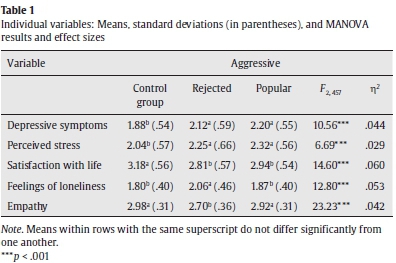
<body><![CDATA[<p><font face="Verdana, Arial, Helvetica, sans-serif" size="2"><b>Results </b></font></p>     <p><font face="Verdana, Arial, Helvetica, sans-serif" size="2">We first examined    whether sociometric status was independent of gender via a 2 (gender) by 2 (rejected    and popular status) Chi-square analysis. This revealed that sociometric status    was not independent of gender, ~<sup>2</sup>(2) = 16.67, <i>p</i> &lt; .001.    Of 72 aggressive rejected adolescents, 76.4% (<i>n = </i>55) were boys and 23.6%    (<i>n = </i>17) were girls, while of aggressive popular adolescents, 57.1% (<i>n    = </i>20) were boys and 42.9% (<i>n = </i>15) were girls. Due to the size of    the groups, however, the subsequent analyses did not include gender as a classification    variable but as a control covariate.</font></p>     <p><font face="Verdana, Arial, Helvetica, sans-serif" size="2">Following this,    we carried out a series of multivariate analyses ofvariance (MANOVA) in order    to examine significant relationships between peer-nominated status and the adjustment    indicators considered in the study. Due to the existence of very different cell    sizes and lack of homogeneity of variance, the robust estimators of Brown and    Forsythe (1974) and Welch (1951) were used in the analyses for <i>F</i> estimation.</font></p>     <p><font face="Verdana, Arial, Helvetica, sans-serif" size="2"><b>Individual Variables    and Sociometric Status Differences </b></font></p>     <p><font face="Verdana, Arial, Helvetica, sans-serif" size="2">To evaluate whether    aggressive rejected, aggressive popular, and the control group differed in the    individual adjustment variables, a MANOVA was performed with depressive symptomatology,    perceived stress, satisfaction with life, feelings of loneliness, and empathy    as dependent measures. There were statistically significant differences for    all variables. <a href="#t1">Table 1</a> gives main effects of status group    and corresponding estimated means, standard deviations, as well as the results    of pairwise comparisons of means effect sizes. For partial eta-squared, an effect    size of .01-.06 is interpreted as small, a value of .06-.08 indicates a medium    effect, and above .08 a large effect.</font></p>     <p><a name="t1"></a></p>     <p>&nbsp;</p>     <p align="center"><img src="/img/revistas/inter/v23n1/07t1.jpg"></p>     <p>&nbsp;</p>     <p><font face="Verdana, Arial, Helvetica, sans-serif" size="2">Post hoc tests    with Bonferroni's correction indicated that, generally, adolescents in the control    group showed better emotional adjustment, compared to both rejected and popular    groups of aggressive adolescents. In particular, participants in the control    group showed lower levels of depressive symptoms and perceived stress, and greater    levels of satisfaction with life, compared to aggressive rejected and aggressive    popular adolescents. No statistically significant differences were observed    between these latter two groups regarding these three variables. Finally, the    aggressive rejected adolescents reported more feelings of loneliness and lower    empathy, while there were no differences between control and aggressive popular    groups. Effect sizes of the differences statistically significant in these individual    variables were small in all cases, except for life satisfaction, which was medium.</font></p>     ]]></body>
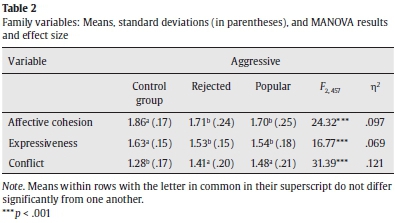
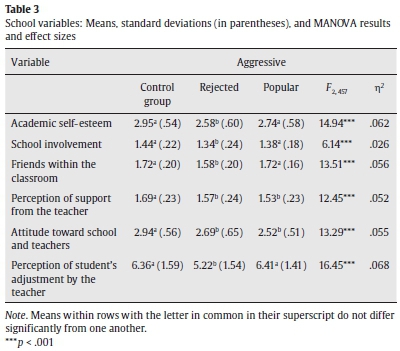
<body><![CDATA[<p><font face="Verdana, Arial, Helvetica, sans-serif" size="2"><b>Family Variables    and Sociometric Status Differences </b></font></p>     <p><font face="Verdana, Arial, Helvetica, sans-serif" size="2">A MANOVA was performed    to examine whether there were significant differences in family variables, namely    affective cohesion, expressiveness, and family conflict, among adolescents classified    as aggressive rejected or aggressive popular, and the control group. There were    statistically significant differences on the three variables. Means, standard    deviations, results of comparisons of means and effect sizes are presented in    <a href="#t2">Table 2</a>. Follow-up post hoc tests revealed that, generally,    those adolescents in the control group reported greater affective cohesion in    their families, compared to the two groups of aggressive adolescents, who showed    no differences between them. The results are in line with expressivity of opinions    and feelings within the family: the scores obtained by the control group were    significantly higher than those of either aggressive rejected or aggressive    popular adolescents, while these two latter groups did not differ. Differences    between groups in affective cohesion and expressiveness showed a medium effect    size. Finally, both groups of aggressive adolescents reported higher frequencies    of family conflicts than the control group. The effect size for differences    in family conflicts was large.</font></p>     <p><a name="t2"></a></p>     <p>&nbsp;</p>     <p align="center"><img src="/img/revistas/inter/v23n1/07t2.jpg"></p>     <p>&nbsp;</p>     <p><font face="Verdana, Arial, Helvetica, sans-serif" size="2"><b>School Variables    and Sociometric Status Differences </b></font></p>     <p><font face="Verdana, Arial, Helvetica, sans-serif" size="2">A MANOVA between    the status groups was computed with the following dependent variables: academic    self-esteem, school involvement, friends within the classroom, perception of    support from the teacher, attitude toward school and teachers, and teacher's    perception of student's adjustment. There were significant differences for all    variables. As indicated in <a href="#t3">Table 3</a>, post hoc tests with Bonferroni's    correction revealed that aggressive rejected had, generally, the lowest scores    on all the school variables. With respect to school tasks, these adolescents    reported lower academic self-esteem and lower involvement in classroom activities,    compared to the control and aggressive popular groups, there being no significant    differences between these latter.</font></p>     <p><a name="t3"></a></p>     <p>&nbsp;</p>     ]]></body>
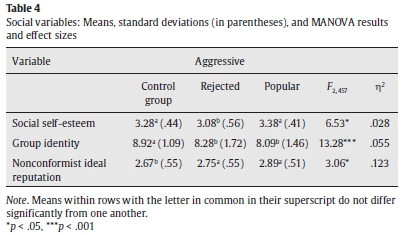
<body><![CDATA[<p align="center"><img src="/img/revistas/inter/v23n1/07t3.jpg"></p>     <p>&nbsp;</p>     <p><font face="Verdana, Arial, Helvetica, sans-serif" size="2">With respect to    perception of social relationships in the classroom,aggressive rejected adolescents    reported having fewer friends among their classmates, compared to the other    two groups. Perception of support from the teacher was lower in both aggressive    rejected and aggressive popular adolescents, compared to the control group.    The control group had more positive attitudes toward school, teachers and studies    compared to the more negative attitudes of both groups of aggressive adolescents.    Finally, teachers perceived aggressive rejected students to have greater adjustment    problems at school compared to both aggressive popular adolescents the control    group.</font></p>     <p><font face="Verdana, Arial, Helvetica, sans-serif" size="2">Effect sizes of    the differences statistically significant in these school variables were small    in all cases, except for academic self-esteem and teacher's perception of the    student's adjustment, which were medium.</font></p>     <p><font face="Verdana, Arial, Helvetica, sans-serif" size="2"><b>Social Variables    and Sociometric Status Differences </b></font></p>     <p><font face="Verdana, Arial, Helvetica, sans-serif" size="2">To test whether    aggressive rejected, aggressive popular, and the control group differed with    respect to social adjustment, a MANOVA was performed with social self-esteem,    group identity, and nonconformist social reputation as dependent measures. There    were statistically significant differences on all variables. The main effects    of status group, corresponding estimated means, standard deviations, and the    results of pairwise comparisons of means and effect sizes are presented in <a href="#t4">Table    4</a>. Post hoc tests with Bonferroni's correction indicated that aggressive    rejected adolescents had the lowest scores for social self-esteem, while there    was no difference between control and aggressive popular adolescents. With respect    to group identity, the control group had stronger identification with a reference    group, compared to both rejected and aggressive popular adolescents. Differences    between groups in social self-esteem and group identity showed a medium effect    size. Finally, both aggressive rejected and aggressive popular adolescents had    higher scores than the control group for nonconformist ideal reputation, this    difference having a large effect size.</font></p>     <p><a name="t4"></a></p>     <p>&nbsp;</p>     <p align="center"><img src="/img/revistas/inter/v23n1/07t4.jpg"></p>     <p>&nbsp;</p>     ]]></body>
<body><![CDATA[<p><font face="Verdana, Arial, Helvetica, sans-serif" size="2"><b>Discussion</b></font></p>     <p><font face="Verdana, Arial, Helvetica, sans-serif" size="2">Most of the literature    on sociometric status and psychosocial adjustment focuses on the rejected subgroup,    traditionally considered as the status at greatest risk for comorbidity of emotional    and behavior problems. Far fewer studies have analyzed the psychosocial profile    of popular adolescents. Even scarcer are studies addressing the heterogeneity    of the popular category, with a very few recent analyses of popularity as a    risk factor for deviant behavior in adolescence (Hoff et al., 2009; Mayeux,    Sandstrom, &amp; Cillessen, 2008; Rodkin et al., 2000). Moreover, none of these    studies examine the profile of aggressive popular students in any depth, with    regards to their individual characteristics or the immediate contexts of family    and school. Given this state of affairs, the main purpose of the present investigation    was to analyze and compare the profiles of adolescents classified respectively    as aggressive rejected and aggressive popular.</font></p>     <p><font face="Verdana, Arial, Helvetica, sans-serif" size="2"><b>Differences    between Groups in Variables of Individual Adjustment </b></font></p>     <p><font face="Verdana, Arial, Helvetica, sans-serif" size="2">The previous literature    has documented the close relationship between social rejection in adolescence    and indicators of emotional maladjustment such as the presence of stress and    depressive symptoms (Coie et al., 1992; Kiesner, 2002), feelings of loneliness    and low satisfaction with life (Hay et al., 2004; Woodward &amp; Fergusson,    1999). In the present study we found this pattern for aggressive rejected students    who, compared to a control group, scored lower on these four variables, indicating    greater maladjustment. Aggressive popular adolescents, contrary to the first    hypothesis, did not differ from the aggressive rejected group with respect to    stress, depression, or dissatisfaction with life. These results extend earlier    findings by indicating that accepted and popular students show emotional maladjustment    problems, and not just those students who suffer rejection at school. Thus,    social acceptance itself does not guarantee emotional adjustment, particularly    for those who are also aggressive.</font></p>     <p><font face="Verdana, Arial, Helvetica, sans-serif" size="2">There were, however,    significant differences between aggressiverejected and aggressive popular adolescents    with respect to empathy and loneliness, the former reporting greater feelings    of loneliness than the latter. Previous studies have found that rejected students    have smaller networks of friends than average or popular adolescents (Gest et    al., 2001; Gifford-Smith &amp; Brownell, 2003; Zettegren, 2005), which may explain    the greater loneliness they experience.</font></p>     <p><font face="Verdana, Arial, Helvetica, sans-serif" size="2">Aggressive rejected    adolescents had poorer empathic ability than either aggressive popular adolescents    or controls. These differences in empathy may be at the root of their lower    social acceptance and may also be related to a particular style of aggression.    Results of the present study are consistent with those obtained by Gifford-Smith    and Brownell (2003), who concluded that aggressive rejected students show a    different and particular style of violent behavior, compared to non-rejected    students. Aggression that is ineffective predominates in aggressive rejected    adolescents; it is reactive, poorly controlled and associated with negative    situations experienced as frustrating. In contrast, non-rejected adolescents    display effective violence, more active and associated with power, a type of    aggression that does not lead to social rejection (Bierman, 2004; Miller-Johnson    et al., 2002). Results of the current study suggested that this could be particularly    true of aggressive popular students.</font></p>     <p><font face="Verdana, Arial, Helvetica, sans-serif" size="2"><b>Differences    between Groups with respect to Family Adjustment </b></font></p>     <p><font face="Verdana, Arial, Helvetica, sans-serif" size="2">Contrary to the    second hypothesis, the results indicate that both aggressive rejected and aggressive    popular adolescents had poorer family adjustment than adolescents with average    status. Thus, regardless of their level of social acceptance among peers, rejected    and popular adolescents with problems of aggression reported greater levels    of family conflict than those in the control group, as well as lower levels    of affective cohesion and open communication of feelings and opinions among    family members. Previous studies have documented a direct association between    lack of social capital in the family and at school or, in other terms, between    perception of a rejecting and unsupportive family environment, and experience    of social rejection in the school (Cava &amp; Musitu, 2000; Ladd, 1999). Likewise,    a relationship between negative family climate and children's development of    deviant behaviors has been extensively documented (Cummings et al., 2003; Dekovic,    Wissink,, &amp; Mejier, 2004; Est&eacute;vez, Musitu, &amp; Herrero, 2005; Lila,    Herrero &amp; Gracia, 2008; Stevens, De Bourdeaudhuij, &amp; Van Oost, 2002).</font></p>     <p><font face="Verdana, Arial, Helvetica, sans-serif" size="2">Results from the    current research extend the conclusions of these earlier studies, which either    focus on the relations between family variables and sociometric status or between    family variables and children's behavioral adjustment. These findings directly    confirm the significance of family environment for both aggressive rejected    and aggressive popular adolescents; these types did not differ with respect    to family adjustment.</font></p>     <p><font face="Verdana, Arial, Helvetica, sans-serif" size="2"><b>Differences    between Groups with respect to School Adjustment </b></font></p>     ]]></body>
<body><![CDATA[<p><font face="Verdana, Arial, Helvetica, sans-serif" size="2">Partial support    was found for the third hypothesis. Generally, aggressive rejected adolescents    had poorer academic and social adjustment at school compared to both aggressive    popular adolescents and controls. Thus, as expected, aggressive rejected adolescents    reported lower levels of academic self-esteem and academic involvement. These    results are consistent with those of previous studies of rejected adolescents    (Greenman et al., 2009; Hymel et al., 1993; Jimerson et al., 2009). Nonetheless,    findings of the current work add to the picture in showing that popular students    who also report aggressive behavior maintain academic self-esteem and school    involvement at levels equal to those of average pupils. These results suggest    that those at greatest risk of school dropout are rejected students with behavior    problems.</font></p>     <p><font face="Verdana, Arial, Helvetica, sans-serif" size="2">The popular aggressive    adolescents also received more positive evaluations from their teachers despite    their deviant behavior. The results revealed that popular aggressive students    had as many friends within the classroom and as positive teacher evaluations    as the control group. As hypothesized, aggressive rejected adolescents were    perceived as the most maladjusted by teachers and also reported the fewest friends    within the classroom. As already mentioned, previous studies have associated    popular status with a rich social network (Zettegren, 2005) but our results    indicate that positive social evaluations persist for popular status even when    this coexists with aggressive behavior. This is of fundamental importance in    the design of school interventions, since it helps explain the persistence of    deviant behavior of certain students who, being liked and popular among their    peers, receive positive feedback for their aggressive behavior, which enhances    the probability that such behavior will be repeated.</font></p>     <p><font face="Verdana, Arial, Helvetica, sans-serif" size="2">Finally, and contrary    to our <i>a priori</i> expectations, there were two variables that did not differentiate    aggressive rejected and aggressive popular students: perception of support from    the teacher and attitude toward school and teachers. Attitudes to and evaluations    of support at school were more negative in both subgroups than in the control    group. Previous studies have shown that students who display negative attitudes    toward figures and institutions associated with formal authority, such as teachers    and the school context, are more likely to develop aggressive and delinquent    behaviors (Emler &amp; Reicher, 1995; Hoge, Andrews, &amp; Lescheid, 1996).    Results of the current study extend these previous findings by showing that    a negative attitude toward school may be, in fact, a risk factor for aggressive    behavior, regardless of the degree of social acceptance among peers.</font></p>     <p><font face="Verdana, Arial, Helvetica, sans-serif" size="2"><b>Differences    between Groups with respect to Social Adjustment </b></font></p>     <p><font face="Verdana, Arial, Helvetica, sans-serif" size="2">Inconsistent with    the fourth hypothesis, there was a significant difference between aggressive    rejected and aggressive popular adolescents in level of social self-esteem.    The lowest scores were recorded for aggressive rejected adolescents, a result    in line with their perception of having fewer friends within the classroom and    their reported greater experience of loneliness. Previous studies, for example    Cava and Musitu (2001), have indicated that those with both popular and average    status normally display higher social self-esteem than those with rejected status.    This pattern was confirmed in the present study, but with one further variable    included in the analysis aggressive behavior. Thus, the results indicated that    aggressive behavior on the part of popular adolescents is not incompatible with    experiencing positive social interactions. This suggests that aggressive behavior    is not by itself as source of greater or lesser social acceptance in the classroom.    This is a key consideration in designing interventions focused on achieving    the social integration of students at school, since highly conflictive aggressive    students may be, at the same time, well-adjusted and adapted to the social dynamics    of the classroom.</font></p>     <p><font face="Verdana, Arial, Helvetica, sans-serif" size="2">The results on    group identity shed further light on pattern found for social self-esteem. In    the light of Gifford-Smith and Brownell's results (2003) on friendships of different    sociometric status, it was expected that popular adolescents would identify    more strongly with a social reference group than rejected students. The results    indicated, however, that both aggressive rejected and aggressive popular students    reported feeling less identified with a reference group than average status    adolescents; social acceptance by itself does not guarantee stronger group identification.    Students who displayed aggressive behavior, even though they were popular, seemed    to have friendships of lower quality than those adolescents without behavior    problems documented.</font></p>     <p><font face="Verdana, Arial, Helvetica, sans-serif" size="2">Finally, we examined    the adolescent's ideal social reputation as a rebellious and nonconformist person.    As hypothesized, both aggressive rejected and aggressive popular groups scored    significantly higher on this variable than the control group. Both the aggressive    subgroups displayed a more obvious and stronger desire to adopt an image of    strength and power among their peers, regardless their current level of social    acceptance. In line with conclusions from recent studies, there seems to be    a close association between the search for social recognition as a non-conformist    individual and participation in aggressive acts during adolescence (Buelga,    Musitu, Murgui &amp; Pons, 2008; Carroll et al., 1999, 2003; Emler &amp; Reicher,    2005; Moreno, Neves de Jes&uacute;s, Murgui, &amp; Mart&iacute;nez, 2012). Even    though this relationship between nonconformist reputation and aggressive behavior    is well supported in previous research, the link between sociometric status    and desire to acquire an antisocial reputation among classmates had not previously    been examined. Findings of this study are consistent with Emler's (2009) analysis    of deviant and delinquent youth in suggesting that aggressive behavior is seen    by some adolescents as a strategy to avoid future victimization or rejection,    while for others it is interpreted as an opportunity to achieve desired popularity    among peers.</font></p>     <p><font face="Verdana, Arial, Helvetica, sans-serif" size="2"><b>Strengths, Limitations,    and Implications for Future Research </b></font></p>     <p><font face="Verdana, Arial, Helvetica, sans-serif" size="2">The present study    has several strong points such as: the use of data collecting instruments widely    used and validated in previous studies with adolescent samples; a multi-variate    approach concurrently examining different domains relating to adolescents' adjustment;    the inclusion of a sample of aggressive popular adolescents; and the generation    of new findings concerning the similarities and differences between students    with aggressive rejected status and those with aggressive popular status. One    limitation of this study was the relatively small number adolescents in the    subgroup of aggressive popular adolescents (<i>n </i>= 35). A second limitation    was that two of the twelve scales used in the current study, perceived stress    and classroom environment, had reliabilities between .60 and .70.</font></p>     <p><font face="Verdana, Arial, Helvetica, sans-serif" size="2">A third limitation    of this work is its cross-sectional design whichprecludes causal conclusions    about observed relationships. For example, we cannot say whether problems of    emotional adjustment or negative perception of school were either cause or consequence    of students' degree of social acceptance in the classroom - their sociometric    status - or of their aggressive behavior. The results obtained in this study    are more descriptive than explanatory and mainly concern the different profiles    of the two groups examined. Further research examining in more detail the origin    and consequences of degree of social acceptance of students with aggressive    behavior problems would require the use of a longitudinal design that allows    monitoring these adolescents at different points in time. Also, further research    could analyze in greater depth sociometric status in relation to the type of    violent behavior used by teenagers, which, according to the classification proposed    by Gifford-Smith and Brownell (2003), may be categorized into inefficient-useless    and efficient-useful. It would be interesting to observe whether there is a    significant association between social acceptance, empathic ability, and the    specific type of violent behavior shown. These results could shed light on the    reasons for rejection or popularity of aggressive students, which would in turn    support better interventions.</font></p>     ]]></body>
<body><![CDATA[<p><font face="Verdana, Arial, Helvetica, sans-serif" size="2"><b>Implications    for Intervention </b></font></p>     <p><font face="Verdana, Arial, Helvetica, sans-serif" size="2">The results of    the current study allow us to conclude that, although aggressive rejected students    seem to be at greater risk of maladjustment in several respects compared to    adolescents with aggressive popular status (for example, in feelings of loneliness,    self-esteem and academic success), both groups require attention for effective    interventions addressing school violence and social integration within the classroom.    Thus, for instance, both groups had poor emotional adjustment levels - significantly    lower than the average group -, indicating we cannot ignore the need for therapeutic    work with students who are socially accepted by their peers, but display aggressive    behavior. The involvement of families and working with them and the school is    another key element in effective intervention, according to the results of the    current study. The negative perception of the family environment is a shared    feature of aggressive rejected and aggressive popular students since both groups    reported the presence of more family conflicts and a poorer family communication    than the control group, as pointed out in previous research (Jim&eacute;nez    &amp; Lealle, 2012).</font></p>     <p><font face="Verdana, Arial, Helvetica, sans-serif" size="2">The analysis of    school variables also provides indicators for the design of prevention and intervention    strategies. It is worth noting that aggressive popular students do not seem    to have problems of academic adjustment; their academic involvement is comparable    to students with average status and no behavioral problems. It would be advisable,    however, to pay more attention to the academic situation of aggressive rejected    students to reduce school dropout. The academic success of aggressive popular    students, along with the fact that they are supported by their peers and also    perceived by teachers as well adjusted within the classroom, makes their identification    as a group at risk more difficult. In other words, it is necessary to establish    mechanisms in schools that allow the detection of these students, given they    normally go unnoticed more often than aggressive rejected students. Intervention    could also be helpful to them if aimed at modifying both their behavior and    attitudes toward school and teachers.</font></p>     <p><font face="Verdana, Arial, Helvetica, sans-serif" size="2">Attitudes toward    teachers and school is another important issue in relation to intervention.    The need to work at an attitudinal level is, as suggested by the results of    the present study, a key issue for both groups. Aggressive rejected students    reported negative attitudes toward teachers and school, but attitudes of aggressive    popular students were equally negative, despite their better general academic    adjustment. Encouraging positive attitudes, as well as fostering a closer relationship    with the teacher - both groups perceived little help from the teacher compared    to the average group -, are aspects of remarkable relevance that, according    to our findings, would improve the social integration of students and, ultimately,    positively influence school life.</font></p>     <p><font face="Verdana, Arial, Helvetica, sans-serif" size="2">Finally, interventions    might aim at weakening the link between aggressive behavior and being socially    dominant or liked by preventing aggressors from harvesting the benefits of their    behavior, as others have also pointed out (Olthof &amp; Goossens, 2008; Olthof,    Goossens, Vermande, Aleva, &amp; van der Meulen, 2011). One way of achieving    this might involve focusing on aggressors' reputations among their peers. As    pointed out by Farmer et al. (2006), the focus of violence prevention programs    should extend beyond aggressive adolescents and deviant groups and also address    nonaggressive peers who support these behaviors.</font></p>     <p><font face="Verdana, Arial, Helvetica, sans-serif" size="2">The results of    the current study indicate that aggressive popular adolescents have friends    who admire, respect, and like them. Further research, following the theoretical    argument proposed by Emler (2009), could probe further the association between    aggressive behavior and the search for a social reputation as a respected, rebellious    and nonconformist person, and particularly in the group of aggressive popular    students. In order to break down the relationship between these variables, interventions    could focus on affecting the attitude of adolescents in a class in such a way    that aggressive behavior is no longer perceived as a 'cool' behavior (Rodkin    et al., 2006), "but rather as a definitely 'uncool' strategy of someone who    cannot think of less aggressive ways to attract attention" (Olthof et al., 2011,    p.19). In short, future studies should consider these and other intervention    strategies that include all those students at risk of developing adjustment    problems, without ignoring socially accepted adolescents who are nonetheless    harboring serious problems at other levels.</font></p>     <p>&nbsp;</p>     <p><font face="Verdana, Arial, Helvetica, sans-serif" size="2"><b>Conflict of    Interest </b></font></p>     <p><font face="Verdana, Arial, Helvetica, sans-serif" size="2">The authors of    this article declare no conflicts of interest.</font></p>     <p>&nbsp;</p>     ]]></body>
<body><![CDATA[<p><font face="Verdana, Arial, Helvetica, sans-serif" size="2"><b>References</b></font></p>     <!-- ref --><p><font face="Verdana, Arial, Helvetica, sans-serif" size="2">Arbuckle, J. L.    (2005). <i>Amos 6.0 User's Guide</i>. Chicago, IL: SPSS Inc.    &nbsp;&nbsp;&nbsp;&nbsp;&nbsp;&nbsp;&nbsp;&nbsp;[&#160;<a href="javascript:void(0);" onclick="javascript: window.open('/scielo.php?script=sci_nlinks&ref=4379926&pid=S1132-0559201400010000700001&lng=','','width=640,height=500,resizable=yes,scrollbars=1,menubar=yes,');">Links</a>&#160;]<!-- end-ref --></font></p>     <!-- ref --><p><font face="Verdana, Arial, Helvetica, sans-serif" size="2">Astor, R., Pitner,    R.O., Benbenishty, R., &amp; Meyer, H.A. (2002). Public concern and focus on    school violence. In L. A. Rapp-Paglicci, A. R. Roberts, &amp;, J. S. Wodarski    (Eds.), <i>Handbook of violence</i> (pp. 262-297). New York: Wiley.    &nbsp;&nbsp;&nbsp;&nbsp;&nbsp;&nbsp;&nbsp;&nbsp;[&#160;<a href="javascript:void(0);" onclick="javascript: window.open('/scielo.php?script=sci_nlinks&ref=4379928&pid=S1132-0559201400010000700002&lng=','','width=640,height=500,resizable=yes,scrollbars=1,menubar=yes,');">Links</a>&#160;]<!-- end-ref --></font></p>     <!-- ref --><p><font face="Verdana, Arial, Helvetica, sans-serif" size="2">Atienza, F. L.,    Pons, D., Balaguer, I., &amp; Garc&iacute;a-Merita, M. (2000). Propiedades psicom&eacute;tricas    de la escala de satisfacci&oacute;n con la vida en adolescentes. <i>Psicothema,</i>    <i>12,</i> 314-320.    &nbsp;&nbsp;&nbsp;&nbsp;&nbsp;&nbsp;&nbsp;&nbsp;[&#160;<a href="javascript:void(0);" onclick="javascript: window.open('/scielo.php?script=sci_nlinks&ref=4379930&pid=S1132-0559201400010000700003&lng=','','width=640,height=500,resizable=yes,scrollbars=1,menubar=yes,');">Links</a>&#160;]<!-- end-ref --></font></p>     <!-- ref --><p><font face="Verdana, Arial, Helvetica, sans-serif" size="2">Becker, B. E.,    &amp; Luthar, S. S. (2007). Peer-perceived admiration and social preference:    contextual correlates of positive peer regard among suburban and urban adolescents.    <i>Journal of Research on Adolescence, 17</i>, 117-144. doi: 10.1111/j.1532-7795.2007.00514.x</font>&nbsp;&nbsp;&nbsp;&nbsp;&nbsp;&nbsp;&nbsp;&nbsp;[&#160;<a href="javascript:void(0);" onclick="javascript: window.open('/scielo.php?script=sci_nlinks&ref=4379932&pid=S1132-0559201400010000700004&lng=','','width=640,height=500,resizable=yes,scrollbars=1,menubar=yes,');">Links</a>&#160;]<!-- end-ref --><!-- ref --><p><font face="Verdana, Arial, Helvetica, sans-serif" size="2">Bellmore, A. (2011).    Peer rejection and unpopularity: Associations with GPAs across the transition    to middle school. <i>Journal of Educational Psychology, 103, </i>282-295. doi:    10.1037/a0023312</font>&nbsp;&nbsp;&nbsp;&nbsp;&nbsp;&nbsp;&nbsp;&nbsp;[&#160;<a href="javascript:void(0);" onclick="javascript: window.open('/scielo.php?script=sci_nlinks&ref=4379933&pid=S1132-0559201400010000700005&lng=','','width=640,height=500,resizable=yes,scrollbars=1,menubar=yes,');">Links</a>&#160;]<!-- end-ref --><!-- ref --><p><font face="Verdana, Arial, Helvetica, sans-serif" size="2">Bierman, K. L.    (2004). <i>Peer rejection. Developmental processes and intervention strategies.</i>    New York: Guilford Press.    &nbsp;&nbsp;&nbsp;&nbsp;&nbsp;&nbsp;&nbsp;&nbsp;[&#160;<a href="javascript:void(0);" onclick="javascript: window.open('/scielo.php?script=sci_nlinks&ref=4379934&pid=S1132-0559201400010000700006&lng=','','width=640,height=500,resizable=yes,scrollbars=1,menubar=yes,');">Links</a>&#160;]<!-- end-ref --></font></p>     <!-- ref --><p><font face="Verdana, Arial, Helvetica, sans-serif" size="2">Bierman, K. L.,    Smoot, D. L., &amp; Aumiller, K. (1993). Characteristics of aggressive- rejected,    aggressive (nonrejected), and rejected (nonaggressive) boys. <i>Child Development,    64,</i> 139-151. doi: 10.2307/1131442</font>&nbsp;&nbsp;&nbsp;&nbsp;&nbsp;&nbsp;&nbsp;&nbsp;[&#160;<a href="javascript:void(0);" onclick="javascript: window.open('/scielo.php?script=sci_nlinks&ref=4379936&pid=S1132-0559201400010000700007&lng=','','width=640,height=500,resizable=yes,scrollbars=1,menubar=yes,');">Links</a>&#160;]<!-- end-ref --><!-- ref --><p><font face="Verdana, Arial, Helvetica, sans-serif" size="2">Birch, S.H., &amp;    Ladd, G.W. (1998). Children's interpersonal behaviors and the teacher- child    relationship. <i>Developmental Psychology, 34,</i> 934-946. doi: 10.1037//0012-1649.34.5.934</font>&nbsp;&nbsp;&nbsp;&nbsp;&nbsp;&nbsp;&nbsp;&nbsp;[&#160;<a href="javascript:void(0);" onclick="javascript: window.open('/scielo.php?script=sci_nlinks&ref=4379937&pid=S1132-0559201400010000700008&lng=','','width=640,height=500,resizable=yes,scrollbars=1,menubar=yes,');">Links</a>&#160;]<!-- end-ref --><!-- ref --><p><font face="Verdana, Arial, Helvetica, sans-serif" size="2">Black, B., &amp;    Logan, A. (1995). Links between communication patterns in mother-child, father-child,    and child-peer interactions and children's social status. <i>Child Development</i>,    <i>66</i>, 255-271. doi: 10.2307/1131204</font>&nbsp;&nbsp;&nbsp;&nbsp;&nbsp;&nbsp;&nbsp;&nbsp;[&#160;<a href="javascript:void(0);" onclick="javascript: window.open('/scielo.php?script=sci_nlinks&ref=4379938&pid=S1132-0559201400010000700009&lng=','','width=640,height=500,resizable=yes,scrollbars=1,menubar=yes,');">Links</a>&#160;]<!-- end-ref --><!-- ref --><p><font face="Verdana, Arial, Helvetica, sans-serif" size="2">Blankemeyer, M.,    Flannery, D.J., &amp; Vazsonyi, A.T. (2002). The role of aggression and social    competence in children's perception of the child-teacher relationship. <i>Psychology    in the Schools, 39,</i> 293-304. doi:10.1002/pits.10008</font>&nbsp;&nbsp;&nbsp;&nbsp;&nbsp;&nbsp;&nbsp;&nbsp;[&#160;<a href="javascript:void(0);" onclick="javascript: window.open('/scielo.php?script=sci_nlinks&ref=4379939&pid=S1132-0559201400010000700010&lng=','','width=640,height=500,resizable=yes,scrollbars=1,menubar=yes,');">Links</a>&#160;]<!-- end-ref --><!-- ref --><p><font face="Verdana, Arial, Helvetica, sans-serif" size="2">Brown, M. B., &amp;    Forsythe, A. B. (1974). The small sample behavior of some statistics which test    the equality of several means. <i>Technometrics, 16,</i> 129-132. doi: 10.2307/1267501</font>&nbsp;&nbsp;&nbsp;&nbsp;&nbsp;&nbsp;&nbsp;&nbsp;[&#160;<a href="javascript:void(0);" onclick="javascript: window.open('/scielo.php?script=sci_nlinks&ref=4379940&pid=S1132-0559201400010000700011&lng=','','width=640,height=500,resizable=yes,scrollbars=1,menubar=yes,');">Links</a>&#160;]<!-- end-ref --><!-- ref --><p><font face="Verdana, Arial, Helvetica, sans-serif" size="2">Bryant, B. K. (1982).    An Index of Empathy for Children and Adolescents. <i>Child Development, 53 </i>(2),    413-425. doi: 10.2307/1128984</font>&nbsp;&nbsp;&nbsp;&nbsp;&nbsp;&nbsp;&nbsp;&nbsp;[&#160;<a href="javascript:void(0);" onclick="javascript: window.open('/scielo.php?script=sci_nlinks&ref=4379941&pid=S1132-0559201400010000700012&lng=','','width=640,height=500,resizable=yes,scrollbars=1,menubar=yes,');">Links</a>&#160;]<!-- end-ref --><!-- ref --><p><font face="Verdana, Arial, Helvetica, sans-serif" size="2">Buelga, S., Musitu,    G., Murgui, S., &amp; Pons, J. (2008). Reputation, loneliness, satisfaction    with life and aggressive behavior in adolescence. <i>The Spanish Journal of    Psychology, 11</i>, 192-200.    &nbsp;&nbsp;&nbsp;&nbsp;&nbsp;&nbsp;&nbsp;&nbsp;[&#160;<a href="javascript:void(0);" onclick="javascript: window.open('/scielo.php?script=sci_nlinks&ref=4379942&pid=S1132-0559201400010000700013&lng=','','width=640,height=500,resizable=yes,scrollbars=1,menubar=yes,');">Links</a>&#160;]<!-- end-ref --></font></p>     <!-- ref --><p><font face="Verdana, Arial, Helvetica, sans-serif" size="2">Buhs, E. S., Ladd,    G. W., &amp; Herald, S. L. (2006). Peer exclusion and victimization: Processes    that mediate the relations between peer group rejection and children's classroom    engagement and achievement. <i>Journal of Educational Psychology, 98, </i>1-13.    doi: 10.1037/0022-0663.98.1.1</font>&nbsp;&nbsp;&nbsp;&nbsp;&nbsp;&nbsp;&nbsp;&nbsp;[&#160;<a href="javascript:void(0);" onclick="javascript: window.open('/scielo.php?script=sci_nlinks&ref=4379944&pid=S1132-0559201400010000700014&lng=','','width=640,height=500,resizable=yes,scrollbars=1,menubar=yes,');">Links</a>&#160;]<!-- end-ref --><!-- ref --><p><font face="Verdana, Arial, Helvetica, sans-serif" size="2">Carroll, A., Hattie,    J., Durkin, K., &amp; Houghton, S. (1999). Adolescent reputation enhancement:    differentiating delinquent, nondelinquent, and at-risk youths. <i>Journal of    Child Psychology and Psychiatry, 40</i>, 593-606. doi: 10.1111/1469-7610.00476</font>&nbsp;&nbsp;&nbsp;&nbsp;&nbsp;&nbsp;&nbsp;&nbsp;[&#160;<a href="javascript:void(0);" onclick="javascript: window.open('/scielo.php?script=sci_nlinks&ref=4379945&pid=S1132-0559201400010000700015&lng=','','width=640,height=500,resizable=yes,scrollbars=1,menubar=yes,');">Links</a>&#160;]<!-- end-ref --><!-- ref --><p><font face="Verdana, Arial, Helvetica, sans-serif" size="2">Carroll, A., Green,    S., Houghton, S., &amp; Wood, R. (2003). Reputation enhancement and involvement    in delinquency among high school students. <i>International Journal of Disability,    Development and Education, 50</i>, 253-273. doi: 10.1080/1034912032000120444</font>&nbsp;&nbsp;&nbsp;&nbsp;&nbsp;&nbsp;&nbsp;&nbsp;[&#160;<a href="javascript:void(0);" onclick="javascript: window.open('/scielo.php?script=sci_nlinks&ref=4379946&pid=S1132-0559201400010000700016&lng=','','width=640,height=500,resizable=yes,scrollbars=1,menubar=yes,');">Links</a>&#160;]<!-- end-ref --><!-- ref --><p><font face="Verdana, Arial, Helvetica, sans-serif" size="2">Carroll, A., Houghton,    S., Hattie, J., &amp; Durkin, K. (2001). Reputation enhancing goals: Integrating    reputation enhancement and goal setting theory as an explanation of delinquent    involvement. In F.H. Columbus (Ed.), <i>Advances in Psychology Research </i>(pp.    101-129). New York: Nova Science Publishers.    &nbsp;&nbsp;&nbsp;&nbsp;&nbsp;&nbsp;&nbsp;&nbsp;[&#160;<a href="javascript:void(0);" onclick="javascript: window.open('/scielo.php?script=sci_nlinks&ref=4379947&pid=S1132-0559201400010000700017&lng=','','width=640,height=500,resizable=yes,scrollbars=1,menubar=yes,');">Links</a>&#160;]<!-- end-ref --></font></p>     <!-- ref --><p><font face="Verdana, Arial, Helvetica, sans-serif" size="2">Cava, M. J. (2011).    Family, teachers, and peers: keys for supporting victims of bullying. <i>Psychosocial    Intervention, 20, </i>183-192. doi: 10.5093/in2011v20n2a6</font>&nbsp;&nbsp;&nbsp;&nbsp;&nbsp;&nbsp;&nbsp;&nbsp;[&#160;<a href="javascript:void(0);" onclick="javascript: window.open('/scielo.php?script=sci_nlinks&ref=4379949&pid=S1132-0559201400010000700018&lng=','','width=640,height=500,resizable=yes,scrollbars=1,menubar=yes,');">Links</a>&#160;]<!-- end-ref --><!-- ref --><p><font face="Verdana, Arial, Helvetica, sans-serif" size="2">Cava, M.J., Buelga,    S., Musitu, G., &amp; Herrero, J. (2011). Estructura factorial de la adaptaci&oacute;n    espa&ntilde;ola de la escala de Identificaci&oacute;n Grupal de Tarrant. <i>Psicothema,    23, </i>772-777.    &nbsp;&nbsp;&nbsp;&nbsp;&nbsp;&nbsp;&nbsp;&nbsp;[&#160;<a href="javascript:void(0);" onclick="javascript: window.open('/scielo.php?script=sci_nlinks&ref=4379950&pid=S1132-0559201400010000700019&lng=','','width=640,height=500,resizable=yes,scrollbars=1,menubar=yes,');">Links</a>&#160;]<!-- end-ref --></font></p>     <!-- ref --><p><font face="Verdana, Arial, Helvetica, sans-serif" size="2">Cava, M.J., Est&eacute;vez,    E. Buelga, S., &amp; Musitu, G. (2013). Propiedades psicom&eacute;tricas de    la Escala de Actitudes hacia la Autoridad Institucional en adolescentes (AAI-A).    <i>Anales de Psicolog&iacute;a, 29, </i>540-548.    &nbsp;&nbsp;&nbsp;&nbsp;&nbsp;&nbsp;&nbsp;&nbsp;[&#160;<a href="javascript:void(0);" onclick="javascript: window.open('/scielo.php?script=sci_nlinks&ref=4379952&pid=S1132-0559201400010000700020&lng=','','width=640,height=500,resizable=yes,scrollbars=1,menubar=yes,');">Links</a>&#160;]<!-- end-ref --></font></p>     <!-- ref --><p><font face="Verdana, Arial, Helvetica, sans-serif" size="2">Cava, M. J., &amp;    Musitu, G. (1999). Percepci&oacute;n del profesor y estatus sociom&eacute;trico    en el grupo de iguales. <i>Informaci&oacute;n Psicol&oacute;gica, 71</i>, 60-65.    &nbsp;&nbsp;&nbsp;&nbsp;&nbsp;&nbsp;&nbsp;&nbsp;[&#160;<a href="javascript:void(0);" onclick="javascript: window.open('/scielo.php?script=sci_nlinks&ref=4379954&pid=S1132-0559201400010000700021&lng=','','width=640,height=500,resizable=yes,scrollbars=1,menubar=yes,');">Links</a>&#160;]<!-- end-ref --></font></p>     <!-- ref --><p><font face="Verdana, Arial, Helvetica, sans-serif" size="2">Cava, M. J., &amp;    Musitu, G. (2000). <i>La potenciaci&oacute;n de la autoestima en la escuela</i>.    Barcelona: Paid&oacute;s.    &nbsp;&nbsp;&nbsp;&nbsp;&nbsp;&nbsp;&nbsp;&nbsp;[&#160;<a href="javascript:void(0);" onclick="javascript: window.open('/scielo.php?script=sci_nlinks&ref=4379956&pid=S1132-0559201400010000700022&lng=','','width=640,height=500,resizable=yes,scrollbars=1,menubar=yes,');">Links</a>&#160;]<!-- end-ref --></font></p>     <!-- ref --><p><font face="Verdana, Arial, Helvetica, sans-serif" size="2">Cava, M. J., &amp;    Musitu, G. (2001). Autoestima y percepci&oacute;n del clima escolar en ni&ntilde;os    con problemas de integraci&oacute;n social en el aula. <i>Revista de Psicolog&iacute;a    General and Aplicada, 54, </i>297-311.    &nbsp;&nbsp;&nbsp;&nbsp;&nbsp;&nbsp;&nbsp;&nbsp;[&#160;<a href="javascript:void(0);" onclick="javascript: window.open('/scielo.php?script=sci_nlinks&ref=4379958&pid=S1132-0559201400010000700023&lng=','','width=640,height=500,resizable=yes,scrollbars=1,menubar=yes,');">Links</a>&#160;]<!-- end-ref --></font></p>     <!-- ref --><p><font face="Verdana, Arial, Helvetica, sans-serif" size="2">Cillessen, A.,    van Ijzendoom, H., van Lieshout, C., &amp; Hartup, W. (1992). Heterogeneity    among peer rejected boys: Subtypes and stabilities. <i>Child Development, 63,</i>    893-905. doi: 10.2307/1131241</font>&nbsp;&nbsp;&nbsp;&nbsp;&nbsp;&nbsp;&nbsp;&nbsp;[&#160;<a href="javascript:void(0);" onclick="javascript: window.open('/scielo.php?script=sci_nlinks&ref=4379960&pid=S1132-0559201400010000700024&lng=','','width=640,height=500,resizable=yes,scrollbars=1,menubar=yes,');">Links</a>&#160;]<!-- end-ref --><!-- ref --><p><font face="Verdana, Arial, Helvetica, sans-serif" size="2">Cohen, S., Kamarck,    T., &amp; Mermelstein, R. (1983). A global measure of perceived stress.<i> Journal    of Health and Social Behavior, 24</i>, 385-396. doi: 10.2307/2136404</font>&nbsp;&nbsp;&nbsp;&nbsp;&nbsp;&nbsp;&nbsp;&nbsp;[&#160;<a href="javascript:void(0);" onclick="javascript: window.open('/scielo.php?script=sci_nlinks&ref=4379961&pid=S1132-0559201400010000700025&lng=','','width=640,height=500,resizable=yes,scrollbars=1,menubar=yes,');">Links</a>&#160;]<!-- end-ref --><!-- ref --><p><font face="Verdana, Arial, Helvetica, sans-serif" size="2">Cohen, S., &amp;    Williamson, G. (1988). Perceived stress in a probability sample of the United    States. In S. Spacapan &amp; S. Oskamp (Eds.), <i>The social psychology of health</i>    (pp. 31-67). Newbury Park, CA: Sage.    &nbsp;&nbsp;&nbsp;&nbsp;&nbsp;&nbsp;&nbsp;&nbsp;[&#160;<a href="javascript:void(0);" onclick="javascript: window.open('/scielo.php?script=sci_nlinks&ref=4379962&pid=S1132-0559201400010000700026&lng=','','width=640,height=500,resizable=yes,scrollbars=1,menubar=yes,');">Links</a>&#160;]<!-- end-ref --></font></p>     <!-- ref --><p><font face="Verdana, Arial, Helvetica, sans-serif" size="2">Coie, J. D., Dodge,    K. A., &amp; Coppotelli, H. (1982). Dimensions and types of social status: Across-age    perspective. <i>Developmental Psychology, 18,</i> 557-570. doi: 10.1037/0012-1649.18.4.557</font>&nbsp;&nbsp;&nbsp;&nbsp;&nbsp;&nbsp;&nbsp;&nbsp;[&#160;<a href="javascript:void(0);" onclick="javascript: window.open('/scielo.php?script=sci_nlinks&ref=4379964&pid=S1132-0559201400010000700027&lng=','','width=640,height=500,resizable=yes,scrollbars=1,menubar=yes,');">Links</a>&#160;]<!-- end-ref --><!-- ref --><p><font face="Verdana, Arial, Helvetica, sans-serif" size="2">Coie, J. D., Lochman,    J. E., Terry, R., &amp; Hyman, C. (1992). Predicting early adolescent disorder    from childhood aggression and peer rejection. <i>Journal of Consulting and Clinical    Psychology, 60,</i> 783-792. doi: 10.1037//0022-006X.60.5.783</font>&nbsp;&nbsp;&nbsp;&nbsp;&nbsp;&nbsp;&nbsp;&nbsp;[&#160;<a href="javascript:void(0);" onclick="javascript: window.open('/scielo.php?script=sci_nlinks&ref=4379965&pid=S1132-0559201400010000700028&lng=','','width=640,height=500,resizable=yes,scrollbars=1,menubar=yes,');">Links</a>&#160;]<!-- end-ref --><!-- ref --><p><font face="Verdana, Arial, Helvetica, sans-serif" size="2">Crick, N. R., &amp;    Dodge, K. A. (1994). A review and reformulation of social information-processing    mechanisms in children's social adjustment. <i>Psychological Bulletin</i>, <i>115</i>,    74-101. doi: 10.1037//0033-2909.115.1.74</font>&nbsp;&nbsp;&nbsp;&nbsp;&nbsp;&nbsp;&nbsp;&nbsp;[&#160;<a href="javascript:void(0);" onclick="javascript: window.open('/scielo.php?script=sci_nlinks&ref=4379966&pid=S1132-0559201400010000700029&lng=','','width=640,height=500,resizable=yes,scrollbars=1,menubar=yes,');">Links</a>&#160;]<!-- end-ref --><!-- ref --><p><font face="Verdana, Arial, Helvetica, sans-serif" size="2">Cummings, E. M.,    Goeke-Morey, M., &amp; Papp, L. (2003). Children's responses to everyday marital    conflict tactics in the home. <i>Child Development, 74</i>, 1918-1929. doi:    10.1046/j.1467-8624.2003.00646.x</font>&nbsp;&nbsp;&nbsp;&nbsp;&nbsp;&nbsp;&nbsp;&nbsp;[&#160;<a href="javascript:void(0);" onclick="javascript: window.open('/scielo.php?script=sci_nlinks&ref=4379967&pid=S1132-0559201400010000700030&lng=','','width=640,height=500,resizable=yes,scrollbars=1,menubar=yes,');">Links</a>&#160;]<!-- end-ref --><!-- ref --><p><font face="Verdana, Arial, Helvetica, sans-serif" size="2">Davis, H. (2003).    Conceptualizing the role and influence of student-teacher relationships on children's    social and cognitive development. <i>Educational Psychologist, 38</i>, 207-234.    doi: 10.1207/S15326985EP3804_2</font>&nbsp;&nbsp;&nbsp;&nbsp;&nbsp;&nbsp;&nbsp;&nbsp;[&#160;<a href="javascript:void(0);" onclick="javascript: window.open('/scielo.php?script=sci_nlinks&ref=4379968&pid=S1132-0559201400010000700031&lng=','','width=640,height=500,resizable=yes,scrollbars=1,menubar=yes,');">Links</a>&#160;]<!-- end-ref --><!-- ref --><p><font face="Verdana, Arial, Helvetica, sans-serif" size="2">Dekovic, M., Wissink,    I., &amp; Meijer, A. (2004). The role of family and peer relations in adolescent    antisocial behaviour: Comparison of four ethnic groups. <i>Journal of Adolescence,    27, </i>497-514. doi: 10.1016/j.adolescence.2004.06.010</font>&nbsp;&nbsp;&nbsp;&nbsp;&nbsp;&nbsp;&nbsp;&nbsp;[&#160;<a href="javascript:void(0);" onclick="javascript: window.open('/scielo.php?script=sci_nlinks&ref=4379969&pid=S1132-0559201400010000700032&lng=','','width=640,height=500,resizable=yes,scrollbars=1,menubar=yes,');">Links</a>&#160;]<!-- end-ref --><!-- ref --><p><font face="Verdana, Arial, Helvetica, sans-serif" size="2">Deptula, D. P.,    &amp; Cohen, R. (2004). Aggressive, rejected, and delinquent children and adolescents:    a comparison of their friendships. <i>Aggression and Violent Behavior, 9, </i>75-104.    doi: 10.1016/S1359-1789(02)00117-9</font>&nbsp;&nbsp;&nbsp;&nbsp;&nbsp;&nbsp;&nbsp;&nbsp;[&#160;<a href="javascript:void(0);" onclick="javascript: window.open('/scielo.php?script=sci_nlinks&ref=4379970&pid=S1132-0559201400010000700033&lng=','','width=640,height=500,resizable=yes,scrollbars=1,menubar=yes,');">Links</a>&#160;]<!-- end-ref --><!-- ref --><p><font face="Verdana, Arial, Helvetica, sans-serif" size="2">Diener, E., Emmons,    R., Larsen, R. J., &amp; Griffin, S. (1985). The Satisfaction With Life Scale<i>.    Journal of Personality Assessment, 49, </i>71-75. doi: 10.1207/s15327752jpa4901_13</font>&nbsp;&nbsp;&nbsp;&nbsp;&nbsp;&nbsp;&nbsp;&nbsp;[&#160;<a href="javascript:void(0);" onclick="javascript: window.open('/scielo.php?script=sci_nlinks&ref=4379971&pid=S1132-0559201400010000700034&lng=','','width=640,height=500,resizable=yes,scrollbars=1,menubar=yes,');">Links</a>&#160;]<!-- end-ref --><!-- ref --><p><font face="Verdana, Arial, Helvetica, sans-serif" size="2">Emler, N. (2009).    Delinquents as a minority group: Accidental tourists in forbidden territory    or voluntary &eacute;migr&eacute;s? In F. Butera &amp; J. Levine (Eds.), <i>Coping    with minority status: Responses to exclusion and inclusion. </i>US: Cambridge    University Press.    &nbsp;&nbsp;&nbsp;&nbsp;&nbsp;&nbsp;&nbsp;&nbsp;[&#160;<a href="javascript:void(0);" onclick="javascript: window.open('/scielo.php?script=sci_nlinks&ref=4379972&pid=S1132-0559201400010000700035&lng=','','width=640,height=500,resizable=yes,scrollbars=1,menubar=yes,');">Links</a>&#160;]<!-- end-ref --></font></p>     <!-- ref --><p><font face="Verdana, Arial, Helvetica, sans-serif" size="2">Emler, N. &amp;    Reicher, S. (1995). <i>Adolescence and delinquency: The collective management    of reputation. </i>Oxford: Blackwell.    &nbsp;&nbsp;&nbsp;&nbsp;&nbsp;&nbsp;&nbsp;&nbsp;[&#160;<a href="javascript:void(0);" onclick="javascript: window.open('/scielo.php?script=sci_nlinks&ref=4379974&pid=S1132-0559201400010000700036&lng=','','width=640,height=500,resizable=yes,scrollbars=1,menubar=yes,');">Links</a>&#160;]<!-- end-ref --></font></p>     <!-- ref --><p><font face="Verdana, Arial, Helvetica, sans-serif" size="2">Emler, N., &amp;    Reicher, S. (2005). Delinquency: Cause or consequence of social exclusion? In    D. Abrams, M. A. Hogg, &amp; J. M. Marques (Eds.), <i>The Social Psychology    of Inclusion and Exclusion </i>(pp. 211-241). New York: Psychology Press.    &nbsp;&nbsp;&nbsp;&nbsp;&nbsp;&nbsp;&nbsp;&nbsp;[&#160;<a href="javascript:void(0);" onclick="javascript: window.open('/scielo.php?script=sci_nlinks&ref=4379976&pid=S1132-0559201400010000700037&lng=','','width=640,height=500,resizable=yes,scrollbars=1,menubar=yes,');">Links</a>&#160;]<!-- end-ref --></font></p>     <!-- ref --><p><font face="Verdana, Arial, Helvetica, sans-serif" size="2">Estell, D. B.,    Cairns, R. B., Farmer, T. W., &amp; Cairns, B. D. (2002). Aggression in inner-city    early elementary classrooms: individual and peer-group configurations. <i>Merrill-Palmer    Quarterly, 48,</i> 52-76. doi: 10.1353/mpq.2002.0002</font>&nbsp;&nbsp;&nbsp;&nbsp;&nbsp;&nbsp;&nbsp;&nbsp;[&#160;<a href="javascript:void(0);" onclick="javascript: window.open('/scielo.php?script=sci_nlinks&ref=4379978&pid=S1132-0559201400010000700038&lng=','','width=640,height=500,resizable=yes,scrollbars=1,menubar=yes,');">Links</a>&#160;]<!-- end-ref --><!-- ref --><p><font face="Verdana, Arial, Helvetica, sans-serif" size="2">Estell, D. B.,    Farmer, T. W., Pearl, R., Van Acker, R., &amp; Rodkin, P. C. (2008). Social    status and aggressive and disruptive behavior in girls: individual, group, and    classroom influences. <i>Journal of School Psychology, 46</i>, 193-212. doi:    10.1016/j.jsp.2007.03.004</font>&nbsp;&nbsp;&nbsp;&nbsp;&nbsp;&nbsp;&nbsp;&nbsp;[&#160;<a href="javascript:void(0);" onclick="javascript: window.open('/scielo.php?script=sci_nlinks&ref=4379979&pid=S1132-0559201400010000700039&lng=','','width=640,height=500,resizable=yes,scrollbars=1,menubar=yes,');">Links</a>&#160;]<!-- end-ref --><!-- ref --><p><font face="Verdana, Arial, Helvetica, sans-serif" size="2">Est&eacute;vez,    E., Herrero, J., Mart&iacute;nez, B., &amp; Musitu, G. (2006). Aggressive and    non-aggressive rejected students: an analysis of their differences. <i>Psychology    in the Schools, 43, </i>387-400. doi: 10.1002/pits.20152</font>&nbsp;&nbsp;&nbsp;&nbsp;&nbsp;&nbsp;&nbsp;&nbsp;[&#160;<a href="javascript:void(0);" onclick="javascript: window.open('/scielo.php?script=sci_nlinks&ref=4379980&pid=S1132-0559201400010000700040&lng=','','width=640,height=500,resizable=yes,scrollbars=1,menubar=yes,');">Links</a>&#160;]<!-- end-ref --><!-- ref --><p><font face="Verdana, Arial, Helvetica, sans-serif" size="2">Est&eacute;vez,    E., Jim&eacute;nez, T. I., &amp; Moreno, D. (2010). Cuando las v&iacute;ctimas    de violencia escolar se convierten en agresores: "&iquest;Qui&eacute;n va a    defenderme?". <i>European Journal of Education and Psychology, 3,</i> 177-186.    &nbsp;&nbsp;&nbsp;&nbsp;&nbsp;&nbsp;&nbsp;&nbsp;[&#160;<a href="javascript:void(0);" onclick="javascript: window.open('/scielo.php?script=sci_nlinks&ref=4379981&pid=S1132-0559201400010000700041&lng=','','width=640,height=500,resizable=yes,scrollbars=1,menubar=yes,');">Links</a>&#160;]<!-- end-ref --></font></p>     <!-- ref --><p><font face="Verdana, Arial, Helvetica, sans-serif" size="2">Est&eacute;vez,    E., Mart&iacute;nez, B., &amp; Jim&eacute;nez, T. (2009). Las relaciones sociales    en la escuela: El problema del rechazo escolar. <i>Psicolog&iacute;a Educativa,    15</i>, 5-12.    &nbsp;&nbsp;&nbsp;&nbsp;&nbsp;&nbsp;&nbsp;&nbsp;[&#160;<a href="javascript:void(0);" onclick="javascript: window.open('/scielo.php?script=sci_nlinks&ref=4379983&pid=S1132-0559201400010000700042&lng=','','width=640,height=500,resizable=yes,scrollbars=1,menubar=yes,');">Links</a>&#160;]<!-- end-ref --></font></p>     ]]></body>
<body><![CDATA[<!-- ref --><p><font face="Verdana, Arial, Helvetica, sans-serif" size="2">Est&eacute;vez,    E., Mart&iacute;nez, B., Moreno, D., &amp; Musitu. G. (2006). Relaciones familiares,    rechazo entre iguales y violencia escolar. <i>Cultura y Educaci&oacute;n, 18,</i>    335-344. doi: 10.1174/113564006779173046</font>&nbsp;&nbsp;&nbsp;&nbsp;&nbsp;&nbsp;&nbsp;&nbsp;[&#160;<a href="javascript:void(0);" onclick="javascript: window.open('/scielo.php?script=sci_nlinks&ref=4379985&pid=S1132-0559201400010000700043&lng=','','width=640,height=500,resizable=yes,scrollbars=1,menubar=yes,');">Links</a>&#160;]<!-- end-ref --><!-- ref --><p><font face="Verdana, Arial, Helvetica, sans-serif" size="2">Est&eacute;vez,    E., Musitu, G., &amp; Herrero, J. (2005). The influence of violent behavior    and victimization at school on psychological distress: the role of parents and    teachers.<i> </i><i>Adolescence, 40</i>, 183-196.    &nbsp;&nbsp;&nbsp;&nbsp;&nbsp;&nbsp;&nbsp;&nbsp;[&#160;<a href="javascript:void(0);" onclick="javascript: window.open('/scielo.php?script=sci_nlinks&ref=4379986&pid=S1132-0559201400010000700044&lng=','','width=640,height=500,resizable=yes,scrollbars=1,menubar=yes,');">Links</a>&#160;]<!-- end-ref --></font></p>     <!-- ref --><p><font face="Verdana, Arial, Helvetica, sans-serif" size="2">Exp&oacute;sito,    F., &amp; Moya, M. C. (1999). Soledad and Apoyo Social<i>. Revista de Psicolog&iacute;a    Social, 2-3, </i>319-339. doi: 10.1174/021347499760260000</font>&nbsp;&nbsp;&nbsp;&nbsp;&nbsp;&nbsp;&nbsp;&nbsp;[&#160;<a href="javascript:void(0);" onclick="javascript: window.open('/scielo.php?script=sci_nlinks&ref=4379988&pid=S1132-0559201400010000700045&lng=','','width=640,height=500,resizable=yes,scrollbars=1,menubar=yes,');">Links</a>&#160;]<!-- end-ref --><!-- ref --><p><font face="Verdana, Arial, Helvetica, sans-serif" size="2">Farmer, T. W.,    Leung, M., Pearl, R., Rodkin, P. C., Cadwallader, T. W., &amp; Van Aken, R.    (2002). Deviant or diverse peer groups? The peer affiliations of aggressive    elementary students. <i>Journal of Educational Psychology, 94, </i>611-620.    doi: 10.1037//0022-0663.94.3.611</font>&nbsp;&nbsp;&nbsp;&nbsp;&nbsp;&nbsp;&nbsp;&nbsp;[&#160;<a href="javascript:void(0);" onclick="javascript: window.open('/scielo.php?script=sci_nlinks&ref=4379989&pid=S1132-0559201400010000700046&lng=','','width=640,height=500,resizable=yes,scrollbars=1,menubar=yes,');">Links</a>&#160;]<!-- end-ref --><!-- ref --><p><font face="Verdana, Arial, Helvetica, sans-serif" size="2">Fern&aacute;ndez-Ballesteros,    R., &amp; Sierra, B. (1989). <i>Escalas de Clima Social FES, WES, CIES and CES.    </i>Madrid: TEA.    &nbsp;&nbsp;&nbsp;&nbsp;&nbsp;&nbsp;&nbsp;&nbsp;[&#160;<a href="javascript:void(0);" onclick="javascript: window.open('/scielo.php?script=sci_nlinks&ref=4379990&pid=S1132-0559201400010000700047&lng=','','width=640,height=500,resizable=yes,scrollbars=1,menubar=yes,');">Links</a>&#160;]<!-- end-ref --></font></p>     <!-- ref --><p><font face="Verdana, Arial, Helvetica, sans-serif" size="2">Franz, D. Z., &amp;    Gross, A. M. (2001). Child sociometric status and parent behaviours. <i>Behavior    Modification, 25</i>, 3-20. doi: 10.1177/0145445501251001</font>&nbsp;&nbsp;&nbsp;&nbsp;&nbsp;&nbsp;&nbsp;&nbsp;[&#160;<a href="javascript:void(0);" onclick="javascript: window.open('/scielo.php?script=sci_nlinks&ref=4379992&pid=S1132-0559201400010000700048&lng=','','width=640,height=500,resizable=yes,scrollbars=1,menubar=yes,');">Links</a>&#160;]<!-- end-ref --><!-- ref --><p><font face="Verdana, Arial, Helvetica, sans-serif" size="2">Garc&iacute;a-Bacete,    F. J. (1989). <i>Los ni&ntilde;os con dificultades de aprendizaje y ajuste escolar:    aplicaci&oacute;n y evaluaci&oacute;n de un modelo de intervenci&oacute;n con    padres y ni&ntilde;os como coterapeutas </i>(Dissertation). Universitat de Val&egrave;ncia.    &nbsp;&nbsp;&nbsp;&nbsp;&nbsp;&nbsp;&nbsp;&nbsp;[&#160;<a href="javascript:void(0);" onclick="javascript: window.open('/scielo.php?script=sci_nlinks&ref=4379993&pid=S1132-0559201400010000700049&lng=','','width=640,height=500,resizable=yes,scrollbars=1,menubar=yes,');">Links</a>&#160;]<!-- end-ref --></font></p>     ]]></body>
<body><![CDATA[<!-- ref --><p><font face="Verdana, Arial, Helvetica, sans-serif" size="2">Gest, S. D., Graham-Bermann,    S. A., &amp; Hartup, W. W. (2001). Peer experience: common and unique features    of number of friendships, social network centrality and sociometric status.    <i>Social Development, 10</i>, 23-39. doi: 10.1111/1467-9507.00146</font>&nbsp;&nbsp;&nbsp;&nbsp;&nbsp;&nbsp;&nbsp;&nbsp;[&#160;<a href="javascript:void(0);" onclick="javascript: window.open('/scielo.php?script=sci_nlinks&ref=4379995&pid=S1132-0559201400010000700050&lng=','','width=640,height=500,resizable=yes,scrollbars=1,menubar=yes,');">Links</a>&#160;]<!-- end-ref --><!-- ref --><p><font face="Verdana, Arial, Helvetica, sans-serif" size="2">Gifford-Smith,    M. E., &amp; Brownell, C. A. (2003). Childhood peer relationships: social acceptance,    friendships, and social network. <i>Journal of School Psychology, 41</i>, 235-284.    doi: 10.1016/S0022-4405(03)00048-7</font>&nbsp;&nbsp;&nbsp;&nbsp;&nbsp;&nbsp;&nbsp;&nbsp;[&#160;<a href="javascript:void(0);" onclick="javascript: window.open('/scielo.php?script=sci_nlinks&ref=4379996&pid=S1132-0559201400010000700051&lng=','','width=640,height=500,resizable=yes,scrollbars=1,menubar=yes,');">Links</a>&#160;]<!-- end-ref --><!-- ref --><p><font face="Verdana, Arial, Helvetica, sans-serif" size="2">Gracia, E., Lila,    M., &amp; Musitu, G. (2005). Rechazo parental y ajuste psicol&oacute;gico y    social de los hijos. <i>Salud Mental, 28,</i> 73-81.    &nbsp;&nbsp;&nbsp;&nbsp;&nbsp;&nbsp;&nbsp;&nbsp;[&#160;<a href="javascript:void(0);" onclick="javascript: window.open('/scielo.php?script=sci_nlinks&ref=4379997&pid=S1132-0559201400010000700052&lng=','','width=640,height=500,resizable=yes,scrollbars=1,menubar=yes,');">Links</a>&#160;]<!-- end-ref --></font></p>     <!-- ref --><p><font face="Verdana, Arial, Helvetica, sans-serif" size="2">Graham, S., &amp;    Juvonen, J. (2002). Ethnicity, peer harassment, and adjustment in middle school:    An exploratory study. <i>Journal of Early Adolescence, 22</i>, 173-199. doi:    10.1177/0272431602022002003</font>&nbsp;&nbsp;&nbsp;&nbsp;&nbsp;&nbsp;&nbsp;&nbsp;[&#160;<a href="javascript:void(0);" onclick="javascript: window.open('/scielo.php?script=sci_nlinks&ref=4379999&pid=S1132-0559201400010000700053&lng=','','width=640,height=500,resizable=yes,scrollbars=1,menubar=yes,');">Links</a>&#160;]<!-- end-ref --><!-- ref --><p><font face="Verdana, Arial, Helvetica, sans-serif" size="2">Greenman, P. S.,    Schneider, B. H., &amp; Tomada, G. (2009). Stability and change in patterns    of peer rejection. <i>School Psychology International, 30, </i>163-183.    &nbsp;&nbsp;&nbsp;&nbsp;&nbsp;&nbsp;&nbsp;&nbsp;[&#160;<a href="javascript:void(0);" onclick="javascript: window.open('/scielo.php?script=sci_nlinks&ref=4380000&pid=S1132-0559201400010000700054&lng=','','width=640,height=500,resizable=yes,scrollbars=1,menubar=yes,');">Links</a>&#160;]<!-- end-ref --></font></p>     <!-- ref --><p><font face="Verdana, Arial, Helvetica, sans-serif" size="2">Hamre, B. K., &amp;    Pianta, R. C. (2001). Early teacher-child relationships and the trajectory of    children's school outcomes through eighth grade. <i>Child Development, 72,</i>    625-638. doi: 10.1111/1467-8624.00301</font>&nbsp;&nbsp;&nbsp;&nbsp;&nbsp;&nbsp;&nbsp;&nbsp;[&#160;<a href="javascript:void(0);" onclick="javascript: window.open('/scielo.php?script=sci_nlinks&ref=4380002&pid=S1132-0559201400010000700055&lng=','','width=640,height=500,resizable=yes,scrollbars=1,menubar=yes,');">Links</a>&#160;]<!-- end-ref --><!-- ref --><p><font face="Verdana, Arial, Helvetica, sans-serif" size="2">Harrist, A. W.,    Zaia, A. F., Bates, J. E., Dodge, K. A., &amp; Pettit, G. S. (1997). Subtypes    of social withdrawal in early childhood: Sociometric status and social-cognitive    differences across four years. <i>Child Development, 68,</i> 278-294. doi: 10.2307/1131850</font>&nbsp;&nbsp;&nbsp;&nbsp;&nbsp;&nbsp;&nbsp;&nbsp;[&#160;<a href="javascript:void(0);" onclick="javascript: window.open('/scielo.php?script=sci_nlinks&ref=4380003&pid=S1132-0559201400010000700056&lng=','','width=640,height=500,resizable=yes,scrollbars=1,menubar=yes,');">Links</a>&#160;]<!-- end-ref --><!-- ref --><p><font face="Verdana, Arial, Helvetica, sans-serif" size="2">Hay, D. F., Payne,    A., &amp; Chadwick, A. (2004). Peer relations in childhood. <i>Journal of Psychology    and Psychiatry, 45,</i> 84-108. doi: 10.1046/j.0021-9630.2003.00308.x</font>&nbsp;&nbsp;&nbsp;&nbsp;&nbsp;&nbsp;&nbsp;&nbsp;[&#160;<a href="javascript:void(0);" onclick="javascript: window.open('/scielo.php?script=sci_nlinks&ref=4380004&pid=S1132-0559201400010000700057&lng=','','width=640,height=500,resizable=yes,scrollbars=1,menubar=yes,');">Links</a>&#160;]<!-- end-ref --><!-- ref --><p><font face="Verdana, Arial, Helvetica, sans-serif" size="2">Helsen, M., Vollebergh,    W., &amp; Meeus, W. (2000). Social support from parents and friends and emotional    problems in adolescence. <i>Journal of Youth and Adolescence</i>, <i>29</i>,    319-335. doi: 10.1023/A:1005121121721</font>&nbsp;&nbsp;&nbsp;&nbsp;&nbsp;&nbsp;&nbsp;&nbsp;[&#160;<a href="javascript:void(0);" onclick="javascript: window.open('/scielo.php?script=sci_nlinks&ref=4380005&pid=S1132-0559201400010000700058&lng=','','width=640,height=500,resizable=yes,scrollbars=1,menubar=yes,');">Links</a>&#160;]<!-- end-ref --><!-- ref --><p><font face="Verdana, Arial, Helvetica, sans-serif" size="2">Herrero, J., &amp;    Meneses, J. (2006). Short Web-based versions of the perceived stress (PSS) and    Center for Epidemiological Studies-Depression (CESD) Scales: a comparison to    pencil and paper responses among Internet users. <i>Computers in Human Behavior,    22, </i>830-848. doi: 10.1016/j.chb.2004.03.007</font>&nbsp;&nbsp;&nbsp;&nbsp;&nbsp;&nbsp;&nbsp;&nbsp;[&#160;<a href="javascript:void(0);" onclick="javascript: window.open('/scielo.php?script=sci_nlinks&ref=4380006&pid=S1132-0559201400010000700059&lng=','','width=640,height=500,resizable=yes,scrollbars=1,menubar=yes,');">Links</a>&#160;]<!-- end-ref --><!-- ref --><p><font face="Verdana, Arial, Helvetica, sans-serif" size="2">Hoff, K. E., Reese-Weber,    M., Schneider, W. J., &amp; Stagg, J. W. (2009). The association between high    status positions and aggressive behavior in early adolescence. <i>Journal of    School Psychology 47</i>, 395-426. doi: 10.1016/j.jsp.2009.07.003</font>&nbsp;&nbsp;&nbsp;&nbsp;&nbsp;&nbsp;&nbsp;&nbsp;[&#160;<a href="javascript:void(0);" onclick="javascript: window.open('/scielo.php?script=sci_nlinks&ref=4380007&pid=S1132-0559201400010000700060&lng=','','width=640,height=500,resizable=yes,scrollbars=1,menubar=yes,');">Links</a>&#160;]<!-- end-ref --><!-- ref --><p><font face="Verdana, Arial, Helvetica, sans-serif" size="2">Hoge, R. D., Andrews,    D. A., &amp; Leschied, A. W. (1996). An investigation of risk and protective    factors in a sample of youthful offenders. <i>Journal of Child Psychology and    Psychiatry and Allied Discplines</i>,<i> 37</i>, 419-424. doi: 10.1111/j.1469-7610.1996.tb01422.x</font>&nbsp;&nbsp;&nbsp;&nbsp;&nbsp;&nbsp;&nbsp;&nbsp;[&#160;<a href="javascript:void(0);" onclick="javascript: window.open('/scielo.php?script=sci_nlinks&ref=4380008&pid=S1132-0559201400010000700061&lng=','','width=640,height=500,resizable=yes,scrollbars=1,menubar=yes,');">Links</a>&#160;]<!-- end-ref --><!-- ref --><p><font face="Verdana, Arial, Helvetica, sans-serif" size="2">Hymel, S., Bowker,    A., &amp; Woody, E. (1993). Aggressive versus withdrawal unpopular children:    variations in peer and self-perceptions in multiple domains. <i>Child Development,</i>    <i>64,</i> 879-896. doi: 10.2307/1131224</font>&nbsp;&nbsp;&nbsp;&nbsp;&nbsp;&nbsp;&nbsp;&nbsp;[&#160;<a href="javascript:void(0);" onclick="javascript: window.open('/scielo.php?script=sci_nlinks&ref=4380009&pid=S1132-0559201400010000700062&lng=','','width=640,height=500,resizable=yes,scrollbars=1,menubar=yes,');">Links</a>&#160;]<!-- end-ref --><!-- ref --><p><font face="Verdana, Arial, Helvetica, sans-serif" size="2">Jiang, X. L., &amp;    Cillessen, A. H. N. (2005). Stability of continuous measures of sociometric    status: a meta-analysis. <i>Developmental Review, 25</i>, 1-25. doi: 10.1016/j.dr.2004.08.008</font>&nbsp;&nbsp;&nbsp;&nbsp;&nbsp;&nbsp;&nbsp;&nbsp;[&#160;<a href="javascript:void(0);" onclick="javascript: window.open('/scielo.php?script=sci_nlinks&ref=4380010&pid=S1132-0559201400010000700063&lng=','','width=640,height=500,resizable=yes,scrollbars=1,menubar=yes,');">Links</a>&#160;]<!-- end-ref --><!-- ref --><p><font face="Verdana, Arial, Helvetica, sans-serif" size="2">Jim&eacute;nez,    T. I., &amp; Lealle, H. (2012). La violencia escolar entre iguales en alumnos    rechazados y populares. <i>Psychosocial Intervention, 21, </i>77-89. doi: <a href="http://dx.doi.org/10.5093/in2012v21n1a5" target="_blank">http://dx.doi.org/10.5093/in2012v21n1a5</a></font>&nbsp;&nbsp;&nbsp;&nbsp;&nbsp;&nbsp;&nbsp;&nbsp;[&#160;<a href="javascript:void(0);" onclick="javascript: window.open('/scielo.php?script=sci_nlinks&ref=4380011&pid=S1132-0559201400010000700064&lng=','','width=640,height=500,resizable=yes,scrollbars=1,menubar=yes,');">Links</a>&#160;]<!-- end-ref --><!-- ref --><p><font face="Verdana, Arial, Helvetica, sans-serif" size="2">Jimerson, S. R.,    Durbrow, E. H., &amp; Wagstaff, D. A. (2009). Academic and behaviour associates    of peer status for children in a Caribbean community findings from the St Vincent    Child Study. <i>School Psychology International, 30, </i>184-200.    &nbsp;&nbsp;&nbsp;&nbsp;&nbsp;&nbsp;&nbsp;&nbsp;[&#160;<a href="javascript:void(0);" onclick="javascript: window.open('/scielo.php?script=sci_nlinks&ref=4380012&pid=S1132-0559201400010000700065&lng=','','width=640,height=500,resizable=yes,scrollbars=1,menubar=yes,');">Links</a>&#160;]<!-- end-ref --></font></p>     <!-- ref --><p><font face="Verdana, Arial, Helvetica, sans-serif" size="2">Kiesner, J. (2002).    Depressive symptoms in early adolescence: Their relations with classroom problem    behavior and peer status. <i>Journal of Research on Adolescence, 12</i>, 463-478.    doi: 10.1111/1532-7795.00042</font>&nbsp;&nbsp;&nbsp;&nbsp;&nbsp;&nbsp;&nbsp;&nbsp;[&#160;<a href="javascript:void(0);" onclick="javascript: window.open('/scielo.php?script=sci_nlinks&ref=4380014&pid=S1132-0559201400010000700066&lng=','','width=640,height=500,resizable=yes,scrollbars=1,menubar=yes,');">Links</a>&#160;]<!-- end-ref --><!-- ref --><p><font face="Verdana, Arial, Helvetica, sans-serif" size="2">Koth, C. W., Bradshaw,    C. P., &amp; Leaf, P. J. (2008). A multilevel study of predictors of students    perceptions of school climate: The effect of classroom-level factors. <i>Journal    of Educational Psychology, 100, </i>96-104. doi: 10.1037/0022-0663.100.1.96</font>&nbsp;&nbsp;&nbsp;&nbsp;&nbsp;&nbsp;&nbsp;&nbsp;[&#160;<a href="javascript:void(0);" onclick="javascript: window.open('/scielo.php?script=sci_nlinks&ref=4380015&pid=S1132-0559201400010000700067&lng=','','width=640,height=500,resizable=yes,scrollbars=1,menubar=yes,');">Links</a>&#160;]<!-- end-ref --><!-- ref --><p><font face="Verdana, Arial, Helvetica, sans-serif" size="2">Kupersmidt, J.    B., Coie, J. D., &amp; Dodge, K. A. (1990). The role of poor peer relationships    in the development of disorder. In S. R. Asher &amp; J. D. Coie (Eds.), <i>Peer    rejection in childhood</i> (pp. 274-305). New York: Cambridge University Press.    &nbsp;&nbsp;&nbsp;&nbsp;&nbsp;&nbsp;&nbsp;&nbsp;[&#160;<a href="javascript:void(0);" onclick="javascript: window.open('/scielo.php?script=sci_nlinks&ref=4380016&pid=S1132-0559201400010000700068&lng=','','width=640,height=500,resizable=yes,scrollbars=1,menubar=yes,');">Links</a>&#160;]<!-- end-ref --></font></p>     <!-- ref --><p><font face="Verdana, Arial, Helvetica, sans-serif" size="2">Ladd, G. W. (1999).    Peer relationships and social competence during early and middle childhood.    <i>Annual Review of Psychology, 50,</i> 333-359. doi: 10.1146/annurev. psych.50.1.333</font>&nbsp;&nbsp;&nbsp;&nbsp;&nbsp;&nbsp;&nbsp;&nbsp;[&#160;<a href="javascript:void(0);" onclick="javascript: window.open('/scielo.php?script=sci_nlinks&ref=4380018&pid=S1132-0559201400010000700069&lng=','','width=640,height=500,resizable=yes,scrollbars=1,menubar=yes,');">Links</a>&#160;]<!-- end-ref --><!-- ref --><p><font face="Verdana, Arial, Helvetica, sans-serif" size="2">Lila, M., Garc&iacute;a,    F., &amp; Gracia, E. (2007). Perceived paternal and maternal acceptance and    childrens outcomes in Colombia. <i>Social Behavior and Personality, 35,</i>    115-124.    &nbsp;&nbsp;&nbsp;&nbsp;&nbsp;&nbsp;&nbsp;&nbsp;[&#160;<a href="javascript:void(0);" onclick="javascript: window.open('/scielo.php?script=sci_nlinks&ref=4380019&pid=S1132-0559201400010000700070&lng=','','width=640,height=500,resizable=yes,scrollbars=1,menubar=yes,');">Links</a>&#160;]<!-- end-ref --></font></p>     <!-- ref --><p><font face="Verdana, Arial, Helvetica, sans-serif" size="2">Lila, M., Herrero,    J., &amp; Gracia, E. (2008). Multiple victimization of Spanish adolescents:    A multilevel analysis. <i>Adolescence, 43,</i> 333-350.    &nbsp;&nbsp;&nbsp;&nbsp;&nbsp;&nbsp;&nbsp;&nbsp;[&#160;<a href="javascript:void(0);" onclick="javascript: window.open('/scielo.php?script=sci_nlinks&ref=4380021&pid=S1132-0559201400010000700071&lng=','','width=640,height=500,resizable=yes,scrollbars=1,menubar=yes,');">Links</a>&#160;]<!-- end-ref --></font></p>     <!-- ref --><p><font face="Verdana, Arial, Helvetica, sans-serif" size="2">Lila, M., Musitu,    G., &amp; Buelga, S. (2000). Adolescentes colombianos y espa&ntilde;oles: diferencias,    similitudes y relaciones entre la socializaci&oacute;n familiar, la autoestima    y los valores. <i>Revista Latinoamericana de Psicolog&iacute;a, 32,</i> 301-319.    &nbsp;&nbsp;&nbsp;&nbsp;&nbsp;&nbsp;&nbsp;&nbsp;[&#160;<a href="javascript:void(0);" onclick="javascript: window.open('/scielo.php?script=sci_nlinks&ref=4380023&pid=S1132-0559201400010000700072&lng=','','width=640,height=500,resizable=yes,scrollbars=1,menubar=yes,');">Links</a>&#160;]<!-- end-ref --></font></p>     ]]></body>
<body><![CDATA[<!-- ref --><p><font face="Verdana, Arial, Helvetica, sans-serif" size="2">Little, T. D.,    Henrich, C. C., Jones, S. M., &amp; Hawley, P. H. (2003). Disentangling the    "whys" from the "whats" of aggressive behaviour. <i>International Journal of    Behavioral Development, 27, </i>122-133. doi: 10.1080/01650250244000128</font>&nbsp;&nbsp;&nbsp;&nbsp;&nbsp;&nbsp;&nbsp;&nbsp;[&#160;<a href="javascript:void(0);" onclick="javascript: window.open('/scielo.php?script=sci_nlinks&ref=4380025&pid=S1132-0559201400010000700073&lng=','','width=640,height=500,resizable=yes,scrollbars=1,menubar=yes,');">Links</a>&#160;]<!-- end-ref --><!-- ref --><p><font face="Verdana, Arial, Helvetica, sans-serif" size="2">Maag, J. W., Vasa,    S. F., Reid, R., &amp; Torrey, G. K. (1995). Social and behavioral predictors    of popular, rejected and average children. <i>Educational and Psychological    Measurement</i>, <i>55</i>, 196-205. doi: 10.1177/0013164495055002004</font>&nbsp;&nbsp;&nbsp;&nbsp;&nbsp;&nbsp;&nbsp;&nbsp;[&#160;<a href="javascript:void(0);" onclick="javascript: window.open('/scielo.php?script=sci_nlinks&ref=4380026&pid=S1132-0559201400010000700074&lng=','','width=640,height=500,resizable=yes,scrollbars=1,menubar=yes,');">Links</a>&#160;]<!-- end-ref --><!-- ref --><p><font face="Verdana, Arial, Helvetica, sans-serif" size="2">Mayeux, L., Sandstrom,    M. J., &amp; Cillessen, A. (2008). Is Being Popular a Risky Proposition? <i>Journal    of Research on Adolescence, 18</i>, 49-74. doi: 10.1111/j.1532-7795.2008.00550.x</font>&nbsp;&nbsp;&nbsp;&nbsp;&nbsp;&nbsp;&nbsp;&nbsp;[&#160;<a href="javascript:void(0);" onclick="javascript: window.open('/scielo.php?script=sci_nlinks&ref=4380027&pid=S1132-0559201400010000700075&lng=','','width=640,height=500,resizable=yes,scrollbars=1,menubar=yes,');">Links</a>&#160;]<!-- end-ref --><!-- ref --><p><font face="Verdana, Arial, Helvetica, sans-serif" size="2">Mehrabian, A.,    &amp; Epstein, N. A. (1972). A measure of emotional empathy. <i>Journal of Personality,    40</i>, 525-543. doi: 10.1111/j.1467-6494.1972.tb00078.x</font>&nbsp;&nbsp;&nbsp;&nbsp;&nbsp;&nbsp;&nbsp;&nbsp;[&#160;<a href="javascript:void(0);" onclick="javascript: window.open('/scielo.php?script=sci_nlinks&ref=4380028&pid=S1132-0559201400010000700076&lng=','','width=640,height=500,resizable=yes,scrollbars=1,menubar=yes,');">Links</a>&#160;]<!-- end-ref --><!-- ref --><p><font face="Verdana, Arial, Helvetica, sans-serif" size="2">Mestre, V., P&eacute;rez-Delgado,    E., Fr&iacute;as, D., &amp; Samper, P. (1999). Instrumentos de evaluaci&oacute;n    de la empat&iacute;a. In E. P&eacute;rez-Delgado &amp; V. Mestre, <i>Psicolog&iacute;a    moral y crecimiento personal</i> (pp. 181-190). Barcelona: Ariel.    &nbsp;&nbsp;&nbsp;&nbsp;&nbsp;&nbsp;&nbsp;&nbsp;[&#160;<a href="javascript:void(0);" onclick="javascript: window.open('/scielo.php?script=sci_nlinks&ref=4380029&pid=S1132-0559201400010000700077&lng=','','width=640,height=500,resizable=yes,scrollbars=1,menubar=yes,');">Links</a>&#160;]<!-- end-ref --></font></p>     <!-- ref --><p><font face="Verdana, Arial, Helvetica, sans-serif" size="2">Miller-Johnson,    S., Coie, J.D., Maumary-Gremaud, A., &amp; Bierman, K. (2002). Peer rejection    and aggression and early starter models of conduct disorder. <i>Journal of Abnormal    and Child Psychology, 30,</i> 217-230. doi: 10.1023/A:1015198612049</font>&nbsp;&nbsp;&nbsp;&nbsp;&nbsp;&nbsp;&nbsp;&nbsp;[&#160;<a href="javascript:void(0);" onclick="javascript: window.open('/scielo.php?script=sci_nlinks&ref=4380031&pid=S1132-0559201400010000700078&lng=','','width=640,height=500,resizable=yes,scrollbars=1,menubar=yes,');">Links</a>&#160;]<!-- end-ref --><!-- ref --><p><font face="Verdana, Arial, Helvetica, sans-serif" size="2">Moos, R. H., &amp;    Moos, B. S. (1981). <i>Family Environment Scale Manual.</i> Palo Alto, CA: Consulting    Psychologist Press.    &nbsp;&nbsp;&nbsp;&nbsp;&nbsp;&nbsp;&nbsp;&nbsp;[&#160;<a href="javascript:void(0);" onclick="javascript: window.open('/scielo.php?script=sci_nlinks&ref=4380032&pid=S1132-0559201400010000700079&lng=','','width=640,height=500,resizable=yes,scrollbars=1,menubar=yes,');">Links</a>&#160;]<!-- end-ref --></font></p>     <!-- ref --><p><font face="Verdana, Arial, Helvetica, sans-serif" size="2">Moos, R. H., &amp;    Trickett, E. J. (1973). <i>Classroom Environment Scale manual</i>. Palo Alto,    CA: Consulting Psychologist Press.    &nbsp;&nbsp;&nbsp;&nbsp;&nbsp;&nbsp;&nbsp;&nbsp;[&#160;<a href="javascript:void(0);" onclick="javascript: window.open('/scielo.php?script=sci_nlinks&ref=4380034&pid=S1132-0559201400010000700080&lng=','','width=640,height=500,resizable=yes,scrollbars=1,menubar=yes,');">Links</a>&#160;]<!-- end-ref --></font></p>     <!-- ref --><p><font face="Verdana, Arial, Helvetica, sans-serif" size="2">Moreno, D., Est&eacute;vez,    E., Murgui, S., &amp; Musitu, G. (2009). Reputaci&oacute;n social y violencia    relacional en adolescentes: el rol de la soledad, la autoestima y la satisfacci&oacute;n    vital. <i>Psicothema, 21,</i> 537-542.    &nbsp;&nbsp;&nbsp;&nbsp;&nbsp;&nbsp;&nbsp;&nbsp;[&#160;<a href="javascript:void(0);" onclick="javascript: window.open('/scielo.php?script=sci_nlinks&ref=4380036&pid=S1132-0559201400010000700081&lng=','','width=640,height=500,resizable=yes,scrollbars=1,menubar=yes,');">Links</a>&#160;]<!-- end-ref --></font></p>     <!-- ref --><p><font face="Verdana, Arial, Helvetica, sans-serif" size="2">Moreno, D., Neves    de Jes&uacute;s, S., Murgui, S., &amp; Mart&iacute;nez, B. (2012). Un estudio    longitudinal de la reputaci&oacute;n social no conformista y la violencia en    adolescentes desde la perspectiva de g&eacute;nero. <i>Psychosocial Intervention,    21, </i>67-75. doi: <a href="http://dx.doi.org/10.5093/in2012v21n1a6" target="_blank">http://dx.doi.org/10.5093/in2012v21n1a6</a></font>&nbsp;&nbsp;&nbsp;&nbsp;&nbsp;&nbsp;&nbsp;&nbsp;[&#160;<a href="javascript:void(0);" onclick="javascript: window.open('/scielo.php?script=sci_nlinks&ref=4380038&pid=S1132-0559201400010000700082&lng=','','width=640,height=500,resizable=yes,scrollbars=1,menubar=yes,');">Links</a>&#160;]<!-- end-ref --><!-- ref --><p><font face="Verdana, Arial, Helvetica, sans-serif" size="2">Murray, C., &amp;    Greenberg, M. T. (2001). Relationships with teachers and bonds with school:    Social-emotional adjustment correlates for children with and without disabilities.    <i>Psychology in the Schools, 38, </i>25-41<i>. </i>doi: 10.1002/1520-6807(200101)38:1&lt;25::AID-PITS4&gt;3.0.CO;2-C</font>&nbsp;&nbsp;&nbsp;&nbsp;&nbsp;&nbsp;&nbsp;&nbsp;[&#160;<a href="javascript:void(0);" onclick="javascript: window.open('/scielo.php?script=sci_nlinks&ref=4380039&pid=S1132-0559201400010000700083&lng=','','width=640,height=500,resizable=yes,scrollbars=1,menubar=yes,');">Links</a>&#160;]<!-- end-ref --><!-- ref --><p><font face="Verdana, Arial, Helvetica, sans-serif" size="2">Musitu, G., &amp;    Cava, M. J. (2001).<i> Familia y educaci&oacute;n</i>. Barcelona: Octaedro.    &nbsp;&nbsp;&nbsp;&nbsp;&nbsp;&nbsp;&nbsp;&nbsp;[&#160;<a href="javascript:void(0);" onclick="javascript: window.open('/scielo.php?script=sci_nlinks&ref=4380040&pid=S1132-0559201400010000700084&lng=','','width=640,height=500,resizable=yes,scrollbars=1,menubar=yes,');">Links</a>&#160;]<!-- end-ref --></font></p>     <!-- ref --><p><font face="Verdana, Arial, Helvetica, sans-serif" size="2">Musitu, G., &amp;    Garc&iacute;a, F. (2004). La socializaci&oacute;n parental desde el modelo bidimensional:    &lt;&iquest;padres autoritativos o padres indulgentes? <i>Psicothema, 16</i>,    288-293.    &nbsp;&nbsp;&nbsp;&nbsp;&nbsp;&nbsp;&nbsp;&nbsp;[&#160;<a href="javascript:void(0);" onclick="javascript: window.open('/scielo.php?script=sci_nlinks&ref=4380042&pid=S1132-0559201400010000700085&lng=','','width=640,height=500,resizable=yes,scrollbars=1,menubar=yes,');">Links</a>&#160;]<!-- end-ref --></font></p>     <!-- ref --><p><font face="Verdana, Arial, Helvetica, sans-serif" size="2">Musitu, G., Garc&iacute;a,    F., &amp; Guti&eacute;rrez, M. (1994). <i>AFA, Autoconcepto Forma A, Manual</i>.    Madrid: TEA.    &nbsp;&nbsp;&nbsp;&nbsp;&nbsp;&nbsp;&nbsp;&nbsp;[&#160;<a href="javascript:void(0);" onclick="javascript: window.open('/scielo.php?script=sci_nlinks&ref=4380044&pid=S1132-0559201400010000700086&lng=','','width=640,height=500,resizable=yes,scrollbars=1,menubar=yes,');">Links</a>&#160;]<!-- end-ref --></font></p>     <!-- ref --><p><font face="Verdana, Arial, Helvetica, sans-serif" size="2">Newcomb, A. F.    , Bukowski, W. M., &amp; Pattee, L. (1993). Children's peer relations: a meta-analytic    review of popular, rejected, neglected, controversial, and average sociometric    status. <i>Psychological Bulletin</i>, <i>113</i>, 99-128. doi: 10.1037//0033-2909.113.1.99</font>&nbsp;&nbsp;&nbsp;&nbsp;&nbsp;&nbsp;&nbsp;&nbsp;[&#160;<a href="javascript:void(0);" onclick="javascript: window.open('/scielo.php?script=sci_nlinks&ref=4380046&pid=S1132-0559201400010000700087&lng=','','width=640,height=500,resizable=yes,scrollbars=1,menubar=yes,');">Links</a>&#160;]<!-- end-ref --><!-- ref --><p><font face="Verdana, Arial, Helvetica, sans-serif" size="2">Newman, R. S.,    &amp; Murray, B. J. (2005). How students and teachers view the seriousness of    peer harassment: When is it appropriate to seek help? <i>Journal of Educational    Psychology, 97, </i>347-365. doi: 10.1037/0022-0663.97.3.347</font>&nbsp;&nbsp;&nbsp;&nbsp;&nbsp;&nbsp;&nbsp;&nbsp;[&#160;<a href="javascript:void(0);" onclick="javascript: window.open('/scielo.php?script=sci_nlinks&ref=4380047&pid=S1132-0559201400010000700088&lng=','','width=640,height=500,resizable=yes,scrollbars=1,menubar=yes,');">Links</a>&#160;]<!-- end-ref --><!-- ref --><p><font face="Verdana, Arial, Helvetica, sans-serif" size="2">Olthof, T., &amp;    Goossens, F. A. (2008). Bullying and the need to belong: Early adolescents'    bullying-related behavior and the acceptance they desire and receive from particular    classmates. <i>Social Development, 17, </i>24-46. doi: 10.1111/j.1467-9507.2007.00413.x</font>&nbsp;&nbsp;&nbsp;&nbsp;&nbsp;&nbsp;&nbsp;&nbsp;[&#160;<a href="javascript:void(0);" onclick="javascript: window.open('/scielo.php?script=sci_nlinks&ref=4380048&pid=S1132-0559201400010000700089&lng=','','width=640,height=500,resizable=yes,scrollbars=1,menubar=yes,');">Links</a>&#160;]<!-- end-ref --><!-- ref --><p><font face="Verdana, Arial, Helvetica, sans-serif" size="2">Olthof, T., Goossens,    F. A., Vermande, M. M., Aleva., E. A., &amp; van der Meulen, M. (2011). </font><font face="Verdana, Arial, Helvetica, sans-serif" size="2">Bullying    as strategic behavior: Relations with desired and acquired dominance in the    peer group. <i>Journal of School Psychology, 49, </i>339-359. doi: 10.1016/j.jsp.2011.03.003.    &nbsp;&nbsp;&nbsp;&nbsp;&nbsp;&nbsp;&nbsp;&nbsp;[&#160;<a href="javascript:void(0);" onclick="javascript: window.open('/scielo.php?script=sci_nlinks&ref=4380049&pid=S1132-0559201400010000700090&lng=','','width=640,height=500,resizable=yes,scrollbars=1,menubar=yes,');">Links</a>&#160;]<!-- end-ref --></font></p>     <!-- ref --><p><font face="Verdana, Arial, Helvetica, sans-serif" size="2">Pakaslahti, L.,    Karjalainen, A., &amp; Keltikangas,-Jarvinen, L. (2002). Relationships between    adolescent prosocial problem-solving strategies, prosocial behaviour, and social    acceptance. <i>International Journal of Behavioral Development, 26, </i>137-144.    doi: 10.1080/01650250042000681</font>&nbsp;&nbsp;&nbsp;&nbsp;&nbsp;&nbsp;&nbsp;&nbsp;[&#160;<a href="javascript:void(0);" onclick="javascript: window.open('/scielo.php?script=sci_nlinks&ref=4380051&pid=S1132-0559201400010000700091&lng=','','width=640,height=500,resizable=yes,scrollbars=1,menubar=yes,');">Links</a>&#160;]<!-- end-ref --><!-- ref --><p><font face="Verdana, Arial, Helvetica, sans-serif" size="2">Parke, R. D. (2004).    Development in the family. <i>Annual Review of Psychology, 55</i>, 365-399.    doi: 10.1146/annurev.psych.55.090902.141528</font>&nbsp;&nbsp;&nbsp;&nbsp;&nbsp;&nbsp;&nbsp;&nbsp;[&#160;<a href="javascript:void(0);" onclick="javascript: window.open('/scielo.php?script=sci_nlinks&ref=4380052&pid=S1132-0559201400010000700092&lng=','','width=640,height=500,resizable=yes,scrollbars=1,menubar=yes,');">Links</a>&#160;]<!-- end-ref --><!-- ref --><p><font face="Verdana, Arial, Helvetica, sans-serif" size="2">Parkhurst, J.T.,    &amp; Asher, S. R. (1992). Peer rejection in middle school: Subgroup differences    in behaviour, loneliness and interpersonal concerns. <i>Developmental Psychology,    28,</i> 231-241. doi: 10.1037//0012-1649.28.2.231</font>&nbsp;&nbsp;&nbsp;&nbsp;&nbsp;&nbsp;&nbsp;&nbsp;[&#160;<a href="javascript:void(0);" onclick="javascript: window.open('/scielo.php?script=sci_nlinks&ref=4380053&pid=S1132-0559201400010000700093&lng=','','width=640,height=500,resizable=yes,scrollbars=1,menubar=yes,');">Links</a>&#160;]<!-- end-ref --><!-- ref --><p><font face="Verdana, Arial, Helvetica, sans-serif" size="2">Patterson, C. J.,    Kupersmidt, J. B., &amp; Griesler, P. C. (1990). Children's perceptions of self    and of relations with others as a function of sociometric status. <i>Child Development,    61</i>, 1335-1349.    &nbsp;&nbsp;&nbsp;&nbsp;&nbsp;&nbsp;&nbsp;&nbsp;[&#160;<a href="javascript:void(0);" onclick="javascript: window.open('/scielo.php?script=sci_nlinks&ref=4380054&pid=S1132-0559201400010000700094&lng=','','width=640,height=500,resizable=yes,scrollbars=1,menubar=yes,');">Links</a>&#160;]<!-- end-ref --></font></p>     <!-- ref --><p><font face="Verdana, Arial, Helvetica, sans-serif" size="2">Pettit, G. S.,    Clawson, M. A., Dodge, K. A., &amp; Bates, J. E. (1996). Stability and change    in peer-rejected status: The role of child behavior, parenting, and family ecology.    <i>Merrill-Palmer Quarterly, 42,</i> 267-294.    &nbsp;&nbsp;&nbsp;&nbsp;&nbsp;&nbsp;&nbsp;&nbsp;[&#160;<a href="javascript:void(0);" onclick="javascript: window.open('/scielo.php?script=sci_nlinks&ref=4380056&pid=S1132-0559201400010000700095&lng=','','width=640,height=500,resizable=yes,scrollbars=1,menubar=yes,');">Links</a>&#160;]<!-- end-ref --></font></p>     <!-- ref --><p><font face="Verdana, Arial, Helvetica, sans-serif" size="2">Peugh, J. L., &amp;    Enders, C. K. (2004). Missing data in educational research: A review of reporting    practices and suggestions for improvement. <i>Review of Educational Research,    74</i>, 525-556. doi: 10.3102/00346543074004525</font>&nbsp;&nbsp;&nbsp;&nbsp;&nbsp;&nbsp;&nbsp;&nbsp;[&#160;<a href="javascript:void(0);" onclick="javascript: window.open('/scielo.php?script=sci_nlinks&ref=4380058&pid=S1132-0559201400010000700096&lng=','','width=640,height=500,resizable=yes,scrollbars=1,menubar=yes,');">Links</a>&#160;]<!-- end-ref --><!-- ref --><p><font face="Verdana, Arial, Helvetica, sans-serif" size="2">Radloff, L. S.    (1977). The CES-D scale: A self-report depression scale for research in the    general population. <i>Applied Psychological Measurement, 1</i>, 385-401. doi:    10.1177/014662167700100306</font>&nbsp;&nbsp;&nbsp;&nbsp;&nbsp;&nbsp;&nbsp;&nbsp;[&#160;<a href="javascript:void(0);" onclick="javascript: window.open('/scielo.php?script=sci_nlinks&ref=4380059&pid=S1132-0559201400010000700097&lng=','','width=640,height=500,resizable=yes,scrollbars=1,menubar=yes,');">Links</a>&#160;]<!-- end-ref --><!-- ref --><p><font face="Verdana, Arial, Helvetica, sans-serif" size="2">Reicher, S., &amp;    Emler, N. (1985). Delinquent behaviour and attitudes to formal authority.<i>    British Journal of Social Psychology,</i> <i>3,</i> 161-168. doi: 10.1111/j.2044-8309.1985.    tb00677.x</font>&nbsp;&nbsp;&nbsp;&nbsp;&nbsp;&nbsp;&nbsp;&nbsp;[&#160;<a href="javascript:void(0);" onclick="javascript: window.open('/scielo.php?script=sci_nlinks&ref=4380060&pid=S1132-0559201400010000700098&lng=','','width=640,height=500,resizable=yes,scrollbars=1,menubar=yes,');">Links</a>&#160;]<!-- end-ref --><!-- ref --><p><font face="Verdana, Arial, Helvetica, sans-serif" size="2">Rodkin, P. C.,    Farmer, T. W., Pearl, R., &amp; Van Acker, R. (2000). Heterogeneity of popular    boys: antisocial and prosocial configurations. <i>Developmental Psychology,    36</i>, 14-24. doi: 10.1037/0012-1649.36.1.14</font>&nbsp;&nbsp;&nbsp;&nbsp;&nbsp;&nbsp;&nbsp;&nbsp;[&#160;<a href="javascript:void(0);" onclick="javascript: window.open('/scielo.php?script=sci_nlinks&ref=4380061&pid=S1132-0559201400010000700099&lng=','','width=640,height=500,resizable=yes,scrollbars=1,menubar=yes,');">Links</a>&#160;]<!-- end-ref --><!-- ref --><p><font face="Verdana, Arial, Helvetica, sans-serif" size="2">Rodkin, P. C.,    Farmer, T.W., Pearl, R., &amp; Van Acker, R. (2006). They're cool: social status    and peer group supports for aggressive boys and girls. <i>Social Development,    15,</i> 175-204. doi: 10.1111/j.1467-9507.2006.00336.x</font>&nbsp;&nbsp;&nbsp;&nbsp;&nbsp;&nbsp;&nbsp;&nbsp;[&#160;<a href="javascript:void(0);" onclick="javascript: window.open('/scielo.php?script=sci_nlinks&ref=4380062&pid=S1132-0559201400010000700100&lng=','','width=640,height=500,resizable=yes,scrollbars=1,menubar=yes,');">Links</a>&#160;]<!-- end-ref --><!-- ref --><p><font face="Verdana, Arial, Helvetica, sans-serif" size="2">Rose, A. J., Swenson,    L. P., &amp; Carlson, W. (2004). Friendships of aggressive youth: Considering    the influences of being disliked and of being perceived as popular. <i>Journal    of Experimental Child Psychology 88, </i>25-45. doi: 10.1016/j. jecp.2004.02.005</font>&nbsp;&nbsp;&nbsp;&nbsp;&nbsp;&nbsp;&nbsp;&nbsp;[&#160;<a href="javascript:void(0);" onclick="javascript: window.open('/scielo.php?script=sci_nlinks&ref=4380063&pid=S1132-0559201400010000700101&lng=','','width=640,height=500,resizable=yes,scrollbars=1,menubar=yes,');">Links</a>&#160;]<!-- end-ref --><!-- ref --><p><font face="Verdana, Arial, Helvetica, sans-serif" size="2">Rubin, K. H., Bukowski,    W., &amp; Parker, J. G. (1998). Peer interactions, relationships, and groups.    In W. Damon &amp; N. Eisenberg (Eds.), <i>Handbook of child psychology: Vol.    3. Social, emotional, and personality development</i> (pp. 553-617). New York:    Wiley.    &nbsp;&nbsp;&nbsp;&nbsp;&nbsp;&nbsp;&nbsp;&nbsp;[&#160;<a href="javascript:void(0);" onclick="javascript: window.open('/scielo.php?script=sci_nlinks&ref=4380064&pid=S1132-0559201400010000700102&lng=','','width=640,height=500,resizable=yes,scrollbars=1,menubar=yes,');">Links</a>&#160;]<!-- end-ref --></font></p>     <!-- ref --><p><font face="Verdana, Arial, Helvetica, sans-serif" size="2">Rubini, M., &amp;    Palmonari, A. (1995). Orientamenti verso la autorita formali e partecipazione    poltica degli adolescenti. <i>Giornale Italiano di Psicologia, 10,</i> 757-775.    &nbsp;&nbsp;&nbsp;&nbsp;&nbsp;&nbsp;&nbsp;&nbsp;[&#160;<a href="javascript:void(0);" onclick="javascript: window.open('/scielo.php?script=sci_nlinks&ref=4380066&pid=S1132-0559201400010000700103&lng=','','width=640,height=500,resizable=yes,scrollbars=1,menubar=yes,');">Links</a>&#160;]<!-- end-ref --></font></p>     <!-- ref --><p><font face="Verdana, Arial, Helvetica, sans-serif" size="2">Russell, D., Peplau,    L.A., &amp; Cutrona, C.E. (1980). The revised UCLA Loneliness Scale: Concurrent    and discriminant validity evidence. <i>Journal of Personality and Social Psychology,    39</i>, 472-480. doi: 10.1037//0022-3514.39.3.472</font>&nbsp;&nbsp;&nbsp;&nbsp;&nbsp;&nbsp;&nbsp;&nbsp;[&#160;<a href="javascript:void(0);" onclick="javascript: window.open('/scielo.php?script=sci_nlinks&ref=4380068&pid=S1132-0559201400010000700104&lng=','','width=640,height=500,resizable=yes,scrollbars=1,menubar=yes,');">Links</a>&#160;]<!-- end-ref --><!-- ref --><p><font face="Verdana, Arial, Helvetica, sans-serif" size="2">Stevens, V., De    Bourdeaudhuij, I., &amp; Van Oost, P. (2002). Relationship of the family environment    to children's involvement in bully/victim problems at school. <i>Journal of    Youth and Adolescence, 31</i>, 419-428. doi: 10.1023/A:1020267221683</font>&nbsp;&nbsp;&nbsp;&nbsp;&nbsp;&nbsp;&nbsp;&nbsp;[&#160;<a href="javascript:void(0);" onclick="javascript: window.open('/scielo.php?script=sci_nlinks&ref=4380069&pid=S1132-0559201400010000700105&lng=','','width=640,height=500,resizable=yes,scrollbars=1,menubar=yes,');">Links</a>&#160;]<!-- end-ref --><!-- ref --><p><font face="Verdana, Arial, Helvetica, sans-serif" size="2">Schwartz, D., Gorman,    A., Nakamoto, J., &amp; McKay, T. (2006). Popularity, social acceptance, and    aggression in adolescent peer groups: Links with academic performance and school    attendance. <i>Developmental Psychology, 42, </i>1116-1127.    &nbsp;&nbsp;&nbsp;&nbsp;&nbsp;&nbsp;&nbsp;&nbsp;[&#160;<a href="javascript:void(0);" onclick="javascript: window.open('/scielo.php?script=sci_nlinks&ref=4380070&pid=S1132-0559201400010000700106&lng=','','width=640,height=500,resizable=yes,scrollbars=1,menubar=yes,');">Links</a>&#160;]<!-- end-ref --></font></p>     <!-- ref --><p><font face="Verdana, Arial, Helvetica, sans-serif" size="2">Tajfel, H. (1981).    <i>Human groups and social categories.</i> Cambridge: Cambridge University Press.    &nbsp;&nbsp;&nbsp;&nbsp;&nbsp;&nbsp;&nbsp;&nbsp;[&#160;<a href="javascript:void(0);" onclick="javascript: window.open('/scielo.php?script=sci_nlinks&ref=4380072&pid=S1132-0559201400010000700107&lng=','','width=640,height=500,resizable=yes,scrollbars=1,menubar=yes,');">Links</a>&#160;]<!-- end-ref --><!-- ref -->    Tarrant, M. (2002). Adolescent peer groups and social identity. <i>Social Development,    11(1)</i>, 110-123. doi: 10.1111/1467-9507.00189</font>&nbsp;&nbsp;&nbsp;&nbsp;&nbsp;&nbsp;&nbsp;&nbsp;[&#160;<a href="javascript:void(0);" onclick="javascript: window.open('/scielo.php?script=sci_nlinks&ref=4380073&pid=S1132-0559201400010000700108&lng=','','width=640,height=500,resizable=yes,scrollbars=1,menubar=yes,');">Links</a>&#160;]<!-- end-ref --><!-- ref --><p><font face="Verdana, Arial, Helvetica, sans-serif" size="2">Terry, R. (2000).    Recent advances in measurement theory and the use of sociometric techniques.    In A. H. N. Cillessen &amp; W. M. Bukowski (Eds.), <i>Recent advances in the    measurment of acceptance and rejection in the peer system </i>(pp. 75-93)<i>.</i>    San Francisco, CA: Jossey-Bass.    &nbsp;&nbsp;&nbsp;&nbsp;&nbsp;&nbsp;&nbsp;&nbsp;[&#160;<a href="javascript:void(0);" onclick="javascript: window.open('/scielo.php?script=sci_nlinks&ref=4380074&pid=S1132-0559201400010000700109&lng=','','width=640,height=500,resizable=yes,scrollbars=1,menubar=yes,');">Links</a>&#160;]<!-- end-ref --></font></p>     <!-- ref --><p><font face="Verdana, Arial, Helvetica, sans-serif" size="2">Turner, J. C. (1982).    Towards a cognitive redefinition of the social group. In H. Tajfel (Ed.), <i>Social    identity and intergroup relations </i>(pp. 15-40)<i>.</i> Cambridge: Cambridge    University Press.    &nbsp;&nbsp;&nbsp;&nbsp;&nbsp;&nbsp;&nbsp;&nbsp;[&#160;<a href="javascript:void(0);" onclick="javascript: window.open('/scielo.php?script=sci_nlinks&ref=4380076&pid=S1132-0559201400010000700110&lng=','','width=640,height=500,resizable=yes,scrollbars=1,menubar=yes,');">Links</a>&#160;]<!-- end-ref --></font></p>     <!-- ref --><p><font face="Verdana, Arial, Helvetica, sans-serif" size="2">Vaillancourt, T.,    &amp; Hymel, S. (2006). Aggression and social status: The moderating roles of    sex and peer-valued characteristics. <i>Aggressive Behavior, 32,</i> 396-408.    &nbsp;&nbsp;&nbsp;&nbsp;&nbsp;&nbsp;&nbsp;&nbsp;[&#160;<a href="javascript:void(0);" onclick="javascript: window.open('/scielo.php?script=sci_nlinks&ref=4380078&pid=S1132-0559201400010000700111&lng=','','width=640,height=500,resizable=yes,scrollbars=1,menubar=yes,');">Links</a>&#160;]<!-- end-ref --></font></p>     <!-- ref --><p><font face="Verdana, Arial, Helvetica, sans-serif" size="2">Verschueren, K.,    &amp; Marcoen, A. (2002). Perceptions of self and relationship with parents    in aggressive and nonaggressive rejected children. <i>Journal of School Psychology,    40, </i>501-522. doi: 10.1016/S0022-4405(02)00122-X</font>&nbsp;&nbsp;&nbsp;&nbsp;&nbsp;&nbsp;&nbsp;&nbsp;[&#160;<a href="javascript:void(0);" onclick="javascript: window.open('/scielo.php?script=sci_nlinks&ref=4380080&pid=S1132-0559201400010000700112&lng=','','width=640,height=500,resizable=yes,scrollbars=1,menubar=yes,');">Links</a>&#160;]<!-- end-ref --><!-- ref --><p><font face="Verdana, Arial, Helvetica, sans-serif" size="2">Welch, B. L. (1951).    On the comparison of several mean values: An alternative approach. <i>Biometrika,    38,</i> 330-336.    &nbsp;&nbsp;&nbsp;&nbsp;&nbsp;&nbsp;&nbsp;&nbsp;[&#160;<a href="javascript:void(0);" onclick="javascript: window.open('/scielo.php?script=sci_nlinks&ref=4380081&pid=S1132-0559201400010000700113&lng=','','width=640,height=500,resizable=yes,scrollbars=1,menubar=yes,');">Links</a>&#160;]<!-- end-ref --></font></p>     <!-- ref --><p><font face="Verdana, Arial, Helvetica, sans-serif" size="2">Wentzel, K. R.,    &amp; Asher, S. R. (1995). The academic lives of neglected, rejected, popular,    and controversial children. <i>Child Development, 66</i>, 754-763.    &nbsp;&nbsp;&nbsp;&nbsp;&nbsp;&nbsp;&nbsp;&nbsp;[&#160;<a href="javascript:void(0);" onclick="javascript: window.open('/scielo.php?script=sci_nlinks&ref=4380083&pid=S1132-0559201400010000700114&lng=','','width=640,height=500,resizable=yes,scrollbars=1,menubar=yes,');">Links</a>&#160;]<!-- end-ref --></font></p>     ]]></body>
<body><![CDATA[<!-- ref --><p><font face="Verdana, Arial, Helvetica, sans-serif" size="2">Woodward, L. J.,    &amp; Fergusson, D. M. (1999). Childhood peer relationship problems and psychosocial    adjustment in late adolescence. <i>Journal of Abnormal Child Psychology</i>,    <i>27</i>, 87-104. doi: 10.1023/A:1022618608802</font>&nbsp;&nbsp;&nbsp;&nbsp;&nbsp;&nbsp;&nbsp;&nbsp;[&#160;<a href="javascript:void(0);" onclick="javascript: window.open('/scielo.php?script=sci_nlinks&ref=4380085&pid=S1132-0559201400010000700115&lng=','','width=640,height=500,resizable=yes,scrollbars=1,menubar=yes,');">Links</a>&#160;]<!-- end-ref --><!-- ref --><p><font face="Verdana, Arial, Helvetica, sans-serif" size="2">Zakriski, A. L.,    &amp; Coie, J. D. (1996). A comparison of aggressive-rejected and nonaggressiverejected    children's interpretations of self-directed and other-directed rejection. <i>Child    Development, 67</i>, 1048-1072. doi: 10.2307/1131879</font>&nbsp;&nbsp;&nbsp;&nbsp;&nbsp;&nbsp;&nbsp;&nbsp;[&#160;<a href="javascript:void(0);" onclick="javascript: window.open('/scielo.php?script=sci_nlinks&ref=4380086&pid=S1132-0559201400010000700116&lng=','','width=640,height=500,resizable=yes,scrollbars=1,menubar=yes,');">Links</a>&#160;]<!-- end-ref --><!-- ref --><p><font face="Verdana, Arial, Helvetica, sans-serif" size="2">Zettergren, P.    (2003). School adjustment in adolescence for previously rejected, average, and    popular children. <i>British Journal of Educational Psychology, 73</i>, 207-221.    doi: 10.1348/00070990360626949</font>&nbsp;&nbsp;&nbsp;&nbsp;&nbsp;&nbsp;&nbsp;&nbsp;[&#160;<a href="javascript:void(0);" onclick="javascript: window.open('/scielo.php?script=sci_nlinks&ref=4380087&pid=S1132-0559201400010000700117&lng=','','width=640,height=500,resizable=yes,scrollbars=1,menubar=yes,');">Links</a>&#160;]<!-- end-ref --><!-- ref --><p><font face="Verdana, Arial, Helvetica, sans-serif" size="2">Zettergren. P.    (2005). Childhood peer status as predictor of mid-adolescence peer situation    and social adjustment. <i>Psychology in the Schools, 42</i>, 745-757. doi: 10.1002/pits.20121</font>&nbsp;&nbsp;&nbsp;&nbsp;&nbsp;&nbsp;&nbsp;&nbsp;[&#160;<a href="javascript:void(0);" onclick="javascript: window.open('/scielo.php?script=sci_nlinks&ref=4380088&pid=S1132-0559201400010000700118&lng=','','width=640,height=500,resizable=yes,scrollbars=1,menubar=yes,');">Links</a>&#160;]<!-- end-ref --><p>&nbsp;</p>     <p>&nbsp;</p>     <p><font face="Verdana, Arial, Helvetica, sans-serif" size="2"><a href="#top" name="corresp"><img src="/img/revistas/inter/v23n1/seta.jpg" border="0"></a>    <b>Correspondence</b>:    <br>   e-mail: <a href="mailto:eestevez@umh.es">eestevez@umh.es</a></font></p>     <p><font face="Verdana, Arial, Helvetica, sans-serif" size="2">Manuscript received:    29/11/2013    <br>   Accepted: 20/01/2014</font></p>     ]]></body>
<body><![CDATA[ ]]></body><back>
<ref-list>
<ref id="B1">
<nlm-citation citation-type="book">
<person-group person-group-type="author">
<name>
<surname><![CDATA[Arbuckle]]></surname>
<given-names><![CDATA[J. L.]]></given-names>
</name>
</person-group>
<source><![CDATA[Amos 6.0 User's Guide]]></source>
<year>2005</year>
<publisher-loc><![CDATA[Chicago^eIL IL]]></publisher-loc>
<publisher-name><![CDATA[SPSS Inc.]]></publisher-name>
</nlm-citation>
</ref>
<ref id="B2">
<nlm-citation citation-type="book">
<person-group person-group-type="author">
<name>
<surname><![CDATA[Astor]]></surname>
<given-names><![CDATA[R.]]></given-names>
</name>
<name>
<surname><![CDATA[Pitner]]></surname>
<given-names><![CDATA[R.O.]]></given-names>
</name>
<name>
<surname><![CDATA[Benbenishty]]></surname>
<given-names><![CDATA[R.]]></given-names>
</name>
<name>
<surname><![CDATA[Meyer]]></surname>
<given-names><![CDATA[H.A.]]></given-names>
</name>
</person-group>
<article-title xml:lang="en"><![CDATA[Public concern and focus on school violence]]></article-title>
<person-group person-group-type="editor">
<name>
<surname><![CDATA[Rapp-Paglicci]]></surname>
<given-names><![CDATA[L. A.]]></given-names>
</name>
<name>
<surname><![CDATA[Roberts]]></surname>
<given-names><![CDATA[A. R.]]></given-names>
</name>
<name>
<surname><![CDATA[Wodarski]]></surname>
<given-names><![CDATA[J. S.]]></given-names>
</name>
</person-group>
<source><![CDATA[Handbook of violence]]></source>
<year>2002</year>
<page-range>262-297</page-range><publisher-loc><![CDATA[New York ]]></publisher-loc>
<publisher-name><![CDATA[Wiley]]></publisher-name>
</nlm-citation>
</ref>
<ref id="B3">
<nlm-citation citation-type="journal">
<person-group person-group-type="author">
<name>
<surname><![CDATA[Atienza]]></surname>
<given-names><![CDATA[F. L.]]></given-names>
</name>
<name>
<surname><![CDATA[Pons]]></surname>
<given-names><![CDATA[D.]]></given-names>
</name>
<name>
<surname><![CDATA[Balaguer]]></surname>
<given-names><![CDATA[I.]]></given-names>
</name>
<name>
<surname><![CDATA[García-Merita]]></surname>
<given-names><![CDATA[M.]]></given-names>
</name>
</person-group>
<article-title xml:lang="es"><![CDATA[Propiedades psicométricas de la escala de satisfacción con la vida en adolescentes]]></article-title>
<source><![CDATA[Psicothema]]></source>
<year>2000</year>
<volume>12</volume>
<page-range>314-320</page-range></nlm-citation>
</ref>
<ref id="B4">
<nlm-citation citation-type="journal">
<person-group person-group-type="author">
<name>
<surname><![CDATA[Becker]]></surname>
<given-names><![CDATA[B. E.]]></given-names>
</name>
<name>
<surname><![CDATA[Luthar]]></surname>
<given-names><![CDATA[S. S.]]></given-names>
</name>
</person-group>
<article-title xml:lang="en"><![CDATA[Peer-perceived admiration and social preference: contextual correlates of positive peer regard among suburban and urban adolescents]]></article-title>
<source><![CDATA[Journal of Research on Adolescence]]></source>
<year>2007</year>
<volume>17</volume>
<page-range>117-144</page-range></nlm-citation>
</ref>
<ref id="B5">
<nlm-citation citation-type="journal">
<person-group person-group-type="author">
<name>
<surname><![CDATA[Bellmore]]></surname>
<given-names><![CDATA[A.]]></given-names>
</name>
</person-group>
<article-title xml:lang="en"><![CDATA[Peer rejection and unpopularity: Associations with GPAs across the transition to middle school]]></article-title>
<source><![CDATA[Journal of Educational Psychology]]></source>
<year>2011</year>
<volume>103</volume>
<page-range>282-295</page-range></nlm-citation>
</ref>
<ref id="B6">
<nlm-citation citation-type="book">
<person-group person-group-type="author">
<name>
<surname><![CDATA[Bierman]]></surname>
<given-names><![CDATA[K. L.]]></given-names>
</name>
</person-group>
<source><![CDATA[Peer rejection. Developmental processes and intervention strategies]]></source>
<year>2004</year>
<publisher-loc><![CDATA[New York ]]></publisher-loc>
<publisher-name><![CDATA[Guilford Press]]></publisher-name>
</nlm-citation>
</ref>
<ref id="B7">
<nlm-citation citation-type="journal">
<person-group person-group-type="author">
<name>
<surname><![CDATA[Bierman]]></surname>
<given-names><![CDATA[K. L.]]></given-names>
</name>
<name>
<surname><![CDATA[Smoot]]></surname>
<given-names><![CDATA[D. L.]]></given-names>
</name>
<name>
<surname><![CDATA[Aumiller]]></surname>
<given-names><![CDATA[K.]]></given-names>
</name>
</person-group>
<article-title xml:lang="en"><![CDATA[Characteristics of aggressive- rejected, aggressive (nonrejected), and rejected (nonaggressive) boys]]></article-title>
<source><![CDATA[Child Development]]></source>
<year>1993</year>
<volume>64</volume>
<page-range>139-151</page-range></nlm-citation>
</ref>
<ref id="B8">
<nlm-citation citation-type="journal">
<person-group person-group-type="author">
<name>
<surname><![CDATA[Birch]]></surname>
<given-names><![CDATA[S.H.]]></given-names>
</name>
<name>
<surname><![CDATA[Ladd]]></surname>
<given-names><![CDATA[G.W.]]></given-names>
</name>
</person-group>
<article-title xml:lang="en"><![CDATA[Children's interpersonal behaviors and the teacher- child relationship]]></article-title>
<source><![CDATA[Developmental Psychology]]></source>
<year>1998</year>
<volume>34</volume>
<page-range>934-946</page-range></nlm-citation>
</ref>
<ref id="B9">
<nlm-citation citation-type="journal">
<person-group person-group-type="author">
<name>
<surname><![CDATA[Black]]></surname>
<given-names><![CDATA[B.]]></given-names>
</name>
<name>
<surname><![CDATA[Logan]]></surname>
<given-names><![CDATA[A.]]></given-names>
</name>
</person-group>
<article-title xml:lang="en"><![CDATA[Links between communication patterns in mother-child, father-child, and child-peer interactions and children's social status]]></article-title>
<source><![CDATA[Child Development]]></source>
<year>1995</year>
<volume>66</volume>
<page-range>255-271</page-range></nlm-citation>
</ref>
<ref id="B10">
<nlm-citation citation-type="journal">
<person-group person-group-type="author">
<name>
<surname><![CDATA[Blankemeyer]]></surname>
<given-names><![CDATA[M.]]></given-names>
</name>
<name>
<surname><![CDATA[Flannery]]></surname>
<given-names><![CDATA[D.J.]]></given-names>
</name>
<name>
<surname><![CDATA[Vazsonyi]]></surname>
<given-names><![CDATA[A.T.]]></given-names>
</name>
</person-group>
<article-title xml:lang="en"><![CDATA[The role of aggression and social competence in children's perception of the child-teacher relationship]]></article-title>
<source><![CDATA[Psychology in the Schools]]></source>
<year>2002</year>
<volume>39</volume>
<page-range>293-304</page-range></nlm-citation>
</ref>
<ref id="B11">
<nlm-citation citation-type="journal">
<person-group person-group-type="author">
<name>
<surname><![CDATA[Brown]]></surname>
<given-names><![CDATA[M. B.]]></given-names>
</name>
<name>
<surname><![CDATA[Forsythe]]></surname>
<given-names><![CDATA[A. B.]]></given-names>
</name>
</person-group>
<article-title xml:lang="en"><![CDATA[The small sample behavior of some statistics which test the equality of several means]]></article-title>
<source><![CDATA[Technometrics]]></source>
<year>1974</year>
<volume>16</volume>
<page-range>129-132</page-range></nlm-citation>
</ref>
<ref id="B12">
<nlm-citation citation-type="journal">
<person-group person-group-type="author">
<name>
<surname><![CDATA[Bryant]]></surname>
<given-names><![CDATA[B. K.]]></given-names>
</name>
</person-group>
<article-title xml:lang="en"><![CDATA[An Index of Empathy for Children and Adolescents]]></article-title>
<source><![CDATA[Child Development]]></source>
<year>1982</year>
<volume>53</volume>
<numero>2</numero>
<issue>2</issue>
<page-range>413-425</page-range></nlm-citation>
</ref>
<ref id="B13">
<nlm-citation citation-type="journal">
<person-group person-group-type="author">
<name>
<surname><![CDATA[Buelga]]></surname>
<given-names><![CDATA[S.]]></given-names>
</name>
<name>
<surname><![CDATA[Musitu]]></surname>
<given-names><![CDATA[G.]]></given-names>
</name>
<name>
<surname><![CDATA[Murgui]]></surname>
<given-names><![CDATA[S.]]></given-names>
</name>
<name>
<surname><![CDATA[Pons]]></surname>
<given-names><![CDATA[J.]]></given-names>
</name>
</person-group>
<article-title xml:lang="en"><![CDATA[Reputation, loneliness, satisfaction with life and aggressive behavior in adolescence]]></article-title>
<source><![CDATA[The Spanish Journal of Psychology]]></source>
<year>2008</year>
<volume>11</volume>
<page-range>192-200</page-range></nlm-citation>
</ref>
<ref id="B14">
<nlm-citation citation-type="journal">
<person-group person-group-type="author">
<name>
<surname><![CDATA[Buhs]]></surname>
<given-names><![CDATA[E. S.]]></given-names>
</name>
<name>
<surname><![CDATA[Ladd]]></surname>
<given-names><![CDATA[G. W.]]></given-names>
</name>
<name>
<surname><![CDATA[Herald]]></surname>
<given-names><![CDATA[S. L.]]></given-names>
</name>
</person-group>
<article-title xml:lang="en"><![CDATA[Peer exclusion and victimization: Processes that mediate the relations between peer group rejection and children's classroom engagement and achievement]]></article-title>
<source><![CDATA[Journal of Educational Psychology]]></source>
<year>2006</year>
<volume>98</volume>
<page-range>1-13</page-range></nlm-citation>
</ref>
<ref id="B15">
<nlm-citation citation-type="journal">
<person-group person-group-type="author">
<name>
<surname><![CDATA[Carroll]]></surname>
<given-names><![CDATA[A.]]></given-names>
</name>
<name>
<surname><![CDATA[Hattie]]></surname>
<given-names><![CDATA[J.]]></given-names>
</name>
<name>
<surname><![CDATA[Durkin]]></surname>
<given-names><![CDATA[K.]]></given-names>
</name>
<name>
<surname><![CDATA[Houghton]]></surname>
<given-names><![CDATA[S.]]></given-names>
</name>
</person-group>
<article-title xml:lang="en"><![CDATA[Adolescent reputation enhancement: differentiating delinquent, nondelinquent, and at-risk youths]]></article-title>
<source><![CDATA[Journal of Child Psychology and Psychiatry]]></source>
<year>1999</year>
<volume>40</volume>
<page-range>593-606</page-range></nlm-citation>
</ref>
<ref id="B16">
<nlm-citation citation-type="journal">
<person-group person-group-type="author">
<name>
<surname><![CDATA[Carroll]]></surname>
<given-names><![CDATA[A.]]></given-names>
</name>
<name>
<surname><![CDATA[Green]]></surname>
<given-names><![CDATA[S.]]></given-names>
</name>
<name>
<surname><![CDATA[Houghton]]></surname>
<given-names><![CDATA[S.]]></given-names>
</name>
<name>
<surname><![CDATA[Wood]]></surname>
<given-names><![CDATA[R.]]></given-names>
</name>
</person-group>
<article-title xml:lang="en"><![CDATA[Reputation enhancement and involvement in delinquency among high school students]]></article-title>
<source><![CDATA[International Journal of Disability, Development and Education]]></source>
<year>2003</year>
<volume>50</volume>
<page-range>253-273</page-range></nlm-citation>
</ref>
<ref id="B17">
<nlm-citation citation-type="book">
<person-group person-group-type="author">
<name>
<surname><![CDATA[Carroll]]></surname>
<given-names><![CDATA[A.]]></given-names>
</name>
<name>
<surname><![CDATA[Houghton]]></surname>
<given-names><![CDATA[S.]]></given-names>
</name>
<name>
<surname><![CDATA[Hattie]]></surname>
<given-names><![CDATA[J.]]></given-names>
</name>
<name>
<surname><![CDATA[Durkin]]></surname>
<given-names><![CDATA[K.]]></given-names>
</name>
</person-group>
<article-title xml:lang="en"><![CDATA[Reputation enhancing goals: Integrating reputation enhancement and goal setting theory as an explanation of delinquent involvement]]></article-title>
<person-group person-group-type="editor">
<name>
<surname><![CDATA[Columbus]]></surname>
<given-names><![CDATA[F.H.]]></given-names>
</name>
</person-group>
<source><![CDATA[Advances in Psychology Research]]></source>
<year>2001</year>
<page-range>101-129</page-range><publisher-loc><![CDATA[New York ]]></publisher-loc>
<publisher-name><![CDATA[Nova Science Publishers]]></publisher-name>
</nlm-citation>
</ref>
<ref id="B18">
<nlm-citation citation-type="journal">
<person-group person-group-type="author">
<name>
<surname><![CDATA[Cava]]></surname>
<given-names><![CDATA[M. J.]]></given-names>
</name>
</person-group>
<article-title xml:lang="en"><![CDATA[Family, teachers, and peers: keys for supporting victims of bullying]]></article-title>
<source><![CDATA[Psychosocial Intervention]]></source>
<year>2011</year>
<volume>20</volume>
<page-range>183-192</page-range></nlm-citation>
</ref>
<ref id="B19">
<nlm-citation citation-type="journal">
<person-group person-group-type="author">
<name>
<surname><![CDATA[Cava]]></surname>
<given-names><![CDATA[M.J.]]></given-names>
</name>
<name>
<surname><![CDATA[Buelga]]></surname>
<given-names><![CDATA[S.]]></given-names>
</name>
<name>
<surname><![CDATA[Musitu]]></surname>
<given-names><![CDATA[G.]]></given-names>
</name>
<name>
<surname><![CDATA[Herrero]]></surname>
<given-names><![CDATA[J.]]></given-names>
</name>
</person-group>
<article-title xml:lang="es"><![CDATA[Estructura factorial de la adaptación española de la escala de Identificación Grupal de Tarrant]]></article-title>
<source><![CDATA[Psicothema]]></source>
<year>2011</year>
<volume>23</volume>
<page-range>772-777</page-range></nlm-citation>
</ref>
<ref id="B20">
<nlm-citation citation-type="journal">
<person-group person-group-type="author">
<name>
<surname><![CDATA[Cava]]></surname>
<given-names><![CDATA[M.J.]]></given-names>
</name>
<name>
<surname><![CDATA[Estévez]]></surname>
<given-names><![CDATA[E.]]></given-names>
</name>
<name>
<surname><![CDATA[Buelga]]></surname>
<given-names><![CDATA[S.]]></given-names>
</name>
<name>
<surname><![CDATA[Musitu]]></surname>
<given-names><![CDATA[G.]]></given-names>
</name>
</person-group>
<article-title xml:lang="es"><![CDATA[Propiedades psicométricas de la Escala de Actitudes hacia la Autoridad Institucional en adolescentes (AAI-A)]]></article-title>
<source><![CDATA[Anales de Psicología]]></source>
<year>2013</year>
<volume>29</volume>
<page-range>540-548</page-range></nlm-citation>
</ref>
<ref id="B21">
<nlm-citation citation-type="journal">
<person-group person-group-type="author">
<name>
<surname><![CDATA[Cava]]></surname>
<given-names><![CDATA[M. J.]]></given-names>
</name>
<name>
<surname><![CDATA[Musitu]]></surname>
<given-names><![CDATA[G.]]></given-names>
</name>
</person-group>
<article-title xml:lang="es"><![CDATA[Percepción del profesor y estatus sociométrico en el grupo de iguales]]></article-title>
<source><![CDATA[Información Psicológica]]></source>
<year>1999</year>
<volume>71</volume>
<page-range>60-65</page-range></nlm-citation>
</ref>
<ref id="B22">
<nlm-citation citation-type="book">
<person-group person-group-type="author">
<name>
<surname><![CDATA[Cava]]></surname>
<given-names><![CDATA[M. J.]]></given-names>
</name>
<name>
<surname><![CDATA[Musitu]]></surname>
<given-names><![CDATA[G.]]></given-names>
</name>
</person-group>
<source><![CDATA[La potenciación de la autoestima en la escuela]]></source>
<year>2000</year>
<publisher-loc><![CDATA[Barcelona ]]></publisher-loc>
<publisher-name><![CDATA[Paidós]]></publisher-name>
</nlm-citation>
</ref>
<ref id="B23">
<nlm-citation citation-type="journal">
<person-group person-group-type="author">
<name>
<surname><![CDATA[Cava]]></surname>
<given-names><![CDATA[M. J.]]></given-names>
</name>
<name>
<surname><![CDATA[Musitu]]></surname>
<given-names><![CDATA[G.]]></given-names>
</name>
</person-group>
<article-title xml:lang="es"><![CDATA[Autoestima y percepción del clima escolar en niños con problemas de integración social en el aula]]></article-title>
<source><![CDATA[Revista de Psicología General and Aplicada]]></source>
<year>2001</year>
<volume>54</volume>
<page-range>297-311</page-range></nlm-citation>
</ref>
<ref id="B24">
<nlm-citation citation-type="journal">
<person-group person-group-type="author">
<name>
<surname><![CDATA[Cillessen]]></surname>
<given-names><![CDATA[A.]]></given-names>
</name>
<name>
<surname><![CDATA[van Ijzendoom]]></surname>
<given-names><![CDATA[H.]]></given-names>
</name>
<name>
<surname><![CDATA[van Lieshout]]></surname>
<given-names><![CDATA[C.]]></given-names>
</name>
<name>
<surname><![CDATA[Hartup]]></surname>
<given-names><![CDATA[W.]]></given-names>
</name>
</person-group>
<article-title xml:lang="en"><![CDATA[Heterogeneity among peer rejected boys: Subtypes and stabilities]]></article-title>
<source><![CDATA[Child Development]]></source>
<year>1992</year>
<volume>63</volume>
<page-range>893-905</page-range></nlm-citation>
</ref>
<ref id="B25">
<nlm-citation citation-type="journal">
<person-group person-group-type="author">
<name>
<surname><![CDATA[Cohen]]></surname>
<given-names><![CDATA[S.]]></given-names>
</name>
<name>
<surname><![CDATA[Kamarck]]></surname>
<given-names><![CDATA[T.]]></given-names>
</name>
<name>
<surname><![CDATA[Mermelstein]]></surname>
<given-names><![CDATA[R.]]></given-names>
</name>
</person-group>
<article-title xml:lang="en"><![CDATA[A global measure of perceived stress]]></article-title>
<source><![CDATA[Journal of Health and Social Behavior]]></source>
<year>1983</year>
<volume>24</volume>
<page-range>385-396</page-range></nlm-citation>
</ref>
<ref id="B26">
<nlm-citation citation-type="book">
<person-group person-group-type="author">
<name>
<surname><![CDATA[Cohen]]></surname>
<given-names><![CDATA[S.]]></given-names>
</name>
<name>
<surname><![CDATA[Williamson]]></surname>
<given-names><![CDATA[G.]]></given-names>
</name>
</person-group>
<article-title xml:lang="en"><![CDATA[Perceived stress in a probability sample of the United States]]></article-title>
<person-group person-group-type="editor">
<name>
<surname><![CDATA[Spacapan]]></surname>
<given-names><![CDATA[S.]]></given-names>
</name>
<name>
<surname><![CDATA[Oskamp]]></surname>
<given-names><![CDATA[S.]]></given-names>
</name>
</person-group>
<source><![CDATA[The social psychology of health]]></source>
<year>1988</year>
<page-range>31-67</page-range><publisher-loc><![CDATA[Newbury Park^eCA CA]]></publisher-loc>
<publisher-name><![CDATA[Sage]]></publisher-name>
</nlm-citation>
</ref>
<ref id="B27">
<nlm-citation citation-type="journal">
<person-group person-group-type="author">
<name>
<surname><![CDATA[Coie]]></surname>
<given-names><![CDATA[J. D.]]></given-names>
</name>
<name>
<surname><![CDATA[Dodge]]></surname>
<given-names><![CDATA[K. A.]]></given-names>
</name>
<name>
<surname><![CDATA[Coppotelli]]></surname>
<given-names><![CDATA[H.]]></given-names>
</name>
</person-group>
<article-title xml:lang="en"><![CDATA[Dimensions and types of social status: Across-age perspective]]></article-title>
<source><![CDATA[Developmental Psychology]]></source>
<year>1982</year>
<volume>18</volume>
<page-range>557-570</page-range></nlm-citation>
</ref>
<ref id="B28">
<nlm-citation citation-type="journal">
<person-group person-group-type="author">
<name>
<surname><![CDATA[Coie]]></surname>
<given-names><![CDATA[J. D.]]></given-names>
</name>
<name>
<surname><![CDATA[Lochman]]></surname>
<given-names><![CDATA[J. E.]]></given-names>
</name>
<name>
<surname><![CDATA[Terry]]></surname>
<given-names><![CDATA[R.]]></given-names>
</name>
<name>
<surname><![CDATA[Hyman]]></surname>
<given-names><![CDATA[C.]]></given-names>
</name>
</person-group>
<article-title xml:lang="en"><![CDATA[Predicting early adolescent disorder from childhood aggression and peer rejection]]></article-title>
<source><![CDATA[Journal of Consulting and Clinical Psychology]]></source>
<year>1992</year>
<volume>60</volume>
<page-range>783-792</page-range></nlm-citation>
</ref>
<ref id="B29">
<nlm-citation citation-type="journal">
<person-group person-group-type="author">
<name>
<surname><![CDATA[Crick]]></surname>
<given-names><![CDATA[N. R.]]></given-names>
</name>
<name>
<surname><![CDATA[Dodge]]></surname>
<given-names><![CDATA[K. A.]]></given-names>
</name>
</person-group>
<article-title xml:lang="en"><![CDATA[A review and reformulation of social information-processing mechanisms in children's social adjustment]]></article-title>
<source><![CDATA[Psychological Bulletin]]></source>
<year>1994</year>
<volume>115</volume>
<page-range>74-101</page-range></nlm-citation>
</ref>
<ref id="B30">
<nlm-citation citation-type="journal">
<person-group person-group-type="author">
<name>
<surname><![CDATA[Cummings]]></surname>
<given-names><![CDATA[E. M.]]></given-names>
</name>
<name>
<surname><![CDATA[Goeke-Morey]]></surname>
<given-names><![CDATA[M.]]></given-names>
</name>
<name>
<surname><![CDATA[Papp]]></surname>
<given-names><![CDATA[L.]]></given-names>
</name>
</person-group>
<article-title xml:lang="en"><![CDATA[Children's responses to everyday marital conflict tactics in the home]]></article-title>
<source><![CDATA[Child Development]]></source>
<year>2003</year>
<volume>74</volume>
<page-range>1918-1929</page-range></nlm-citation>
</ref>
<ref id="B31">
<nlm-citation citation-type="journal">
<person-group person-group-type="author">
<name>
<surname><![CDATA[Davis]]></surname>
<given-names><![CDATA[H.]]></given-names>
</name>
</person-group>
<article-title xml:lang="en"><![CDATA[Conceptualizing the role and influence of student-teacher relationships on children's social and cognitive development]]></article-title>
<source><![CDATA[Educational Psychologist]]></source>
<year>2003</year>
<volume>38</volume>
<page-range>207-234</page-range></nlm-citation>
</ref>
<ref id="B32">
<nlm-citation citation-type="journal">
<person-group person-group-type="author">
<name>
<surname><![CDATA[Dekovic]]></surname>
<given-names><![CDATA[M.]]></given-names>
</name>
<name>
<surname><![CDATA[Wissink]]></surname>
<given-names><![CDATA[I.]]></given-names>
</name>
<name>
<surname><![CDATA[Meijer]]></surname>
<given-names><![CDATA[A.]]></given-names>
</name>
</person-group>
<article-title xml:lang="en"><![CDATA[The role of family and peer relations in adolescent antisocial behaviour: Comparison of four ethnic groups]]></article-title>
<source><![CDATA[Journal of Adolescence]]></source>
<year>2004</year>
<volume>27</volume>
<page-range>497-514</page-range></nlm-citation>
</ref>
<ref id="B33">
<nlm-citation citation-type="journal">
<person-group person-group-type="author">
<name>
<surname><![CDATA[Deptula]]></surname>
<given-names><![CDATA[D. P.]]></given-names>
</name>
<name>
<surname><![CDATA[Cohen]]></surname>
<given-names><![CDATA[R.]]></given-names>
</name>
</person-group>
<article-title xml:lang="en"><![CDATA[Aggressive, rejected, and delinquent children and adolescents: a comparison of their friendships]]></article-title>
<source><![CDATA[Aggression and Violent Behavior]]></source>
<year>2004</year>
<volume>9</volume>
<page-range>75-104</page-range></nlm-citation>
</ref>
<ref id="B34">
<nlm-citation citation-type="journal">
<person-group person-group-type="author">
<name>
<surname><![CDATA[Diener]]></surname>
<given-names><![CDATA[E.]]></given-names>
</name>
<name>
<surname><![CDATA[Emmons]]></surname>
<given-names><![CDATA[R.]]></given-names>
</name>
<name>
<surname><![CDATA[Larsen]]></surname>
<given-names><![CDATA[R. J.]]></given-names>
</name>
<name>
<surname><![CDATA[Griffin]]></surname>
<given-names><![CDATA[S.]]></given-names>
</name>
</person-group>
<article-title xml:lang="en"><![CDATA[The Satisfaction With Life Scale]]></article-title>
<source><![CDATA[Journal of Personality Assessment]]></source>
<year>1985</year>
<volume>49</volume>
<page-range>71-75</page-range></nlm-citation>
</ref>
<ref id="B35">
<nlm-citation citation-type="book">
<person-group person-group-type="author">
<name>
<surname><![CDATA[Emler]]></surname>
<given-names><![CDATA[N.]]></given-names>
</name>
</person-group>
<article-title xml:lang="en"><![CDATA[Delinquents as a minority group: Accidental tourists in forbidden territory or voluntary émigrés?]]></article-title>
<person-group person-group-type="editor">
<name>
<surname><![CDATA[Butera]]></surname>
<given-names><![CDATA[F.]]></given-names>
</name>
<name>
<surname><![CDATA[Levine]]></surname>
<given-names><![CDATA[J.]]></given-names>
</name>
</person-group>
<source><![CDATA[Coping with minority status: Responses to exclusion and inclusion]]></source>
<year>2009</year>
<publisher-name><![CDATA[Cambridge University Press]]></publisher-name>
</nlm-citation>
</ref>
<ref id="B36">
<nlm-citation citation-type="book">
<person-group person-group-type="author">
<name>
<surname><![CDATA[Emler]]></surname>
<given-names><![CDATA[N.]]></given-names>
</name>
<name>
<surname><![CDATA[Reicher]]></surname>
<given-names><![CDATA[S.]]></given-names>
</name>
</person-group>
<source><![CDATA[Adolescence and delinquency: The collective management of reputation]]></source>
<year>1995</year>
<publisher-loc><![CDATA[Oxford ]]></publisher-loc>
<publisher-name><![CDATA[Blackwell]]></publisher-name>
</nlm-citation>
</ref>
<ref id="B37">
<nlm-citation citation-type="book">
<person-group person-group-type="author">
<name>
<surname><![CDATA[Emler]]></surname>
<given-names><![CDATA[N.]]></given-names>
</name>
<name>
<surname><![CDATA[Reicher]]></surname>
<given-names><![CDATA[S.]]></given-names>
</name>
</person-group>
<article-title xml:lang="en"><![CDATA[Delinquency: Cause or consequence of social exclusion?]]></article-title>
<person-group person-group-type="editor">
<name>
<surname><![CDATA[Abrams]]></surname>
<given-names><![CDATA[D.]]></given-names>
</name>
<name>
<surname><![CDATA[Hogg]]></surname>
<given-names><![CDATA[M. A.]]></given-names>
</name>
<name>
<surname><![CDATA[Marques]]></surname>
<given-names><![CDATA[J. M.]]></given-names>
</name>
</person-group>
<source><![CDATA[The Social Psychology of Inclusion and Exclusion]]></source>
<year>2005</year>
<page-range>211-241</page-range><publisher-loc><![CDATA[New York ]]></publisher-loc>
<publisher-name><![CDATA[Psychology Press]]></publisher-name>
</nlm-citation>
</ref>
<ref id="B38">
<nlm-citation citation-type="journal">
<person-group person-group-type="author">
<name>
<surname><![CDATA[Estell]]></surname>
<given-names><![CDATA[D. B.]]></given-names>
</name>
<name>
<surname><![CDATA[Cairns]]></surname>
<given-names><![CDATA[R. B.]]></given-names>
</name>
<name>
<surname><![CDATA[Farmer]]></surname>
<given-names><![CDATA[T. W.]]></given-names>
</name>
<name>
<surname><![CDATA[Cairns]]></surname>
<given-names><![CDATA[B. D.]]></given-names>
</name>
</person-group>
<article-title xml:lang="en"><![CDATA[Aggression in inner-city early elementary classrooms: individual and peer-group configurations]]></article-title>
<source><![CDATA[Merrill-Palmer Quarterly]]></source>
<year>2002</year>
<volume>48</volume>
<page-range>52-76</page-range></nlm-citation>
</ref>
<ref id="B39">
<nlm-citation citation-type="journal">
<person-group person-group-type="author">
<name>
<surname><![CDATA[Estell]]></surname>
<given-names><![CDATA[D. B.]]></given-names>
</name>
<name>
<surname><![CDATA[Farmer]]></surname>
<given-names><![CDATA[T. W.]]></given-names>
</name>
<name>
<surname><![CDATA[Pearl]]></surname>
<given-names><![CDATA[R.]]></given-names>
</name>
<name>
<surname><![CDATA[Van Acker]]></surname>
<given-names><![CDATA[R.]]></given-names>
</name>
<name>
<surname><![CDATA[Rodkin]]></surname>
<given-names><![CDATA[P. C.]]></given-names>
</name>
</person-group>
<article-title xml:lang="en"><![CDATA[Social status and aggressive and disruptive behavior in girls: individual, group, and classroom influences]]></article-title>
<source><![CDATA[Journal of School Psychology]]></source>
<year>2008</year>
<volume>46</volume>
<page-range>193-212</page-range></nlm-citation>
</ref>
<ref id="B40">
<nlm-citation citation-type="journal">
<person-group person-group-type="author">
<name>
<surname><![CDATA[Estévez]]></surname>
<given-names><![CDATA[E.]]></given-names>
</name>
<name>
<surname><![CDATA[Herrero]]></surname>
<given-names><![CDATA[J.]]></given-names>
</name>
<name>
<surname><![CDATA[Martínez]]></surname>
<given-names><![CDATA[B.]]></given-names>
</name>
<name>
<surname><![CDATA[Musitu]]></surname>
<given-names><![CDATA[G.]]></given-names>
</name>
</person-group>
<article-title xml:lang="en"><![CDATA[Aggressive and non-aggressive rejected students: an analysis of their differences]]></article-title>
<source><![CDATA[Psychology in the Schools]]></source>
<year>2006</year>
<volume>43</volume>
<page-range>387-400</page-range></nlm-citation>
</ref>
<ref id="B41">
<nlm-citation citation-type="journal">
<person-group person-group-type="author">
<name>
<surname><![CDATA[Estévez]]></surname>
<given-names><![CDATA[E.]]></given-names>
</name>
<name>
<surname><![CDATA[Jiménez]]></surname>
<given-names><![CDATA[T. I.]]></given-names>
</name>
<name>
<surname><![CDATA[Moreno]]></surname>
<given-names><![CDATA[D.]]></given-names>
</name>
</person-group>
<article-title xml:lang="es"><![CDATA[Cuando las víctimas de violencia escolar se convierten en agresores: "¿Quién va a defenderme?"]]></article-title>
<source><![CDATA[European Journal of Education and Psychology]]></source>
<year>2010</year>
<volume>3</volume>
<page-range>177-186</page-range></nlm-citation>
</ref>
<ref id="B42">
<nlm-citation citation-type="journal">
<person-group person-group-type="author">
<name>
<surname><![CDATA[Estévez]]></surname>
<given-names><![CDATA[E.]]></given-names>
</name>
<name>
<surname><![CDATA[Martínez]]></surname>
<given-names><![CDATA[B.]]></given-names>
</name>
<name>
<surname><![CDATA[Jiménez]]></surname>
<given-names><![CDATA[T.]]></given-names>
</name>
</person-group>
<article-title xml:lang="es"><![CDATA[Las relaciones sociales en la escuela: El problema del rechazo escolar]]></article-title>
<source><![CDATA[Psicología Educativa]]></source>
<year>2009</year>
<volume>15</volume>
<page-range>5-12</page-range></nlm-citation>
</ref>
<ref id="B43">
<nlm-citation citation-type="journal">
<person-group person-group-type="author">
<name>
<surname><![CDATA[Estévez]]></surname>
<given-names><![CDATA[E.]]></given-names>
</name>
<name>
<surname><![CDATA[Martínez]]></surname>
<given-names><![CDATA[B.]]></given-names>
</name>
<name>
<surname><![CDATA[Moreno]]></surname>
<given-names><![CDATA[D.]]></given-names>
</name>
<name>
<surname><![CDATA[Musitu.]]></surname>
<given-names><![CDATA[G.]]></given-names>
</name>
</person-group>
<article-title xml:lang="es"><![CDATA[Relaciones familiares, rechazo entre iguales y violencia escolar]]></article-title>
<source><![CDATA[Cultura y Educación]]></source>
<year>2006</year>
<volume>18</volume>
<page-range>335-344</page-range></nlm-citation>
</ref>
<ref id="B44">
<nlm-citation citation-type="journal">
<person-group person-group-type="author">
<name>
<surname><![CDATA[Estévez]]></surname>
<given-names><![CDATA[E.]]></given-names>
</name>
<name>
<surname><![CDATA[Musitu]]></surname>
<given-names><![CDATA[G.]]></given-names>
</name>
<name>
<surname><![CDATA[Herrero]]></surname>
<given-names><![CDATA[J.]]></given-names>
</name>
</person-group>
<article-title xml:lang="en"><![CDATA[The influence of violent behavior and victimization at school on psychological distress: the role of parents and teachers]]></article-title>
<source><![CDATA[Adolescence]]></source>
<year>2005</year>
<volume>40</volume>
<page-range>183-196</page-range></nlm-citation>
</ref>
<ref id="B45">
<nlm-citation citation-type="journal">
<person-group person-group-type="author">
<name>
<surname><![CDATA[Expósito]]></surname>
<given-names><![CDATA[F.]]></given-names>
</name>
<name>
<surname><![CDATA[Moya]]></surname>
<given-names><![CDATA[M. C.]]></given-names>
</name>
</person-group>
<article-title xml:lang="es"><![CDATA[Soledad and Apoyo Social]]></article-title>
<source><![CDATA[Revista de Psicología Social]]></source>
<year>1999</year>
<volume>2-3</volume>
<page-range>319-339</page-range></nlm-citation>
</ref>
<ref id="B46">
<nlm-citation citation-type="journal">
<person-group person-group-type="author">
<name>
<surname><![CDATA[Farmer]]></surname>
<given-names><![CDATA[T. W.]]></given-names>
</name>
<name>
<surname><![CDATA[Leung]]></surname>
<given-names><![CDATA[M.]]></given-names>
</name>
<name>
<surname><![CDATA[Pearl]]></surname>
<given-names><![CDATA[R.]]></given-names>
</name>
<name>
<surname><![CDATA[Rodkin]]></surname>
<given-names><![CDATA[P. C.]]></given-names>
</name>
<name>
<surname><![CDATA[Cadwallader]]></surname>
<given-names><![CDATA[T. W.]]></given-names>
</name>
<name>
<surname><![CDATA[Van Aken]]></surname>
<given-names><![CDATA[R.]]></given-names>
</name>
</person-group>
<article-title xml:lang="en"><![CDATA[Deviant or diverse peer groups?: The peer affiliations of aggressive elementary students]]></article-title>
<source><![CDATA[Journal of Educational Psychology]]></source>
<year>2002</year>
<volume>94</volume>
<page-range>611-620</page-range></nlm-citation>
</ref>
<ref id="B47">
<nlm-citation citation-type="book">
<person-group person-group-type="author">
<name>
<surname><![CDATA[Fernández-Ballesteros]]></surname>
<given-names><![CDATA[R.]]></given-names>
</name>
<name>
<surname><![CDATA[Sierra]]></surname>
<given-names><![CDATA[B.]]></given-names>
</name>
</person-group>
<source><![CDATA[]]></source>
<year>1989</year>
<publisher-loc><![CDATA[Madrid ]]></publisher-loc>
<publisher-name><![CDATA[Escalas de Clima Social FESWESCIES and CES]]></publisher-name>
</nlm-citation>
</ref>
<ref id="B48">
<nlm-citation citation-type="journal">
<person-group person-group-type="author">
<name>
<surname><![CDATA[Franz]]></surname>
<given-names><![CDATA[D. Z.]]></given-names>
</name>
<name>
<surname><![CDATA[Gross]]></surname>
<given-names><![CDATA[A. M.]]></given-names>
</name>
</person-group>
<article-title xml:lang="en"><![CDATA[Child sociometric status and parent behaviours]]></article-title>
<source><![CDATA[Behavior Modification]]></source>
<year>2001</year>
<volume>25</volume>
<page-range>3-20</page-range></nlm-citation>
</ref>
<ref id="B49">
<nlm-citation citation-type="book">
<person-group person-group-type="author">
<name>
<surname><![CDATA[García-Bacete]]></surname>
<given-names><![CDATA[F. J.]]></given-names>
</name>
</person-group>
<source><![CDATA[Los niños con dificultades de aprendizaje y ajuste escolar: aplicación y evaluación de un modelo de intervención con padres y niños como coterapeutas]]></source>
<year>1989</year>
<publisher-name><![CDATA[Universitat de València]]></publisher-name>
</nlm-citation>
</ref>
<ref id="B50">
<nlm-citation citation-type="journal">
<person-group person-group-type="author">
<name>
<surname><![CDATA[Gest]]></surname>
<given-names><![CDATA[S. D]]></given-names>
</name>
<name>
<surname><![CDATA[Graham-Bermann]]></surname>
<given-names><![CDATA[S. A]]></given-names>
</name>
<name>
<surname><![CDATA[Hartup]]></surname>
<given-names><![CDATA[W. W]]></given-names>
</name>
</person-group>
<article-title xml:lang="en"><![CDATA[Peer experience: common and unique features of number of friendships, social network centrality and sociometric status]]></article-title>
<source><![CDATA[Social Development]]></source>
<year>2001</year>
<volume>10</volume>
<page-range>23-39</page-range></nlm-citation>
</ref>
<ref id="B51">
<nlm-citation citation-type="journal">
<person-group person-group-type="author">
<name>
<surname><![CDATA[Gifford-Smith]]></surname>
<given-names><![CDATA[M. E.]]></given-names>
</name>
<name>
<surname><![CDATA[Brownell]]></surname>
<given-names><![CDATA[C. A.]]></given-names>
</name>
</person-group>
<article-title xml:lang="en"><![CDATA[Childhood peer relationships: social acceptance, friendships, and social network]]></article-title>
<source><![CDATA[Journal of School Psychology]]></source>
<year>2003</year>
<volume>41</volume>
<page-range>235-284</page-range></nlm-citation>
</ref>
<ref id="B52">
<nlm-citation citation-type="journal">
<person-group person-group-type="author">
<name>
<surname><![CDATA[Gracia]]></surname>
<given-names><![CDATA[E.]]></given-names>
</name>
<name>
<surname><![CDATA[Lila]]></surname>
<given-names><![CDATA[M.]]></given-names>
</name>
<name>
<surname><![CDATA[Musitu]]></surname>
<given-names><![CDATA[G.]]></given-names>
</name>
</person-group>
<article-title xml:lang="es"><![CDATA[Rechazo parental y ajuste psicológico y social de los hijos]]></article-title>
<source><![CDATA[Salud Mental]]></source>
<year>2005</year>
<volume>28</volume>
<page-range>73-81</page-range></nlm-citation>
</ref>
<ref id="B53">
<nlm-citation citation-type="journal">
<person-group person-group-type="author">
<name>
<surname><![CDATA[Graham]]></surname>
<given-names><![CDATA[S.]]></given-names>
</name>
<name>
<surname><![CDATA[Juvonen]]></surname>
<given-names><![CDATA[J.]]></given-names>
</name>
</person-group>
<article-title xml:lang="en"><![CDATA[Ethnicity, peer harassment, and adjustment in middle school: An exploratory study]]></article-title>
<source><![CDATA[Journal of Early Adolescence]]></source>
<year>2002</year>
<volume>22</volume>
<page-range>173-199</page-range></nlm-citation>
</ref>
<ref id="B54">
<nlm-citation citation-type="journal">
<person-group person-group-type="author">
<name>
<surname><![CDATA[Greenman]]></surname>
<given-names><![CDATA[P. S.]]></given-names>
</name>
<name>
<surname><![CDATA[Schneider]]></surname>
<given-names><![CDATA[B. H.]]></given-names>
</name>
<name>
<surname><![CDATA[Tomada]]></surname>
<given-names><![CDATA[G.]]></given-names>
</name>
</person-group>
<article-title xml:lang="en"><![CDATA[Stability and change in patterns of peer rejection]]></article-title>
<source><![CDATA[School Psychology International]]></source>
<year>2009</year>
<volume>30</volume>
<page-range>163-183</page-range></nlm-citation>
</ref>
<ref id="B55">
<nlm-citation citation-type="journal">
<person-group person-group-type="author">
<name>
<surname><![CDATA[Hamre]]></surname>
<given-names><![CDATA[B. K.]]></given-names>
</name>
<name>
<surname><![CDATA[Pianta]]></surname>
<given-names><![CDATA[R. C.]]></given-names>
</name>
</person-group>
<article-title xml:lang="en"><![CDATA[Early teacher-child relationships and the trajectory of children's school outcomes through eighth grade]]></article-title>
<source><![CDATA[Child Development]]></source>
<year>2001</year>
<volume>72</volume>
<page-range>625-638</page-range></nlm-citation>
</ref>
<ref id="B56">
<nlm-citation citation-type="journal">
<person-group person-group-type="author">
<name>
<surname><![CDATA[Harrist]]></surname>
<given-names><![CDATA[A. W.]]></given-names>
</name>
<name>
<surname><![CDATA[Zaia]]></surname>
<given-names><![CDATA[A. F.]]></given-names>
</name>
<name>
<surname><![CDATA[Bates]]></surname>
<given-names><![CDATA[J. E.]]></given-names>
</name>
<name>
<surname><![CDATA[Dodge]]></surname>
<given-names><![CDATA[K. A.]]></given-names>
</name>
<name>
<surname><![CDATA[Pettit]]></surname>
<given-names><![CDATA[G. S.]]></given-names>
</name>
</person-group>
<article-title xml:lang="en"><![CDATA[Subtypes of social withdrawal in early childhood: Sociometric status and social-cognitive differences across four years]]></article-title>
<source><![CDATA[Child Development]]></source>
<year>1997</year>
<volume>68</volume>
<page-range>278-294</page-range></nlm-citation>
</ref>
<ref id="B57">
<nlm-citation citation-type="journal">
<person-group person-group-type="author">
<name>
<surname><![CDATA[Hay]]></surname>
<given-names><![CDATA[D. F.]]></given-names>
</name>
<name>
<surname><![CDATA[Payne]]></surname>
<given-names><![CDATA[A.]]></given-names>
</name>
<name>
<surname><![CDATA[Chadwick]]></surname>
<given-names><![CDATA[A.]]></given-names>
</name>
</person-group>
<article-title xml:lang="en"><![CDATA[Peer relations in childhood]]></article-title>
<source><![CDATA[Journal of Psychology and Psychiatry]]></source>
<year>2004</year>
<volume>45</volume>
<page-range>84-108</page-range></nlm-citation>
</ref>
<ref id="B58">
<nlm-citation citation-type="journal">
<person-group person-group-type="author">
<name>
<surname><![CDATA[Helsen]]></surname>
<given-names><![CDATA[M.]]></given-names>
</name>
<name>
<surname><![CDATA[Vollebergh]]></surname>
<given-names><![CDATA[W.]]></given-names>
</name>
<name>
<surname><![CDATA[Meeus]]></surname>
<given-names><![CDATA[W.]]></given-names>
</name>
</person-group>
<article-title xml:lang="en"><![CDATA[Social support from parents and friends and emotional problems in adolescence]]></article-title>
<source><![CDATA[Journal of Youth and Adolescence]]></source>
<year>2000</year>
<volume>29</volume>
<page-range>319-335</page-range></nlm-citation>
</ref>
<ref id="B59">
<nlm-citation citation-type="journal">
<person-group person-group-type="author">
<name>
<surname><![CDATA[Herrero]]></surname>
<given-names><![CDATA[J.]]></given-names>
</name>
<name>
<surname><![CDATA[Meneses]]></surname>
<given-names><![CDATA[J.]]></given-names>
</name>
</person-group>
<article-title xml:lang="en"><![CDATA[Short Web-based versions of the perceived stress (PSS) and Center for Epidemiological Studies-Depression (CESD) Scales: a comparison to pencil and paper responses among Internet users]]></article-title>
<source><![CDATA[Computers in Human Behavior]]></source>
<year>2006</year>
<volume>22</volume>
<page-range>830-848</page-range></nlm-citation>
</ref>
<ref id="B60">
<nlm-citation citation-type="journal">
<person-group person-group-type="author">
<name>
<surname><![CDATA[Hoff]]></surname>
<given-names><![CDATA[K. E.]]></given-names>
</name>
<name>
<surname><![CDATA[Reese-Weber]]></surname>
<given-names><![CDATA[M.]]></given-names>
</name>
<name>
<surname><![CDATA[Schneider]]></surname>
<given-names><![CDATA[W. J.]]></given-names>
</name>
<name>
<surname><![CDATA[Stagg]]></surname>
<given-names><![CDATA[J. W.]]></given-names>
</name>
</person-group>
<article-title xml:lang="en"><![CDATA[The association between high status positions and aggressive behavior in early adolescence]]></article-title>
<source><![CDATA[Journal of School Psychology]]></source>
<year>2009</year>
<volume>47</volume>
<page-range>395-426</page-range></nlm-citation>
</ref>
<ref id="B61">
<nlm-citation citation-type="journal">
<person-group person-group-type="author">
<name>
<surname><![CDATA[Hoge]]></surname>
<given-names><![CDATA[R. D.]]></given-names>
</name>
<name>
<surname><![CDATA[Andrews]]></surname>
<given-names><![CDATA[D. A.]]></given-names>
</name>
<name>
<surname><![CDATA[Leschied]]></surname>
<given-names><![CDATA[A. W.]]></given-names>
</name>
</person-group>
<article-title xml:lang="en"><![CDATA[An investigation of risk and protective factors in a sample of youthful offenders]]></article-title>
<source><![CDATA[Journal of Child Psychology and Psychiatry and Allied Discplines]]></source>
<year>1996</year>
<volume>37</volume>
<page-range>419-424</page-range></nlm-citation>
</ref>
<ref id="B62">
<nlm-citation citation-type="journal">
<person-group person-group-type="author">
<name>
<surname><![CDATA[Hymel]]></surname>
<given-names><![CDATA[S.]]></given-names>
</name>
<name>
<surname><![CDATA[Bowker]]></surname>
<given-names><![CDATA[A.]]></given-names>
</name>
<name>
<surname><![CDATA[Woody]]></surname>
<given-names><![CDATA[E.]]></given-names>
</name>
</person-group>
<article-title xml:lang="en"><![CDATA[Aggressive versus withdrawal unpopular children: variations in peer and self-perceptions in multiple domains]]></article-title>
<source><![CDATA[Child Development]]></source>
<year>1993</year>
<volume>64</volume>
<page-range>879-896</page-range></nlm-citation>
</ref>
<ref id="B63">
<nlm-citation citation-type="journal">
<person-group person-group-type="author">
<name>
<surname><![CDATA[Jiang]]></surname>
<given-names><![CDATA[X. L.]]></given-names>
</name>
<name>
<surname><![CDATA[Cillessen]]></surname>
<given-names><![CDATA[A. H. N.]]></given-names>
</name>
</person-group>
<article-title xml:lang="en"><![CDATA[Stability of continuous measures of sociometric status: a meta-analysis]]></article-title>
<source><![CDATA[Developmental Review]]></source>
<year>2005</year>
<volume>25</volume>
<page-range>1-25</page-range></nlm-citation>
</ref>
<ref id="B64">
<nlm-citation citation-type="journal">
<person-group person-group-type="author">
<name>
<surname><![CDATA[Jiménez]]></surname>
<given-names><![CDATA[T. I.]]></given-names>
</name>
<name>
<surname><![CDATA[Lealle]]></surname>
<given-names><![CDATA[H.]]></given-names>
</name>
</person-group>
<article-title xml:lang="es"><![CDATA[La violencia escolar entre iguales en alumnos rechazados y populares]]></article-title>
<source><![CDATA[Psychosocial Intervention]]></source>
<year>2012</year>
<volume>21</volume>
<page-range>77-89</page-range></nlm-citation>
</ref>
<ref id="B65">
<nlm-citation citation-type="journal">
<person-group person-group-type="author">
<name>
<surname><![CDATA[Jimerson]]></surname>
<given-names><![CDATA[S. R.]]></given-names>
</name>
<name>
<surname><![CDATA[Durbrow]]></surname>
<given-names><![CDATA[E. H.]]></given-names>
</name>
<name>
<surname><![CDATA[Wagstaff]]></surname>
<given-names><![CDATA[D. A.]]></given-names>
</name>
</person-group>
<article-title xml:lang="en"><![CDATA[Academic and behaviour associates of peer status for children in a Caribbean community findings from the St Vincent Child Study]]></article-title>
<source><![CDATA[School Psychology International]]></source>
<year>2009</year>
<volume>30</volume>
<page-range>184-200</page-range></nlm-citation>
</ref>
<ref id="B66">
<nlm-citation citation-type="journal">
<person-group person-group-type="author">
<name>
<surname><![CDATA[Kiesner]]></surname>
<given-names><![CDATA[J.]]></given-names>
</name>
</person-group>
<article-title xml:lang="en"><![CDATA[Depressive symptoms in early adolescence: Their relations with classroom problem behavior and peer status]]></article-title>
<source><![CDATA[Journal of Research on Adolescence]]></source>
<year>2002</year>
<volume>12</volume>
<page-range>463-478</page-range></nlm-citation>
</ref>
<ref id="B67">
<nlm-citation citation-type="journal">
<person-group person-group-type="author">
<name>
<surname><![CDATA[Koth]]></surname>
<given-names><![CDATA[C. W.]]></given-names>
</name>
<name>
<surname><![CDATA[Bradshaw]]></surname>
<given-names><![CDATA[C. P.]]></given-names>
</name>
<name>
<surname><![CDATA[Leaf]]></surname>
<given-names><![CDATA[P. J.]]></given-names>
</name>
</person-group>
<article-title xml:lang="en"><![CDATA[A multilevel study of predictors of students perceptions of school climate: The effect of classroom-level factors]]></article-title>
<source><![CDATA[Journal of Educational Psychology]]></source>
<year>2008</year>
<volume>100</volume>
<page-range>96-104</page-range></nlm-citation>
</ref>
<ref id="B68">
<nlm-citation citation-type="book">
<person-group person-group-type="author">
<name>
<surname><![CDATA[Kupersmidt]]></surname>
<given-names><![CDATA[J. B.]]></given-names>
</name>
<name>
<surname><![CDATA[Coie]]></surname>
<given-names><![CDATA[J. D.]]></given-names>
</name>
<name>
<surname><![CDATA[Dodge]]></surname>
<given-names><![CDATA[K. A.]]></given-names>
</name>
</person-group>
<article-title xml:lang="en"><![CDATA[The role of poor peer relationships in the development of disorder]]></article-title>
<person-group person-group-type="editor">
<name>
<surname><![CDATA[Asher]]></surname>
<given-names><![CDATA[S. R.]]></given-names>
</name>
<name>
<surname><![CDATA[Coie]]></surname>
<given-names><![CDATA[J. D.]]></given-names>
</name>
</person-group>
<source><![CDATA[Peer rejection in childhood]]></source>
<year>1990</year>
<page-range>274-305</page-range><publisher-loc><![CDATA[New York ]]></publisher-loc>
<publisher-name><![CDATA[Cambridge University Press]]></publisher-name>
</nlm-citation>
</ref>
<ref id="B69">
<nlm-citation citation-type="journal">
<person-group person-group-type="author">
<name>
<surname><![CDATA[Ladd]]></surname>
<given-names><![CDATA[G. W.]]></given-names>
</name>
</person-group>
<article-title xml:lang="en"><![CDATA[Peer relationships and social competence during early and middle childhood]]></article-title>
<source><![CDATA[Annual Review of Psychology]]></source>
<year>1999</year>
<volume>50</volume>
<page-range>333-359</page-range></nlm-citation>
</ref>
<ref id="B70">
<nlm-citation citation-type="journal">
<person-group person-group-type="author">
<name>
<surname><![CDATA[Lila]]></surname>
<given-names><![CDATA[M.]]></given-names>
</name>
<name>
<surname><![CDATA[García]]></surname>
<given-names><![CDATA[F.]]></given-names>
</name>
<name>
<surname><![CDATA[Gracia]]></surname>
<given-names><![CDATA[E.]]></given-names>
</name>
</person-group>
<article-title xml:lang="en"><![CDATA[Perceived paternal and maternal acceptance and childrens outcomes in Colombia]]></article-title>
<source><![CDATA[Social Behavior and Personality]]></source>
<year>2007</year>
<volume>35</volume>
<page-range>115-124</page-range></nlm-citation>
</ref>
<ref id="B71">
<nlm-citation citation-type="journal">
<person-group person-group-type="author">
<name>
<surname><![CDATA[Lila]]></surname>
<given-names><![CDATA[M.]]></given-names>
</name>
<name>
<surname><![CDATA[Herrero]]></surname>
<given-names><![CDATA[J.]]></given-names>
</name>
<name>
<surname><![CDATA[Gracia]]></surname>
<given-names><![CDATA[E.]]></given-names>
</name>
</person-group>
<article-title xml:lang="en"><![CDATA[Multiple victimization of Spanish adolescents: A multilevel analysis]]></article-title>
<source><![CDATA[Adolescence]]></source>
<year>2008</year>
<volume>43</volume>
<page-range>333-350</page-range></nlm-citation>
</ref>
<ref id="B72">
<nlm-citation citation-type="journal">
<person-group person-group-type="author">
<name>
<surname><![CDATA[Lila]]></surname>
<given-names><![CDATA[M.]]></given-names>
</name>
<name>
<surname><![CDATA[Musitu]]></surname>
<given-names><![CDATA[G.]]></given-names>
</name>
<name>
<surname><![CDATA[Buelga]]></surname>
<given-names><![CDATA[S.]]></given-names>
</name>
</person-group>
<article-title xml:lang="es"><![CDATA[Adolescentes colombianos y españoles: diferencias, similitudes y relaciones entre la socialización familiar, la autoestima y los valores]]></article-title>
<source><![CDATA[Revista Latinoamericana de Psicología]]></source>
<year>2000</year>
<volume>32</volume>
<page-range>301-319</page-range></nlm-citation>
</ref>
<ref id="B73">
<nlm-citation citation-type="journal">
<person-group person-group-type="author">
<name>
<surname><![CDATA[Little]]></surname>
<given-names><![CDATA[T. D.]]></given-names>
</name>
<name>
<surname><![CDATA[Henrich]]></surname>
<given-names><![CDATA[C. C.]]></given-names>
</name>
<name>
<surname><![CDATA[Jones]]></surname>
<given-names><![CDATA[S. M.]]></given-names>
</name>
<name>
<surname><![CDATA[Hawley]]></surname>
<given-names><![CDATA[P. H.]]></given-names>
</name>
</person-group>
<article-title xml:lang="en"><![CDATA[Disentangling the "whys" from the "whats" of aggressive behaviour]]></article-title>
<source><![CDATA[International Journal of Behavioral Development]]></source>
<year>2003</year>
<volume>27</volume>
<page-range>122-133</page-range></nlm-citation>
</ref>
<ref id="B74">
<nlm-citation citation-type="journal">
<person-group person-group-type="author">
<name>
<surname><![CDATA[Maag]]></surname>
<given-names><![CDATA[J. W.]]></given-names>
</name>
<name>
<surname><![CDATA[Vasa]]></surname>
<given-names><![CDATA[S. F.]]></given-names>
</name>
<name>
<surname><![CDATA[Reid]]></surname>
<given-names><![CDATA[R.]]></given-names>
</name>
<name>
<surname><![CDATA[Torrey]]></surname>
<given-names><![CDATA[G. K.]]></given-names>
</name>
</person-group>
<article-title xml:lang="en"><![CDATA[Social and behavioral predictors of popular, rejected and average children]]></article-title>
<source><![CDATA[Educational and Psychological Measurement]]></source>
<year>1995</year>
<volume>55</volume>
<page-range>196-205</page-range></nlm-citation>
</ref>
<ref id="B75">
<nlm-citation citation-type="journal">
<person-group person-group-type="author">
<name>
<surname><![CDATA[Mayeux]]></surname>
<given-names><![CDATA[L.]]></given-names>
</name>
<name>
<surname><![CDATA[Sandstrom]]></surname>
<given-names><![CDATA[M. J.]]></given-names>
</name>
<name>
<surname><![CDATA[Cillessen]]></surname>
<given-names><![CDATA[A.]]></given-names>
</name>
</person-group>
<article-title xml:lang="en"><![CDATA[Is Being Popular a Risky Proposition?]]></article-title>
<source><![CDATA[Journal of Research on Adolescence]]></source>
<year>2008</year>
<volume>18</volume>
<page-range>49-74</page-range></nlm-citation>
</ref>
<ref id="B76">
<nlm-citation citation-type="journal">
<person-group person-group-type="author">
<name>
<surname><![CDATA[Mehrabian]]></surname>
<given-names><![CDATA[A.]]></given-names>
</name>
<name>
<surname><![CDATA[Epstein]]></surname>
<given-names><![CDATA[N. A.]]></given-names>
</name>
</person-group>
<article-title xml:lang="en"><![CDATA[A measure of emotional empathy]]></article-title>
<source><![CDATA[Journal of Personality]]></source>
<year>1972</year>
<volume>40</volume>
<page-range>525-543</page-range></nlm-citation>
</ref>
<ref id="B77">
<nlm-citation citation-type="book">
<person-group person-group-type="author">
<name>
<surname><![CDATA[Mestre]]></surname>
<given-names><![CDATA[V.]]></given-names>
</name>
<name>
<surname><![CDATA[Pérez-Delgado]]></surname>
<given-names><![CDATA[E.]]></given-names>
</name>
<name>
<surname><![CDATA[Frías]]></surname>
<given-names><![CDATA[D.]]></given-names>
</name>
<name>
<surname><![CDATA[Samper]]></surname>
<given-names><![CDATA[P.]]></given-names>
</name>
</person-group>
<article-title xml:lang="es"><![CDATA[Instrumentos de evaluación de la empatía]]></article-title>
<person-group person-group-type="editor">
<name>
<surname><![CDATA[Pérez-Delgado]]></surname>
<given-names><![CDATA[E.]]></given-names>
</name>
<name>
<surname><![CDATA[Mestre]]></surname>
<given-names><![CDATA[V.]]></given-names>
</name>
</person-group>
<source><![CDATA[Psicología moral y crecimiento personal]]></source>
<year>1999</year>
<page-range>181-190</page-range><publisher-loc><![CDATA[Barcelona ]]></publisher-loc>
<publisher-name><![CDATA[Ariel]]></publisher-name>
</nlm-citation>
</ref>
<ref id="B78">
<nlm-citation citation-type="journal">
<person-group person-group-type="author">
<name>
<surname><![CDATA[Miller-Johnson]]></surname>
<given-names><![CDATA[S.]]></given-names>
</name>
<name>
<surname><![CDATA[Coie]]></surname>
<given-names><![CDATA[J.D.]]></given-names>
</name>
<name>
<surname><![CDATA[Maumary-Gremaud]]></surname>
<given-names><![CDATA[A.]]></given-names>
</name>
<name>
<surname><![CDATA[Bierman]]></surname>
<given-names><![CDATA[K.]]></given-names>
</name>
</person-group>
<article-title xml:lang="en"><![CDATA[Peer rejection and aggression and early starter models of conduct disorder]]></article-title>
<source><![CDATA[Journal of Abnormal and Child Psychology]]></source>
<year>2002</year>
<volume>30</volume>
<page-range>217-230</page-range></nlm-citation>
</ref>
<ref id="B79">
<nlm-citation citation-type="book">
<person-group person-group-type="author">
<name>
<surname><![CDATA[Moos]]></surname>
<given-names><![CDATA[R. H.]]></given-names>
</name>
<name>
<surname><![CDATA[Moos]]></surname>
<given-names><![CDATA[B. S.]]></given-names>
</name>
</person-group>
<source><![CDATA[Family Environment Scale Manual]]></source>
<year>1981</year>
<publisher-loc><![CDATA[Palo Alto^eCA CA]]></publisher-loc>
<publisher-name><![CDATA[Consulting Psychologist Press]]></publisher-name>
</nlm-citation>
</ref>
<ref id="B80">
<nlm-citation citation-type="book">
<person-group person-group-type="author">
<name>
<surname><![CDATA[Moos]]></surname>
<given-names><![CDATA[R. H.]]></given-names>
</name>
<name>
<surname><![CDATA[Trickett]]></surname>
<given-names><![CDATA[E. J.]]></given-names>
</name>
</person-group>
<source><![CDATA[Classroom Environment Scale manual]]></source>
<year>1973</year>
<publisher-loc><![CDATA[Palo Alto^eCA CA]]></publisher-loc>
<publisher-name><![CDATA[Consulting Psychologist Press]]></publisher-name>
</nlm-citation>
</ref>
<ref id="B81">
<nlm-citation citation-type="journal">
<person-group person-group-type="author">
<name>
<surname><![CDATA[Moreno]]></surname>
<given-names><![CDATA[D.]]></given-names>
</name>
<name>
<surname><![CDATA[Estévez]]></surname>
<given-names><![CDATA[E.]]></given-names>
</name>
<name>
<surname><![CDATA[Murgui]]></surname>
<given-names><![CDATA[S.]]></given-names>
</name>
<name>
<surname><![CDATA[Musitu]]></surname>
<given-names><![CDATA[G.]]></given-names>
</name>
</person-group>
<article-title xml:lang="es"><![CDATA[Reputación social y violencia relacional en adolescentes: el rol de la soledad, la autoestima y la satisfacción vital]]></article-title>
<source><![CDATA[Psicothema]]></source>
<year>2009</year>
<volume>21</volume>
<page-range>537-542</page-range></nlm-citation>
</ref>
<ref id="B82">
<nlm-citation citation-type="journal">
<person-group person-group-type="author">
<name>
<surname><![CDATA[Moreno]]></surname>
<given-names><![CDATA[D.]]></given-names>
</name>
<name>
<surname><![CDATA[Neves de Jesús]]></surname>
<given-names><![CDATA[S.]]></given-names>
</name>
<name>
<surname><![CDATA[Murgui]]></surname>
<given-names><![CDATA[S.]]></given-names>
</name>
<name>
<surname><![CDATA[Martínez]]></surname>
<given-names><![CDATA[B.]]></given-names>
</name>
</person-group>
<article-title xml:lang="es"><![CDATA[Un estudio longitudinal de la reputación social no conformista y la violencia en adolescentes desde la perspectiva de género]]></article-title>
<source><![CDATA[Psychosocial Intervention]]></source>
<year>2012</year>
<volume>21</volume>
<page-range>67-75</page-range></nlm-citation>
</ref>
<ref id="B83">
<nlm-citation citation-type="journal">
<person-group person-group-type="author">
<name>
<surname><![CDATA[Murray]]></surname>
<given-names><![CDATA[C.]]></given-names>
</name>
<name>
<surname><![CDATA[Greenberg]]></surname>
<given-names><![CDATA[M. T.]]></given-names>
</name>
</person-group>
<article-title xml:lang="en"><![CDATA[Relationships with teachers and bonds with school: Social-emotional adjustment correlates for children with and without disabilities]]></article-title>
<source><![CDATA[Psychology in the Schools]]></source>
<year>2001</year>
<volume>38</volume>
<page-range>25-41</page-range></nlm-citation>
</ref>
<ref id="B84">
<nlm-citation citation-type="book">
<person-group person-group-type="author">
<name>
<surname><![CDATA[Musitu]]></surname>
<given-names><![CDATA[G.]]></given-names>
</name>
<name>
<surname><![CDATA[Cava]]></surname>
<given-names><![CDATA[M. J.]]></given-names>
</name>
</person-group>
<source><![CDATA[Familia y educación]]></source>
<year>2001</year>
<publisher-loc><![CDATA[Barcelona ]]></publisher-loc>
<publisher-name><![CDATA[Octaedro]]></publisher-name>
</nlm-citation>
</ref>
<ref id="B85">
<nlm-citation citation-type="journal">
<person-group person-group-type="author">
<name>
<surname><![CDATA[Musitu]]></surname>
<given-names><![CDATA[G.]]></given-names>
</name>
<name>
<surname><![CDATA[García]]></surname>
<given-names><![CDATA[F.]]></given-names>
</name>
</person-group>
<article-title xml:lang="es"><![CDATA[La socialización parental desde el modelo bidimensional: <¿padres autoritativos o padres indulgentes?]]></article-title>
<source><![CDATA[Psicothema]]></source>
<year>2004</year>
<volume>16</volume>
<page-range>288-293</page-range></nlm-citation>
</ref>
<ref id="B86">
<nlm-citation citation-type="book">
<person-group person-group-type="author">
<name>
<surname><![CDATA[Musitu]]></surname>
<given-names><![CDATA[G.]]></given-names>
</name>
<name>
<surname><![CDATA[García]]></surname>
<given-names><![CDATA[F.]]></given-names>
</name>
<name>
<surname><![CDATA[Gutiérrez]]></surname>
<given-names><![CDATA[M.]]></given-names>
</name>
</person-group>
<source><![CDATA[AFA, Autoconcepto Forma A, Manual]]></source>
<year>1994</year>
<publisher-loc><![CDATA[Madrid ]]></publisher-loc>
<publisher-name><![CDATA[TEA]]></publisher-name>
</nlm-citation>
</ref>
<ref id="B87">
<nlm-citation citation-type="journal">
<person-group person-group-type="author">
<name>
<surname><![CDATA[Newcomb]]></surname>
<given-names><![CDATA[A. F.]]></given-names>
</name>
<name>
<surname><![CDATA[Bukowski]]></surname>
<given-names><![CDATA[W. M.]]></given-names>
</name>
<name>
<surname><![CDATA[Pattee]]></surname>
<given-names><![CDATA[L.]]></given-names>
</name>
</person-group>
<article-title xml:lang="en"><![CDATA[Children's peer relations: a meta-analytic review of popular, rejected, neglected, controversial, and average sociometric status]]></article-title>
<source><![CDATA[Psychological Bulletin]]></source>
<year>1993</year>
<volume>113</volume>
<page-range>99-128</page-range></nlm-citation>
</ref>
<ref id="B88">
<nlm-citation citation-type="journal">
<person-group person-group-type="author">
<name>
<surname><![CDATA[Newman]]></surname>
<given-names><![CDATA[R. S.]]></given-names>
</name>
<name>
<surname><![CDATA[Murray]]></surname>
<given-names><![CDATA[B. J.]]></given-names>
</name>
</person-group>
<article-title xml:lang="en"><![CDATA[How students and teachers view the seriousness of peer harassment: When is it appropriate to seek help?]]></article-title>
<source><![CDATA[Journal of Educational Psychology]]></source>
<year>2005</year>
<volume>97</volume>
<page-range>347-365</page-range></nlm-citation>
</ref>
<ref id="B89">
<nlm-citation citation-type="journal">
<person-group person-group-type="author">
<name>
<surname><![CDATA[Olthof]]></surname>
<given-names><![CDATA[T.]]></given-names>
</name>
<name>
<surname><![CDATA[Goossens]]></surname>
<given-names><![CDATA[F. A.]]></given-names>
</name>
</person-group>
<article-title xml:lang="en"><![CDATA[Bullying and the need to belong: Early adolescents' bullying-related behavior and the acceptance they desire and receive from particular classmates]]></article-title>
<source><![CDATA[Social Development]]></source>
<year>2008</year>
<volume>17</volume>
<page-range>24-46</page-range></nlm-citation>
</ref>
<ref id="B90">
<nlm-citation citation-type="journal">
<person-group person-group-type="author">
<name>
<surname><![CDATA[Olthof]]></surname>
<given-names><![CDATA[T.]]></given-names>
</name>
<name>
<surname><![CDATA[Goossens]]></surname>
<given-names><![CDATA[F. A.]]></given-names>
</name>
<name>
<surname><![CDATA[Vermande]]></surname>
<given-names><![CDATA[M. M.]]></given-names>
</name>
<name>
<surname><![CDATA[Aleva.]]></surname>
<given-names><![CDATA[E. A.]]></given-names>
</name>
<name>
<surname><![CDATA[van der Meulen]]></surname>
<given-names><![CDATA[M.]]></given-names>
</name>
</person-group>
<article-title xml:lang="en"><![CDATA[Bullying as strategic behavior: Relations with desired and acquired dominance in the peer group]]></article-title>
<source><![CDATA[Journal of School Psychology]]></source>
<year>2011</year>
<volume>49</volume>
<page-range>339-359</page-range></nlm-citation>
</ref>
<ref id="B91">
<nlm-citation citation-type="journal">
<person-group person-group-type="author">
<name>
<surname><![CDATA[Pakaslahti]]></surname>
<given-names><![CDATA[L.]]></given-names>
</name>
<name>
<surname><![CDATA[Karjalainen]]></surname>
<given-names><![CDATA[A.]]></given-names>
</name>
<name>
<surname><![CDATA[Keltikangas]]></surname>
<given-names><![CDATA[-Jarvinen, L.]]></given-names>
</name>
</person-group>
<article-title xml:lang="en"><![CDATA[Relationships between adolescent prosocial problem-solving strategies, prosocial behaviour, and social acceptance]]></article-title>
<source><![CDATA[International Journal of Behavioral Development]]></source>
<year>2002</year>
<volume>26</volume>
<page-range>137-144</page-range></nlm-citation>
</ref>
<ref id="B92">
<nlm-citation citation-type="journal">
<person-group person-group-type="author">
<name>
<surname><![CDATA[Parke]]></surname>
<given-names><![CDATA[R. D.]]></given-names>
</name>
</person-group>
<article-title xml:lang="en"><![CDATA[Development in the family]]></article-title>
<source><![CDATA[Annual Review of Psychology]]></source>
<year>2004</year>
<volume>55</volume>
<page-range>365-399</page-range></nlm-citation>
</ref>
<ref id="B93">
<nlm-citation citation-type="journal">
<person-group person-group-type="author">
<name>
<surname><![CDATA[Parkhurst]]></surname>
<given-names><![CDATA[J.T.]]></given-names>
</name>
<name>
<surname><![CDATA[Asher]]></surname>
<given-names><![CDATA[S. R.]]></given-names>
</name>
</person-group>
<article-title xml:lang="en"><![CDATA[Peer rejection in middle school: Subgroup differences in behaviour, loneliness and interpersonal concerns]]></article-title>
<source><![CDATA[Developmental Psychology]]></source>
<year>1992</year>
<volume>28</volume>
<page-range>231-241</page-range></nlm-citation>
</ref>
<ref id="B94">
<nlm-citation citation-type="journal">
<person-group person-group-type="author">
<name>
<surname><![CDATA[Patterson]]></surname>
<given-names><![CDATA[C. J.]]></given-names>
</name>
<name>
<surname><![CDATA[Kupersmidt]]></surname>
<given-names><![CDATA[J. B.]]></given-names>
</name>
<name>
<surname><![CDATA[Griesler]]></surname>
<given-names><![CDATA[P. C.]]></given-names>
</name>
</person-group>
<article-title xml:lang="en"><![CDATA[Children's perceptions of self and of relations with others as a function of sociometric status]]></article-title>
<source><![CDATA[Child Development]]></source>
<year>1990</year>
<volume>61</volume>
<page-range>1335-1349</page-range></nlm-citation>
</ref>
<ref id="B95">
<nlm-citation citation-type="journal">
<person-group person-group-type="author">
<name>
<surname><![CDATA[Pettit]]></surname>
<given-names><![CDATA[G. S.]]></given-names>
</name>
<name>
<surname><![CDATA[Clawson]]></surname>
<given-names><![CDATA[M. A.]]></given-names>
</name>
<name>
<surname><![CDATA[Dodge]]></surname>
<given-names><![CDATA[K. A.]]></given-names>
</name>
<name>
<surname><![CDATA[Bates]]></surname>
<given-names><![CDATA[J. E.]]></given-names>
</name>
</person-group>
<article-title xml:lang="en"><![CDATA[Stability and change in peer-rejected status: The role of child behavior, parenting, and family ecology]]></article-title>
<source><![CDATA[Merrill-Palmer Quarterly]]></source>
<year>1996</year>
<volume>42</volume>
<page-range>267-294</page-range></nlm-citation>
</ref>
<ref id="B96">
<nlm-citation citation-type="journal">
<person-group person-group-type="author">
<name>
<surname><![CDATA[Peugh]]></surname>
<given-names><![CDATA[J. L.]]></given-names>
</name>
<name>
<surname><![CDATA[Enders]]></surname>
<given-names><![CDATA[C. K.]]></given-names>
</name>
</person-group>
<article-title xml:lang="en"><![CDATA[Missing data in educational research: A review of reporting practices and suggestions for improvement]]></article-title>
<source><![CDATA[Review of Educational Research]]></source>
<year>2004</year>
<volume>74</volume>
<page-range>525-556</page-range></nlm-citation>
</ref>
<ref id="B97">
<nlm-citation citation-type="journal">
<person-group person-group-type="author">
<name>
<surname><![CDATA[Radloff]]></surname>
<given-names><![CDATA[L. S.]]></given-names>
</name>
</person-group>
<article-title xml:lang="en"><![CDATA[The CES-D scale: A self-report depression scale for research in the general population]]></article-title>
<source><![CDATA[Applied Psychological Measurement]]></source>
<year>1977</year>
<volume>1</volume>
<page-range>385-401</page-range></nlm-citation>
</ref>
<ref id="B98">
<nlm-citation citation-type="journal">
<person-group person-group-type="author">
<name>
<surname><![CDATA[Reicher]]></surname>
<given-names><![CDATA[S.]]></given-names>
</name>
<name>
<surname><![CDATA[Emler]]></surname>
<given-names><![CDATA[N.]]></given-names>
</name>
</person-group>
<article-title xml:lang="en"><![CDATA[Delinquent behaviour and attitudes to formal authority]]></article-title>
<source><![CDATA[British Journal of Social Psychology]]></source>
<year>1985</year>
<volume>3</volume>
<page-range>161-168</page-range></nlm-citation>
</ref>
<ref id="B99">
<nlm-citation citation-type="journal">
<person-group person-group-type="author">
<name>
<surname><![CDATA[Rodkin]]></surname>
<given-names><![CDATA[P. C.]]></given-names>
</name>
<name>
<surname><![CDATA[Farmer]]></surname>
<given-names><![CDATA[T. W.]]></given-names>
</name>
<name>
<surname><![CDATA[Pearl]]></surname>
<given-names><![CDATA[R.]]></given-names>
</name>
<name>
<surname><![CDATA[Van Acker]]></surname>
<given-names><![CDATA[R.]]></given-names>
</name>
</person-group>
<article-title xml:lang="en"><![CDATA[Heterogeneity of popular boys: antisocial and prosocial configurations]]></article-title>
<source><![CDATA[Developmental Psychology]]></source>
<year>2000</year>
<volume>36</volume>
<page-range>14-24</page-range></nlm-citation>
</ref>
<ref id="B100">
<nlm-citation citation-type="journal">
<person-group person-group-type="author">
<name>
<surname><![CDATA[Rodkin]]></surname>
<given-names><![CDATA[P. C.]]></given-names>
</name>
<name>
<surname><![CDATA[Farmer]]></surname>
<given-names><![CDATA[T.W.]]></given-names>
</name>
<name>
<surname><![CDATA[Pearl]]></surname>
<given-names><![CDATA[R.]]></given-names>
</name>
<name>
<surname><![CDATA[Van Acker]]></surname>
<given-names><![CDATA[R.]]></given-names>
</name>
</person-group>
<article-title xml:lang="en"><![CDATA[They're cool: social status and peer group supports for aggressive boys and girls]]></article-title>
<source><![CDATA[Social Development]]></source>
<year>2006</year>
<volume>15</volume>
<page-range>175-204</page-range></nlm-citation>
</ref>
<ref id="B101">
<nlm-citation citation-type="journal">
<person-group person-group-type="author">
<name>
<surname><![CDATA[Rose]]></surname>
<given-names><![CDATA[A. J.]]></given-names>
</name>
<name>
<surname><![CDATA[Swenson]]></surname>
<given-names><![CDATA[L. P.]]></given-names>
</name>
<name>
<surname><![CDATA[Carlson]]></surname>
<given-names><![CDATA[W.]]></given-names>
</name>
</person-group>
<article-title xml:lang="en"><![CDATA[Friendships of aggressive youth: Considering the influences of being disliked and of being perceived as popular]]></article-title>
<source><![CDATA[Journal of Experimental Child Psychology]]></source>
<year>2004</year>
<volume>88</volume>
<page-range>25-45</page-range></nlm-citation>
</ref>
<ref id="B102">
<nlm-citation citation-type="book">
<person-group person-group-type="author">
<name>
<surname><![CDATA[Rubin]]></surname>
<given-names><![CDATA[K. H.]]></given-names>
</name>
<name>
<surname><![CDATA[Bukowski]]></surname>
<given-names><![CDATA[W.]]></given-names>
</name>
<name>
<surname><![CDATA[Parker]]></surname>
<given-names><![CDATA[J. G.]]></given-names>
</name>
</person-group>
<article-title xml:lang="en"><![CDATA[Peer interactions, relationships, and groups]]></article-title>
<person-group person-group-type="editor">
<name>
<surname><![CDATA[Damon]]></surname>
<given-names><![CDATA[W.]]></given-names>
</name>
<name>
<surname><![CDATA[Eisenberg]]></surname>
<given-names><![CDATA[N.]]></given-names>
</name>
</person-group>
<source><![CDATA[Handbook of child psychologySocial, emotional, and personality development]]></source>
<year>1998</year>
<volume>3</volume>
<page-range>553-617</page-range><publisher-loc><![CDATA[New York ]]></publisher-loc>
<publisher-name><![CDATA[Wiley]]></publisher-name>
</nlm-citation>
</ref>
<ref id="B103">
<nlm-citation citation-type="journal">
<person-group person-group-type="author">
<name>
<surname><![CDATA[Rubini]]></surname>
<given-names><![CDATA[M.]]></given-names>
</name>
<name>
<surname><![CDATA[Palmonari]]></surname>
<given-names><![CDATA[A.]]></given-names>
</name>
</person-group>
<article-title xml:lang="it"><![CDATA[Orientamenti verso la autorita formali e partecipazione poltica degli adolescenti]]></article-title>
<source><![CDATA[Giornale Italiano di Psicologia]]></source>
<year>1995</year>
<volume>10</volume>
<page-range>757-775</page-range></nlm-citation>
</ref>
<ref id="B104">
<nlm-citation citation-type="journal">
<person-group person-group-type="author">
<name>
<surname><![CDATA[Russell]]></surname>
<given-names><![CDATA[D.]]></given-names>
</name>
<name>
<surname><![CDATA[Peplau]]></surname>
<given-names><![CDATA[L.A.]]></given-names>
</name>
<name>
<surname><![CDATA[Cutrona]]></surname>
<given-names><![CDATA[C.E.]]></given-names>
</name>
</person-group>
<article-title xml:lang="en"><![CDATA[The revised UCLA Loneliness Scale: Concurrent and discriminant validity evidence]]></article-title>
<source><![CDATA[Journal of Personality and Social Psychology]]></source>
<year>1980</year>
<volume>39</volume>
<page-range>472-480</page-range></nlm-citation>
</ref>
<ref id="B105">
<nlm-citation citation-type="journal">
<person-group person-group-type="author">
<name>
<surname><![CDATA[Stevens]]></surname>
<given-names><![CDATA[V.]]></given-names>
</name>
<name>
<surname><![CDATA[De Bourdeaudhuij]]></surname>
<given-names><![CDATA[I.]]></given-names>
</name>
<name>
<surname><![CDATA[Van Oost]]></surname>
<given-names><![CDATA[P.]]></given-names>
</name>
</person-group>
<article-title xml:lang="en"><![CDATA[Relationship of the family environment to children's involvement in bully/victim problems at school]]></article-title>
<source><![CDATA[Journal of Youth and Adolescence]]></source>
<year>2002</year>
<volume>31</volume>
<page-range>419-428</page-range></nlm-citation>
</ref>
<ref id="B106">
<nlm-citation citation-type="journal">
<person-group person-group-type="author">
<name>
<surname><![CDATA[Schwartz]]></surname>
<given-names><![CDATA[D.]]></given-names>
</name>
<name>
<surname><![CDATA[Gorman]]></surname>
<given-names><![CDATA[A.]]></given-names>
</name>
<name>
<surname><![CDATA[Nakamoto]]></surname>
<given-names><![CDATA[J.]]></given-names>
</name>
<name>
<surname><![CDATA[McKay]]></surname>
<given-names><![CDATA[T.]]></given-names>
</name>
</person-group>
<article-title xml:lang="en"><![CDATA[Popularity, social acceptance, and aggression in adolescent peer groups: Links with academic performance and school attendance]]></article-title>
<source><![CDATA[Developmental Psychology]]></source>
<year>2006</year>
<volume>42</volume>
<page-range>1116-1127</page-range></nlm-citation>
</ref>
<ref id="B107">
<nlm-citation citation-type="book">
<person-group person-group-type="author">
<name>
<surname><![CDATA[Tajfel]]></surname>
<given-names><![CDATA[H.]]></given-names>
</name>
</person-group>
<source><![CDATA[Human groups and social categories]]></source>
<year>1981</year>
<publisher-loc><![CDATA[Cambridge ]]></publisher-loc>
<publisher-name><![CDATA[Cambridge University Press]]></publisher-name>
</nlm-citation>
</ref>
<ref id="B108">
<nlm-citation citation-type="journal">
<person-group person-group-type="author">
<name>
<surname><![CDATA[Tarrant]]></surname>
<given-names><![CDATA[M.]]></given-names>
</name>
</person-group>
<article-title xml:lang="en"><![CDATA[Adolescent peer groups and social identity]]></article-title>
<source><![CDATA[Social Development]]></source>
<year>2002</year>
<volume>11</volume>
<numero>1</numero>
<issue>1</issue>
<page-range>110-123</page-range></nlm-citation>
</ref>
<ref id="B109">
<nlm-citation citation-type="book">
<person-group person-group-type="author">
<name>
<surname><![CDATA[Terry]]></surname>
<given-names><![CDATA[R.]]></given-names>
</name>
</person-group>
<article-title xml:lang="en"><![CDATA[Recent advances in measurement theory and the use of sociometric techniques]]></article-title>
<person-group person-group-type="editor">
<name>
<surname><![CDATA[Cillessen]]></surname>
<given-names><![CDATA[A. H. N.]]></given-names>
</name>
<name>
<surname><![CDATA[Bukowski]]></surname>
<given-names><![CDATA[W. M.]]></given-names>
</name>
</person-group>
<source><![CDATA[Recent advances in the measurment of acceptance and rejection in the peer system]]></source>
<year>2000</year>
<page-range>75-93</page-range><publisher-loc><![CDATA[San Francisco^eCA CA]]></publisher-loc>
<publisher-name><![CDATA[Jossey-Bass]]></publisher-name>
</nlm-citation>
</ref>
<ref id="B110">
<nlm-citation citation-type="book">
<person-group person-group-type="author">
<name>
<surname><![CDATA[Turner]]></surname>
<given-names><![CDATA[J. C.]]></given-names>
</name>
</person-group>
<article-title xml:lang="en"><![CDATA[Towards a cognitive redefinition of the social group]]></article-title>
<person-group person-group-type="editor">
<name>
<surname><![CDATA[Tajfel]]></surname>
<given-names><![CDATA[H.]]></given-names>
</name>
</person-group>
<source><![CDATA[Social identity and intergroup relations]]></source>
<year>1982</year>
<page-range>15-40</page-range><publisher-loc><![CDATA[Cambridge ]]></publisher-loc>
<publisher-name><![CDATA[Cambridge University Press]]></publisher-name>
</nlm-citation>
</ref>
<ref id="B111">
<nlm-citation citation-type="journal">
<person-group person-group-type="author">
<name>
<surname><![CDATA[Vaillancourt]]></surname>
<given-names><![CDATA[T.]]></given-names>
</name>
<name>
<surname><![CDATA[Hymel]]></surname>
<given-names><![CDATA[S.]]></given-names>
</name>
</person-group>
<article-title xml:lang="en"><![CDATA[Aggression and social status: The moderating roles of sex and peer-valued characteristics]]></article-title>
<source><![CDATA[Aggressive Behavior]]></source>
<year>2006</year>
<volume>32</volume>
<page-range>396-408</page-range></nlm-citation>
</ref>
<ref id="B112">
<nlm-citation citation-type="journal">
<person-group person-group-type="author">
<name>
<surname><![CDATA[Verschueren]]></surname>
<given-names><![CDATA[K.]]></given-names>
</name>
<name>
<surname><![CDATA[Marcoen]]></surname>
<given-names><![CDATA[A.]]></given-names>
</name>
</person-group>
<article-title xml:lang="en"><![CDATA[Perceptions of self and relationship with parents in aggressive and nonaggressive rejected children]]></article-title>
<source><![CDATA[Journal of School Psychology]]></source>
<year>2002</year>
<volume>40</volume>
<page-range>501-522</page-range></nlm-citation>
</ref>
<ref id="B113">
<nlm-citation citation-type="journal">
<person-group person-group-type="author">
<name>
<surname><![CDATA[Welch]]></surname>
<given-names><![CDATA[B. L.]]></given-names>
</name>
</person-group>
<article-title xml:lang="en"><![CDATA[On the comparison of several mean values: An alternative approach]]></article-title>
<source><![CDATA[Biometrika]]></source>
<year>1951</year>
<volume>38</volume>
<page-range>330-336</page-range></nlm-citation>
</ref>
<ref id="B114">
<nlm-citation citation-type="journal">
<person-group person-group-type="author">
<name>
<surname><![CDATA[Wentzel]]></surname>
<given-names><![CDATA[K. R.]]></given-names>
</name>
<name>
<surname><![CDATA[Asher]]></surname>
<given-names><![CDATA[S. R.]]></given-names>
</name>
</person-group>
<article-title xml:lang="en"><![CDATA[The academic lives of neglected, rejected, popular, and controversial children]]></article-title>
<source><![CDATA[Child Development]]></source>
<year>1995</year>
<volume>66</volume>
<page-range>754-763</page-range></nlm-citation>
</ref>
<ref id="B115">
<nlm-citation citation-type="journal">
<person-group person-group-type="author">
<name>
<surname><![CDATA[Woodward]]></surname>
<given-names><![CDATA[L. J.]]></given-names>
</name>
<name>
<surname><![CDATA[Fergusson]]></surname>
<given-names><![CDATA[D. M.]]></given-names>
</name>
</person-group>
<article-title xml:lang="en"><![CDATA[Childhood peer relationship problems and psychosocial adjustment in late adolescence]]></article-title>
<source><![CDATA[Journal of Abnormal Child Psychology]]></source>
<year>1999</year>
<volume>27</volume>
<page-range>87-104</page-range></nlm-citation>
</ref>
<ref id="B116">
<nlm-citation citation-type="journal">
<person-group person-group-type="author">
<name>
<surname><![CDATA[Zakriski]]></surname>
<given-names><![CDATA[A. L.]]></given-names>
</name>
<name>
<surname><![CDATA[Coie]]></surname>
<given-names><![CDATA[J. D.]]></given-names>
</name>
</person-group>
<article-title xml:lang="en"><![CDATA[A comparison of aggressive-rejected and nonaggressiverejected children's interpretations of self-directed and other-directed rejection]]></article-title>
<source><![CDATA[Child Development]]></source>
<year>1996</year>
<volume>67</volume>
<page-range>1048-1072</page-range></nlm-citation>
</ref>
<ref id="B117">
<nlm-citation citation-type="journal">
<person-group person-group-type="author">
<name>
<surname><![CDATA[Zettergren]]></surname>
<given-names><![CDATA[P.]]></given-names>
</name>
</person-group>
<article-title xml:lang="en"><![CDATA[School adjustment in adolescence for previously rejected, average, and popular children]]></article-title>
<source><![CDATA[British Journal of Educational Psychology]]></source>
<year>2003</year>
<volume>73</volume>
<page-range>207-221</page-range></nlm-citation>
</ref>
<ref id="B118">
<nlm-citation citation-type="journal">
<person-group person-group-type="author">
<name>
<surname><![CDATA[Zettergren.]]></surname>
<given-names><![CDATA[P.]]></given-names>
</name>
</person-group>
<article-title xml:lang="en"><![CDATA[Childhood peer status as predictor of mid-adolescence peer situation and social adjustment]]></article-title>
<source><![CDATA[Psychology in the Schools]]></source>
<year>2005</year>
<volume>42</volume>
<page-range>745-757</page-range></nlm-citation>
</ref>
</ref-list>
</back>
</article>