<?xml version="1.0" encoding="ISO-8859-1"?><article xmlns:mml="http://www.w3.org/1998/Math/MathML" xmlns:xlink="http://www.w3.org/1999/xlink" xmlns:xsi="http://www.w3.org/2001/XMLSchema-instance">
<front>
<journal-meta>
<journal-id>1134-8046</journal-id>
<journal-title><![CDATA[Revista de la Sociedad Española del Dolor]]></journal-title>
<abbrev-journal-title><![CDATA[Rev. Soc. Esp. Dolor]]></abbrev-journal-title>
<issn>1134-8046</issn>
<publisher>
<publisher-name><![CDATA[Inspira Network Group, S.L ]]></publisher-name>
</publisher>
</journal-meta>
<article-meta>
<article-id>S1134-80462010000300005</article-id>
<title-group>
<article-title xml:lang="en"><![CDATA[Intrathecal therapy for cancer pain management]]></article-title>
<article-title xml:lang="es"><![CDATA[Tratamiento intratecal del dolor en el cáncer]]></article-title>
</title-group>
<contrib-group>
<contrib contrib-type="author">
<name>
<surname><![CDATA[León-Casasola]]></surname>
<given-names><![CDATA[O. de]]></given-names>
</name>
<xref ref-type="aff" rid="A01"/>
<xref ref-type="aff" rid="A02"/>
</contrib>
</contrib-group>
<aff id="A01">
<institution><![CDATA[,University at Buffalo Department of Anesthesiology ]]></institution>
<addr-line><![CDATA[Buffalo New York]]></addr-line>
</aff>
<aff id="A02">
<institution><![CDATA[,Roswell Park Cancer Institute  ]]></institution>
<addr-line><![CDATA[Buffalo New York]]></addr-line>
<country>United States</country>
</aff>
<pub-date pub-type="pub">
<day>00</day>
<month>04</month>
<year>2010</year>
</pub-date>
<pub-date pub-type="epub">
<day>00</day>
<month>04</month>
<year>2010</year>
</pub-date>
<volume>17</volume>
<numero>3</numero>
<fpage>162</fpage>
<lpage>168</lpage>
<copyright-statement/>
<copyright-year/>
<self-uri xlink:href="http://scielo.isciii.es/scielo.php?script=sci_arttext&amp;pid=S1134-80462010000300005&amp;lng=en&amp;nrm=iso"></self-uri><self-uri xlink:href="http://scielo.isciii.es/scielo.php?script=sci_abstract&amp;pid=S1134-80462010000300005&amp;lng=en&amp;nrm=iso"></self-uri><self-uri xlink:href="http://scielo.isciii.es/scielo.php?script=sci_pdf&amp;pid=S1134-80462010000300005&amp;lng=en&amp;nrm=iso"></self-uri><abstract abstract-type="short" xml:lang="en"><p><![CDATA[Acute and chronic pain is highly prevalent in cancer patients. Inadequate assessment and treatment of pain and other distressing symptoms may interfere with antitumor therapy and markedly affect the quality of life. While a strong focus on pain control is important regardless of disease stage, it is a special priority in patients with advanced disease who are no longer candidates for potentially curative therapy. Although rarely eliminated, pain can be controlled in the vast majority of patients, with the implementation of aggressive comprehensive medical management. In the small but significant proportion of patients whose pain is not readily controlled with non-invasive analgesics, a variety of alternative invasive and non-invasive measures, when selected carefully, are also associated with a high degree of success. To this end, it is very reassuring to conclude that at this point, we have the appropriate tools to adequately treat cancer related pain in close to 100% of the patients.]]></p></abstract>
<abstract abstract-type="short" xml:lang="es"><p><![CDATA[Tanto el dolor agudo como el crónico tienen gran prevalencia en los pacientes con cáncer. La evaluación y el tratamiento inadecuados del dolor y de otros síntomas penosos pueden interferir con el tratamiento antitumoral y disminuyen en gran medida la calidad de vida. Pese a la importancia de prestar gran atención al control del dolor en cualquier etapa de la enfermedad, se convierte en una prioridad especial en los pacientes con una enfermedad avanzada que ya no son candidatos a un tratamiento potencialmente curativo. Aunque raras veces se elimine, el dolor puede controlarse en la inmensa mayoría de los pacientes instaurando un tratamiento médico enérgico e integral. En la pequeña, pero significativa proporción de pacientes cuyo dolor no puede controlarse rápidamente con analgésicos no invasivos, una serie de medidas alternativas, invasivas y no invasivas, meticulosamente seleccionadas, también se asocian con una gran tasa de éxito. En este sentido, es muy reconfortante concluir que actualmente contamos con las medidas oportunas para tratar adecuadamente el dolor relacionado con el cáncer en casi el 100% de los pacientes.]]></p></abstract>
<kwd-group>
<kwd lng="en"><![CDATA[Acute pain]]></kwd>
<kwd lng="en"><![CDATA[Chronic pain]]></kwd>
<kwd lng="en"><![CDATA[Cancer]]></kwd>
<kwd lng="en"><![CDATA[Intrathecal therapy]]></kwd>
<kwd lng="es"><![CDATA[Dolor agudo]]></kwd>
<kwd lng="es"><![CDATA[Dolor crónico]]></kwd>
<kwd lng="es"><![CDATA[Cáncer]]></kwd>
<kwd lng="es"><![CDATA[Tratamiento intratecal]]></kwd>
</kwd-group>
</article-meta>
</front><body><![CDATA[ <p><a name="top"></a><font face="Verdana" size="2"><b>REVISIÓN MBE</b></font></p>     <p>&nbsp;</p>     <p><font face="Verdana" size="4"><b>Intrathecal therapy for cancer pain management</b></font></p>     <p><font face="Verdana" size="4"><b>Tratamiento intratecal del dolor en el cáncer</b></font></p>     <p>&nbsp;</p>     <p>&nbsp;</p>     <p><font face="Verdana" size="2"><b>O. de León-Casasola</b></font></p>     <p><font face="Verdana" size="2">Professor and Vice-Chair for Clinical Affairs, Department of Anesthesiolog y University at Buffalo, New York, Chief, Pain Medicine and Professor of Oncology, Roswell Park Cancer Institute, Buffalo, New York, United States</font></p>     <p><font face="Verdana" size="2"><a href="#bajo">Correspondence</a></font></p>     <p>&nbsp;</p>     ]]></body>
<body><![CDATA[<p>&nbsp;</p> <hr size="1">    <p><font face="Verdana" size="2"><b>ABSTRACT</b></font></p>     <p><font face="Verdana" size="2">Acute and chronic pain is highly prevalent in cancer patients. Inadequate assessment and treatment of pain and other distressing symptoms may interfere with antitumor therapy and markedly affect the quality of life. While a strong focus on pain control is important regardless of disease stage, it is a special priority in patients with advanced disease who are no longer candidates for potentially curative therapy.    <br>Although rarely eliminated, pain can be controlled in the vast majority of patients, with the implementation of aggressive comprehensive medical management. In the small but significant proportion of patients whose pain is not readily controlled with non-invasive analgesics, a variety of alternative invasive and non-invasive measures, when selected carefully, are also associated with a high degree of success. To this end, it is very reassuring to conclude that at this point, we have the appropriate tools to adequately treat cancer related pain in close to 100% of the patients.</font></p>     <p><font face="Verdana" size="2"><b>Key words:</b> Acute pain; Chronic pain; Cancer; Intrathecal therapy.</font></p> <hr size="1">    <p><font face="Verdana" size="2"><b>RESUMEN</b></font></p>     <p><font face="Verdana" size="2">Tanto el dolor agudo como el crónico tienen gran prevalencia en los pacientes con cáncer. La evaluación y el tratamiento inadecuados del dolor y de otros síntomas penosos pueden interferir con el tratamiento antitumoral y disminuyen en gran medida la calidad de vida. Pese a la importancia de prestar gran atención al control del dolor en cualquier etapa de la enfermedad, se convierte en una prioridad especial en los pacientes con una enfermedad avanzada que ya no son candidatos a un tratamiento potencialmente curativo.    <br>Aunque raras veces se elimine, el dolor puede controlarse en la inmensa mayoría de los pacientes instaurando un tratamiento médico enérgico e integral. En la pequeña, pero significativa proporción de pacientes cuyo dolor no puede controlarse rápidamente con analgésicos no invasivos, una serie de medidas alternativas, invasivas y no invasivas, meticulosamente seleccionadas, también se asocian con una gran tasa de éxito. En este sentido, es muy reconfortante concluir que actualmente contamos con las medidas oportunas para tratar adecuadamente el dolor relacionado con el cáncer en casi el 100% de los pacientes.</font></p>     <p><font face="Verdana" size="2"><b>Palabras clave:</b> Dolor agudo; Dolor crónico; Cáncer; Tratamiento intratecal.</font></p> <hr size="1">     <p>&nbsp;</p>     ]]></body>
<body><![CDATA[<p><font face="Verdana" size="2"><b>Background</b></font></p>     <p><font face="Verdana" size="2">Cancer pain is the result of cancer growth in human tissues, or the pain produced by any of the therapies used to treat it. Adequate pain control can be achieved in the great majority of patients by means of aggressive pharmacological treatment with the use of opioids and adjuvants<sup>1,2</sup>. With these strategies, 90-95% of the patients could achieve adequate pain control<sup>3</sup>. Consequently, 5-10% of patients will need some form of invasive therapy. For the successful management of these patients it is critically important to start with a thorough assessment by means of clinical history and physical examination, and the judicious use of diagnostic testing to try to define the pathophysiological components involved in the expression of pain in order to implement optimal analgesic therapy. Although intrathecal opioids are very effective for the treatment of somatic and visceral pain, intrathecal bupivacaine and/or clonidine will be needed for the treatment of neuropathic pain. Thus, defining the specific pathophysiological component(s) will be critical for the successful management of these patients. Thus, when following specific guidelines, the great majority of patients with cancer related pain should expect adequate pain control in the 21<sup>st</sup> century. Control of pain and related symptoms is a cornerstone of cancer treatment, as it may lead to an increase in the quality of life, improved functioning, better compliance and a means for patients to focus on those things that give meaning to life<sup>4</sup>. In addition to their salutary effects on quality of life, mounting evidence suggests that good pain control may positively influence survival<sup>5,6</sup>.</font></p>     <p><font face="Verdana" size="2"><b>Intraspinal Analgesia</b></font></p>     <p><font face="Verdana" size="2">Neuraxial analgesia is achieved by the epidural or intrathecal administration of an opioid alone (very rarely) or in combination with other agents such as bupivacaine, clonidine or ziconotide. With the use of neuraxial analgesia, pain relief is obtained in a highly selective fashion with the absence of motor, and sympathetic blockade, making these modalities highly adaptable to the home care environment. When first introduced, the philosophy behind neuraxial opioid therapy was that administering small quantities of opioids in close proximity to their receptors in the substantia gelatinosa of the spinal cord, one could achieve high concentrations at these sites<sup>7,8</sup>. Thus, analgesia is superior to that achieved when opioids are administered by other routes, and since the total amount of drug administered is reduced, side effects are minimized. Currently, the biggest advantage is the ability to use multiple agents to target multiple receptors resulting in better neuropathic, somatic and visceral pain control while minimizing side effects.</font></p>     <p><font face="Verdana" size="2">In general, patients with a survival expectancy greater than three months will be candidates for intrathecal therapy with a permanent intraspinal catheter and an implanted subcutaneous pump. Conversely, those patients with survival expectancy less than 3 months will require epidural therapy with an implanted system, such as the Du Pen's<sup>®</sup> epidural catheter<sup>9</sup>, or the Sims<sup>®</sup> epidural port-a-cath which will be connected to an external pump with PCA (Patient-controlled anesthesia) capabilities. When considering a patient for intrathecal therapy with a permanent intrathecal catheter and a subcutaneous pump, a trial with an epidural catheter will be necessary to: 1) Assess the need for intrathecal multimodal therapy, 2) estimate the doses of the opioid to be used, 3) confirm the best site for catheter tip positioning.</font></p>     <p><font face="Verdana" size="2">Consequently, the tip of the epidural catheter will need to be placed at the site where nociception is being processed within the spinal cord. We conduct this trial on an out-patient basis to achieve a 50% decrease in pain. If successful, we will proceed to implant the permanent device. For this purpose, we use the following protocol:</font></p>     <p><font face="Verdana" size="2"><b>Epidural Trial</b></font></p>     <p><font face="Verdana" size="2">— Catheter position: dermatomal specific for the area of nociception under fluoroscopy guidance:</font></p>     <p><font face="Verdana" size="2"><i>1.</i> Opioids:</font></p>     <blockquote> 	    ]]></body>
<body><![CDATA[<p><font face="Verdana" size="2"><i>a)</i> Morphine: 0.1 (60 mg) - 0.2 (120 mg) mg/ml</font></p> 	    <p><font face="Verdana" size="2"><i>b)</i> Hydromorphone: 0.03 (20 mg) - 0.12 (80 mg) mg/ml</font></p> </blockquote>     <p><font face="Verdana" size="2"><i>2.</i> Bupivacaine: 1-2 mg/ml (0.1-0.2%)</font></p>     <p><font face="Verdana" size="2"><i>3.</i> Total volume 600 ml.</font></p>     <p><font face="Verdana" size="2"><i>4.</i> If the patient's source of nociception is in the lower lumbar or sacral areas, which precludes the use of high concentrations of bupivacaine, we use a more diluted solution of bupivacaine (0.05%) to minimize the possibility of motor block and we compensate by adding clonidine: 3-5 mcg/ml.</font></p>     <p><font face="Verdana" size="2">— Determining epidural opioid doses:</font></p>     <p><font face="Verdana" size="2"><i>1.</i> If the patient is receiving &gt; 300 ug/h of Fentanyl or 1200 mg/day of ¿MS? or 600 mg/day of Oxycodone or 160 mg/day of methadone, or &gt;300 mg/day of oxymorphone:</font></p>     <blockquote> 	    <p><font face="Verdana" size="2"><i>a)</i> Hydromorphone: 0.12 mg/ml</font></p> </blockquote>     <p><font face="Verdana" size="2"><i>2.</i> If the patient is receiving between 100 and 300 ug/h of fentanyl or an equivalent opioid dose:</font></p>     ]]></body>
<body><![CDATA[<blockquote> 	    <p><font face="Verdana" size="2"><i>a)</i> Hydromorphone: 0.06 mg/ml</font></p> </blockquote>     <p><font face="Verdana" size="2"><i>3.</i> If the patient is receiving less than 100 ug/h of fentanyl or equivalent dose:</font></p>     <blockquote> 	    <p><font face="Verdana" size="2">a) Hydromorphone: 0.03 mg/ml</font></p> 	    <p><font face="Verdana" size="2">— Basal infusion: 2 ml/h</font></p> 	    <p><font face="Verdana" size="2">— No bolus during the first 72 hours</font></p> 	    <p><font face="Verdana" size="2">1. Then 2 ml q 10 min</font></p> 	    <p><font face="Verdana" size="2">— The goal is to determine patient requirements</font></p> 	    <p><font face="Verdana" size="2">— Trial for 7-14 days as an outpatient.</font></p> </blockquote>     ]]></body>
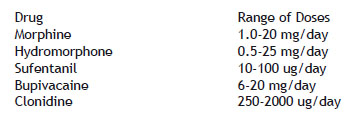
<body><![CDATA[<p><font face="Verdana" size="2">If the patient had a successful trial, as defined above, we proceed to implant an intrathecal system. We suggest the following protocol to achieve more than 80% success rate:</font></p>     <p><font face="Verdana" size="2">— Conditions for success</font></p>     <blockquote> 	    <p><font face="Verdana" size="2"><i>a)</i> Place the tip of the intrathecal catheter in the dermatome corresponding to the area of nociception under fluoroscopy guidance.</font></p> 	    <p><font face="Verdana" size="2"><i>b)</i> Combinations of local anesthetics and an opioid will be needed for severe somatic pain</font></p> 	    <p><font face="Verdana" size="2"><i>c)</i> For neuropathic pain:</font></p> 	    <blockquote> 		    <p><font face="Verdana" size="2">A. If the tip of the catheter is below L3-4: Initial therapy with opioid + clonidine</font></p> 		    <p><font face="Verdana" size="2">B. If the tip of the catheter is above L1-2: Initial therapy with opioid + bupivacaine</font></p> 	</blockquote> </blockquote>     <p><font face="Verdana" size="2">The doses and drugs that we use in our practice are (82):</font></p>     ]]></body>
<body><![CDATA[<blockquote> 	    <p><font face="Verdana" size="2"><img src="/img/revistas/dolor/v17n3/revision_mbe1_x1.jpg" width="358" height="120"></font></p> </blockquote>     <p><font face="Verdana" size="2">Thus, compounding by a trained pharmacist will be needed. The goal is to concentrate these drugs to twice the daily dose, so that the 20 ml programmable pumps may be programmed to deliver 0.5 ml/h. In this way, patients will need pump refills monthly and it will not be a burden to their quality of life by having to make visits to the pain specialist clinic. The steps that we use to implement the therapy are:</font></p>     <p><font face="Verdana" size="2">Step 1:</font></p>     <p><font face="Verdana" size="2"><i>1.</i> Opioid + bupivacaine:</font></p>     <blockquote> 	    <p><font face="Verdana" size="2"><i>a)</i> MS 3-25 mg/day or hydromorphone 0.5-15 mg/day ** 6 mg of MS/day = 1 mg of hydromorphone/day</font></p> 	    <p><font face="Verdana" size="2"><i>b)</i> Bupivacaine: 6-20 mg/day</font></p> </blockquote>     <p><font face="Verdana" size="2"><i>2.</i> Opioid + clonidine:</font></p>     <blockquote> 	    ]]></body>
<body><![CDATA[<p><font face="Verdana" size="2"><i>a)</i> Clonidine: 250-2000 ug/day</font></p> </blockquote>     <p><font face="Verdana" size="2">Step 2: Opioid + bupivacaine + clonidine</font></p>     <p><font face="Verdana" size="2">Step 3: Ziconotide:</font></p>     <p><font face="Verdana" size="2"><i>1.</i> Initiate therapy with ziconotide at a dose of 2.4 ug/day (0.1 mcg/hr) and titrate to patient response</font></p>     <p><font face="Verdana" size="2"><i>2.</i> Rinse the pump with 2 ml of the 25 ug/ml solution three times and then fill the pump with the balance (16 ml)</font></p>     <blockquote> 	    <p><font face="Verdana" size="2"><i>a)</i> Titration increments should not be more than 2.4 ug/ day or more frequent than once per week</font></p> 	    <p><font face="Verdana" size="2"><i>b)</i> Maximum recommended dose: 19.2 ug/day (0.8 u/hr)</font></p> </blockquote>     <p><font face="Verdana" size="2"><i>3.</i> In particular situations, the use of morphine + ziconotide may be an alternative<sup>10</sup>. However, the limitations include the following:</font></p>     <blockquote> 	    ]]></body>
<body><![CDATA[<p><font face="Verdana" size="2"><i>a)</i> There is not the benefit of a trial, as ziconotide may not be administered in the epidural space. Consequently, the patient will need progressive titration once the implanted system is in place.</font></p> 	    <p><font face="Verdana" size="2"><i>b)</i> Patients may not allow the practitioner to carry out a titration protocol over 4-6 weeks sin</font></p> 	    <p><font face="Verdana" size="2"><i>c)</i> The starting dose for ziconotide is 2.4 ug/day with weekly increases of no more than 2.4 ug/day</font></p> </blockquote>     <p><font face="Verdana" size="2">— Therapeutic effects are not usually seen until a dose of 8-10 ug/day is reached.</font></p>     <p><font face="Verdana" size="2">Recently, the option to co-administer ziconotide with morphine has emerged. A phase II, open-label, multicenter study of combined intrathecal morphine and ziconotide as add on therapy in 26 patients with non-cancer pain showed that the mean improvement in pain, as judged by visual analog scale measurements was 14.5% from baseline to week 5<sup>10</sup>. Moreover, there was a mean decrease in opioid therapy of 14.3% at week 5. Treatment related side effects included mental confusion, dizziness, abnormal gait, hallucinations, and anxiety. Consequently, both the mean pain improvement and the mean opioid sparing effect produced by the use of this agent where clinically insignificant. However, the maximum dose of ziconotide used in this study was 7.2 ug/day and that may explain the marginal results.</font></p>     <p><font face="Verdana" size="2">If triple therapy with an opioid, bupivacaine and clonidine at optimal doses is not working or one considers the need to implement therapy with ziconotide, then evaluation for catheter obstruction, disconnection, catheter migration, or pump malfunction is a must. In doing so, consider the following possibilities: </font></p>     <p><font face="Verdana" size="2"><i>1.</i> Pump: Computer program analysis for volume and the volume present within the pump needs to be within 10% of each other, otherwise pump failure is suspected due to:</font></p>     <blockquote> 	    <p><font face="Verdana" size="2"><i>a)</i> MRI Effects (Medtronic Medical Device Correction, August 2008). 	</font></p> </blockquote>     <p><font face="Verdana" size="2">There is a potential for a delay in the return of proper drug infusion after a MRI affecting <i>all</i> SyncroMed pumps. Moreover, with SynchroMed II pumps, there is the potential for a delay in the logging of motor stall events after MRI. Although the reported incidence of these phenomena is very low (0.014% and 0.11%, respectively) it is important to interrogate all the pumps after the MRI, to spare patients from not receiving medication. This is particularly important for SynchroMed pumps, as a "Pump Memory Error" may be generated and the pump will NOT restart infusing unless it is reprogrammed. In contrast, the SynchroMed II may continue infusing even though the interrogation may show a stall state. In either case, the pump will alarm in the face of a stall phenomenon.</font></p>     ]]></body>
<body><![CDATA[<blockquote> 	    <p><font face="Verdana" size="2"><i>b)</i> Missing Propellant within the pump: Synchromed<sup>®</sup> II Missing Propellant. Models Affected: 8637-20, 8637-40 (Medtronic Medical Device Recall - May 2008)</font></p> 	    <p><font face="Verdana" size="2"><i>c)</i> Synchromed<sup>®</sup> EL Pump Motor Stall Due to Gear Shaft Wear (Patient Management Information &#091;Medtronic, August 2007&#093;.</font></p> </blockquote>     <p><font face="Verdana" size="2"><i>2.</i> Catheter: A myelogram performed through the diagnostic port of the pump will be needed to determine if there is obstruction, disconnection (Medical Device Safety Alert -June 2008: Proper Connection of Sutureless Connector Intrathecal Catheters Models Affected: 8709SC, 8731SC, 8596SC, 8578), and the position of the tip of the catheter. When performing a myelogram through the diagnostic port of the pump, remember that this only accommodates a 25 gauge Huber needle. Moreover, consider:</font></p>     <blockquote> 	    <p><font face="Verdana" size="2"><i>A. The dead space of the catheter when injecting the contrast medium:</i> 0.196 ml &#091;89 cm total catheter length (81.4 cm for the spinal segment + 7.6 of the catheter interface with the sutureless connector) x 0.0022 ml/cm catheter volume for the model 8709 SC&#093;</font></p> 	    <p><font face="Verdana" size="2"><i>B. The need for a bolus dose after the study is completed, as the catheter will be filled with contrast medium. Consequently, at a programmed rate of 0.5 ml/hr it will take 9.4 hours for the pump to clear all this volume resulting in inadequate pain control and possibly opioid withdrawal symptoms.</i></font></p> </blockquote>     <p><font face="Verdana" size="2">When performing pump's diagnostic port injections, one needs:</font></p>     <blockquote> 	    <p><font face="Verdana" size="2"><i>A.</i> To withdraw enough amount of cerebrospinal fluid/ therapeutic solution prior to injecting contrast medium to remove all the volume of the drug within the catheter and avoid giving the patient a bolus of the medications in use. If this was not performed, up to 0.196 ml of solution could be pushed alone with the contrast medium. Likewise, we suggest that one should aspirate the fluid with a 3 ml syringe at a very low negative pressure to avoid turbulence and the risk of leaving medication within the catheter (cavitations phenomenon). We usually aspirate a total of 3 ml of fluid, as this should contain all the medication left in the catheter's dead space and some CSF.</font></p> 	    ]]></body>
<body><![CDATA[<p><font face="Verdana" size="2"><i>B.</i> A bolus dose should be programmed after the myelo-gram to clear the catheter's dead space containing contrast medium at this point. By doing so, one avoids leaving the patient without intrathecal treatment for periods of 16-20 hours depending of how much catheter was implanted.</font></p> </blockquote>     <p>&nbsp;</p>     <p><font face="Verdana" size="2"><b>Clinical Studies</b></font></p>     <p><font face="Verdana" size="2">A recently published multicenter prospective randomized clinical trial by Smith, et al., compared intrathecal therapy to comprehensive medical management (CMM) after 1 month of therapy in 202 cancer patients with refractory pain<sup>11</sup>. The primary outcome measure was a 20% improvement in analgesia, as measured via a 0-10 visual analog scale. Side effects changes based on the National Cancer Institute's common toxicity criteria were also recorded. There was a slight trend toward better analgesia in the intrathecal group, but this difference did not achieve statistical significance. In contrast, there was a statistical difference in the side effect profile of those patients randomized to the intrathecal group. The two side effects where the therapy had its greatest impact were constipation and level of consciousness. After a six month analysis, there was also a trend towards an increased survival in the intrathecal group (54% versus 37%). Even though the number of patients who were alive at the end of the analysis was small, this difference is about a 25% increase survival in the patients randomized to the intrathecal group when compared to the CMM group.</font></p>     <p><font face="Verdana" size="2">A longitudinal prospective analysis of 30 crossover patients who received intrathecal therapy found significant decreases in pain scores and drug toxicity (27% and 51%, respectively)<sup>12</sup>. Median survival was 103 days after crossover to an IDDS, which was similar to that of patients in the randomized controlled trial<sup>12</sup>.</font></p>     <p><font face="Verdana" size="2">The cost of implementing intrathecal therapy is initially high, because of equipment acquisition cost. In contrast, the cost of implementing long-term epidural therapy is low. Two studies evaluated the cost of implementing therapy with these two modalities. These analyses show a "break even" point at approximately 3 months<sup>13,14</sup>. Thus, epidural therapy becomes very expensive after 3 months, and is one of the reasons to limit its use in patients with survival expectations of less than 3 months.</font></p>     <p><font face="Verdana" size="2"><b>Clinical Guidelines</b></font></p>     <p><font face="Verdana" size="2">A consensus panel was recently published to update recommendations on the use of intrathecal medications in chronic <i>non-cancer</i> pain<sup>15</sup>. Their goal was to:</font></p>     <blockquote> 	    <p><font face="Verdana" size="2"><i>1.</i> Review the conclusions and guidelines of the Polyanalgesic Conference 2000 and Polyanalgesic Conference 2003.</font></p> 	    ]]></body>
<body><![CDATA[<p><font face="Verdana" size="2"><i>2.</i> Evaluate the current guidelines for intrathecal (IT) drug infusion.</font></p> 	    <p><font face="Verdana" size="2"><i>3.</i> Review survey responses of fellow peers in the field of IT analgesics for pain management and use the findings to guide discussion during the conference.</font></p> 	    <p><font face="Verdana" size="2"><i>4.</i> Review preclinical and clinical data relevant to IT anal-gesics published since 2000.</font></p> 	    <p><font face="Verdana" size="2"><i>5.</i> Formulate consensus opinions on critical issues for IT polyanalgesic therapy.</font></p> 	    <p><font face="Verdana" size="2"><i>6.</i> Modify and update the IT analgesic drug selection algorithm, as appropriate, based on "best evidence" from published data and expert consensus opinion.</font></p> 	    <p><font face="Verdana" size="2"><i>7.</i> Identify areas, including promising under-researched and experimental analgesic agents, for future evidence based research that will advance the clinical practice of IT drug infusion therapy.</font></p> 	    <p><font face="Verdana" size="2"><i>8.</i> Disseminate the consensus opinions and primary conclusions of the expert panelists to the medical community through data-driven articles published in appropriate peer-reviewed biomedical journals.</font></p> </blockquote>     <p><font face="Verdana" size="2">Although the consensus limits its conclusions to the non-cancer population, there are five issues that are important to discuss in light of the recommendations given in this review:</font></p>     <blockquote> 	    <p><font face="Verdana" size="2"><i>1.</i> Hydromorphone equianalgesic doses</font></p> 	    ]]></body>
<body><![CDATA[<p><font face="Verdana" size="2"><i>2.</i> Hydromorphone maximum dose</font></p> 	    <p><font face="Verdana" size="2"><i>3.</i> Bupivacaine spinal cord lesions</font></p> 	    <p><font face="Verdana" size="2"><i>4.</i> Ziconotide as first line agent</font></p> 	    <p><font face="Verdana" size="2"><i>5.</i> The use of CT- Myelography for the diagnosis of granulomas at the tip of the intrathecal catheter.</font></p> </blockquote>     <p><font face="Verdana" size="2"><i>1. Hydromorphone Equianalgesic Doses:</i></font></p>     <p><font face="Verdana" size="2">The study by Johansen et al<sup>16</sup> quoted in the consensus (reference 36) did not study equianalgesic doses between morphine and hydromorphone. Johansen et al. simply administered hydromorphone at "a dose equivalent to the minimum intrathecal morphine dose shown to produce inflammatory masses in our sheep model (12 mg/day)". Thus, there is no basis for the authors of the consensus to conclude that "intrathecal (IT) morphine and IT hydromorphone, in a dose 20% of that of morphine, induce an equianalgesic response". Nonetheless, the discussion in the Johansen paper states that the morphine to hydromorphone conversion rate is 5-6:1: "No masses were observed at hydromorphone doses (3 and 6 mg/day) that were equianalgesic to morphine doses (18 and 36 mg/day, respectively)"<sup>16</sup>. This is the conversion rate that we have used in our clinical practice but there has not been a trial to support the validity of this conversion figure.</font></p>     <p><font face="Verdana" size="2"><i>2. Hydromorphone Maximum Doses:</i></font></p>     <p><font face="Verdana" size="2">The consensus panel recommends a maximum hydromor-phone concentration of 10 mg/cc and a maximum dose of 4 mg/day for intrathecal use to prevent granuloma formation. Throughout the manuscript, there is not a single reference to support this recommendation and they acknowledge that "physicians are advised to titrate doses of these two opioids (morphine and hydromorphone) not beyond an <i>a</i> <i>priori</i> upper limit that has been determined from clinical practice"<sup>15</sup>. To date, we have treated about 60 patients with IT hydromorphone in combination with bupivacaine and/or clonidine at concentrations and doses well beyond these recommended concentrations without a single incidence of granuloma. It is noteworthy that we survey these patients with magnetic resonance imaging on yearly basis to make an early diagnosis of this condition. Moreover, we ask patients on their monthly refill visits about symptoms that may be associated with the development of these masses (<a target="_blank" href="/img/revistas/dolor/v17n3/revision_mbe1_t1.jpg">Table 1</a>).</font></p>     <p><font face="Verdana" size="2"><i>3. Bupivacaine Spinal Cord Lesions:</i></font></p>     <p><font face="Verdana" size="2">The preclinical discussion on the use of IT bupivacaine in the Consensus<sup>15</sup> begins with the following statement: "Transient neurological syndrome (TNS), defined as radicular irritation after spinal anesthesia with local anesthetics, is hypothesized to fall on the lower end of a spectrum of toxic effects caused by local anesthetics". It is noteworthy, that there is not a single report on TNS after bupivacaine spinal anesthesia. In contrast, it has been associated with the use of lidocaine and mepivacaine<sup>17</sup>. Consequently, the discussion of this syndrome in the bupivacaine section is out of contest and misleading. Additionally, there is the suggestion that bupivacaine/clonidine combinations could result in spinal cord lesions, based on a case report<sup>18</sup>. This appears as a footnote in the Recommendations section of the manuscript that states: "a spinal cord lesion has been reported with the use of bupivacaine at a concentration of 20 mg/ ml"<sup>18</sup>. It is important to recognize that in the reported case, the neurological deficit suddenly appeared 2 years after therapy with bupivacaine and clonidine at doses of 20 mg/day and 200 ug/day respectively. The patient was a male individual who had been receiving a perfusion of this solution for about two years for a right sciatic cord compression neuropathy after a suicide attempt. The patient developed a neurological deficit 1 week after sustaining a fall and landing on his back. Neurological examination 1 week after the fall revealed gait ataxia with impaired proprioception in the left leg. No vibration sensation up to the left knee and a left foot drop was noted. Three days after these findings, he was found to have complete loss of proprioception bilaterally up to T11, hyper-reflexia in the left lower extremity and bilateral hypoesthesia of all sacral segments. The MRI showed a round cavity within the spinal cord measuring 3 mm in diameter at the T9-11 level associated with edema that extended from the T5 level to the conus medullaris. The tip of the intrathecal catheter had migrated from the T12 to T10 level. The drug infusion was stopped and the patient's neurological status improved over the following three months and he experienced improvement of the cortico-spinal signs, but only moderate improvement in the proprioception and the gait ataxia.</font></p>     ]]></body>
<body><![CDATA[<p><font face="Verdana" size="2">It is unclear if the spinal cord changes were related to drug neurotoxicity, particularly as the rate of administration was 0.5 ml/h and the edema in the spinal cord extended from the conus medularis to T5 level. The CSF spread of the intrathecal solutions administered at a rate of 0.5 ml/h has been shown to be very limited both in the animal model<sup>19</sup>, and in humans<sup>20</sup>. Consequently, it is difficult to understand how the edema in the spinal cord was so extensive. Moreover, the tip of the catheter had migrated from the T12 to the T10 level, where the lesion was found, raising the possibility that this could be the result of spinal cord catheter injury during the fall.</font></p>     <p><font face="Verdana" size="2"><i>4. Ziconotide as First Line Agent:</i></font></p>     <p><font face="Verdana" size="2">The last polyanalgesic consensus recommended the use of ziconotide in chronic pain when all other options were exhausted<sup>21</sup>. At that time, the drug had not been FDA approved and the only randomized clinical trial available was the study by Staats et al<sup>22</sup>. In contrast, the panelists of the new recommendations have upgraded ziconotide to a first line agent at the same level as morphine and hydromorphone<sup>15</sup>. Since it is acknowledged that "the medications in the current algorithm are arranged in a hierarchy based on evidence on safety, efficacy, and broad clinical parameters gleaned from previous and current consensus literature reviews, ratings of published studies, and expert opinion from three Polyanalgesic Consensus Conferences"<sup>21</sup>, the questions is whether there is enough new data on therapeutic efficacy and safety to support that recommendation.</font></p>     <p><font face="Verdana" size="2">In the study by Staats et al<sup>22</sup>, there are two concerns:</font></p>     <p><font face="Verdana" size="2">First, the physiopathology of pain in cancer patients is disease and site specific, and may be multifactorial. Thus, treating patients without a clear description of the source of nociception (i.e., somatic, versus visceral, versus neuropathic) could be a problem.</font></p>     <p><font face="Verdana" size="2">Second, the 2 week follow-up may result in two problems. As previously discussed, ziconotide needs a significant titration window to reach a therapeutic effect and this is not normally achieved within a two week period. Thus, it is possible that the investigators were evaluating placebo effect at that time. Consequently, therapeutic responses beyond that time may have decreased and the success rate might have been lower if the follow-up was longer. Consequently, the results of this study do not fully support the use of this agent as first line.</font></p>     <p><font face="Verdana" size="2">Since the publication of the Staats et al study, five other studies addressing the use of ziconotide in severe non-cancer chronic pain have been published<sup>23-27</sup>.</font></p>     <p><font face="Verdana" size="2"><b>Conclusion of consensus based on references 164-172</b></font></p>     <p><font face="Verdana" size="2">In the first study, 644 patients with severe chronic pain were studied in an open label, multi-center study with ziconotide<sup>23</sup>. In the end, 119 patients were treated for at least 1 year. Median duration of therapy was 2 months with a range of 1 to 1215 days. Mean dose was 8.4 ug/day (range 0.048-240 ug/day). Pain scores decreased from 76 mm to 68 mm after one month of therapy and to 73 mm after 2 months of therapy. Virtually all patients experienced adverse events (99.7%), of which 43.5% were mild, 42.3% moderate, and 14.2% severe. Half of those adverse events were considered non-therapy related. The most common side effects (<u>&gt;</u> 25) were nausea, dizziness, headache, confusion, pain, somnolence, and memory impairment. The authors concluded that "long-term IT ziconotide is an option for patients with severe refractory pain". However, the high incidence of side effects and the clinically insignificant pain reduction does not support therapeutic efficacy under the present protocol design.</font></p>     <p><font face="Verdana" size="2">In the second study, in what appears to be the need to address the lack of therapeutic effects reported in the first study, the safety and efficacy of adding IT ziconotide to intrathecal morphine in patients receiving a stable IT morphine dose<sup>24</sup>. Twenty-six patients receiving doses ranging between 2-20 mg/day of morphine received 0.6 to 7.2 ug/day of IT ziconotide. The mean percentage improvement of pain in the visual analog scale was 14.5% (95% confidence interval of -9% to 38%) from baseline to week 5. The mean percentage oral opioid dose change from baseline was -14% at week 5. The investigators concluded that the co-administration of IT ziconotide and morphine may reduce pain and decrease systemic opioid use in patient receiving treatment with IT morphine alone<sup>24</sup>. However, both the mean decrease in pain intensity, as judged by the visual analog scale, and the amount of systemic opioid reduction are clinically insignificant and do not support these conclusions. Moreover, there is evidence of decreased ziconotide stability when co-administered with either morphine or hydromorphone<sup>15</sup>. Thus, at this point it is not clear what the clinical advantage of co-administering ziconotide with morphine is.</font></p>     ]]></body>
<body><![CDATA[<p><font face="Verdana" size="2">In the third study<sup>26</sup>, 255 patients were randomized to receive ziconotide (n=169) or placebo (n=86) during six days as in-patients. Patients received doses ranging from 9.6 ug/ day to 168 ug/day. But during the course of the study doses were reduced to 2.4 to 57.6 ug/day due to the high prevalence of side effects with the initial doses. The authors reported a 31% pain reduction in the ziconotide group versus a 6% reduction in the placebo group. Despite this significant pain reduction, it is noteworthy that of the 169 patients initially treated with ziconotide, only 54 patients (31%) were considered responders and were eligible for five-day outpatient treatment<sup>26</sup>. Treatment responders were defined as patients having 1) a <u>&gt;</u> 30% pain improvement in the VASPI compared to baseline, 2) stable or decreased concomitant opioid analgesic use, and 3) no changes in type of opioid used during the study period.</font></p>     <p><font face="Verdana" size="2"><i>5. The use of CT- Myelography for the diagnosis of granulomas at the tip of the intrathecal catheter:</i></font></p>     <p><font face="Verdana" size="2">The authors of the consensus suggest that "MRI remains the gold standard for surveillance when evaluating the presence of a catheter-related inflammatory mass, although computed tomography/myelography through the pump offers a more cost-effective technique". This is true, provided that the practitioner is able to aspirate CSF from the diagnostic port prior to performing a myelography study. As noted before, if CSF is not aspirated prior to injecting the contrast medium, the catheter dead space volume will also be injected, and severe side effects may occur.</font></p>     <p>&nbsp;</p>     <p><font face="Verdana" size="2"><b>Conflict of interests</b></font></p>     <p><font face="Verdana" size="2">The authors have no conflict of interest to declare.</font></p>     <p>&nbsp;</p>     <p><font face="Verdana" size="2"><b>Bibliografía</b></font></p>     <!-- ref --><p><font face="Verdana" size="2">1. American Pain Society. Principles of Analgesic use in the treatment of acute pain and chronic cancer pain. 3<sup>rd</sup> ed. Skokie, IL: APS; 1992.</font>&nbsp;&nbsp;&nbsp;&nbsp;&nbsp;&nbsp;&nbsp;&nbsp;[&#160;<a href="javascript:void(0);" onclick="javascript: window.open('/scielo.php?script=sci_nlinks&ref=4906214&pid=S1134-8046201000030000500001&lng=','','width=640,height=500,resizable=yes,scrollbars=1,menubar=yes,');">Links</a>&#160;]<!-- end-ref --><!-- ref --><p><font face="Verdana" size="2">2. Jacox A, Carr DB, Payne R, Berde CB, Breitbart W, Cain JM, et al. Management of cancer pain: clinical practice guideline 9. Agency for Health Care Policy and Research pub. 94-0592. Rockville, MD: ACHPR; 1994.</font>&nbsp;&nbsp;&nbsp;&nbsp;&nbsp;&nbsp;&nbsp;&nbsp;[&#160;<a href="javascript:void(0);" onclick="javascript: window.open('/scielo.php?script=sci_nlinks&ref=4906215&pid=S1134-8046201000030000500002&lng=','','width=640,height=500,resizable=yes,scrollbars=1,menubar=yes,');">Links</a>&#160;]<!-- end-ref --><!-- ref --><p><font face="Verdana" size="2">3. Zech DF, Grond S, Lynch J, Hertel D, Lehmann KA. Validation of World Health Organization Guidelines for cancer pain relief: a 10-year prospective study. Pain. 1995;63:65-76.</font>&nbsp;&nbsp;&nbsp;&nbsp;&nbsp;&nbsp;&nbsp;&nbsp;[&#160;<a href="javascript:void(0);" onclick="javascript: window.open('/scielo.php?script=sci_nlinks&ref=4906216&pid=S1134-8046201000030000500003&lng=','','width=640,height=500,resizable=yes,scrollbars=1,menubar=yes,');">Links</a>&#160;]<!-- end-ref --><!-- ref --><p><font face="Verdana" size="2">4. Ferrell BR, Wisdon C, Wenzl C. Quality of life as an outcome variable in management of cancer pain. Cancer. 1989;63:2321.</font>&nbsp;&nbsp;&nbsp;&nbsp;&nbsp;&nbsp;&nbsp;&nbsp;[&#160;<a href="javascript:void(0);" onclick="javascript: window.open('/scielo.php?script=sci_nlinks&ref=4906217&pid=S1134-8046201000030000500004&lng=','','width=640,height=500,resizable=yes,scrollbars=1,menubar=yes,');">Links</a>&#160;]<!-- end-ref --><!-- ref --><p><font face="Verdana" size="2">5. Liebeskind JC. Pain can kill. Pain. 1991;44:3-4.</font>&nbsp;&nbsp;&nbsp;&nbsp;&nbsp;&nbsp;&nbsp;&nbsp;[&#160;<a href="javascript:void(0);" onclick="javascript: window.open('/scielo.php?script=sci_nlinks&ref=4906218&pid=S1134-8046201000030000500005&lng=','','width=640,height=500,resizable=yes,scrollbars=1,menubar=yes,');">Links</a>&#160;]<!-- end-ref --><!-- ref --><p><font face="Verdana" size="2">6. Lillemoe KD, Cameron JL, Kaufman HS, Yeo CJ, Pitt HA, Sauter PK. Chemical splanchnicectomy in patients with unresectable pancreatic cancer. Ann Surg. 1993;217:447-57.</font>&nbsp;&nbsp;&nbsp;&nbsp;&nbsp;&nbsp;&nbsp;&nbsp;[&#160;<a href="javascript:void(0);" onclick="javascript: window.open('/scielo.php?script=sci_nlinks&ref=4906219&pid=S1134-8046201000030000500006&lng=','','width=640,height=500,resizable=yes,scrollbars=1,menubar=yes,');">Links</a>&#160;]<!-- end-ref --><!-- ref --><p><font face="Verdana" size="2">7. Cousins MJ, Mather LE. Intrathecal and epidural administration of opioids. Anesthesiology. 1984;61:276-310.</font>&nbsp;&nbsp;&nbsp;&nbsp;&nbsp;&nbsp;&nbsp;&nbsp;[&#160;<a href="javascript:void(0);" onclick="javascript: window.open('/scielo.php?script=sci_nlinks&ref=4906220&pid=S1134-8046201000030000500007&lng=','','width=640,height=500,resizable=yes,scrollbars=1,menubar=yes,');">Links</a>&#160;]<!-- end-ref --><!-- ref --><p><font face="Verdana" size="2">8. Yaksh TL. Spinal opiates: a review of their effect on spinal function with an emphasis on pain processing. Acta Anaesthesiol Scand. 1987;31 Suppl 85:25. </font>&nbsp;&nbsp;&nbsp;&nbsp;&nbsp;&nbsp;&nbsp;&nbsp;[&#160;<a href="javascript:void(0);" onclick="javascript: window.open('/scielo.php?script=sci_nlinks&ref=4906221&pid=S1134-8046201000030000500008&lng=','','width=640,height=500,resizable=yes,scrollbars=1,menubar=yes,');">Links</a>&#160;]<!-- end-ref --><!-- ref --><p><font face="Verdana" size="2">9. Du Pen S, Kharasch ED, Williams A, Peterson DG, Sloan DC, Hasche-Klunder H, et al. Chronic epidural bupivacaine-opioid infusion in intractable cancer pain. Pain. 1992;49:293-300.</font>&nbsp;&nbsp;&nbsp;&nbsp;&nbsp;&nbsp;&nbsp;&nbsp;[&#160;<a href="javascript:void(0);" onclick="javascript: window.open('/scielo.php?script=sci_nlinks&ref=4906222&pid=S1134-8046201000030000500009&lng=','','width=640,height=500,resizable=yes,scrollbars=1,menubar=yes,');">Links</a>&#160;]<!-- end-ref --><!-- ref --><p><font face="Verdana" size="2">10. Wallace MS, Kosck PS, Staats P, Fisher R, Schultz DM, Leong M. Phase II, open-label, multicenter study of combined intrathecal morphine and ziconotide: addition of ziconotide in patients receiving intrathecal morphine for severe chronic pain. Pain Med. 2009;9:271-81.</font>&nbsp;&nbsp;&nbsp;&nbsp;&nbsp;&nbsp;&nbsp;&nbsp;[&#160;<a href="javascript:void(0);" onclick="javascript: window.open('/scielo.php?script=sci_nlinks&ref=4906223&pid=S1134-8046201000030000500010&lng=','','width=640,height=500,resizable=yes,scrollbars=1,menubar=yes,');">Links</a>&#160;]<!-- end-ref --><!-- ref --><p><font face="Verdana" size="2">11. Smith TJ, Staats PS, Deer T, Stearns LJ, Rauck RL, Boortz-Marx RL, et al. Randomized clinical trial of an implantable drug delivery system compared with comprehensive medical management for refractory cancer pain: impact on pain, drug-related toxicity and survival. J Clin Oncol. 2002;20:4040-9.</font>&nbsp;&nbsp;&nbsp;&nbsp;&nbsp;&nbsp;&nbsp;&nbsp;[&#160;<a href="javascript:void(0);" onclick="javascript: window.open('/scielo.php?script=sci_nlinks&ref=4906224&pid=S1134-8046201000030000500011&lng=','','width=640,height=500,resizable=yes,scrollbars=1,menubar=yes,');">Links</a>&#160;]<!-- end-ref --><!-- ref --><p><font face="Verdana" size="2">12. Smith TJ, Coyne PJ. Implantable drug delivery systems (IDDS) after failure of comprehensive medical management (CMM) can palliate symptoms in the most refractory cancer pain patients. J Palliat Med. 2005;8:736-42.</font>&nbsp;&nbsp;&nbsp;&nbsp;&nbsp;&nbsp;&nbsp;&nbsp;[&#160;<a href="javascript:void(0);" onclick="javascript: window.open('/scielo.php?script=sci_nlinks&ref=4906225&pid=S1134-8046201000030000500012&lng=','','width=640,height=500,resizable=yes,scrollbars=1,menubar=yes,');">Links</a>&#160;]<!-- end-ref --><!-- ref --><p><font face="Verdana" size="2">13. Bedder MD, Burchiel KJ, Larson A. Cost analysis of two implantable narcotic delivery systems. J Pain Symptom Manage. 1991;6:368.</font>&nbsp;&nbsp;&nbsp;&nbsp;&nbsp;&nbsp;&nbsp;&nbsp;[&#160;<a href="javascript:void(0);" onclick="javascript: window.open('/scielo.php?script=sci_nlinks&ref=4906226&pid=S1134-8046201000030000500013&lng=','','width=640,height=500,resizable=yes,scrollbars=1,menubar=yes,');">Links</a>&#160;]<!-- end-ref --><!-- ref --><p><font face="Verdana" size="2">14. Hassenbusch SJ, Bedder M, Patt RB, Bell GK. Current status of intrathecal therapy for nonmalignant pain management: clinical realities and economic unknowns. J Pain Symptom Manage. 1997;14:S36-48.</font>&nbsp;&nbsp;&nbsp;&nbsp;&nbsp;&nbsp;&nbsp;&nbsp;[&#160;<a href="javascript:void(0);" onclick="javascript: window.open('/scielo.php?script=sci_nlinks&ref=4906227&pid=S1134-8046201000030000500014&lng=','','width=640,height=500,resizable=yes,scrollbars=1,menubar=yes,');">Links</a>&#160;]<!-- end-ref --><!-- ref --><p><font face="Verdana" size="2">15. Deer T, Krames ES, Hassenbusch SJ, Burton A, Caraway D, Dupen S, et al. Polyanalgesic Consensus Conference 2007: Recommendations for the Management of Pain by Intrathecal (Intraspinal) Drug Delivery: Report of an Interdisciplinary Expert Panel. Neuromodulation. 2007;10:300-28.</font>&nbsp;&nbsp;&nbsp;&nbsp;&nbsp;&nbsp;&nbsp;&nbsp;[&#160;<a href="javascript:void(0);" onclick="javascript: window.open('/scielo.php?script=sci_nlinks&ref=4906228&pid=S1134-8046201000030000500015&lng=','','width=640,height=500,resizable=yes,scrollbars=1,menubar=yes,');">Links</a>&#160;]<!-- end-ref --><!-- ref --><p><font face="Verdana" size="2">16. Johansen MJ, Satterfield WC, Baze WB, Hildebrand KR, Gradert TL, Hassenbusch SJ. Continuous intrathecal infusion of hydro-morphone: Safety in the sheep model and clinical implications. Pain Medicine. 2004;5:14-25.</font>&nbsp;&nbsp;&nbsp;&nbsp;&nbsp;&nbsp;&nbsp;&nbsp;[&#160;<a href="javascript:void(0);" onclick="javascript: window.open('/scielo.php?script=sci_nlinks&ref=4906229&pid=S1134-8046201000030000500016&lng=','','width=640,height=500,resizable=yes,scrollbars=1,menubar=yes,');">Links</a>&#160;]<!-- end-ref --><!-- ref --><p><font face="Verdana" size="2">17. Liu S. Spinal Anesthesia. Anesthesiology. 1995;82:1359.</font>&nbsp;&nbsp;&nbsp;&nbsp;&nbsp;&nbsp;&nbsp;&nbsp;[&#160;<a href="javascript:void(0);" onclick="javascript: window.open('/scielo.php?script=sci_nlinks&ref=4906230&pid=S1134-8046201000030000500017&lng=','','width=640,height=500,resizable=yes,scrollbars=1,menubar=yes,');">Links</a>&#160;]<!-- end-ref --><!-- ref --><p><font face="Verdana" size="2">18. Perren F, Buchser E, Chedel D, Hirt L, Maeder P. Vingerhoets F. Spinal cord lesion after long-term intrathecal clonidine and bupivacaine treatment for the management of intractable pain. Pain. 2004;109:189-94.</font>&nbsp;&nbsp;&nbsp;&nbsp;&nbsp;&nbsp;&nbsp;&nbsp;[&#160;<a href="javascript:void(0);" onclick="javascript: window.open('/scielo.php?script=sci_nlinks&ref=4906231&pid=S1134-8046201000030000500018&lng=','','width=640,height=500,resizable=yes,scrollbars=1,menubar=yes,');">Links</a>&#160;]<!-- end-ref --><!-- ref --><p><font face="Verdana" size="2">19. Bernard CM. Cerebrospinal fluid and spinal cord distribution of Baclofen and bupivacaine during slow intrathecal infusion in pigs. Anesthesiology. 2006;105:169-78.</font>&nbsp;&nbsp;&nbsp;&nbsp;&nbsp;&nbsp;&nbsp;&nbsp;[&#160;<a href="javascript:void(0);" onclick="javascript: window.open('/scielo.php?script=sci_nlinks&ref=4906232&pid=S1134-8046201000030000500019&lng=','','width=640,height=500,resizable=yes,scrollbars=1,menubar=yes,');">Links</a>&#160;]<!-- end-ref --><!-- ref --><p><font face="Verdana" size="2">20. Kotob F, De Leon-Casasola OA, Lema M. Intrathecal Infusion Rates of 1 ml/day Improve Narrow Analgesia with Infusion Rates of 0.5 ml/day. Anesthesiology. 2006;105:A347.</font>&nbsp;&nbsp;&nbsp;&nbsp;&nbsp;&nbsp;&nbsp;&nbsp;[&#160;<a href="javascript:void(0);" onclick="javascript: window.open('/scielo.php?script=sci_nlinks&ref=4906233&pid=S1134-8046201000030000500020&lng=','','width=640,height=500,resizable=yes,scrollbars=1,menubar=yes,');">Links</a>&#160;]<!-- end-ref --><!-- ref --><p><font face="Verdana" size="2">21. Hassenbusch S, Portenoy R, Cousins M, Buchser E, Deer TR, Du Pen SL, et al. Polyanalgesic consensus conferen an update on the management of pain by intraspinal drug delivery - report of an expert pane. J Pain Symptom Manage. 2004;27:540-63.</font>&nbsp;&nbsp;&nbsp;&nbsp;&nbsp;&nbsp;&nbsp;&nbsp;[&#160;<a href="javascript:void(0);" onclick="javascript: window.open('/scielo.php?script=sci_nlinks&ref=4906234&pid=S1134-8046201000030000500021&lng=','','width=640,height=500,resizable=yes,scrollbars=1,menubar=yes,');">Links</a>&#160;]<!-- end-ref --><!-- ref --><p><font face="Verdana" size="2">22. Staats PS, Yearwood T, Charapata SG, Presley RW, Wallace MS, Byas-Smith M, et al. Intrathecal ziconotide in the treatment of refractory pain in patients with cancer or AIDS. A randomized controlled trial. JAMA. 2004;291:63-70.</font>&nbsp;&nbsp;&nbsp;&nbsp;&nbsp;&nbsp;&nbsp;&nbsp;[&#160;<a href="javascript:void(0);" onclick="javascript: window.open('/scielo.php?script=sci_nlinks&ref=4906235&pid=S1134-8046201000030000500022&lng=','','width=640,height=500,resizable=yes,scrollbars=1,menubar=yes,');">Links</a>&#160;]<!-- end-ref --><!-- ref --><p><font face="Verdana" size="2">23. Wallace MS, Rauck R, Fisher R, Charapata SG, Ellis D, Dissanayake S; Ziconotide 98-022 Study Group. Intrathecal ziconotide for severe chronic pain: safety and tolerability results of an open-label, long-term trial. Anesth Analg. 2008;106:628-37.</font>&nbsp;&nbsp;&nbsp;&nbsp;&nbsp;&nbsp;&nbsp;&nbsp;[&#160;<a href="javascript:void(0);" onclick="javascript: window.open('/scielo.php?script=sci_nlinks&ref=4906236&pid=S1134-8046201000030000500023&lng=','','width=640,height=500,resizable=yes,scrollbars=1,menubar=yes,');">Links</a>&#160;]<!-- end-ref --><!-- ref --><p><font face="Verdana" size="2">24. Wallace MS, Kosek PS, Staats P, Fisher R, Schultz DM, Leong M. Phase II, open-label, multicenter study of combined intrathecal morphine and ziconotide: addition of ziconotide in patients receiving intrathecal morphine for severe chronic pain. Pain Med. 2008;9:271-81.</font>&nbsp;&nbsp;&nbsp;&nbsp;&nbsp;&nbsp;&nbsp;&nbsp;[&#160;<a href="javascript:void(0);" onclick="javascript: window.open('/scielo.php?script=sci_nlinks&ref=4906237&pid=S1134-8046201000030000500024&lng=','','width=640,height=500,resizable=yes,scrollbars=1,menubar=yes,');">Links</a>&#160;]<!-- end-ref --><!-- ref --><p><font face="Verdana" size="2">25. Webster LR, Fakata KL, Fisher R, MineHart M. Open-label multicenter study of combined intrathecal morphine and ziconotide: addition of morphine in patients receiving ziconotide for severe chronic pain. Pain Med. 2008;9:282-90.</font>&nbsp;&nbsp;&nbsp;&nbsp;&nbsp;&nbsp;&nbsp;&nbsp;[&#160;<a href="javascript:void(0);" onclick="javascript: window.open('/scielo.php?script=sci_nlinks&ref=4906238&pid=S1134-8046201000030000500025&lng=','','width=640,height=500,resizable=yes,scrollbars=1,menubar=yes,');">Links</a>&#160;]<!-- end-ref --><!-- ref --><p><font face="Verdana" size="2">26. Wallace M, Charapata S, Fisher R, Byas-Smith M, Staats PS, Mayo M, et al. Intrathecal ziconotide in the treatment of chronic nonmalignant pain: a randomized double-blind placebo-controlled trial. Neuromodulation. 2006;9:75-86.</font>&nbsp;&nbsp;&nbsp;&nbsp;&nbsp;&nbsp;&nbsp;&nbsp;[&#160;<a href="javascript:void(0);" onclick="javascript: window.open('/scielo.php?script=sci_nlinks&ref=4906239&pid=S1134-8046201000030000500026&lng=','','width=640,height=500,resizable=yes,scrollbars=1,menubar=yes,');">Links</a>&#160;]<!-- end-ref --><!-- ref --><p><font face="Verdana" size="2">27. Rauck RL, Wallace MS, Leong MS, Minehart M, Webster LR, Charapata SG, et al. A Randomized, double-blind, placebo-controlled study of intrathecal ziconotide in adults with severe chronic pain. J Pain Symp Manage. 2006;5:393-406.</font>&nbsp;&nbsp;&nbsp;&nbsp;&nbsp;&nbsp;&nbsp;&nbsp;[&#160;<a href="javascript:void(0);" onclick="javascript: window.open('/scielo.php?script=sci_nlinks&ref=4906240&pid=S1134-8046201000030000500027&lng=','','width=640,height=500,resizable=yes,scrollbars=1,menubar=yes,');">Links</a>&#160;]<!-- end-ref --><p>&nbsp;</p>     <p>&nbsp;</p>     <p><font face="Verdana" size="2"><b><a name="bajo"></a><a href="#top"><img border="0" src="/img/revistas/dolor/v17n3/seta.gif" width="15" height="17"></a>Correspondence:</b>    <br>Correo electrónico: <a href="mailto:Oscar.DeLeon@RoswellPark.org">Oscar.DeLeon@RoswellPark.org</a></font></p>     <p><font face="Verdana" size="2">Recibido el 20 de abril de 2009;    ]]></body>
<body><![CDATA[<br>aceptado el 25 de octubre de 2009</font></p>      ]]></body><back>
<ref-list>
<ref id="B1">
<label>1</label><nlm-citation citation-type="book">
<collab>American Pain Society</collab>
<source><![CDATA[Principles of Analgesic use in the treatment of acute pain and chronic cancer pain]]></source>
<year>1992</year>
<edition>3</edition>
<publisher-loc><![CDATA[Skokie^eIL IL]]></publisher-loc>
<publisher-name><![CDATA[APS]]></publisher-name>
</nlm-citation>
</ref>
<ref id="B2">
<label>2</label><nlm-citation citation-type="book">
<person-group person-group-type="author">
<name>
<surname><![CDATA[Jacox]]></surname>
<given-names><![CDATA[A]]></given-names>
</name>
<name>
<surname><![CDATA[Carr]]></surname>
<given-names><![CDATA[DB]]></given-names>
</name>
<name>
<surname><![CDATA[Payne]]></surname>
<given-names><![CDATA[R]]></given-names>
</name>
<name>
<surname><![CDATA[Berde]]></surname>
<given-names><![CDATA[CB]]></given-names>
</name>
<name>
<surname><![CDATA[Breitbart]]></surname>
<given-names><![CDATA[W]]></given-names>
</name>
<name>
<surname><![CDATA[Cain]]></surname>
<given-names><![CDATA[JM]]></given-names>
</name>
</person-group>
<source><![CDATA[Management of cancer pain: clinical practice guideline]]></source>
<year>1994</year>
<volume>9</volume>
<publisher-loc><![CDATA[Rockville^eMD MD]]></publisher-loc>
<publisher-name><![CDATA[ACHPR]]></publisher-name>
</nlm-citation>
</ref>
<ref id="B3">
<label>3</label><nlm-citation citation-type="journal">
<person-group person-group-type="author">
<name>
<surname><![CDATA[Zech]]></surname>
<given-names><![CDATA[DF]]></given-names>
</name>
<name>
<surname><![CDATA[Grond]]></surname>
<given-names><![CDATA[S]]></given-names>
</name>
<name>
<surname><![CDATA[Lynch]]></surname>
<given-names><![CDATA[J]]></given-names>
</name>
<name>
<surname><![CDATA[Hertel]]></surname>
<given-names><![CDATA[D]]></given-names>
</name>
<name>
<surname><![CDATA[Lehmann]]></surname>
<given-names><![CDATA[KA]]></given-names>
</name>
</person-group>
<article-title xml:lang="en"><![CDATA[Validation of World Health Organization Guidelines for cancer pain relief: a 10-year prospective study]]></article-title>
<source><![CDATA[Pain.]]></source>
<year>1995</year>
<volume>63</volume>
<page-range>65-76</page-range></nlm-citation>
</ref>
<ref id="B4">
<label>4</label><nlm-citation citation-type="journal">
<person-group person-group-type="author">
<name>
<surname><![CDATA[Ferrell]]></surname>
<given-names><![CDATA[BR]]></given-names>
</name>
<name>
<surname><![CDATA[Wisdon]]></surname>
<given-names><![CDATA[C]]></given-names>
</name>
<name>
<surname><![CDATA[Wenzl]]></surname>
<given-names><![CDATA[C]]></given-names>
</name>
</person-group>
<article-title xml:lang="en"><![CDATA[Quality of life as an outcome variable in management of cancer pain]]></article-title>
<source><![CDATA[Cancer.]]></source>
<year>1989</year>
<volume>63</volume>
<page-range>2321</page-range></nlm-citation>
</ref>
<ref id="B5">
<label>5</label><nlm-citation citation-type="journal">
<person-group person-group-type="author">
<name>
<surname><![CDATA[Liebeskind]]></surname>
<given-names><![CDATA[JC]]></given-names>
</name>
</person-group>
<article-title xml:lang="en"><![CDATA[Pain can kill]]></article-title>
<source><![CDATA[Pain.]]></source>
<year>1991</year>
<volume>44</volume>
<page-range>3-4</page-range></nlm-citation>
</ref>
<ref id="B6">
<label>6</label><nlm-citation citation-type="journal">
<person-group person-group-type="author">
<name>
<surname><![CDATA[Lillemoe]]></surname>
<given-names><![CDATA[KD]]></given-names>
</name>
<name>
<surname><![CDATA[Cameron]]></surname>
<given-names><![CDATA[JL]]></given-names>
</name>
<name>
<surname><![CDATA[Kaufman]]></surname>
<given-names><![CDATA[HS]]></given-names>
</name>
<name>
<surname><![CDATA[Yeo]]></surname>
<given-names><![CDATA[CJ]]></given-names>
</name>
<name>
<surname><![CDATA[Pitt]]></surname>
<given-names><![CDATA[HA]]></given-names>
</name>
<name>
<surname><![CDATA[Sauter]]></surname>
<given-names><![CDATA[PK]]></given-names>
</name>
</person-group>
<article-title xml:lang="en"><![CDATA[Chemical splanchnicectomy in patients with unresectable pancreatic cancer]]></article-title>
<source><![CDATA[Ann Surg.]]></source>
<year>1993</year>
<volume>217</volume>
<page-range>447-57</page-range></nlm-citation>
</ref>
<ref id="B7">
<label>7</label><nlm-citation citation-type="journal">
<person-group person-group-type="author">
<name>
<surname><![CDATA[Cousins]]></surname>
<given-names><![CDATA[MJ]]></given-names>
</name>
<name>
<surname><![CDATA[Mather]]></surname>
<given-names><![CDATA[LE]]></given-names>
</name>
</person-group>
<article-title xml:lang="en"><![CDATA[Intrathecal and epidural administration of opioids]]></article-title>
<source><![CDATA[Anesthesiology.]]></source>
<year>1984</year>
<volume>61</volume>
<page-range>276-310</page-range></nlm-citation>
</ref>
<ref id="B8">
<label>8</label><nlm-citation citation-type="journal">
<person-group person-group-type="author">
<name>
<surname><![CDATA[Yaksh]]></surname>
<given-names><![CDATA[TL]]></given-names>
</name>
</person-group>
<article-title xml:lang="en"><![CDATA[Spinal opiates: a review of their effect on spinal function with an emphasis on pain processing]]></article-title>
<source><![CDATA[Acta Anaesthesiol Scand.]]></source>
<year>1987</year>
<volume>31</volume>
<numero>^s85</numero>
<issue>^s85</issue>
<supplement>85</supplement>
<page-range>25</page-range></nlm-citation>
</ref>
<ref id="B9">
<label>9</label><nlm-citation citation-type="journal">
<person-group person-group-type="author">
<name>
<surname><![CDATA[Du Pen]]></surname>
<given-names><![CDATA[S]]></given-names>
</name>
<name>
<surname><![CDATA[Kharasch]]></surname>
<given-names><![CDATA[ED]]></given-names>
</name>
<name>
<surname><![CDATA[Williams]]></surname>
<given-names><![CDATA[A]]></given-names>
</name>
<name>
<surname><![CDATA[Peterson]]></surname>
<given-names><![CDATA[DG]]></given-names>
</name>
<name>
<surname><![CDATA[Sloan]]></surname>
<given-names><![CDATA[DC]]></given-names>
</name>
<name>
<surname><![CDATA[Hasche-Klunder]]></surname>
<given-names><![CDATA[H]]></given-names>
</name>
</person-group>
<article-title xml:lang="en"><![CDATA[Chronic epidural bupivacaine-opioid infusion in intractable cancer pain]]></article-title>
<source><![CDATA[Pain.]]></source>
<year>1992</year>
<volume>49</volume>
<page-range>293-300</page-range></nlm-citation>
</ref>
<ref id="B10">
<label>10</label><nlm-citation citation-type="journal">
<person-group person-group-type="author">
<name>
<surname><![CDATA[Wallace]]></surname>
<given-names><![CDATA[MS]]></given-names>
</name>
<name>
<surname><![CDATA[Kosck]]></surname>
<given-names><![CDATA[PS]]></given-names>
</name>
<name>
<surname><![CDATA[Staats]]></surname>
<given-names><![CDATA[P]]></given-names>
</name>
<name>
<surname><![CDATA[Fisher]]></surname>
<given-names><![CDATA[R]]></given-names>
</name>
<name>
<surname><![CDATA[Schultz]]></surname>
<given-names><![CDATA[DM]]></given-names>
</name>
<name>
<surname><![CDATA[Leong]]></surname>
<given-names><![CDATA[M]]></given-names>
</name>
</person-group>
<article-title xml:lang="en"><![CDATA[Phase II, open-label, multicenter study of combined intrathecal morphine and ziconotide: addition of ziconotide in patients receiving intrathecal morphine for severe chronic pain]]></article-title>
<source><![CDATA[Pain Med.]]></source>
<year>2009</year>
<volume>9</volume>
<page-range>271-81</page-range></nlm-citation>
</ref>
<ref id="B11">
<label>11</label><nlm-citation citation-type="journal">
<person-group person-group-type="author">
<name>
<surname><![CDATA[Smith]]></surname>
<given-names><![CDATA[TJ]]></given-names>
</name>
<name>
<surname><![CDATA[Staats]]></surname>
<given-names><![CDATA[PS]]></given-names>
</name>
<name>
<surname><![CDATA[Deer]]></surname>
<given-names><![CDATA[T]]></given-names>
</name>
<name>
<surname><![CDATA[Stearns]]></surname>
<given-names><![CDATA[LJ]]></given-names>
</name>
<name>
<surname><![CDATA[Rauck]]></surname>
<given-names><![CDATA[RL]]></given-names>
</name>
<name>
<surname><![CDATA[Boortz-Marx]]></surname>
<given-names><![CDATA[RL]]></given-names>
</name>
</person-group>
<article-title xml:lang="en"><![CDATA[Randomized clinical trial of an implantable drug delivery system compared with comprehensive medical management for refractory cancer pain: impact on pain, drug-related toxicity and survival]]></article-title>
<source><![CDATA[J Clin Oncol.]]></source>
<year>2002</year>
<volume>20</volume>
<page-range>4040-9</page-range></nlm-citation>
</ref>
<ref id="B12">
<label>12</label><nlm-citation citation-type="journal">
<person-group person-group-type="author">
<name>
<surname><![CDATA[Smith]]></surname>
<given-names><![CDATA[TJ]]></given-names>
</name>
<name>
<surname><![CDATA[Coyne]]></surname>
<given-names><![CDATA[PJ]]></given-names>
</name>
</person-group>
<article-title xml:lang="en"><![CDATA[Implantable drug delivery systems (IDDS) after failure of comprehensive medical management (CMM) can palliate symptoms in the most refractory cancer pain patients]]></article-title>
<source><![CDATA[J Palliat Med.]]></source>
<year>2005</year>
<volume>8</volume>
<page-range>736-42</page-range></nlm-citation>
</ref>
<ref id="B13">
<label>13</label><nlm-citation citation-type="journal">
<person-group person-group-type="author">
<name>
<surname><![CDATA[Bedder]]></surname>
<given-names><![CDATA[MD]]></given-names>
</name>
<name>
<surname><![CDATA[Burchiel]]></surname>
<given-names><![CDATA[KJ]]></given-names>
</name>
<name>
<surname><![CDATA[Larson]]></surname>
<given-names><![CDATA[A]]></given-names>
</name>
</person-group>
<article-title xml:lang="en"><![CDATA[Cost analysis of two implantable narcotic delivery systems]]></article-title>
<source><![CDATA[J Pain Symptom Manage.]]></source>
<year>1991</year>
<volume>6</volume>
<page-range>368</page-range></nlm-citation>
</ref>
<ref id="B14">
<label>14</label><nlm-citation citation-type="journal">
<person-group person-group-type="author">
<name>
<surname><![CDATA[Hassenbusch]]></surname>
<given-names><![CDATA[SJ]]></given-names>
</name>
<name>
<surname><![CDATA[Bedder]]></surname>
<given-names><![CDATA[M]]></given-names>
</name>
<name>
<surname><![CDATA[Patt]]></surname>
<given-names><![CDATA[RB]]></given-names>
</name>
<name>
<surname><![CDATA[Bell]]></surname>
<given-names><![CDATA[GK]]></given-names>
</name>
</person-group>
<article-title xml:lang="en"><![CDATA[Current status of intrathecal therapy for nonmalignant pain management: clinical realities and economic unknowns]]></article-title>
<source><![CDATA[J Pain Symptom Manage.]]></source>
<year>1997</year>
<volume>14</volume>
<page-range>S36-48</page-range></nlm-citation>
</ref>
<ref id="B15">
<label>15</label><nlm-citation citation-type="journal">
<person-group person-group-type="author">
<name>
<surname><![CDATA[Deer]]></surname>
<given-names><![CDATA[T]]></given-names>
</name>
<name>
<surname><![CDATA[Krames]]></surname>
<given-names><![CDATA[ES]]></given-names>
</name>
<name>
<surname><![CDATA[Hassenbusch]]></surname>
<given-names><![CDATA[SJ]]></given-names>
</name>
<name>
<surname><![CDATA[Burton]]></surname>
<given-names><![CDATA[A]]></given-names>
</name>
<name>
<surname><![CDATA[Caraway]]></surname>
<given-names><![CDATA[D]]></given-names>
</name>
<name>
<surname><![CDATA[Dupen]]></surname>
<given-names><![CDATA[S]]></given-names>
</name>
</person-group>
<article-title xml:lang="en"><![CDATA[Polyanalgesic Consensus Conference 2007: Recommendations for the Management of Pain by Intrathecal (Intraspinal) Drug Delivery: Report of an Interdisciplinary Expert Panel]]></article-title>
<source><![CDATA[Neuromodulation.]]></source>
<year>2007</year>
<volume>10</volume>
<page-range>300-28</page-range></nlm-citation>
</ref>
<ref id="B16">
<label>16</label><nlm-citation citation-type="journal">
<person-group person-group-type="author">
<name>
<surname><![CDATA[Johansen]]></surname>
<given-names><![CDATA[MJ]]></given-names>
</name>
<name>
<surname><![CDATA[Satterfield]]></surname>
<given-names><![CDATA[WC]]></given-names>
</name>
<name>
<surname><![CDATA[Baze]]></surname>
<given-names><![CDATA[WB]]></given-names>
</name>
<name>
<surname><![CDATA[Hildebrand]]></surname>
<given-names><![CDATA[KR]]></given-names>
</name>
<name>
<surname><![CDATA[Gradert]]></surname>
<given-names><![CDATA[TL]]></given-names>
</name>
<name>
<surname><![CDATA[Hassenbusch]]></surname>
<given-names><![CDATA[SJ]]></given-names>
</name>
</person-group>
<article-title xml:lang="en"><![CDATA[Continuous intrathecal infusion of hydro-morphone: Safety in the sheep model and clinical implications]]></article-title>
<source><![CDATA[Pain Medicine]]></source>
<year>2004</year>
<volume>5</volume>
<page-range>14-25</page-range></nlm-citation>
</ref>
<ref id="B17">
<label>17</label><nlm-citation citation-type="journal">
<person-group person-group-type="author">
<name>
<surname><![CDATA[Liu]]></surname>
<given-names><![CDATA[S]]></given-names>
</name>
</person-group>
<article-title xml:lang="en"><![CDATA[Spinal Anesthesia]]></article-title>
<source><![CDATA[Anesthesiology.]]></source>
<year>1995</year>
<volume>82</volume>
<page-range>1359</page-range></nlm-citation>
</ref>
<ref id="B18">
<label>18</label><nlm-citation citation-type="journal">
<person-group person-group-type="author">
<name>
<surname><![CDATA[Perren]]></surname>
<given-names><![CDATA[F]]></given-names>
</name>
<name>
<surname><![CDATA[Buchser]]></surname>
<given-names><![CDATA[E]]></given-names>
</name>
<name>
<surname><![CDATA[Chedel]]></surname>
<given-names><![CDATA[D]]></given-names>
</name>
<name>
<surname><![CDATA[Hirt]]></surname>
<given-names><![CDATA[L]]></given-names>
</name>
<name>
<surname><![CDATA[Maeder]]></surname>
<given-names><![CDATA[P.]]></given-names>
</name>
<name>
<surname><![CDATA[Vingerhoets]]></surname>
<given-names><![CDATA[F.]]></given-names>
</name>
</person-group>
<article-title xml:lang="en"><![CDATA[Spinal cord lesion after long-term intrathecal clonidine and bupivacaine treatment for the management of intractable pain]]></article-title>
<source><![CDATA[Pain.]]></source>
<year>2004</year>
<volume>109</volume>
<page-range>189-94</page-range></nlm-citation>
</ref>
<ref id="B19">
<label>19</label><nlm-citation citation-type="journal">
<person-group person-group-type="author">
<name>
<surname><![CDATA[Bernard]]></surname>
<given-names><![CDATA[CM]]></given-names>
</name>
</person-group>
<article-title xml:lang="en"><![CDATA[Cerebrospinal fluid and spinal cord distribution of Baclofen and bupivacaine during slow intrathecal infusion in pigs]]></article-title>
<source><![CDATA[Anesthesiology.]]></source>
<year>2006</year>
<volume>105</volume>
<page-range>169-78</page-range></nlm-citation>
</ref>
<ref id="B20">
<label>20</label><nlm-citation citation-type="journal">
<person-group person-group-type="author">
<name>
<surname><![CDATA[Kotob]]></surname>
<given-names><![CDATA[F]]></given-names>
</name>
<name>
<surname><![CDATA[De Leon-Casasola]]></surname>
<given-names><![CDATA[OA]]></given-names>
</name>
<name>
<surname><![CDATA[Lema]]></surname>
<given-names><![CDATA[M]]></given-names>
</name>
</person-group>
<article-title xml:lang="en"><![CDATA[Intrathecal Infusion Rates of 1 ml/day Improve Narrow Analgesia with Infusion Rates of 0. 5 ml/day.]]></article-title>
<source><![CDATA[Anesthesiology.]]></source>
<year>2006</year>
<volume>105</volume>
<page-range>A347</page-range></nlm-citation>
</ref>
<ref id="B21">
<label>21</label><nlm-citation citation-type="journal">
<person-group person-group-type="author">
<name>
<surname><![CDATA[Hassenbusch]]></surname>
<given-names><![CDATA[S]]></given-names>
</name>
<name>
<surname><![CDATA[Portenoy]]></surname>
<given-names><![CDATA[R]]></given-names>
</name>
<name>
<surname><![CDATA[Cousins]]></surname>
<given-names><![CDATA[M]]></given-names>
</name>
<name>
<surname><![CDATA[Buchser]]></surname>
<given-names><![CDATA[E]]></given-names>
</name>
<name>
<surname><![CDATA[Deer]]></surname>
<given-names><![CDATA[TR]]></given-names>
</name>
<name>
<surname><![CDATA[Du Pen]]></surname>
<given-names><![CDATA[SL]]></given-names>
</name>
</person-group>
<article-title xml:lang="en"><![CDATA[Polyanalgesic consensus conferen an update on the management of pain by intraspinal drug delivery: report of an expert pane]]></article-title>
<source><![CDATA[J Pain Symptom Manage.]]></source>
<year>2004</year>
<volume>27</volume>
<page-range>540-63</page-range></nlm-citation>
</ref>
<ref id="B22">
<label>22</label><nlm-citation citation-type="journal">
<person-group person-group-type="author">
<name>
<surname><![CDATA[Staats]]></surname>
<given-names><![CDATA[PS]]></given-names>
</name>
<name>
<surname><![CDATA[Yearwood]]></surname>
<given-names><![CDATA[T]]></given-names>
</name>
<name>
<surname><![CDATA[Charapata]]></surname>
<given-names><![CDATA[SG]]></given-names>
</name>
<name>
<surname><![CDATA[Presley]]></surname>
<given-names><![CDATA[RW]]></given-names>
</name>
<name>
<surname><![CDATA[Wallace]]></surname>
<given-names><![CDATA[MS]]></given-names>
</name>
<name>
<surname><![CDATA[Byas-Smith]]></surname>
<given-names><![CDATA[M]]></given-names>
</name>
</person-group>
<article-title xml:lang="en"><![CDATA[Intrathecal ziconotide in the treatment of refractory pain in patients with cancer or AIDS: A randomized controlled trial]]></article-title>
<source><![CDATA[JAMA.]]></source>
<year>2004</year>
<volume>291</volume>
<page-range>63-70</page-range></nlm-citation>
</ref>
<ref id="B23">
<label>23</label><nlm-citation citation-type="journal">
<person-group person-group-type="author">
<name>
<surname><![CDATA[Wallace]]></surname>
<given-names><![CDATA[MS]]></given-names>
</name>
<name>
<surname><![CDATA[Rauck]]></surname>
<given-names><![CDATA[R]]></given-names>
</name>
<name>
<surname><![CDATA[Fisher]]></surname>
<given-names><![CDATA[R]]></given-names>
</name>
<name>
<surname><![CDATA[Charapata]]></surname>
<given-names><![CDATA[SG]]></given-names>
</name>
<name>
<surname><![CDATA[Ellis]]></surname>
<given-names><![CDATA[D]]></given-names>
</name>
<name>
<surname><![CDATA[Dissanayake]]></surname>
<given-names><![CDATA[S]]></given-names>
</name>
</person-group>
<collab>Ziconotide 98-022 Study Group</collab>
<article-title xml:lang="en"><![CDATA[Intrathecal ziconotide for severe chronic pain: safety and tolerability results of an open-label, long-term trial]]></article-title>
<source><![CDATA[Anesth Analg.]]></source>
<year>2008</year>
<volume>106</volume>
<page-range>628-37</page-range></nlm-citation>
</ref>
<ref id="B24">
<label>24</label><nlm-citation citation-type="journal">
<person-group person-group-type="author">
<name>
<surname><![CDATA[Wallace]]></surname>
<given-names><![CDATA[MS]]></given-names>
</name>
<name>
<surname><![CDATA[Kosek]]></surname>
<given-names><![CDATA[PS]]></given-names>
</name>
<name>
<surname><![CDATA[Staats]]></surname>
<given-names><![CDATA[P]]></given-names>
</name>
<name>
<surname><![CDATA[Fisher]]></surname>
<given-names><![CDATA[R]]></given-names>
</name>
<name>
<surname><![CDATA[Schultz]]></surname>
<given-names><![CDATA[DM]]></given-names>
</name>
<name>
<surname><![CDATA[Leong]]></surname>
<given-names><![CDATA[M]]></given-names>
</name>
</person-group>
<article-title xml:lang="en"><![CDATA[Phase II, open-label, multicenter study of combined intrathecal morphine and ziconotide: addition of ziconotide in patients receiving intrathecal morphine for severe chronic pain]]></article-title>
<source><![CDATA[Pain Med.]]></source>
<year>2008</year>
<volume>9</volume>
<page-range>271-81</page-range></nlm-citation>
</ref>
<ref id="B25">
<label>25</label><nlm-citation citation-type="journal">
<person-group person-group-type="author">
<name>
<surname><![CDATA[Webster]]></surname>
<given-names><![CDATA[LR]]></given-names>
</name>
<name>
<surname><![CDATA[Fakata]]></surname>
<given-names><![CDATA[KL]]></given-names>
</name>
<name>
<surname><![CDATA[Fisher]]></surname>
<given-names><![CDATA[R]]></given-names>
</name>
<name>
<surname><![CDATA[MineHart]]></surname>
<given-names><![CDATA[M]]></given-names>
</name>
</person-group>
<article-title xml:lang="en"><![CDATA[Open-label multicenter study of combined intrathecal morphine and ziconotide: addition of morphine in patients receiving ziconotide for severe chronic pain]]></article-title>
<source><![CDATA[Pain Med.]]></source>
<year>2008</year>
<volume>9</volume>
<page-range>282-90</page-range></nlm-citation>
</ref>
<ref id="B26">
<label>26</label><nlm-citation citation-type="journal">
<person-group person-group-type="author">
<name>
<surname><![CDATA[Wallace]]></surname>
<given-names><![CDATA[M]]></given-names>
</name>
<name>
<surname><![CDATA[Charapata]]></surname>
<given-names><![CDATA[S]]></given-names>
</name>
<name>
<surname><![CDATA[Fisher]]></surname>
<given-names><![CDATA[R]]></given-names>
</name>
<name>
<surname><![CDATA[Byas-Smith]]></surname>
<given-names><![CDATA[M]]></given-names>
</name>
<name>
<surname><![CDATA[Staats]]></surname>
<given-names><![CDATA[PS]]></given-names>
</name>
<name>
<surname><![CDATA[Mayo]]></surname>
<given-names><![CDATA[M]]></given-names>
</name>
</person-group>
<article-title xml:lang="en"><![CDATA[Intrathecal ziconotide in the treatment of chronic nonmalignant pain: a randomized double-blind placebo-controlled trial]]></article-title>
<source><![CDATA[Neuromodulation.]]></source>
<year>2006</year>
<volume>9</volume>
<page-range>75-86</page-range></nlm-citation>
</ref>
<ref id="B27">
<label>27</label><nlm-citation citation-type="journal">
<person-group person-group-type="author">
<name>
<surname><![CDATA[Rauck]]></surname>
<given-names><![CDATA[RL]]></given-names>
</name>
<name>
<surname><![CDATA[Wallace]]></surname>
<given-names><![CDATA[MS]]></given-names>
</name>
<name>
<surname><![CDATA[Leong]]></surname>
<given-names><![CDATA[MS]]></given-names>
</name>
<name>
<surname><![CDATA[Minehart]]></surname>
<given-names><![CDATA[M]]></given-names>
</name>
<name>
<surname><![CDATA[Webster]]></surname>
<given-names><![CDATA[LR]]></given-names>
</name>
<name>
<surname><![CDATA[Charapata]]></surname>
<given-names><![CDATA[SG]]></given-names>
</name>
</person-group>
<article-title xml:lang="en"><![CDATA[A Randomized, double-blind, placebo-controlled study of intrathecal ziconotide in adults with severe chronic pain]]></article-title>
<source><![CDATA[J Pain Symp Manage.]]></source>
<year>2006</year>
<volume>5</volume>
<page-range>393-406</page-range></nlm-citation>
</ref>
</ref-list>
</back>
</article>
