<?xml version="1.0" encoding="ISO-8859-1"?><article xmlns:mml="http://www.w3.org/1998/Math/MathML" xmlns:xlink="http://www.w3.org/1999/xlink" xmlns:xsi="http://www.w3.org/2001/XMLSchema-instance">
<front>
<journal-meta>
<journal-id>1135-5727</journal-id>
<journal-title><![CDATA[Revista Española de Salud Pública]]></journal-title>
<abbrev-journal-title><![CDATA[Rev. Esp. Salud Publica]]></abbrev-journal-title>
<issn>1135-5727</issn>
<publisher>
<publisher-name><![CDATA[Ministerio de Sanidad]]></publisher-name>
</publisher>
</journal-meta>
<article-meta>
<article-id>S1135-57271999000200007</article-id>
<title-group>
<article-title xml:lang="es"><![CDATA[Protocolo EMECAM: análisis del efecto a corto plazo de la contaminación atmosférica sobre la mortalidad]]></article-title>
<article-title xml:lang="en"><![CDATA[Short-term effect of air pollution on mortality: the EMECAM project protocol]]></article-title>
</title-group>
<contrib-group>
<contrib contrib-type="author">
<name>
<surname><![CDATA[Pérez-Hoyos]]></surname>
<given-names><![CDATA[Santiago]]></given-names>
</name>
<xref ref-type="aff" rid="A01"/>
</contrib>
<contrib contrib-type="author">
<name>
<surname><![CDATA[Sáez Zafra]]></surname>
<given-names><![CDATA[Marc]]></given-names>
</name>
<xref ref-type="aff" rid="A02"/>
</contrib>
<contrib contrib-type="author">
<name>
<surname><![CDATA[Barceló]]></surname>
<given-names><![CDATA[Mª Antonia]]></given-names>
</name>
<xref ref-type="aff" rid="A02"/>
</contrib>
<contrib contrib-type="author">
<name>
<surname><![CDATA[Cambra]]></surname>
<given-names><![CDATA[Coldo]]></given-names>
</name>
<xref ref-type="aff" rid="A03"/>
</contrib>
<contrib contrib-type="author">
<name>
<surname><![CDATA[Figueiras Guzmán]]></surname>
<given-names><![CDATA[Adolfo]]></given-names>
</name>
<xref ref-type="aff" rid="A04"/>
</contrib>
<contrib contrib-type="author">
<name>
<surname><![CDATA[Ordóñez]]></surname>
<given-names><![CDATA[José Mª]]></given-names>
</name>
<xref ref-type="aff" rid="A05"/>
</contrib>
<contrib contrib-type="author">
<name>
<surname><![CDATA[Guillén Grima]]></surname>
<given-names><![CDATA[Francisco]]></given-names>
</name>
<xref ref-type="aff" rid="A06"/>
</contrib>
<contrib contrib-type="author">
<name>
<surname><![CDATA[Ocaña]]></surname>
<given-names><![CDATA[Ricardo]]></given-names>
</name>
<xref ref-type="aff" rid="A07"/>
</contrib>
<contrib contrib-type="author">
<name>
<surname><![CDATA[Bellido]]></surname>
<given-names><![CDATA[Juan]]></given-names>
</name>
<xref ref-type="aff" rid="A08"/>
</contrib>
<contrib contrib-type="author">
<name>
<surname><![CDATA[Cirera Suárez]]></surname>
<given-names><![CDATA[Lluis]]></given-names>
</name>
<xref ref-type="aff" rid="A09"/>
</contrib>
<contrib contrib-type="author">
<name>
<surname><![CDATA[Alonso López]]></surname>
<given-names><![CDATA[Andrés]]></given-names>
</name>
<xref ref-type="aff" rid="A10"/>
</contrib>
<contrib contrib-type="author">
<name>
<surname><![CDATA[Rodríguez]]></surname>
<given-names><![CDATA[Valentín]]></given-names>
</name>
<xref ref-type="aff" rid="A11"/>
</contrib>
<contrib contrib-type="author">
<name>
<surname><![CDATA[Alcalá Nalvaiz]]></surname>
<given-names><![CDATA[Tomás]]></given-names>
</name>
<xref ref-type="aff" rid="A12"/>
</contrib>
<contrib contrib-type="author">
<name>
<surname><![CDATA[Ballester Díez]]></surname>
<given-names><![CDATA[Ferran]]></given-names>
</name>
<xref ref-type="aff" rid="A01"/>
</contrib>
</contrib-group>
<aff id="A01">
<institution><![CDATA[,Generalitat Valenciana  ]]></institution>
<addr-line><![CDATA[ ]]></addr-line>
</aff>
<aff id="A02">
<institution><![CDATA[,Universitat de Girona  ]]></institution>
<addr-line><![CDATA[ ]]></addr-line>
</aff>
<aff id="A03">
<institution><![CDATA[,Gobierno Vasco  ]]></institution>
<addr-line><![CDATA[ ]]></addr-line>
</aff>
<aff id="A04">
<institution><![CDATA[,Universidad de Santiago  ]]></institution>
<addr-line><![CDATA[ ]]></addr-line>
</aff>
<aff id="A05">
<institution><![CDATA[,Comunidad de Madrid  ]]></institution>
<addr-line><![CDATA[ ]]></addr-line>
</aff>
<aff id="A06">
<institution><![CDATA[,Ayuntamiento de Pamplona  ]]></institution>
<addr-line><![CDATA[ ]]></addr-line>
</aff>
<aff id="A07">
<institution><![CDATA[,Escuela Andaluza de Salud Publica  ]]></institution>
<addr-line><![CDATA[ ]]></addr-line>
</aff>
<aff id="A08">
<institution><![CDATA[,Conselleria de Sanitat  ]]></institution>
<addr-line><![CDATA[Castelló ]]></addr-line>
</aff>
<aff id="A09">
<institution><![CDATA[,Comunidad de Murcia  ]]></institution>
<addr-line><![CDATA[ ]]></addr-line>
</aff>
<aff id="A10">
<institution><![CDATA[,Ayuntamiento de Vitoria-Gasteiz  ]]></institution>
<addr-line><![CDATA[ ]]></addr-line>
</aff>
<aff id="A11">
<institution><![CDATA[,Dirección Regional de Salud Pública  ]]></institution>
<addr-line><![CDATA[Asturias ]]></addr-line>
</aff>
<aff id="A12">
<institution><![CDATA[,Dirección General de Salud Pública  ]]></institution>
<addr-line><![CDATA[Aragón ]]></addr-line>
</aff>
<pub-date pub-type="pub">
<day>00</day>
<month>03</month>
<year>1999</year>
</pub-date>
<pub-date pub-type="epub">
<day>00</day>
<month>03</month>
<year>1999</year>
</pub-date>
<volume>73</volume>
<numero>2</numero>
<fpage>177</fpage>
<lpage>185</lpage>
<copyright-statement/>
<copyright-year/>
<self-uri xlink:href="http://scielo.isciii.es/scielo.php?script=sci_arttext&amp;pid=S1135-57271999000200007&amp;lng=en&amp;nrm=iso"></self-uri><self-uri xlink:href="http://scielo.isciii.es/scielo.php?script=sci_abstract&amp;pid=S1135-57271999000200007&amp;lng=en&amp;nrm=iso"></self-uri><self-uri xlink:href="http://scielo.isciii.es/scielo.php?script=sci_pdf&amp;pid=S1135-57271999000200007&amp;lng=en&amp;nrm=iso"></self-uri><abstract abstract-type="short" xml:lang="es"><p><![CDATA[El objetivo del presente trabajo es mostrar el protocolo de análisis elaborado dentro del proyecto EMECAM, ilustrando su aplicación en el efecto de la contaminación en la mortalidad en Valencia ciudad. Se consideran como variables respuesta la mortalidad diaria para todas las causas, excepto las externas Las variables explicativas son las series diarias de diversos contaminantes (humos negros, SO2, NO2, CO, O3). Como posibles variables de confusión se consideran factores metereológicos, factores estructurales y casos semanales de gripe. Se construye un modelo de regresión Poisson para cada una de las cuatro series de mortalidad en dos fases. En la primera se construye un modelo basal con las posibles variables de confusión. En una segunda se incluyen las variables de contaminación o sus retardos, controlando la autocorrelación residual con la inclusión de retardos de mortalidad. El proceso de construcción del modelo basal sigue el siguiente proceso: 1º) Incluir los términos sinusoidales significativos hasta orden 6. 2º) Incluir los términos significativos de temperatura o temperatura al cuadrado con sus retardos hasta orden 15. 3º) Repetir el proceso con la humedad relativa.4º) Introducir los términos significativos de años del calendario, tendencia diaria y tendencia al cuadrado. 5º) Los días de la semana como variables "dummy" se incluyen siempre en el modelo. 6º) Incluir los días festivos, y de los retardos hasta 15 días de gripe aquellos que fueron significativos. Tras la reevaluación del modelo, se prueba cada uno de los contaminantes y sus retardos hasta orden 5. Se analiza el efecto por semestres incluyendo términos de interacción.]]></p></abstract>
<abstract abstract-type="short" xml:lang="en"><p><![CDATA[The aim of this study is to show the protocol of analysis which was set out as part of the EMECAM Project, illustrating the application thereof to the effect of pollution has on the mortality in the city of Valencia. The response variables considered will be the daily mortality resulting from all causes, except external ones. The explicative variables are the daily series of different pollutants (black smoke, SO2, NO2, CO, O3). As possible confusion variables, weather factors, structural factors and weekly cases of flu are taken into account. A Poisson regression model is built up for each one of the four deaths series in two stages. In the first stage, a baseline model is fitted using the possible confusion-causing variables. In the second stage, the pollution variables or the time lags thereof are included, controlling the residual autocorrelation by including mortality time lags. The process of fitting the baseline model is as follows: 1) Include the significant sinusoidal terms up to the sixth order. 2) Include the significant temperature or temperature squared terms with the time lags thereof up to the 7th power. 3) Repeat this process with the relative humidity. 4) Add in the significant terms of calendar years, daily tendency and tendency squared. 5) The days of the week as dummy variables are always included in the model. 6) Include the holidays and the significant time lags of up to two weeks of flu. Following the reassessment of the model, each one of the pollutants and the time lags thereof up to the fifth order are proven out. The impact is analyzed by six-month periods, including interaction terms.]]></p></abstract>
<kwd-group>
<kwd lng="es"><![CDATA[Contaminación]]></kwd>
<kwd lng="es"><![CDATA[Mortalidad]]></kwd>
<kwd lng="es"><![CDATA[Regresión Poisson]]></kwd>
<kwd lng="es"><![CDATA[Series temporales]]></kwd>
<kwd lng="en"><![CDATA[Pollution]]></kwd>
<kwd lng="en"><![CDATA[Mortality]]></kwd>
<kwd lng="en"><![CDATA[Poisson regression]]></kwd>
<kwd lng="en"><![CDATA[Times series]]></kwd>
</kwd-group>
</article-meta>
</front><body><![CDATA[ <p ALIGN="CENTER"><font size="4"><b>PROTOCOLO EMECAM: ANÁLISIS DEL EFECTO A CORTO PLAZO DE LA CONTAMINACIÓN ATMOSFÉRICA SOBRE LA MORTALIDAD</b></font></p>      <p ALIGN="CENTER">&nbsp;</p>      <p ALIGN="JUSTIFY"><font size="3"><strong>Santiago Pérez-Hoyos (1), Marc Sáez Zafra, (2), Mª Antonia Barceló (2), Coldo Cambra (3), Adolfo Figueiras Guzmán (4), José Mª Ordóñez (5), Francisco Guillén Grima (6), Ricardo Ocaña (7), Juan Bellido (8), Lluis Cirera Suárez (9), Andrés Alonso López (10), Valentín Rodríguez (11), Tomás Alcalá Nalvaiz (12), Ferran Ballester Díez (1)<sup> </sup>por el Grupo EMECAM.</strong></font></p>      <p ALIGN="JUSTIFY"><font size="3"><strong>(1) Institut Valencià d'Estudis en Salut Pública (IVESP). Generalitat Valenciana.    <br> (2) Universitat de Girona. Departament d'Economia     <br> (3) Departamento de Sanidad del Gobierno Vasco.     <br> (4) Universidad de Santiago. Facultad de Medicina.    <br> (5) Dirección General de Prevención y Promoción de Salud. Comunidad de Madrid.     <br> (6) Area de Sanidad y Medioambiente. Ayuntamiento de Pamplona.     <br> (7) Escuela Andaluza de Salud Publica.    ]]></body>
<body><![CDATA[<br> (8) Centro Salud Pública Area 2. Castelló. Conselleria de Sanitat    <br> (9) Centro Area Cartagena. Consejería de Sanidad de la Comunidad de Murcia.    <br> (10) Departamento de Salud y Consumo. Ayuntamiento de Vitoria-Gasteiz.    <br> (11) Dirección Regional de Salud Pública. Asturias.    <br> (12) Dirección General de Salud Pública. Aragón.</strong></font></p>      <p ALIGN="JUSTIFY">&nbsp;</p>      <p ALIGN="JUSTIFY"><font size="3"><strong>Correspondencia    <br> Santiago Pérez Hoyos    <br> Institut Valencià d&#146;Estudis en Salut Pública (IVESP)    <br> C/ Joan de Garay, 21    ]]></body>
<body><![CDATA[<br> 46017 València    <br> Correo electrónico: <a HREF="mailto:sperez@san.gva.es">sperez@san.gva.es</a></strong></font></p>      <p ALIGN="JUSTIFY"><font size="3"><strong>(*) Este trabajo cuenta con una beca del Fondo de Investigaciones Sanitarias (Expediente núm 97/0051)</strong></font></p>  <hr>  <table border="0" width="100%">   <tr>     <td valign="top" width="48%"><b>    <p ALIGN="CENTER"><font size="3">RESUMEN</font></b></p>         <p ALIGN="JUSTIFY"><font size="3">El objetivo del presente trabajo es mostrar el protocolo     de análisis elaborado dentro del proyecto EMECAM, ilustrando su aplicación en el efecto     de la contaminación en la mortalidad en Valencia ciudad.</font></p>         <p ALIGN="JUSTIFY"><font size="3">Se consideran como variables respuesta la mortalidad     diaria para todas las causas, excepto las externas Las variables explicativas son las     series diarias de diversos contaminantes (humos negros, SO<sub>2</sub>, NO<sub>2</sub>,     CO, O<sub>3</sub>). Como posibles variables de confusión se consideran factores     metereológicos, factores estructurales y casos semanales de gripe.</font></p>         <p ALIGN="JUSTIFY"><font size="3">Se construye un modelo de regresión Poisson para cada     una de las cuatro series de mortalidad en dos fases. En la primera se construye un modelo     basal con las posibles variables de confusión. En una segunda se incluyen las variables     de contaminación o sus retardos, controlando la autocorrelación residual con la     inclusión de retardos de mortalidad.</font></p>         <p ALIGN="JUSTIFY"><font size="3">El proceso de construcción del modelo basal sigue el     siguiente proceso: 1º) Incluir los términos sinusoidales significativos hasta orden 6.     2º) Incluir los términos significativos de temperatura o temperatura al cuadrado con sus     retardos hasta orden 15. 3º) Repetir el proceso con la humedad relativa.4º) Introducir     los términos significativos de años del calendario, tendencia diaria y tendencia al     cuadrado. 5º) Los días de la semana como variables &quot;dummy&quot; se incluyen siempre     en el modelo. 6º) Incluir los días festivos, y de los retardos hasta 15 días de gripe     aquellos que fueron significativos. Tras la reevaluación del modelo, se prueba cada uno     de los contaminantes y sus retardos hasta orden 5. Se analiza el efecto por semestres     incluyendo términos de interacción.</font></p>         <p ALIGN="JUSTIFY"><font size="3"><b>Palabras Clave</b>: Contaminación. Mortalidad.     Regresión Poisson. Series temporales.</font></td>     <td width="4%"></td>     <td valign="top" width="48%"><b>    <p ALIGN="CENTER"><font size="3">ABSTRACT</font></p>         ]]></body>
<body><![CDATA[<p ALIGN="CENTER"><font size="3">Short-term Effect of Air Pollution on Mortality: The     EMECAM Project Protocol.</font></p>         <p ALIGN="JUSTIFY"></b><font size="3">The aim of this study is to show the protocol of     analysis which was set out as part of the EMECAM Project, illustrating the application     thereof to the effect of&nbsp; pollution has on the mortality in the city of Valencia.</font></p>         <p ALIGN="JUSTIFY"><font size="3">The response variables considered will be the daily     mortality resulting from all causes, except external ones. The explicative variables are     the daily series of different pollutants (black smoke, SO<sub>2</sub>, NO<sub>2</sub>, CO,     O<sub>3</sub>). As possible confusion variables, weather factors, structural factors and     weekly cases of flu are taken into account.</font></p>         <p ALIGN="JUSTIFY"><font size="3">A Poisson regression model is built up for each one of     the four deaths series in two stages. In the first stage, a baseline model is fitted using     the possible confusion-causing variables. In the second stage, the pollution variables or     the time lags thereof are included, controlling the residual autocorrelation by including     mortality time lags.</font></p>         <p ALIGN="JUSTIFY"><font size="3">The process of fitting the baseline model is as follows:     1) Include the significant sinusoidal terms up to the sixth order. 2) Include the     significant temperature or temperature squared terms with the time lags thereof up to the     7<sup>th</sup> power. 3) Repeat this process with the relative humidity. 4) Add in the     significant terms of calendar years, daily tendency and tendency squared. 5) The days of     the week as dummy variables are always included in the model. 6) Include the holidays and     the significant time lags of up to two weeks of flu. Following the reassessment of the     model, each one of the pollutants and the time lags thereof up to the fifth order are     proven out. The impact is analyzed by six-month periods, including interaction terms.</font></p>         <p ALIGN="JUSTIFY"><font size="3"><b>Palabras clave: </b>Pollution. Mortality. Poisson     regression. Times series.</font></td>   </tr> </table>  <hr> <b>      <p ALIGN="CENTER"><font size="4">INTRODUCCIÓN</font></b></p>      <p ALIGN="JUSTIFY"><font size="3">El objetivo del proyecto EMECAM (Estudio Multicéntrico Español sobre la relación entre la Contaminación Atmosférica y la Mortalidad) es evaluar el impacto a corto plazo de la contaminación atmosférica sobre la mortalidad diaria por todas las causas, excepto las externas, y causas respiratorias y del aparato circulatorio, en un conjunto de ciudades españolas<sup>1</sup>.</font></p>      <p ALIGN="JUSTIFY"><font size="3">Para analizar el efecto a corto plazo de la contaminación atmosférica sobre la mortalidad se ha optado por llevar a cabo un análisis con datos de series temporales. Las consideraciones teóricas sobre la metodología del análisis de datos temporales se pueden encontrar detalladas en la revisión publicada en este número<sup>2</sup>. Tal como se mencionaba en el artículo de presentación del proyecto<sup>1</sup>, en un primer momento se adaptó el protocolo del proyecto <i>APHEA</i><sup>3</sup>. Éste incluía, tras un análisis descriptivo, la identificación de un modelo basal por medio de una regresión lineal gaussiana para el logaritmo de las defunciones diarias. El ajuste posterior de las variables de contaminación y las identificadas en la primera fase gaussiana se efectuó por medio de una regresión de Poisson. Como ya ha sido mencionado, el bajo número de muertes diarias en las ciudades de menor población, da lugar a que, para las causas seleccionadas, se hayan observado numerosos días sin defunciones: Por ello se ha optado por adaptar el protocolo de análisis a las circunstancias peculiares, utilizando modelos de Poisson desde el inicio.</font></p>      <p ALIGN="JUSTIFY"><font size="3">El objetivo del presente texto es mostrar el protocolo de análisis elaborado dentro del proyecto <i>EMECAM</i>, ilustrando su aplicación en el efecto de la contaminación por partículas en suspensión (humos negros) en la mortalidad por todas las causas durante 1992-96 en la ciudad de Valencia.</font></p> <b>      ]]></body>
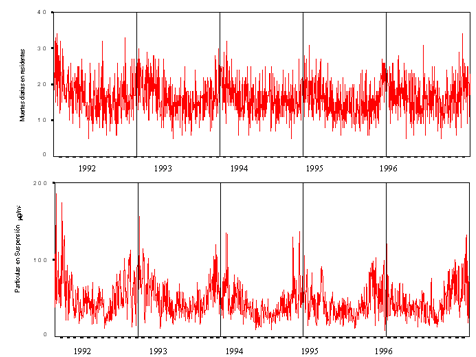
<body><![CDATA[<p ALIGN="JUSTIFY"><font size="3">Información</font></b><i></p>      <p ALIGN="JUSTIFY"><font size="3">Variable respuesta</font></i></p>      <p ALIGN="JUSTIFY"><font size="3">Como se ha mencionado en la presentación del proyecto<sup>1</sup>, cada centro dispone de cuatro series diarias de mortalidad ocurridas en cada ciudad para las personas residentes en la misma: la mortalidad por todas las causas, exceptuando las externas, para todas las edades y para mayores de 70 años (CIE 9 001-799), la mortalidad por causas cardiovasculares (CIE 9 390-459) y la mortalidad por causas respiratorias (CIE 9 460-519). </font></p> <i>      <p ALIGN="JUSTIFY"><font size="3">Variables explicativas</font></p>      <p ALIGN="JUSTIFY"></i><font size="3">Las variables explicativas son las series diarias de cada uno de los contaminantes disponibles en cada centro, construidas a partir de las estaciones captadoras consideradas admisibles tras la imputación de datos no registrados<sup>1</sup>. Cada serie de datos de cada contaminante, bien en promedio diario o en máximo de 24 horas, ha sido considerada separadamente.</font></p> <i>      <p ALIGN="JUSTIFY"><font size="3">Factores de confusión</font></i></p>      <p ALIGN="JUSTIFY"><font size="3">Como posibles variables de confusión se consideran la temperatura media diaria y la humedad relativa (factores meteorológicos), el número diario de casos de gripe, calculado a partir del número de casos semanales declarados dividido por 7, para controlar epidemias de gripe, y otras variables de estructura temporal como factores sinusoidales de estacionalidad anual, tendencias a largo plazo, fluctuaciones semanales y anuales, días festivos y eventos inusuales (la huelga médica, los Juegos Olímpicos en Barcelona o la expo-92 en Sevilla,etc.)</font></p> <b>      <p ALIGN="JUSTIFY"><font size="3">Modelo de análisis</font></b></p>      <p ALIGN="JUSTIFY"><font size="3">La serie de datos diarios de mortalidad puede considerarse como distribuida aproximadamente como una distribución Poisson con sobredispersión<sup>4</sup> (es decir la varianza es mayor que la media) y, habitualmente, con autocorrelación. La sobredispersión y la estructura de autocorrelación suelen ser consecuencia de factores exógenos, como la temperatura o la estructura estacional, más que de factores propios del número de defunciones. Así, para cada una de las series de mortalidad, cada centro construyó un modelo de regresión de Poisson para explicar las fluctuaciones de la mortalidad. El modelo de regresión de Poisson se construye como:</font></p>      <p ALIGN="JUSTIFY"><font size="3">log E(Y) =a +g C +å b <sub>i</sub>X<sub>i</sub></font></p>      ]]></body>
<body><![CDATA[<p ALIGN="JUSTIFY"><font size="3">Donde E(Y) es el número esperado de defunciones diario; a es la constante del modelo; g el efecto de cada contaminante o de sus retardos o de los promedios de los últimos días; C es el contaminante y b el efecto de cada una de las covariables X<sub>i</sub> a controlar. </font></p>      <p ALIGN="JUSTIFY"><font size="3">Para especificar el modelo de Poisson anterior se sigue una estrategia parecida a la metodología <i>APHEA</i><sup>3</sup>. En primer lugar se identifica un modelo basal para cada una de las causas de muertes, a partir de las posibles variables de confusión entre la relación de la mortalidad y la contaminación. A diferencia de <i>APHEA</i>, este modelo basal se identifica directamente usando la regresión de Poisson con el programa <i>EGRET</i><sup>5</sup>. Una vez identificado el modelo basal, se procede a extender este modelo a cada uno de los contaminantes y sus retardos. Finalmente, se intenta controlar la autocorrelación residual incluyendo términos autoregresivos de la mortalidad.</font></p>      <p ALIGN="JUSTIFY"><font size="3">Tal como se ha mencionado, se procede a mostrar el método de análisis utilizando como ejemplo la serie de datos de mortalidad por todas las causas en el período 1992-1996. En la <a href="#fig1">figura 1</a> se muestra esta serie, junto con la de humos negros, apreciándose una aparente correlación entre ambos.</font></p>      <p ALIGN="JUSTIFY"><a name="fig1"></a>&nbsp;&nbsp; </p> <b>      <p ALIGN="CENTER"><font size="3">Figura 1    <br> Defunciones diarias por todas las causas menos externas en la ciudad de Valencia 1992-1996 y media diaria de humos negros</font></b></p>      <p ALIGN="center"><!-- big --><!-- big --><img src="/img/fbpe/resp/v73n2/proy1.gif" alt="proy1.gif (47775 bytes)"><!-- /big --><!-- /big --></p>      
<p ALIGN="JUSTIFY">&nbsp;</p> <b>      <p ALIGN="JUSTIFY"><font size="3">Identificación del modelo basal</font></b></p>      <p ALIGN="JUSTIFY"><font size="3">Para la construcción del modelo basal se introducen progresivamente las variables estructurales y meteorológicas. Las variables en el modelo se incluyen utilizando un criterio estadístico conservador, consistente en la mejoría de la lejanía (<i>deviance</i>), determinada por una significación del cociente de verosimilitudes de p&lt;0.10. A continuación se muestra como se ha construido el modelo.</font></p> <i>      ]]></body>
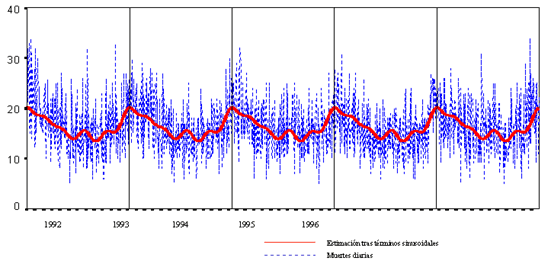
<body><![CDATA[<p ALIGN="JUSTIFY"><font size="3">Estacionalidad</font></i></p>      <p ALIGN="JUSTIFY"><font size="3">El control de la estacionalidad se lleva a cabo introduciendo términos sinusoidales del tipo <img SRC="/img/fbpe/resp/v73n2/image8.gif" align="middle"> y <img SRC="/img/fbpe/resp/v73n2/image9.gif" align="middle">, siendo k un valor de 1 al 6 y t=1,2,&#133; el número de días transcurridos desde el 1 de enero de 1992. Este tipo de términos permite recoger desde ciclos anuales (k=1) hasta ciclos bimestrales (k=6). Para seleccionar los términos sinusoidales del modelo se decide incluirlos sucesivamente por parejas de seno y coseno, empezando por k=1. Para incluir una pareja se exige una mejora en la lejanía de p&lt;0.10. De este modo se incluyen los términos de orden 1, 2, 3, 4 y 5. En la <a href="#fig2">figura 2</a> se observa como queda la serie tras ajustar los términos sinusoidales.</font></p>      
<p ALIGN="JUSTIFY"><a name="fig2"></a>&nbsp;&nbsp; </p>      <p ALIGN="center"><font size="3"><b>Figura 2    <br> Ajuste de variables sinusoidales para las defunciones diarias por todas las causas menos externas en la ciudad de Valencia 1992-1996.</b></font></p>      <p ALIGN="center"><!-- big --><!-- big --><img src="/img/fbpe/resp/v73n2/proy2.gif" alt="proy2.gif (40325 bytes)"><!-- /big --><!-- /big --></p>      
<p ALIGN="JUSTIFY"><font size="3">Modelo ajustado con términos sinusoidales <img SRC="/img/fbpe/resp/v73n2/image12.gif" align="middle"> y <img SRC="/img/fbpe/resp/v73n2/image13.gif" align="middle"> de orden k= 1, 2,3,4 y 5.</font></p>      
<p><i>&nbsp;</p>      <p ALIGN="JUSTIFY"><font size="3">Temperatura</font></i></p>      <p ALIGN="JUSTIFY"><font size="3">La relación de la temperatura con la mortalidad diaria no tiene por qué ser lineal. Además, el efecto puede ser retardado, ya que la temperatura de un día no tiene necesariamente que estar relacionada con la mortalidad del mismo día, sino que puede estarlo con la mortalidad de los días siguientes. Por ello, se calculan los retardos hasta orden 7 de la temperatura media diaria. Así mismo, se calcula la temperatura media diaria al cuadrado y sus correspondientes retardos hasta orden 7. Con ello no es necesario asumir la relación lineal entre la temperatura y la mortalidad, lo que permite otra forma funcional además de controlar el efecto retardado de la relación. Para decidir qué términos se incluyen en el modelo, con el fin de obtener el más parsimonioso posible, se sigue la siguiente estrategia:</font></p>      ]]></body>
<body><![CDATA[<p ALIGN="JUSTIFY"><font size="3">En primer lugar se calcula el &quot;<i>score test&quot; </i>obtenido al ampliar el modelo con términos sinusoidales para cada una de las variables de temperatura mencionadas. El &quot;<i>score test&quot;</i> contrasta, si el coeficiente de regresión de cada una de las variables de temperatura es igual a cero al añadir esta variable al modelo ajustado hasta el momento, sin necesidad de ajustar cada uno de los modelo generados al añadir la variable de temperatura<sup>6</sup>. Aquella variable para la que se obtiene una mayor puntuación (significación) en el &quot;<i>score test&quot;</i> se selecciona y se ajusta junto con los términos sinusoidales elegidos. Si el modelo mejora su lejanía en una p&lt;0.1 se procede a extenderlo con un nuevo término de temperatura y se evalúa de nuevo el &quot;<i>score test&quot;,</i> introduciendo la variable que tiene mejor puntuación. De este modo se sigue un proceso iterativo hasta que la inclusión de un nuevo término no mejore significativamente el modelo, considerando mejora significativa la de la lejanía del modelo con p&lt;0.1. Al efectuar este proceso en el ejemplo, se incluyen los retardos de orden 1, 2 y 7 de la temperatura media y el retardo de orden 1 de la variable temperatura media al cuadrado.</font></p> <i>      <p ALIGN="JUSTIFY"><font size="3">Humedad</i> </font></p>      <p ALIGN="JUSTIFY"><font size="3">En el caso de la humedad relativa, se efectúa un proceso semejante al seguido con las temperaturas. Se calculan los retardos de orden 1 a 7, tanto para la humedad como para su cuadrado. Se sigue el proceso iterativo de ampliación del modelo utilizando el <i>&quot;score test&quot;</i> y añadiendo al modelo la variable de humedad de mayor puntuación, hasta que añadir una no mejore el modelo significativamente. Al efectuar el proceso se incluye la humedad del día y los retardos de orden 4 para la humedad y la humedad al cuadrado. </font></p>      <p ALIGN="JUSTIFY"><font size="3">En la <a href="#fig3">figura 3</a> se observa la serie de mortalidad estudiada tras ajustar los términos sinusoidales y las variables de temperatura y humedad.</font></p>      <p><a name="fig3"></a>&nbsp;&nbsp; <b></p>      <p ALIGN="CENTER"><font size="3">Figura 3    <br> Ajuste de variables sinusoidales, de temperatura y humedad para las defunciones diarias por todas las causas menos externas en la ciudad de Valencia 1992-1996</font></p> </b>      <p ALIGN="center"><!-- big --><!-- big --><img src="/img/fbpe/resp/v73n2/proy3.gif" alt="proy3.gif (44371 bytes)"><!-- /big --><!-- /big --></p>      
<p ALIGN="JUSTIFY"><font size="3">Modelo ajustado con términos sinusoidales <img SRC="/img/fbpe/resp/v73n2/image14.gif" align="middle"> y <img SRC="/img/fbpe/resp/v73n2/image15.gif" align="middle"> de orden k= 1, 2,3,4 y 5., retardos 1,2 y 7 de la</font> temperatura media y retardo 7 de la temperatura media al cuadrado, humedad y retardos 4 de la humedad y la humedad al cuadrado. Al ajuste se le ha añadido 20 para poder visualizar el ajuste. </p>      
<p><i>&nbsp;</p>      ]]></body>
<body><![CDATA[<p ALIGN="JUSTIFY"><font size="3">Años de estudio</font></i><b></p>      <p ALIGN="JUSTIFY"></b><font size="3">Debido a que el proyecto EMECAM tiene por objeto evaluar la asociación diaria entre mortalidad y contaminación y no otros tipos de relación temporal, y con el fin de controlar posibles diferencias por año se crea una variable indicador para cada año, excepto para el primero, que es seleccionado como referencia, siendo en el ejemplo el año 1992. Estas variables toman el valor 1 cuando las observaciones corresponden a ese mismo año y 0 cuando corresponden a otros años. Se incluyen en el modelo de forma conjunta (en bloque) y sólo si se produce una mejora de la lejanía en p&lt;0.1. En el ejemplo han sido incluidas.</font></p> <i>      <p ALIGN="JUSTIFY"><font size="3">Tendencia</font></i></p>      <p ALIGN="JUSTIFY"><font size="3">Además de la estacionalidad y diferencias anuales, puede haber una tendencia secular en la serie que no necesariamente tiene que ser lineal. Con el fin de controlarla se crean dos variables. Una es el número de días transcurridos desde el primer día de la serie (tendencia) y otra su cuadrado. Se añade al modelo la variable que entre las dos mejore la lejanía. En nuestro caso ambas variables mejoran el modelo.</font></p> <i>      <p ALIGN="JUSTIFY"><font size="3">Días de la semana</font></i></p>      <p ALIGN="JUSTIFY"><font size="3">Tanto la mortalidad como la contaminación tienen un patrón semanal. Por ello se crean 6 variables indicadoras, una para cada día de la semana a excepción del lunes tomado como referencia, que valen 1 si la observación es de ese día y 0 en otro caso. Al estar relacionadas con las dos variables de interés se decidió que estas variables debían mantenerse en el modelo independientemente de su significación estadística.</font></p> <i>      <p ALIGN="JUSTIFY"><font size="3">Días festivos</font></i></p>      <p ALIGN="JUSTIFY"><font size="3">Además del día de la semana hay que tener en cuenta si un día fue o no festivo, por la disminución de la contaminación. Esta variables sólo se incluyen si mejoran la lejanía en p&lt;0.1, lo que no ha ocurrido en el ejemplo.</font></p> <i>      <p ALIGN="JUSTIFY"><font size="3">Gripe</font></i></p>      <p ALIGN="JUSTIFY"><font size="3">La gripe también se relaciona con ambas variables de interés. Con el fin de controlarla se calcula el número de gripes diarias como el número de gripes semanales divido por siete. Se obtienen los retardos de hasta orden 15, para disponer de variación en los datos. Se procede del mismo modo que en el caso de la temperatura y humedad. Se calcula el <i>&quot;score test&quot;</i> para cada una de las variables incluyendo progresivamente aquellos retardos con mayor puntuación en el test y que mejoren la lejanía en p&lt;0.10. En el ejemplo se han incluido los términos de la gripe del día y los retardos 2 y 8. </font></p> <i>      ]]></body>
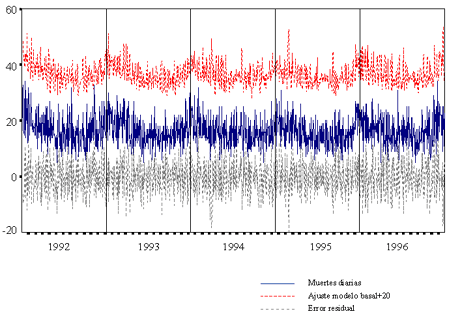
<body><![CDATA[<p ALIGN="JUSTIFY"><font size="3">Reevaluación del modelo</font></i></p>      <p ALIGN="JUSTIFY"><font size="3">Una vez incluidas las variables seleccionadas según el proceso anterior, se reevalúa el modelo, para observar si alguna pareja de términos sinusoidales o variables meteorológicas tienen el nivel de significación del contraste de Wald por encima de p=0.10. En ese caso se eliminarían del modelo la variable o pareja de variables que al excluirlas no produjeran una modificación significativa de la lejanía del modelo (p&lt;0.1). En el ejemplo todas las variables se mantuvieron en el modelo. Así en la <a href="#tab1">tabla 1</a> se muestra el modelo basal finalmente ajustado y en la <a href="#fig4">figura 4</a> se muestra el resultado del ajuste y los residuos.</font></p>      <p><a name="fig4"></a>&nbsp;&nbsp; <b></p>      <p ALIGN="CENTER"><font size="3">Figura 4    <br> Ajuste del modelo Poisson para las defunciones diarias por todas las causas menos externas en la ciudad de Valencia 1992-1996.</font></b></p>      <p ALIGN="center"><!-- big --><!-- big --><img src="/img/fbpe/resp/v73n2/proy4.gif" alt="proy4.gif (51564 bytes)"><!-- /big --><!-- /big --></p>      
<p ALIGN="JUSTIFY"><a name="tab1"></a>&nbsp;&nbsp; </p> <b>      <p ALIGN="CENTER"><font size="3">Tabla 1    <br> Ajuste del modelo basal de regresión de Poisson para las defunciones diarias por todas las causas menos externas en la ciudad de Valencia 1992-1996</font></p> </b>    <div align="center">    ]]></body>
<body><![CDATA[<center>  <table BORDER="0" CELLSPACING="1" bgcolor="#ECECEC">   <tr>     <td VALIGN="top" bgcolor="#C0C0C0">&nbsp; </td>     <td VALIGN="top" COLSPAN="3" bgcolor="#C0C0C0"><b>    <p ALIGN="CENTER"><font size="3">Modelo     Basal</font></b></td>     <td VALIGN="top" COLSPAN="3" bgcolor="#C0C0C0"><b>    <p ALIGN="CENTER"><font size="3">Modelo     final con Humos negros</font></b></td>   </tr>   <tr>     <td VALIGN="top" bgcolor="#C0C0C0">    <p ALIGN="JUSTIFY"><font size="3">Variables</font></td>     <td VALIGN="top" bgcolor="#C0C0C0">    <p ALIGN="CENTER"><font size="3">Coeficiente</font></td>     <td VALIGN="top" bgcolor="#C0C0C0">    <p ALIGN="CENTER"><font size="3">Error Estándar</font></td>     <td VALIGN="top" bgcolor="#C0C0C0">    <p ALIGN="CENTER"><font size="3">p</font></td>     <td VALIGN="top" bgcolor="#C0C0C0">    <p ALIGN="CENTER"><font size="3">Coeficiente</font></td>     <td VALIGN="top" bgcolor="#C0C0C0">    <p ALIGN="CENTER"><font size="3">Error Estándar</font></td>     <td VALIGN="top" bgcolor="#C0C0C0">    <p ALIGN="CENTER"><font size="3">P</font></td>   </tr>   <tr>     <td VALIGN="top">    ]]></body>
<body><![CDATA[<p ALIGN="JUSTIFY"><font size="3">Constante</font></td>     <td VALIGN="top">    <p ALIGN="JUSTIFY"><font size="3">3.441</font></td>     <td VALIGN="top">    <p ALIGN="JUSTIFY"><font size="3">145</font></td>     <td VALIGN="top">    <p ALIGN="JUSTIFY"><font size="3">&lt;.001</font></td>     <td VALIGN="top">    <p ALIGN="JUSTIFY"><font size="3">3.362</font></td>     <td VALIGN="top">    <p ALIGN="JUSTIFY"><font size="3">.149</font></td>     <td VALIGN="top">    <p ALIGN="JUSTIFY"><font size="3">&lt;.001</font></td>   </tr>   <tr>     <td VALIGN="top">    <p ALIGN="JUSTIFY"><font size="3">sin1</font></td>     <td VALIGN="top">    <p ALIGN="JUSTIFY"><font size="3">.03295</font></td>     <td VALIGN="top">    <p ALIGN="JUSTIFY"><font size="3">.0283</font></td>     <td VALIGN="top">    ]]></body>
<body><![CDATA[<p ALIGN="JUSTIFY"><font size="3">.244</font></td>     <td VALIGN="top">    <p ALIGN="JUSTIFY"><font size="3">.03582</font></td>     <td VALIGN="top">    <p ALIGN="JUSTIFY"><font size="3">.0284</font></td>     <td VALIGN="top">    <p ALIGN="JUSTIFY"><font size="3">.208</font></td>   </tr>   <tr>     <td VALIGN="top">    <p ALIGN="JUSTIFY"><font size="3">cos1</font></td>     <td VALIGN="top">    <p ALIGN="JUSTIFY"><font size="3">.09121</font></td>     <td VALIGN="top">    <p ALIGN="JUSTIFY"><font size="3">.0300</font></td>     <td VALIGN="top">    <p ALIGN="JUSTIFY"><font size="3">.002</font></td>     <td VALIGN="top">    <p ALIGN="JUSTIFY"><font size="3">.08336</font></td>     <td VALIGN="top">    <p ALIGN="JUSTIFY"><font size="3">.0303</font></td>     <td VALIGN="top">    ]]></body>
<body><![CDATA[<p ALIGN="JUSTIFY"><font size="3">.006</font></td>   </tr>   <tr>     <td VALIGN="top">    <p ALIGN="JUSTIFY"><font size="3">sin2</font></td>     <td VALIGN="top">    <p ALIGN="JUSTIFY"><font size="3">.01772</font></td>     <td VALIGN="top">    <p ALIGN="JUSTIFY"><font size="3">.0160</font></td>     <td VALIGN="top">    <p ALIGN="JUSTIFY"><font size="3">.269</font></td>     <td VALIGN="top">    <p ALIGN="JUSTIFY"><font size="3">-.01418</font></td>     <td VALIGN="top">    <p ALIGN="JUSTIFY"><font size="3">.0161</font></td>     <td VALIGN="top">    <p ALIGN="JUSTIFY"><font size="3">.380</font></td>   </tr>   <tr>     <td VALIGN="top">    <p ALIGN="JUSTIFY"><font size="3">cos2</font></td>     <td VALIGN="top">    <p ALIGN="JUSTIFY"><font size="3">.01924</font></td>     <td VALIGN="top">    ]]></body>
<body><![CDATA[<p ALIGN="JUSTIFY"><font size="3">.00931</font></td>     <td VALIGN="top">    <p ALIGN="JUSTIFY"><font size="3">.039</font></td>     <td VALIGN="top">    <p ALIGN="JUSTIFY"><font size="3">.01752</font></td>     <td VALIGN="top">    <p ALIGN="JUSTIFY"><font size="3">.00934</font></td>     <td VALIGN="top">    <p ALIGN="JUSTIFY"><font size="3">.061</font></td>   </tr>   <tr>     <td VALIGN="top">    <p ALIGN="JUSTIFY"><font size="3">sin3</font></td>     <td VALIGN="top">    <p ALIGN="JUSTIFY"><font size="3">-.02434</font></td>     <td VALIGN="top">    <p ALIGN="JUSTIFY"><font size="3">.0113</font></td>     <td VALIGN="top">    <p ALIGN="JUSTIFY"><font size="3">.032</font></td>     <td VALIGN="top">    <p ALIGN="JUSTIFY"><font size="3">-.02279</font></td>     <td VALIGN="top">    ]]></body>
<body><![CDATA[<p ALIGN="JUSTIFY"><font size="3">.0113</font></td>     <td VALIGN="top">    <p ALIGN="JUSTIFY"><font size="3">.045</font></td>   </tr>   <tr>     <td VALIGN="top">    <p ALIGN="JUSTIFY"><font size="3">cos3</font></td>     <td VALIGN="top">    <p ALIGN="JUSTIFY"><font size="3">.01312</font></td>     <td VALIGN="top">    <p ALIGN="JUSTIFY"><font size="3">.00879</font></td>     <td VALIGN="top">    <p ALIGN="JUSTIFY"><font size="3">.136</font></td>     <td VALIGN="top">    <p ALIGN="JUSTIFY"><font size="3">.01417</font></td>     <td VALIGN="top">    <p ALIGN="JUSTIFY"><font size="3">.00885</font></td>     <td VALIGN="top">    <p ALIGN="JUSTIFY"><font size="3">.110</font></td>   </tr>   <tr>     <td VALIGN="top">    <p ALIGN="JUSTIFY"><font size="3">sin4 </font></td>     <td VALIGN="top">    ]]></body>
<body><![CDATA[<p ALIGN="JUSTIFY"><font size="3">.01210</font></td>     <td VALIGN="top">    <p ALIGN="JUSTIFY"><font size="3">.00984</font></td>     <td VALIGN="top">    <p ALIGN="JUSTIFY"><font size="3">.219</font></td>     <td VALIGN="top">    <p ALIGN="JUSTIFY"><font size="3">.01217</font></td>     <td VALIGN="top">    <p ALIGN="JUSTIFY"><font size="3">.00982</font></td>     <td VALIGN="top">    <p ALIGN="JUSTIFY"><font size="3">.217</font></td>   </tr>   <tr>     <td VALIGN="top">    <p ALIGN="JUSTIFY"><font size="3">cos4</font></td>     <td VALIGN="top">    <p ALIGN="JUSTIFY"><font size="3">.02407</font></td>     <td VALIGN="top">    <p ALIGN="JUSTIFY"><font size="3">.00873</font></td>     <td VALIGN="top">    <p ALIGN="JUSTIFY"><font size="3">.006</font></td>     <td VALIGN="top">    ]]></body>
<body><![CDATA[<p ALIGN="JUSTIFY"><font size="3">.02282</font></td>     <td VALIGN="top">    <p ALIGN="JUSTIFY"><font size="3">.00874</font></td>     <td VALIGN="top">    <p ALIGN="JUSTIFY"><font size="3">.009</font></td>   </tr>   <tr>     <td VALIGN="top">    <p ALIGN="JUSTIFY"><font size="3">sin5</font></td>     <td VALIGN="top">    <p ALIGN="JUSTIFY"><font size="3">-.02050</font></td>     <td VALIGN="top">    <p ALIGN="JUSTIFY"><font size="3">.00927</font></td>     <td VALIGN="top">    <p ALIGN="JUSTIFY"><font size="3">.027</font></td>     <td VALIGN="top">    <p ALIGN="JUSTIFY"><font size="3">-.01901</font></td>     <td VALIGN="top">    <p ALIGN="JUSTIFY"><font size="3">.00930</font></td>     <td VALIGN="top">    <p ALIGN="JUSTIFY"><font size="3">.041</font></td>   </tr>   <tr>     <td VALIGN="top">    ]]></body>
<body><![CDATA[<p ALIGN="JUSTIFY"><font size="3">cos5</font></td>     <td VALIGN="top">    <p ALIGN="JUSTIFY"><font size="3">.02542</font></td>     <td VALIGN="top">    <p ALIGN="JUSTIFY"><font size="3">.00845</font></td>     <td VALIGN="top">    <p ALIGN="JUSTIFY"><font size="3">.003</font></td>     <td VALIGN="top">    <p ALIGN="JUSTIFY"><font size="3">.02460</font></td>     <td VALIGN="top">    <p ALIGN="JUSTIFY"><font size="3">.00848</font></td>     <td VALIGN="top">    <p ALIGN="JUSTIFY"><font size="3">.004</font></td>   </tr>   <tr>     <td VALIGN="top">    <p ALIGN="JUSTIFY"><font size="3">temperatura(7)</font></td>     <td VALIGN="top">    <p ALIGN="JUSTIFY"><font size="3">-.008677</font></td>     <td VALIGN="top">    <p ALIGN="JUSTIFY"><font size="3">.00276</font></td>     <td VALIGN="top">    ]]></body>
<body><![CDATA[<p ALIGN="JUSTIFY"><font size="3">.002</font></td>     <td VALIGN="top">    <p ALIGN="JUSTIFY"><font size="3">-.00826</font></td>     <td VALIGN="top">    <p ALIGN="JUSTIFY"><font size="3">.00277</font></td>     <td VALIGN="top">    <p ALIGN="JUSTIFY"><font size="3">.003</font></td>   </tr>   <tr>     <td VALIGN="top">    <p ALIGN="JUSTIFY"><font size="3">temperatura*temperatura (1)</font></td>     <td VALIGN="top">    <p ALIGN="JUSTIFY"><font size="3">.001014</font></td>     <td VALIGN="top">    <p ALIGN="JUSTIFY"><font size="3">.00028</font></td>     <td VALIGN="top">    <p ALIGN="JUSTIFY"><font size="3">&lt;.001</font></td>     <td VALIGN="top">    <p ALIGN="JUSTIFY"><font size="3">.0009642</font></td>     <td VALIGN="top">    <p ALIGN="JUSTIFY"><font size="3">.000281</font></td>     <td VALIGN="top">    ]]></body>
<body><![CDATA[<p ALIGN="JUSTIFY"><font size="3">&lt;.001</font></td>   </tr>   <tr>     <td VALIGN="top">    <p ALIGN="JUSTIFY"><font size="3">temperatura(2)</font></td>     <td VALIGN="top">    <p ALIGN="JUSTIFY"><font size="3">-.009431</font></td>     <td VALIGN="top">    <p ALIGN="JUSTIFY"><font size="3">.00362</font></td>     <td VALIGN="top">    <p ALIGN="JUSTIFY"><font size="3">.009</font></td>     <td VALIGN="top">    <p ALIGN="JUSTIFY"><font size="3">-.008971</font></td>     <td VALIGN="top">    <p ALIGN="JUSTIFY"><font size="3">.00364</font></td>     <td VALIGN="top">    <p ALIGN="JUSTIFY"><font size="3">.017</font></td>   </tr>   <tr>     <td VALIGN="top">    <p ALIGN="JUSTIFY"><font size="3">temperatura(1)</font></td>     <td VALIGN="top">    <p ALIGN="JUSTIFY"><font size="3">-.01711</font></td>     <td VALIGN="top">    ]]></body>
<body><![CDATA[<p ALIGN="JUSTIFY"><font size="3">.0100</font></td>     <td VALIGN="top">    <p ALIGN="JUSTIFY"><font size="3">.088</font></td>     <td VALIGN="top">    <p ALIGN="JUSTIFY"><font size="3">-.01575</font></td>     <td VALIGN="top">    <p ALIGN="JUSTIFY"><font size="3">.0101</font></td>     <td VALIGN="top">    <p ALIGN="JUSTIFY"><font size="3">.117</font></td>   </tr>   <tr>     <td VALIGN="top">    <p ALIGN="JUSTIFY"><font size="3">humedad</font></td>     <td VALIGN="top">    <p ALIGN="JUSTIFY"><font size="3">.0008927</font></td>     <td VALIGN="top">    <p ALIGN="JUSTIFY"><font size="3">.00046</font></td>     <td VALIGN="top">    <p ALIGN="JUSTIFY"><font size="3">.052</font></td>     <td VALIGN="top">    <p ALIGN="JUSTIFY"><font size="3">.0008074</font></td>     <td VALIGN="top">    ]]></body>
<body><![CDATA[<p ALIGN="JUSTIFY"><font size="3">.000464</font></td>     <td VALIGN="top">    <p ALIGN="JUSTIFY"><font size="3">.082</font></td>   </tr>   <tr>     <td VALIGN="top">    <p ALIGN="JUSTIFY"><font size="3">humedad*humerdad (4)</font></td>     <td VALIGN="top">    <p ALIGN="JUSTIFY"><font size="3">.00007690</font></td>     <td VALIGN="top">    <p ALIGN="JUSTIFY"><font size="3">.000027</font></td>     <td VALIGN="top">    <p ALIGN="JUSTIFY"><font size="3">.004</font></td>     <td VALIGN="top">    <p ALIGN="JUSTIFY"><font size="3">.00008189</font></td>     <td VALIGN="top">    <p ALIGN="JUSTIFY"><font size="3">.0000271</font></td>     <td VALIGN="top">    <p ALIGN="JUSTIFY"><font size="3">.003</font></td>   </tr>   <tr>     <td VALIGN="top">    <p ALIGN="JUSTIFY"><font size="3">humedad(4)</font></td>     <td VALIGN="top">    ]]></body>
<body><![CDATA[<p ALIGN="JUSTIFY"><font size="3">-.01084</font></td>     <td VALIGN="top">    <p ALIGN="JUSTIFY"><font size="3">.00339</font></td>     <td VALIGN="top">    <p ALIGN="JUSTIFY"><font size="3">.001</font></td>     <td VALIGN="top">    <p ALIGN="JUSTIFY"><font size="3">-.01144</font></td>     <td VALIGN="top">    <p ALIGN="JUSTIFY"><font size="3">.00340</font></td>     <td VALIGN="top">    <p ALIGN="JUSTIFY"><font size="3">&lt;.001</font></td>   </tr>   <tr>     <td VALIGN="top">    <p ALIGN="JUSTIFY"><font size="3">año 93</font></td>     <td VALIGN="top">    <p ALIGN="JUSTIFY"><font size="3">.1011</font></td>     <td VALIGN="top">    <p ALIGN="JUSTIFY"><font size="3">.0668</font></td>     <td VALIGN="top">    <p ALIGN="JUSTIFY"><font size="3">.130</font></td>     <td VALIGN="top">    ]]></body>
<body><![CDATA[<p ALIGN="JUSTIFY"><font size="3">.07863</font></td>     <td VALIGN="top">    <p ALIGN="JUSTIFY"><font size="3">.0676</font></td>     <td VALIGN="top">    <p ALIGN="JUSTIFY"><font size="3">.245</font></td>   </tr>   <tr>     <td VALIGN="top">    <p ALIGN="JUSTIFY"><font size="3">año 94</font></td>     <td VALIGN="top">    <p ALIGN="JUSTIFY"><font size="3">.1914</font></td>     <td VALIGN="top">    <p ALIGN="JUSTIFY"><font size="3">.125</font></td>     <td VALIGN="top">    <p ALIGN="JUSTIFY"><font size="3">.126</font></td>     <td VALIGN="top">    <p ALIGN="JUSTIFY"><font size="3">.1567</font></td>     <td VALIGN="top">    <p ALIGN="JUSTIFY"><font size="3">.126</font></td>     <td VALIGN="top">    <p ALIGN="JUSTIFY"><font size="3">.214</font></td>   </tr>   <tr>     <td VALIGN="top">    ]]></body>
<body><![CDATA[<p ALIGN="JUSTIFY"><font size="3">año 95</font></td>     <td VALIGN="top">    <p ALIGN="JUSTIFY"><font size="3">.2257</font></td>     <td VALIGN="top">    <p ALIGN="JUSTIFY"><font size="3">.182</font></td>     <td VALIGN="top">    <p ALIGN="JUSTIFY"><font size="3">.215</font></td>     <td VALIGN="top">    <p ALIGN="JUSTIFY"><font size="3">.1832</font></td>     <td VALIGN="top">    <p ALIGN="JUSTIFY"><font size="3">.183</font></td>     <td VALIGN="top">    <p ALIGN="JUSTIFY"><font size="3">.318</font></td>   </tr>   <tr>     <td VALIGN="top">    <p ALIGN="JUSTIFY"><font size="3">año 96</font></td>     <td VALIGN="top">    <p ALIGN="JUSTIFY"><font size="3">.2821</font></td>     <td VALIGN="top">    <p ALIGN="JUSTIFY"><font size="3">.239</font></td>     <td VALIGN="top">    ]]></body>
<body><![CDATA[<p ALIGN="JUSTIFY"><font size="3">.239</font></td>     <td VALIGN="top">    <p ALIGN="JUSTIFY"><font size="3">.2353</font></td>     <td VALIGN="top">    <p ALIGN="JUSTIFY"><font size="3">.241</font></td>     <td VALIGN="top">    <p ALIGN="JUSTIFY"><font size="3">.328</font></td>   </tr>   <tr>     <td VALIGN="top">    <p ALIGN="JUSTIFY"><font size="3">tendencia</font></td>     <td VALIGN="top">    <p ALIGN="JUSTIFY"><font size="3">-.0004849</font></td>     <td VALIGN="top">    <p ALIGN="JUSTIFY"><font size="3">.000199</font></td>     <td VALIGN="top">    <p ALIGN="JUSTIFY"><font size="3">.015</font></td>     <td VALIGN="top">    <p ALIGN="JUSTIFY"><font size="3">-.0003965</font></td>     <td VALIGN="top">    <p ALIGN="JUSTIFY"><font size="3">.000203</font></td>     <td VALIGN="top">    ]]></body>
<body><![CDATA[<p ALIGN="JUSTIFY"><font size="3">.050</font></td>   </tr>   <tr>     <td VALIGN="top">    <p ALIGN="JUSTIFY"><font size="3">tendencia*tendencia</font></td>     <td VALIGN="top">    <p ALIGN="JUSTIFY"><font size="3">.0000001547</font></td>     <td VALIGN="top">    <p ALIGN="JUSTIFY"><font size="3">.000000596</font></td>     <td VALIGN="top">    <p ALIGN="JUSTIFY"><font size="3">.009</font></td>     <td VALIGN="top">    <p ALIGN="JUSTIFY"><font size="3">.0000001256</font></td>     <td VALIGN="top">    <p ALIGN="JUSTIFY"><font size="3">.0000000607</font></td>     <td VALIGN="top">    <p ALIGN="JUSTIFY"><font size="3">.038</font></td>   </tr>   <tr>     <td VALIGN="top">    <p ALIGN="JUSTIFY"><font size="3">martes</font></td>     <td VALIGN="top">    <p ALIGN="JUSTIFY"><font size="3">-.01771</font></td>     <td VALIGN="top">    ]]></body>
<body><![CDATA[<p ALIGN="JUSTIFY"><font size="3">.0217</font></td>     <td VALIGN="top">    <p ALIGN="JUSTIFY"><font size="3">.415</font></td>     <td VALIGN="top">    <p ALIGN="JUSTIFY"><font size="3">-.02827</font></td>     <td VALIGN="top">    <p ALIGN="JUSTIFY"><font size="3">.0225</font></td>     <td VALIGN="top">    <p ALIGN="JUSTIFY"><font size="3">.208</font></td>   </tr>   <tr>     <td VALIGN="top">    <p ALIGN="JUSTIFY"><font size="3">miércoles</font></td>     <td VALIGN="top">    <p ALIGN="JUSTIFY"><font size="3">.002668</font></td>     <td VALIGN="top">    <p ALIGN="JUSTIFY"><font size="3">.0217</font></td>     <td VALIGN="top">    <p ALIGN="JUSTIFY"><font size="3">.902</font></td>     <td VALIGN="top">    <p ALIGN="JUSTIFY"><font size="3">-.01124</font></td>     <td VALIGN="top">    ]]></body>
<body><![CDATA[<p ALIGN="JUSTIFY"><font size="3">.0228</font></td>     <td VALIGN="top">    <p ALIGN="JUSTIFY"><font size="3">.622</font></td>   </tr>   <tr>     <td VALIGN="top">    <p ALIGN="JUSTIFY"><font size="3">jueves</font></td>     <td VALIGN="top">    <p ALIGN="JUSTIFY"><font size="3">-.02718</font></td>     <td VALIGN="top">    <p ALIGN="JUSTIFY"><font size="3">.0218</font></td>     <td VALIGN="top">    <p ALIGN="JUSTIFY"><font size="3">.213</font></td>     <td VALIGN="top">    <p ALIGN="JUSTIFY"><font size="3">-.004263</font></td>     <td VALIGN="top">    <p ALIGN="JUSTIFY"><font size="3">.0230</font></td>     <td VALIGN="top">    <p ALIGN="JUSTIFY"><font size="3">.064</font></td>   </tr>   <tr>     <td VALIGN="top">    <p ALIGN="JUSTIFY"><font size="3">viernes</font></td>     <td VALIGN="top">    ]]></body>
<body><![CDATA[<p ALIGN="JUSTIFY"><font size="3">-.02285</font></td>     <td VALIGN="top">    <p ALIGN="JUSTIFY"><font size="3">.0218</font></td>     <td VALIGN="top">    <p ALIGN="JUSTIFY"><font size="3">.294</font></td>     <td VALIGN="top">    <p ALIGN="JUSTIFY"><font size="3">-.03732</font></td>     <td VALIGN="top">    <p ALIGN="JUSTIFY"><font size="3">.0230</font></td>     <td VALIGN="top">    <p ALIGN="JUSTIFY"><font size="3">.104</font></td>   </tr>   <tr>     <td VALIGN="top">    <p ALIGN="JUSTIFY"><font size="3">sábado</font></td>     <td VALIGN="top">    <p ALIGN="JUSTIFY"><font size="3">-.04041</font></td>     <td VALIGN="top">    <p ALIGN="JUSTIFY"><font size="3">.0219</font></td>     <td VALIGN="top">    <p ALIGN="JUSTIFY"><font size="3">.064</font></td>     <td VALIGN="top">    ]]></body>
<body><![CDATA[<p ALIGN="JUSTIFY"><font size="3">-.05281</font></td>     <td VALIGN="top">    <p ALIGN="JUSTIFY"><font size="3">.0226</font></td>     <td VALIGN="top">    <p ALIGN="JUSTIFY"><font size="3">.020</font></td>   </tr>   <tr>     <td VALIGN="top">    <p ALIGN="JUSTIFY"><font size="3">domingo</font></td>     <td VALIGN="top">    <p ALIGN="JUSTIFY"><font size="3">-.02223</font></td>     <td VALIGN="top">    <p ALIGN="JUSTIFY"><font size="3">.0217</font></td>     <td VALIGN="top">    <p ALIGN="JUSTIFY"><font size="3">.306</font></td>     <td VALIGN="top">    <p ALIGN="JUSTIFY"><font size="3">-.02551</font></td>     <td VALIGN="top">    <p ALIGN="JUSTIFY"><font size="3">.0218</font></td>     <td VALIGN="top">    <p ALIGN="JUSTIFY"><font size="3">.242</font></td>   </tr>   <tr>     <td VALIGN="top">    ]]></body>
<body><![CDATA[<p ALIGN="JUSTIFY"><font size="3">gripe</font></td>     <td VALIGN="top">    <p ALIGN="JUSTIFY"><font size="3">.0004613</font></td>     <td VALIGN="top">    <p ALIGN="JUSTIFY"><font size="3">.000144</font></td>     <td VALIGN="top">    <p ALIGN="JUSTIFY"><font size="3">.001</font></td>     <td VALIGN="top">    <p ALIGN="JUSTIFY"><font size="3">.0004374</font></td>     <td VALIGN="top">    <p ALIGN="JUSTIFY"><font size="3">.000145</font></td>     <td VALIGN="top">    <p ALIGN="JUSTIFY"><font size="3">.003</font></td>   </tr>   <tr>     <td VALIGN="top">    <p ALIGN="JUSTIFY"><font size="3">gripe(2)</font></td>     <td VALIGN="top">    <p ALIGN="JUSTIFY"><font size="3">-.000345</font></td>     <td VALIGN="top">    <p ALIGN="JUSTIFY"><font size="3">.000153</font></td>     <td VALIGN="top">    ]]></body>
<body><![CDATA[<p ALIGN="JUSTIFY"><font size="3">.025</font></td>     <td VALIGN="top">    <p ALIGN="JUSTIFY"><font size="3">-.0003386</font></td>     <td VALIGN="top">    <p ALIGN="JUSTIFY"><font size="3">.000154</font></td>     <td VALIGN="top">    <p ALIGN="JUSTIFY"><font size="3">.027</font></td>   </tr>   <tr>     <td VALIGN="top">    <p ALIGN="JUSTIFY"><font size="3">gripe(8)</font></td>     <td VALIGN="top">    <p ALIGN="JUSTIFY"><font size="3">.0001692</font></td>     <td VALIGN="top">    <p ALIGN="JUSTIFY"><font size="3">.0000942</font></td>     <td VALIGN="top">    <p ALIGN="JUSTIFY"><font size="3">.072</font></td>     <td VALIGN="top">    <p ALIGN="JUSTIFY"><font size="3">.0001706</font></td>     <td VALIGN="top">    <p ALIGN="JUSTIFY"><font size="3">.0000942</font></td>     <td VALIGN="top">    ]]></body>
<body><![CDATA[<p ALIGN="JUSTIFY"><font size="3">.070</font></td>   </tr>   <tr>     <td VALIGN="top">    <p ALIGN="JUSTIFY"><font size="3">Humos negros (1)</font></td>     <td VALIGN="top">&nbsp; </td>     <td VALIGN="top">&nbsp; </td>     <td VALIGN="top">&nbsp; </td>     <td VALIGN="top">    <p ALIGN="JUSTIFY"><font size="3">.0007017</font></td>     <td VALIGN="top">    <p ALIGN="JUSTIFY"><font size="3">.000360</font></td>     <td VALIGN="top">    <p ALIGN="JUSTIFY"><font size="3">.051</font></td>   </tr>   <tr>     <td VALIGN="top">    <p ALIGN="JUSTIFY"><font size="3">Muertes (3)</font></td>     <td VALIGN="top">&nbsp; </td>     <td VALIGN="top">&nbsp; </td>     <td VALIGN="top">&nbsp; </td>     <td VALIGN="top">    <p ALIGN="JUSTIFY"><font size="3">.002389</font></td>     <td VALIGN="top">    <p ALIGN="JUSTIFY"><font size="3">.00136</font></td>     <td VALIGN="top">    <p ALIGN="JUSTIFY"><font size="3">.080</font></td>   </tr>   <tr>     <td VALIGN="top">&nbsp;&nbsp;&nbsp; </td>     <td VALIGN="top" COLSPAN="3">    <p ALIGN="JUSTIFY"><font size="3">Lejanía 1974.836 con 1779     grados de libertad</font></td>     <td VALIGN="top" COLSPAN="3">    ]]></body>
<body><![CDATA[<p ALIGN="JUSTIFY"><font size="3">Lejanía 1967.773 con 1777     grados de libertad</font></td>   </tr> </table> </center></div>      <p ALIGN="JUSTIFY">&nbsp;</p>      <p ALIGN="JUSTIFY"><font size="3">El valor entre paréntesis indica el retardo de la variable La variable sin <i>k</i>=<img SRC="/img/fbpe/resp/v73n2/image10.gif" align="middle"> y cos <i>k</i>=<img SRC="/img/fbpe/resp/v73n2/image11.gif" align="middle"></font></p> <b>      
<p ALIGN="JUSTIFY"><font size="3">Selección de las variables de contaminación atmosférica</font></p>      <p ALIGN="JUSTIFY"></b><font size="3">Una vez identificado el modelo basal se introducen en él cada uno de los contaminantes por separado y cada uno de sus retardos hasta orden 5. En un primer momento, el análisis se efectúa diferenciado para cada contaminante y cada retraso. En el caso del ejemplo se ha efectuado el análisis con la variable humos negros, observando una relación significativa (p=0.045) con el primer retardo de humos negros</font></p> <i>      <p ALIGN="JUSTIFY"><font size="3">Autocorrelación residual</font></i></p>      <p ALIGN="JUSTIFY"><font size="3">Con el fin de controlar la posible autocorrelación seriada existente, se añaden los retardos de la mortalidad hasta orden 7 en bloque, eliminándose sucesivamente aquellos que no son significativos, utilizando el contraste de verosimilitudes. De este modo se elige el retardo de la mortalidad correspondiente. Para el ejemplo con el retardo de orden 1 de humos negros se tiene que añadir el término autoregresivo de orden 3 de la mortalidad.</font></p> <b>      <p ALIGN="JUSTIFY"><font size="3">Análisis por semestres</font></p>      <p ALIGN="JUSTIFY"></b><font size="3">Con el fin de analizar si la relación de la contaminación con la mortalidad es diferente según la época del año, se agrupan los meses en dos grupos, el semestre frío de noviembre a abril ambos inclusive, y el semestre cálido de mayo a octubre ambos inclusive. Para ver el efecto por semestres, no se lleva a cabo un análisis estratificado, dada la disminución de los efectivos y el problema de usar variables con retardo. Por ello, se incluyen términos de interacción con la contaminación. Así se crean dos variables indicadoras. La primera &quot;frío&quot; vale 1 cuando el semestre es el frío y 0 en el otro caso. La segunda &quot;cálido&quot; toma el valor 1 cuando el semestre es el cálido y 0 en caso contrario. </font></p>      <p ALIGN="JUSTIFY"><font size="3">Para obtener el efecto del contaminante en los meses fríos se incluyen en el modelo la variable <i>cálido</i> y su interacción con el contaminante. De este modo el coeficiente que acompaña al efecto principal del contaminante corresponde al efecto cuando la variable <i>cálido</i> es 0, es decir el efecto en los meses fríos. El intervalo de confianza de la estimación se obtiene directamente a partir del error estándar. En el ejemplo, el coeficiente que acompaña al primer retardo de los humos al incluir la interacción con la variable <i>cálido</i> es 0.0005541 y su error estándar es 0.000389 y un nivel de significación de p=0.155.</font></p>      ]]></body>
<body><![CDATA[<p ALIGN="JUSTIFY"><font size="3">Análogamente, para obtener el efecto del contaminante en los meses cálidos se incluye en el modelo la variable <i>frío</i> y su interacción con el contaminante. Se observa el coeficiente que acompaña a la variable del contaminante sin interacción, siendo el efecto en los meses cálidos y obteniéndose el intervalo de confianza directamente a partir del error estándar. En el ejemplo el coeficiente correspondiente al primer retardo de los humos negros al incluir la interacción con la variable <i>frío</i> es 0.001336, con un error estándar de 0.000722 y con una significación de p=0.064.</font></p>      <p ALIGN="JUSTIFY"><font size="3">Grupo <i>EMECAM</i></font></p>      <p ALIGN="JUSTIFY"><font size="3">F Ballester, S Pérez-Hoyos, JM Tenías, R Molina, J González-Aracil (Valencia, Centro coordinador); M Saez, MA Barceló, C Saurina, A Tobias (Barcelona); E. Alonso, K. Cambra (Bilbao); M Taracido, JM Barros, I Castro, A Figueiras, A Montes, E Smyth (Vigo); JM Ordóñez, E Aranguez, I Galán, AM Gandarillas (Madrid); I Aguinaga, MY Floristan, F Guillén, MS Laborda, MA Martínez, MT Martínez, PJ Oviedo (Pamplona); A Daponte, R Garrido de la Sierra, JL Gurucelain, P. Gutiérrez, JA Maldonado, JL Martín, JM Mayoral, R Ocaña, J Serrano (Granada); JB Bellido, A Arnedo, F González (Castellón); JJ Guillén, Ll Cirera, L García, E Jiménez, MJ Martínez, S Moreno, C Navarro (Cartagena); MJ Pérez, A Alonso, JJ Estíbalez, MA García-Calabuig, (Vitoria); A Cañada, C Fernández, F Fernández, V García, I Huerta, V Rogríguez (Asturias); F Arribas, M Navarro, C Martos, MJ Rabanaque, E Muniesa, JM Abad, JI Urraca (Zaragoza); y J Sunyer como asesor del proyecto.</font></p>      <p ALIGN="CENTER">&nbsp;</p> <b>      <p ALIGN="CENTER"><font size="4">BIBLIOGRAFIA</font></b></p>      <!-- ref --><p ALIGN="JUSTIFY"><font size="3">1.- Ballester F, Sáez M, Alonso ME, Taracido M, Ordóñez JM, Aguinaga I et al. El proyecto EMECAM: Estudio Multicéntrico Español sobre la relación entre la contaminación atmosférica y la mortalidad. Antecedentes, participantes, objetivos y material y métodos. Rev Esp Salud Publica 1999;165-175.</font>&nbsp;&nbsp;&nbsp;&nbsp;&nbsp;&nbsp;&nbsp;&nbsp;[&#160;<a href="javascript:void(0);" onclick="javascript: window.open('/scielo.php?script=sci_nlinks&ref=5545714&pid=S1135-5727199900020000700001&lng=','','width=640,height=500,resizable=yes,scrollbars=1,menubar=yes,');">Links</a>&#160;]<!-- end-ref --><!-- ref --><p ALIGN="JUSTIFY"><font size="3">2 - Sáez M, Pérez-Hoyos S, Tobias A, Saurina C, Barceló MA, Ballester F Métodos de series temporales en los estudios epidemiológicos sobre contaminación atmosférica. Rev Esp Salud Publica 1999; 133-143.</font>&nbsp;&nbsp;&nbsp;&nbsp;&nbsp;&nbsp;&nbsp;&nbsp;[&#160;<a href="javascript:void(0);" onclick="javascript: window.open('/scielo.php?script=sci_nlinks&ref=5545715&pid=S1135-5727199900020000700002&lng=','','width=640,height=500,resizable=yes,scrollbars=1,menubar=yes,');">Links</a>&#160;]<!-- end-ref --><!-- ref --><p ALIGN="JUSTIFY"><font size="3">3.- Katsouyanni K, Schwartz J, Spix C, Touloumi G, Zmirou D, Sanobetti et al. Short term effects of air pollution on health: A European approach using epidemiologic time series data: The APHEA protocol. J Epidemiol Community Health 1996;50 (Suppl 1):S12-S18.</font>&nbsp;&nbsp;&nbsp;&nbsp;&nbsp;&nbsp;&nbsp;&nbsp;[&#160;<a href="javascript:void(0);" onclick="javascript: window.open('/scielo.php?script=sci_nlinks&ref=5545716&pid=S1135-5727199900020000700003&lng=','','width=640,height=500,resizable=yes,scrollbars=1,menubar=yes,');">Links</a>&#160;]<!-- end-ref --><!-- ref --><p ALIGN="JUSTIFY"><font size="3">4.- Schwartz J, Spix C, Touloumi G, Bachárová L, Barumamdzadeh T, leTertre et al. Methodological issues in studies of air pollution and daily counts of deaths or hospital admissions. J Epidemiol Community Health 1996;50(Suppl 1):S3-S11.</font>&nbsp;&nbsp;&nbsp;&nbsp;&nbsp;&nbsp;&nbsp;&nbsp;[&#160;<a href="javascript:void(0);" onclick="javascript: window.open('/scielo.php?script=sci_nlinks&ref=5545717&pid=S1135-5727199900020000700004&lng=','','width=640,height=500,resizable=yes,scrollbars=1,menubar=yes,');">Links</a>&#160;]<!-- end-ref --><!-- ref --><p ALIGN="JUSTIFY"><font size="3">5.- Egret User Manual. Seattle Washington: Statistics and Epidemiology Research Corporation; 1991.</font>&nbsp;&nbsp;&nbsp;&nbsp;&nbsp;&nbsp;&nbsp;&nbsp;[&#160;<a href="javascript:void(0);" onclick="javascript: window.open('/scielo.php?script=sci_nlinks&ref=5545718&pid=S1135-5727199900020000700005&lng=','','width=640,height=500,resizable=yes,scrollbars=1,menubar=yes,');">Links</a>&#160;]<!-- end-ref --><!-- ref --><p ALIGN="JUSTIFY"><font size="3">6.- Breslow NE, Day NE. Statistical Methods for Cancer Research Vol II. The design and analysis of cohort studies. Lyon.: IARC; 1987</font>&nbsp;&nbsp;&nbsp;&nbsp;&nbsp;&nbsp;&nbsp;&nbsp;[&#160;<a href="javascript:void(0);" onclick="javascript: window.open('/scielo.php?script=sci_nlinks&ref=5545719&pid=S1135-5727199900020000700006&lng=','','width=640,height=500,resizable=yes,scrollbars=1,menubar=yes,');">Links</a>&#160;]<!-- end-ref --> ]]></body><back>
<ref-list>
<ref id="B1">
<label>1</label><nlm-citation citation-type="journal">
<person-group person-group-type="author">
<name>
<surname><![CDATA[Ballester]]></surname>
<given-names><![CDATA[F]]></given-names>
</name>
<name>
<surname><![CDATA[Sáez]]></surname>
<given-names><![CDATA[M]]></given-names>
</name>
<name>
<surname><![CDATA[Alonso]]></surname>
<given-names><![CDATA[ME]]></given-names>
</name>
<name>
<surname><![CDATA[Taracido]]></surname>
<given-names><![CDATA[M]]></given-names>
</name>
<name>
<surname><![CDATA[Ordóñez]]></surname>
<given-names><![CDATA[JM]]></given-names>
</name>
<name>
<surname><![CDATA[Aguinaga]]></surname>
<given-names><![CDATA[I]]></given-names>
</name>
</person-group>
<article-title xml:lang="es"><![CDATA[El proyecto EMECAM: Estudio Multicéntrico Español sobre la relación entre la contaminación atmosférica y la mortalidad. Antecedentes, participantes, objetivos y material y métodos]]></article-title>
<source><![CDATA[Rev Esp Salud Publica]]></source>
<year>1999</year>
<page-range>165-175</page-range></nlm-citation>
</ref>
<ref id="B2">
<label>2</label><nlm-citation citation-type="journal">
<person-group person-group-type="author">
<name>
<surname><![CDATA[Sáez]]></surname>
<given-names><![CDATA[M]]></given-names>
</name>
<name>
<surname><![CDATA[Pérez-Hoyos]]></surname>
<given-names><![CDATA[S]]></given-names>
</name>
<name>
<surname><![CDATA[Tobias]]></surname>
<given-names><![CDATA[A]]></given-names>
</name>
<name>
<surname><![CDATA[Saurina]]></surname>
<given-names><![CDATA[C]]></given-names>
</name>
<name>
<surname><![CDATA[Barceló]]></surname>
<given-names><![CDATA[MA]]></given-names>
</name>
<name>
<surname><![CDATA[Ballester]]></surname>
<given-names><![CDATA[F]]></given-names>
</name>
</person-group>
<article-title xml:lang="es"><![CDATA[Métodos de series temporales en los estudios epidemiológicos sobre contaminación atmosférica]]></article-title>
<source><![CDATA[Rev Esp Salud Publica]]></source>
<year>1999</year>
<page-range>133-143</page-range></nlm-citation>
</ref>
<ref id="B3">
<label>3</label><nlm-citation citation-type="journal">
<person-group person-group-type="author">
<name>
<surname><![CDATA[Katsouyanni]]></surname>
<given-names><![CDATA[K]]></given-names>
</name>
<name>
<surname><![CDATA[Schwartz]]></surname>
<given-names><![CDATA[J]]></given-names>
</name>
<name>
<surname><![CDATA[Spix]]></surname>
<given-names><![CDATA[C]]></given-names>
</name>
<name>
<surname><![CDATA[Touloumi]]></surname>
<given-names><![CDATA[G]]></given-names>
</name>
<name>
<surname><![CDATA[Zmirou]]></surname>
<given-names><![CDATA[D]]></given-names>
</name>
<name>
<surname><![CDATA[Sanobetti]]></surname>
</name>
</person-group>
<article-title xml:lang="en"><![CDATA[Short term effects of air pollution on health: A European approach using epidemiologic time series data: The APHEA protocol]]></article-title>
<source><![CDATA[J Epidemiol Community Health]]></source>
<year>1996</year>
<volume>50</volume>
<numero>^s1</numero>
<issue>^s1</issue>
<supplement>1</supplement>
<page-range>S12-S18</page-range></nlm-citation>
</ref>
<ref id="B4">
<label>4</label><nlm-citation citation-type="journal">
<person-group person-group-type="author">
<name>
<surname><![CDATA[Schwartz]]></surname>
<given-names><![CDATA[J]]></given-names>
</name>
<name>
<surname><![CDATA[Spix]]></surname>
<given-names><![CDATA[C]]></given-names>
</name>
<name>
<surname><![CDATA[Touloumi]]></surname>
<given-names><![CDATA[G]]></given-names>
</name>
<name>
<surname><![CDATA[Bachárová]]></surname>
<given-names><![CDATA[L]]></given-names>
</name>
<name>
<surname><![CDATA[Barumamdzadeh]]></surname>
<given-names><![CDATA[T]]></given-names>
</name>
<name>
<surname><![CDATA[leTertre]]></surname>
</name>
</person-group>
<article-title xml:lang="en"><![CDATA[Methodological issues in studies of air pollution and daily counts of deaths or hospital admissions]]></article-title>
<source><![CDATA[J Epidemiol Community Health]]></source>
<year>1996</year>
<volume>50</volume>
<numero>^s1</numero>
<issue>^s1</issue>
<supplement>1</supplement>
<page-range>S3-S11</page-range></nlm-citation>
</ref>
<ref id="B5">
<label>5</label><nlm-citation citation-type="book">
<source><![CDATA[Egret User Manual]]></source>
<year>1991</year>
<publisher-loc><![CDATA[SeattleWashington ]]></publisher-loc>
<publisher-name><![CDATA[Statistics and Epidemiology Research Corporation]]></publisher-name>
</nlm-citation>
</ref>
<ref id="B6">
<label>6</label><nlm-citation citation-type="book">
<person-group person-group-type="author">
<name>
<surname><![CDATA[Breslow]]></surname>
<given-names><![CDATA[NE]]></given-names>
</name>
<name>
<surname><![CDATA[Day]]></surname>
<given-names><![CDATA[NE]]></given-names>
</name>
</person-group>
<source><![CDATA[Statistical Methods for Cancer Research: Vol II. The design and analysis of cohort studies]]></source>
<year>1987</year>
<publisher-loc><![CDATA[Lyon ]]></publisher-loc>
<publisher-name><![CDATA[IARC]]></publisher-name>
</nlm-citation>
</ref>
</ref-list>
</back>
</article>