<?xml version="1.0" encoding="ISO-8859-1"?><article xmlns:mml="http://www.w3.org/1998/Math/MathML" xmlns:xlink="http://www.w3.org/1999/xlink" xmlns:xsi="http://www.w3.org/2001/XMLSchema-instance">
<front>
<journal-meta>
<journal-id>1139-6709</journal-id>
<journal-title><![CDATA[International Microbiology]]></journal-title>
<abbrev-journal-title><![CDATA[INT. MICROBIOL.]]></abbrev-journal-title>
<issn>1139-6709</issn>
<publisher>
<publisher-name><![CDATA[Sociedad Española de Microbiología]]></publisher-name>
</publisher>
</journal-meta>
<article-meta>
<article-id>S1139-67092005000100003</article-id>
<title-group>
<article-title xml:lang="en"><![CDATA[Soil health: a new challenge for microbiologists and chemists]]></article-title>
<article-title xml:lang="es"><![CDATA[La salud del suelo: un nuevo reto para microbiólogos y químicos]]></article-title>
<article-title xml:lang="pt"><![CDATA[A saúde do solo: um novo desafio para microbiologistas e químicos]]></article-title>
</title-group>
<contrib-group>
<contrib contrib-type="author">
<name>
<surname><![CDATA[Arias]]></surname>
<given-names><![CDATA[M. Enriqueta]]></given-names>
</name>
<xref ref-type="aff" rid="A01"/>
</contrib>
<contrib contrib-type="author">
<name>
<surname><![CDATA[González-Pérez]]></surname>
<given-names><![CDATA[José A.]]></given-names>
</name>
<xref ref-type="aff" rid="A02"/>
</contrib>
<contrib contrib-type="author">
<name>
<surname><![CDATA[González-Vila]]></surname>
<given-names><![CDATA[Francisco J.]]></given-names>
</name>
<xref ref-type="aff" rid="A02"/>
</contrib>
<contrib contrib-type="author">
<name>
<surname><![CDATA[Ball]]></surname>
<given-names><![CDATA[Andrew S.]]></given-names>
</name>
<xref ref-type="aff" rid="A03"/>
</contrib>
</contrib-group>
<aff id="A01">
<institution><![CDATA[,University of Alcalá Department of Microbiology and Parasitology ]]></institution>
<addr-line><![CDATA[ Madrid]]></addr-line>
<country>Spain</country>
</aff>
<aff id="A02">
<institution><![CDATA[,CSIC Natural Resources and Agrobiology Institute of Sevilla ]]></institution>
<addr-line><![CDATA[ ]]></addr-line>
<country>Spain</country>
</aff>
<aff id="A03">
<institution><![CDATA[,University of Essex Department of Biological Sciences ]]></institution>
<addr-line><![CDATA[Colchester ]]></addr-line>
<country>UK</country>
</aff>
<pub-date pub-type="pub">
<day>00</day>
<month>03</month>
<year>2005</year>
</pub-date>
<pub-date pub-type="epub">
<day>00</day>
<month>03</month>
<year>2005</year>
</pub-date>
<volume>8</volume>
<numero>1</numero>
<fpage>13</fpage>
<lpage>21</lpage>
<copyright-statement/>
<copyright-year/>
<self-uri xlink:href="http://scielo.isciii.es/scielo.php?script=sci_arttext&amp;pid=S1139-67092005000100003&amp;lng=en&amp;nrm=iso"></self-uri><self-uri xlink:href="http://scielo.isciii.es/scielo.php?script=sci_abstract&amp;pid=S1139-67092005000100003&amp;lng=en&amp;nrm=iso"></self-uri><self-uri xlink:href="http://scielo.isciii.es/scielo.php?script=sci_pdf&amp;pid=S1139-67092005000100003&amp;lng=en&amp;nrm=iso"></self-uri><abstract abstract-type="short" xml:lang="en"><p><![CDATA[Soil health refers to the biological, chemical, and physical features of soil that are essential to long-term, sustainable agricultural productivity with minimal environmental impact. Thus, soil health provides an overall picture of soil functionality. Although it cannot be measured directly, soil health can be inferred by measuring specific soil properties (e.g. organic matter content) and by observing soil status (e.g. fertility). There is also increased interest in studying soil microorganisms in their particular environments, as microbial diversity is intimately related to soil structure and function. One of the key objectives in determining soil health is to acquire indicators that can be used to evaluate the soil's current status and hence to develop sustainable agricultural systems. In this regard, significant progress has been made over the last few years in the development of specific biomarkers and macromolecular probes, enabling rapid and reliable measurements of soil microbial communities. In addition, modern molecular biological techniques, such as fluorescence in situ hybridization (FISH), reverse transcriptase polymerase chain reaction (RT-PCR), denaturing gradient gel electrophoresis (DGGE), and terminal restriction fragment length polymorphism (T-RFLP), have facilitated the analysis of microbial biodiversity and activity, whereas the application of modern analytical techniques, such as nuclear magnetic resonance (NMR) and pyrolysis-gas chromatography-mass spectrometry (Py-GC-MS), have provided data on soil chemistry. The combination of these two approaches offers promise in determining soil health status.]]></p></abstract>
<abstract abstract-type="short" xml:lang="es"><p><![CDATA[El concepto de salud del suelo se relaciona con las características biológicas, químicas y físicas que son esenciales para una productividad agrícola sostenible a largo plazo con un mínimo impacto ambiental. La salud del suelo es el más fiel reflejo de su funcionalidad. Aunque no puede medirse directamente, se puede inferir a partir de la determinación de propiedades específicas del mismo suelo (p.e. el contenido en materia orgánica) y por la observación de su estado (p.e. la fertilidad). El interés por el estudio de los microorganismos del suelo en su propio medio está aumentando, puesto que la diversidad microbiana está estrechamente relacionada con la estructura y función del suelo. Un objetivo clave para determinar la salud de un suelo es la disponibilidad de indicadores factibles de ser utilizados en la evaluación de su estado y, a partir de aquí, implementar sistemas de agricultura sostenible. El desarrollo de biomarcadores específicos y sondas macromoleculares ha evolucionado considerablemente en los últimos años, lo cual ha permitido obtener medidas fiables y rápidas de las comunidades microbianas del suelo. Por otro lado, las modernas técnicas biomoleculares más recientes (p.e. la hibridación in situ mediante fluorescencia [FISH], la reacción en cadena de la polimerasa mediante transcriptasa inversa [RT-PCR], la electroforesis en gel con gradiente desnaturalizante [DGGE] y el análisis del polimorfismo en la longitud de los fragmentos de restricción terminales [T-RFLP]) permiten analizar la biodiversidad y actividad microbianas, mientras que la aplicación de técnicas analíticas modernas (p.e. resonancia magnética nuclear [NMR], pirólisis-cromatografía de gases-espectrometría de masas [Py-GC-MS]) proporciona datos sobre la química del suelo. La combinación de estas dos aproximaciones metodológicas ofrece buenas perspectivas en la determinación del estado de salud del suelo.]]></p></abstract>
<abstract abstract-type="short" xml:lang="pt"><p><![CDATA[O conceito de saúde do solo relaciona-se com suas características biológicas, químicas e físicas, essenciais para uma produtividade agrícola sustentável a longo prazo, com um mínimo de impacto ambiental. A saúde do solo é o mais fiel reflexo de sua funcionalidade. Ainda que não se possa medir diretamente, se pode inferir a partir da determinação das propriedades específicas do mesmo solo (p.e. o conteúdo da matéria orgânica) e pela observação de seu estado (p.e. a fertilidade). O interesse pelo estudo dos microrganismos do solo em seu meio está aumentando, uma vez que a diversidade microbiana está estreitamente relacionada com a estrutura e função do solo. Um dos objetivos chave para se determinar a saúde do solo é a disponibilidade de indicadores factíveis de serem utilizados na avaliação de seu estado e a partir daí implementar sistemas de agricultura sustentável. O desenvolvimento de biomarcadores específicos e sondas macromoleculares têm evoluído consideravelmente nos últimos anos, e através deles se pode obter medidas confiáveis e rápidas das comunidades microbianas do solo. Por outro lado, as modernas técnicas biomoleculares mais recentes (p.e. a hibridação in situ mediante fluorescência [FISH], a reação em cadeia da polimerase mediante transcriptase inversa [RT-PCR], a eletroforese em gel com gradiente desnaturalizante [DGGE] e a análise do polimorfismo no comprimento dos fragmentos de restrição terminais [T-RFLP]) permitem analisar a biodiversidade e a atividade microbiana, enquanto a aplicação de técnicas analíticas modernas (p.e. ressonância magnética nuclear [NMR], pirólise-cromatográfica de gases-espectrometria de massa [Py-GC-MS]) proporcionam dados sobre a química do solo. A combinação dessas duas abordagens oferece boas perspectivas na determinação do estado da saúde do solo.]]></p></abstract>
<kwd-group>
<kwd lng="en"><![CDATA[soil health]]></kwd>
<kwd lng="en"><![CDATA[microbial indicators]]></kwd>
<kwd lng="en"><![CDATA[chemical indicators]]></kwd>
<kwd lng="en"><![CDATA[molecular methods]]></kwd>
<kwd lng="en"><![CDATA[analytical methods]]></kwd>
<kwd lng="es"><![CDATA[salud del suelo]]></kwd>
<kwd lng="es"><![CDATA[indicadores microbianos]]></kwd>
<kwd lng="es"><![CDATA[indicadores químicos]]></kwd>
<kwd lng="es"><![CDATA[métodos moleculares]]></kwd>
<kwd lng="es"><![CDATA[métodos analíticos]]></kwd>
<kwd lng="pt"><![CDATA[saúde do solo]]></kwd>
<kwd lng="pt"><![CDATA[indicadores microbianos]]></kwd>
<kwd lng="pt"><![CDATA[indicadores químicos]]></kwd>
<kwd lng="pt"><![CDATA[métodos moleculares]]></kwd>
<kwd lng="pt"><![CDATA[métodos analíticos]]></kwd>
</kwd-group>
</article-meta>
</front><body><![CDATA[ <p>&nbsp;</p> <table border="0" width="100%">   <tbody>     <tr>       <td colspan="3" height="82" valign="top"><b><font color="#666666" face="Arial" size="+3">REVIEW ARTICLE</font></b></p>           <hr>         &nbsp;</td>     </tr>     <tr>       <td colspan="3" height="50">    <p>&nbsp;</p></td>     </tr>     <tr>       <td height="133" valign="top" width="32%"><table border="0" width="100%">           <tbody>             <tr>               <td valign="top">    <p><b>M. Enriqueta Arias<sup>1*</sup>    <br> José A. González-Pérez<sup>2</sup>    <br> Francisco J. González-Vila<sup>2</sup>    <br> Andrew S. Ball<sup>3</sup></b></p>       <p><sup>1</sup>Department of Microbiology    <br>   and Parasitology, University    <br>   of Alcalà (Madrid), Spain    <br>     <sup>2</sup>Natural Resources and Agrobiology Institute of   Sevilla, CSIC, Spain    ]]></body>
<body><![CDATA[<br>     <sup>3</sup>Department of Biological Sciences, University of   Essex, Colchester, UK</p>               </td>             </tr>           </tbody>       </table></td>       <td colspan="2" rowspan="2" valign="top">    <p><b><font size="+3">Soil         health-a new challenge for microbiologists and chemists</font></b></p>               <p>&nbsp;</p>               <p><b>Summary.</b>  Soil health refers to the biological,           chemical, and physical features of soil that are essential to           long-term, sustainable agricultural productivity with minimal           environmental impact. Thus, soil health provides an overall picture of           soil functionality. Although it cannot be measured directly, soil           health can be inferred by measuring specific soil properties (e.g.           organic matter content) and by observing soil status (e.g. fertility).           There is also increased interest in studying soil microorganisms in           their particular environments, as microbial diversity is intimately           related to soil structure and function. One of the key objectives in           determining soil health is to acquire indicators that can be used to           evaluate the soil's current status and hence to develop sustainable           agricultural systems. In this regard, significant progress has been           made over the last few years in the development of specific biomarkers           and macromolecular probes, enabling rapid and reliable measurements of           soil microbial communities. In addition, modern molecular biological           techniques, such as fluorescence in situ hybridization (FISH), reverse           transcriptase polymerase chain reaction (RT-PCR), denaturing gradient           gel electrophoresis (DGGE), and terminal restriction fragment length           polymorphism (T-RFLP), have facilitated the analysis of microbial           biodiversity and activity, whereas the application of modern           analytical techniques, such as nuclear magnetic resonance (NMR) and           pyrolysis-gas chromatography-mass spectrometry (Py-GC-MS), have           provided data on soil chemistry. The combination of these two           approaches offers promise in determining soil health status. &#091;<b>Int           Microbiol </b>2005; 8(1):13-21&#093;</p>               <p><b>Key words:</b>  soil health · microbial indicators ·           chemical indicators · molecular methods · analytical methods</p></td>     </tr>     <tr>       <td valign="bottom" width="32%"><table border="0" width="100%">           <tbody>             <tr>               <td valign="bottom">    <p><font size="-1">Received 12 December 2004    <br> Accepted 10 January 2005</font></p>                   <p>&nbsp;</p></td>             </tr>             <tr>               <td valign="bottom"><font size="-1">*Corresponding author:    <br> M.E. Arias    <br> Departamento de Microbiología y Parasitología    ]]></body>
<body><![CDATA[<br> Universidad de Alcalá    <br> 28871 Alcalá de Henares, Madrid, Spain    <br> Tel. +34-918854633. Fax +34-918854623    <br> E-mail: <a href="mailto:enriqueta.arias@uah.es">enriqueta.arias@uah.es</a></font></td>             </tr>           </tbody>       </table></td>     </tr>   </tbody> </table>     <p>&nbsp;</p> <table border="0" width="100%">   <tbody>     <tr>       <td valign="top" width="48%"><hr>               <p><b>La salud del suelo-un nuevo reto para microbiólogos y químicos</b></p>               <p><b><font size="2">Resumen.</font></b> El concepto de           salud del suelo se relaciona con las características biológicas,           químicas y físicas que son esenciales para una productividad           agrícola sostenible a largo plazo con un mínimo impacto ambiental.           La salud del suelo es el más fiel reflejo de su funcionalidad. Aunque           no puede medirse directamente, se puede inferir a partir de la           determinación de propiedades específicas del mismo suelo (p.e. el           contenido en materia orgánica) y por la observación de su estado (p.e.           la fertilidad). El interés por el estudio de los microorganismos del           suelo en su propio medio está aumentando, puesto que la diversidad           microbiana está estrechamente relacionada con la estructura y           función del suelo. Un objetivo clave para determinar la salud de un           suelo es la disponibilidad de indicadores factibles de ser utilizados           en la evaluación de su estado y, a partir de aquí, implementar           sistemas de agricultura sostenible. El desarrollo de biomarcadores           específicos y sondas macromoleculares ha evolucionado           considerablemente en los últimos años, lo cual ha permitido obtener           medidas fiables y rápidas de las comunidades microbianas del suelo.           Por otro lado, las modernas técnicas biomoleculares más recientes (p.e.           la hibridación <i>in situ</i>  mediante fluorescencia &#091;FISH&#093;, la           reacción en cadena de la polimerasa mediante transcriptasa inversa &#091;RT-PCR&#093;,           la electroforesis en gel con gradiente desnaturalizante &#091;DGGE&#093; y el           análisis del polimorfismo en la longitud de los fragmentos de           restricción terminales &#091;T-RFLP&#093;) permiten analizar la biodiversidad y           actividad microbianas, mientras que la aplicación de técnicas           analíticas modernas (p.e. resonancia magnética nuclear &#091;NMR&#093;,           pirólisis-cromatografía de gases-espectrometría de masas &#091;Py-GC-MS&#093;)           proporciona datos sobre la química del suelo. La combinación de           estas dos aproximaciones metodológicas ofrece buenas perspectivas en           la determinación del estado de salud del suelo. &#091;<font size="2"><b>Int           Microbiol</b>  2005; 8(1):13-21</font>&#093;</p>               <p><b>Palabras clave:</b> salud del suelo &middot; indicadores microbianos &middot; indicadores qu&iacute;micos &middot; m&eacute;todos moleculares &middot; m&eacute;todos anal&iacute;ticos</p></td>       <td width="4%">&nbsp;</td>       <td valign="top" width="48%"><hr>               <p><b>A saúde do solo-um novo desafio para microbiologistas e químicos</b></p>               <p><b><font size="2">Resumo.</font> </b>O conceito de saúde           do solo relaciona-se com suas características biológicas, químicas           e físicas, essenciais para uma produtividade agrícola sustentável a           longo prazo, com um mínimo de impacto ambiental. A saúde do solo é           o mais fiel reflexo de sua funcionalidade. Ainda que não se possa           medir diretamente, se pode inferir a partir da determinação das           propriedades específicas do mesmo solo (p.e. o conteúdo da matéria           orgânica) e pela observação de seu estado (p.e. a fertilidade). O           interesse pelo estudo dos microrganismos do solo em seu meio está           aumentando, uma vez que a diversidade microbiana está estreitamente           relacionada com a estrutura e função do solo. Um dos objetivos chave           para se determinar a saúde do solo é a disponibilidade de           indicadores factíveis de serem utilizados na avaliação de seu           estado e a partir daí implementar sistemas de agricultura           sustentável. O desenvolvimento de biomarcadores específicos e sondas           macromoleculares têm evoluído consideravelmente nos últimos anos, e           através deles se pode obter medidas confiáveis e rápidas das           comunidades microbianas do solo. Por outro lado, as modernas técnicas           biomoleculares mais recentes (p.e. a hibridação <i>in situ</i>            mediante fluorescência &#091;FISH&#093;, a reação em cadeia da polimerase           mediante transcriptase inversa &#091;RT-PCR&#093;, a eletroforese em gel com           gradiente desnaturalizante &#091;DGGE&#093; e a análise do polimorfismo no           comprimento dos fragmentos de restrição terminais &#091;T-RFLP&#093;) permitem           analisar a biodiversidade e a atividade microbiana, enquanto a           aplicação de técnicas analíticas modernas (p.e. ressonância           magnética nuclear &#091;NMR&#093;, pirólise-cromatográfica de           gases-espectrometria de massa &#091;Py-GC-MS&#093;) proporcionam dados sobre a           química do solo. A combinação dessas duas abordagens oferece boas           perspectivas na determinação do estado da saúde do solo. &#091;<font size="2"><b>Int           Microbiol</b>  2005; 8(1):13-21</font>&#093;</p>               ]]></body>
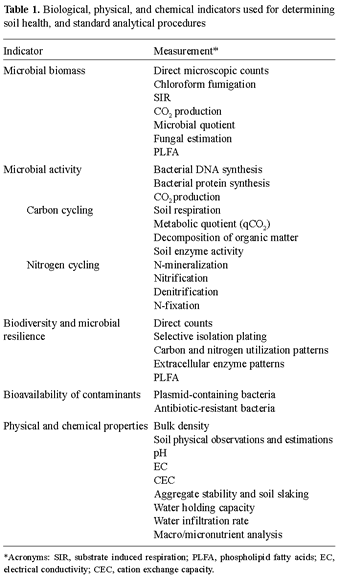
<body><![CDATA[<p><b>Palavras chave:</b>  saúde do solo · indicadores           microbianos · indicadores químicos · métodos moleculares ·           métodos analíticos</p></td>     </tr>   </tbody> </table>      <p>&nbsp;</p>     <p><font size="4"><b>Introduction</b></font></p>     <p>Soil represents the largest carbon pool on the Earth's surface (2157-2293 Pg), the amount of this element being twice as high in soil as in the atmosphere and two or three times larger than the amount in all living matter &#091;6,48&#093;. Because of the large quantity of C stored in soils, small modifications in soil C status may have a significant effect on the global C balance and therefore on climate change &#091;31&#093;. Soils contain an intricate network of plants and microbes in a heterogeneous solid medium in which chemical and physical conditions vary at the scale of the molecule and the cell. It is therefore difficult to understand the variations in soils in the absence of knowledge derived from both chemical and biological approaches, because microorganisms affect the environment and vice versa. Despite their small volume, soil microorganisms are key players in the global cycling of organic matter, reworking organic residues or mineralizing them to CO<sub>2</sub>, H<sub>2</sub>O, nitrogen, phosphorus, sulfur, and other nutrients &#091;12&#093;. Nutrients immobilized in microbial biomass are subsequently released when microbes are grazed by microbivores such as protozoa and nematodes. The purpose of this article is to give a current, multidisciplinary view of the study of soil health, with a brief description of the chemical and biological techniques now being used to analyze soil composition. We summarize current knowledge about the biological and chemical indicators of soil health, with particular emphasis on the classical and molecular techniques most widely used for its assessment.</p>      <p><font size="4"><b>Soil organic matter</b></font></p>     <p>Soil organic matter (SOM) can be seen as a mixture of biogenic components that include, in variable proportions and evolutionary stages, microorganisms and non-decomposed plant materials (1-10%). Depending on the turnover time in soil, SOM can be either active (fast recycling, corresponding mainly to carbohydrate, amino acid, and lipid fractions), remaining in the soil for months or even decades (10-40%), or passive or refractory (humic fraction), remaining in the soil for centuries to millennia (40-60%) &#091;7&#093;. SOM has taken on new significance because it correlates well with a number of important physical, chemical, and microbiological properties of soil. The SOM content of agricultural topsoil, for example, is usually in the range of 0.1-6%. From a qualitative point of view, SOM influences the physical and chemical properties of soil as well as the availability of nutrients for microbial and plant growth. It accumulates over long periods of time and its current distribution in a soil profile is the result of continuous reprocessing by microbes, recombination by chemical reactions, physical movement by soil animals, disturbances such as tree falls, and movement of the soil solution. Consequently, carbon cycling and its stabilization in soils are intimately associated with soil structure &#091;40&#093;.</p>     <p>Intensive agriculture is practiced in many countries with adverse consequences on biodiversity and SOM status. Changes in the nutrient status of the soil, such as a decrease in the organic matter content, directly affect its microbial biodiversity. Some of the more resilient soils are found in grassland pastures, where bacteria are associated with root material and are attached to clay particles &#091;43&#093;. In well-drained soil sustained by a healthy bacterial microbiota, much of the space between soil aggregates is filled with air, which is necessary for soil productivity. Knowledge of the biodiversity of microbes in soil is therefore essential to maintaining agricultural productivity &#091;19&#093;.</p>      <p><font size="4"><b>Biological indicators used for determining soil health, and standard analytical procedures</b></font></p>     <p>The concept of soil health refers to the biological, chemical, and physical features necessary for long-term, sustainable agricultural productivity with minimal environmental impact. Thus, soil health provides an overall picture of soil functionality. Healthy soils maintain a diverse community of soil organisms that help to: (i) control plant diseases as well as insect and weed pests; (ii) form beneficial symbiotic associations with plant roots (e.g. nitrogen-fixing bacteria and mycorrhizal fungi; (iii) recycle plant nutrients; (iv) improve soil structure with positive repercussions for its water- and nutrient-holding capacity; (v) improve crop production. One of the most important objectives in assessing the health of a soil is the establishment of indicators for evaluating its current status. These indicators are listed in <a href="#t1">Table 1</a>, and several of them are discussed below.</p>     <p align="center"><a name="t1"><img src="/img/revistas/im/v8n1/03AriasTable1.gif" width="340" height="578"></a></p>    ]]></body>
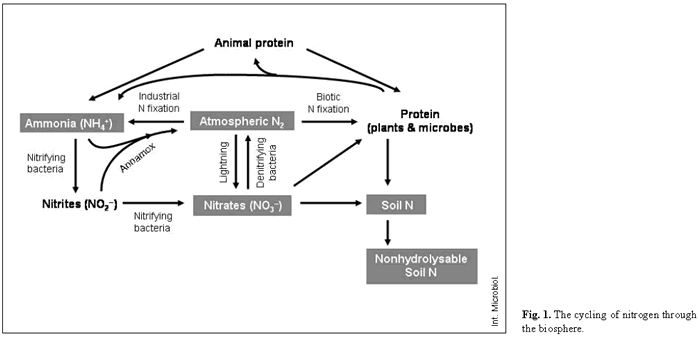
<body><![CDATA[<br>      <p><b>Microbial biomass.</b> Both direct and indirect methods have been used for the estimation of microbial biomass in the soil. Direct counting includes the use of staining techniques in conjunction with epifluorescence microscopy or automated image analysis &#091;10,11&#093;. The most common indirect methods are chloroform fumigation and substrate-induced respiration (SIR) &#091;17&#093;. In chloroform fumigation, the chloroform vapors kill the microorganisms in the soil and the size of the killed biomass is estimated either by quantification of respired CO<sub>2</sub>  (CFI) or by direct extraction of the soil immediately after the fumigation, followed by quantification of extractable carbon (CFE) (ISO-standard 14240-2:1997). SIR (ISO standard 14240-1:1997) measures the metabolically active portion of the microbial biomass by measuring the initial change in the soil respiration rate as a result of adding an easily decomposable substrate (e.g. glucose) &#091;3&#093;. Soil microbial biomass is subsequently calculated using a conversion factor &#091;37&#093;.</p>     <p>Soil respiration is the biological oxidation of organic matter to CO<sub>2</sub> by aerobic organisms, notably microorganisms &#091;1&#093;. It is positively correlated with SOM content, and often with microbial biomass and microbial activity, and can be determined as CO<sub>2</sub> or O<sub>2</sub> production using chemical titration, electrical conductivity, gas chromatography, or infrared spectroscopy &#091;1&#093;. The metabolic quotient (qCO<sub>2</sub>), also called the specific respiratory rate, is defined as the microbial respiration rate per unit microbial biomass &#091;4&#093;.</p>     <p><b>Phospholipid fatty acids.</b> Most soil microorganisms cannot be characterized by conventional cultivation techniques; indeed, it has been estimated that 80-99% of all species have not yet been cultured. Currently, the analysis of phospholipid fatty acids (PLFA), essential membrane components present in living organisms, can be used to overcome this limitation, thereby providing information on the trophic structure (at the phenotypic level) of microbial communities. The use of PLFA patterns for the characterization of microbial communities in soil has been reviewed by Zelles &#091;60&#093;. In general, PLFA analysis is a fast, reliable method for the detection of changes in the structure of soil microbial communities &#091;27&#093;, and the variations detected can be related to changes in soil use and management &#091;13&#093;.</p>      <p><font size="4"><b>Microbial activity</b></font></p>     <p>Measurements of microbial activity at the community level include the quantification of bacterial DNA and protein synthesis. The amount of DNA synthesis can be determined by measuring the incorporation of <sup>3</sup>H- or <sup>14</sup>C-thymidine into bacterial DNA &#091;5&#093;. Similarly, the amount of incorporation of <sup>3</sup>H- or <sup>14</sup>C-leucine, an amino acid that is incorporated only into proteins, reflects the level of bacterial protein synthesis &#091;5&#093;.</p>     <p>There are a number of key indicators related to microbial activity, and some can be used to estimate both biomass and activity (e.g. soil respiration and the microbial quotient). Indicators of carbon cycling measure activity at the ecosystem level. For example, organic matter decomposition can be estimated using either litter bags &#091;57&#093;, cotton strips, or wood sticks &#091;34&#093;. The information provided by each of these tests allows comparisons of the decomposition rates of different sites and ecosystems and at different times. In addition, well-documented assays are available for many soil-enzyme activities (e.g. cellulase, urease, phosphatase, and phenol oxidase) &#091;20&#093;. The mineralization of soil organic nitrogen through nitrate to gaseous nitrogen by soil microorganisms is a major component of global nitrogen cycling (<a href="#f1">Fig. 1</a>). Therefore, measuring the activities of enzymes involved in these processes (e.g. urease) is an important aspect of determining overall microbial activity.</p>     <p align="center"><a name="f1"><img src="/img/revistas/im/v8n1/03AriasFig1.gif" width="700" height="337"></a></p>    <br>      <p><font size="4"><b>Microbial biodiversity and resilience</b></font></p>     ]]></body>
<body><![CDATA[<p>As in other well-studied ecosystems, the resilience of the soil is associated with biodiversity such that increasing the microbial diversity of the soil increases its resilience capacity. Thus, the aim of isolating viable microorganisms in soil is to estimate not only their numbers but also the diversity of the isolates. To do this, a medium satisfying the nutritional requirements of as many microorganisms in the soil as possible is required. The functional diversity of microbial populations in soils may be determined by measuring the expression of different enzymes, e.g. with respect to carbon utilization patterns &#091;59&#093;. Another aspect of soil biodiversity, soil suppressiveness, is an indicator of the capacity of soils to suppress specific plant pathogens through inherent biotic and abiotic factors &#091;21&#093;. Several methods are available for determining soil suppressiveness, including the inoculation of target plants seeds directly into the test soil or into a pathogen-infested test soil &#091;14&#093;.</p>     <p><font size="4"><b>Bioavailability of environmental contaminants</b></font></p>     <p>Microorganisms can be used to determine the bioavailability of a given chemical compound in soil. Specifically, measurement of plasmid-containing bacteria, using either an endogenous or exogenous approach, serves as a general indicator of environmental contaminants. In the endogenous approach, plasmids are extracted from soil bacteria isolated on agar plates &#091;16&#093;. In the exogenous approach, a soil sample is mixed with plasmid-free bacteria, which, by conjugation, subsequently acquire naturally occurring plasmids from the soil bacteria &#091;53&#093;. If the number of plasmids is found to have increased at a given site, an investigation of the responsible stress factor can be initiated. Similarly, monitoring of antibiotic-resistant bacteria in soil can be used as an indicator of industrial and urban pollution.</p>      <p><font size="4"><b>Soil physical and chemical indicators</b></font></p>     <p>Among the variables proposed to assess soil health, physical indicators are of prime importance &#091;22,56&#093;. However, their site-specific interpretation with respect to soil quality will, in many instances, depend on specific land use and crop tolerance.</p>     <p><b>Water infiltration rate.</b> Infiltration rates are subject to significant changes with soil use, management, and time. They are affected by the development of plant roots, earthworm burrows, soil aggregation, and overall increases in stable organic matter. Depending on the soil type, texture, structure, and soil water content, the water infiltration rate may improve immediately after tillage due to the loosening of surface crusts or compacted areas. Nonetheless, tillage also disrupts aggregates and soil structure, creating the potential for renewed compaction and surface crusting, and leading to a loss of continuous surface-connected pores.</p>     <p><b>Bulk density.</b> Defined as the ratio of oven-dried soil (weight) to its bulk volume, soil bulk densities range, in general, from &lt; 1.0 (in organic soils) to 1.7 g cm<sup>-3</sup> and are dependent on the densities of the soil particles (sand, silt, clay, and organic matter) and their packing arrangement. Compacted soil layers have high bulk densities, restrict root growth, and inhibit the movement of air and water through the soil.</p>     <p><b>Soil pH.</b> By estimating hydrogen-ion activity in a soil solution, the acidity or alkalinity of a soil can be measured. Soil pH affects the solubility of soil minerals, the availability of plant nutrients, and the activity of microorganisms. Acidity is generally associated with leached soils, whereas alkalinity generally occurs in drier regions. However, agricultural practices, such as liming or the addition of ammonium fertilizers, can alter soil pH. In general, pH values between 6 and 7.5 are optimal for crop growth.</p>     <p><b>Electrical conductivity.</b> The electrical conductivity (EC) of a soil-water mixture is an indication of the amount of ions (dissolved salts) present in the soil solution. Excess salt content seriously affects plant growth and soil-water balance &#091;26&#093;. This may occur either naturally or as a result of inappropriate soil use and management. In general, electrical conductivity values between 0 and 0.8 dS m<sup>-1</sup> are acceptable for general crop growth.</p>      <p><b>Ion-exchange capacity.</b> The soil's ability to supply major plant nutrients, mainly calcium, magnesium and potassium, is reflected by its ion-exchange capacity. Specifically, the cation exchange capacity (CEC) is, to a large extent, related to the amount of soil colloids, organic matter, and clay, which are negatively charged and thus enable the soil to retain cations. Changes in pH and salt content affect the CEC. For example, aluminum toxicity occurs in certain soils at pH &lt; 5, and soil dispersion with serious losses in structure may appear at high sodium concentrations (increasing salinity), both limiting factors for soil productivity and health.</p>      ]]></body>
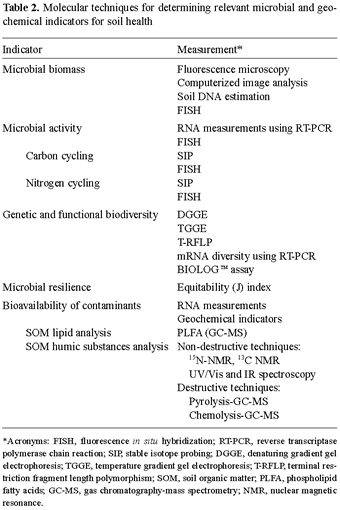
<body><![CDATA[<p><b>Aggregate stability and soil slaking.</b> An aggregate consists of several soil particles bound together and is usually formed by interactions of soil biota and the plant community and their products with soil mineral components. Aggregates play a major role in several aspects of soil health: the movement and storage of water, soil aeration, physical protection of SOM, the prevention of erosion, root development, and microbial community activity &#091;54&#093;. Aggregate stability is a measure of the vulnerability of soil aggregates to external destructive forces. Soil aggregation can naturally develop, disintegrate, and reform periodically &#091;36&#093;. Slaking is the process of fragmentation that occurs when aggregates are suddenly immersed in water &#091;18&#093; due to their inability to withstand the stresses of rapid water uptake. At fast rates of wetting, internal stresses arise from differential swelling and air entrapment in the soil aggregate &#091;38&#093;. Soil slaking can be used as a measure of the ability of the soil to maintain its structure and is affected by water content, rate of wetting, texture, clay mineralogy, and organic matter content.</p>      <p><b>Soil physical observations and estimations.</b> Topsoil depth, root growth, and penetration resistance are also important indicators of soil health. Changes in topsoil thickness are usually the result of erosion processes accelerated by plowing, burning, overgrazing, and other management practices that remove the protective vegetative cover. These changes result in a loss of both the most fertile soil layer and its water-holding capacity as well as soil organic carbon content and productivity. Anomalies observed in root growth along a soil profile are indicators of physicochemical restraints in the soil, including compaction and the presence of areas with a higher penetration resistance, deficiencies in soil structure, high salt content, and low depth to bedrock, the stone layer, hard pan, the frozen layer, and the water table. All of these factors can result in plant stress and, eventually, in reduced crop growth and productivity &#091;9&#093;. Soil texture, i.e. the size distribution of primary soil particles smaller than 2 mm (sand, silt, and clay), is one of the most stable properties of soil. Texture is only slightly modified by cultivation and other practices that cause mixing of the different soil layers. Texture influences almost all other soil health indicators and helps determine water intake rates, water storage in the soil, ease of tillage, and soil aeration.</p>      <p><font size="4"><b>Molecular techniques to measure soil health: microbial biomass</b></font></p>     <p>An understanding of coupled biological and geochemical processes at the molecular level is fundamental for assessing the condition of the soil. Thus, a number of molecular and cellular techniques are currently being used in conjunction with biological and chemical indicators to increase our ability to evaluate soil health (<a href="#t2">Table 2</a>).</p>     <p align="center"><a name="t2"><img src="/img/revistas/im/v8n1/03AriasTable2.gif" width="340" height="510"></a></p>    <br>      <p><b>Fluorescence microscopy</b>. The number of bacteria in soil, their cell volumes, and the frequencies of dividing cells can be determined by fluorescence microscopy and computerized image analysis &#091;10&#093;. Soil microbial biomass can be estimated by staining with fluorescent dyes such as fluorescein isothiocyanate.</p>      <p><b>DNA measurement.</b> Quantification of DNA following its extraction from soil may provide a simple and practicable method for estimating the amount of microbial biomass &#091;29&#093;. However, further work on correlating DNA measurements with a particular soil type is required.</p>      <p><b>Fluorescence in situ hybridization.</b> FISH is a direct, cultivation-independent technique using rRNA-targeted oligonucleotide probes that is frequently used for the identification of microorganisms in soils. While this technique allows selective visualization of bacterial cells of different phylogenetic groups, it also has some limitations, particularly regarding quantitative analysis of complex samples &#091;44&#093;.</p>      <p><b>RNA measurement.</b> The composition of soil microbial communities can be estimated by reverse transcriptase polymerase chain reaction (RT-PCR) followed by gel electrophoresis of the amplified cDNA fragments &#091;25&#093;. The analysis of specific mRNAs reflects the expression of the corresponding gene in soil. Such measurements can also be done by real-time quantitative RT-PCR, which allows the detection and quantification of of mRNAs present in low amounts in environmental samples, including soils &#091;47&#093;. However, this method requires previous knowledge of the sequence of the mRNA of interest.</p>     ]]></body>
<body><![CDATA[<p><b>Stable isotope probing</b>. SIP is a culture-independent technique that allows the identification of microorganisms directly involved in specific metabolic processes. In this method, labeled nucleic acids that were synthesized during assimilation of an isotopically enriched substrate are isolated and analyzed &#091;50&#093;. The technique has been used to study forest soils &#091;51&#093; and to identify the active components of an ammonia-oxidizing population in lake water &#091;58&#093;.</p>      <p><font size="4"><b>Molecular techniques to measure soil health: genetic and functional biodiversity</b></font></p>     <p>Genetic diversity is most commonly studied by analyzing the diversity of genes encoding 16S rRNA (18S rRNA for eukaryotes). These genes occur in all microorganisms and show species-dependent variations in their base compositions. Three methods are commonly applied to examine the diversity of 16S (and 18S) rDNA sequences in total DNA extracted from soil microbial communities: denaturing gradient gel electrophoresis (DGGE), temperature gradient gel electrophoresis (TGGE), and terminal restriction fragment length polymorphisms (T-RFLP).</p>     <p><b>Denaturing gradient gel electrophoresis.</b> Differences in the melting behavior of small DNA fragments (200&#8211;700 bp) that differ in as little as a single base substitution can be detected by DGGE &#091;45&#093;. The denaturants used are heat (a constant temperature of 60ºC) and a fixed ratio of formamide (ranging from 0&#8211;40%) and urea (ranging from 0&#8211;7 M). The position in the gradient where a domain of a DNA fragment melts and thus nearly stops migrating is dependent on the nucleotide sequence in the melted region. The benefit of this approach is that a molecular fingerprint of the community structure is generated for each soil. In fact, each band in each lane of the gel theoretically represents a different bacterial species. In addition, this technique enables the excision and subsequent sequencing of bands, allowing species identification using existing databases.</p>     <p><b>Temperature gradient gel electrophoresis.</b> In contrast to DGGE, the separation of DNA by TGGE &#091;35&#093; does not depend on a chemical gradient of urea but instead on a precisely defined and controllable temperature gradient. This highly reproducible technique has the same advantages as DGGE. By designing species-specific in situ probes that hybridize to identified bacterial sequences, various species can be examined in even greater detail.</p>     <p><b>Terminal restriction fragment length polymorphism.</b> Organisms can also be differentiated according to the patterns derived from cleavage of their DNA &#091;41&#093;. Thus, in T-RFLP, the specific fingerprint of a community is revealed by analyzing the polymorphism of a certain gene. T-RFLP is a high-throughput, reproducible method that allows the semi-quantitative analysis of the diversity of a particular gene in a community. It requires the extraction of DNA from a soil sample and its PCR amplification using a fluorescently labeled primer. T-RFLP yields a mixture of amplicons of the same or similar sizes with a fluorescent label at one end. After purification, the amplicon mixture is digested with a restriction enzyme, which generates fragments of different sizes that are separated by gel or capillary electrophoresis. The separated, labeled fragments are then densitometrically detected and a profile based on fragment lengths is generated. Recently, the potential of T-RFLP to discriminate soil bacterial communities in cultivated and non-cultivated soils was demonstrated &#091;15&#093;.</p>     <p><b>BIOLOG&#8482;.</b> Carbon utilization patterns can be measured by the BIOLOG&#8482; assay &#091;28&#093;. In this test, a soil extract is incubated with up to 95 different carbon sources in a microtiter plate, and the redox dye tetrazolium blue is used to indicate microbial activity. Specific carbon sources have been selected for studies of soil microbial communities. The result of the assay is a qualitative physiological profile of the potential metabolic functions within the culturable portion of the microbial community. Differences in the profiles can then be analyzed by multivariate statistics.</p>     <p><b>Microbial resilience.</b> The ability to estimate the relative abundance of each species of microorganisms in the soil, using the three techniques described above, has led to the suggestion that the "equitability index" (J) of numbers of individual species is an important estimation of the resilience of a soil. The use of statistical packages such as Phoretix enables quantification of both diversity indices and equitability &#091;29,30&#093;.</p>      <p><font size="4"><b>Geochemical indicators</b></font></p>     <p>A number of analytical techniques are used for structural characterization of the SOM. In general, these involve the isolation of the free lipid and macromolecular fractions (humic substances and other recalcitrant organic fractions), which are among the most informative components of the SOM. The macromolecular fraction can be degraded by several means into small fragments that are chromatographically separated and then analyzed. This approach is aimed at obtaining environmental information based on the variable chemical composition of the SOM and it can be used to assess the impact of external disturbances. A review of the methods used can be found in &#091;40&#093;.</p>     ]]></body>
<body><![CDATA[<p><b>Soil free lipids.</b> This diverse group of hydrophobic substances includes simple compounds, ranging from fatty acids (which can be analyzed by the previously described PLFA techniques), to more complex molecules, such as sterols, terpenes, polynuclear hydrocarbons, chlorophylls, fats, waxes, and resins, which constitute the principal group of SOM biomarkers &#091;39&#093;. The extraction of soil lipids is frequently carried out using solvents with variable polarity in a Soxhlet apparatus, although alternative techniques, e.g. supercritical fluid extraction (SFE), are also available &#091;8&#093;. Total lipid extracts can be further fractionated by preparative chemical and chromatographic techniques, derivatized to enhance separation, or characterized by gas chromatography-mass spectrometry (GC-MS).</p>     <p><b>Humic fraction.</b> Macromolecules with complex structures, including materials derived directly from the alteration of biogenic materials as well as structures formed de novo in the soil by biotic and abiotic factors &#091;52&#093;, make up the humic fraction. The term humic substances (HS) is operational and several fractions are distinguished depending on their solubility in acid and alkaline media &#091;24&#093;. Recent progress in HS research has been made possible by the development of new approaches, methodologies, and instruments. A combination of different techniques appropriate for the study of complex matrices is used. Generally, a first estimation of the maturity or humification degree of the different HS fractions from SOM is obtained based on the results of both non-destructive and destructive methods. Among the non-destructive methods, solid-state <sup>13</sup>C and <sup>15</sup>N NMR spectroscopy is a valuable technique to quantify the different C and N structural groups: aromatic, aliphatic &#091;alkyl-(waxes, alkanes, cutins and suberins)&#093;, <i>o</i>-alkyl (carbohydrates, tannins and altered carbohydrates), amide, amine, pyrrolic, etc. &#091;33,49&#093;. Infrared spectroscopy also provides valuable information on oxygen- and nitrogen-containing functionalities, while UV/visible spectroscopy is useful to establish humus maturity and the degree of HS aromaticness &#091;55&#093;. Among the destructive techniques, conventional analytical pyrolysis (Curie point or microfurnace), chemolysis in the presence of alkylating reagents ("thermally assisted hydrolysis-methylation") &#091;32&#093;, and wet chemical degradation methods using specific reagents (CuO-NaOH, NaBO<sub>3</sub>, KMnO<sub>4</sub>, etc.) &#091;2&#093; generate fragments amenable to GC-MS analyses, which can be unambiguously used to identify to structures present in the HS.</p>     <p>Other methods used to characterize the HS include isotope ratio monitoring GC-MS (IRM-GC-MS), which provides both structural information and insight into the evolution and turnover times of different organic soil fractions &#091;46&#093;. Other emerging techniques are variants of traditional thermal analysis (TG-DSC) coupled with isotopic ratio monitoring (TA-IRM) &#091;42&#093;.</p>      <p><font size="4"><b>Future prospects</b></font></p>     <p>There is a need for a holistic consideration of soil health as well as transdisciplinary soil management approaches that integrate biological, chemical, and physical strategies to achieve soils supporting a sustainable agriculture. The environmental and economic benefits of sustainable soils are enormous: increased resource efficiency, decomposition and nutrient cycling, nitrogen fixation, and water-holding capacity, as well as prevention of pollution and land degradation. Current agricultural practices reduce soil biodiversity, mainly as a result of the overuse of chemicals, leading to compaction or other disturbances and hence irreversible adverse ecological alterations, resulting in loss of agricultural productivity. A series of long-term comparative studies have shown that organic/sustainable systems can increase both SOM accumulation and microbial activity. Moreover, the organic C lost during intensive agriculture could be regained through sustainable management practices, thereby contributing to mitigating climate change.    <br>   The development of approaches that do not require the establishment of microbial cultures will undoubtedly enhance our knowledge of biodiversity and promote the discovery of new microorganisms with unique capacities for bioremediation, soil restoration, and therapeutic applications.</p>      <p><font size="2"><b>Acknowledgements.</b> We thank Gonzalo Almendros from Centro de Ciencias Medioambientales (CSIC, Madrid, Spain) for his valuable revision of the article.</font></p>      <p><font size="4">References</font></p>     <!-- ref --><p>1. Alef K (1995) Soil respiration. In: Alef K, Nannipieri P (eds) Methods in applied soil microbiology and biochemistry. Academic Press, New York, pp 214-218&nbsp;&nbsp;&nbsp;&nbsp;&nbsp;&nbsp;&nbsp;&nbsp;[&#160;<a href="javascript:void(0);" onclick="javascript: window.open('/scielo.php?script=sci_nlinks&ref=2778598&pid=S1139-6709200500010000300001&lng=','','width=640,height=500,resizable=yes,scrollbars=1,menubar=yes,');">Links</a>&#160;]<!-- end-ref --><!-- ref --><p>2. Almendros G, Gonz&aacute;lez-Vila FJ (1987) Degradative studies on a soil humin fraction. Sequential degradation of inherited humin. Soil Biol Biochem 19:513-520&nbsp;&nbsp;&nbsp;&nbsp;&nbsp;&nbsp;&nbsp;&nbsp;[&#160;<a href="javascript:void(0);" onclick="javascript: window.open('/scielo.php?script=sci_nlinks&ref=2778599&pid=S1139-6709200500010000300002&lng=','','width=640,height=500,resizable=yes,scrollbars=1,menubar=yes,');">Links</a>&#160;]<!-- end-ref --><!-- ref --><p>3. Anderson JPE, Domsch KH (1978) A physiological method for the quantitative measurement of microbial biomass in soils. Soil Biol Biochem 10:215-221&nbsp;&nbsp;&nbsp;&nbsp;&nbsp;&nbsp;&nbsp;&nbsp;[&#160;<a href="javascript:void(0);" onclick="javascript: window.open('/scielo.php?script=sci_nlinks&ref=2778600&pid=S1139-6709200500010000300003&lng=','','width=640,height=500,resizable=yes,scrollbars=1,menubar=yes,');">Links</a>&#160;]<!-- end-ref --><!-- ref --><p>4. Anderson JPE, Domsch KH (1990) Application of echo-physiological quotients (qCO<sub>2</sub> and qD) on microbial biomasses from soil of different cropping histories. Soil Biol Biochem 25:393-395&nbsp;&nbsp;&nbsp;&nbsp;&nbsp;&nbsp;&nbsp;&nbsp;[&#160;<a href="javascript:void(0);" onclick="javascript: window.open('/scielo.php?script=sci_nlinks&ref=2778601&pid=S1139-6709200500010000300004&lng=','','width=640,height=500,resizable=yes,scrollbars=1,menubar=yes,');">Links</a>&#160;]<!-- end-ref --><!-- ref --><p>5. Baath E (1998) Growth rates of bacterial communities in soils at varying pH: a comparison of the thymidine and leucine incorporation techniques. Microb Ecol 36:316-327&nbsp;&nbsp;&nbsp;&nbsp;&nbsp;&nbsp;&nbsp;&nbsp;[&#160;<a href="javascript:void(0);" onclick="javascript: window.open('/scielo.php?script=sci_nlinks&ref=2778602&pid=S1139-6709200500010000300005&lng=','','width=640,height=500,resizable=yes,scrollbars=1,menubar=yes,');">Links</a>&#160;]<!-- end-ref --><!-- ref --><p>6. Bajtes NH (1996) Total carbon and nitrogen in the soils of the world. Eur J Soil Sci 47:151-163&nbsp;&nbsp;&nbsp;&nbsp;&nbsp;&nbsp;&nbsp;&nbsp;[&#160;<a href="javascript:void(0);" onclick="javascript: window.open('/scielo.php?script=sci_nlinks&ref=2778603&pid=S1139-6709200500010000300006&lng=','','width=640,height=500,resizable=yes,scrollbars=1,menubar=yes,');">Links</a>&#160;]<!-- end-ref --><!-- ref --><p>7. Balesdent J, Mariotti A (1996) Measurement of soil organic matter turnover using <sup>13</sup>C natural abundance. In: Boutton TW, Yamasaki SI (eds) Mass spectrometry of soil. Marcel Dekker, New York, pp 83-111&nbsp;&nbsp;&nbsp;&nbsp;&nbsp;&nbsp;&nbsp;&nbsp;[&#160;<a href="javascript:void(0);" onclick="javascript: window.open('/scielo.php?script=sci_nlinks&ref=2778604&pid=S1139-6709200500010000300007&lng=','','width=640,height=500,resizable=yes,scrollbars=1,menubar=yes,');">Links</a>&#160;]<!-- end-ref --><!-- ref --><p>8. Bautista JM, Gonz&aacute;lez-Vila FJ, Mart&iacute;n F, del Rio JC, Gutierrez A, Verdejo T, Gonzalez AG (1999) Supercritical-carbon-dioxide extraction of lipids from a contaminated soil. J Chromatogr 845:365-371&nbsp;&nbsp;&nbsp;&nbsp;&nbsp;&nbsp;&nbsp;&nbsp;[&#160;<a href="javascript:void(0);" onclick="javascript: window.open('/scielo.php?script=sci_nlinks&ref=2778605&pid=S1139-6709200500010000300008&lng=','','width=640,height=500,resizable=yes,scrollbars=1,menubar=yes,');">Links</a>&#160;]<!-- end-ref --><!-- ref --><p>9. Bennie ATP (1996) Growth and mechanical impedance. In: Waisel Y, Eshel A, Kafkafi U (eds) Plant roots: the hidden half, 2nd edn. Marcel Dekker, New York, pp 453-470&nbsp;&nbsp;&nbsp;&nbsp;&nbsp;&nbsp;&nbsp;&nbsp;[&#160;<a href="javascript:void(0);" onclick="javascript: window.open('/scielo.php?script=sci_nlinks&ref=2778606&pid=S1139-6709200500010000300009&lng=','','width=640,height=500,resizable=yes,scrollbars=1,menubar=yes,');">Links</a>&#160;]<!-- end-ref --><!-- ref --><p>10. Bloem J, Bolhuis PR, Veninga MR, Wieringa J (1995) Microscopic methods for counting bacteria and fungi in soil. In: Alef K, Nannipieri P (eds) Methods in applied soil microbiology and biochemistry. Academic Press, New York, pp 162-172&nbsp;&nbsp;&nbsp;&nbsp;&nbsp;&nbsp;&nbsp;&nbsp;[&#160;<a href="javascript:void(0);" onclick="javascript: window.open('/scielo.php?script=sci_nlinks&ref=2778607&pid=S1139-6709200500010000300010&lng=','','width=640,height=500,resizable=yes,scrollbars=1,menubar=yes,');">Links</a>&#160;]<!-- end-ref --><!-- ref --><p>11. Bloem J, Breure AM (2003) Microbial indicators. In: Breure AM, Markert B, Zechmeister HG (eds) Bioindicators &amp; biomonitors. Principles, assessment, concepts. Elsevier, Amsterdam, pp. 259-282&nbsp;&nbsp;&nbsp;&nbsp;&nbsp;&nbsp;&nbsp;&nbsp;[&#160;<a href="javascript:void(0);" onclick="javascript: window.open('/scielo.php?script=sci_nlinks&ref=2778608&pid=S1139-6709200500010000300011&lng=','','width=640,height=500,resizable=yes,scrollbars=1,menubar=yes,');">Links</a>&#160;]<!-- end-ref --><!-- ref --><p>12. Bloem J, de Ruiter P, Bouwman LA (1997) Soil food webs and nutrient cycling in agro-ecosystems. In: van Elsas JD, Trevors JT, Wellington HME (eds) Modern soil microbiology. Marcel Dekker, New York, pp 245-278&nbsp;&nbsp;&nbsp;&nbsp;&nbsp;&nbsp;&nbsp;&nbsp;[&#160;<a href="javascript:void(0);" onclick="javascript: window.open('/scielo.php?script=sci_nlinks&ref=2778609&pid=S1139-6709200500010000300012&lng=','','width=640,height=500,resizable=yes,scrollbars=1,menubar=yes,');">Links</a>&#160;]<!-- end-ref --><!-- ref --><p>13. Bossio, DA, Scow, KM, Gunapala, N, Graham, KJ (1998) Determinants of soil microbial communities: effects of agricultural management, season, and soil type on phospholipid fatty acid profiles. Microb Ecol 36:1-12&nbsp;&nbsp;&nbsp;&nbsp;&nbsp;&nbsp;&nbsp;&nbsp;[&#160;<a href="javascript:void(0);" onclick="javascript: window.open('/scielo.php?script=sci_nlinks&ref=2778610&pid=S1139-6709200500010000300013&lng=','','width=640,height=500,resizable=yes,scrollbars=1,menubar=yes,');">Links</a>&#160;]<!-- end-ref --><!-- ref --><p>14. Bruggen van A. H. C, Grunwald N J (1996) Tests for risk assessment of root infection by plant pathogens. In: Doran W, Jones AJ (eds) Methods for assessing soil quality. Soil Sci Soc Am, Madison, WI, pp 293-310&nbsp;&nbsp;&nbsp;&nbsp;&nbsp;&nbsp;&nbsp;&nbsp;[&#160;<a href="javascript:void(0);" onclick="javascript: window.open('/scielo.php?script=sci_nlinks&ref=2778611&pid=S1139-6709200500010000300014&lng=','','width=640,height=500,resizable=yes,scrollbars=1,menubar=yes,');">Links</a>&#160;]<!-- end-ref --><!-- ref --><p>15. Buckley DH, Schmidt TM (2001) The structure of microbial communities in soil and the lasting impact of cultivation. Microb Ecol 42:11-21&nbsp;&nbsp;&nbsp;&nbsp;&nbsp;&nbsp;&nbsp;&nbsp;[&#160;<a href="javascript:void(0);" onclick="javascript: window.open('/scielo.php?script=sci_nlinks&ref=2778612&pid=S1139-6709200500010000300015&lng=','','width=640,height=500,resizable=yes,scrollbars=1,menubar=yes,');">Links</a>&#160;]<!-- end-ref --><!-- ref --><p>16. Campbell JIA, Albrechtsen M, Sorensen J (1995) Large <i>Pseudomonas</i> phages isolated from barley rhizosphere. FEMS Microbiol Ecol 18:63-74&nbsp;&nbsp;&nbsp;&nbsp;&nbsp;&nbsp;&nbsp;&nbsp;[&#160;<a href="javascript:void(0);" onclick="javascript: window.open('/scielo.php?script=sci_nlinks&ref=2778613&pid=S1139-6709200500010000300016&lng=','','width=640,height=500,resizable=yes,scrollbars=1,menubar=yes,');">Links</a>&#160;]<!-- end-ref --><!-- ref --><p>17. Carter MR, Gregorich EG, Angers DA, Beare MH, Sparling GP, Wardle DA, Voroney RP (1999) Interpretation of microbial biomass measurements for soil quality assessment in humid temperate regions. Can J Soil Sci 79:507-520&nbsp;&nbsp;&nbsp;&nbsp;&nbsp;&nbsp;&nbsp;&nbsp;[&#160;<a href="javascript:void(0);" onclick="javascript: window.open('/scielo.php?script=sci_nlinks&ref=2778614&pid=S1139-6709200500010000300017&lng=','','width=640,height=500,resizable=yes,scrollbars=1,menubar=yes,');">Links</a>&#160;]<!-- end-ref --><!-- ref --><p>18. Chan KY, Mullins CE (1994) Slaking characteristics of some Australian and British soils. Eur J Soil Sci 45:273-283&nbsp;&nbsp;&nbsp;&nbsp;&nbsp;&nbsp;&nbsp;&nbsp;[&#160;<a href="javascript:void(0);" onclick="javascript: window.open('/scielo.php?script=sci_nlinks&ref=2778615&pid=S1139-6709200500010000300018&lng=','','width=640,height=500,resizable=yes,scrollbars=1,menubar=yes,');">Links</a>&#160;]<!-- end-ref --><!-- ref --><p>19. Colwell, RR (1997). Microbial biodiversity and biotechnology. In: Reaka-Kudla ML, Wilson DE, Wilson EO (eds) Biodiversity II: Understanding and protecting our biological resources. Joseph Henry Press, University of Washington, Washington, DC, pp. 279-288&nbsp;&nbsp;&nbsp;&nbsp;&nbsp;&nbsp;&nbsp;&nbsp;[&#160;<a href="javascript:void(0);" onclick="javascript: window.open('/scielo.php?script=sci_nlinks&ref=2778616&pid=S1139-6709200500010000300019&lng=','','width=640,height=500,resizable=yes,scrollbars=1,menubar=yes,');">Links</a>&#160;]<!-- end-ref --><!-- ref --><p>20. Dick RP, Breakwell DP, Turco RF (1996) Soil enzyme activities and biodiversity measurements as integrative microbiological indicators. In: Doran JW, Jones AJ (eds) Methods for assessing soil quality. Soil Sci Soc Am, pp 107-121&nbsp;&nbsp;&nbsp;&nbsp;&nbsp;&nbsp;&nbsp;&nbsp;[&#160;<a href="javascript:void(0);" onclick="javascript: window.open('/scielo.php?script=sci_nlinks&ref=2778617&pid=S1139-6709200500010000300020&lng=','','width=640,height=500,resizable=yes,scrollbars=1,menubar=yes,');">Links</a>&#160;]<!-- end-ref --><!-- ref --><p>21. Dom&iacute;nguez J, Negr&iacute;n MA, Rodr&iacute;guez CM (2001) Aggregate water-stability, particle-size and soil solution properties in conductive and suppressive soil to <i>Fusarium</i> wilt of banana from Canary Islands (Spain). Soil Biol Biochem 33:449-455&nbsp;&nbsp;&nbsp;&nbsp;&nbsp;&nbsp;&nbsp;&nbsp;[&#160;<a href="javascript:void(0);" onclick="javascript: window.open('/scielo.php?script=sci_nlinks&ref=2778618&pid=S1139-6709200500010000300021&lng=','','width=640,height=500,resizable=yes,scrollbars=1,menubar=yes,');">Links</a>&#160;]<!-- end-ref --><!-- ref --><p>22. Doran JW, Jones AJ (1996) Methods for assessing soil quality. Special publication No 49. Soil Sci Soc Am, American Society of Agronomy, Madison, WI&nbsp;&nbsp;&nbsp;&nbsp;&nbsp;&nbsp;&nbsp;&nbsp;[&#160;<a href="javascript:void(0);" onclick="javascript: window.open('/scielo.php?script=sci_nlinks&ref=2778619&pid=S1139-6709200500010000300022&lng=','','width=640,height=500,resizable=yes,scrollbars=1,menubar=yes,');">Links</a>&#160;]<!-- end-ref --><!-- ref --><p>23. Doran JW, Zeiss MR (2000) Soil health and sustainability: managing the biotic component of soil quality. Appl Soil Ecol 15:3-11&nbsp;&nbsp;&nbsp;&nbsp;&nbsp;&nbsp;&nbsp;&nbsp;[&#160;<a href="javascript:void(0);" onclick="javascript: window.open('/scielo.php?script=sci_nlinks&ref=2778620&pid=S1139-6709200500010000300023&lng=','','width=640,height=500,resizable=yes,scrollbars=1,menubar=yes,');">Links</a>&#160;]<!-- end-ref --><!-- ref --><p>24. Duchaufour Ph, Jacquin F (1975) Comparaison des processus d'humification dans les principaux types d'humus forestiers. Bull Alaska Agric Forest Experim Station 1:29-36 (In French)&nbsp;&nbsp;&nbsp;&nbsp;&nbsp;&nbsp;&nbsp;&nbsp;[&#160;<a href="javascript:void(0);" onclick="javascript: window.open('/scielo.php?script=sci_nlinks&ref=2778621&pid=S1139-6709200500010000300024&lng=','','width=640,height=500,resizable=yes,scrollbars=1,menubar=yes,');">Links</a>&#160;]<!-- end-ref --><!-- ref --><p>25. Duineveld BM, Kowalchuk GA, Keijzer A, van Elsas JD, van Veen JA (2001) Analysis of bacterial communities in the rhizosphere of chrysanthemum via denaturing gradient gel electrophoresis of PCR-amplified 16S rRNA as well as DNA fragments coding for 16S rRNA. Appl Environ Microbiol 67:172-178&nbsp;&nbsp;&nbsp;&nbsp;&nbsp;&nbsp;&nbsp;&nbsp;[&#160;<a href="javascript:void(0);" onclick="javascript: window.open('/scielo.php?script=sci_nlinks&ref=2778622&pid=S1139-6709200500010000300025&lng=','','width=640,height=500,resizable=yes,scrollbars=1,menubar=yes,');">Links</a>&#160;]<!-- end-ref --><!-- ref --><p>26. Fitter AH, Hay RKM (1987) Environmental physiology of plants. Academic Press, London, UK&nbsp;&nbsp;&nbsp;&nbsp;&nbsp;&nbsp;&nbsp;&nbsp;[&#160;<a href="javascript:void(0);" onclick="javascript: window.open('/scielo.php?script=sci_nlinks&ref=2778623&pid=S1139-6709200500010000300026&lng=','','width=640,height=500,resizable=yes,scrollbars=1,menubar=yes,');">Links</a>&#160;]<!-- end-ref --><!-- ref --><p>27. Frostegard A, Baath E (1996) The use of phospholipid fatty acids analysis to estimate bacterial and fungal biomass in soil. Biol Fertil Soils 22:59-65&nbsp;&nbsp;&nbsp;&nbsp;&nbsp;&nbsp;&nbsp;&nbsp;[&#160;<a href="javascript:void(0);" onclick="javascript: window.open('/scielo.php?script=sci_nlinks&ref=2778624&pid=S1139-6709200500010000300027&lng=','','width=640,height=500,resizable=yes,scrollbars=1,menubar=yes,');">Links</a>&#160;]<!-- end-ref --><!-- ref --><p>28. Gardland JL, Mills AL (1991) Classification and characterization of heterotrophic microbial communities on the basis of patterns of community level sole-carbon-source utilization. Appl Environ Microbiol 57:2351-2359&nbsp;&nbsp;&nbsp;&nbsp;&nbsp;&nbsp;&nbsp;&nbsp;[&#160;<a href="javascript:void(0);" onclick="javascript: window.open('/scielo.php?script=sci_nlinks&ref=2778625&pid=S1139-6709200500010000300028&lng=','','width=640,height=500,resizable=yes,scrollbars=1,menubar=yes,');">Links</a>&#160;]<!-- end-ref --><!-- ref --><p>29. Girvan MS, Bullimore J, Ball AS, Pretty JN, Osborn AM (2004) Responses of active bacterial and fungal communities in soils under winter wheat to different fertilizer and pesticide regimens. Appl Environ Microbiol 70:2692-2701.    &nbsp;&nbsp;&nbsp;&nbsp;&nbsp;&nbsp;&nbsp;&nbsp;[&#160;<a href="javascript:void(0);" onclick="javascript: window.open('/scielo.php?script=sci_nlinks&ref=2778626&pid=S1139-6709200500010000300029&lng=','','width=640,height=500,resizable=yes,scrollbars=1,menubar=yes,');">Links</a>&#160;]<!-- end-ref --></p>     <!-- ref --><p>30. Girvan MS, Bullimore J, Pretty JN, Osborn AM, Ball AS (2003) Soil type is the primary determinant of the composition of the total and active bacterial communities in arable soils. Appl Environ Microbiol 69:1800-1809&nbsp;&nbsp;&nbsp;&nbsp;&nbsp;&nbsp;&nbsp;&nbsp;[&#160;<a href="javascript:void(0);" onclick="javascript: window.open('/scielo.php?script=sci_nlinks&ref=2778628&pid=S1139-6709200500010000300030&lng=','','width=640,height=500,resizable=yes,scrollbars=1,menubar=yes,');">Links</a>&#160;]<!-- end-ref --><!-- ref --><p>31. Gonz&aacute;lez-P&eacute;rez JA, Gonz&aacute;lez-Vila FJ, Almendros G, Knicker H (2004) The effect of fire on soil organic matter-a review. Environ Int 30:855-870&nbsp;&nbsp;&nbsp;&nbsp;&nbsp;&nbsp;&nbsp;&nbsp;[&#160;<a href="javascript:void(0);" onclick="javascript: window.open('/scielo.php?script=sci_nlinks&ref=2778629&pid=S1139-6709200500010000300031&lng=','','width=640,height=500,resizable=yes,scrollbars=1,menubar=yes,');">Links</a>&#160;]<!-- end-ref --><!-- ref --><p>32. Gonz&aacute;lez-Vila FJ, del R&iacute;o JC, Mart&iacute;n F, Verdejo T (1996) Pyrolytic alkylation-gas chromatography-mass spectrometry of model polymers. Further insights into the mechanism and scope of the technique. J Chromatogr 750:155-160&nbsp;&nbsp;&nbsp;&nbsp;&nbsp;&nbsp;&nbsp;&nbsp;[&#160;<a href="javascript:void(0);" onclick="javascript: window.open('/scielo.php?script=sci_nlinks&ref=2778630&pid=S1139-6709200500010000300032&lng=','','width=640,height=500,resizable=yes,scrollbars=1,menubar=yes,');">Links</a>&#160;]<!-- end-ref --><!-- ref --><p>33. Gonz&aacute;lez-Vila FJ, L&uuml;demann HD, Mart&iacute;n F (1983) <sup>13</sup>C NMR structural features of soil humic acids and their methylated, hydrolyzed and extracted derivatives. Geoderma 31:3-15&nbsp;&nbsp;&nbsp;&nbsp;&nbsp;&nbsp;&nbsp;&nbsp;[&#160;<a href="javascript:void(0);" onclick="javascript: window.open('/scielo.php?script=sci_nlinks&ref=2778631&pid=S1139-6709200500010000300033&lng=','','width=640,height=500,resizable=yes,scrollbars=1,menubar=yes,');">Links</a>&#160;]<!-- end-ref --><!-- ref --><p>34. Harrison AF, Latter TM, Walton DWH (1988) The cotton strip assay: an index of decomposition in soils. In: Institute of Terrestrial Ecology Symposium No. 24, Institute of Terrestrial Ecology, Grange-Over-Sand, UK&nbsp;&nbsp;&nbsp;&nbsp;&nbsp;&nbsp;&nbsp;&nbsp;[&#160;<a href="javascript:void(0);" onclick="javascript: window.open('/scielo.php?script=sci_nlinks&ref=2778632&pid=S1139-6709200500010000300034&lng=','','width=640,height=500,resizable=yes,scrollbars=1,menubar=yes,');">Links</a>&#160;]<!-- end-ref --><!-- ref --><p>35. Heuer H, Smalla K (1997) Application of denaturing gradient gel electrophoresis and temperature gel electrophoresis for studying soil microbial communities. In: van Elsas JD, Trevors JT, Wellington EMH (eds) Modern soil microbiology. Marcel Dekker, New York, pp 353-373&nbsp;&nbsp;&nbsp;&nbsp;&nbsp;&nbsp;&nbsp;&nbsp;[&#160;<a href="javascript:void(0);" onclick="javascript: window.open('/scielo.php?script=sci_nlinks&ref=2778633&pid=S1139-6709200500010000300035&lng=','','width=640,height=500,resizable=yes,scrollbars=1,menubar=yes,');">Links</a>&#160;]<!-- end-ref --><!-- ref --><p>36. Hillel D (1982) Introduction to soil physics. 2nd edn. Academic Press, San Diego, CA&nbsp;&nbsp;&nbsp;&nbsp;&nbsp;&nbsp;&nbsp;&nbsp;[&#160;<a href="javascript:void(0);" onclick="javascript: window.open('/scielo.php?script=sci_nlinks&ref=2778634&pid=S1139-6709200500010000300036&lng=','','width=640,height=500,resizable=yes,scrollbars=1,menubar=yes,');">Links</a>&#160;]<!-- end-ref --><!-- ref --><p>37. Kaiser E-A, Muller T, Jorgensen RG, Insam H, Heinemeyer O (1992) Evaluation of methods to estimate the soil microbial biomass and the relationships with soil texture and organic matter. Soil Biol Biochem 24:675-683&nbsp;&nbsp;&nbsp;&nbsp;&nbsp;&nbsp;&nbsp;&nbsp;[&#160;<a href="javascript:void(0);" onclick="javascript: window.open('/scielo.php?script=sci_nlinks&ref=2778635&pid=S1139-6709200500010000300037&lng=','','width=640,height=500,resizable=yes,scrollbars=1,menubar=yes,');">Links</a>&#160;]<!-- end-ref --><!-- ref --><p>38. Kay BD (1998) Soil structure and organic carbon: a review. In: R. Lal, JM Kimble, RF Follett, BA Stewart (eds) Soil processes and carbon cycle. CRC Press, Boca Raton, FL, pp 169-197&nbsp;&nbsp;&nbsp;&nbsp;&nbsp;&nbsp;&nbsp;&nbsp;[&#160;<a href="javascript:void(0);" onclick="javascript: window.open('/scielo.php?script=sci_nlinks&ref=2778636&pid=S1139-6709200500010000300038&lng=','','width=640,height=500,resizable=yes,scrollbars=1,menubar=yes,');">Links</a>&#160;]<!-- end-ref --><!-- ref --><p>39. Killops SD, Killops VJ (1993) An introduction to organic geochemistry. Longman, Harlow, UK&nbsp;&nbsp;&nbsp;&nbsp;&nbsp;&nbsp;&nbsp;&nbsp;[&#160;<a href="javascript:void(0);" onclick="javascript: window.open('/scielo.php?script=sci_nlinks&ref=2778637&pid=S1139-6709200500010000300039&lng=','','width=640,height=500,resizable=yes,scrollbars=1,menubar=yes,');">Links</a>&#160;]<!-- end-ref --><!-- ref --><p>40. K&ouml;gel-Knabner I (2000) Analytical approaches for characterizing soil organic matter. Org Geochem 31:609-625&nbsp;&nbsp;&nbsp;&nbsp;&nbsp;&nbsp;&nbsp;&nbsp;[&#160;<a href="javascript:void(0);" onclick="javascript: window.open('/scielo.php?script=sci_nlinks&ref=2778638&pid=S1139-6709200500010000300040&lng=','','width=640,height=500,resizable=yes,scrollbars=1,menubar=yes,');">Links</a>&#160;]<!-- end-ref --><!-- ref --><p>41. Liu WT, Marsh TL, Cheng H, Forney LJ (1997) Characterization of microbial diversity by determining terminal restriction fragment length polymorphisms of genes encoding 16S rRNA. Appl Environ Microbiol 63:4516-4522&nbsp;&nbsp;&nbsp;&nbsp;&nbsp;&nbsp;&nbsp;&nbsp;[&#160;<a href="javascript:void(0);" onclick="javascript: window.open('/scielo.php?script=sci_nlinks&ref=2778639&pid=S1139-6709200500010000300041&lng=','','width=640,height=500,resizable=yes,scrollbars=1,menubar=yes,');">Links</a>&#160;]<!-- end-ref --><!-- ref --><p>42. Lopez-Capel E, Manning DAC (2004) Thermal analysis and isotope ratio mass spectrometry in the evaluation of carbon turnover and SOM characterisation. EUROSOIL 2004. Albert-Ludwigs Universit&auml;t, Freiburg, Germany&nbsp;&nbsp;&nbsp;&nbsp;&nbsp;&nbsp;&nbsp;&nbsp;[&#160;<a href="javascript:void(0);" onclick="javascript: window.open('/scielo.php?script=sci_nlinks&ref=2778640&pid=S1139-6709200500010000300042&lng=','','width=640,height=500,resizable=yes,scrollbars=1,menubar=yes,');">Links</a>&#160;]<!-- end-ref --><!-- ref --><p>43. Lynch JM, Poole NJ (1979) Microbial ecology: a conceptual approach. John Wiley, New York&nbsp;&nbsp;&nbsp;&nbsp;&nbsp;&nbsp;&nbsp;&nbsp;[&#160;<a href="javascript:void(0);" onclick="javascript: window.open('/scielo.php?script=sci_nlinks&ref=2778641&pid=S1139-6709200500010000300043&lng=','','width=640,height=500,resizable=yes,scrollbars=1,menubar=yes,');">Links</a>&#160;]<!-- end-ref --><!-- ref --><p>44. Moter A, G&ouml;bel UB (2000) Fluorescence in situ hybridization (FISH) for direct visualization of microorganisms J Microbiol Methods 41:85-112&nbsp;&nbsp;&nbsp;&nbsp;&nbsp;&nbsp;&nbsp;&nbsp;[&#160;<a href="javascript:void(0);" onclick="javascript: window.open('/scielo.php?script=sci_nlinks&ref=2778642&pid=S1139-6709200500010000300044&lng=','','width=640,height=500,resizable=yes,scrollbars=1,menubar=yes,');">Links</a>&#160;]<!-- end-ref --><!-- ref --><p>45. Muyzer G, de Waal EC, Uitterlinden AG (1993) Profiling of complex microbial populations by denaturing gradient gel electrophoresis analysis of polymerase chain reaction-amplified genes coding for 16S ribosomal-RNA. Appl Environ Microbiol 59:695-700&nbsp;&nbsp;&nbsp;&nbsp;&nbsp;&nbsp;&nbsp;&nbsp;[&#160;<a href="javascript:void(0);" onclick="javascript: window.open('/scielo.php?script=sci_nlinks&ref=2778643&pid=S1139-6709200500010000300045&lng=','','width=640,height=500,resizable=yes,scrollbars=1,menubar=yes,');">Links</a>&#160;]<!-- end-ref --><!-- ref --><p>46. Neunlist S, Rodier C, Llopiz P (2002) Isotopic biogeochemistry of the lipids in recent sediments of Lake Bled (Slovenia) and Baldeggersee (Switzerland). Org Geochem 33:1183-1195&nbsp;&nbsp;&nbsp;&nbsp;&nbsp;&nbsp;&nbsp;&nbsp;[&#160;<a href="javascript:void(0);" onclick="javascript: window.open('/scielo.php?script=sci_nlinks&ref=2778644&pid=S1139-6709200500010000300046&lng=','','width=640,height=500,resizable=yes,scrollbars=1,menubar=yes,');">Links</a>&#160;]<!-- end-ref --><!-- ref --><p>47. Pfaffl MW, Hageleit M (2001) Validities of mRNA quantification using recombinant RNA and recombinant DNA external calibration curves in real-time RT-PCR. Biotechnol Lett 23:275-282&nbsp;&nbsp;&nbsp;&nbsp;&nbsp;&nbsp;&nbsp;&nbsp;[&#160;<a href="javascript:void(0);" onclick="javascript: window.open('/scielo.php?script=sci_nlinks&ref=2778645&pid=S1139-6709200500010000300047&lng=','','width=640,height=500,resizable=yes,scrollbars=1,menubar=yes,');">Links</a>&#160;]<!-- end-ref --><!-- ref --><p>48. Prentice IC, Farquhar GD, Fasham MJR, Goulden ML, Heimann M., Jaramillo VJ (2001) The carbon cycle and atmospheric carbon dioxide. In: Houghton JT, Ding Y, Griggs DJ, Noguer M, van der Linden PJ, Dai X, Maskell K, Johson CA (eds) Climate change: the scientific bases. Cambridge University Press, Cambridge, UK, pp 183-237&nbsp;&nbsp;&nbsp;&nbsp;&nbsp;&nbsp;&nbsp;&nbsp;[&#160;<a href="javascript:void(0);" onclick="javascript: window.open('/scielo.php?script=sci_nlinks&ref=2778646&pid=S1139-6709200500010000300048&lng=','','width=640,height=500,resizable=yes,scrollbars=1,menubar=yes,');">Links</a>&#160;]<!-- end-ref --><!-- ref --><p>49. Quideau SA, Anderson MA, Graham RC, Chadwick OA, Trumbore SE (2000) Soil organic matter processes: characterization by <sup>13</sup>C NMR and <sup>14</sup>C measurements. Forest Ecol Manag 138:19-27&nbsp;&nbsp;&nbsp;&nbsp;&nbsp;&nbsp;&nbsp;&nbsp;[&#160;<a href="javascript:void(0);" onclick="javascript: window.open('/scielo.php?script=sci_nlinks&ref=2778647&pid=S1139-6709200500010000300049&lng=','','width=640,height=500,resizable=yes,scrollbars=1,menubar=yes,');">Links</a>&#160;]<!-- end-ref --><!-- ref --><p>50. Radajewski S, Ineson P, Parekh NR, Murrell JC (2000) Stable-isotope probing as a tool in microbial ecology. Nature 403:646-649&nbsp;&nbsp;&nbsp;&nbsp;&nbsp;&nbsp;&nbsp;&nbsp;[&#160;<a href="javascript:void(0);" onclick="javascript: window.open('/scielo.php?script=sci_nlinks&ref=2778648&pid=S1139-6709200500010000300050&lng=','','width=640,height=500,resizable=yes,scrollbars=1,menubar=yes,');">Links</a>&#160;]<!-- end-ref --><!-- ref --><p>51. Radajewski S, Webster G, Reay DS, Morris SA, Ineson P, Nedwell DB, Prosser JI, Murrell JC (2002) Identification of active methylotroph populations in an acidic forest soil by stable isotope probing. Microbiology 148:2331-2342&nbsp;&nbsp;&nbsp;&nbsp;&nbsp;&nbsp;&nbsp;&nbsp;[&#160;<a href="javascript:void(0);" onclick="javascript: window.open('/scielo.php?script=sci_nlinks&ref=2778649&pid=S1139-6709200500010000300051&lng=','','width=640,height=500,resizable=yes,scrollbars=1,menubar=yes,');">Links</a>&#160;]<!-- end-ref --><!-- ref --><p>52. Schnitzer M, Khan UK (1972) Humic substances in the environment. Marcel Dekker, New York&nbsp;&nbsp;&nbsp;&nbsp;&nbsp;&nbsp;&nbsp;&nbsp;[&#160;<a href="javascript:void(0);" onclick="javascript: window.open('/scielo.php?script=sci_nlinks&ref=2778650&pid=S1139-6709200500010000300052&lng=','','width=640,height=500,resizable=yes,scrollbars=1,menubar=yes,');">Links</a>&#160;]<!-- end-ref --><!-- ref --><p>53. Smalla K, Heuer H, Gotz A, Niemeyer D, Kr&ouml;gerrecklenfort E, Tietze E (2000) Exogenous isolation of antibiotic resistance plasmids from piggery manure slurries reveals a high prevalence and diversity of IncQ-like plasmids. Appl Environ Microbiol 66:4854-4862&nbsp;&nbsp;&nbsp;&nbsp;&nbsp;&nbsp;&nbsp;&nbsp;[&#160;<a href="javascript:void(0);" onclick="javascript: window.open('/scielo.php?script=sci_nlinks&ref=2778651&pid=S1139-6709200500010000300053&lng=','','width=640,height=500,resizable=yes,scrollbars=1,menubar=yes,');">Links</a>&#160;]<!-- end-ref --><!-- ref --><p>54. Tate RL (1995) Soil Microbiology. John Wiley, New York&nbsp;&nbsp;&nbsp;&nbsp;&nbsp;&nbsp;&nbsp;&nbsp;[&#160;<a href="javascript:void(0);" onclick="javascript: window.open('/scielo.php?script=sci_nlinks&ref=2778652&pid=S1139-6709200500010000300054&lng=','','width=640,height=500,resizable=yes,scrollbars=1,menubar=yes,');">Links</a>&#160;]<!-- end-ref --><!-- ref --><p>55. Traina SJ, Novak J, Smeck NE (1990) An ultraviolet absorbance method of estimating the percent aromatic carbon content of humic acids. J Environ Qual 19:151-153&nbsp;&nbsp;&nbsp;&nbsp;&nbsp;&nbsp;&nbsp;&nbsp;[&#160;<a href="javascript:void(0);" onclick="javascript: window.open('/scielo.php?script=sci_nlinks&ref=2778653&pid=S1139-6709200500010000300055&lng=','','width=640,height=500,resizable=yes,scrollbars=1,menubar=yes,');">Links</a>&#160;]<!-- end-ref --><!-- ref --><p>56. USDA (1999) Soil quality test kit guide. United States Department of Agriculture, Agricultural Research Service and Natural Resources Conservation Service. Soil Quality Institute, Auburn, AL&nbsp;&nbsp;&nbsp;&nbsp;&nbsp;&nbsp;&nbsp;&nbsp;[&#160;<a href="javascript:void(0);" onclick="javascript: window.open('/scielo.php?script=sci_nlinks&ref=2778654&pid=S1139-6709200500010000300056&lng=','','width=640,height=500,resizable=yes,scrollbars=1,menubar=yes,');">Links</a>&#160;]<!-- end-ref --><!-- ref --><p>57. Verhoef HA (1995) Litter bag method. In: Alef K, Nannipieri P (eds) Methods in applied soil microbiology and biochemistry. Academic Press, New York, pp 485- 487&nbsp;&nbsp;&nbsp;&nbsp;&nbsp;&nbsp;&nbsp;&nbsp;[&#160;<a href="javascript:void(0);" onclick="javascript: window.open('/scielo.php?script=sci_nlinks&ref=2778655&pid=S1139-6709200500010000300057&lng=','','width=640,height=500,resizable=yes,scrollbars=1,menubar=yes,');">Links</a>&#160;]<!-- end-ref --><!-- ref --><p>58. Whitby CB, Hall G, Pickup R, Saunders JR, Ineson P, Parekh NR, McCarthy A (2001) C<sup>13</sup> incorporation into DNA as a means of identifying the active components of ammonia-oxidizer populations. Lett Appl Microbiol 32:398-401&nbsp;&nbsp;&nbsp;&nbsp;&nbsp;&nbsp;&nbsp;&nbsp;[&#160;<a href="javascript:void(0);" onclick="javascript: window.open('/scielo.php?script=sci_nlinks&ref=2778656&pid=S1139-6709200500010000300058&lng=','','width=640,height=500,resizable=yes,scrollbars=1,menubar=yes,');">Links</a>&#160;]<!-- end-ref --><!-- ref --><p>59. Zak JC, Willig MR, Moorhead DL, Wildman HG (1994) Functional diversity of microbial communities: a quantitative approach. Soil Biol Biochem 26:1101-1108&nbsp;&nbsp;&nbsp;&nbsp;&nbsp;&nbsp;&nbsp;&nbsp;[&#160;<a href="javascript:void(0);" onclick="javascript: window.open('/scielo.php?script=sci_nlinks&ref=2778657&pid=S1139-6709200500010000300059&lng=','','width=640,height=500,resizable=yes,scrollbars=1,menubar=yes,');">Links</a>&#160;]<!-- end-ref --><!-- ref --><p>60. Zelles L (1999) Fatty acids pattern of phospholipids and polysaccharides in the characterization of microbial communities in soil: a review. Biol Fertil Soils 29:111-129&nbsp;&nbsp;&nbsp;&nbsp;&nbsp;&nbsp;&nbsp;&nbsp;[&#160;<a href="javascript:void(0);" onclick="javascript: window.open('/scielo.php?script=sci_nlinks&ref=2778658&pid=S1139-6709200500010000300060&lng=','','width=640,height=500,resizable=yes,scrollbars=1,menubar=yes,');">Links</a>&#160;]<!-- end-ref --> ]]></body><back>
<ref-list>
<ref id="B1">
<label>1</label><nlm-citation citation-type="book">
<person-group person-group-type="author">
<name>
<surname><![CDATA[Alef]]></surname>
<given-names><![CDATA[K]]></given-names>
</name>
</person-group>
<article-title xml:lang="en"><![CDATA[Soil respiration]]></article-title>
<person-group person-group-type="editor">
<name>
<surname><![CDATA[Alef]]></surname>
<given-names><![CDATA[K]]></given-names>
</name>
<name>
<surname><![CDATA[Nannipieri]]></surname>
<given-names><![CDATA[P]]></given-names>
</name>
</person-group>
<source><![CDATA[Methods in applied soil microbiology and biochemistry]]></source>
<year>1995</year>
<page-range>214-218</page-range><publisher-loc><![CDATA[New York ]]></publisher-loc>
<publisher-name><![CDATA[Academic Press]]></publisher-name>
</nlm-citation>
</ref>
<ref id="B2">
<label>2</label><nlm-citation citation-type="journal">
<person-group person-group-type="author">
<name>
<surname><![CDATA[Almendros]]></surname>
<given-names><![CDATA[G]]></given-names>
</name>
<name>
<surname><![CDATA[González-Vila]]></surname>
<given-names><![CDATA[FJ]]></given-names>
</name>
</person-group>
<article-title xml:lang="en"><![CDATA[Degradative studies on a soil humin fraction: Sequential degradation of inherited humin]]></article-title>
<source><![CDATA[Soil Biol Biochem]]></source>
<year>1987</year>
<volume>19</volume>
<page-range>513-520</page-range></nlm-citation>
</ref>
<ref id="B3">
<label>3</label><nlm-citation citation-type="journal">
<person-group person-group-type="author">
<name>
<surname><![CDATA[Anderson]]></surname>
<given-names><![CDATA[JPE]]></given-names>
</name>
<name>
<surname><![CDATA[Domsch]]></surname>
<given-names><![CDATA[KH]]></given-names>
</name>
</person-group>
<article-title xml:lang="en"><![CDATA[A physiological method for the quantitative measurement of microbial biomass in soils]]></article-title>
<source><![CDATA[Soil Biol Biochem]]></source>
<year>1978</year>
<volume>10</volume>
<page-range>215-221</page-range></nlm-citation>
</ref>
<ref id="B4">
<label>4</label><nlm-citation citation-type="journal">
<person-group person-group-type="author">
<name>
<surname><![CDATA[Anderson]]></surname>
<given-names><![CDATA[JPE]]></given-names>
</name>
<name>
<surname><![CDATA[Domsch]]></surname>
<given-names><![CDATA[KH]]></given-names>
</name>
</person-group>
<article-title xml:lang="en"><![CDATA[Application of echo-physiological quotients (qCO2 and qD) on microbial biomasses from soil of different cropping histories]]></article-title>
<source><![CDATA[Soil Biol Biochem]]></source>
<year>1990</year>
<volume>25</volume>
<page-range>393-395</page-range></nlm-citation>
</ref>
<ref id="B5">
<label>5</label><nlm-citation citation-type="journal">
<person-group person-group-type="author">
<name>
<surname><![CDATA[Baath]]></surname>
<given-names><![CDATA[E]]></given-names>
</name>
</person-group>
<article-title xml:lang="en"><![CDATA[Growth rates of bacterial communities in soils at varying pH: a comparison of the thymidine and leucine incorporation techniques]]></article-title>
<source><![CDATA[Microb Ecol]]></source>
<year>1998</year>
<volume>36</volume>
<page-range>316-327</page-range></nlm-citation>
</ref>
<ref id="B6">
<label>6</label><nlm-citation citation-type="journal">
<person-group person-group-type="author">
<name>
<surname><![CDATA[Bajtes]]></surname>
<given-names><![CDATA[NH]]></given-names>
</name>
</person-group>
<article-title xml:lang="en"><![CDATA[Total carbon and nitrogen in the soils of the world]]></article-title>
<source><![CDATA[Eur J Soil Sci]]></source>
<year>1996</year>
<volume>47</volume>
<page-range>151-163</page-range></nlm-citation>
</ref>
<ref id="B7">
<label>7</label><nlm-citation citation-type="book">
<person-group person-group-type="author">
<name>
<surname><![CDATA[Balesdent]]></surname>
<given-names><![CDATA[J]]></given-names>
</name>
<name>
<surname><![CDATA[Mariotti]]></surname>
<given-names><![CDATA[A]]></given-names>
</name>
</person-group>
<article-title xml:lang="en"><![CDATA[Measurement of soil organic matter turnover using 13C natural abundance]]></article-title>
<person-group person-group-type="editor">
<name>
<surname><![CDATA[Boutton]]></surname>
<given-names><![CDATA[TW]]></given-names>
</name>
<name>
<surname><![CDATA[Yamasaki]]></surname>
<given-names><![CDATA[SI]]></given-names>
</name>
</person-group>
<source><![CDATA[Mass spectrometry of soil]]></source>
<year>1996</year>
<page-range>83-111</page-range><publisher-loc><![CDATA[New York ]]></publisher-loc>
<publisher-name><![CDATA[Marcel Dekker]]></publisher-name>
</nlm-citation>
</ref>
<ref id="B8">
<label>8</label><nlm-citation citation-type="journal">
<person-group person-group-type="author">
<name>
<surname><![CDATA[Bautista]]></surname>
<given-names><![CDATA[JM]]></given-names>
</name>
<name>
<surname><![CDATA[González-Vila]]></surname>
<given-names><![CDATA[FJ]]></given-names>
</name>
<name>
<surname><![CDATA[Martín]]></surname>
<given-names><![CDATA[F]]></given-names>
</name>
<name>
<surname><![CDATA[del Rio]]></surname>
<given-names><![CDATA[JC]]></given-names>
</name>
<name>
<surname><![CDATA[Gutierrez]]></surname>
<given-names><![CDATA[A]]></given-names>
</name>
<name>
<surname><![CDATA[Verdejo]]></surname>
<given-names><![CDATA[T]]></given-names>
</name>
<name>
<surname><![CDATA[Gonzalez]]></surname>
<given-names><![CDATA[AG]]></given-names>
</name>
</person-group>
<article-title xml:lang="en"><![CDATA[Supercritical-carbon-dioxide extraction of lipids from a contaminated soil]]></article-title>
<source><![CDATA[J Chromatogr]]></source>
<year>1999</year>
<volume>845</volume>
<page-range>365-371</page-range></nlm-citation>
</ref>
<ref id="B9">
<label>9</label><nlm-citation citation-type="book">
<person-group person-group-type="author">
<name>
<surname><![CDATA[Bennie]]></surname>
<given-names><![CDATA[ATP]]></given-names>
</name>
</person-group>
<article-title xml:lang="en"><![CDATA[Growth and mechanical impedance]]></article-title>
<person-group person-group-type="editor">
<name>
<surname><![CDATA[Waisel]]></surname>
<given-names><![CDATA[Y]]></given-names>
</name>
<name>
<surname><![CDATA[Eshel]]></surname>
<given-names><![CDATA[A]]></given-names>
</name>
<name>
<surname><![CDATA[Kafkafi]]></surname>
<given-names><![CDATA[U]]></given-names>
</name>
</person-group>
<source><![CDATA[Plant roots: the hidden half]]></source>
<year>1996</year>
<edition>2</edition>
<page-range>453-470</page-range><publisher-loc><![CDATA[New York ]]></publisher-loc>
<publisher-name><![CDATA[Marcel Dekker]]></publisher-name>
</nlm-citation>
</ref>
<ref id="B10">
<label>10</label><nlm-citation citation-type="book">
<person-group person-group-type="author">
<name>
<surname><![CDATA[Bloem]]></surname>
<given-names><![CDATA[J]]></given-names>
</name>
<name>
<surname><![CDATA[Bolhuis]]></surname>
<given-names><![CDATA[PR]]></given-names>
</name>
<name>
<surname><![CDATA[Veninga]]></surname>
<given-names><![CDATA[MR]]></given-names>
</name>
<name>
<surname><![CDATA[Wieringa]]></surname>
<given-names><![CDATA[J]]></given-names>
</name>
</person-group>
<article-title xml:lang="en"><![CDATA[Microscopic methods for counting bacteria and fungi in soil]]></article-title>
<person-group person-group-type="editor">
<name>
<surname><![CDATA[Alef]]></surname>
<given-names><![CDATA[K]]></given-names>
</name>
<name>
<surname><![CDATA[Nannipieri]]></surname>
<given-names><![CDATA[P]]></given-names>
</name>
</person-group>
<source><![CDATA[Methods in applied soil microbiology and biochemistry]]></source>
<year>1995</year>
<page-range>162-172</page-range><publisher-loc><![CDATA[New York ]]></publisher-loc>
<publisher-name><![CDATA[Academic Press]]></publisher-name>
</nlm-citation>
</ref>
<ref id="B11">
<label>11</label><nlm-citation citation-type="book">
<person-group person-group-type="author">
<name>
<surname><![CDATA[Bloem]]></surname>
<given-names><![CDATA[J]]></given-names>
</name>
<name>
<surname><![CDATA[Breure]]></surname>
<given-names><![CDATA[AM]]></given-names>
</name>
</person-group>
<article-title xml:lang="en"><![CDATA[Microbial indicators]]></article-title>
<person-group person-group-type="editor">
<name>
<surname><![CDATA[Breure]]></surname>
<given-names><![CDATA[AM]]></given-names>
</name>
<name>
<surname><![CDATA[Markert]]></surname>
<given-names><![CDATA[B]]></given-names>
</name>
<name>
<surname><![CDATA[Zechmeister]]></surname>
<given-names><![CDATA[HG]]></given-names>
</name>
</person-group>
<source><![CDATA[Bioindicators & biomonitors: Principles, assessment, concepts]]></source>
<year>2003</year>
<page-range>259-282</page-range><publisher-loc><![CDATA[Amsterdam ]]></publisher-loc>
<publisher-name><![CDATA[Elsevier]]></publisher-name>
</nlm-citation>
</ref>
<ref id="B12">
<label>12</label><nlm-citation citation-type="book">
<person-group person-group-type="author">
<name>
<surname><![CDATA[Bloem]]></surname>
<given-names><![CDATA[J]]></given-names>
</name>
<name>
<surname><![CDATA[de Ruiter]]></surname>
<given-names><![CDATA[P]]></given-names>
</name>
<name>
<surname><![CDATA[Bouwman]]></surname>
<given-names><![CDATA[LA]]></given-names>
</name>
</person-group>
<article-title xml:lang="en"><![CDATA[Soil food webs and nutrient cycling in agro-ecosystems]]></article-title>
<person-group person-group-type="editor">
<name>
<surname><![CDATA[van Elsas]]></surname>
<given-names><![CDATA[JD]]></given-names>
</name>
<name>
<surname><![CDATA[Trevors]]></surname>
<given-names><![CDATA[JT]]></given-names>
</name>
<name>
<surname><![CDATA[Wellington]]></surname>
<given-names><![CDATA[HME]]></given-names>
</name>
</person-group>
<source><![CDATA[Modern soil microbiology]]></source>
<year>1997</year>
<page-range>245-278</page-range><publisher-loc><![CDATA[New York ]]></publisher-loc>
<publisher-name><![CDATA[Marcel Dekker]]></publisher-name>
</nlm-citation>
</ref>
<ref id="B13">
<label>13</label><nlm-citation citation-type="journal">
<person-group person-group-type="author">
<name>
<surname><![CDATA[Bossio]]></surname>
<given-names><![CDATA[DA]]></given-names>
</name>
<name>
<surname><![CDATA[Scow]]></surname>
<given-names><![CDATA[KM]]></given-names>
</name>
<name>
<surname><![CDATA[Gunapala]]></surname>
<given-names><![CDATA[N]]></given-names>
</name>
<name>
<surname><![CDATA[Graham]]></surname>
<given-names><![CDATA[KJ]]></given-names>
</name>
</person-group>
<article-title xml:lang="en"><![CDATA[Determinants of soil microbial communities: effects of agricultural management, season, and soil type on phospholipid fatty acid profiles]]></article-title>
<source><![CDATA[Microb Ecol]]></source>
<year>1998</year>
<volume>36</volume>
<page-range>1-12</page-range></nlm-citation>
</ref>
<ref id="B14">
<label>14</label><nlm-citation citation-type="book">
<person-group person-group-type="author">
<name>
<surname><![CDATA[Bruggen van]]></surname>
<given-names><![CDATA[A. H. C]]></given-names>
</name>
<name>
<surname><![CDATA[Grunwald]]></surname>
<given-names><![CDATA[N J]]></given-names>
</name>
</person-group>
<article-title xml:lang="en"><![CDATA[Tests for risk assessment of root infection by plant pathogens]]></article-title>
<person-group person-group-type="editor">
<name>
<surname><![CDATA[Doran]]></surname>
<given-names><![CDATA[W]]></given-names>
</name>
<name>
<surname><![CDATA[Jones]]></surname>
<given-names><![CDATA[AJ]]></given-names>
</name>
</person-group>
<source><![CDATA[Methods for assessing soil quality]]></source>
<year>1996</year>
<page-range>293-310</page-range><publisher-loc><![CDATA[Madison^eWI WI]]></publisher-loc>
<publisher-name><![CDATA[Soil Sci Soc Am]]></publisher-name>
</nlm-citation>
</ref>
<ref id="B15">
<label>15</label><nlm-citation citation-type="journal">
<person-group person-group-type="author">
<name>
<surname><![CDATA[Buckley]]></surname>
<given-names><![CDATA[DH]]></given-names>
</name>
<name>
<surname><![CDATA[Schmidt]]></surname>
<given-names><![CDATA[TM]]></given-names>
</name>
</person-group>
<article-title xml:lang="en"><![CDATA[The structure of microbial communities in soil and the lasting impact of cultivation]]></article-title>
<source><![CDATA[Microb Ecol]]></source>
<year>2001</year>
<volume>42</volume>
<page-range>11-21</page-range></nlm-citation>
</ref>
<ref id="B16">
<label>16</label><nlm-citation citation-type="journal">
<person-group person-group-type="author">
<name>
<surname><![CDATA[Campbell]]></surname>
<given-names><![CDATA[JIA]]></given-names>
</name>
<name>
<surname><![CDATA[Albrechtsen]]></surname>
<given-names><![CDATA[M]]></given-names>
</name>
<name>
<surname><![CDATA[Sorensen]]></surname>
<given-names><![CDATA[J]]></given-names>
</name>
</person-group>
<article-title xml:lang="en"><![CDATA[Large Pseudomonas phages isolated from barley rhizosphere]]></article-title>
<source><![CDATA[FEMS Microbiol Ecol]]></source>
<year>1995</year>
<volume>18</volume>
<page-range>63-74</page-range></nlm-citation>
</ref>
<ref id="B17">
<label>17</label><nlm-citation citation-type="journal">
<person-group person-group-type="author">
<name>
<surname><![CDATA[Carter]]></surname>
<given-names><![CDATA[MR]]></given-names>
</name>
<name>
<surname><![CDATA[Gregorich]]></surname>
<given-names><![CDATA[EG]]></given-names>
</name>
<name>
<surname><![CDATA[Angers]]></surname>
<given-names><![CDATA[DA]]></given-names>
</name>
<name>
<surname><![CDATA[Beare]]></surname>
<given-names><![CDATA[MH]]></given-names>
</name>
<name>
<surname><![CDATA[Sparling]]></surname>
<given-names><![CDATA[GP]]></given-names>
</name>
<name>
<surname><![CDATA[Wardle]]></surname>
<given-names><![CDATA[DA]]></given-names>
</name>
<name>
<surname><![CDATA[Voroney]]></surname>
<given-names><![CDATA[RP]]></given-names>
</name>
</person-group>
<article-title xml:lang="en"><![CDATA[Interpretation of microbial biomass measurements for soil quality assessment in humid temperate regions]]></article-title>
<source><![CDATA[Can J Soil Sci]]></source>
<year>1999</year>
<volume>79</volume>
<page-range>507-520</page-range></nlm-citation>
</ref>
<ref id="B18">
<label>18</label><nlm-citation citation-type="journal">
<person-group person-group-type="author">
<name>
<surname><![CDATA[Chan]]></surname>
<given-names><![CDATA[KY]]></given-names>
</name>
<name>
<surname><![CDATA[Mullins]]></surname>
<given-names><![CDATA[CE]]></given-names>
</name>
</person-group>
<article-title xml:lang="en"><![CDATA[Slaking characteristics of some Australian and British soils]]></article-title>
<source><![CDATA[Eur J Soil Sci]]></source>
<year>1994</year>
<volume>45</volume>
<page-range>273-283</page-range></nlm-citation>
</ref>
<ref id="B19">
<label>19</label><nlm-citation citation-type="book">
<person-group person-group-type="author">
<name>
<surname><![CDATA[Colwell]]></surname>
<given-names><![CDATA[RR]]></given-names>
</name>
</person-group>
<article-title xml:lang="en"><![CDATA[Microbial biodiversity and biotechnology]]></article-title>
<person-group person-group-type="editor">
<name>
<surname><![CDATA[Reaka-Kudla]]></surname>
<given-names><![CDATA[ML]]></given-names>
</name>
<name>
<surname><![CDATA[Wilson]]></surname>
<given-names><![CDATA[DE]]></given-names>
</name>
<name>
<surname><![CDATA[Wilson]]></surname>
<given-names><![CDATA[EO]]></given-names>
</name>
</person-group>
<source><![CDATA[Biodiversity II: Understanding and protecting our biological resources]]></source>
<year>1997</year>
<page-range>279-288</page-range><publisher-loc><![CDATA[Washington, DC ]]></publisher-loc>
<publisher-name><![CDATA[Joseph Henry PressUniversity of Washington]]></publisher-name>
</nlm-citation>
</ref>
<ref id="B20">
<label>20</label><nlm-citation citation-type="book">
<person-group person-group-type="author">
<name>
<surname><![CDATA[Dick]]></surname>
<given-names><![CDATA[RP]]></given-names>
</name>
<name>
<surname><![CDATA[Breakwell]]></surname>
<given-names><![CDATA[DP]]></given-names>
</name>
<name>
<surname><![CDATA[Turco]]></surname>
<given-names><![CDATA[RF]]></given-names>
</name>
</person-group>
<article-title xml:lang="en"><![CDATA[Soil enzyme activities and biodiversity measurements as integrative microbiological indicators]]></article-title>
<person-group person-group-type="editor">
<name>
<surname><![CDATA[Doran]]></surname>
<given-names><![CDATA[JW]]></given-names>
</name>
<name>
<surname><![CDATA[Jones]]></surname>
<given-names><![CDATA[AJ]]></given-names>
</name>
</person-group>
<source><![CDATA[Methods for assessing soil quality]]></source>
<year>1996</year>
<page-range>107-121</page-range><publisher-name><![CDATA[Soil Sci Soc Am]]></publisher-name>
</nlm-citation>
</ref>
<ref id="B21">
<label>21</label><nlm-citation citation-type="journal">
<person-group person-group-type="author">
<name>
<surname><![CDATA[Domínguez]]></surname>
<given-names><![CDATA[J]]></given-names>
</name>
<name>
<surname><![CDATA[Negrín]]></surname>
<given-names><![CDATA[MA]]></given-names>
</name>
<name>
<surname><![CDATA[Rodríguez]]></surname>
<given-names><![CDATA[CM]]></given-names>
</name>
</person-group>
<article-title xml:lang="en"><![CDATA[Aggregate water-stability, particle-size and soil solution properties in conductive and suppressive soil to Fusarium wilt of banana from Canary Islands (Spain)]]></article-title>
<source><![CDATA[Soil Biol Biochem]]></source>
<year>2001</year>
<volume>33</volume>
<page-range>449-455</page-range></nlm-citation>
</ref>
<ref id="B22">
<label>22</label><nlm-citation citation-type="book">
<person-group person-group-type="author">
<name>
<surname><![CDATA[Doran]]></surname>
<given-names><![CDATA[JW]]></given-names>
</name>
<name>
<surname><![CDATA[Jones]]></surname>
<given-names><![CDATA[AJ]]></given-names>
</name>
</person-group>
<source><![CDATA[Methods for assessing soil quality]]></source>
<year>1996</year>
<volume>49</volume>
<publisher-loc><![CDATA[Madison^eWI WI]]></publisher-loc>
<publisher-name><![CDATA[Soil Sci Soc AmAmerican Society of Agronomy]]></publisher-name>
</nlm-citation>
</ref>
<ref id="B23">
<label>23</label><nlm-citation citation-type="journal">
<person-group person-group-type="author">
<name>
<surname><![CDATA[Doran]]></surname>
<given-names><![CDATA[JW]]></given-names>
</name>
<name>
<surname><![CDATA[Zeiss]]></surname>
<given-names><![CDATA[MR]]></given-names>
</name>
</person-group>
<article-title xml:lang="en"><![CDATA[Soil health and sustainability: managing the biotic component of soil quality]]></article-title>
<source><![CDATA[Appl Soil Ecol]]></source>
<year>2000</year>
<volume>15</volume>
<page-range>3-11</page-range></nlm-citation>
</ref>
<ref id="B24">
<label>24</label><nlm-citation citation-type="journal">
<person-group person-group-type="author">
<name>
<surname><![CDATA[Duchaufour]]></surname>
<given-names><![CDATA[Ph]]></given-names>
</name>
<name>
<surname><![CDATA[Jacquin]]></surname>
<given-names><![CDATA[F]]></given-names>
</name>
</person-group>
<article-title xml:lang="en"><![CDATA[Comparaison des processus d'humification dans les principaux types d'humus forestiers]]></article-title>
<source><![CDATA[Bull Alaska Agric Forest Experim Station]]></source>
<year>1975</year>
<volume>1</volume>
<page-range>29-36</page-range></nlm-citation>
</ref>
<ref id="B25">
<label>25</label><nlm-citation citation-type="journal">
<person-group person-group-type="author">
<name>
<surname><![CDATA[Duineveld]]></surname>
<given-names><![CDATA[BM]]></given-names>
</name>
<name>
<surname><![CDATA[Kowalchuk]]></surname>
<given-names><![CDATA[GA]]></given-names>
</name>
<name>
<surname><![CDATA[Keijzer]]></surname>
<given-names><![CDATA[A]]></given-names>
</name>
<name>
<surname><![CDATA[van Elsas]]></surname>
<given-names><![CDATA[JD]]></given-names>
</name>
<name>
<surname><![CDATA[van Veen]]></surname>
<given-names><![CDATA[JA]]></given-names>
</name>
</person-group>
<article-title xml:lang="en"><![CDATA[Analysis of bacterial communities in the rhizosphere of chrysanthemum via denaturing gradient gel electrophoresis of PCR-amplified 16S rRNA as well as DNA fragments coding for 16S rRNA]]></article-title>
<source><![CDATA[Appl Environ Microbiol]]></source>
<year>2001</year>
<volume>67</volume>
<page-range>172-178</page-range></nlm-citation>
</ref>
<ref id="B26">
<label>26</label><nlm-citation citation-type="book">
<person-group person-group-type="author">
<name>
<surname><![CDATA[Fitter]]></surname>
<given-names><![CDATA[AH]]></given-names>
</name>
<name>
<surname><![CDATA[Hay]]></surname>
<given-names><![CDATA[RKM]]></given-names>
</name>
</person-group>
<source><![CDATA[Environmental physiology of plants]]></source>
<year>1987</year>
<publisher-loc><![CDATA[London^eUK UK]]></publisher-loc>
<publisher-name><![CDATA[Academic Press]]></publisher-name>
</nlm-citation>
</ref>
<ref id="B27">
<label>27</label><nlm-citation citation-type="journal">
<person-group person-group-type="author">
<name>
<surname><![CDATA[Frostegard]]></surname>
<given-names><![CDATA[A]]></given-names>
</name>
<name>
<surname><![CDATA[Baath]]></surname>
<given-names><![CDATA[E]]></given-names>
</name>
</person-group>
<article-title xml:lang="en"><![CDATA[The use of phospholipid fatty acids analysis to estimate bacterial and fungal biomass in soil]]></article-title>
<source><![CDATA[Biol Fertil Soils]]></source>
<year>1996</year>
<volume>22</volume>
<page-range>59-65</page-range></nlm-citation>
</ref>
<ref id="B28">
<label>28</label><nlm-citation citation-type="journal">
<person-group person-group-type="author">
<name>
<surname><![CDATA[Gardland]]></surname>
<given-names><![CDATA[JL]]></given-names>
</name>
<name>
<surname><![CDATA[Mills]]></surname>
<given-names><![CDATA[AL]]></given-names>
</name>
</person-group>
<article-title xml:lang="en"><![CDATA[Classification and characterization of heterotrophic microbial communities on the basis of patterns of community level sole-carbon-source utilization]]></article-title>
<source><![CDATA[Appl Environ Microbiol]]></source>
<year>1991</year>
<volume>57</volume>
<page-range>2351-2359</page-range></nlm-citation>
</ref>
<ref id="B29">
<label>29</label><nlm-citation citation-type="journal">
<person-group person-group-type="author">
<name>
<surname><![CDATA[Girvan]]></surname>
<given-names><![CDATA[MS]]></given-names>
</name>
<name>
<surname><![CDATA[Bullimore]]></surname>
<given-names><![CDATA[J]]></given-names>
</name>
<name>
<surname><![CDATA[Ball]]></surname>
<given-names><![CDATA[AS]]></given-names>
</name>
<name>
<surname><![CDATA[Pretty]]></surname>
<given-names><![CDATA[JN]]></given-names>
</name>
<name>
<surname><![CDATA[Osborn]]></surname>
<given-names><![CDATA[AM]]></given-names>
</name>
</person-group>
<article-title xml:lang="en"><![CDATA[Responses of active bacterial and fungal communities in soils under winter wheat to different fertilizer and pesticide regimens]]></article-title>
<source><![CDATA[Appl Environ Microbiol]]></source>
<year>2004</year>
<volume>70</volume>
<page-range>2692-2701</page-range></nlm-citation>
</ref>
<ref id="B30">
<label>30</label><nlm-citation citation-type="journal">
<person-group person-group-type="author">
<name>
<surname><![CDATA[Girvan]]></surname>
<given-names><![CDATA[MS]]></given-names>
</name>
<name>
<surname><![CDATA[Bullimore]]></surname>
<given-names><![CDATA[J]]></given-names>
</name>
<name>
<surname><![CDATA[Pretty]]></surname>
<given-names><![CDATA[JN]]></given-names>
</name>
<name>
<surname><![CDATA[Osborn]]></surname>
<given-names><![CDATA[AM]]></given-names>
</name>
<name>
<surname><![CDATA[Ball]]></surname>
<given-names><![CDATA[AS]]></given-names>
</name>
</person-group>
<article-title xml:lang="en"><![CDATA[Soil type is the primary determinant of the composition of the total and active bacterial communities in arable soils]]></article-title>
<source><![CDATA[Appl Environ Microbiol]]></source>
<year>2003</year>
<volume>69</volume>
<page-range>1800-1809</page-range></nlm-citation>
</ref>
<ref id="B31">
<label>31</label><nlm-citation citation-type="journal">
<person-group person-group-type="author">
<name>
<surname><![CDATA[González-Pérez]]></surname>
<given-names><![CDATA[JA]]></given-names>
</name>
<name>
<surname><![CDATA[González-Vila]]></surname>
<given-names><![CDATA[FJ]]></given-names>
</name>
<name>
<surname><![CDATA[Almendros]]></surname>
<given-names><![CDATA[G]]></given-names>
</name>
<name>
<surname><![CDATA[Knicker]]></surname>
<given-names><![CDATA[H]]></given-names>
</name>
</person-group>
<article-title xml:lang="en"><![CDATA[The effect of fire on soil organic matter-a review]]></article-title>
<source><![CDATA[Environ Int]]></source>
<year>2004</year>
<volume>30</volume>
<page-range>855-870</page-range></nlm-citation>
</ref>
<ref id="B32">
<label>32</label><nlm-citation citation-type="journal">
<person-group person-group-type="author">
<name>
<surname><![CDATA[González-Vila]]></surname>
<given-names><![CDATA[FJ]]></given-names>
</name>
<name>
<surname><![CDATA[del Río]]></surname>
<given-names><![CDATA[JC]]></given-names>
</name>
<name>
<surname><![CDATA[Martín]]></surname>
<given-names><![CDATA[F]]></given-names>
</name>
<name>
<surname><![CDATA[Verdejo]]></surname>
<given-names><![CDATA[T]]></given-names>
</name>
</person-group>
<article-title xml:lang="en"><![CDATA[Pyrolytic alkylation-gas chromatography-mass spectrometry of model polymers: Further insights into the mechanism and scope of the technique]]></article-title>
<source><![CDATA[J Chromatogr]]></source>
<year>1996</year>
<volume>750</volume>
<page-range>155-160</page-range></nlm-citation>
</ref>
<ref id="B33">
<label>33</label><nlm-citation citation-type="journal">
<person-group person-group-type="author">
<name>
<surname><![CDATA[González-Vila]]></surname>
<given-names><![CDATA[FJ]]></given-names>
</name>
<name>
<surname><![CDATA[Lüdemann]]></surname>
<given-names><![CDATA[HD]]></given-names>
</name>
<name>
<surname><![CDATA[Martín]]></surname>
<given-names><![CDATA[F]]></given-names>
</name>
</person-group>
<article-title xml:lang="en"><![CDATA[13C NMR structural features of soil humic acids and their methylated, hydrolyzed and extracted derivatives]]></article-title>
<source><![CDATA[Geoderma]]></source>
<year>1983</year>
<volume>31</volume>
<page-range>3-15</page-range></nlm-citation>
</ref>
<ref id="B34">
<label>34</label><nlm-citation citation-type="book">
<person-group person-group-type="author">
<name>
<surname><![CDATA[Harrison]]></surname>
<given-names><![CDATA[AF]]></given-names>
</name>
<name>
<surname><![CDATA[Latter]]></surname>
<given-names><![CDATA[TM]]></given-names>
</name>
<name>
<surname><![CDATA[Walton]]></surname>
<given-names><![CDATA[DWH]]></given-names>
</name>
</person-group>
<article-title xml:lang="en"><![CDATA[The cotton strip assay: an index of decomposition in soils]]></article-title>
<source><![CDATA[Institute of Terrestrial Ecology Symposium No. 24]]></source>
<year>1988</year>
<publisher-loc><![CDATA[Grange-Over-Sand^eUK UK]]></publisher-loc>
<publisher-name><![CDATA[Institute of Terrestrial Ecology]]></publisher-name>
</nlm-citation>
</ref>
<ref id="B35">
<label>35</label><nlm-citation citation-type="book">
<person-group person-group-type="author">
<name>
<surname><![CDATA[Heuer]]></surname>
<given-names><![CDATA[H]]></given-names>
</name>
<name>
<surname><![CDATA[Smalla]]></surname>
<given-names><![CDATA[K]]></given-names>
</name>
</person-group>
<article-title xml:lang="en"><![CDATA[Application of denaturing gradient gel electrophoresis and temperature gel electrophoresis for studying soil microbial communities]]></article-title>
<person-group person-group-type="editor">
<name>
<surname><![CDATA[van Elsas]]></surname>
<given-names><![CDATA[JD]]></given-names>
</name>
<name>
<surname><![CDATA[Trevors]]></surname>
<given-names><![CDATA[JT]]></given-names>
</name>
<name>
<surname><![CDATA[Wellington]]></surname>
<given-names><![CDATA[EMH]]></given-names>
</name>
</person-group>
<source><![CDATA[Modern soil microbiology]]></source>
<year>1997</year>
<page-range>353-373</page-range><publisher-loc><![CDATA[New York ]]></publisher-loc>
<publisher-name><![CDATA[Marcel Dekker]]></publisher-name>
</nlm-citation>
</ref>
<ref id="B36">
<label>36</label><nlm-citation citation-type="book">
<person-group person-group-type="author">
<name>
<surname><![CDATA[Hillel]]></surname>
<given-names><![CDATA[D]]></given-names>
</name>
</person-group>
<source><![CDATA[Introduction to soil physics]]></source>
<year>1982</year>
<edition>2</edition>
<publisher-loc><![CDATA[San Diego^eCA CA]]></publisher-loc>
<publisher-name><![CDATA[Academic Press]]></publisher-name>
</nlm-citation>
</ref>
<ref id="B37">
<label>37</label><nlm-citation citation-type="journal">
<person-group person-group-type="author">
<name>
<surname><![CDATA[Kaiser]]></surname>
<given-names><![CDATA[E-A]]></given-names>
</name>
<name>
<surname><![CDATA[Muller]]></surname>
<given-names><![CDATA[T]]></given-names>
</name>
<name>
<surname><![CDATA[Jorgensen]]></surname>
<given-names><![CDATA[RG]]></given-names>
</name>
<name>
<surname><![CDATA[Insam]]></surname>
<given-names><![CDATA[H]]></given-names>
</name>
<name>
<surname><![CDATA[Heinemeyer]]></surname>
<given-names><![CDATA[O]]></given-names>
</name>
</person-group>
<article-title xml:lang="en"><![CDATA[Evaluation of methods to estimate the soil microbial biomass and the relationships with soil texture and organic matter]]></article-title>
<source><![CDATA[Soil Biol Biochem]]></source>
<year>1992</year>
<volume>24</volume>
<page-range>675-683</page-range></nlm-citation>
</ref>
<ref id="B38">
<label>38</label><nlm-citation citation-type="book">
<person-group person-group-type="author">
<name>
<surname><![CDATA[Kay]]></surname>
<given-names><![CDATA[BD]]></given-names>
</name>
</person-group>
<article-title xml:lang="en"><![CDATA[Soil structure and organic carbon: a review]]></article-title>
<person-group person-group-type="editor">
<name>
<surname><![CDATA[Lal]]></surname>
<given-names><![CDATA[R.]]></given-names>
</name>
<name>
<surname><![CDATA[Kimble]]></surname>
<given-names><![CDATA[JM]]></given-names>
</name>
<name>
<surname><![CDATA[Follett]]></surname>
<given-names><![CDATA[RF]]></given-names>
</name>
<name>
<surname><![CDATA[Stewart]]></surname>
<given-names><![CDATA[BA]]></given-names>
</name>
</person-group>
<source><![CDATA[Soil processes and carbon cycle]]></source>
<year>1998</year>
<page-range>169-197</page-range><publisher-loc><![CDATA[Boca Raton^eFL FL]]></publisher-loc>
<publisher-name><![CDATA[CRC Press]]></publisher-name>
</nlm-citation>
</ref>
<ref id="B39">
<label>39</label><nlm-citation citation-type="book">
<person-group person-group-type="author">
<name>
<surname><![CDATA[Killops]]></surname>
<given-names><![CDATA[SD]]></given-names>
</name>
<name>
<surname><![CDATA[Killops]]></surname>
<given-names><![CDATA[VJ]]></given-names>
</name>
</person-group>
<source><![CDATA[An introduction to organic geochemistry]]></source>
<year>1993</year>
<publisher-loc><![CDATA[Harlow^eUK UK]]></publisher-loc>
<publisher-name><![CDATA[Longman]]></publisher-name>
</nlm-citation>
</ref>
<ref id="B40">
<label>40</label><nlm-citation citation-type="journal">
<person-group person-group-type="author">
<name>
<surname><![CDATA[Kögel-Knabner]]></surname>
<given-names><![CDATA[I]]></given-names>
</name>
</person-group>
<article-title xml:lang="en"><![CDATA[Analytical approaches for characterizing soil organic matter]]></article-title>
<source><![CDATA[Org Geochem]]></source>
<year>2000</year>
<volume>31</volume>
<page-range>609-625</page-range></nlm-citation>
</ref>
<ref id="B41">
<label>41</label><nlm-citation citation-type="journal">
<person-group person-group-type="author">
<name>
<surname><![CDATA[Liu]]></surname>
<given-names><![CDATA[WT]]></given-names>
</name>
<name>
<surname><![CDATA[Marsh]]></surname>
<given-names><![CDATA[TL]]></given-names>
</name>
<name>
<surname><![CDATA[Cheng]]></surname>
<given-names><![CDATA[H]]></given-names>
</name>
<name>
<surname><![CDATA[Forney]]></surname>
<given-names><![CDATA[LJ]]></given-names>
</name>
</person-group>
<article-title xml:lang="en"><![CDATA[Characterization of microbial diversity by determining terminal restriction fragment length polymorphisms of genes encoding 16S rRNA]]></article-title>
<source><![CDATA[Appl Environ Microbiol]]></source>
<year>1997</year>
<volume>63</volume>
<page-range>4516-4522</page-range></nlm-citation>
</ref>
<ref id="B42">
<label>42</label><nlm-citation citation-type="book">
<person-group person-group-type="author">
<name>
<surname><![CDATA[Lopez-Capel]]></surname>
<given-names><![CDATA[E]]></given-names>
</name>
<name>
<surname><![CDATA[Manning]]></surname>
<given-names><![CDATA[DAC]]></given-names>
</name>
</person-group>
<source><![CDATA[Thermal analysis and isotope ratio mass spectrometry in the evaluation of carbon turnover and SOM characterisation: EUROSOIL 2004]]></source>
<year>2004</year>
<publisher-loc><![CDATA[Freiburg ]]></publisher-loc>
<publisher-name><![CDATA[Albert-Ludwigs Universität]]></publisher-name>
</nlm-citation>
</ref>
<ref id="B43">
<label>43</label><nlm-citation citation-type="book">
<person-group person-group-type="author">
<name>
<surname><![CDATA[Lynch]]></surname>
<given-names><![CDATA[JM]]></given-names>
</name>
<name>
<surname><![CDATA[Poole]]></surname>
<given-names><![CDATA[NJ]]></given-names>
</name>
</person-group>
<source><![CDATA[Microbial ecology: a conceptual approach]]></source>
<year>1979</year>
<publisher-loc><![CDATA[New York ]]></publisher-loc>
<publisher-name><![CDATA[John Wiley]]></publisher-name>
</nlm-citation>
</ref>
<ref id="B44">
<label>44</label><nlm-citation citation-type="journal">
<person-group person-group-type="author">
<name>
<surname><![CDATA[Moter]]></surname>
<given-names><![CDATA[A]]></given-names>
</name>
<name>
<surname><![CDATA[Göbel]]></surname>
<given-names><![CDATA[UB]]></given-names>
</name>
</person-group>
<article-title xml:lang="en"><![CDATA[Fluorescence in situ hybridization (FISH) for direct visualization of microorganisms]]></article-title>
<source><![CDATA[J Microbiol Methods]]></source>
<year>2000</year>
<volume>41</volume>
<page-range>85-112</page-range></nlm-citation>
</ref>
<ref id="B45">
<label>45</label><nlm-citation citation-type="journal">
<person-group person-group-type="author">
<name>
<surname><![CDATA[Muyzer]]></surname>
<given-names><![CDATA[G]]></given-names>
</name>
<name>
<surname><![CDATA[de Waal]]></surname>
<given-names><![CDATA[EC]]></given-names>
</name>
<name>
<surname><![CDATA[Uitterlinden]]></surname>
<given-names><![CDATA[AG]]></given-names>
</name>
</person-group>
<article-title xml:lang="en"><![CDATA[Profiling of complex microbial populations by denaturing gradient gel electrophoresis analysis of polymerase chain reaction-amplified genes coding for 16S ribosomal-RNA]]></article-title>
<source><![CDATA[Appl Environ Microbiol]]></source>
<year>1993</year>
<volume>59</volume>
<page-range>695-700</page-range></nlm-citation>
</ref>
<ref id="B46">
<label>46</label><nlm-citation citation-type="journal">
<person-group person-group-type="author">
<name>
<surname><![CDATA[Neunlist]]></surname>
<given-names><![CDATA[S]]></given-names>
</name>
<name>
<surname><![CDATA[Rodier]]></surname>
<given-names><![CDATA[C]]></given-names>
</name>
<name>
<surname><![CDATA[Llopiz]]></surname>
<given-names><![CDATA[P]]></given-names>
</name>
</person-group>
<article-title xml:lang="en"><![CDATA[Isotopic biogeochemistry of the lipids in recent sediments of Lake Bled (Slovenia) and Baldeggersee (Switzerland)]]></article-title>
<source><![CDATA[Org Geochem]]></source>
<year>2002</year>
<volume>33</volume>
<page-range>1183-1195</page-range></nlm-citation>
</ref>
<ref id="B47">
<label>47</label><nlm-citation citation-type="journal">
<person-group person-group-type="author">
<name>
<surname><![CDATA[Pfaffl]]></surname>
<given-names><![CDATA[MW]]></given-names>
</name>
<name>
<surname><![CDATA[Hageleit]]></surname>
<given-names><![CDATA[M]]></given-names>
</name>
</person-group>
<article-title xml:lang="en"><![CDATA[Validities of mRNA quantification using recombinant RNA and recombinant DNA external calibration curves in real-time RT-PCR]]></article-title>
<source><![CDATA[Biotechnol Lett]]></source>
<year>2001</year>
<volume>23</volume>
<page-range>275-282</page-range></nlm-citation>
</ref>
<ref id="B48">
<label>48</label><nlm-citation citation-type="book">
<person-group person-group-type="author">
<name>
<surname><![CDATA[Prentice]]></surname>
<given-names><![CDATA[IC]]></given-names>
</name>
<name>
<surname><![CDATA[Farquhar]]></surname>
<given-names><![CDATA[GD]]></given-names>
</name>
<name>
<surname><![CDATA[Fasham]]></surname>
<given-names><![CDATA[MJR]]></given-names>
</name>
<name>
<surname><![CDATA[Goulden]]></surname>
<given-names><![CDATA[ML]]></given-names>
</name>
<name>
<surname><![CDATA[Heimann]]></surname>
<given-names><![CDATA[M]]></given-names>
</name>
<name>
<surname><![CDATA[Jaramillo]]></surname>
<given-names><![CDATA[VJ]]></given-names>
</name>
</person-group>
<article-title xml:lang="en"><![CDATA[The carbon cycle and atmospheric carbon dioxide]]></article-title>
<person-group person-group-type="editor">
<name>
<surname><![CDATA[Houghton]]></surname>
<given-names><![CDATA[JT]]></given-names>
</name>
<name>
<surname><![CDATA[Ding]]></surname>
<given-names><![CDATA[Y]]></given-names>
</name>
<name>
<surname><![CDATA[Griggs]]></surname>
<given-names><![CDATA[DJ]]></given-names>
</name>
<name>
<surname><![CDATA[Noguer]]></surname>
<given-names><![CDATA[M]]></given-names>
</name>
<name>
<surname><![CDATA[van der Linden]]></surname>
<given-names><![CDATA[PJ]]></given-names>
</name>
<name>
<surname><![CDATA[Dai]]></surname>
<given-names><![CDATA[X]]></given-names>
</name>
<name>
<surname><![CDATA[Maskell]]></surname>
<given-names><![CDATA[K]]></given-names>
</name>
<name>
<surname><![CDATA[Johson]]></surname>
<given-names><![CDATA[CA]]></given-names>
</name>
</person-group>
<source><![CDATA[Climate change: the scientific bases]]></source>
<year>2001</year>
<page-range>183-237</page-range><publisher-loc><![CDATA[Cambridge^eUK UK]]></publisher-loc>
<publisher-name><![CDATA[Cambridge University Press]]></publisher-name>
</nlm-citation>
</ref>
<ref id="B49">
<label>49</label><nlm-citation citation-type="journal">
<person-group person-group-type="author">
<name>
<surname><![CDATA[Quideau]]></surname>
<given-names><![CDATA[SA]]></given-names>
</name>
<name>
<surname><![CDATA[Anderson]]></surname>
<given-names><![CDATA[MA]]></given-names>
</name>
<name>
<surname><![CDATA[Graham]]></surname>
<given-names><![CDATA[RC]]></given-names>
</name>
<name>
<surname><![CDATA[Chadwick]]></surname>
<given-names><![CDATA[OA]]></given-names>
</name>
<name>
<surname><![CDATA[Trumbore]]></surname>
<given-names><![CDATA[SE]]></given-names>
</name>
</person-group>
<article-title xml:lang="en"><![CDATA[Soil organic matter processes: characterization by 13C NMR and 14C measurements]]></article-title>
<source><![CDATA[Forest Ecol Manag]]></source>
<year>2000</year>
<volume>138</volume>
<page-range>19-27</page-range></nlm-citation>
</ref>
<ref id="B50">
<label>50</label><nlm-citation citation-type="journal">
<person-group person-group-type="author">
<name>
<surname><![CDATA[Radajewski]]></surname>
<given-names><![CDATA[S]]></given-names>
</name>
<name>
<surname><![CDATA[Ineson]]></surname>
<given-names><![CDATA[P]]></given-names>
</name>
<name>
<surname><![CDATA[Parekh]]></surname>
<given-names><![CDATA[NR]]></given-names>
</name>
<name>
<surname><![CDATA[Murrell]]></surname>
<given-names><![CDATA[JC]]></given-names>
</name>
</person-group>
<article-title xml:lang="en"><![CDATA[Stable-isotope probing as a tool in microbial ecology]]></article-title>
<source><![CDATA[Nature]]></source>
<year>2000</year>
<volume>403</volume>
<page-range>646-649</page-range></nlm-citation>
</ref>
<ref id="B51">
<label>51</label><nlm-citation citation-type="journal">
<person-group person-group-type="author">
<name>
<surname><![CDATA[Radajewski]]></surname>
<given-names><![CDATA[S]]></given-names>
</name>
<name>
<surname><![CDATA[Webster]]></surname>
<given-names><![CDATA[G]]></given-names>
</name>
<name>
<surname><![CDATA[Reay]]></surname>
<given-names><![CDATA[DS]]></given-names>
</name>
<name>
<surname><![CDATA[Morris]]></surname>
<given-names><![CDATA[SA]]></given-names>
</name>
<name>
<surname><![CDATA[Ineson]]></surname>
<given-names><![CDATA[P]]></given-names>
</name>
<name>
<surname><![CDATA[Nedwell]]></surname>
<given-names><![CDATA[DB]]></given-names>
</name>
<name>
<surname><![CDATA[Prosser]]></surname>
<given-names><![CDATA[JI]]></given-names>
</name>
<name>
<surname><![CDATA[Murrell]]></surname>
<given-names><![CDATA[JC]]></given-names>
</name>
</person-group>
<article-title xml:lang="en"><![CDATA[Identification of active methylotroph populations in an acidic forest soil by stable isotope probing]]></article-title>
<source><![CDATA[Microbiology]]></source>
<year>2002</year>
<volume>148</volume>
<page-range>2331-2342</page-range></nlm-citation>
</ref>
<ref id="B52">
<label>52</label><nlm-citation citation-type="book">
<person-group person-group-type="author">
<name>
<surname><![CDATA[Schnitzer]]></surname>
<given-names><![CDATA[M]]></given-names>
</name>
<name>
<surname><![CDATA[Khan]]></surname>
<given-names><![CDATA[UK]]></given-names>
</name>
</person-group>
<source><![CDATA[Humic substances in the environment]]></source>
<year>1972</year>
<publisher-loc><![CDATA[New York ]]></publisher-loc>
<publisher-name><![CDATA[Marcel Dekker]]></publisher-name>
</nlm-citation>
</ref>
<ref id="B53">
<label>53</label><nlm-citation citation-type="journal">
<person-group person-group-type="author">
<name>
<surname><![CDATA[Smalla]]></surname>
<given-names><![CDATA[K]]></given-names>
</name>
<name>
<surname><![CDATA[Heuer]]></surname>
<given-names><![CDATA[H]]></given-names>
</name>
<name>
<surname><![CDATA[Gotz]]></surname>
<given-names><![CDATA[A]]></given-names>
</name>
<name>
<surname><![CDATA[Niemeyer]]></surname>
<given-names><![CDATA[D]]></given-names>
</name>
<name>
<surname><![CDATA[Krögerrecklenfort]]></surname>
<given-names><![CDATA[E]]></given-names>
</name>
<name>
<surname><![CDATA[Tietze]]></surname>
<given-names><![CDATA[E]]></given-names>
</name>
</person-group>
<article-title xml:lang="en"><![CDATA[Exogenous isolation of antibiotic resistance plasmids from piggery manure slurries reveals a high prevalence and diversity of IncQ-like plasmids]]></article-title>
<source><![CDATA[Appl Environ Microbiol]]></source>
<year>2000</year>
<volume>66</volume>
<page-range>4854-4862</page-range></nlm-citation>
</ref>
<ref id="B54">
<label>54</label><nlm-citation citation-type="book">
<person-group person-group-type="author">
<name>
<surname><![CDATA[Tate]]></surname>
<given-names><![CDATA[RL]]></given-names>
</name>
</person-group>
<source><![CDATA[Soil Microbiology]]></source>
<year>1995</year>
<publisher-loc><![CDATA[New York ]]></publisher-loc>
<publisher-name><![CDATA[John Wiley]]></publisher-name>
</nlm-citation>
</ref>
<ref id="B55">
<label>55</label><nlm-citation citation-type="journal">
<person-group person-group-type="author">
<name>
<surname><![CDATA[Traina]]></surname>
<given-names><![CDATA[SJ]]></given-names>
</name>
<name>
<surname><![CDATA[Novak]]></surname>
<given-names><![CDATA[J]]></given-names>
</name>
<name>
<surname><![CDATA[Smeck]]></surname>
<given-names><![CDATA[NE]]></given-names>
</name>
</person-group>
<article-title xml:lang="en"><![CDATA[An ultraviolet absorbance method of estimating the percent aromatic carbon content of humic acids]]></article-title>
<source><![CDATA[J Environ Qual]]></source>
<year>1990</year>
<volume>19</volume>
<page-range>151-153</page-range></nlm-citation>
</ref>
<ref id="B56">
<label>56</label><nlm-citation citation-type="book">
<collab>USDA</collab>
<source><![CDATA[Soil quality test kit guide]]></source>
<year>1999</year>
<publisher-loc><![CDATA[Auburn^eAL AL]]></publisher-loc>
<publisher-name><![CDATA[United States Department of AgricultureAgricultural Research Service and Natural Resources Conservation ServiceSoil Quality Institute]]></publisher-name>
</nlm-citation>
</ref>
<ref id="B57">
<label>57</label><nlm-citation citation-type="book">
<person-group person-group-type="author">
<name>
<surname><![CDATA[Verhoef]]></surname>
<given-names><![CDATA[HA]]></given-names>
</name>
</person-group>
<article-title xml:lang="en"><![CDATA[Litter bag method]]></article-title>
<person-group person-group-type="editor">
<name>
<surname><![CDATA[Alef]]></surname>
<given-names><![CDATA[K]]></given-names>
</name>
<name>
<surname><![CDATA[Nannipieri]]></surname>
<given-names><![CDATA[P]]></given-names>
</name>
</person-group>
<source><![CDATA[Methods in applied soil microbiology and biochemistry]]></source>
<year>1995</year>
<page-range>485- 487</page-range><publisher-loc><![CDATA[New York ]]></publisher-loc>
<publisher-name><![CDATA[Academic Press]]></publisher-name>
</nlm-citation>
</ref>
<ref id="B58">
<label>58</label><nlm-citation citation-type="journal">
<person-group person-group-type="author">
<name>
<surname><![CDATA[Whitby]]></surname>
<given-names><![CDATA[CB]]></given-names>
</name>
<name>
<surname><![CDATA[Hall]]></surname>
<given-names><![CDATA[G]]></given-names>
</name>
<name>
<surname><![CDATA[Pickup]]></surname>
<given-names><![CDATA[R]]></given-names>
</name>
<name>
<surname><![CDATA[Saunders]]></surname>
<given-names><![CDATA[JR]]></given-names>
</name>
<name>
<surname><![CDATA[Ineson]]></surname>
<given-names><![CDATA[P]]></given-names>
</name>
<name>
<surname><![CDATA[Parekh]]></surname>
<given-names><![CDATA[NR]]></given-names>
</name>
<name>
<surname><![CDATA[McCarthy]]></surname>
<given-names><![CDATA[A]]></given-names>
</name>
</person-group>
<article-title xml:lang="en"><![CDATA[C13 incorporation into DNA as a means of identifying the active components of ammonia-oxidizer populations]]></article-title>
<source><![CDATA[Lett Appl Microbiol]]></source>
<year>2001</year>
<volume>32</volume>
<page-range>398-401</page-range></nlm-citation>
</ref>
<ref id="B59">
<label>59</label><nlm-citation citation-type="journal">
<person-group person-group-type="author">
<name>
<surname><![CDATA[Zak]]></surname>
<given-names><![CDATA[JC]]></given-names>
</name>
<name>
<surname><![CDATA[Willig]]></surname>
<given-names><![CDATA[MR]]></given-names>
</name>
<name>
<surname><![CDATA[Moorhead]]></surname>
<given-names><![CDATA[DL]]></given-names>
</name>
<name>
<surname><![CDATA[Wildman]]></surname>
<given-names><![CDATA[HG]]></given-names>
</name>
</person-group>
<article-title xml:lang="en"><![CDATA[Functional diversity of microbial communities: a quantitative approach]]></article-title>
<source><![CDATA[Soil Biol Biochem]]></source>
<year>1994</year>
<volume>26</volume>
<page-range>1101-1108</page-range></nlm-citation>
</ref>
<ref id="B60">
<label>60</label><nlm-citation citation-type="journal">
<person-group person-group-type="author">
<name>
<surname><![CDATA[Zelles]]></surname>
<given-names><![CDATA[L]]></given-names>
</name>
</person-group>
<article-title xml:lang="en"><![CDATA[Fatty acids pattern of phospholipids and polysaccharides in the characterization of microbial communities in soil: a review]]></article-title>
<source><![CDATA[Biol Fertil Soils]]></source>
<year>1999</year>
<volume>29</volume>
<page-range>111-129</page-range></nlm-citation>
</ref>
</ref-list>
</back>
</article>