<?xml version="1.0" encoding="ISO-8859-1"?><article xmlns:mml="http://www.w3.org/1998/Math/MathML" xmlns:xlink="http://www.w3.org/1999/xlink" xmlns:xsi="http://www.w3.org/2001/XMLSchema-instance">
<front>
<journal-meta>
<journal-id>1139-6709</journal-id>
<journal-title><![CDATA[International Microbiology]]></journal-title>
<abbrev-journal-title><![CDATA[INT. MICROBIOL.]]></abbrev-journal-title>
<issn>1139-6709</issn>
<publisher>
<publisher-name><![CDATA[Sociedad Española de Microbiología]]></publisher-name>
</publisher>
</journal-meta>
<article-meta>
<article-id>S1139-67092005000200004</article-id>
<title-group>
<article-title xml:lang="en"><![CDATA[Polygenic analysis of ammonia-oxidizing bacteria using 16S rDNA, amoA, and amoB genes]]></article-title>
<article-title xml:lang="es"><![CDATA[Análisis poligénico de cepas de bacterias oxidadoras de amoníaco por medio de los genes 16S rDNA, amoA y amoB]]></article-title>
<article-title xml:lang="pt"><![CDATA[Análise poligénico de cepas de bactérias oxidadoras de amoníaco através dos genes 16S rDNA, amoA e amoB]]></article-title>
</title-group>
<contrib-group>
<contrib contrib-type="author">
<name>
<surname><![CDATA[Calvó]]></surname>
<given-names><![CDATA[Laia]]></given-names>
</name>
<xref ref-type="aff" rid="A01"/>
</contrib>
<contrib contrib-type="author">
<name>
<surname><![CDATA[Cortey]]></surname>
<given-names><![CDATA[Martí]]></given-names>
</name>
<xref ref-type="aff" rid="A02"/>
</contrib>
<contrib contrib-type="author">
<name>
<surname><![CDATA[García-Marín]]></surname>
<given-names><![CDATA[Jose-Luís]]></given-names>
</name>
<xref ref-type="aff" rid="A02"/>
</contrib>
<contrib contrib-type="author">
<name>
<surname><![CDATA[Garcia-Gil]]></surname>
<given-names><![CDATA[L. Jesús]]></given-names>
</name>
<xref ref-type="aff" rid="A01"/>
</contrib>
</contrib-group>
<aff id="A01">
<institution><![CDATA[,University of Girona Institute of Aquatic Ecology Laboratory of Molecular Microbiology]]></institution>
<addr-line><![CDATA[ ]]></addr-line>
<country>Spain</country>
</aff>
<aff id="A02">
<institution><![CDATA[,University of Girona Unit of Genetics Department of Biology]]></institution>
<addr-line><![CDATA[ ]]></addr-line>
<country>Spain</country>
</aff>
<pub-date pub-type="pub">
<day>00</day>
<month>06</month>
<year>2005</year>
</pub-date>
<pub-date pub-type="epub">
<day>00</day>
<month>06</month>
<year>2005</year>
</pub-date>
<volume>8</volume>
<numero>2</numero>
<fpage>103</fpage>
<lpage>110</lpage>
<copyright-statement/>
<copyright-year/>
<self-uri xlink:href="http://scielo.isciii.es/scielo.php?script=sci_arttext&amp;pid=S1139-67092005000200004&amp;lng=en&amp;nrm=iso"></self-uri><self-uri xlink:href="http://scielo.isciii.es/scielo.php?script=sci_abstract&amp;pid=S1139-67092005000200004&amp;lng=en&amp;nrm=iso"></self-uri><self-uri xlink:href="http://scielo.isciii.es/scielo.php?script=sci_pdf&amp;pid=S1139-67092005000200004&amp;lng=en&amp;nrm=iso"></self-uri><abstract abstract-type="short" xml:lang="en"><p><![CDATA[Finding a unique molecular marker capable of quickly providing rigorous and useful phylogenetic information would facilitate assessing the diversity of ammonia-oxidizing bacteria in environmental samples. Since only one of several available markers can be used at a time in these kinds of studies, the 16S rDNA, amoA and amoB genes were evaluated individually and then compared in order to identify the one that best fits the information provided by the composite dataset. Distance-based neighbor-joining and maximum parsimony trees generated using the sequences of the three mentioned genes were analyzed with respect to the combined polygenic trees. Maximum parsimony trees were found to be more accurate than distance-based ones, and the polygenic topology was shown to best fit the information contained in the sequences. However, the taxonomic and phylogenetic information provided by the three markers separately was also valid. Therefore, either of the functional markers (amoA or amoB) can be used to trace ammonia oxidizers in environmental studies in which only one gene can be targeted.]]></p></abstract>
<abstract abstract-type="short" xml:lang="es"><p><![CDATA[Encontrar un marcador molecular único capaz de proporcionar rápidamente información filogenética rigurosa y útil facilitaría evaluación de la diversidad de las bacterias oxidadoras de amoníaco en muestras ambientales. En esta clase de estudios no se puede utilizar simultáneamente más que uno de los marcadores disponibles. Los genes 16S rDNA, amoA y amoB se evaluaron individualmente para identificar el que se ajusta mejor a la información proporcionada por el conjunto de datos de los tres genes. Se compararon los árboles de Neighbor-Joining, basados en las distancias, y los árboles de máxima parsimonia basados en las secuencias conocidas de los tres genes mencionados, y se analizaron en relación con los árboles poligénicos construidos con la información combinada proporcionada por los tres genes. Los árboles de máxima parsimonia resultaron más fieles que los basados en las distancias, y la topología poligénica era la que mejor se ajustaba a la información contenida en las secuencias. Sin embargo, la información taxonómica y filogenética proporcionada por los tres marcadores por separado también resultó válida. Por tanto, cualquiera de los dos marcadores funcionales (amoA o amoB) se puede utilizar para detectar los oxidantes del amoníaco en estudios ambientales en los que solamente puede usarse un gen.]]></p></abstract>
<abstract abstract-type="short" xml:lang="pt"><p><![CDATA[Encontrar um marcador molecular único capaz de proporcionar rapidamente informação filogenética rigorosa e útil facilitaria avaliação da diversidade das bactérias oxidadoras de amoníaco em amostras ambientais. Nesta classe de estudos não é possível utilizar simultaneamente mais que um dos marcadores disponíveis. Os genes 16S rDNA, amoA e amoB foram avaliadas individualmente para identificar o que se ajusta melhor à informação proporcionada pelo conjunto de dados dos três genes. Foram comparadas as árvores filogenéticas de Neighbor-Joining, baseadas nas distâncias, e as árvores de máxima parcimônia baseadas nas seqüências conhecidas dos três genes mencionados, e foram analisadas em relação com as árvores poligénicas construídas com a informação combinada proporcionada pelos três genes. As árvores de máxima parcimônia resultaram mais fiéis que as baseadas nas distâncias, e a topologia poligénica foi a que melhor se ajustou à informação contida nas seqüências. No entanto, a informação taxonômica e filogenética proporcionada pelos três marcadores separadamente também resultou válida. Portanto, qualquer dos dois marcadores funcionais (amoA ou amoB) pode-se utilizar para detectar os oxidantes do amoníaco em estudos ambientais nos quais somente pode-se usar um gene.]]></p></abstract>
<kwd-group>
<kwd lng="en"><![CDATA[ammonia-oxidizing bacteria]]></kwd>
<kwd lng="en"><![CDATA[16S rDNA]]></kwd>
<kwd lng="en"><![CDATA[amoA]]></kwd>
<kwd lng="en"><![CDATA[amoB]]></kwd>
<kwd lng="en"><![CDATA[polygenic analysis]]></kwd>
<kwd lng="es"><![CDATA[bacterias oxidadoras de amoníaco]]></kwd>
<kwd lng="es"><![CDATA[16S rDNA]]></kwd>
<kwd lng="es"><![CDATA[amoA]]></kwd>
<kwd lng="es"><![CDATA[amoB]]></kwd>
<kwd lng="es"><![CDATA[análisis poligénico]]></kwd>
<kwd lng="pt"><![CDATA[bacterias oxidadoras de amoníaco]]></kwd>
<kwd lng="pt"><![CDATA[16S rDNA]]></kwd>
<kwd lng="pt"><![CDATA[amoA]]></kwd>
<kwd lng="pt"><![CDATA[amoB]]></kwd>
<kwd lng="pt"><![CDATA[análise poligénico]]></kwd>
</kwd-group>
</article-meta>
</front><body><![CDATA[  <table border="0" width="100%">   <tbody>     <tr>       <td colspan="3" height="82" valign="top"><b><font color="#666666" face="Arial" size="+3">RESEARCH ARTICLE</font></b></p>           <hr>   &nbsp;</td>     </tr>     <tr>       <td colspan="3" height="50">    <p>&nbsp;</p></td>     </tr>     <tr>       <td height="133" valign="top" width="32%"><table border="0" width="100%">           <tbody>             <tr>               <td valign="top">    <p><b><font size="3">Laia Calv&oacute;<sup>1</sup>    <br> Mart&iacute; Cortey<sup>2</sup>    <br> Jose-Lu&iacute;s Garc&iacute;a-Mar&iacute;n<sup>2</sup>    <br> L. Jes&uacute;s Garcia-Gil<sup>1*</sup></font></b></p>       <p><sup>1</sup>Laboratory of Molecular Microbiology, Institute of Aquatic Ecology,    <br>     University of Girona, Spain    <br>     <sup>2</sup>Unit of Genetics, Department of Biology, University of Girona, Spain</p>               </td>             </tr>           </tbody>       </table></td>       <td colspan="2" rowspan="2" valign="top">    <p><b><font size="+3">Polygenic analysis of ammonia-oxidizing bacteria using 16S rDNA, <i>amoA</i>, and <i>amoB</i> genes</font></b></p>               ]]></body>
<body><![CDATA[<p>&nbsp;</p>               <p><b>Summary.</b> Finding a unique molecular marker capable of quickly providing rigorous and useful phylogenetic information would facilitate assessing the diversity of ammonia-oxidizing bacteria in environmental samples. Since only one of several available markers can be used at a time in these kinds of studies, the 16S rDNA, <i>amoA</i> and <i>amoB</i> genes were evaluated individually and then compared in order to identify the one that best fits the information provided by the composite dataset. Distance-based neighbor-joining and maximum parsimony trees generated using the sequences of the three mentioned genes were analyzed with respect to the combined polygenic trees. Maximum parsimony trees were found to be more accurate than distance-based ones, and the polygenic topology was shown to best fit the information contained in the sequences. However, the taxonomic and phylogenetic information provided by the three markers separately was also valid. Therefore, either of the functional markers (<i>amoA</i> or <i>amoB</i>) can be used to trace ammonia oxidizers in environmental studies in which only one gene can be targeted. &#091;<b>Int Microbiol</b> 2005; 8(2):103-110&#093;</p>               <p><b>Key words:</b> ammonia-oxidizing bacteria &middot; 16S rDNA &middot; <i>amoA</i> &middot; <i>amoB</i> &middot; polygenic analysis</p></td>     </tr>     <tr>       <td valign="bottom" width="32%">&nbsp;             <p>&nbsp;</p>         <table border="0" width="100%">           <tbody>             <tr>               <td valign="bottom">    <p><font size="2">Received 28 January 2005    <br> Accepted 15 March 2005</font></p>     <p>&nbsp;</p></td>             </tr>             <tr>               <td valign="bottom"><font size="2">*Corresponding author:    <br> L.J. Garcia-Gil    <br> Institut d'Ecologia Aqu&agrave;tica    <br> Universitat de Girona    ]]></body>
<body><![CDATA[<br> Campus de Montilivi    <br> 17071 Girona, Spain    <br> Tel. +34-972418175. Fax +34-972418150    <br> E-mail: <a href="mailto:jesus.garcia@udg.es">jesus.garcia@udg.es</a></font></td>             </tr>           </tbody>       </table></td>     </tr>   </tbody> </table>     <p>&nbsp;</p> <table border="0" width="100%">   <tbody>     <tr>       <td valign="top" width="48%"><hr>             <p><b>An&aacute;lisis polig&eacute;nico de cepas de bacterias oxidadoras de amon&iacute;aco por medio de los genes 16S rDNA, <i>amoA</i> y <i>amoB</i></b></p>             <p><b><font size="2">Resumen.</font></b> Encontrar un marcador molecular &uacute;nico capaz de proporcionar r&aacute;pidamente informaci&oacute;n filogen&eacute;tica rigurosa y &uacute;til facilitar&iacute;a evaluaci&oacute;n de la diversidad de las bacterias oxidadoras de amon&iacute;aco en muestras ambientales. En esta clase de estudios no se puede utilizar simult&aacute;neamente m&aacute;s que uno de los marcadores disponibles. Los genes 16S rDNA, <i>amoA</i> y <i>amoB</i> se evaluaron individualmente para identificar el que se ajusta mejor a la informaci&oacute;n proporcionada por el conjunto de datos de los tres genes. Se compararon los &aacute;rboles de Neighbor-Joining, basados en las distancias, y los &aacute;rboles de m&aacute;xima parsimonia basados en las secuencias conocidas de los tres genes mencionados, y se analizaron en relaci&oacute;n con los &aacute;rboles polig&eacute;nicos construidos con la informaci&oacute;n combinada proporcionada por los tres genes. Los &aacute;rboles de m&aacute;xima parsimonia resultaron m&aacute;s fieles que los basados en las distancias, y la topolog&iacute;a polig&eacute;nica era la que mejor se ajustaba a la informaci&oacute;n contenida en las secuencias. Sin embargo, la informaci&oacute;n taxon&oacute;mica y filogen&eacute;tica proporcionada por los tres marcadores por separado tambi&eacute;n result&oacute; v&aacute;lida. Por tanto, cualquiera de los dos marcadores funcionales (<i>amoA</i> o <i>amoB</i>) se puede utilizar para detectar los oxidantes del amon&iacute;aco en estudios ambientales en los que solamente puede usarse un gen.         <font size="2"> &#091;<b>Int Microbiol</b> 2005; 8(2):103-110&#093;</font></p>             <p><b>Palabras clave:</b> bacterias oxidadoras de amon&iacute;aco &middot; 16S rDNA &middot; <i>amoA</i> &middot; <i>amoB</i> &middot; an&aacute;lisis polig&eacute;nico</p></td>       <td width="4%">&nbsp;</td>       <td valign="top" width="48%"><hr>             <p><b>An&aacute;lise polig&eacute;nico de cepas de bact&eacute;rias oxidadoras de amon&iacute;aco atrav&eacute;s dos genes 16S rDNA, <i>amoA</i> e <i>amoB</i></b></p>             <p><b><font size="2">Resumo.</font></b> Encontrar um marcador molecular &uacute;nico capaz de proporcionar rapidamente informa&ccedil;&atilde;o filogen&eacute;tica rigorosa e &uacute;til facilitaria avalia&ccedil;&atilde;o da diversidade das bact&eacute;rias oxidadoras de amon&iacute;aco em amostras ambientais. Nesta classe de estudos n&atilde;o &eacute; poss&iacute;vel utilizar simultaneamente mais que um dos marcadores dispon&iacute;veis. Os genes 16S rDNA, <i>amoA</i> e <i>amoB</i> foram avaliadas individualmente para identificar o que se ajusta melhor &agrave; informa&ccedil;&atilde;o proporcionada pelo conjunto de dados dos tr&ecirc;s genes. Foram comparadas as &aacute;rvores filogen&eacute;ticas de Neighbor-Joining, baseadas nas dist&acirc;ncias, e as &aacute;rvores de m&aacute;xima parcim&ocirc;nia baseadas nas seq&uuml;&ecirc;ncias conhecidas dos tr&ecirc;s genes mencionados, e foram analisadas em rela&ccedil;&atilde;o com as &aacute;rvores polig&eacute;nicas constru&iacute;das com a informa&ccedil;&atilde;o combinada proporcionada pelos tr&ecirc;s genes. As &aacute;rvores de m&aacute;xima parcim&ocirc;nia resultaram mais fi&eacute;is que as baseadas nas dist&acirc;ncias, e a topologia polig&eacute;nica foi a que melhor se ajustou &agrave; informa&ccedil;&atilde;o contida nas seq&uuml;&ecirc;ncias. No entanto, a informa&ccedil;&atilde;o taxon&ocirc;mica e filogen&eacute;tica proporcionada pelos tr&ecirc;s marcadores separadamente tamb&eacute;m resultou v&aacute;lida. Portanto, qualquer dos dois marcadores funcionais (<i>amoA</i> ou <i>amoB</i>) pode-se utilizar para detectar os oxidantes do amon&iacute;aco em estudos ambientais nos quais somente pode-se usar um gene.         <font size="2"> &#091;<b>Int Microbiol</b> 2005; 8(2):103-110&#093;</font></p>               ]]></body>
<body><![CDATA[<p><b>Palavras chave:</b> bacterias oxidadoras de amon&iacute;aco &middot; 16S rDNA &middot; <i>amoA</i> &middot; <i>amoB</i> &middot; an&aacute;lise polig&eacute;nico</p></td>     </tr>   </tbody> </table>      <p>&nbsp;</p>     <p><font size="4"><b>Introduction</b></font></p>     <p>Environmental and biotechnological interest in ammonia-oxidizing bacteria (AOB) has increased tremendously in recent years. However, their slow growth and the difficulty to be cultured have necessitated the development of a variety of culture-independent techniques for carrying out ecologic and taxonomic studies &#091;18,19,21,28,48,53,54&#093;. These techniques include the use of 16S rDNA and protein-encoding genes to characterize natural AOB populations &#091;4,7,25,42,46&#093; and to analyze their taxonomic and phylogenetic features &#091;1,2,6,37,38&#093;. Nonetheless, although 16S rDNA sequences are suitable for providing a comprehensive long-term evolutionary view of prokaryotic taxonomy, they fail to discriminate among close relatives, such as species within a given group or genus &#091;39&#093;. In addition, considerable variability can be found among organisms with almost identical 16S rDNA genes &#091;3&#093;. Thus, while 16S rDNA has proven useful in the discrimination between nitrosococci and nitrosomonads &#091;5,55&#093;, the outcome is confusing when examining a single genus, such as <i>Nitrosospira</i> &#091;41&#093;. For this reason, protein-encoding genes, such as <i>amoA</i>, have been added to the collection of comparative tools used by taxonomists and molecular ecologists for diversity studies &#091;14,46&#093;. Gene <i>amoA</i> codes for the active site of ammonia monooxygenase &#091;30&#093;, and it has been extensively used for the detection and study of ammonia oxidizers, particularly in natural environments &#091;1,15,21&#093;. According to Rotthauwe et al. &#091;41&#093;, <i>amoA</i> is more useful at a fine-scale than 16S rDNA. By contrast, Ludwig and Schleifer &#091;27&#093; stated that the 16S rDNA gene is the best marker to infer phylogenetic relationships, since the topologies derived from 16S rDNA are in accordance with those obtained using markers with rather diverse functions. This has been recently supported by Purkhold et al. &#091;38&#093;, who showed higher resolution using 16S rDNA than <i>amoA</i> within the traditional classification. Recently, <i>amoB</i> has been shown to be a suitable molecular marker for the study of AOB, as it has a high capacity of resolution within genera. In addition, its phylogeny is highly consistent with the current taxonomic outline &#091;6&#093;.</p>     <p>The reconstruction of phylogenetic relationships between closely related species requires the use of markers with significant mutation rates; however, the accumulation of recurrent mutations results in the incorporation of large amounts of mutational homoplasy into the molecular data &#091;47&#093;. In addition, when mutations occur repeatedly at the same site, those that occurred later mask the previous ones, rendering the sequences useless for phylogenetic purposes. This phenomenon, known by geneticists as substitution saturation, should be taken into account before proceeding with any type of phylogenetic analysis &#091;12&#093;. It should also be noted that polymorphisms detected in the sequences of a given population reveal not only the mutations experienced by the ancestors but also the consequences of evolutionary forces, such as genetic drift and natural selection. It is therefore essential to check whether the molecular dataset has been affected by evolutionary pressures, especially since the neutral theory has become the standard null hypothesis in the study of molecular evolution &#091;13,22&#093;.</p>     <p>In the present work, the 16S rDNA, <i>amoA</i>, and <i>amoB</i> genes were used to determine whether or not a polygenic or single-marker analysis was more suitable for taxonomic studies of AOB. These three markers were evaluated independently in a panel of genetic tests to compare the amount of useful information contained in their respective sequences. The phylogenetic trees constructed from each gene were then weighted against the composite sequence dataset to identify the marker that best reproduced the information resulting from the polygenic tree.</p>      <p><font size="4"><b>Materials and methods</b></font></p>     <p><b>Sequences.</b> 16S rDNA, <i>amoA</i>, and <i>amoB</i> partial gene sequences from a total of 20 AOB strains of the &beta;- and &gamma;-subclasses of Proteobacteria were obtained from the databases and used in this study (<a href="#t1">Table 1</a>). The sequences of two methane oxidizers, <i>Methylocystis</i> sp. and <i>Methylosinus trichosporium</i>, from the &beta;- and &gamma;-subclass of Proteobacteria, respectively, were also included and used as outgroups for phylogenetic reconstruction.</p>     <p align="center"><a name="t1"><img src="/img/revistas/im/v8n2/04-Calvo-Table1.gif" width="700" height="413"></a></p>     <p><b>    ]]></body>
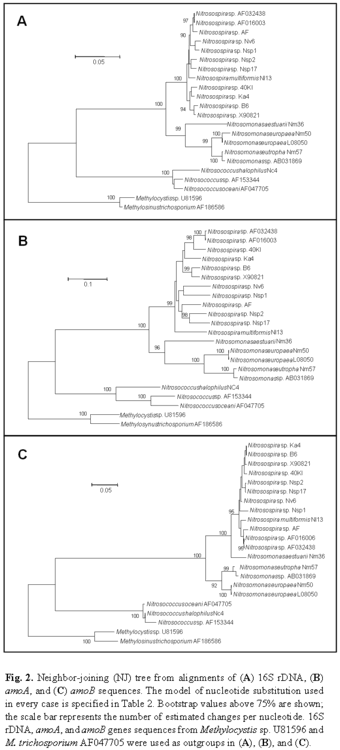
<body><![CDATA[<br> Mutational model.</b> Multiple sequence alignments were performed with CLUSTAL W &#091;51&#093; and refined manually. The proportions of variable and conserved positions were calculated with DNAs    <p v4 &#091;43&#093;. Silent and effective mutations in the protein-encoding genes <i>amoA</i> and <i>amoB</i> were manually checked by comparing the DNA sequences with the translated amino-acid sequences.</p>     <p>The hypothesis of neutrality in nucleotide substitution was tested using Tajima's D test &#091;50&#093;, included in the software MEGA v.2.1 &#091;26&#093;. The test was independently performed for every marker and for the three positions of the codons from the <i>amoA</i> and <i>amoB</i> sequences. Substitution saturation was determined with the index developed by Xia et al. &#091;58&#093; which is included in the DAMBE software &#091;57&#093;. This test is based on the notion of entropy in information theory and yields a critical value permitting the saturation degree of a given set of aligned sequences to be assessed. The same saturation index was calculated for the first, second, and third codon positions in <i>amoA</i> and <i>amoB</i>. In addition, the entire sequences of the three markers were tested individually for saturation.</p>     <p>The nucleotide substitution model best fitting the variations observed in the 16S rDNA, <i>amoA</i>, and <i>amoB</i> partial sequences was determined using the software MODELTEST 3.04 &#091;36&#093;. This program allows the most appropriate among 56 models of nucleotide substitution to be chosen.</p>      <p><b>Phylogenetic analysis.</b> Neighbor-joining (NJ) trees for 16S rDNA, <i>amoA</i>, and <i>amoB</i> genes were generated from the corresponding matrix of nucleotide divergence between sequences using the program MEGA2 &#091;26&#093;. Maximum parsimony (MP) trees were also constructed for each marker using the software PAup 4.0b &#091;49&#093;. To reduce the computational time required by the parsimony algorithm when carried out with a heuristic search, a TBR branch-swapping value of 100 was used. Confidence in the branching points was obtained with 1000 bootstra    <p replicates. The incongruence length difference test (ILD) &#091;10&#093; was conducted as implemented in the PAup 4.0b software package (partition homogeneity test) and used to determine whether 16S rDNA, <i>amoA</i>, and <i>amoB</i> sequence datasets provided similar phylogenetic information. The overall NJ and M    <p trees including the polygenic composite sequences were constructed applying the same variables used for the construction of individual gene trees.</p>     <p>Tree topologies were compared using maximum likelihood, minimum evolution, and parsimony criteria. First, the topologies were analyzed according to the modified Kishino and Hasegawa test &#091;44&#093;, computing the log-likelihoods per site for each tree and comparing the total log-likelihoods among topologies &#091;11&#093;. Minimum evolution (ME) scores were then compared for each topology. Finally, the number of steps and both the consistency and retention indices of the parsimony analysis for each tree were computed.</p>      <p><font size="4"><b>Results</b></font></p>     <p><b>Quantitative aspects of gene variation.</b> Sequences of <i>amoA</i> contained the highest proportion of polymorphic sites. Of the 399 sites in this gene, 203 (62.15%) were found to be variable; of these, 11.27% were silent and 50.88% effective. In <i>amoB</i>, 180 (45.80%) out of 393 genes were variable and all of them were effective. Of the 1014 16S rDNA genes analyzed, 278 (27.42%) were variable. There were 231 parsimony-informative sites in 16S rDNA, 232 in <i>amoA</i>, and 172 in <i>amoB</i>. Approximately 50% of the nucleotide substitutions in <i>amoA</i> affected the third position of the codon (<a href="#t2">Table 2</a>), while in the case of <i>amoB</i> the variable positions were evenly distributed. Furthermore, 44.27% of the polymorphisms detected in the third base-pair of <i>amoB</i> were silent substitutions, i.e., they had no effect on the amino-acid sequence.</p>     ]]></body>
<body><![CDATA[<p align="center"><a name="t2"><img src="/img/revistas/im/v8n2/04-Calvo-Table2.gif" width="340" height="122"></a></p>      <p>&nbsp;</p>     <p><b>Neutrality and substitution saturation.</b> The dataset fit the model of neutral molecular evolution. In fact, the results of Tajima's D test indicated no significant skew in the entire sequences of the three markers in the case of <i>amoB</i> (0.505, 0.421, and 0.623 for the positions 1, 2, and 3, respectively). However, this test revealed a significant excess of polymorphisms in the third position of the codons in <i>amoA</i> (3.131 in contrast with the values 1.091 and 0.315 for the positions 1 and 2, respectively). These results agreed with measurements of substitution saturation, which produced a strong signal in the third position of <i>amoA</i> codons (<a href="#f1">Fig. 1</a>). The persistent accumulation of changes in these specific sites in <i>amoA</i> may produce a loss of phylogenetic information. No substitution saturation was detected in the other two markers.</p>     <p align="center"><a name="f1"><img src="/img/revistas/im/v8n2/04-Calvo-Fig1.gif" width="340" height="350"></a></p>      <p><b>Phylogenetic and topology analyses. </b>The evolution of each gene can be described by a distinct substitution model (<a href="#t3">Table 3</a>). Tamura-Nei 1993 (TrN93) is the nucleotide substitution model including the greatest number of parameters, and the one best fitting the combined dataset. The models Hasegawa-Kishino-Yano 1985 (HKY) and Felsenstein 1981 (F81), obtained for <i>amoA</i> and <i>amoB</i>, respectively, can be considered simplifications of TrN93. TrN93 was applied to all trees based on genetic distances, with a single transition type and a single substitution rate when the selected models were HKY and F81, respectively.</p>     <p align="center"><a name="t3"><img src="/img/revistas/im/v8n2/04-Calvo-Table3.gif" width="340" height="253"></a></p>      <p>For each marker, an NJ tree was constructed using the appropriate nucleotide substitution model (<a href="#t3">Table 3</a>, <a href="#f2">Fig. 2</a>). The trees constructed by MP showed topologies similar to those of their NJ counterparts (data not shown). In all cases, the <i>Nitrosomonas</i> and <i>Nitrosospira</i> radiations grouped together, and the &gamma;-proteobacterial nitrosococci branched separately. This agrees with the classical phylogenetic topology of AOB. Likewise, two different clusters were distinguishable within the &beta;-subgroup of ammonia oxidizers, as <i>Nitrosomonas</i> and <i>Nitrosospira</i> clearly formed two separate clades. Nevertheless, the allocation of <i>Nitrosomonas aestuarii</i> Nm36 was uncertain, since it grouped within the <i>Nitrosospira</i> cluster when using <i>amoB</i> as a molecular marker but fell within the <i>Nitrosomonas</i> group when using 16S rDNA or <i>amoA</i>. The ILD test corroborated (<i>P</i> <font size="2">&lt;</font> 0.001) the incongruence between the phylogenetic information provided by the three markers. However, since under some circumstances combining sequences with different phylogenetic histories can improve the accuracy of phylogenetic analysis &#091;56&#093;, polygenic trees were constructed.</p>     <p align="center"><a name="f2"><img src="/img/revistas/im/v8n2/04-Calvo-Fig2.gif" width="340" height="750"></a></p>    <br>      <p>The consensus polygenic trees generated by M    ]]></body>
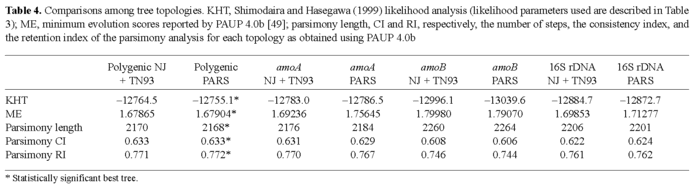
<body><![CDATA[<p and NJ are presented in <a href="#f3"> <a href="#f3">Fig. 3</a></a>. The topologies of the two trees were similar and consistent with both the standard classification of AOB and the results previously obtained with each of the three markers. In this polygenic analysis, <i>Nm. aestuarii</i> Nm36 was considered to be the most divergent <i>Nitrosomonas</i>.</p>     <p align="center"><a name="f3"><img src="/img/revistas/im/v8n2/04-Calvo-Fig3.gif" width="700" height="420"></a></p>    <br>      <p>All topological evaluations (likelihood, minimum evolution, and parsimony criteria) indicated that the MP tree obtained from the composite dataset displayed the most probable topology (<a href="#t4">Table 4</a>). Similar values were obtained for the rest of the trees, which indicated that they were not significantly worse than the best-supported tree.</p>     <p align="center"><a name="t4"><img src="/img/revistas/im/v8n2/04-Calvo-Table4.gif" width="700" height="190"></a></p>    <br>      <p><font size="4">Discussion</font></p>     <p>Correct classification of any bacterial group requires the input of different genetic and phenetic characters, which is not possible when using uncultured bacteria from natural environments &#091;39&#093;. Alternatively, a polygenic approach leads to more accurate estimations of the diversity and composition of natural populations &#091;34,35&#093;, although care must be taken when combining datasets from different markers &#091;9,56&#093;. Gene <i>amoA</i> encodes the active site of ammonia monooxygenase &#091;20&#093;, which makes it difficult for effective mutations to occur in this gene. In <i>amoA</i>, 50% of the mutations were detected in the third base-pair (see <a href="#t2">Table 2</a>), which showed a large accumulation of nucleotide changes at this position. As a consequence, the third position of the codon in <i>amoA</i> is strongly saturated (see <a href="#f1">Fig. 1</a>) and deviates from neutrality, suggesting that this position has experienced selective pressures different from those of the other two positions &#091;24&#093;. The persistent accumulation of changes in these specific sites in <i>amoA</i> may produce a loss of phylogenetic information. By contrast, in the case of <i>amoB</i>, ca. 55% of the conserved sites were detected in all codon positions (<a href="#t2">Table 2</a>). Moreover, ca. 70% of the amino-acid variations observed in the deduced partial amino acid sequences of AmoB proteins are conservative (data not shown).</p>     <p>The general topologies of the constructed trees were almost identical, with one exception. Although taxonomically classified into the genus <i>Nitrosomonas</i>, the strain <i>Nm. aestuarii</i> Nm36 showed significant phylogenetic distances, supported by high bootstra    <p values, from the central cluster of <i>Nitrosomonas</i> when using 16S rDNA and <i>amoA</i> gene sequences. By contrast, <i>Nm. aestuarii</i> Nm36 grouped together with the <i>Nitrosospira</i> lineage when using <i>amoB</i>, but a considerable phylogenetic distance also distinguished this strain from the rest of the nitrosospiras. In the polygenic tree, <i>Nm aestuarii</i> Nm36 again grouped with the <i>Nitrosomonas</i> cluster. Purkhold et al. also reported the ambiguous phylogenetic arrangement of this species depending on the treeing method employed and the type of sequences used &#091;37&#093;. Therefore, this strain should be further studied in order to clarify its phylogenetic affiliation. Moreover, it would be of interest to determine whether <i>amoB</i> of <i>Nm. aestuarii</i> Nm36 has followed a different pattern of evolution and represents the ancestral state within the <i>Nitrosomonas</i> cluster, or whether it is a case of lateral gene transfer.</p>     ]]></body>
<body><![CDATA[<p>The composite dataset, consisting of 16S rDNA, <i>amoA</i>, and <i>amoB</i> sequences, provided more information than any of the three markers alone, and therefore resulted in the most accurate classification. Thus, the marker leading to the tree best-fitting the information of the entire dataset should be the one chosen for taxonomic and diversity studies. As expected, results of a comparison between all of the trees and the data obtained using the likelihood, minimum evolution, and parsimony criteria showed that the polygenic M    <p tree was the best. However, phylogeny could be inferred using any of the markers. Although our results may be biased due to both the sequence sizes of the markers (16S rDNA: 1014 bp; <i>amoA</i>: 399 bp; <i>amoB</i>: 393 bp) and the number of parsimonic informative sites, they support 16S rDNA as a good phylogenetic marker, especially concerning the avoidance of ambiguous classifications. Several authors have recently reaffirmed the potential of 16S rDNA sequences for drawing phylogenetic inferences &#091;3,27,38&#093;. Nonetheless, obtaining the 16S rDNA gene from environmental samples is time-consuming and tedious. It requires the cloning of all 16S rDNA genes present in the sample and then distinguishing the 16S rDNA genes belonging to AOB from the rest.</p>     <p>By contrast, environmental population studies based on the analysis of <i>amoA</i> or <i>amoB</i> present some significant advantages: the genes are AOB-specific, are large enough to allow quick fingerprinting of natural communities, and provide a phylogeny consistent with the current taxonomic outlines. Nevertheless, Oved et al. &#091;33&#093; and Nicolaisen and Ramsing &#091;31&#093; reported the amplification of non-AOB sequences when using <i>amoA</i> sequences in a PCR-denaturing gradient gel electrophoresis (DGGE) approach. Our experiments based on <i>amoB</i> amplification combined with DGGE resulted in the establishment of a sensitive and reliable screening method to detect and identify AOB in environmental samples (data not shown). Additionally, the benefit of using <i>amoB</i> in ecophysiology studies is the ability to distinguish methane-oxidizing bacteria from AOB on a simple agarose gel &#091;6&#093;.</p>     <p>Based on the results reported here, for taxonomic purposes we strongly recommend sequencing16S rDNA, <i>amoA</i> and <i>amoB</i> genes, and to construct a polygenic tree. Since the third position of the codon in <i>amoA</i> is saturated, and due to the non-AOB sequences retrieved by other authors when using this gene &#091;31,33&#093;, the use of <i>amoB</i> is recommended when carrying out environmental ecophysiology studies. <i>amoB</i> allows fingerprinting techniques, such as terminal restriction fragment length polymorphism (tRFLP) and DGGE, to be performed, and results in a reliable phylogenetic profile. Moreover, when using <i>amoB</i> as a marker, the methane-oxidizers present in the sample can be quickly and easily distinguished from AOB, which may be of great hel    <p in analyzing complex samples.</p>      <p><font size="2"><b>Acknowledgements.</b> This work was funded by the Spanish Ministry of Science and Technology (CICYT REN2000). LC is the recipient of a fellowshi    <p from the Spanish Ministry of Science and Technology.</font></p>      <p><font size="4"><b>References</b></font></p>     <!-- ref --><p>1. Aakra A, Ut&aring;ker JB, Nes IF (2001a) Comparative phylogeny of the ammonia monooxygenase subunit A and 16S rRNA genes of ammonia-oxidizing bacteria. FEMS Microbiol Lett 205:237-242&nbsp;&nbsp;&nbsp;&nbsp;&nbsp;&nbsp;&nbsp;&nbsp;[&#160;<a href="javascript:void(0);" onclick="javascript: window.open('/scielo.php?script=sci_nlinks&ref=2779748&pid=S1139-6709200500020000400001&lng=','','width=640,height=500,resizable=yes,scrollbars=1,menubar=yes,');">Links</a>&#160;]<!-- end-ref --><!-- ref --><p>2. Aakra A, Ut&aring;ker JB, P&ouml;mmerening-R&ouml;ser, A, Koops, H. P, Nes, I.F (2001b) Detailed phylogeny of ammonia-oxidizing bacteria determined by rDNA sequences and DNA homology values. Int J Syst Evol Microbiol 51:2021-2030&nbsp;&nbsp;&nbsp;&nbsp;&nbsp;&nbsp;&nbsp;&nbsp;[&#160;<a href="javascript:void(0);" onclick="javascript: window.open('/scielo.php?script=sci_nlinks&ref=2779749&pid=S1139-6709200500020000400002&lng=','','width=640,height=500,resizable=yes,scrollbars=1,menubar=yes,');">Links</a>&#160;]<!-- end-ref --><!-- ref --><p>3. B&eacute;j&agrave;, O, Koonin, EV, Aravind L, Taylor LT, Seitz H, Stein JL, Bensen DC, Feldman RA, Swanson RV, DeLong EF (2002) Comparative genomic analysis of archaeal genotypic variants in a single population and in two different oceanic provinces. Appl Environ Microbiol 68:335-345&nbsp;&nbsp;&nbsp;&nbsp;&nbsp;&nbsp;&nbsp;&nbsp;[&#160;<a href="javascript:void(0);" onclick="javascript: window.open('/scielo.php?script=sci_nlinks&ref=2779750&pid=S1139-6709200500020000400003&lng=','','width=640,height=500,resizable=yes,scrollbars=1,menubar=yes,');">Links</a>&#160;]<!-- end-ref --><!-- ref --><p>4. Bothe H, Jost G, Schloter M, Ward BB, Witzel K (2000) Molecular analysis of ammonia oxidation and denitrification in natural environments. FEMS Microbiol Rev 24:673-690&nbsp;&nbsp;&nbsp;&nbsp;&nbsp;&nbsp;&nbsp;&nbsp;[&#160;<a href="javascript:void(0);" onclick="javascript: window.open('/scielo.php?script=sci_nlinks&ref=2779751&pid=S1139-6709200500020000400004&lng=','','width=640,height=500,resizable=yes,scrollbars=1,menubar=yes,');">Links</a>&#160;]<!-- end-ref --><!-- ref --><p>5. Bruns MA, Stephen JR, Kowalchuk GA, Prosser JI, Paul EA (1999) Comparative diversity of ammonia oxidizer 16S rRNA gene sequences in native, tilled, and successional soils. Appl Environ Microbiol 65:2994-3000&nbsp;&nbsp;&nbsp;&nbsp;&nbsp;&nbsp;&nbsp;&nbsp;[&#160;<a href="javascript:void(0);" onclick="javascript: window.open('/scielo.php?script=sci_nlinks&ref=2779752&pid=S1139-6709200500020000400005&lng=','','width=640,height=500,resizable=yes,scrollbars=1,menubar=yes,');">Links</a>&#160;]<!-- end-ref --><!-- ref --><p>6. Calv&oacute; L, Garcia-Gil LJ (2004) Use of <i>amoB</i> as a new molecular marker for ammonia-oxidizing bacteria. J Microbiol Methods 57:69-78&nbsp;&nbsp;&nbsp;&nbsp;&nbsp;&nbsp;&nbsp;&nbsp;[&#160;<a href="javascript:void(0);" onclick="javascript: window.open('/scielo.php?script=sci_nlinks&ref=2779753&pid=S1139-6709200500020000400006&lng=','','width=640,height=500,resizable=yes,scrollbars=1,menubar=yes,');">Links</a>&#160;]<!-- end-ref --><!-- ref --><p>7. Calv&oacute; L, Vila X, Abella CA, Garcia-Gil LJ (2004) Use of the ammonia-oxidizing bacterial-specific phylogenetic probe Nso1225 as a primer for fingerprint analysis of ammonia-oxidizer communities. Appl Microbiol Biotechnol 63:715-721&nbsp;&nbsp;&nbsp;&nbsp;&nbsp;&nbsp;&nbsp;&nbsp;[&#160;<a href="javascript:void(0);" onclick="javascript: window.open('/scielo.php?script=sci_nlinks&ref=2779754&pid=S1139-6709200500020000400007&lng=','','width=640,height=500,resizable=yes,scrollbars=1,menubar=yes,');">Links</a>&#160;]<!-- end-ref --><!-- ref --><p>8. Dedysh SN, Liesack W, Khmelenina VN, Suzina NE, Trotsenko YA, Semrau JD, Bares AM, Panikov NS, Tiedje JM (2000) <i>Methylocella palustris</i> gen. nov, sp. nov., a new methane-oxidizing acidophilic bacterium from peat bogs, representing a novel subtype of serine-pathway methanotrophs. Int J Syst Evol Microbiol 3:955-969&nbsp;&nbsp;&nbsp;&nbsp;&nbsp;&nbsp;&nbsp;&nbsp;[&#160;<a href="javascript:void(0);" onclick="javascript: window.open('/scielo.php?script=sci_nlinks&ref=2779755&pid=S1139-6709200500020000400008&lng=','','width=640,height=500,resizable=yes,scrollbars=1,menubar=yes,');">Links</a>&#160;]<!-- end-ref --><!-- ref --><p>9. Dolphin K, Belshaw R, Orme CDL, Quicke DLJ (2000) Noise and incongruence: interpreting results of the Incongruence Length Difference Test. Mol Phyl and Evol 17:401-406&nbsp;&nbsp;&nbsp;&nbsp;&nbsp;&nbsp;&nbsp;&nbsp;[&#160;<a href="javascript:void(0);" onclick="javascript: window.open('/scielo.php?script=sci_nlinks&ref=2779756&pid=S1139-6709200500020000400009&lng=','','width=640,height=500,resizable=yes,scrollbars=1,menubar=yes,');">Links</a>&#160;]<!-- end-ref --><!-- ref --><p>10. Farris JS, Kallersjo M, Kluge AG, Bult C (1994) Testing significance of incongruence. Cladistics 10:315-319&nbsp;&nbsp;&nbsp;&nbsp;&nbsp;&nbsp;&nbsp;&nbsp;[&#160;<a href="javascript:void(0);" onclick="javascript: window.open('/scielo.php?script=sci_nlinks&ref=2779757&pid=S1139-6709200500020000400010&lng=','','width=640,height=500,resizable=yes,scrollbars=1,menubar=yes,');">Links</a>&#160;]<!-- end-ref --><!-- ref --><p>11. Felsenstein J (2004) Inferring phylogenies. Sinauer Associates, Sunderland, MA&nbsp;&nbsp;&nbsp;&nbsp;&nbsp;&nbsp;&nbsp;&nbsp;[&#160;<a href="javascript:void(0);" onclick="javascript: window.open('/scielo.php?script=sci_nlinks&ref=2779758&pid=S1139-6709200500020000400011&lng=','','width=640,height=500,resizable=yes,scrollbars=1,menubar=yes,');">Links</a>&#160;]<!-- end-ref --><!-- ref --><p>12. Ford MJ (2002) Applications of selective neutrality tests to molecular ecology. Mol Ecol 11:1245-1262&nbsp;&nbsp;&nbsp;&nbsp;&nbsp;&nbsp;&nbsp;&nbsp;[&#160;<a href="javascript:void(0);" onclick="javascript: window.open('/scielo.php?script=sci_nlinks&ref=2779759&pid=S1139-6709200500020000400012&lng=','','width=640,height=500,resizable=yes,scrollbars=1,menubar=yes,');">Links</a>&#160;]<!-- end-ref --><!-- ref --><p>13. Fu YX, Li WH (1993) Statistical tests of neutrality of mutations. Genetics 133:693-709&nbsp;&nbsp;&nbsp;&nbsp;&nbsp;&nbsp;&nbsp;&nbsp;[&#160;<a href="javascript:void(0);" onclick="javascript: window.open('/scielo.php?script=sci_nlinks&ref=2779760&pid=S1139-6709200500020000400013&lng=','','width=640,height=500,resizable=yes,scrollbars=1,menubar=yes,');">Links</a>&#160;]<!-- end-ref --><!-- ref --><p>14. Garcia-Gil LJ, Gich FB, Fuentes-Garcia X (2003) A comparative study of <i>bchG</i> from green photosynthetic bacteria. Arch Microbiol 179:108-115&nbsp;&nbsp;&nbsp;&nbsp;&nbsp;&nbsp;&nbsp;&nbsp;[&#160;<a href="javascript:void(0);" onclick="javascript: window.open('/scielo.php?script=sci_nlinks&ref=2779761&pid=S1139-6709200500020000400014&lng=','','width=640,height=500,resizable=yes,scrollbars=1,menubar=yes,');">Links</a>&#160;]<!-- end-ref --><!-- ref --><p>15. Gieseke A, Purkhold U, Wagner M, Amann R, Schramm A (2001) Community structure and activity dynamics of nitrifying bacteria in a phosphate-removing biofilm. Appl Environ Microbiol 67:1351-1362&nbsp;&nbsp;&nbsp;&nbsp;&nbsp;&nbsp;&nbsp;&nbsp;[&#160;<a href="javascript:void(0);" onclick="javascript: window.open('/scielo.php?script=sci_nlinks&ref=2779762&pid=S1139-6709200500020000400015&lng=','','width=640,height=500,resizable=yes,scrollbars=1,menubar=yes,');">Links</a>&#160;]<!-- end-ref --><!-- ref --><p>16. Gilbert B, McDonald IR, Finch R, Stafford GP, Nielsen AK, Murrell JC (2000) Molecular analysis of the <i>pmo</i> (particulate methane monooxygenase) operons from two type II methanotrophs. Appl Environ Microbiol 66:966-975&nbsp;&nbsp;&nbsp;&nbsp;&nbsp;&nbsp;&nbsp;&nbsp;[&#160;<a href="javascript:void(0);" onclick="javascript: window.open('/scielo.php?script=sci_nlinks&ref=2779763&pid=S1139-6709200500020000400016&lng=','','width=640,height=500,resizable=yes,scrollbars=1,menubar=yes,');">Links</a>&#160;]<!-- end-ref --><!-- ref --><p>17. Head IM, Hiorns WD, Embley TM, McCarthy AJ, Saunders JR (1993) The phylogeny of autotrophic ammonia-oxidizing bacteria as determined by analysis of 16S ribosomal RNA gene sequences. J Gen Microbiol 139:1147-1153&nbsp;&nbsp;&nbsp;&nbsp;&nbsp;&nbsp;&nbsp;&nbsp;[&#160;<a href="javascript:void(0);" onclick="javascript: window.open('/scielo.php?script=sci_nlinks&ref=2779764&pid=S1139-6709200500020000400017&lng=','','width=640,height=500,resizable=yes,scrollbars=1,menubar=yes,');">Links</a>&#160;]<!-- end-ref --><!-- ref --><p>18. Hermansson A, Lindgren PE (2001) Quantification of ammonia-oxidizing bacteria in arable soil by real-time PCR. Appl Environ Microbiol 67:972-976&nbsp;&nbsp;&nbsp;&nbsp;&nbsp;&nbsp;&nbsp;&nbsp;[&#160;<a href="javascript:void(0);" onclick="javascript: window.open('/scielo.php?script=sci_nlinks&ref=2779765&pid=S1139-6709200500020000400018&lng=','','width=640,height=500,resizable=yes,scrollbars=1,menubar=yes,');">Links</a>&#160;]<!-- end-ref --><!-- ref --><p>19. Hiorns WD, Hastings RC, Head IM, McCarthy AJ, Saunders JR, Pickup RW, Hall GH (1995) Amplification of 16S ribosomal RNA genes of autotrophic ammonia-oxidizing bacteria demonstrates the ubiquity of Nitrosospiras in the environment. Microbiology 141:2793-2800&nbsp;&nbsp;&nbsp;&nbsp;&nbsp;&nbsp;&nbsp;&nbsp;[&#160;<a href="javascript:void(0);" onclick="javascript: window.open('/scielo.php?script=sci_nlinks&ref=2779766&pid=S1139-6709200500020000400019&lng=','','width=640,height=500,resizable=yes,scrollbars=1,menubar=yes,');">Links</a>&#160;]<!-- end-ref --><!-- ref --><p>20. Hyman MR., Arp DJ (1992) 14C2H2- and 14CO2-labeling studies of the de novo synthesis of polypeptides by <i>Nitrosomonas europaea</i> during recovery from acetylene and light inactivation of ammonia monooxygenase. J Biol Chem 267:1534-1545&nbsp;&nbsp;&nbsp;&nbsp;&nbsp;&nbsp;&nbsp;&nbsp;[&#160;<a href="javascript:void(0);" onclick="javascript: window.open('/scielo.php?script=sci_nlinks&ref=2779767&pid=S1139-6709200500020000400020&lng=','','width=640,height=500,resizable=yes,scrollbars=1,menubar=yes,');">Links</a>&#160;]<!-- end-ref --><!-- ref --><p>21. Juretschko S, Timmermann G, Schmid M, Schleifer KH, P&ouml;mmerening-R&ouml;ser A, Koops HP, Wagner M (1998) Combined molecular and conventional analyses of nitrifying bacterium diversity in activated sludge: <i>Nitrosococcus mobilis</i> and <i>Nitrospira</i>-like bacteria as dominant populations. Appl Environ Microbiol 64:3042-3051&nbsp;&nbsp;&nbsp;&nbsp;&nbsp;&nbsp;&nbsp;&nbsp;[&#160;<a href="javascript:void(0);" onclick="javascript: window.open('/scielo.php?script=sci_nlinks&ref=2779768&pid=S1139-6709200500020000400021&lng=','','width=640,height=500,resizable=yes,scrollbars=1,menubar=yes,');">Links</a>&#160;]<!-- end-ref --><!-- ref --><p>22. Kimura M (1983) The neutral theory of molecular evolution. Cambridge University Press, Cambridge, MA&nbsp;&nbsp;&nbsp;&nbsp;&nbsp;&nbsp;&nbsp;&nbsp;[&#160;<a href="javascript:void(0);" onclick="javascript: window.open('/scielo.php?script=sci_nlinks&ref=2779769&pid=S1139-6709200500020000400022&lng=','','width=640,height=500,resizable=yes,scrollbars=1,menubar=yes,');">Links</a>&#160;]<!-- end-ref --><!-- ref --><p>23. Klotz MG, Norton JM (1995) Sequence of an ammonia monooxygenase subunit A-encoding gene from <i>Nitrosospira</i> sp. NpAV. Gene 1:159-160&nbsp;&nbsp;&nbsp;&nbsp;&nbsp;&nbsp;&nbsp;&nbsp;[&#160;<a href="javascript:void(0);" onclick="javascript: window.open('/scielo.php?script=sci_nlinks&ref=2779770&pid=S1139-6709200500020000400023&lng=','','width=640,height=500,resizable=yes,scrollbars=1,menubar=yes,');">Links</a>&#160;]<!-- end-ref --><!-- ref --><p>24. Klotz MG, Norton JM (1998) Multiple copies of ammonia monooxygenase (<i>amo</i>) operons have evolved under biased AT/GC mutational pressure in ammonia-oxidizing autotrophic bacteria. FEMS Microbiol Lett 168:303-311&nbsp;&nbsp;&nbsp;&nbsp;&nbsp;&nbsp;&nbsp;&nbsp;[&#160;<a href="javascript:void(0);" onclick="javascript: window.open('/scielo.php?script=sci_nlinks&ref=2779771&pid=S1139-6709200500020000400024&lng=','','width=640,height=500,resizable=yes,scrollbars=1,menubar=yes,');">Links</a>&#160;]<!-- end-ref --><!-- ref --><p>25. Kowalchuk GA, Stienstra AW, Heilig GH, Stephen JR, Woldendorp JW (2000) Molecular analysis of ammonia-oxidizing bacteria in soil of successional grasslands of the Drentsche A (The Netherlands). FEMS Microbiol Ecol 31:207-215&nbsp;&nbsp;&nbsp;&nbsp;&nbsp;&nbsp;&nbsp;&nbsp;[&#160;<a href="javascript:void(0);" onclick="javascript: window.open('/scielo.php?script=sci_nlinks&ref=2779772&pid=S1139-6709200500020000400025&lng=','','width=640,height=500,resizable=yes,scrollbars=1,menubar=yes,');">Links</a>&#160;]<!-- end-ref --><!-- ref --><p>26. Kumar S, Tamura K, Jakobsen IB, Nei M (2001) MEGA2: Molecular Evolutionary Genetics Analysis software, 2.1 ed. Arizona State University, Tempe, Arizona, USA&nbsp;&nbsp;&nbsp;&nbsp;&nbsp;&nbsp;&nbsp;&nbsp;[&#160;<a href="javascript:void(0);" onclick="javascript: window.open('/scielo.php?script=sci_nlinks&ref=2779773&pid=S1139-6709200500020000400026&lng=','','width=640,height=500,resizable=yes,scrollbars=1,menubar=yes,');">Links</a>&#160;]<!-- end-ref --><!-- ref --><p>27. Ludwig W, Schleifer KH (1999) Phylogeny of bacteria beyond the 16S rDNA standard. ASM News 65:752-757&nbsp;&nbsp;&nbsp;&nbsp;&nbsp;&nbsp;&nbsp;&nbsp;[&#160;<a href="javascript:void(0);" onclick="javascript: window.open('/scielo.php?script=sci_nlinks&ref=2779774&pid=S1139-6709200500020000400027&lng=','','width=640,height=500,resizable=yes,scrollbars=1,menubar=yes,');">Links</a>&#160;]<!-- end-ref --><!-- ref --><p>28. McCaig AE, Embley TM, Prosser JI (1994) Molecular analysis of enrichment cultures of marine ammonia oxidizers. FEMS Microbiol Lett 120:363-367&nbsp;&nbsp;&nbsp;&nbsp;&nbsp;&nbsp;&nbsp;&nbsp;[&#160;<a href="javascript:void(0);" onclick="javascript: window.open('/scielo.php?script=sci_nlinks&ref=2779775&pid=S1139-6709200500020000400028&lng=','','width=640,height=500,resizable=yes,scrollbars=1,menubar=yes,');">Links</a>&#160;]<!-- end-ref --><!-- ref --><p>29. McDonald IR, Murrell JC (1997) The particulate methane monooxygenase gene pmoA and its use as a functional gene probe for methanotrophs. FEMS Microbiol Lett 156:205-210&nbsp;&nbsp;&nbsp;&nbsp;&nbsp;&nbsp;&nbsp;&nbsp;[&#160;<a href="javascript:void(0);" onclick="javascript: window.open('/scielo.php?script=sci_nlinks&ref=2779776&pid=S1139-6709200500020000400029&lng=','','width=640,height=500,resizable=yes,scrollbars=1,menubar=yes,');">Links</a>&#160;]<!-- end-ref --><!-- ref --><p>30. McTavish H, Fuchs JA, Hooper AB (1993) Sequence of the gene coding for ammonia monooxygenase in <i>Nitrosomonas europaea</i>. J Bacteriol 175:2436-2444&nbsp;&nbsp;&nbsp;&nbsp;&nbsp;&nbsp;&nbsp;&nbsp;[&#160;<a href="javascript:void(0);" onclick="javascript: window.open('/scielo.php?script=sci_nlinks&ref=2779777&pid=S1139-6709200500020000400030&lng=','','width=640,height=500,resizable=yes,scrollbars=1,menubar=yes,');">Links</a>&#160;]<!-- end-ref --><!-- ref --><p>31. Nicolaisen MH, Ramsing NB (2002) Denaturing gradient gel electrophoresis (DGGE) approaches to study the diversity of ammonia-oxidizing bacteria. J Microbiol Methods 50:189-203&nbsp;&nbsp;&nbsp;&nbsp;&nbsp;&nbsp;&nbsp;&nbsp;[&#160;<a href="javascript:void(0);" onclick="javascript: window.open('/scielo.php?script=sci_nlinks&ref=2779778&pid=S1139-6709200500020000400031&lng=','','width=640,height=500,resizable=yes,scrollbars=1,menubar=yes,');">Links</a>&#160;]<!-- end-ref --><!-- ref --><p>32. Norton JM, Alzerreca JJ, Suwa Y, Klotz MG (2002) Diversity of ammonia monooxygenase operon in autotrophic ammonia-oxidizing bacteria. Arch Microbiol 177:139-149&nbsp;&nbsp;&nbsp;&nbsp;&nbsp;&nbsp;&nbsp;&nbsp;[&#160;<a href="javascript:void(0);" onclick="javascript: window.open('/scielo.php?script=sci_nlinks&ref=2779779&pid=S1139-6709200500020000400032&lng=','','width=640,height=500,resizable=yes,scrollbars=1,menubar=yes,');">Links</a>&#160;]<!-- end-ref --><!-- ref --><p>33. Oved T, Shaviv A,Goldrath T, Mandelbaum RT, Minz D (2001) Influence of effluent irrigation on community composition and function of ammonia-oxidizing bacteria in soil. Appl. Environ. Microbiol 67:3426-3433&nbsp;&nbsp;&nbsp;&nbsp;&nbsp;&nbsp;&nbsp;&nbsp;[&#160;<a href="javascript:void(0);" onclick="javascript: window.open('/scielo.php?script=sci_nlinks&ref=2779780&pid=S1139-6709200500020000400033&lng=','','width=640,height=500,resizable=yes,scrollbars=1,menubar=yes,');">Links</a>&#160;]<!-- end-ref --><!-- ref --><p>34. Park DH, Kim JS, Kwon SW, Wilson C, Yu YM, Hur JH, Lim CK (2003) <i>Streptomyces luridiscabiei</i> sp. nov, <i>Streptomyces puniciscabiei</i> sp. nov. and <i>Streptomyces niveiscabiei</i> sp. nov, which cause potato common scab disease in 35. Korea. Int J Syst Evol Microbiol 53:2049-2054&nbsp;&nbsp;&nbsp;&nbsp;&nbsp;&nbsp;&nbsp;&nbsp;[&#160;<a href="javascript:void(0);" onclick="javascript: window.open('/scielo.php?script=sci_nlinks&ref=2779781&pid=S1139-6709200500020000400034&lng=','','width=640,height=500,resizable=yes,scrollbars=1,menubar=yes,');">Links</a>&#160;]<!-- end-ref --><!-- ref --><p>35. Pena JA, Li SY, Wilson PH, Thibodeau SA, Szary AJ, Versalovic J (2004) Genotypic and phenotypic studies of murine intestinal <i>lactobacilli</i>: species differences in mice with and without colitis. Appl Environ Microbiol 70:558-568&nbsp;&nbsp;&nbsp;&nbsp;&nbsp;&nbsp;&nbsp;&nbsp;[&#160;<a href="javascript:void(0);" onclick="javascript: window.open('/scielo.php?script=sci_nlinks&ref=2779782&pid=S1139-6709200500020000400035&lng=','','width=640,height=500,resizable=yes,scrollbars=1,menubar=yes,');">Links</a>&#160;]<!-- end-ref --><!-- ref --><p>36. Posada D, Crandall KA (1998) MODELTEST: testing the model of DNA substitution. Bioinformatics 14:817-818&nbsp;&nbsp;&nbsp;&nbsp;&nbsp;&nbsp;&nbsp;&nbsp;[&#160;<a href="javascript:void(0);" onclick="javascript: window.open('/scielo.php?script=sci_nlinks&ref=2779783&pid=S1139-6709200500020000400036&lng=','','width=640,height=500,resizable=yes,scrollbars=1,menubar=yes,');">Links</a>&#160;]<!-- end-ref --><!-- ref --><p>37. Purkhold U, P&ouml;mmerening-R&ouml;ser A, Juretschko S, Schmid MC, Koops HK, Wagner M (2000) Phylogeny of all recognized species of ammonia oxidizers based on comparative 16S rRNA and <i>amoA</i> sequence analysis: implications for molecular diversity surveys. Appl Environ Microbiol 66:5368-5382&nbsp;&nbsp;&nbsp;&nbsp;&nbsp;&nbsp;&nbsp;&nbsp;[&#160;<a href="javascript:void(0);" onclick="javascript: window.open('/scielo.php?script=sci_nlinks&ref=2779784&pid=S1139-6709200500020000400037&lng=','','width=640,height=500,resizable=yes,scrollbars=1,menubar=yes,');">Links</a>&#160;]<!-- end-ref --><!-- ref --><p>38. Purkhold U, Wagner M, Timmermann G, P&ouml;mmerening-R&ouml;ser A, Koops HP (2003) 16S rRNA and <i>amoA</i>-based phylogeny of 12 novel betaproteobacterial ammonia-oxidizing isolates: extension of the dataset and proposal of a new lineage within the nitrosomonads. Int J Syst Evol Microbiol 53:1485-1494&nbsp;&nbsp;&nbsp;&nbsp;&nbsp;&nbsp;&nbsp;&nbsp;[&#160;<a href="javascript:void(0);" onclick="javascript: window.open('/scielo.php?script=sci_nlinks&ref=2779785&pid=S1139-6709200500020000400038&lng=','','width=640,height=500,resizable=yes,scrollbars=1,menubar=yes,');">Links</a>&#160;]<!-- end-ref --><!-- ref --><p>39. Rossell&oacute;-Mora R, Amann R (2001) The species concept for prokaryotes. FEMS Microbiol Rev 25:39-67&nbsp;&nbsp;&nbsp;&nbsp;&nbsp;&nbsp;&nbsp;&nbsp;[&#160;<a href="javascript:void(0);" onclick="javascript: window.open('/scielo.php?script=sci_nlinks&ref=2779786&pid=S1139-6709200500020000400039&lng=','','width=640,height=500,resizable=yes,scrollbars=1,menubar=yes,');">Links</a>&#160;]<!-- end-ref --><!-- ref --><p>40. Rotthauwe JH, deBoer W, Liesack W (1995) Comparative analysis of gene sequences encoding ammonia monooxygenase of <i>Nitrosospira</i> sp. AHB1 and <i>Nitrosolobus multiformis</i> C-71. FEMS Microbiol Lett 133:131-135&nbsp;&nbsp;&nbsp;&nbsp;&nbsp;&nbsp;&nbsp;&nbsp;[&#160;<a href="javascript:void(0);" onclick="javascript: window.open('/scielo.php?script=sci_nlinks&ref=2779787&pid=S1139-6709200500020000400040&lng=','','width=640,height=500,resizable=yes,scrollbars=1,menubar=yes,');">Links</a>&#160;]<!-- end-ref --><!-- ref --><p>41. Rotthauwe JH, Witzel KP, Liesack W (1997) The ammonia monooxygenase structural gene <i>amoA</i> as a functional marker, molecular fine-scale analysis of natural ammonia-oxidizing populations. Appl Environ Microbiol 63:4704-4712&nbsp;&nbsp;&nbsp;&nbsp;&nbsp;&nbsp;&nbsp;&nbsp;[&#160;<a href="javascript:void(0);" onclick="javascript: window.open('/scielo.php?script=sci_nlinks&ref=2779788&pid=S1139-6709200500020000400041&lng=','','width=640,height=500,resizable=yes,scrollbars=1,menubar=yes,');">Links</a>&#160;]<!-- end-ref --><!-- ref --><p>42. Rowan AK, Snape JR, Fearnside D, Barer MR, Curtis TP, Head IM (2003) Composition and diversity of ammonia-oxidizing bacterial communities in wastewater treatment reactors of different design treating identical wastewater. FEMS Microbiol Ecol 43:195-206&nbsp;&nbsp;&nbsp;&nbsp;&nbsp;&nbsp;&nbsp;&nbsp;[&#160;<a href="javascript:void(0);" onclick="javascript: window.open('/scielo.php?script=sci_nlinks&ref=2779789&pid=S1139-6709200500020000400042&lng=','','width=640,height=500,resizable=yes,scrollbars=1,menubar=yes,');">Links</a>&#160;]<!-- end-ref --><!-- ref --><p>43. Rozas J, Sanchez-DelBarrio JC, Messeguer X, Rozas R (2003) DnaSP, DNA polymorphism analyses by the coalescent and other methods. Bioinformatics 19:2496-2497&nbsp;&nbsp;&nbsp;&nbsp;&nbsp;&nbsp;&nbsp;&nbsp;[&#160;<a href="javascript:void(0);" onclick="javascript: window.open('/scielo.php?script=sci_nlinks&ref=2779790&pid=S1139-6709200500020000400043&lng=','','width=640,height=500,resizable=yes,scrollbars=1,menubar=yes,');">Links</a>&#160;]<!-- end-ref --><!-- ref --><p>44. Shimodaira H, Hasegawa M (1999) Multiple comparisons of log-likelihoods with applications to phylogenetic inference. Mol Biol Evol 16:1114-1116&nbsp;&nbsp;&nbsp;&nbsp;&nbsp;&nbsp;&nbsp;&nbsp;[&#160;<a href="javascript:void(0);" onclick="javascript: window.open('/scielo.php?script=sci_nlinks&ref=2779791&pid=S1139-6709200500020000400044&lng=','','width=640,height=500,resizable=yes,scrollbars=1,menubar=yes,');">Links</a>&#160;]<!-- end-ref --><!-- ref --><p>45. Shinozaki H, Fukui M (2002) Comparison of 16S rRNA, ammonia monooxygenase subunit A and hydroxylamine oxidoreductase gene, in chemolithotrophic ammonia-oxidizing bacteria. J Gen Appl Microbiol 48:173-176&nbsp;&nbsp;&nbsp;&nbsp;&nbsp;&nbsp;&nbsp;&nbsp;[&#160;<a href="javascript:void(0);" onclick="javascript: window.open('/scielo.php?script=sci_nlinks&ref=2779792&pid=S1139-6709200500020000400045&lng=','','width=640,height=500,resizable=yes,scrollbars=1,menubar=yes,');">Links</a>&#160;]<!-- end-ref --><!-- ref --><p>46. Sinigalliano CD, Kuhn DN, Jones RD (1995) Amplification of the <i>amoA</i> gene from diverse species of ammonium-oxidizing bacteria and from an indigenous bacterial population from seawater. Appl Environ Microbiol 61:2702-2706&nbsp;&nbsp;&nbsp;&nbsp;&nbsp;&nbsp;&nbsp;&nbsp;[&#160;<a href="javascript:void(0);" onclick="javascript: window.open('/scielo.php?script=sci_nlinks&ref=2779793&pid=S1139-6709200500020000400046&lng=','','width=640,height=500,resizable=yes,scrollbars=1,menubar=yes,');">Links</a>&#160;]<!-- end-ref --><!-- ref --><p>47. Smouse PE (1998) To tree or not to tree. Mol Ecol 7:399-412&nbsp;&nbsp;&nbsp;&nbsp;&nbsp;&nbsp;&nbsp;&nbsp;[&#160;<a href="javascript:void(0);" onclick="javascript: window.open('/scielo.php?script=sci_nlinks&ref=2779794&pid=S1139-6709200500020000400047&lng=','','width=640,height=500,resizable=yes,scrollbars=1,menubar=yes,');">Links</a>&#160;]<!-- end-ref --><!-- ref --><p>48. Stephen JR, McCaig AE, Smith Z, Prosser JI, Embley TM (1996) Molecular diversity of soil and marine 16S rRNA gene sequences related to beta-subgroup ammonia-oxidizing bacteria. Appl Environ Microbiol 62:4147-4154&nbsp;&nbsp;&nbsp;&nbsp;&nbsp;&nbsp;&nbsp;&nbsp;[&#160;<a href="javascript:void(0);" onclick="javascript: window.open('/scielo.php?script=sci_nlinks&ref=2779795&pid=S1139-6709200500020000400048&lng=','','width=640,height=500,resizable=yes,scrollbars=1,menubar=yes,');">Links</a>&#160;]<!-- end-ref --><!-- ref --><p>49. Swofford DL (1998) PAUP*. Phylogenetic Analysis Using Parsimony (*and other methods). Version 4. Sinauer Associates, Sunderland, Massachusetts.    &nbsp;&nbsp;&nbsp;&nbsp;&nbsp;&nbsp;&nbsp;&nbsp;[&#160;<a href="javascript:void(0);" onclick="javascript: window.open('/scielo.php?script=sci_nlinks&ref=2779796&pid=S1139-6709200500020000400049&lng=','','width=640,height=500,resizable=yes,scrollbars=1,menubar=yes,');">Links</a>&#160;]<!-- end-ref --></p>     <!-- ref --><p>50. Tajima F (1989) Statistical method for testing the neutral mutation hypothesis by DNA polymorphism. Genetics 123:585-595&nbsp;&nbsp;&nbsp;&nbsp;&nbsp;&nbsp;&nbsp;&nbsp;[&#160;<a href="javascript:void(0);" onclick="javascript: window.open('/scielo.php?script=sci_nlinks&ref=2779798&pid=S1139-6709200500020000400050&lng=','','width=640,height=500,resizable=yes,scrollbars=1,menubar=yes,');">Links</a>&#160;]<!-- end-ref --><!-- ref --><p>51. Thompson JD, Higgins DG, Gibson TJ (1994) CLUSTAL W, improving the sensitivity of progressive multiple sequence alignment through sequence weighting, position-specific gap penalties and weight matrix choice. Nucleic Acids Res 22:4673-4680&nbsp;&nbsp;&nbsp;&nbsp;&nbsp;&nbsp;&nbsp;&nbsp;[&#160;<a href="javascript:void(0);" onclick="javascript: window.open('/scielo.php?script=sci_nlinks&ref=2779799&pid=S1139-6709200500020000400051&lng=','','width=640,height=500,resizable=yes,scrollbars=1,menubar=yes,');">Links</a>&#160;]<!-- end-ref --><!-- ref --><p>52. Ut&aring;ker JB, Bakken L, Jiang QQ, Nes IF (1995) Phylogenetic analysis of seven new isolates of ammonia-oxidizing bacteria based on 16S rRNA gene sequences. Syst Appl Microbiol 18:549-559&nbsp;&nbsp;&nbsp;&nbsp;&nbsp;&nbsp;&nbsp;&nbsp;[&#160;<a href="javascript:void(0);" onclick="javascript: window.open('/scielo.php?script=sci_nlinks&ref=2779800&pid=S1139-6709200500020000400052&lng=','','width=640,height=500,resizable=yes,scrollbars=1,menubar=yes,');">Links</a>&#160;]<!-- end-ref --><!-- ref --><p>53. Voytek MA, Ward BB (1995) Detection of ammonium-oxidizing bacteria of the beta-subclass of the class Proteobacteria in aquatic samples with the PCR. Appl Environ Microbiol 61:1444-1450&nbsp;&nbsp;&nbsp;&nbsp;&nbsp;&nbsp;&nbsp;&nbsp;[&#160;<a href="javascript:void(0);" onclick="javascript: window.open('/scielo.php?script=sci_nlinks&ref=2779801&pid=S1139-6709200500020000400053&lng=','','width=640,height=500,resizable=yes,scrollbars=1,menubar=yes,');">Links</a>&#160;]<!-- end-ref --><!-- ref --><p>54. Wagner M, Rath G, Amann R, Koops HP, Schleifer KH (1995) In situ identification of ammonium oxidizing bacteria. Syst Appl Microbiol 18:251-264&nbsp;&nbsp;&nbsp;&nbsp;&nbsp;&nbsp;&nbsp;&nbsp;[&#160;<a href="javascript:void(0);" onclick="javascript: window.open('/scielo.php?script=sci_nlinks&ref=2779802&pid=S1139-6709200500020000400054&lng=','','width=640,height=500,resizable=yes,scrollbars=1,menubar=yes,');">Links</a>&#160;]<!-- end-ref --><!-- ref --><p>55. Ward BB, Martino DP, Diaz MC, Joye SB (2000) Analysis of ammonia-oxidizing bacteria from hypersaline Mono Lake, California, on the basis of 16S rRNA sequences. Appl Environ Microbiol 66:2873-2881&nbsp;&nbsp;&nbsp;&nbsp;&nbsp;&nbsp;&nbsp;&nbsp;[&#160;<a href="javascript:void(0);" onclick="javascript: window.open('/scielo.php?script=sci_nlinks&ref=2779803&pid=S1139-6709200500020000400055&lng=','','width=640,height=500,resizable=yes,scrollbars=1,menubar=yes,');">Links</a>&#160;]<!-- end-ref --><!-- ref --><p>56. Wiens JJ (1998) Combining data sets with different phylogenetic histories. Syst Biol 47:568-581&nbsp;&nbsp;&nbsp;&nbsp;&nbsp;&nbsp;&nbsp;&nbsp;[&#160;<a href="javascript:void(0);" onclick="javascript: window.open('/scielo.php?script=sci_nlinks&ref=2779804&pid=S1139-6709200500020000400056&lng=','','width=640,height=500,resizable=yes,scrollbars=1,menubar=yes,');">Links</a>&#160;]<!-- end-ref --><!-- ref --><p>57. Xia X, Xie Z (2001) DAMBE: software package for data analysis in molecular biology and evolution. J Hered 92:371-373&nbsp;&nbsp;&nbsp;&nbsp;&nbsp;&nbsp;&nbsp;&nbsp;[&#160;<a href="javascript:void(0);" onclick="javascript: window.open('/scielo.php?script=sci_nlinks&ref=2779805&pid=S1139-6709200500020000400057&lng=','','width=640,height=500,resizable=yes,scrollbars=1,menubar=yes,');">Links</a>&#160;]<!-- end-ref --><!-- ref --><p>58. Xia X, Xie Z, Salemi M, Chen L, Wang Y (2003) An index of substitution saturation and its application. Mol Phylogenet Evol 26:1-7&nbsp;&nbsp;&nbsp;&nbsp;&nbsp;&nbsp;&nbsp;&nbsp;[&#160;<a href="javascript:void(0);" onclick="javascript: window.open('/scielo.php?script=sci_nlinks&ref=2779806&pid=S1139-6709200500020000400058&lng=','','width=640,height=500,resizable=yes,scrollbars=1,menubar=yes,');">Links</a>&#160;]<!-- end-ref --> ]]></body><back>
<ref-list>
<ref id="B1">
<label>1</label><nlm-citation citation-type="journal">
<person-group person-group-type="author">
<name>
<surname><![CDATA[Aakra]]></surname>
<given-names><![CDATA[A]]></given-names>
</name>
<name>
<surname><![CDATA[Utåker]]></surname>
<given-names><![CDATA[JB]]></given-names>
</name>
<name>
<surname><![CDATA[Nes]]></surname>
<given-names><![CDATA[IF]]></given-names>
</name>
</person-group>
<article-title xml:lang="en"><![CDATA[Comparative phylogeny of the ammonia monooxygenase subunit A and 16S rRNA genes of ammonia-oxidizing bacteria]]></article-title>
<source><![CDATA[FEMS Microbiol Lett]]></source>
<year>2001</year>
<volume>205</volume>
<page-range>237-242</page-range></nlm-citation>
</ref>
<ref id="B2">
<label>2</label><nlm-citation citation-type="journal">
<person-group person-group-type="author">
<name>
<surname><![CDATA[Aakra]]></surname>
<given-names><![CDATA[A]]></given-names>
</name>
<name>
<surname><![CDATA[Utåker]]></surname>
<given-names><![CDATA[JB]]></given-names>
</name>
<name>
<surname><![CDATA[Pömmerening-Röser]]></surname>
<given-names><![CDATA[A]]></given-names>
</name>
<name>
<surname><![CDATA[Koops]]></surname>
<given-names><![CDATA[H. P]]></given-names>
</name>
<name>
<surname><![CDATA[Nes,]]></surname>
<given-names><![CDATA[I. F]]></given-names>
</name>
</person-group>
<article-title xml:lang="en"><![CDATA[Detailed phylogeny of ammonia-oxidizing bacteria determined by rDNA sequences and DNA homology values]]></article-title>
<source><![CDATA[Int J Syst Evol Microbiol]]></source>
<year>2001</year>
<volume>51</volume>
<page-range>2021-2030</page-range></nlm-citation>
</ref>
<ref id="B3">
<label>3</label><nlm-citation citation-type="journal">
<person-group person-group-type="author">
<name>
<surname><![CDATA[Béjà]]></surname>
<given-names><![CDATA[O]]></given-names>
</name>
<name>
<surname><![CDATA[Koonin]]></surname>
<given-names><![CDATA[EV]]></given-names>
</name>
<name>
<surname><![CDATA[Aravind]]></surname>
<given-names><![CDATA[L]]></given-names>
</name>
<name>
<surname><![CDATA[Taylor]]></surname>
<given-names><![CDATA[LT]]></given-names>
</name>
<name>
<surname><![CDATA[Seitz]]></surname>
<given-names><![CDATA[H]]></given-names>
</name>
<name>
<surname><![CDATA[Stein]]></surname>
<given-names><![CDATA[JL]]></given-names>
</name>
<name>
<surname><![CDATA[Bensen]]></surname>
<given-names><![CDATA[DC]]></given-names>
</name>
<name>
<surname><![CDATA[Feldman]]></surname>
<given-names><![CDATA[RA]]></given-names>
</name>
<name>
<surname><![CDATA[Swanson]]></surname>
<given-names><![CDATA[RV]]></given-names>
</name>
<name>
<surname><![CDATA[DeLong]]></surname>
<given-names><![CDATA[EF]]></given-names>
</name>
</person-group>
<article-title xml:lang="en"><![CDATA[Comparative genomic analysis of archaeal genotypic variants in a single population and in two different oceanic provinces]]></article-title>
<source><![CDATA[Appl Environ Microbiol]]></source>
<year>2002</year>
<volume>68</volume>
<page-range>335-345</page-range></nlm-citation>
</ref>
<ref id="B4">
<label>4</label><nlm-citation citation-type="journal">
<person-group person-group-type="author">
<name>
<surname><![CDATA[Bothe]]></surname>
<given-names><![CDATA[H]]></given-names>
</name>
<name>
<surname><![CDATA[Jost]]></surname>
<given-names><![CDATA[G]]></given-names>
</name>
<name>
<surname><![CDATA[Schloter]]></surname>
<given-names><![CDATA[M]]></given-names>
</name>
<name>
<surname><![CDATA[Ward]]></surname>
<given-names><![CDATA[BB]]></given-names>
</name>
<name>
<surname><![CDATA[Witzel]]></surname>
<given-names><![CDATA[K]]></given-names>
</name>
</person-group>
<article-title xml:lang="en"><![CDATA[Molecular analysis of ammonia oxidation and denitrification in natural environments]]></article-title>
<source><![CDATA[FEMS Microbiol Rev]]></source>
<year>2000</year>
<volume>24</volume>
<page-range>673-690</page-range></nlm-citation>
</ref>
<ref id="B5">
<label>5</label><nlm-citation citation-type="journal">
<person-group person-group-type="author">
<name>
<surname><![CDATA[Bruns]]></surname>
<given-names><![CDATA[MA]]></given-names>
</name>
<name>
<surname><![CDATA[Stephen]]></surname>
<given-names><![CDATA[JR]]></given-names>
</name>
<name>
<surname><![CDATA[Kowalchuk]]></surname>
<given-names><![CDATA[GA]]></given-names>
</name>
<name>
<surname><![CDATA[Prosser]]></surname>
<given-names><![CDATA[JI]]></given-names>
</name>
<name>
<surname><![CDATA[Paul]]></surname>
<given-names><![CDATA[EA]]></given-names>
</name>
</person-group>
<article-title xml:lang="en"><![CDATA[Comparative diversity of ammonia oxidizer 16S rRNA gene sequences in native, tilled, and successional soils]]></article-title>
<source><![CDATA[Appl Environ Microbiol]]></source>
<year>1999</year>
<volume>65</volume>
<page-range>2994-3000</page-range></nlm-citation>
</ref>
<ref id="B6">
<label>6</label><nlm-citation citation-type="journal">
<person-group person-group-type="author">
<name>
<surname><![CDATA[Calvó]]></surname>
<given-names><![CDATA[L]]></given-names>
</name>
<name>
<surname><![CDATA[Garcia-Gil]]></surname>
<given-names><![CDATA[LJ]]></given-names>
</name>
</person-group>
<article-title xml:lang="en"><![CDATA[Use of amoB as a new molecular marker for ammonia-oxidizing bacteria]]></article-title>
<source><![CDATA[J Microbiol Methods]]></source>
<year>2004</year>
<volume>57</volume>
<page-range>69-78</page-range></nlm-citation>
</ref>
<ref id="B7">
<label>7</label><nlm-citation citation-type="journal">
<person-group person-group-type="author">
<name>
<surname><![CDATA[Calvó]]></surname>
<given-names><![CDATA[L]]></given-names>
</name>
<name>
<surname><![CDATA[Vila]]></surname>
<given-names><![CDATA[X]]></given-names>
</name>
<name>
<surname><![CDATA[Abella]]></surname>
<given-names><![CDATA[CA]]></given-names>
</name>
<name>
<surname><![CDATA[Garcia-Gil]]></surname>
<given-names><![CDATA[LJ]]></given-names>
</name>
</person-group>
<article-title xml:lang="en"><![CDATA[Use of the ammonia-oxidizing bacterial-specific phylogenetic probe Nso1225 as a primer for fingerprint analysis of ammonia-oxidizer communities]]></article-title>
<source><![CDATA[Appl Microbiol Biotechnol]]></source>
<year>2004</year>
<volume>63</volume>
<page-range>715-721</page-range></nlm-citation>
</ref>
<ref id="B8">
<label>8</label><nlm-citation citation-type="journal">
<person-group person-group-type="author">
<name>
<surname><![CDATA[Dedysh]]></surname>
<given-names><![CDATA[SN]]></given-names>
</name>
<name>
<surname><![CDATA[Liesack]]></surname>
<given-names><![CDATA[W]]></given-names>
</name>
<name>
<surname><![CDATA[Khmelenina]]></surname>
<given-names><![CDATA[VN]]></given-names>
</name>
<name>
<surname><![CDATA[Suzina]]></surname>
<given-names><![CDATA[NE]]></given-names>
</name>
<name>
<surname><![CDATA[Trotsenko]]></surname>
<given-names><![CDATA[YA]]></given-names>
</name>
<name>
<surname><![CDATA[Semrau]]></surname>
<given-names><![CDATA[JD]]></given-names>
</name>
<name>
<surname><![CDATA[Bares]]></surname>
<given-names><![CDATA[AM]]></given-names>
</name>
<name>
<surname><![CDATA[Panikov]]></surname>
<given-names><![CDATA[NS]]></given-names>
</name>
<name>
<surname><![CDATA[Tiedje]]></surname>
<given-names><![CDATA[JM]]></given-names>
</name>
</person-group>
<article-title xml:lang="en"><![CDATA[Methylocella palustris gen. nov, sp. nov.: a new methane-oxidizing acidophilic bacterium from peat bogs, representing a novel subtype of serine-pathway methanotrophs]]></article-title>
<source><![CDATA[Int J Syst Evol Microbiol]]></source>
<year>2000</year>
<volume>3</volume>
<page-range>955-969</page-range></nlm-citation>
</ref>
<ref id="B9">
<label>9</label><nlm-citation citation-type="journal">
<person-group person-group-type="author">
<name>
<surname><![CDATA[Dolphin]]></surname>
<given-names><![CDATA[K]]></given-names>
</name>
<name>
<surname><![CDATA[Belshaw]]></surname>
<given-names><![CDATA[R]]></given-names>
</name>
<name>
<surname><![CDATA[Orme]]></surname>
<given-names><![CDATA[CDL]]></given-names>
</name>
<name>
<surname><![CDATA[Quicke]]></surname>
<given-names><![CDATA[DLJ]]></given-names>
</name>
</person-group>
<article-title xml:lang="en"><![CDATA[Noise and incongruence: interpreting results of the Incongruence Length Difference Test]]></article-title>
<source><![CDATA[Mol Phyl and Evol]]></source>
<year>2000</year>
<volume>17</volume>
<page-range>401-406</page-range></nlm-citation>
</ref>
<ref id="B10">
<label>10</label><nlm-citation citation-type="journal">
<person-group person-group-type="author">
<name>
<surname><![CDATA[Farris]]></surname>
<given-names><![CDATA[JS]]></given-names>
</name>
<name>
<surname><![CDATA[Kallersjo]]></surname>
<given-names><![CDATA[M]]></given-names>
</name>
<name>
<surname><![CDATA[Kluge]]></surname>
<given-names><![CDATA[AG]]></given-names>
</name>
<name>
<surname><![CDATA[Bult]]></surname>
<given-names><![CDATA[C]]></given-names>
</name>
</person-group>
<article-title xml:lang="en"><![CDATA[Testing significance of incongruence]]></article-title>
<source><![CDATA[Cladistics]]></source>
<year>1994</year>
<volume>10</volume>
<page-range>315-319</page-range></nlm-citation>
</ref>
<ref id="B11">
<label>11</label><nlm-citation citation-type="book">
<person-group person-group-type="author">
<name>
<surname><![CDATA[Felsenstein]]></surname>
<given-names><![CDATA[J]]></given-names>
</name>
</person-group>
<source><![CDATA[Inferring phylogenies]]></source>
<year>2004</year>
<publisher-loc><![CDATA[Sunderland^eMA MA]]></publisher-loc>
<publisher-name><![CDATA[Sinauer Associates]]></publisher-name>
</nlm-citation>
</ref>
<ref id="B12">
<label>12</label><nlm-citation citation-type="journal">
<person-group person-group-type="author">
<name>
<surname><![CDATA[Ford]]></surname>
<given-names><![CDATA[MJ]]></given-names>
</name>
</person-group>
<article-title xml:lang="en"><![CDATA[Applications of selective neutrality tests to molecular ecology]]></article-title>
<source><![CDATA[Mol Ecol]]></source>
<year>2002</year>
<volume>11</volume>
<page-range>1245-1262</page-range></nlm-citation>
</ref>
<ref id="B13">
<label>13</label><nlm-citation citation-type="journal">
<person-group person-group-type="author">
<name>
<surname><![CDATA[Fu]]></surname>
<given-names><![CDATA[YX]]></given-names>
</name>
<name>
<surname><![CDATA[Li]]></surname>
<given-names><![CDATA[WH]]></given-names>
</name>
</person-group>
<article-title xml:lang="en"><![CDATA[Statistical tests of neutrality of mutations]]></article-title>
<source><![CDATA[Genetics]]></source>
<year>1993</year>
<volume>133</volume>
<page-range>693-709</page-range></nlm-citation>
</ref>
<ref id="B14">
<label>14</label><nlm-citation citation-type="journal">
<person-group person-group-type="author">
<name>
<surname><![CDATA[Garcia-Gil]]></surname>
<given-names><![CDATA[LJ]]></given-names>
</name>
<name>
<surname><![CDATA[Gich]]></surname>
<given-names><![CDATA[FB]]></given-names>
</name>
<name>
<surname><![CDATA[Fuentes-Garcia]]></surname>
<given-names><![CDATA[X]]></given-names>
</name>
</person-group>
<article-title xml:lang="en"><![CDATA[A comparative study of bchG from green photosynthetic bacteria]]></article-title>
<source><![CDATA[Arch Microbiol]]></source>
<year>2003</year>
<volume>179</volume>
<page-range>108-115</page-range></nlm-citation>
</ref>
<ref id="B15">
<label>15</label><nlm-citation citation-type="journal">
<person-group person-group-type="author">
<name>
<surname><![CDATA[Gieseke]]></surname>
<given-names><![CDATA[A]]></given-names>
</name>
<name>
<surname><![CDATA[Purkhold]]></surname>
<given-names><![CDATA[U]]></given-names>
</name>
<name>
<surname><![CDATA[Wagner]]></surname>
<given-names><![CDATA[M]]></given-names>
</name>
<name>
<surname><![CDATA[Amann]]></surname>
<given-names><![CDATA[R]]></given-names>
</name>
<name>
<surname><![CDATA[Schramm]]></surname>
<given-names><![CDATA[A]]></given-names>
</name>
</person-group>
<article-title xml:lang="en"><![CDATA[Community structure and activity dynamics of nitrifying bacteria in a phosphate-removing biofilm]]></article-title>
<source><![CDATA[Appl Environ Microbiol]]></source>
<year>2001</year>
<volume>67</volume>
<page-range>1351-1362</page-range></nlm-citation>
</ref>
<ref id="B16">
<label>16</label><nlm-citation citation-type="journal">
<person-group person-group-type="author">
<name>
<surname><![CDATA[Gilbert]]></surname>
<given-names><![CDATA[B]]></given-names>
</name>
<name>
<surname><![CDATA[McDonald]]></surname>
<given-names><![CDATA[IR]]></given-names>
</name>
<name>
<surname><![CDATA[Finch]]></surname>
<given-names><![CDATA[R]]></given-names>
</name>
<name>
<surname><![CDATA[Stafford]]></surname>
<given-names><![CDATA[GP]]></given-names>
</name>
<name>
<surname><![CDATA[Nielsen]]></surname>
<given-names><![CDATA[AK]]></given-names>
</name>
<name>
<surname><![CDATA[Murrell]]></surname>
<given-names><![CDATA[JC]]></given-names>
</name>
</person-group>
<article-title xml:lang="en"><![CDATA[Molecular analysis of the pmo (particulate methane monooxygenase) operons from two type II methanotrophs]]></article-title>
<source><![CDATA[Appl Environ Microbiol]]></source>
<year>2000</year>
<volume>66</volume>
<page-range>966-975</page-range></nlm-citation>
</ref>
<ref id="B17">
<label>17</label><nlm-citation citation-type="journal">
<person-group person-group-type="author">
<name>
<surname><![CDATA[Head]]></surname>
<given-names><![CDATA[IM]]></given-names>
</name>
<name>
<surname><![CDATA[Hiorns]]></surname>
<given-names><![CDATA[WD]]></given-names>
</name>
<name>
<surname><![CDATA[Embley]]></surname>
<given-names><![CDATA[TM]]></given-names>
</name>
<name>
<surname><![CDATA[McCarthy]]></surname>
<given-names><![CDATA[AJ]]></given-names>
</name>
<name>
<surname><![CDATA[Saunders]]></surname>
<given-names><![CDATA[JR]]></given-names>
</name>
</person-group>
<article-title xml:lang="en"><![CDATA[The phylogeny of autotrophic ammonia-oxidizing bacteria as determined by analysis of 16S ribosomal RNA gene sequences]]></article-title>
<source><![CDATA[J Gen Microbiol]]></source>
<year>1993</year>
<volume>139</volume>
<page-range>1147-1153</page-range></nlm-citation>
</ref>
<ref id="B18">
<label>18</label><nlm-citation citation-type="journal">
<person-group person-group-type="author">
<name>
<surname><![CDATA[Hermansson]]></surname>
<given-names><![CDATA[A]]></given-names>
</name>
<name>
<surname><![CDATA[Lindgren]]></surname>
<given-names><![CDATA[PE]]></given-names>
</name>
</person-group>
<article-title xml:lang="en"><![CDATA[Quantification of ammonia-oxidizing bacteria in arable soil by real-time PCR]]></article-title>
<source><![CDATA[Appl Environ Microbiol]]></source>
<year>2001</year>
<volume>67</volume>
<page-range>972-976</page-range></nlm-citation>
</ref>
<ref id="B19">
<label>19</label><nlm-citation citation-type="journal">
<person-group person-group-type="author">
<name>
<surname><![CDATA[Hiorns]]></surname>
<given-names><![CDATA[WD]]></given-names>
</name>
<name>
<surname><![CDATA[Hastings]]></surname>
<given-names><![CDATA[RC]]></given-names>
</name>
<name>
<surname><![CDATA[Head]]></surname>
<given-names><![CDATA[IM]]></given-names>
</name>
<name>
<surname><![CDATA[McCarthy]]></surname>
<given-names><![CDATA[AJ]]></given-names>
</name>
<name>
<surname><![CDATA[Saunders]]></surname>
<given-names><![CDATA[JR]]></given-names>
</name>
<name>
<surname><![CDATA[Pickup]]></surname>
<given-names><![CDATA[RW]]></given-names>
</name>
<name>
<surname><![CDATA[Hall]]></surname>
<given-names><![CDATA[GH]]></given-names>
</name>
</person-group>
<article-title xml:lang="en"><![CDATA[Amplification of 16S ribosomal RNA genes of autotrophic ammonia-oxidizing bacteria demonstrates the ubiquity of Nitrosospiras in the environment]]></article-title>
<source><![CDATA[Microbiology]]></source>
<year>1995</year>
<volume>141</volume>
<page-range>2793-2800</page-range></nlm-citation>
</ref>
<ref id="B20">
<label>20</label><nlm-citation citation-type="journal">
<person-group person-group-type="author">
<name>
<surname><![CDATA[Hyman]]></surname>
<given-names><![CDATA[MR]]></given-names>
</name>
<name>
<surname><![CDATA[Arp]]></surname>
<given-names><![CDATA[DJ]]></given-names>
</name>
</person-group>
<article-title xml:lang="en"><![CDATA[14C2H2- and 14CO2-labeling studies of the de novo synthesis of polypeptides by Nitrosomonas europaea during recovery from acetylene and light inactivation of ammonia monooxygenase]]></article-title>
<source><![CDATA[J Biol Chem]]></source>
<year>1992</year>
<volume>267</volume>
<page-range>1534-1545</page-range></nlm-citation>
</ref>
<ref id="B21">
<label>21</label><nlm-citation citation-type="journal">
<person-group person-group-type="author">
<name>
<surname><![CDATA[Juretschko]]></surname>
<given-names><![CDATA[S]]></given-names>
</name>
<name>
<surname><![CDATA[Timmermann]]></surname>
<given-names><![CDATA[G]]></given-names>
</name>
<name>
<surname><![CDATA[Schmid]]></surname>
<given-names><![CDATA[M]]></given-names>
</name>
<name>
<surname><![CDATA[Schleifer]]></surname>
<given-names><![CDATA[KH]]></given-names>
</name>
<name>
<surname><![CDATA[Pömmerening-Röser]]></surname>
<given-names><![CDATA[A]]></given-names>
</name>
<name>
<surname><![CDATA[Koops]]></surname>
<given-names><![CDATA[HP]]></given-names>
</name>
<name>
<surname><![CDATA[Wagner]]></surname>
<given-names><![CDATA[M]]></given-names>
</name>
</person-group>
<article-title xml:lang="en"><![CDATA[Combined molecular and conventional analyses of nitrifying bacterium diversity in activated sludge: Nitrosococcus mobilis and Nitrospira-like bacteria as dominant populations]]></article-title>
<source><![CDATA[Appl Environ Microbiol]]></source>
<year>1998</year>
<volume>64</volume>
<page-range>3042-3051</page-range></nlm-citation>
</ref>
<ref id="B22">
<label>22</label><nlm-citation citation-type="book">
<person-group person-group-type="author">
<name>
<surname><![CDATA[Kimura]]></surname>
<given-names><![CDATA[M]]></given-names>
</name>
</person-group>
<source><![CDATA[The neutral theory of molecular evolution]]></source>
<year>1983</year>
<publisher-loc><![CDATA[Cambridge^eMA MA]]></publisher-loc>
<publisher-name><![CDATA[Cambridge University Press]]></publisher-name>
</nlm-citation>
</ref>
<ref id="B23">
<label>23</label><nlm-citation citation-type="journal">
<person-group person-group-type="author">
<name>
<surname><![CDATA[Klotz]]></surname>
<given-names><![CDATA[MG]]></given-names>
</name>
<name>
<surname><![CDATA[Norton]]></surname>
<given-names><![CDATA[JM]]></given-names>
</name>
</person-group>
<article-title xml:lang="en"><![CDATA[Sequence of an ammonia monooxygenase subunit A-encoding gene from Nitrosospira sp. NpAV]]></article-title>
<source><![CDATA[Gene]]></source>
<year>1995</year>
<volume>1</volume>
<page-range>159-160</page-range></nlm-citation>
</ref>
<ref id="B24">
<label>24</label><nlm-citation citation-type="journal">
<person-group person-group-type="author">
<name>
<surname><![CDATA[Klotz]]></surname>
<given-names><![CDATA[MG]]></given-names>
</name>
<name>
<surname><![CDATA[Norton]]></surname>
<given-names><![CDATA[JM]]></given-names>
</name>
</person-group>
<article-title xml:lang="en"><![CDATA[Multiple copies of ammonia monooxygenase (amo) operons have evolved under biased AT/GC mutational pressure in ammonia-oxidizing autotrophic bacteria]]></article-title>
<source><![CDATA[FEMS Microbiol Lett]]></source>
<year>1998</year>
<volume>168</volume>
<page-range>303-311</page-range></nlm-citation>
</ref>
<ref id="B25">
<label>25</label><nlm-citation citation-type="journal">
<person-group person-group-type="author">
<name>
<surname><![CDATA[Kowalchuk]]></surname>
<given-names><![CDATA[GA]]></given-names>
</name>
<name>
<surname><![CDATA[Stienstra]]></surname>
<given-names><![CDATA[AW]]></given-names>
</name>
<name>
<surname><![CDATA[Heilig]]></surname>
<given-names><![CDATA[GH]]></given-names>
</name>
<name>
<surname><![CDATA[Stephen]]></surname>
<given-names><![CDATA[JR]]></given-names>
</name>
<name>
<surname><![CDATA[Woldendorp]]></surname>
<given-names><![CDATA[JW]]></given-names>
</name>
</person-group>
<article-title xml:lang="en"><![CDATA[Molecular analysis of ammonia-oxidizing bacteria in soil of successional grasslands of the Drentsche A (The Netherlands)]]></article-title>
<source><![CDATA[FEMS Microbiol Ecol]]></source>
<year>2000</year>
<volume>31</volume>
<page-range>207-215</page-range></nlm-citation>
</ref>
<ref id="B26">
<label>26</label><nlm-citation citation-type="book">
<person-group person-group-type="author">
<name>
<surname><![CDATA[Kumar]]></surname>
<given-names><![CDATA[S]]></given-names>
</name>
<name>
<surname><![CDATA[Tamura]]></surname>
<given-names><![CDATA[K]]></given-names>
</name>
<name>
<surname><![CDATA[Jakobsen]]></surname>
<given-names><![CDATA[IB]]></given-names>
</name>
<name>
<surname><![CDATA[Nei]]></surname>
<given-names><![CDATA[M]]></given-names>
</name>
</person-group>
<source><![CDATA[MEGA2: Molecular Evolutionary Genetics Analysis software]]></source>
<year>2001</year>
<edition>2.1</edition>
<publisher-loc><![CDATA[Tempe^eArizona Arizona]]></publisher-loc>
<publisher-name><![CDATA[Arizona State University]]></publisher-name>
</nlm-citation>
</ref>
<ref id="B27">
<label>27</label><nlm-citation citation-type="journal">
<person-group person-group-type="author">
<name>
<surname><![CDATA[Ludwig]]></surname>
<given-names><![CDATA[W]]></given-names>
</name>
<name>
<surname><![CDATA[Schleifer]]></surname>
<given-names><![CDATA[KH]]></given-names>
</name>
</person-group>
<article-title xml:lang="en"><![CDATA[Phylogeny of bacteria beyond the 16S rDNA standard]]></article-title>
<source><![CDATA[ASM News]]></source>
<year>1999</year>
<volume>65</volume>
<page-range>752-757</page-range></nlm-citation>
</ref>
<ref id="B28">
<label>28</label><nlm-citation citation-type="journal">
<person-group person-group-type="author">
<name>
<surname><![CDATA[McCaig]]></surname>
<given-names><![CDATA[AE]]></given-names>
</name>
<name>
<surname><![CDATA[Embley]]></surname>
<given-names><![CDATA[TM]]></given-names>
</name>
<name>
<surname><![CDATA[Prosser]]></surname>
<given-names><![CDATA[JI]]></given-names>
</name>
</person-group>
<article-title xml:lang="en"><![CDATA[Molecular analysis of enrichment cultures of marine ammonia oxidizers]]></article-title>
<source><![CDATA[FEMS Microbiol Lett]]></source>
<year>1994</year>
<volume>120</volume>
<page-range>363-367</page-range></nlm-citation>
</ref>
<ref id="B29">
<label>29</label><nlm-citation citation-type="journal">
<person-group person-group-type="author">
<name>
<surname><![CDATA[McDonald]]></surname>
<given-names><![CDATA[IR]]></given-names>
</name>
<name>
<surname><![CDATA[Murrell]]></surname>
<given-names><![CDATA[JC]]></given-names>
</name>
</person-group>
<article-title xml:lang="en"><![CDATA[The particulate methane monooxygenase gene pmoA and its use as a functional gene probe for methanotrophs]]></article-title>
<source><![CDATA[FEMS Microbiol Lett]]></source>
<year>1997</year>
<volume>156</volume>
<page-range>205-210</page-range></nlm-citation>
</ref>
<ref id="B30">
<label>30</label><nlm-citation citation-type="journal">
<person-group person-group-type="author">
<name>
<surname><![CDATA[McTavish]]></surname>
<given-names><![CDATA[H]]></given-names>
</name>
<name>
<surname><![CDATA[Fuchs]]></surname>
<given-names><![CDATA[JA]]></given-names>
</name>
<name>
<surname><![CDATA[Hooper]]></surname>
<given-names><![CDATA[AB]]></given-names>
</name>
</person-group>
<article-title xml:lang="en"><![CDATA[Sequence of the gene coding for ammonia monooxygenase in Nitrosomonas europaea]]></article-title>
<source><![CDATA[J Bacteriol]]></source>
<year>1993</year>
<volume>175</volume>
<page-range>2436-2444</page-range></nlm-citation>
</ref>
<ref id="B31">
<label>31</label><nlm-citation citation-type="journal">
<person-group person-group-type="author">
<name>
<surname><![CDATA[Nicolaisen]]></surname>
<given-names><![CDATA[MH]]></given-names>
</name>
<name>
<surname><![CDATA[Ramsing]]></surname>
<given-names><![CDATA[NB]]></given-names>
</name>
</person-group>
<article-title xml:lang="en"><![CDATA[Denaturing gradient gel electrophoresis (DGGE) approaches to study the diversity of ammonia-oxidizing bacteria]]></article-title>
<source><![CDATA[J Microbiol Methods]]></source>
<year>2002</year>
<volume>50</volume>
<page-range>189-203</page-range></nlm-citation>
</ref>
<ref id="B32">
<label>32</label><nlm-citation citation-type="journal">
<person-group person-group-type="author">
<name>
<surname><![CDATA[Norton]]></surname>
<given-names><![CDATA[JM]]></given-names>
</name>
<name>
<surname><![CDATA[Alzerreca]]></surname>
<given-names><![CDATA[JJ]]></given-names>
</name>
<name>
<surname><![CDATA[Suwa]]></surname>
<given-names><![CDATA[Y]]></given-names>
</name>
<name>
<surname><![CDATA[Klotz]]></surname>
<given-names><![CDATA[MG]]></given-names>
</name>
</person-group>
<article-title xml:lang="en"><![CDATA[Diversity of ammonia monooxygenase operon in autotrophic ammonia-oxidizing bacteria]]></article-title>
<source><![CDATA[Arch Microbiol]]></source>
<year>2002</year>
<volume>177</volume>
<page-range>139-149</page-range></nlm-citation>
</ref>
<ref id="B33">
<label>33</label><nlm-citation citation-type="journal">
<person-group person-group-type="author">
<name>
<surname><![CDATA[Oved]]></surname>
<given-names><![CDATA[T]]></given-names>
</name>
<name>
<surname><![CDATA[Shaviv]]></surname>
<given-names><![CDATA[A]]></given-names>
</name>
<name>
<surname><![CDATA[Goldrath]]></surname>
<given-names><![CDATA[T]]></given-names>
</name>
<name>
<surname><![CDATA[Mandelbaum]]></surname>
<given-names><![CDATA[RT]]></given-names>
</name>
<name>
<surname><![CDATA[Minz]]></surname>
<given-names><![CDATA[D]]></given-names>
</name>
</person-group>
<article-title xml:lang="en"><![CDATA[Influence of effluent irrigation on community composition and function of ammonia-oxidizing bacteria in soil]]></article-title>
<source><![CDATA[Appl. Environ. Microbiol]]></source>
<year>2001</year>
<volume>67</volume>
<page-range>3426-3433</page-range></nlm-citation>
</ref>
<ref id="B34">
<label>34</label><nlm-citation citation-type="journal">
<person-group person-group-type="author">
<name>
<surname><![CDATA[Park]]></surname>
<given-names><![CDATA[DH]]></given-names>
</name>
<name>
<surname><![CDATA[Kim]]></surname>
<given-names><![CDATA[JS]]></given-names>
</name>
<name>
<surname><![CDATA[Kwon]]></surname>
<given-names><![CDATA[SW]]></given-names>
</name>
<name>
<surname><![CDATA[Wilson]]></surname>
<given-names><![CDATA[C]]></given-names>
</name>
<name>
<surname><![CDATA[Yu]]></surname>
<given-names><![CDATA[YM]]></given-names>
</name>
<name>
<surname><![CDATA[Hur]]></surname>
<given-names><![CDATA[JH]]></given-names>
</name>
<name>
<surname><![CDATA[Lim]]></surname>
<given-names><![CDATA[CK]]></given-names>
</name>
</person-group>
<article-title xml:lang="en"><![CDATA[Streptomyces luridiscabiei sp. nov, Streptomyces puniciscabiei sp. nov. and Streptomyces niveiscabiei sp. nov, which cause potato common scab disease in 35: Korea]]></article-title>
<source><![CDATA[Int J Syst Evol Microbiol]]></source>
<year>2003</year>
<volume>53</volume>
<page-range>2049-2054</page-range></nlm-citation>
</ref>
<ref id="B35">
<label>35</label><nlm-citation citation-type="journal">
<person-group person-group-type="author">
<name>
<surname><![CDATA[Pena]]></surname>
<given-names><![CDATA[JA]]></given-names>
</name>
<name>
<surname><![CDATA[Li]]></surname>
<given-names><![CDATA[SY]]></given-names>
</name>
<name>
<surname><![CDATA[Wilson]]></surname>
<given-names><![CDATA[PH]]></given-names>
</name>
<name>
<surname><![CDATA[Thibodeau]]></surname>
<given-names><![CDATA[SA]]></given-names>
</name>
<name>
<surname><![CDATA[Szary]]></surname>
<given-names><![CDATA[AJ]]></given-names>
</name>
<name>
<surname><![CDATA[Versalovic]]></surname>
<given-names><![CDATA[J]]></given-names>
</name>
</person-group>
<article-title xml:lang="en"><![CDATA[Genotypic and phenotypic studies of murine intestinal lactobacilli: species differences in mice with and without colitis]]></article-title>
<source><![CDATA[Appl Environ Microbiol]]></source>
<year>2004</year>
<volume>70</volume>
<page-range>558-568</page-range></nlm-citation>
</ref>
<ref id="B36">
<label>36</label><nlm-citation citation-type="journal">
<person-group person-group-type="author">
<name>
<surname><![CDATA[Posada]]></surname>
<given-names><![CDATA[D]]></given-names>
</name>
<name>
<surname><![CDATA[Crandall]]></surname>
<given-names><![CDATA[KA]]></given-names>
</name>
</person-group>
<article-title xml:lang="en"><![CDATA[MODELTEST: testing the model of DNA substitution]]></article-title>
<source><![CDATA[Bioinformatics]]></source>
<year>1998</year>
<volume>14</volume>
<page-range>817-818</page-range></nlm-citation>
</ref>
<ref id="B37">
<label>37</label><nlm-citation citation-type="journal">
<person-group person-group-type="author">
<name>
<surname><![CDATA[Purkhold]]></surname>
<given-names><![CDATA[U]]></given-names>
</name>
<name>
<surname><![CDATA[Pömmerening-Röser]]></surname>
<given-names><![CDATA[A]]></given-names>
</name>
<name>
<surname><![CDATA[Juretschko]]></surname>
<given-names><![CDATA[S]]></given-names>
</name>
<name>
<surname><![CDATA[Schmid]]></surname>
<given-names><![CDATA[MC]]></given-names>
</name>
<name>
<surname><![CDATA[Koops]]></surname>
<given-names><![CDATA[HK]]></given-names>
</name>
<name>
<surname><![CDATA[Wagner]]></surname>
<given-names><![CDATA[M]]></given-names>
</name>
</person-group>
<article-title xml:lang="en"><![CDATA[Phylogeny of all recognized species of ammonia oxidizers based on comparative 16S rRNA and amoA sequence analysis: implications for molecular diversity surveys]]></article-title>
<source><![CDATA[Appl Environ Microbiol]]></source>
<year>2000</year>
<volume>66</volume>
<page-range>5368-5382</page-range></nlm-citation>
</ref>
<ref id="B38">
<label>38</label><nlm-citation citation-type="journal">
<person-group person-group-type="author">
<name>
<surname><![CDATA[Purkhold]]></surname>
<given-names><![CDATA[U]]></given-names>
</name>
<name>
<surname><![CDATA[Wagner]]></surname>
<given-names><![CDATA[M]]></given-names>
</name>
<name>
<surname><![CDATA[Timmermann]]></surname>
<given-names><![CDATA[G]]></given-names>
</name>
<name>
<surname><![CDATA[Pömmerening-Röser]]></surname>
<given-names><![CDATA[A]]></given-names>
</name>
<name>
<surname><![CDATA[Koops]]></surname>
<given-names><![CDATA[HP]]></given-names>
</name>
</person-group>
<article-title xml:lang="en"><![CDATA[16S rRNA and amoA-based phylogeny of 12 novel betaproteobacterial ammonia-oxidizing isolates: extension of the dataset and proposal of a new lineage within the nitrosomonads]]></article-title>
<source><![CDATA[Int J Syst Evol Microbiol]]></source>
<year>2003</year>
<volume>53</volume>
<page-range>1485-1494</page-range></nlm-citation>
</ref>
<ref id="B39">
<label>39</label><nlm-citation citation-type="journal">
<person-group person-group-type="author">
<name>
<surname><![CDATA[Rosselló-Mora]]></surname>
<given-names><![CDATA[R]]></given-names>
</name>
<name>
<surname><![CDATA[Amann]]></surname>
<given-names><![CDATA[R]]></given-names>
</name>
</person-group>
<article-title xml:lang="en"><![CDATA[The species concept for prokaryotes]]></article-title>
<source><![CDATA[FEMS Microbiol Rev]]></source>
<year>2001</year>
<volume>25</volume>
<page-range>39-67</page-range></nlm-citation>
</ref>
<ref id="B40">
<label>40</label><nlm-citation citation-type="journal">
<person-group person-group-type="author">
<name>
<surname><![CDATA[Rotthauwe]]></surname>
<given-names><![CDATA[JH]]></given-names>
</name>
<name>
<surname><![CDATA[deBoer]]></surname>
<given-names><![CDATA[W]]></given-names>
</name>
<name>
<surname><![CDATA[Liesack]]></surname>
<given-names><![CDATA[W]]></given-names>
</name>
</person-group>
<article-title xml:lang="en"><![CDATA[Comparative analysis of gene sequences encoding ammonia monooxygenase of Nitrosospira sp. AHB1 and Nitrosolobus multiformis C-71]]></article-title>
<source><![CDATA[FEMS Microbiol Lett]]></source>
<year>1995</year>
<volume>133</volume>
<page-range>131-135</page-range></nlm-citation>
</ref>
<ref id="B41">
<label>41</label><nlm-citation citation-type="journal">
<person-group person-group-type="author">
<name>
<surname><![CDATA[Rotthauwe]]></surname>
<given-names><![CDATA[JH]]></given-names>
</name>
<name>
<surname><![CDATA[Witzel]]></surname>
<given-names><![CDATA[KP]]></given-names>
</name>
<name>
<surname><![CDATA[Liesack]]></surname>
<given-names><![CDATA[W]]></given-names>
</name>
</person-group>
<article-title xml:lang="en"><![CDATA[The ammonia monooxygenase structural gene amoA as a functional marker, molecular fine-scale analysis of natural ammonia-oxidizing populations]]></article-title>
<source><![CDATA[Appl Environ Microbiol]]></source>
<year>1997</year>
<volume>63</volume>
<page-range>4704-4712</page-range></nlm-citation>
</ref>
<ref id="B42">
<label>42</label><nlm-citation citation-type="journal">
<person-group person-group-type="author">
<name>
<surname><![CDATA[Rowan]]></surname>
<given-names><![CDATA[AK]]></given-names>
</name>
<name>
<surname><![CDATA[Snape]]></surname>
<given-names><![CDATA[JR]]></given-names>
</name>
<name>
<surname><![CDATA[Fearnside]]></surname>
<given-names><![CDATA[D]]></given-names>
</name>
<name>
<surname><![CDATA[Barer]]></surname>
<given-names><![CDATA[MR]]></given-names>
</name>
<name>
<surname><![CDATA[Curtis]]></surname>
<given-names><![CDATA[TP]]></given-names>
</name>
<name>
<surname><![CDATA[Head]]></surname>
<given-names><![CDATA[IM]]></given-names>
</name>
</person-group>
<article-title xml:lang="en"><![CDATA[Composition and diversity of ammonia-oxidizing bacterial communities in wastewater treatment reactors of different design treating identical wastewater]]></article-title>
<source><![CDATA[FEMS Microbiol Ecol]]></source>
<year>2003</year>
<volume>43</volume>
<page-range>195-206</page-range></nlm-citation>
</ref>
<ref id="B43">
<label>43</label><nlm-citation citation-type="journal">
<person-group person-group-type="author">
<name>
<surname><![CDATA[Rozas]]></surname>
<given-names><![CDATA[J]]></given-names>
</name>
<name>
<surname><![CDATA[Sanchez-DelBarrio]]></surname>
<given-names><![CDATA[JC]]></given-names>
</name>
<name>
<surname><![CDATA[Messeguer]]></surname>
<given-names><![CDATA[X]]></given-names>
</name>
<name>
<surname><![CDATA[Rozas]]></surname>
<given-names><![CDATA[R]]></given-names>
</name>
</person-group>
<article-title xml:lang="en"><![CDATA[DnaSP, DNA polymorphism analyses by the coalescent and other methods]]></article-title>
<source><![CDATA[Bioinformatics]]></source>
<year>2003</year>
<volume>19</volume>
<page-range>2496-2497</page-range></nlm-citation>
</ref>
<ref id="B44">
<label>44</label><nlm-citation citation-type="journal">
<person-group person-group-type="author">
<name>
<surname><![CDATA[Shimodaira]]></surname>
<given-names><![CDATA[H]]></given-names>
</name>
<name>
<surname><![CDATA[Hasegawa]]></surname>
<given-names><![CDATA[M]]></given-names>
</name>
</person-group>
<article-title xml:lang="en"><![CDATA[Multiple comparisons of log-likelihoods with applications to phylogenetic inference]]></article-title>
<source><![CDATA[Mol Biol Evol]]></source>
<year>1999</year>
<volume>16</volume>
<page-range>1114-1116</page-range></nlm-citation>
</ref>
<ref id="B45">
<label>45</label><nlm-citation citation-type="journal">
<person-group person-group-type="author">
<name>
<surname><![CDATA[Shinozaki]]></surname>
<given-names><![CDATA[H]]></given-names>
</name>
<name>
<surname><![CDATA[Fukui]]></surname>
<given-names><![CDATA[M]]></given-names>
</name>
</person-group>
<article-title xml:lang="en"><![CDATA[Comparison of 16S rRNA, ammonia monooxygenase subunit A and hydroxylamine oxidoreductase gene, in chemolithotrophic ammonia-oxidizing bacteria]]></article-title>
<source><![CDATA[J Gen Appl Microbiol]]></source>
<year>2002</year>
<volume>48</volume>
<page-range>173-176</page-range></nlm-citation>
</ref>
<ref id="B46">
<label>46</label><nlm-citation citation-type="journal">
<person-group person-group-type="author">
<name>
<surname><![CDATA[Sinigalliano]]></surname>
<given-names><![CDATA[CD]]></given-names>
</name>
<name>
<surname><![CDATA[Kuhn]]></surname>
<given-names><![CDATA[DN]]></given-names>
</name>
<name>
<surname><![CDATA[Jones]]></surname>
<given-names><![CDATA[RD]]></given-names>
</name>
</person-group>
<article-title xml:lang="en"><![CDATA[Amplification of the amoA gene from diverse species of ammonium-oxidizing bacteria and from an indigenous bacterial population from seawater]]></article-title>
<source><![CDATA[Appl Environ Microbiol]]></source>
<year>1995</year>
<volume>61</volume>
<page-range>2702-2706</page-range></nlm-citation>
</ref>
<ref id="B47">
<label>47</label><nlm-citation citation-type="journal">
<person-group person-group-type="author">
<name>
<surname><![CDATA[Smouse]]></surname>
<given-names><![CDATA[PE]]></given-names>
</name>
</person-group>
<article-title xml:lang="en"><![CDATA[To tree or not to tree]]></article-title>
<source><![CDATA[Mol Ecol]]></source>
<year>1998</year>
<volume>7</volume>
<page-range>399-412</page-range></nlm-citation>
</ref>
<ref id="B48">
<label>48</label><nlm-citation citation-type="journal">
<person-group person-group-type="author">
<name>
<surname><![CDATA[Stephen]]></surname>
<given-names><![CDATA[JR]]></given-names>
</name>
<name>
<surname><![CDATA[McCaig]]></surname>
<given-names><![CDATA[AE]]></given-names>
</name>
<name>
<surname><![CDATA[Smith]]></surname>
<given-names><![CDATA[Z]]></given-names>
</name>
<name>
<surname><![CDATA[Prosser]]></surname>
<given-names><![CDATA[JI]]></given-names>
</name>
<name>
<surname><![CDATA[Embley]]></surname>
<given-names><![CDATA[TM]]></given-names>
</name>
</person-group>
<article-title xml:lang="en"><![CDATA[Molecular diversity of soil and marine 16S rRNA gene sequences related to beta-subgroup ammonia-oxidizing bacteria]]></article-title>
<source><![CDATA[Appl Environ Microbiol]]></source>
<year>1996</year>
<volume>62</volume>
<page-range>4147-4154</page-range></nlm-citation>
</ref>
<ref id="B49">
<label>49</label><nlm-citation citation-type="book">
<person-group person-group-type="author">
<name>
<surname><![CDATA[Swofford]]></surname>
<given-names><![CDATA[DL]]></given-names>
</name>
</person-group>
<source><![CDATA[PAUP*. Phylogenetic Analysis Using Parsimony (*and other methods)]]></source>
<year>1998</year>
<publisher-loc><![CDATA[Sunderland^eMassachusetts Massachusetts]]></publisher-loc>
<publisher-name><![CDATA[Sinauer Associates]]></publisher-name>
</nlm-citation>
</ref>
<ref id="B50">
<label>50</label><nlm-citation citation-type="journal">
<person-group person-group-type="author">
<name>
<surname><![CDATA[Tajima]]></surname>
<given-names><![CDATA[F]]></given-names>
</name>
</person-group>
<article-title xml:lang="en"><![CDATA[Statistical method for testing the neutral mutation hypothesis by DNA polymorphism]]></article-title>
<source><![CDATA[Genetics]]></source>
<year>1989</year>
<volume>123</volume>
<page-range>585-595</page-range></nlm-citation>
</ref>
<ref id="B51">
<label>51</label><nlm-citation citation-type="journal">
<person-group person-group-type="author">
<name>
<surname><![CDATA[Thompson]]></surname>
<given-names><![CDATA[JD]]></given-names>
</name>
<name>
<surname><![CDATA[Higgins]]></surname>
<given-names><![CDATA[DG]]></given-names>
</name>
<name>
<surname><![CDATA[Gibson]]></surname>
<given-names><![CDATA[TJ]]></given-names>
</name>
</person-group>
<article-title xml:lang="en"><![CDATA[CLUSTAL W, improving the sensitivity of progressive multiple sequence alignment through sequence weighting, position-specific gap penalties and weight matrix choice]]></article-title>
<source><![CDATA[Nucleic Acids Res]]></source>
<year>1994</year>
<volume>22</volume>
<page-range>4673-4680</page-range></nlm-citation>
</ref>
<ref id="B52">
<label>52</label><nlm-citation citation-type="journal">
<person-group person-group-type="author">
<name>
<surname><![CDATA[Utåker]]></surname>
<given-names><![CDATA[JB]]></given-names>
</name>
<name>
<surname><![CDATA[Bakken]]></surname>
<given-names><![CDATA[L]]></given-names>
</name>
<name>
<surname><![CDATA[Jiang]]></surname>
<given-names><![CDATA[QQ]]></given-names>
</name>
<name>
<surname><![CDATA[Nes]]></surname>
<given-names><![CDATA[IF]]></given-names>
</name>
</person-group>
<article-title xml:lang="en"><![CDATA[Phylogenetic analysis of seven new isolates of ammonia-oxidizing bacteria based on 16S rRNA gene sequences]]></article-title>
<source><![CDATA[Syst Appl Microbiol]]></source>
<year>1995</year>
<volume>18</volume>
<page-range>549-559</page-range></nlm-citation>
</ref>
<ref id="B53">
<label>53</label><nlm-citation citation-type="journal">
<person-group person-group-type="author">
<name>
<surname><![CDATA[Voytek]]></surname>
<given-names><![CDATA[MA]]></given-names>
</name>
<name>
<surname><![CDATA[Ward]]></surname>
<given-names><![CDATA[BB]]></given-names>
</name>
</person-group>
<article-title xml:lang="en"><![CDATA[Detection of ammonium-oxidizing bacteria of the beta-subclass of the class Proteobacteria in aquatic samples with the PCR]]></article-title>
<source><![CDATA[Appl Environ Microbiol]]></source>
<year>1995</year>
<volume>61</volume>
<page-range>1444-1450</page-range></nlm-citation>
</ref>
<ref id="B54">
<label>54</label><nlm-citation citation-type="journal">
<person-group person-group-type="author">
<name>
<surname><![CDATA[Wagner]]></surname>
<given-names><![CDATA[M]]></given-names>
</name>
<name>
<surname><![CDATA[Rath]]></surname>
<given-names><![CDATA[G]]></given-names>
</name>
<name>
<surname><![CDATA[Amann]]></surname>
<given-names><![CDATA[R]]></given-names>
</name>
<name>
<surname><![CDATA[Koops]]></surname>
<given-names><![CDATA[HP]]></given-names>
</name>
<name>
<surname><![CDATA[Schleifer]]></surname>
<given-names><![CDATA[KH]]></given-names>
</name>
</person-group>
<article-title xml:lang="en"><![CDATA[In situ identification of ammonium oxidizing bacteria]]></article-title>
<source><![CDATA[Syst Appl Microbiol]]></source>
<year>1995</year>
<volume>18</volume>
<page-range>251-264</page-range></nlm-citation>
</ref>
<ref id="B55">
<label>55</label><nlm-citation citation-type="journal">
<person-group person-group-type="author">
<name>
<surname><![CDATA[Ward]]></surname>
<given-names><![CDATA[BB]]></given-names>
</name>
<name>
<surname><![CDATA[Martino]]></surname>
<given-names><![CDATA[DP]]></given-names>
</name>
<name>
<surname><![CDATA[Diaz]]></surname>
<given-names><![CDATA[MC]]></given-names>
</name>
<name>
<surname><![CDATA[Joye]]></surname>
<given-names><![CDATA[SB]]></given-names>
</name>
</person-group>
<article-title xml:lang="en"><![CDATA[Analysis of ammonia-oxidizing bacteria from hypersaline Mono Lake, California, on the basis of 16S rRNA sequences]]></article-title>
<source><![CDATA[Appl Environ Microbiol]]></source>
<year>2000</year>
<volume>66</volume>
<page-range>2873-2881</page-range></nlm-citation>
</ref>
<ref id="B56">
<label>56</label><nlm-citation citation-type="journal">
<person-group person-group-type="author">
<name>
<surname><![CDATA[Wiens]]></surname>
<given-names><![CDATA[JJ]]></given-names>
</name>
</person-group>
<article-title xml:lang="en"><![CDATA[Combining data sets with different phylogenetic histories]]></article-title>
<source><![CDATA[Syst Biol]]></source>
<year>1998</year>
<volume>47</volume>
<page-range>568-581</page-range></nlm-citation>
</ref>
<ref id="B57">
<label>57</label><nlm-citation citation-type="journal">
<person-group person-group-type="author">
<name>
<surname><![CDATA[Xia]]></surname>
<given-names><![CDATA[X]]></given-names>
</name>
<name>
<surname><![CDATA[Xie]]></surname>
<given-names><![CDATA[Z]]></given-names>
</name>
</person-group>
<article-title xml:lang="en"><![CDATA[DAMBE: software package for data analysis in molecular biology and evolution]]></article-title>
<source><![CDATA[J Hered]]></source>
<year>2001</year>
<volume>92</volume>
<page-range>371-373</page-range></nlm-citation>
</ref>
<ref id="B58">
<label>58</label><nlm-citation citation-type="journal">
<person-group person-group-type="author">
<name>
<surname><![CDATA[Xia]]></surname>
<given-names><![CDATA[X]]></given-names>
</name>
<name>
<surname><![CDATA[Xie]]></surname>
<given-names><![CDATA[Z]]></given-names>
</name>
<name>
<surname><![CDATA[Salemi]]></surname>
<given-names><![CDATA[M]]></given-names>
</name>
<name>
<surname><![CDATA[Chen]]></surname>
<given-names><![CDATA[L]]></given-names>
</name>
<name>
<surname><![CDATA[Wang]]></surname>
<given-names><![CDATA[Y]]></given-names>
</name>
</person-group>
<article-title xml:lang="en"><![CDATA[An index of substitution saturation and its application]]></article-title>
<source><![CDATA[Mol Phylogenet Evol]]></source>
<year>2003</year>
<volume>26</volume>
<page-range>1-7</page-range></nlm-citation>
</ref>
</ref-list>
</back>
</article>