<?xml version="1.0" encoding="ISO-8859-1"?><article xmlns:mml="http://www.w3.org/1998/Math/MathML" xmlns:xlink="http://www.w3.org/1999/xlink" xmlns:xsi="http://www.w3.org/2001/XMLSchema-instance">
<front>
<journal-meta>
<journal-id>1139-6709</journal-id>
<journal-title><![CDATA[International Microbiology]]></journal-title>
<abbrev-journal-title><![CDATA[INT. MICROBIOL.]]></abbrev-journal-title>
<issn>1139-6709</issn>
<publisher>
<publisher-name><![CDATA[Sociedad Española de Microbiología]]></publisher-name>
</publisher>
</journal-meta>
<article-meta>
<article-id>S1139-67092005000400004</article-id>
<title-group>
<article-title xml:lang="es"><![CDATA[Widespread occurrence of non-phosphorylating glyceraldehyde-3-phosphate dehydrogenase among gram-positive bacteria]]></article-title>
<article-title xml:lang="es"><![CDATA[Amplia distribución de la gliceraldehído-3-fosfato deshidrogenasa no-fosforilante entre las bacterias gram-positivas]]></article-title>
<article-title xml:lang="pt"><![CDATA[Ampla distribuição da gliceraldeído-3-fosfato desidrogenase não fosforiladora entre as bactérias gram-positivas]]></article-title>
</title-group>
<contrib-group>
<contrib contrib-type="author">
<name>
<surname><![CDATA[Iddar]]></surname>
<given-names><![CDATA[Abdelghani]]></given-names>
</name>
<xref ref-type="aff" rid="A01"/>
</contrib>
<contrib contrib-type="author">
<name>
<surname><![CDATA[Valverde]]></surname>
<given-names><![CDATA[Federico]]></given-names>
</name>
<xref ref-type="aff" rid="A02"/>
</contrib>
<contrib contrib-type="author">
<name>
<surname><![CDATA[Assobhei]]></surname>
<given-names><![CDATA[Omar]]></given-names>
</name>
<xref ref-type="aff" rid="A03"/>
</contrib>
<contrib contrib-type="author">
<name>
<surname><![CDATA[Serrano]]></surname>
<given-names><![CDATA[Aurelio]]></given-names>
</name>
<xref ref-type="aff" rid="A02"/>
</contrib>
<contrib contrib-type="author">
<name>
<surname><![CDATA[Soukri]]></surname>
<given-names><![CDATA[Abdelaziz]]></given-names>
</name>
<xref ref-type="aff" rid="A01"/>
</contrib>
</contrib-group>
<aff id="A01">
<institution><![CDATA[,University Hassan-II Faculty of Sciences Aïn-Chock Enzymatic Engineering and Molecular Genetics Team]]></institution>
<addr-line><![CDATA[Casablanca ]]></addr-line>
<country>Morocco</country>
</aff>
<aff id="A02">
<institution><![CDATA[,CSIC - University of Seville Institute for Plant Biochemistry and Photosynthesis ]]></institution>
<addr-line><![CDATA[Seville ]]></addr-line>
<country>Spain</country>
</aff>
<aff id="A03">
<institution><![CDATA[,University Chouaib Doukkali Faculty of Sciences Laboratory of Applied Microbiology and Biotechnology]]></institution>
<addr-line><![CDATA[El Jadida ]]></addr-line>
<country>Morocco</country>
</aff>
<pub-date pub-type="pub">
<day>00</day>
<month>12</month>
<year>2005</year>
</pub-date>
<pub-date pub-type="epub">
<day>00</day>
<month>12</month>
<year>2005</year>
</pub-date>
<volume>8</volume>
<numero>4</numero>
<fpage>251</fpage>
<lpage>258</lpage>
<copyright-statement/>
<copyright-year/>
<self-uri xlink:href="http://scielo.isciii.es/scielo.php?script=sci_arttext&amp;pid=S1139-67092005000400004&amp;lng=en&amp;nrm=iso"></self-uri><self-uri xlink:href="http://scielo.isciii.es/scielo.php?script=sci_abstract&amp;pid=S1139-67092005000400004&amp;lng=en&amp;nrm=iso"></self-uri><self-uri xlink:href="http://scielo.isciii.es/scielo.php?script=sci_pdf&amp;pid=S1139-67092005000400004&amp;lng=en&amp;nrm=iso"></self-uri><abstract abstract-type="short" xml:lang="en"><p><![CDATA[The non-phosphorylating glyceraldehyde 3-phosphate dehydrogenase (GAPDHN, NADP+-specific, EC 1.2.1.9) is present in green eukaryotes and some Streptococcus strains. The present report describes the results of activity and immunoblot analyses, which were used to generate the first survey of bacterial GAPDHN distribution in a number of Bacillus, Streptococcus and Clostridium strains. Putative gapN genes were identified after PCR amplification of partial 700-bp sequences using degenerate primers constructed from highly conserved protein regions. Alignment of the amino acid sequences of these fragments with those of known sequences from other eukaryotic and prokaryotic GAPDHNs, demonstrated the presence of conserved residues involved in catalytic activity that are not conserved in aldehyde dehydrogenases, a protein family closely linked to GAPDHNs. The results confirm that the basic structural features of the members of the GAPDHN family have been conserved throughout evolution and that no identity exists with phosphorylating GAPDHs. Furthermore, phylogenetic trees generated from multiple sequence alignments suggested a close relationship between plant and bacterial GAPDHN families.]]></p></abstract>
<abstract abstract-type="short" xml:lang="es"><p><![CDATA[La gliceraldehído-3-fosfato deshidrogenasa no-fosforilante (GAPDHN, NADP+-específica, EC 1.2.1.9) está presente en organismos eucariotas fotosintéticos y en algunas cepas de Streptococcus y Clostridium. En este trabajo se presentan los resultados de los análisis de actividad e inmunotransferencia, que se utilizaron para la primera prospección de la distribución de GAPDHN bacteriana en diversas cepas de Bacillus, Streptococcus y Clostridium. Se han identificado genes putativos gapN mediante amplificación por PCR de secuencias parciales de 700 bp utilizando cebadores degenerados construidos a partir de regiones proteínicas muy conservadas. Las secuencias de aminoácidos de estos fragmentos se alinearon con las de otras secuencias conocidas de GAPDHN eucarióticas y procarióticas, lo que demuestra la presencia de residuos conservados que participan en la actividad catalítica y que no se han conservado en las aldehído deshidrogenasas, una familia de proteínas estrechamente relacionadas con las GAPDHN. Los resultados confirman que las características estructurales básicas de los miembros de la familia GAPDHN se han conservado durante la evolución y que no existe identidad con las GAPDH fosforilantes. Además, los árboles filogenéticos generados a partir de alineaciones de secuencia múltiples sugieren una estrecha relación entre las familias GAPDHN en plantas y bacterias.]]></p></abstract>
<abstract abstract-type="short" xml:lang="pt"><p><![CDATA[Indicou-se a presença da gliceraldeído-3-fosfato desidrogenase não fosforiladora (GAPDHN, NADP+-específica, EC 1.2.1.9) em organismos eucariotas fotossintéticos e em algumas cepas de Streptococcus e Clostridium. Neste trabalho apresenta-se os resultados da atividade en imunotransferência, usados para a primeira prospecção da distribuição da GAPDHN bacteriana em diversas cepas de Bacillus, Streptococcus e Clostridium. Se identificaram genes putativos gapN mediante amplificação por PCR de seqüências parciais de 700 bp utilizando iniciadores degenerados construídos a partir de regiões proteicas altamente conservadas. As seqüências de aminoácidos destes fragmentos se alinharam com as de outras seqüências desconhecidas de GAPDHNs eucarióticas e procarióticas, o que demonstra a presença de resíduos conservados que participam da atividade catalítica que não estão conservados nas aldeído desidrogenases, uma família de proteínas estreitamente relacionados com as GAPDHN. Este trabalho confirma que as características estruturais básicas dos membros da família GAPDHN se conservaram durante a evolução e que não existe identidade com as GAPDH fosforilantes. Além disso, as árvores filogenéticas geradas a partir de alinhamentos de seqüência múltiplas indicam uma estreita relação entre as famílias de GAPDHN de plantas e bactérias.]]></p></abstract>
<kwd-group>
<kwd lng="en"><![CDATA[non-phosphorylating glyceraldehyde-3-phosphate dehydrogenase]]></kwd>
<kwd lng="en"><![CDATA[Bacillus]]></kwd>
<kwd lng="en"><![CDATA[Streptococcus]]></kwd>
<kwd lng="en"><![CDATA[Clostridium]]></kwd>
<kwd lng="en"><![CDATA[gapN genes]]></kwd>
<kwd lng="es"><![CDATA[gliceraldehído-3-fosfato deshidrogenasa no fosforilante]]></kwd>
<kwd lng="es"><![CDATA[Bacillus]]></kwd>
<kwd lng="es"><![CDATA[Streptococcus]]></kwd>
<kwd lng="es"><![CDATA[Clostridium]]></kwd>
<kwd lng="es"><![CDATA[genes gapN]]></kwd>
<kwd lng="pt"><![CDATA[gliceraldeído-3-fosfato desidrogenase não fosforiladora]]></kwd>
<kwd lng="pt"><![CDATA[Bacillus]]></kwd>
<kwd lng="pt"><![CDATA[Streptococcus]]></kwd>
<kwd lng="pt"><![CDATA[Clostridium]]></kwd>
<kwd lng="pt"><![CDATA[genes gapN]]></kwd>
</kwd-group>
</article-meta>
</front><body><![CDATA[ <p>&nbsp;</p> <table border="0" width="100%">   <tbody>     <tr>       <td colspan="3" height="82" valign="top"><b><font color="#666666" face="Arial" size="+3">RESEARCH ARTICLE</font></b>           <hr>   &nbsp;</td>     </tr>     <tr>       <td colspan="3" height="50">    <p>&nbsp;</p></td>     </tr>     <tr>       <td height="133" valign="top" width="32%"><table border="0" width="100%">           <tbody>             <tr>               <td valign="top">    <p><b>Abdelghani Iddar<sup>1</sup>    <br>                 Federico Valverde<sup>2</sup>    <br>                 Omar Assobhei<sup>3</sup>    <br>                 Aurelio Serrano<sup>2</sup>*    <br>                 Abdelaziz Soukri<sup>1</sup><sup>*</sup></b></p>                       <p><sup>1</sup>Enzymatic Engineering and Molecular Genetics Team, Faculty of Sciences A&iuml;n-Chock, University Hassan-II, M&acirc;arif, Casablanca, Morocco    <br>                     <sup>2</sup>Institute for Plant Biochemistry and Photosynthesis (CSIC-Univ. of Seville), Seville, Spain     <br>                     <sup>3</sup>Lab. of Applied Microbiology and Biotechnology, Faculty of Sciences, Univ. Chouaib Doukkali, El Jadida, Morocco</p>               </td>             </tr>           </tbody>       </table></td>       <td colspan="2" rowspan="2" valign="top">    ]]></body>
<body><![CDATA[<p><b><font size="+3">Widespread occurrence ofnon-phosphorylating         glyceraldehyde-3-phosphate dehydrogenase among gram-positive bacteria</font></b></p>               <p>&nbsp;</p>               <p><b>Summary.</b>  </b> The non-phosphorylating glyceraldehyde 3-phosphate dehydrogenase (GAPDHN, NADP<sup>+</sup>-specific, EC 1.2.1.9) is present in green eukaryotes and some <i>Streptococcus</i> strains. The present report describes the results of activity and immunoblot analyses, which were used to generate the first survey of bacterial GAPDHN distribution in a number of <i>Bacillus</i>, <i>Streptococcus</i> and <i>Clostridium</i> strains. Putative <i>gapN</i> genes were identified after PCR amplification of partial 700-bp sequences using degenerate primers constructed from highly conserved protein regions. Alignment of the amino acid sequences of these fragments with those of known sequences from other eukaryotic and prokaryotic GAPDHNs, demonstrated the presence of conserved residues involved in catalytic activity that are not conserved in aldehyde dehydrogenases, a protein family closely linked to GAPDHNs. The results confirm that the basic structural features of the members of the GAPDHN family have been conserved throughout evolution and that no identity exists with phosphorylating GAPDHs. Furthermore, phylogenetic trees generated from multiple sequence alignments suggested a close relationship between plant and bacterial GAPDHN         families. <b> [Int Microbiol</b> 2005; 8(4):251-258]</p>         <b>               <p><b>Key words:</b>  </b>non-phosphorylating glyceraldehyde-3-phosphate dehydrogenase &middot; <i>Bacillus</i> &middot; <i>Streptococcus</i> &middot; <i>Clostridium</i> &middot; <i>gapN</i> genes</p></td>     </tr>     <tr>       <td valign="bottom" width="32%"><table border="0" width="100%">           <tbody>             <tr>               <td valign="bottom">    <p><font size="-1">Received 22 June 2005    <br>                 Accepted 19 September 2005</font></p>                     <p>&nbsp;</p></td>             </tr>             <tr>               <td valign="bottom"><font size="-1">*Corresponding authors:     <br>                 A. Serrano    <br>                 Tel. +34-954489524. Fax +34-954460065    <br>                 E-mail: <a href="mailto:aurelio@cica.es" target="_blank">aurelio@cica.es</a>    ]]></body>
<body><![CDATA[<br>                 A. Soukri    <br>                 Tel. +212-22230672. Fax +212-22230674    <br>                 E-mail: <a href="mailto:a_soukri@hotmail.com" target="_blank">a_soukri@hotmail.com</a> </font></td>             </tr>           </tbody>       </table></td>     </tr>   </tbody> </table>     <p>&nbsp;</p> <table border="0" width="100%">   <tbody>     <tr>       <td valign="top" width="48%"><hr>         <b>Amplia distribuci&oacute;n de la gliceraldeh&iacute;do-3-fosfato deshidrogenasa no-fosforilante entre las bacterias gram-positivas</b>             <p><font size="2"><b>Resumen.</b> La gliceraldeh&iacute;do-3-fosfato deshidrogenasa no-fosforilante (GAPDHN, NADP<sup>+</sup>-espec&iacute;fica, EC 1.2.1.9) est&aacute; presente en organismos eucariotas fotosint&eacute;ticos y en algunas cepas de <i>Streptococcus</i> y <i>Clostridium</i>. En este trabajo se presentan los resultados de los an&aacute;lisis de actividad e inmunotransferencia, que se utilizaron para la primera prospecci&oacute;n de la distribuci&oacute;n de GAPDHN bacteriana en diversas cepas de <i>Bacillus</i>, <i>Streptococcus</i> y <i>Clostridium</i>. Se han identificado genes putativos <i>gapN</i> mediante amplificaci&oacute;n por PCR de secuencias parciales de 700 bp utilizando cebadores degenerados construidos a partir de regiones prote&iacute;nicas muy conservadas. Las secuencias de amino&aacute;cidos de estos fragmentos se alinearon con las de otras secuencias conocidas de GAPDHN eucari&oacute;ticas y procari&oacute;ticas, lo que demuestra la presencia de residuos conservados que participan en la actividad catal&iacute;tica y que no se han conservado en las aldeh&iacute;do deshidrogenasas, una familia de prote&iacute;nas estrechamente relacionadas con las GAPDHN. Los resultados confirman que las caracter&iacute;sticas estructurales b&aacute;sicas de los miembros de la familia GAPDHN se han conservado durante la evoluci&oacute;n y que no existe identidad con las GAPDH fosforilantes. Adem&aacute;s, los &aacute;rboles filogen&eacute;ticos generados a partir de alineaciones de secuencia m&uacute;ltiples sugieren una estrecha relaci&oacute;n entre las familias GAPDHN en plantas y bacterias.         <b> [Int Microbiol</b> 2005; 8(4):251-258]</font></p>             <p><font size="2"><b>Palabras clave:</b> gliceraldeh&iacute;do-3-fosfato deshidrogenasa no fosforilante &middot; <i>Bacillus</i> &middot; <i>Streptococcus</i> &middot; <i>Clostridium</i> &middot; genes <i>gapN</i> </font> </p></td>       <td width="4%">&nbsp;</td>       <td valign="top" width="48%"><hr>         <b>Ampla distribui&ccedil;&atilde;o da gliceralde&iacute;do-3-fosfato desidrogenase n&atilde;o fosforiladora entre as bact&eacute;rias gram-positivas</b>             <p><font size="2"><b>Resumo.</b> Indicou-se a presen&ccedil;a da gliceralde&iacute;do-3-fosfato desidrogenase n&atilde;o fosforiladora (GAPDHN, NADP<sup>+</sup>-espec&iacute;fica, EC 1.2.1.9) em organismos eucariotas fotossint&eacute;ticos e em algumas cepas de <i>Streptococcus</i> e <i>Clostridium</i>. Neste trabalho apresenta-se os resultados da atividade en imunotransfer&ecirc;ncia, usados para a primeira prospec&ccedil;&atilde;o da distribui&ccedil;&atilde;o da GAPDHN bacteriana em diversas cepas de <i>Bacillus</i>, <i>Streptococcus</i> e <i>Clostridium</i>. Se identificaram genes putativos <i>gapN</i> mediante amplifica&ccedil;&atilde;o por PCR de seq&uuml;&ecirc;ncias parciais de 700 bp utilizando iniciadores degenerados constru&iacute;dos a partir de regi&otilde;es proteicas altamente conservadas. As seq&uuml;&ecirc;ncias de amino&aacute;cidos destes fragmentos se alinharam com as de outras seq&uuml;&ecirc;ncias desconhecidas de GAPDHNs eucari&oacute;ticas e procari&oacute;ticas, o que demonstra a presen&ccedil;a de res&iacute;duos conservados que participam da atividade catal&iacute;tica que n&atilde;o est&atilde;o conservados nas alde&iacute;do desidrogenases, uma fam&iacute;lia de prote&iacute;nas estreitamente relacionados com as GAPDHN. Este trabalho confirma que as caracter&iacute;sticas estruturais b&aacute;sicas dos membros da fam&iacute;lia GAPDHN se conservaram durante a evolu&ccedil;&atilde;o e que n&atilde;o existe identidade com as GAPDH fosforilantes. Al&eacute;m disso, as &aacute;rvores filogen&eacute;ticas geradas a partir de alinhamentos de seq&uuml;&ecirc;ncia m&uacute;ltiplas indicam uma estreita rela&ccedil;&atilde;o entre as fam&iacute;lias de GAPDHN de plantas e bact&eacute;rias.         <b> [Int Microbiol</b> 2005; 8(4):251-258]</font></p>             <p><font size="2"><b>Palavras chave:</b> gliceralde&iacute;do-3-fosfato desidrogenase n&atilde;o fosforiladora &middot; <i>Bacillus</i> &middot; <i>Streptococcus</i> &middot; <i>Clostridium</i> &middot; genes         </font> <i><font size="2">gapN</font></i></p></i></td>     </tr>   </tbody> </table>     <p>&nbsp;</p>     <p><font size="4">Introduction</font></p>     ]]></body>
<body><![CDATA[<p>Glyceraldehyde-3-phosphate dehydrogenase (GAPDH) is an enzyme involved in central pathways of carbon metabolism. The most common form of GAPDH is the NAD<sup>+</sup>-dependent enzyme (EC 1.2.1.12) found in all organisms so far studied and located in the cytoplasm. This enzyme plays a role in the Embden-Meyerhoff pathway not only in glycolysis but also in gluconeogenesis [8]. NADP<sup>+</sup>-dependent GAPDH (EC 1.2.1.13), located in the chloroplast stroma and the cyanobacterial cytoplasm, is involved in photosynthetic CO<sub>2</sub> assimilation [3,5,33]. The non-phosphorylating glyceraldehyde-3-phosphate dehydrogenase (GAPDHN; EC 1.2.1.9) is encoded by the nuclear gene <i>gapN</i> and is ubiquitous among photosynthetic eukaryotes. While the enzyme is thought to metabolize trioses exported from the chloroplast, its precise function remains to be established [25,30]. It does, however, catalyze the oxidation of glyceraldehyde-3-phosphate (G3P) to 3-phosphoglycerate (3-PGA) with the reduction of NADP<sup>+</sup> to NADPH. No inorganic phosphate is required and the reaction is irreversible under physiological conditions. This is in contrast to the reversibility of NAD<sup>+</sup>- and NADP<sup>+</sup>-dependent phosphorylating GAPDH reactions, which require inorganic phosphate to oxidize G3P into diphosphoglyceric acid [5,30]. GAPDHN was originally reported to be exclusively present in green eukaryotes, and GAPDHN activity was first found in the cytosolic protein fraction of leaf tissues, endosperm, and the cotyledons of plants [21]. This was followed by the discovery of GAPDHN activity in other photosynthetic eukaryotes, e.g. in different algae [18,25]. However, early reports of a non-phosphorylating GAPDH activity in <i>Streptococcus mutans</i> [4] were confirmed later by molecular data [2]. This strain lacks the two oxidative enzymes of the hexose monophosphate pathway, glucose-6-phosphate dehydrogenase and 6-phosphogluconate dehydrogenase [4], and as a consequence must use alternative mechanisms, implicating GAPDHN, to generate NADPH for reductive biosynthetic reactions. Recently, we have cloned the gapN genes from <i>Clostridium acetobutylicum</i> and <i>Streptococcus pyogenes</i> and expressed them in <i>Escherichia coli</i>. The recombinant GAPDHNs produced were purified and their physical and catalytic properties investigated [15,16]. The results showed that these genes effectively encoded GAPDHN proteins with enzymatic characteristics similar to those previously described.</p>     <p>The GAPDHN of higher plants [10,11] and bacteria [2] consists of a subunit of about 490 amino acids. The active enzyme in plants is a homo-tetramer of about 190 kDa, as determined from beet, <i>Chlamydomonas reinhardtii</i>, and <i>Hevea brasiliensis</i> [18,19,27]. The enzyme from <i>S. mutans</i>, <i>C. acetobutylicum</i>, and <i>S. pyogenes</i> is a homotetramer with subunit molecular masses of 51, 50, and 55 kDa, respectively [15,16,22].</p>     <p>The amino acid sequences of GAPDHNs align well with those of aldehyde dehydrogenases (ALDH), demonstrating that they are members of the large ALDH superfamily, sharing an amino acid identity of 20-30%. Thus, GAPDHNs clearly differ from phosphorylating GAPDHs both in primary structure and molecular mass [10,18,17]. Bacterial and plant enzymes of the GAPDHN family have a much closer affiliation among each other than with other enzymes of the ALDH superfamily. For example, <i>S. mutans</i> GAPDHN shows about 50% amino acid identity with the enzyme of photosynthetic eukaryotes [11]. By contrast, the archaeon <i>Methanococcus jannaschii</i> has a non-phosphorylating GAPDH with ferredoxin-dependent activity, but the sequence of the enzyme is distinctly separate from that of NADP<sup>+</sup>-dependent GAPDHNs [11]. To clarify the distribution of GAPDHN in bacteria, we surveyed the occurrence and activity of the enzyme in several bacterial strains, applying a molecular genetic approach to gather more information on the enzyme"s distribution.</p>     <p>  <font size="4">Material and methods</font></p>     <p><b>Strains and culture conditions.</b> <i>Clostridium acetobutylicum</i> ATCC 824 and ATCC 859, <i>C. perfringens</i> ATCC 13124, <i>C. pasteurianum</i> ATCC 6013, <i>C. difficile</i> ATCC 11011 and <i>C. sporogenes</i> CIP 79.39 strains were grown in trypticase-yeast-extract-glucose (TYA) broth [26] at 37&ordm;C in an anoxic chamber within a nitrogen atmosphere. <i>Streptococcus pyogenes</i> [16], <i>S. agalactiae</i> ATCC 13813 and isolated <i>Streptococcus</i> sp. strains were grown in Todd Hewitt broth (THY) medium containing 0.2% (w/v) yeast extract [1]. <i>Bacillus megaterium</i> ATCC 14945, <i>B. subtilis</i> ATCC 6633, <i>B. thuringiensis</i> ATCC 10792, <i>Staphylococcus aureus</i> ATCC 25923, <i>Mycobacterium tuberculosis</i> ATCC 27294, <i>Pseudomonas aeruginosa</i> ATCC 9027, <i>Bacteroides fragilis</i> ATCC 25285, <i>Enterococcus faecium</i> CIP 54.32, and <i>E. hirae</i> ATCC 10541, and isolated <i>Bacillus</i> sp., <i>B. licheniformis</i>, and <i>B. cereus</i> [14], were grown at 37&ordm;C in Luria-Broth (LB) medium [29]. <i>Neisseria meningitidis</i> M13 was grown at 37&ordm;C on GCB medium (Difco Laboratories, USA) [20]. <i>Lactobacillus brevis</i> ATCC 14869, <i>L. paracasei</i> ATCC 25598, <i>L. plantarum</i> ATCC 8014, and <i>L. lactis</i> CNRZ 548 were grown at 25&deg;C in MRS medium [7].</p>     <p><b>Cell-free extract preparation.</b> Liquid culture cells were harvested by centrifugation at 8,000 &times; g for 15 min at 4&ordm;C. Cell pellets were washed twice in 25 mM Tris-HCl (pH 7.5) and resuspended in the same buffer supplemented with 2 mM dithiothreitol (DTT), 1 mM phenylmethylsulfonyl fluoride (PMSF), and 10% (v/v) glycerol. Cells were then disrupted by ultrasonic treatment in a chilled water bath using a Branson 25U sonifier at medium strength. The resulting suspension was centrifuged at 20,000 &times; g for 20 min to obtain the cell-free extract.</p>     <p><b>Enzyme assays.</b> GAPDHN activity was measured as described elsewhere [34]. The reaction was started by the addition of 10 &micro;g of cell-free extract to an assay mixture containing 50 mM Tricine buffer (pH 8.5), 1 mM NADP<sup>+</sup>, and 1 mM <font size="2">D</font>-glyceraldehyde-3-phosphate at 25&ordm;C. Absorbance at 340 nm was followed in a spectrophotometer (model 6405, Jenway, Dunmow, UK). Phosphorylating NAD<sup>+</sup>-dependent GAPDH activity was measured using the same procedure but employing NAD<sup>+</sup> (1 mM) and inorganic phosphate or arsenate (10 mM) in the reaction solution.</p>     <p><b>Protein immunodetection.</b> Immunoblot assays of protein samples were carried out after SDS-PAGE [12% (w/v) polyacrylamide slab gels] as described in [15] for <i>C. acetobutylicum</i>.</p>     <p><b>PCR methodology and DNA sequencing.</b> Amplification of ca. 0.7-kb fragments of <i>gapN</i> genes from diverse bacterial genomic DNA samples was carried out by PCR using degenerate primers from two highly conserved regions at the N-terminal and C-terminal ends of GAPDHN proteins (NPCO1: 5<i>'</i>-C(T)TA(G)GCT(CAG)ATT(CA)T(A)C(G)T(C)CCT(CAG)TT T(C)AAT(C)-3<i>'</i>, and NPCO2: 5<i>'</i>-CCT(CAG)GGT(CAG)TTT(C)CCT(CA G)GAA(G)GAA(G)TGG-3<i>'</i>). Amplification conditions were: cycle 1, 92&deg;C for 2 min; cycles 2-36, 92&deg;C for 1 min, 45&deg;C for 1 min, and 72&deg;C for 1 min; cycle 37, 72&deg;C for 30 min. Chromosomal DNA was isolated using a Wizard Kit (Promega, Madison, USA). The amplified reaction was visualized on 0.8 % (w/v) agarose gels with the addition of ethidium bromide according to [29]. PCR-amplified DNA fragments were purified by selective adsorption/desorption on glass beads (Gene Clean, Bio101, La Jolla, CA, USA). Sequence analysis was carried out employing the DNA Strider program (version 1.2 for Macintosh).</p>     <p><b>DNA alignment and phylogenetic analyses.</b> Multiple sequence alignment of GAPDHN protein regions corresponding to the PCR-amplified DNA fragments of the bacteria studied were done with the Clustal X v.1.8 program [32]. Using this alignment, phylogenetic trees were constructed employing the distance (neighbor-joining, Kimura distance calculations), maximum likelihood, and maximum parsimony methods and using the programs Clustal X v.1.8, Tree-Puzzle v.5.0 [31] and Protpars v.3.573c (PHYLIP package v.3.5c w1993x Felsenstein, J., Dept. of Genetics, Univ. of Washington, Seattle, USA), respectively. Bootstrap analyses (values presented on a percentage basis) were computed with 1000 replicates for the distance and maximum parsimony trees; for maximum likelihood analysis, estimations of support were assigned to each internal branch using the quarter puzzling algorithm [31]. Published amino acid sequences of GAPDHNs used in this work come from bacteria (<i>Bacillus anthracis</i>, accession number AAP24851; <i>Bacillus halodurans</i>, E83929; <i>Streptococcus mutans</i>, NP721104; <i>Streptococcus pneumoniae</i> TIGR4, NP345590; <i>Streptococcus pneumoniae</i> R6, NP358622; <i>Mycoplasma capricolum</i>, CAA 83756; <i>Ureaplasma urealyticum</i>, AAF30771), higher plants (<i>Pisum sativum</i>, P81406; <i>Nicotiana plumbaginifolia</i>, P93338; <i>Zea mays</i>, Q43272), and a microalga (<i>Scenedesmus vacuolatus</i>, CAC81014). Ferredoxin-dependent GAPDHN sequences of archaea (<i>Pyrococcus furiosus</i>, NP578193 and <i>Methanococcus jannaschii</i>, NP248149) were also used. Bacterial GAPDH encoded by the <i>Escherichia coli gap1</i> gene (accession number P06977) was used as out-group. PCR-amplified partial <i>gapN</i> sequences from bacteria were submitted to EMBL/GeneBank databases and assigned accession numbers as follows: AJ880320 (<i>Clostridium acetobutylicum</i> ATCC859), AJ880322 (<i>C. pasteurianum</i>), AJ880325 (<i>C. difficile</i>), AJ880321 (<i>C. perfringens</i>), AJ880323 (<i>C. sporogenes</i>), AJ8800317 (<i>Bacillus</i> sp.), AJ880318 (<i>B. cereus</i>), AJ880319 (<i>B. licheniformis</i>), AJ880324 (<i>B. thuringiensis</i>), AJ880316 (<i>Streptococcus</i> sp.), AJ880315 (<i>S. agalactiae</i>), and AJ880326 (<i>S. pyogenes</i>).</p>     ]]></body>
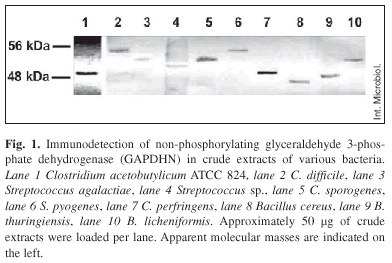
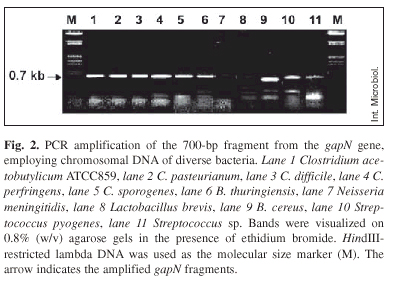
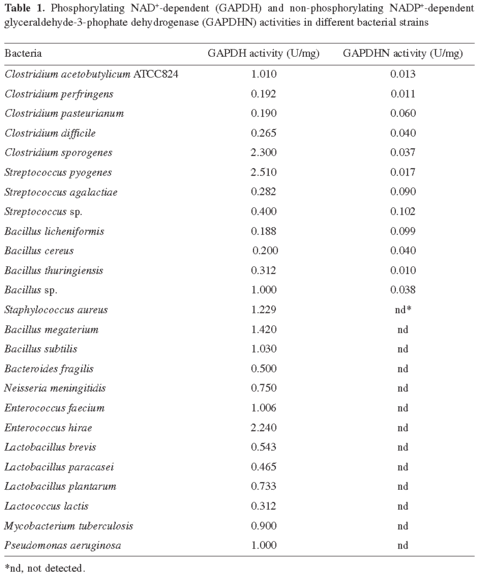
<body><![CDATA[<p> <font size="4">Results and Discussion</font>    <br>       <br>   <b>GAPDHN activity and immunoblot analyses.</b>  <a href="#t1"> Table 1</a> shows the enzymatic activities (U/mg) of phosphorylating NAD<sup>+</sup>-dependent and non-phosphorylating NADP<sup>+</sup>-dependent glyceraldehyde-3-phosphate dehydrogenase (GAPDH and GAPDHN) in the strains studied. Phosphorylating NAD<sup>+</sup>-dependent GAPDH was present universally and showed high specific activity values, in the range of 0.2-2.5 U/mg, in all bacterial strains examined. By contrast, GAPDHN activity (specific activity 0.01-0.1 U/mg) was found only in a number of gram-positive strains of the genera <i>Clostridium</i>, <i>Streptococcus</i>, and <i>Bacillus</i>. Surprisingly, despite some cases of close evolutionary linkage to those bacteria, activity was absent from <i>B. megaterium</i>, <i>B. subtilis</i>, <i>E. faecium</i>, <i>E. hirae</i>, <i>S. aureus</i>, <i>L. brevis</i>, <i>L. paracasei</i>, <i>L. plantarum</i>, <i>L. lactis</i>, <i>M. tuberculosis</i>, and the gram-negative bacteria <i>N. meningitidis</i>, <i>Ba. fragilis</i>, and <i>P. aeruginosa</i>.</p>     <p align="center"><a name="t1"><img src="/img/revistas/im/v8n4/04tabla1.gif" width="480" height="576"></a></p>     <p>    <br> <a href="#f1"> Figure 1</a> shows the immunoblot containing single-protein bands of ca. 48-54 kDa, corresponding to the GAPDHN subunits, in soluble protein extracts from the species mentioned above that have non-phosphorylating dehydrogenase activity Similar bands were detected by immunoblots and using the same antibodies in cell extracts from other bacteria, including <i>Clostridium pasteurianum</i> and <i>C. sporogenes</i> (data not shown). The observed cross-reaction suggests common epitopes between the <i>C. acetobutylicum</i> protein and the other bacterial GAPDHNs. As expected, no bands were immunodetected in cell extracts of those bacteria in which activity had not been recorded.</p>     <p align="center"><a name="f1"><img src="/img/revistas/im/v8n4/04fig1.jpg" width="392" height="263"></a></p>      <p><b>    <br> PCR and sequence analysis of bacterial gapN genes. </b>The bands resulting from separating the PCR products on agarose gel are shown in <a href="#f2"> Fig. 2</a>. After amplification of the ca. 0.7-kb single DNA fragments, these bands were excised from the gel, sequenced, and their deduced amino acid composition analyzed. All of the amino acid sequences showed good identity with that from the <i>gapN</i> fragment of <i>S. mutans</i>. In agreement with biochemical and immunochemical data, no band was amplified in the cases of <i>B. megaterium</i>, <i>B. subtilis</i>, <i>Ba. fragilis</i>, <i>S. aureus</i>, <i>N. meningitidis</i>, <i>E. faecium</i>, <i>E. hirae</i>, <i>L. brevis</i>, <i>L. paracasei</i>, <i>L. plantarum</i>, <i>L. lactis</i>, <i>M. tuberculosis</i>, and <i>P. aeruginosa</i>.</p>     <p align="center"><a name="f2"><img src="/img/revistas/im/v8n4/04fig2.jpg" width="393" height="283"></a></p>      ]]></body>
<body><![CDATA[<p>    <br> <a href="/img/revistas/im/v8n4/04fig3.pdf" target="_blank">Figure 3</a> shows the alignment between the approximately 240 amino acids corresponding to the amplified 700-bp fragments and the deduced amino acid sequences of the corresponding <i>GapN</i> fragments from higher plants (<i>P. sativum</i>, <i>N. plumbaginifolia</i>, <i>Z. mays</i>) and algae (<i>S. vacuolatus</i>). The latter were also compared with other deduced amino acid sequences of bacterial GAPDHNs in databases (<i>B. anthracis</i>, <i>B. halodurans</i>, <i>S. mutans</i>, <i>M. capricolum</i>, <i>U. urealyticum</i>).</p>      <p>As expected, the non-phosphorylating GAPDHN showed no significant identity match with phosphorylating GAPDHs. Both non-phosphorylating GAPDH and phosphorylating GAPDHs showed high specificity towards <font size="2">D</font>-glyceraldehyde-3-phosphate [13,18], which suggested that substrate specificity of the two GAPDH forms emerged by convergent evolution along independent lines [10]. Sequences of the archaeal ferredoxin-dependent GAPDHN, which requires a heavy-metal cofactor and is oxygen sensitive, were distinctly different from that of any other NADP<sup>+</sup>-dependent GAPDHN (not shown).</p>      <p>The 12 deduced partial bacterial GAPDHN sequences determined in this study were compared using the CLUSTAL X (v. 1.8) program with other published amino acid sequences of eukaryotic and prokaryotic origin. The results showed significant similarities between the various prokaryote and eukaryote sources (<a href="/img/revistas/im/v8n4/04fig3.pdf" target="_blank">Fig. 3</a>). In addition to the conserved heptapeptide Ser-Gly-Glu-Arg-Cys-Thr-Ala (residues 294-300, following pea GAPDHN numbering [10], including residues Arg-297, necessary for phosphate group binding of the substrate, and Cys-298, involved in catalytic thioester formation), other residues involved in enzyme activity are strictly conserved in all GAPDHN proteins. These are the 191-192 dipeptides Lys-Pro, and the hexapeptide Glu-Leu-Gly-Gly-Lys-Asp at position 264-269. The latter includes the active site Glu-264, involved in deacylation through activation and orientation of the attacking water molecule [22,23,24] (<a href="/img/revistas/im/v8n4/04fig3.pdf" target="_blank">Fig. 3</a>). Thus, the basic structural features of the members of the GAPDHN family have been conserved over evolution. The highly conserved Gly-249 and Gly-295 are also present in the aldehyde dehydrogenase superfamily [10], showing that GAPDHNs and ALDHs probably shared a common ancestor. Nevertheless, the number of residues in which ALDHs differ from GAPDHN in the aligned sequences provides evidence that they actually belong to different enzyme families.</p>      <p><b>Phylogenetic analysis of GAPDHN sequences.</b> The phylogenetic tree constructed using the above-described multiple sequence alignment and the distance (neighbor-joining) method [28] is shown in <a href="/img/revistas/im/v8n4/04fig4.gif" target="_blank"> Fig. 4</a>. Maximum likelihood and parsimony methods were also used, giving results (not shown) very similar to those in <a href="/img/revistas/im/v8n4/04fig4.gif" target="_blank"> Fig. 4</a>. <i>E. coli</i> GAPDH1 protein was used as out-group. The trees showed an analogous phylogenetic relationship among the GAPDHNs of the eukaryotic and prokaryotic groups. These groups are different from the archaeal ferredoxin-dependent GAPDHN, which probably diverged out first, before eukaryotic and bacterial GAPDHN separation. However, note that these results depict only the molecular phylogeny of the GAPDHN protein and do not necessarily represent phylogenetic relationships between species. A paraphyletic relationship is observed between bacterial GAPDHN sequences that appear in three clusters (Streptococcaceae, Clostridia, and Bacillaceae) together with the plant group, and a separate, early-branching group of mycoplasm sequences (<i>Ureaplasma urealyticum</i> and <i>Mycoplasma capricolum</i>). This suggests that GAPDHNs of Mycoplasmataceae separated early in evolution. Indeed, mycoplasms include some of the smallest prokaryotic genomes (600 kb, about 500 genes), and the sequences of many genes are very divergent when compared to homologous sequences of other bacteria [9]. These phylogenetic relationships may be due to horizontal gene transfers and enzyme functional substitutions, such as those described for some GAPDHs [6,8,12].</p>      <p>In this work, we demonstrated that the <i>gapN</i> gene is present in various gram-positive bacteria with a characteristic low G + C content, including Bacillaceae, Streptococcaceae, and Clostridiaceae. A possible explanation for this distribution among some gram-positive bacteria and for the absolute absence of <i>gapN</i> in gram-negative bacteria could be an early divergence in basic metabolic enzymes. Nevertheless, a wider survey of this protein among other microorganisms would provide better knowledge of its distribution and, especially, its relation with GAPDHs.</p>      <p><font size="2"><b>Acknowledgements.</b> This work was supported by AECI (Spain) and Collaborative Grants from the Andalusian Government (Consejer&iacute;a de Presidencia, Junta de Andaluc&iacute;a, Ayuda de Cooperaci&oacute;n al Desarrollo en el Ambito Universitario no. 52/02, 54/04, and PAI CVI-261 group) - Minist&eacute;re d"Education et de la Recherche Scientifique and PARS (Morocco). FV was supported by an EU Marie Curie reintegration project no. 505303.</font></p>     <p><font size="4">References</font></p>     <!-- ref --><p>1. Ajdic D, McShan WM, Savic DJ, Gerlach D, Ferretti JJ (2000) The NAD-glycohydrolase (<i>nga</i>) gene of <i>Streptococcus pyogenes</i>. FEMS Microbiol Lett 191:235-241&nbsp;&nbsp;&nbsp;&nbsp;&nbsp;&nbsp;&nbsp;&nbsp;[&#160;<a href="javascript:void(0);" onclick="javascript: window.open('/scielo.php?script=sci_nlinks&ref=2782325&pid=S1139-6709200500040000400001&lng=','','width=640,height=500,resizable=yes,scrollbars=1,menubar=yes,');">Links</a>&#160;]<!-- end-ref --><!-- ref --><p>2. Boyd DA, Cvitkovitch DG, Hamilton IR (1995) Sequence, expression, and function of the gene for the nonphosphorylating, NADP-dependent glyceraldehyde-3-phosphate dehydrogenase of <i>Streptococcus mutans</i>. J Bacteriol 177:2622-2627&nbsp;&nbsp;&nbsp;&nbsp;&nbsp;&nbsp;&nbsp;&nbsp;[&#160;<a href="javascript:void(0);" onclick="javascript: window.open('/scielo.php?script=sci_nlinks&ref=2782326&pid=S1139-6709200500040000400002&lng=','','width=640,height=500,resizable=yes,scrollbars=1,menubar=yes,');">Links</a>&#160;]<!-- end-ref --><!-- ref --><p>3. Brinkmann H, Cerff R, Salomon M, Soll J (1989) Cloning and sequence analysis of cDNAs encoding the cytosolic precursors of subunits <i>GapA</i> and <i>GapB</i> of chloroplast glyceraldehyde-3-phosphate dehydrogenase from pea and spinach. Plant Mol Biol 13:81-94&nbsp;&nbsp;&nbsp;&nbsp;&nbsp;&nbsp;&nbsp;&nbsp;[&#160;<a href="javascript:void(0);" onclick="javascript: window.open('/scielo.php?script=sci_nlinks&ref=2782327&pid=S1139-6709200500040000400003&lng=','','width=640,height=500,resizable=yes,scrollbars=1,menubar=yes,');">Links</a>&#160;]<!-- end-ref --><!-- ref --><p>4. Brown AT, Wittenberger CL (1971) Mechanism for regulating the distribution of glucose carbon between the Embden-Meyerhof and hexose-monophosphate pathways in <i>Streptococcus faecalis</i>. J Bacteriol 106:456-467&nbsp;&nbsp;&nbsp;&nbsp;&nbsp;&nbsp;&nbsp;&nbsp;[&#160;<a href="javascript:void(0);" onclick="javascript: window.open('/scielo.php?script=sci_nlinks&ref=2782328&pid=S1139-6709200500040000400004&lng=','','width=640,height=500,resizable=yes,scrollbars=1,menubar=yes,');">Links</a>&#160;]<!-- end-ref --><!-- ref --><p>5. Cerff R (1982) Separation and purification of NAD- and NADP-linked glyceraldehyde-3-phosphate dehydrogenase from higher plants. In: Edelman M, Hallick RB, Chua NH (eds) Methods in chloroplast molecular biology. Elsevier Biomedical Press, Amsterdam, Netherlands, pp 683-694&nbsp;&nbsp;&nbsp;&nbsp;&nbsp;&nbsp;&nbsp;&nbsp;[&#160;<a href="javascript:void(0);" onclick="javascript: window.open('/scielo.php?script=sci_nlinks&ref=2782329&pid=S1139-6709200500040000400005&lng=','','width=640,height=500,resizable=yes,scrollbars=1,menubar=yes,');">Links</a>&#160;]<!-- end-ref --><!-- ref --><p>6. Cerff R (1995) Origin and evolution of phosphorylating and non-phosphorylating glyceraldehyde-3-phosphate dehydrogenases. In: Mathis P (ed) Photosynthesis: From light to biosphere, Vol I. Kluwer, Dordrecht, pp 933-938&nbsp;&nbsp;&nbsp;&nbsp;&nbsp;&nbsp;&nbsp;&nbsp;[&#160;<a href="javascript:void(0);" onclick="javascript: window.open('/scielo.php?script=sci_nlinks&ref=2782330&pid=S1139-6709200500040000400006&lng=','','width=640,height=500,resizable=yes,scrollbars=1,menubar=yes,');">Links</a>&#160;]<!-- end-ref --><!-- ref --><p>7. De Man JC, Rogosa M, Sharpe MT (1960) A medium for the cultivation of <i>Lactobacilli</i>. J Appl Bacteriol 23:130-135&nbsp;&nbsp;&nbsp;&nbsp;&nbsp;&nbsp;&nbsp;&nbsp;[&#160;<a href="javascript:void(0);" onclick="javascript: window.open('/scielo.php?script=sci_nlinks&ref=2782331&pid=S1139-6709200500040000400007&lng=','','width=640,height=500,resizable=yes,scrollbars=1,menubar=yes,');">Links</a>&#160;]<!-- end-ref --><!-- ref --><p>8. Forthergill-Gilmore LA, Michels PAM (1993) Evolution of glycolisis. Prog Biophys Molec Biol 59:105-235&nbsp;&nbsp;&nbsp;&nbsp;&nbsp;&nbsp;&nbsp;&nbsp;[&#160;<a href="javascript:void(0);" onclick="javascript: window.open('/scielo.php?script=sci_nlinks&ref=2782332&pid=S1139-6709200500040000400008&lng=','','width=640,height=500,resizable=yes,scrollbars=1,menubar=yes,');">Links</a>&#160;]<!-- end-ref --><!-- ref --><p>9. Fraser CM, Gocayne JD, White O, Adams MD, Clayton RA, Fleischmann RD, Bult CJ, Kerlavage AR, Sutton G, Kelley JM, et al. (1995) The minimal gene complement of <i>Mycoplasma genitalium</i>. Science 270:397-403&nbsp;&nbsp;&nbsp;&nbsp;&nbsp;&nbsp;&nbsp;&nbsp;[&#160;<a href="javascript:void(0);" onclick="javascript: window.open('/scielo.php?script=sci_nlinks&ref=2782333&pid=S1139-6709200500040000400009&lng=','','width=640,height=500,resizable=yes,scrollbars=1,menubar=yes,');">Links</a>&#160;]<!-- end-ref --><!-- ref --><p>10. Habenicht A, Hellman U, Cerff R (1994) Non-phosphorylating GAPDH of higher plants is a member of the aldehyde dehydrogenase superfamily with no sequence homology to phosphorylating GAPDH. J Mol Biol 237:165-171&nbsp;&nbsp;&nbsp;&nbsp;&nbsp;&nbsp;&nbsp;&nbsp;[&#160;<a href="javascript:void(0);" onclick="javascript: window.open('/scielo.php?script=sci_nlinks&ref=2782334&pid=S1139-6709200500040000400010&lng=','','width=640,height=500,resizable=yes,scrollbars=1,menubar=yes,');">Links</a>&#160;]<!-- end-ref --><!-- ref --><p>11. Habenicht A (1997) The non-phosphorylating glyceraldehyde-3-phosphate dehydrogenase: biochemistry, structure, occurrence and evolution. Biol Chem 378:1413-1419&nbsp;&nbsp;&nbsp;&nbsp;&nbsp;&nbsp;&nbsp;&nbsp;[&#160;<a href="javascript:void(0);" onclick="javascript: window.open('/scielo.php?script=sci_nlinks&ref=2782335&pid=S1139-6709200500040000400011&lng=','','width=640,height=500,resizable=yes,scrollbars=1,menubar=yes,');">Links</a>&#160;]<!-- end-ref --><!-- ref --><p>12. Hafid N, Valverde F, Villalobos E, Elkebbaj M, Torres A, Soukri A, Serrano, A (1998) Glyceraldehyde-3-phosphate dehydrogenase from <i>Tetrahymena pyriformis</i>: enzyme purification and characterization of a <i>gapC</i> gene with primitive eukaryotic features. Comp Biochem Physiol 119:493-503&nbsp;&nbsp;&nbsp;&nbsp;&nbsp;&nbsp;&nbsp;&nbsp;[&#160;<a href="javascript:void(0);" onclick="javascript: window.open('/scielo.php?script=sci_nlinks&ref=2782336&pid=S1139-6709200500040000400012&lng=','','width=640,height=500,resizable=yes,scrollbars=1,menubar=yes,');">Links</a>&#160;]<!-- end-ref --><!-- ref --><p>13. Harris JI, Waters M (1976) Glyceraldehyde-3-phosphate dehydrogenase. In: Boyer PD (ed) The enzymes, Vol 13. Academic Press, New York, pp 1-49&nbsp;&nbsp;&nbsp;&nbsp;&nbsp;&nbsp;&nbsp;&nbsp;[&#160;<a href="javascript:void(0);" onclick="javascript: window.open('/scielo.php?script=sci_nlinks&ref=2782337&pid=S1139-6709200500040000400013&lng=','','width=640,height=500,resizable=yes,scrollbars=1,menubar=yes,');">Links</a>&#160;]<!-- end-ref --><!-- ref --><p>14. Iddar A, Serrano A, Soukri A (2002) A phosphate-stimulated NAD(P)+-dependent glyceraldehyde-3-phosphate dehydrogenase in <i>Bacillus cereus</i>. FEMS Microbiol Lett 211:29-35&nbsp;&nbsp;&nbsp;&nbsp;&nbsp;&nbsp;&nbsp;&nbsp;[&#160;<a href="javascript:void(0);" onclick="javascript: window.open('/scielo.php?script=sci_nlinks&ref=2782338&pid=S1139-6709200500040000400014&lng=','','width=640,height=500,resizable=yes,scrollbars=1,menubar=yes,');">Links</a>&#160;]<!-- end-ref --><!-- ref --><p>15. Iddar A, Valverde F, Serrano A, Soukri A (2002) Expression, purification and characterization of recombinant non-phosphorylating NADP-dependent glyceraldehyde-3-phosphate dehydrogenase from <i>Clostridium acetobutylicum</i>. Prot Exp Pur 25:519-526&nbsp;&nbsp;&nbsp;&nbsp;&nbsp;&nbsp;&nbsp;&nbsp;[&#160;<a href="javascript:void(0);" onclick="javascript: window.open('/scielo.php?script=sci_nlinks&ref=2782339&pid=S1139-6709200500040000400015&lng=','','width=640,height=500,resizable=yes,scrollbars=1,menubar=yes,');">Links</a>&#160;]<!-- end-ref --><!-- ref --><p>16. Iddar A, Valverde F, Serrano A, Soukri A (2003) Purification of recombinant non-phosphorylating NADP-dependent glyceraldehyde-3-phosphate dehydrogenase from <i>Streptococcus pyogenes</i> expressed in E. coli. Mol Cell Biochem 247:195-203&nbsp;&nbsp;&nbsp;&nbsp;&nbsp;&nbsp;&nbsp;&nbsp;[&#160;<a href="javascript:void(0);" onclick="javascript: window.open('/scielo.php?script=sci_nlinks&ref=2782340&pid=S1139-6709200500040000400016&lng=','','width=640,height=500,resizable=yes,scrollbars=1,menubar=yes,');">Links</a>&#160;]<!-- end-ref --><!-- ref --><p>17. Iglesias AA, Losada M (1988) Purification and kinetic and structural properties of spinach leaf NADP-dependent nonphosphorylating glyceraldehyde-3-phosphate dehydrogenase. Arch Biochem Biophys 260:830-840&nbsp;&nbsp;&nbsp;&nbsp;&nbsp;&nbsp;&nbsp;&nbsp;[&#160;<a href="javascript:void(0);" onclick="javascript: window.open('/scielo.php?script=sci_nlinks&ref=2782341&pid=S1139-6709200500040000400017&lng=','','width=640,height=500,resizable=yes,scrollbars=1,menubar=yes,');">Links</a>&#160;]<!-- end-ref --><!-- ref --><p>18. Iglesias AA, Serrano A, Guerrero MG, Losada M (1987) Purification and properties of NADP-dependent non-phosphorylating glyceraldehyde-3-phosphate dehydrogenase from the green alga <i>Chlamydomonas reinhardtii</i>. Biochim Biophys Acta 925:1-10&nbsp;&nbsp;&nbsp;&nbsp;&nbsp;&nbsp;&nbsp;&nbsp;[&#160;<a href="javascript:void(0);" onclick="javascript: window.open('/scielo.php?script=sci_nlinks&ref=2782342&pid=S1139-6709200500040000400018&lng=','','width=640,height=500,resizable=yes,scrollbars=1,menubar=yes,');">Links</a>&#160;]<!-- end-ref --><!-- ref --><p>19. Jacob JL, D"Auzac J (1972) La glyc&eacute;raldehyde-3-phosphate d&eacute;shydrog&eacute;nase du latex d"<i>Hevea brasiliensis</i>. Eur J Biochem 31:255-265 (In French)&nbsp;&nbsp;&nbsp;&nbsp;&nbsp;&nbsp;&nbsp;&nbsp;[&#160;<a href="javascript:void(0);" onclick="javascript: window.open('/scielo.php?script=sci_nlinks&ref=2782343&pid=S1139-6709200500040000400019&lng=','','width=640,height=500,resizable=yes,scrollbars=1,menubar=yes,');">Links</a>&#160;]<!-- end-ref --><!-- ref --><p>20. Kellogg DS Jr, Peacock WL, Deacon WE, Brown L, Pirkle CI (1963) <i>Neisseria gonorrhoeae</i> I. Virulence genetically linked to clonal variation. J Bacteriol 85:1274-1279&nbsp;&nbsp;&nbsp;&nbsp;&nbsp;&nbsp;&nbsp;&nbsp;[&#160;<a href="javascript:void(0);" onclick="javascript: window.open('/scielo.php?script=sci_nlinks&ref=2782344&pid=S1139-6709200500040000400020&lng=','','width=640,height=500,resizable=yes,scrollbars=1,menubar=yes,');">Links</a>&#160;]<!-- end-ref --><!-- ref --><p>21. Kelly GJ, Gibbs M (1973) Nonreversible <font size="2">D</font>-glyceraldehyde-3-phosphate dehydrogenase of plant tissues. Plant Physiol 52:111-118&nbsp;&nbsp;&nbsp;&nbsp;&nbsp;&nbsp;&nbsp;&nbsp;[&#160;<a href="javascript:void(0);" onclick="javascript: window.open('/scielo.php?script=sci_nlinks&ref=2782345&pid=S1139-6709200500040000400021&lng=','','width=640,height=500,resizable=yes,scrollbars=1,menubar=yes,');">Links</a>&#160;]<!-- end-ref --><!-- ref --><p>22. Marchal S, Branlant G (1999) Evidence for the chemical activation of essential cys-302 upon cofactor binding to nonphosphorylating glyceraldehyde-3-phosphate dehydrogenase from <i>Streptococcus mutans</i>. Biochemistry 38:12950-12958&nbsp;&nbsp;&nbsp;&nbsp;&nbsp;&nbsp;&nbsp;&nbsp;[&#160;<a href="javascript:void(0);" onclick="javascript: window.open('/scielo.php?script=sci_nlinks&ref=2782346&pid=S1139-6709200500040000400022&lng=','','width=640,height=500,resizable=yes,scrollbars=1,menubar=yes,');">Links</a>&#160;]<!-- end-ref --><!-- ref --><p>23. Marchal S, Rahuel-Clermont S, Branlant G (2000) Role of glutamate-268 in catalytic mechanism of nonphosphorylating glyceraldehyde-3-phosphate dehydrogenase from <i>Streptococcus mutans</i>. Biochemistry 39:3327-3335&nbsp;&nbsp;&nbsp;&nbsp;&nbsp;&nbsp;&nbsp;&nbsp;[&#160;<a href="javascript:void(0);" onclick="javascript: window.open('/scielo.php?script=sci_nlinks&ref=2782347&pid=S1139-6709200500040000400023&lng=','','width=640,height=500,resizable=yes,scrollbars=1,menubar=yes,');">Links</a>&#160;]<!-- end-ref --><!-- ref --><p>24. Marchal S, Cobessi D, Rahuel-Clermont S, Tete-Favier F, Aubry A, Branlant, G (2001) Chemical mechanism and substrate binding sites of NADP-dependent aldehyde dehydrogenase from <i>Streptococcus mutans</i>. Chem Biol Interact 30:15-28&nbsp;&nbsp;&nbsp;&nbsp;&nbsp;&nbsp;&nbsp;&nbsp;[&#160;<a href="javascript:void(0);" onclick="javascript: window.open('/scielo.php?script=sci_nlinks&ref=2782348&pid=S1139-6709200500040000400024&lng=','','width=640,height=500,resizable=yes,scrollbars=1,menubar=yes,');">Links</a>&#160;]<!-- end-ref --><!-- ref --><p>25. Mateos MI, Serrano A (1992) Ocurrence of phosphorylating and non-phosphorylating NADP<sup>+</sup>-dependent glyceraldehyde-3-phosphate dehydrogenases in photosynthetic organisms. Plant Sci 84:163-170&nbsp;&nbsp;&nbsp;&nbsp;&nbsp;&nbsp;&nbsp;&nbsp;[&#160;<a href="javascript:void(0);" onclick="javascript: window.open('/scielo.php?script=sci_nlinks&ref=2782349&pid=S1139-6709200500040000400025&lng=','','width=640,height=500,resizable=yes,scrollbars=1,menubar=yes,');">Links</a>&#160;]<!-- end-ref --><!-- ref --><p>26. Ogata S, Hongo M (1973) Bacterial lysis of <i>Clostridium</i> species. I. Lysis of <i>Clostridium</i> species by univalent cation. J Gen Appl Microbiol 19:251-261&nbsp;&nbsp;&nbsp;&nbsp;&nbsp;&nbsp;&nbsp;&nbsp;[&#160;<a href="javascript:void(0);" onclick="javascript: window.open('/scielo.php?script=sci_nlinks&ref=2782350&pid=S1139-6709200500040000400026&lng=','','width=640,height=500,resizable=yes,scrollbars=1,menubar=yes,');">Links</a>&#160;]<!-- end-ref --><!-- ref --><p>27. Pupillo P, Faggiani R (1979) Subunit structure of three glyceraldehyde-3-phosphate dehydrogenases of some flowering plants. Arch Biochem Biophys 194:581-592&nbsp;&nbsp;&nbsp;&nbsp;&nbsp;&nbsp;&nbsp;&nbsp;[&#160;<a href="javascript:void(0);" onclick="javascript: window.open('/scielo.php?script=sci_nlinks&ref=2782351&pid=S1139-6709200500040000400027&lng=','','width=640,height=500,resizable=yes,scrollbars=1,menubar=yes,');">Links</a>&#160;]<!-- end-ref --><!-- ref --><p>28. Saitou N, Nei M (1987) The neighbour-joining method: a new method for reconstructing phylogenetic trees. Mol Biol Evol 4:406-425&nbsp;&nbsp;&nbsp;&nbsp;&nbsp;&nbsp;&nbsp;&nbsp;[&#160;<a href="javascript:void(0);" onclick="javascript: window.open('/scielo.php?script=sci_nlinks&ref=2782352&pid=S1139-6709200500040000400028&lng=','','width=640,height=500,resizable=yes,scrollbars=1,menubar=yes,');">Links</a>&#160;]<!-- end-ref --><!-- ref --><p>29. Sambrook J, Fritsch EF, Maniatis T (1989) Molecular cloning, A laboratory manual. Cold Spring Harbor Laboratory Press, New York&nbsp;&nbsp;&nbsp;&nbsp;&nbsp;&nbsp;&nbsp;&nbsp;[&#160;<a href="javascript:void(0);" onclick="javascript: window.open('/scielo.php?script=sci_nlinks&ref=2782353&pid=S1139-6709200500040000400029&lng=','','width=640,height=500,resizable=yes,scrollbars=1,menubar=yes,');">Links</a>&#160;]<!-- end-ref --><!-- ref --><p>30. Serrano A, Mateos MI, Losada M (1993) ATP-driven transhydrogenation and ionization of water in a reconstituted glyceraldehyde-3-phosphate dehydrogenases (phosphorylating and non-phosphorylating) model system. Biochem Biophys Res Comm 193:1348-1356&nbsp;&nbsp;&nbsp;&nbsp;&nbsp;&nbsp;&nbsp;&nbsp;[&#160;<a href="javascript:void(0);" onclick="javascript: window.open('/scielo.php?script=sci_nlinks&ref=2782354&pid=S1139-6709200500040000400030&lng=','','width=640,height=500,resizable=yes,scrollbars=1,menubar=yes,');">Links</a>&#160;]<!-- end-ref --><!-- ref --><p>31. Strimmer K, von Haeseler A (1996) Quarter puzzling: a quarter maximum likelihood method for reconstructing tree topologies. Mol Biol Evol 13:964-969&nbsp;&nbsp;&nbsp;&nbsp;&nbsp;&nbsp;&nbsp;&nbsp;[&#160;<a href="javascript:void(0);" onclick="javascript: window.open('/scielo.php?script=sci_nlinks&ref=2782355&pid=S1139-6709200500040000400031&lng=','','width=640,height=500,resizable=yes,scrollbars=1,menubar=yes,');">Links</a>&#160;]<!-- end-ref --><!-- ref --><p>32. Thompson JD, Gibson TJ, Plewniak F, Jeanmougin F, Higgins DG (1997) The CLUSTALX Windows interface: flexible strategies for multiple sequence aided by quality analysis tools. Nucleic Acids Res 25:4876-4882&nbsp;&nbsp;&nbsp;&nbsp;&nbsp;&nbsp;&nbsp;&nbsp;[&#160;<a href="javascript:void(0);" onclick="javascript: window.open('/scielo.php?script=sci_nlinks&ref=2782356&pid=S1139-6709200500040000400032&lng=','','width=640,height=500,resizable=yes,scrollbars=1,menubar=yes,');">Links</a>&#160;]<!-- end-ref --><!-- ref --><p>33. Valverde F, Losada M, Serrano A (1997) Functional complementation of an <i>Escherichia coli gap</i> mutant supports an amphibolic role for NAD(P)-dependent glyceraldehyde-3-phosphate dehydrogenase of <i>Synechocystis</i> sp. strain PCC 6803. J Bacteriol 179:4513-4522&nbsp;&nbsp;&nbsp;&nbsp;&nbsp;&nbsp;&nbsp;&nbsp;[&#160;<a href="javascript:void(0);" onclick="javascript: window.open('/scielo.php?script=sci_nlinks&ref=2782357&pid=S1139-6709200500040000400033&lng=','','width=640,height=500,resizable=yes,scrollbars=1,menubar=yes,');">Links</a>&#160;]<!-- end-ref --><!-- ref --><p>34. Valverde F, Losada M, Serrano A (1999) Engineering a central metabolic pathway: glycolysis with no net phosphorylation in an <i>Escherichia coli gap</i> mutant complemented with a plant <i>GapN</i> gene. FEBS Lett 449:153-158&nbsp;&nbsp;&nbsp;&nbsp;&nbsp;&nbsp;&nbsp;&nbsp;[&#160;<a href="javascript:void(0);" onclick="javascript: window.open('/scielo.php?script=sci_nlinks&ref=2782358&pid=S1139-6709200500040000400034&lng=','','width=640,height=500,resizable=yes,scrollbars=1,menubar=yes,');">Links</a>&#160;]<!-- end-ref --> ]]></body><back>
<ref-list>
<ref id="B1">
<label>1</label><nlm-citation citation-type="journal">
<person-group person-group-type="author">
<name>
<surname><![CDATA[Ajdic]]></surname>
<given-names><![CDATA[D]]></given-names>
</name>
<name>
<surname><![CDATA[McShan]]></surname>
<given-names><![CDATA[WM]]></given-names>
</name>
<name>
<surname><![CDATA[Savic]]></surname>
<given-names><![CDATA[DJ]]></given-names>
</name>
<name>
<surname><![CDATA[Gerlach]]></surname>
<given-names><![CDATA[D]]></given-names>
</name>
<name>
<surname><![CDATA[Ferretti]]></surname>
<given-names><![CDATA[JJ]]></given-names>
</name>
</person-group>
<article-title xml:lang="en"><![CDATA[The NAD-glycohydrolase (nga) gene of Streptococcus pyogenes]]></article-title>
<source><![CDATA[FEMS Microbiol Lett]]></source>
<year>2000</year>
<volume>191</volume>
<page-range>235-241</page-range></nlm-citation>
</ref>
<ref id="B2">
<label>2</label><nlm-citation citation-type="journal">
<person-group person-group-type="author">
<name>
<surname><![CDATA[Boyd]]></surname>
<given-names><![CDATA[DA]]></given-names>
</name>
<name>
<surname><![CDATA[Cvitkovitch]]></surname>
<given-names><![CDATA[DG]]></given-names>
</name>
<name>
<surname><![CDATA[Hamilton]]></surname>
<given-names><![CDATA[IR]]></given-names>
</name>
</person-group>
<article-title xml:lang="en"><![CDATA[Sequence, expression, and function of the gene for the nonphosphorylating, NADP-dependent glyceraldehyde-3-phosphate dehydrogenase of Streptococcus mutans]]></article-title>
<source><![CDATA[J Bacteriol]]></source>
<year>1995</year>
<volume>177</volume>
<page-range>2622-2627</page-range></nlm-citation>
</ref>
<ref id="B3">
<label>3</label><nlm-citation citation-type="journal">
<person-group person-group-type="author">
<name>
<surname><![CDATA[Brinkmann]]></surname>
<given-names><![CDATA[H]]></given-names>
</name>
<name>
<surname><![CDATA[Cerff]]></surname>
<given-names><![CDATA[R]]></given-names>
</name>
<name>
<surname><![CDATA[Salomon]]></surname>
<given-names><![CDATA[M]]></given-names>
</name>
<name>
<surname><![CDATA[Soll]]></surname>
<given-names><![CDATA[J]]></given-names>
</name>
</person-group>
<article-title xml:lang="en"><![CDATA[Cloning and sequence analysis of cDNAs encoding the cytosolic precursors of subunits GapA and GapB of chloroplast glyceraldehyde-3-phosphate dehydrogenase from pea and spinach]]></article-title>
<source><![CDATA[Plant Mol Biol]]></source>
<year>1989</year>
<volume>13</volume>
<page-range>81-94</page-range></nlm-citation>
</ref>
<ref id="B4">
<label>4</label><nlm-citation citation-type="journal">
<person-group person-group-type="author">
<name>
<surname><![CDATA[Brown]]></surname>
<given-names><![CDATA[AT]]></given-names>
</name>
<name>
<surname><![CDATA[Wittenberger]]></surname>
<given-names><![CDATA[CL]]></given-names>
</name>
</person-group>
<article-title xml:lang="en"><![CDATA[Mechanism for regulating the distribution of glucose carbon between the Embden-Meyerhof and hexose-monophosphate pathways in Streptococcus faecalis]]></article-title>
<source><![CDATA[J Bacteriol]]></source>
<year>1971</year>
<volume>106</volume>
<page-range>456-467</page-range></nlm-citation>
</ref>
<ref id="B5">
<label>5</label><nlm-citation citation-type="book">
<person-group person-group-type="author">
<name>
<surname><![CDATA[Cerff]]></surname>
<given-names><![CDATA[R]]></given-names>
</name>
</person-group>
<article-title xml:lang="en"><![CDATA[Separation and purification of NAD- and NADP-linked glyceraldehyde-3-phosphate dehydrogenase from higher plants]]></article-title>
<person-group person-group-type="editor">
<name>
<surname><![CDATA[Edelman]]></surname>
<given-names><![CDATA[M]]></given-names>
</name>
<name>
<surname><![CDATA[Hallick]]></surname>
<given-names><![CDATA[RB]]></given-names>
</name>
<name>
<surname><![CDATA[Chua]]></surname>
<given-names><![CDATA[NH]]></given-names>
</name>
</person-group>
<source><![CDATA[Methods in chloroplast molecular biology]]></source>
<year>1982</year>
<page-range>683-694</page-range><publisher-loc><![CDATA[Amsterdam ]]></publisher-loc>
<publisher-name><![CDATA[Elsevier Biomedical Press]]></publisher-name>
</nlm-citation>
</ref>
<ref id="B6">
<label>6</label><nlm-citation citation-type="book">
<person-group person-group-type="author">
<name>
<surname><![CDATA[Cerff]]></surname>
<given-names><![CDATA[R]]></given-names>
</name>
</person-group>
<article-title xml:lang="en"><![CDATA[Origin and evolution of phosphorylating and non-phosphorylating glyceraldehyde-3-phosphate dehydrogenases]]></article-title>
<person-group person-group-type="editor">
<name>
<surname><![CDATA[Mathis]]></surname>
<given-names><![CDATA[P]]></given-names>
</name>
</person-group>
<source><![CDATA[Photosynthesis: From light to biosphere]]></source>
<year>1995</year>
<volume>I</volume>
<page-range>933-938</page-range><publisher-loc><![CDATA[Dordrecht ]]></publisher-loc>
<publisher-name><![CDATA[Kluwer]]></publisher-name>
</nlm-citation>
</ref>
<ref id="B7">
<label>7</label><nlm-citation citation-type="journal">
<person-group person-group-type="author">
<name>
<surname><![CDATA[De Man]]></surname>
<given-names><![CDATA[JC]]></given-names>
</name>
<name>
<surname><![CDATA[Rogosa]]></surname>
<given-names><![CDATA[M]]></given-names>
</name>
<name>
<surname><![CDATA[Sharpe]]></surname>
<given-names><![CDATA[MT]]></given-names>
</name>
</person-group>
<article-title xml:lang="en"><![CDATA[A medium for the cultivation of Lactobacilli]]></article-title>
<source><![CDATA[J Appl Bacteriol]]></source>
<year>1960</year>
<volume>23</volume>
<page-range>130-135</page-range></nlm-citation>
</ref>
<ref id="B8">
<label>8</label><nlm-citation citation-type="journal">
<person-group person-group-type="author">
<name>
<surname><![CDATA[Forthergill-Gilmore]]></surname>
<given-names><![CDATA[LA]]></given-names>
</name>
<name>
<surname><![CDATA[Michels]]></surname>
<given-names><![CDATA[PAM]]></given-names>
</name>
</person-group>
<article-title xml:lang="en"><![CDATA[Evolution of glycolisis]]></article-title>
<source><![CDATA[Prog Biophys Molec Biol]]></source>
<year>1993</year>
<volume>59</volume>
<page-range>105-235</page-range></nlm-citation>
</ref>
<ref id="B9">
<label>9</label><nlm-citation citation-type="journal">
<person-group person-group-type="author">
<name>
<surname><![CDATA[Fraser]]></surname>
<given-names><![CDATA[CM]]></given-names>
</name>
<name>
<surname><![CDATA[Gocayne]]></surname>
<given-names><![CDATA[JD]]></given-names>
</name>
<name>
<surname><![CDATA[White]]></surname>
<given-names><![CDATA[O]]></given-names>
</name>
<name>
<surname><![CDATA[Adams]]></surname>
<given-names><![CDATA[MD]]></given-names>
</name>
<name>
<surname><![CDATA[Clayton]]></surname>
<given-names><![CDATA[RA]]></given-names>
</name>
<name>
<surname><![CDATA[Fleischmann]]></surname>
<given-names><![CDATA[RD]]></given-names>
</name>
<name>
<surname><![CDATA[Bult]]></surname>
<given-names><![CDATA[CJ]]></given-names>
</name>
<name>
<surname><![CDATA[Kerlavage]]></surname>
<given-names><![CDATA[AR]]></given-names>
</name>
<name>
<surname><![CDATA[Sutton]]></surname>
<given-names><![CDATA[G]]></given-names>
</name>
<name>
<surname><![CDATA[Kelley]]></surname>
<given-names><![CDATA[JM]]></given-names>
</name>
</person-group>
<article-title xml:lang="en"><![CDATA[The minimal gene complement of Mycoplasma genitalium]]></article-title>
<source><![CDATA[Science]]></source>
<year>1995</year>
<volume>270</volume>
<page-range>397-403</page-range></nlm-citation>
</ref>
<ref id="B10">
<label>10</label><nlm-citation citation-type="journal">
<person-group person-group-type="author">
<name>
<surname><![CDATA[Habenicht]]></surname>
<given-names><![CDATA[A]]></given-names>
</name>
<name>
<surname><![CDATA[Hellman]]></surname>
<given-names><![CDATA[U]]></given-names>
</name>
<name>
<surname><![CDATA[Cerff]]></surname>
<given-names><![CDATA[R]]></given-names>
</name>
</person-group>
<article-title xml:lang="en"><![CDATA[Non-phosphorylating GAPDH of higher plants is a member of the aldehyde dehydrogenase superfamily with no sequence homology to phosphorylating GAPDH]]></article-title>
<source><![CDATA[J Mol Biol]]></source>
<year>1994</year>
<volume>237</volume>
<page-range>165-171</page-range></nlm-citation>
</ref>
<ref id="B11">
<label>11</label><nlm-citation citation-type="journal">
<person-group person-group-type="author">
<name>
<surname><![CDATA[Habenicht]]></surname>
<given-names><![CDATA[A]]></given-names>
</name>
</person-group>
<article-title xml:lang="en"><![CDATA[The non-phosphorylating glyceraldehyde-3-phosphate dehydrogenase: biochemistry, structure, occurrence and evolution]]></article-title>
<source><![CDATA[Biol Chem]]></source>
<year>1997</year>
<volume>378</volume>
<page-range>1413-1419</page-range></nlm-citation>
</ref>
<ref id="B12">
<label>12</label><nlm-citation citation-type="journal">
<person-group person-group-type="author">
<name>
<surname><![CDATA[Hafid]]></surname>
<given-names><![CDATA[N]]></given-names>
</name>
<name>
<surname><![CDATA[Valverde]]></surname>
<given-names><![CDATA[F]]></given-names>
</name>
<name>
<surname><![CDATA[Villalobos]]></surname>
<given-names><![CDATA[E]]></given-names>
</name>
<name>
<surname><![CDATA[Elkebbaj]]></surname>
<given-names><![CDATA[M]]></given-names>
</name>
<name>
<surname><![CDATA[Torres]]></surname>
<given-names><![CDATA[A]]></given-names>
</name>
<name>
<surname><![CDATA[Soukri]]></surname>
<given-names><![CDATA[A]]></given-names>
</name>
<name>
<surname><![CDATA[Serrano]]></surname>
<given-names><![CDATA[A]]></given-names>
</name>
</person-group>
<article-title xml:lang="en"><![CDATA[Glyceraldehyde-3-phosphate dehydrogenase from Tetrahymena pyriformis: enzyme purification and characterization of a gapC gene with primitive eukaryotic features]]></article-title>
<source><![CDATA[Comp Biochem Physiol]]></source>
<year>1998</year>
<volume>119</volume>
<page-range>493-503</page-range></nlm-citation>
</ref>
<ref id="B13">
<label>13</label><nlm-citation citation-type="book">
<person-group person-group-type="author">
<name>
<surname><![CDATA[Harris]]></surname>
<given-names><![CDATA[JI]]></given-names>
</name>
<name>
<surname><![CDATA[Waters]]></surname>
<given-names><![CDATA[M]]></given-names>
</name>
</person-group>
<article-title xml:lang="en"><![CDATA[Glyceraldehyde-3-phosphate dehydrogenase]]></article-title>
<person-group person-group-type="editor">
<name>
<surname><![CDATA[Boyer]]></surname>
<given-names><![CDATA[PD]]></given-names>
</name>
</person-group>
<source><![CDATA[The enzymes, Vol 13]]></source>
<year>1976</year>
<page-range>1-49</page-range><publisher-loc><![CDATA[New York ]]></publisher-loc>
<publisher-name><![CDATA[Academic Press]]></publisher-name>
</nlm-citation>
</ref>
<ref id="B14">
<label>14</label><nlm-citation citation-type="journal">
<person-group person-group-type="author">
<name>
<surname><![CDATA[Iddar]]></surname>
<given-names><![CDATA[A]]></given-names>
</name>
<name>
<surname><![CDATA[Serrano]]></surname>
<given-names><![CDATA[A]]></given-names>
</name>
<name>
<surname><![CDATA[Soukri]]></surname>
<given-names><![CDATA[A]]></given-names>
</name>
</person-group>
<article-title xml:lang="en"><![CDATA[A phosphate-stimulated NAD(P)+-dependent glyceraldehyde-3-phosphate dehydrogenase in Bacillus cereus]]></article-title>
<source><![CDATA[FEMS Microbiol Lett]]></source>
<year>2002</year>
<volume>211</volume>
<page-range>29-35</page-range></nlm-citation>
</ref>
<ref id="B15">
<label>15</label><nlm-citation citation-type="journal">
<person-group person-group-type="author">
<name>
<surname><![CDATA[Iddar]]></surname>
<given-names><![CDATA[A]]></given-names>
</name>
<name>
<surname><![CDATA[Valverde]]></surname>
<given-names><![CDATA[F]]></given-names>
</name>
<name>
<surname><![CDATA[Serrano]]></surname>
<given-names><![CDATA[A]]></given-names>
</name>
<name>
<surname><![CDATA[Soukri]]></surname>
<given-names><![CDATA[A]]></given-names>
</name>
</person-group>
<article-title xml:lang="en"><![CDATA[Expression, purification and characterization of recombinant non-phosphorylating NADP-dependent glyceraldehyde-3-phosphate dehydrogenase from Clostridium acetobutylicum]]></article-title>
<source><![CDATA[Prot Exp Pur]]></source>
<year>2002</year>
<volume>25</volume>
<page-range>519-526</page-range></nlm-citation>
</ref>
<ref id="B16">
<label>16</label><nlm-citation citation-type="journal">
<person-group person-group-type="author">
<name>
<surname><![CDATA[Iddar]]></surname>
<given-names><![CDATA[A]]></given-names>
</name>
<name>
<surname><![CDATA[Valverde]]></surname>
<given-names><![CDATA[F]]></given-names>
</name>
<name>
<surname><![CDATA[Serrano]]></surname>
<given-names><![CDATA[A]]></given-names>
</name>
<name>
<surname><![CDATA[Soukri]]></surname>
<given-names><![CDATA[A]]></given-names>
</name>
</person-group>
<article-title xml:lang="en"><![CDATA[Purification of recombinant non-phosphorylating NADP-dependent glyceraldehyde-3-phosphate dehydrogenase from Streptococcus pyogenes expressed in E. coli]]></article-title>
<source><![CDATA[Mol Cell Biochem]]></source>
<year>2003</year>
<volume>247</volume>
<page-range>195-203</page-range></nlm-citation>
</ref>
<ref id="B17">
<label>17</label><nlm-citation citation-type="journal">
<person-group person-group-type="author">
<name>
<surname><![CDATA[Iglesias]]></surname>
<given-names><![CDATA[AA]]></given-names>
</name>
<name>
<surname><![CDATA[Losada]]></surname>
<given-names><![CDATA[M]]></given-names>
</name>
</person-group>
<article-title xml:lang="en"><![CDATA[Purification and kinetic and structural properties of spinach leaf NADP-dependent nonphosphorylating glyceraldehyde-3-phosphate dehydrogenase]]></article-title>
<source><![CDATA[Arch Biochem Biophys]]></source>
<year>1988</year>
<volume>260</volume>
<page-range>830-840</page-range></nlm-citation>
</ref>
<ref id="B18">
<label>18</label><nlm-citation citation-type="journal">
<person-group person-group-type="author">
<name>
<surname><![CDATA[Iglesias]]></surname>
<given-names><![CDATA[AA]]></given-names>
</name>
<name>
<surname><![CDATA[Serrano]]></surname>
<given-names><![CDATA[A]]></given-names>
</name>
<name>
<surname><![CDATA[Guerrero]]></surname>
<given-names><![CDATA[MG]]></given-names>
</name>
<name>
<surname><![CDATA[Losada]]></surname>
<given-names><![CDATA[M]]></given-names>
</name>
</person-group>
<article-title xml:lang="en"><![CDATA[Purification and properties of NADP-dependent non-phosphorylating glyceraldehyde-3-phosphate dehydrogenase from the green alga Chlamydomonas reinhardtii]]></article-title>
<source><![CDATA[Biochim Biophys Acta]]></source>
<year>1987</year>
<volume>925</volume>
<page-range>1-10</page-range></nlm-citation>
</ref>
<ref id="B19">
<label>19</label><nlm-citation citation-type="journal">
<person-group person-group-type="author">
<name>
<surname><![CDATA[Jacob]]></surname>
<given-names><![CDATA[JL]]></given-names>
</name>
<name>
<surname><![CDATA[D"Auzac]]></surname>
<given-names><![CDATA[J]]></given-names>
</name>
</person-group>
<article-title xml:lang="fr"><![CDATA[La glycéraldehyde-3-phosphate déshydrogénase du latex d"Hevea brasiliensis]]></article-title>
<source><![CDATA[Eur J Biochem]]></source>
<year>1972</year>
<volume>31</volume>
<page-range>255-265</page-range></nlm-citation>
</ref>
<ref id="B20">
<label>20</label><nlm-citation citation-type="journal">
<person-group person-group-type="author">
<name>
<surname><![CDATA[Kellogg]]></surname>
<given-names><![CDATA[DS Jr]]></given-names>
</name>
<name>
<surname><![CDATA[Peacock]]></surname>
<given-names><![CDATA[WL]]></given-names>
</name>
<name>
<surname><![CDATA[Deacon]]></surname>
<given-names><![CDATA[WE]]></given-names>
</name>
<name>
<surname><![CDATA[Brown]]></surname>
<given-names><![CDATA[L]]></given-names>
</name>
<name>
<surname><![CDATA[Pirkle]]></surname>
<given-names><![CDATA[CI]]></given-names>
</name>
</person-group>
<article-title xml:lang="en"><![CDATA[Neisseria gonorrhoeae I: Virulence genetically linked to clonal variation]]></article-title>
<source><![CDATA[J Bacteriol]]></source>
<year>1963</year>
<volume>85</volume>
<page-range>1274-1279</page-range></nlm-citation>
</ref>
<ref id="B21">
<label>21</label><nlm-citation citation-type="journal">
<person-group person-group-type="author">
<name>
<surname><![CDATA[Kelly]]></surname>
<given-names><![CDATA[GJ]]></given-names>
</name>
<name>
<surname><![CDATA[Gibbs]]></surname>
<given-names><![CDATA[M]]></given-names>
</name>
</person-group>
<article-title xml:lang="en"><![CDATA[Nonreversible D-glyceraldehyde-3-phosphate dehydrogenase of plant tissues]]></article-title>
<source><![CDATA[Plant Physiol]]></source>
<year>1973</year>
<volume>52</volume>
<page-range>111-118</page-range></nlm-citation>
</ref>
<ref id="B22">
<label>22</label><nlm-citation citation-type="journal">
<person-group person-group-type="author">
<name>
<surname><![CDATA[Marchal]]></surname>
<given-names><![CDATA[S]]></given-names>
</name>
<name>
<surname><![CDATA[Branlant]]></surname>
<given-names><![CDATA[G]]></given-names>
</name>
</person-group>
<article-title xml:lang="en"><![CDATA[Evidence for the chemical activation of essential cys-302 upon cofactor binding to nonphosphorylating glyceraldehyde-3-phosphate dehydrogenase from Streptococcus mutans]]></article-title>
<source><![CDATA[Biochemistry]]></source>
<year>1999</year>
<volume>38</volume>
<page-range>12950-12958</page-range></nlm-citation>
</ref>
<ref id="B23">
<label>23</label><nlm-citation citation-type="journal">
<person-group person-group-type="author">
<name>
<surname><![CDATA[Marchal]]></surname>
<given-names><![CDATA[S]]></given-names>
</name>
<name>
<surname><![CDATA[Rahuel-Clermont]]></surname>
<given-names><![CDATA[S]]></given-names>
</name>
<name>
<surname><![CDATA[Branlant]]></surname>
<given-names><![CDATA[G]]></given-names>
</name>
</person-group>
<article-title xml:lang="en"><![CDATA[Role of glutamate-268 in catalytic mechanism of nonphosphorylating glyceraldehyde-3-phosphate dehydrogenase from Streptococcus mutans]]></article-title>
<source><![CDATA[Biochemistry]]></source>
<year>2000</year>
<volume>39</volume>
<page-range>3327-3335</page-range></nlm-citation>
</ref>
<ref id="B24">
<label>24</label><nlm-citation citation-type="journal">
<person-group person-group-type="author">
<name>
<surname><![CDATA[Marchal]]></surname>
<given-names><![CDATA[S]]></given-names>
</name>
<name>
<surname><![CDATA[Cobessi]]></surname>
<given-names><![CDATA[D]]></given-names>
</name>
<name>
<surname><![CDATA[Rahuel-Clermont]]></surname>
<given-names><![CDATA[S]]></given-names>
</name>
<name>
<surname><![CDATA[Tete-Favier]]></surname>
<given-names><![CDATA[F]]></given-names>
</name>
<name>
<surname><![CDATA[Aubry]]></surname>
<given-names><![CDATA[A]]></given-names>
</name>
<name>
<surname><![CDATA[Branlant]]></surname>
<given-names><![CDATA[G]]></given-names>
</name>
</person-group>
<article-title xml:lang="en"><![CDATA[Chemical mechanism and substrate binding sites of NADP-dependent aldehyde dehydrogenase from Streptococcus mutans]]></article-title>
<source><![CDATA[Chem Biol Interact]]></source>
<year>2001</year>
<volume>30</volume>
<page-range>15-28</page-range></nlm-citation>
</ref>
<ref id="B25">
<label>25</label><nlm-citation citation-type="journal">
<person-group person-group-type="author">
<name>
<surname><![CDATA[Mateos]]></surname>
<given-names><![CDATA[MI]]></given-names>
</name>
<name>
<surname><![CDATA[Serrano]]></surname>
<given-names><![CDATA[A]]></given-names>
</name>
</person-group>
<article-title xml:lang="en"><![CDATA[Ocurrence of phosphorylating and non-phosphorylating NADP+-dependent glyceraldehyde-3-phosphate dehydrogenases in photosynthetic organisms]]></article-title>
<source><![CDATA[Plant Sci]]></source>
<year>1992</year>
<volume>84</volume>
<page-range>163-170</page-range></nlm-citation>
</ref>
<ref id="B26">
<label>26</label><nlm-citation citation-type="journal">
<person-group person-group-type="author">
<name>
<surname><![CDATA[Ogata]]></surname>
<given-names><![CDATA[S]]></given-names>
</name>
<name>
<surname><![CDATA[Hongo]]></surname>
<given-names><![CDATA[M]]></given-names>
</name>
</person-group>
<article-title xml:lang="en"><![CDATA[Bacterial lysis of Clostridium species: I. Lysis of Clostridium species by univalent cation]]></article-title>
<source><![CDATA[J Gen Appl Microbiol]]></source>
<year>1973</year>
<volume>19</volume>
<page-range>251-261</page-range></nlm-citation>
</ref>
<ref id="B27">
<label>27</label><nlm-citation citation-type="journal">
<person-group person-group-type="author">
<name>
<surname><![CDATA[Pupillo]]></surname>
<given-names><![CDATA[P]]></given-names>
</name>
<name>
<surname><![CDATA[Faggiani]]></surname>
<given-names><![CDATA[R]]></given-names>
</name>
</person-group>
<article-title xml:lang="en"><![CDATA[Subunit structure of three glyceraldehyde-3-phosphate dehydrogenases of some flowering plants]]></article-title>
<source><![CDATA[Arch Biochem Biophys]]></source>
<year>1979</year>
<volume>194</volume>
<page-range>581-592</page-range></nlm-citation>
</ref>
<ref id="B28">
<label>28</label><nlm-citation citation-type="journal">
<person-group person-group-type="author">
<name>
<surname><![CDATA[Saitou]]></surname>
<given-names><![CDATA[N]]></given-names>
</name>
<name>
<surname><![CDATA[Nei]]></surname>
<given-names><![CDATA[M]]></given-names>
</name>
</person-group>
<article-title xml:lang="en"><![CDATA[The neighbour-joining method: a new method for reconstructing phylogenetic trees]]></article-title>
<source><![CDATA[Mol Biol Evol]]></source>
<year>1987</year>
<volume>4</volume>
<page-range>406-425</page-range></nlm-citation>
</ref>
<ref id="B29">
<label>29</label><nlm-citation citation-type="book">
<person-group person-group-type="author">
<name>
<surname><![CDATA[Sambrook]]></surname>
<given-names><![CDATA[J]]></given-names>
</name>
<name>
<surname><![CDATA[Fritsch]]></surname>
<given-names><![CDATA[EF]]></given-names>
</name>
<name>
<surname><![CDATA[Maniatis]]></surname>
<given-names><![CDATA[T]]></given-names>
</name>
</person-group>
<source><![CDATA[Molecular cloning: A laboratory manual]]></source>
<year>1989</year>
<publisher-loc><![CDATA[New York ]]></publisher-loc>
<publisher-name><![CDATA[Cold Spring Harbor Laboratory Press]]></publisher-name>
</nlm-citation>
</ref>
<ref id="B30">
<label>30</label><nlm-citation citation-type="journal">
<person-group person-group-type="author">
<name>
<surname><![CDATA[Serrano]]></surname>
<given-names><![CDATA[A]]></given-names>
</name>
<name>
<surname><![CDATA[Mateos]]></surname>
<given-names><![CDATA[MI]]></given-names>
</name>
<name>
<surname><![CDATA[Losada]]></surname>
<given-names><![CDATA[M]]></given-names>
</name>
</person-group>
<article-title xml:lang="en"><![CDATA[ATP-driven transhydrogenation and ionization of water in a reconstituted glyceraldehyde-3-phosphate dehydrogenases (phosphorylating and non-phosphorylating) model system]]></article-title>
<source><![CDATA[Biochem Biophys Res Comm]]></source>
<year>1993</year>
<volume>193</volume>
<page-range>1348-1356</page-range></nlm-citation>
</ref>
<ref id="B31">
<label>31</label><nlm-citation citation-type="journal">
<person-group person-group-type="author">
<name>
<surname><![CDATA[Strimmer]]></surname>
<given-names><![CDATA[K]]></given-names>
</name>
<name>
<surname><![CDATA[von Haeseler]]></surname>
<given-names><![CDATA[A]]></given-names>
</name>
</person-group>
<article-title xml:lang="en"><![CDATA[Quarter puzzling: a quarter maximum likelihood method for reconstructing tree topologies]]></article-title>
<source><![CDATA[Mol Biol Evol]]></source>
<year>1996</year>
<volume>13</volume>
<page-range>964-969</page-range></nlm-citation>
</ref>
<ref id="B32">
<label>32</label><nlm-citation citation-type="journal">
<person-group person-group-type="author">
<name>
<surname><![CDATA[Thompson]]></surname>
<given-names><![CDATA[JD]]></given-names>
</name>
<name>
<surname><![CDATA[Gibson]]></surname>
<given-names><![CDATA[TJ]]></given-names>
</name>
<name>
<surname><![CDATA[Plewniak]]></surname>
<given-names><![CDATA[F]]></given-names>
</name>
<name>
<surname><![CDATA[Jeanmougin]]></surname>
<given-names><![CDATA[F]]></given-names>
</name>
<name>
<surname><![CDATA[Higgins]]></surname>
<given-names><![CDATA[DG]]></given-names>
</name>
</person-group>
<article-title xml:lang="en"><![CDATA[The CLUSTALX Windows interface: flexible strategies for multiple sequence aided by quality analysis tools]]></article-title>
<source><![CDATA[Nucleic Acids Res]]></source>
<year>1997</year>
<volume>25</volume>
<page-range>4876-4882</page-range></nlm-citation>
</ref>
<ref id="B33">
<label>33</label><nlm-citation citation-type="journal">
<person-group person-group-type="author">
<name>
<surname><![CDATA[Valverde]]></surname>
<given-names><![CDATA[F]]></given-names>
</name>
<name>
<surname><![CDATA[Losada]]></surname>
<given-names><![CDATA[M]]></given-names>
</name>
<name>
<surname><![CDATA[Serrano]]></surname>
<given-names><![CDATA[A]]></given-names>
</name>
</person-group>
<article-title xml:lang="en"><![CDATA[Functional complementation of an Escherichia coli gap mutant supports an amphibolic role for NAD(P)-dependent glyceraldehyde-3-phosphate dehydrogenase of Synechocystis sp. strain PCC 6803]]></article-title>
<source><![CDATA[J Bacteriol]]></source>
<year>1997</year>
<volume>179</volume>
<page-range>4513-4522</page-range></nlm-citation>
</ref>
<ref id="B34">
<label>34</label><nlm-citation citation-type="journal">
<person-group person-group-type="author">
<name>
<surname><![CDATA[Valverde]]></surname>
<given-names><![CDATA[F]]></given-names>
</name>
<name>
<surname><![CDATA[Losada]]></surname>
<given-names><![CDATA[M]]></given-names>
</name>
<name>
<surname><![CDATA[Serrano]]></surname>
<given-names><![CDATA[A]]></given-names>
</name>
</person-group>
<article-title xml:lang="en"><![CDATA[Engineering a central metabolic pathway: glycolysis with no net phosphorylation in an Escherichia coli gap mutant complemented with a plant GapN gene]]></article-title>
<source><![CDATA[FEBS Lett]]></source>
<year>1999</year>
<volume>449</volume>
<page-range>153-158</page-range></nlm-citation>
</ref>
</ref-list>
</back>
</article>