<?xml version="1.0" encoding="ISO-8859-1"?><article xmlns:mml="http://www.w3.org/1998/Math/MathML" xmlns:xlink="http://www.w3.org/1999/xlink" xmlns:xsi="http://www.w3.org/2001/XMLSchema-instance">
<front>
<journal-meta>
<journal-id>1139-6709</journal-id>
<journal-title><![CDATA[International Microbiology]]></journal-title>
<abbrev-journal-title><![CDATA[INT. MICROBIOL.]]></abbrev-journal-title>
<issn>1139-6709</issn>
<publisher>
<publisher-name><![CDATA[Sociedad Española de Microbiología]]></publisher-name>
</publisher>
</journal-meta>
<article-meta>
<article-id>S1139-67092006000100001</article-id>
<title-group>
<article-title xml:lang="en"><![CDATA[The era of microbiology: a Golden Phoenix]]></article-title>
<article-title xml:lang="es"><![CDATA[La era de la microbiología: un Fénix de oro]]></article-title>
<article-title xml:lang="pt"><![CDATA[A era da microbiologia: uma Fênix de ouro]]></article-title>
</title-group>
<contrib-group>
<contrib contrib-type="author">
<name>
<surname><![CDATA[Maloy]]></surname>
<given-names><![CDATA[Stanley]]></given-names>
</name>
<xref ref-type="aff" rid="A01"/>
</contrib>
<contrib contrib-type="author">
<name>
<surname><![CDATA[Schaechter]]></surname>
<given-names><![CDATA[Moselio]]></given-names>
</name>
<xref ref-type="aff" rid="A01"/>
</contrib>
</contrib-group>
<aff id="A01">
<institution><![CDATA[,San Diego State University Center for Microbial Sciences ]]></institution>
<addr-line><![CDATA[San Diego California]]></addr-line>
<country>USA</country>
</aff>
<pub-date pub-type="pub">
<day>00</day>
<month>03</month>
<year>2006</year>
</pub-date>
<pub-date pub-type="epub">
<day>00</day>
<month>03</month>
<year>2006</year>
</pub-date>
<volume>9</volume>
<numero>1</numero>
<fpage>01</fpage>
<lpage>07</lpage>
<copyright-statement/>
<copyright-year/>
<self-uri xlink:href="http://scielo.isciii.es/scielo.php?script=sci_arttext&amp;pid=S1139-67092006000100001&amp;lng=en&amp;nrm=iso"></self-uri><self-uri xlink:href="http://scielo.isciii.es/scielo.php?script=sci_abstract&amp;pid=S1139-67092006000100001&amp;lng=en&amp;nrm=iso"></self-uri><self-uri xlink:href="http://scielo.isciii.es/scielo.php?script=sci_pdf&amp;pid=S1139-67092006000100001&amp;lng=en&amp;nrm=iso"></self-uri><abstract abstract-type="short" xml:lang="en"><p><![CDATA[The discoveries over the last decade have demonstrated that microbiology is a central scientific discipline with practical applications in agriculture, medicine, bioremediation, biotechnology, engineering, and other fields. It is clear that the roles of microbes in nature are so diverse that the process of mining this genetic variation for new applications will continue long into the future. Moreover, the rapid rate of microbial evolution ensures that there will be no permanent solution to agricultural, medical, or environmental problems caused by microbes. These problems will demand a continual stream of creative new approaches that evolve along with the microbes. Thus, the excitement of this field will continue long into the future. However, these opportunities and imperatives demand a deep understanding of basic microbial physiology, genetics, and ecology. Major challenges that lay ahead are to impart the broad training needed to entice and enable the next generation of microbiologists, and to educate the public and government representatives about the continued and critical importance of this field for health and the economy.]]></p></abstract>
<abstract abstract-type="short" xml:lang="es"><p><![CDATA[Los descubrimientos de la última década han demostrado que la microbiología no es sólo una disciplina científica con aplicaciones prácticas en agricultura, medicina, biorremediación, biotecnología, ingeniería y otros campos. Está claro que el papel de los microbios en la naturaleza es tan diverso que la explotación de esta variación genética para nuevas aplicaciones va a continuar en el futuro. Además, la rápida evolución microbiana asegura que no habrá soluciones permanentes para los problemas de la agricultura, la medicina o el medio causados por los microbios. Estos problemas tendrán que ser abordados con nuevos enfoques que evolucionen a la vez que los microorganismos. Con ello, la fascinación de esta disciplina se mantendrá en el futuro. Pero estas oportunidades e imperativos exigen un profundo conocimiento de la fisiología, la genética y la ecología nicrobianas básicas. Los principales retos son proporcionar una formación amplia a fin de atraer y capacitar a la siguiente generación de microbiólogos, y educar a la población y a los gobernantes para entender la importancia crucial de esta disciplina en la salud y en la economía.]]></p></abstract>
<abstract abstract-type="short" xml:lang="pt"><p><![CDATA[Os descobrimentos da última década demonstraram que a microbiologia não é só uma disciplina científica com aplicações práticas em agricultura, medicina, biorremedio, biotecnologia, engenharia e outros campos. Está claro que as funções dos micróbios na natureza são tão diversas, que a exploração desta variação genética para novas aplicações vai continuar no futuro. No entanto, a rápida evolução microbiana determina que não haverá soluções permanentes para os problemas da agricultura, a medicina ou o meio causados pelos micróbios. Estes problemas terão que ser abordados com novos enfoques que evolucionem ao mesmo tempo que os micróbios. Com isso, a fascinação desta disciplina se manterá no futuro. Mas estas oportunidades e imperativos exigem um profundo entendimento da fisiologia, a genética e a ecologia microbianas básicas. Os principais desafios são proporcionar uma formação ampla com o fim de atrair e capacitar à seguinte geração de microbiologistas, e educar ao público e aos governantes para entender a importância crucial desta disciplina na saúde e na economia.]]></p></abstract>
<kwd-group>
<kwd lng="en"><![CDATA[development of microbiology]]></kwd>
<kwd lng="en"><![CDATA[microbial ecology]]></kwd>
<kwd lng="en"><![CDATA[microbial cell biology]]></kwd>
<kwd lng="en"><![CDATA[integrative microbiology]]></kwd>
<kwd lng="es"><![CDATA[desarrollo de la microbiología]]></kwd>
<kwd lng="es"><![CDATA[ecología microbiana]]></kwd>
<kwd lng="es"><![CDATA[biología celular microbiana]]></kwd>
<kwd lng="es"><![CDATA[microbiolagía integral]]></kwd>
<kwd lng="pt"><![CDATA[desenvolvimento da microbiologia]]></kwd>
<kwd lng="pt"><![CDATA[ecologia microbiana]]></kwd>
<kwd lng="pt"><![CDATA[biologia celular microbiana]]></kwd>
<kwd lng="pt"><![CDATA[microbiologia integradora]]></kwd>
</kwd-group>
</article-meta>
</front><body><![CDATA[ <p align="left"><b><font size="2" face="Verdana, Arial, Helvetica-Normal, sans-serif">RESEARCH REVIEW</font></b></p>     <p>&nbsp;</p>     <p><font face="Verdana, Arial, Helvetica-Normal, sans-serif" size="4"><b> <a name="top"></a>The era of microbiology: a Golden Phoenix</b></font></p>     <p>&nbsp;</p>     <p>&nbsp;</p>      <p><font face="Verdana, Arial, Helvetica, sans-serif" size="2"><b>Stanley Maloy; Moselio Schaechter</b></font></p>      <p><font size="2" face="Verdana, Arial, Helvetica, sans-serif">Center for Microbial Sciences, San Diego State University, San Diego, California, USA</font></p>     <p><font face="Verdana, Arial, Helvetica, sans-serif" size="2">This article is based on the invited lecture given by S. Maloy, president of the American Society for Microbiology, at the 20th National Congress of the Spanish Society for Microbiology on September 19, 2006, in C&aacute;ceres, Spain.</font></p>     <p><font face="Verdana, Arial, Helvetica, sans-serif" size="2"><a href="#back">Corresponding author</a></font></p>     <p>&nbsp;</p>     ]]></body>
<body><![CDATA[<p>&nbsp;</p> <hr size="1" noshade>     <p><font face="Verdana, Arial, Helvetica, sans-serif" size="2"><b>SUMMARY</b></font></p>      <p><font face="Verdana, Arial, Helvetica, sans-serif" size="2">The discoveries over the last decade have demonstrated that microbiology is a central scientific discipline with practical applications in agriculture, medicine, bioremediation, biotechnology, engineering, and other fields. It is clear that the roles of microbes in nature are so diverse that the process of mining this genetic variation for new applications will continue long into the future. Moreover, the rapid rate of microbial evolution ensures that there will be no permanent solution to agricultural, medical, or environmental problems caused by microbes. These problems will demand a continual stream of creative new approaches that evolve along with the microbes. Thus, the excitement of this field will continue long into the future. However, these opportunities and imperatives demand a deep understanding of basic microbial physiology, genetics, and ecology. Major challenges that lay ahead are to impart the broad training needed to entice and enable the next generation of microbiologists, and to educate the public and government representatives about the continued and critical importance of this field for health and the economy. &#091;<b>Int Microbiol</b> 2006; 9(1):1-7&#093;</font><font face="Verdana, Arial, Helvetica, sans-serif" size="2">.</font></p>      <p><font face="Verdana, Arial, Helvetica, sans-serif" size="2"><b>Key words:  </b>development of microbiology &middot; microbial ecology &middot; microbial cell biology &middot; integrative microbiology.</font></p>  <hr size="1" noshade>     <p><font face="Verdana, Arial, Helvetica, sans-serif" size="2"><b>RESUMEN</b></font></p>     <p><b><font size="2" face="Verdana, Arial, Helvetica, sans-serif">La era de la microbiolog&iacute;a: un F&eacute;nix de oro</font></b></p>     <p><font face="Verdana, Arial, Helvetica, sans-serif" size="2">Los descubrimientos de la &uacute;ltima d&eacute;cada han demostrado que la microbiolog&iacute;a no es s&oacute;lo una disciplina cient&iacute;fica con aplicaciones pr&aacute;cticas en agricultura, medicina, biorremediaci&oacute;n, biotecnolog&iacute;a, ingenier&iacute;a y otros campos. Est&aacute; claro que el papel de los microbios en la naturaleza es tan diverso que la explotaci&oacute;n de esta variaci&oacute;n gen&eacute;tica para nuevas aplicaciones va a continuar en el futuro. Adem&aacute;s, la r&aacute;pida evoluci&oacute;n microbiana asegura que no habr&aacute; soluciones permanentes para los problemas de la agricultura, la medicina o el medio causados por los microbios. Estos problemas tendr&aacute;n que ser abordados con nuevos enfoques que evolucionen a la vez que los microorganismos. Con ello, la fascinaci&oacute;n de esta disciplina se mantendr&aacute; en el futuro. Pero estas oportunidades e imperativos exigen un profundo conocimiento de la fisiolog&iacute;a, la gen&eacute;tica y la ecolog&iacute;a nicrobianas b&aacute;sicas. Los principales retos son proporcionar una formaci&oacute;n amplia a fin de atraer y capacitar a la siguiente generaci&oacute;n de microbi&oacute;logos, y educar a la poblaci&oacute;n y a los gobernantes para entender la importancia crucial de esta disciplina en la salud y en la econom&iacute;a. &#091;<b>Int Microbiol</b> 2006; 9(1):1-7&#093;</font><font face="Verdana, Arial, Helvetica, sans-serif" size="2">.</font></p>     <p><font face="Verdana, Arial, Helvetica, sans-serif" size="2"><b>Palabras clave: </b>desarrollo de la microbiolog&iacute;a &middot; ecolog&iacute;a microbiana &middot; biolog&iacute;a celular microbiana &middot; microbiolag&iacute;a integral.</font></p> <hr size="1" noshade>     <p><font face="Verdana, Arial, Helvetica, sans-serif" size="2"><b>RESUMO</b></font></p>     <p><b><font size="2" face="Verdana, Arial, Helvetica, sans-serif">A era da microbiologia: uma F&ecirc;nix de ouro</font></b></p>     ]]></body>
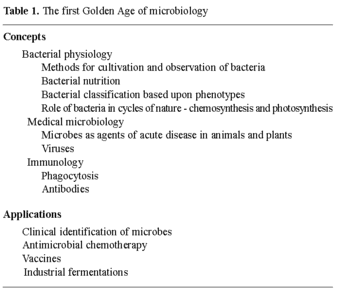
<body><![CDATA[<p><font face="Verdana, Arial, Helvetica, sans-serif" size="2">Os descobrimentos da &uacute;ltima d&eacute;cada demonstraram que a microbiologia n&atilde;o &eacute; s&oacute; uma disciplina cient&iacute;fica com aplica&ccedil;&otilde;es pr&aacute;ticas em agricultura, medicina, biorremedio, biotecnologia, engenharia e outros campos. Est&aacute; claro que as fun&ccedil;&otilde;es dos micr&oacute;bios na natureza s&atilde;o t&atilde;o diversas, que a explora&ccedil;&atilde;o desta varia&ccedil;&atilde;o gen&eacute;tica para novas aplica&ccedil;&otilde;es vai continuar no futuro. No entanto, a r&aacute;pida evolu&ccedil;&atilde;o microbiana determina que n&atilde;o haver&aacute; solu&ccedil;&otilde;es permanentes para os problemas da agricultura, a medicina ou o meio causados pelos micr&oacute;bios. Estes problemas ter&atilde;o que ser abordados com novos enfoques que evolucionem ao mesmo tempo que os micr&oacute;bios. Com isso, a fascina&ccedil;&atilde;o desta disciplina se manter&aacute; no futuro. Mas estas oportunidades e imperativos exigem um profundo entendimento da fisiologia, a gen&eacute;tica e a ecologia microbianas b&aacute;sicas. Os principais desafios s&atilde;o proporcionar uma forma&ccedil;&atilde;o ampla com o fim de atrair e capacitar &agrave; seguinte gera&ccedil;&atilde;o de microbiologistas, e educar ao p&uacute;blico e aos governantes para entender a import&acirc;ncia crucial desta disciplina na sa&uacute;de e na economia. &#091;<b>Int Microbiol</b> 2006; 9(1):1-7&#093;</font><font face="Verdana, Arial, Helvetica, sans-serif" size="2">.</font></p>     <p><font face="Verdana, Arial, Helvetica, sans-serif" size="2"><b>Palavras chave:</b> desenvolvimento da microbiologia &middot; ecologia microbiana &middot; biologia celular microbiana &middot; microbiologia integradora.</font></p> <hr size="1" noshade>     <p>&nbsp;</p>      <p><font face="Verdana, Arial, Helvetica-Normal, sans-serif" size="3"><b>Introduction</b></font></p>     <p><font size="2" face="Verdana, Arial, Helvetica, sans-serif">The development of powerful new technologies in the post-World War II period led to a revolution in biology. The introduction of genetic tools such as transposons, coupled with the ability to clone genes and determine DNA sequences, and the subsequent explosion of techniques based upon these methods made it possible to dissect the molecular genetics of essentially any organism. These developments allowed us to answer questions that were previously deemed unfathomable, and had a major impact on every discipline of biology. The study of microbes has particularly profited from these developments. It was previously only feasible to study details of microbial physiology of pure cultures growing in the laboratory. However, it is now possible to directly characterize organisms growing in the natural environment, and to monitor the physiology of single cells under defined conditions. Advances in microscopy, nanotechnology, and structural biology allow the analysis of the underlying chemical mechanisms at a deeper and deeper level. In addition to enhancing our understanding of the biological world, these new developments have many practical applications. The ability to study microbes in their own environment rather than the test tube, coupled with the ability to dissect the molecular details of microbial cells has made microbial biology pivotal to nearly all disciplines of science. To illustrate this point, we will discuss the key stages in development of microbiology and how new developments have led to what we refer to as the third Golden Age of microbiology &#091;37&#093;.</font></p>     <p>&nbsp;</p>     <p><font size="3" face="Verdana, Arial, Helvetica, sans-serif"><b>The first Golden Age</b></font></p>     <p><font size="2" face="Verdana, Arial, Helvetica, sans-serif">The existence of microbes and their role in disease was guessed by ancient Greeks and demonstrated convincingly by a number of studies in the 17th, 18th, and early 19th centuries. Despite what seems today like compelling evidence, most of these studies did not gain universal acceptance and were the subject of controversy. In the second half of the 19th century, microbiology made a grandiose entry, sweeping away doubts about the existence and importance of microbes. Within a 20-year period, the main bacterial etiological agents of disease in humans and animals were discovered, and the field of immunology was developed, leading to vaccines and serological tests. The discovery of the microbial etiology of major infectious diseases led in turn to accurate diagnoses and attempts at prevention and cure. Several vaccines used today stem from those developed by early microbiologists. The importance of microbes in the cycles of nature was elucidated and strain selection was applied for industrial purposes. The intellectual developments and practical applications of this first Golden Age propelled microbiology into becoming one of the main branches of biology and medicine (<a href="#t1">Table 1</a>).</font></p>     <p align="center"><a name="t1"><img src="/img/revistas/im/v9n1/01tab1maloy.gif" width="340" height="292"></a></p>     <p>&nbsp;</p>     ]]></body>
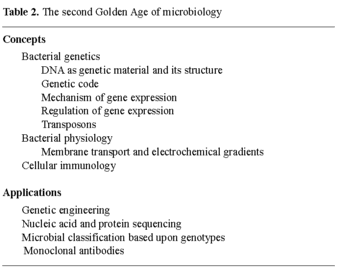
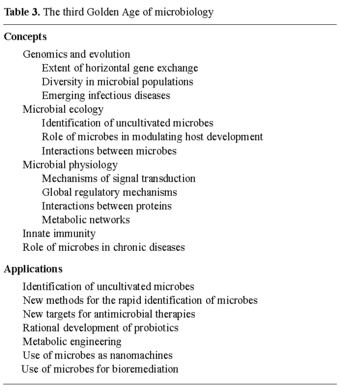
<body><![CDATA[<p><b><font size="3" face="Verdana, Arial, Helvetica, sans-serif">The second Golden Age</font></b></p>     <p><font size="2" face="Verdana, Arial, Helvetica, sans-serif">In the first half of the 20th century, microbiological research continued at an ever-increasing pace and many of the missing details in biochemical, medical, and environmental microbiology were uncovered. However, microbiology became increasingly fragmented. The unity that Pasteur originally brought to the discipline by applying similar approaches to medical and environmental microbiology was replaced by specialized subdisciplines. During this period, medical microbiologists and immunologists were mainly working at the organism level of host and parasite. Environmental microbiologists, on the other hand, were focused on chemical processes. Thanks to the pioneering work of the Russian Sergei Winogradsky and the Dutch Martinus Beijerinck and Albert Kluyver, environmental microbiology became a branch of comparative biochemistry, emphasizing the unity of biochemical processes in all living organisms. Unfortunately, the great gains of this period in microbial biochemistry and geochemistry did not find a ready parallel in medical microbiology. Many advances were made but only a few startling breakthroughs emerged in this field. Microbial genetics, for most purposes, was still to be discovered, meaning that many cellular phenomena remained undecipherable. Although individual aspects of the field made important strides during this period, microbiology was not seen as a dominant science. All this changed as abruptly as the first Golden Age with the advent of molecular genetics. </font></p>     <p><font size="2" face="Verdana, Arial, Helvetica, sans-serif">The discovery of biochemical genetics and of genetic exchange mechanisms in bacteria and viruses ushered in a new era of stellar advances. These discoveries led to modern concepts of the gene and the biochemical basis of genetics, the understanding of how genetic information flows from nucleic acids to proteins, the regulation of gene expression, and how complex structures such as bacteriophages are assembled. These breakthroughs led to a paradigm shift. At that time, anyone who wanted to do modern science, mindful of it or not, had to become a microbiologist. The incipient science of molecular biology was spawned by the use of microbes and, consequently microbial science was once again recognized as a fundamental scientific discipline (<a href="#t2">Table 2</a>).</font></p>     <p align="center"><a name="t2"><img src="/img/revistas/im/v9n1/01tab2maloy.gif" width="340" height="276"></a></p>     <p>&nbsp;</p>     <p><b><font size="3" face="Verdana, Arial, Helvetica, sans-serif">The third Golden Age</font></b></p>     <p><font size="2" face="Verdana, Arial, Helvetica, sans-serif">Soon after the discoveries in molecular genetics were made, investigators studying eukaryotic systems adopted the new tools for their own use. For those systems that can be manipulated with nearly the same ease as bacteria, such as yeast, the transition was straightforward. Ultimately, other systems that lack the ease of manipulation and the speed of growth of bacteria benefited even more from DNA cloning and sequencing. As the methodological playing field became more even, eukaryotic science blossomed, eventually overshadowing the work with bacteria and phages. As funding for basic microbiology became increasingly difficult to obtain in the United States and elsewhere, many aspects of this science became neglected and were left to a few stalwarts. Although modern genetic techniques appropriate to "higher" organisms were gradual in coming, they promised the genetic analysis of such biological phenomena as cancer and differentiation. In a short time, enormous progress was made along these lines. By the last decades of the 20th century, the study of prokaryotes played distinct second fiddle. In addition, the early success of antibiotics and their promise dampened the impetus for the study of microbial pathogens. William Stewart, the Surgeon General of the United States, echoed the conviction of many scientists when he said in 1967 that it was "time to close the book on infectious diseases, declare the war against pestilence won, and shift national resources to such chronic problems as cancer and heart disease". Not surprisingly, microbiology lost its luster in the eyes of many, leading to the wholesale closure of microbiology departments and diminishing funding opportunities for researchers in this field. Despite rising from the ashes of the first Golden Age, the success of microbiology was responsible for its own demise.</font></p>     <p><font size="2" face="Verdana, Arial, Helvetica, sans-serif">All this has changed in the last 20 years, restoring the eminence of microbial science. Discoveries during this time have led to the understanding that microbes are essential for processes that impinge on nearly every aspect of our planet. It is now clear that microbial biology plays a unique and fundamental role in essentially every field of science. These insights have largely come from the study of microbes at the two ends of the spectrum-from the broad perspective of microbes in natural environments to the focused perspective of the molecular mechanisms operating in microbial cells (<a href="#t3">Table 3</a>).</font></p>     <p align="center"><a name="t3"><img src="/img/revistas/im/v9n1/01tab3maloy.gif" width="340" height="392"></a></p>     <p>&nbsp;</p>     ]]></body>
<body><![CDATA[<p><b><font size="3" face="Verdana, Arial, Helvetica, sans-serif">Microbial ecology and population biology</font></b></p>     <p><font size="2" face="Verdana, Arial, Helvetica, sans-serif">As eloquently argued by paleontologist Stephen Jay Gould &#091;19&#093;, the 21st century will be the era of the microbe.</font></p>     <p><font size="2" face="Verdana, Arial, Helvetica, sans-serif"><i>"We live now in the &lsquo;Age of Bacteria.' Our planet has always been in the "Age of Bacteria," ever since the first fossils-bacteria, of course-were entombed in rocks more than 3 billion years ago. On any possible, reasonable or fair criterion, bacteria are-and always have been-the dominant forms of life on Earth. Our failure to grasp this most evident of biological facts arises in part from the blindness of our arrogance but also, in large measure, as an effect of scale. We are so accustomed to viewing phenomena of our scale-sizes measured in feet and ages in decades-as typical of nature." </i></font></p>     <p><font size="2" face="Verdana, Arial, Helvetica, sans-serif">Despite their small size, microbes play an enormous role in the cycle of matter and in the metabolism of this planet. With the discovery of the huge microbial biota in subsoil fissures and better estimates of microbial life in the oceans, the microbial biota on Earth is thought to exceed in weight all other living things combined. Bacteria alone account for 50% of the biomass of carbon and over 90% of the biomass of nitrogen and phosphorus on our planet. At least as much photosynthesis is carried out by marine microbes as by terrestrial plants &#091;40&#093;. It has been estimated that if the action of microbes on the nitrogen cycle were to cease, the amount of nitrogen available to plants would become too low to sustain life within about one week (David Lipson, personal communication). Microbes are also critical for assimilating dissolved organic material into the particulate organic matter used by eukaryotes &#091;3&#093;. Microbes are responsible for enormous geochemical activities, such as the formation of carbon and silica deposits and the shaping of limestone caverns &#091;13&#093;. Microorganisms can be found in unexpected niches, such as thermal ocean vents and fissures in deep rocks &#091;44&#093;. Such lithotrophic organisms support the existence of biomes that are not ultimately dependent on the sun or atmospheric oxygen, expanding the scope of microbial ecology and our understanding of the role of microbes in the cycles of matter in nature, but also raising new questions about microbial physiology &#091;48&#093;.</font></p>     <p><font size="2" face="Verdana, Arial, Helvetica, sans-serif">These insights come largely from the ability to study microbes in nature. Once a specialized branch of microbiology, microbial ecology now occupies center stage. Thanks to cloning techniques and PCR, it became possible to break out of the confines of model organisms grown in the laboratory to study the physiology and genetics of microbes in the natural environment. This includes species that cannot yet be cultured in the laboratory, estimated to comprise over 99% of the total microbial population &#091;43&#093;. It is now possible to approach questions such as who lives where, who does what, and who is phylogenetically related to whom. This has greatly expanded our awareness of the diversity of types and total numbers of microbes, even embracing a new Domain of life, the <i>Archaea</i>, a division that we did not know existed during the two previous golden ages. </font></p>     <p><font size="2" face="Verdana, Arial, Helvetica, sans-serif">As the extent of microbial diversity has become appreciated, many microbiologists have questioned the concept of non-cultivability-a concept that simply reflects experimental failure rather than a verifiable conclusion. This rationale has driven the development of new methods to culture species previous believed to be uncultivable &#091;42&#093;. We can expect many more of these "uncultivable" microbes to be grown in the laboratory, facilitating studies on their physiology and potentially allowing them to be harnessed for practical applications. </font></p>     <p><font size="2" face="Verdana, Arial, Helvetica, sans-serif">These approaches have led to an increased appreciation that microbes in nature tend to live in communities, some with their own kin, others in consortia with different microbes. This awareness dictates that the study of microbes must be extended from the laboratory to the natural communities. In fact, pathogenic microbes are increasingly being investigated in their natural habitat. Clever genetic approaches have been developed to identify genes that are selectively expressed in a particular environment. These approaches have many applications, for example identifying gene products that are essential for a pathogen to survive in a host or in the outside environment &#091;10&#093;. This ecological approach has led to great strides in the identification of novel molecular mechanisms of cell&#150;cell interactions. An example is the Type III secretion system, a device used by bacteria to "inject" proteins directly into host cells and which is turned on by contact with host cells &#091;30&#093;. This implausible-sounding mechanism is shared by a surprisingly large number of pathogens of vertebrates, insects, worms, and plants &#091;6&#093;. Like earlier studies on microbial physiology that led to the concept of the unity of biochemistry, these findings suggest that microbe-host interactions may share common mechanisms despite the type of host or whether the interaction is mutualistic or parasitic.</font></p>     <p><font size="2" face="Verdana, Arial, Helvetica, sans-serif">Recent studies on microbe&#150;host interactions indicate that microbes influence the host in ways we never imagined previously. For example, the presence of the normal microbial biota in the intestine of mice promotes proper development of the vascular tissue as well as host immunity to invading pathogens &#091;4,41&#093;. These discoveries provide novel insights into beneficial microbe&#150;host interactions that may lead to rational design of probiotics. However, we are also beginning to learn that microbes can cause chronic diseases that were previously thought to be to due to genetics or environment-ailments such as ulcers and stomach cancer caused by <i>Helicobacter pylori</i>, arthritis caused by <i>Borrelia burgdorferi</i>, and many other diseases &#091;7&#093;. Epidemiological evidence coupled with sensitive assays for bacteria based upon the environmental PCR approaches hint that the role of microbes in causing chronic diseases is pervasive. These studies have also led to a deeper understanding of innate immunity.</font></p>     <p>&nbsp;</p>     <p><b><font size="3" face="Verdana, Arial, Helvetica, sans-serif">Genomics and evolution</font></b></p>     ]]></body>
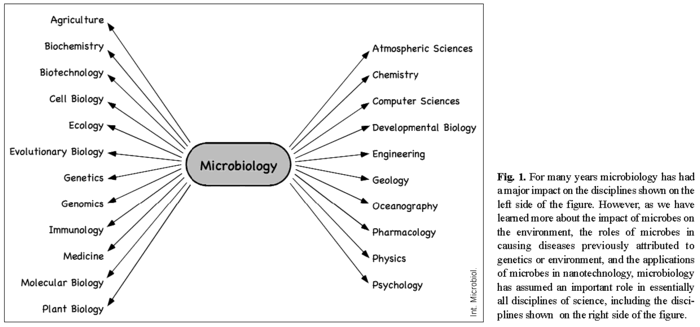
<body><![CDATA[<p><font size="2" face="Verdana, Arial, Helvetica, sans-serif">In part because of their small size, the genomes of many prokaryotes have been sequenced. The number of completed sequences includes not only representatives of major groups but also multiple strains of many species. Not surprisingly, this richness of data has spawned a whole industry intended to "mine" the genomic information for practical uses &#091;14,25&#093;. Genome sequences have provided important insights into evolution. One surprise has been the demonstration of the extent and impact of lateral gene transfer. Genomic islands, sets of genes a dozen or more in number, appear in unrelated microbes and endow them with new functions such a virulence trait or a novel metabolic capacity &#091;12&#093;. Often these functions are encoded on mobile genetic elements that can readily move between bacteria &#091;15&#093;. For example, many bacterial toxins are encoded on bacteriophages that can integrate into the bacterial genome &#091;46&#093;. Thus, microbes break out of the confines of sexual recombination by the promiscuous transfer of genes between organisms. Most of the DNA so transferred is lost, but some is retained to alter the genotype and phenotype of recipients &#091;22&#093;. The extent and impact of lateral gene transfer has made us reevaluate the concept that evolution can be linearly traced along separated branches of a tree. Instead, the branches of the tree are laterally connected to one another. Thus, the ancestry of an organism may not be simply monophyletic, but can result from multiple exchanges between distinct genomes. Such interactions are not limited to one Domain of life, but can also jump between <i>Bacteria</i> and <i>Archaea</i> or <i>Eukarya</i> &#091;2&#093;. This lateral gene exchange seriously compromises the concept of species in microbiology &#091;17&#093;. </font></p>     <p><font size="2" face="Verdana, Arial, Helvetica, sans-serif">Lateral gene transfer does not tell the whole story of microbial evolution. Genome sequences have also revealed the importance of point mutations (SNPs) in bacterial evolution &#091;47&#093;. The accumulation of pseudogenes seems to play an important role in restricting a microbe to a particular host or environmental niche &#091;29&#093;. These discoveries have an important impact on our understanding of how new emerging diseases arise, but we still do not know how often these events occur in nature.</font></p>     <p>&nbsp;</p>     <p><b><font size="3" face="Verdana, Arial, Helvetica, sans-serif">Microbial cell biology</font></b></p>     <p><font size="2" face="Verdana, Arial, Helvetica, sans-serif">An old dictum argued that bacteria are just bags of enzymes. It is becoming increasingly clear that within the small confines of one cubic millimeter or so, there is a sophisticated and unexpected compartmentalization &#091;5&#093;. Cellular components act in dynamic fashion and a surprising molecular choreography has been unveiled via fluorescence microscopy and other techniques that allow us to visualize molecules in action &#091;23,35&#093;. Some macromolecules localize to specific sites, others move around the cell interior along established paths. In nearly all prokaryotes, cell division depends on the formation at mid-cell of a constricting ring that consists of the tubulin-like protein FtsZ &#091;26&#093;. Other proteins, called Min, bounce from one pole of a rod-shaped bacterium to the other, helping to determine the division site. Rod-shaped bacteria also have the equivalent of actin and some that of intermediate filaments &#091;16,34&#093;. Thus, at least some of the eukaryotic cytoskeletal proteins were prokaryotic inventions that long preceded emergence in eukaryotes. </font></p>     <p><font size="2" face="Verdana, Arial, Helvetica, sans-serif">Microbial symbionts and pathogens make extensive uses of host cell machinery, such as cell surface receptors, cell signaling pathways, and the cytoskeleton &#091;1&#093;. An example is the appropriation of host cell actin by <i>Escherichia coli</i> to promote binding to intestinal cells &#091;39&#093; or by <i>Shigella</i> and <i>Listeria</i> to facilitate direct passage from one host cell to another &#091;18&#093;, thereby avoiding exposure to the host immune system. In addition to providing insights into pathogenesis, these processes provide tools to understand the structure and function of eukaryotic cells. Nowadays, pathogenic microbiologists are being invited with increasing frequency to deliver papers at cell biology meetings. As in the old days, when the proper study of bacteria was via bacteriophages, it seems increasingly evident that studying bacteria&#150;host interactions provides unique tools for studying many aspects of eukaryotic cell biology. These conceptual advances have many practical applications. The increasing problem of antibiotic resistance, the burden of emerging infectious diseases, and the threat of bioterrorism require improved ways of rapidly detecting pathogenic agents, preventing their transmission, and effectively treating infected humans, other animals, and plants. These problems demand a continuous search for new antimicrobial drugs to stay one step ahead of the evolution of microbial resistance &#091;11&#093;, as well as the development of effective new vaccines to treat emerging diseases &#091;21&#093;. Both of these applications are increasingly relying on a detailed understanding of genomics, structural biology, molecular biology, and microbial physiology. For example, understanding the details of genetic recombination has led to specific peptide inhibitors of this essential cellular function &#091;20&#093;. Likewise, understanding of protein structure and function provides new approaches for designing effective vaccines. </font></p>     <p><font size="2" face="Verdana, Arial, Helvetica, sans-serif">Microbiology is having an increasing impact in other areas as well. Microbes are playing an increasing role in industrial production of pharmaceuticals and other compounds &#091;27&#093;. There has already been considerable success in mining the genomes of cultivated and uncultivated microorganisms for enzymes with desirable physical and chemical properties &#091;45&#093;. This approach has already brought to market several hydrolytic enzymes with enhanced thermal stability and targeted substrate specificities. But there are many other opportunities for industrial microbiology. For example, fermentation processes have the potential to decrease our reliance on fossil fuels &#091;24&#093;, and bacterial systems are being developed as nano-biosensors &#091;9&#093;, nano-batteries &#091;38&#093;, and nano-computers &#091;49&#093;. An infusion of funds in these areas will almost certainly lead to significant advances, but note that these practical applications ultimately depend on a strong foundation of basic scientific research and a deep understanding of the details of bacterial physiology. </font></p>     <p>&nbsp;</p>     <p><b><font size="3" face="Verdana, Arial, Helvetica, sans-serif">Integrative microbiology</font></b></p>     <p><font size="2" face="Verdana, Arial, Helvetica, sans-serif">Microbiology has become more unified. The fields of microbial physiology, microbial genetics, microbial ecology, and microbial pathogenesis are no longer sovereign domains with their own tools and dialects. Nowadays, a marine microbiologist can easily talk to a microbiologist studying human pathogens, and a food microbiologist can converse effortlessly with a scientist studying microbial evolution. These interactions are not simply because scientists working on different problems share genomic databases and molecular tools-the interactions are driven by the realization that microorganisms use similar mechanisms to accomplish diverse functions. Discoveries in microbial pathogenesis have a direct impact on the field of microbial ecology, and an understanding of microbial ecology is critical for understanding transmission of pathogens. Common molecular mechanisms of adhesion to surfaces, quorum sensing, signal transduction, responding to environmental stresses, or injecting proteins directly into host cells are found in a wide variety of microbes that live in a broad spectrum of environmental niches, from humans to the ocean to sulfurous hot springs. As a result, the subdisciplines of microbiology are no longer isolated fields of study (<a href="#f1">Fig. 1</a>). </font></p>     ]]></body>
<body><![CDATA[<p align="center"><a name="f1"><img src="/img/revistas/im/v9n1/01fig1maloy.gif" width="700" height="327"></a></p>     <p>&nbsp;</p>     <p><font size="2" face="Verdana, Arial, Helvetica, sans-serif">In addition to its roles in agriculture and medicine, microbiology has also become an integral part of other scientific disciplines. The role of microbes in geochemistry has made microbiology a fundamental aspect of geology &#091;31&#093;. The use of microbes in nanotechnology has brought microbiology to engineering &#091;36&#093;, and physics &#091;28&#093;. Microbial processes profoundly influence climate and weather, integrating microbiology into the field of atmospheric sciences &#091;33&#093;. Microbes are increasingly used to make complex molecules with chiral properties that cannot be synthesized in a test tube, making microbiology an invaluable assistant in chemistry &#091;32&#093;. And recent discoveries indicate that microbes also play important roles in determining animal behavior, bringing microbiology to the realm of psychology &#091;8&#093;. Hence, microbiology has become an integrative science that simultaneously adopts the tools of diverse scientific disciplines and impacts diverse scientific disciplines.</font></p>     <p>&nbsp;</p>     <p><b><font size="3" face="Verdana, Arial, Helvetica, sans-serif">References</font></b></p>     <!-- ref --><p><font size="2" face="Verdana, Arial, Helvetica, sans-serif">1. Alonso A, Garc&iacute;a-del Portillo F (2004) Hijacking of eukaryotic functions by intracellular bacterial pathogens. Int Microbiol 7:181-191</font>&nbsp;&nbsp;&nbsp;&nbsp;&nbsp;&nbsp;&nbsp;&nbsp;[&#160;<a href="javascript:void(0);" onclick="javascript: window.open('/scielo.php?script=sci_nlinks&ref=2801161&pid=S1139-6709200600010000100001&lng=','','width=640,height=500,resizable=yes,scrollbars=1,menubar=yes,');">Links</a>&#160;]<!-- end-ref --><!-- ref --><p><font size="2" face="Verdana, Arial, Helvetica, sans-serif">2. Andersson JO (2005) Lateral gene transfer in eukaryotes. Cell Mol Life Sci 62:1182-1197</font>&nbsp;&nbsp;&nbsp;&nbsp;&nbsp;&nbsp;&nbsp;&nbsp;[&#160;<a href="javascript:void(0);" onclick="javascript: window.open('/scielo.php?script=sci_nlinks&ref=2801162&pid=S1139-6709200600010000100002&lng=','','width=640,height=500,resizable=yes,scrollbars=1,menubar=yes,');">Links</a>&#160;]<!-- end-ref --><!-- ref --><p><font size="2" face="Verdana, Arial, Helvetica, sans-serif">3. Azam F, Smith DC, Stewart GF, Hagstr&ouml;m &Aring; (1993) Bacteria&#150;organic matter coupling and its significance for oceanic carbon cycling. Microb Ecol 28:167-179</font>&nbsp;&nbsp;&nbsp;&nbsp;&nbsp;&nbsp;&nbsp;&nbsp;[&#160;<a href="javascript:void(0);" onclick="javascript: window.open('/scielo.php?script=sci_nlinks&ref=2801163&pid=S1139-6709200600010000100003&lng=','','width=640,height=500,resizable=yes,scrollbars=1,menubar=yes,');">Links</a>&#160;]<!-- end-ref --><!-- ref --><p><font size="2" face="Verdana, Arial, Helvetica, sans-serif">4. Backhed F, Ley RE, Sonnenburg JL, Peterson DA, Gordon JI (2005) Host-bacterial mutualism in the human intestine. Science 307:1915-1920</font>&nbsp;&nbsp;&nbsp;&nbsp;&nbsp;&nbsp;&nbsp;&nbsp;[&#160;<a href="javascript:void(0);" onclick="javascript: window.open('/scielo.php?script=sci_nlinks&ref=2801164&pid=S1139-6709200600010000100004&lng=','','width=640,height=500,resizable=yes,scrollbars=1,menubar=yes,');">Links</a>&#160;]<!-- end-ref --><!-- ref --><p><font size="2" face="Verdana, Arial, Helvetica, sans-serif">5. Bravo A, Serrano-Heras G, Salas M (2005) Compartmentalization of prokaryotic DNA replication. FEMS Microbiol Rev 29:25-47</font>&nbsp;&nbsp;&nbsp;&nbsp;&nbsp;&nbsp;&nbsp;&nbsp;[&#160;<a href="javascript:void(0);" onclick="javascript: window.open('/scielo.php?script=sci_nlinks&ref=2801165&pid=S1139-6709200600010000100005&lng=','','width=640,height=500,resizable=yes,scrollbars=1,menubar=yes,');">Links</a>&#160;]<!-- end-ref --><!-- ref --><p><font size="2" face="Verdana, Arial, Helvetica, sans-serif">6. B&uuml;ttner D, Bonas U (2003) Common infection strategies of plant and animal pathogenic bacteria. Curr Opin Plant Biol 6:312-319</font>&nbsp;&nbsp;&nbsp;&nbsp;&nbsp;&nbsp;&nbsp;&nbsp;[&#160;<a href="javascript:void(0);" onclick="javascript: window.open('/scielo.php?script=sci_nlinks&ref=2801166&pid=S1139-6709200600010000100006&lng=','','width=640,height=500,resizable=yes,scrollbars=1,menubar=yes,');">Links</a>&#160;]<!-- end-ref --><!-- ref --><p><font size="2" face="Verdana, Arial, Helvetica, sans-serif">7. Cabone K, Luftig R, Buckley M (2005) Microbial triggers of chronic human disease. ASM Press, Washington DC</font>&nbsp;&nbsp;&nbsp;&nbsp;&nbsp;&nbsp;&nbsp;&nbsp;[&#160;<a href="javascript:void(0);" onclick="javascript: window.open('/scielo.php?script=sci_nlinks&ref=2801167&pid=S1139-6709200600010000100007&lng=','','width=640,height=500,resizable=yes,scrollbars=1,menubar=yes,');">Links</a>&#160;]<!-- end-ref --><!-- ref --><p><font size="2" face="Verdana, Arial, Helvetica, sans-serif">8. Callahan GN (2002) Madness. Emerg Infect Dis 8:998-1002</font>&nbsp;&nbsp;&nbsp;&nbsp;&nbsp;&nbsp;&nbsp;&nbsp;[&#160;<a href="javascript:void(0);" onclick="javascript: window.open('/scielo.php?script=sci_nlinks&ref=2801168&pid=S1139-6709200600010000100008&lng=','','width=640,height=500,resizable=yes,scrollbars=1,menubar=yes,');">Links</a>&#160;]<!-- end-ref --><!-- ref --><p><font size="2" face="Verdana, Arial, Helvetica, sans-serif">9. Cheng Vollmer A, Van Dyk TK (2004) Stress responsive bacteria: biosensors as environmental monitors. Adv Microb Physiol 49:131-174</font>&nbsp;&nbsp;&nbsp;&nbsp;&nbsp;&nbsp;&nbsp;&nbsp;[&#160;<a href="javascript:void(0);" onclick="javascript: window.open('/scielo.php?script=sci_nlinks&ref=2801169&pid=S1139-6709200600010000100009&lng=','','width=640,height=500,resizable=yes,scrollbars=1,menubar=yes,');">Links</a>&#160;]<!-- end-ref --><!-- ref --><p><font size="2" face="Verdana, Arial, Helvetica, sans-serif">10. Chiang SL, Mekalanos JJ, Holden DW (1999) In vivo genetic analysis of bacterial virulence. Annu Rev Microbiol 53:129-154</font>&nbsp;&nbsp;&nbsp;&nbsp;&nbsp;&nbsp;&nbsp;&nbsp;[&#160;<a href="javascript:void(0);" onclick="javascript: window.open('/scielo.php?script=sci_nlinks&ref=2801170&pid=S1139-6709200600010000100010&lng=','','width=640,height=500,resizable=yes,scrollbars=1,menubar=yes,');">Links</a>&#160;]<!-- end-ref --><!-- ref --><p><font size="2" face="Verdana, Arial, Helvetica, sans-serif">11. Courvalin P (2005) Antimicrobial drug resistance: "Prediction is very difficult, especially about the future". Emerg Infect Dis 11:1503-1506</font>&nbsp;&nbsp;&nbsp;&nbsp;&nbsp;&nbsp;&nbsp;&nbsp;[&#160;<a href="javascript:void(0);" onclick="javascript: window.open('/scielo.php?script=sci_nlinks&ref=2801171&pid=S1139-6709200600010000100011&lng=','','width=640,height=500,resizable=yes,scrollbars=1,menubar=yes,');">Links</a>&#160;]<!-- end-ref --><!-- ref --><p><font size="2" face="Verdana, Arial, Helvetica, sans-serif">12. Dobrindt U, Hochhut B, Hentschel U, Hacker J (2004) Genomic islands in pathogenic and environmental microorganisms. Nat Rev Microbiol 2:414-424</font>&nbsp;&nbsp;&nbsp;&nbsp;&nbsp;&nbsp;&nbsp;&nbsp;[&#160;<a href="javascript:void(0);" onclick="javascript: window.open('/scielo.php?script=sci_nlinks&ref=2801172&pid=S1139-6709200600010000100012&lng=','','width=640,height=500,resizable=yes,scrollbars=1,menubar=yes,');">Links</a>&#160;]<!-- end-ref --><!-- ref --><p><font size="2" face="Verdana, Arial, Helvetica, sans-serif">13. Engel A, Stern L, Bennett P (2004) Microbial contributions to cave formation: New insights into sulfuric acid speleogenesis. Geology 32:369-372</font>&nbsp;&nbsp;&nbsp;&nbsp;&nbsp;&nbsp;&nbsp;&nbsp;[&#160;<a href="javascript:void(0);" onclick="javascript: window.open('/scielo.php?script=sci_nlinks&ref=2801173&pid=S1139-6709200600010000100013&lng=','','width=640,height=500,resizable=yes,scrollbars=1,menubar=yes,');">Links</a>&#160;]<!-- end-ref --><!-- ref --><p><font size="2" face="Verdana, Arial, Helvetica, sans-serif">14. Eyers L, George I, Schuler L, Stenuit B, Agathos SN, El Fantroussi S (2004) Environmental genomics: exploring the unmined richness of microbes to degrade xenobiotics. Appl Microbiol Biotechnol 66:123-130</font>&nbsp;&nbsp;&nbsp;&nbsp;&nbsp;&nbsp;&nbsp;&nbsp;[&#160;<a href="javascript:void(0);" onclick="javascript: window.open('/scielo.php?script=sci_nlinks&ref=2801174&pid=S1139-6709200600010000100014&lng=','','width=640,height=500,resizable=yes,scrollbars=1,menubar=yes,');">Links</a>&#160;]<!-- end-ref --><!-- ref --><p><font size="2" face="Verdana, Arial, Helvetica, sans-serif">15. Frost LS, Leplae R, Summers AO, Toussaint A (2005) Mobile genetic elements: the agents of open source evolution. Nat Rev Microbiol 3:722-732</font>&nbsp;&nbsp;&nbsp;&nbsp;&nbsp;&nbsp;&nbsp;&nbsp;[&#160;<a href="javascript:void(0);" onclick="javascript: window.open('/scielo.php?script=sci_nlinks&ref=2801175&pid=S1139-6709200600010000100015&lng=','','width=640,height=500,resizable=yes,scrollbars=1,menubar=yes,');">Links</a>&#160;]<!-- end-ref --><!-- ref --><p><font size="2" face="Verdana, Arial, Helvetica, sans-serif">16. Gerdes K, Moller-Jensen J, Ebersbach G, Kruse T, Nordstr&ouml;m K (2004) Bacterial mitotic machineries. Cell 116:359-366</font>&nbsp;&nbsp;&nbsp;&nbsp;&nbsp;&nbsp;&nbsp;&nbsp;[&#160;<a href="javascript:void(0);" onclick="javascript: window.open('/scielo.php?script=sci_nlinks&ref=2801176&pid=S1139-6709200600010000100016&lng=','','width=640,height=500,resizable=yes,scrollbars=1,menubar=yes,');">Links</a>&#160;]<!-- end-ref --><!-- ref --><p><font size="2" face="Verdana, Arial, Helvetica, sans-serif">17. Gevers D, Cohan FM, Lawrence JG, Spratt BG, Coenye T, Feil EJ, Stackebrandt E, Van de Peer Y, Vandamme P, Thompson FL, Swings J (2005) Opinion: Re-evaluating prokaryotic species. Nat Rev Microbiol 3:733-739</font>&nbsp;&nbsp;&nbsp;&nbsp;&nbsp;&nbsp;&nbsp;&nbsp;[&#160;<a href="javascript:void(0);" onclick="javascript: window.open('/scielo.php?script=sci_nlinks&ref=2801177&pid=S1139-6709200600010000100017&lng=','','width=640,height=500,resizable=yes,scrollbars=1,menubar=yes,');">Links</a>&#160;]<!-- end-ref --><!-- ref --><p><font size="2" face="Verdana, Arial, Helvetica, sans-serif">18. Gouin E, Welch MD, Cossart P (2005) Actin-based motility of intracellular pathogens. Curr Opin Microbiol 8:35-45</font>&nbsp;&nbsp;&nbsp;&nbsp;&nbsp;&nbsp;&nbsp;&nbsp;[&#160;<a href="javascript:void(0);" onclick="javascript: window.open('/scielo.php?script=sci_nlinks&ref=2801178&pid=S1139-6709200600010000100018&lng=','','width=640,height=500,resizable=yes,scrollbars=1,menubar=yes,');">Links</a>&#160;]<!-- end-ref --><!-- ref --><p><font size="2" face="Verdana, Arial, Helvetica, sans-serif">19. Gould SJ (1996) Planet of the bacteria, Washington Post Horizon, vol. 119, p 344</font>&nbsp;&nbsp;&nbsp;&nbsp;&nbsp;&nbsp;&nbsp;&nbsp;[&#160;<a href="javascript:void(0);" onclick="javascript: window.open('/scielo.php?script=sci_nlinks&ref=2801179&pid=S1139-6709200600010000100019&lng=','','width=640,height=500,resizable=yes,scrollbars=1,menubar=yes,');">Links</a>&#160;]<!-- end-ref --><!-- ref --><p><font size="2" face="Verdana, Arial, Helvetica, sans-serif">20. Gunderson CW, Segall AM (2006) DNA repair, a novel antibacterial target: Holliday junction-trapping peptides induce DNA damage and chromosome segregation defects. Mol Microbiol 59:1129-1148</font>&nbsp;&nbsp;&nbsp;&nbsp;&nbsp;&nbsp;&nbsp;&nbsp;[&#160;<a href="javascript:void(0);" onclick="javascript: window.open('/scielo.php?script=sci_nlinks&ref=2801180&pid=S1139-6709200600010000100020&lng=','','width=640,height=500,resizable=yes,scrollbars=1,menubar=yes,');">Links</a>&#160;]<!-- end-ref --><!-- ref --><p><font size="2" face="Verdana, Arial, Helvetica, sans-serif">21. Kaper J, Rappuoli R, Buckley M (2005) Vaccine development: current status and future needs. ASM Press, Washington DC</font>&nbsp;&nbsp;&nbsp;&nbsp;&nbsp;&nbsp;&nbsp;&nbsp;[&#160;<a href="javascript:void(0);" onclick="javascript: window.open('/scielo.php?script=sci_nlinks&ref=2801181&pid=S1139-6709200600010000100021&lng=','','width=640,height=500,resizable=yes,scrollbars=1,menubar=yes,');">Links</a>&#160;]<!-- end-ref --><!-- ref --><p><font size="2" face="Verdana, Arial, Helvetica, sans-serif">22. Lawrence JG, Hendrickson H (2005) Genome evolution in bacteria: order beneath chaos. Curr Opin Microbiol 8:572-578</font>&nbsp;&nbsp;&nbsp;&nbsp;&nbsp;&nbsp;&nbsp;&nbsp;[&#160;<a href="javascript:void(0);" onclick="javascript: window.open('/scielo.php?script=sci_nlinks&ref=2801182&pid=S1139-6709200600010000100022&lng=','','width=640,height=500,resizable=yes,scrollbars=1,menubar=yes,');">Links</a>&#160;]<!-- end-ref --><!-- ref --><p><font size="2" face="Verdana, Arial, Helvetica, sans-serif">23. Lim GE, Derman AI, Pogliano J (2005) Bacterial DNA segregation by dynamic SopA polymers. Proc Natl Acad Sci USA 102:17658-17663</font>&nbsp;&nbsp;&nbsp;&nbsp;&nbsp;&nbsp;&nbsp;&nbsp;[&#160;<a href="javascript:void(0);" onclick="javascript: window.open('/scielo.php?script=sci_nlinks&ref=2801183&pid=S1139-6709200600010000100023&lng=','','width=640,height=500,resizable=yes,scrollbars=1,menubar=yes,');">Links</a>&#160;]<!-- end-ref --><!-- ref --><p><font size="2" face="Verdana, Arial, Helvetica, sans-serif">24. Lin Y, Tanaka S (2006) Ethanol fermentation from biomass resources: current state and prospects. Appl Microbiol Biotechnol 69:627-642</font>&nbsp;&nbsp;&nbsp;&nbsp;&nbsp;&nbsp;&nbsp;&nbsp;[&#160;<a href="javascript:void(0);" onclick="javascript: window.open('/scielo.php?script=sci_nlinks&ref=2801184&pid=S1139-6709200600010000100024&lng=','','width=640,height=500,resizable=yes,scrollbars=1,menubar=yes,');">Links</a>&#160;]<!-- end-ref --><!-- ref --><p><font size="2" face="Verdana, Arial, Helvetica, sans-serif">25. Lorenz P, Eck J (2005) Metagenomics and industrial applications. Nat Rev Microbiol 3:510-516</font>&nbsp;&nbsp;&nbsp;&nbsp;&nbsp;&nbsp;&nbsp;&nbsp;[&#160;<a href="javascript:void(0);" onclick="javascript: window.open('/scielo.php?script=sci_nlinks&ref=2801185&pid=S1139-6709200600010000100025&lng=','','width=640,height=500,resizable=yes,scrollbars=1,menubar=yes,');">Links</a>&#160;]<!-- end-ref --><!-- ref --><p><font size="2" face="Verdana, Arial, Helvetica, sans-serif">26. Margolin W (2005) FtsZ and the division of prokaryotic cells and organelles. Nat Rev Mol Cell Biol 6:862-871</font>&nbsp;&nbsp;&nbsp;&nbsp;&nbsp;&nbsp;&nbsp;&nbsp;[&#160;<a href="javascript:void(0);" onclick="javascript: window.open('/scielo.php?script=sci_nlinks&ref=2801186&pid=S1139-6709200600010000100026&lng=','','width=640,height=500,resizable=yes,scrollbars=1,menubar=yes,');">Links</a>&#160;]<!-- end-ref --><!-- ref --><p><font size="2" face="Verdana, Arial, Helvetica, sans-serif">27. Mir J (2004) Industrial microbiology. A new challenge. Int Microbiol 7:81-82</font>&nbsp;&nbsp;&nbsp;&nbsp;&nbsp;&nbsp;&nbsp;&nbsp;[&#160;<a href="javascript:void(0);" onclick="javascript: window.open('/scielo.php?script=sci_nlinks&ref=2801187&pid=S1139-6709200600010000100027&lng=','','width=640,height=500,resizable=yes,scrollbars=1,menubar=yes,');">Links</a>&#160;]<!-- end-ref --><!-- ref --><p><font size="2" face="Verdana, Arial, Helvetica, sans-serif">28. Mitchell JG, Kogure K (2006) Bacterial motility: links to the environment and a driving force for microbial physics. FEMS Microbiol Ecol 55:3-16</font>&nbsp;&nbsp;&nbsp;&nbsp;&nbsp;&nbsp;&nbsp;&nbsp;[&#160;<a href="javascript:void(0);" onclick="javascript: window.open('/scielo.php?script=sci_nlinks&ref=2801188&pid=S1139-6709200600010000100028&lng=','','width=640,height=500,resizable=yes,scrollbars=1,menubar=yes,');">Links</a>&#160;]<!-- end-ref --><!-- ref --><p><font size="2" face="Verdana, Arial, Helvetica, sans-serif">29. Moran NA, Plague GR (2004) Genomic changes following host restriction in bacteria. Curr Opin Genet Dev 14:627-633</font>&nbsp;&nbsp;&nbsp;&nbsp;&nbsp;&nbsp;&nbsp;&nbsp;[&#160;<a href="javascript:void(0);" onclick="javascript: window.open('/scielo.php?script=sci_nlinks&ref=2801189&pid=S1139-6709200600010000100029&lng=','','width=640,height=500,resizable=yes,scrollbars=1,menubar=yes,');">Links</a>&#160;]<!-- end-ref --><!-- ref --><p><font size="2" face="Verdana, Arial, Helvetica, sans-serif">30. Mota LJ, Cornelis GR (2005) The bacterial injection kit: type III secretion systems. Ann Med 37:234-249</font>&nbsp;&nbsp;&nbsp;&nbsp;&nbsp;&nbsp;&nbsp;&nbsp;[&#160;<a href="javascript:void(0);" onclick="javascript: window.open('/scielo.php?script=sci_nlinks&ref=2801190&pid=S1139-6709200600010000100030&lng=','','width=640,height=500,resizable=yes,scrollbars=1,menubar=yes,');">Links</a>&#160;]<!-- end-ref --><!-- ref --><p><font size="2" face="Verdana, Arial, Helvetica, sans-serif">31. Newman DK, Banfield JF (2002) Geomicrobiology: how molecular-scale interactions underpin biogeochemical systems. Science 296: 1071-1077</font>&nbsp;&nbsp;&nbsp;&nbsp;&nbsp;&nbsp;&nbsp;&nbsp;[&#160;<a href="javascript:void(0);" onclick="javascript: window.open('/scielo.php?script=sci_nlinks&ref=2801191&pid=S1139-6709200600010000100031&lng=','','width=640,height=500,resizable=yes,scrollbars=1,menubar=yes,');">Links</a>&#160;]<!-- end-ref --><!-- ref --><p><font size="2" face="Verdana, Arial, Helvetica, sans-serif">32. Patel RN (2003) Microbial/enzymatic synthesis of chiral pharmaceutical intermediates. Curr Opin Drug Discov Devel 6:902-920</font>&nbsp;&nbsp;&nbsp;&nbsp;&nbsp;&nbsp;&nbsp;&nbsp;[&#160;<a href="javascript:void(0);" onclick="javascript: window.open('/scielo.php?script=sci_nlinks&ref=2801192&pid=S1139-6709200600010000100032&lng=','','width=640,height=500,resizable=yes,scrollbars=1,menubar=yes,');">Links</a>&#160;]<!-- end-ref --><!-- ref --><p><font size="2" face="Verdana, Arial, Helvetica, sans-serif">33. Pedr&oacute;s-Ali&oacute; C, Sim&oacute; R (2002) Studying marine microorganisms from space. Int Microbiol 5:195-200</font>&nbsp;&nbsp;&nbsp;&nbsp;&nbsp;&nbsp;&nbsp;&nbsp;[&#160;<a href="javascript:void(0);" onclick="javascript: window.open('/scielo.php?script=sci_nlinks&ref=2801193&pid=S1139-6709200600010000100033&lng=','','width=640,height=500,resizable=yes,scrollbars=1,menubar=yes,');">Links</a>&#160;]<!-- end-ref --><!-- ref --><p><font size="2" face="Verdana, Arial, Helvetica, sans-serif">34. Pogliano J (2004) DNA segregation by bacterial actin homologs. Dev Cell 6:3-4</font>&nbsp;&nbsp;&nbsp;&nbsp;&nbsp;&nbsp;&nbsp;&nbsp;[&#160;<a href="javascript:void(0);" onclick="javascript: window.open('/scielo.php?script=sci_nlinks&ref=2801194&pid=S1139-6709200600010000100034&lng=','','width=640,height=500,resizable=yes,scrollbars=1,menubar=yes,');">Links</a>&#160;]<!-- end-ref --><!-- ref --><p><font size="2" face="Verdana, Arial, Helvetica, sans-serif">35. Rubio A, Jiang X, Pogliano K (2005) Localization of translocation complex components in <i>Bacillus subtilis</i>: enrichment of the signal recognition particle receptor at early sporulation septa. J Bacteriol 187: 5000-5002</font>&nbsp;&nbsp;&nbsp;&nbsp;&nbsp;&nbsp;&nbsp;&nbsp;[&#160;<a href="javascript:void(0);" onclick="javascript: window.open('/scielo.php?script=sci_nlinks&ref=2801195&pid=S1139-6709200600010000100035&lng=','','width=640,height=500,resizable=yes,scrollbars=1,menubar=yes,');">Links</a>&#160;]<!-- end-ref --><!-- ref --><p><font size="2" face="Verdana, Arial, Helvetica, sans-serif">36. Sara M, Pum D, Schuster B, Sleytr UB (2005) S-layers as patterning elements for application in nanobiotechnology. J Nanosci Nanotechnol 5:1939-1953</font>&nbsp;&nbsp;&nbsp;&nbsp;&nbsp;&nbsp;&nbsp;&nbsp;[&#160;<a href="javascript:void(0);" onclick="javascript: window.open('/scielo.php?script=sci_nlinks&ref=2801196&pid=S1139-6709200600010000100036&lng=','','width=640,height=500,resizable=yes,scrollbars=1,menubar=yes,');">Links</a>&#160;]<!-- end-ref --><!-- ref --><p><font size="2" face="Verdana, Arial, Helvetica, sans-serif">37. Schaechter M (2003) Integrative microbiology-the third Golden Age. J Biosci 28:149-154</font>&nbsp;&nbsp;&nbsp;&nbsp;&nbsp;&nbsp;&nbsp;&nbsp;[&#160;<a href="javascript:void(0);" onclick="javascript: window.open('/scielo.php?script=sci_nlinks&ref=2801197&pid=S1139-6709200600010000100037&lng=','','width=640,height=500,resizable=yes,scrollbars=1,menubar=yes,');">Links</a>&#160;]<!-- end-ref --><!-- ref --><p><font size="2" face="Verdana, Arial, Helvetica, sans-serif">38. Scholz F, Schroder U (2003) Bacterial batteries. Nat Biotechnol 21:1151-1152</font>&nbsp;&nbsp;&nbsp;&nbsp;&nbsp;&nbsp;&nbsp;&nbsp;[&#160;<a href="javascript:void(0);" onclick="javascript: window.open('/scielo.php?script=sci_nlinks&ref=2801198&pid=S1139-6709200600010000100038&lng=','','width=640,height=500,resizable=yes,scrollbars=1,menubar=yes,');">Links</a>&#160;]<!-- end-ref --><!-- ref --><p><font size="2" face="Verdana, Arial, Helvetica, sans-serif">39. Selbach M, Backert S (2005) Cortactin: an Achilles' heel of the actin cytoskeleton targeted by pathogens. Trends Microbiol 13:181-189</font>&nbsp;&nbsp;&nbsp;&nbsp;&nbsp;&nbsp;&nbsp;&nbsp;[&#160;<a href="javascript:void(0);" onclick="javascript: window.open('/scielo.php?script=sci_nlinks&ref=2801199&pid=S1139-6709200600010000100039&lng=','','width=640,height=500,resizable=yes,scrollbars=1,menubar=yes,');">Links</a>&#160;]<!-- end-ref --><!-- ref --><p><font size="2" face="Verdana, Arial, Helvetica, sans-serif">40. Shively JM, English RS, Baker SH, Cannon GC (2001) Carbon cycling: the prokaryotic contribution. Curr Opin Microbiol 4:301-306</font>&nbsp;&nbsp;&nbsp;&nbsp;&nbsp;&nbsp;&nbsp;&nbsp;[&#160;<a href="javascript:void(0);" onclick="javascript: window.open('/scielo.php?script=sci_nlinks&ref=2801200&pid=S1139-6709200600010000100040&lng=','','width=640,height=500,resizable=yes,scrollbars=1,menubar=yes,');">Links</a>&#160;]<!-- end-ref --><!-- ref --><p><font size="2" face="Verdana, Arial, Helvetica, sans-serif">41. Stappenbeck TS, Hooper LV, Gordon JI (2002) Developmental regulation of intestinal angiogenesis by indigenous microbes via Paneth cells. Proc Natl Acad Sci USA 99:15451-15455</font>&nbsp;&nbsp;&nbsp;&nbsp;&nbsp;&nbsp;&nbsp;&nbsp;[&#160;<a href="javascript:void(0);" onclick="javascript: window.open('/scielo.php?script=sci_nlinks&ref=2801201&pid=S1139-6709200600010000100041&lng=','','width=640,height=500,resizable=yes,scrollbars=1,menubar=yes,');">Links</a>&#160;]<!-- end-ref --><!-- ref --><p><font size="2" face="Verdana, Arial, Helvetica, sans-serif">42. Stevenson BS, Eichorst SA, Wertz JT, Schmidt TM, Breznak JA (2004) New strategies for cultivation and detection of previously uncultured microbes. Appl Environ Microbiol 70:4748-4755</font>&nbsp;&nbsp;&nbsp;&nbsp;&nbsp;&nbsp;&nbsp;&nbsp;[&#160;<a href="javascript:void(0);" onclick="javascript: window.open('/scielo.php?script=sci_nlinks&ref=2801202&pid=S1139-6709200600010000100042&lng=','','width=640,height=500,resizable=yes,scrollbars=1,menubar=yes,');">Links</a>&#160;]<!-- end-ref --><!-- ref --><p><font size="2" face="Verdana, Arial, Helvetica, sans-serif">43. Streit WR, Schmitz RA (2004) Metagenomics&#150;the key to the uncultured microbes. Curr Opin Microbiol 7:492-498</font>&nbsp;&nbsp;&nbsp;&nbsp;&nbsp;&nbsp;&nbsp;&nbsp;[&#160;<a href="javascript:void(0);" onclick="javascript: window.open('/scielo.php?script=sci_nlinks&ref=2801203&pid=S1139-6709200600010000100043&lng=','','width=640,height=500,resizable=yes,scrollbars=1,menubar=yes,');">Links</a>&#160;]<!-- end-ref --><!-- ref --><p><font size="2" face="Verdana, Arial, Helvetica, sans-serif">44. Teske AP (2005) The deep subsurface biosphere is alive and well. Trends Microbiol 13:402-404</font>&nbsp;&nbsp;&nbsp;&nbsp;&nbsp;&nbsp;&nbsp;&nbsp;[&#160;<a href="javascript:void(0);" onclick="javascript: window.open('/scielo.php?script=sci_nlinks&ref=2801204&pid=S1139-6709200600010000100044&lng=','','width=640,height=500,resizable=yes,scrollbars=1,menubar=yes,');">Links</a>&#160;]<!-- end-ref --><!-- ref --><p><font size="2" face="Verdana, Arial, Helvetica, sans-serif">45. van den Burg B (2003) Extremophiles as a source for novel enzymes. Curr Opin Microbiol 6:213-218</font>&nbsp;&nbsp;&nbsp;&nbsp;&nbsp;&nbsp;&nbsp;&nbsp;[&#160;<a href="javascript:void(0);" onclick="javascript: window.open('/scielo.php?script=sci_nlinks&ref=2801205&pid=S1139-6709200600010000100045&lng=','','width=640,height=500,resizable=yes,scrollbars=1,menubar=yes,');">Links</a>&#160;]<!-- end-ref --><!-- ref --><p><font size="2" face="Verdana, Arial, Helvetica, sans-serif">46. Waldor M, Freidman D, Adhya S (2005) Phages: their role in bacterial pathogenesis and biotechnology. ASM Press, Washington DC</font>&nbsp;&nbsp;&nbsp;&nbsp;&nbsp;&nbsp;&nbsp;&nbsp;[&#160;<a href="javascript:void(0);" onclick="javascript: window.open('/scielo.php?script=sci_nlinks&ref=2801206&pid=S1139-6709200600010000100046&lng=','','width=640,height=500,resizable=yes,scrollbars=1,menubar=yes,');">Links</a>&#160;]<!-- end-ref --><!-- ref --><p><font size="2" face="Verdana, Arial, Helvetica, sans-serif">47. Weissman SJ, Moseley SL, Dykhuizen DE, Sokurenko EV (2003) Enterobacterial adhesins and the case for studying SNPs in bacteria. Trends Microbiol 11:115-117</font>&nbsp;&nbsp;&nbsp;&nbsp;&nbsp;&nbsp;&nbsp;&nbsp;[&#160;<a href="javascript:void(0);" onclick="javascript: window.open('/scielo.php?script=sci_nlinks&ref=2801207&pid=S1139-6709200600010000100047&lng=','','width=640,height=500,resizable=yes,scrollbars=1,menubar=yes,');">Links</a>&#160;]<!-- end-ref --><!-- ref --><p><font size="2" face="Verdana, Arial, Helvetica, sans-serif">48. Wood AP, Aurikko JP, Kelly DP (2004) A challenge for 21st century molecular biology and biochemistry: what are the causes of obligate autotrophy and methanotrophy? FEMS Microbiol Rev 28:335-352</font>&nbsp;&nbsp;&nbsp;&nbsp;&nbsp;&nbsp;&nbsp;&nbsp;[&#160;<a href="javascript:void(0);" onclick="javascript: window.open('/scielo.php?script=sci_nlinks&ref=2801208&pid=S1139-6709200600010000100048&lng=','','width=640,height=500,resizable=yes,scrollbars=1,menubar=yes,');">Links</a>&#160;]<!-- end-ref --><!-- ref --><p><font size="2" face="Verdana, Arial, Helvetica, sans-serif">49. Yokobayashi Y, Weiss R, Arnold FH (2002) Directed evolution of a genetic circuit. Proc Natl Acad Sci USA 99:16587-16591</font>&nbsp;&nbsp;&nbsp;&nbsp;&nbsp;&nbsp;&nbsp;&nbsp;[&#160;<a href="javascript:void(0);" onclick="javascript: window.open('/scielo.php?script=sci_nlinks&ref=2801209&pid=S1139-6709200600010000100049&lng=','','width=640,height=500,resizable=yes,scrollbars=1,menubar=yes,');">Links</a>&#160;]<!-- end-ref --><p>&nbsp;</p>     <p>&nbsp;</p>     <p><font face="Verdana, Arial, Helvetica, sans-serif" size="2"><a href="#top"><img border="0" src="/img/revistas/im/v9n1/seta.gif" width="15" height="17"></a><b><a name="back"></a>Corresponding author</b>    <br> S. Maloy    <br> Center for Microbial Sciences    <br> San Diego State University    ]]></body>
<body><![CDATA[<br> 5500 Campanile Drive    <br> San Diego, CA 92182-4614, USA    <br> Tel. 1- 619-5947123. Fax 1- 619-5945676    <br> Email: <a href="mailto:smaloy@sciences.sdsu.edu">smaloy@sciences.sdsu.edu</a></font></p>     <p><font size="2" face="Verdana, Arial, Helvetica, sans-serif">Received 10 January 2006    <br> Accepted 6 February 2006</font></p>       ]]></body><back>
<ref-list>
<ref id="B1">
<label>1</label><nlm-citation citation-type="journal">
<person-group person-group-type="author">
<name>
<surname><![CDATA[Alonso]]></surname>
<given-names><![CDATA[A]]></given-names>
</name>
<name>
<surname><![CDATA[García-del Portillo]]></surname>
<given-names><![CDATA[F]]></given-names>
</name>
</person-group>
<article-title xml:lang="en"><![CDATA[Hijacking of eukaryotic functions by intracellular bacterial pathogens]]></article-title>
<source><![CDATA[Int Microbiol]]></source>
<year>2004</year>
<volume>7</volume>
<page-range>181-191</page-range></nlm-citation>
</ref>
<ref id="B2">
<label>2</label><nlm-citation citation-type="journal">
<person-group person-group-type="author">
<name>
<surname><![CDATA[Andersson]]></surname>
<given-names><![CDATA[JO]]></given-names>
</name>
</person-group>
<article-title xml:lang="en"><![CDATA[Lateral gene transfer in eukaryotes]]></article-title>
<source><![CDATA[Cell Mol Life Sci]]></source>
<year>2005</year>
<volume>62</volume>
<page-range>1182-1197</page-range></nlm-citation>
</ref>
<ref id="B3">
<label>3</label><nlm-citation citation-type="journal">
<person-group person-group-type="author">
<name>
<surname><![CDATA[Azam]]></surname>
<given-names><![CDATA[F]]></given-names>
</name>
<name>
<surname><![CDATA[Smith]]></surname>
<given-names><![CDATA[DC]]></given-names>
</name>
<name>
<surname><![CDATA[Stewart]]></surname>
<given-names><![CDATA[GF]]></given-names>
</name>
<name>
<surname><![CDATA[Hagström]]></surname>
<given-names><![CDATA[Å]]></given-names>
</name>
</person-group>
<article-title xml:lang="en"><![CDATA[Bacteria-organic matter coupling and its significance for oceanic carbon cycling]]></article-title>
<source><![CDATA[Microb Ecol]]></source>
<year>1993</year>
<volume>28</volume>
<page-range>167-179</page-range></nlm-citation>
</ref>
<ref id="B4">
<label>4</label><nlm-citation citation-type="journal">
<person-group person-group-type="author">
<name>
<surname><![CDATA[Backhed]]></surname>
<given-names><![CDATA[F]]></given-names>
</name>
<name>
<surname><![CDATA[Ley]]></surname>
<given-names><![CDATA[RE]]></given-names>
</name>
<name>
<surname><![CDATA[Sonnenburg]]></surname>
<given-names><![CDATA[JL]]></given-names>
</name>
<name>
<surname><![CDATA[Peterson]]></surname>
<given-names><![CDATA[DA]]></given-names>
</name>
<name>
<surname><![CDATA[Gordon]]></surname>
<given-names><![CDATA[JI]]></given-names>
</name>
</person-group>
<article-title xml:lang="en"><![CDATA[Host-bacterial mutualism in the human intestine]]></article-title>
<source><![CDATA[Science]]></source>
<year>2005</year>
<volume>307</volume>
<page-range>1915-1920</page-range></nlm-citation>
</ref>
<ref id="B5">
<label>5</label><nlm-citation citation-type="journal">
<person-group person-group-type="author">
<name>
<surname><![CDATA[Bravo]]></surname>
<given-names><![CDATA[A]]></given-names>
</name>
<name>
<surname><![CDATA[Serrano-Heras]]></surname>
<given-names><![CDATA[G]]></given-names>
</name>
<name>
<surname><![CDATA[Salas]]></surname>
<given-names><![CDATA[M]]></given-names>
</name>
</person-group>
<article-title xml:lang="en"><![CDATA[Compartmentalization of prokaryotic DNA replication]]></article-title>
<source><![CDATA[FEMS Microbiol Rev]]></source>
<year>2005</year>
<volume>29</volume>
<page-range>25-47</page-range></nlm-citation>
</ref>
<ref id="B6">
<label>6</label><nlm-citation citation-type="journal">
<person-group person-group-type="author">
<name>
<surname><![CDATA[Büttner]]></surname>
<given-names><![CDATA[D]]></given-names>
</name>
<name>
<surname><![CDATA[Bonas]]></surname>
<given-names><![CDATA[U]]></given-names>
</name>
</person-group>
<article-title xml:lang="en"><![CDATA[Common infection strategies of plant and animal pathogenic bacteria]]></article-title>
<source><![CDATA[Curr Opin Plant Biol]]></source>
<year>2003</year>
<volume>6</volume>
<page-range>312-319</page-range></nlm-citation>
</ref>
<ref id="B7">
<label>7</label><nlm-citation citation-type="book">
<person-group person-group-type="author">
<name>
<surname><![CDATA[Cabone]]></surname>
<given-names><![CDATA[K]]></given-names>
</name>
<name>
<surname><![CDATA[Luftig]]></surname>
<given-names><![CDATA[R]]></given-names>
</name>
<name>
<surname><![CDATA[Buckley]]></surname>
<given-names><![CDATA[M]]></given-names>
</name>
</person-group>
<source><![CDATA[Microbial triggers of chronic human disease]]></source>
<year>2005</year>
<publisher-loc><![CDATA[Washington DC ]]></publisher-loc>
<publisher-name><![CDATA[ASM Press]]></publisher-name>
</nlm-citation>
</ref>
<ref id="B8">
<label>8</label><nlm-citation citation-type="journal">
<person-group person-group-type="author">
<name>
<surname><![CDATA[Callahan]]></surname>
<given-names><![CDATA[GN]]></given-names>
</name>
</person-group>
<article-title xml:lang="en"><![CDATA[Madness]]></article-title>
<source><![CDATA[Emerg Infect Dis]]></source>
<year>2002</year>
<volume>8</volume>
<page-range>998-1002</page-range></nlm-citation>
</ref>
<ref id="B9">
<label>9</label><nlm-citation citation-type="journal">
<person-group person-group-type="author">
<name>
<surname><![CDATA[Cheng Vollmer]]></surname>
<given-names><![CDATA[A]]></given-names>
</name>
<name>
<surname><![CDATA[Van Dyk]]></surname>
<given-names><![CDATA[TK]]></given-names>
</name>
</person-group>
<article-title xml:lang="en"><![CDATA[Stress responsive bacteria: biosensors as environmental monitors]]></article-title>
<source><![CDATA[Adv Microb Physiol]]></source>
<year>2004</year>
<volume>49</volume>
<page-range>131-174</page-range></nlm-citation>
</ref>
<ref id="B10">
<label>10</label><nlm-citation citation-type="journal">
<person-group person-group-type="author">
<name>
<surname><![CDATA[Chiang]]></surname>
<given-names><![CDATA[SL]]></given-names>
</name>
<name>
<surname><![CDATA[Mekalanos]]></surname>
<given-names><![CDATA[JJ]]></given-names>
</name>
<name>
<surname><![CDATA[Holden]]></surname>
<given-names><![CDATA[DW]]></given-names>
</name>
</person-group>
<article-title xml:lang="en"><![CDATA[In vivo genetic analysis of bacterial virulence]]></article-title>
<source><![CDATA[Annu Rev Microbiol]]></source>
<year>1999</year>
<volume>53</volume>
<page-range>129-154</page-range></nlm-citation>
</ref>
<ref id="B11">
<label>11</label><nlm-citation citation-type="journal">
<person-group person-group-type="author">
<name>
<surname><![CDATA[Courvalin]]></surname>
<given-names><![CDATA[P]]></given-names>
</name>
</person-group>
<article-title xml:lang="en"><![CDATA[Antimicrobial drug resistance: "Prediction is very difficult, especially about the future"]]></article-title>
<source><![CDATA[Emerg Infect Dis]]></source>
<year>2005</year>
<volume>11</volume>
<page-range>1503-1506</page-range></nlm-citation>
</ref>
<ref id="B12">
<label>12</label><nlm-citation citation-type="journal">
<person-group person-group-type="author">
<name>
<surname><![CDATA[Dobrindt]]></surname>
<given-names><![CDATA[U]]></given-names>
</name>
<name>
<surname><![CDATA[Hochhut]]></surname>
<given-names><![CDATA[B]]></given-names>
</name>
<name>
<surname><![CDATA[Hentschel]]></surname>
<given-names><![CDATA[U]]></given-names>
</name>
<name>
<surname><![CDATA[Hacker]]></surname>
<given-names><![CDATA[J]]></given-names>
</name>
</person-group>
<article-title xml:lang="en"><![CDATA[Genomic islands in pathogenic and environmental microorganisms]]></article-title>
<source><![CDATA[Nat Rev Microbiol]]></source>
<year>2004</year>
<volume>2</volume>
<page-range>414-424</page-range></nlm-citation>
</ref>
<ref id="B13">
<label>13</label><nlm-citation citation-type="journal">
<person-group person-group-type="author">
<name>
<surname><![CDATA[Engel]]></surname>
<given-names><![CDATA[A]]></given-names>
</name>
<name>
<surname><![CDATA[Stern]]></surname>
<given-names><![CDATA[L]]></given-names>
</name>
<name>
<surname><![CDATA[Bennett]]></surname>
<given-names><![CDATA[P]]></given-names>
</name>
</person-group>
<article-title xml:lang="en"><![CDATA[Microbial contributions to cave formation: New insights into sulfuric acid speleogenesis]]></article-title>
<source><![CDATA[Geology]]></source>
<year>2004</year>
<volume>32</volume>
<page-range>369-372</page-range></nlm-citation>
</ref>
<ref id="B14">
<label>14</label><nlm-citation citation-type="journal">
<person-group person-group-type="author">
<name>
<surname><![CDATA[Eyers]]></surname>
<given-names><![CDATA[L]]></given-names>
</name>
<name>
<surname><![CDATA[George]]></surname>
<given-names><![CDATA[I]]></given-names>
</name>
<name>
<surname><![CDATA[Schuler]]></surname>
<given-names><![CDATA[L]]></given-names>
</name>
<name>
<surname><![CDATA[Stenuit]]></surname>
<given-names><![CDATA[B]]></given-names>
</name>
<name>
<surname><![CDATA[Agathos]]></surname>
<given-names><![CDATA[SN]]></given-names>
</name>
<name>
<surname><![CDATA[El Fantroussi]]></surname>
<given-names><![CDATA[S]]></given-names>
</name>
</person-group>
<article-title xml:lang="en"><![CDATA[Environmental genomics: exploring the unmined richness of microbes to degrade xenobiotics]]></article-title>
<source><![CDATA[Appl Microbiol Biotechnol]]></source>
<year>2004</year>
<volume>66</volume>
<page-range>123-130</page-range></nlm-citation>
</ref>
<ref id="B15">
<label>15</label><nlm-citation citation-type="journal">
<person-group person-group-type="author">
<name>
<surname><![CDATA[Frost]]></surname>
<given-names><![CDATA[LS]]></given-names>
</name>
<name>
<surname><![CDATA[Leplae]]></surname>
<given-names><![CDATA[R]]></given-names>
</name>
<name>
<surname><![CDATA[Summers]]></surname>
<given-names><![CDATA[AO]]></given-names>
</name>
<name>
<surname><![CDATA[Toussaint]]></surname>
<given-names><![CDATA[A]]></given-names>
</name>
</person-group>
<article-title xml:lang="en"><![CDATA[Mobile genetic elements: the agents of open source evolution]]></article-title>
<source><![CDATA[Nat Rev Microbiol]]></source>
<year>2005</year>
<volume>3</volume>
<page-range>722-732</page-range></nlm-citation>
</ref>
<ref id="B16">
<label>16</label><nlm-citation citation-type="journal">
<person-group person-group-type="author">
<name>
<surname><![CDATA[Gerdes]]></surname>
<given-names><![CDATA[K]]></given-names>
</name>
<name>
<surname><![CDATA[Moller-Jensen]]></surname>
<given-names><![CDATA[J]]></given-names>
</name>
<name>
<surname><![CDATA[Ebersbach]]></surname>
<given-names><![CDATA[G]]></given-names>
</name>
<name>
<surname><![CDATA[Kruse]]></surname>
<given-names><![CDATA[T]]></given-names>
</name>
<name>
<surname><![CDATA[Nordström]]></surname>
<given-names><![CDATA[K]]></given-names>
</name>
</person-group>
<article-title xml:lang="en"><![CDATA[Bacterial mitotic machineries]]></article-title>
<source><![CDATA[Cell]]></source>
<year>2004</year>
<volume>116</volume>
<page-range>359-366</page-range></nlm-citation>
</ref>
<ref id="B17">
<label>17</label><nlm-citation citation-type="journal">
<person-group person-group-type="author">
<name>
<surname><![CDATA[Gevers]]></surname>
<given-names><![CDATA[D]]></given-names>
</name>
<name>
<surname><![CDATA[Cohan]]></surname>
<given-names><![CDATA[FM]]></given-names>
</name>
<name>
<surname><![CDATA[Lawrence]]></surname>
<given-names><![CDATA[JG]]></given-names>
</name>
<name>
<surname><![CDATA[Spratt]]></surname>
<given-names><![CDATA[BG]]></given-names>
</name>
<name>
<surname><![CDATA[Coenye]]></surname>
<given-names><![CDATA[T]]></given-names>
</name>
<name>
<surname><![CDATA[Feil]]></surname>
<given-names><![CDATA[EJ]]></given-names>
</name>
<name>
<surname><![CDATA[Stackebrandt]]></surname>
<given-names><![CDATA[E]]></given-names>
</name>
<name>
<surname><![CDATA[Van de Peer]]></surname>
<given-names><![CDATA[Y]]></given-names>
</name>
<name>
<surname><![CDATA[Vandamme]]></surname>
<given-names><![CDATA[P]]></given-names>
</name>
<name>
<surname><![CDATA[Thompson]]></surname>
<given-names><![CDATA[FL]]></given-names>
</name>
<name>
<surname><![CDATA[Swings]]></surname>
<given-names><![CDATA[J]]></given-names>
</name>
</person-group>
<article-title xml:lang="en"><![CDATA[Opinion: Re-evaluating prokaryotic species]]></article-title>
<source><![CDATA[Nat Rev Microbiol]]></source>
<year>2005</year>
<volume>3</volume>
<page-range>733-739</page-range></nlm-citation>
</ref>
<ref id="B18">
<label>18</label><nlm-citation citation-type="journal">
<person-group person-group-type="author">
<name>
<surname><![CDATA[Gouin]]></surname>
<given-names><![CDATA[E]]></given-names>
</name>
<name>
<surname><![CDATA[Welch]]></surname>
<given-names><![CDATA[MD]]></given-names>
</name>
<name>
<surname><![CDATA[Cossart]]></surname>
<given-names><![CDATA[P]]></given-names>
</name>
</person-group>
<article-title xml:lang="en"><![CDATA[Actin-based motility of intracellular pathogens]]></article-title>
<source><![CDATA[Curr Opin Microbiol]]></source>
<year>2005</year>
<volume>8</volume>
<page-range>35-45</page-range></nlm-citation>
</ref>
<ref id="B19">
<label>19</label><nlm-citation citation-type="journal">
<person-group person-group-type="author">
<name>
<surname><![CDATA[Gould]]></surname>
<given-names><![CDATA[SJ]]></given-names>
</name>
</person-group>
<article-title xml:lang="en"><![CDATA[Planet of the bacteria]]></article-title>
<source><![CDATA[Washington Post Horizon]]></source>
<year>1996</year>
<volume>119</volume>
<page-range>344</page-range></nlm-citation>
</ref>
<ref id="B20">
<label>20</label><nlm-citation citation-type="journal">
<person-group person-group-type="author">
<name>
<surname><![CDATA[Gunderson]]></surname>
<given-names><![CDATA[CW]]></given-names>
</name>
<name>
<surname><![CDATA[Segall]]></surname>
<given-names><![CDATA[AM]]></given-names>
</name>
</person-group>
<article-title xml:lang="en"><![CDATA[DNA repair, a novel antibacterial target: Holliday junction-trapping peptides induce DNA damage and chromosome segregation defects]]></article-title>
<source><![CDATA[Mol Microbiol]]></source>
<year>2006</year>
<volume>59</volume>
<page-range>1129-1148</page-range></nlm-citation>
</ref>
<ref id="B21">
<label>21</label><nlm-citation citation-type="book">
<person-group person-group-type="author">
<name>
<surname><![CDATA[Kaper]]></surname>
<given-names><![CDATA[J]]></given-names>
</name>
<name>
<surname><![CDATA[Rappuoli]]></surname>
<given-names><![CDATA[R]]></given-names>
</name>
<name>
<surname><![CDATA[Buckley]]></surname>
<given-names><![CDATA[M]]></given-names>
</name>
</person-group>
<source><![CDATA[Vaccine development: current status and future needs]]></source>
<year>2005</year>
<publisher-loc><![CDATA[Washington DC ]]></publisher-loc>
<publisher-name><![CDATA[ASM Press]]></publisher-name>
</nlm-citation>
</ref>
<ref id="B22">
<label>22</label><nlm-citation citation-type="journal">
<person-group person-group-type="author">
<name>
<surname><![CDATA[Lawrence]]></surname>
<given-names><![CDATA[JG]]></given-names>
</name>
<name>
<surname><![CDATA[Hendrickson]]></surname>
<given-names><![CDATA[H]]></given-names>
</name>
</person-group>
<article-title xml:lang="en"><![CDATA[Genome evolution in bacteria: order beneath chaos]]></article-title>
<source><![CDATA[Curr Opin Microbiol]]></source>
<year>2005</year>
<volume>8</volume>
<page-range>572-578</page-range></nlm-citation>
</ref>
<ref id="B23">
<label>23</label><nlm-citation citation-type="journal">
<person-group person-group-type="author">
<name>
<surname><![CDATA[Lim]]></surname>
<given-names><![CDATA[GE]]></given-names>
</name>
<name>
<surname><![CDATA[Derman]]></surname>
<given-names><![CDATA[AI]]></given-names>
</name>
<name>
<surname><![CDATA[Pogliano]]></surname>
<given-names><![CDATA[J]]></given-names>
</name>
</person-group>
<article-title xml:lang="en"><![CDATA[Bacterial DNA segregation by dynamic SopA polymers]]></article-title>
<source><![CDATA[Proc Natl Acad Sci USA]]></source>
<year>2005</year>
<volume>102</volume>
<page-range>17658-17663</page-range></nlm-citation>
</ref>
<ref id="B24">
<label>24</label><nlm-citation citation-type="journal">
<person-group person-group-type="author">
<name>
<surname><![CDATA[Lin]]></surname>
<given-names><![CDATA[Y]]></given-names>
</name>
<name>
<surname><![CDATA[Tanaka]]></surname>
<given-names><![CDATA[S]]></given-names>
</name>
</person-group>
<article-title xml:lang="en"><![CDATA[Ethanol fermentation from biomass resources: current state and prospects]]></article-title>
<source><![CDATA[Appl Microbiol Biotechnol]]></source>
<year>2006</year>
<volume>69</volume>
<page-range>627-642</page-range></nlm-citation>
</ref>
<ref id="B25">
<label>25</label><nlm-citation citation-type="journal">
<person-group person-group-type="author">
<name>
<surname><![CDATA[Lorenz]]></surname>
<given-names><![CDATA[P]]></given-names>
</name>
<name>
<surname><![CDATA[Eck]]></surname>
<given-names><![CDATA[J]]></given-names>
</name>
</person-group>
<article-title xml:lang="en"><![CDATA[Metagenomics and industrial applications]]></article-title>
<source><![CDATA[Nat Rev Microbiol]]></source>
<year>2005</year>
<volume>3</volume>
<page-range>510-516</page-range></nlm-citation>
</ref>
<ref id="B26">
<label>26</label><nlm-citation citation-type="journal">
<person-group person-group-type="author">
<name>
<surname><![CDATA[Margolin]]></surname>
<given-names><![CDATA[W]]></given-names>
</name>
</person-group>
<article-title xml:lang="en"><![CDATA[FtsZ and the division of prokaryotic cells and organelles]]></article-title>
<source><![CDATA[Nat Rev Mol Cell Biol]]></source>
<year>2005</year>
<volume>6</volume>
<page-range>862-871</page-range></nlm-citation>
</ref>
<ref id="B27">
<label>27</label><nlm-citation citation-type="journal">
<person-group person-group-type="author">
<name>
<surname><![CDATA[Mir]]></surname>
<given-names><![CDATA[J]]></given-names>
</name>
</person-group>
<article-title xml:lang="en"><![CDATA[Industrial microbiology: A new challenge]]></article-title>
<source><![CDATA[Int Microbiol]]></source>
<year>2004</year>
<volume>7</volume>
<page-range>81-82</page-range></nlm-citation>
</ref>
<ref id="B28">
<label>28</label><nlm-citation citation-type="journal">
<person-group person-group-type="author">
<name>
<surname><![CDATA[Mitchell]]></surname>
<given-names><![CDATA[JG]]></given-names>
</name>
<name>
<surname><![CDATA[Kogure]]></surname>
<given-names><![CDATA[K]]></given-names>
</name>
</person-group>
<article-title xml:lang="en"><![CDATA[Bacterial motility: links to the environment and a driving force for microbial physics]]></article-title>
<source><![CDATA[FEMS Microbiol Ecol]]></source>
<year>2006</year>
<volume>55</volume>
<page-range>3-16</page-range></nlm-citation>
</ref>
<ref id="B29">
<label>29</label><nlm-citation citation-type="journal">
<person-group person-group-type="author">
<name>
<surname><![CDATA[Moran]]></surname>
<given-names><![CDATA[NA]]></given-names>
</name>
<name>
<surname><![CDATA[Plague]]></surname>
<given-names><![CDATA[GR]]></given-names>
</name>
</person-group>
<article-title xml:lang="en"><![CDATA[Genomic changes following host restriction in bacteria]]></article-title>
<source><![CDATA[Curr Opin Genet Dev]]></source>
<year>2004</year>
<volume>14</volume>
<page-range>627-633</page-range></nlm-citation>
</ref>
<ref id="B30">
<label>30</label><nlm-citation citation-type="journal">
<person-group person-group-type="author">
<name>
<surname><![CDATA[Mota]]></surname>
<given-names><![CDATA[LJ]]></given-names>
</name>
<name>
<surname><![CDATA[Cornelis]]></surname>
<given-names><![CDATA[GR]]></given-names>
</name>
</person-group>
<article-title xml:lang="en"><![CDATA[The bacterial injection kit: type III secretion systems]]></article-title>
<source><![CDATA[Ann Med]]></source>
<year>2005</year>
<volume>37</volume>
<page-range>234-249</page-range></nlm-citation>
</ref>
<ref id="B31">
<label>31</label><nlm-citation citation-type="journal">
<person-group person-group-type="author">
<name>
<surname><![CDATA[Newman]]></surname>
<given-names><![CDATA[DK]]></given-names>
</name>
<name>
<surname><![CDATA[Banfield]]></surname>
<given-names><![CDATA[JF]]></given-names>
</name>
</person-group>
<article-title xml:lang="en"><![CDATA[Geomicrobiology: how molecular-scale interactions underpin biogeochemical systems]]></article-title>
<source><![CDATA[Science]]></source>
<year>2002</year>
<volume>296</volume>
<page-range>1071-1077</page-range></nlm-citation>
</ref>
<ref id="B32">
<label>32</label><nlm-citation citation-type="journal">
<person-group person-group-type="author">
<name>
<surname><![CDATA[Patel]]></surname>
<given-names><![CDATA[RN]]></given-names>
</name>
</person-group>
<article-title xml:lang="en"><![CDATA[Microbial/enzymatic synthesis of chiral pharmaceutical intermediates]]></article-title>
<source><![CDATA[Curr Opin Drug Discov Devel]]></source>
<year>2003</year>
<volume>6</volume>
<page-range>902-920</page-range></nlm-citation>
</ref>
<ref id="B33">
<label>33</label><nlm-citation citation-type="journal">
<person-group person-group-type="author">
<name>
<surname><![CDATA[Pedrós-Alió]]></surname>
<given-names><![CDATA[C]]></given-names>
</name>
<name>
<surname><![CDATA[Simó]]></surname>
<given-names><![CDATA[R]]></given-names>
</name>
</person-group>
<article-title xml:lang="en"><![CDATA[Studying marine microorganisms from space]]></article-title>
<source><![CDATA[Int Microbiol]]></source>
<year>2002</year>
<volume>5</volume>
<page-range>195-200</page-range></nlm-citation>
</ref>
<ref id="B34">
<label>34</label><nlm-citation citation-type="journal">
<person-group person-group-type="author">
<name>
<surname><![CDATA[Pogliano]]></surname>
<given-names><![CDATA[J]]></given-names>
</name>
</person-group>
<article-title xml:lang="en"><![CDATA[DNA segregation by bacterial actin homologs]]></article-title>
<source><![CDATA[Dev Cell]]></source>
<year>2004</year>
<volume>6</volume>
<page-range>3-4</page-range></nlm-citation>
</ref>
<ref id="B35">
<label>35</label><nlm-citation citation-type="journal">
<person-group person-group-type="author">
<name>
<surname><![CDATA[Rubio]]></surname>
<given-names><![CDATA[A]]></given-names>
</name>
<name>
<surname><![CDATA[Jiang]]></surname>
<given-names><![CDATA[X]]></given-names>
</name>
<name>
<surname><![CDATA[Pogliano]]></surname>
<given-names><![CDATA[K]]></given-names>
</name>
</person-group>
<article-title xml:lang="en"><![CDATA[Localization of translocation complex components in Bacillus subtilis: enrichment of the signal recognition particle receptor at early sporulation septa]]></article-title>
<source><![CDATA[J Bacteriol]]></source>
<year>2005</year>
<volume>187</volume>
<page-range>5000-5002</page-range></nlm-citation>
</ref>
<ref id="B36">
<label>36</label><nlm-citation citation-type="journal">
<person-group person-group-type="author">
<name>
<surname><![CDATA[Sara]]></surname>
<given-names><![CDATA[M]]></given-names>
</name>
<name>
<surname><![CDATA[Pum]]></surname>
<given-names><![CDATA[D]]></given-names>
</name>
<name>
<surname><![CDATA[Schuster]]></surname>
<given-names><![CDATA[B]]></given-names>
</name>
<name>
<surname><![CDATA[Sleytr]]></surname>
<given-names><![CDATA[UB]]></given-names>
</name>
</person-group>
<article-title xml:lang="en"><![CDATA[S-layers as patterning elements for application in nanobiotechnology]]></article-title>
<source><![CDATA[J Nanosci Nanotechnol]]></source>
<year>2005</year>
<volume>5</volume>
<page-range>1939-1953</page-range></nlm-citation>
</ref>
<ref id="B37">
<label>37</label><nlm-citation citation-type="journal">
<person-group person-group-type="author">
<name>
<surname><![CDATA[Schaechter]]></surname>
<given-names><![CDATA[M]]></given-names>
</name>
</person-group>
<article-title xml:lang="en"><![CDATA[Integrative microbiology-the third Golden Age]]></article-title>
<source><![CDATA[J Biosci]]></source>
<year>2003</year>
<volume>28</volume>
<page-range>149-154</page-range></nlm-citation>
</ref>
<ref id="B38">
<label>38</label><nlm-citation citation-type="journal">
<person-group person-group-type="author">
<name>
<surname><![CDATA[Scholz]]></surname>
<given-names><![CDATA[F]]></given-names>
</name>
<name>
<surname><![CDATA[Schroder]]></surname>
<given-names><![CDATA[U]]></given-names>
</name>
</person-group>
<article-title xml:lang="en"><![CDATA[Bacterial batteries]]></article-title>
<source><![CDATA[Nat Biotechnol]]></source>
<year>2003</year>
<volume>21</volume>
<page-range>1151-1152</page-range></nlm-citation>
</ref>
<ref id="B39">
<label>39</label><nlm-citation citation-type="journal">
<person-group person-group-type="author">
<name>
<surname><![CDATA[Selbach]]></surname>
<given-names><![CDATA[M]]></given-names>
</name>
<name>
<surname><![CDATA[Backert]]></surname>
<given-names><![CDATA[S]]></given-names>
</name>
</person-group>
<article-title xml:lang="en"><![CDATA[Cortactin: an Achilles' heel of the actin cytoskeleton targeted by pathogens]]></article-title>
<source><![CDATA[Trends Microbiol]]></source>
<year>2005</year>
<volume>13</volume>
<page-range>181-189</page-range></nlm-citation>
</ref>
<ref id="B40">
<label>40</label><nlm-citation citation-type="journal">
<person-group person-group-type="author">
<name>
<surname><![CDATA[Shively]]></surname>
<given-names><![CDATA[JM]]></given-names>
</name>
<name>
<surname><![CDATA[English]]></surname>
<given-names><![CDATA[RS]]></given-names>
</name>
<name>
<surname><![CDATA[Baker]]></surname>
<given-names><![CDATA[SH]]></given-names>
</name>
<name>
<surname><![CDATA[Cannon]]></surname>
<given-names><![CDATA[GC]]></given-names>
</name>
</person-group>
<article-title xml:lang="en"><![CDATA[Carbon cycling: the prokaryotic contribution]]></article-title>
<source><![CDATA[Curr Opin Microbiol]]></source>
<year>2001</year>
<volume>4</volume>
<page-range>301-306</page-range></nlm-citation>
</ref>
<ref id="B41">
<label>41</label><nlm-citation citation-type="journal">
<person-group person-group-type="author">
<name>
<surname><![CDATA[Stappenbeck]]></surname>
<given-names><![CDATA[TS]]></given-names>
</name>
<name>
<surname><![CDATA[Hooper]]></surname>
<given-names><![CDATA[LV]]></given-names>
</name>
<name>
<surname><![CDATA[Gordon]]></surname>
<given-names><![CDATA[JI]]></given-names>
</name>
</person-group>
<article-title xml:lang="en"><![CDATA[Developmental regulation of intestinal angiogenesis by indigenous microbes via Paneth cells]]></article-title>
<source><![CDATA[Proc Natl Acad Sci USA]]></source>
<year>2002</year>
<volume>99</volume>
<page-range>15451-15455</page-range></nlm-citation>
</ref>
<ref id="B42">
<label>42</label><nlm-citation citation-type="journal">
<person-group person-group-type="author">
<name>
<surname><![CDATA[Stevenson]]></surname>
<given-names><![CDATA[BS]]></given-names>
</name>
<name>
<surname><![CDATA[Eichorst]]></surname>
<given-names><![CDATA[SA]]></given-names>
</name>
<name>
<surname><![CDATA[Wertz]]></surname>
<given-names><![CDATA[JT]]></given-names>
</name>
<name>
<surname><![CDATA[Schmidt]]></surname>
<given-names><![CDATA[TM]]></given-names>
</name>
<name>
<surname><![CDATA[Breznak]]></surname>
<given-names><![CDATA[JA]]></given-names>
</name>
</person-group>
<article-title xml:lang="en"><![CDATA[New strategies for cultivation and detection of previously uncultured microbes]]></article-title>
<source><![CDATA[Appl Environ Microbiol]]></source>
<year>2004</year>
<volume>70</volume>
<page-range>4748-4755</page-range></nlm-citation>
</ref>
<ref id="B43">
<label>43</label><nlm-citation citation-type="journal">
<person-group person-group-type="author">
<name>
<surname><![CDATA[Streit]]></surname>
<given-names><![CDATA[WR]]></given-names>
</name>
<name>
<surname><![CDATA[Schmitz]]></surname>
<given-names><![CDATA[RA]]></given-names>
</name>
</person-group>
<article-title xml:lang="en"><![CDATA[Metagenomics-the key to the uncultured microbes]]></article-title>
<source><![CDATA[Curr Opin Microbiol]]></source>
<year>2004</year>
<volume>7</volume>
<page-range>492-498</page-range></nlm-citation>
</ref>
<ref id="B44">
<label>44</label><nlm-citation citation-type="journal">
<person-group person-group-type="author">
<name>
<surname><![CDATA[Teske]]></surname>
<given-names><![CDATA[AP]]></given-names>
</name>
</person-group>
<article-title xml:lang="en"><![CDATA[The deep subsurface biosphere is alive and well]]></article-title>
<source><![CDATA[Trends Microbiol]]></source>
<year>2005</year>
<volume>13</volume>
<page-range>402-404</page-range></nlm-citation>
</ref>
<ref id="B45">
<label>45</label><nlm-citation citation-type="journal">
<person-group person-group-type="author">
<name>
<surname><![CDATA[van den Burg]]></surname>
<given-names><![CDATA[B]]></given-names>
</name>
</person-group>
<article-title xml:lang="en"><![CDATA[Extremophiles as a source for novel enzymes]]></article-title>
<source><![CDATA[Curr Opin Microbiol]]></source>
<year>2003</year>
<volume>6</volume>
<page-range>213-218</page-range></nlm-citation>
</ref>
<ref id="B46">
<label>46</label><nlm-citation citation-type="book">
<person-group person-group-type="author">
<name>
<surname><![CDATA[Waldor]]></surname>
<given-names><![CDATA[M]]></given-names>
</name>
<name>
<surname><![CDATA[Freidman]]></surname>
<given-names><![CDATA[D]]></given-names>
</name>
<name>
<surname><![CDATA[Adhya]]></surname>
<given-names><![CDATA[S]]></given-names>
</name>
</person-group>
<source><![CDATA[Phages: their role in bacterial pathogenesis and biotechnology]]></source>
<year>2005</year>
<publisher-loc><![CDATA[Washington DC ]]></publisher-loc>
<publisher-name><![CDATA[ASM Press]]></publisher-name>
</nlm-citation>
</ref>
<ref id="B47">
<label>47</label><nlm-citation citation-type="journal">
<person-group person-group-type="author">
<name>
<surname><![CDATA[Weissman]]></surname>
<given-names><![CDATA[SJ]]></given-names>
</name>
<name>
<surname><![CDATA[Moseley]]></surname>
<given-names><![CDATA[SL]]></given-names>
</name>
<name>
<surname><![CDATA[Dykhuizen]]></surname>
<given-names><![CDATA[DE]]></given-names>
</name>
<name>
<surname><![CDATA[Sokurenko]]></surname>
<given-names><![CDATA[EV]]></given-names>
</name>
</person-group>
<article-title xml:lang="en"><![CDATA[Enterobacterial adhesins and the case for studying SNPs in bacteria]]></article-title>
<source><![CDATA[Trends Microbiol]]></source>
<year>2003</year>
<volume>11</volume>
<page-range>115-117</page-range></nlm-citation>
</ref>
<ref id="B48">
<label>48</label><nlm-citation citation-type="journal">
<person-group person-group-type="author">
<name>
<surname><![CDATA[Wood]]></surname>
<given-names><![CDATA[AP]]></given-names>
</name>
<name>
<surname><![CDATA[Aurikko]]></surname>
<given-names><![CDATA[JP]]></given-names>
</name>
<name>
<surname><![CDATA[Kelly]]></surname>
<given-names><![CDATA[DP]]></given-names>
</name>
</person-group>
<article-title xml:lang="en"><![CDATA[A challenge for 21st century molecular biology and biochemistry: what are the causes of obligate autotrophy and methanotrophy?]]></article-title>
<source><![CDATA[FEMS Microbiol Rev]]></source>
<year>2004</year>
<volume>28</volume>
<page-range>335-352</page-range></nlm-citation>
</ref>
<ref id="B49">
<label>49</label><nlm-citation citation-type="journal">
<person-group person-group-type="author">
<name>
<surname><![CDATA[Yokobayashi]]></surname>
<given-names><![CDATA[Y]]></given-names>
</name>
<name>
<surname><![CDATA[Weiss]]></surname>
<given-names><![CDATA[R]]></given-names>
</name>
<name>
<surname><![CDATA[Arnold]]></surname>
<given-names><![CDATA[FH]]></given-names>
</name>
</person-group>
<article-title xml:lang="en"><![CDATA[Directed evolution of a genetic circuit]]></article-title>
<source><![CDATA[Proc Natl Acad Sci USA]]></source>
<year>2002</year>
<volume>99</volume>
<page-range>16587-16591</page-range></nlm-citation>
</ref>
</ref-list>
</back>
</article>