<?xml version="1.0" encoding="ISO-8859-1"?><article xmlns:mml="http://www.w3.org/1998/Math/MathML" xmlns:xlink="http://www.w3.org/1999/xlink" xmlns:xsi="http://www.w3.org/2001/XMLSchema-instance">
<front>
<journal-meta>
<journal-id>1576-5962</journal-id>
<journal-title><![CDATA[Revista de Psicología del Trabajo y de las Organizaciones]]></journal-title>
<abbrev-journal-title><![CDATA[Rev. psicol. trab. organ.]]></abbrev-journal-title>
<issn>1576-5962</issn>
<publisher>
<publisher-name><![CDATA[Colegio Oficial de la Psicología de Madrid]]></publisher-name>
</publisher>
</journal-meta>
<article-meta>
<article-id>S1576-59622011000300005</article-id>
<title-group>
<article-title xml:lang="en"><![CDATA[Organizational Perceptions, Leadership and Performance in Work Settings: Do they Interrelate?]]></article-title>
<article-title xml:lang="es"><![CDATA[Percepciones Organizacionales, Liderazgo y Desempeño en el Trabajo: ¿Están Relacionados?]]></article-title>
</title-group>
<contrib-group>
<contrib contrib-type="author">
<name>
<surname><![CDATA[Tziner]]></surname>
<given-names><![CDATA[Aharon]]></given-names>
</name>
<xref ref-type="aff" rid="A01"/>
</contrib>
<contrib contrib-type="author">
<name>
<surname><![CDATA[Kaufmann]]></surname>
<given-names><![CDATA[Rudi]]></given-names>
</name>
<xref ref-type="aff" rid="A02"/>
</contrib>
<contrib contrib-type="author">
<name>
<surname><![CDATA[Vasiliu]]></surname>
<given-names><![CDATA[Cristinel]]></given-names>
</name>
<xref ref-type="aff" rid="A03"/>
</contrib>
<contrib contrib-type="author">
<name>
<surname><![CDATA[Tordera]]></surname>
<given-names><![CDATA[Nuria]]></given-names>
</name>
<xref ref-type="aff" rid="A04"/>
</contrib>
</contrib-group>
<aff id="A01">
<institution><![CDATA[,Netanya Academic College  ]]></institution>
<addr-line><![CDATA[Netanya ]]></addr-line>
</aff>
<aff id="A02">
<institution><![CDATA[,University of Nicosia  ]]></institution>
<addr-line><![CDATA[Nicosia ]]></addr-line>
</aff>
<aff id="A03">
<institution><![CDATA[,Bucharest Academy of Economics Studies  ]]></institution>
<addr-line><![CDATA[Bucharest ]]></addr-line>
</aff>
<aff id="A04">
<institution><![CDATA[,University of Valencia  ]]></institution>
<addr-line><![CDATA[Valencia ]]></addr-line>
</aff>
<pub-date pub-type="pub">
<day>00</day>
<month>12</month>
<year>2011</year>
</pub-date>
<pub-date pub-type="epub">
<day>00</day>
<month>12</month>
<year>2011</year>
</pub-date>
<volume>27</volume>
<numero>3</numero>
<fpage>205</fpage>
<lpage>211</lpage>
<copyright-statement/>
<copyright-year/>
<self-uri xlink:href="http://scielo.isciii.es/scielo.php?script=sci_arttext&amp;pid=S1576-59622011000300005&amp;lng=en&amp;nrm=iso"></self-uri><self-uri xlink:href="http://scielo.isciii.es/scielo.php?script=sci_abstract&amp;pid=S1576-59622011000300005&amp;lng=en&amp;nrm=iso"></self-uri><self-uri xlink:href="http://scielo.isciii.es/scielo.php?script=sci_pdf&amp;pid=S1576-59622011000300005&amp;lng=en&amp;nrm=iso"></self-uri><abstract abstract-type="short" xml:lang="en"><p><![CDATA[An in depth review of literature shows that there is a pressing need to holistically understand how and why the organizational leadership process affects organizational behavior in outcomes (e.g. job performance) differently, depending on various national culture settings. One approach may seek to unveil the moderation of cultural values on the relationship between preferred as well as exhibited styles of leadership and behavioral organizational outcomes. An alternative approach may explore how and why cultural values affect the relationship between the quality of leader - subordinate relationships (LMX) and behavioral organizational outcomes differently. Moreover, as we notice a constant growth of aged workers in the composition of the work force in the Western World, these approaches should be addressed in relation to older managers and workers. The present paper attempts to reconcile these diametrically opposed approaches by conceiving a theoretical model synthesizing organizational justice, organizational leadership styles, LMX and behavioral organizational outcomes (i.e., job performance, organizational citizenship) as moderated by organizational culture in different national values settings and in relation to older employees. By conceptualizing the interrelationships of the various concepts, the paper provides a coherent basis for further research in this field.]]></p></abstract>
<abstract abstract-type="short" xml:lang="es"><p><![CDATA[Una revisión en profundidad de la literatura muestra que hay una importante necesidad de comprender de manera integral cómo y por qué, dependiendo de la cultura nacional, el proceso de liderazgo influye de manera diferente en los resultados del comportamiento organizacional (desempeño en el trabajo, por ejemplo). Una de las perspectivas trata de desvelar el efecto moderador de los valores culturales en la relación entre los estilos de liderazgo preferidos y exhibidos con los resultados del comportamiento organizacional. Un enfoque alternativo explora cómo y por qué los valores culturales influyen diferencialmente en la relación entre la calidad de las relaciones líder-subordinado (LMX) y los resultados del comportamiento organizacional. Además, en tanto se aprecia un crecimiento constante de los trabajadores mayores en la composición de la fuerza de trabajo en el mundo occidental, estos enfoques deben ser planteados en conexión con los empleados y directivos de más edad. El presente artículo intenta conciliar estos enfoques diametralmente opuestos para concebir un modelo teórico que sintetice las relaciones entre la justicia organizacional, los estilos de liderazgo organizacional, las relaciones líder-miembro y los resultados del comportamiento organizacional (p. ej., el desempeño del trabajo, la ciudadanía organizativa), moderados por la cultura organizacional en diferentes valores nacionales y en relación a los empleados mayores. Al conceptuar la interrelación de los diversos conceptos, el artículo proporciona una base coherente para más investigación en este campo.]]></p></abstract>
<kwd-group>
<kwd lng="en"><![CDATA[justice]]></kwd>
<kwd lng="en"><![CDATA[leadership]]></kwd>
<kwd lng="en"><![CDATA[perceptions]]></kwd>
<kwd lng="en"><![CDATA[performance]]></kwd>
<kwd lng="en"><![CDATA[values]]></kwd>
<kwd lng="es"><![CDATA[desempeño]]></kwd>
<kwd lng="es"><![CDATA[justicia]]></kwd>
<kwd lng="es"><![CDATA[liderazgo]]></kwd>
<kwd lng="es"><![CDATA[percepciones]]></kwd>
<kwd lng="es"><![CDATA[valores]]></kwd>
</kwd-group>
</article-meta>
</front><body><![CDATA[ <p>&nbsp;</p>     <p>&nbsp;</p>     <p><font face="Verdana" size="4"><a name="top"></a><b>Organizational Perceptions, Leadership and Performance in Work Settings: Do they Interrelate?</b></font></p>     <p><font face="Verdana" size="4"><b>Percepciones Organizacionales, Liderazgo y Desempeño en el Trabajo: ¿Están Relacionados?</b></font></p>     <p>&nbsp;</p>     <p>&nbsp;</p>     <p><font face="Verdana" size="2"><b>Aharon Tziner<sup>1</sup>, Rudi Kaufmann,<sup>*2</sup>, Cristinel Vasiliu<sup>*3</sup>, Nuria Tordera<sup>4</sup></b></font></p>     <p><font face="Verdana" size="2"><sup>1</sup>Netanya Academic College    <br><sup>2</sup>University of Nicosia    <br><sup>3</sup>Bucharest Academy of Economics Studies    ]]></body>
<body><![CDATA[<br><sup>4</sup>University of Valencia</b></font></p>     <p><font face="Verdana" size="2"><sup>*</sup> Both authors have equally contributed to this paper and their names are listed in an alphabetical order</font></p>     <p><font face="Verdana" size="2"><a href="#back">Correspondence</a></font></p>     <p>&nbsp;</p>     <p>&nbsp;</p> <hr size="1">     <p><font face="Verdana" size="2"><b>ABSTRACT</b></font></p>     <p><font face="Verdana" size="2">An in depth review of literature shows that there is a pressing need to holistically understand how and why the organizational leadership process affects organizational behavior in outcomes (e.g. job performance) differently, depending on various national culture settings. One approach may seek to unveil the moderation of cultural values on the relationship between preferred as well as exhibited styles of leadership and behavioral organizational outcomes. An alternative approach may explore how and why cultural values affect the relationship between the quality of leader - subordinate relationships (LMX) and behavioral organizational outcomes differently. Moreover, as we notice a constant growth of aged workers in the composition of the work force in the Western World, these approaches should be addressed in relation to older managers and workers. The present paper attempts to reconcile these diametrically opposed approaches by conceiving a theoretical model synthesizing organizational justice, organizational leadership styles, LMX and behavioral organizational outcomes (i.e., job performance, organizational citizenship) as moderated by organizational culture in different national values settings and in relation to older employees. By conceptualizing the interrelationships of the various concepts, the paper provides a coherent basis for further research in this field.</font></p>     <p><font face="Verdana" size="2"><b>Key words:</b> justice, leadership, perceptions, performance, values.</font></p> <hr size="1">     <p><font face="Verdana" size="2"><b>RESUMEN</b></font></p>     <p><font face="Verdana" size="2">Una revisión en profundidad de la literatura muestra que hay una importante necesidad de comprender de manera integral cómo y por qué, dependiendo de la cultura nacional, el proceso de liderazgo influye de manera diferente en los resultados del comportamiento organizacional (desempeño en el trabajo, por ejemplo). Una de las perspectivas trata de desvelar el efecto moderador de los valores culturales en la relación entre los estilos de liderazgo preferidos y exhibidos con los resultados del comportamiento organizacional. Un enfoque alternativo explora cómo y por qué los valores culturales influyen diferencialmente en la relación entre la calidad de las relaciones líder-subordinado (LMX) y los resultados del comportamiento organizacional. Además, en tanto se aprecia un crecimiento constante de los trabajadores mayores en la composición de la fuerza de trabajo en el mundo occidental, estos enfoques deben ser planteados en conexión con los empleados y directivos de más edad. El presente artículo intenta conciliar estos enfoques diametralmente opuestos para concebir un modelo teórico que sintetice las relaciones entre la justicia organizacional, los estilos de liderazgo organizacional, las relaciones líder-miembro y los resultados del comportamiento organizacional (p. ej., el desempeño del trabajo, la ciudadanía organizativa), moderados por la cultura organizacional en diferentes valores nacionales y en relación a los empleados mayores. Al conceptuar la interrelación de los diversos conceptos, el artículo proporciona una base coherente para más investigación en este campo.</font></p>     ]]></body>
<body><![CDATA[<p><font face="Verdana" size="2"><b>Palabras clave:</b> desempeño, justicia, liderazgo, percepciones, valores.</font></p> <hr size="1">     <p>&nbsp;</p>     <p><font face="Verdana" size="2">Value-based constructs such as work values and professional ethics, along with associated behaviours, have been ubiquitous engines of social change on a variety of levels. The effects of these constructs have been revealed in a wide range of studies, which range from history to moral philosophy and across the social sciences (Loftquist & Dawis, 1978). The study of values is important to organizations because knowledge of individual and group-level value structures can help managers understand and predict attitudes towards motivational processes, and other important organizational outcomes (Meglino & Ravlin, 1998). Many types of connections between values and work-related behaviours have been documented (Rokeach, 1973; Dawis, 1991), and individual-level value constructs have played important roles in need-based theories of motivation such as the Self-Determination Theory (Deci & Ryan, 2002). Also, value-based constructs are critical to theories of person-organization fit (Edwards, 2004) and in explaining general congruence patterns between employee values and attitudes. In addition, there are numerous studies that examine values from a cross-cultural perspective, both at the level of individual value structures (Schwartz & Bilsky, 1990) and in the collective sense of shared values, such as in hofstede's studies of value- based elements of national culture (Hoftstede, 2001; Hofstede & Peterson, 2000). Another example is the Global Leadership and Organizational Behaviour Effectiveness (gLOBE) research program, which has identified different patterns of connections between shared value structures as revealed in national cultures and various leadership behaviors (House, Hanges, Javidan, & Dorfman, 2004; Javidan, & House, 2001). In a world that is increasingly interconnected across national, regional, and cultural boundaries, the understanding of value structures and how variability in value structures may affect organizational processes is gaining in importance.</font></p>     <p>&nbsp;</p>     <p><font face="Verdana" size="2"><b>Individual values</b></font></p>     <p><font face="Verdana" size="2">Values may be defined as personal beliefs in the relative desirability of different modes of conduct and end states of existence (Rokeach, 1973). In addition to understanding values as beliefs, values can be considered as transformations of a psychological need (Super, 1995). Thus, values may be defined in reference to categories of needs, and as such may be considered "second-order needs" (Loftquist & Dawis, 1978). We feel that values are best defined as belief structures that are also connected to particular categories of needs (Elizur, 1984; Tziner & Elizur, 1987). As such, values represent common elements in need dimensions, and they serve as reference dimensions for the description of needs. Through their connection to needs, values can produce states of psychological tension, which lead to cognition, affect, and behaviour. Also, particular values operate together as elements of individuals' value systems, which are collections of beliefs that together address the desirability of multiple modes of conduct and end states (Rokeach, 1973). Such value systems can be particularly effective at predicting important work-related behaviours (Maio & Olson, 1998, Schwartz & Bilsky, 1990).</font></p>     <p><font face="Verdana" size="2">As values are derived from needs (Super, 1995), psychological needs serve as antecedents for values. Because values, in turn, serve as a representation and transformation of needs, they are enduring, but because they address multiple modes of conduct or end states of existence, they are broader and more basic than interests are.</font></p>     <p>&nbsp;</p>     <p><font face="Verdana" size="2"><b>Cultural Values</b></font></p>     <p><font face="Verdana" size="2">National culture helps to determine which personal values should be pursued and what sort of gratification should be sought. They set normative standards to judge and select among alternative behaviours and courses of action (Latham & Pinder, 2005). For example, effects of cultural values can be seen in the shaping of motives derived from concepts of the self, such as in the degree of challenge inherent in goal levels and the degree of approach or promotion focus versus avoidance tendencies in self-regulatory processes (Erez, 2008).</font></p>     ]]></body>
<body><![CDATA[<p><font face="Verdana" size="2">The term culture has numerous meanings and definitions. For example, culture has been defined as unstated standard operation procedures or ways of doing things (Triandis, 1994); as the collective programming of the mind and as the characteristic profile of a society with respect to its values, norms and institutions (hofstede, 1980). Although there is no standard definition of culture, many emphasize that culture is shared, adaptive or has been adaptive at some point in the past, and transmitted across time and generations (Gelfand, Erez, & Aycan, 2007; Triandis 1994).</font></p>     <p><font face="Verdana" size="2">Research using a variety of typologies has shown that national cultural values are related to organizational phenomena (e.g., Hofstede, 1980). Despite the fact that there are many cultural frameworks to choose from, hofstede offers the most influential framework for differentiation of nations in relation to their cultural values. His work has guided cross-cultural research for over 20 years (e.g., Hofstede, 2001). It comprises five dimensions: power distance, individualism-collectivism, masculinity-femininity, uncertainty avoidance and long-term orientation. So far, only a small number of studies have addressed connections between personal- level values and leadership from a cross-cultural perspective.</font></p>     <p>&nbsp;</p>     <p><font face="Verdana" size="2"><b>Leadership styles</b></font></p>     <p><font face="Verdana" size="2">Leader-follower outcomes are a specific type of performance that has received extensive attention. Furthermore, within the leadership literature there are many studies that examine connections between traits and leadership behaviours (e.g., Walumbwa & Schaubroeck, 2009). While there is no shortage of work that examines connections between leadership and traits, less work considers the relationships between <i>individual-level values and leadership behaviours</i>. In the same vein, when existing studies have examined connections between leadership behaviour and value structures, these connections have frequently been examined from the perspective of shared values (e.g., Brown & Trevino, 2009). With exception of several recent studies, there seems to be a need in the leadership literature to address the influence of personal values on leadership styles of managers.</font></p>     <p><font face="Verdana" size="2">Theories of leadership inhabit a large conceptual range and include theories focused on individual differences, situational characteristics, and combinations of both individual differences and situational elements. In recent years, the balance of development in leadership theory has focused on a broad range of behaviours, to include both transactional and transformational leadership behaviours, as well as instrumental and laissez faire leadership behaviours.</font></p>     <p><font face="Verdana" size="2">Also, there is an increasing amount of research that suggests that both transactional and transformational leadership behaviours are related to effective leadership. Transactional leadership behaviours, which focus on clarifying employee role and task requirements, providing performance-based reinforcement, and assisting employee self-regulation (Thorbjornsen and Supphellen, 2011) through goal setting and feedback seeking behaviours often result in successful leadership. However, transformational leadership behaviours, which primarily focus on creating developmental changes in followers' values, employees' and other stakeholders' identity (Balmer, 2011), and psychological needs, can offer a contribution above and beyond transactional leadership behaviour. It is likely that this effect occurs through an emphasis on intrinsic motivation, which serves to augment the extrinsic elements within transactional leadership approaches. An alternative theoretical approach to understanding the leadership process, the LMX theory, is discussed in the next paragraph.</font></p>     <p>&nbsp;</p>     <p><font face="Verdana" size="2"><b>LMX</b></font></p>     <p><font face="Verdana" size="2">One of the theories seeking to explain the dynamics of this process is leader-member exchange (LMX), which holds that managers do not exhibit the same leadership styles (e.g., transactional, transformational) to all subordinates, but rather develop different types of exchange relationships with different employees. These may range from high-quality exchanges based on trust and liking, to low quality relations based on formal job requirements and the employment contract. Employees who enjoy high-quality LMX with their superiors typically receive more opportunities, emotional support, and cooperative interactions than those in low quality LMX relationships (Liden & graen, 1980). Thus, it has been shown to be related to several correlates at the individual and group level (Tordera, gonzález-Romá & Peiró, 2008).</font></p>     ]]></body>
<body><![CDATA[<p><font face="Verdana" size="2">As LMX is premised on the notions of social exchange and reciprocity (Adams, 1965), subordinates offered high quality LMX are expected to feel compelled to reciprocate the preferential treatment they receive from their manager or supervisor. The positive affect, respect, loyalty, and perceived obligation characteristics of high-quality LMX should motivate better job performance, organizational citizenship and extrarole behaviour (Morhart et al., 2009) such as working overtime and offering extra help to co-workers and supervisors. Empirical support for this prediction was provided by the meta-analysis of gerstner and Day (1997), who reported a correlation of .31 between LMX and supervisory performance ratings. More recent studies have found further evidence of this link (Kacmar et al., 2003; Wang et al., 2005).</font></p>     <p><font face="Verdana" size="2">However, other factors related to the organizational culture, or leadership processes have been neglected. In as much as high-quality LMX is likely to affect employees' performance and values, fundamental elements in maintaining an organization's viability and competitive advantage, it is important to identify factors that are conducive to such interpersonal relations in the workplace. Recent research suggests that perceived fairness of leaders may be one such factor (Wayne et al., 2002). The use of the term "fairness" in this context appears in organizational justice literature (Bell, Wiechmann & Ryan, 2006) and originated in the field of social interactions (greenberg, 1990).</font></p>     <p>&nbsp;</p>     <p><font face="Verdana" size="2"><b>Organizational Justice</b></font></p>     <p><font face="Verdana" size="2">Justice-related consequences include some of the most important outcomes studied by management researchers. For example, perceptions of unfair or unjust treatment have been associated with many harmful effects including negative health outcomes, intentional deviant behaviours, and withdrawal behaviours (Pinder, 2008). To explain the power of justicerelated phenomena, we must recognize that employees in organizations constantly tend to examine the actions taking place within the organization, in an attempt to determine whether the action was fair, or in other words, whether justice exists within the organization. To this end, they explore according to three types of criteria:</font></p>     <blockquote>     <p><font face="Verdana" size="2">&bull; The first criterion relates to practical implications, i.e. personal gain or loss, which derive from the employee's feeling that the decisions reached were just and right. This fairness is examined in the Distributive Justice Theory (Adams, 1965).</font></p>     <p><font face="Verdana" size="2">&bull; The second relates to the way in which the decision to take action was made: the employee assesses whether the processes that led to the decision were fair (Thibaut, friedland & Walker, 1974).</font></p>     <p><font face="Verdana" size="2">&bull; The third relates to the approach adopted during planning and application (Sheppard, Lewicki & Minton, 1992), i.e. the treatment employees receive during implementation, their feeling that the organization imparted new information and treated them sensitively and fairly. This fairness is examined in the Interactional Justice Theory (Tyler & Bies, 1990).</font></p> </blockquote>     <p><font face="Verdana" size="2">As research has shown that justice perceptions influence a variety of outcomes (Cohen-Charash & Spector 2001), it seems reasonable to assume that when employees perceive their supervisors to be treating them fairly, they are likely to develop high-quality exchange relationships. Yet, this dynamic may not be as straightforward as it might appear. LMX theory has also been criticized for paying little attention to possible moderators of the relationship between LMX and job performance. furthermore, it has been suggested that the relationship between perceived organizational justice and LMX may be moderated by organizational culture. for example, low perceived organizational justice might not lead to low-quality LMX if employees believe the inequity to be attributable to an organizational culture that does not reward workers or praise them for good performance, rather than to deliberate unfair behaviour of their managers. If the dominant organizational culture is perceived to perpetuate a reality of injustice, the employees may be more prone to excuse and be tolerant of inequity on the part of their superiors.</font></p>     ]]></body>
<body><![CDATA[<p><font face="Verdana" size="2">The LMX theory is suggested to be applied to a specific group of workers, which is anticipated to gain significant importance in the future, the "greying workforce". Some idiosyncratic aspects regarding this group are provided in the next paragraph.</font></p>     <p>&nbsp;</p>     <p><font face="Verdana" size="2"><b>The "greying workforce"</b></font></p>     <p><font face="Verdana" size="2">By focusing on older workers and their involvement in the work role, the present paper attempts to address one of the more challenging phenomena in the understanding of the workforce of the near future, what has been called the "greying" of the workforce.</font></p>     <p><font face="Verdana" size="2">Since the early 1970s, there has been a constant decline in labor force participation and in employment rate of workers older than 55 years (Von Nordheim, 2003). Half a century ago, the average exit age in the European Union was above 65 years; recent rates show it to be around 59.9 (data from 2001; after Von Nordheim, 2003). The European Commission has paid attention to the progressive shrinking of the workforce, which will occur by 2015, if certain strategies to retain older workers in their workplaces are not taken into consideration. It has been estimated that the number of people in the 20-29 age group will fall by 20% , whereas the number in the 50-64 age group will increase by 25% . However, the latter group is the one that is the least represented in nowadays labor market, especially due to early retirement practices (Von Nordheim, 2003).</font></p>     <p><font face="Verdana" size="2">It has to be pointed out that early retirement has different consequences, which will have important effects for societies and companies in the short and, most importantly, in the long term. These consequences might be considered at three levels. First of all, early retirement directly affects the financing of the social security system. For instance, due to early retirement the number of beneficiaries of retirement benefits will increase, whereas the number of employees paying into the security system will decrease (forteza & Prieto, 1994). Furthermore, early retirement also affects organizations in the form of brain drain and loss of skilled employees (Talaga & Beehr, 1989). Finally, decisions to take early retirement influence older workers themselves, for instance in terms of their finances, health, or life satisfaction.</font></p>     <p><font face="Verdana" size="2">Due to the increasing tendency of greying workforce, most European countries are studying different strategies to keep older employees in the labour market (Von Nordheim, 2003). In some sectors (e.g. nursing), we can already observe a lack of labor force. In other sectors, older employees represent valuable human capital, and therefore the organizations have to develop policies and practices oriented towards their retention. This is the case with regard to the situation of older workers in management positions. For this reason, to include a sample of managers in future research projects differentiating as to their specific value set, will offer added knowledge to the subject. Research on early retirement practices has mainly been centered in the individual factors that are related to workers' decisions to retire early. However, decisions of older workers to exit or remain in their work roles do not evolve in a social vacuum. Research that considers the role of social and organizational influences in older workers' involvement with their work role is needed. Organizational factors such as leadership and organizational culture have been emphasized as playing an important role in the retention of older workers (Beehr et al., 2006; hedge, Borman & Lammlein, 2006; henkens, 1999; Rosen & Jerdee, 1977). however, there is a lack of research addressing those issues.</font></p>     <p><font face="Verdana" size="2">Moreover, embracing an intercultural dimension will allow future researches to analyze possible differences in the way that different organizational factors are faced with regard to older workers in different geographic areas. Thus, the consideration of managers operating in different European (and non-European countries) will also increase the value of further research.</font></p>     <p><font face="Verdana" size="2">In this sense, the present paper calls to pay heightened attention to the conditions and factors that motivate older employees to stay in the labour market. This approach, together with the development of organizational cultures and practices that take into account the special needs of older workers, is opening the way towards the examination of factors that may promote a "delayed exit culture".</font></p>     <p>&nbsp;</p>     ]]></body>
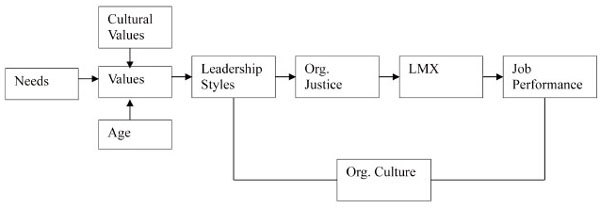
<body><![CDATA[<p><font face="Verdana" size="2"><b>Organizational culture</b></font></p>     <p><font face="Verdana" size="2">Organizational culture influences behaviour in organizations (Bonavia, 2006; Bonavia, Molina & Boada, 2009), and may be suggested as a potential moderator. Indeed a proximal concept to culture, organizational climate, has been found to moderate the relationship between LMX and individual level results such as perceptions of role overload and well-being (Tordera, González-Romá & Peiró, 2008). However, the relationship between organizational culture and leadership has received little attention in the literature. Some studies have shown that specific leadership behaviours are associated with distinct organizationalcultural characteristics. Moreover, organizational culture might be a contextual factor leading to the emergence of a specific leadership style. Schein (1992) claims that organizational culture controls the manager more than the manager controls the culture, through the automatic filters that bias the manager's perceptions, thoughts and feelings. Therefore, although LMX is based on the dyadic employee-manager interaction, it also is likely to be affected by organizational-cultural dimensions.</font></p>     <p><font face="Verdana" size="2">Organizational culture is viewed in the literature as a multifaceted abstraction with several dimensions, which have varying degrees and directions of effect on both employees' behaviour (e.g., Sheridan, 1992) and organizational performance (e.g., Denison, 1984, 1990). In this study, we used O'Reilly III, Chatman and Caldwell's (1991) classification of organizational culture.</font></p>     <p><font face="Verdana" size="2">Summarizing, in our model, we posit the following relationships between individual values, national cultural values, leadership styles, LMX, organizational justice, organizational culture, and performance. We have reached the point where we can sum up the entire exposition of this paper with a holistic conceptualization (<a href="#f1">figure 1</a>) so far not provided by literature. The model hypothesizes employees' needs and values (determined by cultural values and age), leadership styles, perceived organizational justice and LMX as the antecedent variables and job performance (such as compliant, deviant, organizational citizenship, and in-role and extra-role behaviour) as the outcome variable. The relationship between leadership styles, organizational justice, LMX and job performance is suggested to be moderated by organizational culture.</font></p>     <p>&nbsp;</p>     <p align="center"><font face="Verdana" size="2"><a name="f1"></a>Figure 1. The conceptualization guiding the paper's argumentation and reasoning    <br><img src="/img/revistas/rpto/v27n3/v27n3a5f1.jpg"></font></p>     <p>&nbsp;</p>     <p><font face="Verdana" size="2"><b>Recommended future research directions</b></font></p>     <p><font face="Verdana" size="2">In view of these suggestions, a research program should be designed and conducted to examine the moderating role of organizational culture on the links between organizational justice, leadership style (e.g., transformational vs. transactional), LMX, and job performance in various national cultural contexts. The countries to be chosen should provide for a consolidated view on countries (e.g., European countries) and to possibly differentiate as to "established" and transition countries. Moreover, a future research project should target understanding how perceptions of organizational justice, leadership and organizational culture contribute to the performance of older managers in organizational and work settings. These issues are especially important with regard to management positions in organizations. The cumulated body of knowledge shows that cultural value differences preclude automatic transfer of findings from one culture to another. Therefore, it is essential to explore how organizational fairness, justice, leadership behaviours and organizational culture link to job performance and organizational citizenship in different national cultural contexts, triangulating quantitative and qualitative methods. On the practical ground, such knowledge will enhance functioning of international companies establishing in culturally different economic spaces.</font></p>     ]]></body>
<body><![CDATA[<p>&nbsp;</p>     <p><font face="Verdana" size="2"><b>Referencias</b></font></p>     <!-- ref --><p><font face="Verdana" size="2">1. Adams, J. S. (1965). Inequity in social exchange. In L. Berkowitz (Ed.), Advances in Experimental Social Psychology. Vol.2, (pp. 267-299). New York: Academic Press.    &nbsp;&nbsp;&nbsp;&nbsp;&nbsp;&nbsp;&nbsp;&nbsp;[&#160;<a href="javascript:void(0);" onclick="javascript: window.open('/scielo.php?script=sci_nlinks&ref=5019469&pid=S1576-5962201100030000500001&lng=','','width=640,height=500,resizable=yes,scrollbars=1,menubar=yes,');">Links</a>&#160;]<!-- end-ref --></font></p>    <!-- ref --><p><font face="Verdana" size="2">2. Balmer, J. M. T. (2011). Corporate Marketing Myopia and the Inexorable Rise of a Corporate Marketing Logic. European Journal of Marketing, 45, 1329-1352.    &nbsp;&nbsp;&nbsp;&nbsp;&nbsp;&nbsp;&nbsp;&nbsp;[&#160;<a href="javascript:void(0);" onclick="javascript: window.open('/scielo.php?script=sci_nlinks&ref=5019471&pid=S1576-5962201100030000500002&lng=','','width=640,height=500,resizable=yes,scrollbars=1,menubar=yes,');">Links</a>&#160;]<!-- end-ref --></font></p>    <!-- ref --><p><font face="Verdana" size="2">3. Beehr, T. A., Glaser, K. M., Beehr, M. J., Beehr, D. E., Wallwey, D. A., Erofeev, D., & Canali, K. G. (2006). The nature of satisfaction with subordinates: Its predictors and importance to supervisors. Journal of Applied Social Psychology, 36, 1523-1547.    &nbsp;&nbsp;&nbsp;&nbsp;&nbsp;&nbsp;&nbsp;&nbsp;[&#160;<a href="javascript:void(0);" onclick="javascript: window.open('/scielo.php?script=sci_nlinks&ref=5019473&pid=S1576-5962201100030000500003&lng=','','width=640,height=500,resizable=yes,scrollbars=1,menubar=yes,');">Links</a>&#160;]<!-- end-ref --></font></p>    <!-- ref --><p><font face="Verdana" size="2">4. Bell, B. S., Wiechmann, D., & Ryan, A. M. (2006). Consequences of organizational justice expectations in a selection system. Journal of Applied Psychology, 91, 455-466.    &nbsp;&nbsp;&nbsp;&nbsp;&nbsp;&nbsp;&nbsp;&nbsp;[&#160;<a href="javascript:void(0);" onclick="javascript: window.open('/scielo.php?script=sci_nlinks&ref=5019475&pid=S1576-5962201100030000500004&lng=','','width=640,height=500,resizable=yes,scrollbars=1,menubar=yes,');">Links</a>&#160;]<!-- end-ref --></font></p>    ]]></body>
<body><![CDATA[<!-- ref --><p><font face="Verdana" size="2">5. Bonavia, T. (2006). Preliminary organizational culture scale focused on artifacts. Psychological Reports, 99, 671-674.    &nbsp;&nbsp;&nbsp;&nbsp;&nbsp;&nbsp;&nbsp;&nbsp;[&#160;<a href="javascript:void(0);" onclick="javascript: window.open('/scielo.php?script=sci_nlinks&ref=5019477&pid=S1576-5962201100030000500005&lng=','','width=640,height=500,resizable=yes,scrollbars=1,menubar=yes,');">Links</a>&#160;]<!-- end-ref --></font></p>    <!-- ref --><p><font face="Verdana" size="2">6. Bonavia, T., Molina, g., & Boada, J. (2009). further examination of the organizational culture scale of artifacts. Psychological Reports, 105, 827-834.    &nbsp;&nbsp;&nbsp;&nbsp;&nbsp;&nbsp;&nbsp;&nbsp;[&#160;<a href="javascript:void(0);" onclick="javascript: window.open('/scielo.php?script=sci_nlinks&ref=5019479&pid=S1576-5962201100030000500006&lng=','','width=640,height=500,resizable=yes,scrollbars=1,menubar=yes,');">Links</a>&#160;]<!-- end-ref --></font></p>    <!-- ref --><p><font face="Verdana" size="2">7. Brown, M. E. & Trevino, L. K. (2009). Leader-follower values congruence: Are socialized charismatic leaders better able to achieve it? Journal of Applied Psychology, 94, 478-490.    &nbsp;&nbsp;&nbsp;&nbsp;&nbsp;&nbsp;&nbsp;&nbsp;[&#160;<a href="javascript:void(0);" onclick="javascript: window.open('/scielo.php?script=sci_nlinks&ref=5019481&pid=S1576-5962201100030000500007&lng=','','width=640,height=500,resizable=yes,scrollbars=1,menubar=yes,');">Links</a>&#160;]<!-- end-ref --></font></p>    <!-- ref --><p><font face="Verdana" size="2">8. Cohen-Charash, Y. & Spector, P. E. (2001). The role of justice in organizations: A meta-analysis. Organizational Behavior and Human Decision Processes, 86, 278-321.    &nbsp;&nbsp;&nbsp;&nbsp;&nbsp;&nbsp;&nbsp;&nbsp;[&#160;<a href="javascript:void(0);" onclick="javascript: window.open('/scielo.php?script=sci_nlinks&ref=5019483&pid=S1576-5962201100030000500008&lng=','','width=640,height=500,resizable=yes,scrollbars=1,menubar=yes,');">Links</a>&#160;]<!-- end-ref --></font></p>    <!-- ref --><p><font face="Verdana" size="2">9. Dawis, R. V. (1991). Vocational interests, values, and preferences. In M. D. Dunnette & L. M. hough (Eds.), Handbook of industrial and organizational psychology, Vol. 2, 2<sup>nd</sup> ed. (pp. 833-871). Palo Alto, CA: Consulting Psychologists Press.    &nbsp;&nbsp;&nbsp;&nbsp;&nbsp;&nbsp;&nbsp;&nbsp;[&#160;<a href="javascript:void(0);" onclick="javascript: window.open('/scielo.php?script=sci_nlinks&ref=5019485&pid=S1576-5962201100030000500009&lng=','','width=640,height=500,resizable=yes,scrollbars=1,menubar=yes,');">Links</a>&#160;]<!-- end-ref --></font></p>    ]]></body>
<body><![CDATA[<!-- ref --><p><font face="Verdana" size="2">10. Deci, E. L. & Ryan, R. M. (2002). Self-determination research: Reflections and future directions. In E. L. Deci, & R. M. Richard (Eds.), Handbook of Self-determination Research (pp. 431-441). Rochester, New York: University of Rochester Press.    &nbsp;&nbsp;&nbsp;&nbsp;&nbsp;&nbsp;&nbsp;&nbsp;[&#160;<a href="javascript:void(0);" onclick="javascript: window.open('/scielo.php?script=sci_nlinks&ref=5019487&pid=S1576-5962201100030000500010&lng=','','width=640,height=500,resizable=yes,scrollbars=1,menubar=yes,');">Links</a>&#160;]<!-- end-ref --></font></p>    <!-- ref --><p><font face="Verdana" size="2">11. Denison, D. R. (1984). Bringing corporate culture to the bottom line. Organizational Dynamics, 13, 5-22.    &nbsp;&nbsp;&nbsp;&nbsp;&nbsp;&nbsp;&nbsp;&nbsp;[&#160;<a href="javascript:void(0);" onclick="javascript: window.open('/scielo.php?script=sci_nlinks&ref=5019489&pid=S1576-5962201100030000500011&lng=','','width=640,height=500,resizable=yes,scrollbars=1,menubar=yes,');">Links</a>&#160;]<!-- end-ref --></font></p>    <!-- ref --><p><font face="Verdana" size="2">12. Denison, D. R. (1990). Corporate Culture and Organizational Effectiveness. New York: Wiley.    &nbsp;&nbsp;&nbsp;&nbsp;&nbsp;&nbsp;&nbsp;&nbsp;[&#160;<a href="javascript:void(0);" onclick="javascript: window.open('/scielo.php?script=sci_nlinks&ref=5019491&pid=S1576-5962201100030000500012&lng=','','width=640,height=500,resizable=yes,scrollbars=1,menubar=yes,');">Links</a>&#160;]<!-- end-ref --></font></p>    <!-- ref --><p><font face="Verdana" size="2">13. Dorn, D. & Sousa-Poza, A. (2005). The determinants of early retirement in Switzerland. Swiss Journal of Economics and Statistics, 141, 247-283.    &nbsp;&nbsp;&nbsp;&nbsp;&nbsp;&nbsp;&nbsp;&nbsp;[&#160;<a href="javascript:void(0);" onclick="javascript: window.open('/scielo.php?script=sci_nlinks&ref=5019493&pid=S1576-5962201100030000500013&lng=','','width=640,height=500,resizable=yes,scrollbars=1,menubar=yes,');">Links</a>&#160;]<!-- end-ref --></font></p>    <!-- ref --><p><font face="Verdana" size="2">14. Edwards, J. R. (2004). Complementary and supplementary fit: A theoretical and empirical integration. Journal of Applied Psychology, 89, 822-34.    &nbsp;&nbsp;&nbsp;&nbsp;&nbsp;&nbsp;&nbsp;&nbsp;[&#160;<a href="javascript:void(0);" onclick="javascript: window.open('/scielo.php?script=sci_nlinks&ref=5019495&pid=S1576-5962201100030000500014&lng=','','width=640,height=500,resizable=yes,scrollbars=1,menubar=yes,');">Links</a>&#160;]<!-- end-ref --></font></p>    ]]></body>
<body><![CDATA[<!-- ref --><p><font face="Verdana" size="2">15. Elizur, D. (1984). Facets of work values: A structural analysis of work outcomes. Journal of Applied Psychology, 69, 379-389.    &nbsp;&nbsp;&nbsp;&nbsp;&nbsp;&nbsp;&nbsp;&nbsp;[&#160;<a href="javascript:void(0);" onclick="javascript: window.open('/scielo.php?script=sci_nlinks&ref=5019497&pid=S1576-5962201100030000500015&lng=','','width=640,height=500,resizable=yes,scrollbars=1,menubar=yes,');">Links</a>&#160;]<!-- end-ref --></font></p>    <!-- ref --><p><font face="Verdana" size="2">16. Erez, M. (2008). Social-cultural influences on work motivation. In R. Kanfer, G. Chen, & R. D. Pritchard (Eds.), Work motivation: Past, present, and future (pp. 501-538). New York: Routledge/Taylor & Francis Group.    &nbsp;&nbsp;&nbsp;&nbsp;&nbsp;&nbsp;&nbsp;&nbsp;[&#160;<a href="javascript:void(0);" onclick="javascript: window.open('/scielo.php?script=sci_nlinks&ref=5019499&pid=S1576-5962201100030000500016&lng=','','width=640,height=500,resizable=yes,scrollbars=1,menubar=yes,');">Links</a>&#160;]<!-- end-ref --></font></p>    <!-- ref --><p><font face="Verdana" size="2">17. Forteza, J. A. & Prieto, J. M. (1994). Aging and work behavior. In h. C. Triandis, M. D. Dunette, & L. M. hough (Eds.), Handbook of Industrial and Organizational Psychology, 2<sup>nd</sup> ed. (Vol. 4, pp. 447-483). Palo Alto, CA: Consulting Psychologists Press, Inc.    &nbsp;&nbsp;&nbsp;&nbsp;&nbsp;&nbsp;&nbsp;&nbsp;[&#160;<a href="javascript:void(0);" onclick="javascript: window.open('/scielo.php?script=sci_nlinks&ref=5019501&pid=S1576-5962201100030000500017&lng=','','width=640,height=500,resizable=yes,scrollbars=1,menubar=yes,');">Links</a>&#160;]<!-- end-ref --></font></p>    <!-- ref --><p><font face="Verdana" size="2">18. Gerstner, C. R. & Day, D. V. (1997). Meta-analytic review of leader-member exchange theory: Correlates and construct issues, Journal of Applied Psychology, 82, 827-844.    &nbsp;&nbsp;&nbsp;&nbsp;&nbsp;&nbsp;&nbsp;&nbsp;[&#160;<a href="javascript:void(0);" onclick="javascript: window.open('/scielo.php?script=sci_nlinks&ref=5019503&pid=S1576-5962201100030000500018&lng=','','width=640,height=500,resizable=yes,scrollbars=1,menubar=yes,');">Links</a>&#160;]<!-- end-ref --></font></p>    <!-- ref --><p><font face="Verdana" size="2">19. Hedge, J. W., Borman, W. C., & Lammlein, S. E. (2006). The aging workforce: Realities, myths, and implications for organizations. Washington, DC: American Psychological Association.    &nbsp;&nbsp;&nbsp;&nbsp;&nbsp;&nbsp;&nbsp;&nbsp;[&#160;<a href="javascript:void(0);" onclick="javascript: window.open('/scielo.php?script=sci_nlinks&ref=5019505&pid=S1576-5962201100030000500019&lng=','','width=640,height=500,resizable=yes,scrollbars=1,menubar=yes,');">Links</a>&#160;]<!-- end-ref --></font></p>    ]]></body>
<body><![CDATA[<!-- ref --><p><font face="Verdana" size="2">20. Henkens, K. (1999). Retirement intentions and spousal support: A multi-actor approach. Journal of Gerontology: Social Sciences, 54B, 63-73.    &nbsp;&nbsp;&nbsp;&nbsp;&nbsp;&nbsp;&nbsp;&nbsp;[&#160;<a href="javascript:void(0);" onclick="javascript: window.open('/scielo.php?script=sci_nlinks&ref=5019507&pid=S1576-5962201100030000500020&lng=','','width=640,height=500,resizable=yes,scrollbars=1,menubar=yes,');">Links</a>&#160;]<!-- end-ref --></font></p>    <!-- ref --><p><font face="Verdana" size="2">21. Hofstede, G. H. (1980). Culture Consequences: International Differences in Work-related Values. London, United Kingdom: Sage.    &nbsp;&nbsp;&nbsp;&nbsp;&nbsp;&nbsp;&nbsp;&nbsp;[&#160;<a href="javascript:void(0);" onclick="javascript: window.open('/scielo.php?script=sci_nlinks&ref=5019509&pid=S1576-5962201100030000500021&lng=','','width=640,height=500,resizable=yes,scrollbars=1,menubar=yes,');">Links</a>&#160;]<!-- end-ref --></font></p>    <!-- ref --><p><font face="Verdana" size="2">22. Hofstede, G. (2001). Culture's consequences: Comparing values, behaviors, institutions, and organizations across nations, 2<sup>nd</sup> Ed. Thousand Oaks, CA: Sage.    &nbsp;&nbsp;&nbsp;&nbsp;&nbsp;&nbsp;&nbsp;&nbsp;[&#160;<a href="javascript:void(0);" onclick="javascript: window.open('/scielo.php?script=sci_nlinks&ref=5019511&pid=S1576-5962201100030000500022&lng=','','width=640,height=500,resizable=yes,scrollbars=1,menubar=yes,');">Links</a>&#160;]<!-- end-ref --></font></p>    <!-- ref --><p><font face="Verdana" size="2">23. Hofstede, G., & Peterson, M. F. (2000). National values and organizational practices. In N. M. Ashkanasy, C. M. Wilderom, & M. F. Peterson (Eds.), Handbook of organizational culture.and climate (pp. 401-414). Thousand Oaks, CA: Sage.    &nbsp;&nbsp;&nbsp;&nbsp;&nbsp;&nbsp;&nbsp;&nbsp;[&#160;<a href="javascript:void(0);" onclick="javascript: window.open('/scielo.php?script=sci_nlinks&ref=5019513&pid=S1576-5962201100030000500023&lng=','','width=640,height=500,resizable=yes,scrollbars=1,menubar=yes,');">Links</a>&#160;]<!-- end-ref --></font></p>    <!-- ref --><p><font face="Verdana" size="2">24. House, R. J., Hanges P. J., Javidan, M., & Dorfman, P. W. (2004). Leadership, culture, and organizations: The GLOBE study of 62 societies. Thousand Oaks, CA: Sage.    &nbsp;&nbsp;&nbsp;&nbsp;&nbsp;&nbsp;&nbsp;&nbsp;[&#160;<a href="javascript:void(0);" onclick="javascript: window.open('/scielo.php?script=sci_nlinks&ref=5019515&pid=S1576-5962201100030000500024&lng=','','width=640,height=500,resizable=yes,scrollbars=1,menubar=yes,');">Links</a>&#160;]<!-- end-ref --></font></p>    ]]></body>
<body><![CDATA[<!-- ref --><p><font face="Verdana" size="2">25. Javidan, M., & House, R. P. (2001). Cultural acumen for the global manager: Lessons from project GLOBE. Organizational Dynamics, 29, 289-305.    &nbsp;&nbsp;&nbsp;&nbsp;&nbsp;&nbsp;&nbsp;&nbsp;[&#160;<a href="javascript:void(0);" onclick="javascript: window.open('/scielo.php?script=sci_nlinks&ref=5019517&pid=S1576-5962201100030000500025&lng=','','width=640,height=500,resizable=yes,scrollbars=1,menubar=yes,');">Links</a>&#160;]<!-- end-ref --></font></p>    <!-- ref --><p><font face="Verdana" size="2">26. Kacmar, K. M., Witt, L. A., Zivnuska, S., & Gully, S. M. (2003). The interactive effect of leader-member exchange and communication frequency on performance ratings. Journal of Applied Psychology, 88, 764-772.    &nbsp;&nbsp;&nbsp;&nbsp;&nbsp;&nbsp;&nbsp;&nbsp;[&#160;<a href="javascript:void(0);" onclick="javascript: window.open('/scielo.php?script=sci_nlinks&ref=5019519&pid=S1576-5962201100030000500026&lng=','','width=640,height=500,resizable=yes,scrollbars=1,menubar=yes,');">Links</a>&#160;]<!-- end-ref --></font></p>    <!-- ref --><p><font face="Verdana" size="2">27. Latham, G. P. & Pinder, C. C. (2005). Work motivation: Theory and research at the down of the 21<sup>st</sup> century. Annual Review of Psychology, 56, 485-517.    &nbsp;&nbsp;&nbsp;&nbsp;&nbsp;&nbsp;&nbsp;&nbsp;[&#160;<a href="javascript:void(0);" onclick="javascript: window.open('/scielo.php?script=sci_nlinks&ref=5019521&pid=S1576-5962201100030000500027&lng=','','width=640,height=500,resizable=yes,scrollbars=1,menubar=yes,');">Links</a>&#160;]<!-- end-ref --></font></p>    <!-- ref --><p><font face="Verdana" size="2">28. Loftquist, L. H. & Davis, R. V. (1978). Values as second-order needs in the theory of work adjustment. Journal of Vocational Behavior, 1, 12-19.    &nbsp;&nbsp;&nbsp;&nbsp;&nbsp;&nbsp;&nbsp;&nbsp;[&#160;<a href="javascript:void(0);" onclick="javascript: window.open('/scielo.php?script=sci_nlinks&ref=5019523&pid=S1576-5962201100030000500028&lng=','','width=640,height=500,resizable=yes,scrollbars=1,menubar=yes,');">Links</a>&#160;]<!-- end-ref --></font></p>    <!-- ref --><p><font face="Verdana" size="2">29. Maio, G. R. & Olson, J. M. (1998). Values as truisms: Evidence and implications, Journal of Personality and Social Psychology, 74, 294-311.    &nbsp;&nbsp;&nbsp;&nbsp;&nbsp;&nbsp;&nbsp;&nbsp;[&#160;<a href="javascript:void(0);" onclick="javascript: window.open('/scielo.php?script=sci_nlinks&ref=5019525&pid=S1576-5962201100030000500029&lng=','','width=640,height=500,resizable=yes,scrollbars=1,menubar=yes,');">Links</a>&#160;]<!-- end-ref --></font></p>    ]]></body>
<body><![CDATA[<!-- ref --><p><font face="Verdana" size="2">30. Meglino, B. M. & Ravlin, E. C. (1998). Individual values in organizations: Concepts, controversies, and research. Journal of Management, 24, 251-289.    &nbsp;&nbsp;&nbsp;&nbsp;&nbsp;&nbsp;&nbsp;&nbsp;[&#160;<a href="javascript:void(0);" onclick="javascript: window.open('/scielo.php?script=sci_nlinks&ref=5019527&pid=S1576-5962201100030000500030&lng=','','width=640,height=500,resizable=yes,scrollbars=1,menubar=yes,');">Links</a>&#160;]<!-- end-ref --></font></p>    <!-- ref --><p><font face="Verdana" size="2">31. Morhart, F. M., Herzog, W., & Tomczak, T. (2009). Brand-specific leadership: turning employees into brand champions. Journal of Marketing, 73, 122-142.    &nbsp;&nbsp;&nbsp;&nbsp;&nbsp;&nbsp;&nbsp;&nbsp;[&#160;<a href="javascript:void(0);" onclick="javascript: window.open('/scielo.php?script=sci_nlinks&ref=5019529&pid=S1576-5962201100030000500031&lng=','','width=640,height=500,resizable=yes,scrollbars=1,menubar=yes,');">Links</a>&#160;]<!-- end-ref --></font></p>    <!-- ref --><p><font face="Verdana" size="2">32. O'Reilly III, C. A., Chatman, J., & Caldwell, D. f. (1991). People and organizational culture: A profile comparison approach to assessing person-organization fit. Academy of Management Journal, 34, 487-516.    &nbsp;&nbsp;&nbsp;&nbsp;&nbsp;&nbsp;&nbsp;&nbsp;[&#160;<a href="javascript:void(0);" onclick="javascript: window.open('/scielo.php?script=sci_nlinks&ref=5019531&pid=S1576-5962201100030000500032&lng=','','width=640,height=500,resizable=yes,scrollbars=1,menubar=yes,');">Links</a>&#160;]<!-- end-ref --></font></p>    <!-- ref --><p><font face="Verdana" size="2">33. Pinder, C. C. (2008). Work motivation in organizational behavior (2nd ed.). New York, NY US: Psychology Press. Rokeach, M. (1973). The Nature of Human Values. New York: free Press.    &nbsp;&nbsp;&nbsp;&nbsp;&nbsp;&nbsp;&nbsp;&nbsp;[&#160;<a href="javascript:void(0);" onclick="javascript: window.open('/scielo.php?script=sci_nlinks&ref=5019533&pid=S1576-5962201100030000500033&lng=','','width=640,height=500,resizable=yes,scrollbars=1,menubar=yes,');">Links</a>&#160;]<!-- end-ref --></font></p>    <!-- ref --><p><font face="Verdana" size="2">34. Rosen, B. & Jerdee, T. h. (1977). Too old or not too old? Harvard Business Review, 55, 97-106.    &nbsp;&nbsp;&nbsp;&nbsp;&nbsp;&nbsp;&nbsp;&nbsp;[&#160;<a href="javascript:void(0);" onclick="javascript: window.open('/scielo.php?script=sci_nlinks&ref=5019535&pid=S1576-5962201100030000500034&lng=','','width=640,height=500,resizable=yes,scrollbars=1,menubar=yes,');">Links</a>&#160;]<!-- end-ref --></font></p>    ]]></body>
<body><![CDATA[<!-- ref --><p><font face="Verdana" size="2">35. Schein, E. h. (1992). Organizational Culture and Leadership. San Francisco, CA: Jossey-Bass.    &nbsp;&nbsp;&nbsp;&nbsp;&nbsp;&nbsp;&nbsp;&nbsp;[&#160;<a href="javascript:void(0);" onclick="javascript: window.open('/scielo.php?script=sci_nlinks&ref=5019537&pid=S1576-5962201100030000500035&lng=','','width=640,height=500,resizable=yes,scrollbars=1,menubar=yes,');">Links</a>&#160;]<!-- end-ref --></font></p>    <!-- ref --><p><font face="Verdana" size="2">36. Sheppard, B. h., Lewicki, R. J., & Minton, J. W. (1992). Organizational justice: The search for fairness in the workplace. New York: Lexington Books/Macmillan.    &nbsp;&nbsp;&nbsp;&nbsp;&nbsp;&nbsp;&nbsp;&nbsp;[&#160;<a href="javascript:void(0);" onclick="javascript: window.open('/scielo.php?script=sci_nlinks&ref=5019539&pid=S1576-5962201100030000500036&lng=','','width=640,height=500,resizable=yes,scrollbars=1,menubar=yes,');">Links</a>&#160;]<!-- end-ref --></font></p>    <!-- ref --><p><font face="Verdana" size="2">37. Sheridan, J. E. (1992). Organizational culture and employee retention. Academy of Management, 35, 1036-1056.    &nbsp;&nbsp;&nbsp;&nbsp;&nbsp;&nbsp;&nbsp;&nbsp;[&#160;<a href="javascript:void(0);" onclick="javascript: window.open('/scielo.php?script=sci_nlinks&ref=5019541&pid=S1576-5962201100030000500037&lng=','','width=640,height=500,resizable=yes,scrollbars=1,menubar=yes,');">Links</a>&#160;]<!-- end-ref --></font></p>    <!-- ref --><p><font face="Verdana" size="2">38. Schwartz, S. H. & Bilsky, W. (1990). Toward a theory of the universal content and structure of values: Extensions and cross-cultural replications. Journal of Personality and Social Psychology, 58, 878-91.    &nbsp;&nbsp;&nbsp;&nbsp;&nbsp;&nbsp;&nbsp;&nbsp;[&#160;<a href="javascript:void(0);" onclick="javascript: window.open('/scielo.php?script=sci_nlinks&ref=5019543&pid=S1576-5962201100030000500038&lng=','','width=640,height=500,resizable=yes,scrollbars=1,menubar=yes,');">Links</a>&#160;]<!-- end-ref --></font></p>    <!-- ref --><p><font face="Verdana" size="2">39. Super, D. E. (1995). Values: Their nature, assessment, and practical use. In D. E. Super, B. Super, & Sverko (Eds.), Life roles, values, and careers: International findings of the Work Importance Study (pp. 54-61). San Francisco, CA: Jossey-Bass.    &nbsp;&nbsp;&nbsp;&nbsp;&nbsp;&nbsp;&nbsp;&nbsp;[&#160;<a href="javascript:void(0);" onclick="javascript: window.open('/scielo.php?script=sci_nlinks&ref=5019545&pid=S1576-5962201100030000500039&lng=','','width=640,height=500,resizable=yes,scrollbars=1,menubar=yes,');">Links</a>&#160;]<!-- end-ref --></font></p>    ]]></body>
<body><![CDATA[<!-- ref --><p><font face="Verdana" size="2">40. Talaga, J. A., & Beehr, T. A. (1989). Retirement: A psychological perspective. In C. L. Copper & I. T. Robertson (Eds.), International review of industrial and organizational psychology (pp. 185-211). Chichester, United Kingdom: Wiley.    &nbsp;&nbsp;&nbsp;&nbsp;&nbsp;&nbsp;&nbsp;&nbsp;[&#160;<a href="javascript:void(0);" onclick="javascript: window.open('/scielo.php?script=sci_nlinks&ref=5019547&pid=S1576-5962201100030000500040&lng=','','width=640,height=500,resizable=yes,scrollbars=1,menubar=yes,');">Links</a>&#160;]<!-- end-ref --></font></p>    <!-- ref --><p><font face="Verdana" size="2">41. Thibaut, J., Friedland, N. & Walker, L. (1974). Compliance with rules: Some social determinants. Journal of Personality and Social Psychology, 30, 792-801.    &nbsp;&nbsp;&nbsp;&nbsp;&nbsp;&nbsp;&nbsp;&nbsp;[&#160;<a href="javascript:void(0);" onclick="javascript: window.open('/scielo.php?script=sci_nlinks&ref=5019549&pid=S1576-5962201100030000500041&lng=','','width=640,height=500,resizable=yes,scrollbars=1,menubar=yes,');">Links</a>&#160;]<!-- end-ref --></font></p>    <!-- ref --><p><font face="Verdana" size="2">42. Thorbjornsen, H. & Supphellen, M. (2011). Determinants of core value behaviour in service brands. Journal of Services Marketing, 25, 68-76.    &nbsp;&nbsp;&nbsp;&nbsp;&nbsp;&nbsp;&nbsp;&nbsp;[&#160;<a href="javascript:void(0);" onclick="javascript: window.open('/scielo.php?script=sci_nlinks&ref=5019551&pid=S1576-5962201100030000500042&lng=','','width=640,height=500,resizable=yes,scrollbars=1,menubar=yes,');">Links</a>&#160;]<!-- end-ref --></font></p>    <!-- ref --><p><font face="Verdana" size="2">43. Tordera, N., González-Romá, V., & Peiró, J. M. (2008). The moderator effect of psychological climate on the relationship between leader-member exchange (LMX) quality and role overload. European Journal of Work and Organizational Psychology , 17, 55-72.    &nbsp;&nbsp;&nbsp;&nbsp;&nbsp;&nbsp;&nbsp;&nbsp;[&#160;<a href="javascript:void(0);" onclick="javascript: window.open('/scielo.php?script=sci_nlinks&ref=5019553&pid=S1576-5962201100030000500043&lng=','','width=640,height=500,resizable=yes,scrollbars=1,menubar=yes,');">Links</a>&#160;]<!-- end-ref --></font></p>    <!-- ref --><p><font face="Verdana" size="2">44. Triandis, H. C. (1994). Culture and social behavior. New York: Mcgraw-Hill.    &nbsp;&nbsp;&nbsp;&nbsp;&nbsp;&nbsp;&nbsp;&nbsp;[&#160;<a href="javascript:void(0);" onclick="javascript: window.open('/scielo.php?script=sci_nlinks&ref=5019555&pid=S1576-5962201100030000500044&lng=','','width=640,height=500,resizable=yes,scrollbars=1,menubar=yes,');">Links</a>&#160;]<!-- end-ref --></font></p>    ]]></body>
<body><![CDATA[<!-- ref --><p><font face="Verdana" size="2">45. Tyler, T. R. & Bies, R.J. (1990). Beyond formal procedures: The interpersonal context of procedural justice. In J.S. Carroll (Ed.). Applied social psychology and organizational settings (pp. 77-98). hillsdale, New Jersey: Lawrence Erlbaum Associates.    &nbsp;&nbsp;&nbsp;&nbsp;&nbsp;&nbsp;&nbsp;&nbsp;[&#160;<a href="javascript:void(0);" onclick="javascript: window.open('/scielo.php?script=sci_nlinks&ref=5019557&pid=S1576-5962201100030000500045&lng=','','width=640,height=500,resizable=yes,scrollbars=1,menubar=yes,');">Links</a>&#160;]<!-- end-ref --></font></p>    <!-- ref --><p><font face="Verdana" size="2">46. Tziner A. & Elizur, D. (1987). Work values as "reinforcer groups." Is the underlying structure method free? Quality & Quantity, 21, 377-392.    &nbsp;&nbsp;&nbsp;&nbsp;&nbsp;&nbsp;&nbsp;&nbsp;[&#160;<a href="javascript:void(0);" onclick="javascript: window.open('/scielo.php?script=sci_nlinks&ref=5019559&pid=S1576-5962201100030000500046&lng=','','width=640,height=500,resizable=yes,scrollbars=1,menubar=yes,');">Links</a>&#160;]<!-- end-ref --></font></p>    <!-- ref --><p><font face="Verdana" size="2">47. Von Nordheim, F. (2003). EU Policies in support of member state efforts to retain, reinforce and re-integrate older workers in employment. In H. Buck & B. Dworschak (Eds.), Ageing and Work in Europe. Strategies at Company Level and Public Policies in Selected European Countries, (pp. 9-26) Demography and Employment. Stuttgart, germany: IRB Verlag.    &nbsp;&nbsp;&nbsp;&nbsp;&nbsp;&nbsp;&nbsp;&nbsp;[&#160;<a href="javascript:void(0);" onclick="javascript: window.open('/scielo.php?script=sci_nlinks&ref=5019561&pid=S1576-5962201100030000500047&lng=','','width=640,height=500,resizable=yes,scrollbars=1,menubar=yes,');">Links</a>&#160;]<!-- end-ref --></font></p>    <!-- ref --><p><font face="Verdana" size="2">48. Walumbwa, F. O. & Scaubroeck, J. (2009). Leader personality traits and employee voice behaviour: Mediating roles of ethical leadership and work group psychological safety. Journal of Applied Psychology, 94, 1275-1286.    &nbsp;&nbsp;&nbsp;&nbsp;&nbsp;&nbsp;&nbsp;&nbsp;[&#160;<a href="javascript:void(0);" onclick="javascript: window.open('/scielo.php?script=sci_nlinks&ref=5019563&pid=S1576-5962201100030000500048&lng=','','width=640,height=500,resizable=yes,scrollbars=1,menubar=yes,');">Links</a>&#160;]<!-- end-ref --></font></p>    <!-- ref --><p><font face="Verdana" size="2">49. Wang, H., Law, K. S., Hackett, R. D., Wang, D., & Chen, z. X. (2005). Leader-member exchange as a mediator of the relationship between transformational leadership and followers' performance and organizational citizenship behavior. Academy of Management Journal, 48. 420-432.    &nbsp;&nbsp;&nbsp;&nbsp;&nbsp;&nbsp;&nbsp;&nbsp;[&#160;<a href="javascript:void(0);" onclick="javascript: window.open('/scielo.php?script=sci_nlinks&ref=5019565&pid=S1576-5962201100030000500049&lng=','','width=640,height=500,resizable=yes,scrollbars=1,menubar=yes,');">Links</a>&#160;]<!-- end-ref --></font></p>    ]]></body>
<body><![CDATA[<!-- ref --><p><font face="Verdana" size="2">50. Wayne, S. J., Shore, L. M., Bommer, W. h., & Tetrick, L. E. (2002). The role of fair treatment and rewards in perceptions of organizational support and leader-member exchange. Journal of Applied Psychology, 87, 590-598.    &nbsp;&nbsp;&nbsp;&nbsp;&nbsp;&nbsp;&nbsp;&nbsp;[&#160;<a href="javascript:void(0);" onclick="javascript: window.open('/scielo.php?script=sci_nlinks&ref=5019567&pid=S1576-5962201100030000500050&lng=','','width=640,height=500,resizable=yes,scrollbars=1,menubar=yes,');">Links</a>&#160;]<!-- end-ref --></font></p>     <p>&nbsp;</p>     <p>&nbsp;</p>     <p><font face="Verdana" size="2"><a name="back"></a><a href="#top"><img src="/img/revistas/rpto/v27n3/seta.gif" width="15" height="17"></a><b>Correspondence:</b>    <br>Aharon Tziner    <br>Schools of Behavioral Studies and Business Administration    <br>Netanya Academic College    <br>Jerusalem, Israel    <br>E-mail address: <a href="mailto:atziner@netanya.ac.il">atziner@netanya.ac.il</a></a></font></p>     ]]></body>
<body><![CDATA[<p><font face="Verdana" size="2">Manuscrito recibido: 29/05/2011    <br>Revisión recibida: 26/10/2011    <br>Aceptado: 30/10/2011</font></p>      ]]></body><back>
<ref-list>
<ref id="B1">
<label>1</label><nlm-citation citation-type="book">
<person-group person-group-type="author">
<name>
<surname><![CDATA[Adams]]></surname>
<given-names><![CDATA[J. S.]]></given-names>
</name>
</person-group>
<article-title xml:lang="en"><![CDATA[Inequity in social exchange]]></article-title>
<person-group person-group-type="editor">
<name>
<surname><![CDATA[Berkowitz]]></surname>
<given-names><![CDATA[L.]]></given-names>
</name>
</person-group>
<source><![CDATA[Advances in Experimental Social Psychology]]></source>
<year>1965</year>
<volume>2</volume>
<page-range>267-299</page-range><publisher-loc><![CDATA[New York ]]></publisher-loc>
<publisher-name><![CDATA[Academic Press]]></publisher-name>
</nlm-citation>
</ref>
<ref id="B2">
<label>2</label><nlm-citation citation-type="journal">
<person-group person-group-type="author">
<name>
<surname><![CDATA[Balmer]]></surname>
<given-names><![CDATA[J. M. T.]]></given-names>
</name>
</person-group>
<article-title xml:lang="en"><![CDATA[Corporate Marketing Myopia and the Inexorable Rise of a Corporate Marketing Logic]]></article-title>
<source><![CDATA[European Journal of Marketing]]></source>
<year>2011</year>
<volume>45</volume>
<page-range>1329-1352</page-range></nlm-citation>
</ref>
<ref id="B3">
<label>3</label><nlm-citation citation-type="journal">
<person-group person-group-type="author">
<name>
<surname><![CDATA[Beehr]]></surname>
<given-names><![CDATA[T. A.]]></given-names>
</name>
<name>
<surname><![CDATA[Glaser]]></surname>
<given-names><![CDATA[K. M.]]></given-names>
</name>
<name>
<surname><![CDATA[Beehr]]></surname>
<given-names><![CDATA[M. J.]]></given-names>
</name>
<name>
<surname><![CDATA[Beehr]]></surname>
<given-names><![CDATA[D. E.]]></given-names>
</name>
<name>
<surname><![CDATA[Wallwey]]></surname>
<given-names><![CDATA[D. A.]]></given-names>
</name>
<name>
<surname><![CDATA[Erofeev]]></surname>
<given-names><![CDATA[D.]]></given-names>
</name>
<name>
<surname><![CDATA[Canali]]></surname>
<given-names><![CDATA[K. G.]]></given-names>
</name>
</person-group>
<article-title xml:lang="en"><![CDATA[The nature of satisfaction with subordinates: Its predictors and importance to supervisors]]></article-title>
<source><![CDATA[Journal of Applied Social Psychology]]></source>
<year>2006</year>
<volume>36</volume>
<page-range>1523-1547</page-range></nlm-citation>
</ref>
<ref id="B4">
<label>4</label><nlm-citation citation-type="journal">
<person-group person-group-type="author">
<name>
<surname><![CDATA[Bell]]></surname>
<given-names><![CDATA[B. S.]]></given-names>
</name>
<name>
<surname><![CDATA[Wiechmann]]></surname>
<given-names><![CDATA[D.]]></given-names>
</name>
<name>
<surname><![CDATA[Ryan]]></surname>
<given-names><![CDATA[A. M.]]></given-names>
</name>
</person-group>
<article-title xml:lang="en"><![CDATA[Consequences of organizational justice expectations in a selection system]]></article-title>
<source><![CDATA[Journal of Applied Psychology]]></source>
<year>2006</year>
<volume>91</volume>
<page-range>455-466</page-range></nlm-citation>
</ref>
<ref id="B5">
<label>5</label><nlm-citation citation-type="journal">
<person-group person-group-type="author">
<name>
<surname><![CDATA[Bonavia]]></surname>
<given-names><![CDATA[T.]]></given-names>
</name>
</person-group>
<article-title xml:lang="en"><![CDATA[Preliminary organizational culture scale focused on artifacts]]></article-title>
<source><![CDATA[Psychological Reports]]></source>
<year>2006</year>
<volume>99</volume>
<page-range>671-674</page-range></nlm-citation>
</ref>
<ref id="B6">
<label>6</label><nlm-citation citation-type="journal">
<person-group person-group-type="author">
<name>
<surname><![CDATA[Bonavia]]></surname>
<given-names><![CDATA[T.]]></given-names>
</name>
<name>
<surname><![CDATA[Molina]]></surname>
<given-names><![CDATA[g.]]></given-names>
</name>
<name>
<surname><![CDATA[Boada]]></surname>
<given-names><![CDATA[J.]]></given-names>
</name>
</person-group>
<article-title xml:lang="en"><![CDATA[further examination of the organizational culture scale of artifacts]]></article-title>
<source><![CDATA[Psychological Reports]]></source>
<year>2009</year>
<volume>105</volume>
<page-range>827-834</page-range></nlm-citation>
</ref>
<ref id="B7">
<label>7</label><nlm-citation citation-type="journal">
<person-group person-group-type="author">
<name>
<surname><![CDATA[Brown]]></surname>
<given-names><![CDATA[M. E.]]></given-names>
</name>
<name>
<surname><![CDATA[Trevino]]></surname>
<given-names><![CDATA[L. K.]]></given-names>
</name>
</person-group>
<article-title xml:lang="en"><![CDATA[Leader-follower values congruence: Are socialized charismatic leaders better able to achieve it?]]></article-title>
<source><![CDATA[Journal of Applied Psychology]]></source>
<year>2009</year>
<volume>94</volume>
<page-range>478-490</page-range></nlm-citation>
</ref>
<ref id="B8">
<label>8</label><nlm-citation citation-type="journal">
<person-group person-group-type="author">
<name>
<surname><![CDATA[Cohen-Charash]]></surname>
<given-names><![CDATA[Y.]]></given-names>
</name>
<name>
<surname><![CDATA[Spector]]></surname>
<given-names><![CDATA[P. E.]]></given-names>
</name>
</person-group>
<article-title xml:lang="en"><![CDATA[The role of justice in organizations: A meta-analysis]]></article-title>
<source><![CDATA[Organizational Behavior and Human Decision Processes]]></source>
<year>2001</year>
<volume>86</volume>
<page-range>278-321</page-range></nlm-citation>
</ref>
<ref id="B9">
<label>9</label><nlm-citation citation-type="book">
<person-group person-group-type="author">
<name>
<surname><![CDATA[Dawis]]></surname>
<given-names><![CDATA[R. V.]]></given-names>
</name>
</person-group>
<article-title xml:lang="en"><![CDATA[Vocational interests, values, and preferences]]></article-title>
<person-group person-group-type="editor">
<name>
<surname><![CDATA[Dunnette]]></surname>
<given-names><![CDATA[M. D.]]></given-names>
</name>
<name>
<surname><![CDATA[hough]]></surname>
<given-names><![CDATA[L. M.]]></given-names>
</name>
</person-group>
<source><![CDATA[Handbook of industrial and organizational psychology]]></source>
<year>1991</year>
<volume>2</volume>
<edition>2</edition>
<page-range>833-871</page-range><publisher-loc><![CDATA[Palo Alto^eCA CA]]></publisher-loc>
<publisher-name><![CDATA[Consulting Psychologists Press]]></publisher-name>
</nlm-citation>
</ref>
<ref id="B10">
<label>10</label><nlm-citation citation-type="book">
<person-group person-group-type="author">
<name>
<surname><![CDATA[Deci]]></surname>
<given-names><![CDATA[E. L.]]></given-names>
</name>
<name>
<surname><![CDATA[Ryan]]></surname>
<given-names><![CDATA[R. M.]]></given-names>
</name>
</person-group>
<article-title xml:lang="en"><![CDATA[Self-determination research: Reflections and future directions]]></article-title>
<person-group person-group-type="editor">
<name>
<surname><![CDATA[Deci]]></surname>
<given-names><![CDATA[E. L.]]></given-names>
</name>
<name>
<surname><![CDATA[Richard]]></surname>
<given-names><![CDATA[R. M.]]></given-names>
</name>
</person-group>
<source><![CDATA[Handbook of Self-determination Research]]></source>
<year>2002</year>
<page-range>431-441</page-range><publisher-loc><![CDATA[Rochester^eNew York New York]]></publisher-loc>
<publisher-name><![CDATA[University of Rochester Press]]></publisher-name>
</nlm-citation>
</ref>
<ref id="B11">
<label>11</label><nlm-citation citation-type="journal">
<person-group person-group-type="author">
<name>
<surname><![CDATA[Denison]]></surname>
<given-names><![CDATA[D. R.]]></given-names>
</name>
</person-group>
<article-title xml:lang="en"><![CDATA[Bringing corporate culture to the bottom line]]></article-title>
<source><![CDATA[Organizational Dynamics]]></source>
<year>1984</year>
<volume>13</volume>
<page-range>5-22</page-range></nlm-citation>
</ref>
<ref id="B12">
<label>12</label><nlm-citation citation-type="book">
<person-group person-group-type="author">
<name>
<surname><![CDATA[Denison]]></surname>
<given-names><![CDATA[D. R.]]></given-names>
</name>
</person-group>
<source><![CDATA[Corporate Culture and Organizational Effectiveness]]></source>
<year>1990</year>
<publisher-loc><![CDATA[New York ]]></publisher-loc>
<publisher-name><![CDATA[Wiley]]></publisher-name>
</nlm-citation>
</ref>
<ref id="B13">
<label>13</label><nlm-citation citation-type="journal">
<person-group person-group-type="author">
<name>
<surname><![CDATA[Dorn]]></surname>
<given-names><![CDATA[D.]]></given-names>
</name>
<name>
<surname><![CDATA[Sousa-Poza]]></surname>
<given-names><![CDATA[A.]]></given-names>
</name>
</person-group>
<article-title xml:lang="en"><![CDATA[The determinants of early retirement in Switzerland]]></article-title>
<source><![CDATA[Swiss Journal of Economics and Statistics]]></source>
<year>2005</year>
<volume>141</volume>
<page-range>247-283</page-range></nlm-citation>
</ref>
<ref id="B14">
<label>14</label><nlm-citation citation-type="journal">
<person-group person-group-type="author">
<name>
<surname><![CDATA[Edwards]]></surname>
<given-names><![CDATA[J. R.]]></given-names>
</name>
</person-group>
<article-title xml:lang="en"><![CDATA[Complementary and supplementary fit: A theoretical and empirical integration]]></article-title>
<source><![CDATA[Journal of Applied Psychology]]></source>
<year>2004</year>
<volume>89</volume>
<page-range>822-34</page-range></nlm-citation>
</ref>
<ref id="B15">
<label>15</label><nlm-citation citation-type="journal">
<person-group person-group-type="author">
<name>
<surname><![CDATA[Elizur]]></surname>
<given-names><![CDATA[D.]]></given-names>
</name>
</person-group>
<article-title xml:lang="en"><![CDATA[Facets of work values: A structural analysis of work outcomes]]></article-title>
<source><![CDATA[Journal of Applied Psychology]]></source>
<year>1984</year>
<volume>69</volume>
<page-range>379-389</page-range></nlm-citation>
</ref>
<ref id="B16">
<label>16</label><nlm-citation citation-type="book">
<person-group person-group-type="author">
<name>
<surname><![CDATA[Erez]]></surname>
<given-names><![CDATA[M.]]></given-names>
</name>
</person-group>
<article-title xml:lang="en"><![CDATA[Social-cultural influences on work motivation]]></article-title>
<person-group person-group-type="editor">
<name>
<surname><![CDATA[Kanfer]]></surname>
<given-names><![CDATA[R.]]></given-names>
</name>
<name>
<surname><![CDATA[Chen]]></surname>
<given-names><![CDATA[G.]]></given-names>
</name>
<name>
<surname><![CDATA[Pritchard]]></surname>
<given-names><![CDATA[R. D.]]></given-names>
</name>
</person-group>
<source><![CDATA[Work motivation: Past, present, and future]]></source>
<year>2008</year>
<page-range>501-538</page-range><publisher-loc><![CDATA[New York ]]></publisher-loc>
<publisher-name><![CDATA[Routledge/Taylor & Francis Group]]></publisher-name>
</nlm-citation>
</ref>
<ref id="B17">
<label>17</label><nlm-citation citation-type="book">
<person-group person-group-type="author">
<name>
<surname><![CDATA[Forteza]]></surname>
<given-names><![CDATA[J. A.]]></given-names>
</name>
<name>
<surname><![CDATA[Prieto]]></surname>
<given-names><![CDATA[J. M.]]></given-names>
</name>
</person-group>
<article-title xml:lang="en"><![CDATA[Aging and work behavior]]></article-title>
<person-group person-group-type="editor">
<name>
<surname><![CDATA[Triandis]]></surname>
<given-names><![CDATA[h. C.]]></given-names>
</name>
<name>
<surname><![CDATA[Dunette]]></surname>
<given-names><![CDATA[M. D.]]></given-names>
</name>
<name>
<surname><![CDATA[hough]]></surname>
<given-names><![CDATA[L. M.]]></given-names>
</name>
</person-group>
<source><![CDATA[Handbook of Industrial and Organizational Psychology]]></source>
<year>1994</year>
<volume>4</volume>
<edition>2</edition>
<page-range>447-483</page-range><publisher-loc><![CDATA[Palo Alto^eCA CA]]></publisher-loc>
<publisher-name><![CDATA[Consulting Psychologists Press]]></publisher-name>
</nlm-citation>
</ref>
<ref id="B18">
<label>18</label><nlm-citation citation-type="journal">
<person-group person-group-type="author">
<name>
<surname><![CDATA[Gerstner]]></surname>
<given-names><![CDATA[C. R.]]></given-names>
</name>
<name>
<surname><![CDATA[Day]]></surname>
<given-names><![CDATA[D. V.]]></given-names>
</name>
</person-group>
<article-title xml:lang="en"><![CDATA[Meta-analytic review of leader-member exchange theory: Correlates and construct issues]]></article-title>
<source><![CDATA[Journal of Applied Psychology]]></source>
<year>1997</year>
<volume>82</volume>
<page-range>827-844</page-range></nlm-citation>
</ref>
<ref id="B19">
<label>19</label><nlm-citation citation-type="book">
<person-group person-group-type="author">
<name>
<surname><![CDATA[Hedge]]></surname>
<given-names><![CDATA[J. W.]]></given-names>
</name>
<name>
<surname><![CDATA[Borman]]></surname>
<given-names><![CDATA[W. C.]]></given-names>
</name>
<name>
<surname><![CDATA[Lammlein]]></surname>
<given-names><![CDATA[S. E.]]></given-names>
</name>
</person-group>
<source><![CDATA[The aging workforce: Realities, myths, and implications for organizations]]></source>
<year>2006</year>
<publisher-loc><![CDATA[Washington^eDC DC]]></publisher-loc>
<publisher-name><![CDATA[American Psychological Association]]></publisher-name>
</nlm-citation>
</ref>
<ref id="B20">
<label>20</label><nlm-citation citation-type="journal">
<person-group person-group-type="author">
<name>
<surname><![CDATA[Henkens]]></surname>
<given-names><![CDATA[K.]]></given-names>
</name>
</person-group>
<article-title xml:lang="en"><![CDATA[Retirement intentions and spousal support: A multi-actor approach]]></article-title>
<source><![CDATA[Journal of Gerontology: Social Sciences]]></source>
<year>1999</year>
<volume>54B</volume>
<page-range>63-73</page-range></nlm-citation>
</ref>
<ref id="B21">
<label>21</label><nlm-citation citation-type="book">
<person-group person-group-type="author">
<name>
<surname><![CDATA[Hofstede]]></surname>
<given-names><![CDATA[G. H.]]></given-names>
</name>
</person-group>
<source><![CDATA[Culture Consequences: International Differences in Work-related Values]]></source>
<year>1980</year>
<publisher-loc><![CDATA[London ]]></publisher-loc>
<publisher-name><![CDATA[United KingdomSage]]></publisher-name>
</nlm-citation>
</ref>
<ref id="B22">
<label>22</label><nlm-citation citation-type="book">
<person-group person-group-type="author">
<name>
<surname><![CDATA[Hofstede]]></surname>
<given-names><![CDATA[G.]]></given-names>
</name>
</person-group>
<source><![CDATA[Culture's consequences: Comparing values, behaviors, institutions, and organizations across nations]]></source>
<year>2001</year>
<edition>2</edition>
<publisher-loc><![CDATA[Thousand Oaks^eCA CA]]></publisher-loc>
<publisher-name><![CDATA[Sage]]></publisher-name>
</nlm-citation>
</ref>
<ref id="B23">
<label>23</label><nlm-citation citation-type="book">
<person-group person-group-type="author">
<name>
<surname><![CDATA[Hofstede]]></surname>
<given-names><![CDATA[G.]]></given-names>
</name>
<name>
<surname><![CDATA[Peterson]]></surname>
<given-names><![CDATA[M. F.]]></given-names>
</name>
</person-group>
<article-title xml:lang="en"><![CDATA[National values and organizational practices]]></article-title>
<person-group person-group-type="editor">
<name>
<surname><![CDATA[Ashkanasy]]></surname>
<given-names><![CDATA[N. M.]]></given-names>
</name>
<name>
<surname><![CDATA[Wilderom]]></surname>
<given-names><![CDATA[C. M.]]></given-names>
</name>
<name>
<surname><![CDATA[Peterson]]></surname>
<given-names><![CDATA[M. F.]]></given-names>
</name>
</person-group>
<source><![CDATA[Handbook of organizational culture.and climate]]></source>
<year>2000</year>
<page-range>401-414</page-range><publisher-loc><![CDATA[Thousand Oaks^eCA CA]]></publisher-loc>
<publisher-name><![CDATA[Sage]]></publisher-name>
</nlm-citation>
</ref>
<ref id="B24">
<label>24</label><nlm-citation citation-type="book">
<person-group person-group-type="author">
<name>
<surname><![CDATA[House]]></surname>
<given-names><![CDATA[R. J.]]></given-names>
</name>
<name>
<surname><![CDATA[Hanges]]></surname>
<given-names><![CDATA[P. J.]]></given-names>
</name>
<name>
<surname><![CDATA[Javidan]]></surname>
<given-names><![CDATA[M.]]></given-names>
</name>
<name>
<surname><![CDATA[Dorfman]]></surname>
<given-names><![CDATA[P. W.]]></given-names>
</name>
</person-group>
<source><![CDATA[Leadership, culture, and organizations: The GLOBE study of 62 societies]]></source>
<year>2004</year>
<publisher-loc><![CDATA[Thousand Oaks^eCA CA]]></publisher-loc>
<publisher-name><![CDATA[Sage]]></publisher-name>
</nlm-citation>
</ref>
<ref id="B25">
<label>25</label><nlm-citation citation-type="journal">
<person-group person-group-type="author">
<name>
<surname><![CDATA[Javidan]]></surname>
<given-names><![CDATA[M.]]></given-names>
</name>
<name>
<surname><![CDATA[House]]></surname>
<given-names><![CDATA[R. P.]]></given-names>
</name>
</person-group>
<article-title xml:lang="en"><![CDATA[Cultural acumen for the global manager: Lessons from project GLOBE]]></article-title>
<source><![CDATA[Organizational Dynamics]]></source>
<year>2001</year>
<volume>29</volume>
<page-range>289-305</page-range></nlm-citation>
</ref>
<ref id="B26">
<label>26</label><nlm-citation citation-type="journal">
<person-group person-group-type="author">
<name>
<surname><![CDATA[Kacmar]]></surname>
<given-names><![CDATA[K. M.]]></given-names>
</name>
<name>
<surname><![CDATA[Witt]]></surname>
<given-names><![CDATA[L. A.]]></given-names>
</name>
<name>
<surname><![CDATA[Zivnuska]]></surname>
<given-names><![CDATA[S.]]></given-names>
</name>
<name>
<surname><![CDATA[Gully]]></surname>
<given-names><![CDATA[S. M.]]></given-names>
</name>
</person-group>
<article-title xml:lang="en"><![CDATA[The interactive effect of leader-member exchange and communication frequency on performance ratings]]></article-title>
<source><![CDATA[Journal of Applied Psychology]]></source>
<year>2003</year>
<volume>88</volume>
<page-range>764-772</page-range></nlm-citation>
</ref>
<ref id="B27">
<label>27</label><nlm-citation citation-type="journal">
<person-group person-group-type="author">
<name>
<surname><![CDATA[Latham]]></surname>
<given-names><![CDATA[G. P.]]></given-names>
</name>
<name>
<surname><![CDATA[Pinder]]></surname>
<given-names><![CDATA[C. C.]]></given-names>
</name>
</person-group>
<article-title xml:lang="en"><![CDATA[Work motivation: Theory and research at the down of the 21st century]]></article-title>
<source><![CDATA[Annual Review of Psychology]]></source>
<year>2005</year>
<volume>56</volume>
<page-range>485-517</page-range></nlm-citation>
</ref>
<ref id="B28">
<label>28</label><nlm-citation citation-type="journal">
<person-group person-group-type="author">
<name>
<surname><![CDATA[Loftquist]]></surname>
<given-names><![CDATA[L. H.]]></given-names>
</name>
<name>
<surname><![CDATA[Davis]]></surname>
<given-names><![CDATA[R. V.]]></given-names>
</name>
</person-group>
<article-title xml:lang="en"><![CDATA[Values as second-order needs in the theory of work adjustment]]></article-title>
<source><![CDATA[Journal of Vocational Behavior]]></source>
<year>1978</year>
<volume>1</volume>
<page-range>12-19</page-range></nlm-citation>
</ref>
<ref id="B29">
<label>29</label><nlm-citation citation-type="journal">
<person-group person-group-type="author">
<name>
<surname><![CDATA[Maio]]></surname>
<given-names><![CDATA[G. R.]]></given-names>
</name>
<name>
<surname><![CDATA[Olson]]></surname>
<given-names><![CDATA[J. M.]]></given-names>
</name>
</person-group>
<article-title xml:lang="en"><![CDATA[Values as truisms: Evidence and implications]]></article-title>
<source><![CDATA[Journal of Personality and Social Psychology]]></source>
<year>1998</year>
<volume>74</volume>
<page-range>294-311</page-range></nlm-citation>
</ref>
<ref id="B30">
<label>30</label><nlm-citation citation-type="journal">
<person-group person-group-type="author">
<name>
<surname><![CDATA[Meglino]]></surname>
<given-names><![CDATA[B. M.]]></given-names>
</name>
<name>
<surname><![CDATA[Ravlin]]></surname>
<given-names><![CDATA[E. C.]]></given-names>
</name>
</person-group>
<article-title xml:lang="en"><![CDATA[Individual values in organizations: Concepts, controversies, and research]]></article-title>
<source><![CDATA[Journal of Management]]></source>
<year>1998</year>
<volume>24</volume>
<page-range>251-289</page-range></nlm-citation>
</ref>
<ref id="B31">
<label>31</label><nlm-citation citation-type="journal">
<person-group person-group-type="author">
<name>
<surname><![CDATA[Morhart]]></surname>
<given-names><![CDATA[F. M.]]></given-names>
</name>
<name>
<surname><![CDATA[Herzog]]></surname>
<given-names><![CDATA[W.]]></given-names>
</name>
<name>
<surname><![CDATA[Tomczak]]></surname>
<given-names><![CDATA[T.]]></given-names>
</name>
</person-group>
<article-title xml:lang="en"><![CDATA[Brand-specific leadership: turning employees into brand champions]]></article-title>
<source><![CDATA[Journal of Marketing]]></source>
<year>2009</year>
<volume>73</volume>
<page-range>122-142</page-range></nlm-citation>
</ref>
<ref id="B32">
<label>32</label><nlm-citation citation-type="journal">
<person-group person-group-type="author">
<name>
<surname><![CDATA[O'Reilly III]]></surname>
<given-names><![CDATA[C. A.]]></given-names>
</name>
<name>
<surname><![CDATA[Chatman]]></surname>
<given-names><![CDATA[J.]]></given-names>
</name>
<name>
<surname><![CDATA[Caldwell]]></surname>
<given-names><![CDATA[D. f.]]></given-names>
</name>
</person-group>
<article-title xml:lang="en"><![CDATA[People and organizational culture: A profile comparison approach to assessing person-organization fit]]></article-title>
<source><![CDATA[Academy of Management Journal]]></source>
<year>1991</year>
<volume>34</volume>
<page-range>487-516</page-range></nlm-citation>
</ref>
<ref id="B33">
<label>33</label><nlm-citation citation-type="book">
<person-group person-group-type="author">
<name>
<surname><![CDATA[Pinder]]></surname>
<given-names><![CDATA[C. C.]]></given-names>
</name>
</person-group>
<source><![CDATA[Work motivation in organizational behavior]]></source>
<year>2008</year>
<edition>2</edition>
<publisher-loc><![CDATA[New York^eNY NY]]></publisher-loc>
<publisher-name><![CDATA[Psychology Press]]></publisher-name>
</nlm-citation>
</ref>
<ref id="B34">
<label>34</label><nlm-citation citation-type="journal">
<person-group person-group-type="author">
<name>
<surname><![CDATA[Rosen]]></surname>
<given-names><![CDATA[B.]]></given-names>
</name>
<name>
<surname><![CDATA[Jerdee]]></surname>
<given-names><![CDATA[T. h.]]></given-names>
</name>
</person-group>
<article-title xml:lang="en"><![CDATA[Too old or not too old?]]></article-title>
<source><![CDATA[Harvard Business Review]]></source>
<year>1977</year>
<volume>55</volume>
<page-range>97-106</page-range></nlm-citation>
</ref>
<ref id="B35">
<label>35</label><nlm-citation citation-type="book">
<person-group person-group-type="author">
<name>
<surname><![CDATA[Schein]]></surname>
<given-names><![CDATA[E. h.]]></given-names>
</name>
</person-group>
<source><![CDATA[Organizational Culture and Leadership]]></source>
<year>1992</year>
<publisher-loc><![CDATA[San Francisco^eCA CA]]></publisher-loc>
<publisher-name><![CDATA[Jossey-Bass]]></publisher-name>
</nlm-citation>
</ref>
<ref id="B36">
<label>36</label><nlm-citation citation-type="book">
<person-group person-group-type="author">
<name>
<surname><![CDATA[Sheppard]]></surname>
<given-names><![CDATA[B. h.]]></given-names>
</name>
<name>
<surname><![CDATA[Lewicki]]></surname>
<given-names><![CDATA[R. J.]]></given-names>
</name>
<name>
<surname><![CDATA[Minton]]></surname>
<given-names><![CDATA[J. W.]]></given-names>
</name>
</person-group>
<source><![CDATA[Organizational justice: The search for fairness in the workplace]]></source>
<year>1992</year>
<publisher-loc><![CDATA[New York ]]></publisher-loc>
<publisher-name><![CDATA[Lexington Books/Macmillan]]></publisher-name>
</nlm-citation>
</ref>
<ref id="B37">
<label>37</label><nlm-citation citation-type="journal">
<person-group person-group-type="author">
<name>
<surname><![CDATA[Sheridan]]></surname>
<given-names><![CDATA[J. E.]]></given-names>
</name>
</person-group>
<article-title xml:lang="en"><![CDATA[Organizational culture and employee retention]]></article-title>
<source><![CDATA[Academy of Management]]></source>
<year>1992</year>
<volume>35</volume>
<page-range>1036-1056</page-range></nlm-citation>
</ref>
<ref id="B38">
<label>38</label><nlm-citation citation-type="journal">
<person-group person-group-type="author">
<name>
<surname><![CDATA[Schwartz]]></surname>
<given-names><![CDATA[S. H.]]></given-names>
</name>
<name>
<surname><![CDATA[Bilsky]]></surname>
<given-names><![CDATA[W.]]></given-names>
</name>
</person-group>
<article-title xml:lang="en"><![CDATA[Toward a theory of the universal content and structure of values: Extensions and cross-cultural replications]]></article-title>
<source><![CDATA[Journal of Personality and Social Psychology]]></source>
<year>1990</year>
<volume>58</volume>
<page-range>878-91</page-range></nlm-citation>
</ref>
<ref id="B39">
<label>39</label><nlm-citation citation-type="book">
<person-group person-group-type="author">
<name>
<surname><![CDATA[Super]]></surname>
<given-names><![CDATA[D. E.]]></given-names>
</name>
</person-group>
<article-title xml:lang="en"><![CDATA[Values: Their nature, assessment, and practical use]]></article-title>
<person-group person-group-type="editor">
<name>
<surname><![CDATA[Super]]></surname>
<given-names><![CDATA[D. E.]]></given-names>
</name>
<name>
<surname><![CDATA[Super]]></surname>
<given-names><![CDATA[B.]]></given-names>
</name>
<name>
<surname><![CDATA[Sverko]]></surname>
</name>
</person-group>
<source><![CDATA[Life roles, values, and careers: International findings of the Work Importance Study]]></source>
<year>1995</year>
<page-range>54-61</page-range><publisher-loc><![CDATA[San Francisco^eCA CA]]></publisher-loc>
<publisher-name><![CDATA[Jossey-Bass]]></publisher-name>
</nlm-citation>
</ref>
<ref id="B40">
<label>40</label><nlm-citation citation-type="book">
<person-group person-group-type="author">
<name>
<surname><![CDATA[Talaga]]></surname>
<given-names><![CDATA[J. A.]]></given-names>
</name>
<name>
<surname><![CDATA[Beehr]]></surname>
<given-names><![CDATA[T. A.]]></given-names>
</name>
</person-group>
<article-title xml:lang="en"><![CDATA[Retirement: A psychological perspective]]></article-title>
<person-group person-group-type="editor">
<name>
<surname><![CDATA[Copper]]></surname>
<given-names><![CDATA[C. L.]]></given-names>
</name>
<name>
<surname><![CDATA[Robertson]]></surname>
<given-names><![CDATA[I. T.]]></given-names>
</name>
</person-group>
<source><![CDATA[International review of industrial and organizational psychology]]></source>
<year>1989</year>
<page-range>185-211</page-range><publisher-loc><![CDATA[Chichester ]]></publisher-loc>
<publisher-name><![CDATA[Wiley]]></publisher-name>
</nlm-citation>
</ref>
<ref id="B41">
<label>41</label><nlm-citation citation-type="journal">
<person-group person-group-type="author">
<name>
<surname><![CDATA[Thibaut]]></surname>
<given-names><![CDATA[J.]]></given-names>
</name>
<name>
<surname><![CDATA[Friedland]]></surname>
<given-names><![CDATA[N.]]></given-names>
</name>
<name>
<surname><![CDATA[Walker]]></surname>
<given-names><![CDATA[L.]]></given-names>
</name>
</person-group>
<article-title xml:lang="en"><![CDATA[Compliance with rules: Some social determinants]]></article-title>
<source><![CDATA[Journal of Personality and Social Psychology]]></source>
<year>1974</year>
<volume>30</volume>
<page-range>792-801</page-range></nlm-citation>
</ref>
<ref id="B42">
<label>42</label><nlm-citation citation-type="journal">
<person-group person-group-type="author">
<name>
<surname><![CDATA[Thorbjornsen]]></surname>
<given-names><![CDATA[H.]]></given-names>
</name>
<name>
<surname><![CDATA[Supphellen]]></surname>
<given-names><![CDATA[M.]]></given-names>
</name>
</person-group>
<article-title xml:lang="en"><![CDATA[Determinants of core value behaviour in service brands]]></article-title>
<source><![CDATA[Journal of Services Marketing]]></source>
<year>2011</year>
<volume>25</volume>
<page-range>68-76</page-range></nlm-citation>
</ref>
<ref id="B43">
<label>43</label><nlm-citation citation-type="journal">
<person-group person-group-type="author">
<name>
<surname><![CDATA[Tordera]]></surname>
<given-names><![CDATA[N.]]></given-names>
</name>
<name>
<surname><![CDATA[González-Romá]]></surname>
<given-names><![CDATA[V.]]></given-names>
</name>
<name>
<surname><![CDATA[Peiró]]></surname>
<given-names><![CDATA[J. M.]]></given-names>
</name>
</person-group>
<article-title xml:lang="en"><![CDATA[The moderator effect of psychological climate on the relationship between leader-member exchange (LMX) quality and role overload]]></article-title>
<source><![CDATA[European Journal of Work and Organizational Psychology]]></source>
<year>2008</year>
<volume>17</volume>
<page-range>55-72</page-range></nlm-citation>
</ref>
<ref id="B44">
<label>44</label><nlm-citation citation-type="book">
<person-group person-group-type="author">
<name>
<surname><![CDATA[Triandis]]></surname>
<given-names><![CDATA[H. C.]]></given-names>
</name>
</person-group>
<source><![CDATA[Culture and social behavior]]></source>
<year>1994</year>
<publisher-loc><![CDATA[New York ]]></publisher-loc>
<publisher-name><![CDATA[Mcgraw-Hill]]></publisher-name>
</nlm-citation>
</ref>
<ref id="B45">
<label>45</label><nlm-citation citation-type="book">
<person-group person-group-type="author">
<name>
<surname><![CDATA[Tyler]]></surname>
<given-names><![CDATA[T. R.]]></given-names>
</name>
<name>
<surname><![CDATA[Bies]]></surname>
<given-names><![CDATA[R.J.]]></given-names>
</name>
</person-group>
<article-title xml:lang="en"><![CDATA[Beyond formal procedures: The interpersonal context of procedural justice]]></article-title>
<person-group person-group-type="editor">
<name>
<surname><![CDATA[Carroll]]></surname>
<given-names><![CDATA[J.S.]]></given-names>
</name>
</person-group>
<source><![CDATA[Applied social psychology and organizational settings]]></source>
<year>1990</year>
<page-range>77-98</page-range><publisher-loc><![CDATA[hillsdale^eNew Jersey New Jersey]]></publisher-loc>
<publisher-name><![CDATA[Lawrence Erlbaum Associates]]></publisher-name>
</nlm-citation>
</ref>
<ref id="B46">
<label>46</label><nlm-citation citation-type="journal">
<person-group person-group-type="author">
<name>
<surname><![CDATA[Tziner]]></surname>
<given-names><![CDATA[A.]]></given-names>
</name>
<name>
<surname><![CDATA[Elizur]]></surname>
<given-names><![CDATA[D.]]></given-names>
</name>
</person-group>
<article-title xml:lang="en"><![CDATA[Work values as "reinforcer groups: Is the underlying structure method free?]]></article-title>
<source><![CDATA[Quality & Quantity]]></source>
<year>1987</year>
<volume>21</volume>
<page-range>377-392</page-range></nlm-citation>
</ref>
<ref id="B47">
<label>47</label><nlm-citation citation-type="book">
<person-group person-group-type="author">
<name>
<surname><![CDATA[Von Nordheim]]></surname>
<given-names><![CDATA[F.]]></given-names>
</name>
</person-group>
<article-title xml:lang="en"><![CDATA[EU Policies in support of member state efforts to retain, reinforce and re-integrate older workers in employment]]></article-title>
<person-group person-group-type="editor">
<name>
<surname><![CDATA[Buck]]></surname>
<given-names><![CDATA[H.]]></given-names>
</name>
<name>
<surname><![CDATA[Dworschak]]></surname>
<given-names><![CDATA[B.]]></given-names>
</name>
</person-group>
<source><![CDATA[Ageing and Work in Europe: Strategies at Company Level and Public Policies in Selected European Countries]]></source>
<year>2003</year>
<page-range>9-26</page-range><publisher-loc><![CDATA[Stuttgart ]]></publisher-loc>
<publisher-name><![CDATA[IRB Verlag]]></publisher-name>
</nlm-citation>
</ref>
<ref id="B48">
<label>48</label><nlm-citation citation-type="journal">
<person-group person-group-type="author">
<name>
<surname><![CDATA[Walumbwa]]></surname>
<given-names><![CDATA[F. O.]]></given-names>
</name>
<name>
<surname><![CDATA[Scaubroeck]]></surname>
<given-names><![CDATA[J.]]></given-names>
</name>
</person-group>
<article-title xml:lang="en"><![CDATA[Leader personality traits and employee voice behaviour: Mediating roles of ethical leadership and work group psychological safety]]></article-title>
<source><![CDATA[Journal of Applied Psychology]]></source>
<year>2009</year>
<volume>94</volume>
<page-range>1275-1286</page-range></nlm-citation>
</ref>
<ref id="B49">
<label>49</label><nlm-citation citation-type="journal">
<person-group person-group-type="author">
<name>
<surname><![CDATA[Wang]]></surname>
<given-names><![CDATA[H.]]></given-names>
</name>
<name>
<surname><![CDATA[Law]]></surname>
<given-names><![CDATA[K. S.]]></given-names>
</name>
<name>
<surname><![CDATA[Hackett]]></surname>
<given-names><![CDATA[R. D.]]></given-names>
</name>
<name>
<surname><![CDATA[Wang]]></surname>
<given-names><![CDATA[D.]]></given-names>
</name>
<name>
<surname><![CDATA[Chen]]></surname>
<given-names><![CDATA[z. X.]]></given-names>
</name>
</person-group>
<article-title xml:lang="en"><![CDATA[Leader-member exchange as a mediator of the relationship between transformational leadership and followers' performance and organizational citizenship behavior]]></article-title>
<source><![CDATA[Academy of Management Journal]]></source>
<year>2005</year>
<volume>48</volume>
<page-range>420-432</page-range></nlm-citation>
</ref>
<ref id="B50">
<label>50</label><nlm-citation citation-type="journal">
<person-group person-group-type="author">
<name>
<surname><![CDATA[Wayne]]></surname>
<given-names><![CDATA[S. J.]]></given-names>
</name>
<name>
<surname><![CDATA[Shore]]></surname>
<given-names><![CDATA[L. M.]]></given-names>
</name>
<name>
<surname><![CDATA[Bommer]]></surname>
<given-names><![CDATA[W. h.]]></given-names>
</name>
<name>
<surname><![CDATA[Tetrick]]></surname>
<given-names><![CDATA[L. E.]]></given-names>
</name>
</person-group>
<article-title xml:lang="en"><![CDATA[The role of fair treatment and rewards in perceptions of organizational support and leader-member exchange]]></article-title>
<source><![CDATA[Journal of Applied Psychology]]></source>
<year>2002</year>
<volume>87</volume>
<page-range>590-598</page-range></nlm-citation>
</ref>
</ref-list>
</back>
</article>
